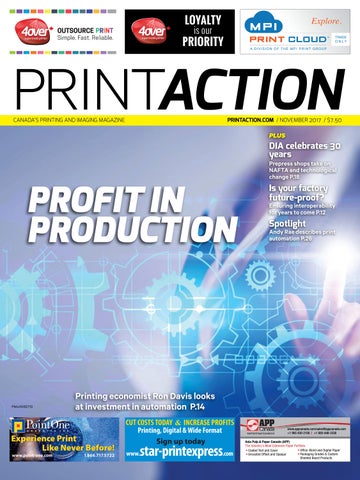
The key to lower cost and higher profits in the printing industry revolves around managing new world automation
18 DIA celebrates 30 years
A leading resource for Canadian print forms in 1987 to focus on NAFTA and the speed of technological change
DEPARTMENTS
GAMUT
5 News, People, Calendar, Dots, Installs, Globe, Archive
TECH REPORT
20 Digital printing engines
Liquid and dry toner presses continue to advance in fifth station units, print enhancements, media formats and raw printing power
MARKETPLACE
25 Industry classifieds
SPOTLIGHT
26 Andy Rae, Head of Marketing, Heidelberger Druckmaschinen AG, describes the smart print shop
COLUMNS
FROM THE EDITOR
4 Jon Robinson
Turbocharge profitability
How to separate yourself through productivity to be a profit leader
ENERGY
10 Anatoli Naoumov
How to sell your team to position yourself as a sales leader 18 6 26 20
Six steps for energy management in manufacturing
Critical reasons to begin developing an energy plan and reign in energy costs
DEVELOPMENT
12 Jennifer Rideout
Is your factory future-proof?
Ensuring interoperability with network technology for years to come
SALES
13 Dave Fellman
We is bigger than me
Turbocharge profitability
Dr. Ron Davis of the Printing Industries of America is a rare commodity in printing as one of a handful of true economists focused on developing independent research for the industry. It is one thing to provide opinion on the statistics of third-party organizations and government agencies, but something entirely different to generate and analyze specific industry data.
A one percent decrease in manufacturing costs (factory expenses and payroll, paper and other materials/ outside services), explains Ron Davis, translates to a 34-percent increase in profits.
Last month, Davis released two reports about what has to be the most-pressing issue facing commercial printers, profitability, which the industry at large has not been taken for granted for at least two decades now – since the business maturation of the World Wide Web, creating new economies and new forms of revenue. Profitability in printing, as in most every manufacturing sector, directly relates to productivity, which is the focus of Davis’ new reports: The Key to Lower Cost and Higher Profits in the Printing Industry and the Impact of Cost on Profitability in the Printing Industry. Davis, focusing on the street price of print, explains, “The bottom line is that productivity driven by automation, innovation, and technology-embedded equipment drives down costs and increases financial performance.The key to managing this complex process is to understand the dynamics of the interactions better than your competitors.”
The most intriguing – and promising – observation born of Davis’ statistical analysis is that a one percent decrease in manufacturing costs translates to a 34-percent increase in profits. Davis explains this potential as it relates to the printers’ profitability defined by the PIA Dynamic Ratios studies, which is analysis not included in this month’s cover story. North America printers have relied on these statistics for years to benchmark their own performance.
In terms of new benchmarking approaches, most major offset press makers are now leveraging Big Data to usher in a new era of productivity analysis, as their printing clients are hooked into the Industrial Internet of Things and sending massive amounts of data into a central repository. This data is then collected into usable information for the printer to build better strategies for daily operations, but also cleansed in a manner to be compared press maker’s worldwide client base.
The PIA’s Dynamic Ratios, however, remain a key component of modern day business building based on an objective analysis of your position amongst profit leaders. PIA’s Dynamic Ratios are primarily generated through general com-
mercial sheetfed printers, but also use other processes such as digital and inkjet.
As profit margins are typically slim, explains Davis, profits increase disproportionally to a given percentage-cost decrease. In his report, Davis explains profit-leading printers (top quartile of profitability) have significantly lower cost structures than those with profit potential (printers at the bottom quartile) with a differential of approximately $13 on every $100 of sales to the profit challengers. This shows that controlling manufacturing costs is a primary driver in increasing profitability, explains Davis. “This reduction in the comparative cost of production has two benefits to the profit leaders. Not only are they making increased profit on their equipment, they also have the flexibility to adjust pricing to increase their conversion rate with estimates, therefore also increasing total sales.”
Relating these findings to PIA’s Dynamic Ratios, Davis explains profit leaders have almost double the investment per factory employee compared to those with profit potential – due to continual performance improvements in equipment, which lead to higher productivity and lower staffing levels. “All of this translates into the number of employees in a company,” he writes, “where the profit leaders save more than two employees per million dollars in sales compared to those with profit potential.”
The profit-leading printers, according to the PIA report, earned almost $8,700 per employee last year compared to a loss of over $600 for those with profit potential. Analyzing your own performance will allow you to know where you are and what types of changes are needed to further maximize your profitability.
Commenting on the PIA report, given a push on 1,000-sheet productivity benchmarking, Heidelberg’s Andy Rae, Head of Group Marketing, stated, “This study shows that the productivity gain only needs to be around 33 percent of the price differential price gap to justify the more expensive purchase. In other words to justify a 25 percent price premium, you need to deliver 8.75 percent more output! For our customers, it means the equipment that produces the lowest cost per sheet based on their capacity need, should be the one to purchase for maximum bottom line benefit – even if it seems more expensive at the time. Productivity trumps cost. Period.”
Editor Jon Robinson jrobinson@annexweb.com
Contributing writers
Zac Bolan, Wayne Collins, David Fellman, Victoria Gaitskell, Martin Habekost, Nick Howard, Neva Murtha, Abhay Sharma
Publisher Paul Grossinger pgrossinger@annexweb.com 416-510-5240
Associate Publisher Stephen Longmire slongmire@annexweb.com 416-510-5246
Media Designer
Lisa Zambri
Circulation Manager
Barbara Adelt badelt@annexbizmedia.com
Customer Service
Angie Potal apotal@annexbizmedia.com
Tel: 416-510-5113
Fax: 416-510-5170
Mail: 80 Valleybrook Drive, Toronto, ON, M3B 2S9
COO
Ted Markle tmarkle@annexweb.com
President & CEO
Mike Fredericks
Subscription rates
For a 1 year monthly subscription (12 issues): Canada — $40.95
Canada 2 year— $66.95
United States — CN$71.95
Other foreign — CN$140.00
Mailing address
Annex Business Media 80 Valleybrook Drive Toronto, ON, M3B 2S9 printaction.com
Tel: 416-442-5600 Fax: 416-442-2230
JON ROBINSON, editor jrobinson@annexweb.com
Alex Christopoulos
ICON Digital Productions of Markham, Ont., acquired a controlling interest in Asterisk Media, a Toronto creative studio. Asterisk will be rebranded as ICON Motion and continue to operate from its current Liberty Village location. Asterisk specializes in creating video content for multiple platforms, including 360/ VR and livestream. This is ICON’s second acquisition of 2017, following its February purchase of Toronto Trade Printers (TTP).
ICON reached $32 million in sales last year prior to its TTP and Asterisk acquisitions. With offices in Toronto, Markham, Montreal and New York City, ICON now operates four divisions with capabilities for display graphics, digital signage, commercial printing and video production.
Imprimerie Ste-Julie received $750,000 in funding from the Government of Canada for the acquisition of a flexographic press to increase its production capacity. The funding – in the form of repayable contributions – was granted through the Quebec Economic Development Program (QEDP), within the larger
framework of the Government of Canada’s Innovation and Skills Plan. Close to $100,000 under the same program was also provided to MIIP to commercialize its products in the U.S. and Europe. MIIP’s flagship product, miipCam, is a camera inspection system for the printing and labelling industries. miipCam was developed in collaboration with Quebec businesses, including Imprimerie Ste-Julie, to reduce the consumption of paper and other substrates, as well as improve efficiency and print quality.
Electronics For Imaging purchased UK-based Escada Systems, which develops Corrugator Control systems for packaging. EFI has a growing interest in corrugated production, primarily based on its 2016 introduction of the Nozomi C18000 single-pass LED inkjet press. The addition of Escada technology enables EFI to expand its Productivity Suite to sheet feeders and corrugated plants.
Canadian Printing Industries Scholarship Trust Fund is providing $75,500 in funding to 47 students for their current school year. A total of $33,000 was awarded to 22 new students enrolled in the first year of an approved course of study. A further $37,500 was awarded to 25 students already
enrolled in the program.
DATA Communications Management moved to acquire BOLDER Graphics of Calgary, Alberta, for $4.9 million. With around 40 employees, BOLDER generated approximately $7 million in revenues (unaudited) for the fiscal year ended January 1, 2017. BOLDER’s staff and operations are to be moved into DATA’s 165,000-square-foot facility in Calgary. DATA also announced plans to integrate its Multiple Pakfold operations into its 269,000-square-foot facility in Brampton, Ont. Multiple Pakfold is a supplier of business forms, cheques and labels to the trade printing market, with around 100 employees.
AlphaGraphics, a global franchisor of printing businesses, has been purchased by fellow franchisor Mail Boxes Etc., which now holds a network of approximately 2,600 locations in 39 countries. MBE also acquired the U.S.-based PostNet franchise system in April 2017. AlphaGraphics will continue to operate as an independent company and retain its current management team, with headquarters in Salt Lake City.
Graphic Packaging International (GPI) is merging International Paper’s packaging operations in a transaction valued at $2.3 billion. As a result IP will receive a 20.5 percent interest in the company, which will be one of the largest folding-carton and packaging operations in North America, generating approximately $7.7 billion in annual revenues. The transaction, expected to close in early 2018, is to be structured as a new partnership called Graphic
Packaging Holding Company (GPK). There will be no change to GPK’s current leadership team. The transaction includes 3,900 employees located at 10 locations. GPK, headquartered in Atlanta, Georgia, is global company with two Canadian operations in Cobourg and Mississauga, Ont.
Smithers Pira released a new report called The Future of Label Printing to 2022, projecting that market to expand at an average of 2.8 percent year on year to yield a total value of $39.5 billion in 2022. The Smithers Pira report shows the label printing market in 2017 is worth $34.5 billion globally. This contrasts with an annual growth rate of just 1.2 percent in the wider print market. With over 465 billion A4 sheet equivalents in 2017, according to Smithers Pira, Asia is today 46 percent of the worldwide label market by volume. Above average growth will push this to 48 percent by the end of the study period.
Sun Chemical entered into a licensing agreement to introduce a family of molecular inks for the printed electronics market with Groupe Graham International (GGI), a developer of user interfaces for touch applications, and the National Research Council of Canada (NRC). The new ink technology developed by GGI and NRC will be produced by Sun Chemical and promoted by all three organizations. Based on ionic molecules processed through a reduction process, the new IPS products will offer a viable alternative to conventional polymer thick film conductive inks and serve as a low-cost alternative to nano materials. The IPS family of products includes silver and copper metallization options that can be applied by screen, inkjet or other high-speed printing methods.
Toshiba Business Solutions Canada selected PrintReleaf as a partner in its Platinum services program. PrintReleaf will now automatically plant trees equivalent to the paper used by Toshiba Platinum customers. Toshiba has 10 branches across Canada.
Durst US formed a partnership with Media One Digital Imaging Solutions to sell Durst equipment in the Rho, Rhotex & Alpha printer lines throughout the U.S. and Canada. Media One focuses on large format print and finishing solutions for the textile market.
ICON Digital’s CFO
(left to right) with company co-founders Juan Lau and Peter Evans.
Imprimerie Ste-Julie is a family business founded 42 years ago.
Gabriel Matsliach, Senior VP and GM, EFI Productivity Software.
DATA CEO Michael Sifton and President Gregory Cochrane.
INSTALLS
Naoya Kawagoshi becomes President of Mimaki USA, a manufacturer of wide-format inkjet printers and cutters. He was previously VP of Sales for Mimaki USA covering the U.S. and Canada. Kawagoshi came to Mimaki USA in 2012 from Mimaki Engineering (Nagano), where he was the Director of the Japan Sales Promotion department. Prior to that, he held progressive sales and management positions at the Mimaki Fukuoka and Tokyo branch offices. Yasuhiro Haba who previously served as President of Mimaki USA returns to Japan to lead new sales initiatives for the Americas, Asia/Oceana, and China.
is noted for his track record for successful machine start-ups and rebuilds, as well as product development for emerging markets.
Paul McCarthy becomes Indigo Country Manager for HP Canada after working with Konica Minolta Business Solutions (KMBS) Canada for 18 years. He most recently held the position of Director of Print Production for KMBS, for more than three years, after holding various senior sales management roles with the company. Before joining KMBS, McCarthy spent two years with Pitney Bowes. He currently serves on the board of the Digital Imaging Association.
Mark Hischar , President and CEO of Koenig & Bauer North America, was elected Chairman of NPES, The Association for Suppliers of Printing, Publishing and Converting Technologies. Four new directors of the NPES Board include: Kelly Mandarano, Director, WW Marketing & Communications and VP, Print Systems Division, Kodak; Doug Schardt, Director of Product Management, Komori USA; Kevin Abergel, VP of Sales and Marketing, MGI; Brent Moncrief, VP, Strategic Marketing & Brand Management, Fujifilm North America.
Edward Dwyer becomes President and Chief Executive Officer of Catalyst Paper, based in Richmond, BC. He has more than 30 years of experience in the pulp-and-paper industry. Dwyer most recently served as Catalyst’s COO and
Jim Lambert becomes Vice President of Digital Sales, Ink and Hardware, for INX International Ink Co. He most recently served as VP and General Manager for the digital division of INX International. He has over 35 years of printing industry experience. Lambert was the co-owner of Innovative Solutions Inc. in Huntsville, AL when INX acquired the digital printer and integration manufacturing company in 2007. Previously he headed the publishing and prepress division at Intergraph Computer Systems, where he was recognized as one of the top 100 industry professionals in 1998. He also served as VP for JL Troupe Co., an engineering and product development organization with clients that included Federal Express.
Mathew C. Mathew, Technical Manager with Sun Chemical, was honoured by the National Association of Printing Ink Manufacturers (NAPIM) with the Technical Achievement Award. Some of Mathew’s most notable achievements in the industry include his work formulating: conductive inks for touchscreen devices, packaging laminating inks, water-based technology for printing on film, and energy-curable inks. He has worked with Sun Chemical for 30 years and in the industry for 34.
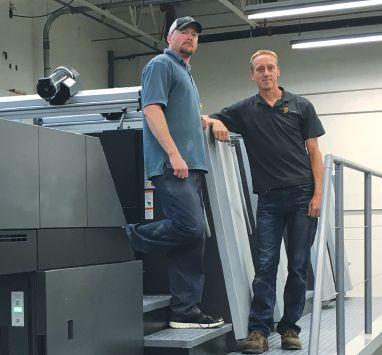
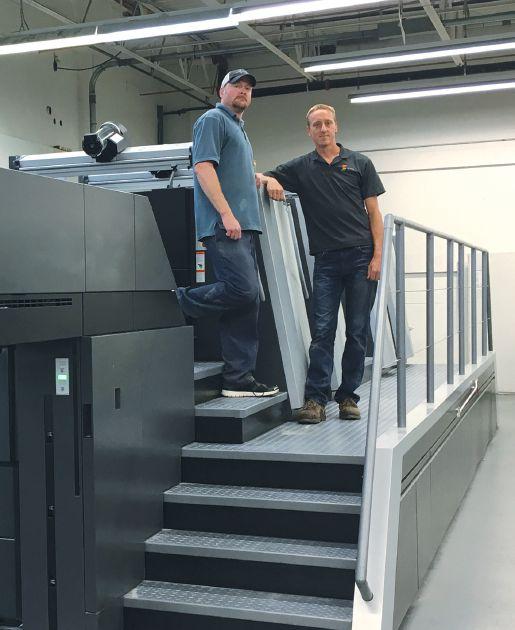
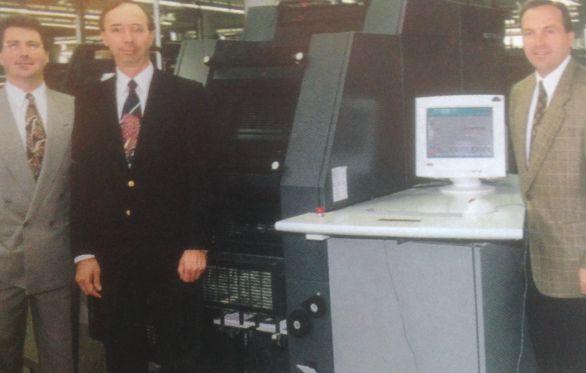
Premier Printing of Winnipeg installed a Heidelberg Speedmaster XL-106-4P, pictured with Danny Miller (left), Press Operator, and Ted Gortemaker, Operations Manager. The press features AutoPlate Pro plate loading, Prinect Axis Control Spectral measuring, and dynamic sheet brakes. Premier also installed a TH-82-P Stahl folder with PFX feeder, doubling its finishing throughput.
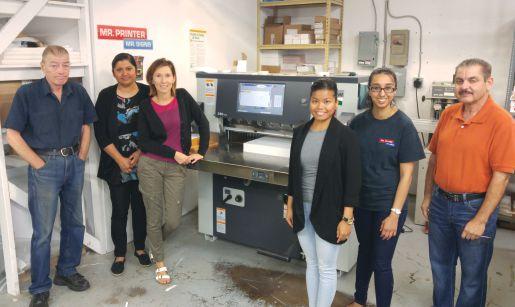
Mr. Printer of Etobicoke invested in its finishing department, primarily through Sydney Stone, with a Mohr 80 NET cutter, Morgana Digifold PRO, Morgana AF System 2000, Horizon BQ 140 and a Challenge EH3C drill.
Dr. Vlad Sljapic joins Xeikon as VP of Global Sales. He holds a degree in Mechanical Engineering and a Masters in Engineering Management, and recently read for a Ph.D. in nanotechnology applied to inkjet printable electronics. Most recently he was running the EMEA business for the Domino Digital Printing division prior to joining Xeikon.
Danny Oblad becomes President of Fortusis LLC, which in October acquired the ICED print brands of Kwik Kopy Printing, Kwik Kopy Business Centers, The Ink Well, Franklin’s Printing, and American Wholesale Thermographers. Oblad is the owner of a Kwik Kopy in a suburb of Salt Lake City.
CJ Graphics added a six-colour Heidelberg XL106 press to its existing sheetfed line-up of two 6-colour XL presses, forming the backbone of its new facility in Mississauga. The newest press, equipped with Press Center XL 2, is being directed toward Heidelberg’s Push To Stop autonomous operating philosophy.
GLOBE
Onset lands in Elk Grove
Schiele Group of Elk Grove Village, one of the largest printers in the Chicago area, has added a new Onset for its retail interests, with an emphasis on producing high-quality backlit signage. In 1948, Henry Schiele opened a small print shop in an old barbershop. His modest enterprise, that began with two small presses, grew over the years with the integration of eight companies. Today, Schiele Group is a multi-plant operation that produces more than 2-billion pieces of printed materials a year.
Schiele Group’s new Onset R40i, distributed exclusively in North America by Fujifilm, is a flatbed UV machine with a print array that proivdes a 123.6 x 63inch printable area. Fujifilm explains the system’s design helps to eliminate gloss matte banding normally associated with traditional step-an- repeat inkjet printing.
Running two shifts per day, five days a week, Schiele Group is running several hundred different items, sizes, shapes on its Onset. “Since we’ve had the Onset R40i, we’ve been hiring additional sales staff. This is a great area of growth for us,” said John Schiele, President, Schiele Group. “This machine is very consistent. It’s easy to produce two-sided output, with perfect registration. With our previous equipment, it was just brutal to print one side, and then attempt to feed it back through on a latex machine.”
Schiele prints often for grocery stores, cosmetics firms, auto repair shops, and convention displays.
Two Rapids for Dome
One of California’s largest privately held printing companies, with more than 250 employees, Dome, by the end of its 2017 fourth quarter, aimed to complete the consolidation of its five facilities. The company was moving all of its assets into a newly renovated 320,000-square-foot facility in Sacramento’s McClellan Park.
In conjunction with the new facility, Dome began a new partnership with KBA to install two sheetfed presses, including a 41-inch, 10-colour Rapida 106 UV perfector and an 81-inch Rapida 205 large-format offset press.
The company explains its new KBA presses will add creative options for the display designers who are employed by Dome’s retail clients. This includes offering an enlarged litho format of 81 inches and the greater reproduction versatility afforded by a 10-colour press. Dome provides retail instore media, direct mail and general commercial print, and operates ArrowClick E-Commerce and Custom Fulfillment services.
“With these purchases, Dome is taking a bold step into the world of super-large format and super-speed sheetfed offset printing,” said Misha Pavlov, Dome’s President. “The KBA Rapida 205’s XXL sheet size with 5-colour UV printing, on substrates up to 48 points at 9,000 sheets per hour, is the perfect addition to our business.
“This is a game-changer for Northern California, Oregon, Northern Nevada and Washington,” continued Pavlov, “enabling Dome to serve customers and prospects in these markets better than anyone, as this is the only 81-inch press in the area.”
The large-format Rapida a 106 is a 10-colour, double coater, full-interdeck UV press, features that aid in the makeready of a 10-colour press. Dome explains the press will bring increased quality, efficiency and greater productivity while offering high-end applications previously not offered in-house. The presses were set to be up and running by the end of 2017.
Flint XCURA EVO in Dorchester
Tegan Al Fateh-Jamjoom Packaging established a folding-carton factory in a new industrial area of Rabeg City, located in Saudi Arabia. Established in 1998 as a systems supplier, the company is venturing into printing with the installation of a Roland 706 LV Evolution press with Telepresence and InlineColorPilot.
Epic Creative Print of the UK has retrofitted UV LED lamps to its 6-colour Mitsubishi press, leveraging Flint Group’s XCURA EVO technology. “Installing UV LED broadens our opportunity to sell creativity,” said Mark Downey, Managing Partner of Epic Creative Print, based in the prehistoric market town of Dorchester in South West England.
In 2013, Epic launched its branded HiLite service to produce special effects and textures through its Mitsubishi Diamond 1000 press, as well as an Indigo and a Scodix enhancement press. “Our customers began asking for larger print runs of some of our most highly creative designs which we were producing on our Scodix and Indigo, but longer print runs doesn’t mean reduced unit cost in this case, so we began investigating the possibilities UV LED might offer,” said Downey. “We use all kinds of substrates, from light uncoated stock, 100 percent recycled boards and specialist substrates, through to silvers like Mirri Pak, our own in-house foil papers and laminated substrates. We thought we may be able to transfer some of the longer run length work to litho with UV LED.”
Flint Group’s technology partner AMS Spectral UV, now part of Baldwin Technology, was responsible for installing the UV LED lamp, chiller and control unit.
John Schiele, President, Schiele Group, with the Inca Onset R40i at their Elk Grove Village, Illinois, facility.
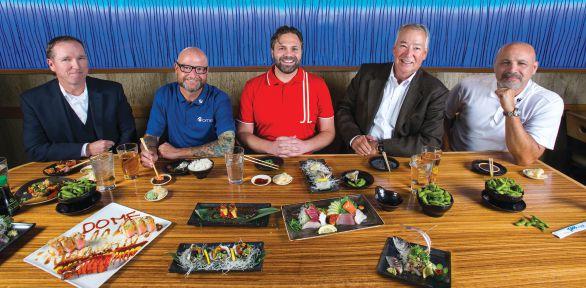
Dome’s CFO Eric Carle (left to right), CMO and partner Bob Poole; President Misha Pavlov; CEO and partner Tim Poole; and Executive Vice President of Sales Sherwin Poorsina. (Photo/Jeremy Sykes)
Epic Creative’s Jason Johnson and Mark Downey.
25 years ago
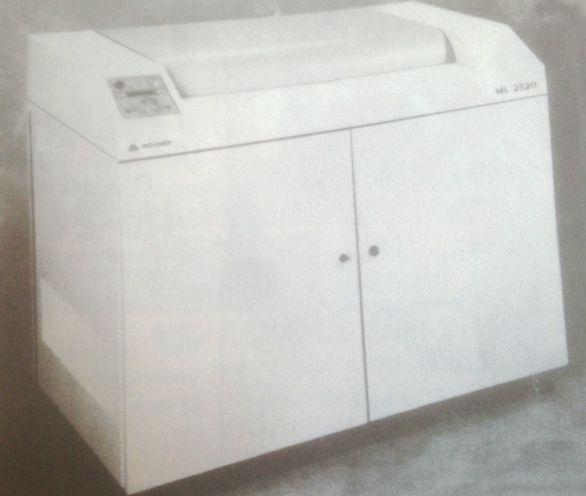
Imagesetter Compatible with Misomex: A new PostScript-compatible laser imagesetter, designed to eliminate manual stripping, was recently introduced by Misomex North America. The ML2520 produces high-resolution output of fully imposed pages using a standard Misomex format. The company explains it was designed for accurately positioning films in a unique zone-controlled vacuum drum, which provides materials savings and format flexibility. Digitally stored pages and conventional film originals can also be combined with less manual intervention.
20 years ago
Litho Acme Adds DI: Litho Acme in Montreal, a member of Transcontinental Printing Inc., has installed a Heidelberg Quickmaster DI 46-4. A full service commercial printing facility with a complete digital prepress structure, Litho Acme employs 160 people.
15 years ago
Creo Named Business of the Year: Creo has been named as the Business the Year by the Burnaby Business Excellence Awards program. Founded in Burnaby in 1983, Creo receives the award a month after being named as the largest high-tech company in British Columbia on the T-Net 100.
Creo is also the province’s first technology company to achieve revenues of $1 billion. Creo reported revenue of $1,018,223,000 in 2001 – an increase of $91 million or 9.8 percent over the previous year. Creo’s revenue was more than twice that of the second-largest company on the T-Net 100, MacDonald Dettwiler and Associates ($481.3 million), and nearly three times that of PMC-Sierra ($346.2 million).
$80K
For sale (2002 classified): High quality 40-inch CTP machine. $80,000 or best offer, includes six months bumper to bumper warranty.
$8.9K
For sale (1992 classified): Compugraphic typesetter 8400. One dual disk drive, 2 video display terminals, 2 keyboards, one controller, 26 fonts. $8,900 or best offer. Must sell.
Pictured with the Quickmaster DI are: Alain Doutre, Sales Manager, Jean Denault, General Manager, and Alain Trahan, Production Manager, all with Litho Acme in Montreal.
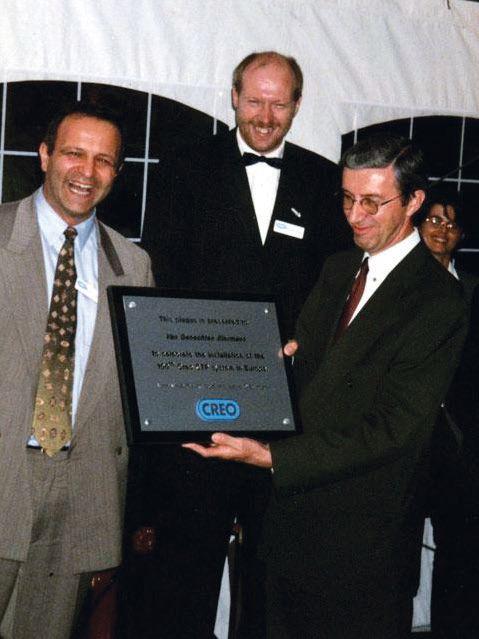
Amos Michelson (left) and Boudwijin Neijens (centre) of Creo Inc. celebrate the sale of the company’s 100th CTP device, manufactured in Burnaby, BC.
DOTS
CALENDAR
Private brand package Vertex
In mid-2017, a crowd of retailers, agencies, designers and print manufacturers gathered at the Hilton Amsterdam to celebrate the winners of this year’s international private brand design competition. This year’s competition included more than 300 entries from 25 countries and 49 retailers from around the world, including representatives from packaging powerhouse SGK.
A division of Matthews International Corporation, SGK and its Anthem (design) and Schawk (production) divisions has a global footprint in more than 20 countries. In total, the company’s brand development and brand deployment agencies won seven Gold, Silver and Bronze Vertex Awards for their private brand packaging work.
SGK’s Anthem Toronto office won Gold and Silver Awards for its packaging design done for Walmart. Marque Brand Consultants, an Australia brand-building entity controlled by SGK, won four awards for Woolworths packaging and Schawk’s on-site team at Lowe’s in North Carolina won a bronze. SGK is unique in the printing world focusing on brand development, activation and deployment provider that drives brand performance.
The Vertex Awards are the only global competition devoted exclusively to the art of private brand packaging design. This year’s Vertex Awards IV competition included entries from North America, South America, Europe, Asia and Australia. The awards are judged by a panel of industry experts from around the world and awarded based on Creativity, Marketability, and Innovation.
“We are fortunate to collaborate with clients who understand the power of strategic packaging design,” said Wendy Kufeldt, Managing Director of Anthem. “Effective design communicates and embodies the brand promise, enabling breakthrough results on shelf and delivering a distinct consumer experience.”
Schawk’s on-site team in North Carolina at Lowe’s won a bronze for its Lighting Portfolio Grouping.
Anthem Toronto was awarded Vertex Gold and Silver for the packaging design of Walmart’s Sam’s Choice Honey.
Marque Brand Consultants, SGK’s regional brand development agency in Australia, won for Your Majesty, working with Woolworths.
December 5, 2017
Digital Print Japan 2017 Tokyo, Japan
January 13-16, 2018
PIA Color Conference
Hyatt Regency Mission Bay, San Diego, CA
January 23-26, 2018
EFI Connect
The Wynn Las Vegas, Nevada
February 22-24, 2018
Graphics of the Americas Fort Lauderdale, Florida
March 10-12, 2018
South China International Exhibition on Printing Import & Export Fair Complex, Pazhou, Guangzhou
March 22-24, 2018
Sign Expo 2018
Orlando Convention Center, FL
May 1-2, 2018
InPrint USA
Palmer House Hilton, Chicago, IL
May 15-18, 2018
FESPA 2018 Global Print Expo Messe Berlin, Germany
June 6, 2017
PrintForum Trade Show & Conference
The International Centre, Mississauga, ON
June 19-20, 2018
2018 Print & Packaging
Legislative Summit Washington, DC
September 26-27, 2018
Label Expo
Donald E Stephens Convention Center, Chicago, IL
September 30-October 3, 2018
Graph Expo 2018
McCormick Place, Chicago, IL
October 18-20, 2018
SGIA Expo
Las Vegas Convention Center
October 24-28, 2018
All in Print China
New International Expo Center, Shanghai
June 16-26, 2020
Drupa 2020
Dusseldorf, Germany
Canadian supply
Six-step energy management
Generation in Canada – 639 TWh (2014)
Generation by source, 2014
With the increasing pressure on Canadian printers to reign in energy costs, there are critical reasons to begin developing an energy plan
By Anatoli Naoumov
hen it comes to energy management, the key word is management, not energy. As such, all the rules of management apply, which means everything starts at the top. This reality determines everything. So how do we achieve effective energy management in a manufacturing setting?
Step #3: Set an energy consump
tion baseline and track usage
• Over-cooling a frozen food warehouse overnight at lower nightly rates will lower consumption during peak times, or reduce peak demand.
• Staged start of major machines decreases demand.
• Accurate forecast of natural gas consumption allows you to buy it in lower-priced blocks.
Step #5 - Recognize value beyond energy cost reduction
Energy does not disappear; it powers up machines that either create value or create waste. Non-energy waste routinely exceeds the cost of wasted energy. Consider these energy trouble alerts at an industrial bakery:
64%, first in the G7
-
The creation of an energy consumption baseline must be the starting point of any energy management effort. This understanding will direct energy-efficiency work and enable actionable evaluation.
Canada’s economy, as a developed nation, is driven by a range of energy sources, outlined by the above chart.
• Increased electricity consumption at freezer may signal loss of insulation or open door. Both may lead to product loss, slippery floor or mould.
Generation from non-GHG emitting sources: 80%, second in the G7 after France
• Compressor coming online during non-production hours signals air leaks or unauthorized operations.
Step #1: Effective energy management requires a C-level champion
Practically speaking, when none of the Top Guns care about energy management – or, at the very least, energy efficiency –nothing significant will be achieved.
There can be implementations and installations of energy-efficiency projects, conservation initiatives, reports and presentations, incentives and bonuses, but without C-Suite buy-in the company will miss opportunities for reaping strategic benefits in energy management, namely differentiation and cost.
Step #2: Energy is everywhere, management of it should be too
Your Top Gun’s job is to set up a cross-functional team to figure out the role energy plays in the value creation chain, and what changes would create the most bang for the buck. The team must identify current consumption and its key drivers, develop energy-use reduction strategies and set targets. Those targets should then be linked to performance evaluation of unit managers. Energy is procured for the production floor, not the corner office.
To make energy-efficiency results possible, people on the production floor must have understanding and real-time visibility of consumption. People on the floor must also have the means and authority to take action and share benefits from achieved results.
In the absence of a baseline, how are you going to determine and report results? A comparison to last year’s bill is a risky idea, especially for the energy manager’s year-end bonus. I mean, try predicting your utility bill after the following: high-efficiency motors installed on the production floor; production volume increased by 5 percent; size of final product changed by 12 percent; tariffs grew by 5 percent; reject rate varied between 5 to 8 percent. Were I in charge of energy efficiency, I would not like my performance evaluated against the utility bill.
Tracking energy-efficiency projects results may make the difference between triumph and disaster in the boardroom. Accurate energy-consumption tracking and recording any changes in factors that drive consumption are the keys to demonstrating results that can withstand any boardroom criticism.
Besides, accurately tracking energy use and acting on deviations not only routinely leads to reduced consumption, but also uncovers operational issues, quality risks and performance losses.
Step #4: Distinguish between utility bill and consumption
Your utility bill is determined by consumption and tariffs, while energy consumption is determined by production needs. Plus, not all kWhs cost the same! Natural gas can be procured at substantially different prices. Consider both energy procurement and energy consumption to find ways of lowering that utility bill. Consider:
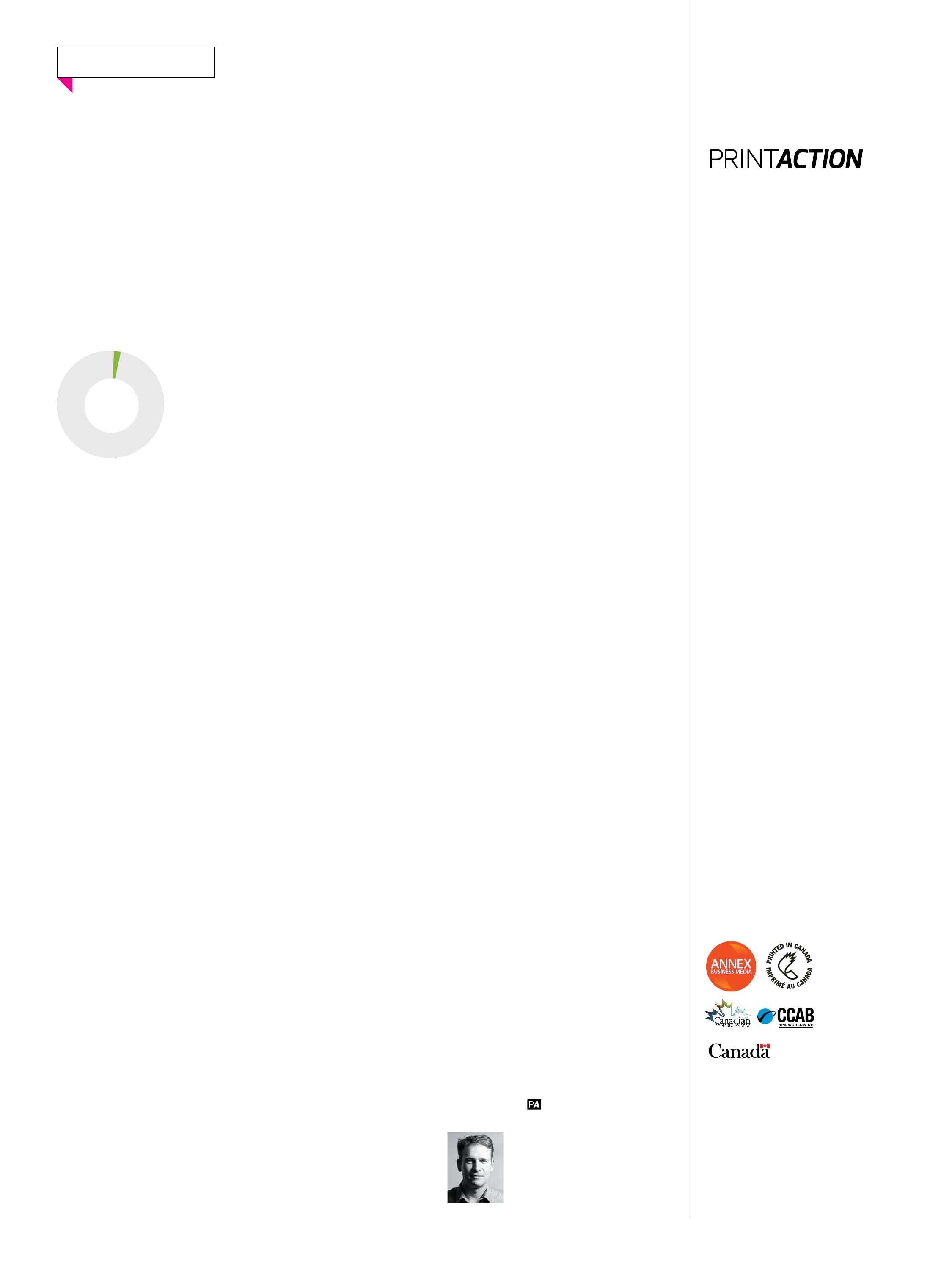
According to a 2016 Federal Energy Fact Book Report, Canada at 64 percent was first among G7 countries in its use of electricity being generated from renewable sources. 64%
• Increased electricity consumption by a mixer during stable production may mean wrong recipe or the need for preventive maintenance.
On the positive side:
• Better lighting results in fewer mistakes in packaging and sorting.
• Stable load extends life of motors and prevents production stoppage.
Energy management measures often create value for businesses even without a reduction in energy consumption. For example, power factor correction can reduce the electricity bill with no changes on the production floor. In the same manner, harmonics do not affect electricity consumption, yet they can disable electronics, leading to costly production.
Step #6:
Communicate results consistently
Stakeholders and employees pay attention to their company’s environmental standing, so make results public, visible and transparent. Better yet, engage employees in energy conservation and link results to their paycheques, or maybe offer a $50 “energy conservation” year-end bonus. Proud employees demonstrate higher productivity and lower absenteeism, and stay longer with the company as well – all this because you embraced the rules of energy management.
Anatoli Naoumov, MBA, MSc, CMVP, is a managing partner and “chief energy waste buster” at GreenQ Partners. He is certified as a measurement and verification professional by AEE and EVO.
Is your factory future-proof
Entering 2018 there are four must-haves to future proof your facility: Talent, cybersecurity, the right industrial network, and culture
By Jennifer Rideout
The Oxford dictionary defines future-proof as “[a product or system] unlikely to become obsolete.” I admit, in an era of unprecedented technology advances, the concept of a future-proof factory floor may seem disingenuous. After all, what is bleeding-edge today will be table stakes tomorrow.
But there are enough commonalities across these advancements in technology that the idea of a future-proof factory should be taken seriously. In a word… Ethernet. The introduction of industrial IT networks to unify, protect and streamline data on the factory floor has revolutionized manufacturing, and that can no longer be ignored.
The advantages an Ethernet IT network creates on the factory floor – improved product quality, machine utilization and a reduction in unplanned downtime, to start – breeds continued success for early adopters. Their advantage multiplies the longer it takes competitors to adopt new technologies. And while an industrial network is a large part of future-proofing your factory floor, ensuring interoperability with technology for years to come, there are other considerations to ensure you have a factory that’s built to last.
Is your factory future-proof? Consider the following:
Must-have #1: Talent
Investing in your people and technology go hand-in-hand. Without the right technology, your people cannot produce their best work. Without the right skills and talent in your organization, even the best technology will go to waste.
A future-proof factory requires the right technology and the right talent to operate it. My colleague dove into this topic a few issues ago, explaining how investments in technology and talent can complement each other.
An investment in video conferencing technology, for example, not only makes it possible to introduce remote troubleshooting and video on the factory floor – it also provides a way to train employees and offer continuing education programs.
Consider this: Do you have the right talent to lead you into the future?
Must-have #2: Cybersecurity
The introduction of Ethernet to the plant floor has created new challenges for IT and manufacturing leaders. One of the most significant is cybersecurity, as factories continue to be one of the most attractive targets for malware and ransomware attacks.
At a minimum, any plans to future-proof your factory must include a defence-indepth cybersecurity strategy. Yet manufacturing leaders often underestimate the importance of this issue. One-fifth of Canadian manufacturers admitted they have not taken any steps to defend against cyber attacks. Would you trust those companies with your data?
A cybersecurity strategy protects not only your data and equipment, it also increases consumer confidence. And with proper security layers in place, such as an Industrial Demilitarized Zone (IDMZ) and access controls, data goes where you want it to – nowhere else.
Consider this: Are your machines safe from cyber threats?
Must-have #3: Industrial network
Most factories have an industrial network.
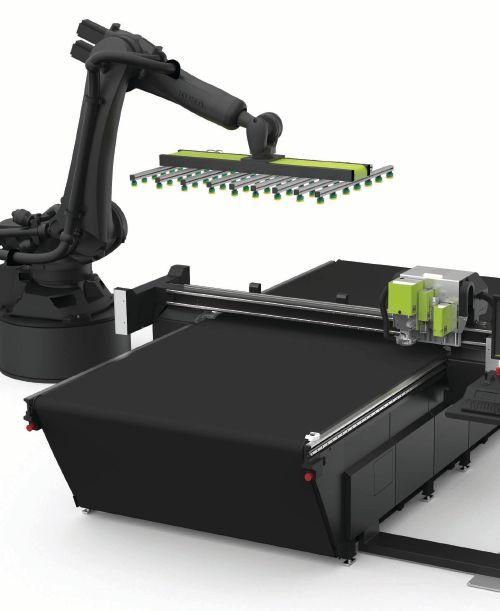
Esko’s robotic approach to handling large-format substrates was introduced in mid-2016, as more industrial automation continues to reach into the printing industry.
The problem is that many legacy industrial networks are flat, with no segmentation of traffic between controls, process devices, supervisory devices, and factory operations. The problem? If an issue arises in one part of your factory – let’s say hackers compromise one machine –there is no barrier from that machine to the rest of your floor. Or, if the single switch networking your PLCs and HMIs fails, the damage to production could be debilitating.
The other risk of a flat network is bandwidth. Factory managers run the risk of adding devices that can’t be supported, out-scaling the network and causing outages.
The right industrial network follows a segmented design architecture, so traffic is routed properly, securely and without data loss. That same architecture should prioritize network redundancy, so if one switch fails, another picks up the excess traffic. Production stays online, your machines are secure, and your network can handle the addition of new machines moving forward.
Consider this: Is your industrial network flat?
Must-have #4: Culture
Building a factory for the future requires leadership. Implementing the items above requires significant financial, time and human resource investments that should not be ignored. To be successful, leadership must fully commit to these changes and initiate a cultural shift for employees to follow.
Data supports that manufacturers who make these changes see improvements in factory productivity, uptime, and machine health. Introducing these concepts to leadership and having a conversation around factory vulnerability is a good way to gauge readiness for a future-proof factory.
Business Development Bank of Canada identifies six trends that will fundamentally reshape Canada’s future business landscape, including: The aging workforce; the rise of the millennial generation; a more culturally diverse population; the growth of virtual marketplaces; the automation of business activities; and the rise of the data economy.
Consider this: Has your company’s leadership embraced the adoption of advanced technology?
The demand from customers for highly personalized, ready-made products will not decrease. The manufacturers that can deliver on these expectations will have the technology, people and culture to thrive in the digital era.
Will that be you? Only time will tell.
This column was originally published in the October 2017 issue of Manufacturing AUTOMATION, a property of Annex Business Media.
Jennifer Rideout is the manufacturing marketing manager for Cisco Canada, responsible for developing go-to-market strategies for the manufacturing sector in Canada. jerideou@cisco.com.
We is bigger than me
How and why to sell your team to better position yourself as a leading printing salesperson
By David Fellman
In last month’s column, I wrote about five fundamental questions. This month, I want to write about a fundamental idea, that the first thing a salesperson has to sell is their self.
Okay – that’s obviously true, but what exactly does it mean? And how far does it take you toward the ultimate goal of printing sales success?
To sell yourself effectively, you really need to sell me on two interrelated elements. The first is that you know what you’re talking about. The second is that you’ll do what you say you will do.
If I decide that I can believe both of those things, I’ll probably think seriously about buying from you. If I don’t believe either one, though, I probably won’t.
Think of it this way. You sell a custom-manufactured product. It doesn’t exist until I place an order and you produce it – and every printer knows there’s a lot that can go wrong between the order and the delivery.
If I’m not convinced that you know what you’re talking about, I cannot be sure that you know enough to prevent any of those things from going wrong. And if I’m not convinced that you will do what you say you will, I cannot be sure that buying from you won’t turn into a painful experience.
Selling trust
Please understand this, it’s not a matter of whether I like you. That is a part of most people’s decision-making process, of course, but it’s not the most important part.
The real issue is whether I trust you, to keep all of the promises you make in the selling process.
And I’d like you to give some thought to just how many promises you make. You’ll be happy with the quality.You’ll be happy with the service. We’ll deliver on
Quality control is
a primary part of good printing companies, but the insurance provided by solid quality processes and procedures is often not sold to print prospects.
time. I work with a great team, and we’re all committed to your complete satisfaction!
Selling is largely about making promises, especially selling a custom-manufactured product, and customer satisfaction is mostly about keeping all of those promises.
Selling the team
While it’s true that you have to sell yourself, it’s also true that you have to sell your company. But that’s the wrong way to phrase it! Rather than talking about your company, I strongly suggest that you talk about your team – as in, I work with a great team, and we’re all committed to your complete satisfaction!
What’s the difference in the terminology? It’s been my experience that when salespeople talk about their company, they usually talk about equipment and capabilities. But does it really make any difference to a buyer whether a job runs on a Heidelberg or a Komori?
When you talk about your team, you can talk about people and processes, and that’s really where differentiation lives. You can be in competition against a company with the exact same press, but not the exact same people, and rarely the exact same processes.
Selling processes
meets or exceeds the customer’s expectations, so the most important process in printing is quality control.
Here’s another very fundamental idea. Quality control adds time and therefore cost to print production. Another way to say that is the lack of quality control equates to cutting corners. As a buyer, would you want to buy from a company that cuts corners? Would you be willing to accept a higher cost from a company that doesn’t?
I know that I can’t speak for every buyer, but it’s been my experience that most will pay what it costs to get what they really want. Sadly, most printing salespeople aren’t very good insurance salespeople. In other words, they don’t try to sell a higher price as insurance against quality failures, insurance provided by solid quality control processes and procedures.
Selling quality control
Now make no mistake, this is not just a matter of mentioning your commitment to quality control. I’m talking about really selling it, explaining your processes and procedures in detail, and providing evidence that they’re being followed. How do you provide that evidence? I might suggest introducing your prospects and customers to the people who actually do the work, either in person on a plant tour, or using video.
One of my clients produced short video “interviews” with every staff member, focusing on their experience and time in service to the company, and stressing their role in the quality control process.
The salespeople use those videos as part of the selling process, and the result seems to be a smooth and effective transition from the salesperson selling himself/herself to the salesperson selling the entire team.
My dictionary defines “process” as a series of actions or steps taken in order to achieve a particular end. The most important end in printing is quality that
As one of the salespeople told me, “The ‘we’ is way bigger and stronger than the ‘me.’ I can see how my prospects and customers respond to the idea that I’m the front end of a whole team of talented people.”
PROFITABILITY IN PRODUCTION
The key to lower cost and higher profits in the printing industry revolves around understanding productivity and managing new world automation
By Dr. Ron Davis
Today’s printing industry is a capital-intensive business that is a hybrid of production, distribution, and ancillary services. In this article, I examine the relationship between productivity and profitability in print, using independent industry data for sheetfed commercial printers covering primarily commercial and advertising, direct mail and packaging, while the budgeted hourly rates are from an industry accepted source.
First, let’s define productivity from an economic perspective. Productivity is the connection between inputs (resources used to produce a good or service) and outputs (the quantity of goods or services produced). Productivity goes up if we can produce more output for the same
amount of inputs or produce the same amount of output with fewer inputs.
In the printing industry, typical economic metrics for productivity are sales per employee, sales per factory employee, or value added per employee or factory employee. Here I focus on the value-added component. A comparison of these metrics for sheetfed printers dramatically demonstrates how much more productive profit leaders (top quartile of profitability) are than those with profit potential (lower quartile of profitability). For example, profit-leading printers produce in excess of 44 percent more value added per production worker than those with profit potential.
It is important from a business’ perspective to understand what underlying reasons for this differential. A vital reason for this competitive advantage in produc-
The complex recipe for print production results in over 100 separate cost-expense items for a typical printer’s chart of accounts. However, these can be grouped into the main categories shown in Figure 1, top left.
Investment in Machinery per Employee (figure 2)
A $10-million profit-leading printer would have 17 fewer factory employees than a printer with profit potential. This reduction in staffing significantly impacts the profitability of the printer.
tivity is the difference in machinery and equipment per factory employee. Data indicates high-profit printers are much more likely to substitute capital for labour. In fact, high-profit printers have almost double the investment per factory employee compared to low-profit printers. Why is capital investment an important factor in profitability? Higher investment on the factory floor equates to less labour in the factory. Indeed, high-profit printers use approximately 30 percent fewer factory employees per million dollars of sales. For comparison purposes, a $10-million profit-leading printer would have 17 fewer factory employees than a printer with profit potential. This reduction in staffing significantly impacts the profitability of the printer.
This comparative focus on equipment and efficiency allows high-profit printers to achieve a big reduction in direct labour cost as a percentage of value added with a savings of around 7 percent (Figure 2).
It is important to understand how this lower cost is achieved. The cost to manufacture an item is comprised of material costs, cost to produce it (budgeted hourly rate or BHR), and how many of the item can be produced over a period of time (productivity). Let’s consider a simple case of two manufacturing scenarios for the same item. The first has a BHR of $300 and net productivity of 1000 items per hour, while the second has a BHR of $360 and net productivity of 1500 items per hour. In the first case it costs $0.30 per item, while in the second it costs $0.24 per item.
The second manufacturing scenario, while at a higher BHR, has a lower manufacturing cost. This clearly demonstrates that both BHR and productivity should be considered in tandem when evaluating your manufacturing costs.
Now, let’s examine in more detail the connection between the cost of equipment (in this case a press), the BHR, and press productivity. In general, the depreciation and finance cost of a new press makes up between 20 to 35 percent of budgeted hourly rates. The remainder of the BHR is composed of manufacturing labour, other manufacturing costs,
and sales and administrative costs.
On this basis, higher equipment costs translate to only approximately a 6- to 10-percent increase in BHR depending on the factors above. This could be considered a significant difference in a competitive industry like printing. However, this difference is significantly impacted by any productivity difference in equipment as indicated above.
In the example for a typical two-shift operation, a 25-percent premium in equipment costs is equalized by an 8.75-percent difference in equipment productivity, a factor defined as the productivity equalizer. In general, productivity is three times more important than price differential between equipment. Therefore, in this case, at any productivity difference above 8.75 percent, the business would reduce costs and increase profitability despite paying 25 percent more for the equipment.
The bottom line is that productivity driven by automation, innovation, and technology-embedded equipment drives down costs and increases financial performance. The key to managing this complex process is to understand the dynamics of the interactions better than your competitors.
Impact of cost on profitability
Pinpointing how costs impact profitability in the printing industry is critical for printers to understand and leverage in their businesses. The underlying drivers of profitability are sales or total revenues, prices they charge, and cost structure.
In general, increased sales, higher prices, and lower costs all add to the bottom line and the profitability of companies. Last year, a typical sheetfed printer’s costs comprised just under 98 percent of total sales, leaving only two-percent profits across the industry. Often in today’s print market, there is a “street price” for the product, above which the printer cannot increase their pricing unless there are additional value-added services. Printers can increase profitability by analyzing their sales and operations, making business changes that increase sales volumes, and or lowering their
manufacturing costs.
The complex recipe for print production results in over 100 separate cost-expense items for a typical printer’s chart of accounts. However, these can be grouped into the main categories shown in Figure 1 (top of page 14). In this data, for an average sheetfed printer the manufacturing costs cover the majority of the costs at 76 percent. This is made up from the factory payroll (all factory employees, benefits, etc.), factory expenses (rent, insurance, power, etc.) paper, materials, and outside services.
Admin and selling costs account for 22 percent, leaving just over two-percent average profitability. Clearly, reducing the costs indicated above will impact companies’ profitability. So what happens to profits as companies reduce costs? As profit margins are typically slim, profits increase disproportionally to a given percentage-cost decrease. For example, a one percent decrease in manufacturing costs (factory expenses and payroll, paper and other materials/outside services) translates to a 34-percent increase in profits, other things remaining equal. Therefore, achieving a three-percent reduction in the manufacturing costs doubles profits! A one-percent decrease in overall total costs translates to a 43-percent jump in profits.
There are two key drivers for lower costs: First, more equipment, specifically newer and more productive equipment, for manufacturing. Second: fewer but more productive and higher-paid people. These two factors working in tandem are the crucial determinants of the profit gap between industry profit leaders (sheetfed printers in the top quartile of profitability) and the rest of the industry (the other 75 percent of the industry) where over the last 10 years there has been, on average, a 10-percent profit differential between these groups.
A primary path to higher profitability for printing companies is lowering cost. This will also, by definition, increase the sales conversion rate and therefore also increase total sales. By leveraging manufacturing efficiency, printers can turbocharge their profitability.
Maracle Press’ George Sittlinger, Kodak’s Mike Halliwell, Roxana Salehy, Chrisitan Knapp of CMD Insight, with Ellis Group’s Mike Millard and Madison Millard.
DIA CELEBRATES 30 YEARS
One of Canada’s most-important printing industry associations began in 1987 to address the arrival of NAFTA and the quickening pace of technological change
By Marg Macleod
In October 1987 a group of prepress shop owners gathered to form the Ontario PrePress Association. The reason was twofold: One being the advent of NAFTA and the perceived threat to Canadian prepress and printing companies; the other being the aggressive speed of changing technology which had significant impact in the graphics industry.
The goals of the OPPA were to provide a unified body to liaise with government officials in the hope of assuring no undue threats were unleashed on our industry with excessive cross-border tariffs; and to develop a neutral educational forum to learn about new prepress technologies.
Ultimately, NAFTA proved to be an asset for the Canadian printing industry, with cross-border tariffs removed, and the need for Printed In Canada being re-
quired only on outside cartons, not individual printed pieces. A truly free enterprise system brought about by NAFTA meant that printers on either side of the border were impacted only by the rise and fall of currency and operational rates.
Technology, however, became, and remains, the biggest threat and growth opportunity for prepress and printing companies. As technology evolved at lightning speed and computers with sophisticated software applications eliminated jobs (film strippers, proof makers, dot etchers (remember them?), and photo retouchers were all replaced first of all with high-end (expensive) colour electronic prepress systems (LinoHell, Scitex, Crosfield), then Adobe Photoshop (hard to believe a $500,000 piece of equipment would be replaced with a $1,000 software program and a $2,000 MacIntosh).
PHOTOS BY JON ROBINSON
The learning curve became a 90-degree angle and transferring conventional skill sets to computers was paramount for survival of both the employees and the companies. Traditional functions crossed lines which had been etched in metal for years. Printers were buying prepress companies, and vice versa, for survival. The OPPA became the Digital Imaging Association in 1998 to better reflect the functionality of its members.
The goal of the DIA became more firmly entrenched in the education of the members. As recession followed recession, survival was top of mind for everyone –employees, printers and vendors alike. The DIA researched and invested in
bringing the best of the best speakers to meetings to facilitate learning new technologies, new ways of growing your business, and new business opportunities (packaging, direct mail, cross promotion, sales promotion, displays, RFID, etc.)
Being an on-going knowledge resource continues to be the primary objective of the Digital Imaging Association. With six educational meetings a year we address different market opportunities, technology updates and target all levels of personnel in our member companies – from senior management/decision makers, through R&D, prepress, press, sales and marketing – educational events are targeted at each group within an organization.
We have been fortunate over the years, to enjoy the support of vendor companies like Adobe, EFI, Graphics Canada, Heidelberg, KBA, KonicaMinolta, MGI, Spicers and Xerox. Our membership has increased and decreased over the years –mergers, acquisitions and bankruptcies followed by new companies emerging has been part of what keeps us alive and growing – and also provides food for thought at meetings.
The key to the DIA’s success has been to not just embrace change as it happens in our industry, but to make it part of our culture so we are constantly watching for growth opportunities for our members and their businesses.
Tom Maltby, Senior Sales Representative of Prinect Solutions & Consumables at Heidelberg Canada, and Jason Hamilton, VP of Technology & Business Development at Hughes Containers Group.
Kim Long of Reprodux and Dominic Veroni of Kodak Canada work with one of Cirillo’s
Sam Leung, Process Manager at Capital One, and Louis DeBellefeuille of Transcontinental.
Gus and Louise Amantea of Ram Digital Imaging, which focuses on supplying large format and digital imaging technologies, based in North York, Ontario.
Spicers’ Eddie Weiss and Moveable’s Chris Fraser prepare vegetables at Cirillo’s Culinary Academy, where the Digital Imaging Association celebrated its 30th anniversary.
Marg Macleod, Manager of the Digital Imaging Association, and George Sittlinger of Maracle Press.
Roxana Salehy and Chrisitan Knapp of CMD Insight.
Paul McCarthy, newly appointed as HP Indigo Country Manager for Canada and Paolo Leone of Print Three.
Andrea Leven-Marcon of Spicers Canada creates a base for dinner.
Ghyslaine Norlock with Heidelberg’s Merk Sokolow and Emma Blanchard.
Culinary Academy’s chefs.
The Ontario PrePress Association was renamed as the Digital Imaging Associatioin in 1998 to reflect the future of technology.
Ed Rooney of RR Donnelly presents Marg McLeod with a gift to recognize her work as DIA Manager.
Jim Dickson of Xerox Canada and James Tovell of Spicers Canada.
Ilona Tarvydas, Senior Engineer at City of Toronto, and Joyce Grieve, Project Manager at TD.
Ed Rooney serves maple-infused apple rose in puffy pastry with blueberry compote.
Digital Printing Engines
With all of the attention on production inkjet, liquid and dry toner presses continue to advance in fifth station units, print enhancements, media formats and raw printing power.
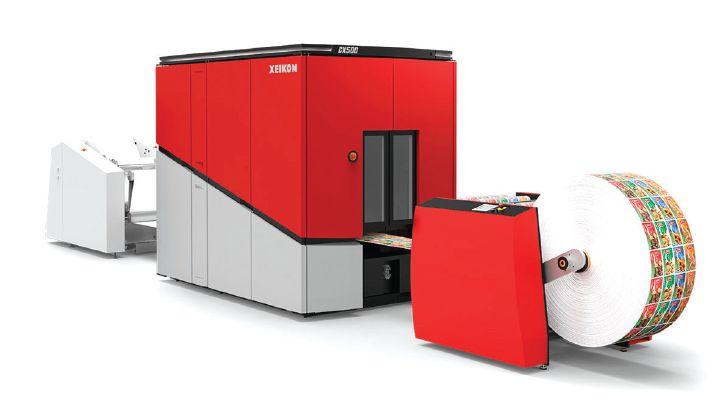
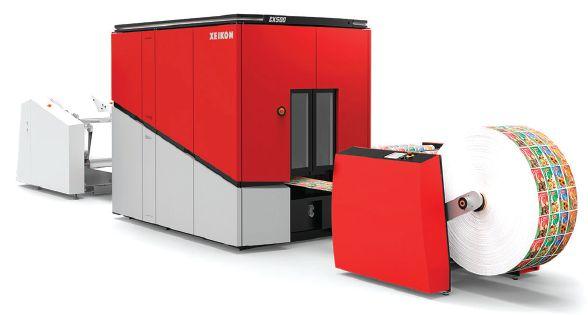
Xeikon CX500 Label Press
Xeikon in October 2017 introduced the new Xeikon CX500 digital label press, which the company describes as its first press based on a new generation dry toner platform. It is scheduled to be commercially available as of 2018. The Xeikon CX500, with a web width of up to 520 mm (20.47 inches), is designed for larger sized labels, labels requiring an opaque white or an extended colour gamut. It also features full rotary printing technology and speeds of up to 30 metres per minute (98 feet per minute).
The wider web of Xeikon CX500 is part of the company’s dry toner Cheetah Series aimed at the highend self-adhesive label market. Xeikon explains it also complements the narrow-web CX3 press introduced in 2015. Like the Xeikon CX3, the CX500 runs on Cheetah toner, which is based on Xeikon’s ICE technology and is designed specifically to cope with the higher speed. The company explains its dry toner process is based on a proven printing process operating at 1,200 dpi that meets FDA regulations for food contact and allows to print on standard label materials without the
need pre-treatment, including direct thermal papers, BoPP, PE and co-extruded films. The CX500 is also driven by the Xeikon X-800 digital front-end.
Kodak NexPress ZX
The NexPress ZX Platform, consisting of the 3300/ZX3900 engines and introduced in mid-2016, includes a range of new features for Kodak’s long-serving toner press series. The NexPress ZX presses include System software v16, which provides a set of new tools that control image quality and maintain productivity. This includes a new Ink Estimating Tool, which estimates the CMYK colour model and all specialty inks used in a print job. New Spot Color Recipes allow printers to create unique colour blends for clients and save them for future orders.
A new Production Dashboard allows users to monitor the activity, consumables and performance of their NexPress System on a handheld device. Automated Data Export provides periodic data on press production details for integrations with external MIS systems. NexPert Operator Support is described as a
The Xeikon CX500 features full rotary printing technology with speeds of up to 30 metres per minute.
Your Printer Do This?
• Print CMYK on Dark Stock
• Print White on Any Colour Stock
• Print 3 + 6 Panel Brochures Up to 52 Inches Long
• Print CMYK Envelopes on any coloured stock
• Print up to 360 GSM
• Add Optional Feeder
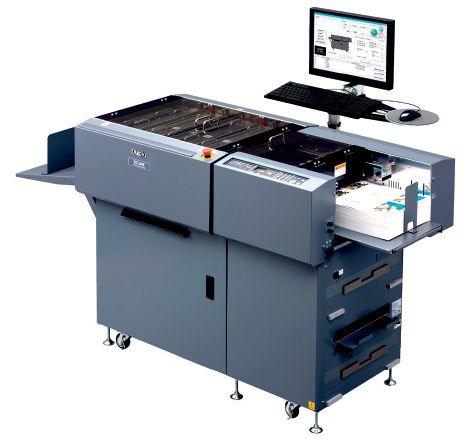
Duplo DC-646 Crease, Cut, Slit, Perf
• Process up to 30 SPM
Up to 8 Slits, 25 Cuts and 20 Creases in a single pass • Built in CCD scanner reads barcodes and registration marks and sets up jobs automatically
Binder
fully featured operator support and diagnostic system based on HTML5, allowing for operator access with no Java-related security or performance restrictions.
The new NexPress Opaque White Dry Ink capabilities of the platform compliments nine existing specialty inks currently available. Kodak explains it delivers 20 percent higher opacity in a single pass compared to multiple passes on competitive presses.
Canon imagePRESS C10000VP
cludes new features for full bleed printing and closed-loop colour control with an inline in X-Rite spectrophotometer on both the 180 with Performance Package and the 3100. Integrated registration alignment for better on-sheet, sheet-tosheet and front-to-back registration are also included.
Kodak NexPress Substrate Expansion Kit
finishing: crease, fold, glue, tipping, envelope inserting, ink jetting (Duplex), clip seal (3 sides), mail prep.
SAVE ON POSTAGE COSTS —As a Certified Canada Post Direct Marketing Specialist, we get contract pricing reductions. 5. RETURN MAIL PRODUCTS — Customized “Return Mailers” created in-line with “U” or “BOX-shape” remoistenable glue, time perfed applications and envelope formation. 6. MINI-BOOKLETS — Saddle-stitch and trim 2-up booklets in-line to the size of a business card. No need to trim off-line, or do 2 passes. 7. HIGH SPEED EQUIPMENT — High speed Tipping, Folding, Saddle-stitching and soft folding ensuring on time delivery.
Canon Canada in mid-2016 launched the imagePRESS C10000VP Series to enter a new higher volume segment, engineered to run a range of media types and to support a monthly duty cycle of up to 1.5 million letter-size images. The imagePRESS Series reaches print speeds of up to 100 letter images per minute with the C10000VP model and 80 letter images per minute with the imagePRESS C8000VP, on all supported media weights up to 350 gsm.
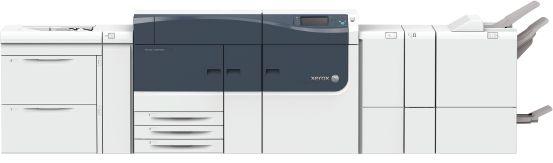
Xerox Versant 3100
Xerox in mid-2017 introduced the new Versant 3100 in the European market, along with the new Versant 180 and Versant 180 with Performance Package. THe Versant product line was launched three years ago with the 100 ppm mid-entry Versant 2100 press. The company subsequnetly introduced the Versant 80, an 80 ppm press with a smaller footprint. The Versant 3100 in-
Kodak in October 2017 launched a NexPress Substrate Expansion Kit to increase the types of paperboard and synthetic substrates that can be run on the digital press. The Expansion Kit allows the NexPress to handle paperboard substrates graded up to 24 points (610 microns). For synthetic substrates, the it gives printers the option to print on materials of up to 14 mil. Kodak explains the ability to work with thicker substrates opens up new opportunities for printers with short-run packaging applications including labels, tags and small folding cartons, as well as differentiated commercial and publishing products like point-of-sale displays, retail signage, business cards and hospitality pieces such as menus and door hangers. The upgrade takes approximately two days, according to Kodak, and is supported by a full day of onsite training by a Kodak technician that includes best practices associated with running a broader range of substrates. The Substrate Expansion Kit allows press operators to quickly make configuration changes.
The NexPress Opaque White Dry Ink complements the Kodak’s other nine specialty inks applied through its fifth station.
Ricoh Pro C7110/C9110
Ricoh in mid-2016 introduced its Pro C7110X five-colour digital press featuring expanded 5th colour capabilities. The recently enhanced system features a new Neon Pink to enhance images, providing crucial highlights or graphic colour, even combining with other process shades to create a neon palette that pops on a variety of media, including textured media and synthetics.
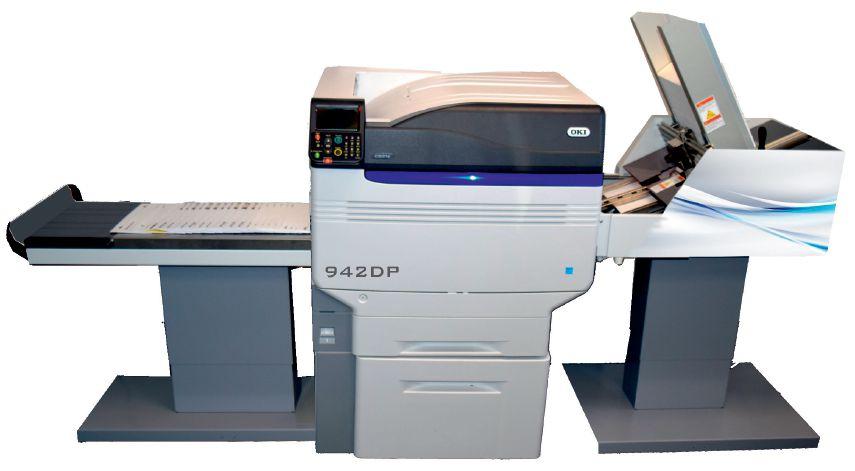
PDS, OKI 900
PDS distributes the recently introduced OKI C942e for full-colour and spot-white printing, as part of the company’s coverage of the OKI 900 series. The OKI 942 models feature single pass, CMYK + White printing, as well as 1,200 x 1,200 LED print-heads that handle a range of media stocks of up to 52 inches. All three models in the 942 series can handle 360 gsm extra-thick card stock, 14-point polyester, magnetic media and transparency films. The 941dn has the added flexibility of being able to apply white text and graphics to dark
media, and to place clear toner selectively on a design. The series reaches speeds of up to 50 ppm in colour with a paper capacity expandable to 2,950 sheets.
HP Indigo GEM
In September 2017, HP introduced a range of new technologies for digital labels, including the new HP Indigo GEM, a one-pass digital embellishment system that will begin shipping in the spring of 2018. HP Indigo also announced a new ElectroInk Silver, now in beta customer testing. The new formula is capable of generating a wide gamut of metallic colours, combining metallic effects with digital capabilities.
Integrated with the HP Indigo WS6800 press, GEM produces labels with foil, screen, tactile, varnish and other special effects, using one workflow, one operator, and one design file without the need for tooling. The HP Indigo GEM utilizes GEM Coat and GEM Clear, developed in conjunction with JetFX. The HP Indigo WS6800 with Indigo GEM will be powered by the new HP Production Pro with what the company describes as five times faster processing to handle large volumes of variable data.
PDS, OKI C711WT
PDS is now distributing the OKI 711wt system, referred to as the T-shirt press, for textile transfer printing. Its white toner cartridge enables printing CMYK plus white on transfer medias, leveraging a multi-purpose tray that handles up to 100 transfer media sheets. The 711wt also has a 530-sheet internal paper cassette for day-to-day printing needs. It features colour print speeds of up to 8 ppm on transfer
HP’s roll-fed Indigo WS6800 digital press features
Ricoh’s Pro C7110 now features Neon Pink and UV Security Red toner.
The OKI 900 includes CMYK + White printing.
media and up to 34 ppm on standard media, while producing 1,200 x 600-dpi resolution. The OKI 711wt’s single pass color technology allows for printing up to 140 lb index (250 gsm) stock. The system also features PostScript emulation Network and USB connectivity.
Canon Océ VarioPrint 6000 TITAN
In August 2017, Canon unveiled the Océ VarioPrint 6000 TITAN Series of sheetfed monochrome production presses, which builds off the existing Océ VarioPrint 6000 Series and its Gemini Instant Duplex Technology. The technology, explains Canon, has been developed with increased quality, speeds and a wider selection of media weights and formats. Supporting volumes of up to 10 million letter-size impressions per month, Canon explains the new presses are ideally suited to produce commercial print materials, books and transactional documents. The Océ VarioPrint 6000 TITAN series will be available in three versions, including Standard/ TP(Transactional Print)/MICR, with a range of finishing options that include booklet-making, perfect binding, tape binding, die punching and trimming. The TITAN series also offers an open Document Finishing Device (DFD) Interface for connectivity to compatible third-party finishers.
The redesigned Océ VarioPrint 6000 TITAN series offers maximum running speeds of up to 320
letter images per minute in perfecting mode, which translates to a potential of more than 30,000 additional letter prints in one week in a one-shift operation. Four new speed models will be available to meet different production requirements (VarioPrint 6180, 6220, 6270 and 6330).
Xerox White Dry Ink
In October 2017, Xerox released a White Dry Ink for the fifth print station of its iGen 5 digital press. With the addition of White Dry Ink to the iGen 5 platform, print providers can apply spot effects to produce printed pieces with a physical look and feel. Xerox’s White Dry Ink features the ability to print White Dry Ink only, as white layers under or over CMYK. The company claims it provides strong brightness and opacity that’s achievable in a single pass of white. The iGen 5’s automated multi-pass mode can
also be leveraged to produce up to two layers of white. Additional layers of white can be manually printed for custom applications.
HP Indigo Pack Ready
HP in May 2017 unveiled the Indigo Pack Ready Laminator commercial model, optimized for the HP Indigo 20000 press, designed for immediate time-to-market in flexible packaging. The laminating system will be manufactured and supplied by Karlville. First units are to ship by the end of the year. The HP Indigo Pack Ready Lamination is new machinery created with thermal lamination as part of the HP Indigo Pack Ready platform.
Xerox White Dry Ink is for the iGen 5.
ESTIMATOR
Primary Working Relationships: Sales Reps, Customers, Project Coordinators & Administrators
Major Duties/Outcomes:
Receive incoming quote requests via email, fax and phone. Source cost of services and raw materials from outside suppliers. Process estimates accurately. Communicate with Customer & Sales to address any concerns and changes. Respond to Customer requests in a timely manner. Advise Customers of anticipated turnaround time of quotes. Maintain Customer specs for quoting. Assist other Estimators as needed to maintain Customer satisfaction. Ensure self and others work in a safe possible way, reporting injuries, occurrences or near misses to Supervisors. Ensure that all the required personnel protective equipment is worn at all times and in the required areas. Keep work area neat and tidy. Other related duties as required. Primary Job Requirements: (Skill, Education, Experience, etc.). Excellent keyboarding skills. Computer proficient. Capable of processing data and information.
Two years estimating experience or Graduate from a Printing Program.Excellent organizational skills. Able to work well in a team.
Perfect Binder Operators, required for expanding, growing East end bindery/ finishing house. Plant runs 5/24 and has day, afternoon and midnight shifts. Experience preferred but may train the right candidate(s) with aptitude. Must work well under tight deadlines with minimal supervision. Salary commensurate with experience, only candidates being considered will be contacted. REFER to Perfect Binder Operator. Please forward resume.
Email resume to: resumes@reliablegrp. com Tel: 416-291-5571. Fax: 416-412-7443. www.reliablegrp.com
ESTIMATOR
Knowledge of offset sheetfed & web printing process
Computer skills in print costing software. Excellent communication skills Analyze quotes and recommend further efficiencies. Print management degree an asset.
Email resume to: fayaz@west-star.com Tel: 416-201-0881. Fax: 416-201-8885. www.west-star.com
LARGE FORMAT & IGEN OPERATOR
We are looking for an Xerox Igen & Large Format operator. Ability to work
with Xerox iGen, Large Format and other digital print equipment. Maintains equipment, troubleshoots equipment problems, performs prescribed preventative maintenance on equipment as required and identify repairs if needed. Provide preventative maintenance on machines as required. Use functions such as multi-up –booklet making. Perform basic preflight.
Maintain color matching to client standards or requirements. Perform color calibration using densitometers and perform color adjustments. Prioritize – schedule and execute document workflow process activities (prepress to delivery). Record meter reads – process production forms and maintain records. Service organizations to collaboratively ensure high levels of customer satisfaction.
Email resume to: fayaz@west-star.com Tel: 416-201-0881. Fax: 416-201-8885. www.west-star.com
FLEXO OPERATOR
The ideal candidates have a minimum of 3 years printing experience, strong
technical experience of printing on unsupported materials (films and paper) and PS material, and strong technical experience of printing with UV and water based inks and coatings. Operators must be comfortable with shift work.
Email resume to: dana.hilleli@westrock-mps.com
FULL TIME SADDLE STITCHER OPERATOR
Seeking a Full Time Saddle Stitcher Operator. Efficiently set-up and operate Muller Martini Bravo or Prima Saddle stitchers 6 to 8 pockets. Ensure top quality production and exacting attention to detail. Maintain plant in a clean and organized manner. Other bindery duties as required. Day and Afternoon shifts available.
Email resume to: bdprinthr@gmail.com
PRESSMAN
REQUIRED
Pressman required 3-4 days per week. Experience required to run Heidelberg Platen and Windmill. Please call 647-545-7427. Email resume to: prestonsaccounts@hotmail.com
Sakurai: 1, 2 or 4 colours and any size (newer model)
Polar: any size/older or newer models (66/72/76/78/82/90/92/107/115)
Horizon-BQ: 220/240/260/440/460
Andy Rae / Head of Marketing / Heidelberger Druckmaschinen AG / Kennesaw, Georgia
Andy Rae was appointed Global Head of Marketing for Heidelberg AG in April 2017 after serving as Senior VP of Equipment & Marketing for Heidelberg Americas over the past six years. He has more than 20 years of experience with Heidelberg in both the UK and U.S. Under his Americas responsibilities, he controlled the entire equipment portfolio for U.S., Canada, Mexico and Brazil, covering digital print, sheetfed offset, workflow, commercial postpress and postpress packaging.
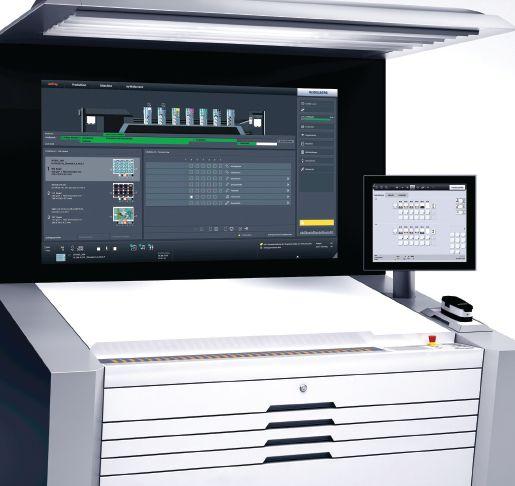
In his new role, as he leads the company’s Print Media Center in Kennesaw, Rae is driving awareness around the Smart Print Shop, which primarily describes maximizing overall equipment effectiveness through automation. At PrintForum in mid-2017, Rae described Heidelberg’s approach to evaluating cost of production and how increased automation can help commercial printers become more profitable.
Why invest in new capital equipment?
AR: In an ideal world, it is to make as much money as possible, because otherwise why are you doing it. Generally, we find there are two reasons to invest. The first is you are either trying to reduce costs by buying more efficient equipment or you are trying to install new equipment to turn two [presses] into one or three into one. One new folder today can easily output what three older folders can do and your cost per printed sheet is less.
The second way of investing is to grow. You see opportunity and want to add capacity. The important thing here is to add it for sales growth without delivering the same old margins.... by having a smart approach. This is process manufacturing automation. There is no reason why the printing industry shouldn’t be as efficient as a Push To Stop philosophy just like a car manufacturer.
They know [output], their cost exactly per unit, and they know their quality level. And if any of those three things change because they are trying to push the boundaries, they get recalls, and it’s the same in print. You try to push the boundaries of efficiency too much based on your current capacity and you end up doing rework.
Why adopt process manufacturing?
AR: In a car manufacturing plant there is no way they change any of their optimized processes unless they are fully tested offline. And if they work, they reduce costs and they increase the output. They increase the quality and they then reduce it to a process. But in the print world, we are used to the guy on press trying a new chemistry or a new ink and [they are not focused on] a
time-managed process. The entire standardized process is shot, because you changed one variable.
I cannot turn up to the BMW manufacturing line and put wheel nuts on and say, ‘I found some cheaper ones so I think I will try them out,’ because it is not an optimized process. It has not been tested offline.
Based on a 2017 survey of its customers, Heidelberg explains the productivity gain only needs to be around 33 percent of the price differential price gap to justify a capital equipment purchase. In other words, to justify a 25 percent price premium, you need to deliver 8.75 percent more output.
But we think nothing about letting the guys on press or the pressroom manager trying different things. Leave my process alone because I have optimized it and I know my cost per sheet. That is what we are trying to get to know – your cost per sheet.
Why is it difficult to automate printing?
AR: Generally, we do not have that philosophy in print shops because we are smaller and everyone is wearing many different hats, so the constant pressures of daily business don’t let us focus on making it a process manufacturing industry.
We are still stuck with an artistic perspective but that is long gone. It can be so automated now in terms of technology. It’s Delta-E, it is presetting, it is a production process... It is all down to your cost per sheet per process.
We find because of this approach, where smaller shops have many different hats and
processes are not defined, the whole thing is really fairly chaotic still in the average print shop. This doesn’t generally adhere to big packaging firms. Because they have to run in an automated fashion and need to know their cost per sheet. Because if you are working with P&G and you are working on a five-year, multi-billion-dollar contract you better know your cost per sheet otherwise you are potentially going to throw a big loss.
What do printers really sell today?
AR: There are many answers for this but what you really sell to your customer is time. You are selling them the time to process. So if you sell time on one cost centre and your process is made of many linked cost centres, you need to know your costs.
Why focus on linked processes in print?
AR: If you do not know your costs, you do not know if you are making money on a daily basis. Many printers we talk to about profitability say, ‘I will let you know on the 10th day of next month.’ It’s a bit late then. You need to know on a daily basis your costs of the business by process, by makeready, by running sheet. What is the linked cost of all of those, because that is what you are estimating for a customer.