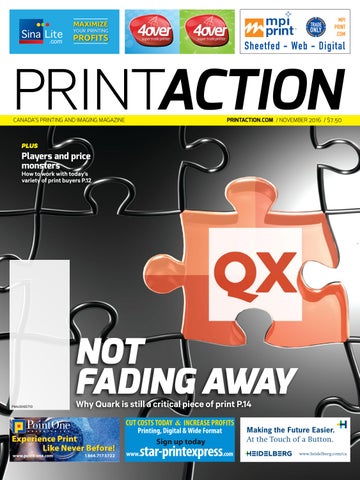
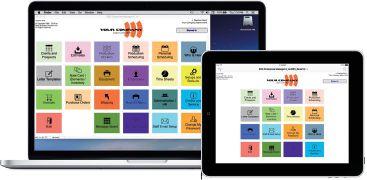
A test drive of QuarkXPress 2016 illustrates one of print’s most historical software developers is still in the fight
18 Scenes from Graph Expo
After a risky play to move from Chicago to Orlando, exhibitors describe an upbeat show with key decision makers attending
19 Canadian signage
Printers flock to Sign Expo Canada as large-format continues to prove itself as one of print’s most-intriguing sectors
DEPARTMENTS
GAMUT
5 News, People, Calendar, Dots, Installs, Globe, Archive
TECH REPORT
20 Postpress power
Finishing is still a critical area to realize enormous production savings for toner, offset or inkjet printing
NEW PRODUCTS
22 Detailing the newest technologies from Agfa, GMC, GMG, EFI, HP, Mimaki, MultiCam, Serif Software, Silicon Publishing, Toyo and Xerox
MARKETPLACE
25 Industry classifieds
SPOTLIGHT
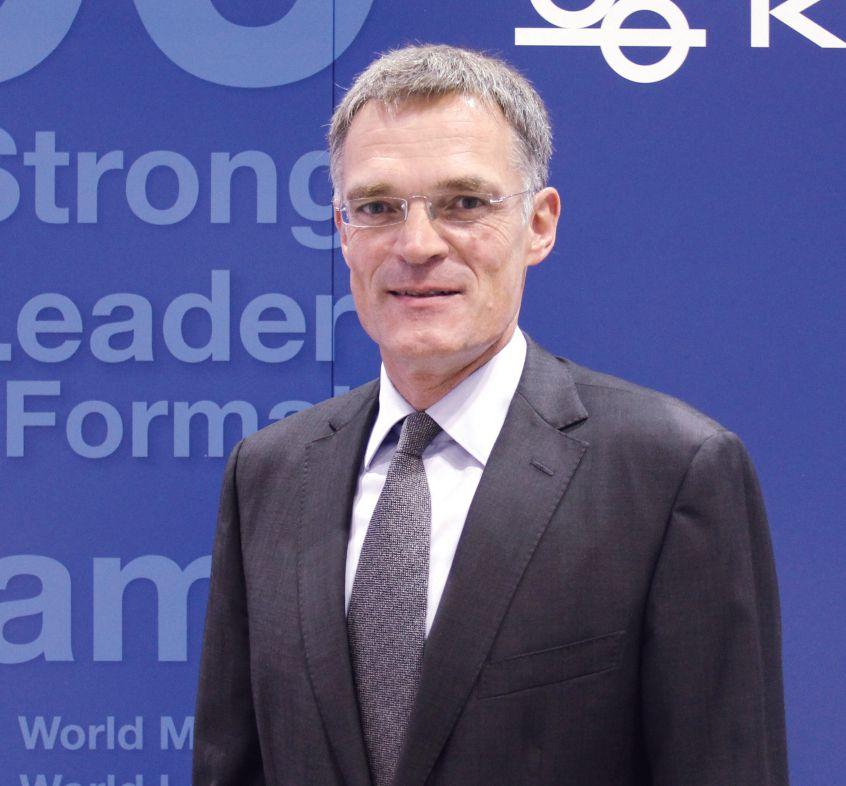
26 Claus Bolza-Schünemann, CEO and President, Koenig & Bauer AG, Würzburg, Germany
COLUMNS
FROM THE EDITOR
4 Jon Robinson
Neuromarketing the mail
Canada Post commissions a study indicating the power of direct mail
CHRONICLE
10 Nick Howard
Back in the U.S.S.R.
A printing trip to the Soviet Union at the height of the Cold War
DEVELOPMENT
12 Dave Fellman
Players and price monsters
How printers can best work with all types of print buyers 14 20 10 6
Neuromarketing the mail
In early October, Deepak Chopra, President and Chief Executive Officer of Canada Post, wrote a guest editorial column for The Globe and Mail under the title Physical mail marketing still has plenty to offer advertisers. Given the tribulations effecting most mailing systems around the world, particularly the United States Postal System, which suffered a net loss of US$1.6 billion in its most recent 2016 third quarter, it is easy to read Chopra’s title as holding a great deal of bias for Canada’s mailing system.
display) advertising media.
The researchers developed two integrated campaigns featuring mock brands, applying the same creative and messaging consistently across each campaign’s physical and digital media formats. The 270 participants underwent brain imaging and eye-tracking to test for the campaigns’ ease of understanding, motivation and visual attention. Participants were later given memory tests to assess their recall of branded material.
Editor Jon Robinson jrobinson@annexweb.com 905-713-4302
Contributing writers
Zac Bolan, Wayne Collins, Peter Ebner, Victoria Gaitskell, Martin Habekost, Nick Howard, Angus Pady, Nicole Rycroft, Abhay Sharma, Trish Witkowski
Publisher Paul Grossinger pgrossinger@annexweb.com 905-713-4387
21%
According to a study by True Impact Marketing and Canada Post, using neuro imaging to test the responses of 270 participants to direct mail or pure digital advertising, it takes 21 percent less thought to process the direct mail message.
In its most recent quarterly financial results, Q2 2016 released in late August, Canada Post actually posted a small profit (before tax) of $1 million – essentially breaking even and taking a positive step forward relative to a loss before tax of $31 million in the same period a year ago.
The crown corporation primarily applauded its parcels line for the result with revenue in this specific segment rising by $34 million or 9.2 percent to $404 million, while volumes increased by 4 million pieces or 8.5 percent compared to the same period a year ago. In the first two quarters of 2016, parcels revenue rose by $75 million or 10.9 percent, while volumes increased by nine million pieces or 11.4 percent, compared to the same period a year ago.
Chopra’s article in The Globe, however, specifically speaks about the benefits of leveraging direct mail, which saw slight declines in Canada Post’s second quarter results. The results, however, highlighted direct mail stability when considering the uncertainty around contentious labour negotiations that continued through this summer for several weeks. In the second quarter, ended July 2, 2016, direct marketing contributed $296 million to the Canada Post segment, a decline of $4 million or 1.3 percent from the same period a year ago. Volumes fell by 35 million pieces or 2.8 percent. In the first two quarters of 2016, Direct marketing revenue decreased by $19 million or 2.4 percent, while volumes fell by 85 million pieces or 2.7 percent compared to the same period a year ago.
The power of direct mail proposed by Chopra, which many involved printing companies would certainly agree as being a stable, if not growing, segment of the industry, was supported by a Canada Post-commissioned study called A Bias For Action
Neuromarketing research company
True Impact Marketing partnered with Canada Post to conduct the largest study of its kind to date. Brain imaging and eye-tracking technology were used to see into the brains of people interacting with physical (direct mail) and digital (email,
True Impact Marketing described four key findings from the study, including the result that direct mail is easier to understand and more memorable than digital media – concluding it takes 21 percent less thought to process and creates a 70 percent higher brand recall. Second, direct mail is far more persuasive than digital media. Its motivation response is 20 percent higher, according to the study, and even better if it appeals to senses beyond touch, such as smell and hearing.
Third, direct mail gets the message across faster because our brains process it quicker than digital media, which True Impact Marketing describes as an important difference in an era when goldfish have longer attention spans than the average human. Finally, the research group reports direct mail is more likely to drive consumers to act on an advertising message than digital media.
“Physical fills a much-needed, and very human, sensory deficit in the virtual world, where we spend most of our time these days. While people love talking to Alexa (Amazon’s latest gadget) to order whatever they are running short on, they notice and retain a lot more of a paper promotional offer than they would from a purely digital message,” wrote Chopra in The Globe. “The most important renaissance in advertising has gone largely unnoticed. In their race to find the next big breakthrough, marketers didn’t stop to realize that paper catalogues and marketing mail are emerging as an effective tool, even to engage digital natives.
Chopra continued to write that while most millennials show a disdain for paper-based advertising, their brainwaves are saying exact the opposite: “If there is one thing Steve Jobs taught us well, it is that customers don’t always know what they really want. You have to figure it out for them.”
Associate Publisher Stephen Longmire slongmire@annexweb.com 905-713-4300
Director of Soul/COO Sue Fredericks
Media Designer Lisa Zambri
Circulation Manager Barbara Adelt badelt@annexbizmedia.com
Customer Service Angie Potal apotal@annexbizmedia.com Tel: 416-510-5113 Fax: 416-510-5170
Mail: 80 Valleybrook Drive, Toronto, ON, M3B 2S9
Subscription rates
For a 1 year monthly subscription (12 issues): Canada — $40.95 Canada 2 year— $66.95 United States — CN$71.95 Other foreign — CN$140.00
Mailing address
Annex Business Media 222 Edward Street Aurora, ON, L4G 1W6 printaction.com Tel: 905-727-0077 Fax: 905-727-0017
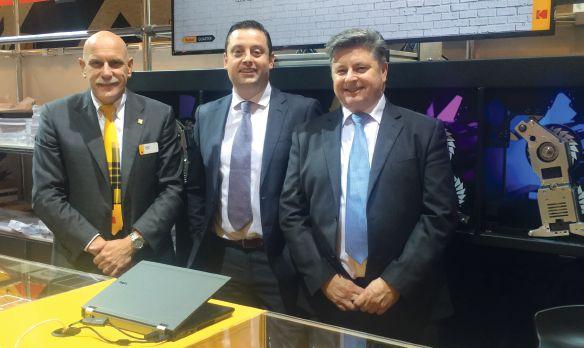
Robert Taylor, GM of Electrophotographic Printing Solutions and VP, Print Systems Division, Kodak; David Haskett, Commercial Director, PRP; and Kevin Peart, Managing Director, PRP.
Eastman Kodak reached a new contract to have PRP Optoelectronics manufacture 1,200-dpi LED print heads for its NexPress platform, building on a three-year development program between the companies. At drupa 2016, Kodak previewed its new Max Platform for NexPress featuring a multi-bit LED writing system for greater application range like transactional, direct mail, packaging, commercial print and photobooks. The writing system computes at 12 bits and delivers eight bits of data to each of the imaging cylinders. Kodak explains it delivers nearly 300-million pieces of image information per square centimetre using a data rate similar to watching 3,700 HD movies simultaneously.
Agfa Graphics won three Product of the Year awards at SGIA Expo for the second year straight, including two systems built in its Mississauga manufacturing facility. The brand new Anapurna H3200i won in the UV Hybrid category ($100-500k), while the Canadian-built Jeti Mira won in the UV Flatbed ($200500k) category and Jeti Tauro won
top honours in the UV Hybrid High Volume Production Class. A total of 170 entries in 49 product categories were submitted for the SGIA competition.
St. Joseph Communications acquired Bassett Direct, founded by Rich Basset in 1994, which quickly became one of North America’s leading producers of personalized printing and direct marketing programs. Bassett Direct works with many of Canada’s top financial institutions, advertising agencies, not-for-profit organizations and loyalty companies. St. Joseph’s annual output includes more than 200 million catalogues and magazines, and one billion flyers.
Prinova of Toronto, which develops software and services within the Customer Communications Management sector, ranked No. 347 on the 28th annual PROFIT 500, ranking Canada’s fastest-growing companies based on five-year revenue growth. Prinova experienced five-year revenue growth of 148 percent largely based on its SaaS solution called Messagepoint, a
hybrid cloud-based content platform.
Access Labels of Amherst, Nova Scotia, acquired the pressure-sensitive label manufacturing division of Farnell Packaging in nearby Dartmouth. The purchase will increase Access Labels’ capacity between 20 to 30 percent and bring new full-time jobs to Amherst. Founded by Paul Carr in 1993, Access Labels specializes in printing labels, as well as selling and servicing equipment like label dispensers, applicators and thermal printers.
HP Inc. moved to acquire Samsung Electronics Co.’s printer business in a deal valued at US$1.05 billion. HP states the acquisition positions it to disrupt and reinvent the US$55 billion copier industry. The largest print acquisition in its history, HP plans to integrate the Samsung assets with its PageWide technologies. Samsung’s printer business holds more than 6,500 printing patents and a workforce close to 1,300 researchers and engineers.
Cansel in late-September acquired Veritiv’s engineering bond paper converting operations and business in Eastern Canada (Ontario, Quebec, New Brunswick, Nova Scotia, Prince Edward Island, Newfoundland and Labrador & Nunavut) held by Unisource Canada. Veritiv stated the sale of these assets is inline with the company’s direction to focus on core commercial and wide-format printing sectors in Canada.
Aleyant of Wheaton, Illinois, acquired Tucanna Software of Carlsbad, CA, which develops products like tFLOW (large-format proofing), RapidCheck (reporting system), PrintControl (gray balance), and QualityControl. Aleyant, which develops Pressero, had invested in Tucanna back in 2014. In September 2016, Aleyant also acquired Keen’s
Web-to-print business based in San Francisco, California.
Flint Group acquired Printec Industries located in Marietta, Georgia, which manufactures water-based inks for flexo and gravure applications for North American printers. Printec was founded in 1991 and supplies inks for high-end paper cups, plates, folding cartons, and other specialty applications. Flint also recently acquired Advanced Color Systems and American Inks and Coatings.
Infigo Software acquired UK-based Netkandi, which develops e-commerce software for printing, marketing, educational, franchise, labelling, packaging, in-plant and CRD sectors. Infigo, an accredited HP SmartStream partner, explains the acquisition allows it to offer a complete end-to-end package from the creation of storefronts to a suite of digital marketing services.
Ultimate TechnoGraphics of Montreal, a developer of imposition and finishing software, formed a new alliance with Canon Solutions America aimed at improving the prepress workflow of commercial printers. Ultimate’s Impostrip and Bindery JDF automated finishing hub software will be offered to Canon’s digital press customers.
Agfa Graphics plans to close its factory in Vallese, Italy, one of its seven printing plate manufacturing sites worldwide. This facility, which Agfa describes as a small operation relative to its other plate plants, produces litho aluminum plates for offset presses. Agfa explained these product lines have been facing a weaker market demand, primarily in Europe, for several years. The move will impact 120 employees.
Sun Chemical expanded its online support platform, SunSupportOnline.com, to Canadians. Available now in both French and English, the online platform allows users to view order history, re-order products from a personalized product catalogue, and check the shipment status of open orders. The platform also includes newly optimized mobile functionality.
Members of Agfa’s Canadian manufacturing team responsible for the award-winning Jeti Tauro and Mira machines.
Labonté becomes Territory Sales Manager, Eastern Canada, Channel & Custom Sales, for Drytac Canada, a manufacturer of adhesive-coated products. His primary focus will be expanding Drytac’s wide-format graphics and custom coating business across New Brunswick, Newfoundland, Nova Scotia, Prince Edward Island and Quebec. Prior to joining Drytac, Labonté served as Business Development Director with LVP, a large-format print provider.
Douglas Bradley becomes Vice President of Service for manroland Sheetfed U.S. & Canada. With more than 25 years of service experience, Bradley is responsible for service and parts, customer service, technical and business support, logistics, project management, and business development. Bradley is familiar with manroland Sheetfed having served as Vice President of Service with the Web Division for more than nine years.
dependent community of HP graphic arts business owners and technical professionals who use Indigo, Scitex, Latex and PWP equipment. The organization currently has more than 8,000 members worldwide.
Niels Stenfeldt has expanded his role to become Esko’s Vice President, EMEA & Global Brand Sales, a position previously held by Armand Gougay, who is retiring at the end of the year after 27 years at Esko. Prior to joining Esko, Stenfeldt was the VP, Business Network EMEA at Open Text and he also held Managing Director and CEO roles at Columbus A/S and Evenex, respectively, and spent three years as a Global Vice President at SAP.
INSTALLS
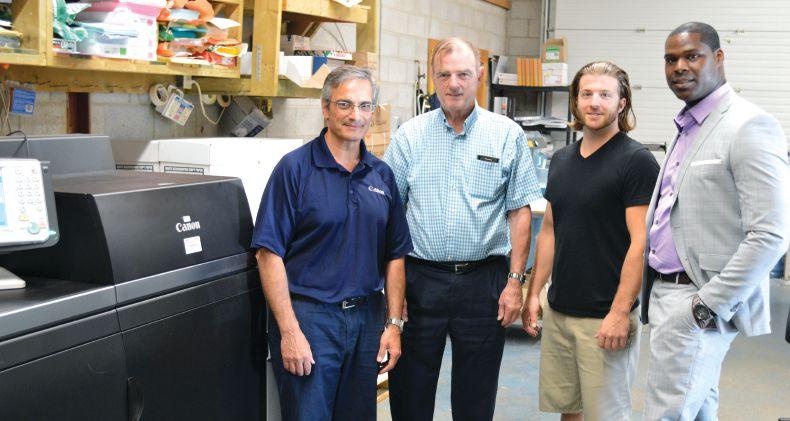
Multitech Graphics of Whitby, Ontario, added new Canon imagePRESS C8000VP, pictured with Multitech owner and President Lorne Seamone (second from left). The four-colour press reaches speeds of up to 80 pages per minute on all media weights up to 350 gsm and features gloss optimization tools.
Cindy Van Luyck becomes the Marketing Officer of Ghent Workgroup, which has been focused on developing PDF specifications more than 14 years. Replacing Peter Claes, who continues as Ghent Workgroup’s Treasurer, Van Luyck previously worked for Enfocus, Four Pees and currently serves as Marketing Manager for CHILI Publish. The Ghent Workgroup in September also appointed its Executive Committee, including David Zwang as Chairman, David van Driessche as Executive Officer, Elli Cloots as Vice Chair, Andrew-Bailes Collins remains as Technical Officer and Ryerson University’s Jason Lisi as Documentation Officer.
Timothy Baechle joins Idealliance as Director of Global Print Media Markets & Technologies. Prior to joining Idealliance, he most recently served as Vice President of the Production Consulting Group of Zeno Imaging. He was previously Director-Strategic Consulting Division, Production Print & Human Capital, for GIS-Dahill, a Xerox Company.
Friedrich von Rechteren becomes Vice President of Global Business Development for Flint Group’s Flexographic Products Division located in Stuttgart, Germany. von Rechteren will simultaneously assume responsibility for Sales in Europe, the Middle East and Africa.
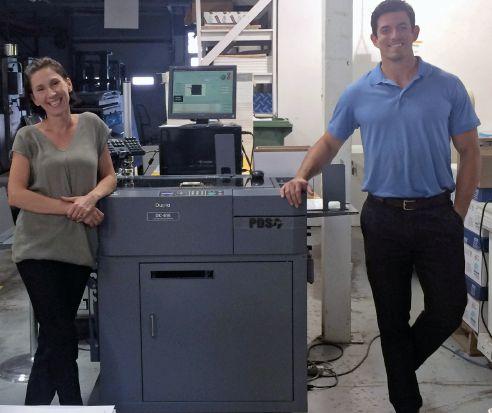
Mr. Printer of Toronto installed a Duplo 616 Pro system, pictured with Agnes Ver of Mr. Printer and Brett Kisiloski of PDS, a Duplo distributor. Mr. Printer was founded in 1978 and continues as a family-owned company. The DC-616 Pro can process up to six slits, 25 cuts, and 20 creases in a single pass.
Craig Hath has been appointed to the newly created position of Dscoop Global Director, Partner Programs. Founded in 2005, Dscoop is an in-
Bob Loescher joins Nilpeter as Northeast Senior Sales Consultant, bringing with him 18 years of Northeast Regional Sales expertise from ACTEGA North America. Nilpeter is a supplier of printing presses in the global narrow-web market for self-adhesive labels and flexible packaging.
Jet Label & Packaging, described as Western Canada’s largest label manufacturer, is installing two AVT Helios inspection systems at its 55,000-squarefoot facility in Edmonton, Alberta. Led by CEO Darrell Friesen, Jet Label plans to expand its AVT investment to six lines by early 2017.
UNISET relocated in Warsaw in record time
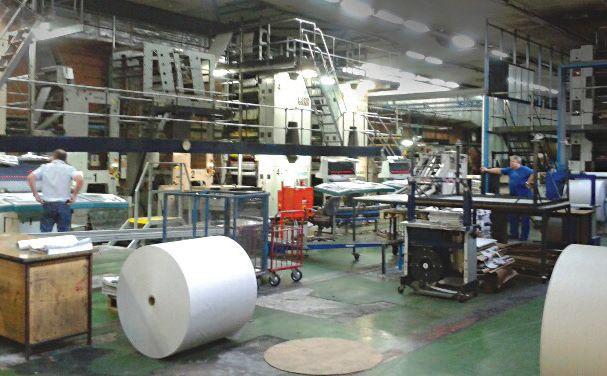
manroland web systems has relocated a UNISET newspaper press within the city of Warsaw to the printing plant of the ZPR Media media company. The press maker is heralding the move based on an incredibly short time frame. “For this project, less than five months passed between signing the contract and putting the press into operation, including all approvals,” said Christof Centmayer, manroland web systems project manager. “A challenge that let us bring to bear all of our competence as a press manufacturer.”
The 20-year-old UNISET newspaper press with five printing towers, six reel splicers, two folders and a quarter fold was originally owned by Polskapresse/ Multico of Warsaw. The relocation comprised the complete disassembly and reassembly of the UNISET, as well as its mechanical and electrical start-up, including all electronic switching systems and control consoles.
“The relocation was strenuous for everyone involved, everyone had to perform well. We were under time pressure for operational reasons,” said Tomasz Szakiel, Managing Director with ZPR Media. “The project teams cooperated perfectly, which made the record assembly time of eight weeks possible. It was our first project with manroland web systems and therefore an excellent start for our business partnership.” The UNISET now prints newspapers like the high-circulation paper Super Express at ZPR Media.
500
In October, Fusion Flexo LLC, a prepress and platemaking trade shop located in Plainwell, Michigan, purchased the 500th seat of HYBRID Software’s PACKZ native PDF editor.
3
After installing its third Xeikon CX3 press earlier this year, Belgian printer Label’Or won two awards at the annual congress of FINAT, including its dry toner digital printing for a label produced on transparent material.
World-first MGI install in Lyon
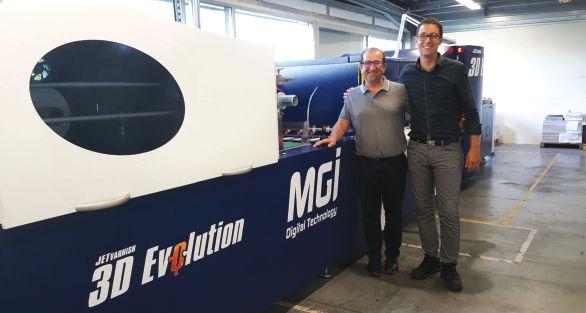
Imprimerie Courand et Associés, headquartered in the scenic town of Tignieu Jameyzieu, near the ancient city of Lyon in the Eastern region of France, installed the new MGI JETvarnish 3D Evolution, described as the world’s first B1+ size digital enhancement press.
Founded in 1906 by the Courand family, Imprimerie Courand et Associés (ICA) is now managed by Remi Courand, who represents the fourth generation of Courand business owners, with the assistance of his partner for the last 26 years, Dann Ramstein. ICA generates approximately $17 million in annual revenues and employs a staff of 48.
The company’s JETvarnish 3D Evolution is equipped with MGI’s new Artificial Intelligence (AIS) SmartScanner technology to analyze and manage each printed sheet for optimal processing. “Our business model is to ensure the highest quality on every job and meet the important delivery expectations of our clients,” said Rémi Courand, who was trained as an engineer. “Therefore, our full-service commitment to printing and postpress finishing is at the heart of our corporate strategy. Our customers appreciate this fact and that is why ICA has been in business for over 100 years.”
The JETvarnish 3D Evolution produces digital 2D/3D UV special effects, dimensional textures and variable data embossed foil, along with transactional benefits provided by short-run customization. The company describes the system as a natural complement to its existing infrastructure, which includes 15 other finishing systems and three Komori H-UV offset machines that range from five to eight-colour units with print sheet sizes up to 75 x 120 cm (29 x 47 inches).
“In all printing operations, there is always a challenge to finish work that is produced on different machines with different processes and technologies,” said Courand. “This is especially true for high-value 2D/3D UV varnish special effects and embossed foil applications. The print industry has been searching a very long time for a solution like the MGI JETvarnish 3D Evolution. So, we are very pleased to be the first printing company in the world to offer such special services.”
Heidelberg X-Package dances in Florida
In October, Heidelberg hosted an open house at SunDance Marketing Solutions in Orlando, Florida, to highlight how the Speedmaster CD 102 with X-Package can provide profitability for short-run printing. The event included live demonstration of Sundance’s Speedmaster CD 102-6+L with X-Package and Prinect Image Control.
Within 60 minutes, three different jobs were run with a make ready of less than 10 minutes each. Prinect Image Control was used to match press colour to the proof on the second pull with a delta E below 2.0. With an annual capacity of around 40 million sheets, Heidelberg states the Speedmaster CD 102-X increases productivity from between 25 percent to 50 percent over older generation CD 102s and new competitive presses.
“Since the installation, our productivity and offset volume has more than doubled, and our makeready times have been reduced by 70 percent,” said John Henry Ruggieri, President, SunDance. “We are confident in the machine’s ability to help further accelerate our business growth by 20 percent this year.”
Assembly of the right UNISET machine part at ZPR Media, which completed the rebuild in eight weeks.
Remi Courand and Dann Ramstein with ICA’s new MGI JETvarnish 3D Evolution, featuring a world-first install of AIS Artificial Intelligence (AIS).
SunDance Marketing Solutions’ (left to right) John Henry Ruggieri, Damon Jenkins and Brad Taylor.
26.7
Allen Iverson, The Answer, was an 11-time NBA All-Star and averaged 26.7 points over his 14-year career. He was drafted first overall in 1996 by Philadelphia.
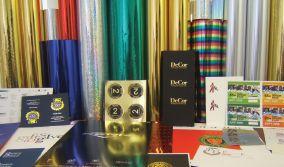
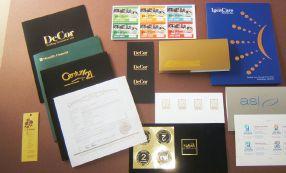
Coating, embossing, holographics and lamination are all part of Hazen Paper’s unique tool kit.
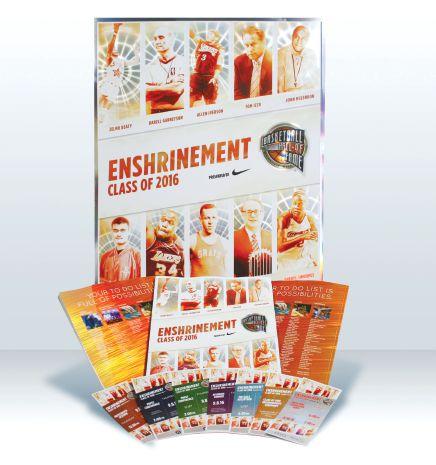
Hazen’s keepsake poster for the 2016 NBA Hall of Fame enshrinement was produced on an HP Indigo press.
Hazen Paper provides a range of lamination possibilities for lottery tickets.
Holographic hoop heroes
For the 2016 Enshrinement at the Naismith Memorial Basketball Hall of Fame, which took place in September with top ticket packages reaching $1,000, Hazen Paper Company created a range of custom holographic promotional items and event souvenirs. This is the fourth year Hazen has been asked to produce event-marketing materials for basketball’s Hall of Fame to stimulate interest, generate income, enhance visitor experiences and deliver more impact to advertisers.
The Class of 2016 inductees includes ABA superstar Zelmo Beaty, 27-year NBA referee Darell Garretson, 11-time NBA All-Star Allen Iverson, two-time NABC Coach of the Year Tom Izzo, the first African-American coach in a professional league John McLendon, threetime NBA Finals MVP Shaquille O’Neal, African American basketball pioneer Cumberland Posey, Chicago Bulls owner Jerry Reinsdorf, four-time WNBA Champion Sheryl Swoopes, and global ambassador of the game Yao Ming.
For the 2016 event, in addition to a keepsake poster and tickets for a series of related events, the 2016 Enshrinement package features trademarked Hazen Holography on each item, integrating unique techniques like the company’s white-motion Holoplaid and full-spectrum Hazen-Lens.
Hazen explains custom holography was used to boost advertising impact for a major sponsor on the back cover of the enshrinement program, with diamond Hazen-Lens and a Hazen Solar Flare hologram set against a colour-motion sleet pattern.
“Large-format capabilities and the creative prowess of our holographic lab equip us to craft unique, musthave memorabilia from tickets to brochures, books and commemorative posters for collectors to take home,” said President John Hazen. “Custom holography incorporates special effects and security elements that add significant value to each piece.”
Produced on Hazen Holojet, which is engineered to perform on HP Indigo presses, pieces were digitally printed with variable data and numbered for authentication – leveraging holographic techniques to also deliver security features that make each souvenir near impossible to counterfeit.
Holojet is a transfer-metallized Hazen Envirofoil product, created to deliver strong visual effects and reliable performance with environmentally progressive characteristics for holography. Though it is twice as bright, Hazen explains Envirofoil uses 95 percent less aluminum than traditional foil. Manufactured with renewable energy and third-party-certified recyclable paper, Envirofoil can be customized and is available in a range of holographic patterns and metallic colours.
Founded in 1925, Hazen Paper is a paper converter specializing in holographic origination, film coating, foil and paper lamination, metallizing, gravure printing, specialty coating and rotary embossing. A family-run company headquartered in Holyoke, MA, Hazen produces specialty materials for worldwide use in retail display and POP, luxury, entertainment and media packaging, bookbinding, scratch-off lottery and other security-related tickets, tags and cards, and fine art applications. Hazen supplies converted paper and paperboards that are FSC, SFI and PEFC certified.
CALENDAR
November 10, 2016
Canadian Printing Awards
Palais Royale, Toronto, ON
November 16, 2016
Digital Imaging Association (DIA) Meeting
Spicers, Concord, ON
November 30-December 1, 2017
Gutenberg Gala Palais des congrès, Montréal, QC
December 7, 2016
DIA Annual Luncheon, featuring Frank Romano
The Boulevard Club, Toronto, ON
November 19-21, 2016
Print World 2016
Enercare Centre, Toronto, ON
November 25, 2016
CMA Awards Show
Westin Harbour, Toronto, ON
January 17-20, 2017
EFI Connect 2017
Wynn, Las Vegas, NV
February 16-18, 2017
Graphics of the Americas
Greater Fort Lauderdale Convention Centre, FL
March 1-4, 2017
Dscoop
Phoenix, AZ
March 19-24, 2017
IPEX
London, UK
April 6-8, 2017
Graphics Canada International Centre, Mississauga, ON
May 9-13, 2017
China Print 2017
New China International Exhibition Center, Beijing
May 11, 2017
Gutenberg Gala Centre des Sciences, Montréal, QC
May 12-13, 2017
Grafik’ Art
Place Bonaventure, Montréal, QC
June 21-23, 2017
EskoWorld
Omni Orlando Resort, FL
September 10-14, 2017
Print 17
McCormick Center, Chicago, IL
October 10-12, 2017
SGIA Expo 2017
New Orleans, LA
ARCHIVE
45 years ago
Gravure opens new era for newspaper spectacolor: There are firm indications in the North American graphic arts industry that gravure printing, because of its true full colour fidelity, may well be the printing process of the future, particularly for daily and weekly newspapers which are engaged in a competitive struggle with colour TV for the advertising dollar.
40 years ago
A New Approach to Fast Proofing: It is now possible to produce a proof on paper, with plates and inks, in less than half an hour together with a set of progressives, and to pull a few hundred sheets in a few more minutes. The inking system is the most important feature of this new press. Derived from a French patent recently improved by a Swiss patent, it involves only one inking roller and a steel rod. There are no keys in the fountain.
35 years ago
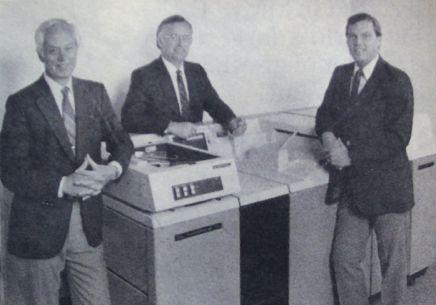
Herzig Somerville installs Scitex Response 300: A digital computer system capable of running images and text through the entire pre-print production process has been installed by Herzig Somerville. The system represents a radical departure from traditional techniques, replacing a series of mechanical steps with a single, integrated operation performed on a CRT screen.
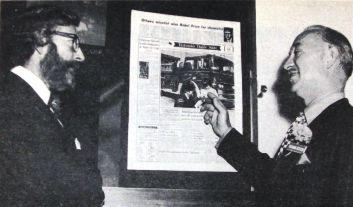
Photographer Peter Croydon and Norm Esch, President of Graphic Cylinders, check the proof of the Toronto Star front page, which was produced on gravure cylinders and ready for printing only eight hours after the photo was taken.
30 years ago
$15K
For sale (1996 classified): Kreonite KMIII 48-inch Rapid Access and continuous tone black and white film processor in excellent condition.
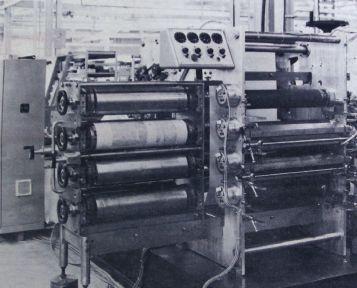
A new proofing method without the use of ink key in the fountain.
$168
Cost of a return flight from Montreal to Cologne, Germany, to attend drupa 72. A $1 bus ride is needed to complete the trip from Cologne to Dusseldorf.
$19.5K
For sale (1976 classified): 2-unit, 34-inch web Thatcher offset press complete with folders. All in good condition and presently producing nine community publications per week in Western Canada.
$450 million Quick Print Business is Sleeping Giant: For British Columbia entrepreneur William Flannigan, Canada’s $450 million quick print business is a sleeping franchise giant he plans on capturing. Flannigan made his first move in North Vancouver in 1979 when he opened the first Zippy Print store. Today, he and his two sons run Zippy Print Franchise Canada Ltd., one of the country’s fastest growing franchise with 44 stores stretching from BC to Ontario by June 1986.
Annual sales for the franchise jumped by more than 40 percent in 1985 to $3.5 million from $2.4 million in 1984, when Zippy Print tackled the country’s biggest printing market by opening its first Toronto franchise. Since then five more Ontario stores have opened. Across Canada, Flannigan expects to open at least another two dozen stores by the end of 1986. Zippy Print stores serve both the large-volume, high-speed photocopy customer and those wanting offset printing. Together these two markets make up the $450 million quick print business.
15 years ago
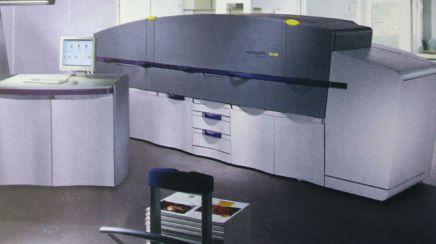
NexPress Arrives in Canada: After months of marketing hype, the NexPress 2100 is finally available to printers in Canada looking for a new form of document imaging. Heidelberg states that the NexPress will use digital colour printing to offer new services of higher value. As in offset, the NexPress transfers the image to the paper using a blanket cylinder, so it can print on a variety of stocks and weights – coated, uncoated, textured papers and foils.
NexPress applications allow for short-run colour, print-on-demand, Web-based marketing, e-commerce, versioning and personalization with variable content.
Zippy Print’s Myron Flett, Dennis Crisp and Rick Flannigan with a Kodak Ektprint 150AF.
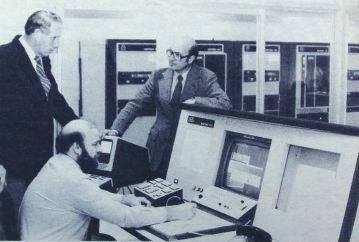
VP Bill Somerville and President Ernie Herzig (standing left to right) with Scanning Supervisor John Mitchell.
Back in the U.S.S.R.
A unique business trip to the Soviet Union, including a look inside the printing operation of the Red Army, at the height of Cold War leaves a lasting impression
By Nick Howard
The world of print has been enriched by many folks from all walks of life who took many different roads to arrive at an industry with seemingly no beginning or end.
On a busy mid-week day 36 years ago, a city inspector walked into Frank Herrington’s print shop. “Can you tell me where your designated smoking area is?” asked the inspector. “Wherever I’m standing,” uttered Frank.
This story was often repeated and always with a chuckle. It was a different time. Frank, a lifelong smoker, seemed to have two butts going at the same time. It was never uncommon to see an ashtray with a forgotten cigarette burned to the end with a length of ash. I first met Frank around 1977. He was then a partner in a trade shop but already had a lifetime’s worth of print experience. Born in Hastings, Ontario, to a family with a lot of siblings, Frank had a rough early childhood and found himself and his younger brother, Murray, in an orphanage.
Unlike today, there were few family roots in the printing industry and it was a chance opportunity that Frank found a job at Toronto’s Parr’s Print & Litho in the mid-1960s. Starting with a broom, Frank did all sorts of odd jobs until one day a pressman called in sick and he had the chance to run a varnish job on a Consolidated Jewel. The Jewel was a hefty 30-inch single colour offset press made by ColorMetal in Zurich, Switzerland, but rebranded (as was common in those days), from its Swiss name Juwel to an Americanization Jewel.
Frank was hooked. Especially with offset as he had no interest in letterpress. Like many of his generation, trade schools carried printing courses and taught various
disciplines such as typesetting, page assembly, platen press operation, and so on. But for Frank, learning the California job case and composing with type was dumb and tedious when offset offered a better future in printing.
Canadian connections
The ATF Chief 20 was a popular smaller press at the time and soon Frank was running one of these 14 x 20-inch single colours, too. He would run split plates for the record jacket business. This was difficult work, making ready two plates on one cylinder. Next he had the chance to run a Harris LUP two colour.This was a 49-inch press and the big leagues. Over his entire life, Frank preached about the simple intelligent concepts of the Harris press.
Frank also had a short stint working in St. Paul, Minnesota, with Ternes Pin Register. Norm Ternes was instrumental in developing a simple method of installing register pins in plate clamps and also made plate register punches. On his return to Toronto, along with two partners, Frank began manufacturing plate punches and installing systems on all sorts of presses. It’s important to know that even in the early 1970s few offset presses had any kind of pin register.
I once saw him completely re-strip a four-colour cover and print the job on a very old Solna 124 single colour. It was quite amazing to see him manipulate the film, cut the masking sheets, burn the plates and then make numerous adjustments to the press just to get the job out and prove to our customer the press would print.
On another occasion, we had a customer in our shop and Frank was print testing with some plates that the customer had brought. The Harris LXG-FR had Micro
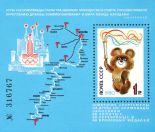
A Soviet stamp sheet shows the logo of the 1980 Summer Olympic Games and its mascot Misha. The map shows the torch relay route running from Olympia, Greece, to Moscow and Tallinn, Estonia, which hosted sailing events during the 1980 Olympics.
flow dampening. What a chore it was to set the dampener, because it was driven by two sets of V-belts. I leaned down to look at the plate docket the customer had brought. Frank, without missing a beat, leaned over and said if I ever pulled out that screen plate he’d kick me into the middle of next week! Frank knew that trying to run a full screen in such conditions would be a disaster.
On yet another occasion, we had sold a printer a Heidelberg KOR single-colour offset press. A few months later that customer had dropped a dampener form into the press and smashed it. Resulting inspections by the Heidelberg agent indicated the press was scrap, so we were able to take it back for parts. After months of this press languishing in our shop, Frank strolled in one day and asked, “Whats up with the press?”
I told him the story and how the press’ owner had said the plate cylinder was bent and it was toast. “But did you check it yourself?” Frank asked. I had not. So we did it together. Much to my surprise the plate cylinder was not bent and we quickly went through it and sold it on to another shop. This lesson was one of the most important Frank would pass on to me.
Our long association proved to be much more than fixing presses and learning common sense. Frank would always challenge you. This trait seems almost extinct today. Over the last 40 years we had many a good mechanic work for us. Some were quite brilliant, others less so. Frank was unique in his ability to speak to owners with confidence while at the same time be a mentor to even the lowest skilled employee. From all walks of life there are folks even today that can share the same sentiments about Frank and how he was the best friend any of them could possibly have. Frank’s genius was in his confidence. He never let a piece of equipment intimidate him. No matter the complexity or difficulty. Especially with an offset press, Frank’s common sense fundamentals allowed him to almost always disregard the operation manual and use inherent basics to set grippers, adjust bearer pressures or make a feeder run difficult stocks.
Honey, disconnect the phone
U.S. boycotts the 1980 Summer Olympics in Moscow, a year after Soviet troops invaded Afghanistan and formerly ended the period of detente with the West. The Soviets then boycotted the 1984 Games in L.A.
Over the next 25 years I would make seven or eight trips to Russia but a visit in 1980, in the midst of the Cold War, was special. For Frank, this was his first visit anywhere out of North America. We traveled aboard an aging Aeroflot Ilyushin Il-62 where the in-flight refreshments consisted of handing out mickeys and chocolates wrapped in tin foil. So here we were in Moscow during two weeks of September 1980. Our goal, to study various printing related equipment
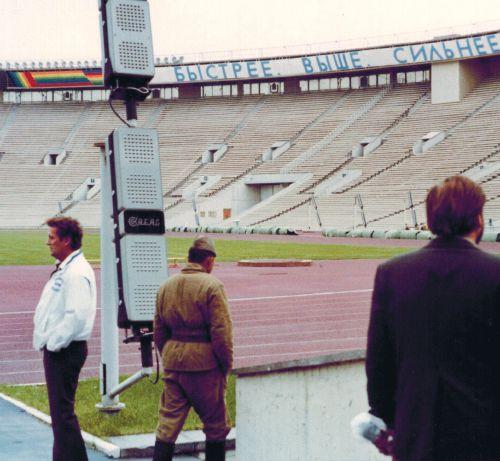
Frank Herrington visiting the Olympic Stadium in Moscow.
manufactured by the Soviet Union and see if we could purchase any of it.
Frank and I had become close friends. He taught me a great deal and I needed him to help me access the viability of the anticipated equipment we would see. We arrived at the scary monolithic Hotel Ukraina near Red Square. A very large haunting and dark place we nicknamed Dracula’s Castle. The Ukraina was a huge place built in a typical Soviet Style in 1953. This was also a foreigner’s Hotel and Russians themselves could not enter without a pass. The room had a black-and-white TV and a radio that was hard wired and couldn’t be turned off. Only the volume worked – there was only one station, too. I recall it was made of Bakelite and had the shape of the Moscow University’s main tower. The radio would chime an eerie tune to signify the top of the hour.
Off we went the next day to the Red Army printing plant. There we were to see the supreme example of the Soviet industrial complex in the POL-54 offset press. This press, a single colour about 74 centimetres (29 inches) was running with two operators (one sitting on a stool at the delivery). To make matters worse the press wasn’t even running offset but rather letterset (dry offset). Frank had a quick look, smiled and whispered, “If that’s all they have we’re in for a rough two weeks.”
Representatives from Techmaschexport (Soviet exporting agency) asked our opinions and I nudged Frank to go take a better look. He’s under the feedboard checking the grippers while all of a sudden the operator hits the run button. This caught Frank’s finger in the press and, as blood dripped from his hand, off he went with a nurse to the infirmary. Shortly after, with a plaster cast the size of an ice-cream cone, in strolled Frank. We never saw the Pol-54 again and apparently no one else did either.
Our days off proved amusing and we had a lot of them. Each place we visited, Frank shook his head. In order to buy something at a store you needed to find what you wanted, get a chit, go to teller to pay, then back with receipt to the first guy. The 1980 Olympics had been held only a few months earlier, so we wandered over to the main outdoor stadium where, to our glee, we found a store that sold potato chips. Nearby was what we would call a fast-food restaurant. We nicknamed it the Bun & Run. They were serving some kind of dish with a flatbread and a white creamy sauce poured over it. Looks good we thought. Pulling out a few Rubles, Frank bought a couple only to find out the sauce was some kind of butter milk. Tasted awful, smelled even worse.The food in the Ukraine was remarkably better than Russia.
We walked each day to Red Square and watched the locals in the GUM department store. We visited a science and technology museum and spent time at the INTOURIST Hotel bar because as foreigners we could get in. But mostly we found ourselves in the main dining area of the Ukraina each night, getting a laugh when we spotted new arrivals trying to figure out that the only drinks were Georgian sweet “Champaign” and Vodka. We took a flight to the Ukrainian city of Odessa on the Black Sea. There we toured a prepress factory known for platemakers and cameras. It held really nothing of relevance, but we consumed a lot of Vodka during a lunch put on for us.That evening Mr. Ptashkin, our host, insisted we take in a show
at the famous Odessa opera. Moments after taking our seats, Frank quickly nodded off. Afterword we walked down to the water on the famous Potemkin Stairs. These sacred steps were constructed in the 1800s and unique because from the top looking down you don’t see any stairs only landings. But on this night somehow, Frank and Ptashkin got into a bet of who could get to the top first. Frank did.
So it’s now after midnight and time to head to the hotel. “Let’s go for a nightcap,” says Frank. There are no night bars in Odessa uttered Ptashkin in a stern voice. “Follow me,” said Frank. Around the back of the hotel, down some steps, knock on a door and – voila – a night bar and with Western liquor to boot. That was Frank, who was somehow a step or two ahead of everyone.Well, we left Frank at the bar and that’s the last I saw of him that night. I was worried in the morning when he didn’t show, having made my way down to the foyer to await our hosts. I was just about to explain Frank’s absence to Ptashkin when he strolled in looking haggard. Best we leave the rest of that story alone.
Soviet presses and the KGB
Once back in Moscow another outing was arranged to visit a major factory in the city of Rybinsk. This city was near a giant reservoir and about 300 kilometers north of Moscow. To get there we had to take the train and also get special permits. The trip involved leaving Moscow in the evening to arrive in the morning. Neither of us actually knew where we were going and looking back it seems nuts to take such a long time to go 300 kilometers. We shared a bunk-bed cabin with the female interpreter and Mr. Ptashkin, separated from the proletariat who had less than stellar accommodations. It seemed every time we awoke coincided with the train stopping, changing direction or in one case stifling smoke in the cabin. Someone had closed a vent for a coal-fired massive tea urn at the rear of the car.
The factory was huge. It still exists today. Back then it also had its own iron foundry. This facility made a wide range of printing equipment from web to sheetfed. A little cold set web press called the POG-60 was actually a licence agreement with West Germany’s MAN and was created to be portable. There were three units and a folder. Two colours one side, one on the back and in a tabloid size. We found this little press amusing because although the Soviet Union had several dailies we never saw anyone reading them – only reading official posted copies of a broadsheet on designated notice boards.
Very large offset and letterpress newspaper webs – all for Coldset newspaper production – were being assembled in the factory. One item of interest was a sheetfed feeder by the name of TIPO, which turned out to be a Planeta design and the Soviets were now building all the feeders that were to be used on these East German presses. Oddly enough, the Soviets failed to use this feeder for their own presses. We were able to view the VOLGA offset press. In a 40-inch size, the VOLGA featured chain transfer from each unit – another dud! We walked past at a brisk pace. But we did have another troubling experience the next day.
There was a special apartment in a workers housing complex. This was reserved for foreign guests. We had a few hours to kill and both of us
had brought gum and candies to pass out as gifts. Looking out of the window I noticed some children playing in the late afternoon, so we grabbed our goodies and cameras and went downstairs to hand out the treats. All the kids were excited and we enjoyed making their afternoon.
The next day the Rybinsk general director invited us to a special workers camp on the banks of the lake. Surrounded by woods, this camp consisted of a large house, sauna and outdoor showers. They laid on a feast along with the customary quantities of vodka and toasts. Followed by an obligatory visit to the sauna. A car arrived for us around dusk and we headed back through the woods toward the main road. However, as we cleared the thick trees two black Moskvitch cars blocked our path. Frank and I were ordered to stay in our car while Ptashkin got out to talk to a bunch of guys wearing three quarter length leather trench coats. Moments later a stern looking Ptashkin came back and told us we had been observed taking photographs in a prohibited place the previous day and the “police” insisted that I hand over my camera and film. At first I refused but Frank clearly knew more than I and told me to shut up and give the KGB the damn film. I reluctantly agreed. The KGB developed my film and kept the ones they felt would cause harm to national security.
Funny enough, 14 years later I again found myself at the same factory. By this time the Soviet Union had collapsed and things had changed a great deal. In the huge machine hall, once occupying all types of machine tools, the printing presses were gone and in their place workers were punching out pots and pans. Central planning and subsidies exposed a crumbling infrastructure.
The U.S.S.R trip gave us a lot to laugh about for years after, but the trip ultimately proved to be disappointing. What was very apparent to us was a stubbornness of the Soviets not embracing developments from the outside world. As we later discovered all high-quality printing was not printed in Moscow but in places such as Finland, Austria and Hungary. But that’s possibly because print was not a defense industry and languished because of its apparent unimportance. Odd still considering the Soviet Union, at that time, was the world’s largest producer of books.
I continued to learn many lessons from Frank – both in and out of the printing world. I really miss my good friend in so many ways and I’m not alone. Frank touched a lot of people’s lives and left an indelible mark on all who knew him.We don’t have many in our print industry like Frank anymore. Guys that were strippers, pressman, mechanics and electricians all rolled into one.
I once asked Frank why he had so little respect for authority. In his early days, he had been in the Air Force, trained to use secretive radar equipment. After all the training and being sworn to secrecy, he was walking downtown a few years after leaving the military and saw one of those secret radar units for sale in the window of a surplus store.
NICK HOWARD, a partner in Howard Graphic Equipment and Howard Iron Works, is a printing historian, consultant and Certified Appraiser of capital equipment. nick@howardgraphicequipment.com
Players and price monsters
A look at the various types of print buyers and how a printing company can best use their available resources to work with them
By David Fellman
It’s been my experience that all printing buyers will fit into one of five categories. I call them solids, liquids, gases, players and price monsters. Solids are happy with their current supplier and they’re not going to change. Liquids are generally happy with their current supplier, but they’ll talk to you, and they might buy from you if you convince them that you’re better than what they have now. Gases are unhappy with their current supplier, and most of them have already made the decision to try a new printer the next time around.
Players spread their work around, and they’re price sensitive to the degree that they’ll usually give the order to the printer in their “stable” who quotes the lowest price on any given project.They won’t have the cheapest printer in town in that group, though, because that would make them price monsters—people who make all their decisions based strictly and only on price. Why is this important? Mostly because it tells you who you should be spending your time and resources on, in terms of both prospecting and customer maintenance.
Current customers
Let’s start with your current customers. Hopefully you have lots of solids, but it’s dangerous to assume that. A better strategy would be to simply ask them! I’ve had a lot of success asking my customers to gauge the temperature of our relationship. A temperature of 37 would mean a strong and healthy relationship, while 34 might indicate some weakness.
Think of it this way: A customer who gauges the temperature of your relationship at 37 is a solid. A customer who places the temperature at 34 is probably a liquid. Here’s another way to look at this. A solid
tells your competitors “I’m happy with my current printer.” A liquid says “sure, let’s talk.”
Now, how about gases, players and price monsters among your current customers? There’s probably not much you can do with the gases, unless you can identify their dissatisfaction issues immediately and do something about them. With the players, you must consider whether you’re happy with the share of their business you’re getting. The key here is to maintain a profitable share.
You can probably get more business from players by lowering your prices, but I want you to question whether that’s the best strategy. I’d much rather see you win a smaller share of profitable business from 10 to 12 individual players than win a larger share of less profitable business from just one or two. In other words, be looking for more good customers rather than settling for marginal ones.
That takes us to price monsters, who are marginal customers at best, and usually just bad ones. I suggest that you let the bad customers weaken your competitors.
Prospecting
As noted, you should always be looking for more good customers. It’s sad, I think, that most printing salespeople don’t do enough prospecting, and doubly sad that much of the prospecting they do is misdirected. I think too much time gets spent on solids, and on players who are really either solids or price monsters.
Let’s start with the players. The typical printing salesperson seems to consider it a victory to get something to quote on. The distance between entertaining a quote and thinking seriously about buying from you can be vast, though. And you have to consider that the true player already has a stable of trusted suppliers. In other words,
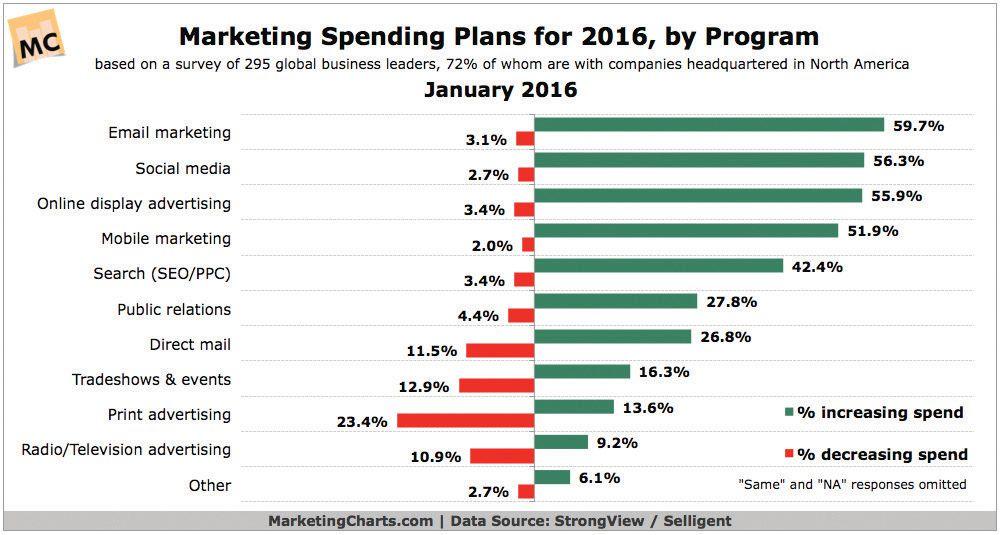
Print, radio, and television are expected to see a net decrease in total marketing investments, according to new data published by Marketingcharts and sourced by StongView/ Selligent.
20%
More than 20 percent of today’s print buyers have less than 10 years experience or even less than five, according to a report called The New Print Buyers: Who They Are, What They Want, and What You Should Do, produced by Margie Dana and John Zarwan, who interviewed 315 professionals who buy print as part of their job.
those are solid relationships!You don’t win in those situations by reducing your prices until you get some action — if it works that way, you’re dealing with a price monster! The real win is to find either a pain point or an added value point and to build a relationship around that.
Now consider this. There are no pain points or added value points with a true solid. They’re already getting what they want and/or need from their current supplier(s)! That takes us straight to the only difference between a solid and a liquid — liquids will talk to you! And the reason they’ll talk to you is that they have pain points, or that they’re receptive to added value.
Do solids ever turn into liquids? Sure, so there is some value in attempting to stay on someone’s radar in anticipation of a time when they’re less-than-happy with their current supplier. Just recognize that that’s a long term challenge. My advice is to go looking for liquids. If they’ll talk to you, that gives you the opportunity to explore their wants and needs and problems and opportunities and possibly sell them on a better solution.
Something else to consider: When you gain a customer on that basis, that’s pretty solid!
DAVE FELLMAN is the President of David Fellman & Associates, a graphic arts industry consulting firm based in Cary, North Carolina. He is a popular speaker who has delivered keynotes and seminars at industry events across the United States, Canada, England, Ireland and Australia. He is the author of Sell More Printing (2009) and Listen To The Dinosaur (2010). Visit his website at davefellman.com.
presented by
PLATINUM SPONSOR
GOLD SPONSORS
SILVER SPONSORS
NOT FADING AWAY
QuarkXPress 2016 comes out swinging to regain its role as powerful software for the printing industry by focusing on new tools for layout, file conversion and digital publishing
By Zac Bolan
You have to admire the persistence of Quark. I’ve seen major players in the graphic arts software cosmos come and go through the years, many falling from seemingly impervious heights. Remember Aldus – maker of Pagemaker and Freehand? Remember when QuarkXPress ruled the roost in the early days of professional digital page layout? While Pagemaker enjoyed a devoted following in creative circles back in the day, QuarkXPress had the edge with publishing and prepress professionals – especially with version 3.32 which had a tenacious following well into the 21st century!
Then Adobe turned the tables by acquiring Aldus and initiating development of a new secret weapon in the page layout wars. InDesign came along at just the right time – Quark was struggling to get their Mac OS X version to market while
creative pros wanted to benefit from the latest Mac hardware and operating systems. For them, InDesign looked like the logical choice. Quark eventually brought their next-gen XPress to market, but it was too little, too late. InDesign had captured the creative imagination, and coupled with Creative Suite Adobe seemed to floor rival Quark.
But it wouldn’t be a very good yarn if Quark just faded away into desktop obscurity. The punch-drunk slugger eventually went Mac OS X in 2003 and has doggedly progressed ever since, carving a niche in the publishing marketplace by adding features requested by users and focusing on ePublishing and App development through their App Studio. Then things changed with Adobe’s move to their subscription-based Creative Cloud – suddenly QuarkXPress was punching above its weight with perpetual licensing!
With seemingly renewed purpose, Quark hit the gym and produced a signifi-
QuarkXPress 2016
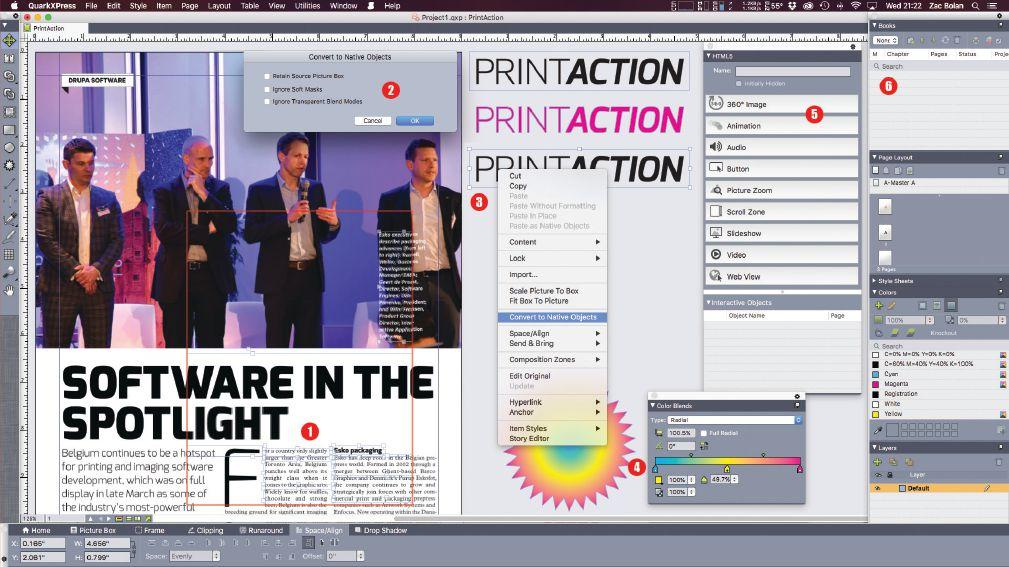
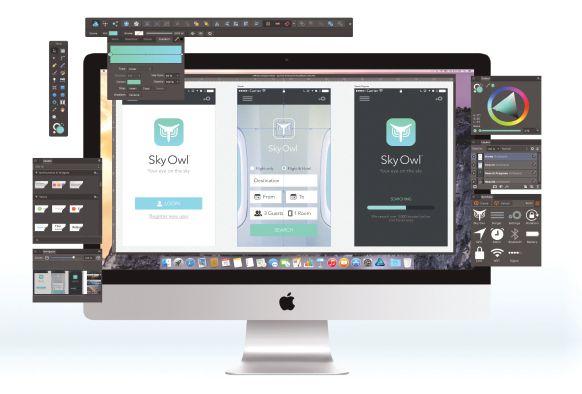
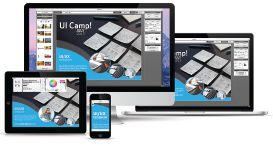
Interface: 1 – PDF of PrintAction page originally created in InDesign, imported as a graphic, then converted to native Quark objects. Everything appears in place and matches the original PDF in the background perfectly, however text is contained in multiple boxes. Also, the full resolution image is embedded and will increase the size of the QXP file.
2 – Options for conversion.
3 – Users can right-click on individual graphic elements and convert to native objects through the context menu.
4 – Powerful new colour blending tool supports up to 5 colour blends with transparency.
5 – HTML5 elements can be added to your digital layout.
6 – QXP 2016 improves tools for book and technical document publishers.
cant upgrade in QuarkXPress 2016. Aside from a bevy of user-requested improvements and features in this new release, Quark has actually managed land a few sucker punches.
File conversion powerhouse
For eons digital artists and prepress pros have lusted after the Rosetta Stone of graphic file conversion – an application that could import a non-native file and render it editable. QXP 2016 can lay claim to being the first page layout application to bring this robust capability to the masses. Accessible under Styles or contextual menu, the Convert to Native Objects tool can magically turn the contents of placed text, raster or vector images to native and editable XPress objects.
File formats supported for conversion include Adobe Illustrator, PDF, EPS and Windows/Enhanced Meta file. For a newly introduced feature, I found the conversion process surprisingly easy and seamless. Users can import a supported file into a picture content box as usual, but then choose to convert the entire image, or just a cropped section.
This is a boon to designers and production artists who routinely deal with customer-supplied charts and graphs they wouldn’t normally be able to edit.
While the feature works very well in most circumstances, it’s important to remember that importing a text laden PDF file, then converting it to native XPress format won’t necessarily provide nice, neat text boxes full of reflow-able content. Much as when opening a PDF file in Adobe Illustrator, text may be broken up into line-by-line elements, or even words, letters and punctuation isolated in text boxes. Also, as with any native QXP object the user will need to have the appro-
priate fonts active in order to correctly display converted files. However, users are giving the option of choosing replacement fonts before conversion.
Other conversion options include the ability to retain the source picture box which will keep the link to the original file as well as the option to ignore soft image masks and transparent blend modes –neither of which are supported in this version of QuarkXPress.
In addition to converting imported objects, users can also Convert to Native Object while pasting any supported format file contained in the clipboard. For example, you can copy formatted text from MS Word and convert the content by right-clicking on the destination page and choosing Paste as Native Object from the contextual menu.
When converting a file containing raster or vector objects in addition to text, QXP 2016 embeds the object on the page while maintaining the original object format. That means your vector graphics will stay vector within QXP 2016. However, the graphic will not be available as an external image file like other imported QXP support files.
Also, users have limited export options when saving these embedded objects out to a file – either PNG or JPEG. That means vector objects will convert to raster when exporting from QXP 2016. Most users will find this isn’t a big detriment to their workflows, as the convenience of converting these files into native editable QXP objects far outweighs the limited export options. And there are workarounds if needed.
Digital publishing uppercut
Few designers can live exclusively on print these days. Increasingly clients de-
$179
A strategic plan to counteract the new software market driven by costly perpetual licensing, Quark allows users to buy a one-time license which amounts to just US$179 for QuarkXPress 2015 users to upgrade or US$349 for users of any version between 3 to 10.
mand digital publishing options along with their collateral designed for print. While Quark has provided a variety of digital publishing capabilities in prior versions of QXP, QuarkXPress 2016 has rolled their App Studio and eBook production tools into their new harmonized Digital Layout workspace. When creating a Digital Layout, users choose from a variety of predefined pixel dimensions for popular devices ranging from Kindle and iPad to a selection of popular mobile phone screen sizes.
Users can also define unique dimensions for content that might appear on a Web page, which harkens potentially the most significant new digital publishing feature in this release – the capability to export a project as an HTML5 package. HTML5 is the latest version of the markup language used to power the web and was famously championed by Steve Jobs when he refused to support Adobe FLASH technology on the first iPad –instead suggesting HTML5 would be the future framework for digital content.
Turns out Steve was right! Since Job’s endorsement HTML5 has evolved to become the leading technology used for online publishing due to its ability to provide application programming interfaces for complex web functions while natively streamlining the delivery of graphical and multimedia content. Increasingly HTML5 is being used to produce cross-platform mobile applications as well.
QXP 2016 also enables designers to convert print projects to digital layouts which can then be supplemented with interactive elements such as video or slideshow galleries while maintaining the aesthetic of the print layout. Additionally, many QXP 2016 text and typographic
features survive the jump to HTML5 including run-around text, support for justification and hyphenation as well as embedded OpenType and TrueType fonts. Users are also able to launch a preview of their HTML5 layouts from the QXP 2016 desktop.
So does Quark’s HTML5 export feature make every print designer a savvy web coder and online creator? Hardly. Creators of static print will need to study the digital layout paradigm before building compelling eBooks, mobile apps or web content.
On first inspection, the QXP HTML5 tool palette offers a beguiling collection of media and interactive content options to the designer such as 360º image, audio, video, zoom, scroll zones and animations. Not all of these interactive elements and enhancements, however, will be effective in every digital publishing channel – standard ePub, fixed-layout ePub, Kindle, Kindle Fire and iOS all have varying capabilities and limitations that will determine what HTML5 can do. This translates to more homework for the newly minted HTML5 producer before undertaking a digital publication for their client.
Ringside requests
Not every new QuarkXPress 2016 feature came from the coach in their corner. As I alluded earlier, many of the new features are enhancements requested by die-hard QuarkXPress users.
In a nod to technical writers and textbook publishers, QXP 2016 now supports the insertion of cross-references for Endnotes, Footnotes and Numbered Item. Additionally, the Footnotes feature introduced in QXP 2015 has been enhanced with improved formatting options. Also, HTML5 export supports bullets and numbering as well as ‘pop-up’ footnotes when creating a digital publication for fixed-layout ePub format.
A long overdue eye-dropper style colour picker tool has been added to the Colours Palette, enabling users to sample any colour from an image or imported object. And another welcome colour capability added to QXP 2016 is a powerful Colour Blends Palette. This tool does precisely what you’d expect, enabling users to build complex multi-colour blends within QXP 2016 in a range of styles including linear and radial. Users can even set different levels of transparency for each colour in the blend!
For typography fans OpenType
stylistic sets are now supported in QXP 2016 to take advantage of any fancy ligatures, fractions or swashes you may have hiding in your font. QXP 2016 includes a number of UI enhancements geared towards productivity, most notably for the Windows version, which has lagged behind the Mac look and feel. And thanks to their Xenon Graphics Engine QXP 2016 continues the tradition of delivering the best onscreen display experience of any page layout application. They had me at 8,000 percent zoom!
Knockout punch?
At one point in time Adobe seemed to have the graphics world boxed into a corner with their software suite. Creatives depended almost exclusively on Illustrator and Photoshop to bring their ideas to life, while using InDesign to aggregate the graphic content into printable pages.
Today’s creative pros have many more software options at their disposal with applications such as Affinity Designer, Affinity Photo and Pixelmator making inroads into what was once Adobe’s exclusive domain. And like Quark, these contenders have avoided the subscription model in order to appeal to the software libertarians out there.
As the printed page vies for relevancy in the digital ring, developers of graphics software take two distinct approaches to iterative improvements… either empower your application to create content for diverse delivery channels, or rely on other specialized applications to collaboratively re-purpose content. Quark has chosen to empower with XPress 2016.
Is QuarkXPress 2016 perfect? While the Convert to/Paste As Native Object feature is a remarkable bit of engineering, improving the flow of text into boxes would be nice perk. Also direct InDesign import/conversion is still not an option, though possible through a third-party application from Markzware. And having the capability to produce HTML5 digital publications doesn’t make a printer into an ePub designer – though having the tools sure gives them the option to grow.
Having said that, QuarkXPress fans choosing to upgrade to QXP 2016 can actually step into the ring with some confidence, knowing this heavy hitter could be a contender. And others struggling to justify a monthly stipend for page layout finally have an option in their corner!
fold and even glue all on the same machine, up to 30 pt.
3. INTEGRATED MODULAR UNITS — Combined in-line finishing: crease, fold, glue, tipping, envelope inserting, ink jetting (Duplex), clip seal (3 sides), mail prep.
4. SAVE ON POSTAGE COSTS As a Certified Canada Post Direct Marketing Specialist, we get contract pricing reductions.
5. RETURN MAIL PRODUCTS — Customized “Return Mailers” created in-line with “U” or “BOX-shape” remoistenable glue, time perfed applications and envelope formation.
6. MINI-BOOKLETS — Saddle-stitch and trim 2-up booklets in-line to the size of a business card. No need to trim off-line, or do 2 passes.
7. HIGH SPEED EQUIPMENT — High speed Tipping, Folding, Saddle-stitching and soft folding ensuring on time delivery.
SCENES FROM GRAPH EXPO
After a risky play to move from Chicago to Orlando, exhibitors describe an upbeat Graph Expo 2016 with decision makers and an increase in sales on the show floor
By Jon Robinson
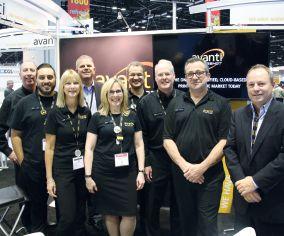
Members from Avanti of Toronto demonstrated Slingshot, billed as the only JDF-certified, cloud-based Print MIS in the market today.
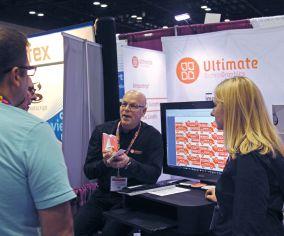
Raymond Duval, Director, Solutions Sales at Montreal’s Ultimate TechnoGraphics, with a new Nesting Optimization Engine for Impostrip.
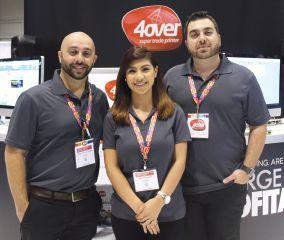
4over, North America’s largest trade printer, continues its strong show presence with Arby Tatavossian, Viri Anguiano and Todd Kamali.
Karl Belafi Jr., VP, KBR Graphics, with RMGT’s new 55-inch display, which will be available in January 2017, for customizable monitoring.
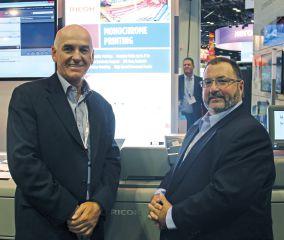
Ricoh Vice Presidents Andre Brazea and John Fulena with the new Pro 8220s series – a monochrome press with 136-pages-per-minute speed.
Xerox’ new CEO Jeff Jacobson describes the company’s upcoming split into two entities, Xerox (printing) and Conduent (BPO).
HP’s John Lyle and Danny Ionescu with the PageWide XL Series, which prints large-format colour work twice as fast as most laser systems.
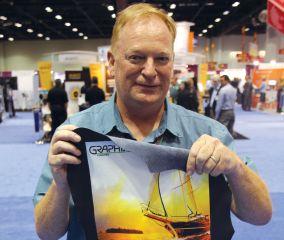
Tech guru Dave Kew with samples printed by Graphixon’s inkjet developments, which retain the feel of difficult fabrics like upholstery.
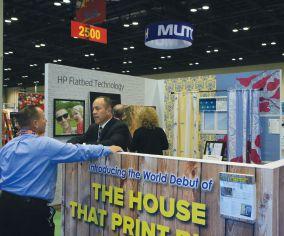
The House That Print Built was a brand new section of Graph Expo to showcase the increasing possibilities of inkjet technology.
Canada’s
and
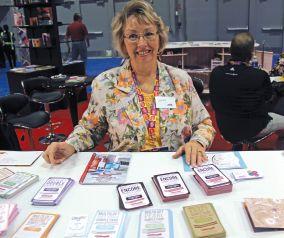
Duke shows off some of the unique Multiloft products, which is becoming a global print sensation to create standout cards.
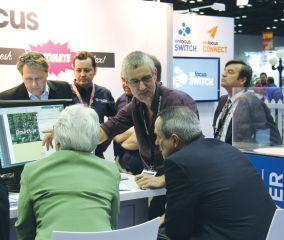
Enfocus showed off its PDF editing software, including the new Enfocus Appstore for Switch users who want to automate repetitive tasks.
Xerox
Andrew Gunn
John Santoli, Xerox’s World Wide Product Marketing Manager, in front of the new Brenva HD Inkjet Press.
Louella
CANADIAN SIGNAGE SHOW
In late September, printers gather in Mississauga to take in Sign Expo Canada and one of the fastest growing printing segments for the past decade
By Jon Robinson
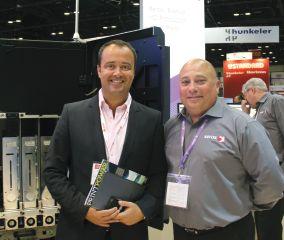
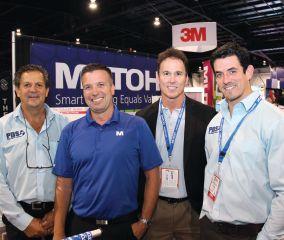
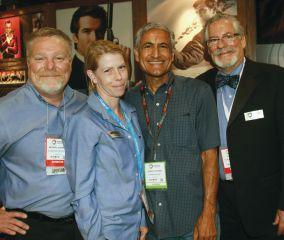
Supporting their recent partnership are PDS’ Dave Kisiloski, Mutoh’s Matt Bartlett and David Conrad, and PDS’ Brett Kisiloski.
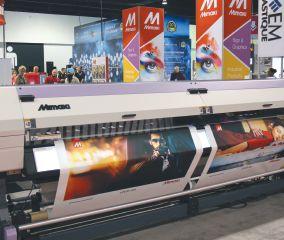
Mimaki’s new UV55-320 system, which is now on display in its first Canadian demo centre recently opened in Mississauga, Ontario.
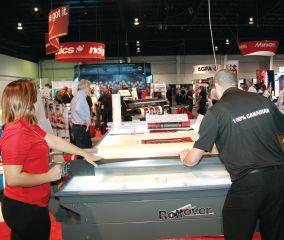
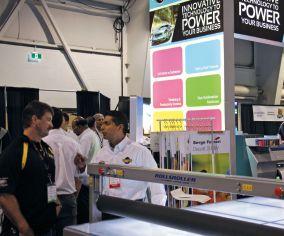
ND Graphics, with more than 10 locations across Canada, was demonstrating new Roll Over laminating technology for wide-format imaging.
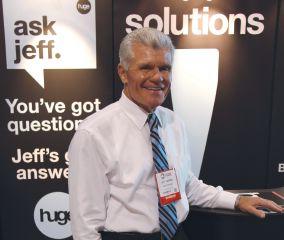
Huge Paper’s Jeff
has expanded into the wide format imaging space with high-end vinyls and synthetics.
Cled DeSouza of All Graphic Supplies, founded in 1992 and now one of Canada’s most prominent large-format-imaging suppliers.
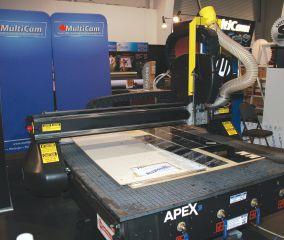
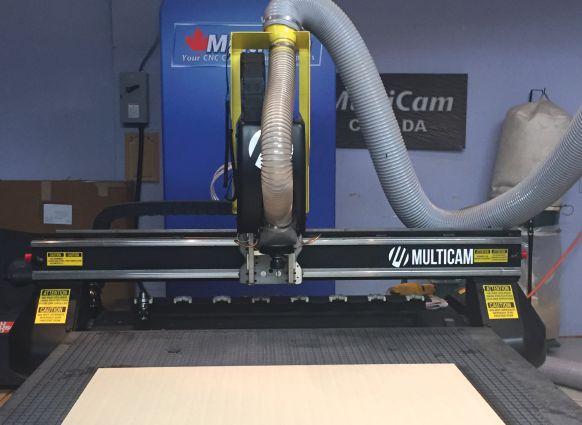
MultiCam’s next-generation CNC router, APEX3R, includes an automatic tool changer, all-steel tube frame and moving gantry.
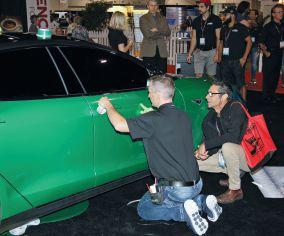
3M’s Jeff Uzbeck was busy at the show demonstrating innovative medias for a range of car wrapping applications.
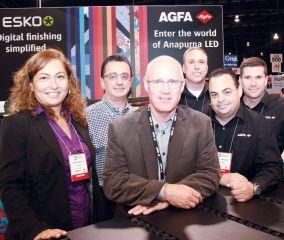
Agfa Canada’s Lupina Mancuso, Ruben Silva, James Burghgraef, Steve Fournier, Bruno LaPlante and Alexis Aubre.
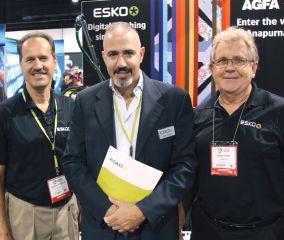
Esko’s Sergey Potebrya, Marc Raad and Brian Shaw exhibited on the Agfa booth to showcase wide-format finishing advances.
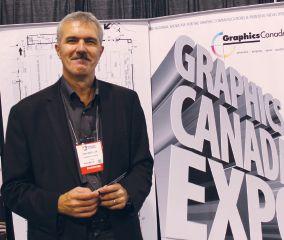
Graphics Canada show manager Dan Mustada explains the April 2017 trade show in Toronto is more than 70 percent sold out.
HP’s Kevin Sykes speaks with an interior designer about the advances of HP Latex technology, showcased by the company’s unique booth.
On the Roland DGA booth with Michael Guarino, Lisa Dunbar, Abhay Sharma (Ryerson GCM), and Canadian Sales Manager Don Ross.
Tapping
Postpress power
The printing industry continues to develop innovative finishing technologies as a critical area to drive enormous production savings
Duplo Digital Spot UV Coater
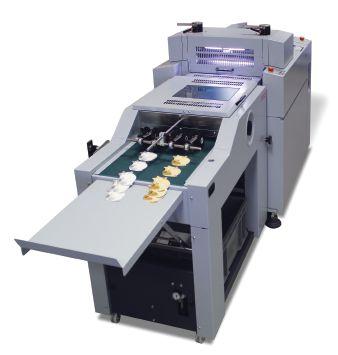
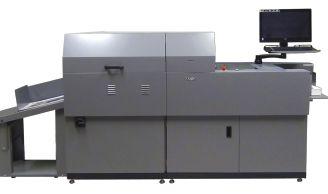
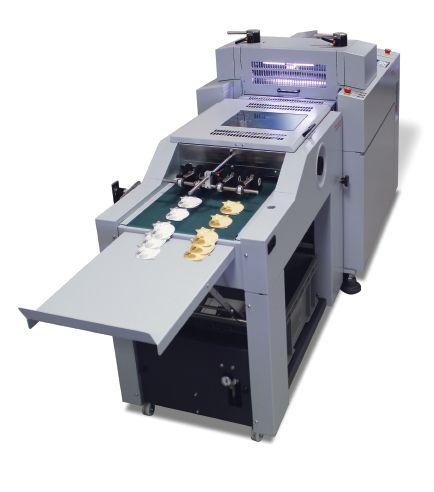
In August, Duplo USA introduced North America to its new Digital Spot UV Coater, which adds depth to images and enhances the appeal of the printed product. The system will be made available in 2017. Utilizing ink jet technology together with an ultra violet lamp to instantly cure the ink, the Digital Spot UV Coater applies a gloss finish to defined areas of the printed substrate. A CCD camera recognition system helps ensure the accurate application and alignment of the spot UV image onto the printed application.
Released in May 2016, Duplo’s new DC-446 offers improvements on performance and key specifications over previous models. With approximately a 20 percent increase in speed, the DC-446 processes up to 60 sheets per minute, handles a maximum paper width of 330.5mm/13 inches to accommodate 13 x 19-inch sheet sizes, and offers an increased capability of 20 creases in a single pass.
Muller Martini Connex
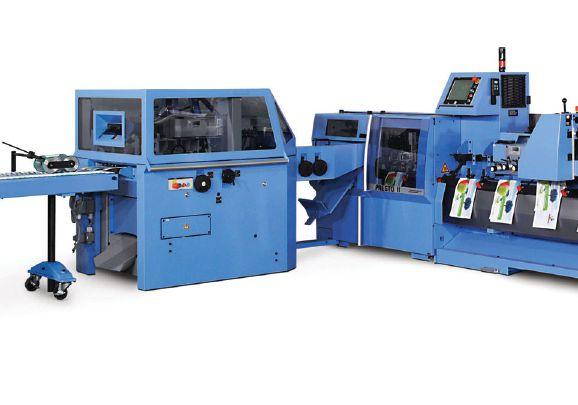
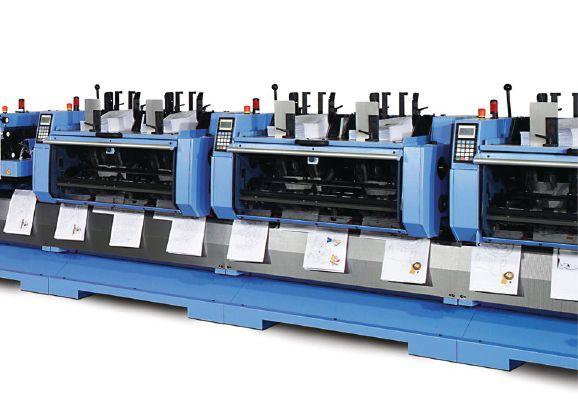
In September, Muller Martini showcased its new Finishing 4.0 networking technology, Connex, including an end-to-end touchless workflow, allowing users to migrate to digital and hybrid platforms while concurrently satisfying demands for conventionally produced products. The Connex data and process management system provides seamless connectivity for both digital and conventional print production. This includes working with such systems as the Vareo perfect binder to process both offset and digitally
produced signatures – equipped with an all-new PUR gluing system. The Presto II saddle stitcher is able to merge both web and conventional signatures.
Challenge CMT 130TC
Introduced in August, Challenge Machinery’s third-generation CMT 130TC On-Demand Book Trimmer is an automated three-side book trimmer for creating short-run perfect-bound books. The trimmer line has been upgraded with a 10-inch colour touchscreen display. The company also describes the system’s integrated inline and near-line feeding systems as industry-exclusive features.
Morgana DigiFold Pro 385
In October, Morgana released its next generation DigiFold Pro 385. One of the key changes from previous DigiFold models is the introduction of a high-capacity vacuum top-feeder that can take a sheet pile of over 17.7 inches. Once the size and thickness of stock are entered, all other feeder functions including air and vacuum settings, side guide positions, and fold roller gaps are automatically adjusted for quick and easy setup of jobs. Stock of up to 0.4 mm can be creased and folded with virtually no cracking of the sheets or the toner on them. Another new feature is the dual creasing blades, the Morgana DynaCrease, for creasing and folding applications at over 6,000 sheets per hour.
MBO BSR 550 Basic
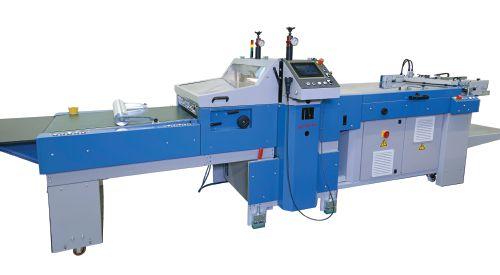
In September, MBO debuted the new BSR 550 Basic rotary diecutting system which the company explains provides benefits for both digital and offset printing projects. The BSR 550 Basic is an all-in-one rotary diecutting system designed for the mainstream 20 x 29-inch cut-sheet market. A key innovation in the system’s design eliminates manual production steps, resulting in five minute makereadies. This industry-exclusive benefit substantially improves productivity and turn-around times, especially as the industry demands shorter runs.
The BSR 550 Basic’s advanced engineering and versatility allows printers to produce mailings, presentation folders,
The Muller Martini Presto II stitcher can now leverage the new Connex system.
business cards, greeting cards, folding carton blanks, tags and labels, and other products in a one-up or multi-up production setting. This is due to an improved infeed, easy change magnetic die cylinders and tool-less components at the waste stripper.
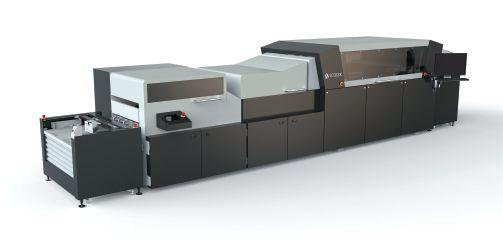
Scodix UltraPro features a new foiling option for print enhancement.
Scodix UltraPro with Foil
MBO’s new BSR 550 Basic rotary diecutting system.
Scodix UltraPro with Foil, released at GraphExpo 2015, which is an optional module, that runs in-line with the Scodix Ultra Pro Digital Press, delivering unmatched foil enhancement capabilities, including high gloss, embossed, variety of densities for short to medium runs, using a highly advanced, highly-efficient digital process. Scodix Foil is ideal for commercial printers, coping with short to medium runs, who today have to outsource the foil application or to use a long and expensive make ready process including molds and dies, as well as for converters doing highend short up to medium runs. Scodix Foil deploys a wide range of hot and cold industry standard foil films, coupled with a variety of substrates, including offset, digital, plastics, laminated/non-laminated, and coated/ Without coating Applications include business/greeting cards, folders, book covers, brochures, labels, packaging and more.
Hunkeler WI6
Released in May 2016, Hunkeler’s enhanced WI6 system is the latest innovation in inspection and tracking software, ensuring error-free print quality through continuous monitoring of the printed web for quality-related checks such as color registration, front-to-back registration, variable content, print marks, logos, pictures, and jet-outs. At the show, WI6 is running on Standard’s continuous-feed saddlestitching solution, a roll-to-booklet
The new Digital Spot UV Coater.
configuration that pairs the Standard Horizon StitchLiner 6000 saddlestitcher with Hunkeler’s UW6 unwinder and CS6 rotary cutter.
Hunkeler’s enhanced WI6 system
Standard Horizon RD-4055
Released in May 2016, the Standard Horizon RD-4055 Rotary Die Cutter, with Dual Magnetic Cylinder, is designed to meet the growing demand for short-run die-cut product, with the ability to die-cut, crease, perforate, slit, hole punch, and round corner in one process for both digital and offset printed sheets. A repeat register function allows multiple-up applications from a single-up die to minimize costs. Presented with the RD-4055 and making its North American debut is the new Dual Magnetic Cylinder, allowing for magnetic and pin-registered mounting of matching male and female dies, and pro-
viding additional creasing and embossing patterns to suit a wider range of substrates and light packaging applications.
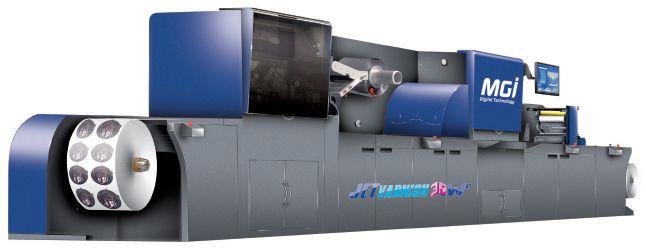
JETvarnish 3DW
The new JETvarnish 3DW delivers provides print enhancement value to the label market. The JETvarnish 3DW allows label printers to go digital for Spot UV Coating and Embossed Hot Foiling without dies, screens or expensive tooling on narrow webs up to 420 mm/16.53 inches. The JETvarnish 3DW is designed for both 2D (flat)/3D Embossed Spot Coating over flexo, offset or digital webfed printed output. Hot Foiling can be added with glamorous metallic and colored foils to embellish label designs. The JETvarnish 3DW also has an inline flexo station that applies a pre-coating treatment to label substrates not originally planned for inkjet processing. This elegant, flexible solution offers a great compatibility advantage to label printers who use a diverse range of printing technology (digital, offset or flexo).
Rollem Insignia6 Diecutter
Rollem explains the Insignia5 is a leader in the new category of sheetfed flexo-magnetic diecutters. It allows for diecutting, kiss cutting and creasing of label sheets, shaped photo cards and direct mail products. Insignia6 is the newest release with a sheet size of 24×24 inches, offering the flexibility to feed sheets either landscape or portrait to maximize imposition. The Insignia5 model, with a 20×15” sheet size will be demonstrated at Graph Expo. The third size — Insignia7 offers a 24×30” sheet size capacity. Insignia performs diecutting, kiss-cutting, perforating, scoring, cut-scoring and hole punching on papers, plastics, magnetic material, PVC, and styrene up to 24-pt. Key features include speeds up to 5,000 sph, ease of operation and quick changeover.
Komfi imiJet BE70
In August, thermal laminating machine supplier Komfi introduced a book-edge printing machine that is specifically designed for digital UV printing on book edges using inkjet technology. The imiJet BE70 is semi-automatic in operation and features an integrated PC that provides
built-in help and self-diagnostics, as well as easy job preparation. The printing process involves a one-person operation via a screen and involves the application of either UV inks or UV varnish to all three book edges. While the feeding, turning and removal of the book is undertaken manually, the pumping of the ink into the printing unit, as well as the moving of the book under the printing heads and electronically controlled UV lamp, is carried out automatically. The machine uses four piezo-electric printing heads while two more printing heads (two colours) can be added. The ink amount is adjustable at four levels; 180dpi, 360dpi, 720dpi and variable.
Vivid Matrix 370 Duplex
In Ocotober, Vivid Laminating Technologies unveiled a number of new products including additions to its Matrix laminator range as well as a new gluing system and foils. The double-sided Matrix 370 Duplex, which is able to laminate, foil and create Spot UV-style effects on SRA3 portrait sheets, is a smaller format model of the firm’s Matrix 530 device. Launching alongside this is the 370 Auto-Feeder, which follows the Drupa debut of the Auto-Feeder for the 530 models. These feeders allow prints to be top loaded on the fly for non-stop operation. The company is also adding new finishes to its Boss Premium Foil range, including an over-printable holographic foil and a pure white foil, which Vivid said replicates the effect of printing white.
Standard’s RD-4055
Rotary Die Cutter, with Dual Magnetic Cylinder, is designed for short runs.
The new double-sided Vivid Matrix 370 Duplex system.
The JETvarnish 3D W gives extra added-value and sensory dimensional textures to printed label output.
Detailing the
newest
technologies from Agfa, GMC, GMG, EFI, HP, Mimaki, MultiCam, Serif Software, Silicon Publishing, Toyo and Xerox
Agfa Fortuna 10
In September, Agfa Graphics released Fortuna 10, software for high-security printing, with new new security design tools and brand new rasters, as well as a series of new tools focusing on productivity and simplifying security designers’ tasks. These aim at reducing complex manual calculations, as well as achieving more productivity and ease-of-use for designers of high-security printing graphics for passports, ID documents, high-security cards, breeder documents, tax stamps, security documents, lottery tickets and more. Fortuna 10 introduces the brand new Trafo pattern
generator, a solution for the very latest challenges faced by passport and other security document designers.
Serif Affinity Designer
v1.5
In October, Serif introduced what it described as major updates to its Affinity Designer application, which is free to existing owners. Updates in Version 1.5 include: MacOS Sierra optimized, Symbols, Constraints, Asset management, Text styles, export improvements, New colour picker tool, Style improvements. Constraints gives users the ability to control the position or size of an object relative to its container, making it
Fortuna 10 will be available for Windows 10 environments at the end of 2016.
Affinity Designer v1.5 includes an Alignment update with customizable grids and snap to pixel tools.
possible to create reusable elements which perform in a pseudo-responsive fashion. Symbols will allow users to have multiple instances of the same object, where editing one object will edit them all simultaneously. Snapping power is another feature which continually wows Affinity Designer users.
HP PageWide Web Presses
In September, HP Inc. introduced four new 30-inch PageWide Web Presses powered by its High Definition Nozzle Architecture (HDNA) technology: HP PageWide Web Press T390 HD, T390M HD, T380 HD and T370 HD. The new system print at 500 feet per minute in quality mode and, according to HP, are aimed at applications like colour and trade books, journals, retail catalogues, brochures and marketing collateral. The company also introduced a new technology that can be applied through the HP PageWide Web Presses, called HP Link Technology, which embeds Internet-connected codes and invisible watermarks in printed collateral, such as customized textbooks, magazines or instruction manuals.
Xerox Color C60/C70
In September, Xerox introduced enhancements to Xerox Color C60/
C70 printers for increased substrate flexibility and greater image quality accuracy. Software updates and fea ture enhancements to Xerox’s Color C60/C70 Printer are opening appli cation opportunities to print en vironments of any size. New media and paper weight management capabilities make it easier to handle an even wider range of substrates to include lightweight media (60 gsm) often used for dictionaries along with heavier, more challenging stocks (256 gsm 2-sided/300 gsm 1-sided) used for cards or invitations.
Toyo AQUA
In October, Toyo Ink Group show cased a range of new inks including new water-based technologies called AQUAECOL gravure lamin ation inks; AQUA LIONA flexo inks for the reverse printing on flexible films; AQUAGRACE series of flexo inks for the surface printing on films; solventless and high-solid adhesives, and other food-grade inks. Toyo’s adhesives for energy applications such as solar cell backsheets and lithium-ion secondary battery cells will be featured together with its Liojet inkjet inks and Lioduras functional hard coatings (UV coating agent, water- and oil-repelling type, low-odor type and releasable coating agent).
HP’s new T390 series runs at up to 500 feet per minute.
The Xerox Color C60/C70 was awarded the 2016 Buyers Laboratory Production Printer PRO Award.
MultiCam APEX3r
Introduced in August, the new APEX3r CNC router is a next generation machine with, according to MultiCam, standard features normally associated with more expensive machines. The automatic tool changer gives the user machining flexibility, and the all-steel tube frame, moving gantry design allows for machining of large parts while maintaining a small, space-saving footprint. Standard features include a 25-mm linear ball-bearing profile rails, MultiCam EZ Control user-friendly operator interface, highspeed three axis motion control system, 12-MB memory with unlimited file size transfer capabilities, brushless digital AC servo drive system, and EZ Suite Software.
Mimaki JFX200-2531
In September, Mimaki extended its JFX200 product range with the launch of the JFX200-2531 model, which offers an increased printing area and enhanced productivity. The new flatbed UV LED printer, which builds on the success of the JFX200-2513 model that was launched two years ago, features the same specifications as its predecessor but adds a larger table with a print area twice the size. It also includes a ‘toggle print’ function that increases productivity and improves continuous running capability by allowing operators to load one board while another is printing.
GMG ProofMedia
In August, GMG released its GMG ProofMedia studio OBA matte 150, which is the company’s first matte surface proofing media containing high Optical Brightening Agents (OBAs). GMG explains it has been developed for highly accurate proofing and the closest visual match of
commonly used uncoated production papers. In the past, explains GMG, it was problematic for design agencies, prepress and print companies to deliver a visual match between proofs and prints, even with good colorimetric measurement, as matte proofing media contains no or too little fluorescence. GMG’s new OBA matte 150 media features fluorescent levels, according to the company, comparable to popular production papers, for visual matches to final production.
Silicon Designer
In September, Silicon Publishing showcased how users can edit Adobe documents using mobile browsers and iPhones. The new Silicon Designer enables editing of Adobe InDesign documents with standard web interfaces on mobile browsers through a configurable white-label interface. While the documents themselves start out as standard InDesign, the UI is nothing like InDesign. Instead of a single one-size-fits all approach, the editing interface can be completely customized using standard web technologies such as CSS and web components. For mobile devices, using the entire screen footprint for previewing, and zooming in on the page object being edited, makes it possible to edit, even on a phone, high-quality print documents.
MultiCam’s APEX3r includes an automatic tool changer.
Silicon Designer marries InDesign and
PREPRESS & DIGITAL OPERATOR
Full time experienced Prepress & Digital Operator required in downtown Toronto. Prepress: Edit, proof, colour match, preflight files, imposition & plate making. Solid understanding of colour profiles, overprint, transparency, trapping etc.
Digital: Operate Konica Bizhub Press C1060 with Fiery RIP. Process files accurately and efficiently.Proficient with Adobe Creative Suite 5+
Email résumé to: info@qprint.ca Website: www.qprint.ca
CP BOURG PERFECT BINDER
For sale CP BOURG BB2000 Perfect binder in working condition. Willing to show a live demo. $2,000 or best offer.
Email: info@qprint.ca
Tel: 416-366-0374
PART-TIME TYPESETTER/GRAPHIC ARTS DESIGNER
Agassiz is a great little community surrounded by beautiful mountains and lakes. We are a small print shop looking to build up more clientele from the surrounding communities. We are looking to hire a Part time typesetter/Graphic Designer who has printing experience/ background. This position could lead to a management position. Please email inquiries or résumé.
Email: agharprinters@uniserve.com
Tel: 604-796-3131
Fax: 604-796-2952
Website: www.agassizharrisonprinters.com
FIELD SERVICE TECHNICIAN, HIGH SPEED INK JET PRESS
The Field Service Technician, High Speed Ink Jet Press will provide comprehensive technical service support for all HSIJ equipment sold by Fujifilm. This position will be responsible for providing superior service to internal and external customers to ensure that equipment operates properly and meets established quality and reliability levels.
Email résumé to : www.fujifilm.ca/ and clicking on “Careers”
PROFESSIONAL SERVICES CONSULTANT
The Professional Services Consultant provides expert level consulting services to internal and external customers to identify potential opportunities. This position will play a key role in identifying and recommending business and technical solutions within the Graphics High Speed Ink Jet environment related to trends and technical solutions.
Responsible for all facets of each project they are involved with including defining client requirements, documenting specifications, developing project plans and managing customer expectations resulting in a successful Professional Services implementation.
Email résumé to: www.fujifilm.ca/ and clicking on “Careers”
SUCCESSFUL PRINTING/ LAMINATING/BINDING BUSINESS FOR SALE
Successful Binding/Laminating/Printing Business (29 years), For Sale – with the building - in London, Ontario. 13,500 sq. ft., fully air-conditioned, free-stand building on .6 of an acre. Asking price for both is $900,000. For more information
go to the “View Listings” section of the website at www.commercialsales.caclick on the link for 39 Charterhouse Cres., London.
Email: dalebensette@royallepage.ca
Web: www.commercialsales.ca
TECHNICAL SERVICE MANAGER, WIDE FORMAT
The primary responsibility of this role is to oversee and participate in the overall management of comprehensive technical service support for Wide Format & High Speed Ink Jet equipment sold by the Graphics division in the Central region.
This position will also maximize the utilization of regional service resources, and interact regularly and directly with customers to ensure that equipment operates properly and meets established quality and reliability levels. The ideal candidate will have 5-10 years experience working within the Graphics industry, with 5+ years working in a service department in a leadership capacity. Interested candidates can apply for this position by visiting www.fujifilm. ca and clicking on “Careers”.
Web: www.fujifilm.ca
EXPERIENCED LARGE FORMAT PRINT SALESPERSON
Reproart Imaging is a state of the art large format print facility with high speed HP printers and automated finishing capabilities. We are looking for a sales representative with experience in selling large format print jobs. Attractive compensation package commensurate with experience and deliverables. Send your résumé to zohrab@reproart. com
Sakurai: 1, 2 or 4 colours and any size (newer model)
Polar: any size/older or newer models (66/72/76/78/82/90/92/107/115)
Horizon-BQ: 220/240/260/440/460
Claus Bolza-Schünemann / CEO & President / Koenig & Bauer AG / Würzburg, Germany
Nearly one year ago, PrintAction sat down with Claus Bolza-Schünemann of Koenig & Bauer AG (KBA) at Graph Expo to discuss the prospects of the upcoming drupa 2016 trade show, which a somewhat beleaguered printing industry eagerly awaited to provide signs of the future. In addition to his leadership role with the world’s oldest press maker (celebrating 200 years in 2017), Bolza-Schünemann took on the role as Chairman of drupa 2016 with all of the responsibilities to drive this critical printing exhibition. At Graph Expo 2016, held for the first time in Orlando in late September, PrintAction once again spoke with Bolza-Schünemann to get his perspective for how successful drupa 2016 was and if the exhibition signaled printing’s push into a new communications era.
Do you bill drupa 2016 as a success?
CBS: To sum up what I heard from many vendors, customers, and also my personal opinion: Best drupa since 2000 – 2004 was okay; 2008, Lehman’s said hello; 2012, there was still lots of consolidation going on in the whole printing world. In 2016, I was personally, completely overwhelmed to be honest. As the drupa Chairman, I toured half of the world from Chile to Tokyo and from Johannesburg, South Africa, to Almaty, Kazakhstan... but I was not sure if the number of visitors that we were all aiming for, a quarter of a million, would really show up. And it did happen.
Was the make-up of visitors as expected?
CBS: It was the most international drupa ever. More than 80 percent of the visitors were from outside Germany – absolutely awesome – and, as I said, all vendors, the fair itself, they were all overwhelmed. What I really enjoyed was the presence of very knowledgeable customers, not poster pickers. The visitors knew exactly what they were looking for and what questions to ask. It was both quality and quantity.
Did drupa bring new optimism for print?
CBS: Yes – I think the whole printing industry was complaining for years about how bad things are and how difficult. This is very dangerous, because it creates a public feeling that print is not useful – it has no value. This was also one of the essential keys for me personally during the drupa promotion tour around the world, to give the audience a sense that printing is from dead. It is from dusk till dawn around us. With printing everybody relates to paper or to magazines, but never to folding carton or corrugated or metal decorating or glass container printing or floor printing or walls – you name it, there is nothing which is not printed on. And we just ignore this.
Why did drupa revert to a 4-year cycle?
CBS: I am absolutely convinced that it was a very good decision to have the next drupa in 2020 [every four years, instead of three as announced in early 2016, before this year’s event] and keep the four-year cycle. To stay with a quality drupa and also to ensure visitors see new equipment whatever they dream of. This is the essence of drupa.
Was this the packaging drupa?
From surveyed attendees, 55 percent of visitors attended drupa primarily to find innovations and trends in the printing industry, while 33 percent came to connect with existing suppliers and 30 percent cam to search for new suppliers.
CBS: Packaging was certainly a big part of drupa. For us, from the KBA end, it was a stage to present the broader variety of solutions that we have, no matter if it is commercial printing, packaging, inkjet, flexible die cutting, whatever. So perhaps this was most important for us, to show that we have solutions for not all, but many, many applications customers are looking for. Packaging of course is strong in the industry.
How did Industry 4.0 materialize?
CBS: I think for us it was not as big as the hype, because for years and years integrated processes have been state of the art. No matter if it is a commercial printer, newspapers, or any typical example of fully automated workflow, preset of machinery,
fully automated warehousing. Everything has been linked to protect the process for years. We do remote maintenance around the world. We can look into any press no matter where it is in the world. I think the printing industry overall is far ahead of other industries – far ahead.
Why do external markets not recognize print’s Industry 4.0 position?
CBS: Maybe because we do a bad job from a marketing point of view to show this is state of the art. Just think of job definition formats, JDF, that have been around for 15 years. For example, to make sure that you have a digital device and your trimmer knowing exactly how to adjust for a particular product.
How did drupa effect KBA’s position?
CBS: The sheetfed business overall is very nice. Our market share is constantly growing and if the market itself isn’t growing you can only do so when you gain market share. And we did quite well over the last two or three years. We just recently announced, that among all of the sales we had in the U.S. over the last four years, 45 percent of all presses we delivered are with new customers.
SHOP ANYTIME ANYWHERE GOSPICERS.CA
FAST, EASY & CONVENIENT
Access Product Information 24/7
View Up-to-Date Pricing
Download our Latest Price Book
Check Available Inventory
Improve Purchasing Efficiencies
Order from Order History
Shop Securely Anytime
Streamlined Shopping Experience from Login to Checkout
Get product information and view up-to-date inventory and pricing. Streamline your procurement by creating customized shopping lists, view order status and order history with a click of the mouse.