In special report titled “The consumer demand recovery and lasting effects of COVID-19,” the McKinsey Global Institute recently explored which pandemic-induced consumer habits would likely stick.
Consumption polarization
The report forecasts an increasing polarization of consumption between higher and lower income cohorts.While spending by mid- and high-income cohorts are expected to bounce back to pre-COVID-19 levels by 2022, spending by low-income earners could drop below pre-COVID levels once stimulus measures expire.
E-grocery shopping, telehealth, and home gyms likely to continue after the pandemic.
“Consumption is expected to shift toward older and richer segments because of both a growing share of the population over 65 and a slower post-pandemic recovery for low-income cohorts,” the report said.
Consumer habits
The pandemic interrupted some long-standing habits, such as leisure travel and socializing. New habits were also formed.These include an increased adoption of e-grocery shopping, home gyms, backyard skating/hockey rinks, telehealth and remote learning. On a personal note, I completed a certificate course in content marketing during the pandemic, fully virtual.
Stickiness test
The report’s authors went on to develop a “stickiness test” to identify which behaviours would persist post-COVID. They found e-grocery shopping, telehealth, and home nesting (e.g. home gyms, virtual bootcamps and backyard rinks) were likely to stick while remote learning, leisure air travel, and live entertainment consumption would revert to pre-pandemic levels.
Lessons for companies
It is evident the pandemic upended the competitive landscape across many industries. Further, changing consumption patterns opened up some markets to new players with innovative ideas. Many companies were forced to accelerate investment in e-commerce and expand their capabilities in areas such as delivery. The report’s authors recommend “companies could determine how a segmented rate of recovery, varying degrees of stickiness of con-
sumer behaviours introduced during COVID-19, and emerging innovations, changes in business models and a reshaped competitive landscape will affect their product and service offerings.”
On a related note, the report suggests demand for business air travel would permanently drop by 20 per cent due to a wider adoption of work from home policies. Read the full report at www.mckinsey.com/industries/consumer-packaged-goods/our-insights/ the-consumer-demand-recovery-andlasting-effects-of-covid-19.
What habits are you hoping to retain in a post-COVID world? Personally, I hope to continue waking up at 4:30 a.m. in order to meditate for an hour before morning chores take over. Another habit that I wish will become second nature is my daily neighbourhood walks. The one pre-pandemic habit I wish to bring back is visiting friends. I miss that tactile connection!
The May issue
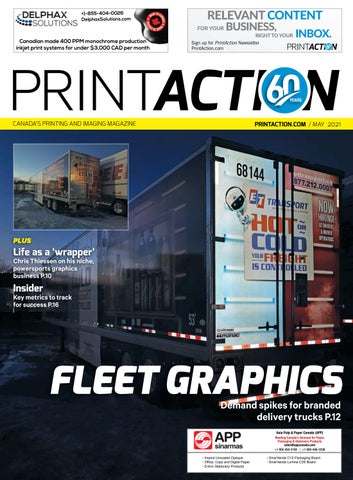
When we talk about tactile, print is not far away. This issue is all about wide-formats. Demand for fleet graphics has spiked during the pandemic. Find out why on pg 12. We also have an interview with Chris Thiessen, founder of Wide Open Throttle Graphics in Lacombe County, Alta. He explains why he decided to bet big and start a powersports graphics business.
Women in Manufacturing
I’m excited to share with you a virtual event my manufacturing publication colleagues and I are organizing on May 13, 2021, 1 p.m. ET. Featuring some of the biggest influencers in the Canadian manufacturing sector, the Women in Manufacturing Virtual Summit offers a live panel discussion, presentations and on-demand sessions where speakers explore the importance of fostering a diverse and inclusive workforce. Don’t miss this opportunity to connect with industry experts whose shared goal is to promote gender equity, diversity and inclusion in Canadian manufacturing. Register at www.automationmag.com/virtual-events/ women-in-manufacturing.
Reader Service
NITHYA CALEB Editor ncaleb@annexbusinessmedia.com
Print and digital subscription inquiries or changes, please contact Barbara Adelt, Audience Development Manager
Tel: 416-510-5184
Fax: 416-510-6875
Email: badelt@annexbusinessmedia.com
Mail: 111 Gordon Baker Rd., Suite 400, Toronto, ON M2H 3R1
COO Scott Jamieson sjamieson@annexbusinessmedia.com
Subscription rates
For a 1 year
subscription (10 issues): Canada — $43.00 +Tax Canada 2 year — $70.50 +Tax United States —$98.00 Other foreign —$191.00
All prices in CAD funds
Mailing address
Annex Business Media
111 Gordon Baker Rd., Suite 400, Toronto, ON M2H 3R1 Tel: 416-442-5600 Fax: 416-442-2230
Occasionally, PrintAction will mail information on behalf of industry related groups whose products and services we believe could be of interest to you. If you prefer not to receive this information, please contact our Audience Development in any of the four ways listed above.
Annex Business Media Privacy Officer Privacy@annexbusinessmedia.com 800-668-2384
PrintAction is printed by Annex Business Media Printing on Creator Gloss 80lb text and Creator Silk 70lb text available from Spicers Canada.
ISSN 1481 9287
Mail Agreement No. 40065710
May 2021 | Vol. 60, No. 4 printaction.com
APP’s FBB Sinar Vanda
DOUBLE COATING TOP LAYER UNDER LAYER FILLER LAYER BACK LAYER COATING
Benefits of Sinar Vanda Folding Boxboard
Highly Formable
Enables intricate structural designs and die-cutting to help brands achieve attractive shelf-ready packaging
Functional Stability
Holds shape for better scoring, folding, and durability
FDA & ISEGA Certified for Certain food contact and packaging applications
High-yield Advantage
1 ton of FBB provides a range of 18-23% more sheets than 1 ton of solid bleached substrate
Environmentally Friendly
Uses less energy in production, reduced pulp demands for FBB manufacturing means less trees are needed for the same end usage as SBS packaging
Sustainable
100% sourced from certified and sustainably managed forests
Spicers Canada, a distributor of paper and specialty products, graphics, and sign solutions and industrial packaging supplies has merged all its divisions under a single brand – Spicers. Previously, in addition to Spicers in Canada, Shippers Supply and All Graphic Supplies operated as separate entities since they were acquired by Spicers in December 2017 and February 2020, respectively.
With this change, Spicers’ Canadian customers will enjoy full and easier access to everything the company has to offer while creating brand clarity and simplicity that will ensure the experience with the whole company is reliable, consistent and recognizable across the country.
Vancouver-based Premier Graphics opted for Drytac SpotOn White Matte to carry out a window graphics project for the Very Good Butchers, a vegan food company.
The graphics had to cover up window panels measuring 21-ft tall as well as building work that was taking place at a retail location in Mount Pleasant, which is a neighbourhood in Vancouver.
The project challenged Premier Graphics to create graphics offering a high-impact and high-contrast design, while also allowing adequate
across almost all procurement categories: petrochemical derivatives, such as resins and solvents, pigments and freight, are three of the most volatile areas, in Flint’s experience.
ambient light to pass into the facility to assist with ongoing construction work inside. The graphics also needed to cover.
Premier Graphics selected Drytac SpotOn White Matte monomeric PVC film. The film features a ‘dot pattern’ adhesive that enables easy bubble-free application on a variety of smooth interior surfaces, windows, and glass. The graphics were printed using an HP Latex 365 device.
HP, Inc., has announced a new method for print service providers of all sizes to acquire HP Indigo digital printing technology while saving capital expenditure, in the form of its new HP Indigo Certified Pre-Owned program.
The program, which is starting with B2 HP Indigo 10000 Digital Press units, offers previously owned presses at a more accessible price point. They are certified and resold after undergoing a strict renewal process in order to ensure the press units continue to provide reliable and quality production.
Flint Group Packaging has increased the price of its ink and coating products. The company is facing an extraordinarily turbulent set of supply chain conditions, exacerbated by the global pandemic. Costs are increasing and supply is tightening
PRINTING United Alliance and Idealliance have officially merged. Under the guidance and direction of the board of directors at each organization, which comprise representative printer and supplier members across the industry, and with the overwhelming support and approval from Idealliance members, PRINTING United Alliance and Idealliance can together bring even more resources and service offerings to its collective membership and the printing industry at large.
The merger is a unique opportunity during a challenging time to collaborate and utilize the strengths of each organization to continue serving the printing industry across market segments. Each organization will retain its unique events and services.
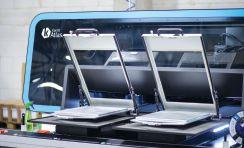
Printful expands DTG production with Kornit Digital systems. Global on-demand printing and warehousing provider Printful will be adding more than 50 Kornit Atlas systems during 2021 for on-demand, direct-to-garment production, representing a considerable expansion of their current production capabilities. This coincides with Printful’s addition of new production facilities in Los Angeles, Dallas, Charlotte, Mexico, Spain and Canada, as well as the expansion of existing facilities globally.
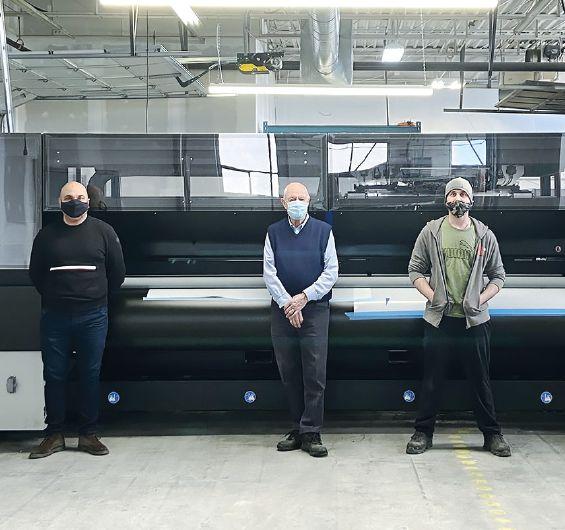
Québec-based Etendard has new owners. Etendard, which specializes in large-scale printing, has been acquired by three entrepreneurs—Rémy Vézina, president of 2nd Skin, Mario Trahan, a chartered professional accountant, and Patrick Coutu, an engineer.
Established in 1995, Etendard owns a 100-ft-wide printing press. The company is able to handle textile sublimation projects on nylon and polyester. The new owners’ expertise is expected to increase the comapny’s business opportunities.
Xeikon America launches a new virtual advisory service using a 3D visual browsing experience. This is in response to the increase in online exploration by printers. The virtual platform will act like an advisory hub for printers and converters.
Dedicated to wall decoration, the 3D-rendered showroom will be a unique space for the company to demonstrate its digital production portfolio of hardware and software. To access this service, visit www. xeikon-virtual.com.
Ultimate TechnoGraphics and Duplo International are enhancing their partnership to introduce more automation into print production through the advanced integration of Ultimate Impostrip imposition software and the Duplo Slitter/Cutter/Creasers.
Ultimate Impostrip can automatically generate Duplo-certified impositions with the right layout and marks for card, flyer and booklet printing. Combined with the barcode technology, the solution enables complete automation from imposition to finishing, thus eliminating make-readies to “reach greater level of productivity, saving time on job preparation, delivering high quality that customers expect.’
It also reduces the need of specialist operators in prepress and postpress.
Premier Graphics used Drytac Spoton White Matte to create window graphics with a high-contrast and high-impact design.
Printful will be adding more than 50 Kornit Atlas systems during 2021 to increase its on-demand, direct-to-garment production capacity.
Cori Devlin and Brad Gasque, technical consultants at DuPont Image Solutions, have been certified as G7 experts through training provided by Idealliance. G7 is a methodology from the association for printing neutral greys, which result in a shared visual appearance for prints using any print method. The main goal of this Idealliance training and certification is to achieve cost-effective, reproduceable colour on any substrate, and have dynamic workflows worldwide.
Domino has hired Samuel Frist as digital printing service engineer for Domino North America. He brings over 15 years of experience in production management and service to the role, including time spent at Frontier Label where he began as an operator, then was production manager for 10 years.
Samuel was then recruited by HP, where he spent four years servicing HP commercial and digital label presses. From there, he joined Kornit, a manufacturer of digital textile inkjet printers for the garment and apparel industry.
Samir Macklai, a first-year Ryerson University (Toronto, Ont.) student, has been selected by the Canadian Print Scholarships to receive the Warren Wilkins Memorial Scholarship for the 2020/2021 academic year.
The prestigious $5,000 scholarship was established to honour the late Warren Wilkins, a visionary leader in the Canadian printing industry who worked to foster and support new talent for the industry. It is given to a student who is starting their post-secondary studies toward a career in the graphic communications industry.
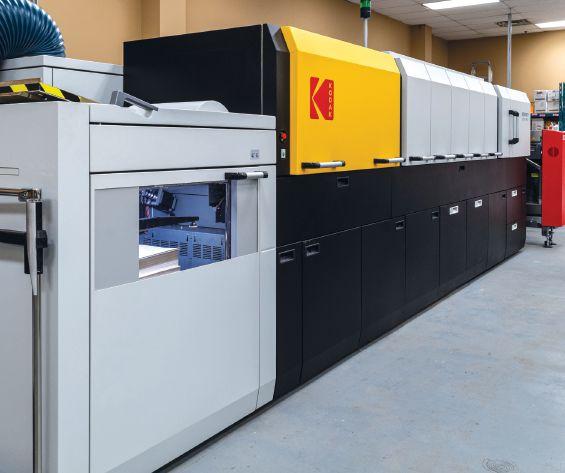
Lowe-Martin has added two Kodak Nexfinity digital presses to its business. The Nexfinity digital press can provide production speeds of up to 152 A4 pages per minute. The additions will allow Lowe-Martin to increase its uptime, achieve higher output and expand its capabilities.
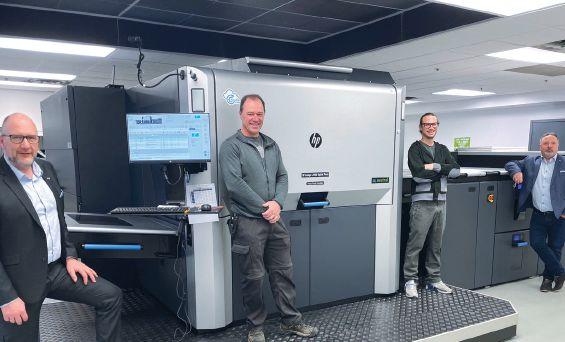
Quebec-based Impression Paragraph has installed a new 29-inch format HP Indigo 12000 Digital Press. The press is loaded with the new HP Indigo 15K value pack, which includes thick substrate support of up to 24 pt as well as premium white ink.
Miraclon has appointed Brian Ellis as the new sales manager for the Northwestern U.S. and Western Canada territories.The role includes supporting and enabling customers to maximize the capabilities of their KODAK FLEXCEL NX Solutions and aiding prospective customers to achieve business growth with new investments in FLEXCEL NX Technology from Miraclon.
Ellis joins Miraclon with over a decade of experience in the flexographic printing industry, and brings with him a wide range of expertise from tag and label to wide web flexible packaging. He recently worked at Siegwerk as the West Coast ink sales manager and has also worked for FlexoWash, Harper and Canflexographics.
Toronto-based Cameron Advertising is the first in North America to purchase the Jeti Tauro H3300 UHS LED printer. The newest member of the Jeti Tauro H3300 family combines “industry-leading print quality with versatility, productivity and cutting-edge automation at 30 per cent faster speeds.”
May 12, 2021
INFOFLEX 2021 Online
May 13, 2021
Women in Manufacturing Online
May 17, 2021
EskoWorld 2021 Online
May 18, 2021
3D in Action Online
June 8-10, 2021
Labelexpo Americas 2021 Chicago, Ill.
June 8-10, 2021
Brand Print Americas 2021 Chicago, Ill.
June 10, 2021
DIA Annual Golf Tournament Aurora, Ont.
The art of being credible
The life of an equipment appraiser
By Nick Howard
“T
oday is an ideal time to spend some money and have my plant appraised”—no printer has ever said that. Regardless, today’s plant and machinery appraisal industry is substantial and essential. Trained specialists are deployed to access and verify plant machinery to determine condition and worth.
Printers can take many steps to maximize their asset’s dollar valuation. Messy shops and filthy machines are a drag on valuations, especially if the equipment is only a few years old.
“Credible” is the keyword when preparing an assignment, just as is expert knowledge of a specific industry. I’ve been carrying out plant appraisals for over 40 years, and, almost exclusively, for the print communications industry, although anything from five-axis machine tools to a winery have been part of recent assignments.
There are good arguments to be made in support of an appraisal. Banks and leasing sectors insist on a valid and certified opinion of value and often turn to professional appraisers or auction companies, most of which offer this service. Although it’s always possible to guess a value, lenders prefer professional evaluators who hold accreditations with an accepted appraisal society or foundation. Becoming an accredited appraiser requires industry experience, study and constant training since regulations constantly change.
The joint U.S. and Canada benchmark standard involves a thorough understanding of Uniform Standards of Professional Appraisal Practice (USPAP).The Appraisal Foundation, a recog-
nized source of appraisal requirements, developed USPAP after the savings and loan crisis in the early 1980s. It is designed to tighten up the responsibilities and ethics appraisers must follow. However, USPAP doesn’t provide the appraiser with specific know-how on arriving at a credible conclusion, but rather it offers guidance on proper procedures and all the responsibilities each appraiser must conform to. Essentially, it’s to ensure members impart fair, balanced and truthful assignments that are void of misinterpretation or bias.
The need for USPAP and continual updating of rules and ethics took on new meaning during the subprime financial meltdown of 2008/09. It became painfully obvious USPAP had to be updated when thousands of real estate assessments, well short of the mark, turned out to be lacking credibility. Only after home foreclosures fell off a cliff did some funders discover valuations that were biased at worst and incompetent at best. Some local lending offices, in their eagerness to close mortgages held rather unhealthy symbiotic relations with appraisal firms who didn’t understand the word “no”. As
house values took flight, no one considered that both the appraiser and bank played a role in what seemed “perpetual-motion” accounting. The dollar value index only pointed up: Today’s home, at say $400K, was tomorrow’s assessment at around $425K.
For the appraiser, there is a great temptation to acquiesce when lenders and, especially, potential purchasers of a business make insinuating comments as to where they “hope” to end up and how they wish the valuation comes in at a number that will let the transaction proceed. Many of my appraisals have received a similar preamble. Although I listen intently, these comments would never affect my conclusions. Impartiality is also why lenders have no interest in considering a manufacturer as an appraiser, even though the company may have produced the asset.
Appraisals don’t always just provide a financial value, they can include an asset’s condition and usefulness. Software, now a key element of a machine’s operation, is expensive. However, perhaps surprisingly, software often retains no monetary value in an appraisal, as systems under assessment are typically
Nick Howard inspecting a Dreissig bronzer in Kansas City, MO.
older models or licensing restrictions negate a transfer to another firm. Just like dry ice on a hot summer day, the software only has monetary value before it’s installed.
A particular example of this is in Canada. One of the world’s largest digital equipment manufacturers usually leases their equipment. However, because of lower finance rates, printers are outright purchasing instead. This manufacturer’s contract has buried in small print a clause that precludes a buyer from actually owning the intellectual property, even though the buyer owns the hardware. If that same buyer attempts to sell his machine (in Canada), the manufacturer will initiate hefty fees to re-certify and/or permit their software to be used. Not only does this severely affect a machine’s value, but also kills any transaction unless the manufacturer is involved. Printers can take many steps to maximize their asset’s dollar valuation. The initial appearance of the plant, offices and machinery is important. Messy shops and filthy machines are a drag on valuations, particularly if the equipment is only a few years old. I recently appraised a two-year-old 140-in. inkjet roll-to roll that had filthy ink tanks. Also, the flushing tank looked like someone had thrown a gallon of ink at the machine. Regardless of performance, poor housekeeping is often reflected in an appraisal.
Depending on the degree of an appraiser’s knowledge it’s pointless to provide a “Walt Disney” tour, pointing out what you believe to be relevant about the equipment. Often this is the case when I arrive at a plant. Sometimes, the printer would pro-
$0Software often has zero monetary value in an appraisal, as systems under assessment are older or licensing restrictions negate a transfer to another firm.
vide a list but I rarely use them, as I insist on verifying everything myself. Once, a funder called to clarify the serial number of two assets. I confirmed the numbers. After some investigation, the funder realized the serial number was noted incorrectly during a previous appraisal. The resulting mix-up went on to generate substantial work to re-register the assets. If they had not caught the error, the funder could have lost all legal rights to the chattels.
A large sheetfed manufacturer has been buying LCD sheet counters, since about 2002, with a flaw. These counters are installed to record the total impressions of a press, but when a $3 lithium battery is depleted, the counter’s display goes blank. The total use of a particular press is now unknown. If accurate (service) records are kept, the technician might have written down the impression count. Today, when I see machines of this builder with very low impression counts, I know the reason. Use is a major input to valuation dollars and opens up the potential for deceit if attempting to sell a press with more impressions than advertised. Knowing how to access the overall condition is key for the appraiser, as he or she has to be familiar with wear and tear of the machine being assessed.
signed to appraise the largest printing operation in Atlantic Canada. This involved 12 individual plants across four provinces. Just the physical process of travel kept me away from the office for more than a week. The plants ranged in sophistication from large web, sheetfed and bindery to small-town businesses. Not only was each facility unique, but also the individual management styles varied, with some plants highly organized and using up-to-date management tools while others looked like they were stuck in the 1970s. Just as I was to fly from Halifax to St John’s, a once-in-a-decade snowstorm hit Newfoundland and I was stuck in the airport for a day.
Whether it be one company buying another, a loan for a new piece of equipment, estate planning (especially if families and real estate are involved), or tax matters, a good appraisal firm, fluent in print technology, can handle the assignment.
I’ve carried out assignments for various interests across North America. One rather memorable episode occurred in the northwest United States, where I completed two appraisals for that state’s justice department. Two of the largest printers were involved in litigation with the revenue department over tax-related asset book values. On arrival at one of the businesses, a group of government staff and I were sequestered in a boardroom awaiting to be escorted around the facility by a senior memmanagement executive. It seemed as if we were in that room for hours, and were finally given a frosty reception when the executive turned up.
I went to work with the gaggle of five accountants and attorneys in tow firing off questions in my direction. The plant was a substantial web and bindery facility.”
The West Coast file isn’t typical but did have one thing in common— plenty of variety, and, if you love to travel, then that too. Another assignment provided both when I was as-
Today, an appraiser must also be conversant in the new technologies appearing on shop floors. For me, it’s obvious how our industry has changed so rapidly, as I appraise more digital (both inkjet, dry, and liquid toner) platforms than offset. The large format and point-of-sale businesses have blossomed, and with it an increase in cutting tables and routers. The bindery has also changed considerably as traditional manufacturers of large signature work are purchasing lighter duty equipment designed for speed and short runs.
All this digital technology contains wide variables in value retention as compared to older traditional equipment of the 1990s. In many cases, depreciation is swift and suppliers are investing massive resources into research and development. This pattern will only increase because digital is the future. However, without a credible and accredited appraisal, our financial sector cannot function with a sense of assurance and continue to support the printing industry.
NICK HOWARD, a partner in Howard Graphic Equipment and Howard Iron Works, is a printing historian, consultant and Certified Appraiser of capital equipment.
nick@howardgraphicequipment.com
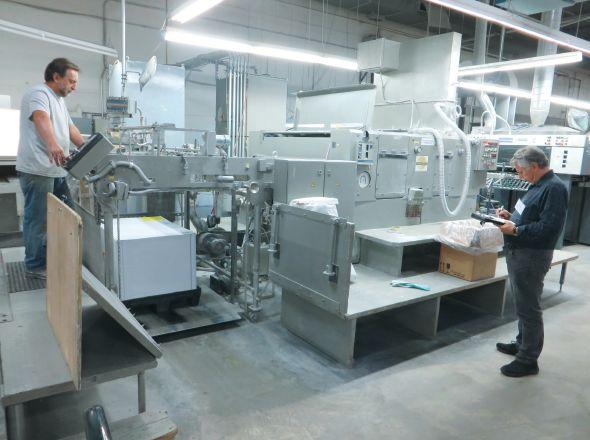
A Heidelberg Speedmaster 102 is being apprised in Toronto.
WRAPPING THE THROTTLE
A
tête-à-tête with
Chris Thiessen, founder of Wide
Open Throttle Graphics
By PrintAction Staff
Chris Thiessen, founder of Wide Open Throttle Graphics in Lacombe County, Alta., has a T-shirt with a slogan that pretty much sums up his motto: “Everything will kill you, so choose something fun.” He started his career working in an oilfield for almost 20 years. When he was laid off, he became a service manager at a Yamaha and Arctic Cat dealership, where he was introduced to installing graphics on bikes and sleds, and to the sport of snowmobiling. Soon after, he decided to open his own print and snowmobile rental shop.
We talked with Thiessen about why he decided to bet big and start
his own business, how he’s built a strong client base in powersports graphics and rentals, and what’s next for his shop.
Why did you opt to start a business?
Thiessen: After learning to do wraps on sleds and bikes, I went back to the oilfield briefly and ended up getting laid off again. I looked for a job for a few months, but no one was calling, so I asked myself, “How can I make a living with sledding?”
I started Wide Open Throttle Graphics in early 2019, working out of my basement and an enclosed trailer. I set up deals with other wrap companies to sell and install their wraps for snowmobiles and motocross (MX) bikes.
Chris Thiessen founded Wide Open Throttle Graphics in Lacombe County, Alta., when he was laid off and wanted to turn his passion for sledding into a profitable business.
I recently moved to a new location with office space, which also helps my clients find me more easily.Today I have three sleds that I rent out with my own wraps on them. Those are my showpieces.
Why did you decide to purchase a wide-format printer?
Thiessen: After four months in business, I realized I needed to stop outsourcing. I bought a Roland VersaCAMM VS-540 printer/cutter, and learnt to use it. Having that machine helped me offer my own designs and prints.
A few months later, I traded in my VersaCAMM for a new Roland DG TrueVIS VG2-540 printer/cutter. My business exploded when I got the VG2. I’ve been able to expand my product line to offer wraps and graphics kits for MX bikes, personal cars and trucks and fleet vehicles.
What is your product range?
Thiessen: The top two products that come out of my shop are sled and MX wraps. Both of these products
Business exploded when Chris bought the Roland DG TrueVIS
VG2-540 printer/ cutter, as it allowed him to expand his product line.
are seasonal, but together, they keep me pretty busy. I also print decals, banners, posters, canvas,T-shirts and small signage projects.
Who are your clients these days?
Thiessen: My clients love “life behind bars” – handlebars, that is. I have customers from Texas to Nunavit. I also supply most of the powersports dealerships in central Alberta. I sponsor a team of riders as well. My riders all show the same passion and dedication, whether it be on a bike, sled, or any other toy.
Please tell us about the Snoriders West 2020 Best Sled Wrap Contest.
Thiessen:This is something I am extremely proud of: two of my sleds were nominated for 2020 Wrap of the Year. That really came out of nowhere. I entered the crown jewel of my rental fleet, the new 2020 Ski Doo Turbo, and the 2019 Ski Doo Summit 850, named Alpyne. This is the first year I have participated in this competition, and I look forward to entering again next year.
How have you been coping during the pandemic?
Thiessen: When the pandemic arrived back in March 2020, my sled rentals were considered a non-essential service, so I closed. Coping with no work for two-and-a-half months was hard. Every graphics kit I had on the go was cancelled and the deposits were forfeited. There were times I didn’t think Wide Open was coming out of the pandemic. I was wrong. When Alberta opened in June 2020, the phone went crazy with people calling for kits and new projects.
What do you see for the future of your business?
Thiessen: I am going Wide Open Throttle into the future, with my main focus on powersports wraps. I am also interested in expanding the number of fleet and commercial graphics I produce. I’d like to more fleet graphics.
To date, it has been a one-man show. However, I think I may need to hire someone soon! My business continues to improve and grow.
Canadian Manufacturing Demo Days puts the power of Annex Business Media’s manufacturing brands to work to showcase your product videos through a single online source. Promoted through database, online, editorial and social media drivers across 17 manufacturing titles to ensure you receive the leads of decision makers interested in your products.
For More Information contact Kim Barton, Media Sales Manager 416.435.9229 kbarton@annexbusinessmedia.com
LAUNCH JUNE 1, 2021
graphics can be an effective way to reach new customers.
DEMAND UP FOR VEHICLE WRAPS
The
spike in last-mile deliveries has increased the adoption of fleet graphics
By Nithya Caleb
Delivery has never been this important. During the pandemic-induced shutdown, people limited store visits. Almost overnight, consumers moved to online shopping platforms. As a result, one can get almost anything delivered these days including medicines and groceries. As the “Anatomy of Change,” a survey by Oracle revealed, there is a clear preference for home delivery and other fulfillment options for essential and nonessential items.
Last-mile delivery
Many companies are finding ways to address the critical last-mile de-
livery challenges to meet customer expectations, as brands who deliver on time win the hearts of consumers. Besides offering curbside and instore pickups, companies have resorted to home deliveries to alleviate safety concerns.
According to Jeff Uzbalis, senior account executive | branding and transportation specialist, 3M Commercial Graphics, the growth in e-commerce and increased emphasis on last-mile delivery has escalated the demand for trucks. In the latter half of 2020, the wait time for trucks was eight to 10 months.
An ACT Research survey found the US trailer industry had booked 54,200 net orders for October 2020. This is up six per cent from Septem-
ber and 68 per cent more than October 2019.
This proliferation in delivery services has increased the importance of fleet graphics in marketing. Another reason for the demand is rebranding, which, in Uzbalis’ view, is inevitable during economic downturns either due to M&As or consolidation of operations.
For Uzbalis, the biggest struggle has been keeping up with the increased demand for graphic films.
Fleet graphics as a marketing tool
The American Driving Survey by AAA Foundation for Traffic Safety found a person spends more than 300 hours in their vehicles annually. With so much time spent on the road, fleet graphics can be an effective way to reach new customers, as the brand is visible to millions.
Another study by Neilsen and the Outdoor Advertising Association of America found 35 per cent used online search engines to look for
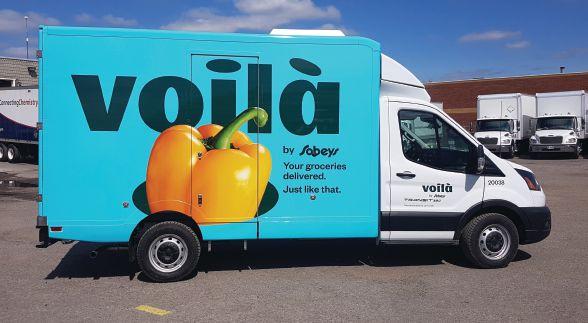
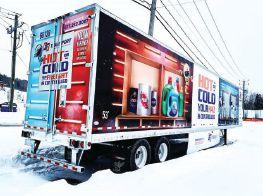
The rise in home delivery services has increased the importance of fleet graphics in marketing.
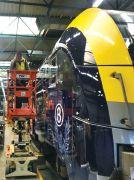
Supercolor applied decorative New Year prints to a Belgium train.
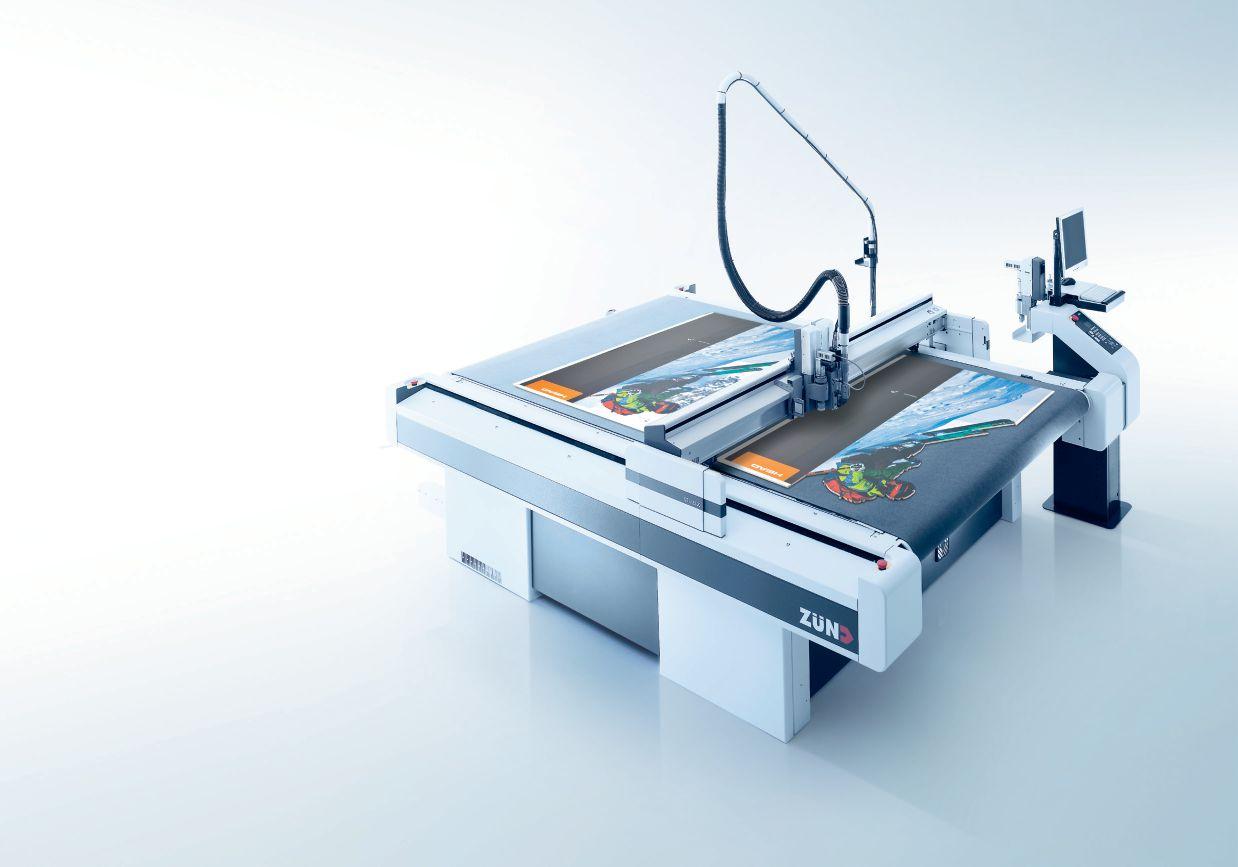
Cut with the best for less .
Package deals currently available based on the most popular cutter models
Tailored to graphics, packaging, and textile applications
Upgrade and trade-in options available anytime
out-of-home (OOO) advertiser, 22 per cent visited an advertiser’s website and 14 per cent snapped a photo of an ad.
According to Charles Veilleux, vice-president of sales and marketing at Quebec-based Turbo Images, a provider of fleet graphics and large-format printing solutions, a single vehicle with fleet graphics has the potential to earn an average of 16 million impressions annually in an urban setting.
Vehicle wraps allow companies to use their vans, sedans and trucks as canvases for creative storytelling that promote customer engagement.
“Putting your messaging on the vehicle is the cheapest form of advertisement,” believes Uzbalis.
The Outdoor Advertising Association of America’s (OAAA’s) experience has been that fleet graphics have a very low cost per thousand impressions (CPM). When compared to other types of advertising
Contact us for details and a virtual, personal
PHOTO COURTESY AGFA
PHOTO
fleet graphics cost only $0.15 per thousand impressions.
These compelling statistics could be the reason for an increase in Turbo Images’ business.
“Demand has just been restructured. Companies are delivering to homes instead of stores. Transportation is considered essential, and the market is booming right now,” explains Veilleux.
Design trends
In Veilleux’s experience, the intensity of branding has increased in fleet graphics. Clients are moving away from simple logos. They prefer customized graphics with more colour. Also, the coverage is more extensive these days.
“People are realizing their vehicle is an asset, and that they can leverage it as a marketing asset rather than it just being a debt. You can turn your money spending into an
investment that starts working for you,” says Veilleux.
Eco-friendly
Companies that are looking to reduce their carbon footprint can also employ fleet graphics to optimize their marketing campaigns. For instance, materials, such as 3M Envision 480 (made without PVC), are a suitable eco-friendly option.
Reflective materials
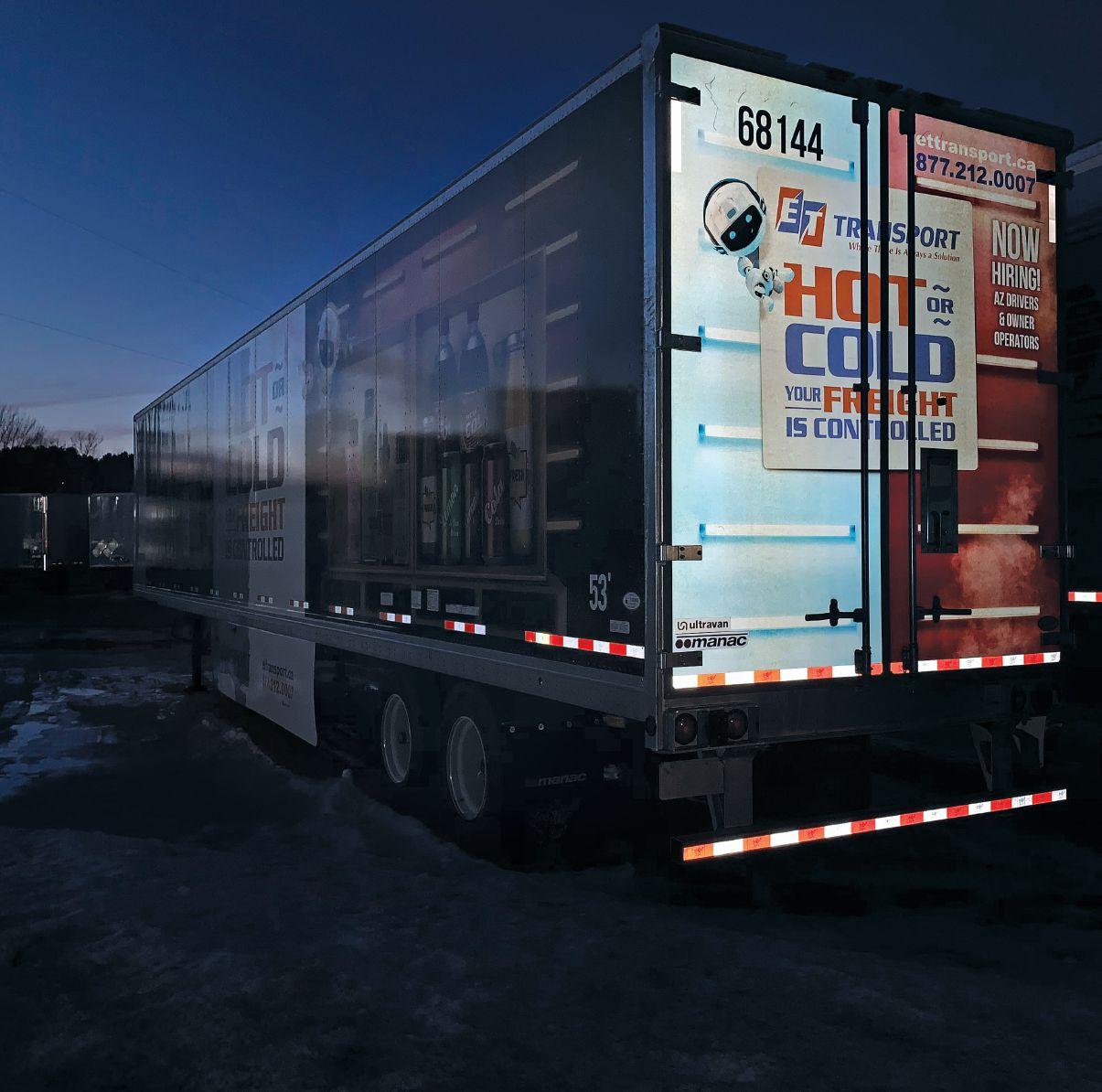
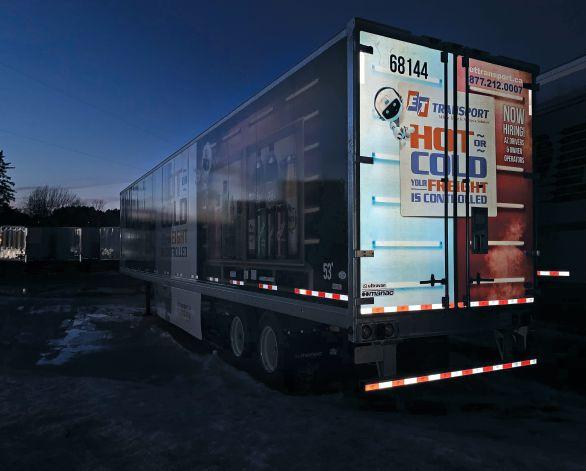
Veilleux also sees an uptick in graphics with reflective material. Traditionally used to enhance road safety, they can also be used to promote brands 24/7. Since these materials reflect light, the graphics are illuminated at night.
According to the American Trucking Association, the use of reflective graphics increases the number of annual impressions by 40 per cent.
Graphics with reflective materials help illuminate branding at night as well as enhances safety.
Also, reflective vehicle films help protect drivers and assets on the road by increasing visibility.
Printing solutions
SpeedPro in Irving, TX, uses an Anapurna H3200i LED from Agfa to produce vehicle graphics.The UV inkjet system is designed for indoor and outdoor applications, and its six-colour-plus-white capability helps them create window graphics that are viewable from either side of the glass, as well as flat panel adhesive vinyl or magnetic graphics for advertising purposes.
Vehicle wraps allow companies to use their trucks as canvases for creative storytelling to encourage brand engagement.
People are realizing their vehicle is an asset, and that they can leverage it as a marketing asset rather than it just being a debt.
“We help customers produce more powerful messages and create more opportunities for growth with innovative technology. The Anapurna, and all Agfa’s UV inkjet inks, offer ‘thin ink layer’ technology, thereby consuming less ink per square foot, thus saving on consumable expenses while resulting in dazzling prints,” says Bill Brouhle, solutions architect, Digital Print Sales, Agfa.
Supercolor, a Belgium-based digital printing company, uses a Jeti Tauro H2500 LED to create large wrapping projects. A hybrid printer, the Jeti Tauro H2500 LED can print on a variety of media. Once, they applied decorative New Year prints to a train of SNCB, Belgium’s national railway company. As you can imagine, the size of the vehicle alone brings along its own challenges.
“The Jeti Tauro features up to 32 fast-firing Ricoh inkjet print heads, and utilizes Agfa’s UV-curable inks, delivering a unique combination of productivity and superior print quality. The Jeti Tauro’s UV LED lamps for the curing process offer major advantages in terms of performance, costs, maintenance, the environment and the generation of extra business,” adds Brouhle.
Installation
Printing the graphics is just the beginning; they need to be installed. As Uzbalis mentions, proper installation is the key to success in the wide-format business. For its part, 3M certifies installers and fabricators to ensure work quality.
Home deliveries are expected to continue in a post-COVID world. Thus, fleet graphics will play an important role in a company’s marketing strategies, and the demand is only going to increase.
PHOTOS
the
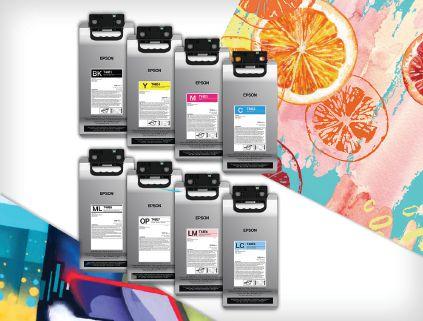
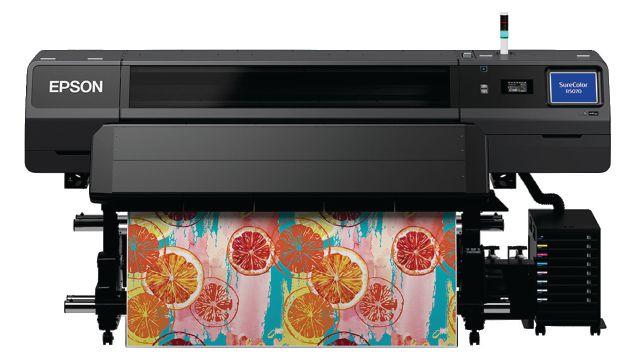
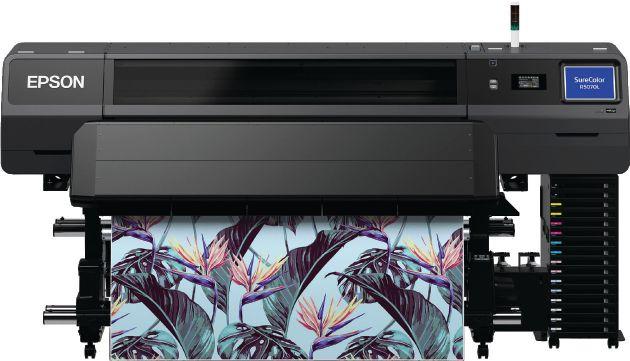
SureColor® R-Series Printers Together Delivering Solutions
These 64" roll-to-roll signage printers with water-based resin ink consistently provide professional-quality wallpapers, fabrics, uncoated papers, and traditional signage at remarkable speeds.
Measure for success
Metrics to track for assessing performance
By Bob Dale and Howard Conway
Workflow improvement is a major theme in many industry publications and webinars, and for good reasons. More than 85 per cent of respondents to a recent industry survey indicated that they are dealing with mostly manual processes. If that is the case with you, managing CRM, sales activity, customer inquiries, file preparation and proofing, production and related administrative activity is taking too long and is more expensive than it should be.
The goal is to improve. However, managers need to know what to aspects of the business require improvement. Also, how do you check if things have improved? Measurements must therefore be established by the company and constantly monitored.
The adage, “what gets measured gets done” is true. I’m sure many of you have a smart watch or an activity tracker. A Fitbit lets you set hourly, daily and weekly goals, motivates you to keep moving and informs you when you reach the goals! The same applies for managing your business.
The challenge is to know what to measure. Key productivity indicators (KPIs) can help with that. Since there are many types of activities
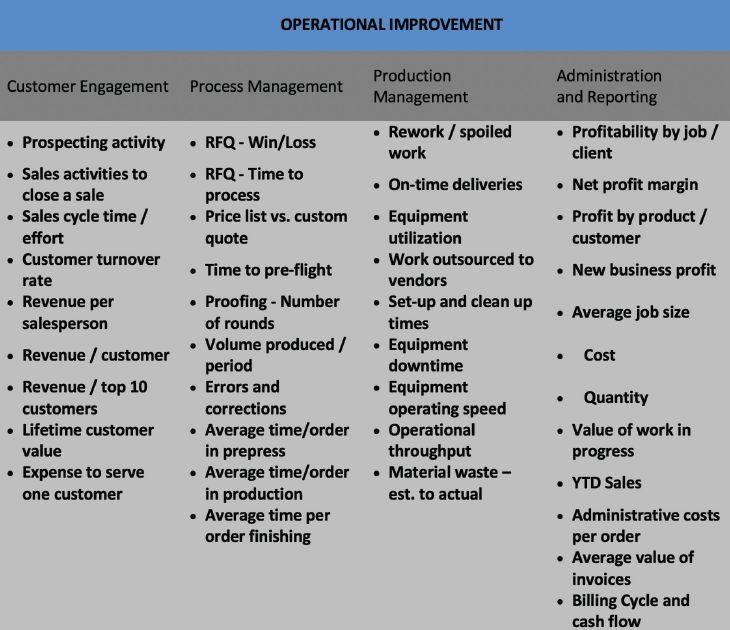
A list of key productivity indicators to track.
Over 85 per cent of respondents to a recent industry survey indicated they are dealing with mostly manual processes. 85%
Since there are many types of activities and performances to measure, it is critical to select the correct metrics to avoid ‘analysis paralysis.’
and performances to measure, it is critical to select the correct metrics to avoid ‘analysis paralysis.’ Keep the following guidelines in mind when selecting KPIs:
• practical – simple, easy-to-get data to report, analyze, maintain and act upon;
• fewer KPIs is likely better so you remain focused;
• identify KPIs that have the greatest impact on your business;
• automate KPI collection and reporting for greatest impact;
• draw from your MIS/ERP system for consistent, relevant data gatherting and managament;
• in order to get the necessary information from your systems, you need to collect them;
• ensure team understands why you are collecting the data, and how you use it;
• share appropriate data with team members to align everyone’s efforts; and
• interpret what the data means (i.e. what is the root cause of the negative or positive variance and what action needs to be taken).
Measure improvement, not just activity. To do this, you need to track KPIs over a period of time (e.g. six months) to understand the changes and identify if they are positive or negative for the company.
For example, sales per month, compared to the same month in a previous year. Also, remember that while revenue is a metric, it can be misleading. For instance, some printers are achieving increased margins with lower sales, so it it good to remember total revenue is only one side of the story.
How to get started
The above image has some suggestions that could help you determine the KPIs that would be useful for you to track. Remember, PrintingUnited publishes performance ratios that can help benchmark your financial and operational performance to industry standards.
Bob Dale and Howard Conway are with Connecting for Results Inc. They can be reached at info@connectingforresults.com.
SURVIVING & THRIVING in 2021 & beyond
June 9 • 1:00 pm EST MODERATOR PANELISTS
PrintAction invites you to a panel discussion on “Surviving & Thriving” in 2021 & beyond. The printing industry is at a crossroad. Hard decisions must be made to survive the pandemic. Innovation is the order of day, but how? What strategies can help printers succeed in a post-COVID world? Our panelists have been there and know all about the struggles. They will offer practical strategies that you can successfully apply in your business/work to not only survive, but also thrive in 2021 and beyond.
Nithya Caleb, Editor, PrintAction
April Burke, VP OperationsCorporate Printed Packaging, Bellwyck
Jay Mandarino, President & CEO, CJ Graphics Inc.
Richard Kouwenhoven, President and COO, Hemlock Printers Ltd.
Continuous production inkjet
Agfa Jeti Tauro H3300 UHS LED
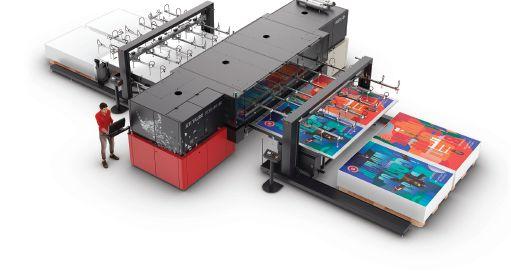
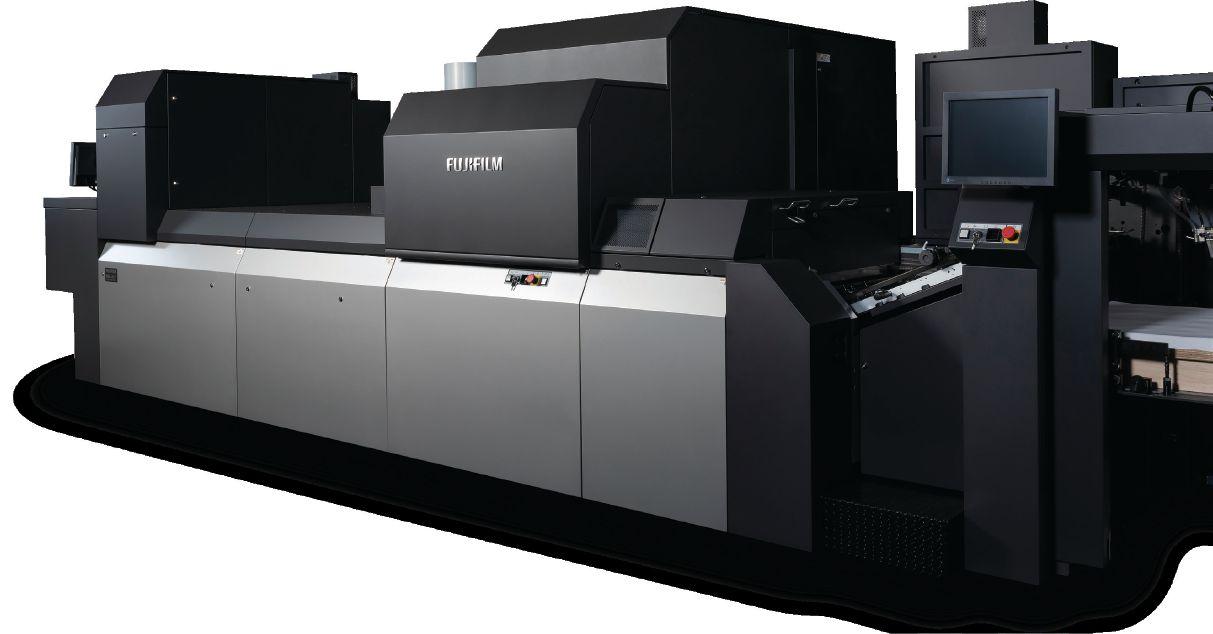
The Jeti Tauro H3300 UHS LED is Agfa’s newest inkjet printer for the sign and display market. This UV LED inkjet engine prints media up to 3.3 m wide in four or six colours at a speed up to 600 m²/h. It can handle boards and sheets as well as flexible materials, in different configurations.
Every component of the new Jeti Tauro H3300 UHS LED is geared toward sustaining “highly productive, reliable print operations with low maintenance requirements and high uptime.”
Koenig & Bauer AlphaJET 5 HS
Koenig & Bauer Coding meets the demand for specialized equipment for industrial coding with the technical adaptation of the alphaJET 5 HS small character inkjet printer. The new alphaJET 5 HS-M is able to process a large number of inks.
The alphaJET 5 HS-M is suitable for marking a wide variety of substrates in different industries (e.g. food and
beverages, pharmaceuticals and automotive).
For precise product coding of important data (e.g. barcodes, 2D codes or alphanumeric characters), the alphaJET 5 HS-M has a print height of 32 pixels or five lines.
Kao Collins inkjet inks
Kao Collins has launched the NEXXO line of inkjet inks for solvent-compatible Funai thermal inkjet ink cartridge.
The inks offer “greater” opportunities for printing on new and challenging substrates with thermal inkjet technology. Printers using CIJ systems now have a TIJ alternative.
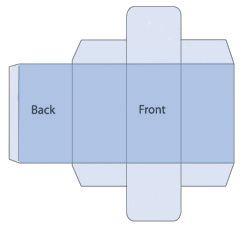
TECHNOLOGY — Die crease without a die, then fold and even glue all on the same machine, up to 30 pt.
3. INTEGRATED MODULAR UNITS — Combined in-line finishing: crease, fold, glue, tipping, envelope inserting, ink jetting (Duplex), clip seal (3 sides), mail prep.
4. SAVE ON POSTAGE COSTS As a Certified Canada Post Direct Marketing Specialist, we get contract pricing reductions.
5. RETURN MAIL PRODUCTS — Customized “Return Mailers” created in-line with “U” or “BOX-shape” remoistenable glue, time perfed applications and envelope formation.
6. MINI-BOOKLETS — Saddle-stitch and trim 2-up booklets in-line to the size of a business card. No need to trim off-line, or do 2 passes.
7. HIGH SPEED EQUIPMENT — High speed Tipping, Folding, Saddle-stitching and soft folding ensuring on time delivery.
The Jeti Tauro H3300 UHS LED is Agfa’s fastest inkjet printer.
Detailing the latest offerings from Xeikon, Colortrac, Herma and Roland DGA
Xeikon launches
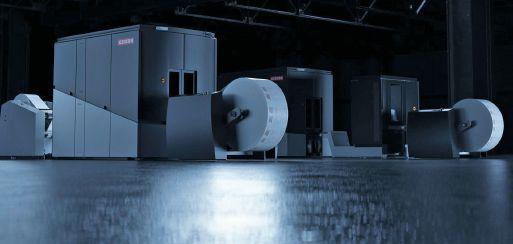
SX20000 digital press
Xeikon America, Inc., expands its graphic arts and commercial product portfolio with the new Xeikon SX20000 digital colour press, which is based on the SIRIUS dry toner technology. It is suitable for printers looking
for a cost-effective machine that will give “superior image quality, perfect registration front-toback and exceptional colour quality control.”
This press will suit print providers working in the production of high-quality books and direct mail, PoS materials,
security print and general commercial print applications.
The Xeikon SX20000 is able to run at a printing width of 20 inches (508 mm) on a broad range of substrates at 1200x3600dpi at speeds of 66 feet per minute (20m/min) or 1700 B2 sheets per hour.
Colortrac introduces new scanners and software
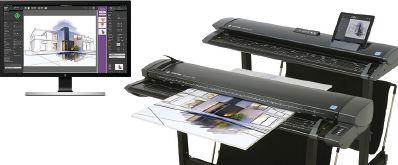
Colortrac introduces new large-format scanners, the SmartLF SGi and SmartLF SCi, along with new scanning software, SmartWorks Imaging, to support them. The new large-format scanning systems feature modern interface and
The SmartLF SGi and SmartLF SCi large-format scanners are supported by a new scanning software.
also have the ability to manage scanning remotely.
The SmartLF SGi and SmartLF SCi scanner series are suitable for capturing, enhancing, sharing, and copying information from large-format documents of all types, such as hand-drawn originals, old plans, marked-up construction drawings, textured artwork, and thick media.
Herma adds continuous labelling capabilities for 132M labeler
Herma US, Inc., the subsidiary of Herma GmbH, a Germany-based provider of labelling machinery and self-adhes-
The Xeikon SX20000 digital colour press is suitable for the production of books, direct mail and security print.
Paper reels can be changed without production interruption by retrofitting the 132M HC Wrap-around Labeler with an EasySplicer and EasyCutter.
ive labels and materials, has introduced continuous labelling capabilities for its 132M HC Wrap-around Labeler.
The continuous operation is made possible by two new modules—EasySplicer and EasyCutter—that can be retrofitted onto existing machines.
The new add-ons allow label and backing paper reels to be changed or disposed of without interrupting production. Considering that paper reels on high-speed labelers, such as the
Herma 132M HC, require replacement approximately every 10 minutes, the result is improved output through downtime elimination.
Roland
DGA introduces new overlaminates for
floor graphics
Wide-format imaging company Roland DGA adds two
new overlaminates—the GuardLam Glossy Floor Overlaminate (ESM-GLGF-150-54) and GuardLam Embossed Floor Overlaminate (ESM-GLEF-150-54)—to its existing family of certified media offerings.
Suitable for floor applications, the two overlaminates provide clear protection or textured protection, respectively, to graphics that are printed not only for floors, but also windows, worktops, walls displays and wallcoverings.
output. The GuardLam Glossy Floor Overlaminate also has anti-slip properties. GuardLam Embossed Floor Overlaminate, a 6-mil film, delivers “outstanding” protection while adding non-slip grip and stability.
GuardLam Glossy Floor Overlaminate is a 4-mil optically clear film that adds a smooth sheen and protects printed
Sakurai: 1, 2 or 4 colours and any size (newer model)
Polar: any size/older or newer models (66/72/76/78/82/90/92/107/115)
Horizon-BQ: 220/240/260/440/460
Karen Hueston / Vice-president / The Aylmer Express
Karen Hueston is the vice-president of The Aylmer Express. A 40-year veteran of the printing business, Karen offers a unique perspective on the industry based on her experience of running a successful print shop in a small town in Ontario.
What is the state of the print industry today, in your opinion?
KH: Pre-COVID, we had steady growth for 10 years, with every year being our best. We had over 100 employees spread across four locations. The pandemic has impacted the industry, and this is related to your customer base. We seem to be rebounding, and I think we will become stronger. The past year allowed us to organize, work on MIS systems and update things we previously never had time for. I believe printers who modernize and diversify will be fine.
The industry failed greatly years ago by not responding quickly and strongly to the “don’t print this e-mail” campaign, which painted us like oil producers. We have been struggling with that image since then. We were afraid to look like luddites and remained silent instead of promoting print. Paper is eco-friendly; the massive use of energy for computers is not. Their plastic waste, toxic byproducts and designed obsolescence are filling landfills by the tonne.
What attracted you to the print industry?
KH: My husband! I moved to Aylmer, Ont., when our marriage plans were finalized. My husband asked me to help out for a few weeks before our wedding. After our motorcycle honeymoon to the West Coast, I was waiting to start a new contract in the new year. Again, I went in to “help out a bit,” and was hooked. I love the business, the fast pace, challenges and all the variables; there is never a dull moment.
Print is an honourable profession. The invention of print—a perfect communication medium—changed the world and helped create a more egalitarian society. Widespread communication became possible and education was brought to the masses, including women.
How can the industry attract more young people?
KH: It is important to increase
I’ve been in the business for 40 years; it is just as exciting and rewarding now as it was when I started.
You need to add value, and not just be the lowest price. What would be the future of the industry if it is a race to the bottom price? We need to be innovative in tough times.
awareness of the industry and the history behind it. Honestly, for the six years I dated my husband, I never really knew what he did.
It is an ever changing, fast-paced, detail-oriented business. Many printers want to hire people with working knowledge of the printing industry. However, in our experience, partly from being located in a small town, it is often better to train an inexperienced person—no matter the age—with a good attitude and a willingness to learn. We have a good mix of long-term and new staff.
In such a competitive landscape, how can printers win more sales?
KH: This is a question everybody would like the answer to. I believe strong sales people know how to sell. You need to add value, and not just be the lowest price. What would be the future of the industry if it is a race to the bottom price? We need to be innovative in tough times.
What are some of the biggest opportunities you see in the print industry?
KH: We have modern equipment that
makes things easier and faster. I think a fair number of people in the traditional printing space are looking to retire, so there will be some degree of vertical integration and industry consolidation in the near future.
What do you think is the most exciting thing about print today?
KH: After 40 years in the business, it is just as exciting and rewarding now as it was when I started. Working with different sectors offers a glimpse into worlds you wouldn’t normally see. Book printing will always be special, thanks to the authors we meet and the relationships we build.
Our business philosophy is very simple. We prefer to treat others the way we want to be treated. Our motto is “keep your customers and staff happy, have a strong supply chain, and life is wonderful.”
The other exciting thing for me is that my children want to continue in the print business.
Karen’s responses were edited for length. For more Q&A Spotlight interviews, please visit www.printaction.com/profile.
A Cut, Fold and Stitch Above
RM Machinery has partnered with Standard and Horizon— the world leader in finishing solutions including folding, binding, stitching and cutting—to provide fully integrated finishing solutions that take your print products from the pressroom to the marketplace. Get ahead of the fold by contacting RM Machinery at 855-RMGT-123 or visiting us online: www.rmmc.ca.
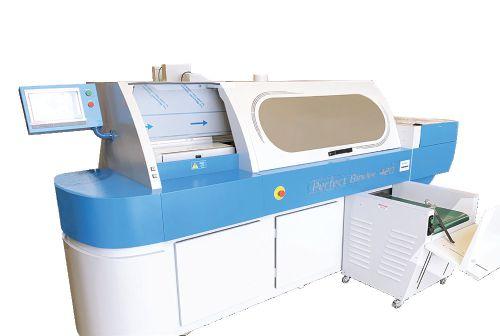
Perfect Binding
The Standard Horizon BQ-500 Perfect Binder features the quickest set-up and changeover for variable book production in its class, especially for book-of-one.
• PUR-friendly design with gentle delivery system for 5mm drop and low temperature setting
• Easy glue changeover, between PUR and EVA
• Automated controls for adjusting roller height, nipping height, and amount of side glue
Equipping Canada to cut, fold, stitch and print.
RM Machinery Inc.
905-238-9797 • 1-855-RMGT-123
5250 Satellite Drive, Unit 9 Mississauga, ON L4W 5G5 www.rmmc.ca
Rotary Die Cutting
With dual magnetic cylinders, the RD-4055DMC Rotary Die Cutter is designed to simultaneously die-cut and crease/score short-run product from both sides of the sheet. It can also perforate, slit, hole punch, and round corners in one process for digital and o set printed sheets.
• Crack-free creasing and clean, sharp creases
• Multiple-up applications from single-up die
• Handles complex creasing patterns and light packaging applications