Examine your processes to discover potential cost-saving opportunities in your operations 18 12 16 6
A review from the biannual Canadian graphics and printing tradeshow
16 Changing powers
More gender-balanced workplaces emerge as the print industry shifts toward prevalent female leadership
18 Continuous inkjet innovations
New continuous inkjet systems strive to deliver versatility, flexibility and efficiency
DEPARTMENTS
GAMUT
5 News, People, Installs, Calendar, Dots, Globe
NEW PRODUCTS
21 Detailing new technologies from Canon, Easy Cut Studio, Esko, Herma US, HP, Kornit, Ryerson University Library, Sappi, SPGPrints, Xanté and Xeikon
SPOTLIGHT
26 Jamie Barbieri, President, PDI Group Inc.
COLUMNS
FROM THE EDITOR
4 Alyssa Dalton
Report finds global print industry in good health
CHRONICLE
10 Nick Howard
A return to simple thinking
Global print in good health
The global print industry is in stable condition overall, according to the 6th drupa Global Trends Report, released by Messe Düsseldorf last month. Based on two separate surveys conducted by Printfuture and Wissler & Partner last fall, one each to more than 700 printers and 200 suppliers, the report finds global figures remain positive. However political and economic concerns for the future appear to be dampening otherwise positive prospects for the majority of respondents.
volumes are increasing slowly. In 2014, 17 percent of participants with W2P installations reported more than 25 percent of their turnover came from that source, and by 2018, that number had increased to 23 percent.
Editor Alyssa Dalton
adalton@annexbusinessmedia.com 416-510-5225
Contributing writers
Zac Bolan, Wayne Collins, Victoria Gaitskell, Martin Habekost, Nick Howard, Neva Murtha, Abhay Sharma
Suppliers have shown increasing confidence every year since they were included in the report, growing from +18 percent in 2014 to a whopping +53 percent in 2017. However in 2018, the net balance dropped down to +28 percent.
“Most survey participants are positive overall about the future, despite very clear concerns about the economic and political prospects for 2019 and beyond,” Richard Gray, Operations Director at Printfuture, explains. “It is striking that many show an increasingly confident grasp of how to exploit the rapidly changing opportunities for print, as the wider markets make increased use of digital communications.”
The Printer Barometer for economic confidence finds North American participants scored the highest positive net balance among all regions. Respondents were asked, “How do you rate the current economic situation of your company and what are your expectations of your company’s economic situation for the next 12 months?” In 2018, 40 percent of printers said their company was in ‘good’ economic state and 13 percent described it as ‘poor,’ while the balance answered ‘satisfactory.’ This gives a positive net balance of 27 percent and it is that net balance that makes up the Printer Barometer numbers. Regionally the 2018 results are uneven: North America enjoyed strong growth, Europe and Australia/Oceania saw steady growth, Asia, South/Central America and the Middle East were cautious, while Africa was in decline.
For suppliers, the positive net balance came in at 19 percent. Both groups remain optimistic, the report finds, with 50 percent expecting better conditions in 2019.
It’s interesting to note conventional print volumes continue to decline at a slow pace. In 2013, 23 percent of printers reported that digital print was more than 25 percent of their turnover. In 2018, the proportion of printers had increased to 29 percent. Nevertheless, sheetfed offset remains the most common form of print technology, present in 66 percent of all printers. The report finds the volume of sheetfed offset continues to grow in packaging, but there is a clear decline among commercial printers for the first time. Meanwhile, web-to-print (W2P)
Despite challenging conditions, 41 percent of printers spent more in 2018 than 2017, while just 15 percent spent less; capital expenditure grew in all regions except Africa. Expenditure patterns largely mirror the overall regional performance, with North America being the most positive, followed by Asia and Europe. According to report findings, those in packaging and functional markets were very confident, and those in commercial and publishing markets were more cautious. Participants named finishing equipment as their top priority, followed by print technology and prepress/workflow and MIS solutions, when asked about their investment plans over the next 12 months. Digital toner sheetfed colour was the most common target for print technology investment for commercial, publishing and functional markets, the report notes, except for packaging where sheetfed offset ranked first.
When asked about the barriers to future growth, printers and suppliers named ‘strong competition’ as their key constraint, followed by ‘lack of demand’ and ‘lack of skills.’ Given that market conditions are largely outside their control, what can printers and suppliers do to improve matters? ‘Reduced staffing/improved productivity’ followed by ‘systems integration’ were the most common responses from printers. For suppliers, it was ‘new product launches’ and ‘new sales channels.’ Both printers and suppliers chose ‘automation and data exchange’ – often referred to as Industry 4.0 – as the longterm technological disruption with the most impact.
“Global print is in good shape overall. Most of our global indicators have climbed over the last five years and whilst there are some leading indicators of challenges ahead, they are commonly with regard to non-print issues, namely politics and the broader economic conditions,” the report concludes. “Clearly there are some regions doing better than others. Equally there are stronger and weaker markets.The industry has found its collective confidence again after the twin shocks of the last decade — the global recession and the impact of digital media.”
ALYSSA DALTON,
editor adalton@annexbusinessmedia.com
Associate Publisher Stephen Longmire slongmire@annexbusinessmedia.com 416-510-5246
Media Designer - Team Lead
Lisa Zambri lzambri@annexbusinessmedia.com
Account Coordinator
Alice Chen achen@annexbusinessmedia.com 416-510-5217
Mail: 111 Gordon Baker Rd., Suite 400, Toronto, ON M2H 3R1
Group Publisher
Diane Kleer dkleer@annexbusinessmedia.com
COO Scott Jamieson sjamieson@annexbusinessmedia.com
President & CEO
Mike Fredericks
Subscription rates
For a 1 year
subscription (10 issues): Canada — $43.00 +Tax Canada 2 year — $70.50 +Tax United States — USD$75.50
Other foreign — USD$147.00
Mailing address
Annex Business Media
111 Gordon Baker Rd., Suite 400, Toronto, ON M2H 3R1 printaction.com Tel: 416-442-5600
Fax: 416-442-2230
Annex Privacy Officer
Privacy@annexbusinessmedia.com
800-668-2384
PrintAction is printed by
from Spicers Canada.
ISSN 1481 9287
Mail Agreement No. 40065710
Optimized for HP Indigo presses, new Mohawk Synthetics with Cobalt boast “ultimate ink adhesion, built-in static control and best-in-class runnability.”
Electronics For Imaging (EFI) in April entered into a definitive agreement to be acquired by an affiliate of Siris Capital Group in an all-cash deal valued at roughly US$1.7 billion. Under the agreement, an affiliate of Siris will acquire all the outstanding common stock of EFI for $37.00 per share in cash. The proposed transaction is expected to close by the third quarter of 2019. “We believe this transaction delivers superior and immediate value to our shareholders while providing us with a partner that can add strategic and operational expertise to our business,” Bill Muir, CEO of EFI, says.
Metropolitan Fine Printers (MET) is moving into its new Vancouver headquarters and manufacturing plant this fall, after its head office and pressroom were destroyed by a fire in April 2018. “East Vancouver has always been MET’s home; it’s where the company started and where it wants to stay,” the company explains. A stone’s throw away from Vancouver’s downtown core, the new headquarters will house the company’s executives, sales and production teams as well as its main manufacturing plant. A fusion of old and new, modern design is contrasted with vintage, exposed wood beams and brick walls. “We’re excited to bring this new technology and a state-of-the-art printing facility to Vancouver,” MET President Nikos Kallas adds.
Bobst North America has named Apex North America its preferred partner for its web-fed division –flexible packaging, pre-print and narrow-web presses – in Canada and the United States. The agreement allows Apex and Bobst
A new independent company, known as Miraclon, has been founded to take Kodak’s former flexographic packaging division forward. Eastman Kodak Company entered into a definitive agreement last November to sell its flexographic packaging division to Montagu Private Equity LLP. With more than 300 employees, a research and development team and manufacturing operations in the U.S. and Japan, Miraclon will focus on the development, production and sale of Kodak Flexcel Solutions, including the company’s flagship Kodak Flexcel NX System. Chris Payne, who has been leading the division since January 2015, is the new company CEO and will continue to head the team.
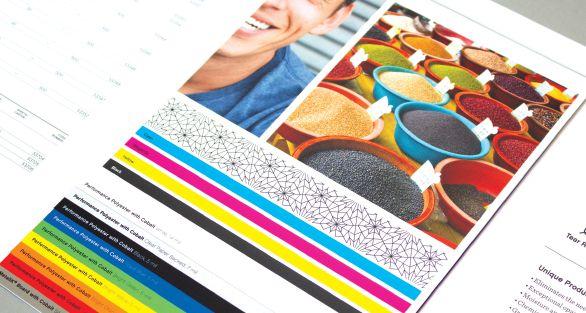
Cobalt boast “ultimate ink adhesion, built-in static control, and best-in-class runnability.” With a range of calipers in white, coloured and metallic films offered, the new Mohawk Synthetics with Cobalt portfolio aims to enable new print applications using four colours, white or clear ink, and is made up of synthetics designed to be tear resistant, and suitable for perforating and die-cutting.
to work together to promote the REVO program and the added value around a solution-based offering to the market. Apex said it is the only anilox company to offer every possible engraving and roll composition in the market today, providing Bobst with a complete and full anilox selection from conventional to GTT.
On March 18, Pazazz Printing of Ville Mont-Royal, Que., announced new ownership, effective immediately, under Marc Giroux, who will continue to lead the Pazazz team as President, and Jimmy Garfinkle of Mitchel-Lincoln, a corrugated box manufacturer in Quebec. Former president/ CEO and founder Warren Werbitt has left the company to pursue other opportunities. Pazazz Printing filed a Notice of Intention early this year, submitting a proposal for restructuring. On January 14, Pazazz filed a Notice of Intention in accordance with Section 50.4(1) of the Bankruptcy and Insolvency Act, R.S. C. 1985, c. B.-3, and Richter Advisory Group was appointed Proposal Trustee under the NOI. “New ownership and the financial restructuring of Pazazz has positioned and empowered us to start a new and exciting chapter for our company. I am so proud of our team, and truly passionate about working with them to achieve our vision,” Giroux says, who joined the company in July 2018. “We have worked so hard recently to ensure continued and consistent operations, and can now only look forward to what we accomplish next.” This is the second time in less than a decade the Quebec printing company has filed to restructure.
Rogers sold off all its remaining magazine brands in late March.
In March, Rogers announced the sale of its publishing division to St. Joseph Communications (SJC), in which SJC will acquire all seven Rogers Media print and digital magazine brands: Maclean’s, Chatelaine (English and French), Today’s Parent, HELLO! Canada, digital publications Flare and Canadian Business, as well as the company’s custom content business. Once the largest magazine publisher in Canada after purchasing the Maclean-Hunter media properties in 1994, Rogers Media has been slowly reducing its print footprint in recent years. In 2016, it announced four of its print publications – MoneySense, Sportsnet Magazine, Canadian Business and Flare – would move to a digital-only format in January 2017.
Mohawk Fine Papers, a privately-owned manufacturer of fine papers, envelopes and specialty materials for printing, has announced a strategic partnership with Kernow Coatings Ltd., a provider of coatings for print, security, engineering and industrial substrates. Kernow’s Cobalt Coating Technology, described as a new benchmark for HP Indigo synthetics print performance, is now available exclusively in North America from Mohawk. Specifically optimized for HP Indigo presses, new Mohawk Synthetics with
Tetra Pak explains its new packaging platform will turn cartons into full-scale data carriers and digital tools.
Tetra Pak has introduced its connected packaging platform, designed to transform milk and juice cartons into interactive information channels, full-scale data carriers and digital tools. Driven by the trends behind Industry 4.0, and with code generation, digital printing and data management at its core, the connected packaging platform is expected to bring new benefits to food producers, retailers and shoppers, it explains. For producers, the new packaging platform will offer end-to-end traceability to help improve production, quality control and supply chain transparency, Tetra Pak says, noting that it will have the ability to track and trace the history or location of any product. Tetra Pak explains for retailers, it will offer greater supply chain visibility and real-time insights, enabling distributors to track stock movements, be alerted when issues occur, and monitor for delivery performance. And for shoppers, Tetra Pak explains, it will mean the ability to access vast amounts of information, including where the product was made, the farm that the ingredients came from and where the package can be recycled.
Konica Minolta Business Solutions Canada has acquired Continuity Solutions Ltd., a managed IT services provider based in Calgary, Alta., joining Konica Minolta’s IT Services division (IT Weapons). To expand the accessibility of its service offerings nationally, the division also recently launched eight IT-service Client Experience Centres across Canada, including one in Calgary.
INSTALLS
TC Transcontinental has announced two executive appointments: Magali Depras and Alex Hayden. Named Chief Strategy Officer, she will also serve on the executive management committee. In her role Depras will oversee the development and implementation of annual and long-term strategic plans and will also lead corporate social responsibility (CSR) initiatives, including aligning the CSR plan with TC Transcontinental’s business strategy. Meanwhile Hayden has joined as Senior Vice President, R&D, Innovation and Sustainability, TC Transcontinental Packaging. In his role, Hayden will be responsible for R&D and Innovation, where he will oversee the development and commercialization of differentiated products and eco-responsible packaging solutions for customers. As TC Transcontinental continues to strive toward a circular economy for plastics, the company says Hayden will work closely with Depras to achieve its objectives in light of its pledge to the New Plastics Economy Global Commitment.
Artisan Complete, a Toronto, Ontario-based print provider has acquired three Fujifilm wide-format presses: two Onset X3s and an Onset R40i, also known as QR40. The two Onset X3s include three-quarter automation, allowing for increased throughput by reducing manual handling.
Al Varney has been named Xerox Canada President, succeeding John Corley who has decided to leave the company to pursue new ventures. Appointed to the position in January, Varney is responsible for the Canadian go-to-market strategy, operations, marketing, sales and delivery of document technology, solutions and services for small, medium, large enterprise, graphic communications, and public sector clients across all business channels. Previously, Varney was President of North, South and Central Europe for Xerox. Taking on the role in January 2017, he was responsible for the growth of both profit and revenue of 14 European countries. Prior to this leadership role at Xerox International Operations, he was CEO and President of Xerox Canada.
Thomas Krischke has been named President and CEO of Muller Martini North America, succeeding Werner Naegeli who is retiring after nearly three decades of service. Krischke has been involved with the graphic arts industry for more than 20 years, beginning his career as a strategic planner at Eastman Kodak in Germany in 1996. He then spent almost 15 years with Heidelberg Druckmaschinen, starting as Head of Finance for the postpress division before managing the entire division with profit and loss responsibility. He will work out of Muller’s U.S. headquarters in Hauppauge.
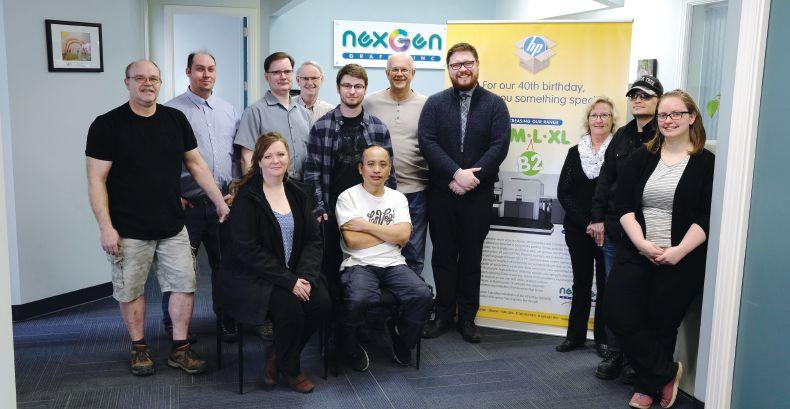
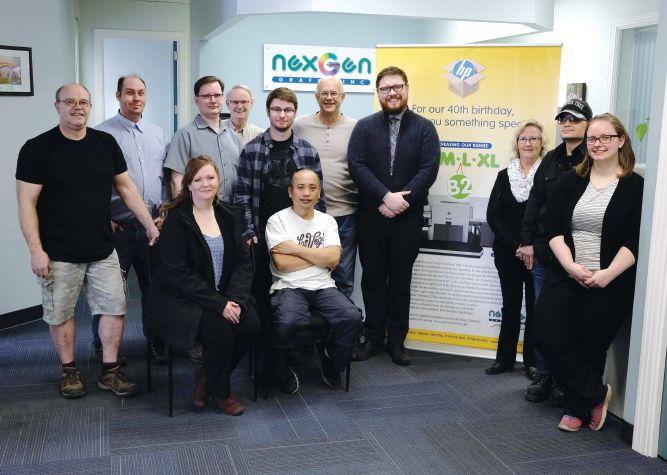
Edmonton, Alberta-based nexGen Grafix is celebrating its 40th year in business with the acquisition of Canada’s first HP Indigo 12000HD B2-format digital colour press, giving it the capability to produce digital-offset printing on sheet sizes up to 20 x 29 inches.
Matik, a North American distributor of European print and packaging technologies, has hired Kregg Albrecht as Sales Manager, Label Products, where he will represent Matik label products throughout Canada and Eastern United States. He comes from Essentra and a 20year tenure at Nosco, a full-service packaging solutions provider.
Imprimerie HLN, a family-owned company specializing in book printing in Sherbrooke, Que., says it has increased its sales by 30 percent six months after installing its new Heidelberg Speedmaster XL 106-5P+L with perfector and coater. The new press replaces an aging Speedmaster SM 102-4P
CALENDAR
May 14-17, 2019
FESPA 2019
Munich, Germany
May 28-30, 2019
Packaging Première
Milan, Italy
May 30, 2019
Gala Gutenberg Montreal, Que.
June 13, 2019
PrintForum 2019
The International Centre, Mississauga, Ont.
June 26, 2019
DIA Annual Golf Tournament St. Andrew’s Valley Golf Club, Aurora, Ont.
October 3-5, 2019
Print 19 Chicago, Ill.
October 23-25, 2019
Printing United 2019 Dallas, Texas
November 7, 2019
Canadian Printing Awards
Palais Royale, Toronto, Ont.
November 25-28, 2019
Shanghai World of Packaging Shanghai, China
June 16-26, 2020
drupa 2020
Düsseldorf, Germany
September 15-17, 2020
Labelexpo Americas 2020 Rosemont, Ill.
Aperol toasts to 100 years
Aperol – an Italian bittersweet aperitif – recently announced the celebration of its centenary at a press conference in Padova, Italy, the birthplace of the brand. Launched in 1919 at the Padua International Fair, the bright orange beverage was created by brothers Luigi and Silvio Barbieri, who coined the brand name with inspiration from the French term for aperitif, Apéro. Made with citrus oil infused with herbs and roots, the original recipe remains unchanged to this day.
To mark the 100-year milestone, Aperol is commencing a series of celebrations internationally throughout the year, using the universal languages of art, music and print to bring people together.
The brand is set to introduce unique limited-edition bottle labels, with single variations on the 1990 design by Italian artist Lorenzo Mattotti, which shows a dancing couple holding an Aperol bottle and two glasses.
Aperol is also collaborating with renowned comic book author Tito Faraci, illustrator Sergio Gerasi and Italian publishing house Gribaudo to create a bespoke illustrated book which aims to tell the story of Aperol in a contemporary way. The graphic novel, the brand explains, is comprised of seven comic-strip style stories set in different decades and parts of the world, from Padova to New York, where the artists have “created a mosaic of tales, from comedy to suspense with a touch of romance, with orange as leitmotiv to capture the magic of human connections over the course of 100 years.” The graphic novel, titled Orange chronicles, will be available for purchase starting in July at the Feltrinelli chain and independent libraries across Italy, online at Amazon, and through the Gribaudo website in Italian and English.
As well, throughout the summer, orange amphibious vehicles will tour Italy and other countries along the European Coast, such as Greece and Malta, via the Aperol Summer Tour. The vehicles, which sit half on land and half in the sea, will create spontaneous pop-up bars with DJ stations, providing consumers with a surprise aperitif on the beach.
Andrea Neri, Managing Director Italian Icons at Campari Group, notes, “Aperol is a brand that aims to bring people together from all over the world using its universal language. In such a special year, we are so pleased to be working on a global project of this scale that will echo in ears of Aperol fans and new consumers alike at the four corners of the globe. As a real Italian icon, Aperol is successfully spreading its philosophy and way of life across borders.”
An excerpt from Orange chronicles, Sergio Gerasi and Tito Faraci’s collaborative graphic novel created in celebration of the brand’s centenary.
Ireland’s first Mark Andy LED-UV press
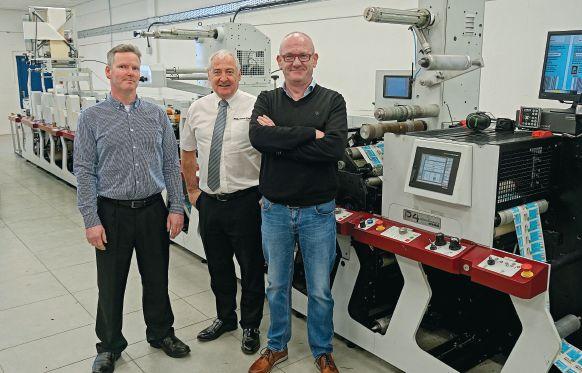
Dublin-based HB Label Print is the first narrow web converter in Ireland and the U.K. to install a Mark Andy press with LED-UV curing. The new eight-colour P4 Performance Series press is the third Mark Andy purchased by the company since it was established in 2002 and is the first 13-inch at the plant — the two existing Mark Andy 2200 lines both have a 10-inch web width.
“The new press is already showing noticeable improvements to overall productivity, as well as attracting new work with its wider web and faster production speeds, with guaranteed 100 percent curing,” HB General Manager Declan Boran says.
Fitted with cold foil, turn bars and delam/relam facility, the P4 also has two die stations, the second of which is the QCDC unit.
“The P4 is an ideal choice for label printers using 2200 series machines as there is a high degree of compatibility between the two. The Mark Andy Pro-LED curing system offers significant advantages in terms of curing capability, even on full-out solids, low power consumption, zero heat in the work environment and no ozone generation,” says Paul Macdonald of Mark Andy UK who supplied the press.
With a staff of 16, HB Label Print produces labels for the food and beverage, logistics and airline sectors, and currently sees a balance of 80:20 between paper and filmic substrates.
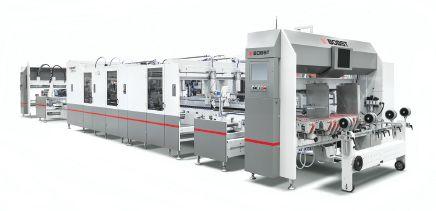
Independent producer of corrugated cardboard packaging Atlas Packaging has taken delivery of a Bobst Expertfold 230 A4 featuring Accueject XL at its site in North Devon, the first installation of its kind in the U.K., the company explains.
The installation of Expertfold 230 A4 complements existing Bobst machinery at the site, including a Visionfold 145 A2. Bobst says the Expertfold 230 A4 features the Accueject XL device, and when linked with a quality control system, ejects skewed cartons where glue has been missed or not applied for real-time quality assurance.
The investment comes as the company seeks to deliver continuous improvement and enhanced service through its quality and turnaround time to its customers.
“This is the latest in a long line of continual strategic investments across the business to ensure we stay relevant for customers and continue delivering consistent, high-quality corrugated packaging solutions,” Atlas Packaging Managing Director Jason Sharman says. “Expertfold 230 A4 drives efficiency and consistency along the processing line, meaning we can produce high quality printed boxes that our customers expect, whilst ensuring the maintenance of delivery times and schedules.”
“We have an excellent established working relationship with Bobst. Following an in-depth review of the market, we opted for the build quality, consistency, excellent training and technical support we can be sure of from Bobst,” says Vince McDermott, Operations Director at Atlas Packaging.
Atlas Packaging’s acquisition of the Bobst Expertfold 230 A4 featuring Accueject XL is the first installation of its kind in the U.K.
Enriching direct mail pieces with variable embossed foil
Since 1986, Spectrum Printing Company in Tucson, Ariz., has been delivering commercial printing services for printing, mailing and direct mail marketing solutions to the southwestern United States. It also maintains in-house binding/finishing and fulfillment departments. In 2016, it acquired an MGI JETvarnish 3DS digital enhancement press from Konica Minolta to distinguish its Idealliance G7-certified colour management skills with the extra added-value impact of 2D/3D textures and variable embossed foil.
Spectrum founder George Stewart decided that developing a strategic growth plan for the future would involve focusing on core strengths that could leverage his staff’s years of applications expertise. The result was a dedicated specialty direct mail practice that provides consultative, advisory services for print and mail campaigns linked to omni-channel engagement activities. From creative graphics support to knowledge of United States Postal Service (USPS) mail preparation regulations, the Spectrum Mail
Hubei Guangcai Printing recently ordered a nine-colour Rapida 106 with coater and kit for UV mixed operation from Koenig & Bauer. The press will mainly be used for the production of folding carton and cigarette packaging.
Team strives to help corporate brands and non-profit organizations deliver high impact mail experiences.
With the addition of its JETvarnish 3D technology to Spectrum’s print production skills, the printing company says it can now elevate flat 2D CMYK colour printing with 3D tactile, sensory impressions that “feel and look different from everything else in a mailbox,” adding that the “coloured metallic foils to embellish a mail recipient’s personalized name with variable data messaging maximizes the enhanced postal print experience.”
“We create designs that get held longer in someone’s hand than just plain colour prints,” says Ken Huizenga, Spectrum Production Manager. “Those extra seconds and minutes of engagement when someone runs their finger over a textured logo or sees their name in bright gold foil make all the difference in the world for our clients. It gives them an added extra-long opportunity to communicate the value of their brands and products. Each mail moment matters.”
L to R: Declan Boran, Paul Macdonald and Ian Bowden with HB Label Print’s new P4, Mark Andy’s first press in Ireland with LED-UV curing.
A return to simple thinking
Examine your processes to discover potential cost-saving opportunities in your operations
By Nick Howard
Epochal comedian George Carlin once discussed how the English language had expanded to create pointless new vocabulary. Carlin recounted how during the First World War, many servicemen suffered from shellshock. During the second Great War, this morphed into battle fatigue. Finally after the first Gulf war, a newly penned description was wrestled out of dictionaries and we now refer to it as PTSD or post-traumatic stress disorder. The argument was why bother? Shell-shock provided a clear straight-forward description of mental suffering afflicting many who fought wars or experienced horrific events — and it’s a whole lot shorter.Who needs yet another acronym? Sometimes you need to step back and keep it simple.
Numerous associations put up a good fight to pump print’s tires. Somehow this tactic seems drowned out by the constant noise and content of social media. Shouting alone in a forest comes to mind. Recently Canada lost a very influential Bay Street executive: William Wilder. Mr. Wilder passed at age 96 and was said to be always ahead of the curve.Years ago when asked about the roots of his success, he said: “What Harvard Business School did for me was point out that if you’re going to be a success in business you’ve got to be able to make decisions even when you don’t have all the facts. I find that Canadian executives are frightened by the very thought of making decisions.”
Making a decision has always been a chore for most so we tend to put them off. However there are many decisions that
are easy to make and can result in improved margins. As Mr. Wilder suggests, the act of reaching a conclusion is often when your instincts are followed. Challenges abound today in all sorts of industries that are peppered with altered business metrics resulting of new technologies. However these tend to push aside the often mundane costs that can be trimmed immediately.
I can assure you that none of these suggestions are new or confusing, but are almost always neglected or ignored. Here are a few worth revisiting:
What we printed and who we sold it to, even just 10 years ago, has radically changed. No other communication medium can duplicate what we do — and we are constantly reinventing ourselves.
Besides the continuous search for new business and constant concerns about rapid new inkjet technologies, there remains very basic business practices that are overlooked. Some may be out of your control but most are staring back at you every day. History repeats itself but also has many common sense lessons that can be applied right now. One simple rule is if something doesn’t work, get it fixed and fast! Another one: don’t over-complicate a problem or remedy. In 1906, the Ford Motor Company moved its machine tools next to the fabrication lines. Ford also embraced tooling jigs which meant it didn’t need to hire highly skilled machinists and also guaranteed conformity of parts. Not many had thought of that before. There weren’t ‘The GE Way’ or ‘Daily Drucker’ handbooks back then –just the Ford common logic: sit in the corner and think about it awhile. Someone looked at a production problem and asked why?
Today it may be hard to increase prices but by taking a fresh look at what and how you do things and questioning everything, you can save your company thousands if not hundreds of thousands of dollars.
Maintain your equipment. Ever since Sir Joseph Whitworth fashioned his first metal lathe, manufacturers have reminded us to maintain our machines, but this rarely happens and it is getting worse. By simply changing oil filters in a modern offset press, you can increase the life of the press and reduce costs and unplanned downtime. In fact, changing any filter can eliminate a multitude of problems, including overheated compressors to seized bearings. Furthermore it could mean never changing the oil in your press. Filter change twice a year — it’s the best return on your investment. Eschew making up rules and instead, slowly correct bad housekeeping habits, messy environments and those boneyards filled with stuff no one knows what to do with. As production areas improve, misplaced items stand out. Production actually improves when staff work within a system that’s anchored by a spotless environment.
Lubricate your equipment. Thousands of dollars are saved just by ensuring gripper bars, chains and other lubrication points never run dry. A gripper shaft replacement on a typical 40-inch press can cost as much as $10,000 when all it needed was cheap grease. Get into the habit of immediately fixing problems and replacing parts. Operators need to be reminded that just because they can do a
work-around, it doesn’t mean everybody can. Problems also tend to add up like stacks of lumber. Never let that happen.
Maintain your plant support equipment. Want to know how often an air compressor goes down from lack of basic maintenance? Perhaps you already know. Compressors, HVAC systems, rolling stock and batteries never fail on a Saturday at midnight — they fail when in use. Multiply the costs with that of lost time and shifting schedules. It’s not just the $20,000 compressor anymore; it’s wages, overtime and immediate lost profits. Numerous failures, even fires, can be traced to filthy support equipment, such as compressors. Have a simple uncomplicated schedule made up and put someone competent in charge of all these devices. Don’t have anyone like that? Then use outside service companies to come in for scheduled maintenance and then watch your overhead costs plummet.
Eliminate aging equipment. Just because something is paid for, it doesn’t mean it’s profitable. Older equipment tends to break down more often and uses higher amounts of electricity and labour input. New equipment allows you to do more work with less labour. It doesn’t matter if you run offset or digital, there have been such rapid increases in efficiency during the last three years that sitting back actually raises your overhead. A new B1 eight-colour perfector can do the work of three 10-year-old machines and at a lower cost.
Ensure you have adequate insurance. Claims are a disaster — even worse are the lack of proper replacement coverage and lack of business interruption protection. Bad insurance can ruin any business. Review your policy with your insurance agent and get good advice from
an independent party, such as an adjuster. The worst time to find out you aren’t adequately covered is after a claim.
Update your plant lighting. This is another simple and well discussed topic, and it’s ridiculous how many plants seem to either ignore or disregard having an immediate cash saving! There is currently only one solution and that is the LED. No longer price prohibitive, LEDs not only cut your facility lighting costs in half but also eliminate all the labour of changing burned out bulbs and ballasts. On a recent plant overhaul, we ripped out all power-hogging high intensity discharge (HID) and fluorescent fixtures. The most common HID is rated at 400 watts and uses primary voltage. Add the extra drag of the transformer and you get 480 watts per fixture. The new LED has a higher lumen rating and uses only 170 watts — that’s half the cost! T5s (fluorescent) still have ballasts – electronic or not – but the bulbs still burn out, cost money to replace, and are often located in hard to reach places. LEDs means you can forget about lighting virtually forever. In fact we don’t have a single fluorescent or incandescent bulb in that facility. We even changed the soda machine and interior machine-tool lighting, resulting in half the costs and zero maintenance. Pretty simple. The initial costs to convert should not be your biggest concern because over a very short time, the savings of never having to change a bulb go hand-in-hand with immediate power bill reductions. Some jurisdictions even pay you money through rebates when you replace archaic fixtures. If you’re renting your space, consider leaving existing plant lighting in place so if you move, you can take your new lights with you.
Pay attention to the post office. It’s common knowledge the problems some countries are facing with antiquat-
ed labour intensive abilities to delivery to each and every address. The USPS in the United States has even more to worry printers, with a loss of US$3.9 billion in the last year and an even more concerning US$121-billion pension liability as of 2016. Package delivery might be a bright spark but fixing the post offices around the globe is going to mean substantially higher delivery costs. This simply will negatively affect the direct mail portion of print. Higher costs are one thing but suppose the “every address” formula gets altered so everyone has to pick up mail at select locations? How will that impact you if you’re heavily reliant on the postal service as your delivery medium? Take a peek into any condo or apartment building community mailbox than at the nearby blue recycle bin. The bin is always full. If you’re currently heavily involved with direct mail, look for new sources of revenue that won’t be affected by the post office.
Print is in an exclusive zone and newly revitalized as customers who previously left us for the web now realize how many eyeballs print attracts. What we printed and who we sold it to, even just 10 years ago, has radically changed. No other communication medium can duplicate what we do — and we are constantly reinventing ourselves. The printer’s creativity is unmatched, so much so that we are starting to return to the core elements of artistry and typography, while supplying a product that is 100-percent recyclable. Consider how much new printing is being created for products that would be unheard of just a few years ago. One example is pre-packaged and ready-togo fresh food, which is couriered to you ready for assembly and cooking. I was surprised to see how much printed material came in a box.
But again, be vigilant when considering how upselling processes, such as UV coatings, might end up in the cross-hairs of environmentalists as they zero in on the difficulties of recycling paper and packaging. There are always new challenges lurking. Imagine print’s consistently green future. Plastic in all forms, especially in packaging, is rapidly gaining negative media attention.
As a 1939 advertisement boldly stated: “Printers can be prosperous only in proportion to the prevailing belief in their product as a selling medium.” This message may be 80 years old but still rings true today.
nick@howardgraphicequipment.com
NICK HOWARD, a partner in Howard Graphic Equipment and Howard Iron Works, is a printing historian, consultant and Certified Appraiser of capital equipment.
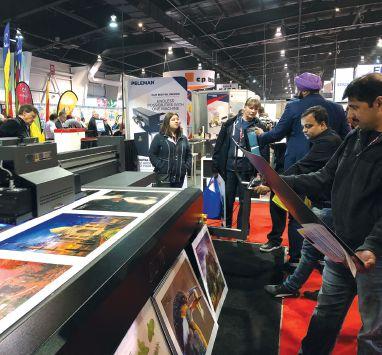
More than 7,500 attendees visited Graphics Canada 2019, from April 11 to 13 at the International Centre in Toronto.
GRAPHICS CANADA SNAPSHOTS
Biannual tradeshow highlights technology trends, new revenue-generating print markets and industry collaboration
By PrintAction staff
Show organizers say more than 7,500 visitors attended Graphics Canada 2019, a biannual graphics and printing tradeshow held at the International Centre in Toronto, Ont., from April 11 to 13.
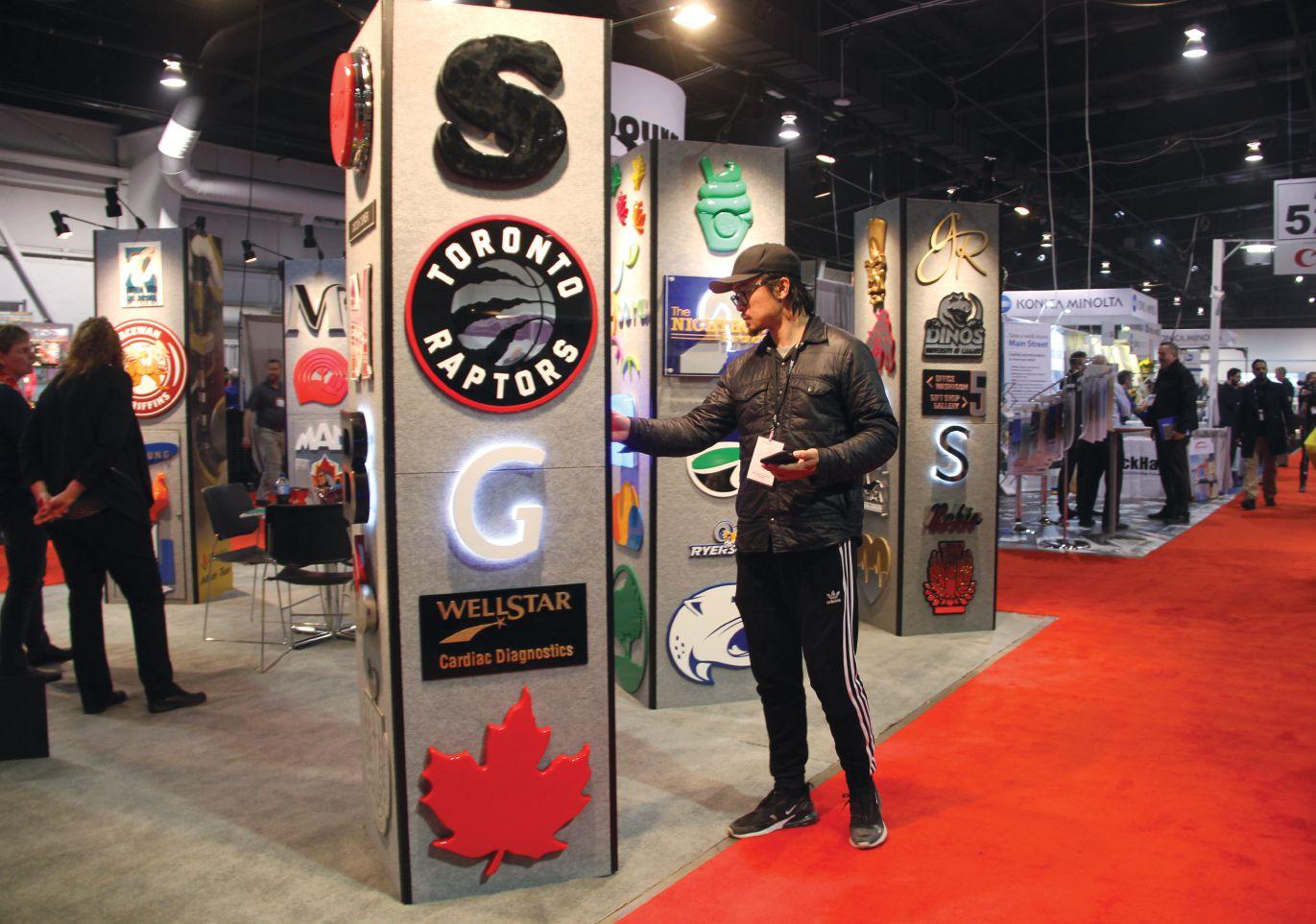
Dozens of new print technologies and solutions were on display and demonstrated, including the Canon Océ Arizona 1380, Konica Minolta AccurioWide 160 wide-format printer, Fujifilm Acuity Ultra superwide UV roll-to-roll press, Delphax Solutions Elan 500HD colour inkjet press, HP Latex 365 printer, Zünd Over Cutter Camera system and the Drafting Clinic HD Ultra Scanner. The three-day event also featured a range of
educational sessions, including Idealliance’s G7 Summit, the Canadian Label & Package Printing Conference, the Ryerson Extended Color Gamut Summit, IntelliFLEX Smart Packaging Workshops, and a Digital Imaging Association (DIA) breakfast meeting. A common theme among the conference programs? The need for printing companies to better position themselves for the future, as an influx of new technologies, emerging niche markets, talent shortages and rising paper costs continue to disrupt the industry.
“We’re a global market now, so it puts printers in different perspectives. The gamut is way bigger than it was, so we have to be a lot more creative. How does that affect the printing industry – [embrace] technology and find amazing
PHOTOS: A. DALTON/S. RUCCIA
people too, I think. The intellect is out there in the younger generations,” said Debbie Swift, Director of Relationship Management at Brand Relationship Marketing, during a panel titled 20/20 A new print culture. The discussion, moderated by DIA Association Manager Marg Macleod, also featured Louise Albert, Sales Executive and Production Expert; Debbie Gilbert, President, PRX Print; Ève Pétroni, Marketing Specialist, Ultimate TechnoGraphics; and Christine Yardley, President, Print Panther.
Al Varney, Xerox Canada President, believes there is no shortage of technological innovation on the horizon. “We’re seeing an evolution in the entire portfolio of inkjet as well as toner, there are a lot of drivers of it. Artificial intelligence and automation are offering massive improvements in productivity and quality,” he said, during an industry insights panel.
Meanwhile Glenn Laverty, President and CEO of Ricoh Canada, believes the innovation around inks will result in “extraordinary things.” “We [thought] of ink in the past as being something that generates colour, and those are days gone by,” he noted. “On the ink side of things, we’re going to see innovation that [will] drive real change in terms of how packaging gets done, how inks will become traceable and how they could be involved in combinations of data and data analytics.”
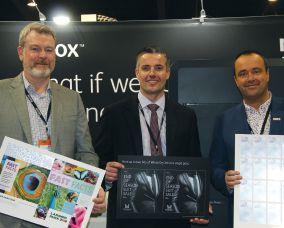
Flash Reproductions’ David Gallant and Rich Pauptit with Brennan Wright of Sydney Stone.
Debbie Swift (right) of Brand Relationship Marketing shares her take on industry challenges.
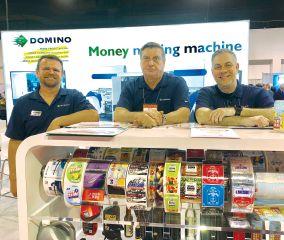
Team members from Domino, a manufacturer of digital printing and product identification solutions.
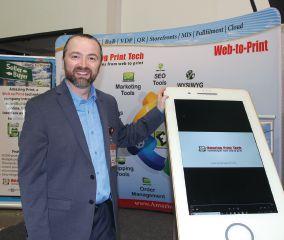
Slava Apel of AmazingPrintTech (Web-to-print).
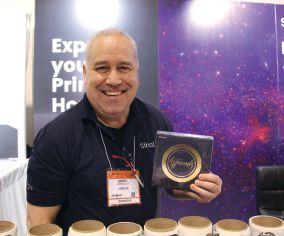
Marc Arsenault of SinaLite, a wholesale trade printer based in Markham, Ont.
Komcan President Steve Ranson and PrintAction Associate Publisher Stephen Longmire.
The PDS team, which represents brands such as Duplo, OKI Data, Multigraf-Touchline and Mutoh.
Clive Buckley, Product Manager, Production & Graphics Products of Ricoh Canada.
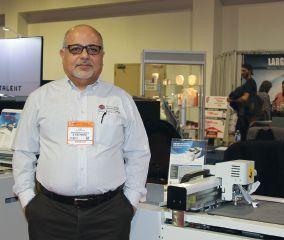
Ali Muhtaram, Sales Manager at Printer’s Parts & Equipment.
Richard Thompson and Gail Bullen of the Avanti sales team.
Kathy Schwartz and Deanne Sinclair of Cambridge Label, an Ontario-based trade printer.
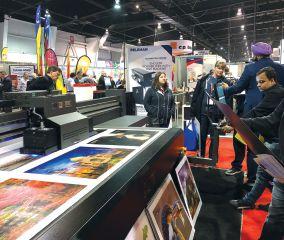
Attendees take in live demonstrations at the Stratojet booth.
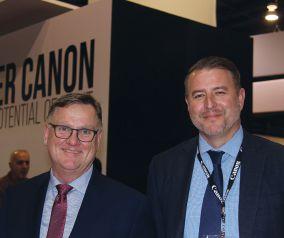
Graham Douglas and Philip Hampson of Canon Canada.
Xerox Canada’s Jim Dickson, Damien Johnston and Andrew Gunn.
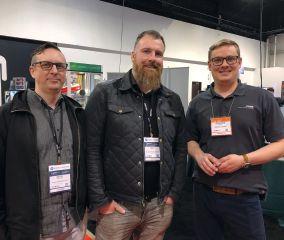
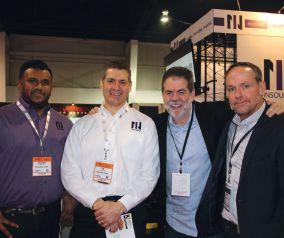
Kareem Sesook and Tim Wakefield of Insource Corp., Jay Mandarino of C.J. Graphics, and Glenn Houston of PDI Inc.
Team members from Spicers, which operates facilities in Toronto and Winnipeg.
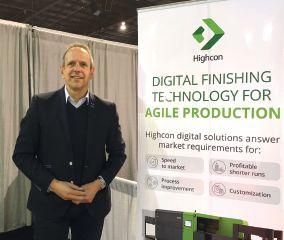
Christian Knapp, President, CMD Insight, presents Highcon digital finishing solutions.
CHANGING POWERS
More gender-balanced workplaces emerge as Canada’s print industry experiences a shift toward prevalent female leadership
By Stefano Ruccia
Despite being a traditionally male-dominated industry, the print world is not shy of successful women.
After nearly 15 years spent working at various printing companies, Janis Parker was involved in a serious car accident on her way to a press approval in 1994. During her recovery, her father, the now-late Frank Parker Jr., asked if she would be interested in bringing her sales experience to Parker Pad & Printing – the family business founded by her grandfather in 1946 – as she looked for a way to recuperate without having to drive. In 1997, she began the gradual purchase of the company from her father, and the deal concluded in 2007. With Janis at the helm as President and
Owner for more than a decade, Parker Pad & Printing went from doing around $3.5 million a year in revenue to $15 million a year in revenue, complete with growing direct mail and packaging divisions.
“The only thing I’ve always found a little troublesome is [the notion that] I couldn’t have done well without my father. Certainly that goes hand in hand, but I’m bright enough to get a university degree and I’m bright enough to grow the business,” she says. “When my dad passed away, I got a couple of pretty interesting emails saying, ‘Now that your father is no longer around to advise you, would you like some help taking care of the business?’ and I’m thinking, ‘I’ve been running the business for the last 10 years, but thanks anyway.’”
She believes the biggest barrier for young people entering the industry, irregardless of gender, is the reinvention of
Left to right: Ryerson GCM students Alvira Estepa, Sydney Natale and Taylor Page with Associate Professor Reem El Asaleh at the 2019 GCM Colloquium & Expo.
PHOTO: A. DALTON
print. “It’s not anything most people are going to tell their children to make their career. I think there’s some upswing now but there’s never going to be as many people working in the printing industry as there were in my dad’s heyday,” she says.
During a panel discussion at Graphics Canada 2019, Christine Yardley, President at Oakville, Ontariobased Print Panther, said she had recently hired her first female pressperson to work on the company’s MGI JETvarnish 3DS and iFOIL S.
More women are joining the print and graphic arts disciplines as they become increasingly creative fields, according to Reem El Asaleh, Associate Professor at Ryerson University’s School of Graphic Communications Management (GCM) in Toronto, Ont. She recalls her lab classes in 2012 as being a 50/50 percent male/female split; last semester, one of her lab classes consisted of 23 female students and only two male students. “There will be more women in the printing industry, I can see that just by looking at the number of female undergraduates [enrolled] in our program alone.”
She believes the move toward a more artistic industry – combined with technological advancements such as Industry 4.0 connectivity and augmented reality – is more enticing for women.The next step to building a more gender-inclusive workplace, she suggests, is to increase the support for women through measures such as: Lessening the gender wage gap, promoting women into leadership positions, implementing work-life balance initiatives, and targeted recruitment efforts.
Shelley-Lynn MacKinnon is the longest-running female sales executive at Metropolitan Fine Printers, having been with the company for more than 25 years, and is the only female sales executive at the Vancouver, B.C., headquarters.
“I found it was a bit of a ‘boys’ club’ [when I first started] and it was hard to crack some of the larger accounts,” MacKinnon says. “But as the world changed and as more women became [print] buyers, it became easier to get in.
I’m very tenacious, so if I knew there was a gold nugget in that account, I would
“If I had men in my path who might have doubted my competency, I just stuck with the facts, stuck with [my] technical knowledge and proved them wrong.”
continue working and break through.”
She points to the supportive culture at the family-owned business as a guiding light. “Within the organization itself, I had a lot of male mentors because there were no females, and they treated me well and encouraged me…and we worked [together] as a team. I still have that team support [today].”
MacKinnon finds excitement in reconnecting with clients she worked with in her early career. Regardless of changes in their lives, such as starting families or joining different organizations, she says old clients still connect with her after many years.
“I really love print. It’s never the same day twice and you’re always creating something. Every client has different needs, so it’s quite the exciting industry,” she says. “The world will always need print in some fashion.”
Lauréanne Houde-Blais, now six months pregnant, serves as Strategic Director for Précigrafik, a Sherbrooke, Que., print shop founded by her father Gilles Blais more than three decades ago.Women becoming mothers in any occupation, she says, can often lead to additional pressures and barriers to their professional life.
“That said I am a firm believer that the only barriers we encounter are the ones we create for ourselves and it’s not a question of gender. It happens to everyone,” Houde-Blais says. She believes the print environment is slowly evolving away from being a “one-woman show” and becoming more team-oriented, thus creating a more cohesive and diverse environment.
“I feel like men in the past have been putting pressure on themselves to run the show and I feel like as a woman, I don’t see it like that,” she says. “You play as a team, so as long as you’re well surrounded, I am confident.That’s just the new way to do it.”
Précigrafik’s executive committee is made up of three women and three men. “Even on our production floor and within our sales and graphic design departments, our employment is very [evenly split],” she says.
Trudy Hunter began her career at Renaissance Printing Inc. (formerly Web Offset Publications Ltd.) in 1988, creating pages for customers in the composition department, before taking on various positions in production, quality control and strategic planning, and supervisory
roles until her current position as Vice-President of Operations.
Based in Pickering, Ont., Renaissance Printing in early 2017 became a new Toronto-area printer under the ownership of Annex Publishing & Printing. The company was formed after the purchase of the remaining primary assets from Web Offset Publications’ receiver. Annex is the parent company of PrintAction and Canada’s largest business-to-business media company, with 60-plus B2B brands.
Hunter says she has seen more women working alongside her as she has moved up through the company.
“When I started in the industry, there was a lot of ‘old perspective’ that any [women] coming in should be in secretarial or clerical roles,” she recalls. “They wouldn’t give them the credit [for] the technical knowledge or the training they may have, but I don’t really see that anymore.”
The physical nature of the plant production environment has historically resulted in a very male-dominated workplace, Hunter says, “but now that [print] is very digital and creative...these [traits] are suited to women — but not just women.” The industry is much more inclusive to both women and men now, she says.
Hunter advises all women planning to enter the print industry, whether they are training for technical knowledge, or operations and production planning to “stay the course” if they do encounter gender barriers and biases. “That’s what I did. If I had men in my path who might have doubted my competency, I just stuck with the facts, stuck with [my] technical knowledge and proved them wrong. Proceed with the path you want to pursue.”
She says print will grow as an industry as companies continue to promote inclusivity for both female and male employees. This includes improvements in the recruitment process for employees in the business to ensure fair hiring opportunities. “We need to prove to these people coming into the industry that it’s different than it was, that [print] is still going to be around.
“I do believe print isn’t going anywhere. Print is changing but it’s not diminishing quite like they said it was going to several years ago. It’s a different feeling to pick up a book or a magazine than it is to read on a [screen].”
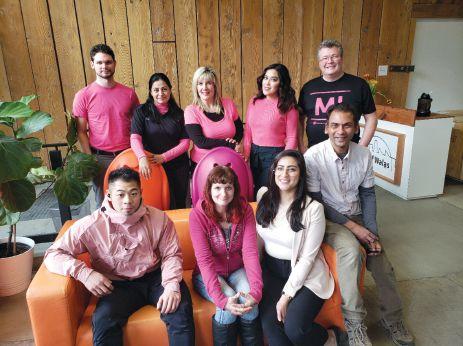
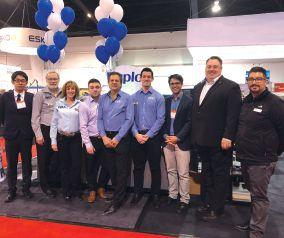
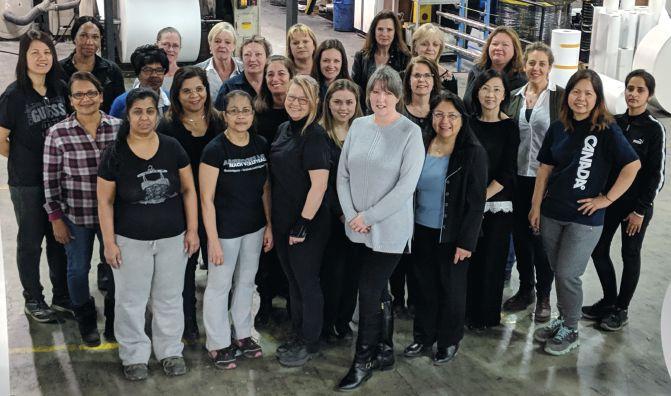
Team members from Metropolitan Fine Printers (above left) and Renaissance Printing (above right).
Continuous inkjet
Innovations in continuous production inkjet strive to be versatile, flexible and efficient
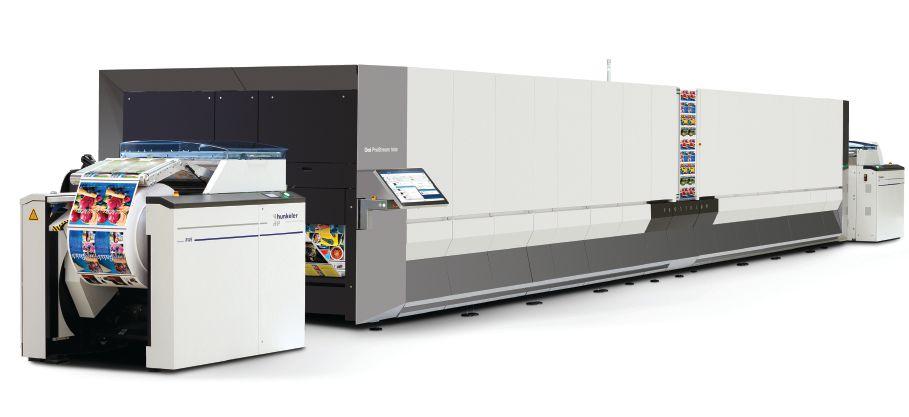
Canon Océ ProStream
The Canon Océ ProStream series prints uncoated, inkjet-optimized, gloss and matte-coated papers up to 1,144 letter size or 35 million pages per month in 2-up duplex production speed at a speed of 262 feet/min. The latest piezo drop-ondemand inkjet printhead generation, Canon explains, is leveraged with Océ Multilevel technology for sharper details, smoother half tones and economized ink usage. An Océ-developed set of ColorGrip and polymer pigment inks creates strong colours on uncoated, inkjet-optimized and gloss and matte-coated offset papers. The series uses a sensitive floatation air dryer in which the printed paper is not touched until the print images are fully robust — there are no scratches or changes to gloss levels and minimal paper stress for maximum quality, explains Canon.
Tecnau Revolution 50
In its Print 18 booth, Tecnau showcased the new Revolution 50 series for highspeed colour inkjet printers, a family of products featuring top speeds up to 656 fpm/200 mpm, Internet-of-Things (IoT) compatibility, and media flexibility as required in demanding digital print environments. The first member of the Revolution 50 family, the new Stack 5250 system for cutting and stacking continu-
ous inkjet-printed output features the double-cutting Cutter c52 and is designed to accommodate a range of papers and heavy ink coverages. The Stack 5250, Tecnau explains, never lets go of the web, minimizing friction on the printed surface it says. Stack 5250’s Stacker s50 module produces 1-up, 2-up, 2-up merged or 3-up stacks, featuring patented gripper technology for damage-free handling of high-value print, it says. The system includes natural-language error reporting on the user screen and onboard diagnostics to help keep the system up and running. IoT options are being introduced for remote monitoring and diagnostics, automatic software updates and preventive maintenance aids.
Xerox Trivor 2400
The Xerox Trivor 2400 High Fusion Inkjet Press is designed to allow print providers to expand their inkjet media range to produce cost-effective, higher-value personalized jobs such as direct mail, catalogues, magazines and colour books. The scalable continuous inkjet press initially targets speeds of up to 551 feet (168 metres) per minute in colour and 656 feet (200 metres) per minute in monochrome. The High Fusion Ink, Xerox explains, is specially formulated to help optimize printing and drying on offset coated media including matte, silk and glass stock from 60 to 250 gsm, up to 250 feet per minute, producing high-quality results direct to paper, removing the need for intermediate coating processes, primers or added hardware.
Screen NID Truepress Jet 520HD
Screen in October announced the immediate availability of the new Near Infrared (NIR) Dryer for the 520HD inkjet web press, designed to advance productivity for jobs demanding high image quality and expands print applications for high-speed inkjet across a broad
The Océ ProStream prints uncoated, inkjet-optimized, gloss and matte-coated papers at a rate of 80 metres per minute.
landscape of products. The new Screen NIR Dryer technology, built into the existing press frame and structure of the 520 HD, is designed to extend drying performance for both lightweight uncoated stocks and heavier weight, coated litho substrates. The result is an expanded range of applications and higher productivity on difficult to dry substrates, Screen explains. Operators can create substrate profiles with embedded drying protocols at different print resolutions and ink limits. These profiles are managed by Screen’s proprietary Equios front-end software, boasting “intelligent” drying balance for each specific stock to help achieve the desired ink coverages.
HP PageWide T1190, T1170
HP in May 2018 announced two new six-colour PageWide ultra high-volume inkjet web presses for pre-print corrugated packaging, the HP PageWide T1190 and HP PageWide T1170, described as delivering higher productivity and quality for digital packaging presses. The company says the flagship PageWide T1190 Press offers 67 percent more throughput productivity compared with the current PageWide T1100S, delivering up to 305 m/min in six colours at full press speed. The addition of six-colour printing
CALLING ALL PRINTERS
A MUST-ATTEND CONFERENCE FOR ALL PRINT PROFESSIONALS LOOKING TO BUILD THEIR BUSINESS
WHY YOU SHOULD ATTEND:
• Explore new technology trends and revenue streams
• Participate in engaging panel discussions
• Hear inspiring keynotes from print leaders
• See demos of new technologies and solutions
• Engage in valuable networking opportunities
(CMYKOV) also expands the colour gamut for matching colours, allowing for “new digital possibilities for brands, including short-runs, faster turnaround time, and versioning,” HP says. HP explains the 2.8-m thermal inkjet technology web presses are ideal for packaging converters seeking analogue-to-digital transformation with high-volume productivity in offset quality for pre-print corrugated packaging applications. Additionally, the presses use HP A30 true water-based inks, which HP explains contains no UV-reactive chemistries and does not require additional barriers for food packaging applications. The PageWide T1170 Press prints 183 m/min in six colours, compared with four-colour printing at the same speed on the PageWide T1100S. Both the T1170 and T1190 presses are suitable for both coated and uncoated media, from 80 gsm to 350 gsm. Additionally, HP Multi-lane Print Architecture can boost plant productivity by splitting the web into multiple print lanes, so different jobs, with different box sizes and run lengths, can be printed in the individual lanes, says HP, adding that multiple ultra-short or short runs can be queued and printed together while a long run is printed in another lane.
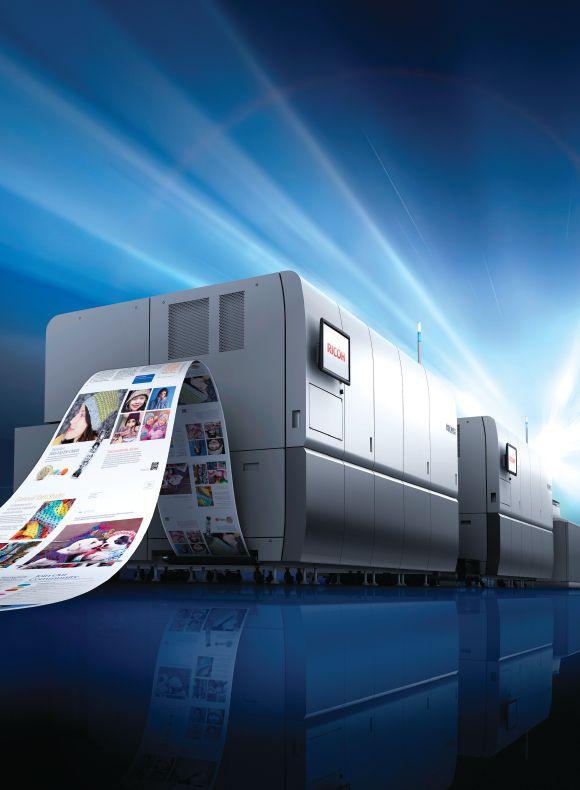
Ricoh Pro VC70000
Last June, Ricoh announced the newest addition to its inkjet portfolio, the Ricoh Pro VC70000, designed to accelerate the transfer of offset print volumes to digital. The continuous feed platform targets commercial printers looking to produce high-end catalogues and magazines, traditionally expected from offset presses. Additionally, Ricoh-developed inks are described as enabling up to 40 percent savings in paper costs while also expand-
ing media support to offset-coated papers, untreated papers and more. The Pro VC70000 joins the Pro VC60000, Pro VC40000 and InfoPrint 5000 in Ricoh’s inkjet portfolio. It touts a wealth of features including a new engine platform designed to increase drying capacity. The platform prints at speeds up to 492 ft/ min, producing nearly 130,000 A4/letter impressions per hour. It leverages piezo drop-on-demand printheads at up to 1200 x 1200 dpi resolution on uncoated, offset-coated, inkjet-treated or inkjetcoated papers. Ricoh says its new inkjet ink technology rivals the output of offset inks with its media versatility and compatibility with gloss-coated stocks, while enabling a wider colour gamut.
Kodak Prosper Plus Imprinting Solutions
Kodak in February announced the Prosper Plus Imprinting Solution, the newest Kodak Stream Inkjet Technology component product line designed for packaging and product decoration applications. Based on Prosper S-Series Imprinting Systems, the Prosper Plus Imprinting Solution includes four new imprinting components as well as food safe packaging inks and pre-coatings for folding cartons, food wraps, paper cups and plates, and ream wraps. The four hardware products will include two narrow formats and two wider format models that print at speeds of up to 850 fpm or 2,000 fpm maximum. The components can be mounted inline with offset, flexo or gravure presses, and can be implemented in finishing lines. In addition to packaging applications, the Prosper Plus is suitable for use in other hybrid printing applications such as direct mail, forms imprinting, security and barcoding.
The Pro VC70000 joins the Pro VC60000, Pro VC40000 and InfoPrint 5000 in Ricoh’s inkjet portfolio.
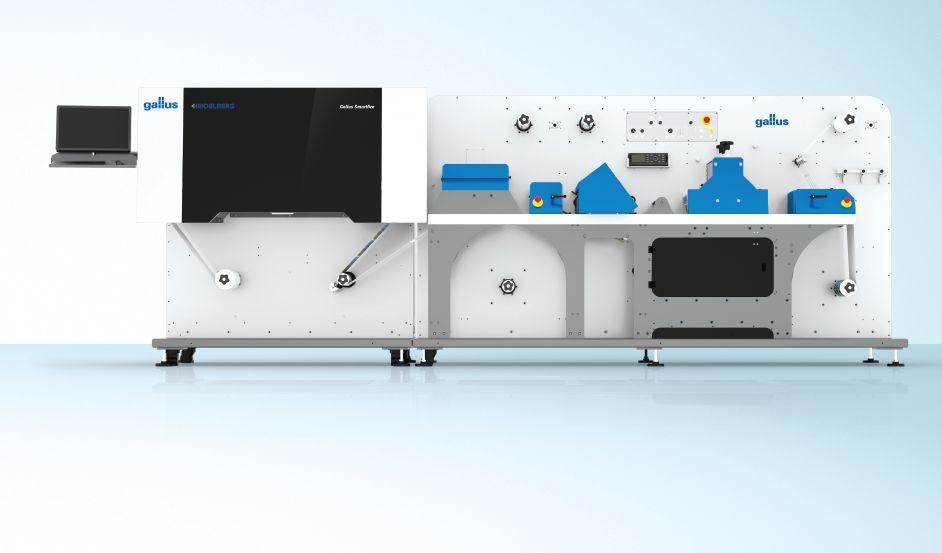
Gallus Smartfire
Gallus, a member of the Heidelberg Group, has introduced a digital label press designed for ultra-short-run fully finished labels. With a maximum web width of 9.45 inches, the four-colour Smartfire targets those looking to enter the digital label printing space, Gallus explains. Operating at a speed of 9 m/min at 1600 x 1600 dpi resolution using Memjet printheads, the Smartfire requires no exhaust equipment and emits no volatile organic compounds (VOC), it adds. Its Caldera front-end includes colour management, substrate qualification, and step and repeat modules. The integrated converting line offers self-wound lamination, a die-cutting knife system for complex dielines, a semi-rotary die-cutter for quick changeovers, a waste matrix pickup, slitting knives, and finished labels — taking jobs from “file to finish.”
Konica Minolta WEBJet 100D, 200D
Last fall, Konica Minolta launched the WEBJet 100D and WEBJet 200D continuous feed inkjet presses. Manufactured by Super Web and powered by Memjet printheads, the presses offer roll-stand and stacking configurations and aim to reduce operating costs and improve profitability. From the included 50-inch rollstand to its inline stacker, the 100D is designed for challenging applications in the direct mail, transactional and publishing space. Meanwhile the WEBJet 200D provides printers in the direct mail, transactional and publishing space with a continuous feed, allin-one solution to print simplex or duplex, cut, perforate, slit and merge, and stack all on the same machine.
The new Gallus Smartfire produces fully finished labels at a speed of 9 m/min.
Detailing new solutions from Canon, Easy Cut Studio, Esko, Herma US, HP, Kornit,
Ryerson University Library, Sappi, SPGPrints, Xanté and Xeikon
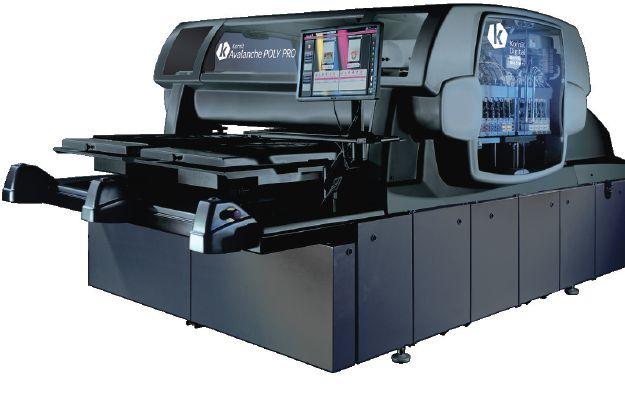
Kornit Avalanche Poly Pro Kornit Digital Americas recently debuted the Kornit Avalanche Poly Pro, calling it the industry’s first digital direct-to-garment system built specifically for polyester and poly-blend substrates, a market that has seen increased popularity due to non-cotton sportswear and athleisure apparel. The system is based on Kornit’s NeoPoly technology and is paired with NeoPigment Olympia ink. Designed to print on a variety of polyester fabrics, including woven, knits, poly blends (polylycra, poly-cotton) and different fabric textures, the four-colour CMYK + white + poly enhancer Avalanche Poly Pro boasts “superior” white base opacity for “vivid, lasting graphics” with up to 1,200 dpi printing resolution.
Esko software 18.0.1
The latest update to the Esko soft-
ware platform includes ArtPro 64-bit and full plug-in compatibility with Adobe Creative Cloud 2019, including Studio, DeskPack and Dynamic Content. The macOS-supported 64-bit version of ArtPro, Esko explains, which means users who have a maintenance contract will receive a complimentary copy of ArtPro+ packaging editor. Boasting a clean task-driven user interface, ArtPro+ action lists in Automation Engine are designed to automate time-consuming prepress tasks. Another feature of the release is Imaging Engine, which includes In-RIP Prepare for viewing, allowing users to control the quality of ripped files on the fly throughout the ripping process.
Canon Océ Arizona 1300
Canon Canada in March introduced the Océ Arizona 1300 series
of high-productivity mid-volume UV true flatbed printers, delivering prints up to 568 sf/hour and highdensity prints up to 380 sf/hour. Customers can choose from three GT models (Océ Arizona 1340 GT, 1360 GT, 1380 GT) with a flatbed print area of 49.2 x 98.4 inches, or three larger 121.3 x 98.4 inches XT models (Océ Arizona 1340 XT, 1360 XT, 1380 XT). The series can print on different media, including oddshaped, heavy, smooth or pre-cut media and unusual objects such as canvas, glass or wood, says Canon. With the built-in Automated Main-
tenance System (AMS) for handsfree printhead maintenance, nozzle function for all colours can be selectively restored in seconds, the company says. Meanwhile the integrated Océ Arizona Xpert self-learning technology is designed to help the printer learn from what the operator does, thus making it easier to reproduce complex, multi-layered projects. Canon explains the printer will learn the “recipe” for the project, including transparencies and multi-sided printing, which can then be used over and over again.
Finishing 4.0
Muller Martini’s manufacturing philosophy, trademarked Finishing 4.0., does just that with machines and systems that are designed and engineered to help you compete within the variable world of today and tomorrow. Our forward-thinking finishing solutions efficiently and expeditiously accommodate offset, digital and hybrid printed products by creating end-to-end workflows, from file through finished product, that achieve the greatest quality—and even greater efficiencies. These efficiencies include reduced makeready and manpower, less waste, and faster speed to market, all the while significantly improving the experience of the product’s end user.
Muller Martini is Finishing 4.0
There is a demand for innovative print-finishing solutions for the digital and offset printing of long and short runs.
With Finishing 4.0 Muller Martini will underline the major importance of digital networking and end-to-end touchless workflow, from printing to distribution. Muller Martini is leading the way in finishing with the seamless integration of its solutions. Muller Martini – your strong partner.
The Avalanche Poly Pro boasts “superior” white base opacity with up to 1,200 dpi printing resolution.
Herma 500 label applicator
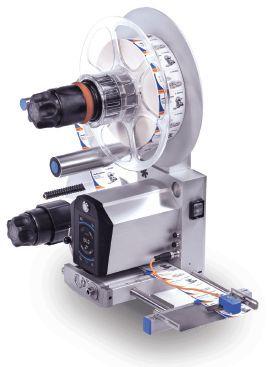
Herma US Inc. has introduced the Herma 500 label applicator, an IoT-enabled machine that leverages real-time metrics to help optimize production efficiency and consistency in a multi-factory setting. Capable of achieving labelling speeds up to 200 m/min, the Herma 500 can handle label widths between 80 to 320 mm and roll diameters from 300 to 600 mm. Since launching its North American operations in 2016, Herma says it has sold more than 4,000 Herma 400 label applicators in 2018, half of which were provided to original equipment manufacturers. The Herma 500, it explains, is a next-generation unit that builds upon its predecessor’s features and integrates Industry 4.0 connectivity. The Herma 500 reaches a maximum speed 70 ft/
min higher than the H400. According to Herma, a maximum speed of 650 ft/min can be achieved.
SPGPrints RSI III
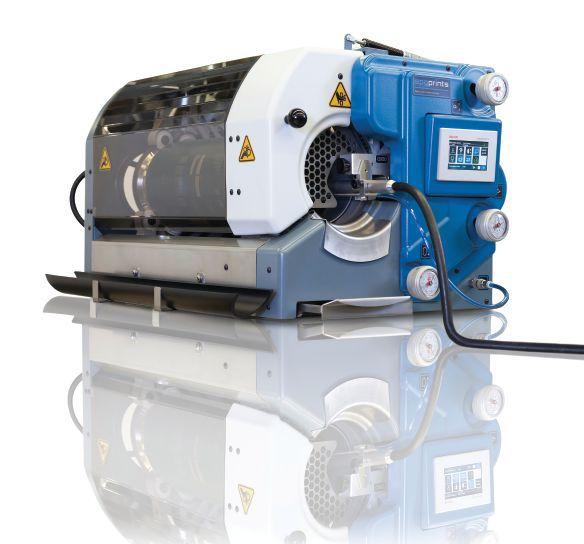
SPGPrints’ new RSI III – the third generation of its rotary screen printing integration module for label and packaging presses – boasts time, safety and ergonomic innovations for increased production efficiency. The company explains operator safety has been augmented with the introduction of guards to prevent contact with the rotating screen, squeegee pipe and gear wheels to help reduce the risk of injury. A new web-cleaning scraper, positioned on a guiding roller immediately after the nip between the screen and substrate, automatically removes undesired ink splashes on the web that may have spilled from the screen during stoppages or slow-rotation mode, SPGPrints says. Operated only for the first one-anda-half screen rotations at the start of the production run, the scraper is designed for thorough drying of the substrate, minimizing the risk of ink contaminating the rollers and reducing the cleaning requirement, the company says. A new colour interface display offers enhanced visibility with a wider angle of observation so operators can monitor and control the unit without needing to view the screen at eye level. Among other benefits, this facilitates easier monitoring of controls and ink levels.
Easy Cut Studio software
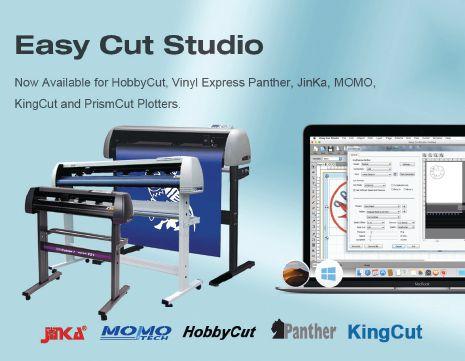
Sign-making software provider Easy Cut Studio has launched Easy Cut Studio version 4.1.0.6, de -
SPGPrints RSI III features a new web-cleaning scraper to remove ink splashes on the web that may have spilled from the screen during stoppages or slow-rotation mode.
The Herma 500 can handle label widths between 80 to 320 mm and roll diameters from 300 to 600 mm.
The Easy Cut Studio software includes sign-making tools such as image tracing, shadows, welding, text on arch, objects on path, special effects and more.
scribing it as a user-friendly cutting plotter application that creates vinyl letterings, decals and general signs with vinyl plotters. According to the company, users can create text, shapes and freehand graphics at any size to cut in vinyl. It includes a more robust set of sign-making tools such as image tracing, shadows, scanning, welding, text on arch, objects on path, node editor, gradient fills, transparent fills, special effects and more. The latest version provides support for more than 60 different vinyl cutting plotters including HobbyCut, JinKa, PrismCut, MOMO, KingCut and Vinyl Express Panther cutting plotter.
Xanté iQueue 13
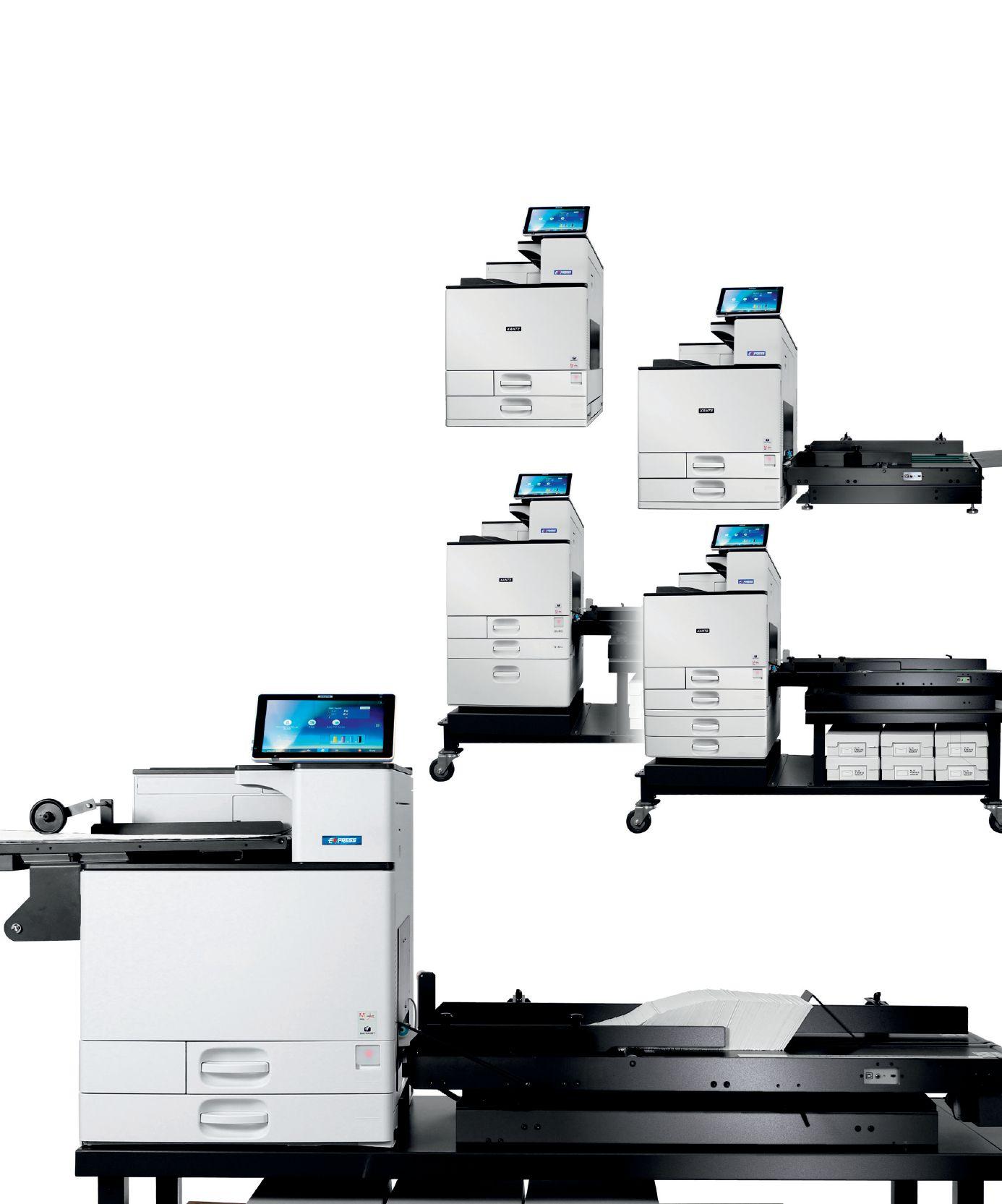
Xanté says it is making the preparation and printing of mail jobs “more powerful, simpler and much more economical” with iQueue 13, its flagship Adobe PostScript PDF workflow software. iQueue 13, Xanté says, will allow printing companies to import their clients’ mailing list, scrub, sort and update it for address changes through iQueue’s Cloud servers containing the CASS and NCOALink databases. Additionally, the software will generate and print intelligent mail barcodes. The preparer may submit the documentation electronically to the data processing network directly from a link within iQueue. After processing the list through the network for address and change-of-address accuracy, the print provider can incorporate the list into an existing job through iQueue’s Variable Data engine and printing can begin. The new version includes a selection for variable data and automatically formats an address block, including the barcode. Placement of the variable data on the piece is a “drag and drop” operation within iQueue 13. The iQueue-powered Xanté digital press prints the entire list in the re-
quired order (or reverse order) for sorting into trays or sacks depending on the job. A separator page can mark the divisions between each tray or sack. After scrubbing the list, iQueue 13 allows the mail preparer to review and correct any addresses that were either partially or completely incorrect. iQueue 13 runs on any Windows 7 PC or later and is compatible with Xanté products.
Web Design Primer textbook
Web Design Primer is a new opensource eBook published by the Ryerson University Library by authors Richard Adams, Associate Professor in the School of Graphic Communications Management, and Ahmed Sagarwala, Manager of Industry Relations in the Digital Media Zone (DMZ). The book explains the basics of HTML and CSS codes used to create web pages and related technologies including JavaScript, jQuery, audio, video and animation. Designed to accompany a one-semester course on web design, the book can be read online or downloaded in ePub and PDF versions from https://pressbooks.library.ryerson.ca/webdesign. Printed versions can be ordered from the website. The eBook has been published under a Creative Commons Share and share alike with attribution copyright licence, enabling other instructors to download, edit and use the book for their classes, royalty-free, with the only requirement being to credit the original authors.
Xeikon digital printing solution for pouches
Xeikon says it has developed a digital printing solution for pouches that will result in reduced lead times, while also increasing the number of SKUs to better meet the demand from brand owners. Designed to simplify the overall production process by being a
SUPERIOR TECHNOLOGY — Die crease without a die, then fold and even glue all on the same machine, up to 30 pt.
3. INTEGRATED MODULAR UNITS — Combined in-line finishing: crease, fold, glue, tipping, envelope inserting, ink jetting (Duplex), clip seal (3 sides), mail prep. 4. SAVE ON POSTAGE COSTS —As a Certified Canada Post Direct Marketing Specialist, we get contract pricing reductions. 5. RETURN MAIL PRODUCTS — Customized “Return Mailers” created in-line with “U” or “BOX-shape” remoistenable glue, time perfed applications and envelope formation. 6. MINI-BOOKLETS — Saddle-stitch and trim 2-up booklets in-line to the size of a business card. No need to trim off-line, or do 2 passes.
7. HIGH SPEED EQUIPMENT — High speed Tipping, Folding, Saddle-stitching and soft folding ensuring on time delivery.
Custom V inyl Stickers & Signs
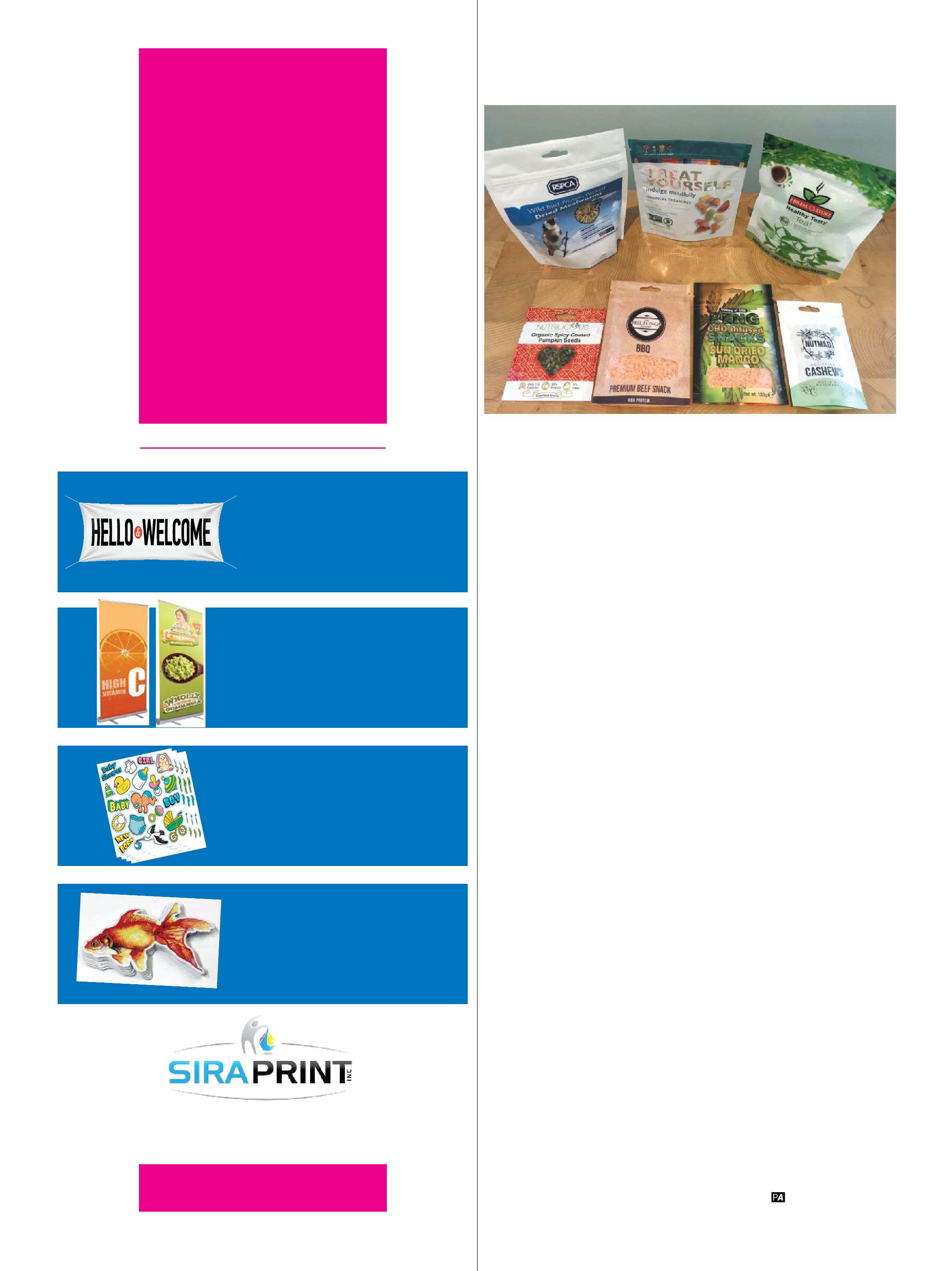
Xeikon’s digital process for printing on pouches was developed for consumer goods markets: food, beverage, chemical and pharmaceutical industries. fast-turnaround solution, the new digital technology can be used in applications for consumer goods markets, including food, beverage, chemical and pharmaceutical industries. Brand owners looking for shelf impact for their products are drawn to flexible pouches for their ability to stand, as well as being lightweight and sustainable, but pouches can be complex to manufacture because of the flexible nature of their multi-layers, Xeikon says, noting it is essentially a laminated bag made from several layers of material that requires a number of different steps in production. Xeikon says it is aiming to simplify the process. By firstly digitally printing the text and graphics on a thermal laminate, the outside layer of the pouch is prepared and ready for the next steps. A variety of different layers is then constructed by lamination with a series of barriers for protection before the pouch is finally put together in the manufacturing process. Xeikon’s digital printing solution is said to provide the lowest possible complexity and the broadest lamination construction. Its dry toner technology enables JIT production, versioning and last-minute adaptations on the fly, and helps customers print variable data information in both single and full colour. For print operations with a high volume and complex jobs, the crossover point for flexo and the digital process is at least 4,000 lm.
Sappi Proto, Spectro paperboard products
Sappi’s new Proto and Spectro paperboard products are now available globally. Proto C1S is described as a sturdy SBS for everyday appli-
cations, including magazine and book covers, shopping bags, POS materials, direct mail and consumer packaging. Spectro C1S is a single-ply SBS for high-quality packaging and graphic applications. Whether using UV, aqueous or specialty coatings, hot foil stamping, embossing, special effects or varnishes, the line aims to bring a “substantial feel at a lighter weight with enhanced optics.”
HP PrintOS Marketplace
At Dscoop Edge in March, HP Inc. announced the expansion of HP PrintOS Marketplace, an ideas store designed to inspire HP print service providers to collaborate and innovate, while implementing Industry 4.0 for automated printing. New applications in the marketplace from HP and solution partners can also help printing companies increase productivity, streamline workflow and develop new digital print applications, it explains, and can give users control over print operations from virtually anywhere at any time, simplifying and automating production processes. More than 50 free projects and design tools are now available for download exclusively for PSPs using PrintOS. Resources in the new PrintOS Marketplace ideas store include projects-in-a-box for labels and packaging, commercial and photo printing. Ready-to-go projects include HP Mosaic and HP Collage packaging templates, seed patterns, sample files, and royalty-free images and icons. Members are also invited to share or sell their print ideas in the store. The company says PrintOS has grown to more than 20,000 users since launching at drupa 2016.
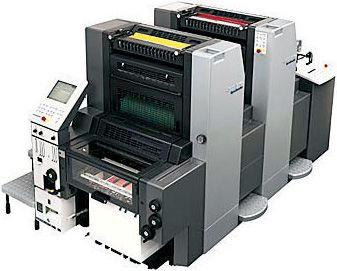
Sakurai: 1, 2 or 4 colours and any size (newer model)
Polar: any size/older or newer models (66/72/76/78/82/90/92/107/115)
Horizon-BQ: 220/240/260/440/460
Jamie Barbieri / President / PDI Group Inc.
PDI Group has been a fixture of Quebec’s complex printing industry since Phipps Dickson and Integria merged in 2007. After introducing the PDI branding in 2008, the company has grown to encompass pre-media, offset and digital print production, web-toprint, as well as fulfilment, warehousing and direct mail services. Last fall its subsidiary, PDI Large Format Solutions, became the first business in the country to install both the flatbed/roll-fed EFI VUTEk h3 superwide-format LED printer and the new EFI VUTEk 3r+ roll-to-roll LED printer. It also installed an EFI VUTEk FabriVU 340i soft signage printer. PrintAction spoke to Jamie Barbieri, President of PDI Group, to discuss the Quebec landscape.
PA: What is the greatest strength of Quebec’s printing community?
JB: If you look at its history, Quebec has had some of the largest printers in the world, certainly in North America. In Quebec, it has the headquarters of Quebecor and TC Transcontinental. Those large players have exited, for the most part, the commercial printing world. But there is still a fair amount of capacity in Quebec and a lot of the sales that Quebec printers deal with are export sales to other provinces or even other countries, whether it’s the United States, South America or Europe.
PA: What are some challenges it faces?
JB: The biggest challenge in Quebec right now is labour. Printers located in metropolitan cities, like Quebec City or Montreal, have access to a certain labour pool, but if you are in regions up north, you basically have no labour pool. There’s a program we are embarking on in Quebec that encompasses all the printers in a real collaborative effort to change that.
Printing is an old business; it’s a fragmented business. It has been slighted by probably everybody – including the financial community – in terms of its ability to survive the digital age. In retrospect, the printing industry itself has not done a great job in marketing how far it has come. Businesses are stronger today than they were 10 years ago and print is far from dead, but there is still the misconception that print is suffering. Even though print contributes significantly to the Quebec economy, young people are not encouraged to go into this world and it is unfortunate.
PA: What capital equipment investments are taking place in Quebec?
JB: There has been a number of new presses installed over the last two years. PDI has already spent probably $3 million last year, we’re probably going to spend another $5
million this year. And my competitors are doing the same. It’s a good sign that the industry has settled down and folks are starting to rebuild and invest in the future. It’s a great indication that the market in Quebec is moving in the right [direction].
PA: What print markets are gaining traction?
2016
Barbieri was named Printing Leader of the Year at PrintAction’s 2016 Canadian Printing Awards.
JB: I think retail is a big one. Everything that is consumer-based goes through seasons, but if you look at packaging, a lot of these retailers are the ones buying up most of the product. Whether it’s in stores or for promotional messaging, that is the hot market right now. There are a bunch of compliance markets as well that are interesting, but they are shrinking. Whether it’s pharmaceutical or financial banking, those markets are going digital and that leaves print out in the cold a bit. The pharmaceutical companies are cutting down on the number of detail or sales aids they print for their sales force because they are putting all that stuff on a tablet instead. They’re really emphasizing the use of electronic media as opposed to printed media to get the message across.
PA: How has PDI strengthened its operations?
JB: PDI has gone the way of diversification
over the last seven or eight years. We got into distribution and logistics, mailing and fulfilment, large-format printing and digital printing, all under one roof. We believe you [have to] wrap yourself around your customer. We have a very blue-chip customer list and we have grown by adding services.
PA: What would you recommend for companies that aren’t able to expand their offerings?
JB: You cannot do everything for everybody and ultimately, what’s going to happen is a customer will not – as good as you are – confide 100 percent of their purchasing to one vendor. It’s very rare for that to happen now. Partnerships between printers allow you to capture perhaps, a bigger volume of business. Partnerships can also take you into spaces you [might] not be able [to tap into] otherwise. For example, you can do the printing and someone else can do the distribution or different types of printing, like 3D printing or large-format printing. If you are a commercial printer and all you do is put ink on paper, you can’t survive on that alone. You need partners to help add value to your business. Partnerships can also give you access to different geographical markets, like from one province to another.
By Stefano Ruccia
Raise Your Expectations
WHEN FIRST IMPRESSIONS MATTER
When you only have a few seconds to make that first impression memorable, Duplo’s NEW DDC-810 Raised Spot UV Coater gets the job done. Embellish your images and engage the senses with an eye catching layer of texture and depth that they can touch and feel!
JUST WHEN YOU THOUGHT INKJET COULDN’T GET MORE AMAZING
The J Press 720S set the industry standards for print quality, colour reproduction, repeatability and reliability. Now, the new J Press 750S is pushing the envelope of inkjet technology even further by incorporating exciting new advancements like an increased sheet size of 23” x 29.5” and a running speed of 3,600 sheets per hour – effectively doubling letter-size output. Just imagine where the new J Press 750S can take your business.
By pushing the envelope of inkjet technology, the J Press 750S invites you to rethink what you can do using the worl fastest full colour B2 sheetfed inkjet press.