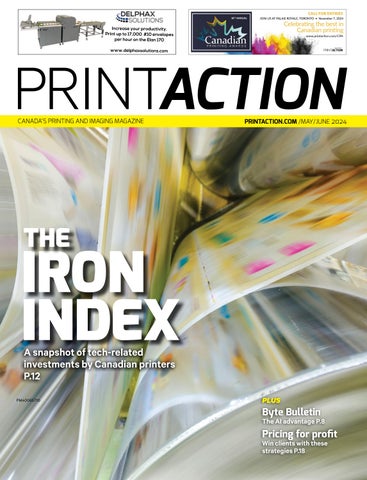
Technology and process trends in the Canadian printing industry
The reasons behind this trend and the technologies supporting its growth
18 Your guide to profitable pricing
How to set prices your customers will love 21 Automating prep
How Kwality Labels relies on workflow to prepare artwork for print
24 Small steps, big impact
Canadian printers who are reducing emissions without breaking the bank
DEPARTMENTS
GAMUT
5 News, People, Installs
11 Calendar
NEW PRODUCTS
28 Introducing new solutions from Komori, HP, Landa, and Flint
SPOTLIGHT
30 Denis Gagnon, owner, Graphiscan
COLUMNS
FROM THE EDITOR
4 Nithya Caleb
Are you ready to report to the federal plastics registry?
BYTE BULLETIN
8 AI, your trusty sidekick
CHRONICLE
10 Nick Howard
The problem press
TECH REPORT
27 Angus Pady
Time to report plastics
Less than 10 per cent of plastics in Canada are recycled, with the rest ending up in landfills and the environment, harming wildlife and damaging habitats. To ensure plastics is kept out of landfills and environment, the federal government has launched a new federal plastics registry, a tool to compel plastic producers and other companies across the plastics value chain to help monitor and track the material from the time it is produced up to its end of life.
Flow of plastic in Canada
A Stats Canada study found that packaging comprised 30.4 per cent of the total amount of plastic produced in Canada in 2020.
According to Stats Canada, in 2020, the amount of plastic produced for Canadian consumption was 7,121 kilotonnes (kt), an increase of 0.8 per cent from 2019 (7,068 kt) but less than the 3.4 per cent increase from 2018 to 2019.
In contrast, the amount of plastic directly discarded by Canadian households, businesses and institutions fell by 2.7 per cent from 2019 to 4,928 kt in 2020. Most of the total discarded plastic in products was collected for either disposal (3,637 kt) or material recovery (1,249 kt), while the remainder was leaked to the environment as pollution. Diversion and disposal both fell during the start of the COVID-19 pandemic in 2020, going against the general upward trend since 2012. Collected plastic for material recovery declined at a faster rate (-8.8 per cent) than plastic sent for disposal (-0.4 per cent).
The “Physical Flow Account for Plastic Material” is an environmental-economic account that estimates the flow of plastic through the Canadian economy. The study found that packaging (+4.1 per cent) and construction materials (+6.9 per cent) were the largest contributors to the 0.8 per cent increase in production.
Packaging constituted 30.4 per cent (2,167 kt) of total produced plastic for Canadian consumption in 2020, followed by construction materials, which made up 21.7 per cent (1,546 kt). There was a combined increase of 0.8 per cent at the national level in plastic production for textile, agricultural film, and other plastic products in 2020. In contrast, electrical and electronic equipment and vehicles combined showed a decline of 8.5 per cent of produced plastic.
Canadian recyclers produced about 362 kt of recycled plastic resins for use
by manufacturers in 2020. Material from recycled plastic bottles accounted for 60.9 per cent of this total.
Federal registry
The registry requires plastic resin manufacturers, producers of plastic products, and service providers to report each year on the quantity and types of plastic they put on the Canadian market and how that plastic moves through the economy. This tool will provide Canadians with data that will identify opportunities for action to reduce plastic waste and pollution, as well as help monitor progress over time.
Implementation timeline
Reporting will be phased in over time and by sector. The categories covered by the registry are packaging, single-use and disposable products, construction, transportation, electronics and electrical equipment, tires, textiles and apparel, fishing and aquaculture equipment, and agriculture and horticulture equipment.
Small producers placing less than one tonne of plastic on the market are exempt from making annual reports. For others, reporting will start in September 2025. Producers must report on the quantity of plastic imported, manufactured, and placed on the market in the three categories of packaging, electronic and electrical equipment, and single-use or disposable plastic products for the 2024 calendar year.
In 2026, reporting requirements for resin manufacturers and importers will be added, as well as reporting on plastic placed on the market for the remaining categories. Additionally, reporting on plastic waste generated at industrial, commercial, and institutional facilities, plastic collected at end-of-life, as well as plastic sent for diversion and disposal for some categories, will be introduced in 2026.
It is hoped that the federal plastics registry will support the Canada-wide Action Plan on Zero Plastic Waste by providing accessible, consistent, and robust plastic data. If you have any questions about the registry and reporting timelines, please email me.
Reader Service
Print and digital subscription inquiries or changes, please contact Angelita Potal 416-510-5113 apotal@annexbusinessmedia.com Fax: 416-510-6875
Mail: 111 Gordon Baker Road, Suite 400, Toronto, ON M2H 3R1
Nick Howard, A.J. Rai, Treena Hein, Aaron Montgomery, Mike Agness, Angus Pady
Associate Publisher Kim Barton kbarton@annexbusinessmedia.com 416-435-9229
Media Designer Lisa Zambri lzambri@annexbusinessmedia.com
Account Coordinator Melissa Gates
mgates@annexbusinessmedia.com 416-510-5217
Audience Development Manager Urszula Grzyb ugrzyb@annexbusinessmedia.com 416-510-5180
Group Publisher/VP Sales Martin McAnulty mmcanulty@annexbusinessmedia.com
CEO Scott Jamieson sjamieson@annexbusinessmedia.com
Subscription rates
For a 1 year subscription (6 issues): Canada — $43.86 +Tax Canada 2 year — $71.91 +Tax United States — $99.96 Other foreign — $194.82 Single Issue — $8.00 + Tax All prices in CAD funds
Mailing address
Annex Business Media
111 Gordon Baker Rd., Suite 400, Toronto, ON M2H 3R1 Tel: 416-442-5600 Fax: 416-442-2230
Occasionally, PrintAction will mail information on behalf of industry related groups whose products and services we believe could be of interest to you. If you prefer not to receive this information, please contact our Audience Development in any of the four ways listed above.
Annex Business Media Privacy Officer Privacy@annexbusinessmedia.com 800-668-2384
PrintAction is printed by Annex Business Media Printing on Creator Gloss 80lb text and Creator Silk 70lb text available from Spicers Canada. ISSN 1481 9287
Mail Agreement No. 40065710
NITHYA CALEB Editor ncaleb@annexbusinessmedia.com
printaction.com
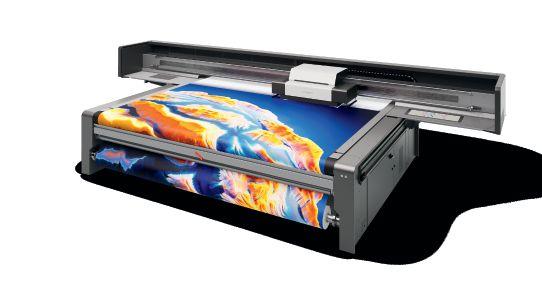
SwissQprint customers will now receive a 36-month parts warranty starting from delivery of their large format printer. The industry standard is 12 months. The provisions stipulate preventative maintenance intervals.
Supremex acquires the assets of Forest Envelope Group for approx. US$1.8 million, on a cash-free and debt-free basis. Founded over 40 years ago, Forest Envelope manufactures specialty envelopes. It is located in Bolingbrook, Ill., in the Greater Chicago area.
As part of its reinvention, Xerox is changing its product portfolio. It plans to focus on creating solutions related to workflow automation, intelligent assistant services, and personalization through its suite of Xerox FreeFlow Workflow Software, Predictive AI Pro and XMPie. It plans to discontinue the manufacture of its iGen 5 and Nuvera presses, two legacy platforms. Order fulfillment for iGen and Nuvera is expected to continue through 2024 or while inventory lasts.
Konica Minolta and Fujifilm Business Innovation sign a memorandum of understanding to begin a feasibility study for a strategic alliance in the multifunction printer (MFP), office printer and production printer segments. The rapidly evolving market landscape for MFPs and printers requires proactive measures. Konica Minolta and Fujifilm Business Innovation are actively considering a business alliance to strengthen their business foundation including the development of a robust supply
system for all of their products. The companies are also seeking to expand other business alliances and continue discussions.
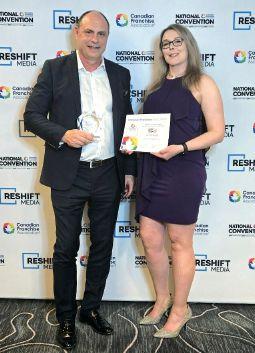
Print Three is the silver winner of the 2024 Canadian Franchise Association (CFA) Awards of Excellence in Franchising in the Category of Traditional 30-99 Franchisees. The award was presented to Print Three at the 2024 CFA National Convention in Le Westin Montreal, Quebec. Considered the pinnacle of franchise achievement in Canada, the CFA Awards of Excellence in Franchising are given annually to franchise systems that have demonstrated superior franchise relations, leadership, training, as well as communications.
The National Print and Sign Owners Association (NPSOA) launches a student scholarship program for the children of its member-owners who aspire to pursue careers in the print and sign industry in North America. The association has initially dedicated $10,000 per year towards supporting this initiative.
Fujifilm files a patent infringement lawsuit against Eastman Kodak Company in the United States District Court for the District of New Jersey. Fujifilm asserts four patents (U.S. Patent Nos. 10,427,443, 10,525,696, 10,875,346, and 11,294,279) pertaining to various aspects of processless lithographic printing plate technologies, including method and apparatus claims, were infringed upon. Fujifilm is seeking remedies including damages and injunctive relief related to Eastman Kodak’s unauthorized commercial manufacture, use, offer to sell, or sale within the United States, and/or importation of its processless lithographic printing plate products that infringe the four asserted patents, including those sold under the product name “SONORA X” and the brand umbrella name “SONORA XTRA”.
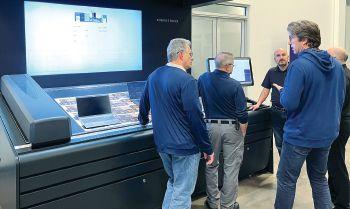
Koenig & Bauer introduces a new training program that simulates a complete press electronically from a network perspective. Users have been visiting the company’s Dallas (Texas) headquarters in small, focused groups to learn on press operation and software before the arrival of their new presses.
“It’s important for our
sheetfed press customers to feel ready to use their new press and thrive at peak performance. They’re operating their new press smarter, faster, and more responsive. To gain that confidence, we are offering maximum process automation training to boost their onsite performance capabilities. It is geared to each individual setting, their unique needs, and press purchase,” said Chris Talbert, senior vice president of service and operations at Koenig & Bauer (US/CA).
Miraclon and Bobst reinforce their strategic partnership, with Miraclon named as the plate technology partner in Bobst’s new Competence Center in Atlanta. The centre is home to a Flexcel NX System and Flexcel NX Ultra Processing Solution. The Bobst Competence Center will also be utilized by Miraclon for on-press demonstrations and print trials. The Miraclon and Bobst partnership will likewise see the companies co-hosting industry events.
Printing United Alliance forms a strategic partnership with the Advertising Specialty Institute (ASI), a technology, marketing, and information provider in the $26.1 billion promotional products industry. The partnership paves the way for members of both organizations to benefit from the increasing convergence of promotional products and print distributors, printing, and apparel and promo decoration. As part of the agreement, ASI will assume ownership of the Alliance’s Power Meetings events and Print & Promo Marketing media brand.
Koenig & Bauer’s Florian Spiekermann, director of special projects and analytics, answers questions at a pre-installation training program.
Andrew Hrywnak, president of Print Three, with Suzanne Howie, franchise support.
Jürgen Otto will become the new CEO of Heidelberg on July 1, 2024. He succeeds Dr. Ludwin Monz, who will resign from his position as chair of the management board at his own request. Otto brings decades of experience in the sustainable orientation of large industrial companies, which is complemented by experience in the field of turnaround management in recent years.
X-Rite promotes Jeff McKee from chief financial officer to the role of president. The promotion is a reflection of McKee’s 20 years of dedication to X-Rite as well as his commitment to customer excellence. In his new role, McKee will lead the company into the future of digital colour management, automation, and 3D visualization.
Toronto-based Best Deal Print and Packaging orders a new Komori GLX RP Advance 10c double coater from Komcan. The press will be one of the largest in Canada at a total of 14 units. It’ll also be the first GLX RP machine installed in Canada.
Fedrigoni appoints Gary Bernstein as commercial senior vice president of Fedrigoni Special Papers, North America. In his career, Bernstein has driven opportunities with significant brands within the high-end retail, food & beverage, beauty & personal care markets, with a strong focus on fibre-based alternatives to plastic. He brings a wealth of expertise in packaging and sustainable solutions, having worked at Neenah Paper for 25 years, and held previous roles supporting the printing and creative communities in North America.
Monadnock Paper Mills appoints Chloe Jones as the new director of marketing and communications. Over the course of her career, Jones has delivered strategic marketing and design solutions to organizations like Neenah Paper, Pfizer, UMass, and YMCA chapters. She will play a pivotal role in crafting thoughtful campaigns, ensuring Monadnock’s brand and sustainability initiatives in the market, and fostering connections with stakeholders.
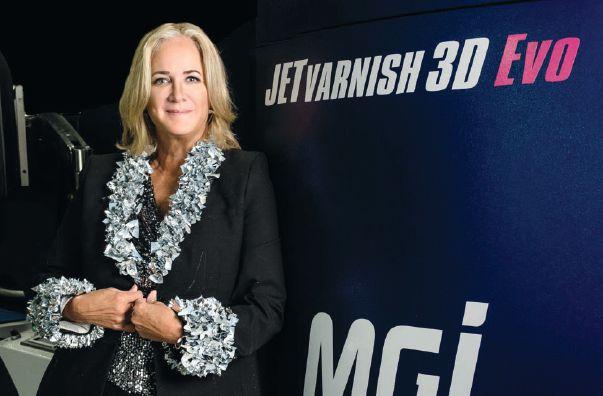
Konica Minolta Business Solutions installs its Jetvarnish 3D Evolution press at Print Panther Direct, a commercial printer in Oakville, Ont.
Baldwin Technology hires Jason Atturo, Philadelphia, P.A., as sales lead for the Northeast region of the U.S. and Eastern Canada. With a career spanning two decades in the print, packaging and converting space, he has a wealth of experience in the offset, flexo and corrugated industries having supported customers with their ink, substrate and equipment needs.
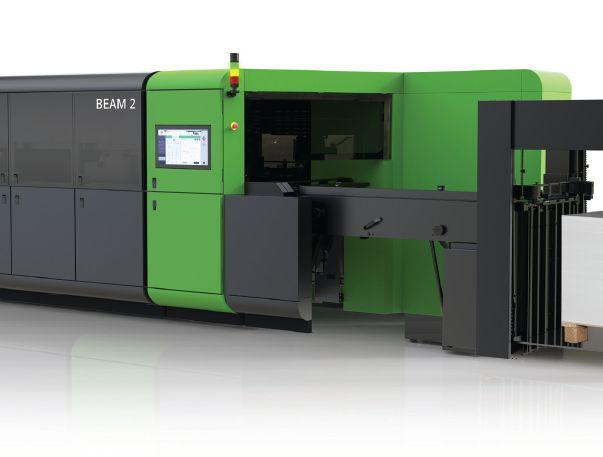
Menasha Packaging Company buys two Highcon Beam 2 Digital Die Cutting systems for installation at one of its North American packaging facilities.
AI, your trusty sidekick
Artificial intelligence isn’t replacing sales teams. Rather, it’s going to empower them with vital information
By A.J. Rai
hen the digital era dawned on us, we were caught off guard. Print advertising took a nosedive, digital media became the new norm, and customer service got a facelift with the ease of access. Now it’s the era of artificial intelligence (AI) marketing. Yet, the print community is not even discussing how to blend our traditional expertise with these cutting-edge advancements. Why is it that AI is only seen as a tech upgrade? We’ve spent over a decade scrambling to integrate print into strategic business functions, but we’re still playing catch-up.
The sales and marketing realm is a dynamic beast that thrives on trends and new tech. According to a 2023 survey by the Small Business Council, AI tools are saving small businesses nearly $275 billion a year by allowing them to focus on high-value tasks.
We must understand the current trends and how print can be used to plug the gaps. AI tools will be used in everyday business, so it’s only fitting that we figure out how our customers are using the technology in their business in order to sell the power of print as part of an omnichannel marketing campaign.
Personalization tops the 2024 marketing trends list. Also, online privacy regulations are causing a dip in digital ads due to trust issues. Given these two key indicators, it’s time we dive deep into understanding how businesses are leveraging AI to cater to their clientele. How are they mining data to tailor campaigns? How are they slashing digital costs and redirecting invest-
ments for growth? It’s time to get in on the action or risk being left in the dust of digital evolution.
Personalization
Artificial intelligence is a creative assistant, stirring up fresh ideas from existing information and offering templates for strategic marketing endeavours.
According to Salesforce, 84 per cent of customers say being treated as an individual is crucial to winning their business. AI algorithms can analyze customer data and behaviour to create highly personalized print materials. By understanding individual preferences, AI can tailor content, imagery, and offers to resonate with specific target audiences, leading to higher engagement and response rates.
Predictive analytics
AI can analyze vast amounts of data, so it can identify trends, patterns, and insights that inform marketing strategies for print materials. By predicting customer behaviour and preferences, AI helps optimize print campaigns, ensuring they reach the right audience at the right time with the right message.
Content optimization
Artificial intelligence-powered tools can analyze content performance and optimize messaging. This includes A/B testing of headlines, images, and copy to determine the most effective combinations for driving engagement and conversions.
Customer segmentation
Looking at your current data, AI can segment customers based on demographics, purchasing behaviour, and psychographic profiles. This segmentation enables print marketers to create targeted campaigns tailored to different audience segments, improving relevance and effectiveness.
It’s essential to acknowledge that unlike the digital scare of yesteryears, AI isn’t here to snatch our roles in sales and marketing. At least not entirely. As it stands, AI lacks the finesse and human touch crucial to our industry. Instead, it’s more of a trusty sidekick, designed to streamline tasks and unlock the power of data. Picture it as a creative assistant, stirring up fresh ideas from existing information and offering templates for strategic marketing endeavours.
So, let’s boldly embrace this next step in tech, affirming our position as vital players in today’s ecosystem. It’s time to show the world that we, as printers, have not just a place, but a pivotal role to play in shaping the future of sales and marketing.
A.J. RAI is the vice-president of sales at Mitchell Press. He can be reached at ajrai@mitchellpress.com.
The problem press
When the ‘next big thing’ didn’t turn out to be one
By Nick Howard
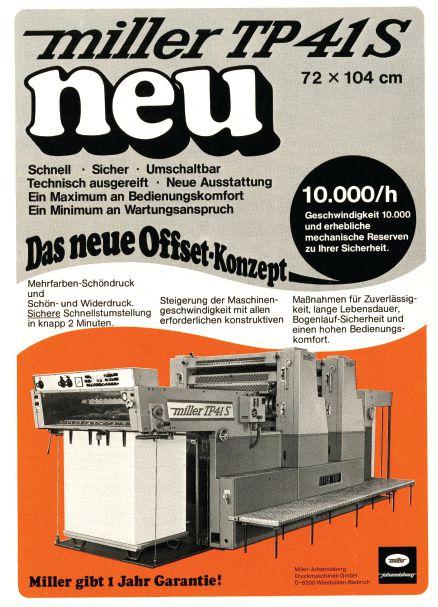
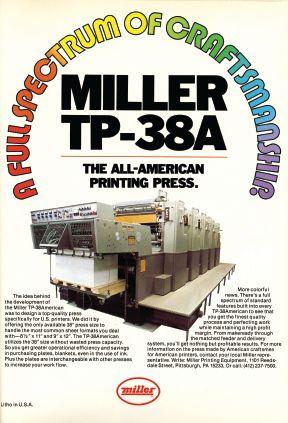
Bad news spreads fast. When adverse reports have an element of public safety, news and speculation spread quicker. In the U.S., the Miller Printing Machinery Company was incorporated in 1903 as the Miller Saw Trimmer Co., specializing in table saws. Initially in Colorado and after subsequent moves to Wisconsin, Michigan, and finally, Pittsburgh, it created a significant concern in manufacturing letterpress equipment. Miller went on to build the world’s first convertible model—the TPJ 36-in. offset perfector in 1958—a new market all to themselves. In 1962, a more significant 25 x 38 in. press, the TP38, would maintain hold of the perfecting market, and soon Miller held more than 30 per cent of the market share. In 1954, Miller, then owned by Commercial Credit of Baltimore, allied with Germany’s Maschinenfabrik Johannisberg to expand their reach into Europe. This proved successful at first, with TP38 being developed into a slightly larger model and introduced in 1971 as TP41 or, as advertised in the U.S., the TP38B.
However, nagging problems surfaced when Johannisberg’s design teams demanded more influence on press designs. Further changes in ownership probably made matters worse. In 1976, Western Gear Corporation purchased Miller and the renamed German entity Miller-Johannisberg (MJG).
Corporate shuffling continued, and in 1981, the German arms manufacturer Fritz Werner Industrieausrüstungen GmbH, who had already held shares in MJG since 1968, purchased all of Miller’s U.S. and German assets. A new model, the TP41S, would come to market in 1976 and be
showcased at Drupa in 1977. It was the brainchild, not of the engineers in Pittsburgh, who seemed content with pumping out the relatively slow and tired ‘American’ TP38A, but of the design teams in Geisenheim. Heidelberg’s entry into a lucrative convertible perfecting market in 1976 had been foreshadowed by MJG, who knew an aging TP38A platform wouldn’t cut it compared to the new Heidelberg Speedmaster 102ZP. So, this new and German-redesigned Miller would become the new armament against future competition. Miller’s U.S. operation would not promote TP41S for years, pushing the old TP38A. But still, a few TP41S were sold stateside.
Yorker: competent, effective, and nobody’s fool. He knew how to sell iron and develop rapport with clients who had to survive in America’s most prominent and demanding market. Life was good until he got ‘the call.’ He had sold a spanking new Miller TP41S four-colour to a Manhattan printer. The owner was unhappy and demanded to see the prized salesperson tout suite!
‘Take a look at this,’ the printer said, gesturing to the press table where printed sheets lay. ‘Wadya see?’ The job had an image of what looked to be a reddish glowing sunset, but the sun wasn’t supposed to look like that: It was meant to be a bright, sort of midday illumination, and not a near dusk scene. Slurring was the cause. A flurry of expletives unfit for print completed Mickey’s dressing down while raising temperature in the pressroom and Mickey’s blood pressure. A phone call to Miller headquarters in Pittsburgh was necessary and fast. After exchanging unpleasantries with Miller’s service department, Mickey lambasted them all with the need for speed, as his reputation was also on the line.
‘We’ll send over a specialist from Germany, and he’ll catch the next flight’ was the reply. A few days later,
The Miller Printing Machinery Company was incorporated in 1903 as the Miller Saw Trimmer Co.
Trouble brews
The TP41S sailed into view with little problem as a two-colour convertible perfector. However, serious print issues started to surface when the press was expanded to four, five, and six colours.
In the late 1970s and early 1980s, Mickey Cohen was Miller’s sales representative in New York City. Mickey is what you’d call a real New
The TP38 press allowed Miller to hold more than 30 per cent of the U.S. perfecting market share.
An ad of the problematic Miller TP41S perfector.
Mickey picked up the German engineer at the airport and raced to the printer. During the drive, he asked how and why such a slurring problem occurred. No answers that made sense were forthcoming. On arrival, Mickey and the engineer looked at the sheets, walked around the press, and checked that it was installed correctly. Mickey then left him to dig a little further.
A short time later, Mickey returned to discover the gear side of the press sans guards, and the German busy adjusting the gearing and other things. The day was over, so they left for a local bar to cool off.
‘How could something like this happen?’ Mickey demanded. It was well known within Miller that there was constant infighting between the German and American cousins. Pittsburgh seemed amid constant labour problems with several strikes, and oversight of design and execution looked lacking for a company that held two cultures.
The TP41S was a problem press and remained so until it was replaced
in 1982 by the new TP104. By rearranging the timing and repositioning some gearing, the TP41S pronounced slur improved but was not eliminated. Looking back, we can see that not everything was lost. The TP41S ushered in Miller’s UNIMATIC C3 off-press console and had a 10,000 IPH running speed. The American TP38A had neither and could only manage a top speed of 8,500 IPH.
Our German engineer had the final word: ‘Mickey, if we were making airplanes, we’d be killing people.’
Every company that manufactures things, including Boeing, isn’t immune to histories like this. Today’s printing equipment is no exception. What seems to be the ‘next big thing’ may not turn out that way.
HOWARD, a partner in Howard Graphic Equipment and Howard Iron Works, is a printing historian, consultant, and certified appraiser of capital equipment. He can be reached at nick@howardgraphic.com.
The TP41S sailed into view with little problem as a twocolour convertible perfector. However, serious print issues started to surface when the press was expanded
to four, five, and six colours.
June 11, 2024
PAC Global Disruptors Summit Toronto
June 13, 2024
DIA Annual Golf Tournament Alliston, Ont.
July 18, 2024
PrintForward Golf Tournament Richmond, B.C.
July 29-31, 2024
Wide-Format Summit Miami, Fla.
Sep 10-12, 2024
Printing United Expo Las Vegas, Nev.
Sep 10-12, 2024
Labelexpo Americas Chicago, Ill.
Sep 12, 2024
OPIA Golf Classic Milton, Ont.
November 7, 2024
Canadian Printing Awards Toronto
THE BEST THING IN A PRINTER’S LIFE IS FINDING THE RIGHT PARTNER
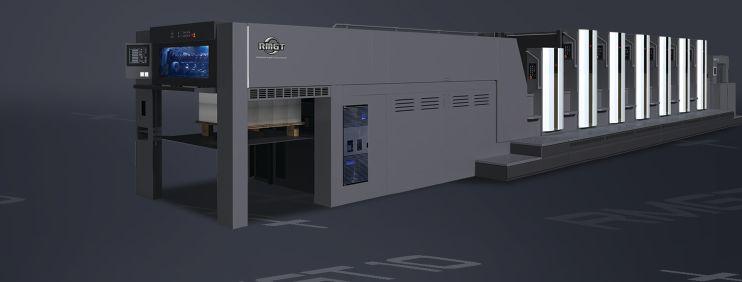
Choose Canada’s distributor for RMGT sheetfed o set presses, including the flagship 1060 LX Performance package! With RM Machinery, not only do you get cutting-edge presses, but you also gain access to comprehensive training, fully stocked parts, and industry-leading maintenance programs. Elevate your print operations to ensure consistent quality and profitability for the life of your press.
RM Machinery: Powering Pressrooms with Precision.
NICK
Technology and process trends in the Canadian printing industry
By Nithya Caleb
The following snapshot of the Iron Index 2024 survey produced by PrintAction compares current production trends to a historical benchmark of capital investments made by Canadian printers. The facts presented throughout the article relate 2024 numbers to past survey statistics. The first iteration of the Iron Index was launched in 1996, when PrintAction published a short, but important, list of innovative commercial printers that were the first to install computer-to-plate (CTP) imaging systems. Now, 28 years later, the Iron Index tracks the production-technology investment trends of leading commercial printing companies across Canada. This includes tracking the offset (by model, number of units and format size), toner and inkjet press specifications of participants, as well as employee levels, revenue, front-end technologies, and MIS. The following statistics provide insight into what is going on with the direction of production ratios. The key statistics
describe how the landscape is changing in terms of long and short runs, as well as the work of 29- and 40-in. printers, and how they are shaping their companies and Canadian printing.
Based on the information provided by 57 responding companies, it appears toner printing is continuing its upward trajectory, as 20.6 per cent of all printers surveyed this year say toner printing accounts for at least 40 per cent of their work. Since this year has its own unique challenges, we also asked survey respondents about how their workflow has been impacted by inflation, rising interest rates, supply chain issues, and whether it has led them to change their business plans. More than 43 per cent of the respondents said the rising cost of skilled labour, which is in short supply, as well as increased competition from a narrowing market are barriers to their company’s future competitiveness. To participate in next year’s Iron Index survey, please contact the editor Nithya Caleb at ncaleb@annexbusinessmedia.com.
Key statistics from the Iron Index describing technology advances in Canada
What areas does your company plan to invest in over the next three years?
Equipment, machinery, or technology upgrades:
Total number of employees represented in this year’s survey.
34.48% 3720
Percentage of respondents cite lack of skilled labour as a barrier to their company’s future competitiveness.
53.4%
Percentage of respondents with 15 or less employees.
10.3%
Percentage of all printers surveyed in 2024 producing work with all three processes (offset, toner, and inkjet).
What do you see as the prime barrier to your company’s future competitiveness?
41.38% A majority of respondents cited increased competition from a narrowing market as the prime barrier to their company’s future competitiveness.
34.48% The next most important reason is the lack of skilled labour.
Some printers were also being challenged with rising cost of property lease and the decline in mail.
THE IRON INDEX METHODOLOGY
Sustainability/environmental upgrades:
Training and education:
New hiring initiatives:
Health and safety measures:
Service and sales-related programs:
What else is your company considering besides investments?
Business acquisition/merger:
Divesting/selling of equipment or capabilities:
Scaling back shifts or consolidating space:
Buying or selling real estate or leasing premises:
For 21 years, PrintAction has surveyed commercial printing companies across the country to track their production-technology investment and trends. Below is a sample of the survey questions respondents have answered to produce our results. This primarily includes tracking the offset (by model, number of units and format size), toner and inkjet press specifications of participants, as well as employee levels, revenue, front-end technologies and MIS.
Year of company founding
Number of employees
Offset presses:
• List up to four primary offset presses. Include press brand, press format size in inches and number of press units.
Toner/Digital Presses:
• List up to three primary toner/digital presses. Include press brand and model number.
Management Information System:
• Provide brand, type, and version, if available.
Primary Front-end (Prepress) Software:
• Provide brand, type, and version, if available
Primary Platesetter:
• Provide brand and type, if available.
Primary Offset Plate Brand:
• Provide brand and type, if available.
Production Ratio:
• Provide approximate percentage of work done, in terms of total revenue generation, with Offset : Toner : Inkjet.
Wide-format Inkjet:
• List up to two primary wide-format inkjet machines. Include press brand and model number.
Production Inkjet:
• List up to two primary production inkjet machines. Include press brand and model number.
What do you see as the prime barrier to your company’s future competitiveness?
What is your best estimate at a dollar amount for how much printing technology, software, and related services your company will purchase over the next three years?
What areas does your company plan to invest in over the next three years?
What else is your company considering besides investments?
What are your plans for diversifying your capabilities?
In the next 12 to 18 months, which is most likely to happen at your company?
Respondents are planning:
40-inch printers
The following statistics apply to Canadian printing companies with at least one 40-inch sheetfed press, based on their participation in the Iron Index surveys.
% 1 Toner press 1
% 2 Toner presses 2 % Branded MIS 3
> 70% 4
> 80% 3
> 90% 1
> 10% 3
> 20% 1
Key 40-in. printer findings in 2024:
The Iron Index indicates the number of commercial printers with full-size sheetfed presses are largely focused on offset work. They produce over 70 per cent of their work on offset. We are also seeing an increasing adoption of toner printing by these print service providers.
29-inch printers
The following statistics apply to Canadian printing companies with at least one 29-in. offset press (or of smaller format), based on the Iron Index surveys.
Key 29-in. printer findings in 2024:
The Iron Index survey finds that many commercial printers with at least one 29-in. offset press have at the minimum one toner press. While offset was a significant portion of their printing work, it was no longer more than 90 per cent. Inkjet production work is quite minimal at this time among these group of printers.
Complete Iron Index participants by year
• expanding into the educational market and assisting institutions with their printing needs;
• expanding in-house capabilities by acquiring some key equipment, and refitting current tech to either make it more efficient, thereby increasing profitability;
• continually monitor new processes or equipment that helps keep costs down for clients; and
• move more into packaging, CNC die-cutting and label printing.
What are your plans for diversifying your capabilities? 12 9 3 2 1 2
Projected investments in printing technology, software, and related services over the next three years.
Projected investment
Less than $99,999
$100,000 - $499,999
$500,000 - $999,999
$1,000,000 – $2,499,999
$2,500,000 – $4,999,999
More than $5 million
Number of respondents
In the next 12 to 18 months, which is most likely to happen at your company?
The following percentages are derived from 57 Canadian printing companies who participated in the
PrintAction would like to thank all the companies that have participated in The Iron Index over its 28-year history, and in particular, those who responded to our 2024 edition, enabling these statistics to be generated. To participate in next year’s survey, please contact the editor Nithya Caleb at ncaleb@annexbusinessmedia.com.
ON DEMAND PRINT TRENDING
The reasons behind this trend and the technologies supporting its growth
By Treena Hein
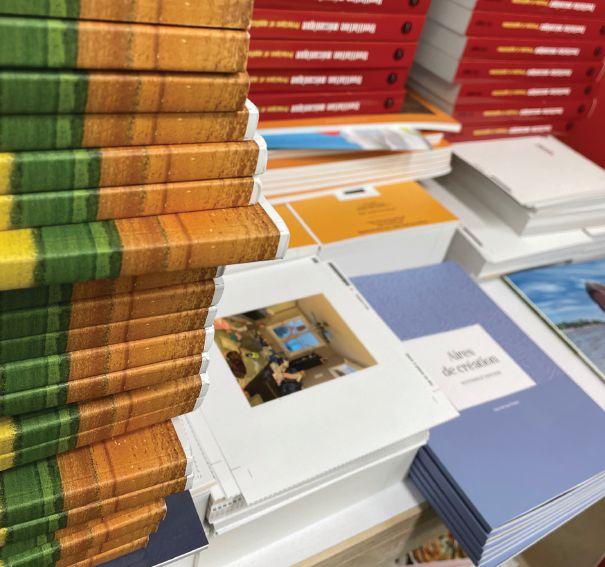
The days of having a minimum printing run for books have come to an end for some commercial printers in Canada. Here and around the world, we have entered the era of on-demand book printing, where even single copies of a book can be printed and delivered to customers within 48 hours. And with new digital or offset equipment, even smaller printers can enter this market.
“Printing books on-demand is the future,” says André Gauvin, president and general manager of Gauvin Press. Based in Gatineau, Que., Gauvin Press prints paperbacks and cele-
brates its 132nd birthday this year. Gauvin notes that COVID really boosted this trend, with everyone staying home and reading.
“We saw some decrease in demand in 2022 and early 2023 as the pandemic waned,” he says, “but demand was mostly stable last year and is now picking up again. We are expanding our capacity and our colour options this year.”
The company currently prints 2 million books on-demand annually, with the average run being 250 books and the average length 240 pages. The books are mostly text, but they print a substantial number of graphic novels in colour as well.
New tech solutions are allowing small print companies to enter the on-demand book printing space.
Gauvin had seen 15 years ago that printing on-demand would be a trend in the book printing industry. Some years back, he started developing a digital platform for publishers called GoLibro to manage their titles. He launched it in 2020 and attained the Canadian patent last year.
“We’re in the process of securing the patent in the U.S. and Europe,” he says. “We have many publishers across Canada using it.”
They have an HP Indigo 7K for the covers and print with a Heidelberg Speedmaster and Canon Titans. “We also have a laminator and Muller Martini Vareo Binders and Infinitrim,” says Gauvin. “It can do 800 unique single-book orders an hour. The software is incredible.”
Photo book specialty
Graphiscan, which has three locations in Quebec, also experienced an spike in orders for on-demand printing during the pandemic, after starting this type of printing about 10 years ago. With supply chains precarious at the time, “publishers wanted to print in Canada, and they also didn’t want to warehouse large amounts of books and hope they would sell,” explains Alex Legué, Graphiscan operations director. “Over time, it’s gone to all orders of small runs, so we had to adjust to be faster.”
It is now possible to print a single copy of a book and deliver it to customers within 48 hours.
packaging and shipping.
“Depending on the time of year we can increase our packaging capacity quickly to accommodate for fluctuating flow and rush periods,” Legué reports. “We use a variety of logistic partners depending on the needs, delivery locations, service speed needed etc. Some of our partners then dispatch to different couriers for the last mile delivery.”
Ready, but investigating
For its part, Marquis Book Printing, with operations in Quebec and Ontario, is taking a measured approach to on-demand book printing. About six years ago when the company purchased Webcom in Toronto, some on-demand printing was happening at that plant, but due to inefficiencies, it was shut down.
“We went to a minimum quantity of 25,” says Marquis general manager Jason Foubert.
During the pandemic, individuals and organizations started collectively ordering a lot of photo books. Individuals stuck at home wanted to capture memories for themselves and loved ones, while museums, art galleries and companies started creating photo books as a unique way, says Legué, to mark special events or anniversaries.
“Companies change the photo on the cover for different clients or to mark an employee’s years of service, for example,” he explains. “It’s now minutes to set up a book to print, and you can do endless customization.”
Similarly to Gauvin Press, Graphiscan found demand stabilizing as COVID waned but it’s now on the upswing again.
“We are adding equipment and upgrading to meet this demand,” explains Legué. “We just purchased an HP Indigo 100K, which offers extremely high-quality printing quickly and reliably. We also just got a new binder from Standard Horizon and we’re extremely excited about it. It completely automates the binding process, producing books that are ready to ship.”
With so many ‘book-of-one’ orders, Graphiscan has a dedicated team for
Gauvin Press turns 132 this year.
However, years later they’ve added on-demand technology such as a Muller Martini binder and trimmer system to existing devices that includes HP digital webs and sheetfed printing. Currently on-demand represents a tiny percentage of their sales, and they are looking at how much time to invest in this service.
“I think true book-of-one will always stay a niche,” says Foubert.”
Advice for newbies
Don Dubuque, marketing director at Standard Finishing Systems, believes on-demand has a bright future.
“Publishers are happy with smaller order sizes, retailers are happy with smaller inventories and authors are happy with the increased viability of self-publishing made possible by on-demand models,” he says. “Improved technology on the printing and finishing side is making on-demand printing more cost effective for print service providers as well.”
Printing books on-demand is the future. – says André Gauvin
Dubuque stresses that any printer looking to get into the on-demand book space needs heavily automated bindery equipment. On-demand book applications require frequent changeovers, and there are fewer highly skilled bindery operators left in the industry that can perform these changeovers on legacy equipment, he notes. It’s easier to train inexperienced employees on automated equipment, and automation eliminates as many
manual touchpoints as possible for faster changeovers and more machine set-ups per shift regardless of operator experience level.
Standard offers equipment for case binding (hardcover) preparation. It now also provides print service providers with the ability to switch easily between softcover production
and case binding preparation on a single machine.
“Once softcover books are perfect bound, our latest generation of trimmers allow print service providers to trim softcover books into a variety of shapes, including corner cutting,” explains Dubuque. “We also offer the ability to perform flap cover trimming
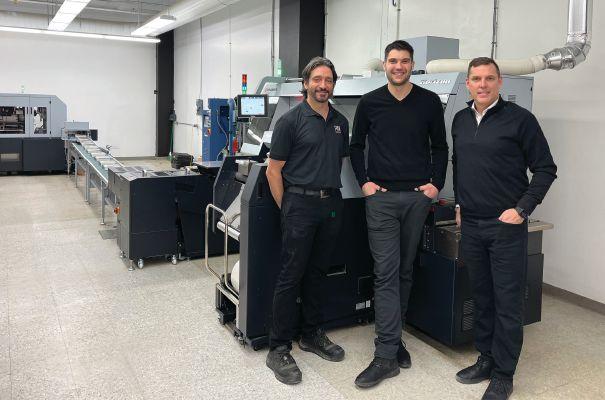
John Kaliotzakis, RM Machinery field service engineer with Alex Legué, Graphiscan’s operations manager, and Karl Belafi, sales manager with Standard Finishing Systems.
in one pass.”
Standard offers a range of automated perfect binding equipment ranging from tabletop products like the BQ-P65 Perfect Binder to end-toend products such as the Hunkeler/ Horizon Roll-to-Perfect Bind solution for high-volume commercial print environments.
“We have seen higher demand for improved workflow technology within the bindery and on-demand book space,” adds Dubuque.
With these new technologies and changing consumer attitudes, Dubuque sees a bright future in on-demand printing.
“This trend doesn’t seem like it will reverse in the short term,” he says. “There is even some evidence that demand [for books] could modestly accelerate on the consumer side with the rise of ‘BookTok’ [a part of TikTok where creators, mostly young adults and teens, make videos about books they read] and a renewed interest in physical books among younger readers.”
Looking
to reduce your production printing costs?
Of course you are,
The price you charge for your products or service offerings is unique to you.
YOUR GUIDE TO PROFITABILITY
How to set prices your customers will love
By Aaron Montgomery
Pricing is an art form. We worry no one is going to pay the price we ask or that we are leaving money on the table and not making enough profit to survive. In my experience, pricing is the biggest struggle for many businesses. But it is a crucial skill we must master and have confidence in to be successful. I have set pricing and helped others review their pricing. Through that process, I have landed on a pricing strategy that seems to trump all others, which I’ll share here.
The great news for all of us is that the strategy is simple as long as we
are willing to adopt an uncommon mindset.
People tend to oversimplify pricing. We sometimes accept advice as facts without understanding that the advisor doesn’t know our company’s USP. Once you have clarity on what makes your business unique right from the costs associated with your process to the value you provide, pricing becomes simple. However, pricing cannot be determined by simply multiplying a number or two, copying from a neighbour, and finding the lowest common denominator.
The Starbucks effect Your business is different from others.
Pricing cannot be determined by simply multiplying a number or two, copying from a neighbour, and finding the lowest common denominator.
Your ideal customer’s needs are also different. What somebody else would charge and what you should charge are two separate realities. The same holds true for searching pricing info online or using suggested manufacturer prices. If you cannot make the money you need at the set price, you should not sell that product. Else, you must find a way to market the product in order to charge what you need to charge. Before Starbucks came along, not many people in the U.S. were willing to pay US$5 or more for a cup of coffee. As of January 29, 2024, there are 16,386 Starbucks stores in the United States alone. Cafes that used to give away their coffee for free
Overhead rate/ manufacturing time + direct costs = product/ service price
if you bought a donut now charge US$5 for extra whipped coffee, lattes, cappuccinos, and other sugary delights that I love.
Understanding what not to do leads us to what we need to do. The first and most crucial step to this simple process is having clarity on how much it costs per hour for you to be in business. I call this your overhead rate. This cost should include paying everyone including yourself and planning for future needs. This way you let your pricing, and thereby, your business pay for upgrades instead of your personal savings. I know most businesses don’t have a handle on this. If that’s your situation, don’t worry, as
you can still get there. I would suggest making this a priority immediately. Further, if numbers are not your thing, investing in an accountant or bookkeeper will be worth its weight in gold for your pricing strategy.
Your market value
Your pricing strategy should be solely based on your market value. It is the value your ideal customers are happy to exchange, and it is a value your bottom line is delighted to receive to make it grow. Your ideal customer and your business are unique. You seek pricing info from competitors to simply understand market potential. If you need more than what your perceived market potential is, then you need to determine how to add more value. Alternatively, find a different target audience. Value, cost, and price might seem similar, but they are quite different.
Knowing what your business needs to be profitable, and understanding what your ideal customers are willing to spend for the value they perceive
you provide simplifies pricing. Divide your overhead rate by the time it takes you to provide the service or make the product. Then add direct costs, such as goods needed for manufacturing or other easy-to-track costs for each job that fall outside your
overhead rate. Now, you have the minimum amount you need to charge to cover your overhead and direct costs or cost of goods. If that price is less than what your ideal customer is willing to pay, then you can go ahead and charge what your
ideal customer is willing to pay.
The difference becomes your profit margin and as a business, you can work to improve that margin in various ways.
If the necessary selling price of your product or service exceeds what your ideal customers are willing to pay, then you need to take critical decisions, such as reducing costs or enhancing the perceived value of your offering.
The initial reaction for many businesses is to reduce costs, but this shouldn’t be the first choice. It might seem like you’re saving on one item, but it’ll cost your bottom line more on another due to the cost of these said ‘savings’. Remember the times when you purchased the less expensive consumable, but ended up spending more because that consumable required you to use more, or it created more waste.
While improving the perceived value of your product or service might not feel straight-
forward, it the wiser solution. To tackle this you must dig into the emotional connection, problem-solving abilities, and convenience factors of your offering. It’s about storytelling and positioning. Your product isn’t just an item or a service; it’s a solution to a specific problem, a creator of joy, or a provider of a unique experience. For instance, by highlighting how your product saves time, reduces stress, or offers a unique benefit, you elevate its perceived value.
Remember, successful pricing strategies are not set in stone. They are dynamic and responsive to the market and your business’s evolving circumstances. Start with a foundation of having a clear understanding of all your costs, add in the needs and values of your ideal customers, and you have a winning strategy for pricing that will bring you confidence, and ultimately, success.
AUTOMATING ARTWORK PREP
How Kwality Labels relies on an automated workflow to prepare artwork for print
By Mike Agness
As with the variety of specifications faced on a daily basis for packaging, the preparation of artwork for labels and packaging differs from job to job.
Historically, prepress departments, either manually or with the help of automated workflow systems, have resolved several challenges. They include tasks such as:
• Preflighting: Assuring artwork file is ready to be printed.
• Colour management: Matching colour appearances as closely as possible from input to output and between devices, assuring colours
will be printed as specified.
• Trapping: With traditional presses, assuring there are no gaps between type or images of different colours. Additionally, in flexo printing, consideration is given to keep aways or hold backs where required.
• Step and repeat: Determining the most efficient way to print jobs on press. As these differ from converter to converter, the best way to illustrate how to consider file preparation would be to start from the beginning.
Ground zero
Kwality Labels, owned by Shanti Chadha and based in Richmond Hill,
Randy McDonnell and Shanti Chadha of Kwality Labels.
Ont., began more than 40 years ago as a narrow web commercial flexo label printer. They have since expanded capabilities to include custom digital label printing for both long and short print runs. These include pressure sensitive, cut and stack, and doublesided labels, along with products like spirals. They offer a full range of products and services for their clients from industries like health, cosmetics, juice, and snack foods. Kwality Labels complies with several industry standards and has certifications such as G7, FTA FIRST, and IFS PACsecure, allowing them to achieve premium quality for everyone.
When Randy McDonnell joined Kwality Labels in 2019, they outsourced all prepress. After client approval, plates showed up and they ran the job. McDonnell, along with plant manager Joe Miller, were tasked with building a prepress department from scratch using a PDF editor.
“I always heard the rationale for using a PDF editor, but never understood it. Since I worked previously with Adobe Illustrator, I never had real workflow experience. In the very early days here at Kwality Labels, I did the work first in Illustrator, then moved the files into the PDF editor,” remembers McDonnell. “Now that I know how to use the workflow, I realized that I could process a file better and faster entirely with the PDF editor. If I’m spending eight hours on one file or on a series of SKUs in the editor, I’m going to spend much longer in Illustrator to accomplish the same.”
McDonnell gets artwork files from both ends of the spectrum. Once someone has edited a file, particularly for flexo, the struggle is getting both print runs to look the same.
“Consider a job that requires five designs—one new, but four repeated
from last year. It’s easy to use last year’s file and tweak the text. But if there’s a new flavour or SKU this year, I’ll get a new design file,” says McDonnell. “How do I ensure the design file matches the ones I’ve already printed—and maybe not even by me, but someone else? That would be a challenge without a good workflow.”
The other issue is flexo vs. digital. Kwality Labels has digital HD and flexo presses. “We’re not going to run 5,000 or fewer labels on a flexo press. But I need to mimic its print quality on the digital press. Conversely, customers may order a print job of 5,000 labels today that we will print on a digital press—and may order 100,000 tomorrow, which we will print on a flexo press. The challenge, of course, is to match colour between presses.”
There are different ink and colour settings to be considered. This is where colour management comes into play. McDonnell relies on the CXF value of the Pantone colour, which includes the LAB value and the spectral data (essentially lighting conditions, as a package on the shelf looks different from a package under freezer lighting).
At times, McDonnell extends the print gamut by utilizing orange, green and violet.
“One of the tests of a better workflow, particularly when you want to colour manage it to expanded gamut, is the ability to convert everything: CMYK images, RGB images and others. Some just convert the Pantone or vector components. The more sophisticated systems apply it to all images,” explains McDonnell.
Step and repeat
The way Kwality Labels automatically steps and repeats jobs is innovative.
“We’re pulling the information
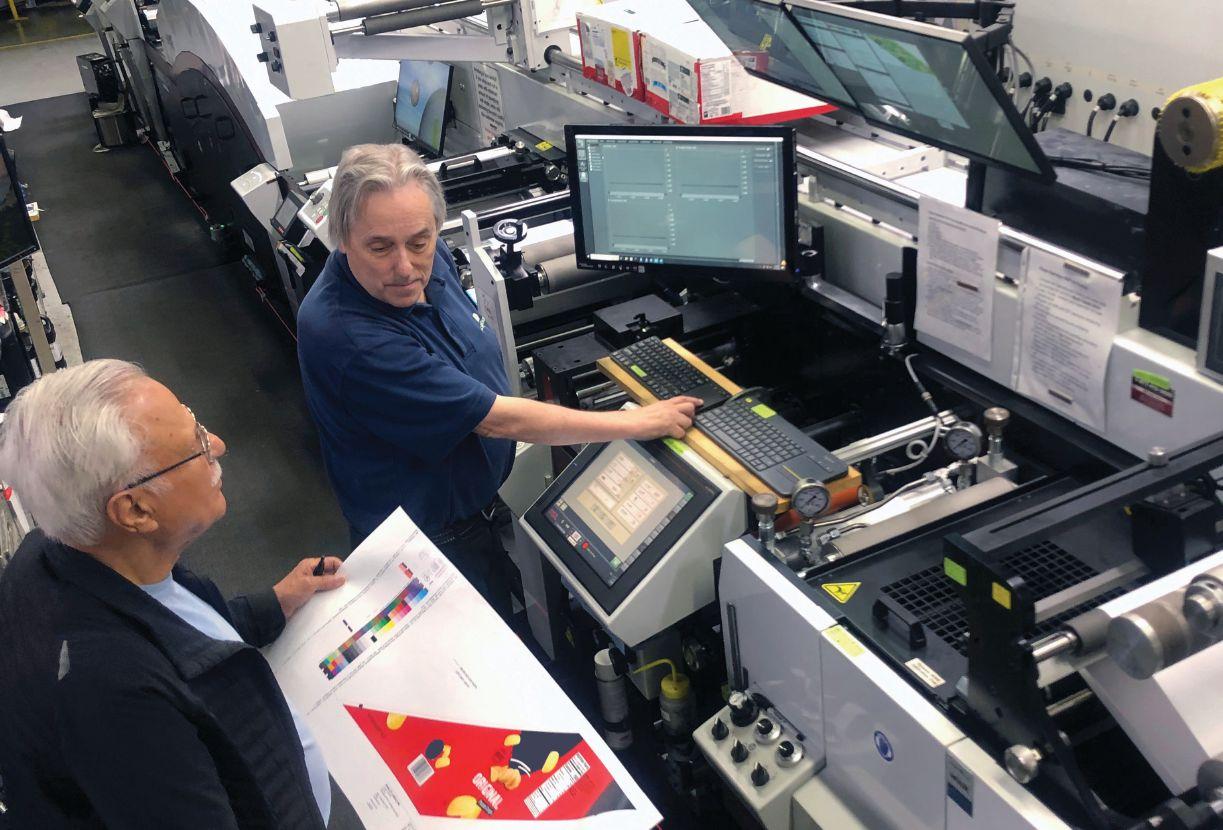
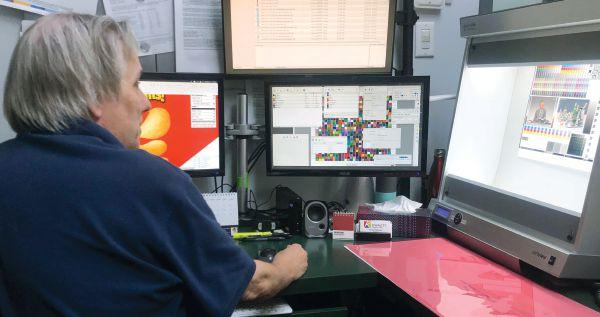
A PDF editor and cloud-based dashboard have automated many of the company’s prepress tasks.
Kwality Labels began more than 40 years ago as a narrow web commercial flexo label printer.
from an updated database. For example, with nutraceuticals, there are about 40 different sized bottles and labels that we typically print. We input those sizes into an automated dashboard,” mentions McDonnell. “Once the customer okays the one-up, the system automatically finds that size in the database, and locates the step and repeats. We just say ‘go’, and we’ve got a stepped file sitting at the digital press to print—or RIPped to a 1-bit tiff file for plates.”
“The old way to send files for approval was via a low-res PDF. The problem is, what will you use as a viewer? Many people rely on a browser. Even the free version of Adobe Acrobat presents problems if settings are incorrect. Some customers might say, ‘Why does the type look fat?’ It’s because we put a trap on the type and it’s being looked at with the overprint off,” remarks McDonnell. “Now, if we try to send one of our larger clients a low-res PDF, they won’t even open the email message. It has to be approved via our online portal. The viewer on the automated dashboard forces everyone to view literally the same file, with the same rendering. Customers can leave notes on the file or on certain areas of the image. We just collect the notes and make a new version.”
Future plans
Kwality Labels’ future plan is to tie its MIS into their plate-ordering jobs. They can already automate the digital press front end (DFE). If a job is approved in digital form, it just goes to DFE and RIPs automatically at the correct settings. Preparing jobs automatically for flexo printing will take more work.
“If you’re still preparing your print production files with Adobe apps, you’re like the film stripper in 1990s, when desktop publishing was taking hold. Yes, you could do everything with film stripping. But at a certain point, it didn’t matter how good you were. Technology has changed,” concludes McDonnell. “There’s also a big change in PDF editing technology, and those who rely on other tools could be left behind.”
MIKE AGNESS, Hybrid Software executive vice president, Americas, joined the company in 2011 after a long career at Pitman Company and Agfa. He can be reached at mikea@hybridsoftware.com.
MORE THAN 50 CATEGORIES UNDER FOUR PROGRAM SECTIONS: Print Production, Printing, Packaging, Labels, Technology and Environmental
Awards Gala November 7, 2024
Mitchell Press held a dumpster dive to sort through a week’s worth of garbage and identify areas for improving waste streams.
SMALL STEPS, BIG IMPACT
Canadian printers making strides on emission reduction without breaking the bank
By Nithya Caleb
Canada aims to reduce its greenhouse gas (GHG) emissions by 40 per cent below 2005 levels by 2030 and achieve net-zero emissions by 2050.
The recently released National Inventory Report shows Canada is on track to achieve these goals. According to the Report, emissions were lower, by 44 megatonnes in 2022, than Canada’s pre-pandemic 2019 levels. However, there’s still work to do.
When compared to 2021, emissions from transport increased by 7.8 megatonnes (4.2 per cent) due to an increase in travelling while emissions
from commercial, institutional, and residential fuel combustion increased by 3.8 megatonnes (5.3 percent) because of a cold winter.
Given these stats, it’s useful to explore the ways in which some printing companies are reducing their carbon emissions, particularly solutions offering maximum impact for minimum investments.
Hemlock
Hemlock continues to lead the industry in sustainability. Their Zero carbon neutral program encourages clients to invest in carbon neutral print projects by either buying 100 per cent carbon neutral paper stocks
or purchasing carbon offsets through Hemlock. Developed in 2009 in partnership with Ostrom Climate, a climate change solutions provider, the purchased offsets by Hemlock and their clients go towards forest conservation projects like the Great Bear Rainforest Carbon Project in Haida Gwaii, B.C. Since 2009, Hemlock clients have produced over 66 million Zero carbon neutral print pieces, offsetting over 24,000 metric tonnes of GHG emissions.
Lowe-Martin
Another printing company that emphasizes sustainable operations is Lowe-Martin. In fact, it won the 2024 Most Environmentally Progressive Printing Company-Canadian Printing Award. It was the first printing company in Canada to become EcoLogo certified in offset (1999) and digital (2004) imaging. In 2011, it became the first Ontario-based printing company to become carbon neutral. In 2022, Lowe-Martin produced $2.5 million worth carbon neutral print projects; it achieved a 41 per cent reduction in water use year over year, 5.6 per cent reduction in natural gas use, and 3.6 per cent reduction in electricity purchased company wide year over year.
Cambridge Label
Cambridge Label, a trade printer in Cambridge, Ont., adopted an LED lighting system in 2023 and upgraded two of their flexo presses from a UV curing system to LED in November 2023. They also installed a trash compactor to reduce the number of waste pickups.
“It may sound silly, but I think these small steps like a trash compactor goes a long way in helping business and to reduce waste,” explained Deanne Sinclair, president and owner, Cambridge Label. “It has reduced our waste take away expenses because we were getting a few pickups a week and now it’s three times a month.” The reduction in trips has also brought down Cambridge Label’s emissions from travel and gas.
The LED curing system was installed on Cambridge Label’s heaviest used presses that typically run for 20 hours a day. The impact has been significant, according to Sinclair.
“We love it. It’s amazing. Our hy-
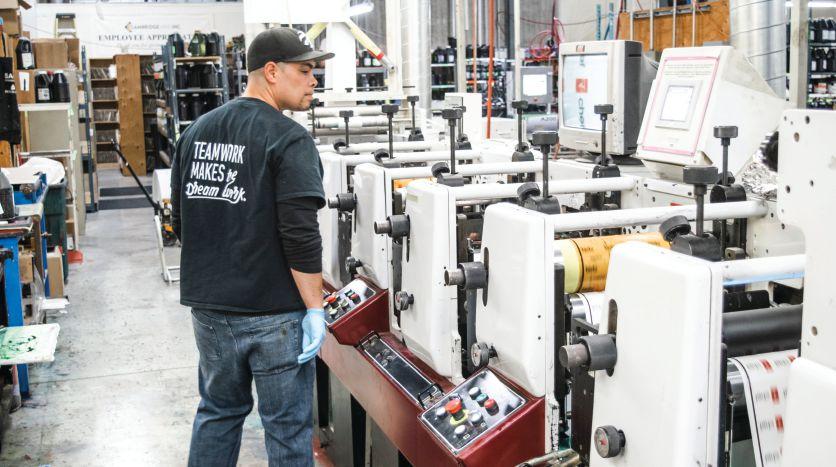
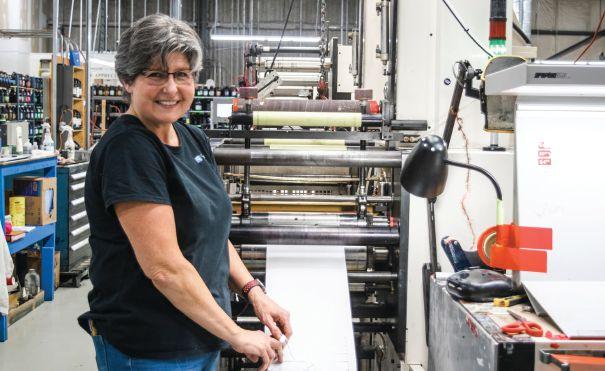
By adopting LED curing systems in two of their flexo presses, Cambridge Label has significantly
reduced their power consumption.
dro bill has been reduced by 10 per cent,” said Sinclair. “What’s also interesting is that I actually find the LED inks to run better than UV, so they cure faster. We can actually print faster.”
Sinclair admitted that these upgrades were influenced by a need to improve power consumption rather than due to an aspiration of creating a more sustainable print operation.
“We were kind of maxed out in terms of what we could run. Our local hydro provider said it would take about 18 months to two years to upgrade the amount of power that we can have in the building,” she recalled.
This motivated Sinclair to look for alternate options, which also had the unintended, but welcome, consequence of creating a more energy-efficient facility with less GHGs and reduced operating costs.
“These power upgrades are expensive. It’s a six-figure endeavour. It’s also a six-figure endeavour to convert the press to LED. However, if you
convert the press to LED, then you reduce your operating costs as well as emissions,” she explained.
According to the LED curing system supplier, upgrading the two presses reduced Cambridge Label’s carbon emissions by 150 tonnes.
Deanne also highlighted the availability of sustainable offerings in the label space made from post-consumer waste. Cambridge Label offers stone paper, which consists of 80 per cent calcium carbonate (a base mineral/inorganic compound) and 20 per cent polyethylene resin to create an environmentally friendly paper. Aged agave material is made from recycled coffee bean bags. Hemp paper is manufactured with 25 per cent hemp fibre and 75 per cent post-consumer waste, and does not use any virgin wood content. These products have a unique, more upscale look than standard paper-based labels, she explained. Even though the price is slightly higher, Deanne has found consumers are interested in these
Mitchell has facilitated the planting of over 80,000 trees in verifiable reforestation projects.
Hemp
These power upgrades are expensive. It’s a six-figure endeavour. It’s also a six-figure endeavor to convert the press to LED. However, if you convert the press to LED, then you reduce your operating costs as well as emissions. – Deanne Sinclair
eco-friendly options.
“There’s been a huge shift in the last three to four years. Prior to the pandemic, no one was asking about sustainable labels. Now, consumers are very interested in these products,” she added.
Mitchell Press
The 2024 Most Environmentally Progressive Printing Company-Canadian Printing Award winner, Mitchell Press, took some time to kick start their sustainability journey, but now have definitive programs in place.
They began by tracking and measuring their emissions and resource consumption with help from Climate Smarts, a Vancouver-based social enterprise. For six years, Mitchell has been generating annual emission reports. This helped the company identify areas for improvement. One of the first steps by Mitchell was a big LED lighting retrofit to reduce the company’s electricity consumption and associated emissions in 2019. This resulted in approx. 50 per cent reduction in lighting-related energy costs. They also started to prioritize
paper with higher recycled content. The majority of Mitchell’s customers are using at least a 10 per cent recycled stock while five to 10 per cent of their clients use 100 per cent recycled stock, shared Holly Denson-Camp, sustainability specialist, Mitchell Press.
The company swapped their shipping truck for a more efficient diesel truck. Finally, “we kind of built a green company culture to help re-
duce our waste-related emissions and encourage everyone to work towards a zero-waste system,” said Denson-Camp.
Mitchell’s green team comprises Denson-Camp and representatives from different departments with a personal passion for environmentalism. They create educational newsletters and events to help create an eco-friendly culture in the company. In fall 2023, the team overhauled their internal recycling program and added signage, so people fully understood what went into which bin.
Cambridge Label reduced hydro bill by 10 per cent by simply retrofitting a LED lighting system in their facility and upgrading two flexo presses from UV curing to LED.
Since a large piece of the printing industry’s emissions comes from harvesting wood products, Mitchell, in June 2023, partnered with PrintReleaf to offset the biomass that’s lost from paper consumption by planting trees in verified reforestation projects. So far, they’ve facilitated the planting of more than 80,000 trees.
“We’re working in an inherently extractive industry. We’re in a unique position to create and encourage real climate action in the middle of this climate crisis. We’re hoping that by making these changes ourselves, more companies will follow suit, and it can kind of become the norm,” explained Denson-Camp.
Top: Members of Mitchell Press’ Green Team gear up to plant crops in their communal garden that produces greens, veggies, and herbs.
Right: A switch to UV curing systems from LED has sped up the printing process at Cambridge Label.
Additionally, sustainability has been playing a really big role in consumer decision-making. Consumers are more aware of the activities that are negatively impacting the environment. “So, they’re happy to know that we’ve dedicated real time and effort into decarbonizing and reducing our impact,” she added. “They want to come back to us because they feel that connection and they align with our values as well.”
Denson-Camp highlighted that these initiatives have not only reduced emissions, but also saved operating costs for Mitchell. In the near future, she would like to focus on reducing Mitchell’s heating-related emissions.
These initiatives make a compelling business case for PSPs to implement emission reduction measures in their facilities. I hope these spark some ideas and you begin to see tangible benefits in terms of efficiency, waste reduction and operational costs from adopting eco-friendly measures.
Embrace cloud-based systems
A data-driven solution enhances quality control and improves colour management
By Angus Pady
The shift from isolated computer systems to a unified, cloud-based structure marks a significant transformation in colour management. This migration not only broadens access to critical data across the production chain, but also facilitates the evaluation and centralized storage of libraries, revolutionizing traditional practices.
Historical challenges
The process of managing colour has been relatively static and fraught with inefficiencies. Initially, designs were developed by ad agencies and had to pass through several stages of approval by clients, culminating in the creation of proofs that adhere to industry standards. These proofs, serving as the primary assessment tools during printing, accompany the job throughout its life cycle. However, the decision-making process around the accuracy of the proof was left to the subjective judgment of the press operator, influenced by variables like lighting conditions, the observer’s perception, and even their physical state at the time of evaluation. Such subjectivity introduces significant variability in the final product.
Revolutionizing accuracy
The advent of cloud-based systems has introduced a new era of precision
Cloud-based systems improve the accessibility and consistency of colour production across multiple runs.
-1 DE
A Delta E value of less than one is ideal, but often impractical in colour matching.
and standardization in colour management. In this system, specifications and tolerances are defined and stored centrally before printing begins. This allows for real-time comparisons, enabling press operators to immediately assess whether the output meets established standards. This method eliminates subjectivity from assessment, grounding decisions in data.
Enhanced by Delta E
To refine colour matching, the industry relies on a mathematical model known as Delta E, which quantifies the difference between two colours. While achieving a Delta E value of less than one—indicative of a perfect match—is ideal, it’s impractical. Realistically, values within the range of 2-3 DE are considered very good, while those between 3-4 might be acceptable. This precise quantification helps in setting realistic expectations and standards for colour matching.
Data-driven quality control
is a major challenge in printing. Cloud-based colour management helps maintain colour consistency by providing standardized colour targets.
Accessibility and collaboration
Designers and printers can access various colour libraries from anywhere, facilitating remote work and collaboration. This accessibility improves workflow efficiency and allows for faster project completion.
By centralizing colour management in the cloud, businesses can reduce the need for multiple local software licenses and minimize local hardware requirements. Additionally, improved colour accuracy reduces waste from misprints and trials.
Cloud solutions can easily scale with the business, accommodating more users or higher demands without significant infrastructure changes.
Driven by demand
The advent of cloud-based systems has introduced a new era of precision and standardization in colour management.
The shift to cloud-based systems facilitates the collection and analysis of data. This data is crucial for maintaining high standards across multiple print runs. By centralizing data collection, the system allows quality control managers to monitor and evaluate the performance of different print providers continuously. This enhances the consistency of colour quality across different outputs and provides valuable insights into the overall efficiency of the production process.
Consistency across platform
Ensuring consistent colour reproduction across various devices and media
The push towards these colour management technologies is driven by brand owners. Those responsible for maintaining brand integrity are the most enthusiastic proponents of this technology, as it assures them of consistent brand representation.
As we continue to embrace these technological advancements, the industry is set to become more reliable, data-driven, and aligned with the digital age’s demands.
ANGUS PADY is a G7-certified expert that has helped customers resolve colour management challenges for over 30 years. He can be reached at angus.pady@fujifilm.com.
Showcasing the latest offerings from Komori, Landa, HP, and Flint
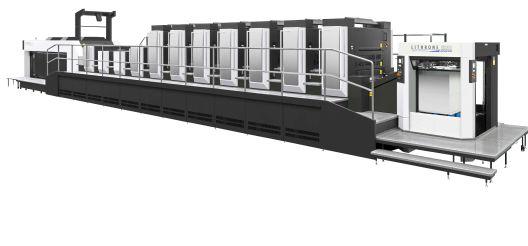
The Lithrone GX/G advance EX press is designed to help printers reduce greenhouse gas emissions.
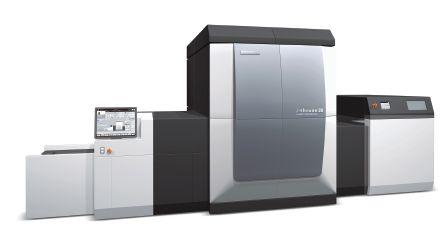
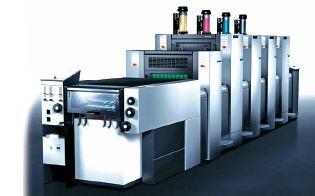
The J-throne 29 is a new B2 inkjet sheetfed digital press from Komori.
Komori debuts Lithrone GX/G advance EX press
The Komori Lithrone GX/G advance EX press is an offset printing press designed to support printers while reducing greenhouse gas emissions. It has a micro-mist system that controls the humidity of the paper to combat the effects of static electricity, as well as an improved user interface.
At Drupa, Komori also introduced the J-throne 29, a 29-in. sheetfed UV inkjet digital printing system with printing speed of 6,000 sheets per hour for single-sided printing and 3,000 sph for double-sided printing.
HP releases new digital printing solutions
HP unveils a series of digital printing presses and smart solutions for commercial printing and labels and packaging industries. The newly launched HP Indigo 120K Digital Press reduces human touchpoints and enables multi-press operation by a single operator. The new HP Indigo 18K Digital Press handles a wide range of print applications with a single B2 digital press. It has advanced AI features like auto recovery and proactive alerts.
The HP Indigo 7K Secure Digital Press enables workflows tailor-made for security production lines.
Landa launches new press models
Landa Digital Printing launches the next generation of its B1 digital print technology, the Landa S11 and S11P Nanographic Printing Presses. The new Landa models offer a print speed of 11,200 SPH. They also offer a PrintAI module, which automates colour matching. The new presses come with a choice of four or seven colours, a continuous printing capability, an optional in-line coating unit, and the opportunity to purchase the 11K module and/or the PrintAI module.
Flint releases new ink for sheetfed offset printing
The Flint Group launches Novasens P670 Prime, a high-performance low odour, low migration (LOLM) process ink series formulated to meet the needs of sheetfed offset packaging printers. According to the company, Novasens P670 Prime is formulated with 75 per cent renewable raw materials.
Denis Gagnon / owner / Graphiscan
Graphiscan was founded in Alma, Que., in 1978. Denis Gagnon has been the company’s owner and president since 2001. Graphiscan has three facilities in Quebec— Alma, Longueuil and Montreal. Each production site has is own specialty. The 110-member Graphiscan team serves more than 1000 customers. In February, Graphiscan made a few capital investments. It became the first printer in eastern Canada to purchase the HP Indigo 100K digital press, which can print 6000 sph. It’ll be installed in Graphiscan’s Montreal plant. It also purchased a book binding solution from Standard Finishing Systems. The solution includes the Horizon LBF-500 Book Block Feeder, BQ-500 Perfect Binder, GF-500 Gauze Feeder, and HT-1000V Three-Knife Trimmer. The new Horizon line replaced an older Horizon perfect binding and trimming solution. It increased Graphiscan’s capacity and enabled it to handle both softcover book production and hardcover book preparation with the same system. Here’s an excerpt from an interview with Gagnon.
What is the state of the print industry today, in your opinion?
DG: Print providers today are treated more as manufacturers than service providers. The industry is evolving, not dying. It has turned into a technology driven industry with highly automated equipment that only medium and large players are able to adapt to. The technology also requires companies to invest a lot of capital in order to grow and stay competitive.
What attracted you to the print industry?
DG: I was born into this industry. After all these years, I still love my profession. I’m impressed by people who are devoted to delivering a tangible product. Many customers don’t realize the time and expertise needed to deliver a high-quality product. The highlight of our day is when a visiting client is blown away by our facility, equipment, and mainly our team, and dedication to work. Before that visit, they wouldn’t have fully understood how their products were being manufactured.
How can the industry attract more young people?
The print industry has turned into a technology driven industry with highly automated equipment.
DG: With high-end technology, automated equipment and digital printing processes continuously evolving, we can attract a younger generation. It is possible to get more of them into the industry if we, as an industry, adopt robust eco-friendly policies. Students with skills like mechanical, engineering and web development can be an asset to our industry. I have a few youngsters in my company, and I’m proud to say they are happy and content to work in this field.
In such a competitive landscape, how can printers win more sales?
DG: It is important to understand our markets. This allows us to diversify our offers. It’ll also give us a better perspective on effective marketing strategies. Further, we can attract clients by providing customized solutions and investing in equipment that offers better quality and pricing and quick turnarounds.
What are some of the biggest opportunities you see in the print industry?
DG: Print on demand and personalized products are the biggest opportunities in the print industry. We focus on printing books and photo books in small to medium-sized runs.
What do you think is the most exciting thing about print today?
DG: The print industry is here to stay, but in a different way. Youngsters understand the emotional pull of printed materials. They invest in creating photo books from vacations and custom posters, which proves that print is still appreciated.
Denis Gagnon’s response was edited for length. For more Q&A Spotlight interviews, please visit www.printaction. com/profile.