Correctly specifying a light source is key to successful colour measurement
16 The Iron Index
An overview of how Canadian printers have invested in technology over the past year
DEPARTMENTS
GAMUT
5 News, Calendar, People, Installs
TECHNOLOGY REPORT
22 Highlighting new management information system releases and updates
NEW PRODUCTS
23 Detailing new offerings from Arrow Systems, Konica Minolta, Screen and Mohawk Renewal
SPOTLIGHT
26 Remembering Ronald Kletke, co-owner, Oil City Press
COLUMNS
FROM THE EDITOR
4 Kavita Sabharwal-Chomiuk
Highlighting a brighter economic outlook as the country begins to reopen amid COVID-19
CHRONICLE
8 Nick Howard
An analysis of Heidelberg’s decision to end its VLF collaboration with Fujifilm
Brighter outlook
Iam excited to sign on for my first issue of PrintAction magazine. I look forward to learning more about the printing industry as a whole, and from your personal perspectives.
I’ve had the pleasure of speaking with a few members of the industry since I joined the PrintAction team in May, and I encourage others to get in touch – I would love to hear about your corner of the industry and what a post-COVID-19 print industry looks like to you.
open up at the right time (Stage 1).
EMPLOYMENT IN CANADA
Full-Time Employment
219,400
Part-Time Employment
70,300
SOURCE: THE CONFERENCE BOARD OF CANADA
I’m happy to share that, according to the Conference Board of Canada (CBoC), the worst of COVID-19 for business may be behind us. According to a recent CBoC report, the Index of Consumer Confidence rose 16.2 points in May, after record-breaking declines in March and April. It now sits at 63.7, which isn’t great, but it’s still better than it was during the 2008 financial crisis, when consumer confidence plunged to 56.3.
While this is welcome news, CBoC warns that the Index of Consumer Confidence is still nearly 60 points below its levels before the country began lockdown in February, indicating consumers remain cautious about the economy, which will weigh on purchasing decisions over the coming months. However, Canadians are still feeling more optimistic about a coming economic recovery.
Now that the country is focusing on opening up after COVID-19, the economy may be experiencing a brighter outlook, as another CBoC report finds that employment climbed by 289,600 in May. Canadians may be reassured by the job growth seen this month, which lines up with the increase in consumer confidence reported by the CBoC. Since this survey was conducted before most businesses began reopening, especially in Ontario, this number should continue to climb in June. That said, COVID-19 and the related business shutdowns resulted in 2.7 million jobs lost, so the road ahead is still a long one.
Full-time employment rose by more than part-time employment, but this may be due to the fact that industries that typically employ part-time workers are still mostly closed. Quebec accounted for nearly all the employment growth in the country (up 230,900), but all provinces apart from Ontario (down 64,500) saw job gains. In terms of industries, manufacturing saw strong employment growth, with an uptick of 79,100.
In addition, Ipsos recently conducted a poll on behalf of the Ontario Ministry of Heritage, Sport, Tourism and Culture Industries on the subject of COVID-19 recovery, between May 29 and 31, 2020. The survey found that 57 per cent of those surveyed say the province is starting to
That said, the poll also looked at how consumers were feeling about resuming their regular activities post-lockdown. While many Ontarians would prefer to wait up to six months to visit a salon or attend a sporting event, 72 per cent say they would be inclined to speed up that timeline if there is a steady decline in new cases of COVID-19, workplaces that follow public health guidelines are certified, more high-risk people, including frontline employees, are getting tested, tougher penalties are introduced for people who don’t physically distance, the government introduces a system to trace COVID-19 cases, masks are made mandatory in public, most people are physically distancing in public, there is a dramatic increase in the number of COVID-19 tests completed daily, or if political leaders announce the pandemic is under control.
That doesn’t even include the 66 per cent of those surveyed who would be much more inclined to speed up getting back to normal if a vaccine were developed that was effective against the coronavirus, or the 58 per cent that would do the same if an effective treatment were developed.
The print industry has an opportunity to use distancing protocols to its advantage; after all, social distancing signage is likely to be in even higher demand once restaurants and other social gathering spaces begin to reopen.
Speaking of industry, this issue spotlights our annual Iron Index report on Canadian print businesses, many of which have also felt the pressure of COVID-19 on business. However, that hasn’t stopped many in the industry from adapting to the “new normal” by pivoting to produce PPE such as face masks and physical barriers, social distancing signage or even portable hospital beds. While many printers surveyed have adapted equipment to produce PPE and signage to help prevent the spread of COVID-19, others plan to do so in the near future (p. 16). If these CBoC and consumer confidence numbers are anything to go by, the worst may be on its way behind us.
This issue also includes an article from Abhay Sharma on accurately measuring colour using real light sources (p. 11), and an interview with Dave Kletke on his father, Ronald, co-owner of Calgary’s Oil City Press, who passed away from COVID-19 in April (p. 26).
PrintAction is printed by Annex Printing on Creator Gloss 80lb text and Creator Silk 70lb text available from Spicers Canada.
ISSN 1481 9287 Mail Agreement No. 40065710
3M signs three-year collaboration agreement with Wrapmate
The Specialty Graphic Imaging Association (SGIA) and Printing Industries of America (PIA) merged on May 1, 2020, and have now announced their new organization name as a combined company: PRINTING United Alliance (PUA). The merger brought together two long-standing printing organizations to help serve the communities within the printing industry.
Wrapmate, a digital platform for graphics projects, has entered a three-year global collaboration agreement with 3M Commercial Solutions to help businesses improve their marketability within the print, signage and vehicle graphics industry. This agreement is an expansion of the initial six-month collaboration first announced in September 2019.
Wrapmate’s technology includes an augmented reality app that allows businesses to visualize their vehicle graphic mock-up on a 3D digital image placed virtually on a real surface, such as in a parking lot or driveway. Additionally, Wrapmate has developed an online price calculator for vehicle graphics with real-time pricing coming in the near future.
Canfor Pulp Products Inc. is announcing the temporary curtailment of Prince George Pulp and Paper and Intercontinental Pulp for approximately four weeks, beginning July 6, 2020.
“We have made the difficult decision to temporarily curtail Prince George Pulp and Paper and Intercontinental Pulp due to the major global economic impacts of
estimated that the new facility will shorten shipping time from 9 days to 2 days in Ontario, and 4 days in most other provinces. In addition, orders will not have to go through customs or be charged import duties.
Printful will start by fulfilling direct-to-garment (DTG) and embroidered hats and apparel. The selection of products available for the Canadian market is expected to develop over time.
the COVID-19 pandemic and the shortage of economically viable fibre in the region,” said Don Kayne, Canfor Pulp’s CEO.
The curtailment will reduce Canfor Pulp’s production output by approximately 38,000 tonnes of market kraft pulp and 12,000 tonnes of kraft paper.
Printful, an on-demand fulfillment company, will be opening a 2,900-square-metre facility in Mississauga, Ont., with production expected to start by the end of 2020. This will be Printful’s first Canadian facility and seventh worldwide. Printful’s initial investment will be CAD$2.8 million, and the company is planning to grow its Canadian team to 50 people in its first three years of operation.
Canada is Printful’s second-largest market after the U.S. With the new facility, the company aims to improve logistics and the overall experience for Canadian store owners and customers. It is
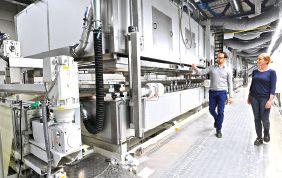
Herma recently decided to partially open its new coating plant for label adhesives prompted by implementation of better distancing measures between production teams and an increased degree of automation, reducing human interaction.
The key components of the new plant have been brought into service one step at a time, allowing the company to distribute production orders among its facilities and guarantee its employees better protection.
The remainder of the new plant is expected to open this summer. Once open, Herma says it will increase its annual self-adhesive material capacity by 50 per cent, to 1.2 billion square metres.
Ricoh Printing Systems America, Inc. (RPSA) has announced that its Board of Directors has resolved on April 30, 2020 to merge its wholly-owned subsidiary Anajet,
Inc., in an absorption-type of merger, effective June 1, 2020. Anajet Inc. will dissolve at that date as it officially become the direct-to-garment (DTG) printing division of RPSA, with customer support, products and services remaining the same.
As Ricoh Company, Ltd. (RCL) has been conducting a reorganization of the North America DTG business, it has decided on the merger to pursue greater efficiency in management of subsidiaries.
The merger will allow for more efficient synergies among Ricoh’s divisions, reduced overhead and more streamlined work processes through consolidation of the division’s management team.
Next Generation Manufacturing Canada (NGen), the industry-led organization behind Canada’s Advanced Manufacturing Supercluster, has invested over $21 million in projects that will lead to the Canadian production of critical technologies, equipment and medical devices to fight COVID-19. Approved projects include the development and manufacturing of ventilators and components, test kits, face shields and a coating material that kills bacteria and viruses on contact.
Projects that have received funding include ventilators by Canadian Emergency Ventilators Inc./Starfish Medical (Toronto, ON); ventilator components by BOMImed (Winnipeg, MB); face shields by Molded Precision Components (Oro-Medonte, ON), Mosaic (Toronto, ON) and Burloak Technologies (Burlington, ON); test kits by Sona Nanotech (Halifax, NS) and Response Biomedical (Vancouver, BC); and sterilization coating by Envision SQ Inc. (Guelph, ON).
The federal government’s 12-week Canada Emergency Wage Subsidy (CEWS) program will be extended eight weeks beyond its initally rescheduled endpoint of August 29 to October 3.
The CEWS program covers 75 per cent of employees’ pay, up to $847, to help employers – who are facing steep declines in revenue due to COVID-19 lockdown measures – keep their workers on the payroll for the duration of the COVID-19 crisis.
The announcement comes as new Statistics Canada data shows the Canadian economy lost almost two million jobs in April, a record high, as the closure of
Herma partially opens new coating plant
Printful’s new Canadian fulfillment centre is set to be operational by the end of 2020.
CALENDAR
Sept. 24, 2020
DIA Annual Golf Tournament Aurora, Ont.
Oct. 6-8, 2020
FESPA Global Print Expo 2020 Madrid, Spain
October 2020 Printing United 2020 Online
March 23-25, 2021 Labelexpo Americas Chicago, Ill.
March 23-25, 2021
Brand Print Americas Chicago, Ill.
April 15-17, 2021 Graphics Canada Mississauga, Ont.
April 20-30, 2021 drupa 2021
Düsseldorf, Germany
Sept. 9-11, 2021
Sign Expo Canada 2021 Mississauga, Ont.
Editor’s note: Please note, we’ll be postponing the Canadian Print Awards until further notice. However, we’ll still be accepting your submissions produced from August 31, 2019 to August 31, 2020! Please stay tuned for more information.
non-essential services to slow the spread of COVID-19 forced businesses to shutter temporarily.
Great Little Box Company (GLBC) has announced that it has acquired Ideon Packaging. The acquisition brings together two independent, locally-owned businesses, after talks of uniting began in late 2019. Together, GLBC and Ideon will offer a number of products and services under a united leadership team. Over the coming months, the two packaging teams will continue to operate alongside each other in their existing facilities, working towards long-term integration.
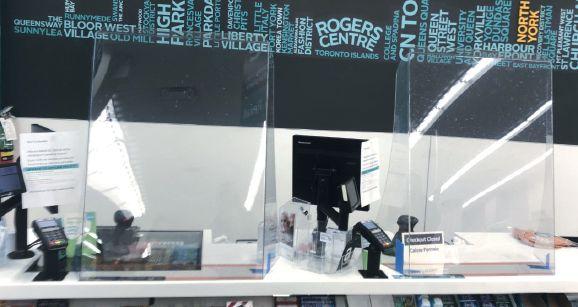
Markham, Ont.-based PCL Graphics has converted into a PPE safety supplier in an effort to help fight COVID-19. At this time, the company has switched over its
printing facilities to mass-produce wearable face shields, masks and large screens to help protect workers and consumers.
PCL says its screens create a physical barrier between the customer and retailer, are easily installed on any surface, allow money and products to be transferred through an opening at the bottom, and are extremely easy to clean.
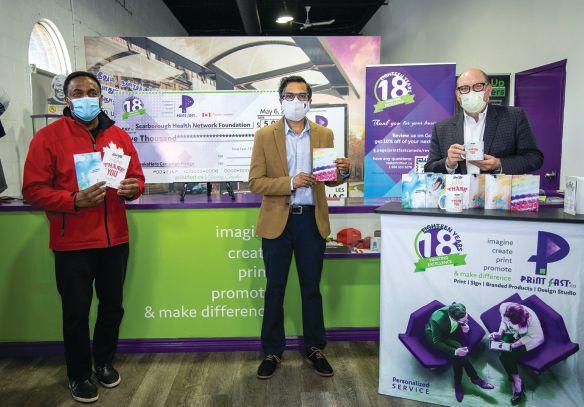
Toronto-based PrintFast.ca has launched a free online greeting card promotion that enables people to personally thank Toronto’s frontline workers amid COVID-19.
The ‘Thank a Real-Life Hero for Free’ program allows Torontonians to visit PrintFast.ca’s website and send a thank-you card to the frontline worker of their choice. A number of specially-designed templates are available to choose from, and can be customized using the site’s design tools.
While the service is free, participating customers have the option of purchasing a gift to add
to the card or donating in support of COVID-19 relief efforts at Scarborough Health Network (SHN).
PrintFast.ca has also donated $5,000 to SHN, as well as 100 clear face shields for hospital staff. The company will also donate all proceeds from the campaign to SHN Foundation’s COVID-19 Emergency Fund.
RM Machinery (RMM) has been named North American distribution partner for Miyakoshi Digital Inkjet label and book presses. These presses, manufactured in Japan with UL/ANSI certifications, are available in commercial, transaction, label and flexible packaging models, and are serviced by factory-trained RMM technicians in the U.S. and Canada.
RM Machinery has also signed a North American distribution partnership with Bottcher America Corporation for its printing rollers, blankets and chemistry solutions, which all seamlessly integrate with RYOBI MHI Graphic Technology (RMGT), Mitsubishi and Miya-
koshi presses.
Additionally, RM Machinery is now authorized by Horizon Print Finishing Solutions to offer its folding, binding, stitching and rotary die cutting solutions in Ontario, Quebec and the Maritimes.
RM Machinery’s expansion into Canada now includes representation of RMGT and legacy Mitsubishi sheetfed offset presses, Miyakoshi, Bottcher and Horizon.
Veritiv Corporation’s Canadian division, Veritiv Canada, has been named the exclusive Canadian distributor of coated board from China from Asia Pulp & Paper (APP).
The relationship provides Veritiv with exclusive marketing, selling and distribution rights across Canada to APP’s lineup of coated board from China. This type of paper is generally used for cosmetics, pharmaceuticals, food packaging, point of purchase displays, greeting cards, direct mailers and marketing applications.
4over, a North American trade gang run printer, has announced the permanent closure of its Canadian plant in Mississauga. This move is part of the company’s North American restructuring.
The 36,000-square-foot plant housed about 55 employees, Komori 29-inch and 40-inch six-colour presses, three cutters and other bindery equipment. The company estimates its Canadian operation did about $11 million in sales.
When COVID-19 hit, the staff was temporarily laid off in March, but the company has officially announced that the closure has been made permanent.
4over says it still intends to serve Canadian clients from its plants in New Jersey and Ohio. In total, 4over has sales of about US$270 million and employs 1,500 employees across nine plants in the United States. The company plans to consolidate its plants down to seven in the U.S.
PCL Graphics switches production over to PPE
L to R: Michael Thompson, Deputy Mayor, City of Toronto; Thushy Thurairatnam, CEO, PrintFast.ca; Guy Bonnell, Vice President Community Development, Scarborough Health Network Foundation.
Steve Klaric has joined RM Machinery as Canadian regional sales manager. He will lead RM Machinery’s first Canadian office in Mississauga, Ont., which has recently opened.
Klaric is an industry veteran with over 30 years of experience in offset and digital printing. He joins RM Machinery from KBR Graphics Ltd. and has also worked at Heidelberg Canada and Finish on Demand.
Anderson & Vreeland has named Andy Gillis as its new vice president of sales and general manager. Gillis joins the company from Provident, where he served as general manager. Prior to this role, he was senior sales engineer for narrow web and wide web presses at PCMC, where he served the tag, label and flexible packaging markets.
AlphaGraphics has hired Kevin Bryant, a franchise sales veteran, to help support the company’s strategic growth as regional development director. Bryant has 15 years of experience in the franchise industry, including ownership, sales, conversion, marketing and development. In this role, Bryant will work with the company’s franchise development team to develop and implement strategies for lead generation, identifying potential franchisees and build relationships to drive profitability and revenue.
INSTALLS
Graphitek, a Victoriaville, Que. printer specializing in large-format printing, completed the installation of an Anapurna H2500i LED large-format printer from Agfa. Graphitek says the investment allows them to improve their service offering and productivity, reduce printing costs and continue to lead the market in the Victoriaville region.
Impression
MacDermid Graphics Solutions (MGS) has hired Justin Kimmel as its new senior account manager, Canada. In this role, Kimmel will be responsible for cultivating relationships with current customers and developing new business partnerships in Canada. Kimmel brings 10 years of new business development and account management experience in the tag and label industry to the role. He will be based out of Toronto, Ont., and will report to Tom Caplinger, vice president, Americas.
Mike O’Neal, president and CEO of #1 Network, Inc. is entering retirement, effective June 1, 2020. O’Neal has been president of the company since August 1992. Under his leadership, #1 Network has grown dramatically, both within the graphic arts channel and by its stock-holding members. O’Neal will be succeeded by Roger Gould on June 1, 2020. Gould has been with the company since June 1999.
Keypoint Intelligence has named Mack P. Brothers president and CEO of the company, effective May 1, 2020. In this role, he will be responsible for the development, refinement and execution of the company’s overall strategy and growth initiatives. Brothers brings over 30 years of research and advisory experience to the position, including working as chief product officer at Forrester Research, where he was responsible for driving the growth of the company’s corporate portfolio of product offerings in syndicated research, data and analytics, events and consulting.
Paragraph of Saint-Laurent, Que., is moving to the Energy Elite Eco Thermal Plate System from Agfa. The addition will deliver reduced chemistry consumption, with “extremely low” replenishment rates for a total waste reduction of up to 50 per cent, plus a total elimination of rinse water equal to 95 per cent of water saving.
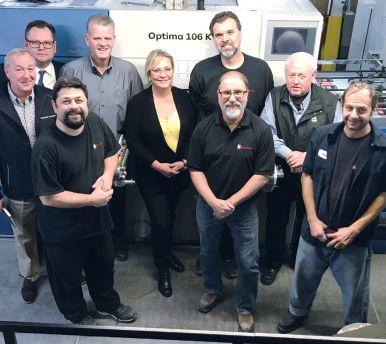
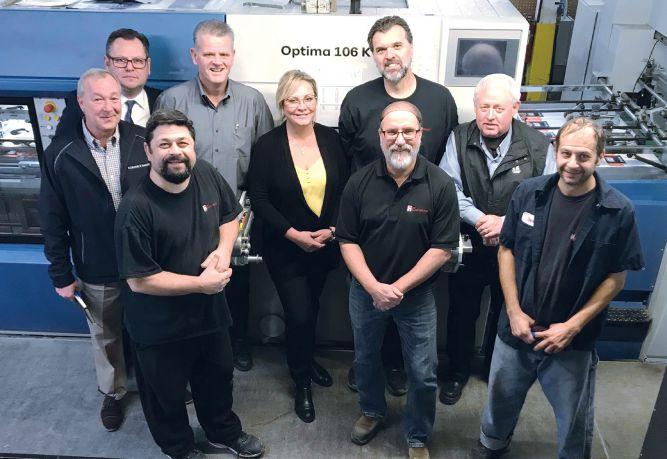
Pickering, Ont.-based Ellis Packaging recently invested in its fourth Koenig & Bauer-Iberica Optima 106 K die cutter. “Since the installation, we’ve seen our net output, which factors in press speed, makeready times, and down time, improve by an impressive 25-30 per cent,” said Cathie Ellis, president.
Not everything turns to gold
Analyzing Heidelberg’s decision to end its VLF collaboration with Fujifilm
By Nick Howard
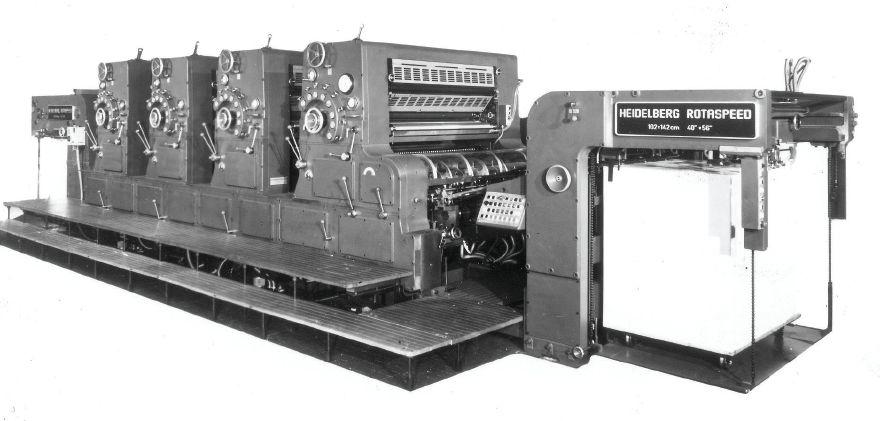
This past March, amid a worldwide pandemic, news from the world’s largest printing press manufacturer may have caught some in the industry by surprise. Heidelberg’s much-touted collaboration with Fujifilm, developing the world’s first inkjet 40-inch press, was ending. Adding to the astoundment, Heidelberg would also cease producing their VLF (very large format) presses. The Primefire 106 came to me in puzzlement, but VLF not so. The moment I laid eyes on the launch press at Drupa 2008, I could see one obvious shortcoming. The press was too monstrously over-built. It seemed unimaginable that in such a small yet exclusive sector, Heidelberg would ever sell enough given the magnificence of the design. Too big and too expensive: customers also had to essentially engineer massive foundations, with Heidelberg factory engineers and bespoke erecting teams on-site to put the presses together. In 1972 Heidelberg made a similar decision building a massive size six (56 inch) Rotaspeed V1 that never even made it out of the factory. Was this a scene out of the movie Groundhog Day?
Didn’t that earlier lesson suggest something?
Koenig & Bauer and manroland also build large format but not to the overblown extent of Heidelberg. A Rapida 162A can be quickly dismantled to fit regular shipping containers except for the feeder and delivery. Rigging requires nothing particularly special and installation very quick. In Heidelberg’s case, special rail systems, super-size crates, and associated freight cost just added a higher expenditure to an already pricey press.
Commercial print buyers were scarce
As it turned out, these monsters were absolute winners when it came to uptime and productive running speeds. Shortly after the 2008 launch, a perfecting option was added, but that horse had already bolted with a severe reduction of four-over-four commercial and book work. Printers were dealing with shorter run lengths and pre-
Heidelberg’s Rotaspeed V1 never even made it out of the factory.
The number of years it took Heidelberg and Fujifilm to develop a new industrial digital inkjet using their respective R&D resources.
ferred smaller B1 (forty-inch) presses.The few web-to-print wholesalers, some even installing the roll-to-sheet CutStar option, were scarce. Folding-carton was a much different story as the Speedmaster VLFs eclipsed what had previously been possible in terms of throughput and make-readies while stealing the crown from the other two manufacturers. No doubt, a massive sigh of relief emanated from Würzburg and Offenbach when they read the news.
The co-developed Primefire 106 struggled to gain sales, mainly because of the sale price. Still, everyone knew digital, and most assuredly, inkjet would soon be the technology that would displace the Offset method. However, the shock of termination amplified in our current climate, where no one can afford to wait for the rest of the industry to arrive. These two changes appear devastating, but in reality, machine tools and real estate are liquid assets. In the case of the Primefire 106, it was mostly composed of an existing Speedmaster 106 with only a specially designed imaging unit, and a console shoved into the delivery. As Heidelberg is legendary for its spare parts and service, these will likely continue well past the end of natural life.
So, it seems the printing industry will not spend millions of dollars on technology that runs at speeds of the 1950s. Price is an obstacle that every potential 40-inch seller, including Landa and Komori, may face.
The joint venture with Fujifilm is the second go Heidelberg has had with digital. The first ended in tears back in 2004 when Heidelberg ended their venture with Kodak. At that time – as it is today- everyone knew the industry was changing, and sooner or later, printers would convert to some version of the digital method. Trouble was, not many were willing to
write checks. Time and massive writedowns forced Heidelberg to react the same in both cases.
The life of machine builders, and that includes our printing machine manufacturers, are continuously fraught with whether or not some new device or design will be a winner. Numerous examples exist of machine concepts that came out of departments with shelves groaning under the weight of drawings, only to belly flop. Every builder has these miss-fires during their lifetimes. I’m sure Komori would like to re-think the decision to build a sizeable perfect binder without a gatherer back in the mid-1970s, but they didn’t. Neither did Koenig & Bauer with their chain-transfer bright yellow SRO presses. Disturbingly this time the (PrimeFire 106 and VLF) problem was not performance, but financial.
And so it was, back in 1967, when Heidelberg thought they were on to something that could breathe new life into letterpress. The mid-1960s were inundated with print—notably books. Newfound technology in perfect-binding solved the problems of having to use animal glue and side nailing to keep the increasingly popular paperback books from falling apart. Everyone it seemed was installing perfect binders with the new “Hotmelt” adhesives, and book prices were coming down. To produce these books ideally meant perfecting (printing both sides in a single pass). There were not many sheetfed choices in those days, unless printers purchased a dedicated offset press such as the Crabtree SP56 or similar models made by MAN and Marinoni or many other blanket-blanket presses, three of which would be soon to arrive from Japanese builders Komori, Akiyama and Mitsubishi. Of course, first-generation “convertible”
perfecting with Miller TP-38 or TP-54 presses was also popular.
“Two Waldorf salads, please!”
Heidelberg wanted to catch the wave of new letterpress plate technologies that rapidly appeared with both DuPont’s Dycril and Germany’s BASF branded Nyloprint plates. Both were metal-backed, about 0.8 mm thick and used not only for letterpress but with the film flipped on exposure for right-reading, ideal for Dry-offset on an offset press with requisite ground plate cylinder. Besides, Heidelberg wasn’t entirely new to this game, and especially with DuPont’s efforts in America, Dry Offset was also gaining popularity for books and other simple monochrome work. In 1962, Heidelberg designed a small two-colour (non-perfecting rotary press), the 40 x 57cm KRZ. Now, why not design a much larger format, say in the SRA1 (640 x 900mm) sheet size that could accommodate A4 sixteen-page work, perfected in one pass?
During May 1988, I was visiting the Heidelberg rebuilding center, just near the main Wiesloch factory, in the town of Waldorf.Yes, the same Waldorf that would lend its name to the salad. This shop was magic. Speedmasters and S-Offsets were rebuilt entirely along with all sorts of letterpresses, from the T-Platen to SBDZ. Finished machines looked like new! Packed away at the rear storage area was a press I’d only read about in a Heidelberg
Heidelberg foresaw the need for perfecting and the public’s appetite for pocketbooks. What they couldn’t know was the speed at which offset would eclipse letterpress.
catalog. My eyes were drawn to it in fascination. The press was a model SRDW. The designation is loosely translated as fastrotary-perfecting-press.
During our years in business, there are but only two models, excluding the VLF and Primefire 106, we never bought and sold. The first was a very short-lived KSL, which was a flat-bed letterpress with an offset upper unit. The second was the SRD series. We have sold everything else: from the iconic little T-platen to the Speedmaster 106. Initially launched at Drupa 1967, the press came in only the SRA1 size but in three variants: SRDE-single color, SRDZ-two-color, and SRDWtwo color perfector.
“We have built the best performing technology. What could possibly go wrong?”
arm in-feed with pull side-guide, the SRDW used some existing technology but also was responsible for designs that would be used later on with the S-Offset: delivery grippers being a good example. The way it perfects is the most fascinating part for me. Anyone who has run older Heidelberg rotaries can easily navigate through the SRDW and a key argument of why Heidelberg has always been considered the pressman’s press. Now, after a full restoration, our SRDW – probably the most unique machine Heidelberg ever made, is on display and soon to be printing again at the museum.
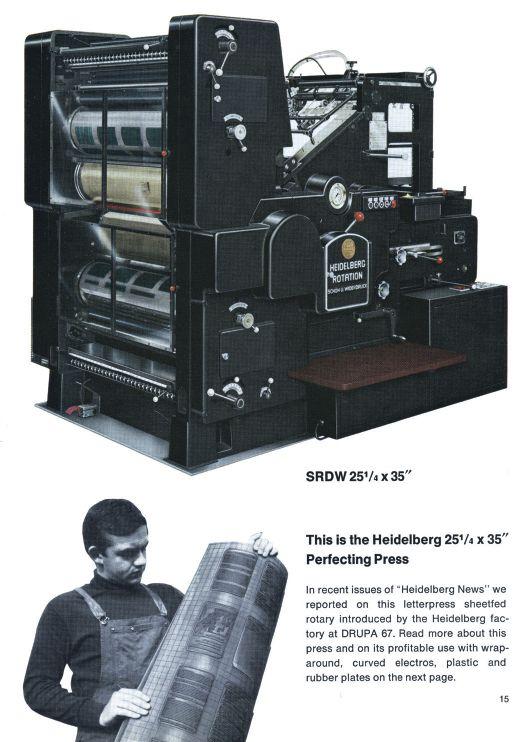
Heidelberg’s perfecting press was able to turn out pages at a reasonable speed of 5,500 impressions per hour using inexpensive relief plates.
At the time, I just looked at it, amused. Why in 1988 would anyone buy such a thing? Hadn’t the industry moved on from letterpress? Furthermore, why on earth would Heidelberg even have such a fossil ready to be rebuilt? But as time went on and we started to think about building a museum, I remembered that SRDW and started to envisage having such a unique piece of history: we just had to have one of these. As it turns out, Heidelberg made very few: our research indicates less than 126 in all three variants were made between 1967 and 1973 when it was quietly put to rest. Finally, after years of searching, our museum found one parked in a Berlin book bindery. The company was using the SRDW to die-cut with foil dies. Diecutting was never in the scope of work for this press, but it must have done the job judging by all the waste we had to clean out. The upper first unit has an extra cylinder that carries the sheet to be printed, and then back to the main double-size impression cylinder where the bottom unit prints the backside. Some type of anti-marking tympan was used – probably 3M’s Spherekote, which was invented in 1947.
Our press was manufactured in 1969 and would have had the original Spiess BX stream feeder. But the Spiess was upgraded to the newly developed Heidelberg head (invented in 1969 by Arno Wirz).The press was originally black but had been repainted grey, which became Heidelberg’s new livery in 1972. Could it be that the press I saw 32 years ago in Germany is our press after a makeover? We may never know—but one thing is for sure, it is a beautifully designed piece of equipment. From the user-friendly feeder to a swing-
Heidelberg certainly had a good idea back in 1967. They designed a perfecting press that could pound out pages at a reasonable speed of 5,500 impressions per hour using inexpensive relief plates. Heidelberg foresaw the need for perfecting and the public’s appetite for pocketbooks. What they couldn’t know was the speed at which Offset would eclipse letterpress. And just as they did recently with Primefire 106 and VLF models that offered little return or were too expensive to build, they hit the brakes on the SRD series and moved on. Others had similar harsh decisions to make. Koenig & Bauer spent years pushing their Rotafolio version of relief printing before they too put a stop to it. Dry Offset, or Letterset as it’s called in Germany, lives on today, especially for metal decorating and label printing. But for book work and any other type of B/W printing, even the offset press struggles to maintain a hold as most of this work is slowly vanishing.
The SRDW is the story of machine development, and every single press manufacturer has a book full of missed or unprofitable equipment that either because it was not the right time, or the market wasn’t willing to buy enough, was forced into painful decisions. In 2020 no one, including Heidelberg, can afford to wait it out. Today this is our reality. Heidelberg made the right call. Meanwhile, for anyone interested in the rich history of printing presses, we have saved an extraordinary piece of Heidelberg engineering you may never see anywhere else.
NICK HOWARD, a partner in Howard Graphic Equipment and Howard Iron Works, is a printing historian, consultant and Certified Appraiser of capital equipment. nick@howardgraphicequipment.com
The number of presses Heidelberg produced in its SRD series between 1967 and 1973.
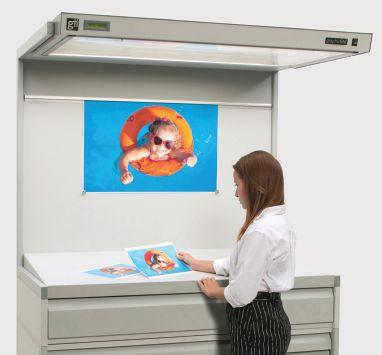
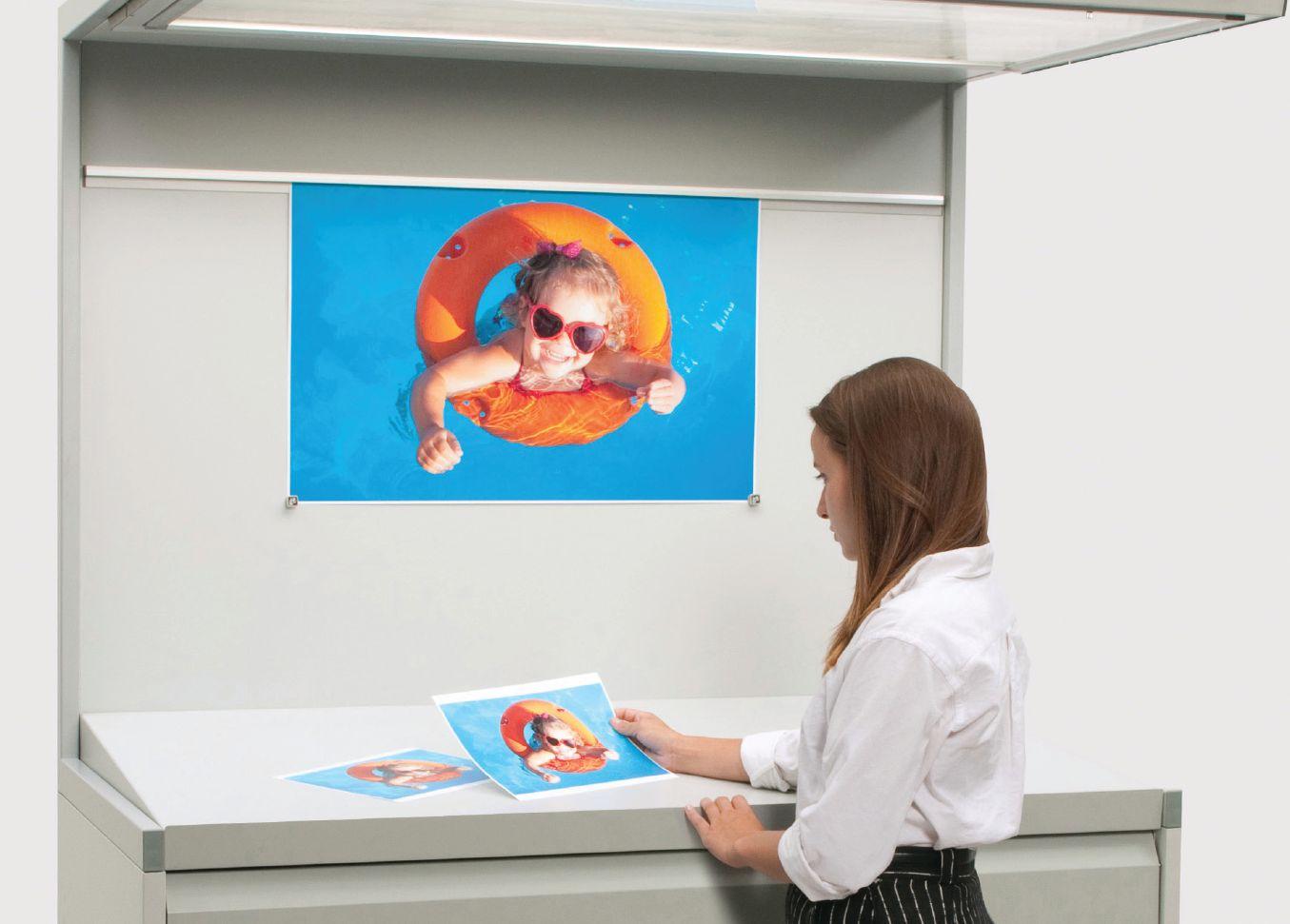
Viewing booths are used to create standard viewing conditions and are a vital part of a colour management system. North American manufacturer GTI’s EVS-3052 model is shown here.
REAL LIGHT SOURCES
Correctly specifying a light source is key
to
successful colour measurement
By Abhay Sharma
Whenever we view coloured images, whether via a web browser, on an iPhone, in a magazine advertisement, or in a store, it is important to understand the effect of lighting. If the light source is very yellow, it will make the object look yellow; if the light is blue, it will make the object look blue.
The colour of a sample can change depending on the light source it is viewed under. In everyday colour evaluation we can deal with a number of different sources, but only as long as we understand and accommodate the light’s characteristics and the effect it can have in terms of colour.
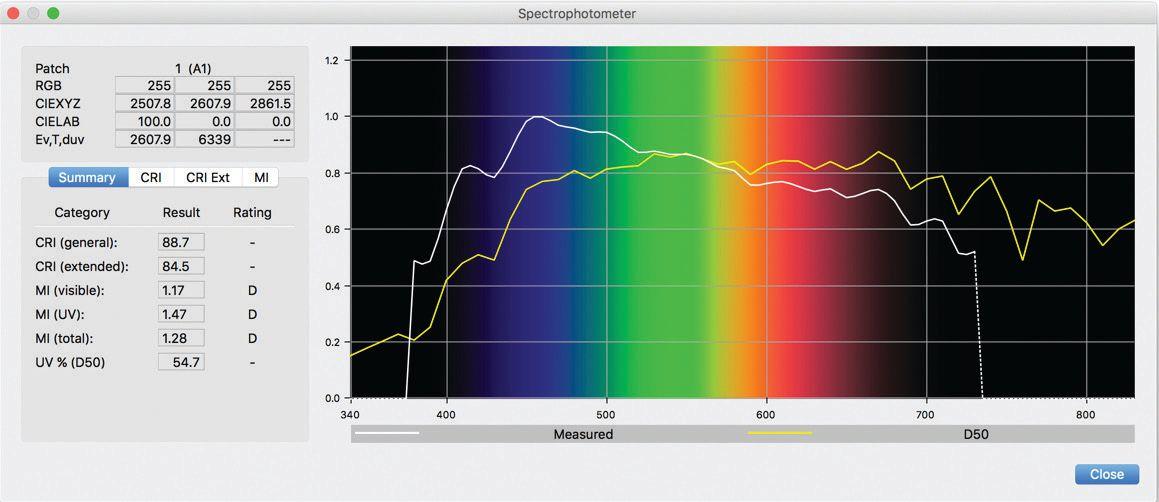
In this article we consider different ways to specify a light source using the colour temperature scale, e.g. 5000 K, and also official CIE illuminants, such as D50.We make real measurements outside in the street, and show how close Toronto daylight agrees with theoretical expectations!
Effect of lighting
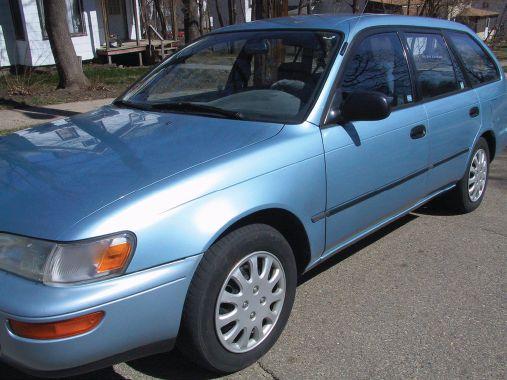
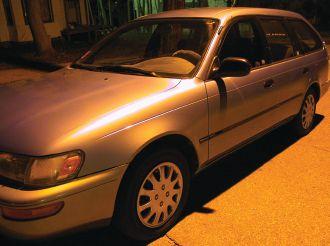
To illustrate the effect that light can have on the colour of an object, consider the example of a car parked in the road. During the day, the car is illuminated by daylight and it looks blue. After dark, when the car is only illuminated by a street lamp, it may look a totally different colour, perhaps silver or dark gray. Why does this happen?
During the day, daylight consists of “all the colours” which reflect off the blue
paint of the vehicle and we see the blue colour of the car. After dark, the car is only illuminated with light from a street lamp. Street lamps are often high-pressure sodium-vapor lamps that emit most of their radiation as a very narrow spike in the yellow part of the spectrum.The blue paint of the car does not have much reflectance in this part of the spectrum, and so very little “colour” is returned to the observer, and as a result the car looks devoid of colour and neutral - silver or gray.
Colour temperature
In colour management, there are different ways to describe the colour of a light source. A convenient method is called the colour temperature scale. The idea of colour temperature can be appreciated by considering the progressive heating of a piece of metal. As objects are heated, they get hotter and begin to glow and emit light. The colour changes as objects get warmer, so an object goes from dull black to deep red then bright red and finally to “white hot.” It is therefore possible to describe the colour of a light source by temperature. When used in this way, the temperature is called colour temperature. In the colour temperature scale, lower colour temperatures are redder/warmer and higher colour temperatures are bluer/ colder.
Colour temperature is measured on an absolute temperature scale and has units in Kelvin (K). A tungsten source may have a colour temperature of, for example, 2800 K. (No degree sign is used with K, so colour temperature is not written as 28000 K but simply 2800 K.) Typical
Light sources can have very different operating principles, which results in a wide variation in the inherent characteristics of the light.
values for common light sources are: high-pressure sodium vapor (used for night-time street lighting in the car example), 2100 K; photographic studio lamp, 3400 K; electronic flash, 6000 K; average daylight, 5000 - 6500 K; artificial daylight compact fluorescent lamp, 6500 K; uncalibrated computer monitor, 9300 K. The colour temperature scale provides a succinct, numerical means of specifying the colour of a light source and is widely used in colour management.
Spectral Power Distribution Curves
There are many types of light sources. Some are artificial like tungsten and
compact fluorescent light bulbs, and some are natural sources, like daylight. Light sources can have very different operating principles, which results in a wide variation in the inherent characteristics of the light. The Kelvin colour temperature scale does not fully reveal all the characteristics of the light, so we can also use a spectral distribution curve. The spectral graph describes the relative amount of power or energy at each wavelength and is technically known as a spectral power distribution curve. From the examples, we see that daylight tends to be well balanced with emission throughout the spectrum and thus the “colour” of daylight is more or
During the day a car may look blue (top), while at night under sodium-vapour street lamps, it can look silver or gray (bottom).
Daylight was measured in Toronto, Canada (white line) and shown to be very close to CIE Illuminant D50. Screenshot is from basICColor catch 5 colour management software.
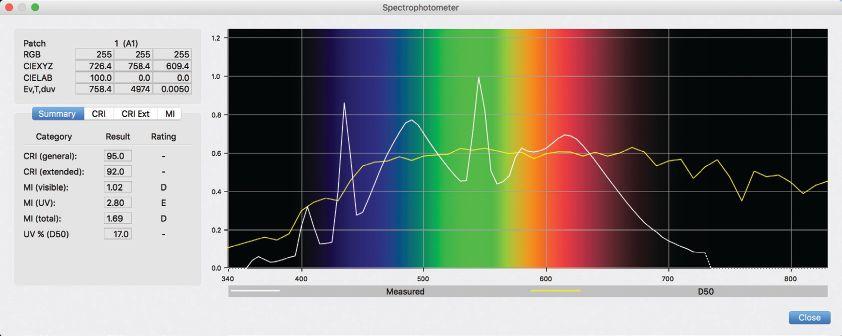
A light booth was measured and despite the spiky response of the LED source (white line), the booth can create light that approximates D50
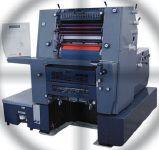
Discover the new Speedmaster 2020 generation with innovative solutions for Commercial, Label, and Packaging Printing. Experience unprecedented performance thanks to a new scalable user interface and intelligent assistance systems, which enable integrated automation and simplifed production processes.
Discover these innovations at heidelberg.com/nextgeneration
less neutral. A fluorescent or LED light source has some dominant peaks in the blue and green part of the spectrum – the illumination from this source is very spiky. From the graphs it is clear that each source has very different characteristics. Daylight that originates from a hot glowing sun is essentially incandescent. Incandescent sources have a graph with a continuous line. Other sources, such as fluorescent lights, are not heated up and therefore do not operate this way. These lights contain a gas that is excited by the discharge of an electric current, which in turn excites the phosphor coating of the tube, which glows, giving off light. The chemical composition of the coating can be altered to adjust the colour temperature of the emitted light - which is why you can get different colour temperature lights at Home Depot!
By using spectral graphs, we can clearly see the smooth continuous nature of some sources (daylight) vs. the spiky response of others (fluorescent lamps and LEDs). The spiky nature of fluorescent sources can cause problems such as metamerism, when these sources are used in viewing booths.
CIE Illuminants vs. real sources
With so many different types of light sources in everyday use, a few common light sources have been chosen and adopted as universally accepted standards.
It is extremely important to establish agreed viewing conditions between the printer and the customer.
Periodically over the years, in response to user needs, the Commission Internationale de l’Eclairage (CIE) agrees on the name and specification of an illuminant and publishes the spectral power graph for the colour community to use.
A CIE illuminant is a theoretical spectral power curve that has been established as a standard. The spectral curve can be an average of light sources and is not a real, actual light source. There are physical standards for the kilogram and meter, but a CIE illuminant is just a theoretical construct – it is a spectral graph – and there is no “golden standard” tungsten bulb in a vault in Paris!
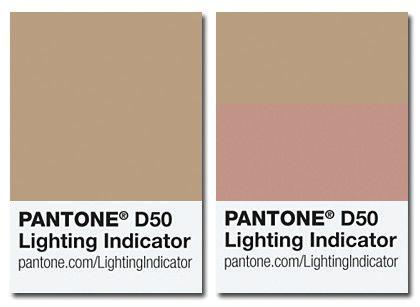
In the PANTONE® D50 Lighting Indicator, the top and bottom halves are different in non-D50 lighting. The two-inch sticker can be attached to colour proofs to check the lighting.
Over the years, the CIE has defined a number of illuminants that range conveniently in letters A, B, C, D, E, F. Illuminant A is represented by incandescent lights (tungsten filament bulbs). These devices have a colour temperature of 2856 K. Illuminants B and C are daylight-type illuminants, but they are no longer in general use. They were made by placing a liquid cell containing a blue copper sulphate solution in front of illuminant A. D illuminants are daylight-type illuminants. Illuminants D50, D55, D65, and D75 have colour temperatures of 5000 K, 5500 K, 6500 K, and 7500 K, respectively. D50 and D65 are widely used as illuminants in printing and imaging. European countries often use D65. Illuminant E is an imaginary, hypothetical equi-energy illuminant. Illuminant E is used in some colorimetry calculations. Series F illuminants relate to fluorescent lights.
It should be noted that the spectral power distributions for an illuminant, Illuminant D50 for example, is a representation of “standard daylight” and any actual sample of daylight might be different according to the geographic location, altitude, weather, time of day, and so on.
Lighting and light booths
A customer may visit a print shop and together with the printer may generate an excellent sample that is approved in a press-side D50 viewing booth. However, when the customer takes the samples back to the office to show their boss, under office lighting the samples may change colour and incur the anger of the manager!
If someone holds up a print and says they do not like the colours, the first thing to do is to ask them how are they viewing the print. If colour measurement for the
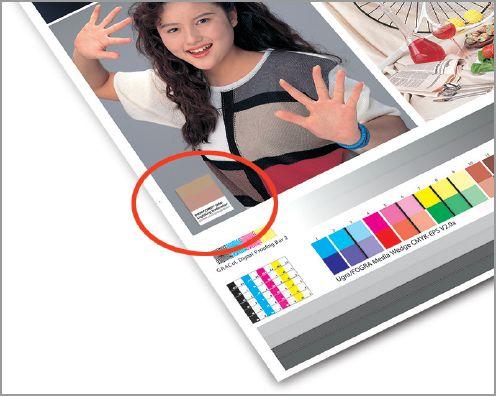
print was done with settings that intended viewing for D50, the sample should be viewed under D50. The print is only intended for a specific viewing condition and may look different under other light sources. Another way to think of this is that if you have sent a print to your client and you want them to see what you see; they must view the print under the conditions you viewed and measured it under. One way to create well specified and controlled viewing conditions is to use a viewing booth. Viewing booths have switches that offer D50, D65, or other illuminant conditions, such as settings for grocery store or clothing store lighting. In printing and proofing, the light source used by the customer can be checked using the PANTONE D50 Lighting Indicator. In this small sticker, the top and bottom materials are different, but are chosen in such a way that they will look alike under D50 illumination. The sticker can be placed in the corner of a contract proof used to gain customer approval.The sticker will show whether the user is using a lighting condition that approximates D50. There is a D50 and D65 version and each cost around $2. The Lighting Indicator uses an effect known as metamerism, and the top and bottom materials are called a metameric pair.
Summary
We need to always remember that lights themselves have a colour and that colour can be passed on to the sample. We often “standardize” on D50, but strictly speaking, there is no correct light source for evaluating colour. What is more important is that we know the light source we are using, and we communicate that clearly to all involved. It is extremely important to establish agreed viewing conditions between the printer and the customer.
Whether we are considering a shade of lipstick or the colour of a sofa in a catalog, there are many different light sources in common use, but by correctly specifying the light source being used, we can accommodate their differences and ensure successful colour measurement and colour management.
Abhay Sharma is a professor at Ryerson University, Toronto, and the author of a textbook - Understanding Color Management, 2nd Edition, Wiley, 2018.
REACH FOR HIGHPOINT
AVAILABLE EXCLUSIVELY FROM VERITIV
VISER HAUT AVEC HIGHPOINT
OFFERT EXCLUSIVEMENT PAR VERITIV
HI-BRITE C1S BOARD, C2S BOARD AND C2S HI-BULK BOARD
Features include:
• Highly versatile, bright white boards that are ideal for numerous applications
• Strong folding endurance and stiffness
•
•
•
•
Please contact your Veritiv sales professional to learn more and place your order.
HI-BRITE C1S BOARD, C2S BOARD AND C2S HI-BULK BOARD
• Carton blanc brillant très polyvalent, parfait pour de multiples applications
•
•
•
• Large éventail de poids de base et d’épaisseurs
•
Pour en savoir plus et pour passer une commande, communiquez avec votre professionnel des ventes Veritiv.
An overview of how Canadian printers have invested in technology over the past year
By Kavita Sabharwal-Chomiuk
The following snapshot of The Iron Index 2020 survey produced by PrintAction compares current production trends to a historical benchmark of capital investments made by Canadian printers. The facts presented throughout the article relate 2020 numbers to past survey statistics.
The first iteration of the Iron Index was launched in 1996, when PrintAction published a short, but important, list of innovative commercial printers that were
the first to install computer-to-plate (CTP) imaging systems. Now, 24 years later, the Iron Index tracks the production-technology investment trends of leading offset-based printing companies across Canada. This includes tracking the offset (by model, number of units and format size), toner and inkjet press specifications of participants, as well as employee levels, revenue, frontend technologies and MIS.
The following statistics provide insight into what is going on with the direction of production ratios. The key statistics describe how the landscape is changing in
terms of long and short runs, as well as the work of 29- and 40-inch printers, and how they are shaping their companies and Canadian printing. Based on the information provided by 72 responding companies, it appears production inkjet has started making more significant inroads as 5.6 per cent of all printers surveyed (both 40- and 29-inch) are producing at least 30 per cent of their work with production-strength inkjet, compared to 1.3 per cent in 2019. Meanwhile, toner printing is also enjoying an upward trajectory, as 13.9 per cent of all printers surveyed this year say toner printing accounts for at least 40 per cent of their work, up from 12.9 per cent last year.
Since this year has its own unique challenges, we also asked survey respondents about how their workflow has been impacted by the coronavirus pandemic, and whether it has led them to change over some of their equipment to produce personal protective equipment or social distancing graphics amid COVID-19.
To participate in next year’s Iron Index survey, please contact kchomiuk@annexbusinessmedia. com.
Key statistics from The Iron Index describing technology advances in Canada
21%
Percentage of respondents that haven’t already reconfigured their print production lines to produce PPE or social distancing-related products, but have plans to in the future.
36%
Percentage of respondents that have reconfigured some of their print production lines to produce PPE or social distancing-related products recently.
THE IRON INDEX METHODOLOGY
Percentage of respondents that cite COVID-19 as a prime barrier to their company’s future competitiveness. 10%
For over 20 years, PrintAction has surveyed commercial printing companies across the country to track their production-technology investment and trends. Below is a sample of the survey questions respondents have answered to produce our results. This primarily includes tracking the offset (by model, number of units, and format size), toner and inkjet press specifications of participants, as well as employee levels, revenue, front-end technologies and MIS.
Year of company founding:
Number of employees:
Have you reconfigured any of your print production lines to produce PPE or social distancing related products recently?
If not, do you plan on moving in this direction in the near future?
Offset presses:
List up to four primary offset presses. Include press brand, press format size in inches, and number of press units.
Toner/Digital Presses:
List up to three primary toner/digital presses. Include press brand and model number.
Management Information System:
Provide brand, type and version if available.
Primary Frontend (Prepress) Software:
Provide brand, type and version if available
Primary Platesetter:
Provide brand and type if available.
Primary Offset Plate Brand:
Provide brand and type if available.
Production Ratio:
Provide approximate percentage of work done, in terms of total revenue generation, with Offset : Toner : Inkjet.
Wide-Format Inkjet:
List up to two primary wide-format inkjet machines. Include press brand and model number.
Production Inkjet:
List up to two primary production inkjet machines. Include press brand and model number.
What do you see as the prime barrier to your company’s future competitiveness?
What is your best estimate at a dollar amount for how much printing technology, software and related services your company will purchase over the next three years?
What areas does your company plan to invest in over the next three years?
In the next 12 to 18 months, which is most likely to happen at your company?
Percentage of 40-inch printers surveyed in 2020 with at least two toner printing systems, down from 63.1% last year, but slightly higher than 2012 levels.
Percentage of 40-inch printers surveyed in 2020 producing at least some of their work with production-strength inkjet. 56% 67% 39% 28%
Percentage of 40-inch printers surveyed in 2020 with at least one toner printing system, a level comparable to 2013.
Percentage of 40-inch printers surveyed in 2020 producing at least 70% of their work with offset, down from 81.9% last year.
Percentage of the lowest amount of revenue generated by toner by any surveyed 29-inch printer. 15%
Percentage of 40-inch printers surveyed in 2020 generating at least 30% of their revenues from toner, down from 10.4% in 2019. 0% What
Enhanced Throughput
Smart Services
Extend
The future of finishing is at work in today’s smart factories worldwide.
Experience the power of Muller Martini’s highly automated print finishing systems. Contact your Regional Sales Manager for more information, or to schedule a demo.
40-inch printers
The following statistics apply to Canadian printing companies with at least one 40-inch sheetfed press, based on their participation in The Iron Index surveys.
Key 40-inch printer findings in 2020: The Iron Index indicates the number of commercial printers with full-size sheetfed presses focusing solely on offset work has declined. This is seen by the nearly 15 per cent decline in printers producing 90 per cent or more of their work with offset between 2019 and 2020.
29-inch printers
The following statistics apply to Canadian printing companies with at least one 29-inch offset press (or of smaller format) and no 40-inch presses, based on The Iron Index surveys.
Key 29-inch printer findings in 2020: The Iron Index survey finds that all commercial printers surveyed in 29-inch market have at least one toner press. The number of surveyed printers producing more than 90 per cent of their revenue with offset continues to decline, while a significant number of respondents are producing at least 10 per cent of their revenue with toner production presses.
Percentage of printers surveyed in 2020 that were founded 50 or more years ago.
22% 50%
Percentage of 40-inch printers surveyed in 2020 producing at least 20% of their work with inkjet, illustrating how large-format inkjet continues to make an impact in this segment.
Percentage of 29-inch (or smaller) printers that indicated they own at least one toner printing system.
Percentage of 29-inch printers surveyed in 2020 producing at least 30% of their work with toner, up from over 32% in 2019.
100% 25% 67%
Percentage of 29-inch printers surveyed in 2020 generating at least 20% of revenue from toner, a decline from 82.3% in 2019, but higher than 2015 levels.
11%
Percentage of 29-inch printers surveyed in 2020 producing at least 80% of their work with offset, down significantly from 24.2% in 2019.
Complete Iron Index participants by year
The following percentages are derived from 80 Canadian printing companies who participated in The 2019 Iron Index survey.
Percentage of 29-inch printers producing less than 50% of their work with offset, which remains important.
42%
Percentage of printers surveyed in 2020 that plan to invest in equipment, machinery or technology upgrades.
56% 17% 25%
Percentage of all printers (29- and 40-inch) surveyed in 2020 generating at least 30% of revenue from toner, versus 32.8% in 2019.
Percentage of all printers (29- and 40-inch) surveyed in 2020 producing work with all three processes (offset, toner, inkjet).
36%
Percentage of all printers (29- and 40-inch) surveyed in 2020 producing at least 10% of their work with toner, down from 73% last year.
Projected investments in
Less than $99,999
$100,000-$499,999
$500,000-$999,999
$1,000,000-$2,499,999
More than $5 million
No Answer
Projected investments in printing technology, software and related services over the next three years.
Projected investment Number of respondents Less than $99,999
PrintAction would like to thank all of the companies that have participated in The Iron Index over its 22-year history, and in particular those who responded to our 2020 edition, enabling these statistics to be generated. To participate in next year’s survey, please contact the editor at kchomiuk@annexbusinessmedia.com.
Software solutions
Highlighting new management information system releases and updates
Bard Business Solutions’ API
Bard Business Solutions has integrated its new Application Programming Interface (API) into all of its systems. API is a computing interface that defines interactions between different software programs, which J. Stephen Bard of Bard Business Solutions Inc. says is key to the future of any software program.
“Think of an API (Application Programming Interface) as a universal language. But first your program or application must have the ability to read and write (or send and receive) through an API. When two programs have the API, then you have the basis to send and receive data between the programs,” says Bard. “This send and receive is similar to you typing in an address in a web browser and then receiving the web page.”
Bard says his company’s API can send a request to another production device to start a new job, and send all the particulars to go with that job, which will send through confirmation of a successful receipt. After the job has passed that stage, the production device can usually trigger a response to the program and send a status update of that particular job.
EFI MarketDirect Fulfillment
Electronics for Imaging, Inc. (EFI)’s new MarketDirect Fulfillment software for inventory management is a new, automated offering as part of the company’s MarketDirect suite of web-to-print, eCommerce and cross media solutions. Featuring flexible administration tools, the product creates an order-to-fulfillment workflow that businesses can use to expand service offerings,
create efficiency in warehouse operations and drive even greater customer loyalty.
The new software provides functionality for existing MarketDirect StoreFront web-to-print/eCommerce users, and is designed to reduce the time and complexities needed to start and manage print fulfillment operations. The software also provides a simple administrative dashboard to manage both clients and orders.
“With full integration of our web-to-print and fulfillment services, we can manage our clients with one central solution, providing a more integrated experience for our customers and better automation for our production team,” said Lynn Smith, The Sourcing Group’s chief marketing officer.
The software helps commercial print and packaging businesses, inplant print centres and corporate marketing communications teams create immersive order and fulfillment portals with an administrative dashboard for staff.
The ‘always-on’ EFI cloud-managed solution helps mitigate concerns about server availability and uptime. As with the rest of the MarketDirect platform, the new product also integrates with EFI Productivity Suite MIS/ERP workflows.
Crawford Technologies DTE Version 4.11
Crawford Technologies has released its Digital Transform Engine (DTE) version 4.11, which is designed to provide users with greater flexibility, performance and functionality to further streamline the management and deployment of customer communications, reduce overall costs and continue to improve the customer experience.
A new capability in DTE V4.11 streamlines the ability to split PDF files into multiple files with greater speed and flexibility, reducing processing time while allowing users to create separate files for different delivery channels. The update can also help reduce the time it takes to link PDF files in sequence while expanding the ability to support new font combinations.
New functionality has been added to intelligently automate and streamline the creation of accessible communications. The new version continues to improve the way unstructured documents can be converted into Accessible PDFs (WCAG 2.1), PDF/UA and Accessible HTML, offering increased foreign language support and simplified document remediation, helping achieve compliance with accessibility regulations.
New user interface and updates to Aleyant eDocBuilder
The latest release of Aleyant’s eDocBuilder includes improvements to the user interface and user experience for eDocBuilder’s iFrame and Pressero clients. The updates include:
• With the addition of Field Scripting, Field Designer has achieved feature parity with Field Setup.
• While editing templates in the Test/View Templates area, users will notice the “Update Preview” button. Previously a persistent element, this now appears only after changes are detected.
• Added support in Field Designer for Emulate Acrobat Text Field Positioning, within the Layout tab; Stacking Groups for image and text fields; and the Data Source: Another Field (as exists in Field Setup: Field Type).
• Removed hidden fields on the template while working in Field Designer. Select the “hidden” indicator to make it reappear to resize or reposition.
• For users who access the app through mobile devices, the new eDocBuilder user interface is optimized for mobile.
To set up future developments, Aleyant has removed the capability to customize the layout of eDocBuilder through CSS. By the end of the year, the eDocBuilder iFrame client will be removed; everything will be transitioned to Pressero. This release also fixes several bugs.
Avanti and Enfocus sign OEM agreement
In October 2019, Avanti Computer Systems Ltd. and Enfocus BV an-
nounced an agreement under which Avanti will market, sell and support Enfocus products in Canada and the U.S. The agreement expands on the collaborative partnership agreement that the two companies signed in 2019.
This means Avanti can offer Enfocus Switch with all its modules and Enfocus PitStop Server, together with training and support services to its existing customers, as well as a bundled solution to new customers.
With this partnership Avanti will make apps available for Enfocus Switch on the Enfocus Appstore online marketplace. The apps will help ease the integration with Avanti Slingshot, making it uniform for all customers.
The apps will provide bi-directional JDF job ticket exchange for automated job processing and updates of production status back into Avanti Slingshot. Customers can retain control over processes using dashboard and reporting features present in both programs.
Avanti now offering Enfocus products in Canada and the U.S.
Customers will also be able to PDF proof on Slingshot, provided using the PDF Review Module for Switch. The proofing cycle will be triggered from Avanti Slingshot when it submits a job. Enfocus Switch receives the job in JDF and will automatically manage the invitations to print buyers by sending emails including the URL to the PDF file that awaits approval, and sends approve and reject statuses back to Avanti Slingshot.
The latest release of Aleyant eDocBuilder includes improved user interface and experience.
Bard Business Solutions has integrated its new API computing interface into all of its systems.
Detailing new offerings from Arrow Systems, Konica Minolta, Screen and
Mohawk Renewal
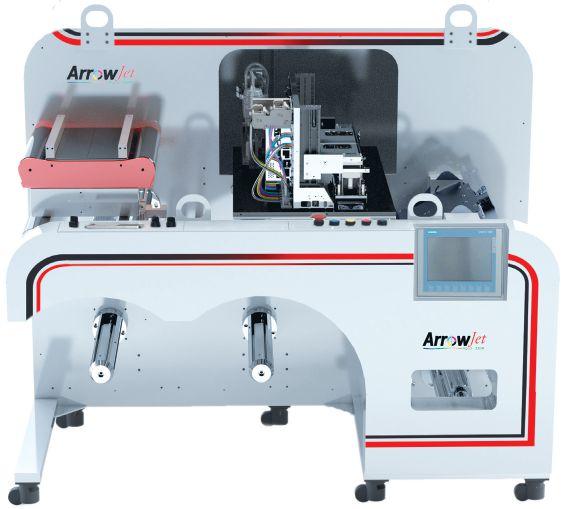
Arrow Systems’ ArrowJet Aqua 330R is a high-speed, aqueous pigment press for mid- to high-volume label and packaging production.
ArrowJet Aqua 330R
Arrow Systems has launched the ArrowJet Aqua 330R, a new solution for mid- to high-volume label and packaging production. The product is a high-speed, aqueous pigment press that provides enhanced print quality and greater production flexibility.
The ArrowJet Aqua 330R, which features Memjet’s DuraFlex printhead technology, provides the benefits of digital printing, enhanced durability and fast speeds through the use of aqueous pigment inkjet technology. The digital nature provides the flexibility to change designs, print on demand, implement variable data and make colour alterations without changing inks, plates or tooling. Plus, an aqueous pigment-based inkjet ink provides greater substrate compatibility than older technologies.
The product offers up to 1600 x 1600 dpi resolution, and print speeds of up to 150 feet (50 metres)
per minute, and can be configured to either work offline or paired with various inline finishing options, including both laser die-cutting and traditional analog finishing.
The ArrowJet Aqua 330R also features a large unwind and rewind with capacity up to standard 30inch rolls, an inline edge guide, inline IR curing and an integrated RIP software for precise colour matching and variable data printing. The technology also offers the ability to stitch multiple printheads together for wider print widths. Arrow Systems is currently working on a 17-inch model for the flexible packaging market.
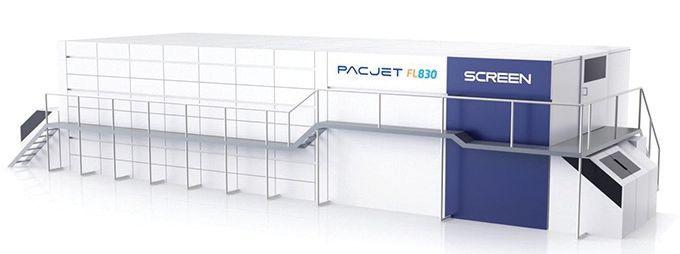
Screen PacJet FL830
Screen Graphic Solutions has finalized the development of the PacJet FL830, a new high-speed, waterbased inkjet system designed for the flexible packaging market. The FL830 is set to be launched in March 2021.
Screen has launched the PacJet FL830, a new high-speed, water-based inject system for the flexible packaging market.
ONE-STOP SHOP — Die Cutting, Bindery, Data & Lettershop.
2. SUPERIOR TECHNOLOGY — Die crease without a die, then fold and even glue all on the same machine, up to 30 pt.
3. INTEGRATED MODULAR UNITS — Combined in-line finishing: crease, fold, glue, tipping, envelope inserting, ink jetting (Duplex), clip seal (3 sides), mail prep.
4. SAVE ON POSTAGE COSTS
—As a Certified Canada Post Direct Marketing Specialist, we get contract pricing reductions.
5. RETURN MAIL PRODUCTS — Customized “Return Mailers” created in-line with “U” or “BOX-shape” remoistenable glue, time perfed applications and envelope formation.
6. MINI-BOOKLETS — Saddle-stitch and trim 2-up booklets in-line to the size of a business card. No need to trim off-line, or do 2 passes.
7. HIGH SPEED EQUIPMENT — High speed Tipping, Folding, Saddle-stitching and soft folding ensuring on time delivery.
The new printing system is designed for flexible packaging and can handle media up to 830 mm (32 in) wide at speeds of up to 75 metres per minute (246 feet per minute). It is also capable of printing at a resolution of 1,200 dpi using CMYK and white water-based inks that conform to relevant food safety regulations.
The PacJet FL830 can be used for promotional to production applications. It can also responsively tackle small lot jobs under 4,000 metres, which can be problematic for conventional analog production. Currently, the system handles both PET and OPP media and Screen is working to further expand compatibility based on industry requirements.
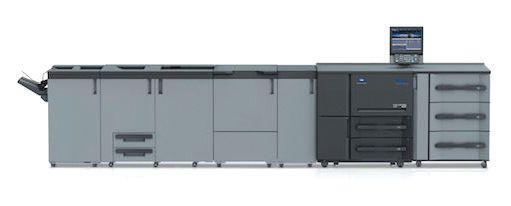
Konica Minolta AccurioPress 6136P MICR
Konica Minolta Business Solutions
U.S.A. Inc. (Konica Minolta) has launched the AccurioPress 6136P MICR, giving the 6136P product line an MICR toner and developer that it says will significantly impact the financial printing market.
Konica Minolta partnered with Troy Group to help convert the AccurioPress 6136P to an MICR version through the use of Troy’s patented MICR Toner Secure with its own proprietary developer bead. The toner has been extensively tested to ABA/ANSI standards.
Troy’s MICR Toner Secure, MICR developer and MICR fonts were designed specifically for use in the 6136P printer to ensure consistent MICR quality and performance. The AccurioPress 6136P MICR helps deliver tamper-resistant MICR documents in a high-volume production environment, while printing at a speed of 136 ppm. The use of Troy’s MICR Toner Secure makes toner scraping nearly impossible. Through patented security technology, red dye is released which voids the cheque if chemical alteration is attempted.
The printer can be specified to optimize print settings instantaneously, providing paper setups with each job for up to 256 media profiles. It features a 15-inch touch
panel where operators can view and edit job tickets, create previews and print sample output to confirm results, allowing for output operations that are efficient and waste-free. Advanced job management support simplifies output work and reduces labour costs.
Mohawk Renewal swatchbook
Mohawk Fine Papers, Inc. has unveiled Mohawk Renewal, a portfolio of papers made with hemp, straw and recycled cotton fiber, and a swatchbook for the portfolio is now available to order.
The Mohawk Renewal swatchbook was designed and crafted to display all the qualities of the product line, while also revealing the story behind the new portfolio of sustainable papers. The 28-page swatchbook is constructed from the papers featured inside, and every sheet displays the sustainable fibers used to make the line. The book was produced using four different paper shades from the portfolio and was printed with four colour offset lithography.
Inside the book is a browse section, organized by fiber type, allowing users to dive deeper into the paper specification process. Each waterfall contains samples of every shade, weight and finish available within the line, along with detailed product specifications. At the back of the swatchbook is the details section, which contains in-depth paper information and specific printing resources.
The cover is made from three sheets of Mohawk Renewal Hemp, Rough, Flower, 120 Cover, laminated together, Mohawk Renewal Straw, Rough, Wheat and 80 Text and Mohawk Renewal Recycled Cotton, Denim, 60 Cover, diecut and printed with white foil.
Konica Minolta’s AccurioPress 6136P MICR helps produce tamper-resistant documents for the financial printing market.
The Mohawk Renewal swatchbook is made with hemp, straw and recycled cotton fiber.
PHOTO: ARIEL PARILLO
1250W Multilith with MONA Unit (numbering,
includes rotary numbering machines - Bostitch heavy duty stitcher
Sakurai: 1, 2 or 4 colours and any size (newer model)
Polar: any size/older or newer models (66/72/76/78/82/90/92/107/115)
Horizon-BQ: 220/240/260/440/460
Remembering Ronald Kletke / Owner / Oil City Press
In 1963, Ronald Kletke became the proud co-owner of Oil City Press.
Born and raised in Winnipeg, Ron relocated to Calgary in the late 1950s with his father, Ron Sr., to work at a printing shop with Ron Sr.’s brother-inlaw. In 1963, they decided to venture off on their own, which is when they together purchased Oil City Press. Under Ron’s leadership, the business has made huge strides since the Kletke family took over.
Oil City Press works with brands such as Circle K, looking after all of the chain’s 320 Western Canada stores spanning west from Winnipeg to Vancouver Island, and north to Yellowknife. Its client list also includes the Calgary Flames, Heritage Park, Alberta Children’s Hospital Foundation and the City of Calgary.
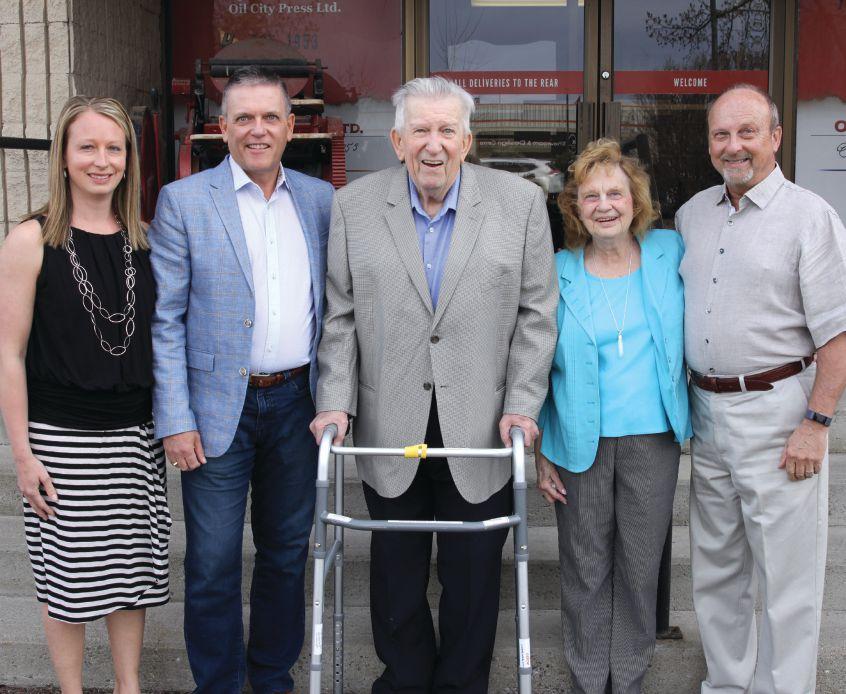
On April 22, 2020, Ron passed away at the age of 88 from COVID-19. We spoke with his son, Dave, co-owner of Oil City Press, about his father’s start in the industry and the printing legacy that lives on.
PrintAction: How did your father gain an interest in the printing industry?
Dave Kletke: My grandfather and my father both worked at Hignell Printing in Winnipeg. My grandfather came from a family of 14 kids and a lot of his brothers were also working in the printing industry in Winnipeg as well. So, it was really the business of choice for our family.
PA: How did the Kletke family come to own Oil City Press?
DK: In the late 1950s, my grandfather was offered to come to Calgary and work with his brother-in-law and become a partner with him [at his printing shop]. So, my grandfather and my father moved to Calgary and started working at Kyle Printing, but found that it didn’t really work out as expected. After a couple of years, my grandfather decided to venture off. They found Oil City Press here in Calgary. This was a one-man operation, and they purchased it together in 1963.
PA: What are some of his career highlights?
DK: In 1969, my mother brought home a carton of cigarettes for my father called Casino Cigarettes from Imperial Tobacco Company, because he loved going to Las Vegas. Casino Cigarettes had a scratchand-win card in each package. Back then, this was the first real scratch-and-win style of printing that was happening. My dad being a printer was quite intrigued, wondering how they were able to print these cards and put the scratch material on it. So, he opened up each card and you could either win $5 or $100, depending on the numbers that you scratched off on each card.
After spending some time with it, my dad
was able to figure out the code of these cards, and along with Bill Volk, another Calgary-based printer and my dad’s musical partner (they played in a two-piece party band on weekends), they cracked the code. They ended up making every news station around Canada and in North America. Imperial Tobacco offered to pay them out if they’d stop winning money with the scratch tickets.
In the meantime, my dad used his winnings to invest into Oil City Press and he ended up building an addition onto the building that we were in which really helped expand the growth of our company.
PA: How has Oil City Press expanded since your grandfather and your father purchased the company?
DK: Over the last 10 years, we’ve really diversified into wide format, signage and have also gone into doing vehicle wraps and outdoor signage. It’s been a great diversification for us and it’s helped us grow. We’ve pretty much doubled our sales over the last five years, and a good part of that is due to going into wide format.
PA: How has Oil City Press been able to switch over to help on COVID-related printing materials for PPE?
DK: A couple of our major customers are in the retail food industry. We do all of the
printing for Circle K stores across western Canada. Printing facilities are essential businesses through this pandemic so we’ve been able to help support them with cashier barriers, floor signage for physical distancing, and more, so that has helped us in the sense that we’ve had that the ability with those customers to be able to expand into the retail industry. We’re now able to support the additional restaurants and stores that are re-opening here in Alberta. We’ve been fortunate to have been able to stay open and help support these businesses. We have been doing some plexiglass shields for inside Uber vehicles and other safety shields on a brand-new Multicam Celero Router Cutter. It’s nice to be able to have the flexibility to be able to adapt to the ever-changing world.
PA: What roles are you and your brother in now as co-owners of Oil City Press?
DK: We’re co-owners, yes, and Doug’s daughter, Pam is the fourth generation of the Kletke family now working for the business. It’s pretty much a group dynamic; we each wear all the hats.
Editor’s note: This interview has been condensed for length and clarity.
Ronald Kletke became the proud co-owner of Oil City Press
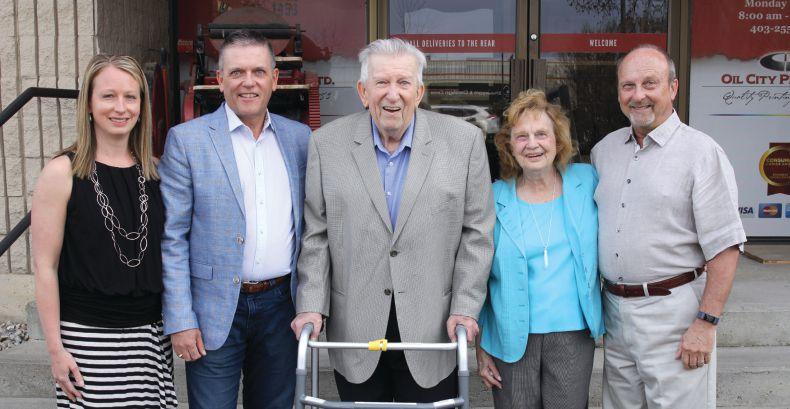
The Kletke family. From L to R: Pamela, Dave, Ron, Linda and Doug.
a better way.
We get why solvent is king. It’s been around for a while, and other options have not been able to compete with its quality.
But that’s changed. Improved water wash technology has arrived, and Flenex plates are the proof. They process 3x faster than solvent and 1.5x faster than thermal, and the lowest cost-in-use is a true difference maker. Plus, Flenex’s natural flat top dot allows high gradation and superior print quality with the ability to hold a 1%, up to 99% dot.
No more disposing of nasty chemicals. No more waiting on drying time. Just 30 minutes of total processing.
Learn more and transform your plates at www.fujifilmpackaginginsights.com/flenex-fw/.