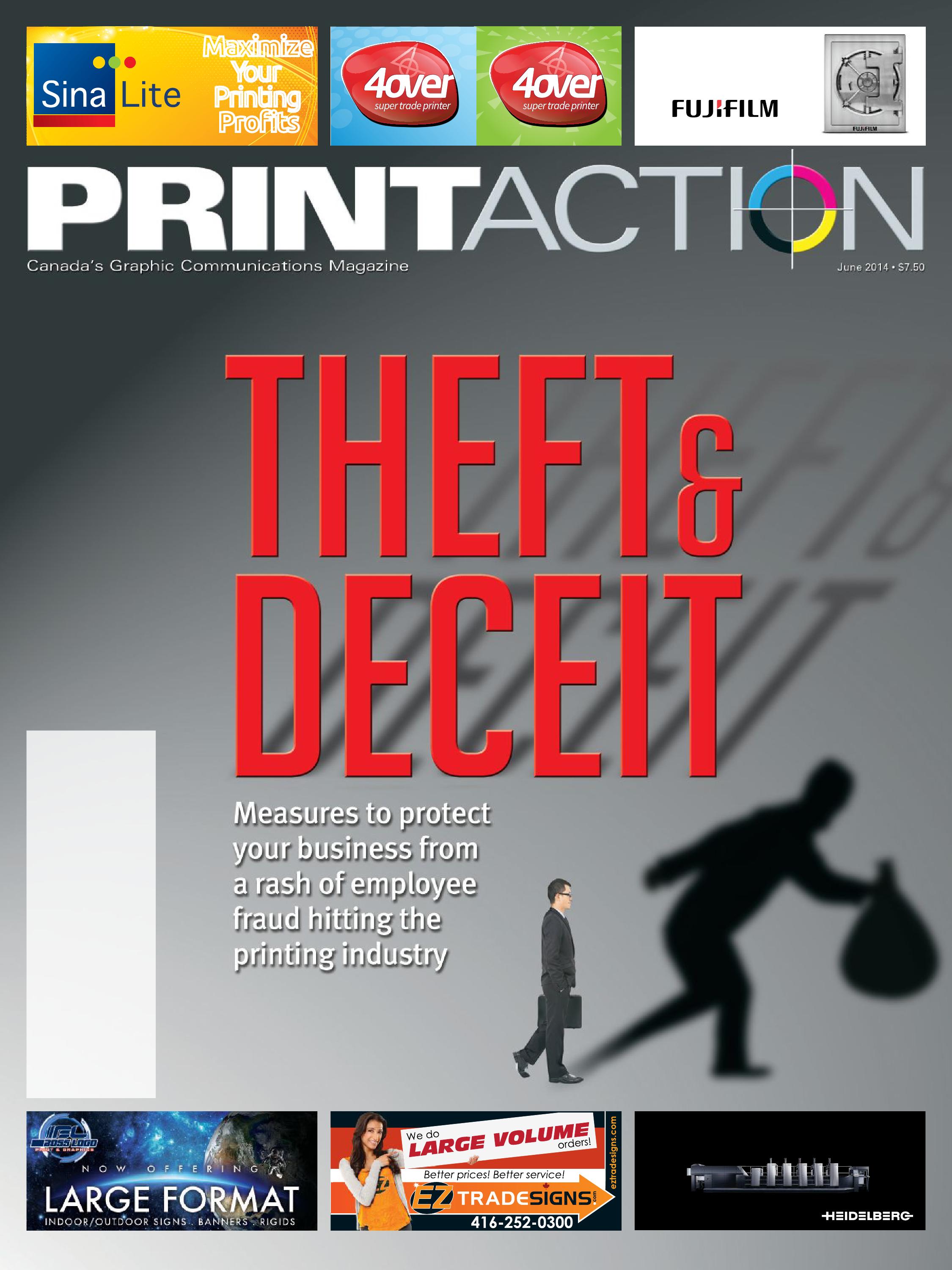
After a series of high-profile fraud cases in North American printing, two forensic accountants and a police detective share lowcost methods for protecting your business 11
Technology Report: Finishing digital and Short-run Work
Categorizing the incredible growth in short-run finishing systems by binding, booklet making, coating, creasing, cutting, feeding and folding 14
NEWS
6
Michael Garcia takes the lead of Domtar, TC Transcontinental inks another newspaper deal with Postmedia, and APP moves to protect the Sumatran Tiger
MARKET & INSTALLATIONS
7
Canstruction generates more than 64,000 pounds for the Vancouver Food Bank, Wayzgoose celebrates the book craft, and Made in Print installs its eighth Xerox press
8
CALENdAR
PAC plans for a Toronto symposium on retail trends and supply-chain sustainability, Proveer wraps more cars, and golfing season continues with the OPIA at Angus Glen
ZAC BOLAN
Parallels desktop 9
Learn how to protect your prepress software investment, particularly multiple generations of key applications, with virtual machines
22
June 1989
The SkyDome opens in Toronto, Chinese citizens make a stand in Tiananmen Square, and the still video camera begins to alter page production in print
Celebrating Canadian Print
A
ndy Paparozzi, Chief Economist for the NAPL, a business management association focused on the printing industry, back in mid-2012 predicted a sustained upturn would soon begin for the printing industry. Although this upturn has been dampened by a still struggling United States economy, which greatly effects Canadian prosperity, marketing budgets finally appear to be returning to normalized levels.
Printing now seemingly suffers with any drop into economic valleys, but there appears to be a new sense of optimism around the effectiveness of the medium. Whether it is because of the growing email deluge or diode-driven messaging on every street corner, the power of print is finding new ground with the true arrival of cross-media campaigns. This is a major reason why PrintAction has added the Cross Media Project category to its 9th annual Canadian Printing Awards (CPA) program, which is now open for submissions. The Cross Media Project category relates to a campaign tying together print and digital communications, linking tools like Augmented Reality, email, Near Field Communications, QR Codes and mobile computing.
PrintAction also added two other significant new categories to this year’s awards program to better reflect important trends in the use of high-end printing. The new Specialty Project category relates to a communications project comprised of at least two distinctly different printing components in addition to supporting materials, containers or unique fulfillment pieces. Over the past couple of years, the CPA program has seen a substantial increase in the submission of such unique and beautiful projects – often accounting for just a handful of final items produced, like pieces of original art.
The new Specialty Effects category relates to a printing project containing an extraordinary use of inks or coatings beyond four process colours, such as thermochromatic, photochromatic, metallic, or pearlescent applications. As print continues to recede in its daily production of process-colour collateral work, which is often relied upon to turn press cylinders across the country, it is vital for commercial printers to adopt emerging technologies to remain in front of their clients. As the marketing world slowed over the past two years, developers of printing technology continued to push forward with the understanding that product differentiation will truly separate industry leaders from those who succumb to the negative outlook outsiders have for this resilient communications medium.
As Paparozzi so eloquently stated back in 2012, printing companies must either prepare for recovery or get left behind – “A rising tide no longer lifts all boats.” PrintAction’s annual awards program aims to celebrate innovation in Canadian printing, culminating with our awards gala on November 6 in Toronto. Full details of the Canadian Printing Awards program can be found at printaction.com/CPA
Jon Robinson, Editor
Canada’s Graphic Communications Magazine. Proudly published for two generations. Editor Jon Robinson • 905.713.4302 • jrobinson@annexweb.com
Contributing Writers Zac Bolan, Peter Ebner, Chris Fraser, Victoria Gaitskell, Dr. Martin Habekost, Nick Howard, Thad McIlroy, Nicole Rycroft, Dr. Abhay Sharma, Trish Witkowski
Publisher Sara Young • 905.726.5444 • syoung@annexweb.com
Associate Publisher Stephen Longmire • 905.713.4300 • slongmire@annexweb.com
Group Publisher Paul Grossinger • 905.713.4387 • pgrossinger@annexweb.com
Advertising Sales Sara Young • 905.726.5444 • syoung@annexweb.com Stephen Longmire • 905.713.4300 • slongmire@annexweb.com
Art Director Clive Chan • 905.713.4301 • cchan@annexweb.com
Publications Mail Agreement Number 40065710 • ISSN 1481-9287
Return undeliverable
addresses to Circulation Department: P.O.
Email: ncuerrier@annexweb.com
brian rEiD, President of TC Transcontinental Printing, announced a new agreement with Postmedia Network Inc. to print The Gazette newspaper, which is published primarily for the Montreal market. This contract compliments two other recent agreements between printer and publisher, including a five-year deal to print the Vancouver Sun beginning in early 2015 and a November 2013 deal to print the Calgary Herald
Choose SFI
asia PulP anD PaPEr announced a new initiative to restore and conserve one million hectares (approximately 2,471,053 acres) of forest across Indonesia, primarily within the Bukit Tigapuluh ecosystem, home to the endangered Sumatran Tiger. The Bukit Tigapuluh National Park, referred to as The Thirty Hills, is a 143,223-hectare system in Eastern Sumatra. APP describes its commitment as being approximately equivalent to the total area of plantation from which the company sourced pulp fibre in 2013. The APP group of companies is one of the world’s largest integrated pulp and paper entities, with an annual combined pulp, paper, and converting products capacity of over 18 million tons.
MichaEl garcia becomes President of Domtar Pulp and Paper to oversee operations of North America’s largest producer of uncoated freesheet paper and a top-three market pulp producer. The company has a network of 13 mills in the United States and Canada. Garcia joins Domtar from his role as CEO of Evraz Highveld Steel & Vanadium Co. in the Eastern Cape of South Africa. In 2013, Domtar had sales of US$5.4 billion from some 50 countries. The company employs approximately 10,000 people.
MullEr MarTini of Switzerland unveiled next-generation saddle stitching heads, which the company refers to as game-changing technology. The re-engineered PerformancePlus II Stitching Heads include industry-unique features that, according to Muller Martini, will revitalize these stitching consumables. Where traditional stitching heads might contain anywhere from 25 to 40 parts, explains Muller Martini, the PerformancePlus II Stitching Heads contain only seven moving parts. The heads feature a 40-millimeter centre-to-centre distance.
hP steps deeper into the packaging world with its new HP Scitex 15000 press for the production of corrugated displays and short-run packaging. The wide-format inkjet press is engineered to run corrugated substrates at speeds up to 600 m2/hour (6,456 ft2/hour). HP expects the machine to be commercially available by November of this year. The Scitex 15000 includes what HP describes as an integrated automatic media loader to handle up to four stacks of stock. It uses HDR240 Scitex Inks, which are GREENGUARD certified for printing indoor point-of-purchase displays,
E ric -Y v E s M ah E joins Eastman Kodak Company as Senior Vice President and Director of Sales Strategy and Operations. He has also been elected as a corporate officer of Kodak, sitting on the company’s Executive Council. In this newly created role, Mahe, 51, is responsible for formulating a strategy to drive and measure sales of Kodak’s portfolio of hardware, consumables, software and services. Prior to joining Kodak, Mahe was based in Singapore with Pitney Bowes Inc., most recently as President, Global Growth Markets, with responsibility for the company’s operations in Latin America, Asia Pacific, Middle East, Africa and emerging markets.
ToraY is now producing its unique waterless printing plates out of a new manufacturing facility at Toray Textiles Central Europe (TTCE) in Prostejov, Czech Republic. The 60,000-square-foot facility, located just outside of the country’s capital of Prague, is producing Toray’s LL-7 commercial-sized waterless plates for European, North American and South American customers, with VG-5 waterless plates to follow. Toray has now invested another €50 million in the site to construct a coating line for waterless printing plates. Toray GM Mitsunori Hayashi explains sales have increased fivefold since 2005, particularly in markets like newspapers, because of the KBA Cortina press, and security printing.
PDs PrEssDown is now distributing a new version of the DigiXpress, traditionally regarded as a system for printing envelopes. The new system, called DigiXpress Hybrid, moves beyond four colour printing with an additional ink channel for applying either white or clear toner, while producing a maximum 1,200 x 1,200-dpi resolution. DigiXpress Hybrid also has the ability to print on substrates of up to 360 gsm (16 point) and to run transfer applications like T-shirts. PDS plans to sell three versions of the DigiXpress including Lite, Bold and Hybrid.
robErT haYashi becomes Director of Sales and Marketing for Toronto’s Webcom Inc. He is to lead the transformation of Webcom’s book publishing programs after the company has invested approximately $27 million in new printing technologies, centered around HP inkjet web presses. Webcom’s inkjet infrastructure is branded through its BookFWD program, which was launched in 2010 and ties directly to HP T300 and T360 presses. Hayashi previously served as the first President and CEO of eBound Canada, a not-forprofit organization focused on advancing digital engagement in the publishing industry. Hayashi also previously held the position of VP of Publishing at Indigo Books & Music.
Dr. anDrEas PlEsskE becomes a member of Koenig & Bauer’s (KBA) management board to oversee the German press maker’s restructuring efforts. The move comes a few weeks after Dr. Martin Hoyos was introduced as Chairman of KBA’s Supervisory Board and Sven Michael was appointed as CEO of KBA-MePrint AG in Veitshöchheim. Plesske will lead what KBA refers to as its Fit@All program, which was approved in December 2013 to realign one of the world’s largest press manufacturers. This effort involves a series of measures, including the elimination of anywhere from 1,100 to 1,500 jobs.
JEff TaPPing, owner of Huge Paper in Aurora, Ontario, reached an agreement to distribute substrates converted by GPA for toner-press production. Huge Paper specializes in the distribution of such substrates primarily in the Greater Toronto Area and southwestern Ontario. Huge Paper is to carry a range of GPA’s Ultra Digital line, including: coated and uncoated papers, specialty fine papers, C1S and C2S boards, pre-converted substrates, pressure-sensitive papers and synthetic substrates. GPA of Chicago is an HP Indigo Preferred Partner and a Diamond Partner of Dscoop.
64,000 Pounds of Canstruction
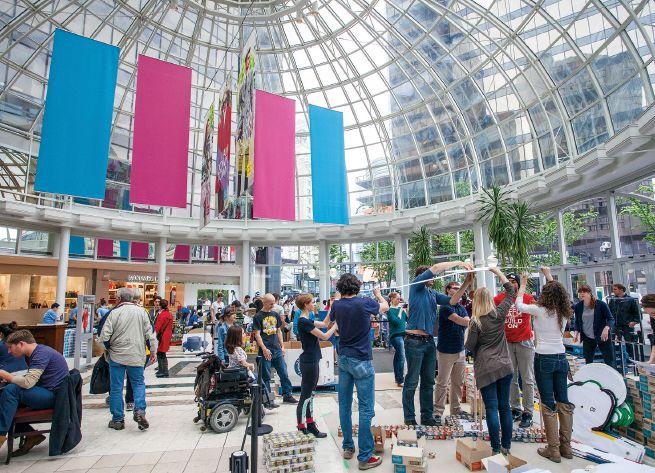
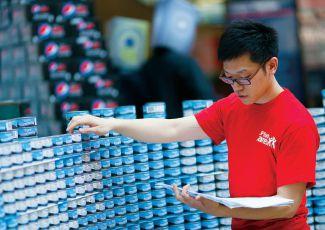
Canstruction Vancouver, an annual non-profit competition founded by MET Fine Printers to build large sculptures out of non-perishable cans, generated more than 64,000 pounds of food to be donated to the Greater Vancouver Food Bank Society.
After two days of building, from May 9 to 11, the sculptures went on public display at three Vancouver venues, including: the Pendulum Gallery, Rotunda at Pacific Centre, and Four Seasons Hotel in the heart of downtown.
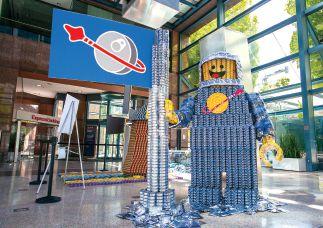
“Inspired by our theme Around the World, we will have astronauts, airplanes, ships, postcards, spiritual moons and travelling gnomes on display,” said Scott Gray, Chair of Canstruction Vancouver, just before judging began.
Now in its 12th year, the 2014 competition features 19 food-can sculptures of approximately 10 x 10 x 8 feet. Organizers estimate the sculptures when combined are comprised of more than 65,000 cans of food.
On May 14, organizers held the ACANamy Awards emceed by Margaret Gallagher, host of Canadian Broadcasting Corporation’s Hot Air program, to present 13 coveted Canstruction Ribbons to both national and local award winners.
Canstruction Vancouver is the local chapter of Canstruction International, a global anti-hunger project that has been held in more than 140 cities worldwide. Since 1992, Canstruction has contributed over 17.5 million pounds of food to community food banks. The Greater Vancouver Food Bank Society provides weekly assistance to more than 28,000 people through 15 food depots and over 100 community agencies located in Vancouver, Burnaby, New Westminster and North Vancouver.
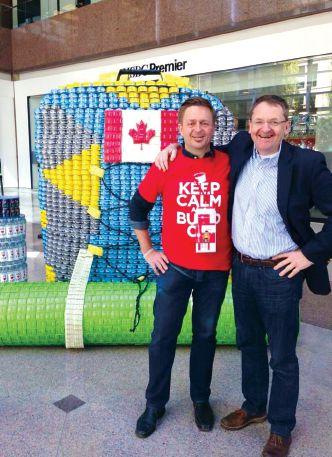
MET Fine Printer’s Scott Gray, Chair of Canstruction Vancouver, and Aart Schuurman Hess, CEO of the Greater Vancouver Food Bank Society (Photo by Danny Chan).
Wayzgoose Celebrates the Book Craft
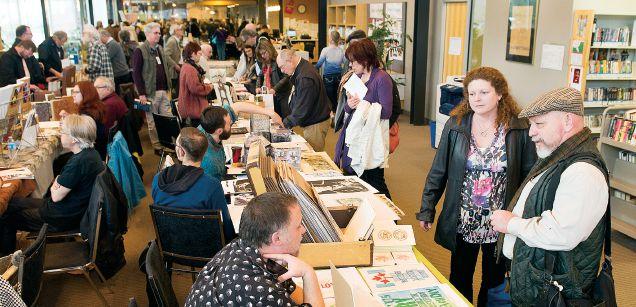
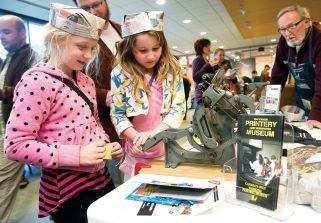
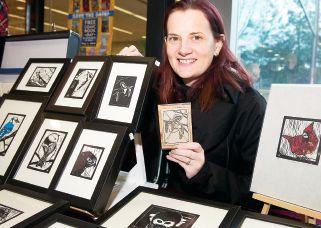
Every year on the last Saturday of April, the Wayzgoose Society brings together people active in book-related crafts, including letterpress printers, printmakers, paper makers and hand bookbinders, who gather at the Grimsby Public Art Gallery. The daylong, free event took place this year on April 26. It marked the 36th year of the Wayzgoose organization, which began as a small gathering of friends and colleagues from the Canadian printing industry. The group’s first event attracted some 300 visitors. The Wayzgoose April 26 book fair drew in more than 2,000 visitors from across Ontario, Quebec and the Northeastern United States. This year’s event also played host to a few travelers from as far away as Europe and Japan.
Canstruction National Award Winners
Canstruction Vancouver is a juried design and build competition where teams of architects, engineers, graphic designers, schools and corporate teams compete to create sculptures out of full cans of food. This year’s 19 teams featured more than 225 builders. Winners of the National Awards will compete against more than 130 cities from around the world in the International Canstruction Competition later this year.
Structural Ingenuity Eiffel Tower Allnorth
Photos provided by Denis Cahill
MIP Installs Eighth Xerox Press
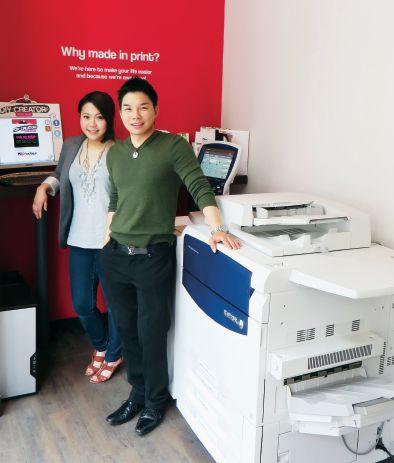
Made in Print (MIP) of Vancouver added a new Xerox Color J75 press. MIP is a network of franchises focused on retail branding and has expanded to seven shops in British Columbia, after opening its first location in Vancouver three years ago. Collectively, MIP now operates eight Xerox systems. The J75 press, employing Xerox’ Simple Image Quality Adjustment toolset, runs at 75 pages per minute on uncoated stocks and up to 51 ppm on coated.
Organizers Begin drupa 2016 Registration
Messe Düsseldorf Gmbh opened up exhibitor registration for its upcoming drupa 2016 tradeshow scheduled to take place in Germany from May 31 to June 10, 2016. Registration for the massive printing industry exhibition, held every four years in Düsseldorf, will close on October 31, 2014. drupa 2016 will be three days shorter than it was in 2012, spanning 11 days instead of 14. Organizers recently announced drupa 2016 is to run under the slogan of “touch the future.” This will include an emphasis on functional printing, printed electronics and 3D printing, as well as growing applications in the areas of digital printing, package and label printing. Claus Bolza-Schünemann, CEO of KBA, is drupa’s Chairman for 2016.
Esko Summit Reaches Toronto, Montreal and Vancouver
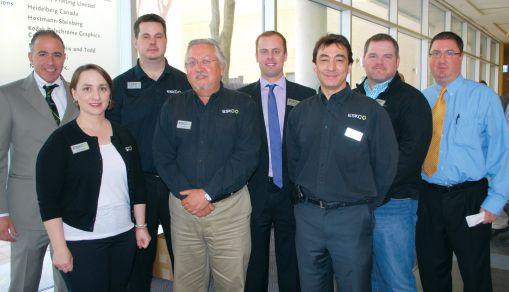
Members of the Esko and X-Rite, both operations controlled by Danaher Corp., converged at Ryerson University’s School of Graphic Communications for the Toronto stop of a 14-city flexography imaging tour – billed as The Esko Educational Summit – across North America. Esko also presented its day-long educational workshop in Montreal and Vancouver, focusing on technologies like ArtiosCAD, WebCenter, Automation Engine and Color Engine.
June 15–18
Esko, Eskoworld 2014
Walt Disney World, Orlando, Florida, $695*
Proveer/Avery Dennison, Car Wrap Workshop
June 19–21
Proveer facility, Dartmouth, Nova Scotia, $999*
June 25
IAPHC Toronto Craftsmen Golf Tournament
Wooden Sticks Golf Club, Uxbridge, Ontario
OPIA Toronto Golf Classic
August 14
Angus Glen Golf Club and Conference Centre Markham, Ontario
August 18–20
Proveer/Avery Dennison, Car Wrap Workshop
Proveer facility, Toronto, Ontario, $999*
September 9–11
Label Expo Americas
Donald E. Stephens Convention Center Chicago, Illinois
September 16–18
Sustainable Forestry Initiative Annual Conference Le Centre Sheraton, Montreal, Quebec
September 28–October 1
Graph Expo
McCormick Place Chicago, Illinois
September 30–October 2
PAC Symposium, Retail Trends and Supply Chain Sustainability
Steam Whistle Brewery & Real Sports, Toronto
October 22–24
SGIA Expo 2014
Las Vegas Convention Center Las Vegas, Nevada
October 30–November 1
Proveer/Avery Dennison 2014
Car Wrap Training
Riley’s Reproductions, Calgary, Alberta, $999*
November 6
Canadian Printing Awards, hosted by PrintAction Toscana Conference Centre, Hilton Garden Inn, Toronto, Ontario Calgary, Alberta
Made in Print co-owners Lillian Lam and Michael Chan with the Xerox J75.
Esko’s team at the Ryerson event included (left to right): Marc Raad, Julie Bauer, Shawn Osborn, Bob Biskner, Joe Eckerle, Julian Fernandez, Paul Plank and X-Rite’s Dave Benner.
Stefan Egge, Managing Director, Messe Düsseldorf Canada (left to right); Sabine Geldermann, Director of drupa, Messe Düsseldorf GmbH; and Eva Rowe, Vice President, Messe Düsseldorf North America.
Parallels Desktop 9
Protecting your software investment with virtual machines
Virtual machines are nothing new, and out of necessity I was an early adopter of the technology. While working in prepress and later in software development a few years back, it was essential for me to have ready access to the Windows environment. Initially, this meant hauling around two laptops in my bulging computer bag, as early operating-system emulators for the Mac were sluggish and limited in function. All that changed when I discovered an early version of Parallels Desktop. With Parallels I was finally able to ditch the ThinkPad and effectively run Windows XP on my MacBook Pro. For the uninitiated, virtual machines (VM) are complete computing environments including operating system, software and user documents/files contained in a single disk image. With a software emulator such as Parallels Desktop, an appropriately configured host computer can run a VM and its applications alongside host-native applications.
When I reviewed Parallels Desktop 8 (PrintAction, February 2013), I had just made the transition to a new MacBook Air with a Solid State Drive (SSD). The differences in speed between the SSD and a conventional hard drive is remarkable, making a virtual machine respond just like a hardware-based Windows workstation. Suffice it to say that the SSD completely changed the way I used virtual machines and put Parallels Desktop on my daily use list.
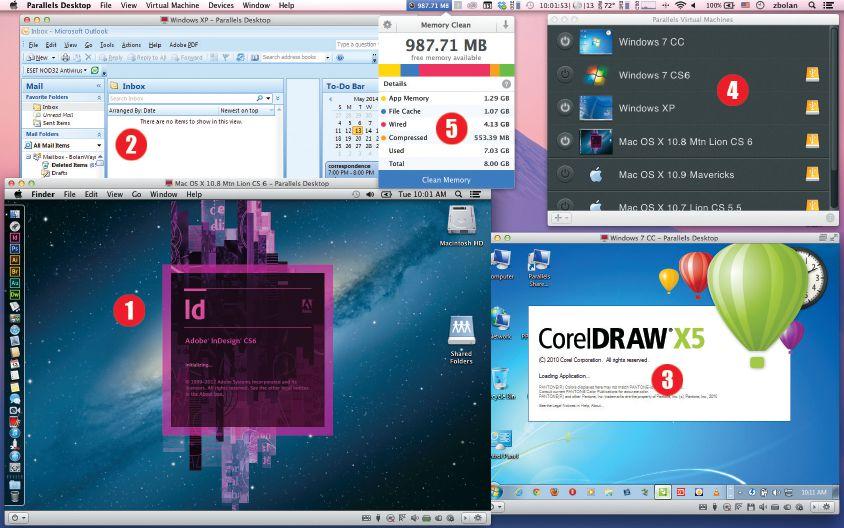
Parallels at work on an 11-inch Macbook Air (2012), 2GHz Intel Core i7/8GB Ram/256GB SSD, running OS X 10.9 Mavericks: q InDesign CS6 running in a Mac OS X 10.8 virtual machine (VM) w MS Outlook running in a Windows XP VM e Corel Draw X5 running in a Windows 7 VM r The Parallels VM list view showing all available virtual machines t 8GB RAM disappears quickly when using multiple VMs simultaneously. Memory Clean, a free App from FIPLAB available in the Mac App store, can help you keep tabs on your RAM.
Released in September 2013, Parallels Desktop 9 improves an already robust hardware emulator with a host of new features, including: Support for Windows 8; Thunderbolt and Firewire device access; multi-monitor settings remembered; iCloud, SkyDrive and Dropbox sync; and an enhanced wizard making it considerably easier to setup a new virtual machine. The biggest reason to upgrade is speed, however, as Parallels Desktop 9 runs noticeably faster than version 8. Parallels claims up to 40 percent better disk performance in Desktop 9 in addition to faster start-up, shutdown and suspend times. While I often take marketing claims of this nature with a grain of salt, this one seems to stand true. My virtual machines were significantly speedier after migrating to Desktop 9.
Of course, your mileage will vary based on the configuration of your host computer. To be effective, virtual machines need to live on a speedy machine such as a late model iMac, MacBook Pro or Air. While the stated memory requirements for Desktop 9 start at 2GB, users will find that more is better in this department, as a sizable block of memory must be assigned to the virtual machine OS. My current MacBook Air has 8GB RAM which is more than adequate for Parallels Desktop 9 – but my next Mac will have at least 16GB RAM or more, if available. Likewise, you do not need an SSD to run Desktop 9, but your user experience will improve dramatically if you do. Fortunately, SSD prices are coming down as more manufacturers include them in new machines and aftermarket upgrade drives become commonplace.
Alongside Desktop 9, Parallels launched Parallels Access, an iOS App enabling users to access and run applications from their Mac and VM on an iPad. Parallels Access is available on an annual subscription basis.
Why do you need a virtual machine?
You would be forgiven to think that the only reason to run a virtual machine on your desktop is to get Windows running on your Mac. After all, Parallel’s Website and packaging both scream “RUN WINDOWS ON YOUR MAC” in large red print. What many do not realize, however, is that Parallels Desktop can accommodate a wide range of 32-bit and 64-bit Guest Operating Systems including Linux, Solaris and every flavour of Windows ever devised, as well as legacy Mac OS X operating systems back to OS X 10.5 Leopard Server.
So why would you want to run an older version of Mac OS X as a virtual machine on your Mac? Simple –protecting your legacy software investment. As prepress
departments deal with a wide range of clients and an even wider range of source files, it is important to maintain older versions of production critical applications such as Adobe Creative Suite and QuarkXPress. Many prepress pros concurrently keep multiple generations of these applications on their workstations so they can work with customer files in the specific version in which they were created – thus avoiding text reflow and other potential file problems.
Also, with each new Mac OS X iteration comes new features and enhancements enticing users to upgrade. These new capabilities often come at a price, however, as older applications may no longer work as effectively – or at all – with the latest Mac OS X. By building a bespoke virtual machine for each major version of the Mac OS users can install and run older applications in the environment they were designed for. For example, I currently run a Mac OS X 10.7 (Lion) VM for Adobe Creative Suite 5.5 and an OS X 10.8 (Mountain Lion) VM for Creative Suite 6. These VMs can either run on the host computer in their own window, in full-screen mode, or in their applications side-by-side with host applications using Parallel’s Coherence mode.
Creating a Mac OS X VM is a relatively easy process with Parallels Desktop 9. After launching Desktop 9, select ‘New’ under the File menu and the Wizard will walk you through the steps. Assuming you acquired your Mac OS upgrades through the App Store, your older operating system installers will be available under the ‘Purchases’ menu and available for download. For Mac OS X installs before version 10.6 (Lion), you will need to find your original installer DVD. Once you have created and are running your VM, install and register your legacy software as you would on any Mac.
Another major advantage of virtual machines is the ease in which they can be backed up and duplicated. Users need only copy the Parallels disk image to another drive for backup, or to another Mac with Parallels installed to use the virtual machine elsewhere.
Considering Adobe’s recent decision to stop selling perpetual Creative Suite licenses it seems prudent to ensure you will always have access to your last ‘owned’ version of Creative Suite should you decide to work outside of the Creative Cloud. Housing your second CS6 install in a Mountain Lion VM, for example, is one way to ensure you will always have access to Photoshop, regardless of how Mac OS and Apple hardware evolve.
Zac Bolan’s blog: blog.softcircus.com
dept.
dept.
• 4 Epson 9900 Color Proofers, CGS O.R.I.S. RIP, 44” Certified GRACoL 7 with Built-in SpectroPhotometers
• Two 44” Fuji Fully Automated CTP Machines: 300 Line Screen Standard
• Canon IPF8000s 2 Sided Digital Color Dylux Proofer
• 2 Konica Bizhub Pro with Perfect Binding and Saddle Stitching
• Xerox Nuvera 120
• Digital UV Coater
• Inca S40i Onset Larger Format Super High Speed Digital Printer with Pro-Brite.
• Inca S20 Onset Large Format High Speed Digital Printer with White
• Fuji 96” Acuity Advance HS HD2545 x2 Color High Speed Flat Bed and Roll Feed, with White Ink
• 98” Scitex 6 Color Flatbed and Roll-Fed UV Printer
• Epson 64” Stylus Pro GS6000, 8 Color Ultra Chrome GS High Speed Roll Feed
• Durst 50” Lambda Photographic Imaging
• Two 62” Laminator / Mounters
• Zund I-cut Digital Flatbed Cutter
• Kongsberg Digital Flatbed Cutter with Auto-Load
• Heidelberg CD 102 40” UV 6 Color with Interdeck Curing and UV Anilox coater/Aqueous
• Heidelberg 40” 8 Color Perfector with Aqueous Coater
• Heidelberg 40” 6 Color with Aqueous Coater
• Mitsubishi UV 40” 6 Color with Inline UV Curing and Aqueous / UV Coater
• Color King 40” 4C (2/2) Web, Folds 32 pg. Signatures at 20,000 sph
• Heidelberg 20” 5 Color GTO
• Heidelberg 18” 2 Color Speedmasters
• Royal Zenith 5 Color Web Press
dept.
• 9 Pocket, 8 Pocket, and 6 Pocket Saddle Stitchers
• Mûller Martini 21 Pocket Perfect Binder
• 7 STAHL, 3 MBO Folders
• 85”, 60”, 44” and 30” Guillotines
• 40” Brausse Diecutter
• Digital Diecutting
• Horizon 9 Bin Collator / Stitcher
he printing industry is continually plagued by cases of employee fraud. During the five years I managed the Ontario Association of Quick Printers, I was surprised by the number of small business owners who confided that at some point their company had been defrauded out of ruinous sums by staff – often a long-term employee whom they thought they knew well and trusted...
Cases of staff fraud at printing companies reported in just the past 12 months, include:
Michael Britt, 31, charged with 13 counts of forgery occurring over more than five years and resulting in the theft of over $1 million from Gene-Del Printing, the Brentwood, Missouri company co-owned by Britt’s mother and three partners. Britt allegedly wrote at least 166 unauthorized cheques to himself using forged signatures of two of the company’s owners, fabricated fraudulent invoices for the cheques, and made at least $25,000 in unauthorized purchases on a company credit card.
Christina and Brian Russo, a married couple, both in their 50s, charged with stealing more than $657,000 from Harmony Press of Easton, Pennsylvania. Christina Russo allegedly wrote hundreds of unauthorized cheques to her husband and herself using a rubber stamp with the owner’s signature.
Leona Gebhart, the 70-year-old former comptroller of Henderson’s Printing in Altoona, Pennsylvania, charged with stealing at least $151,130 over 11 years by allegedly writing unauthorized company cheques to herself (including duplicate and triplicate paycheques), manipulating petty cash, and falsifying documents, while allowing the company’s Federal tax payments to become delinquent.
With all these past and present horror stories in mind, I spoke to Robert Fowlie and David Malamed, forensic accountants at leading Toronto financial and business advisory firms, and Detective
Constable Keith Nakahara of the Halton Regional Police Service Fraud Unit (Commercial Team) to learn what printers can do to protect themselves from devastation by employee fraud.
How employee fraud works
Nakahara’s region of Ontario, including the towns of Oakville and Milton, has one of the highest per capita incomes and one of the highest rates of fraud in Canada. He observes that business fraudsters have no particular motivations or characteristics in common except that they have too much control with too little supervision – a position that creates overwhelming temptation for some people. “Don’t automatically assume you can trust somebody based on a family connection or the length of time you’ve known them,” he warns. “In business the most common fraud we see is committed by a person in a position of trust with limited oversight, typically a bookkeeper or accountant who has a certain amount of control over what facts get released, so the fraud may go undetected for years.”
Both Fowlie, a partner at Deloitte LLP, and Malamed, a partner at Grant Thornton LLP, have long strings of credentials after their names certifying them as fraud experts. Besides investigating alleged cases and preparing financial information for use in court, they also work proactively to establish preventative controls.
Both say smaller print shops are more susceptible to fraud than larger companies if their smaller staff count results in less separation of duties. In other words, the person writing the cheques may be the same person reconciling the bank accounts and doing the accounting, so he or she can readily conceal bogus payments to themselves or fictional third parties.
In billing fraud, phony vendors may
get paid, or an individual working in procurement for a company starts his own business, buys raw materials at cost, marks up the prices exorbitantly, then sells the materials to the company he works for. In payroll fraud, wages may be paid to a fictitious employee or somebody who was terminated still gets paid via deposits to an account controlled by the fraudster.
Verify bank and accounting records
Fowlie and Malamed say a good way to detect fraud is for owners to obtain their bank statement directly from the bank and review it monthly (or else delegate the review to an internal third party knowledgeable and reliable) to ensure that each payment and vendor is legitimate. They also recommend comparing your list of vendor and delivery addresses with your employees’ addresses and regularly reviewing the payroll journal that
most companies submit to an external third party for processing.
“In a recent trial we uncovered that, even after review and approval of payroll information, a clerk was still able to make changes by adding payments to herself and terminated employees to an account she controlled and make accounting entries to cover up these payments,” warns Fowlie. “Our clients thought they were in control when in fact the process was not operating as they intended.”
Nakahara suggests that the notes in your company’s year-end financial reporting may also identify specific items of concern: “For example, ledgers that don’t match bank payments and the bookkeeper’s explanation dismissing the discrepancy as a computer glitch may warrant closer investigation.”
Expenses, consumables and cheques
Another big area of concern is employee expense accounts, says Malamed: “Expense fraud is epidemic among all organizations. It’s the number-one trend I see.”
Fowlie explains: “In today’s tougher economic climate, some families have gone from two to one income or experience no growth in income against growing expenses. Under new financial pressures, some people feel forced to do things they have not done before. Perhaps this is one reason we’re seeing an up-tick in fraudulent employee expense claims involving false documentation or duplicate claims.” He warns that Websites even exist where users can print out receipts for fictitious claims.
As a remedy, he says companies must check every detail of expense claims submitted by employees and require each item to be supported not only by legitimate documentation but also within business rationale.
“Another form of fraud happens if I cook and sell steaks in the restaurant where I work, then pocket the customer’s money because the owners don’t know they were sold,” says Malamed. “This type of transaction is also possible in
the printing world, where press or prepress operators could be running their own jobs on the side using the owner’s resources.” Since consumables like toner, ink, and paper are expensive and highly transactional, he thinks there could also be a secondary market for them.
One preventative measure he suggests owners can take is to project what the company’s sales should be based on consumption of supplies. If either the sales or the supplies in stock fall short, they need to investigate why.
“Don’t get carried away with the business and forget to look at the numbers,” he insists. “The numbers tell the story. Perform your own analysis to see if things add up.”
Typically, in cheque fraud the names of payees or dollar amounts on cheques are changed, or duplicates are issued of the same cheque. “Usually cheques are numbered sequentially, so if number 005 shows up a few times, it’s a red flag,” says Malamed. (Red flags are warning signals that deviate from correct practice and may point to the presence of fraud.)
Fowlie says organized criminals commonly perpetrate a counterfeiting scheme by intercepting a company’s cheque in the mail and taking it to a printer to obtain fake blank copies. Then they write the fake cheques to third parties, who cash them and return some of the proceeds to the organized criminals.
“This is the reason why in Europe payment is typically arranged through wires and direct transfers to avoid cheques being intercepted and compromised and counterfeits being written against the account,” explains Fowlie. “Some of my clients have lost millions of dollars through this type of scheme because they didn’t monitor their accounts closely or were unprotected in terms of the way their account was set up.”
As a preventative measure, banks operate something called Positive Pay programs in which companies pay the bank a fee (something like 20 cents) per cheque and provide the bank with standard information on cheques they issue like cheque numbers, payees’ names, and dollar amounts. If the information written on a particular cheque differs from their records, the bank will hold the cheque and notify the company. “Some companies think the cost of a Positive Pay program is too expensive; however, if you’re lacking in segregation of duties, it may be the least expensive way to handle the problem of cheque fraud,” says Malamed.
Staff and hiring issues
Nakahara says before hiring any employee in a position of financial trust it is important to have the person sign a pre-employment contract that clearly delineates the basis and limitations of the job. He explains that fraud is the crime of obtaining money or some other benefit for the perpetrator or someone else by deliberate deception. Thus, to prosecute fraud, police need evidence both of a theft and of the deceit the fraudster used
to commit it.
He says a lot of cases get thrown out of court because the fraudster claims that the business owner knew about and approved the transactions in question. Without corroborating evidence on either side, the case boils down to the fraudster’s word against the owner’s and is likely to get tossed. Thus the pre-employment contract should specify
that: (1) the person will not gain by any transaction without the knowledge and consent of the owner, and (2) the owner’s approval of any transaction must be stated in writing.
Additionally, before hiring accounting and payroll personnel, Fowlie advises owners to call their former employers. If, for example, his client’s company had checked on the payroll clerk mentioned
earlier in this way, they would have learned she was charged by the RCMP for doing the same thing at a previous employer’s company.
But Nakahara says doing systematic police background checks on prospective employees only provide a false sense of security: “The checks only reveal when people are convicted, not charged, and for various reasons conviction rates are
...Sunday Presses
Higher productivity. Lower costs. New opportunities.
Step up to the most productive and agile presses available and open the door to new, more competitive web offset production possibilities.
Finishing Digital and Short-run Work
With the now ubiquitous installation of toner presses in commercial printing operations, lines are blurring between what is a true digital finishing system versus a true offset finishing system, particularly as toner format sizes increase. While many of the following technologies can be applied to both printing processes, there has been tremendous growth in shortrun finishing machines to handle the demanding substrates now used on toner presses.
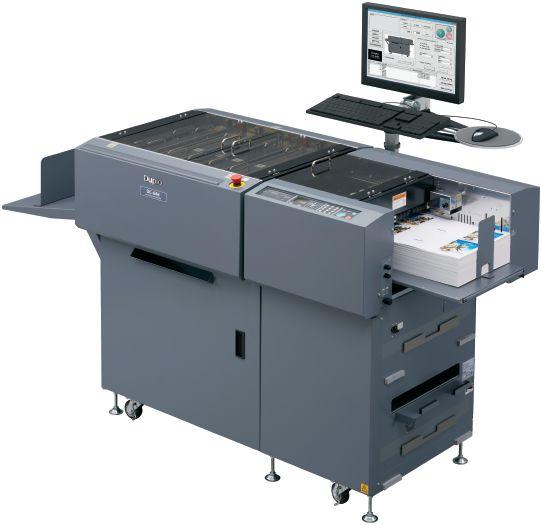
Duplo DC-646
Duplo in January 2014 launched its new mid-range DC-646 Slitter/Cutter/Creaser. Engineered to succeed the DC-645, it performs up to six slits, 25 cuts, and 20 creases in a single pass (compared to six slits, 15 cuts and 10 creases on the DC645). The new system eliminates white borders and, according to Duplo, prevents toner cracking on fold lines up to 30 sheets per minute. The machine also has an optional rotary tool and cross-perforating modules. Users, among a series of applications, can create 24-up business cards, slit-score greeting cards, and micro-perforated coupons.
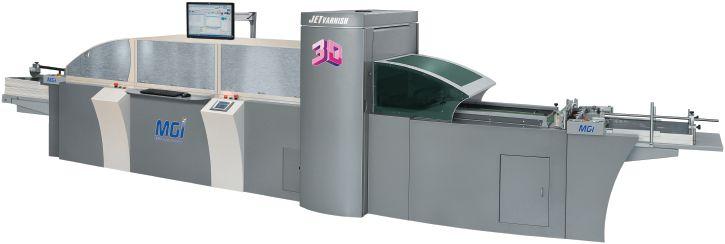
MGI JETvarnish 3D Twin
MGI introduced its JETvarnish 3D inkjet spot UV coater in mid-2012, but recently (September 2013) provided new options for the system, including the JETvarnish 3D Twin: A second print engine increases 3D effects production speed up to 2,234 12 x 18-inch sheets per hour. Users also have the option to apply double coating thickness in one pass up to 200 microns, which can reach into new markets like braille. The JETvarnish 3D can also now include iFoil to apply real foil (rather than coating over metallic film) inline on the system. The JETvarnish 3D can apply spot UV coating at speeds of up to 3,000 B2 (20 x 29-inch) sheets per hour and produce 3D raised effects of up to 100 microns in thickness. The system also handles sheet sizes of up to 20.5 x 42 inches and variable data pages.
Technologies Featured Binding
• C.P Bourg BB3002 PUR-C
• Duplo UltraBIND 2000 PUR
• Gateway Total Koil Binder
• Heidelberg Stitchmaster ST 200 Compact
• Morgana DigiBook 150
• Muller Martini Presto II
• Standard Horizon BQ-280PUR
• Watkiss PowerSquare 224
Booklet Making
• C.P. Bourg ExPress
• Duplo 150C Booklet System
• Sitma WM10
• Watkiss BookMaster Pro 30
Coating
• Graphic Whizard VividCoater XDC-530 Micro
• MGI JETvarnish 3D Twin
• Scodix Rainbow
• TRESU iCoat 30000
Creasing
• Duplo DC-646
• Morgana Autocreaser Pro-500
• Technifold CreaseStream Mini Series
Cutting
• Challenge CMT 130
• Colter & Peterson Microcut
• KAMA ProCut
Feeding
• Standard Horizon SmartStacker
Folding
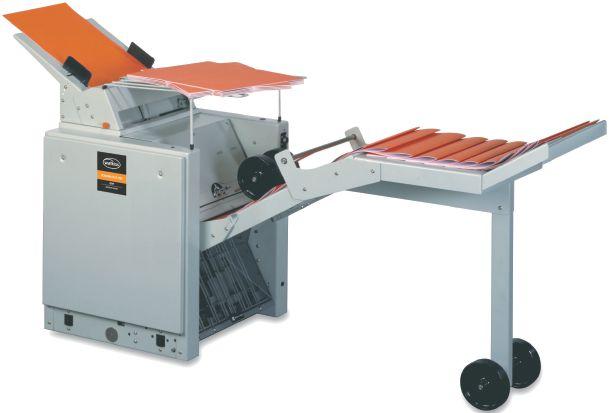
• Graphic Whizard PT370 IKF
• MB Bäuerle prestigeFOLD NET 52
• MBO K8
• MBO M80
• Morgana Digifold Pro-500
Other
• Profold Linx Pro+ tabbing machine
• Sitma WM30
Watkiss BookMaster Pro 30
Watkiss’ new BookMaster Pro 30 booklet maker can produce booklets of up to 120 pages. It features a new Android-based touchscreen interface and an increased stapling capacity. Options for the BookMaster Pro 30 include a face-trimmer and a Watkiss SpineMaster to convert the booklets to square-back books. The company also released a new CuceA3 entry-level booklet maker, which processes sheets from A5 to A3+ with standard or loop staples into booklets or edge-stapled sets.
BOOKLET MAKING
Muller Martini Presto II
The Presto II (introduced May 2012) is a small- to mid-size saddle-stitching system designed to integrate roll or flat sheet printed toner material with conventionally printed signatures. It can also be configured as a standard stitcher, with components added to make it suitable for toner work. The recently introduced Solit Three Knife Trimmer operates at 4,500 cycles per hour with an 85-mm trim thickness capacity. The Solit’s automation platform is designed to perform in both toner- and medium-run offset production environments. It is modeled after Muller’s Orbit platform. The Solit relies on the company’s patented SmartPress technology for trimming.
Gateway Total Koil Binder
The new PT370 IKF knife folder, designed for finishing toner work, uses two knives to fold sheets up to 350 gsm. The PT370 IKF – working with sheet sizes of up to 14.5 x 33 inches – can be handfed or placed inline with creasing machines like the CreaseMaster or PT series. This includes the recently introduced PT370A creaser that works with a maximum sheet size of 14.5 x 25.5 inches (39 inches when hand-fed) and a minimum format of 4.75 x 3.25 inches. The PT370A can perform up to 16 creases per sheet and up to 50 jobs can be stored into longterm memory. The system has a rated speed of 3,250 sheets per hour, handling a stock weight of up to 16 point.
Challenge CMT 130
The recently introduced CMT 130 is a modular book-trimming system with a controller for data entry and storage of up to 99 jobs. Hydraulic clamping and cutting works with up to 2-inch thick books. It is designed to process up to 200 books per hour in single book mode or up to 500 books per hour with an optional multiple-book mode. The CMT 130 can be configured as a hand-fed offline trimmer or for what Challenge describes as true inline trimming by substituting the book pile feeder with an in-feed conveyor and cooling elevator. It can also be equipped with an optional high-capacity feeder that allows up to 36-inch (914 cm) of books to be stacked and automatically fed into the trimmer. The optional vertical stacker allows up to 24-inch (609 cm) of books to be delivered.
The new Total Koil Binder is a compact machine with combined roller insertion for thinner books and spine-forming placement for the thicker books up to 50 mm. Gateway explains the prepunched thinner book has the operator starting the coil into the first few punch holes and then making contact with the roller inserter to drive the coil forward. A thicker book is placed on the spine formers, creating a curve to the binding edge. The operator then starts the coil into the first few holes and foot pedal operation drives the coil forward through the remaining holes. The positioning of the thicker book, explains Gateway, also enables the operator to open the book slightly to aid the insertion process.
TRESU iCoat 30000
An adaption of the TRESU’s Digital Sheet Coater technology, the new iCoat 30000 is designed specifically to work inline with the new HP Indigo 30000 press, which itself is aimed at the folding carton market. The coating system can be configured for use with UV-curable coatings or for hot air drying of water-based coatings. Flexo sleeve technology delivers flood, pattern or spot coating in a single pass.
Watkiss PowerSquare 224
Watkiss launched its new PowerSquare 224 booklet-making system, designed to produce stitched square-back books of up to 224 pages thick. The machine features a new auto-adjustment system for uninterrupted running when streaming jobs. It can be fitted with OCR for variable content documents with different page counts.
Graphic Whizard PT370 IKF
7 Ways RS Superior Saves You Time and Money
1. ONE-STOP SHOP
Die Cutting, Bindery, Data & Lettershop –all under one roof.
2. ONGOING INVESTMENT IN SUPERIOR TECHNOLOGY
Die crease without a die, then fold and even glue all on the same machine, up to 30 pt.
3. INTEGRATED MODULAR UNITS
Combined in-line finishing: crease, fold, glue, tipping, envelope inserting, ink jetting (Duplex), clip seal (3 sides), mail prep.
4. SAVE ON POSTAGE COSTS
As a Certified Canada Post Direct Marketing Specialist, we get contract pricing reductions.
5. RETURN MAIL PRODUCTS
Customized “Return Mailers” created in-line with “U” or “BOX-shape” remoistenable glue, time perfed applications and envelope formation.
6. MINI-BOOKLETS
We can saddle-stitch and trim 2-up booklets in-line to the size of a business card. No need to trim off-line, or do 2 passes.
7. HIGH SPEED EQUIPMENT
High speed Tipping, Folding, Saddle-stitching and soft folding ensuring on time delivery.
BINDING
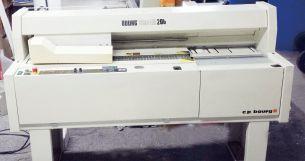
C.P Bourg BB3002 PUR-C
The BB3002 PUR-C perfect binder, first introduced in May 2012, is designed as a compact system with a top speed of 285 books per hour – when not applying PUR, which is delivered through a Nordson Compact melt system with two to four kilogram glue capacity. The binder automatically adapts to the thickness of each job, up to a maximum thickness of 2.36 inches. The BB3002 allows for up to 13 positive or negative creases. The Bourg BB3202 perfect binder is designed to operate inline with a range of toner presses and finishing configurations, including the Challenge Machinery Trimmer 330 and 130 series. It can also be combined with the new Bourg BBL Book Loader option for unattended operation.
MBO K8
MBO America launched its new K8 RS combi-folder in April 2014, after first introducing the technology last fall at an open-house event in Oppenweiler, Germany. The company describes its K8 RS combi-folder as “the world’s fastest folding machine.” With production speeds of up to 275 metres per minute, the K8 RS represents a 20 percent speed increase over MBO’s previous K8 Perfection folder. The new machine is described as allowing for 1:1 printing to folding production, based on its ability to better match the speeds of today’s modern sheetfed and toner presses. Like its predecessors, the K8 RS can be outfitted with variations of the S-KTL and S-KTZ cross-fold units, as well as an automation package to improve make-ready times.
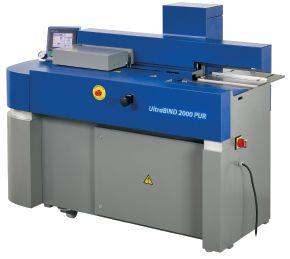
Duplo UltraBIND 2000 PUR
Duplo in April 2014 launched its single-clamp UltraBIND 2000 PUR perfect binder as what the company describes as the world’s smallest closed-tank PUR system. Using its patented Orbital PUR system, Duplo rates the UltraBIND 2000 PUR with a cycling speed is 290 per hour and the start-up time less than 20 minutes. Duplo also states the system can be cleaned in less than five minutes.
C.P. Bourg ExPress
C.P. Bourg introduced its new Inline Bourg Booklet Maker ExPress in September 2013 designed specifically for the HP Indigo 7000 press series. It is aimed at the full-colour booklet-making segment of the stitch-fold-trim finishing market. The ExPress is based on the company’s existing Bourg BM-e Booklet Maker and Bourg BCM-e Bleed Crease Module with the ability to handle the duplex 2-up format of HP Indigo 7000 presses. The Bourg BM-e includes a visible straight paper path; variable-pressure paper folding designed to prevent marking, scuffing or scratching; face trimming to within 1/256th of an inch (0.999 mm); misfeed detection; and job purge, among others. The optional Bourg BCM-e can register and trim printed sheets top and bottom to produce full-bleed A4- and letter-size booklets. The Bourg Booklet Maker ExPress can transport and finish print produced on coated and uncoated stock from 80 gsm to 350 gsm.
MB Bäuerle prestigeFOLD NET 52
MB Bäuerle of Germany recently launched its prestigeFOLD NET 52 featuring a double alignment table (DAT 24). The system can be connected to a Pit Stop DH speed creaser and hot-melt unit for self-mailer production. The creased sheets, for example, are transported onto prestigeFOLD NET 52’s alignment table for further processing in a single pass, reducing the risk of markings or scratches. A feature of the double alignment table, explains MB Bäuerle, is the choice between producing 1- or 2-up applications by entering the required information via the touchscreen of the folding machine. All further settings at the DAT are then made automatically. If producing a 1-up product, the alignment rail that is not needed automatically moves to the side. prestigeFOLD NET 52 is pre-programmed with 20 standards folds and can set data of more than 200 jobs.
Sitma WM30
Sitma of Italy launched its new WM30 paper wrapping system, like other Sitma systems, for making envelopes from a paper reel. The high-speed WM30 is aimed at high-volume direct mail and door-drop manufacturing. It can create envelopes with dimensions from C6 up to C4 with a mechanical speed of up to 30,000 cycles per hour. This machine can be supplied inline with paper reel, with cut-sheet or with double infeed system from paper reel and cut-sheet to match different documents.
Morgana DigiBook 150
The Morgana DigiBook 150 (introduced May 2012) is a PUR binder designed for toner production and joins an existing line of DigiBook machines. The DigiBook 150 is capable of producing 150 cycles per hour and can bind publications with a spine thicknesses from 2 mm through to 50 mm. The DigiBook 300 (introduced in late2011) can bind up to 300 books per hour and the line top machine, DigiBook 450, can produce up to 450 cycles per hour with automatic cover feeding. Morgana’s recently enhanced DigiCoater line is available in 33- and 50cm formats. The DigiCoater 33 is an entry-level coater with three tanks and one coating roller that can change between gloss, matt and textured finishes. DigiCoater 50 works with larger sheets sizes up to 500 mm. It is available in two versions: One with four tanks and two coating rollers and the second version comes with six tanks and three coating rollers.
Colter & Peterson Microcut
Colter & Peterson recently released two new versions of its Microcut automated back-gauge control system, available for paper cutters between 20 to 150 inches in width, including the Microcut COLOR WS and Microtrack II. All Microcut systems are designed to memorize cutting sequences, allowing the back-gauge to automatically position itself to deliver a cut within 1/64 of an inch. The new Microcut COLOR WS, using an 8-inch wide touchscreen control, is designed to guide the correct position movement faster and more accurately using a computer guidance system. The new Microtrack II is a digital display and programming guide designed to increase the accuracy and productivity of manually operated paper cutters.
Duplo 150C Booklet System
The entry-level 150C Booklet System debuted in September 2013. It incorporates the new DBM-150 Bookletmaker with Duplo’s existing DSC10/20 suction collator. The system, handling sheet sizes of up to 12 x 18 inches, includes an Isaberg Rapid Stapler within each mechanism and a 16-job memory. Optional features include a corner-and-side stapling kit, as well as a sheet-by-sheet kit. The 150C Booklet System produces up to 2,400 booklets per hour.
Scodix Rainbow
Scodix Rainbow (introduced mid2012) is described by the company as the world’s first in-house inkjet glittering station, which is designed for applications like photo-album covers, marketing materials, cosmetics and premium packaging, business cards, and wedding invitations. Scodix has also recently introduced add-on modules like Inkjet-Braille to recreate standard raised Braille formats and the S Series, a VDP module using clear polymer or glittering, as well as a the Scodix Barcode System.
Standard Horizon SmartStacker
The Horizon SmartStacker (introduced May 2012) can convert – using JDF – a B2-size toner sheet into 28 individual cut sheets. The system was developed in cooperation with HP and designed to run in-line with the B2-format HP Indigo 10000 press. The SmartStacker can also run near-line with sheet feeding capability up to 4,500 B2 sheets per hour. The SmartStacker edge trims and gutter cuts for up to seven sheets in one direction and four in the other for fullbleed trimming. It can deliver finished product such as posters or postcards, straight or offset stacked, individual sets or book blocks, or bypass to inline finishing for saddle-stitching, perfect binding or folding.
The M80, introduced May 2013, is a modular buckle-folding machine available with a range of interchangeable components that can be installed after the initial purchase. The machine features an in-feed width of 83 cm and production speed capability of up to 230 metres per minute. The 30-inch format folder is driven by the new M1 control designed for easy use through an intuitive touch screen process.
MBO M80
BINDING
Standard Horizon BQ-280PUR
Graphic Whizard VividCoater XDC-530 Micro
The recently introduced VividCoater XDC-Micro is an ultra-violet coating system with a footprint smaller than 3 x 3 feet, while running a speed of up to 2,700 sheets per hour. Using a standard IR and wiper blade, and vacuum hold down, the system allows for variable coating thickness control, from 5 to 25.4 microns, and variable speed control. It holds a nine-pound coating capacity, which the company describes as handling over 5,000 sheets. The VividCoater XDC-Micro works with a stock range from 128 to 450 gsm.
FOLDING
Morgana Digifold Pro-500
The Horizon BQ-280PUR, introduced in February 2013, provides single-clamp PUR perfect binding, particularly aimed at finishing short-run toner production, such as books. The BQ-280PUR can be operated by a single person and includes a sensor-activated caliper system for book-block measurement. The system includes what Standard describes as fully automated set-up (carriage clamp, milling, glue tank, nipping and cover feeder), an elevator delivery system, and special processing for extended spine length up to 15.5 inches. The BQ280PUR reaches production speeds of up to 400 books per hour.
CREASING
Technifold CreaseStream Mini Series
Morgana unveiled its new Digifold Pro500 in April 2014 as a next-generation technology, which is expected to reach market after mid-2014. Digifold Pro-500 is rated to operate at 6,000 A4 sheets per hour (sph). Using a new high capacity vacuum top feeder, the Pro-500 holds much larger sheet piles, relative to its predecessor, of up to 500 millimeters. It also handles paper stocks up to 400 gsm. Other new features include dual creasing blades, which can be set for up or down creasing profiles, as well as different creasing thicknesses and automatic set up of folding rollers, previously set manually.
The new CreaseStream Mini Series is engineered to eliminate fibre cracking in toner printing and to provide what Technifold describes as letterpress-quality creasing. The machines, which also provide micro perforating, rely on Technifold’s patented Tri-Creaser technology to eliminate fibre cracking irrespective of grain direction. There are three models in the line referred to as Standard (manual), Quick-Feed (semi-automatic) and Auto-Feed (fully automatic). With adjustable in-feed guides, the machines crease 100 lb text up through 120 lb cover or 14 pt, as well as toner text stocks ranging from 60 lb to 100 lb, while working with a sheet sizes from 3 x 5.75 inches up to 20.4 x 20.4 inches.
CREASING
Morgana Autocreaser Pro-500
Morgana unveiled its new Autocreaser Pro-500 in April 2014 as a next-generation technology, which is expected to reach market after mid-2014. The Autocreaser Pro-500 features a new high capacity vacuum top feeder. It operates at 8,500 sheets per hour and features a new dual-creasing-blade design to handle varied stocks – allowing for fewer blade changes. The system is suited for perfect-binding work based on new profile setting for both hinge and spine creasing.
Heidelberg Stitchmaster ST 200 Compact
The Stitchmaster ST 200 Compact (introduced June 2013, commercially available around September) is designed for low-cost saddle-stitched work of up to A3 format, such as stitched brochures, processing end formats as large as 330 x 500 millimeters (12.99 x 19.69 inches). The machine, versatile for both short- and long-run work, operates at a speed of up to 11,000 cycles per hour. It can be equipped with up to four double feeders and a cover folder feeder. In addition to these feeders, all the other components like the stitching unit and trimmer are fully automatic via separate servo drives. New make-ready assistant software takes operators step by step through the setup process. Like the Stitchmaster ST 500, the Stitchmaster ST 200 Compact can also be used as a gathering machine for adhesive binding. It can be integrated into workflow using Prinect Postpress Manager for production data and costing.
Profold Linx Pro+ Tabbing Machine
Profold, a Florida-based systems integrator of mail- and card-finishing equipment, exhibited its new generation Linx Pro+ Tabber. The company explains this new technology is well suited for sorting unwrapped magazines for the postal system. It uses a single 19-inch spool, with web threading, and a patented twist-belt sealing assembly. The machine can place one to four tabs in a single pass, applying a single tab to products at speed of up to 30,000 per hour. With an optional 4.5-inch label kit, the Linx Pro+ can apply Post-it Notes.
Sitma in April 2014 released its new WM10 machine for making plastic covers (with two pockets) meant to protect books. The dimensions of the books (and covers) can be entered into the machine manually, via company network or with an optional system that automatically recognizes the dimensions of the book to be protected. Each cover for the softback or hardback book can be personalized with individual data, such as name class, logo, book title or price, by means of a thermal printer installed on the WM10. The WM10 runs at the speed of up to 1,000 books per hour.
The KAMA ProCut and DC die cutting and foiling machines feature camera-based automatic registration for what the company refers to as a complete finishing solution. The system includes an AutoRegister feature to match each sheet to a print mark. The KAMA ProCut and DC die cutters with AutoRegister and SBU are available for B3 and B2 format (21 and 30 inches). Applications include hot-foil stamping, blind embossing, die cutting and creasing, which is then completed with stripping, blanking and shingled stream delivery on the SBU.
KAMA ProCut
CUTTING
Sitma WM10
BOOKLET MAKING
low in comparison to the larger number of people who are actually committing fraud. So no amount of front-end due diligence can replace ongoing due diligence in a business operation.”
Fowlie says due diligence should include remaining alert to changes in staff’s behaviour and financial well-being, such as someone suddenly living outside their means. Additionally, he says people involved in fraud often do not take vacations to prevent their fraud from being detected; so refusal to take vacations is often a red flag.
If you suspect fraud
Fowlie encourages businesses to review their insurance policy with their broker or insurer to make sure it includes coverage not only for fraud, but also for fees for a forensic accountant to conduct an investigation on their behalf, if necessary.
If you suspect someone of fraud, he says it is not prudent to confront the individual straight away. Rather, you should first conduct an investigation and strategize about what is to be done. “I have seen companies accuse and fire longtime employees, only to discover the problem was not fraud but careless accounting,” he cautions.
If an investigation substantiates fraud, Nakahara advises owners to be aware that perpetrators usually plan an escape, so that even if they are removed from their job, they can still continue to defraud the company. So the most appropriate course of action is not only to remove the person from the job completely, but also to notify your bank and other financial institutions that the person no longer has the authority to transact business for your company.
Nakahara also recommends you let the fraudster know you have gone to the police, which might make them stop robbing you of more money or prompt them into a legally useful verbal response – something police call a “spontaneous utterance” – such as an admission of guilt or an offer to pay you back the stolen money, which you should carefully make note of.
As the victim, you can also file a complaint with the police, usually in the district where you work or reside. In fact, to pay out on a crime insurance policy, most insurance companies require police to lay criminal charges to validate that the fraud has occurred with reasonable probable cause. A subsequent criminal conviction on the charges in court gives the perpetrator a police record which may prevent the person from repeating the offence at other companies.
Sometimes, if a business is not covered by insurance for fraud, or insurance does not cover the entire loss, the owner may also elect to pursue a civil lawsuit against the perpetrator to try to recover stolen money. In this event, Fowlie says forensic accounts are often enlisted to investigate the fraudster’s assets to determine how much recovery might be possible.
Fraud risk assessment
Fowlie points to statistics from the global Association of Certified Fraud Examiners (ACFE) showing that some business-
es are defrauded as often as every two to three years. And because prevention costs are generally lower than the cost of a fraud investigation, he urges businesses to become proactive about prevention.
Malamed concurs: “Prevention is my key focus. Every dollar you spend on prevention saves $10 or $20 on reaction – not including dollar loss. If there’s one message I want to scream from the top of buildings, it’s ‘Put preventative techniques in place!’”
One thing a business can do is hire a forensic accountant to conduct a fraud risk assessment of its operations, which reviews all of the company’s activities to determine the types of fraud it is exposed to and develops preventative internal controls.
As with legal fees, you pay for the consultant’s professional expertise, so the cost of a fraud risk assessment can be high. But Fowlie explains: “Like lawyers, most forensic accountants will first meet with you for an hour to understand your business and prepare a quote on how much time and money will be required to assess the entire organization. Some will also help figure out a budget that will work for you, since it is possible to perform the assessment in stages, one division or function at a time. You can start with the most vulnerable area the first year, then assess the rest over time.”
Awareness training and whistleblower programs
Malamed suggests two more important anti-fraud services available from companies like his, which are affordable to small- and medium-sized companies: fraud awareness training and whistleblower programs. Fraud awareness training educates employees, owners, and stakeholders on how to identify red flags. A whistleblower program enables employees to anonymously point out instances where potential fraud exists.
“For example, in one investigation, I asked the employee I was interviewing: ‘Didn’t you find it unusual when the manager asked you to make journal entries on Friday nights and Saturday mornings instead of during regular business hours?’” recalls Malamed. “With awareness training, the employee would have realized this timing was a red flag, and a whistleblower program would have given him a way around his feelings of discomfort about questioning a manager’s orders directly.”
Malamed says research by ACFE shows that over 40 percent of fraud is identified by tips. Giving employees a way to report it without worrying about backlash increases the odds of detection. ACFE statistics also show most fraud take about 18 months to identify and result in an average loss of $140,000 over this time. But for companies with controls in place like awareness training and whistleblower programs, detection time goes down from 18 months to nine months and average loss from $140,000 to $77,000.
PREPRESS & DIGITAL OPERATOR WANTED
Full time Experienced Prepress & Digital Operator required in Downtown Toronto. Operating Konica Bizhub 6500, 7000 & 1060 with Fiery & Creo Software.
Digital: Process files accurately and efficiently.ProficientwithAdobeCreativeSuiteCS5+. Please send resume to: info@qprint.ca
MERGER OR ACQUISITION
We are looking to acquire or merge with a printer that has 40” capabilities in the GTA. We have an established client base. Contact searching40@hotmail.com
PRODUCTION PRINT CONSULTANT - GTA
The Production Print Consultant has the responsibility for successfully leading sales engagements and negotiating complex business relationships for Xerox Digital Press, Inkjet technology and associated third-party finishing, integrated software and workflow solutions. The Consultant will lead the building of a healthy pipeline of close-able business to grow revenue. The Production Print Consultant will need to collaborate with multiple sales resources to ensure a successful close of the sales cycle and solution implementation.
MAJOR RESPONSIBILITIES
• Minimum 100% achievement of Total Sales Revenue Plan
• Thought leadership and sought out by clients for business advice
• Leads sales cycles into larger commercial print, trade print, and packaging accounts and must have expert understanding of the supported products and lines of business
• Expert knowledge of industry trends, competitive landscape, workflows (from pre-press, plate business and MIS solutions), and in the utilization of the relevant Xerox tools
• Leads qualified opportunities from development to delivery following the key steps of the sales cycle such as executive presentations, customer workflow studies, assessments of the customer business with their recommendations
• Knowledge transfer, coaching and support of assigned Sales Team(s)
Go to printaction.com/marketplace for more details. Send resume to employmentopps@xerox.com
CP BOURG BB2000 Perfect Binder - in working condition. Willing to show a live demo. $3,750 or best offer. Contact info@qprint.ca or call (416) 366-0374
PRODUCTION SUPERVISOR REQUIRED
Production Supervisor required for our Printing Services Group which specializes in the production of photo gifts including photobooks, calendars and cards. Reporting to the Production Manager, this position will plan production operations and co-ordinate the activities of employees engaged in the manufacturing of our products. For additional details and to apply, visit www.fujifilm.ca and click on “Careers.”
PRODUCTION SUPERVISOR AND PRODUCTION COORDINATOR
Requirements: Strong knowledge of sheetfed & web printing process, computer skills in print MIS software.
• Schedule and coordinate the flow of work between Prepress, Printing and Finishing departments to ensure delivery dates are met and production time is maximized.
• Communicate with customers. Take orders
• Review Work Orders before releasing to Production and revise schedule according to Work Order specifications, established priorities and availability of workers, material and equipment. Actively contribute in carrying out the daily functions of Printing and Finishing departments as required based on workload, holidays, etc.
• Act as an internal technical resource for product applications and ideas.
• Provide leadership and guidance to other Plant employees and offer advice for process improvements.
Email resumes to hrdept@west-star.com or Fax (416) 201-0920
EMPLOYMENT OPPORTUNITY
Print Finishing Estimator required. Markham, Ontario. Full time position. Experience and understanding of print finishing (mounting, die-cutting and finishing) is an asset. Position available immediately. Salary to be negotiated. Veda@lamacutting.com
BINDERY OPERATOR WANTED
Commercial printing company is currently seeking experienced full time folder operator. Experience on other bindery equipment an asset. Email resume to email@battlefieldgraphics.com
BROKERAGE FOR SALE
Would you like to expand to Quebec? Need representation? Brokerage since 1990 for sale. Bilingual services and established volume up for discussion. Contact Carol: 6388216@gmail.com
WANTED
Used HP Indigo presses wanted. We’ll pay more to buy 5000/3500, 5500/5600, 7000/7500, WS4050/4500, WS6000. Contact kevin@heiostrade.com or call (416) 875-7586
ESTIMATOR WANTED
Experience in estimating/print production/ customer service for sheetfed and web printing. Computer skills in print costing software, excellent communication skills. Print management degree an asset. Email resumes to hrdept@west-star.com or Fax (416) 201-0920
OFFER NEW PRODUCTS
Offer new products, increase your profits! Cheques Plus will print and ship 100% CPA compliant computer and manual business cheques to your clients with your branding. Call 877.888.7163 x107, email corporate@chequesplus.com or visit www.chequesplus.com
BUSINESS FOR SALE
Well established digital print shop located on the busy Danforth excellent opportunity for new or existing operator. Rent $1,975 plus hydro asking $79,000. Contact Shane: 416-703-6621 ext 244 Shane.jamieson@metcomrealty.com
PRESS OPERATOR WANTED
Somerset Graphics, located at 370 Brunel Road, Mississauga, Ontario, seeks full-time permanent offset press operator.
Wage $24.00 per hour plus group insurance and possibility of bonus.
Location: Mississauga. Some high school required as well as five years of experience, including apprenticeship.
Essential skills include: Reading text, Document use, Numeracy, Writing, Oral communication, Working with others, Problem solving, Decision making, Critical thinking, Job task planning and organizing, Finding information, Computer use, Continuous learning. Duties include: Mount plates or cylinders and make necessary adjustments, Fill ink fountains and control colour and viscosity, Set up press and operate at slow speed to check samples, Monitor regular press run for quality using computer control console, Remove and clean plates and cylinders at end of press run, Set up and adjust in-line binding and finishing equipment, Direct press crew to set up, operate and shut down press. Send resume by email to jobs@somersetgraphics.com
Heidelberg: K-Line/S-Line/ Speedmaster/GTO/MO
Komori: 1,2,4 or 5 colours & an Adast : 714/715/724/725
Mitsubishi: Any model
Ryobi: : 2800CD/3200CD
Itek: 960/975/985
Hamada: 500/600/700/800
Polar: 72/82/90/92/107/115 CM
Horizon-BQ: 220/240/260/440/460
June 1989
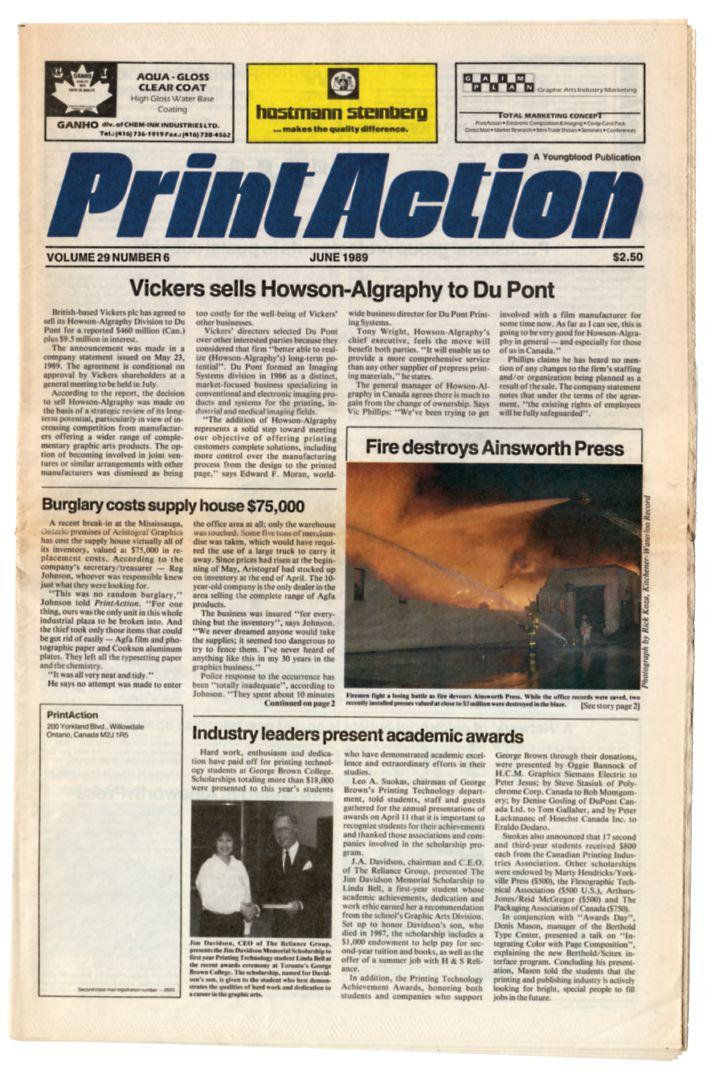
Toronto Blue Jays SkyDome stadium opens; Billy Smith, last original New York Islander, retires; and 10,000 Chinese soldiers are blocked by 100,000 citizens protecting students demonstrating for democracy in Tiananmen Square, Beijing.
Fire destroys Ainsworth Press
An early morning fire swept through Ainsworth Press in Kitchener, Ontario, causing more than $10 million in damages and leaving behind little more than portions of the building’s concrete walls. Firefighters reached the scene at 2:30 am but the fire spread quickly due to the amount of paper stored on site. Several small explosions occurred when drums of chemicals burst.
While the fire razed most of the 50,000-squarefoot building, computer disks (stored overnight in a bank vault) and records were saved. Destroyed, however, were a newly installed six-colour Heidelberg press valued at $1.75 million and another press valued at about $1.1 million installed a couple of months ago. Ainsworth Press, owned by JEMCOM Inc., is a commercial printing plant specializing in colour work, film separations, state-of-the-art computer graphics, and creative and design facilities.
development in Electronic Photography:
From original to print-ready plate
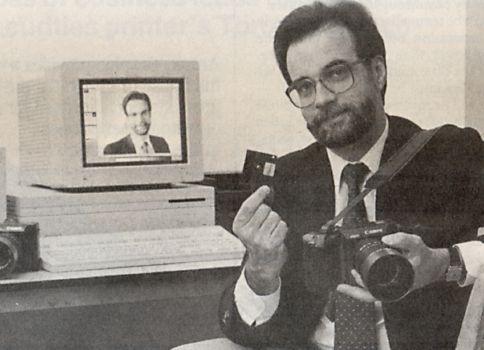
Author Douglas Rea shows the Canon PC still video camera, Macintosh computer and still video floppy disk used in the recent experimental work on electronic photography
The cameras have a special mechanical shutter that in some cases permits shutter speeds ranging from 1/8 to 1/2000 per second. After a picture is made, this electronic image is converted to a NTSC video format (analogue) and recorded onto a two-inch floppy disk, which closely resembles a standard 3 ½ inch computer floppy disk Depending on the recording format selected, a photographer can make either 25 or 50 pictures on one still video disk.
A technician can make a photograph using any manufacturer’s still video camera and play it back on another manufacturer’s still video player. The disk is reusable in the sense that after you review pictures, those unwanted shots can be erased from the disk and new pictures recorded in their place.
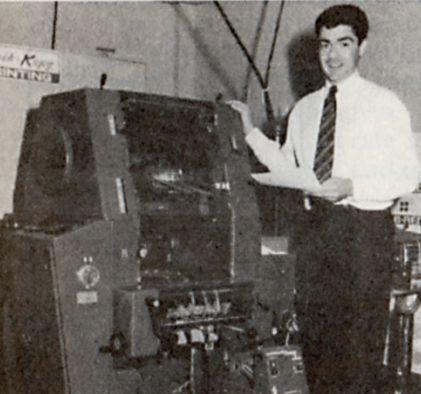
Peter Lazanis of Montreal’s largest Kwik Kopy franchise displays the firm’s new Heidelberg T-Offset. Impressed with the “phenomenal” performance of his T-Offset, Lazanis is already negotiating for a second.
Montreal Kwik Kopy Installs T-Offset
at RIT.
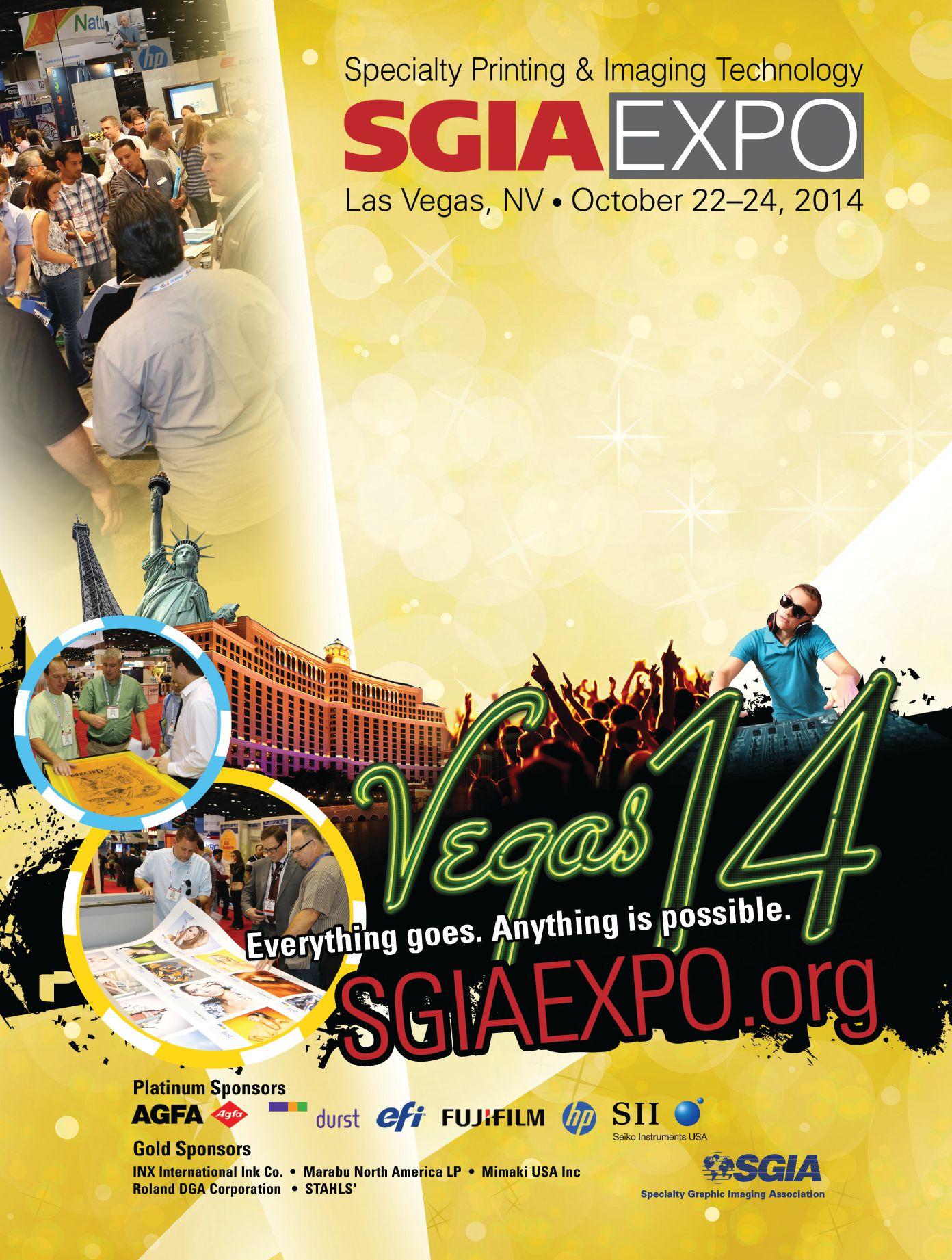
Everything goes. Anything is possible.
Las Vegas and the SGIA Expo have this in common: Everything goes, and anything is possible. The industry’s most diverse group of educated attendees comes together each year for the annual Expo, and industry leading exhibitors pack the trade show floor with equipment, innovation and solutions.
It’s the only place to see the latest imaging techniques, newest garment decoration technologies and cutting-edge industry applications.
Sign up to be notified when registration opens, and get ready for your Expo experience in Vegas, baby.