Opportunities and challenges within one of the most-attractive print segments
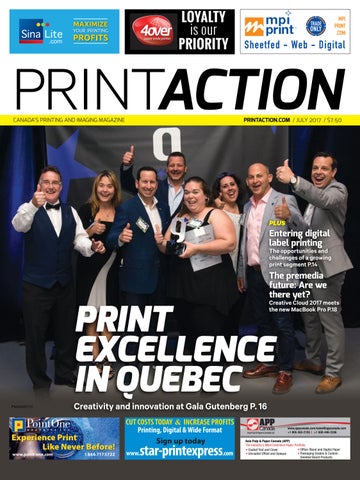
16 Celebrating Print in Quebec
The innovation of provincial printing powers gather at Gala Gutenberg
Creative Cloud 2017 meets the new MacBook Pro and its Touch Bar
DEPARTMENTS
GAMUT
5 News, People, Calendar, Dots, Installs, Globe, Archive
TECH REPORT
20 Web to print
Technology suppliers provide their newest storefront tools to drive print
NEW PRODUCTS
How companies are saving money by digitizing workflow processes 14 26 6 16
23 Detailing the newest technologies from CET Color, Crawford Technologies, EFI, GMG, Nustream, Sharp and Techkon
MARKETPLACE
25 Industry classifieds
SPOTLIGHT
26 Scott Gray discusses Mitchell Press’ new digital printing initiatives
COLUMNS
FROM THE EDITOR
4 Jon Robinson
Essential Internet trends
Mary Meeker’s annual report includes insights for print amid online growth
TECHNOLOGY
10 Rick Huijbregts
Keeping your plant floor secure Manufacturers have been, and will continue to be, the target of cyberattacks
DEVELOPMENT
12 David Fellman
But I know where everything is
The organization of your workspace can increase your sales opportunities
DIGITIZATION
13 Mohan Mailvaganam
It’s not just about saving paper
Essential Internet trends
In mid-2017, Mary Meeker, an analyst with Morgan Stanley and Kleiner Perkins investor, released her annual Internet Trends Report, which is viewed by the business world as one of the most important reports on the current direction of technology and media industries. The report, this year with 353 slides, is loaded with statistical analysis covering everything from online advertising and the cloud to Chinese Internet initiatives and interactive gaming.
“It’s not really a ‘shift to mobile’ as much as ‘the addition of mobile’, since desktop usage hasn’t declined much while mobile usage has skyrocketed to over three hours per day per person in the U.S.”
Editor Jon Robinson jrobinson@annexweb.com
Contributing writers
Google and Facebook control 85 percent of online ad growth according to the recently released Kleiner Perkins 2017 Internet Report.
As highly read Techcrunch.com explains, “This is the best way to get up to speed on everything going on in tech. Kleiner Perkins venture partner Mary Meeker’s annual Internet Trends report is essentially the state of the union for the technology industry. The widely anticipated slide deck compiles the most informative research on what’s getting funded, how Internet adoption is progressing, which interfaces are resonating, and what will be big next.”
Fortune magazine broke down its view of the report by compiling its 10 Big Takeaways, including: 1. Smartphone growth is slowing (installations were up 12 percent in 2016 compared to a 25 percent increase in 2015), 2. Online advertising is growing thanks to mobile (revenue from online ads was up 22 percent in 2016 compared to a 20 percent increase in 2015), 3. Voice is on the rise (Amazon’s Alexa, Apple’s Siri, and Google Assistant), 4. The bar for quality customer support is rising (82 percent of customers stopped doing business with a company in 2016, up from 76 percent in 2015), 5. E-commerce is growing (number of packages shipped in the U.S. rose nine percent in 2016), 6. Video gaming is evolving (now a $100 billion business globally), and it’s still early days, 7. Streaming media is growing (streaming services now represent 52 percent of music recording revenue compared to zero percent 13 years ago), 8. China is in the golden age of mobile entertainment (China’s mobile Internet users rose 12 percent in 2016 to 700 million), 9. Transportation is growing in China too, and 10. Internet competition in India is heating up (country’s smartphone shipments were up 15 percent in the first quarter of 2017).
One of the most promising report takeaways provided by Techcrunch.com, relative to the printing industry, is that “email spam with malicious attachments is exploding as cloud usage increases, so be careful what you click.” The technology news Website also points out, while smartphone adoption is slow there is a major growth in mobile communications, which will impact the printing industry.
Looking through the 69 slides dedicated to online advertising trends, which are most pertinent to the printing industry, the report finds that online advertising is slowing on the desktop but dramatically increasing on mobile mediums, as much as 22 percent year over year. Collectively, desktop and mobile accounted for US$73 billion of Internet advertising in 2016. The report finds that Google and Facebook control 85 percent of all online ad growth.
Looking at the percentage of time spent in media versus percentage of advertising spend in 2016, the report found time spent with print was four percent among all mediums, including radio (9 percent), TV (38 percent), Internet (20 percent) and mobile (28 percent). Print’s percentage of the advertising spend, however, was 12 percent, larger than radio’s spend at nine percent and relatively close to the Internet spend at 20 percent.
Another positive to come out of the report for the printing industry is that online ad blocking is continuing to rise at a fast pace. In fact, the report found that Canada, at 24 percent, had the second largest desktop ad-blocking penetration amongst 11 selected countries. Germany had a desktop ad-blocking rate of 28 percent and the U.S. 18 percent. Canada’s mobile ad-blocking rate was not measured but it was only one percent in both Germany and the United States, while developing markets had much higher rates, including Indonesia at 58 percent, India 28 percent, and China 13 percent. Globally, the report found that there were more than 225 million desktop ad-blocking software users, surmising, “Users increasingly opt out of stuff they don’t want.”
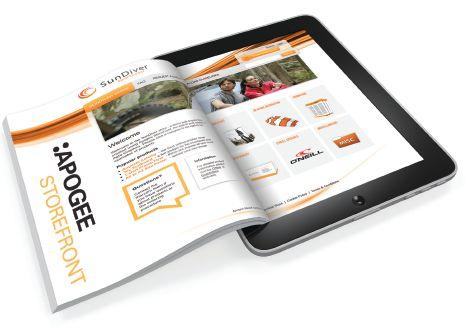
The report also focused on what it describes as the growing impact of targeting (combing data with direct mail, for example) and online-offline synergies in marketing and merchandising. It used phrases like the Digital-Physical Feedback Loop and Offline Engagement (catalogues) to create direct touch points in the physical world. One of the best ways printing companies can capitalize on this important trend of mixed reality, shifting between digital and physical worlds, is to invest in online storefronts, which are driving enormous e-commerce growth.
JON ROBINSON, editor jrobinson@annexweb.com
Zac Bolan, Wayne Collins, David Fellman, Victoria Gaitskell, Martin Habekost, Nick Howard, Neva Murtha, Abhay Sharma
Publisher Paul Grossinger pgrossinger@annexweb.com
416-510-5240
Associate Publisher Stephen Longmire slongmire@annexweb.com
416-510-5246
Media Designer Lisa Zambri
Circulation Manager
Barbara Adelt badelt@annexbizmedia.com
Customer Service
Angie Potal apotal@annexbizmedia.com
Tel: 416-510-5113
Fax: 416-510-5170
Mail: 80 Valleybrook Drive, Toronto, ON, M3B 2S9
COO
Ted Markle tmarkle@annexweb.com
President & CEO
Mike Fredericks
Subscription rates
For a 1 year monthly
subscription (12 issues): Canada — $40.95
Canada 2 year— $66.95
United States — CN$71.95
Other foreign — CN$140.00
Mailing address
Annex Business Media 80 Valleybrook Drive Toronto, ON, M3B 2S9 printaction.com Tel: 416-442-5600 Fax: 416-442-2230
The Burke Group of Companies acquired McCallum Printing Group. Both are located in Edmonton, Alberta, bringing together two of the leading print and media companies in the region. “As the printing industry progresses, we understand that diversification is the key to long-term growth and prosperity,” said Ian Burke, CEO of Burke Group. “So, when we saw the opportunity to join forces with McCallum Printing – one of our largest and most respected competitors – I jumped in with both feet.” Darren Pohl, McCallum Printing’s former President and CEO stays on in a senior management capacity to oversee sales management.
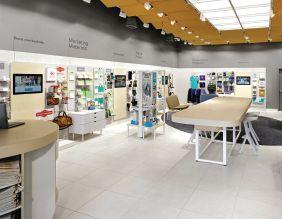
Vistaprint Studio in Toronto provides free design services.
Vistaprint opened its first ever bricks and mortar retail space in downtown Toronto. The location will offer free design services, which the company estimates might cost as much as $100 per hour elsewhere, and face-to-face help from the store’s VP Coaches. A recent survey of the company’s North American customer base found that nearly two-thirds (64 percent) of business owners want
technologies for the graphic arts industry. Komcan is the dealer for AMS in Canada. The new entity of Baldwin, part of the $2+ billion Barry-Wehmiller family of companies, will rebrand as AMS SPECTRAL UV, which currently has operations in River Falls, Wisconsin; Easton, Pennsylvania; and Slough, UK. AMS explains its current install LED UV base is nearly 10 times larger than its nearest competitor. According to market intelligence provider Yole Development, the total value of the UV LED market worldwide is projected to grow to US$1 billion-plus in the next five years.
silver nanostructure has set a new standard for cost, durability and flexibility, making it a promising option for thin solar cells, printed and flexible electronics, touch screens and smart windows. Compared to typical silver nanowire, the synthesis process for NanoCnet’s nanomaterial is faster and can occur at room temperature – essential for low-cost manufacturing.
more 1:1 in-person support when designing their marketing materials. The store will be open six days a week.
Crawford Technologies of Toronto, which provides document solutions to manage customer communications, has been named to the Branham300 list of Canada’s Top Information and Communication Technology (ICT) companies for the seventh year in a row. Ranked by 2016 annual revenues, the listing is published by Branham Group. Crawford’s growth in 2016 represented the strongest financial year in its 21-year history, demonstrated by the introduction of nine new products in fiscal 2016. The company has more than 1,800 customers on six continents, including some of the world’s largest banks, insurers, healthcare providers, utilities and print services companies.
Baldwin Technology, a global producer of UV, LED UV and IR drying systems, acquired Air Motion Systems (AMS), which provides LED UV curing
Asia Pulp & Paper Canada in June expanded its sales network to provide paper and packaging products to printers, publishers and paper converters in Eastern Canada, following a recent expansion into Saskatchewan. The company will directly ship its wood-free coated and uncoated text and cover, opaque printing paper, gloss and silk paper, copy papers, and packaging boards to Nova Scotia, New Brunswick and Prince Edward Island.
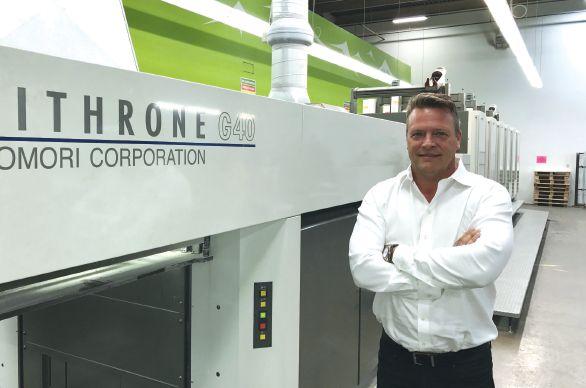
Annex Business Media acquired Aquaculture North America, Hatchery International and Crane & Hoist Canada media brands from Capamara Communications of Victoria, B.C. “Crane & Hoist Canada will complement our existing heavy construction and resource media group, and we see the aquaculture business as a sustainable, long-term business to be in, especially given the international reach of these magazines,” said Annex COO Ted Markle. Annex’ primary printing operation is based in Simcoe, Ont. with a 40-inch Komori perfecting press.
NanoCnet Ltd. received the first Startup of the Year award at CPES2017, a conference and trade show for printable, flexible and wearable electronics, produced by the Canadian Printable Electronics Industry Association (CPEIA). NanoCnet, explains CPEIA, has manufactured a transparent conductive film using silver nanowires so thin that they are invisible to the human eye. CPEIA continues to explain this stable
The Allimand Group, designer and manufacturer of paper and nonwovens machines, is to supply a new paper machine for the production of the security paper required for the printing of Euro banknotes. This machine is currently being installed at the Europafi mill in Vic-le-Comte (Puy-de-Dôme), a European public fiduciary centre and will go into production at the end of 2017. The euro is known to be one of the most secure banknote in the world, with 10 apparent security features, including holograms, magnetized inks and secret signs, plus a complex encryption of banknotes and a watermark. Based on an overall investment of more than 75 million euros, the future paper machine is to hold a width of 2.55 metres and a length of about 100 metres.
Fortress Paper of Vancouver, BC, won a contract from the Central Bank of the Bahamas to use Durasafe, the proprietary banknote substrate of Fortress Paper’s wholly-owned subsidiary, Landqart AG, for the two highest denomination banknotes of its Crisp Evolution series. The company expects its Landqart will begin shipments in 2018. In March 2017, the company began Durasafe shipments for the Swiss 20 Franc.
Graphic Communication Advisors has been formed, according to the consulting group, to bridge a gap left by association mergers, downsizing or elimination. The founding team members of Graphic Communication Advisors, include: Sid Chadwick, Gary Field, Laura Gale, Raymond Hartman, Hal Hinderliter, Nelson Ho, John Hyde, Frank Kanonik, Malcolm Keif, Harvey Levenson, William McLauchlan, Michael Murphy, Ray Prince, Frank Romano, Peter Schlosser, Steve Suffoletto, John P. Sweeney, Robert Tapella, Janet Treer, Richard Warner, and William Woods Jr.
Ernie Crawford, President and CEO of Crawford Technologies.
Burke Group’s owner and CEO, Ian Burke.
Ted Markle, Annex COO.
Brent Becker, CEO of Baldwin.
INSTALLS
Yuval Dubois becomes Chief Executive Officer of Presstek LLC, which he joined in 2013 after the company acquired VIM Technologies. He played a pivotal role in the launch of the Zahara waterless plate product. Dubois replaces John Becker, the interim CEO who stepped in after the sudden passing of Presstek’s former CEO Sparsh Bhargava in October 2016. Becker is a General Partner at American Industrial Partners, an investment company that acquired Presstek in 2012.
Andy Rae becomes Global Head of Marketing for Heidelberg AG. He had been Senior Vice President of Equipment & Marketing for Heidelberg Americas for the last six years. He has over 20 years of experience with Heidelberg in both the UK and US. Rae began his Heidelberg career in marketing before becoming the company’s Regional Vice President in the UK. He maintains responsibility for marketing in the US and for the North American Print Media Center in Kennesaw, GA.
William “Kip” Smythe passed away in early June at age 68 at his home in Arizona following a battle with esophagus cancer. Smythe joined NPES in 1980 in his early 30s as Director of Member Services. He remained at the association for 33 years, serving in various executive roles, before retiring in 2013. Smythe also served as Executive Secretary of the International Color Consortium for 20 years and was President of the PRIMIR research organization for more than eight years. In 2013, he received the Meritorious Service Award from ANSI and was inducted into the NAPL Soderstrom Society in 1995.
Brett Rogers joins Komcan Inc. as Technical Sales Manager. Based in Georgetown, Komcan is the Canadian dealer for Komori presses. Rogers is a graduate of Ryerson University and previously held management positions within leading Canadian printing companies.
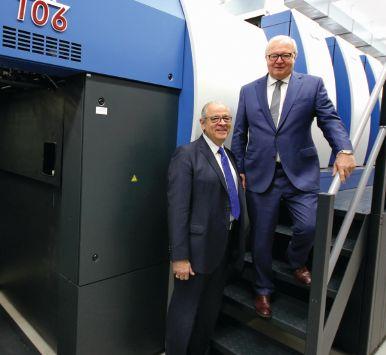
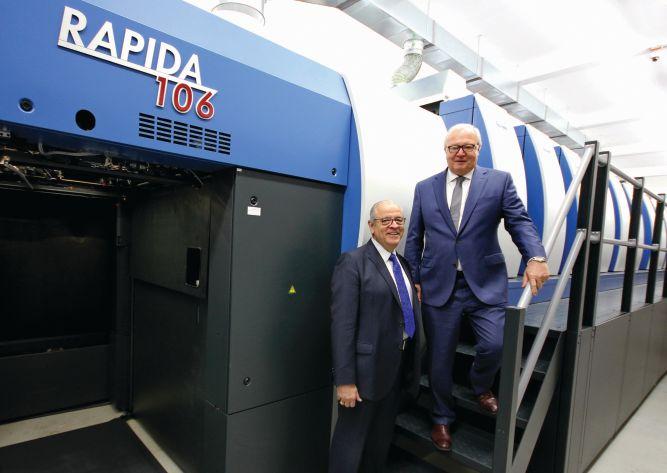
Canadian Bank Note Company of Ottawa, Ont., installed a new 12-colour KBA Rapida 106 press, pictured with Mark Norlock, KBA Canada Regional Sales Manager (left) and Ronald G. Arends, President and CEO of Canadian Bank Note, to focus on the production of high-quality, secure identity products.
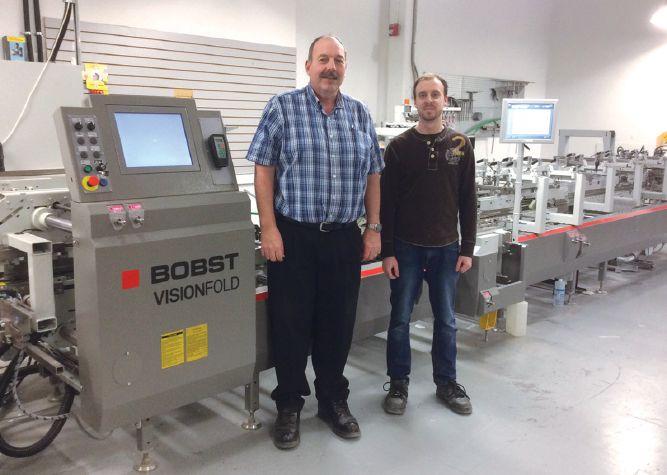
Parker Pad & Printing of Markham, Ont., installed a new Bobst Visionfold gluer with a Baumer hhs gluing system, pictured with are Mark Wegener, General Manager, and Kyle Pearson, Lead Operator. The equipment will be used for the printing company’s continuing growth in folding carton and packaging.
Brent Holmes becomes an Account Manager for Agfa Inc., focusing on western Canada and responsible for its wide-format equipment product portfolio. Holmes has 20 years of experience in the graphic arts industry. Most recently, he was an Equipment Specialist with Access Imaging/ Grimco Inc. in Calgary, Alberta. He has held various positions at Hewlett Packard Canada, Unisource Canada, Fuji Graphic Systems Canada and Staedtler-Mars.
Christine Lancaster has been appointed to Flint Group’s newly created position of Business Development Director, Security, focusing on the company’s security inks and coatings segment. Lancaster has been involved in this market since 2002. Doug Aldred, President of Packaging & Narrow Web Division, noted the security market is a key development area for Flint.
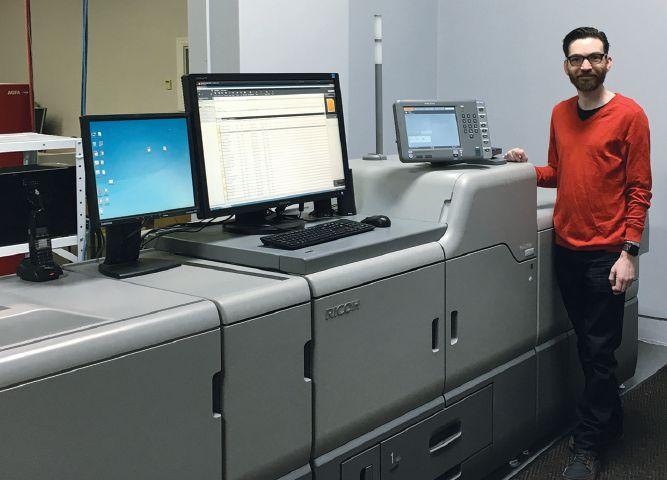
Central Web of Toronto, Ont., invested in Color-Logic software and a Ricoh 7100 production press, pictured with Jean-Pierre Mazare, President. Central Web is expanding with a digital division, offering decorative and reflective colour communications with Color-Logic’s Process Metallic Color System.
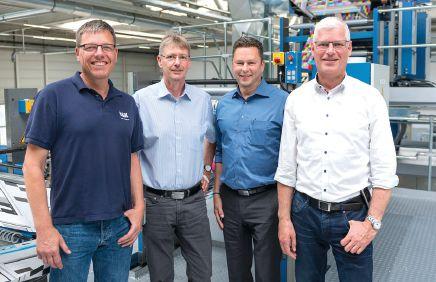
B&K Offsetdruck starts up KBA C16 in Germany
B&K Offsetdruck in Ottersweier, Germany, brought its new automated KBA C16 on stream right on schedule on June 1, 2017. The new press runs with a maximum production speed of 65,000 cylinder revolutions per hour. B&K Offsetdruck now operates three commercial web presses from KBA (a Compacta 217 and two KBA C16 presses).
“Another new chapter has now been added to the success story of longstanding partnership between B&K and KBA,” said Stefan Segger, Sales Director for KBA-Digital & Web.
Jörn Kalbhenn is the manager of the family business founded by his father. B&K Offsetdruck is today supported by more than 200 employees. The latest five-unit KBA C16 was configured with a range of innovations, including a new superstructure concept with what KBA describes as ribbon leads. Automation functions such as KBA EasyTronic, in conjunction with the ErgoTronic console technology, serve to enhance productivity while at the same time minimizing makeready and waste. B&K Offsetdruck has once again fitted the new C16 with a cutter.
With the new KBA C16 are (left to right): Hans Geideck, Technical Manager, B&K Offsetdruck; Werner Stimmler, Commercial Manager, B&K Offsetdruck; Stefan Segger, Sales Director, KBA-Digital & Web; and Jörn Kalbhenn, Managing Director, B&K Offsetdruck.
Color Ink transforms with J Press 720S in Wisconsin
Color Ink, a Sussex, Wisconsin-based printing company, explains it is changing its approach to traditional print while expanding into new markets with Fujifilm’s J Press 720S, a B2-size sheetfed production inkjet press. “The Fujifilm J Press 720S has transformed our business,” said Todd Meissner, President, Color Ink. “We’re taking jobs off of the 40-inch litho press, as well as jobs from our wide-format press.”
Jim Meissner, Todd’s father, started Color Ink in 1984, as primarily a commercial printer. With the addition of Austin Meissner, Todd’s son, Color Ink is now a third-generation family owned and operated business, with 100,000 square feet within two buildings situated in suburban Milwaukee that was once a family farm. The operation includes 75 full-time employees, along with an additional head count of up to 50 temporary employees, working up to three shifts a day, five days a week.
“My grandfather started the company with very humble roots,” said Austin Meissner, Sales and Sourcing Manager, Color Ink. “It certainly means a lot to me being third generation at Color Ink. Having the opportunity to work with my father is just a great experience for me.”
With a 29.6-inch x 20.9 inch sheet and an output rate of 2,700 sheets per hour, Color Ink’s second generation sheetfed J Press 720S is configured for printing 100-pound text weight to 18-point board stocks; while other configurations are available to run lighter weight stocks, as thin as 60-pound text weight, and up to 24-point board stocks.
Visix Esko automation in Belgium
Visix, a manufacturer of flags and banners based in Roeselare, Belgium, from where it also serves customers in France, installed a Kongsberg C64 cutting table with Esko Automation Engine.
“Visix has set the standard for craftsmanship and experience since 1903 when, trading under the name of Demeere Vlaggen in Ypres, the company specialized in handmade flags and embroidered chasubles for processions, associations and communities,” said Stefaan Devlaminck, who is in charge of Visix production.
In addition to its 3.2-metre Kongsberg C64 cutting table with Esko Automation Engine, Visix has also deployed Esko’s Device Manager. “The 3.2-metre format for the cutting table is the same width as our grand format printers and downstream calender,” said Devlaminck. “We have found the most efficient textile run to be 20-metres long by 3.2-metres wide, and the Kongsberg fits perfectly into that flow.” Following creation of print files using Adobe Creative Suite, Visix uses i-cut Preflight, part of Automation Engine, to check for quality and bleed prior to printing. This process tags the file with XML metadata that guides it through the rest of the production process.
Reynolds & Reynolds now prints 500,000 square feet of Kodak Sonora Process Free Plates per year. The 51 printing presses at Reynolds & Reynolds’ plant feed 16,000 dealers with the business forms for their dealerships, running through some 500,000 square feet of plates per year. If you laid out all those plates on the ground, they would cover a small neighbourhood in New York City.
Visix began its unique production journey in 1903 when it specialized in handmade flags and embroidered chasubles.
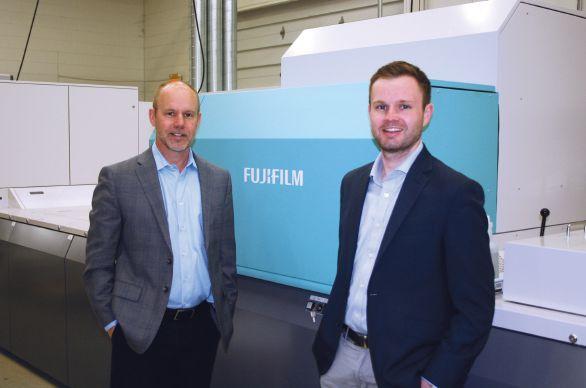
Todd Meissner (left), President of Color Ink, stands with the J Press 720S, along with his son, Austin Meissner, Sales and Sourcing Manager, in their Sussex facility.
15 years ago
More than 20 years experience in the self-adhesive label materials industry.
More than 15 series of products, over 3,000 categories.
Provide high quality Film Materials (PP, PET, PVC, Electrostatic, Holographic), Cast Coated, Aluminum Foil and more.
Transcontinental Printing has broken ground for the future facility that will print the daily newspaper La Presse. Expected to be fully operational by the fall of 2003, the Point-aux-Trembles plant will measure 125,000 square feet and produce work estimated to be worth $60 million. Transcontinental secured a 15-year contract to print La Presse before moving ahead with the project. The company announced that two huge Heidelberg Harris Mainstream 80 presses are to be the backbone of the facility. This same press is currently being employed to print England’s largest daily, London’s Daily Telegraph, which has a circulation of 1.2 million copies per day. La Presse is published seven days a week and has a readership of 880,000.
Breaking ground are (left to right): Remi Marcoux, Chairman and CEO of Transcontinental Group; Guy Chevier, President and Publisher of La Presse; Cosmo Maciocia, member of the City of Montreal Executive Committee; as well as two City of Montreal Executives.
$26.5K
For sale (1992 classified): Heidelberg GTO 46 no numbering $24,000. Heidelberg GTO 46 with numbering $26,500. Heidelberg KORD 62 $12,000.
20 years ago
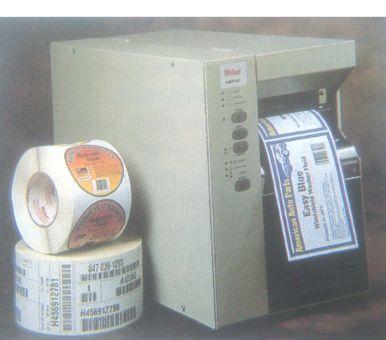
Weber Marking Systems announced the availability of its new 24 Series thermal/ thermal-transfer label printer, which offers high-density, 300-dpi label printing at an affordable cost. The 24 Series accommodates pressure-sensitive label materials and tags of up to 4 ½ inches wide and 15 inches long. In-spec barcodes, along with high-resolution text and images, can be produced at a rate of six inches per second. Weber provides compatible label materials and thermal-transfer ribbons.
25 years ago
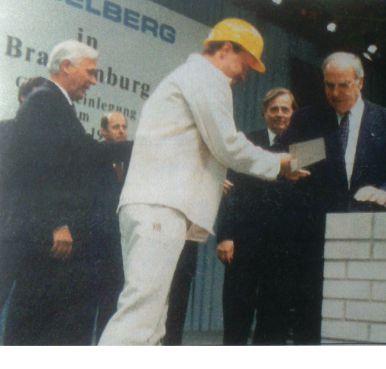
German Chancellor Helmut Kohl lays the cornerstone for a new press factory being built by Heidelberg in Brandenburg, Germany. Approximately 2,000 people are expected to be employed at the factory, situated on a parcel of land totalling 8.8 million square feet in area.
DOTS
NEWS THAT WE CAN’T KEEP UNDER WRAPS
TC Transcontinental Printing wins two Awards of Excellence
OPIA print excellence
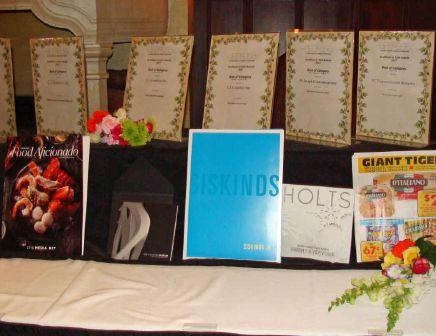
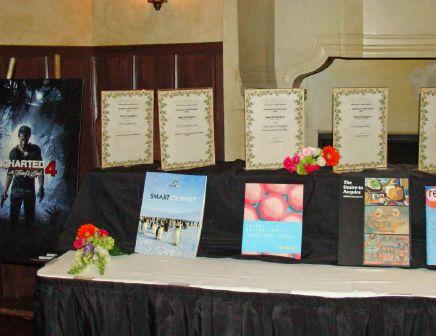
The Ontario Printing & Imaging Association in May at the St. Georges Golf and Country Club in Toronto handed out a range of awards in its annual Excellence In Print Awards program. This included five top awards noted as Awards of Excellence, chosen from among all categories winners, presented to C.J. Graphics Inc. (Sheetfed, Digital and Specialty categories), St. Joseph Communications (Web Commercial) and TC Transcontinental Vaughan (Web Newspaper).
Best of categories winners included: Mi5 Print & Digital (Brochures), Aylmer Express Graphics (Books Hard Cover, Magazines Perfect Bound, Presentation Folders), Ryerson University’s School of Graphic Communications Management (Digital Large or Grand Format, Books 4+ Colours, Bindery, Engraving), St. Joseph (Catalogues 4+ Throughout), TC Transcontinental Brampton (Flyers), TC Transcontinental Vaughan (Newspapers) and C.J. Graphics Inc. (Cards, Programs, Newsletters, Booklets, Annual Reports, Magazines Saddle Stitched, Catalogues 4+ colours, Inserts, Stationery, Direct Mail, Posters Art Prints, Digital Small Format, Specialty Inks, Embossing, Self-promotion, Labels, Boxes, Cartons).
Following the dinner and awards presentation, futurist Jesse Hirsh provided an hour-long keynote about the direction of communications technologies. He primarily focused on how various forms of Artificial Intelligence are creating new economies by leveraging the World Wide Web, automation and mixed reality (virtual and real). Hirsh described how the smart, fast and unregulated economy of the future might impact the business world – and where to find opportunities.
The 2017 OPIA Excellence In Print Awards were sponsored by Heidelberg, Flint, Domtar, Sun Chemical and Spicers.
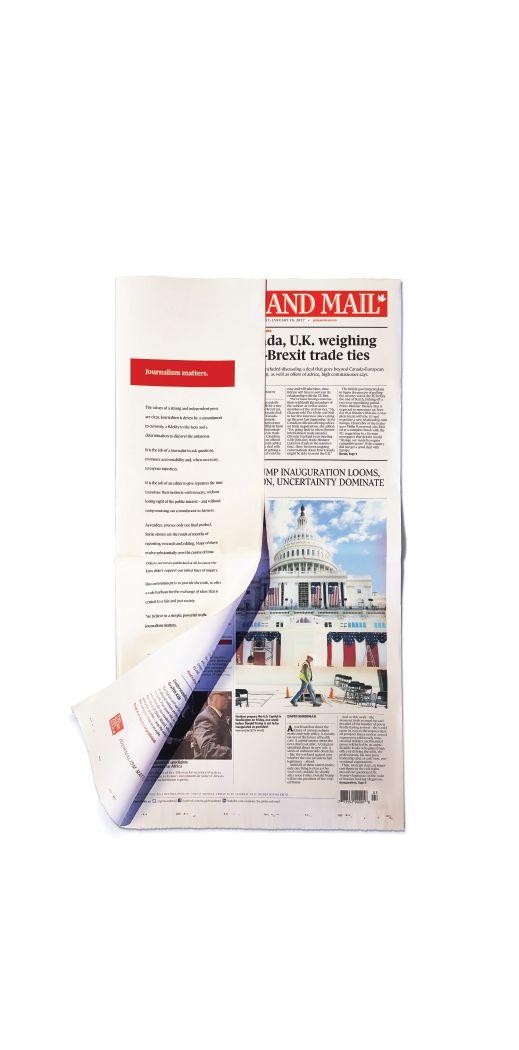
TC Transcontinental Vaughan’s Award of Excellence in the Web category, for the The Globe and Mail Gatefold project, was featured as an advertisement in the national newspaper (left). Winning print projects were displayed in the lobby of St. Georges Golf and Country Club (below).
CALENDAR
July 16-20, 2017
95th Annual GCEA Conference, Woman in Print Ryerson GCM, Toronto, ON
August 4, 2017
Canadian Printing Awards Entry Deadline CanadianPrintingAwards.com
August 10, 2017
OPIA Toronto Golf Classic
Angus Glen, Markham, ON
September 10-14, 2017
Print 17
McCormick Center, Chicago, IL
September 20-23, 2017
Pack Print International Bangkok, Thailand
September 25, 207
Pack Expo Las Vegas Las Vegas, NV
September 25-28, 2017
Label Expo Europe
Brussels Expo, Brussels, Belgium
September 27-29, 2017
SFI Conference
The Westin, Ottawa, ON
October 4-6, 2017
PSDA 2017 P2P Technology + Innovation Summit 2017 Sheraton Hotel, New Orleans, LA
October 10-12, 2017
SGIA Expo 2017 New Orleans, LA
October 23-25, 2017
Digital Packaging Summit 2017 Ponte Vedra Beach, FL
October 27-28, 2017
Sign Expo Canada International Centre Mississauga, ON
October 31-November 3, 2017
IPEX 2017
Birmingham, UK
November 9, 2017
Canadian Printing Awards
Palais Royale, Toronto, ON
March 22-24, 2018
Sign Expo 2018
Orlando Convention Center, FL
May 15-18, 2018
FESPA 2018 Global Print Expo Messe Berlin, Germany
Keeping your plant floor secure in the IIoT era
Manufacturers will continue to be targets of cyberattacks and it is critical to develop a process to lessen risk
By Rick Huijbregts
The introduction of advanced technologies such as the Industrial Internet of Things (IIoT) to the plant floor has created new challenges for Operational Technology (OT) and Information Technology (IT) professionals. What were once physical-only systems, managed and maintained by OT staff, are now connected by an IT
network to an enterprise system. Securing these new cyber-physical systems should be a priority for manufacturers as they begin their digital transformation, but leaders often underestimate the importance of cybersecurity on the plant floor. It is believed the risk of attack is low, and thus securing cyber-physical systems can be overlooked.
For example, PLANT magazine’s 2017 Outlook report revealed that 17 percent of Canadian manufacturers have not taken any steps to defend against cyberattacks. In addition, when you consider that 78 percent rated their concern of a cyberattack affecting them as ‘low’ or ‘medium,’ why would they? Clearly, the industry believes other organizations are much more suitable targets.
The Cisco 2017 Annual Cybersecurity Report, released in January, showed that Canadian organizations rank second-tolast in security capability maturity. Nearly half (48 percent) of our businesses have ‘low’ or ‘lower-middle’ maturity. Across
The percentage of Canadian manufacturers who haven’t taken any steps to defend against cyberattacks, according to a recent PLANT Magazine report. 17%
The truth is that, compared to other industries, manufacturers operate some of the most high-risk applications over their networks.
all industries, our organizations are not nearly prepared to deal with dynamic cybersecurity threats.
Add to this the complexity of digitally securing a production facility or shop floor, and it is easy to understand why Canadian manufacturers want to believe cyberattacks are not a significant threat. But the truth is that, compared to other industries, manufacturers operate some of the most high-risk applications over their networks. Any threat to those applications — due to cyberattacks, poor maintenance or otherwise — must be addressed and mitigated. And for the record, manufacturers have been, and will continue to be, the target of cyberattacks.
That will not change.
The good news for Canadian manufacturers is that securing their plant floor does not need to be complicated. In fact, when done right, keeping a plant secure in the IIoT era can be as simple as 1, 2, 3: prepare, assess, build.
Prepare
It is important for manufacturers to develop a security framework that helps them align and prioritize business and security needs. The first step in building that framework is to ask specific questions about their physical and cybersecurity capabilities. For example, IT and OT leaders could ask the following:
• Have we outlined who has access to which machines and devices?
• Do we have centralized control of both OT and IT network security?
• Can our network quickly provision and securely adapt to new connections?
• Have we assessed, ranked and prioritized our most critical assets?
By understanding capabilities and potential gaps in security processes, technologies and practices, manufacturers can better understand what cybersecurity solutions they require.
Assess
Although there is no silver bullet to cybersecurity for manufacturers, there are trusted partners who can help. These partners can review the organization’s current infrastructure and make recommendations to help achieve its security goals. Many technology and cybersecurity vendors provide these reviews, often called security assessments. My advice is to evaluate the assessments offered by several vendors, then decide which has the right combination of security expertise, best-inclass products and industry knowledge for your organization.
Build
It is vital that, prior to implementing a new cybersecurity solution, manufacturers work with their selected vendor to build a security strategy and plan. This plan should include both cybersecurity and
technology elements — such as whether to leverage virtualization to back up important systems — as well as physical security processes and best practices. Most importantly, a plan provides a roadmap for manufacturers and vendors to follow to ensure projects have measureable goals, outline expected Return on Investment (ROI) and stay on time and budget.
For Canadian manufacturers who aren’t ready for the process above, there are other ways to keep their plant floor secure. I encourage all manufacturing leaders to take the following steps in their production facility to increase cybersecurity readiness:
• Ensure single-use computers are actually single-use,
• Change default passwords on IIoT-enables devices,
• Implement change control,
• Use secure protocols where possible, and
• Use manufacturers’ recommended secure settings.
When it comes to cybersecurity on the plant floor, doing nothing is
no longer an option for Canadian manufacturers. The convergence of IT and operational networks through the IIoT has highlighted the risks of legacy control systems that were never designed with cybersecurity as a priority. Although stopping all attacks may not be possible, manufacturers can minimize both the risk and the impact of these threats by working with a trusted partner who can evaluate their current systems.
The IIoT is creating incredible business opportunities for manufacturers by decreasing downtime, increasing sustainability and providing real-time visibility across the plant floor. The right IIoT partner will ensure your network, and everything connected to it, is secure.
Rick Huijbregts is the vice president of digital transformation and innovation at Cisco Canada. He leads a team responsible for fuelling the digitization of customers across the country. He can be contacted at rhuijbre@ cisco.com.
But I know where everything is
The organization of your workspace can not only improve overall productivity, but also greatly increase your sales opportunities
By David Fellman
Irecently paid a visit to an old sales colleague, who is actually the top salesperson at his company. His cubicle was a mess. He assured me that it only looks disorganized, and that in fact, he knows where everything is. So I bet him that he couldn’t find a hard copy document I sent him two or three weeks earlier. Lunch was on him that day.
At the end of the day, I sat with the owner of the company in his own office, which was also fairly messy. On his wall, he has a poster which states that “A Clean Desk Is The Sign Of A Dirty Mind.” I pointed at his desk, and at the poster, and said, “I’m not sure you’re setting a really good example for your employees, especially Carl [the top salesperson].”
“I don’t care about neatness,” he said, “I care about results, and Carl brings in a lot of business.”
The question, of course, is whether he could be bringing in even more if he was better organized. What do you think?
Everything in its place
The secret to organization is simply to put everything in its place. If that place really is on the top of your desk – or on top of your chair! – then that’s where whatever we’re talking about should be. But if it’s not, it should be somewhere else. That might be a file folder, in a filing cabinet, in a file room. It might be a digital folder, on a computer desktop, or somewhere deeper inside your hard drive. It might be in the trash.
I’m not saying that your desktop, physical or digital, must be perfectly neat and organized at all times, but here’s what I want you to ask yourself: Is there any upside to the kind of mess you see in this picture?
Now ask yourself this: What would Carl likely find if he took the time to look through every piece of paper in his work-
space? I think he’d find that most of the documents are no longer current to his workflow. I think he’d also find some lost opportunity.
Lost opportunity
80/20
The 80/20 Rule was developed in 1906 by Italian economist Vilfredo Pareto. It means that in any situation, 20 percent of the inputs or activities are responsible for 80 percent of the outcomes or results. In Pareto’s case, it meant 20 percent of the people owned 80 percent of the wealth. Project Managers know that 20 percent of the work (the first 10 percent and the last 10 percent) consume 80 percent of the time and resources.
This is really the critical issue. I’ve been saying for a long time that selling is mostly about follow-up. And please understand, I’m not just talking about persistence. I’m talking about follow-up that’s appropriate to the situation at hand. I have seen far too many printing salespeople miss out on opportunities because they were blindly persistent when they should have employed something more creative in terms of follow-up, but that’s a topic for another day. For today, it’s pretty simple. If you miss an opportunity because you didn’t follow up on time, because it was hidden under the clutter in your workspace, that’s an indefensible loss.
I actually forced Carl to dig though his clutter as part of the follow-up to my onsite visit. He found five quotes that he’d never followed up. He also found 23 leads that he’d never followed up on. He even found a job jacket for an order that had never been put into production. He swears that he’s seen the light, and that he’s going to get himself and keep himself better organized. I’m confident that if he does it, he will bring in even more business and make more money.
Contact management software
As described a few columns ago, I use a software product called ACT to keep my-
self organized. It’s in a category of software referred to as CM (Contact Management) or CRM (Customer Relationship Management). I prefer the term Contact Management, because a typical printing salesperson’s database will be made up of suspects, prospects and customers. No matter what you call it, I think every salesperson should be using this kind of tool. The category also includes products like Outlook, SalesNet, and salesforce. com.
In ACT, I’ve set up a database record for everyone I do business with or hope to do business with. In that record, I can store everything from names, addresses, phone numbers and e-mail addresses to the notes I take during every call or contact. I can send emails from ACT and store them in the database record. I can attach quotes, artwork, or any other digital file. I can also schedule my follow-up activity after each contact. In other words, ACT gives me a place to put everything in its place.
DAVE FELLMAN is the President of David Fellman & Associates, a graphic arts industry consulting firm based in Cary, North Carolina. He is a popular speaker who has delivered keynotes and seminars at industry events across the United States, Canada, England, Ireland and Australia. He is the author of Sell More Printing (2009) and Listen To The Dinosaur (2010). Visit his website at davefellman.com.
It’s not just about saving paper
Providing digital document services allows printers to help save their clients time and money by automating workflow processes
By Mohan Mailvaganam
Every spring, thousands of students across Canada mull over acceptance letters and offers from colleges and universities, to decide where to go to school in the fall.
As tough as the choice may be for many students, the competition among the schools is even tougher. Academic reputations are at stake for the schools. They all want to attract the cream of the crop. And there are hundreds of millions of dollars in tuition fees on the line, which help institutions grow, enhance programs and innovate.
So how can an enterprising school stand out from the pack? Beyond the traditional recruiting tactics most schools use, Simon Fraser University (SFU) worked with Xerox Canada to find competitive advantage through the digital transformation of its admissions process.
The post-secondary application process in Canada is generally a very lengthy exercise. Students have to apply to the schools of their choice by the end of the calendar year and then typically don’t hear whether they’ve been accepted until spring – sometimes as late as the end of May. It takes weeks for admissions personnel to sort through the applications, extract the information they need and make offers.
Research shows that roughly 80 percent of students accept the first offer they receive – so getting out of the gate quickly is crucial when vying to attract students in a highly competitive field.
By digitizing and automating the process, SFU aims to realize the benefits of faster decision making, reduction of operational costs, and improved student experiences resulting in greater acceptance rates on offers of admission.
Organizations from all sectors and of all sizes – from small- and medium-sized businesses to large corporations – can
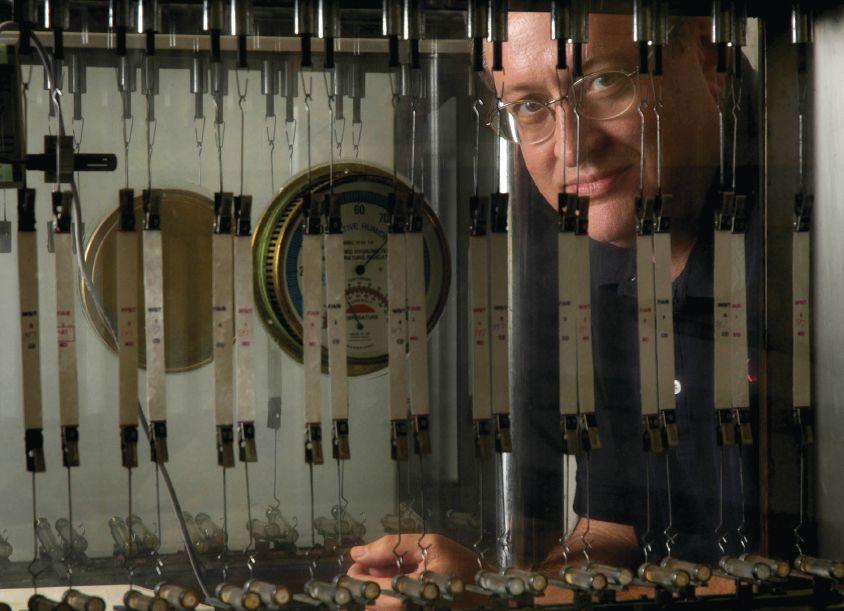
Even with its efforts to digitize office communications, Xerox continues research into its High Yield Business Paper, pictured with scientist Bruce Katz, examining how mechanical samples curl when exposed to humidity.
realize similar benefits such as improving the client acquisition process and streamlining back-office operations by leveraging workflow automation and digitization capabilities. So what’s holding companies back from overhauling their workflows?
By far, the greatest barrier to change we run into is institutional culture – how the organization thinks and acts from upper leadership to middle management and down to frontline staff. There has to be company-wide buy-in to effect real change. Many organizations have a general idea of some of the advantages of trying to become more lean and agile for a digital future, but they don’t understand the specific benefits to their operations.
Until they have an accurate picture of how Key Performance Indicators (KPIs) like operating expenses and client satisfaction can be improved, it’s difficult for business leaders to see past the logistical challenges and effort required for digital transformation.
was worthwhile, FST leadership committed to a digital strategy.
As part of its transformation, FST automated paper processes in its Passport program, which helps adults with a developmental disability participate in their communities. By going digital, the organization was able to cut operating costs and improve internal business process, including reducing invoice processing time by 60 percent. More importantly, FST was able to redirect resources from back-office processing to direct client service, improving experiences for both staff and clients.
By
We saw this firsthand when we worked with Family Service Toronto (FST), a notfor-profit organization that provides counselling, community development, advocacy and public education programs.
The organization faced a daunting prospect of digitizing its heavily paperbased processes prior to a move into a new office location, including the digital conversion of decades of paper records stored in more than 500 bankers boxes. But with a positive 10-year cost-benefit analysis in hand that showed the initial investment in a digital document management solution
Like all major decisions organizations make, it’s important that they be made from an informed position. Before companies can figure out how to harness the power of digitization, they need a solid understanding of their paper use and document flows. It’s also important to keep in mind that today’s documents are more than paper and span the digital space from emails to office documents, videos and images – all equally capable of causing friction in the process.
It’s crucial that companies embarking on the digital journey today know the fate of their documents – how they were generated, why they were printed and where they will eventually end up – through document analytics.
Mohan Mailvaganam is the Director of Digital Process Automation at Xerox Canada.
ENTERING DIGITAL LABEL PRINTING
Digital labels is one of the most attractive segments for printing growth led by significant new demands from brand owners for short-run versioning and variable print work
By Jon Robinson
The digitization of label production began years ago with bleeding-edge projects but only now is beginning take a foothold across the printing world, which is still dominated by flexography. Some of the globe’s largest brands are reinvesting in print with the shifts in advertising effectiveness to younger generations, who may never watch a television ad or block them entirely online.
A recent report by Future Market Insights estimates the demand for digital printing in packaging will grow at 15.3 percent to surpass US$52 billion in revenues by 2026. By product type, labels is currently the largest segment, accounting for over US$7.1 billion in revenues in 2016. Future Market Insights estimates
demand for digital labels will increase at 16.7 percent CAGR to reach US$38.4 billion in revenues. The labels segment is estimated to hold the highest market share by the end of the projected period, accounting for more than 70 percent of the global market share by the end of 2027, up from 64.1 percent in 2016.
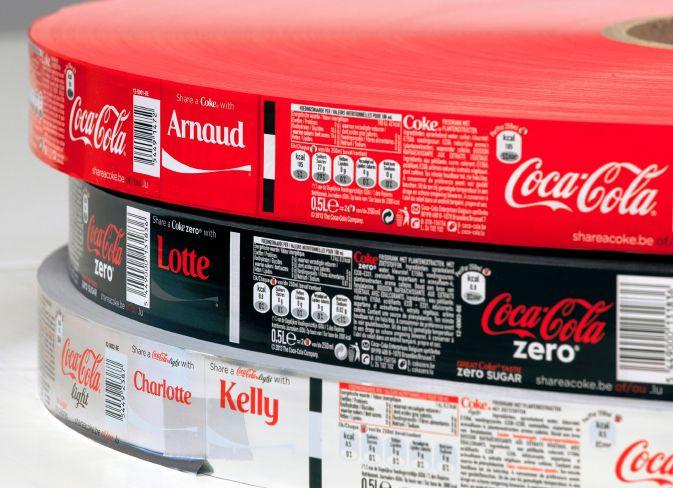
Consider for example, the money invested by Coca-Cola to produce its largest-ever personalized brand campaign, Share a Coca-Cola, launched in 2013 across 32 countries. Coke used printing operations with HP Indigo presses to digitally print labels with 150 of the most popular first names, nicknames and terms of affection – initially 800 million high-quality personalized labels.
The Share a Coca-Cola campaign became famous across the printing world because it signified a paradigm shift in
In 2014, Coca-Cola printed two million unique Diet Coke labels via Q Digital and HP Indigo. The campaign followed its 2013 Share a Coke project (top right), which signalled a key change in the use of digital printing systems for label production.
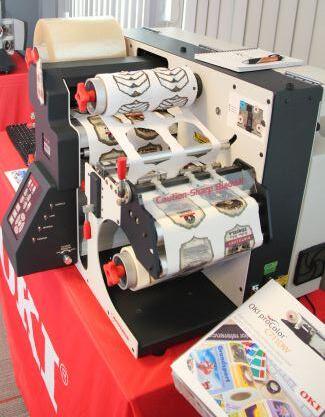
Entry-level digital label systems can include an engine and integrated finishing (bottom right).
800M
The 2013 Share a Coca-Cola campaign kicked off with the digital production of 800 million high-quality personalized labels.
what is effective marketing, leveraging print. It is an example of long-run versioning through digital, but the possibilities of digital labels burst open.
Commercial printers are certainly attracted to the potential of digital labels but without a large client base will find it hard to invest millions in capital equipment and workflow infrastructure. Instead, many will take the route of entrylevel inkjet- or toner-based printing engines, which can be integrated with a range of finishing technologies to work with existing clients and build up a base before committing significant resources.
PrintAction spoke with Brett Kisiloski, PDS Sales Manager, about the potential of digital label printing, as well as the challenges and opportunities of investing in entry-level digital printing systems.
What kind of systems do printers need to enter digital labels?
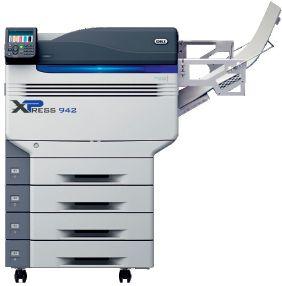
Kisiloski: Essentially you need two machines for a full production label system. You have your roll-to-roll label printer and your label finisher, which will laminate, die cut custom shapes, waste matrix, and then you can slit into singles from a multiple-up format. We focus on tonerbased printers rather than inkjet – roll-toroll toner. For us specifically, we use the OKI engines. We carry a few different die cutters but essentially they do the same sort of thing.
When is a die-cutter not needed?
Kisiloski: The only time we ever suggest to a customer that it is okay for them just to purchase a label printer is if they are only doing one or two sizes of labels… then it is easy for them to print pre-diecut and they only need to stock one or two sizes in their shop. If you have a lot of other custom sizes, you can’t just phone up your label material provider saying you need new shapes… it is going to cost you twice as much. The flexibility isn’t there.
Are more commercial printers looking into digital labels?
Kisiloski: A lot of printers like the idea of it. The problem is that even for an entry-level system it is fairly costly if you want to get into a new machine. You are looking at probably an entry cost of definitely no less than $50,000, between $50,000 and $60,000. So you have to think that these printers already have a built-up label business of some sort. I have seen the most random, small print shops that are looking for a label printer. They might be doing hundreds of thousands a month and they have been outsourcing it, because they just happened to stumble across these customers who want labels.
Another challenge with digital labels is finding that sweet spot… Is it going to be six cents a label, eight cents a label, be-
cause there is a difference when you have a trade printer quoting five cents a label. What really comes into play is that there is a lot of short-run or variable-data label printing.
How much work do you need for ROI on an entry-level system?
Kisiloski: You actually do not need that many jobs per month for this to make sense. It is likely you are selling that thousand let’s say for $300 and it is costing you maybe $80 to $100 to print. That’s printing, labour and everything, so let’s say $100, and you are making really good margin.
If you are making $200 on every order and you get two orders a week you can pay off the machine. So that is really not a ton of volume for someone to jump into it based on getting one or two orders per week.
What are the pros and cons of inkjet versus toner?
Kisiloski: We carry smaller systems so I do not want to compare too much to the bigger guys… Systems for under $100,000 let’s say. We still sell Memjet print-head [inkjet] systems for envelopes and labels. It is great in the sense that it is really fast and it is quite inexpensive to print in terms of the ink costs.You are printing 60 feet a minute which is two to three times as fast as you are going to get on a toner printer, so it was really interesting a few years ago.
The downfall is that you have to print on inkjet-coated material. About three or four years ago it was still cheaper when all was said and done to print on inkjet with the coated material. In the last two to three years, however, coated material prices have gone up big time, so it is very difficult. I would say it is 25 percent cheaper to print any size label using a toner printer rather than an inkjet just because of the material cost.
is also very finicky. It might have 70,000 print nozzles in a tiny little bar stretching 8 1/2 inches wide, so those things clog easily, whereas toner is very consistent.
When does entry-level inkjet make sense today?
Kisiloski: I have a customer who prints post-it notes, for example, and because it is a paper you do not need inkjet coating… The paper stock will absorb the ink… an inkjet system is perfect for him, because it is super cheap. He is just paying for the ink and it is really fast. But most people print on gloss paper or polyesters or vinyl, which has to be inkjet coated and you are doubling or tripling your cost.
What is most exciting about digital label printing?
Kisiloski: The label business is huge. Packaging is a massive industry so it is very exciting to be able to offer that… it is nice to be able to provide different options for a customer when they walk in the door and open up their mind a little bit to other ways of making money.
Inkjet
Brett Kisiloski, PDS Sales Manager.
CELEBRATING PRINT EXCELLENCE IN QUEBEC
Provincial printing powers gather in Montreal to highlight innovation
By Jon Robinson
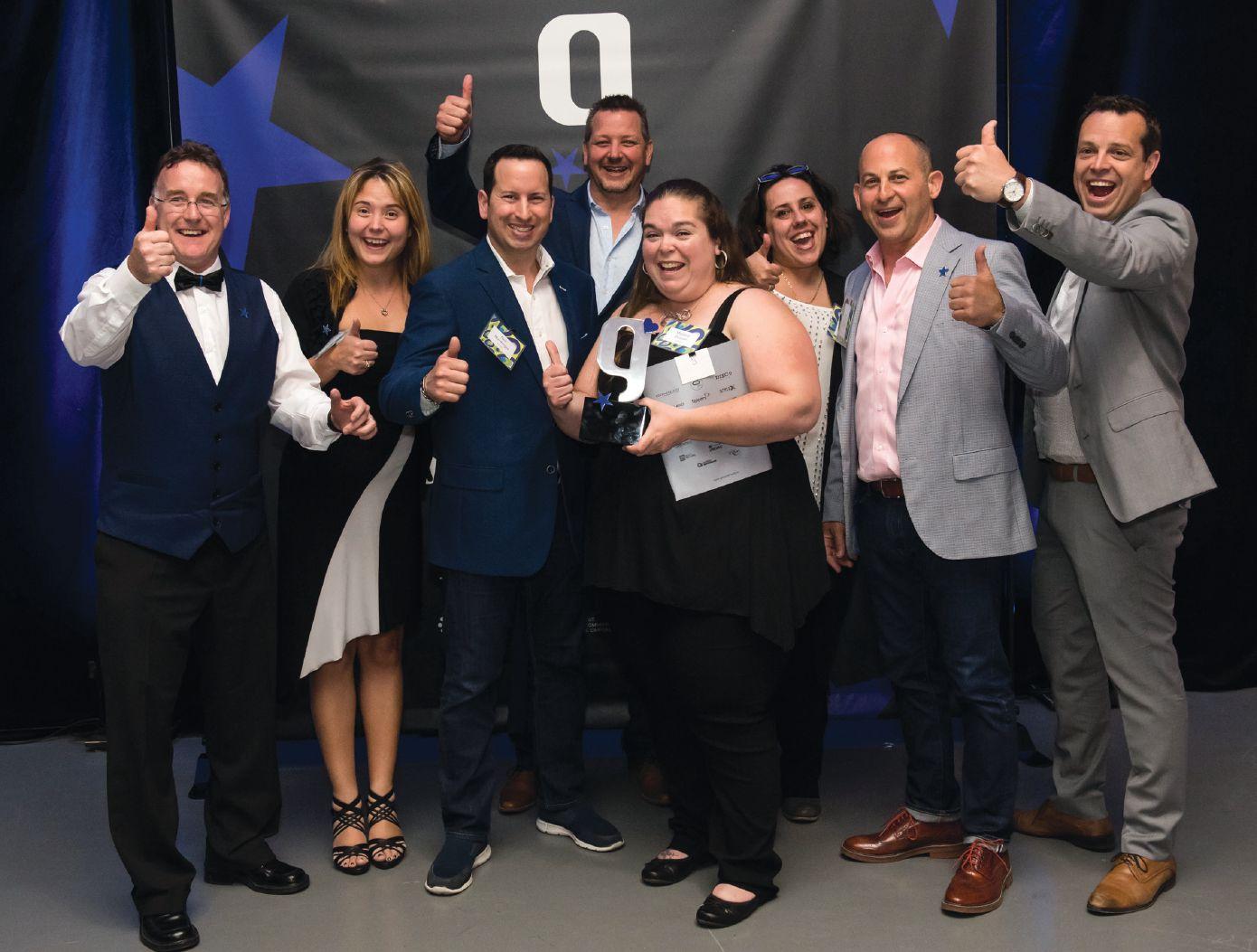
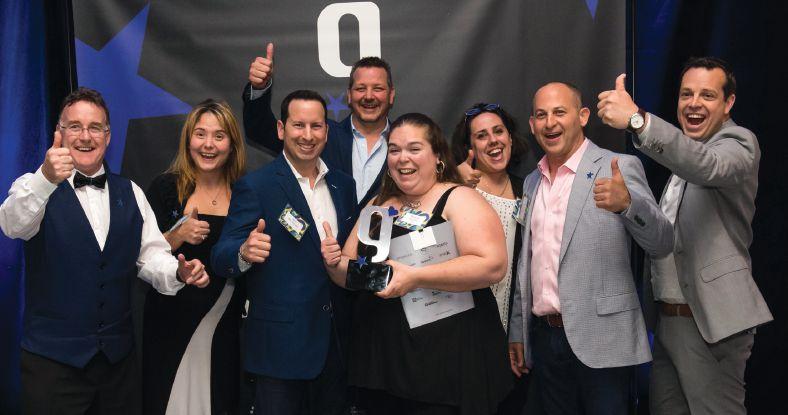
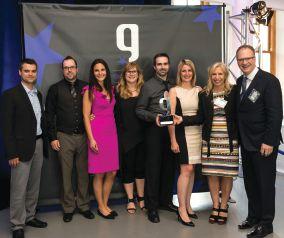
More than 350 people at the start of June gathered at the 35th annual Gala Gutenberg in the ballroom of the Bonsecours Market in Montreal to celebrate excellence in print achievement. In total, 17 trophies, in Technical Challenge and Innovation Challenge categories, were awarded to a range of printing companies from the province of Quebec.
“The Gutenberg [program] pushes the boundaries of each individual and responds to the challenges raised by the talent and creativity of businesses, communication agencies and print buyers in Quebec, regardless of the size of the companies. And this year, our industry has once again demonstrated that it is a great event,” said Patrick Choquet, President, Gravure Choquet, and President of Gala Gutenberg 2017.
BY
BY
The team for Les Étiquettes IML based in Saint-Eustache wins for flexible packaging.
ATFFEQ receives its Prix de la Relève Award.
Transcontinental Interglobe accepts its Gutenberg Technical award for publishing.
MP Repro of Pointe-Claire wins in Gutenberg’s Technical category for brochures.
Gravure Choquet’s Patrick Choquet, President of Gutenberg 2017, and Bilal Madwar of Madovar Packaging.
Stewart Sargent of Novagraf and Yvon Sauvageau of Multi-Reliure.
The team from Laklé receives their Technical packaging award.
The team from Pazazz receives its Self-promotion award in the Technical Challenge category.
Canon’s Alec Couckuyt with Louise Kralka and Denis Paquette of PDI.
Groupe Précigrafik’s team from Sherbrooke, Quebec.
Sylvain Pregent of Super Lustre, Gilles Bois of R&L Lamination and Louis Desjardins of Mardigrafe.
Helene Pageau, Marie-Eve Huppé and Mariane Beauchesne-Chrétien from ICI, Gutenberg’s organizing Committee.
2017 Gutenberg Technical Challenge Award Winners
Category: Packaging Project: Collection Serveurs Nuutok Winner: Laklé Inc.
Category: Marketing Client Project: Programme souvenir Gala reconnaissance Estrie Winner: Groupe Précigrafik
Category: Finishing Project: Great Comet Winner: Transcontinental Interglobe
Category: Brochures Project: Conférence « New Cities Summit Montreal » Winner: PDI Solutions Grand Format
Category: Packaging Project: A-Trax – In The Loop: A Decade of Remixes Winner: Transcontinental Ross-Ellis
Christian Legault from Enveloppe Concept.
Yves Audet from Graphiscan and Nancy Moisan, President of the AQII.
Stéphane Abraham of Rolland.
Gilles Blais from Groupe Précigrafik.
The team from Pro-pals receives its Technical Challenge award for flexible packaging.
Patrick Choquet of Gravure Choquet, President of Gutenberg 2017 Edition.
Pierre Janelle, Bob Van Geison and Joe Niro from Ricoh.
TC Transcontinental Ross-Ellis receives its packaging award.
The team from TC Transcontinental Transmag recieves its Innovation Challenge award for magazines.
Stéphane Barbier, Directeur Alliances Stratégiques de Recherche at FPInnovations.
Rino Ruffolo from Kodak.
PREMEDIA TOOLS OF THE FUTURE
The Touch Bar in Apple’s new MacBook Pro melds with Adobe Create Suite and Photoshop 17 to provide a new way forward for premedia professionals
By Zac Bolan
HHonestly? I’d expected to own a flying car by now. If not a flying car, at least a self-driving one, right? Instead I have to settle for Lane Change Warning and Apple CarPlay. And where is the ubiquitous artificial intelligence guiding and improving my everyday life? Siri and Alexa are fun to play with but hardly fill the bill as intelligent digital assistants. Seems like the future I was anticipating isn’t quite here yet!
For that reason, I’d tempered my expectations of the October 2016 Apple Keynote, held to roll out the new line of Macbook Pro laptops. To no one’s surprise, Apple Marketing VP Phil Schiller proudly extolled the virtues of the new
Macbook Pro – thinner, faster, more graphics power and the sharpest Retina Display ever squeezed into a razor thin aluminum chassis. Additionally, Schiller boasted about the new Force Touch trackpad, twice as big as the previous iteration and the responsive 2nd-gen butterfly mechanism keyboard first introduced on last year’s Macbook.
Then Schiller coyly revealed the new Touch Bar: a narrow Retina resolution, multi-touch strip of glass replacing the function keys normally found at the top of every laptop keyboard. Schiller cleverly paused for a requiem to the underused function key that it replaced, a remnant of the earliest days of computing, before showing how the Touch Bar could revolutionize working with the Macbook Pro. As one would expect, Touch Bar integration is baked-in to the latest Apple
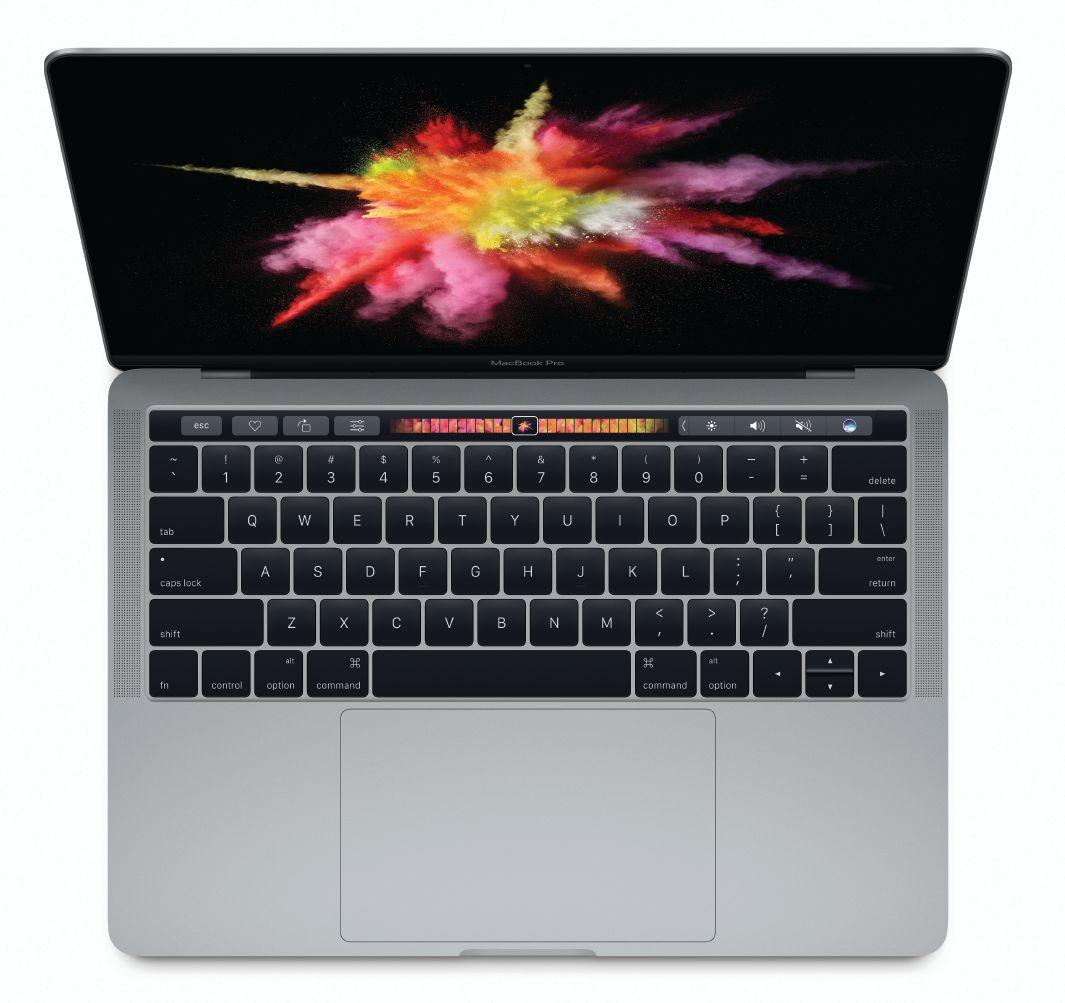
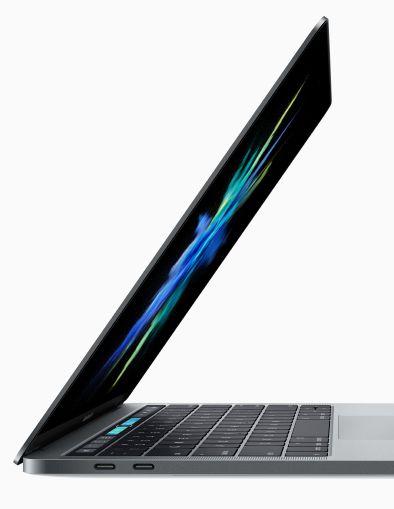
Apple’s new Macbook Pro features the new, unique Retina-quality Multi-Touch display called the Touch Bar, above the keyboard, that dynamically adapts to the application you’re using. The new MacBook Pro holds sixth-generation quad-core and dual-core processors, up to 2.3 times the graphics performance over the previous generation, super-fast SSDs and up to four Thunderbolt 3 ports.
software ranging from Safari, Mail and GarageBand on the consumer end of the spectrum to Final Cut Pro at the high end. However, while impressive, Touch Bar integration into off the rack Apple apps wasn’t enough to tempt me to abandon my faithful 2012 Macbook Air.
But all that changed when Bradee Evans, Adobe’s Experience Design Manager for Photoshop, took the stage to preview Adobe Photoshop CC 2017 with Touch Bar support. “This new Macbook Pro and Photoshop are made for each other,” Bradee exclaimed. “This new addition of the Touch Bar really combines with the keyboard and the new giant trackpad to create this incredibly natural, expressive and powerful new way of working in Photoshop.”
During her demo, Bradee masked and combined images by accessing the Photoshop Select and Mask tool (found in the Select pull-down menu) directly from the Touch Bar. Once selected, the Touch Bar immediately displayed Select and Mask properties for easy adjustment while Bradee simultaneously worked on the image. In a non-Touch Bar workflow, users have to mouse or trackpad all over the place to access the menu, adjust the many parameters for the tool in the properties window, then mask the image –jumping back and forth between creative and technical activities.
Bradee was able to work much more intuitively by using her right had to carefully mask the image with the Macbook Pro’s sizable trackpad while adjusting tool properties on the Touch Bar with her left hand. She was able to resize brushes while masking in real time without ever taking her eyes off the image on the MBP Retina Display.
I have to admit, I was intrigued. As a Creative Cloud user, I was already eagerly anticipating the 2017 refresh of the venerable CC collection that forms the nucleus of my premedia workflow, but hadn’t considered that a Macbook Pro might be in the cards as well. After all, Creative Cloud subscribers receive the CC 2017 upgrade at no additional expense. On the other hand, moving to Apple’s Touch Bar enabled Macbook Pro line represents a substantial capital investment – one I would have to budget for. Adobe released their CC 2017 apps in January, but it took me until late April to lay my hands on a Touch Bar enabled Macbook Pro.
Photoshop 2017 for premedia
Gone are the days of the major, life-altering 18-24 month software upgrade cycle for those of us in the graphics world. With most design and layout dragons long since slain, Adobe has pragmatically chosen digital publishing and other forms of content delivery as their primary focus for innovation. In recent CC updates (including CC 2017), InDesign, Illustra-
tor and Photoshop have seen steady, but modest improvement while other Creative Cloud applications get major upgrades.
In addition to Touch Bar integration, Photoshop CC 2017 boasts new features geared towards productivity. For starters, the New Document window has been completely redesigned to display a wide variety of presets, templates and parameters. Additionally, users can search Adobe Stock for a plethora of pre-baked layouts available for purchase. Users can also create customized presets and templates to suit their specific workflow needs.
Photoshop’s search tool has been supercharged with access to Adobe Stock, and Adobe Learn. For example, if you search “Window” the results include instructions on how to minimize windows, create an application frame as well as a selection of images of windows in a wall available in Adobe Stock. The new Find Similar function can source a variety of Adobe Stock images based on any image in your library. Of course at any time users can opt for good, old fashioned search of their assets.
Adobe has made a number of other improvements to Photoshop including support for Open SVG fonts, a polygonal lasso tool and unspecified performance enhancements.
But the biggest perk for users of the latest Macbook Pro remains Touch Bar support for a variety of PS tools such as Layer Properties, Brushes and Favourites. Users can also uniquely configure the Touch Bar by adding their frequently used commands or deleting under-utilized functions. My favourite uses for the Touch Bar include being able to scrub through the history stages and blending modes when working with Layers.
InDesign and Illustrator 2017
Both InDesign and Illustrator have received a major UI refresh. To mitigate user eye strain, the interface has been modernized with an appealing flat look that is both easy to read and customizable to specific tastes. Users can now choose between Dark, Medium Dark, Medium Light, and Light for the UI and adjust the height of tabs in the working space to make them easier to read. Also, as with Photoshop, both InDesign and Illustrator have an overhauled New Document dialogue with access to a correspondingly wide range of presets, templates or Adobe Stock layouts.
Adobe’s page layout powerhouse saw only minor improvements in the CC 2017 update. InDesign has introduced some typographical tweaks with Open Type enhancements, including the ability to preview Open Type properties on single characters or all the content in a text frame. Additionally, fans of footnotes will be happy to hear that they can now Span
Footnotes Across Columns by selecting it as an option. And if you ever wanted to scale your arrowheads independently of the stroke weight, your future has arrived! Besides the UI overhaul, Illustrator has benefited from some new features including the ability to import text into a path or shape, as well as fill objects with Lorem Ipsum placeholder text by default. You can now also crop imported raster images as you would in Photoshop in addition to accessing a wide range of colour themes using the new Adobe Colour Themes panel for your design project.
Sadly, there doesn’t appear to be support for the Touch Bar in either of the current versions of Illustrator or InDesign.
Are we there yet?
Historically, innovation has come from vying for survival – the need for a company to compete for its very existence has driven some of the greatest advances in hardware and software. And while both Apple and Adobe have all but vanquished their closest rivals, both companies are continuing to innovate, albeit on their own schedules.
Realistically, Creative Cloud subscribers would continue to update their applications regardless of the new features, simply to keep their workflows current. Thankfully Adobe has maintained a steady pace of innovation by introducing new features on a regular basis rather than saving them for a major upgrade cycle. And for those still working with Creative Suite 6 (the last version you could own), each successive iteration of Creative Cloud ups the temptation factor. As for Apple and the Touch Bar, the jury is still sequestered. I bought a new Macbook Pro because my aging Macbook Air was starting to struggle everyday tasks. And while I chose the Touch Bar model largely due to Adobe’s support in Photoshop I’m not sure that functionality alone would justify the additional expense. I am however, finding Touch Bar integration into Apple apps surprisingly useful and I’m relying on it more every day. But will Touch Bar fever hit InDesign and Illustrator? That remains to be seen. Currently the number of MacBook Pro users who might benefit from further Touch Bar adoption by Adobe must be relatively small compared to their wider customer base. I think Apple would have to expand the technology to more of their product line, perhaps through a product like a Touch Bar Magic Keyboard, before Adobe and other developers would have the critical user mass needed to justify further development.
Should you run out and by a new topof-the-line Macbook Pro for your Photoshop workflow? At this stage, I think it’s too early to tell whether Touch Bar is a fad or the way of the future. If the idea intrigues you, I suggest watching the Adobe demo before taking the plunge.
Web to print
range of technology suppliers were asked to provide up to two of their newest Web to Print tools, which can include either a new platform or updates to an existing product. The following technologies provide some of the strongest tools available to drive a range of business to digital and offset printing presses.
Radatech Web to Print Shop
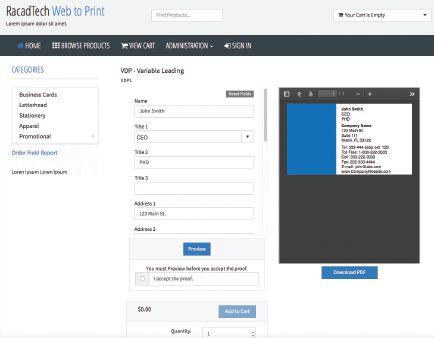
Web to Print Shop bundles Radatech’sW2P tools into modules as plug-ins that can be applied to any Wordpress/Woocommerce Website. These tools are well suited for companies that have a modest level of fluency in managing their Website and wish to manage their own data. They can leverage the general open source aspects of their Website that are publicly available, while the Web to Print Shop plug-ins will fill in the gaps and handle harder issues like sophisticated product options and pricing, variable data templates, the uDRAW HTML5 designer plug-in, PDF based templates, file upload detection, file data and job routing. The system allows users to choose from several user interfaces and to create their own.W2P Shop can also be connected to the W2P CLOUD system and have all orders funnel into one production dashboard for streamlined management and reporting.
Infigo MegaEdit 3D preview
The MegaEdit 3D preview module was updated in March 2017 to in-
clude finishing features, such as embossing, spot varnish and foiling, and photo-realistic 360-degree product previews. The original 3D preview tool was launched last year. Infigo explains the MegaEdit 3D preview module gives users the closest online experience to try before they buy, which is particularly useful for the personalized gifting space. The HTML 5 MegaEdit module is cloud-based so there are no time-consuming downloads, and it’s compatible for any device, so clients and end users can access it anywhere.
The 3D preview module has also been integrated with Esko so it can deliver a 3D visual of the product and automate the output of the Esko CAD profiles in a print-ready format, delivering an automated workflow that enables on-demand printing for packaging suppliers.
Amazing Print eCardBuilder Version 5.2
eCardBuilder Version 5.2 is to be released at Print 17 in September 2017 and will have a multi-lingual interface with more products. Amazing Print explains the new version of the web-to-print design engine eCardBuilder 5.2 will feature 100 new products and thousands of additional templates as a free upgrade to current users. Some of the new upgrades include new template creation functionality, new language support for multilingual w+Websites, new image editing capability and image cropping and resizing improvements. The tool’s improved
of
mobile optimized interface will allow ordering and designing on any cell phone or tablet device, while desktop users will benefit from increased speed and better aesthetics.
A new version of APIs will allow deeper connectivity in popular shopping carts and Websites. eCardBuilder users can additionally upgrade to a PosterDesignerPlus+ web to print poster designer and ordering interface based on eCardBuilder framework directly from Canon Canada.
EFI SmartCanvas
SmartCanvas, powered by DirectSmile is a new, Web-based product design tool launched with the new version 9.2 of EFI’s Digital StoreFront Web-to-print and eCommerce software. With SmartCanvas, users can create templates for a variety of products such as greeting cards, flyers, business cards, brochures, stationery, and banners. SmartCanvas is 100 percent HTML5 compatible, ensuring it works across a range of browsers for printer clients to submit custom-
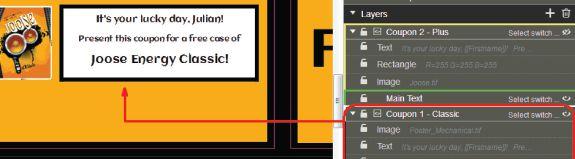
ized orders online. Clients can use the design tools to personalize products by selecting images from galleries and adding their own text, images, QR codes, and shapes, while retaining the original branding control of the template. SmartCanvas supports: Multiple levels of undo (and redo); Keyboard shortcuts; Right-click context menus; Layers; Data tools – form fields, variables, and switches; Custom-defined spot colours and official Pantone spot colour definitions, including metallic and fluorescent colours); Real-time preview of product customization.
Infigo MegaEdit Mobile
A mobile optimized version of Infigo’s MegaEdit design tool was launched in March 2017 to enhance the user experience on mobile devices, which requires an intuitive mobile experience. With consumers storing photos on their mobile device more so than their computer, Infigo explains this development is key to deliver a great experience for photo gifting businesses, and personalized product online retailers. The latest developments, explains Infigo, make it easy for end users to personalize their order. The MegaEdit mobile interface has been developed to make image upload and editing variable fields simple on a mobile phone. MegaEdit is built in HTML 5 and is cloud-based, so is easy access on most any device.
Agfa StoreFront 4.0
In April, Agfa Graphics released the next generation of its StoreFront, version 4.0 software, which now features what Agfa describes as responsive stores for optimal ease of use, new estimating functionality for pricing information, and new packaging algorithms for cost-effective shipping. The new StoreFront version is optimized to be viewed on smaller screens and large desktop monitors, as store pages automatically adapt to any device. Another addition to StoreFront 4.0 is the ‘save for quote’ functionality. It allows resellers and agencies to get instant pricing information
With SmartCanvas, users can create templates for a variety of products such as greeting cards, flyers, business cards, brochures, stationery, and banners.
eCardBuilder 5.2 will feature 100 new products and thousands
additional templates as a free upgrade to current users.
RS SuperiorSuperior Binder y Ser vices Inc.
without a
MODULAR UNITS — Combined in-line finishing: crease, fold, glue, tipping, envelope inserting, ink jetting (Duplex), clip seal (3 sides), mail prep.
SAVE ON POSTAGE
As a Certified Canada Post Direct Marketing Specialist, we get contract pricing reductions.
RETURN MAIL PRODUCTS — Customized “Return Mailers” created in-line with “U” or “BOX-shape” remoistenable glue, time perfed applications and envelope formation.
— Saddle-stitch and trim 2-up booklets in-line to the size of a business card. No need to trim off-line, or do 2 passes.
HIGH SPEED EQUIPMENT — High speed Tipping, Folding, Saddle-stitching and soft folding ensuring on time delivery.
for an entire product bundle, including shipping costs. In StoreFront 4.0, the shipping module is completely reworked with new packaging algorithms for the grouping of order items and for calculating the optimal number of boxes needed for shipping. Also a new packaging type has been introduced for posters, banners and similar types of signage. These products can now be combined on a single packaging roll.
Radatech Web to Print Cloud
Web to Print Cloud is powered by EPOWER, which specializes in online ordering portals for corporate brands and in-plant operations. The software has the ability to modify the skin to accommodate any look and feel. The system utilizes multiple file formats for variable data – HTML5 design application, PDFLib and InDesign files with XMPie. The system offers editable workflow stations (as many as you want). The company explains there are no limits to the type of products that users can publish on the system. It also accommodates multiple administrative privileges, multi-billing and shipping options. The reporting can also be customized to generate reports with any piece of data in a few seconds and no coding is necessary.
Print Science wp2print
wp2print is an e-commerce solution for printing companies built on top of WordPress. wp2print brings these important functions to the Website: Complete purchase process includ-
ing: quotes, purchase and payment; pricing calculators that can handle all the different products type printers require including saddle-stitched catalogues, perfect-bound books, wide format products, signs and more; design-online; both public storefronts and private storefronts for large accounts; and file uploads with no limitations on file size or type. Because it is built with WordPress, the company explains wp2print is easy to manage to create an attractive and responsive Website by using thousands of available WordPress themes. Print Science explains it is also easy to extend functionality by adding Wordpress or WooCommerce plugins; and to translate to any language. wp2print is available for purchase or by subscription (SaaS). Subscription prices start at US$100 per month. Subscriptions include Website hosting, training and technical support.
W2P Shop can be
the
system and have all orders funnel into one production dashboard for streamlined management and reporting.
Radatech’s
connected to
W2P CLOUD
Print Science’s wp2print product.
Agfa’s newStoreFront 4.0 software is optimized to be viewed on smaller screens and large desktop monitors.
Detailing the newest technologies from CET
Color, Crawford Technologies, EFI, GMG, Nustream, Sharp and Techkon
GMG OpenColor 2.1
In June 2017, GMG launched OpenColor 2.1 to create profiles without test charts. Optical brighteners are also now detected automatically. Whereas previously customers would require a specific test chart to create a color profile, GMG explains OpenColor 2.1 enables the measurement of full-tone patches from a print control strip, or solid patches and tint patches on the running printed sheet and to create a profile from the captured spectral data.
OpenColor 2.1 also now includes a detection tool for optical brighteners. When a customer measures a test chart, mini-strip or patches using GMG OpenColor 2.1, the software identifies optical brighteners in the substrate and recommends the correct measuring mode settings and the use of a proofing paper that also contains optical brighteners, such as the GMG ProofMedia OBA series.
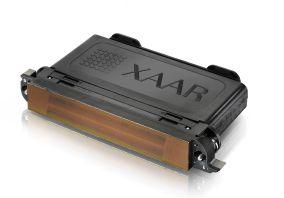
Xaar 5501 print head
In June, Xaar introduced the Xaar 5501, a new addition to its portfolio of aqueous print heads, which complements the existing Xaar 1201 and Xaar 5601. This is the first product resulting from Xaar’s collaboration with Xerox, aiming to provide high print quality combined with low printing and integration costs. Xaar
describes the 5501 as a lightweight and high resolution 1,200 dpi print head that is ideal for a range of water-based digital printing applications, such as textiles (digital direct to garment, dye sublimation transfer and soft signage) and graphics (banners, posters, displays). It has 5,544 nozzles, each producing five pL sub-drops giving a 115 mm print width. The Xaar 5501’s robust construction, according to the company, makes it compatible with a range of fluids including aqueous inks, low viscosity UV or solvent-based inks. The Xaar 5501 uses a micro alignment system to position and align print heads via software. This allows rapid and easy printer set up, explains Xaar, streamlining print head commissioning and reducing downtime overall. In addition, it does not require an ink recirculation system; which helps with lower integration costs and makes it suitable to use in scanning applications.
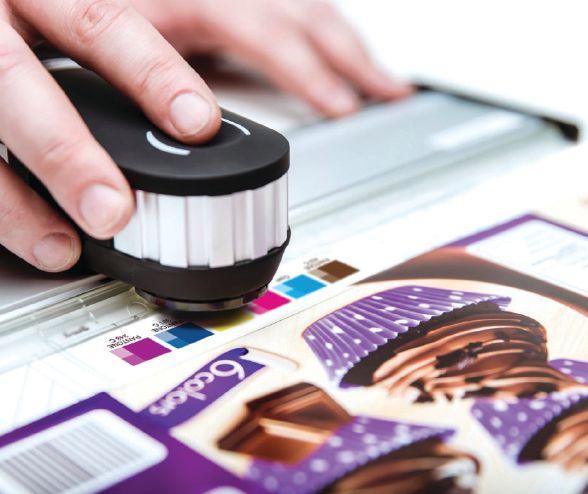
OpenColor 2.1 enables the measurement of full-tone patches from a print control strip.
The Xaar 5501 uses a micro alignment system to position and align print heads via software.
Solutions for the Publishing Industry
❏ One program manages entire company
❏ Enter data once and use it many times
❏ Enhances client service
❏ Work smart, work efficiently
❏ Increases speed - accuracy from contracts to invoices
❏ Eliminates duplication of effort
❏ Saves time and resources
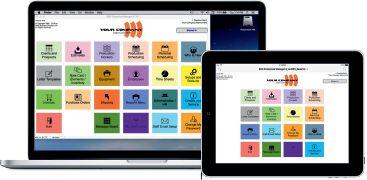
Magazine Manager
CET Color 3200UVRTR
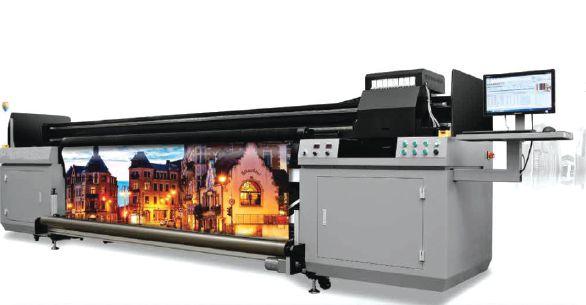
In June, CET Color, a manufacturer of wide-format UV flatbed and hybrid printers based in Atlanta, Georgia, introduced the 3200UVRTR printer, which is a 126-inch roll to roll UV printer. It leverages two Kyocera print heads and can include up to four. This unit has the capability of C,Y, M, K, Lc, Lm and WW ink configurations and supports Onyx or Caldera RIP software. The unit is able to print on various substrates like banner, backlit, mesh and vinyl. It also has a built in light source so users can back light their material before it goes to the take up reel, aimed at the UV market. CET Color offers a line of wide format UV printers, as well as a recently introduced flatbed cutter
Nustream Veramax
On and Fiery Image Enhance Visual Editor, and built-in Fiery FreeForm for variable-data printing.
Crawford Auto Tagger
In June, Crawford introduced its newest document accessibility solution, Auto Tagger for creating PDF or HTML documents that can be recognized by assistive technologies. The solution, explains Crawford, is the first on the market to easily and cost effectively address the need for creating ADA and Section 508 compliant ad hoc communications such as letters, notices, marketing documents, books, manuals, contracts and legal documents.
Roland HeatSoft SATIN
In June, Roland introduced the new HeatSoft SATIN (ESM-HTMS) as an inkjet-printable, polyurethane substrate for heat transfer applications. With its semi-gloss finish, HeatSoft SATIN can be transferred to cotton, polyester and poly blend materials to create customized apparel and accessories with what Roland describes as a “screen print” sheen. HeatSoft SATIN earned CPSIA certification for producing apparel and products for children 12 years of age or younger.
Techkon ColorEnsure
In June, Nustream Group introduced two large-format substrate lines in the Veramax Large-Format Aqueous-Coated Collection and the Veramax Large-Format Solvent-Coated Substrate Collection. The Veramax Large-Format Aqueous-Coated Collection provides substrates for Canon, Epson and HP water-based inkjet printing. The line is aimed at applications like labels and signage in addition to current proof or CAD prints. The Veramax Large-Format Solvent-Coated Collection is compatible with most solvent, eco-solvent, Latex or UV-curable inkjet printers.
EFI Fiery for Sharp
In June, Electronics For Imaging and Sharp Imaging announced the launch of a new EFI Fiery digital front end (DFE) to drive Sharp’s new MX-6580N and MX-7580N Color Document Systems.This new DFE includes the Fiery Command WorkStation and Fiery VUE, a free 3D visual print client application that simplifies the creation of booklets, sales guides, manuals, and more. It can also be integrated with EFI Quick Print Suite, Fiery Spot-
Techkon has introduced ColorEnsure for its recently launched ChromaQA 3.0 software, which pairs with the company’s SpectroDens spectro-densitometer to form a pressroom colour monitoring solution. ColorEnsure helps ensure press operators are taking colour measurements that are accurate for the job they are measuring. Before every sample is measured, the ColorEnsure feature automatically checks the connected SpectroDens instrument to be sure that the instrument is set up exactly as specified in the job. If the instrument is not set up properly, the operator will see the dialogue box below alerting them to the situation.
The 126-inch wide 3200UVRTR.
PROJECT MANAGER/PRODUCTION COORDINATOR
Manage projects through operations and manufacturing, end to end, docket entry, planning, technical reviews and interaction with the Operations group (scheduling, planning, purchasing and manufacturing).
Applications must have production coordination experience within the
printing industry; computer skills; Awesome Customer Service focus.
Email resume to: www.LMGroup.com/ careers
XEROX IGEN4 FOR SALE
Xerox iGen4 in perfect condition with low impression clicks. Freeflow print server. Media sizes 7” x 7” – 14.33” x 20.5” and weights of 16lbs to 130lbs
Contact Craig at 1.866.467.5391. Email: cwharton@ncogrenville.com
FLEXOGRAPHIC/ROTORY PRESS OPERATORS IN DEMAND
Experienced Flexographic/Rotory press Operators in Demand!
2+ years of experience required Competitive Salary/benefits/relocation pkg.
For info and to apply please email Candice.stark@adecco.ca
PRESS OPERATORS AND JUNIOR PRESS OPERATORS WANTED
Press Operator with experience on offset or web presses to operate a variety of presses. Experience required in operating a printing presses with ability to read and understand instructions. Strong knowledge of colour theory and ISO procedures.
Sakurai: 1, 2 or 4 colours and any size (newer model)
Polar: any size/older or newer models (66/72/76/78/82/90/92/107/115)
Horizon-BQ: 220/240/260/440/460
Scott Gray / Mitchell Press / Vice President of Sales and Marketing / Richmond, British Columbia
Scott Gray, after almost 30 years with Vancouver-based MET Fine Printers, one of Canada’s most highly recognized commercial printing operations, has joined Mitchell Press to help the historic web offset facility move toward digital.
Led by its third generation of family ownership, Mitchell Press operates out of a 64,000-square-foot facility as the largest commercial heatset web printer in Western Canada and the Pacific Northwest, outputting an average of more than two billion printed pages per year for a range of clients. PrintAction spoke with Gray about the transformation of what has been a quiet Canadian printing power.
Why does Mitchell have a unique market position?
SG: I have only been here about a month now but I’ve always known Mitchell to be one of Canada’s leading high-quality heatset operations. The have a 16-page configuration, two full-size webs, 4/4, 5/5, and the 4/4 has a coater as well. They have been going after high-end publication work for the last, I will call it, 88 years.
They started out as a financial printer. Nine years ago was a big moment for them when they sold their old factory, which was actually an old cookie factory, kind of a disjointed building. They created a new purpose-built facility and then put in a brand new Komori 1000 at the time and that was basically setting them off on a brand new foot. The building is really large, with lots of room to move into.
At that time, there wasn’t a lot of competition in the Vancouver market. There was Teldon, which five years ago Mitchell ended up buying and they absorbed the cream of the crop of the staff and brought some of the presses over. And then just kept pushing in that direction.
They outlasted all of their competition, but the web market is reducing a little bit. Run lengths are getting a little bit smaller and these guys are really looking forward to what is the future of the company and they are not afraid to spend a little bit of money to do that.
Where is Mitchell investing for the future?
SG: They want to go in a completely new digital direction with the size of the company and they have other expansion plans down the road that we will reveal a little bit later. But immediately they have now built probably one of the coolest digital rooms that I have ever seen.
The prepress workflow is getting so buttoned down with these guys. They are doing a turnaround of 25,000 on web magazines in 24 to 48 hours. The are so slick from that point of view and so we want to take that mentality and put it into the digital
world. So they have installed a Kodak NexPress CX3300, a beautiful machine with amazing capabilities – oversized sheet, it does metallic gold, opaque whites, dimensional, and I think next quarter we are getting into the heavyweight substrate expansion kit so we will go up to 530 gsm. For digital it has a lot of horsepower.
How difficult will it be for a web offset shop to go digital?
SG: We are getting competitive at 3,000 runs on the web with how fast these guys are making ready and turning around jobs so it is not much of stretch of the imagination to [produce] a couple thousand digital. Now maybe the gap is a thousand copies between digital and web.
2B
One of Canada’s largest heatset web operations, Mitchell Press outputs more than two billion pages per year.
We can do advanced copies for our clients to go around and pitch advertising. They can check out new artwork. They can do variable data image covers and that is just strictly on the publication side, not to mention the extra at least 30 percent of possible business opportunity that rests with existing clients that we are not even touching.
What is your initial push at Mitchell?
SG: Right now it is digital… One of the reasons they brought me on is that I have a lot of experience with digital – digital storefronts. I am leading the sales team. I am not here to retrain anyone because they are all very seasoned. They know what they are doing, but I want to show them new opportunities and I can kind of lead by example with the digital stuff because I have
of a lot of experience with it.
I have already brought in a few very cool, very high-level design projects that really push the limitations of the machines and it has knocked it out. So everybody has kind of caught a buzz on it and now they are looking to their existing client base.
How important are online storefronts for print?
SG: I think it is huge. I honestly think that is the future of print. We will be pushing that very quickly. We are going live with our Monarch update in a month and we are already putting together our storefront team and I believe that is going to be the next part of it. We will be doing both offset and digital through it.
I personally think it is the future of print. If the industry in five years is not doing 30, 40 percent of our work through storefronts then I will give my head a shake.
What are you most excited about by joining Mitchell?
SG: To me it is the ability to help rewrite an almost 90-year-old story. They have been very quiet and I can reintroduce them to design community. They have been really focused on the publication community and we have so much to offer for what people need, but they do not know who we are here. I just really want to shine a light on Mitchell and give them the attention that they deserve. I am really excited about the growth potential and the fact that they have embraced this change.
GET JAZZED.
The next chapter in your imaging success story starts at the 2017 SGIA Expo (New Orleans, October 10–12). Join us for three days exploring aisles filled with the industry’s major suppliers, connecting with the top names in imaging and learning new ways to make your business better.
The SGIA Expo is North America’s largest imaging event, with 540 exhibitors and a complement of top-notch education led by the biggest names in graphics, signs, installation, printed electronics, industrial and functional printing. Miss it, and you’ll be singing the blues.
Register at
SGIAExpo.org
“The SGIA Expo is hands-down the best graphics convention in the world. A must-attend for anyone related to this industry.”
540 exhibitors COUNTLESS possibilities
40+ educational options 3 days of opportunity
September 10-14, 2017
McCormick Place | Chicago, IL USA PRINT2017.com
PRINT 17 convenes the entire printing and imaging community—come connect, collaborate, and discover YOUR next profit opportunities.
• Discover YOUR new sales streams
• Innovate YOUR business with the newest trends and technologies
• Determine YOUR new growth strategies and next business opportunities