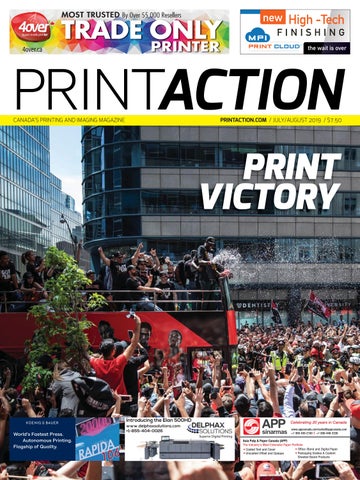
Raptors’ championship win is a slam-dunk victory for Canadian print 16 PrintForum
Toronto conference highlights lessons learned from top printing companies
18 Better connected
How smart packaging is changing the way we live and do business
DEPARTMENTS
GAMUT
5 News, People, Installs, Calendar
TECH REPORT
The world’s struggle with waste Print can play a lead role in recycling prosperity 12 16 26 8
22 Wide-format continues to be one of the most engaging sectors of the industry for commercial printing operations
SPOTLIGHT
26 Brent Moncrief, VP Strategic Marketing & Brand Management, the Americas, FUJIFILM North America Corp., Graphic Systems Division
COLUMNS
FROM THE EDITOR
4 Alyssa Dalton
Elevating print with augmented reality
CHRONICLE
8 Nick Howard
Elevating print with AR
Augmented reality’s ability to create impactful experiences has the potential to revolutionize the way we interact with the world around us.
Author and keynote speaker Bernard Marr describes AR as a technology where digital information – such as audio, graphics and animation – is superimposed onto the real-world environment.
According to the January 2018 BCG Marketing Executive Benchmarking Study, nine out of 10 large consumer advertisers are already using or are planning to use augmented reality in their marketing campaigns, with companies in retail, fashion and beauty, and gaming and entertainment as leading adopters.
“Rather than provide a fully immersive virtual experience, augmented reality enhances the real world with images, text, and other virtual information via devices such as heads-up displays, smartphones, tablets, smart lenses, and AR glasses,” he writes in his 2019 Forbes article. Seen as bridging the gap between the digital and physical worlds, the technology has a broad range of applications, such as enriched advertising opportunities, mesmerizing video game experiences, and improved healthcare education, among many others.
A new partnership between Kellogg’s and Crayola aims to get consumers to interact and engage with their brands in a different way. The multinational food manufacturer has released limited-edition black-and-white cereal boxes in Australia, encouraging customers to colour in the packs for a chance to win a Crayola gift prize. As part of the ‘colour to win’ competition, entrants are asked to submit their works through an AR portal on their mobile device, and watch their pictures come to life.
In a sea of brightly coloured packages vying to catch the attention of shoppers, the cereal boxes have opted for a monochromatic approach that invites consumers to share their own creativity.
“Redesigning the packs of such an iconic brand was a real privilege and the trust Kellogg’s gave us to go as minimal as possible was great validation of the idea,” says Nate Martin, Creative Director of creative agency Kinetic, who worked on the campaign. “We’re intrigued to see how consumers interact with the campaign and are proud to be delivering one of the first instances of in-browser augmented reality for a [fast-moving consumer goods] brand.”
The effort exemplifies the combination of childhood classics – colouring books and breakfast cereal – with sophisticated mobile technologies.
“We’re particularly delighted to be partnering with Crayola for this campaign,” Kellogg’s Senior Shopper Activation Manager Felicha Hogan says. “As a first for Kellogg’s we’ve been able to strip the colour from our packs and hero our distinctive assets, whilst making sure shoppers can still find us on [the] shelf.”
In a 2018 interview with Adweek, Bryn Mooser, co-founder and then-CEO of Ryot Labs, said the near future of ubiquitous self-driving cars and smart displays will create all-new scenarios for consumers to entertain or inform themselves. “The camera on the back of the cellphone is the most important innovation in media since the printing press,” he said. “You can record your own stories, you can see what’s going on in the world, and you can also create this augmented reality world around you.”
A number of brands have recently experimented with AR-print integration. Madame Tussauds London last year introduced an AR-enabled guidebook that, when activated, unlocked a series of behind-the-scenes videos so visitors could see how the wax models were made.
Launched in fall 2017, the Ikea Place app lets customers see how its more than 2,000 furniture items would look and fit in their homes. Its first interactive experience was released in 2013 as part of the Ikea Catalogue app; an AR feature allowed potential buyers to place and view furniture items in their rooms, with a copy of the print catalogue placed in frame to help calculate the scale.
Meanwhile, the front and back covers of the May 2016 issue of The New Yorker featured the work of illustrator Christoph Niemann which could be animated using an AR app, a first for the American magazine. Through a smartphone or tablet, readers could bring Niemann’s illustrations of a subway car and city skyline to life, as well as several AR-enabled ads, transforming static print pages into an interactive experience. Similarly, the May 2016 issue of Ellegirl Japan created unique reader experiences as the first magazine in Japan to be linked entirely to an AR app. Readers could turn themselves into a virtual Ellegirl model, putting themselves on the cover of the issue by uploading a selfie, as well as watch fashion tutorials.
“Marketing in the information age is much more of an ‘experience,’ thus pushing out former methods that were static and less interactive. AR is allowing content to not be held prisoner to paper and screens,” writes Augment, an enterprise AR platform, in a 2016 blog post.
As brands strive to create innovative and captivating engagement opportunities, there’s no doubt AR will become an increasingly significant component of the cross-media experience.
PrintAction is printed by Annex Printing on Creator Gloss 80lb text and Creator Silk 70lb text available from Spicers Canada.
ISSN 1481 9287 Mail Agreement No. 40065710
C.J. Graphics picks up 20 Bennys, making it the first time a Canadian company was awarded the most Bennys worldwide in the program’s history.
C.J. Graphics of Mississauga, Ont., was recently awarded 20 Bennys, the highest honour in the 2019 Premier Print Awards, making it the first time a Canadian company was awarded the most Bennys worldwide in the history of the annual awards program. The printing company also received 42 Awards of Recognition and 83 Certificates of Merit. The Premier Print Awards, the graphic arts industry’s largest international print competition, recognizes achievement in print production and is hosted by Printing Industries of America. In its 71st year, the contest honours those responsible for the creation and production of superior print communications.
Ville Saint-Laurent, Que., commercial printer Accent Impression has acquired Le Groupe Quadriscan. Founded in 1991, Quadriscan is a commercial printing company located in the Mile Ex district of Montreal, Que., with digital, offset and large-format printing capabilities. With nearly 60 years of combined expertise, Quadriscan and Accent Impression will employ over 120 printing specialists out of two plants, and will offer a range of digital, offset and large-format printing, as well as complete fulfilment, bindery and finishing services. President Roger Blanchette, as well as associates Alain Métivier and Denis Forgues, will remain at the helm of Quadriscan and operations will carry on as usual, the company says.
An investment group led by Direct Response Media Group (DRMG) has acquired the assets and ongoing
business interests of Lowe-Martin’s web business. The company, led by CEO Patrick Periard, will operate under the name Dollco Print Solutions Group. The transaction closed on May 12. Dollco and Lowe-Martin also entered into a preferred supplier agreement, which they say will ensure a continuation of service for customers. The move will create two companies “focused on delivering a strong value proposition through specialization,” they explain. Through a statement to its customers and vendors, Lowe-Martin CEO Ward Griffin explains the company will focus on sheetfed printing, digital printing, e-commerce, large-format digital printing and packaging.
pane, the rate would become $0.92 per stamp, up from the current rate of $0.90. Buying a single domestic stamp for the same item would cost $1.07, up from the current rate of $1.05. The rate changes would take effect on January 13, 2020. Canada Post says the estimated impact of the rate increases on the average Canadian household would be under a dollar a year, and the total increase for small businesses that use stamps would be estimated at about $6 a year. It notes Canadians can avoid the increase by purchasing Permanent stamps at the current rate in advance, if the changes are approved for next January. Canada Post is also proposing to increase rates for other domestic Lettermail, U.S. and international Letter-post items and domestic Registered Mail.
Southwest Business Products has purchased the Binders and Index Tabs Business from DATA Communications Management (DCM) of Brampton, Ont. As well, Southwest has entered into a long-term supply agreement with DCM whereby Southwest has become the preferred vendor to DCM for binders, index tabs and related products. A provider of business communication solutions, DCM’s core capabilities include direct marketing, print services, labels and asset tracking, event tickets and gift cards, logistics and fulfilment, content and workflow management, data management and analytics, and regulatory communications. Established in 1978, Southwest operates six branches across Canada, including its head office in Toronto, Ont.; Ottawa, Ont.; Vancouver, B.C.; Calgary, Alta.; Montreal, Que.; and Dartmouth, N.S.
are all students from U.S. post-secondary institutions.
Delphax Solutions, Inc., (DSI) a digital inkjet press designer and manufacturer, has signed a reseller agreement with Triquerta Imaging Solutions of Mississauga, Ont. Triquerta is the first Canadian company to formally sign with DSI’s Sales Partnership Program, announced in March 2019. The deal enables Triquerta to represent DSI’s Elan HD range of colour inkjet presses in the Canadian marketplace and extends its existing product offering to include production equipment.
On July 20, Tim Hortons and Special Olympics Canada released a limited-edition doughnut to support and celebrate Global Day of Inclusion. This year’s doughnut – a cruller sliced in half, filled with whipped topping and decorated with vanilla fondant and red sprinkles – was created by Komcan’s very own Tori Ranson, a Special Olympics athlete whose creation was chosen from more than 400 submissions. All proceeds support Special Olympics programs nationwide. Located in Georgetown, Ont., Komcan is the exclusive distributor of Komori presses in Canada.
On May 30, Gala Gutenberg celebrated 37 years of print excellence at the Bonsecours Market in Montreal, Que., with more than 470 members of the print community. In total, 12 awards were presented to a range of companies from the province of Quebec. This year’s gala included the Coup de Coeur Award again, where attendees were invited to vote for their favourite piece during the cocktail party.
Canada Post announced in mid-June its proposal to increase postage rates in 2020 by two cents for a domestic Lettermail item of 30 grams or less. For stamps purchased in a booklet, coil or
With the support of industry donors, the Specialty Graphic Imaging Association (SGIA) has once again announced its annual scholarship recipients. Out of 67 applicants, the association is awarding 20 SGIA Educational Institution Member students – five of which are Ryerson University students – with US$2,000 each toward education costs. Congratulations to all scholarship recipients, in particular to Ryerson Graphic Communications Management (GCM) students: Iain Ailles, junior; Justin Chan, senior; Matthew Fantauzzi, sophomore; Julia Forrester, senior; and Afrah Idrees, junior. The other recipients
Carbon Graphics Group, formerly Carbon Copy Digital, in May announced it had purchased Petro-Tech Printing Ltd. from The Prolific Group, a move that will enable both companies to expand and diversify their services, they say. With a staff of 18 employees, Petro-Tech has been operating in Calgary, Alta., for more than 50 years. Carbon Graphics Group, with a 20,000-square-foot facility in Calgary and a 15,000-squarefoot facility in Edmonton, Alta., is a 40-year-old Canadian printing company. Petro-Tech operations and staff are expected to eventually merge into Carbon Graphics Group’s Calgary location.
Residents and businesses might see an increase in postage rates starting January of next year.
C.J. GRAPHICS
INSTALLS
Canadian print industry veteran and trailblazer Mary Black passed away on July 5 at 80 years of age. For more than 40 years, she was a champion of the industry as well as an inspirational leader, role model and friend to many. Black started her career as a technical illustrator and art director in the publishing industry in 1967, and then made a move to Graphic Litho Plate as a sales representative. During that time, she also went to night school, earning a BA in Psychology from York University. After a successful career in prepress sales, she started her own company in 1985, Colour Technologies, which was eventually purchased by C.J. Graphics. Her career in the print industry also includes 10 years at Ryerson University, where she served as Professor and Chair of Ryerson University’s School of Graphic Communications Management.
Transcontinental Inc. has appointed Thomas Morin President of TC Transcontinental Packaging. Based in Chicago, Ill., he will report to François Olivier, President and CEO, and will be part of the executive management committee. Since 2014, this position has been held by Brian Reid, who has been with the corporation for over 25 years. Moving forward, Reid will dedicate his time exclusively to his role of President of TC Transcontinental Printing, a position he has held for more than a decade. As President of TC Transcontinental Packaging, Morin will have full profit and loss responsibility and provide strategic and thought leadership to the division’s operations and plants. He will be in charge of establishing long-term goals and strategies as well as executing business plans, aiming for further efficiency and profit maximization. In support of the corporation’s vision, Morin will be responsible for overseeing the expansion of the packaging business in all markets through organic sales growth and acquisitions, as well as managing investments by ensuring that proposed capital expenditures are in line with the strategy, the company explains.
Beginning July 1, Philip Hampson will head the Display Graphics Systems (DGS) division at Canon Canada, adding to his current role as Senior Director, Print Production Systems (PPS). He says his expanded role is expected to help grow the Canon/Océ brand in the commercial segment, noting that he is “very excited” for his new role.
British Columbia’s Mitchell Press is welcoming two new members to its sales team, describing them as bringing a “great blend of culture and incredible depth of expertise.” Mike Winteringham joins the team with over 35 years of print expertise, 34 of which have been at Metropolitan (MET) Fine Printers. Meanwhile Laura Fox joins the sales team, bringing over 12 years of experience analyzing her clients’ business needs and objectives to provide tailored solutions to her native home, Victoria, B.C. The company describes Fox as bringing a “free thinking, exploratory approach to seeking solutions and adapting to her client’s business challenges.”
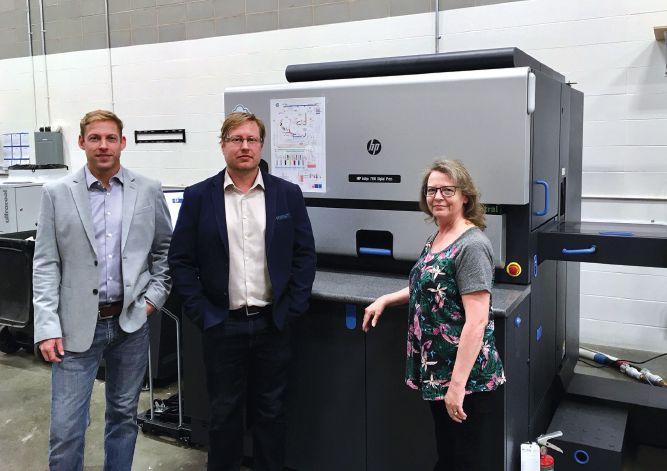
Edmonton, Alberta-based Heron Printing has acquired its first HP Indigo 7900. The fully configured seven-colour press is equipped with a range of capabilities, such as raised/ textured print, One Shot printing on synthetics, and specialty inks white, silver, clear, fluorescents, invisible and Pantone spot colours.
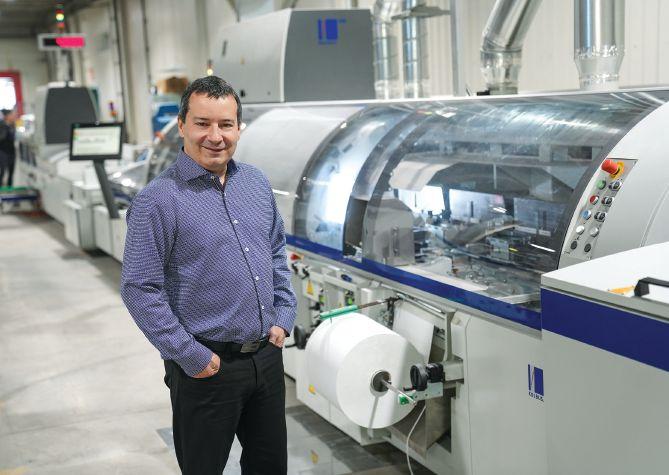
Multi Bookbinding, a hardcover book trade bindery in Shawinigan, Que., has invested in Muller Martini’s KM610 perfect binder to replace a legacy KM470. The purchase was spurred by increased demand for hardcover bookbinding in North America, the company explains.
Boutique digital print shop
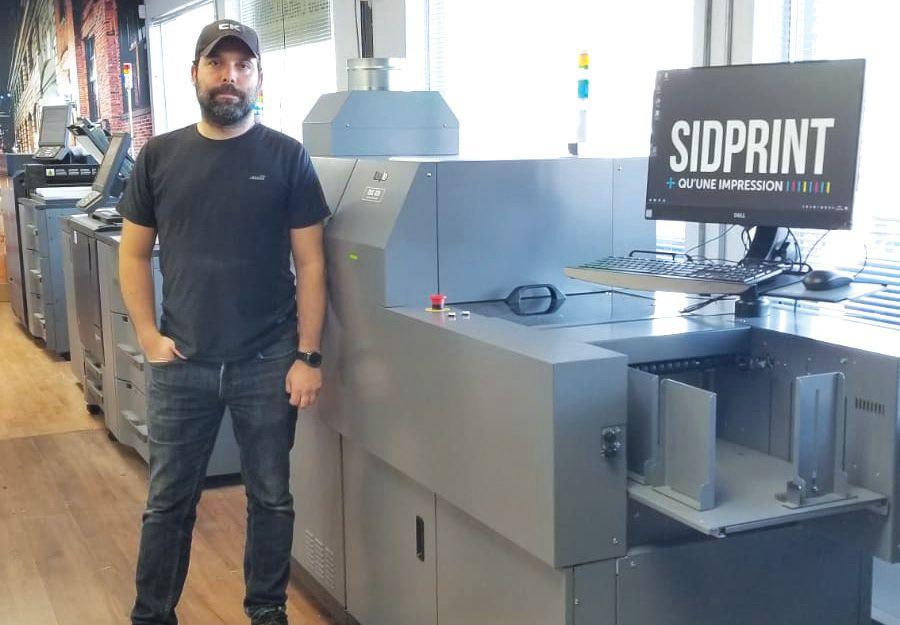
Sidprint of Vaudreuil-Dorion, Que., has purchased Canada’s second Duplo DDC-810 spot UV coater. Along with the DDC-810, Sidprint also upgraded its handfed booklet-maker to the Duplo 150i digital booklet-making system
The world’s struggle with waste
Print can play a lead role in recycling prosperity
By Nick Howard
Standing outside my local coffee shop, I’m staring at a row of trash bins, each emblazoned with signs. One reads garbage, another, recycle, while a third says paper. Just as millions of people, I struggle to figure out which bin or bins my lunch packaging should go into. Even more annoying, some of my trash is made up of a combination of materials.
I feel like a picker at Amazon, ripping apart various bits of my packaging and tossing it into various orifices. This is just stupid.
Recycling is in the cross hairs today and, over the last 12 months, has been heating up to a point where climate change shares top billing with our growing trash problem.
Mountains of articles with a governmental focus are picking up steam, looking for a solution. The answer seems rather obvious from where I stand. Yes, the use of single-use plastics is a concern but banning straws is only a small part of a larger problem.
Paper, as all printers know, has an easy way to be reused. Mixed (coated or other processes such as glue) are sorted and separated from uncoated, and the filled bins can be routinely hauled away by paper recyclers. Because these are already pre-separated, the process is easy. Glass and metals have the same easy process of being returning to recyclers who have a simple task of crushing the glass or filtering the various metals. Nothing can be as simple as isolating steel cans from aluminum
The print industry has been handed an opportunity to show how the use of 100-percent paperbased packaging makes good sense for the planet.
— besides there is a ready buyer for these materials. The common sense approach to plastic should be made the same. The problem is, a good many packaging products are made up of a combination of paper, plastic and metals. This can be fixed by
encouraging the printing industry to develop new cellulose materials that can make packaging homogeneous. Since plastics were invented back in 1862, we sought a way to produce a product that could outlast everything else found in nature. There remains good reasons for this. If you live near bodies of water or in a four-seasons climate, having window frames that don’t rot or rust makes a good deal of sense. Plastic piping, such as ABS, is lighter and is used for everything from high voltage wires to drain and water pipes — none of these do you want to habitually replace. But currently there is no incentive for plastics to be recycled the same way as paper, metal and glass.
Billions, if not trillions, of tax dollars are spent trying to get a grip
CALENDAR
August 9, 2019
Inaugural Martyn Johanns
Memorial Golf Tournament
Conestoga Golf Club, Conestogo, Ont.
August 22, 2019
OPIA Toronto Golf Classic
The Club at Bond Head, Ont.
October 3-5, 2019
Print 19 Chicago, Ill.
October 23-25, 2019
Printing United 2019 Dallas, Texas
November 7, 2019
Canadian Printing Awards
Palais Royale, Toronto, Ont.
November 25-28, 2019
Shanghai World of Packaging Shanghai, China
June 16-26, 2020
drupa 2020
Düsseldorf, Germany
September 15-17, 2020
Labelexpo Americas 2020 Rosemont, Ill.
on the ever-expanding piles of single-use plastic. Canada recently followed the EU in banning various one-time-use plastics by 2021. Does that solve our problems? I don’t think so. There are much easier and less bureaucratic ways of reducing waste and giving it another life. Current recycling programs are simply wasteful as loads of quasi-sorted materials end up at monstrous locations where someone gets the crappy job of rifling through conveyors of household waste looking for the good bits. No wonder it’s a rotten job. But not everything is as simple as a paper cup and a paper lid. Finding a way to manufacture a box of plastic wrap without a metal serration strip is just one obstacle of many that will have to find a solution. Years ago we were in Germany and walking through a quiet neighbourhood one evening. We came across a very large dumpster-like container with two small round holes at shoulder height. One sign read glassklar (clear glass), the other read glasfarben (coloured glass). What a common sense, easy way to
return single-use glassware to be used again. But here in Canada we don’t do that. Yes, we can return wine and spirits bottles to the store or we can throw them, along with other so-called recyclable products, in a blue bin for someone else to sort them out.There is no reason why the public can’t do the sorting themselves and deposit base recyclables into large containers that a recycler can then pick up and not have to re-sort.
Too many trash cans are part of the problem
Try and find a trash can in Japan. I once grew annoyed when I simply could not find a container on a busy street in Tokyo to toss a coffee cup. That is, until I realized the less trash cans there are, the more effort we put into finding a proper place to dispose of refuse. This is unlike Canada where some communities go out of their way to spread millions of containers all over our cities and towns — and to great taxpayer expense. These containers are jammed full of everything from waste paper to dog feces, and someone has to sort it. Tax dollars spent picking up all over the place and sorting materials is a waste of our hard-earned money. Countries such as Japan are excellent examples of intelligent management.
There is money in trash, and not just picking up and filling our landfills or reaping subsidies to sort through the stuff. Look at metals, cars and smaller items, such as batteries. All have value with simple routes back to the industry. Not so with plastic. Canadian firm EPI has developed an OXO-Biodegradable compound called TDPA™ (Totally Degradable Plastic Additive). This compound is now being used in shopping bags and based on a modified formula called Polyactide Aliphatic Copolymer. The bag is designed to biodegrade in weeks. Soon, materials of this type will be used in other products. Another product is CPLA, which features a sugar such as corn- or beet-based renewable bio-waste polylactic acid, that is now being used to manufacture lids and cups. These are good things no doubt, and there is the additional benefit to homogeneous packaging that can also be printed. Biodegradable anything is part of the recycling solution too.
Our industry has a golden opportunity to encourage the use of paper. Although there are new sources of natural, fast-growing trees, printers have already had to struggle and
adjust to shorter fibre-recycled papers. We can ensure the packaging we make is made only with single-stream materials and discourage the use of compounded products, such as a cardboard box with a plastic lid. Perhaps our associations will take a leadership position to encourage the adoption of simplified recycling programs, such as the German glass bottle bins. If we can do this, then more of the materials will be reused again and again, and we can diminish the huge cost of sorting or ambivalence by the public that it is someone else’s problem. Had the EU not banned straws, there would be no push to make them any differently. If every straw went to the right
up in these and must be sorted again at a depot. Eliminate the need for the public and industry to do the same job twice.
• Continue using environmentally friendly inks and coatings to encourage manufacturers that printers can provide a stunning package even with a single component. As long as we do this, no one needs to cut corners on creativity or the amount of packaging used.
The missing link in recycling is plastic. Photos that show oceans and rivers full of plastic bottles and non-biodegradable trash scream now is the time to make it easy to return plastic to be recycled, ground up and used again. If we do that and
Finding a way to manufacture a box of plastic wrap without a metal serration strip is just one obstacle of many that will have to find a solution.
place, there wouldn’t be a “straw” problem or a need for paper straws either. Just because we don’t have an answer to aluminum serration strips in the same material as the cardboard box, doesn’t mean we won’t find one.
Some suggestions
• Mandate single-use packaging to be made with singular ingredients. This includes metallized foil and plastic labels.
• Develop a simple recycling program for plastics and encourage polymer industries to develop ways of reusing all forms of plastic.
• Standardize large community recycle containers for base materials: Paper, plastic, metal, glass and corrugated packaging.
• Centralize recycle deposit containers by working with independent recyclers and make them easy to access, and large enough to reduce pick-ups.
• Reduce the quantities of generic trash cans and raise fines for littering, thereby encouraging the public to return packaging to a source that will reuse it. Change is always the most difficult, but the sense is that most of us want to play a bigger role as long as it doesn’t cost us more money.
• Eliminate the home recycling container.Too many recyclables end
not use our tax dollars to pay a subsidized sorter, not only can the world eradicate plastic waste, we can also reduce our dependence on plastic’s main ingredient — oil. The print industry has been handed a golden opportunity to showcase how the use of 100-percent paper-based packaging makes good sense for the planet.
I don’t want to stand there stripping bits of my trash to be placed in a jumble of bins. A coffee cup and lid should match! The landfill only gets biodegradable organic waste. As kids, we would rummage through ditches and parks looking for glass soda bottles because they had a cash return credit. With metals – especially aluminum cans – inner-city poor still collect and return these to a metal recycler for cash. That’s because metal has value. Now it is plastic’s turn to be easily recycled. Meanwhile packaging designers should see a problem for which they can devise a solution.
NICK HOWARD, a partner in Howard Graphic Equipment and Howard Iron Works, is a printing historian, consultant and Certified Appraiser of capital equipment. nick@howardgraphicequipment.com
PRINT CHAMPIONS
Historic Raptors’ win is a slamdunk victory for Canadian print
By Victoria Gaitskell
The Toronto Raptors’ success in the National Basketball Association (NBA) June Finals over two-time defending champions, the Golden State Warriors, marked the team’s first NBA championship as well as the first time the series was won outside the United States. The Raptors’ historic playoff run and ensuing championship parade became national front-page news, as Canadians from coast to coast united in support of their country’s sole NBA team.
But those wins were not just triumphs in the world of sports; they also amounted to a victory for Canadian print. The PR and omnichannel marketing genius of the team’s corporate owner Maple Leaf Sports & Entertainment Ltd. (MLSE) was instrumental in arousing widespread interest in the Raptors brand, and print was a major driving force in MLSE’s strategies.
So effective were these strategies that even Canadians who do not typically follow the sport found themselves tracking the Raptors’ progress. Even the July free-agency decision of Finals MVP Kawhi Leonard to leave the Raptors in favour of a four-year US$142-million deal with the Los Angeles Clippers captured the general public’s attention. Using social media as a measure of marketing success, sports management firm Deportes & Finanzas reported the Raptors became the world’s most popular basketball team after its NBA victory — garnering a world-leading 28.9 million Instagram interactions in the month of June. Data from Internet analytics platform SEMrush found the number of Raptors-related tweets grew by a staggering 4,400 percent in Canada after its Game 6 championship victory against the Warriors on June 13, while Raptors web searches grew in Canada by 2,490 percent in the days following the win.
MLSE is jointly owned by Bell Canada Enterprises, Rogers Communications, and Kilmer Sports. In addition to the Toronto Raptors, MLSE also owns the Toronto Maple Leafs and Toronto Marlies hockey teams, the Toronto Argonauts football team and the Toronto FC soccer team, as well as all the venues its teams play and train in, and three specialty sports TV channels. This article brings you a behind-the-scenes look at
three diverse print suppliers that produced a select portion of the spectacular media MLSE used in recent months to promote the Raptors brand and its journey to a historic championship win.
Planning and experience
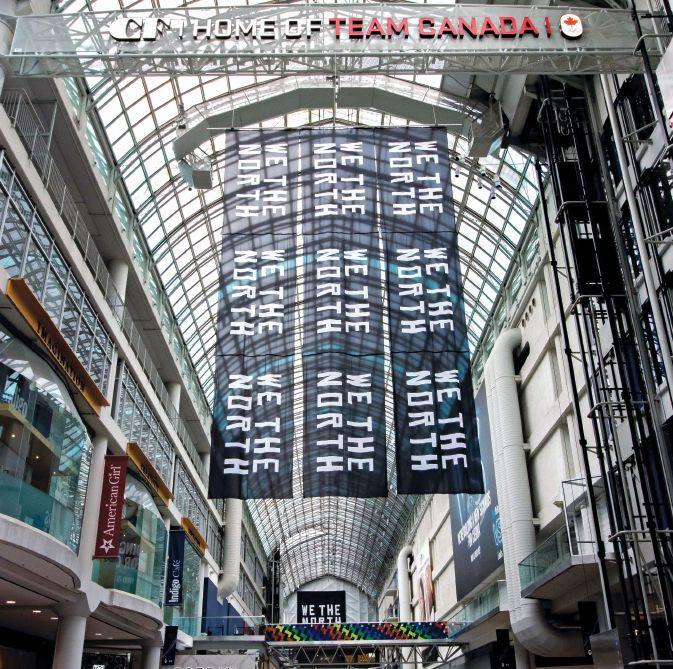
ICON of Markham, Ont., is MLSE’s official supplier of graphics and signage. For the NBA playoffs, ICON printed banners with the Raptors’ slogan, “We The North,” which festooned the CN Tower, the Princes’ Gates at Exhibition Place, the Toronto Eaton Centre, and other Toronto landmarks. ICON also produced signage to decorate the Maple Leaf Square, the public square adjoining Scotiabank Arena where the games are played and the street running into it, Bremner Boulevard. This area, nicknamed “Jurassic Park,” transformed into a lively, outdoor game-viewing venue and was the site of tailgate events organized by MLSE.
For the championship parade on June 17, ICON produced float graphics, banners, mesh scrims and flags for barricades along the parade route, and much of the gigantic signage for the stage, media tower and surrounding area at the parade’s end point, Nathan Phillips Square, which also served as the site of the celebration rally. The company printed all Raptors-related graphics on its fivemetre-wide Durst RHO 500 and three-
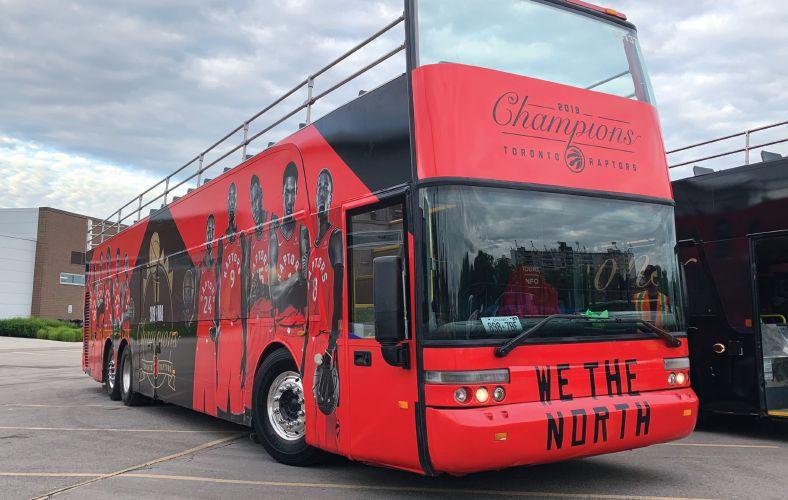
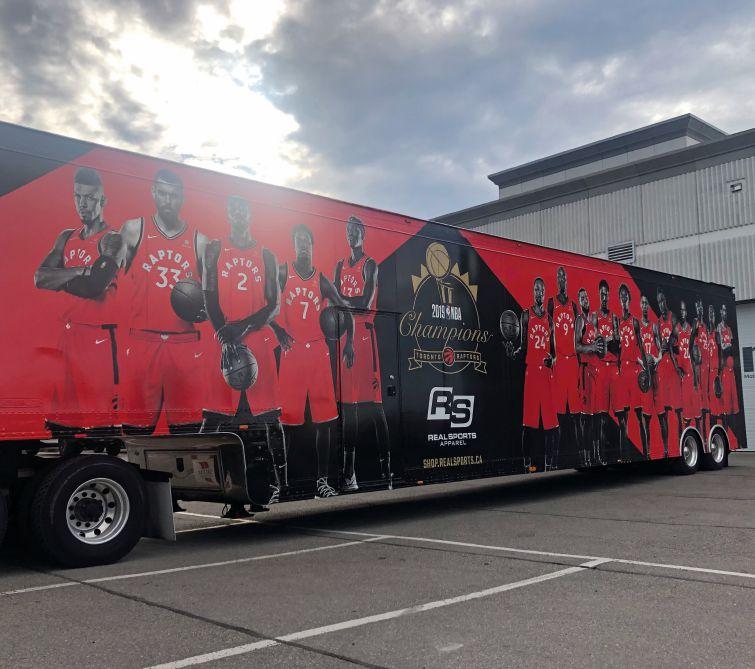
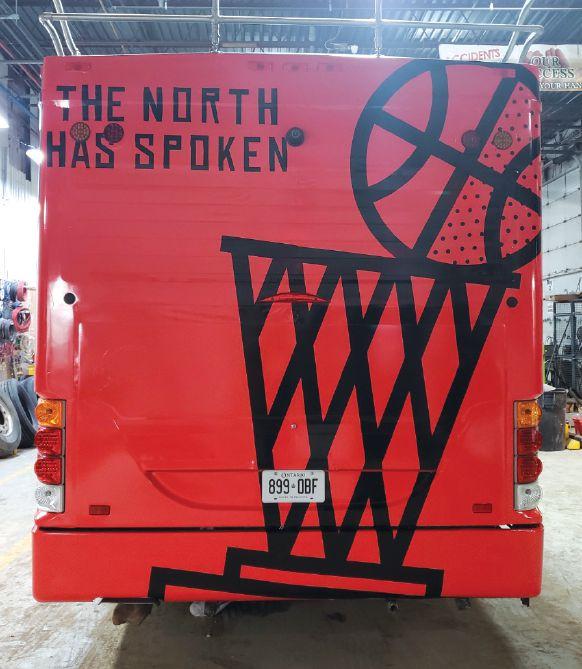
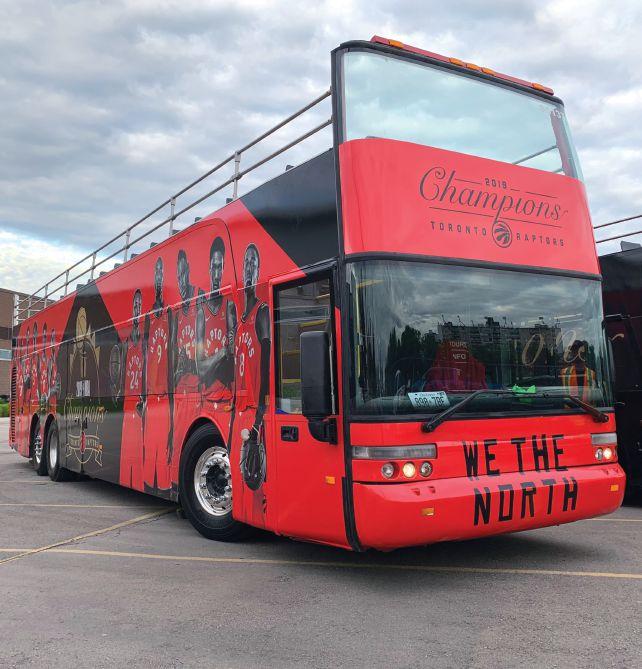
Opposite page and above: Vehicle wraps produced by Motive Media for the championship parade on June 17.
Right: “We The North” flags produced by ICON on display at the Toronto Eaton Centre, as the city cheered on the Raptors during the NBA Finals.
“The Raptors panorama was an unprecedented experience for us in its scope and magnitude, but we were able to execute it through careful planning in close collaboration with MLSE,” ICON President and CEO Juan Lau says. “Our 18year business relationship with MLSE and experiences with other sports event management clients have taught us the mechanics of sitting down with organizers in advance to map out a detailed strategy.”
Past sporting events that ICON has been a supplier for include the NBA AllStar Game, the World Cup of Hockey, the International Ice Hockey Federation (IIHF) World Junior Championship, the Major League Soccer (MLS) Cup, the RBC Canadian Open, and the Honda Indy.
In planning the Raptors’ victory celebration, Lau says graphic files were ready several weeks before the outcome of the playoff run had played out, and plans included several different scenarios and parade dates, dependent on whether the Raptors won in Game 5, 6 or 7. ICON also contacted suppliers in advance to make sure enough of the various substrates would be available to complete the necessary printing, if required.
Co-founded by Lau with two partners in 1995, ICON has grown to occupy a 120,000-square-foot production facility in Markham with additional offices in Toronto and New York. It employs a staff of 240 and serves clients through four divisions: ICON Visual for large-format and display graphics; ICON Media for customized digital signage; ICON Motion for content creation, video production and event management; and ICON Print for offset and commercial printing, including marketing collateral and direct mail.
Lau says one of the biggest challenges of its recent Raptors work was co-ordinating multiple projects and production schedules, not only for MLSE but also for MLSE’s 50-some corporate partners, while also completing other client jobs already in progress. The company relied on its seasoned project managers to perform site checks and deliver precise specs and graphic files to the production team as quickly and efficiently as possible. “Our experience in event marketing really pulled us through,” Lau says.
An extra special challenge arose when ICON received notice at 5 p.m. on the Friday before the parade, when much of the staff were preparing to go home, that Drake – rapper and Raptors global ambassador – had decided to enter a float in the parade set for Monday morning. The staff waited until late Friday evening to receive the files and specs needed to produce all the graphics for the float, and a team of installers worked around the clock to mount the parade and street graphics in time for the parade’s scheduled 10 a.m. start. Until then, all the floats were hidden in the OVO Athletic Centre, the team’s practice facility.
Creative flair and flexibility
Based in Bolton, Ont., Motive Media was responsible for wrapping a number of vehicles in the championship parade, including five double-decker buses, 19 Ford vehicles, a 54-foot merchandising trailer, and a vintage Toronto Transit Commission (TTC) bus and trolley, all used to transport the players and their families, team management and dignitaries. The company produced the graphics on both an HP Latex 370 and an HP Latex 570 printer on 3M IJ180MC-10UR (Ultra Removable) substrate. Once printed, the vehicle graphics were laminated with 3M 8519 Lustre Overlaminate using a 65-inch Kala 1650. As well, Motive supplied banners for the Toronto City Hall stage which
were printed by a longtime trade partner. Motive started preparing design files and ordering materials after the Game 3 win on June 5. With MLSE having been a client for over six years, this helped expedite preparations as Motive already had MLSE’s colour profiles saved, but production did not start until more than a week later.
“We got the go-ahead from MLSE on the night of June 13, the minute Game 6 stopped in Oakland, California,” Kate Glassow, National Account Manager, says. “I was nervous because there was so much at stake for us. We had all hands on deck and people working in production around the clock.”
Over the course of 72 hours, the Motive team printed and installed 8,000 square feet of vinyl, completing the job just before 1 a.m. on parade day. By 6 a.m., the vehicles they had wrapped in Bolton were on the road to Toronto.
Because the double-decker buses were in regular use for Hop-On Hop-Off Bus Tours by Toronto City Sightseeing, Motive could only begin wrapping them Saturday night. The wraps also required taking lots of meticulous measurements in advance to pinpoint the locations of windows, doors and vents, so that during the installation, no important parts of the graphics would be cut off. Additionally, the buses had to be wrapped in the Toronto tour company’s bus bay instead of Motive’s much larger bay in Bolton.
“When we use our own facilities, if the need arises, you can just go inside and have the graphics reprinted,” Glassow says. “But luckily, the bus installations were fairly trouble-free. We sent our best team, led by Installation Manager Randy Shepherd, to work on them, and none of the graphics needed to be reprinted because they all fit. You can have the best printing equipment and best graphics in the world, but if you don’t have a highly skilled installation team backing you up,
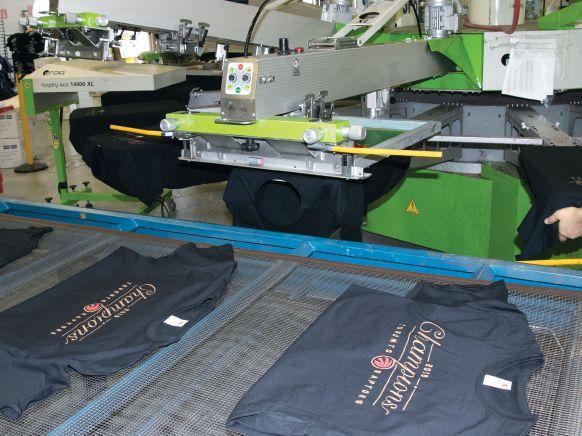
Top left: Production of the black championship t-shirts printed by Entripy Custom Clothing.
Above and top right: Within one week, ICON produced hundreds of fence graphics, tens of thousands of large and handheld flags, and vinyl murals as Toronto hosted the largest championship parade in North American sports history.
it doesn’t matter. They’re the ones who actually bring the job to life.”
Glassow says a further complication was maintaining secrecy because the Toronto bay could only hold 2.5 buses at a time, so during installation, at least half of a bus was always sticking out in plain sight. When passersby started noticing, Glassow called MLSE to report the possibility that someone might leak cellphone photos of the buses before the parade. Although numerous members of the public, and even at one point a CityTV news crew, showed up, Glassow was impressed by how respectful they all were of her request to keep the bus graphics a surprise for fans and parade spectators on Monday.
Founded in 2003 by President and Creative Director Kathy Cartan (who is Glassow’s mother), Motive Media is a boutique creative solutions agency that helps clients promote their brand, usually through large-format digital graphics. It employs 11 staff in its 10,000-square-foot production facility. The company began as a specialist in the design, manufacture, and installation of transportation graphics, but after a close call in 2008, when the closure of a major client almost drove the company under, it downsized to a smaller location and started using its equipment to produce more diverse products, including wall murals and wayfinding system for interior decor.
“I didn’t realize it at the time, but what we went through actually saved us by forcing us to expand our market,” Cartan recounts. “Now we’ll often do a fleet of trucks for a client, and then they’ll ask us to decorate their lobby with a mural.”
Cartan began her career as a graphic artist, painting signs and scenery manually for Canada’s Wonderland. Although she has since moved into computer-aided design, her company’s products are still distinguished by a high degree of artistic creativity. Canada’s Wonderland remains a client and hired her nearly eight years ago to wrap the Leviathan – the tallest and fastest roller coaster in the country –which posed a unique challenge because of its peculiar shape and the fact that it could not be taken off the track during the wrapping process.
About the Raptors’ parade vehicles, Glassow says: “We have wrapped fleets of 50 trailers before, but not on such a tight
timeline. This is definitely the biggest, quickest, most high-profile job we’ve ever done. It was only once I saw the actual players on the buses, and the crowds on the streets [estimated as large as 2 million], and heard the media saying how cool the buses were that I realized, ‘This is huge.’ Before that time, I had been so busy getting the job done that I didn’t realize how immense it was.”
“We are small, but we have a can-do attitude and the flexibility to pivot when needed,” Cartan adds. “We are so proud to have been a part of that special moment for the Raptors and for Canada. We feel grateful for the opportunity to be part of something so big and to have our work on display for millions of people across the country.”
Control and agility
For each Raptors Finals home game, Entripy Custom Clothing, MLSE’s preferred custom apparel and promotional products partner, printed 23,000 custom t-shirts as a free giveaway to each attendee, which was placed on every seat in Scotiabank Arena.
“The shirts are a fantastic part of the fan experience. There’s always a sense of anticipation because people want to know what the next design will look like,” Jas Brar, Founder and CEO of Oakville, Ontario-based Entripy, says. MLSE’s creative team generates a unique design for each shirt which is kept secret until game time. The shirts add to the fans’ experience and provide each person with a coveted collectible souvenir and conversation piece that cannot be obtained anywhere else.
Brar says his company’s ability to control all aspects of production, from sourcing blank garments to production, packaging and delivery without outsourcing any part of the process was critical to producing the t-shirts on time. “Tons of other people sell the same thing I do, but their operations are very fragmented. For MLSE, we need to control service times and lead times, and you can’t rely on third parties to do that,” he explains. “The playoffs are intense because turnaround times are very short and there is a lot of uncertainty.We have to make sure we have enough staff and material to get through the entire playoffs, yet we also have to take things game by game where we can’t
predict the outcomes.”
For instance, until the end of Game 6 in Oakland, the team didn’t know whether there would be a Game 7 in Toronto. Under these conditions, the time available for Entripy to produce and deliver an entire run of 23,000 t-shirts would amount to less than 48 hours.
“Fortunately, we are used to staying agile because our business is seasonal,” Brar continues, explaining that in the summer, they sell more t-shirts and in the fall and winter, more jackets, sweatshirts and hoodies. “One way we stay agile is to add a third eight-hour rotating shift from 11 p.m. to 7 a.m. when we need it, and eliminate the third shift when we don’t. For the Raptors Finals, we also worked weekends – even long weekends if necessary – and called in our office staff and management team for extra help.”
Brar started the company in 1999 while he was still a student at the University of Toronto. After identifying a gap in the market for custom t-shirts for campus events and organizations, he started buying t-shirts wholesale, embellishing them through a third party, and selling them back to other students. When he found the third party was unreliable at meeting tight deadlines, Brar purchased a manual press and started screen printing custom clothing himself out of his parents’ basement. From day one, he set up his company to transact Internet business only and now has the technological solutions in place to satisfy online orders as small as one to as large as 100,000 pieces. Over time he hired more people, and added software and equipment for screen and digital printing and embroidery to the business. Today, Entripy employs 170 people and occupies 60,000 square feet in an industrial park. The company printed the Raptors t-shirts on their entire arsenal of seven screen printers, including the M&R Sportsman and Roq International Roqprint autoformated presses. The screens were prepared with the latest M&R i-image STE Computer-To-Screen Imaging and Exposure System, which can burn the screens in seconds flat.
Touted as the biggest party in Toronto’s history, the Raptors’ dramatic playoff run and monumental win is an unforgettable moment in Canada’s printing history.
The good old days are what got us to this point: bankruptcies, buyouts, diminished revenues. To continue with business-as-usual will just get us more of the same. In order to survive, to thrive even, we must change what we offer our customers. New products based on their needs, not our capabilities. New solutions rooted in digital technology. We must be innovative, fearless, unsentimental. PRINT® 19 will be a forum on this brave new world. See you there.
PRINTFORUM SCENES
Toronto conference highlights lessons learned from top Canadian printers
By Alyssa Dalton
Print professionals from across the province attended PrintForum 2019, held June 13 at the International Centre in Mississauga, Ont. The fourth annual conference and tradeshow hit on a range of topics, including reaching sustainability goals, expanded colour gamut, strengthening the customer experience, and essential business strategies.
Richard Kouwenhoven, President and Chief Operating Officer at Hemlock Printers, kicked off the day with an energetic keynote on Hemlock’s longevity. What has remained constant over its 50 years of success, he said, is the leadership, vision and dedication of his father Dick, uncles John and Frits, and other long-term staff that have helped the business evolve and adapt to changing environments.
Dr. Abhay Sharma, Professor at Ryerson University’s School of Graphic Communications Management, and Harold Leete, Sales Specialist/Consultant, Folding Carton & Plastic Card, Graphics Solutions Business North America, HP Inc.,
presented the results of a recent research study on expanded colour gamut (CMYK-OGV), and the benefits of expanded gamut printing for spot colours for label and package printing applications.
After lunch, Mike Badour, General Manager, Smartmail Marketing and Partner Solutions at Canada Post, and Scott Pinkney, VP and ECD at Publicis Hawkeye, shared examples of how data can create meaningful connections that drive measurable results and action.
The day concluded with back-toback presentations from two thriving Toronto-area-based printers. Flash Reproductions President Rich Pauptit spoke about tailoring the customer approach, while Jason Burlington, Account Manager at Pronto Reproductions, shared proven tactics for creating a positive customer experience: Being empathic and patient with customers, doing your research and understanding their business, and keeping them informed throughout each stage of the job.
For video highlights and presentation slides from the event, please visit www.printforum.ca.
Richard Kouwenhoven, President & COO of Hemlock Printers during his morning keynote address.
Jim Neate, Clint Ferner and Ray Fagan of Heidelberg.
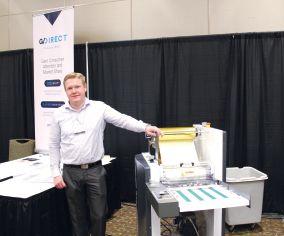
Simon Corney, Sales Representative with GV Direct.
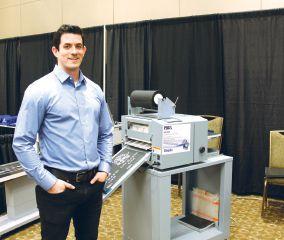
Brett Kisiloski, Sales Manager at PDS, which represents brands such as Duplo and Multigraf-Touchline.
Suzan Doucet and James Marvin of 4over Canada.
Rich Pauptit, President of Flash Reproductions, a Toronto print shop established in 1969.
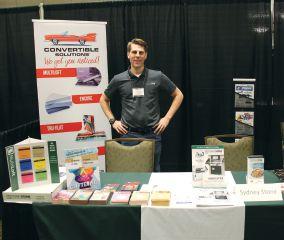
Dylan Westgate, Partner, Sydney Stone.
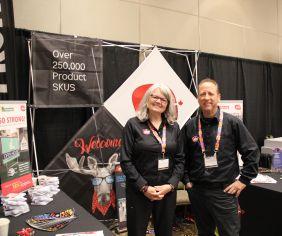
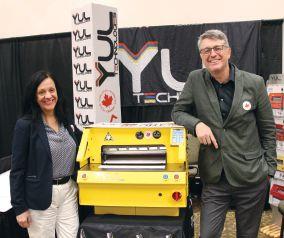
Anne Groleau and Martin Charbonneau of YUL Technologies from Laval, Que.
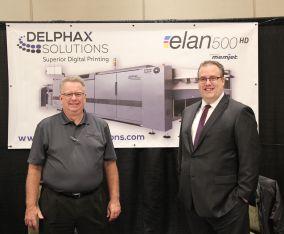
Grant Robinson, Channel Sales Manager, and Richard Lee, CEO, of Delphax Solutions.
Brian Bako, Specialist – Product Marketing, Production Systems at Canon Canada.
Jason Burlington, Account Manager, of Pronto Reproductions, a familyrun full service print supplier.
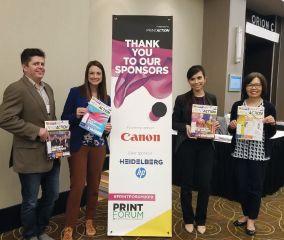
Members of the PrintAction team: Stephen Longmire, Tara Jacobs, Alyssa Dalton and Alice Chen.
BALANCE ON PROPRINT
AVAILABLE EXCLUSIVELY FROM VERITIV
PROVIDING A PERFECT BALANCE OF PERFORMANCE AND AFFORDABILITY
Features include:
• Gloss and Silk finishes in a wide range of standard weights and sizes
• Available in matching digital basis weights and sizes
• Smooth, even print surface for excellent print results
• High opacity for superior image sharpness
• Excellent print contrast leads to crisp imagery
• PEFC Certified
60, 70, 80, 100 and 115 lb. Text
80, 100, 111 and 130 lb. Cover
To learn more and see the full offset and digital range, please visit: Pour en savoir plus et pour voir tout l’éventail de papiers offset et numériques, rendez-vous sur : veritivcorp.com/proprint
L’ÉQUILIBRE AVEC PROPRINT
OFFERT EXCLUSIVEMENT PAR VERITIV
L’ÉQUILIBRE PARFAIT ENTRE LA PERFORMANCE ET L’ABORDABILITÉ
Principales caractéristiques :
• Finis brillant et satiné, large éventail de formats standard, versions édition et couverture assorties
• Poids de base et formats digital assortis
• Surface d’impression lisse et uniforme pour d’excellents résultats
• Opacité élevée pour une netteté supérieure des images
• Excellent contraste pour des images précises
• Certifié PEFC
120, 140, 160, 200 et 230 M Édition
160, 200, 222 et 200 M Couverture
BETTER CONNECTED
How smart packaging is changing the way we live and do business
By Dr. Paul Smith
Labels. We see them every day on routine items we depend on to get through life.
There are labels on our food, medicine, clothes and technology. They tell us crucial information to help guide our decisions: Nutritional information about the food we consume; how to wash our clothes; how and when we should take medicine; and potentially life-saving warnings about certain products, such as chemicals or prescription drugs.
How often do we actually read these labels? How much information do we actually absorb? For most of us, the answer is “very little.”
Today, brands deliver a disconnected customer experience. They rely on the
consumer to make purchasing decisions and understand a product’s intended use by piecing together information from labels, packaging and traditional retail displays. While some of us may read the fine print or visit the brand’s website to learn more, many of us buy what is familiar or perhaps what is on sale. We assume we know how to use a product based on what we’ve done in the past.
But what if our labels, packaging and retail displays could be smarter? Instead of us mining the fine print for information, what if these intelligent devices could simply tell us what we need to know?
As it happens, Xerox scientists and engineers are digging into that question right now. They are carrying out research that promises to bring intelligent elements, such as printed electronics and
The global smart packaging market is expected to reach US$37,797 million by 2022, according to an Allied Market Research report.
smart sensors, to product labels and packaging that they say will revolutionize business operations and help make the Internet of Things (IoT) a reality.
Imagine a world where a simple cardboard shelf displays product information – benefits, ingredients and even special offers – on a screen the moment you pick up a package or touch a sensor. Technology embedded into the display would detect your smartphone’s signal and im-
mediately direct you to the brand’s website for more information about the product you have just selected or similar products that might be of interest to you. And, if you choose to receive more information, the brand could customize discounts and offers specific to you before you even leave the store.
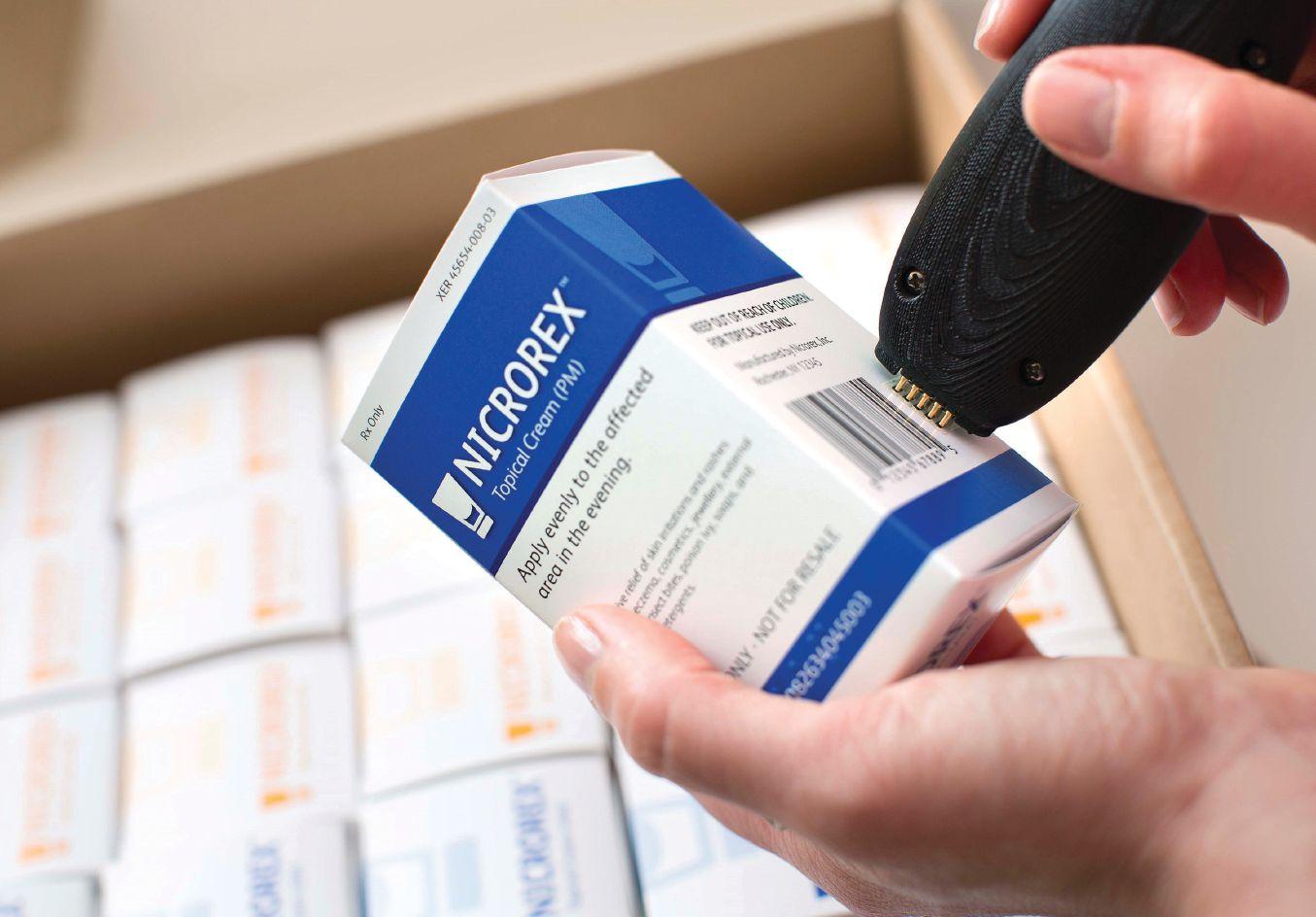
This connected customer experience could even continue beyond the store. For instance, a smart drug package could remind patients when and how to take their medication. It would also send information directly to their pharmacy about when a dose has been taken, if the patient needs a refill and even how the patient feels. Patients could connect to their pharmacist and receive ongoing support, and pharmacists could monitor medication adherence and know if the treatment needs to be adjusted.
Meanwhile, the brand and their retail partners gain a better understanding of how customers engage with products. They would know which products their customers purchase, and which ones they pick up and put back on the shelf. They would learn how long customers look at the display and what information is considered most important. They could use
this information to improve pricing, discounts and future interactive displays.
Batteries and wires wouldn’t be a problem — they would be printed right onto the shelf and package. Assembly of the smart displays would be completed in mere minutes.
As these technologies mature, new opportunities will become available for players across the value chain, from print providers that create these smart, customized displays and packaging, to retailers and brand owners that hope to create a more meaningful experience for customers by connecting their physical world to the digital realm.
What may have sounded too farfetched a decade ago is now not only credible, but also well within reach.
Dr. Paul Smith is Vice President and Centre Director of the Xerox Research Centre of Canada (XRCC), one of Canada’s leading materials research centres. With more than 40 years of innovation research experience, XRCC’s mission is to drive business growth through the commercialization of breakthrough materials, technologies and services.
Where the Community Meets
80% of printers believe a consolidated printing industry event would serve the industry better than separate, segment-only events.
PRINTING United is a “One-Roof” Expo that will provide you with access to all of the latest technologies, while making sure you spend less time out of the o ce.
Be sure to mark the dates in your calendar and register to be a part of the community:
Wide-format inkjet
The Agfa Jeti Tauro H3300 UV-LED offers four levels of automation so users can configure the press to specific needs.
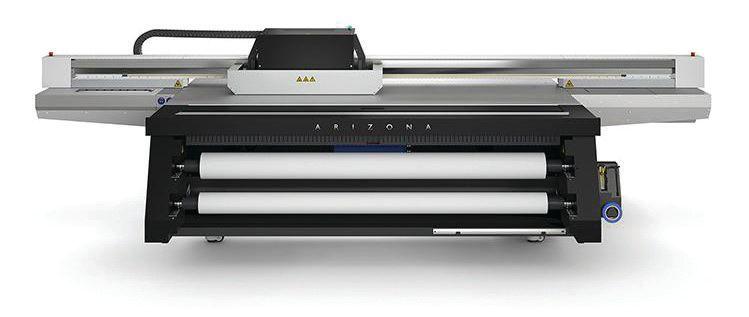
Canon Océ Arizona 1300
Canon Canada in March introduced the Océ Arizona 1300 series of mid-volume UV true flatbed printers, delivering prints up to 568 sqft/hour and high-density prints up to 380 sqft/hour. Customers can choose from three models – 1340 GT, 1360GT and 1380GT – with a flatbed print area of 49.2 x 98.4 inches, or three larger XT models measuring 121.3 x 98.4 inches (1340 XT, 1360 XT, 1380 XT). The series can print on different media, including odd-shaped, heavy, smooth or pre-cut media and unusual objects such as canvas, glass or wood. With the built-in Automated Maintenance System for hands-free printhead maintenance, nozzle function for all colours can be selectively restored in seconds, the company says. As well, the integrated Océ Arizona Xpert self-learning technology is designed to help the press learn from what the operator does, thus making it easier to reproduce complex, multi-layered projects.
Agfa Jeti Tauro H3300 LED
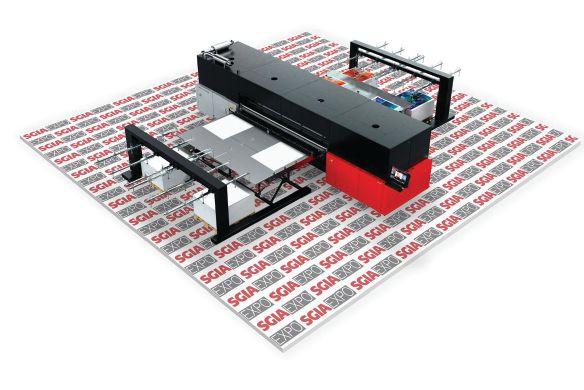
The Jeti Tauro H3300 UV-LED inkjet printing system from Agfa
Graphics made its North American debut at SGIA 2018. Designed to be an UV inkjet system that can support single or dual master rolls for uninterrupted printing, the Jeti Tauro H3300 LED boasts four levels of automation to choose from, so printing companies can configure the engine to their specific needs: Manual loading and unloading, master roll-to-roll, semi-automation, and full automation. Featuring a resolution of 635 x 1200 dpi in all print modes, the Jeti Tauro H3300 LED produces prints up to 130 inches wide at speeds of up to 4,676 sqft/hour.
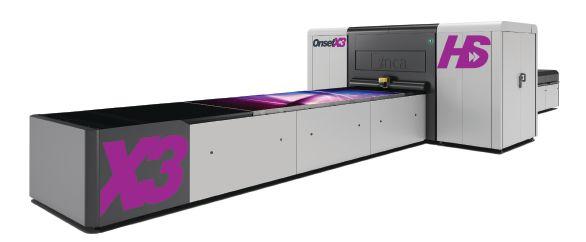
OnsetX HS UV
Fujifilm and Inca Digital in June introduced a new addition to the OnsetX UV flatbed series – the OnsetX HS (High Speed) range. Featuring two new machines, the Onset X2 HS and the Onset X3 HS, the range can print up to 15,597 sqft/ hour, utilizing a new single cycle mode. Compatible with Inca’s range of application-specific robotic handling systems and incorporating 30-second job setup and single-cycle printing mode, the new range is said to deliver a ‘step change’ in inkjet
The Océ Arizona 1300 can print on different media, including odd-shaped, heavy or pre-cut media, such as glass, canvas or wood.
printing. The OnsetX HS launch is partnered with a new Fujifilm inkjet range, Uvijet OX. Uvijet OX features a new ink technology developed for Onset printers to print on rigid plastic media at high speeds.
Mutoh dye-sublimation ink
Mutoh America says its DH-21 dye-sublimation ink is designed to achieve high-density colours with less ink consumption. Compatible with ValueJets 1948WX, 1638WX, 1938WX and 1624WX printers, the ink boasts: High transferability, consistent colours under various lighting conditions, versatility in media usage, and the ability to print on a range of media thicknesses.
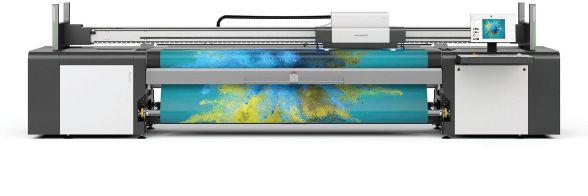
swissQprint Karibu
Karibu, swissQprint’s first roll-toroll printer, made its debut at FESPA 2019. Available this fall, the printer delivers a maximum print width of 3.4 metres and features a lightbox for on-the-spot inspection of backlit prints. For users who regularly print in parallel, swissQprint offers a dual roll option capable of handling two rolls each up to 1.6 metres wide, doubling its productivity. The roll holders are split into two sections with each half of the shaft driven individually, which swissQprint says will help ensure optimum web tension on both rolls. A mesh kit comes integrated with the print bed for processing permeable substrates, as well as full bleed printing. A mouse click by the operator sends the Karibu print beam – which is movable in the X direction – from its standard position to the mesh position; printing can then start immediately. Karibu has 136 keys ranged across the print bed width,
like a piano. Each one opens or closes a vacuum channel to help eliminate air leakage in the gap between dual rolls. A light tap on the switches is all that is required to open or close the entire vacuum area width within four seconds, also known as the Tip Switch vacuum.
Mimaki JFX200-2513 EX
Mimaki in April announced the JFX200-2513 EX UV-LED flatbed printer, which it says has adopted a new draft mode that enables a maximum print speed of up to 12 boards per hour. Its three staggered printheads also allow for simultaneous printing without sacrificing speed, Mimaki says, as the model boasts faster mechanical motors and a vacuum foot pedal that gives users the ability to load or unload various substrates more effectively. The press can print onto media up to 98.4 inches wide x 51.1 inches long x 1.96 inches thick, for a range of applications, such as rigid signage, wayfinding, decorative panels and POPs. It utilizes Greenguard Gold inks in four- and six-colour configurations, plus available white, clear and primer.
Roland DG VersaEXPRESS RF-640 8 Colour
Roland DG has launched the Roland VersaEXPRESS RF-640 8 Colour eco-solvent printer. Powered by ErgoSoft Roland Edition 2 Special Plus RIP, the RF-640 8 Colour features CMYK plus light black, red, green and orange ink and up to 99 percent of Pantone+ Solid Coated is within gamut, it says, adding that the press is designed to accurately match and reproduce colours normally difficult to achieve.
SUPERIOR TECHNOLOGY — Die crease without a die, then fold and even glue all on the same machine, up to 30 pt.
3. INTEGRATED MODULAR UNITS — Combined in-line finishing: crease, fold, glue, tipping, envelope inserting, ink jetting (Duplex), clip seal (3 sides), mail prep.
4. SAVE ON POSTAGE COSTS
—As a Certified Canada Post Direct Marketing Specialist, we get contract pricing reductions.
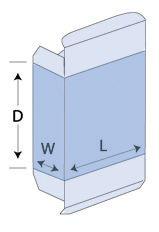
5. RETURN MAIL PRODUCTS — Customized “Return Mailers” created in-line with “U” or “BOX-shape” remoistenable glue, time perfed applications and envelope formation.
6. MINI-BOOKLETS — Saddle-stitch and trim 2-up booklets in-line to the size of a business card. No need to trim off-line, or do 2 passes.
7. HIGH SPEED EQUIPMENT — High speed Tipping, Folding, Saddle-stitching and soft folding ensuring on time delivery.
The OnsetX HS series is available now and distributed exclusively in North America by Fujifilm.
The Karibu features a lightbox next to
inspection and quality control.
JUNIOR
This position is open to all levels of experience with XMPie; we are willing to provide the XMPie training necessary to allow you to succeed.
Our Junior XMPie developer will be responsible for building and maintaining XMPie uStore websites, as well as creating print ready variable data and mailing documents, and occasionally working with our sales team to meet with clients to provide technical knowledge in the on boarding process. Qualifications and Skills: Working knowledge of Adobe Creative Cloud (specifically InDesign) – required. Experience in programming (any language) – required. Experience working with databases (excel, CSV) – required, SQL knowledge is a plus. Knowledge of web design (html/CSS) – required. Print experience – required. XMPie uStore, uCreate, uProduce – any experience is a plus. Familiarity with Postal Regulations is a Plus. Attention to detail, accuracy and organization are required. Must be a self-starter and highly motivated to learn. Excellent written and oral communication skills. Highly creative and conceptual thinking abilities. Must be able to think critically and problem solve effectively.
Polar: any size/older or newer models (66/72/76/78/82/90/92/107/115)
Horizon-BQ: 220/240/260/440/460
Brent Moncrief / VP Strategic Marketing & Brand Management, the Americas, FUJIFILM North America Corp., Graphic Systems Division
Earlier this year, Fujifilm brought together 30-plus printing companies, as well as a handful of media brands including PrintAction, for the official launch of the J Press 750S production inkjet press into the North American market. Described as the fastest full-colour, B2-format inkjet press now available, the J Press 750S is capable of generating 3,600 B2 sheets per hour, for both static and variable jobs, with a new maximum sheet size of 23 x 29.5 inches (585 mm x 750 mm) delivering a six-up imposition of letter-size output. The VIP event featured candid presentations on the future of inkjet, a tour through Fujifilm Americas Technology Center near Chicago, in Hanover Park, Ill., and a panel of three executives who shared their experience as a J Press owner. A key takeaway from the day was the immediate need for automation, largely driven by labour shortages, rising wages and lower overall page volumes, resulting in a higher adoption rate of production inkjet presses among commercial printers. We spoke with Brent Moncrief for his thoughts on this shift.
PA: We’ve heard that to grow in print and direct mail, today’s printing companies need to invest in automation. Why do you think the time to invest is now?
BM: When you look at the reality, the labour pool is going to be so much smaller and there’s going to be a lot of different competition. We’re going to need so many more people with that programming and data analytics mindset — is printing going to be that market where someone with a hot resume will say, “I want to enter that industry?” I sit on many [association] boards and we discuss how we can get new people into this industry and reposition it as more than just a graphic communications or printing industry, but as a ‘technology industry.’ The automation revolution is coming, there’s no doubt about it. We see it in every segment we serve. Commercial printing is the easiest of all the markets we serve because a lot of the times, it gets cut, stapled and finished. Then you go to wide-format and it’s more complex. Packaging is by far the most difficult [market]. We look at packaging as a manufacturing process, not a printing process, and many of these companies are called converters because they convert plastic into packages. A lot of [companies] look at printing as the decoration part of a massive process, that includes laminates and overlaminates to keep things food-safe and durable, so they can go through canning and bottling lines, but the printing process is a very tiny part of it, as opposed
to commercial printing.
As we get into increased artificial intelligence, more presses and systems will give operators feedback and diagnostics, as today’s presses monitor their own health. Operators will receive warnings before the machine breaks down so that it can be fixed before it becomes catastrophic. It goes back to that idea of a smart factory where companies want to be able to have less labour and more automation. You still need staff, but at some point, you don’t need them to just watch that press run — you want [to be able to] move them into more value-added roles.
Fuji Photo Film Co., Ltd., was established in 1934 in Japan, based on a government plan to establish a domestic photographic film manufacturing industry.
PA: What is the most exciting thing about print right now?
BM: I think the most exciting thing is that with the right data analytics and by leveraging new technologies coming to market, is that print can be a very relevant part of the marketing mix. I think five, eight, 10 years ago, print was being written off and [we were hearing] “print is dead.” Certainly there are segments [that are being challenged], like the newspaper segment –newspapers must reinvent themselves through digital subscriptions – but ink on paper is only going to [keep] declining. If
you look at the ability, printing is a purely digital process. The only thing that is not digital, we used to say, was the print part, but inkjet is digital until you’ve got ink on paper. It just becomes static versus digital at that last part of the process. To me, what’s very exciting is getting good data analytics and doing good print that’s relevant, not just to a region, a [postal code] or a household, but being sent directly to you. As my three kids, who are five years apart, were being pitched to [attend] higher education, the relevance, uniqueness and connection of direct mail [grew] exponentially over the course of 10 years, where they were [able to pinpoint] my son as being a cross-country runner, a musician and a really good student athlete.
As we keep hearing, [the younger] generation is really leaning in on books, they like vinyl, and they like direct mail. I think print is going to have a really nice future as long as we continue to recognize the key [to its success] is really good data that connects [with consumers] and can augment or supplement digital. We shouldn’t look at mobile and web-based digital programs as competition but as another [component] in a multi-channel approach.
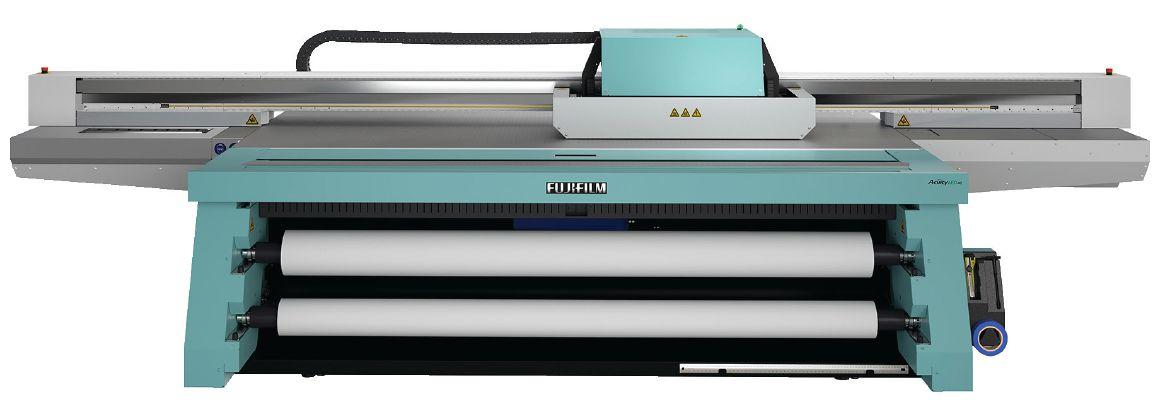
The most versatile Acuity flatbed is here. This is the LED 40.
If an LED flatbed has been on your wishlist for a while— or if you’re ready to welcome the first flatbed to your shop— look no further than the Acuity LED 40 from Fujifilm. It allows you to produce high-value creative work that blasts your business into new markets.
n Get outstanding, consistent print quality and reliability via long-life, low-energy LED UV lamps
n Tailor the Acuity LED 40 to your application needs with 4, 6 or 8 colour channels
n Print a range of remarkable products for distance and close viewing
n Enjoy low-energy cost savings and minimized production costs
It’s the low cost, high performance flatbed that has the power and flexibility to run whatever you can dream up. Learn much more about the all-new Acuity LED 40 at fujifilminkjet.com