Shifting consumer demographics make digital print ripe for the future
enVIrOnment
11 Laurel Brunner
Sustainability in printing
drupa Expert Series on eco-print
Expensive mediums
the New Year brings what might best be described as cautious optimism for print after years of external doubt and internal turmoil. Many printing manufacturers will certainly continue to struggle under the weight of the need for further consolidation, lack of access to capital, and significant decreases in several traditional product sectors.
Number of TV stations owned by Bell Media (30 local stations and 34 specialty channels like TSN), which are currently undergoing a large restructuring process because of maturing Interent-driven content delivery.
It is clear to see, however, that print is not the only communications medium undergoing major transformations because of the maturation of the Internet, which continues to revolutionize the distribution of information through both mobile and desktop computing. The production of television content, for example, has been turned on its ear. Cable TV, as it turns out, was a short, intense revolution from the means of radio communications, but ultimately just a harbinger for the true power of digital information display.
Media conglomerates around the world are now quickly rationalizing just how expensive the production of cable TV is relative to the – inexpensive and omnipresent – content distribution of the Internet. In November 2015, Bell Media, which controls 30 local TV stations and 34 specialty channels, cut more than 350 jobs. This number does not seem significant for such a large corporation, but the fact that Bell’s cuts have impacted so many of Canada’s best-known broadcast personalities, including CTV anchors Dan Matheson, Bill Hutchison and Suneel Joshi, speaks to major changes underway in cable TV.
When BCE released its most recent quarterly report, the Bell Media division had an adjusted profit of $183 million, which was up approximately $1 million from previous year. Revenue at Bell Media grew 4.1 percent to $692 million and the parent company attributed this increase largely to a surge in subscriber revenues from CraveTV, a streaming video service similar to Netflix.
It is simply too expensive to produce traditional TV content in the face of Internet-driven content distribution, a force that drove newspaper publishers to make what looked like death-knell shifts over the past decade. The true resurgence of radio is largely based on it being a cost-effective method for delivering content in the Information Age. Print manufacturing, when compared to TV production, also holds it own as a cost-effective means of preparing content for delivery – even if mailing continues to be a major challenge that is constantly being reinvented through technological innovations.
Print has struggled for years to grapple with the realities of Internet distribu-
tion and the industry shook out huge inefficiencies that cable TV producers are only now starting to face head on. This early Internet-driven reality check for print is a silver-lining for print, even as more systematic challenges face its manufacturers. It is a reason for cautious optimism in the printing industry as it moves into 2016, sentiment that can be gleaned from a recent survey released by Semper International.
Since February 2003, Semper, a placement firm focused on the printing industry, has produced a quarterly survey based on the opinions of more than 300 small, medium and large printing companies. Participants provide data on revenue and hiring, as well as estimated outlooks on future trends. In November 2015, Semper’s survey found a 13-point increase in firms reporting profitability in their third quarter relative to the same quarter last year. Although 84 percent of respondents reported profitability, optimism among survey participants dropped, which again indicates the printing industry is well aware of its challenges ahead.
The November Semper survey also found that 42 percent of companies reported an increase in sales during the first two weeks of Q4 2015. However, the survey also reported a more pessimistic sales forecast by participating companies. “The roller coaster ride of the recovery continues. On a strong positive note, last quarter we reported a contraction in the number of companies reporting profits. It is probably a combination of both a fickle economy and a testament to the industry’s resilience and flexibility that many firms adjusted in three months to increase sales and return to profitability,” said David Reagan, CEO, Semper International. “However, we also report dropping net margins, with 50 percent of firms reporting net profits of five to 10 percent, and another 25 percent reporting profits of under five percent.”
Semper’s survey also found the number of companies that made capital investments grew to 39 percent and that 45 percent of firms reported plans to hire this quarter, up from 36 percent last survey. The mixed results of Semper’s survey describe the continuing state of flux for the printing industry, but it leans toward an optimism that is unlikely to be shared by other communications mediums only just beginning to face the realities of Internet distribution.
Editor Jon Robinson jrobinson@annexweb.com 905-713-4302
Contributing writers
Zac Bolan, Wayne Collins, Peter Ebner, Victoria Gaitskell, Martin Habekost, Nick Howard, Angus Pady, Nicole Rycroft, Abhay Sharma, Trish Witkowski
Publisher Paul Grossinger pgrossinger@annexweb.com 905-713-4387
Associate Publisher Stephen Longmire slongmire@annexweb.com 905-713-4300
Director of Soul/COO Sue Fredericks
National Advertising Manager Danielle Labrie dlabrie@annexweb.com 888-599-2228 ext 245
Media Designer Lisa Zambri lzambri@annexbizmedia.com
For a 1 year monthly subscription (12 issues): Canada — $40.79 ($35.39 + $4.60 HST) United States — CN$66.30 Other foreign — CN$86.70
Mailing address
Annex Business Media 222 Edward Street Aurora, ON, L4G 1W6 printaction.com Tel: 905-727-0077 Fax: 905-727-0017
Kühn becomes Managing Director of Sales and Dr. Robert Sänger completes the board as Managing Director of Technology.
Pantone’s Color of the Year has influenced design decisions for 15 years.
pantone, a subsidiary of X-Rite, unveiled its 2016 Color of the Year, which, for the first time, includes the blending of two shades, Serenity and Rose Quartz. Chosen as an antidote to the stress of modern day lives, Pantone explains: “Weightless and airy, like the expanse of the blue sky above us, Serenity (PANTONE 15-3919) comforts with a calming effect, bringing feelings of respite and relaxation even in turbulent times. Rose Quartz (PANTONE 13-1520) is a persuasive yet gentle tone that conveys compassion.”
Flint Group moved to acquire toner press maker Xeikon N.V. with an agreement to purchase XBC B.V., a company that holds more than 95 percent of the shares in Xeikon. Headquartered in Eede, Netherlands, Xeikon’s products and services will become the foundation of a newly created division to be called Flint Group Digital Printing Solutions and led by Xeikon’s current CEO, Wim Maes.
supremex Inc. of LaSalle, Quebec, purchased Premier Envelope Ltd., which employs around 70 people and generated approximately $12 million in annual revenue last year from two principal manufacturing locations in Richmond, BC, and Edmonton, Alta., as well as a satellite plant in Mississauga, Ont. Supremex has five locations in Western Canada, two in Ontario, and two in Eastern Canada, in addition two locations south of the
border, employing approximately 650 people.
Digital Imaging association introduced its 2016 officers and board at its annual holiday luncheon in Toronto, attended by more than 100 industry professionals, which included a digital-printing presentation by Jim Hamilton, Group Director of Infotrends. The DIA’s 2016 officers include: President, Dino Sinnathurai, Cober Evolving Solutions; George Sittlinger, Maracle Press; 2nd Vice President, Paul Tarvydas, Tsus4; Treasurer, Mark Norlock, KBA; and Past President, Paul McCarthy, Konica Minolta. The 2016 DIA board includes Rebecca Buffi, Xerox; Ray Fagan, Heidelberg; Steve Falk, Prime Data; Steve Fournier, Agfa; Jason Hamilton, TI Group; Andrea Leven Marcon, Spicers; Mike Millard, Ellis Packaging; Ed Rooney, TI Group; Randall Stevenson; Larry Stewart, Graphic Whizard; and Bob Weller (Director Emeritus, Karl Schmed).
Ist metZ GmbH of Nürtingen, Germany, is repositioning itself to focus on the development of LED UV systems, which included the May 2015 majority-interest purchase of Integration Technology Ltd. IST METZ has reorganized its management board with Christian-Marius Metz, grandson of deceased company founder Gerhard Metz and previous Head of the Central Area Operations & Services, becoming CEO. Holger
sun Chemical formed a new Advanced Materials division with an expanded portfolio of technologies from both Sun Chemical and DIC, its parent company. The Advanced Materials group is to focus on markets like automotive, inkjet, electronics, architectural and industrial coatings, aerospace, printed circuits, photovoltaics, printed electronics, plastic cards, water degassing, and plastics. The DIC group most recently generated annual sales of more than $7.5 billion with more than 20,000 employees.
asia pulp & paper, at the UN Climate Conference in Paris, committed to helping the economic development of 500 Indonesian villages surrounding its supply chain, including $10 million per year of financial support. APP also presented details of its forest and peatland protection initiatives, which support Indonesia’s ambitions to achieve a 29 percent reduction in GHG emissions by 2030.
Communicorp, a subsidiary of Aflac and one of the largest marketing providers in the U.S., entered a new partnership with Ricoh to implement the Slingshot Print Management Information System developed by Toronto’s Avanti Computer Systems. Ricoh made a significant investment in Avanti in 2013 as part of its workflow strategy.
manroland web systems GmbH announced a positive turn for its 2015 fiscal year, with sales revenues for the year projected to be at about €240 million and order intake for new machines expected to be approximately €140 million, representing a significant increase when compared to 2014. manroland web states its worldwide market share will exceed 40 percent.
January 19-22, 2016 eFI Connect Users’ Conference Wynn las Vegas, NV
January 28, 2016
Jones packaging tour, paC brampton, oN
February 3-4, 2016 Cma, the Gathering Multiple locations, banff, ab
February 18-20, 2016
Graphics of the americas Convention Center, Miami beach, Fl
March 8-11, 2016 Fespa Digital RaI exhibition Center, amsterdam
March 20-23, 2016 taGa technical Conference Sheraton Downtown, Memphis, TN
april 14-16, 2016
Dscoop11 San antonio, TX
april 20, 2016 roland imaginat IOn 2016 orange County Convention Center orlando, Fl
april 20-23, 2016 sign expo orange County Convention Center orlando, Fl
May 31-June 10, 2016 drupa Düsseldorf Fairgrounds, germany
June 22, 2016 printaction printForum Mississauga Convention Centre, oN
September 14-16, 2016 sGIa expo las Vegas Convention Center, NV
September 23-24, 2016 COnsaC International Centre, Mississauga, oN
September 25-28, 2016 Graph expo orange County Center, orlando, Fl
September 28-29, 2016 paC Conference Niagara Falls, oN
terry Carpenter, a Service engineer with dealer Far From Normal in Fargo, North Dakota, won Roland D g ’s biannual, worldwide technician competition. a total of 21 Roland service engineers from 18 different countries competed in the Roland Dg global Se awards 2015 finals held for two days in october at Roland Dg headquarters in h amamatsu, Japan. Finishing in second was a lexandre g eraldi, representing Roland D g b razil, and third-place went to Peter De bont of Roland Dg benelux in belgium.
alexander Wassermann becomes the second Managing Director of manroland web systems in augsburg, next to Joern g ossé. Wassermann previously spent 16 years with the paper machine business unit of Voith, heidenheim, and most recently with bielomatik leuze gmbh, a manufacturer of printing-press accessories. he will be responsible for service, production and human resources, while gossé continues to be responsible for new machinery sales, subsidiaries, technology and finance.
Darren speizer becomes VP of Sales and Marketing for Drytac North america, a manufacturer of adhesive-coated products, responsible for developing and implementing strategic initiatives in both the U.S. and Canada. earlier this year, Speizer joined Drytac as U.S. National Sales Manager to expand distribution and national accounts.
InstaLLs
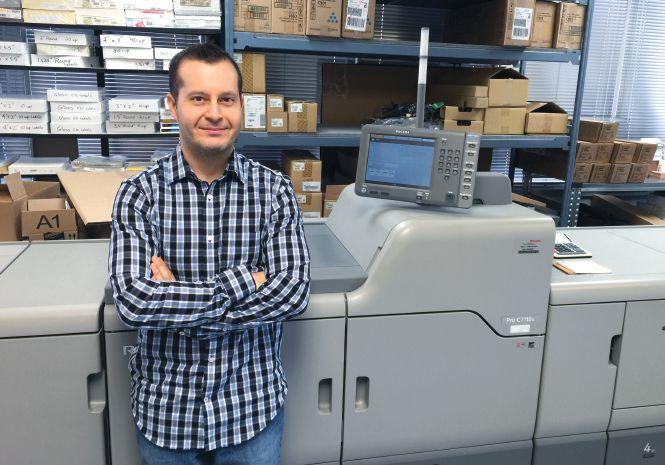
marlin Digital Imaging Inc. of Richmond hill, ont., added both a Ricoh Pro C7110x (pictured with Marlin’s operations Manager Raffi Stepanian) and a monochromebased Pro 8100. The commercial printing operation, with sheetfed offset and wide-format inkjet, has been running Ricoh systems for 12 years.
ralph nappi, who served as President of NPeS for 10 years, is leaving the organization. beyond NPeS, Nappi also serves as President of the graphic arts Show Company, which oversees the graph expo and Print tradeshows, and President of the graphic arts education and Research Foundation (gaeRF). he will resign all three positions at the same time. NPeS has also appointed Malkon b aboyian, executive VP, Production Printing Solutions/large Format Solutions, Canon Solutions america, as NPeS’ new Chairman.
andrew Henkel is Kba North america’s new mid-atlantic Regional Sales Manager for Sheetfed Products. henkel comes to K ba from one of the world’s leading manufacturers of print finishing products, where he served as its technical sales representative for the printing and packaging industries.
mary Lee schneider becomes Ceo of Sg360°, one of the world’s largest direct marketing solutions providers with $300 million in annual revenue, replacing Rick Joutras, who remains as Chairman of the board. Prior to joining Sg360°, Schneider, 53, served from 2012 to 2015 as President and Ceo of Follett, which provides education technology, services and print and digital content to both the K-12 and higher education markets.
p hilip n ichols becomes Marketing & Communications Manager for atlas Converting equipment ltd. h e is replacing Roger astell who is taking an early retirement at the end of the year after almost 18 years with the company.
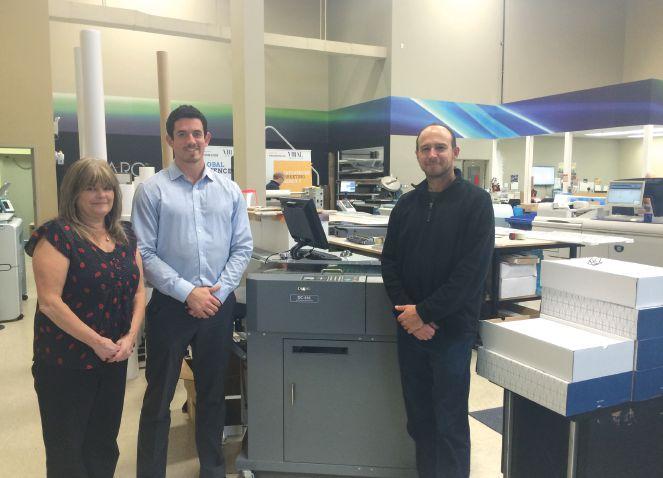
arc Digital Canada Corporation of Woodbridge, ont., purchased a Duplo 616 Pro system, pictured with (left to right) Jo-anne Davey of arc Digital, brett Kisiloski of PDS, and Frank Scott of arc Digital. The 616 Pro system is an all-in-one finisher that processes up to six slits, 25 cuts and 20 creases in a single pass.
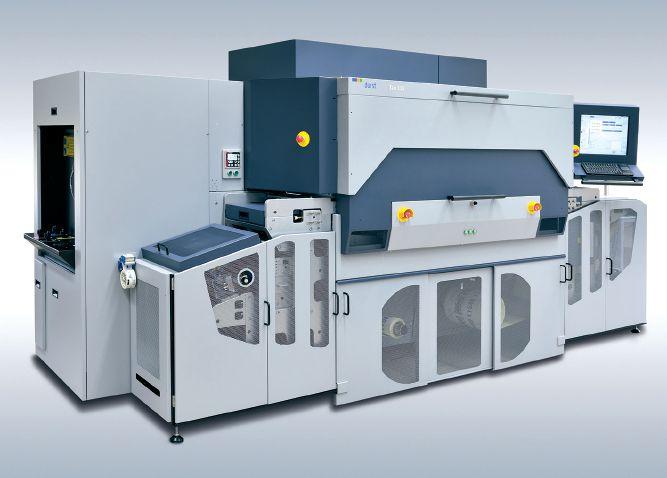
Design Label systems of Mississauga, led by President Zeb Faruqui, acquired a new Durst Tau 330 UV inkjet press (with an in-line SMag finishing system) to be installed in January 2016 at the company’s 25,000-squarefoot facility. Faruqui notes that nearly 40 percent of Design label’s jobs are below 7,000 feet in run length.
peOpLe
Nilpeter in Porta Westfalica
Marschall GmbH & Co. KG of Porta Westfalica, Germany, reports it is postponing a move to digital printing after installing a Nilpeter FA-4 for more short-run flexibility. Established in 1924, Marschall began to offer pressure-sensitive roll-fed labels in 1986.
In the past year, Marschall invested in a 6-colour, 420-mm (16.5-inch) wide Nilpeter FA-4 flexo printing press for its 20 employees, who produce mainly labels for technical applications on five presses. Run lengths for these applications are typically between 10,000 to 250,000 labels; only in exceptional circumstances do they extend into the millions. Marschall has always produced these jobs via flexography and its growing number of small- and medium-sized runs prompted the company to think about adopting digital printing.
“We have constantly watched the development of inkjet printing. However, we have not seen the expected breakthrough,” said Friedel Sellmann, Managing Director of Marschall. “Although there has been considerable progress, there are still several questions in our opinion. As a relatively small company, we did not want to assume the role of a pioneer which in the end could jeopardize our existence.
The majority of Marschall’s output is paper, but the company is turning more toward film composites.
Number of units on a new
Manroland R710
Faster Fox finishing
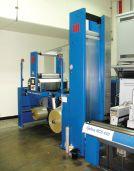
Number of employees at Bangkok-based Salee Printing Public Company Ltd., which recently equipped a new flexo press with automatic splicer and rewinder (pictured) from Martin Automatic Inc. The Thai label printer was established in 1996 and grew in part based on a strategic alliance with European converter Pago International AG.
HiPrint sheetfed offset press to be installed in the first quarter of 2016 at rlc packaging, one of Europe’s largest packaging operations, with annual revenue of €216 million. The press is to be equipped with new cold foil technology and specially combined inking and coating operations.
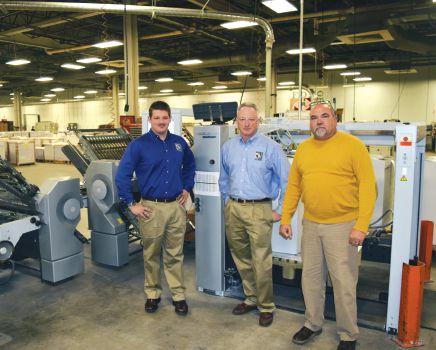
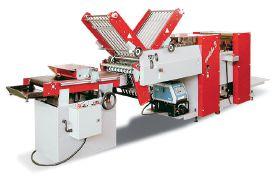
Fox Group, a trade bindery in Lansdale, Pennsylvania, has completed a major upgrade with three new Heidelberg technologies, including a Stahlfolder TH 82, Stahlfolder KH 82 and POLAR 137 with added peripherals. The company recently transitioned from three 30,000-square-foot buildings to a 150,000-square-foot facility.
Hank Fox, President of Fox Group, describes the improvements seen two months after the Stahlfolder installations: “Both machines are performing as promised. We’ve gone from an hour and 30 minute makeready time to just 15 minutes. We have doubled our hourly output on both folders and have greatly improved our manufacturing times.”
Previously, the company was running four older Stahlfolder machines to keep up with its customer demands. Fox Group states it now has the capability to produce the same amount of work at a faster pace and reduce labour costs by 50 percent by utilizing the new Stahlfolder TH/KH 82 duo, equipped with high-speed pallet feeders and SPB horizontal stackers.The POLAR 137 guillotine cutter includes peripherals like stacklift, jogger with air removal and transomat offloader.
“Our history has proven that upgrading technology will lead to results,” said Fox. The company services both the packaging and commercial print industries with finishing techniques like die cutting, specialty folding and gluing, stitching and binding.
Nosco adds MPS in Texas
Nosco of Green Bay, Wisconsin, purchased its second MPS EF press in the past three years, installing the newest such system at its Carrollton, Texas, facility. With more than 75 years of experience, Nosco is a full-service packaging producer serving more than 350 customers in the pharmaceutical, medical device, contract manufacturing/packaging, animal health, natural health, biotech and over-the-counter markets. Nosco is a subsidiary of Holden Industries Inc., a 100 percent employee-owned company, which also controls Setco (machine tooling), Vac-Con (industrial cleaning and jetting), and Wildeck (material lifts and guardrail products).
The 17-inch, eight-colour EF press at Nosco Texas includes an automatic unwind and rewind system from Kocher & Beck. The flagship MPS press is an automated, multi-substrate flexography press that, according to its manufacturer, excels at label production and flexible packaging printing. “[EF is] a press with exceptionally tight registration that holds through speed changes and no bar marking. MPS has thought differently. They are printing against a free-wheeling, hadurable rubber impression roll, so they’ve eliminated pacing issues and minimized dot gain.”
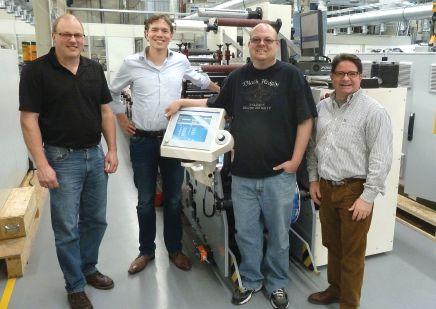
In front of Nosco’s news MPS EF press are (L to R): Buster Westrum, Maintenance Supervisor, Nosco; Kees Nijenhuis, Vice President, MPS North America; BJ Taipalus, MPS Press Lead, Nosco; and Brad Elledge, Director of Continuous Improvement, Nosco.
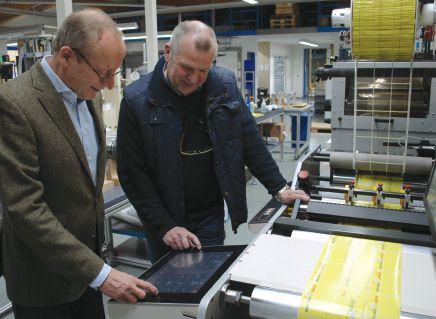
Managing Director Friedel Sellmann (right) from Marschall and Bernd Fiebig from Nilpeter GmbH.
Michael Fox (left to right), Hank Fox and Huck Brooks.
January 1981
Kodak introduces colour inkjet printer
The Kodak Diconix Color 4 Printer, which prints on plain paper or inkjet transparency material, is designed to provide quality output for users of IbM-compatible and apple Macintosh computers. The printer produces colour text and graphics at resolution of up to 192 x 192 dpi, using four separate print heads. Print speeds run as high as 150 characters per second in draft mode.
January 1986
Maguire retires from Ryerson at the end of November, the School of graphic Communications Management at Ryerson Polytechnic University held an event to honour Frank Maguire on his retirement as the school’s Chair. at the same time, the school announced Mary black, President of Colour Technologies, would take over from Maguire as Chair. Ryerson GCM leaders Frank Maguire and Mary Black.
January 2001
On demand book factory blitzprint officially opened its doors last December just weeks after purchasing Canada’s first Xerox Digipath book Factory press. along with a DocuColor 2060, the Digipath’s speed and colour abilities are specifically designed for filling short-run orders of books, anywhere from one to a few thousand. blitzprint’s strategy is based on what has become known as the Dell business Model, named after the company that first employed a sell-then-make approach in the personal computer market.
“With Avanti Slingshot we produced 74 estimates and orders in 3 days.
We could never have done that in our old system.”
Avanti Slingshot, winner of two 2015 MUST SEE’EMs, is the only JDF-certified, cloud-based Print MIS in the market today. It incorporates business intelligence, production planning, fulfillment, shipping and billing into one easy-to-use and easy-to-implement print MIS platform.
More at avantisystems.com/unexpected15 1.800.482.2908 | info@avantisystems.com Have a question? #AskAvanti
WE HAVE ANSWERS ®
Temple doors restored with Agfa inkjet
The byōdō-in is a buddhist temple near Kyoto, Japan, which is registered as Japanese National Treasure and World heritage Site. It appears on the backside of the Japanese 10 yen coin. Its most famous part, and the only remaining structure of the original building, is the Phoenix hall (hōō-dō), constructed in 1053.
as the paint on the original west doors to hōō-dō was fading, Monsho Kamii, Chief Priest of the temple, had a team collect the remaining small amounts of paint in order to simulate the colours and the image. The Chief Priest then contacted agfa graphics Japan with the simulated image file and a request to reconstruct the doors.
The temple doors were restored with an Anapurna M2050i.
agfa graphics experts tried to match the expected colours as accurately as possible using in-house colour management technology and printing techniques. an anapurna 2050i wide-format-inkjet printer was used to print on the 400-yearold Japanese cypress wood that the two new doors are made of. as the 1.2 by 2.5-metre doors were not flat, a unique technique was developed to print on the curved surface of the frames with the help of a special tool that was created with a 3D printer. In addition, a particular type of white ink was used to imitate the original white parts of the door.
“The moment I saw the completed door, I couldn’t withhold my tears,” said Monsho Kamii. “To see them reconstructed had been my dearest wish for 20 years.”
Gwen Gades of Dragon Moon Press holds a digital production of Legends of the Serai, printed by Blitzprint, led by President Kevin Lanuke, in runs of 50.
printing for the market
the holiday season magnifies shifting consumer behaviours and potential for three digital processes
By Wayne Collins
iam shocked by the people who have a tree up, their shopping complete, and gifts wrapped with weeks left to Christmas. I asked one woman how she accomplished that, and she said, “I shop for Christmas 52 weeks a year!” This confirmed there is a disease we are talking about here, and I did get her to confess she has a closet full of stuff and she can’t figure out who she bought what for.
Those buying habits are a few generations old, and certainly run against the grain for the predictions that are emerging in the printing/packaging sector of the graphic communications industry. Most marketing professionals agree that the profile of the new consumer has some strong characteristics. Compared to previous generations, young consumers bring vastly different values to bear on the retail experience. Sudden changes in global economies are creating consumers that are more and more frugal. They demand product convenience: re-sealable packaging, on-the-move snacks, and smaller, individual portions. Consumers are eating more healthy foods and purchase more and more fitness-related nutraceutical products. There seems to be a competition among my college students to criticize each other’s product choices based on the environmental impact of the products they buy – as determined by how they are manufactured, packaged and transported.
More and more consumers, in general, want to know that their purchases match their individual needs and lifestyles. Young consumers are consummately rejecting mass-produced products, especially if they contribute to environmental wastefulness. Products that quickly respond to an individualized, educated and informed need are lauded with praise and consumer loyalty.
Consumer demographics are less and less geographical, and more global in scope, as buyers unify in communities of needs. As the Information Age sweeps developing countries, more like-minded people are coming together through so-
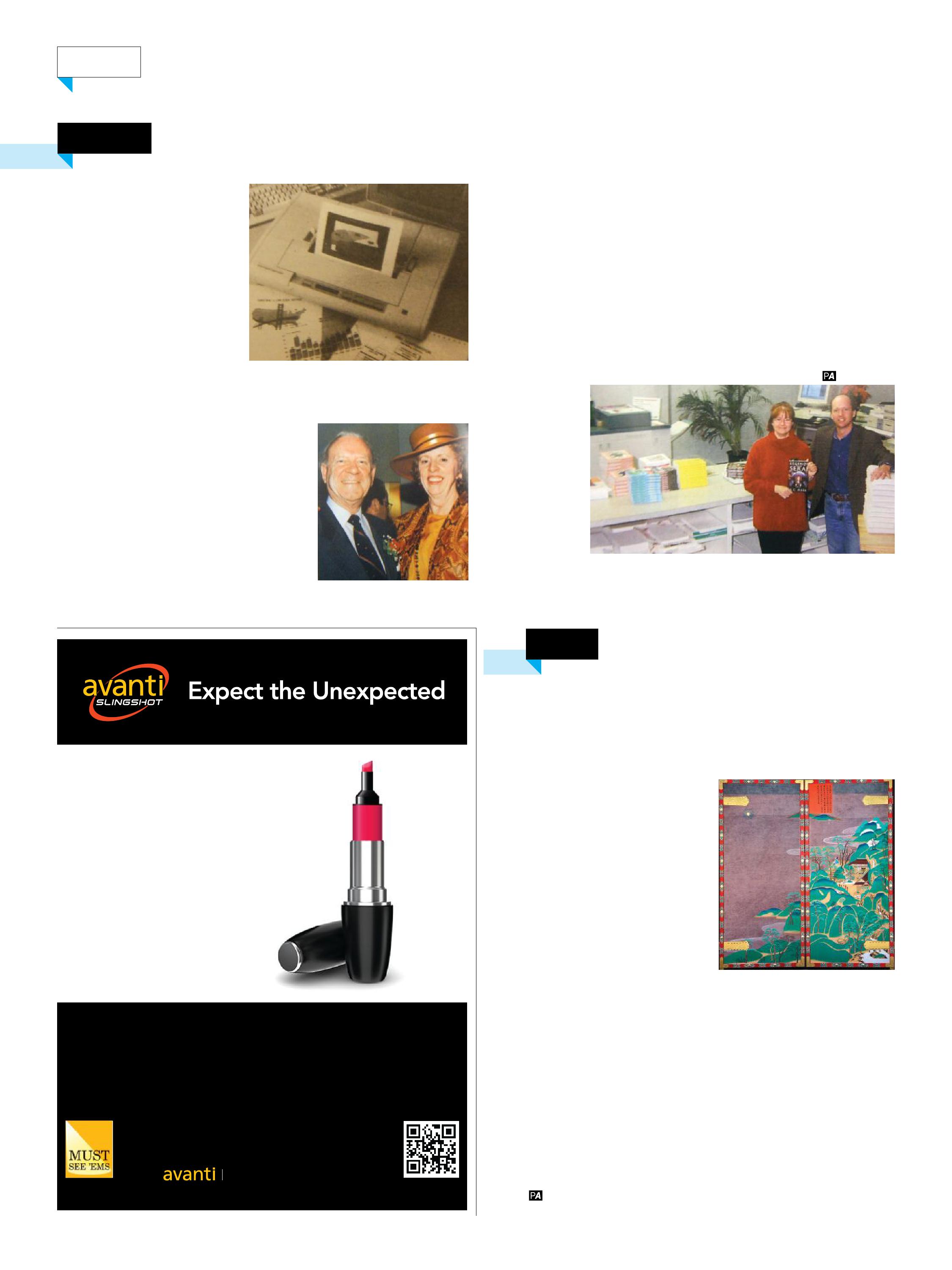
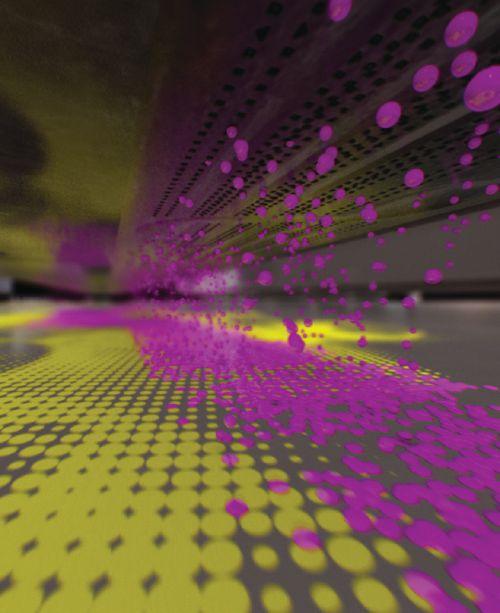
The ink dispersion methodology of Nanographic printing presses is presented as a new approach to inkjet printing, which can combine speed and run lengths for today’s market demographics.
cial media. Those trends are combining with more urban development, less compulsory retirement, and more women and teens expanding the global workforce. Today’s consumers have greater buying power, are more informed, and more frugal than at any other time in history.
Retailers are completely overhauling their business models to meet these new market trends. They are demanding shorter product-line development cycles, greater product personalization, and smart designs. Brand owners are gathering and utilizing more detailed and comprehensive databases on their customer base, and producing more private label and co-branded products. Mass customization is a new marketing concept that is demanding new imaging technologies in the labeling and packaging of these products.
image quality, and shorter, faster production runs. Vendors that produce electrophotographic imaging engines are responding to fulfill the short-run-length, variable-data and high-image-quality demands of this market. That technology has serious gaps in the range of substrates that can be utilized, and the production throughput of the imaging engines.
Inkjet technologies are quickly emerging as the technology that can surpass all other technologies in quality, with higher resolutions, expanded colour gamut and the ability to image on any material. Inkjet imaging methods including thermal, piezoelectric and electrostatic printing are all limited in resolution.
Electrohydrodynamic jet printing generates droplets that are smaller than the nozzle itself, and can be printed at room temperature and at a high speed. Surface acoustic wave (SAW) printing and pyroelectrodynamic printing generate a droplet in the nanometer range, so they do not need an inkjet nozzle. These nano inkjet technologies are being rapidly developed to fill needs in electronic and pharmaceutical applications and the spin off for printing will be game changing.
Nanography promises to provide a superior imaging engine with unique deployment of the best from inkjet and litho-offset technologies. Benny Landa’s Nanographic printing process, allows digital production at up to 6,500 B1 sheets per hour for sheetfed and 100 metres per minute for web-fed presses. Nanography claims to produce ultra-sharp dots of extremely high uniformity, high gloss fidelity and a broad CMYK colour gamut – covering at least 15 percent more Pantone colours than offset.
Emerging inkjet technologies will allow packaging converters to customize short, on-demand print runs to match the profile of individual consumers. Those consumers want a product to “feel” customized to their individual specifications. They want their buying decisions to reflect that they are indeed very unique.
6,500
Number of B1-size sheets per hour that can be printed with Nanographic printing presses, which should arrive on the market sometime in 2016 after much fanfare and a delayed launch.
Every sector of our industry is predicting more growth in the packaging sector right through the next decade. Gravure, flexography, lithography are expected to continue to grow, especially in the folding carton and flexible packaging markets. More importantly, these mass production imaging engines established a quality standard that digital imaging technologies are striving to surpass.
Lithography, flexography, and gravure are less than fully equipped to meet the new market demands though. Servicing these emerging markets is falling squarely on the shoulders of digital imaging technologies to service the need for highly customized packaging, superior
It is wise to pay attention to the emerging marketing trends in the retail industry, as they drive the imaging technologies in our industry. With the heightened consumerism we witness at this time of year, it is prudent to reflect on how retail buying trends are affecting the growth in businesses in our industry over the next decade.
WaYne COLLIns is the program head of bCIT’s graphic Communications Technology program and has more than 25 years of industry experience. wayne_collins@bcit.ca
Sustainability and printing
the environmentally progressive position of print is reaching the minds of consumers and creatives alike
By Laurel Brunner
Economic concerns, technological threat and uncertain futures have contributed to a crisis of confidence in print. Throw in rapidly changing market expectations and media choices, and you have an industry that’s been on the back foot for several years. But a reversal is underway. Print is reinventing itself to be more vibrant than ever, an energetic force in a multichannel communications world.
Years of turmoil have forced printers to refine their systems, minimize waste and maximize process automation and efficiency. Streamlined process management and being based on a renewable resource make print a highly sustainable, as well as effective, medium. Rising environmental awareness is encouraging environmentally aware media buyers to refocus on print.
Difficult dynamics
For many printers investment decisions in today’s climate can be risky so they cautiously explore new ways of doing business, embracing digital tools to support changing customer needs. Successful printers are reshaping their businesses to help clients leverage channels and align commercial and environmental goals.
“Environmental solutions are essentially economic, so it’s a shared problem,” says Stephen Fitzgerald, Cofounder Affirmative Investment Management, which is the world’s first dedicated green bond management company.
In all sectors and geographies, survival dictated lean and efficient production based on automation and standardization. Industry standards such as the ISO 12647 series emerged to support process control and data-driven production, resulting in less waste. Automated, standardized production manages colour quality and ink consumption across substrates and for digital output. Thanks to technology, standards and the printer’s skill, media buyers can trust that colours will be accurate in every iteration of print. And such efficiency minimizes emissions and waste, improving environmental sustainability as well as commercial.
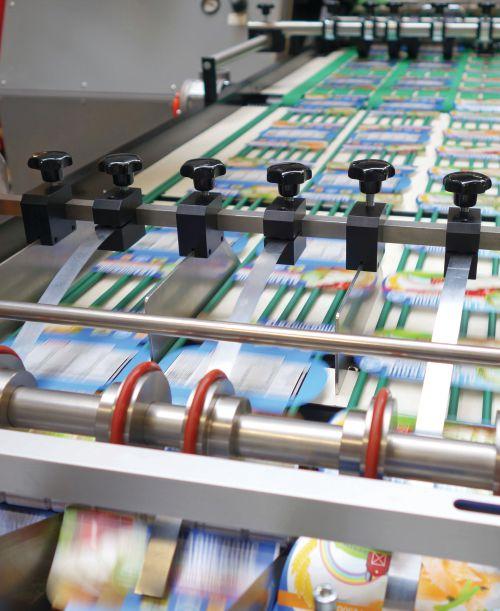
Packaging and labels are perhaps our
The environmental approach of printing, which has been at the forefront of the industry for decades, is finally beginning to pay dividends in the market when it has never been so needed.
most common shared print experience. “Responsible packaging protects the product, extends its shelf life, ensures that the product is safe for the consumer to use,” says Ken MacKenzie, Managing Director, Amcor. Packaging printers are often investing with sustainability in mind, which can translate as getting a product to market as efficiently as possible. SmileyColor, a U.S. packaging production consulting group, say that every day’s delay getting product to shelf costs a brand $100,000, so process efficiency and control are vital. The balance between the economics of achieving high turnover, and managed environmental impact and waste control is delicate.
What goes around
$100,000
The daily cost to a brand of delaying to get their product on the store shelf, according to a U.S. packaging production consulting group.
An ambitious example of this subtle balance is found in the Carlsberg Circular Community (CCC). Among other activities, this collection of Carlsberg and global suppliers is developing packaging materials optimized for recycling and reuse. The Green Fiber Bottle, biodegradable and biobased, is being developed currently and will consist primarily of sustainably sourced wood fiber.
“By using partnerships strategically, we can obtain much bigger scale and scope of our sustainability activities, and we are excited every time a potential partner approaches us about joining the community,” says Simon Boas Hoffmeyer, Sustainability Director, Carlsberg Group. “We do not currently have any print-related partners in the CCC, however, we are
by no means rejecting the inclusion of such partners.”
According to McKinsey, a consultancy, sustainability is a permanent management fixture for 70 percent of CEOs. Freddie Woolfe, Associate Director Corporate Engagement for Hermes Investment Management wants “companies to make strong commitments to tackle deforestation, eliminating unsustainable forestry practices from their supply chains.” Fitzgerald says, “Our mandate is return, but there is an [Environmental, Social and Governance] component to what we do.”
Control of emissions to air, water and land, and chemical regulations impact all industries including print, but inconsistency plagues global legislation. Fitzgerald explains, “This is not a driver in Australia, but in Germany and Scandinavia it is.” In the UK companies handling packaging weighing over 50 tonnes per year are required to recover and recycle packaging waste. There and elsewhere printers who use ink chemistries with high Volatile Organic Compounds (VOC) must comply with rules of varying stricture to protect health and safety, and avoid pollution.
ISO 17098 Report on substances and materials which may impede recycling is one of many useful tools. Standards such as ISO 14001 (Environmental management systems) and ISO 16759 (Calculating the carbon footprint of print) help printers to support customers’ environmental commitments, which can be ambitious. Kingfisher, a multi-retail sector conglomerate, wants “100 percent responsibly sourced timber and paper in all our operations by 2020,” according to Jamie Lawrence, Senior Sustainability Advisor. Kingfisher wants compliance with environmental legislation such as the US Lacey Act, the European Union Timber Regulation and Restrictions on Hazardous Substances II, plus other rules as they emerge.
Nothing changes if customers aren’t on board with sustainability objectives. Brand owners can drive reduced dependence on primary materials, leading to innovation in substrates and print processes. But the market and economics drive sustainability in print so the biggest challenge becomes the relationship between commercial, practical and sustainability priorities.
Laurel Brunner has been covering the graphic arts industry for over 30 years. her work regularly appears in publications and on Websites around the world and she is a regular speaker at industry events.
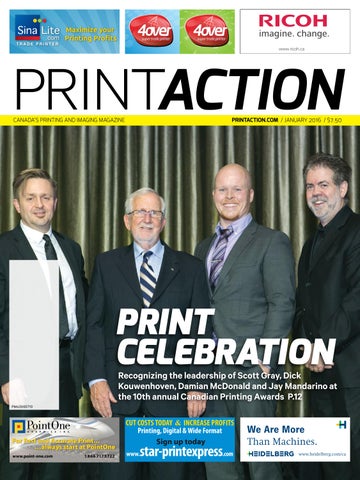
Print Celebration
On november 12, more than 220 people gathered in toronto to celebrate the progress and innovation of canada’s influential printing industry. now in its 10th year, PrintAction’s canadian printing awards program is based on three distinct sections, including: Environmental printing, Quality printing and industry achievement
LIFETIME AchIEvEMENT AWARD
Dick Kouwenhoven, chairman and cEO, hemlock Printers
Less than a year after immigrating to Canada from The Netherlands in 1961,
Dick Kouwenhoven began to form what is now recognized around the world as a trailblazing printing company not just in terms of its high-end sheetfed perfecting capabilities and bleeding-edge adoption of imaging technologies, but also in its environmentally progressive position.
The day after Kouwenhoven arrived in Vancouver, BC, he found work as a typesetter based on the experienced he gained from eight years of learning and working the trade in his Dutch hometown of Delft. Six months later he joined a small storefront printery by the name of Hemlock Printers and soon after took on an ownership role. In 1968, Kouwenhoven bought out his partner and incorporated Hemlock Printers, borrowed some money to install better presses, hired staff, and moved to larger premises.
During the 1970s, Hemlock Printers expanded with two large-format presses
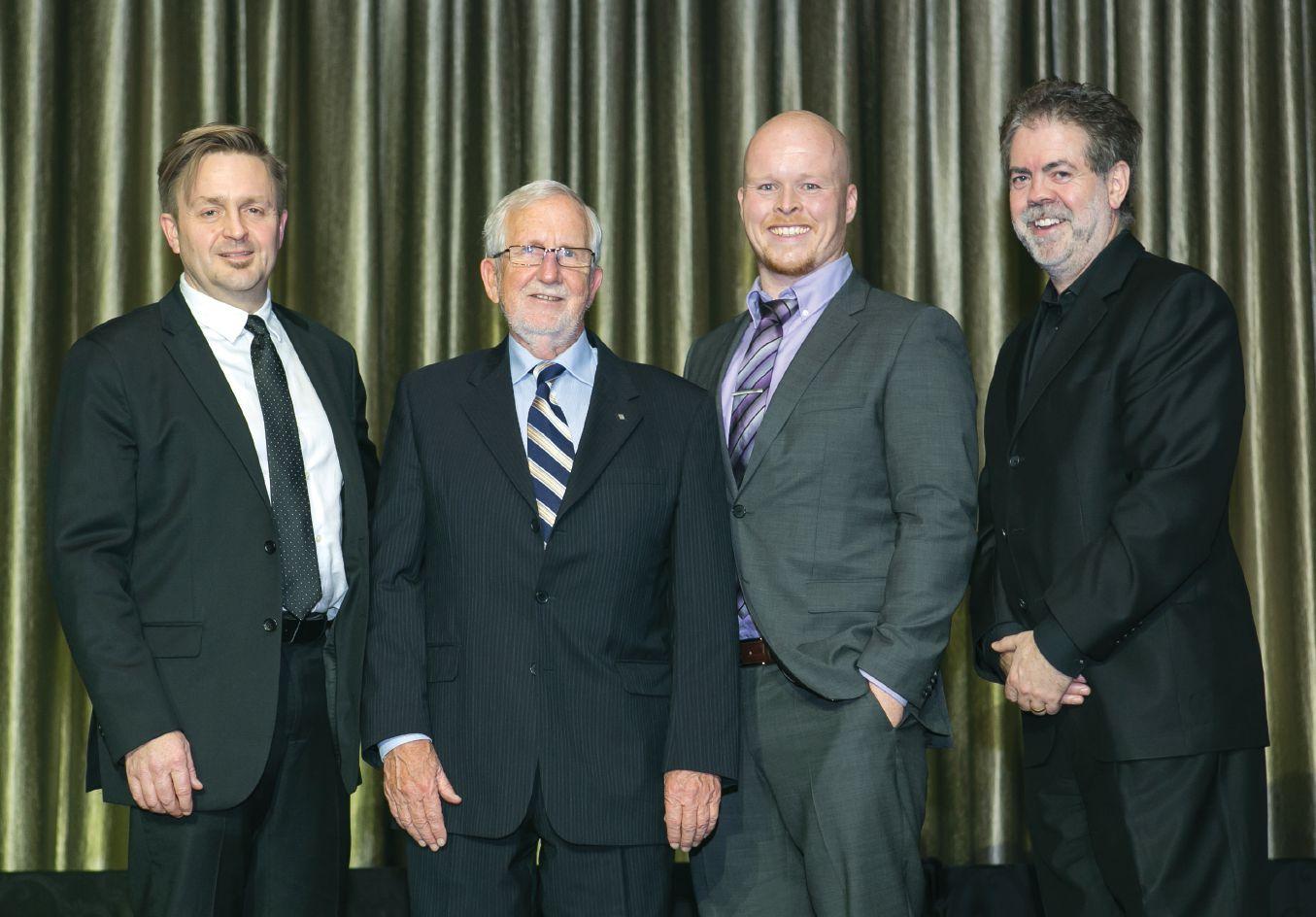
PrintAction’s 2015 Industry Achievement winners (left to right): Scott Gray, Dick Kouwenhoven, Damian McDonald and Jay Mandarino.
Year Hemlock Printers was incorporated by Dick Kouwenhoven, after buying out his partner in a storefront printing operation of the same name, just five years after arriving in Vancouver from The Netherlands.
and began producing two-colour direct mail for Eatons, Simpsons-Sears and other major retailers. Hemlock became a true force in the Vancouver print market in the 1980s with the installation of more presses and, in 1986, moved to its current location in Burnaby. The BC facility expanded again in 1993 to make room for Hemlock’s full-service prepress department as the company began its world-first journey into computer-to-plate imaging with Vancouver’s Creo Inc.
located on the perimeter of Toronto’s downtown core. As a result, C.J. Group is now comprised of close to 160,000 square feet across three facilities. Mandarino holds the ambition to become the largest independent full-service printing operation in Canada and continued to move toward this goal in 2015 by installing North America’s first Scodix Ultra Pro with Scodix Foil and Canada’s first Highcon Euclid II+ system.
23
Number of companies operating under the C.J. Group of Companies umbrella, 60 percent of which have been purchased over the past five years.
Hemlock, which was one of the first independent printers in BC to reach into the U.S. market, is now one of the largest commercial printers in the Pacific Northwest, housed in a state-of-the-art 79,000-squarefoot facility employing more than 170 people, with sales in excess of $30 million. It remains a privately owned family enterprise built on what Kouwenhoven describes as service integrity, quality products and a commitment to continuous innovation. Hemlock also now operates 100 percent carbon neutral and is a global business leader in sustainability.
PRINTINg LEADER OF ThE YEAR
$3.7 million
Estimated retail value of all food raised through the 13-year-old Canstruction Vancouver program, owned by MET Fine Printers, and organized by its VP of Branding, Scott Gray.
Jay Mandarino, Founder, President & cEO, c.J. graphics, Printers & Lithographers
Jay Mandarino oversees the daily operations of 24 companies with total sales reaching over $33 million. More than 60 percent of C.J. Group’s 24 companies have been purchased over the past five years,
28
Age at which Damian McDonald led ampersand to win its first CIPPI Award for its high-level of JDF integration in CIP4’s worldwide competition.
including 10 over the last two years.
In February 2015, the C.J. Group began putting the final touches on its new 80,000-square-foot facility
Mandarino’s founding company, C.J. Graphics Inc., which he started out of his parent’s basement in 1980, remains as the core of C.J. Group and, in 2013, installed a new Heidelberg XL 105. In 2015, C.J. Graphics added two massive Italian Sais screen presses, running 70 x 120inch sheets, and unique Océ LightJet photographic presses (apparent 4,000-dpi resolution) to compliment its new wide-format printing division.
Mandarino is also well-known for his philanthropic pursuits in helping to raise more than $50 million over the past 26 years for more than 250 different charities.
EMERgINg LEADER OF ThE YEAR
Damian McDonald, President, ampersand
When Damian McDonald was in his early-20s, he faced a decision about whether to continue a promising career in Web development, which had taken him to epicenter of computing power in California, or to join his father, Mike, to lead the family business into the future.
McDonald chose to leave Silicon Valley and return home where ampersand was housed in Guelph, Ont. His technological influence was immediately felt at the company, which pushed its 29-inch sheetfed press to print well over 500-line screen, one of the only printers in Canada to do so, while also working to overcome the early-day bottlenecks of sending massive data to one of the region’s most advanced digital presses.
McDonald also focused on emerging XML interchange with prepress and led ampersand to win consecutive CIP4 awards for Best Process Automation, competing
against world-leading printers. As President, McDonald is now driving ampersand into the future in a new Guelph facility with a Xerox iGen 150 and a 40-inch press that continues to produce High Definition staccato.
cOMMuNITY LEADER OF ThE YEAR
Scott gray, vice President, Branding, MET Fine Printers
Scott Gray, responsible for bringing together the passions of one of the world’s most-renowned printing companies, spends countless hours driving the Canstruction Vancouver program, now entering its 14th year. The non-profit competition, founded by MET Fine Printers, brings teams together to build sculptures out of canned goods, which are put on public display across the city, before 100 percent of the food is
donated to the Greater Vancouver Food Bank Society (GVFB). In its 13-year history, Canstruction Vancouver has raised an estimated $3,673,392 in retail value of food for GVFB (1,394,892 total cans from 259 sculptures). In 2015 alone, the program generated 36,922 pounds of food from 74,465 cans (with an average value of more than $14,000 per sculpture), while its exhibits were seen by more than 67,000 people.
MoMents froM the gala
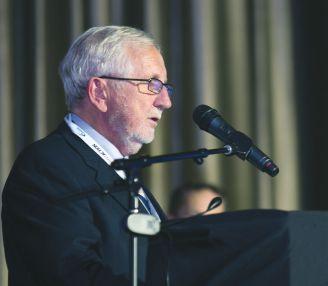
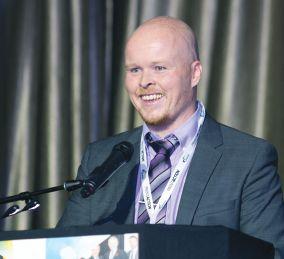
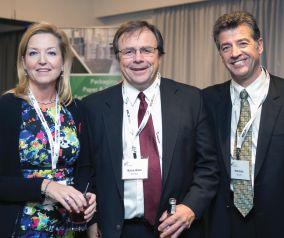
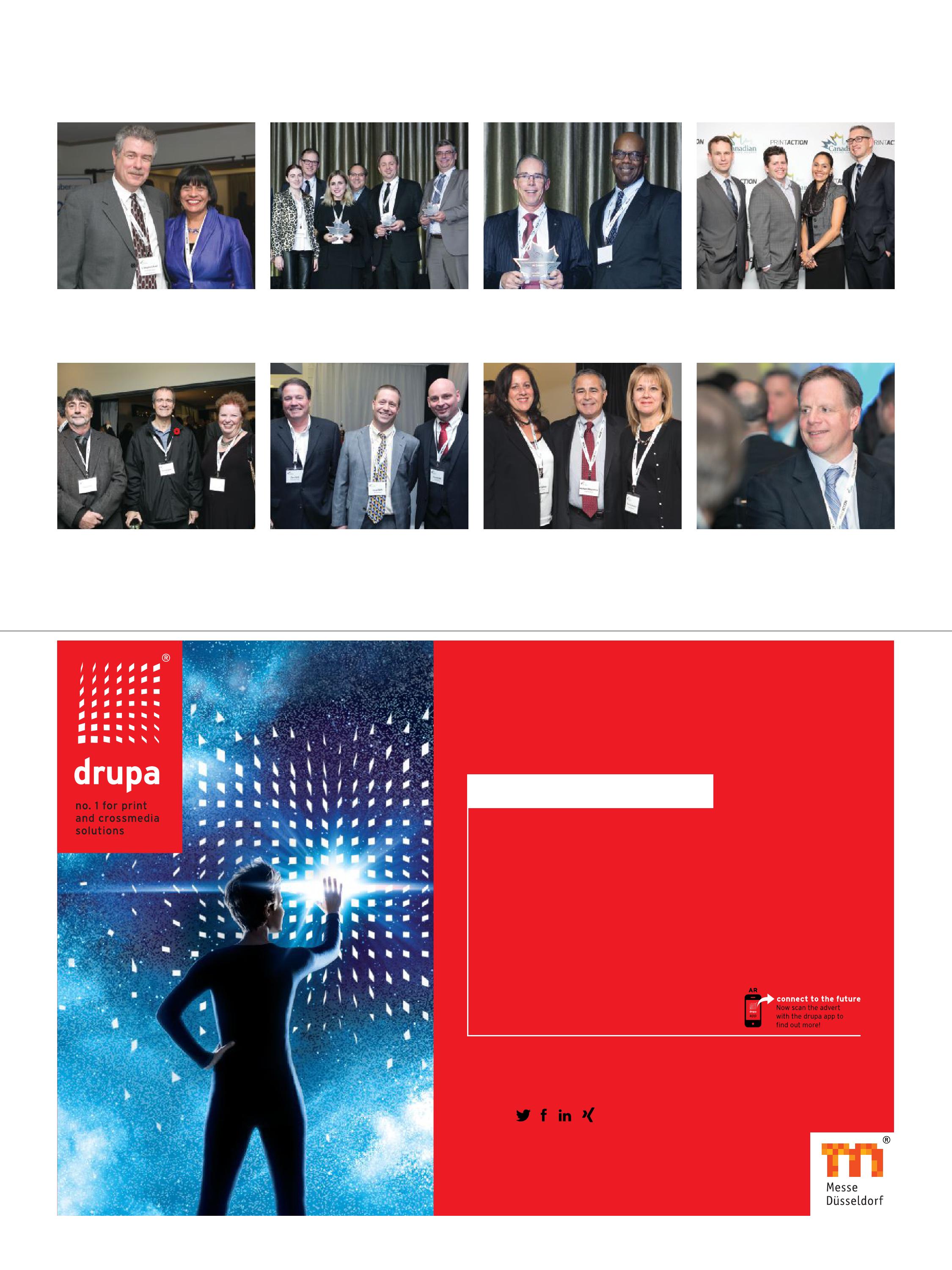
more than 220 people attended the 10th annual canadian printing awards held at the grand Luxe in toronto on november 12 to help celebrate achievement and innovation in canadian printing
KBA North America’s Chris Travis and Sun Chemical’s Derrick Hemmings.
Veritiv’s Jason Alederman and Stephane Dagenais.
Jones Packaging’s Terry Dale and wide-format specialist Vince Tuccitto.
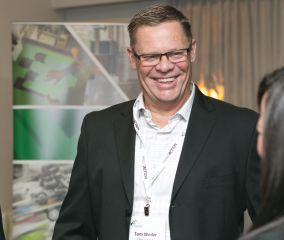
Flint Group’s Tom Weiler.
CMD Insight’s Christian Knapp and C.J. Graphics’ Jay Mandarino.
manroland Sheetfed’s Sean Springett and KBA’s Mark Norlock.
ASL Print FX Ltd.’s Darcy Caly and Yvonne Baker.
Ryerson’s Abhay Sharma, Sasha Blay, and PrintAction Publisher Paul Grossinger.
Graphics Canada’s Dan Mustada with PDS’ Jackie and Dave Kisiloski.
Flint’s Trish Oakley, Domtar’s Brian Watt, and Spicers’ Rob Salis.
Veritiv’s Racheal Zon, Lou Bekyarovich and Tom Deighton.
PDI’s Louise Kralka with Spicers’ Jason Schneider and Marc Boyer, and Gaetano DiTrapani of PDI.
Ingersoll Paper Box’s Sarah Skinner and Nikki Sloan.
drupa
Innovative
The
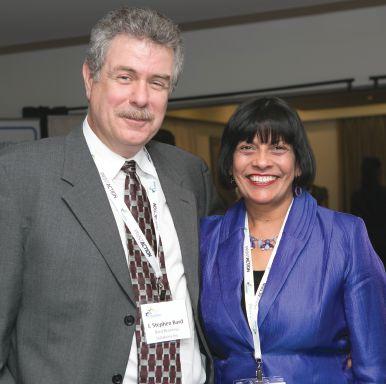
Stephen Bard of Bard Business Solutions and Vivy Dicosta of hubergroup.
Canon’s Doug Reid, Fujifilm’s Rick Gargano and DIA’s Marg McLeod.
Colour Innovations and Sophmore magazine accept for Specialty Project, with MET’s Scott Gray and Lowe Martin’s Michael Lorish.
Bauhmer hss’s Don Stitt with Heidelberg Canada’s Jason Roth and Harold Hoff
HP Canada’s Lloyd Bryant and Kevin Skyes.
manroland Sheetfed’s Gina Gigliozzi, Michael Mugavero and Sera Biancucci.
PrintAction’s Jon Robinson, Stephen Longmire, Danielle Labrie and Paul Grossinger.
The Lowe-Martin’ Group’s Ward Griffin.
World-Class Printing
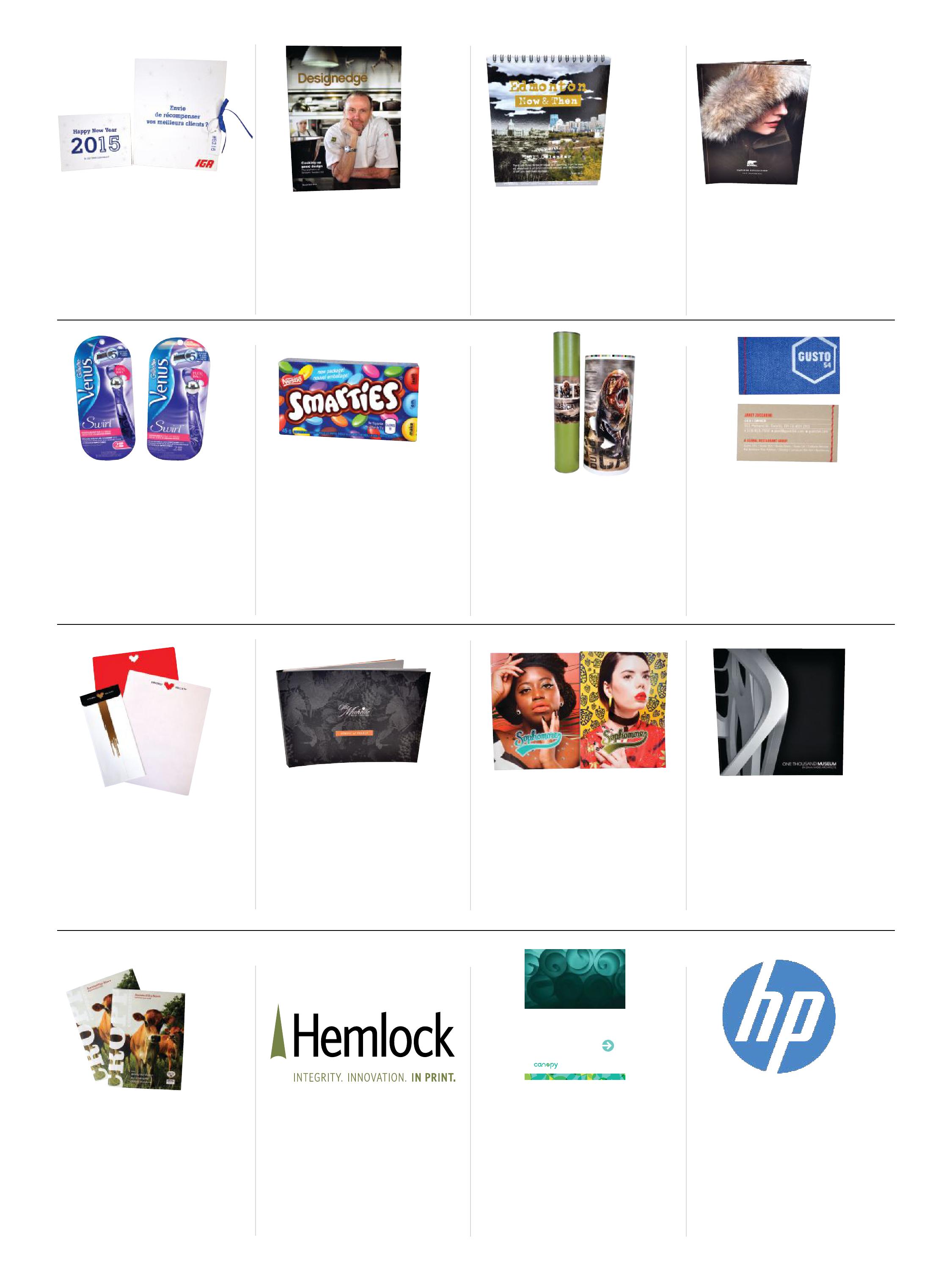
an independent judging panel, working from a blind scoring system, poured through more than 230 submissions to determine gold, silver and Bronze recipients across 21 Quality printing categories, as well as a Best of show winner from the entire group. recipients of the Environmental printing categories, which are the foundation of the canadian printing awards, were determined by PrintAction magazine based on more extensive submissions
Best of show
hemlock Printers
Leo s aul Berk, structure and Ornament production challenge: hemlock explains this project, with high expectations on a tight budget, required critical colour reproduction for the text, with exact crossover alignment and an inline spot gloss varnish applied to the images. This was produced in a single pass on hemlock’s 10-colour heidelberg perfector. To compel the readers, continues hemlock, the cover uses fluorescent inks, lamination and white foil stamping. given a short run of 750, hemlock explains all the elements of the project came together to achieve an outstanding product at a competitive price.
Brochures & Booklets, Offset
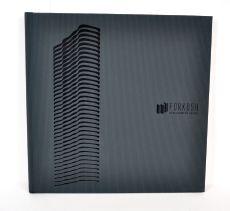
Gold: Forkosh Development
brochure by C.J. graphics
silver: bennington house
brochure by hemlock Printers
Bronze: lexus eS 2016
brochure by Colour Innovations
Books, Digital
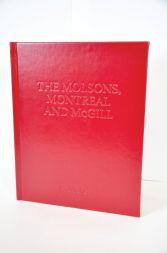
Gold: The Molsons by PDI
silver: Risk Takers, The World is in beta, by C.J. graphics
Bronze: e one The Shop by C.J. graphics
Brochures & Booklets, Digital
Gold: o.P.I. Culture of Color by PDI Integrated Print Solutions
silver: Intact Insurance Distinction by The lowe-Martin group
Bronze: bua Thai Menus by C.J. graphics, Printers & lithographers
Web Offset Printing
Gold: 1879 by birks, Spring 2015, by St. Joseph Communications
silver: Canadian Sportswear by Impart litho
Bronze: holt Renfrew Fall 2015
Catalogue by St. Joseph Communications
Books, hardcover
Gold: leo Saul berk, Structure and ornament, by hemlock Printers
silver: West Coast Reduction by MeT Fine Printers
Bronze: Cameracraftsmen of america by Friesens Corp.
Business & Annual Reports
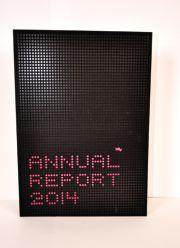
Gold: Intertain 2014 by Mi5 Print & Digital Communications
silver: PowerStream 2014 by Skylar
Media
Bronze: University of Waterloo 2014 by Somerset graphics
Books, Softcover
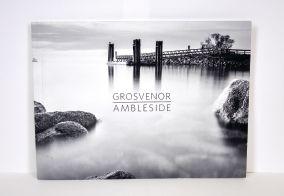
Gold: grosvenor ambleside by MeT Fine Printers
silver: get Quiet, live loud, by MeT Fine Printers
Bronze: Panam games opening Ceremonies by The lowe-Martin group
Direct Mail
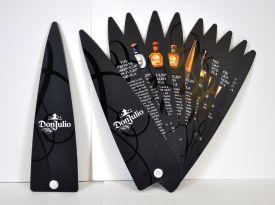
Gold: 1942 Donjulio brochure by C.J. graphics
silver: Kit and ace blogger Invitations by hemlock Printers
Bronze: griffin Poetry Prize Invitation by Mi5 Print
variable Data Imaging
Gold: Sobeys best Customer by PDI
silver: engagement Calendar by Friesens
Bronze: The 700 Club Program by honeycomb Mailing Services
Magazines
Gold: Designedge, March/april 2015, by C.J. graphics
silver: Mountain life annual by hemlock Printers
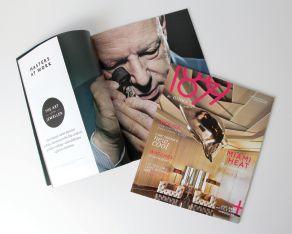
Bronze: Nuvo Spring 2015 by Colour Innovations
calendars
Gold: edmonton, Now & Then by Priority Printing
silver: Toronto Tree Portraits by C.J. graphics
Bronze: Ultimate Sailing 2015 by Friesens Corp.
Flexography
Gold: gillette Venus Swirl FleXIball by Friesens Corp.
silver: Raven Deep Dark Red by aSl Print FX
silver: Corona, glow in the Dark Pennants, by Promoflex International Bronze: bespoke Chardonnay by artcraft label
Rigid Packaging
Gold: Smarties Three Portion Carton by Jones Packaging
silver: alluring Maple leafs box by The lowe-Martin group
silver: Sudafed head Cold + Sinus by Jones Packaging
Bronze: Philadelphia Jalapeno Dip by Polytainers
Labels
Gold: Dinosaur Uncut Press Sheet by The lowe-Martin group
silver: Crown Royal black label by C.J. graphics
Bronze: eoS Sansin by RP graphics group
catalogues
Gold: Sorel look book 2015 by hemlock Printers
silver: Infinity QX60 by C.J. graphics
Bronze: artist Series by hemlock Printers
Stationery
Gold: Sandbox Society by C.J. graphics
silver: Ruby & Shiller barristers by C.J. graphics
Bronze: lgM Pocket Folder by RP graphics group
Finishing
Gold: String of Pearls Catalogue by Pacific bindery Services
silver: Roland Security Papers by C.J. graphics
Bronze: PbS holiday Cards by Pacific bindery Services
Environmental printing awards
Specialty Project
Gold: Sophmore magazine by Colour Innovations
silver: Nike young athletes book by MeT Fine Printers
Bronze: horizons eTFs Program Kits by The lowe-Martin group
Business cards
Gold: gusto 54 business Card by Somerset graphics
silver: arcane business Card by C.J. graphics
Bronze: Russell gibbs Design business Card by Somerset graphics
Most Environmentally Progressive Printing Project
Gold: CRoPP Sustainability Report by hemlock Printers
silver: NeI Winter Fund Focus by The lowe-Martin group
Bronze: Toronto Tree Portraits by C.J. graphics
Most Environmentally Progressive Printing company
Gold: hemlock Printers
silver: The lowe-Martin group
Bronze: Symcor ISS
Most Environmentally Progressive Service or Technology
Gold: The blueline Report 2015 by Canopy
Specialty Effects
Gold: one Thousand Museum book by C.J. graphics
silver: Infiniti QX60 brochure by C.J. graphics
Bronze: Corona, glow in the Dark Pennants, by Promoflex International
Most Environmentally Progressive Technology company
Gold: hP Canada
Plates & imaging
Frontend hardware continues to play an integral part of the printing industry, now pushing a trifecta of sustainability, quality and efficiency
Asahi Pinning Top Dot
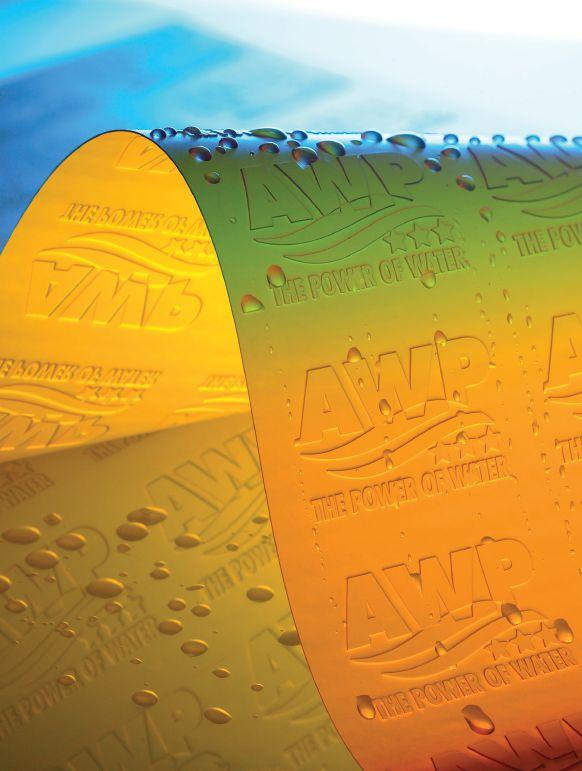
In October, Asahi Photoproducts introduced what the company describes as two new premium digital photopolymer flexo plates, called TOP (solvent washable) and AWP (water-washable), which use Pinning Top Dot (PTD) technology. PTD is designed to provide clean ink transfer and to prevent ink accumulating on the plate
surfaces and shoulders in screen areas. It allows what Asahi refers to as a kiss-touch printing pressure settings. Its polymer chemistry provides low plate surface tension to inhibit liquid flow. The ink forms a globule, with a large contact angle and high pinning point. This results, according to Asahi, in a cleaner and homogeneous ink transfer from plate to substrate.
Asahi explains the higher pinning point also allows for applying reduced printing pressure throughout the printing run, regardless of ink set used, which leads to lower dot gain. Asahi’s PTD plates offer a resolution of 80 l/cm (200 lpi), minimum isolated dot of 150 µm micron, and is available in thicknesses of 1.14 mm (shore A hardness 77) and 1.70 mm (shore A hardness 69). It is compatible with all commonly available laser types, as well as the latest high-definition microcell screening technology.
Presstek gemPlate
In September, Presstek introduced its new GemPlate, described as a chemistry-free thermal plate that develops on
press. The plate can be imaged on an industry-standard 830 nm platesetter. The press fountain solution and ink remove the plate’s unexposed areas, developing a
Wednesday, June 22, 2016
Mississauga Convention Centre
PrintForum, presented by PrintAction magazine, is a national conference for printing and imaging professionals from across Canada. Designed to build thought leadership in business strategy and technological innovation, PrintForum is a one-day event featuring educational sessions, networking and exhibits of new industry technology.
For sponsorship and exhibitor information, please contact Danielle Labrie, National Advertising Manager, 1-888-599-2228 ext 245 Stephen Longmire, Associate Publisher, 905-713-4300
Asahi’s Pinning Top DOT technology provides cleaner ink transfer.
polymerized, hardened, exposed ink-receptive image area. GemPlate has a rated resolution of 2% to 98% @ 200 lpi screening and supports FM (stochastic) screening. It is rated by Presstek for a run length of up to 100,000 impressions.
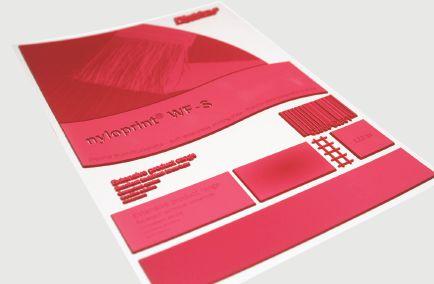
Flint nyloprint WF-S
In December, Group Flexographic Products introduced a new letterpress plate, called nyloprint WF-S, with a purposeful softer layer. The water-washable, film-based nyloprint WF-S plate, according to Flint, provides more flexibility and improved ink transfer over previous products. It replaced the nyloprint WF-M printing plate type as of November 2015. Compared to the previous type, the new nyloprint WF-S film-based plate has what Flint describes as a softer plate surface for more varied applications. Flint explains the soft surface provides improved ink transfer resulting in optimal ink lay-down, especially on rough surfaces.
The nyloprint WF-S plate, according to Flint, is particularly suitable for special applications like blister pack printing but also for rotary letterpress, coating units and imprinting units. It also provides for fast plate processing, which Flint describes as reproduction being completed within 25 to 35 minutes.
Agfa Attiro vhS
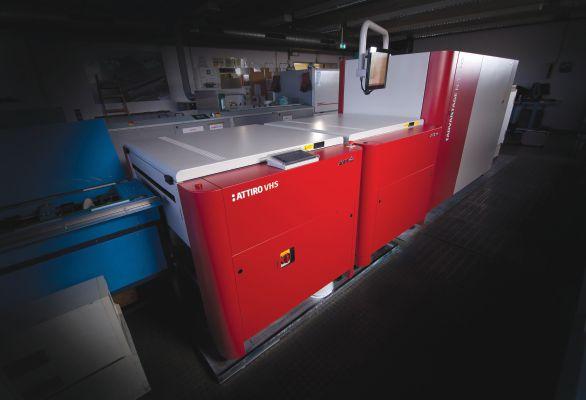
Agfa Graphics in October launched the Attiro VHS, built on the same patented cascading concept of the earlier Attiro clean-out unit introduced earlier this year. With an increased plate throughput speed of up to three metres per minute, the Attiro VHS handles plates from platesetters imaging up to 400 plates per hour, such as Agfa Graphics’ newest Advantage N-TR VHS.
The Attiro and Attiro VHS are built according to a cascade design concept. There are three sections; the concentrated gum cascades from the third section into the second and later into the first. The gum is therefore reused three times, explains Agfa, resulting in minimal gum consumption yet maximal clean-out effect. It allows users to save on maintenance and gum while contributing to a more sustainable prepress process.
Kodak LIBRA vP
In October, Kodak expanded its plate portfolio with a new violet offset plate, called LIBRA VP, which the company describes as being compatible with most violet CTP platesetters and plate-line equipment. The LIBRA VP digital plate is designed for both newspaper production and the quality needs of
Your Superior choice for Print Finishing and Lettershop Ser vices
Heavy boards, plastics, laminations or digitally printed works up to 30 pt can now die crease, fold and even glue in-line.
Flint’s nyloprint WF-S plate offers more flexibility and an improved ink transfer.
— Die crease without a die, then fold and even glue all on the same machine, up to 30 pt.
3. INTEGRATED MODULAR UNITS — Combined in-line finishing: crease, fold, glue, tipping, envelope inserting, ink jetting (Duplex), clip seal (3 sides), mail prep.
4. SAVE ON POSTAGE COSTS As a Certified Canada Post Direct Marketing Specialist, we get contract pricing reductions.
5. RETURN MAIL PRODUCTS — Customized “Return Mailers” created in-line with “U” or “BOX-shape” remoistenable glue, time perfed applications and envelope formation.
6. MINI-BOOKLETS — Saddle-stitch and trim 2-up booklets in-line to the size of a business card. No need to trim off-line, or do 2 passes.
7. HIGH SPEED EQUIPMENT — High speed Tipping, Folding, Saddle-stitching and soft folding ensuring on time delivery.
Agfa Attiro VHS can image up to 400 plates per hour.
semi-commercial printing applications, while holding what the company describes as a streamlined easy chem setup.
Kodak continues to explain that, with LIBRA VP, newspaper printers that process plates in the conventional way can now simplify processing and reduce environmental impact by replacing their traditional developer and replenisher with a single, low-pH clean-out finisher. Using this same finisher, Kodak explains printers can choose an easy chem setup that eliminates the plate prewash and post-rinse steps using a modified conventional processor or a dedicated clean-out unit.
Kodak’s LIBRA VP plate provides 150 lpi (60 lines/cm) AM or 180 lpi (70 lines/cm) hybrid (XM) screening capabilities. Newspaper printers can achieve run lengths of up to 350,000 impressions if the plates are processed conventionally or up to 300,000 impressions when easy chem setups are used.
signed for the requirements of commercial and packaging printers needing a high-performance plate to be used in a range of UV applications. Kodak explains this includes strong on-press robustness and solvent resistance for harsh environments such as UV, 10-micron FM screening capability, long unbaked run lengths, fast imaging and processing speeds and low chemistry usage.
Initial tests of the plate, according to Kodak, confirmed it achieves an unbaked run length of 500,000 impressions in web offset applications, 350,000 in sheetfed applications, and 150,000 in UV applications
Kodak’s LIBRA VP is designed for newspaper production.
cRON-EcRM Platesetters
In October, CRON-ECRM LLC, a newly formed joint venture of China’s Hangzhou CRON Machinery & Electronics Co. Ltd, and ECRM Imaging Systems, announced the availability in North America of the partnership’s new platesetter series. The CRONECRM systems provide up to 400 lpi with 1,200 to 3,600 dpi resolution. Each system allows for options in automation, imaging head preference (UV or thermal) and up to 96 diodes.
In addition to choosing the system’s type of imaging heads (UV or thermal), users can also select their productivity requirements by modifying the number of imaging diodes. Beginning with 16 diodes (in five different diode configurations), users can choose up to 96 diodes.
Kodak Electra Max
In September, Kodak introduced its new Electra Max thermal plates, de-
Fujifilm Flenex
In November, Fujifilm introduced a new flexographic plate system, called Flenex, aimed at the packaging market. Flenex provides what Fujifilm describes as the highest flexo print quality at the fastest production times and significantly lower cost-in-use than the latest thermal, solvent and other waterwash technologies. With total processing time of 30 minutes, Clarity is more than 3 times faster than solvent systems and 1.5 times faster than thermal and 25 percent more than competitive water-wash plates. Fujifilm describes how the technology’s water-washable chemistry is designed to eliminate all solvents and wicking cloth while getting to press faster, running longer and producing better print.
Flenex features 175 lpi, 1 percent process dot, and strong dot structure, while requiring the use of only a mild detergent for washout. Fujifilm also points out how Flenex’s low pH level provides a safer work environment than other water-wash plates that require high alkaline solution and create industrial waste. Both the analog and digital versions can be used width UV, water-base or solvent-based ink. There is no requirement for different plates for different ink types.
Kodak Electra Max is aimed at UV applications.
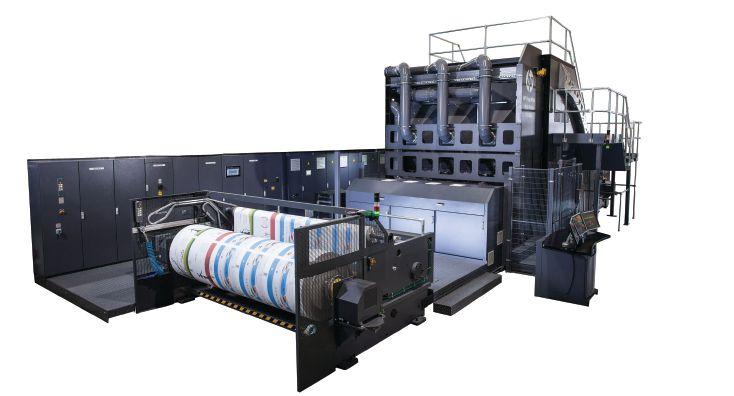
hP T1100S Web Press
In December, HP Inc., in a co-development project with KBA, unveiled the much-anticipated HP PageWide Web Press T1100S. The system features a 2.8-metre (110inch) width. The company states the HP PageWide Web Press T1100S, with Multi-lane Print Architecture (MLPA), creates a paradigm shift in the production of corrugated board.
HP explains its MLPA technology splits the web into multiple print lanes, so different jobs, with different box sizes and run lengths, can be printed in the individual lanes. Multiple ultra-short or short runs can be queued and printed together, with no make-ready in between jobs, continues HP, while a long run is printed in another lane. In essence MLPA technology, coupled with all the advantages of inkjet printing, allows cost-effective customization and personalization of corrugated packaging.
The HP PageWide Web Press prints at speeds of up to 183 linear metres (600 linear feet) per minute and 30,600 square metres (330,000 square feet) per hour. The inking system of the press a combination of
HP Bonding Agent, HP Priming Agent and four-colour HP A50 aqueous pigmented CMYK inks. HP explains this allows users to print on standard uncoated and coated liners from 80-400 grams per square meter (GSM). Optional configuration features include an auto-splice/turret rewind, primer and over-print varnish coating solutions, as well as the KBA PATRAS Automated Paper Logistics System.
Rotoflex hIS Slitter
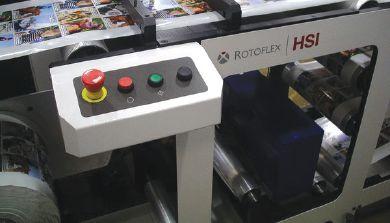
In November, Rotoflex, which manufacturers inspection, slitting, rewinding and die cutting equipment, released the new HSI slitter rewinder designed for high volume label slitting, inspection and rewinding. It is built with, according to Rotoflex, the same architecture as the company’s flagship VSI vertical design series. Rotoflex explains features of the new HSI include 330 and 440mm web widths, 1,000 fpm running speed, extra-large inspection table, ergonomic 37 inch (940 mm) high editing area, easily accessible slitting module, a straightforward web path and conveniently located finished roll rewind
The HP PageWide Web Press T1100S prints at 183 linear metres per minute.
location. With end-to-end servo control design, the HSI also features the Rotoflex URC 2.0 proprietary control system with simple menus and an intuitive interface, giving operators the ability to monitor all functions from a single screen.
The small footprint HSI is configurable for a range of vision inspection solutions and offers options like the new biometric (fingerprint) authentication for operator access and the Rotoflex exclusive Report Management System (RMS). With the RMS tool, real-time production data is collected from multiple finishing machines to a single interface, which can be accessed remotely via computer or handheld device. RMS generates a variety of detailed, customizable reports on performance variables such as run time, defects, production volume and scrap generation, as well as compares outputs of multiple machines.
Roland RotaPrint
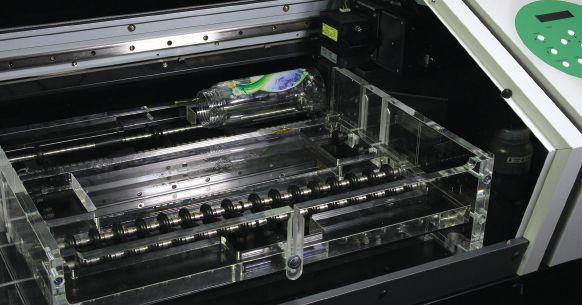
In November, Roland DGA has introduced the RotaPrint attachment, priced at US$3,195, for the company’s VersaUV LEF-20 flatbed printer for printing directly on bottles and other cylindrical objects. The RotaPrint utilizes the LEF-20’s existing feed system, which, according to the company, enables it to print cleanly and precisely onto glass, plastic, metal or ceramic objects with a diameter between 1.6 to three inches.
Developed exclusively for use with Roland’s LEF-20 by Digi -
Graphics, the lightweight RotaPrint attaches to the printer via a series of magnets. Roland explains the RotaPrint is also unique in that it does not feature any motors or electrical connections. It is powered by the motion of the LEF-20.
Jay-Line Ad cubes
Jay-Line Trade Print & Promo, which has been serving the promotional products industry as a trade-only supplier since 1977, is reestablishing its focus on commercial printing initially with its specialty adhesive note pads and Ad Cubes products. The Ad Cubes product line includes both adhesive (printed on 50-lb offset stock) and non-adhesive (70-lb offset) versions in standard sizes or either full-cube or half-cube versions.The Ad Cubes can be produced with digitally printed full colour images on the sides and the tops of the individual sheets can be printed via spot colours or 4-colour process. Available sizes range from 2 x 3 inches up to 8 x 6 inches, in standard sheet counts of 25, 50 or 100 sheets per pad. JayLine’s Adhesive note pads (50 lb offset stock) can also be produced in custom shapes, such as a light bulb, house or heart.
Jay-Line operates out of a 50-employee, 35,000-square-foot facility located in St. Catharines, Ont., with processes for sheetfed offset, web offset, toner sheetfed, envelope printing, flexography, roll and flatbed wide-format, roll labels, screen printing, pad printing, hot stamping, die cutting, digital die cutting and routering, scoring, folding, packaging and assembly. The company also has a complete promotional button manufacturing and assembly line, in addition to a range of promotional items from fridge magnets to playing cards.
Rotoflex’ HIS runs at 1,000 feet per minute.
Roland’s RotaPrint works with the VersaUV LEF-20.
Sun Streamline ESL 2
In December, Sun Chemical enhanced its Streamline ESL 2 range of eco-solvent inkjet inks for the North American market use the company’s HPQ-LO (High Print Quality-Low Odor) eco-solvent chemistry platform for printers working in confined environments. The seven-colour ink series includes CMYK with a revised nickel-free yellow ink, light cyan, light magenta and a new light black ink.
Sun states Streamline ESL 2 inks are perfectly colour-matched to the Roland Eco Sol Max II ink series to help eliminate the need for re-profiling when converting from the original inks. ESL 2 inks, for outdoor durability, can be intermixed with the Roland inks for transitioning without waste.
Sun Chemical also upgraded its Streamline Ultima HPQ product line with Streamline Ultima HPQ LO inkjet inks, which are designed for Mimaki eco-solvent printers. Sun explains the Streamline Ultima HPQ product line has been carefully matched to the original products for both colour shade and strength, as well as physical properties.
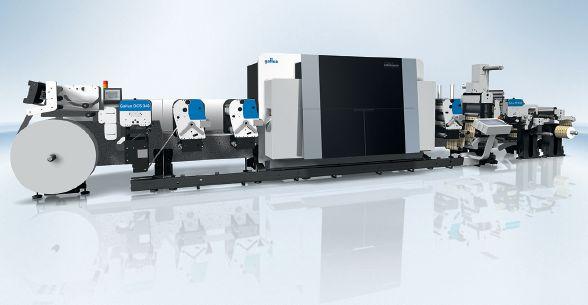
heidelberg gallus DcS 340
In September, Heidelberg commercially released its new Gallus DCS 340 press designed for label printing, which was first unveiled in late 2013, shortly after acquiring the
Gallus Group, the Swiss manufac turer of web presses for the label and folding carton market. The UVbased DCS 340 (Digital Converting System) is supplied with the Prinect Digital Frontend developed by Heidelberg, which the company is also using with its toner and inkjet presses for commercial printing.
The Gallus DCS 340 label press system is based on Fujifilm’s inkjet technology, which enables several print heads to be joined together for a greater print width, without visible transitions. It produces a native resolution of 1,200. In addition to Prinect, the press also benefits from functions such as spot colour matching, PDF Toolbox and Pre press Manager.
Maxson Stacker upgrades
In December, Maxson Automatic Machinery Company introduced stacker enhancements to improve pile quality on lightweight and/or static prone materials. This includes an enhancement that incorporates tapes over the pile, a unique air delivery system and a connecting frame that mechanically adjusts the stacker when setting up the size in the delivery system. In addition to assuring press-ready piles, Maxson explains the new design increases line speeds by as much as 200 feet per minute (65 mpm), while reducing set up time.
Maxson explains the delivery
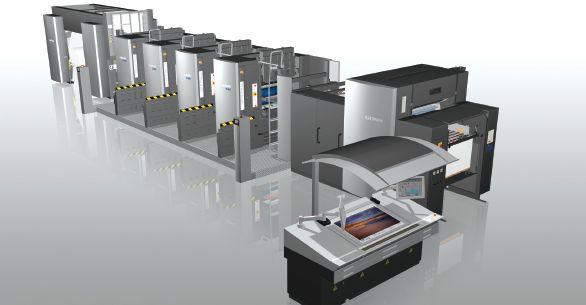
The Goss M-600 Folio system.
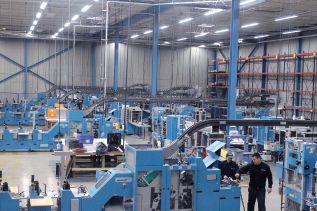
The Gallus DCS 340 has been developed jointly with Heidelberg and Fujifilm.
system’s overlap carriage is joined to the stacker’s front stop assembly. The connecting arms serve as the framework for the tapes over the pile design.
callas PDFchip
In December, callas software, which develops automated PDF quality control and archival solutions, released a version 1.1 update for its pdfChip product line. pdfChip converts HTML into standards-compliant PDF documents. callas explains the pdfChip 1.1 update adds features that were identified in projects customers realized with pdfChip, especially when it was used to create long, dynamic documents. The updated pdfChip 1.1 allows users to control the maximum number of pages in the generated PDF file.
Ricoh ProcessDirector
In November, Ricoh’s enhanced ProcessDirector – modular, scalable workflow-driven software – is designed to more effectively help users capture, transform and manage information. New features include document-level processing of PDF jobs and an optional AFP Feature for using the more powerful AFP document architecture. Ricoh explains the baseline product with this AFP Feature included costs less than previous versions of AFP-capable RICOH ProcessDirector. The enhanced software also is also now available with optional transform capabilities, allowing users to work with a variety of file formats.
axial MadeToPrint
In November, Berlin-based axaio software, developer of solutions for PDF creation, printing and content correction workflows for the publishing and printing markets, intro-
duced a new version of its MadeToPrint product line.The new version, MadeToPrint 2.6.296, specifically provides faster PDF export, especially for InDesign document types that contain a large amount of InDesign master page objects.
axaio MadeToPrint Standard is a plug-in for Adobe InDesign, Illustrator or InCopy and an XTension for QuarkXPress allowing manual, one-click, print and export from design documents to one or more output targets. axaio MadeToPrint Auto, meanwhile, makes all functionality from MadeToPrint Standard available in a fully automated way using integrated hot folder support.
Xaar Marking heads
In December, Xaar plc introduced a new family of piezoelectric print heads for printer manufacturers (OEMs) developing machines for coding and marking applications, which is to be available in late 2016. The heads will all have a 17-mm print swathe, which the company describes as being an ideal width for high-resolution coding and marking applications like printing barcodes, best before dates and other product identification codes onto a range of packaging. The new family of print heads will be manufactured in Xaar’s factory in Huntingdon, UK.
KOmOrI press FeeDers nIGHts/ aFternOOns
Komori Press feeders nights/ afternoons for Komori glX presses 29” and 40” UV hybrid. l ink and chamber coating experience an asset.
40 hours per week, always. We will not send you home short hours. Full benefits after three months.
Fastest growing printer in North america.
Contact Paul Kett 647-938-9578 or email paulk@4over.com
saLes representatIVe, BInDerY anD FInIsHInG
PP& e is looking for a dynamic, goal-oriented sales representative for
ESTIMATOR
Summary of Responsibilities: As a member of the Estimating team, you are responsible for providing costs and plans for Commercial / Web printing, Direct Mail and related services using a computerized Estimating system.
Experience:
• Experience estimating for Web presses
• Experience estimating for Direct Mail
• Current experience in computerized estimating is preferred
• Strong background in production
• A comprehensive understanding of pricing strategies, competitive pricing models is an asset
• Demonstrated excellence in organization and attention to detail
CLIENT SERVICE
REPRESENTATIVE
Client Services Representatives ensure service excellence in all aspects of our dealings with our customers. They work closely with sales and manage order receipt, order entry, order tracking, reporting, follow-up and communication both internally and externally to ensure high quality – on-time delivery.
Experience:
• Previous Customer Service experience is essential – preferably within the printing industry
its bindery/finishing and supplies products. The successful candidate will have some industry experience, knowledge of MS office and electronic communications (email, sms, etc.).
Knowledge of bindery and finishing will be an asset. Candidate must have own vehicle. Competitive compensation package with benefits available. email résumé to: info@printersparts. com.
mOVInG saLe
Trojan programmable hydraulic paper cutter 28.25 inches, includes three blades. Perfect for graphic and print shop. e xcellent working condition. Uses little hydro. $5,000. Contact Mary at 416-504-2387 or mary@centurygraphics.net.
• Recent experience within the printing industry (offset,digital,direct mail, warehousing and distribution)
• Knowledge of Direct Mail printing requirements, database creation and use, Canada Post mailing regulations – a definite asset
• Knowledge of administrative tasks considered an asset – knowledge of SAP,working with numbers, invoicing, electronic order entry systems/job tracking
• High level of record keeping – organization skills required
• Must have completed high school
• Graduation from recognized post secondary school print program such as Ryerson University’s Graphic Communication Management or Graphic Design programs is a definite asset
• Education or courses from other printing-based environments also a definite asset
• Equivalent print experience obtained through previous work experience is considered to be an asset
• Project Management certification obtained through direct work experience or courses focused on managing both short and long-term projects with multiple components
Heidelberg: K-Line/S-Line/Speedmaster/GTO/MO
Komori: 1, 2, 4 or 5 colours & any size
Adast: 714/715/724/725
Mitsubishi: Any model
Ryobi: 2800CD/3200CD-MCD/640K
Itek: 960/975/985
Hamada: 600/700/800/E47/RS34
Shinohara/Fuji: 66/65 1,2 or 4 colours
Sakurai: 1, 2 or 4 colours and any size
(newer model)
Polar: any size/older or newer models (66/72/76/78/82/90/92/107/115)
Horizon-BQ: 220/240/260/440/460
John Bacopulos / President & cEO / Ironstone Media / Pickering, Ont.
Back in March 2012, Pickering, Ontario-based Ironstone Media Corporation submitted a Notice of Intent to file a Proposal within Canada’s Bankruptcy and Insolvency Act (BIA). The company, led by Chief Executive Officer John Bacopulos and President John Pizale, was intent on restructuring its debt to push the company forward.
In June 2012, creditors voted to approve the proposal, which outlined for debts to be repaid at less than 10 cents on the dollar. At the time, Ironstone also worked out a new labour agreement with its unionized employees, who represented a majority of the company’s approximate 100 staff members.
A little over three years later, in July 2015, Web Offset, a subsidiary of Ironstone, filed a notice to restructure under BIA, again with the intention of restructuring to continue in business. Ironstone Media had been at the forefront of the technological change facing the publishing industry, as the sector tried to understand the impact that digital publishing would have on printed products.
Founded in 1961, Ironstone Media, which began under the name of Web Offset Publications, consists of three divisions, with around 100 employees, including Web Offset, LinkPath and Imprint. The company was built primarily by focusing on publication printing, running at one point four web-offset printing presses, and more recently expanded into digital- and cross-media initiatives, such as virtual publications (LinkPath), and toner-based production (Imprint).
PrintAction magazine spoke with CEO John Bacopulos on the phone just prior to the 2015 creditors’ vote on whether they were going to accept the restructuring deal. Positive about the support being received, Bacopulos then agreed to answer some of PrintAction’s emailed questions about the company’s second financial restructuring process in a little over three years.
When did the Notice of Intent to file under the Bankruptcy and Insolvency Act take place and was it for Ironstone, Web Offset, or both?
JB: Only Web Offset filed on July 21, 2015.
What can you share about the amounts to creditors?
JB: All unsecured amounts to owed to ownership have been postponed to the claims of unsecured creditors in the approximate amount of $3.2 million.
Can you provide specifics about the vote, in terms of percentage of creditors who accepted the restructuring offer?
JB: The proposal received overwhelming support – over 98 percent.
Can you share what restructuring offer was accepted by creditors, in terms of cents on the dollar?
JB: Approximately $0.25 on the dollar.
What were some of the key challenges facing Ironstone that led to the filing?
$3.2 million
Amount of debt owed to unsecured creditors in Web Offset’s July 2015 filing under the Bankruptcy and Insolvency Act.
JB: Tough economy, lower Canadian dollar and resultant surge in paper prices. Unexpected customer insolvencies and uncollectable receivables with negative fall out.
How has the cost of inputs, perhaps fluctuating paper rates specifically, been a challenge?
JB: Since the first quarter of 2014 until April 2015, paper prices jumped over 24 percent. We were only able to collect a small percentage of the increase from customers. As well, ink, plates and other consumable costs rose dramatically during this period.
How was this 2015 filing different from the one three years ago?
JB: Certainly much smaller in scale.
What gives your team the confidence the current restructuring can work?
JB: Continued solid support of customers, lender, landlord, employees and suppliers.
Why did you receive such a positive level of creditor support?
JB: We’ve been in business since 1961. We have a long term and continuing relationship with all stakeholders.
Is the staff staying committed to the company?
JB: Absolutely.
Will you be selling any assets as a result of the restructuring?
JB: Not anticipated.
Does the restructuring involve new ownership?
JB: No
Why are you and the employees staying committed to Web Offset and pushing it forward?
JB: It’s the best alternative to pay out dividends to creditors, protect employees and provide future business opportunities.
GE Brightness 93-96
lb 60.8, 70, 80, 100 Text 80, 100, 120 Cover
The key to our customers’ success lies in the perfect interplay between people,machines, materials, and processes. Heidelberg combine prepress, press and postpress expertise with consumables, services, and consulting. This integrated solution portfolio has already gained the company 40 percent of the global packaging printing market.
Discover the opportunities the Speedmaster offers and let yourself be inspired! www.SpeedmasterGetInspired.com