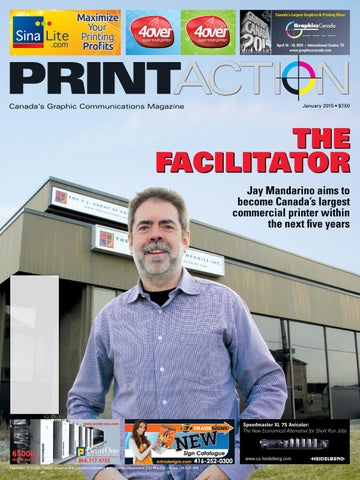
Jay Mandarino of the C.J. Group of Companies, which has acquired three companies in the past six months, discusses the continuing surge of mergers and acquisitions in Canadian printing 10
products of the year
Technology manufacturers and distributors name and describe their most impactful product of 2014, providing a guideline for future installation and development trends in the industry 14
5
News
Al Varney becomes CEO of Xerox Canada, Danny Ionescu is named HP’s Director of Enterprise Business for Graphics in the Americas, and Ricoh acquires PTI Marketing Technologies
Market
General Printers’ bankruptcy filing by the numbers, Image Four adds a large-format Busch pile turner and Kuda guillotine, and Best Deal Graphics buys a Mitsubishi 3000TP perfecting press
Profiling new printing products including Agfa Graphics’ chemistry-free Azura TE printing plate, CTI Paper’s high-impact Kromekote foils, and Drytac’s 7-mil PET film rebranded as Reveal 6 18
techNology report
Nick howard Following the Money
A look at how the printing world is changing in the face of Internet-driven communications and how it affects large-scale capital expenditures
22
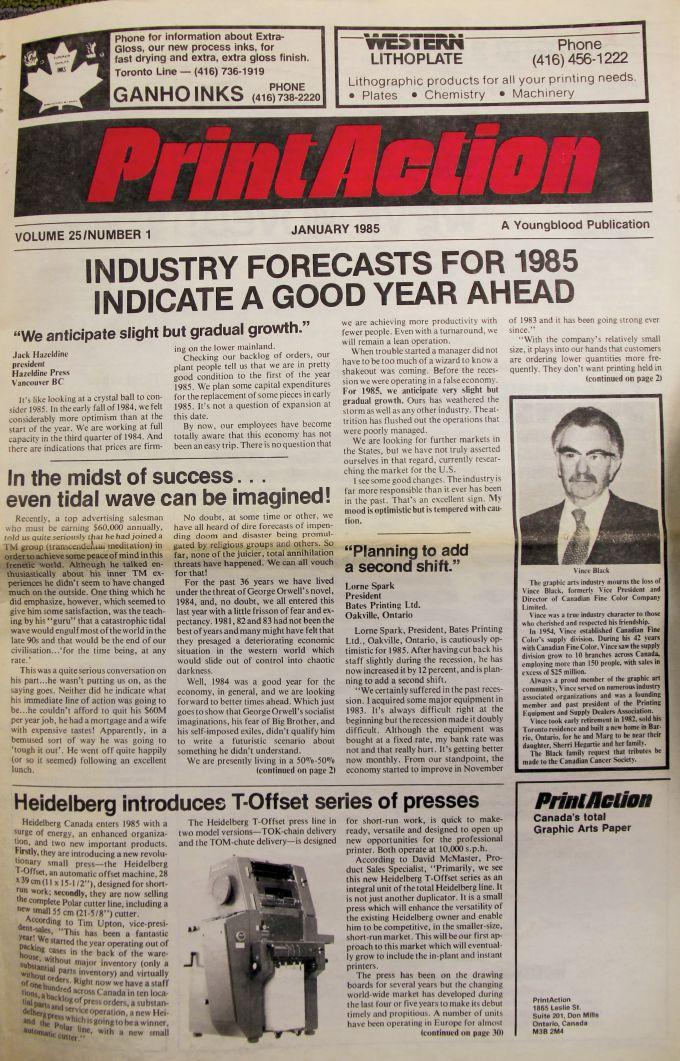
January 1985
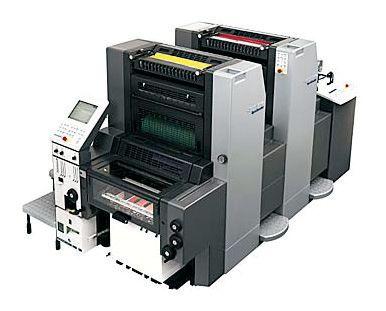
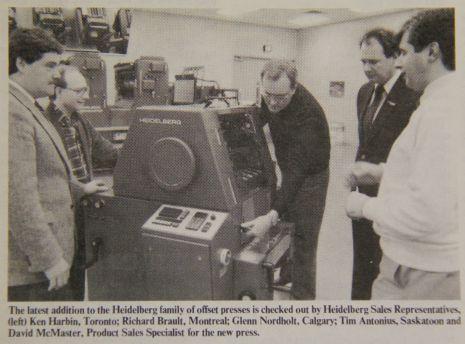
The Internet’s Domain Name System is created, Wayne Gretzky scores 50 goals in 49 games, and Heidelberg Canada introduces its game-changing T-Offset Series of Presses
Coming Spring 2015
The New Normal S
itting down to discuss the printing industry with Jay Mandarino, President of the C.J. Group of Companies, is always interesting, mostly because he is one of the country’s most tuned-in printers. A good chunk of his day is spent on the phone with suppliers and other printers to find out what is happening out there – true realtime market intelligence.
Mandarino estimates he takes as many as three calls a day from printers who are looking at mergers or acquisitions. This is a unique position based on his high visibility, but its helps confirm the growing spike of M&A activity in Canadian printing, which Mandarino openly discusses in this month’s cover story.
Another, more unfortunate conformation of M&A activity is the continuing bankruptcy and restructuring filings by printers, such as Oshawa’s General Printers, which closed in December with creditors owed approximately $4.6 million. Any amount of unpaid liabilities hurt the industry going forward, particularly the dozens of smaller companies who were owed thousands of dollars, but this was a relatively light hit compared to other recent liquidations.
Because of the large capital investments and high number of daily transactions needed to operate a printing business, the industry operates within its own unique economy where financing becomes the burden of equipment and consumables vendors. They are often blamed for propping up unhealthy companies that pile up debt.
A Toronto-area printer recently shared the following with PrintAction in relation to General Printers’ bankruptcy: “The biggest question, and who is at fault other than management, is why did the paper companies extend so much credit… it probably explains why we just had an across-the-board five percent hike in paper from the merchants.” This printer summed up a common frustration many others feel when hit with the consequences of a bankruptcy, even as they themselves operate in good faith.
As another example of the impact that bankruptcies can have on the industry, Mandarino brings up the 2013 case of Toronto’s Pareto Corporation, which was said to be generating more than $100 million in annual revenues. “When the Pareto thing happened, three major banks got hit for millions and that really pegged our industry,” he explains. “Right now suppliers will tell you, all of the time, they have 10 deals signed, but they cannot get financing.”
This false economic environment warrants discussion, but the printing economy is not going to change how it has operated for the past couple of decades. The New Year will see more bankruptcies with unnecessary levels of liabilities and more growth in M&A activity as the market continues to right itself. It will be difficult for printing companies to not become bogged down in this morass, but it is vital to focus more on business development in 2015.
Jon Robinson, Editor
Canada’s Graphic Communications Magazine. Proudly published for two generations.
Editor Jon Robinson • 905.713.4302 • jrobinson@annexweb.com
Contributing Writers Zac Bolan, Peter Ebner, Chris Fraser, Victoria Gaitskell, Dr. Martin Habekost, Nick Howard, Thad McIlroy, Nicole Rycroft, Dr. Abhay Sharma, Trish Witkowski
Publisher Paul Grossinger • 905.713.4387 • pgrossinger@annexweb.com
Associate Publisher Stephen Longmire • 905.713.4300 • slongmire@annexweb.com
Media Designer Katerina Maevska • kmaevska@annexweb.com
Al Varney becomes President and Chief Executive Officer of Xerox Canada Ltd., succeeding Mandy Shapansky who was to retire on January 1, 2015. Varney, a former Vice President of Marketing for Xerox Canada, will lead the Canadian organization after spending the past five years in the United States, where he served as President of Xerox North American Agent Operations and, prior to that, as a Senior Vice President for U.S. Client Operations. Varney first joined Xerox Canada in 1986 where he has held various positions in sales, marketing and general management. Shapansky spent nearly three decades with Xerox Canada, and served as CEO for the past four years. Xerox Canada is headquartered in Toronto.
Ricoh acquired PTI Marketing Technologies, which provides SaaS marketing asset management and applications. The acquisition follows Ricoh’s investment in PTI in August 2012 and its 2013 investment in Avanti Computer Systems of Toronto. PTI will continue to operate under its current name, management team and structure at its Solana Beach, California headquarters. Coleman Kane remains PTI’s President and CEO. MarcomCentral, PTI’s highest-profile product, is a cloud-based platform (Marcom.com) that can be used to create a one-stop-hub to store, customize and share marketing campaigns with partners in the field.
Danny Ionescu, who has been leading much of Hewlett-Packard’s business development in the Canadian printing market for nearly two decades, has been promoted to lead similar initiatives across the Americas. Ionescu becomes HP’s Director of Enterprise Business for Graphics in the Americas. The execu-
tive had been Vice President of Sales for HP Canada’s graphic arts division since 1994. In the past few years, Ionescu has been spearheading the introduction of HP Inkjet Web Press systems into the Canadian market, as well as the recently introduced 29-inch HP Indigo 10000 platform and a range of wide-format inkjet developments. He continues to be based out of the Greater Toronto Area.
Brad Kruchten takes the lead of Kodak’s new Print Systems division after the imaging giant established a new organizational structure to take effect on January 1, 2015, based on five business divisions: Print Systems; Enterprise Inkjet Systems; Micro 3D Printing and Packaging; Software and Solutions; and Consumer and Film. Enterprise Inkjet Systems is to be led by Philip Cullimore; Micro 3D Printing and Packaging will also be led by Cullimore (on an interim basis); Software and Solutions by Eric-Yves Mahe; and the Consumer and Film division is to be led by Steven Overman, who is also Kodak’s Chief Marketing Officer. Kodak is also combining its current four regional sales organizations into two: Europe, United States and Canada, Australia and New Zealand (EUCAN); and Asia, Latin America, Middle East and Africa (ALMA).
Seiko Epson of Tokyo plans to invest $1.2 billion in its manufacturing subsidiary Epson Precision Philippines Inc. to construct a new plant for increasing inkjet printer and 3LCD projector production volumes. It will be constructed inside the existing site by the early part of 2017, with operations slated to begin in the spring of that year. Epson plans to install a large solar power generation system with a capacity of approximately 3,000 kWh on the roof of the new plant. This system will reduce overall daytime electricity consumption at Epson Precision by half. Epson plans to increase the workforce of Epson Precision in the Philippines to approximately 20,000 from the current level of 12,500.
KOMCAN is the new operating name for K-North Services Inc., which distributes and services printing technologies, primarily Komori presses. KOMCAN states its rebrand is a move that will allow the market to better identify with the authorized agent for Komori printing presses in Ontario and Western
Canada. “We felt that with the changing times in the printing industry and our close relationship with Komori it was a good time to rebrand,” said Steve Ranson, President of KOMCAN. “Komori is diversifying into many different print markets such as printed electronics and digital equipment that present new opportunities for our company and for our customers.”
Panenka succeeds Carsten Knudsen to become President of Esko. Panenka joined the Belgium company in September 2014 from Kollmorgen, which is an operation owned by Danaher Corporation. Danaher purchased Esko in 2011 for approximately €350 million. At Kollmorgen, Panenka most recently served as VP and GM for Industrial Automation in Europe and India. He joined Kollmorgen in 2008. Back in September 2014, at the same time when Panenka joined Esko, Jon Giardina also came from a Danaher operation to become Esko’s VP for the Americas. Prior to Danaher, Panenka held sales, marketing and general management positions with ABS Deutschland, RITZ Pumpenfabrik and New Haden Pumps. Panenka has a BA degree in Management from Berufsakademie located in Heidenheim, Germany.
Transcontinental is selling its Toronto- and Montreal-based consumer magazines and associated Websites to TVA Group, controlled by Quebecor Media, for $55.5 million. The transaction is subject to approval by regulators, including Canada’s Competition Bureau. It affects some 310 people at Transcontinental’s TC Media division. Transcontinental also signed a parallel agreement to print the purchased consumer magazines and TVA’s marketing products for a
period of seven years, and to extend previously signed contracts to print some TVA Group magazines to the end of June 2022. “Today’s agreement creates twofold value for Transcontinental Inc.,” said Francois Olivier, CEO of Transcontinental. “In one stroke we have also improved the book of business for our printing sector.” In June 2014, Transcontinental spent $75 million to buy a majority of Quebecor’s newspaper assets operated by Sun Media
C.J. Group of Companies of Toronto purchased 30-year-old Prime Imaging, a well-known commercial-print shop in the area, led by Scott Currie, who continues in his role. Prime Imaging was established in 1983 as a typesetting firm in downtown Toronto. The company purchased its first wide-format inkjet system in 1996 and continued to build a strong presence in display graphics. The company runs unique Oce photographic presses that produce apparent 4,000-dpi output. Currie began as a bookkeeper at Prime Imaging in 1989 and worked his way into sales and managerial roles before becoming part owner of the company, along with the two original founders. Currie then took over the operation completely in 2003. The company will move into C.J. Group’s new facility in Toronto in early 2015 (see page 10).
Udo
General Printers Closes operation
Consolidated Graphics Canada Ltd., which operates as General Printers, has ceased operations at its facility in Oshawa, Ontario, following its proposal to creditors, who accepted the action on December 12. The approximate amount of total debt owed to creditors is $4.6 million, with around $2.15 million secured.
In late-October, General Printers made a Notice of Intention to Make a Proposal filing under Canada’s Bankruptcy and Insolvency Act, which held the potential for the company to restructure. “Due to a downturn in business, the company was facing a cash crunch and was no longer able to meet its obligations as they became due,” explains a Harris&Partners trustee overseeing the bankruptcy act filing. General Printers had a 30-day schedule in November to meet its cash flow obligations.
The Harris&Partners trustee then reported, “Prior to the 30-day initial stay expiring, the company made a proposal to its creditors. The intention is an organized wind down including an auction of [General Printer’s] assets, completing work in process, collecting receivables and selling real estate.” The equipment auction was held on December 16.
David Fors, a principal owner of General Printers, was not available for
comment. Fors had led the operation as President since 1991. General Printers was established in 1951 and was one of the region’s most-visible printing operations for decades. General Printers lost one of longtime leaders in 2011 when Fred Thornley, co-owner and Vice President, passed away at age 63. He had spent 45 years at the company. General Printers described itself as an employee-owned company.
The following breakdown of the printing company’s proposal to creditors provides an overview of where monies were owed on its Statement of Affairs.
The figures used in this breakdown are based on creditors, both secured and unsecured, relating directly to the printing industry. These creditors were then placed in categories based on the type of product or service they provide. The figures used in the breakdown exclude external factors like real estate and energy services, lawyers, automobile leasing and other general business needs.
The percentage breakdown of each category’s contribution to General Printers’ overall creditor liabilities applies only to those figures used in the chart, which again directly relate to the printing industry, $2,419,923, not the entire $4.7 million owed. A percentage is also provided excluding employee liability, because of its relatively high figure in this particular bankruptcy filing.
General Printers Bankruptcy By the Numbers
Major liabilities not included in this printing sector breakdown
$73,984 (Accord Financial)
$65,000 (Canadian Revenue Service)
$33,377 (PUC Networks)
$1,955,000 (Ontario Wealth Management Corp.)
$52,637 (Penske Truck Leasing)
Total liabilities directly relating to printing industry: $2,419,923
Total liabilities directly relating to printing industry, excluding employee debt: $1,076,291
Courier service liabilities
total owed: $20,018
Percentage of liabilities relating to printing industry: 0.8%
Percentage of liabilities, excluding employee debt: 1.9%
Paper and substrate supplier liabilities
total owed: $461,711
Percentage of liabilities relating to printing industry: 19.1%
Percentage of liabilities, excluding employee debt: 42.9%
Ink provider liabilities
total owed: $69,873
Percentage of liabilities relating to printing industry: 2.9%
Percentage of liabilities, excluding employee debt: 6.5%
Printing service liabilities
total owed: $30,926
Percentage of liabilities relating to printing industry: 1.3%
Percentage of liabilities, excluding employee debt: 2.9%
finishing service liabilities
total owed: $126,931
Percentage of liabilities relating to printing industry: 5.2%
Percentage of liabilities, excluding employee debt: 11.8%
Mailing
service liabilities
total owed: $141,469
Percentage of liabilities relating to printing industry: 5.8%
Percentage of liabilities, excluding employee debt: 13.1%
Press and postpress equipment supplier liabilities
total owed: $179,778
Percentage of liabilities relating to printing industry: 7.4%
Percentage of liabilities, excluding employee debt: 16.7%
Misc. service provider liabilities (workwear, environmental, electrical & repair, etc.)
total owed: $45,585
Percentage of liabilities relating to printing industry: 1.9%
Percentage of liabilities, excluding employee debt: 4.2%
employees (wages, salaries, commissions, etc.)
total owed: $1,343,632
Percentage of liabilities relating to printing industry: 55.5%
PRINT MARKET
four adds to KBa VLf Power
Image Four Inc. of Vaughan, Ontario, ramped up its pressroom for its previously installed 64-inch, 6-colour KBA Rapida 162a press, plus coater, which is now supported by a new Kuda guillotine and Busch pile turner.
All of the new support systems for the KBA RA162a-6-3ALV-CX press are designed to handle larger format materials, including the 70-inch Kuda guillotine and 64-inch Busch SWH 180RLA pile turner. These systems and the press were purchased and installed through Howard Graphic Equipment.
The Busch system includes programmable aeration and vibration options, allowing Image Four staff to handle both lightweight and heavyweight materials.
Brant Instore Installs two More Kongsberg tables
Brant InStore of Brantford, Ontario, purchased its third and fourth Esko Kongsberg finishing systems, specifically two XP24 tables that feature i-cut cameras, as well as auto-feeder and kiss-cut, through-cut and routing capabilities. The company also owns an older model Kongsberg table and had purchased a Kongsberg XP24 with i-cut camera last year.
“These two machines were similar to the one we had purchased a year ago,” said John Paul deBoer, CEO of Brant InStore. “The Kongsberg table is relatively simple to install, and doesn’t consume a lot of floor space.”
Founded in 1963 with one manual press and two employees, Brant InStore has approximately 300 employees generating revenue for customers across Canada and the United States, who primarily operate in retail, restaurant and automotive industries. It operates four large-format silkscreen colour presses along with four wide-format flatbed inkjet printers and four large-format inkjet roll-to-roll presses. They also run five litho presses of varying sizes. The com-
The Black Creek Pioneer Village in northwest Toronto gave visitors live demonstrations of a cylinder press built by R. Hoe & Co. of New York in 1860. Holding a country drum cylinder design, the printing machine was made to produce newspapers with a moderate circulation and, at the same time, print general jobs.
Priced at $1,750 in 1867, the machine could produce 800 impressions per hour when operated by hand, and 1,000 impressions per hour by steam. Black Creek Village explains the press and others of its type, was the staple of small-town newspaper production for more than 100 years. The restored R. Hoe printing press at Black Creek Pioneer Village was first purchased in 1862 for E.J. Barker of Kingston, Ontario, to produce his weekly newspaper, the British Whig, which still exists today as the Kingston Whig-Standard.
In 1881, the press was sold to the Whitby Chronicle, which planned to launch the new Pickering News. In 1901, the paper and the press were sold to John Murkar, whose son and grandson continued to operate the press for over 50 years.
W.B. Murkar, John’s grandson, donated the press to Black Creek Pioneer Village. (Some of Murkar’s descendants were on hand for Black Creek’s printing demonstration of the restored press.) In early 2004, Ray Redmayne, who had just retired after 60 years in the printing industry, volunteered to clean the machine and explore the possibility of putting it back into working condition.
Redmayne invested over 1,350 hours of volunteer time to clean and repair the printing machine. Only a dozen of these presses are known to have survived, of which only a third are in operating order. This restoration is a example of Black Creek’s mandate to preserve 19th century technology and trades.
Image Four explains its substrate handling needs regularly shift from 60-lb to micro-flute materials.
“We are extremely proud of our association with Tim Treloar and his staff,” says Nick Howard of Howard Graphic Equipment. “Image Four continually over delivers to their clients as the go-to independent large-format plant in Canada.”
Image Four was established in 1991 as a traditional prepress trade house. The company moved toward its large-format production with the installation of a VLF-capable CTP imaging system in 2002. Today, Image Four provides full prepress, proofing and platemaking up to 70 inches for both packaging and commercial printers across North America.
pany is housed in a 150,000-square-foot finishing and distribution facility.
With a maximum working area of 70 x 141 inches and a maximum speed of 66 inches per second, the Kongsberg XP24 can convert a range of board, sheet and roll materials. An optional conveyor extension is available that can work with rolls or sheets/boards with an Auto-Feeder integrated with scissor-lift and transfer cart system, expanding the quantity of print runs that can be pre-stacked. With the Auto-Feeder, the Kongsberg table is able to take the substrate, set the program, read the registration marks, cut the job, and send it to an output conveyor.
“One of the strengths we promote is helping to reduce time to market,” said deBoer. “We can turn around jobs in 24 hours or less. This is our busiest time of the year and if you cannot react quickly enough to changes and last-minute requests, you can lose orders.”
Best Deal Graphics & Printing, a trade printer based in Scarborough, Ontario, has increased its 40-inch press capability by ordering a Mitsubishi sheetfed perfecting machine. The company is adding a Mitsubishi 3000TP perfecting press, sold through New Jersey’s RM Machinery, to its existing 40-inch press line up. Best Deal Graphics’ 8-colour Mitsubishi 3000TP is a dedicated tandem perfector with features like closed-loop colour control and inline coating. The Mitsubishi 3000TP joins Best Deal Graphics’ existing 8-colour 3000R convertible perfector with dual coaters and three 3000 series straight presses (two sixcolours and one five-colour), also equipped with coaters. In addition to its printing services, Best Deal Graphics provides finishing, kitting and fulfillment.
Image
Best deal Buys Mitsubishi Perfecting Press
Black Creek Village d emonstrates 1860 Press
Brant InStore executives John Paul deBoer (left) and Jim deBoer with their new Kongsberg tables.
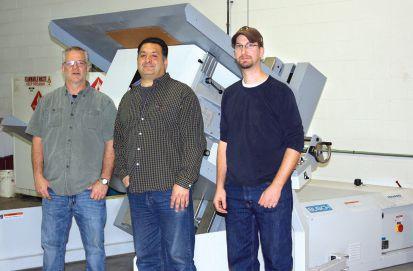
With Image Four’s new Busch pile turner are (left to right): Tim Treloar, President, Koko Boudakian, General Manager, and Jason Taylor, Prepress Manager.
PRINT MARKET
Cascades
Cascades Inc. has invested more than $13 million with the installation of two new Mitsubishi printing presses into its Norampac plants in Vaudreuil and Drummondville, Quebec, which specialize in manufacturing corrugated packaging products.
“This major investment in Québec is part of our efforts to modernize Norampac’s and Cascades’ assets,” stated Charles Malo, VP and COO for Packaging at Norampac. A few days later, Cascades reached an agreement to sell its North American boxboard manufacturing and converting assets to Atlanta’s Graphic Packaging Holding for $44.9 million. The deal involves five plants and 670 workers, including: East Angus and Jonquière, Quebec; Winnipeg, Manitoba; and Cobourg and Mississauga, Ontario.
The Mitsubishi Evol press at the Vaudreuil plant
CMD Insight Ltd. of Toronto, focused on providing distribution and consulting about print-enhancement technologies, becomes a new distributor for LasX products in the Canadian market, while also working to promote and market Scodix technology.
Christian Knapp, a well-known European printing executive, is the driving force behind CMD Insight as Managing Director and a partner in the business. He recently moved to Toronto with his Canadian-born wife. Knapp previously served as Managing Director and CEO of KBA United Kingdom, a subsidiary of German press maker Koenig & Bauer Group, from January 2001 until July 2013. During this time, Knapp grew the KBA UK sales, service and distribution channel from $9 million to more than $60 million with 50 employees. He also previously served as VP of Sales for MAN Roland in Germany. With CMD Insight, Knapp plans to focus on pro-
has been in operation since September 2014, and the press at Drummondville was commissioned in November. Mitsubishi explains its Evol 100 press can be set up in two minutes by two operators and run at 350 blanks per minute. The press handles a maximum sheet size of 37.4 inches long by 100.59 inches wide.
“The new state-of-the-art equipment is part of our plan to increase our productivity and market share by focusing on strategic sectors as a means of keeping the company on track as we move forward,” stated Alain Lemaire, Cascades’ Executive Chairman. “[This] gesture demonstrates the trust we are placing in the employees at the Vaudreuil and Drummondville plants.”
Founded in 1964, Cascades employs close to 12,000 people who produce packaging and tissue products that are composed mainly of recycled fibres.
viding Canadian printers with products and services that make print stand out and provide added value to brand owners. Knapp describes his tech focus as being aimed at digital photo-quality presses, digital enrichment devices and sophisticated laser-cutting technology. This is to now include LasX laser cutting technologies, which have been developed out of the United States for more than 16 years. The partnership was recently on display at the Print World tradeshow in Toronto with a demonstration of the LasX Matrix Modular Digital Finishing system. As a base model, Matrix provides programmable laser to die cutting, perforating, and scoring.
CMD Insight also recently reached an agreement to promote Scodix’ unique finishing systems, designed to add finishing enhancements to printed products.
CALENDAR
January 20, 2015
CMa Business of Ideas Conference
One King West, Toronto, ON
January 20 – 23, 2015
efI Connect users’ Conference
The Wynn Las Vegas, Las Vegas, NV
February 23 – 26, 2015
hunkeler Innovation days
Luzern, Switzerland
February 26 – 28, 2015
Graphics of the americas 2015
Miami Beach Convention Center, Florida
March 1 – 3, 2015
Print uV
Las Vegas, Nevada
March 5 – 7, 2015
dscoopX Conference
Gaylord National Hotel & Convention Center, Washington, DC
March 22 – 25, 2015
67th annual taGa technical Conference
Hotel Albuquerque, Albuquerque, New Mexico
April 8 – 11, 2015
sign expo 2015
Mandalay Bay Convention Center, Las Vegas, NV
April 16 – 18, 2015
Graphics Canada International Centre, Toronto, ON
May 7 – 9, 2015
Grafik art Montreal 2015
Place Bonaventure, Montréal, QC
May 19 – 23, 2015
Grafitalia 2015
Fieramilano Spa Hall 18, Milan, Italy
June 16 – 18, 2015
Codiac Printing, based in MacDougall Settlement, New Brunswick, installed an Agfa Anapurna M2540 flatbed inkjet system, purchased through ND Graphics. After beginning as a downtown Moncton print shop, Codiac was relocated to MacDougall Settlement in 1992, working out of a small building on a historic farm property. Codiac provides a range of production services, including screen printing, large-format inkjet, offset and vinyl cut lettering.
The Anapurna M2540, with a pin register bed size of 8.3 x 5 feet, reaches speeds of up to 484 square feet per hour in Express Mode. In what Agfa classifies as Production Mode, the system reaches a speed of 301 square feet per hour.
PaCeX
Toronto Congress Centre, Toronto, ON
September 13 – 16, 2015
Graph expo 2015
McCormick Place, Chicago, IL
September 16 – 19, 2015
sign China 2015
Shanghai New International Expo Centre, China
May 31 – June 10, 2016
drupa
Messe Düsseldorf, Düsseldorf, Germany
Christian Knapp, Managing Director of CMD Insight, has spent more than 25 years in printing. (Photo provided by Printweek.)
CMd Insight to distribute LasX in Canada
Codiac Installs agfa Inkjet
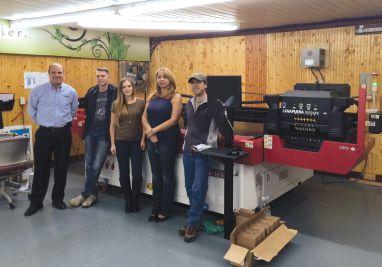
With the new Anapurna M2540 FB are (left to right): Stan Tranter, Agfa Account Manager, and Codiac Printing’s Shane Mazerolle, Designer and Print Operator; Jen Saulnier, Graphic Designer; Donna Magee, Graphic Designer; and Adam Chappell, IT Administrator.
For
Fast and Accurate Print…
…always start at PointOne
Blistering Make Ready Times.
Blazing Fast Production Speed.
Start to Finish Colour Consistency. Uniquely at PointOne G raphics. PointOne can keep you on the right track by utilizing any one of it’s State of the Art Presses Heidelberg
Equipment For Today’s Printing
At PointOne there are no sacri ces for quality. We o er trade competitive prices without going over your budget, while still keeping the environment in mind. We have leading edge technology to keep our cost and our quality in line. Come in and work with us to make your print job a work of art.
2007 MAN Roland Rotoman
5 printing units with remoistenable gluer, pattern perf, spine paster, inline folding and sheeting capabilities. Computer Assisted Colour and Register System
2014 Heidelberg XL 106
8 Color perfecter w/Aquaous Coater 29.5” x 41.7” with roll to sheet, 15,000 Sheets Per Hour
2014 Heidelberg XL 106
8 Color perfecter 29.5” x 41.7” with roll to sheet, InPress auto colour and registration system, 18,000 Sheets Per Hour
2010 Heidelberg XL 105
6 Color w/Aquaous Coater 29.5” x 41.7” with roll to sheet, Up to 40pt sheet thickness 18,000 Sheets Per Hour
2007 Heidelberg SM 52
4 Color perfecter 14” x 20” 13,000 Sheets Per Hour
2012 Heidelberg ST 450
8 Pockets + 2 Cover Feeders + Tip Gluer In + Blow In 13,000 Books Per Hour One Up
8 Amrys Pockets w/6 Stream Feeders + Cover Feeder 14,000 Books Per Hour One Up
2013 Ricoh 901s w/E81 Fiery RIP
2014 Ricoh 901s Plus w/E82 Fiery RIP
Full Colour with saddle stitching and perfect binding, 3 side trimming, scoring and folding 90 pages per minute at sheets
EFI Monarch MIS
Monarch, Foundation, Print Flow, Planner, AutoCount and Metrics
Where the Money is Going
There was a time not so long ago, when letterpress technology was embraced by the printing industry. In 1955, when it became quite clear the cheap despicable offset process was going to eat letterpress for lunch, the outcries from the hot metal industry were loud and constant.
Herbert Becker, President of IAES (International Association of Electrotypers & Stereotypers) sent a letter out stating, “Our feeling is that the letterpress industry has rested too long on its laurels. Letterpress sets the standard for quality for the entire printing industry. [With] the confusion of claims and counter-claims, it’s time to get the facts to the people who need them.”
This type of talk may sound familiar even today from various trade organizations as they struggle to find the magic ingredient that will stop eroding print sales. As new technologies came available, printers were the first to embrace them. Phototypesetting killed off hot metal and all of its related career jobs, but also benefited the printer in many ways. The Mac then wiped out what was left of a dedicated typesetting segment. Now anyone could do it and much cheaper to boot.
There are many examples of the happy marriage between technology and the printing industry. The love affair continued until the mid-1990s when all of a sudden the symbiotic honeymoon ended with a bang. But with most every tech wave of newness there is that gestation period that lingers and generally confuses people as to how and what the future will look like.
As much as we may want to think that bad luck in market crashes and a sluggish economy are the roots of our demise it simply is not so. One thing is very apparent when looking back in time: The absolutely fantastic amount of necessary printing was everywhere. There was just no other way to distribute information in a reasonably cheap way. Radio and television were still very expensive options. Print was the only answer for low cost communications.
The money and the brains, however, are now directed elsewhere. Internet applications are thriving as retailers see the advantages of reaching the public in immediate and cheaper ways. Luma Partners LLC, an investment banking company, has tracked the new Ad-Technology industry and they indicate there are now about 3,000 firms in this segment that provides businesses like JetBlue Airways Corp. the resources to tailor personalized messages to individual mobile devices. In Canada, Shoppers Drug Mart is using its Optimum membership program to track customer’s habits and buying decisions, then send alerts to their mobile device.
More is coming and, each month, new money is being plowed into print’s replacement, the Internet. Meanwhile, the news from our industry continues with a negative tone. Gannett, the owner of 23 TV stations and 82 newspapers, said its third-quarter 2013 net income slumped 40 percent from the previous
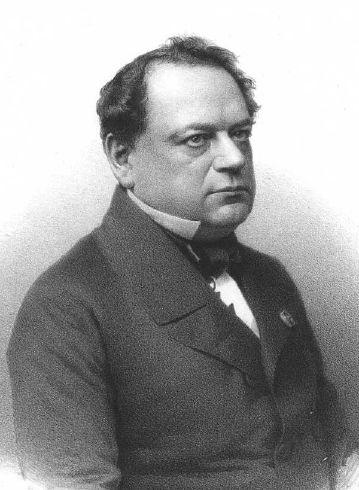
Electrotyping is a chemical method for forming metal parts that exactly reproduce a model. The method was invented by Moritz von Jacobi in Russia in 1838, and was immediately adopted for applications in printing and several other fields. As described in an 1890 treatise, electrotyping produces “an exact facsimile of any object having an irregular surface, whether it be an engraved steel- or copper-plate, a wood-cut, or a form of set-up type, to be used for printing; or a medal, medallion, statue, bust, or even a natural object, for art purposes.” (source Wikipedia)
year. Although digital revenue was up 12 percent, it was not enough to balance the losses.
The Wall Street Journal’s Lenore Skenazy described this seachange by relating to common experiences from her childhood: “At 15, I stared at the back of a Cap’n Crunch cereal box. My son has a few million more options.” She goes on to write how she and her son instantly integrated Youtube videos into their morning conversation, including briskly pulling up videos to show her son what she listened to as a child. We all probably read the back of a cereal box and, if you are from Canada, you were able to read it twice, in French and English.
With Google’s announced net income rising 36 percent to US$2.97 billion (from the previous year), it is easy to see where the money has gone. Google con-
tinues to take advantage of the most popular search platform in the world. Insiders say that Google should take about 33 percent of the global online-advertising market by the end of 2014. Online, smart phones and tablets are in almost everyone’s hands today and will remain so.
Print does continue to share a small slice of the communications market but that sliver is getting smaller. What may be confusing to some of us is the success many printing companies are having right now. Look closer and you will see most of these high flyers are into much more than ink. They may have partnered with large entities like banks and handle all sorts of print management functions. Or perhaps they have great marketing minded customers in the entertainment or sports sectors. The Web-to-print sector also continues to grow because of simple cost of manufactory metrics.
Perhaps it is irrational to assume these success stories can continue and I am certain they will as fewer companies take more of the existing print pie. I’m still of the opinion that we are in the dog days for a lot of existing printed materials. Of course, print shops are still full of both books and magazines, but look at the negative results from most retailers and publishing houses and add the fact more and more is going on-line. Nooks, kindles and iPads already dominate the market. The brief encouraging news of Newsweek ’s return to print does not change the downward trajectory.
Digital print devices are here and much more is almost here. Komori Corporation is a very smart company. They now have several avenues of digital on offer with the recent tie-up with Landa included. One assumes the Japanese press maker knows more than the average printer when it comes to making a successful machine. KBA and Heidelberg are also playing in the same sandbox, just with different partners. All three have been soiled by plunging new press sales and are trying to subsist on things like service and supplies.
Even though there has been a blip of new machine sales since September 2013, smart money says it is not sustainable. Few printers cherish the thought of laying out about $2 million on a new machine when revenue is tepid to outright bad for the majority. The fact remains, that for a large segment of the printing world, million outlays for a single new machine is just not in the cards.
Our daughter loves the Chicago Blackhawks hockey team. I mean she really loves those guys. All she wanted was the commemorative One Goal special edition book. She did not want to read it on her smartphone or tablet. No, she wanted to hold it, flip the pages, watch the little built-in video screen and put it on her shelf. She needed something that is real and physical. That is print’s ace card.
Print will live forever, it is just moving from a mansion to an apartment. Money may be going elsewhere but there is always room for print. Just a lot less of it.
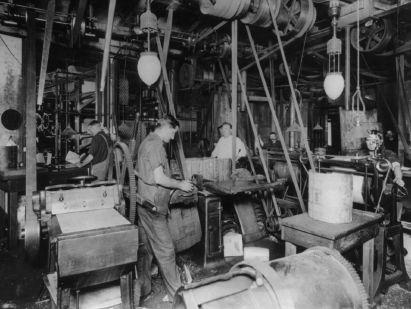
The electrotyping department of the New York Herald in 1902.
The Facilitator
Jay Mandarino discusses his plans for growth and the continuing spike of mergers and acquisitions in Canadian printing
by Jon robinson
It is hard to argue against stating Jay Mandarino, President and Founder of the C.J. Group of Companies, is the most-visible personality in Canada’s printing industry. By being so engaged in the community, particularly in the hypercompetitive environment of Toronto, he is as much a sounding board for insight as a lightning rod for criticism.
Mandarino, however, is the consummate entrepreneur on which the Canadian printing industry was built. He embodies the strategy and ambition needed to move through some of printing’s darkest days, when the business maturation of mobile, Internet-driven communications is wiping out swaths of excess press capacity, crippling companies that have existed for decades. When there is no longer an automatic generational succession of printing companies.
Today’s printing environment also provides opportunity for the wise printing entrepreneur and Mandarino’s C.J. Group has made three acquisitions over the past six months. This includes the November purchase of Prime Imaging and its interesting Océ LightJet photographic presses that produce an apparent 4,000-dpi resolution. Artwords, a unique logistics operation with large-format and short-run printing capabilities was acquired in June 2014 and, in December, Mandarino was wrapping up the purchase of another nearby operation called TPS, which went into bankruptcy on December 3. TPS is a screen-printing company with two massive Italian Sais presses, running 70 x 120-inch sheets, as well as a 120-inch guillotine, 56.5 x 96-inch die cutter, and 60 x 70-inch mounter.
With these three recent acquisitions, C.J. Group, which Mandarino started out of his parent’s basement in 1980, becomes a $30 million operation and one of Toronto’s largest independent printing operations. In February 2015, the C.J. Group will be putting the final touches on its new 80,000-square-foot facility located on the perimeter of Toronto’s downtown core. As a result, C.J. Group will be comprised of close to 160,000 square feet in total.
“When I finish all of this, I want to be the largest independent full-service shop in the country, so we are going to have to head towards $100 million,” says Mandarino. “It is becoming a goal. I wanted to get out, but now I am doing the opposite. I am committed.”
After years of his public commitment to Canada’s printing industry, matched only by his tireless philanthropy, which is often a key characteristic of successful entrepreneurs, Mandarino now fields calls about printing-company succession throughout the day. “About half of my time is spent on discussing mergers and acquisitions, easily
50 percent of my time – literally, I have three calls a day,” says Mandarino, noting he is currently looking at another three acquisitions. “One is a $10 million deal that I am very interested in. And there is an $8 million deal which is going to be over the next, after I do the $10 million one, and then there is one for $20 million where they have approached us.”
In addition to his company’s 18 acquisitions over the past decade, Mandarino explains he has also served as an intermediary, as an M&A facilitator, for at least 25 proposals between two third-party printing companies trying to reach a purchase agreement. In early December, PrintAction magazine sat down with Mandarino to discuss the state of mergers and acquisitions in Canadian printing.
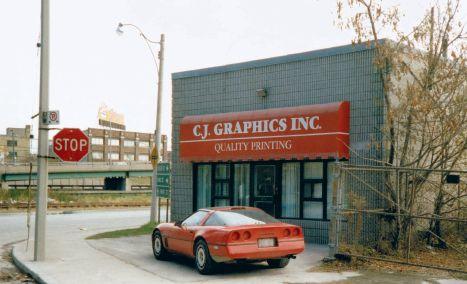
C.J. Graphics’ first commercial building with a press opened in 1985 on Toronto’s King Street.
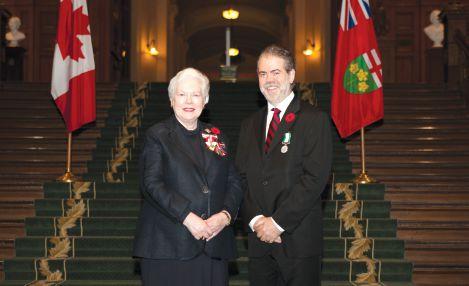
The Honourable Elizabeth Dowdeswell presents Jay Mandarino with the Ontario Medal for Good Citizenship in November 2014.
“When I finish all of this, I want to be the largest independent full-service shop in the country, so we are going to have to head towards $100 million.”
Jay
Mandarino, President and Founder, C.J. Group of Companies
printaction: what is today’s biggest challenge facing printing companies?
Jay Mandarino: They need more sales to grow. One way to get more sales is by hiring a good salesperson. There are a lot of order-takers out there and the really good salespeople are either becoming brokers, getting out of the business, or they are staying where they are because they have a job that is guaranteed. There is so much risk and uncertainty with so many companies closing. The only other way to grow is how we have and that is really from acquisitions.
how difficult are sales-driven M&as when salespeople might own the clients?
As a business owner, you do want to make sure that you are involved with those clients so that you have part of that ownership as well. If you leave it just to the sales reps, the danger is that when that sales rep leaves most likely all of their work is going with them. We try to tie people into our company with different systems and stuff so it would be harder for them to leave. We also make sure to take care of the sales reps, make sure they get what they need – make sure they are happy.
why is there now so much focus on providing lead generation to keep salespeople happy? I must get an email a day from someone who can provide us with lead generation. I was at a course a few years ago. It was a test for salespeople: How do you communicate with your customer? And everybody in the room was saying, “Well, I email them, twitter them, talk to them on Linkedin.” They gave every possible avenue of communicating without actually sitting in front of the customer and meeting with them, developing that relationship. Really it is all about the relationship that you have with your client, working as a team. Our staff are key to our success and growth; and honesty I am blessed to have the best of the best.
when you buy a company is book of business always more important than equipment? The equipment is generally the last thing we are looking at. I’m sure some companies when they are doing this are probably looking at some equipment. There are always one or two pieces of equipment of interest. But generally you are looking at accounts. You are looking to see if they have any RFPs. Do they have any standing contracts with people, because those are generally grandfathered over when you take over a company. It is pretty hard to get into [new customers] these days.
how do you overcome the hesitation to share proprietary information about accounts?
It is always a challenge. If you had asked me a few years ago, I would have said try to do it on your own but I believe now that you need somebody, that intermediary, who is almost like a marriage councilor. You need someone to get the buyer and seller on the same page about what is realistic, what is unrealistic, and to do it without offending anybody.
As the buyer, I can really jeopardize that relationship or get the other party angry, which is not what I want to do. You can have a company that has been around for several generations in a family but the kids don’t want to take it over. Now all of a sudden, you are not just looking at a company, you are looking at family history, especially in printing. The first step is to sign a NDA to protect both parties and, of course, you do an Letter of Intent to agree on the basic facts and stipulate that you need to know what the accounts are and, more importantly, who is in control of those accounts.
“No one is working to capacity, so good salespeople are in demand and can get paid a premium for that. They are pretty hard to find and much more of an asset to their current company than they realize.”
why is it so important to understand who is in control of the accounts?
We looked at one company that had some really fantastic accounts, but they were 90 percent tied into the owner. In most of the cases we have been involved with, maybe about half, the owners generally do not stay on. They either want to retire or just want to stay there for one or two years. It is a big risk if they leave and now suddenly there is no relationship with you. It is very easy for someone else to get in the door.
when purchasing a business, how do you determine what to pay up front?
You really cannot pay all of the money up front because there is just too much risk. If you pay all of this money
up front and you give them exactly what they want, all of a sudden 30 days go by and all of the sales might go somewhere else. You have no guarantee those sales are going to stay with you.
We will generally pay over a couple of years and we will put an escalator in there. If the sales drop, they get less. If the sales go up, they get more. It has to be beneficial to both parties and sometimes people have a hard time with this. And fair enough to their point, too, what happens if we do a bad job managing their accounts? Why should they suffer?
Generally, in our successful acquisitions, we try to keep the Presidents on as a member of our management team, but try to take away all of the dayto-day work they had to do and just have them focus on sales and client development – do what they do best. Most people started with sales as they developed their companies and then took on all of these other roles that they really do not want to do. Nobody wants to collect bills. Nobody wants to deal with human resources.
how important are non-competes?
You have to do non-competes. In one situation, we purchased a company and thought we had everything covered. The owner stayed on for three years, but there was another partner in the business and he had left the country. We did not have him do a non-compete because he left the country, but all of a sudden he came back and started competing against us.
You can make a non-compete for four or five years, but it can never be enforceable. You can never stop someone from making income. If they are an owner of a company, you can probably get one signed for longer than three years, but after a year it is pretty much non-enforceable.
what other key factors must be considered when buying a company primarily for accounts?
You also have to make sure the client list is not made up of the same people you are already dealing with? And also, who is servicing those accounts, a salesperson or a CSR, because you have to tie them into the deal, too. The sales rep might say, “You know what? I want more money or I’m going to leave.”
how do you effectively tie salespeople to a business purchase?
You make your deal with the owner first, but also subject to making a deal with the sales reps. Smart owners will help make it happen because it is to his or
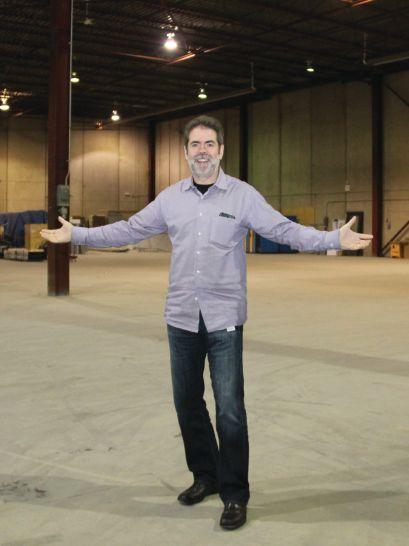
Mandarino inside C.J. Graphics’ new 80,000-square-foot facility, scheduled to open in the first quarter of 2015.
Mandarino signed his first book, Cause for Laughter, for Martin Short during a charity gala in Toronto. He has helped to raise over $50 million for more than 200 charities through not-for-profit JBM Auction Services.
her benefit. You can also do an asset purchase, where you are just buying equipment and buying accounts, which means there are no liabilities with it – sometimes that is the cleanest.
No one is working to capacity, so good salespeople are in demand and can get paid a premium for that. They are pretty hard to find and much more of an asset to their current company than they realize.
Most of these recent deals have all been tied into the sales reps. I am working on one right now with another company, not for us, but as a facilitator, and there are X number of salespeople all over $1 million. If they were to not come with the deal, the company wouldn’t be worth anything. So the owners, between the two of them, are trying to come up with a compromise. To get the salespeople to sign, I suggested they are going to have to give them a signing bonus and that they should split the cost.
can you become too focused on the salespeople when buying a company?
As soon as you bring the salespeople into this it gets really complicated. The deal really has to be pretty well 99.9 percent done, subject to then tying in the salespeople. You really have to work together to get those people in because they might be nervous and think, “I am going to go be a broker.” Of course, I think it is now much harder being a broker going forward.
why is it harder being a broker today?
There are so many of them out there, but there are also so many clients that are weary of it and really want one-stop shopping, with everybody cutting back. They want somebody to deal with and know that they are going to be there tomorrow.
how has the print buyer changed?
What has really changed can be seen in the RFPs: 10 years ago, 10 percent of the questions would be finance and 90 percent reproduction and pricing. Now it is
Mandarino jumping a Ferrari in 1976. His passion for skateboarding and philanthropy later became the non-profit C.J. Skateboard Park and School for at-risk youth and children with special needs.
around 60 percent finance. They are assuming that you are the same price, that you can provide the quality and that you can deliver. They want to make sure you own your assets and how much debt you have if they are going to partner with you.
are most people today looking at asset or share purchases?
The seller wants to sell shares, but there have been
too many issues lately with liabilities and challenges, bankruptcies, especially in our industry. People are shying away from share purchases.
how can you avoid unseen problems with canadian revenue agency?
Even if they are up to date with their CRA filing, you cannot find out if they are going to be audited and they can go back five or seven years, so there could be a lawsuit. You can make the owners personally responsible for X amount of years after, but no lawyer wants their client to sign that.
what are some of the key factors to consider when you are trying to sell your printing business?
You have to separate your real estate from the printing business. You can always sell real estate but you cannot always sell printing equipment. Other things people can do to add value to their company is to consider if you have any trade rights or intellectual property – having all of that documented, registered. You really have to set it up ahead of time to make sure that you are prepared, to know what your assets are, because the printing equipment itself, honestly, in most cases is worth nothing.
are most printers prepared to sell their business?
Most people never think about setting their company up to be sold, because it is just the last thing they think about. Succession is a huge challenge and people do not think about it. I have been in 16 countries in the last three or four years and everywhere it is the same thing. It is not just a North American problem. You are so busy with your day-to-day business and trying to survive and remain profitable.
You really do have to think of a succession plan and there is no sooner time to do it than now. Start it now. Meet with your accountant.
Printing Sells Products
You print packaging for your clients to sell more products. We provide the tools and resources to keep your client’s happy and grow your business.
A Collaborative Approach
Business should be based on relationships - not transactions. At Anderson & Vreeland, we do not simply sell products to the flexo market; we work with our clients and vendors to introduce new, innovative technology that improves the efficiency and quality of flexographic printing.
The flexo industry is evolving and so are the demands of the market. Today, everything is a rush and perfection is demanded. As a printer, you need a partner that offers more to keep your clients happy. Call Anderson & Vreeland to find out how we can help you and your business grow.
ProduCts of the year
To produce the 4th annual Products of the Year feature, PrintAction asked a range of technology manufacturers and distributors to name and describe their most impacting product of 2014, which can include software, hardware, services, consumables, among almost any other product that fits under the technology handle.
Suppliers were specifically asked to name the one product most important to their business or marketplace over 2014. The product can be of any vintage or still under development. The approach of asking vendors to name their Product of the Year allows them to showcase recent successes, but also provides readers with a guideline for development trends, based on process and application. The following 22 companies focused on technologies that will surely continue to make an impact in 2015.
featured technologies
Agfa Jeti Titan HS
Allen Datagraph iTech AXXIS
Canon ImageStream 3500
DALIM ES 4.5
Drytac ReTac Wall
EFI H1625 LED
Esko Equinox
Ricoh PRo c5100S
commercially released July 2013
GMG OpenColor
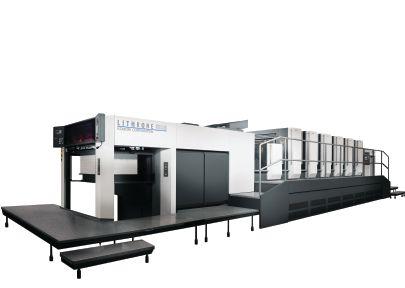
Goss Magnum Compact
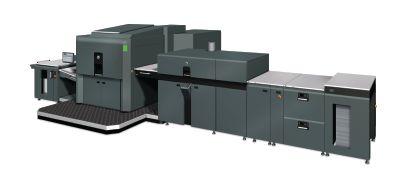
HP Indigo 30000
Inca Onset R40i
INX International JetINX KOMCAN, Komori GLX 40
KBA RotaJET L-Series
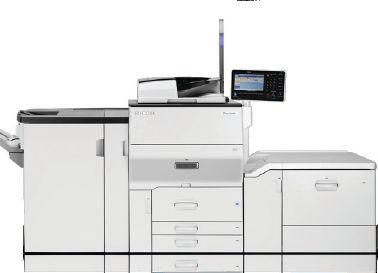
Ricoh named the Pro C5100S as its Product of the Year because it has made a substantial impact on the print-forpay market and has been embraced by print service providers. The full-colour digital press prints at 65 pages per minute and its output can be collated and finished inline.
Ricoh points to the technology’s proprietary PxP-EQ chemical toner, engineered to increase colour gamut, colour density and saturation, with minimal use of toner. The toner formulation has a lower fusing temperature for faster warm-up times and lower energy consumption.
The Pro C5100S’ enhanced toner transfer technology and elastic fusing-belt technology, explains Ricoh, delivers higher-quality imaging on heavily textured media. The press also holds a compact footprint requiring less than four inches of clearance from the wall.
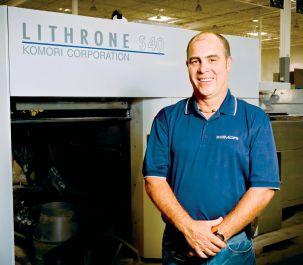
KoMcAN, KoMoRi GLX 40
commercially released June 2014
KOMCAN, the authorized distributor of Komori presses in Ontario and Western Canada, named the GLX 40 its Product of the Year because the press provides what the company describes as a plethora of standard and optional equipment never seen before.
KOMCAN points to the press’ fully automatic, non-
Manroland Evolution Press
MGI DP8700 XL+
Mutoh ValueJet 2638
Ricoh Pro C5100S
Roland VersaUV LEJ-640FT
Sydney Stone, Multiloft Xerox Versant
stop feeder and delivery, camera inspection and inline colour control. The GLX’ A-APC plate changers can change plates in one minute regardless of number of printing units. The company also points toward how the press runs on vegetable-based greases and oils. The GLX 40, explains KOMCAN, has the lowest power consumption and heat omissions of any presses built to date.
The new Komori GLX is rated to run at 18,000 impressions per hour, and, although aimed at the carton market, KOMCAN explains the versatile machine is also suitable for the high-end or ultra-quick make-ready commercial market, as well as printers with long runs. The new GLX can also be configured with multiple coating units in almost any location.
AGfA Jeti titAN hS
commercially released January 2014
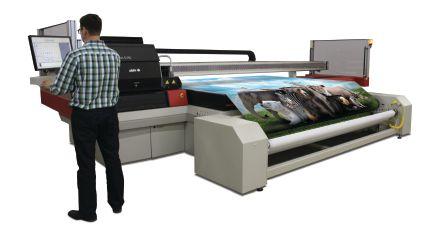
Agfa named the Jeti Titan HS, manufactured at the Belgium company’s facility in Mississauga, as its Product of the Year because it combines 720 x 1,200-dpi print quality at a highly productive 1,722-square-feet-per-hour printing speed.
Agfa explains, based on this combination of speed and quality, that the Jeti Titan HS is ideal for close-up point-of-purchase work or for high-level art, fashion and cosmetics markets. The system’s white printing supports
over-print, under-print, spot, under-spot, fill and overspot for rigids and pre-white for roll media.
The 122-inch wide, six-colour Jeti Titan HS is available with a 126-inch format when combined with the FTR option. This FTR option allows for flexible media printing with the same resolution as rigid materials at the maximum media width. The Canadian-made technology was also recently named as a Product of the Year at the SGIA Expo held in Las Vegas in March 2014.
eSKo equiNoX
commercially released May 2012
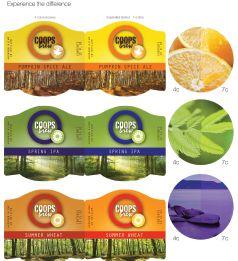
Esko named Equinox as its Product of the Year because of its ability to replace custom spot colours with printing through a standard seven-colour process. Esko explains Equinox improves the competitive position of flexography and package printing.
Equinox converts packaging graphics to five, six, or seven-colour process, delivering extremely close matches to spot colours, while printing more colours than available ink stations on the press. This results in improved image quality and visual brand impact.
Esko explains Equinox also allows jobs to be printed more economically with ganged press runs. Using Equinox, consumer product companies have converted entire product lines to expanded gamut, benefiting from
an economical manufacturing process. Equinox also received recognition with a 2014 innovation award from the United States-based Flexographic Technical Association.
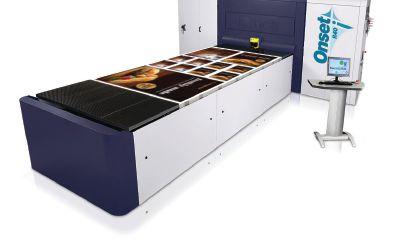
iNcA oNSet R40i commercially released May 2014 Inca Digital of the United Kingdom, distributed exclusively in Canada (and worldwide) by Fujifilm, named the Inca Onset R40i UV flatbed printer as its Product of the Year based on its combination of speed and quality – “fast turnaround graphics for distance viewing and high-quality graphics for short-distance viewing.”
Artisan Complete, based in Markham, Ontario, was the first company in the world to install the R40i. Inca Digital explains the R40i prints with 14-picolitre drop sizes at up to 400 square metres per hour, which equates to 80 full-bed sheets per hour. The system produces a maximum output resolution of 1,200-dpi on media up to 3.14 x 1.6 metres.
The R40i is based on what Inca describes as its dynamic Onset Scaleable Architecture platform. As business grows, explains Inca, customers can adapt other printer elements, including UV curing lamps, automation, speed modes, electronics and software. This roll-to-roll dye sublimation series, using a new generation of PrecisionCore TFP print heads, hits resolutions of up to 1,440 x 720-dpi (8-pass mode) for fabrics and soft signage.
DALiM eS 4.5
commercial release planned for q1 2015
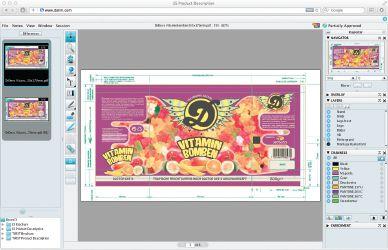
DALIM SOFTWARE named ES 4.5, a Web-based media production platform that manages the technical production workflow, as its Product of the Year because it relates business processes to review and approval for cross-media campaigns, including print, Web, e-book and video.
DALIM explains users can setup projects, define artwork delivery deadlines, prepress tasks and approvals. The software’s e-Publication option turns PDF documents into enhanced digital publications for the iPad or HTML5 Website or ePUB3 for e-book readers.
ES 4.5 includes an integrated media asset manager to provide better control of user content. DALIM points out how this makes it easier for customers and market-
ing service providers to access project content quickly and to then distribute it for review, approval and final delivery.
GMG
oPeNcoLoR
commercially released September 2012
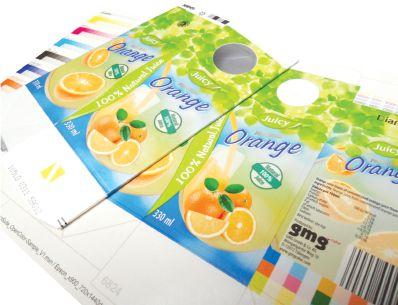
GMG once again named OpenColor its Product of the Year based on its ability to produce what the company describes as extraordinarily accurate predictions of overprints.
It creates high-quality multicolour profiles simulating the behaviour of diverse printing technologies (flexo, offset, gravure, digital), media types, and screening technologies – if necessary, without ‘proprietary chart-based press fingerprinting. Prior to a product like OpenColor, GMG points out the challenges to accurately proof press behaviour for multicolor printing when brand owners have very high colour accuracy expectations.
With OpenColor, GMG explains colour information is applied to a specific printing technology along with process specific information (ink rotation, trapping, etc.). The final press condition is simulated on a proof. OpenColor can automatically create multicolour profiles with single step scales of spot colours on substrates.
ALLeN DAtAGRAPh itech AXXiS hS commercially released february 2013
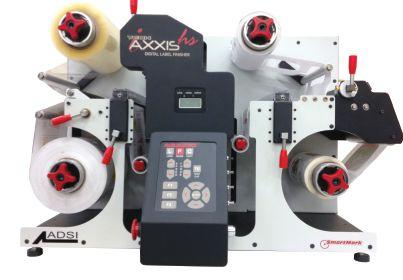
Allen Datagraph named the iTech AXXIS HS Digital Label System as its Product of the Year because, as the company explains, it is a complete digital solution that prints and finishes labels.
Allen Datagraph points out the LED iTech AXXIS HS Digital Label Printer images consumer-quality labels at a maximum width of 216 mm, with what the company describes as brilliant, durable, consistent colour at 1,200 dpi X 600 dpi, at speeds of up to 9.1 meters per minute.
The iTech AXXIS HS Digital Label Finisher laminates, integrates die-less die cutting, and then strips, slits and rewinds to finished rolls of labels. Print-tocut registration to any shape is accomplished via the SMARTMark Optical Registration System.
cANoN océ iMAGeStReAM 3500 commercially released May 2014
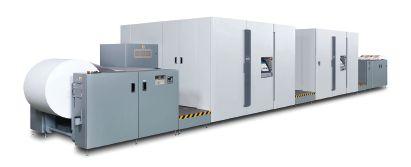
Canon named its ImageStream 3500, a high-speed
continuous inkjet web press, as its Product of the Year largely based on its ability to print inkjet on standard coated media instead of treated inkjet media, typically requiring bonding agents or primers – a noted challenge for the sector. This extensive paper spectrum includes lightweight offset paper and standard offset coated stock.
Canon explains, in the high-speed inkjet space, this provides the ability for customers to save significant dollars (upwards of $1 to $5 million per year) on standard coated offset papers instead of inkjet treated papers.
Canon explains the ImageStream 3500 reaches a maximum speed of up to 525 feet per minute (3,240 A4 pages per minute), working with a 30-inch paper width, which equates to the important 29.5-inch (half-size) print width. The ImageStream 3500 produces a native 1,200 x 1,200-dpi resolution, jetting ink at 1.5 to 2.8 picoliters.
ImageStream 3500’s unique features, according to Canon, in addition to its speed, include the fact that it holds fewer print-heads than most wide-format-printing systems. Its print-heads use a multi-level technology resulting in what Canon describes as smother colour gradations. Canon also describes the ImageStream 3500 as holding the most compact footprint in its class.
hP iNDiGo 30000
commercially released July 2014
HP named the Indigo 30000 as its Product of the Year based on its market-altering 75-cm (29-inch) format size, with what the company describes as an offset-matching sheetfed solution, designed specifically for folding cartons.
HP explains the Indigo 30000 has the ability to print on any substrate from 8- to 24-pt, including off-the-shelf paperboard, coated, uncoated, metallized and synthetic materials with offset quality. The system holds seven on-press ink stations, which HP explains meets the most-stringent corporate branding requirements, offering four, six, or seven colours using HP IndiChrome for on-press Pantone emulations, including white ink.
The Indigo 30000 is compatible with standard sheet sizes, offset palette feeding, and finishing devices, enabling carton converters to optimize operations and assign jobs more economically. It is capable of
running more than 20 different jobs per shift (1,000 sheets on average per job) with automatic and immediate switching from one job to another, keeping waste to a minimum.
iNX iNteRNAtioNAL JetiNX
commercially released in 2012
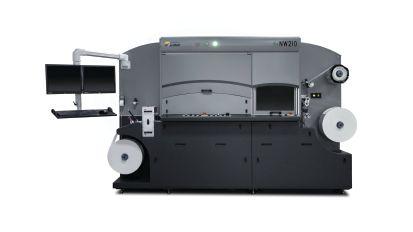
INX, North America’s third largest producer of inks, named its JetINX as Product of the Year based on its technology partnership with the new Komori NW210 inkjet UV digital narrow web press, with inline laser cutting. The innovative press was introduced at Labelexpo Americas 2014. By leveraging JetINX, INX explains the NW210 is incredibly fast and offers bestin-class image quality performance with UV LED (low energy) curing technology.
JetINX is capable of delivering UV-LED cure single pass output at up to 80 feet per minute on any label stock. INX explains it also combines printing and conversion capabilities to produce both brilliant colour and easy production of printed labels at a maximum printing width of 210 mm
SyDNey StoNe, MuLtiLoft
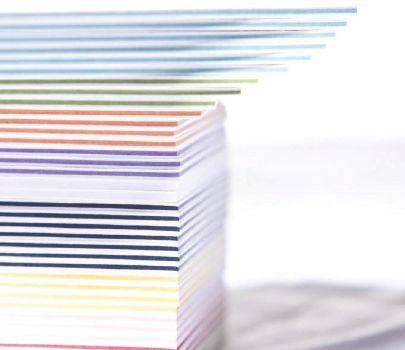
Released September 2014 in c anada Sydney Stone, a distributor focused on finishing for short-run print work, named MultiLoft its Product of the Year because it offers a quick and elegant way to produce thick cards. The company recently introduced the product to Canada. It had been available in the United States and Europe for a couple of years previous.
Sydney Stone explains MultiLoft allows for the production of thick cards ranging from 28 to 64 points. MultiLoft paper can be printed on by any digital print engine capable of handling a 14-pt sheet. Sydney Stone points out that the front and back sheet, along with inserts if preferred, are taken to the paper cutter as normal to be cut down to finished size. The use of the clamp in the paper cutting process activates the cohesive, and forms the bond needed to convert this 14-pt sheet into a 28 to 64-pt thick finished product.
With MultiLoft, Sydney Stone explains thick cards can be offered by printers as an up-sell from standard business cards and incur only minimal extra labour. The covers are available in various finishes including SoftTouch, textured and accent opaque, while the inserts are available in white or 12 different colours to match with client’s artwork.
DRytAc RetAc WALL
commercially released May 2014, updated September 2014
Drytac named ReTac Wall as its Product of the Year primarily because it adheres to and is cleanly removed from virtually any smooth surface, including painted drywall and doors. As a result, Drytac explains it is ideal for interior wall graphic applications like appliques and wall murals.
Compatible with most eco-solvent, UV and latex printers, ReTac Wall can be cleanly detached without the worry of unwanted residue, and it can be removed and repositioned multiple times, allowing for repeated use. The adhesive does not set up permanently, eliminating concern about surface damage on walls. The polymeric PVC film is offered in 3.5- and 6-mil thicknesses.
KBA RotAJet L-SeRieS
commercially released September 2014
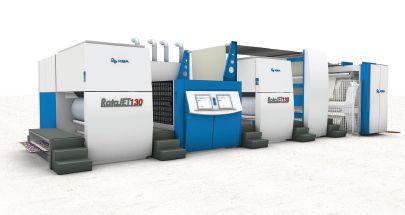
KBA named the RotaJET L-Series as its Product of the Year based on what the company describes as its position as the most flexible and upgradable press concept ever – “future proof.”
KBA explains the RotAJET L-Series concept addresses more than 15 different base press configurations, starting from a RotaJET 89 with a 35-inch web width in 4/0 configuration up to the top model RotaJET 130 in 4/4 configuration. KBA explains the revolutionary approach in the L-Series concept is that each model is fully field upgradable to the top model.
KBA explains a customer can start with a RotaJET 89 f.e. in 1/1 configuration and can then upgrade the system onsite to address wider web width – or gear up to a 4/4c system. So, both upgrade paths are available – address higher volume in an existing market – or address new applications in a new market.
All Systems of the KBA RotAJET L-Series lineup are equipped with KBA auto-splicer, Patras M paper logistics system and are designed to be compatible with the next generation of inkjet heads.
MGi DP8700 XL+
commercially released in September 2014
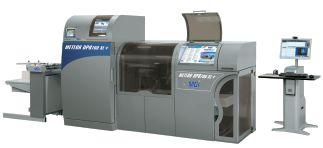
MGI named the Meteor DP8700 XL+ as its Product of the Year because it has true multi-substrate capabilities for paper, plastics and envelopes, laser-safe prints, with offset comparable output.
MGI explains this versatile, toner-based digital press sports sizeable upgrades in format, quality, thicknesses
and more. The Meteor XL+ is now capable of printing up to 47 inches long in format size, allowing for the creation of up to 5.7 A4’s up on a single sheet with a speed of up to 4,260 A4s per hour.
The Meteor DP8700 XL+ can print on substrates with thicknesses ranging up to 400 GSM (400 microns on plastic substrates) and has a new EFI FS100 Pro RIP.
RoLAND VeRSAuV LeJ-640ft
commercially released october 2014
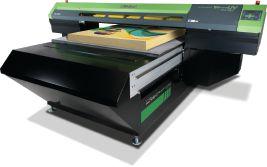
Roland named the VersaUV LEJ-640FT as its Product of the Year based its advanced imaging capabilities and compatibility with a wide range of substrates, including heavy, rigid materials up to six inches thick and weighing as much as 220 pounds.
The VersaUV LEJ-640FT, a natural extension of its VersaUV series, uses Roland’s CMYK, White and Clear Coat ECO-UV inks to produce POP displays, interior design, art, promotional products and two-sided signs incorporating unique dimensional effects.
The LEJ-640FT features what the company describes as a powerful, zoned vacuum system for holding difficult materials flat, a low-heat UV-LED curing system, an Automated Ink Circulation System, and a convenient handheld control unit.
efi h1625 LeD
commercially released May 2014
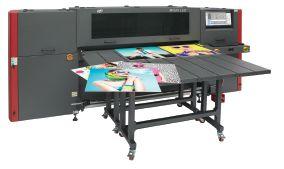
EFI named its H1625 LED printer as its Product of the Year because it creates more opportunities by printing on a broader range of substrates compared with UV or latex inkjet printers.
EFI explains the printer’s grayscale print-heads produce near-photographic image quality, with saturated colours and smooth gradations. H1625 LED is an entry-level production printer provides what the company descries as the industry-leading LED inkjet technology, including white.
The H1625 LED “cool cure” LED, users can print on roll or flatbed media that cannot withstand the heat of other curing or drying processes. Plus, instant on/off LED lamps provide more consistent imaging with fewer wasted prints. The printer also is a greener option, using less energy and emitting virtually no VOCs.
Mutoh VALueJet 2638
commercially released September 2012
Mutoh named the ValueJet 2638 as its Product of the
Year based on its position in the grand-format-printing production space. At 104 inches in width, the VJ 2638 prints up to a 1,016 square feet per hour and is seven colour capable (CMYK x 2 or CMYK, Lc, Lm, Lk).
Mutoh explains the ValueJet 2638 comes standard with a one year limited on-site warranty, heavy duty take up system, Mutoh Edition FlexiSE RIP software and Mutoh’s Smart Printing Technologies, including the Intelligent Interweave print technique that helps to eliminate banding.
The ValueJet 2638 was previously named as one of SGIA’s Products of the Year in the Eco-Solvent/Latex Printers category, over 96 inches.
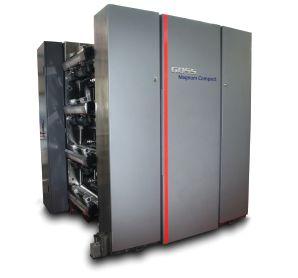
GoSS MAGNuM coMPAct
commercially released June 2013
Goss named the Magnum Compact press as its Product of the Year because it introduces what the company describes as significant benefits for single-width newspaper production and for short-run, multi-product business models.
Goss describes the Magnum Compact as providing compact, extremely fast changeovers, increased versatility and simplified operation which translates into expanded uptime and low-cost production for newspapers, as well as book and semicommercial printing.
Magnum Compact’s design combines the company’s Autoplate technology, presetting and shaftless drives with optional closed-loop colour, register and cut-off control, which Goss explains can minimize make-ready times and waste while exceeding limitations of a traditional 2x1 press. Autoplate technology, explains Goss, enables single plate changes in 30 seconds and full job changeover in less than 10 minutes.
XeRoX VeRSANt 2100
commercially released April 2014
Xerox named the Versant 2100 as the Product of the Year because of what the company describes as combination of performance, quality and automation. This allows users, Xerox explains, to tackle more jobs of greater variety and deliver in new ways that are ultimately more valuable to customers.
Xerox explains the Versant 2100, aimed at the light- to mid-range production, features a new compact belt fuser with 100 page-per-minute speed. The Versant 2100’s imaging system uses a new compact belt fuser, handling substrate weights from 52 to 300 GSM at 100 pages per minute (ppm), as well weights of above 300 to 350 GSM at 80 ppm.
The Versant 2100 also includes an auto sheet-clearing feature to reduce paper jams. Its substrate range can include unique stocks like linen, polyester, vinyl magnet and other specialties.
- DUPLEX
Heavy boards, plastics, laminations or digitally printed works up to 30 pt can now die crease, fold and even glue in-line.
MODULAR UNITS — Combined in-line finishing: crease, fold, glue, tipping, envelope inserting, ink jetting (Duplex), clip seal (3 sides), mail prep.
4. SAVE ON POSTAGE COSTS — a Certified Canada Post Direct Marketing Specialist, we get contract pricing reductions.
5. RETURN MAIL PRODUCTS — Customized “Return Mailers” created in-line with “U” or “BOX-shape” remoistenable glue, time perfed applications and envelope formation.
6. MINI-BOOKLETS — We can saddle-stitch and trim 2-up booklets in-line to the size of a business card. No need to trim off-line, or do 2 passes. 7. HIGH SPEED EQUIPMENT — High speed Tipping, Folding, Saddle-stitching and soft folding ensuring on time delivery.
TRADE PRINTING
Fax:
E-mail:
E-mail:
TECHNOlOGy RePORT
Highlighting new products and services, including Canadian distribution, that have been released into the printing market over the past several weeks.
PRINT
agfa azura te
In early December, Agfa Graphics launched its new Azura TE plate, which is described by the Belgian imaging giant as a chemistry-free, direct-on-press product aimed at commercial sheetfed applications. As the Azura TE plates are cleaned out on-press, Agfa explains the system requires no processor, no chemistry and no water. The company continues to explain its Azura TE product behaves very similarly to a traditionally processed or chemistry-free plate, limiting the variables in pressroom operations, including immediate ink acceptance.
Azura TE, Agfa explains, provides strong image contrast based on its patented Thermochromic Dye technology, which eases visual inspection and allows dot measurements or plate detection to be done with standard devices. In addition, Azura TE has an excellent daylight stability. As with other ThermoFuse products in the Azura plate line, Azura TE support up to 240 lines per inch with Sublima screening. Launched in 2004, ThermoFuse technology works with a single-layer water-based coating, containing ink-accepting latex pearls, which allow for sharp highlight reproduction.
drytac reveal
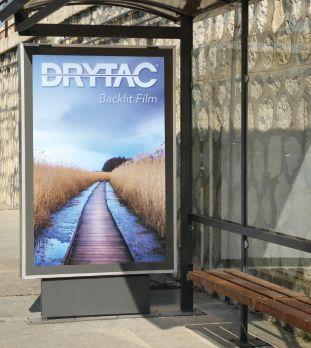
In December, Drytac announced its Backlit film is to be sold under a new brand name, Reveal, which the company describes as directly relating to its key selling features. The 7-mil printable matte PET film, according to Drytac, is comparable to a true durable transparency. With Reveal backlit film, Drytac explains light is dispersed evenly and consistently and its white point yields strong colour saturation, tonal rendition and contrast.
The substrate can also work with UV and latex inks. Drytac explains Reveal can also be cut on automated cutting machines. Reveal is designed with anti-slip, anti-static treatment on the back of the film, making it suitable for indoor and outdoor backlit graphic displays. Reveal is sold in 54-, 60- and 72-inch wide rolls, while 86-inch width is available by special order.
smartsoft PressWise
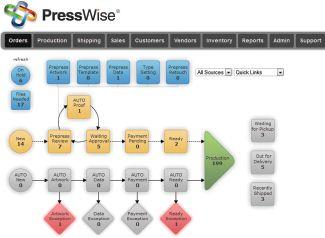
In late November, SmartSoft of California, which develops workflow solutions for the printing, postal and data quality markets, announced the Canadian launch of its PressWise print management platform. PressWise is a cloud-based MIS and print automation platform that includes Web-to-print Storefronts, Estimating, Order Management, Production Automation, Shipping and Fulfillment, and Mail Processing. This is the first time that the service has been launched outside of the United States.
Azura TE is based on Agfa’s patented Thermochromic Dye technology.
Reveal is a 7-mil printable matte PET film.
PressWise
The latest version of PressWise includes a new Reporting Engine for designing reports within a browser, in addition to a suite of pre-built standard reports, as well as new drag-and-drop Job Scheduling functionality. Automatic Scheduling provides insight into Resource Constraints that sales teams require.
SmartSoft also recently introduced SmartAddresser version 5 as a list management and postal software solution, first developed in 2008. It includes Address Correction and Postal Presorting, and options like Change-of-Address processing, Geocoding, Mail Tracking and more. Updates for SmartAddresser 5 include the Mail Tracking capabilities in its MailSpotter module.
X-rite Certified Printer Program
X-Rite Inc. of Grand Rapids, Michigan, has introduced an updated PANTONE Certified Printer Program for commercial printers and packaging converters to address new industry standards. The PANTONE Certified Printer Program reviews and analyzes a range of colour operations from preflight, file preparation and proofing to ink formulation and mixing, and process control in the pressroom.
The process begins with a PANTONE Certified Printer Audit conducted by an X-Rite specialist. The audit process isolates issues that compromise colour accuracy and is the basis for the implementation of standards-based procedures so that operators can produce consistent colour.
PANTONE Certified Printers follow operating procedures throughout the production operation when specifying CMYK colours based on their print standards. PANTONE colours are specified and formulated using spectral data from the PantoneLIVE digital libraries. Packaging converters and printers that earn certification are then able to use the PANTONE Certified Printer logo in sales and marketing efforts.
CtI Kromekote holographic foils
In early December, CTI Paper USA expanded its Kromekote Collection with new high-impact foils, which are presented in a new swatchbook. These cast-coated printing papers include highly reflective holographic foils, which can be used in toner-based presses, colour copiers, offset presses and HP Indigo presses.
The new Rainbow Foil and Light Pillars Foil papers deliver high gloss and reflectivity of blues, greens, oranges and reds from ambient light sources. Rainbow Foil creates diffuse holographic rainbow colours across the sheet while the Light Pillars Foil creates holographic columns of spectral light.
For offset and dry-toner production equipment, Kromekote features an ultra bright-white universal coated one-side and a coated two-side sheet in a variety of weights and sizes. Kromekote is also available for HP Indigo presses in two calipers and sizes in C1S (RIT certified) and C2S. In addition, Kromekote is available in five colours, six foils – and as a C1S label in two basis weights. Kromekote products are acid-free, lignin-free, elemental chlorine free and, with the exception of foils, recyclable.
hP Multi Jet fusion
HP in early November officially entered the 3D Printing space with the introduction of its Multi Jet Fusion system. While the technology is available today through a partner program, HP expects to begin wider distribution in 2016. Built on HP Thermal Inkjet technology, Multi Jet Fusion, according to the company, features a unique synchronous architecture to address the commercial viability of 3D printing.
X-Rite’s recently introduced eXact handheld.
Multi Jet uses thermal inkjet.
CTI’s new swatchbook with foils.
❏ One program manages entire company
❏ Enter data once and use it many times
❏ Enhances client service
❏ Work smart, work efficiently
❏ Increases
Saves
Bard Business solutions inc. Online tours: www.bardsolutions.com email: info@bardsolutions.com 416-410-BARD (2273)
HP states Multi Jet Fusion is 10 times faster than the fastest technology in market today based on its ability to image entire surface areas versus one point at a time. The company’s proprietary multi-agent printing process, utilizing HP Thermal Inkjet arrays, simultaneously apply multiple liquid agents that combines accuracy, resiliency and uniform part strength in all three axis directions. The company also explains Multi Jet Fusion is able to manipulate part and material properties, including form, texture, friction, strength, elasticity, electrical, thermal properties and more – well beyond other 3D print processes.
HP has also started its HP Open Customer Engagement Program to work with users to extend the capabilities of the HP 3D Print platform, which will include a certification process for partners to drive materials innovation. HP also introduced its vision for the future of computing and 3D printing by unveiling its new Blended Reality ecosystem. This ecosystem is underpinned by two key advancements, including Multi Jet Fusion and what the company calls Sprout by HP. Sprout is described as a first-of-its-kind Immersive Computing platform that combines an advanced desktop computer with an immersive, natural user interface.
Durst Rho 1312
Durst in late September introduced its automated Rho 1312 system with what the company describes as “unprecedented media handling,” as well as the Rhotex HS system for soft signage applications. The 98-inch (250 cm) Rho 1312 prints at speeds of up to 6,600 square feet per hour and provides what Durst describes as a higher gloss finish. The system has been engineered with unique media handling flexibility, particularly with difficult and heat-sensitive media. It uses Durst’s Quadro Array print head technology, applying droplets of 12 picolitres.
The 1312 also incorporates what Durst brands as Gradual Flow Printing, which includes media transportation advances such as a stronger vacuum, a wider transport belt and improved media registration. The Rhotex HS reaches production speeds of more than 4,300 square feet per hour (400 m²/hr.), which Durst equates as “the fastest digital soft signage printer on the market.” It has an image resolution of 1,200 dpi and is equipped with Durst´s patented QuadroZ print head technology, which is also utilized in the Durst Kappa series. With a print width of the 130-inch (330 cm), the Rhotex HS uses water-based dispersion inks, which are odourless and free of volatile organic compounds.
Agfa Fortuna 8
Agfa Graphics in November introduced version 8 of its Fortuna printing design software used to secure and prevent counterfeiting and theft. It is designed for use in the highest security printing applications, such as passports, ID cards, official documents, certificates and tax labeling, as well as design vouchers, lottery or event tickets.
Fortuna 8, which was developed in close cooperation with the security industry, includes numerous improvements that facilitate the creation of fraud-deterrent security designs. By streamlining the PDF file generation in Fortuna 8, its compliancy with prepress workflows is increased. This in turn results in further automation of the production process.
Fortuna software features different levels of verification, both for the expert and for non-qualified end users who can determine a true product from a fake one. The software includes a graphical base editor, with integrated security features. The software is based on a modular architecture for upgrading.
The 98-inch Rho 1312 prints at speeds of up to 6,600 square feet per hour.
Fortuna 8 includes a graphical base editor.
eMPLoyMeNt oPPoRtuNity Scarborough, trade bindery requires experienced folder, set up operator for the day shift. Please contact: norm@sgfteam.ca
BiNDeRy MAchiNe MechANic: The Maintenance Technician/Certified Millwright is responsible for troubleshooting, repairing and maintaining the plant production machinery, service equipment and physical building systems.
PReSS feeDeR: The Press Feeder is responsible for ensuring that all presses are supplied and fed with required quantities of paper and other consumables. Resume to be sent to: vanandl@4over.com
PReSS feeDeR foR 40” PReSS Minimum 2 year’s experience required. North Etobicoke Duties include: Filling Ink Fountains; Manually Flipping Paper; Assist with Press Maintenance; Keep a Clean and Safe Workplace. Resumes to: hr@harmonyprinting.com
fuLL tiMe BiNDeRy AND Die cutteR NeeDeD
Looking for a full time bindery and die cutter operator. Day Shift and can work over time.
Can work the following equipment:
• Polar cutter Windmill Die Cutter Press (scoring and perfing)
• Die Cylinder Press
• MBO OR STAHL FOLDER
• Willing to learn new equipment.
• Team player and can work full time
Please email resumes to NAV@PRiNtiNGbyheartland.com or call 647-782-9498
BiNDeRy oPeRAtoR
Full-time bindery operator wanted. We will train the right candidate, although some background in print production a definite asset. Moveable has a reputation for being quality-conscious, client-focused, and bringing attention to detail to every job. These are the qualities we look for in potential hires. Downtown West location (Liberty Village). Apply: info@moveable.com
We Buy
Heidelberg: K-Line/S-Line/ Speedmaster/GTO/MO
Komori: 1,2,4 or 5 colours & an Adast : 714/715/724/725
Mitsubishi: Any model
Ryobi: : 2800CD/3200CD Itek: 960/975/985
Hamada: 500/600/700/800
Polar: 72/82/90/92/107/115 CM
Horizon-BQ: 220/240/260/440/460
January 1985
The Internet’s Domain Name System is created; British Telecom announces it will begin to phase out red telephone boxes, as the country’s first mobile phone call is made; United States’ first mandatory seatbelt law goes into effect (New York); Playboy announces it will stop stapling centerfolds; and Edmonton Oiler Wayne Gretzky scores 50 goals in 49 games.
heidelberg introduces t-offset series of presses
The Heidelberg T-Offset press line is available in two model version – TOK-chain delivery and TOM-chute delivery. It is designed for short-run work and is quick to make-ready, versatile and designed to open up new opportunities for professional printers. Both operate at 10,000 sph.
“It is a small press which will enhance the versatility of the existing Heidelberg owner and enable him to be competitive, in the smaller-size, short-run market,” said David McMaster, Production Sales Specialist at Heidelberg Canada. “This will be our first approach to this market which will eventually grow to include the in-plant and instant printers.”
The new T-Offset machine is designed to print in the smallest-size range, from 4 1/8 x 3 inches to 11 x 15 1/2 inches, single colour jobs, with runs from 50 up to 4,000 sheets. This machine will compete economically with high-volume photocopiers.
Heidelberg sales reps check out the new T-Offset, including (left to right): Ken Harbin, Richard Brault, Glenn Nordholt, Tim Antonius, and David McMaster.
award for oldest running pako processor
McCutcheon Graphics Inc. and Pako Corp. concluded its Trade-in Days program with a luncheon to honour the owner of the oldest-running Pako processor in Canada. Originally built in 1965 and first installed at Perma Plate in New Jersey, the Pakorol 24 had been Canada Yearbook’s only processor for the past 12 years. The Whitby, Ontario, company was presented with a new Pako 26EL Lith Processor and a plaque.
“With more than 2,500 Canadian owners of Pako processors, [distributor] McCutcheon Graphics and Pako Corporation have captured approximately two thirds of the Canadian market,” said Jack Cuthbert, National Equipment Manager for McCutcheon.
the challenges and opportunities of 1985 are abundant
During 1985/86, the growth in four-colour process printing is expected to be much greater than the average national CNP growth in Canada and the U.S., as the two countries explore free trade… Litho remains the predominant printing process in Canada… Flexo and gravure retain the major share in packaging… Canadian daily newspapers may consider switching to flexo from letterpress as the Japanese and some U.S. dailies start up flexo presses, while many are also now transmitting complete pages via satellite.
Typesetting now means composing complete pages, using video screen to preview the page exactly as it will be printed…. Some companies with aggressive marketing plans will switch to flatbed scanners, producing halftones screens from 65 lines to 150 lines…. Semi-automatic systems will begin to eliminate hand stripping for companies that cannot afford full prepress… There are 14 fully electronic digital prepress systems now operating in Canada… Scanners can now perform cropping, output position of separations on film, as well as integrate colour type, knocks and text.
We at Unisource wish to congratulate all of this year’s winners and entrants that made the 2014 Uvu Design and Print Excellence Awards a year to remember.
Visit Unisourcedesign.ca/en/uvu to view this year’s winners catalogue, and be sure to choose Unisource papers to qualify for Uvu 2015.