Zac Bolan takes Serif Software’s new Affinity Designer software for a test drive to find out if this once PC-focused illustrating engine can pose a serious challenge to Adobe Illustrator’s Mac dominance
13
digital Geometry
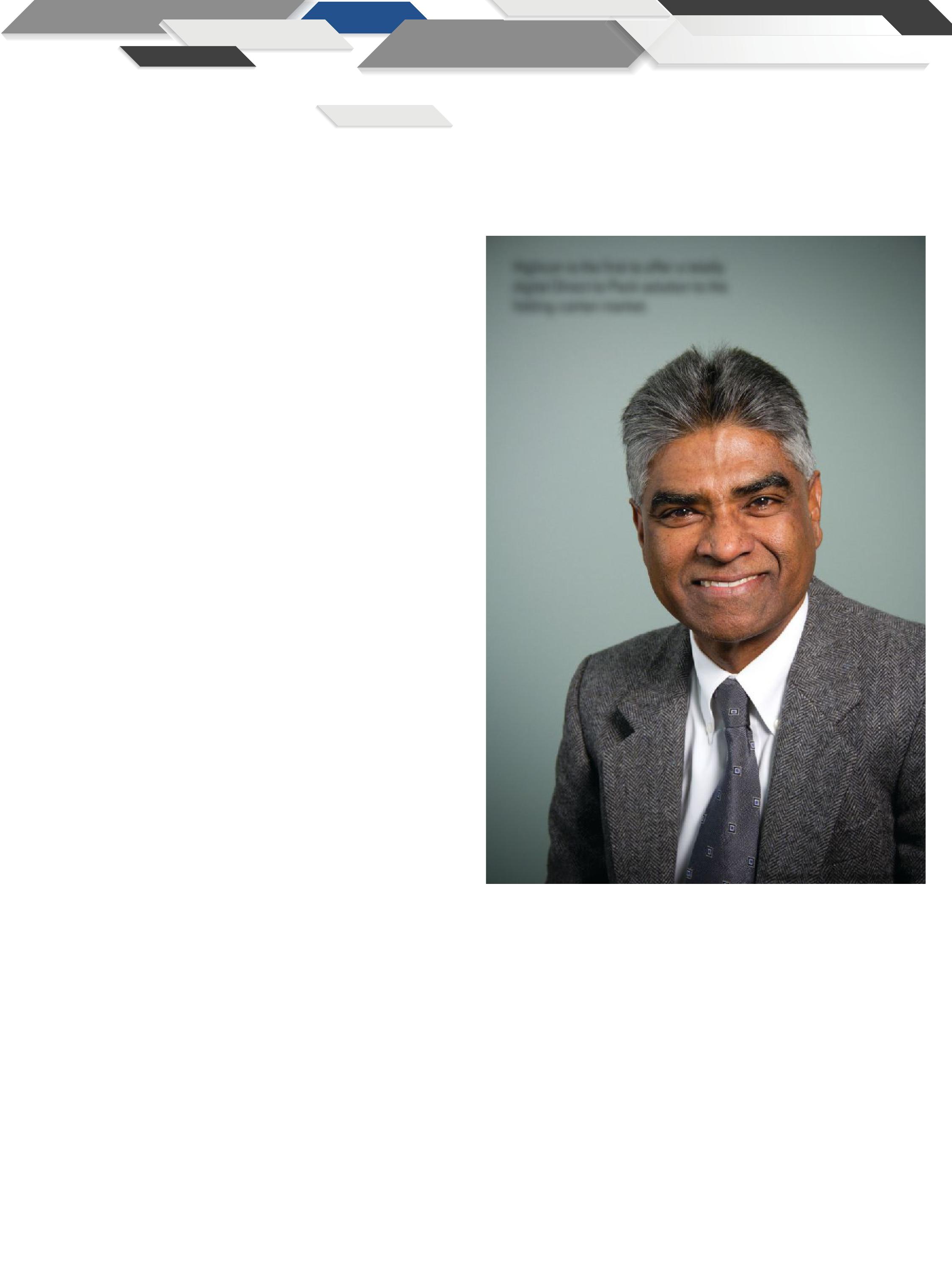
Vic Stalam discusses his new role in the Americas to develop market success for Highcon’s unique Euclid creasing and cutting technology, which holds the potential to disrupt packaging’s die-cutting traditions
18
technology report: short-run Finishing
Detailing the market position and technology highlights of more than 25 products that are making a significant impact on the short-run finishing of packaging, digital, inkjet and sheetfed press work
5
News
Verso completes its $1.4 billion acquisition of NewPage, police seize five presses and €50 million of counterfeit bills in Italy, and Mohawk expects to produce 500-million more envelopes per year
6 23
Market
Scan Copy Print installs Edmonton’s first Xerox Versant 2100, ForestEthics compares FSC and SFI auditing in Canada, and a photographic report from the world’s largest consumer communications show
New Products
RISO launches what it bills as the industry’s fastest digital duplicator, SPGPrints demon strates its single-pass textile printer called Pike, and QuarkXPress 2015 prepares to support PDF/X-4
Nick Howard software is Printing Power
Determining how printing fits today’s ever-changing communications landscape is more about understanding the power of software before traditional hardware
26
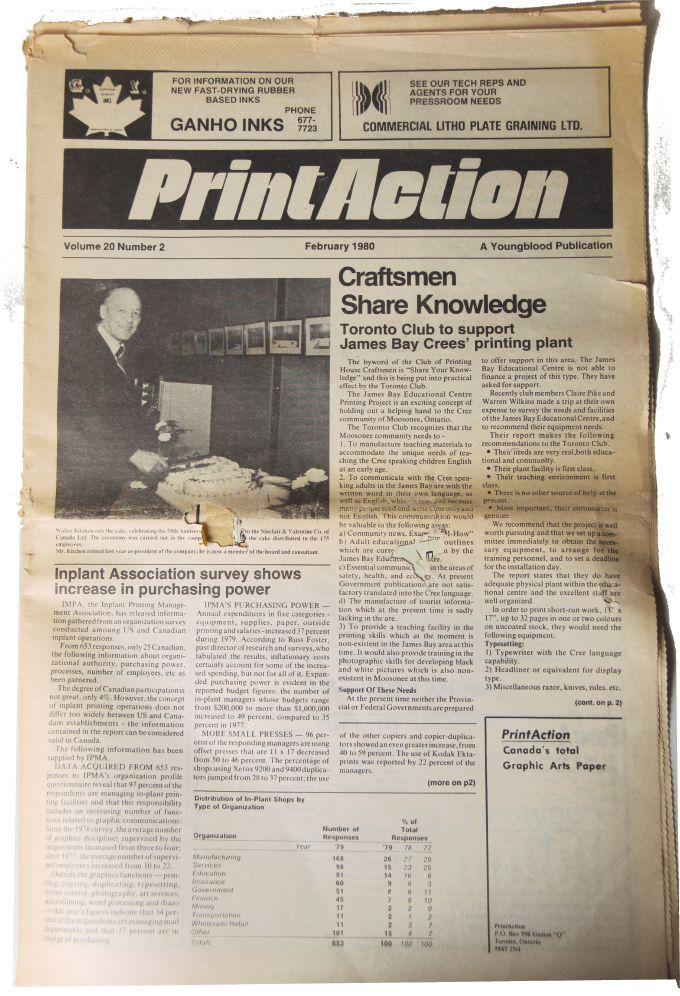
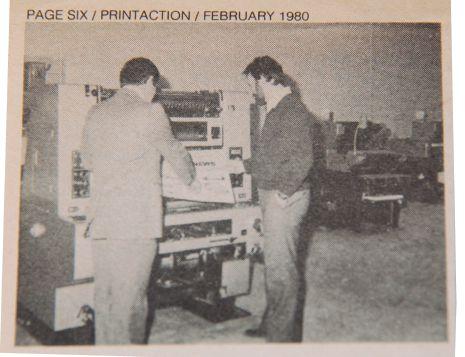
February 1980
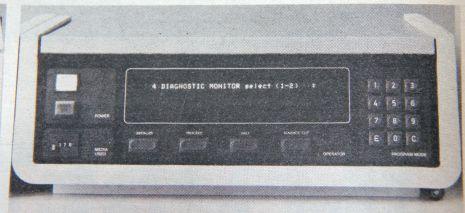
Pierre Elliott Trudeau’s Liberal Party wins Canadian elections, United States men’s national team performs its Miracle on Ice, and Autologic introduces a digital typesetter for under $50,000
Register now free online with VIP code PA152
Pillar of Print
Without meaning to trivialize the tragic Charlie Hebdo shooting, at the weekly newspaper’s Paris location on January 7, or the resulting protests involving millions of people in dozens of countries, the power of print was in full-bore over the past couple of weeks. In the 24-hours news cycle, we have seen television and social media spark public outrage, divide populations and organize revolution. Print once again found itself as an agent of social change in mid-January.
A week after gunmen killed 12 people at Charlie Hebdo’s office, millions of copies of the magazine’s newest edition have been sold in what French newspaper Le Figaro called “a record in the history of the French press.” The popularity of the print issue is a reflection of the millions of people who marched around the world in support of Charlie Hebdo and free speech just days after the shooting.
Referred to as the Survivors’ Issue, the first magazine printed since the massacre featured a cover containing another controversial cartoon of Islam’s holiest figure. It depicts the Prophet Mohammed tearfully holding a sign reading “Je suis Charlie,” the slogan used by supporters of Charlie Hebdo following last week’s attack. The headline reads, “All is forgiven.” The cover sparked massive protests around the world, bringing together hundreds of thousands of Muslims in Pakistan, Jordan, Algeria, Niger, Mali, Somalia, Senegal and Chechnya.
According to a report by Sky News, Charlie Hebdo typically publishes around 60,000 copies of its newspaper. The magazine’s publisher noted printing of the Survivors’ Issue had reached 7-million copies. To put this number in perspective, Sid Holt, Chief Executive of the American Society of Magazine Editors told CNNMoney, “Nothing in the United States compares to the Charlie Hebdo print run… The equivalent of going from 60,000 to six million would be as if a magazine in the United States sold 30-million copies – 30 times what People sells on the newsstand every week.”
Several major news outlets in North America decided to not show the controversial cover in print, online or on television, which angered Charlie Hebdo’s Editor-in-chief, Gerard Biard. In an interview with NBC News’ Chuck Todd, who hosts Meet the Press, Biard said, “This cartoon is not just a little figure. It’s a symbol. It’s the symbol of freedom of speech, of freedom of religion, of democracy and secularism. When they refuse to publish this cartoon, when they blur it out, when they decline to publish it, they blur out democracy.” A survey conducted by Le Journal du Dimanche found 42 percent of French people felt the country should “consider these reactions and avoid publishing these cartoons.”
For centuries, printing was the only vehicle of free speech and debate, often leading outrage and change at the highest levels of societal influence. The often forgotten medium clearly continues to serve as a pillar of The Fourth Estate.
Jon Robinson, Editor
Canada’s Graphic Communications Magazine. Proudly published for two generations. Editor Jon Robinson • 905.713.4302 • jrobinson@annexweb.com
Contributing Writers Zac Bolan, Peter Ebner, Chris Fraser, Victoria Gaitskell, Dr. Martin Habekost, Nick Howard, Thad McIlroy, Nicole Rycroft, Dr. Abhay Sharma, Trish Witkowski
Publisher Paul Grossinger • 905.713.4387 • pgrossinger@annexweb.com
Associate Publisher Stephen Longmire • 905.713.4300 • slongmire@annexweb.com
PrintAction is published by Annex Publishing & Printing and is Canada’s only national monthly publication serving the graphic arts industry. ISSN 1481-9287. Annual Subscriptions: Canada: $39.99 ($35.39 + $4.60 HST); United States: CN$69.99; Other Foreign: CN$139.99
Publications Mail Agreement Number 40065710 • ISSN 1481-9287 Return undeliverable Canadian addresses to Circulation Department: P.O. Box 530, Simcoe ON N3Y 4N5; Email: ncuerrier@annexweb.com We acknowledge the [financial] support of the Government of Canada. PrintAction
HERE WE GROW AGAIN...
Verso Corporation of Memphis completed its US$1.4 billion acquisition of NewPage Holdings, which needed to divest itself of two mills that have been purchased by Catalyst Paper of Richmond, British Columbia. Verso’s purchase of NewPage brings the company approximately US$3.5 billion in annual sales and around 5,800 employees in eight mills across six American states. The NewPage acquisition also results in Verso changing its name from Verso Paper Corporation to Verso Corporation.
Catalyst Paper acquired two NewPage operations, including a paper mill in Biron, Wisconsin, and a pulpand-paper mill in Rumford, Maine, for US$62.4 million. “This acquisition represents a new chapter in the history of Catalyst Paper,” said Joe Nemeth, President and Chief Executive Officer. “Catalyst becomes a larger and stronger company with five facilities across North America and an estimated production capacity of 2.1 million tons of paper and 500,000 tons of pulp.” Catalyst subsequently appointed Greg Maule as Senior Vice President, U.S. Operations, and Linda McClinchy as Vice President, U.S. Supply Chain.
Italian Police, according to Reuters, seized five printing presses and some €50 million in counterfeit bills, primarily in the €50 denomination. The news agency reported the unfinished fake banknotes were found inside the warehouse of a sewer company, including behind wood paneling and in drawers built under the pavement, at a location south of Naples. Five men had been ordered by the courts to be arrested in connection with the counterfeiting ring. A month earlier, Italian police seized €556,000 in fake coins that were minted in China.
Mohawk, led by Chairman and CEO Thomas O’Connor Jr., expects to produce 500-million envelopes annually by taking over an 112,342-squarefoot manufacturing facility in South Hadley, Massachusetts. Mohawk plans to hire 40 new employees and invest up to US$2 million to retrofit the facility, projected to be fully functional by the end of April 2015. Mohawk also owns and operates a 1-million-squarefoot envelope converting facility in Ashtabula, Ohio, that produces 1.5-billion envelopes per year.
Dr. Doug Edwards becomes Chief Executive Officer of inkjet print-head developer Xaar plc, headquartered in Cambridge, UK, succeeding Ian Dinwoodie, who previously announced plans to retire in 2015. Dinwoodie joined Xaar in 2001 and served as CEO since 2003. Edwards joins Xaar from Eastman Kodak Company, where he most recently served as President, Digital Printing and Enterprise. He had been a member of Kodak’s Executive Board since 2006. Xaar recently launched its 1002 GS6 print-head for UV applications like labels, laminates, direct-to-shape, packaging and other types of product decoration.
Sihl LLC and Arkwright Advanced Coating Inc. became one company based in Fiskeville, Rhode Island, beginning on January 1, 2014, under the new name Sihl Inc. Arkwright Advanced Coating, which opened in 1802 as a cotton-spinning mill, today has five coating lines, eight converting machines and approximately 100 employees serving a capacity of 30-million square metres of photo paper, transfer paper and tonerreceptive film. Parent company Sihl AG of Bern, Switzerland, produces coatings and materials for inkjet, solvent, UV curable, latex and toner-receptive wide format plotters, printers and presses.
Kees Nijenhuis, VP of North American operations for MPS, celebrated a new press distribution deal with Jerry Wynia (right), President and owner of Northern Graphic Solutions (NGS). This includes MPS’ flagship EF printing press, which is to be sold through NGS in central and eastern Canada. Available at 13-, 17- and 20inch formats, the EF press includes
Crisp.Dot technology and features a choice of either plate rolls or print sleeves, as well as UV and hot-air drying technology, allowing users to print on a range of substrates like film, paper, shrink sleeves and flexible packaging.
Mitsubishi Imaging signed a North American distribution agreement with CRON-ECRM, which includes the supply of CtcP products, accessories and Blackwood printing plates. Mitsubishi Imaging is headquartered in Rye, New York. CRON-ECRM, led by President and CEO Rick Black, is a joint venture between ECRM and Hangzhou CRON Machinery & Electronics for distribution of CRON products and Blackwood printing plates and chemistry.
Serge Trajkovich becomes Vice President and Managing Director of PrintLink Canada, which focuses on human resources and professional placement within the printing and packaging industries. Trajkovich has 35 years of experience in the printing industry, including time within premedia, digital printing and packaging sectors across North America. He has both owned and managed several companies in the Toronto area. His work in packaging covered foldingcarton, converting and flexographic processes.
Crawford Technologies of Toronto became the first supporter of Braille Literacy Canada’s Edie Mourre Scholarship, which aims to help fund recipients studying to become qualified Braille transcribers, proofreaders or teachers. Mourre was one of the Canadian National Institute for the Blind’s most influential employees and
advocates of Braille. She was Treasurer of The Canadian Braille Authority and the chair of the English Braille Standards Committee, the parent organization of the tactile research project. More than 21 million North Americans have what is described as profound visual impairment.
Alan Poole becomes Area Business Development Manager for FLXON Inc.’s northeast region, including Quebec and Ontario, as well as the northeastern United States. Founded in 1995, FLXON is based in Charlotte, North Carolina, and focuses on providing products for the flexographic and rotogravure printing industries in North America. This includes the SWEDCUT brand doctor blades. Poole previously worked as a sales representative for a printing company.
Epicomm is the new name for a group represented by three North American printing associations that merged together one year ago, including the Association of Marketing Service Providers, National Association for Printing Leadership, and National Association of Quick Printers. The new name arrives after a third-party survey of more than 200 members from all industry segments. Ken Garner, who was named President and Chief Executive Officer of the organization in October 2014, indicated Epicomm plans to launch new member-focused initiatives in line with its new tagline, Association for Leaders in Print, Mail, Fulfillment, and Marketing Services.
Quad/Graphics signed an agreement to acquire Massachusetts’ book manufacturer Courier Corp. for approximately $260 million. Days earlier, Quad announced a new 3-year strategy to transform its book platform, which includes investing in 20 or more HP high-speed web presses, as well as related frontend software and backend systems for finishing, distribution and fulfillment. Quad is to put five HP web presses into production this year, including a first installation in January. The other 15plus presses will be installed in the remaining 2-year period. Once all units are installed, Quad/Graphics will have the capacity to produce nearly 3-billion colour pages per month.
Interacting with the Next Generation of Consumer Communications
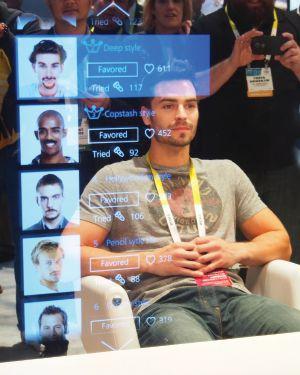
Early in the New Year, tens of thousands of people made a tech pilgrimage to CES 2015 Las Vegas, which has become North America’s most-important event in terms of understanding the direction of digital communications trends. In 2015, 3D Printing was once again a highlight of the annual show, as was emerging applications of imaging through drone technology, wearable computers and the continued expansion of in-house and in-car connected communications.
The 4-day 2015 CES exhibition wrapped up as the largest show in its history with more than 2.2-million square feet of exhibit space featuring more than 3,600 exhibitors, including a record number of 375 startup companies. More than 170,000 industry professionals, including at least 45,000 from outside the United States, converged at what organizers bill as the only event of its kind to engage in the hands-on experience of interacting with the next generation of technology.
Intel’s depth-sensing RealSense camera captures images and renders them on a screen as the subject passes by.
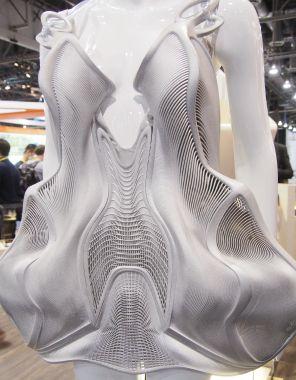
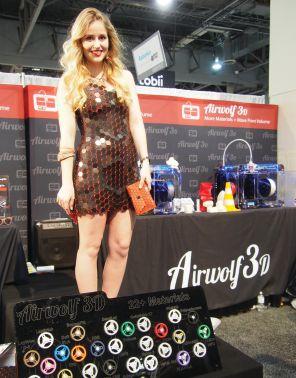
A 3D printed dress produced with Airwolf 3D materials.
Shared virtual reality demonstrated by Intel at CES 2015.
Russian-made YotaPhone uses power-saving E Ink and conventional colour displays on opposite sides of the phone.
A remarkable 3D printed dress on display at the Autodesk booth.
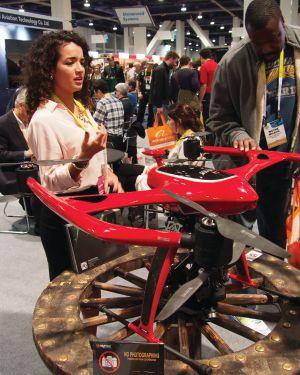
This tiny Zano ‘Selfie’ drone will follow a narcissist around and snap selfies while avoiding obstacles.
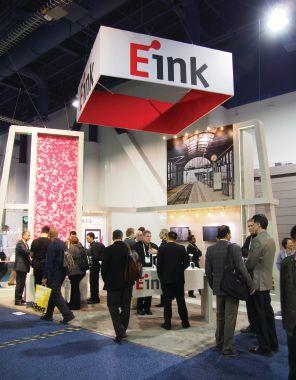
E Ink displays its latest low power displays once again in Las Vegas.
Sophisticated carbon fibre UAV for aerial video shoots by Harwar, a Chinese manufacturer.
Robotic 3D dress by Anouk Wipprecht with tiny Intel Edison wearable computers that sense motion and activate spider arms.
CES attendees lined up for hours for a few minutes with the Oculus Rift VR headset. CES Las Vegas is billed as providing handson experience with next-generation tech.
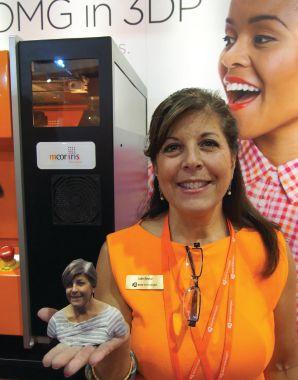
Julie Reece of mcor with her own 3D printed model produced by the iris 3D printer using office paper instead of plastic.
Photos by Zac Bolan
Remembering Presstek’s Imaging Pioneer
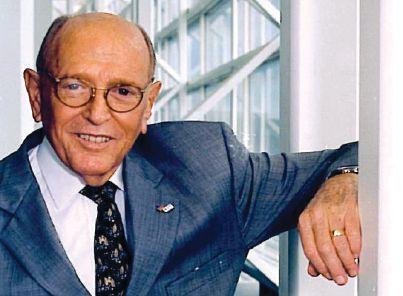
Robert Howard, one of the most-dynamic imaging innovators in North American printing over the past several decades, passed away in January at age 91. Howard is often regarded as the inventor of the dot-matrix printer through his firm Centronics Data Computer. His work in driving the technology behind Presstek, as a founding director, and Howtek, both in Hudson, New Hampshire, also continue to hold significant influence in today’s printing world.
“The innovative vision that Bob Howard had for Presstek, and its role in the print industry when he founded the company back in 1987, has been carried forward by many dedicated and talented team members over the years,” said Geoff Loftus COO of Presstek LLC. “We can all be thankful for his role in the genesis of the company and for the thriving Presstek that continues on today.”
Howard served as Presstek’s Chairman of the Board from June 1988 to September 1998, while also hold-
ing roles as President and Treasurer. After resigning from the Board, he served as the company’s Chairman Emeritus until December 2000.
At the time of stepping down from Presstek, fellow
board member Richard Williams said: “Robert Howard’s vision to make the printing press a computer peripheral has changed the shape of the printing and graphic arts industries forever. In the few short years since Presstek built its first concept press, direct imaging of a printing plate on a press has become widely accepted throughout the industry.”
Presstek today holds hundreds of patents and is best known for its invention of DI thermal laser direct imaging on-press technology. It was the first company to develop and bring to market chemistry-free platemaking for off-press applications. Many of the industry’s largest press manufacturers, including Heidelberg, Ryobi, Xerox, KBA and Kodak, have partnered with Presstek and incorporated its DI technology on their presses.
Among a range of printing industry awards, Howard received the Albert Einstein Technology Medal from the Jerusalem Fund of Aish HaTorah.
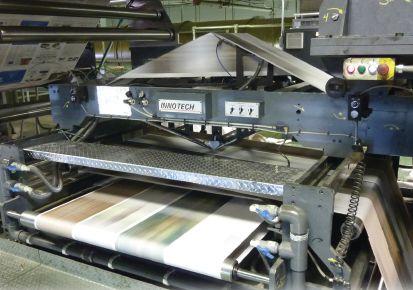
Goss International completed a press enhancement project with systems integrator Innotech installing a full-colour Panorama Gatefold System to produce unique advertising formats in The New York Times
The Panorama System uses what is referred to as INNOFORMER, the geometric air bar plow, for high-speed folding with no set-up time. Innotech has installed many such systems, primarily retrofitted on existing presses, in China, India, Germany and Colombia. Completed to a tight schedule of around 20 weeks from initial order to the first test run, The New York Times Panorama project involved retrofitting each of two existing Goss Colorliner press lines. “Obviously, for a publisher operating on the scale of The New York Times, there is no time to lose and there
can be no disruption to ongoing daily production,” said Dan Picco, Regional Sales Manager at Goss. “We had to establish failsafe processes from the outset and make sure we achieved the highest level of teamwork.”
The gatefold system now running at The New York Times enables the Goss Colorliner presses to produce an additional four-page-wide centrefold or a separate eight-page pull-out section, up to a maximum format of 48 x 22 inches (1,219 x 559 mm). In addition, it is possible to make smaller gatefolds or coupon folds at one or both edges for special promotions providing new display areas for advertisers. It is also possible to make gatefolds in the cover page or have the gate-folded section as a wrap around in the main section.
The C.J. Group of Companies in December held its 26th annual open house celebration to raise funds for the C.J. Skateboard Park & School special needs programs, Toronto’s Daily Bread Food Bank and the Toronto Tree Foundation. The fundraiser reached a record $21,865 for the non-profit skateboard park, as well as $1,600 and 1,700 pounds of goods for Toronto’s food bank.
C.J. Group also emphasized its recent new partnerships with Gilda’s Club of Toronto, Ontario Parents Advocating for Children with Cancer (OPACC) and Childhood Cancer of Canada, in addition to an expansion of its skateboard park and Kids Being Kids program.
More than 1,000 people attended the December event, which included both live and silent fundraising auctions. Thirteen items were picked up at the Live Auction, led by Jay Mandarino, President of C.J. Group, while 90 were available to bid on during the Silent Auction. In addition to C.J. Group, the event was sponsored by CIBC, Sony Playstation, Maple Lodge Farms, Gatorade and Pizza Pizza.
C.J. Group Holds Annual Fundraiser
The New York Times Adds Panorama Gatefold
The New York Times’ new gatefold technology can produce an additional 4-page-wide centrefold or 8-page pullout section.
Robert Howard helped develop thermal laser direct imaging on-press technology.
Jay Mandarino served as auctioneer at C.J. Group’s fundraiser, reaching a record $23,000 in donations..
PRINT MARKET CALENDAR
Scan Copy Print Installs Edmonton’s First Xerox Versant
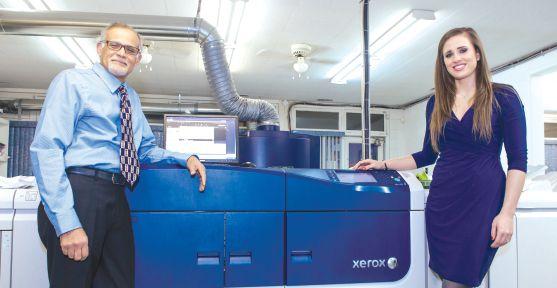
Prior to the New Year, Scan Copy Print Inc. became the first company in Edmonton to install Xerox’ new Versant 2100 press, with its Ultra HD Resolution technology rendering work at 1,200 x 1,200 dpi at up to 10 bits.
Led by owner Ashraf Jaffer, Scan Copy Print was founded in 1995 and today provides customers with complete on-demand services from concept and design to printing and finishing. The company, located on Gateway Boulevard in Edmonton, focuses much of its attention on annual reports, books and booklets, flyers and stationery packages, as well as producing corporate identity and various association work.
First unveiled in April 2014, the redesigned imaging system of Xerox’ Versant 2100 press uses a new compact belt fuser to handle substrate weights from 52 to 300 GSM at 100 pages per minute
ForestEthics
(ppm), as well weights of above 300 to 350 GSM at 80 ppm. The press prints with what Xerox labels as new 1,200 x 1,200-dpi Ultra HD Resolution. The Versant 2100 also incorporates what Xerox brands as Full Width Array technology for highly accurate production registration.
In addition to the Versant 2100, Scan Copy Print’s equipment list includes a Xerox Nuvera 200 EA
Report Compares SFI
perfecting system and a 44-inch imagePROGRAF iPF8300 largeformat printer with a 12-colour LUCIA ink system.
Scan Copy Print’s finishing department provides services like saddle stitching, Cerlox binding, coil binding, tape binding, hard cover binding, and perfect binding, in addition to shrink wrapping, padding, three-hole punching, cutting, folding and collating.
and FSC Auditing in Canada
A new 17-page report produced by ForestEthics, called Peeling Back the Eco-Labels, compares the rigour of FSC and SFI forest certification program audits in Canada. ForestEthics begins its report by stating the Sustainable Forestry Initiative (SFI) program is less transparent than the Forest Stewardship Council (FSC), while also indicating SFI’s approach misleads consumers.
“Corporate customers and the public rely on forest certifications to know that the paper, fibre, and lum-
ber they buy is responsible... In the case of SFI, the label is misleading,” said Todd Paglia, ForestEthics Executive Director.
ForestEthics explains it analyzed publicly available audit reports from the past 10 years and concluded that SFI is dramatically less transparent and audit teams were smaller and took less time for the audit process than FSC. More than half of the SFI reports were missing pertinent data, explains ForestEthics, adding SFI rarely required logging companies to take any additional action to improve operations.
“Companies that do invest in environmentally sound practices suffer from SFI’s empty claims,” said Jim Ace, ForestEthics Campaigner. ForestEthics is a U.S. and Canadian coalition that takes corporations and governments to task to protect community health, the climate, and ecosystems. Over its history, ForestEthics states it has secured the protection of 65-million acres of wilderness
“SFI’s green seal of approval is governed and financed by the logging industry - which gives it about as much credibility as a seal of approval for cigarettes by Phillip Morris,” said Paglia. “It’s bunk, plain and simple.”
In early January, SFI introduced an updated set of rules and standards regarding its certification program. This is part of a regular process taken by the forestry group to update its program every five years. In developing the 2015/2019 update, SFI explains comments were received during two 60-day public periods in 2013 and 2014, and input was received from 12 public workshops across the U.S. and Canada, followed by independent oversight at each stage of the revision.
March 1 – 3, 2015
Print UV
Las Vegas, Nevada
March 5
Ryerson GCM Job Fair
Ryerson University, Toronto, ON
March 5 – 7, 2015
DscoopX Conference
Gaylord National Hotel & Convention Center, Washington, DC
March 22 – 25, 2015
67th Annual TAGA Technical Conference
Hotel Albuquerque, Albuquerque, New Mexico
April 8 – 11, 2015
Sign Expo 2015
Mandalay Bay Convention Center, Las Vegas, NV
April 14 – 16
Xploration 15
Wyndham Orlando Resort, Orlando, Florida
April 16 – 18, 2015
Graphics Canada International Centre, Toronto, ON
April 16
Printing Sales Training Day, Graphics Canada International Centre, Mississauga, ON
April 17
DIA Breakfast, 3D Printing, Graphics Canada International Centre, Mississauga, ON
April 17
IDEAlliance G7 Summit, Graphics Canada International Centre, Mississauga, ON
May 7 – 9, 2015
Grafik Art Montreal 2015 Place Bonaventure, Montréal, QC
June 16 – 18, 2015
PACEX
Toronto Congress Centre, Toronto, ON
June 24
Annual IAPHC Golf Tournament
Wooden Sticks Golf Course, Uxbridge, ON
September 13 – 16, 2015
Graph Expo 2015 McCormick Place, Chicago, IL
September 25 – 26
Consac Imagemakers International Centre, Mississauga, ON
ForestEthics Executive Director Todd Paglia joined the North American organization in 1999.
Ashraf Jaffer of Scan Copy Print and Beth Piorecky of Xerox Canada with the Versant 2100.
Unisource and xpedx recently combined to form Veritiv –a new company leading the way in printing paper, media, supplies and equipment.
Software is Printing Power
For over 500 years, since the first bible was printed mechanically and in multiplicity, the industry we call Print has been one of exclusiveness and necessity.
Letterpress printers, for example, grew their businesses by what inventory of fonts they had, by varieties of type styles and sizes, choice of matrices and pure quantity. If these printers also had the means to make electros and cuts, or perhaps the newest hot-metal-casting equipment, they could prosper simply by providing more choice in style and product. Large font stockpiles often meant winning a job based on greater firepower alone. This environment of hardware strength flourished through the 1980s and 90s as heavy-iron offset presses flooded the printing world.
Printing power, however, is certainily no longer about stockpiling fonts, nor is it commonly determined by the size of an offset pressroom or its variety of printing presses. To drive this point home, even today’s reemerging letterpress industry can produce work without one drawer of type. Relief plates, imaged on CTP devices are used for producing large quantities of work with instant layout and thousands of available font designs. Today’s printing position is not about what hardware can reproduce, but rather what software can create or drive.
Conventional litho print is expensive. It does not update itself and requires constant raw-material input. For an application-based example of this changing environment, consider the recent resurgence of print catalogues being produced by large online retailers. These companies, howwever, will ultimatley turn toward their own New Media platforms for engagement. It is only a matter of time.
The Globe & Mail’s Susan Krashinsky recently reported that marketers too are turning away from traditional media. Krashinsky was referring to a late-2014 Ipsos Reid research poll of roughly 3,000 marketers and ad agencies (see Figure 1). The poll results specifically mention the continued downward interest in print as a tool for the marketers. Ipsos Reid does caution that the figures do not provide direct proof of where the money is shifting, but explains the results do “reflect a sentiment in the marketing community about where money should be spent.”
Economic Modeling Specialists Intl. and CareerBuilder produced a study of projected high-skill occupations growth to 2017. Of the various positions,
software developers and computer systems analysts are expected to grow at a 11 percent rate from 2014. Marketing specialists and research analysts could see the highest growth at 13 percent. This speaks again of the New Media position, turning toward virtual and direct-to-consumer tools. Print, as expected, is not even on the list.
Digital printing machinery may offer an extension to the plight of the traditional printing press, but not a solution. The digital platform, as it continuously matures, will provide more variable data, higher quality (closer to lithography) and lower costs due to shorter run lengths and less skilled operator involvement. But this new technology is not cheap and binds the print communications industry into its continued draconian supply network. Everything from special inks and substrates, toners and maintenance supplies need to be purchased – often through a click-charge model –directly from the manufacturer. After all, consumables are the ultimate repeating source of revenue for vendors in the existing supply chain.
Many well established printing businesses that cannot generate enough sales revenue from software, as opposed to their hardware, will secede from print altogether. Litho press makers will not be any better off. A new 40-inch, 6-colour press with standard automation sells for between $1.8 and $2.2 million. More commercial printers seeking to update their presses will do so either through the used market, where costs run between a half and two-thirds the price of new machine, or continue on with whatever hardware is already on their shop floor.
The latter is generally what is happening out in today’s market, as it becomes more difficult to solve the math on completely new printing equipment. Even though there have been engineering strides in the last five years, most presses are still essentially built on the same platform. In the UK and Europe there are many long perfectors and these machines come to market with enormous impression counts. Some have in excess of 350-million impressions. Many in the UK are 10- and 12-colour machines. Of all the platforms, the long perfector as a used machine has suffered the most in value retrenchment. Few buyers exist even though these machines are replaced with new ones. This sort of situation is right out of the digital platform and copier
business: Good and needed when new, a boat anchor when used. The investment in software yeilds a much more palatable return than hardware in today’s printing environment.
Peter Burns, VP and Research Director of the firm Forrester Research, comments: “The pressure is on to shift the focus to software and related business technology services, which is where customers, investors and partners see greater opportunity and value. Nobody digitally disrupts by building multibillion-dollar processor fabs any more. What companies need to do is differentiate on software that improves business technology.”
The printing industry continues to have its bright spots, too. Because of the continued simplicity of printing a job and (in a large amount of cases) little to no in-house preventative maintenance expenses, some printers are doing fine as they either offer more products or do the work for less. One particular new development is the tendency of not disclosing new machinery purchases. I recently had a conversation with two executives of a very large press manufacturer. Quite surprisingly, I learned of at least 15 very large installations that had not even made the news. Not telling the industry about two recent 10-colour press installs and about 13 other major placements was quite a surprise to me. “Some customers just won’t allow us to share this information,” said one of the executives. “I wish we could.”
Traditional print manufacturing has been turned on its ear. Perhaps we have taken the lithographic press as far is it can go. Litho is made for large runs at low cost. Digital is not. Landa and the new platforms he hopes to deliver soon will be very expensive and come with boiler plate growing pains. This is a worry for an industry that is saddled with low profit margins and little new growth. However, digital is the future for print.
Just as Apple took credit for Xerox PARC’s Graphical User Interface and Microsoft snared QDOS (Quick & Dirty Operating System) from Tim Patterson, being first with a new technology will mean little if people do not know how to implement it. New technologies being developed today can provide many powerful tools needed to move quickly from massive mainframe printing presses to smaller more adaptable platforms. No longer can we measure our worth by what hardware we have.
Figure 1. Planned Media Market Spend
ONLY PRESS OF THIS CLASS IN NORTH AMERICA
Let PointOne help you break through conventional printing stigmas.
RECORD MAKE READY TIMES. BLAZING FAST SPEED. SHARPER COLOUR CONSISTENCY.
THE ALL NEW BEST IN CLASS FOR NORTH AMERICA UNIQUELY AT POINTONE GRAPHICS.
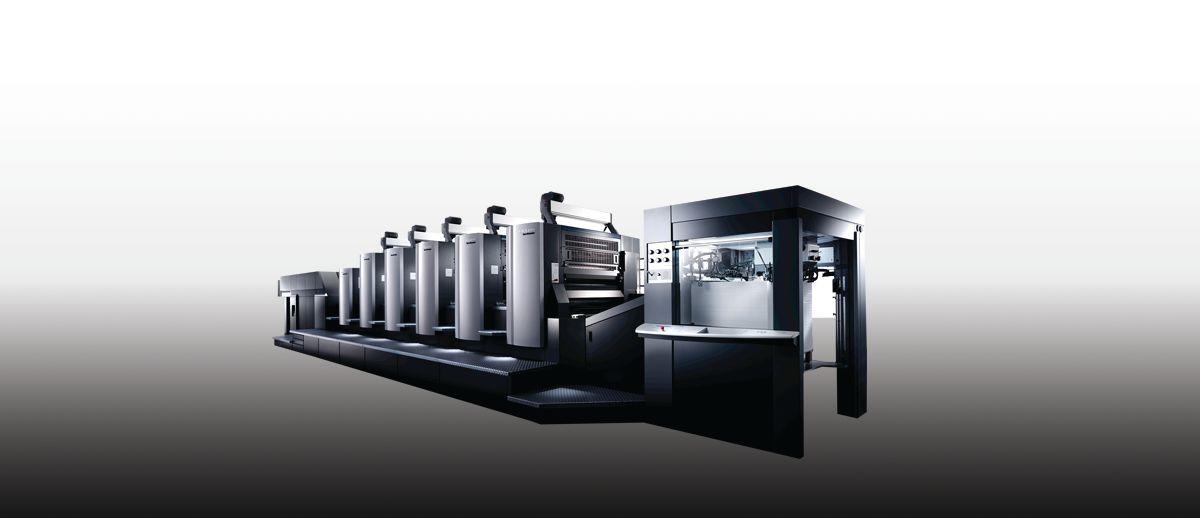
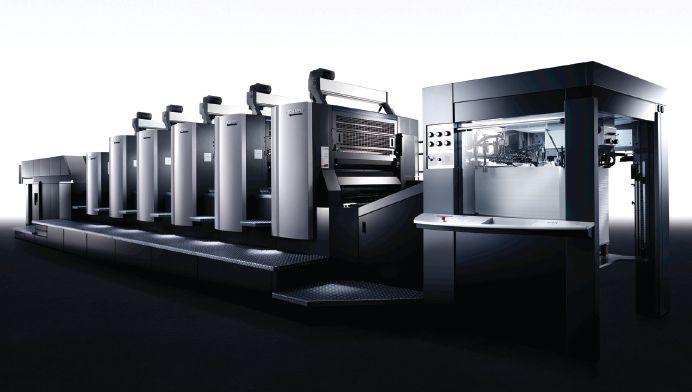
Heidelberg XL106
18,000 SHEETS PER HOUR 8 COLOR PERFECTOR
Peak Performance Class Technology and Productivity That Know No Compromise
18,000 sheets per hour in straight printing and in perfecting mode are unrivaled peak values. A 20 percent higher production means new opportunities The perfect interplay between preset functionality, a sheet travel optimized for maximum production speed and a machine that is consequently designed for top print quality as well as straightforward operation make the Speedmaster XL 106 the Peak Performance machine
Prinect Inpress Control
The Spectrophotometric Inline Measuring System for Maximum Productivity
Prinect Inpress Control automatically measures and controls colour and register on the fly and at any speed. Integrated directly into the press, the measuring unit measures process colours, spot colors and register in the print control strip. Any corrections required are forwarded directly to the Prinect Press Center for adjustment. As the press does not need to be stopped for either make-ready or monitoring of the production run, Prinect Inpress Control achieves maximum productivity.
EQUIPMENT FOR TODAY’S PRINTING
At PointOne there are no sacrifices for quality. We offer trade competitive prices without going over your budget, while still keeping the environment in mind. We have leading edge technology to keep our cost and our quality in line. Come in and work with us to make your print job a work of art.
FINISHING
• 3 saddle stitchers
• 8 folders
• 3 cutters
• Drilling and shrink wrapping
• Climate control
• VideoJet capabilities
• Perfect binding and die cutting available at trade partners
• Online spectrometer to monitor ink densities and control colour consistency
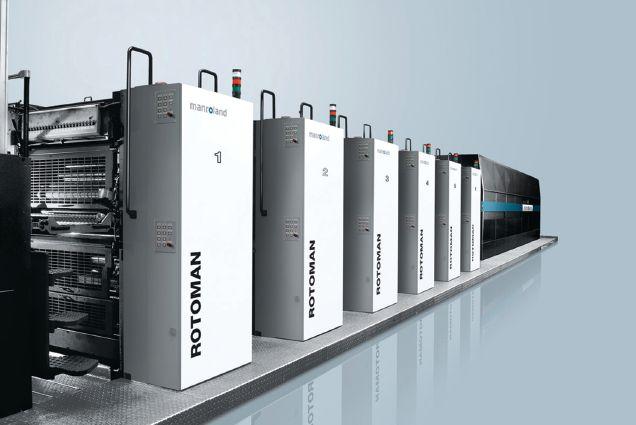
2007 MAN Roland Rotoman 5 printing units + aq with remoistenable gluer, pattern perf, spine gluer, inline folding and sheeting capabilities.
2014 Heidelberg XL 106 4 Color perfecter with auto colour and registration system, 28 x 40 with roll to sheet
2014 Heidelberg XL 106 4 Color perfecter with coater, 28 x 40 with roll to sheet
2013 Heidelberg XL 105 5 Color with coater, 28 x 40 with roll to sheet
Heidelberg Suprasetter 40 plates/hr 30 x 40
Affinity Designer:
More Vector, Less Money
by Zac Bolan
As in nature, the software ecosystem abhors a vacuum! Introduced for the Mac in 1987, Adobe Illustrator evolved from Adobe’s in-house font development software to become the industry standard line-work editor and has all but dominated the desktop vector graphics market. Twenty-eight years later, Illustrator is so pervasive in the graphic arts few prepress pros would even consider an alternative were one available. While a few innovative Mac applications such as iDraw and Sketch have nipped at Adobe’s heels, to date no application has presented a credible challenge to Illustrator’s dominance on the Mac platform, creating a competitive vacuum. That might be about to change.
Though unknown to many Mac users, Serif Software is a dominant player in the lucrative Windows desktop publishing software world. Founded in 1987, Serif’s original mandate was to produce powerful yet cost-effective alternatives to expensive desktop publishing and graphic design applications for the PC. Its critically acclaimed PagePlus, DrawPlus and PhotoPlus applications have garnered a large and loyal following in the Windows world – extending from casual creatives to business and education users.
After years of planning and development, Serif stepped across the OS barrier in June 2014 with its first Mac App, Affinity Designer. While still in public beta, Affinity Designer turned heads while generating a great deal of online buzz before the October 2014 launch of version 1.0 on the Mac App Store. Since release, Affinity Designer has raced up the App Store charts and finished the year as Editor’s Choice Best of 2014! But does all that hype make any difference in the prepress and print world? Can a PC software developer give Adobe a run for its money on Adobe’s home turf?
Vector contender or pretender
destined for a variety of output intents, including both print and Web. Where Designer differs from other line-work editors is in its ability to work with raster images and create pixel-based effects and textures within the same file as vector layers. And while Designer has its own file format, the App can import a wide variety of file types including: Adobe Illustrator, Freehand, Photoshop, EPS, JPEG, PDF and SVG. Additionally Designer can export: Photoshop, EPS, GIF, JPEG, PNG, SVG and PDF – although direct export of AI format is not supported. Users wanting to bring their Designer files into Illustrator will have to pass through PDF-land first.
“It’s pretty clear that Affinity Designer was engineered from the ground up as a production environment for professional grade vector drawing.”
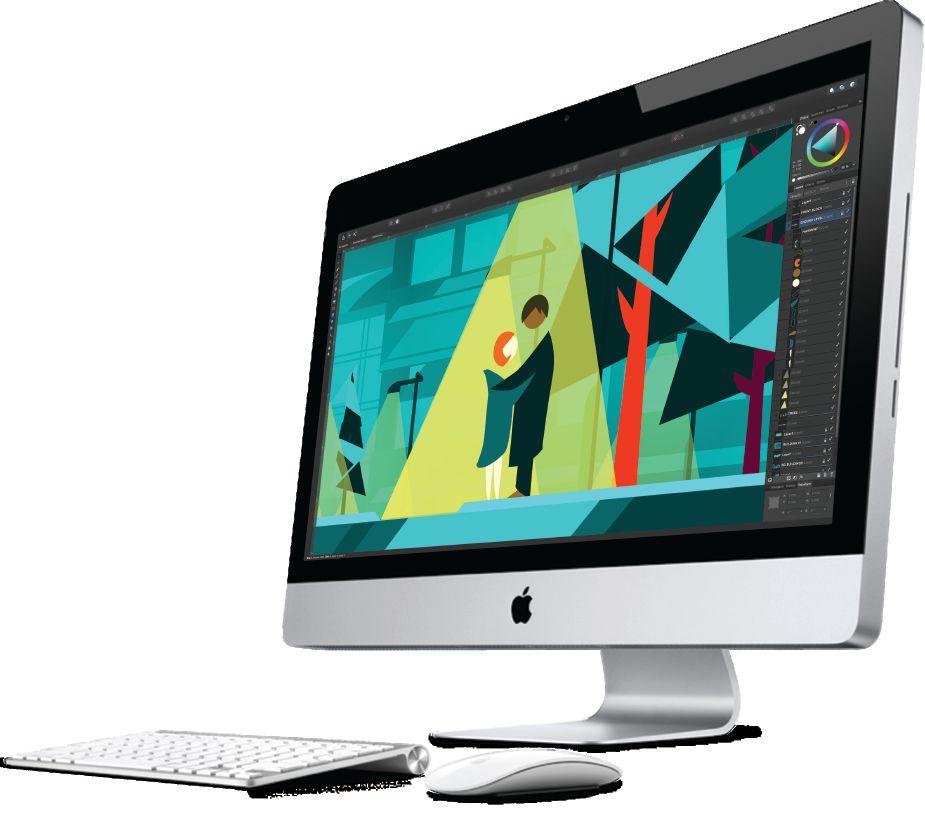
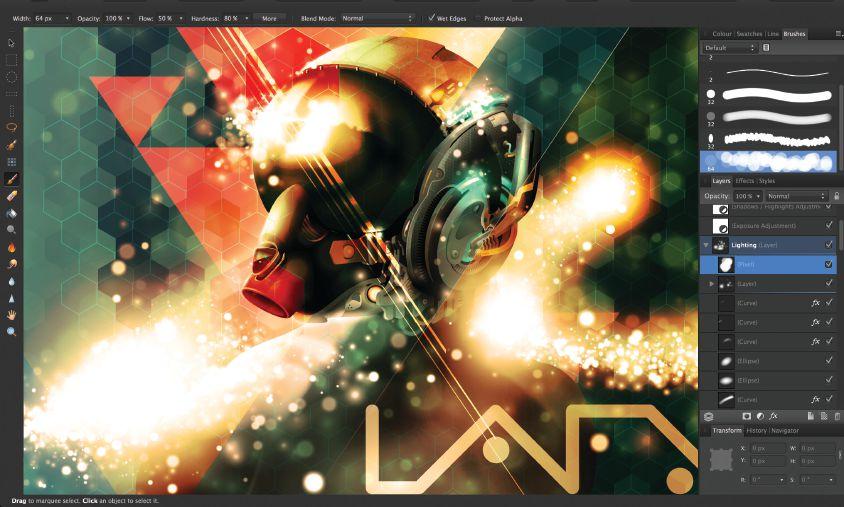
When launching Designer for the first time users are presented with a clean, uncluttered user interface that is unique yet somewhat reminiscent of an Adobe Creative Cloud application. As a result, anyone with Illustrator chops should be able to find their way around Affinity Designer in fairly short order. The default application window follows the familiar axiom of toolbar on the left, functions along the top and tabbed palettes on the right hand side of the workspace.
Users can also choose to work in Separated Mode meaning the Designer toolbars, workspace and palettes are free floating and can be reconfigured to individual tastes. Designer diverges from other editors by breaking down the workflow into Personas (Draw, Pixel and Export) represented by icons on the upper left side of the workspace. The icon for the active Persona appears in colour and each features tools, functions and palettes specifically configured for the appropriate tasks.
Well, for starters it is pretty clear that Affinity Designer was engineered from the ground up as a production environment for professional-grade vector drawing
The Draw Persona toolbar contains recognizable drawing tools you would expect to find, such as a Move Tool, Vector Brush Tool for creating painted effects and a Pencil Tool for free drawing vector lines, as well as Gradient and Transparency tools. Additionally, the toolbar houses a wide variety of shape tools ranging from standard rectangles and ellipses to diverse polygons, clouds and call-outs. Each shape can be quickly and radically altered either with the Node Tool, or the context-sensitive settings in the Draw Persona tool set. There is even a special hidden Easter Egg feature that
enables users to make a cat shape – see if you can find it!
The Pixel Persona enables a variety of marquee and selection tools along with essential raster editing tools in the toolbar, such as erase, fill, dodge, burn, blur and sharpen. It is important to remember that while Designer is equipped to create, alter and apply raster effects within a vector file, it is definitely not a replacement for a full image editor such as Photoshop or Pixelmator as there are no tools that I can find for adjusting the contrast, saturation or hue of photographic images.
As the name implies, the Export Persona provides a straightforward workflow for getting your image online with several presets, support for ICC profiles as well as layers and image slices. Speaking of online, Designer has a number of features targeting the Web slinger, such as a powerful pixel preview of vector images for both standard and retina displays, as well as instant export of multiple objects – each with independent output settings.
Designer also brings back one of my favourite old Illustrator features with a new twist. The Split View divides the image workspace vertically enabling the user to see any combination of Frame, Vector, Pixel or Retina
previews and drag the dividing line back and forth across the image – changing the preview instantly.
Of course, any mention of ‘instant preview’ inevitably brings up the topic of Designer performance. Whether opening a complex vector graphic or a massive layered Photoshop file, it is immediately apparent that Designer is blazingly fast. This 64-bit application is fully optimized for the latest Mac OS and Retina 5K displays, enabling users to pan and zoom across their images with little perceptible lag as well as apply and view effects in realtime. This is especially impressive when you consider that Designer offers a staggering 1,000,000 percent zoom, as well as super smooth gradients that can be edited in real time at any magnification.
For such a young App, Designer offers some impressively mature workflow features like nondestructive editing and robust support for layers, including vector, pixel and adjustment layers.
ready for the big league
Working with Affinity Designer is comfortable once you get used to multiple Personas, however, the software is lacking in a few key areas of importance
Affinity Designer boasts an intuitive interface:
Switch Personas by clicking one of the icons (the active Persona icon displays in colour)
Both the top and left toolbar will change to the appropriate tools for each Persona
Split view allows users to see both vector and raster previews simultaneously
The various pallets will change to suit the Persona selected
The Draw Persona features a large library of shapes which can be adjusted in a myriad of ways (hold down the Option Key to get the Cat shape)
easy-to-use Colour Wheel
to design and production pros. For example, Designer currently only supports a single page per file, something designers who are used to building multiple art boards will find hard to live with. And what prepress pro has not used Illustrator’s AutoTrace to quickly build a logo for a job they are working on? Designer will need to implement some sort of raster to vector workflow to really gain print market share.
And while Designer seems to be able to import a wide variety of file formats, I have experienced mixed results when opening old EPS files containing complex vector gradients. Mind you, Designer has only been in the field for a few months and to Serif’s credit they’ve already built an active, lively and supportive user community that fuels its development team with bug reports and feature requests. Within just three months of launch, Serif has already revved Designer to v1.1.2 – not only with bug fixes but also significant new userrequested features like iCloud Drive support; critical stroke alignment options; and 5K-display support.
the road ahead
Serif recently published the first issue of Affinity Review – a quarterly ePUB magazine for their users – containing some very interesting product news in addition designer profiles, interviews and tutorials. According to Serif, the Affinity Designer roadmap includes several professional printing features such as: PDF/X support; PDF image compression; trim, bleed, overprint and mark control; spot, Pantone and registration colours; and advanced transparency features. Designers can look forward to: multiple pages; text on a path; mesh warp and distort tools; and improved text controls… all promised as free updates!
Likely many of these new functions will be incorporated into its own Personas. Also in Serif’s 2015 playbook: Affinity Photo and Affinity Desktop (you can see where they are going with this).
Is Affinity Designer the answer to all your high-end vector design, editing and production needs? Not yet. Is it worth fifty bucks? You bet! Besides, designers on a budget are already flocking to Designer so it’s only a matter of time before Affinity files start making their way into your prepress department.
Designer’s
Affinity Designer diverges from other editors by breaking down the workflow into Personas (Draw, Pixel and Export) represented by icons on the upper left side of the workspace.
BINDERY & FINISHING
Digital Geometry
Vic Stalam discusses Highcon’s push into the Americas
By Jon Robinson
PrintAction reached Vic Stalam by phone in his hometown of Philadelphia, where he has lived for the past 14 years. He previously spent more than a decade of his career in Rochester as part of a 25-year run with Kodak, where he had the opportunity to serve in various lead roles, including five years as Chief Marketing Officer for Kodak Polychrome, an innovative joint venture focusing on the development, manufacture and sale of digital printing plates.
After helping develop digital technologies for the commercial printing world, Stalam then led Kodak’s ambition to establish a foothold in the packaging industry. He recalls the process in which Kodak built an entire packaging portfolio of solutions from workflow to CTP devices to help solve the analogue-heavy challenges facing many packaging printers, and ultimately ease the lifecycle management of brand owners.
This portfolio building process also meant Stalam needed to establish key partnerships with third-party technology suppliers, which will also be vital to his new role as President of Highcon Americas. Stalam, who most recently served as Senior Vice President of Marketing, Sales and Service at X-Rite, will now leverage his go-tomarket experience from the worlds of both commercial and packaging printing to position Highcon’s Euclid finishing system in the Americas. It is primarily aimed at finishing work in the folding-carton market, while also handling paper, labels and microflute.
Founded in 2009 by Aviv Ratzman and Michael Zimmer, former
technology managers with Indigo NV and then HP, Israel-based Highcon launched the Euclid at drupa 2012. It incorporates Highcon’s patented Digital Adhesive Rule Technology (DART) to produce creasing, using polymers, foils and UV curing, as well as high-speed laser optics to precision cut a range of substrates. The system eliminates the decades-old steps involved with conventional die cutting.
When the Euclid was officially launched into North America at Graph Expo in September 2014, Highcon introduced several advances in its second-generation machine, called Euclid II. This included, perhaps most prominently, the Integrated Digital Stripping Unit that automatically removes waste from internal cutouts, as well as optical registration of the sheets, as opposed to mechanical only. New software for the Euclid II, described as the Fine Cutting Accelerator, is designed to provide more flexibility and speed for laser cutting and marking. New Web-topack software can be combined with Euclid II’s digital cutting and creasing.
The Euclid II also includes a new substrate handling system to work better with substrates like paper and labels. Highcon also enhanced the quality of the crease line by developing a new polymer formula and implementing optimized rule geometry, which provides a new ability to produce curved lines. Cutting algorithms for laser power control have also been improved for Euclid II. With a next generation system on board, Stalam discusses the Euclid’s potential disruption in one of printing’s most enduring long-run sectors.
Highcon is the first to offer a totally digital Direct to Pack solution to the folding-carton market.
Printaction: What past experience will most help you develop Highcon’s presence in the Americas?
Vic stalam: I have experience with a product called Approval. When we announced it at drupa 1990 everything else was analogue proofing, film based… We came in and totally disrupted the market with digital proofing. I led the development team as well as the go-to-market team, which means I had to hire all of the salespeople around the world, the marketing people, service, etcetera, responsible for getting it out of the lab.
I learned that the only way to launch a new disruptive technology is
basically to show customers the value it can bring to help them grow their business, in terms of applications. They are not very comfortable with innovation of this nature, because change is always hard. And not only for our customers, but part of the equation is also their customers, who are the brand owners. They need to be a part of the discussion of how it is going to help: What are the new applications that they can do today with digital finishing that they could not do before – just like with digital proofing.
Printaction: How is Highcon’s Direct to Pack technology unique?
Vic Stalam, President, Highcon Americas
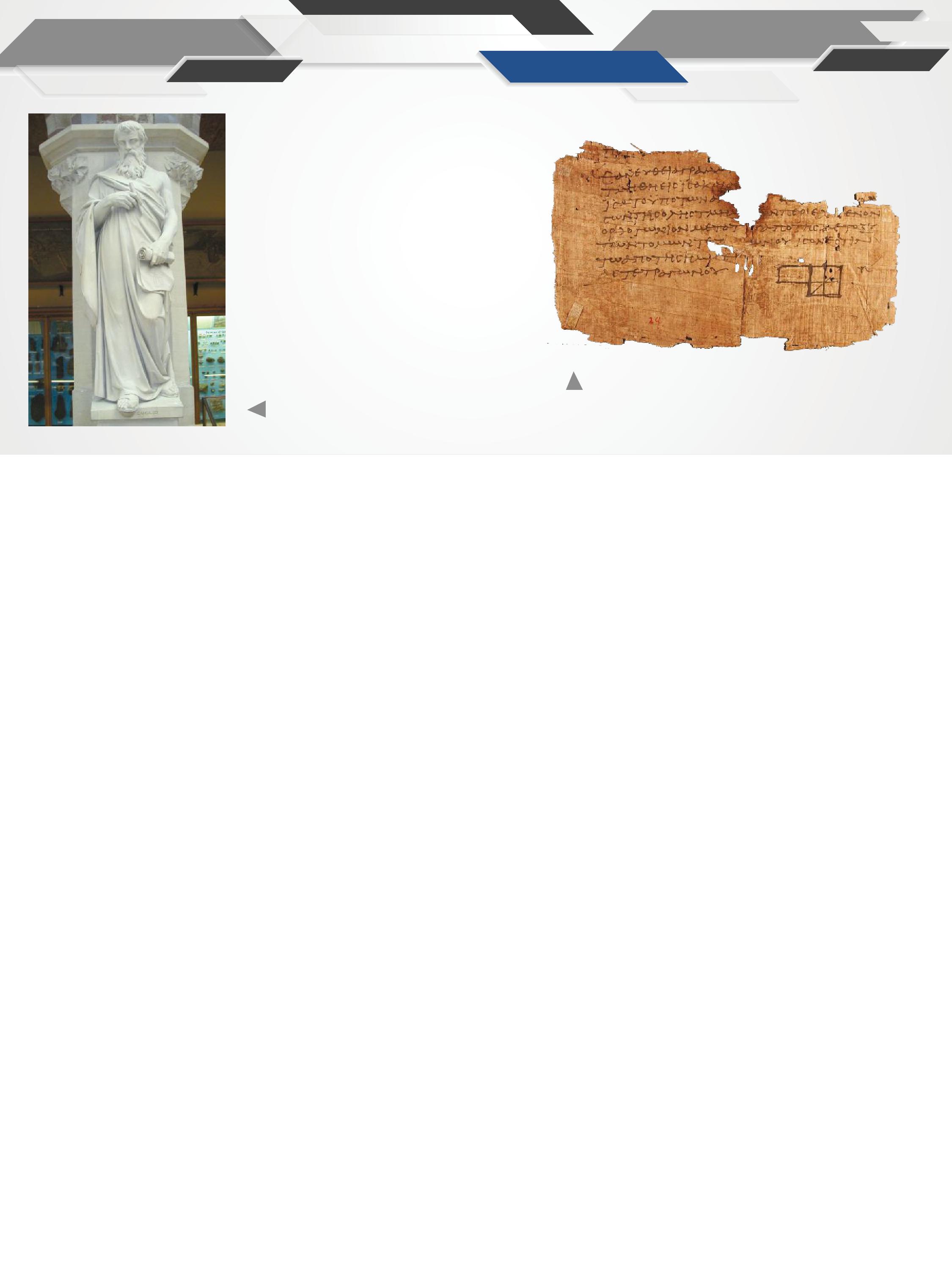
EUCLID was a Greek mathematician, often referred to as the Father of Geometry. He was active in Alexandria during the reign of Ptolemy I (323–283 BC). His Elements is one of the most influential works in the history of mathematics, serving as a main textbook in the field from the time of its publication until the late 19th or early 20th century. In Elements, Euclid deduced the principles of what is now called Euclidean geometry from a small set of axioms. (Source: Wikipedia).
Vic stalam: Nothing else exists today in terms of what we have to offer… Highcon is the first to offer a totally digital Direct to Pack solution to the foldingcarton market. It also handles both [worlds]. It doesn’t have to be digitally printed, it can also be analogue. Truth be told, most of the volume is still analogue and we need to support that. So, in this sense, it is not only the technology that is unique, but also the fact that we support both digital and analogue.
Printaction: What stands out most about Highcon’s DART technology?
Vic stalam: The paper movement is right to left and, in stage one, once the paper is registered… the polymer is UV-cured and then it produces the creasing lines. It is very unique in that sense. Because it can address any point on the paper, you have opportunities to create very, very unique applications. Once the line is creased – and it is folded through the creasing lines – the next major stage is the laser, which does the actual cutting.
What’s unique about our technology is, not only DART and the way the polymer is laid, but also the way it is creased and then how it is registered for the laser to cut it. Typically when you use a high-powered laser you can burn all kinds of other things like paper or folding carton. Our technology takes care of [this challenge] so that you do not see any of that. It is a very clean process.
Printaction: How are Euclid’s digital optics important to the laser-writing process?
Vic stalam: With the optics you not only have edge registration, which is mechanical, but we also have optical registration. With traditional die cutting, you just do not have the precision of a laser, so everything you see [off the Euclid] is going to be a higher quality product, as it relates to registration and the quality of the cut itself.
of
Printaction: What advantage does Highcon, relative to printing’s historic postpress players, have when it comes to developing new approaches for finishing folding-carton work?
Vic stalam: I always think of the great Canadian Wayne Gretzky and a famous quote. Somebody in the press asked him, “You are not a big guy, what makes you great?” He said, which always sticks in my mind, “I always try to be one step ahead. I always try to get to where the puck is going to be next and I do not worry about where the puck is now.” I think that is where Highcon is going… positioning ourselves as customers move to digital – how is it going to help them in the future?
Printaction: How would you compare Highcon’s potential impact to another stage of printing evolution, such as when film was eliminated in prepress?
Vic stalam: The world is going to be very different in just a few years – I guarantee you that. This is the disruption and we are going to be a big part of that on the finishing side. Remember how we used to have these film-based companies called trade shops – absolutely, same analogy. Trade finishers have an opportunity to embrace this new technology and grow or else they are going to fall by the wayside.
Printaction: How can a technology like Euclid ease the ability for commercial printers to get into packaging?
Vic stalam: Having spent a lot of my life in both commercial printing and packaging, 70 percent of what commercial printers do is the same as what packaging printers do… There are differences. One is the language they speak. Commercial printers talk about pages and packaging printers obviously do not. There is an issue around substrates. Then there is an issue around specialty colours. Commercial printers
now do six, seven colours. With packaging customers it is not unusual to see 10, 12, 14 with all of the varnishes, all of the metallics.
But when it comes to digital technology, the one thing I like about commercial printers is that they are trying hard to get digital right. I think they are probably five to 10 years ahead of packaging printers as far as digitization is concerned. I give them credit for that. Given their experience with digital technology, given their desire to get into packaging, I think solutions like Euclid will help.
Printaction: How does Highcon benefit from the growth in digital press development for packaging?
Vic stalam: We are in constant dialogue with all of these digital press companies, whether it is HP, Xerox, Xeikon, Landa or Kodak, whoever, because the nature of the relationship between us is very symbiotic. We need each other, because if we can get a lot of shortrun jobs printed with digital that will make the Euclid system very successful. They need us because they can do all of the digital printing, but it comes to a screeching halt if they have to depend on an analogue process for finishing. We are the missing link to complete that whole digitization process for end customers.
Printaction: What type of printing company should be looking at Euclid?
Vic stalam: We are looking for companies who are very progressive and innovative, who want to look at new technology. That is one vector. The second one is we are looking for companies who either have digital or, more importantly, they are in the process of moving toward digital. We have a few customers who do not have any digital and are just putting it in now, after they put in the Euclid, because it also supports analogue. The third vector we are looking for is customers who want to grow with new applications, who are willing to work with
One
the oldest surviving fragments of Euclid’s Elements, found at Oxyrhynchus and dated to circa AD 100, now housed at the University of Pennsylvania.
Statue in honour of Euclid in the Oxford University Museum of Natural History.
Solvent printing has never been smarter, faster and more beautiful. The EPSON SureColor S-Series line of printers represents a step forward, combining performance, quality and reliability. Developed for high-performance printing and a low cost of ownership, this suite of solvent printers delivers print speeds that are the fastest in their class with image quality that’s simply amazing. And, with three unique 64” models to choose from, there’s an S-Series printer that’s right for your business. Learn more about the way solvent printing should be at epson.ca/solventprinter
Poweredby
their customers, the brand owners, to help them grow.
Printaction: What type of industry sectors are being targeted for Euclid as a starting point?
Vic stalam: There are about three major sectors. One is clearly commercial printers who are doing folding carton. This is going to be key. Two is packaging printers who are doing a lot of the other stuff like labels. And the third sector is trade finishers, the prepress houses of the finishing business. Those are the three big ones as we move ahead. There are also some very creative design applications to take advantage and we will build on that as we go forward in time.
Printaction: How much investment is needed to add Euclid in your facility?
Vic stalam: Just as a ballpark, the entry-level product is around $690,000. That is where it starts and then you can add things to it.
Printaction: What savings can be realized through Euclid, specifically by eliminating traditional diecutting processes?
Vic stalam: It takes about 15 minutes to set up a job in terms of the Euclid. In the case of die cutting, first of all, probably you have to send the job outside. You have to schedule it and then it takes typically anywhere from one to three days. The actual set up time is between four to eight hours on the die-cutting side depending on the complexity of the job versus 15 minutes, so there is a huge difference in the set-up times. In the case of die cutting, they will have to store [a new die] in the event that they may have to reuse it at some point, which means they need a huge inventory management system and storage space. Think of the old days of film; how you had to store film and then go find it when needed. It is just a mess. Go back to
the days of stripping a piece of film on a light table. And it also depends on the experience of the operator.
Printaction: How many Euclid systems are currently installed in North America?
Vic stalam: We have four in North America right now, with one currently going in. We just launched the product in North America at Graph Expo [September 2014].
“We are also unique in terms of how we automatically strip off all of the waste materials into a collection bin, which is totally automated.”
Printaction: Do you have projections for how many Euclid systems should be installed on an annual basis?
Vic stalam: No, it is too early to tell. One of my jobs is to size the market, how big the opportunity is. As the new guy, I am going to go look at it with a fresh set of eyes. Ask me in three months.
Printaction: How is Euclid’s consumables opportunity attractive to Highcon?
Vic stalam: There are three consumables that go with the system. The first one is the polymer. And this is the polymer I talked about earlier, which creates the creasing line. The polymer is first put on the foil and then it is UV hardened and then it creates a creasing line on the substrate.
The second one is the foil onto which the crease
lines are written. And those two are one to one. For every job, you need a polymer and you need a foil. And the last consumable is called the counter substrate, which supports the high-quality creasing. It is replaced approximately every 120 jobs on average, so that is probably once every two months, depending on how many jobs you run.
Printaction: Is the foil and polymer developed by Highcon or a third-party?
Vic stalam: Highcon develops it all. It is optimized to run – absolutely.
Printaction: What hidden costs should printers consider before investing in Euclid?
Vic stalam: There are two things. The power requirement. Make sure they have enough power in the plant. And two is the chilling unit. Make sure there is enough accommodation for the chilling unit.
Printaction: How does Euclid deal with waste material?
Vic stalam: This is a very important point. We are also unique in terms of how we automatically strip off all of the waste materials into a collection bin, which is totally automated. You cannot do that with traditional die cutting. It is a mess when you look at a traditional diecutting machine – carton board is all over the place.
Printaction: How will Highcon reach the market in the Americas, particularly here in Canada?
Vic stalam: Today, we have an agent out of Winnipeg called Canadian Printing Equipment. I’m going to be coming up in the next few weeks and doing an assessment on what do we need. At the same time, we continue to work with digital press partners. But right now it is definitely a dealer model for Canada, given how big the country is and what we need to do.
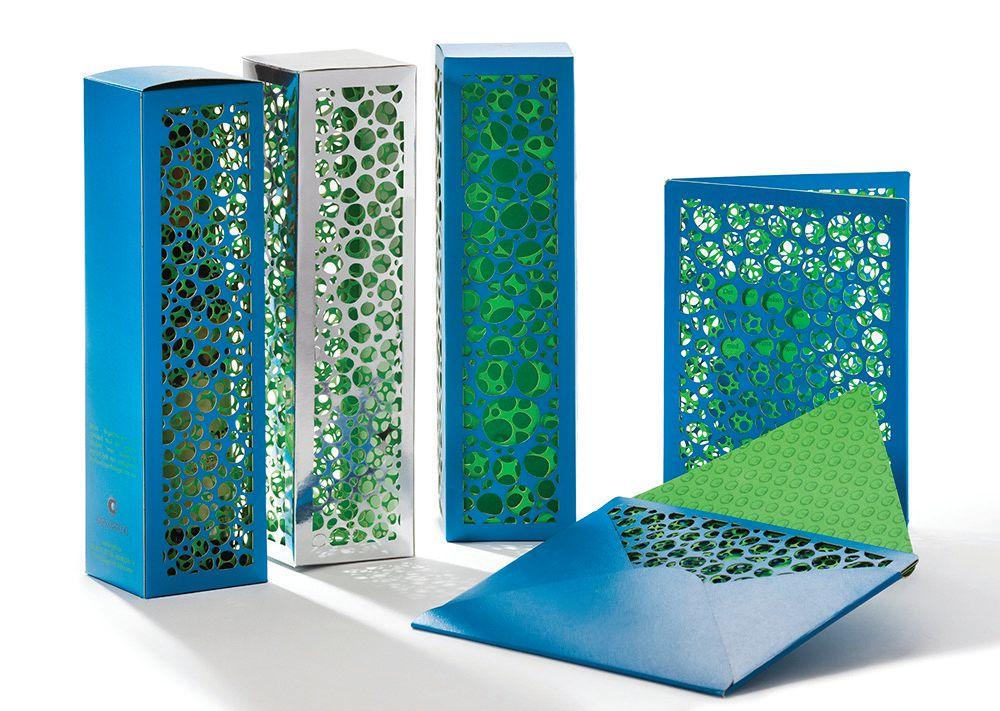
A new polymer formula and optimized rule geometry for the Euclid provides new capabilities to produce curved lines.
Highcon’s Euclid technology provides a die-less cutting process for creating unique carton applications.
Printaction: What technology challenges does Euclid still face?
Vic stalam: We continue to listen and learn from cutomers and we will not be a one-trick pony. We are committed to being an R&D powerhouse in this space and we are building a portfolio of products. One of the reasons why I joined the company is because of its strong commitment to R&D and the desire to listen and continue to iterate on the product. In my experience, with new products, that is the only way to do it.
Printaction: What struck you most on your recent tour of Highcon’s facility in Israel?
Vic stalam: I believe in the technology. I believe in the value of what it will do for our customers and their customers. I have had the opportunity over the years to work with several Israeli companies. Their passion in terms of technology and their hard-work ethic is just incredible. I was there for four days. I was trying to cram in as much as possible. I was there every day from 8 o’clock to 8 o’clock, before we went for dinner, and I saw almost the whole team working. That is passion in terms of new technology.
Printaction: What excites you most about Highcon’s technology and its potential impact?
Vic stalam: The single biggest thing that I am excited about is the fact that for brand owners, especially for folding-carton end customers, it means that now they can push for short runs without a lot of additional cost, at a very affordable rate. Today short run [folding carton] is not affordable because the finishing is very, very expensive. We are going to bring a lot of value to brand owners in terms of helping them grow their brand. I think that is going to have a major impact. It is also going to cut down on the amount of time they need to bring a new product out. Brand owners take months and months when they have a new product to get on the shelf, so every day counts. Also new applications, which you could never produce with traditional die cutting.
Printaction: What is your most important message to PrintAction’s readers?
Vic stalam: There is a major shift going on within the folding-carton market, to go digital. And we are going to be a major part of it. We are going to make it happen because it brings value to our customers and their customers. There is going to be a seismic shift even if today a lot of the volume is still traditionally printed. It is just a matter of time before the shift happens.
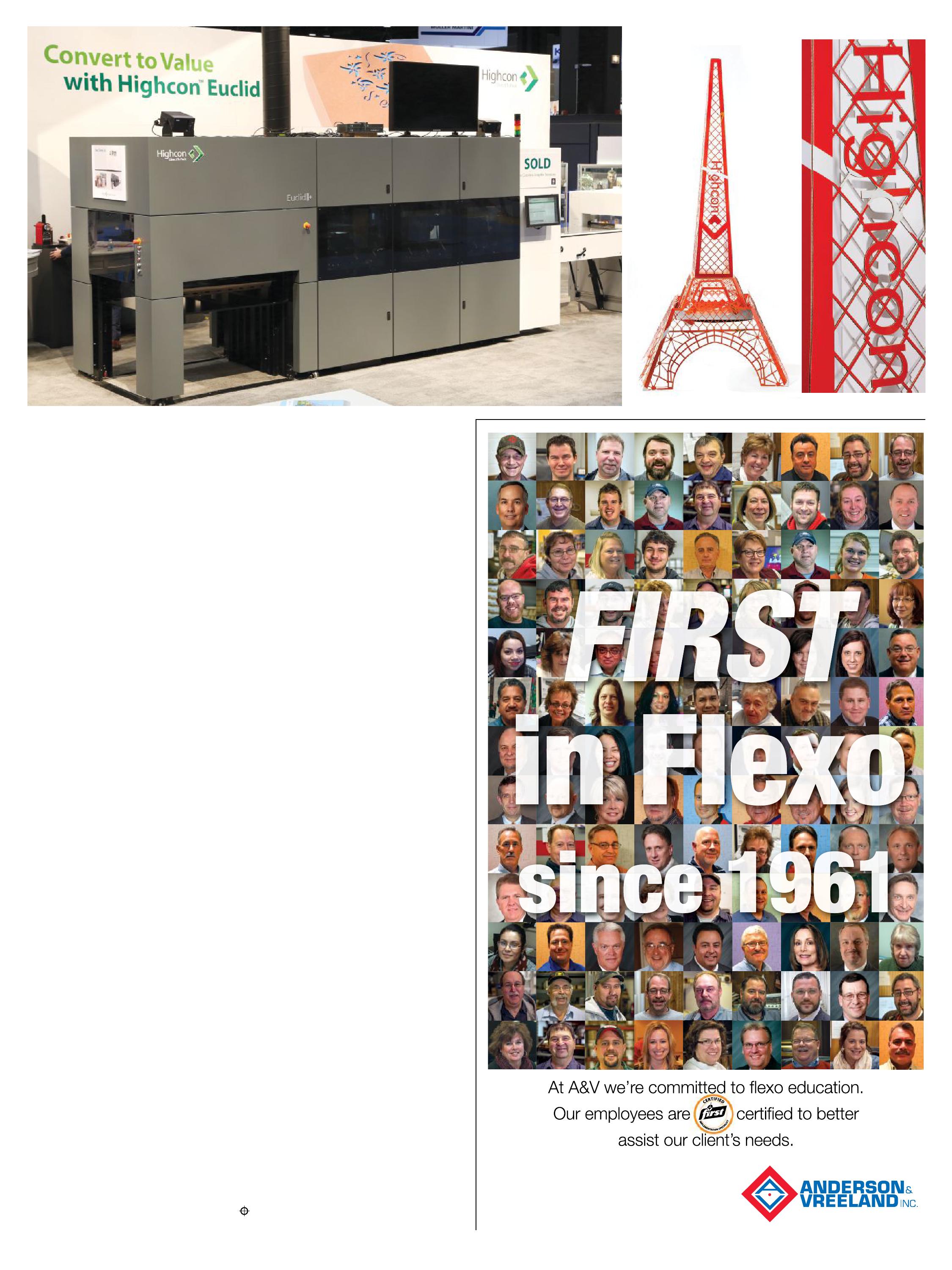
Top Right: During his January visit to Highcon’s Israeli facility, Stalam was impressed with Euclid’s creative-application abilities, including this version of the Eiffel tower.
Top Left: Highcon demonstrated its second-generation Euclid II machine at Graph Expo 2014 in Chicago with a raft of new features.
ShorT-ruN FINIShING
The need for developing new short-run finishing technologies continues at a breakneck pace to accommodate a range of printing processes, which are being integrated collectively inside many successful commercial printing operations. Technology suppliers were asked to provide one or two of their key products aimed specifically at short-run finishing across this breadth of production.
Technologies Featured
• Access Imaging, Royal Sovereign RBW 1500
• Access Imaging, Royal Sovereign Trimmer
• Agfa Jeti Titan, varnish option
• Agfa Acorta
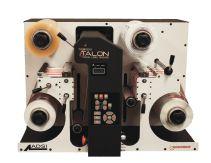
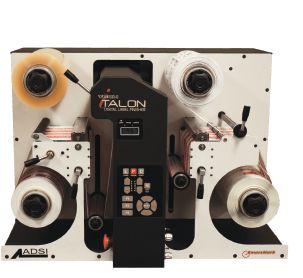
• Allen Datagraph iTech TALON
• Bobst Novacut 106 ER
• CM Insight, LasX STS250
• Drytac Reveal Backlit Film
• Drytac JetMounter JM63 Fuzion XD
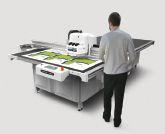
Multicam Digital Express
• Esko Kongsberg C
• Esko Kongsberg V
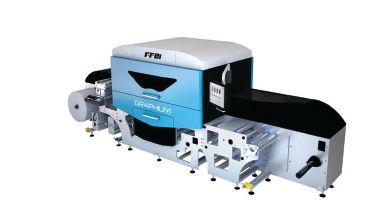
• Fujifilm Graphium, finishing options
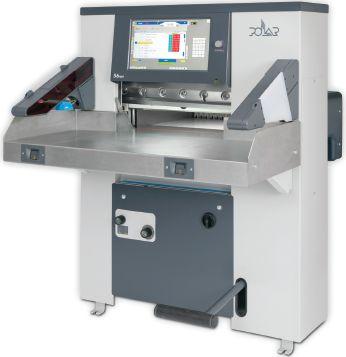
• Heidelberg POLAR 56 Net
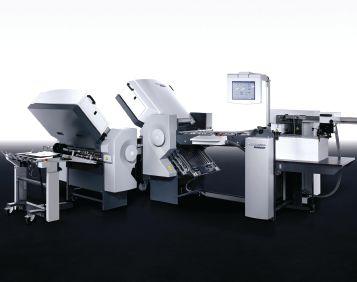
• Heidelberg Stahlfolder BH/CH
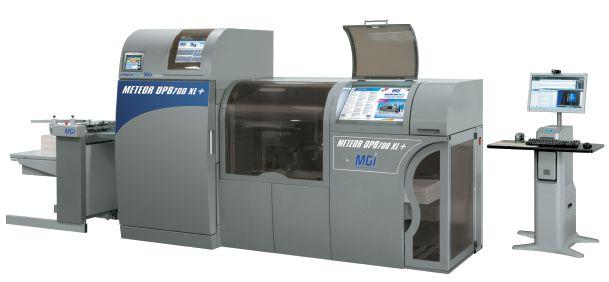
• MGI Meteor DP8700 XL+, DF Pro option
• Multicam Digital Express
• Multicam Graph-X Cutter
• Ricoh, CPBourg BME Booklet Maker
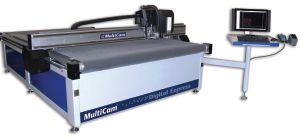
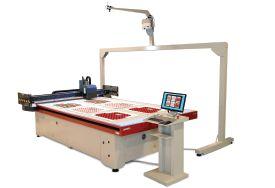
Released in 2011: The Digital Express cutting system, according to Multicam, is ideally suited for short-run projects based on its combination of speed and versatility. It features 7,000 IPM rapid traverse and multiple knife and routing configurations, as well as Multicam’s tangential EZ Knife System with creasing and perforation – supporting rotary, kiss-cut, drag, oscillating, and ultrasonic cutting. It also features the MultiVision Digital Registration System that recognizes marks visually and aligns the image automatically. Key specs: Table sizes from 50 x 50 inches to 120 x 289 inches; Spindle: 3-5.5 HP; and Repeatability ± 0.001 inches; allsteel, stress-relieved base; and high-flow vacuum table.
Pricing: $120,000 to $180,000+
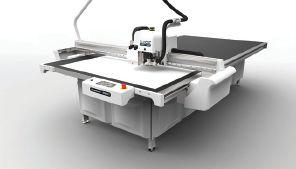
Multicam Graph-X Cutter
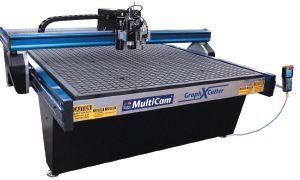
Released in 2014: The versatile Graph-X Cutter combines routing and knife-cutting capabilities. It features Multicam’s EZ Knife and MultiVision Digital Registration systems (described with Digital Express on page TK). Graph-X’ CAD/ CAM software is designed for enhanced tool-path generation, as well as 3D sign and graphics applications. In the printing space, the cutter is primarily suited for applications like wide format, short-run, decals and posters, as well as signage (wood, vinyl and foamcore, channel letters), POP and packaging.
Key specs: Table sizes from 50 x 50 inches to 120 x 289 inches; Spindle, 1.5 HP; Rapid Traverse, 2,100 IPM; Repeatability ± 0.001 inches; and Extruded aluminum frame.
Pricing: $75,000 to $100,000
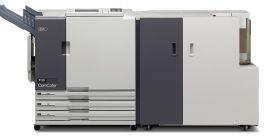
RISO Envelope Wrapper
Released August 2014: A RISO ComColor X1 9150 or 7150 inkjet printer can be combined with the new Wrapping Envelope Finisher, creating what the company calls its In-line Printto-Mail System. It prints full-colour content, then inserts, addresses, folds and assembles in a single pass into a sealed mail-piece, which has the same dimensions as a standard #10 envelope for mailing purposes. It can accommodate up to five tri-folded letter-sized pages or three quad-folded legal-sized pages of 20-lb bond. Key specs: Holing an 8 x 12-foot footprint, Print-to-Mail runs at rates of up to 2,200 completed pieces (single page insert) of mail every hour.
Pricing: $52,995 for Envelope Wrapper option (not including main unit)
• Ricoh, GBC Spire III 64T
• RISO Envelope Wrapper
• RISO Perfect Bind
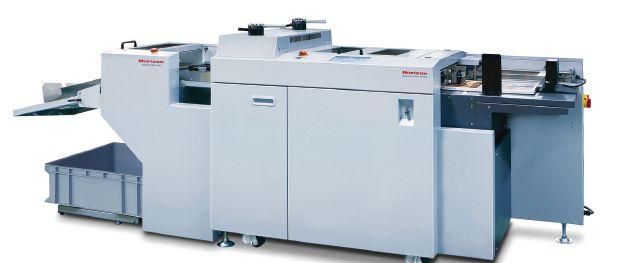
• Standard Horizon, RD-3346/RD-4055
• Sydney Stone, EBA 5255/EBA 6660
• Therm-O-Type RAS-mc
• Therm-O-Type NSF Excel
• Xeikon Web Varnishing Module
• Zünd Total QR-Code Automation
RISO Perfect Bind
Released September 2014: RISO’s
Perfect Binder option converts a ComColor X1 Series inkjet printer into a self-contained, high-speed book manufacturing solution. It prints, collates, trims and binds full colour books of up to 600 pages, inline and fully finished. It allows for printing covers as part of the book production or inserting pre-printed covers and pages as needed. Key specs: Accommodating book thicknesses up to 300 sheets (1.5 to 30 mm), the system, holding a 8 x 12-foot footprint, produces spot colour or full colour at speeds of up to 150 pages per minute.
Pricing: $48,995 for Perfect Binder option (not including main unit)
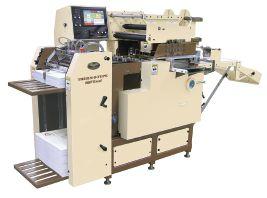
Therm-O-Type NSF Excel
Released in 2014: Therm-O-Type describes the NSF Excel as the only platen press with a format specifically designed to fit digital output, while also able to work with larger quantities. It provides flat foil stamping, blind and foil embossing, die/kiss cutting and high-speed foil fusing. It fits into a range of offset and digital market sectors, such as greeting card manufacturing, invitations, photo-lab products, packaging, security applications (holograms), or general product finishing like die-cut door hangers or table tents. It allows smaller, multiple-up orders to be run with low-cost dies in a step-and-repeat process. Key specs: NSF Excel runs at up to 6,000 impressions per hour. It can apply up to eight programmable impressions per sheet.
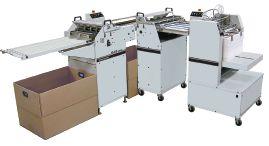
Therm-O-Type RAS-mc
Released in late-2014: Therm-O-Type describes RAS-mc as the only right-angle slitter to combine high-speed production, using quick-change cassettes, with product-size flexibility, including a format specifically designed for digital output. Stacks containing multiple small quantity orders can be processed with each order delivered in sets on a conveyor, eliminating the need to gather orders from multiple stacks after guillotine cutting. An RAS-mc auto-adjust-cassette upgrade was introduced in December 2014. Key specs: In March 2015, a new right angle section for the RAS-mc will be introduced that incorporates a second cassette position designated for scoring – a configuration suited for jobs like single-fold cards.
CM Insight LasX STS250/ STS400
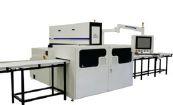
Released in Canada November 2014: The STS250, or STP250 250W CO2 entry model with single laser (future expansion possible), was first introduced in 2008, while the STS400, or STP400W CO2 entry model with one or two lasers, was introduced in 2009 – now distributed in Canada by CM Insight. The STS and STP products target short-run, high-variable-shape printing applications. The STS also targets decorative markets like wedding and greeting cards, typically B2-sheet size and less. The STS handles sheets on the infeed section and the finished sheet on the output, whereas the STP version includes robotics so the input side is a sheet, but the output side has finished parts separated from the waste. Key specs: STS and STP are available with a 250w, 400w or 1,000w laser. Each model has the option of scaling from 1 to 2 lasers.
Pricing: STS250 $275,000 (entry base model)
Bobst Novacut 106 ER
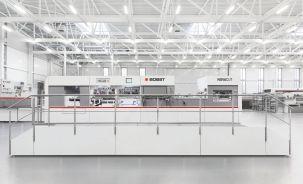
Released July 2014: The brand new Bobst Novacut 106 ER gives packaging printers access to integrated and automated production by bringing together Bobst die-cutting technology and the Angle Lock blanking tool system. The Novacut 106 ER die-cutter offers inline blank separation without the production or investment headaches that users expect from this process, Bobst explains, delivering stacked bundles of blanks ready for downstream processing with no need for breaking out by hand..
Sydney Stone, EBA 5255/EBA 6660
Released June 2014 (Canada): While EBA paper cutters have been sold around the world for more than 40 years, the latest iteration of the systems were developed to work with the growth in 13 x 19-inch and 14 x 20-inch sheet sizes. The cutters are suitable for handling both digital and small-offset print runs. Key specs: The EBA 5255 offers a 20.4-inch cutting width with a Lexan cover and touchscreen controller. The EBA 6660 model replaces the previous 6550 model with its 25.5-inch cutting width.
Pricing: EBA 5255, $10,495; EBA 6660, $14,899
Xeikon Web Varnishing Module
Released January 2015: Xeikon’s Web Varnishing Module is designed specifically to work inline with the company’s 3000 Series of digital colour presses for production of labels and packaging. It can work with a range of substrates, including self-adhesive label materials, coated papers, unsupported films and coated paperboard. Xeikon explains the Web Varnishing Module offers two unique advantages: First, its versatility to apply UV or aqueous varnish on one side of various substrates; Second, inline varnishing allows operators to make changes.
Drytac Reveal Backlit Film
Released September 2014: Aimed at producing Lightboxes and backlit applications, Reveal Backlit Film is designed to transmit and disperse light evenly and consistently across an image for proper illumination. Drytac explains both UV and latex inks adhere well to Reveal, and the film can be cut with a large-format CNC router. Due to the film’s rigidity, however, graphics can be more easily inserted into light boxes. Drytac explains Reveal holds an excellent white point and anti-static, anti-slip treatment on the backside.
Key specs: 7-mil printable PET film with a matte finish.
Pricing: $361.74 to $543.17 (54 x 164 to 72 x 164 inches)
Drytac JetMounter JM63 Fuzion XD
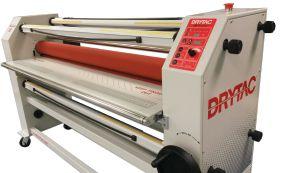
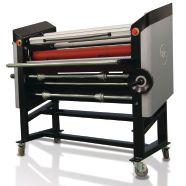
Released October 2014: Drytac explains the JM63 Fuzion XD has many of the features of the JM63 Pro XD, but with the price point of a standard wide-format roller laminator. With its roll-to-roll capability and a 63-inch laminating width, JM63 Fuzion XD is well suited for laminating vehicle wraps, creating window decals and for mounting graphics to substrates. Key specs: Top roller with heat assist to 110°F, large 4.7-inch diameter non-stick silicone rollers, speed control from zero to 20 feet per minute, maximum 1-inch nip opening, nip pressure indicator, and heavy-duty metal construction with lockable casters.
Pricing: $7,595
Agfa Jeti Titan, varnish and primer options
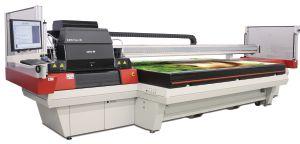
Released February 2014: Made in Canada, the Jeti Titan S/HS printing systems are 6-colour true flatbed UV inkjet wide-format printers. The engine incorporates the latest generation Ricoh Gen 5 print-heads and comes with double white as standard. For finishing, the system is available with primer or varnish options, as well as a flat-to-roll option on the HS model to print flexible media as well as rigid substrates. The new primer option is designed to extend the durability of outdoor signage. Key specs: The Jeti Titan HS is a 122 x 79-inch format system equipped with two rows of 1,280-nozzle print-heads.
Pricing: $350,00 to $500,000 (depending on options)
Agfa Acorta
Released January 2015: Agfa Graphics, to extend its portfolio in signage and display markets, added an automatic cutting plotter for use with its Anapurna and Jeti wide-format printing systems. Acorta is designed to finish both rigid and flexible sheet medias. The company points to the system’s auto recognition system, which automatically localizes the printed objects and the position of the reference points on the cutting table, as well as the substrate’s height. Key specs: Cutting speeds of up to 102 metres per minute and automated 40 vacuum zones.
Ricoh, GBC Spire III 64T integration
Available to Ricoh customers, November 2014: The GBC Spire III 64T thermal laminator is designed for wide-format production, specifically with the Ricoh Pro L4160, such as signage, restaurant menus, vinyl prints, vehicle and other types of wraps that utilize textured medias that are hard to laminate on using cold-process laminating – and can benefit from thermal laminating. Key specs: The system provides both thermal and cold-process laminating in one 63-inchwide device.
Ricoh, CP Bourg BME integration
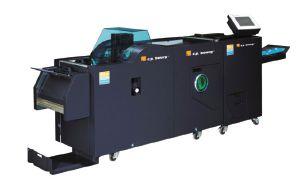
Available to Ricoh customers, May 2014: The CP Bourg BME booklet maker is designed for digital presses, applications like booklets, schools and calendars. It is suited for high-volume work on the Ricoh Pro 7110x, Ricoh 8110s and soon the Ricoh Pro 9100 series presses. It features what Ricoh describes as a totally visible paper path, capable of handling landscape A4 brochures. Key Specs: The integrated system, with inline capability, can trim up to 30 sheets, stitch up to 55 sheets, and fold up to 120-page booklets.
Access Imaging, Royal Sovereign RBW 1500
Released in Canada January 2015: Access Imaging recently began to distribute the Royal Sovereign RBW 1500 portable welding system for large-format printing, which the company specializes in. It provides a thermal weld. Access Imaging explains the system is ideal for sign shops, as well as screen or offset printers that need to send out printed banners for finishing. The system can be operated by one person and features an adjustable height to sit against a table for ease of use. Key specs: Welds a hem or pocket in any PVC banner up to 22 oz. Pricing: $4,650
Access Imaging, Royal Sovereign Trimmer
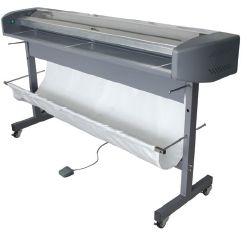
Available in two sizes, the 59-inch RET1501 and 98-inch RET-2501 electronic trimmers, distributed by Access Imaging, are designed for finishing large-format work. Access Imaging explains the electric trimmers provide smooth, clean cuts on a variety of substrates, such as signs, posters and laminated materials. Key specs: Cutting speed of 6.6 feet per second. Cuts materials up to 0.8-mm thick. Pricing: 98-inch unit sells for $3,950
Esko Kongsberg C
Released October 2013: The Kongsberg C table is aimed at wide format and roll-fed inkjet, used primarily for display and POP graphics. It is a 3.2-metre finishing system
with more than 10 feet across the table. It features what Esko describes as a unique rigid, carbon-composite traverse with high speed, fast acceleration, cutting, creasing and powerful 3kW milling capabilities.
Esko Kongsberg V
Released May 2014: The Kongsberg V can finish products from wide-format, digital toner, offset, and roll-fed inkjet presses, including applications like display and POP graphics, labels and packaging. The V table is available in two standard configurations, including one system aimed at sign and display, as well as a model for packaging. Each model includes a selection of tools to process market specific applications, including print-to-cut registration, creasing, drilling and plotting activities.
Zünd Total QR-Code Automation
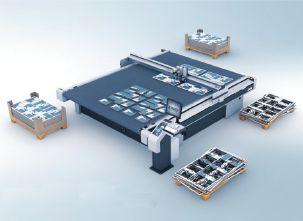
Released September 2009: The automatic QR-code capture technology is driven through Zünd Cut Center (ZCC). In a static-bed, tandem vacuum setup or fully automated, with automatic sheet or roll feed and integrated robotic off-load, Zünd cutters using QR-Code Automation have the ability run without interruption. This is possible, according to Zünd, regardless of whether the graphics are nested, or in what sequence single or multiple stacks of printed sheets are fed
DISCOVER THE POSSIBILITIES
onto the cutting table. ZCC automatically captures the embedded QR-codes, retrieves the corresponding cut files, and keeps cutting.
Allen Datagraph Systems
iTech TALON
Released in February 2014: Building on the original system released in 2009, the iTech TALON label finisher can be used with digital presses, inkjet presses and flexo presses. The iTech TALON laminates, die-cuts, strips, slits and rewinds labels, without the need for expensive dies. It opens the same Adobe Illustrator vector-based file data that would typically be sent out for die manufacturing and delivers it to the finisher. Key specs: Finishing label rolls 4.5 to 8-inches wide at speeds of up to nine feet per minute.
Standard Horizon RD-3346/RD-4055
Released May 2014: The Standard Horizon RD-3346 and RD-4055 rotary systems can die-cut, crease, perforate, slit, hole punch, and round corner in one process for both digital and offset printed sheets. Both models feature what the company describes as easy changeover and operation with touchscreen controls and vacuum belt feed. Die cutting and kiss cutting can also be performed at the same time to produce stickers and labels, as a repeat register function allows multiple-up applications from a single-up die. The systems are suitable for a range of applications like labels, trans-promotional novelties, greeting cards, presentation folders, business cards, tags and packaging. Key specs: RD-4055 features speeds of 6,000 cycles per hour and handles sheet sizes up to 15.74 x 21.65 inches, at a thickness up to 0.019 inches. RD-3346 produces at 3,000 cycles per hour with sheets sizes up to 13 x 18 inches at 0.013 inches thick.
Heidelberg
Stahlfolder BH/CH
Released April 2014: Heidelberg explains the highly standardized features of the new Stahlfolder BH/CH folding machines, using a modular platform concept, make them well suited for signatures, books, and perfect-bound or stitched commercial products. The Stahlfolder BH buckle plate folding machines are available in working widths of 56/66/82 cm; while the Stahlfolder CH combination folding machines in working widths 56/66/78 cm. With the automated machine versions, buckle plate stops, buckle plates with swing deflectors, folding rollers and slitter shafts are automatically set in the buckle plate units. Key specs: Settings for up to 300 jobs can be stored. The pneumatic gatefold buckle plate allows for 15,000 cycles per hour. The ACC 2.4 digital module controls the switching points of the pneumatic gatefold buckle plate, individually, and independently of the folding speed. The pneumatic gatefold buckle plate enables fold lengths from 6.5 centimeters (2.56 inches).
Heavy boards, plastics, laminations or digitally printed works up to 30 pt can now die crease, fold and even glue in-line.
machine, up to 30 pt.
3. INTEGRATED MODULAR UNITS — Combined in-line finishing: crease, fold, glue, tipping, envelope inserting, ink jetting (Duplex), clip seal (3 sides), mail prep. 4. SAVE ON POSTAGE COSTS As a Certified Canada Post Direct Marketing Specialist, we get contract pricing reductions.
5. RETURN MAIL PRODUCTS — Customized “Return Mailers” created in-line with “U” or “BOX-shape” remoistenable glue, time perfed applications and envelope formation. 6. MINI-BOOKLETS — Saddle-stitch and trim 2-up booklets in-line to the size of a business card. No need to trim off-line, or do 2 passes. 7. HIGH SPEED EQUIPMENT — High speed Tipping, Folding, Saddle-stitching and soft folding ensuring on time delivery.
TRADE PRINTING
TECHNOlOGy RePORT
Heidelberg
POLAR 56 Net
PRINT
est Deal’s 75,000 square feet climate controlled plant holds 8 latest presses including 2 brand new Mitsubishi 8 Colour Tandem Perfector with coater, boasting both sides printing in one pass reducing press time.
Phone: 416-299-8568
Free: 1-866-719-3339
Toll Free: 1-866-719-3339
Fax: 416-299-3977
est Deal offers in-house finishing for a complete one-stop service. Our services range from folding, stitching, perfect binding, wire bound, coil bind, diecutting, glueing along with additional services to matches our efficiencies of our presses to meet any demanding schedules.
Fax: 416-299-3977
E-mail: bestdeal@bdprint.com
E-mail: bestdeal@bdprint.ca
30 Production Drive Scarborough, Ontario, Canada M1H 2X8 www.bdprint.com
30 Production Drive Scarborough, Ontario, Canada M1H 2X8 www.bdprint.com .
Released September 2012: The programmable POLAR 56 Net cutter is designed for one-shift operation. Its swing cut is carried out hydraulically, Heidelberg explains, meaning the time the knife spends in the lower dead end can be adapted to the material. It also features an ultra-smooth stainless table surface for handling of the material without air jets. Clamping pressure can be adjusted infinitely to each cutting material by means of a turning knob with scale. POLAR 56 Net is designed with a 18.5inch touchscreen, barcode reader, Compucut and process visualization. Key specs: Memory capacity of 1,998 programs. Cutting width and feeding depths of 22.05 inches, and feeding height of 3.15 inches.
MGI Meteor DP8700 XL+, DF Pro option
Released in North America September 2014 (press and DF Pro): The Meteor DP8700 XL+ is described as a versatile toner press with true multi-substrate capabilities for paper, plastics and envelopes. MGI explains it provides significant upgrades in print quality, format size (up to 47 inches long, and media thicknesses. The Digital Finisher Pro (DF Pro) is a new inline finishing option for the Meteor DP8700 XL+ press, allowing for single-pass production. For any given document, up to 20 distinct operations can be applied like horizontal and vertical cutting, positive and negative creasing, and horizontal and vertical perforating. Key specs: The DF Pro produce up to 4,260 finished sheets per hour.
Fujifilm Graphium, finishing options
Press released September 2013: Graphium is an inkjet-based press designed for mid- to high-production packaging and specialty work. Its hybrid converting capabilities, including the ability to add flexo decks, can handle job lengths from one piece to 250,000 pieces. No special coating materials are required for this press, which supports a wide range of materials like PE, PP, PET, PVC, PETG, metalized materials, and most papers. The press features inline finishing capabilities with a
unit, as well as a solid white ink, which can be done inline at full rated speeds of the machine.
NEW PRODucTS
RISO SE9480
In January 2015, RISO Inc. launched its new high-speed digital duplicator, the SE9480, into both Canada and the United States. The company describes the SE9480 as the fastest cut-sheet digital duplicator on the market, producing documents at a speed of up to 185 sheets per minute. It is engineered, Riso explains, for use in a range of printing environments, such as corporate, manufacturing and educational settings, requiring high-volume, low-cost document reproduction. Users can employ the system’s optional Letter Cylinder for more efficiency, as well as optional colour cylinders, including metallic.
The SE9480 scans and prints images at a true 600 dpi based on new imaging technology designed for producing clean, uniform imaging of solids and fine text at high printing speeds. It includes multiple image modes and the RISO i-Quality system for print quality and supply management. RISO’s SE9480 is also ENERGY STAR compliant.
SPGPrints Pike
The first Pike will be a 6-colour machine with plans for including up to nine colours and wider formats up to 3,200 mm.
In late-December 2014, SPGPrints demonstrated a prototype of its new single-pass textile printer, called Pike, scheduled for launch at ITMA 2015 in Milan, this coming November. Pike is based on a full-width array of Fujifilm Samba print-heads, which have been modified for textile printing. The heads are incorporated in what SPGPrints describes as a user-friendly print-bar technology, called Archer.
SPGPrints explains one key advantage of Archer technology is that it can accurately jet inks across a distance greater than print-heads used in most current textile-printing systems. The head plates in the Archer array are typically 4-mm away from the surface of the substrate, compared with the traditional 1.5-mm distance of other print-heads. SPGPrints has also developed Pike Reactive inks as a formula that helps to eliminate misting problems that might have arisen with Archer’s greater firing distance.
The first Pike printer will be a 6-colour machine in which each colour is represented by an Archer print bar containing 43 print-heads, resulting in a printing width of 1,850 mm. The print bar has a native resolution of 1,200 x 1,200 dpi, variable drop sizes from two to 10 picolitres and a jetting frequency of 32 kHz. These firing specifications together deliver typical productivity of 40 linear metres per minute (mpm), with a maximum of around 75 mpm. The modular construction of Pike will allow models with up to nine colours. Wider versions of Pike, up to 3,200 mm, are also planned.
HP Light Fabric
In January 2015, Hewlett Packard released a new 100 percent knitted polyester fabric for its Latex wide-format printing systems. The substrate, denoted as an HP Light Fabric, is described as being wrinkle-resistant, rub- and scratch-resistant, and soft to the touch for producing high-profile display applications. It is designed to allow printing companies to produce lightweight, high-quality banners and display for special events, retail displays and exhibits, among other applications. HP explains Light Fabric has been tested for harmful substances and is certified according to the Oeko-Tex Standard 1001, and is REACH compliant, which means the material poses no health risks when used as intended. It is also fabric flame-retardant to B1, M1, and NFPA 701 standards. HP describes the materials as presenting an alternative to PVC for banners and displays. HP Light Fabric is available in 42-, 54-, and 60-inch widths.
AccuWeb EVO 150 for Colordyne 3600 Series
In late December, AccuWeb announced a technology partnership for integrating its EVO 150 controller on the new Colordyne Technologies’ 3600 series of printing systems, primarily aimed at tag or label runs. The Colordyne Technologies’ 3600 series produces a resolution of 1,600 x 1,375-dpi running at 225 feet per minute. AccuWeb web guides are positioned before the print engine and the laser die
RISO’s SE9480 scans and prints images at native 600 dpi.
HP Light Fabric is available in 42-, 54-, and 60-inch widths.
Solutions for the Printing Industry
❏ One program manages entire company ❏ Enter data once and use it many times
❏ Enhances client service
❏ Work smart, work efficiently
❏ Increases speed - accuracy from estimates to invoices ❏ Eliminates duplication of effort ❏ Saves time and resources
cutter for consistent web travel. The AccuWeb EVO 150 controller allows press operators to fine-tune web guide performance using a switch-pad or touch-screen interface. The EVO 150 web guide controller combines 150 watts of power and 24 VDC with the ability to control brushed and brushless actuator motors.
QuarkXPress 2015
In January 2015, Quark Software announced new features to be included in its upcoming release of QuarkXPress 2015, scheduled for March. Key enhancements include a new 64-bit architecture and support for PDF/X-4 output, which certifies files as if produced inside Adobe Acrobat. QuarkXPress 2015 will also continue to be sold as a perpetual license.
Quark also described the following QuarkXPress 2015 enhancements: 4x larger page sizes, dedicated orthogonal line tool, fixed layout interactive ebooks, custom paper sizes, relink any picture in the usage dialogue, collect for output for complete project, user-definable shortcut keys on Mac, new table styles, format painter, footnotes and endnotes, footnotes from word, search in palettes, smart guides, content variables, and Yosemite OS X support, as well as tool palette, measurement palette and palette group docking on Windows.
TRESU F10 iCon Ink Supply
In January 2015, TRESU Group introduced its flexography-based F10 iCon ink supply system for integration into a water-soluble detergent pouch filling and converting line to meet new safety regulations. The process enables household detergent manufacturers to comply with a European safety directive requiring individual capsules to carry warning messages – a consequence of injuries suffered by children who mistake the brightly coloured capsules used in washing machines or dishwashers as sweets.
Contained within a printing module before the pouch-filling stage, the multi-colour servo-driven solution provides fully automated ink flow and job setup. The F10 iCon ink supply system constantly feeds the printing units and maintains viscosity, temperature and pressure. Sealed, pressure-controlled chambered doctor blade systems enable direct, foam-free transfer of ink or coating to the anilox rollers. The unit operates at only 10 metres per second, a relatively low speed necessitated by the subsequent pouch filling process. A register module after the printing stations maintains positioning of fine text on the fly. Accommodating multiple pouches in the cross direction, the unit prints inline on the substrate, ensuring integrity of the printed message through the packing or logistics process.
Canon PRISMAsync Remote Manager
In December 2014, Canon released PRISMAsync Remote Manager, which the company describes as a multi-engine scheduler and remote management console for expanded control on a customer’s fleet of PRISMAsync controller-driven digital presses. The Web-based tool is designed to help pressroom managers and operators handle a high-performing printing operation by providing insight into their production schedules with the ability to upload jobs, edit job properties and manipulate digital press queues from a remote location or workstation.
PRISMAsync Scheduler provides a visual guide of the jobs scheduled for up to five presses, which allows operators to plan production schedules one shift ahead. At a glance, print-shop managers and operators can see the time to completion for jobs, based on relevant job settings and process parameters. And, to help achieve non-stop productivity, upcoming interventions are colour coded so operators can load media and toner and unload print output before a press stops.
PRISMAsync Remote Manager allows production staff to submit jobs of printready PDFs, PostScript and PCL files via file import or drag-and-drop functionality. Remote Manager also allows users to edit job properties remotely. It gives an operator full control over job settings, including page level editing if page programming functionality is enabled. Operators can actively manage and prioritize the print jobs in the queues or PRISMAsync DocBoxes with the ability to reroute jobs from one digital press to another directly from PRISMAsync Remote Manager. It allows users to remotely change job priorities, holding, reprinting or rerouting print jobs.
AccuWeb EVO 150 provides web guide control via a switch-pad or touchscreen.
TRESU launches printing module for integration into converting lines for detergent pouches
QuarkXPress 2015 will be sold as a perpetual license.
BINDERY HELP NEED
Scarborough Bindery requires a MBO Folder Operator with a min. of 5 yrs. Experience. Must be able to do all setup Full Time or Part Time, Dayshift or Nightshift
Please call 416-701-1673 or send your resume to fax 416-701-9961 or email it to estimates.fortescue@bellnet.ca
EXPERIENCED BINDERY OPERATOR, PART TIME, (15 – 20 hours/ week) night shift. North York location Fax resume: 416-749-6072
ACCOUNT REPRESENTATIVE
Prospect, cold call and develop new business relationships/customer accounts
Requirements:
• Minimum 2 years experience in a business-to-business sales environment
• High level of commitment to exceptional customer service and relationship
• Strong written and verbal communication skills
• Proficiency in MS Office tools – Outlook, Word, Excel
• Experience in the printing industry preferred We offer:
• Base salary and commission
• A competitive benefits package Fax resume: 416-749-6072
SHEET FED PRESS OPERATOR
Responsibilities:
· Read and interpret docket instructions.
• Set up and run Mitsubishi 5 colour
20"x 28" sheet fed press.
• Troubleshoot and perform general repairs and routine maintenance on machines.
• Monitor work to ensure quality products.
• Maintain a clean, safe work area to prevent accident and/or injury.
• Other duties as assigned.
Requirements:
• 5 or more years printing industry
• Day shift and be able to run weekends when required
• Ability to lift up to 30 pounds and stand in one spot for long periods of time.
• Basic computer skills.
• General math skills including adding, subtracting and multiplying, determining & following number sequences.
• Attention to detail with strong time management skills.
• Able to function well in a deadline troubleshooting capabilities.
• Effective communication skills. Contact: Bruno Zollino
PRE-PRESS OPERATOR/PRODUCTION SPECIALIST
The candidate must have 5 years minimum experience in the printing industry (litho/digital print).
He/She must manage all production aspects of print jobs. Proficiency in Quark Xpress9, CS6: Illustraor, Photoshop, InDesign for MAC OS. Experience in operating a Xerox digital press would be an asset. Fax or email covering letter & resume to 416-798-8229 or info@reverbgroup.com
Heidelberg: K-Line/S-Line/ Speedmaster/GTO/MO
Komori: 1,2,4 or 5 colours & any size
Adast: 714/715/724/725
Mitsubishi: Any model
Ryobi: : 2800CD/3200CD
Itek: 960/975/985
Hamada: 500/600/700/800
Polar: 72/82/90/92/107/115 CM
Horizon-BQ: 220/240/260/440/460
February 1980
Pierre Elliott Trudeau’s Liberal Party wins Canada’s elections; Apollo Computer is incorporated; U.S. Olympic Hockey Team defeats Soviet Union en route to their Miracle on Ice Gold Medal; Afghanistan declares martial law; and Gordie Howe becomes the first NHL player to score 800 career goals.
Magnum Has Growth Future
Magnum Graphic Equipment Ltd. is a small Canadian company located in Toronto that is forging a place in the North American printing industry. According to Mike Speller, President and General Manager, “Yes, we are a small but we have a full order book for the manufacturing division. We are encouraged by the industry’s reaction to the work we’re doing… a large business forms company in South Texas sent a huge press all the way up here for a compete overhaul and modifying. They heard about us from other satisfied customers.”
In addition to modifying press equipment, Magnum has designed a line of folders that are attachable to business forms presses or web label presses. The Mangum 1420 Folder is built entirely in their Toronto plant and can be supplied to suite four different applications: Web press folder, continuous forms collator folder, universal press and collator folder, and offline folder. They can do high-speed folding up to 650 feet per minute, utilize versatility, running dial-in system (360 degrees), quality bearings throughout, locating and leveling screw jacks.
Mike Speller and Steve Rider check a Ryobi in Magnum’s showroom.
autologic intros digital typesetter under $50,000
A compact, high-speed digital typesetter for the mid-range market has been introduced by Autologic Inc. – the APS-Micro 5. Priced under $50,000, the CRT typesetter will set 1,250 lines per minute. It has a 200 typeface storage capacity and resolution is far higher than has ever been available for the mid-range market, up to 3,600 lines per inch. It will be available in 45, 47 and 70 pica line widths.
Typesetting features include point-size scaling in 1/10-point increments and dynamic leading. Technological advances include Winchester (hard) disks and a unique, patented vacuum transport system. The APS-Micro 5 will accept paper tape, mag tape, floppy disk input or interfaces online to virtually all frontend systems. Autologic is introducing a new disposable output media cartridge holding 200-foot rolls. An optional reusable supply cassette will hold rolls up to 4,090 feet.
Broadway Printers of Vancouver go for Versatility, Quality, service and Price
In the printing industry, a reputation is built on quality, service and price. According to Dick Blockberger, President of Broadway Printers Ltd., “Those three factors are dependent on consistency,” he says. “One cannot provide excellent quality and fast service at a fair price without having the supplies and equipment that consistently deliver first-rate products with a minimum of maintenance. Versatility is another asset Blockberger values highly. His shop, founded in 1911, runs nine different roll and sheetfed presses.
Dick Blockberger, President of Broadway Printers, with operator Douglas Smith.
Sonora XP Process Free Plates deliver the print capabilities and productivity of mainstream plates, without the processing and chemistry.