Digital RounDtable
In early-February, PrintAction brought together four printers to discuss the opportunities and challenges in today’s digital printing market, including two of Canada’s digital printing pioneers, John Roger and Marc Fortier, a trade printer in Dino Siriopoulos, and a digital printing entrepreneur in Seth Rodness, who is now helping to drive what is recognized as one of Canada’s fastest growing printing companies. The open, hour-and-a-half roundtable discussion primarily focuses on issues in liquid and dry toner press production, including topics like Web-to-print, sales, emerging applications, technology investment and developing internal resources. The group naturally ventured into areas like wide-format and high-speed inkjet printing, as well as the position of offset technology, to address the past, present and future of digital printing.
By Jon Robinson
How important is digital printing to your business?
Marc Fortier: Our company derives 60 percent of its revenue from non-litho activities, which includes digital… many of the businesses that we serve, such as direct mail or Web-to-print platforms, fulfillment, print-on-demand, are all digitally based, so for us it really is a core part of our business, also with the expanding large-format digital business, which for us is part of the digital context… [Digital] is where we make the bulk of our investment both on the preprint and in terms of workflows and software and the post-print aspect; finishing, folding, gluing and specialty finishing. So it is a big part of company now and a big part of the future.
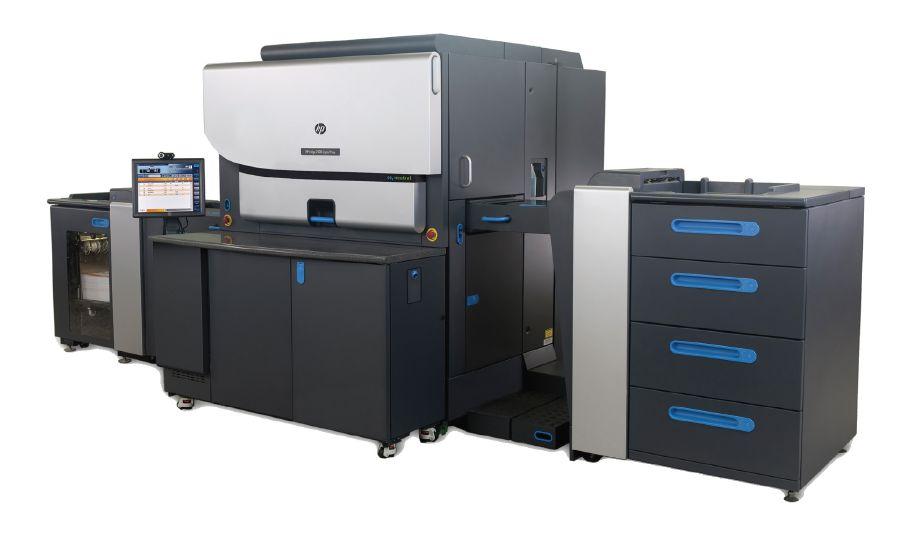
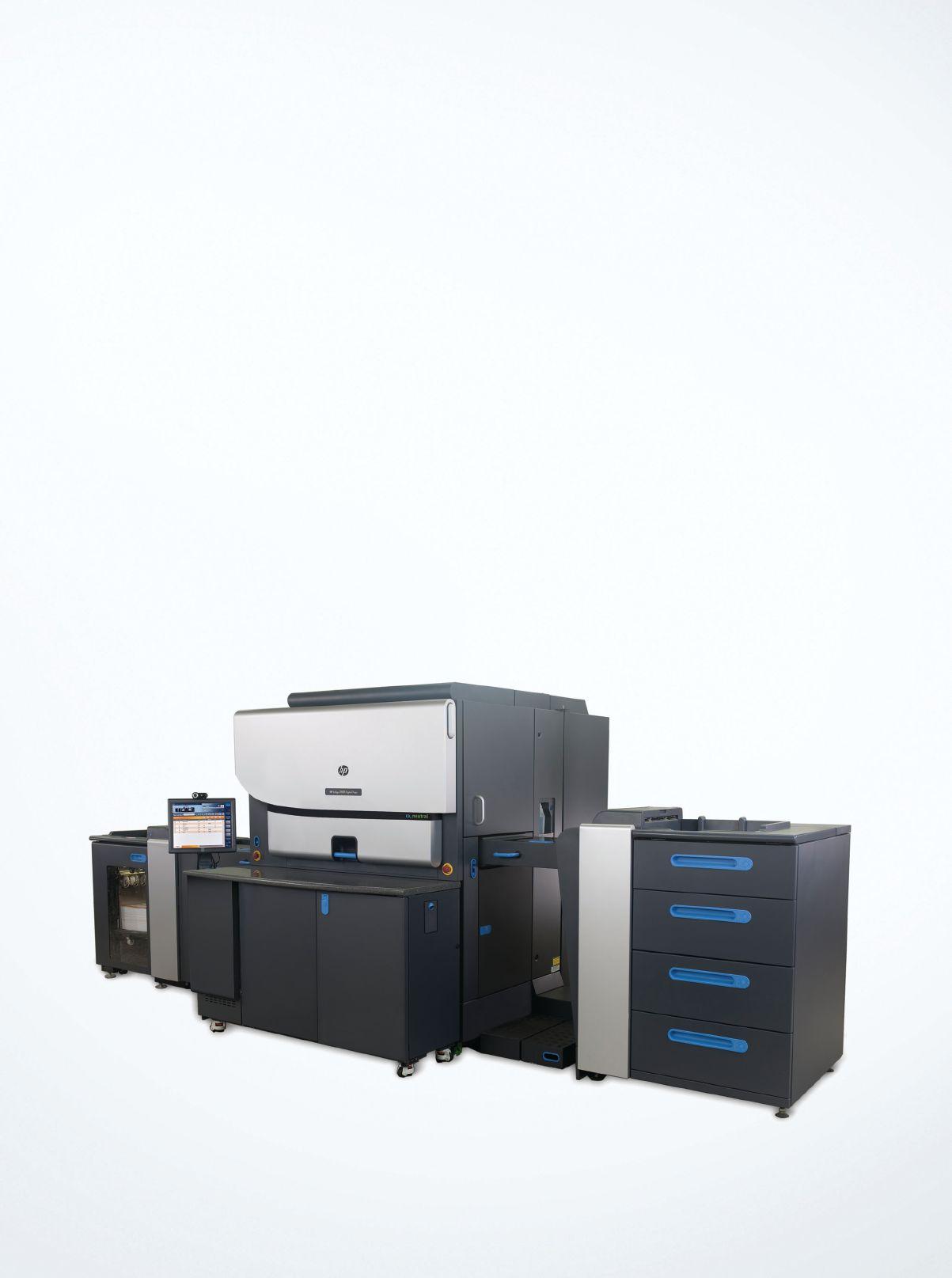
Dino Siriopoulos: It is huge. We were very reluctant to get into it because we are doing a lot of print for other digital shops who have iGens and I am doing their offset. So we were debating, “should I get into digital or not”... All of the brokers that I work with essentially were pushing me in that direction… My clients have iGens, so we went with the HP [Indigo] which we felt best suited our business model... more of the fussy premium work; not necessarily generic, commodity-style business. The HP fit well. We colour calibrate it and we use it every day. It runs 10 hours a day.
Sometimes [we] run the 40s based on the proofs from the HP, because everyone is trying to bring costs down… It is a fantastic device. The colour is sharp and some of the things that we can do: We are turning books around inside of 48 hours with tabs, perfect-bound and sometimes we will have a little bit of gold-foil lamination… so it is a nice compliment to the sheetfed.
Seth Rodness: When I came [Mi5] had one small box, which I think was primarily used for internal documentation… After that first year we have gone from that small Xerox 700 to three highspeed black-and-white machines, one iGen4 and another Konica Minolta colour machine, so we grew quite rapidly… It enables us to offer a complete all-around service with litho components, digital component and with our wide-format capabilities. We can really present an entire solution to all of our clients now. It has really boosted the opportunities that were out there –tremendously.
We are offering Web-to print storefronts… a lot of our clients have offices all across the country. It is very easy from them all to get in and to order something that is standardized… It gets to the point where they do not care what they are paying. When their branding is that important to them, it becomes a situation where we can actually make some really good money off of it.
John Rogers: I know a fellow running Indigo technologies, very high-end Indigo technologies within a hybrid application… and his responsibility for this one application is 250-million pieces –it is not small potatoes… I remember being asked one time to give my thoughts on what the industry is going to look like five years hence and I flat out said, “[It] has nothing to do with the box.” It has so little to do with the box. It is all about information management be it Web-to-print or VDP or in conjunction with social-media applications. [A digital press] is an output device for the management of information and we all have to face up with that.
Are you purposing trying to shift offset pages onto your digital presses?
Fortier: No, not for us… When we have that [offset to digital] conversation we really have to be specific about short-run digital toner or liquid-based technology. When we get to some of the new inkjet technologies that are being introduced right now, then we enter a different realm. That is where I believe you will see cannibalizing of the litho market both from a sheetfed and a web standpoint.
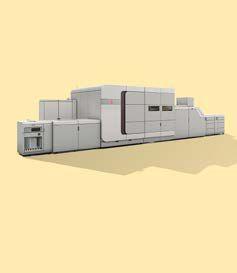
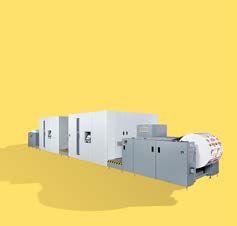
Some of the big webs that are coming out of HP on the inkjet side, the 30-inch webs, these beasts can produce 20-, 30-million impressions a month and definitely can claw away at [publication work], books, magazines and even on the commercial printing side. But for a commercial business like ours, we see [toner press] technology as a complement…. [For example], we produce 20 samples on our short-run digital ahead of the print run in order to get them to a sales meeting or something like that. So it is really a complementary technology for us, not a lot of cannibalizing going on, off of our 40.
Siriopoulos: I agree – you hit it right on the head: It is a tool. It is just a tool like everything else, so the job has to go through the appropriate device, whether it be a press, a digital device, large format, it doesn’t matter. As long as it colour calibrated, it looks good.
Being on time is one of the most-important things… [With digital] you can produce things on demand and, as long as it is calibrated, that is all the clients want. And most people purchasing print are a lot younger now. So seeing digital for them is the norm. I think calibration is one of the big elements. As long as your are colour calibrated to the GRACoL standard, that is key
Rodness: We are actually finding that we are able to take some impressions off of our litho equipment, primarily off of our GTO especially with the 26-inch iGen4 that we have. We can run 6-panel or 6-page brochures that we have tons of; 500, 400, [digital] allows us to run them and run them profitably.
Fortier: Definitely – if you have small-format offset, then that is a good point. We do not have small-format offset... but, that is true, [for small-format, digital printing] becomes a perfect substitute.
Rodness: There are definitely some applications that allow us to move the impressions into a more profitable situation. I just ran two jobs, yesterday… there were two different versions, totaling 1,100… they were 4/4, so the cost to run that on the GTO would have been… we wouldn’t of had the work, put it that way… and this related to $2,500, $3,000 worth of revenue just going through digital.
Rogers: I think there are a lot of pages moving off of traditional technologies onto the digital platforms, because they are getting wider and faster and much less expensive to run. The breakeven proposition is much different than what it used to be… Look at the photo books, for instance. That is a new application that couldn’t have been done five years ago… it is the new applications that I think are going to take up space.
I just think this trend will continue I think it is moving faster
today than it has ever moved before, from offset to digital, but a lot of it is the new digital. It is the new applications that are driving this business when you can do things like Web to print – or Web to print with VDP jobs – where you are collecting data and driving it to a press; All personalized in sort order for mail systems and so on. That is the real value going forward.
Siriopoulos: And that is profitable… You run personalization on a small digital device, in a small format, on a machine that costs half a million versus a $3, $4, $5 million press. It is a completely different business model.
How important is finishing to a digital printing business model?
Siriopoulos: I think you have to offer a nice breadth of finishing capabilities, at least stitching and perfect binding for the everyday items that are going to be coming off those machines. I do not think there is any point in not being able to finish it properly... You do not want to be sending things out to the binderies afterwards.
We also have an offline UV coater which allows us to give it more of a litho look on smaller runs and that really helps sell the job depending on the buyer, whether it is a newer buyer or older buyer. A UV finish on a small book is something that is really going to attract an older buyer to something that is a little more traditional.
Rogers: Take photo books for instance: The bindery has to be an integral part of the entire production line. If it is not, you will not be in the business. I remember producing photo books 15 years ago; Very rudimentary, but somebody would bring in their photos… and you could sell it for a lot of money. When photo books became popular you could actually sell them for $30. Today, from a production standpoint, you have to be at $8, $9, $10 for a 24-page book. You need to have your costs taken out of the process.
Fortier: I think the equation here that everyone is referring to is value added; How much value do you add to the paper. If you look at VDP solutions, you have the front-end data, forms work
JoHn RoGeRs Executive Director, Dscoop Founder, Dots & Pixels
John Rogers is one of the founders of what most describe as Canada’s first digital printing company, Dots & Pixels. This position places him as one the country’s digital printing pioneers, working through the trials and tribulations of the initial Indigo press technology, which was eventually purchased by HP for more than $800 million in 2001. Today, Rogers continues to consult within the Canadian printing industry and in December 2014 was named as the Executive Director of Dscoop, which is the printing world’s most powerful user group focusing on HP printing technology.
and all of the requirements in order to deliver that variable piece, which is all value added to the print product… [It is] the same way with finishing. As John [Rogers] was saying, you are not in the game if you cannot finish the job, because you have to get it out the next day.
Developing these capabilities on the finishing side allows you to become more efficient and take cost out of the process and add more value to the piece of paper… Which drives your profitability ultimately in terms of the amount of cash that you are generating in the organization. Where you would have had limited margin on a component of the process, you are now taking that margin over several processes and it becomes a more attractive piece of business.
Is this why RP Graphics focuses on developing specialty finishing for digital printing?
Fortier: It becomes a little bit of a different mousetrap and [digital is] such a broad market… I believe companies like ours have to decide which areas of this market they are going to become very, very good at. So for us, the aspect of specialty finishing and fulfillment applications is a natural migration… we are more into tipping, folding and gluing, self-mailers… it is a lot of hybrid between our litho application and our digital application.
How difficult is it for a trade printer to stay as a trade printer when running digital, because it requires so many daily transactions?
Siriopoulos: It is tough in trade because the work has to come to you. You really do not go out and push or drive a client in certain directions… For example, with Web-to-print I will set up a storefront for my client with their logo. We are invisible. We work in the background on it, but this is the value added part of the service that we are doing…
We were not specialists in digital printing. It is something that we learned as we went along. A lot of it was through HP and there are a lot of truths to what they were saying... but, in the end, I have a 5-colour 52 Speedmaster as well. If I factor in plates, labour, etcetera, I can be up and running in under $50, so I can still make more profit running it on the 52 than on whipping it over to the Indigo. The Indigo is faster. I can do more jobs per day
and there are enormous amounts of efficiencies, [but] you have to put it on the right tool…
I still have to maintain my integrity – that I am not going to go after your clients. That is critical. I have to be true to who I am and who I represent. I almost feel like when I say, “I am trade,” that it takes away from something we are offering people… I do not consider ourselves using [the] volume gang-run business model, but I do deal with brokers so that makes me a trade printer – that is the differentiating factor. I think we are giving a higher level of service, or I hope we are, and I hope we are giving a lot of value added.
How has Mi5 differentiated itself with digital?
Rodness: I totally agree with what everybody is saying: You cannot be everything to everybody. You have to pick and chose what you do well and exceed at it… We consider ourselves to be a high-end, quality shop and we need to have our digital, both wide- and small-format, match what we can do in litho.
We are a very innovative company. Within the last three years, our upper management team developed print systems through our litho division and there isn’t anybody else, we believe in the world, that can match what we are doing on press with our Pro-Brite series and our MetalMaX series and so on.
With the Pro-Brite colours that we have developed, we can even do that in our wide-format department… that is where we are gearing all of our production through on the higher end. It has been successful for us and it has really helped us grow.
How does a digital pioneer view differentiation in today’s market?
Rogers: It depends a great deal on focus. Like the fellas are saying, pick and chose what you are good at, where you can add more value. Whether it is customer relationships, whether it is data management; Each one of these things takes a significant amount of investment as well.
I found in my own business if you can find a way to manage costs more effectively, provide data services more effectively, because that is what digital is all about now: Management of customer relationships, make it a seamless process. Those to me are the real things that can differentiate you. It ultimately saves in cost, but also from a service perspective that is more important
than finding a particular product and going after it. I think it is [about] developing a solution approach to virtually everything you do. And then you can find value.
How can a digitally savvy printer become more of an agency, adding value, without stepping on the toes of your agency customers?
Fortier: I think we just reframe that statement a little bit, in terms of trying to pitch it… I think that printers have to become more solutions oriented; to become consultative with their clients and define what challenges they are faced with and how the printer can assemble the tools to be able to overcome that problem… Printers have to bring more resources to the table than just, “Can I quote this job.” I think even for a trade printer, when we talk about Web platforms to support his clients… that is the type of service or solution that will differentiate printers moving forward.
The scope of service may go as far as providing support with design and things of that nature, but I do not think it would be in the nature of a printer to become a true agency… printers will become more solutions providers assembling the resources in which print becomes a component of the solution… our clients have to do more with less. Therefore, they are putting more of an onus on us to come up with solutions for them.
Rogers: I remember knocking on doors of the agencies in the early days of digital and they didn’t have a clue… They really didn’t see that as part of their repertoire because it was all big-volume stuff… even personalization back then was black and white to them, your name and address on a communication vehicle…
Today, the digital printer actually knows more than the agency and I say that in all honesty. I believe, as a digital printer, if you understand the application of information onto a printed document, or how it can be combined with a variety of other things, you become an agency – even to an agency… help them to be able to understand how to better utilize what they are doing for their clients.
Once with the publisher of Home Depot magazine… I use a Home Depot credit card… I went and bought a bunch of flowers for my daughter’s wedding… I said to them, “Why didn’t you start talking to me about that shift in what I was doing, my buying patterns.” They didn’t understand what I was talking about. And
MARc FoRTIeR President, RP Graphics Group
Marc Fortier is widely recognized as one of North America’s most-influential digital printing executives, driving modern technology platforms into companies like Yorkville, Transcontinental, PLM Group, TI Group and now RP Graphics Group, which is a 60,000-square-foot facility in Mississauga, Ontario. RP Graphics was one of the first companies in Canada to install Xerox iGen technology and it continues to push this technology through Web-to-print and specialty finishing applications in combination with its offset and wide-formatinkjet printing power.
I said, “Think about it – now you can talk to me about something totally different.” Those are the kinds of things where a digital printer can really add value in a discussion with agencies or their customers themselves. Bring the agency in to do the creative, but it is the idea.
Siriopoulos: I think the production is dictating creativity… people are going to [printers] and asking, “How do I do this, because I have to go to my client with something new and I do not know how to do it.” Since 2007/2008, all of us have had to get more creative and we have learned digital. We have learned large format. We have learned mailing. We have learned bindery. Historically, it has been put ink on paper and that is it… But now they are coming to us for these answers.
Is there money to be made by investing in data management?
Rodness: Absolutely there is money to be made. It is one of the leading areas where you can make money. It is not a commodity. It is not something that everybody can do. As with everybody at this table, it is one of the things that we do well and there is a price to pay for that. If they are not willing to pay the price then, “Well, you are free to go off and do it on your own, but you are not going to get the results.” There is a tremendous amount of money to be made.
Siriopoulos: It is why there are so many printers who are changing their name to so-and-so media… because they are trying to say, “Okay, I am doing more than just ink on paper, what do you need.” And managing the data is critical.
Fortier: John [Rogers] was touching on the issue when we talked about cannibalizing… or migrating, if you want to use a word that is not as offensive... I think the true attraction of digital in our market place right now is the new applications. [Some] are coming of age in the marketplace that present new opportunities. They can be captured through digital printing and or be serviced through digital printing…
From a technology standpoint… All of the true investment in new technology that is coming out in the next three, five, 10 years is all going to be digitally based. So, in the context of a printer
seTH RoDness
Digital Division Manger, Mi5 Print & Digital Communications
Seth Rodness has been involved with digital printing for three decades. After operating his own Print Three location for around 25 years, Rodness came to Mi5 five years ago to help with the company’s move into digital printing. Today, Mi5’s digital printing division runs two Xerox iGen4s, a Konica Minolta press, and four monochrome machines. For the past six years, Mi5 has been recognized as one of the fastest growing printing companies in Canada, which has been aided by its growing digital printing division.
not being active in the digital arena, and/or trying to ignore that segment of the market as part of their business, it is going to leave them wanting.
It is not going to happen overnight. The ratio is still 90 percent offset to 10 percent digital, in terms of the volumes of pages, but digital is growing at a fast pace and there is absolutely no growth on the offset side. So overtime it is going to become the dominant technology in printing. And if you are not in, then you are going to be left behind.
How important has the advance in processing power been for digital printing?
Rogers: Doing a brochure, I think this was in 1996 and we were doing I am sure it was less than 100 and it was for Dodge, the auto manufacturer, and there was something like 15 or 16 different vehicles that had a number of variables, colours, seats that matched and so on… for less than 100 pieces. To process them, we would leave it running overnight, whereas this stuff today is phenomenal. It is beyond comprehension. Think about producing 30,000 photo book orders over a weekend – 30,000 over a weekend. The amount of horsepower that is required to process that blows me away.
Fortier: It has made a significant impact. Technology is driving a lot of change… The challenge I believe we still face in the industry, that is still present right now, that is preventing us from moving forward with some of these applications, is the readiness or the commitment that the end-user companies have to their marketing efforts – the rigor that they need to implement and support a true variable application.
This technology will allow us to build a real strong relationship with our client… the tools are there to deliver this now [but clients] have to commit to it and stay with it, because if you do it for a month, the investment in the infrastructure will not provide you for a return. It needs to be done over 1-year, 2-year campaigns with adjustments and retooling. We talk about having to educate the clients and that is still very much a part of the game today.
What have you learned in terms of compensating salespeople for digital printing?
Fortier: For me the biggest challenge would not be compensation, per say… Yes – you have a longer cycle but now you have a repeat-
able, sustainable sale as part of your portfolio, so the investment in time justifies the effort. I think the biggest challenge we face with the sales force is knowledge, especially with the part of a sales force that may have grown up on the offset side of the business.
We have overcome that through training and also by introducing something that is a relatively new concept for printers: A product specialist or product managers, people who are really industryfocused experts that act in support of our sales force and move the sales cycle forward.
With enough available resources, what printing technology would you invest in today: Toner, inkjet or offset?
Rodness: That can be a difficult question and I think we may all have different answers, because our clients are driving a lot of those decisions… it is really about buying the right equipment that is going to serve our clients properly and you do not want to buy a piece of equipment just because it has clear toner in it [unless] a client is requesting spot clear coat on the front of covers of all of their books, that is going to be driving impressions all day long… I see us increasing the better quality digital toner, potentially enlarging mailing… being able to fulfill from concept to Canada Post is a growing part of our business.
Siriopoulos: I would definitely get another Indigo again. I am happy with the product, but really what I would invest in is in people in the front-end to drive that business; To drive the Web-to-print, to have a series of specialists who can set up the portals through MIS efficiency, online advertising using Google analytics, and try to bring in work to the existing equipment or possibly new equipment.
Fortier: You say our answers could be different, but I think they are very similar… I think faster and better is going to be the investment… Those are the technologies that I believe the printers on the digital side are going to continue to integrate. For some, it may mean a leap into high-speed inkjet to open new market opportunities. I do not think that will be for our company, but faster, better, creating efficiency, getting knowledge, making sure that we are very good at the applications that we support and, in that context, also effecting speed to market – being able to do it faster.
There are some challenges with toner-based technology in terms of our accelerating a particle beyond the speeds that we are experiencing now. There are some technical issues that may drive one away from toner-based to liquid-based type technologies, but I think faster, better will be the modus operandi for most printers who are committed to digital.
What advice would you share with for your fellow printers when it comes to digital printing?
Rogers: You have to be thinking about the world that you are playing in... If you look at how people want to be marketed to today, you have to be thinking digital. I am not saying that offset is going to go the way of the Dodo bird, but if you look at the largest player at drupa next year: The most space in that enormous facility there is being taken up by HP and Xerox will be closely behind. It is not the big-iron guys.
If you look at the number of PSPs in North America... in 2002 there were 50,000 print service providers. Today there are 20,000 and that is going out of business or being gobbled up by the big guys... If you want the latter, then make sure your business is really, really profitable, so you can sell if for a good buck. You have to be thinking digital.
Fortier: Printers have to recognize the fact that [digital] has to be supported by knowledge. You need to have Web programmers, data programmers... workflow specialists... if someone has an engineering background, when you look at automating workflows and things of that nature, it helps in a big way. You need computer specialists now to maintain your presses, but I think that is something escaping a lot of printers. Those who make a commitment to digital get it because you immediately understand it is going to be a knowledge-based business as we move forward.
Rodness: We are all in agreement that [digital] is crucial… you have to get in quick or else you will not be around. My advice would be to do your homework, make sure you understand your business and clients’ requirements – what equipment is going to suit you to serve your clients best, initially, and then grow from there. You can get into it on a small scale... but definitely do your homework.
DIno sIRIoPouLos President, Tower Litho
Tower Litho is a Markham-based trade printing operation rooted in half and full-size sheetfed offset production. Around three and a half years ago, Tower Litho decided to move into digital printing with an HP Indigo 7500. The company differentiates itself by focusing on higher-quality printing for the trade rather than being a volume producer. Tower litho continues to emphasis printing on its four Heidelberg presses, including three 40-inch machines and one 29-inch.
NOVEMBER 12, 2015 THE GRAND LUX E , TORONTO