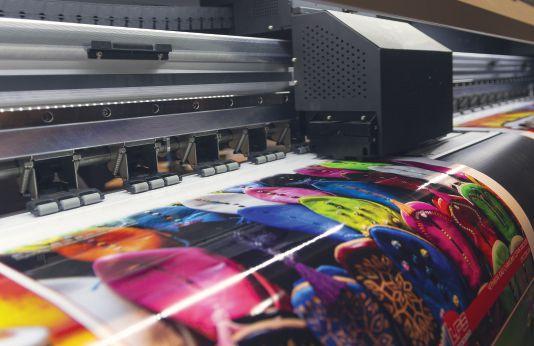
Food packaging is ready to embrace digital printing
12 Security printing product showcase
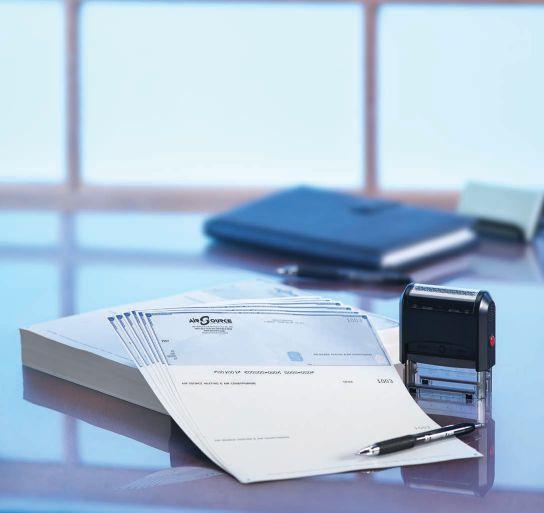
New offerings from Canon U.S.A., HP and Domino
14 Reproducing skin tones
Are they as difficult to print as commonly assumed?
DEPARTMENTS
GAMUT
5 News, Calendar, People, Installs
TECH REPORT
Do more with less: An overview of operational-level SWOT analysis 10 14 22 18
18 Showcasing some of the new technologies that are set to be unveiled at virtual.drupa
NEW PRODUCTS
20 Detailing new products from Duplo, Mosaica, Mark Andy and SynDaver
SPOTLIGHT
22 Wayne Collins, Program Director of Graphic Communications Technology Management Program at the School of Business + Media
COLUMNS
FROM THE EDITOR
4 Nithya Caleb
The way forward
CHRONICLE
8 Nick Howard
Wish you were here: The unique power of postcards
INSIDER
17 Bob Dale and Howard Conway
The way forward
I’m happy to be the newest editor of PrintAction . As a journalist with more than 15 years of experience in three different countries and varied industries, I’m excited to become a part of the printing world and to get to know the community. I’ve had the pleasure of talking to several industry veterans over the last few weeks, and all the chats have been insightful. I’d love to hear from you too, especially about the challenges you’re facing and what tools would be most useful. You can either e-mail or connect with me on LinkedIn.
unsuitable for ‘digital’ because of the volume of printing and the compliance requirements. For more on that topic, please read the article penned by Alvise Cavallari on Pg 10.
Reader Service
Print and digital subscription inquires or changes, please contact Barbara Adelt, Audience Development Manager
Tel: 416-510-5184
Fax: 416-510-6875
Email: badelt@annexbusinessmedia.com
Mail: 111 Gordon Baker Rd., Suite 400, Toronto, ON M2H 3R1
Postcards were first printed in 1870
The pandemic hasn’t been kind; it has disrupted the global supply chain market. It has also laid bare the risks with offshore manufacturing. However, the economic challenges induced by the pandemic have allowed us to reinvent ourselves. Even though ‘survival’ printing is widespread now, it is good to remember that “printing is one of the largest custom-manufacturing sectors in the world,” as Bob Dale of Connecting for Results told me recently. This is the key reason for many printers to easily pivot focus and manufacture PPEs when the demand spiked last year due to COVID-19.
I’m proud to be a part of the printing world, as “there is a rich tradition of innovation and rapid change in this very demanding, time-sensitive, and ultra-perfectionistic industry,” as described by an industry veteran.
I’m also reminded of the fact that printing is everywhere. It is no longer restricted to paper. Signs, packages, and laminates are also being printed. In fact, in this issue, columnist Nick Howard talks about the genesis of postcard printing. The first mass-produced cards were actually printed in 1870. Further, the digitalisation of printing is going to reshape the whole converting industry. It is becoming a reality even in the challenging area of food packaging, a sector that was once considered
In this issue, we’re also focusing on the seemingly difficult process of reproducing skin tones in print. As Laura Rendell-Dean explains, it is technically easy to reproduce skin tones in a print setting. However, humans have a lower tolerance for the way skin tones look when printed. This complicates the colour management process when skin tones are involved.
This month, we shine the spotlight on Wayne Collins, program director, Graphic Communications Technology Management (GCTM), School of Business + Media, Burnaby, B.C., who has more than 50 years of industry experience. Collins provides a topline view of the GCTM program, its USP and growth, industry support, and how it is attracting youngsters into the graphic arts sector.
He strongly believes, “the graphic communications industry has been in a state of rapid growth and technological change for most of the last century. New innovations have usurped well established modes of production to drive greater capacity and profits for business owners who are fast on their feet and are willing to adapt.”
Talking about innovations, virtual. drupa is just around the corner. I’ve registered for the show and am eager to find out about new technologies that will be beneficial to the Canadian printing industry. We are also showcasing some of the technologies that will be ‘displayed’ at virtual.drupa in this issue’s Technology Report.
I’m aware that the way forward requires out-of-the box thinking from industry players, but I’ve no doubt all of us will rise to the occasion. As Collins said, “there is a rich tradition of innovation and rapid change in this very demanding, time-sensitive, ultra-perfectionistic industry.” I’m proud to be a part of this industry.
Until next time, stay safe, happy and healthy. Enjoy the Spring weather!
PrintAction is printed by Annex Printing on Creator Gloss 80lb text and Creator Silk 70lb text available from Spicers Canada.
ISSN 1481 9287 Mail Agreement No. 40065710
DOUBLE COATING TOP LAYER UNDER LAYER FILLER LAYER BACK LAYER COATING
Benefits of Sinar Vanda Folding Boxboard
Highly Formable
Enables intricate structural designs and die-cutting to help brands achieve attractive shelf-ready packaging
Functional Stability
Holds shape for better scoring, folding, and durability
High-yield Advantage
1 ton of FBB provides a range of 18-23% more sheets than 1 ton of solid bleached substrate
Environmentally Friendly
Uses less energy in production, reduced pulp demands for FBB manufacturing means less trees are needed for the same end usage as SBS packaging
FDA & ISEGA Certified for Certain food contact and packaging applications
Sustainable
100% sourced from certified and sustainably managed forests
A recent study has questioned the environmental benefits of recycling paper. Researchers from Yale University and the University College London published the “Limited climate benefits of global recycling of pulp and paper” study in Nature Sustainability in October 2020.
According to the study, the recycling of paper materials could have a negative impact on the climate. The study’s writers warn that the efforts for a circular economy should carefully consider the energy implications of recycling paper products. They then concluded that recycling paper has a limited climate benefit but a higher climate impact than the production of fresh fibre-based paper.
The eco benefits of recycling paper is limited because the process uses more more fossil energy than new paper production.
The main reason for this is making recycled paper uses more fossil energy than the production of new paper, as it uses electricity from the grid or natural gas. Fresh fibre paper can be produced using
sheetfed inks, coatings and adhesives in North America.
Sun Chemical is attributing these price increases in its raw material feedstocks to a combination of raw material shortages, including petrochemical, vegetable oils and derivatives, increased international freight transport costs, and demand due to economic recovery.
for regional trading in the print industry.
The Peter Purcell In Memoriam Scholarship was awarded to Thomas Huynh. Peter Purcell established Vancouver’s Inter-City Papers in 1984, and was a 40-year industry veteran.
fossil-free energy made from by-products of the wood pulping process.
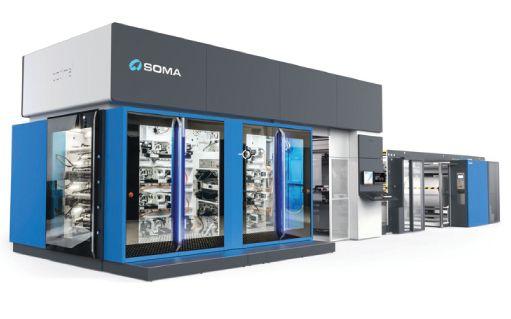
SOMA names DTM Flexo Services as sales agent in Canada. As per the agreement DTM will represent the company’s entire range of equipment, such as flexographic printing presses, plate mounters and slitter rewinders, to the Canadian market.
Based in Stoney Creek, Ont., DTM is a Canadian flexographic printing and converting industries sales and service representative that serves the flexo market across Canada. The DTM team has over 70 years of combined hands-on experience in the technical flexo space.
Sun Chemical has raised prices across a number of its packaging and commercial
Pacific Bindery adds polyurethane reactive (PUR) perfect binding to its range of post-press finishing trade services for B.C. and Alberta’s commercial print market. The company says PUR adhesives open up a wide variety of high-value project work, as it is the industry standard for adhesion and durability.
The addition of PUR perfect binding comes following increased demand for this service by B.C. and Alberta printers in need of technical perfect bound production runs from 100 to 100,000 copies.
Canadian Print Scholarships announce the recipients of three Canadian Printing Industries Scholarships named for B.C. print industry leaders. The scholarships have been awarded to students in the Graphic Communications Technology Program at BCIT.
The John Kouwenhoven In Memoriam Scholarship was awarded to Elodie Brewer. John Kouwenhoven was a founding partner of Hemlock Printers and a strong advocate
The Dick Blockberger In Memoriam Scholarship was awarded to Agnes Pham. Dick Blockberger was the third-generation president and CEO of Broadway Printers, was a director of the BCPIA and Canadian Graphic Arts Association, and director & chair of CPIA.
Connecting for Results (CFR) has expanded its business offering to clients in the United States. Operating in the U.S. as Connecting for Results Corp., the firm is set to help American customers in commercial print and packaging to achieve their goals with mergers and acquisitions, recruiting and consulting, effective immediately. The company has hired Keith Larson to lead the business expansion in the U.S. As CFR expands its business to assist U.S.-based customers, the company is offering mergers and acquisitions, consulting and recruitment in commercial print and packaging. Its team is also equipped to help the industry overall, as well as specific segments experiencing additional challenges due to the COVID-19 pandemic.
Spicers Canada has merged all its divisions under a single brand – Spicers. The company is a distributor of paper and specialty products, graphics, and sign solutions and industrial packaging supplies. Previously, in addition to Spicers in Canada, Shippers Supply and All Graphic Supplies operated as separate entities since they were acquired in 2017 and 2020, respectively. The change will create brand clarity and offer customers a consistent experience across Canada.
Researchers at Yale University and University College London raise doubts about the environmental benefits of recycling paper.
Domino North America has named Nikki Johnson as its new director of marketing. Johnson has nearly three decades of leadership and success in many marketing and sales roles within the packaging sector. She has also been an active member of various industry associations such as PMMI (The Association for Packaging and Processing) and the Contract Packaging Association.
Mac Papers and Packaging has named Charles Paquin as its new CEO. Paquin brings two decades of commercial experience and financial leadership to the role. Previously, he was the president and CEO of ModSpace Corporation for 15 years. During that time, Paquin led the acquisition of General Electric’s modular space division as well as spearheaded the successful sale of ModSpace to its primary competitor, WillScot.
Paper Converting Machine Company (PCMC) has named Andy Piotter as the business development manager, Packaging Systems. In this role, Piotter will develop the company’s new packaging systems division, which will specialize in “creating dynamic, comprehensive and efficient tissue packaging systems for customers around the world.”
Piotter brings over 35 years of experience in developing complete packaging systems for a variety of industries to the business development role at PCMC. He joins PCMC from roles that include engineering, sales and business management and development.
Xante’s has announced that its CEO, Robert Ross, has been named to the 2021 board of directors for Association for Print Technologies (APTech) at its annual member meeting in December 2020 for a threeyear term.
According to APTech, its charter supports the worldwide printing industry, including research, supply chain, and education. Its board members consist of print representatives across all fields, including users, manufactures, suppliers, and print providers.
Robert brings over 35 years of print industry experience to his role on the board, first with QMS, as well as three decades at Xante’. He is a graduate of the University of Alabama in Electrical Engineering. “It is an honour to be called to duty as a long-time member of this association. Over the years, APTech has been a powerhouse in the industry.”
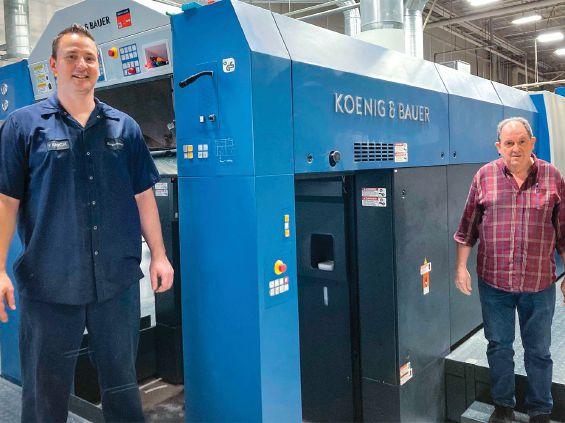
SupremeX has installed a new fully-automated UV-equipped, 41”, seven-colour Koenig & Bauer Rapida 105 PRO. This helped the company meet the increased demand for packaging materials, and it saw its revenue in its packaging and specialty products segment increase by 10 per cent.
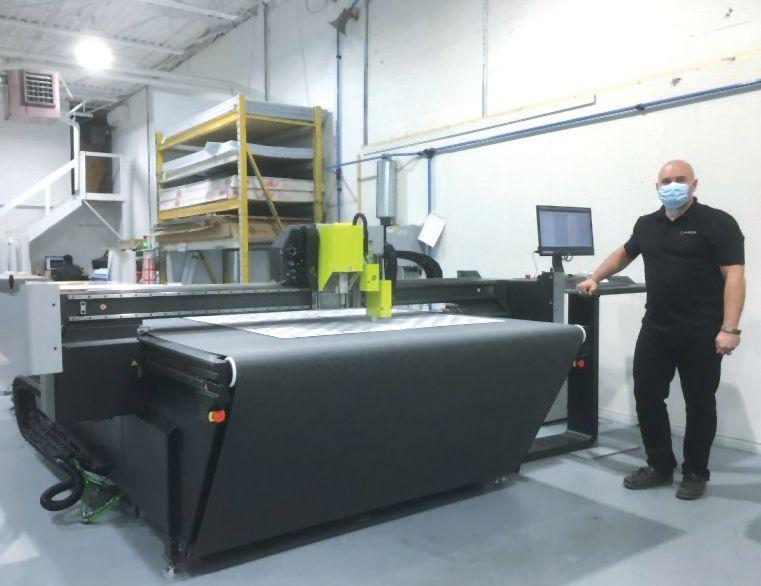
Gatineau-based Albion Screen Printing has invested in a new Esko Kongsberg C24 digital cutter. In partnership with Agfa, this investment will allow the printer to increase finishing productivity.
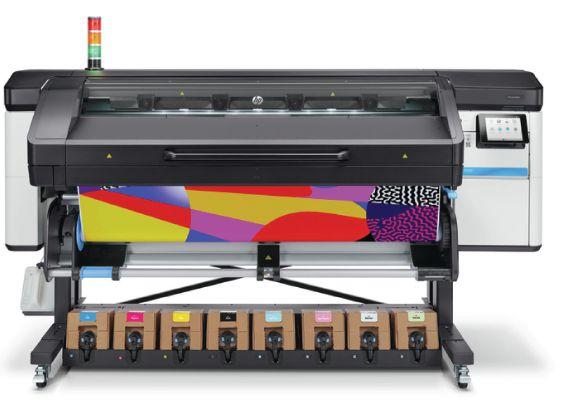
Oshawa-based 10West Commercial Graphics has placed Canada’s first order of two HP Latex 800W series of roll-to-roll printers with white ink. The print shop will primarily use the printers for custom signage, pop displays and vehicle wraps. 10West has been using HP Latex technology since 2013.
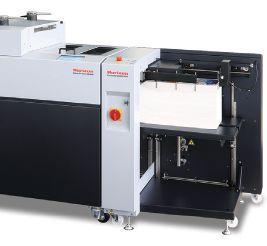
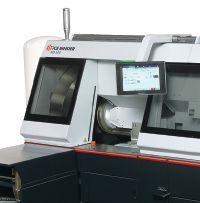
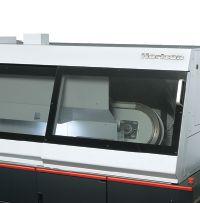
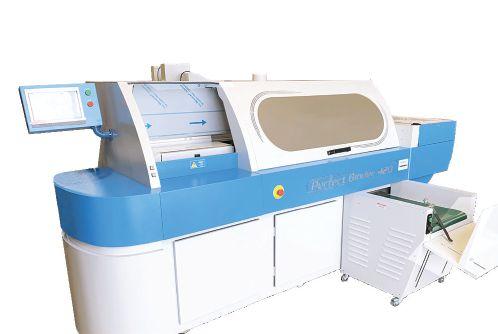
Perfect Binding
The Standard Horizon BQ-500 Perfect Binder features the quickest set-up and changeover for variable book production in its class, especially for book-of-one.
• PUR-friendly design with gentle delivery system for 5mm drop and low temperature setting
• Easy glue changeover, between PUR and EVA
• Automated controls for adjusting roller height, nipping height, and amount of side glue
A Cut, Fold & Stitch Above
RM Machinery has partnered with Standard and Horizon—the world leader in finishing solutions including folding, binding, stitching and cutting—to provide fully integrated finishing solutions that take your print products from the pressroom to the marketplace. Get ahead of the fold by contacting RM Machinery at 855-RMGT-123 or visiting us online: www.rmmc.ca.
Rotary Die Cutting
With dual magnetic cylinders, the RD-4055DMC Rotary Die Cutter is designed to simultaneously die-cut and crease/score short-run product from both sides of the sheet. It can also perforate, slit, hole punch, and round corners in one process for digital and o set printed sheets.
• Crack-free creasing and clean, sharp creases
• Multiple-up applications from single-up die
• Handles complex creasing patterns and light packaging applications
Equipping Canada to cut, fold, stitch and print.
RM Machinery Inc.
905-238-9797 • 1-855-RMGT-123
5250 Satellite Drive, Unit 9 Mississauga, ON L4W 5G5 www.rmmc.ca
April 19-22, 2021
PRINTING United Alliance CIReady! Online
April 20-23, 2021
virtual.drupa 2021 Online
June 8-10, 2021
Labelexpo Americas 2021 Chicago, Ill.
June 8-10, 2021
Brand Print Americas 2021 Chicago, Ill.
June 10, 2021
DIA Annual Golf Tournament Aurora, Ont.
August 12, 2021
OPIA Toronto Golf Classic Brampton, Ont.
October 12-15, 2021
FESPA Global Print Expo Amsterdam, The Netherlands
Wish you were here
The unique power of postcards
By Nick Howard
Aguy, diving headfirst, into a small pond or lake—this was the image on a 1975-postcard included in Pink Floyd’s iconic vinyl album titled Wish You Were Here. I thought it was an innocuous addition, but did hope to mail it someday.
The zenith of first-class postcards in the United States was 1990 when 3,307,076,000 were mailed. That’s a lot of print! In the same year, bulk advertising cards aka pre-sorted postcards amounted to an additional 1.5 billion.
The back of the postcard read, “Wish you were here.” Vinyl albums have risen from obsolescence to capture a small bespoke segment of the music industry. If any Winkler & Dü nnebier record jacket machines have not been turned into car doors or gas pipes, they are just about the hottest commodity on the market. Although the choices were bleak in 1975, the vinyl record with emblazed graphics—and possibly a souvenir card—has managed to become relevant, especially for die-hard fans.
The postcard’s journey dates back to 1840’s England when an Englishman mailed himself a simple, hand-drawn card as a joke, apparently.
In 1861, John Charlton of Philadelphia patented a “private postal card,” and a trickle of cards started to appear in household mailboxes. Soon after, in 1865, Heinrich von Stephan, a Prussian established the “open post-sheet” in Germany. Postal rates (for envelopes) were expensive and Stephan surmised that a thin piece of card would reduce the costs and encourage Germans to stay in touch with family and friends. Although Stephan was a director of the Royal Prussian Post, the government was cold
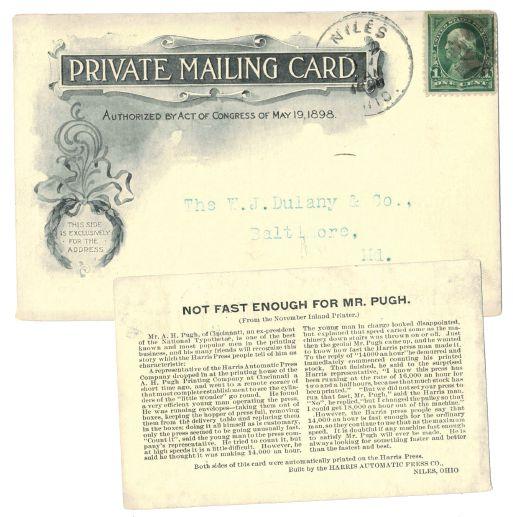
Front/back of a 1898-dated private mail card from Harris Printing Press Co.
to the idea. However, the populace loved it and pushed through legislation allowing single cards at a reduced rate.
“Shine
on You Crazy Diamond” – Printers, that’s you
In 1870, the first mass-produced cards were being printed, many with lithographed images designed to catch the eye. The Austrians beat the Germans by a few weeks, but Stephan and the Germans are credited with the win. Also, in December 1870, the postcard was introduced in London, England, in time for the Christmas season. There were said to be riots on the streets, as Britishers descended on post offices to purchase the new cards. Nearly a million postcards were sold in England during the first week of launch iteself.
Then British Prime Minister William Gladstone was so taken by the postcard rage that he announced he would quit and begin writing an epic book about the postcard. Common sense must have gotten the better of Gladstone, and he never gave up his job. Besides fervently supporting the post-
card, Gladstone is also remembered for this memorable quote, which is valid today too: “We look forward to the time when the power of love will replace the love of power. Then will our world know the blessings of peace.”
The New York Times reported that in May 1873, the first American illustrated postcard was sent by S.S. Bumstead of Springfield, Mass., to fellow town resident M.M. Burt.
Originally penny postcards were only supplied through the post office. They were plain looking, and included a government stamp. The first U.S. printed stamp was the head of the proposed Statue of Liberty. France would donate the statue, but Americans had to pay for the pedestal and Bedloe’s Island where the statue would be situated. A major fund-raising drive was organized for the same, but Americans proved cool to the idea of shelling out cash for what seemed a superfluous idea then. The Statue of Liberty stamp changed all that. Americans across the country instantly became aware of the iconic face of liberty, and money started pouring in for the project almost overnight.
Some people believe the postcard also helped launch the American coffee break. Most businesses kept a kettle of boiling water going most of the day. The steam dampened the foul-tasting glue used to seal envelopes. With hot water seemingly in limitless supply, employees started making cups of coffee and tea. Since penny postcards were half the postage and didn’t require envelopes, the boiling water started to disappear. So, some employees began stepping out to buy the hot beverage, and thus the coffee break was born.
Picture postcards appeared in force by 1880. The Germans, who were quite advanced in the use of stone lithography, became a major supplier of postcards (and greeting cards) for the next 35 years. It wasn’t until the First World War that nations started to invest in printing. The majority of cards then were issued by various governments and included a stamp. In the United States, Congress reduced private cards from two to one cent in 1898, which unleashed the modern age of postcards. With low mailing costs and increased travels, millions of cards were mailed, and an equal number were probably purchased for family albums.
The zenith of first-class postcards in the United States was 1990 when 3,307,076,000 were mailed. That’s a lot of print! In the same year, bulk advertising cards, known as pre-sorted postcards, amounted to an additional 1.5 billion. As is the case in the printing world, the use of traditional postcards has declined over the years. In 2020, only 4.8 million were mailed. However, advertorial cards (pre-sorted postcards) continue to grow. Although facing some headwinds, these bulk cards amounted to two billion mailings in 2020 alone. That’s a lot of mailouts in a relatively
30 per cent of consumers pay more attention to direct mail, says Canada Post 30%
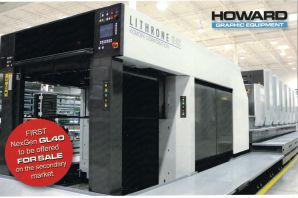
A 2014-front/back card that Howard Graphic Equipment used quite often.
young segment, which was first tracked by USPS in 1977.
Bulk mailing is the darling of a vibrant direct-mail industry that demonstrates the power of a simple piece of 10-point cardboard in getting and retaining business for their customers. Stats by Canada Post further emphasize the power of the postcard. Canada Post claims 30 per cent of consumers pay more attention to direct mail, and this includes the cards we receive from realtors and lawn-care businesses. With the number of letters and paper bills falling by 55 per cent since 2006, direct mail and cards have rushed to fill the void.
2billion advertorial cards were mailed out in 2020
Canada Post recently announced they will print 13.5-million postcards that will include free postage. These cards will be sent to households across Canada in the hopes that residents who are tired of COVID-19 will use them to send a note to a friend or loved one. This is a major expense and sentiments are mixed, but it shows the power of postcards to connect people, even in this day of instant messaging and social media.
The front of a Canadian card from 1944/45.
Recently, we discovered a French postcard mailed by my grandfather when he was stationed in France during World War One. The image is of a square in the town of Douai (France) with the Estaminet De La Petite restaurant in the background. Amazingly, that restaurant is still there and the square looks exactly as it did over 100 years ago. This card is not a piece of ephemera, but a lasting link to our family’s past.
Welcome to the machine
So, is this article just about the history of the postcard? No. It’s much more than that. If anything, the postcard highlights the unique place print has in our everyday lives.While many printers surviving in the world of commercial work cast envious glances at those that are or have
moved into packaging, the power of print, whether a direct-mail flyer or postcard, cannot be surmounted by the Internet and social media. If you need a plumber, a postcard probably won’t help if it arrives at the wrong time; you’ll have to Google a name for sure. However, when it comes to things you never thought about until a card arrives in the mail; well, that’s when the magic happens.
Mailchimp, the e-mail marketing service company, has introduced actual printed postcards for their clients.They refer to printed cards as “e-mail for mailboxes.”The templates allow their clients to use the postal service and take advantage of the power of direct mails. There are plenty of examples where a simple postcard can reach a higher percentage of buyers than the endless ads in social media.Yes, it’s more expensive to produce and mail a postcard, but you must be unique to stand out today’s market. Printed cards have started in to grow again and perhaps it’s because we, as an industry, tired of the doom and gloom, are now starting to realize print has something to offer that no other medium can touch: the ability to draw attention to some service or product we didn’t know we wanted by delivering the message through an exclusive portal: the mailbox.
Still, I’m disappointed in our printing equipment manufacturers for not taking advantage of the postcard more often. On a late Friday afternoon when the boss is usually found sequestered in the office reviewing the week’s activities, he or she spots a mailed card promoting a shiny new press or special offer. Recalling how one of their machines requires major repairs this decision-maker visits a website, and maybe, just maybe, leaves a message for someone to contact them. After a busy week, there was no thought of replacing their machine, but a chance encounter spurred an inquiry that just may turn into a sale. This is just another example of the power of printed postcards.
NICK HOWARD, a partner in Howard Graphic Equipment and Howard Iron Works, is a printing historian, consultant and Certified Appraiser of capital equipment.
nick@howardgraphicequipment.com
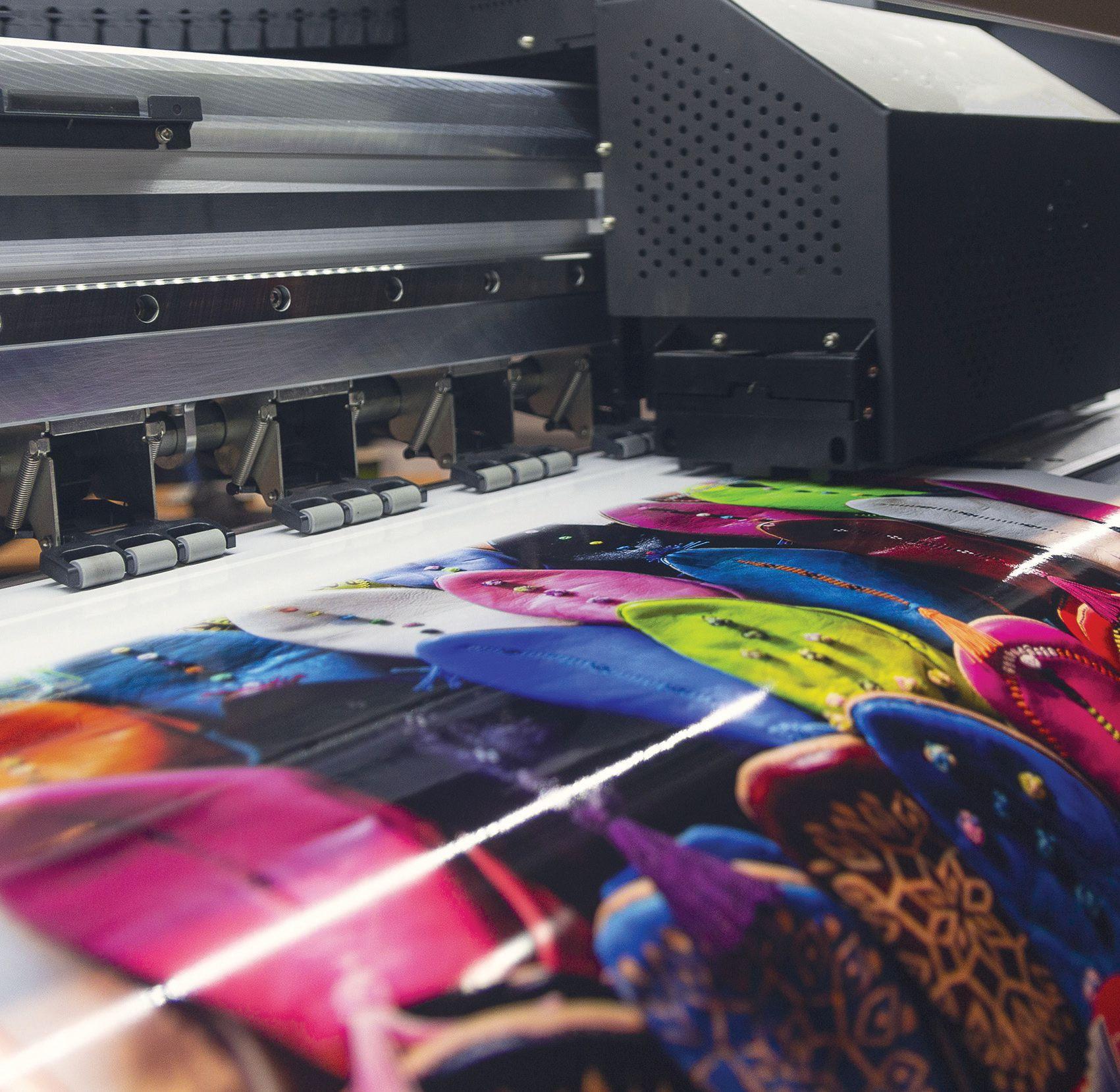
Combining connectivity with digital printing allows CPG companies to customise and personalise packaging.
READY FOR THE DIGITAL WORLD?
Variable
data management
and sustainability are key for digital printing success
By Alvise Cavallari
The world of packaging is facing many changes. The drivers behind these changes include not only new routes to market (e.g. e-commerce) and multichannel supply chains, but also regulatory and sustainability requirements as well as increased demands for customised and personalised products. Innovative technologies and materials are required for—and indeed enable— these changes to occur. Digital printing is one such breakthrough within the packaging world.
It has only taken around 20 years for the centuries-old ‘analogue’ printing industry to reinvent itself
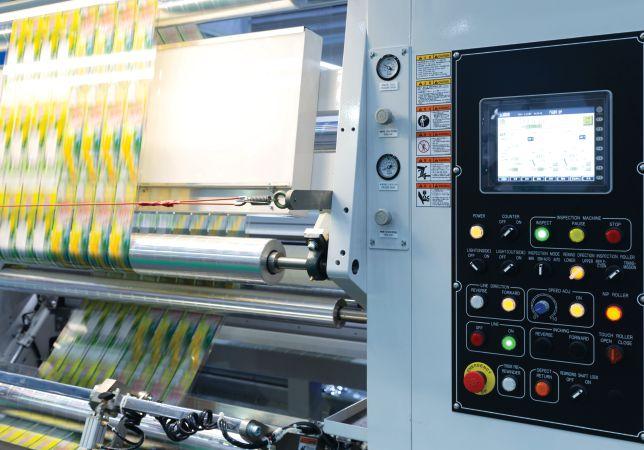
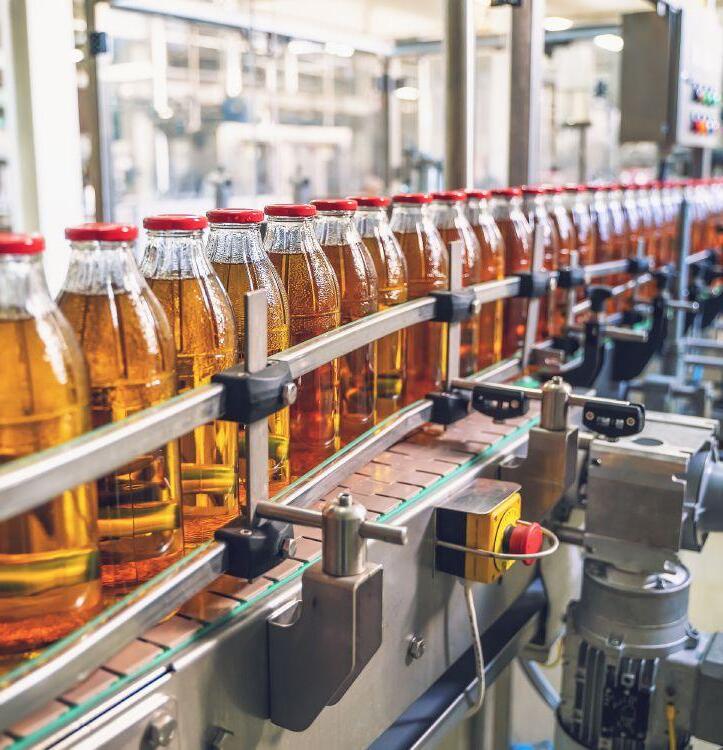
‘digitally’. Digital printing is becoming a reality even in the challenging area of food packaging. The sector was once considered unsuitable for ‘digital’ due to the volume of printing and compliance requirements. Digital printing is here to stay. The digitalisation of printing is a major step toward reshaping the whole converting industry. The main print-press vendors are quite advanced on their digital roadmaps even as new players enter the scene. Though lively, the digital printing industry is fragmented. A phase of business and market consolidation can be expected in the coming years, driven by the need to adapt to new technology needs or uses. We are
also witnessing a strong surge in print-in-production, with history seemingly repeating itself, as ‘printing’ comes back to ‘production’.
As our printing journey advances, technologies mature and prices fall, we will always find new opportunities to leverage the benefits of digital printing. However, we will also be confronted by new regulatory requirements and different kinds of barriers. Currently, two factors are critical for the efficient adoption of digital printing.
Sustainability
The first aspect relates to eco-friendly print production. Nestlé has commited to using only recyclable or reusable packaging by 2025. To help meet this commitment, the company established the Nestlé Institute of Packaging Sciences to explore alternative packaging materials along with suppliers and other external partners. We can already anticipate that these materials, such as paper-based laminates, have lighter barrier properties compared with materials in use today. This presents a challenge to the related printing processes that will constrain their use. Of course, digital printing inks have made huge progress in food-compliance and are still improving. However, on new packaging materials with light er barrier properties, some printing systems (the combination of a printing process, an ink and its finishing process) must be adapted to meet strict food packaging re quirements. Additional goals, such as reusability and recyclability, should also be considered. Are today’s ink formulations, developments and finishing processes ready for this transition?
Data management
Each print output is potentially unique with its own variable data that can be managed flexibly by creating an agile printing process.
a networked supply-chain where multiple players can print different static and variable layers of an artwork in one or several locations. It means moving away from a monolithic approach where the full printing and converting processes are entirely outsourced to a situation where many supply-chain options are available to cover the high variety of products, business models and routes to market (from fully outsourced supply to fully internalised printing and converting, with mixed approaches in-between). This is our definition of variability and flexibility, derived from data-driven print production and late-stage customisation.
The second aspect underlying the promise of digital printing has to do with variability in the printout (output) as well as flexibility in the printing (process). Print jobs are increasingly related to data management, as each output is potentially unique with its own variable data that is managed flexibly within an agile printing process.
Late-stage customisation is the ability to customise the output at the latest stage, which itself refers to moving printed packaging from a conventional rigid supply-chain to
While digital printing inks have made huge progress in complying with food regulations, there are some challenges with printing on new packaging materials with lighter barrier properties.
To achieve all this, the dots need to be connected, meaning the printjob data as well as the printing and converting process must connect seamlessly into an integrated endto-end supply-chain workflow. This integration and connectivity happen in two dimensions, namely horizontally and vertically. Horizontal integration involves the progressive digitalisation of the complete converting machinery and processes, streamlining the repro while ensuring colour matching and consistency. This digitalisation has already occurred for the artwork and prepress; is happening for the printing step; and will progressively include the decorating, cutting and folding-gluing steps as well as other converting steps. Vertical integration relates to the print and converting-data. It ensures the right output is achieved from the correct data in a make-to-order or print-toorder model. Both static as well as variable artwork data must be aggregated dynamically together with production-specific data coming from a production order, which, in the end, can make every pack literally unique, if required.
At first glance, this degree of integration and connectivity to achieve a batch-of-one might sound futuristic, and is definitely ambi-
tious, but the reality is that all the necessary technology-related building-blocks already exist. Digital front-ends rip dynamic artwork for the printer. Manufacturing execution systems dispatch production order information to the various assets of a production line. Dedicated servers ensure additional functionality, such as serialisation or aggregation. For each and every type of data, a dedicated and well-optimised channel exists. Additionally, connectivity standards are maturing and being adopted to ensure both horizontal and vertical communication between all the modules of a production environment. All these channels, which are mainly independent today, can start to be interconnected to combine, as and when needed, the relative data, rip it accordingly, and finally print it to produce unique packaging items. Data is the fuel of today’s economies. The ability to create, collect, handle, combine, extract, analyse, process and convey data will drive the most efficient businesses. Printing is no longer about accurate colour-matching and process-efficiency. It is rather about conveying to buyers and consumers digital information that has been applied physically on the pack. Some call it the blended reality. Nonetheless, it is a paradigm shift enabled by combining digital printing with connectivity. Such a shift is a prerequisite for achieving personalisation and customisation, the “holy grail” of the digital transformation in consumer package goods (CPG). This paradigm shift can help one envision the connected production-floors and factories of the future.
Alvise Cavallari heads Nestlé’s corporate digital printing programme as well as other related activities.
This article was originally published as part of the Drupa Essentials of Print series.
SAFE & SECURE PRESS OPTIONS
New offerings from Canon, HP and Domino
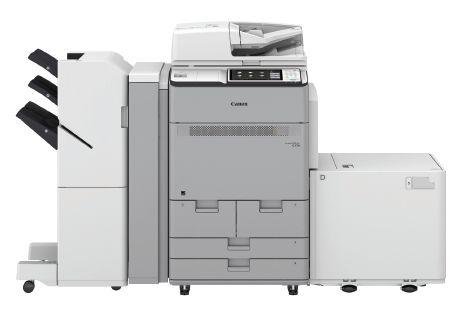
Canon imagePRESS Lite C170
The imagePRESS Lite C170 colour multifunction printer from Canon U.S.A. is designed to help streamline efficiency and sustainability while using security features, as well as enable users to create high-quality output to support an organization’s internal printing needs.
This new light production printer is equipped standard to print on stocks up to 350 mgsm, as well as includes the ability to print on long sheets up to 51.2 inches with optional accessories. It allows users to print up to 70 letter pages per minute (ppm) in colour, and 80 letter ppm in black and white.
The imagePRESS Lite C170 Series offers security features designed to help users safeguard sensitive information, and assist in the user’s regulatory compliance efforts in high-end office and light production environments. Once activated, the McAfee Embedded Control feature helps block the execution of unauthorized applications.
HP Bug Bounty Program
HP has expanded its Bug Bounty program to focus on office-class
Canon U.S.A. introduces new imagePRESS Lite C170 Color Multifunction Printer.
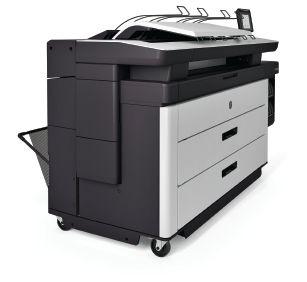
The new PageWide XL solutions from HP addresses security by including HP SecureBoot, Whitelisting and HP Connection Inspector.
print cartridge security vulnerabilities. As part of this program, HP has engaged with Bugcrowd, a cybersecurity company, to conduct a threemonth program in which four professional ethical hackers have been challenged to identify vulnerabilities in the interfaces associated with the HP Original print cartridges.
“Bad actors aiming to exploit printers with sophisticated malware pose an ever-present and growing threat to businesses and individuals alike,” said Shivaun Albright, HP chief technologist for print security. “Security features need to go beyond the hardware and include the cartridge for an end-to-end secure system that protects your network.”
HP PageWide XL
HP has made new additions to the PageWide XL suite of large-format print solutions. Aimed at enterprise and mid-market companies, as well as print reprohouses serving the architecture, engineering and construction industries, the new HP PageWide XL devices are expected to provide fast, simple, and secure print solutions.
The PageWide XL 4200, 4700 and 5200 models boast of a larger front panel—increased from 8 to 15.6 inches. This makes it easier for users to preview real-time scans and undertake complex printing tasks. Additionally, for the first time, users can carry out post-editing tasks, including crop, contrast, brightness, and rotation directly from the panel.
For IT managers and CAD designers at enterprise and mid-market businesses, security is a major priority. The new PageWide XL solutions respond to this with new features to protect businesses
in an increasingly connected world, including HP SecureBoot, Whitelisting and HP Connection Inspector.
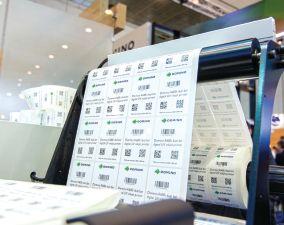
Domino K600i inkjet printer
The Domino high speed K600i digital inkjet printer can print variable data onto labels, each with a unique linear barcode, QR code and data matrix code.
The codes are typically used for logistics and reverse logistics in e-commerce and online retail; ‘trackand-trace’ applications in the food and beverage sectors; and for secur-
ity applications including brand protection in the pharmaceutical and tobacco sectors.
The monochrome UV inkjet printer is available in seven different print width formats, ranging from 108 to 782 mm, in either a standard single print bar or the high-speed dual bar configuration. It can be retrofitted onto most conventional printing presses and finishing lines. The K600i can be used with Domino’s UV-curable, LED-curable and aqueous pigmented ink sets, with a high opacity white ink, a fluorescent ink and a clear varnish also available. The single print bar prints 75 metres per minute at 600 x 600 dpi resolution with optimum print density, but can print at up to 150 metres per minute.The dual bar unit prints at 600 x 600 dpi at up to 200 metres per minute.
The Domino K600i digital inkjet can print variable data onto labels.
Luxury Business Cards
16 pt - Soft Touch Laminated 4/4 CMYK + Raised Spot UV or Raised Foil (Gold or Silver) 4/4
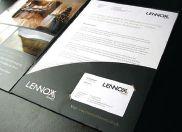
Luxury Presentation Folders - 9x12
16 pt - Matte Laminated 9x12 4/0 CMYK + Raised Spot UV or Raised Foil (Gold or Silver)
Luxury Post Cards
MANAGING SKIN TONES IN PRINT
Why are skin tones commonly considered so difficult to print?
By Laura Rendell-Dean
Reproducing skin tones in printed media is widely considered more “difficult” or less intuitive to calibrate than other types of CMYK colours. Skin tones specifically are considered an important part of the colour management process solely because of how tricky they can be and how easy they are to mess up.
This article, based on my thesis, “The Analysis of Skin Tones and How They are Replicated in Commercial Offset Lithography,” aims to answer this question as well as take a look into the world of skin tone reproduction.
To be able to analyze where the issue lies, it is a good idea to start from the historical pretenses that were originally set to calibrate skin tones, and how the pretenses have had an effect on the more modern ways of colour calibration.
So why could skin tones be difficult to print?
A historical example would be the regular use of Kodak’s Shirley cards and how those had skewed the reference for diverse skin tones. As described in Mandalit Del Barco’s November 13, 2014, podcast on the subject, Shirley cards were reference images used to calibrate the skin tones in printed media, and the
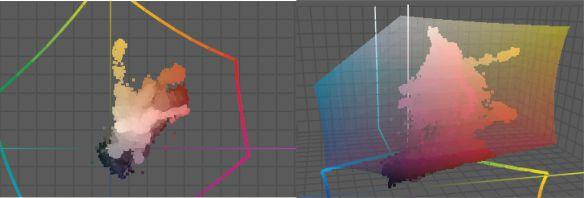
Figure 1: Skin tone colours within the standard gamut for offset lithographic printing.
card was only a photo of a Caucasian woman. This card was used as the only skin tone reference image for many years by photo reproduction lab technicians.
This quickly became a problem because if anyone was not Caucasian and was photographed, there would be no reference for the colour of their skin and they would often be printed incorrectly.
Due to of this lack of diversity in photography and print, the notion of western beauty standards has been perpetuated for decades and we are still trying to overcome the ripple effects of this colourism, as mentioned in Lorna Roth’s 2009 article on Shirley cards, “Looking at Shirley, the Ultimate Norm: Colour Balance, Image Technologies, and Cognitive Equity” from the Canadian Journal of Communication . The impact of this could also lead many to believe that non-Caucasian skin tones are more difficult to reproduce as the colour calibration methods have historically been non-inclusive to them.
Figure 2: Both of these photos have the same 25 per cent green overlay, but the colour is more visible in the image of the people than in the rose photo.
Thankfully, modern colour calibration methods have been more diverse and include a wider range of skin tones so that more than just Caucasian skin tones look good in print. Since this level of diversity is a newer concept, there is not nearly as much knowledge on non-Caucasian skin tones compared to Caucasian skin tones.
Another way to examine this phenomenon would be to look at these more modern, commonly used skin tone calibration methods and try to extrapolate why things could be going wrong. So, to take a look at this, colour data from various IT8 targets and test images were
narrowed down to the skin tones directly and then processed into Chromix ColorThink Pro 3.0.8. They were then compared to the GRACoL 2013 ICC colour profile to set a baseline for what colours are printable on a standard offset lithographic press, and to see if any of these skin tones are out of gamut or act differently in some way. The specific samples used were the Kodak Ektacolor IT8.7/2-1993 target, Fujicolor IT8.7/2-1993 and the Agfacolor IT8.7/2-1993, a GMG test image and a general use ISO 300 test image.
As you can see in Figure 1, it is clear these skin tone colours are
Canadian Manufacturing Demo Days puts the power of Annex Business Media’s manufacturing brands to work to showcase your product videos through a single online source. Promoted through database, online, editorial and social media drivers across 17 manufacturing titles to ensure you receive the leads of decision makers interested in your products.
For More Information contact Kim Barton, Media Sales Manager 416.435.9229
kbarton@annexbusinessmedia.com
LAUNCH JUNE 1, 2021
within the standard gamut for offset lithographic printing, with the exception of a few very dark hues.
Although because of this, we can assume that the vast
have a lower tolerance when skin tones look wrong; the margin of error for those colours have to be smaller than other colours since they can be drastically changed, and easily
Due to of a lack of diversity in photography and print, the notion of western beauty standards has been perpetuated for decades and we are still trying to overcome the ripple effects of this colourism.
CALL FOR ENTRIES
majority of these colours should theoretically be easy to reproduce as they are within gamut. So, then this leads us to a conclusion that there may be an external factor impacting the way we see these colours, and also brings up more questions than answers.
Since it should be easy to reproduce skin tones in a print setting, there must be a reason why they are still so tricky to get right. Ultimately, the theory as to why this is happening is that we, as humans, just simply have a lower tolerance for the way skin tones look when they are printed out.
Figure 2 compares a photo of a group of people to an image of a rose. It is important to note that both of these photos have the same 25 per cent green overlay in order to to simulate a colour printing error. When we observe the image of the flower, we notice the green is not as noticeable as it is in the image of the people. This example gives an insight into how we perceive colour outside of the more technical colour processing programs and methods of calibration. We clearly
too. Skin tones are very neutral colours, so they can easily be overpowered if there is too much of one colour cloaking the image, and when compared to other commonly used imagery in print media, they are always the most consistently neutral and therefore “difficult” to get right.
Ultimately, if there is a slight error in the ink management on a press or if images are processed incorrectly, it is much for skin tones to show any of the user errors compared to other colours and imagery. We are able to notice the change in colour more immediately than when the same errors are applied to other examples. The combination of the historical misrepresentation of skin tones in colour reproduction on top of our natural tolerance for discolouration in these tones have created this perfect storm to make it seem like skin tones are difficult when in reality, they should not be.
Laura Rendell-Dean is a fourth-year student in Ryerson University’s Graphic Communications Management program. She is expected to graduate in spring 2021. She can be reached at laura.rendelldean@ryerson.ca.
Do more with less
The dos and don’ts of operational-level SWOT analysis
By Bob Dale and Howard Conway
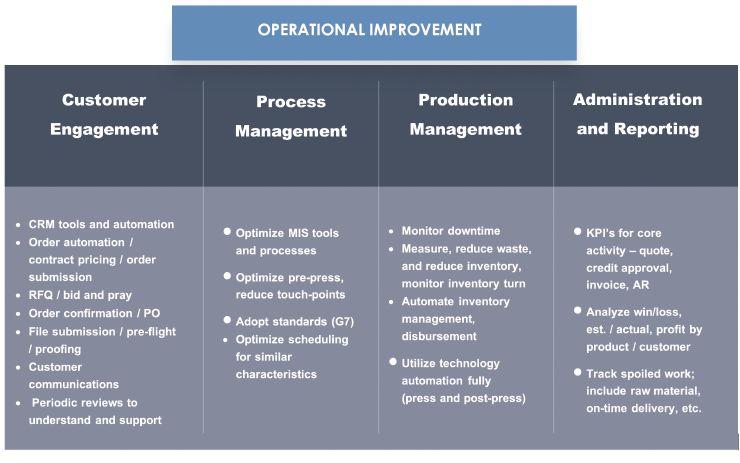
The pandemic has forced all companies to make major changes. A February 2021 study by PRINTING United Alliance indicated that 79 per cent of print service providers have seen a 26 per cent decrease in yearover-year volume in 2020. If your company had a diversified product mix, you may have been able to mitigate the impact, but many organizations had to reduce staff. Even when the volume of business began to increase, as COVID-19 cases declined in fall 2020, many owners were reluctant to re-staff to pre-pandemic levels. As a result, the existing staff are now expected to do more. In these times, operational efficiency is very critical. However, there are many aspects to ‘operational efficiency,’ including digital, production and administrative workflows.
Before investing in a new ERP, e-commerce, MIS or prepress software, please note the utilization of existing software, tools and talent can be improved or enhanced. Therefore, it is advisable to conduct an operational-level SWOT and a preliminary cost-benefit analyses to prioritize the areas for improvement. Often, major changes are set aside
until an outside influence or customer need compels the automation or process improvement. If you are only reactive, you’re likely to miss many business opportunities.
79 per cent of print service providers have seen a 26 per cent decrease in year-over-year volume in 2020, per PRINTING United Alliance 79%
SWOT analysis
Many owners/managers are tempted to assign team members to conduct the review process. The challenge with this approach is that staff are typically busy with client orders and may not have the time required for process improvement.
As reported in the November 2020 column, Richard Kouwenhoven, CEO of Hemlock Printing in B.C., identified that implementing major operational changes requires hands-on involvement and excellent communications company-wide, starting with engagement of the senior leadership team.
ment, implement and monitor change that will result in positive improvements; and
• reward and recognition.
If the internal team members are working diligently to manage the current volume of work, then including additional projects will risk current customer satisfaction, errors, cause burnout or delay achieving success. It may be appropriate to hire outside help and expertise to manage the process.
Hiring experts
Many owners/managers are tempted to assign team members to conduct the review process. The challenge with this approach is that staff are typically busy with client orders and may not have the time required for process improvement.
Change and continuous improvement requires that the people have the right tools to succeed. If this is to be managed by internal resources, then staff need:
• an understanding of company objectives and benefits;
• knowledge of how to evaluate and document workflow using tolls like Kaizen;
• have the authority and time to conduct a full investigation;
• support from colleagues to review progress as well as for guidance purposes;
• training on how to plan, docu-
To undertake more extensive changes, such as implementing digital storefront, digital automation requiring coding or deep technical expertise and outsourcing elements of the business, it would be best to hire subject matter experts. It is important to set realistic expectations. I’ve inherited many change initiatives that were started with unrealistic expectations. We did manage to accomplish the goals, but faced ongoing challenges with helping senior management understand the full scope of the transition.
Good luck with your initiatives, and remember seeking help is better than failing.
Bob Dale and Howard Conway are with Connecting for Results Inc. They can be reached via e-mail at info@connectingforresults.com.
Preview: the 2021 virtual.drupa
Showcasing some of the new technologies that are set to be unveiled at the trade show
Enfocus BoardingPass software
Enfocus will unveil the benefits of BoardingPass, its new software solution that seeks to empowers customer-facing staff to quickly inspect incoming PDF files for showstopping issues in print.
“We will be showcasing Switch, the print automation rebel movement, that delivers an open workflow automation platform, removing the constraints on print professionals who don’t want to adapt to allin-one, vendor-specific, workflow solutions,” said Tomas Van Rossom, general manager of Enfocus.
Esko’s Cloud Freedom strategy
At virtua.drupa 2021, Esko will reveal the results of its collaboration with Asahi Photoproducts. Both the companies have been working on the development of a new automated flexo platemaking solution, and the technology will be unveiled during a webinar on April 21.
“virtual.drupa will provide the perfect forum for us to showcase our next-generation technology developments for the packaging in-
The Enfocus BoardingPass software will help staff to inspect incoming PDF files for showstopping issues in print.
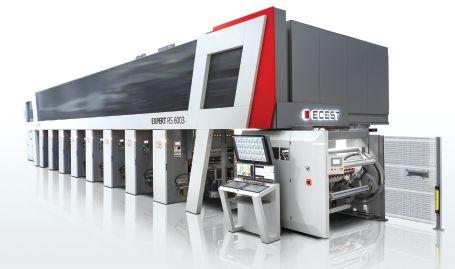
The EXPERT RS 6003 by Bobst is a suitable press for the food and other flexible packaging market segments.
dustry. Through a number of webinars, videos and presentations, we will be sharing our latest software releases and launching our new ‘Cloud Freedom’ strategy,” said Wim Fransen, vice-president of global marketing & software product management at Esko. “Moving from onsite server-based software applications to cloud-hosted service as a subscription (SaaS) software models sees a number of benefits for our packaging, labels and wide-format prepress and converter customers alike. We will be sharing examples of Esko software solutions that now have both models available and providing insight to the advantages of utilizing the Esko cloud.”
Bobst EXPERT RS 6003 Gravure printing presses
The EXPERT RS 6003 is said to integrate flexibility and efficiency into an “innovative design addressing cost-effectively” the always changing requirements of the flexible material printing production. This gravure press handles a wide range of substrates, ink-types and job lengths. The short web path, web-handling capabilities and accurate register control system combined with oneECG printing make the EXPERT RS 6003 a suitable
press for the food and other flexible packaging market segments.
Kurz DM-JETLINER digital embellishment unit
Whether deployed in mass customization, individualization, small runs, special editions or entire product families, the Kurz DM-JETLINER inline enhancement module lets printers refine thier packaging and personalize the job. There’s no need to compromise on flexibility even as one offers real metal effects in digital printing solutions.
DM-JETLINER lets you transfer metallization effects onto paper and label materials during digital printing. The transfer process can be integrated seamlessly inline into your digital printing machine—upstream from the digital colour printing.
Once the metallization is applied with a UV-curing adhesive to the unprinted substrate, the PET carrier is removed, and the substrate can be then overprinted within the printing machine.
DM-JETLINER can transfer the desired metallization onto paper or
The DM-JETLINER allows the personalization of metal effects in digital printing.
Esko plans to launch its Cloud Freedom strategy at virtual.drupa.
a broad range of label materials as part of the printing process.
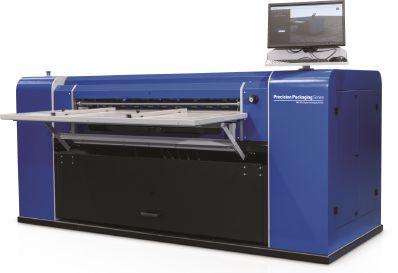
The PKG-675i is an inkjet device that can print short runs and personalised corrugated boards and folding cartons, flat or pre-die cut.
For packaging converters, it also offers a suitable solution to create quick mockups of packaging designs, thereby helping to improve a product’s time to market and reduce waste.
Manufactured by Konica Minolta’s partner MTEX NS, and based on five Memjet CMYK printheads, which enable it to achieve a print width of 1067 mm, the PKG-675i prints graphics on corrugated board at 1,600 x 1,600 dpi.
With minimal prepress interaction, on-demand jobs can be produced at speeds of up to 18 meters per minute. The printer comes with a Caldera RIP and uses water-based inks that are FDA-approved for indirect food contact.
WindmÖller & HÖlscher automation
& assistance systems
In addition to WindmÖller & HÖlscher’s (W&H’s) CI flexo and gravure printing presses, virtual.drupa visitors will be able to learn more about their latest automation and assistance systems. RUBY is their new IoT system.
With RUBY, data can be used to monitor, automate and improve packaging production.
RUBY is offered as a platform with freely combinable extensions, such as RUBY Gain, RUBY Check, RUBY Flow and RUBY Track, in order to provide users with an individually tailored range of workflow functions.
Winkler+Dünnebier sheet-fed inkjet printing system
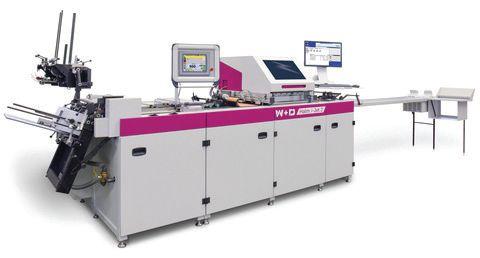
The Winkler+D Ü nnebier (W+D) Halm i-Jet 2 enables “high-quality” digital printing in a resolution of 1600 x 1375 dpi for the purposes of printing envelopes and other types of non-coated paper.
The “high print quality and the quick, easy workflow for job changes” makes it a suitable machine for small and medium runs ranging from a couple to well over 100,000 envelopes.
The envelopes are held in position on a vacuum media belt and transported to the commercial grade high-resolution print engine. This process ensures image registration and the “highest” print quality.
The result is precise, sharp images and type almost to the very edge of the envelope.
With variable data capability every full-colour image can be different, and a job change on the same stock can be made without stopping the press. Further, order data can be stored for future use.
The Halm i-Jet 2 is a 4C inkejt digital press for envelopes. The PKG-675i water-based digital inkjet printer is suitable for short run and personalised corrugated and folding carton packaging.
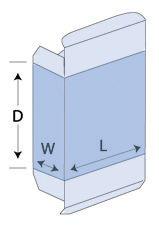
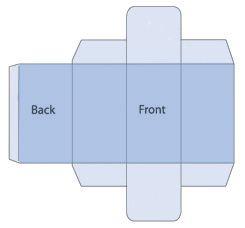
— Die crease without a die, then fold and even glue all on the same machine, up to 30 pt.
3. INTEGRATED MODULAR UNITS — Combined in-line finishing: crease, fold, glue, tipping, envelope inserting, ink jetting (Duplex), clip seal (3 sides), mail prep.
4. SAVE ON POSTAGE COSTS As a Certified Canada Post Direct Marketing Specialist, we get contract pricing reductions.
5. RETURN MAIL PRODUCTS — Customized “Return Mailers” created in-line with “U” or “BOX-shape” remoistenable glue, time perfed applications and envelope formation.
6. MINI-BOOKLETS — Saddle-stitch and trim 2-up booklets in-line to the size of a business card. No need to trim off-line, or do 2 passes.
7. HIGH SPEED EQUIPMENT — High speed Tipping, Folding, Saddle-stitching and soft folding ensuring on time delivery.
The latest innovations from Duplo, Mosaica, Mark Andy and SynDaver
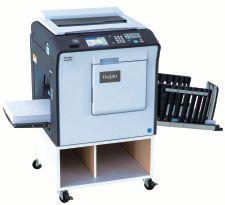
1: The Duplo DocuCutter HC-550i Hydraulic Cutter comes with operational and safety features such as a rail back gauge system, UL certification and 10-inch touchscreen control panel. 2: The Duplo 150 Booklet System can transition from letter-size to CD-size jobs within minutes. 3: The Duplo DP-X850 Digital Duplicator is designed to handle long runs at faster speeds.
Duplo launches booklet system, digital duplicator and hydraulic cutter
Duplo USA Corporation has launched new products to its booklet-maker, duplicator and cutter lineups.
With production speeds of up to 2400 booklets per hour, the 150 Booklet System performs saddle and corner/side stapling up to 25 sheets. The DP-X850 Digital Duplicator print documents at 600 dpi up to 200 sheets per minute. The programmable DocuCutter HC-550i Hydraulic Cutter can cut through stacks of paper up to 21.6 inches wide and finishes postcards, direct mail and perfect bound books up to 3.5 inches in height.
SynDaver launches Axi2 3D printer
SynDaver, a bio-tech firm manufacturing synthetic humans and animals for surgical education and medical device testing, has launched its second
3D printer, the SynDaver Axi2. The Axi2 includes a colour touchscreen, large build volume, high-performance toolhead, direct drive extruder and heated BL Touch automatic 25-point mesh bed leveling system to enable edge-to-edge printing. The magnetic, powder-coated PEI build plate allows prints to be easily removed and a run-out sensor detects when there is no more filament. The system pauses the print so the filament can be replaced.
Mark Andy and Domino partner on new Digital Series iQ press
Mark Andy’s Digital Series iQ press uses a Domino N610i UV inkjet module. The new press can be configured with up to seven UV inkjet colours. Hybrid converting components can be integrated to meet specific requirements. Print stations and semi rotary die cutting are available.
The Digital Series iQ can
The Digital Series iQ inkjet press combines high-resolution digital print with inline converting with the aim to maximize revenue generation.
achieve speeds up to 230 fpm (70 mpm) in rapid production mode. It also integrates software solutions from Esko and Global Graphics including ScreenPro for workflow and digital front-end processes.
Mosaica introduces Panthera JR digital dye sublimation system
The Mosaica Group, a distributor of dye sublimation and wide-format print processes with equipment, consumables and services, has launched the Panthera JR, an industrial 1.9-m printer for dye sublimation. The Pan -
thera JR has four i3200 Epson print heads that achieve speeds of up to 1900 square feet per hour.
Panthera printing systems feature a specially-developed print head controller that provides better precision and print quality, along with an anti-crash system on the carriage in order to protect the print heads from incorrectly hitting the transfer paper.
The machine’s roll-to-roll feeding system helps elimi nate paper waste, and can even print directly on fabric, in certain applications.
REFURBISHED CTP’S FOR SALE
2009 Screen PT R 8300 S, with SAL 2012 Agfa Avalon N8 CTP (64 diods, 22pph) w/ online conveyor More machines available The equipment is refurbished and available for immediate delivery Please contact us at giprint@giprint.ca, or 416 854 3804 George, G&I Printing
Sakurai: 1, 2 or 4 colours and any size (newer model)
Polar: any size/older or newer models (66/72/76/78/82/90/92/107/115)
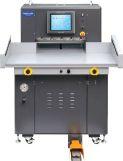
Horizon-BQ: 220/240/260/440/460
Wayne Collins / Program Director, Graphic Communications Technology Management / School of Business + Media
Wayne Collins, program director of the Graphic Communication Technology Management Program (GCTM) at the School of Business + Media (BCIT), Burnaby, B.C., has more than 50 years of industry experience and is well aware of the highs and lows of Canada’s printing industry.
How is BCIT’s GCTM program unique from other print-related programs?
WC: The GCTM at BCIT is unique. This program was instigated by some members of the BCPIA (now known as Print Forward) association who recognized the need for a training program. Secondly, BCIT, unlike other institutions, permitted 15 part-time faculty members to teach the program. Since these managers work full-time in the industry, they bring their vast industry knowledge into the classroom. The instructors also benefitted, as they had access to a pool of highly trained individuals. The program started with almost $3 million in donations from the industry, so as to give students training on the most up-to-date equipment in primarily three areas: Lithographic press production, training in graphics software, and business skills. We then acquired electro-photographic equipment that allowed us to train students in a parallel, short-run colour workflow. The growth of the large-format signage industry helped us establish a training facility as well as another stream of production in inkjet imaging technologies.
Have there been any recent investments in the program?
WC: Our recent donations are letting us expand our curriculum in variable data and colour management. Techkon has donated their most advanced spectrophotometers. Burton Empey, from Echo Interactive Communications Group, conducted a $200K-plus donation for the XMPIE server software to our program. Stephen Morris from Esko Graphics engineered their donation of a Kongsberg cutting table to get our students enthusiastically working with 3D structural designs. John Quinn from Kodak drove the donation
of our Insite server to complement our training in PDF workflows with Kodak’s Prinergy software.
What is the state of the print industry today, in your opinion?
New innovations have usurped well established modes of production to drive greater capacity and profits for business owners who are fast on their feet and are willing to adapt.
WC: The graphic communications industry has been in a state of rapid growth and technological change for most of the last century. New innovations have usurped established modes of production to drive greater capacity and profits for business owners who are fast on their feet and are willing to adapt. There is a rich tradition of innovation and rapid change in this demanding, time-sensitive, ultra- perfectionistic industry.
How can the industry attract more young people?
WC: Young people are always attracted to passion. Industry leaders have to be passionate to lead effectively. At BCIT, we have tried dozens of media campaigns to attract young people to our program. The most effective way has been to facilitate interactions between business owners and young people who are exploring their education
options. Secondary school students are obsessed with computer technologies. They get very excited when we show them how to “make things real” by designing products on the computer, imaging them, and crafting an aesthetic final product.
What do you think is the most exciting thing about print?
WC: I love the concept of personalized packaging. People are tired of mass-produced media messaging. Industry can create accurate profiles of end-users by analyzing their web browsing patterns. This data helps customize consumer products to meet end-user needs while reflecting their unique personalities. This will primarily be done through one-of-a kind packaging.
I also think consumer packaging is on the cusp of creating a system that feeds the earth rather than polluting it. I love the notion of my next cereal box fertilizing the garden.
Collins’ responses were edited for length. For more Q&A Spotlight interviews, please visit www.printaction.com/profile.