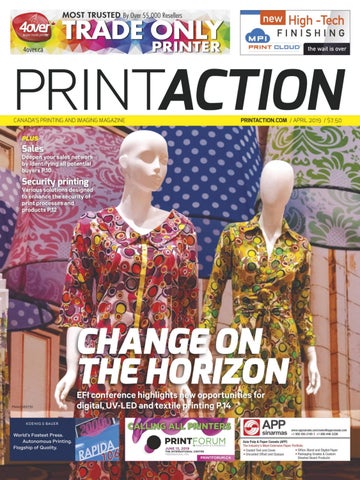
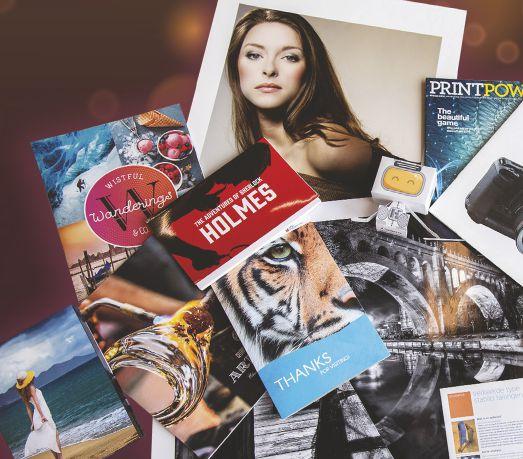
Exploring some of the latest solutions designed to enhance the security of print processes and products
14 Change on the horizon
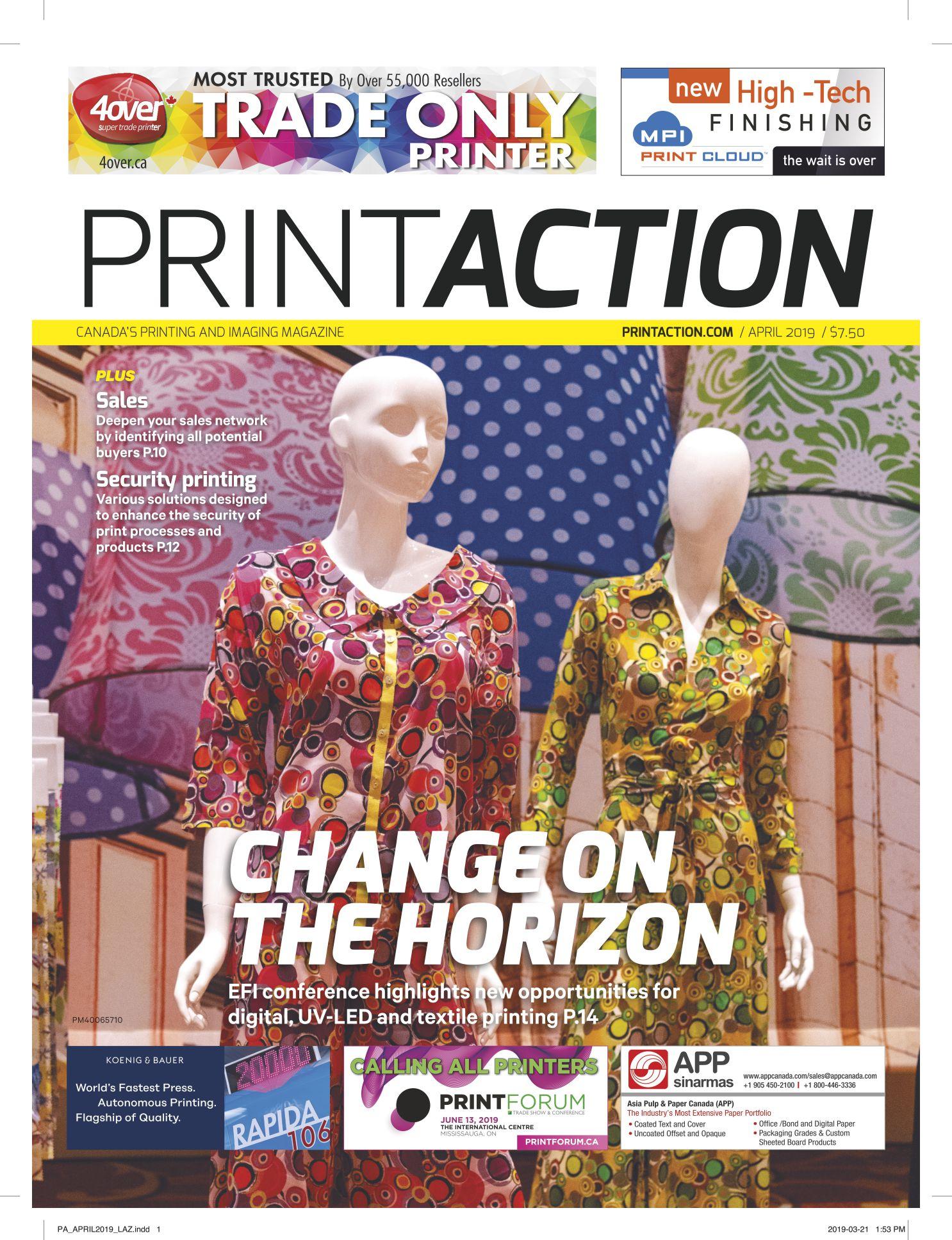
EFI’s 20th annual Connect conference highlights new opportunities for digital, UV-LED and textile printing
DEPARTMENTS
GAMUT
5 News, People, Installs, Calendar
TECHNOLOGY REPORT
20 Colour tools provide printing companies with reliable colour results and pressroom efficiency
NEW PRODUCTS
22 Introducing new products and solutions from Aleyant, Asahi Photoproducts, Datalogics, Fujifilm, Herma US, hubergroup, Kodak, Roland DGA, Rollem and Scodix
SPOTLIGHT
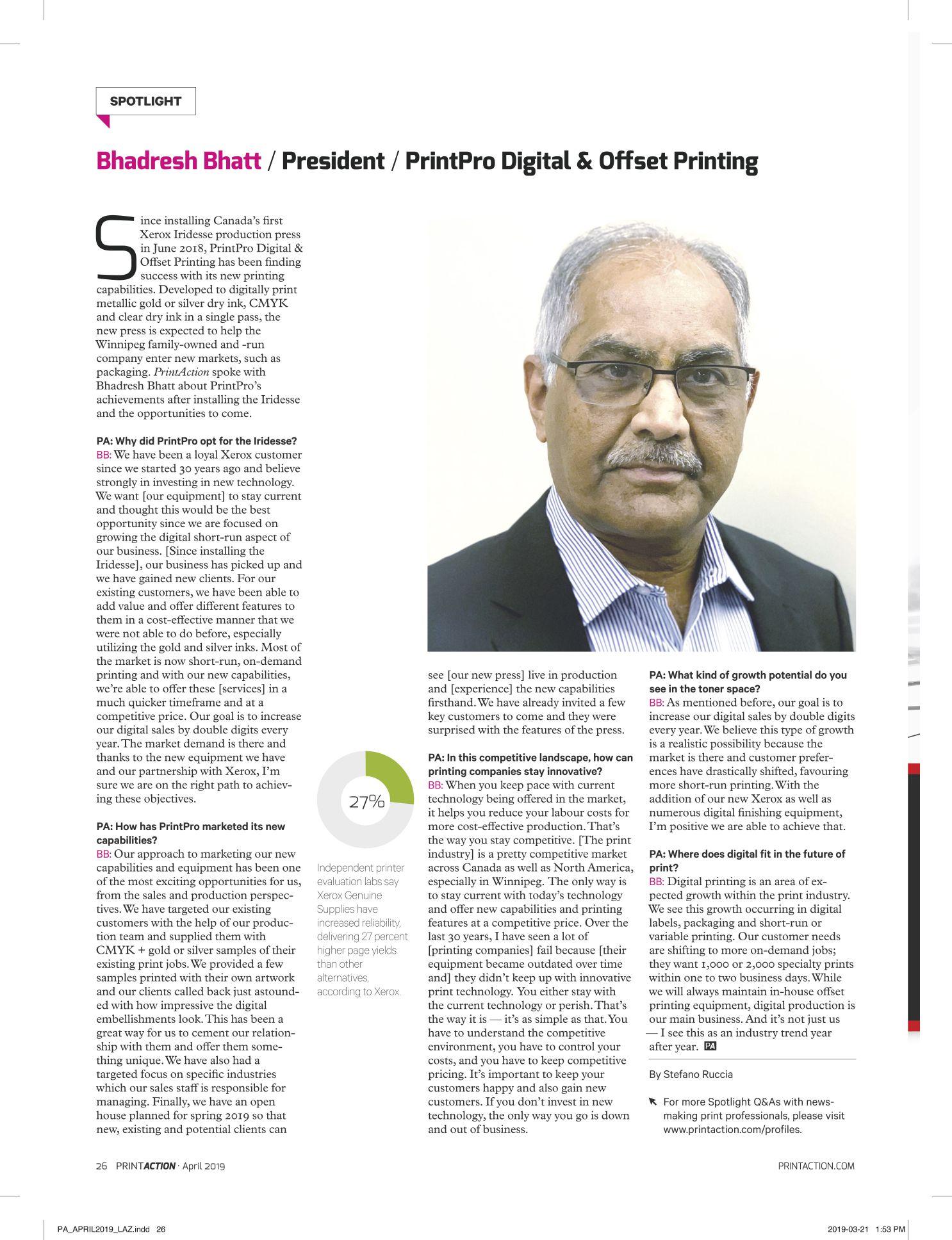
26 Bhadresh Bhatt, President, PrintPro Digital & Offset Printing
COLUMNS
FROM THE EDITOR
4 Alyssa Dalton
Traditionally digital brands pivot to print media
CHRONICLE
8 Nick Howard
Specialty segment growth
Out with the old? Not so fast
SALES
10 Dave Fellman
The importance of titles
Deepen your sales network by identifying all potential buyers
COVER PHOTO AND ABOVE PHOTO BY DANE REYNOLDS
Pivoting to print media
For one day only, BuzzFeed pivoted to print publishing. On March 6, the digital media company – known for its quirky ‘listicles,’ pop culture quizzes and investigative reporting – went retro and handed out 20,000 newspapers at Union Square, Penn Station and Herald Square in New York.
“BuzzFeed, a company that was born on the Internet and social media, is testing a new technology called print and unveiling a one-time, special edition BuzzFeed Newspaper , showcasing the latest news stories and favourite BuzzFeed content in an easy to consume mobile format. Fans all across New York will be able to check out the must-read stories without ever needing Wi-Fi,” it playfully announced.
possible when we are open with each other and curious to explore the world — and ourselves.” Last summer, Facebook quietly introduced Grow , a quarterly print magazine in the U.K., for business leaders and executives. The print product is now being distributed for free in select airport and train business lounges.
A matter of trust, a November 2017 study by media buyer MediaCom and Magnetic, a marketing agency for consumer media, finds magazine brands are more trusted than social media brands: 70 percent of magazine readers trust magazines, but only 30 percent of social media users trust social media. For digital natives under the age of 35, the split is 62 percent and 35 percent, respectively.
Zac Bolan, Wayne Collins, David Fellman, Victoria Gaitskell, Martin Habekost, Nick Howard, Neva Murtha, Abhay Sharma
Associate Publisher Stephen Longmire slongmire@annexbusinessmedia.com 416-510-5246
Media Designer - Team Lead Lisa Zambri lzambri@annexbusinessmedia.com
Account Coordinator Alice Chen achen@annexbusinessmedia.com 416-510-5217
Autopilot research finds 72 percent of consumers would rather connect with a brand or business through multi-channel campaigns.
With content from various sections across the company, the paper’s cover story delves into the whirlwind obsession over the Momo Challenge, a viral hoax that first came to light last July and recently resurfaced in Canada in February. Also featured in the 12-page newspaper are a New York City knowledge page, instructions for cooking cheap and expensive steaks, and a printed gif of Glenn Close at the Oscars, detailing her reaction frame-by-frame to Billy Porter’s red carpet outfit. “Confident @BuzzFeed is the first outlet to print a gif in a newspaper, we are rocket scientists,” Tom Namako, Head of Breaking News at BuzzFeed News, tweeted.
“It’s a print edition of some of the best stuff we’ve done over the last few weeks with a great cover story on a classic Internet phenomenon by Katie Notopoulos, which is that in the course of a week, Momo went from this kind of terrifying Internet figure to a debunked hoax, to the subject of people making fan art and falling in love with her,” BuzzFeed Editor-in-chief Ben Smith explained, as he doled out copies of the one-off paper at Union Square. “It’s kind of an attempt to do the Internet in print, in fact.”
The back page is devoted to advertising, and BuzzFeed says it will track the advertising coupon codes to see how well the newspaper performed.
At a time when brands are cutting back on their print components or shuttering them completely, why are others –particularly those born and bred online – moving into the print realm? In recent years, Airbnb, Dollar Shave Club and Net-a-Porter, among others, have all launched their own print publications. Airbnb and Hearst Magazines in May 2017 launched Airbnb Magazine, which echoes the adventurous spirit of Airbnb and celebrates the “experiences made
“Building brand trust is in large part down to product and service experience; however, media can play a role in delivering trustworthiness, or a perception of trust,” MediaCom and Magnetic say. “There is a ‘brand rub effect,’ trust in a magazine brand translates into perceptions of trustworthiness for brands who use this environment. Across a basket of campaign effectiveness studies and a range of trust-based metrics, we saw an average percentage KPI uplift of between 64 percent and 94 percent per brand.”
The study used three different ways to measure trust: a single direct question, factor analysis to capture the nuances of trust, and implicitly to account for subconscious perceptions.
“There’s been a bit of a wake-up call in the last 18 months in terms of people’s disbelief around fake news and their worries that what they’re being sent and sold and reading is not real,” Magnetic CEO Sue Todd said in a July 2018 interview with The Drum. “People’s response to that is to be a bit more diligent, and that means they’re looking towards the most trusted channels.
“The thinking is: if there are challenges around the trust in our content and our brand, then a magazine, a printed magazine, is a good way for us to change that conversation and build more trust.”
In what often seems like an increasingly digital-centric world, it’s clear that multi-channel campaigns that leverage the innate trust of print with the accessibility of digital will be the most effective way to engage with today’s audiences.
Circulation Manager Barbara Adelt badelt@annexbusinessmedia.com 416-442-5600 ext. 3546
Circulation apotal@annexbusinessmedia.com
Tel: 416-510-5113
Fax: 416-510-6875 or 416-442-2191
Mail: 111 Gordon Baker Rd., Suite 400, Toronto, ON M2H 3R1
Group Publisher Diane Kleer dkleer@annexbusinessmedia.com
President & CEO
Mike Fredericks
Subscription rates
For a 1 year
subscription (10 issues): Canada — $43.00 +Tax Canada 2 year — $70.50 +Tax United States — USD$75.50
Other foreign — USD$147.00
Mailing address
Annex Business Media
111 Gordon Baker Rd., Suite 400, Toronto, ON M2H 3R1 printaction.com
Tel: 416-442-5600
Fax: 416-442-2230
Annex Privacy Officer
Privacy@annexbusinessmedia.com 800-668-2384
PrintAction is
ISSN 1481 9287 Mail Agreement No. 40065710
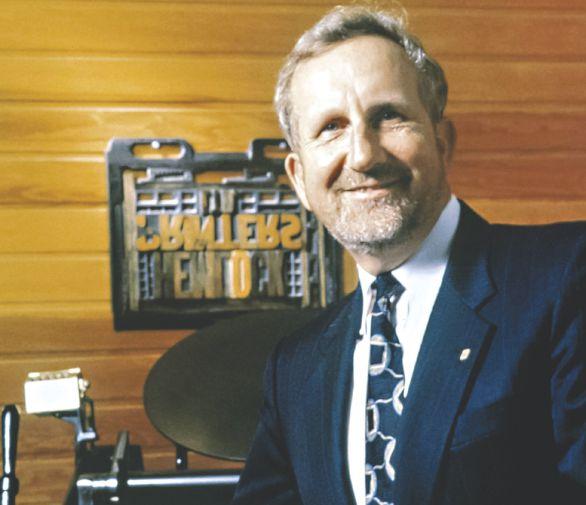
Hemlock Printers, founded in 1968 by Dick Kouwenhoven, recently celebrated its 50th anniversary.
Fastsigns International has partnered with Click2Sell, an online platform designed to simplify, automate and personalize the process for sales professionals performing business-to-business sales. A web-based application for sales teams, Click2Sell’s reply actions and email send algorithms aim to help drive sales by serving as a virtual assistant, it explains. “The initial results for Fastsigns have been some of the best we’ve seen yet,” Amy Barcus, Founding Partner of Click2Sell, says. “Our purpose is to help Fastsigns re-engage with repeat customers and find new customers daily, keeping the brand top-of-mind with thousands of prospects in each market. We’re very excited about this partnership and look forward to all we can accomplish as our relationship continues to evolve.” A global sign, graphics and visual communications franchise, Fastsigns operates 39 Canadian centres throughout Manitoba, Alberta, Ontario, British Columbia, Nova Scotia, Prince Edward Island, and Newfoundland and Labrador.
The Kouwenhoven family in early March announced a gift to Simon Fraser University to honour the legacy of Hemlock Printers founder Dick Kouwenhoven. The donation will establish the Dick Kouwenhoven Book Arts Studio at the SFU
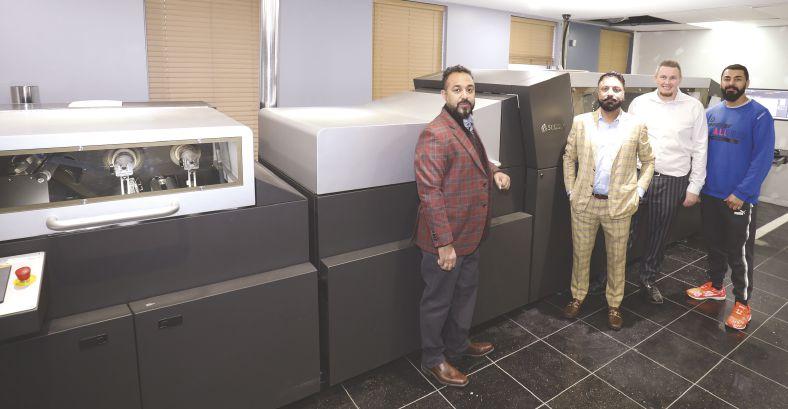
enhancements and services to the newspaper, commercial and packaging market, to become its sales partner in Canada and Western United States. The agreement sees imPRESSions Worldwide assume responsibility for the growing integration of Contiweb’s flagship Thallo hybrid web offset printer, along with the Contiweb CD unwinder and CR rewinders. Targeting the digital and converting market, the systems also provide workflow enhancements for Contiweb’s existing splicer and dryer customers. Designed on a modular inline platform, Thallo is described as being fully compatible with all flexo and rotogravure systems, “providing customers with greater flexibility and seamless integration,” Contiweb says, with offset plates produced in-house.
client relationship management, accounting and JDF integrations. Once released later this year, commercial printers that run on EPMS’s PrintReleaf integration can automate and scale PrintReleaf and provide their customers the opportunity to automatically offset the paper consumption associated with each print job by planting trees – equivalent to the paper used in each print job – at certified reforestation sites around the world.
Burnaby campus’ WAC Bennett Library as well as printer-in-residence program. Slated to open in 2021, the studio is designed to inspire university and community members with the same enthusiasm for books, book-making and print culture that Kouwenhoven was known for. Housing all necessary equipment to print using traditional letterpress, the studio aims to foster multi-disciplinary collaborations with departments such as English, publishing and history, as well as The School for the Contemporary Arts.
imPRESSions Worldwide maintains an inventory of used newspaper and commercial presses and auxiliary equipment.
In late February Contiweb announced it has signed a sales agreement with imPRESSions Worldwide, a supplier of presses,
Quebec commercial printing company Novostyle has reportedly closed. Operating locations in Terrebonne and Salaberry-de-Valleyfield in Quebec, Novostyle (9182-5829 Quebec Inc.) had a range of offset presses, digital presses and wide-format equipment, including Xerox copiers, Roland printers, Canon ImageRunners and a Hans Müller assembler. An online auction conducted by 3C Crescent Commercial Corporation was held on February 28.
SMAG Graphique has started operations in Canada and Colombia in order to provide commercial and technical support services to its customers in the Americas. Managed by Sandro Cardoch, the two newly set-up Commercial & Technical Support Centres aim to deliver faster connections with new prospective customers and easy access to customer service and technical support for existing clients. The satellite office set in Canada is located at the McDougal Centre, in Calgary, Alta. A French company employing a workforce of 60, SMAG manufactures and resells printing and converting equipment for self-adhesive labels and flexible packing in the narrow web industry.
EPMS says it is the first print MIS provider to integrate with PrintReleaf, a print industry sustainability and reforestation standard. Founded in 1989, EPMS provides fully integrated print MIS solutions to printing companies, from simple quoting to sophisticated
Mutoh America is hosting 13 classes across Canada and the U.S. to provide Flexi Sign and Print Training, offering real-world problem-solving answers to print operators using SAI’s Flexi Sign and Print RIP. The training program will allow end-users to test print files, learn to solve tricky RIP software and colour management problems, and preview its wide-format printer lineup. The tour’s sole Canadian training session is scheduled for June 13-14 in Toronto, Ont.
Veritiv Canada Inc., a business-to-business distributor of print, publishing, packaging, facility and logistics solutions, is now the exclusive Canadian distributor of coated sheets from Asia Pulp & Paper (APP). The relationship provides Veritiv exclusive marketing, selling and distribution rights to APP’s ProPrint Folio and Digital lines of coated paper, generally used by commercial printers for catalogues, magazines, high-end advertising materials, annual reports and other marketing applications, across the country. Canadian customers can order Asia Pulp & Paper products from Veritiv beginning April 5.
Jet Marking Systems (JMS) has signed agreements with three labelling equipment manufacturers, where it will provide installation services, operator training and ongoing maintenance. In Canada, JMS has partnered with British Columbia’s Accent Label, and will provide installation and maintenance services for equipment orders within a line of automatic labelling equipment for pouches, bottles, jars, clamshells and cases. Additionally, the Accent Label team will assist JMS in fulfilling equipment orders based on specific customer configuration needs. JMS is a sister company of Jet Label & Packaging, based in Western Canada.
INSTALLS
The Canadian Printing Industries Scholarship Trust Fund (CPISTF) has appointed Ken Freek Executive Director, Outreach and Partner Relations. He brings 35 years of printing industry experience to the role, including senior positions with printing and supplier companies as well as experience with various industry organizations and associations. The mission of the CPISTF is to attract students to the graphic communications industry by providing financial assistance to enrol and continue in a post-secondary management or technical program at an approved institution.
Nobuhiko Kitajima has been named Canon Canada’s new President and CEO. Beginning his career with Canon Inc. in 1981, he has worked for the organization in several regions including Japan, Europe and the United States. Kitajima joined Canon Canada in 2018 as the Executive Vice-President and GM for the Imaging Systems Group and Professional Printing Solutions Group. He succeeds Taizaburo Egawa, who will be leaving Canon Canada and returning to Japan.
Perry Stacks has been named Sales Representative for North America at Rotoflex, a subsidiary of Daetwyler Corp., where he will be responsible for all sales and marketing activities of Rotoflex. He will be focusing on the market for solvent-based liquid inks and over print varnishes for flexible packaging. The company explains Stacks has been working in ink rooms with printers since 2000, and his work experience is based on holding positions at consultant companies, printers/converters and ink manufacturers.
The Board of Directors of Eastman Kodak Company has appointed Jim Continenza the company’s new Executive Chairman, effective immediately. Continenza, who has served as Chairman of Kodak’s Board of Directors since 2013, will continue as Board Chairman while also assuming the responsibilities of Jeffrey J. Clarke, who is stepping down after nearly five years as CEO. In his role as Board Chairman, Continenza led the company’s efforts to improve its capital structure, execute strategic M&A transactions and drive investment in growth engines.
Zund America has hired Scott Spagnolli as North American Sales and Channel Manager responsible for Canada and the United States. Based in Dallas, he will manage the sales team and distribution channels and will work to drive direct and channel sales into the graphics and packaging segments, as well as explore new opportunities in non-graphics industrial segments.
Dave Soden has been named Managing Director of manroland Goss web systems Americas. Greg Blue, previous Managing Director of Durham Operations, will move into a transition support position with manroland Goss web systems Americas.
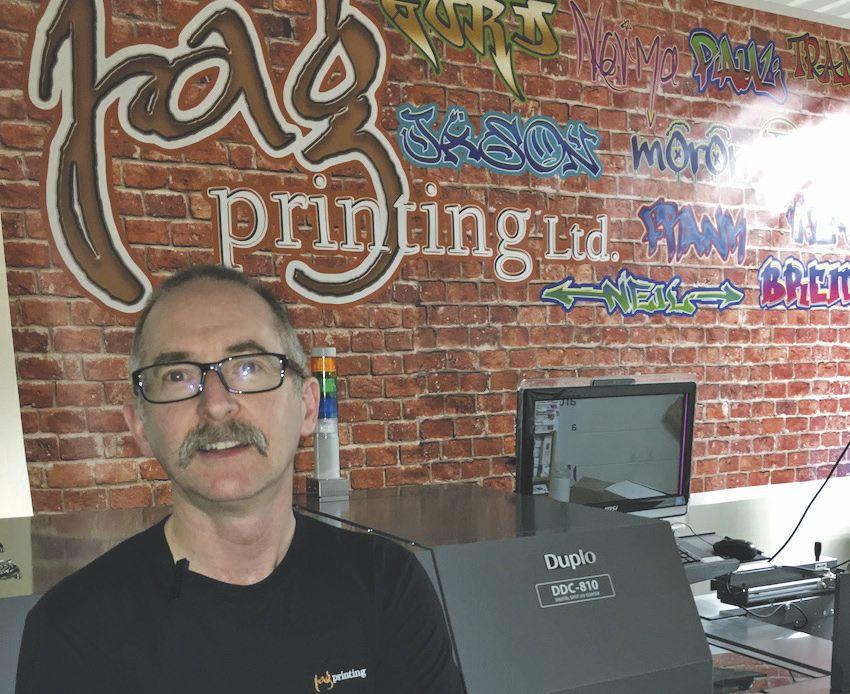
Jag Printing, an Edmonton, Alta., printing company with both offset and digital sheetfed capabilities, has installed the country’s first Duplo DDC-810 Raised Spot UV Coater from Sydney Stone. The Duplo DDC-810 boasts a camera image registration system, a Duplo air suction feeder and quick installation.
Simpson Print of Bloomingdale, Ont., in January installed a swissQprint Nyala 3 roll-toroll six-colour + orange, white and clear wide-format printer. Simpson Print President Carla Johanns explains the swissQprint Nyala 3 doubles the company’s digital output capacity.
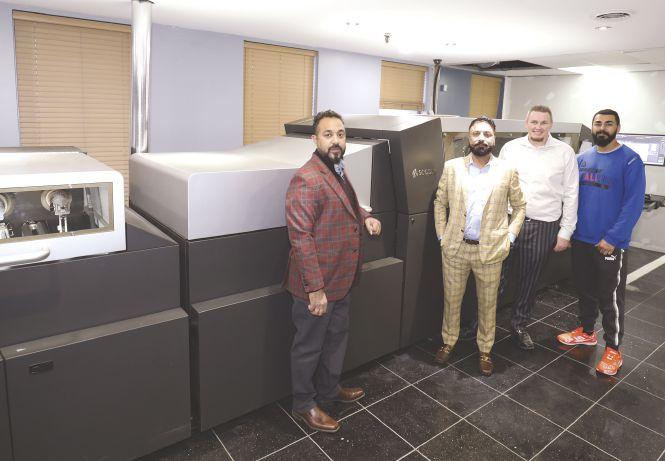
MPI Print has installed Canada’s first Scodix Cast & Cure Ultra 202 digital enhancement press at its Concord, Ont., production facility, enabling the trade-only sheetfed printer to produce spot UV and raised UV finishes, and boosting its spot foiling and cast & cure capabilities.
Don't miss a
Specialty segment growth
Out with the old? Not so fast
By Nick Howard
ecades ago our company represented Brandtjen & Kluge stampers and embossing presses in Canada.
The Kluge platen press, based on patents dating back to 1860, has managed to outlast everyone, including original inventors George Gordon and Chandler & Price. During the 1960s as letterpress quickly disappeared from printing plants, Kluge, who made its name in 1919 with an automatic platen feeder device, refused to go quietly and embarked on a road of re-engineering the iconic Gordon platen and re-emerged in the specialty segment long utilized but starving for a better and easier way of production — hot foil stamping and embossing.
When we took on the agency, Kluge had launched the enhanced 14 x 22-inch EHD platen. This press included a threedraw hot foil attachment and a brilliant dwell feature, which used die-springs to allow the platen to remain closed on impression. Dwell provided more time for the paper to seat into the hot die. By 1967, Heidelberg’s TP platen was also equipped to hot foil stamp. But there was no dwell option and more importantly the design of the press with the gripper needing to pass over the platen, negated the ability to produce very deep impressions compared to the Kluge EHD. As well, Kluge had a larger sheet size and provided more impressional strength.
Kluge’s results are unbelievably beautiful. To showcase the magnificent embossing, Kluge produced many stunning pieces as handouts. Every time we would pull them out to show prospective buyers the reactions were always the same, “wow!” Most of our prospects were not active in the field of hot stamping and embossing; it was one of those dark arts everyone loved but few had the knowledge or skills to integrate into their print shops. Inevitably the conversation would turn to other things, such as the cost of metal dies.
Although magnesium was – and still is – the cheapest form of embossing die, in order to achieve multi-level stunning effects, it required engraving manually into brass. Just as the skilled engraver who creates the silver dollar, brass engravings demand great competence as opposed to
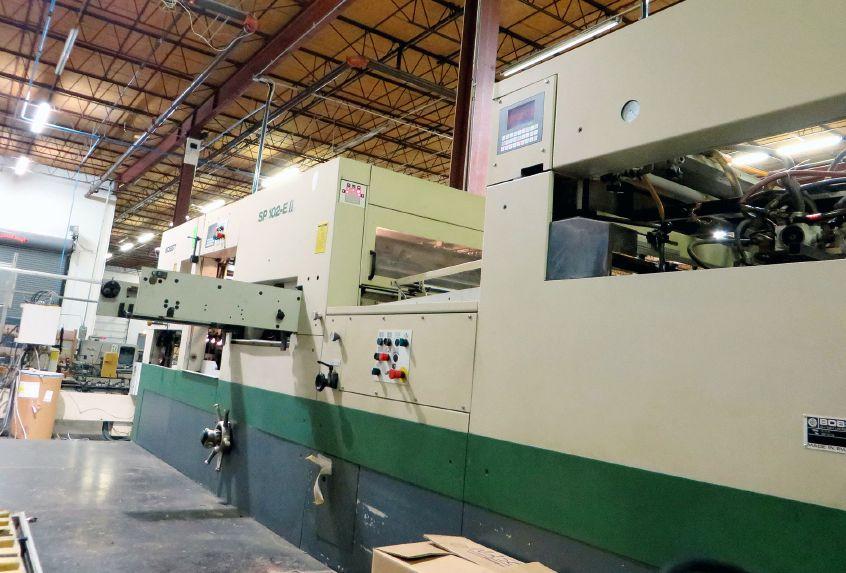
A 1998 Bobst SP-102-E-II automatic die-cutter with stripping.
$30.3M
Transparency Market Research finds the North American specialty printing consumables market saw a revenue of US$30.3 million in 2018.
the single- or two-level magnesium die, which exposed with film, creates the relief with acid etching. Intricate brass dies can also cost thousands of dollars.
That’s where we lost a majority of our prospects — the cost of dies seemed prohibitive. “Who would pay such a fee and how could we make a profit running letterheads and business cards?” we asked. It became crystal clear to me that although prospects swooned over the beauty of the samples, reality soon swooped in to remind them this might be a scanty market and not particularly lucrative. Would their customers pay three or four times the cost of printing or thermographed stationary? Event invitations also seemed like a scarce and unreliable source of revenue. Not to be deterred, Brandtjen & Kluge focused on the specialty shops already familiar with embossing and stamping, and continues to successfully service this specialty field to this day.
In May 2012, a small Israeli company caught the world’s attention with a revolutionary die-cutting and scoring machine. Using a laser, the machine could die-cut the most intricate shapes imaginable. The scoring hurdle was dealt with by using a liquid polymer applied to a sheet of mylar-mounted on a cylinder, then cured rock hard with UV light. No more steel rule dies and no more matrix for scoring. Most importantly, there were virtually no makeready times or waste.
This company, Highcon, has continually improved its platform, which from a distance slightly resembles a Bobst SP76 Autoplaten, and remains poised to reap
the benefits of a radically new technology. That hasn’t happened yet. Yes, Highcon continues to close that gap. Although lasers leave a disagreeable brown burn mark as they slice through the substrate, this minor inconvenience is not the biggest reason everyone hasn’t tossed out their Bobst and Heidelberg Cylinders. Several reasons float to the surface. The biggest, perhaps, is the cost of equipment versus the cold realities of revenue generation. These B1-size digital machines are expensive and slow.
Along with just about everyone else who stopped by Highcon’s drupa stand, I was immediately captivated by this new technology. It seemed like such a total no-brainer that I expected to see them everywhere in a few short years. To further infatuate us, Highcon rolled out a dazzling array of samples, each one more stunning than the last. It’s as if we were in the largest smorgasbord eatery with each dish exceeding the previous. If a printer was looking for new revenue streams –intricate giant snowflakes or an origami-looking box that opens like a flower – this just might release those creative brain cells. But wait a minute — run lengths must certainly be short and a lot of the die-cut creations need to be finished by hand. This feels like history repeating itself; only now it’s not about stamped and embossed art, it’s about good old die-cutting.
Alas, reality starts to re-enter the picture. What if the real revenue is currently for primal things, such as door hangers, folding cartons and the odd tent? What if
this mainstream work has runs in the tens of thousands? How can you make money when all these basic day-to-day die-cutting jobs run well on anything from a $10,000 Heidelberg Cylinder or Autoplaten? Laser technology already exists in the making of steel rule dies, so dies themselves are easy to get and relatively inexpensive. Besides, the Heidelberg Cylinder is one of the fastest set-up die-cutters around and that’s why it has lasted since 1950.
All of these thoughts rush back into forcing out what must surely come to pass — machines, such as the Highcon, will take over the market. But to get there, these laser offerings need to run a whole lot faster. Run lengths may be shrinking but regardless, Highcon’s Euclid III can only pump out 1,500 sheets per hour. Compare this to the basic letterpress Heidelberg Cylinder at 3,000 to 4,000 sheets per hour or a larger Bobst at 6,000 to 9,000 sheets per hour. Now calculate the actual costs of conventional ma -
ed box — an ideal solution for short SKUs if no exotic effects are needed. Chinese supplier Hans-Gronhi is readying to launch the LC1060SF 40-inch and currently sells smaller, less sophisticated lines, such as the LC340S. These are said to run at speeds of 2,500 sheets per hour.
One must also take into consideration that if embossing or foil stamping effects are needed – and most of the time they are – then you must
It’s now been seven years since Highcon shocked the printing industry. I’m confident we won’t have to wait another seven for even faster, lower priced versions to force us to change our ways.
chinery and you might agree that Highcon’s biggest hurdle – besides sticker price – is output. Likewise, the die-cutter is only one element in a production chain and must go through a traditional folder-gluer too — no savings there.
You may surmise that now Highcon does have a faster machine. That’s correct, the recently launched Beam in the 76 x 106-cm size can process up to 5,000 sheets per hour, and both the Beam and Euclid have the ability to strip waste. The old Cylinder presses can’t strip. But this new Beam is considerably more money than a new, faster running Bobst or Iberica.
Although not too crowded, there are competitors to Highcon technology. U.S.-based LasX has been at it for a few years and builds a machine called Cartons in Minutes. This LasX model is an actual shortrun complete line with a digital toner press coupled with the die-cutter which is then connected to a straightline gluer, producing a fully complet-
have another piece of equipment for that. Scodix, another Israeli technology, or Konica Minolta’s MGI JETvarnish are two leaders in this segment. All of a sudden there is a room full of machinery and a growing list of consumables. Autoplatens, such as the Bobst BMA, is capable of hot stamping, embossing and die-cutting, but generally not all three at the same time.
Unless all your business wants to do is amazing keepsake creations in extremely short runs, then today’s largest run folding-carton packaging will stay the course with conventional machinery. Folding-carton plants remain reliant on the Autoplaten. Medium- to long-runs with speeds up to 9,000 sheets per hour are possible. Think food and pharmaceuticals as examples of substantial run lengths. Bobst, Koenig & Bauer-Iberica and Heidelberg/Masterwork control the lion’s share of this segment.
In North America where the buzz is about the burgeoning canna-
bis industry (no pun intended) – a potential US$500-billion market is what many analysts and economists are predicting – there are many opportunities for paper packaging. If this turns out to be true, most packaging could see long runs. Highcon’s Beam at 5,000 sheets per hour is still short of what will entice conventional paper box makers, but not by much.
It’s now been seven years since Highcon shocked the printing industry. I’m confident we won’t have to wait another seven for even faster, lower priced versions to force us to change our ways. Faster and cheaper are the two targets for laser. Truly amazing creations and intricate cut-out patterns are eyeball-drawing and seductive, but will the printing industry sell enough or will they become lost leaders? Just as variable data has been slow to catch on, perhaps short-run variable data boxes will take time to find a market.
Perhaps if dazzling effects capture your imagination, take a look at less sophisticated offerings available. Austrian firm Trotec and Polar Digicut ECO are just two manual laser die-cutters that won’t break the bank and will allow you to enter into what will be the future of die-cutting. Another option is to follow how the industry has dealt with specialty segments for well over 100 years; send your work out to specialty trade shops that can afford the equipment because they run it more.
NICK HOWARD, a partner in Howard Graphic Equipment and Howard Iron Works, is a printing historian, consultant and Certified Appraiser of capital equipment. nick@howardgraphicequipment.com
CALENDAR
April 11-13, 2019
Graphics Canada The International Centre, Mississauga, Ont.
April 24-25, 2019
AICC Canada Trade Show and Conference Toronto, Ont.
May 14-17, 2019 FESPA 2019 Munich, Germany
May 28-30, 2019 Packaging Première Milan, Italy
May 30, 2019 Gala Gutenberg Montreal, Que.
June 13, 2019
PrintForum 2019
The International Centre, Mississauga, Ont.
June 26, 2019
DIA Annual Golf Tournament
St. Andrew’s Valley Golf Club, Aurora, Ont.
October 3-5, 2019 Print 19 Chicago, Ill.
October 23-25, 2019 Printing United 2019 Dallas, Texas
November 7, 2019 Canadian Printing Awards Palais Royale, Toronto, Ont.
November 25-28, 2019 Shanghai World of Packaging Shanghai, China
June 16-26, 2020 drupa 2020 Düsseldorf, Germany
September 15-17, 2020
Labelexpo Americas 2020 Rosemont, Ill.
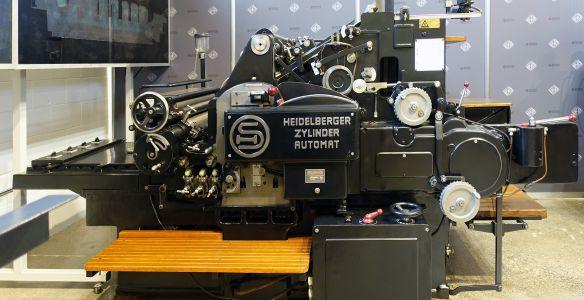
A 1950 Heidelberg OHC cylinder; the original design first launched in 1935.
The importance of titles
Deepen your sales network by identifying all potential buyers
By David M. Fellman
Ihad an interesting exchange of emails recently with a new sales hire at a commercial printing company. “What title should I have on my business card?” he asked. “My boss wants it to be sales representative, but that’s not how I want to be seen. What do you think about print satisfaction specialist?”
“I’m not sure what that means. What exactly are you trying to convey?” I wrote back.
He answered, “I don’t want to be seen as someone who is trying to sell something. I want them to know I’m committed to their satisfaction.”
My response: “What’s wrong with being seen as someone who is trying to sell something? You have to sell the idea that you’re committed to their satisfaction! No one will automatically accept that just because you say it. You have to convince them and that, by my definition, is selling.”
False stigma
It’s true there is a stigma attached to selling, but that mostly relates to the overly-aggressive salesperson who will say or do anything to make a sale. That kind of salesperson is a lot more common in transactional selling situations, such as a commodity product or a one-time sale. The printing sale is much more of a relationship sale, and as I have written before, the strongest relationships are based on trust — it takes a leap of faith to place an order with a printing salesperson and a printing company. We sell a custom-manufactured product, and a lot can go wrong between the order and the delivery.
Here’s the challenge in a nutshell. The first time around, you have to convince them to take that leap of faith. It gets easier after that, as long as everything goes well the first time, and the next time, and the next time. Please understand you will not make it easier by disguising the fact that your job is to be a convincer. I would be completely open about that: “I’m a sales representative, and what that means to me is I have to convince you to give me a chance, then I have to do everything that will lead to your long-term satisfaction. Let me apologize in advance if I push too hard while I’m trying to convince you,
because I think I’m doing it with your best interests in mind.”
The strongest relationships are based on trust — it takes a leap of faith to place an order with a print salesperson and a printing company.
Think about this. If you don’t think your customers are better off because they buy from you – and that your prospects will be better off if they do – you’re in the wrong line of work!
Buyer titles
Ultimately, I don’t think the title of the seller is all that important. I know people who are very successful with titles including junior salesperson, senior sales representative, sales executive, account executive, etc. I could even live with print satisfaction specialist — as long as you accept that you will need to explain exactly what that means.
On the other side of the coin, I think it is very important you know the exact title of every one of your customers and prospects — and I hope you will remember my definition of customer and prospect refers not to companies, but to the individuals within those companies who buy or could be buying from you.
It’s those could-be’s that make this so important. I think you have two main categories of prospects; first are people who buy printing at companies you have never sold to, and second are other people who buy printing at companies you’re already selling to. If you’re getting business from one buyer or even multiple buyers, you still want to get business from all of the buyers, right?
The process of identifying all the buyers can often be reduced to a process of elim-
ination. Let’s say your current customer list includes marketing titles, purchasing titles, human resources titles, business owners and managing directors. If you’re selling to the human resources manager at a company, should you not also be talking to the marketing manager or vice versa? And if you don’t have a passing relationship with the business owner or managing director, should you not try to build one?
In my experience, most printing salespeople don’t work hard enough at account penetration. They work at deepening their relationship with individual buyers — adding a ‘like factor’ to the ‘trust factor’ which still has to be at the heart of the relationship. That ‘like factor’ is important, especially if you need them to give you another chance after an incident strains the trust.
The real winners penetrate their accounts and often use the people they are selling to as their conduit to the others... but that’s a topic for another day!
DAVE FELLMAN is the president of David Fellman & Associates, a graphic arts industry consulting firm based in Raleigh, N.C. He is a popular speaker who has delivered keynotes and seminars at industry events across the United States, Canada, England, Ireland and Australia. He is the author of “Sell More Printing” and “Listen To The Dinosaur.” Visit his website at www.davefellman.com.
CALLING ALL PRINTERS
A MUST-ATTEND CONFERENCE FOR ALL PRINT PROFESSIONALS LOOKING TO BUILD THEIR BUSINESS
WHY YOU SHOULD ATTEND:
• Explore new technology trends and revenue streams
• Participate in engaging panel discussions
• Hear inspiring keynotes from print leaders
• See demos of new technologies and solutions
• Engage in valuable networking opportunities
Silver sponsor Founding sponsor
SOUPED-UP SECURITY
Exploring the secret world of security printing and some of today’s latest solutions designed to enhance the security of print processes and products
By Victoria Gaitskell
Security printers get paid more for their products than other commercial printers — a minimum increase of 10 percent but maybe as high as 15 or 20 percent more, according to U.S.-based security printing consultant Richard D. Warner. “Usually it takes a big financial investment and a lot of time – at least a good couple of years – and a lot of trial and error for a commercial printer to get up to speed with security printing. They rely heavily on outside technology suppliers, who will help them, but it is still a big jump for the printer. They’ve got to be committed to do it.”
Warner holds several U.S. patents for security printing technologies. He works with printing organizations, suppliers,
printers, and end-users to develop other patents, implement new technologies, and execute anti-counterfeiting projects. From 1977 to 2002 he was Vice President and Director of Research for the Graphic Arts Technical Foundation (GATF) and Printing Industries of America. With Ryerson University Associate Professor Richard Adams, he co-authored a book, Introduction to security printing, now in its second edition, which defines basic security printing technologies, identifies new markets and security end products, and explains risk management issues and operating protocols. It also discusses the special materials needed for security printing, such as inks, substrates and security devices, as well as the prepress, press and bindery/finishing issues unique to security printing.
In the 1980s and 1990s Warner’s career
“Security printing is a conversion process that starts with a commercial product that is correct both aesthetically and informationally.”
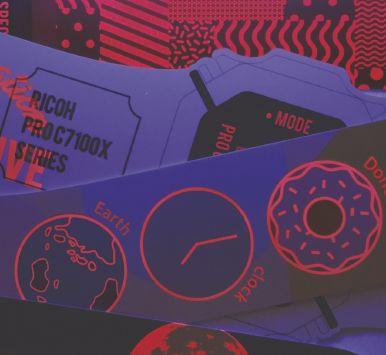
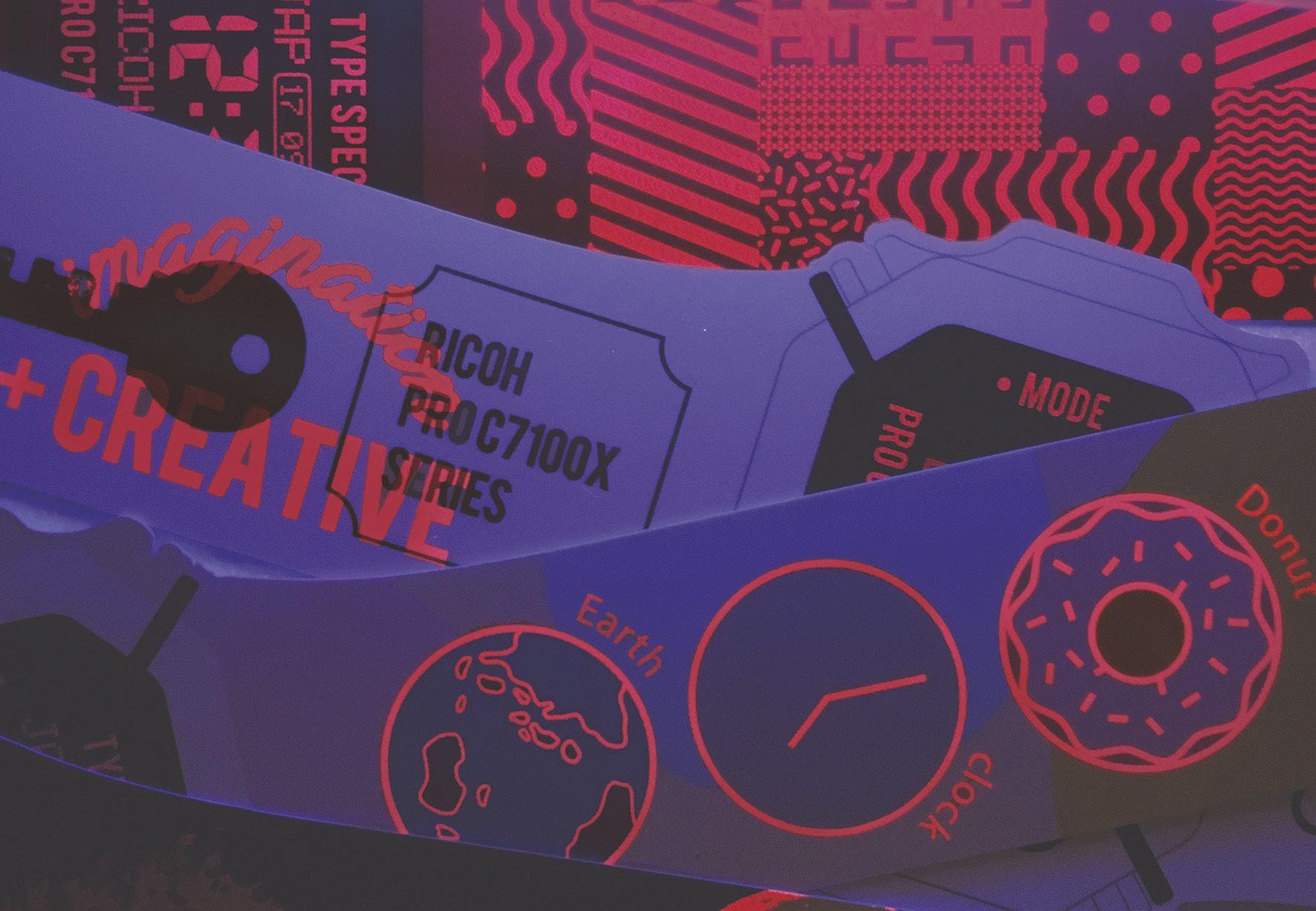
Left and above: Images showcase the effect of Ricoh invisible red toner through a graphic project by Hirokazu Tsunakawa, Art Director and Designer at SOLO New Communication Studio in Toyko, Japan.
took a dramatic turn when the CIA recruited him to help investigate international counterfeiting operations that produced fake U.S. currency. Other federal cases he worked on involved counterfeit casino chips and gaming plaques for highstakes players — items whose secret and complicated construction nowadays often includes RFID chips or ultraviolet (UV) security prints using inks that are visible only under UV or infrared-emitting light.
A conversion process
“Security printing is a conversion process that starts with a commercial product that is correct both aesthetically and informationally,” Warner continues. These products may take a wide variety of forms and can include currency, cheques, credit cards, identity documents, postage stamps, licences, transit passes, and packaging and labels. Because these products are liable to be counterfeited, security printers must incorporate extra security features into them.
become increasingly common, especially in the food and pharmaceutical industries. Also on the rise are computer chips that replace holograms on plastic polymer credit cards and ID cards.
“Most recently,” Warner says, “integrated computer chips are being used for authentication which are almost thin enough to be embedded into paper substrates. Last but not least is photonics, a process which is still being worked on at university research labs using finely ground-up materials such as ferric oxide [rust], opals, and gems that change colours when acted upon by electromagnetic radiation. If reduced to practice, photonics could bring about a major change in how we protect packages, labels, documents and cards.”
Secrecy requirement
Security printers also have to segregate part of their facility and storage area to be totally secure from break-ins and only admit people working on security products inside. “All sorts of security checks are required on these personnel,” Warner says. “It’s like two different companies operating in the same building. The reason is the first thing a lot of criminals want to do is get a job with a security printer to get trained on the latest programs and equipment. They may also try to sneak in and secretly use the security printer’s equipment and materials.”
For many reasons, security printers tend to be secretive about most details regarding their design process, security features, equipment, substrates and inks. Even some informational gatherings for security printers have restricted access. For example, Intergraf’s SecurityPrinters Banknotes + Identity conference requires all registrants to submit detailed documentation as well as product samples and only admits those who have been vetted by a committee of experts.
Security-focused solutions
Established in 1897, Canadian Bank Note is a security printer best known for supplying the Bank of Canada’s banknotes since 1935.
“The tricky part is they have to do it without affecting the aesthetics or information on the product, and generally the security features have to be added simultaneously with the commercial print run, especially with digital printing. That requirement makes it much more difficult. Usually it is accomplished with a lot of programming to integrate the required security features into the printing process so they work seamlessly,” he explains.
Warner says newer security features include 2D barcodes that carry significantly greater information storage than conventional supermarket one-dimensional barcodes. He explains the matrices of two types of 2D barcodes in particular – HD barcodes and QR codes – can be designed to deter counterfeiting and knockoffs. He predicts that expensive DNA signatures, now available from various suppliers, will
Ricoh Canada is a technology supplier that strives to help print service providers build security features into their processes; its clients include four out of five major Canadian banks. Ricoh Intelligent Print Data Stream (IPDS) boasts a secure bidirectional data communication system between the printer and the server that sends the data to be printed. Meanwhile, Magnetic Ink Character Recognition Printing (MICR) is a financial-industry standard method for the secure printing of cheques or bonds, including a dedicated font and toner with iron microfilaments. Some of Ricoh’s optional technology can be used to convert a desktop printer into a MICR printer. Clive Buckley, Product Manager, Production & Graphics Products, explains Ricoh’s recent uptick in sales of this product indicates that government and insurance companies still consider cheques to be a secure method of payment.
Another option is invisible red toner, introduced last July, available for Ricoh fifth colour presses C7210X and C7210SX. The specialized toner is invisible under regular circumstances, but under UV light, shows as a distinguishable red – adding security features to a range of applications such as event tickets and gamified signage. A new security ink from Leibinger was introduced last December to help protect against product packaging piracy. For use with the Leibinger JET3up PI inkjet printer, the ink at first glance looks like a classic black ink but under a UV light, tiny fluorescent pigments begin to glow greenish. If it remains black, it’s a fake, Leibinger explains.
On the software side, last February Agfa Graphics released Fortuna 11 high-security design software, designed to help safeguard counterfeit-sensitive documents. The modular release allows users to choose from different features to match their needs. In creating unique designs to protect sensitive documents, users can rely on a potent graphical base editor that reconciles aesthetics with security, Agfa says. Fortuna 11 also includes Live Preview so users can view changes in their security designs in real time.
Meanwhile in August, Agfa introduced the fourth version of Arziro Design, a dedicated ecosystem for the security printing market. The Adobe Illustrator plug-in update includes a guilloche generator and, for validated security printers and government entities, rainbow colouring capabilities to protect against forgeries and counterfeiting. The generator enables users to create guilloches that can be combined with other tools to create complex security design in Illustrator.
Rainbow or iris printing is a rainbow colouring process used in security printing to help prevent colour-accurate reproduction of documents by photocopiers and scanners. It is designed to protect security documents against colour separation or copying by subtly merging colours into each other, resulting in a gradual colour change. Agfa says the new rainbow functionality in Arziro Design allows security designers to view the rainbow inks while creating the document, as well as create inkjet proofs with the rainbow print visible to help generate the correct output for print.
In a move to further safeguard data and devices in the workplace, Xerox in July 2018 introduced Xerox Workplace Solutions. For companies operating fleets of printers and multifunction devices, the solutions provide two security offerings: Content Security, to protect intellectual property by monitoring all content that is printed, copied or scanned; and Mobile Phone Unlock, which allows a mobile phone to unlock and authenticate Xerox AltaLink and VersaLink devices, eliminating the need for card readers and their proximity cards.
CHANGE ON THE HORIZON
EFI’s 20th annual Connect conference highlights new opportunities for digital, UV-LED and textile printing
By Martin Habekost
The year 2019 has just gotten underway, signalling it is time to go to Las Vegas and attend EFI Connect. This year was the 20th a EFI Worldwide Users’ Conference kicked off with the keynote by newly announced CEO Bill Muir, succeeding Guy Gecht. He re minded the audience of the fact that EFI started 30 years ago when Google was just one year old. Change is happening rapidly and is not slowing down, he said — au contraire, it is likely to accelerate.
Muir stated that, “Technology changes exponentially” but “business changes logarithmically,” as he stressed that ness does not always keep up with the changing pace of technology, but success ful companies must continue to help their
others. According to Popolo, the future of live events is strong, with today’s demographic wanting to go to live events and experience the interaction with that event. He gave a few words of advice and wisdom to the audience: “The more solutions you can provide to your customers, the better off you are,” “Be customer obsessed,” and “Expanding into new product lines is hard.” Focused on developing and delivering memorable brand experiences for its clients, the US$3-billion firm produces 10 million square feet of print a year with its 17 VUTEk wide-format fabric printing machines.
The following morning Marc Olin, CFO, and Gaby Matsliach, Senior VP and General Manager of Productivity Software, both of EFI, spoke about the product releases that debuted last year and the innovations in the pipeline to be introduced this upcoming year.
gated board. It offers a high gloss effect on uncoated and mottled white papers. As well, the press offers three new print modes: Photo mode, which using six-colour printing, can match up to 97 percent of Pantone colours; POP mode, for less colour-critical jobs where ink saving is an important criterion; and Eco mode, which works with a restricted colour range and low ink consumption for uncoated paper and simple graphics.
Also from the Fiery division comes the Fiery proServer Premium DFE for superwide-format inkjet production, which uses GPU-accelerated Fast Drive technology to process jobs, allowing users to control multiple devices from one workstation. During his part of the presentation, Olin announced IQ Cloud services – an offering designed to agglomerate the information (number of jobs, usage, etc.) of various EFI devices within a given company – set to be rolled out later this year. A key feature of IQ Cloud is its ability to calculate predictive maintenance, which alerts users that a specific part is expected to break down soon so a maintenance appointment can be scheduled.
The second half of the presentation was covered by Matsliach, who gave an overview of what EFI has done in the past year to draw new customers and its recent developments in its product portfolio. He explained that EFI remains focused on helping customers be successful by investing in customer success teams and processes, noting that the increased number of boutique customers in all segments will have an impact on cost of sales, management overhead and planning. As a result, business owners have to ask themselves: Diversify or specialize?
2023
EFI launched machines for the wide-format market that uses UV-LED curing technology, such as the Pro 32r, a 3.2-metre roll-to-roll printer with a builtin Fiery digital front end (DFE), which debuted at SGIA 2018. Another system using UV-LED curing is the h5 for flatbed printing, which features a 7-picolitre droplet size and 1200 dpi resolution.
For the soft signage market, EFI introduced the VUTEk FabriVU 340i with 2400 dpi resolution. The dye-sublimation printer includes a built-in calender and heat press and allows users to direct print to fabric and sublimate inline for one-offs that are immediately ready for finishing and shipping.
For the corrugated packaging market, the Nozomi C18000 is the machine recommended by EFI. The company says clients on four continents of the world have bought a Nozomi and it is now beginning to receive its first repeat orders. Since the last Connect conference, the Nozomi has been upgraded with three print modes, white ink capabilities, a new top feeder and a new coater. The white ink is an interesting feature, as it enables the printing of better looking graphics on brown corru-
In July 2015, EFI entered the digital textile printing segment by acquiring Italybased Reggiani, and has since continued to deliver a stream of innovations over the last 48 months. For example, the Reggiani Terra pigment ink technology is designed to eliminate any steaming and washing in the printing of fabrics through the use of a unique inline polymerization process, resulting in less water and energy being used, EFI explains. Meanwhile last November, EFI debuted the next-generation, single-pass Reggiani Bolt textile digital printer, with throughput speeds of up to 295 feet per minute at 600 x 600 dpi resolution.
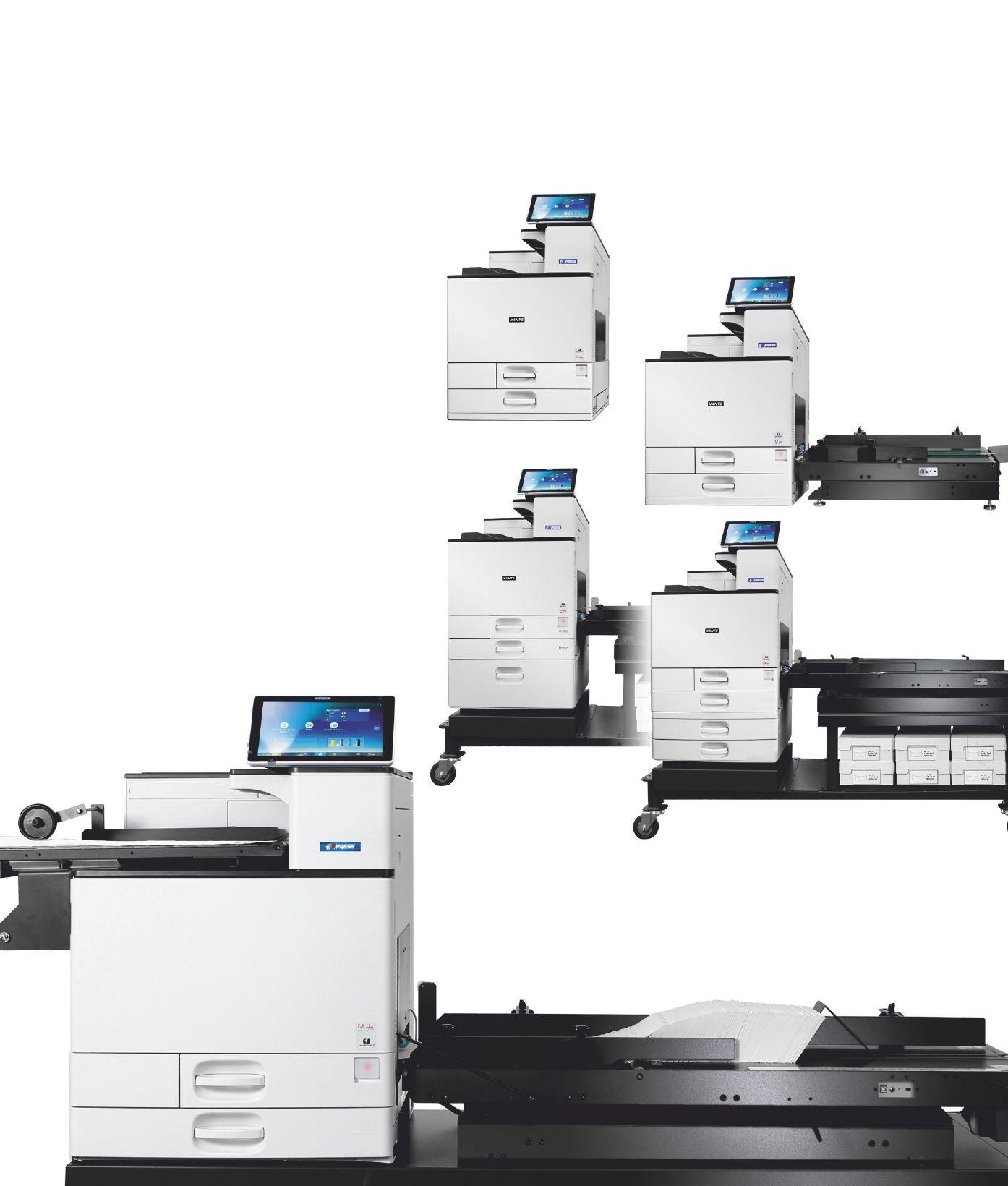
At the user conference, the company unveiled its new Fiery FS350 Pro DFE, developed to drive cutsheet and continuous feed digital production presses from EFI’s OEM customers, including its own single-pass presses, such as the Nozomi and Bolt. The FS350 Pro DFE software, EFI explains, can handle extended-gamut colour configurations and includes tools to reduce ink and toner usage. It offers a ‘Smart White’ feature for laying down a layer of white ink on corrugated materials. Instead of solid white being printed underneath an image, the image is analyzed and white is printed only in areas that require white, translating to ink savings when printing on corrugated materials. As well, the FS350 Pro can be connected to the Duplo DDC-810 Raised Spot UV Coater, the Duplo DC-646/746 slitter/cutter/ creaser and the Duplo UD-300 rotary die-cutter, allowing the printing company to control all aspects of a digital print job from beginning to end.
The industry is undergoing a lot of change and change is hard work. In order to implement change, a business needs to have a clear vision and strategy for the changes that are needed. Customers and their businesses must to be empowered during this period of implementation, otherwise it will become more difficult to carry out these evolutions.
At Connect 2019 EFI announced its newest version of MarketDirect integrated customer engagement and revenue enablement platform, offering new social media, 3D visualization and inventory management capabilities. Boasting significant enhancements over the previous release, the MarketDirect software also includes the addition of EFI Digital StoreFront web-to-print software, now rebranded as MarketDirect StoreFront. EFI has introduced many solutions to create a true end-to-end workflow for its various products, like enterprise/commercial publications, packaging suite, midmarket print suite and its corrugated packaging suite.
The next day I attended the media track, which included six sessions. In the first session, José Luis Ramón, EFI VP/General Manager of Industrial Printing, gave an overview of the company’s industrial printing sector, which covers decorative building materials such as ceramics, wood and laminates, vinyl, linoleum and rubber, residential and commercial carpets. Ramón noted that today’s digital opportunities include not only the wide-format rigid, roll and hybrid solutions, but also printing on ceramics and building products. An interesting fact I learned is that 52
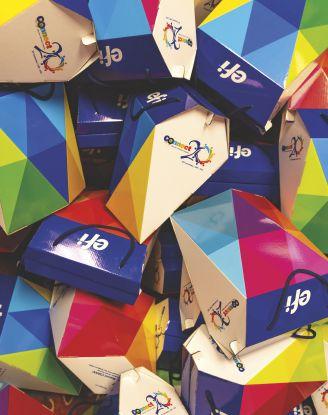
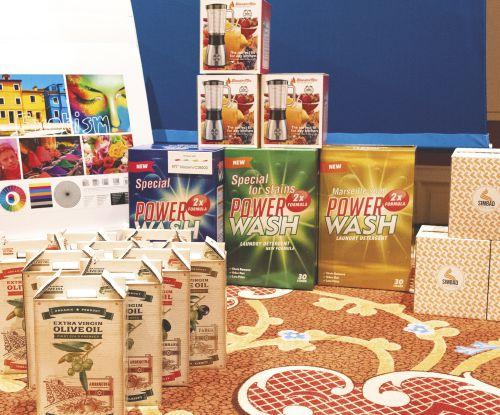
Above: A display of colourful paper boxes. Top right: Corrugated products printed with the EFI Nozomi C18000.
A new Smithers Pira report finds the global digital textile printing market will reach €4.90 billion (C$7.41 billion) by 2023.
percent of ceramics are now printed digitally. EFI offers the Cretaprint inkjet printers for this market, describing them as the most advanced digital ceramic tile decorating systems. The company recently developed its 5th generation printer platform, featuring a new EFI e•D5 printhead designed to deliver better alignment and higher throughput speeds. It also announced the upcoming release of two additional 5th generation printers, C5 and D5.
steaming, washing and stentering, and are currently available in CMYK plus blue and red. A key takeaway from this session is that market trends are driving the digital transformation of textile printing.
The following session was hosted by Nick Benkovich, EFI VP Portfolio Product Management, and covered the updates to the productivity suites – an extension of the presentation by Matsliach. He explained that version 7 of the productivity suites is all about enhancing and optimizing workflows and the connection to the Cloud. Suite 7 is suitable for wide-format, superwide-format, marketing, crossmedia, signage, textiles, packaging and commercial printing.
After this session John Henze, VP Sales & Marketing for Fiery, gave a recap of what happened with Fiery in 2018 and provided an outlook for 2019. Numerous Fiery-branded DFEs were launched, including a DFE for the Bolt. New tools for fashion and textile designers were launched with Fiery DesignPro 4.0. New Fiery DFEs were also launched for the Ricoh Pro 7200 and 9200, the Nozomi C18000, the Xerox Iridesse, and the VUTEk h3/h5 and FabriVU. He explained the division wants to have a unified Fiery-driven print room where Command Workstation can be used to control all machines with a Fiery DFE.
A steadily growing market, soft signage can be up to 50 percent cheaper to ship than printing on vinyl, because the signage weighs less and can often be installed by a single person. EFI has partnered with 3M for roadway safety signage printing, with 3M delivering the reflective foil material for the signs. Another signage specialty market is the printing of signs that get thermoformed. For this, high elongation inks are needed.
The media track presentations showed the market diversity that EFI is catering to and how EFI strives to ensure its customers get the best possible product/combination of products for their individual needs.
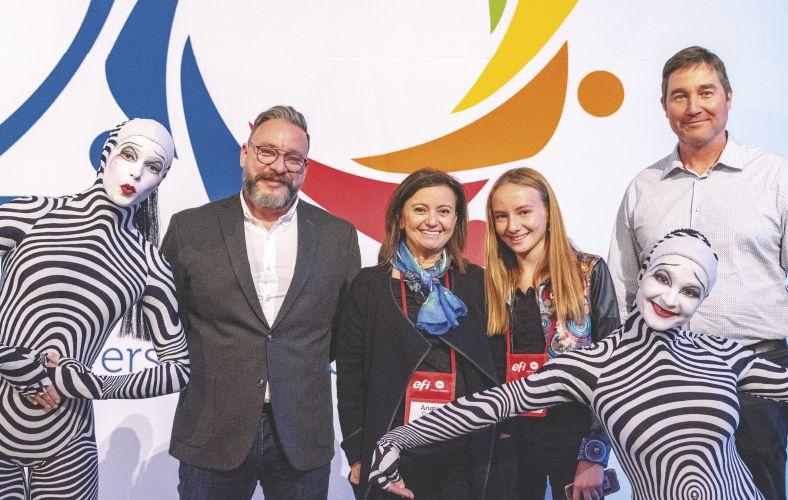
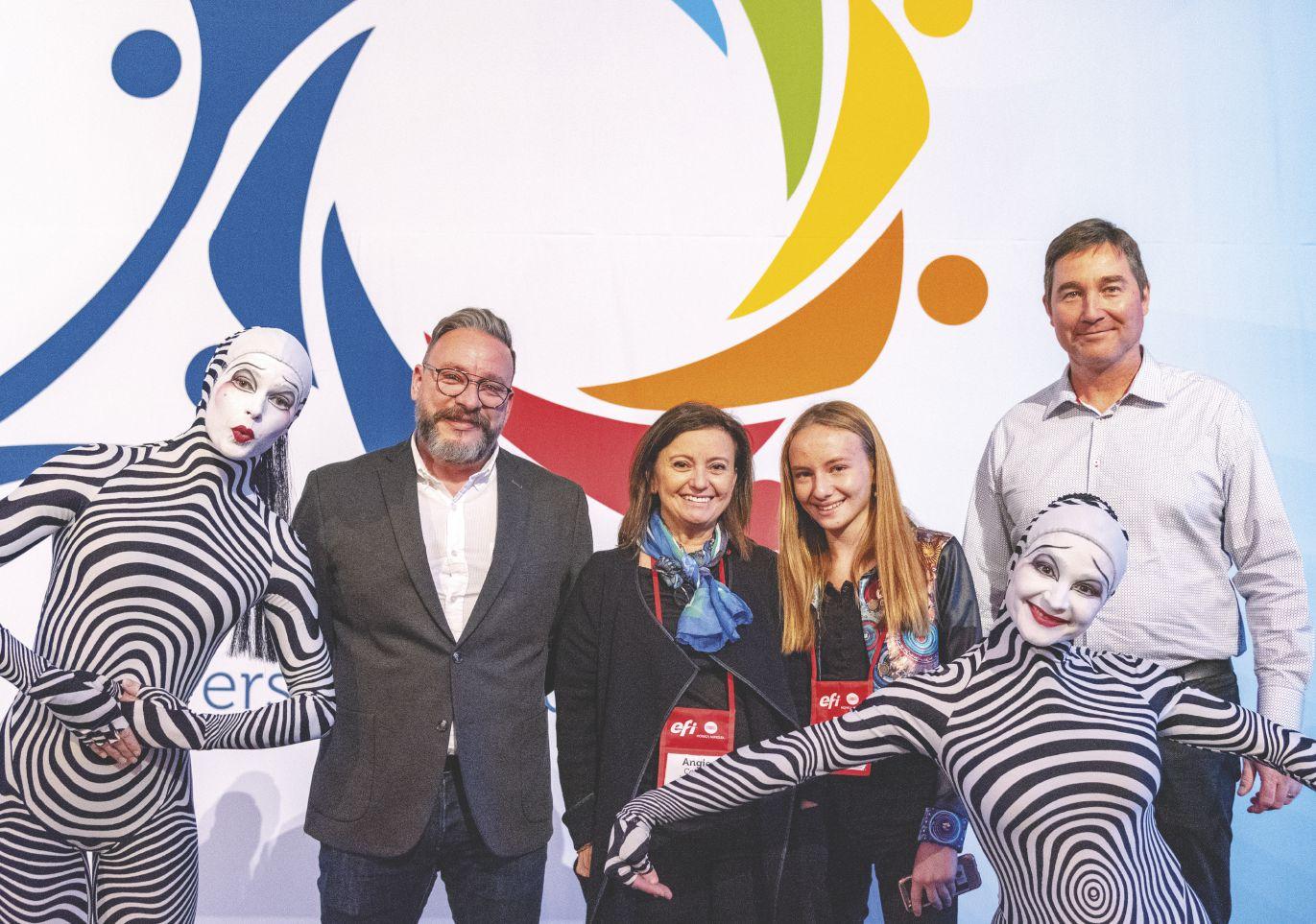
One highlight of the event for me was the keynote presentation by Olivier Gariépy and Michel Savoie from Cirque du Soleil. Both gentlemen took the audience behind the scenes on how the costumes and accessories used in the shows are manufactured. Everyday 4,500 costumes are worn by 1,300 artists at different performance shows around the world. Cirque du Soleil has seven shows alone in Las Vegas.
Clothing accounted for 75 percent of the
The next session was held by Adele Genoni, Vice President and General Manager of EFI Reggiani, who said she believes the future of textiles is digital. Digital textile printing allows us to personalize whatever we want to buy, and online tools that enable customize ordering are today’s tools for being creative, she said. Fast fashion, sportswear and footwear can all be customized with the help of digital printers from Reggiani, she noted. Even though some will balk at the mention of sustainability and fast fashion in the same sentence, it was explained to me that printing textile patterns digitally is less energy- and resource-intensive than creating these textile patterns the traditional way.
In total there are 900-plus digital textile printers from Reggiani around the world and 2600-plus analogue ones. In the last 24 months, Reggiani has been very innovative, with the launch of the VUTEk FabriVU 520 with iris dye sub ink in the first quarter of 2017 to the launch of the Bolt in the fourth quarter of 2018, described as the first digital fabric printing machine that can print on different fabrics at 90 sqm/min. The Reggiani Terra inks, EFI explains, eliminate the process steps of
On the design and e-commerce side of a digital textile print workflow is the Fiery DesignPro print suite, the Optitex visual garment development and the Digital StoreFront. These three solutions connect to the Fiery proServer, which in turn controls the Reggiani textile printers. The new Fiery DesignPro 4.0, Benkovich said, can print direct to the Fiery DFE and works together with Adobe Photoshop tools. In 2019 Fiery plans to invest in a new platform, hardware and applications, expanded gamut printing, high-speed inkjet printing, automation and integration with third-party vendors.
Personally I wasn’t aware of the EFI communities for 24/7 on-demand learning. The communities, found at https://communities.efi.com/s/, allow EFI users to share ideas and discuss products with a global community of experts.
The next session was held by Ken Hanulec, EFI VP Marketing Inkjet Solutions, who spoke about the display graphics side of the business. Display graphics is a US$3.4-billion-dollar a year hardware and ink industry. Future opportunities for display graphics lie in alternative curing technologies, new ink formulations, automation and new printheads. Printheads for EFI machines come from Toshiba, Seiko, Kyocera, Ricoh and Xaar. EFI’s wide-format portfolio continues to grow and the new machines use cool cure UVLED technology. According to Hanulec, EFI’s line-up for roll-to-roll printers is quickly approaching 200 installations worldwide.
Many fabrics are printed silk screen, but digital printing is making more and more inroads into the production of costumes. Every circus artist gets 3D scanned, so the costumes are made to fit them exactly. The costume patterning is done using EFI’s Optitex software.
Cirque du Soleil also uses 3D printers to manufacture props for the artists. During the presentation, Gariépy and Savoie gave an example of a crown that is part of a costume. The 3D printed crown is made based on the 3D scans of the performer’s head. As a result the crown sits a lot better than the previous version made through conventional methods. Two Las Vegas circus artists even joined Gariépy and Savoie on stage and remained for photo opportunities.
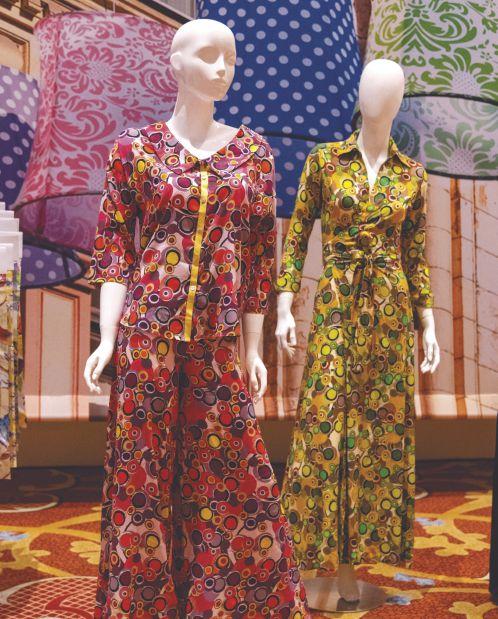
A dynamic fashion show rounded out Connect 2019, as 15-year-old fashion designer Ariel Swedroe from Florida took the stage to present her digitally-printed fashion line. Beginning her career at just seven years of age, Swedroe was inspired by the collages from her grandfather, well-known Miami architect Robert Swedroe, and uses the colourful patterns to create high-end beachwear and resortwear, as well as a new men’s line. The printing of the patterns onto the fabrics is realized using EFI technology. During the conference, Swedroe was even offered an internship in the costume shop at Cirque du Soleil — a fantastic opportunity for the rising designer.
Overall Connect 2019 was a very interesting event to attend. I am sure that users of various EFI solutions would gain a lot of useful information from the different tracks tailored to the specific EFI product they are using. The next instalment of EFI Connect is scheduled for January 21 – 24, 2020, in Las Vegas, Nev.
Exhibit hall mannequins model clothing digitally printed using EFI Reggiani textile inkjet solutions.
global digital textile printing output by end use segment in 2018, according to Smithers Pira.
Colour management
Colour management tools provide printers with reliable colour results and pressroom efficiency
CGS-ORIS adds Barbieri colour management devices
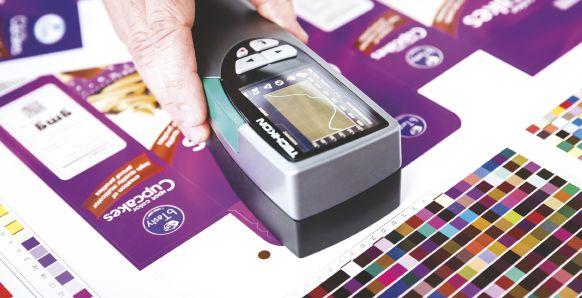
In January CGS-ORIS said it will begin selling Barbieri North America colour management measuring devices, including the Spectro LFP qb spectrophotometer, to complement its colour management software solutions. Barbieri explains the fully automatic Spectro LFP qb measures reflection and transmission media using different measurement apertures. According to ORIS, users of Barbieri measurement technology can expect a wider range of spectrophotometry choices, process control for consistent colour reproduction and flexibility in colour management, and a wide variety of substrate measurement capabilities.
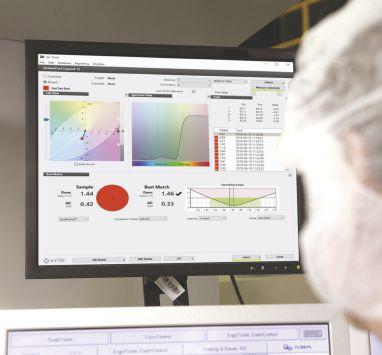
X-Rite ColorCert QA
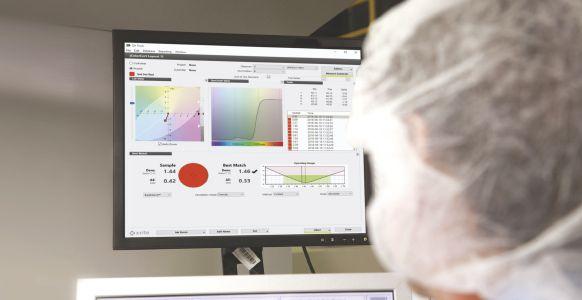
X-Rite Incorporated and Pantone LLC in September 2018 announced the launch of ColorCert QA, a pressroom quality assurance software designed to help personnel manage standards more efficiently, optimize jobs on press and facilitate strong ink room integration. Boasting improved quality control, X-Rite says commercial and packaging printers can reduce the time and complexity associated with managing colour standards and minimize waste, ultimately reducing
reprints and rejections, while increasing the number of jobs they are able to run per shift. The ColorCert QA quality control software is part of the ColorCert Suite, a modular set of tools developed to streamline colour communications and provide actionable data for colour adjustments. The ColorCert QA module supports a non-job-based workflow, the company explains, saying this will help achieve overall colour accuracy and consistency, especially when used in conjunction with an X-Rite eXact handheld spectrophotometer.
Agfa Graphics says InkTune is designed to reduce ink consumption by up to 30 percent while maintaining or even increasing print quality.
Agfa InkTune/PressTune
Agfa Graphics in June 2018 introduced InkTune and PressTune, calling them tools that will enable
X-Rite describes ColorCert QA as a quality control application that aims to optimize press efficiency for non-job-based workflows.
“ultimate control” over printing resources and standards, while optimizing performance and lowering total cost-of-ownership. Part of the ECO3 offering, Agfa explains the offerings will allow users to control all printing elements, from ink use to compliance with ISO, G7 and client-specific standards through real-time data insights, independent of printing technology and press manufacturer. Building on grey component replacement technology, InkTune substitutes CMY inks with black ink. Integrating into the prepress workflow, InkTune uses Agfa technology, such as Dynamic Ink Limit Control and Dynamic Device Link Generation, to reduce ink consumption by up to 30 percent while maintaining colour fidelity, the company says, resulting in reduced drying time. Furthermore, quality levels increase as rosette structures disappear and colour deviations become less visible, Agfa notes. The PressTune print standardization tool is designed to drive consistency, productivity and the ability to print to exacting standards, Agfa explains. Through intelligent analytics capabilities applied to print and colour data obtained from the press, PressTune reports in real time across printing technologies to each stakeholder. As a result, the solution enables issue identification and promotes press maintenance scheduling for brand owners in packaging and commercial print. Agfa says print houses can expect to see a reduction of up to 40 percent as a result of PressTune’s ink density adjustment.
GMG OpenColor 2.2
GMG last fall released version 2.2, extending the functionality of its GMG OpenColor profiling solution which incorporates automatic, spectral data-based optimization of measurement data. The colour management company explains the
user measures test charts or colour patches in order to obtain data needed for characterization. This data is subsequently combined with other parameters from the printing process to create a dynamic profile. Previously, users were reliant on third-party software to optimize the measurement data or had to subsequently correct profiles themselves in a manual process, GMG notes, saying with version 2.2, users can create a “colour-accurate profile in a few steps.” Another new feature is CxF/X-4 support according to ISO 17972-4, meaning that now, spectral values along with dot gain steps can be communicated to other parties involved in a print production.
Onyx 18.5 software with APPE 5.1 now shipping
Onyx Graphics has announced the global availability of Onyx 18.5 software, the latest release of the company’s wide- and grand-format RIP software. Onyx 18.5 software builds upon the Onyx 18 version as what it says is the first wide-format RIP solution with Adobe PDF Print Engine 5.1 (APPE 5.1). Onyx says with APPE 5.1, users can expect complete design-to-print workflows including high impact colour rendering, smoother edges for graphics, enhanced Unicode support, plus support for PDF 2.0 features such as black-point compensation, half-tone origin, special data for spot colours, and page-level output intent. The new software version also introduces new Quick Set application library management boasting improved automation, enhanced iccMAX compatibility with support for third-party files and new spot colour tools for colour accuracy and vibrancy.
Techkon ChromaQA 4.0
Techkon describes the ChromaQA version 4.0 as an advanced print colour quality solution that monitors the colour quality of jobs on
GMG explains version 2.2 of the GMG OpenColor profiling solution incorporates automatic, spectral data-based optimization of measurement data.
Detailing new solutions from Aleyant, Asahi Photoproducts, Datalogics, Fujifilm, Herma US, hubergroup, Kodak, Roland DGA, Rollem and Scodix
Kodak Prosper Plus Imprinting Solutions
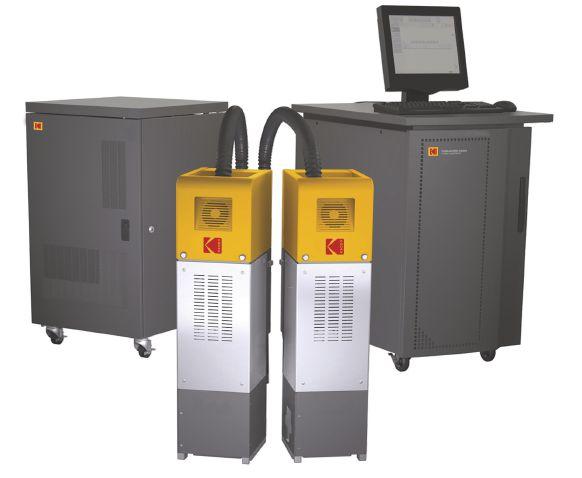
Kodak in February announced the Prosper Plus Imprinting Solution, the newest Kodak Stream Inkjet Technology component product line designed for packaging and product decoration applications. Based on Prosper S-Series Imprinting Systems, the Prosper Plus Imprinting Solution includes four new imprinting components as well as food safe packaging inks and pre-coatings for folding cartons, food wraps, paper cups and plates, and ream wraps. The new models, Kodak says, will expand the capabilities for printers to leverage continuous inkjet as a complimentary capability to the Kodak Prosper 6000S Simplex Press and the Uteco Sapphire EVO (flexible substrates) web-fed solution. The four hardware products will include two narrow formats and two wider for-
mat models that print at speeds of up to 850 fpm or 2,000 fpm maximum. There are two narrow-format machines for applications up to 4.13 inches wide for printing barcodes, QR codes, promotional content or small-format designs in either monochrome or four-colour output, and two wider machines that can print up to 8.26 inches in width. The wider format machines are suited for corrugated, folding-carton and label packaging applications that require full page printing or layouts.The components can be mounted inline with offset, flexo or gravure presses from Uteco and other equipment providers, and can be implemented in finishing lines such as folding/gluing systems, providing the flexibility for digital to be incorporated throughout various existing printing operations, it says. The new components are expected to be available this month.
Kodak introduces the latest iteration of its Prosper imprinting system, Prosper Plus.
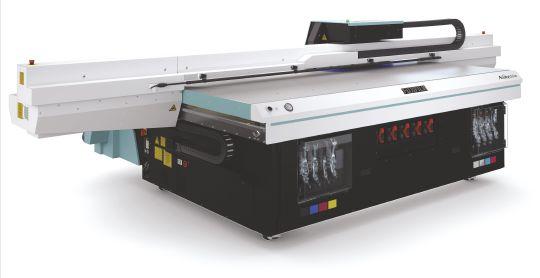
The Acuity LED 40 series is available with four, six or eight colour channels.
Fujifilm Acuity LED 40 series flatbed printers
The Acuity LED 40 series with instant-on LED curing is the newest addition to Fujifilm North America Corporation, Graphic Systems Division’s Acuity platform. Designed to be a cost-effective printer for growing print service providers as well as existing customers considering an upgrade, the series of mid-volume UV flatbed printers provides production capacity speeds of up to 538 square feet per hour. The standard model enables users to print on media or objects of any size up to 49 x 98 inches, while the X2 (double-bed size) model is suited for sizes up to 98 x 121 inches. The 40 series also features an added benefit of instant-on for immediate printing, Fujifilm explains, saying this eliminates the need to wait for the printer to warm up. The Acuity LED 40 series utilizes a new LED ink by Fujifilm, Uvijet KL, and is available with four, six or eight colour channels. Users have the option to add light inks and varnish, and can also upgrade to Fujifilm’s brightest white UV ink for backlit and fine art applications. The series can also print on canvas, wood, tile, glass and heat-sensitive films.
hubergroup MGA Natura inks
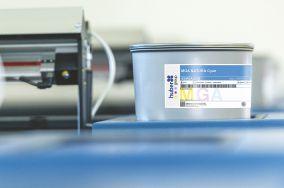
With increasingly strict and regionally variable regulation of printing inks for food packaging, printers have been required to use a variety of inks in order to meet regulatory demands for North American and European markets. hubergroup says it has reinvented its MGA Natura sheetfed offset ink series with a single ink that complies with all FDA standards and EC regulations for folding-carton food packaging in one formula, in a move to help printers meet regulatory demands for different markets. The new inks are globally available and include both process and spot colour inks.
hubergroup explains it developed and manufactured its own customized raw materials for the inks, saying chemists discovered a method for incorporating a “fully bio-compatible” yet unused raw material into the ink formula. The company says its own strict MGA guidelines for packaging printing inks guarantee the ink is produced in compliance with all relevant standards, including Good Manufacturing Practice (GMP) requirements for printing inks for food contact materials.
Aleyant PrintJobManager version 2.0
Aleyant has announced the availability of the newest version of its production tool, PrintJobManager. With version 2.0 now available, the company introduces Scheduling Simplified to help print shops engage in more intelligent production planning. In addition to Scheduling Simplified, version 2.0 of PrintJobManager features an additional integration point with Aleyant’s Pressero Web2Print solution. Customers can now designate custom fields as internal or external when sending out an estimate, allowing better control of the information that is exposed to the customer, it explains.
Roland VersaSTUDIO BT-12
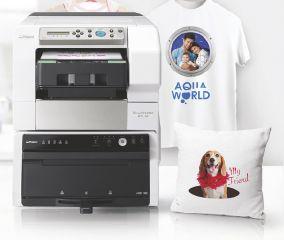
Roland DGA in January released its first direct-to-garment printer for on-demand personalization, the VersaSTUDIO BT-12, that can print directly on cotton-based products. With the BT-12, users can print full-colour graphics, including photos, logos and text, directly on T-shirts, tote-bags, interior décor items and other items that are made of 50- to 100-percent cotton. The footprint of the BT-12, which measures 15.7 x 29.9 inches, includes a finishing unit stacked with the printer unit that aims to reduce the installation space that is typically required for a traditional direct-to-garment
ONE-STOP SHOP — Die Cutting, Bindery, Data & Lettershop.
2. SUPERIOR TECHNOLOGY — Die crease without a die, then fold and even glue all on the same machine, up to 30 pt.
3. INTEGRATED MODULAR UNITS — Combined in-line finishing: crease, fold, glue, tipping, envelope inserting, ink jetting (Duplex), clip seal (3 sides), mail prep.
4. SAVE ON POSTAGE COSTS
—As a Certified Canada Post Direct Marketing Specialist, we get contract pricing reductions.
5. RETURN MAIL PRODUCTS — Customized “Return Mailers” created in-line with “U” or “BOX-shape” remoistenable glue, time perfed applications and envelope formation.
6. MINI-BOOKLETS — Saddle-stitch and trim 2-up booklets in-line to the size of a business card. No need to trim off-line, or do 2 passes.
7. HIGH SPEED EQUIPMENT — High speed Tipping, Folding, Saddle-stitching and soft folding ensuring on time delivery.
new Natura series includes both process and spot colour inks.
PRESSMAN LITHO
Press operator, large format Litho. KBA 162A experience preferred but not mandatory. Full time, 3-5 years experience working as lead press operator. Competitive salary and benefits. Must be a team player/works well with others in a team environment. Willingness to assist in other departments as required. Troubleshoot, maintenance. Image Four Inc. is willing to train the right applicant. Responsibilities: Efficient operation of Printing Press Equipment. Following dockets ensuring high quality print production. Able to work with tight deadlines. Work independently and safely at all times. Email resume to: careers@imagefour.com Tel: 416-739-7545
FOR SALE – GRAPHIC WIZARD
(GW6000) NUMBERING.SCORING/PERFING MACHINE.
2 new numbering heads and feed tires. Perfing and scoring wheels included along with stand. Asking $1,500. Please call during office hours, 705-688-1600.
FUJIFILM SALES MANAGER, SOUTH WESTERN ONTARIO
The Fujifilm Sales Manager (FSM) is responsible for growing profitable sales and ensuring business plan targets are achieved in accounts in the South Western Ontario territory, through the implementation of effective and efficient sales strategies and tactics. The ideal candidate will develop and utilize strategies that increase visibility and strengthen our relationships with our customers, support sales processes, systems and resources in order to maximize profitability. 6-8 years sales or related experience within the Graphics industry and commercial print and packaging industry experience is required. For additional details, and to apply for this position please visit www.fujifilm.ca and click on “Careers”.
ESTIMATOR/PROJECT COORDINATOR FOR BINDERY
East-end Bindery is looking for a full-time Estimator/Production Co-ordinator to join our team. Responsibilities include: preparing quotes based on client specifications, creating/reviewing layouts, working closely with sales and production to ensure timelines and client expectations are met and/or exceeded. Position is salary based. Email resume to: desiree@pppcorp.ca Tel: 416-948-3291, Fax: 416-609-0670.