Creating an environment that will get you an honest answer 14 18 6 10
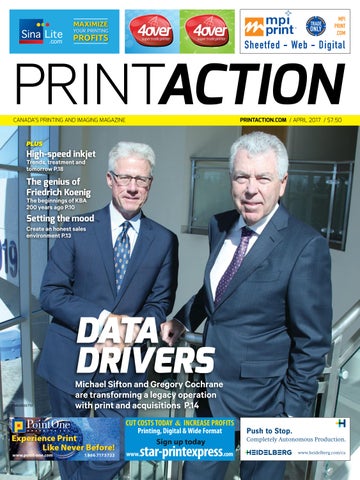
How DATA Communications is leveraging its printing legacy to become a managed communications provider
18 High-speed inkjet surfaces
New surface treatments for paper might enable commercial inkjet ink savings, one of the biggest challenges for adoption
DEPARTMENTS
GAMUT
5 News, People, Calendar, Dots, Installs, Globe, Archive
TECH REPORT
20 Short-run finishing
Facing a higher number of weekly jobs, a look at ever more important tools
NEW PRODUCTS
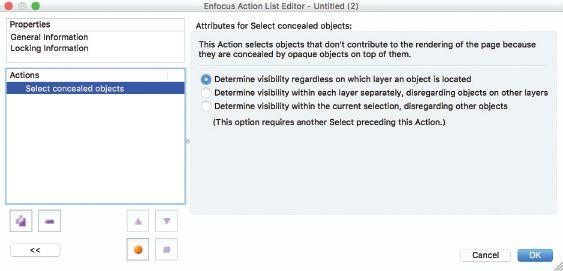
22 Technologies from 4over, Agfa, Avanti, Canon, EFI, Enfocus, INX Digital, Roland DG, SAi and SmartSoft
MARKETPLACE
25 Industry classifieds
SPOTLIGHT
26 Mike Fredericks, CEO of Toronto’s new Renaissance Printing Inc.
COLUMNS
FROM THE EDITOR
4 Jon Robinson
Global print conditions
The 4th drupa Global Trends report based on a survey of 839 printers
CHRONICLE
10 Nick Howard
The genius of Friedrich Koenig
How one of the world’s most influential inventors and business leaders built print
ENVIRONMENT
12 Neva Murtha
A top printer on straw papers
Ag-res papers shift from being a novelty eco-paper to a viable print product
DEVELOPMENT
13 David Fellman
Setting the sales mood
Global print conditions
At the end of March, Messe Düsseldorf released its 4th drupa Global Trends report tracking key economic and market developments across the printing world. The report is based on two separate surveys for printers and suppliers, sharing some common questions, but also asking more specific questions relevant to each group. The full version can be purchased for Euro 249 online at drupa.de/2131.
report found that employee numbers continue to rise globally with a nine percent net balance, including 21 percent in North America.
Production employee numbers have increased globally nine percent, but there is a decline in administration employees of -2 percent. In what the authors describe as the more developed regions, numbers employed in publishing printers are falling sharply, by as much as -21 percent in North America.
Editor Jon Robinson jrobinson@annexweb.com 905-713-4302
Contributing writers
Zac Bolan, Wayne Collins, David Fellman, Victoria Gaitskell, Martin Habekost, Nick Howard, Neva Murtha, Abhay Sharma
Publisher Paul Grossinger pgrossinger@annexweb.com 905-713-4387
When asked How do you rate the current economic situation of your company, 42 percent of printers and 56 percent of suppliers describe their company’s current economic condition as good compared with just 11 percent and 6 percent as poor.
A total of 839 printers participated, including 525 from Europe and 314 from the rest of the world. Europe also dominated the supplier survey, accounting for 220 of the 331 respondents, but all other regions had material representation with 111 respondents.
Among printers, 42 percent described their business as being in a ‘good’ economic state in 2016, while only 11 percent reported it as ‘poor.’ North American printers showed the most economic confidence among all global regions with more than 70 percent forecasting business to be in ‘good’ shape in 2016, although the final ‘good’ number came in just below 50 percent
Eighty percent of North American printers also forecast business in 2017 would remain in a ‘good’ economic condition. Globally, 46 percent of printers and 50 percent of suppliers expect their economic performance to improve in 2017. The report’s authors explain functional and packaging printers globally are more confident than commercial printers, who are in turn more confident than publishing printers – a pattern that has been present since 2013.
There is a similar positive story for suppliers with 56 percent reporting their company to be in ‘good’ economic condition and just six percent stating it was in a ‘poor’ state. The report states amongst both printers and suppliers, in general, a more cautious outlook is emerging. “The economic summary in the main report indicates there is good cause for that caution,” write the authors. “Printers globally report continuing falls in prices which are compensated for by increasing utilization and hence raising overall revenues at a cost of falling margins.”
Despite the squeeze on margins, the
Market conditions for suppliers are similar globally with revenues up 17 percent but prices down -24 percent and margins down -27 percent. Despite these falling numbers, Messe Düsseldorf explains, this is actually the least negative net balance in the three years since the survey began.
When it comes to the print technologies used, the penetration of toner cutsheet colour presses led by a wide margin in terms of the positive net balance of print volumes in 2016 at 25 percent, followed by inkjet roll-fed colour at 11 percent. The report found there is eight percent growth overall in sheetfed offset, largely because of packaging and publishing markets.
The proportion of printers reporting that more than 25 percent of their turnover is being produced by digital, included the following breakdown: Functional printers 62 percent, commercial printers 40 percent, publishing printers 22 percent, and packaging printers 14 percent.
“However, there was a major surprise in the apparent irreversible transition to digital print; as for the first year there was a small but distinct reduction in the proportion of turnover that was digitally printed,” writes the authors.
The report concludes the proportion by value of digital print that is variable refuses to rise. In 2013, 19 percent of the printers then using digital print reported more than 25 percent of their digital print was variable, while the figure for 2016 is 18 percent. “As variable data is the major added value component of digital printing, this is an alarming trend.”
JON ROBINSON, editor jrobinson@annexweb.com
Associate Publisher Stephen Longmire slongmire@annexweb.com 905-713-4300
Media Designer Lisa Zambri
Circulation Manager Barbara Adelt badelt@annexbizmedia.com
Customer Service
Angie Potal apotal@annexbizmedia.com
Tel: 416-510-5113
Fax: 416-510-5170
Mail: 80 Valleybrook Drive, Toronto, ON, M3B 2S9
COO
Ted Markle tmarkle@annexweb.com
President & CEO Mike Fredericks
Subscription rates
For a 1 year monthly subscription (12 issues): Canada — $40.95 Canada 2 year— $66.95 United States — CN$71.95 Other foreign — CN$140.00
Mailing address
Annex Business Media 222 Edward Street Aurora, ON, L4G 1W6 printaction.com Tel: 905-727-0077 Fax: 905-727-0017
PrintAction is printed by Annex Printing on Creator Gloss 80lb text and Creator Silk 70lb text available from Spicers Canada.
We acknowledge the [financial] support of the Government of Canada.
Isabelle Marcoux, Chair of the Board of Transcontinental Inc., is the first Canadian recipient of the Visionary Award for Strategic Leadership presented by the WomenCorporateDirectors Foundation (WCD), which brings together more than 3,500 women serving on over 8,500 boards. The Visionary Award, according to WCD, recognizes Marcoux’ proven leadership driving TC Transcontinental’s transformation while maintaining profitable growth, as well as her personal commitment to the advancement of women into leadership roles.
Aylmer Express Graphics Group purchased two companies in London, Ontario, including Contact Creative Printing, a lithography shop, and Double Q Printing, a digital shop. They have been absorbed into existing Ontario facilities of Aylmer Group, which includes Aylmer Express in Aylmer, Accell Graphics and Absolute Mail in London, and Barney Printing in Woodstock. The company also operates a mail, data management and distribution centre called Westminster International in Toronto.
Danaher of Washington reached an agreement to purchase Israel-based Advanced Vision Technology, which develops print inspection systems. The deal is worth US$100 million through Danaher’s product identification platform. Danaher is the parent company of Esko (purchased in 2011 for €350 million) and X-Rite
point.
Prinova, a Toronto-based software developer, changed its corporate name to Messagepoint Inc. to reflect the ongoing investment in its Messagepoint CCM cloud-based content management platform. Messagepoint is aimed at large enterprise clients to control content for customer-facing print and digital communications.
(purchased in 2012 for US$625 million), which also controls Pantone. Danaher is one of North America’s largest manufacturing conglomerates with annual sales of approximately US$17 billion.
HP Inc. reported first quarter results for fiscal 2017 with net revenue of US$12.7 billion, up four percent from the prior-year period. Printing net revenue was down three percent year over year with a 16 percent operating margin. Total hardware units were up six with Commercial hardware units up two percent and Consumer hardware units up seven percent.
Avery Dennison completed the acquisition of Hanita Coatings, a pressure-sensitive materials manufacturer of specialty films and laminates. Headquartered in northern Israel with sales and distribution facilities in the United States, Germany, China and Australia, Hanita develops and manufactures coated, laminated and metallized polyester films.
Veritiv completed four Canadian events in Vancouver (March 2017), Toronto (January 2017), Montreal (December 2016) and Calgary (October 2016) to recognize the top projects in its annual Veritiv Design and Print Excellence Awards, also known as the uVU Awards.The Best of Show Print award went to Hemlock Printers for its 2015 Holiday Wrapping Paper project, while Andora Graphics printed the project that won Best of Show Design. The remaining companies to receive Print category awards includes: LG Chabot, Exodus Graphics, Somerset Graphics, Litho Chic (Deschamps Impression), TC Transcontinental PLM, MET Fine Printers and Flash Reproductions.
Hemlock Harling Distribution acquired PDQ Post Group based in Surrey, BC, with more than 25 years of experience in data, mail and lettershop print. All PDQ operations will shift to Hemlock Harling’s 40,000-square-foot facility in Richmond, BC. An equal partnership of Hemlock Printers and Harling Direct, formed in December 2016, Hemlock Harling officially opened its doors in February 2017, coinciding with its purchase of Kirk Marketing, a 60-year-old full-service print, mailing and fulfillment services company.
Tony Langley, Chairman, Langley Holdings.
Langley Holdings , the industrial group that controls German press maker Manroland Sheetfed, reported its fiscal year results, ended 31 December, 2016, with profits before tax up by 15 percent on the previous year. This amounted to a profit of €122.7 million on revenue of €900.9 million. The company explains Manroland Sheetfed, acquired five years ago, has now returned the group’s initial investment in full. Manroland is its largest division in terms of revenue and employees with some 40 subsidiaries. Under Langley’s ownership, the company has installed around 500 presses and applied for 169 patents.
X-Rite acquired ColorCert assets from Nelissen Consulting of Germany. Since 2013, X-Rite has been the exclusive distributor of ColorCert software, a quality process control tool used in packaging.
BMO Bank of Montreal and GMC Software received the 2017 Xplor Application of the Year, based on a customer onboarding project that pioneered an end-to-end digital account opening process, enabled by the creation of dynamic eForms and eSignature capabilities. The winner of the 2017 Xplor Technology of the Year was awarded to Pitney Bowes Clarity Solutions.
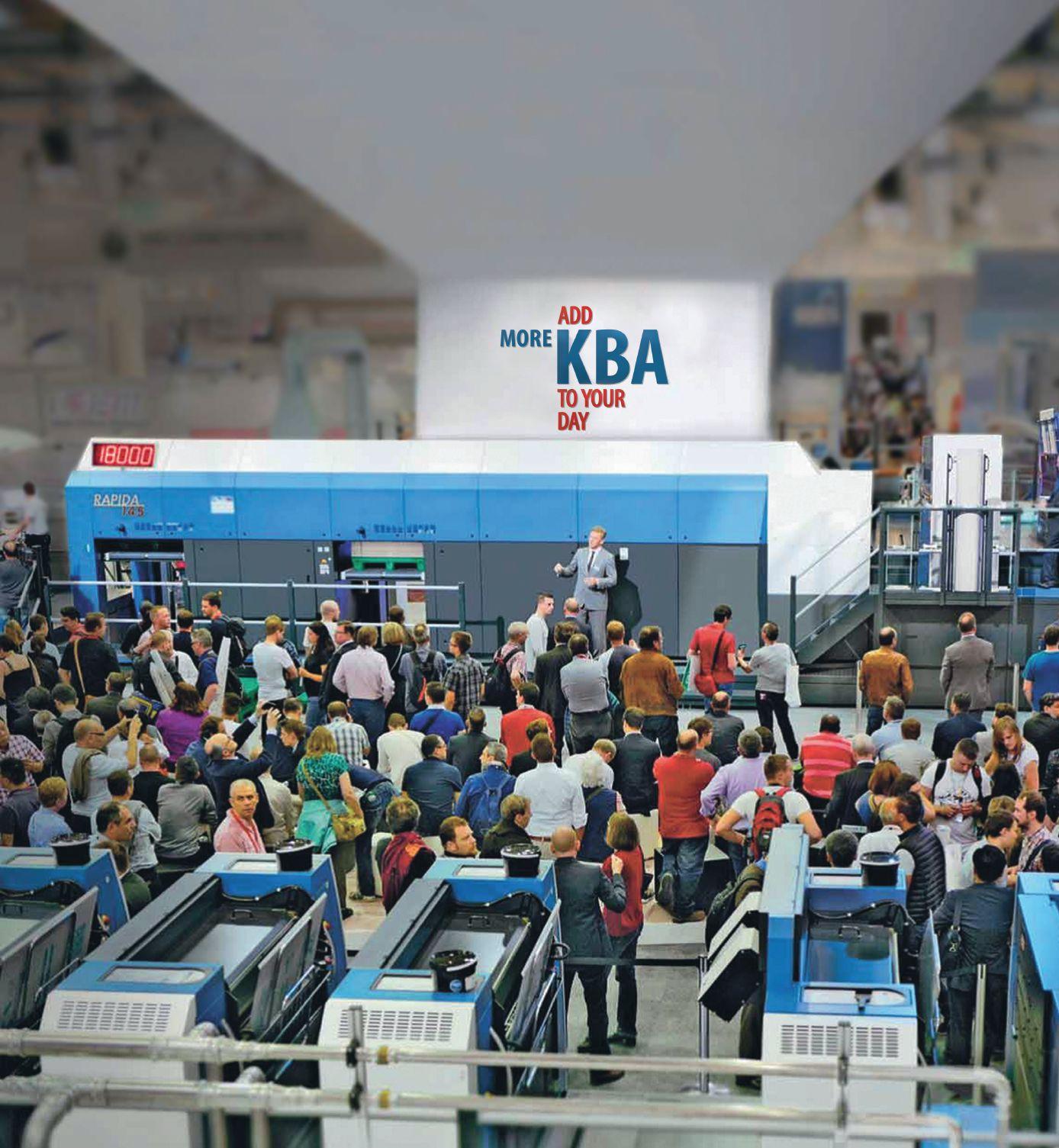
KBA-Sheetfed Solutions reports, since the initial launch of a wholly redesigned Rapida large-format generation in 1995, a total of 1,500 large-format presses have left the KBA factory in Radebeul. That equates to well over 6,000 printing units for the format classes 910 x 1,300 to 1,510 x 2,050 mm.
Correction Notice: PrintAction ’s March 2017 issue included the wrong Graphics Canada write-up for Veritiv. PrintAction apologizes for our error.
Marcoux in 2016 received the Medal of the National Assembly of Quebec.
Nick Romano, CEO, Message-
Claus Bolza-Schünemann, CEO, KBA.
Marty Fiorillo of Yupo, Tracey Pitt of Veritiv and Nikos Kallas of MET.
Richard Kouwenhoven, President, Hemlock.
Patrick Kehoe joins Toronto-based Messagepoint Inc., formerly Prinova, as Executive Vice President of Product Management. Messagepoint provides software and services within the Customer Communications Management market. Kehoe brings more than 25 years of experience in document processing, customer communications and content management. Prior to joining Messagepoint, Kehoe most recently held the position of Worldwide Head of OpenText Exstream, where he managed, designed and also delivered systems like BPO for customers in healthcare, financial services, banking, manufacturing and retail/distribution markets.
Mike Dye becomes Vice President of Franchise Member Support of Alliance Franchise Brands LLC’s Marketing & Print Division. In his new role, Dye’s responsibilities focus on four marketing and print concepts under the Alliance Franchise Brands umbrella: Allegra Marketing – Print – Mail, American Speedy Printing, Insty-Prints and KKP. Dye is 30-plus year print industry veteran who has spent the majority of his professional career with the franchise organization. He now oversees all field operations activities for the family of companies. This includes leading a team who guide, mentor and coach franchise members from the time they join a franchise brand.
technologies for textile and wallcover printing. Sangeeta joined the company in 2003, taking on a range of management roles in the U.S. after leading sales in India, Bangladesh and Sri Lanka.
Tom Fitzgerald is to lead KBA North America’s recently introduced distribution of KBA-Iberica flatbed die-cutters and KBA rotary die cutters, after its parent company Koenig & Bauer, purchased the Spanish medium- and large-format flatbed die cutter manufacturer Iberica AG S.A. Fitzgerald will be responsible for the development, implementation and management of sales and marketing support for post-press products, such as sheetfed die cutting equipment. Fitzgerald joins KBA with nearly 25 years of experience with sheetfed offset presses and post-press equipment.
INSTALLS
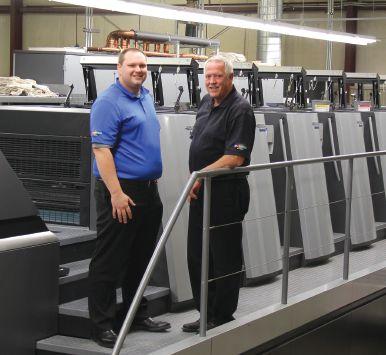
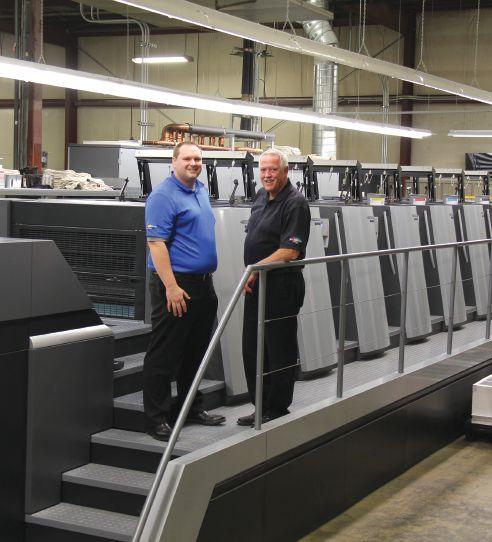
Battlefield Graphics of Burlington, Ontario, installed a Heidelberg Speedmaster XL-106-7+L, pictured with Matt Theoret, Production Manager, and Jerry Theoret, President. The press is equipped with IST UV curing, Inpress Control, AutoPlate Pro and the Prinect Press Center with Intellistart.
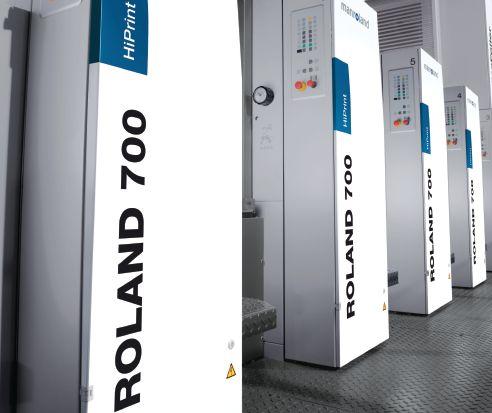
Avant Imaging & Integrated Media this April is scheduled to install a Manroland R706PLV HiPrint perfecting press into its Aurora, Ontario, facility. The 41-inch press will be its second Manroland, joining an R710 HiPrint installed more than a decade ago.
Sangeeta Sachdev becomes Managing Director of SPGPrints America Inc., taking responsibility for the company’s operations in the United States and Canada. SPGPrints is a developer of rotary screen technology for the self-adhesive label and industrial narrow-web markets. SPGPrints also provides inkjet printing
Kevin Oakes becomes Sales Manager for Domino, Digital Printing North America after spending the past 25 years with companies like HP, Man Roland and Agfa. Dale Rawhoof, a 27year veteran with Domino, has been promoted to Product Manager, Digital Printing North America. He specializes in inkjet, industrial control and material handling. Matt Condon becomes OEM Manager, Digital Printing North America, with more than 27 years of industry experience. He has been with Domino for seven years, most recently as Product Manager. Patrick LaMourie has been promoted to Digital Solutions Manager, Digital Printing North America, joining Domino from EFI where he was an Applications Engineer.
Jack Condon of Ricoh becomes President of the Advanced Function Presentation Consortium (AFPC), which works on the Advanced Function Presentation document architecture. He succeeds Harry Lewis of Ricoh, a founding member of the AFPC, who is retiring. Dennis Carney, also of Ricoh, becomes the consortium’s secretary and treasurer.
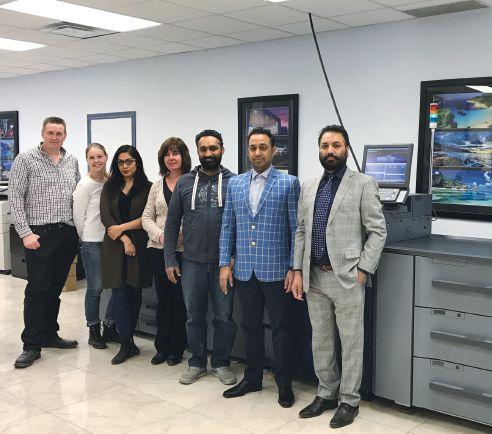
MPI Print Group, a trade-printing operation with two facilities in the Greater Toronto Area, installed a Konica Minolta bizhub PRESS C1100, which also includes an inline SD-506 booklet maker, running at speeds of up to 100 pages per minute.
Orange County leverages J
Press and litho work
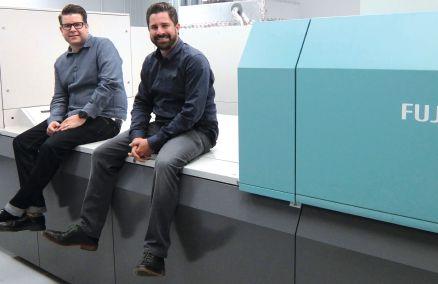
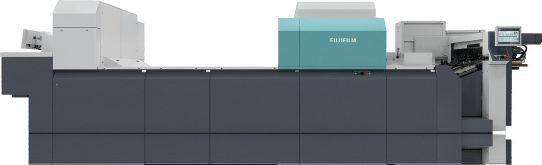
Direct Edge Media of Orange County, California, recently installed a Fujifilm J Press 720S.The second-generation J Press 720S, based on an inkjet sheetfed platform, runs a 29.6 x 20.9-inch sheet with an output speed of up to 2,700 sheets per hour.
“We have a tremendous range of equipment, and the J Press 720S truly bridges the gap from our litho world,” said Ryan Clark, President, Direct Edge Media, who also notes the company is migrating more jobs from offset to the J Press 720S. Direct Edge has leveraged several Fujifilm printing systems over the years, including the Uvistar Pro-8, Uvistar Hybrid 320, Onset Q40i with white, and flatbeds from the Acuity Series.
“One of our clients within the fashion industry distributes small-runs of seasonal catalogues,” said Clark. “These short-run jobs are challenging to produce on traditional offset presses. With the J Press 720S we’ve been able to capitalize on these types of projects cost-effectively, and that’s the sweet-spot for us.”
3
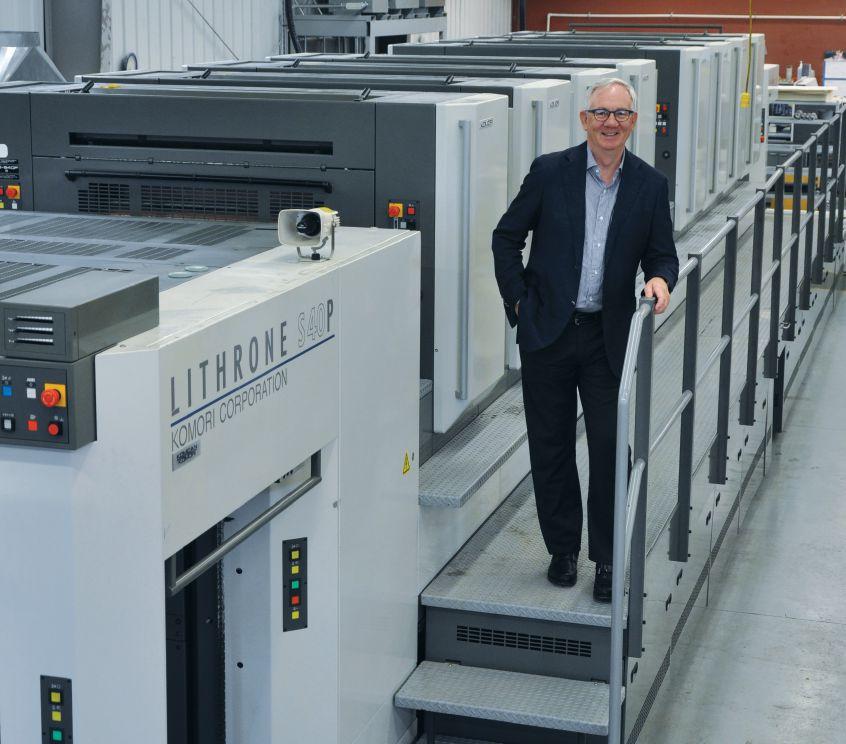
Minnesota’s Wallace Carlson spent $4 million over the past year and a half. It runs three offset presses, including a new 8-colour H-UV, perfector, and three digital presses – Konica Minolta bizhub Press C1100, Ricoh Pro C5100s 8120. The pressroom is now tied together with EFI’s Midmarket Print Suite. Midstate Printing, a G7 Master Printer in Syracuse, NY, recently purchased an eight-colour Lithrone G40 perfector with LED-UV (GL840P) to replace three presses in operation on its pressroom floor.
Rheinisch-Bergische adds more Cortina varnishing in Germany
Twenty operating companies of Rheinisch-Bergische Druckerei (RBD) use its KBA Cortina waterless coldset web press, housed in Düsseldorf, Germany, with a total of 90 printing towers. KBA describes this Cortina coldset installation as unique, because the compact rotary press features an inline water-based varnishing unit and IR dryer, finishing print work without any damping units.
The print quality of RBD’s waterless Cortina, according to KBA, cannot be achieved in coldest by using a wet offset process. RBD uses this advantage, often in conjunction with natural papers, to produce higher quality advertising work, unique page formats like MultiView, and special-interest publications. RBD began using its first KBA-provided varnishing unit with an IR dryer in 2014, running it daily ever since. RBD will integrate a second such varnishing unit on the Cortina by August 2017. KBA explains five such varnishing units have already been installed by Cortina users.
“Thanks to the variety of formats that the Cortina can process, the production of A4 magazine products has developed into an economically interesting product branch for our company,” said Matthias Tietz, Managing Director, RBD. “The varnishing of printed products is becoming increasingly popular. Today, the current limitation of 32 pages prevents us from giving a positive answer to the numerous requests concerning magazines with up to 64 pages.”
Control Group installs third Nilpeter in New Jersey
Control Group of Norwood, New Jersey, has added a third Nilpeter press to its production lineup, a 22-inch FA-6*, which is the company’s second press from the FA-Line. Founded in 1971, Control Group produces specialized printed packaging applications in the pharmaceutical, healthcare, nutraceutical, cosmetics and personal-care markets. In 2008, Control Group installed a 16-inch FG servo press which was the first press built in that product line. COO Jim Imburgia states the company has recorded zero downtime with the press since its installation. “We decided to add a 22-inch FA-6 in 2012. Having 13 colours, rotary screen, movable towers, and die-cutting, this press really raised the bar and made us stand out from the competition,” said Imburgia. “Its Clean-Hand Technology is perfect for our evolving workforce and product innovation.”
Ryan Clark, President (left), and Ryan Brueckner, CEO, with the Fujifilm J Press 720S, at Direct Edge Media’s Orange County facility.
RBD’s compact and accessible varnishing unit (left) and the IR dryer, integrated with a 90-tower KBA Cortina.
Control Group owners Bill Cheringal (left) and Jeff Levine with their newest Nilpeter press.
CALENDAR
DOTS
3M Envision in Picturesque Quebec
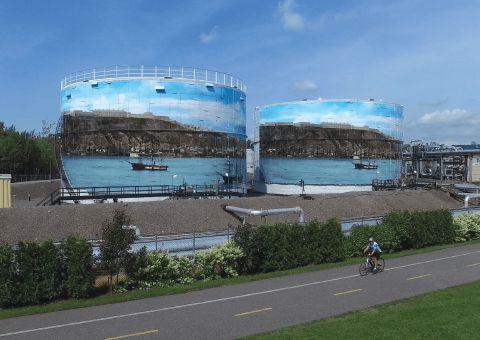
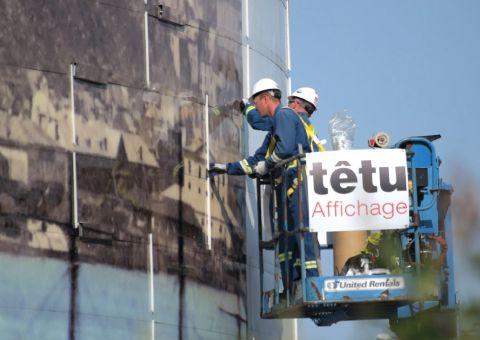
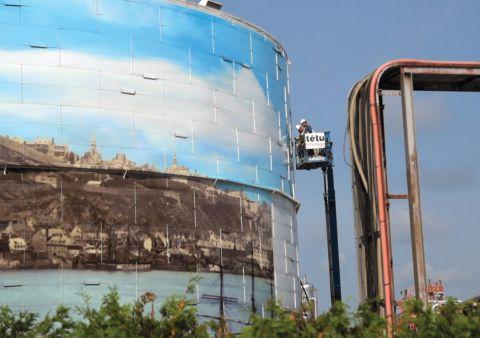
On the pedestrian trail of Lévis, Québec, two Valero Energy reservoir towers stood apart from the picturesque shoreline with a neighbouring view of Quebec City. Valero was approached by city officials to integrate the two towers into the natural environment of the area, located on the shores of the St. Lawrence River. Lévis was founded in 1886 and is connected to Quebec City by two massive bridges and ferries.
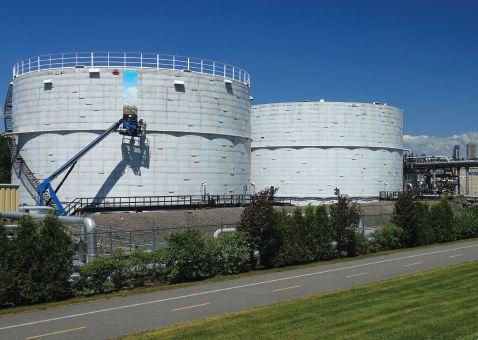
Valero, best known in Canada for its Ultramar retail brand, teamed up with Groupe têtu, which specializes in large-format graphics, and 3M Canada to meet the challenge presented by the texture, shape and sheer scale of the structures. The front-facing surface of the two reservoirs is a combined 40,000 square feet. The towers’ cylindrical shape meant any covering needed to be conformable, while the exterior surface of the tanks is rough and stippled. The use of any heat source was banned from the graphical application process, because the tanks house oil.
To transform the Valero reservoir tanks, the team installed a large-scale graphic showing a historical view of the shoreline. Groupe têtu and 3M Canada decided to work with 3M Envision Print Wrap Film 480, described by the company as the world’s first non-PVC, high-performing wrap film. 3M points three primary revolutions in its display graphics films over the past two decades, including the introduction of Controltac graphic film approximately 20 years ago.
Controltac marked a step forward for vehicle graphics application because its adhesive would not stick immediately and users could move it around to then apply with a squeegee. 3M’s second major wrap innovation came around a decade ago with the introduction of Comply air-release technology, based on micro-replication science applied to a special liner with a series of ridges. When the liner is pulled away from the back of Comply film, it leaves impressions in the adhesive, which provide routes for the air to escape ahead of an application squeegee – preventing the formation of bubbles. Introduced in 2012, Envision is 3M’s newest film advancement, adding material stretch and a wider operating temperature.
With 150 percent stretch capabilities, explains 3M, the material could be applied to the round, rugged surfaces of the Valero oil tanks without issue. It could also be installed using the heat naturally radiating off of the metal tanks – no heat gun required. As a non-PVC film, 3M Envision Print Wrap Film 480 also provided an environmentally-friendlier alternative to PVC products that aligned with Valero’s commitment to sustainability. The team printed the image on the film and installed the graphic using over 80 vertical panels.
3M describes the Valero reservoir towers installation as the largest graphic film project in the region, covering some 40,000 square feet.
April 25-27, 2017
InPrint USA
Orange County Convention Center, Orlando, FL
April 30-May 3, 2017
FTA 2017 INFO*FLEX Phoenix, AZ
May 9-11, 2017
EskoWorld Charlotte, North Carolina
May 12-13, 2017
Grafik’ Art Place Bonaventure, Montreal, QC
May 21-24, 2017
National Postal Forum Convention Center, Baltimore, MD
May 23-26, 2017
PACKEX Toronto Congress Centre, Toronto, ON
May 23, 2017
Avanti User Group Conference Grand Hyatt, Denver, Colorado
June 1, 2017
Gutenberg Gala Marché Bonsecours, Montreal, QC
June 14, 2017
PrintForum West Delta Burnaby, Burnaby, BC
July 16-20, 2017
95th Annual GCEA Conference, Woman in Print
Ryerson GCM, Toronto, ON
September 10-14, 2017
Print 17
McCormick Center, Chicago, IL
September 25, 2017
Pack Expo Las Vegas Las Vegas, NV
September 27-29, 2017
SFI Conference
The Westin, Ottawa, ON
October 10-12, 2017
SGIA Expo 2017
New Orleans, LA
November 9, 2017
Canadian Printing Awards
Palais Royale, Toronto, ON
25 years ago
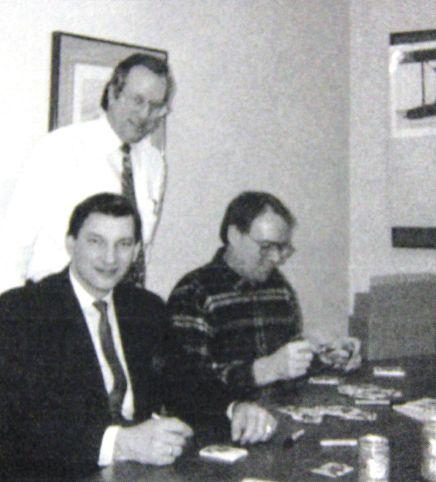
Collector Cards Spell Success for McLaren, Morris
& Todd: Ranking the great historical events of our time, just about everybody remembers where they were and what they were doing when they heard Team Canada had come from behind to pull off a last-minute victory over the Soviet National Hockey Team in 1972.
To mark the 20th anniversary of Canada’s shining moment of hockey glory, a limited series of collector cards are being produced by Future Trends Experience Ltd. The cards, 28 million in total, are being printed by McLaren, Morris & Todd (MM&T) of Mississauga, Ontario. The 101-card series, made up of black-and-white shots taken by a Toronto Star sports photographer, chronicles the sequence of events that took place in 1972. Ken Dryden wrote and edited much of the text for the collector cards. MM&T has been contracted to print collector cards for the Quebec, Ontario and Western Junior A hockey leagues, including the much-coveted Eric Lindros rookie card, as an Oshawa General. The printer has also produced a series of cards covering the NASCAR professional stock car racing circuit in the United States.
$53K
For sale, 1997 classified: Agfa Selectset 5000 imagesetter, 3600 DPI, 22 x 16 Image Area, purchased new in 1994. Only 450 hours use, $42,000. Also available, Agfa Star 400 RIP level II for $15,000. Buy both and save! $53,000.
20 years ago
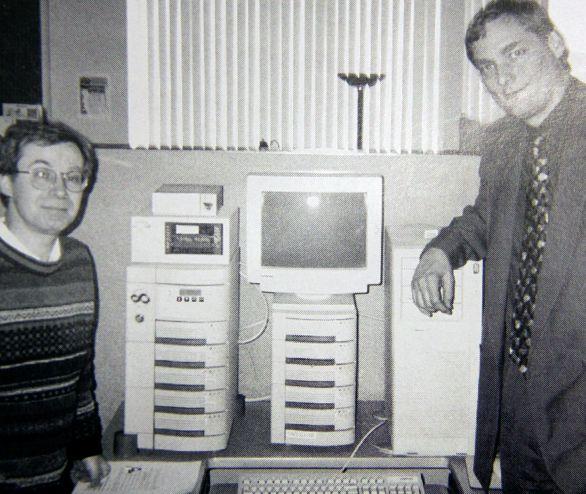
TopLine Opens Remote Office: This month, TopLine Printing and Graphics will take a major step in the expansion of its digital prepress, extending its commitment to an all-digital workflow with the opening of a remote computerized prepress office in downtown Toronto. The remote office will allow customers to have their print files preflighted and then expressed to TopLine’s Mississauga printing plant via ISDN connections and 4-Sight software, where they will be imaged using a Creo Trendsetter computer to plate system. TopLine has named its digital prepress initiative as Digital Pipeline Xpress (DPX) and is comprised of the satellite office, direction customer ISDN connections and CTP technology.
$5.5K
For sale, 1992 classified: Fuji Rapid Access film/paper processor model FG360F. Excellent condition. $5,500 or best offer.
15 years ago
Technology Legend Passes: After celebrating his 100th birthday on December 19, Dr. Rudolf Hell, the German inventor who pioneered the technology that led to the fax machine and colour scanner, has passed away. Hell, with patents and ideas that formed much of the imaging telecommunications technology of today, started his first company in 1929. The company was called Hell Recorder. When he turned 100 years of age, the City of Kiel and Heidelberger Druckmaschinen honoured him at a ceremony in Kiel City Hall, in part to celebrate the fact that the city had renamed a street after him. The street leads to Heidelberg’s factory gates. His company was taken over by Siemens AG in 1981 and merged with Linotype in 1990, becoming Linotype-Hell AG.
Vladislav Tretiak and Ken Dryden autograph hockey cards to be packaged in a collector series.
TopLine’s prepress manager Marc Belanger (left) and President Grant Morris in the company’s Mississauga prepress department, which will receive files from its new satellite office in downtown Toronto.
Dr. Rudolf Hell lived to be 100 years old.
The genius of Friedrich Koenig
The London Years, Part I of how one of the world’s most influential inventors created a leading press manufacturer 200 years ago
By Nick Howard
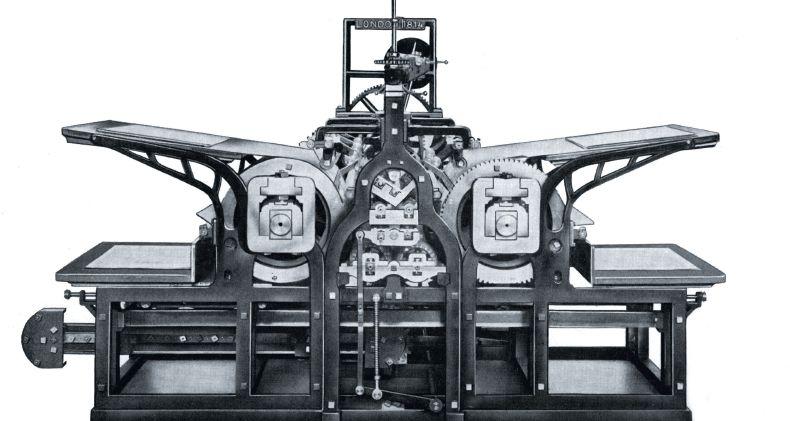
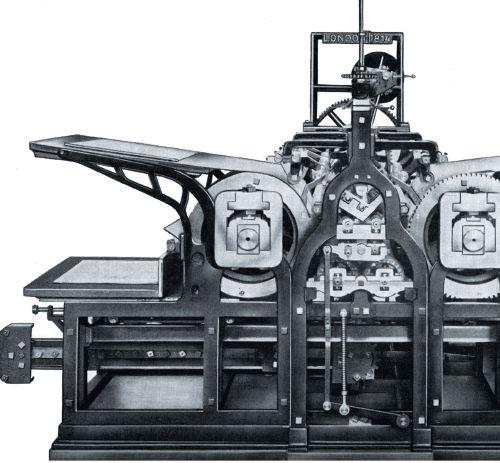
Friedrich Koenig was a genius. If you visit either KBA’s Würzburg headquarters or the Gutenberg Museum in Mainz, you will see just how advanced his now famous The Times press is, built in 1814. With a 19th century fledgling printing industry labouring with only brute force, Koenig created a massive advancement.
I was stunned when I saw it: Such brilliance in a press, the first to not only have a cylinder but also endless tapes to feed a sheet. The most incredible feature was how Koenig worked out a system with cams and gears to stop and start the cylinder and keep register to a moving bed. What may be even more stunning is how long it took afterwards for his concepts to become commonplace. All of it powered by steam. Koenig’s creation would hasten the development of newspapers, making them cheaper and more readily available to spur the spreading of ideas.
The year 2017 marks an incredible milestone for Germany’s Koenig & Bauer AG, described today as the world’s second largest press manufacturer, as it will begin massive national celebrations later this year to mark its 200th year anniversary. I will begin the story of this crucial printing power by first sharing its London years.
All roads to England
James Watt’s invention of the steam engine in 1769 not only unleashed new thinking in the trade houses of Great Britain but stimulated thoughts and ideas
from all sorts of manufacturing industries that relied on manpower, waterfalls or animals to drive machines. Watts’ invention caught fire all over Europe and spurred the Industrial Revolution, when steam lifted the burdens of manual labour.
Friedrich Koenig was born in 1774 in the Saxon town of Eisleben, which was most famous as the home of Martin Luther. After schooling, Koenig entered an apprenticeship in a printing shop, then returned to University to study mathematics and mechanics. Afterward, he tried his luck running a bookstore and a printing shop. Both ventures failed.
It was not until Koenig relocated to Suhl (state of Thuringia) that he began experiments using steam power to operate a faster printing press. Koenig had an incredible idea! Up until 1803, print shops were still using the rudimentary wooden presses almost identical to what Johannes Gutenberg created in 1450.
By 1799, Lord Charles Stanhope had fashioned the first successful all iron hand press and the famous George Clymer Columbian was still years away. The printing industry was primitive with basic screw and wooden-handle presses. Koenig wrote out a description of his automation ideas and sent prospectuses off to leading printers in Europe and Russia. With poor response, Koenig decided to try his luck in the most advanced country on earth. England was ground zero for advanced engineering and also patents could be easily obtained. Koenig managed to arrive only one day before Napoleon’s blockade
Construction of the Times machine was done in secret on Whitecross Street in London, England.
of the channel and on November 20, 1806, he stepped foot on English soil.
On March 31, 1807, in order to get financing for his project, Koenig struck a deal with the devil. One of England’s most prestigious printers was a Mr. Thomas Bensley. Koenig caught Bensley’s interest with his ideas and formed a partnership. In part the contract read: “Mr. Koenig has stated in the particulars he has delivered to Mr. Bensley, signed with his name, he shall enter into a legal Engagement to purchase the Secret from Mr. Koenig.”
£250
An 1813 press agreement reads: Printing by means of Machinery, two double machines of sufficient dimensions and capable of printing sheets 35 ½ inches in length by 22 inches in breadth, the letter press occupying to within one inch of the length and breadth thereof. Price £1,100 each with additionally two steam engines of two horse power - £250 each.
It was Bensley’s job to hunt for prospects and newspaper publishers were a very good place to start. John Walter Jr. owned the venerable The Times newspaper and he had been utilizing new technologies. In 1804, Walter had entered into an agreement with a Thomas Martyn, who was a printer in Golden Lane (London), to finance the building of four new presses “by which manual labour in printing will be rendered nearly unnecessary”.There were stipulations on Martyn that these presses were for the exclusive use of The Times After wasting £1,482 (£138,000 in today’s money), on Martyn’s Self Acting Press, Walter killed the project. On August 9, 1809, Bensley wrote to Koenig; “Having occasion to leave town for the remainder of this week, I made a point of calling upon Mr.Walter yesterday, who I am sorry to say declines our proposition altogether.”
The rejection by Walter forced Bensley to bring in additional financial partners and form a syndicate. The partnership now included Thomas Bensley, printer of Bolt Court, Fleet Street, Frederick Koenig, printer of Castle Street, Finsbury Square, George Woodfall, printer, Sea Coal Lane, Ludgate Circus and Richard Taylor, printer, Shoe Lane, Fleet Street. None could offer anything more than money to the enterprise except Koenig who himself had invested all his savings.
1809 is the year that we first hear of Andreas Bauer. A very well educated man, Bauer held master’s degrees in mathematics and natural sciences and was trained as an optical instrument maker. Bauer first met Koenig in 1805 but became business partners only in 1809. The two formed a close bond right from their first meeting and began collaborating on Koenig’s invention.
By March 1810, Koenig’s first platen
press was issued a British patent. In April, 1811 the press was used for the first time to print a trial run of the Annual Register (3,000 copies). This was to be the first job ever printed on a mechanical (steam) press. It ran at 400 sheets per hour. Unheard of at the time. By December 1812, Koenig’s second machine for the very first time featured a cylinder and bed construction. It ran Clarkson’s Life of Penn. Patents on this design were granted July 20, 1813.
With the secret press set up at his workshop at Whitecross Street, Koenig invited a Mr. Perry, the owner of the Morning Chronicle, and again Mr. Walter of The Times. Only Walter showed up and on witnessing Koenig’s phenomenal machine in action he quickly realized what a leap it was and subsequently agreed to purchase two presses.
Construction on The Times machines continued in secret at Whitecross Street. Andreas Bauer, now Koenig’s manager and chief mech-
anic had each of his employees bound by a stamped confidentiality fidelity bond of £100 each. A sizable amount. By March 30, 1813, the syndicate and Walter had a signed contract.
The agreement describes the goods as; “Printing by means of Machinery, two double machines of sufficient dimensions and capable of printing sheets 35 ½ inches in length by 22 inches in breadth, the letter press occupying to within one inch of the length and breadth thereof. Price £1,100 each with additionally two steam engines of two horse power - £250 each.”
Walter was to have a 14 year exclusive agreement on the technology, save allowing the syndicate rights to sell machines for printing the Clarendon Bible and use by Government Printing Office). But if the machines not produce 1,100 sheets per hour (550 sheets per machine), then Walter had the right to terminate the contract and get his money back.
As time went on, Koenig was busy making parts for his presses and eventually delivered them to a special building owned by Walter near The Times at Printing House Square. All done in secret or so it seemed at first until The Times compositors caught wind of what was happening and demonstrated.The compositors feared that some would lose their jobs as the composing of duplicate pages would not be necessary. The rebellion was quashed by Walter, who was on hand on the night of November 28, 1814, to oversee the very first issue printed on Koenig’s marvellous press.
By six o’clock the next morning, Walter walked into the main Times pressroom holding up a copy of the paper to stunned pressman. He shouted out this now famous line,“The Times is already printed –by Steam!” The lead story was of the new press and how it would change the course of printing forever. It mentioned both Koenig and Bauer by name.
Various revisions of the original Times contract culminated with terms that would ultimately seal Koenig’s fate in England and usher forth competition from English engineers. In essence, the revised November 19, 1816, agreement lifted all restrictions upon Walter to use anyone he wished to work on or repair the Koenig presses.The revision restricted the patentees from selling similar machines to any morning papers for less than £1,000 each.
Part II of this article series will look at how these roadblocks would force Koenig and Bauer’s return to Germany.
NICK HOWARD, a partner in Howard Graphic Equipment and Howard Iron Works, is a printing historian, consultant and Certified Appraiser of capital equipment. nick@howardgraphicequipment.com
WEDNESDAY, JUNE 14, 2017
BURNABY / BURNABY, BRITISH COLUMBIA
PrintForum West, presented by PrintAction magazine, is the only trade show and conference for printing and imaging professionals in Western Canada. Designed to build thought leadership in business strategy and technological innovation, PrintForum West is a
For Sponsorship and Exhibit Opportunities: Stephen Longmire, Associate Publisher 905-713-4300 / slongmire@annexweb.com
A top printer on straw papers
As 2017 hits its stride, straw papers are poised to shift from being an eco-novelty to a viable product
By Neva Murtha
As evidenced in Canopy’s recent investor informa tion Webinar, co-hosted by the governments of Al berta, Saskatchewan and Manitoba, agricultural residue pulps and papers are clearly ready for prime time. The message from the market: Launch commercial-scale production in North America and watch the sales take off!
More than 60 participants, including equity and venture capital firms, banks, and major philanthropic foundations joined Canopy, the three governments, Staples, EarthColor and two technical experts of the supply chain to discuss the market and technical readiness for straw papers and the opportunity awaiting investors. The educational Webinar served as an immersion for investors, with a review of quantified marketplace demand; trials undertaken to date; the viability of the fiber for multiple uses; the strong interest from the print and retail sectors; and the latest technological advances.
Notable bell-weathers of the marketplace signalled clear market readiness for these kinds of eco-solution products. As one of the world’s largest re-sellers of freesheet paper, Staples has already taken a leading role. It stocks and uses a range of agricultural residue-based papers including copy, cut-sheet, packaging and shipping materials. Straw-based copy paper is available to consumers in Staples stores and online, and ag-res products are used widely internally. Its message to investors was one of strong support for North American agricultural residue production facilities, noting that straw products expand the range of product options available to them to retail. Domestic production is seen as a natural progression that has the potential to rapidly accelerate over the next five years.
Canopy has run several agricultural residue paper trials with well-known authors and publishers as well as glossy magazines. Each has clearly demonstrated the viability of straw-based pulps and papers for commercial application. Through Canopy’s experience supporting large publishers, brands and printers to implement their environmental policies, it’s been clear that the market is looking for these kinds of solutions.
EarthColor customers include Disney, Walmart, L’Oreal, Google, Verizon, big pharmaceutical firms and large retail, buying 60,000 tonnes of paper per year. Podmayersky is confident agricultural residue papers offer the quality EarthColor and their customers demand.
In closing, Podmayersky stated, “Over the next decade there is enormous opportunity to integrate agricultural residue papers as the next big thing. This certainly would work with our clients.”
Mark Lewis, President and CTO at Sustainable Fibre Technologies highlighted North American biomass potential, noting there are approximately 370 million tonnes of forest resources available -- and one billion tonnes of agricultural residues. Lewis emphasized the efficiencies of agricultural residue pulp production, highlighting lower capital costs, chemical consumption, water usage and energy consumption.
The cover of EarthColor’s most recent sustainability report.
65%
David Podmayersky agrees. As Chief Sustainability Officer for EarthColor, Podmayersky told Webinar participants that ag-res pulps and papers are, “The new wave of thinking of sustainable design in the circular economy. They are financially viable and… a great win-winwin story. The environment wins, society wins and the economic financial model is incredibly viable.”
EarthColor has been providing commercial print and related services for over 30 years and has grown into one of the country’s largest privately held printers with over 500 print experts nationwide. EarthColor provides its marketing communications clients with sustainable products like straw-residue based Step Forward Paper and a range of eco-engineering tools, products and procedures to minimize the carbon footprint throughout the supply chain.
In 2014, 65 percent of all the paper purchased by EarthColor was FSC certified, up from 50 percent in 2012. Its emphasis on purchasing postconsumer waste (PCW) and postindustrial waste (PIW) paper in addition to recycling all its PIW manufacturing paper waste saved the equivalent of 280,000 trees.
The pulp produced through the Phoenix process test facility in Washington State can feed into a broad array of products including printing and writing grade papers, bathroom tissue, paper towels, food service wares, unbleached paperboard and industrial packaging.
The facts about agricultural residue papers tell a compelling and exciting story. The feedstock for North American production is abundant; the technology proven; the product quality top-notch; the cost-savings clear and the environmental benefits enormous. Greenhouse gas emissions and water consumption are reduced and the carbon storage benefits of intact forest landscapes can be retained. Sales of straw residue provide a “second harvest” for farmers, offering revenue for a product currently treated as waste.
Canopy’s Second Harvest campaign has been laying the groundwork, in the marketplace and with producers, for more than a decade. This is the year we will see commercial scale North American agricultural straw pulp and paper production break ground to make this vision a reality.
NEVA MURTHA works with Canada’s magazine publishers and printers to develop visionary procurement policies. neva@canopyplanet.org
Setting the sales mood
How to create a print sales environment with your client in order to receive an honest answer
By David Fellman
In last month’s column, I wrote that the ideal printing sales conversation should be built around a single question: If you could change anything about your printing or your dealings with your printing supplier(s), what would it be?
I also wrote that I’m not sure you can walk in, sit down, and ask that question without first creating an environment that will get you an honest answer.
As I mentioned last month, you won’t identify a buyer’s hot buttons by talking at them. It’s a much better strategy to engage them in conversation. And if you find that they do have problems, that’s a reason to get excited. Problems with print suppliers generally cause pain, and pain creates a pivot point. It makes people think about changing suppliers, but getting an honest answer about their willingness to change is a significant sales challenge.
Four-part conversation
I think that an “ideal printing sales conversation” should consist of four parts. Part 1 is about the company you’re calling on. Part 2 is about the individual(s) you’re meeting with. Part 3 is about the printing you’ll be competing for. Finally, Part 4 is about what you would change if you could. I think it’s important to follow that order, and that’s because Parts 1 and 2 especially are about setting a mood, and creating that environment for an open and honest answer to the ultimate question.
So let’s start by talking about the company, and let’s not ever start by saying, “So what does this company do?” I saw that happen recently, and the buyer’s response was, “We don’t spend much time with someone who doesn’t make an effort to learn that before he walks into my office.”
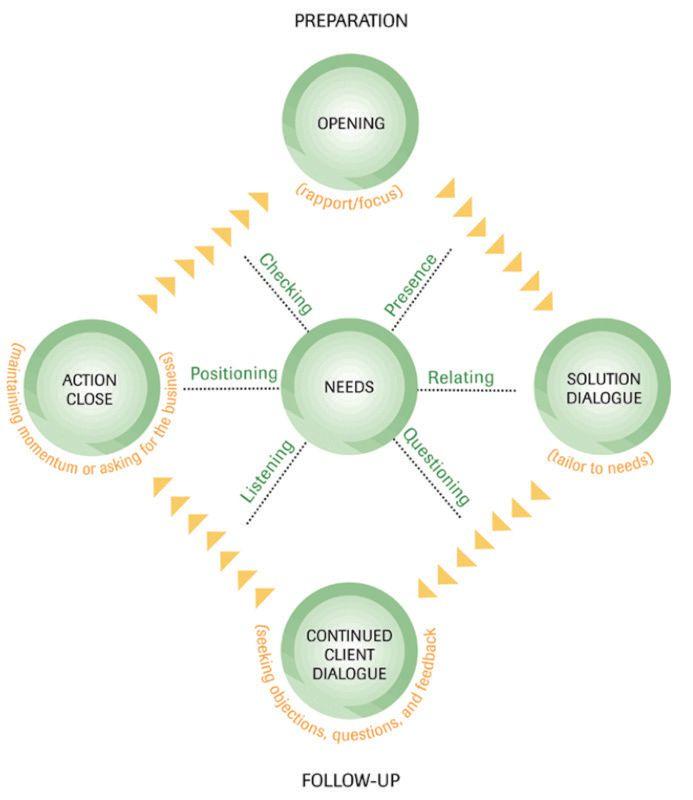
Richardson, a leading global sales training and performance improvement company, created a chart to describe the Six Critical Skills for Successful Sales Conversations, produced (April 2014) by Dario Priolo, the company’s Chief Strategy Officer.
I hope you’ll agree that a little research is called for before meeting with a prospect.
In that research, I’m hoping to find something that will give the person I’m talking to an opportunity to brag about his or her company. Here’s an example: “I’ve been following your company on Facebook, and I saw that you received a corporate good citizenship award. Were you personally involved in that?” That 10-second question had the prospect talking animatedly for three to four minutes.
Here’s a good rule of thumb for any salesperson: The more they’re talking and the less you’re talking, the better you’re doing, especially early in the game. The key here is to engage your prospect in conversation.
About the individual
Okay, let’s say that you engage in a few successful minutes of conversation about the company. Next, I want to transition to a few minutes of conversation about the individual. But this is not where you ask which football team the prospect supports.
You’ll have opportunity for social conversation later. This is a business conversation, and there are two things I want to learn at this stage. First, whether the person I’m talking to is empowered to buy from me and, second, whether he or she will likely have interest in buying from me.
To address the first issue, I like to ask, “How long have you been working here?” I’ve found that long tenure is a good indication of authority. But do you see how this question cloaks your true objective inside a question that should be perceived as sincere interest? Let’s compare that to another approach, asking bluntly whether the person you’re talking to has the authority you need. Do you agree that a question like that could destroy the mood?
To address the second issue, I like to ask, “How much time do you spend dealing with printing salespeople, and is this a part of your job that you enjoy?” The answer I’m hoping for is a lot of time, but not a lot of enjoyment. Do you see how that would provide interest in making a change from the status quo?
Qualifying the lead
To this point, if all has gone well. You’ve done a little bit of talking and a lot of listening. I want you to continue that for another few minutes, but now I want you to learn about the prospect’s printing needs. This is really about qualifying, because before you invest a lot of time in a prospect, I want you to be sure that they have enough volume potential to justify it.
To get into that, I might ask, “Can you tell me about your last print project?” I can mentally calculate the dollar value as the prospect describes the job. I can repeat this process to talk about a few more recent projects, and maybe some future projects.
I hope you’ll see how this process can help you to qualify – without destroying the mood. Because now we’re getting to the point where you ask the ultimate question. To get an open and honest answer. And have some real basis to decide whether success is likely, and exactly how to position yourself as the solution to his or her problem and/or the relief for his or her pain – Now that’s selling!
DAVE FELLMAN is the President of David Fellman & Associates, a graphic arts industry consulting firm based in Cary, North Carolina. He is a popular speaker who has delivered keynotes and seminars at industry events across the United States, Canada, England, Ireland and Australia. He is the author of Sell More Printing (2009) and Listen To The Dinosaur (2010). Visit his website at davefellman.com.
DATA DRIVERS
Michael Sifton and Greg Cochrane are reshaping a legacy company to become one of Canada’s most-formidable managed communications providers by leveraging print and strategic acquisitions
By Jon Robinson
For the past two years, DATA Communications Management has been entrenched in transformation, perhaps best signified by this new name for the 58-year-old company that is historically associated with printing business forms. The change to DATA Communications Management from The DATA Group in the summer of 2016 seems trivial, but, at that time, the public printing company –one of just a handful in Canada – also consolidated all of its issued and outstanding common shares and began trading under a new TSX stock symbol, DCM
The transformation of DCM is a story of powerful investors who have influenced Canada’s printing industry for a couple of decades, mergers and acquisitions, reorganizing a national footprint and investing in a unique service platform run by highly skilled employees. Leaning on the printing legacy of one of Canada’s largest and longest-surviving document producers, DCM is now positioning itself as a managed communications provider with leadership expertise in marketing services. The company’s position pits it up against North America’s largest printers and technology suppliers who have a growing interest in the cash cow of corporate print consulting. This is driving DCM to build a breadth of printing services to
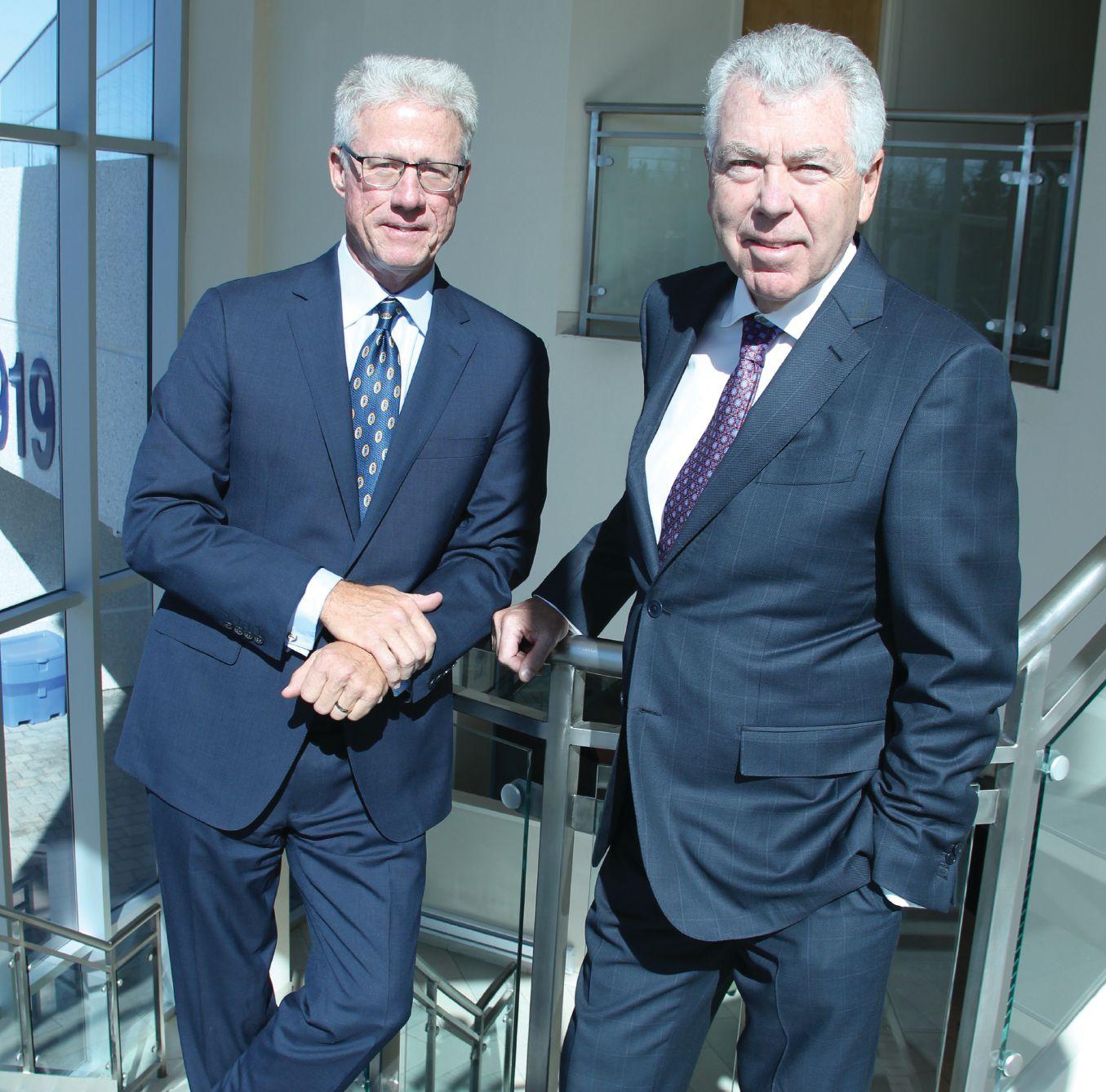
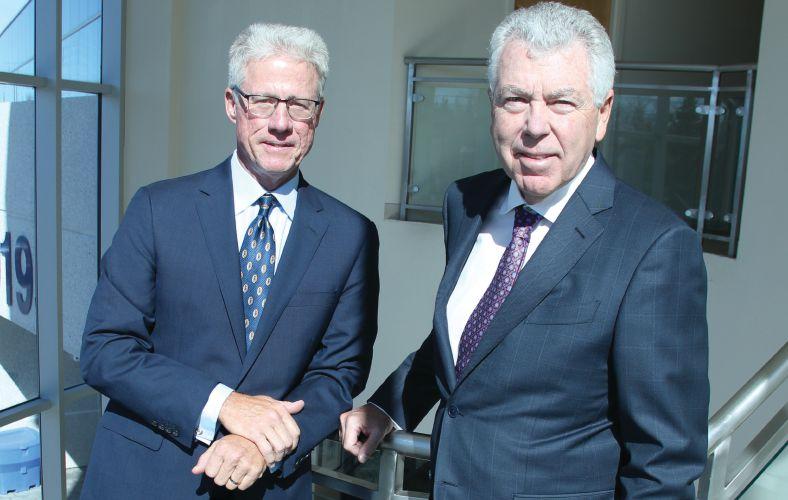
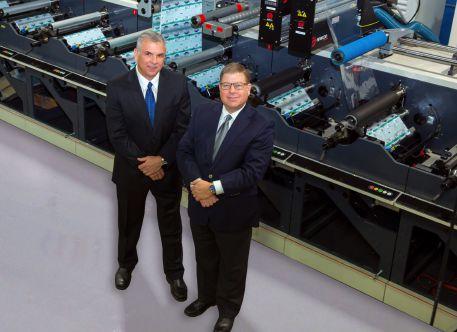
Michael Sifton, Chief Executive Officer (left), and Gregory Cochrane, who became President of DATA in November 2016, in the company’s Brampton, Ontario, facility.
Above left: DATA has developed a major presence in large format imaging, including its recent acquisition of Eclipse imaging, running HP inkjet and Heidelberg litho presses.
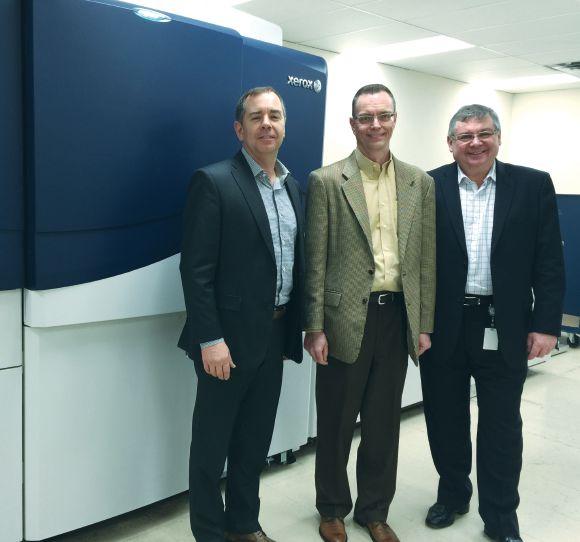
Above right: As part of DATA’s initial $6.7 million investment back in 2015, one of its new Xerox iGen 5s is pictured with (left to right) Steve Wittal, Senior VP, Sales; Leigh Busch, VP Commercial & ODS Operations; and Alan Roberts, Senior VP, Operations.
simplify its clients’ most complex communications campaigns.
Rounding out print
“The business has been in transition for many years, giving credit to prior management. They acquired, stitched together and moved the business forward in a lot of different ways,” says Michael Sifton, who has served as Chief Executive Officer of DCM since April 2015. “That being said, what we did was amp up the rate of change in the last two to three years.”
DCM’s current evolution leverages a sticky printing infrastructure used by some of Canada’s largest financial institutions, from where most of its revenue is still generated, accounting for approximately one third of total revenue in its most recent fiscal year. To increase the breadth of its printing capabilities, DCM has made key acquisitions like February’s share purchase of Thistle Printing and substantially all of the assets of Eclipse Colour & Imaging. The acquisitions came after Sifton spent two years rightsizing the company, reducing DCM’s production footprint from nine facilities to just five, which the company today labels as Centres of Excellence – in Brampton (headquarters) and Mississauga (two), Ontario; Calgary, Alberta; and Drummondville, Quebec.
“We are absolutely more focused than we were before and we are more optimized. One of our big initiatives is to become more united because we were disparate parts and not really working together with a mission,” says Sifton. “We are much closer to that today.”
DCM’s core capabilities include direct marketing, print services, labels and asset tracking, event tickets and gift cards, logistics and fulfillment, content and workflow management, data management and analytics, and regulatory communications. In addition to leveraging an executive team with vast M&A experience, DCM is heavily focused on firming up processes and systems to get the most out of what is now one of Canada’s largest and most diverse printing operations.
In January 2016, DCM revealed it had made a significant upgrade to its digital printing capabilities by acquiring multiple new Xerox systems, including high-end iGen 5 presses. In late-2016, DCM completed an additional $2.1 million investment in its printing platform with an emphasis on label production, with upgrades and technology enhancements to systems in Brampton. As it made these platform investments, DCM also realized the consolidation of its facilities, including moving its Regina manufacturing and warehousing operations into its flagship Calgary facility, which had already absorbed much of DCM’s Edmonton plant.
The Calgary location, which also holds significant sheetfed offset capabilities, recently began to absorb the wide-format capabilities of DCM’s Mississauga plant following the purchase of Eclipse in nearby Burlington, Ontario. Eclipse specializes in large-format and point-of-purchase display printing with approximately 90 employees operating in an 80,000-squarefoot facility. This $9.4 million (net purchase price) acquisition turns DCM
into one of the country’s most significant large- and grand-format printers. Eclipse generated approximately $21.3 million in revenues (unaudited) for the fiscal year ended November 30, 2016.
“They also have a growing packaging business, especially in specialty packaging, so we are quite happy about that,” says Greg Cochrane, who became DCM’s President in November 2016. “We see three growth areas: Large format, packaging and labeling.”
The $6.1 million (net purchase price) purchase of Thistle in Toronto provides DCM with commercial printing capabilities in a location that better aligns with its critical customer base in the financial heart of Canada. “Thistle is a steady, classic commercial printer. What that allows us to do here in Eastern Canada is to have, under one roof, our complete litho and sheetfed operation,” says Cochrane. “Currently, we are outsourcing a lot of that to tier-two vendors, maybe some of our competitors, but this allows us to do more inside. We repatriate the business.” With approximately 65 employees operating in a 42,000-square-foot facility, Thistle generated $16.4 million in revenues (audited) for the fiscal year ended October 31, 2016.
As it closed the 3-month acquisitions of Thistle and Eclipse, DCM also arranged an increase under its senior revolving credit facility with a chartered bank by $10 million to up to $35 million. The move provides DCM with a total borrowing base of up to $72 million from $50 million, suggesting its investment-savvy executive team will continue to make acquisitions.
$9.4M
In February 2017, DATA acquired substantially all of the assets of Eclipse, through an asset purchase, for a net price of approximately $9.4 million. The company also bought the common shares of Thistle for a net price of approximately $6.1 million.
“There are opportunities on the traditional side of the spectrum that we need to tuck in and we think that they are trading at favourable multiples today,” says Sifton.
Leveraging growth experience
DCM purchased Thistle from private equity firm VRG Capital Corp., perhaps best known for its financial backing of PLM Group, which was eventually purchased for $130 million by Transcontinental in 2007. Cochrane in 2011 became a Managing Partner of VRG Capital, which also holds an interest in DCM. The company publicly disclosed the Thistle purchase after receiving opinions on what was determined to be fair market value.
Cochrane actually began working with DCM in June 2016 as a Director of the company (stepping down from his board position in November to fulfill his mandate as President), along with VRG Managing Partner J.R. Kingsley Ward, who currently serves as DCM’s Chairman of the Board. It was also around this time, as the new DCM entity came into existence, that Sifton made his own siz-
able investment in the company, approximately 10 percent, along with Cochrane at a lesser amount.
“I bought in during the springtime last year in a fairly major way. Greg just recently took more shares as part of a transaction and is interested in making larger commitments to this company,” says Sifton. “So we are committed. We believe in its future and it is a company that is going to continue to go through transitions. There are going to be some bumps and grinds along the way, but we think the prize is worth it.”
With the arrival of Cochrane, Sifton shifted his CEO mandate with DCM to focus on financial and strategic initiatives. Cochrane meanwhile is putting his knowledge toward sales and business development. “I am a real execution type,” he says. “There is no such thing as better strategy just better execution.” At age 65, Cochrane provides a diverse background with decades of experience in marketing services, communications, event management and private equity investment.
term contracts. It is RFPs with major [financial institutions] and insurance businesses,” he says, acknowledging a decline in the printing of transactional forms, although DCM is also entrenched with the same clients’ use of electronic options. “As that [print] is declining, you better be best in class in terms of costing, on time, and we aren’t paying for any extras. So that part of the business we are really good at it. There are only a couple companies that can do it here in Canada.”
Cochrane refers to the other part of DCM’s business as customized on-demand, which relies on printing processes like digital, large-format, labels, packaging and direct mail – even sheetfed with DCM’s new lithographic assets. “Those are the types of things that are growing… And the recent acquisitions we have made really bolster those areas for us,” he says. The customized on-demand part of DCM is where Cochrane’s marketing background comes into play based on evolving client-purchasing patterns.
After beginning his marketing career in product management with General Electric and then S.C. Johnson, Cochrane in 1981, along with his business partner, built out one of the largest Canadian event and conference companies, Mariposa Communications, which was sold in 1997 to Mosaic Group. In 2001, Cochrane became a lead investor in Pareto Corporation, a start-up marketing services business which became publicly listed in 2004, and where he remained a director until its sale to U.S.-based private equity firm Riverside Company in 2011 for $125 million.
Pareto would eventually shut its doors in late-2013, filing under Canada’s Companies’ Creditors Arrangement Act, which new owner Riverside described as the result of a sluggish economy and increased competition in the shopper marketing space. Also described as sales activation, the term shopper marketing is based on methods to connect brands, retailers and shoppers before, during and after a sale, which can include a plethora of print for direct marketing, experiential marketing, events, sampling programs, retail merchandising, in-store messaging and other incentives.
With operational responsibility for the direction of DCM, Cochrane views the company as holding two primary business arenas. “The first part is what I call the rinse-repeat. It is forms. It is long-
“People who are around the room are not only in procurement but also marketing,” says Cochrane. “The [sales] conversation 10 years ago is totally different than it is today.” He explains the marketing executives of large clients are now involved in the complete process, often asking DCM to work directly with agencies on campaign details. “Yes, this is complex, but we are in the business of simplifying the complexity of your communications needs.”
Cochrane uses the term “to stand the client up” to describe DCM’s value-add approach, as he recalls one recent example: “With all of their requests it took 150,000 lines of code to get them up and running, so we could deliver materials on time.” In fact, it was this same marketing executive who remarked on the true nature of DCM’s services. “The customer said, ‘Actually what you guys are is a managed services provider.’” With Cochrane’s experience and millions of dollars invested in new printing infrastructure, DCM is a formidable managed communications provider supported by marketing services potential and decades of process knowledge.
“I knew nothing about DATA when I was first approached about the opportunity a couple of years ago,” says Sifton. “The one thing that keeps coming back to me is just how great the folks are in this company and they are worth us putting a shoulder behind to make it work.”
J Press Redefines the Eye Test
When it comes to high resolution print quality and color consistency, close is not enough. Discerning brand managers expect to see offset quality and repeatable color on every printed piece. Job after job. Reprint after reprint.
J Press 720S delivers a wider color gamut than 4-color offset and exceeds the Idealliance organization’s stringent tolerances for color and quality consistency. In fact, it’s the only high speed production inkjet press platform certified by Idealliance and the only digital press certified to Gracol 2013 standards.
So if you’re being challenged by brand managers and print buyers to deliver faster job turnaround without compromising on quality or color consistency, then look no further.
Take the J Press Eye Test yourself. Request a side-by-side comparison with offset at Fujifilminkjet.com/JPress.
High Definition
Nozzle Architec-
ture is HP’s newest print head technology for high-speed inkjet printing, delivering 2,400 nozzles per inch and providing support for dual drop weight per colour.
HIGH-SPEED INKJET SURFACES
New surface treatments for paper might enable significant savings in the use of commercial inkjet presses, which remains one of the biggest challenges for widespread adoption of what most envision as the future of printing
By Martin Fairbank
At PaperWeek Canada, the annual conference of the Canadian pulp and paper industry held in Montreal the week of February 13, 2017, one of the presentations discussed a new surface treatment for paper that could allow highspeed inkjet printers to improve quality and save money on their high quality print jobs.
Inkjet printing is achieved by spraying fine ink droplets on the printing medium from a print head. In order to obtain a good quality image on paper, the ink
droplet arriving on the surface of the sheet must be immobilized, to prevent spreading of the ink and blurring of the image. There are two types of inkjet ink: pigment-based and dye-based. Pigment-based inks contain solid coloured particles which remain on the surface of the sheet. Dye-based inks, which are cheaper, absorb into the sheet and often produce duller images.
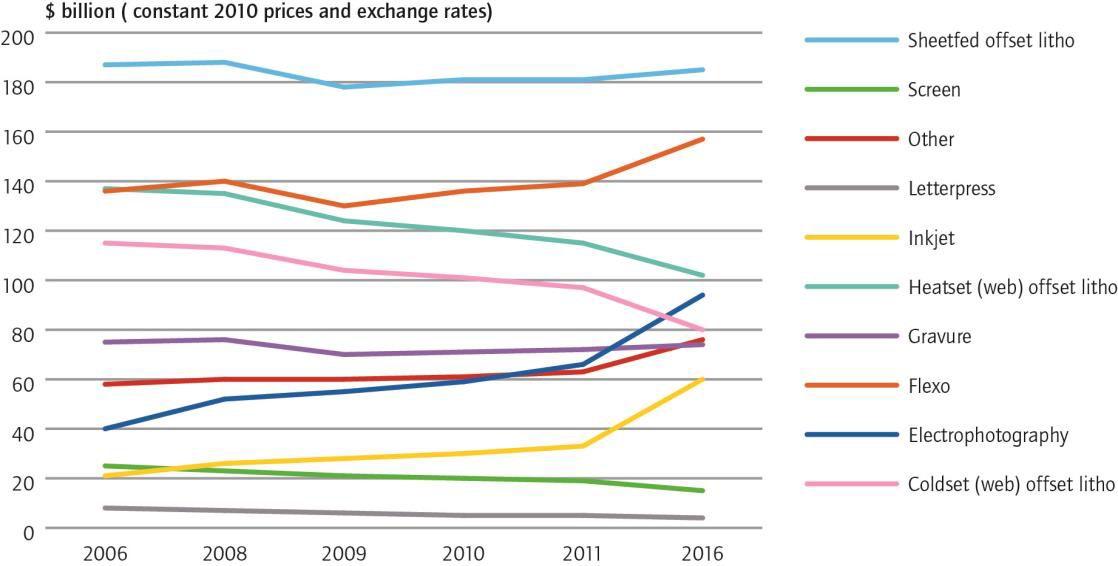
Commercial high-speed inkjet printing has shown an annual growth rate of about 15 percent over the last five years in the U.S., according to a study by Poyry. Inkjet printing is already the leading digital printing technique on transactional print jobs such as credit card statements where mostly black ink is used, since
High-speed inkjet, according to a Pira International study, is expected to have the highest value growth among a range of key printing processes, increases from $33 billion in 2011 to $60 billion in 2015. This represents a market share increase from four to just seven percent over the same time frame, 2011 to 2016.
Why High Speed Inkjet?
dye-based inks are cheaper than toners. It is also increasingly used for new business models such as print-on-demand and custom publishing.
Source: Pira International
Market shift in print
HP’s High Definition
Nozzle Architecture allows for the printing of up to 800 feet (244 metres) per minute in colour.
Commercial inkjet printing is starting to take significant market share away from offset printing. There are many reasons for this, including fast setup time, ease of customization, less waste and lower cost per copy for shorter print runs.
drying time required. Home and office inkjet printers print relatively slowly, and the drying time is not critical, but webbased production inkjet printers often need to use inline drying techniques to run paper webs at several hundred feet per minute without ink smearing.
KemPrint 17 in Montreal
In 2018, Poyry estimates the printing market value in the United States will be $913 billion, with digital comprising around 21 percent of that number ($188 billion), 50% of which will be inkjet printing.
Source: World Population Prospects (United Nations)
High quality marketing communications such as catalogues and brochures are traditionally printed by offset printing on glossy coated paper. With inkjet machines, printing on these types of papers can be a challenge, because the water phase of the ink must pass through the coating while the colorant remains fixed on the surface. For this type of promotional printing, pigment-based inks are the inks of choice for inkjet printers.
To design a paper surface that works well with inkjet inks, there are two strategies. One is to coat the surface with positively charged particles, which immobilizes negatively charged ink pigment particles. An approach using calcium chloride in the coating formulation was developed jointly by HP and International Paper about 10 years ago and is trademarked as ColorLok technology.
The second strategy is to provide a surface treatment that rapidly absorbs the liquid phase while keeping it near the surface of the sheet, and minimizes the
An interesting research paper presented in Montreal was given by Bob Hardy from Kemira Paper Chemicals. Kemira has developed a new product, KemPrint 17, that can be applied at the size press of a paper machine. The product is a very high surface area cationic pigment and thus it uses both of the above strategies to immobilize the ink and minimize the set time. Ink penetration into the sheet is significantly reduced, creating high ink densities.
Kemira carried out lab printing trials with their product to demonstrate how it compares with a calcium chloride surface treatment, using either pigment-based or dye-based inks. A constant coat weight of 2.3 g/m² was used. The CaCl2 treatments used a 4:1 mixture of oxidized starch and CaCl2.
Two levels of KemPrint were applied, at 1/3 and 2/3 of the coat weight, mixed with oxidized starch. The results indicate, that for pigment inks, the black print density can be matched with KemPrint and coloured print density can be improved. The colour gamut, where a higher colour gamut value equals more
vivid colour reproduction, was also improved with the KemPrint treatments. The tests were repeated with dye-based inks, and here the KemPrint treatments all gave higher values of print density and colour gamut than the CaCl2 (ColorLok) treatment. This makes sense, as dyebased inks are non-ionic, so the cationic nature of the CaCl2 is ineffective at immobilizing this type of ink.
Print-through tests also showed that the KemPrint product could match or improve the print-through performance of CaCl2, a good indication that liquid penetration into the sheet is being minimized.
High-speed inkjet printers are always looking for the higher print quality for lower cost. This new technology from Kemira, which is now being tried out by a few papermakers and printers, should result in brighter, sharper images, and may allow them in the long run to move from more expensive pigment-based inks to dye-based inks for these high-speed jobs.
Production inkjet is already driving change in the printing industry, both by enabling new applications and by capturing volumes previously produced with analogue technologies such as offset and flexography. Over the past couple of years, there have been major advances in both technology and pricing models, with ink and substrates being front and centre in the future success of the production inkjet model.
Short-run finishing
As the printing world continues to experience decreasing run lengths, higher transaction jobs, and a demand for higher value work to push out of the commodity market, short-run finishing technologies are becoming an ever more important tool for printers, including some of the following newer systems.
Sydney Stone, Morgana DigiFold
The Morgana DigiFold PRO 385 is a high-speed creaser folder with fully automatic setup and deep pile feeder. It is the newest addition to the Morgana range of folder/creasers. The DigiFold Pro 385 is the fourth generation of the DigiFold series, offering new levels of automation to meet a range of printed applications. It is specifically designed for digital and litho printers who have a need to crease and fold digitally printed, heavyweight or cross grained stock.
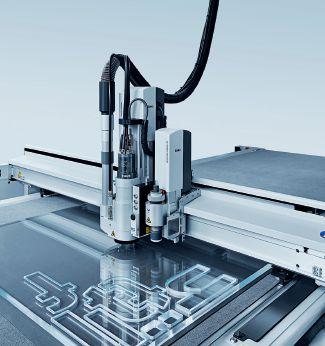
Esko Lubri-Cool
The Kongsberg C with Lubri-Cool is part of a line of cutting, creasing and milling tables that leverage a collection of software tools. To develop the Kongsberg C, Esko explains it engaged customers and non-customers involved in the short-run finishing market primarily focused on sign making, displays and paperboard packaging converting. The Kongsberg C series is designed for finishing a mixture of 3.2-metre wide flexible and rigid materials for sign, display and packaging applications.
Standard Horizon RD-4055
The Standard Horizon RD-4055 Rotary Die Cutter can die-cut, crease, perforate, slit, hole punch and round corners in one process for both digital and offset printed sheets. The recently updated RD-4055 is well suited for producing a variety of unique applications, including door hangers, table tents, CD holders, pop-up business cards, stickers, labels and specialty packaging, as well as applications which require an additional folding pro-
cess after die-cutting such as boxes, pocket folders and greeting cards. The system can achieve up to 6,000 cycles per hour on sheet sizes up to 15.74 x 21.65 inches. A repeat register function allows multiple-up applications from a single-up die to minimize costs.
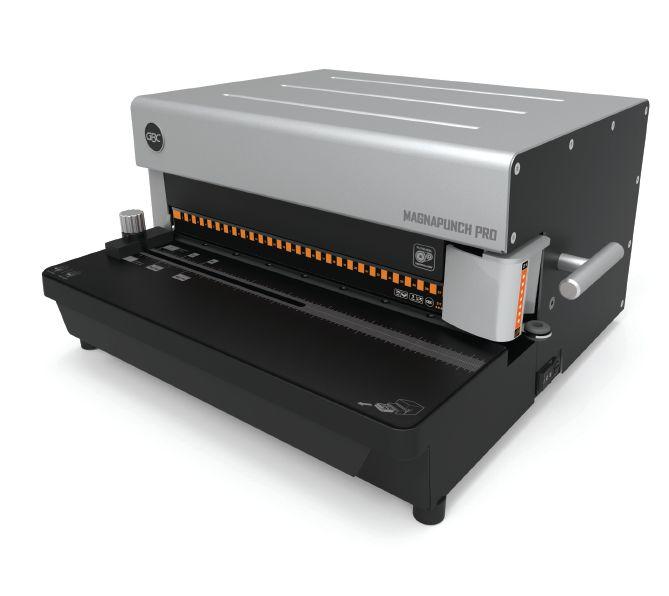
GBC Magnapunch Pro
The GBC AdvancedPunch Pro is a compact hole punching unit which offers multiple hole punch die sets as options. This automatic hole punch unit provides good quality output, saves time and increases productivity by eliminating the labour-intensive steps of manual punching, and is integrated into the Xerox print engines. The AdvancedPunch Pro is a compact device and requires only a small increase in footprint. Productivity is at rated print engine speed for most paper sizes. Key Features include Trail edge, LEF and SEF punching, 2-up punching (double punch) and on large sheets enabled by new AdvancedPunch Plus alignment technology on selected print engines.
Zünd RM-L Router
Magnapunch Pro can be integrated into the Xerox engines.
Zünd in early 2017 introduced what it describes as robust routing option, called the RM-L router, for working with
heavy-duty materials like acrylics, plexiglass, aluminums, polycarbonates, Dibond, Forex and MDF. The spindle delivers 3.6 kW of processing power and is well suited for print service providers running diverse work that is typically processed via different tools. The spindle with pneumatic collet of the RM-L system is capable of routing, engraving and polishing with a maximum torque of 0.7 Nm. The tool allows for dense, hard materials to be processed at greater speeds and cutting depths. It essentially reduces the number of passes required to increase throughput.
Southwest Bindings ALM
The ALM 3230 Mini, according to Southwest, is a next generation, automated one- to two-sided print laminator that can work with up to 13 x 19-inch sheets. The machine, according to the company, features ultra quick warm up and automatically feeds up to 100 sheets – and with laminate and trim in one pass. Available film for the system includes 1.2-, 1.5-, 3- and 5-mm thickness.
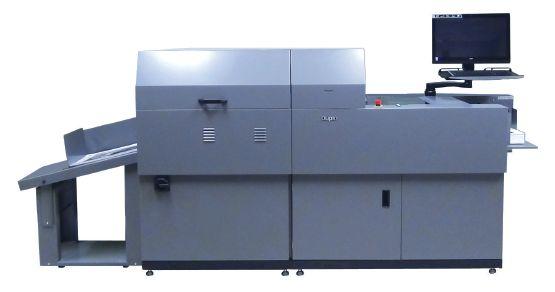
Duplo DDC-810 UV Coater
In February, Duplo introduced its new DDC-810 Digital Spot UV Coater, which is expected to be officially released in May 2017. Utilizing ink jet technology, the DDC-810 applies a gloss finish to defined areas of the substrate giving images a raised effect with texture and depth. Its CCD camera recognition system ensures image-to-image registration and its PC
GBC
The magazine for the RM-L router can accommodate up to eight different preloaded collet holders.
Controller software offers an easyto-use operation. Designed for short run applications, the DDC810 can process up to 21 sheets per minute (A3), UV thickness from 20 to 80 microns, and paper weights from 157 to 450 gsm (coated paper).
Unibind
CM750 UniFoil Printer allows users to personalize books, notebooks, agendas and contracts. The UniFoil Printer is a digital printer that prints foil directly from a digital file on any flat surface. As well, the CaseMaker 650 allows users to create a hard cover, ringbinder or display in what Unibind describes as an easy and maintenance-free way with the Unibind CasePlanos.
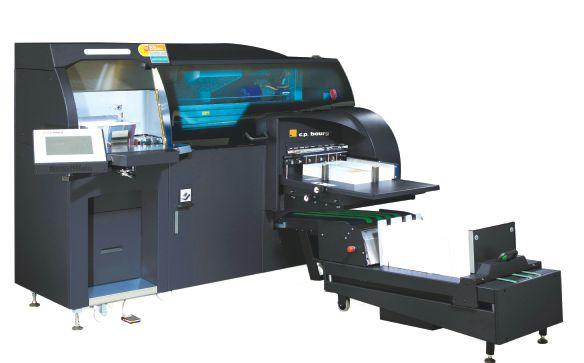
C.P. Bourg BB3002
The C.P. Bourg Binder BB3002 family of products are designed to create a range of on-demand perfect-bound books ranging from 1 mm up to 60 mm, with up to 13 positive or negative knife creases, using EVA/hot melt or PUR-C adhesive systems. The company states its BB3002 is easy to maintain and
set up for integration with existing workflow. The BB3002 can be upgraded with a Bourg Book Loader to create the BB3102 system.
Intec ColorFlare 1000LX
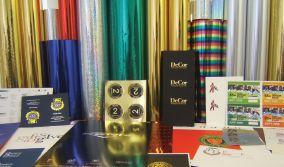
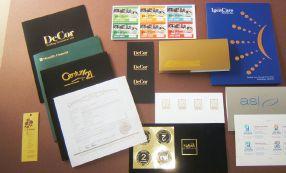
The new ColorFlare 1000LX is a compact and dual laminator and foil flaring technology designed to offer commercial printers, marketers and designers in-house decorative effects.
Primarily designed for short run, on-demand toner printing applications, as well as lamination for traditional litho output, the CF1000LX is well suited for applications like greetings cards, vouchers, security print, packaging, book jackets and labels.
Sydney Stone, instaFOIL
instaFOIL is a new product to create short run spot foil for digital printers. instaFoil is used in conjunction with a laminator in order to apply foil in-house. The product is available in nine colours including Gold, Silver, Gloss, Green, Red, Matte Gold, Medium Blue, Dark Blue, Pink and Red.
ONE-STOP SHOP — Die Cutting, Bindery, Data & Lettershop.
2. SUPERIOR TECHNOLOGY — Die crease without a die, then fold and even glue all on the same machine, up to 30 pt.
3. INTEGRATED MODULAR UNITS — Combined in-line finishing: crease, fold, glue, tipping, envelope inserting, ink jetting (Duplex), clip seal (3 sides), mail prep.
4. SAVE ON POSTAGE COSTS As a Certified Canada Post Direct Marketing Specialist, we get contract pricing reductions.
5. RETURN MAIL PRODUCTS — Customized “Return Mailers” created in-line with “U” or “BOX-shape” remoistenable glue, time perfed applications and envelope formation.
6. MINI-BOOKLETS — Saddle-stitch and trim 2-up booklets in-line to the size of a business card. No need to trim off-line, or do 2 passes. 7. HIGH SPEED EQUIPMENT — High speed Tipping, Folding, Saddle-stitching and soft folding ensuring on time delivery.
Duplo’s DDC-810 applies a gloss finish to defined areas of the substrate.
The Bourg Binder BB3002 products are designed to create a range of on-demand perfect-bound books
Detailing the newest technologies from 4over, Agfa Graphics, Avanti, Canon, EFI, Enfocus, INX Digital, Roland DG, SAi and SmartSoft
Agfa Asanti 3.0
In March, Agfa Graphics released Asanti 3.0, described as an automated production hub and workflow tool for sign and display printers, pointing to version 3.0’s new graphical user interfaces, added automation and more integration possibilities with equipment and Management Information Systems, as well as software like PrintSphere and StoreFront. Asanti 3.0 now includes IntelliTune, which, according to Agfa, automatically analyzes and improves image quality. The company explains this can include optimizing skin tones or by eliminating noise, stair-casing and blurriness. Other new Asanti 3.0 features include QuickProof proofing support; an improved digital alternative for see-through graphics on clear material; and improved automation through updated parameter presets and smart image repetition.
4over Painted Edge Business Cards
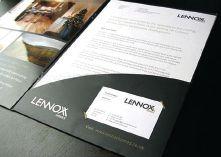
In March, North American-wide trade printer 4over of Glendale, California, introduced a new product called Painted Edge Business Cards, which is an extension to the company’s Majestic Product line. 4over explains the 32-pt stock Painted Edge Business Cards line can
include a vibrant colour to the business card’s edge. This includes a range of metallic colours like blue, gold, green, hot pink, purple or classic white.
Canon Océ Colorado 1640
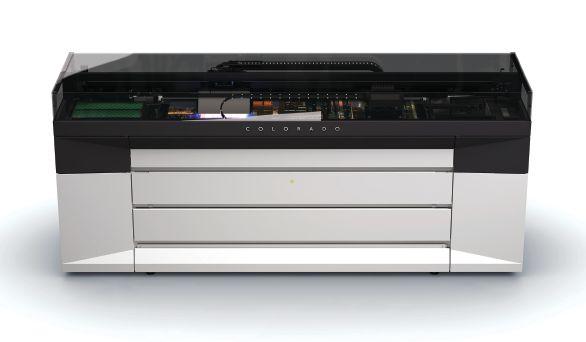
In March, Canon Canada introduced its first UVgel-enabled system in the 64-inch Océ Colorado 1640, a roll-to-roll inkjet printer for producing both indoor and outdoor graphics. At the heart of the Océ Colorado 1640 is Canon’s recently unveiled UVgel technology. The company describes the Océ Colorado 1640 as the fastest 64-inch printer on the market, with a top speed of 1,710 square feet per hour and another setting to produce high-quality, point-of-purchase prints at 430 square feet per hour.
Canon explains UVgel combines a radically new Canon UV curable ink that instantly gels on contact with the media, advanced self-aware piezoelectric printhead technology, an LED-based UV system that cures without adding any damaging heat to the media, and continuous printhead nozzle monitoring and performance compensation. As UVgel ink instantly gels on contact with media, Canon explains this results in precise dot gain and positional control, repeatable images,
Asanti 3.0 includes a new GUI for tiling large jobs.
Canon explains its Océ Colorado 1640’s UVgel technology features ink consumption that is as much as 40 percent lower than competitive technologies.
and instantly cured, durable prints. The system’s low temperature LED-UV curing technology moves independently from the printing carriage to help establish uniform post-print UV curing that contributes to print speed and quality.
SAi myFlexi App
In March, SA International (SAi), which develops software for wide-format printing and CAD/ CAM for CNC machining, unveiled its new MyFlexi mobile app. It will be released in mid-April in conjunction with its SAi FlexiSIGN version 11 and FlexiPRINT version 12 software. The MyFlexi app is available for iOS iPhones and iPads and Android mobile phones and tablets. SAi explains it provides tools to improve throughput and minimize overall job production time – from set-up to completion. It includes remote access to the Web-based FlexiQuote tool to remotely create customer quotes.
Enfocus PitStop 2017
In April 2017, Enfocus plans to launch PitStop version 2017 to help
mark the 20th anniversary since the PDF-preflight software was first released. Signaling the company’s initial move to an annual PitStop release cycle, version 2017 includes what Enfocus labels as PDF Geomapper technology, which provides new ways for objects to be selected or ignored. PDF Geomapper, for example, can be used for configuring preflight checks to check only the objects needed to render or print a PDF file. Any additional hidden or unneeded elements can be ignored or removed, which Enfocus describes as a way to reduce the complexity of files and false error messages.
EFI VUTEk 3r and 5r
In March, EFI launched two new high-volume, roll-to-roll UV LED inkjet printers in the VUTEk 5r and VUTEk 3r, first introduced in January 2017. The 3-metre-wide VUTEk 3r reaches speeds up to 3,715 square feet per hour and the 5-metre 5r reaches speeds up to 4,896 square feet per hour. In addition to LED curing, the new printers feature resolutions up to 1,200 dpi and EFI
times
❏ Enhances client service
❏ Work smart, work efficiently
❏ Increases speed - accuracy from estimates to invoices
❏ Eliminates duplication of effort
❏ Saves time and resources
UItraDrop technology leveraging seven-picoliter print heads with multi-drop addressability. This system uses a colour distribution algorithm aimed at providing economic advantages with ink usage, explains EFI, whereby one litre of ink can cover up to 1,600 square feet, on average, across all print modes.
Canon varioPRINT 140
In March, Canon released the third generation of its varioPRINT DP product line, aimed at the monochrome production print market, with the varioPRINT 140 Series. Models in the new series print at speeds of up to 140 ipm, 130 ipm and 115 ipm. The 140 Series is rated for average monthly print volumes up to 800,000 letter-size images and, explains Canon, has the capability of producing peak volumes up to 2.2 million letter-size images per month. Software tools for the 140 Series include: PRISMAsync Job Scheduler, PRISMAsync Remote Manager, and the new PRISMAsync Remote Control app.
Roland ErgoSoft RIP
Catfish can be customized for printer buyers.
possible to automate every aspect of the print job into a single workflow. This includes functions like job specification and submission, reporting, estimating, imposition, inventory management, scheduling, shipping and billing. Catfish is HTML5-based (SaaS) software that can be customized and configured for use by print buyers.
INX Digital CP100 UV
In March, Roland DG released the ErgoSoft Roland Edition 2 RIP software for its Texart dye-sublimation transfer printers. ErgoSoft has developed the RIP specifically for the Texart XT-640 and RT-640 to support high-fidelity textile printing of sports and fashion apparel, soft signs such as polyester banners and flags, curtains and other interior décor, as well as promotional goods and personalized gifts. ErgoSoft Roland Edition 2, according to Roland, includes more than 40 new features and enhancements. A new dithering method increases rasterization speed and improves dot placement accuracy resulting in what the company describes as 40 percent faster RIP times and smoother gradients.
Avanti Catfish integration
In March, software developer Avanti Computer Systems announced the integration of its Avanti Slingshot Print MIS solution with the Catfish Web-to-print platform from Infigo Software. By integrating Catfish with Slingshot, Avanti explains it is
In April, INX Digital will feature the upgraded CP100 UV digital cylindrical printer and the SLED, which is designed for testing and demonstration purposes, at the InPrint show. INX explains it has developed the CP100 and the SLED to satisfy the demand for direct-to-object printing in industrial markets. Both are driven by the JetINX Printhead Drive Electronics and Ink Recirculation. The CP100 is designed for creating short runs, proofs and prototypes for sectors like drinkware and cosmetics.
SmartSoft PressWise
In March, SmartSoft introduced new enhancements to its PressWise software which provides web-toprint, MIS and workflow tools. This includes what the company describes as a major update to Purchase Order to better accommodate outsourcing. Users can now purchase non-inventory items, including services and finishing tasks. Outsourced Products POs can be automatically created upon order injection, PO line items associated to specific jobs, and POs emailed directly from within PressWise. Imposition enhancements include new support for Work & Tumble as a work mode on quotes.
BINDERY POSITIONS
Head of shipping, dayshift, experienced, required for growing and expanding East end bindery. Duties include, but are not limited to: work well under tight deadlines with minimal supervision directing day to day activities of shipping staff and internal drivers. Responsible for outsourcing to external carriers. Work with production to coordinate shipping of client jobs. Forklift license a must. Must be able to provide a clear Canadian Criminal Background Check prior to starting in position. Salary commensurate with
experience, thank you for your interest. Only candidates being considered will be contacted. Please forward resume to resumes1@reliablegrp.com
ESTIMATOR
Estimator wanted for an expanding and growing East Toronto bindery. Must be detail oriented and have knowledge of bindery, printing knowledge an asset. Must be able to work well under tight deadlines with minimal supervision. Successful candidate must be able to provide a clean Canadian Criminal Background Check prior to starting in position. Salary commensurate with experience. Please forward resume to resumes1@reliablegrp.com
Thank you for your interest, only candidates who are being considered will be contacted.
INKJET/MAILING OPERATOR
Inkjet/Mailing Operator, plant runs day,
afternoon, midnight shifts, experienced, required for expanding, growing East end bindery and mailing house. Must be able to provide a clear Canadian Criminal Background Check prior to starting in position. Must work well under tight deadlines with minimal supervision. Salary commensurate with experience, thank you for your interest. Only candidates being considered will be contacted. Refer to MAIL/INKJET OPERATOR. Please forward resume to resumes1@reliablegrp.com
SALES & INSTALLATION OF NEW & USED PRINTING EQUIPMENT
Sales and Installation of new and used printing equipment.
1994 KBA 142-7 LX UV; 1994 KBA RA 104-7 lx; 2000 KBA RA 105-7 P LX UV; 2005 Mitsubishi 3F-8 LX; 2002 Heidelberg SM 102-5L; 2013 Heidelberg SM 52-4L.
Web: www.PrintEquipment.ca
Email: Sales@PrintEquipment.ca T: 416-427-5915 or 647-895-6478
ASSISTANT PROFESSOR, SCHOOL OF GRAPHIC COMMUNICATIONS MANAGEMENT
Ryerson University, Toronto, Canada
The School of Graphic Communications Management, in the Faculty of Communications and Design, is seeking a full-time tenure-track Assistant Professor, in the area of packaging. The successful candidate will assume responsibilities for teaching, research and scholarly activities, curriculum development, and service. The position will commence July 1, 2017 (subject to budgetary approval). The successful candidate will have a doctoral degree in a field related to packaging or a Masters degree in packaging in addition to 5+ years experience. Additional qualifications include experience in academic leadership positions and successful receipt of external research funding. More details can be found at: https:// hr.cf.ryerson.ca/ams/faculty/preview. cfm?posting_id=508840
Sakurai: 1, 2 or 4 colours and any size (newer model)
Polar: any size/older or newer models (66/72/76/78/82/90/92/107/115)
Horizon-BQ: 220/240/260/440/460
Mike Fredericks / Chief Executive Officer / Renaissance Printing Inc. / Pickering, ON
Renaissance Printing Inc. in March became a new entrant in the Greater Toronto Area’s printing community under the majority ownership of Annex Publishing & Printing. Renaissance, running a five-unit Mitsubishi Diamond 16 MAX-M commercial web press, is focused on providing turnkey printing services for publishers and marketers primarily in Ontario, as well as New York State, Pennsylvania, Quebec and throughout New England.
Annex, the parent company of PrintAction, purchased the remaining primary assets of Web Offset Publications (Ironstone Media) from a receiver after it fell into creditor protection earlier this year, its third filing since 2012.
Annex has long held a significant regional printing position based out of its headquarters in Simcoe, Ontario. In August 2015, the company installed an 8-colour, 40-inch Komori LS perfecting press. PrintAction spoke with CEO Mike Fredericks about the strategy and position of Renaissance Printing.
Why did Annex already own the web press?
MF: The evolution of this goes back to their first creditor protection filing, which was in 2012 and we ended up acquiring the Mitsubishi heatset press that was in the building. So Annex already owns the primary piece of the printing infrastructure, 100 percent of the press, which effectively meant they rented it from us.
How was Renaissance purchased?
MF: [Web Offset] was back in an insolvent situation with other protection filings against it and we made a deal with the financial company that held the primary secured interest of the business and Annex is the majority shareholder.
Why does this buy make sense for Annex?
MF: It is a great fit because we are already the [facility’s] second largest customer. All of our larger runs and different format work go through that press. We have been doing business with them for close to 20 years as customers.
Why can Annex make the facility work?
MF: As publishers, the only time you ever hear about printers is when they screw up
and I never heard any of my Annex publishers complain about Web Offset. They produce great quality and they get it out on time. So from my perspective, it is a great printing company and it just needed some financial backbone. We obviously have operational skills to provide from our Annex exposure so that it can survive, succeed and thrive.
As Canada’s largest business-to-business publishing group, Annex Business media controls close to 60 unique media brands.
What did you share with Renaissance staff about your leadership approach?
MF: I did tell the story to the staff that I wasn’t in my first print plant until I was two. And I don’t mean two months or weeks or years. I was two days old when my dad took me to his printing plant. So I can claim that I have effectively 58 years of experience in the printing industry, even if there were intermittent periods when I became a chartered accountant, among a few other things… But effectively I came back to what I started out at when I was two days old.
Why is Renaissance a new company?
MF: Renaissance is a completely new company following a court vesting order
that basically dissolved Web Offset to clear the newly purchased assets of old liabilities, effectively cleansing the company from all of its history.
What liabilities does Annex hold?
MF: We did not practically assume any liability for anything they had in the past. It is fundamentally a brand new company. The asset purchase was a complicated transaction, rather than an acquisition, through Viva Financial centred around book of business, employees and Annex’ pre-existing press purchase.
What is happening with the employees?
MF: We hired the employees fresh [on Feb. 28] so they are fundamentally all new staff. The whole company has been cleansed –Renaissance really is a renaissance.
How does this new position change Annex?
MF: Annex will always be a publishing company first that has an interest in the printing industry. This is a commitment from our side that we still believe in the world of print.
Counterfeiting is a global problem. In your world, that means thieves are trying to steal your most prized possession — your reputation. Fortunately, Sun Chemical has the anti-counterfeiting technology you need to protect your brand and reputation. From infant formula to adult beverages and more, it’s just one more way Sun Chemical helps you go securely from concept to consumer — all from a single, trusted source.
Request your copy of our white paper, Anti-counterfeiting Technologies for Packaging, at www.sunchemical.com/ anticounterfeiting or call 1-708-236-3798. working for you.