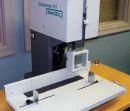
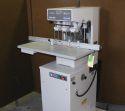
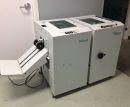
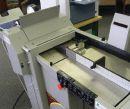
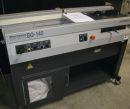
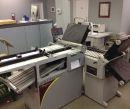
Heavy boards, plastics, laminations or digitally printed works up to 30 pt can now die crease, fold and even glue in-line.
3M shapes supply
ahuge development touching the printing world took place last month when 3M, one of the world’s largest adhesives producers, with $32 billion in annual sales and 90,000 employees, announced its new pulp-and-paper sourcing policy. The company states the policy is designed to ensure all the virgin wood fibre going into its paper-based products and packaging comes from sources that protect forests and respect human rights.
3M’s revised policy comes on the heels of a multi-year campaign by ForestEthics challenging the company to strengthen its environmental commitment along these lines. Greenpeace joined the campaign in 2014.
Most significantly, 3M states all paper-based products and packaging suppliers working with the company are required to provide information on the original forest sources of the virgin pulp in 3M’s products, and allow those sources to be assessed against 3M’s policy.
ment, including Canada’s largest printer, we know the key to measuring success will be in effective and transparent actions by the company to make it real on the ground.”
3M’s new policy will initially create great reservations in printing, because such initiatives introduce more costs to an industry fighting to generate sustainable margin. The company taking on the primary cost burden of the policy, 3M, sees the long-term business case for action and, ultimately, the industry will also benefit long-term. It allows printing to gain a stronger foothold in future economies that eventually will need to be environmentally progressive.
— Combined in-line finishing: crease, fold, glue, tipping, envelope inserting, ink jetting (Duplex), clip seal (3 sides), mail prep.
4. SAVE ON POSTAGE COSTS —As a Certified Canada Post Direct Marketing Specialist, we get contract pricing reductions.
5. RETURN MAIL PRODUCTS — Customized “Return Mailers” created in-line with “U” or “BOX-shape” remoistenable glue, time perfed applications and envelope formation.
6. MINI-BOOKLETS — Saddle-stitch and trim 2-up booklets in-line to the size of a business card. No need to trim off-line, or do 2 passes.
7. HIGH SPEED EQUIPMENT — High speed Tipping, Folding, Saddle-stitching and soft folding ensuring on time delivery. Call us
Implementation of the policy throughout 3M’s global operations involves more than 70 countries and 5,000 pulp-and-paper suppliers, each with their own supply chains. “Canopy joins our environmental allies who worked closely on the policy in praising 3M’s actions. 3M’s policy has impact because of their global scale of operations,” says Neva Murtha, Printer Campaigner with Canopy, Canada’s leading non-profit focused on printing’s paper supply chain. “Having supported over 750 companies in forest policy develop-
The e-waste of digital communications is a largely unchecked problem. The efficiencies of digital communications, however, provide powerful counterbalances to mask the problem – in some part legitimately. Imagine the amount of print needed on a daily basis to consume just five percent of the information gathered through the Internet. Certainly an argument can be made whether such information overload is healthy or harmful, but its growth and distribution will continue on.
The good news is that print, too, is valuable in this information economy. And it is certain the breakneck pace of science, fuelled by digital communications, will make a stronger case for environmental progress.
Editor Jon Robinson jrobinson@annexweb.com 905-713-4302
contributing writers
Zac Bolan, Peter Ebner, Chris Fraser, Victoria Gaitskell, Martin Habekost, Nick Howard, Andy McCourt, Nicole Rycroft, Abhay Sharma, Trish Witkowski
Publisher Paul Grossinger pgrossinger@annexweb.com 905-713-4387
associate Publisher Stephen Longmire slongmire@annexweb.com 905-713-4300
director of soul/coo Sue Fredericks
National advertising manager Danielle Labrie dlabrie@annexweb.com 888-599-2228 ext 245
magazine redesign Janice Van Eck janicevaneck@rogers.com
For a 1 year monthly subscription (12 issues): Canada — $39.99 ($35.39 + $4.60 HST)
United States — CN$69.99
Other foreign — CN$139.99
Jon robInson, editor jrobinson@annexweb.com
annex’ 40-inch Komori perfecting press is scheduled to be in operation this summer.
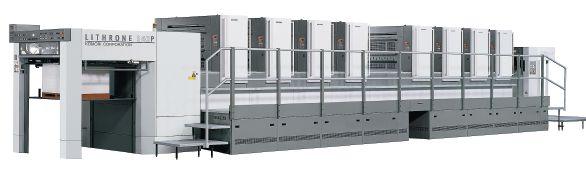
annex business media, on the heels of acquiring Glacier Media assets, purchased a 40-inch, 8-colour Komori LS perfecting press, which is scheduled to be operational in Annex’ Simcoe, Ontario, facility this summer.
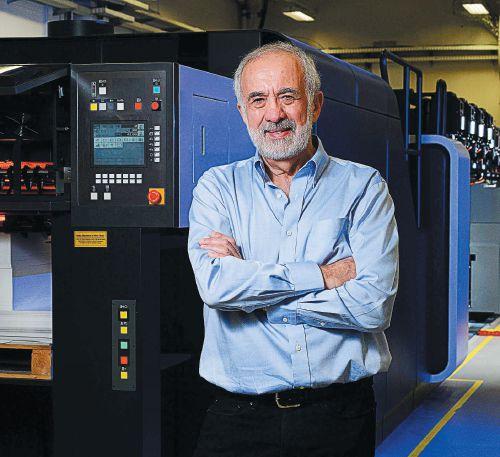
“This purchase means growth for our print division,” said Lance Hill, Director of Plant Operations at Annex Business Media. “We will double our productivity, improve quality, and lower our make-ready and waste through automation.”
lance
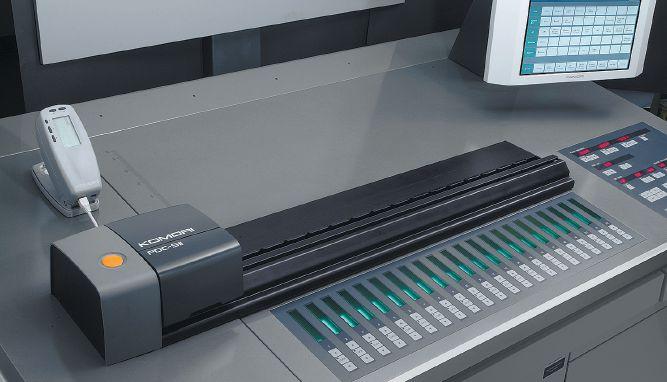
Replacing an existing 29-inch, 8-colour press, the 40-inch Komori perfector, purchased through KOMCAN Inc., will be equipped with APC plate changers, PDC-SII colour control, AMR, automatic wash-up systems and KHS inking.
In late January, Annex, which owns PrintAction magazine, teamed up with Newcom Business Media to acquire 67 trade-publishing brands from Vancouver-based Glacier Media Inc., a deal worth $19.65 million. Annex immediately took control of 15 Glacier Media properties, adding to its existing stable of more than 40 businessto-business brands. Annex Newcom Limited Partnership was formed to hold several other media properties.
purchase price of approximately €91.5 million with an option to acquire the remaining 30 percent of the shares in 2019 for a price between €39 million and €47 million, subject to financial performance in the year 2017.
Grenville management and printing of Toronto, led by President Michael Burke, purchased NCO Technologies, resulting in a combined company now operating as NCOGrenville, focused on streamlining document workflows. NCO Technologies is described as the largest dealer of Canon Imaging Systems in Ontario.
2013 acquisition of a second manufacturing and coating operation in Toronto. “It is imperative that Drytac focuses on manufacturing and custom coating in Canada,” said Mike Wildbore, Drytac’s Vice President of Sales. Drytac also states it is focusing more on self-adhesive markets like labels and tags used in packaging and industrial applications.
eFI and Konica Minolta Business Solutions (KMBS) signed a non-exclusive agreement for KMBS to distribute and service EFI’s wide-format inkjet imaging technology across North America. The 65-inch-wide EFI H1625 LED hybrid inkjet printer is to be the first system available through the KMBS sales network this coming May. EFI’s Frank Mallozzi explains EFI and KMBS share a longstanding development relationship around Fiery frontends and production equipment.
CalenDar
May 5
printaction education series: Colour of printing
Delta Markham, Markham, ON
May 7–9
Grafik art montreal Place Bonaventure, Montréal, QC
May 11–13
poDi appForum Las Vegas, NV
May 19–23
Grafitalia
Milan, Italy
May 20
DIa meeting Unisource, Mississauga, ON
June 3
Dscoop emea Conference Dublin, Ireland
June 10–13
pacwest Conference
Fairmont Chateau, Whistler, BC
June 11
DIa annual Golf tournament
St. Andrews Valley, Aurora, ON
Cimpress, the newly named holding company that began as Vistaprint, moved to acquire Exagroup SAS, founded in 1999 to serve Frenchlanguage clients in Europe through an online tradeprinting business model. Cimpress is acquire 70 percent of the shares of Exagroup for a
Heidelberger Druckmaschinen, led by Gerold Linzbach, moved to acquire European Printing Systems Group (PSG), headquartered in the Netherlands, from CoBe Capital for an undisclosed sum. Heidelberg expects the acquisition of the distribution company to increase its annual sales by around €130 million. PSG, with approximately 400 employees in Belgium, the Netherlands, Luxembourg, and southern Europe, generates more than half of its revenue through services and consumables, with Heidelberg products accounting for a majority of equipment sales.
Drytac, a manufacturer of adhesivecoated products, appoints ND Graphics as its exclusive Canadian distributor for the sign and large-format printing market.
Robert Keane, President and cEo, cimpress
The move, according to Drytac, was in part due to its
mercian labels of the UK becomes the world’s first pilot site to install Xeikon’s new Cheetah dry-toner press, which is to run alongside an existing Xeikon 3000 in the company’s new 24,000-square-foot factory in Staffordshire. Founded more than 40 years ago, Mercian Labels is a manufacturer of self-adhesive labels, cartons and security seals. Xeikon Cheetah is a five-colour label press rated to produce a native 1,200 x 3,600-dpi resolution, reaching speeds of up to 30 metres per minute (98 feet per minute). It holds a printing width of 7.9 to 13 inches.
rr Donnelley & sons of Chicago, led by Thomas Quinlan III, moved to purchase book manufacturer Courier Corp., which terminated an earlier US$260 million merger agreement with Quad/Graphics.
Based on the closing trading price of RRD’s common stock (NASDAQ) on February 4, 2015, the merger equates to a total transaction value of approximately US$261 million, plus the assumption of Courier’s net debt and payout of outstanding equity awards. Just days before announcing the now-terminated merger, Quad/Graphics stated it planned to buy 20 or more HP inkjet web presses over the next three years, with the first two slated to arrive in January.
June 16
packex toronto Congress Centre, Toronto, ON
June 23
printaction education series: Craft of printing
Delta Markham, Markham, ON
June 24
IapHC Golf tournament Wooden Sticks, Uxbridge, ON
September 25–26
Consac Imagemakers International Centre, Miss., ON
September 28–30
packexpo Las Vegas, NV
October 28
printaction education series: business of printing
Delta Markham, Markham, ON
november 4-6
sGIa expo Atlanta, georgia
november 12
Canadian printing awards Gala The grand Luxe, Toronto, On
May 31 – June 10, 2016
drupa
Dusseldorf, Germany
Gerold linzbach, cEo, heidelberger druckmaschinen
mike wildbore, VP of sales, drytac
Thomas Quinlan iii, cEo, RRd
hill, director, Plant operations, annex Business media
Adobe in February celebrated the 25th anniversary of Photoshop with an event featuring thomas Knoll, co-creator of Photoshop, who discussed the evolution of Photoshop over the years, its impact on the design community and where it’s going. On his Mac Plus in 1987, Adobe explains knoll wrote a subroutine that simulated a greyscale effect, which he and his brother, John, then presented to Adobe in 1988.
As the Photoshop team’s first engineer, knoll wrote code for six versions of the venerable image-editing software. He also developed Adobe Color Engine and built Adobe Camera Raw technology. He also created the Digital negative file format (Dng).
emile tabassi, who for decades managed north American print-technology suppliers, passed way in February at age 65. Tabassi graduated from the university of Maryland in 1978 with a Bachelor’s Degree in Production Management, as well as from the Executive Sales Management Program at Columbia u niversity and the Executive Marketing Management Program at the university of Chicago.
Tabassi, who most recently worked for Flordia’s M gi Digital graphic Technology, spent 21 years as a Sales and Marketing Manager with Agfa. After working with HP, he then became VP of u.S. Sales at Presstek inc. Tabassi joined Mgi uSA as the north American Director of Sales & Communications.
Installs
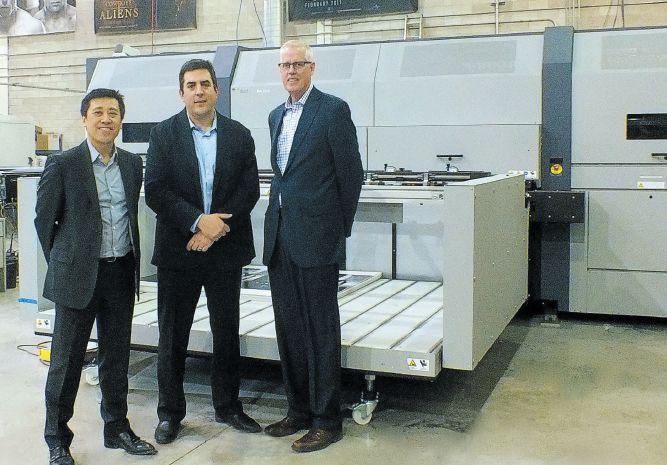
ICon Digital productions of Toronto acquires Canada’s first 98-inch Durst Rho 1312 uV, which is pictured with Juan Lau, President and CEO of iCOn Digital (left to right); CFO Alex Christopoulos; and Joe Lloyd of Durst u.S. The Rho 1312 reaches printing speeds of up to 6,600 square feet per hour.
richard armstrong, who had led Heidelberg Canada as President for the past 14 years, said he was to retire at the end of March, inline with the completion of the company’s fiscal year. Prior to joining Heidelberg, Armstrong worked with Transcontinental Printing, Maclean Hunter Printing, Southam Murray Printing and Webcom Limited. Armstrong was instrumental in establishing a dedicated building, eventually named the Heidelberg Centre, for Ryerson u niversity’s School of g raphic Communications Management (gCM) program.
Greg Donais joins EF i as Sales Development Manager for Eastern Canada, covering Manitoba, Ontario, Quebec, n ewfoundland, n ew Brunswick, nova Scotia and PEi, and focusing on EF i ’s V u TEk and wide-format-inkjet portfolio. He succeeds ken Lunn, who is retiring after being with EFi for the past 15 years. Donais most recently served as VP of Cameron Advertising’s digital division, where he worked from 2010 until January 2015. He also previously spent almost five years as the Managing Director of Schawk Canada’s digital division, after owning and operating ig3 for a decade.
bryan Hall becomes VP, Western Canada, for Treck Hall Wide Format. He has spent more than 20 years in wide-format with Treck Hall Limited, Mondrian Hall and most recently Fujifilm. Treck Hall, with warehousing in Toronto and Vancouver, distributes wide-format product brands like Ritrama, kodak, Epson and Magic.
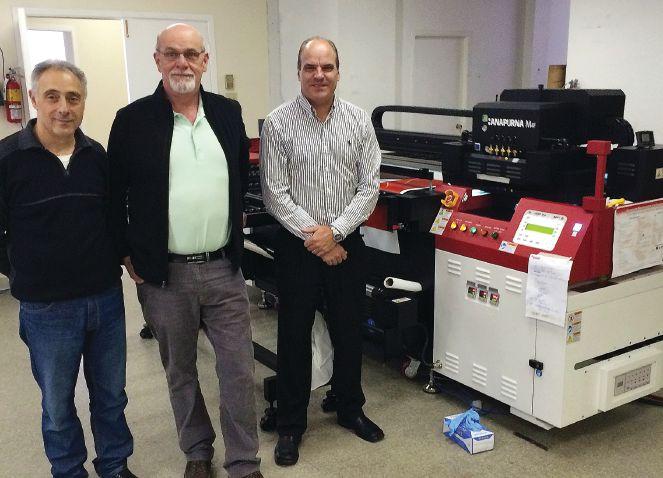
synchrolith, a prepress trade operation in Saint-Laurent, Quebec, installs an Agfa Anapurna M4F inkjet printer, pictured with Claudio Quieti, Production Manager (left to right), Richard Hillier, President, and Agfa Account
Manager Stan Tranter. The 62-inch uV system produces a 720 x 1,440-dpi resolution.
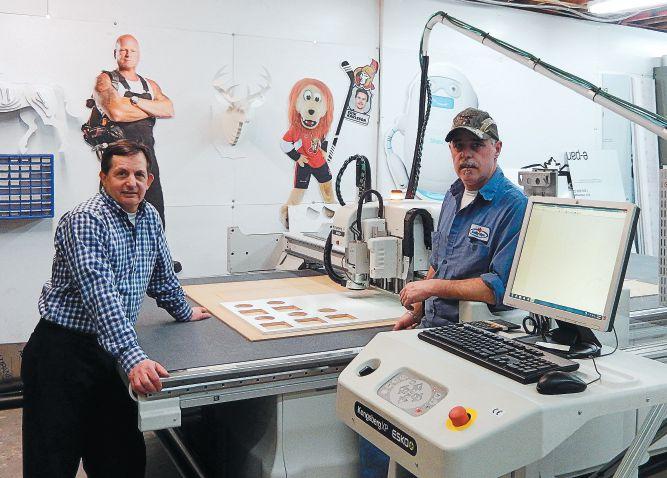
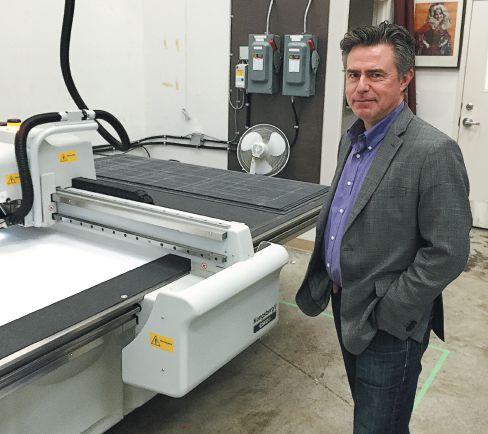
Kelly signs of Ottawa adds an Esko kongsberg i-XP24 table, pictured with Mark Steinberg, general Manager (left), and Marc nadon, Production Manager. One of the largest sign companies in Eastern Ontario, kelly Signs, founded in 1947, operates two silkscreen presses and two flatbed inkjet printers, along with one roll-fed machine.
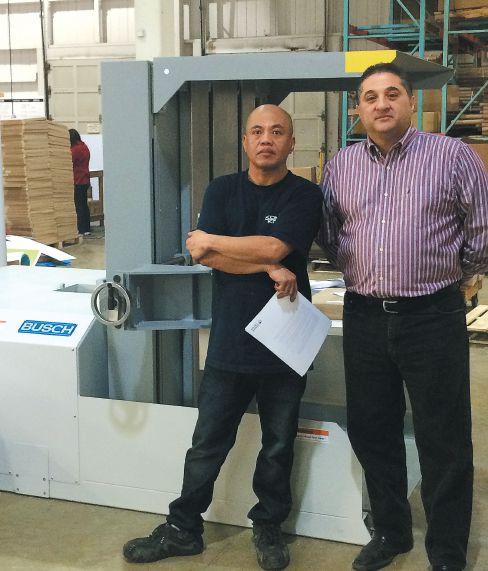
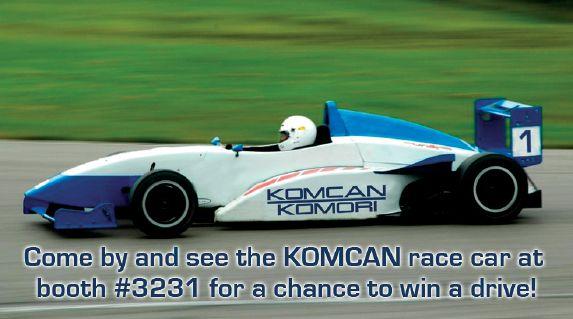
rp Graphics Group adds a Busch SWH125RLA pile turner, pictured with Press Feeder Ramil glorioso (left) and Operations Manager Shant Pashayan, to its 60,000-squarefoot Mississauga facility. Purchased through kOMCAn, the pile turner handles materials for two 6-colour, 40-inch komori gL presses.
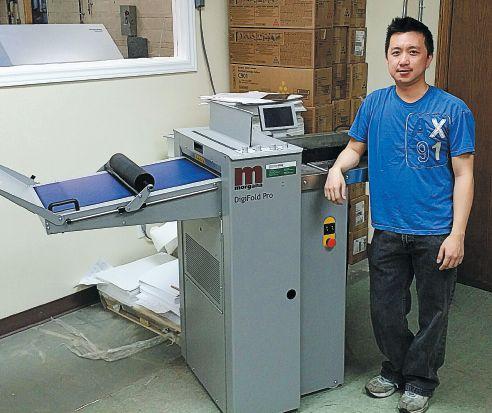
pointone Graphics adds a new Morgana DigiFOLD PRO, which is pictured with operator Cody Lu, to its 70,000-squarefoot trade operation in Etobicoke, Ontario. Purchased through Sydney Stone, the DigiFOLD PRO is rated to crease and fold up to 6,000 A4-size sheets per hour.
FastsIGns of Vancouver installed a new Esko kongsberg V finishing table, pictured with owner Paul LeBlanc, who opened up Canada’s second FASTSignS franchise in 1996. in 2008, LeBlanc moved his operation into its current 5,400-squarefoot facility.
BOPI celebrates North American first with KBA
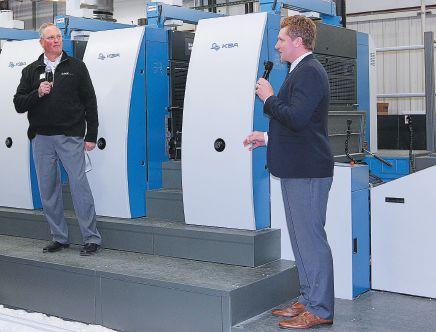
BOPI hosted more than 200 guests, including Illinois Lieutenant Governor Evelyn Sanguinetti and State Senator Bill Brady, to cut the ribbon on its new 8-colour KBA Rapida 106 press, the first in North America with HR-UV.
“We are financially strong and growing. We care about print and we care about our customers,” said Tom Mercier, President and CEO of BOPI. “Print is an important part of the market place. Print is here and has a rightful place in today’s market.”
BOPI’s new Rapida 106 includes features like KBA ErgoTronic colour control, QualiTronic (inline colour control for 2-sided printing in one pass), and the LogoTronic management system. Its HR-UV system immediately dries both sides of the sheets allowing a job to immediately move to its next operation.
Founded in 1947 as Bloomington Offset Process Inc., the Illinois firm began as a high-quality commercial printer. BOPI has since established itself in the direct marketing field through VDP applications, data services, Web-based commerce, collateral management and fulfillment. Its Midwest base includes insurance, manufacturing, college and university, agricultural, hospital, financial, government, and non-profit organizations.
Cuban printer opts for manroland UNISET
Empresa de Artes Gráficas Federico Engels, one of the largest printing houses in Cuba, extended its production capability with a new UNISET newspaper press from manroland Web Systems.
The company produces several tabloid products and its primary manufacturing of educational books in one to four colours.The UNISET is to be delivered at the end of 2015 with production starting in the first quarter of 2016.
The UNISET press consists of one H/H printing tower and two reel splicers and shows a maximum web width of 965 mm. Its PFN 2:3:1 pin folder enables format changes from tabloid to broadsheet and several book formats. The UNISET runs with a production speed of 75,000 copies per hour and will also be equipped with manroland’s PECOM automation system for pre-settings.
The first Performance Series press installation in Ecuador took place at Carlex Cia Ltda., a 40-year-old label and packaging manufacturer serving Central America. Their P5 investment will target growth in Latin American’s flexible packaging market. The Mark Andy P5 acquired by Carlex is a 17-inch (440 mm), 8-colour UV-flexo press with options including chill rolls, a web turn bar, cold-foil adhesive capabilities and a delam/relam unit.
54
Number of years of severed diplomatic ties between US and Cuba, before renewing in 2015
Tom mercier, President and cEo of BoPi (left), and chris Travis, director of Technology at KBa North america.
1985
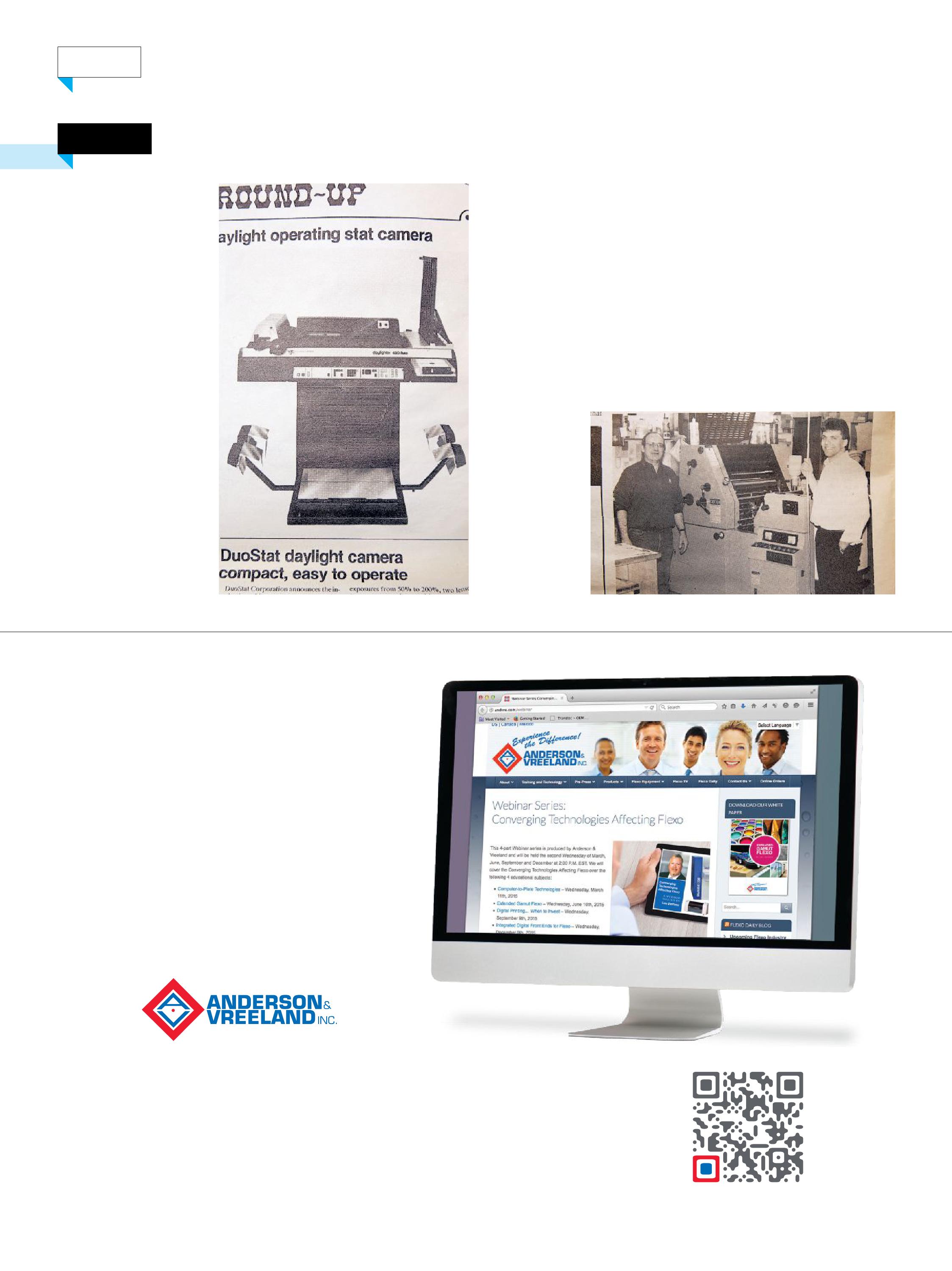
A daylight operating stat camera
Visual graphics Corp. introduces the Daylighter 450 Auto, a stat camera and processor using roll-fed diffusion transfer materials. The 450 features a new push-button focusing system that automatically adjusts the lensboard and copyboard to the proper position when a specific enlargement or reduction is entered on the camera’s electronic control panel. it has a new 100-channel programmable memory that stores exposure information and a microcomputer that computes optimum exposure time for line or halftone work, when density and magnification data are keyed in. daylighter 450 auto
1995
Scientific American, Apple Computer and printer
1990
Moving to colour
kildonan Printing Ltd., a father-and-son operation in Winnipeg, Manitoba, is prospering from its move to colour by adding an Oliver 58 press from the Miehle Division of Rockwell international. Traditionally, kildonan had specialized in foil stamping and embossing corporate stationery. Able to print only low-quality process colour on a duplicator until two years ago, the company added the single-colour Oliver 58 and saw a 65 percent increase in business over the past year. The Oliver 58 runs a 17 1/2 x 22 1/2-inch sheet, allowing kildonan to print four 8 1/2 x 11-inch products, at speeds of up to 12,000 impressions per hour.
R.R. Donnelley successfully produced 300,000 copies of a 200-page publication in its entirety with a computer-toplate process. This is the first time an entire publication was produced without the use of film. Apple and BBDO/ Los Angeles provided advertising in digital format that R.R. Donnelley converted to PostScript files. Ralph
WATCH CONVERGING TECHNOLOGIES
SEMINAR SERIES
(left) and Randy Nelson of Kildonan Printing.
Co-op marketing
How to win jobs by reducing your prospect’s marketing cost by up to 75% while maintaining maximum margins
By Peter Ebner
most account executives are facing the same two print sales challenges: How do I differentiate my services when my competitors are capable of supplying the same job and how can I be competitive when there is always someone willing to print the same job for less? Although co-op marketing does not apply to every print sales situation, if your prospect is a neighborhood business that is print marketing collateral then co-op marketing offers a unique solution to this print sales challenge.
WhAT IS CO-OP MArKETINg?
With winter now at an end, businesses that offer home services like lawn care, carpet cleaning, door and window sales, heating and air conditioning sales, eaves trough installers, roofers, driveway paving, kitchen and bathroom renovators, home improvement contractors and landscapers are getting ready for their spring marketing drive, which usually entails distributing fliers, brochures and door hangers throughout the local neighborhood. This need for marketing collateral presents an excellent opportunity for anyone in the printing industry to grow their sales and earnings.
But landing these accounts is not that easy, after all, most of them are already dealing with a printer and the vast majority – a whopping 80 percent – are happy with their existing supplier. So why should any of these companies endure the risk and inconvenience of changing suppliers? Well the fact is that in most cases they won’t, unless:
• You have something to offer that they can’t get from their existing supplier,
• You can show them how to get a better ROI, and
• Your quote is very competitive.
Co-op marketing allows you to meet all three of these criteria. Co-op marketing simply means sharing the printing and distribution costs between two or more noncompetitive businesses.
CO-OP MArKETINg AdvANTAgES
1. It lowers your prospect’s cost
For example, the lawn care service provider is ready to invest $3,000 to print and distribute a promotional flier; the roofing company is also planning to send promotional fliers to the same target market; and so is the driveway paving service and the eaves trough installers. If only two of these businesses got together to share the cost of the flier and distribution, they could reduce their marketing costs by up to 50 percent; and if all four got together their savings could be as high as 75 percent.
From a print sales perspective creating a co-op marketing program allows you to differentiate your service by telling the prospect that you can reduce their marketing costs by up to 75 percent!
2. It will increase sales
For your prospect a reduction in marketing costs means much more than just saving money; it also means an increase in sales and higher profits. For example, take any business person; a real estate agent; the owner of a lawn care service or the owner of the local pizzeria, their success requires marketing. They need to tell everyone in their neighborhood about the service or product and the more often they get their message out, the higher their sales. But small business owners have a limited marketing budget, so although they’d like to advertise more, they cannot afford it. Small business owners will welcome an idea that allows them to promote their services more often for the same cost and co-op marketing provides this opportunity.
From a print sales perspective, creating a co-op marketing program allows you to differentiate your service by telling the prospect that you can share an idea that will increase their sales and gain market share.
3. It makes your prospect’s marketing material more effective
Diversity increases readership. For example, a Healthcare Newsletter that included an article and ad from a dentist, a dermatologist, a chiropractor and a nutritionist would have a much higher readership then a newsletter that only focused on one of these topics. So while sharing the cost of printing and distributing a brochure, flier or door hanger will greatly reduce your prospect’s marketing cost, co-op marketing will also increase readership and, for the prospect, that means generating a higher response.
From a print sales perspective, creating a co-op marketing program means that you differentiate your service by telling the prospect that you can share an idea that will increase response and make their marketing collateral more effective.
CrEATE A CO-OP MArKETINg PACKAgE
1. seleCt proDUCt
Any printed material can be turned into a co-op marketing program.
• a note pad
• a calendar
• an oversize door hanger
• a 11 x 17 sheet can be turned into 4 page newsletter
• a flier
• a postcard
2. seleCt an area For DIstrIbUtIon
• 5,000 homes along specified postal walks
• all the businesses within a target area
3. pICK a tHeme
• Home improvements
• Real estate
• Food and entertainment
• Health and fitness
• Business services
• neighbourhood businesses – a strip mall
4. lIst tHe DIFFerent types oF bUsIness tHat FIt UnDer yoUr seleCteD tHeme
• Home improvements: Carpet cleaning, door and window sale, heating and air conditioning sale, eaves trough installers, roofers, driveway paving, kitchen and bathroom renovators, home improvements contractors, landscapers, lawn care, plumbers and electricians.
• Food and entertainment: Restaurants, theatres, pubs, country clubs, caterers, wine making outlets, butchers, home delivery, bakers and even farms that sell to the public.
• Business services: Office cleaning, office supplies, office equipment, business insurance, car leasing, temp services, accounting, bookkeeping and computer services, courier, shipping.
5. Create a prospeCtInG lIst
use the phone directory and internet to identify all the local businesses on your list.
6. ContaCt eVeryone on yoUr lIst
Tell them about the benefits. Offer everyone exclusivity by only including one company for each service. For example if your theme was dinning you could make it exclusive by including only one italian, one Chinese and one Mexican restaurant.
80%
Percentage of accounts who are satisfied with their present print supplier
MAxIMIzE yOUr SAlES
While offering your prospects a co-op marketing opportunity is an extremely effective way to differentiate your services and eliminate price competition, you can maximize your sales and earnings by offering the prospect a marketing campaign instead of a single co-op distribution. For example, if you created a co-op Home Services Newsletter or Door Hanger your promotional package could include printing and distribution to 5-million homes once a month for six months.
peter ebner is a professional sales trainer and marketing consultant. He is author of 12 industry-specific books and audio programs including Breaking the Print Sales Barrier EbnerSeminars.com.
Ipex is not dead
Informa reacts quickly to suggestions of its demise following drupa’s move to a 3-year show cycle
By Andy McCourt
“
pex is not dead and Informa has every intention of running it again and is committed to working with the industry to ensure the next Ipex is both relevant and successful,” explains Peter Hall, Managing Director of Informa Exhibitions.
Following the trade-show turmoil created by drupa’s announcement that it will switch to a 3-year frequency cycle, Hall has countered reports emanating from drupa’s global media conference that ‘Ipex is dead’ and is ‘unlikely to take place again.’
Informa Exhibitions, who purchased Ipex from owners Picon (formerly the British Federation of Printing Machinery Manufacturers) in 2006, having organized the two previous successful Ipex exhibitions, is part of Informa plc, a London stock exchange-listed company specializing in B2B knowledge, business intelligence and transfer using publications, conferences, events, training, Websites and trade shows. Its 2014 financial year, gross revenues were equivalent in Australian dollars to $2.24 billion.Within this, Informa’s stellar performing division was its Global Exhibitions division, which recorded a 25 percent increase in revenue under the leadership of Hall.
A company of such substance and success, whose current share price is on a 45-degree upward trajectory, is unlikely to be fazed by one mediocre showing, which Ipex 2014 undoubtedly was. Rather, it is likely to apply all of its considerable resources to go back to the drawing board and come up with creative, innovative and new ways of delivering an event that the printing and graphic arts world wants and needs. Added to this is the recruitment of Patrick Martell, former CEO of one of the UK’s largest printers, the St Ives Group, in a business intelligence role.
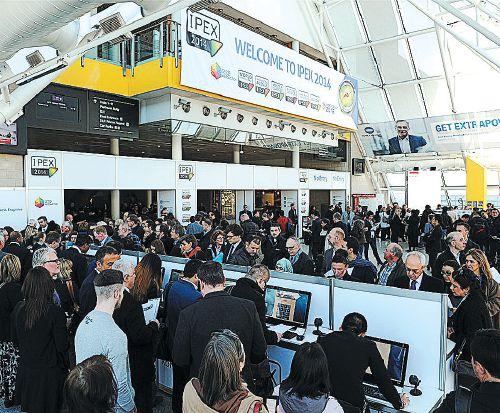
Ipex 2014 suffered from several major exhibitor withdrawals including the employer of the then Ipex President, Canon. Still reeling from post-GFC effects, slashed budgets and industry consolidation, first Heidelberg, then HP followed by Canon, Kodak, Xerox and others pulled out of the show. Of the major
digital suppliers, only Konica Minolta kept the faith and by all accounts had a very successful show. Companies such as Dainippon Screen, Fujifilm and EFI also stayed in and reported positive results. Perhaps Ipex 2014 also suffered from the change principle. It was the first time in 34 years that the show had been held in London, having been domiciled at the National Exhibition Centre, near Birmingham, since 1980. Even that move was initially described as disastrous as the dominant paradigm was that all big shows had to be in London. However, Ipex at the NEC grew to cultivate a loyal constituency, endeared to the semi-rural surrounds where friendly pubs abound and bed-and-breakfast accommodation could be enjoyed cheaply in places like Stratford, Warwick, Leamington Spa and smaller villages of Warwickshire while more elaborate hotels were also plentiful in Birmingham, Coventry and Solihull.
Ipex is of course renowned for premiering digital printing to the world, with both Indigo and Xeikon choosing Ipex 1993 as their respective launching pads. While always more compact than drupa, it has consistently delivered an excellent program of innovation, relevance and convenience, with English as the language for communication. Its traditional equilibrium, balanced at 2-year intervals between drupas, has worked very well despite the 2014 hiccups. Until last year, visitors would always see drupa promoting at Ipex and Ipex promoting at drupa, by mutual consent.
Now it seems that genteel understandings between trade show organizers have been subjugated by “Cry havoc and let the dogs loose.” drupa’s position regarding its triennial move, is that there may be some irritation amongst trade show organizers in other countries who have always respected the Düsseldorf cycle. I think it is more than irritation; it’s anger at not being consulted.
That drupa is an important and influential event on the printing and graphic arts calendar cannot be disputed; it works superbly but it has ignored, or has just been blind to, the market stimuli that have allowed LabelExpo to become a global force in narrow-web packaging exhibitions, and FESPA to become a multi-edition and highly successful series of events for the burgeoning digital signage and display sector. Labels and wide format are the two highest growth rate sectors in the graphic arts.
drupa 2016 is already sandwiched between LabelExpo Europe in September 2015 and LabelExpo Americas in September 2016. It is also girt by FESPA Digital in Amsterdam in March 2016, just two months before drupa. It is likely that these two market events will impact on the labelling and wide format presence at drupa.
Back to Ipex; its smaller footprint and digital focus have always been an advantage. Because of the dearth of British print machinery manufacturing (Timsons the last British press maker has just gone into receivership), the lobbying has tended to be more international. German and Swiss print manufacturing powerhouses such as Heidelberg, KBA, manroland, Kolbus, Goebel and Muller Martini have traditionally called the shots at drupa but the reality today is that Germany has almost no digital press manufacturing of its own origination and this vital growth sector is dominated by US, Japanese, Belgian, Israeli and even UK companies.
ClASh OF ThE TITANS
After drupa’s move to a 3-year cycle, trade-show conflicts arise around current future dates for some of printing’s biggest events.
drupa: 2016, 2019, 2022, 2025
PacPrint: 2017, 2021, 2025
PrintEx: 2015, 2019, 2023
Ipex: 2018, 2022, 2026
Since its inception, drupa has had Presidents who have been associated with Heidelberg, Goebel or KBA. With a declining manufacturing base to support, this leaves drupa with the dominant function as a trade show organizer; much in the same way that Photokina has remained a popular photographic biennial event in Cologne despite once great brands such as Zeiss, Rollei, Leica, Voigtlander, Braun and Linhof having been steamrollered by the Japanese Nikon, Canon, Olympus, Panasonic and Sony.
This means that the task for Ipex is one of developing a compelling new format that, as Hall says, ensures both relevance and success. It is quite apparent that the resolve at Informa is to do just this and sources indicate that the company is already working closely again with Picon.
This completely debunks the scuttlebutt that the show is dead and will not take place again. Informa is a major player in global exhibitions and growing fast. It has the resources to correct any aberrations that the 2014 event may have suffered from.
anDy mCCoUrt is freelance consultant editor to Print21, the official journal of the Printing industries Association of Australia.
– Steve Jobs
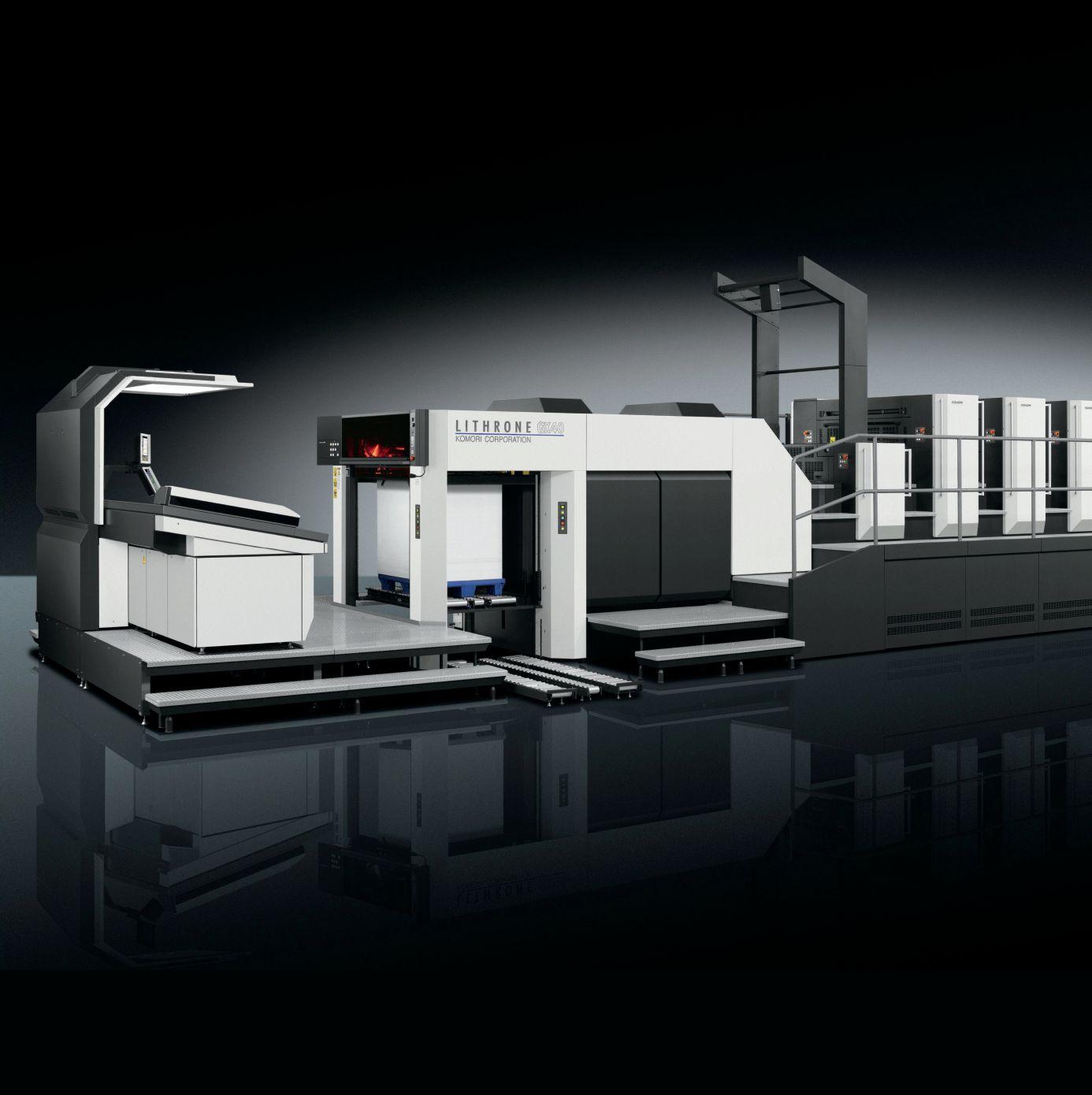
KOMORI GLX40
Highest operational productivity by high-speed operation at 18,000 sph stabilized by the latest control technologies and nonstop logistics available In addition to being equipped with KHS-AI, the world’s most advanced print start-up system, printing changeovers for flexible use of special colours are optimized and made ver y short by innovative new systems A diverse range of machine configurations for high added value printing and a solid lineup of print quality inspection equipment.
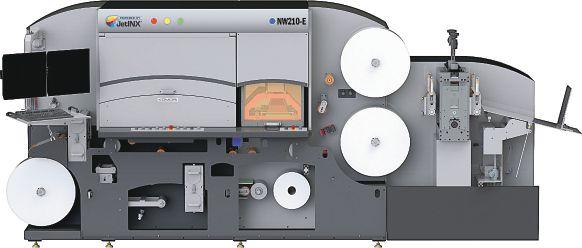
KOMORI NW 210
Powerd by JetInx, this machine is ideal for label and commercial printers and is also suitable for direct mail and packaging needs The NW210 provides high quality inkjet printing with run speeds up to 80 feet per minute
The progress of Nanography
With drupa 2016 just a year away, martin Habekost takes a look at the delayed release of nanography, first introduced by Landa digital three years ago at the german trade show
By Martin Habekost
ith drupa 2016 a year away, I began thinking about the last time the giant German tradeshow in Düsseldorf took place in 2012 and the crowds at Landa Digital Printing’s exhibition space. Mostly, I remember the blue-and-black futuristic design of Landa’s new Nanographic Printing Presses, including the unique control panel mounted to the side of each press like a giant iPhone. I wondered aloud, “Shouldn’t there be a few presses already installed in print shops by this time?”
Providing as much function as form, the control screen GUI appeared to be well designed to meet the needs of a busy operator. There was even a digital microscope that came with each press, which I was immediately impressed with because it allows both operators and customers to look at the details of a printed sheet. Over the first days of the 14-day trade show, heavy iron manufacturers like Heidelberg, manroland and Komori joined Landa’s marketing buzz by announcing Nanographic technology partnerships, albeit a little vague.
Benny Landa, who founded the company in 2002, told drupa 2012 visitors the Nanographic presses could reach first adopters by the end of 2013 at the earliest, with initial machines hitting the market during the first months of 2014. I thought to myself: Let’s see if he can keep this deadline.
Nanography nutshell
The year 2013 came and went without any Landa Digital presses going into potential customers, although there may have well been quiet alpha testing going on inside an eager print shop. In March 2013, I attended the annual TAGA conference in Portland, Oregon, where Gilad Tzori, VP of Product Strategy of Landa Digital Printing gave the event’s third keynote presentation.
Tzori provided conference attendees, who primarily serve on the technical side of printing, an overview of how Landa Nanography works and differs from existing printing presses. Emphasis was put on Landa’s jetting of water-based inks which do not soak the paper, so the sheet does not come out wavy at the end of the press run.
Nano pigments sit on top of the paper so the printed density for both coated and uncoated stock is the same
Many people will have experienced this water-soaking problem when they print a sheet of paper with heavy coverage on their home or office inkjet printer. Tzori explained how the Nanographic printing process first inkjets the image onto a heated transfer belt, and secondly how the ink turns into a semi-solid type material on the transfer belt, which is then transferred onto the paper. Unique properties of Landa’s belt, explained Tzori, ensures a 100 percent transfer of the image onto the paper.
He then showed images of a printed dot produced with Nanography and compared it to the same magenta dot printed with different technologies currently on the market. The superior quality of the Nanographic process, in regards to the roundness and sharpness of the printed dot, was then described in Tzori’s marketing presentation. A clear advantage of Nanography indicates the process allows for printing on almost any substrate. Nano pigments deliver a broader colour gamut than standard offset inks. The Landa black has L*a*b*-values of 5.4, 0.7 and 0.05 compared to the ISO standard of 16, -0.1, 0.1. The ink film is 500-nanometers thick, which is a lot less than that of any other conventional printing process. The printed density for coated and uncoated paper is the same, since the ink does not sink into the uncoated paper but rather sits on top of the paper. De-inkability studies, explained Tzori, have also shown good results. De-inkability is a significant problem with regular inkjet printed sheets.
Nanography niche
After describing the technical architecture of Nanography, Tzori explained where Landa Digital sees its market niche and how it plans to bridge a gap between short-run digital and longer-run offset jobs. This includes targeting offset sheetfed work with a 40-inch or B1-format press model. Tzori stressed that Landa is not reinventing existing machine technology like paper feeding and delivery, which is why the company is working with
Benny landa founded indigo digital Press in 1977 and landa digital Printing in 2002
traditional press makers, most notably Komori.
A key question to come from the conference crowd that day asked about the future availability of these new Nanographic printing presses. A careful answer was given, which I interrupted to mean it would be at the beginning of 2014, while the company’s main challenge was to achieve the desired print quality at the necessary resolution.
Year 2014 came and went and, without hearing much more from Landa in terms of press installations, I naturally started wondering if the past two years of Nanographic marketing had been all smoke and mirrors? In February of 2014, Landa Digital and EFI announced a strategic alliance and in June 2014 Altana invested €100 million into Landa Digital, which had also received a number of press down payments from printers wanting to be first in line. It is my guess that Altana will manufacture the Landa inks and EFI will deliver the digital front-end to the presses.
On December 9, 2014, Landa Digital made a public statement about its technology development, including its intent to focus on the
Altana invested €100 million into Landa Digital, which also received a number of press down payments from printers wanting to be first in line.
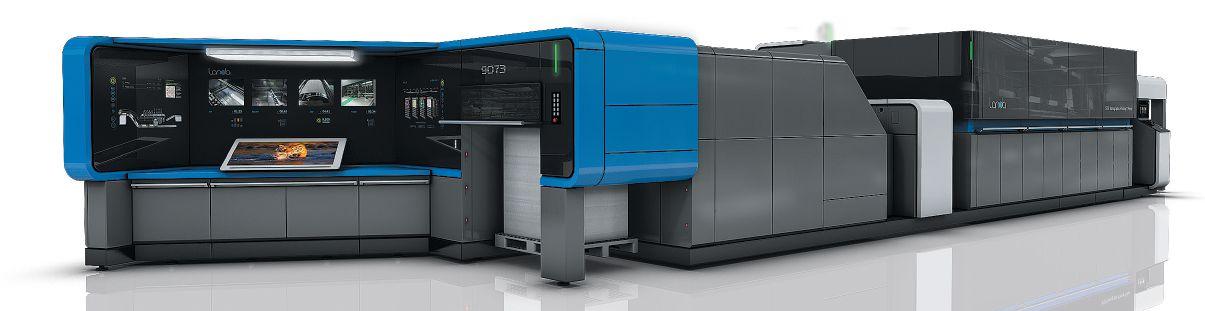
40-inch folding-carton market with its S10 press. The press has undergone some radical design changes, including the addition of a coating unit. The operator’s side-mounted touchscreen, as it was seen at drupa 2012, had to be moved to the delivery end – transforming its look more toward a traditional press design. The weight of the press has increased also from 10 tons to 30 tons.
Landa Digital explained the S10 operator now has a more ergonomic workplace showing all the required information for running jobs. Personally, I like the video feeds from inside the press to the operator cockpit. The press operator can see if any sheets have been dropped or if they are causing a jam. The presses also have an inline inspection unit from Advanced Vision Technology. Within its online marketing material, Landa Digital writes: “The quality control solution will combine
innovative nozzle performance and colour control techniques to maintain print quality and increase press productivity. The quality control system will also control colour-to-colour registration, image placement and front-to-back registration.” The print resolution of the S10 press is now at 1,200 dpi and the press also makes it possible to print on both sides of the carton sheet before entering the coating unit.
Nanography 2015
In early 2015, I spoke with Tzori on the phone to discuss recent developments at Landa Digital Printing. He indicated the first presses are scheduled to be commercially available in the second half of 2015. Beta machine are currently set up at Landa’s facilities in Israel, where potential customers can see the presses in action.
During our phone conversation, Tzori also discussed what kind of drying technology is installed between the coating unit and the delivery end of the press. Depending on what kind of coating the customer wants to use, there will be IR drying lamps installed for water-based coatings and UV-curing lamps for UV coatings. The UV-curing technology can either be UV-mercury vapour lamps or UV-LED.
Tzori points out that the IR or UV technology is only necessary for the coatings that are applied to the printed sheets. The sheets printed with the Nanography ink come dry out of the press.
Thinking ahead to drupa 2016, which surely will be another important exhibition for Landa Digital technology, I asked Tzori what is to come with regard to the company’s web-fed printing machines. The first web-fed printing machine will be geared towards the flexible packaging market.
Landa Digital expects this to make a huge impact on the flexible packaging sector, especially with many of the other digital press manufacturers also developing printing solutions for the short-run flexible packaging market. I have every intention of attending drupa 2016 for a firsthand view of Landa’s developments and I expect they will be as interesting as Nanography’s unveiling three years ago.
martIn HabeKost received his Ph.D. in Analytical Chemistry from universität Hannover. He is Associate Chair for Ryerson university’s School of graphic Communications Management. mhabekos@ryerson.ca
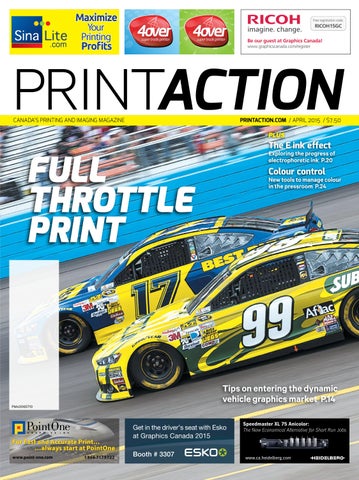
FULL THROTTLE PRINT
tips on entering the dynamic vehicle graphics market
By Jon Robinson
The commercialization of wide-format-inkjet printing in the 1990s signaled the beginnings of a technological evolution into what is today one of the printing industry’s most intriguing and fastestgrowing applications, vehicle graphics.
Inkjet printing shifted the production of these mobile billboards away from laborious screen-printing techniques reserved for large vehicle fleets, as well as specialized one-off lettering jobs.
Leveraging the maturation of inkjet systems and inks, materials science is now the key driver of the vehicle graphics market, pushing incredible and effective new applications and business models. Printing professionals who were in Miami
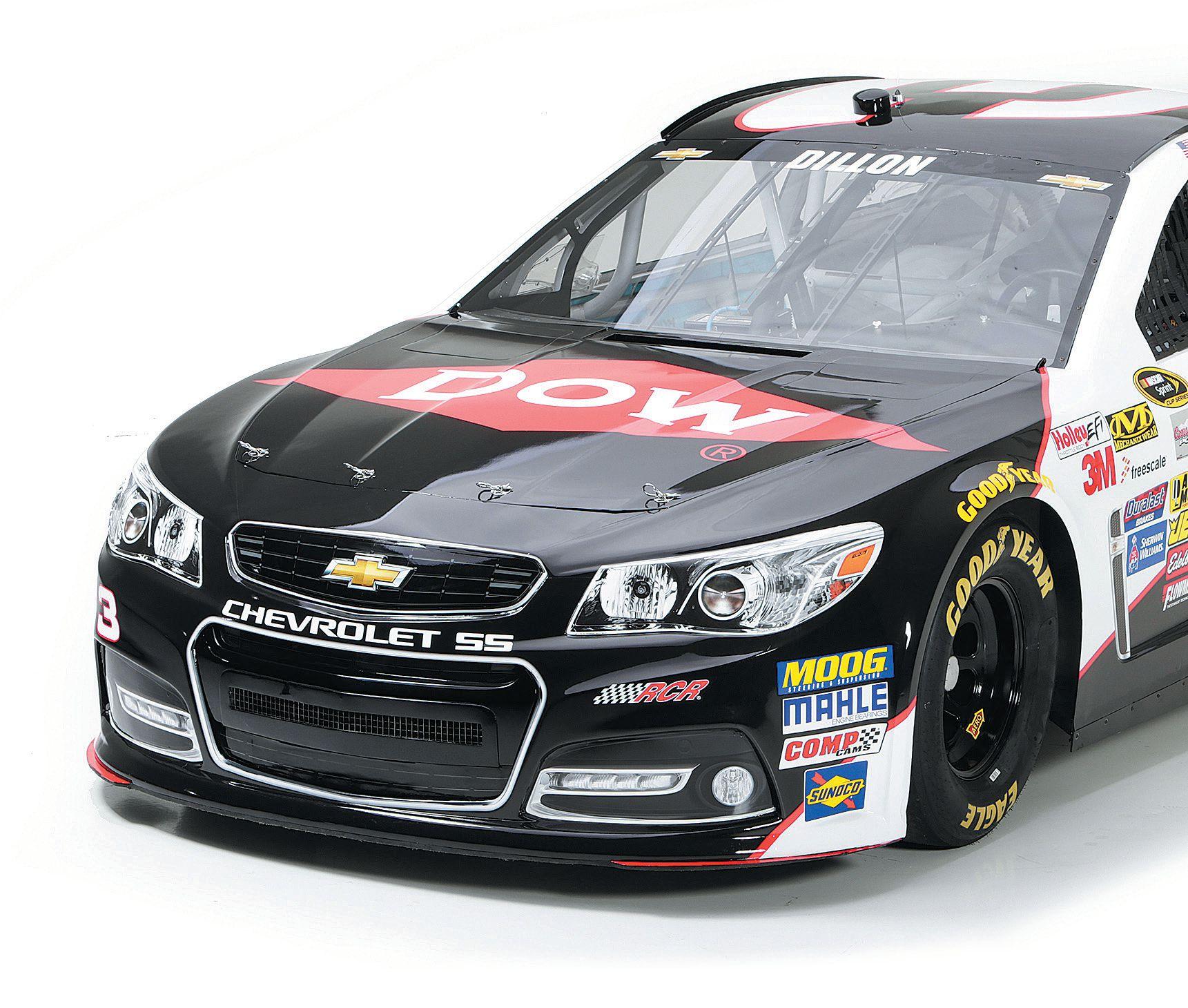
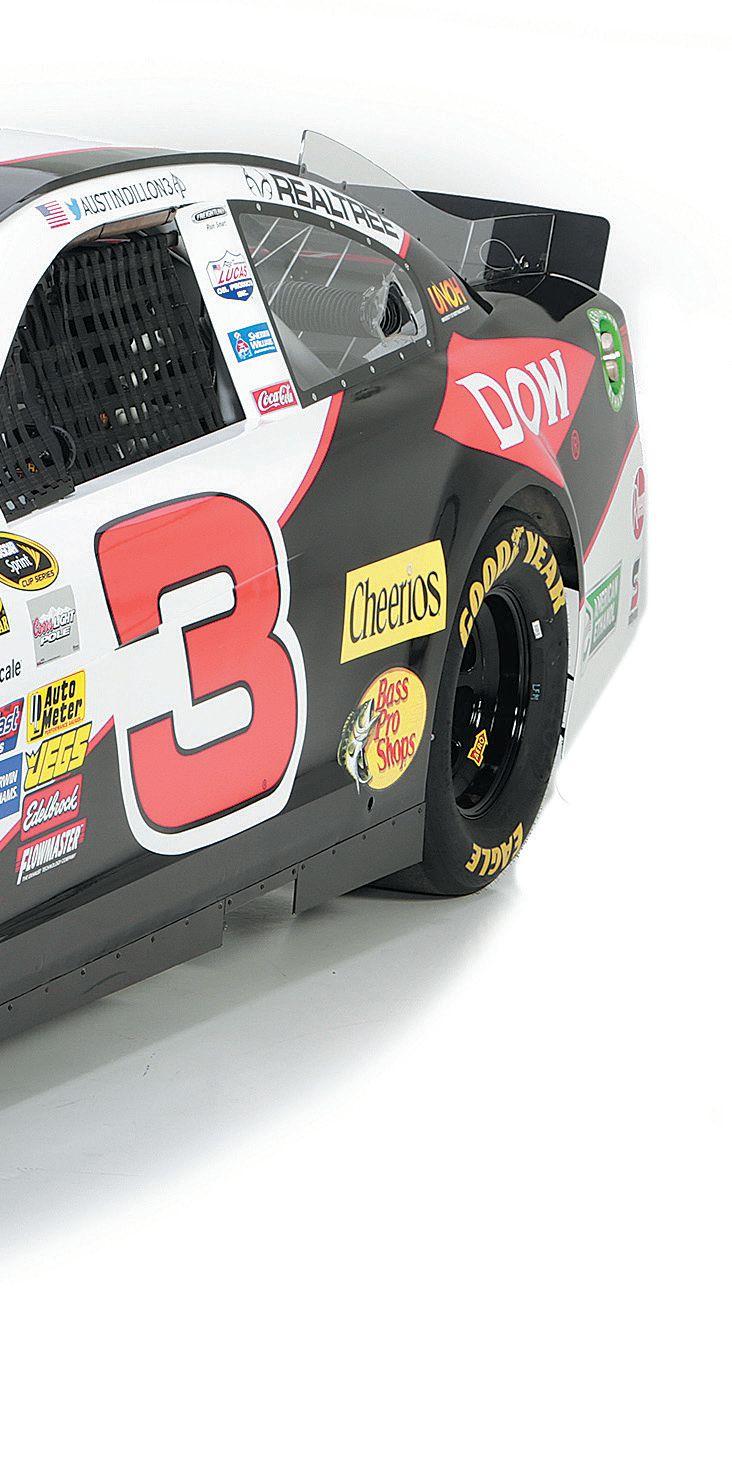
NascaR teams, famous for their application of vehicle graphics, leverage the advances of film adhesive technology, often completely removing and reapplying vinyl wraps to a base layer to sport different sponsors by the race. Roland recently renewed a partnership with Richard childress Racing for five years. during 75 races alone in 2015, RcR expects to use 325 full vehicle wraps and more than 99,000 square feet of media.
Beach in late-February for the Graphics of the Americas trade show surely noticed the dozens of ATV-like taxis running people around through the night. “They were all lit up on the sides with a material that was backlit and printed,” recalls Brian Phipps, Vice President and General Manager of Mutoh America.
Phipps continues to describe the growing use of OLED technology applied to thin vehicle films, a boom in paint replacement with pure coloured vinyl holding a metallic flake feel, and car dealerships running inkjet systems in-house by adding the cost of graphics into the leasing of van fleets. Ford recently bought one of Mutoh’s printing systems to apply its logo to corporate semi-trailers.
“[This sector] is more around doing commercial graphics for fleet vehicles and panel trucks, potentially cars too, but it is more about the commercial side… the bigger side of the market,” says David Hawkes, Group Product Manager, Sign Products and Textile Printers, Roland DGA. Marketers and businesses alike are realizing vehicle graphics rule the economics of out-of-home advertising, which is no longer solely pegged to static billboards, as determined by the Cost Per Thousand (CPM) metric relating large-formatadvertisement location to eyeballs.
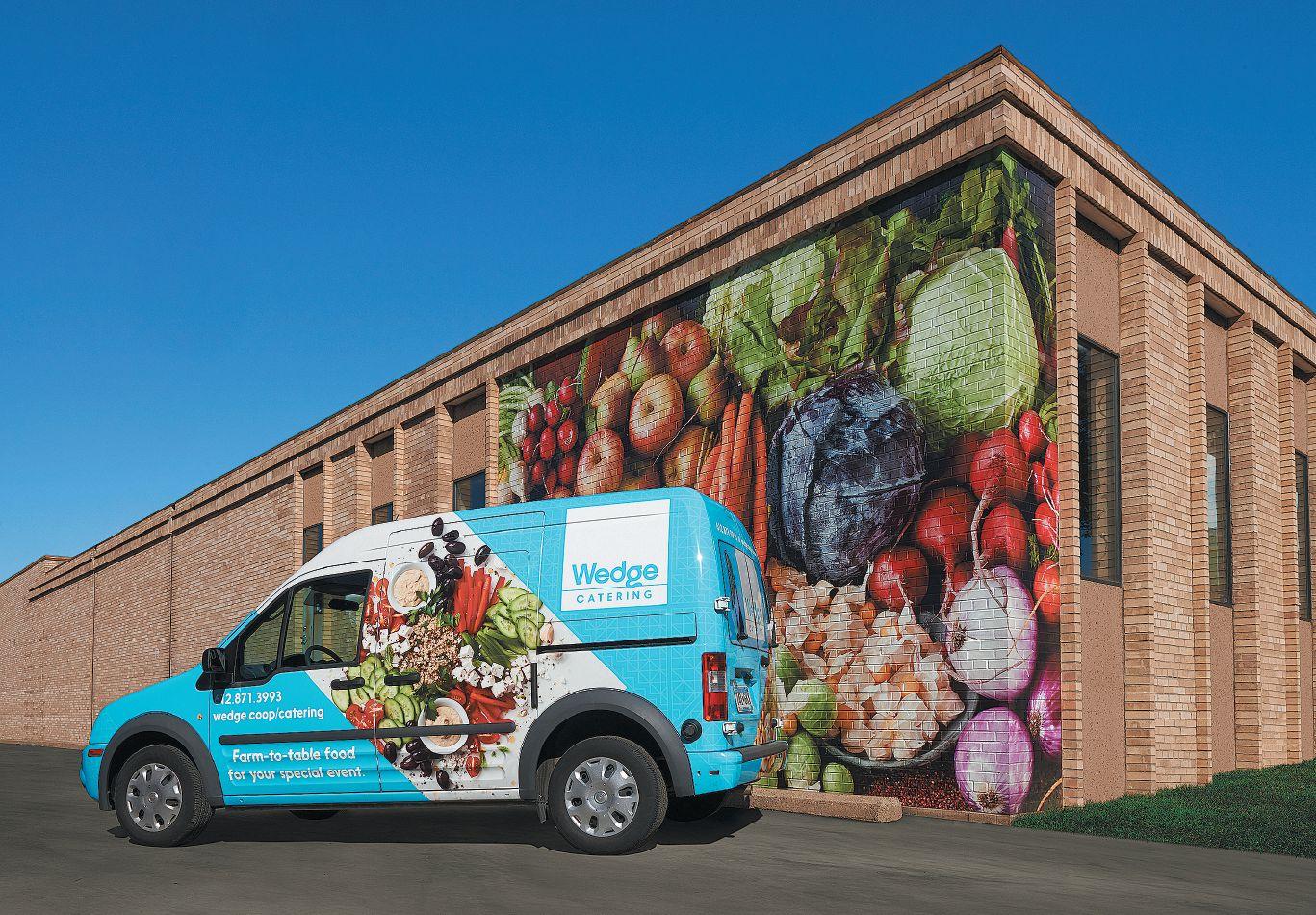
“Vehicle wraps, whether it is on the side of a truck or a car, are the lowest cost form of advertising available,” says Jeffrey Uzbalis, National Distribution Accounts, 3M Commercial Graphics. “Its CPM is around 50 cents versus 20 bucks [for prime TV advertising]. It is cheaper than Internet banner ads.” The advances in wide-format technologies have developed the out-of-home playing field for the betterment of print. Uzbalis explains this is why 3M films are used to display Smirnoff ads on the brick and concrete walls around Toronto’s BMO soccer pitch, where hard-drinking 19- to 34-yearold males congregate.
“Everybody is so focused on social media and mobile that what they often overlook is physical graphics actually get
results,” says Uzbalis. “If you put a floor graphic in a supermarket that say Chips Ahoy! you can actually influence consumer behaviour at the point of decision making.” He explains 3M now commissions audited studies to generate hard data points to illustrate the cost effectiveness of printed wraps to marketers. It is part of the company’s massive R&D investment in the sector to tap deeper into one of the strongest printing opportunities.
“People shouldn’t think this is a mature market or that it is too late – it is not. It is growing and there are a million things to do,” says Phipps. “The media companies are driving this a lot with the different materials that are coming out.”
Mastering materials
An 18-year veteran with 3M’s Commercial Graphics division, Uzbalis is a true subject-matter expert on wide-format printing and specifically vehicle graphics. He has seen the wrap-materials evolution mirror the digital revolution from his position with arguably the world’s most-powerful adhesives company, which generated revenues of $32 billion in its most recent fiscal year with some 90,000 employees.
With its Canadian headquarters based in London, Ontario, 3M’s introduction of Controltac graphic film approximately 20 years ago marked a significant step forward for vehicle graphics application. Labeled by 3M as adhesive performance, Controltac allowed users to move away from heavy permanent adhesive that was slow and expensive to use. “Controltac really revolutionized the industry because the adhesive wouldn’t stick immediately,” explains Uzbalis. “You could move it around, slide it around, position it and then apply it with a squeegee.”
3M’s second major wrap innovation came around a decade ago with the introduction of Comply air-release technology, based on micro-replication science that was developed to make better stamp paper. The technology was applied to wrap material to make a special liner with a series of ridges. When the liner is pulled away from the back of Comply film it leaves impressions in the adhesive, which provide routes for the air to escape ahead of an application squeegee – preventing the formation of bubbles. 3M’s newest film advancement, called Envision, adds material stretch and a wider operating temperature to the innovations of Comply and Controltac.
“Really, for [commercial printers] it should be about wrapping in general, whether it is the side of a building or a glass curtain wall or the windows and floors, in addition to vehicle wraps, because there is
“If you are not ready to jump in with both feet, you can outsource.”
– Brian Phipps, Mutoh
a well-established vehicle wrap business out there,” says Uzbalis.
Images of the amazing artistic work of vehicle-wrap specialists can be seen across every social media platform, which is intimidating for commercial printers thinking about entering the sector. This is compounded by the fact that print is not the most significant component of such projects.
“It is not just a printer, it is a department,” says Uzbalis. “With wide-format printing, once you have printed [the job] it is only the beginning. Now that graphic has a second life… it has to be applied to somebody else’s private or public property. It has adhesive on the back of it and this is a key difference – it often has to be removed.”
Investing wisely
Commercial printers, however, are becoming more accustomed to value-add
30,000 to 70,000
Number of daily impressions generated by a car wrap, depending on city (OAAA)
business models, where print is not the sole revenue source for a communications project, whether this means data management, specialty finishing or some other tangible expertise.
“There is certainly an art to both the design and the application if you are doing a full vehicle wrap,” says Hawkes. “There are plenty of third-party providers out there who would be more than happy to wrap vehicles for you; and do it under your name… there are ways to put your toe in that market to see if there is interest in your customer base.” Hawkes emphasizes vehicle wraps are often just a component of a client’s overall promotional needs, which may also include out-ofhome products like signage, apparel or more standard collateral work.
Commercial printers thinking about entering the wrap sector, therefore, must consider their most viable investment route. “The good news for commercial
“Profit can quickly turn into a loss when a $2,000 invoice shows up for broken storefront windows.” – Jeffrey Uzbalis, 3M
printers is that they are used to spending a million or half a million dollars and they see our printer for $15,000 or down as low as $6,800,” says Phipps. Mutoh’s proclaimed “Wrapper’s Choice” printing system costs US$18,995 list. “So, at least it is not a shock from the cost standpoint. It may be from the learning curve.”
Uzbalis recalls, when he started out in the wrap sector 18 years ago, it cost around half a million dollars to get into the business.Today, a printer in theory can get into vehicle wraps without spending a dime based on outsourcing, instead focusing on sales. Commercial printers, however, do have specialized colour and production management skills they can leverage with relatively inexpensive equipment, while outsourcing installation.
“A large percentage of the installers do not do any printing at all,” explains Phipps. “They either come to your place if you have a bay, or you can have it done at their place.”
Roland, which builds its expertise in the wrap sector through print-and-cut technology, also focuses on producing decals, smaller format vehicle graphics instead of full wraps. “There is also something called partial wraps,” says Hawkes. “Some companies getting into
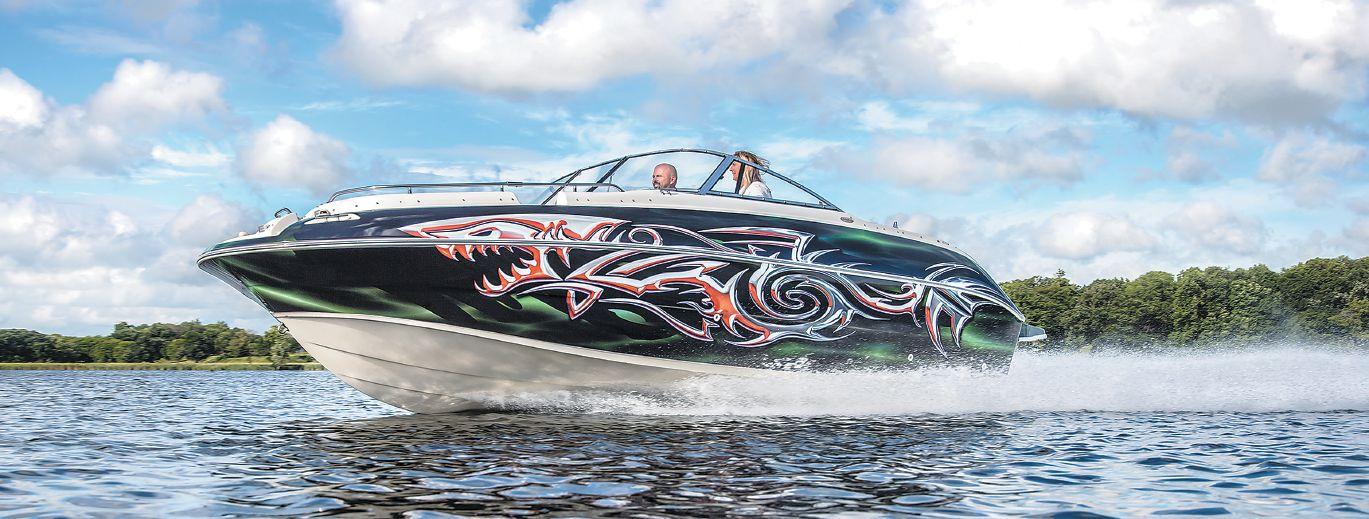
watercraft wraps illustrate the sector’s advances in materials sciences, as does the boom in paint replacement with coloured vinyl for cars.
Power up your bottom line with reliable, dependable aftermarket inkjet inks from Sun Chemical. These inks give you the same high quality you expect from an OEM without the high price. And, every purchase is backed by our global expertise and world-class service and support — providing everything from initial setup to training to ongoing color management. So count on Sun Chemical for all of your aftermarket inkjet ink needs.
To see how we can support you, visit www.sunchemical.com/naidigital or
in addition to its earlier advances with controltac (repositioning), comply (air release) and Envision (stretch and temperature latitude), 3m recently introduced adhesives to apply Envision films to textured surfaces like brick, concrete and block walls.
T IP s ON WOR k IN g WITH W IDE -fORMAT V IN y L
Brian Phipps Vice President and General Manager, Mutoh America
InVest In proper eqUIpment: “My advice is to get the right equipment up front. Do not go with cheap versions, because the whole chain of equipment needs to be of good quality or the last piece that you might have saved a few dollars on is going to ruin all of your good work.”
InVest In tHe traInInG: “Spend the $700 to get the training. Fly to another city if you have to. get trained by the professionals in the market whether it is 3M, Avery, us, whoever… it will save you so much time in practice and wasted material because this stuff is not cheap to print.”
Do not HesItate to oUtsoUrCe: “if you are not ready to jump in with both feet, you can outsource… advertise that you have it and then work a deal in a wholesale situation, which happens all the time, with a sign company down the street. you can buy a printer and a laminator, but then outsource the install… you can get into this in a number of ways. you have options.”
Jeffrey Uzbalis
National Distribution Accounts, 3M Commercial Graphics
aDHesIon anD remoVal testInG Is CrUCIal: “it doesn’t matter what type of printer you are running. We really advocate understanding the application that the client wants, what is it going to go on — is it short-term or long-term, indoor, outdoor and what is the surface — and then doing both adhesion and removability testing.”
ConsIDer DryInG tIme: “if purchasing a solvent printer, build dry time into your workflow. The number-one cause of failure in the industry is solvent contamination. it is vital to slash off the solvents before laminating.”
tHInK oF It as a Department: “it is not just a printer, it is a department. you need a laminator. you need a cutter. you need all of the software. you need skilled and experienced people and you have to train your sales staff.”
David Hawkes
Group Product Manager, Sign Products and Textile Printers, Roland DGA
Do not UnDerestImate yoUr abIlIty to D o VeHICle GrapHIC s: “if you are doing any type of adhesive vinyl now, particularly if you are doing any type of print cut, you can do vehicle graphics. Vehicle graphics take less time to apply yet they have the same margins as doing a full wrap.”
Do not DeValUe yoUr DesIGn WorK: “i often see a lot of printers say, ‘yeah, i will give you that design’ and [clients] do not actually pay for the work that they put into it. if you have done a really good job on the design, people will want to use it other places.”
tHere are no sHort CUts: “you get what you pay for. i see people who have tried to do a wrap with calendared vinyl instead of cast vinyl. Calendared vinyl has memory and over time those corners peel up… if it doesn’t hold the image well, if it doesn’t last well in uV, if it doesn’t hold up to the environment then you have to redo that wrap in a year.”
it will just do tailgates on trucks or maybe back windows with perforated – things that are easy, decals for the door of a plumbing truck. That is a whole business on its own.”
Producing partial graphics can also lower equipment investment needs, in terms of printing system width. However, Hawkes, Phipps and Uzbalis all suggest focusing on investing in 60- to 64-inch printers, again relating to the relatively low cost and available network of installers. “It doesn’t have to be a $70,000 printer that you bring in in order to do this stuff. We have our 640 RF printer and that can handle it,” says Hawkes. “It is print only, but you can do a full vinyl wrap job with it and people do that all the time and that printer is less than $20,000.”
“Sixty-four inch is the magic size,” says Phipps. “Most of the media you are going to use in the wrap business is 60 inches.”
This size, explains Phipps, can produce work for a lot of different parts of a vehicle, such as one-piece hoods and tailgates. “You want to shy away from having a seam down the middle if you can. It is becoming less and less acceptable especially when you are getting into higher-end wraps.”
Phipps also explains 60-inch media is the ideal size for a single operator to handle during installation, avoiding the costly need for a second installer. “From an application standpoint one person can handle 60 inches,” he explains, “and secondly it will cover most vehicles in one piece.”
If a commercial printer does decide to enter the sector by purchasing a wide-format system engine, they will also require a laminator, which might cost as little as $5,000. Phipps explains a laminator will typically outlast all of the other wrap equipment by at least two or three times. He warns, however, that it is vital to purchase a good-quality laminator, because an inexpensive machine is likely to lose its pinching ability over time, for applying an even, crinkle-free laminate. “There is nothing worse than spending the time designing the file, then printing it on expensive vinyl… and having it crinkle up and then having to start all over.”
Making margins
After the initial capital outlay for the printing engine and laminator, the ongoing investment concern revolves around media costs, particularly given the current advances in the technology. Printers have the natural tendency to look at these expensive films as a means to control margins on their jobs, but, unlike specifying papers for commercial work,
the wrong substrates can turn into very costly mistakes.
43%
Percentage of print providers who report falling margins, while just 16% succeeded in increasing margins (drupa Report)
This often relates to specialized adhesives and to the use of calendared or cast vinyl, the latter being more expensive. “Calendared vinyl is basically when you take a big lump of heated vinyl [and] roll it flat and then cut it off to get the piece that you want. Well, the problem is that it has memory and over time those corners peel up,” explains Hawkes. “A cast vinyl is just what it sounds like: You are pouring into a mould and so it doesn’t have memory.You always want to print with a cast vinyl, but at the same time there are so many inexpensive places to buy vinyl these days.” Calendared vinyl is also a thicker film, usually 3 1/2 to 4 mils, relative to cast materials.
Uzbalis warns it may be tempting to save $500 on the front end to purchase a vinyl that is cheaper because of its adhesive, which may not be engineered for a specific application. “Profit can quickly turn into a loss when a $2,000 invoice shows up for broken storefront windows,” he says. “Worse, what is my reputation now with that client?”
One of the more important aspects of working with wrap materials is to ensure the production team has the ability to properly estimate the job, which is certainly a strength of commercial printers. “Measuring and estimating the job is one
“The problem is that calendared vinyl has memory and over time those corners peel up.” – David Hawkes, Roland
of the more important parts,” says Hawkes, “because if you have to print another 10 feet of vinyl and apply another 10 feet of vinyl, because you forgot the back of a truck or something, that is a big expense in product and time.”
At the same time, Phipps explains the amount of work involved in producing wraps, from design and printing to laminating and installation, provides substantial revenue avenues for printers. “There is a lot of opportunity to show value to the customer. You are not just selling a piece of paper. There is a lot more involved,” he says.
Uzbalis emphasizes revenue potential goes hand in hand with a dynamic market that is constantly presenting new applications. “It is a market that has relatively better margins than ink on paper so it is very attractive to commercial printers,” he says. While it is easy enough to throw calendared vinyl on a piece of Coroplast, which does happen often for short term installations, commercial printers can also leverage their craft-based abilities to add value to what is becoming a powerful and cost-effective form of advertising.
“It is the same with all types of printing. You can find people who are willing to do this for a song and make next-to-no margin,” says Hawkes. “I never really understood the thought process behind that. Or you can find the people who turn around and say, ‘I have the ability to do quality graphics. I use quality materials and I stand behind what I wrap.’ Those are the people who make the margins. It doesn’t happen overnight necessarily, but those are the people who do the best long term.”
GTa car wrap, founded in 2009, now wraps more than 250 vehicles a year, including this paint-replacement work for an audi s4. The company, listed on 3m’s online directory of preferred fabricators and installers, primarily works with vehicle graphics.
The e Ink effecT
makers
of electrophoretic ink discuss how technology that began life as an mIt media Lab research project is transforming information consumption
By Zac Bolan
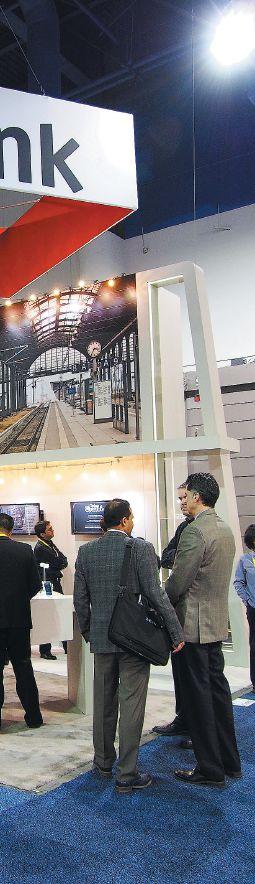
to anyone exploring the expansive halls of CES 2015 in Las Vegas recently it was immediately apparent that e-readers are here to stay. A myriad of manufacturers displayed countless tablets of varying sizes, each intended to become someone’s media consumption device of choice. Much of that media had been consumed on the printed page in the nottoo-distant past.
But has anyone aspired to master the digital page? From consumer reports it seems the tablet reading experience on devices such as Apple’s iPad or Samsung’s Galaxy leaves something to be desired.The tablet’s glossy backlit LCD screen is great for watching videos, but reflections tire the reader’s eye and the words are difficult to read outdoors. Emissive displays also draw a lot of power causing tablet batteries to fade after only a few hours in many cases.
On the other hand many avid e-book fans will tell you that a Kindle or Kobo with crisp black type on a paper-white background provides a much better reading experience. Though by no means a replacement for the multi-media friendly tablet, former consumers of the printed page have been increasingly adopting this style of e-reader for ease of reading both indoors and out while enjoying longer battery life. But what makes these e-readers so different from tablets?
ThE ANSWEr IS E INK
E Ink takes its name from its technology – electrophoretic ink – and is the visible component used in Electronic Paper
Electrodes drive microcapsules of suspended black and white pigments
The year electrophoretic ink technology began life as a research project at the MIT Media Lab
Displays (EPDs). This promising technology began life in 1996 as a research project in the MIT Media Lab before becoming the foundation of E Ink Corporation, which sought to commercialize the digital paper concept as the preferred display for e-readers.
E Ink is made of microcapsules about the diameter of a human hair sandwiched between two thin layers of film containing a transparent top electrode, and a bottom electrode. Each microcapsule contains negatively charged black pigment and positively charged white pigment suspended in a clear fluid. When the top electrode charges positive, the black pigment rises to the surface, morphing the microcapsule from white to black. The microcapsules are bi-stable and reflective – meaning the image will remain on the digital page without electricity and requires only ambient light to be visible. That’s why E Ink displays draw very little power.
E Ink displays are well suited for viewing static images that change sporadically – simulating book, newspaper or magazine pages for example. Because the display reflects natural light, it much more closely resembles the printed page with readability improving as the light gets brighter – working especially well in full sunlight. E Ink Corporation announced new concepts at CES 2015 and demonstrated E Ink products developed by licensees that evolve the digital paper paradigm beyond the e-reader.
NEW E INK MOdElS
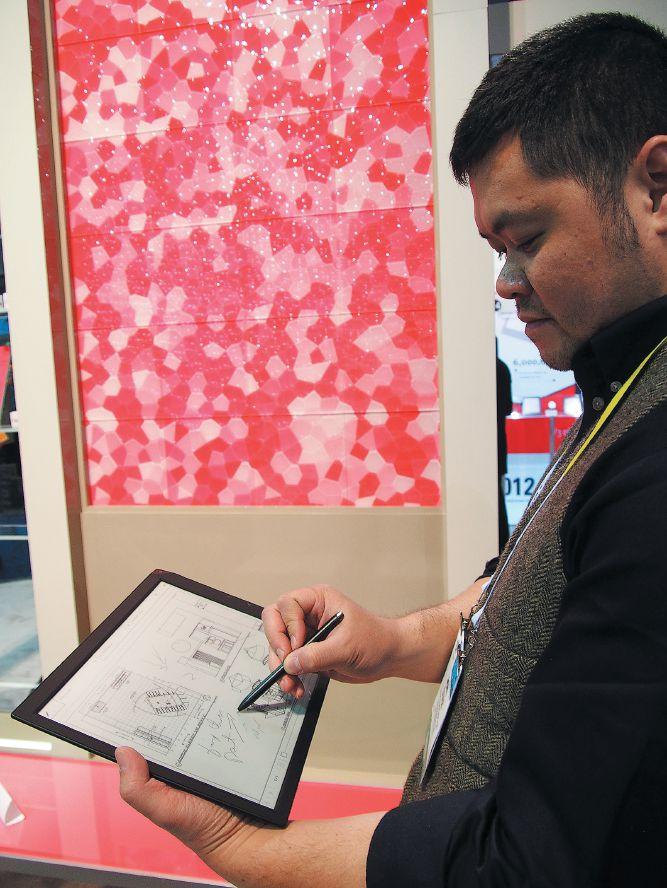
“One of the more interesting products we are showing at CES is the Sony DPT S1 business e-reader,” reveals Giovanni Mancini, head of global marketing for E Ink. “Designed for the business user, this device is the size of an A4 sheet of paper, extremely rugged and weighs only about six ounces.
“The DPT S1 has touch capability, but it also has an extremely responsive digitizer. This is intended for business users who want to take a large number of documents with them, but don’t want the bulk of the paper,” he continues. “Users can annotate documents with their fingertip while in the field, then have the information captured into the document control system back in the office.”
The Sony DPT S1 comes with 4gb storage, capable of carrying thousands of monochrome pages and has a micro SD slot for expansion.
Mancini then demonstrates another innovative use for E Ink in the form of a mobile phone display. The Russian-made YotaPhone is an Android mobile phone featuring a standard high-resolution colour display on the front, and a monochrome E Ink display on the back of the handset.
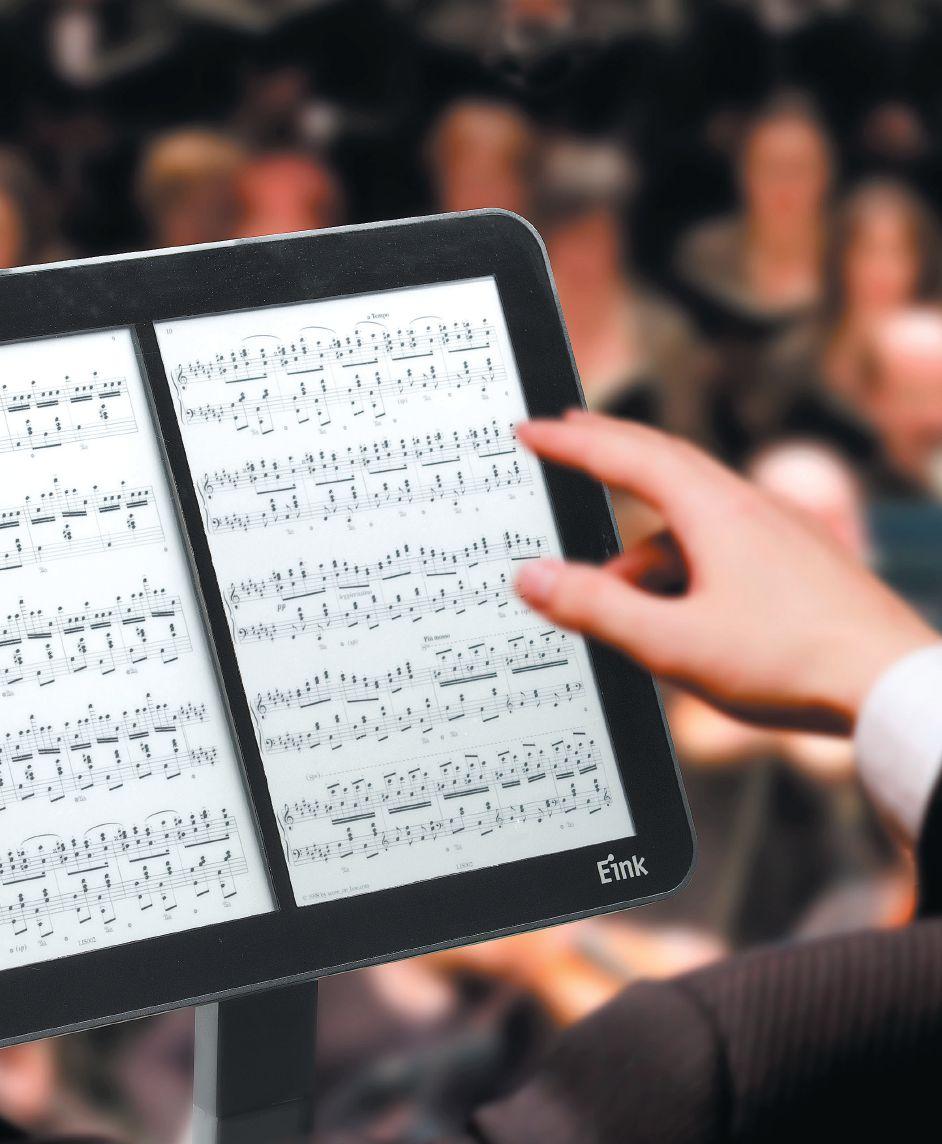
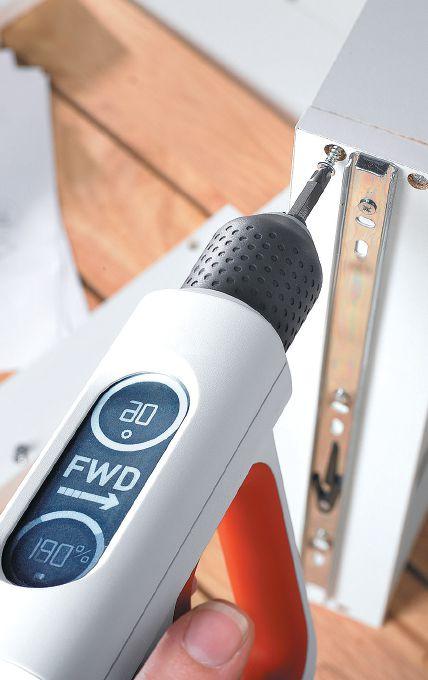
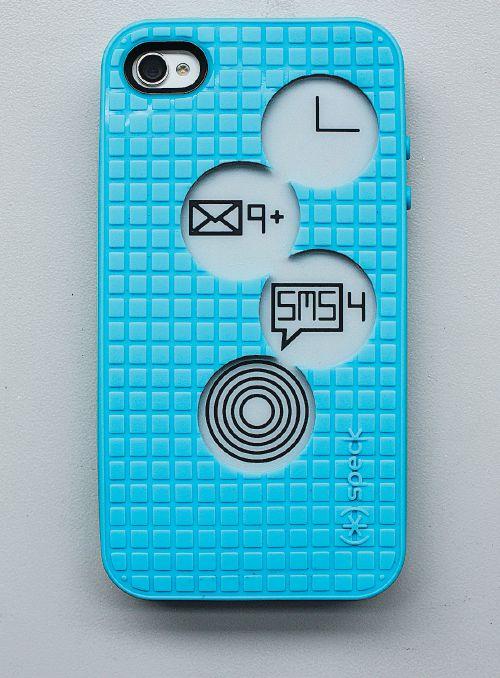
“The idea is to attach different information feeds, such as email or text messages, that you want to keep monitoring (clockwise from top) The E ink music stand, phone case, drill and bike computer.
to the E Ink display on the back,” Mancini explains. “This way you don’t have to constantly turn on the screen on the front of your phone and cycle through the various apps to get the information. This really extends the battery life of the YotaPhone because of the very low power consumption of E Ink displays.
“To really conserve power, the user can completely disable the front colour display and get the full Android interface on the E Ink display. You can even use the Kindle App to read books on the back of the YotaPhone!
“Another innovative use of an E ink display can be seen on the Sony Smartband Talk – a sports watch and fitness device that pairs up with an Android phone. The Smartband Talk enables you to track your fitness during the day and
The year E Ink introduced world’s first active matrix EPD display
The year E Ink Spectra is introduced as first 3-pigment display for electronic shelf labels
“Because of low energy requirements, batteries or even solar power can power these E Ink displays.”
– giovanni Mancini, E Ink
get information from your smartphone, all displayed on a controllable E Ink display,” explains Mancini.
While EPDs are already well established in the retail display category, E Ink Corporation announced and demonstrated innovative new solutions at CES 2015 targeting both the indoor and outdoor signage markets.
“These E Ink 32-inch digital displays are great for small businesses such as coffee shops or restaurants, for example, that might want to use them as menu boards,” says Mancini. “They are also well-suited for information displays in public spaces such as bus shelters. Because of low energy requirements, batteries or even solar power can power these E Ink displays without the need to run cables.
“Another thing that we announced at CES this year is our E ink Prism product,” Mancini continues. “We’ve taken our E ink technology and encapsulated many different colours of pigments within the same microsphere and laminated them into a colour changing film to incorporate into architectural products.”
E Ink Corporation demonstrated a 20foot wall of colour-shifting Prism tiles at CES. Controlled by a PC, these tiles are designed to change colours, providing a different aesthetic and changing the mood
of a hotel lobby or an airport terminal.
“Right now this is a concept product for us,” Mancini continues, “created through collaboration with architects and design firms over the past year. We hope to have a public installation of Prism by the end of 2015. We also plan to use Prism in horizontal surfaces such as glass counters or coffee tables.”
NEMESIS OF PrINT
From the products on display at CES 2015 it’s logical to conclude that E Ink has already done most of the damage it’s going to do to the conventional printed page. After all, e-readers already represent an established market for publishers, and the line has been drawn between those who prefer to read the printed page, and those who choose digital.
Instead, the future of E Ink and Electronic Page Displays lies in enabling the next generation of signage, personal document readers, smart devices and wearable technology – where low-power displays and control surfaces are essential to ensure functionality and energy efficiency.
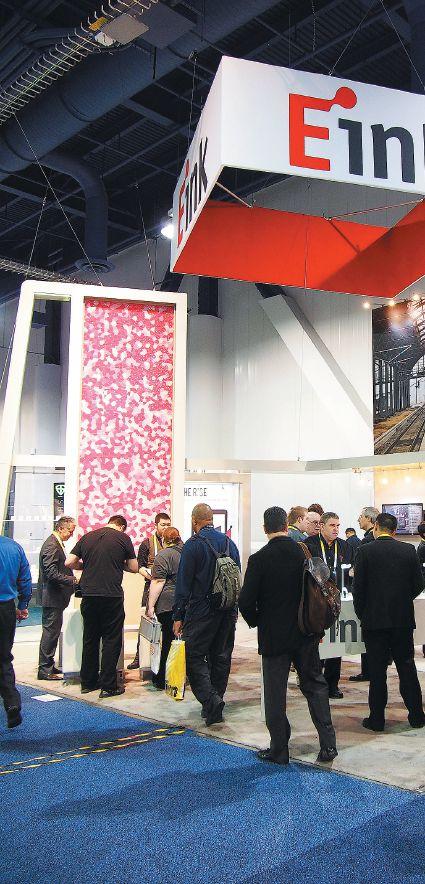
(left) E ink corporation’s booth at cEs featured a 20-foot wall of colour-shifting Prism tiles; (right) a sony tablet.
Colour control
detailing control tools to manage colour in the pressroom
echnology companies were asked to choose one of their most-significant and recently introduced –or soon to be released –colour-control products for use in a printing operation. The submissions range from handheld instruments and prepress software to ink dispensers and inline integrated press systems.
KBA QualiTronic Instrument Flight
The Instrument Flight colour tool, developed with System Brunner, is available as an option for KBA’s QualiTronic Color Control, which is a density-based inline measurement and control system for sheetfed presses. System Brunner’s Instrument Flight inking unit control software prioritizes grey-balance values to build a closed-loop system for measuring and controlling colour during impression.
Instrument Flight measures individual colours (typical solid density measurement), as well as the direct 3-colour overprint in mid-tones and shadows (colour balance). Ink-key controls are based on these prioritized parameters to ensure that the optical result complies with colour specifications. In a halftone image, the optical appearance depends not just on solid densities or L*a*b* values in solids but on colour balance and dot gain, and how the two are controlled.
With Instrument Flight more than 30 image-critical parameters are measured in the colour control strip for each ink key. They are then weighted and evaluated and recommendations are provided for inline colour correction. Instrument Flight also serves as a diagnostic tool for providing information on weak spots in the printing process or proofs.
heidelberg Multi-Color Toolbox v.15
Released December 2014, Heidelberg’s Multi-Color Toolbox v15 for expanded colour gamut is a module within Heidel-
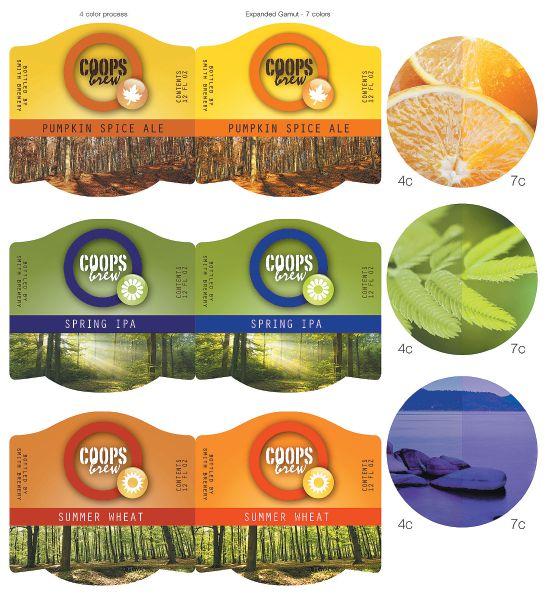
berg’s Prinect Color Toolbox suite, an application using multi-channel ICC profiles. Heidelberg explains Multi-Color Workflow, which the company refers to as MC7, relates to the addition of one to three colours (typically, Orange, Green, and Violet or Blue) to the standard CMYK ink set.
Heidelberg explains this enlarges the colour gamut and enables printing at a higher level of quality for RGB conversions into Pantone’s colour space. Printers who employ the MC7 methodology, explains Heidelberg, no longer need to print with Pantone spot colours by allowing printers to standardize a multi-colour offset press with 5-, 6- or 7-colour ink sets and press colour sequences for gang runs.
Heidelberg’s Multi-Color methodology uses a 7-colour open ICC profile to produce separations, plating and proofing. It also interacts with Prinect’s PDF Toolbox module with .pdf editing capabilities, and can show the recipes for each colour in the pallet. As a result, the page can be inspected as individual channels or as progressive channeling showing the recipes for each 7-colour separation.
Prinect’s PDF Toolbox provides delta e values of the respective colour swatch against the referenced colour library – using the actual 7-colour press profile. Heidelberg explains this reduces colour corrections and proofing cycles. Multi-Color Toolbox is also said to facilitate the printing of problematic colours like purples, greens, and browns or flesh tones.
Sun Chemical Water-Based Flexo dispenser
Released December 2013, Sun’s Flexo Dispenser program is designed for narrow web tag and label (NWTL) printers that use water-based flexo inks. Its main advantage comes from decreasing the overall bottom-line operating expenses in ink volume and ink costs – Sun states by as much as 25 percent. The Flexo Dispenser program also allows a printer to improve colour-matching consistency, while also reducing inventory and waste.
Sun’s Water-Based Flexo Dispenser system can make process, blending bases and spot colours. Color concentrates and technology extenders can be dispensed to make inks for more than one application, providing the flexibility to control colour density and compensate for various anilox configurations.
It allows for 0.5-gram accuracy of all process, spot and blending base colours. Sun explains only 14 components are needed to make inks for a variety of applications. The dispensing unit is provided to printers at no cost based on a minimum annual purchase of Sun Chemical products.
Equinox Expanded color Gamut technology uses a 7-colour process
Esko Equinox
First launched in 2010, Equinox was not fully usable for production until Esko Suite 12 was released in 2012. Equinox Expanded Color Gamut (ECG) Technology is a patented methodology for converting packaging graphics from RGB, CMYK and spot colours to 7-colour process.
By quantifying only subsets of 4-colour combinations, Esko states Equinox 7-colour profiles contain hundreds of times the amount of colour data as a 7-color ICC profile. These profiles are used to convert industry standard ink books into tint build books for a specific press.
Number of components needed to make inks with Sun’s Flexo Dispenser
GmG colorProof 5.6
The Equinox Photoshop Plug-in uses the 4x4 profiles to convert images from RGB or CMYK to 5-, 6- or 7-colour jobs. It can work automatically or with user discretion as to which colours should be expanded and by how much.
gMg ColorProof 5.6
Updated in October 2014, features of ColorProof version 5.6 provide new proof standards, full support of the new M0/ M1/M2 measuring conditions, and the new enhanced proof paper “GMG ProofPaper semimatte 250 OBA” for proof-toprint match.
GMG explains, previously, measuring devices and the light in viewing booths had not been subject to any standards regarding how they measured or illuminated print media that contains optical brightening agents (OBA) to increase the whiteness of a page. Newer standards and specifications are being created to address the colour matching problems caused by OBA-enhanced media.
In version 5.6, GMG created new smart hotfolders and job ticket hotfolders with an XML interface that allows oper-
ators to use one hotfolder for multiple printing standards. GMG also designed a new file distribution system that can connect to multiple installations and download new or altered colour management files automatically. It allows for parallel RIPping and reassigning jobs to different printers. ColorProof 5.6 also includes White Profiling allowing transparent areas of the white channel to stay transparent. They are not covered with a simulation of the paper tint.
Color-logic Process Metallic Color System
Released in 2010, with periodic updates, Color-Logic Metallic Color System (MCS) allows printers and brand owners to apply decorative effects without the use of special equipment. The Color-Logic software automatically creates the necessary white ink mask, working with a range of printing processes like offset, flexo, digital, screen, gravure and inkjet.
Color-Logic states MCS is the only product designed to colour manage metallic images. It is built as a plug-in for design programs like Adobe InDesign. The company explains metallic images cannot be managed with the G7 process, and standard colour measurement devices cannot accurately measure metallic images.
MCS allows printers to create swatch books or colour charts from which the designer selects metallic hues. The printer can then produce the desired metallics, eliminating the trial-and-error process typical of designing with metallics.
x-rite i1
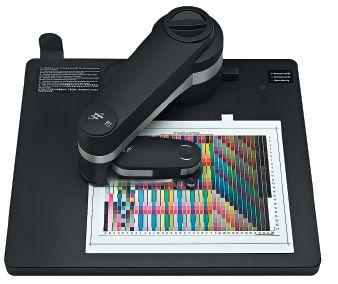
X-Rite’s i1 family of colour management tools includes the i1Pro 2, i1Display Pro, i1iSis and i1iO 2 automated chart readers and i1Profiler software. The i1 Family allows prepress and premedia departments to create colour profiles.
In spring of 2015, X-Rite plans to release its next-generation i1iSis 2 automated chart readers, along with an update to the i1Profiler software. The i1iSis 2 now includes M0, M1 and M2 illumination modes. This includes additional capabilities for measuring optically brightened papers. i1iSis 2, according to X-Rite, is the first fully automated sheet scanning spectrophotometer to support the measurement modes for M0, M1 and M2 print specifications.
X-Rite states i1Profiler will include more than a dozen new features. i1Profiler 1.6 includes scanning capabilities for i1iO2 in M1, as well as M0 and M2. It supports the new i1iSis 2 device, includes a new Patch Editor and Measured Patch Viewer i1Pro. i1iSis and i1iO are currently available. The i1iSis 2 and i1profiler 1.6 will be available in April 2015.
Komori PdC-Sx and PQA-S
Komori’s PDC-SX and PQA-S technologies work together for controlling how a print run hits accepted parameters, while also dealing with defects. PDC-SX is a colour bar scanner that automatically adjusts ink keys and provides reporting of quality control measurements like density, dot gain, greyness, grey balance, print contrast, trap, delta e and L*a*b values. PDC-SX also provides register control including lateral, circumferential, skewing, fanout and aligning print on the top of the sheet to print on the bottom. The colour bar can be placed anywhere on the sheet. This colour management system is designed to monitor and control press output to match a job’s target values.
PQA-S is a camera inspection system designed to detect defects like hickies, scratches, dry-up, lost image, oil drops, that can occur during printing. In addition to detecting colour changes, PQA-S automatically corrects them. The system is focused through a narrow slit in the catwalk to the last impression cylinder. It photographs each sheet at press speed for comparing to a master sheet.
Different areas of the sheet can be set for different levels of detection sensitivity. When a defect occurs the operator is notified by a visual and audible alarm. The entire image is displayed on a screen at the console with the error location highlighted in a flashing red box, with alternating zoom function. The cameras capture the colour bar image in RGB, but
it must be translated to density. This is done in conjunction with PDC-SX.
PDC-SX is always used for the first scan of a job and the ink key values generated for the process inks are used for calibration of the PQA-S, which can then continuously check and control the ink keys throughout the press run. In addition to controlling the ink keys, a density trend graph is also displayed.
Agfa Asanti Calibrated Print Modes
Released as part of the Asanti workflow in May 2014, Asanti Calibrated Print Modes (CPM) is designed for colour management with sign makers. Asanti CPM automatically selects colour profiles based on the print media, the required quality and the chosen print engine. The CPM system is driven by the Asanti Mediahub. Using filtering and collection techniques, Mediahub knows which profile to use for each application.
xerox Colour Consulting Services
Xerox Confident Colour program combines technology, consulting expertise, business development tools, custom solutions, and partners to create a consistent colour printing experience across many platforms. The goal of the program is to produce accurate, repeatable colour as a means to broaden clients’ application range.
Using what Xerox describes as a phased approach to colour management, clients are educated on standardization procedures with industry specifications like G7, GRACoL and SWOP, the ability to detect problems before they appear on the job and to achieve G7 Master Printer Qualification.
The Confident Colour program also focuses on issues like reduced waste, increased profitability, better time management, optimized workflow and reduced risk.
Komori’s on-press colour management technologies: (top) Pdc-5X and PQa-s
Introducing the heidelberg Stahlfolder
Ch 56, Kornit dC Pro Ink, Inca Onset r40lT, xerox rialto 900 and versant 80, xeikon 9800 and more
heidelberg Stahlfolder Ch 56
Heidelberg describes its new Stahlfolder CH 56 KT, to be released in April, as holding the industry’s first automated 50 x 70-cm cross-fold unit. The Stahlfolder CH 56 KT has been specially designed for folding fliers in 50 x 70-cm format, which is well-suited for short-run flier production.
With the Stahlfolder CH 56 KT, an operator enters a new job on the touchscreen for the front-edge stop in the cross-fold unit to automatically move into position. The buckle plate and folding rollers are set to the right format and substrate weight. This is significant automation, Heidelberg explains, when setting up small folding jobs.
In one hour, Heidelberg states the Stahlfolder CH 56 KT machine can complete five repeat folding jobs of 500 to 1,000 copies each. It can be integrated with options and modules like two feeder types and four or six buckle plates in the parallel folding unit.
Inca digital Onset r40lT
The new Inca Onset R40LT wide-format, flatbed UV printer, sold exclusively by Fujifilm, is positioned as a mid-range machine that carries the full-width array of print heads used on higher-end Onset systems. The field upgradable Onset R40LT base model starts as a manual 3.14 x 1.6-metre (123.6 x 63
inch) flatbed printer in a choice of four, five or six colours. It can eventually reach up to eight colours through upgrades.
The Onset R40LT is rated to reach speeds of up 265 m2/hr on substrates up to 50 mm (two inches) thick, which Inca describes as being equivalent to producing 40 full-bed sheets per hour. The Onset R40LT printer uses 14-picolitre Fujifilm Dimatix Spectra print heads and a 15-zone vacuum table.
xerox rialto 900
Xerox states the new Rialto 900 roll-to-cut-sheet, narrow-web inkjet press is designed to carve out a new space within the production inkjet
stahlfolder ch 56 KT joins the Bh/ch series launched one year ago.
The first inca onset R40lT units are installed at imperial in New Berlin, united states, and at daelprinting in ypres, Belgium.
segment. It is the first product jointly developed by Xerox and Impika. The full-colour Rialto 900 is designed for producing 1.5- to 5-million impressions per month. Xerox also states the Rialto 900 has the smallest footprint of any inkjet press on the market, measuring 11.9 x 5.1 feet (3.58 x 1.55 metres), including the press tower.
In addition to duplex printing, the company also explains Rialto has the smallest, narrow web on the market, measuring 9.84 inches (250 millimeters). These smaller-scale production factors for an inkjet web press provide for a lower cost of entry into inkjet web printing. Running Xerox’ water-based pigment HD ink, Rialto 900 is rated to produce a 1,000 x 1,000-dpi apparent resolution
Kornit dC Pro Ink
Kornit Digital, which focuses on the development of textile printing technology, launched a new-generation discharge ink for the Kornit Avalanche DC Pro direct-to-garment printing system. Kornit states it produces printed garments with a natural feel, which is suitable for high-fashion applications.
The discharge ink does not require special handling or mixing, according to the company, and remains stable in print-heads for up to a year. The Kornit Avalanche DC Pro has two additional print heads by which the new discharge ink is applied to bleach the dye molecules of the dark garment, providing a base for CMYK printing. It can print CMYK over discharge, CMYK over white, or CMYK over a discharge and white combination.
Objectif lune PlanetPress Connect
Objectif Lune of Montreal launches PlanetPress Connect for aiding the flow of transactional documents, whether destined for print, Web, email or SMS, through existing PlanetPress software. The software creates communications directly in HTML.
PlanetPress Connect allows users to personalize output with tables and charts, while also connecting to mass-mailing applications with the addition of scan marks. Modules comprising the toolbox include: The DataMapper, for developing data models extraction and creation; The Designer, to create HTML communications; and The Workflow tool for automation.
xeikon 9800
Xeikon demonstrated its new 9800 dry-toner press, which is designed to replace the 8800 model, while adding to the continuing 8500 and 8600 models. The 9800 engine is scheduled for a September 2015 commercial launch. It uses Xeikon’s new QA-CD toner and reaches speeds of up to 21.5 metres per minute. It is designed to print on untreated substrates ranging from lightweight 40 gsm to 300 gsm.
Leveraging the Xeikon X-800 front-end and new QA-CD toner, the Xeikon 9800 is rated to produce a print resolution of 1,200 x 3,600 dpi, with variable dot density. The company states the 9800, described as its most-productive colour press, with 5/5 single-pass duplex printing, is ideally suited for high-end direct-marketing work.
Sun Chemical Troubleshooting App
Sun Chemical made its Online Troubleshooting Guide available as a mobile-device app available on Google Play and the Apple Store. It is designed to help customers resolve common technical defects that
Rialto 900’s web is 9.84 inches.
Qa-cd toners with the Xeikon 9800 include cmyK, red, green, blue, Extra magenta, superBlack, white and clear (uV reflecting).
❏ Increases speed - accuracy from estimates to invoices
❏ Eliminates duplication of effort
❏ Saves time and resources
can happen during a press run, whether running flexography, sheetfed offset, paper packaging, gravure, or energy curable printing systems. After choosing the printing process, the app uses both photos and defect terms, such as dot gain, pinholes, feathering, and comets, to help a printer identify which technical problem they are facing and read a possible solution.
150 metres per minute (492 feet) with three print widths of 333, 445 or 558 mm and with simplex or duplex options in the same frame.
The K630i is an evolution of the Graph Tech AG MonoCube product that was first released in 2012, just before Domino, already a shareholder, acquired the remaining shares of the company. There are currently four installations in Europe and North America, each running between 2- to 12-million A4 impressions per month. Domino states a further five K630i presses are now on order.
xerox versant 80
Building from its new Versant 2100 press platform introduced in mid2014, Xerox’ new Versant 80 is an entry-level press reaching speeds of up to 80 pages per minute, handling media weights from 52 gsm to 350 gsm and media sizes up to 13 x 19.2 inches.
Canon Océ ColorWave 700
Scheduled for a March 2015 commercial release, the Océ ColorWave 700 wide-format printer is as an entry-level system aimed at reprographers and in-plant shops. The printer is suited for applications like posters, pop-up banners and wallpaper, while also handling CAD and GIS documents.
The Océ ColorWave 700 uses Océ MediaSense technology, providing the ability to print on thicker media of up to 32-mil. Canon explains the system is rated to print up to 640 posters or 1,800 A1/D-size CAD drawings per working day. The system allows for up to six different rolls of media to be loaded simultaneously.
domino K630i
Domino Printing Sciences states it has entered into the transactional, direct mail and book printing markets with the launch of the K630i monochrome printing press. A continuous-feed production printer, the K630i is configured to run at 75 metres per minute (246 feet) or
The Versant 80 provides users with single-pass duplex scanning at 200 images per minute. The new press uses the same Xerox Ultra HD Resolution imaging platform as does the existing Versant 2100, which delivers 1,200 x 1,200 at 10-bit RIP rendering, which Xerox describes as a 2,400 x 2,400 imaging resolution.
hP hd Nozzles For Inkjet Web Presses
HP is launching its new High Definition Nozzle Architecture for print heads to be held within its T Series of inkjet web presses. The new technology doubles the native print resolution of current HP inkjet print heads from 10,560 to 21,120 nozzles, delivering 2,400 nozzles per inch.
The HD Nozzle Architecture, with built-in redundancy, also supports dual drop weight per colour for what HP describes as sharp text, fine lines, accurate skin tones, smooth grey and colour transitions, and enhanced highlight and shadow detail. It also allows HP to offer a new quality mode on the T Series machines.
mUller martInI stItCHer
operator neeDeD
Day shift / Evening shift (days preferred). Competitive wages based on experience. Please email resumes to ryanb@tsprinting.ca
pre-press operator/ proDUCtIon speCIalIst WanteD
The candidate must have 5 years minimum experience in the printing industry (litho/digital print). They must manage all production aspects of print jobs. Proficiency in QuarkXPress 9 and CS6 (illustrator, Photoshop, inDesign for Mac OS). Experience in operating a Xerox digital press would be an asset. Fax or email covering letter & resume to 416798-8229 or info@reverbgroup.com.
proDUCtIon sUperVIsor
Experienced Production Supervisor required for our full service commercial printing shop. Must have knowledge of printing and finishing. in this position you will be responsible for coordinating production personnel from the pressroom through the bindery. Those responsibilities include maintaining productivity and colour approvals on the presses. you will also be responsible for finishing approvals and supervision of bindery personnel. s ubmit resume to jschwab@battlefieldgraphics.com
bInDery Help neeDeD
Scarborough Bindery requires a MBO Folder Operator with a minimum of 5
years experience. Must be able to do all setups. Full time or part time, dayshift or nightshift. Please call 416-701-1673 or send your resume to fax number 416-701-9961 or email it to estimates. fortescue@bellnet.ca.
prepress operator / aFternoon sHIFt
Candidate must have solid knowledge of Prinergy workflow including Preps7. Looking for self motivated individual handling Prepress work from Preflight to making plates with our Magnus 800 Platesetter. send cover letter and resume to: hrd@hemlock.com
For
sale
2011 IGen4 perfect condition, low clicks
• Perfect Condition
• Well Maintained
• Low Clicks
Max sheet size 14.33”x20.5” (364 x 521mm) Min sheet size: 7”x7” (178 x 178mm) For more info, call Robert 416-815-8882.
DIGItal prInt operator WanteD
FT experienced Digital Print Operator required in Brantford, Ontario. Operat-
ing Xerox i g en and n uvera printers with Freeflow Software and related bindery operations include cutting, folding, saddle stitching, scoring, stapling, perfect binding, Plastickoil binding. Hours 8:30 to 5:00, Monday through Friday. Additional hours may periodically be required. send resume to careers@distributech.ca
experIenCeD larGe Format
operator neeDeD. maC anD pC KnoWleDGe neeDeD
Markham based company looking for an experienced operator for our large format division. Must be proficient in Adobe i llustrator, Photoshop, i nDesign - Fluent in English - Large format production experience - a team player - Able to multitaskk nowledge of Versa Works helpfulTemporary position, may lead to full time employment - Willingness to learn and a positive attitude - Excellent quality control skills. send cover letter and resume to: RaymENT & colliNs
Sakurai: 1, 2 or 4 colours and any size (newer model)
Polar: any size/older or newer models (66/72/76/78/82/90/92/107/115)
Horizon-BQ: 220/240/260/440/460
Sheryl Sauder / Chief Executive Officer / Mi5 Print and digital Communications, Markham, Ont. / Interviewed by Jon Robinson
After graduating from Princeton, where she competed for the university’s varsity diving and swimming teams, Sheryl Sauder began her career with News Marketing Canada. Within three years, she became a founding partner of Prospect Media Inc. and later Stratafly Inc., which she helped lead for 13 years. Sauder then sold her shares and joined one of Prospect’s print suppliers, Mi5 Print and Digital Communications, as Vice President in 2011. In October 2014, Sauder was named Chief Executive Officer of Mi5 Print, which has been recognized as one of Canada’s fastest growing companies for the past seven years. In its most recent fiscal year, Mi5 generated $30 million in revenues and now employs more than 140 people in neighbouring facilities totaling 85,000 square feet.
what is your business mantra?
SS: My approach is to lead by example. i certainly work hard. it is much easier to manage people when they feel like you are working as equally as hard or harder than they are. And also that they know you understand the hiccups and what they are going through… From that perspective, it keeps me involved in what is going on. People are more willing to open up and talk about things, so you get the heartbeat of the company.
what is your leadership strength?
SS: i do what i say i am going to. if i commit to something, i finish it right through to the end. And i think that is valuable. Once people know they can trust that you are on it, they can then get on with what they need to do. what did you take away from your time at Princeton?
SS: i dove twice a day, plus i went to school and had a job, so it was the best way to learn time management. i find i am much more successful at managing my time the busier i am. i just get more done. what is your most significant career achievement to date?
SS: My biggest achievement to date is becoming CEO at Mi5. [Printing] is still such a male-dominated industry and i think having a female CEO gives us an edge in the marketplace. When we walk into a boardroom, marketing is very female [driven], so it is nice to have a mix that matches well with who we are selling to. what is the mi5/spectracolor structure?
SS: Mi5 is the parent company and Spectracolor is what we consider to be our trade brand.
why is mi5 open about its trade operation, which most try to hide?
SS: We have enough of our own opportunities that we do not need to wait to see what somebody brings into the building and then decide to go after. Pursuing others’
customers is just not what we do. At the same time we are very much a trade supplier and over 50 percent of our business is to brokers and resellers. what do you like most about printing?
SS: it is like new york City, it’s the industry that never sleeps. it is exciting. it is truly 24/7. i never walk out of here feeling like i’m done.
what is mi5’s greatest opportunity in the next couple of years?
$30
SS: Our greatest opportunity is attracting high-level talent either through acquisition or just from a rewarding work environment. We now have a good mix of people who have been in the industry and fresh, young talent. We try to do more things as a company. This is our third year of doing the Warrior Dash up in Horseshoe Valley, which is a 5-km mud run. what is mi5’s greatest challenge?
SS: Managing growth, both from a space standpoint and an infrastructure standpoint… we are going to need a new location, which is not a fun thing for a printer. how much pressure do you feel to keep mi5 growing?
SS: i have a great team with Derek [Mcgeachie], Steve [Tahk] and Peter [nitchos], so i definitely do not feel like i am by myself. i think we do a great job of managing as a team, bouncing ideas off of each other.
why is mi5 focused on becoming a high-quality shop?
SS: We are trying to remind people that print is still a craft and your message is going to be held longer if you take the time to make it creative or make it feel good. There is always going to be commodity business, it keeps the machines running, but it is reminding marketers that there are different things that you can do with print to make a campaign more successful. are marketers returning to print?
SS: There used to be many mass campaigns that were not very well thought out. i think they are smarter about it now. And they might do smaller volumes, but using the same amount of money to do something different. They are looking for us to come with innovation.
what is your favourite print project at mi5?
SS: My favourite is our Mi5 calendar… each page has a different cool print technique. it is a difficult project because it is always hard to get our own stuff through the plant… and it is time-consuming because each technique is new and there is some R&D that goes into it. But the finished product is awesome. what key piece of advice do you have for printers?
SS: Partner with us.
To stand out from the crowd, you have to coat differently.
As a manufacturer of UV and water based coatings, ACTEGA consistently strives for new ways to coat differently. Innovative technologies, a strong product portfolio, and an exceptional technical support system provides you with all the tools necessary to stand out in a crowd.
Delivering solutions.
ACTEGA, in partnership with Spicers, offers one of the most diverse lines of coatings in the Graphic Arts industry and is known for its exceptional runnability, consistency and cost effectiveness. 877 790 2335