






































4 From the editor
Artificial intelligence: A new frontier at work by Michelle
Malcolm-Francis
5 The first word
A year in reflection: My first 12 months as your president by Micheal Mooney, C.E.T.
20 Learning curve
Centennial College’s new mass timber building supports Indigenous ways of teaching by Mark Toljagic
21 Sign of the times
An old/new approach to nuclear energy by Peter Saunders
22 Sign of the times
AI governance 101: Key considerations for organizations and experts by Simon Hodgett, Sam Ip, and Naomi Chernos
6 OACETT in action
Sharing the latest news, happenings and announcements from your professional association and more!
32 New members
Recognizing new and certified members
35 Chapters at work
Events and news from OACETT’s regions and chapters

24 COVER
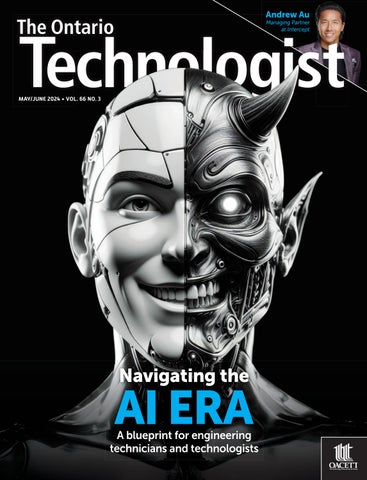
Navigating the AI era
A blueprint for engineering technicians and technologists by Andrew Au

28 Stuck in a jam AI
by
Dennis Furlan

n 2002, Tom Cruise starred in The Minority Report. This science fiction film presents a dystopian vision of the future, where advanced artificial intelligence (AI) is used by law enforcement to predict and prevent crimes before they happen. Twenty-plus years ago, I remember watching the film and thinking this technology seemed advanced, engaging, and potentially dangerous. You see, the movie explored the ethical and moral implications of a system that predicts and prevents criminal activity and raised critical questions about AI and the future and its impact on society.
Fast-forward to 2024. AI is no longer something out of science fiction movies or, better yet, years away. It’s now woven into our daily lives, quietly powering tools and services we rely on to thrive. AI programs and algorithms are designed to do specific tasks like playing highly complex games, driving a car, and recognizing patterns in large data sets. They can also reason and analyze information, simulating human intelligence using machines.
AI technology is also reshaping many industries through its automation, augmentation, and predictive capabilities, creating a growing need for workers to acquire new skills to remain relevant in the workforce. Its impact on today’s workforce depends on the industry, the type of AI technology deployed and societal responses to AI implications. While AI is revolutionizing how many of us work, it raises concerns about inequality, privacy, safety and bias – all needing to be addressed proactively.
With so much happening in the world of AI, OACETT held an AI Summit titled “The Rise of AI and its Impact on the Engineering Technology Profession” to learn and discuss the intricate challenges, ethical implications and opportunities artificial intelligence poses for our future. The summit included a keynote speaker, a panel session and strategy sessions. The strategy sessions had industry leaders working together to develop a collaborative AI framework that will serve as a guide to improve how AI intersects with the engineering technology profession moving forward. This issue covers the event’s highlights, starting on page 6.
At the OACETT AI Summit, keynote speaker Andrew Au explored the broader role of AI in accelerating digital transformation. On page 24, he further provides The Ontario Technologist readers with more insight into this topic in his article, “Navigating the AI Era: A blueprint for engineering technicians and technologists.”
In this issue, you’ll also learn how AI addresses traffic congestion in “Stuck in a Jam” on page 28. Also, “AI Governance 101” on page 22 provides critical considerations for organizations and experts when implementing AI systems.
We have more inside! On page 20, read about how Centennial College’s new mass timber building supports Indigenous ways of teaching. The Fletcher Foundation has a new round-up feature – read about it on page 12. Also, get to know your fellow OACETT members in the OACETT in action section. You’ll learn about the great things they are doing for the profession.
Enjoy this issue!


OACETT is dedicated to excellence in the engineering and applied science technology profession in a manner that serves and protects the public interest.
The Ontario Technologist is published bi-monthly by:
The Ontario Association of Certified Engineering Technicians and Technologists (OACETT) 10 Four Seasons Place, Suite 700 Etobicoke, Ontario, Canada M9B 6H7 Tel: (416) 621-9621 • Fax: (416) 621-8694 www.oacett.org
Please direct all inquiries, submissions and subscription requests to OACETT at the above address.
The Ontario Technologist is published in conjunction with:
Annex Business Media
111 Gordon Baker Road, Suite 400 Toronto, ON M2H 3R1 Tel: (416) 442-5600 • Fax: (416) 442-2230
EDITOR
Michelle Malcolm-Francis editor@oacett.org
ART DIRECTION
Svetlana Avrutin
ACCOUNT COORDINATOR
Cheryl Fisher
SALES CONTACT OTads@oacett.org
Subscriptions:
One year: $24 (Canada), $48 (U.S.A.), $96 (International). Please add 13% HST. HST Registration #107796658
©2024. The opinions expressed in this publication are not necessarily those of the Association. Neither The Ontario Technologist nor OACETT assumes any responsibility or liability for damages arising from any error or omission or from the use of any information or advice printed in this publication.
Letters regarding the journal should be addressed to the Editor at the Association’s address. Letters regarding the Association and other related subjects may also be addressed to the Editor for forwarding.
International Standard Serial Number (ISSN) 0380-1969. Publications Mail Agreement #40062764.
Return undeliverable Canadian address to: Circulation Department, 10 Four Seasons Place, Suite 404, Etobicoke, ON M9B 6H7.

The Ontario Association of Certified Engineering Technicians and Technologists, a self-governing, non-profit organization, maintains standards of excellence in the practice of engineering and appliedscience technology in Ontario. Founded in 1957, the Association became provincially legislated in 1984, and has statutory powers and responsibilities.
PRESIDENT
Micheal Mooney, C.E.T.
PRESIDENT-ELECT
Christopher van Dop, C.E.T.
PAST-PRESIDENT
Rosanna Baggs, C.E.T., rcji, CAPM
CENTRAL REGION
Governance, Strategy and Policy Committee
Norman Sandberg, C.E.T.
EASTERN REGION
Finance and Audit Committee Chair
Brian Raymond, C.E.T.
HORSESHOE REGION
Diversity, Equity and Inclusion Committee Chair
Shelley Parker, A.Sc.T.
NORTHERN REGION
Registration and Professional Practice Committee Chair
Stephanie Pesheau, C.E.T.
TORONTO REGION
Member Engagement and Services Committee Chair
Roy Sue-Wah-Sing, C.E.T.
WESTERN REGION
Human Resources Committee
Member-At-Large
Samuel Nammari, C.E.T., P.Eng.
Young Professionals Committee Chair
Mladen Ivankovic, C.E.T.
Student Representative
Dave Visentin
APPOINTEES
Daniel Liao
Heads of Technology Representative
Alex Lusty, LLB
Public Representative
EX-OFFICIO MEMBER
Cheryl Farrow, MBA, CAE OACETT Chief Executive Officer
DIRECTOR, FINANCE AND CORPORATE SERVICES
Arshad Zaver, CPA, CA
DIRECTOR, REGISTRATION AND PROFESSIONAL PRACTICE
Barry Billing
DIRECTOR, MEMBER ENGAGEMENT, SERVICES AND GOVERNMENT RELATIONS
David Terlizzi
MESSAGE FROM OACETT PRESIDENT MICHEAL MOONEY, C.E.T.

AA year in reflection: My first 12 months as your president
s the first year of my two-year term as president of the Ontario Association of Certified Engineering Technicians and Technologists (OACETT) ends, I look back on a year marked by significant achievements and engagement with our stakeholders, communities, and government.
In a world increasingly driven by technology and innovation, OACETT has steadfastly upheld its commitment to advancing the field of engineering technology in Ontario (from direct engagement with key government ministries to the convening of government, industry and academia to discuss and develop an AI strategy at OACETT’s AI Summit in April), bolstering the professional development of our members, and advocating for the broader interests of the industry and sectors our members work in.
2023-2024 was also a year of strengthened industry partnerships for OACETT. The association collaborated with various industry leaders and governmental bodies to advocate for policies that recognize and enhance the roles of technicians and technologists in the workforce. Our advocacy efforts have centred around the recognition of certified technicians and technologists as key stakeholders in critical discussions on Ontario’s future in technology and infrastructure. This has included participation in roundtable discussions, policy draft submissions, and trade and industry conference representation. Community engagement has always been a pillar of OACETT’s mission, and this past year efforts and new approaches to outreach and inclusion have been renewed. Here are other key activities we achieved in 2023 and 2024.
• Established new scholarships for young professionals.
• Created new industry partnerships, and at the provincial and chapter levels continued outreach efforts in communities that our members live and work in.
• Established a student task force to gain
insight into what benefits student memberships perceive as valuable and find out how OACETT can serve its student members better.
• Formed a new committee structure to engage more members in the Association’s governance.
• Introduced the Technology Partnerships Showcase at OACETT’s 2023 Conference and President’s Awards Dinner to enhance our relationship with colleges and highlight emerging technologies.
These efforts demonstrate our commitment to nurturing the next generation of engineering professionals, building partnerships, engaging members in professional development, and increasing members’ involvement and understanding of OACETT’s governance structure.
The past year was a year of change, growth, challenges, and opportunities for OACETT. As I reflect on our accomplishments and look forward to new initiatives, I am reminded of the strength and resilience of our members and communities. Looking forward to the last year of my term as president, I am excited to continue to work with you all to build on the foundations laid this past year. The Association will continue to focus on the professional growth of its members, the advancement of engineering technology, and the positive impact these efforts have on society.
Here’s to continuing our journey towards excellence in engineering technology and professional development in the coming year. With a robust agenda of initiatives – including the development of a new strategic plan –aimed at further developing certification standards, continuing education, and advocacy, OACETT and our members are poised to lead the way in shaping a dynamic and innovative future for Ontario.
Micheal Mooney, C.E.T., is president of OACETT.




by David Terlizzi
How much AI-related content do you encounter everyday? More digits than you have fingers potentially. Some technologies are so transformative that organizations must take the helm and run with it to be ready before the exponential curve hits. While organizations are tripping over themselves to capture headlines and futurists are contemplating an end-
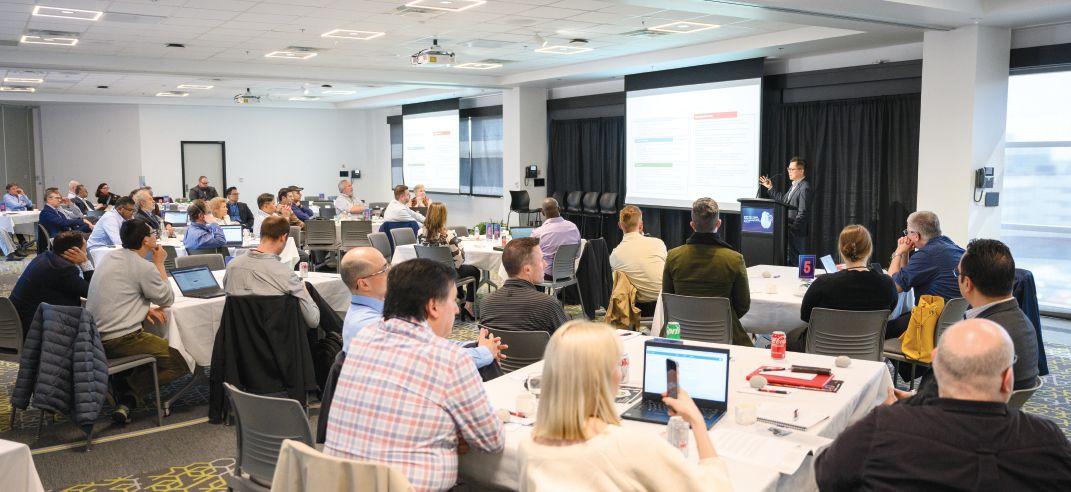
of-days scenario or utopia, OACETT is taking a pragmatic approach and concentrating on how it will affect engineering and applied science technicians and technologists. Recognizing this, OACETT proudly hosted an AI Summit titled “The Rise of AI and its Impact on the Engineering Technology Profession” on April 13 at Humber College’s Barrett Centre for Technology Innovation.
This landmark event was not just a gathering but a bold first step in aligning the profession with potentially the most disruptive technology ever. The theory of technological singularity comes to mind. But before we hit this milestone, it is incumbent upon OACETT and its membership to guide how technicians and technologists will use AI technology in everyday work. As a result, the AI Summit concept was born with a guidance document as a final product, which will act as a clarion call to our members and external stakeholders.
Keynote address
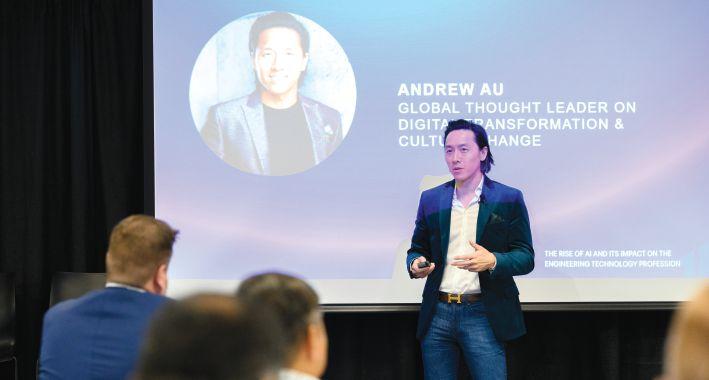
Andrew Au, a global thought leader on digital transformation and culture change, delivered the keynote address for the day’s programming. His engaging presentation explored the broader role of artificial intelligence (AI) in accelerating digital transformation. He noted that companies accelerated their digital strategies by approximately seven years over five months during the pandemic. A rapid increase

followed this acceleration in adopting AI technologies, which facilitated significant advances and brought challenges, such as layoffs and ethical concerns over technology deployment.
Generative AI, a subset of AI, was highlighted for its ability to create new content, offering transformative possibilities akin to the past’s widespread impact of affordable artificial lighting. However, it also raised issues regarding intellectual property and the potential biases in AI models. These models do not simply reflect but can amplify existing biases in data, prompting discussions about the need for governance and ethical frameworks in AI usage to prevent misuse and ensure fairness in automated processes. The narrative underscores a future where AI could reshape every facet of society, necessitating a balanced approach to its development and integration into human activities. His real-world examples of how generative design reduces time and costs for auto manufacturers hit home in terms of its impact. Judging by the membership feedback, Au’s delivery and content were entertaining and informative.
The structure of the AI Summit included a panel session that brought together thought leaders, innovators, and external stakeholders to discuss and dissect the intersection of AI and the engineering technology profession. Our goal was to encourage the exchange of viewpoints, showcase a range of perspectives, and prompt deeper engagement about AI, and we were not disappointed.
Panellists included Joe Armstrong, President and CEO of Erail Consulting Inc., who brought a wealth of thought leadership in the aerospace, defense, and high-tech sectors. Panellists Francis Syms, the associate dean of Humber College’s Faculty of Applied Sciences and Technology (FAST), brought
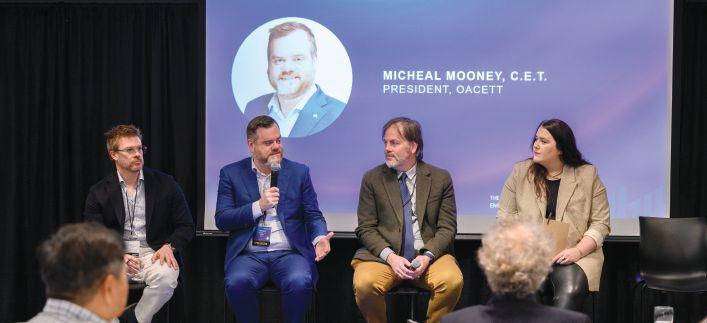
OACETT AI Summit 2024 panel session provides an exchange of viewpoints and showcases a range of perspectives on AI. From left to right: Joe Armstrong, president and CEO, Erail Consulting, OACETT president Micheal Mooney, C.E.T., Francis Syms, dean, Humber College, Faculty of Applied Sciences and Technology, and Stephanie Oldfield, director of Policy & Digital First Branch, Ministry of Public & Service Delivery discuss various facets relating to the impact of AI on the engineering technology profession.
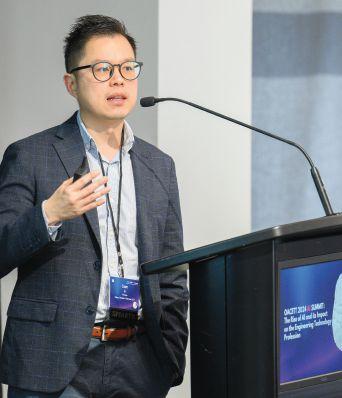
Sam Ip, partner, Osler, Hoskin & Harcourt, discusses the AI governance in Canada during the strategy session.
his industry experience in cybersecurity, artificial intelligence, and risk management and his perspective as an educator. OACETT president Micheal Mooney, C.E.T., provided salient viewpoints and underlined the importance of transparency as a panellist. In addition, Stephanie Oldfield, director of Policy & Digital First Branch, Ministry of Public & Service Delivery, rounded out the panel with a government con-
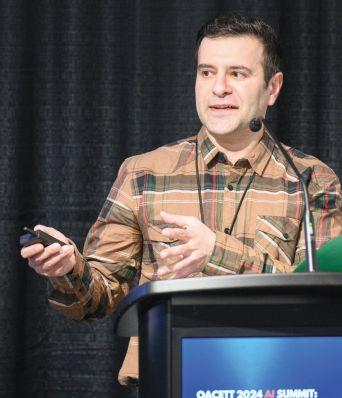
Haeri, IT manager, BGC Engineering discusses labour concerns and uses in the workplace during strategy session on labour.
text to the discussion and also noted how the provincial government had been working on AI long before the prevalence of generative AI took off.
The genesis of the discussion included many agreed-upon opinions, including that AI is significantly reshaping engineering and technology fields by requiring the incorporation of new skills and reflective practices. Also, technicians and technologists
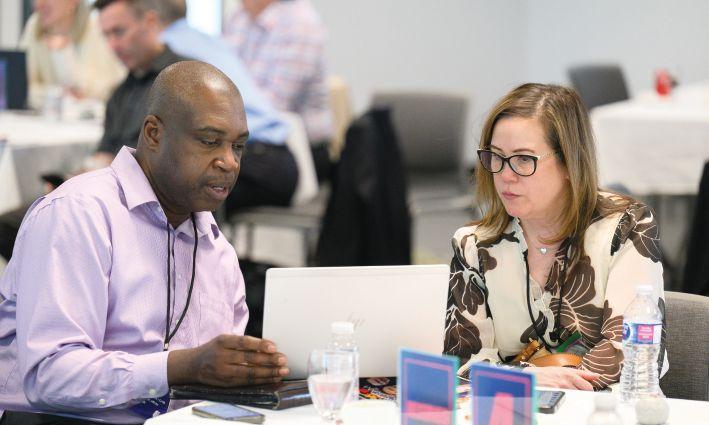
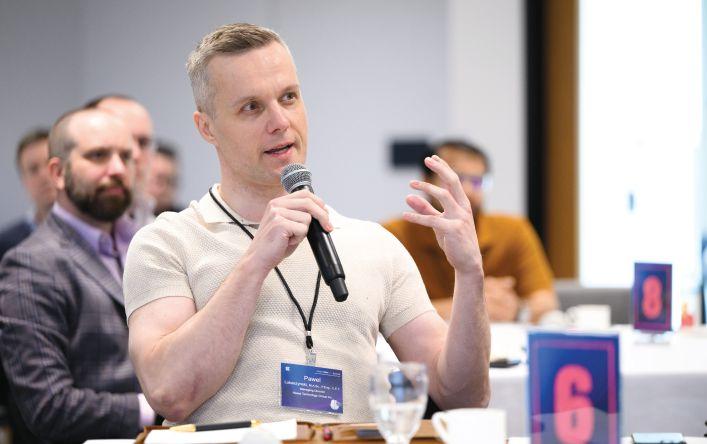
need to adapt to the societal impacts of AI, which challenges traditional problem-solving approaches and requires a broader skill set beyond technical capabilities.
Concerning ethics, president Mooney highlighted AI’s complex ethical dilemmas that traditional engineering solutions have not been able to address. Because of the ethical challenges in AI, technicians and technologists will need to develop skills in ethical decision-making, balancing technical solutions with societal impacts, and
navigating legal and ownership issues altered by AI.
All panellists agreed that AI is becoming essential in business operations, from proposal writing to strategic decision-making. By automating and enhancing data analysis and operational tasks, AI allows businesses to operate more efficiently and focus on higher-level strategic goals.
Syms discussed AI’s challenges and opportunities in assessing and personalizing learning in education. Colleges must adapt their assessment methods
to ensure they measure actual understanding and skills, not just the ability to generate correct answers using AI tools. Discussions also touched on how AI influences government policies and the need for regulations that keep up with technological advances. There was also a strong emphasis on transparency and responsible AI usage to ensure public trust and effective governance.
Looking ahead, the panel reached a consensus that ongoing education and skill development are crucial in keeping up with AI advancements. Technicians and technologists need to continuously update their skills to include ethical considerations, data analysis, and AI application capabilities to stay relevant and responsible in their fields.
The strategy session took a novel approach to gather as much input from attendees as possible to questions regarding AI’s impact on the profession, which included these three overarching issues:
• What are the ethical concerns? Algorithms bias, privacy concerns, and decision-making transparency are critical pieces of the puzzle and must be addressed. These issues raise considerable questions about responsibility and accountability.
• What are possible labour market concerns? AI is transforming the labour market by eliminating and creating new opportunities simultaneously. What skills will be in demand for our members? What new additional skills do we need to consider? How can we leverage AI in our profession to enhance and improve our careers rather than replace us?
• What are the gaps in policy and governance? The rapid evolution of AI technologies has outpaced ex-
isting policies and governance frameworks, sometimes leading to regulatory vacuums.
Within the strategy session, succinct presentations introduced each of the topic questions: ethical concerns, labour market concerns, and policy and governance.
OACETT president Micheal Mooney, C.E.T., covered ethics, addressing the dual aspects of opportunity and caution, advocating for a balanced approach to harnessing the capabilities of Generative AI while safeguarding ethical standards and societal values. Chief among his points are the benefits of Generative AI, such as enhancing creativity, improving efficiency, and fostering collaboration while highlighting its limitations and ethical challenges. These challenges include ethical concerns, job displacement, and quality and authenticity issues. The presentation stressed the importance of ethical considerations in AI deployment, including accountability, transparency, authorship, bias, privacy, and the necessity of human oversight. The overall message advocated for a responsible approach to developing and using AI technologies, ensuring they augment human capabilities and societal well-being.
Vahid Haeri, the IT manager at BGC Engineering discussed the labour side of things, presenting the integration and impact of AI across various departments at engineering firms. In BGC Engineering’s case, he mentioned how AI has enhanced the efficiency and accuracy of tasks such as borehole data analysis by the geotechnical engineering team and core sample analysis by geologists using image recognition technologies. The IT department has also adopted AI, utilizing chatbots and
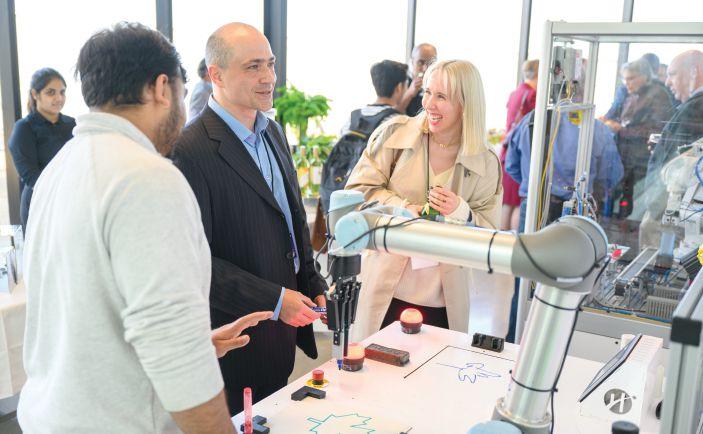
virtual assistants for helpdesk operations, which streamline workflows and improve response times.
Haeri emphasized that AI augments human capabilities, allowing professionals to focus on higher-level problem-solving and creative tasks. Adapting training to include AI skills will be essential to ensure workers are prepared to use these tools effectively and ethically, especially with AI being a driver of innovation and productivity in the engineering sector. Haeri’s most prescient point came at the end: “AI won’t take your job, but someone who knows how to use AI and has the same degree as you will.” You can infer this to also include the words diploma or certifications.
Governance and AI are akin to a gardener tending to a garden. The complex AI ecosystem (garden) must be tended to and controlled by the gardener (governance) so it does not grow unpredictably out of control. To this end, Sam Ip, partner at Osler, Hoskin & Harcourt LLP and member of the firm’s technology group, provided a much-needed environmental scan on AI governance in Canada. His presentation focused on the development and implications of the proposed
Artificial Intelligence and Data Act (AIDA, Part 3 of Bill C-27) in Canada. This legislative measure, currently under parliamentary review, aims to establish a robust framework for AI governance, emphasizing accountability, risk assessment, mitigation, and human oversight in AI systems. Ip highlighted the criticality of technical stakeholders’ voices in shaping practical and effective AI regulations.
All AI Summit participants were sent surveys, which included an additional call for input.
Overall, OACETT’s AI Summit served as a crucible for ideas, where industry leaders, technicians, technologists, and educators converged to decode the implications of using AI in the profession. It will also provide some much-needed guidance.
If you would like an opportunity to add your voice to our guidance document and respond to the questions delivered at the AI Summit, please scan the QR code.
David Terlizzi is director of member engagement and services, government relations at OACETT.

Steve Holmes, C.Tech., now assumes the pivotal role of manager of facilities & parks at the Township of Rideau Lakes, leveraging his wealth of experience and notable certifications. With a distinguished background spanning 17 years at the Upper Canada District School Board as a project manager in the design & construction department, Holmes brings a formidable skill set to his new position. His tenure also includes eight years as a building inspector, fortified by numerous qualifications from the MMAH. Tasked with spearheading the effective development, operation, and maintenance of the Township’s diverse facilities, Holmes’s expertise is poised to optimize the functionality and appeal of operational buildings, community structures, harbors, parks, and more.
Christopher Walker, C.Tech., is now a training simulation specialist at Nav Canada, after serving as a national monitoring and distribution center technologist since 2022. With prior experience at the Canadian Bank Note Company Ltd., Walker is grateful for the support received throughout his career. He looks forward to leveraging his expertise in his new role and sharing insights with the OACETT community as he embarks on this exciting journey.
Siva Priya Gita, C.E.T., has taken on a new position with the City of Brantford as development engineering reviewer. She brings a wealth of expertise to her role, meticulously reviewing technical submissions for planning applications, including official plan amendments, zoning by-law amendments, plans of subdivi-
sion, site plan applications, and other planning-related submissions. Additionally, Gita is dedicated to ensuring seamless coordination of municipal infrastructure with adjacent developments. She is proactive in responding to requests and attending meetings organized by various stakeholders, including the offices of the Mayor and Members of Council, other departments, developers, consultants, and the public, demonstrating her commitment to facilitating effective communication and collaboration within the community.
WHAT’S NEW? We want to hear from other members who have recently changed jobs, received a promotion or an award, or completed an educational program. Make sure your fellow OACETT members read about it in The Ontario Technologist. Promote your success – send your submissions to the editor at editor@oacett.org.
This listing represents those who reached their milestone between February 25, 2024 and April 19, 2024.
25-year members
Steven Barraclough, C.E.T.
Gerry Barstad, C.E.T.
Tim Basten, C.E.T.
Diana Bell, C.Tech.
Adam Boothby, C.Tech., rcji
Jairaj Brijraj, C.E.T.
Nicholas Chevalier, A.Sc.T.
Michael Colquhoun, A.Sc.T.
Brad Crampton, C.Tech.
Joie Cunanan, C.E.T., rcji
J R Gilles Desjardins, C.E.T.
David Bruce Douglas, A.Sc.T.
Brent Drew, A.Sc.T., rcsi
Steven Finley, A.Sc.T., rcca
Claude Gauthier, C.Tech., rcsi
Jeffrey George, C.Tech.
Christopher Gibson, C.E.T.
Gregory Giles, C.E.T.
Paolo Gioacchini, C.E.T.
Darren Gray, C.E.T.
Daniel Groskurth, C.E.T.
Salim Hifawi, C.E.T.
Charles Howell, A.Sc.T.
Ian Karges, C.Tech.
Timothy Klein, C.E.T.
Tamara Lacroix, C.Tech., rcca
Alexander Lazaro, C.E.T.
Rolando Lora, C.Tech.
Rebecca Lychwa, A.Sc.T.
Richard Mask, C.Tech.
W. Scott Matthews, C.E.T.
Justin McCarthy, C.E.T.
Kenneth McShannon, C.Tech.
Rino Molella, C.Tech.
Jeffrey Oakes, A.Sc.T.
Michael Owsiany, C.E.T.
Sunita Pace, C.E.T.
Dharam Pal, C.Tech.
Matthew Rainville, C.E.T.
Joseph Reany, C.Tech.
Dwayne Roberts, C.E.T.
Angelo Sferrazza, C.Tech.
Bhupesh Sharma, C.E.T.
Thane Silliker, C.E.T.
Jennifer Spurgeon, C.E.T.
Jason White, C.E.T.
40-year members
Bruce Alexander, C.E.T.
Michael Armster, C.E.T.
Michael Balcain, C.E.T.
Jon-Paul Blais, C.E.T.
Sergio Borghesi, C.E.T.
Douglas Caroll, C.E.T.
Peter Carpino, C.E.T.
John Cyr, C.E.T.
David De Groote, C.E.T.
Luigi De Santi, C.E.T.
Robert Dion, C.E.T.
Robert Dyke, C.Tech.
Darrell Flieler, C.E.T.
Frank Gaccione, C.E.T.
Gregory Garland, C.E.T.
Claudio Gloazzo, C.E.T.
John Glover, C.E.T.
Glen Good, C.E.T.
Barry Goulah, C.E.T.
Yvon Gravel, C.E.T.
Daniel Guilfoyle, C.E.T., rcca
Randy Hood, C.E.T.
James Kerr, C.E.T.
Gilles Laroche, C.E.T.
Pasquale Maselli, C.E.T.
Stephen Mason, C.E.T.
Kevin Moriarty, C.E.T.
Dario Nini, C.E.T.
Brent Osborne, C.E.T.
Murray Parsons, C.E.T.
Marc Piccioni, C.E.T.
Eugene Puritch, C.E.T.
Paul Richardson, C.E.T.
Ronald Romick, C.E.T.
Robert Rosendale, C.E.T.
Domenico Scappaticci, C.E.T.
Mark Schiller, C.E.T.
Timothy Stafrace, C.E.T.
Franco Torlone, C.E.T.
John Vizza, C.E.T.
Scott Wilson, C.E.T.
Frank Wunderlich, C.E.T.
Michael Young, C.E.T.
50-year members
Julius Bodai, C.E.T.
David Carswell, C.E.T.
Ian McQueen, C.E.T.
Robert Rasmussen, C.E.T.
Michael Russell, C.E.T.
Bryan Slingsby, C.E.T.
Brian Turner, C.E.T.
Hans Van Helden, C.E.T.
Jack Wallace, C.E.T.
Gregory Zwarych, C.E.T.
by Michelle Malcolm-Francis
The Fletcher Foundation has launched a new round-up donation feature on OACETT’s Member Portal, which provides OACETT members with a convenient option to round up their annual dues’ renewal payment to the nearest ten dollars. It is an easy way for members to support the Foundation at membership renewal time.
Every dollar counts when you want to elevate the educational experiences of engineering technology and applied science students. With your support of this new initiative, we can build more funds to support academic projects and programs that advance the training and applied learning of students.
As an OACETT member, you can round up to the nearest ten dollars, donate another amount or choose not to donate when renewing your dues on OACETT’s Member Portal. We hope you choose to give to this important cause, as we know you care about the future of your profession.

How to make a round-up donation on OACETT’s Member Portal
1. Go to OACETT’s Member Portal via the OACETT website and sign in.
2. Under the Membership Renewal section, click the ‘Pay My Dues Now’ button. You will land on Renewal Page – Step One.
3. On the Renewal Page – Step One default page, you will be asked, ‘Do you want to donate to the Fletcher Foundation’? You can choose either ‘Yes, I would like to Donate’ or ‘No, I would not like to Donate.’
4. If you select ‘Yes’ at the bottom of the Renewal Page, you will choose one of two options – ‘Fletcher Foundation Donation, rounding up to the nearest ten dollars’ or ‘Fletcher Foundation Donation, other amount.’
5. If you click on the round-up payment option, your payment will round up to the nearest ten dollars. For example, as a certified member, your
renewal fee of $344.65 would round up to $350.00. After you click the round-up payment option, you must click on ‘Confirm and Continue’ to create the invoice.
6. If you click the second option of entering your donation amount, you will be prompted to put any dollar figure, big or small, in the payment tab. Then you click on ‘Confirm and Continue’ to generate the invoice.
Separate tax receipts will be available in your account for your Fletcher donation. And donations are always welcome year-round through the Fletcher Foundation webpage at www.oacett. org/about-us/fletcher-foundation. If you have any questions, please email fletcherfoundation@oacett.org. We thank you in advance for your support of the Fletcher Foundation.
Michelle Malcolm-Francis is the editor of The Ontario Technologist magazine.
by Kristen Frisa
Ken Taylor, C.E.T., is an entrepreneur at heart, but he’s also contributed to many different companies in various roles over a career spanning nearly five decades.
While still studying at Humber College as a survey technologist, Taylor started an explosives company, doing small jobs taking out stumps and splitting stones while he finished his schooling.

Manager for the Canadian Construction Association.
When the City of Guelph decided it was no longer willing to accept steel shims for adjusting manholes and catch basins, Taylor started producing shims out of high-density polyethylene plastic in his backyard, founding Structure Shims Inc. in 1996, a product he continues to manufacture to this day.
Almost immediately, Taylor applied to become a member of OACETT. Along with the support and education that comes with being a member of an industry association, Taylor understood that the certifications were worthwhile, lending some extra esteem to his resume and giving employers some assurance of his professional skills.
“Certification with OACETT gives you a designation, a certificate saying, ‘this is what I’ve accomplished,’” Taylor said. “It offers a shortcut into some of the more advanced positions within companies.”
Taylor returned to school part-time to finish a course as an engineering technologist, while continuing to work full-time. During that time, he worked as survey party chief at two engineering companies.
After receiving his construction engineering technologist certification in 1992, Taylor worked as an estimator and project manager with four different companies. During his work at Lafarge, Taylor and his team estimated the largest contract the company had ever taken on at that time, worth $26.5 million.
Taylor was the first-ever recipient of the Gold Seal Certificate for Project
In 2022, he was awarded a patent on a second product for the construction industry: a module lock that replaces the concrete module lock for adjusting manholes.
“The concrete ones lose about 20 per cent to breakage because they’re just so brittle. The new ones, you could drop them off the truck at 30 miles an hour, and they’d still be OK to use,” Taylor said.
Although he “retired” from the construction industry in 2017, Taylor now focuses full-time on production of his two construction-related products. At any given moment, he has shipping containers full of raw materials for these projects in his yard.
At the urging of many of his past students, he started literally writing the book on his work—he has begun a manuscript on estimating and project management, which he continues to work on when time allows. Taylor is an independent, well-established member of the contracting community who continues to contribute to its improvement. It seems a long way off before he is truly retired from his work.
Kristen Frisa is a contributor with The Ontario Technologist magazine.
The start of the year ushers in a new Continuing Professional Development cycle. If you were certified in 2023 or were supposed to certify in 2023 and did not, your CPD cycle is
January 1, 2024 –December 31, 2026.
You must complete four CPD activities including one mandatory activity in either technical knowledge or management/leadership. For more information visit www.oacett.org/cpd or email: cpd@oacett.org.
by Julia Farner, CAE
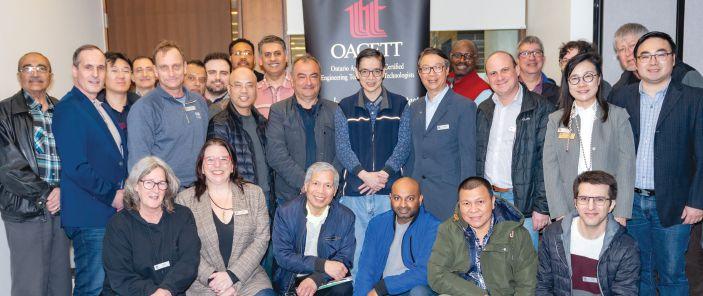
OACETT’s chapters recently held annual chapter meetings (ACMs), which included elections for the chapter executive, updates from the local chapter and OACETT on important initiatives, upcoming events, and changes.
While ACMs are structured meetings, many chapters combine their events with complimentary dinners and free continuing professional development (CPD). Chapter members in attendance can volunteer with their executives, get to know their peers, and ask pertinent questions about their chapter’s direction and the Association’s direction.
For members who have never attended an ACM or missed this year’s ACM, consider getting involved with your chapter ecosystem. While we all have many competing priorities, the benefits of attending are plentiful. Speaking from experience, we make time for the things that matter to us. Here are a few key reasons why you should consider unlocking the power of professional engagement.
• Connect with like-minded peers who are passionate about your profession.
• Build key connections and friendships with professional colleagues.
• Expand your professional circle, which can lead to new opportunities and possible future collaboration.
• Find out what your local chapter and OACETT are doing to support your profession and community through essential initiatives and events.
• Keep updated with your CPD; many chapters hold free educational sessions and tours during their ACMs and inform members of other upcoming learning opportunities.
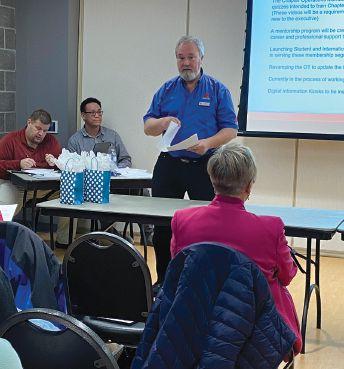
President-elect Christopher van Dop, C.E.T., provides update on OACETT activities at Peel Chapter’s Annual Chapter Meeting.
• Put your name forward to be a volunteer on your chapter executive and have your say. There are many positions to choose from, including chapter chair, vice-chair, women in technology representative, college liaison, secretary, treasurer, and chapter executive member.
• Exercise your right to vote for the leaders of your chapter executive and address critical issues impacting your chapter and the Association.
• Volunteering looks great on a resume and LinkedIn, but it also helps to develop your leadership skills. For those who do not have leadership opportunities at work, consider volunteering to get the experience you need to be considered for that promotion or to obtain management-level employment. If you are already in a leadership position, look at volunteer leadership as a chance to hone your skills or provide mentorship to an up-and-comer.
• Enhance your communication skills and teamwork abilities. We all could use help in this department as means and methods of communication and teamwork are constantly evolving.
OACETT is an Association that depends on its volunteers at all levels to thrive. Our chapter network is critical to local engagement with members, colleges, companies, and the community. If you don’t have time to volunteer with your chapter, try attending your ACM and at least one other event a year. You will see how meaningful your attendance is to your local chapter executive and other members in attendance.
Julia Farner, CAE, is marketing and communications manager at OACETT.
by Scott Barbacki, C.Tech.
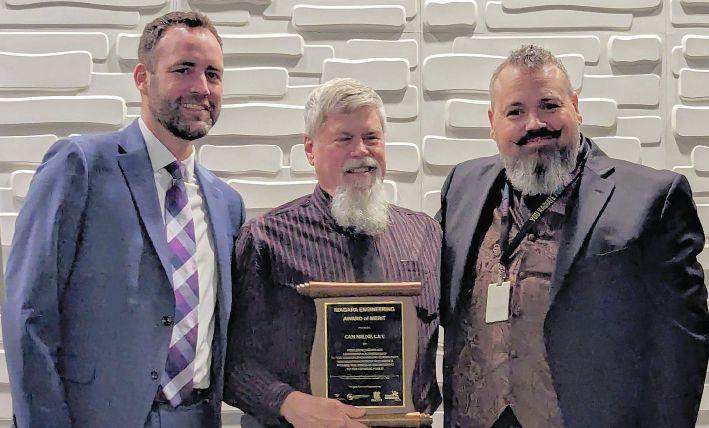
Cam Milne, C.E.T., was awarded the prestigious Niagara Engineering Award of Merit at this year’s Niagara Engineering Week Luncheon to celebrate and acknowledge his indelible mark on the engineering technology field and his contributions that have exemplified the very essence of professionalism and community service.
A legacy of expertise
Milne’s 45-plus years of experience in design and construction has been pivotal in shaping the built environment. His career began in the private sector, where he focused on transportation and buried infrastructure projects, particularly drainage solutions. His expertise eventually extended to municipal projects, where he was pivotal in transportation and structural initiatives.
Leadership and community impact
Milne’s impact on the engineering technology community has extended beyond technical expertise. Over the past 15 years, he has been an integral part of OACETT’s Niagara Chapter, serving as the chapter chair for 13 years. He tirelessly champions the profession and fosters growth and collaboration.
In the broader community, he has been a beacon of hard work, compas-
sion, and professionalism. His commitment to mentorship has shaped the careers of countless young professionals. Notably, he was a founding member of the Big Brothers & Big Sisters Ride for Kids Sake event, which raised over $300,000 for youth mentorship in Niagara over four years.
As part of the Niagara Engineering Week Committee, Milne has contributed to 28 annual events that provide bursaries to four deserving students each
year. His passion for nurturing future talent underscores his commitment to the engineering technology profession. Together, these accomplishments have garnered Milne a legacy of excellence, mentorship, and community impact and inspired many to model his unwavering dedication to advancing the engineering technology community. Congratulations to this year’s deserving recipient!
Scott Barbacki, C.Tech., is secretary of OACETT’s Niagara Chapter.
The end of another year means the beginning of a new Continuing Professional Development (CPD) audit. This audit affects all members belonging to the 2021-2023 cycle. To see what cycle you belong to, check the OACETT Member Portal under CPD.
CPD is a mandatory component of OACETT membership. Check your email/mail to see if you have been selected.
OACETT marked a significant milestone, with the first group of OACETT members earning their Municipal Infrastructure Inspector (mii) designation under the new Municipal Infrastructure Designations program, following the completion of the pilot program. Let’s congratulate the following OACETT-certified members who successfully completed the program and are now title holders of this new designation since April 3, 2024.
Renzo Baldassi, C.Tech., rcsi, mii
Russell Berrouard, C.Tech., CST, mii
Brandon Demeester, C.E.T., mii
Marko Deric, C.E.T., rcsi, mii
Kyla Farmer, C.E.T., rcji, mii
Lindsay Finbow, C.Tech., mii
Kyle Gibson, C.E.T., rcsi, mii
Charles Hawboldt, C.E.T., mii
Eric Heikkila, C.Tech., rcji, mii
Michelle Mathies, C.E.T., mii
Samy Mohamed, C.E.T., mii
Denise Morris, A.Sc.T., rcsi, mii
Aaron O’Keefe, C.Tech., mii
Jim Oriotis, A.Sc.T., rcsi, mii
Sumant Patel, C.Tech., mii
Robert Richardson, C.Tech., rcca, mii
Terri Rutten, C.E.T., rcsi, mii
Brian Sannachan, C.Tech., rcca, mii
Steven Shingler, C.Tech., rcji, mii
Johanne Simpson, C.E.T., mii
Harpreet Sumra, C.E.T., rcji, P.Eng., mii
Adam Wiltschek, C.Tech., mii
Matheos Woldeyohanes, C.Tech., mii
The Municipal Infrastructure Designations program is a voluntary certification program created to ensure that municipal staff who perform inspections and contract administration for the province’s municipal infrastructure can do their work responsibly and safely. OACETT currently offers two designations under the program: Municipal Infrastructure Inspector (mii) and Municipal Infrastructure Contract Administrator (mica). OACETT-certified members can complete the application process through OACETT’s member portal. For more information on the program, visit the oacett.org or email hmaski@oacett.org.


HOST
Louis Savard, C.Tech., conducts thought-provoking interviews with industry leaders, government officials, academia and influencers on hot topics relevant to the engineering and applied science profession.
GUESTS
Kim Pickett, C.E.T., LET
OACETT past-president and project engineer, Grounded Engineering
Eric Cowan, C.E.T. project manager, Vertex Environmental Inc.
EPISODE 8 Transforming toxic terrains: Ontario’s approach to brownfields
Host Louis Savard, C.Tech., discusses with OACETT past-president Kim Pickett, C.E.T., LET, and Eric Cowan, C.E.T., challenges and processes involved in transforming contaminated and underused industrial and commercial properties into safe and usable land. Learn about how sustainable remediation technologies are revolutionizing the clean-up process and reducing environmental impact.
Listen to the podcast at https://www.oacett.org/tech-takes or on your favourite podcast app!
by Peter Saunders
Growing up in a very rural community in Maryland, Shalevia Briscoe, C.Tech., says she had no real vision or expectations of her future. Her teachers, however, identified her standout skills and saw a path toward success through science, technology, engineering and mathematics (STEM).
As Briscoe explains, she had no idea there was a math that involved finding unknowns. She was intrigued by and excelled in it, winning math awards in her junior and senior years and receiving a college credit while still in high school.
Today, as a senior rail specialist for consulting engineering firm HDR, Briscoe ‘pays it forward’ by encouraging other women to reap the benefits of membership with OACETT. She has volunteered as the Toronto Central Chapter’s Women in Technology representative since 2021—and was elected the chapter’s chair earlier this year.
After earning an associate degree in engineering technology at the College of Southern Maryland, where she explained that her teachers also helped her pursue her interests, Briscoe began her career at a local nuclear plant.
She moved to Virginia, then Georgia, until the chance for a more significant move came along. Briscoe was designing roads as an engineering technician for Streetsmarts when that company was acquired by a Canadian consulting engineering firm, Stantec, which was looking to expand in the rail sector in Eastern Canada.
“I love rail and jumped at the opportunity,” she says. “While I prefer the
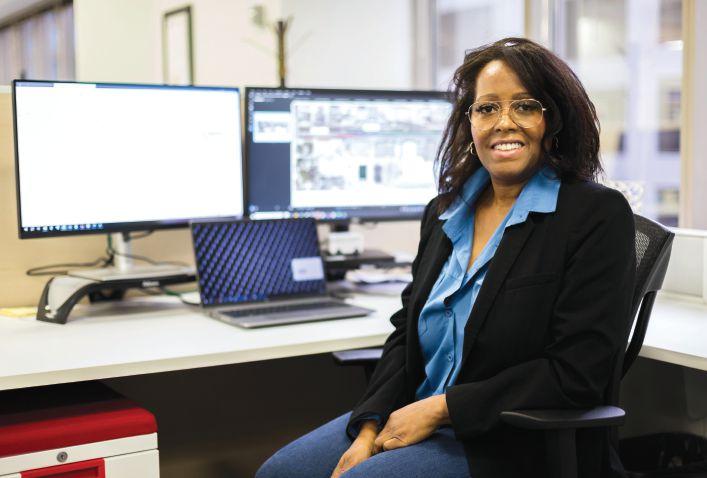
“My teachers looked out for me and got me into engineering technology.”
U.S. on a personal level, Canada has been better for me professionally. Here in Toronto, I got asked what I wanted to do rather than being boxed in and, in some cases, hindered and overlooked. It was liberating and freeing!”
After serving Stantec for six years as a senior railway technologist, she continued to expand her career horizons as a senior building information modelling (BIM) designer at another consulting engineering firm, Arup, for three years. She joined HDR in 2021 as a senior track designer and was promoted to senior rail specialist in 2023.
Not only does Briscoe’s current role offer her greater responsibility than her past positions, but she says she also
appreciates the firm’s employee-owned business model.
Briscoe encountered OACETT shortly after she moved to Toronto in 2012, as she wanted to get certified in her profession. She recalls dragging her kids along to volunteer with her when they were young.
Once her kids “flew the coop,” moving away for university, she was able to dedicate even more time to volunteering. Her contributions to OACETT as a leader have reflected her career journey, which has seen her become more of a mentor and manager over the years.
“My goal was to become a presence,” she says. “My next moves will continue to involve volunteering. I still have a lot to learn!”
Peter Saunders is a regular contributor to The Ontario Technologist.
by Dennis Furlan
The world of engineering technology constantly reveals itself as a dynamic and fascinating aspect of our society. On one hand, there is technology, with all its wondrous understandings and real-world applications. On the other hand, are the professionals who manage teams of people with expert and diverse skillsets, to help build and deliver advanced technological solutions. Perhaps few people embody this multifaceted component of engineering technology more than Samuel Nammari, C.E.T, P.Eng.
Nammari knew he loved engineering when he was growing up. “My father was a civil engineer,” said Nammari. “I enjoyed going to work with him. I would play with the concrete mix equipment used to do concrete flow tests. I looked at his desk, saw all those blueprints, calculators and pencils, and I just loved it.”
As Nammari grew up, he knew what he excelled at in school: math and science. So, he combined his natural love of engineering with his intellectual and interpersonal talents to ultimately pursue a career in the aerospace industry.
What he loved about the field may seem counterintuitive. “It might be the most challenging of fields in engineering technology,” said Nammari. “Think about the operation of an aircraft, for example. Every component must be precise, reliable and tested to its limits. And that’s what I love about it. It demands the most of me.”
This love of a challenge led the 46-year-old to become a program manager at the L3Harris Technologies facility in Waterdown, Ontario, where the company designs, engineers and manufactures electro-optical/infrared camera systems that can see in just about any level of light, serving a multitude of different platforms, environments and
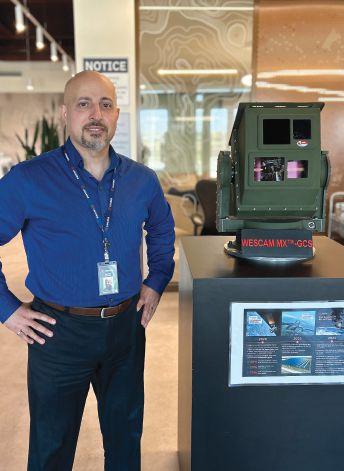
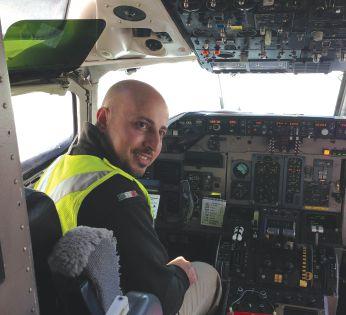
When discussing the defence applications, Nammari revealed his ability to communicate has complemented and served as an asset in his career in aerospace engineering. In fact, his people skills has enabled him to do more than work with technology.
Nammari moved over to the program side of engineering in the aerospace industry, where not only does his knowledge of technology serve him and the
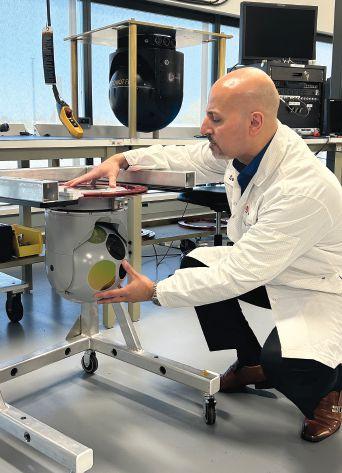
company well, but he manages contracts, employees, relations with customers and more, to become what he believes is the best he can be in engineering technology.
“You don’t need to be an engineering technologist to become a program manager, but I find it helps a lot,” said Nammari. “I can relate and communicate effectively to the engineers and technologists to help them understand the customer’s needs and requirements. It opens many new possibilities of managing technical teams at the program level.”
When asked who the greatest influence in his career has been, he mentions his engineering father, but also his mother: “My mother taught me that everything is possible if you have the will and the right attitude,” he said. “But, most importantly, it’s my wife, Lindsey. She’s the cornerstone that’s been by my side for 20 years. She’s the one who motivates me and keeps me serene through thick and thin.”
Dennis Furlan is a contributor with The Ontario Technologist.
OACETT was proud to participate in Centennial College’s Labour Market Trends Panel at the Centennial College Progress Campus on March 1.
The panel had a lively discussion on employment trends, skills and technology tools for success, and the hurdles students and new immigrants face in entering the workforce. They also explored opportunities to bridge the divide between employers and educators to ensure career success.
David Terlizzi, director of member engagement, services and government relations at OACETT, was joined by OACETT 360 Partner Steve Conway, C.E.T., rcsi, vice-president of construction services at GEI Consultants Inc., Simranzeet Singh Vig, senior policy an-
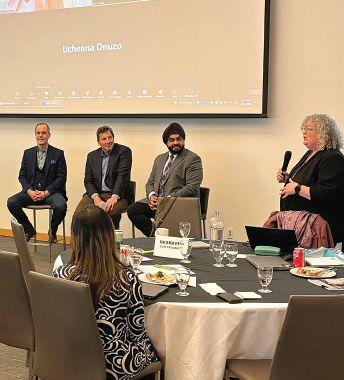
alyst at the Ontario Chamber of Commerce, and Wendy Cukier, academic director at the Diversity Institute at Toronto Metropolitan University.
June 17 – 20
Collision – Auto Tech, The Future of Transportation
Enercare Centre, Toronto https://collisionconf.com/
August 13
Water Canada Awards
The Second City, Toronto https://watersummit.ca/
August 18 – 21
AMO Annual Conference
Shaw Centre and Westin Ottawa https://www.amo.on.ca/2024amo-conference

Join OACETT for a webinar on the benefits of becoming a Certified Engineering Technologist (C.E.T.) and Certified Technician (C.Tech.).
WHY ATTEND?
• Learn how OACETT certification can boost your career — higher salary, networking, and marketability.
• Learn about CTEN.ca, OACETT's career site.
• Learn about OACETT certification requirements.
To register for a webinar, visit: Students: www.oacett.org/student-road-to-certification Internationally Educated Professionals: www.oacett.org/iep-road-to-certification QUESTIONS? Contact Trishia at ttedoldi@oacett.org.
WEBINARS DATES AT A GLANCE
COLLEGE STUDENTS: Tuesday, July 2 Monday, July 15, 29 Monday, August 26 @ 12:00 p.m.
INTERNATIONALLY EDUCATED PROFESSIONALS: Friday, July 5, 26
Thursday, August 1, 29 @ 1:00 p.m.
MARK TOLJAGIC
Centennial College opened the doors to its trailblazing A-Building — Canada’s first zero-carbon, mass timber, higher education facility — at the start of the 2023-24 school year. Students and staff arriving on campus are now greeted by an inclusive, sustainably designed building guided by the Indigenous concept of “two-eyed seeing” – viewing the world through the lens of both Indigenous and Western knowledge.
The $112-million, 130,000-square-foot project established a new landmark at Centennial’s flagship Progress Campus in Scarborough in Toronto’s east end. The facility is home to the School of Engineering Technology and Applied Science and the Department of Information and Communication Engineering Technology programs, including high-tech labs and various specifically designed and designated Indigenous spaces. In fact, an Indigenous Working Group at Centennial composed of Indigenous administrators, support staff and faculty made vital contributions to Indigenous elements of the building, working with Colliers project leaders, EllisDon Construction, DIALOG and Smoke Architecture.
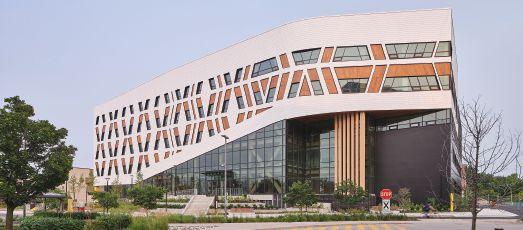
A-building establishes a new landmark at Centennial College’s flagship Progress Campus in Scarborough and is Canada’s first zero-carbon, mass timber, higher education facility.

“This building is a living teaching tool,” said Seán Kinsella, director of the Eighth Fire at Centennial College. “People from around the globe have a place to learn more about Indigenous worldviews, ceremonies, and teachings. Indigenous students, staff and faculty now have a place to gather and practice traditions.”
For example, the courtyard serves as a bookable outdoor classroom, allowing teaching in a circle formation. Other flexible classrooms do the same. At the same time, 13 rooms are equipped with unique exhaust fans that facilitate traditional ceremonial components such as smudging.
Throughout the six-storey edifice of A-Building, its mass timber construction is boldly displayed. Black spruce from Quebec figures prominently in the structure, with generous wood exposures showcased through its crossand glue-laminated columns, beams, and floor slabs.
In addition, the A-Building achieved zero carbon certification, thanks mainly to its highly efficient building envelope and all-electric hot water heating and HVAC systems.
“A-Building represents our commitment to build capacity at our institution for our learners with the least negative impact on our environment,” said Patrick Kelly, dean of
the School of Engineering Technology and Applied Science, Centennial College. “Of note are the artificial intelligence, telecommunication and networking labs, which will provide our students with unparalleled hands-on learning opportunities.”
Eight new high-tech labs support students learning about configuring, maintaining, and troubleshooting local and wide-area networks. The software labs facilitate user-oriented interface design, Microsoft and Adobe technologies, object-oriented software methodologies and testing. The learning outcomes are foundational to industries across all sectors – including clean technology – offering meaningful employment opportunities for students. A donation from Diane Blake helped equip the labs with industry-standard technology, such as artificial intelligence.
On the roof, a solar photovoltaic panel array generates sufficient power to offset the facility’s electricity use by 68,000 kilowatt hours annually, supporting its LEED Gold certification.
“At a time of increasing climate calamity, Centennial is eager to deepen its commitment to environmental stewardship,” said Dr. Craig Stephenson, president and CEO of Centennial College. “Acknowledging the relationship between sustainability, Indigeneity, and inclusivity was essential to creating a welcoming new gateway to our campus. A-Building embodies the journey we’ve all been on, and are still on, as individuals and as a college community, to fully recognize our Commitments to Truth and Reconciliation.”
Mark Toljagic is senior communications officer at Centennial College.
BY PETER SAUNDERS
With Ontario’s decarbonization goals has come a renewed interest in expanding nuclear power generation. While nuclear energy is not renewable like solar or wind power, it is emissions-free and can provide a steady—rather than intermittent—flow of electricity for baseline power needs.
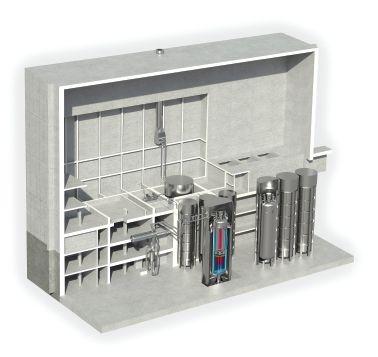
Beyond refurbishing existing nuclear reactors (which remain significant, meeting more than 50 per cent of the province’s power needs), opportunities are arising for small modular reactors (SMRs) to replace fossil fuel-powered generation for heavy industry, oil and gas, communities and remote areas not connected to the primary power grid. Compared to the 6,400-MW capacity of the Bruce Nuclear Generating Station’s eight CANDU reactors in Tiverton, a single SMR produces between five and 300 MW for local use.
As progress is made in developing SMRs worldwide, one company that has emerged within Ontario is Oakville-based Terrestrial Energy. Founded in 2013, this young enterprise is focuses on an old idea: designing a molten salt reactor.
The first molten salt reactor was built and tested in the 1960s, but funding was pulled as light water reactors became accepted.
“As a coolant, molten salt increases efficiency,” explains Bill Smith, Terrestrial’s senior vice-president of opera-
“Molten salt increases efficiency.”
– Bill Smith, Terrestrial Energy
tions engineering, who had previously retired after a 35-year career in the energy business, including more than 20 years in the nuclear industry at Ontario Hydro and Ontario Power Generation. Terrestrial promises its Integral Molten Salt Reactor (IMSR), already designed and now progressing through review and licensing, will be 50 per cent more efficient than conventional nuclear power plants, create 40 per cent less waste and operate for over 50 years. It is intended to serve as the ‘heart’ of a co-generation plant, producing carbon-free heat at 585°C— which water-cooled reactors cannot— and low-cost electrical power.
“Heavy industry wants to decarbonize its processes,” says Smith. “We could put two of our 195-MW IMSRs on the same site, for a total of 390 MW, and they would be ideal for refineries needing heat and electricity from the same reactor.”
The Canadian Nuclear Safety Commission completed the second phase of a seven-year vendor design review (VDR) of Terrestrial’s IMSR in April 2023.
“The VDR’s scope and conclusion provide commercial confidence to proceed to licensing and construction,” said Terrestrial CEO Simon Irish when the completion was announced. “This review is a major step in bringing molten salt technology to large companies seeking to decarbonize industrial production.”
Having reached this early landmark on the path to commercialization, Terrestrial is continuing its efforts in research and development (R&D), testing, licensing, and working with future customers, with an expectation to grow later this year.
“We have access to nuclear talent in Ontario,” Smith explains, “but most of our customers will be to the north and south, from Fort McMurray to Texas. Just follow the pipelines.”
Peter Saunders is a regular contributor to The Ontario Technologist.

In a short time, we have witnessed a remarkable and radical change in the artificial intelligence (AI) sector with the emergence of generative AI technologies. Businesses are exploring this fast-growing technology whose application and implications go beyond the technology sector.
Revolutionary technology presents new challenges and risks for businesses and their technology teams. Implementing appropriate governance frameworks to manage these risks will be key to success. OACETT members, as trusted experts across technology disciplines, will be affected by and well-placed to help navigate this process. The talents or skills of a skilled engineer or technologist will be indispensable.
With so many evolving aspects of AI, including the plethora of emerging regulations and standards, organizations are undoubtedly overwhelmed, and it can be challenging to know where to start.
Adopting and using AI technologies requires a comprehensive strategy that flows through the organization. As a starting point, organizations should establish a risk management framework that is proportionate to the scale and impact of their AI activities and is practical to implement.
The first step involves assessing how the organization intends to use AI and whether the organization is a devel-
oper, deployer, or user of AI solutions. A user of AI solutions will have different concerns and risks than the developer of those same technologies. In establishing a risk management framework, organizations should also determine their overarching AI objective, which should be informed by the organization’s risk appetite. From there, overall responsibility for the implementation of the framework and safe, secure, and trustworthy AI adoption is best delegated to lead persons tasked with developing specific expertise related to the implementation of AI.
This process should determine how safety, fairness, equity, and transparency will be considered. Policies and protocols should also dictate permitted use cases. Other key inclusions are requirements for human oversight and guidelines for how the performance of the AI system will be assessed. Policies should also determine how issues will be reported, escalated, and resolved.
Various available resources, such as the AI Risk Management Framework (NIST), may guide the adoption of AI risk management frameworks.
Before establishing a new framework, organizations should assess their existing policies and consider whether they need to adopt new AI-specific policies or whether existing policies














can be adapted. For example, existing policies relating to confidentiality may need to be clarified in the context of AI use to emphasize the need for caution in submitting sensitive, confidential, or proprietary information to generative AI services. Specific policies may also be required for technical uses of AI, including basic rules regarding the use of generative AI to assist with coding. Such policies should identify lowrisk development activities, such as code development for internal uses. They should also ensure that appropriate safeguards are in place for higher risk uses, such as a requirement for human review of code.
In addition to policies and procedures, organizations should develop internal communication and training strategies for using AI tools, which are essential in establishing compliance protocols. Organizations must also be prepared to explain to external parties the steps to mitigate potential biases and fairness issues in the AI systems that the organization builds or uses.
Given the complex and rapidly evolving environment, legal and ethical considerations should be considered at the appropriate stages of the development lifecycle for an AI solution. This is particularly valuable early in the development process when measures to address risk may be more cost-effective and practical. Foundational responsible AI principles, such as ethics by design, can be integrated from the onset. Given the importance of appropriate privacy considerations in the use of AI, privacy experts should be consulted to guide development teams working with AI.
In addition, organizations may consider adapting existing legal protections, such as intellectual property protections and commercial contracts, to adequately protect AI-related assets and reduce AI-associated risk.
Data powers AI. Having a comprehensive risk management framework addresses the collection, use and disclosure of data in compliance with privacy laws and any industry-specific regulations. Policies addressing the transfer and disclosure of data should ensure that such transfers and disclosures only occur with necessary consent and contractual permission. Protocols must also ensure the prior assessment of the availability, quantity, and suitability of data sets to support solutions that provide usable and compliant results. For example, data inputs should ensure a sufficiently large sample size and have measures to mitigate bias.
Going forward, organizations will race to implement new and exciting AI solutions. Those who ground their approach in strong governance and accountability principles and rely on their experts, particularly skilled technicians, and technologists, will see the most success in crossing this frontier. OACETT members will be ready to rise to the challenge.
Simon Hodgett, Sam Ip, and Naomi Chernos are members of leading business law firm Osler, Hoskin & Harcourt LLP.




BY ANDREW AU
We’re living through one of the most significant technological revolutions in history, propelled by two letters: AI.
AI is redefining the possibilities for engineering technologists. Its capabilities now influence every project you undertake, the infrastructure you design, and every system you improve.
In this article, we’ll explore AI’s transformative impact across the engineering technology profession. We’ll show how this technology optimizes current processes and opens new opportunities for innovation.
AI’s hockey stick moment
AI adoption is scaling at a pace we’ve never seen before. Let’s put this acceleration into context. It took the mobile phone 16 years to reach 100 million users, the Internet seven years, and Facebook four and a half months. ChatGPT? Just two months —according to a 2023 Reuter article called ChatGPT Sets Record for Fastest-Growing User Base.
Today, half of organizations have adopted AI, and approximately twothirds plan to increase their investments in the next three years, says a 2023 IDC report on The Business Value of AI. Despite common perceptions of AI as sentient robots ready to take over the world, the reality is much more grounded. AI today does not have feel-

ings or motivations; it is designed to “simulate” human intelligence—not replace it.
In the early days, “simulating” started with machine learning applications that could make predictions based on existing datasets to complete tasks like pricing optimization. In 2012, we began exploring the concept of deep learning—the ability to give machines capabilities for vision, language understanding, and language generation. The emergence of ChatGPT in 2022 marked a significant wake-up call, highlighting the advanced level of understanding and information possible with Generative AI (GenAI).
So, what is GenAI? It is a subset of AI focused on making predictions from existing data and creating new content from it. While traditional AI helps us make informed decisions by predicting outcomes, GenAI pushes boundaries further by simulating human creativity. Thus, if we can think it, we can now create it using GenAI.


Accelerating generative design
We are beginning to realize how much of a game-changer GenAI really is. As Adam Selipsky, CEO of Amazon Web Services, put it, “GenAI will pretty much change every application inside of companies and every application that consumers interact with. It is a profound technological change that we’re still at the very beginning of.”
As a practical example, GenAI is extending the frontier of generative design, which uses algorithms to create multiple viable options based on defined constraints such as cost, weight, and materials. General Motors (GM) has been an early mover in this space, leveraging this technology to enhance its vehicle light-weighting efforts.
Traditional generative design tools in this field often require precise, complex inputs and are rigid when adapting to new constraints. In contrast, GenAI introduces flexibility and intuitiveness that significantly accelerate the design process.
Beyond just simplifying design workflows, GenAI is pivotal in refining intellectual property management—it can analyze patents, research trends, and market dynamics. It also enhances quality control by detecting and preventing defects during manufacturing processes and generating detailed simulations to foresee and solve potential problems.

GM became one of the first automakers to adopt Autodesk’s generative design software. Their initial project at GM’s Tech Center in Warren, Michigan, focused on a critical but small vehicle component: the seat belt bracket. The software generated over 150 viable design options based on parameters such as connection points, strength, and mass. According to Direct Industry e-Magazine’s article, Autodesk’s Generative Design: Optimizing Design Through AI, the culmination of this project was a redesigned bracket that integrated eight components into one single part, making it 40 per cent lighter and 20 per cent stronger than the original.
Today, a powerful application of GenAI is seen in the development of batteries for electric vehicles. By enabling the exploration of billions of potential molecular combinations for creating new electrolyte materials, GenAI dramatically shortens the development cycle from years to just a few months. The result? We’re seeing accelerated innovation, leading to batteries that can charge faster and perform better, pushing the envelope for electric vehicle technology.
While Generative AI promises to redefine what’s possible in engineering technology, it introduces these challenges and risks.


1. Intellectual property and copyright concerns: One of the most pressing issues with GenAI involves intellectual property rights. As AI systems generate new content from existing data, questions arise about the ownership of these outputs. For instance, when a GenAI system uses data scraped from the Internet or incorporates elements from copyrighted materials, it blurs the lines of originality and copyright. The legal frameworks lag behind the rapid advancements in AI, creating a grey area that could potentially stifle innovation.
2. Bias and data integrity: Another critical concern is the bias inherent in the data on which AI systems are trained. If the input data is biased, the outputs will inevitably carry those biases. This could lead to skewed safety assessments or unfair resource allocations in projects. Addressing these biases requires a concerted effort to use diverse, representative datasets and continuous monitoring to ensure AI outputs remain equitable and accurate.
3. AI inbreeding: A phenomenon called ‘AI inbreeding’ can occur when AI-generated content is recycled back into AI systems, leading to a feedback loop that diminishes the diversity and richness of outputs. This could lead to homogenized design solutions that fail to truly innovate and meet real-world needs.
4. Environmental impact: The environmental cost of training and operating AI at scale is massive. High-performance AI models require significant computational power, leading to substantial energy consumption and associated carbon emissions. As we push the capabilities of GenAI, it’s vital to balance these technological advances with sustainable practices to ensure
that our drive for innovation doesn’t come at the cost of our planet.
Where GenAI is heading in the next 12-18 months
As we look to the next 12 to 18 months, here’s what we’re likely to see.
Multi-modal AI explosion: When considering multi-modal large language models (LLMs), we’re looking at a future where AI will seamlessly integrate multiple forms of media—text, images, video, and audio—into a single connected workflow. This advancement means that tools like ChatGPT, which primarily handle text and images, will soon be able to process and generate video and audio content just as reliably. This could revolutionize how designs are visualized and presented for engineering technologists, making communication and prototyping more dynamic and interactive.
New classes of AI models: New AI models designed explicitly for reasoning, planning, or decision-making are being developed. These models will also advance in-memory capabilities, allowing them to more effectively remember past interactions and tailor their outputs to user preferences. For engineering technologists, this means AI tools that can better understand project scopes, anticipate needs, and provide more accurate predictions and planning assistance.
AI agent experiment scale-up: We’re on the brink of seeing AI agents that can act with a high degree of autonomy, taking on tasks that humans previously managed with minimal oversight. These AI agents will automate routine tasks and engage in complex problem-solving and decision-making based on guide-
lines and objectives they’ve learned over time. For engineering technologists, this could mean a shift towards overseeing and directing AI efforts rather than executing every step, allowing more focus on innovation and strategic planning.
What does this all mean for people?
Many ask themselves, “How will this impact labour markets?” While no one has a crystal ball, history gives us some clues. Take the introduction of the Automated Teller Machine (ATM) in the 1970s, which was perceived as a threat to the livelihood of bank tellers. The assumption was that ATMs would replace human tellers entirely, leading to widespread job losses.
But what actually happened? While ATMs automated routine cash withdrawals and deposit tasks, they did not make the bank tellers obsolete. Instead, they empowered them. Tellers transitioned to roles that required more complex customer service skills, such as helping with loans, navigating banking products, and managing customer relations. According to James E. Bessen’s 2015 Boston School of Law’s How Computer Automation Affects Occupations: Technology, Jobs, and Skills research paper, the employment of tellers grew at a compound annual growth rate of 43 per cent from 1970 to 2010, rather than decreasing.
Looking forward, as AI continues to advance within the field of engineering technology, it is not likely to replace engineering technologists but to enhance their roles. AI can handle repetitive and
time-consuming tasks, allowing professionals to focus more on innovation, strategy, and complex problem-solving. This shift not only secures jobs but also elevates the nature of the work, requiring a higher level of expertise, creativity, and critical thinking.
The 3Cs to thrive in the AI era
As we advance into this AI-driven era, engineering technologists are encouraged to embrace three critical qualities.
Be curious: Explore new use cases for AI within your field. AI has immense potential to transform traditional processes and introduce innovative solutions. Stay curious and open to experimenting with how AI can enhance your projects and drive progress.
Be collaborative: Human insight and teamwork are essential now more than ever. AI doesn’t replace the human element; it enhances it. Use AI as a tool to unite teams, explore new approaches, and solve complex problems in ways that were previously unimaginable.
Be committed: Remember, change has never been this fast, yet it will never be this slow again. Embrace continuous learning and adaptation as essential components of your professional growth.
We’ve been given one of the most significant technological advancements since the Internet. The question, “What will you do with it?”
Andrew Au is a managing partner at Intercept, an award-winning B2B consultancy specializing in the global technology sector. Au was named to Forbes’ 30 Under 30 list and has received over 50 awards for B2B innovations. To hear more from Au on AI and innovation, follow him at www.linkedin.com/in/auandrew.


BY DENNIS FURLAN
AI is being used to address traffic congestion. Is it working?
We’ve become so used to getting stuck in traffic that it seems like a part of modern life. But does it have to be? Since artificial intelligence (AI) is now being used for everything, from writing memos to diagnosing illness, it’s not surprising that it’s also being used to address traffic jams. But will it solve the problem?
First, it should be noted that not just one AI system is being used to address traffic congestion. In Canada, at least a couple have been used.
For example, at the University of British Columbia (UBC) in Vancouver, an Israeli company named NoTraffic engaged in a pilot project for its IoT (Internet of Things) based technology that placed sensors on traffic lights at five key intersections on campus. The sensors are designed to communicate

in real time so that congestion can be detected, and traffic-light behaviour can be adjusted accordingly.
Is AI the next step?
Tal Kreisler is the founder and CEO of NoTraffic. He says, “With its history of embracing innovation, Canada is a priority market for NoTraffic and the ideal location for the next step of our expansion. We are so excited to showcase the practical benefits of our sys-
tem and the improved quality of life it can provide to citizens and communities alike.”
To that end, the pilot program at UBC has been a success. Wait times were reported to have been dramatically reduced, which significantly reduced idling time and, as a result, carbon emissions.
However, NoTraffic’s efforts in Canada are only a part of its global initiatives. The company has implemented
its system in various cities, including the United States. It has formed partnerships with tech companies, such as Rogers in Canada, and has been named one of Time magazine’s 100 most influential companies.
At the heart of NoTraffic’s approach to alleviating traffic is transforming current traffic systems, which are often decades old, if not even older. Their plug-and-play IoT sensors provide what the company describes as a human eye-level measurement of approaching road use. This information is streamed to the cloud for processing. The platform then operates autonomously to optimize traffic signals at any city grid that adopted the system.
Michalia Negri was part of NoTraffic’s entry into Canada. She says, “The NoTraffic platform reinvents how cities manage their urban transportation networks, empowering city officials and traffic engineers to make informed and near-real-time databased decisions to improve sustainability and traffic efficiency. These life-changing improvements, in turn, improve the experience of car drivers, pedestrians, and cyclists as well as those using public transport or emergency vehicles.”
Of course, NoTraffic isn’t the only game in town when it comes to AI and traffic congestion. Toronto has taken a different direction (pardon the pun) with its approach to traffic by implementing two AI-based systems: SCOOT and SCATS.
No, these are not words you shout at a cat. SCOOT stands for Split Cycle Offset Optimization Technique and is an example of an AI technology that Toronto has used since the 1990s, well before the current AI craze. It, too, uses sensors to collect traffic information and then adapts traffic-signal coordination as a result.
According to the City of Toronto, “It is effective in areas where there can be major fluctuations in traffic volumes


such as the city’s major arterials, especially those parallel to the city’s expressways.” However, it has drawbacks: “SCOOT is better suited for signals on main corridors with long cycle lengths, 100 to 120 seconds, than congested areas with much shorter signal cycle lengths, 70 to 80 seconds, such as in the downtown area.”
This is one way of saying that SCOOT can handle car traffic along some main corridors, but less traffic related to pedestrians, cyclists and public transit in the inner core. That’s why the city has migrated to the more modern SCATS
AI system, the Sydney Coordinated Adaptive Traffic System. It’s owned by the Australian state of New South Wales, which has Sydney as its capital and has been used in cities worldwide.
Like many AI systems designed to alleviate traffic congestion, SCATS uses a system that detects traffic usage through sensors and then uses that information to change traffic-light behaviour in real-time. In fact, SCATS has been in development since the 1970s, and so has the technology.
In its current implementation, the City of Toronto says, “SCATS relies on wireless communication to maintain signal coordination and uses an algo-
rithm to determine and implement the best signal timings in real-time. SCATS signals are sometimes referred to as smart signals.” SCATS is used at dozens of intersections in the city.
According to the New South Wales government in Australia, which owns and develops the technology, SCATS has resulted in a 28 per cent reduction in travel time, a 25 per cent reduction in stops, a 12 per cent reduction in fuel consumption and a 15 per cent reduction in emissions.
As if that wasn’t enough, Toronto is upping the ante by engaging in yet another pilot project implementing the latest in AI traffic technologies. Rogers Communications will install cameras and sensors at five intersections in the city. The system will use 5G technology and, you guessed it, AI, to detect and adapt traffic behaviour.
However, with all the new technologies, including AI, being implemented to address global traffic congestion, the question has to be asked: Is it working? Or, put another way, will it work? Decades of efforts, including AI, have yet to solve the problem; since they keep trying, one must wonder if anything will work. Traffic jams on the Gardner Expressway, Don Valley Parkway, and many other areas still reinforce why people believe the problem is intractable.
But why does it seem intractable? To look for a solution, people must also look at the problem. Many theories try to explain why traffic congestion exists in the first place. At the heart of many of these theories is the reality that, as human societies grow, more and more people want to live outside the city but travel to and from it, as well as the goods and services they consume and use. And until we figure out how to best address that situation, maybe all the AI in the world won’t solve traffic congestion completely. But at least we can try.
Dennis Furlan is a contributor with The Ontario Technologist.




February 2024
Certified Engineering Technologists
Alexandr Chalov, C.E.T.
Anthony Infurna, C.E.T., rcji
Ben DeGroot, C.E.T., P.Eng.
Drew White, C.E.T.
Hameed Afinnih, C.E.T.
Hasan Zubair, C.E.T.
Henry Mallari, C.E.T.
John Naef C.E.T., P.Eng.
Keith Clairmont, C.E.T.
Krista Trafford, C.E.T.
Mark Brierley, C.E.T.
Miranda Edwards, C.E.T.
Omar Ahmed, C.E.T.
Robert MacDonald, C.E.T.
Sean Born, C.E.T.
Shubham Sahni, C.E.T., P.Eng.
Sofia Senin, C.E.T.
Sverre Barr-Klouman, C.E.T., rcji
Zili Liao, C.E.T.
Certified Technicians
Abdulkadir Mohamed, C.Tech.
Oloyede Ajala, C.Tech.
Kevin Allan, C.Tech.
Walter Amaral, C.Tech.
Freddy Araujo Navas, C.Tech.
Cayla Austin, C.Tech.
Madhab Baral, C.Tech., rcji
Nathanael Barker, C.Tech.
Rebecca Belch, C.Tech.
Franco-Rey Bisda, C.Tech.
Drake Bourque, C.Tech., rcji
Blake Chaisson, C.Tech.
Brandon Conn, C.Tech.
Elaine Joyce Dalit, C.Tech.
Andi Dedja, C.Tech.
Samson Ejeta, C.Tech.
Youssef Elabd, C.Tech.
Brian Franco, C.Tech.
Adam Gard, C.Tech.
Alysus Guzman, C.Tech.
David Handelsman, C.Tech.
Cameron Harris, C.Tech.
Michelle Hayman, C.Tech.
Tyler Horvath, C.Tech., rcji
Saman Imani-Zenouzi, C.Tech.
Travis Jeffray, C.Tech.
Moe Ali Komaiha, C.Tech.
Tai Fai Li, C.Tech.
Earl Jun Lomotos, C.Tech.
Kevin Mc Ewen, C.Tech.
Nathan McColeman, C.Tech.
Haley McRae, C.Tech.
Bhumikaben Mistry, C.Tech.
Robert Austin Mitchell, C.Tech.
Wai Hong Mok, C.Tech.
Shah Muhi, C.Tech.
Andre Navrot, C.Tech.
Clay Newman, C.Tech.
Van Quy Nguyen, C.Tech.
Paolo Oddi, C.Tech.
John Pacuta, C.Tech.
Jay Panchal, C.Tech.
Neel Parmar, C.Tech., rcji
Navazhushen Patel, C.Tech.
Solomon Pesahov, C.Tech.
Ahtal Prasannakumar Nair, C.Tech.
Stephen Reist, C.Tech.
Tristan Rice, C.Tech.
Naresh Saud, C.Tech., rcji
Zachary Simas, C.Tech.
Karanveer Singh, C.Tech.
Michael Srbljanin, C.Tech.
Joshua Stewart, C.Tech.
Jacob Strasser, C.Tech.
Christopher Tuulos, C.Tech.
Liam Wilson, C.Tech.
Calvin Wu, C.Tech.
Xiaodong Wu, C.Tech.
David Yauk, C.Tech.
Kyle Yip-Chuck, C.Tech.
Associate Members
Minas Abajian
Muhammad Afnan
Tavisha Ahir
Nico Allemano
Sura Alqaseed
Gibran Alvir
Anuskar Anbalagan
Michael Antone
Chia Asaad
Andrew Ball
Klaudia Basler
Mahmoud Bin Shikhan
Cameron Brockwell
Stephen Brodhaecker
Hayden Buchanan
Michael Caille
Marvin Candelaria
Carolyn Casista
Tyler Cheff
James Cousins
Adam D’Agostino
Maulik Dave
Allan Davidson
Tristan Davies
Yasir Dawood
Dante Donceras
Kester Douglas
Dishantkumar Dudhat
Matthew Eddy
Nitharshan Eeswarapatham
Mohammad Fahim
Charles Fears
Sabrina Fitzgerald
David Franceschetti
Jordan Francoeur
Jeffrey Gajdacs
Basil George Divyanshu Goyal
Mark Grossmith
Patrick Gummer
Joel Hackett
Thomas Harnett
Alana Hawton
Morgan Hewitt
Daniel Hodge
Mohammed Hussain
Trevor Jay
Yamba Jeremiah
Joffin Johny
Dennis Jones
Jinson Joseph
Jomar Jovellanos
Alvin Juayno
Cameron Juppe
Rudresh Kanaga Sundar
Sangeeta Kattal
Travis Keeler
Haroon Khalid
Muhammad Khizar Khan
Yash Kharel
Vishnu Kodampattil
Khine Su Kyi
Gavin Laviolette
Joshua Lyle
Christian Marcella
Ashley Marshall
Liju Philip Poikamannil
Mathew
Dionne Meere
Vatsal Mehta
Tayyab Mumtaz
Jignesh Patel Naini
Ankit Nayani
Nothando Ndlovu
Hugues Nsengiyumva
Jeremy Olston
Maureen Onyango
Kevin Ormiston
Peter Palika
Nathanial Park
Bansary Patel
Michael Podolan
John Potoczny
Hassan Rahimi
Dina Ramadan
Kyle Ranger
Mohit Rawat
Sean Rehel
George Rofaiel
Mathieu Ryan
Abdolreza Safari
Arjun Varma Sagiraju
Saige Sandy
Romil Shah
Akshay Sharma
Marnie Shepley
Vishal Shira
Akashdeep Singh
Owen Spence
Daniel Stinson
Daniel Stirpe
Ben Summers
Ryan Tarabocchia
Solan Thomas
Sanikumar Virani
Feiyu Wang
Martin Whittaker
Amanda Wills
Trevor Woods
Christian Yav
Yilmaz Yesil
Arash YoosefDoost
Guochen Zhang
Student Members
Anju Anna Achankunju
Olukorede Akinremi
Mohamad Ali Al khatib
Athira Asokan
Dominic Atherley
Eli Bax
Utsav Bhatt
April Rose Bibat
Maara Bier
Mackenzie Carroll
Ram Chaudhari
Clint Francis Clapano
David Condon
Shenel De Soysa Rajakaruna
Bryan Domingo
Anto Sophia Christine Dominic
Jason D’sa
Adrian Enache
Francisco Estrella
Kailynn Fife
Michael Fox
Amanda Graf
Noorullah Hakemi
Chathura Herath
Mudiyanselage
Ovaiota Igiri
Imran Pasha Imran Pasha
Harikrishna Jayan
Rinto Jimmy
Chen Kai
Kiranpreet Kaur
Adam Khan
Shahbaz Khatri
Ashok Kumar
Gloria La Rosa
Robert Lachapelle
Alnoor Lakhani
Hardik Lakhani
Qin Li
Kyle Liwag
Madison Mackenzie
Mayur Maheshwari
Ryan Mair
Mujahid Bin Marcelo Manalo
Michael Mancini
Jeremiah Marquez
Jose Martinez Salinas
Lee-Anne McLeod
Jared McNabb
Robert Mills
Bibin Muttath Sebastian
Prakash Nadar
Hamzah Nakhuda
Chirag Parmar
Dhruv Patel
Ridham Patel
Vraj Patel
Cirex Peroche
Sreelakshmi Rajan
Vats Ranodaria
Prabhakar Reddy
Anjana Reji
Franklin Rosales
Hailey Ryan
Ezekiel Sampson
Daksha Sandhu
Mark Pierre Santos
Arjun Shaji
Amit Shukla
Tom Sibo
Holly Sittmann
Max Speer-Remes
Azwin Susethar
Vedant Thakkar
Deon Thomas
Abhilash Reddy Toodi
Maria Vasquez Pineros
Vipin vipin
Andrea Walker
Constance Walton
Paul Weiner
Bryan Wilsie
Joshua Withers
Emerson Xu
Fraser Zenwirt
Omar Zholdubayev
Existing Members In Road Construction
Certified Engineering
Technologists
Johnathan Boldrick, C.E.T., rcca
Scott Hoddy, C.E.T., rcca
Robert Peacock, C.E.T., rcji
Certified Technicians
Christopher Lockwood, C.Tech., rcca
Jeffrey Davis, C.Tech., rcji
Michael Harte, C.Tech., rcca
Julien Lawson, C.Tech., rcca
Alex Martins, C.Tech., rcji
Jay Panchal, C.Tech., rcji
Zachary Simas, C.Tech., rcji
Guan Zhi, C.Tech., rcca
Associate Members
Abdul Sajid Ansari, rcji
Blair Daniels, rcji
Matthew Edwards, rcji
Jully Ann Galotos, rcji
Harshith Nagaraju, rcji
Dharmikkumar Patel, rcji
Umangkumar Patel, rcji
Yashkumar Patel, rcji
Avinash Potipagu, rcji
Nima Rezaei, rcji
Masoud Salihi, rcji
March 2024
Certified Engineering Technologists
Arvind Bhatia, C.E.T.
Fady Awad, C.E.T.
Olufemi Awogboro, C.E.T.
Tanya Beishuizen, C.E.T.
Joseph Bruyere, C.E.T.
Michael Burlock, C.E.T.
Rita Daved, C.E.T.
Daniel Eberhardt, C.E.T., rcsi
Wui Yi Ho, C.E.T.
Daniel Oursou, C.E.T.
Kevin Parr, C.E.T., rcsi
Virat Patel, C.E.T.
Bruno Piccin, C.E.T.
Janine Sornillo, C.E.T.
John Thompson, C.E.T.
Darrell Toring, C.E.T.
Yiming Wan, C.E.T.
James Whitaker, C.E.T.
Certified Technicians
Alexandria Cupoli, C.Tech.
Gaurav Bakshi, C.Tech.
Raj Kumar Basnet, C.Tech.
Arshbir Singh Benipal, C.Tech.
Xiaochen Cai, C.Tech.
Lorenzo Campello Beneduzi, C.Tech.
Chi Kit Cheung, C.Tech.
Hetul Dave, C.Tech.
Steven DeGrow, C.Tech.
Shawn Dietze, C.Tech.
Harshpreet Harshpreet, C.Tech.
Jayson Hunter, C.Tech.
Thomas Huynh, C.Tech.
Ian Kendall, C.Tech.
Andrij Kotowych, C.Tech.
Gavin Laviolette, C.Tech.
Michael Leone, C.Tech.
Joseph Leveille, C.Tech., rcji
Duncan McLeod, C.Tech.
Anne-Marie Moniz, C.Tech.
Ramez Nasir, C.Tech.
Narayan Parkash, C.Tech.
Nathanael Roberts, C.Tech., rcji
Fariha Robinson, C.Tech.
Rominkumar Saliya, C.Tech., rcji
Mark Jommel Santiago, C.Tech.
Shayann Sarkaar, C.Tech.
Fiore Sarro, C.Tech.
Ishan Shah, C.Tech.
Nirodha Silva, C.Tech.
Pavan Thadani, C.Tech.
Marc Vaillancourt, C.Tech.
Joseph Valtas, C.Tech.
Joseph Weiss, C.Tech.
Roger Zwicker, C.Tech.
Associate Members
Sanaa Alkhouri
Brandon Allen
Sehajdeep Singh Anand
Andrii Andrieiev
Divyalakshmi Ayyalusamy
Marissa Jocel Balbuena
Muhammad Baqar
Hiren Baraiya
Kerry Battistoni
Swapnil Bhagwat
Luis Boggiano
Arnel Caburnay
Sonny Caguinguin
Adam Calcafuoco
Amit Chaudhary
Sajith Chemmikkat
Siddharth Chevli
Christopher Ciuffini
Rushikesh Darange
William DeNobrega
Brandon Dickson
Ronaldo Domingo
David Drouin
Nathan D’Souza
Nicolas Dubé
Adam Elliott
Navid Esmaeili
Lanz Fernandez
Maria Fernando
Elias Frechette
Dennis Gallarin
Justin Garcia
RECOGNIZING NEW AND CERTIFIED TECHNICIANS AND TECHNOLOGISTS
Abhilash Gautam
Parthgiri Rushigiri Goswami
Jason Gough
Henok Haile
Adam Hall
Andrew Holmes
Wajid Hussain
Yatharthsinh Jadeja
Kevin Jeon
Jobin Joy
Sagarkumar Kachhadiya
Rijan Kafle
Harpreet Kaur
Richard Kayitare
Abdullah Khan
Virang Kheni
Ranjit Kol
Frank Konadu
Karen Kong
Nicholas Kosar
Ying Caden Lam
Alex Lamarche
Leslie Lawson
Sieun Lee
Eryk Mancini
Kayla Martin
Lukas McCarthy
Eric McClure
Joshua McFadden
Aye Min
Daniel Morris
Jasmyn Muir
Joseph Myhaluk
Baig Nadiruzzaman
Ata Nalbandi Aghdam
Jason Nazareth
Harold Stephane Ndje Bitjah
Ryan Neill
Binh Nguyen
Ian Ockenden
Olanrewaju Ogungbemi
Gamaliel Olola
Lucky Onakughotor
Khalid Osman
Izel Ozbay
Anabelle Rose Paloma
Dhruval Patel
Harshkumar Patel
Sunilkumar Patel
Vijaykumar Patel
Gary Pattison
Ramandeep Pawar
Daveon Pitter
Daniel Popik
Christopher Popplewell
Jan Jerome Quiring
Jeewan Ramkissoon
Ojaswi Rijal
Dawn Roberts
Kelvin Robson
Alex Romanov
Mark Rozhko
Katherine Russell
Carla Sa de Lima
Mohssen Salehi Kermani
Jaskaranjit Singh Semar
Jay Shah
Matthew Sharp
Deepinderdeep Singh Sidhu
Charankamal Jit Singh
Devinder Singh
Komalpreet Singh
Kamil Teter
Vimal Toolsy
Shemar Trowers
Shannon Tweedle
Muhammad Usman
Cole Vandevenne
Mark Wattel
Ashley Weissbach
Shuaiyu Xian
Olivier Zanetti
Student Members
Nidhi Abraham
Ibrahim Abudaqqq
Ahmet Acikaliq
Fergus Jerome Acostq
Oscar Alleq
Parth Amiq
Patrick Annableq
Alexander Bateq
Anupama Beena Sq
Vladislav Beliaevq
Roelo Berberiq
Daniel Bergeroq
Martin Berniquq
Lenord Bettq
Pawan Bhatq
Ashok Bhattarq
Prem Bhayaniq
Ross Bolton-q
Hieu Nghia Buq
Ma Cristina Caliq
Daniel Cavasinq
Sona Chenan q
Eric Crozierq
Varshil Darbaq
Tiara De Liveq
James Donkeq
Kyle Dunq
Martin Edeq
Mayowa Familadq
Danika Feq
Mariam Georgq
Nabin Girq
Justin Greenmaq
Ian Groq
Yusuf Ibrahimq
Totaram Jainaraq
Saiah Mae Juezaq
Krishnaja Kareepaq
Paras Kauq
Awan Khadkq
Abdul Khaq
Jayden Leclercq
Lingnan Lq
Tara MacLaurq
Dhaval Makvanaq
Jehad Mirq
Daniel Moguq
Laila Moorq
Hunter Munsoq
Vinay Pateq
Yashkumar Pateq
Paul Pattupaq
Byron Ponce Zq
Heron Raq
Issam Seghiriq
Noe John Serentaq
Dustin Sharpq
Peng Shq
Amrik Singq
Samarjot Singq
Nitish Sirpuraq
Sofin Sunnq
Rajesh Thapa Cq
Anmol Tiwarq
Ethan Veeq
Existing Members In Road
Construction
Certified Engineering
Technologists
Shakeel Arshas, C.E.T., rcji
Elber Bomfis, C.E.T., rcsi
Alexandra Rose Laudes, C.E.T., rcji
Henry Mallas, C.E.T., rcji
Certified Technicians
John Bennight, C.Tech., rcca
Fardeen Hedoo, C.Tech., rcsi
Jayson Hunter, C.Tech., rcji
Christopher Mercieca, C.Tech., rcsi
Taylor Mrasek, C.Tech., rcca
Jay Panchal, C.Tech., rcsi
Dashrathbhai Rudakiya, C.Tech., rcsi
Adam Weremi, C.Tech., rcca
Associate Members
Muhammad Afnan, rcji
Nazir Al Kilani, rcsi
Ryan Bowles, rcsi
Rohan Dalsaniya, rcji
Mansoor Delshadi, rcji
Parthgiri Rushigiri Goswami, rcji
Caleb Hawn, rcji
Syed Jafri, rcji
Virang Kheni, rcji
Mohmmedsaad Mansuri, rcji
Vatsal Mehta, rcji
Tayyab Mumtaz, rcji
Thananjayan Nagaratnam, rcji
John Pryde, rcji
Hassan Rahimi, rcji
Arjun Varma Sagiraju, rcji
Deepinderdeep Singh Sidhu, rcji
Harwinder Singh, rcji
Smit Thakar, rcji
Mark Wardell, rcca
Staff and members of OACETT send their sincere condolences to the family and friends of the following members. They are remembered.
John Robb Alexander, C.E.T. Beverley Jorgensen, C.E.T.
Murray Lees, C.E.T.
David McIntosh, Associate Gary Morris, C.E.T.
Bijay Mainali London Chapter
Q: Tell us about yourself.
A: I am currently working as a technologist with the City of London and have completed my undergraduate in civil engineering. I joined OACETT in 2022 as an associate member.
Q: When did you begin volunteering? What volunteer roles have you fulfilled?
A: I started volunteering with my chapter in 2023 and volunteered
as National Engineering Month coordinator that same year. I am currently the chapter’s treasurer.
Q: What do you enjoy most about being an OACETT volunteer?
A: I enjoy organizing and attending various events, networking with other members and students. It is a great way to learn about professional business meetings.
Q: What advice would you give a prospective member and/or volunteer?
A: Being a volunteer is a great opportunity to learn more about the industry and connect with other
York Chapter held a 407 ETR technical tour event, which drew in 28 participants from the Peel and Durham Chapters. The tour provided valuable insights into road operations management, allowing attendees to visit the company’s yard and learn about engineering practices.
Participants are looking forward to more collaborative chapter events, recognizing the value of networking opportunities for advancing their career development.
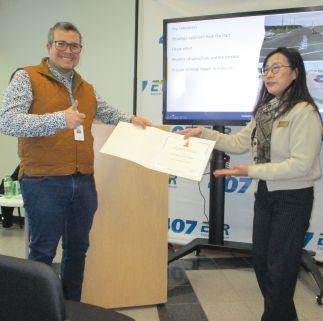
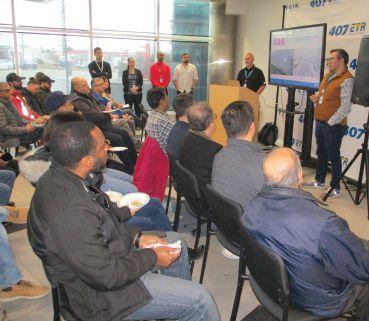
professionals. Also, there are so many other perks that you can enjoy when connected to OACETT.
In the January/February 2024 issue of The Ontario Technologist magazine the volunteer of the month Steven Govenlock, C.E.T. was recorded as the treasurer for Hamilton Chapter. He is the treasurer for the Ottawa Chapter.
OACETT Toronto West Chapter executive members meet monthly through in-person, virtual, and hybrid meetings. The chapter’s members meet and network with other technology professionals and participate in local events that can be helpful to their careers or just for fun. Also, the Toronto West Chapter provides professional development opportunities through the chapter’s volunteer roles. It’s one of the best networking resources around! We strongly encourage Toronto West Chapter members to support and participate in the chapter’s activities. For more information, visit https://www.oacett. org/Upcoming-Events.
Jason Wattleworth, C.E.T., is Toronto West Chapter chair: torontowest-chapter@oacett.org.
On March 1, the Niagara Engineering Week Luncheon took place with 500 attendees, including engineers, technicians, and technologists. This annual event serves as a platform for networking, professional development, and sharing insights within the engineering community.
The event opened with a two-hour morning technical session focused on the municipal class environmental assessment, providing information on the 2023 legislation amendment and changes. Presenter Reg Russwurm from the City of Guelph talked about project classification and reporting while also giving insight into interpreting and administering the Municipal Class EA.
Another informative highlight of the event was the presentation on the design of South Niagara Hospital. Attendees explored the hospital’s innovative engineering solutions, sustainability initiatives, and the role of technology in healthcare infrastructure.
Proceeds from the event funded annual bursaries for students entering engineering, engineering technology, and post-secondary education programs. Attendees also raised funds for Jillian’s Place, a shelter that provides safe refuge and support programs for women, children and LGBTQIA2S+ people facing violence.
Niagara Chapter members participated in the 61st Annual Niagara Regional Science and Engineering Fair.
Chapter members Scott Barbacki and Randy Deguire (pictured) were judges for the event, and chapter chair Kevan Peters presented the Niagara Chapter Award, given to a deserving student whose project demonstrates innovation in applied engineering technology, at the Awards Ceremony held on March 27. This year, the award was presented
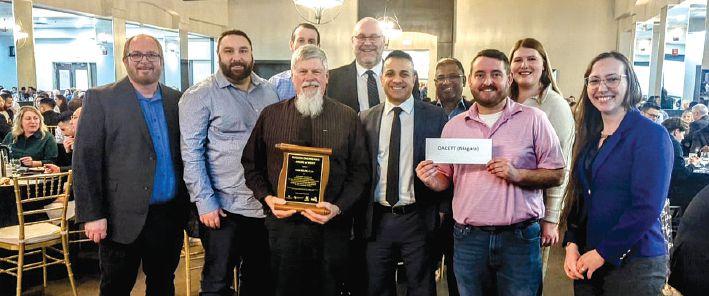
Niagara Chapter executive members with Cam Milne, C.E.T., who received the 2024 Niagara Engineering Award of Merit. Left to right: Randy Dequire, C.E.T., Dave Van Koughnett, C.Tech., Kevan Peters, C.E.T., Cam Milne, C.E.T., Scott Barbacki, C.Tech., Ahmad Tuhmazi, C.E.T., Suba Manickampillai, Joseph Thompson, C.Tech., Lindsay Taylor, and Jessica Brownlee, C.E.T.
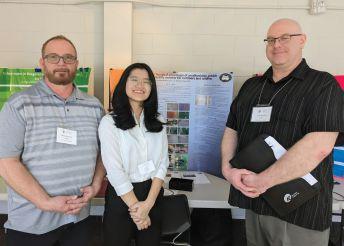
Chapter members Scott Barbacki, C.Tech. and Randy Deguire with Kendra Nayanka, recipient of the Niagara Chapter Award for her project “The Danger of Invisible Things” at the 61st Annual Niagara Regional Science and Engineering Fair on March 27.
to Kendra Nayanka for her project “The Danger of Invisible Things” where she explored a prototype of an affordable, portable, individualized air quality monitor. Kendra demonstrated great intelligence, curiosity, and a passion for science. Congratulations, Kendra!
Scott Barbacki, C.Tech., is Niagara Chapter chair: niagara-chapter@oacett.org.
Hamilton Chapter members Robert DeWolfe, C.E.T., William Stewart, C.E.T., and Julia Farner, manager of
marketing and communications at OACETT, participated in the second online “Futures of Work Symposium.” The symposium addressed 100 soon-tobe graduates of the electrical technician program at Mohawk College’s Stoney Creek campus. Dr. Christine BoykoHead of the McKeil School of Business moderated the six-hour symposium.
The speakers covered topics such as career pathways, resume and interview skills, OACETT membership, giving the pitch, women in technology, apprenticeship, starting your own business, and digital skills.
Farner spoke about OACETT and the advantages of the participants becoming student members. DeWolfe spoke about his experiences in Canada and abroad relating to electrical installations and the challenges encountered by various diverse firms. Stewart also shared stories from his decades in the field.
The symposium is part of the career advancement course, which helps prepare students for their industry capstone presentations, entry into the field, and continued learning options after graduation.
Mark Jacobowski, A.Sc.T., is Hamilton Chapter chair: hamilton-chapter@ oacett.org.

Valley Chapter members enjoy the Kitchener Rangers
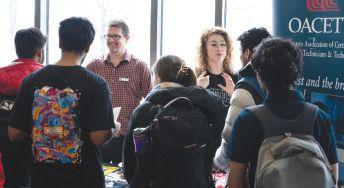
Grand Valley Chapter executive members Daniel Bee, C.E.T. and Kyla Farmer, C.E.T., rcji, talk to students about OACETT’s role in advancing their career at the Conestoga College Engineering and Technology Job Fair.
The Grand Valley Chapter executive hosted 360 partners, members, and their families for a great afternoon of hockey. The Kitchener Rangers took on the Sudbury Wolves and won 6-1. The event was well attended and enjoyed by all. Grand Valley executive members Daniel Bee, C.E.T., and Kyla Farmer, C.E.T., rcji, also attended the Conestoga College Engineering and Technology Job Fair in February. This fair was well attended by students in the engineering stream with great questions about how OACETT can help them on their career path. We look forward to more great events this summer!
Michael Luyckx, C.E.T., is Grand Valley Chapter chair: grandvalley-chapter@ oacett.org.
London Chapter and Fanshawe College hosted a stellar event to boost OACETT certification.
“The event was a resounding success!” texted Peter Nicholas, C.E.T., London Chapter chair, following his experience at the OACETT/Fanshawe College networking night at Fanshawe’s Innovation Village. London Chapter members enjoyed sharing their work experience and answering questions from engineering technology students, who listened while enjoying pizza and refreshments.
Fanshawe College and London Chapter jointly organized the event to demonstrate to engineering technology students that a C.Tech. or C.E.T. designation is an excellent pathway to a meaningful and financially rewarding career upon graduation.
Jay Burt, associate dean of Fanshawe College’s Faculty of Technology, was the first speaker and Fanshawe students Megan Alidchao-Laput and Kira Matveeva served as hostesses for the evening along with Nathalie Beauregard, C.E.T., from London Chapter.
Peter Nicholas, chair of the London Chapter, explained the chapter’s operating functions and identified the career and social benefits of being a certified OACETT member. OACETT associate member Bijay Minali from London Chapter was the master of ceremonies for the networking event.
After the presentations, students freely formed networking pods with London Chapter members who talked about their work experiences. Students also asked questions about OACETT membership, including fees, certification, how to become certified, and how to apply for membership.
The networking event was a fun experience, informative, and timely for engineering technology students. OACETT and Fanshawe College organizers plan to hold another networking night in 2025.
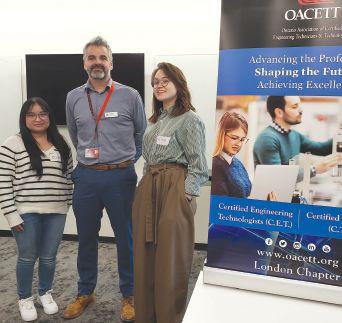
Fanshawe College student/volunteer hostess Megan Alidchao-Laput (left), Jay Burt, associate dean of Fanshawe College’s Faculty of Technology and Fanshawe College student/volunteer hostess Kira Matveeva (right) at the OACETT/Fanshawe College networking night at Fanshawe’s Innovation Village.
WIT representative Katherine Hatherley, C.Tech., organized a successful WIT-sponsored pottery networking event on February 24 with 15 attendees from London, Niagara, and Toronto Chapters. Participants had a lot of fun in sharing in a new hands-on experience. For ideas on how to organize a similar WIT-sponsored event, contact Hatherley at k8hatherley@hotmail.com.
To avoid harmful, career-altering, buried infrastructure accidents, Bijay Mainali, treasurer of the London Chapter, organized a Hydro One B-4-U-DIG, virtual presentation for London Chapter members. The presentation raised awareness of the importance of Ontario One Call and its process of locating buried infrastructure before digging, drilling, or excavating the earth.
All who are party to not following the Ontario One Call safe digging protocol could be held liable for repairing the damaged infrastructure, fined by industry regulators, and incur careeraltering disciplinary action by not adhering to their professional code of ethics, i.e. OACETT Code of Ethics
(a), which states that a member “shall hold paramount the safety, health and welfare of the public, the protection of the environment and the promotion of health and safety within the workplace.” The industry regulators for digging, drilling, or excavating the earth are Ontario One Call, Ontario Ministry of Labour, Ontario Ministry of Environment, and Technical Standards Authority (TSSA).
To view the Hydro One B-4-U-DIG presentation, contact Stephanie Taaffe at staaffe@oacett.org.
Peter Nicholas, C.E.T., is London Chapter chair: london-chapter@oacett.org.
Lanark, Leeds Grenville Chapter
Lanark, Leeds, and Grenville Chapter held its Annual Chapter Meeting on March 14, at the historic Richard’s Coffeehouse in downtown Brockville. Justine Loader, C.Tech., the regional MESC representative, kicked off the meeting, and Cheryl Farrow, CEO of OACETT, provided an update on OACETT’s business. Chapter chair Rob Wright, C.Tech., presented activities and events from 2023 while encouraging a discussion relating to planning for the remainder of 2024.

Lanark, Leeds, and Grenville Chapter members at their ACM. Back row, left to right: Al Billiald, C.E.T., Steve Allan, C.E.T., Rick Seaman, C.E.T, Paul Villeneuve, C.E.T., Justine Loader, C.Tech., MESC, and Cheryl Farrow, CEO of OACETT. Front row, left to right: Jered Seward, Dana Farcasiu, C.E.T., Vanessa Bersnicky, C.E.T., Rob Wright, C.Tech., Yanick Beaudin, C.E.T.
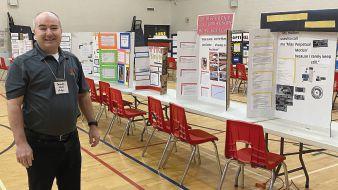
On March 21, Chapter chair Rob Wright, C.Tech., represented the local chapter as a judge for the North Grenville Science Fair for engineeringfocused projects. Gone are the days of creating volcanos; these talented future engineering-minded students were testing perpetual motion and triboelectric nano generation.
Robert Wright, C.Tech., is LLG Chapter Chair: leeds-chapter@oacett.org.
On March 31, local student innovation took center stage at the Frontenac Lennox and Addington Science Fair. Notably, Grade 7 students Hashim Ahmad and Param Prasad showcased the Garbage Buddy, emphasizing “Practical Engineering Concepts” and waste
Joe D’Agostino, C.E.T., Richard Cork, C.Tech., Bruce Fudger, C.E.T., Caroline Kirkwood, C.E.T., Ryan Klein, C.E.T., and Karina Bree, C.Tech., (virtual) at the March meeting.

Project page from the Garbage Buddy winner of OACETT’s category selection as the best application in the 2024 Frontenac Lennox and Addington Science Fair.
sorting solutions and were recognized by OACETT’s category selection as the best application, winning a $100 prize that the students will share.
The excitement persisted on April 4 at St. Lawrence College, where the Bridge Busting Competition unfolded. Civil technology students pushed their creations to the brink as Popsicle stick bridges endured escalating stress until their eventual explosive demise.
April was a significant milestone for the chapter. On April 17, the new executive team was elected amidst a social gathering at Greektown, a well-known Kingston restaurant. A warm welcome was extended to both returning members and those assuming new roles, acknowledging their indispensable dedication and leadership in serving their community.
Mark Jakubowski, A.Sc.T., is the Kingston Chapter chair: kingston-chapter@ oacett.org.

Recruit top talent on our CTEN job board and connect with more than 21,000 engineering technology and applied science professionals.
Increase your brand exposure to a targeted audience of government officials, municipalities, colleges, students, and other companies.
Engage with the OACETT network through ongoing events, chapter activities, and OACETT’s digital and traditional marketing channels.