From hand hauling to high-tech Persistence pays off for Kinnard Farms as the Wisconsin operation works to streamline recycling of its manure-laden sand bedding.
BY DIANE METTLER
Doing
part
BY TONY KRYZANOWSKI
TREENA HEIN
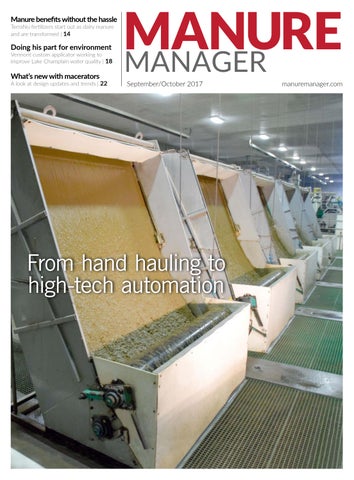
From hand hauling to high-tech Persistence pays off for Kinnard Farms as the Wisconsin operation works to streamline recycling of its manure-laden sand bedding.
BY DIANE METTLER
Doing
part
BY TONY KRYZANOWSKI
TREENA HEIN
Drag hose operator Rick Martens has seen a lot of things in his 30-plus years as a custom applicator. Most of it’s been positive.
“We’re doing a good job,” he said during a recent presentation at the 2017 North American Manure Expo. “This industry has come so far in the last 20 years. It’s incredible.”
But he’s discovered there is a growing disconnect between the people doing the work in the fields and the general population whizzing by in their cars or gazing out their front windows. It hit home for him when he was forwarded a video showing an applicator crew applying manure in Wisconsin.
“Basically, in this video, it was the end of a dragline system, they were blowing out the hose and they were about to receive the pig,” Martens recalled. “You could see the last of the liquid coming out the pig launcher and you could see how the [liquid manure] fans out.
“Public perception may become public policy,” he said. “It doesn’t matter if it’s right. It doesn’t matter if it’s wrong. It’s what the public’s perception is of what you’re doing.”
Ask the average American citizen today what a manure spreader looks like and they will most likely describe the small solid spreader used by their great-grandparents 80 years ago. Anything that doesn’t meet their quaint idea of farming is considered “industrial” or “corporate.” This should be a concern for a technologically advanced industry handling millions of gallons of manure annually.
“You think about the technology that’s come in, how fast we’re getting things done. It is amazing,” said Martens. “But we need to tell our story. We need to be out with the public, letting them know what’s going on. And being professional about it.”
15, No. 5
Published by: Annex Business Media, P.O. Box 530 Simcoe, ON N3Y 4N5
Editor MARGARET LAND (519) 429-5190, (888) 599-2228, ext 269 mland@annexweb.com
Associate Editor JENNIFER PAIGE 416-305-4840 jpaige@annexweb.com
Advertising Manager SHARON KAUK (519) 429-5189, (888) 599-2228, ext 242 skauk@annexweb.com
Account Coordinator MARY BURNIE (519) 429-5175, (888) 599-2228, ext 234 mburnie@annexweb.com
Media Designer CURTIS MARTIN
Circulation Manager URSZULA GRZYB ugrzyb@annexbizmedia.com
VP Production/Group Publisher DIANE KLEER dkleer@annexweb.com
#867172652RT0001
“If you’re familiar with that operation, you’re looking at it, thinking: ‘Okay, he’s just cleaning the pig out.’”
He suggests custom manure applicators take a close look at their business and consider how they might appear to an urban dweller with no experience of rural life.
“The public is the only critic whose opinion means anything” – Mark Twain
But that’s not the conclusion the majority of people reached as they viewed the publicly posted video.
“[They] were making comments on it and putting it through to the Wisconsin DNR, saying: ‘This is happening. What’s going on here?’”
As executive director of the Minnesota Custom Applicators Association, the experience prompted Martens to put together a presentation he has been delivering to manure applicators. The message? Be involved in the industry and be aware of how you’re presenting your business to others.
“What are people seeing when you’re out working? Do they notice what you’re doing?” Martens asked. “What you’re doing out there reflects on the rest of us.”
Ultimately, he would like to see more custom manure applicators involved in the industry and spreading the good word about the work they do.
“Be involved in public policy and the local industry organizations. Go to the local meetings. Stay up-to-date on state and national issues. As an organization and as applicators, we need to know what’s going on, not only in the field but what’s coming from public perception.
“We need a voice in the industry.”
e-mail: RThava@annexbizmedia.com Tel: (416) 442-5600 ext 3555 Fax: (416) 510-5170 Mail: 80 Valleybrook Drive, Toronto, ON M3B 2S9 Occasionally, Manure Manager will mail information on behalf of industry-related groups whose products and services we believe may be of interest to you. If you prefer not to receive this information, please contact our circulation department in any of the four ways listed above.
Annex Privacy Officer privacy@annexbizmedia.com Tel: 800-668-2374
No part of the editorial content of this publication may be reprinted without the publisher’s written permission. ©2017 Annex Publishing and Printing Inc.. All rights reserved. Opinions expressed in this magazine are not necessarily those of the editor or the publisher. No liability is assumed for errors or omissions.
All advertising is subject to the publisher’s approval. Such approval does not imply any endorsement of the products or services advertisted. Publisher reserves the right to refuse advertising that does not meet the standards of the publication.
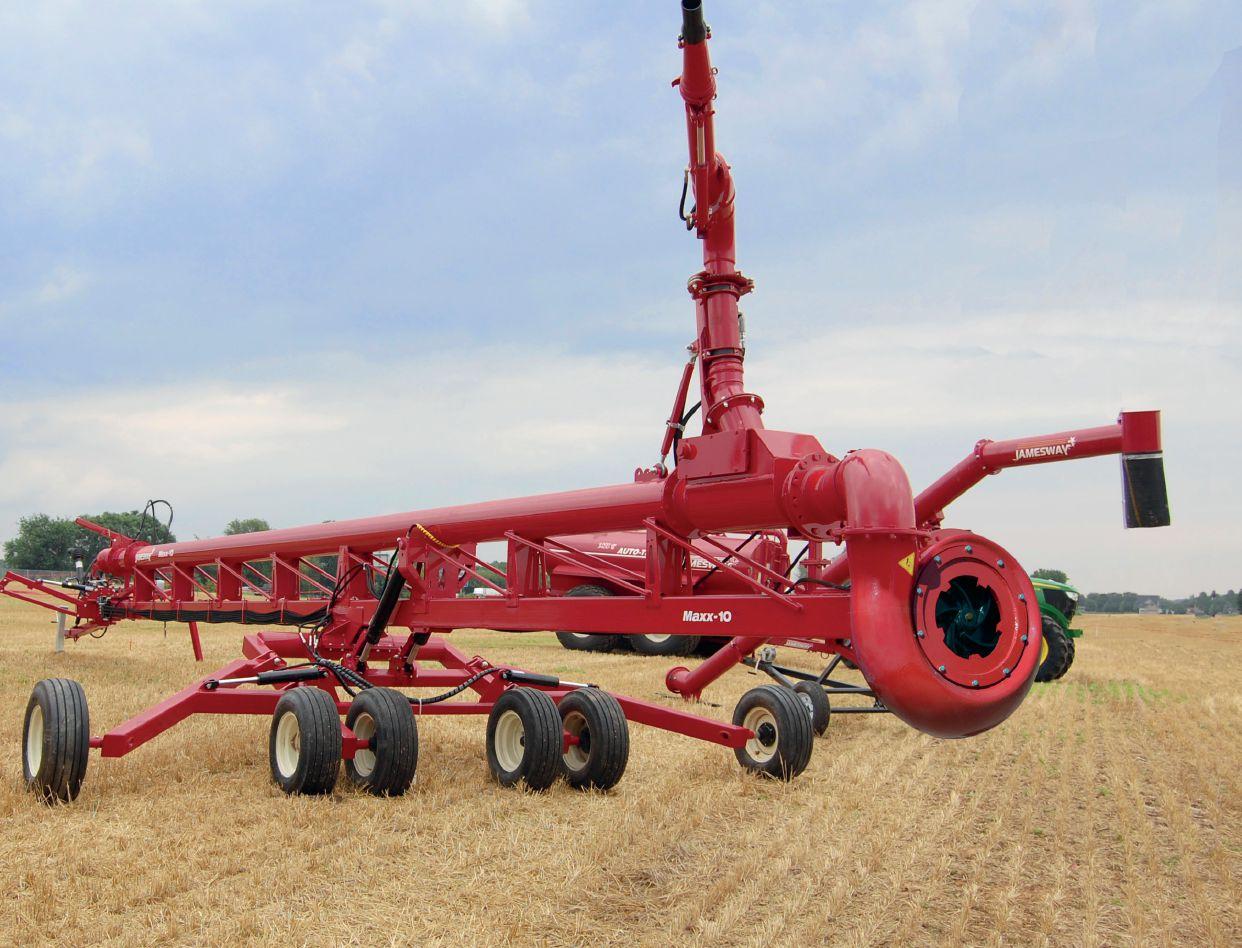
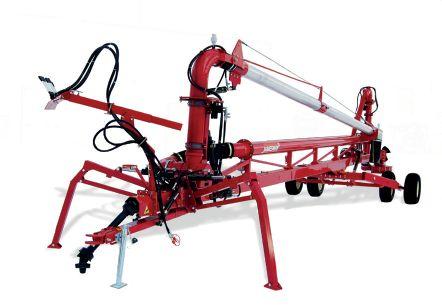
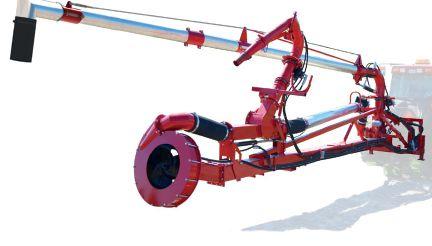
Hydraulic Stabilizers & PowerBoom for fastest set-up. Incredible load-out speed and time-saving remote controls make more loads per day.
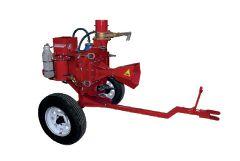
Choose the patented PUMPELLER™ Hybrid Turbine to reduce the toughest crust to nothing in just seconds.
Hardox-450™ and Ni-Hard steel last the longest in tough sand lagoons.
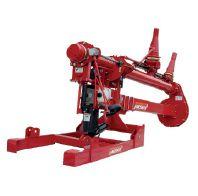
Large lagoons are no problem with models up to 72 ft long and high-pressure, long-distance agitation cannons.
Jamesway lets you build your pump exactly your way at the budget that suits you, while the high-flow pumps get the job done with less fuel.

The Dueppengiesser Dairy Farm, located near Perry, NY, was the recipient of the 2017 Agricultural Environmental Management Award.
The operation was recognized during a ceremony at Empire Farm Days in Seneca Falls, NY.
Dueppengiesser Dairy Farm is a third-generation family farm that manages nearly 2,000 milking cows and youngstock and operates more than 2,000 acres of cropland, producing corn, alfalfa
and wheat. The family has implemented several practices, such as reduced tillage, use of cover crops, and nutrient management, to protect soil and water quality. The family is also very active in the community, hosting several agricultural education programs on their farm.
The farm has worked closely with the Wyoming County Soil and Water Conservation District, which provides technical assistance within the county.
AMP Americas, a natural gas producer, fuel and infrastructure operator, recently received a $47 million equity commitment that will fuel the development of a number of company initiatives. The sizeable commitment comes from EIV Capital, a Houston-based private equity firm that focuses on the energy sector. The funding will help AMP Americas advance its initiatives in converting dairy waste into valuable,
clean, carbon-negative transportation fuel.
AMP Americas operates three business units – Renewable Dairy Fuels, which produces 100 percent renewable natural gas from an anaerobic digester at Fair Oaks Farms in Indiana; ampCNG, a nationwide network of 20 public access fill stations, and ampRenew, a company that provides risk management to help fleets and station owners reduce risk and
save money. With these business holdings, AMP Americas aims to transform the sector by converting animal waste into 100 per cent renewable natural gas for heavyduty vehicles and, through its growing network of fueling stations, make the renewable natural gas publicly accessible.
“As an integrated clean energy company with production and distribution assets across
the country, we wanted a partner with proven success in both the traditional and renewable energy sectors that could help us scale and execute our aggressive growth plans,” said Grant Zimmerman, CEO at AMP Americas. “EIV Capital has an excellent track record growing energy businesses and will help us as we invest in new biogas production, new fueling stations, and in growing our team.”
BY
Vermont’s Required Agricultural Practices

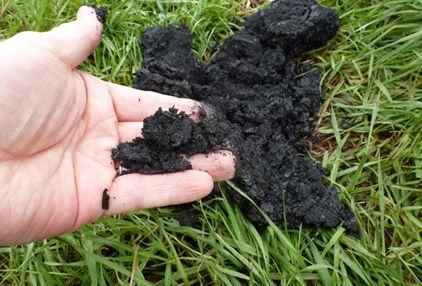
Biochar is plant matter, such as straw, woody debris, or corn stalks, that has been heated to high temperatures in a low- to no-oxygen environment. The result is a black, carbon-rich material similar to charcoal. Scientist Brian Dougherty researched the potential of biochar covers as a method of reducing odor and gas emissions from manure storage lagoons. Dougherty says biochar acts like a sponge and has a lot of potential for holding onto water and nutrients.
Dougherty’s research, which has been published in the Journal of Environmental Quality, studied two liquid dairy manures with differing nutrient levels and two types of biochars, made at different temperatures. Biochar is somewhat fickle, showcasing different properties when created at different temperatures. He also included pails of manure with a straw cover for comparison, and au natural with no cover as his control.
The research found that the biochars picked up the most nutrients from the more concentrated manure with a higher nutrient content. Dougherty also measured the ammonia at the top of each pail. Ammonia and sulfates are the main source of manure’s odor. The cooler-crafted biochar did best here, reducing ammonia by 72 to 80 percent. It also floated better. But because it floated better and tended to repel water, it was less effective at attracting and attaching to the nutrients than the warmercrafted biochar.
Biochar is currently more expensive to buy than straw, but could have a good economic return as excess farm and forestry residue could be used to create the biochar on site. This process generates energy that could be used heat water and warm buildings during colder months. There is also potential for generating electricity, fuels, and other by-products using more sophisticated equipment. After its use in the lagoon, the biochar could be spread on fields as needed. Any excess could be sold as a highvalue fertilizer product.
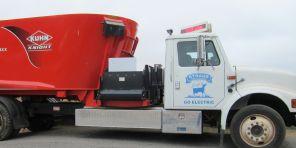
California dairy farmer Albert Straus has announced the launch of the first fullscale electric truck – powered by cow manure.
Straus, along with a local mechanic, spent eight years developing the 33,000-pound gross weight International Harvester truck to use as a feed truck on his farm. The truck measures, mixes and hauls feed before dropping it into the trough for his nearly 300 organic dairy cows.
An environmentally-friendly alternative to diesel-fueled trucks, the feed truck’s motor is charged from electrical power generated from methane gas produced by the cows’ own manure. California dairy farmers are facing pressure to lower methane emissions under the state’s ambitious new greenhouse gas reduction laws, which include methane emission reduction targets of 40 percent below 2013 levels by 2030. The state’s Air Resources Board says that much of the reduction should come from converting methane from cow manure into energy. Dairy manure
accounts for about a quarter of the state’s methane emissions.
Straus’ methane digester has been powering his farm since 2004, fueling his all-electric Toyota RAV4 and Nissan Leaf plus smaller farm vehicles and machinery. Working with the Marin Carbon Project, his 500-acre farm is California’s first dairy to develop a 20year carbon farming plan to sequester 2,000 metric tons of carbon every year.
Straus’ goal is to demonstrate to the farming community and public that farmers can implement and teach others practical solutions to climate change. Ultimately, Straus is working towards getting his farm off fossil fuels entirely. United States plug-in electrical vehicle sales have increased nine-fold since 2011, per Inside EVs. Yet Straus believes he is the first to put a full-scale electric feed truck into use, getting the jump on Tesla Motor’s electric semi-truck slated for September 2017 release. will give producers another tool in the tool box for carefully developing their manure management plans while utilizing best management practices,” says Jennifer Tirey, executive director of the Illinois Pork Producers Association. The mobile app is available for iPhone and Android users. To download, visit the app store and search for “Illinois Manure Calculator.”
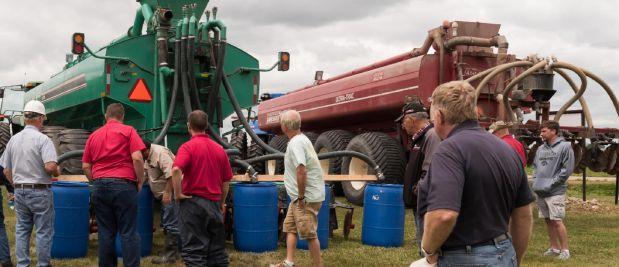
For the past two months, Iowa State University Extension and Outreach hosted demonstrations on manure application uniformity.
Four field days were held across Iowa. First and foremost, Extension would like to thank those who attended, the companies who helped host these events, and all those involved in the planning and execution of these field days. More than 150 people showed up to learn more about using manure as a fertilizer resource, be informed on the science behind selecting application rates, and see some equipment demonstrations on different injection styles and evaluate how uniform manure application is at different rates.

Persistence pays off for Kinnard Farms as the Wisconsin operation works to streamline recycling of its manure-laden sand bedding.
BY TONY KRYZANOWSKI
(Left
One back surgery and 30 years later, Lee Kinnard, co-owner of Kinnard Farms in Wisconsin, is starting to believe that the dairy has finally put all the pieces in place to streamline recycling of manure-laden bedding sand from their barns.
The benefits of using sand bedding were just too good to ignore, with a 50 percent milk production increase nearly overnight when the dairy began using sand bedding in 1986. That was the good news. The bad news was how little technology existed in those early days of sand bedding usage in how to manage and recycle the manure-laden sand.
“I can tell you exactly when we switched to sand bedding because my back surgery was about 12 months to the day later,” says Lee, demonstrating just how challenging the job of moving the sand was in those early adoption days. “It has been a love-hate relationship with sand ever since we switched . . . initially we were filling stalls by hand with sand.”
Having the ability to recycle the sand became critical for the 7,500 head dairy, considering their need for about 150,000 tons of sand annually for bedding while generating about 70 million gallons of liquid manure. The right quality sand was becoming harder and harder to find within a reasonable distance, so something had to be done on the nutrient washing and sand recycling end.
Speaking to Kinnard, there is a sense that his feelings toward sand bedding in the dairy and working toward a feasible system of effectively washing nutrients from the sand and recycling it
has been a bit of a personal quest he intends to win. Today, he feels like maybe he has and in some instances, the solutions were incredibly simple.
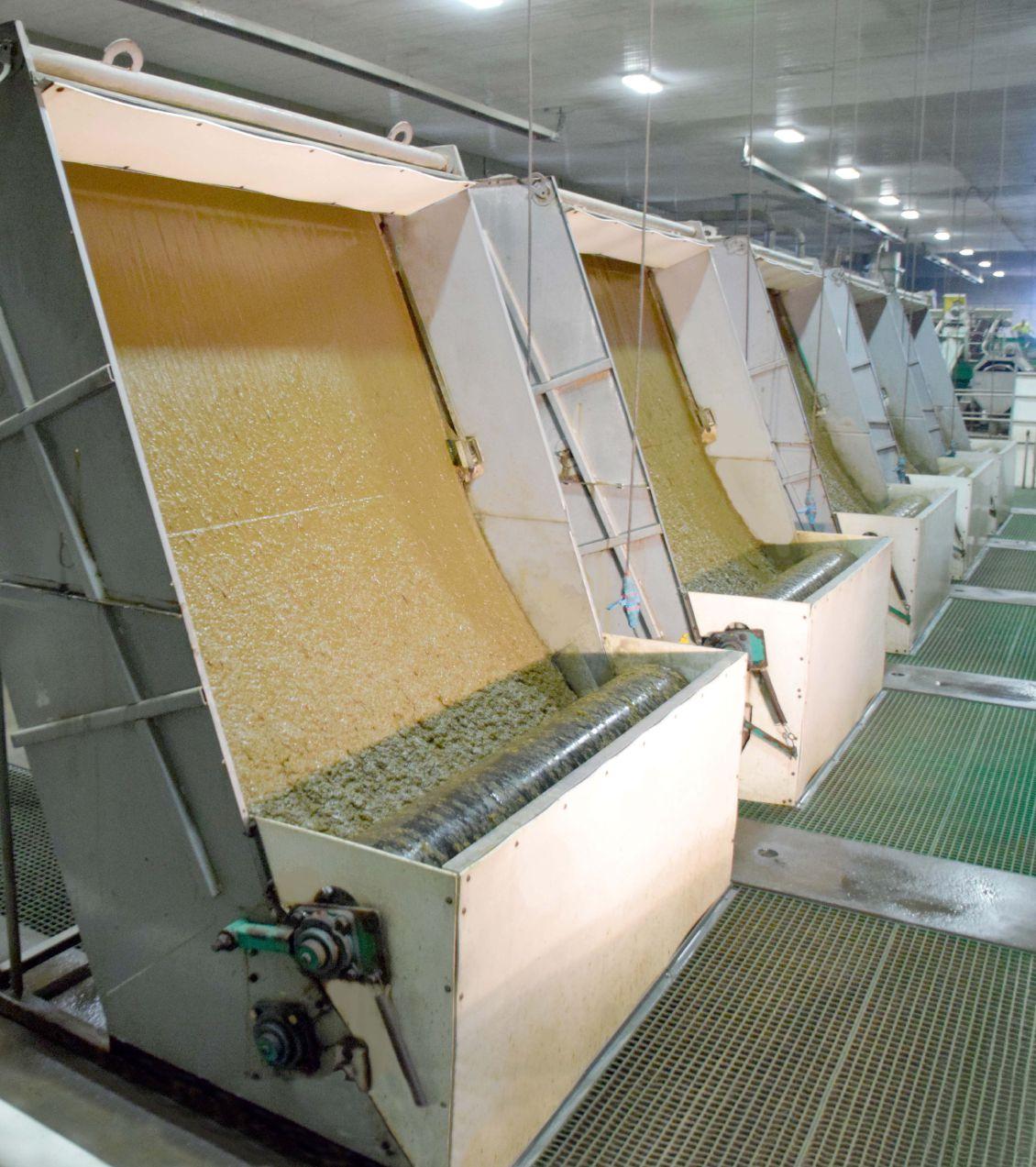
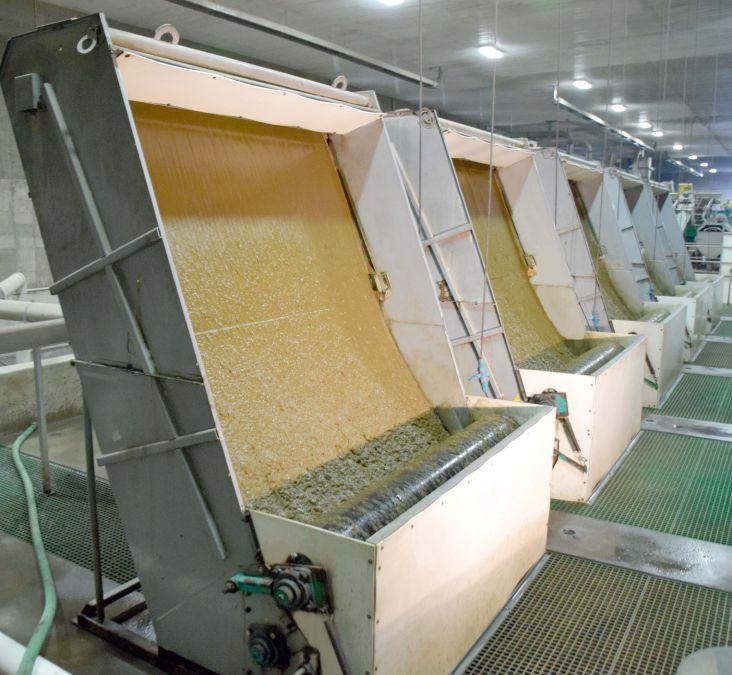
Five slope screens are used at Kinnard Farms to separate solids from the liquids and create flush water that is less than five percent solids.
“I can tell you exactly when we switched to sand bedding because my back surgery was about 12 months to the day later.” – Lee Kinnard
For example, there was the issue of water consumption when washing the nutrients from the sand with clean water. It turns out that the dairy was flushing water from their cattle waterers every 48 hours. In their new barn alone, there are 102 waterers representing 10,000 gallons of water. Instead of simply flushing that water, the Kinnards devised a system when their new barn was built of routing that water to their sand recycling system, using it to flush the sand before this water enters the wastewater stream. It has worked remarkably well, cleaning the sand to a reusable state while significantly reducing odor.
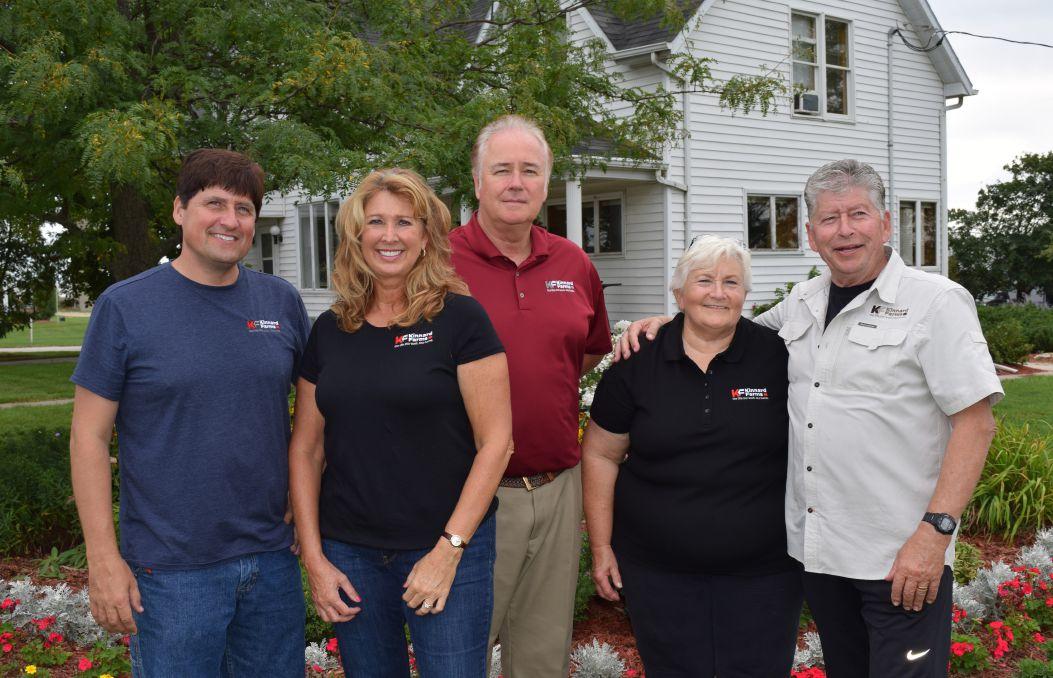
Kinnard Farms, located east of Green Bay near Casco, Wisc., has been described as both an early adopter and innovator in their nutrient management and crop management practices. Owned by Lee, his brother, Rod, and his wife, Maureen, while his sister, Jackie, and her husband, David Stewart, are dairy employees, they have 6,500 acres under cultivation with another 3,000 acres of forage grown
by neighbors to support the dairy, some of whom have retired from the dairy business, but still grow feed to support the Kinnards.
Started by Lee’s parents, Alvin and Milly, the current herd is an offshoot of the initial 14 cows on 80 acres they started out with in 1948. With the dairy’s most recent expansion, cows have been added from other herds.
The dairy has enough capacity to store up to two year’s worth of liquid manure, but is on a regular schedule of land applying about one-third in the spring, another third in the summer, and the final third in the fall for a total of about 60 application days. Along with no-till and minimum-till farm practices, Kinnard Farms uses satellite imagery to test and geo-reference fields, and then uses this information to precisely apply fertilizer to their crops. Liquid manure provides about 50 percent of their fertilizer needs, with a preference for shallow injection. No-till and cover cropping practices, which the Kinnards have been using for more than 25 years, help to keep nutrients in the soil. They sell some of their liquid manure to local vegetable growers, which helps them to coordinate nutrient application on their own land.
Kinnard Farms contracts liquid manure application to local businessman, Jesse Dvorachek. Unlike areas where crops are under cultivation right near the farm, the Wisconsin dairy’s cropland is as far as 31 miles away. Only about seven percent is applied directly from the lagoon with a drag hose system. Most is hauled by truck to a ditch catch and pump system where a tractorpropelled drag hose system takes over to land apply the liquid manure. Trucks never leave the road. On certain days, Lee says that there can be as many as 28 tanker trucks on the road delivering liquid manure to fields. While Dvorachek owns three tanker trucks, the rest come from other truck and tanker owners who are often local farmers. Again, this
helps to support the local economy.
Speaking of the dairy’s history with sand bedding, Lee says that the issue was that their circa 1950s free stall barns, manure pumps and manure pits simply weren’t set up for moving and recycling sand. It was a constant battle.
“We stuck with it because it was so good for the cows,” says Lee.
So being innovators and early adopters, they began traveling the world looking for solutions, but found few sand handling solutions.
While Kinnard Farms was installing its
fifth sand bedding system in 2005, it was already in discussions with technology developers about all the moving parts that they would require in what is their current sand recycling system. The first iteration and prototype was installed on their home farm in 2012.
“It’s really just this last system that we have been running on our home farm for the past five years, which is kind of our prototype, and the other one on the new farm for two years, where we have really made some great strides in 100 percent reusable sand,” says Lee.
Three issues that the new system solves are water consumption, recycled sand quality, and odor. Previous systems were designed so that water was recycled through the flush flume and lagoon system to flush and settle out the manureladen sand. That proved difficult in Wisconsin’s four-season climate, resulting in highly variable recycled sand quality.
“We really wanted a closed-loop system so that we weren’t reliant on water coming off of the lagoons,” says Lee.
Also, the dairy opted for Summitbrand industrial pumps commonly used in the pulp and paper industry, which actually turned out to be more durable and less expensive. The issue Kinnard Farms discovered is that the previous agriculture pumps they were using just weren’t designed for 24-7, seven-day-aweek service.
“Longevity and energy efficiency wise, there is just no comparison,” says Lee. “It’s just night and day.”
The first step in the Kinnard Farms manure management and sand recycling system is to scrape the manure laden sand three times a day with a skid steer into one of three cross flumes in the new 1,700 foot long and 450 foot wide barn, using recycled water and gravity to pump the material through a two-pipe system to the sand recycling center about a half mile way. It sits at about a 25-foot lower elevation than the barn.
The sand recycling center is a dedicated, climate controlled building. The manure-laden sand stream is dumped into a six-foot wide, six-foot deep channel that contains two submersed, mechanical, heavy-duty McLanahan augers. The augers operate full time with water flowing across the augers as they transport the settled out sand about 130 feet to the middle of the building.
Mini-sand lanes on the sides of the augers collect about five percent of the sand that filters out of the moving augers, and this is shoveled back using a payloader into the moving augers about once every eight hours. The augers transport the sand to a submerged McLanahan screw mechanism, which picks up the sand and transports it to floor-level washers. It’s at this point that the fresh water from the waterers is used to wash the sand clean.
“The sand at this point is probably about seven to 10 percent organics,” says Lee “It’s dirty, dark and by no means suitable to be put back under the cows. When it hits the washers, we are running a continuous second loop of water. That is actually what polishes and gets all the organics out of the sand, and gets us down to that one percent or better organics in the sand.”
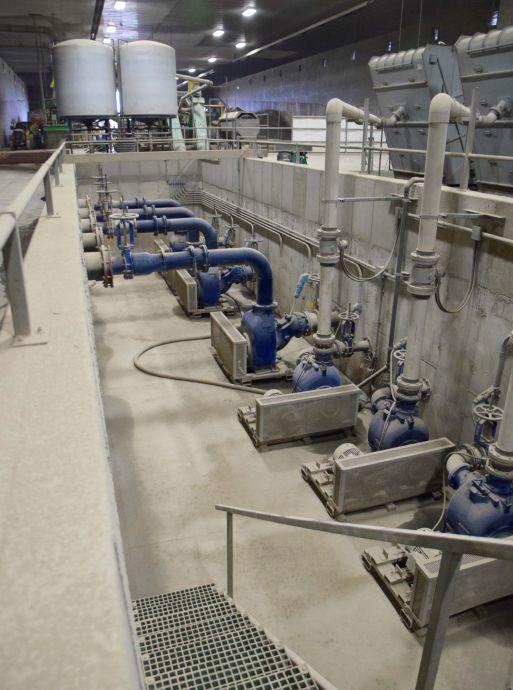
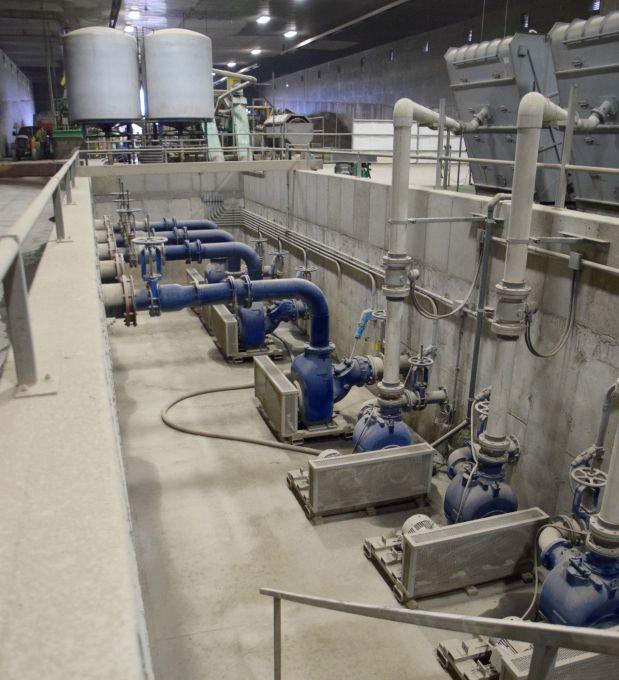
These Summit-brand industrial pumps provide water to the Kinnard Farms flumes. They are described as having very simple and robust construction, with lower operation and maintenance costs than agricultural pumps.
The sand has about 22 percent moisture at that point, and after passing through vibrating screens, it dries down to about 10 percent. To bring the sand down to about three percent moisture, Kinnard Farms – working with McLanahan, Komro Sales and Service, and Uzelac Industries in its design – has developed a novel, natural gas-fired, sand dryer capable of processing on average 11.5 wet tons of sand per hour. This avoids their previous practice of creating windrows and turning them three times to get the sand down to about three percent moisture content. After drying, the sand is now ready for re-use. Farmers and environmental groups have taken notice of the effort and investment that the Kinnards have put into good land stewardship and technological advancement over the past several decades. The dairy was recently recognized with the 2017 U.S. Dairy Sustainability Award.
VISIT MANUREMANAGER.COM.
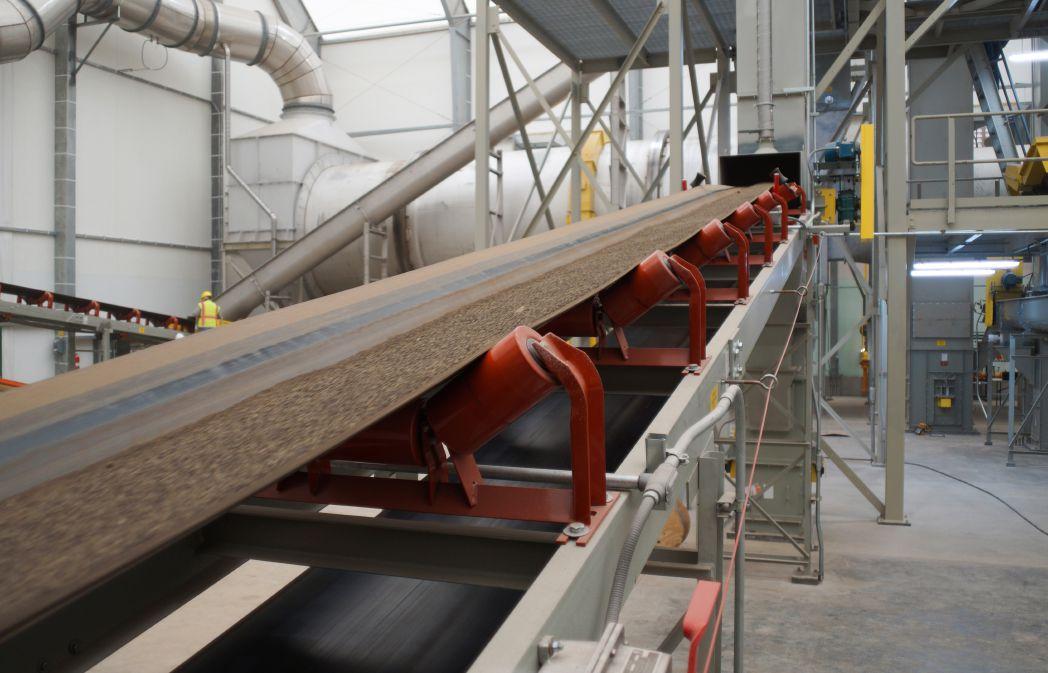
TerraNu fertilizers start out as dairy manure and are transformed into a precision nutrient delivery system.
BY DIANE METTLER
For years, Fair Oaks, Ind.-based Prairie’s Edge Dairy Farms, LLC, had been trying to find the right technology to remove phosphorus from its manure. Little did Carl Ramsey, farm manager, know that search would lead to a new manurebased fertilizer.
“In the process of finding the right technology, we identified and later purchased from Trident Processes, a phosphorus separation system,” says Ramsey.
The highly-automated Trident system processes the material leaving the farm’s anaerobic digester, separating the liquid from the solids and leaving a stackable, dense, highconcentrated, nutrient-laden cake.
ABOVE
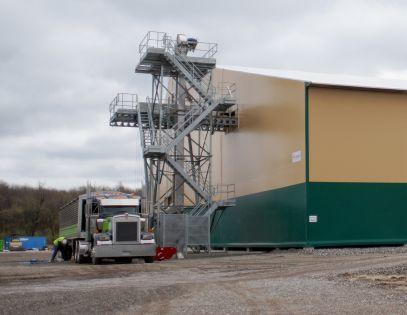
“When Prairie’s Edge was talking to Trident Processes, Kerry Doyle mentioned he had a contact who wanted to take that nutrient cake one step further – Midwestern BioAg,” he adds.
That was good news because Prairie’s Edge is no small operation and the dairy would be dealing with a significant amount of nutrient cake.
Discussions began with Midwestern BioAg after the Trident system was installed.
“Midwestern BioAg was going to create a first-of-its-kind manure blending and granulating facility near the farm,” says Ramsey. “They would in turn take the manure cake and use it in their manufacturing process.”
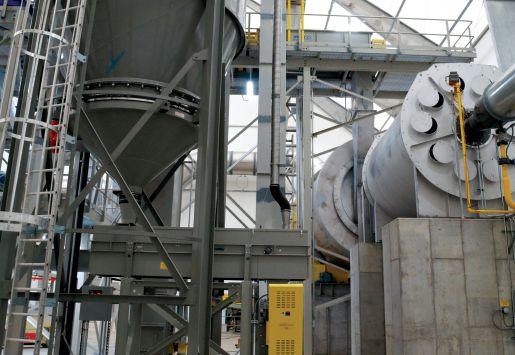
The granulated product is conveyed through various processes in the facility, including a cooling system. All the dust gets captured and brought back into the product for full recycling.
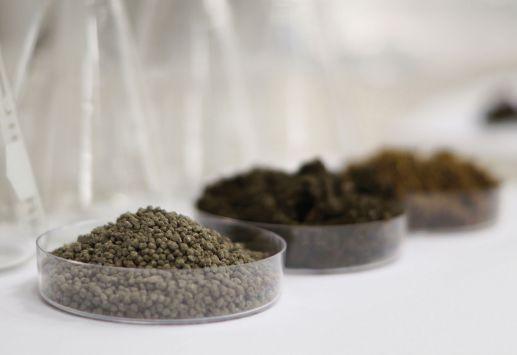
Flash forward two years. Midwestern BioAg created the new blended fertilizer and built the facility. It was operational in April and began producing fertilizer by June. Prairie’s Edge currently has 18 and 20-ton trucks running around the clock delivering the cake to the new plant.
From Prairie’s Edge perspective, it’s going great.
“We get a lot of benefits from the Trident system. One of the benefits is a cleaner liquid that can then be field applied with fewer nutrients in it,” says Ramsey. “And because the nutrient cake has been de-watered, we’re able to transport them more efficiently. Because in our world, pounds of nutrient per ton are what pays the bills.”
Midwestern BioAg is also pleased with the product coming from Prairie’s Edge and the new fertilizer. However, creating new fertilizers isn’t new to the company.
“It’s really a soil-centric approach,” says Dr. Tony Michaels, CEO of Midwestern BioAg. “We figure out how to manage all the different minerals that crops need, and how to build soil biology to help hold and cycle those nutrients. For 35 years, on more than one million acres, we’ve been helping farms manage these kinds of things to create the largest farm profits. Our current business is highly customized because every farm is different and every crop is different.”
Dr. Michaels says that about three years ago, someone in the Pacific Northwest approached Midwestern BioAg with digestate from an anaerobic digester and asked if they could make fertilizer from that. Midwestern BioAg’s owner, Gary Zimmer, saw the possibilities.
“When you’re a manufacturer, you need consistent raw materials and manures have variability in them,” says Dr. Michaels. “But with the digester, the manure gets eaten by all these microbes and what comes out every day is pretty much exactly the same. When you’re a manufacturer, that homogenization process simplifies a lot of the manufacturing steps.”
Working with companies like Trident – that knows how to take moisture from manure – and FEECO – that develops granulated equipment – Midwestern BioAg develops the manure-based products – TerraNu Nutrient Technology. Nutrients are infused into a manure-based granulation for precision, uniform application. And these fertilizers, being bound to manure, are easily pulled into the soli biology.
“We came up with a set of products, and we tested them out in the field, and they outperform our current way of doing things and they are more cost effective than what we’ve done,” says Dr. Michaels. “And they’re dramatically better
Three different products are produced at Midwestern BioAg’s facility
than just the straight conventional fertilizers on their own.”
On June 15, 2017, Midwestern BioAg was able to commercially blend the manure with other dry granulated fertilizers to be professionally used in a traditional fertilizer facility.
The solids are brought to the 85,000-square foot facility – about a two-acre footprint. The company runs about eight tons per hour and has the capacity of 65,000 tons annually with the potential to expand to 90,000 tons. And although it isn’t currently running 24/7, it is designed to.
“What you see when you come into the plant are outdoor cake hoppers where we receive basically a semi load an hour of the manure solids,” says Dr. Michaels. “Then, inside the big building at the front end, you have 11 [computer controlled] bins that meter in all the different minerals or other things we want to add to the product. Those come together into a system in the middle room, which combines all those products, into a consistent product. Next, it goes through a series of steps to turn them into granules, and goes into this massive drum where they get dried. Then, it goes into a cooler to cool them back off. All the dust gets captured and brought back into the product, so we get full recycling. We shake [the granules] through screens to be exactly the right size for fertilizer, and the ones that are too big and too small get recirculated back into the system. Literally, it takes 20 minutes.”
The three new products include:
TerraNu MicroPack – supplies eight additional nutrients, including a full suite of micronutrients, to maximize a crop’s yield potential.
TerraNu Ignite – an all-in-one, balanced mixture of essential nutrients to improve nutrient update efficiency and reduce loss from leaching.
TerraNu Calcium – provides plant-available calcium that improves nutrient uptake, and increases soil biological activity and improves crop yields.
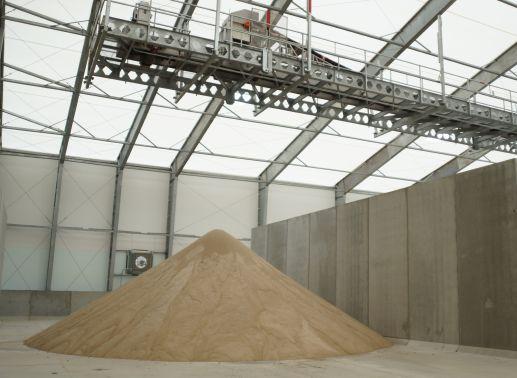
The granules are shaken through screens to be exactly the right size for fertilizer. The ones that are too big and too small get circulated back into the system.
Midwestern BioAg was able to produce product in the spring that was applied to 25 farms, including Prairie’s Edge.
“We have products that are designed for spring (with more nitrogen) and products designed for fall applications,” says Dr. Michaels. “The fall application fertilizers are being made now.
“A lot of the farms will take the Ignite or the MicroPack and they’ll put it on in the fall and then come in and just put nitrogen on when they plant, and it saves them a lot of time in the fall to put the mineral fertilizers on,” he adds. “Then, in the spring, they can put the nitrogen right on the plants, whether it’s a liquid or dry, or side dress afterwards. The whole point is to transform how they farm by changing a few practices as possible.”
Different minerals are metered into the product and the materials come together into a system that combines them into a consistent product. It then goes through a series of steps to turn them into granules before entering a massive drum where the product is dried.
It’s one thing to create a great product, but it’s another to sell it and Midwestern BioAg was concerned that it might be hard to explain the value of the manure-based product to farmers. They need not have worried.
“What surprised us was how farmers who aren’t dairy farmers romanticized manure,” says Dr. Michaels. “They remember when their grandparents had manure as a fertilizer and they know that they’ve reduced the organic matter in the soil, that all the chemical-intensive current way of farming isn’t good for the soil biology, and that soil biology is good for your farm. Based on input from all these farms, we market it as ‘All the benefits of manure without the hassle.’
“Because we blend all these trace minerals and secondary nutrients and other things in, and because we really want it to be a fully balanced way to feed the crop that then complements the normal NPK that they would have used for their basic nutrition program, farmers could connect to what they were getting,” he adds. “It’s dry and granulated, and you can put it in through your precision equipment and everything else.”
The precision nutrient delivery system has a number of benefits. It’s a sustainable, closed loop system. Crops are
grown and consumed by livestock, manure is collected, digested and dewatered. It’s then blended, put back into the soil where it feed the crops again.
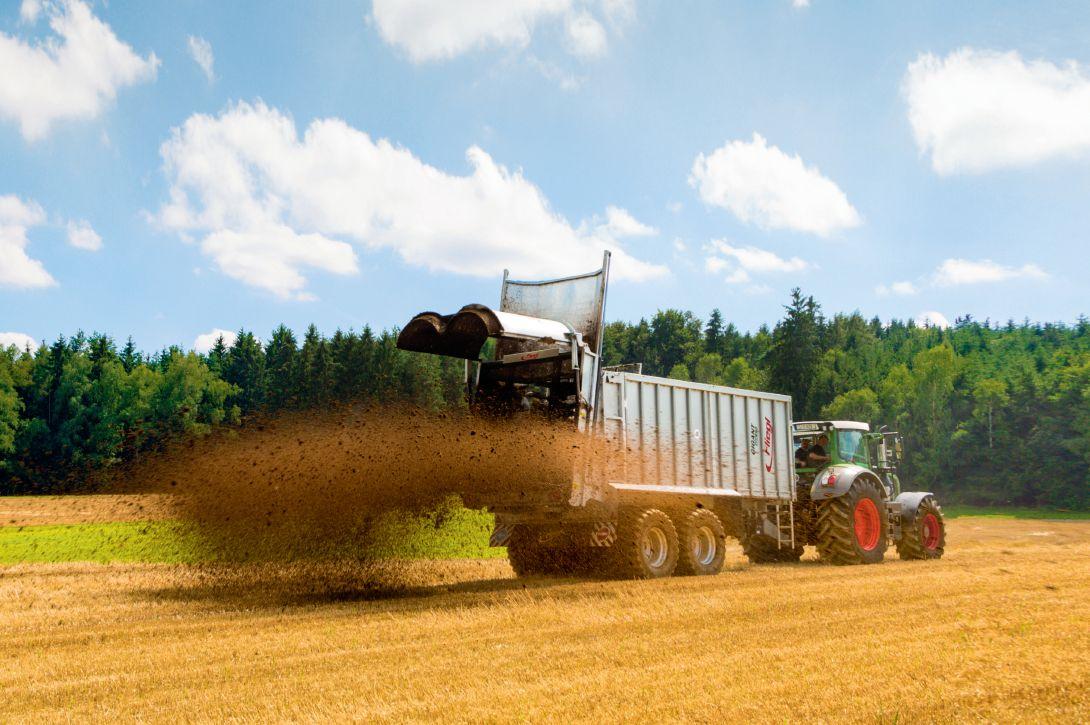
In addition, the granulated manure-based fertilizer allows dairy farmers a no-till farming option as previously manure often had to be knifed or injected into the soil. And it simplifies the management of manures because famers
“We are creating the capacity for farms to get the benefits of manure and the benefits of balanced mineral nutrition delivered by soil biology, all in something that fits as simply as possible into the way they currently farm.” – Dr. Tony Michaels
puzzle and can help them better manage their process and create more value out of a dairy operation.
“This is something both we and Trident came to independently, but it worked out perfectly,” says Dr. Michaels.
Ramsey says he can see more plants like this working with other farms in the future.
“With anything that has not really been done before, there’s a learning curve, and I think we’re actually a little farther ahead at this point than what a lot of people thought we would be. The technology is there and the desire is there. I believe that this is something that can be replicated throughout the country.”
There are also already discussions underway on how to do the same thing with raw manures and with other animal wastes.
“We think there will be iterations over time that will have other carbon sources,” says Dr. Michaels.
But that looks to be down the road.
Currently, Dr. Michaels says it’s all about making it easy for conventional farms to harness the power of soil biology to improve their crops and make their farms more profitable.
aren’t stuck with whatever fertility the manure on the farm contains.
Lastly, for farmers who are already using a digester, processing their manures, making renewable energy and/or running their trucks on biogas, this is another piece of the
“This is a way to simplify that. We are creating the capacity for farms to get the benefits of manure and the benefits of balanced mineral nutrition delivered by soil biology, all in something that fits as simply as possible into the way they currently farm.
“This is a big thing for us and we think a big thing for agriculture, so we’re very excited.”
Vermont custom applicator working to improve Lake Champlain water quality with injection service
BY TONY KRYZANOWSKI
Vermont has recently adopted stiffer manure application rules to try to better control runoff into the state’s largest water feature and tourist attraction, Lake Champlain. As one of the state’s largest manure injection custom applicators, Matthew’s Trucking LLC is doing its part to help farmers better manage farm runoff.
Lake Champlain is the sixth largest lake in the United States with more than 300 kilometers of shoreline attracting thousands of visitors every year. There are also many dairy farms on the land surrounding the lake.
Given the growing frequency of blue green algae blooms appearing on the lake, State authorities were strongly motivated to try to stem the tide of farmbased nutrients seeping into the lake. These nutrients were largely being blamed for fueling algae growth.
Legislators held extensive public consultations on Vermont’s proposed new Required Agricultural Practices (RAP) in 2016, with final regulations approved in early 2017. The state now requires
ABOVE
mandatory custom applicator certification and training, which was provided in late winter in advance of the busy spring application season. The new RAP also requires custom manure applicators to keep detailed records on where they apply manure and how much.
The new regulations require a 100-foot manure application buffer from private water supplies and 200-foot buffer from public water supplies. Certified Small Farm Operations (CSFO) are also required to develop a nutrient management plan by July 1, 2017.
These new regulations came as no surprise to Matthew’s Trucking, although co-owner, Eric Severy, says it will require some adjustments and experience to become familiar with the new regulations. As many of their customers are located right around Lake Champlain, they are very familiar with the nutrient runoff issue. That was a major reason why they invested in their two manure injection systems. Today, about 70 percent of their dairy customers situated near the lake are using the manure injection
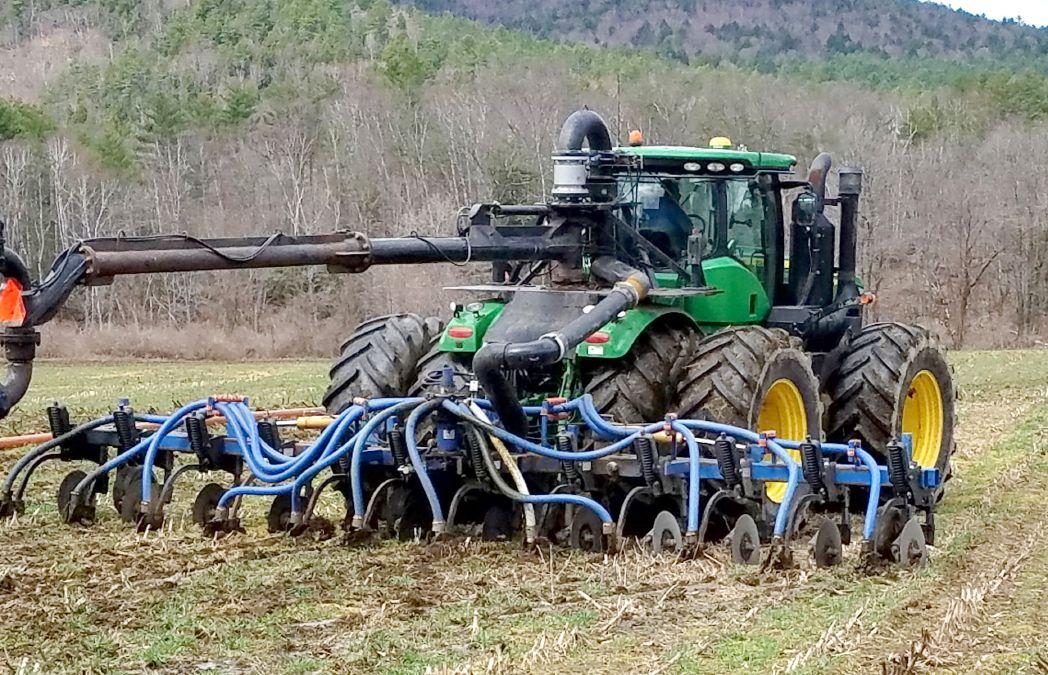
Matthew’s Trucking is doing its part to stem the tide of farm nutrients seeping into Vermont’s Lake Champlain by being among the few in the state to offer manure injection services.
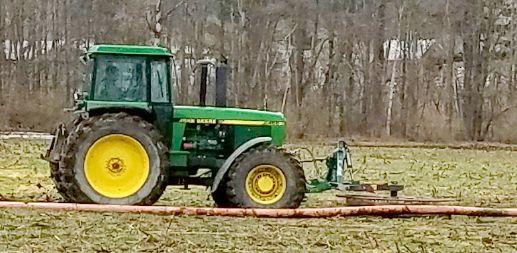
method. In total, they apply about 100 million gallons of manure annually. About half is manure injected into corn crops, with the majority of the surface applied manure placed on alfalfa and grass fields.
“What lead us to injection was because we were doing a lot of surface application on silage ground and we knew it really wasn’t right,” Severy says. “We couldn’t keep the manure where we wanted it and spread the rates that the fields needed without feeling like it was going to run off.”
With the new regulations, he does expect considerably more monitoring and oversight of custom manure application activities by state authorities in future.
“Pretty much our whole business area is in the Lake Champlain watershed,” Severy says. “I’m hoping that the spotlight isn’t on us too much because we have been forward thinking and are doing manure injection on our own before the State either makes us or is really promoting it. We have a handle on it, and we are the only ones doing it on a large scale.”
Matthew’s Trucking applies about 100 million gallons of manure annually, with about half injected into corn crops.
He adds that the regulation changes may actually help to attract new business.
“We knew that these new rules were coming, so we really strived to take action before they come into force so our employees would have the mindset to watch out for ditches, streams and waterways. It wasn’t 100 percent new to them this spring,” Severy says.
Severy owns Matthew’s Trucking along with his father, Matthew Severy. The business is headquartered about an hour south of Burlington in Addison County. They operate an extensive manure management fleet and have been in the manure application business for the past 20 years, with the vast majority of their customers in the dairy business.
They will go as far as Saratoga, N.Y., and Vernon, Vermont, which is about 100 miles from home, to provide their manure application services, but the vast majority of their business is conducted within 50 miles of home.
“We work for dairy farms from 50 cows to 1,500 cows,” says Severy, with a fairly large number of smaller dairy farms still operating in their region, but then the numbers take quite a significant jump to the 700 to 1,000 head range. This size is considered large by Vermont standards.
Before starting his nutrient application business, Matthew

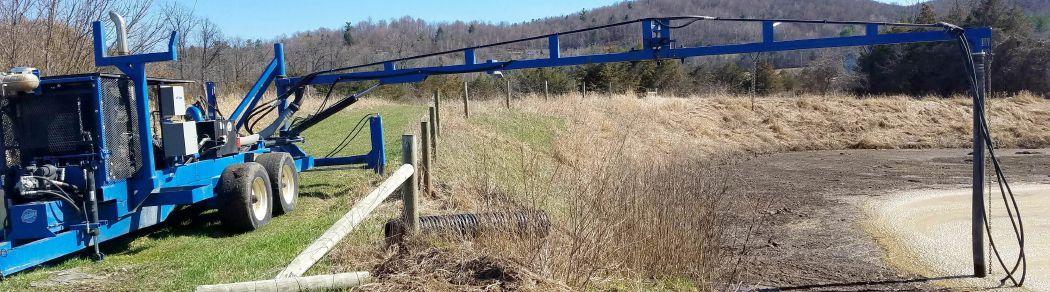
ABOVE
From pumps to drag hose to injection tool bars, Bambauer has been a major supplier to Vermont custom manure applicator, Matthew’s Trucking LLC.
Severy had a long association with the farm industry, working as a mechanic and then as a transport driver for milk and feed companies.
“He bought one silage truck with a 3,600 gallon tank to also use to haul a little bit of manure,” Severy says.
The business grew quickly with the purchase of tandem trucks equipped with 4,000 to 5,000 gallon tanks and surface application bars.
“As farms grew bigger and weather challenges became more of an issue, we wound up purchasing two John Deere 8000 series tractors pulling 7,300 gallon Houle tanks, and also added a couple of semi-trailers because the demand was that big,” Severy says.
He adds that their business really requires the right combination of equipment to service their customers properly, as that area of Addison County consists of heavy, clay soil that receives quite a lot of moisture. The tractor and tanker option has allowed them to land apply in conditions where it is too wet for tanker trucks to work in the field.
At present, they own two, 10-wheel tandem trucks equipped with Diller 4,500 gallon tanks, six semi-trailer trucks with custommade tanks equipped with pumps and spray booms, two Houle 7,300 gallon tanks pulled with tractors, and two full drag hose systems with manure injector bars. The semi-trailer trucks are particularly handy with customers further away, as they can carry more volume and work well in light, sandy soil, where getting stuck in the field is less of an issue. These soils tend to exist in the Saratoga, N.Y., and Vernon areas.
“This option is really good for farmers because it cuts down their costs quite a bit and when the soil is hard and dry in summer, we can use the semi-trucks to top dress a lot of hay,” Severy says.
Having that diversity in their equipment fleet also allows Matthew’s Trucking to work steady from April 1 up until the manure spreading ban comes into place in Vermont on December 15. After fields with crops like corn are spread in spring, the company moves to grass and alfalfa fields through the summer, then back to cropland in fall once the corn is harvested for silage.
While they tried to provide manure injection from a tank, Severy says that given the small-sized fields in the area, the heavy, clay soil, and hilly ground, a drag hose system was a better option for them. They are able to lay out enough drag hose and have enough pumping power to be able to apply manure up to three miles (4.5 kilometers) away from the dairy lagoon. However, they typically operate both injection systems at the same time but for two separate customers, with each system using 1.5 miles of drag hose. That length of hose will normally cover most of the distance
required to reach each customers’ land.
The pumps are supplied primarily by Bambauer Equipment. They have two John Deere 9000 series articulated tractors to drag the hose for their injection systems across the field. Bambauer supplied their drag hose, Houle provided their lagoon agitation pumps, and these are supplemented with a JT Boats LLC lagoon agitation boat. Severy says it does the work of four lagoon agitation pumps and works particularly well with dairy customers using sand as bedding.
PCE-brand swing pipes are attached to their tractors, which is where the drag hose is connected from the pump at the lagoon to the tractor in the field. They only apply manure on land belonging to their dairy customers.
Their first manure injection system was supplied by PCE and was purchased in 2012. It is a chisel-type injector called a John Deere, in-line, deep ripper, “and we got a lot of good feedback about that,” Severy says.
It allows Matthew’s Trucking to inject the manure 10-inches into the ground and conduct primary tillage for the farmer at the same time. Demand from area dairy farms has grown significantly.
However, in the past few years, many Vermont farmers have been transitioning to more no-till and cover crop agricultural practices, partly to reduce soil erosion, which is a farm management practice that doesn’t mesh well with the company’s chisel-type injector system.
To continue to provide their customers with manure injection services when they were practicing no-till crop management, Severy was able to find a Dietrich manure injection tool bar also supplied by Bambauer a couple of years ago, which allows them to inject the manure about six-inches into the ground in this type of minimal ground disturbance scenario.
“One great thing about the Dietrich toolbar on 30-inch spacing is that there is not a ton of ground disturbance,” Severy says. “We are either able to inject into their cover crop, or we are able to inject and our customers are able to no-till plant the field. They are able to get the benefit of manure injection and no-till at the same time.”
The tractor and tank surface application combination comes into play when the application distance is such that using the drag hose system isn’t practical.
Although not as large as some drag hose systems in other parts of the U.S., Severy says what they operate is a good match for their area because they are typically only pumping a million gallons or less per farm.
“We’re not setting up at a big dairy and pumping for two weeks,” he says. “We’re sometimes at a farm for less than a day.”

BIOSELECT TECHNOLOGY
+ Solids Liquid Separation
+ With Structure
+ Without Chemicals




+ Feeding and Transfer of Organic Waste + Closed Loop System
+ Process Control + Energy Efficient

Manufacturers provide an inside look at design updates and latest trends to better address manure management needs.
BY TREENA HEIN
It seems that sales of manure macerators are up, as they can be used with different types of injectors and help address the higher flow rate of manure pumps in North America. And new designs have improvements significantly over old ones.
Christine Brown, field crops program lead at the Ontario Ministry of Agriculture, Food and Rural Affairs, says macerator systems are an important part of most application equipment that distributes manure to narrower bands, such as dribble bar spreaders.
There’s been a need for improvements to choppers over the last few years, notes Trevor Sutcliffe of WER Manufacturing in Walton, Ont.,
ABOVE
which sells an in-line and on-board chopper.
“There have been a lot of complaints in the industry about uneven distribution from on-board choppers and associated system shutdowns,” Sutcliffe explains. “Most of the time a shutdown will take at least half an hour or more and when a custom guy is charging $600 to $800 per hour, it’s a killer. Achieving both an even distribution and a good cutting action at a reasonable cost is key.”
Sutcliffe notes that in Ontario, demand for macerators can go up depending on regulations in effect and grants available to promote manure injection. However, he says that while “some farmers are totally sold on injection and won’t
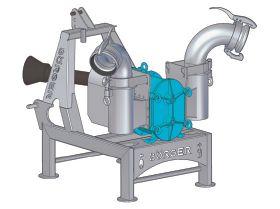
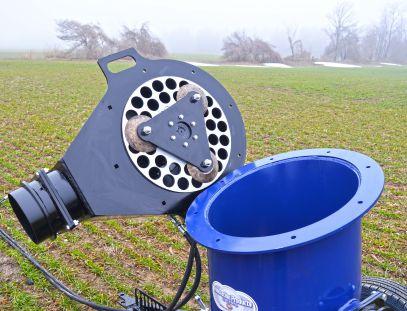
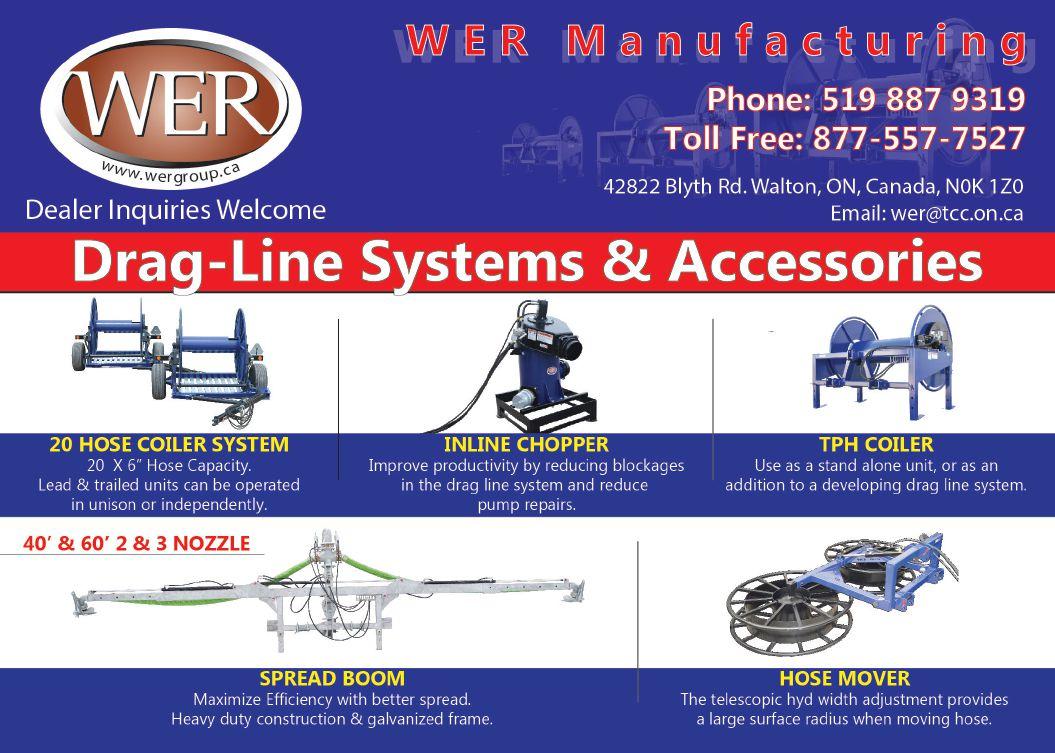
WER Manufacturing’s in-line chopper is installed between the agitator/feed pump and the main pressure pump in a dragline system or before the load pipe for tankers.
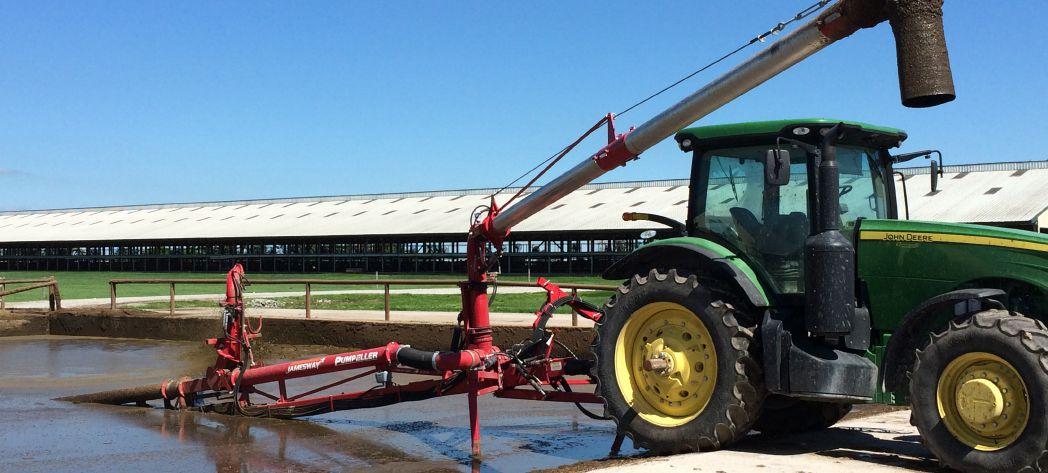
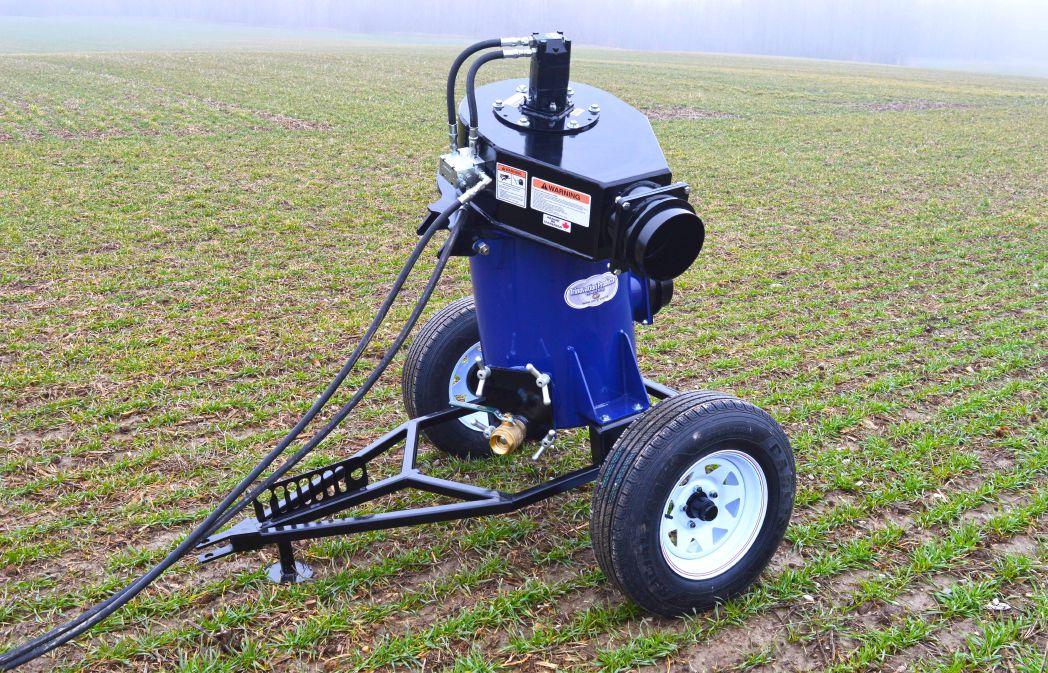
The Pumpeller hybrid turbine by Jamesway Farm Equipment provides maceration and the high-volume mixing of a propeller mixer with the reach of a high-pressure cannon in a single unit, without needing a submerged gearbox.
do anything else – grant or no grant – the majority see it as taking too long and a hassle so they don’t do it, even though there are proven yield benefits in the crop from doing it.”
According to Sutcliffe, Wisconsin and jurisdictions west of there mostly either mandate top spreading or are very strict about other options, making top spreading attractive.
“In Eastern Canada and the U.S. at the moment, regulations about top spreading seem more relaxed, with Ontario having probably the most relaxed rules I have come across,” he says.
The majority of spreading implements currently sold are therefore geared to surface distribution and Sutcliffe says that was one of the reasons for the development of the in-line chopper.
“That way you get rid of anything large enough to block nozzles on the spread booms, which are usually two- to threeinches in diameter and can still plug easily.”
Jamesway Farm Equipment of St-Francois-Xavier-deBrompton, Que., sells its products through about 200 dealers covering large areas of Canada and the U.S., with sales of its dairy and other equipment outside of North America by DeLaval. Their unique mascerator is called the Pumpeller. Its hybrid turbine provides the high-volume mixing of a propeller mixer and the reach of a high-pressure cannon in a single unit, without needing a submerged gearbox in the lagoon.
“Large and difficult solids feed easily into the large inlet, where they are chopped at 50 cuts per second as they enter the turbine,” says Ralph Fanning, sales manager. “Pumpeller mixes difficult lagoons in much less time and using much less fuel compared to conventional pumps.”
Tyler Misch, his father, Merv, and brother, Tanner, bought a Pumpeller in 2012 for spreading dairy manure at their operation (Misch Farms) in Dobbinton, Ont. They spread both their own dairy manure and a neighbor’s pig manure on their land. Tyler says the Pumpeller works really well and agitates their tank very quickly.
“The custom guy we had spreading for us (before we decided to do it for ourselves) was agitating for hours and hours, and we’re spreading within an hour,” he reports. “We have a thick crust with the dairy manure and the pump doesn’t have an issue. I also like that you can control everything from the tanker tractor.”
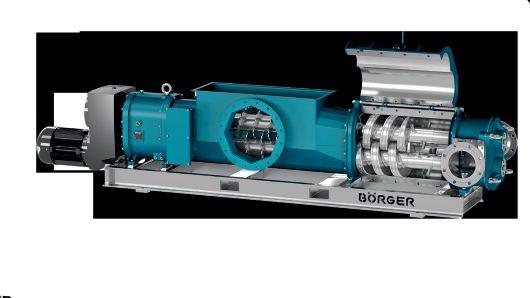
Boerger LLC offers its Rotorrake chopper all over North and South America. It’s a single-shaft inline coarse chopper with counter-blades cleaned by rotating cutting blades on both sides. Some models have a built-in debris catchment and different sizes provide throughput volumes of up to 800 m³/h. Sales representative Drew Vollbrecht says macerators are in higher demand these days, especially for digesters where a more consistent substrate stream provides higher gas yields.
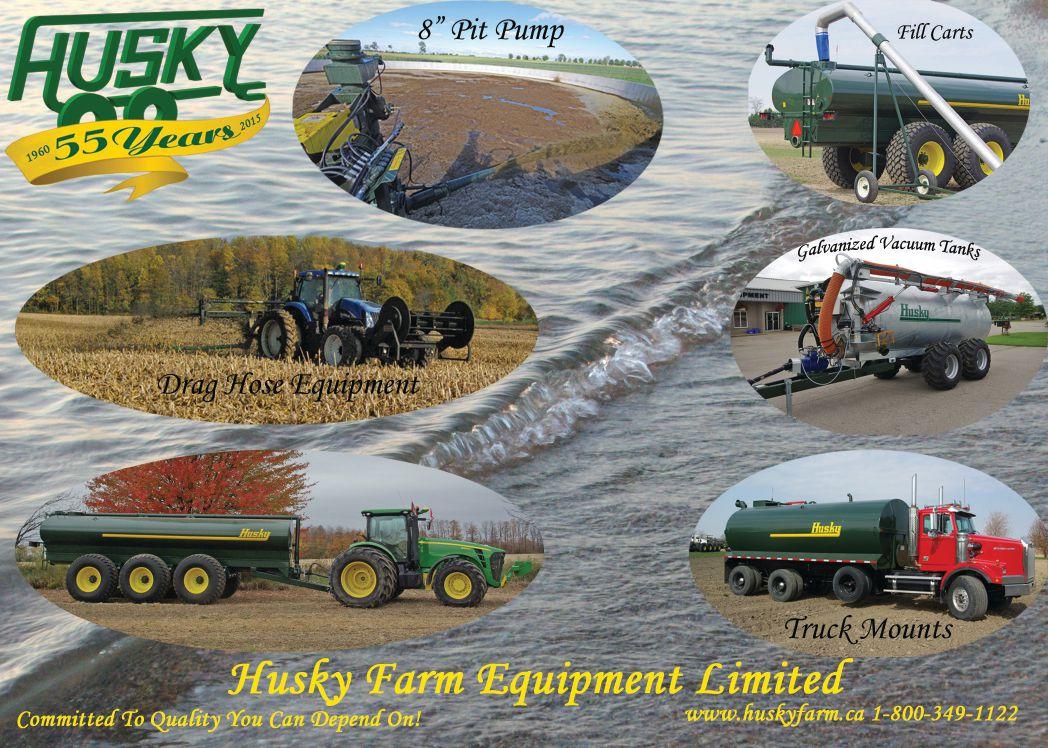
WER Manufacturing offers a fully mobile in-line chopper installed between the agitator/feed pump and the main pressure pump in a dragline system or before the load pipe for tankers. When it is used in conjunction with the firm’s on-board chopper, large chunks are hit twice when travelling through the system before they get to the smaller injector hoses/spread nozzles. Sutcliffe says self-sharpening rotary knives rotate with the circular action of the blade holder plate, as the blade plate rotates the rotary knives spin, creating a high-speed shearing action similar to a pair of scissors. The new quick access top hatch allows for a quick way to access blades for checking and replacement. The catchment area is accessible at the base or through the opening lid at the top of the unit.
Ontario Greenways in Mitchell, Ont. purchased a WER chopper for its injector about 10 years ago. Manager Steve Gloor believes macerators will be in demand in future in Ontario because manure injection will become more common.
“With the issues around run-off of phosphorus into surface water of Lake Erie, there will be changes to the Nutrient Management Act, and more and more, we’ll see a shift from surface application to injection of nutrients,” he says
•
•
•
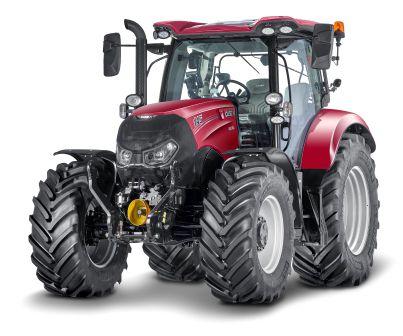
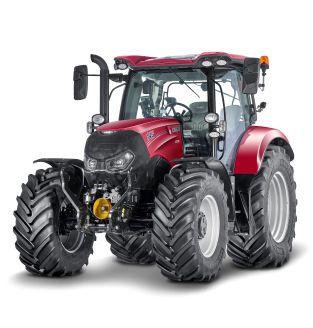
Case IH is launching a new lineup of Maxxum series tractors to handle the day-to-day demands of beef, dairy and row crop operations. Producers will be able to choose between three configurations – the ActiveDrive 4 semi-power shift transmission, the new ActiveDrive 8 dual-clutch transmission and the CVXDrive continuously variable transmission. Designed to increase productivity, the new ActiveDrive 8 24-speed transmission features eight power shift speeds in three electronically shifted ranges. The middle range offers working speeds between 2.4 and 10.7 mph without torque interruptions or requiring range changes. A key attribute of the new lineup is the ability to aggressively shuttle between forward and reverse. With just the simple push of a button, the responsiveness of the dedicated forward and reverse shuttle clutches can be tailored to a producer’s loading task. caseih.com
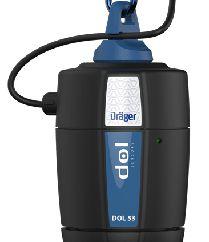
A newly-developed ammonia sensor has been launched by DOL that offers new opportunities to optimize the quality of the litter in livestock houses. With correct litter management, the ammonia level in a livestock house will typically be somewhere between 10 and 15 ppm when the concentration is at its highest. The pressure on the litter increases dramatically during the second and third weeks of life, when the broilers’ gain accelerates rapidly. Here is where a sensor can provide an “early warning” of potential problems before any visible sign that the litter is going bad. In a livestock house with poor litter management, ammonia concentrations can climb up to a level of 30, perhaps even 50 ppm in the course of just a few days. Perhaps without the producer being aware of this increase. An increased ammonia concentration can result in a higher feed consumption (FCR) and lower gain, just as the welfare of the broilers is impaired. dol-sensors.com

resistance (MP Series) Low head transfer to high head booster pumps

or nearly 40 years c lear s pan
s tructures has been providing structural solutions for composting needs of any size.
i ndustry - l eading w arranties - ClearSpan structures are built to last with triple-galvanized steel frames and durable covers.
c ost - e FF ective b uilding s olutions - Drastically reduce construction costs, monthly utilities and maintenance requirements.
F inancing a vailable - Speak to your Truss Arch Specialist today.


BY MARGARET
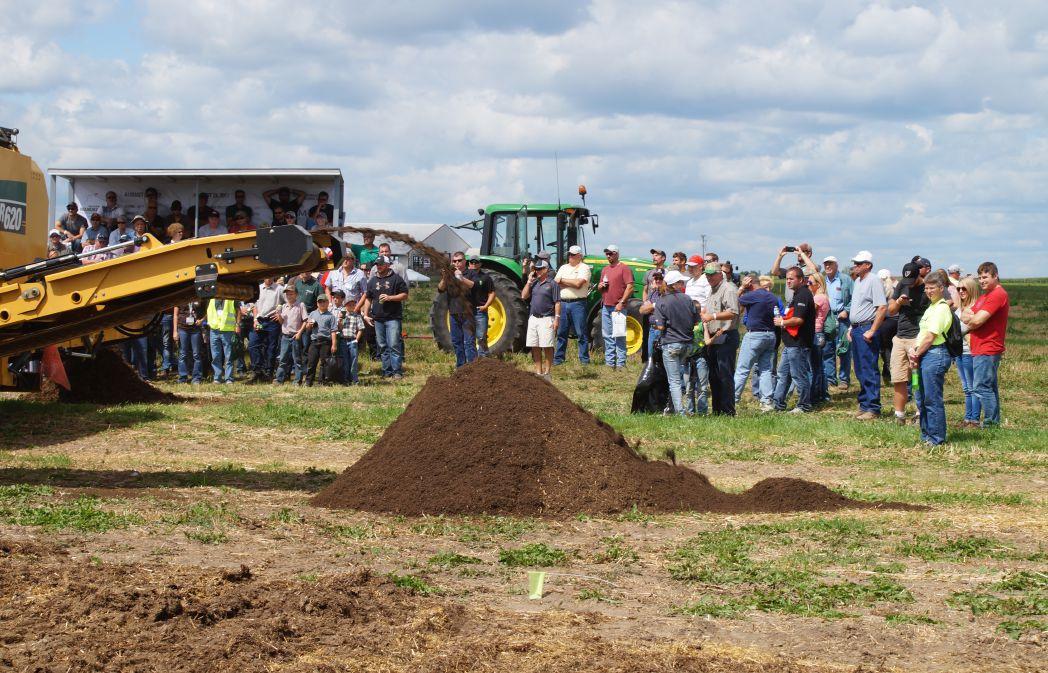
The sun has set on another edition of the North American Manure Expo, which was held in midAugust at the University of Wisconsin’s Arlington Agricultural Research Station near Arlington, Wisc.
More than 1,000 attendees visited the show over the two days, taking part in area farm tours, educational sessions and equipment demonstrations plus viewing the latest manure management technologies within the expo’s extensive trade show area.
“It was a very successful show, thanks in part to everyone involved, including Mother Nature as she cooperated providing excellent weather both days,” said Richard Halopka, Columbia County University of Wisconsin Extension agricultural agent and co-chair of the 2017 NA Manure Expo planning committee. “A show of this magnitude is only successful with everyone working for a common goal and I believe the success was in part because of the combination of education and demonstration of equipment to provide environmentally responsible manure application practices. The theme of Innovation, Research, Solutions was demonstrated both days as what is perceived as a problem can
become an opportunity when innovated, researchdriven individuals on a team can develop a solution.”
“I would like to thank all vendors, volunteers, committee persons, educational presenters and the people who attended 2017 NAME,” he added.
Planning will soon be underway for the 2018 North American Manure Expo.
“South Dakota State University, SDSU Extension, and regional partners look forward to hosting the 2018 North American Manure Expo at the Swiftel Center in Brookings, South Dakota, on August 15 and 16, 2018,” said David Kringen, a field specialist in water resource with SDSU Extension and one of the people involved in preparing for the 2018 event.
“The planning committee looks forward to delivering top-notch tours and quality educational information to both the local and national manure management industry regarding nutrient management planning and utilization, soil health, water quality, and more.
On behalf of the South Dakota NAME planning committee, we welcome you to Brookings, SD in 2018.”
Details about next year’s expo will be posted to manureexpo.org as soon as they are available.