President Mike Fredericks mfredericks@annexweb.com
Publication Mail Agreement #40065710 RETURN UNDELIVERABLE CANADIAN ADDRESSES TO CIRCULATION DEPARTMENT, P.O. BOX 530, SIMCOE, ON N3Y 4N5
e-mail: subscribe@manuremanager.com Printed in Canada
Circulation
e-mail: subscribe@manuremanager.com
Tel: 866-790-6070 ext. 211
Fax: 877-624-1940
Mail: P.O. Box 530 Simcoe, ON N3Y 4N5
Subscription Rates
Canadian Subscriptions
$35.24 Cdn, one year (with GST $37.00, with HST/QST $39.82)
U.S. Subscriptions:
$47.00 USD, one year
Occasionally, Manure Manager will mail information on behalf of industry-related groups whose products and services we believe may be of interest to you. If you prefer not to receive this information, please contact our circulation department in any of the four ways listed above.
All advertising is subject to the publisher's approval. Such approval does not imply any endorsement of the products or services advertisted. Publisher reserves the right to refuse advertising that does not meet the standards of the publication.
Website: www.manuremanager.com
By Margaret Land
Alarming algae
In late July and early August, about one million residents around Toledo, Ohio, were left parched after being placed under a water ban. They were warned not to drink, cook or bath in water from their taps due to a large algae bloom in Lake Erie, which, at one point, completely surrounded Toledo’s water intake facility. Algae blooms – known to produce toxins that can cause seizures and paralysis in people, animals and birds – are not new to Lake Erie. But, according to scientists, they have been on the increase for the past 10 years, “in spite of negligible change in the annual load of total phosphorous,” according to Richard Stumpf of the National Oceanic and Atmospheric Administration (NOAA), based in Maryland, and lead author of a research paper on cyanobacterial blooms.
What’s causing this increase? “We show that long-term trends in agricultural practices are consistent with increasing phosphorous loading to the western basin of the lake, and that these trends, coupled with meteorological conditions … produced record breaking nutrient loads,” stated Anna Michalak of the Department of Global Ecology at Stanford University, California, describing a large bloom in 2011. “We further find that all of these factors are consistent with expected future conditions. We can therefore expect this bloom to be a harbinger of future blooms in Lake Erie.”
Fast forward to early August 2014. Following the water ban, the finger pointing began with many looking at agriculture as the culprit.
The Maumee River watershed is the largest feeding into western Lake Erie. It’s also 73 percent agricultural land. According to data presented in Michalak’s research paper, dissolved reactive phosphorous (DRP) loading in the watershed has increased by 218 percent between 1995 and 2011, while runoff has increased by 42 percent.
“Long-term trends in agricultural nutrient management practices … are consistent with a potential for higher nutrient loading,” she stated in her paper. “Three management practices – autumn fertilizer application, fertilizer being broadcast on the surface rather than being injected in the soil, and conservation tillage – can create conditions for enhanced DRP runoff.”
To help tackle the problem, Ohio Senator Mike Sheehy is proposing tighter rules for Confined Animal Feeding Operations, including a ban on manure application during the winter.
But the U.S. federal government is also looking at conservation programs to help reduce phosphorous runoff. In late August, U.S. Senator Sherrod Brown announced an additional $1 million in emergency funds to reduce runoff in the Western Lake Erie basin. This funding is in addition to $2 million from the Natural Resources Conservation Service (NRCS) – announced earlier in the month – to help farmers enroll in the Environmental Quality Incentives Program (EQIP).
It’s hoped this is just one of many funding announcements aimed at assisting farmers, already charged with supplying food to the world, in protecting the environment for the betterment of all society.
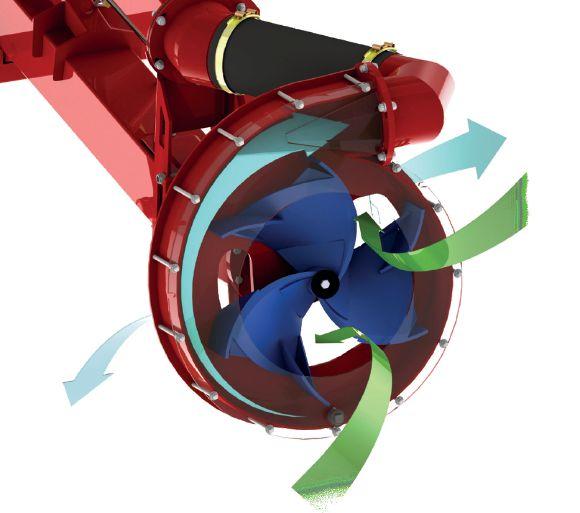
The PUMPELLER® Hybrid Turbine revolutionizes manure pump performance. Incredible intake suction pulls solids into the cutter knives, reducing the toughest crust to nothing in just seconds. The turbine combines the high-volume mixing of a propeller agitator with the power and reach of a lagoon pump, the resulting hybrid design radically outperforms both.
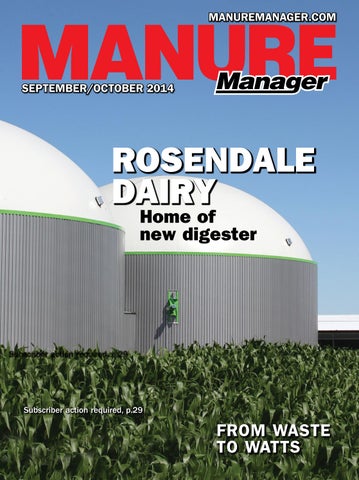
ROSENDALE DAIRY
Home of new digester
By Tony Kryzanowski
B’gosh, University of Wisconsin – Oshkosh seeks global leadership in biodigester tech
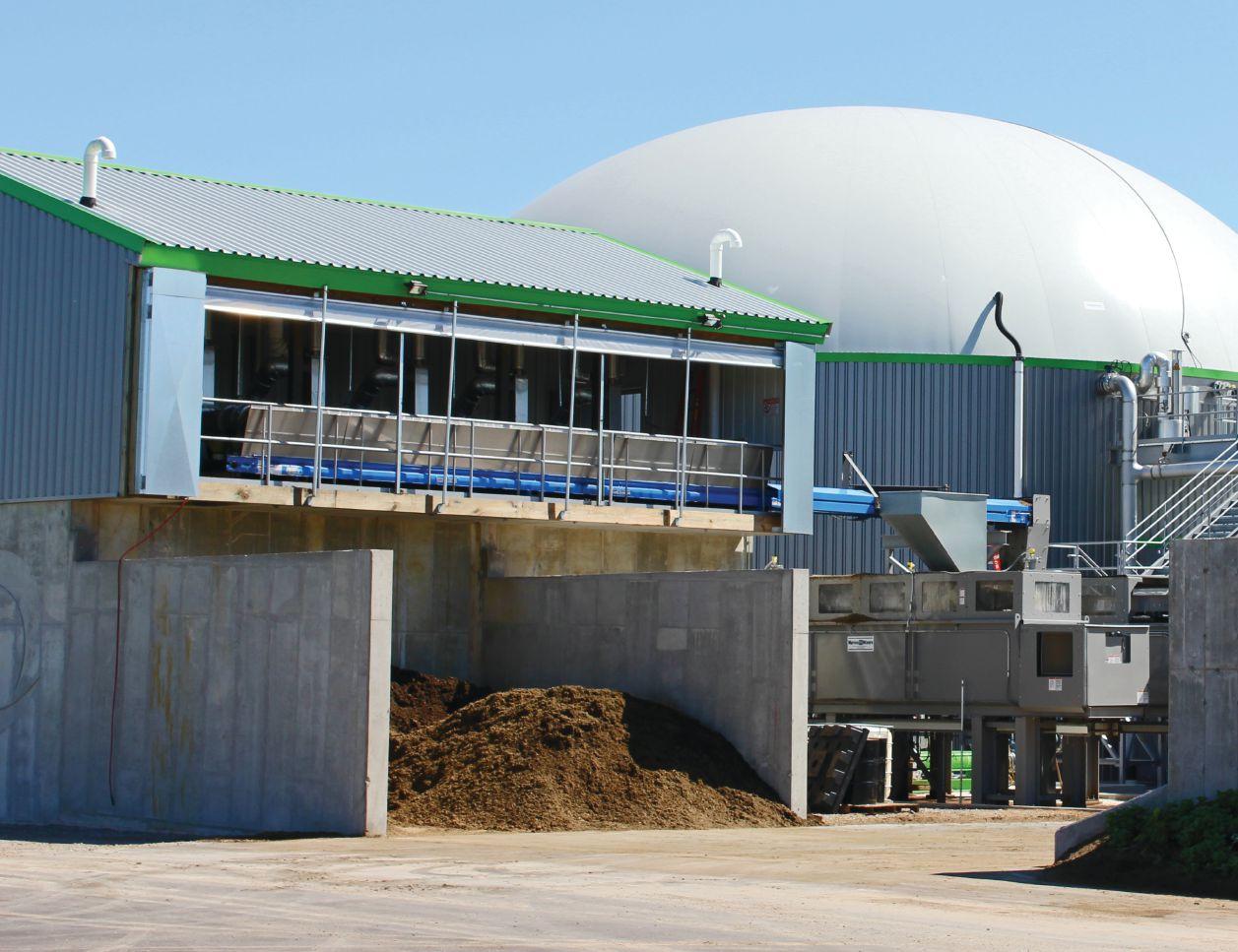
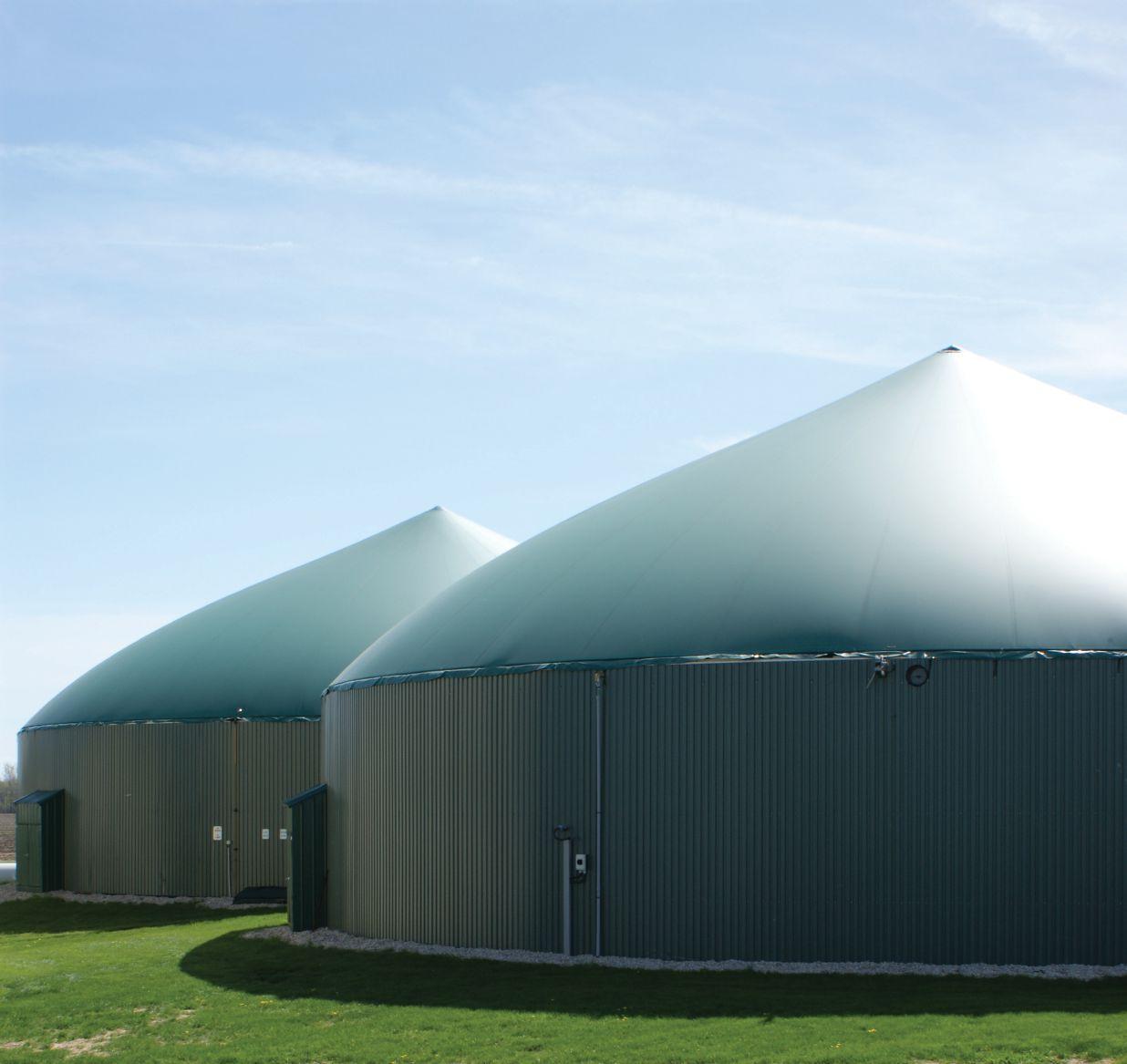
Oshkosh, Wisconsin, is best known for the clothing line, Oshkosh B’gosh, but the Oshkosh campus of the University of Wisconsin is hoping that it will also become known as a global leader in biodigester technology within the agricultural world. That reputation recently took a giant leap forward with the launch of a new $10 million, 1.4 megawatt (MW) biodigester at the state’s largest dairy, financed and operated by the University of Wisconsin –Oshkosh Foundation.
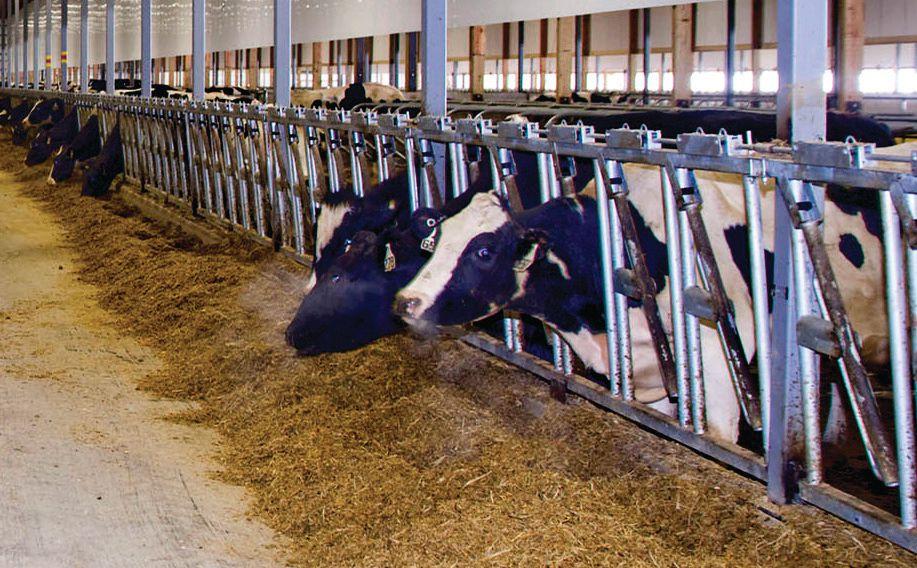
Located at the Rosendale Dairy, owned by the company Milk Source, the biodigester will process 240 tons of manure per day from the dairy’s 8,500 cows, generating biogas burned as fuel in power production and a pathogen-free and nutrient-rich waste stream that is land applied as organic fertilizer. Some will be used on the dairy’s own farmland and the rest marketed at a discounted rate compared to commercial fertilizer to the dairy’s feed providers for use on their land. The 240 tons of manure mixture processed in the digester consists of 23 percent solids collected at the dairy and up to 58,000 gallons of liquid manure to attain optimum biogas production.
The foundation will collect the income from the sale of power from the digester, which is being sold under contract at 9.2 cents per kilowatt-hour to local power utility, Alliant Energy. Although the biodigester
could produce up to 2.2 MWs of power, the foundation was only able to negotiate a contract for up to 1.4 MWs.
The facility, which began producing power last December, will also include a public education center and a research laboratory for use by UW – Oshkosh students and staff. The dairy is located about 25 kilometers away from the university campus.
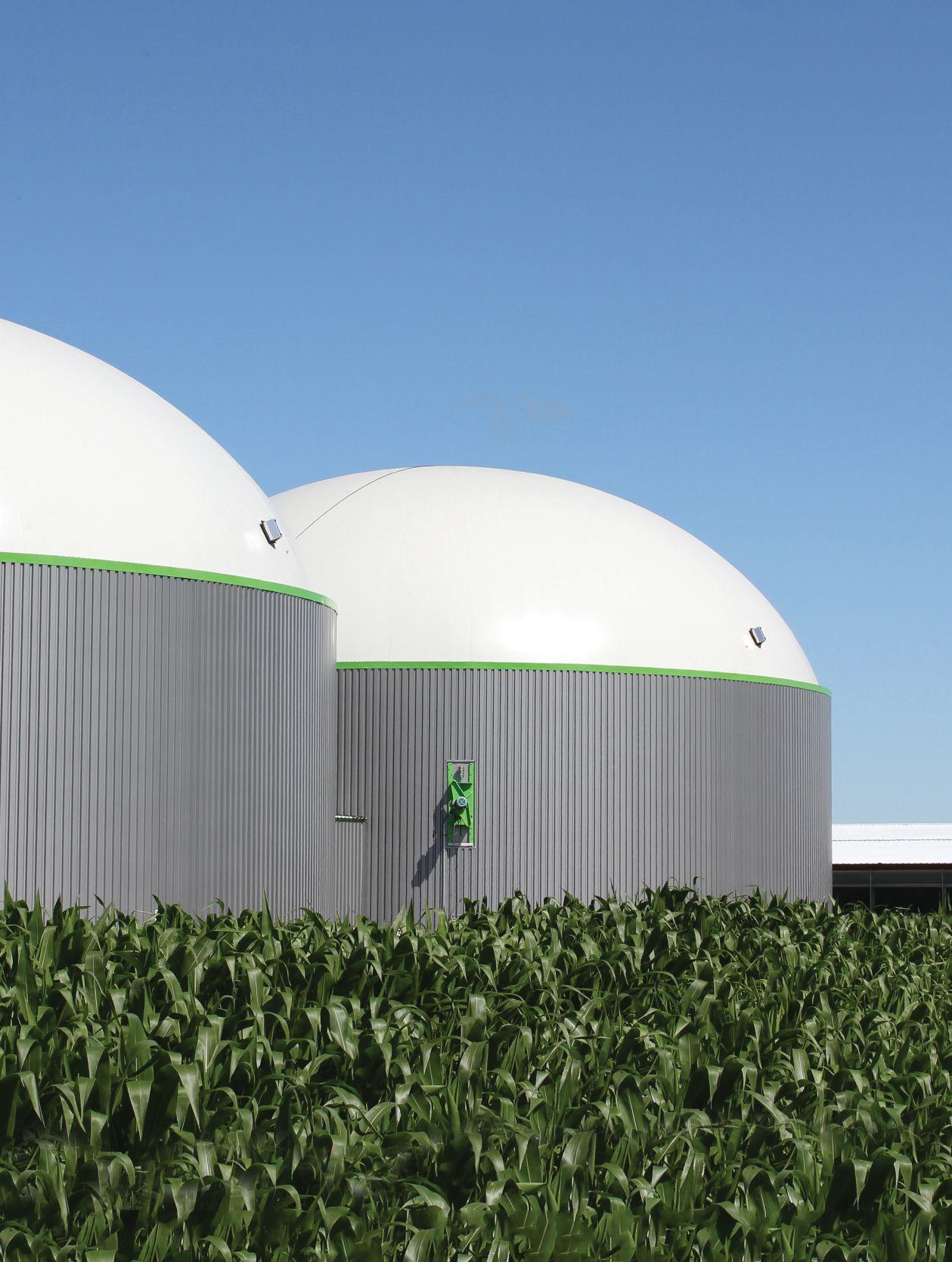
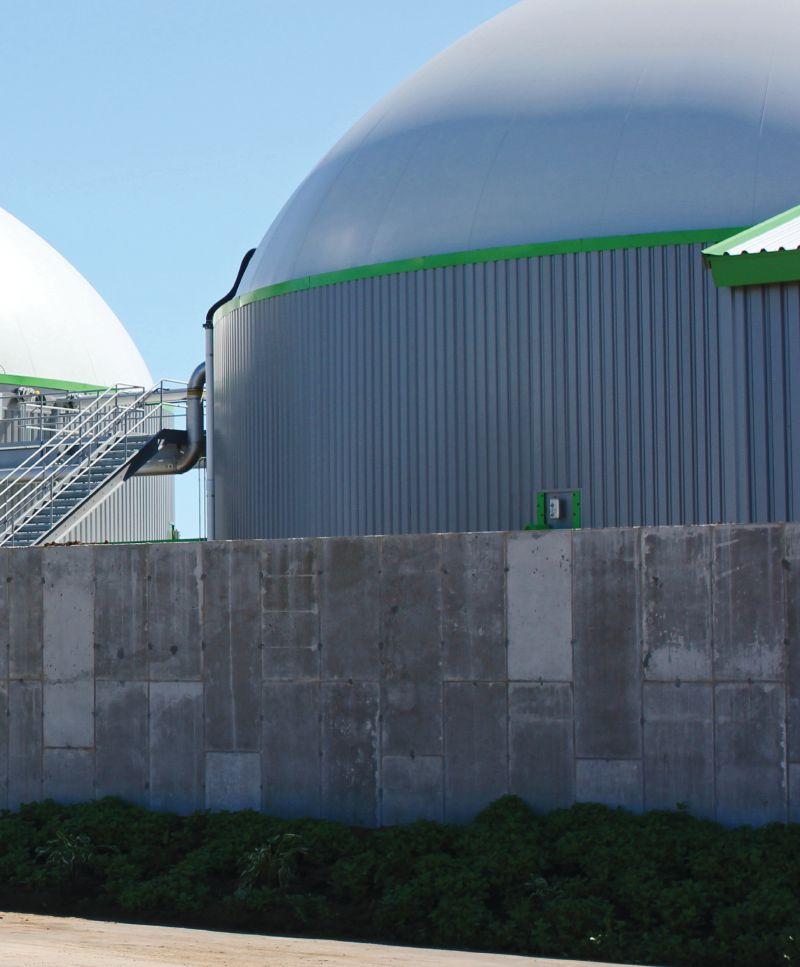
But this latest investment in biodigester technology is only one piece of the puzzle at UW – Oshkosh. This project is the third digester constructed through a partnership, established in 2011, between Wisconsinbased biodigester technology company, BIOFerm Energy Systems, and the university. BIOFerm, a division of the German company Viessmann Group, won the bid to construct the biodigester at Rosendale Dairy, which consists of two cylindrical digester reactors, each with a one-million-gallon capacity. The reactors were constructed by Pipping
Concrete, with the 80-foot diameter and 30foot tall structures consuming about 2,000 yards of concrete.
The power generation system was supplied by 2G Cenergy and features a complete gas treatment system and an avus 1426 Jenbacher engine to generate power. The heat generated by the engine is used to maintain consistent temperature in the biodigesters, which is an important consideration since Wisconsin can experience very cold winter temperatures.
BIOFerm Energy Systems has also partnered with UW – Oshkosh in the construction of a dry-fermentation digester that opened in 2011 plus a small-scale biodigester, called the Titan 55, aimed at dairy farms between 100 and 400 cows. It is located on the Allen Farm about eight kilometers from the university campus and is rated at being able to produce about 55 kilowatts of power.
Left: A total of $10 million will be spent by the University of Wisconsin - Oshkosh Foundation to own and operate a biodigester as well as a learning center at the Rosendale Dairy.
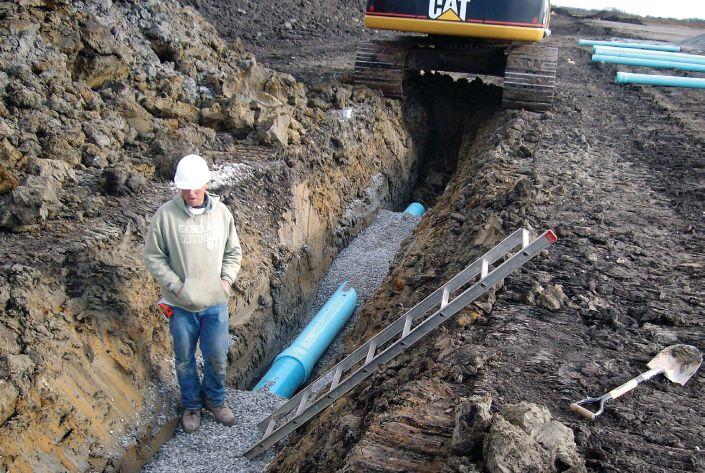
Below: Liquid manure is piped from the Rosendale Dairy collection system to the biodigester owned and operated on site by the University of Wisconsin - Oshkosh Foundation.
The Rosendale Dairy biodigester is capable of producing seven times more energy than the dry-fermentation biodigester, and will generate enough electricity for 1,200 homes.
“We would like people in the biodigester field or in the agriculture world, if you mention the word Oshkosh, to say ‘Oh yeah, I know about their systems’,” says Tom Sonnleitner, vice-chancellor for administrative services at UW – Oshkosh. “That’s what I’d like to see. If we can create this niche for Wisconsin, and not just for Oshkosh, then we’ve won.”
He adds the university is already attracting considerable interest from a variety of sources on how its biodigester technology might be applied in other circumstances, one location being a fishing community in Alaska. They are particularly interested in the small-scale biodigester technology using waste material from a
salmon processing plant to produce biogas as a fuel source to generate electricity that would replace the expensive diesel they burn now to generate power.
Altogether, the three biodigesters are making a significant contribution toward the university campus’s goal of achieving carbon neutrality by 2025. It intends to use the carbon destruction credits it acquires from the Rosendale Dairy biodigester project as both an income source and a resource toward achieving that carbon neutrality goal.
“Beyond producing heat and electricity that meaningfully negate our campus’s carbon footprint, we view our fleet of biodigesters as living, learning laboratories for students, faculty and the communities we serve,” says Arthur Rathjen, UW – Oshkosh Foundation president. “And we are confident our digesters, as their production scales up and their impact becomes even
Contributed photos
more widely known, will draw agricultural, industrial, and other types of enterprises to our campus and region.”
The university was actually approached by Milk Source to help it address the odor complaints it was receiving from some of its Rosendale Dairy neighbors, and after a three-year-long careful and thorough review, the biodigester and learning center concept came together along with the financing.
“We’re not bioenergy experts but dairy and crop farmers,” says Jim Ostrom, Milk Source co-owner. “We spent several years looking for somebody who could fit the bill and we were lucky. We have one of the most forward thinking, professional organizations in the UW – Oshkosh Foundation just down the road from us and those folks have a very similar mission on sustainability, so I think it is a really great combination.”
The Rosendale Dairy is one of six dairies owned by Milk Source in Michigan and Wisconsin. It was co-founded in 1999 by Jim Ostrom, John Vosters and Todd Willer – each with multi-generational Wisconsin family farms. The Rosendale dairy was built from scratch about seven years ago at a cost of about $75 million.
Ostrom says there has been a strong desire, starting early on from area community leaders, for the dairy to install a biodigester to help reduce the odor emanating from the farm. It has been taking remedial action from day one on this issue, including covering lagoons and installing expensive manure management
systems. The dairy uses sand for bedding and has installed a McClanahan sand separator to separate the organic matter from the sand so that it can be recycled. The organic material is processed through six FAN screw press separators to separate out solids from the liquid stream, and the liquids are processed further through a horizontal centrifuge to separate even more solids from the liquid stream. Ostrom says they use a highly controlled lagoon system where liquids are stored based on nutrient content.
With the installation of the biodigester and processing of a combination of waste solids and liquids from the dairy through the digester, Ostrom says there has definitely been a reduction in odor. The processed digestate is transported and stored within the dairy’s lagoon system and is land applied in spring, fall and winter as organic fertilizer.
“The nutrients are probably the second most valuable product that we sell,” says Ostrom. “Chemical fertilizer is very expensive these days and we have an organic form of fertilizer in the form of manure and it is probably better for the crops. It’s more sustainable and it’s better for soil tilt and organic matter. So we didn’t want to part with the nutrients but wanted to improve the product . . . what processing the manure through the digester does is change the crop availability of it and it drops the odor component of the manure modestly.”
He adds the dairy takes a sustainable approach to its herd management, match-
ing the amount of feed the cows consume per acre of crop with the amount of manure returned to the soil to replace the nutrients lost by raising and harvesting the crop.
“The number one question I get is: ‘What are you doing with all the manure?’” says Ostrom. “The answer is that we only have enough manure for about 12 to 14 percent of the land within a 10 mile radius of the dairy.” The rest comes from other dairy farms or chemical fertilizers from other parts of the world.
“To be able to get the nutrients they need four of five miles down the road is a win for the local crop farmers, a win for the crops and it is sustainable for cows,” says Ostrom.
Rosendale Dairy has leased the site for both the biodigester and learning centre to the UW – Oshkosh Foundation, and has installed a piping system from its manure collection system to supply the biodigester.
In addition to production of biogas and odor reduction, another benefit from processing manure through a biodigester is the environmental benefit of decreased phosphorus and nitrogen run-off.
The learning center, which is currently in the planning stages, will function as an extension facility to programs such as microbiology and environmental engineering offered at UW – Oshkosh, with a major dividend for the biogas renewable energy industry and agriculture sectors being that the campus is delivering graduates who have an understanding and applicable training to work in this growing industry. In fact, graduating students are finding jobs within this sector. It will also serve an important educational and public relations role with tours for kindergarten to Grade 12 students.
Ostrom says having the learning center located at the dairy is an important part of what Milk Source wants to accomplish in its messaging to the public.
“We spend a lot of energy communicating with the public for one reason,” says Ostrom. “The reason is that human beings in the evolution of the last 100 years are further and further away from understanding agriculture. We need the public to understand how we take care of our cows and how we take care of our environment, because they don’t have the practical understanding of what our grandfathers may have had. I think the learning centre will help to show people in an interactive way how we produce high quality milk and how we take care of high quality cows.”
As the largest dairy in Wisconsin with 8,500 cows, community leaders around the Rosendale Dairy strongly urged the owners to invest in a biodigester for odor control.
STAYING in the FIELD
By Tony Kryzanowski
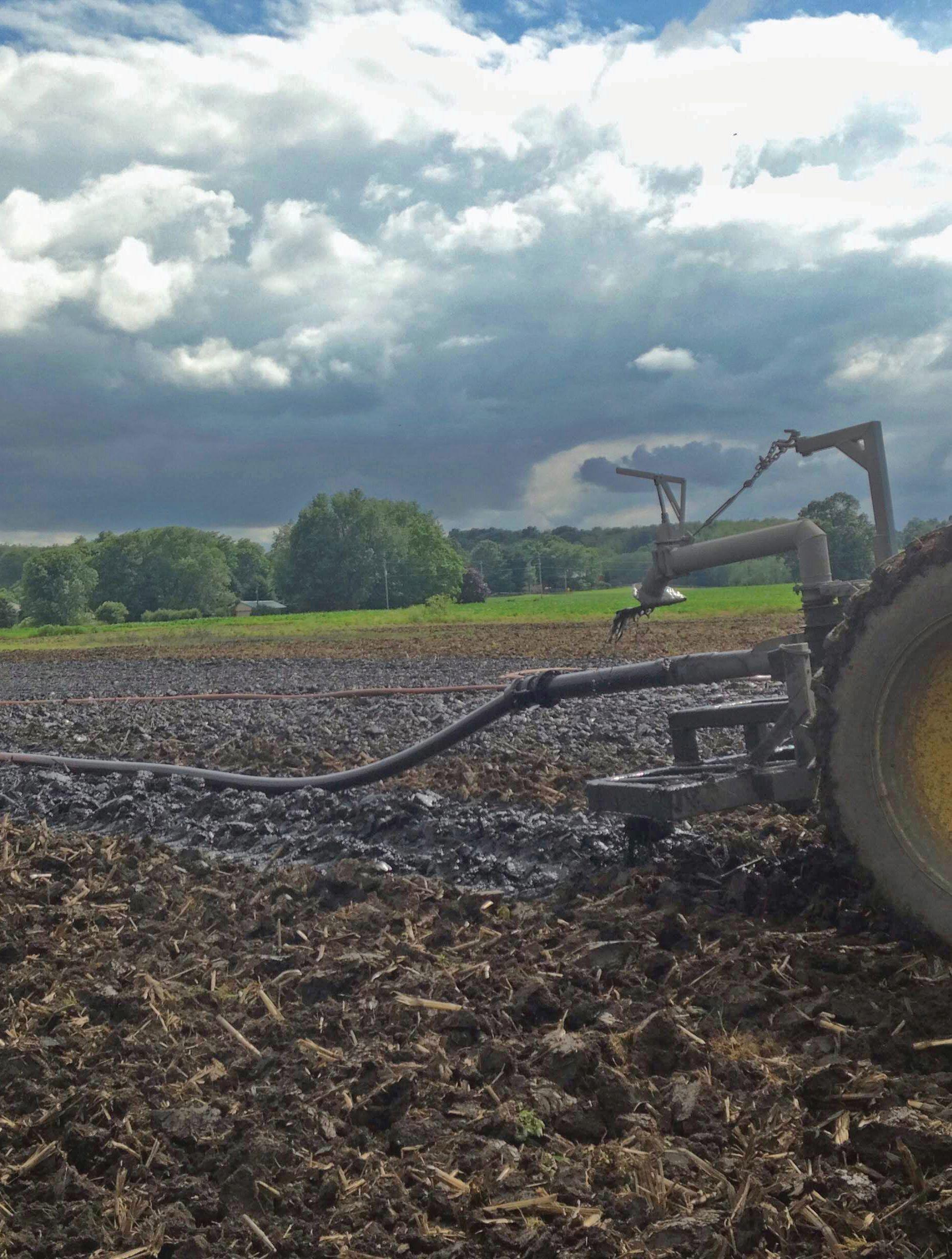
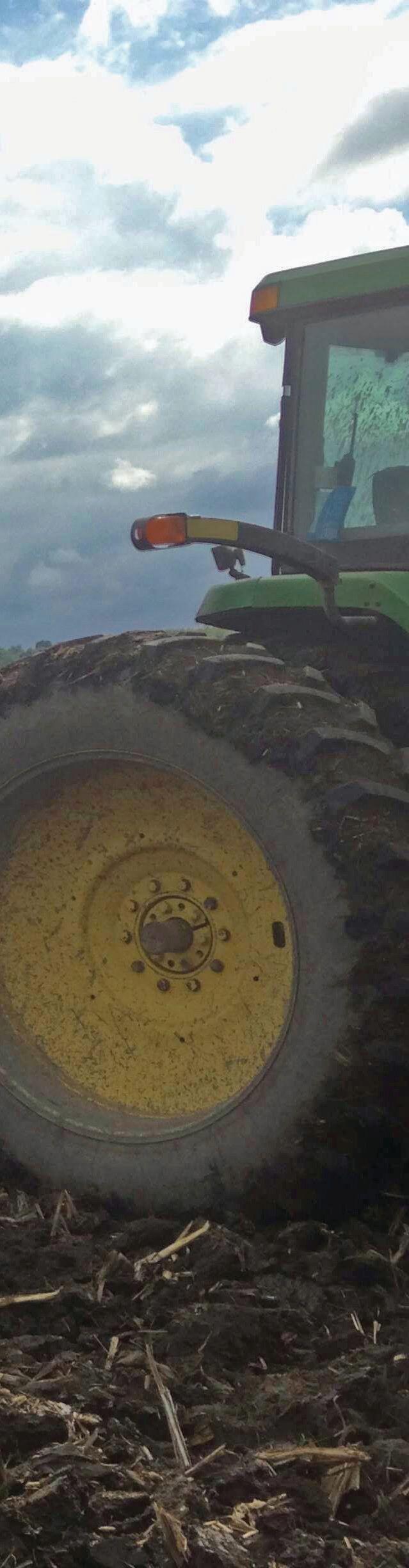
The drag hose attached to a Carmony Stock Farms tractor makes a turn on a customer’s field near Wooster, Ohio. The company is able to offer drag hose manure application exclusively because of high local demand from dairy and hog farms.
Ohio custom applicator chooses helping hog producers over producing hogs
Carmony rhymes with harmony and that’s the best description for Carmony Stock Farms. They are an Ohio-based, custom manure applicator that foresaw a brighter future providing this service in combination with grain farming than raising hogs because of constraints limiting how large their hog business could grow.
Despite exiting the hog business, Carmony Stock Farms still provides an invaluable service to the area’s dairy and hog sectors, viewing themselves as a vital tool for other farmers by helping them to fulfill their manure disposal and application needs.
While still active in grain farming, Ross Carmony, with the grateful assistance of long-time employee and family friend, Henry Braun, has built a well-respected custom manure application business. His sons, Clint and Sam, are also part of the business. The company provides drag hose liquid manure application service exclusively to clients in the central Ohio area. At present, they apply over 100 million gallons of liquid manure annually within about a 100 mile radius of Wooster, Ohio, which is located about halfway between Cleveland and Columbus.
Wayne County, where Wooster is located, is home to the largest concentration of dairy farms in Ohio, explaining why 75 percent of the Carmony Stock Farms customer base comes from that agricultural sector, with the remainder primarily from hog farms.
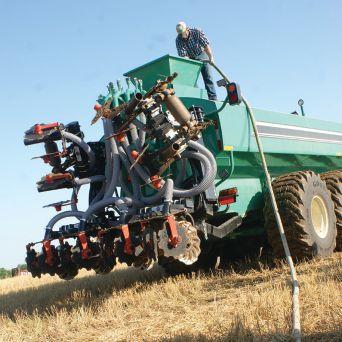
They supply three types of custom manure drag hose application services. These are surface application with a splash pan toolbar, an injection toolbar system, and a GenTill toolbar system. This system perforates the soil and allows the manure to seep into the ground. When customers want to apply manure longer distances from their farms, Carmony Stock Farms offers a ‘Tank ‘n Drag’ service, where they deliver the liquid manure with tanker trucks to a holding tank near the field site, and use surge pumps to feed their drag lines in the field.
“We’re here to help our clients meet their margins and keep them in business so that we can stay in business” says
Sam Carmony. “We still have our original customers and we are always invited back.”
That speaks volumes because Carmony Stock Farms does not sign contracts with its customers but depends on their continued satisfaction with the custom manure application service provided by the company. Sam adds that they are still a bit ‘old school’ in how they deal with their customers, where a phone call and handshake is as solid as a signature on a contract.
They provide manure pumping and application services to farm operations of all sizes, from as small as 100 milking dairy cows to large confined animal feeding operations (CAFOs), and have never had a reason to expand into a tanker manure application system because of the amount of business they attract and the satisfaction their customers have with their drag hose systems.
“We can grow probably as much as we want to but we are more focused on servicing the customers that we have correctly and making sure that their needs are met before we start to expand into other markets and doing other things,” says Sam.
Ross Carmony has a degree in agricultural economics from Ohio State University and built his farm business on hog and grain farming. Back in 1979, he developed a custom manure pumping and irrigation system for the hog farm, where manure was pumped from the lagoon through hoses to irrigation guns. About a decade later, he developed his first drag hose system for use on the farm and requests from his neighbors began arriving to help them dispose of their manure in the same way.
By about 2000, he recognized that growth of the hog business was constrained for two reasons. The first was finding enough good employees to operate the grain, hog and custom manure application divisions of the business. The second was the inability to grow the hog operation on the main farm site because it sits directly adjacent to city limits. So Ross shut down the hog division and dedicated his time to grain and custom manure application. The hog barns are still in operation, but have been rented out for use by other hog producers.
Henry Braun has been with the business since the 1990s and has been instrumental in helping to design and build their custom pumping units. Once the family made the commitment to custom manure application, and Ross and Henry worked hard to establish their core of repeat clients, Clint, who has a business economics degree from Ashland University, and Sam also joined the business. With more hands on deck, this has helped to expand the equipment fleet and grow the business.
The Carmony story is becoming more common in farm circles. Some farmers have recognized both the business opportunity and lifestyle benefits of developing a professionally managed, custom manure application business. It helps that there is significant demand for this service, particularly in areas of high concentrations of dairy and hog farms. Also, as farms grow bigger and nutrient management guidelines become more demanding, many custom manure applicators have discovered that, depending on their location, they have the opportunity to grow as large as they’d like, with the most constraining factor often being just finding enough employees to fill a crew complement.
One lifestyle benefit is knowing exactly when the business will be operating full out and when the weather makes it impossible to operate, meaning the business owner and employees can actually plan a vacation away from the business.
However, when the phone starts ringing from their well-established list of clients, they understand their equipment needs to be ready to go and they must be prepared to work very long hours for long periods of time, provided it’s not raining, to meet customers’ expectations. So, there is pressure involved in operating a successful custom manure application business, but it is a different kind of pressure wrapped around working very hard within a defined time interval, human resource management, and attention to detail when applying the manure.
The Carmony’s recognize grain farming is a good complement to a custom manure application business because there is potential cross over in equipment usage, particularly with tractors, between the two businesses. Also, both types of farm-based businesses have defined seasons. They crop 800 acres, consisting of corn and soybean.
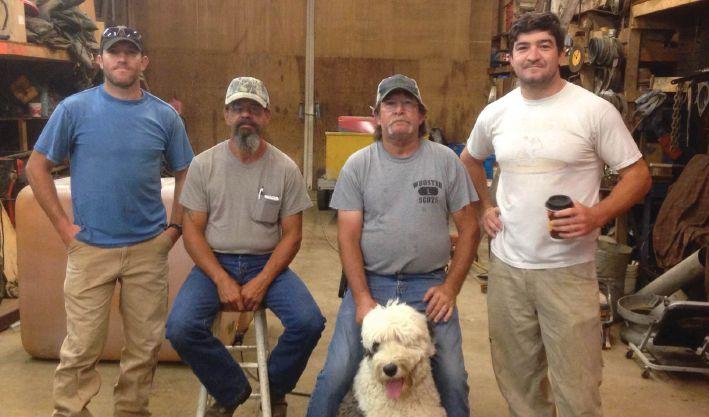
The foursome of (left to right) Clint Carmony, Henry Braun, Ross Carmony, and Sam Carmony are the core group working at Carmony Stock Farms, with assistance from sheepdog, Watson, applying about 100 million gallons of manure annually.
When the phone starts ringing, custom manure applicator, Carmony Stock Farms, knows that the company’s equipment has to be ready to move.
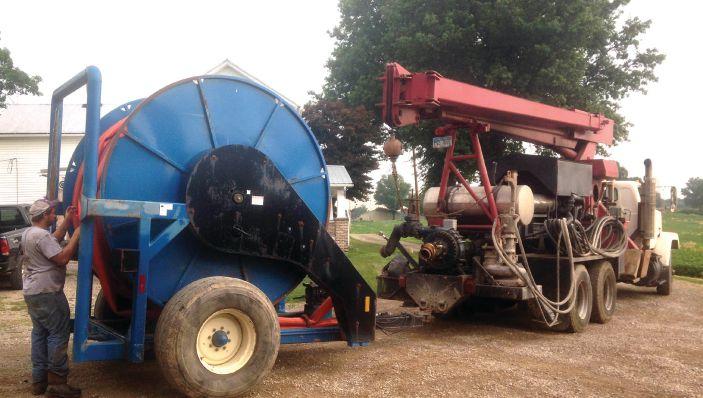
Ross Carmony and Henry Braun have combined their efforts to design four custom pumping units for use by Carmony Stock Farms.
Don’t let manure handling agitate you. Save time and fuel with More Than Manure® (MTM®) Nutrient Manager. MTM can break through crusts and solids in pits and lagoons, and cuts down on foam when pumping into tanks, so manure is easier to handle with less agitation. Visit us at sfp.com to request a free MTM kit.
“The manure pumping operation really makes it possible for us to be efficient grain farmers and vice versa,” says Sam. “Because we need so much equipment for manure pumping, we have equipment that we can use in both endeavors.”
Given the demands for better nutrient management and rising costs of commercial fertilizer, there is no doubt that Ross Carmony entered the custom manure application business at precisely the right time, but because there was little
by way of off-the-shelf equipment when he first started, he developed his own, customized pumping units with Henry Braun’s help. After starting with one custom built pumping unit, the company has since evolved to four pumping units and a total of six employees. Because manure application is so weather-dependent and there is a great need to apply the manure for customers in a timely manner, they will often have three application jobs on the go and at various stages at one time, with their
busiest seasons being the spring and fall.
Bambauer is their main drag hose, hose reel, injector toolbar and pump supplier, one reason being that they are handy, with a location in southern Ohio.
“We started using their equipment and they’ve been effective at creating efficient equipment that works well, and it’s sort of one-stop shopping for us,” says Sam. Bambauer has also been responsive, he says, to listening to their needs and working hard to address those needs.
In addition to Bambauer equipment, Carmony Stock Farms also uses Cornell and Doda pumps, Houle agitators, Cornell flow meters, and John Deere tractors.
They have enough hose to apply up to three miles away from the customer’s lagoon. Most often, the manure is applied on the customer’s farmland, but, occasionally, there are neighbors who also want the liquid nutrients applied on their land as well.
An interesting aspect to how they manage their custom manure application business is they give the customer the option of providing their own tractor, with Carmony Stock Farms providing the pumping rig and manure application equipment as well as the crew to run it. It varies from farm-to-farm, Sam says, and with the years of experience they have supplying many of their customers, they have a good understanding of what equipment is needed for each customer.
Most customers will have a good idea of how many gallons of manure they want applied per acre based on discussions with their agronomist and the nutrient content of their manure. Carmony Stock Farms controls the application rate based on formulas they use pertaining to the flow rate of the manure through the drag hose and speed of the tractor, and these can be adjusted depending on the customer’s requirements for various parts of a field.
“I would say the number one concern of our customers when we do a job is safety and then the second concern is the correct amount of nutrients applied on the field,” says Sam. “We strongly try and make sure that nothing leaves the property through our application techniques.”
As the saying goes, the pursuit of happiness is not always wanting more but being satisfied with what you have, which describes Carmony Stock Farms to a tee as they base their success on a list of satisfied customers and years of repeat business.
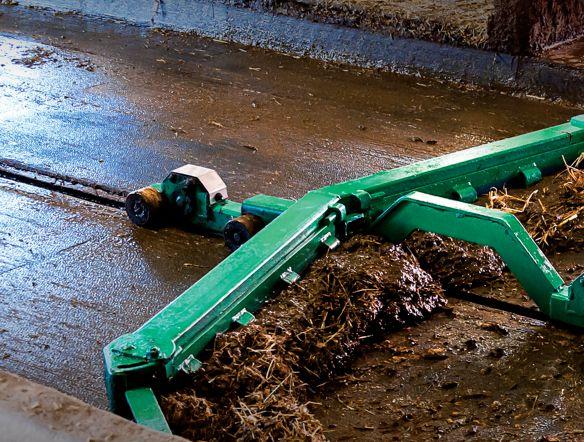
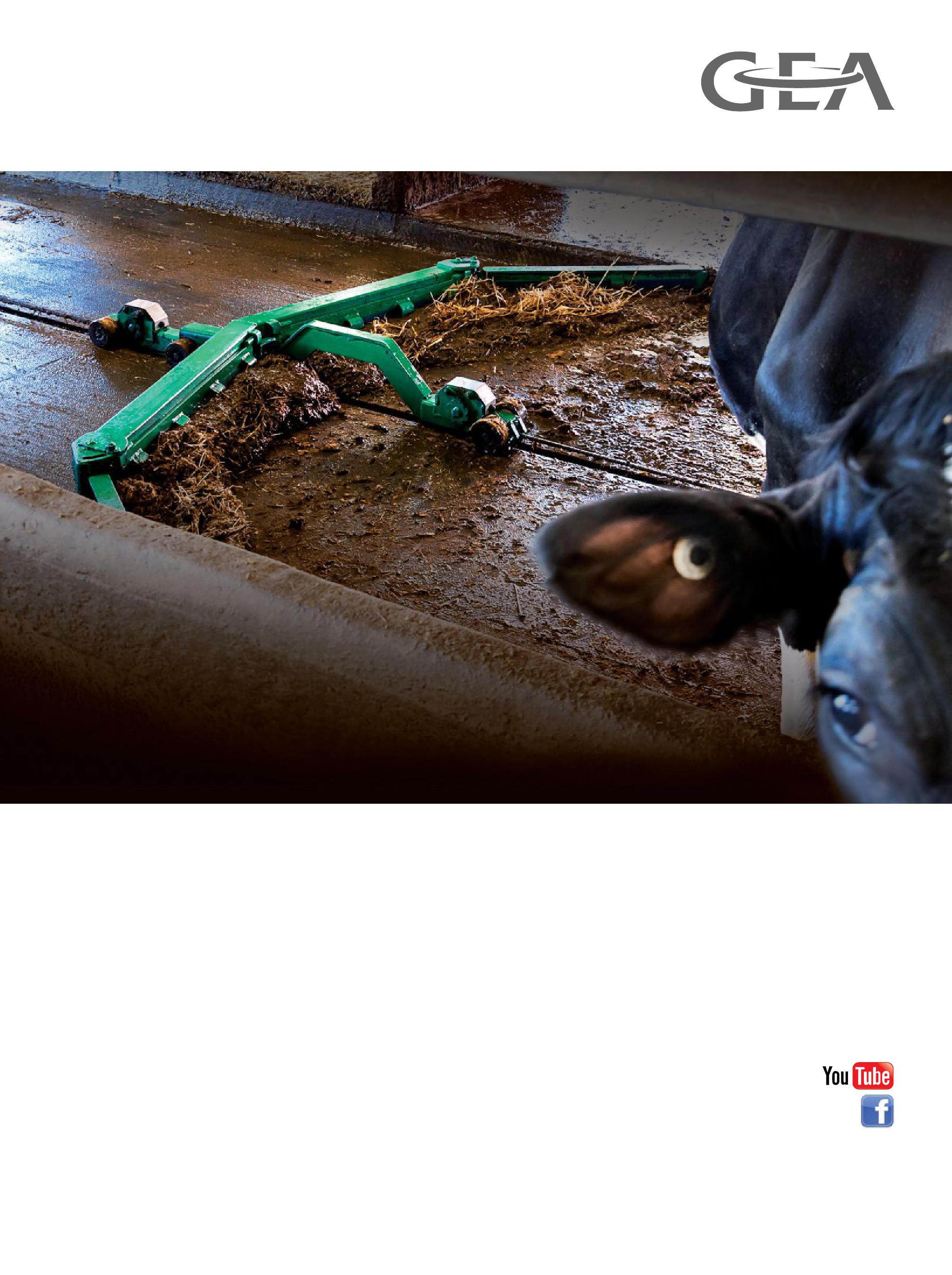
GEA Farm Technologies has always made its mark by developing efficient and long-lasting free stall manure cleaner systems. Whatever your barn condition is we have the solution to meet your highest expectations. 16°, Straight or V-Shape Scrapers. Adapted for rubber mats or concrete alleys. Pulled by galvanized or stainless steel cable, nylon rope, 1/2’’, 7/8’’ or pintle chains or hydraulically operated. It can be floor mounted, standard or deep groove guided or installed with an under floor channel. For alley lengths up to 2,585’ and between 73’’ and 204’’ wide... You have a farm. We have a solution.
A comprehensive line of products for free stall manure cleaning
GEA Farm Equipment | Houle
GEA Farm Technologies Canada Inc.
Tel. 1.800.563.4685 / Fax. 1.819.477.0486
www.gea.com / www.geahoule.com
engineering for a
Farming Free Stall Cleaners Houle EN
From Waste to Watts
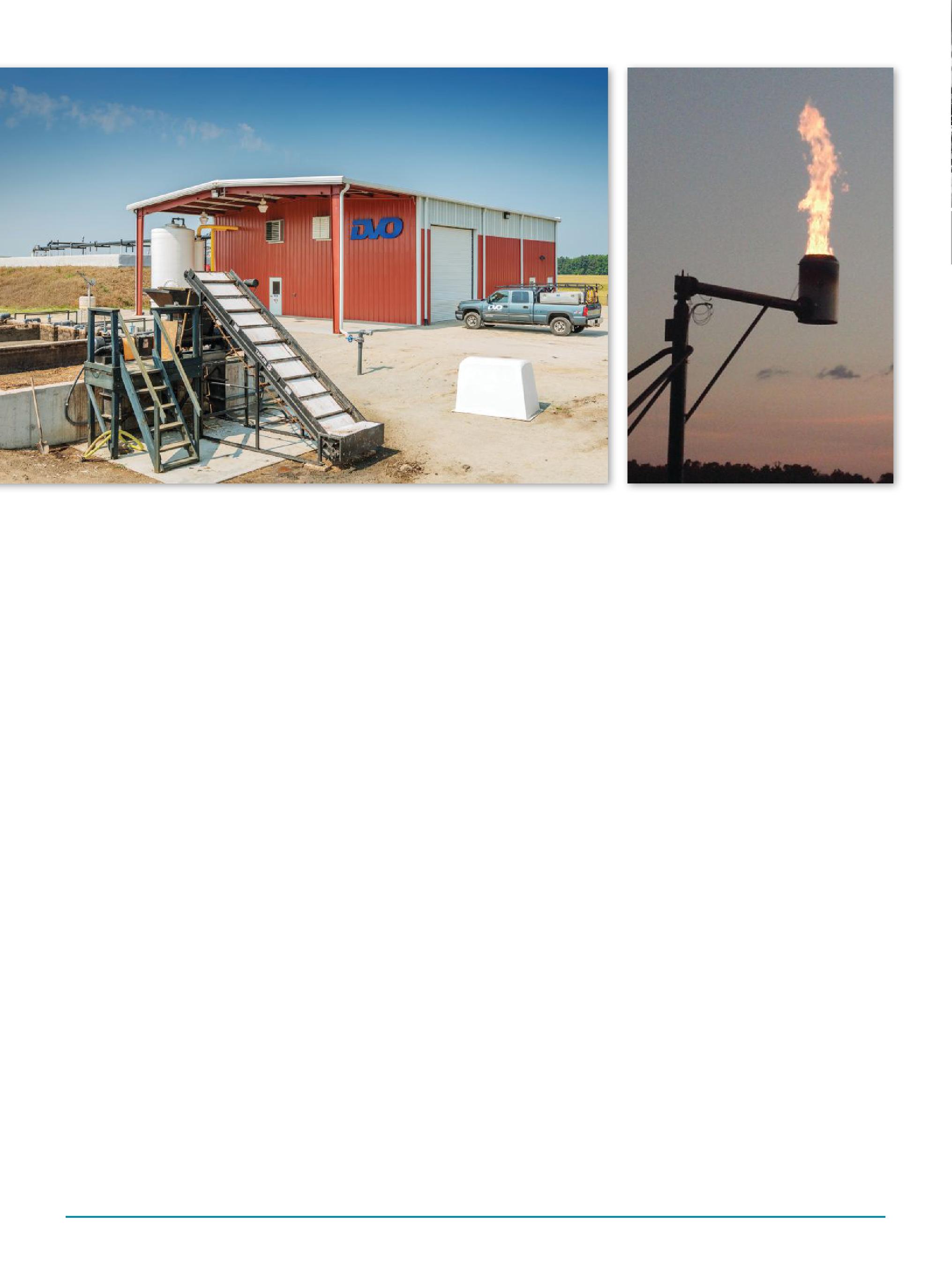
When waste is scraped, from any of Storms Farms swine barns, it goes through a transverse sewer line and runs into an underground storage tank [one of 12]. A vacuum truck comes once a day and empties it. With the waste handled underground, odor is all but eliminated. Contributed Photo
By Diane Mettler
Storms Farm leads the way for other farmers to create energy from hog waste while helping North Carolina meet its renewable energy quota
Whether it’s raising hogs and chickens or crop farming, Billy Storms excels.
The North Carolina farmer is one of the largest contract growers for Murphy Brown — possibly one of the largest in the entire country. The fifth-generation farmer raises approximately 28,000 hogs on his farm at one time. Storms continually looks for a better way to do things, so it’s no surprise that in 2009 he was researching digesters to turn his hog waste into energy.
“I have a grandson who would like to continue farming and I feel we have to protect the soil for the next generation,” says Storms. “The soil is the most important thing to a farmer. And I wanted to be able to do something different with our nutrients besides going to a lagoon and pumping them to the same field, building up phosphorous levels in the soil.”
It should have been a straightforward project. No one could have predicted the rocky road ahead.
Partnering up
At the same time Storms was checking out operations using DVO, Inc.’s patented anaerobic digester technology in Wisconsin and Missouri, Dr. Garth Boyd, currently senior partner of The Prasino Group, was starting up a new company called AgPower Partners LLC with a couple of colleagues. The company was focused on turning pig manure into energy.
“To kick off the company, we sought out several hog farmers that had expressed an interest in working with us to cover existing hog lagoons with a
HDPE (high density polyethylene cover) to capture methane,” says Dr. Boyd. One of those farms was Storms’.
In 2010, AgPower applied for grant money through the Green Business Fund, part of the American Reinvestment and Recovery Act (ARRA) and was awarded grants for four different projects. The economics of covering lagoons needed further evaluation, but Storms’ idea for an anaerobic digester still held promise.
We were looking for a client that was looking to go ‘whole hog,’ if you will, trying to create electricity year round,” explains Dr. Boyd. “As a part of that project, we scoped out all the commercially available digester technology providers and DVO came out clearly ahead.”
In 2011, Jeff Smerko, joined the AgPower team, valued for his financial prowess and tax credits knowledge — and, it turns out, unparalled tenacity.
Stopped before it started
The grant was both a blessing and a curse. It got the project up and running, but the compliance requirement ultimately
NRS – Nutrient Recovery System
consumed a great deal of time and resources. And that was just the start.
“Most people would have thrown up their hands and walked away,” says Dr. Boyd, “Jeff’s unique skill set and personality is the reason that this project turned into a success. Between the grant, putting together the commercial loan package, the extraordinary caution after the recession and the banking failures, the unfamiliarity Farm Credit had with digesters, and the previous overall failure rate of digesters on U.S. farms, it made requirement and contractual issues unbelievable. And this was with a customer [Storms] in extremely good standing with extremely good credit.”
Political problems
The project had another obstacle — a changing political environment.
Director of policy development & communications for the North Carolina Pork Council, Angie Whitener Maier, describes the scenario where she and Jeff worked to keep energy North Carolina energy incentives alive.
“In 2007, North Carolina passed a renewable energy portfolio standard which requires electric providers to purchase a specific amount of energy from renewable sources, and of that, a certain percentage must be derived from swine waste. We’re
the only state in the country that has a renewable energy law with a dedicated carve out for swine waste.”
In 2013, the law was targeted for repeal by state legislators and the pork council found itself working with the environmental community to keep the incentives intact. Next year will probably be the same battle and that’s why Storms’ project is so significant, says Maier.
“Last year, when we were trying to lobby against [the proposal to eliminate the incentive], what we heard was: ‘Nothing is happening, so why should we keep this law in place if it’s not doing anything?’ Now, we’ll be able to hold up the Storms’ farm as an example. Just because progress is slow doesn’t mean it’s not progress. And there’s nothing wrong with taking your time to make sure it’s right.
“And the Storms’ farm is significant because of the model that it represents,” Maier adds. “Because of the size of their operation, he was able to make all the financing work and make all the pieces fall into place, which is crucial for the swine industry’s credibility in its commitment to this. Now we’ve got a farmer who has a lot of skin in the game — a lot.”
In addition, the Storms’ project may also lead to future expansion of hog farming. In North Carolina, a farmer can’t
build a new farm or expand unless the waste treatment technology meets five very strict performance standards.
Storms’ DVO digester system handles four of the five standards, and with a fullscale pilot soon to take place, involving a nitrogen removal unit developed by DVO, Andgar and Washington State University, it intends to meet all the standards. If successful, and there is no evidence that it won’t be, it may allow some hogs farm in North Carolina to finally expand.
Putting it into action
The multi-million dollar system is unique because as Doug VanOrnum, with DVO, explains: “Every site presents unique challenges. There is no “cookie-cutter” solution. We integrate our system into the farm — not try to change how the farm does its farming.
“Hog waste is typically very diluted,” adds VanOrnum. “To ensure an efficient treatment process, one of the challenges is to optimize the amount of water that the farm is using, or at least the water that the digester will see.”
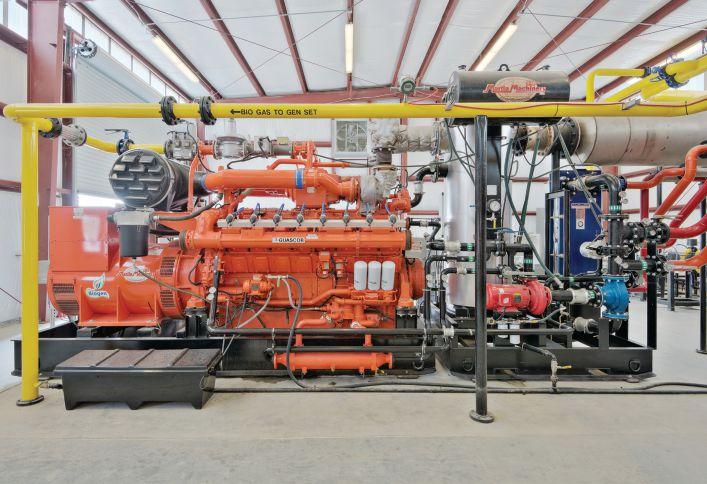
One of the solutions was to change over the 23 barns from a flush system to a scraper system, and it was done in conjunction with the installation of DVO’s digester and the genset provided by Marcus Martin of Martin Machinery.
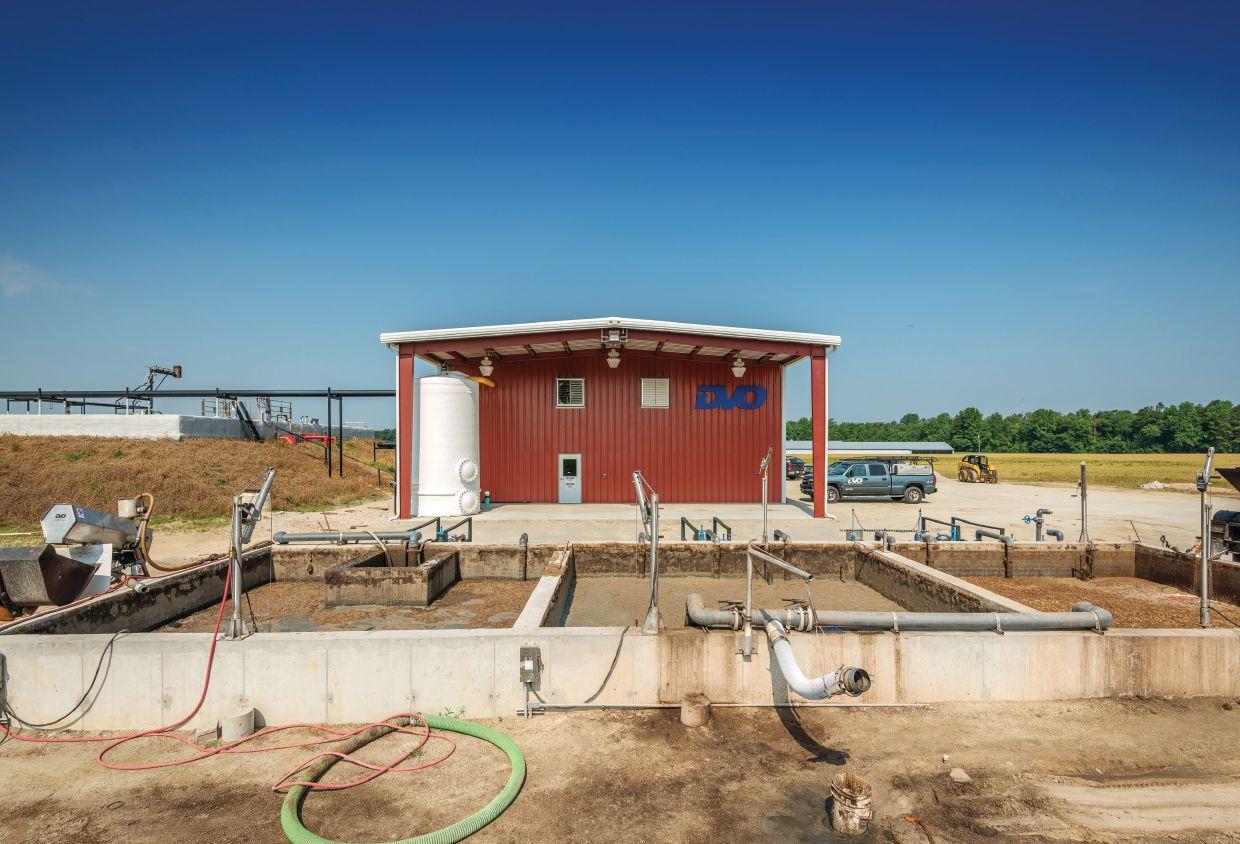
DVO’s digester system currently meets four of five performance standards set by North Carolina. Storms Farms plans to meet all five.
Excess biogas being flared from the anaerobic digester.
AgriInvest
A Smart Investment for Managing Farm Risk
AgriInvest helps you manage income declines on your farm and supports investments that help mitigate risks. To benefit from AgriInvest for the 2013 program year, you must:
• submit your 2013 AgriInvest form by September 30, 2014*
• open an AgriInvest account at a participating financial institution and make your deposit by the deadline date shown on your Deposit Notice.
*Note: Applications will be accepted until December 31, 2014, but will incur a 5% per month reduction in the maximum matchable deposit.
Learn more at agr.gc.ca/agriinvest or call 1-866-367-8506.
Get online with My AAFC Account!
My AAFC Account provides convenient and secure access to your AgriInvest account information online.
To sign up for My AAFC Account, go to agr.gc.ca/myaccount.
Agri-investissement
Un investissement judicieux pour la gestion des risques à la ferme
Agri-investissement vous aide à gérer les baisses de revenu de votre exploitation et à faire des investissements pour atténuer les risques. Pour participer à Agri-investissement pour l’année de programme 2013, vous devez :
• produire votre formulaire d’Agri-investissement pour 2013 au plus tard le 30 septembre 2014*
• ouvrir un compte Agri-investissement dans une institution financière participante et y faire votre dépôt avant la date d’échéance indiquée sur votre avis de dépôt.
*Remarque : Les demandes seront acceptées jusqu’au 31 décembre 2014, mais une réduction de 5 % par mois sera appliquée au dépôt maximal donnant droit à la contribution de contrepartie.
Pour obtenir plus de renseignements, allez à agr.gc.ca/agriinvestissement ou téléphonez au 1 866 367 8506.
Inscrivez-vous à Mon dossier AAC en ligne!
Le site Mon dossier AAC offre un accès pratique et sécurisé en ligne à l’information sur votre compte Agri-investissement.
Pour vous inscrire à Mon dossier AAC, allez à agr.gc.ca/mondossier.
Between Smerko and the Storms Farm team, they designed and installed a cable driven mechanical system that scrapes out the manure. It’s far more effective and eliminated the big water concerns. They took the pipes that were extended 50’ from the back of the barn into the lagoon and intercepted them with a perpendicular sewer line. Now, when the waste is scraped, it goes through that pipe, drops into a transverse sewer line and then runs into an underground storage tank [one of 12] where a vacuum truck comes once a day and empties it. And with the waste handled underground, odor is all but eliminated.
Storms says it took some work, but they were able to do part of the flush to scrape transition while the hogs were in the barn and the rest during the 3 to 4 days the hogs were being switched out. Now the barns are scraped seven times a day. Because of the distance between the barns to the digester, Storms uses tanker trucks to transport the waste to the digester.
The digester is 16 feet deep and about half the length of a football field, encased with an earthen berm. Daily, about 50,000 gallons are fed into the 1.2
AgPower Partners was looking for a swine operation willing to go “whole hog” toward producing electricity year round from pig manure.
million gallon digester. It takes 21 days to process. And, with an add-on technology to the digester, upwards of 90 percent of the phosphorous from the liquid slurry can be removed as well.
“If your acreage is phosphorous limited, hypothetically, if you took out 90 percent of the phosphorous from that liquid slurry, you could irrigate more slurry per-acre,” says VanOrnum.
Return on investment
Typically, VanOrnum says a project like this is successful if there’s a return on investment in three to seven years. There are a number of reasons Storms will probably see a return sooner than later. First, he’s selling the electricity. Second, he’s getting a tipping fee for waste he’s bringing in from a processing plant to feed the digester. Third, Jeff is selling carbon credits using the California protocol, and, lastly, was able to monetize the tax benefits to cover about half the cost of the system.
“Finding a tax credit investor for the project was a big obstacle to overcome because, whereas there’s a lot of appetite for tax equity in other technologies like solar or the wind, finding investors for making electricity out of manure is a whole different deal,” says Smerko. “But now I think it sets the stage to be able to repeat it.”
VanOrnum believes some incentives are helpful to farmers, because otherwise
we’re asking farmers to pay for a system that provides benefits that reach farther than their own farming operation.
“The system eliminates odors and kills pathogens such as e-coli and salmonella. Renewable energy is produced, harmful greenhouse gas emissions are reduced, and the system provides nutrient management options. Most of the storage lagoons aren’t being used any more because of this system. Because BOD and COD are reduced, even the pollution potential of the hog waste itself has been greatly reduced. Some of these do not necessarily directly benefit the farmers as much the community around the farms.”
Worth the challenges
The system is a true success. More than 130 people came to the ribbon cutting. Many have come to see the system since, some from as far away as Africa.
Storms says for anyone considering a project like this: “Have plenty of time to do it and hire yourself a good developer if you don’t have experience in doing this sort of thing. I can say that I think I had some of the best people in the state helping me with this. That’s why it’s been so successful.”
Smerko says the Storms have become like a second family to him and this was no ordinary development project.
“We blazed a trail that now can be followed.”
NA Manure Expo
State-of-the-art
equipment and information all in the same place at the same time
By Margaret Land
For Steve Chapman, it was the opportunity of a lifetime.
The Missouri dairy farmer’s face split into a big grin as he watched different styles and models of lagoon boats stir and agitate his operation’s earthen lagoon, measuring about 100 feet wide by 250 feet long.
“When will there ever be another time we could have all of this state-of-the-art equipment together in the same place at the same time,” he said, gesturing to the activity in front of him.
When, indeed?
Chapman, who operates a 130-cow pasture-based dairy near Pierce City, Missouri, hosted about 150 people on his farm in early July as part of Tour Day for the North American Manure Expo. Attendees had an opportunity to watch five different agitation boats and one dredger strut their stuff in the dairy’s lagoon, which was emptied and decommissioned a few weeks later.
Two pit pumps were also demonstrated in the Chapman Dairy’s 110foot diameter concrete manure tank.
Tour participants also visited Springfield’s Southwest Clean Water Treatment Plant. This award winning facility can handle up to 42.5 million gallons of wastewater per day and removes approximately 70,000 pounds of pollutants from wastewater per day before it is discharged. The Southwest plant also generates about 15 dry tons of biosolids per day. The biosolids are processed and
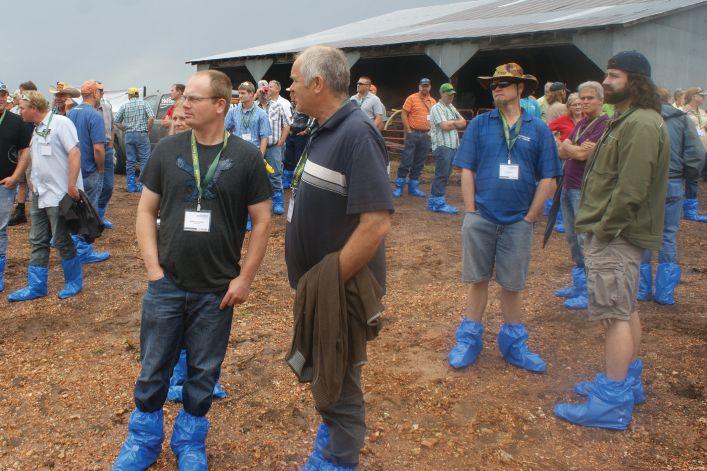
ABOVE: The audience watches different styles and models of lagoon boats stir and agitate an earthen lagoon at Chapman’s Dairy during Tour Day at the North American Manure Expo.
RIGHT: Filling up a liquid manure spreader in preparation for demonstrations at the North American Manure Expo, held in Springfield, Missouri.
utilized as a soil conditioner and fertilizer.
During this stop, tour participants had an opportunity to tour the treatment facility and learn more about biosolids, anaerobic digestion, nutrient management plans and field mapping.
During the second day of the North American Manure Expo, attendees had an opportunity in the morning to visit a field on the outskirts of Springfield and see both
liquid and solid manure spreaders in action.
The afternoon was reserved for visiting the expo’s indoor and outdoor trade show area plus attending educational sessions ranging from valuing manure to managing the risk of PEDv infection.
More than 500 people took part in the two-day expo, which is being held in Chambersburg, Pennsylvania, July 14 and 15, 2015.
Photos by Margaret Land
Manure application and PEDv
By Margaret Land
Jerry Foster, an environmental health and safety manager for Cargill Pork, based out of Missouri, is sick of talking about PEDv. “Six months into this thing, I was already really sick of talking about PEDv,” he explained during an information session held in early July during the North American Manure Expo. “The psychological toll on all those involved is huge.”
He described a swine farm in Texas
that became infected with the disease, despite being isolated – there wasn’t another pig for more than 100 miles around. The new operation was one week away from its first scheduled farrowing.
“In one day, they went from being really excited … to ‘We’re really down because when all those gilts farrow, we’re going to euthanize every pig in here.’ It’s really disheartening, really discouraging to people.”
Foster was one of three people who spoke in Springfield, Missouri, about the devastating swine virus and its effect on
manure hauling and application during the special panel session.
“There’s a lot we haven’t learned,” he said. “There’s a lot we’ve got left to learn about it. It doesn’t respect distance or isolation. It’s really hard to pattern this stuff. Where we’ve had it show up has been rather surprising.”
Once again describing the swine operation in Texas, Foster said it’s not known how the disease spread to the farm. He did add that geese on the farm were sampled and tested.
“They did isolate PEDv on the feathers
Porcine epidemic disease virus (PEDv) kills piglets two to three weeks of age or younger.
Photo by Linda Geist, University of Missouri
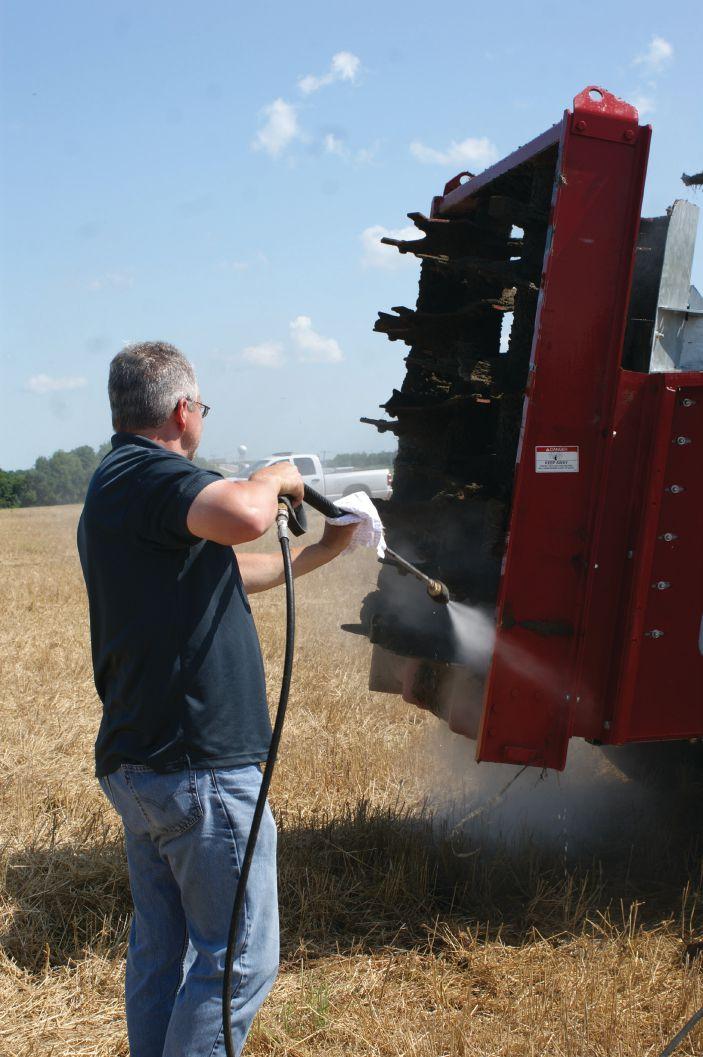
Manure handling and application equipment needs to be properly cleaned before it’s disinfected since most disinfectants don’t work properly unless they can reach the surface.
of those birds. Was it waterfowl that put it in there? Don’t know. Can’t say that it was; can’t say that it wasn’t. But they were able to isolate it there.”
But once an operation has the disease, it’s very hard to get rid of it.
“It’s much easier to catch it than it is
to get rid of it,” said Foster. “You don’t have to try to catch it. You can do that pretty much automatically. Getting rid of it, that takes an awful lot of work.”
Research has shown PEDv does not like dry, hot conditions – three to four days in a dry environment and the virus
dies. But it will survive at least 28 days in wet conditions, including sub-zero temperatures.
“You can thaw out a block of ice and still isolate out PEDv from the material you’re testing,” said Foster. “This is a nasty little varmint to deal with. Manure tends to be wet. That’s why biosecurity is such an important issue for custom applicators. This is one we don’t want to be taking to our customers because of all of the ramifications of the disease.”
It would take just a sample of pure virus the size of a pencil eraser to infect every pig in the United States.
“It doesn’t take much. A fly could carry that much. Fleas on a rat can carry that much; carry it to a farm. When they get it, everybody gets it.”
In light of this, Andrew Henson of Arm’d Custom Pumping, based in Sac City, Iowa, was also on hand to discuss some of the biosecurity and sanitation protocols he has put in place when dealing with swine manure.
“A typical meeting before we go to a new site consists of going over lines of separation, equipment placement and biosecurity,” he explained. “Before we go to a farrowing unit, I collect current data sheets from the barns and find out what they’re going through; if they’re going through (PRRS) Porcine Reproductive and Respiratory Syndrome, PEDv, etcetera.”
All of his equipment is power washed and disinfected in the field using a selfcontained power-washing unit with two, 250-gallon tanks.
“Everything is power washed and disinfected. We also carry canisters and pump sprayers so we disinfect while we’re at the job, not just before and after.”
Farms are also rigorously mapped out to avoid crossing specific lines of separation, including roads frequently travelled by barn employees. All of his equipment is parked in the field to help reduce exposure to the barnyard area.
“The only thing we actually bring on site after everything is in the field is a lead pump and the pickup,” said Henson. “And then agitators are all brought on site the back way through the field so we don’t have to go through the main entrance.”
In a perfect world, he would prefer farm operators supply their own lead pump to transport the manure from the barn to the field, meaning the custom applicator can stay in the field and away from the barn.
It was a sentiment shared by Foster.
“It’s a good idea to have a farm-specific pump there that never leaves that guy’s farm and you’re not taking the responsibility for that pump or having it cleaned,” he said. “You don’t even have to go up close to the farm. If that’s something you can work out with your clients, I think that’s a really good idea to do that.”
Cargill expects custom applicators to follow a strict set of protocol when pumping and applying manure from its contracted facilities. And the key to it all? Communication, said Foster.
“Before you go to the farm, verify the status on the farm before you arrive,” he said. “Ask that producer is this place PEDv positive? Have you had PEDv? How do you know? Have you had any unusual exposures? You want to verify that before you go there. I would even recommend following up with that producer a week later. Since I was there, has anything changed in your health status? You need that information to communicate with your customers that you’re serving down the line.”
Foster stressed that equipment needs to be properly cleaned before it’s disinfected.
“Disinfectant doesn’t work if it can’t get to the surface. You want disinfectant to make it to the surface. It won’t
penetrate dirt. You got to have that stuff really clean. The inside needs to be clean too. You need to be able to recirculate water through that machine, including the disinfectant, to clean the inside out.”
Cargill also requires all equipment to have 24 hours of down time before it’s brought onto one of its contracted farms.
“Disinfectants need time to work,” he explained. “A lot of people think they kill on contact and they frequently don’t. It takes a while for them to get through that cell wall and to deactivate or kill that cell. That is the reason to make sure that disinfectant has had time to be fully effective on the pathogens.
“Other farms might have different requirements. They may want you to have longer down times. They may get along with shorter down times. They may want you to use different disinfectants. They may not be worried about some of those issues. I don’t think you can talk to him too much about this.”
He urged all custom applicators handling swine manure to be very vigilant about following protocols and biosecurity rules during this fall’s manure application season.
“I don’t know of a case where any of our contract farms or any of our field people has said ‘Yes, we can conclusively trace the outbreak of PEDv on this farm back to a custom applicator,’” Foster said. “I don’t know that it’s happened. I do know the mechanics are available for it. If you take a look at how the PEDv travels, how it’s spread. It’s there. That’s why we have to know about this and take precautions, why we have to be careful.”
With PCE’s new LightSpeed™ System, a single operator can see everything that is happening with the supply line
ፚ Instant control over all pumps
ፚ Gate Valve Control: Open/Close
ፚ Fuel capacity
ፚ Full Engine Control: Start/Stop/ Throttle/Idle/Go-To-RPM
ፚ Secure Login
ፚ Live Numbers: Engine RPM, Pump Pressures, Flow Rates
ፚ Wi-Fi spot
ፚ Flow rate leaving site
ፚ All displayed on one easy-to-use screen
Using this information the operator can fine-tune the system and greatly increase efficiency with the security and safety of being in constant control
With PCE’s new control system receive all information from shore to better agitate for a more complete clean out
Contact Puck Custom Enterprises today for more information about how LightSpeed™ will allow you to monitor crews’ progress; as well as advise, and consult your crews’ productivity with more accurate monitoring efficiencies.
BIOGAS ROADMAP will foster innovation, revenue for dairy farms
The White House recently released a Biogas Opportunities Roadmap highlighting the economic and environmental benefits and potential for biogas systems in the U.S.
According to the roadmap, biogas systems offer a wide range of potential revenue streams, growing jobs and boosting economic development for communities, businesses and dairy farms. The systems work by recycling organic material — including cow manure and food waste — into valuable coproducts such as renewable energy, fertilizer, separated nutrients and cow bedding.
To develop the roadmap, The White House worked with the dairy industry through the Innovation Center for U.S. Dairy, which was established under the leadership of dairy farmers, and U.S. Department of Agriculture (USDA), Department of Energy (DOE) and Environmental Protection Agency (EPA).
According to the roadmap, the USDA, DOE and EPA will take these steps to promote the development of biogas systems:
• Fostering investment in biogas systems: To help overcome barriers to the widespread investment in biogas systems, USDA will lead efforts to better understand and track the performance of anaerobic digesters, seek opportunities to broaden financing options, and review Federal procurement guidelines.
• Strengthening markets for biogas systems and system products: The Roadmap identifies activities that could strengthen the market for biogas systems and system products including energy and other valueadded products. For example, dairy farms of all sizes could enhance their revenues through nitrogen and phosphorus recovery.
• Improving communication and coordination: USDA will
establish a Biogas Opportunities Roadmap Working Group, including the dairy industry, to implement the strategies in the Roadmap, with a goal to identify and prioritize policies and technology opportunities by August 2015.
• Promoting biogas use through existing agency programs: Leveraging existing programs will provide a way to enhance the use of biogas systems in the U.S. by ensuring existing criteria for technical and financial assistance considers the benefits of biogas system, leveraging research funding, and strengthening programs that support the use of biogas for clean energy, transportation fuel, and other biobased products.
“On dairy farms, digesters can increasingly be part of the solution to manure management challenges and enhance our ability to sustain our farms for the next generation,” said Jim Werkhoven, a dairy farmer in Monroe, Washington, and chairman of Darigold, Inc.
Biogas systems could help the dairy industry, which contributes approximately two percent of total U.S. greenhouse gas emissions, to further reduce its carbon footprint. In 2009, the dairy industry established a voluntary goal to reduce its carbon footprint by 25 percent by 2020. The Dairy Power project is one of a portfolio of projects to help achieve that goal; it focuses on harnessing the value of manure and realizing the potential of biogas systems for U.S. dairy farmers.
“Dairy farmers are taking many steps to provide nourishing dairy foods and beverages that are responsibly produced,” said Tom Gallagher, chief executive officer of the Innovation Center for U.S. Dairy. “Biogas systems are one example of many technologies available to the industry today that help us continuously improve our stewardship and contribute to our communities.”
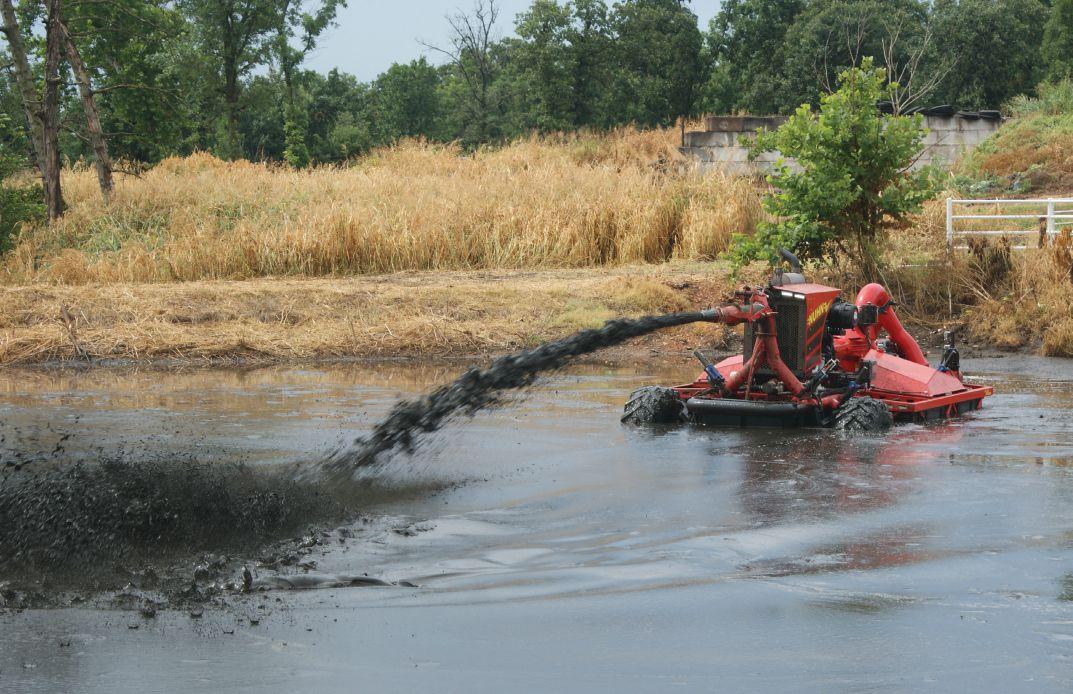
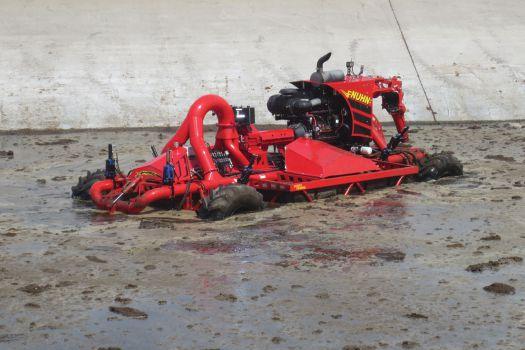
Nuhn Industries’ Lagoon Crawler is known by many names – the Batmobile, the F1 racecar, Hot Wheels.
But to the custom manure applicators who are actually getting this bright red agitation boat manuresplattered, it has one important label – efficient.
“It will do the job of four lagoon agitators in less time,” says George Lorenz of L&M Industries, based in Black Creek, Wisc. “With an agitator, you’re really only reaching the manure in a 50foot diameter around it. You only wish it was doing as good a job as this crawler.”
L&M Industries handles about 350-million gallons of dairy manure annually, mostly in Wisconsin. Of that volume, about 40 percent is sand-laden. And if there’s one thing the Lagoon Crawler appears to excel at, it’s mixing liquid manure and sand into suspension.
“Sometimes, it does too good of a job,” admits Lorenz with a laugh. “We can mix for an hour and then we have to shut the machine down. The manure is so well-mixed, it can become too thick to pump.”
Lorenz had his first glimpse of Nuhn’s creation in August 2013 during that year’s North American Manure Expo, held in
Guelph, Ont. He had a second look at the machine during a farm show later that same year in Oshkosh, Wisc. When he discovered another custom manure applicator in Wisconsin had purchased one, he managed to wrestle a test drive.
“We convinced them to rent it to us. We put 77 hours on it.”
The brainchild of Ian Nuhn, a prototype of the amphibious lagoon agitator was designed and constructed by Nuhn Industries in 10 days so it could be displayed at the 2013 expo. The company worked from August 2013 to January 2014 perfecting the prototype before shipping the first unit in February 2014.
“The idea came from our customers,” explained Nuhn. “We talked to our customers and dealers about what they needed, what they were looking for. They said it needed to have wheels to get in and out of the pit.”
Besides hydraulic wheels, the Lagoon Crawler also features a 275 horsepower Cummins/John Deere motor, which can pump close to 10,000 gallons of manure per minute. It has a hydraulic lift undercarriage to help it maneuver in and out of lagoons and is remotely operated.
There are currently 35 Lagoon Crawlers in use, mostly in Wisconsin and California. There are another 25 on order, including some heading to Russia, a country Nuhn described as “an untapped market.”
Earlier this year, L&M Industries took delivery of its first lagoon crawler, which currently has 110 hours on its 275 horsepower engine. A second one is on order.
“It’s great,” says Lorenz. “I like the fact that, so far, it hasn’t plugged up. If you get it stuck on a sand bar, you’re able to drive it right off. You can drive it out of the pit and around the yard. One
Contributed photos
person can load it.”
That ease of handling was one of the features that struck a chord with custom manure applicator Jim Jolivette of Jolivette Hauling out of Taylor, Wisc.
“The labor efficiency really struck me as something positive,” he said. “It really helps when you’re short on labor. It’s easy to manage and easy to run with one person.
“And there’s the safety aspect, too. It’s handy to drive in and out. You don’t have to crane it in.”
Jolivette Hauling handles between 90- and 100-million gallons of manure annually, almost all of it dairy with about 40 percent sand-laden.
“It does a very good job agitating,” said Jolivette. “There’s getting to be more sand used as bedding in the area. It suspends the sand a lot better.”
Jake Zutz of Braun Electric Inc. in St. Nazianz, Wisc., has experienced first-hand the time-saving aspects of the crawler.
“We have a client who we usually end up leaving with about six-feet of sand remaining using pumps and props,” he said. “With this boat, he was left with six-inches [of sand] remaining in the entire concrete-lined lagoon.
“It does an excellent job agitating and can do a way better job than a lagoon pump. You don’t need three tractors and three pumps. The boat makes you way more mobile.”
Braun Electric, which handles 150- to 175-million gallons of manure annually – about 50 to 70 percent of which is sand laden – currently has two crawlers available for rent and custom work.
There are currently 35 Lagoon Crawlers in use, mostly in Wisconsin and California. There are another 25 on order, including some heading to Russia.
“We have a couple hundred hours on ours,” said Zutz. “I’ve tried to get it stuck and I haven’t been able to. It’s just a great idea on wheels.”
Custom manure applicators, farmers and other people involved in the manure handling industry had an opportunity to see Nuhn’s Lagoon Crawler in action during the 2014 North American Manure Expo, held in Springfield, Missouri. It was one of many lagoon boats showcased during a demonstration at Chapman Dairy, a pasturebased dairy located near Pierce City.
For sales, installation and service of bio gas power generation systems, W.W.Williams is your go-to resource.
A global leader in combined heat and power systems for bio gas applications, we can guarantee electrical efficiencies based on fuel consumption and power output.
And it’s all backed by one of the industry’s most experienced and knowledgeable service teams.
MTU Onsite Energy is a member of the American Biogas Council
In the NEWS
SFP acquired by Verdesian Life Sciences
Verdesian Life Sciences of Cary, NC, recently announced it has acquired Specialty Fertilizer Products (SFP), a Leawood, Kansas-based company focused on fertilizer efficiency products.
By joining forces with SFP, Verdesian will gain more than 270 patent properties and be able to offer a: broader portfolio for customers; more solutions to meet growers’ needs; one of the largest plant nutritional sales forces in the U.S.; and a robust pipeline in plant nutrition.
“SFP’s innovative fertilizer solutions are a natural fit with Verdesian’s expansive product offerings that increase grower yields and return on investment,” said J.J. Grow, chief executive officer for Verdesian Life Sciences. “Bringing SFP into the Verdesian family represents another step in our long-term strategy to build a leading portfolio of plant health and nutrition products.”
Verdesian will enhance its position in the crop markets with the addition of AVAIL Phosphorus Fertilizer Enhancer, NutriSphere-N Nitrogen Fertilizer Manager and More Than Manure Nutrient Manager. These products complement the current portfolio that includes NutriPhite and Nutri-Phite Plus, Sterics, Take Off, PolyAmines, and the INTX line of inoculants and seed treatments.
“We are excited to join Verdesian, which will enable us to take our business to the next level,” said SFP founder J. Larry Sanders, who has served as president and chief executive officer. “As part of Verdesian, we will be able to offer our revolutionary and environmentally beneficial fertilizer efficiency technology to more growers in more markets, and to bring the exciting products we have in our pipeline to market. Verdesian shares our commitment to helping growers optimize their resources, and we look forward to
working with J.J. Grow and the team to continue providing our customers the latest solutions in fertilizer efficiency technology that they expect from us.”
According to Grow, there will be no immediate staffing changes except in the reporting structure at the senior management level. The sales forces of both organizations will continue to service their clients through 2014. In early 2015, SFP will become Verdesian and a combined sales force will be formed.
MagneGas confirms EPA requirements for manure processing achieved
MagneGas Corporation, a technology company that invented a process to convert liquid waste into a hydrogen-based fuel, recently announced that results from its swine manure sterilization trials meet Rule 503.32 requirements, making swine manure suitable for Class A treatment.
According to the company, the fact that MagneGas’ process meets or exceeds the time and temperature requirements for Rule 503.32 means that it could reduce or eliminate the costs of disposal or land application of swine manure by rendering it suitable for direct fertilization application.
“We believe this accelerates our market entry into manure sterilization by converting Class B manures into Class A, transforming it in some cases to be suitable for fertilization as opposed to costly and time consuming land application, lagoons or holding ponds,” commented Ermanno Santilli, CEO of MagneGas Corporation. “We will now present this solution to the contacts we made at the Orlando Biowaste conference from May as well as presenting it to organizations, such as farmer cooperatives, the US Pork Council and agricultural universities.”
www.MagneGas.com
Pure Energy joins American Biogas Council
Pure Energy Group has joined the American Biogas Council (ABC), a U.S. trade association representing organizations dedicated to maximizing the production and use of biogas from organic waste.
PEG recently finished building its wasteto-energy system at a brewery in the San Francisco Bay Area and expects it to reach full production capacity later this year.
“The ABC is the nation’s leader for our industry,” said Brandon Julian, PEG’s CEO. “As we prepare for the official launch of our urban anaerobic digestion system, it was important for us to team up with an organization that shares our principles and goals of promoting the production and use of renewable energy. We’re excited about the potential to partner with member companies as the industry prepares to take anaerobic energy production mainstream.”
Using patented technology developed at Utah State University, PEG’s high-rate anaerobic digestion technology offers the ability to convert organic waste streams, such as food and other organic urban waste, into renewable clean energy. PEG’s project has the ability to generate power around the clock while reducing organic waste by 70 percent or more.
“Our new system will provide an opportunity for the biogas industry to showcase how new technologies can more effectively reduce the amount of waste going into local landfills while generating a substantial, economically viable source of energy,” Julian adds. “As this will be the first waste-to-energy system to be permitted and operational in an urban setting, we see the potential to grow into different industries and communities such as technology campuses with large cafeterias, university campuses, military bases, correctional facilities and any other enterprise that generates a large amount of organic waste.”
MDA launches new ads for
“Manure Happens”
The Maryland Department of Agriculture (MDA) has launched a targeted information program aimed at farmers as part of its recently introduced “Manure Happens” public outreach campaign.
The end-of-summer campaign includes a series of four educational ads being circulated this month on social media and in agricultural newspapers throughout the state encouraging farmers to consider using manure as a fertilizer and soil conditioner.
The ads describe the benefits of using manure to improve the soil, increase yields and save on commercial fertilizer costs.
Farmers are directed to MDA’s new “Manure Happens” web site for more comprehensive insight on the benefits of manure, including information on grants to haul and incorporate manure into fields along with tax breaks for qualifying equipment.
“With the adoption of new nutrient management requirements placing limits on manure use, it is important to open up markets for livestock and poultry farmers who may need to transport their manure to other farms that can use this valuable resource safely using the latest scientific techniques and conservation practices to protect water quality in streams, rivers and the Chesapeake Bay,” said Maryland Agriculture Secretary Buddy Hance.
The farmer education campaign includes four-color advertisements. The “Talk is Cheap” ad focuses on the benefits of poultry litter as a soil conditioner and fertilizer. The “Change is Good” and “Strike Pay Dirt” ads highlight the economic benefits of switching to manure as a crop fertilizer. The “Grow with Manure” ad encourages farmers to look into the benefits of using dairy manure on their crop fields. All four ads direct readers to the new MDA webpage www.mda.maryland. gov/manure.
The MDA will be incorporating the ads into social media (@MdAgDept on Twitter and Facebook/MdAgDept) throughout the spring.
For more information, visit MDA’s new manure management resources page at www.mda.maryland.gov/manure.
Consistent Nutrient ValueAgitation Makes the Difference
• Center agitation system evenly blends nutrients.
• Better utilization of “waste” translates into less purchased fertilizer.
Environmentally Sound
• Designed and constructed using bolted glass-fused-to-steel panels for secure storage and high corrosion resistance.
• Above ground - minimizes the danger of run-off, leaching and ground water contamination.
• Environment-friendly odor control - releases odors above ground level into higher air currents.
IL 60115
www.cstindustries.com to find your local dealer, or call 815-756-1551.
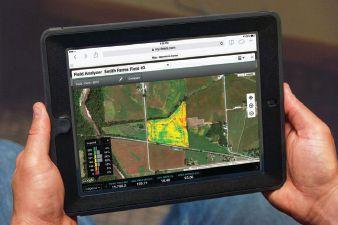
MyJohnDeere Operations Center
John Deere introduces the MyJohnDeere Operations Center with tools for customers to manage their machinery and develop agronomic insights.
Data can be uploaded securely using backup tools or, right from the field using JDLink, and the platform is open, allowing sharing to trusted advisors.
Tools, such as Field Analyzer and Difference Maps, help customers gain insight into their operations for improved decision-making to increase yields, optimize costs, and manage risk.
The Operations Center will continue to evolve with new tools with the customer’s needs in mind. The overall goal is increased productivity and efficiency for the entire farm operation.
Some of the many current tools on the Operations Center are Field Analyzer, online Documentation Analysis and Reporting tool, and Data Sharing, with additional tools added frequently.
“The MyJohnDeere Operations Center provides customers with tools to improve machine uptime, logistics management, and agronomic analysis in a secure, accessible way,” says Chris Batdorf, product marketing manager with John Deere Intelligent Solutions Group. “The customer is in control of the data and can share with dealers, crop consultants, and anyone in their network of trusted advisers; securely, from any Internet-enabled device.”
www.JohnDeere.com
Cadman unveils new manure injector
Cadman Power Equipment recently released a new manure injector, which the company describes as the only frontfolding manure injector in the industry.
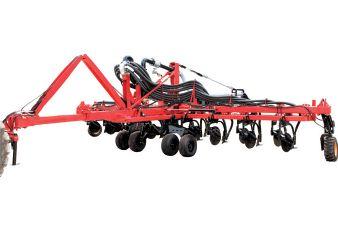
The injector is available in 30, 40 and 50-foot models and is 11 feet wide when folded for highway travel. It features a built-in Vogelsang ExaCut Distributor, a two-point hitch, a hydraulic tongue that can extend independent of the wings plus hydraulically controlled outrigger stabilizers. There is also comes with grade control, six-inch plumbing and a blowout ball catcher.
Options include galvanized wings and frame, a Krohne flow meter, eight-inch plumbing, plus Dietrich, VTI or Yetter tooling, depending on what the customer requires.
www.cadmanpower.com
Case IH Magnum Rowtrac tractors
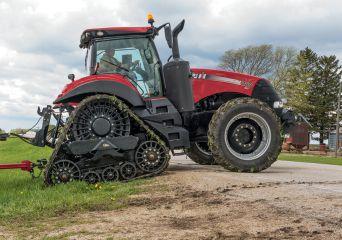
Building on 18 years in independent-track technology, Case IH recently introduced its new Magnum Rowtrac tractor.
Two new models are now available for producers who have soil conditions requiring better flotation and reduced compaction. A Case IH oscillating reartrack system is paired with front tire options to fit virtually any row width. This system keeps the power on the ground through the tightest turns, improves maneuverability, reduces berming and improves operator control of the tractor.
“Customers have told us that it outperforms other two-track options with better handling and a smoother ride,” said Zach Hetterick, Case IH marketing manager for high horsepower tractors. “The flotation provided by the tracks allows them to get into the fields sooner since it avoids ruts and compaction, and doesn’t make divots when turning around.”
The Magnum Rowtrac is available in two models: the 340 and the 380. Each features an 8.7-L engine that cranks either 340 or 380 horsepower. Both use Case IH Selective Catalytic Reduction (SCR)only technology to meet Tier 4 B/Final emissions requirements and have proven to keep fuel and fluid costs low.
The Continuously Variable Transmission (CVT) comes standard on the Magnum Rowtrac 380. The CVT is optional on the Magnum Rowtrac 340 with tread spacing under 136 inches and standard with 136inch tread spacing and above. Producers can opt for the Full Powershift transmission on the 340 when choosing a tread spacing less than 136 inches.
While flotation and traction are priorities for producers, it’s important to note they might not need to purchase the optional front duals for Magnum Rowtrac tractors.
“Flotation and traction are so good with the Magnum Rowtrac,” Hetterick said, “single wheels up front offer almost the same agronomic benefits as duals do.”
Case IH will offer a redesigned front tire exclusive to the Magnum Rowtrac. The tire will feature a large footprint, further reducing soil compaction from the front end of the tractor.
• Vertically Agitate thick solids using the Boat’s powerful nozzle velocities
• Variety of Boat settings service 3 ft to 50 ft depths effectively
• Proven to clean up the toughest jobs and provide consistent nutrient samples throughout the pump-out
• Outflow nozzles easily uncouple and connect to high-pressure hose fittings for pump-out
• Highly Responsive Lightweight Design: Easy to Operate, Set-Up, Clean-Up & Transport
• Decrease agitation costs by 70% on a large scale
• NEW! PCE Voyager Control w/ remote display
With the Magnum Rowtrac, Case IH also introduces an optional front axle. Producers now can choose from among four front-axle options. The new Universal Wide front axle is six inches wider on each side than the standard axle. The Universal Wide axle works with all row spacings and can be adjusted for all tread spacings. The Universal Wide axle and the standard axle are available as suspended or standard configurations.
This Magnum Rowtrac joins the Steiger Quadtrac, Steiger Rowtrac and Axial-Flow tracked combines to deliver independent-track technology. Advantages over conventional mechanical frontwheel drive or track tractors include full power in turns, reduced berms and minimal soil disturbance in wide or tight turns, four points of ground contact for increased flotation, more traction and less compaction, more power to the ground, and being earlier into the field to meet optimal planting dates.
www.CaseIH.com/Magnum
Mitas unveils VF HC 2000 tires for high HP tractors
Mitas recently displayed its new range extension of Very High Flexion (VF) tires –the VF HC 2000, which boasts 40 percent less inflation compared with standard tires – at Iowa’s Farm Progress Show.
The special feature of the Mitas VF rated tires is the highly flexible sidewall, allowing for extended footprint and reduced soil compaction (6,000 lbs. at 15 psi), competing shoulder-to-shoulder with
FLEXIBLE, EFFICIENT & COST EFFECTIVE
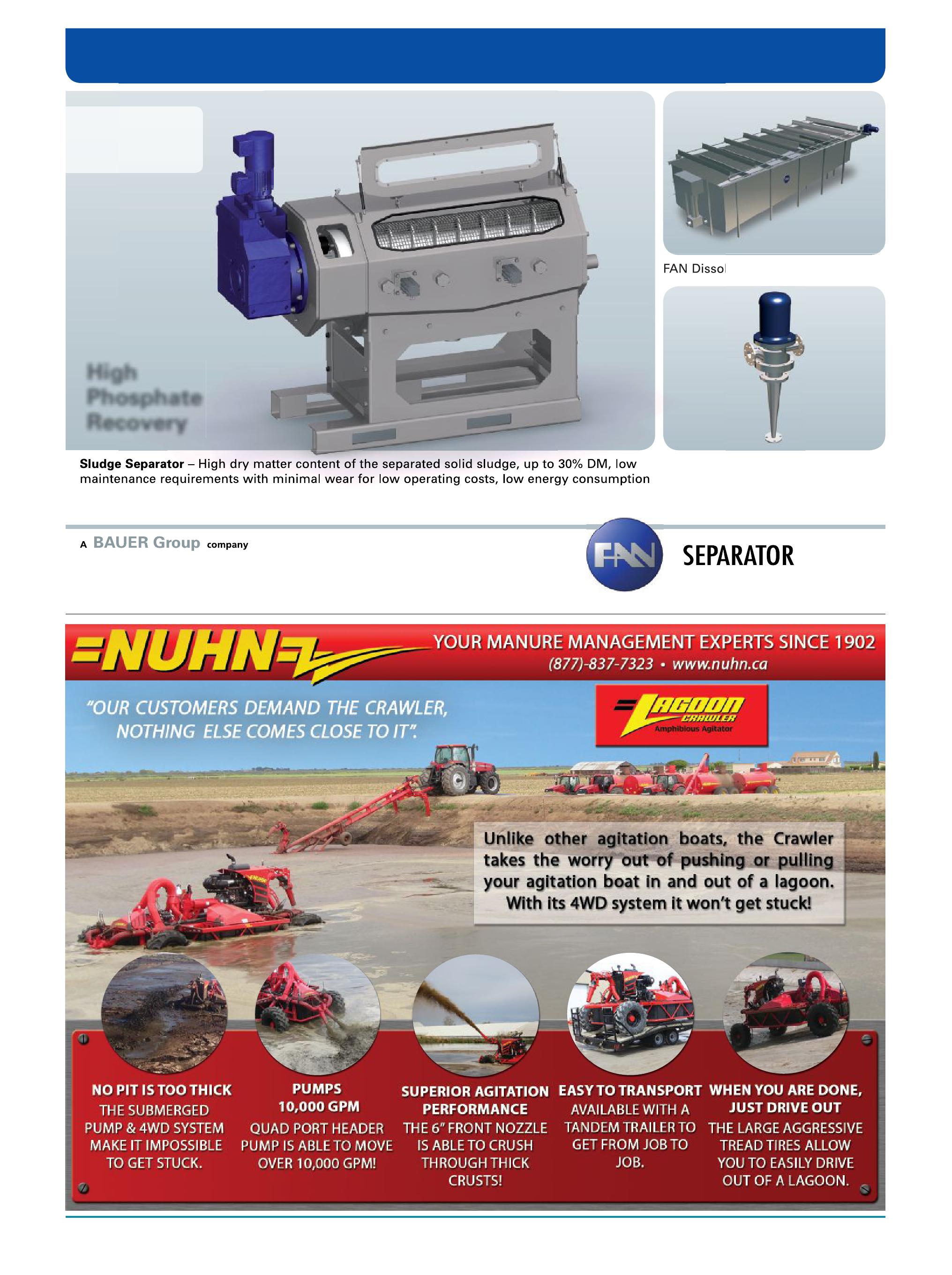
SOLID-LIQUID SEPARATION
rubber tracks.
The Very High Flexion tire product line for high-horsepower tractors were recently released with the VF 380/95R38 HC 2000 and VF 480/95R50 HC 2000. Later in 2014, Mitas plans to extend the range and introduce additional sizes of VF HC 2000, namely VF 600/70R30 and VF 710/70R42.
“The Very High Flexion tire range extension proves Mitas’ competence in developing high-horsepower tires for the largest and most demanding of machinery segments,” said Andrew Mabin, Mitas’ sales and marketing director. “Mitas developed the Very High Flexion tires to meet the demand of increased load and speed required by the highest HP agricultural machinery.”
Mitas also recently released VF 380/90R46 HC 1000 for sprayer applications.
Very High Flexion tires are produced at the Mitas tire manufacturing plant in Charles City, Iowa.
www.mitas-tyres.com
BIOSELECT RC
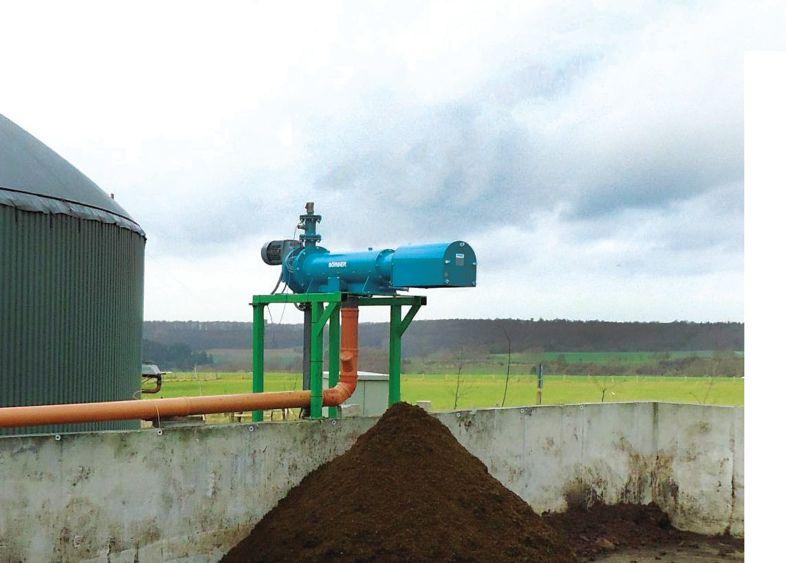
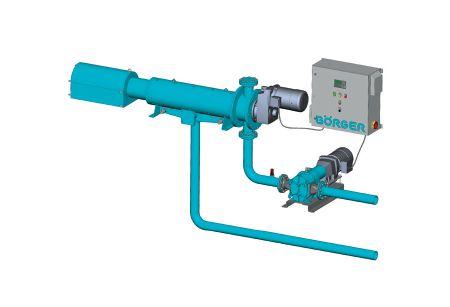
The Bioselect RC is fitted with a feed pump and a control unit for consistent solid-liquid separating.
Börger AgraTec offers a diverse line of agricultural products including: Rotary Lobe Pumps, Macerators, Digester Feed Products, and Liquid-Solid Separators. Börger specializes in custom-built solutions for farmers and biogas plant operators.
To learn more about Börger products, download a free QR code app on your smartphone and then scan this code.
To learn more visit www.boerger.com Call 1.844.BOERGER or find us on:
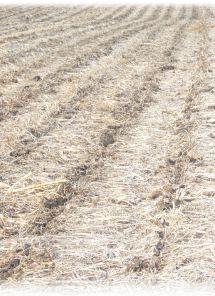
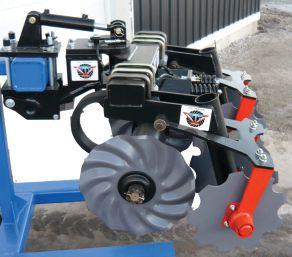
Manure Injection System Minimize Soil Disturbance
High Speed - 3-12 MPH with excellent performance
High Residue - Heavy corn stalks without clogging
Low Draft Manure Injection - up to 15,000 gal per acre and up to 50% less draft than prior technology
Built for Commercial and Custom Pumping Use
NEW FOR FALL 2014 - VTI CONTOUR KING with HydraFlex
A heavy duty swivel system designed to follow very aggressive 30º contours, slopes & angles with ease. Allows manure tubes and closing system to follow the coulter. Automatically returns to center when lifted out of the ground. The HydraFlex option allowing 10” travel for precision application in uneven terrain. Great for wide draghose bars and 6 and 8 row tank bars. A must for rocky conditions.
MDA AWARDS $1 MILLION FOR INNOVATIVE MANURE MANAGEMENT TECHNOLOGIES
The Maryland Department of Agriculture (MDA) recently awarded more than $1 million in grants for three animal waste management technology projects.
Checks were recently presented to Planet Found Energy Development and Green Mountain Technologies for implementation of their demonstration projects.
Maryland recently revitalized the state’s Animal Waste Technology Fund, which provides incentives to companies that demonstrate new technologies on farms and provide alternative strategies for managing animal manure. These technologies generate energy from animal manure, reduce on-farm waste streams, and repurpose manure by creating marketable fertilizer and other products and by-products.
The MDA plans to award a total of $2 million of the $2.5 million available in fiscal year (FY) 2014. Funds not awarded during FY 2014 will be added to a new round of requests for proposals to demonstrate innovative manure management technologies, totaling $3 million in FY2015.
THE FIRST TWO GRANT AWARDEES:
Planet Found Energy Development (PFED) – $676,144.47 – uses an anaerobic digester linked to a nutrient recovery system to produce electricity (26 kWh plant producing an estimated 100,000 kW/yr) for parasitic load and will use net metering to send any excess electricity back to the grid. Excess heat may be used to offset propane costs for poultry house heating. Nitrogen, phosphorus and potassium are to be partitioned into three separate fertilizer products for on-farm use or sale. The dry weight of the poultry litter is reduced by 50 percent and the fiber byproduct has the potential to be re-used as poultry bedding. Millennium Farms, owned/ operated by Jason and Kim Lambertson, is in Worcester County and has six poultry houses. Although pairing the
two components is new, both have been proven as stand- alone systems. PFED broke ground on the anaerobic digester component of the project spring 2014 and will use grant funds from the state to support the nutrient capture system.
“Our team at Planet Found Energy Development is excited to work with the Maryland Department of Agriculture in finding alternative ways to utilize poultry manure,” said PFED partner Jason Lambertson. “Our partnership is the first step in helping the agricultural community use a current resource as renewable energy while reducing key nutrients that have a great impact on the future of the poultry industry in Maryland.”
Green Mountain Technologies, Inc (GMT) – $388,310 – Although composting is not new, the in-vessel system is a closed system reducing variability of environmental factors impacting composting success. The vendor offers this as a turnkey operation and provides ongoing management support, which reduces farm operator time, labor requirements and potential error.
GMT proposed two individual projects for in-vessel composting. The first is a small composter at a horse rescue facility in Howard County where nutrients and by-products will be reduced by 50 percent. GMT is in discussion to market this compost to vendors who sell planting medium for nursery production. The second project is larger and will be implemented on a dairy farm in Frederick County that also will process the offal from its turkey production and processing facility. The agricultural operation is owned and managed by Eugene Iager, who is exploring the use of the compost for dairy bedding and opportunities for marketing it.
GMT operates out of Seattle, Wash., and they will use web-enabled controllers and probes to monitor temperatures and manage the composter remotely when not on site.
“Green Mountain Technologies is
honored to have two projects selected by MDA. We realize that the agricultural industry must be given waste management options that are not only environmentally sustainable but also financially sustainable,” said GMT agricultural sales specialist Mollie Bogardus. “We believe in furthering the market channels for the value added products created through quality composting of the waste from dairies, equine facilities and poultry sites.”
In January 2014, the MDA issued a Request for Proposals for demonstration projects with proven and innovative technologies that manage agricultural manure and on-farm generated waste in a manner that improves its utility as a fertilizer, changes its form or function for alternative uses, or produces energy or other marketable products. The overall outcome of the technology will result in reduction of nitrogen and/or phosphorus movement to surface waters associated with animal manure produced on farms in Maryland.
Maryland’s nutrient management regulations govern the amount, timing, and placement of crop nutrients — Including manure and other organic nutrient sources — on agricultural land to prevent excess nutrients from impacting waterways. To help poultry and livestock producers comply with the regulations, Maryland is supporting and investing in alternative uses for manure such as fertilizer manufacturing, composting and manure-to-energy projects, and the development of new products that add value to improve farm viability.
The MDA received eight bids, which were reviewed by a six-member technical review subcommittee. The subcommittee represented diverse skill sets and backgrounds and its members were chosen from the 20-member Advisory Committee for the Animal Waste Technology Fund. Three of the recommended projects were approved by the Board of Public Works.
It’s no wonder why so many tractor companies want to compare themselves to Fendt. When you introduce the CVT transmission, front axle suspension and cab suspension to tractors, you tend to have plenty of imitators.
And if the scores of items only available from Fendt aren’t enough, we also back it up with our Fendt Gold Star Customer Care program that gives you 3-years or 3,000 hours of comprehensive warranty with included routine maintenancethe best in the industry.
In the hauling business, you need a tractor that’s capable and dependable.
That’s why the best run operations run Fendt. fendt.com/us
2014 Hydro Agitation Pontoons
Hydro Agitation Pontoons are able to reach depths where no other agitation product has gone before. Utilizing low maintenance 17” hydraulic props these pontoons send an intense cyclone of destruction to the bottom of your lagoon. Now you can reach even the deepest parts of the lagoon to get all the nutrients your crops need.
HYDRO F1 FEATURES:
60 HP Engine
1 - 17” Hydraulically Driven Prop for Agitation.
Hand Held Control
Cable and Winch Steering System
120 Gallon Fuel Tank
HID Spot Lights
HYDRO F4 FEATURES:
200 HP John Deere Engine
4 - 17” Hydraulically Driven Props for Agitation and steering.