Is this method of applying manure, popular in Europe, catching on in America? | 20
Pigs, chickens, cattle – weddings
North Carolina farm raises chickens, pigs, cattle and provides wedding venue | 24
Cheese, cows and manure
Making management decisions easier | 30
May/June 2017
Keeping Nitrogen for Your Crops
A new Canadian study compares nitrogen loss to the soil and air with spring and fall applications of digestate versus raw dairy manure BY TREENA HEIN
Ranging Afield With Fracs
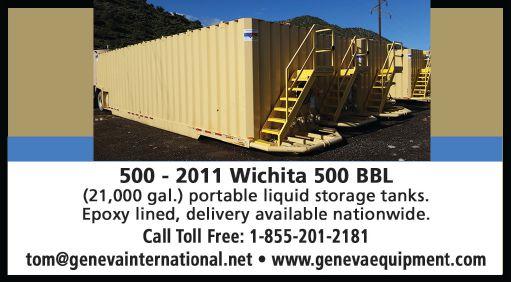
The use of frac tanks is growing in popularity as more manure is being applied further from home
BY TONY KRYZANOWSKI
Dribble Bar Update
Is this method of applying manure, popular with livestock producers in Europe, catching on in North America? BY
TREENA HEIN
Pigs, Chickens, Cattle … and Weddings
Porter family farm raises chickens, pigs, plus cattle, and also runs a successful farm wedding venue BY
DIANE METTLER
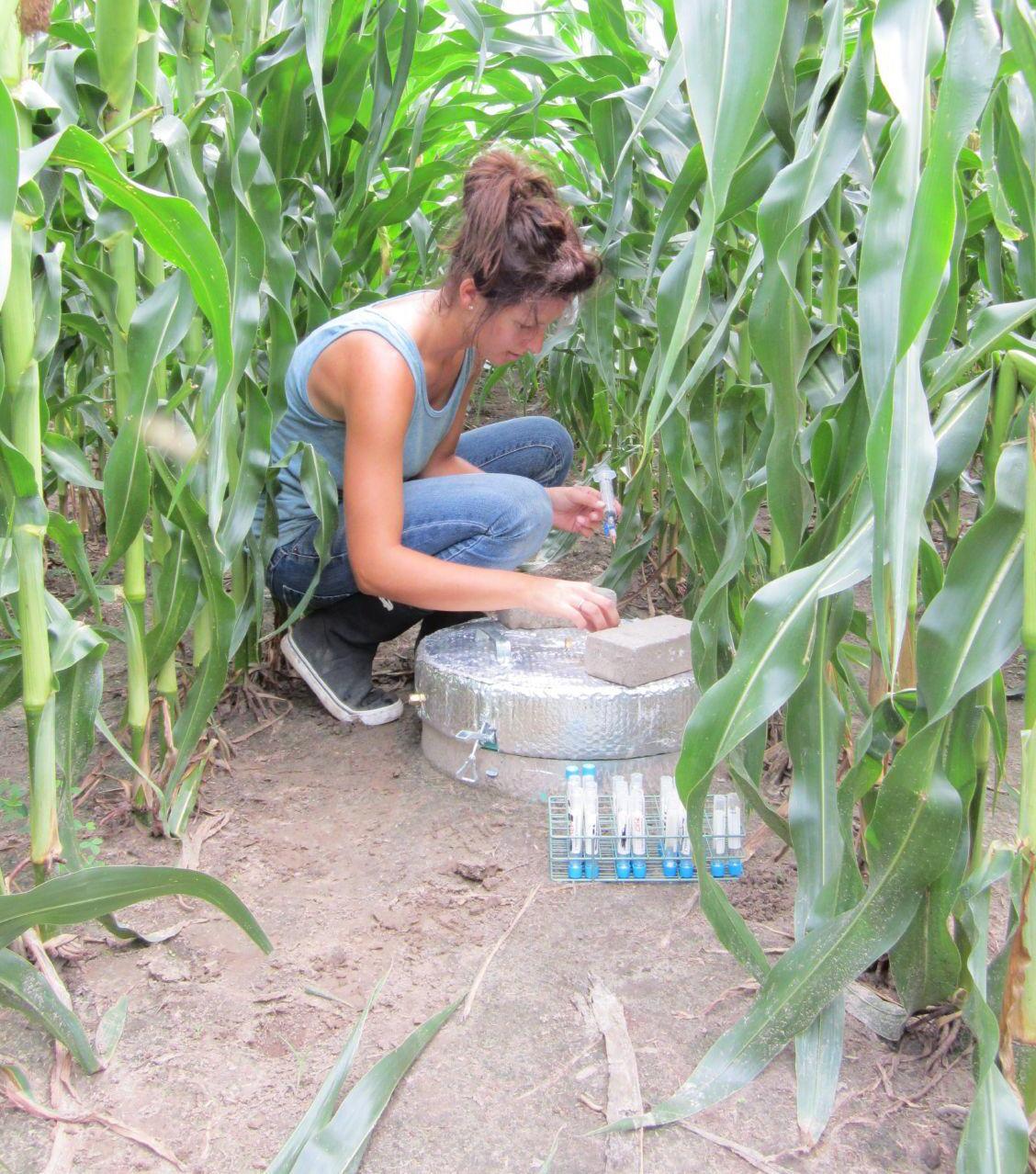
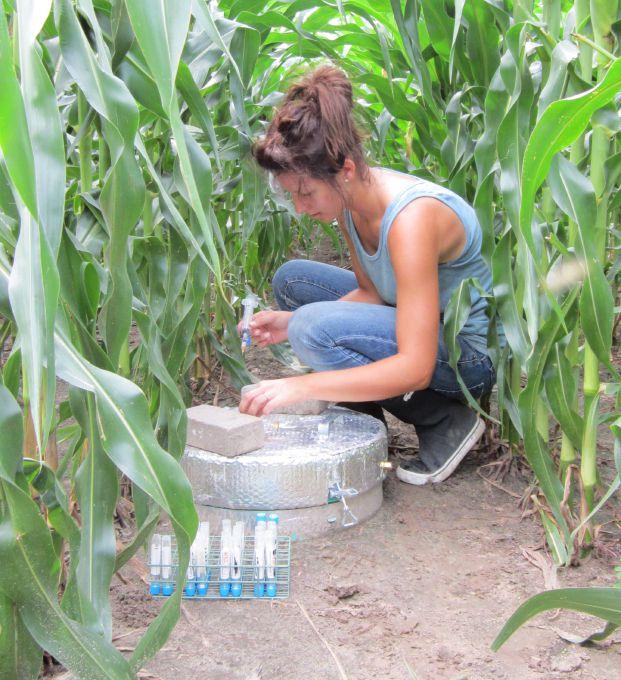
Emily Ann Schwager takes a soil sample. See page 10. Photo by Jessica Singh
Manitoba to expand hog industry?
About 12 years ago, prompted by water quality concerns, the government of Manitoba, Canada, slapped a “temporary” ban on new swine barns. A few years later, that “temporary” ban became a moratorium on new barn construction in 35 municipalities throughout the province. In 2011, restrictions on hog operations increased with the passing of new legislation requiring all new or expanding operations to construct an anaerobic digester to manage the hog manure. Four years later, those requirements eased – instead of a digester, farmers needed to construct a two-cell lagoon and meet new soil phosphorus regulations. Right.
Over this same time period, Manitoba experienced a shortage of slaughter pigs. Meat processers in the province were forced to source pigs from the U.S. and out-of-province, or lay-off staff to make ends meet.
“Companies like Maple Leaf … are running at 79 to 80 percent capacity, which limits them to be able to meet the market demand,”
This has been a long time coming for the province’s pork industry.
“The regulations, even if they are amended … will still be some of the most stringent manure management regulations in North America,” said Andrew Dickson, general manager of Manitoba Pork, to CBC News.
As an example, restrictions on winter manure spreading would continue in the province.
Interest in building new hog barns in Manitoba is increasing.
“We’re getting interest from all over, literally from eastern Manitoba right across to the western side of the province,” Mike Teillet, manager of sustainable development programs with Manitoba Pork, told FarmScape. “Right now, it’s slightly more on the expansion side but we’re also getting interest from new producers as well.”
Not everyone is happy with the proposed changes. Hog Watch Manitoba, an activist group that monitored the province’s swine industry in the late 1990s, has been resurrected after disbanding 10 years ago after the original
“Interest in building new hog barns in Manitoba is increasing.”
said Manitoba’s Agriculture Minister, Ralph Eichler, during a recent interview with FarmScape. “In 2004 and 2005, we were running about 10 million hogs per year. That number has dropped to about 7.4 million.”
Fast forward to today and the recent introduction of Manitoba’s Red Tape Reduction and Government Efficacy Act, aimed at reducing redundant legislation and prohibitive regulatory burdens. On the chopping block? The section of the province’s Environment Act prohibiting the construction or expansion of hog barns and manure storage facilities for hog operations across Manitoba.
moratorium was imposed. Members are concerned nutrient overload problems in area lakes could occur.
Maybe this group should turn its attention to the antiquated sewage system currently serving Manitoba’s capital city. Just Google “Winnipeg” and “sewage” and read all about the millions and millions of liters of raw sewage which have spilled into that province’s rivers in the past 10 years.
Forecasted cost to update Winnipeg’s sewers – more than $1 billion.
Annual hog-farm gate receipts in Manitoba – more than $1 billion.
Hmmmmmm ...
MANURE MANAGER May/June 2017 Volume 15, No. 3
Published by:
Annex Business Media, P.O. Box 530 Simcoe, ON N3Y 4N5
Editor MARGARET LAND (519) 429-5190, (888) 599-2228, ext 269 mland@annexweb.com
Associate Editor JENNIFER PAIGE 416-305-4840 jpaige@annexweb.com
Manure Manager will mail information on behalf of industry-related groups whose products and services we believe may be of interest to you. If you prefer not to receive this information, please contact our circulation department in any of the four ways listed above. Annex Privacy Officer privacy@annexbizmedia.com Tel: 800-668-2374
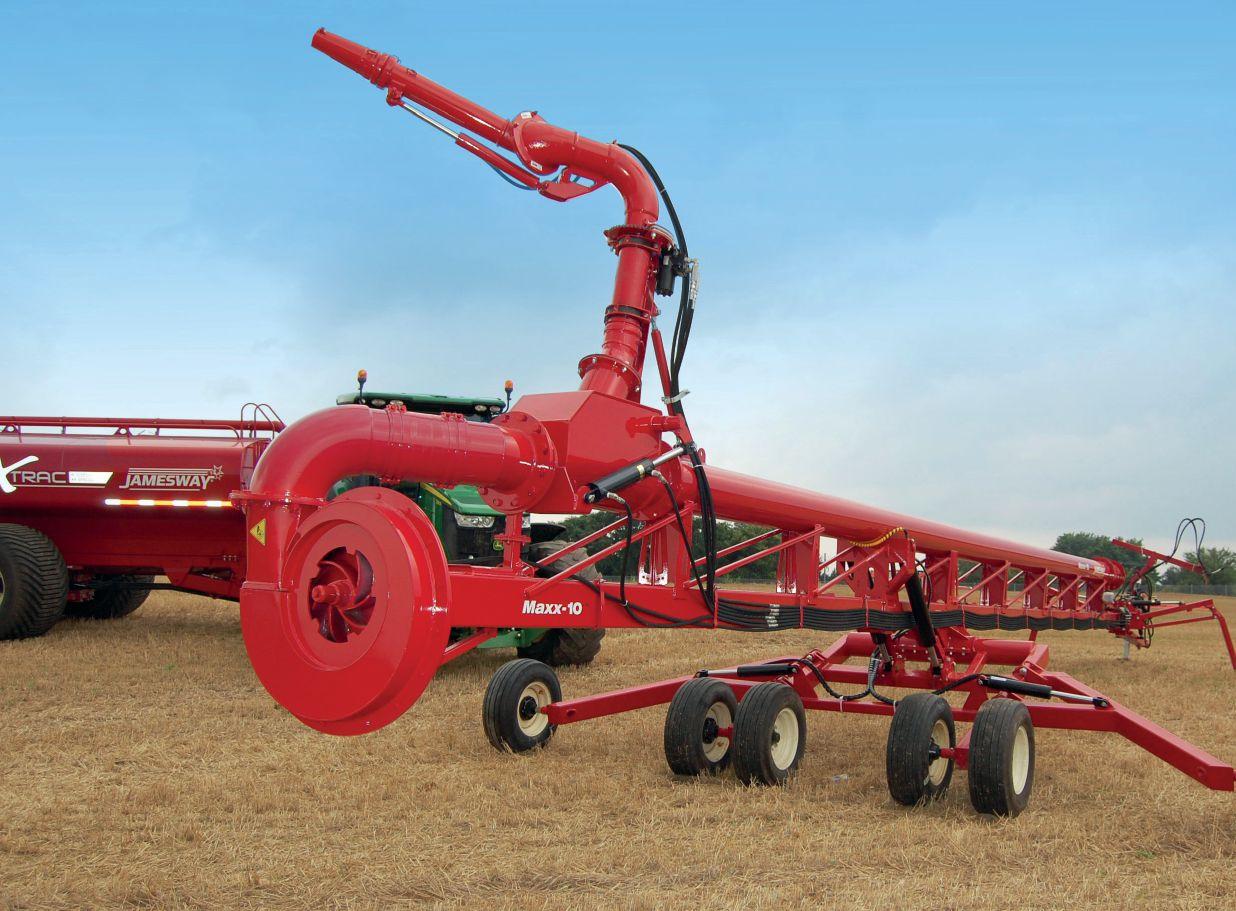
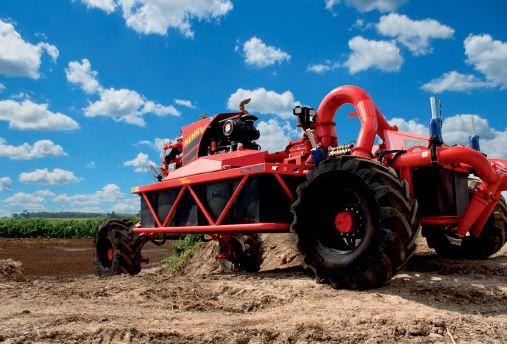
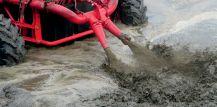
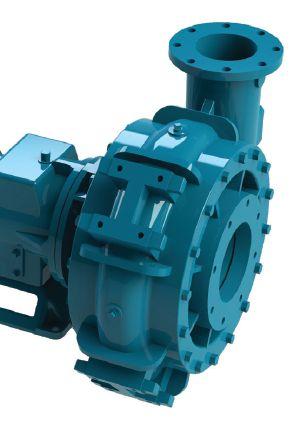
The new Jamesway MAXX-10 Lagoon Pump delivers the fastest load-out times plus the highpowered / long range agitation that big operators need.
• 8,200 gallons/minute flow
• 10-inch discharge for minimum restriction
• High-efficiency single outlet impeller
• 200 ft cannon radius
Key design features keep your pump running longer, even in tough sand.
• NiHard & Hardox-450 steel.
• 10-inch discharge reduces velocity.
• Smooth single outlet reduces turbulence.
Manure management champion in Minnesota
The Minnesota Pollution Control Agency (MPCA) recently recognized Bartholome Farms for its responsible feedlot manure management.
Southeast Minnesota’s karst lands are known for fractures, sinkholes, and underground streams and caves, which can make it difficult for farmers to properly manage manure lagoons. Bartholome Farms has gone to great lengths and expense to overcome the challenges and responsibly manage their dairy feedlot.
In 2014, Bartholome Farms proposed to build a new liquid manure storage basin, but the MPCA required a detailed study due to the potential risk to groundwater. The study, known as electro resistivity
imaging (ERI), locates and maps underground voids and fractures. The ERI confirmed that the proposed basin location was within a high-risk karst area Bartholome and MPCA agreed to reject the location.
More than a year later, Bartholome took the initiative to find a different location, pay for another ERI, and submit a new proposal. This time, the ERI confirmed the new location to be lower risk and led to MPCA approval.
For continued cooperation and spending significant time and money to follow rules and do what’s best for groundwater, the MPCA thanks Bartholome Farms for responsible feedlot manure management.
BEN PUCK NAMED IOWA’S 2017 SMALL BUSINESS PERSON
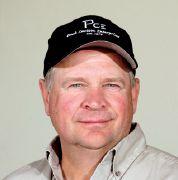
Ben Puck, owner of Puck Custom Enterprises (PCE) in Manning, Iowa, was recently named Iowa’s 2017 Small Business Person of the Year.
Puck was raised on a family farm in rural Iowa. In 1979, he began pumping and hauling liquid manure for area farmers.
In 1998, Puck incorporated the business as Puck Custom Enterprises. As he added additional manure services to the business, he realized there was room for improvement with the equipment he was using. In 2005, PCE built its own hose cart for drag hose manure
BY THE NUMBERS / North Carolina Pork
North Carolina is
application. That piece of equipment received a U.S. Patent in 2009 (Puck has received four other equipment patents over the years for his inventions to improve manure application).
PCE’s drag hose service grew steadily over the years and, in 2010, the company constructed a new
building for equipment manufacturing and sales.
Today, PCE’s primary focus is designing, building and selling equipment for manure management. PCE employs more than 50 full-time and 10 part-time employees in the town of Manning, population 1,480.
There are about
1,600 hog farms in N.C.
46,000 Contributes
11
Vibrating system helps turn manure into clean water, fertilizer
New Logic Research recently announced the successful commissioning of a VSEP vibrating membrane system to make clean water from digested cow manure.
The VSEP system, located in the Italian Alps region of Wipptal, takes the effluent from an anaerobic digester and transforms it into clean water that can either be reused or safely discharged to the environment. The project was implemented with the expert assistance of O.B. Impianti, New Logic’s distribution partner in Northern Italy.
Although cows have a simple diet, the digestive system of ruminant animals makes for complicated wastewater treatment scenarios. VSEP’s patented vibratory shear mechanism coupled with an innovative filter pack design means it can uniquely create crystal clear permeate from water heavily laden with biological material like cow manure.
“Digesters are great at making green power and reducing contaminant levels in the waste, but in most cases, further treatment of the liquid effluent is still necessary,” said New Logic CEO Greg Johnson. “Many have tried to treat digester effluent with standard spiral-wound reverse osmosis membrane systems only to find that it’s incredibly difficult, if not impossible.”
The Wipptal project is a cooperative one, taking cow manure from more than three-dozen local farmers. The liquid manure is transported to the treatment facility where more than 60 percent of it is transformed into clean water, while the remainder is turned into concentrated organic fertilizer. The only pretreatment between the digester and the VSEP is a 100-micron screening device to remove large particles from the feed material.
O.B. Impianti and New Logic are already building on the success of the Wipptal installation – they are currently working on two additional installations on the continent, where EU funding is frequently available for such projects.
OriginClear enters ag wastewater treatment
OriginClear Inc., a provider of water treatment solutions, recently announced its entry into the agricultural wastewater treatment market.
Spanish farming equipment manufacturing company Montajes Longares is launching a spinoff to commercialize its patented Depuporc pig manure slurry cleanup system, and has licensed OriginClear’s Electro Water Separation (EWS) to help clarify and sanitize the slurry for water reuse and fertilizer applications.
“For some time, we’ve been interested in the agricultural waste water treatment market,” said Jean-Louis Kindler, president of OriginClear’s technology division. “Our technology is well-suited to extracting organic contaminants and sanitizing agricultural waste water, and pig manure slurry is a great first application in this large and growing market.”
“We expect to use OriginClear’s EWS to significantly reduce the need for chemicals such as coagulants and flocculants, while reducing equipment cost and footprint, and operating expense,” said Francisco Longares Valero, CEO and co-founder of Depuporc S.L. “We plan to supply agricultural operators
and service companies with mobile treatment units having a capacity of seven metric tons of water per hour, or more than 50,000 gallons per day, and fixed onsite plants able to treat as much as 10 million gallons, per year.”
As part of its licensing commitment, Depuporc has acquired an OriginClear laboratory-scale unit to help its engineering team design and build a pilot system for immediate deployment at the site of a prospective client.
The Depuporc system is an integrated solution for livestock waste treatment that processes animal waste through various phases of filtering and separation, providing a source of recycled water for farm cleaning and irrigation. Depuporc S.L. plans to have the first pilot in operation by summer 2017.
Wisconsin county announces manure storage program
Dane County Executive Joe Parisi recently announced a new program to help clean up area lakes by assisting small and medium sized farms store manure in the winter.
About $1.1 million will be available for farmers to apply to help build community manure storage which will reduce the application of manure during critical times of the year when runoff is most likely to occur. Dane County and its partners spend more than $8 million a year to support the implementation of conservation practices.
“Our farmers are our best partners when it comes to lakes cleanup efforts,” said Parisi. “The county is working to do our part to ensure we preserve our agriculture heritage while protecting one of our most valuable resources.”
University of Wisconsin scientists estimate that 40 percent of manure containing phosphorus runs off snow or frozen ground between January and March and ends up in the lakes. Funds will be allocated using two methods: traditional cost share agreements and requests for proposals. The traditional Dane County cost share will fund a cost share for community manure storage. The request for proposal will allow producers to submit project proposals describing innovative ideas and strategies for managing manure such as ultrafiltration or composting.
Proposals are due to Dane County this summer and county staff will work with the top ranked proposals to develop full proposals. Projects that rank the highest will be contacted by Dane County to develop funding agreements for project implementation.
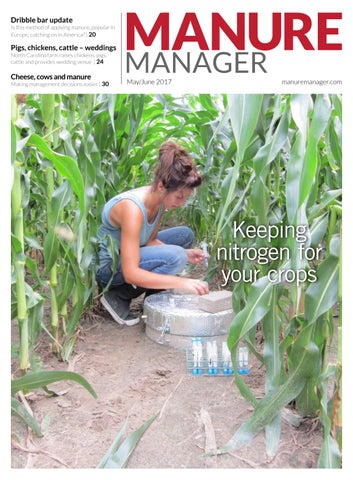
KEEPING NITROGEN for your crops
A new Canadian study compares nitrogen loss to the soil and air with spring and fall applications of digestate versus raw dairy manure.
BY TREENA HEIN
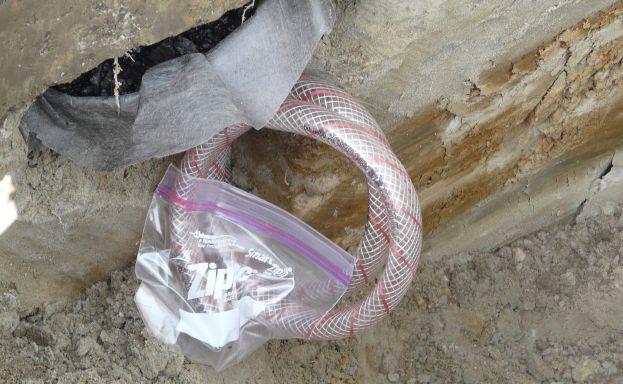
BELOW
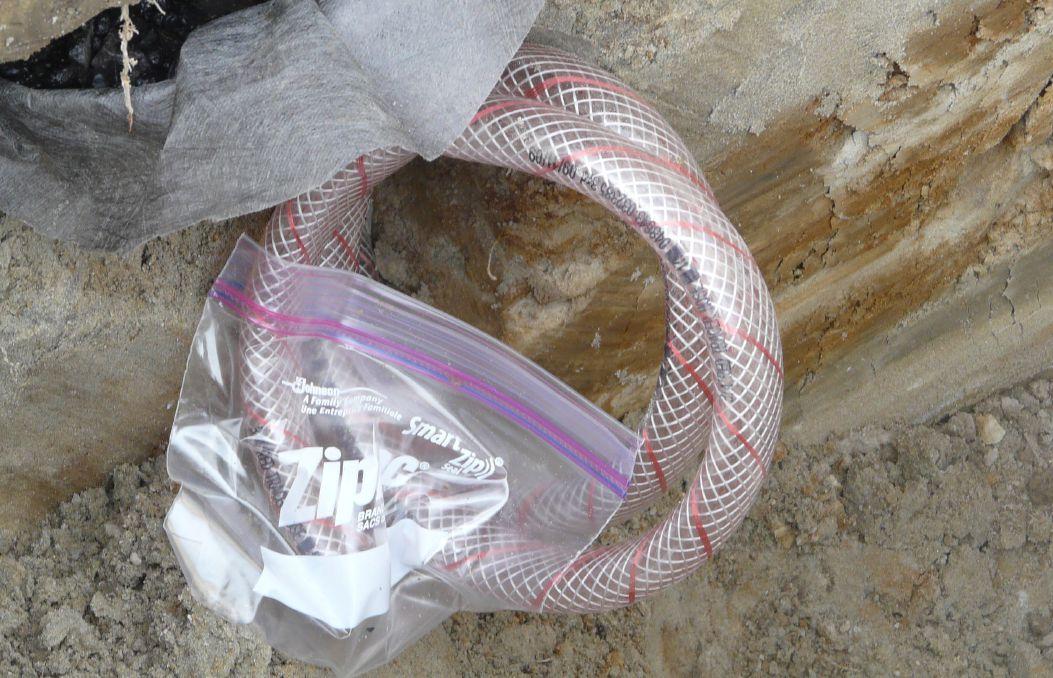
A zero tension lysimeter coil pokes out of the soil. These were used to measure nitrous oxide emissions.
Beef and dairy farmers obviously want to keep as much nitrogen as they can in the soil after they apply any type of manure to their fields, but there aren’t many recommendations out there about whether more N is retained through applying raw dairy manure or digestate (from anaerobic digesters).
In addition, is spring or fall application better for keeping N, and how does soil type figure in? It’s obvious that clay soils that allow for less general water drainage will allow also for less nitrogen leaching, but there haven’t been many studies comparing nitrous oxide emissions between different soil textures in the harsh year-round conditions of the northern U.S. and Canada.
Not only do farmers want to keep the N in the soil for their crops to use, but as good environment stewards, they also want to prevent nitrate leaching into watersheds and nitrous oxide emissions into the atmosphere.
“It’s well known that [nitrous oxide] is a greenhouse gas (GHG) that has a global warming potential almost 300 times more powerful than [carbon dioxide],” notes Emily Ann Schwager, who recently completed her master’s of environmental science degree at the University of Guelph under advisors Dr. Claudia Wagner-Riddle (University of Guelph Department of Environmental
BY
PHOTO
EMILY ANN SCHWAGER
Science) and Dr. Andy VanderZaag (Agriculture and Agri-food Canada or AAFC, Ottawa). “In Canada, [nitrous oxide] emissions account for seven percent of the total annual GHG emissions, 72 percent of which are attributed to the agricultural activities. About 30 percent of Canadian dairy industry’s carbon footprint is from [nitrous oxide] emissions.”
LEFT
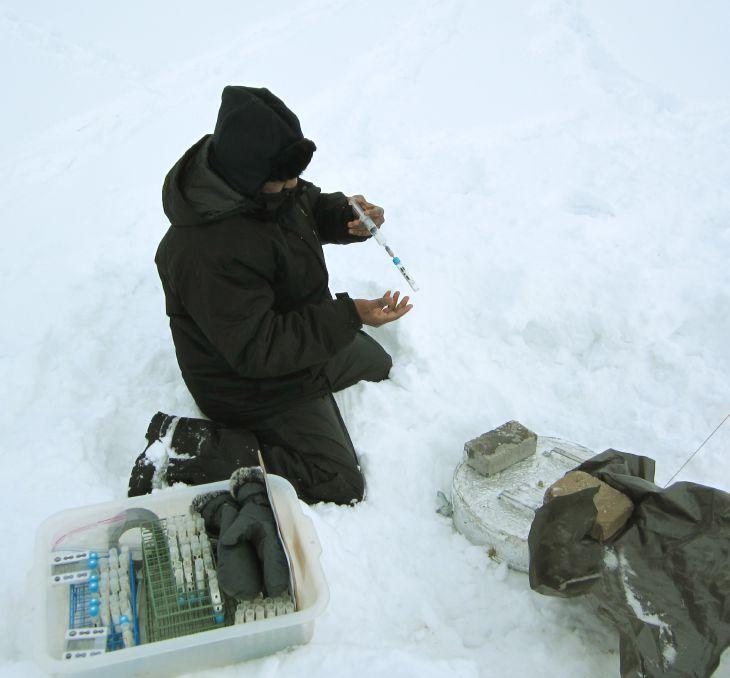
Sampling also had to be done during the winter.
“About 30 percent of Canadian dairy industry’s carbon footprint is from [nitrous oxide] emissions.”
– Emily Ann Schwager
Schwager notes that the Intergovernmental Panel on Climate Change (IPCC) considers better nutrient application practices and better manure management to be among the most important GHG mitigation strategies farmers can partake in.
Schwager (with her advisers and Anna Crolla, now at the Ontario Ministry of Agriculture, Food and Rural Affairs, Chris Kinsley now at the University of Ottawa, and Dr. Ed Gregorich at AAFC in Ottawa) applied and incorporated digestate and raw dairy manure into sandyloam and clay soils in the Ottawa area, in both spring and fall for two and a half years ending in 2015. She
measured leached nitrate through samples from a tile drainage system and nitrous oxide emissions through using zero-tension lysimeters.
Let’s start with the overall results. This study found that farmers who apply raw manure or those who have a digester and apply digestate are equally environmentally friendly. Nitrate leaching was consistently greater from digestate than raw manure, but nitrous oxide emissions were greater from raw manure over digestate.
“Overall environmental N losses between the two manure products were similar,” Schwager says. “There’s a theory that you get more nitrate leaching in digestate because it’s lower in organic matter compared to raw manure. It’s more of a liquid, which leads to faster soil infiltration (a positive effect for decreasing ammonia volatilization) and therefore possibly an increase the amount of nitrogen flowing downward to groundwater, if biochemical processes setting up N for gaseous emission don’t get involved along the way.”
There were no differences in nitrous oxide emissions between digestate and raw manure in the clay soil at any time of year. However, the digestate had significantly higher nitrous oxide emissions than raw manure in the sandy-loam field.
“The key difference was that in the sandy-loam soil, digestate was associated with much higher (50 to 100 percent) emissions during winter and spring thaw compared to raw manure,” VanderZaag notes. “While we’re not exactly sure why, one important factor is that the sandyloam soil was more acidic (pH 6.2) than the clay field (pH 7.1). Research by Cuhel et al. found that there is more nitrous oxide compared to nitrous oxide and nitrogen gas with decreasing pH because soil microbes convert nitrate to nitrous oxide more
preferentially at lower pH.”
Another factor is differences between the freezing properties of the two soil types, which may have also contributed to greater winter and thaw emissions in the sandy loam soil.
In terms of nitrate leaching in different soil types, there was about twice as much from spring-applied raw manure on sandy loam soil compared to clay soil, but digestate showed similar leaching in both soils.
“Both the lysimeter and tile drains results agreed that manure and digestate had lower nitrate leaching loss compared to spring-applied urea,” VanderZaag notes, “which may have been the result of lower N immobilization rates or lower soil denitrification activity due to the lack of applied carbon in urea compared to the organic amendments.”
Whether raw manure or digestate was applied in spring or fall, nitrous oxide emissions were the same. Other studies, however, have shown that fall applications potentially lead to significantly more nitrous oxide loss, considering it takes seven or eight months before the N is taken up by a crop.
“We don’t have a lot of year-round studies to compare to however,” Schwager adds, “so overall annual nitrous oxide emissions may be underestimated.”
Nitrate leaching was higher in fall applications, typically because of late fall precipitation and snow melt. Nitrogen applied in the late spring is often followed by less precipitation and the fields also dry out due to crop uptake of water over the summer and although the team doesn’t have definitive data
on nitrate loss for fall-versus-spring, spring application was preferable for nitrous oxide leaching loss.
“A follow-up study was done with raw manure comparing fall versus spring and we saw that fall application on the sandy loam soil led to higher losses of N in the non-growing season,” says VanderZaag. “So overall, I think it is fair to say spring is recommended for digestate or raw manure application, although it is pushing the limit of what our data can verify.”
Canadian dairy farmers are generally thought to already apply most of their manure in the spring/summer (two-thirds). Manure is applied in the fall for various reasons, Schwager says, including lack of time and access to equipment at spring planting time and the risk of soil compaction following spring thaw, in addition to limitations on farm manure storage capacity.
“It’s positive that although application timing did not have an effect on direct nitrous oxide emissions, most dairy producers already apply manure products in the spring,” she explains.
“The closer the N can be applied to the time of crop needs, the more N losses – from both environmental and economic perspective – can be avoided.”
And, although this study found that farmers who apply raw manure or those who have a digester and apply digestate to their fields are equally environmentally-friendly in terms of GHG emissions, because anaerobic digestion provides GHG reduction in other ways (as well as energy production), Schwager encourages their use. Only about 50 farms in Canada currently have digesters.
•
•
Ranging further afield with fracs
The use of frac tanks is growing in popularity as more manure is being applied further from home
BY TONY KRYZANOWSKI
Custom manure applicators often describe their work in colorful ways, using such terms as “traveling circus” and “hopscotch system” to explain what they do on a day-to-day basis. Lately, many have added a new term to their vocabulary and that is “frac tank.”
Over the past 10 years, many custom manure applicators have added these portable, on site, storage and transfer tanks to their fleets and, while not something they necessarily deploy on every job, it has become a handy and valuable
tool in their arsenal.
Taking Wisconsin as an example, in 2003 there were five frac tanks being used by custom manure applicators in the state and 68 semi transport trucks transporting or both transporting and applying liquid manure. In 2014, there were 34 frac tanks and more than 400 semi trucks. The growth of the use of semi trucks concurrently with frac tanks is important because it shows that at the same time as more frac tanks have been deployed, higher volumes
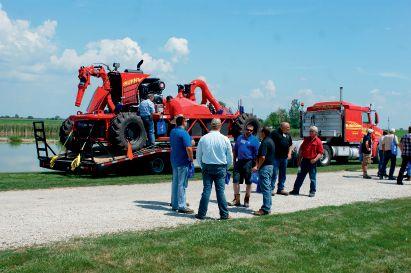
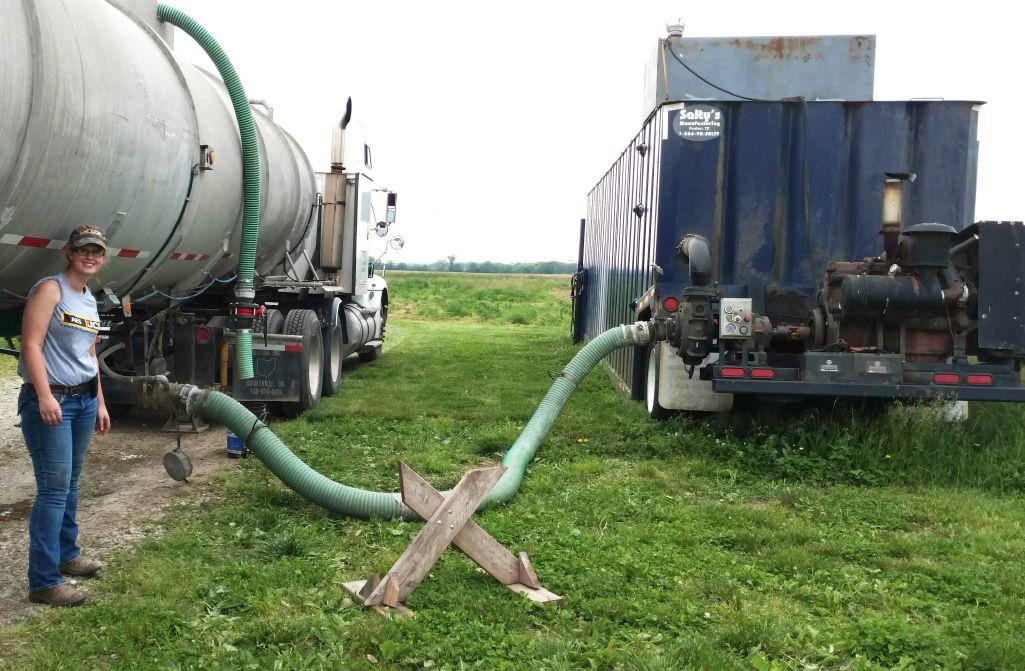
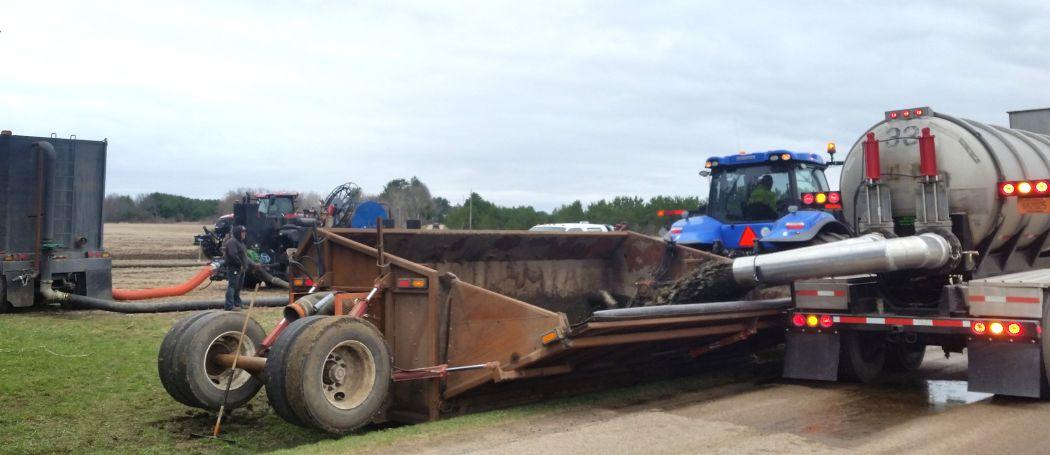
ABOVE Megan Dresbach from Ohio custom manure applicator, WD Farms, unloads manure from a semi into the back of the company’s 21,000 gallon frac tank, using the custom designed, International engine and Cornell pump self-unloading feature.
INSET
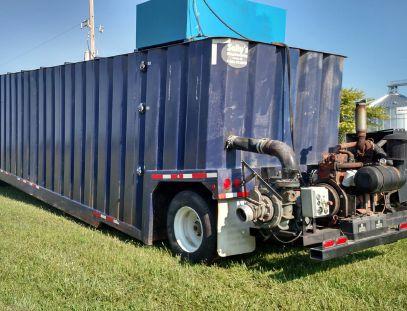
Frac tanks being transported down roads are becoming a more common site as custom manure applicators work to fulfill customer demands to apply manure farth er away from lagoons.
ABOVE
More custom manure applicators are adding frac tanks for portable, on-site manure storage and transfer because many say they can spread more manure per day and apply manure at the correct rate on farms further from customer lagoons.
of liquid manure are being transported over longer distances with semis.
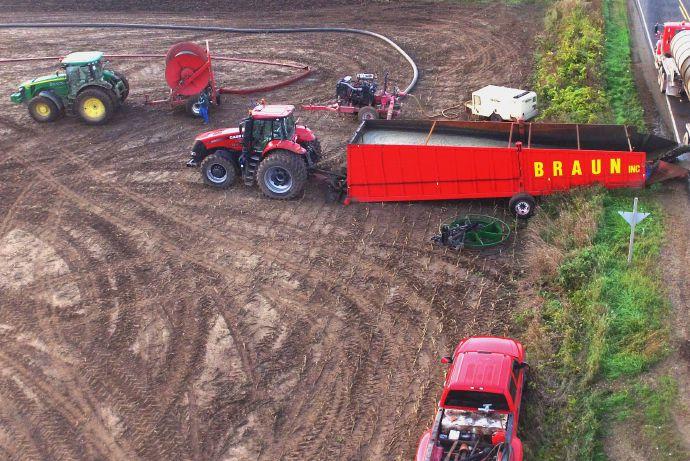
The term frac tank comes from the oil industry where a large, typically rectangular, holding tank is commonly used in the field to hold water or down-hole chemicals. Today, they are being re-purposed by many custom manure applicators as a storage and transfer system, regardless of whether they deploy a drag hose system, tractors and tankers, or trucks to land apply manure. While their use has opened up and helped to maintain business opportunities, it definitely is not business-as-usual when one becomes part of a service call.
There are extra costs related to delivery and set up of the tank as well as extra staff to monitor the inflow and outflow from the tank. There is also a learning curve required to integrate this portable storage device into regular workflow.
After renting a frac tank on a couple of occasions, Circleville, Ohio-based, custom manure applicator, WD Farms Inc., recently purchased and modified a Salty 21,000 gallon frac tank that was used for holding water while in service with the oil industry. Owner Eric Dresbach says he has made a total investment of about $30,000 to both purchase and modify the tank.
“Once we started the drag hose business, we had to have that shock absorber between the trucks and the
drag hose,” Dresbach says. “Long distance delivery and a drag hose system is what drove the purchase.”
Over a period of eight days, hydraulic cylinders along with external reinforcement were added so the tank could be loaded onto a regular semi for transport from site to site. A 200-horsepower International engine with a Cornell pump was attached to the back so delivery trucks could self-load into the tank and fittings were changed on the front so that a booster pump for the in-field drag hose system could be connected. Eric says all this was accomplished by the hard work of his son, David, and other employees. The tank comes equipped with a set of stairs instead of a ladder for safety, and three sight gauges at different levels so that operators can monitor tank volume. They land apply approximately 60,000 gallons per hour from the frac tank with their drag hose system.
“It’s not unusual for us to move cow manure out five-to-eight miles,” Dresbach says. “In Ohio, you can’t lay a hose out that far logistics-wise. When using the frac tank, the farmer gets more benefit from manure because it is more spread out and it’s giving us more gallons per hour.”
One of the primary factors driving more frac tank usage is the potential to attract more business. Jake Buttles, owner of Buttles Custom Ag LLC, located about an hour west of Green
Bay, Wisc., says his investment into a couple of frac tanks over the past few years has brought him about 30 percent more business.
They have an extensive and varied manure hauling and application fleet that includes two drag hose systems. Buttles Custom Ag land applies about 200 million gallons annually exclusively for the dairy industry. Buttles has two, 21,000-gallon frac tanks that he sourced from the oilfield and customized with such features as hydraulic rams on the front so that they can more easily be loaded onto transport trucks. They use a dump tank and frac tank combination, where trucks unload using a gravity flow system into a smaller 4,000-gallon dump tank, and then the liquid manure is pumped into the larger frac tank usually within 25 feet of the dump tank.
“With this system, where we use gravity flow to unload trucks into the dump tank, we’ve reduced our truck unloading time from about two-and-ahalf minutes to about a minute,” Buttles says.
They use frac tanks for about 45 percent of their service calls, typically on jobs when the field where the manure is being applied is more than four miles from the lagoon and the customer wants to minimize field soil compaction.
Buttles adds that with changing farm practices, like dairies planting longer maturity corn, they have a shorter application window. So, using a portable storage and transfer unit like a frac tank provides them with the opportunity to apply more volume within tighter application windows in both spring and fall.
Dresbach adds that just-in-time application is also becoming an issue for him as some of his customers are moving toward planting two crops annually, such as wanting to plant triticale soon after harvesting the corn crop. These customers demand that manure is applied right after the corn harvest so that the second crop can be planted within a few days.
What Buttles likes about his frac tanks is that they help to maintain continuous flow on the land application end, regardless of how many delivery trucks he may have available on a daily basis. It also removes heavier tractors and tanks from roads, and with tank portability, it provides him with the ability to find alternative access points
CONTRIBUTED PHOTO
ABOVE
Wisconsin-based custom manure applicator, Buttles Custom Ag LLC, uses a unique dump tank and frac tank combination that allows them to unload manure transport trucks by gravity flow in about a minute. The manure is then pumped from the smaller dump tank into the frac tank.
to a farm, should he run into a road issue. However, there is more set up time required with the additional set of equipment, and more training required with new employees so that they understand the overall workflow when frac tanks are in use.
Besides the ability to generate more business, other factors fueling frac tank growth include larger farms generating higher volumes of liquid manure with a limited amount of land around the farm available to land apply the manure, more extreme weather resulting in fewer potential application days, precision farming, road weight limits, and implementation of nutrient management plans.
Kevin Erb is a conservation professional training coordinator with the University of Wisconsin Extension branch who works regularly with custom manure applicators in the state and throughout the Midwest. He says greater proliferation of frac tanks has not only contributed to manure delivery and application efficiency, but also to hauling safety.
Erb explains that over the last 15 years, Wisconsin has witnessed many more semis hauling manure on roads, either for direct land application or delivery to portable, on-site storage and transfer devices like frac tanks.
“The real safety aspect (of frac tank use) is that we don’t have equipment going in and out of fields,” he says,
meaning that less mud and manure is being tracked onto roads and there is the potential for fewer accidents when trucks turn into fields.
Custom applicators queried about their frac tank investments, and particularly those serving the dairy industry, said that they have felt pressure from farm customers to provide the frac tank option. Precision farming and implementation of nutrient management plans have sometimes resulted in application of fewer gallonsper-hectare, meaning that the extra volume of liquid manure that the farm generates has to find a new home, usually farther from the farm.
Also, while many farm customers like the idea of drag hose application systems because it reduces land compaction, there is only so much drag hose and pump power that can be economically and safely deployed to reach farmland more than three miles from the farm. So, by offering portable, on-site storage and transfer, custom applicators can still offer the drag hose option on farms farther away from storage lagoons. In many case, custom applicators report that their farm customers are willing to absorb the extra cost if it means less soil compaction, quicker and more timely application, and more precise application of nutrients per hectare.
Another factor contributing to the proliferation of frac tanks in custom
manure application is the availability and cost of frac tanks, with some basic tanks available at auction these days in the $5,000 to $7,000 range due to the oil industry downturn. But, because a frac tank may not be required on all jobs, it may make more sense to simply rent a tank, as needed, and charge the customer accordingly.
A number of frac tank management issues must be considered once one has been put into service. The first is transportation of the tank to the field location. It must be legal to transport the tank on both developed and lessdeveloped rural roads. The second issue is finding an appropriate location for the frac tank.
“When it comes to frac tanks, it’s not just something you put down anywhere,” Erb says. “You really need to be thinking about what’s going to be the traffic impact, what’s the liability, and if you are in the ditch or right-of-way, do you need a permit from that township or county to have that tank located there for a day or two.”
Another important consideration is making sure that the tank is designed and set up in such a way, perhaps with a V-bottom, so that it can be emptied easily once a job is finished and the tank needs to be transported to a new location. Solids, particularly sand, can accumulate in the bottom of the tank, increasing weight and decreasing available capacity.
Dribble bar update
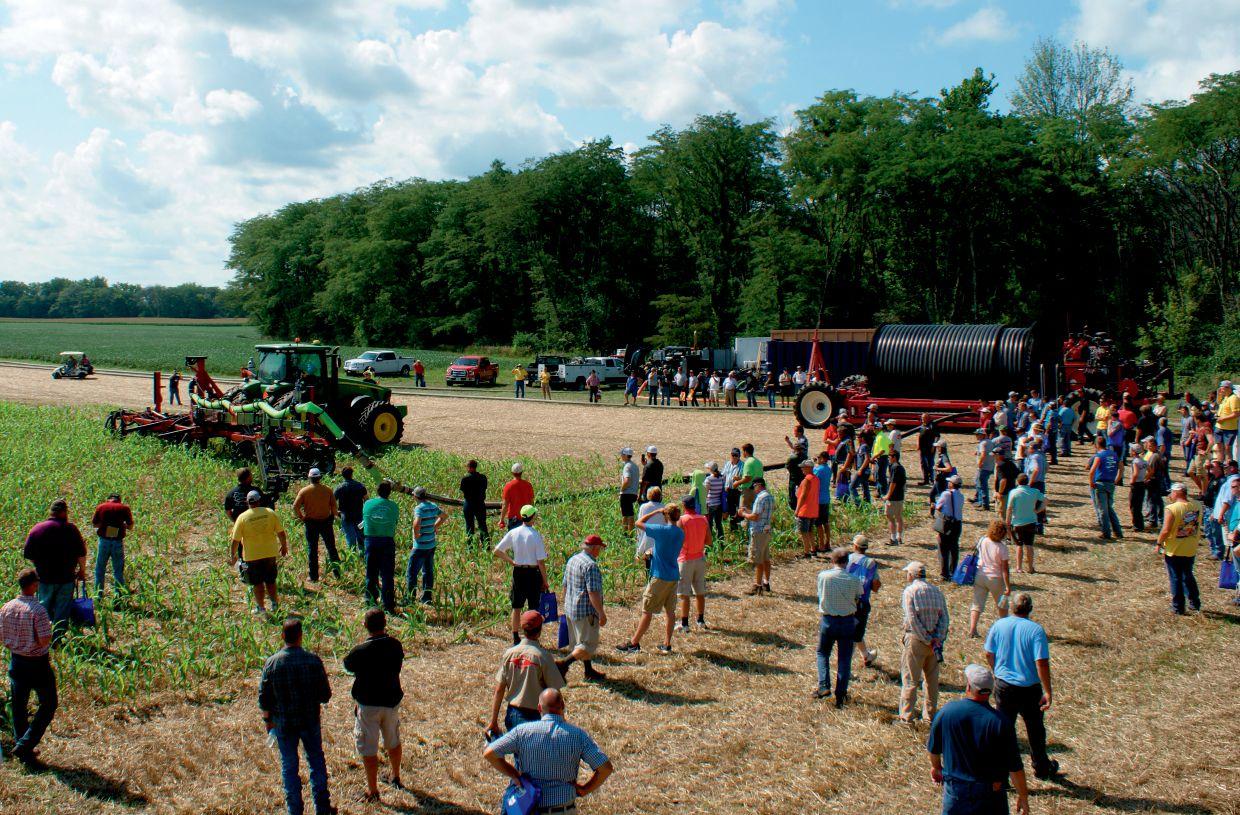
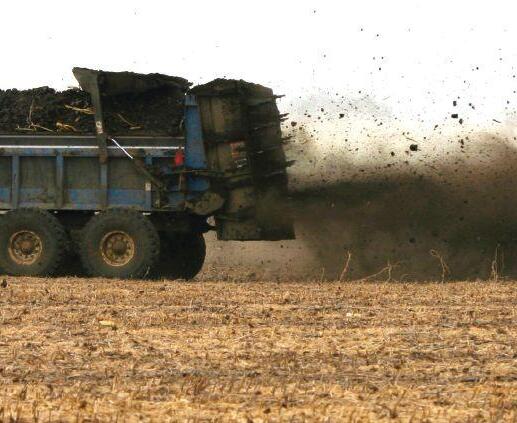
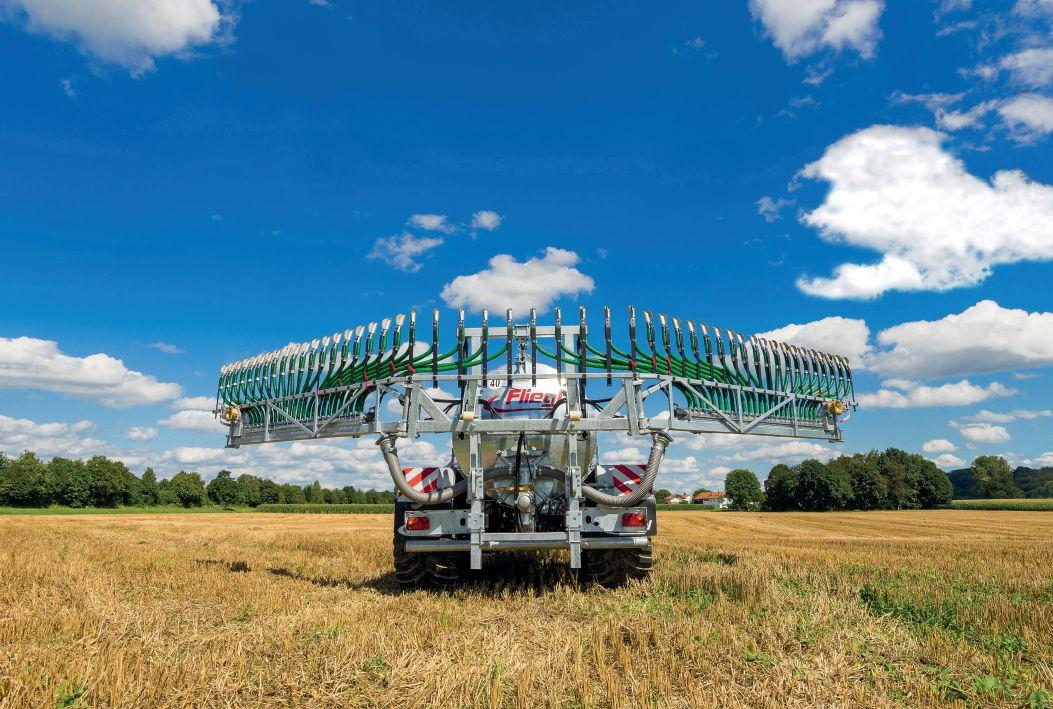
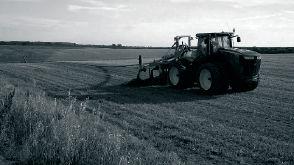
Is this method of applying manure, popular with livestock producers in Europe, catching on in North America?
BY TREENA HEIN
In 2015, Manure Manager reported on the dribble bar, a method of applying liquid manure for dragline units that is very popular in Europe, with thousands of units sold there by its Germanybased manufacturer, Vogelsang, which has a U.S. office in Ravenna, Ohio. The dribble bar was first demonstrated at the North American Manure Expo in 2012, and having heard about it, Walter Grose travelled to Germany to visit the factory. Grose – head of sales and marketing at Husky Farm Equipment in Alma, Ont. – was assured the units could work on Canadian tankers and signed on as a Canadian distributor.
The dribble bar was invented to address widespread European restrictions on manure application outside the growing season. Applying manure to a field with growing plants requires either injection or something that distributes manure at low pressure onto the ground below the plant leaves, allowing a greater amount to be
ABOVE
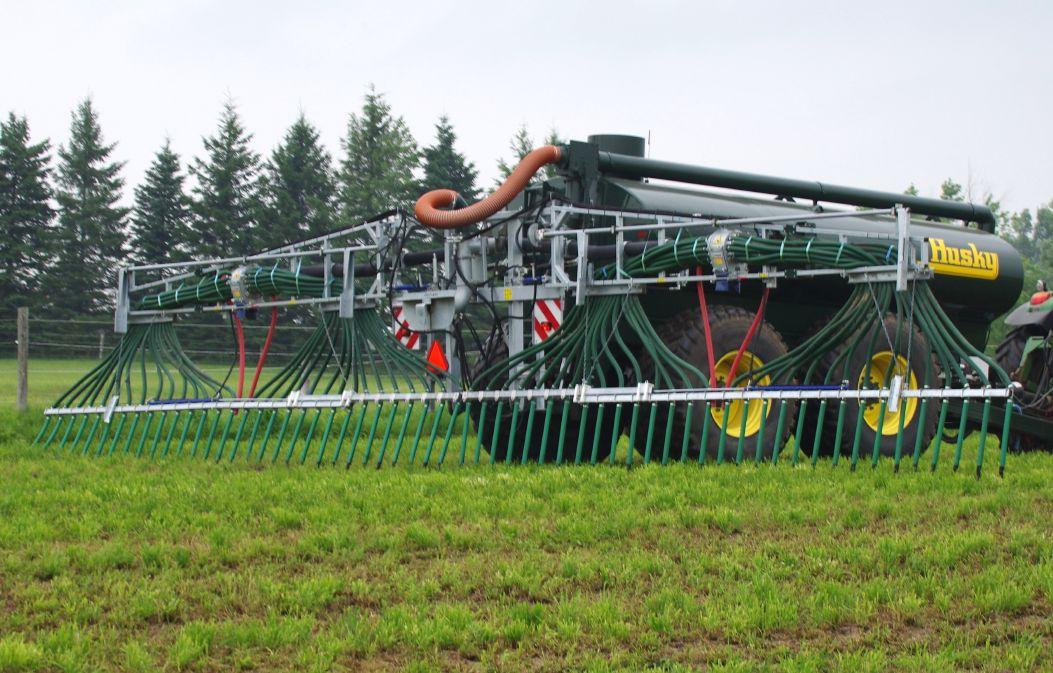
applied with more accuracy and less runoff, crop injury and odor. The Vogelsang dribble bar – and other European equipment, such as Veenhuis shallow injection technology – also offers a large number of rows, which allows for application at ground level in seven to 10-inch spacings with no splash.
In 2015, Christine Brown, field crops program lead with the Ontario Ministry of Agriculture, Food and Rural Affairs, studied the dribble bar on a variety of fronts. She reported to Manure Manager that at a 10-inch row spacing, there are about 60 dribble hoses on the toolbar. At 4,000 gallons per acre, that would be about 70 to 75 gallons applied per row, per acre. Brown noted that less volume per row means less risk of runoff and, when applied on forage or pasture under appropriate conditions, faster infiltration.
In terms of nutrient application accuracy, Brown found that the fine distribution of the
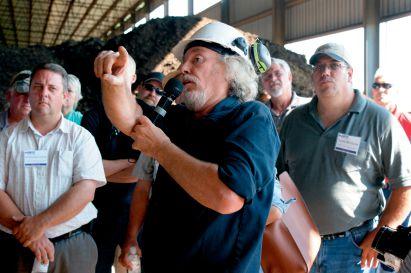
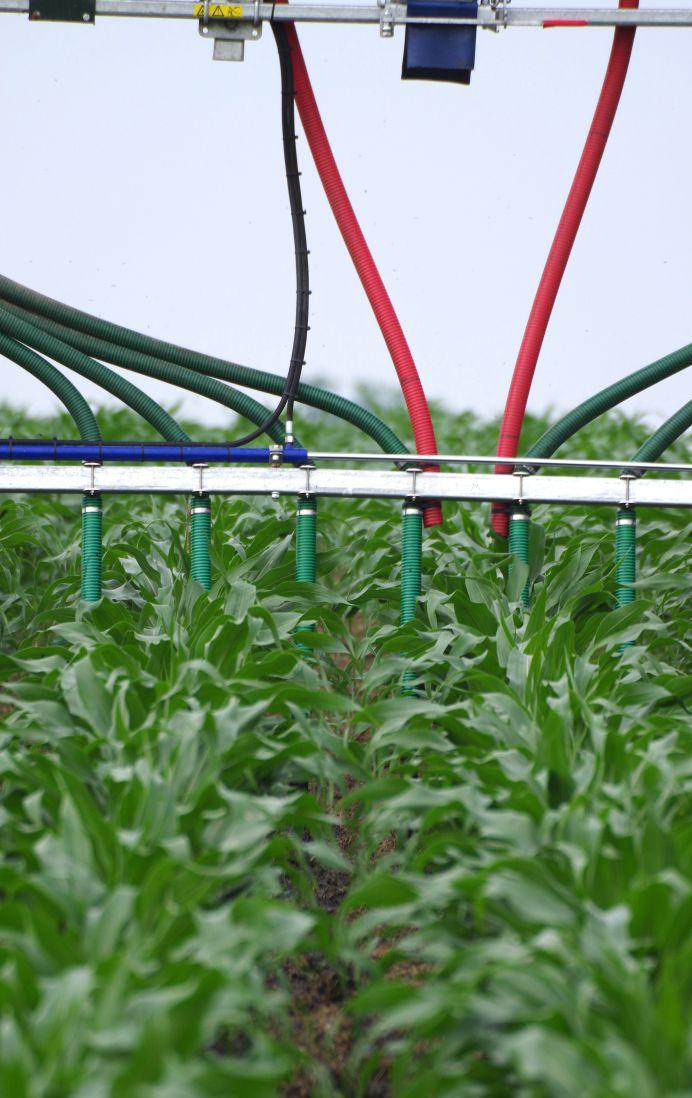
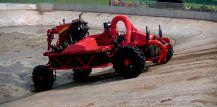
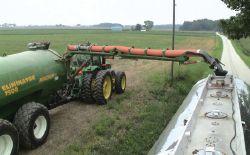
The dribble bar applicator is a method of distributing liquid manure using dragline units and is very popular in Europe.
EFFICIENT SOLIDS LIQUID SEPARATION
ORGANIC FEED SYSTEMS
3-POINT HITCH PUMPS
BIOSELECT TECHNOLOGY
+ Solids Liquid Separation
+ With Structure
+ Without Chemicals
POWERFEED TECHNOLOGY
+ Feeding and Transfer of Organic Waste
+ Closed Loop System
+ Process Control
+ Energy Efficient
ABOVE
system allowed for more consistency in each row than splash plate technology. This makes the application of manure more like fertilizer, she concluded, but with nutrients placed closer to where a growing crop can utilize them. In comparison to injection, Brown noted that dribble bar application is faster and uses less horsepower, with farmers able to cover many acres in a day with less wheel track.
Brown also noted that a dribble bar could be used to apply manure in many situations, such as into a wheat crop at the same time that commercial nitrogen is applied or before planting in canola, corn or soybeans, in planted canola, corn (up to about the six-leaf stage) or soybeans, in edible beans before or just after planting, in forage crops after harvest (with potentially up to three application opportunities) and
in pasture (especially where rotational grazing has been established). Lastly, Brown felt dribble bars would also work well after cereal harvest, where manure could be slurry-seeded with cover crops (or the cover crops could be established after application).
“Where large fields in corn/soy rotation have erosion concerns, grassed tram lines could be established for less compaction damage and more frequent in-crop application opportunities,” she said in 2015. “For custom applicators, technology that allows manure application to occur during the growing season will allow more days for application in a year and will help to reduce the stress associated with full manure storage when the weather doesn’t cooperate, such as late harvest or wet conditions or early winter conditions.”
Brown has not conducted any additional studies on the dribble bar specifically, but her recent studies on volatilization of surface-applied material shows faster infiltration results from a lower application rate per row (70 to 75 gal/ac), especially if there is some canopy, such as four- to-six-leaf corn.
For its part, Husky Farm Equipment toured across North America with the Vogelsang dribble bar mounted on the Husky Spreader in 2015 and 2016, attending the Manure Expo, field days and farm shows.
“Many people were impressed with the accuracy and the different types of manure you could pump,” says Grose. “We raised awareness and got farmers thinking about the new technology. We sold one unit for a dragline operation in Ontario. There may have been other units sold by other dealerships.”
Brown considers this slow adoption to be typical.
“The reality is that when producers are introduced to new technology, they often need to see or hear about it a few times,” she says. “Custom applicators may need to determine how many more days of application they may get by being able to apply into growing crops, and how it would work with their current compliment of labour and equipment.”
Brown believes that as pressure for environmental sustainability in farming increases and the ag industry moves ahead with 4R stewardship (right source, right rate, right place and right time) for fertilizer and manure management, interest in dribble bards will increase, but that there are other devices that provide
The dribble bar system distributes manure at low pressure onto the ground below the plant leaves, allowing a greater amount to be applied with more accuracy and less runoff, crop injury and odor.
COURTESY OF HUSKY FARM EQUIPMENT
targeted manure application and some of it works in tandem.
“The other new technology that we are demonstrating as an opportunity for application into standing crops is the Cadman drag hose system that can apply manure into standing corn without damaging the corn,” she says. “The dribble bar could be attached to the drag hose to apply to other crops.”
Beyond the targeted nature of incrop application with a toolbar, Brown sees benefits in the way compaction is reduced, especially if the setup features a very long boom.
“The Compaction Smart conference in January in Waterloo highlighted compaction damage to cropland and the lasting impact that compaction can have on yield,” she notes, pointing to a study presented at the conference conducted by Dr. Scott Shier of Ohio State University. Dr. Shier found almost half a field was wheel-tracked during manure application, and he also found that under normal soil conditions, a six-bushel corn yield hit was present in untracked areas. Under wet soil conditions, it was 27 bu/acre.
for example, will be banned in Germany in 2020 and that band spreading (which includes spreading by dribble bar) will be mandatory.
“The European mentality has changed towards manure and farmers now view it as a very valuable resource,” he reports. “The dribble bar allows farmers to apply manure as they would commercial fertilizer, during a much larger time window than with other methods. You can do one application before seeding and the other two as
side-dressing during growing season, when the nutrients to really use those nutrients.”
Jansen says it will take some time to educate North American farmers on the benefits of the technology, but that Vogelsang is mobilizing right now to start that up on a new scale.
Grose is also positive about adoption of the dribble bar.
“There are many farmers interested,” he says, “and we are positive it will catch on.”
“There are many farmers interested and we are positive it will catch on.” – Walter Grose
“If there is a 27 bu/acre yield reduction on 45 percent of the field, and corn is around $4.50/bu, that would represent a $50/acre cost due to compaction,” Brown notes. “If I have a 60-foot boom dribble bar and apply when risk of compaction is lower (soil conditions are not wet), then I would reduce the area of the field that is damaged with wheel tracks compared to a tanker that spreads about 30-foot width.”
Vogelsang’s international agriculture sales director notes that European sales are strong and are expected to continue to grow because regulations strongly support environmentally-friendly spreading technologies throughout the region. Ansgar Jansen says mash plates,
PIGS, CATTLE, CHICKENS and Weddings
The diversified Porter family farm raises thousands of chicks and pigs, as well as cattle, and due to successful manure management, also runs a successful farm wedding venue
BY DIANE METTLER
BELOW
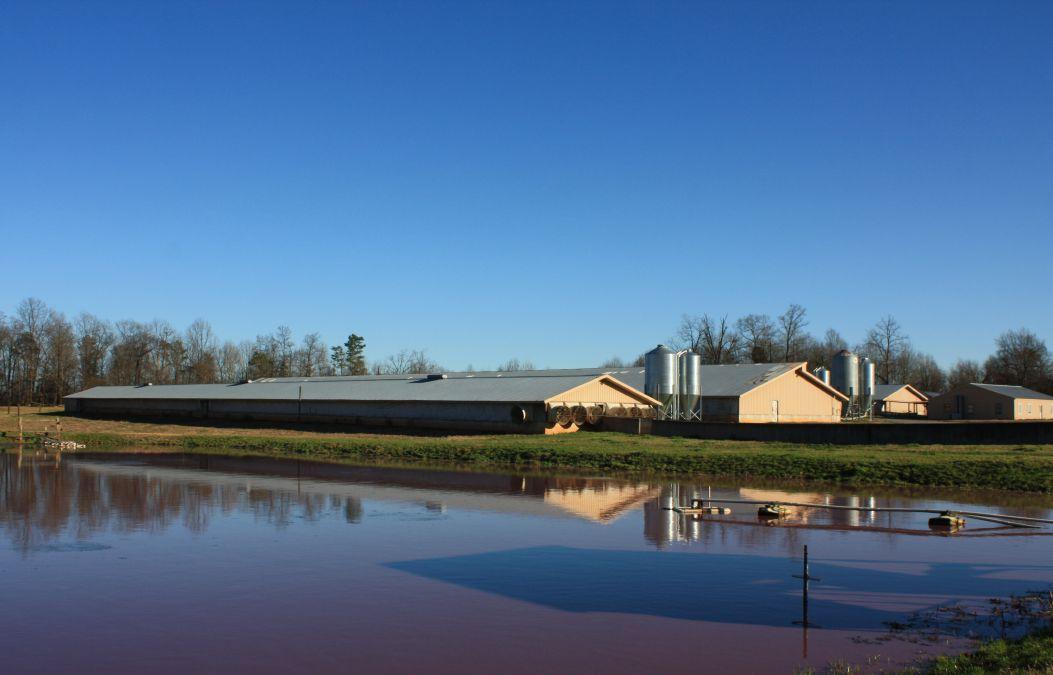
The Porter’s operate a 2,200-sow farrowto-wean multiplication farm, contracted through Smithfield. Waste from the barns is regularly flushed out to a one-acre, anaerobic lagoon, which also acts as a holding pit.
The Porter Family farm, located in Cabarrus County, N.C., is the definition of diverse. Four generations of Porters raise chickens, hogs, cattle, and run a profitable agritourism business.
The 1,000-acre farm is split into two pieces. Six hundred acres house the hogs, chickens, hay fields, cattle and the family homes. Two miles away, the remaining 400 acres contains additional hay fields, cattle and agritourism, including a wedding venue. It takes outstanding teamwork to juggle it all.
The Porter’s 2200-sow farrow-to-wean farm is contracted through Smithfield. They have two farrowing buildings 400-feet by 60-feet, a 500foot gestation building, a 500-foot breeding building, as well as two guilt development buildings where the new breeding stock comes in.
“At the guilt buildings, we monitor the animals and test their blood to assure they are disease-free before being introduced into the herd,” explains Jared Porter, third-generation on the farm.
Fridays, the buildings are used to ship piglets.
“We’re contracted to raise 24 to 28 dayold piglets and every Friday we ship out between 800 to 1,000 piglets to offsite nurseries,” says Jared. “They go out a separate ramp because they are going to a clean nursery and they’re disease free.”
In the hog barns, the waste is captured into onefoot sloped pits under the barns. The waste is
regularly flushed to a one-acre, anaerobic lagoon, which acts as a holding pit.
“At the top of each barn is a flood tank,” explains Jared. “We are recirculating water from the lagoon to fill up and flush about three to four times a day to clean out.
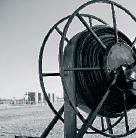
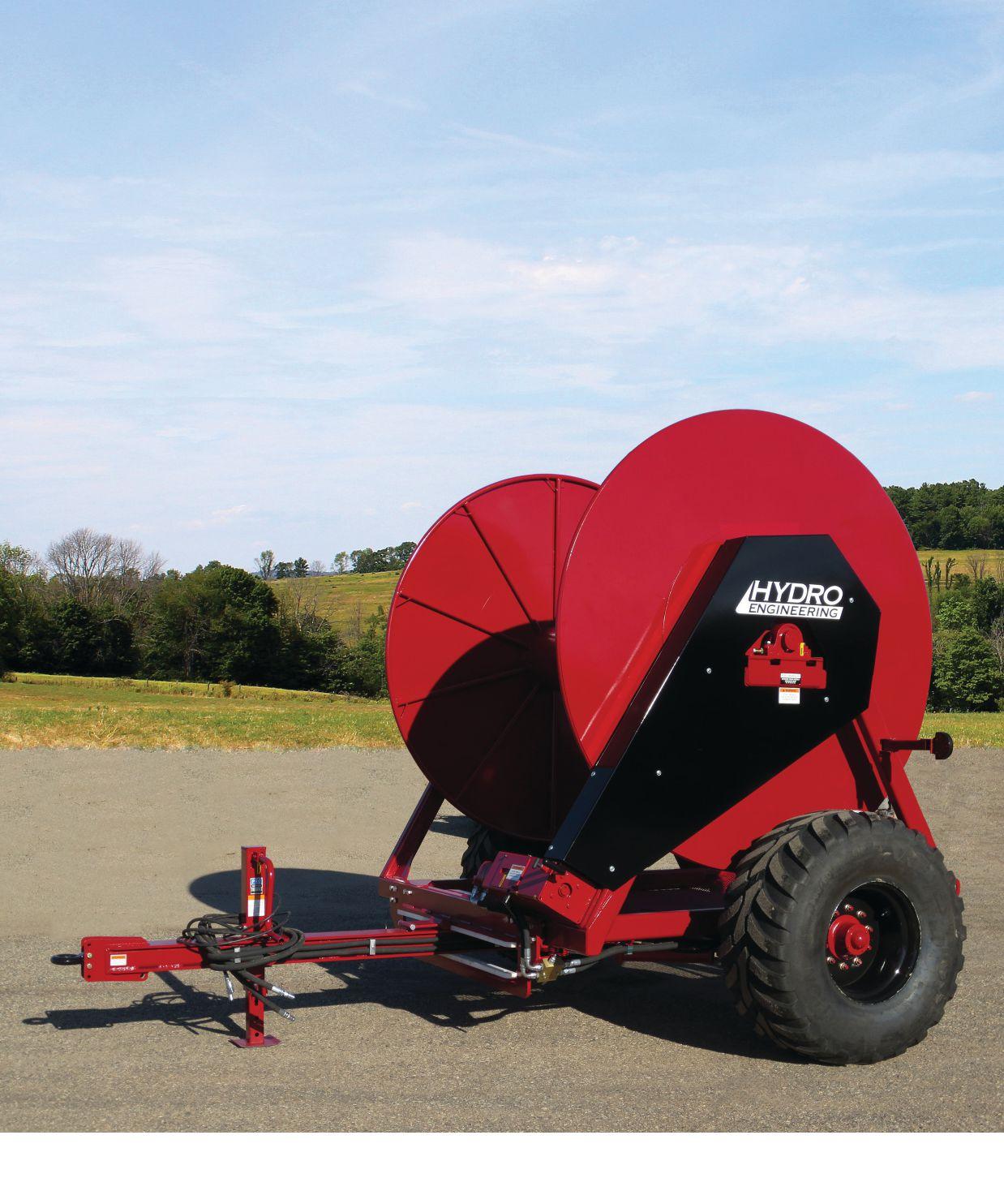
“The liquid waste we use on our fields for hay crops. We have traveling reel irrigation guns supplied by underground piping to hydrants in the fields. We monitor how many inches are going on and make our pulls accordingly.”
Pumping is done with a diesel-driven Berkeley pump at 18-inches below surface and the lagoon levels are maintained to ensure the lagoon works properly. Pumping isn’t done any lower to avoid the solids that build up at the bottom.
“Eventually, the sludge will build up to a level where we have to do something about it, but so far that hasn’t been a problem,” says Jared.
In North Carolina, swine effluent irrigation is only allowed on growing crops, which usually means irrigation takes place between March and November. During that time, the Porters work around the rain.
“If the ground is already saturated, the waste will just flow right off and go into the
creeks, which obviously we cannot do.”
Nitrogen levels on the irrigated fields are closely monitored. Soil and waste samples are tested during the year to ensure there is no nitrogen buildup.
When it comes to irrigation, the Porters also try to be good neighbors. For example, even though they are permitted to irrigate near the road, Jared says they choose not to.
“It’s just another step we take to remove those odors when we’re irrigating, and keep it out of sight as well.”
The poultry operation includes four 500-foot by 60-foot layer houses, as well as four 500-foot pullet houses for replacement layers.
The Porters do clean-outs about every third flock or when Tyson requires it. When they de-cake the houses, material is moved to three litter storage buildings, which are covered concrete floors, built to state specifications.
“We use skid steers to remove the litter from the houses and then we will usually store about 80 percent in the litter storage buildings and then we might spread 20 percent to supplement the places that we can’t irrigate,” explains Jared.
LEFT
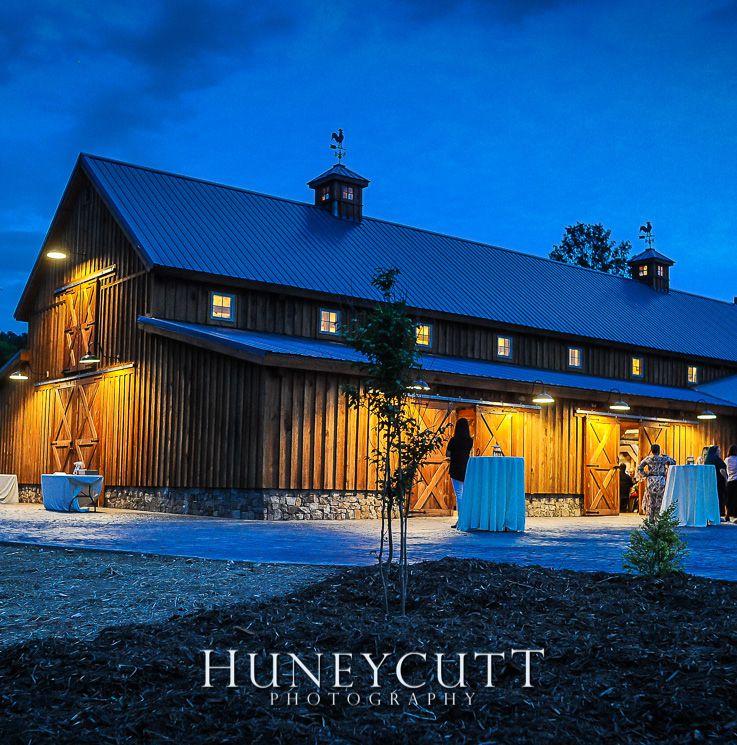
The Porters have been growing the agritourism side of the farm, hosting weddings. Their cattle are often requested for wedding photos.
Two of the litter storage buildings include permitted static composters.
“We use dry litter to compost all the mortality on the farm,” Jared explains. “One composter composts all the dead at the hog operation. The other is used for dead chickens, as well as cull or cracked eggs we collect.
“When something on the farm dies, we’ll bury it and then start in a circular rotation daily where we move piles. By three months, everything should be about gone. You can reuse it. We usually try to reuse it maybe once, then we will spread that on the field.”
The odor of composted litter, however, is more powerful than dry litter. For that reason, composted litter is only spread on certain fields. And the Porters constantly monitor the weather because, if the compost is spread at the right time the odor, can be knocked down.
The cattle are the smallest piece of the Porter portfolio. The 400-head of brood cattle are pastured raised and because they aren’t confined, manure management is not an issue. However, the Porters do work with the Cabarrus County Soil and Water Conservation to have the ponds and streams fenced out and all the cattle are supplied with well water to drink.
Even though the farm is fairly isolated, the Porters still have a few neighbors, including a church with an active ball field. At least three days a week, people are out playing baseball, which means the Porters are always monitoring odors. They don’t irrigate on Sundays and try to avoid Saturdays because the ball field might be occupied.
Everything is taken into consideration when it comes to odors, says Jared, from wind direction to humidity.
“The more moisture in the air, the smell is going to travel.”
The Porters have been growing the agritourism side of the farm since Jared’s sister was married in 2012.
“While they were on their honeymoon, we had a couple approach us wanting to
get married on the farm, and the business started from there.”
Because there are cattle near the site and the fields are fertilized with chicken litter, the Porters again have to worry about odors –primarily picking their spreading days with caution.
“We try to do it on a Monday so it has five days to settle [before a wedding] and then we try to look at the forecast of the rain. If we can get a good rain after we spread, the rain will knock down that dry dusty manure smell.”
They must be doing a good job because, to-date, nobody’s complained about the odor and the cattle are often requested for wedding pictures.
Jared says weddings allow the family to promote the industry because many people who come out have never been to a farm.
“We’re 45 minutes from Charlotte, two hours from Raleigh, and an hour from Greensboro. They have no clue there’s this kind of acreage or isolation close to the city.”
“On the weekends when we do weddings, we’re all out there, whether it’s directly working with the bride and groom and the participants or making sure the kids are occupied while the wedding is going on.”
It’s not just weddings that allow the Porters to talk-up farming. They also host a large county picnic focused on promoting farming and a Spartan Race (an obstacle/mud run).
“This will be the fourth year we’ve hosted the race. In April we have between 8,000 and 10,000 participants come run a three- to five-mile obstacle course on the farm. It’s a pretty big deal,” explains Jared.
The Porters provide 60 acres for parking and ensure the trails run far enough away from their operations so there’s no security risk to the hogs.
“We don’t know where these participants have been,” says Jared. “Some may come from other hogs farms.”
It takes the entire Porter family and more to make this all happen – from hogs to weddings.
Jared’s grandfather, Tom, and father, Tommy, started building up the farm in the mid 80s. Today, Tom, 95, still helps out.
Jared and his wife, Colleen, his brother, Derek, and wife, Amy, and his sister, Erin, and husband, Christopher Conser, all live and work on the farm, along with Tommy and wife, Vicky.
“Derek is a fireman in Concord, so he works at the firehouse and he’s here four days a week,” says Jared. “Erin does the wedding coordinating along with the other girls, and also does a lot of the bookkeeping. Her husband, Christopher, works with the hogs fulltime and the rest of us are everywhere.”
In addition, the Porters have three employees who manage the cows and pullet operation, four women who manage the layer house, and eight to nine men to help run the hogs.
It’s taken 30 years of work to get the size and versatility.
“The agritourism has been a huge expansion, and it’s basically allowed my siblings and me to move back to the farm and work full time,” says Jared.
They are all working here to build something for their kids, Jared says, and hopefully, for their kids’ kids.
Dorset Poultry Manure Dryer
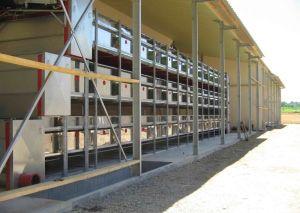
The Dorset Poultry Manure Dryer reduces particulate matter emissions from the barn air. The dosing belt delivers the manure on the smooth plates. This eliminates any necessity for pre-drying of the wet manure, resulting in lower operational cost. The drying system reduces dust as fine dust is filtered from the house as air passes through the manure on the drying trays. Sanitation is provided to assure elimination of semolina and e coli. The dryer has one to six tiers of trays operated by a heavy-duty chain. The drying starts at the top tray and zigzags back and forth as it drops the manure down to the bottom tray. Here it is removed by an auger system from the dryer. Manure is removed from the barn on a daily basis. Pelletizers are offered in five sizes, which include intake bunker, augers, crusher, dosed input frequency control, pellet press, sanitation, cooling and elevators. If you purchase the bagging system, it will weigh, fill and seal your pellet bags for you.
dorset.nu
Fliegl tank beacon
The heart of the Fliegl tank counter is a beacon that is mounted at the pivot point of the float in the manure tanker. When the tank is filled, the beacon registers the filling at an upper measuring point. When the tank is emptied, the beacon registers the emptying at a lower measuring point. One filling plus one emptying results in one counted tank. The board of the beacon is manure-proof and an intelligent energy saving mode increases battery life to four to 20 years. Fliegl has developed a whole generation of innovative beacons and uses its Counter Beacon for the tank counter – it has a tilt and acceleration sensor and a memory function that not only count the fillings of the tank but continuously records the filling levels and counts operating hours. Operating hours can be documented without gaps and is tamper-proof – ideal for contractors, machinery rings, machinery groups and distributors of manure tankers who bill per load.
fliegl-agrartechnik.de
TRIPLE THREAT –Cheese, cows and manure
Researchers in Wisconsin are developing a systems approach to costs, environmental impacts, opinions and priorities to help make tough management decisions easier to digest
BY SAM MILLION-WEAVER
Wisconsin is known as America’s Dairyland. More than one-third of all the cows in U.S. live on approximately 3,000 farms in Wisconsin. Those bovine residents contribute to a thriving dairy industry, but milk is not the only thing they produce in prodigious quantities. That many cows inevitably lead to a significant amount of manure.
“It is a horribly complex problem and we all contribute to it and are affected by it,” says Victor Zavala, a University of Wisconsin-Madison chemical and biological engineering professor who is working on a new approach to manure management. “Farms generate the manure, and we are all affected by its environmental impacts. But manure production is driven by strong economic forces originating from urban areas that demand dairy products.”
Phosphorus runoff from manureladen farm fields causes unpleasant and sometimes dangerous algal blooms in water bodies. Manure also releases potentially harmful bacteria and methane gas.
Technologies do exist to process organic waste while recovering valuable products, such as biogas and a compound called struvite used as fertilizer, but these technologies are affordable only for large farms.
Zavala and his colleagues are developing a framework for decision making to help people narrow their options and reach agreements in complex and potentially controversial decisions, such as manure management. By systematically quantifying costs, environmental impacts, and people’s opinions and priorities, these tools can help lead to compromised solutions that maximize collective stakeholder satisfaction.
Support for the research comes from the U.S. Department of Agriculture, the National Science Foundation, the U.S. Environmental Protection Agency, and Dane County in Wisconsin.
Choosing a suitable solution involves much more than technology cost alone. Where to locate manure processing plants, how to transport the waste, and who should pay for the equipment are all challenging questions – often involving competing interests.
“This problem is too complex. You need to find simpler and more direct ways to explain the interactions between social, economic and technology aspects to people making decisions,” says Zavala.
Conflicting stakeholder interests complicate the problem further. Such conflicts can arise because of a lack of data about technology and logistical constraints.
“We are hoping that with this framework, we can have a more informed negotiation process. Instead of just telling stakeholders what they should do, we want to provide better frameworks for people to negotiate on what the manure management infrastructure would do,” says Zavala, who is leading the effort along with Rebecca Larson, an assistant professor of biological and systems engineering at UW-Madison.
Importantly, the researchers will include quantitative measures of stakeholders’ satisfaction in their models to ensure that the opinions of all groups – rural and urban communities, farmers, political leaders, environmental regulators, and scientists alike – are heard and considered.
“We try to come up with fair solutions that please as many stakeholders as possible, with the important observation that you will very rarely be able to please everyone,” says Zavala. “The framework can also be used to inform stakeholders on how their opinions influence (or not) the final decision. That is a powerful piece of information.”
ABOVE
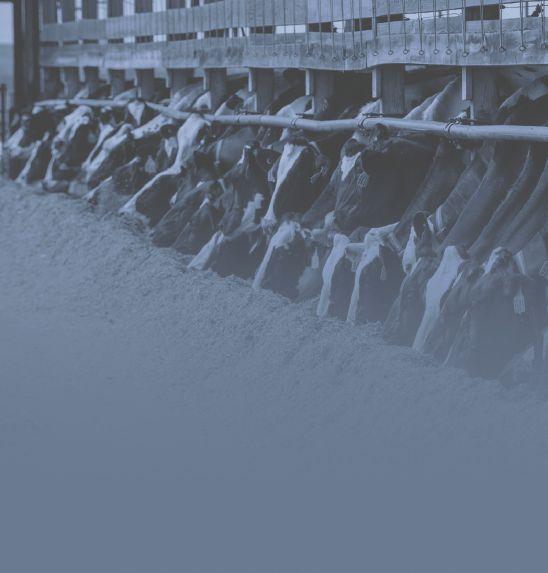
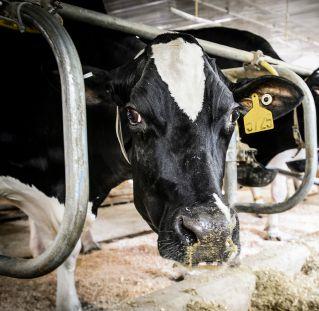
Holstein dairy cows feed at the UW-Madison Dairy Cattle Center. Milk is not the only thing they produce in prodigious quantities.
COURTESY
OF BRYCE RICHTER
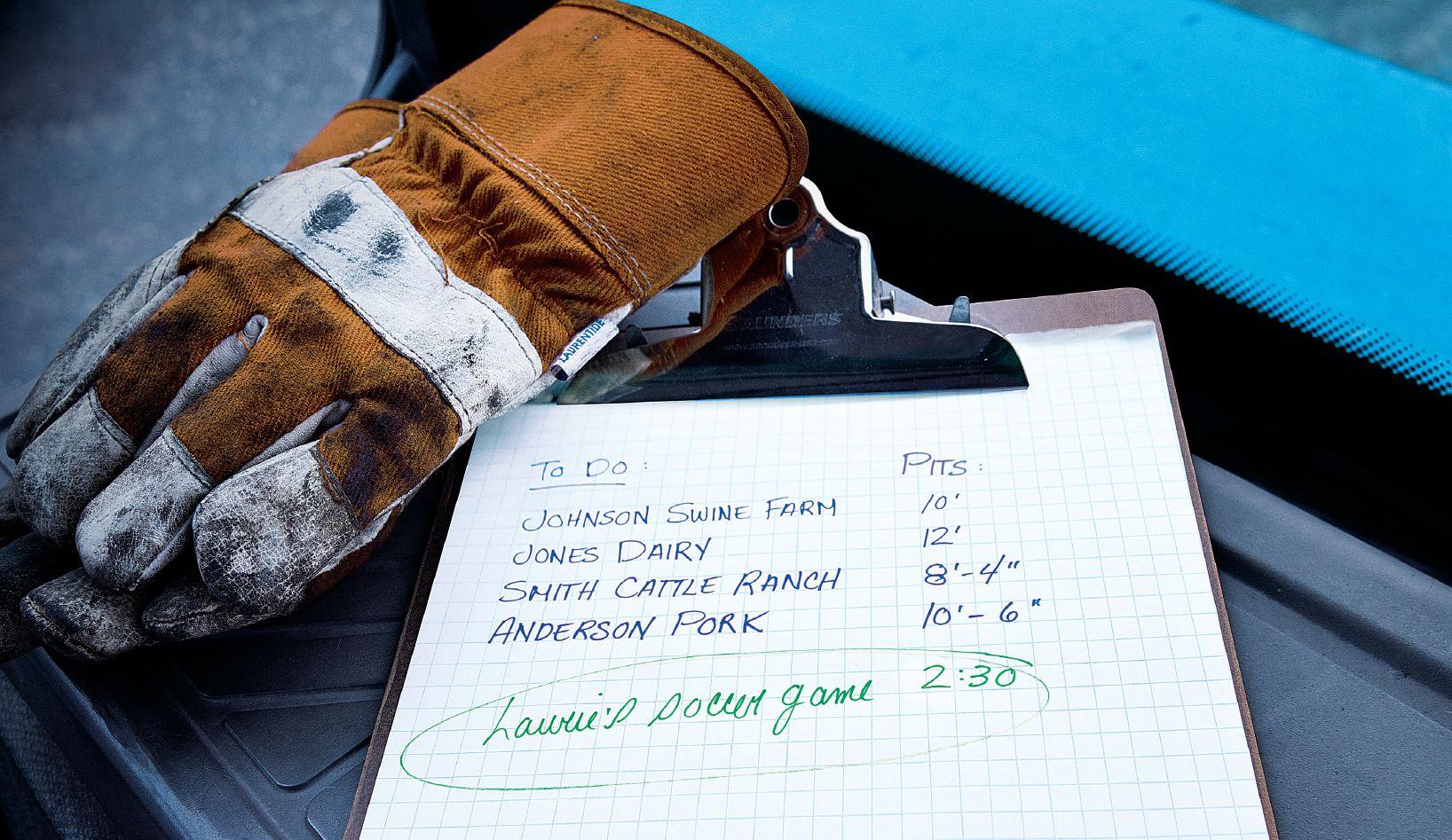
Use your time wisely
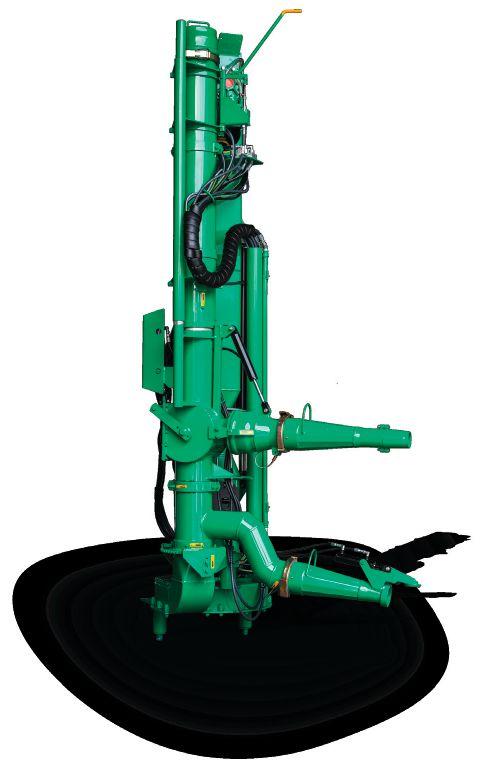
Be more efficient with the Super Slider Pump and give yourself the freedom to do more!
You can complete your to-do list in record time by investing in one pump that can handle manure pits of various depths. The Super Slider Pump adjusts to different lengths and is easy to maneuver, allowing operators to move quickly from one pit to the next. Its dual-nozzle design and visual indicators provide superior agitation performance and greater convenience for the operator.
Your time is valuable. Use it wisely with the Super Slider Pump — just one pump to get the work done!