Reed Family Farms goes extra mile in all aspects of hog production. | 20
Liquid composting
Using aerobic bioreactor to mineralize nutrients from manure | 14
Managing the farm
Controlling to protect water | 28
May/June 2015
By Diane Mettler
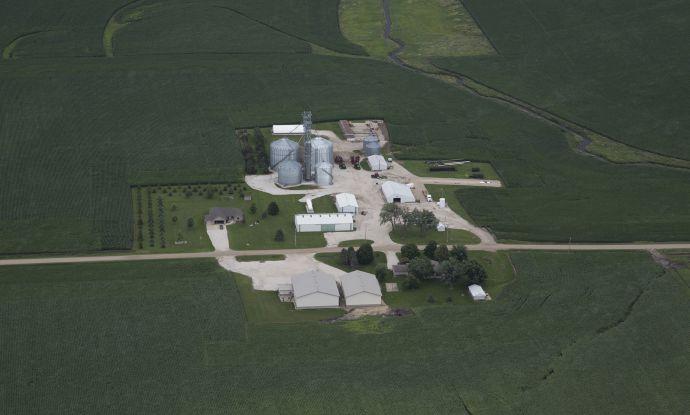
Wessling Ag, a contract finishing farm near Grand Junction, Iowa, raises 5,000 hogs on the home site, and another 2,500 nearby.
TONY KRYZANOWSKI
TONY KRYZANOWSKI
ANGIE RIECK-HINZ
What’s black, white and read all over?
Welcome to the crisp, clean, newly redesigned May/June 2015 edition of Manure Manager magazine.
It’s not very often we have an opportunity to get excited about clean white space in the editorial department of Manure Manager so please excuse us while we brag about the new look.
With spring officially in full swing, we decided it was time to do away with the old – some of which had been in place since the magazine first launched back in 2003 – and try on something fresh and new. We hope you enjoy it as much as we do.
Of course, we’ve held on to some of our tried and true favorites, including our issue themes. May/ June means swine production and this issue is jam-packed with information, including a feature on two of the winners of the 2014 Pork Industry Environmental Stewards. Based in Iowa and Missouri, these two operations share their awardwinning manure management practices with writer Diane Mettler.
Rural Development. The group is examining ways to “mine” raw poultry manure digestate to extract nitrogen and phosphorus with an end result of creating an organic liquid fertilizer for nursery crops.
As well, Michigan State University assistant professor Tim Harrigan highlights the work being done on a Clayton, Mich., farm to protect water quality, including the use of a closed-loop nutrient recycling system to keep nitrogen and phosphorus from escaping into the environment. This includes a 20-acre sub-irrigation system that provides efficent use of two million gallons of “gray” water.
Editor MARGARET LAND (519) 429-5190, (888) 599-2228, ext 269 mland@annexweb.com
Publication Mail Agreement #40065710 RETURN UNDELIVERABLE CANADIAN ADDRESSES TO CIRCULATION DEPARTMENT, P.O. BOX 530, SIMCOE, ON N3Y 4N5 e-mail: subscribe@manuremanager.com
SUBSCRIPTION RATES Canadian Subscriptions $35.24 Cdn, one year (with GST $37.00, with HST/QST $39.82)
U.S. Subscriptions: $47.00 USD, one year
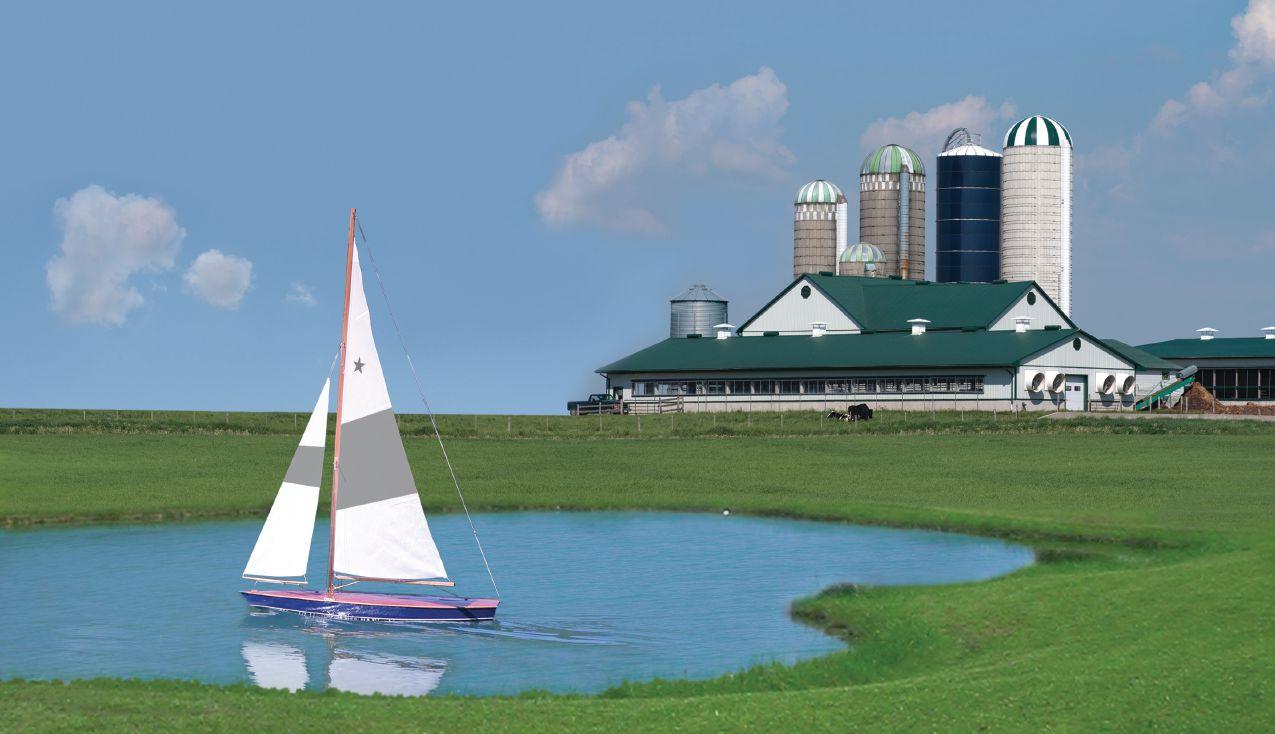
We also have a feature on Reed Family Farms, named Pork All-American by the Iowa Pork Producers Association. Champions of environmental stewardship, the operation has also been named the Prettiest Farm in Iowa and has received multiple awards from the IPPA and the National Pork Board.
Last but not least is an article highlighting the upcoming North American Manure Expo, being held July 14 and 15 in Chambersburg, Penn. One of the industry’s most hotly anticipated event, this year’s expo will feature two days of tours, demonstrations, product launches, and educational sessions. Plans are already underway to transform a field of wheat stubble into a one-stop spot for all things manure related.
“We hope you enjoy the newly redesigned Manure Manager.”
You definitely don’t want to miss out on the perfect opportunity to see and learn the latest and greatest about manure application and nutrient management.
Occasionally, Manure Manager will mail information on behalf of industry-related groups whose products and services we believe may be of interest to you. If you prefer not to receive this information, please contact our circulation department in any of the four ways listed above.
On the research front, writer Tony Kryzanowski describes the latest work being done by a team with Alberta Agriculture and
Once again, we hope you enjoy the newly redesigned Manure Manager. In the coming issues, we hope to introduce new ideas and voices to the editorial mix. Be sure to share your thoughts by contacting us c/o mland@annexweb.com.
Please Note – The incorrect image was featured on page 7 of the Anaerobic Digester Supplement, included with your March/April 2015 issue of Manure Manager. We apologize for the error and any confusion it might have caused.
All advertising is subject to the publisher’s approval. Such approval does not imply any endorsement of the products or services advertisted. Publisher reserves the right to refuse advertising that does not meet the standards of the publication.
THE PERFECT COMBINATION
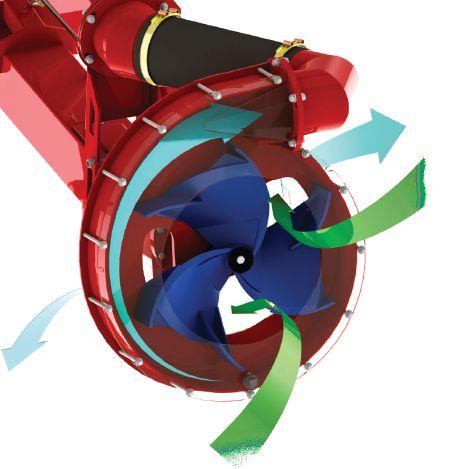
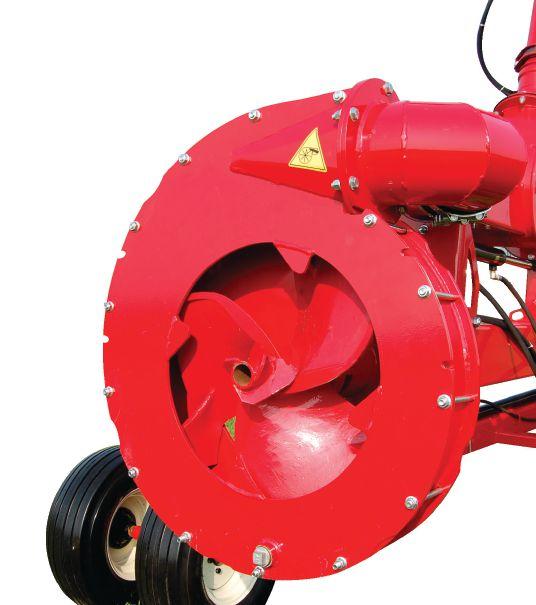
The PUMPELLER® Hybrid Turbine revolutionizes manure pump performance. Incredible intake suction pulls solids into the cutter knives, reducing the toughest crust to nothing in just seconds. The turbine combines the high-volume mixing of a propeller agitator with the power and reach of a lagoon pump, the resulting hybrid design radically outperforms both.
for professional
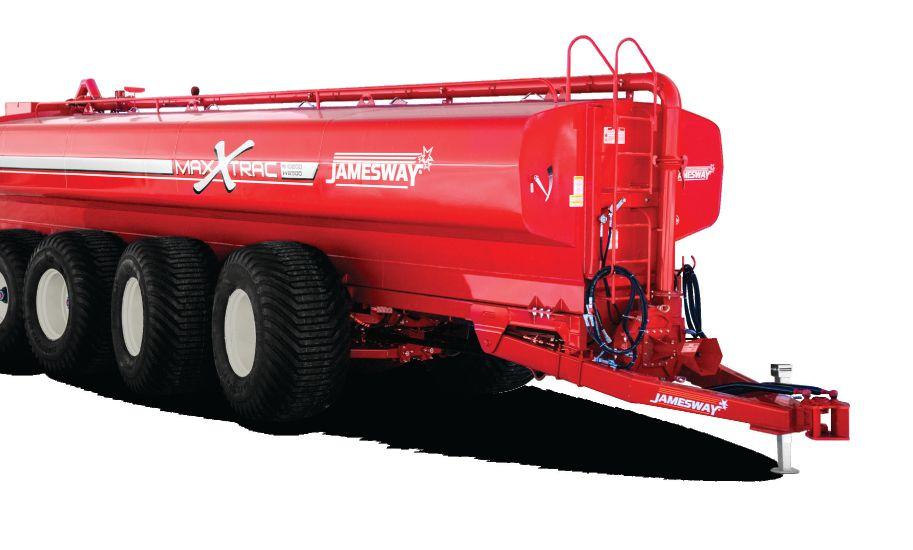
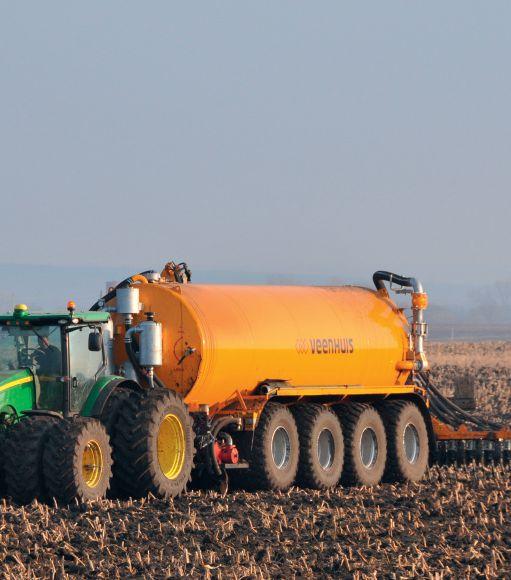
Jamesway’s new MAXX-TRAC tankers deliver maximum performance.
Patented Turbine Impeller
New funding available through USDA-NRCS EQIP
Western United Dairymen has partnered with the Natural Resources Conservation Service (NRCS) and Sustainable Conservation to secure an additional $3.5 million for dairy producers in California’s Merced and Stanislaus counties for water quality/conservation projects.
The process to apply for the funding is the same as the Environmental Quality Incentives Program (EQIP) and will be submitted with NRCS. EQIP has changed from one deadline and funding cycle per year to five. Applications will now be batched and ranked on specific dates. The remaining FY15
batching schedule is Batching Period 5: July 17, 2015.
A Comprehensive Nutrient Management Plan (CNMP) must be completed as part of the process. A technical service provider is necessary to complete the CNMP and NRCS reimburses producers for the cost of the plan.
The type of projects that will be funded include: pipelines; pumps; waste storage facility (concrete pads); solid liquid separators; and Comprehensive Nutrient Management Plans (CNMP). If you have questions, please contact your local NRCS office.
USDA ANNOUNCES PARTNERSHIPS TO ADDRESS CLIMATE CHANGE
In a recent speech at Michigan State University, Agriculture Secretary Tom Vilsack laid out a comprehensive approach to partner with agricultural producers to address the threat of climate change, including the installation of new anaerobic digesters.
The framework
BY THE NUMBERS
announced consists of ten building blocks that span a range of technologies and practices to reduce greenhouse gas emissions, increase carbon storage and generate clean renewable energy. This included livestock partnerships, which will encourage broader deployment of anaerobic digesters,
lagoon covers, composting, and solids separators to reduce methane emissions from cattle, dairy, and swine operations, including the installation of 500 new digesters over the next 10 years.
Other building blocks include soil health, such as managing organic inputs and compost
application, and nitrogen stewardship, which will focus on the right timing, type, placement and quantity of nutrients to reduce nitrous oxide emissions and provide cost savings through efficient application.
More information is available by visiting usda.gov/documents/ climate-smart-fact-sheet. pdf.
23 billion pounds of pork processed from 112 million hogs in 2013 (National Pork Producers Council)
39
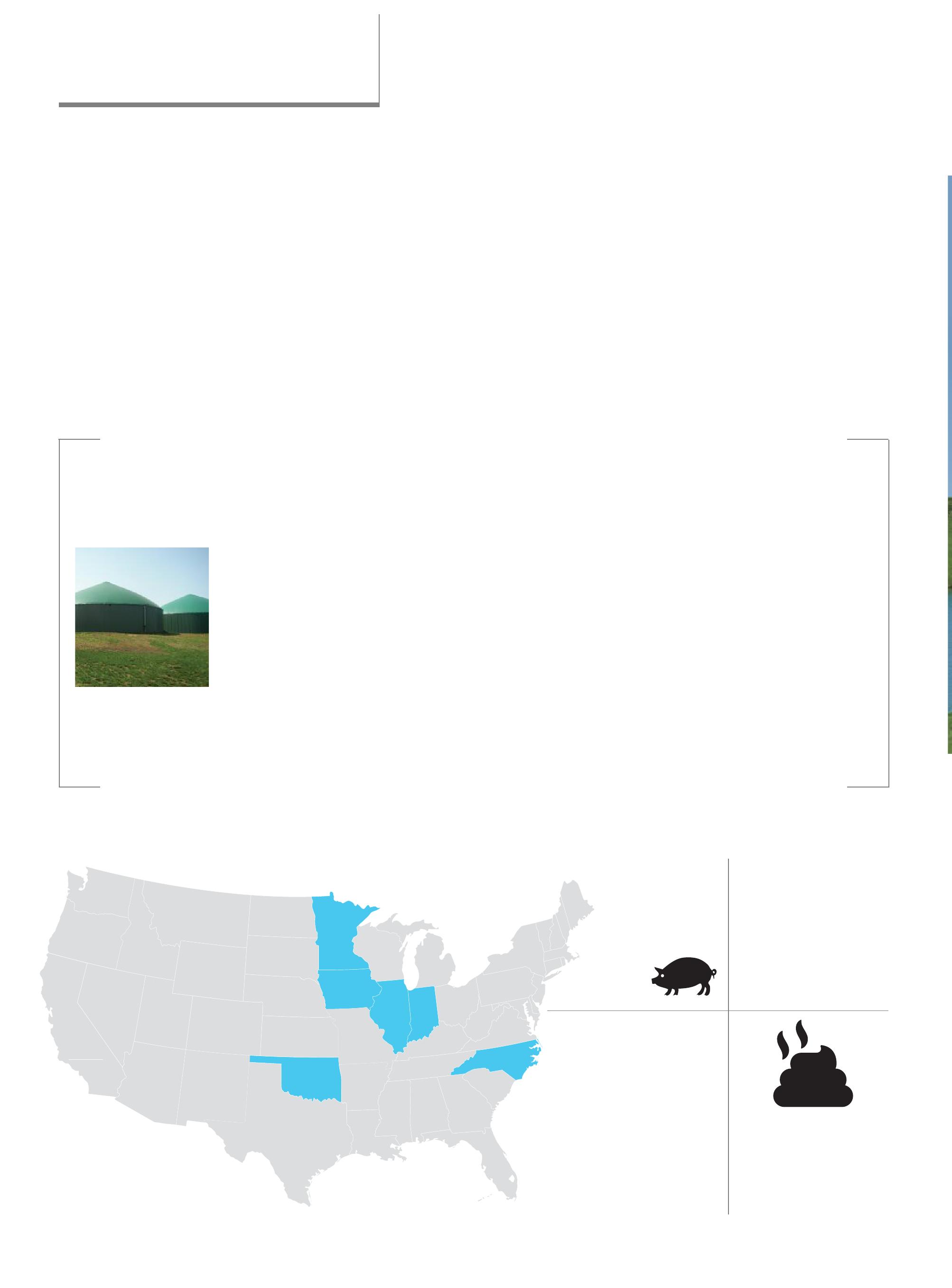
67,000 PORK PRODUCERS ACROSS THE U.S. (National Pork Producers Council) operating anaerobic digesters using swine manure in the U.S. (AgStar – January 2015)
National Pork Producers Council
Navigate Nutrient Management with a Dewatering System from GEA
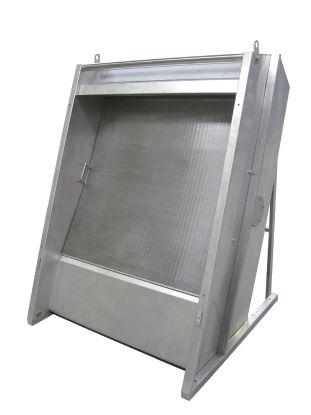
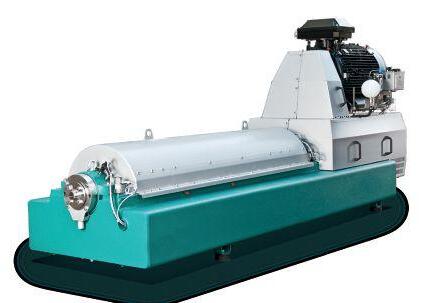
Put nutrients where they belong with a combination GEA Slope Screen and AGM Centrifuge system. Together, the system effectively dewaters manure. Screened solids can be dried and used for bedding. Solids produced by the centrifuge are nutrient-rich and can be used for compost or spread on fields. Recovered liquid can be stored in a lagoon or applied directly to the fields. And since phosphorus levels in the liquid are lower, it can often be sprayed at a higher rate per acre.
The process starts with a Slope Screen that removes large material from the manure. After this, the remaining liquid-solid mixture runs through a high speed AGM Centrifuge that automatically adjusts to different flow rates and solid levels. With almost all the solids removed, the remaining liquid is much cleaner.
Efficient and cost-effective, the equipment can be used with or without an anaerobic digester.
Learn how GEA can help you improve and add value to your manure management program. Call 800-563-4685 or email geahoule@gea.com.
Toll-Free: 800-563-4685
www.gea.com
Researchers, vets concerned with dust research
Back in late January, Texas Tech University released a report highlighting research conducted by the Institute of Environmental and Human Health that allegedly documented the aerial transmission of antibiotic resistance in dust from a cattle feedlot. As can be imagined, the study, published online in the National Institutes of Environmental Science’s peer-reviewed journal, Environmental Health Perspectives, caused a bit of a stir.
In early April, a group of concerned researchers and veterinarians released a white paper listing concerns they had with the study. The professionals, based at universities in Kansas and Texas, were not critical of the basic research attached to the study but “with the conclusions drawn and much more with the distorted misrepresentations of those data that have been spread through the media.”
The white paper can be viewed here: http://www.tcfa.org/assets/media/pdfs/ email/2015/2015-04-02_ttu_feedyard_dust_ statement.pdf .
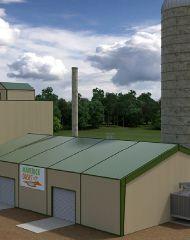
Maverick Oasis GTL methanol plant
A North Carolina based company that produces alternative chemical and fuels production technology is interested in constructing gas-toliquid methanol plants at already established anaerobic digester sites.
Maverick Synfuels recently announced its Maverick Oasis BG Gas-to-Liquid methanol plant product line –which converts biogas from sources such as anaerobic digesters into methanol – is now available.
The Maverick methanol plant is modular, so it can be rapidly deployed to an operational
location, assembled by company engineers, and integrated into the local infrastructure. The Maverick Oasis BG25 methanol plant has a capacity of 8,300 gallons per day (25 metric tons/ day) of methanol. With a footprint of 50 feet x 100 feet, it requires approximately one acre to accommodate storage and tanker truck access.
Each Oasis plant comes equipped with performance guarantees based on the designed methanol output rating.
More information is available by visiting mavericksynfuels.com/oasis.
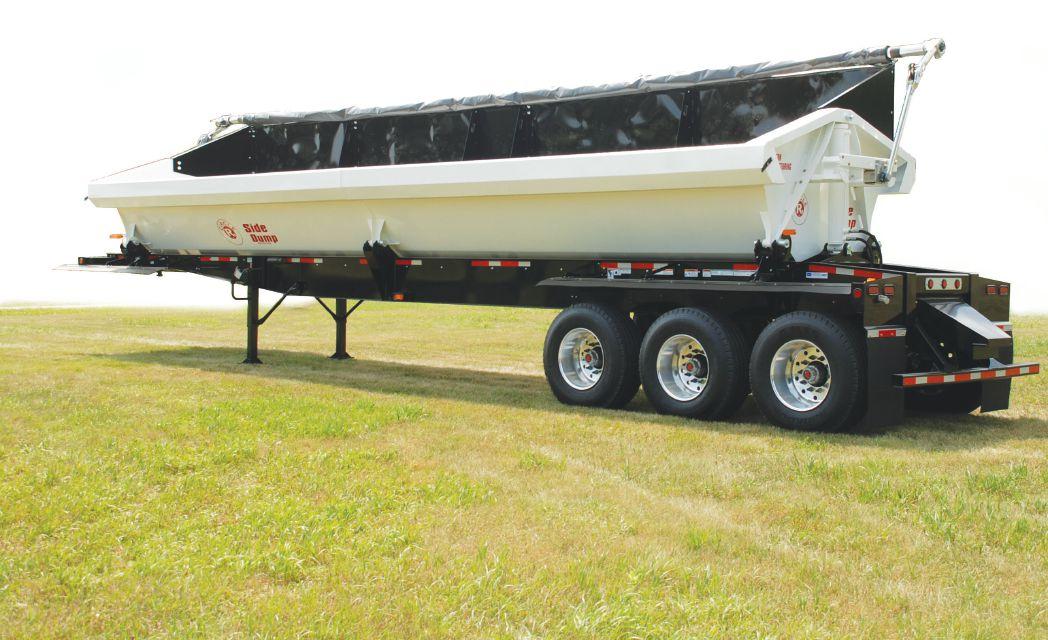
44’ Chassis, 37’ Tub with High Capacity Kit
Storms Farm AD earns national recognition award
The Storms Farm anaerobic digester installation earned a National Recognition Award as part of the American Council of Engineering Companies (ACEC) recent 2015 Engineering Excellence Awards Gala.
Project engineer, Withers & Ravenel, anaerobic digester designer, DVO, Inc., project developer, AgPower Partners, LLC, and Storms Farm collaborated on the project, the largest swine biogas renewable facility in North Carolina.
DVO’s Two-Stage Mixed Plug Flow AD technology provides benefits for both waste handling concerns and energy production.
Drought, nutrient management in California
Dr. Deanne Meyer, a waste management specialist with University of California Extension, is urging dairy operations in drought stricken California to ensure their nutrient budgets are up-to-date as they head into what looks to be another dry year.
“Keep in mind that almost all dairies under the General Order are also in the representative groundwater monitoring program,” she stated in a recent article in the California Dairy Newsletter. “To
remain in the program, nutrients need to be applied to meet identified needs (as per your budgets).”
She also suggested it may be time to modify manure application.
“If you estimate a change in crop N uptake/removal, have nitrate available in groundwater irrigation sources, or fallow land, manure applications will need to be adjusted in order to accommodate changes in anticipated applications or yields,” Dr. Meyer said.
California energy commission approves grants
The California Energy Commission recently approved $21 million in grants for energy innovation and efficiency programs. Almost a dozen innovative projects – including one to turn dairy manure into biogas – were funded through four key grant and loan programs.
Among the recipients was Lakeview Farms Dairy of Bakersfield, which received $4 million to install and demonstrate a covered lagoon digester
that converts dairy manure into biogas. The project plans to generate renewable electricity and prepare a one-megawatt generator platform capable of being expanded by using biogas from neighboring dairies.
West Star North Dairy of Buttonwillow also received $4 million to install and demonstrate a doublecell covered lagoon dairy digester system that will allow the quantity of wastewater to vary.
Pumps on “Cruise Control”
inlet and outlet
system.
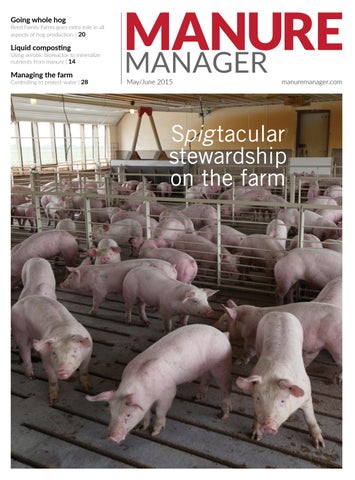
SPIGTACULAR Stewardship on the Farm
Wessling Ag Inc., of Grand Junction, Iowa, and Stephens Farms of Malta Bend, Missouri, were recognized by the Pork Checkoff for their stewardship, and demonstrate how well operations can be run
BY DIANE METTLER
The Pork Checkoff, along with its co-sponsor, National Hog Farmer magazine, have again selected two pork farms to be honored at the 2014 Pork Industry Environmental Stewards. The award is now in its 20th year and recognizes producers who are dedicated to safeguarding the environment and contributing to their local communities.
This year, the Pork Checkoff chose Wessling Ag. Inc., of Grand Junction, Iowa, and Stephens Farms of Malta Bend, Mo., to receive the honors.
WESSLING AG. INC.
Wessling Ag is the definition of a family operation. Bruce Wessling and his wife, Jenny, run the farm along
ABOVE
with their daughters, Jolee and Taylor. And Bruce’s parents, Roger and Judy, although semi-retired are also still involved.
Wessling Ag, a contract finishing farm, raises 5,000 hogs on their home site, and 2,500 at the West site about five miles away. In the course of a year, they raise approximately 18,700 hogs and also grow corn and soybeans on 4,600 acres.
Bruce says you’ll find several different barn designs on the two sites because they were built at different times as he expanded.
“The barns I built in 1997, 2000 and 2004 were all roughly the same style. Then in 2009 we went with a little bit wider barn (71 feet x 278
Bruce Wessling and his wife, Jenny, run the farm along with their daughters, Jolee and Taylor. Contributed photo
ABOVE
feet), shorter and more power ventilated.”
The newer design, he says, works better, especially in the hot weather.
“It’s a tunnel model with fans running at the end. It creates a breeze through the barn and helps cool the pigs. On a calm day it’s definitely easier to keep the pigs comfortable.”
All of the barns have eight-foot deep pits, where Bruce says he can easily store a year’s worth of manure, and probably up to 15 to 16 months worth if necessary.
Bruce and Jenny believe their farm benefits by surrounding themselves with professionals and hiring the best. One of the companies they hire is custom applicator Neese Inc.
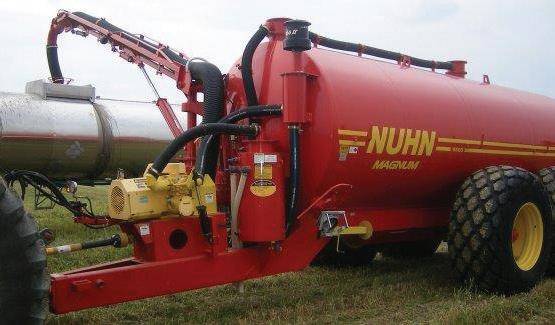
Bruce says in the fall Neese will bring in two or three pumps, primarily Nuhn brand, and can take care of their 5,000-head site in three days.
Just prior to pumping the manure, the pits are agitated for an hour or so.
down in the building.”
Another company the Wesslings rely on is Twin Lakes Environmental, a manure-consulting firm. Twin Lakes writes up the manure management plan and the Wesslings do the testing.
“We give them our soil test and our manure samples out of the pit and then they calculate the nutrients and they tell us how many gallons per acre we can apply to stay in the parameters of our manure plan,” Bruce explains.
Applying their own manure has cut down on the use of commercial fertilizer. Bruce [Wessling] estimates the pigs provide enough manure to cover 1,000 to 1,500 acres.
“We apply straight from the pits to the farmland,” Bruce says. “We like to let the soil temperature cool down below 50 so it helps stabilize the nitrogen.”
The agitation and pumping can be done while the pigs are in the barn. However, Bruce says he adjusts the ventilation based on the size of the pigs and the weather.
“Often we have to have maximum ventilation on the building when we’re pumping, to keep the odor down and the pit gas
Applying can be a bit odorous, but not for long, because the Wesslings inject the manure and till the end rows 24 to 48 hours following application.
Applying their own manure has cut down on the use of commercial fertilizer. Bruce estimates the pigs provide enough manure to cover 1,000 to 1,500 acres.
The family takes pride in this farm, and it shows.
“Keeping it looking nice is something that was instilled in me from my grandpa and dad,” Bruce says.
One attractive feature is the windbreak created by trees the Wesslings planted around their buildings in 2009. The trees have helped keep the wind flow down and reduce odors, but one of the big benefits has been decrease in snow loads up against the barn in the winter.
The Wesslings also incorporated 90-foot buffer strips of switch grass along their creeks, to help filter out any nutrients during rains. Bruce said it was something he said just made sense.
The Stephens family works on a farrow-to-wean farm that produces about 190,000 pigs per year. They also raise 600 acres of corn and soybeans on the adjacent land. Contributed photo
ABOVE
Wessling Ag, a contract finishing farm, raises approximately 18,700 hogs a year and also grow corn and soybeans on 4,600 acres. Contributed photo
Overall though, Bruce says he’s most proud of the farm’s self-sufficiency. “We’re growing row crops of corn and soybeans for feed and ethanol and turning around and feeding that to livestock and then turning around and using the nutrients from the livestock to put back on the row crop, and fertilize for the next year’s crop. I just think it creates a complete and efficient system for us.”
STEPHENS FARMS
The second farm to receive the Environmental Steward award was Stephens Farms, operated by David and Sharon Stephens, along with three of their children, who have been involved in the farm since they were toddlers. (Their fourth child went on to become a veterinarian.)
David says he’s been around hogs all his life, but began the operation he’s involved in now with another farmer in the 1980s.
“My wife’s been right in with it, the whole family has. We’ve grown with that site and brought it along to where it is.”
Today, the family works on a farrow-to-wean farm that produces about 190,000 pigs per year. They also raise 600 acres of corn and soybeans on the adjacent land.
Their tunnel-ventilated sow barns feature cool cells for animal comfort in hot weather, as well as shallow-pit manure storage and shower-in/shower-out facilities for enhanced biosecurity.
Although the award focused on one of the farm’s sites, and where the Stephens live, Stephens Farms operates 10 different sites, with one 80 miles from the house. They run two nurseries and the rest are sow units.
Each sow unit has its own manager and all labor is under that manager’s control.
“We are kind of a unique situation and it’s been evolving that way ever since ‘83 when I started the operation,” David says. Manure is handled differently at different barns because the barns differ in ages, some going back as far as 1982.
“Most of them are more of a shallow pit that drains to the lagoon, and some of them recycle from the lagoon. We’ve got a little of everything,” David says.
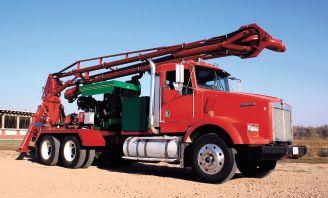
Stephens Farms houses approximately 20,000 sows at various locations at any one time. To handle the manure, they rely exclusively on Puck Custom Enterprises (PCE) equipment.
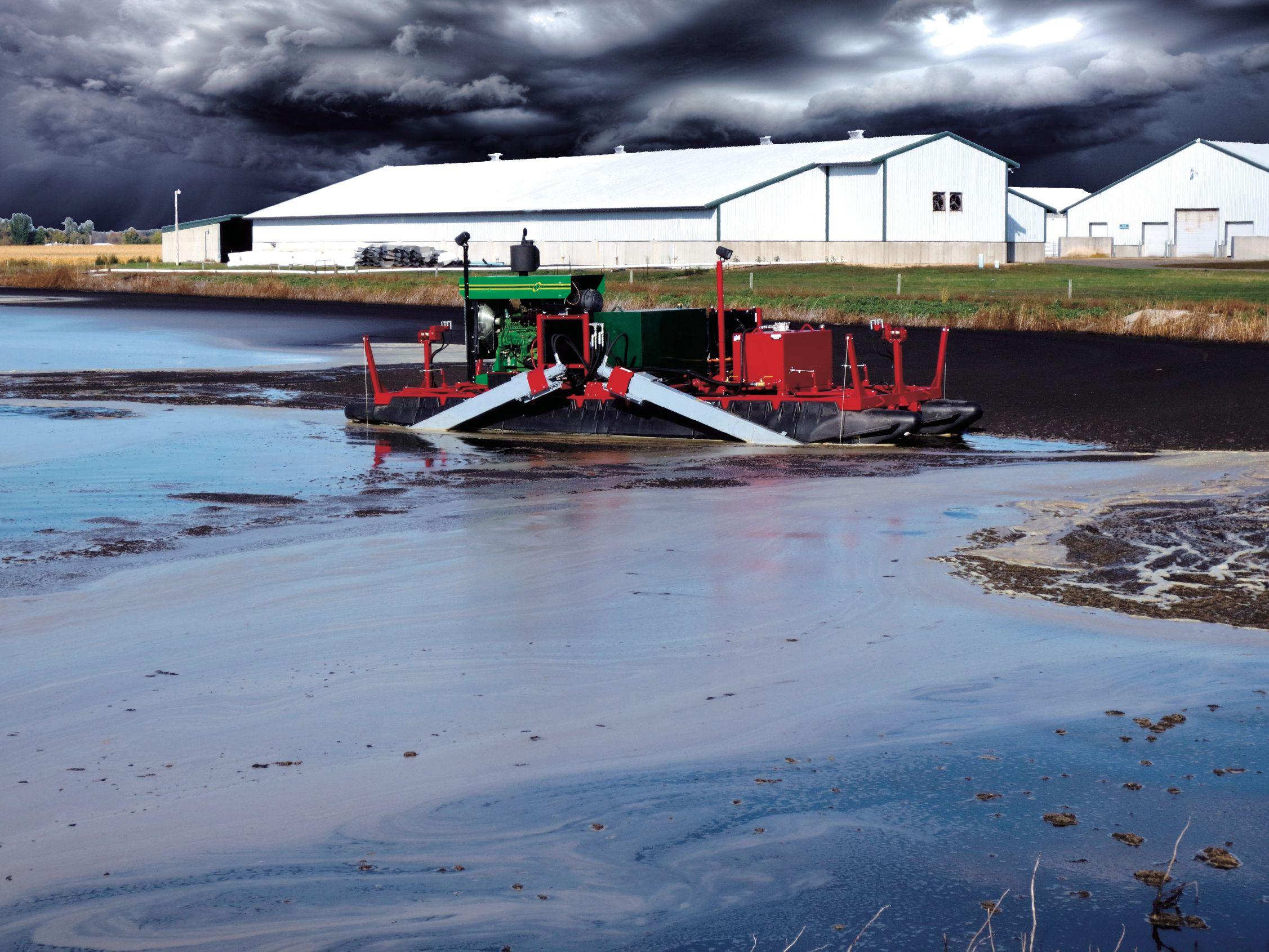
“We’ve been with them since 2010,” David says. “We’ve got their agitation boat for agitating all 10 lagoons. In fact, we bought the first production model they sold in 2010 and have been working with them ever since.”
David says that by going to self-priming equipment the farm has gone from being able to pump 1,400 gallons to 2,200 gallon a minute.
“And we use the Internet to control it all.”
The big change happened when Jeremy of Puck came down to demonstrate some equipment.
“I went to their open house and we purchased that boat off of them that year to kind of learn how that equipment worked – between it and their booster pump – we’ve just been progressing every year since with it.
David has nothing but accolades for PCE.
“They’ve been excellent in every way –the support, the knowledge, the credibility, what they’re trying to make happen, and the performance of the equipment. We’ve never had the performance we got until we got into their equipment. I’m doing things [that] four or five years ago [I] never dreamt of.”
And, for anyone interested in the company’s system, David suggests checking out PCE’s pump schools.
“I’ve gone to a good many of them. They’re open for people looking into buying equipment and all different aspects. There’s a lot of knowledge there to be found.”
David takes the agitation boat from lagoon to lagoon.
“You just pack it all up, put it on trailers and pull it to the next farm and set it up again. In about 30 minutes we have it off the trailer and floating in the lagoon.”
Application happens primarily in the fall, mostly because it’s harder to predict the weather in the spring.
“Typically, as soon as they start harvesting, we’ll start running it,” David says.
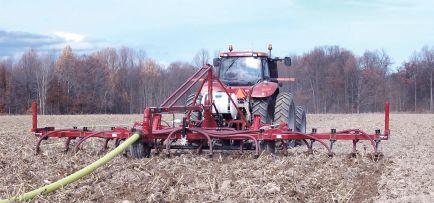
The farm uses a drag hose system.
“We use one of Puck’s booster pumps to help boost an arm out,” David says. “And last year we went from six-inch to seven-inch hoses and a 13.5 L 550 HP lead pump motor, which helped.”
Depending on rainfall, David says they have pumped as much at 70 million gallons in one year. But generally they pump 30 to 50 million gallons.
“And now with the better equipment, the last couple of years we’ve been able to really make good gains on things. With the boat agitating, we’ve been able to pump the lagoons down better.”
David says when the Pork Checkoff folks came out, they seemed most impressed with the high-tech factor on the farm – like the solar panels that generate power on the farm.
“I think they were blown away, to be honest,” David says with a smile. “I’ve been in this operation 33 years and we’ve always tried staying on the higher tech end of it. It’s been a trademark of the operation – to try to stay on the cutting edge of everything.”
David says he’s proud of what his family has done on the farm.
“We’ve been able to work together all these years and bring [the children] up into it. To me, that’s justification right there if you’re able to come in and do that.”
And people nearby are happy to call Stephens Farms neighbors. In fact, some folks who once voiced concerns early on in the farm’s development, have come back to apologize. They have benefited over the years from the Stephens keeping the roads in better shape and open during the snow, as well as better telephone lines, and more.
“We’ve been pretty fortunate,” David says. “We try to take good care of things.”
Liquid composting could help feed humanity in future
A team with Alberta Agriculture is using an aerobic bioreactor to mineralize nutrients from raw poultry manure
By Tony Kryzanowski
“The fact is that if we don’t learn how to recycle nutrients and water, we are doomed. We will start dying off from hunger. This is just one approach to prolong our existence on this planet.”
That ominous warning comes from Nick Savidov, a senior research scientist at the Bio-Industrial Opportunities Branch of Alberta Agriculture and Rural Development (AARD).
By recycling nutrients and water, he means extracting the valuable nutrients from waste streams like animal manure by using microorganisms in an oxygen-rich environment within a device called a bioreactor to mineralize and dissolve the nutrients in a liquid solution. The nutrients can then be
re-used as plant food. Savidov describes this as a sustainable approach to agriculture that could help save humanity from starvation down the road.
Tapping into this source of organic fertilizer from aerobic bioreaction is critical to continued human life on Earth, Savidov says, because current synthetic fertilizer sources are non-renewable. For example, he says that according to the most recent survey by the International Fertilizer Development Centre (IFDC), 85 percent of all phosphorus rock reserves on the planet, which are used to produce phosphorus fertilizers are located in just one area –in Morocco and the Western Sahara. Also, current nitrogen synthetic fertilizers can only be produced
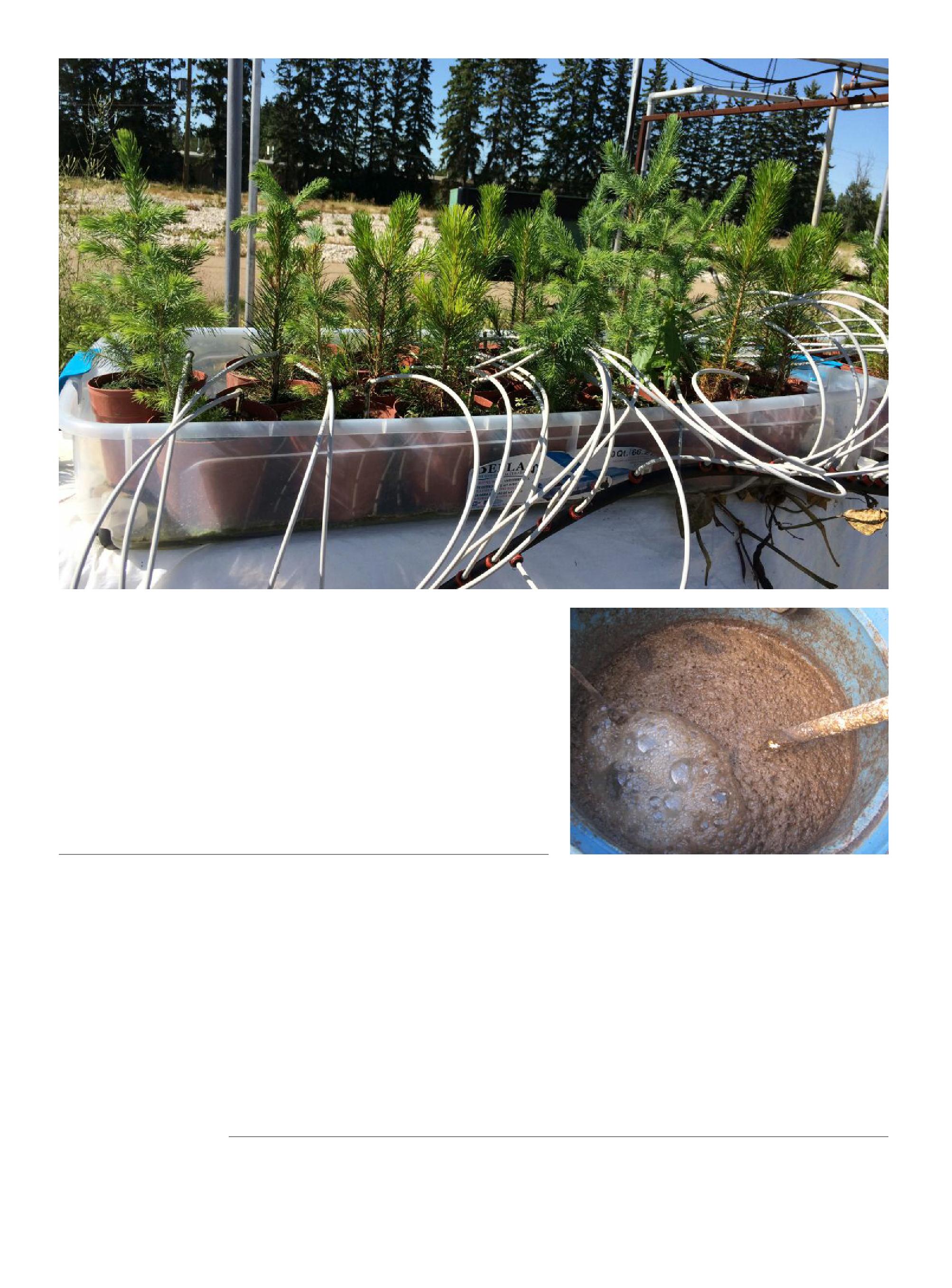
TOP Lodgepole pine tree seedlings fed with mineralized poultry manure nutrients doubled in height in just two months.
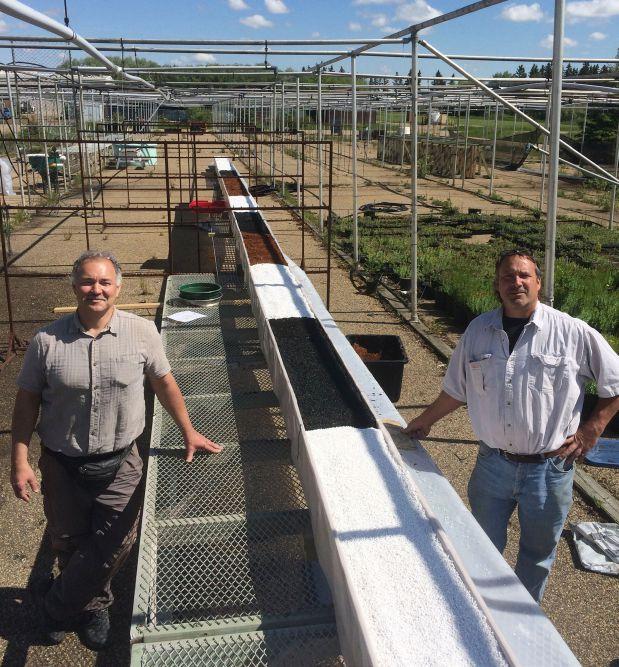
BOTTOM Within three weeks, this bioreactor slurry of poultry manure fed with oxygen becomes a mineralized, organic form of plant food. Contributed photos
ABOVE
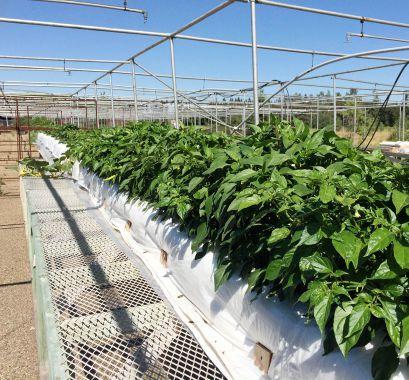
Use of mineralized poultry manure as plant food resulted in vigorous growth from a variety of common market garden plants.
RIGHT Scientist Nick Savidov (left) and engineer, Marc Legault, took ideas from aquaponics to produce mineralized organics from manure to use to grow market garden vegetables and tree seedlings. Contributed photos
using non-renewable fossil fuels. Sources of synthetic fertilizers now in widespread use are a finite resource that will eventually run out. Nutrient water recycling to capture these same nutrients from animal waste streams offers hope to feeding humanity in future.
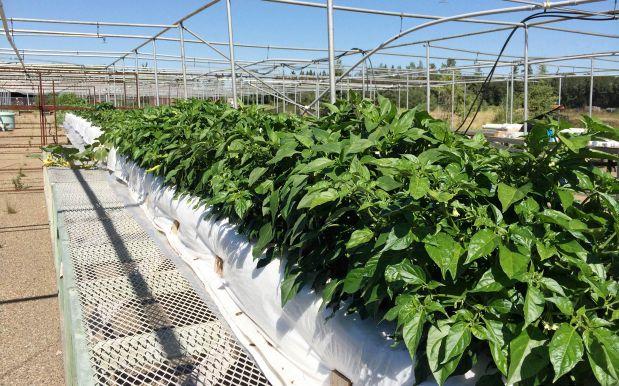
He is working with an AARD research team – which includes engineer and system designer, Marc Legault – to demonstrate the use of an aerobic bioreactor to mineralize nutrients from raw poultry manure. They used the dissolved organic fertilizer called digestate to grow market garden vegetables and tree seedlings in a soil-less growing environment. So far, the results have been highly successful.
For example, seedlings of lodgepole pine and white spruce fed with this mineralized organic nutrient stream, “doubled in height after two months. The results exceeded all our expectations,” Savidov says.
The organic fertilizer was also used to grow greenhouse tomatoes, and a 15 percent higher yield was achieved versus use of synthetic fertilizer because of enhanced nutrient uptake by the plants.
“We demonstrated that we can produce vigorous growth of major nursery crops grown in Alberta and BC, using poultry manure digestate,” Savidov says.
It is common practice right now to
grow market garden vegetables and tree seedlings in greenhouses that use no soil, where the plant roots are immersed in liquid environments and fed computer-controlled, metered amounts of synthetic fertilizers to promote growth. What these Alberta researchers want growers to consider is using mineralized organic fertilizers extracted from animal waste instead of synthetic fertilizers because it is a more sustainable form of agriculture.
What’s different and proving more beneficial by using recycled organic fertilizers instead of synthetics is that they are biologically active with beneficial microorganisms. In addition to exceptional growth over a short period of time, the tree seedlings also experienced enhanced root biomass development, robust health such as better resistance to root pathogens, and improved nutrient uptake, meaning that they experienced exceptional growth in low nutrient solutions. In other words, growers can use small amounts to achieve big results, which could be a huge economic benefit. Furthermore, the water used in these soil-less growing systems is recycled so that there is less pollution released to the environment, and the grower achieves greater water use and nutrient uptake efficiencies.
Researchers chose to work with poultry manure as their raw material because
it was readily available, rich in nitrogen, and less fibrous than cattle manure, which because of its fibre content, takes longer to ferment. The processed poultry manure resulted in organic fertilizer with low sodium content, which can be toxic to plants in higher concentrations, and pH within the tolerable range for plants.
Savidov emphasizes that whether it is synthetic fertilizers or this type of organic fertilizer, the nutrients have to be mineralized so that they can be used as plant food. He adds that what’s new about this process versus the common practice of creating organic fertilizer by composting manure is that this aerobic bioreaction conversion process is much faster – taking two to three weeks versus three months to a year with composting. Also, this method results in 100 percent conversion of the raw manure to valuable, liquid plant food versus composting or the other commonly known method of converting animal manure to organic fertilizer – anaerobic digestion. This is the process of converting manure to organic fertilizer and biogas in an oxygen-free environment.
The researchers’ goals were to prove that it is possible to create a liquid, biologically-active, organic fertilizer from raw animal manure using their aerobic fermentation method and that plant response from
this organic fertilizer in a soil-less growing environment is as good as or better than the use of synthetic fertilizers.
Savidov says it is possible to extract valuable nutrients using their bioreactor system from all forms of animal manure or other food and agriculture by-products, but they started with poultry manure. Ultimately, converting manure to a liquid nutrient stream using their bioreactor technology could represent a new income stream for farmers like poultry producers, as well as a non-synthetic, biologically active, fertilizer source for growers. The conversion process also produces heat, which can be used to heat poultry barns.
An aerobic bioreactor is not expensive, space-age technology. It is easily achievable, relatively inexpensive technology. The bioreactor is simply a septic tank with a built-in agitator. Oxygen and water is added to the tank along with the manure to create a slurry. Intense mixing within the tank is critical to maintain consistent fermentation. Savidov says there is no odor during the reaction process, except when the raw manure is added because oxygen reacts with common
odor-causing compounds like hydrogen sulfide. Because all components within the raw manure will completely mineralize over different time intervals, there will be some solid material left in the liquid outfeed stream after three weeks. After about three weeks, the bioreactor
Converting manure to a liquid nutrient stream using bioreactor technology could represent a new income stream for farmers as well as a fertilizer source for growers.
is stopped and the processed liquid is removed to a filtration tank. The solids are separated from the liquid and returned to the bioreactor for further fermentation, while the liquid stream is ready for use as organic fertilizer.
Savidov’s idea of creating liquid organic fertilizer from manure evolved from aquaponics, where fish like tilapia are grown commercially in large tanks along with plants in what is described as a “co-production” environment. Waste from the fish dissolves and is mineralized by microorganisms in the water, which in turn supplies plants with nutrients. The plants filter the water to maintain a healthy biological environment that supports the fish and microorganisms, so it works as a sustainable loop.
“To be honest, it’s not really an absolutely new system,” Savidov says. “It’s using bits and pieces of what is already used in the agriculture industry for manure treatment.” He adds that greenhouses and nurseries would have to change very little to convert from synthetic fertilizer use to this type of organic fertilizer.
The researchers hope that aerobic fermentation of animal manure into organic fertilizer will become a common practice, either on farms, by commercial organic fertilizer producers, or directly at greenhouses or tree nurseries. It is currently used in some parts of Europe to treat cattle manure.
Going Whole Hog For Industry, Family, Community
Reed Family Farms goes that extra mile in all aspects of hog production while focusing on family and helping out in the community
BY TONY KRYZANOWSKI
With so many pretty farms in Iowa, it’s quite an accomplishment when a farm is named the “Prettiest Farm in Iowa.” That honor was bestowed on Reed Family Farms near Ottumwa in 2014 by Our Iowa magazine. It was one of the first hog farms in the state to win this honor.
Owner Ryan Reed was also named the Pork All-American by the Iowa Pork Producers Association (IPPA) in 2014. To qualify, a pork producer must have been under 40 years of age and a Master Pork Producer.
The Reeds also earned the IPPA’s Environmental Steward Award in 2011, followed by the 2012 Pork Industry Environmental Steward Award from the National Pork Board.
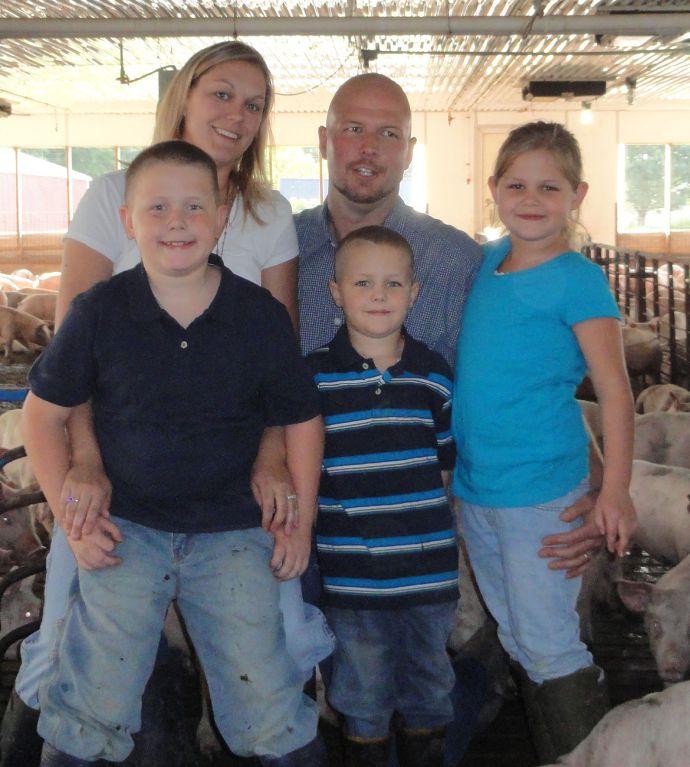
Despite all the accolades, Ryan and his wife, Lana, are a humble couple whose lives are very focused on raising their three children with plenty
ABOVE
of community involvement. It comes as no surprise that they are also past recipients of the Gary Wergin Good Farm Neighbor Award, that they host a Fourth of July Picnic for about 300 friends and neighbors on their farm every year, and also offer custom manure hauling and application services.
The awards are simply the outcome of a best farming practices management philosophy wherever possible in the layout of both their farm and in their hog operation. For example, they have planted 1,200 trees on each of their two properties as a vegetative buffer to their barns by participating in Iowa’s Green Farmstead Partner program, supplemented by a large lawn and an abundance of flowers.
“The trees were an initiative when we built the barns to make them esthetically appealing as well as help the environment from an odor standpoint,” Ryan says. “Also, it puts a barrier between the
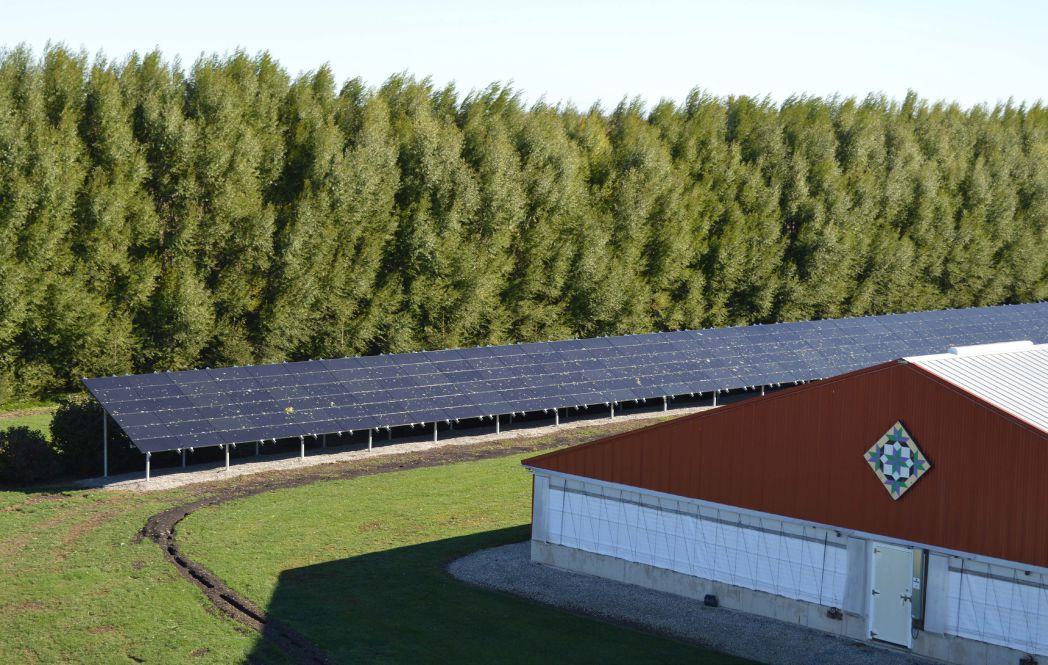
About 1,200 trees plus a grass buffer have been placed around barns on both sites of the Reed Family Farms hog operation as a safety and odor control measure. The farm has also invested in generating 40 kWs of solar power on each farm. Contributed photo
Regulate your nutrient application.
• Complete system provides automatic and prescription based control and complete as-applied records
buildings and the farm grounds if we did have an issue. There are grass buffer strips around the barns and trees to absorb anything that would happen.”
The tree windbreaks are now mature and Reed says he can tell how any odor coming off the farm is directed because of the location and height of the trees.
They also took particular care in the placement of their barns to have the least impact on neighbors through the Community Assessment Model offered by the Coalition to Support Iowa’s Farmers.
Their focus on best farm practices extends to their manure management.
“If I want to provide my children’s generation with the same opportunity that I had, this (nutrient management) is something that has to be taken very seriously by the agriculture industry,” says Ryan, who in addition to decades of hog farming experience also has a bachelor of business degree from Northern Iowa University.
The home location of the Reed Farm where Ryan grew up, plus a second location seven miles away, raise about 12,000 hogs from wean-to-finish annually for Cargill. Each site consists of two barns, each housing 2,345 hogs at a time. The barns were built in 2007 when Ryan returned to hog farming after a short stint working in the feed industry. Besides raising hogs, Ryan also plants about 240 acres of corn, with both corn and soybean crop farming being the predominant agriculture endeavor in that area northeast of Ottumwa.
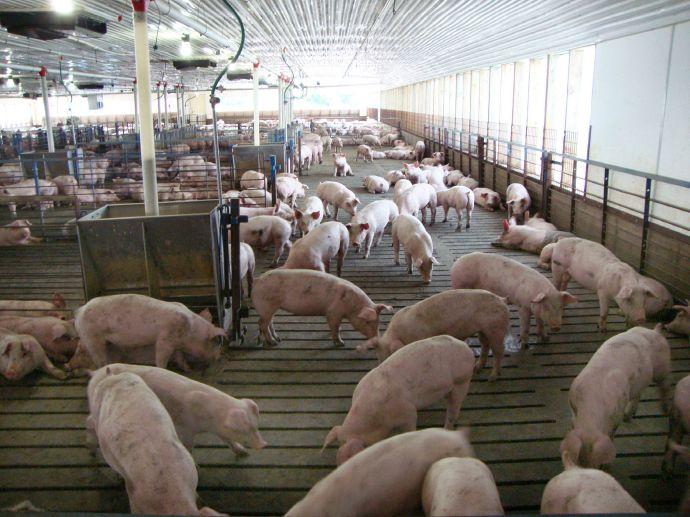
“The opportunity arose to contract through Cargill, which let me both come back to the farm for my family and let me do what I always wanted to do,” Ryan says. Since making the switch a few years ago from feeder-to-finish to a wean-tofinish hog operation, the hog barns now generate between 2.5 and three million gallons of manure annually. For manure collection, each barn has slatted floors with eight-foot concrete pits beneath the buildings to store manure. These pits can store up to 18 months of nutrients.
“I would say that one of the biggest changes I have seen in hog production over the past two decades has been the nutrient side of it,” Ryan says. “We now analyze manure, take soil samples from the ground, and apply what the plants need on a year to year basis based on corn yields or ground nutrients. That is probably the biggest thing – how we are handling our byproducts from animal production.”
He adds that education within the
TOP Lana and Ryan Reed are focused on raising their three children, who Ryan hopes will be able to help with some of the labor on the farm once they grow older, like he did when he grew up.
BOTTOM Manure generated in hog barns at Reed Family Farms falls through slatted floors into eight foot collection pits below each barn capable of storing 18 months worth of manure. Contributed photos
ABOVE
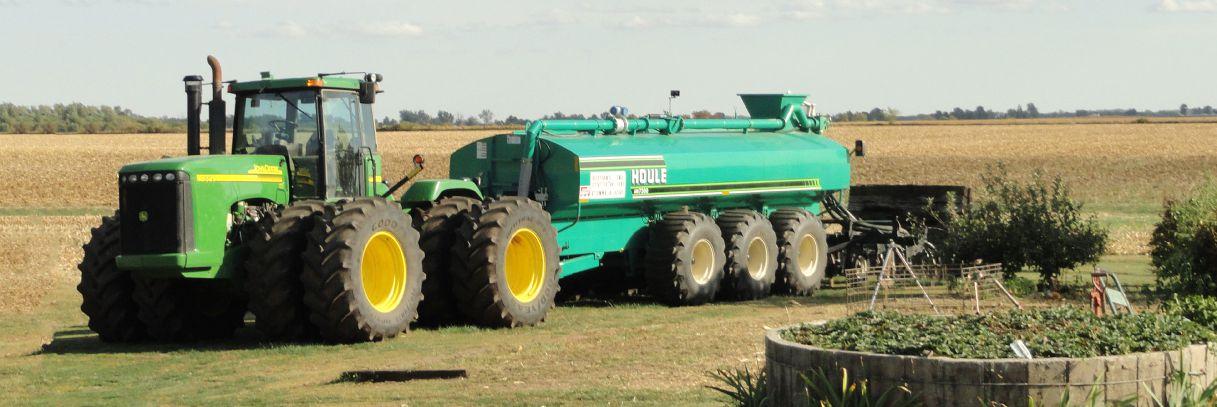
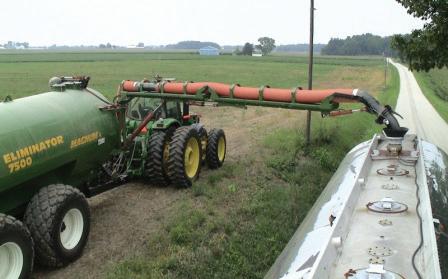
Reed Family Farms generates up to three million gallons of hog manure annually, and it is all injected using a Houle 9,500 gallon, four-axle tank, equipped with an injection system. Contributed photo
farming industry led farmers to realize that given the price of inputs, the manure was valuable.
“When we realized what we had, along with some regulation, it has been attractive for us to manage the nutrients carefully,” he says.
Typically, the hog barn pits on the Reed farm are pumped out and the nutrients land applied in the fall, with a small amount done in spring. Because the pits are the hog farm’s long-term storage system, management of the manure for safety, odor and nutrient retention is a high priority.
“Right now I am testing three different pits additives to see what controls odor the best, along with encapsulating the nitrogen phosphate and potash for plant consumption,” Ryan says. “I am always looking for new things to try.”
During fall application, the manure is pumped into a 9,500-gallon, four axle, Houle tank. The tank is equipped with knives and an injection system, with the application rate controlled by a Krohne flow meter in the John Deere 9430 tractor pulling the tank. All told, the manure is applied on between 750 and 1,000 acres – some owned by other Reed family members as well as a few neighbors.
“Typically, I like to inject the manure in the five to seven inch range to make sure that it is being covered and absorbed into the soil,” Ryan says, adding that the majority of the manure in his area is injected.
“Injection, versus surface applied has multiple advantages,” he adds. “The odor, of course, is reduced greatly and the nutrients are where they need to be while
preventing them from running off.”
That application depth is within the optimum range for good nutrient uptake by corn, and it is also efficient, as any deeper would require more pulling horsepower. Manure is the sole fertilizer added to the Reed’s cropland, saving the farm about 75 percent on its fertilizer costs if it had to purchase it commercially. The rate of application per acre is determined from soil sampling and a nutrient management plan drafted by a professional agronomist. The global positioning system (GPS) in the tractor helps Ryan keep track of where he is located in a field according to maps provided by the agronomist and he sets the flow meter at the recommended application rate for that area. Typically, the flow rate will be the same for each field, so a lot of adjustment on the fly is not required.
He chose the Houle hauling and injection system because he was familiar with it, having operated one working with a neighbor during his years in college. He describes it as a reliable tank and injection system with plenty of positive history behind it.
Good preventative maintenance on the equipment is important to achieve good outcomes from both an application and safety standpoint.
“Maintenance on equipment is one of the biggest things you can do to ensure that you are not going to have a spill or leakage, that you are getting the manure injected within that five to seven inches, and covered properly with the cover plates,” Ryan says.
The Reeds have also installed grass buffers around waterways in their fields
as a safety measure to avoid any potential leaching issues.
The small commercial application branch of the farm business evolved from the need for more acreage to dispose of the hog manure generated by the farm. The Reeds have good relationships with other hog producers in the area, and they help each other as needed during the application season.
Those good relations extend to other areas as well, such as the reason why the Reeds have made an investment into solar power on their farm, and have also investigated the possibility of wind power and anaerobic digestion of their hog manure as an alternative to manure disposal, initially through a partnership in an entity called Tri-Family Farms LLC. Today, two of the company’s partners have proceeded on their own with solar installations.
On the Reed Farm, two, stand-alone solar power installations have been built, one on each farm site and working with a company called E-Pro, to generate 40 kilowatts (kWs) of power per site for use by the farm and in their hog operations. The power is wheeled back and forth through the local utility on a net metering basis, so for whatever power the installations produce, the Reeds receive a credit against their power bill.
“Digesters seem to be cost-prohibitive in our area,” Ryan says. “Solar panels seem to be more popular and I did not see the downside to it. We are fairly early into the solar panel installation, and expansion is an option. Anything we can do to reduce the carbon footprint from the farm is good for everybody.”
Small size, but still an important job
Manure
management on acreages and small farms still needs to be considered
BY ANGIE RIECKHINZ
There are many benefits to living on a rural acreage or small farm. The opportunity to raise livestock as a food source is one of those advantages.
One of the challenges to this practice is what to do with the accumulated manure produced by the animals. If the animals are raised in a pasture-based or grazing system, then natural distribution of the manure nutrient takes place. Otherwise, manure accumulated in coops or pens needs to be removed and appropriately handled.
To give an example, an average sized (four pound) laying hen will excrete about 0.26 pounds of manure per day (MWPS). If you have 50 laying hens, you will accumulate more than 4,700 pounds or 2.37 tons of chicken manure annually if the chickens spend all their time in the coop. As another example, a horse (1,100 pounds) will excrete about 50 pounds of manure per day, or nine tons of manure per year. If the horse is housed in
a stable where bedding is used, then you will also have to account for the soiled bedding in your calculations of material that need to be handled. As you can see, even with just a few animals, manure can quickly accumulate.
The two biggest challenges in manure management on small farms are 1) ease of handling of manure and access to storage and 2) appropriate use, application or disposal of the manure. The easier it is to handle the manure and clean the pens and coops, the more frequently it will get done and prevent accumulation of manure from getting out of hand. It is important when deciding to have animals on your acreage or small farm that you have access to equipment that fits your size of operation and also to have a way to deal with accumulated manure.
Based on the number of animals you have, access to a pitchfork and wheelbarrow may suffice. If you have a larger number of animals, it may be
wise to consider a small garden tractor with a loader/bucket for mechanical cleaning of pens and stalls. Areas that accumulate manure and bedding should be cleaned frequently to provide animal comfort, and to prevent too much manure from accumulating.
Once manure is removed from the animal production area you have two choices, you can store the manure or you can land-apply the manure. The capacity to safely and effectively store manure in Iowa is a necessity as weather conditions are unsuitable at certain time of the year to appropriately land-apply the manure. Our goals should be to return the manure nutrient source to cropland, thereby completing the nutrient cycle of crops feeding animals and animals fertilizing our crops. So when the need to store manure exists, please keep these principles in mind: store manure until application is suitable for crop production; use storage as a way to better match your time resources and labor supply; store manure in a manner to protect nearby water sources; manage storage to prevent flies, odors and vermin; locate storage near manure sources; and size storage for easy access with manure handling equipment.
Much like large livestock farms, land-application of manure should be the primary goal to return nutrients to the cropping systems. Since this is not always possible on a small farm or acreage, you should give due consideration to the distribution, use or disposal of the manure prior to bringing animals onto the small farm. As mentioned previously, the primary goal is to use the manure nutrients in the cropping cycle. This may mean your home garden or pasture acres or it may mean working with neighboring crop farmers. Regardless of where the manure
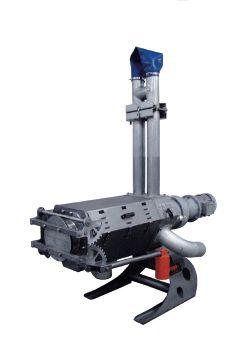
BEDDING MAKER
ALL THE PERFORMANCE YOU NEED, NONE OF THE HASSLES.
COMPLETELY 304 STAINLESS STEEL CONSTRUCTION.
HEAVY DUTY PLANETARY DRIVE, NO GEAR BOX WOES. CASTED STAINLESS STEEL HARDENED AUGER FOR PRECISION AND SUPERIOR PERFORMANCE.
HEAVY DUTY SCREENS STANDARD, IN A VARIETY OF SIZES.
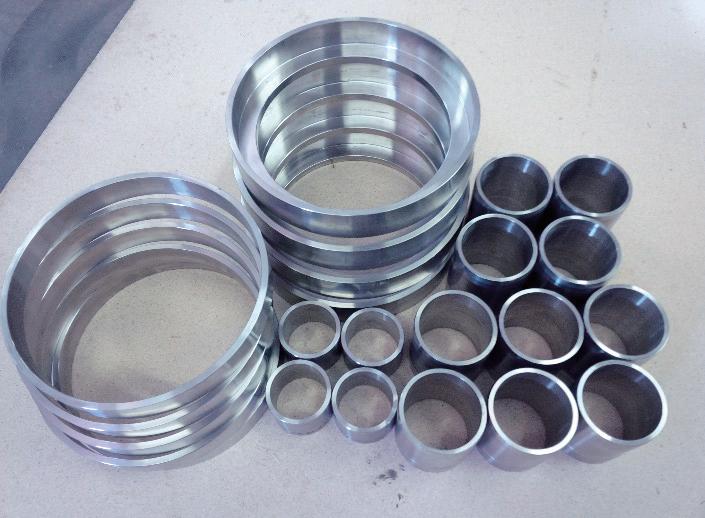
EIGHT CUTTER BLADES TO DESTROY FOREIGN MATERIAL. REVERSIBLE WEAR RINGS AND SPECIAL TUNGSTEN CARBIDE SEAL SYSTEM.
SELF ADJUSTING VOLUME CONTROL ELIMINATES LOSING SOLIDS PLUG AND PROVIDES EVEN HEAD PRESSURE. ADJUSTABLE MOISTURE CONTENT, PERFECT FOR BEDDING.
is land-applied, you should have your manure analyzed for nutrient content and use soil tests to determine the application rate based on the crops you plan to grow. When considering using fresh manure in the home garden, you should apply and incorporate the manure at least three months before the crop will be harvested, four months if growing root crops or leafy material the comes in contact with the soil.
If it is not possible to use the manure in your home garden or elsewhere on your acreage, you can consider these options:
• Work with neighboring crop farmer to distribute on local fields,
• Work with neighbors for use on their gardens, or
• Inquire at local waste transfer station or trash service as to the availability of waste disposal.
The last consideration when handling, storing or land-applying manure on small farms or acreages is to make sure the manure does not adversely impact the environment. Managing runoff from animal production systems on small farms is just as important as on large farms. Be cognizant of local water sources and leachate coming off your manure storage or animal production systems, land-apply manure when weather and soil conditions are appropriate and do not increase the risk of runoff. Be aware of local regulations that apply to all manure sources.
Additional materials can be accessed on the eXtension website, extension.org. For manure management information in Iowa, visit the Iowa Manure Management Action Group (IMMAG) website.
Angie Rieck-Hinz is a field agronomist with Iowa State University Extension and Outreach
Managing farming system to feed crops, protect water
Baker Lad’s Farm of Clayton, Mich., manages the entire farming system to protect water quality
BY TIM HARRIGAN
Water quality problems linked to the loss of crop nutrients have drawn attention to on-farm nutrient management. The city of Des Moines, Iowa, is considering a lawsuit against three counties that manage drainage districts traced to high concentrations of nitrates. Nitrogen (N) and phosphorus (P) runoff from farm fields in the upper Midwest are contributing to oxygen depletion, fish kills and “dead zones” in the Mississippi River and Gulf of Mexico. Nonpoint pollution sources now make up the largest, although highly variable, source of total phosphorus leading to excessive algae growth and disruption of fisheries in Lake Erie. Soil conservation practices have greatly reduced sediment and nutrient loss, but cropland is nutrient-rich and natural levels of N and P in lakes and streams is very low. Even low amounts of runoff can degrade water quality.
During a recent conference co-sponsored by the Michigan Chapter of the Soil and Water Conserva-
tion Society and Michigan State University Extension, Blaine Baker, co-owner of Baker Lad’s Farm in Clayton, Mich., and Tom Van Wagner, technical coordinator for the Lenawee Conservation District Center for Excellence Program, explained how Baker Lad’s Farm manages the entire farming system to protect water quality. Baker Lad’s Farm and the Center for Excellence have a long history of hosting events to advance the knowledge, skills, and sustainability of farms in the region.
Most of the productive farmland in Michigan is tile drained. Tile drainage improves infiltration and reduces runoff, increases water storage, and creates a suitable environment for plant growth by removing excess water. While tile drainage has economic and environmental benefits, under some conditions excess nutrients from commercial fertilizers and livestock manure can quickly move to tile drains through preferential flow paths; cracks and fissures in the soil, worm holes, root channels
Best Storage for Maximum Nutrient Value!
Consistent Nutrient ValueAgitation Makes the Difference
• Center agitation system evenly blends nutrients.
Environmentally Sound
• Designed and constructed using bolted glass-fused-to-steel panels for secure storage and high corrosion resistance.
• Above ground - minimizes the danger of run-off, leaching and ground water contamination.
• Environment-friendly odor control - releases odors above ground level into higher air currents.
• Better utilization of “waste” translates into less purchased fertilizer. 345
Visit www.cstindustries.com to find your local dealer, or call 815-756-1551.
and other macropores, and thereby escape from the field.
At the Baker Lad’s Farm, they use a closed-loop nutrient recycling system to prevent contaminants from escaping to the environment. A 20-acre sub-irrigation system with water table management provides efficient use of two million gallons of “gray water” from the dairy milking center and runoff from the feed storage and processing area. The dilute wastewater is cycled through a three-stage wetland for biological treatment and retention before being pumped through the sub-irrigation system to meet the water and partial nutrient needs of 10 acres of corn during the growing season. Drainage control structures maintain the depth of the water table about 18 inches below the surface. Tile outlets are plugged during the growing season to prevent effluent from reaching the drainage ditch. In dry years, corn yields have increased as much as 70 bushel per acre from efficient use of the wastewater. At the end of the growing season when the water tests clean, the drain plugs are removed and excess water is drained to the open ditch.
Soil health and sustainability are at the center of the Baker Lad’s cropping system. Healthy soil is resilient and productive. Healthy soil balances the physical, chemical and biological properties that enhance its ability to produce quality crops and protect the environment. Healthy soil has stable aggregate structure for stand establishment and crop/root growth, water infiltration, drainage and aeration. Healthy soil retains nutrients in the upper soil layer and minimizes leaching losses, and can mobilize nutrients when needed for crop growth.
Their cropping program is 100 percent no-till and cover crops are used on all of the crop acreage to trap and cycle nutrients,
prevent soil erosion and build soil organic matter. While aerial seeding was previously used to seed cover crops, they now use a 90-foot high-boy sprayer equipped with an air-seeder and drop pipes on 30-inch centers to seed cereal rye, annual ryegrass or an annual ryegrass/clover mix in standing crops. They have greater crop yields with a cover crop than without.
Retaining nutrients in the root zone is a high priority on the farm and tight control is kept over nutrient inputs. All fields are grid soil sampled and commercial fertilizers are applied as close to planting as possible using variable rate application (VRA). No phosphorus-based commercial fertilizers are applied in the fall to avoid runoff losses, and they avoid two-year spreading rates. Manure land application from the 450-cow dairy is based on soil test results and manure analysis. Split applications of N on the corn ground include a portion applied through the planter with make-up sidedress N based on a pre-sidedress nitrogen test (PSNT).
In general, farms in the Great Lakes Region are not losing much N and P on a per acre basis, but the watersheds are large and freshwater is sensitive to even small increases in nutrient concentration. Because nutrient loss is greatly influenced by the timing and intensity of rainfall, the solution to the problem of nutrient loss and eutrophication of lakes and streams is neither simple nor obvious. The Baker Lad’s Farm is just one example of how integrating conservation practices throughout the farming system, and attention to detail in on-farm nutrient management can keep crop nutrients in the root zone and out of waterways.
Tim Harrigan is an assistant professor of biosystems and agricultural engineering with Michigan State University
Black Jack Trimble acquires IRON Solutions, Inc.
Trimble announced it has acquired IRON Solutions, Inc. of Franklin, Tenn. IRON Solutions provides market information, analytics-based intelligence and a cloudbased enterprise system to improve dealer and producer productivity. Coupled with Trimble’s Connected Farm solution, IRON Solutions will enable improved real-time decisions for equipment fleets and more tightly link equipment, seed and chemical dealers to the grower through its ERP/CRM systems. Farmers, their equipment dealers and their agronomy advisors will now have one Connected Farm platform. trimble.com
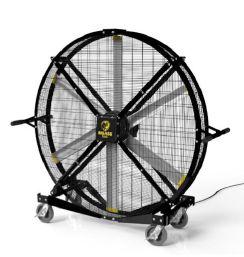
Big Ass Fans has created a fan big enough to provide serious airflow but small enough to go wherever a breeze is needed. Black Jack fits through standard doorways and plugs into any 110V power supply. It moves air up to 120 feet and is wet rated.
Bigasssolutions.com
Tact Master tablet
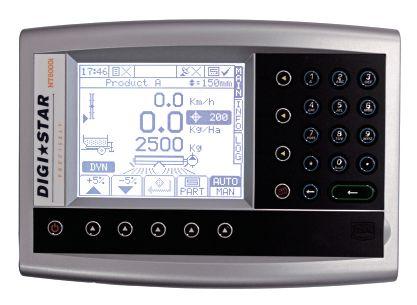
Tact-Master is available in a tablet version. Linked by Wifi, the touch screen tablet can control a spreader in five different modes: transport, pumping, spreading tool, spreading or flowmeter mode. It’s possible to use the tablet as a control tool. About 15 automations are available. pichonindustries.com
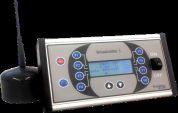
Pichon Industries’ Muck Master can be equipped with a dosage regulator – the Tactile Flowmeter. The touch screen meter can be coupled with GPS to realize better spreading. Complete spreader control is possible through information continuously available on the screen. www.pichonindustries.com
Tactile Flowmeter
MANURE THAN you can handle
The 2015 North American Manure Expo will be here before you know it. It’s time to get ready for two days full of touring, spreading, testing, demoing and learning in Chambersburg, Penn. Register now!
The 2015 North American Manure Expo, taking place July 14 and 15, 2015, near Chambersburg, Penn., will soon be here. The annual event provides an opportunity for custom applicators and livestock producers to advance their knowledge of manure-nutrient utilization while showcasing the latest technology in manure handling, treatment and application.
“I said if I ever brought the expo back to PA that I would want to move it to a more animal-centric region,” said Robb Meinen, who is co-chairing the Manure Expo planning committee with Jennifer Bratthauar of the Franklin County Conservation District. “We are doing just that. Chambersburg is accessible to many dairy, poultry and livestock producers from the entire Bay region and beyond. We fully expect to break 2,000 attendees.”
Activities get underway July 14 with tour day. Attendees can register to take part in one of three full-day tour options covering dairy, poultry and small farm-equine.
The dairy tour includes stops at Mercer Vu Dairy, Slate Ridge Dairy and Burk-Lea Dairy and will cover manure separation technologies, storage covers, static dragline, mortality management, smallscale anaerobic digestion and manure gas monitoring.
The poultry tour features stops at Lesher Poultry, Hillandale Poultry plus the Energy Works Poultry Manure Gasification Plant. Topics include layer manure composting, manure management strategies, nutrient trading, manure byproduct development plus compost turner demonstrations.
tend activities at the Burk-Lea Dairy only.
All the tours will be meeting up in the afternoon at the BurkLea dairy farm for a vendor demonstration of dragline application and manure agitation equipment, including stationary and boat technologies. There will also be a solid separation tour, gas manure monitoring demonstration and discussion of phosphorous removal technologies. Following the demonstration, the participants will return to the expo grounds where they can visit trade show vendors and attend several educational sessions throughout the evening.
The key to Manure Expo is demonstrations and 2015 offers a wide variety, including both solid and liquid manure application. July 15 provides an opportunity for attendees to view side-by-side demonstrations of equipment, allowing them to view and compare technologies. Nowhere else can the audience kick the tires in such a large, industry-specific forum.
ABOVE
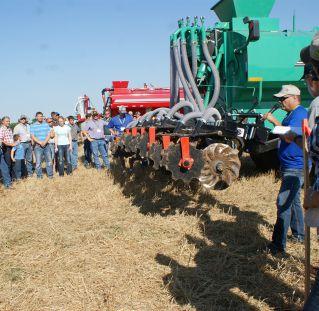
Attendees listen to a dealer describe his machinery during the 2014 North American Manure Expo, held in Springfield, Mo. The 2015 edition is being held July 14-15 in Chambersburg, Penn.
The small farm-equine tour will includes stops at Wilson College and Kiskaddon Beef Farm with discussions covering manure collection, storage and utilization, parasite management, pasture evaluation, controlling runoff and rotational grazing.
A fourth tour option is also available where people can at-
“We really hope to see decision-makers from across the [Chesapeake] Bay states,” said Meinen. “Our show will facilitate a connection between policy and practicality.”
The 2015 expo theme is Manure Than You Can Handle, a play on words that reflects the wide range of continuing education opportunities the event offers. Here certified manure haulers and farmers can learn about important topics surrounding this critical area of animal production. The scope of the event allows exposure of experts from across the U.S. and even worldwide.
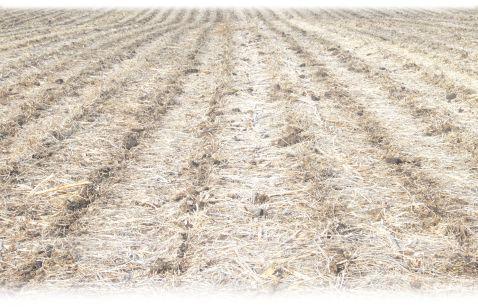
Another important element of Manure Expo is the one-of-a-kind trade show. The event planning committee will transform a field of wheat stubble into a mini manure city, providing attendees an opportunity to talk to manufacturers, dealers and other experts in the manure industry.
To learn more and register for events, visit manureexpo.org.
Quality Systems, Quality Solutions
We’ve proudly provided agricultural solutions for over 44 years and with dealers all over the world there is an expert near you.
For more information on system solutions, products, or locations, visit our website.