21st-century pork farmer tackles the challenges of manure storage, odor, plus high energy and fuel bills by purchasing an anaerobic digester
Biogas Council announces winners of inaugural awards At its recent second annual conference, the American Biogas Council (ABC) awarded the first ever Biogas Projects of the Year
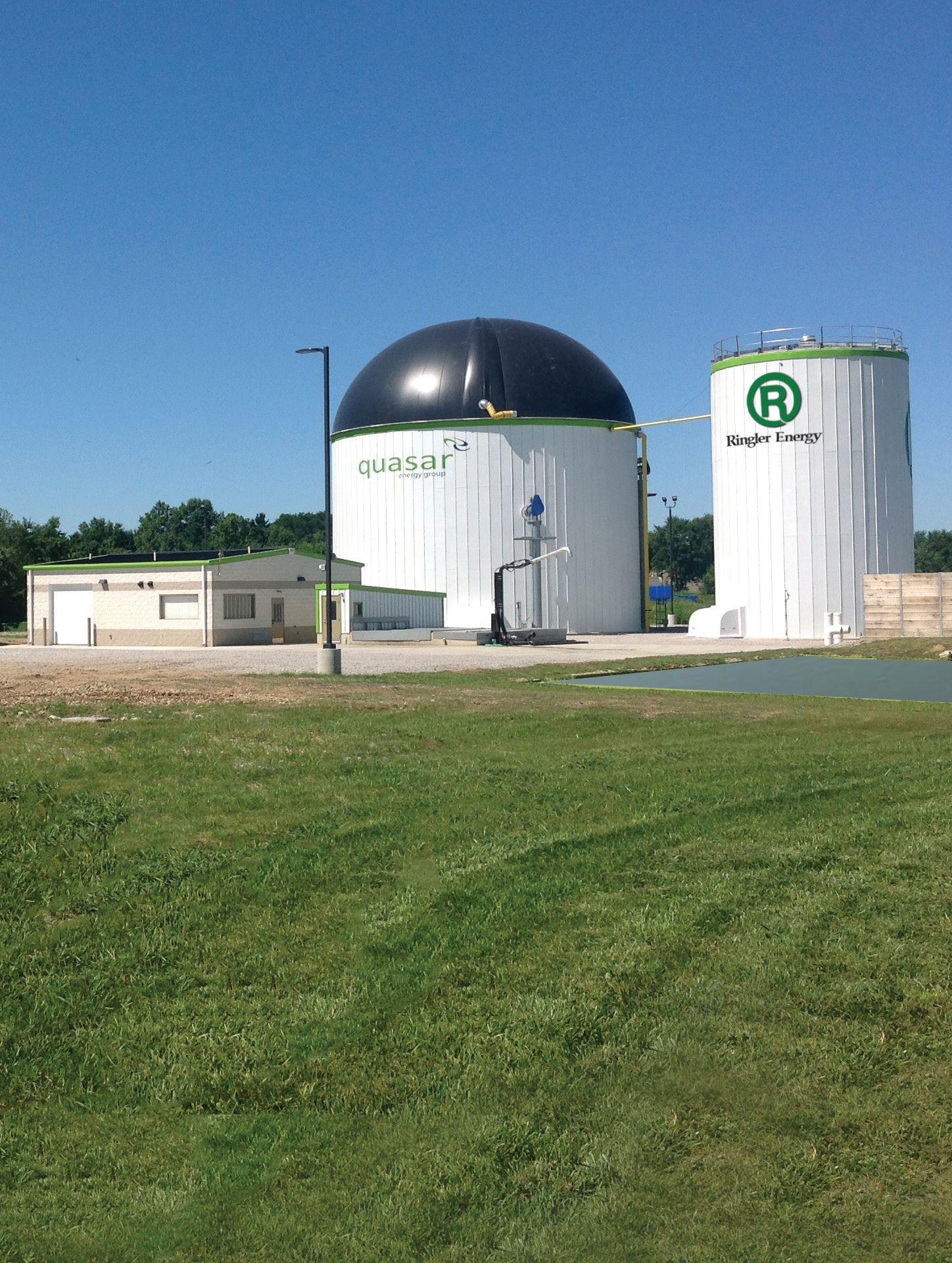
Cover: Alex Ringler, CEO of Ringler Energy, operates a large finisher facility near Ashley, Ohio, which currently uses a quasar
May/June 2014
Volume 12 • No. 3
published by:
Annex Publishing & Printing Inc.
P.O. Box 530 Simcoe, Ontario N3Y 4N5
Editor
Margaret Land • (519) 429-5190, (888) 599-2228, ext 269 mland@annexweb.com
Contributing Editors
Diane Mettler, Tony Kryzanowski, Anne Perry, Jeanine Moyer
president Mike Fredericks mfredericks@annexweb.com
Publication Mail Agreement #40065710
RETURN UNDELIVERABLE CANADIAN ADDRESSES TO CIRCULATION DEPARTMENT, P.O. BOX 530, SIMCOE, ON N3Y 4N5
e-mail: subscribe@manuremanager.com
Printed in Canada
Circulation
e-mail: subscribe@manuremanager.com
Tel: 866-790-6070 ext. 211
Fax: 877-624-1940
Mail: P.O. Box 530 Simcoe, ON N3Y 4N5
subscription Rates Canadian subscriptions
$35.24 Cdn, one year (with GST $37.00, with HST/QST $39.82)
U.s subscriptions: $47.00 USD, one year
Occasionally, Manure Manager will mail information on behalf of industry-related groups whose products and services we believe may be of interest to you. If you prefer not to receive this information, please contact our circulation department in any of the four ways listed above.
All advertising is subject to the publisher's approval. Such approval does not imply any endorsement of the products or services advertisted. Publisher reserves the right to refuse advertising that does not meet the standards of the publication.
Website: www.manuremanager.com
By Margaret Land
Slinging manure in Wisconsin
Wisconsin appears to be in the midst of some kind of manure-fueled hate-fest this spring, seemingly sparked by a series of newspaper articles published in the state.
One of the top dairy-producing states in the u.S., Wisconsin residents have always had a love-hate relationship with all things manure. But the furor seemed a bit more rabid in late-april and into may when the Wisconsin Center for investigative Journalism (WC iJ), in collaboration with Wisconsin Public r adio, Wisconsin Public television, other news media and the university of Wisconsin – madison journalism program, released a series of articles putting the state’s manure management in the spotlight. the series – part of Water Watch Wisconsin, a project examining water quantity and quality issues across the state –was published from april 24 to may 14.
One article that caught my eye was a Sunday feature entitled Manure spraying under scrutiny in Wisconsin that highlighted the plight of two homeowners when a large-scale dairy was constructed near them and used irrigation spraying as a method of distributing its liquid manure. Within days of its publication, the article had spread throughout the u.S. media, including news site Salon.com, which reaches an audience of 15 million visitors.
“So here’s what factory farms are up to these days,” stated lindsay abrams, an assistant editor at Salon. “they are literally spewing a bunch of shit into the air.”
emotion-provoking commentary to say the least, backed up with a stock photo of a sprinkler shooting liquid everywhere.
the Wisconsin dairy industry rallied back. laurie Fischer, executive director of the state’s dairy Business association, published a rebuttal in the Wisconsin State Journal stating the WC iJ article needed a “deeper look.”
“Only 14 of some 76,800 farms in the state use manure spraying technology,” she wrote. “So the practice involves 0.00018 percent of them. that means the practice isn’t just ‘relatively rare,’ as the article contends – it’s infinitesimal.”
Bob grabarski, a farmer from arkdale, Wis., stated in a column he penned for the Wisconsin r apids tribune that the Sunday feature “seems to paint the issue with a broad brush.”
“no matter the industry – animal units, paper production and even cities themselves – wastes that result require solutions,” he concluded. “Some have done better than others and sometimes the environment sustained some challenges in the interim, but good minds prevailed in solving many of these issues. may those same types of minds prevail in solving the current manure and Ca FO issues so that an industry is not destroyed.”
i definitely second that, Bob.
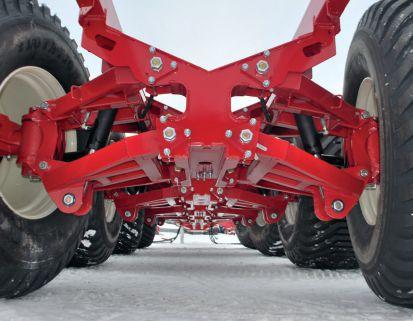
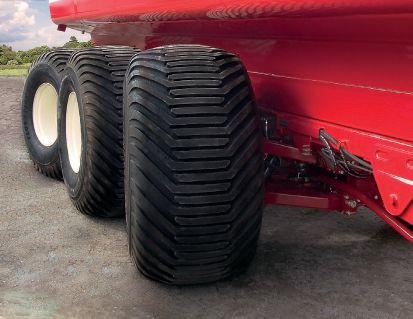
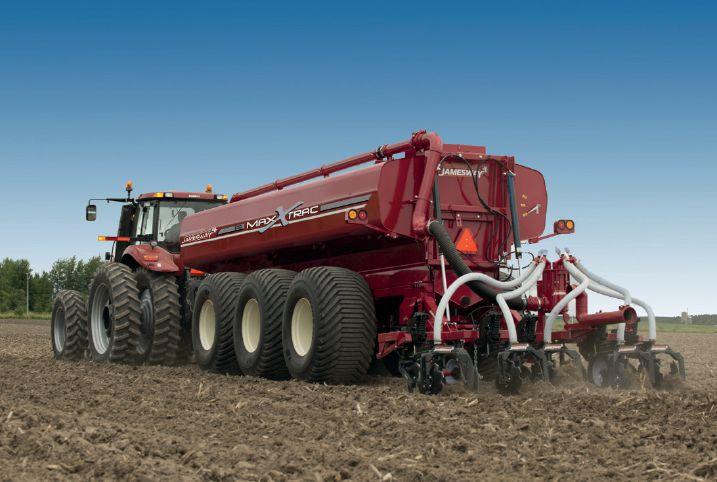
Engineered for professional haulers, Jamesway’s new MAXX-TRAC tankers deliver maximum performance.
MAXX-TRAC Steering is gentle on your fields and on your equipment.
country. The left and right sides of the PARALLEL-LINK suspension move completely independently.
Tandem models4000450050005700US Gal Tridem models5600620066007400US Gal Quad models8500960010 200US Gal
Loaded with features for professional users:
• High Output impeller with 6” or 8” discharge
• Automatic Industrial brakes
• High-speed steering
• Oil-filled hubs
hogS high-energy
By Diane Mettler
the 21st-century pork farmer
Large pork producers face many challenges, including manure storage, odor issues, high energy and fuel bills, just to name a few. But what if all those issues could be solved with the purchase of one technology – an anaerobic digester.
it was for that reason that alex r ingler, C eO of r ingler energy, located near ashley, Ohio, contacted quasar energy group in 2010. they had a large finisher facility with 7,000 hogs between 50 and 250 pounds and were also receiving food waste. they needed a technology that could handle both.
“a biodigester is not sustainable if it’s just utilizing livestock waste,” says r ingler. “You need to have other feedstock available to make a recipe that can
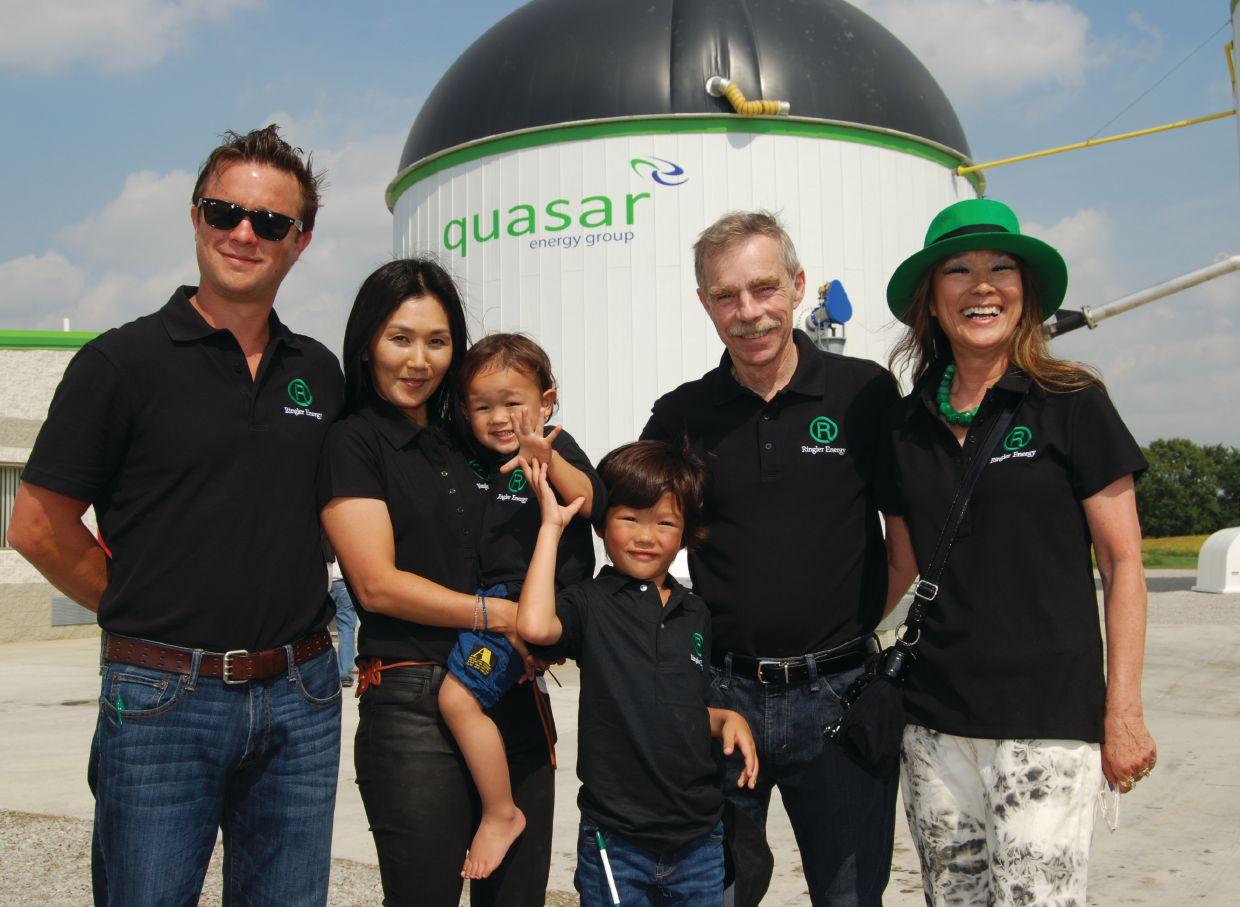
Three generations of the Ringler family pose for a photo in front of the farm’s anaerobic digester, located near Ashley, OH. They are Alex (left) and wife Misa, with their sons Isaac, 8, and Jude, 3, and Alex’s parents, Bill and Yama.
Contributed photo
precipitate stable function and quality of methane, to create renewable energy.”
Two years of research
it wasn’t an investment they took lightly, and before investing in a large-scale digester, they did their homework.
“We had a long research and development program,” says r ingler. “We had at least two to two-and-a-half years of research and development to work on feasibilities and to make sure that we were to be able to do what we said. Furthermore, my lender wanted to be able to quantify that as well, which i can’t blame.”
research also included r ingler and his father traveling to europe where anaerobic digesters are plentiful.
in the end they chose quasar technology, which r ingler says is not only very good, but also locally based in Cleveland, Ohio, just an hour-and-ahalf away.
Partnership
Once quasar technology was chosen, r ingler and quasar began working out the details. What they determined was that the best path would be to partner, and r ingler energy was born.
melvin r. Kurtz, president of quasar says, “Because if quasar has skin in the game, there’s a vested interest in the success; we’re not selling it and running for cover. We partnered and we built it, remained involved. that includes all of the facility upgrades, the hardware upgrades,
the software upgrades, any technology changes.
Kurtz adds that a number of questions have to be answered before deciding if an anaerobic digester is a solid business decision. “the first thing is, is it affordable? Second, is it sustainable? third is where does it fit into our firm’s business practices? lastly, what’s the return going be and how do i limit my risk? We worked through those issues with r inglers. We provided some performance guarantees, and now a year later, we’re all happy.”
Construction
r ingler chose not to be involved in the construction. in fact, one of the reasons they chose quasar was because they offered a turnkey operation.
“Construction took about six months and about another three months to be able to commission the facility,” says r ingler. “We came into full energy production around July or august of 2013.”
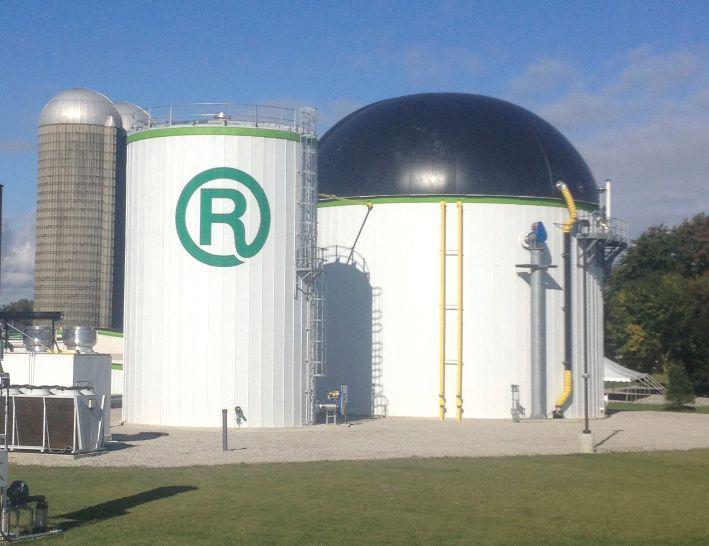
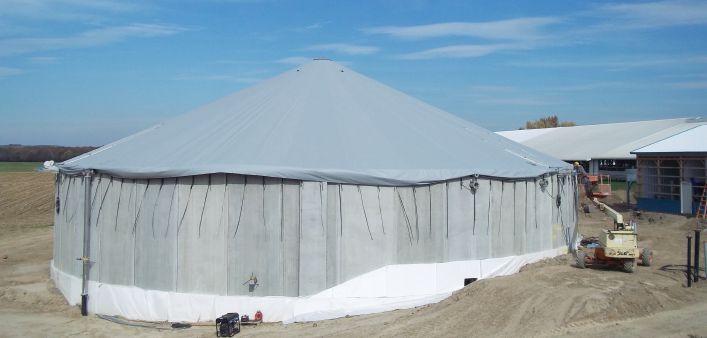
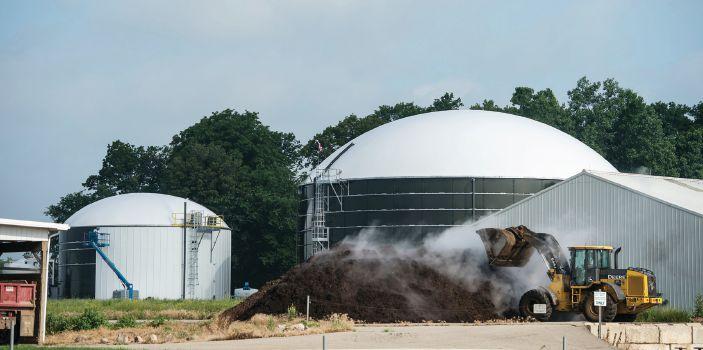
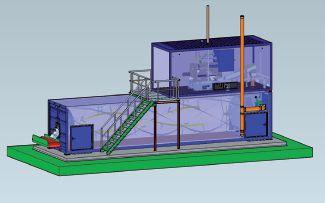
the system is quasar’s standard model – 980,000 gallons of storage divided by two processes. the first is a 230,000-gallon tank – the acid phase –where all the organics are collected and start to convert into energy. every thirty minutes material from the first tank is fed to the second 750,000-gallon digestion tank, where the bacteria does the majority of the conversion.
Combined, the tanks allow r ingler to process 50,000 tons per year of organic biomass and produce about 850 kWh megawatts of renewable electricity. that’s enough power to run his entire farm with extra to put onto the grid.
in addition to the electricity that is produced, r ingler also receives the benefits of heat coming off the generator itself. hot water is circulated through all the adjacent shops, including mechanical shops, via radiant heat in the flooring.
“in the winter time, we never have any type of snow residue or build up because we have hot water underneath all of our concrete structures,” says r ingler. “We circulate the hot water through and i have radiant heat through the old radiator system.”
Small footprint the footprint of the digester facility,
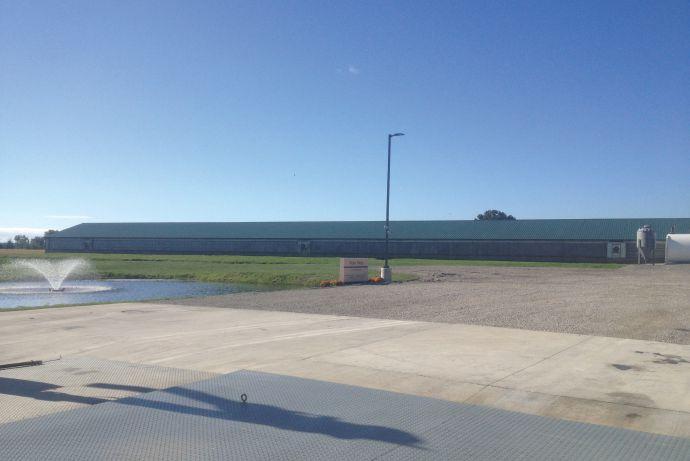
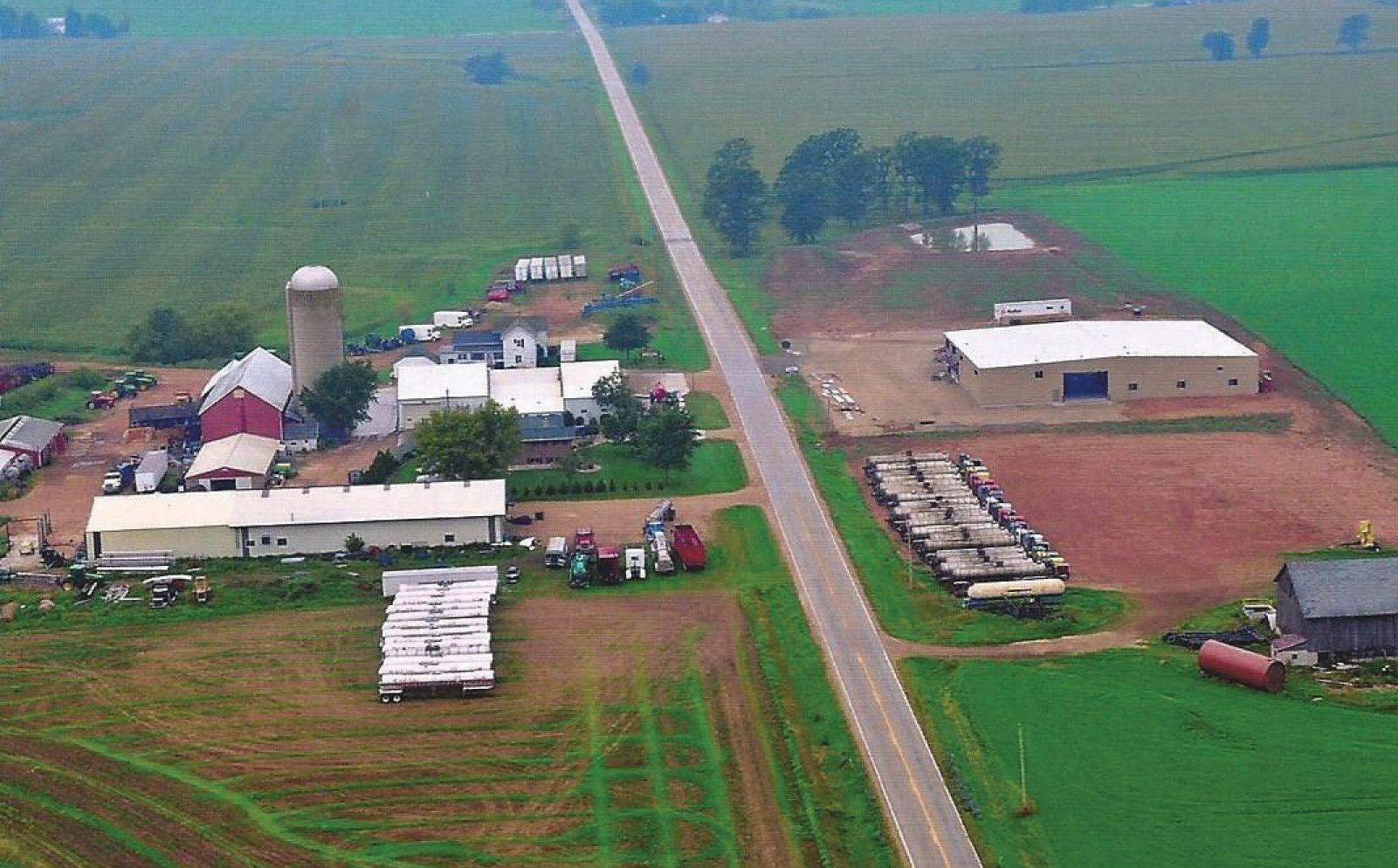
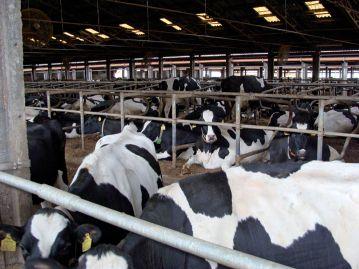
The Ringler family operates a large finisher facility with 7,000 hogs between 50 and 250 pounds. The animals are housed in four barns, each containing 1,250 finish hogs, and one containing 2,000 hogs. Contributed photo
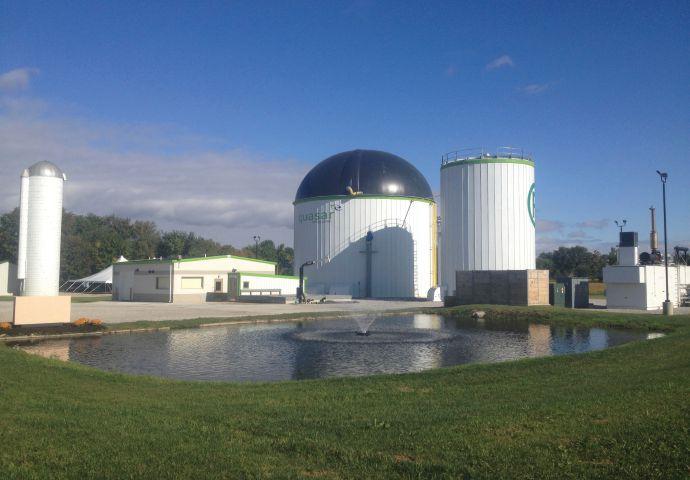
The digester system is quasar’s standard model – 980,000 gallons of storage divided by two processes. The first is a 230,000-gallon tank – the acid phase. Every thirty minutes material from the first tank is fed to the second 750,000-gallon digestion tank, where the bacteria does the majority of the conversion. Contributed photo
including a 40x40 control room, is relatively small, just 1.5 acres. it’s located next to the existing livestock barns – four barns each containing 1,250 finish hogs, and one containing 2,000 hogs. all the barns had shallow pits, and a pull-plug system that gravity fed into lagoons. the manure was stored there until it was time for application.
“now we essentially have a manifold that connects all the barns on their discharge pipe, and we collect the 7,000 gallons of manure on a daily basis,” says r ingler. “the manure never hits the light of day. as we handle the manure through a pull-plug system, it goes into a covered concrete tank, along with almost an equal amount of byproducts, where it’s [then]
fed daily into our biodigester.”
the byproducts come from local businesses and include things like whey, cottage cheese and brewers yeast, and r ingler says those byproducts have allowed the farm an offset for livestock nutrition. “We can use these products as a supplement to traditional dry feed.”
Fertilizer
the hrt (hydraulic retention time), from entry to exit, is about 30 days. Once the biomass leaves the digester the odor is gone but the nutrients remain. the biomass is stored in lagoons until it’s ready to be applied to the fields via an airway dragline system.
all the r ingler facilities (the family has several throughout the midwest) are Ohio e Pa permitted facilities and allowed to use the organic fertilizer as a supplement to commercial fertilizer. this has helped the bottom line.
“r ingler energy distributes the organic fertilizer back to r ingler Farm’s grain and farming operations at a discounted cost compared to commercial fertilizer,” says r ingler.
Monitoring
the quasar technology doesn’t require a lot of manpower and the system can be monitored easily from an iPhone from almost anywhere. even so, there was some education required by r ingler employees and quasar conducted a three to fourmonth training session at the farm while the facility was commissioning.
“i had three people go through this commissioning process, of which i always have one person onsite every day,” says r ingler.
Kurtz adds that all of the programming and software is handled by quasar. “it’s one of the ways that we can control the quality of the work. like alex and his father Bill concluded, you want to make sure that your digester company has skin in the game.”
Next step – fuel
Since the plant’s startup, energy production has exceeded expectations. in fact, it’s been so successful that the r inglers have installed a second, identical quasar digester in Ohio and they are in the process of bringing it in service. the next step will be compressed
natural gas (C ng). the biogas upgrade has been approved but not installed yet. When it is, C ng will be utilized in r ingler’s expanding C ng fleet – from light duty trucks to it heavy-duty semi tractors. in fact, r ingler energy currently has five semi trucks that run on compressed natural gas.
Kurtz is excited about the C ng upgrade, or what they all call Phase 2. “We do the gas upgrade in house. it’s our technology, and we’ve partnered with air Products to do that. Soon r ingler will not only have a revenue stream from electric and heat, but also C ng that will cost him less than half of what diesel costs, and it burns 60 percent cleaner.”
The next generation of farming
Some farms may have looked at anaerobic digesters and decided they were too expensive, but both r inger and Kurtz say that if it’s been a few years, its worth revisiting. For example, the quasar digesters cost only half of what they did just six years ago.
Kurtz says, however, it still it takes a certain size farm to make a digester economical. he estimates the smallest digester that would provide the economies of scale required is 25,000 tons per year— the equivalent of about 100 tons a day of feedstock.
Both Kurtz and r ingler are excited about the future of anaerobic digesters. “it’s the next generation farming,” says Kurtz. “You get to be a better neighbor. You get to have a sustainable operation. You get to increase your revenue stream and you get to be more autonomous, all in one decision – building a digester.”
For r ingler the choice has allowed their operation to achieve efficiency and consistency. “the goal for us is that we have a fleet of 30 trucks on the road every day moving our internal product, livestock feed, and liquid byproducts to our facilities.”
in short, r ingler farm will complete the ultimate loop. manure from the livestock will create energy, which will be used to fuel the trucks that fertilize the fields and will then be used to deliver the feed to the livestock.
“i truly believe that a family farm – which is what we are – has the capability to be modern and progressive. Conservative thinking is not always the best practice,” says r ingler. “Change is good.”
Alex Ringler chose not to be involved in the construction. In fact, one of the reasons they chose quasar was because they offered a turnkey operation. Contributed photo
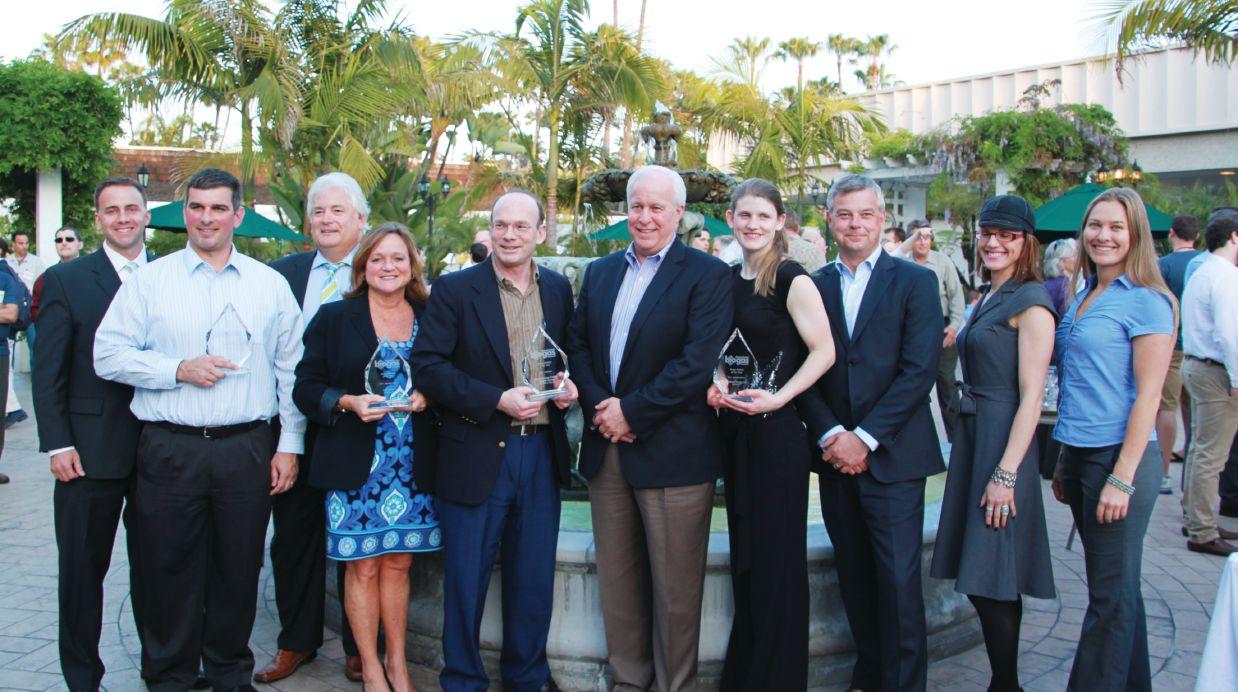
A group photo showcasing all of the winners of the American Biogas Council’s Biogas Projects of the Year award. Photo courtesy of the American Biogas Council
american Biogas Council announces
WinnerS of inaugural aWardS
at its recent second annual conference, the american Biogas Council (a BC) awarded the first ever Biogas Projects of the Year.
The a BC awards Committee recognized projects that have made a significant impact on the development of the biogas industry and excelled in four areas: innovation, technology, collaboration and managing complex systems. Because biogas projects can
vary widely from sector to sector within the biogas industry, the committee awarded Biogas Project of the year in four categories: agricultural, municipal, merchant and institutional. there was a tie in the agricultural category, leading to five awards.
a gri r e n ew in Stockton, ia , won the a gricultural Biogas Project of the Year award for the execution of a quality agricultural-based project and sustainable business model that can be replicated at farms across the u .S. the biogas system was built in part to help the fifth-generation Sievers Family Farms expand their beef feedlot capacity to 2,400 head. i n addition to producing additional revenue streams for the farm,
the biogas project helps to manage the cattle manure, creating 1 m W of 24/7 electricity from the biogas plus a variety of solid and liquid products. e xcess electricity is sold to the local utility.
a BC member companies involved in this project include: Sievers Family Farms, Specialty Concrete Construction, Organic Waste Systems and Caterpillar.
h arvest Power’s e nergy g arden in lake Buena vista, F l , won the m erchant Biogas Project of the Year award for its first-of-a-kind anaerobic digester that converts organic waste into renewable biogas and natural fertilizers, diverting hundreds of thousands of tons of waste from Central Florida landfills. When operating at full capacity, the facility
Don’t let manure handling agitate you. Save time and fuel with More Than Manure® (MTM®) Nutrient Manager. MTM can break through crusts and solids in pits and lagoons, and cuts down on foam when pumping into tanks, so manure is easier to handle with less agitation. Visit us at sfp.com to request a free MTM kit.
will process 130,000 tons of organic materials annually and produce 5.4 megawatts of combined heat and power.
“ this facility signals a paradigm shift for the region’s hospitality industry as theme parks, hotels and restaurants are now able to differentiate themselves to customers through environmentally sound waste recycling practices,” said Chris Peters, regional vice president of h arvest Power in Florida. “We’re excited to see organics recycling and clean energy take off in this region.”
aBC member companies involved in this project include: Caterpillar, entec Biogas gmbh, harvest Power and layne, inc.
lawnhurst e nergy, llC in Stanley, n Y, won the a gricultural Biogas Project of the Year award for their solution to handle a mix of wastes not typically found in n ew York farm-based digesters: dairy cattle manure, whey from nearby yogurt factory and feed residues. the biogas project designed and realized by a BC member e nvi tec Biogas makes over 541kW of renewable electricity all day and all night and the digested materials are dried and used as bedding for the dairy cattle.
the m ichigan State u niversity South Campus a naerobic d igester in e ast lansing, mi , won the i nstitutional Biogas Project of the Year award for a great execution of a food waste biogas project on a college campus that also serves as a research platform for biogas research and development. the biogas system will generate approximately 3,000 m Wh per year of renewable energy by processing organic waste from campus dining halls, food processing facilities and local agricultural operations. i n addition to producing renewable energy for campus use, the facility will also divert nearly 10,000 tons per year of organic waste from landfills.
a BC member companies involved in this project include: a naergia, ut S r esidual Processing, and 2 g Cenergy. the village of r idgewood Biogas - r enewable e nergy Project in
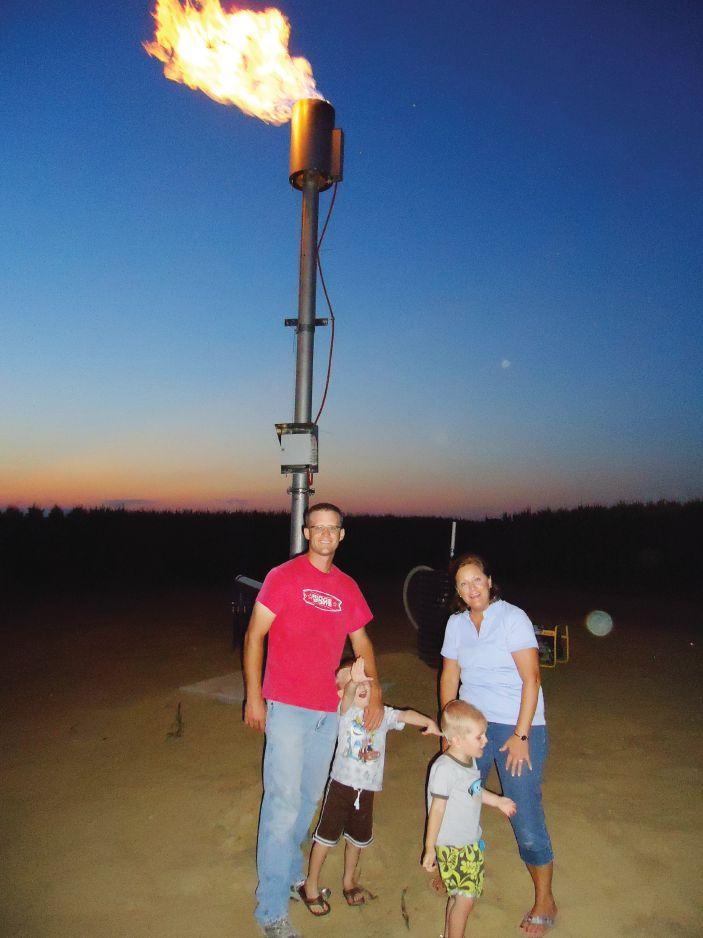
Members of the Sievers Family Farms stand by the beef operation’s biogas flare. AgriReNew, which constructed the biogas project on the Iowa beef farm, recently won the American Biogas Council’s Agricultural Biogas Project of the Year award for the execution of a quality agricultural-based project and sustainable business model that can be replicated at farms across the U.S. Photo courtesy of the American Biogas Council
The Lawnhurst Energy biogas project was designed and realized by EnviTec Biogas and produces more than 541kW of renewable electricity. Photo courtesy of the American Biogas Council
r idgewood, n J, won Biogas Project of the Year for its unique characteristics as the only 100 percent privately financed biogas system at a municipality and also produce an amount of renewable energy from biogas and a small solar array that is equivalent to up to 100 percent of the power demand of the waste water facility.
“ m any municipalities are struggling with aging infrastructure, underperforming utility facilities and severely constrained municipal budgets. this project demonstrates how partnerships with municipal and industrial leaders can achieve a lower carbon footprint while converting wastes to valuable resources for use in the local community. By repurposing an existing facility in this way, everyone benefitsthe environment, the village residents and our renewable energy investors,” said Chuck g ordon, C e O n atural Systems u tilities.
a BC member companies involved in this project include: n atural Systems u tilities and hdr
The Michigan State University biogas system generates approximately 3,000 MWh per year of renewable energy by processing organic waste from campus dining halls, food processing facilities and local agricultural operations. Photo courtesy of the American Biogas Council
the a merican Biogas Council counts 2,000 operational biogas systems in the u .S., but estimates the market potential for 12,000 new biogas systems to process readily available organic waste. a t least $36 billion in construction activity, 300,000 construction jobs and
20,000 permanent jobs are also attainable from realizing this market potential.
m ore details, contact information for each project, and other featured projects can be found at: http://www. americanbiogascouncil.org/projects
Controlling odorS, ghg emiSSionS from Stored SWine manure
By Ann Perry
Storing and reusing swine manure for fertilizer makes good environmental and economic sense, but managing foul-smelling manure is probably one of the least favorite tasks on a producer’s to-do list. recent findings by agricultural research Service microbiologists terry Whitehead and mike Cotta may someday give farmers options for odor control that will protect livestock health and help restore harmony between rural producers and nearby residents.
Odor from swine manure contains hundreds of compounds, so it’s difficult to find the specific ones that are the main culprits contributing to the bad smell. these compounds are made by microbes that break down undigested feed and other materials in the manure. Scientists have determined that one group of these microbes – sulfate-reducing bacteria –produces hydrogen sulfide. hydrogen sulfide and other sulfur compounds make up about half of the offensive odorants from swine manure.
But manure generates more than just a
distinctive odor. Bacterial activity in manure pits also generates methane and nitrous oxide, which are both greenhouse gases. research conducted by scientists elsewhere has indicated that tannins –compounds naturally present in tree leaves and other feed materials – can block bacterial activity in the guts of ruminant livestock such as dairy cows, which in turn lowers digestive efficiency and effectiveness. to Whitehead and Cotta, who are in the ar S Bioenergy research unit in Peoria, illinois, this observation suggested that perhaps the tannins could be an effective agent for controlling the compounds that produce odor associated with manure.
the scientists conducted a laboratory study to evaluate the effectiveness of tannins from the quebracho tree, which have been used in other studies of ruminant digestion, in reducing the emission of odors and greenhouse gases from swine manure pits. the scientists collected swine manure from a local producer and incubated it under laboratory conditions that mimic onfarm conditions. this allowed them to test the effects of adding tannins to the manure by monitoring gas emissions. they also determined the levels of sulfate-reducing
bacteria that typically flourish in that environment.
Seven days after the researchers added quebracho tannins to the manure, they found that hydrogen sulfide and methane production had been reduced more than 90 percent and that production continued to dwindle for another 3 weeks. Sulfate-reducing bacteria populations also significantly declined, by 70 to 90 percent, in the tannin-enriched mix.
larger-scale testing at swine facilities is needed to determine whether the tannins have similar rates of efficacy in commercial swine production facilities. if these findings are replicated in field-scale studies, quebracho tannins could be used in manure pits to reduce the activity of sulfate-reducing bacteria and the amounts of hydrogen sulfide and methane. the benefits of this approach would be twofold: producers would have a cost-effective way of mitigating odors and greenhouse gas emissions, and when the manure is eventually spread onto the fields as fertilizer, the added tannins would not pose a risk to the environment.
Ann Perry is a staff writer with the USDA’s Agricultural Research Service
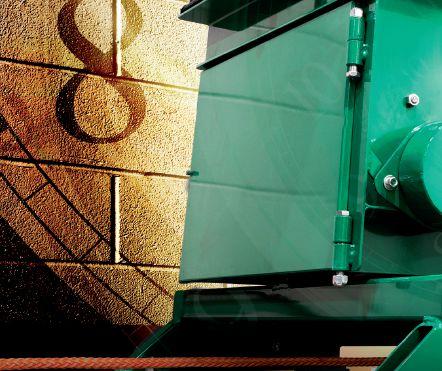
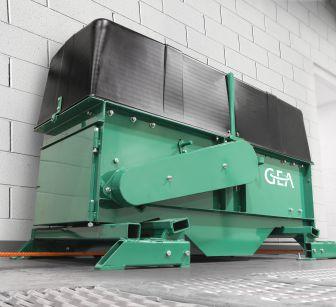
GEA Farm Technologies offers you a brand new and improved range of drive units that will make your life easier – more freedom in installation location, effective operation, and minimum maintenance. This unique design allows lateral movement of the drive as the cable is being wrapped around the rotating drum. The coiling is made without stress and without excessive friction – which is usually the cause of premature wear of the equipment and cable. The SW Drive Unit is another piece of well thought out equipment that will work for you through the years, just like the first day it was installed.
SW Series Cable Drive Unit
GEA Farm Equipment | Houle
GEA Farm Technologies Canada Inc.
Tel. 1.800.563.4685 / Fax. 1.819.477.0486
www.gea.com / www.geahoule.com
engineering for a
GEA Farming SW Serie Drive Unit IVRpro Houle EN
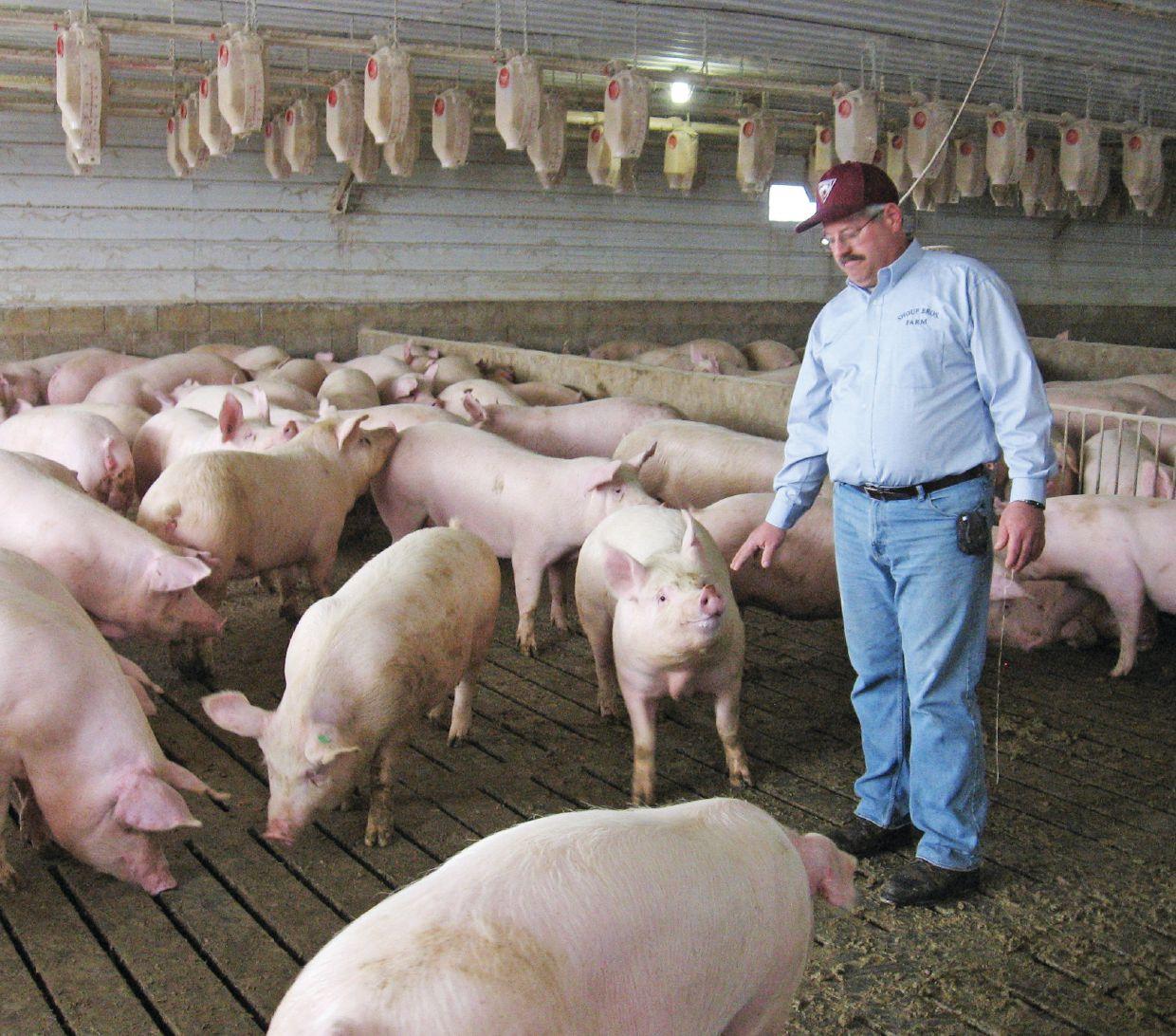
Dave Shoup, a licensed veterinarian, says the decentralized production approach has helped Shoup Brothers Farm better manage their manure. Contributed photo
don’t follow
the CroWd
By Tony Kryzanowski
decentralized approach helps Ohio hog producer with manure management
The hog business operated by Shoup Brothers Farm ltd. in Ohio has proven that sometimes following the wisdom of our forefathers delivers better results than following the crowd. that is reflected in the way the operation has developed a network of production centres and rotates
its manure applications.
the sixth-generation, ninefamily business is a farrow-to-finish operation located about one hour south of Cleveland. they raise about 3,200 sows and 70,000 hogs annually, which altogether generate about 15 million gallons of manure. Shoup Brothers Farm is among a handful of hog producers in an area dominated by dairy farms, where about 80 percent of their production is their own finishers while they contract finish about 20 percent of their herd for families in surrounding counties.
unlike many other hog operations that are moving toward larger, centralized production centres, Shoup Brothers Farm
continues to follow the same pattern established by the farm’s founders, William and robert Shoup, which was to operate smaller production barns over a larger area so that each operation has a lesser impact on the local environment, such as when land applying the manure generated by each farm.
“instead of continuing to build barns in one location, we’ve moved as far as a half hour or 45 minutes away to buy additional farms and build finisher barns there,” says one of the farm’s current partners and a licensed veterinarian, dave Shoup. “my dad and my uncle had that wisdom years ago to stay spread out because they could see what was coming
down the pipe as far as trying to manage these nutrients.”
also, many large hog farms these days tend to rely on the same cropland every year to dispose of their manure, but the Shoup Brothers Farm only applies manure on the same cropland every two to three years, governed largely by soil tests conducted in advance of manure application, which helps to avoid overloading the soil with such problematic nutrients as phosphorus.
Other than one farm, which was already experiencing phosphorus issues because it previously operated as a poultry farm prior to the Shoups purchasing it, “we really don’t have any place else where we are in trouble phosphorus-wise,” says dave. “We pick and choose based on soil tests.”
they also add a product called Phytase to their feed in their nursery barns, which reduces the amount of phosphorus accumulated in their liquid manure.
in addition to raising hogs, the farm also grows about 2,500 acres of corn, soybean and wheat, mostly used as feed in the hog operation and one family member also raises about 200 holstein steers. Where and how much liquid manure is applied to each farm has a lot to do with their nutrient management plan and what crops they plan to grow on each parcel of land.
“i guess the easiest way to say it is that we generally put manure on ahead of corn and try to avoid manure ahead of soybeans if at all possible,” dave says. they will apply up to 10,000 gallons an acre in both summer and fall, but will cut that back to about 8,000 gallons an acre in spring.
“that may sound high for people who probably do 3,000 to 4,000 gallons per acre, but we probably hit fields only about once every three years,” Shoup says. “We rotate. We might go into an area and cover 200 to 300 acres and then won’t go back there for three years.” they still do apply some commercial fertilizer on their cropland, but it is reduced substantially on farms where liquid manure has been applied.
Shoup Brothers Farm has had a nutrient management plan for both soil and water on their properties for over a decade, and this has been done on a voluntary basis. that’s because the barns
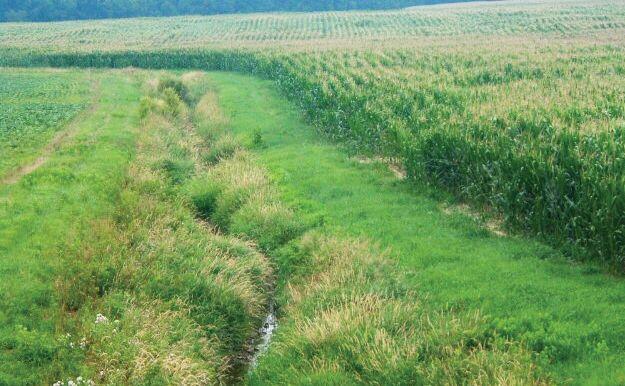
has planted grass along stream slopes and maintains a buffer of about 20 feet from streams to minimize the impact that manure runoff could have on local watercourses. Contributed photo
operated by the farm are smaller than 2,500 finishers per barn, which don’t require a state permit.
“We just want to be good environmental stewards by not over applying and it delivers a financial benefit to us also,” says dave.
the farm has come a long way since dave’s great-great grandfather originally put down roots in the area over a century ago. their foray into hogs began with William and robert starting to farrow sows in straw as far back as the 1940s. they are still involved in financial aspects of the farm, while five of their sons look after day-to-day operations. they are dave, ed, dean, doug and don, and each plays a pivotal role in herd and crop management as well as sales and marketing. Several of their wives and children also work in key aspects of the farm or to advance the hog industry as a whole. For example, doug’s wife, diane, takes part in the Ohio Pork Producers Council’s Family and Consumer Science Classroom program where she gives pork cooking demonstrations and talks about modern farm practices to students in northeast Ohio.
dave says the family’s strong Christian values – which includes regular, short-term missionary work to construct buildings, such as schools, in places like Palestine, haiti, Costa r ica, nicaragua, honduras, thailand, malaysia and Cambodia – has them develop a strong sense of appreciation for what they have
within their business operations and also the need for balance between people’s basic needs and potential environmental impacts.
“it makes us appreciate the blessing that we have as far as available water, the quality of our soils, and the availability of fertilizers, feed hybrids, and everything that it takes to produce the most off an acre of land,” says Shoup. “it makes you appreciate what you have right in your back yard, where we have so many options of what you can do.”
he says a good steward realizes they don’t own the environment, but only manage it in an efficient manner for the greatest possible outcome, with an eye to the future. the Shoup Brothers Farm operation is already witnessing the next generation taking a more active role in day-to-day farm activities.
“anything we have is not our own,” dave says. “We are just stewards of it and that goes beyond the land. hopefully, we each get 80 to 100 years to work with it and then we pass it on to someone else. So we’d like to pass it on better than it was given to us.”
in addition to the practice of decentralizing production centres and rotating manure application, their concern for the environment is also reflected in how carefully they manage runoff to the various waterways that cross their land and in their participation in the Sugarcreek Watershed Partner group, which monitors
Shoup Brothers Farm 3 - Shoup Brothers Farm
the aquatic habitat of the streams within the group’s area of interest in partnership with Ohio State university. this includes testing for nutrient runoff. For its part, Shoup Brothers Farm has adopted farming practices such as limited fall tilling and strip-tillage to minimize soil disturbance both for soil conservation and runoff control. they have established 20 to 30foot wide buffer strips along waterways and have planted grass for runoff control on slopes leading to the watercourses. they also try to avoid applying manure in sensitive areas in the fall.
the family’s concern for the environment is also reflected in their manure application method. all the manure generated by their hog farms is injected into the soil using a drag hose system and not surface applied where there is greater potential for runoff. Custom application using a drag hose set up is handled by custom manure applicator, Carmony Stock Farm. they will set out hose as far as two and a half miles in some cases. the Shoup operation was among the first in their area to adopt
manure injection, starting back in 1998, which is a method that not only places the organic nutrients below ground to retain more nitrogen and reduces the potential for runoff, but also contributes to good relations with neighbors by generating minimal odor. Carmony Stock Farm was a hog producer that transitioned to simply crop farming and custom manure application at about the same time that the Shoups adopted the drag hose manure injection method.
dave says the operation’s main sow herd is within the city limits of Orrville, and borders the community on both the south and southwest side. thankfully, given their manure application method, he says most of the time area residents don’t even realize they are in the process of applying manure. also, by using a drag hose instead of tankers for land application, there is less traffic generated on area roads by the hog operation to transport the liquid manure to application sites and less soil compaction compared to the tanker application system used prior to 1998. the decentralized approach also meshes well with the
drag hose manure disposal method, as with smaller operations, less cropland is required for manure disposal and a drag hose system can generally reach cropland within a reasonable distance of hog barns just by attaching larger horsepower pumps and laying out more hose.
the application window is also considerably more compressed, as with the old tanker system, dave says the farms were applying manure almost year round whereas with the combination of deep pit storage systems at each barn plus the drag hose system, an application is completed over just a two to three week period.
the Shoup Brothers Farm was recognized by the Ohio livestock Coalition (O lC) with an environmental Stewardship award in 2013 for their efforts to protect Ohio’s land, air and water quality as well as conserving the state’s natural resources.
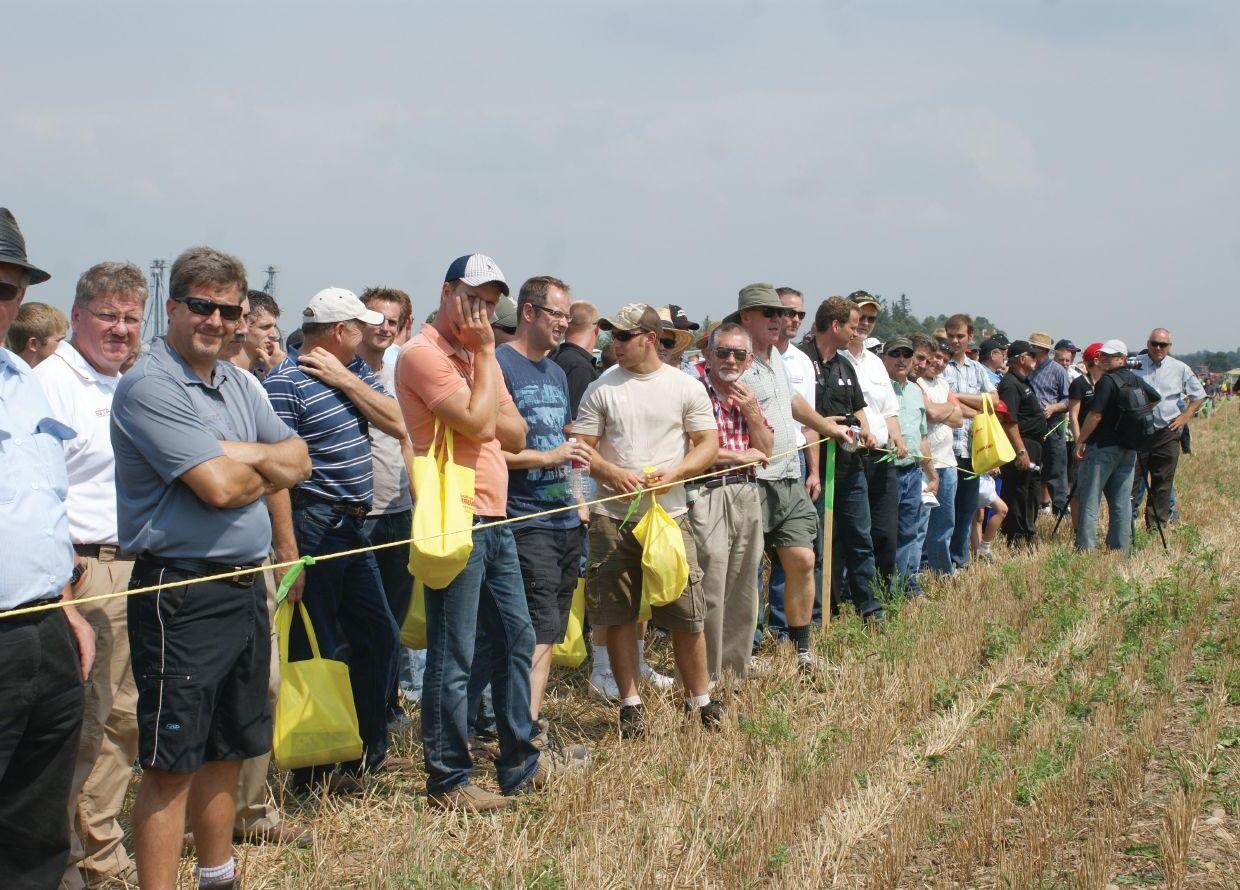
Participants at the 2013 North American Manure Expo, held in Ontario, Canada, line up to watch manure application equipment demonstrations.
na manure expo
Coming Soon
By Margaret Land
Farmers can’t afford to miss the 2014 north american manure expo
The Show me state is preparing to show farmers the importance of valuing manure and the environment during the north american manure expo, being held July 8 and 9 in Springfield, missouri. the free, two-day event – which brings together highly intensive livestock producers in the dairy, beef, poultry, and hog industries; custom manure applicators; plus researchers, consultant and government agencies – is being based at the Ozark empire Fairgrounds. the first day, July 8, will feature stops at a pasture-based dairy and a wastewater treatment and biosolids operation in the southern missouri
area. While at the dairy, attendees will be treated to a manure storage agitation demonstration involving both a lagoon and concrete tank. at the wastewater treatment stop, participants will have an opportunity to learn more about anaerobic digestion, nutrient management plans and field mapping. that afternoon at the Ozark empire Fairgrounds, starting at 3 p.m., the north american manure expo tradeshow will open, providing attendees an opportunity to see the latest technology and innovations involving manure handling, management, treatments and services. more than 80 exhibitors are taking part in the indoor and outdoor event.
at 4 p.m., a tour day and exhibitor appreciation dinner is scheduled. in the evening, starting at 5:30 p.m., visitors can take part in a Pump School or attend information sessions on recycling dairy bedding or precision nutrient management. the indoor and outdoor tradeshow
continues on the second day, July 9, at the fairgrounds. expo attendees will also have an opportunity to see the latest advances in solid and liquid manure application during in-field demonstrations, being held off-site from 8:30 to 11 a.m. transportation will be provided to and from the location. the afternoon features a continuation of the tradeshow plus an opportunity for expo attendees to take part in five different educational sessions being held inside at the Ozark empire Fairgrounds:
managing manure as a fertilizer –soil sampling equipment, techniques and interpretation plus comparing manure nutrient availability calculations application equipment and operation – tire inflation and soil compaction plus managing limited spreading windows and equipment sizing manure value and optimization –litter marketing and brokering plus feedmanure value optimization
Photo by Margaret Land
environmental protection – current nr CS nutrient management policies plus nutrient loss reduction strategies new methods for liquid and solid manure applications – subsurface application of dry poultry manure plus manure application with irrigation equipment later in the afternoon, a presentation discussing manure gas and safety is being held plus a demonstration of manure spill response and safety.
attendance of the north american manure expo is free but participants need to preregister by visiting manureexpo.org. this year’s tour, demonstrations, trade show and educational sessions are being organized through the combined efforts of volunteers from missouri, Oklahoma, nebraska and arkansas, Wisconsin, Ohio and Pennsylvania.
the north american manure expo was first held in Wisconsin in 2001. this year will mark the 13th show. the expo has been hosted in minnesota, nebraska, Pennsylvania, Ohio, michigan, iowa and Ontario, Canada.
the 2015 show is to be held in Pennsylvania.
For more information on the 2014 north american manure expo, please visit manureexpo.org.
Mailed six times per year. Subscriptions are free to farm owners, partners and managers of large livestock or poultry operations in Canada and the USA. free subscriptions must be renewed annually. Great rates are available to other interested readers.
For best service, subscribe or renew online at www.manuremanager.com. If you are renewing, please quote the seven digit customer number found on your mailing label.
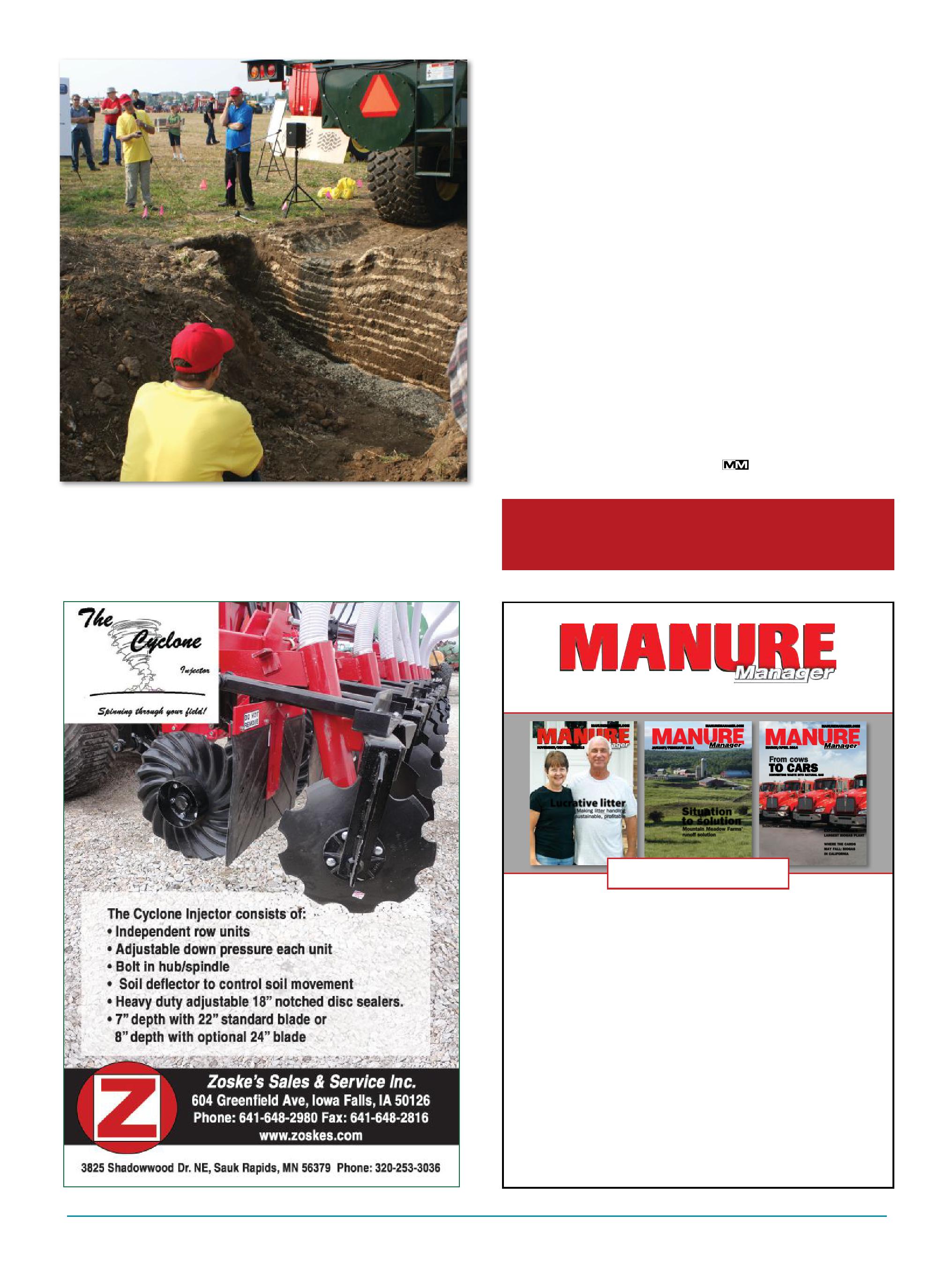
A popular education session in 2013 discussed tire inflation and soil compaction. A similar session is to be held again at the 2014 expo in Springfield, Missouri.
Photo by Margaret Land
While Phil’s Pumping & Fabrication applies about 700 million gallons per year, the company has recently constructed a new metal fabrication shop to supply a wide variety of accessories that they sell to other custom applicators throughout the American Northeast. Contributed photo
By Tony Kryzanowski
Custom applicator’s diversification into fabrication and rental pays off
Agood piece of advice to succeed in business is to investigate what the experts do, pay attention to the equipment they use and then follow their example. When it comes to custom manure application, Phil’s Pumping & Fabrication has decades of experience and markets many of the critical pieces of equipment they use to other custom haulers.
located in Chilton, Wisc., about 35 miles from green Bay, the company has developed into a unique business combination over its 33 years, developing into both a custom manure applicator as well as a fabricator of manure application equipment, supplying its products throughout the northeastern region of the united States.
leading
By example
“Custom manure irrigating and pumping is the largest part of our business, but we also do metal fabrication. We build lagoon pumps, pit pumps, prop agitators, agitation boats, irrigation motor carts, fill pipes, toolbars and several other items. We also sell irrigation hose, hose reels, and a general line of manure equipment,” says company owner, Phil Schneider. their equipment features components from some of today’s most popular brand names in custom manure application accessories, such as Cornell, Balzer, Krohn, and Calumet. the company also rents out its custom manure application equipment.
“the custom fabrication aspect of our business evolved from the days when we’d buy a piece of brand-new equipment and we’d have to go through it for two or three days to refine it to the way that we wanted it,” says Schneider. “it seemed that nothing was ever big enough or strong enough, so at that point, i just started building my own stuff.”
he adds that the company fabricates its equipment and accessories right from scratch, and just recently opened a new 150 by 125-foot building dedicated to this branch of its business, which
now includes a parts department and a showroom. the business would conduct most of its fabrication during its downtime, which is typically from december to march, and put all their staff to work in the custom application branch during that busy season, but with customer demand, they have now decided to continue to fabricate throughout the year.
“We always try to fabricate equipment that outperforms existing equipment,” says Schneider. “We keep analyzing what we are doing, what breaks down, how we can do the job faster and how we can keep the employees happy.” that’s one reason, he adds, that he has not sought patents for his equipment because he doesn’t want to limit the company’s ability to constantly improve the equipment and accessories that they fabricate. One advantage that the company is able to offer to its customers versus purchasing equipment off the shelf is that they listen to what the customer wants and customize the equipment according to their needs.
“Whether it’s a farmer or a custom irrigator, they all want something different,” says Schneider.
High Quality Bedding Material Produced Fresh Daily
•
•
• Low energy consumption
• User friendly touch-screen control panel Office: Michigan City Tel. +1 800 451-8001
j.dewitt@bauer-at.com
t.burns@bauer-at.com
r.hultgren@bauer-at.com
b.coughlin@bauer-at.com
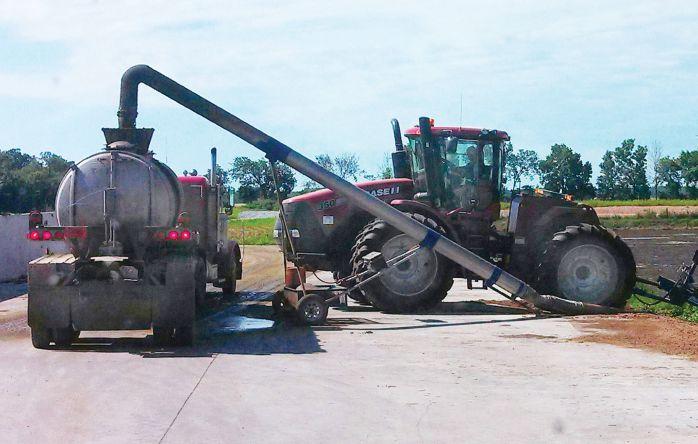
The backbone of Phil’s Pumping & Fabrication is 21 semi-trailer trucks for transport and application of liquid manure. Contributed photo
Contributed photo
he says that this approach of having both a custom application and fabrication branch has provided the company with a notable financial safety net given the seasonal nature of custom manure application. With fabrication and equipment sales complementing their custom manure application business, this helps to maintain financial growth throughout the year and also helps to retain key employees on a full-time basis, who can switch between fabrication and application, depending on the time of year. they have 40 employees.
another rather unusual aspect to Phil’s Pumping & Fabrication is that they also rent equipment, which is not a common practice among custom manure applicators but a valuable service to landowners who may want to handle manure application themselves or for other custom manure applicators who may need one or two items, such as a lagoon agitator or pump, for a particular job. the business even rents tractors, and when it’s the busy application season, Schneider says all 20 tractors are either working for him or rented out.
“the rental aspect came in when we realized that the equipment was sitting here, so why don’t we use it,” says Schneider. “everything in the industry now is a numbers game and using the equipment as much as you can. it got to
be a more common thing where people wanted to use it, we let them use it and organized everything, so that now, the equipment gets out as much as possible.”
Because of the seasonal nature of custom manure application, many businesses have significant downtime during the winter. it has become common practice for them to use this time to put some of their own ideas for custom manure equipment together. Schneider says they’ve noticed that many other businesses come to his fabrication and supply shop to pick up the components they need to fabricate their project.
he operated a dairy farm in partnership with his brother, together offering custom manure hauling services in 1980 in tandem with operating their dairy. in 1998, the brothers sold their dairy herd and Phil struck out into custom manure hauling with his wife, Bonnie, as well as his sons, Steve and tom, and daughter, Kate, helping out in various aspects of the business.
Phil’s Pumping & Fabrication custom applies about 700 million gallons of manure primarily from dairy operations annually, within about a 60-mile radius of home base. the average customer has a dairy herd of about 2000 cows. the fabrication and supply side of the business draws a wider variety of customers from a much larger area, with customers coming from as far away as illinois, Ohio, michigan and minnesota.
“the internet really helps because it
gives us a lot of exposure,” Schneider says. given his more than three decades of experience, Schneider has witnessed considerable change in customer requirements within the custom application business and the ability to adapt to those changes has helped to keep them busy and expand their services over the years.
“Our customers are considering the value of the manure a lot more now rather than simply land applying it as a disposal method,” says Schneider, “which is good for the environment and a good use of the manure.”
as customers put more value on the manure, it has become more and more important for Phil’s Pumping & Fabrication to keep accurate records of where and how much manure is being applied for each customer on an annual basis. many farms now work with crop consultants that recommend specific manure application prescriptions for each farm based on what crop is being grown and also how much has been applied to the farm historically. So keeping an accurate historical record is critical to ensure that the customer is achieving the maximum nutrient value from their manure.
“We’re also going further away from the farms with both laying down hose and transportation with our semi trucks,” says Schneider. “We used to go two or three miles with a big run and now we go 15 or 20 miles.” What has influenced this trend is the development of bigger dairy
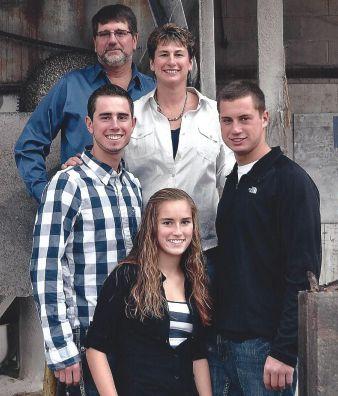
The entire Schneider family, Phil, (top), his wife Bonnie, sons Steve and Tom, and daughter, Kate, all help out in some aspects of the family custom manure application, metal fabrication and equipment rental business.
farms generating more manure and needing a larger land base for manure disposal, as well as new regulations as to how the manure is applied.
“the value of commercial fertilizer has also increased in cost, which makes it more economically feasible to transport the manure longer distances for land application,” says Schneider. their custom manure application fleet consists of 21 Peterbilt 379 semi-trailer trucks, complemented with 21, 6,500-gallon, semi tanks for manure hauling. Phil’s Pumping & Fabrication tries to stay with one truck brand for parts consistency throughout the fleet.
the company also has three drag hose manure application systems with five miles of hose, and four 6,000-gallon tanks, which are pulled by tractors. three are Balzer tanks and one is a Calumet tank. they also have two 5,000-gallon, Calumet tanks. Pulling the tanks are 8000 series, John deere tractors in the 200 to 250 horsepower range. the fleet is designed so the company can provide service to both small and large farms, with the tractors and tanks used primarily on smaller farms where the manure is being spread on cropland fairly close to the farm.
they also offer their customers a variety of options for land applying the manure, such as top dressing application, deep till injection as well as splash and incorporation.
about 75 percent of the manure the company transports and applies involves the semi truck and tanker operation, with the farmer incorporating the manure right behind the trucks. about 25 percent is applied using their drag hose systems, where
a toolbar attached to a tractor is used to apply the manure and then incorporates it immediately into the soil.
“the reason we do that is to avoid trenches and nitrogen lines, which results in more uniform application,” says Schneider. it also does a better job of placing the manure exactly where it is most effective at the correct soil depth.
to pump the liquid manure from lagoons to the field with their drag hose systems, the company uses John deere power units with Cornell pumps and Krohn flow meters in the tractors.
Phil’s Pumping & Fabrication manufactures its own toolbars as well as its own frac tanks, which are used for onsite storage as the manure is transferred from the farm and being land applied. as far as incorporation, Schneider says they generally will not deliver the manure with their semi trucks and trailers unless the farmer is working it in right behind the trailer to incorporate the manure as a safety measure.
“We as custom applicators don’t want to pollute anything,” he says. “We are more concerned about that than anybody.” the company’s overall philosophy is to provide timely service so that whether it is a farmer or manure applicator customer, Phil’s Pumping & Fabrication is able to respond to meet their application needs or have the parts and equipment available when they need it. Schneider says that counts for a lot in today’s fast-paced world.
Earl Martin and his son Stewart in front of their biodigester.
ontario farmer recycles
manure into money
By Jeanine Moyer
digester heats property and generates hydro
Efficiency motivates earl martin. and in his drive to create efficiencies on his beef and poultry farm, he credits his most recent enterprise – installing an on-farm anaerobic biodigester.
an innovative approach to solving a problem, martin first considered installing the biodigester as a solution to an on-farm disposal issue. Farming with his two sons, martin also owns and operates a provincial poultry processing plant, en S Poultry, outside of elora, Ont. Since the outbreak of BS e in 2003, costs of disposing offal have skyrocketed, so developing the on-farm biodigester was martin’s solution to eliminating the expense and recycling the offal. the biodigester also heats the poultry plant,
two houses on the farm and generates a profitable revenue stream from hydro.
“it’s a great idea – we take waste products and make a more valuable product,” says martin, who feeds the biodigester system with poultry offal, cattle manure, wastewater from the poultry plant and additional waste products from food manufacturers.
With the ability to generate 100kW of continuous electrical capacity, martin has been selling power generated from his 500 cubic metre biodigester to the Ontario Power authority (OPa) for almost three years. he sells the electricity to the OPa and buys back hydro for his own use. “We make a few pennies off every kW we sell,” he says, adding he relies on the hydro revenue stream to pay for the system. martin expects to have his digester paid off in 10 years, and faster if the system was operating at maximum capacity. the biodigester has only been running an average of 68 to 70 kW since set up, something that concerns martin.
Feeding the animal
“Originally, i wanted to get rid of my hydro bill,” says martin, listing the opportunities of installing an on-farm biodigester. But his expectations of the system grew when he realized how much work it takes to run the boidigester efficiently. Biodigesters need a delicate balance of contents for the bacteria to digest, or break down the products efficiently, creating methane gas. a genset connected to the biodigester converts the methane gas into hydro. methane gas runs the motor while the generator produces hydro, creating excess heat in the process.
the hydro is sold to the OPa and martin uses water pipes to carry the heat from the genset system to heat two homes and the farm’s poultry plant. “Feeding the digester is like feeding cattle, it needs a balanced, low-protein diet,” he says. “the difference is cattle will quit eating when they’re full, but the digester never stops, even when it can’t digest something properly, making it sick.”
martin’s biodigester is “fed” on-farm waste, a mixture that keeps the bacteria healthy and can be easily broken down to produce the desirable gas. adding additional feed, like natural sugars, can give the bacteria a boost, increasing efficiency and maximizing output. martin’s biggest headache is sourcing off-farm products to boost the bacteria activity and increase gas and hydro production. Without the right balance, or content mixture, the biodigester loses efficiency or kills the bacteria.
On-farm
applications
“it’s hard for someone to tell you how to run a biodigester, you have to get a feel for it,” says martin, explaining that despite, or because of, his challenges keeping the biodigester healthy and fed properly, he’s developed a “feel” for the system. intuition has become part of martin’s management skills. even the texture is important, he explains, because, while the consistency doesn’t yield additional gas, keeping the contents of the biodigester flowable is part of an efficient system. martin uses wash water from the poultry plant to maintain a desirable consistency of the system’s contents, and is pleased with the efficiency of recycling the water into a new product.
the consistency helps produce another benefit, or byproduct, of the biodigester –digestate. martin’s biodigester produces, on average, 24 cubic metres of digestate daily. a liquid byproduct, the digestate is high in ammonium nitrate and used as a valuable fertilizer source on martin’s 400 acres of corn, soybeans, wheat and hay. “But it’s still important to take soil samples to check the nutrient value of the digestate,” notes martin. digestate hasn’t replaced martin’s purchase of field crop fertilizer completely, but it’s helped reduce input costs.
innovation and efficiency are developing practical on-farm systems like martin’s biodigester, and the compounded benefits are proving farmers have a lot to gain. in martin’s case, he needed to find a way to dispose of a waste product and cut his hydro bill. in addition to achieving his initial needs, he’s been able to eliminate his home and on-farm heating bills, produce his own field crop fertilizer and generate a new revenue stream selling hydro. martin admits it’s a lot of work, but the pay offs continue adding up.
Jeanine Moyer wrote this article as one in a series for Farm & Food Care Ontario.
• Center agitation system evenly blends nutrients.
• Better utilization of “waste” translates into less purchased fertilizer.
Environmentally Sound
• Designed and constructed using bolted glass-fused-to-steel panels for secure storage and high corrosion resistance.
• Above ground - minimizes the danger of run-off, leaching and ground water contamination.
• Environment-friendly odor control - releases odors above ground level into higher air currents.
www.cstindustries.com to find your local dealer, or call 815-756-1551.
In the NEWS
California
Leopold
Conservation Award seeks nominees
Sand County Foundation, the California Farm Bureau Federation and Sustainable Conservation are currently accepting applications for the $10,000 California leopold Conservation award.
the award honors California farmers, ranchers and other private landowners who demonstrate outstanding stewardship and management of natural resources.
“the leopold Conservation award is the highest national award given to land stewards who focus on conservation,” said lynn giacomini-Stray of the robert giacomini dairy, recipient of the 2013 California leopold Conservation award. “as the 2013 California recipient, we’re honored and proud to be recognized and acknowledged for our conservation efforts. We encourage others to step up and share their conservation efforts in hope that others will follow.”
“the giacomini family demonstrates that business success goes hand in hand with thoughtful natural resources stewardship,” said Brent haglund, Ph.d., Sand County Foundation president.
“We look forward to recognizing more outstanding landowners who are committed to conservation in California.” given in honor of renowned conservationist aldo leopold, the leopold Conservation award inspires other landowners by example and provides a visible forum where farmers, ranchers and other private landowners are recognized as conservation leaders.
“the leopold Conservation award provides outstanding recognition of farmers and ranchers who often take small steps to realize big gains in
managing their farms in a sustainable and profitable manner,” said California Farm Bureau Federation president Paul Wenger. nominations must be postmarked by July 11, 2014, and mailed to leopold Conservation award c/o Sustainable Conservation, 98 Battery Street, Suite 302, San Francisco, Ca 94111. the 2014 California leopold Conservation award will be presented in december at the California Farm Bureau Federation’s annual meeting in Orange County.
For application information, please visit www.leopoldconservationaward.org.
HY-TEK Bio receives $500,000 award
hY-te K Bio llC, featured in the november/ december 2013 issue of manure manager, was recently awarded a $500,000 grant in the first round of the Change and emissions management Corporation’s (CC em C) $35 million international grand Challenge: innovative Carbon uses.
hY-te K was among 24 finalists selected from 344 submissions from 37 countries on six continents. hY-te K Bio shared the award with the university of maryland Center for environmental Science’s institute of marine and environmental technology (imet) for work using algae to capture carbon dioxide.
“it was exciting to be at CC em C among leading-edge technologies that can be used for removing greenhouse gas.” said hY-te K Bio president and C eO robert mroz.
“this new funding will help us purchase equipment to pursue the many inquiries we’ve gotten to commercialize this process,” mroz said. “We can fulfill the potential we’ve seen from
the beginning.”
Complete information regarding the hYte K Bio process and its related technologies is available at www.hytekbio.com.
McLanahan receives ISO 9001:2008 certification
mclanahan Corporation’s location in hollidaysburg, Pa., has received certification in the i SO 9001:2008 management System for the design, manufacture and service of equipment for the mineral, aggregate, agricultural and industrial industries.
the official registration audit was completed in late October 2013 by S ri quality System registrar, based in Pittsburgh, Penn., and the company received its official certification in december.
according to mclanahan, the success of the registration evaluation was ultimately the result of the commitment the company’s employees have to producing a quality product and providing customer satisfaction.
i SO 9001:2008 is a process-based certification recognizing organizations that can link business objectives with operating effectiveness.
mclanahan Corporation plans to continue its i SO certification efforts, by implementing similar process and procedures at its other locations.
Clarkson University awarded $500K
Clarkson university was recently awarded nearly $500,000 by the u.S. department of agriculture through the agriculture and Food research initiative to expand its clean energy work by continuing development of anaerobic digesters for
north Country farms.
Clarkson university researchers have developed a digester design and pilotscale application that demonstrates the economic viability of anaerobic digester technology for smaller dairy farms. it’s hypothesized that smaller-scale dairy farmers will adopt the technology if they are exposed to viable options appropriate for their farms.
the goal of the project is to upgrade the pilot-scale digester – located at the Cornell Cooperative extension learning Farm in St. lawrence County, n.Y. – and use it as a base for training workshops to teach stakeholders about the operation of digester systems for smaller-scale dairy farms. in addition, data collected through continuous operation of the upgraded pilot ad system will be made available on the web so that interested parties can conduct analyses tailored to their particular circumstances.
Insects represent link for antibiotic resistance traits
Flies could be doing more harm to human health than realized according to a recent study by Kansas State university, published in the applied and environmental microbiology journal.
according to the study, insects carry antibiotic-resistant bacteria from one point to another, including from food animal farms and wastewater treatment facilities, for example, to urban areas.
“there are a number of insects that are commonly associated with animals, such as house flies and cockroaches,” said ludek Zurek, Kansas State professor of microbial ecology and lead author on the published study. “house flies are common where animal manure is produced, including in cattle, poultry and swine operations.”
Zurek and his colleagues collected flies and cockroaches from food animal production locations, including swine and poultry farms, as well as wastewater treatment facilities that collect waste from multiple sources, including hospitals. the researchers then genetically analyzed the bacteria in the digestive tract of the insects and compared them to the bacteria present in the animal feces and wastewater.
“We found these insects carry the same bacteria found in the animal manure,”
Zurek said. “then we started sampling insects found in surrounding urban areas, including fast food restaurants, and again, we found house flies with multi-drug resistant bacteria.”
the flies collected from the wastewater treatment plants, likewise, carried the same bacteria found in the waste itself, he said. Flies collected several miles from the wastewater treatment plants in surrounding urban areas had a
lower prevalence of the antibiotic-resistant bacteria than those examined from the facilities themselves, but the bacteria still existed in those urban flies.
the study led the researchers to conclude that insects, primarily flies, can pick up antibiotic-resistant bacteria and disseminate them to surrounding areas. how serious that link is still needs to be investigated, but the potential is clearly there, Zurek said.
GEA SW Series cable drive unit
gea Farm technologies recently presented its newest series of cable drive unit for free stall barn cleaning, the SW Series.
the new SW Series Cable drive unit (patent pending) has been designed to make life easier – it gives more freedom in installation location, delivers a high level of performance and it requires minimal maintenance. the design allows lateral movement of the drive as the cable is being wrapped around the rotating drum. the coiling is made without excessive friction – which is usually the cause of premature wear of the equipment and cable.
the new SW Series Cable drive unit is suited for free stall dairies – small to large. Five different models are available: SW300, SW-300 hd, SW-450, SW-450 hd and SW-650 hd – hd for double motor. the SW-650 hd has a stroke of 650 (198 m) feet.
the same design is also found for cable drive units operating Cross gutter Scraper. during operation, the drive unit moves from side to side allowing the cable to coil in the right place around the drum. this movement allows the cable to remain well aligned. there is no side pressure as associated with the cable guides on traditional drive units, therefore minimizing
cable wear and stress on the unit.
the movement is done by means of an angled rolling mechanism designed with durable components. Since the lateral movement maintains the cable alignment without excessive pressure, the corner wheels can be installed very close to the drive unit without overlapping its footprint. When gea Farm technologies was developing this new cable drive unit series, its objective was to come out with equipment that has easy-to-reach adjustment points, is easy to handle, and requires minimal maintenance.
• tensioning of the timing chain is easily accomplished from outside the main frame and without having to remove the safety shield of the timing chain.
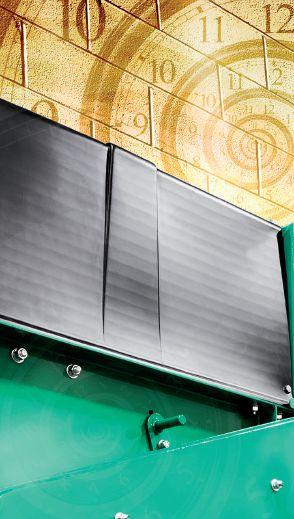
• the top safety shield is split in half and hinged on top. it is made of light and durable plastic – easy to handle.
• the drive shaft of the drum is mounted on high quality roller bearings for long lasting durability and smooth operation.
• Securing the cable is simple with the new external cable tie downs. located outside of the drum, they are more accessible and the cable is easily secured using two bolts.
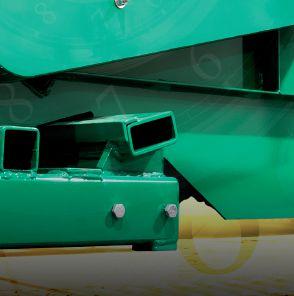
• Cleaning and basic maintenance underneath the drive unit is much easier. the bottom of the frame is very open with plenty of clearance.
the SW Series Cable drive unit is offered with the ivrpro max@ccess control panel. this new generation of control panel provides load sensing technology exclusive to gea Farm technologies. the ivrpro max@ccess control panel is equipped with a detection sensor giving greater resistance and accuracy in sudden load fluctuation readings, meaning less unnecessary down time, less on-farm service, and less worries.
the max@ccess option provides internet connection giving you access to your control panel through a computer, smart phone or digital tablet at any time. it also allows users to share control panel data through the web to ease technical assistance. the programming module has been reviewed and greatly improved in order to offer an ergonomic interface that is easy to navigate through.
www.gea.com
John Deere receives award at FIMA 2014
One of John deere’s manure application innovations received an award at the 2014 Fima show, an agricultural equipment trade fair held in Zaragoza, Spain. in the technical innovation category, the Fima jury awarded John deere’s manure Sensing System.
Jointly developed with Kotte landtechnik and Fliegl agrartechnik in germany, the manure sensing system uses nearinfrared (nir) technology to help adjust slurry spreader application rates to match field conditions, which helps to increase productivity and crop yields while minimizing input costs.
according to John deere, based on complementary data from yield mapping, soil sampling, n-sensors and other sources, the required application rate (eg. target or maximum rate) can be set in the greenStar 2630 in-cab display before starting work.
the nir sensor is able to measure the key constituents of the slurry being applied (dry matter, total nitrogen, ammonium, Pand K) in real time, it said.
the system then automatically adjusts the final flow of slurry to deliver exactly the quantity of nutrients required, it added.
if a John deere tractor is used with the spreader, this process can also be enhanced by the tractor implement automation (tia) system. this enables automatic speed control of the application rate adjustment, based on the tractor’s forward speed.
www.deere.com
Injection System
Disturbance
The Most Durable, Simplest Design, Lowest Maintenance, Manure Injection System On The Market Today.
CoW manure harBorS diverSe neW antiBiotiC
reSiStanCe geneS – Study
Manure from dairy cows, which is commonly used as a farm soil fertilizer, contains a surprising number of newly identified antibiotic resistance genes from the cows’ gut bacteria according to findings recently reported in mBio, the online journal of the american Society for microbiology.
thousands of antibiotic resistance (ar) genes have already been identified, but the vast majority of them don’t pose a problem when found in harmless bacteria. the real worry is when these genes appear in the types of pathogenic bacteria that cause food-borne illnesses or hospital infections.
“Since there is a connection between ar genes found in environmental bacteria and bacteria in hospitals, we wanted to know what kind of bacteria are released into the environment via this route,” of manure fertilization, says Fabienne Wichmann, lead study author and former postdoctoral researcher at Yale university in new haven, Conn.
Farmers use raw or composted cow manure on some vegetable crops, which could lead to a scenario where residual manure bacteria might cling to produce and they or their genes might move to the human ecosystem.
“is this a route for movement of these genes from the barn to the table?” asks
Jo handelsman, senior study author and microbiologist at Yale.
the first step toward an answer was surveying which ar genes are present in cow manure. handelsman’s team used a screening-plus-sequencing approach to identify 80 unique and functional ar genes. the genes made a laboratory strain of escherichia coli bacteria resistant to one of four types of antibiotics – betalactams (like penicillin), aminoglycosides (like kanamycin), tetracycline, or chloramphenicol.
roughly 75 percent of the 80 ar genes had sequences that were only distantly related to ar genes already discovered. the team also found an entirly new family of ar genes that confer resistance to chloramphenicol antibiotics, which are commonly used to treat respiratory infections in livestock.
“the diversity of genes we found is remarkable in itself considering the small set of five manure samples,” says handelsman, who is also a howard hughes medical institute Professor. “But also, these are evolutionarily distant from the genes we already have in the genetic databases, which largely represent ar genes we see in the clinic.”
that might signal good news that ar genes from cow gut bacteria are not currently causing problems for human
patients. But, Wichmann points out, another possibility is that “cow manure harbors an unprecedented reservoir of ar genes” that could be next to move into humans.
“this is just the first in a sequence of studies – starting in the barn, moving to the soil and food on the table and then ending up in the clinic – to find out whether these genes have the potential to move in that direction,” says handelsman.
ar genes can enter the human ecosystem by two routes—either the bacteria that contain them colonize humans, or the genes are transferred through a process called horizontal gene transfer to other bacteria that colonize humans. research has already shown that bacteria are transferred from farm animals to their human caretakers. gene transfer enables genes to jump between microorganisms that are not related, and it occurs in most environments that host bacteria.
Some manure bacteria might be pathogenic to humans, so if they acquire antibiotic resistance, they could pose a problem. alternatively, benign bacteria in manure might transfer resistance genes to pathogens at any point along the path—in manure, soil, food, or humans.
“We’re hoping this study will open up a larger field of surveillance, to start looking at new types of resistance before they show up in the clinic,” says handelsman.
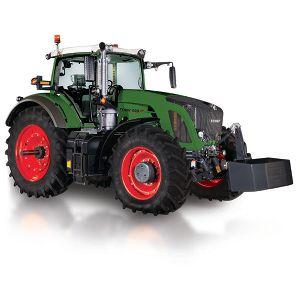
The difference between this Fendt and other tractors is the location of the manure.
Sure, other brands will tell you they have a continuously variable transmission. So ask them why their supposedly continuously variable transmission needs a clutch and see what a load they’ll give you. And don’t even bother asking about features like our stability control or reverse station operation unless you’re wearing tall boots.
And if that’s not enough, we also back it up with our Fendt Gold Star Customer Care program that gives you 3-years or 3,000 hours of comprehensive warranty with included routine maintenance - the best in the industry.
In the hauling business, you need a tractor that’s capable and dependable.
That’s why the best run operations run Fendt.
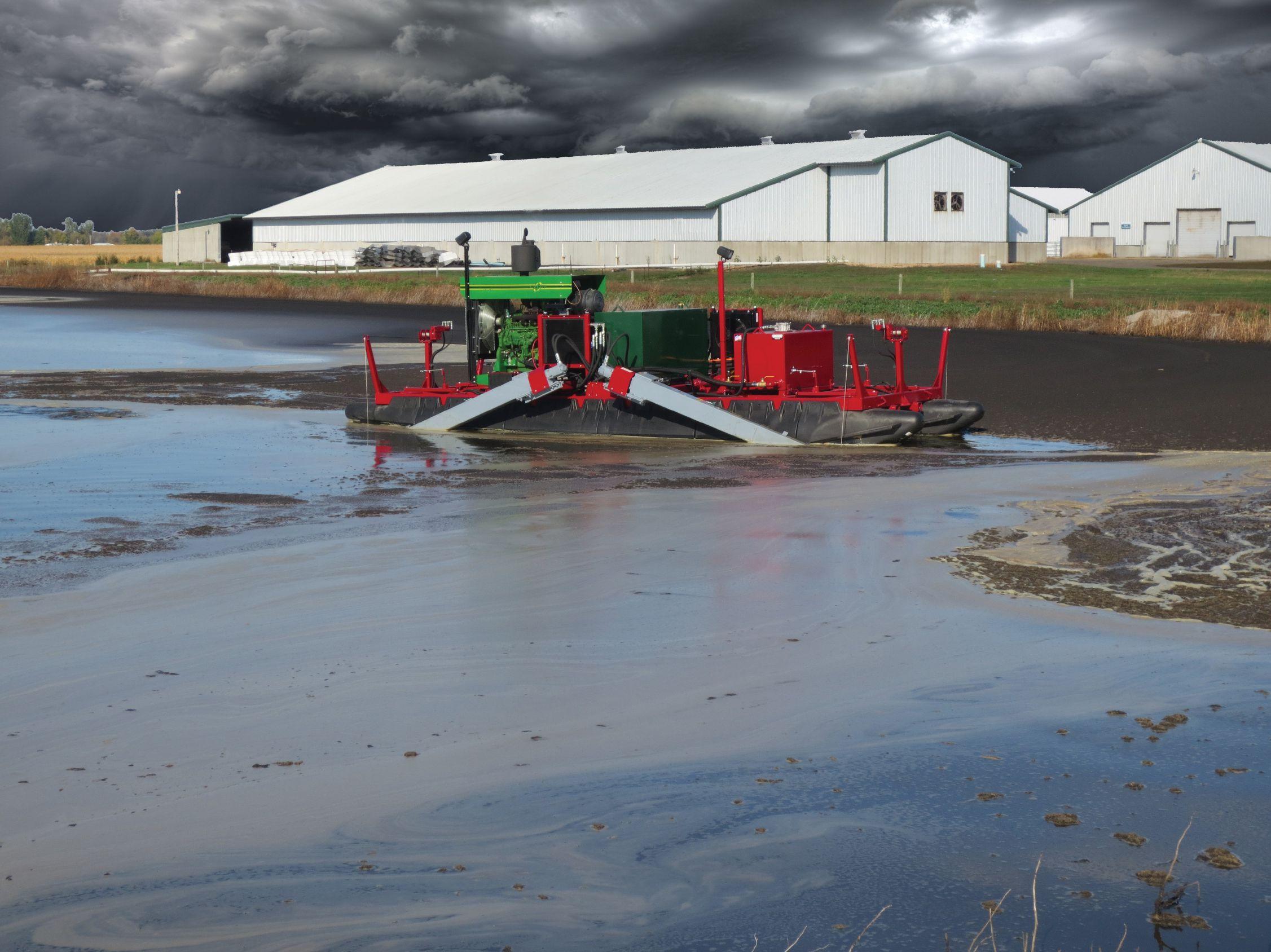
2014 Hydro Agitation Pontoons
Hydro Agitation Pontoons are able to reach depths where no other agitation product has gone before. Utilizing low maintenance 17” hydraulic props these pontoons send an intense cyclone of destruction to the bottom of your lagoon. Now you can reach even the deepest parts of the lagoon to get all the nutrients your crops need.
HYDRO F1 FEATURES:
60 HP Engine
1 - 17” Hydraulically Driven Prop for Agitation.
Hand Held Control
Cable and Winch Steering System
120 Gallon Fuel Tank
HID Spot Lights
HYDRO F4 FEATURES:
200 HP John Deere Engine
4 - 17” Hydraulically Driven Props for Agitation and steering.