Digester closes loop between feedlot, ethanol plant
For over half a century, Doda has provided Organic Waste Solutions by manufacturing a broad variety of products for agricultural use with strict adherence to cost/benefit advantages.
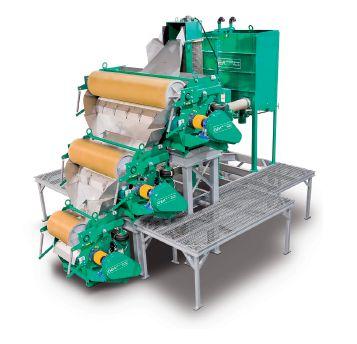
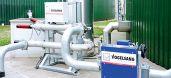
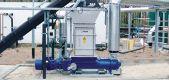
Screw Separators
780HD - Separation for bedding, composting and eliminating solids from lagoons.
Digester Mixers
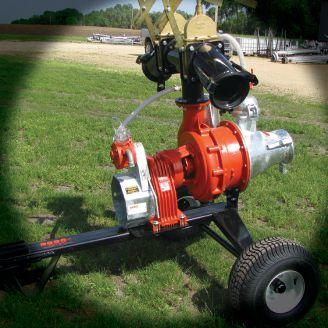
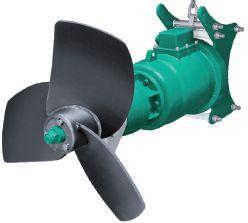
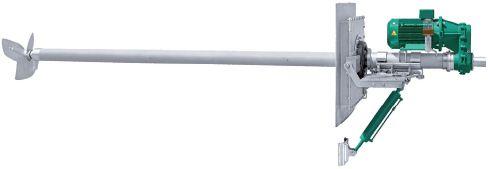
BG80 - Effective mixing for process stability
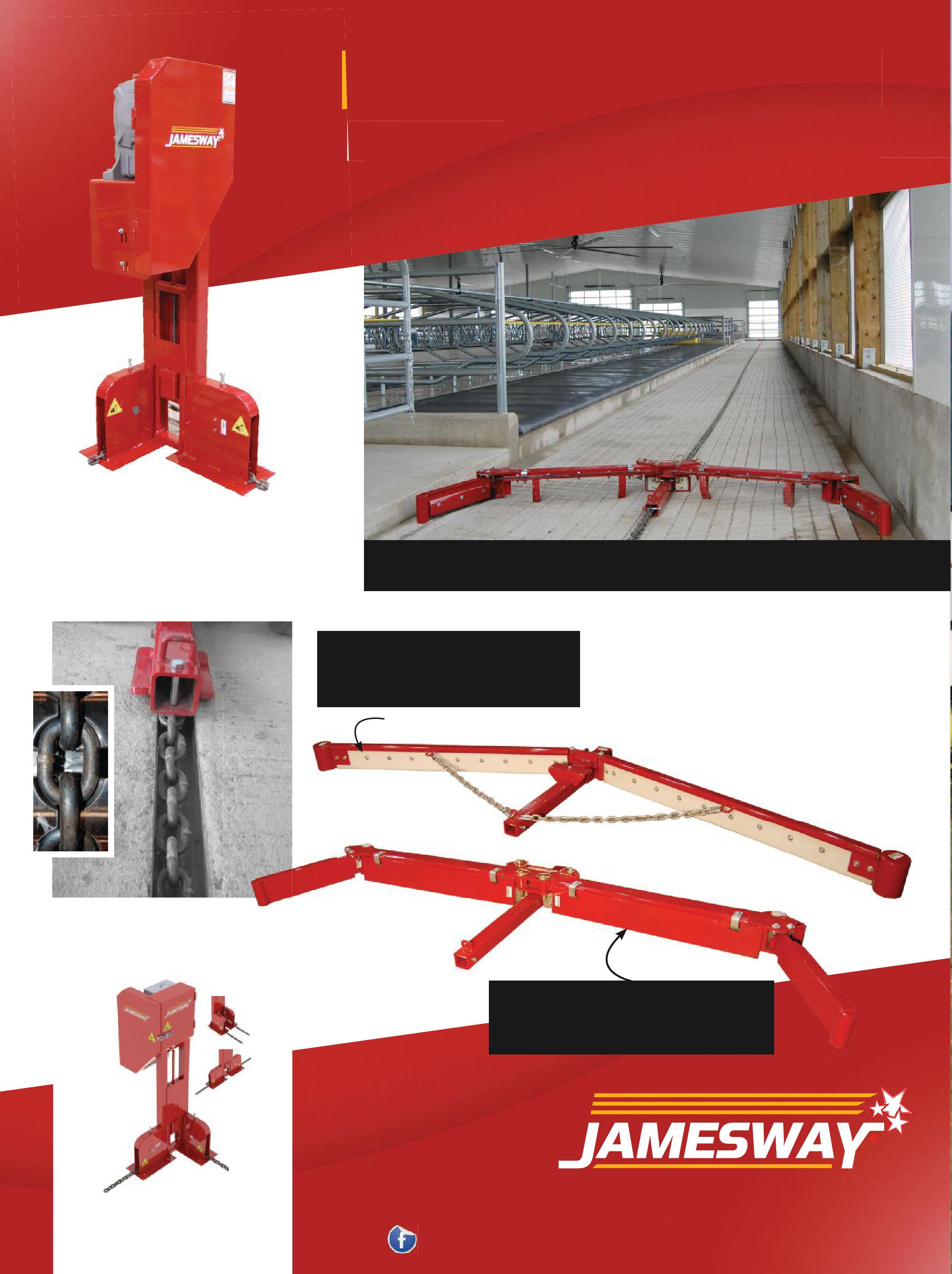
JAMESWAY DURA-CHAIN IS HARDENED TO RESIST WEAR GENUINE DURA-CHAIN
V-BLADES FOR LOWEST MAINTENANCE / BEST CHOICE FOR SAND BEDDING
STRAIGHT BLADES ARE MOST COMPACT /URETHANE MODELS FOR CLEANEST FLOORS
Full circle
Himark BioGas closes loop between Kansas feedlot and ethanol plant
Michigan State powers up
Michigan State University installs an anaerobic digester that helps power the campus by combining cafeteria food waste and manure from the university’s dairy
Phosphorus is the real enemy Study suggests phosphorus, not nitrogen, is the real enemy when it comes to algae
Firm to flat
Ontario farmer develops tire inflation system for manure spreaders to help with compaction issues
Climate-related emissions from feedyards monitored in Texas research study
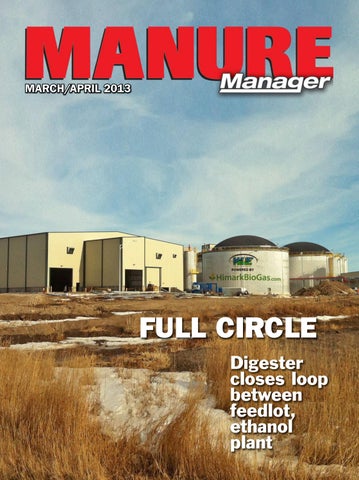
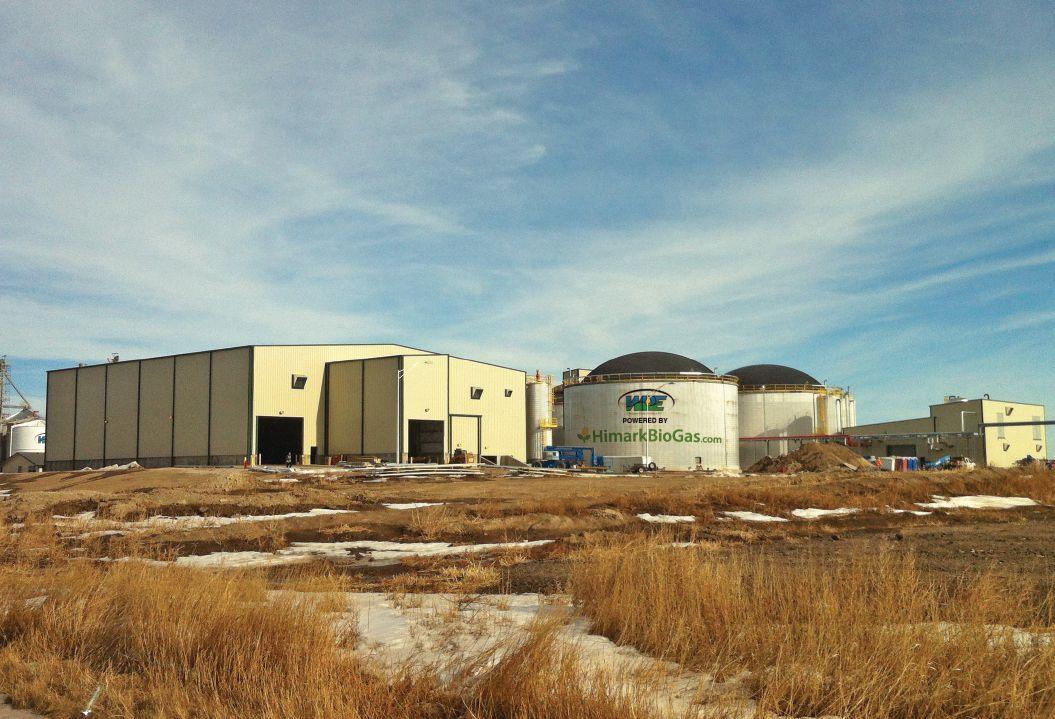
Cover: Western Plains Energy’s anaerobic digesters, constructed in Kansas, are considered the largest in the Western Hemisphere and produce the largest volume of biogas of any facility in North America. Contributed photo
President Mike Fredericks mfredericks@annexweb.com
Publication Mail Agreement #40065710 RETURN UNDELIVERABLE CANADIAN ADDRESSES TO CIRCULATION DEPARTMENT, P.O. BOX 530, SIMCOE, ON N3Y 4N5
e-mail: subscribe@manuremanager.com
Printed in Canada circulation
e-mail: subscribe@manuremanager.com
Tel: 866-790-6070 ext. 211
Fax: 877-624-1940
Mail: P.O. Box 530 Simcoe, ON N3Y 4N5
Subscription rates canadian Subscriptions
$35.24 Cdn, one year (with GST $37.00, with HST/QST $39.82)
U.S. Subscriptions: $47.00 USD, one year
Occasionally, Manure Manager will mail information on behalf of industry-related groups whose products and services we believe may be of interest to you. If you prefer not to receive this information, please contact our circulation department in any of the four ways listed above.
All advertising is subject to the publisher's approval. Such approval does not imply any endorsement of the products or services advertisted. Publisher reserves the right to refuse advertising that does not meet the standards of the publication.
Website: www.manuremanager.com
They say waste; I say resource
Stop me if you’ve heard this rant before.
By Margaret Land
I have a pet peeve – it bothers me when people refer to manure as a “waste” rather than what it really is – a “resource.” I’m sure some of you will think I’m splitting hairs or tilting at windmills. I worry I’m fighting a losing battle. It’s difficult to get people to twist their mind around a different idea or approach, to think of something in a different way. It’s particularly difficult if that shift involves making a negative – such as waste – into a positive – such as resource.
Just examine the definitions of the two words and you’ll see the chasm of understanding that has to be traversed.
Waste – defined as (verb) 1. use to no purpose or for inadequate result or extravagantly 2. fail to use 3. give, utter without effect; fail to be appreciated or used properly 4. wear gradually away, make or become weak, wither 5. devastate 6. treat as wasted or valueless 7. be expended without useful effect 8. beat up, kill or murder. (noun) 1. the act or an instance of wasting; extravagant or ineffectual use of an asset 2. waste material or food, refuse, useless remains or by-products, excrement 3. waste region, desert 4. the state of being used up 5. damage to an estate caused by neglect.
Resource – defined as (noun) 1. the means available to achieve an end; fulfill a function; stock or supply that can be drawn on; available assets 2. a material or condition occurring in nature and capable of economic exploitation 3. a country’s collective wealth or means of defense 4. a book, videotape or other material which supplies information on a particular topic 5. an expedient or device 6. skill in devising expedients; practical ingenuity; quick wit 7. the possibility of aid.
To the average individual, manure might be considered a waste; after all, it is excrement or waste material, useless remains or by-products. But to many involved in agriculture, it is anything but useless. It’s a resource, a natural material capable of economic exploitation, be it through providing crop nutrients, supplying energy or providing compost to urban flower gardens. And yet, even with the understanding of manure’s importance, there are still some involved in agriculture who refer to it as a waste.
Case in point – I was recently in Green Bay, Wisc., attending the 2013 Midwest Manure Summit, a two-day conference focusing on the handling and processing of manure. Numerous presentations discussed the resource qualities of manure – as part of the energy mix in an anaerobic digester, as a source of nitrogen and phosphorus, as a source of bedding for dairy operations and as a compost material.
It was during a presentation on manure storage design that I realized not everyone considers manure a resource. As the latest design developments were described, the presenter mentioned that the state of Wisconsin had recently changed its design standards for manure storage facilities and other aspects of manure handling, including something referred to as “waste transfer.”
“It’s not called manure transfer anymore,” the presenter said. “It’s called waste transfer.”
That little piece of information made my ears ring. Why would engineers and state officials revising standards change something involving “manure” to instead involve “waste?” By changing that one word, the meaning has been shifted. The use of the word manure basically described what is being transferred – manure. But by changing the word to waste, the meaning shifted from describing what is being transferred – manure – to instead reflecting how the engineers and officials feel about that manure being transferred – it’s a waste.
This same issue came up later in the conference when John Ramsden, a conservation engineer with Wisconsin’s Natural Resource Conservation Service (NRCS) – an organization with “resource” in its name – gave a presentation entitled: Resource Concerns and Dairy Manure Management – a presentation with “resource” in its name. Throughout his talk, there was no discussion of manure. Instead, it was called waste.
Perhaps it wasn’t intentional. But it is this kind of disconnect I had hoped to change with Manure Manager magazine. It would appear there is still more work to be done.
FULL CIRCLE
By Tony Kryzanowski
Himark BioGas closes loop between Kansas feedlot and ethanol plant
It’s been a dream that Alberta’s Chrapko and Kotelko families have been pursuing as owners of Himark BioGas for more than a decade –development of a closed-loop cattle, biogas and ethanol production system that they can market globally. Recently, they made a major breakthrough into the American market.
Based in Oakley, Kansas, Western Plains Energy has started producing biogas captured from anaerobic digestion of cattle manure for use as fuel in its ethanol production process. The ethanol producer has invested in Himark’s patented Integrated Biomass Utilization System (IMUS), which the company developed over the past decade with assistance from the Alberta Research Council.
The main selling point of IMUS is its ability to produce biogas from both
clean and dirty manure. This is manure gathered from a location such as an open-pen feedlot, where over time, a high percentage of solids such as dirt, rocks and sand mixes with the manure in the pens. IMUS overcomes that problem by continuously discharging the solids that build up in the digester tanks as part of the biogas production process. This gives Himark BioGas its own niche in the green energy market. With its location close to a large cattle feedlot, the Western Plains Energy ethanol plant was an attractive target for the company. It also has an American patent for the integration and application of biogas produced from a feedlot with an ethanol plant or biodiesel plant.
The $35- to $40-million Kansas installation consists of four massive anaerobic digesters and a tertiary lagoon with 13.5 million gallons of anaerobic digester capacity, making it the largest anaerobic digester in the Western Hemisphere and North America’s largest biogas production facility. It is capable of producing twice as much biogas as Himark’s own digester, which it has
built adjacent to a feedlot owned by the Kotelko family near Vegreville, Alberta.
The ethanol plant produces 50 million gallons of ethanol per year and the biogas replaces natural gas used to heat its boilers. Western Plains Energy chief executive officer Steve McNich says the company expects to save about $5 million per year in energy costs by switching to biogas and if it chooses to use some of the biogas to generate power, it will save an additional $3.3 million per year.
The ethanol plant requires 100 million BTUs of fuel per hour in its manufacturing process.
Shane Chrapko, Himark BioGas chief executive officer (CEO), says the Western Plains Energy installation was a natural fit for introducing IMUS to the United States.
“With all the trouble that digesters have had States-side alongside openpen feedlots or with any kind of manure contaminated with sand, rock, grit and dirt, we elected to stay focused on a potential site that would be able to use that dirty manure, and be integrated with an ethanol plant,” says Chrapko.
With its continuous digester cleanout
The anaerobic digesters constructed at Western Plains Energy in Kansas are the largest in the Western Hemisphere and produce the largest volume of biogas of any facility in North America. Contributed photo
mark your calendars!
feature, Chrapko says that makes IMUS technology highly versatile as compared to other digester suppliers, which have either failed or operated inefficiently due to buildup of solid byproducts in the digester when dealing with manure that has a high solid contaminant content.
“We can handle the very clean stuff like the chicken, hog or dairy manure coming out of the barn,” says Chrapko, “but we can also handle the very contaminated feedstocks, whether it is out of a dry lot or sand bedded dairy, or openpen feedlot.”
Based on their own experiences, the owners of Himark BioGas knew that there were many “nice synergies” when a feedlot, digester and ethanol plant were integrated. In fact, Himark BioGas has also constructed an ethanol plant attached to its installation near Vegreville. It is about one-fifth the size of the Western Plains Energy ethanol plant.
While conducting its investigation into potential U.S. customers, the company discovered that Western Plains Energy was searching for someone to supply a biogas system based on anaerobic digestion of feedlot manure, which consisted of a high percentage of sand. However, they were having trouble finding a supplier with experience disposing of the buildup of sand in the digester on a continuous basis, and
shutting down the digesters to clean out the sand at regular intervals wasn’t an option.
“When we reached out, timing was everything and they were tuned in to the value we offered,” says Chrapko, “given we had our own operation in Vegreville up and running since 2005. They were able to come and kick the tires and that helped tremendously because they knew they weren’t going to be the guinea pig.”
Construction of the Western Plains Energy installation began last summer and the system began ramping up to produce biogas in January.
The IMUS infrastructure consists of four large digesters and a manure infeed building. The manure is transported with end dump trucks from a 50,000-standinghead, open-pen feedlot located eight kilometers away. Some of the heat generated by the adjacent ethanol plant is channelled into the digesters to maintain, control and enhance the digestive process, while the biogas produced from the digesters is transported to the burner on the ethanol plant boiler.
Himark BioGas engineered its biogas plant based on the energy needs of the ethanol plant and comparing that
to potential feedstock suppliers in the region. Pioneer Feedyards owner Scott Foote is a longtime investor in the ethanol plant and the plant has been selling him wet distiller’s grain to feed to his cattle for years. Pioneer Feedyards is the main supplier of manure feedstock to the ethanol plant, and while it is not being paid for the manure, it is benefiting from its nutrient value by land applying the solid byproduct exiting the digesters.
It still has chemical and nutrient value as an organic fertilizer. That’s because the solid byproduct resulting from the anaerobic process uses only the carbon, but the nitrogen, phosphorus, potassium and micronutrient components remain intact. So this processed manure, which is also 100 percent seed and pathogen free without the odor by the time it exits the digester, will continue to be land applied as an organic fertilizer on the feedlot owner’s land. While it is a more consistent organic fertilizer, there is less volume – estimated at about one quarter of the amount of material exiting the digester as went in.
“The feedlot owner was sitting in during early discussions around the digester; he was part of the decision
The goal of collecting the feedlot manure to use in biogas production is to minimize disruption of current pen clean-out practices. Contributed photo
making all along and the due diligence that the ethanol plant conducted on Himark BioGas,” says Chrapko.
Operation of the feedlot in Kansas was very similar to how open-pen feedlots are managed in Alberta, with the pens typically scrapped once or twice a year and the manure land applied.
“As we get going, we will be in those pens more often harvesting manure, but it’s much like you’d see in Alberta,” says Chrapko.
He adds that because the biogas plant will receive all the material that is typically collected from open-pen cleanouts, the system must process the feedstock to catch major contaminants such as, for example, chunks of concrete that equipment can sometimes chip off during the pen clean-out process.
In terms of impact on a feedlot’s dayto-day manure handling operations, the emphasis has been on minimal disruption of what the feedlot is currently doing.
“To make it work every day for the next 40 years, we have said that we won’t change anything in the feedlot,” says Chrapko. “We can just slipstream in and instead of those end dump trucks leaving the feedlot and heading to the cropland, that truck will just head to the biogas plant.”
Because the manure will be removed more often, he says, the feedlot could
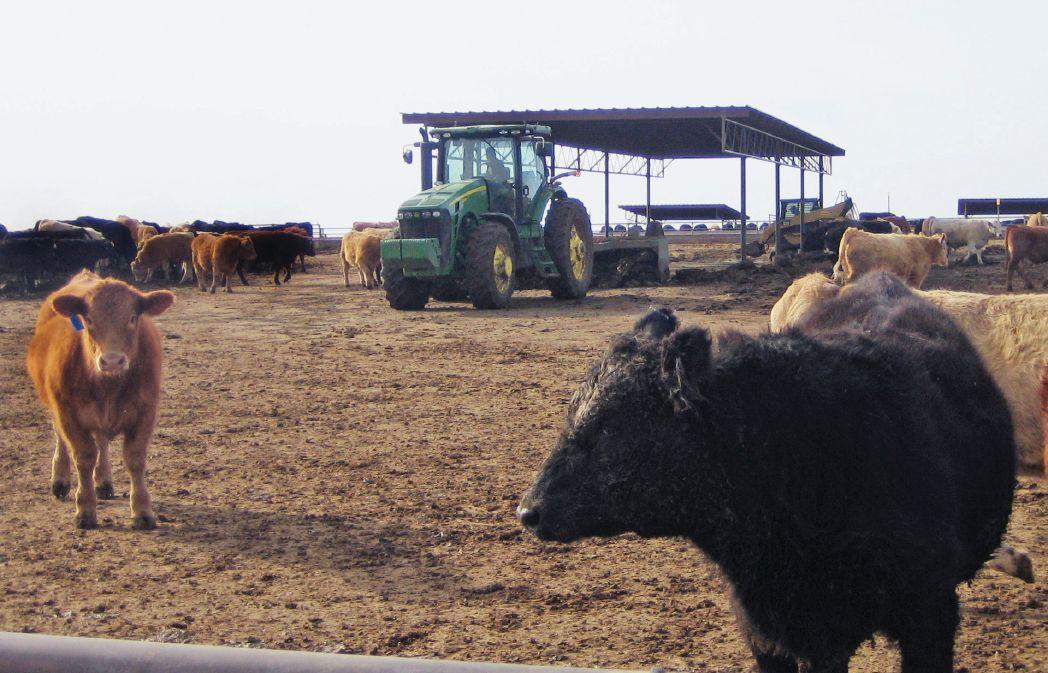
Instead of being delivered for farmland for application, the Pioneer Feedyards manure is now transported to the Himark BioGas anaerobic digesters. Contributed photo
actually realize health benefits to its herd. The manure is used soon after it is removed from the pens because this is beneficial to biogas production, which depends heavily on biological activity.
Himark BioGas wants the biological activity that typically occurs in manure to occur in the digester tank and not while the manure is in a storage pile, so there would be no more than about a five-day supply stockpiled at the biogas plant at one time.
The feedstock going into the digesters will not be entirely feedlot manure but will also consist of other biological materials such as stillage, ground-up hog mortalities and food wastes. A specific recipe will be used to achieve the biogas production that the ethanol plant requires. Himark BioGas brought in one of its portable laboratories, which essentially operates as a minidigester to conduct extensive field studies of the feedstock materials and the biogas response resulting from various recipes. The data collected helped Western Plains Energy make its case when applying for grants and financing. The project has received a $5-million grant from the United States Department of Agriculture,
and a $15.6-million grant from the Kansas Department of Commerce.
Acquiring sources of food waste to add to the digester recipe is to Himark’s advantage because, Chrapko says, there is an opportunity to make money from tipping fees, and food waste tends to have about twice the energy content of manure. So in locations where food waste feedstock sources are plentiful, it can actually influence the size of the digester. However, he says, with the Western Plains Energy installation, manure is definitely the “anchor tenant” in terms of feedstock, representing well over 50 percent of the raw material entering the digesters.
Himark BioGas believes that with the power of its patents and its focus on processing contaminated feedstocks, it has a definite head start in the global green energy market.
“That focus opens up literally billions of tonnes of material that has not been able to be digested before,” says Chrapko. “We feel that we have a very bright future and many more projects because we can handle that material that the traditional companies have shied away from or done a mediocre job of handling.”
MIChIgan STaTE powERS Up
Michigan State University installs an anaerobic digester that helps power the campus by combining cafeteria
food waste and manure from the university’s dairy
By Diane Mettler
Michigan State may be the home of the Spartans, but it is also the home of the Anaerobic Digestion Research and Education Center (ADREC).
“All of the livestock farms are situated immediately adjacent to the teaching campus,” says ADREC manager Dana Kirk. “That allows us unique opportunities.”
One opportunity has been to combine campus food waste and manure from the dairy cows to create energy for the university using an anaerobic digester. An experimental 250,000-gallon plug flow digester has been running for 18 months with success. This summer, a larger anaerobic digester will be installed by Anaergia Inc. that will create 500 kilowatts of renewable energy for use in buildings across the campus.
Research
The project has been in the works for the past six years. It began when the university started looking for ways to divert the food waste generated at the 12 campus cafeterias from being disposed of in landfills. The food waste study evolved into a look at all-organic waste, and it was determined the university produced approximately 21,000 tons per year of organic waste from both the campus facilities and its farms.
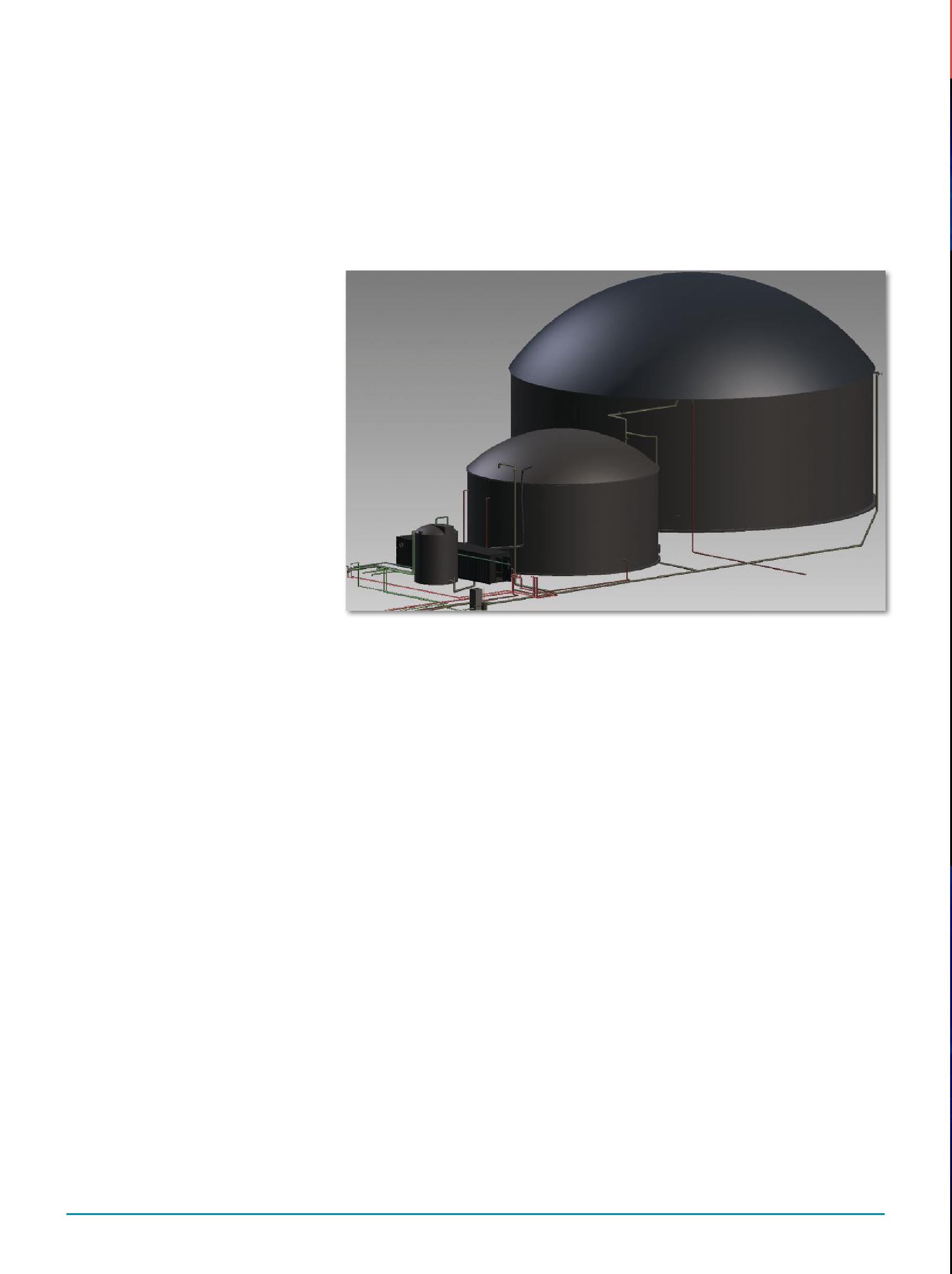
A conceptual drawing of what the 500-kilowatt anaerobic digester – planned for installation this spring at Michigan State University – will look like. The digester will stand about 30 feet tall with a membrane roof and hold 450,000 gallons of material. The manure and food waste entering the tank will be digested for approximately 25 days. Image courtesy of Wieland-Davco/C2AE
“That led us to the development of an anaerobic digestion system to utilize a portion of the waste,” says Kirk. “We looked at the material we had easy access to and wouldn’t cost a lot to transport.”
Using an anaerobic digester to process these materials made sense for a number of reasons:
• The successful experimental digester demonstrated it could be done.
• It provided a full loop system for students studying anaerobic digestion they no longer needed to go off campus to look at one in operation. It supported the school’s sustainability and energy transition plans.
• Other materials collected from a local grease trapper and food processor would bring in revenues for the center in the form of tipping fees.
Searching for the technology
ADREC looked at many different technology providers and different systems in the U.S. and Europe but settled on a complete mix system.
“The selection of the proprietor was based on the best overall value,” says Kirk. “We looked at cost and factored in the experience and the referenced projects. We also looked at other unique aspects that it might bring to the table, and the flexibility of the technology.”
In October 2012, the Anaergia Inc. was chosen. Bernie Sheff, vice president of Anaergia, was excited not just because his company was selected, but also because he is a Michigan State alumni and proud of the university’s desire to improve overall sustainability and transition away from traditional fossil fuels to renewable fuels.
The tanks are already on site and the engines are being shipped. When the weather improves this spring, Anaergia will move ahead on construction in order to have the digester online in July.
Once complete, the 500-kilowatt system should be the largest of its kind on a college campus in the United States.
“It will be the largest in volume and in energy output,” says Kirk.
Getting the materials to the technology
One of the first challenges in designing the layout was to determine how materials would be transported to the digester. Campus food waste is moved from seven cafeterias in curb carts, but it was more complicated for the dairy. A portion of the livestock is in tie stalls, another is in free stalls with slatted floors and the remainder is in free stalls with scrape storage.
“Trying to figure the best way to move the three combinations of dairy manure was a bit of a challenge,” says Kirk. “We covered over the slats and are going to a pump system on the slatted material. The gutter cleaner material was already being moved with a tractor and spreader to our compost facility and will now go an extra couple hundred feet to the digester.”
Local utility issues
Another hurdle was trying to work with the utility company to determine an equitable way to use the energy and maximize its use on campus. Energy will be generated at the anaerobic digester location and will be wheeled through the local distribution grid to the main campus.
“The energy will be utilized at as many facilities on campus as possible,” says Kirk. “The list is not 100 percent finalized yet and will change over time. We’re looking at utilizing it at six to 10 facilities on campus.”
A bird’s-eye view
If you drive by the facility in July when it’s up and running, you will find a fairly small footprint. First is a receiving area, which can receive both solid and liquid waste from large tankers.
“It’s a pretty simple two-pit system,” says Sheff. “We bring in our food and grease waste on one side, and bring in manures on the other. We use a chopper pump to chop the material up and emulsify it. When it’s a good slurry, we pump everything up into a 10,000-gallon
mix tank. That mix tank acts a like an acidification tank. It has about a day’s detention. We bring it to temperature and then we pump it forward up into the digester.”
The digester will stand about 30 feet tall with a membrane roof and hold 450,000 gallons of material. The manure and food waste entering the tank will be digested for approximately 25 days.
After the material has made its way through the digester, the solids will be separated and moved to the university’s compost system. The liquids will move on to a 2.1-million-gallon storage tank directly behind the digester.
“The above-ground storage tank is 100 feet in diameter and stands about 36 feet tall,” says Kirk. “It will have a membrane roof and we will be able to pull additional gas off the effluent storage.
Sheff says the storage tank will work much like the European model.
“In Europe, especially in Germany, effluent is held in storage tanks with 270 to 320 days of capacity. This further increases the energy recovered by the system as additional biogas is captured during this time frame.
The liquids will be later used to fertilize the campus farm, while the compost will be used on campus or sold to the public and wholesalers either in bagged or pelletized form to generate additional revenues.
In addition to generating renewable energy, reducing greenhouse gases and diverting waste from landfills, the facility will also reduce odors released by the dairy farm.
“Not only is the dairy near the main campus, we also have three golf courses surrounding this area,” says Kirk. “Odor control and good manure management practices are critical with this project and a driver behind it. Also the liquid manure will have fewer weed seeds and require less use of herbicides.”
Michigan State University’s livestock farms are situated immediately adjacent to the teaching campus, providing the university’s Anaerobic Digestion Research and Education Center an opportunity to combine campus food waste and manure from the dairy cows to create energy. This site will be the new location of the university’s complete mix digester, designed by Anaergia Inc.
Contributed photo
Phase 2
Over time, the university would like to further expand the project. There is access to more organic material internally and the campus also has access to bio solids and other residuals near the community.
“If this experience turns out well, the goal is to double the capacity of feedstock and double the energy output,” says Kirk.
The project is expected to pay for itself and generate long-term financial benefits through energy production and tipping fee revenues.
“The vice president and the president of the university both wanted us to create a project that had a positive cash flow or a payback period that was reasonable. Being a land grant university, we want to demonstrate technologies that are appropriate and also financially viable for our state builders,” says Kirk.
Future partnerships
Sheff and Kirk are both excited by what this could mean for innovative urban and dairy partnerships in the future.
“Anaerobically digesting food waste and manure in one fully integrated system creates a robust and cost-effective solution. The dairy provides wonderful buffering and bacteria on a daily basis while the cafeterias provide substrates with high energy content that would otherwise be disposed of in a landfill,” says Sheff. “The net result is a more financially viable solution that reduces energy costs for the university while improving environmental sustainability. ”
“Without the cows or the dairy, it would be a lot harder thing to look at because the manure improves the economies of scale for the project,” says Kirk. “Hopefully this can be a model for the small farmer interested in a digester and renewable energy, how they could partner with a local municipality or an urban center and kind of create a partnership where they are bringing feedstock on and generating enough power that the municipality can work with them.”
phoSphoRUS IS ThE REaL EnEMy
Study suggests phosphorus, not nitrogen, is the real enemy when it comes to algae
The Canadian Press
AUniversity of Alberta ecologist says governments shouldn’t be wasting money on controlling nitrogen to stop algae blooms in lakes.
David Schindler says lawmakers should focus instead on controlling phosphorus – something that can be accomplished at only a fraction of the cost.
“There are very few good news stories in ecology these days but this is one,” Schindler says. “It saves us a lot of money that we can spend for other things.”
Numerous studies have linked summer algae blooms to both nitrogen and phosphorus getting into water through sewage, manure and fertilizer. But in a peer-reviewed paper
published recently in Proceedings of the Royal Society of London Series B, Schindler concludes that phosphorus is the real enemy.
Schindler says studies blaming nitrogen for blooms are short-term and do not take into account a lake’s entire ecosystem.
“Emperor Nitrogen has no clothes,” he writes. “The conclusion is we need to rely entirely on whole-lake data ... for reliable environmental policy, not quickand-dirty surveys with a few small bottles or little containers in lakes.”
Schindler reached his conclusions based on studies he did himself on nitrogen in the 1970s and 1980s, as well as a year-long review of about 500 other reports on the subject.
The phosphorus-nitrogen debate has been a huge issue in Manitoba, Canada, where the provincial government and the City of Winnipeg have been at odds over the health of Lake Winnipeg.
The province wanted the city to spend millions in upgrades to its sewage treatment plant to remove nitrogen, while the city insisted that phosphorus was the real battle to pick.
Last year, the province released a pollution reduction strategy that backed away from targeting nitrogen.
Schindler says it was the right move. He notes it’s much easier to control phosphorus than nitrogen.
Phosphorus is removed from water with iron or aluminum or sometimes calcium – a straightforward process. Getting rid of nitrogen is a two-step deal that relies on “finicky” biological processes.
It’s possible focusing on nitrogen may actually make water quality worse –at least when it comes to toxic blue-green algae.
Known scientifically as Cyanobacteria, blue-green algae needs both nitrogen and phosphorus to thrive. It can get the nitrogen it needs from the atmosphere, but the phosphorus has to come from the water.
“By adding phosphorus in a higher amount than nitrogen, you actually favor those species that you are trying to get rid of,” Schindler says. “Some of us worry that, if you were to tightly control both, we might get fewer algae but might get a higher proportion of blue-green algae.
FIRM To FLaT
By Karen Dallimore
Ontario farmer develops tire inflation system for manure spreaders to help with compaction issues
It was a military idea at first –deflating the tires on army vehicles that landed on the beaches of Europe in the Second World War made it easier to drive them on the sand. Now, 70 years later, the technology has come to the fields of Ontario farms.
Only now, the concept of running tires at low pressure is not just about traction, it’s also about keeping soil and crops healthy.
Jake Kraayenbrink has farmed with his family near Moorefield, Ont., since 1989. With 300 acres plus custom work, he combines 1,000 acres in total, as well as raises pigs that are in demand internationally as breeding stock. With too much manure for his land base, Jake’s curiosity is often drawn to exploring creative ways of applying and maximizing the value of manure. He uses only manure, no fertilizer, on his own farm.
“Manure is good for fertility, and it contains live organisms that are needed for cropping,” said Jake.
While he has always used large tires and put the manure on when the crop most required it, he realized that compaction from heavy manure tankers may take away the benefit to the soil.
What if he deflated the tires?
After a research trip to Europe, where he discovered the concept had been in practice for more than 20 years, Jake decided he wanted to use tire deflation technology at home. Some farmers, especially from Holland, wouldn’t even allow machinery in their fields without deflation systems.
Reducing the tire pressure on large farm machinery not only gives better traction on soft soil, but it also reduces compaction, reduces fuel consumption and extends tire life.
The research
Jake and his research team visited a European machinery manufacturer who had these systems already in place for
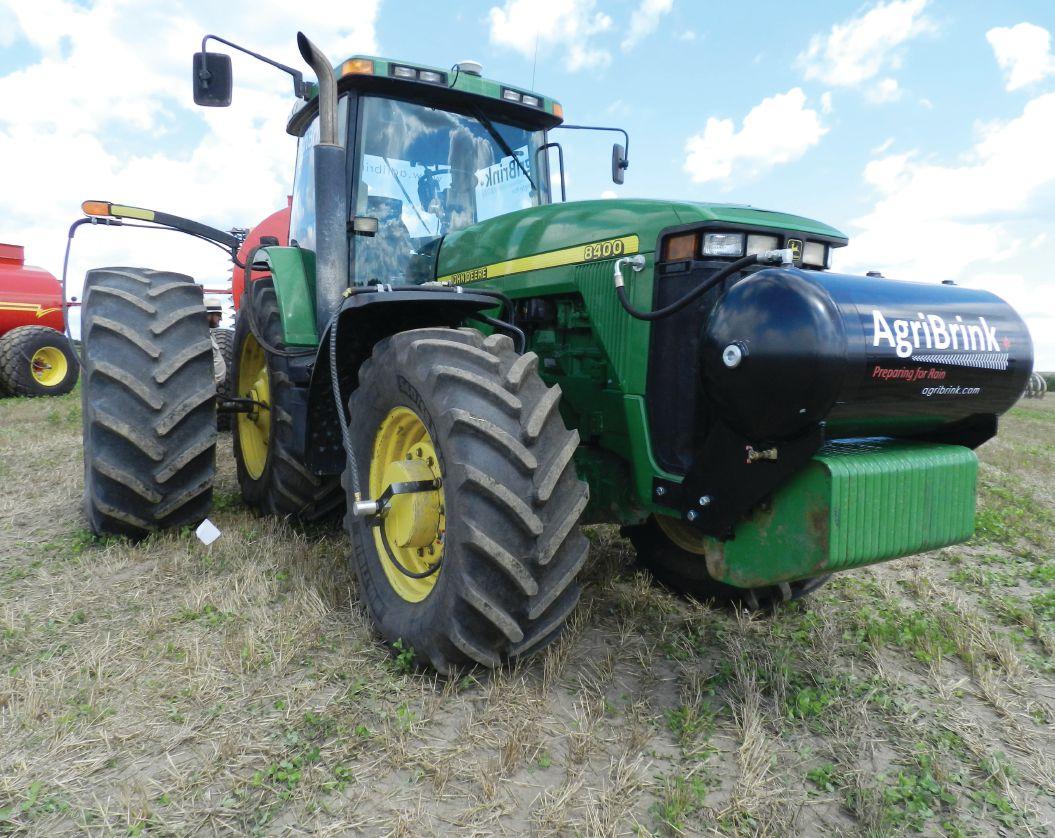
MAIN PHOTO: A new system that will be available in 2013 with a compressor mounted on the tractor for use with multiple implements features modules that can be set up for separate tires. Photo by Karen Dallimore
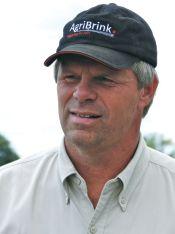
Jake Kraayenbrink. Photo by Karen Dallimore
farm machinery, but wasn’t willing to service the North American market.
So Jake looked west, where the tire inflation and deflation concept was in use in the trucking industry. On cement trucks or logging trucks, for example, lowering the tire pressure gave a two-wheel drive truck the ability to move across a jobsite even more easily than a four-wheel drive under difficult, soft conditions.
Re-inflating the tires allowed that same truck to be driven back on the road.
The technology was available from a trucking firm in Western Canada but the system was too extravagant and timeconsuming, taking almost three minutes to work. Farmers just can’t spend that kind of time at the side of a field.
Meanwhile, the word was getting out in the press about the concept of tire deflation on farm machinery, and Nuhn Industries Ltd. got an order for a tanker with a deflation system, a system that did not yet exist. Kraayenbrink saw an opportunity.
With the help of two capable neighbors – Maurice Veldhuis, a ventilation engineer, and Steve Bailey, a truck mechanic – they took a truck system apart, starting right from the valve stem. Truck tires aren’t the same as farm tires – trucks have high pressure, low volume; farm tires have low pressure, high volume.
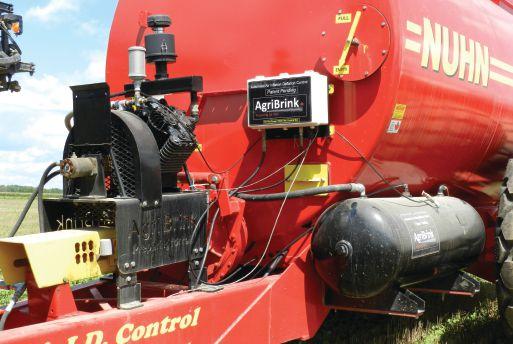
It took all winter but the trio developed a system that could deflate tires in 25 seconds – a “huge breakthrough,” said Jake. Their new system, the Automatic Air Inflation Deflation control device, known as AAID, has three components:
• An air delivery system with a quick release valve that releases air right at the valve stem,
• An air supply system – compressor and tanks – that started with 30 horsepower, 105 cubic feet per minute and went to 10 hp, 36 cfm. The one-third smaller system uses less hydraulic oil to work and needs a smaller storage tank, and
• An air control box in the cab with digital readout and preset tire pressures adjusted by a toggle switch. “You don’t have to do anything but flip the switch,” said Kraayenbrink.
There is also a box with manual override – all quick attach. Should there ever be an issue with electronics you can still inflate and complete the job, said Kraayenbrink.
It takes about 30 seconds to deflate the tires from 35 down to 15 pounds per square inch; as the tires get hot the system adjusts itself to keep the pressure right.
Certain components of the system can be moved, and the components are all quick attach. You can move the compressor in about 40 minutes if you want to, from your tanker to your baler or solid spreader.
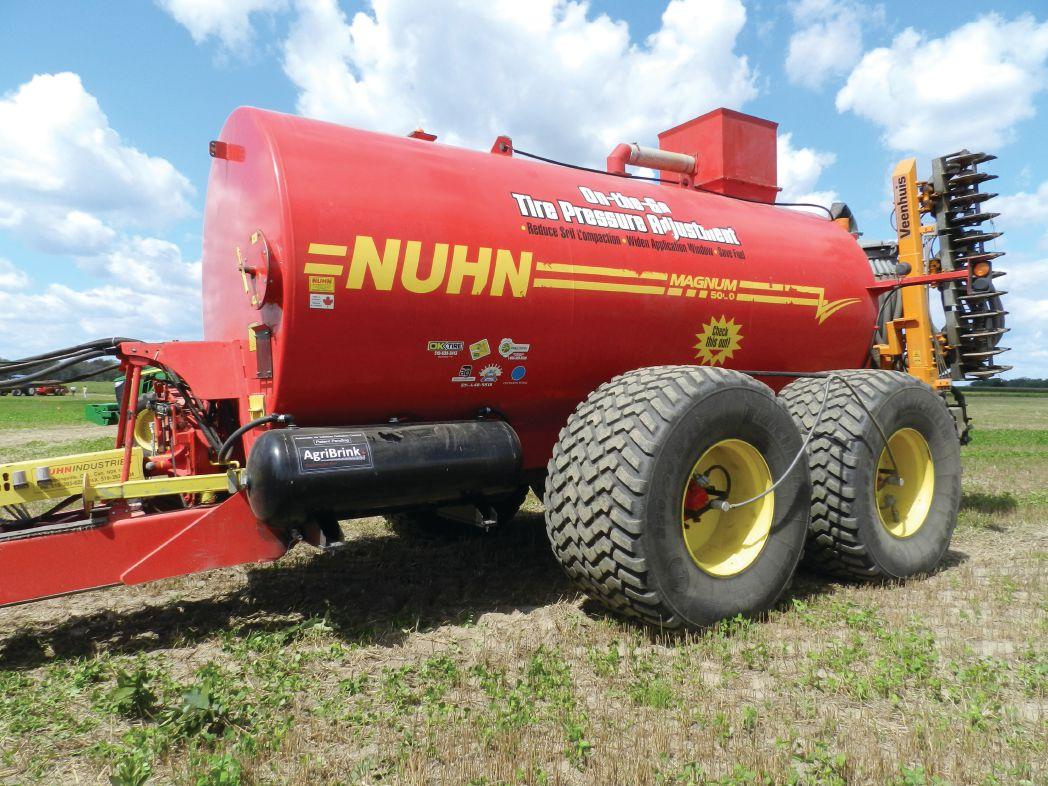
An AAID tank mounted on tanker.
Photo by Karen Dallimore
Kraayenbrink’s research started in 2009. By 2011, he was ready to go commercial, and his company, called AgriBrink, was opened for business. Developed with funding assistance from the Farm Innovation Program, the invention earned him an Ontario Premier’s Award for Agri-Food Innovation Excellence in 2011.
The benefits
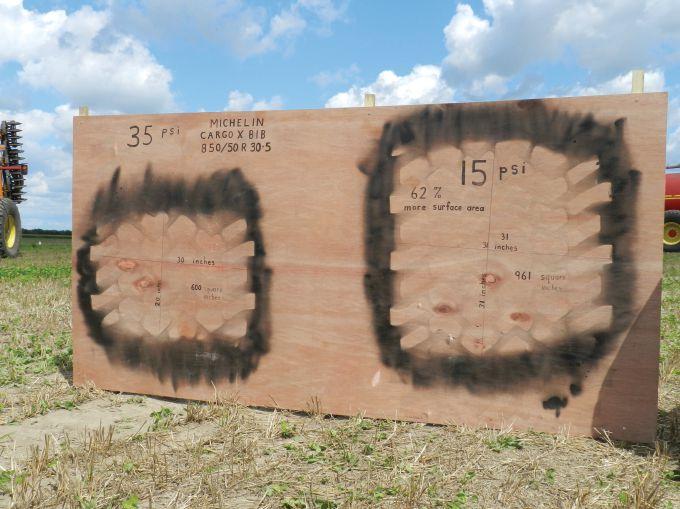
Two tire tracks are spray painted on a plywood board at a manure demonstration day at Kraayenbrink’s farm in August 2012. The first shows a footprint of 600 square inches at 35 psi; the second shows the footprint of the same tire deflated down to 15 psi, showing 961 square inches of surface area. The larger surface area means the equipment won’t sink as deep in soft soil and compaction is reduced as the weight of the load is spread over a larger surface area.
Last year in Ontario was really wet and Kraayenbrink said he got stuck with their tankers, but when they deflated the tires really low he was able to get out. The commercial spreader got stuck too, but pulled through with deflated tires as well.
“I wouldn’t have believed it went right through the wet holes – like putting duals on a tractor, or putting on snowshoes,” reported Kraayenbrink.
Tire deflation is mainly about compaction and traction, but fuel savings and tire life factor in as well.
It takes less fuel to pull a deflated tire, something that Kraayenbrink proved for himself in his own field trial. With tires inflated and a full fuel tank, Kraayenbrink drove on the road 20 minutes. He then deflated the tires to field inflation level, filled the fuel tank and did the same run, using 14 percent less fuel.
“If you’re using 30, 40 or 50 litres per hour you can knock off four to five litres of fuel, saving money and the environment,” said Kraayenbrink.
Tires are expensive too. Tire pressure is determined by speed and weight –the slower you go, the less pressure is required – and Kraayenbrink estimates they get 60 to 80 percent more life when the pressure is optimized.
“Tires last longer because you always have your tire pressure optimized – you’re not compromising.”
Also, you always know your tire pressure, he says – you can’t visually see an abnormally low tire, but with a monitor in cab, a low tire can be detected early. It doesn’t happen often but when it does happen it costs a lot of money.
Financially, you can measure such things, but compaction is harder to measure. Researchers have found that damage attributed to compaction can stay in the soil for more than 10 years. Some years it won’t show – if it’s wet or there is the right amount of moisture, crop roots don’t need to go as deep. But if it’s dry, the roots need to look deeper for moisture, and compacted soil will get in their way. The effects of
compaction are greater on clay soils or those low in organic matter, but using lower tire pressure will help any soil type, by reducing compaction or by helping to alleviate compaction.
“There are a number of benefits we’ve come to learn about,” Kraayenbrink reports, that will become more of a feature as equipment gets bigger. As he says, land is getting too expensive to work at a reduced potential.
The future
“This could go a lot further – we’ve been using it on any machinery we can get it on,” said Kraayenbrink.
It’s not just for manure tankers; it can be used for anything that goes on the road and field. Manure is one of the heavier items to cross over the field so it’s when transporting it that the effects are most noticeable.
Determining the ideal pressure requires knowing your weight and speed and the tire manufacturer. A heavy 12,000-gallon tanker may go from 40 psi to 20 psi, while a 5,000-gallon tanker may go from 28 to 14 psi, for example. On a big sprayer, 65 psi can go down to 40, allowing the unit to work optimally for its design.
Right now, the AAID control will do just one set of tires, on the implement, but Kraayenbrink took the opportunity at the manure demo day to unveil his latest control unit that can do tires separately on the tractor and on the implement. He had just finished setting it up the night before.
“It’s always dangerous to come out with something new when you’re still working on it,” admitted Kraayenbrink, but he’s excited to report that by spring, he will have a unit available that will be able to do up to four different sets of tires.
“We’ve put a compressor on the tractor – we can inflate and deflate the front, back and trailer tires as required to increase the footprint,” he told the crowd.
“By reducing tire pressure, we’re reducing compaction, reducing injury to soil and crop, and increasing our fuel efficiency,” said Kraayenbrink.
He predicts that as soil health becomes more of a concern and more studies show the effects of compaction, practices such as tire deflation will become more accepted.
“There are a lot of interesting things in today’s agriculture,” said Kraayenbrink. “Change is going to happen.”
For more information on Jake Kraayenbrink and his company, AgriBrink, visit www. agribrink.com or call 519-840-0919
Six hundred square inches of surface area at 35 psi becomes 961 square inches at 15 psi. Photo by Karen Dallimore
CLIMaTE-RELaTEd EMISSIonS
Emissions from feedyards monitored in AgriLife research study
By Kay Ledbetter
Getting an accurate estimation of nitrous oxide and methane emissions from beef cattle feedlots is an increasing concern given the current and potential future reporting requirements for greenhouse gas emissions.
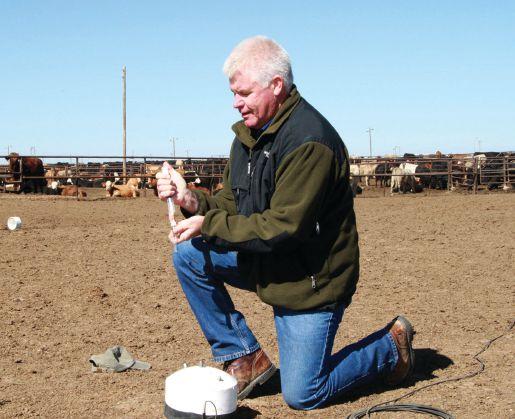
Dr. Ken Casey, a Texas A&M AgriLife Research air quality engineer in Amarillo, is working on an ongoing study to quantify the nitrous oxide and methane emission rates from pen surfaces at two commercial beef cattle feedlots in Texas.
This research was supported in part by Agriculture and Food Research Initiative Competitive Grant from the U.S. Department of Agriculture National Institute of Food and Agriculture, AgriLife Research and Texas Cattle Feeders Association.
To put these in perspective, nitrous oxide and methane have global warming potentials of 310 times and 21 times that of carbon dioxide, respectively, Dr. Casey said. This means these gases trap more heat within the atmosphere than carbon dioxide per unit weight.
“These greenhouse gases contribute more toward climate change but are not concerns for human or animal health at the concentrations that exist in and around feedyards,” he said. “But they need to be studied because we need to know how much is being emitted before we can accurately determine what contribution feedyards are making to the national and global inventory of greenhouse gases.”
Dr. Casey said determining these numbers now also will help make sure any future regulations that might be imposed are based on scientific findings.
“But little research has been conducted into the emissions of these greenhouse gases from beef cattle feedyards and particularly as it applies for the climatic conditions, ration formulations and management practices of Texas High Plains feedlots,” he said.
His AgriLife Research study was set up to determine the range of nitrous oxide and methane emission rates from feedlot pen surfaces; to obtain an understanding of seasonal, temporal and spatial variability of emission rates within pens; and to gain insight into the factors that influence and control emission rates, such as moisture content, days since rainfall and nitrogen content.
In his study, the emissions from the pen surfaces were measured on 20 sampling days from June to October 2011, Dr. Casey said. The air samples were collected from the chambers’ headspace at 0, 10, 20 and 30 minutes using syringes, transferred to evacuated vials and analyzed with a
Dr. Ken Casey, a Texas A&M AgriLife Research air quality engineer in Amarillo, takes a sample from a non-flowthrough, non-steady-state chamber to test for nitrous oxide and methane emissions. Texas A&M AgriLife Research photo
gas chromatograph.
From the nitrous oxide and methane concentrations, emission fluxes were calculated, he said.
Dr. Casey said the study showed nitrous oxide and methane flux generally increased with increasing manure pack temperature. Following a rain, nitrous oxide flux would spike and then was followed by a decline to pre-event levels over three to six days.
The nitrous oxide flux increase due to a rain was approximately 100 times greater than the temperature response, he said.
While this study is quantifying nitrous oxide and methane emission rates from pen surfaces in cattle feedlots, further work is needed to investigate factors that influence emission rates, Dr. Casey said.
Knowing the production and release mechanisms that influence these emissions will help the industry to develop management systems that could reduce the emissions, he said.
For instance, if reduced storage of manure in pens lessens anaerobic conditions, that could result in lower methane emissions, Dr. Casey said. And reduced nitrogen excretion – possibly through feeding less nitrogen – could reduce the nitrous oxide emitted.
Accurate and well-designed emission measurements from well-characterized types of manure and manure management systems will be needed to reduce the uncertainties, he said. These measurements must account for temperature, moisture conditions, aeration, manure nitrogen content, metabolizable carbon and duration of storage.
pRECISIon ManURE
Distribution highlighted
at
Ontario manure demo
By Karen Dallimore
While it was nutrient management legislation that originally generated an interest in the greater precision of manure application, now it’s the high price of fertilizer that has driven a renewed interest in today’s more innovative manure distributors.
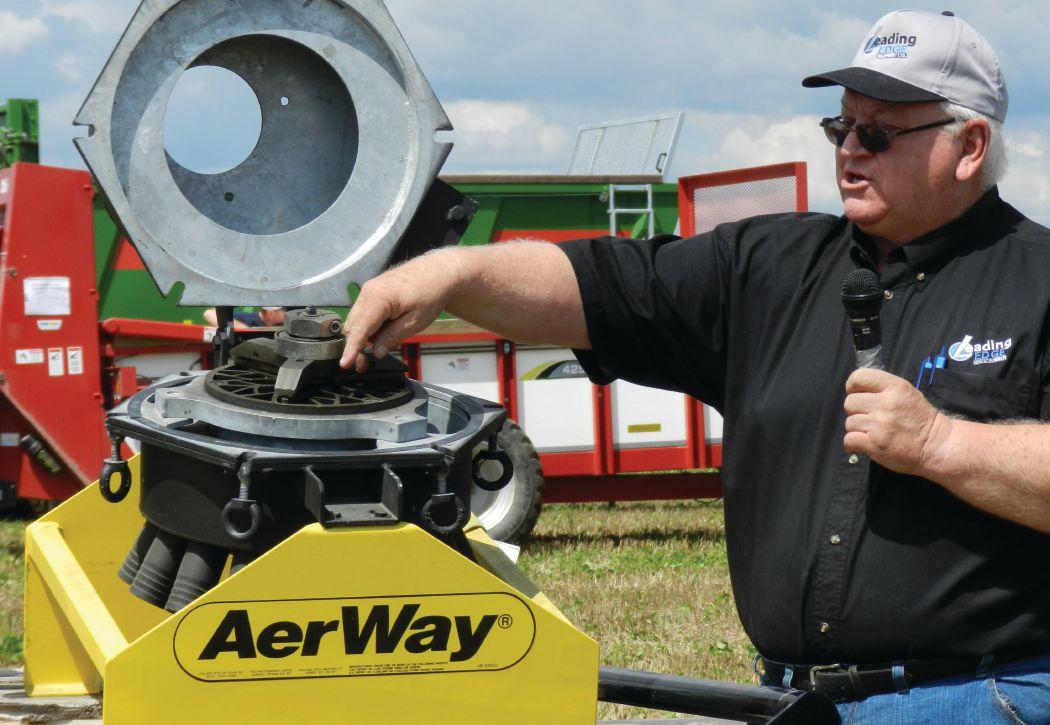
“As the value of commercial fertilizer rises, farmers want more consistent application across the width of their machine,” Wayne Graham of Leading Edge Equipment in Burgessville, Ont., told the crowd at the Manure Demonstration Day held at Jake Kraayenbrink’s farm near Moorefield, Ont.
Graham brought an Aerway SSD (Sub-Surface Deposition) model to the demonstration. Servicing up to 50 hoses to cover a 30-foot boom width, this unit,
with its German Vogelsang distributor, is what he described as the most sophisticated model currently available.
A basic distributor is a pot that divides the flow either coming off a tanker or coming off a drag hose into two or three splash plates, described Graham. If you want the flow divided across the width of the machine, a basic distributor will provide that. But many distributors would simply divide the flow to go to the shortest hose or path of least resistance, depositing the manure into trenches that are vulnerable to washouts with the manure ending up in the lowest parts of the field.
With the Aerway, the process begins when the fluid feeds into the top of the distributor, where a cutting disc rotating at 300 to 400 rpm cuts anything that may be in a liquid manure – straw, wood, bones – so everything passes through a two-inch hose. As it rotates, there’s a pulsating action across the line that feeds the material evenly across the machine.
As Graham explained, rather than
create a continuous trench, the Aerway actually fractures the soil, creating pockets that allow the manure to spread out into the soil layers. This latest Aerway system is hydraulically driven, putting exactly the same placement of fluid in every hose and in every pocket created by the machine.
Recent design changes have now allowed for larger pockets in the ground and this model also features a drag hose boom that reduces strain on the drag hose at the end of the field.
The uniform placement of the manure means that an operation such as side-dressing corn is possible and can give excellent results, said Graham. If you go on a hillside with just a gravity pot you’ll see the lower end of the machine gets the most manure. With a distributor, all the corn will respond in the same way, even on a hillside.
Wayne Graham with the Aerway SSD manure distributor. Photo by Karen Dallimore
STUdyIng ManURE
A look at manure in cows, feedlots and fields
By Ann Perry
Agricultural Research Service scientists at the Agroecosystems Management Research Unit in Lincoln, Neb., have been conducting some very thorough investigations on the microbes that dwell in cattle manure – what they are, where they thrive, where they struggle and where they may end up.
“When we look at potential pathogens that can cause foodborne illness, we need to look at the whole bacterial ecosystem,” says ARS microbiologist Lisa Durso. “For instance, some people used to think all cattle have the same bacteria in their gastrointestinal [GI] tracts. But we’ve found some big differences; so if we say, ‘Oh, it’s just manure,’ we could miss important factors in pathogen control.”
That’s why Durso headed up a study that provided the first-ever “gold standard” accounting of the fecal bacterial types associated with beef cattle.
The researcher used pyrosequencing, a relatively new method of rapidly analyzing bacterial DNA markers, to classify the bacteria into different taxonomic groups. “People hadn’t looked at doing this type of bacterial census before, because some bacteria could be cultured, but other types didn’t grow well,” says Durso, who conducted this
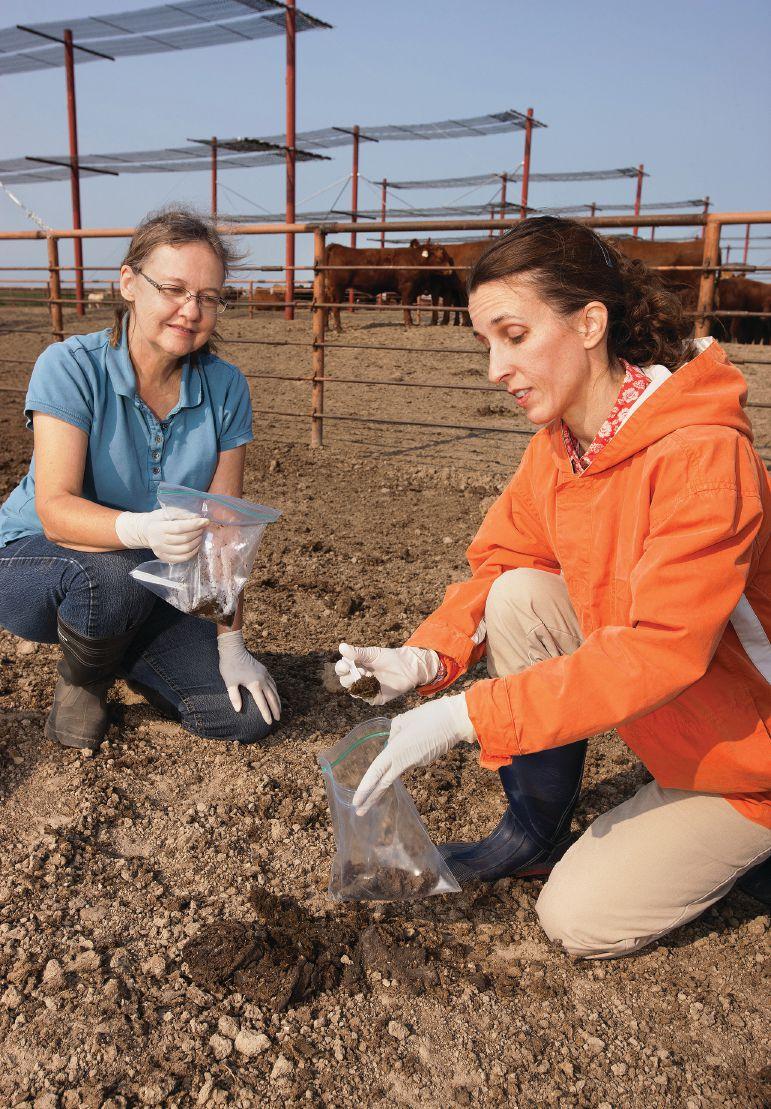
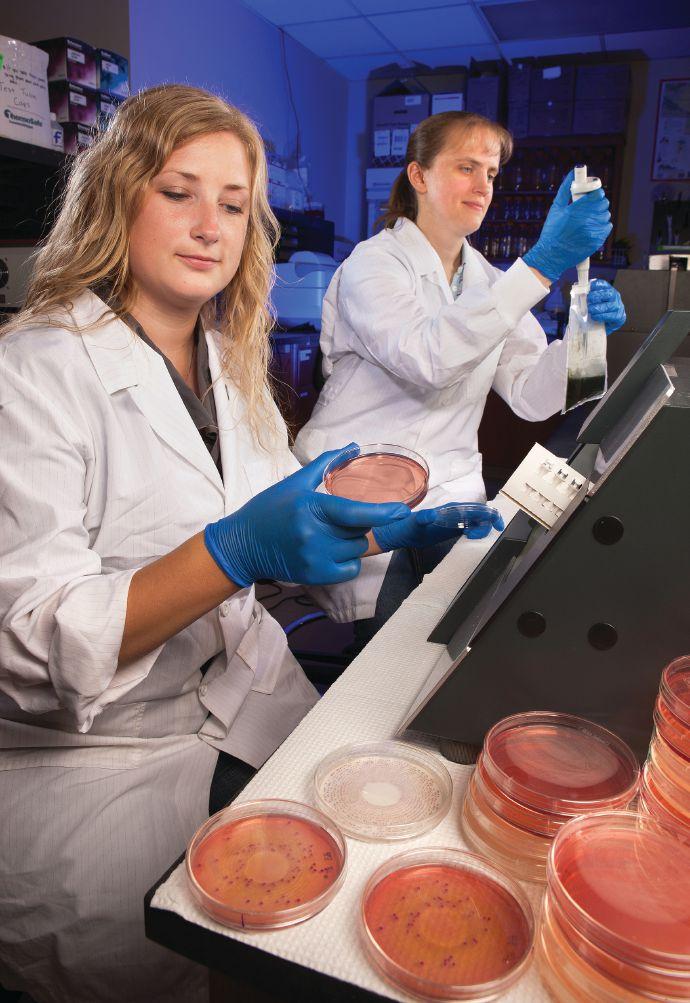
Technician Sandy Fryda-Bradley (left) and microbiologist Lisa Durso collect fecal pats from a feedlot pen. Samples are taken back to the lab to be cultured for bacteria, including E. coli.
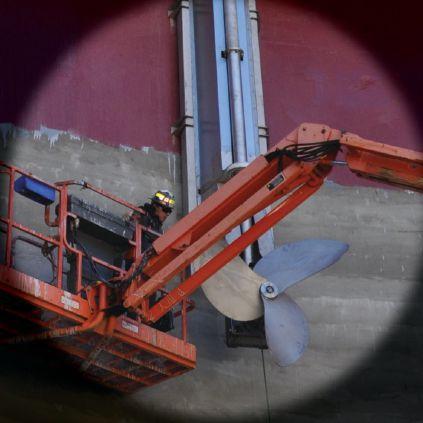
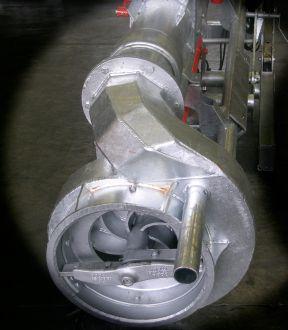
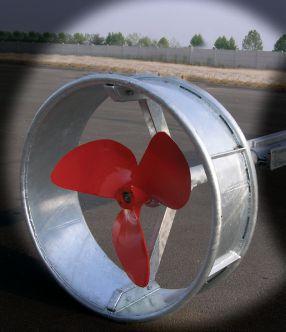
The film about SUMA‘s test basin: www.gosuma.com/videos Giantmix sidewall entry mixer Optimix submersible mixer The NEW HD PLUS Propeller with more mixing power or as much as 30 % lower energy consumption 25%
Upgrade your mixer for more thrust and flow! SUMA optimizes your mixing efficiency.
investigation while she was working at the ARS U.S. Meat Animal Research Center in Clay Center, Neb. “Pyrosequencing let us give every bacterium a name tag ID.”
Using fecal samples from six beef cattle, Durso identified a core set of bovine GI bacterial groups common to both beef and dairy cattle. But she also determined that Prevotella was the most common bacterial genus in the cattle she studied—occurring in 24 percent of the total number of DNA sequences she analyzed. Another published study had identified Prevotella in only 5.5 percent of the bacterial genes sequenced from 20 dairy cattle. And while another survey had identified Clostridium in 19 percent of the bacterial DNA sequenced from dairy cattle, Durso detected the genus in only 1.5 percent of the DNA sequences in her study.
Durso observed bacteria in the beef cattle that had not been reported in dairy cows. She also identified a diverse assortment of bacteria from the six individual beef cows, even though all six animals consumed the same diet and were the same breed, gender and age. Given her results, Durso believes much more high-resolution community
sequencing will be needed to identify “core” members of the bovine bacterial community.
Durso also compared her results to a survey of bacterial types she collected from beef cattle feedlot surfaces. Of a total of 139 different bacterial genera
from both groups, 25 were detected in both fecal samples and feedlot floor samples, 21 were found only in the fecal samples, and 93 were found only in samples from the feedlot surfaces. She attributes the distribution differences to selection pressures bacteria face in feedlot pens that aren’t present in the oxygen-free, dark, moist cattle GI tract.
The implications of these findings? “The focus on food safety is fecal contamination, and preharvest pathogen control has often been animal-centric –for instance, how to ‘fix’ the problem of E. coli in a cow’s GI tract,” Durso says. “But a bacterium has a different pathway once it’s outside of the gut. So we need to start thinking strategically about how to control pathogens when they are at their weakest—outside the animal, rather than inside it.”
Durso also partnered with Lincoln agricultural engineer John Gilley and others to study how livestock diet affected pathogen transport in field runoff from manure-amended soils. “Manure applications can help a farmer meet soil nutrient requirements, but it’s more expensive to apply it every year because of the costs of labor, equipment and fuel,” Gilley says. “A farmer can reduce costs
Beef cattle in a feedlot at Clay Center, Neb.
At Lincoln, Neb., microbiologist Lisa Durso examines the results of a test to quantify bacteria in cattle fecal specimens and runoff from manureamended soils. The number of yellow and glowing wells helps determine the number of bacteria present.
phosphorus than fields amended with one-year or two-year manure rates.
“Our study – which is one of the first studies on this question – indicates there is a significant difference in how manure application rates affect runoff loads,” Gilley says. “And even though crop residues can be effective in controlling soil erosion, the residues also slow the movement of water across fields. So there’s more time for water to pick up nutrients from the soil.”
by applying enough manure to meet twoyear or four-year soil nutrient requirements, but we need to understand more about how these larger applications might be affecting the environment.”
Gilley’s team amended conventional-till and no-till fields at one-, two- or four-year application rates of manure from livestock that had consumed either corn or feed containing 40 percent wet distillers grains. After a series of simulated rain events, they analyzed runoff samples from the fields. They found that neither diet nor tillage management significantly affected transport of fecal indicator bacteria, but that diet did affect transport of bacteriophages – viruses
that invade bacteria – in the runoff.
Gilley also conducted an investigation into how wheat residues affected water quality in runoff from plots amended with one-, two- or four-year application rates of manure. Some of the plots were covered with postharvest wheat residue, and others were bare.
The scientists found that runoff loads of dissolved phosphorus, total phosphorus, nitrate nitrogen and total nitrogen were much higher from plots with residue cover. In addition, they observed that runoff from fields amended with four-year application rates of manure had significantly higher levels of dissolved phosphorus and total
In a follow-up study, Gilley’s team found that narrow grass hedges planted at the edge of manure-amended plots reduced mean runoff loads of dissolved phosphorus from 0.69 to 0.08 kilograms per hectare and total phosphorus from 1.05 to 0.13 kilograms per hectare –similar to levels from plots that had not been amended with manure.
“This study shows that if you have hedges you can substantially reduce nutrient loads in runoff,” Gilley says. “Planting grass hedges is a practice that isn’t expensive and can have a substantial impact.”
Results from these studies have been published in Foodborne Pathogens and Disease, Applied and Environmental Microbiology and Transactions of the ASABE.
Ann Perry is a member of the USDA’s Agricultural Research Service Information Staff.
In Lincoln, Neb., technicians Jaime LaBrie (left) and Jennifer McGhee process samples for enumerating manure-associated bacteria.
In the NEWS
Dairy groundwater coalition conducts election
The Central Valley Dairy Representative Monitoring Program (CVDRMP) recently conducted its first election for district directors.
Nominations for six seats on CVDRMP’s 12-member board of directors were accepted last fall and the election was held by mail-in ballot with a deadline for ballots to be received by mid-December.
The following election winners will serve through January 2014:
• Tom Barcellos, Porterville, District 1 (Tulare County)
• Ray Gene Veldhuis, Winton, District 2 (Merced and Madera counties)
• Rodney Kamper, Riverdale, District 3 (Kern, Fresno and Kings counties)
• Justin Gioletti, Turlock, District 4 (Stanislaus County)
• Bill Van Ryn, Manteca, District 5 (all other Central Valley counties not included in Districts 1 through 4)
• Steve Staas, Marysville, at-large (any Central Valley county)
CVDRMP’s board of directors is charged with carrying out the coalition’s mission of conducting groundwater monitoring activities to help meet regulatory requirements on CVDRMP member dairies throughout the Central Valley. A non-profit, voluntary program, CVDRMP was founded to offer members a cost-effective alternative to individual groundwater monitoring.
CVDRMP members are organized into five districts with two directors each. Directors serve staggered two-year terms, with one seat in each district open for election each year. Two more directors serve at-large, also with two-year staggered terms.
More information about CVDRMP is available online at www.DairyCares.com/CVDRMP.
Incentives offered for enviro improvements in livestock
The recent approval of the Residual Feed Intake (RFI) carbon offset protocol by the Government of Alberta has opened up a new opportunity for farmers to get paid for making environmental improvements.
The innovative practice highlighted in this new protocol reduces greenhouse gas emissions from beef cattle through advancements in genetic selection. This makes it possible to increase the efficiency of feed used by cattle.
“Low RFI or efficient cattle have lower maintenance requirements and consume less feed for the same level of production – such as growth, milk production or fat deposition,” says John Basarab, beef research scientist at Alberta Agriculture and Rural Development’s Lacombe Research Station. “This improved efficiency of feed use translates into a carbon offset when compared with normal feeding practices.”
The first generation of cattle produced from animals with these genetic characteristics will be eligible to receive carbon offset credits of about 28 tonnes (T) of carbon dioxide equivalent (CO2e) per 100 head of cattle. This is like taking five or six cars off the road every year. The value would be close to $340 per 100 head, assuming agricultural carbon offset prices of about $12/T CO2e. Extra benefits of reduced feed costs will also be gained. Tests are currently being conducted at Olds College and Strathmore to identify the most feed efficient animals.
Buyers of offsets are companies regulated under Alberta’s Specified Gas Emitters Regulation (2007). These companies can purchase carbon offsets in the Alberta Carbon Market as a way to meet their legal requirement to reduce annual greenhouse gas emission intensities by 12 percent. Agricultural carbon
offsets are created from farm practice improvements that have a proven scientific basis for reduced greenhouse gas emissions, are above and beyond business as usual, and can be verified by independent third parties.
“Although carbon offset payments are not large at this time, they provide a way to gain extra income from management improvements that increase efficiencies of production,” says Sheilah Nolan, climate change specialist with Alberta Agriculture and Rural Development. “This also helps producers and livestock operators get familiar with types of verifiable farm records that are needed to prove the practice change happened. These records are also likely to be needed to participate in other emerging environmental markets.”
University of Wisconsin NM publications updated
The University of Wisconsin Nutrient and Pest Management (NPM) Program has updated many of its nutrient management publications to be consistent with the recently revised UW-Extension publication Nutrient application guidelines for field, vegetable and fruit crops in Wisconsin (A2809). Updated publications include:
• Nutrient Management Fast Facts
• Know How Much You Haul
• Credit What You Spread – Available Manure Nutrient Content (card)
• Credit Legume Nitrogen and Reap the Profits (card)
• UW Nitrogen Guidelines for Corn (card)
Copies of these and other NPM Program publications are available free of charge. To place an order, contact NPM at npm@hort.wisc.edu or 608-2652660. Most NPM publications are also available for viewing and download at http://ipcm.wisc.edu/.
Smartphone manure apps
A blog posting from the Iowa Beef Centre at Iowa State University provided some information recently that might be of interest to smartphone-savvy producers.
Two new smartphone apps are available for animal ag producers and their advisers. Both apps are priced at 99 cents.
Manure Calculator (iTunes version – https://itunes.apple. com/us/app/manure-calculator/ id564930746?ls=1&mt=8 | Google Play
version – https://play.google.com/store/ apps/details?id=com.movecreative. manurecalculator) has three parts. One is to calculate the amount of manure spread (calibrate equipment). The second is to calculate the amount of nutrients spread using either book values or the producer’s own manure test values. The third is to estimate the approximate value of the manure relative to its fertilizer use. The app includes a feature to e-mail information to keep as a permanent record.
Manure Monitor (iTunes version – https://itunes.apple.
com/us/app/manure-monitor/ id565101082?ls=1&mt=8 | Google Play version – https://play.google.com/store/ apps/details?id=com.movecreative. feedlot) is a record-keeping app for animal feeding operations. It allows the user to develop a farm-wide emergency response plan and then synchronize that plan across all smartphones or tablets associated with the farm. A producer can also keep records on rainfall, manure storage inspections, mortality disposal, waterline inspection, manure transfers and equipment maintenance.
Case Construction
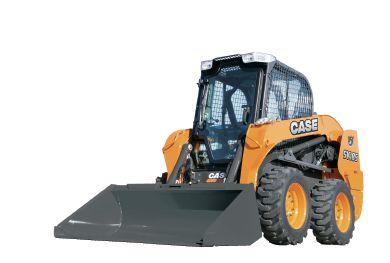
Case Construction Equipment recently announced its new line of skid steer loaders with upgrades to four products in its Alpha Series line.
Leading the way is the Case SR175 and SV185 medium-frame skid steers, which meet Tier 4 status with new engine technology and a diesel oxidation catalyst (DOC) solution. The SR130 and new SR160 compact frame skid steers also meet Tier 4 Final status using cooled exhaust gas recirculation (CEGR) with diesel particulate filter (DPF). Additionally, the large frame SR220 and SV250 skid steers move to Tier 4 Interim with CEGR and DPF technology.
The SR175 and SV185 are designed for radial-path lift and vertical-path lifting, respectively. The SR175 boasts a 21 percent higher peak torque rise at 1800 rpm compared to the previous model, and goes from 60 to 67 gross hp, a 12 percent increase. While the SV185 remains at 60 gross hp, it has seven percent more torque than the previous version. Users also have the flexibility to increase the machines’ rated operating capacities by 100 lb. – to 1,850 lb. (839 kg) for the SR175 and 1,950 lb. (885 kg) for the SV185 – with optional counterweights.
The SR130 skid steer features a 2.2-liter ISM engine and moves from 46 to 49 gross hp. It also receives a 9.6 percent torque boost while maintaining its same dimensions.
The SR160 is an evolution of the SR150 skid steer and delivers seven percent more rated operating capacity and 17 percent more horsepower than the SR150. It has a 10 percent larger engine than the SR150 and
a turbocharger to deliver 60 gross horsepower and a whopping 28 percent torque increase — a full 10 percent more than the existing version of the next size larger skid steer. Furthermore, the SR160 has 27 percent more breakout force over the SR150, making this compact frame skid steer an excellent entry-level machine for landscaping, construction and rental.
The larger SR220 and SV250 skid steers, which now move into Tier 4 Interim status, retain their 82 gross hp engine but receive a 14.2 percent increase in torque which makes them more powerful than the Tier 3 version of the larger 90 hp Case skid steer models. Customers are able to maximize their productivity with a smaller size class machine.
All six models now include a new electronic engine control that helps to maximize performance and ensure reliability. In addition, CAN-messaging capabilities will allow the customer to monitor and store diagnostic data points, some of which include hydraulic oil temperature, fuel rail pressure and even fuel tank level. Expanded control options are available on the SR130, SR160, SR175 and SV185, including factory-fit foot controls for the loader functions.
All six models build on the strengths of the Case Alpha Series — retaining the wide cab for operator comfort. Users still can take advantage of switchable control patterns available on all the models with optional electro-hydraulic (EH) controls. In addition, flow rates for auxiliary hydraulics on the SR175, SV185, SR220 and SV250 have been increased to allow operators to run attachments more productively. www.casece.com
Case IH Farmall U
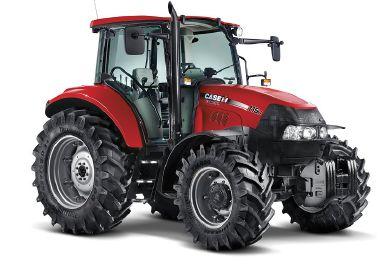
Case IH has released two new utility tractors to meet professional livestock producers’ demand for rugged, yet comfortable and easy-to-operate equipment. Heavy-duty Farmall U tractors deliver power and performance, with the
Farmall 105U having 91 PTO HP and the Farmall 115U having 98 PTO HP.
Running on updated clean-diesel technology, the new Farmall U models use Tier 4A-compliant Case IH FPT 4-cylinder 3.4-L turbocharged and intercooled engines. For a more efficient combustion process, fuel is delivered with electronic high-pressure commonrail fuel injection. This system provides efficiency, extended engine life, and improved cold-engine starting.
Glow plugs warm the engine prior to a cold-weather start, eliminating the need to use ether for more reliable starting in freezing temperatures.
Designed with operator productivity in mind, the models are propelled with 12-speed forward, 12-speed reverse transmissions. The two Farmall U units incorporate an electro-hydraulic power shuttle wet-clutch transmission. If applications demand it, the transmission can be upgraded to 20x20 with creeper or 24x24 with hi-lo.
The newly-designed Farmall cab includes user-friendly controls and features. Reworked internal control ergonomics provide best-in-class productivity and minimize operator fatigue:
• Easy-to-read instrument cluster tilts with the steering column
• Integrated position for loader joystick
• Remote valves in a more accessible position
Visibility to the loader and other attachments is standard with the high-visibility roof panel. The standard instructor seat comfortably allows two adults to be in the cab together. The driver’s seat can be upgraded to air
From
Waste to Worth: “Spreading” Science & Solutions
Denver, Colorado • Grand Hyatt Hotel • April 1–5, 2013
To register or to learn more, visit: www.extension.org/pages/63747/
Sponsorship & exhibitor opportunities are still available. For more information please visit: www.extension.org/pages/65060/
Integrating research, education and extension efforts related to managing environmental impacts of livestock and poultry production in one conference.
Conference Topics include:
• Nutrient & Feed Management
• Air & Water Quality
• Manure Treatment Technologies
• Manure Value & Economics
• Education and Outreach
• Small Farms
• Climate Change
Livestock & Poultry Environmental Learning Center www.extension.org/animal_manure_management
Featuring Keynotes by:
• Managing Livestock Ammonia: A volatile, Promiscuous Fugitive in the Atmosphere (Rocky Mountain Park) – Jay Ham
• Federal Regulations & Pending Legislation Affecting Nutrient Management – Jeff Blackwood
suspension with a 15-degree swivel to make repetitive tasks less monotonous.
Owners can choose between factory-installed value or premium type Case IH loaders.
The standard 17.2-gpm hydraulic pump (optional 22.2 gpm) and the load-sensing close-center rear remotes keep the tractor working in all situations. Electronic draft control with a standard rear-hitch fender switch plus a standard rear PTO fender switch will add convenience to any job. www.caseih.com
New John Deere financing programs
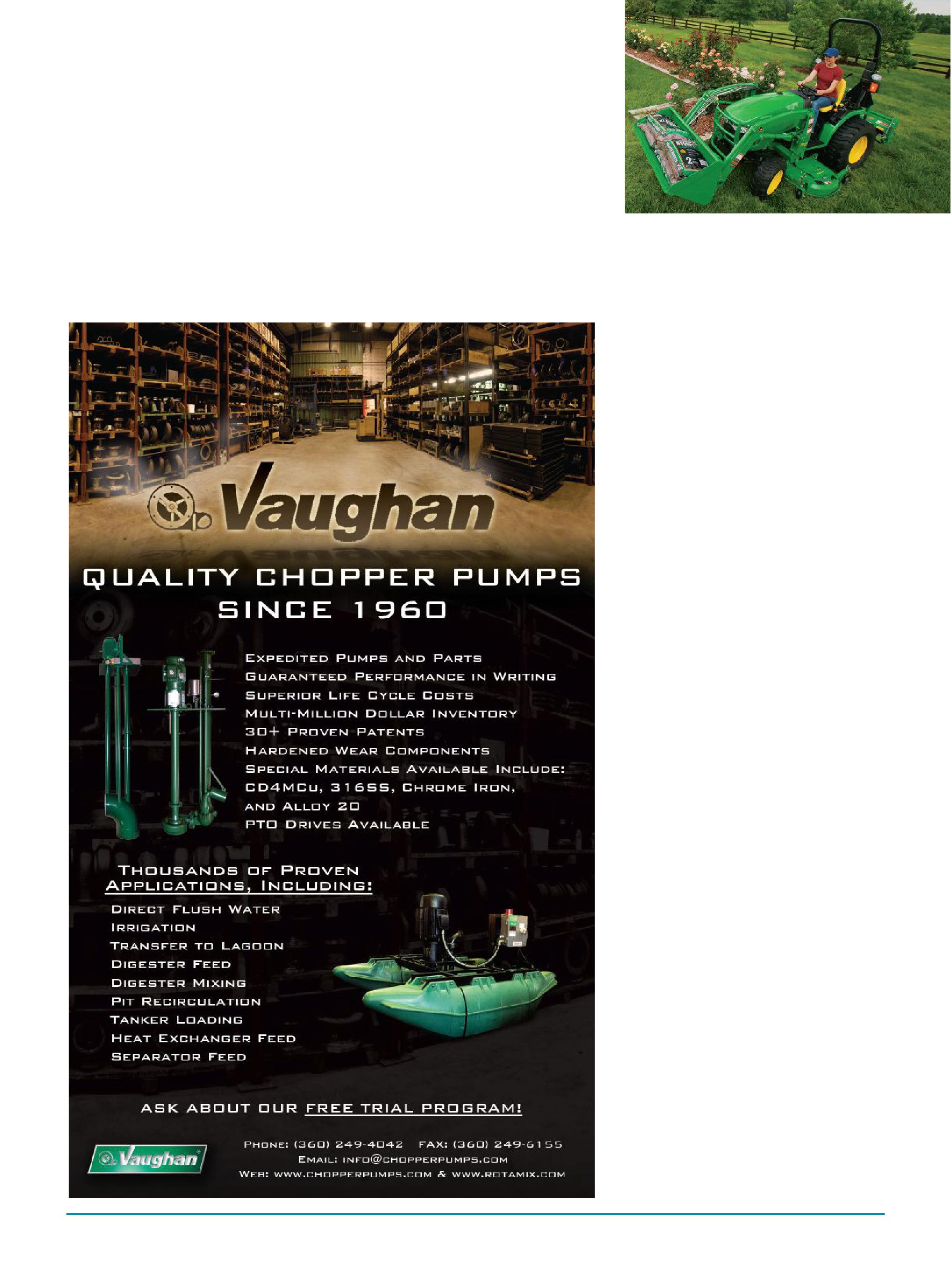
Owning a new John Deere sub-compact and compact utility tractor this spring just became more affordable, thanks to new incentives being offered by John Deere dealers.
From now through April 30, 2013, customers can take advantage of zero percent financing and cash incentives toward owning 1 Family, 2000 Series, 3000 Series and 4000 Series tractors, and implements.
During this early Deere Season kick-off promotion, customers can get zero percent for 60 months financing plus the following cash bonus offers:
• On new John Deere 1023E SubCompact and 2000 Series Compact Utility Tractors, receive $500 retail cash bonus plus another $500 off with the purchase of two or more John Deere or Frontier implements.
• On new John Deere 1025R SubCompact, 3000 Series and 4000 Series Compact Utility Tractors, receive $500 cash bonus with the purchase of two or more John Deere or Frontier implements.
• On new John Deere 3E Series Compact Utility Tractors, receive $1,000 cash bonus with the purchase of two or more John Deere or Frontier implements.
www.JohnDeere.com
TMC, Menicon develop manure compost product
Toyota Motor Corporation (TMC) and contact lens manufacturer Menicon Co., Ltd. (Menicon) have developed a livestock manure composting product.
New-Tokubetsu-Kyuko combines two products in the resQ45 series that are currently sold separately – TokubetsuKyuko, containing an enzymatic agent that promotes decomposition of dietary fibers in manure, and Thermo Master, containing thermophilic bacteria to raise fermentation temperature.
Tokubetsu-Kyuko is added to manure for each compost cycle, while Thermo Master is recommended for the initial batch only as the product’s inherent bacteria breeds during the composting process, meaning finished compost contains “seed” bacteria that can be used for successive compost batches.
The introduction of New-TokubetsuKyuko removes the need for seed compost, as the manure becomes reliably inoculated with thermophilic bacteria.
Although it will initially be sold in parallel with Tokubetsu-Kyuko and Thermo Master, a complete switchover to New-Tokubetsu-Kyuko is planned for 2014.
Dairy industry reducing phosphorus intake, output
By Kay Ledbetter
Reducing phosphorus in dairy diets doesn’t change a cow’s productivity, but it does affect the environmental impact that cow might have, according to a Texas AgriLife Extension Service specialist.
Dr. Ellen Jordan, AgriLife Extension dairy specialist in Dallas, Texas, said she has long worked with nutrition consultants on reducing ration phosphorus so the phosphorus excretion is reduced, thereby protecting the environment. Too much phosphorus in runoff can cause algal blooms.
This long-term effort seems to be paying off, Dr. Jordan said. Working with other AgriLife Extension dairy personnel, their research has shown no production or animal well-being impact caused by the reduction of phosphorus.
In 1999, nutritionists in the region were surveyed regarding their ration formulation strategies, Dr. Jordan said. They indicated the average formulated level of phosphorus for high-producing cows was 30 percent above recommended levels and for low-producing cows it was nearly 20 percent above what was needed.
The same question was asked of nutritionists at this year’s Mid-South
Ruminant Nutrition Conference in Grapevine. The average formulated levels for both high- and low-producing cows had declined to recommended levels, she said.
“This reduction not only protects the environment, but reduces the ration cost by decreasing phosphorus supplementation costs,” Dr. Jordan said. “Because the fertilizer is lower in phosphorus, it could also decrease the cost required for agronomic application because it can be spread over fewer acres.”
Since that initial survey, Dr. Jordan has been explaining at dairy cattle reproduction meetings that the ongoing research results from across the nation are indicating there are no reproductive advantages to feeding more than the recommended levels of phosphorus.
Dr. Jordan also worked through the Texas Animal Nutrition Council to get the council to draft a resolution stating, in part, “Our members formulate rations for their clients’ herds with the lowest level of phosphorus possible consistent with animal health and productivity.
This is based on state and national research demonstrating that minimizing dietary phosphorus will reduce manure phosphorus excretion without being detrimental to animal health and production.
“One stumbling block in implementation of the reduced levels has been that when veterinarians are troubleshooting reproduction problems, they have run a metabolic profile on cows near calving,” Dr. Jordan said. “When the cow’s levels are on the low end of normal, veterinarians have expressed concern about ration phosphorus being too low.”
This area – the metabolic profile of the dairy cow – is the subject of the doctorate work of Kevin Lager, AgriLife Extension associate in Canyon.
“We are finding in the research project that cows within three weeks of calving appear to be at the lower end of normal for their phosphorus levels,” Dr. Jordan said. “Thus, we are working on better defining what the ‘normal’ range is for cows within three weeks of calving.”
Phosphorus in dairy feed has been reduced over the years, according to Dr. Ellen Jordan, Texas AgriLife Extension Service dairy specialist in Dallas. Texas AgriLife Extension Service photo by Dr. Ellen Jordan
It’s no wonder why so many tractor companies want to compare themselves to Fendt. When you introduce the CVT transmission, front axle suspension and cab suspension to tractors, you tend to have plenty of imitators.
And if the scores of items only available from Fendt aren’t enough, we also back it up with our Fendt Gold Star Customer Care program that gives you 3-years or 3,000 hours of comprehensive warranty with included routine maintenancethe best in the industry.
In the hauling business, you need a tractor that’s capable and dependable.