Combining urban and rural wasTe innovations: pumps
6
Maximum Benefit
Variable rate manure application on the fly or spot treatment – both feasible. Variable rate application of manure is something to consider as part of an overall focus by growers interested in precision farming or by custom manure applicators for providing a value-added service to customers. One major advantage of this method is that the same volume of manure is often spread over a larger area. 10
Combining urban and rural waste
Italy’s known for high fashion, but it’s also getting a name for innovative waste handling with the creation of the Rivalta Energia Project, a cooperative formed by area farmers and entrepreneurs where manure and urban waste is turned into compost and electricity.
16 A case study of two dairy manure management systems
An examination of two livestock operations that have looked at ways of better laying out their farm operations to improve manure transfer, treatment, and utilization while minimizing costs and labor.
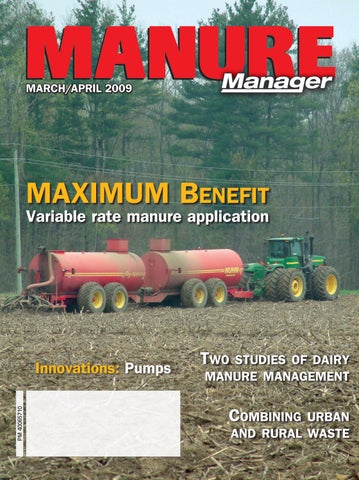
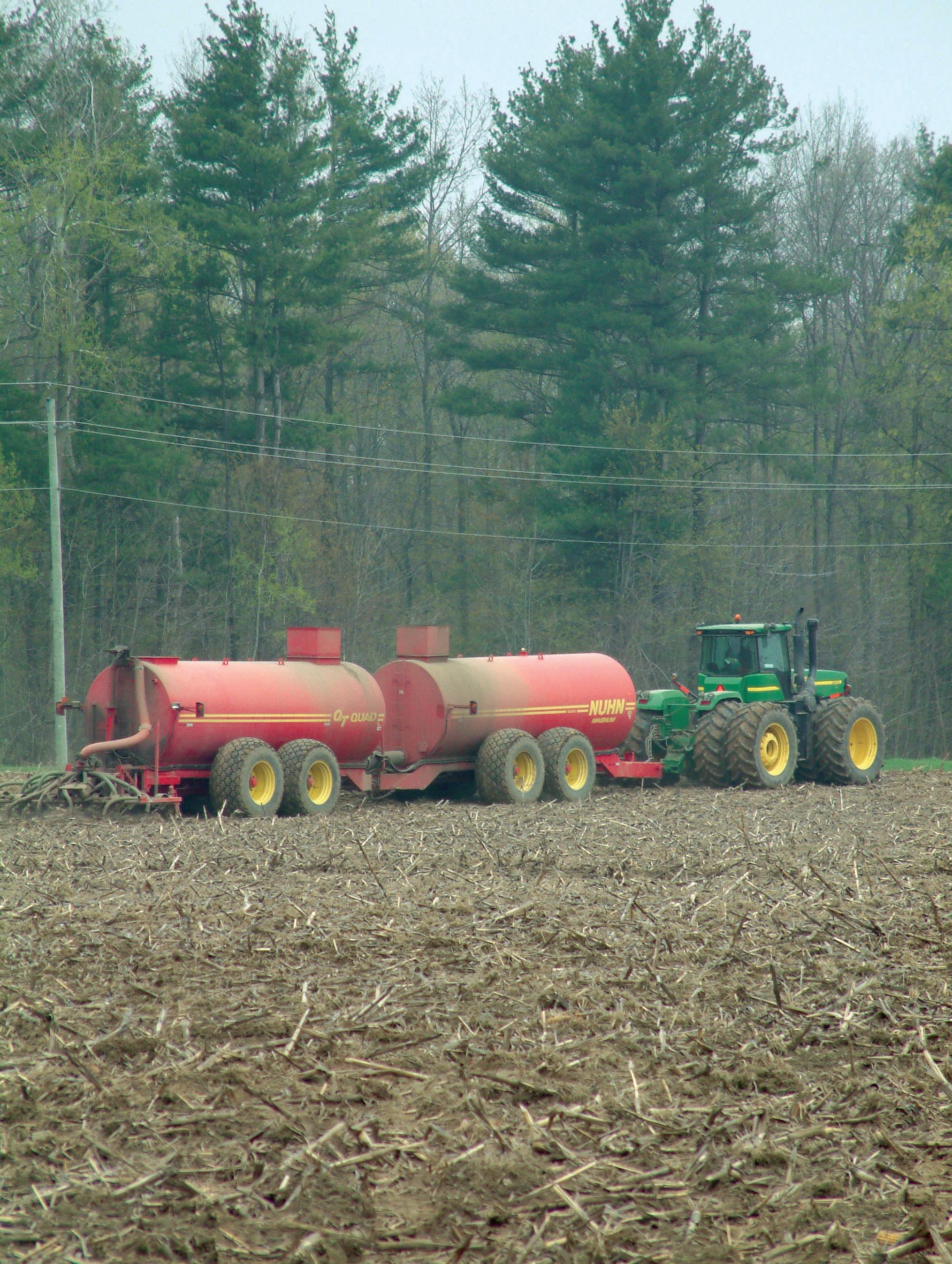
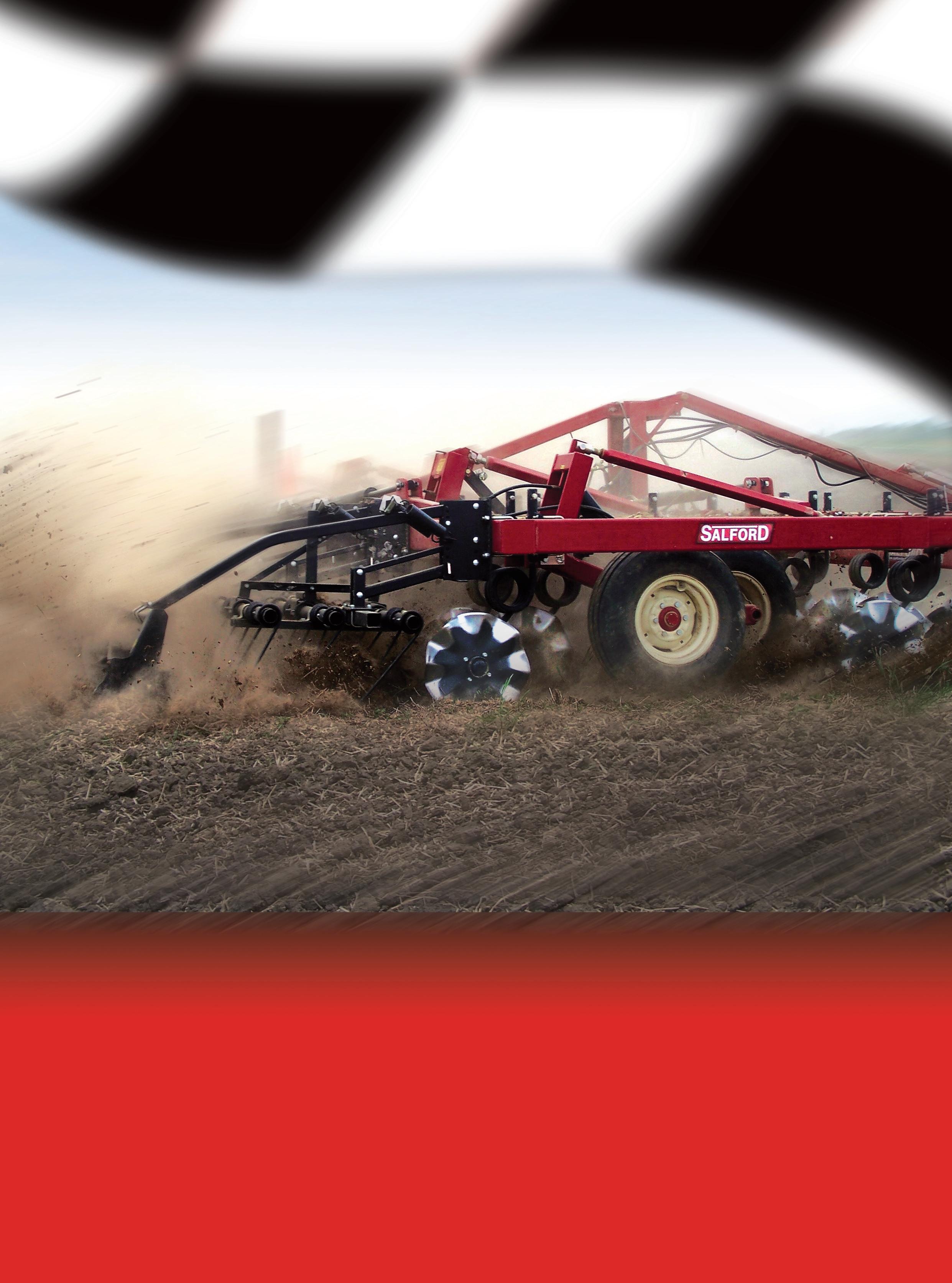
Cover: Spring is the time to empty manure lagoons and pits, and manure application gears up across North America.
Margaret Land • (519) 429-5190, (888) 599-2228, ext 269 mland@annexweb.com
contributing Editors Tony Kryzanowski, Diane Mettler, Lukie Pieterse
advertising Manager
Laura Cofell • (519) 429-5188, (888) 599-2228, ext 275 lcofell@annexweb.com
Sales assistant
Ryan Culver • (519) 429-5183, (888) 599-2228, ext 219 rculver@annexweb.com
production Manager Angela Simon
Group publisher Martin McAnulty mmcanulty@annexweb.com
president Mike Fredericks mfredericks@annexweb.com
Publication Mail Agreement #40065710
RETURN UNDELIVERABLE CANADIAN ADDRESSES TO CIRCULATION DEPARTMENT, P.O. BOX 530, SIMCOE, ON N3Y 4N5
e-mail: mweiler@annexweb.com
Printed in Canada
circulation
e-mail: mweiler@annexweb.com
Tel: 866-790-6070 ext. 211 Fax: 877-624-1940
Mail: P.O. Box 530 Simcoe, ON N3Y 4N5
Subscription rates
canadian Subscriptions (GST included)
$37 Cdn, one year - $65 Cdn, two years
U.S. Subscriptions: $37 US, one year - $64 US, two years
international Subscriptions $70 US, one year
From time to time, we at Manure Manager make our subscription list available to reputable companies and organizations whose products and services we believe maybe of interest to you. If you do not want your name to be made available, contact our circulatiom department in any of the four ways listed above.
Irecently spent two days hearing the latest and greatest on biogas production and the use of agricultural byproducts for energy production during the annual Growing the Margins Conference and the first annual Canadian Farm and Food Biogas Conference, both held in London, Ontario, Canada.
Sessions included everything from recycling raw manure using fly larvae to psychrophilic anaerobic digestion of pig manure. But one talk really stood out for me both in its simplicity of implementation and its usefulness for farm operators.
Ben and Laura Green, and their son, Glenn, operate Ledgecroft Farms Inc., a 470-cow free stall dairy operation located in Eastern Ontario, Canada. During the past 10 years, they have expanded their operation, which was founded in 1970.
And, while the family’s primary focus has been on milk production, “where there’s cows, there’s manure, and lots of it,” explained Ben and Laura’s daughter, Jennifer Green. In a bid to handle the manure responsibly, including decreasing greenhouse gas emissions and reducing its possible impact on surface water, the Greens decided to investigate installing an anaerobic digester. But, they were met with a problem.
“They had difficulty in information gathering,” said Jennifer, who serves as the digester project manager for the farm.
In agriculture, there’s a tendency for large projects, such as barn building, to be granted to contractors based on existing relationships, she explained.
When it came to anaerobic digestion, the Greens were dealing with an entirely new industry they had no background in. So, Jennifer suggested they borrow a resource tool from the engineering world – a Request For Proposal (RFP).
The RFP process is a common approach for design/build projects in the consulting and engineering industries but isn’t commonly used in agriculture. Ledgecroft’s principal members put pen to paper, developed an RFP for the digester project and invited four firms to bid. They received three submissions.
As part of the process, they decided to involve the farm’s lender in the review of technologies, a move that Jennifer described as having real benefits for the project.
“This really improved lender confidence,” she said. “We were able to satisfy a lot of uncertainties that can occur when attempting innovative projects.
“There was a seamless transition to obtaining funding for the project.”
In the end, the RFP experiment was a success and Ledgecroft awarded a contract for the digester project in March 2009. Jennifer recommends this approach to all farm operations considering a large project they might not have experience or expertise in.
“A project of this magnitude would benefit from this process,” she said.
I hope to have a more detailed article on the RFP process in a future issue of Manure Manager. Stay tuned.
Maximum benefit
By Tony Kryzanowski
Variable rate manure application on the fly or spot treatment – both feasible
Variable rate application of manure is something to consider as part of an overall focus by growers on precision farming or by custom manure applicators for providing a valueadded service to customers. One major advantage of this method is that the same volume of manure is often spread over a larger area.
The practice of applying manure at variable rates is essentially an attempt to place the right volume of manure precisely where it is needed, based on the manure’s nutrient content and soil samples. It sounds easy in theory. It’s not so easy in practice, and is far easier to control with liquid manure than solid manure.
Variable rate manure application
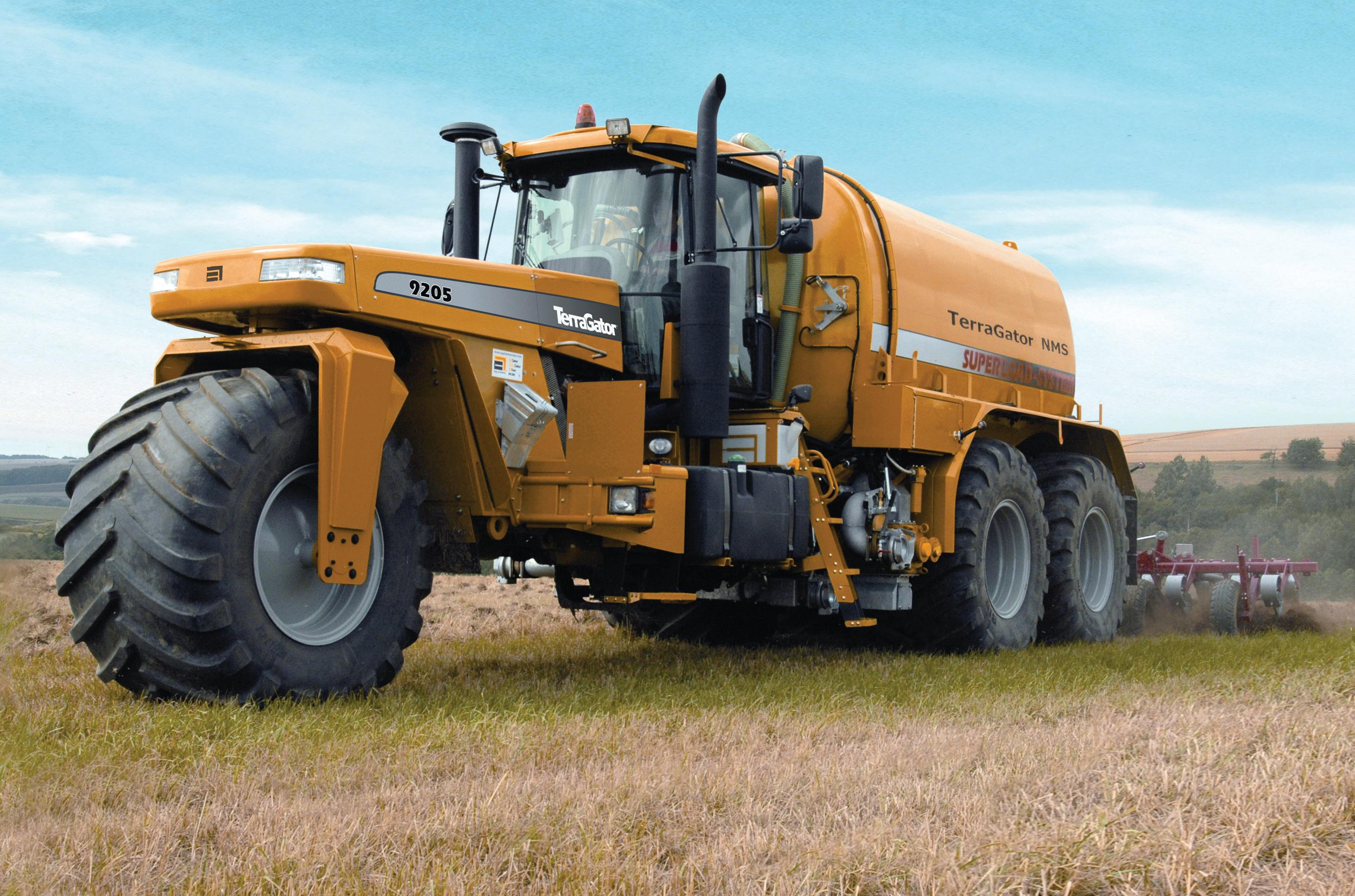
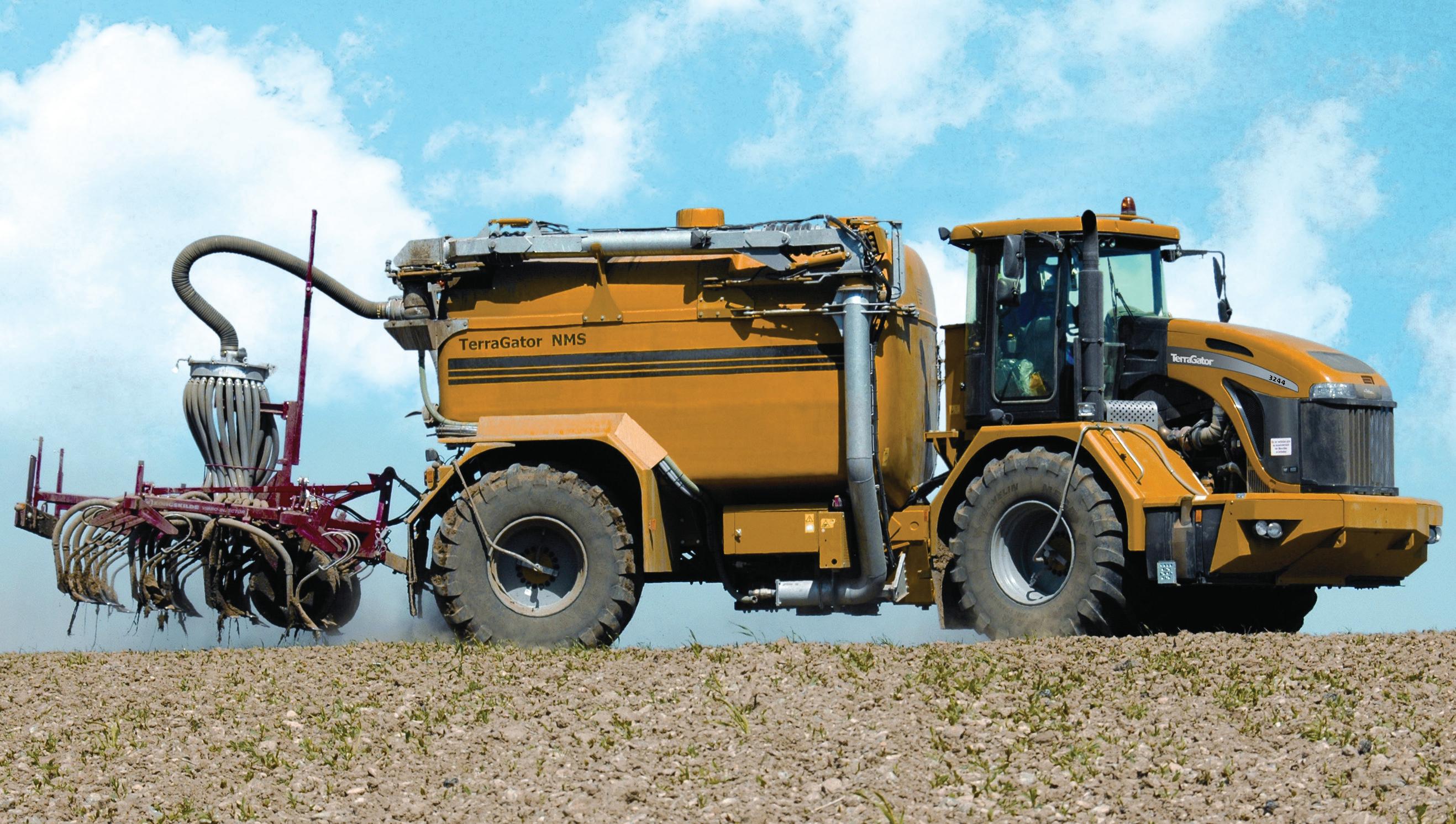
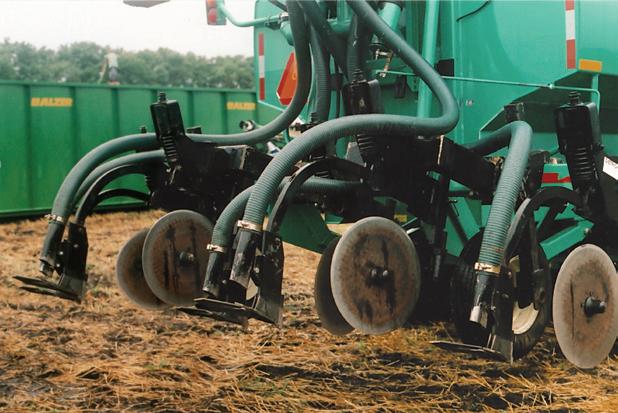
Among the systems for variable rate manure application is this TerraGator NMS 9205 purpose-built unit manufactured by Ag-Chem.
can vary from inexpensive, low tech, common sense methods to more expensive, high tech electronic methods featuring all sorts of off-the-shelf gadgets. Some custom applicators offer Cadillac variable rate application technology using purpose-built application equipment.
Ag-Chem, a part of AGCO Corporation’s Application Equipment Division, is one of only a few providers of self-propelled equipment for variable rate application of manure, and offers it for solid as well as liquid waste. The company’s TerraGator NMS 9205 and TerraGator NMS 3244 units are particularly suited for the purpose. Its Nutrient Management System applies liquid or solid material up to 80 feet wide and application rates can be adjusted on the fly from one to 30 tons per acre. The system consists specifically of Ag-Chem’s Soil Geographic Information System (SGIS) desktop software to create application maps, and this information is entered into the Falcon Virtual Terminal controller. This controller controls site
specific, accurate application of organic materials as directed by the map and nutrient needs of the crop.
At the farm level, some of the most accessible and affordable systems are those emanating from qualified agronomists or university research programs.
For example, the University of Illinois has developed an electronic system that allows for variable rate liquid manure application on the fly. It is portable and can be installed on either a drag hose or tanker system. Best of all, the components of the system can be acquired off the shelf, and the university can provide a general design schematic free of charge.
The system has proven effective with drag hose systems, but visiting research engineer at the University of Illinois, Matthew Robert, says there is no reason it couldn’t work on a tanker system as well, except that there is a lot more traveling involved with tankers.
It all starts with developing a proper nutrient management plan, beginning with manure sampling to ascertain the nutrient content of the
Ag-Chem’s Falcon Virtual Terminal controller installed on its TerraGator NMS 3244 purpose-built manure applicator represents some of the most advanced technology for variable rate manure application.
liquid manure. The next step is soil sampling to determine the areas of the field where more or less manure application is required to achieve crop production targets. Growers can then input this data into a program like Farmworks, “which is just a regular fertilizer application program that we adapted to manure,” says Robert.
Software development is where Robert believes more work needs to be done in terms of creating a purposebuilt application program for farm use specifically for variable rate manure application.
“Trying to use fertilizer programs is really, really hard,” he says, “and if there was a program set up for manure application, that would really get the ball rolling for all the custom applicators and producers.”
By cross-referencing the field soil sampling data with the manure nutrient data, the producer is able to calculate how many gallons of manure should be applied in specific areas of the farm. Once that data is inputted into the computer software, this produces a color-coded map indicating how many gallons of manure should be applied in specific areas of the farm. Each color represents a different volume requirement. What the producer must now determine is
what speed the tractor or truck should travel and at what specific manure flow rate to achieve the proper application. The biggest challenge at this point is setting the flow rate because the flow rate from a liquid slurry will vary at times during the application, which will require a speed adjustment. Designing a quick reference chart relating flow rate to speed and keeping a copy in the cab during the application process is probably a good idea.
So how does the operator monitor all of this data during the application process? The University of Illinois has assembled a list of system hardware and how it all ties in.
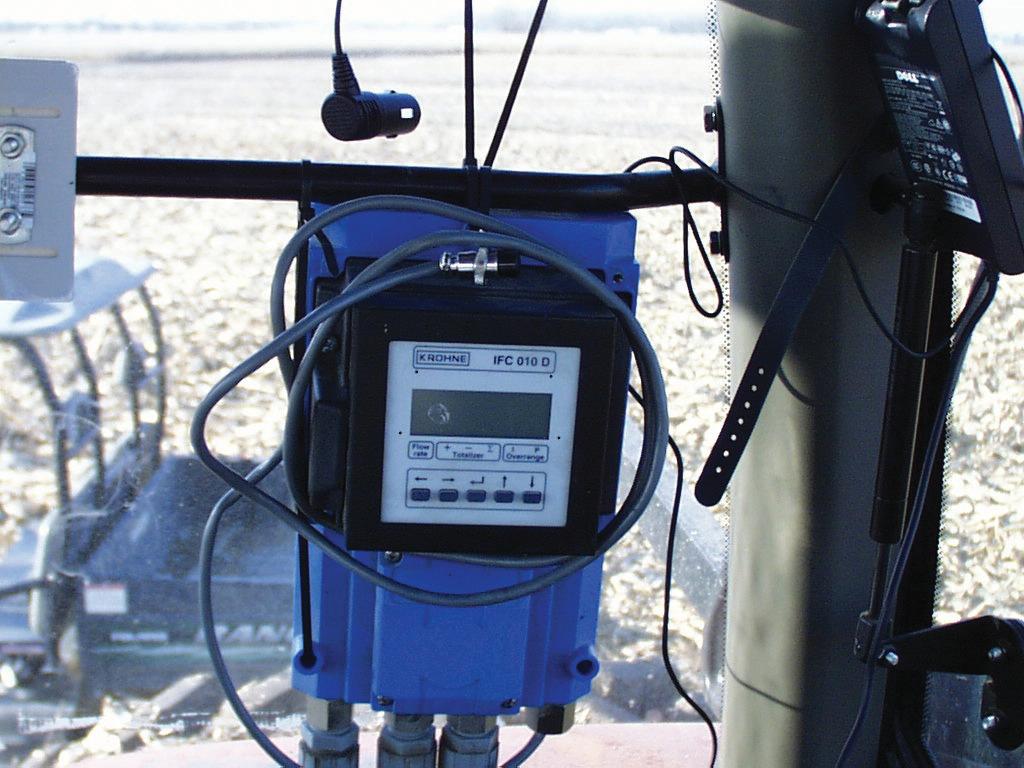
The first item, at a minimum, is a laptop that can be stationed in the cab so that the operator can monitor flow rate, speed, field location, and the color-coded application prescription in real time. Robert recommends the purchase of a touch screen that connects into the laptop so that it is easier for the operator to monitor the data. The second item is a GPS unit to monitor location and speed. The third item is a flow meter. The university uses a Krohne flow meter. The fourth item is the electronic interface developed by the university that ties all the elements together and transmits the information from the GPS unit and flow meter to the
laptop or touch screen.
As the operator drives across the field, he receives a constant flow reading on the monitor that, according to his chart, determines how fast he should be traveling based on his location on the field and the color code in that area. These are all visible on the computer screen. He should adjust his speed with any significant change in the flow reading, according to the chart he has prepared in advance, or when crossing from one color-coded area to another. The operator can manipulate the application rate based on speed adjustments.
Essentially, this system allows the operator to vary manure application on the fly using the flow rate and GPS color-coded map as his guide, and adjusting his speed accordingly.
“It’s very precise,” says Robert. “You can do it on a grid system very easily.” He adds that producers and custom applicators are all interested in using this method, as long as it is easy to use and that it comes at a reasonable cost. For now, he says he’s convinced the university has nailed down ease of use. Cost will vary. For example, if the operator decides not to purchase a touch screen, that represents a savings of about $2000. The total cost of the system, he says, is well under $10,000. Furthermore, after manure application
is complete, all of the hardware components can be removed so that in the case of a farm tractor, it can be put to use in other areas.
Time is not always a critical element, so having the ability to make rate adjustments on the fly is not always that important. Growers in particular should balance their investment in time, effort, and cash for on-the-fly variable rate application against the speed and convenience benefits. Sometimes, if time is not a critical factor, all it takes to adopt some measure of variable rate application of manure is common sense and working with qualified farm specialists to put a well-developed nutrient management plan into action.
That’s what Agri-Trend Agrology Ltd. did recently with two of its farm customers in Manitoba. The farmers worked with Agri-Trend Geo-Coach, Warren Bills, and Agri-Coach, Denis Vermette, who helped them devise a system so that they did a better job of more precise manure application using their existing equipment, which included the use of a GPS device. With colorcoded map in hand provided by AgriTrend and the GPS unit, the growers simply applied the prescribed rate based on where they were on the field.
“Precision farming doesn’t always require the maps, the monitors and the technology,” says Bills. It is sometimes just a question of applying manure on a site-specific basis rather than as a whole.
The Manitoba farmers have achieved good results.
“We’ve noticed an improvement from five years ago,” says Elma-area farmer, Roger Giesbrecht. “There’s less lodging and more even crop maturity.”
The project started with conducting a chemical analysis of their manure sources. Then, a couple of soil samples were taken by Vermette at different depths every five acres, resulting in a color coded map that the farmers could use as reference, showing areas where manure may have been over or under applied in past years. Bills says he believes this type of field research is essential, even if farmers are working with a custom applicator offering variable rate application technology.
Now, the farmer simply adjusts his manure application volume based on where a GPS device tells him he is located on the field and crossreferences that location with his colorcoded map. Each grid on the map is treated like a separate field as far as
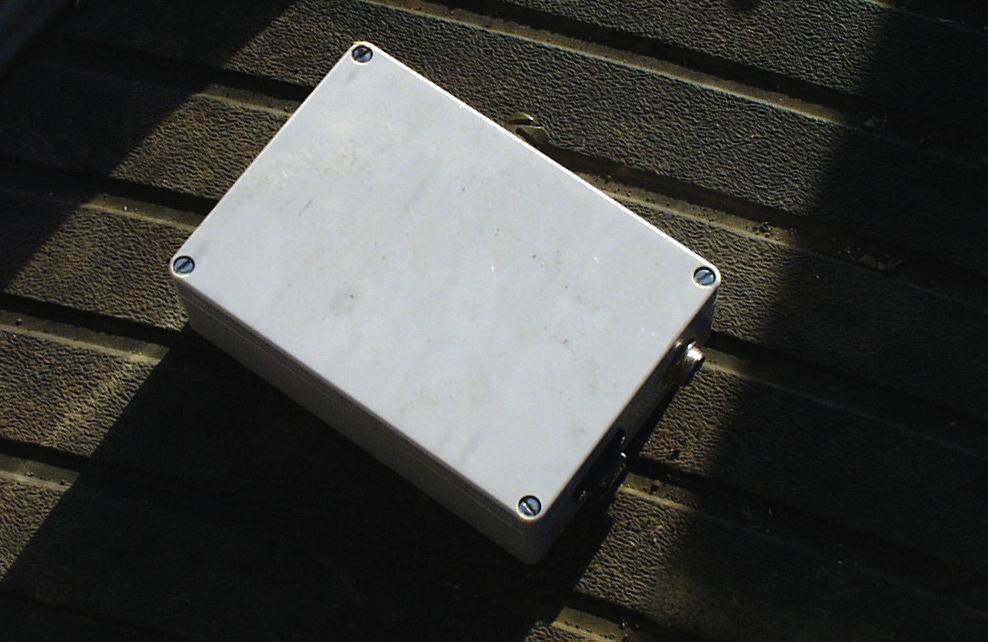
Advances in technology, like this black box that allows various electronic components to communicate and coordinate with each other, make variable rate manure application more accessible in today’s world.
The flow meter is a critical component in the University of Illinois’ off-the-shelf variable rate manure application system.
manure application is concerned.
Once the farmer has the detailed map in hand, Agri-Trend recommends that he only conduct random sampling for the next five years to ensure the manure application prescription is achieving its targets. Bills says some farmers may be able to avoid another detailed soil sampling for a long time, and in some cases with the overall nutrient content evened out throughout the field, revert to a less
time consuming single application rate throughout the field.
The financial payback for farmers using either the on-the-fly or spot treatment approach is that they can potentially spread the same amount of manure over more acreage, as it is being placed precisely where it is needed rather than being broadcast at a single application rate. Furthermore, there is the potential for more even crop maturity at targeted production rates.
Combining urban and rural waste
By Diane Mettler
New technology combines town and farm waste to create power
Italy’s known for high fashion, but it’s also getting a name for innovative waste handling.
Italy has for some time had a serious problem with disposing of it “urban organics,” also known as garbage. Garbage disposal systems are not allowed so for the past 20 years, trucks have picked up the bagged garbage and delivered it to landfills. Or they have taken the waste to facilities to be turned into biofuel. Unfortunately, at these facilities the waste stream must be sorted manually and is fraught with health issues.
“Dr. Carlo Sordelli envisioned this problem as a resource,” says Richard Miller, vice president of DODA USA. “With more than 30 years of experience in alternative energy projects, including biogas, geothermic, solar and wind, he recognized this waste stream as a powerful biogas feedstock and saw a more efficient way to utilize it.”
Dr. Sordelli’s vision also included the rural community. Farmers would be able to turn their manure into a value-added
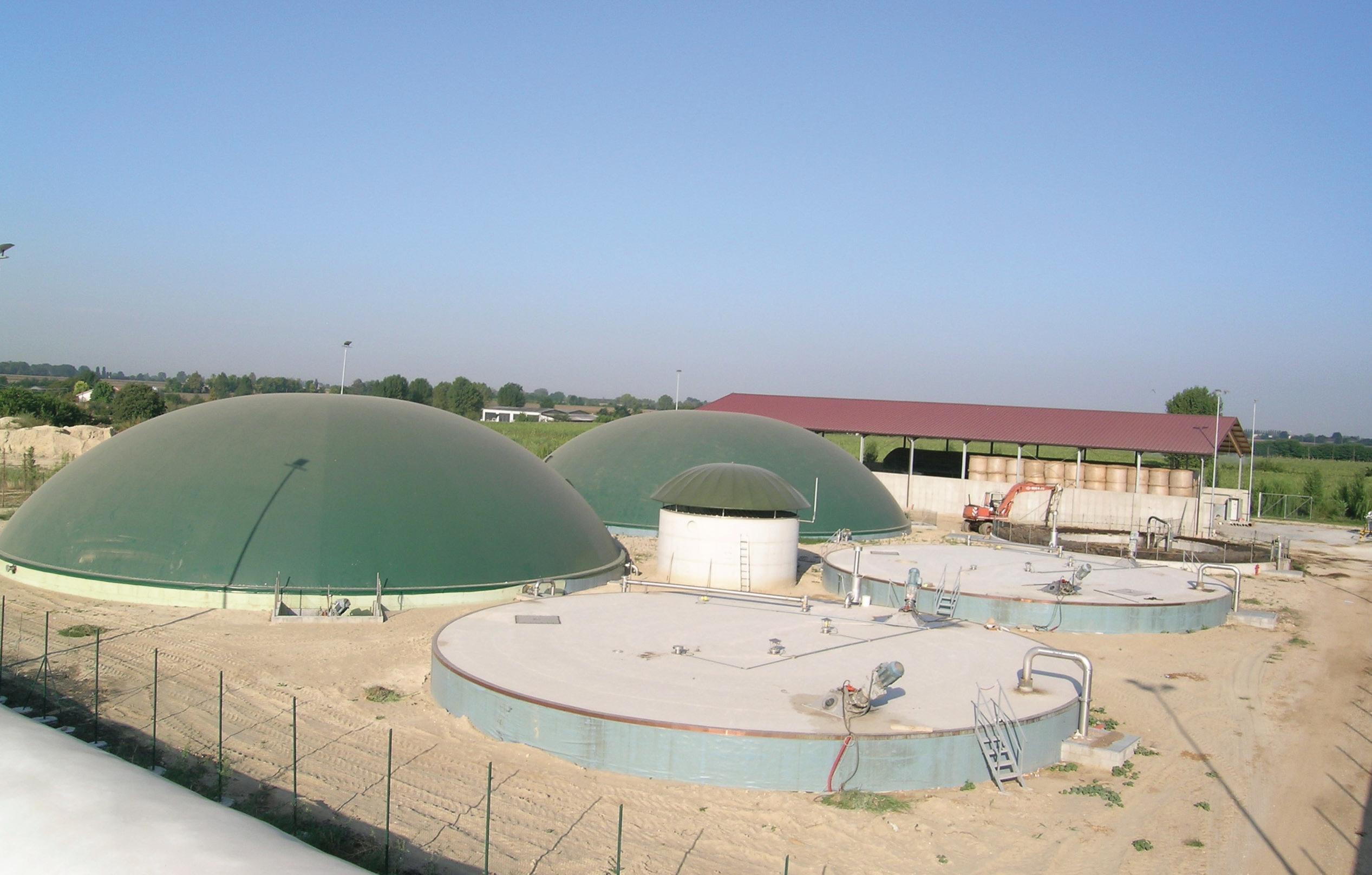
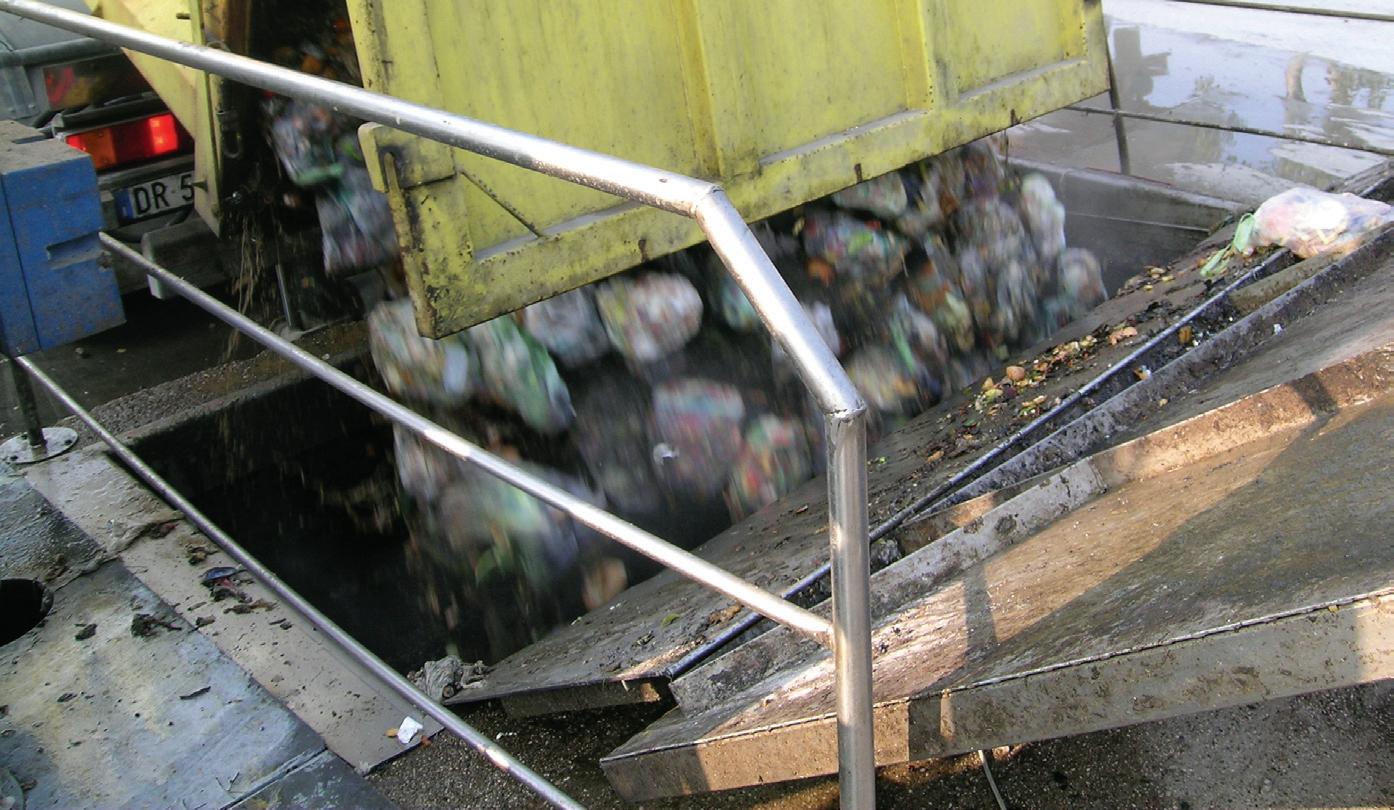
Top: The Rivalta Energia Project is a cooperative formed by area farmers and entrepreneurs that uses manure and urban waste to produce biogas and compost. The facility is based in Buscoldo, Italy, and started operation in the fall of 2007. Bottom: Trucks bring bagged garbage to the facility. Submitted photos
product, while producing and selling electricity.
Dr. Sordelli came to DODA, headquartered in Buscoldo, Italy, with his vision and challenged the company to design it. DODA, known as the “go to” company when it comes to waste management questions, took on the challenge. Their solution became the
Rivalta Energia Project, which went into operation in the fall of 2007.
Rivalta Energia Project
Rivalta is a cooperative formed by area farmers and entrepreneurs, including Dr. Sordelli. The unique operation sits on about three acres near Buscoldo and is being visited by farmers and
municipalities worldwide, looking to take advantage of this new technology.
The processing system is fairly straightforward.
• Step One – Trucks bring the bagged garbage and a bag opener slices open the plastic bags, releasing the contents. It also periodically reverses rotation, preventing the wrapping of bags.
• Step Two – A uniquely designed
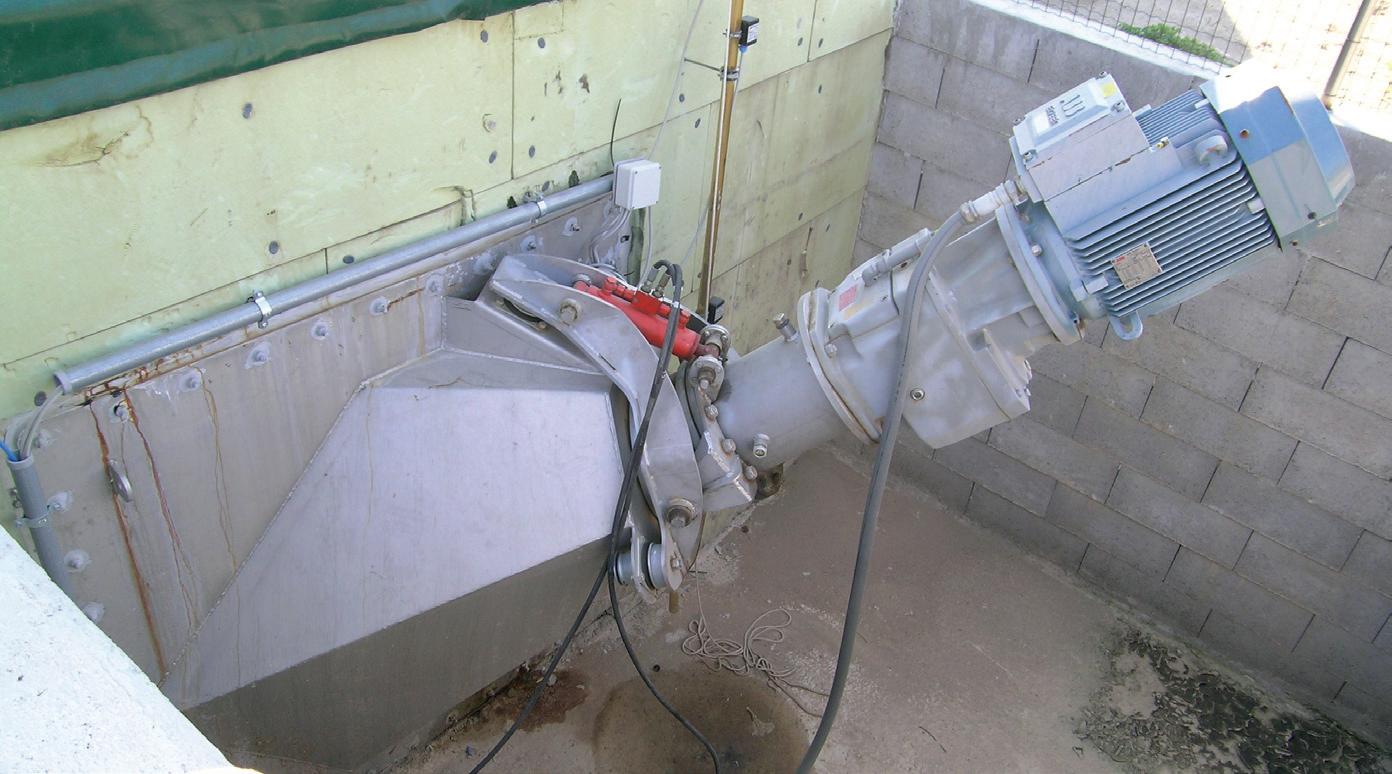
chopper pump agitates and chops the bagged contents and mixes it with digester effluent to form a thick pulp.
“The pump is designed to withstand severe abuse but, on occasion, receives items such as large chunks of iron that it can’t pass,” says Miller. “The pump has a hydraulic quick removal system that allows easy access in the event repair is needed. ”
• Step Three – A specifically designed bio separator separates the contaminants (plastics, metal and other non organics) from the digestible slurry. The pulped waste from the chopper pump is pumped to the bio separator to spin the contaminants from the slurry into a dumpster that’s sent to a plastic recycler.
“The entire process is controlled by a computerized panel board to control each element of the system,” says Miller.
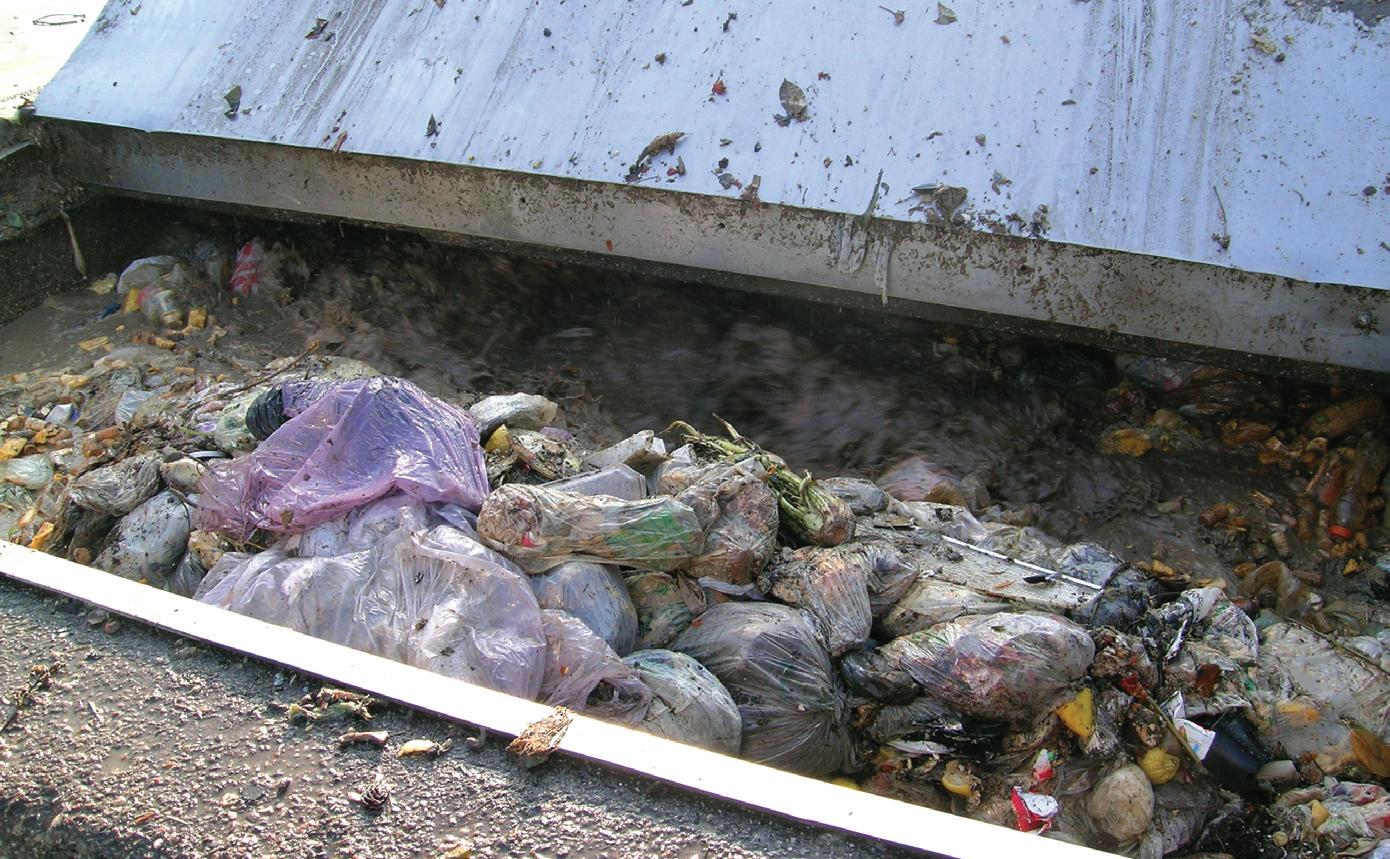
• Step Four – Before going to the digester, the filtered slurry goes to concrete reception pits, which are equipped with hydraulically controlled covers. Manure from 140 dairy cows is also added to the pits (also referred to as the “kitchen”).
The pits can also receive silage, or other similar grasses or feed stock like greases, fats and oils.
Odor isn’t an issue with these particular pits. They are under a vacuum, so no odors are being emitted. Also, when the pits are being agitated, air is pulled from the pit and run through a bio filter filled with wood chips to filter the air.
To make the system more efficient,
The bagged garbage is mixed in with digester effluent. Submitted photo
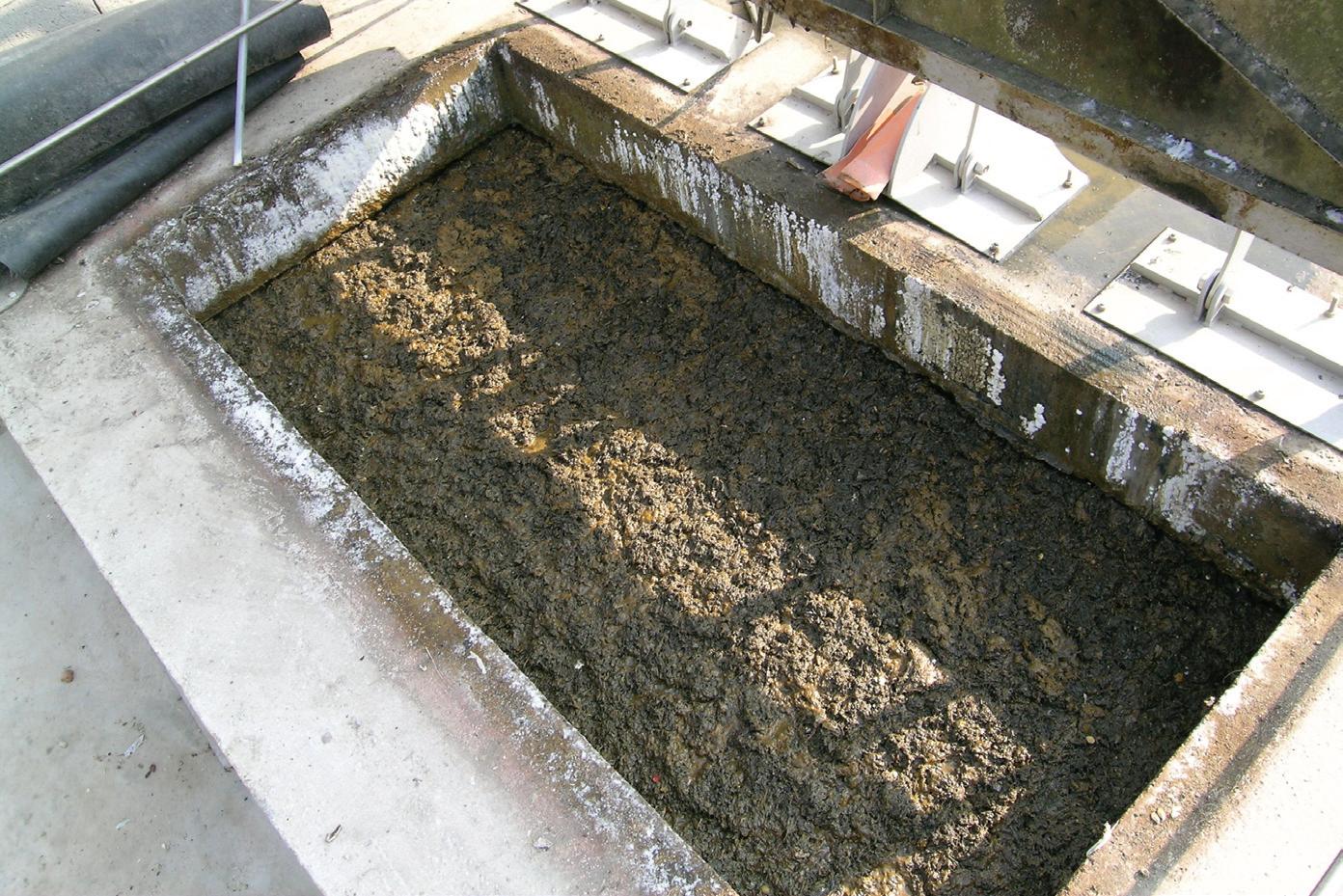
Before going to the digester, the filtered slurry goes to concrete reception pits where manure from 140 dairy cows is added. The pits can also receive silage or feed stock like greases, fats and oils. Submitted photo
Each digester tank is mixed periodically by biogas mixers to keep the mixture homogenized. Submitted photo
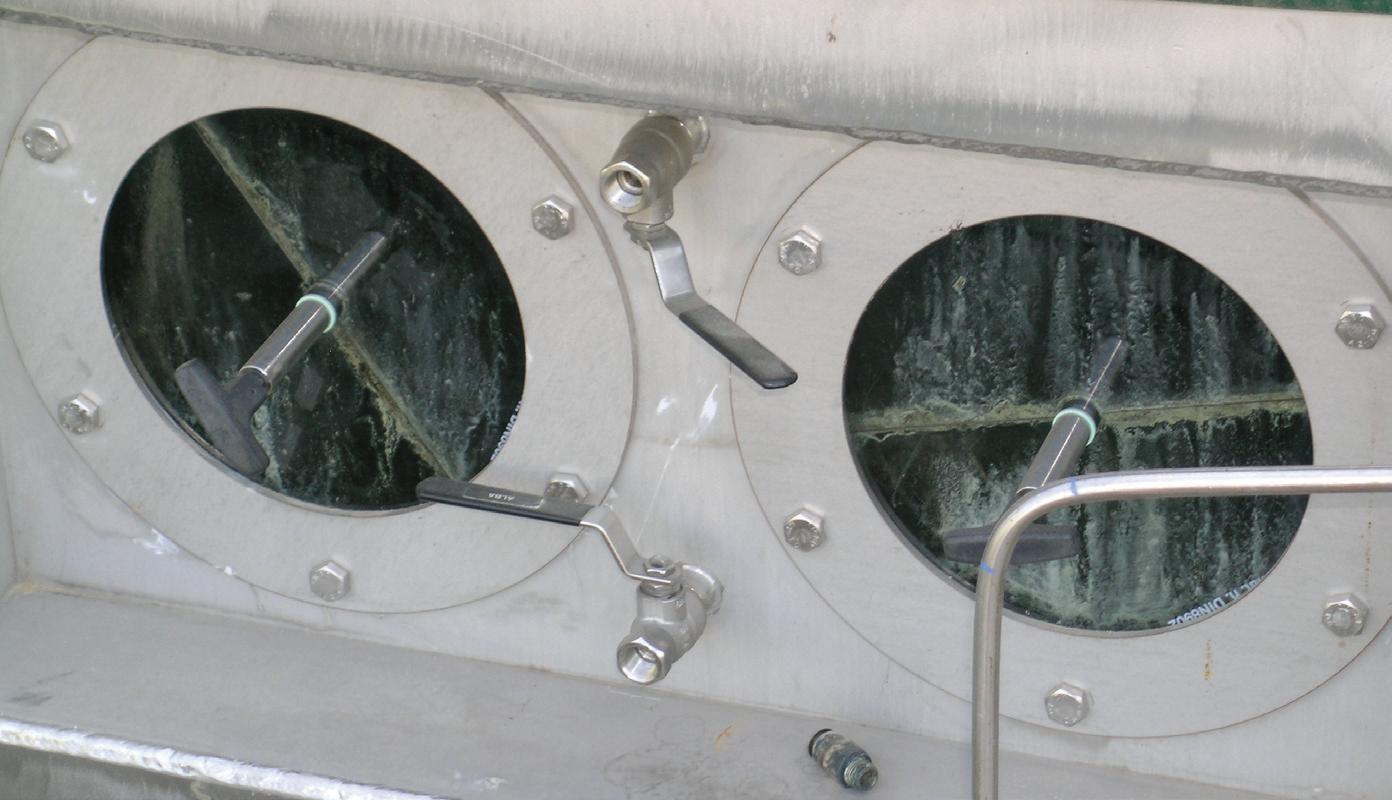
Observation windows were installed in the digesters so operators can see what the waste condition is at all times. Submitted photo
DODA developed a bio box that allows the various slurries to be moved to any place in the facility by one pump and controlled by computer. “The system seems complicated but is rather simple and allows for convenience by the plant operator,” says Miller.
Digesting
The digester system requires 110 tons of substrate a day and can produce one megawatt of energy — expandable to two megawatts.
“It’s a complete mix, two-stage design and is thermophillic,” says Miller. “It operates at 51 to 52 degrees Celsius, or about 125 degrees Fahrenheit.”
There are four tanks — two for the first stage and two for the second. “The primary stage is a round concrete tank with a concrete top. Its purpose is to collect the gas that releases quickly from substrates high in sugars,” says Miller. “The retention is 12 to 15 days, and the gas production is high but lower in methane than stage two.”
The second stage digester is also a concrete tank, but utilizes a two-piece membrane top. “An outer membrane is domed and is inflated by air,” explains Miller. “The inner membrane expands and contracts with gas production and extraction.”
The substrate is retained for 25 to 30 days during this second stage. The gas production is lower but very rich in methane. In fact, Rivalta has experienced exceptional methane production — 800 cubic meters of gas per hour, containing 68 to 70 percent methane.
“The biogas produced is scrubbed and sent to generators that produce the electricity that is sent to the grid,” says Miller. “And water, used to cool the generators, supplies hot water to the heat tubes in the digester tanks.”
When Dr. Sordelli was asked why he chose a two-stage digester design, he said that two complete sets of tanks assure they will never be shut down and not be producing gas. He compared a digester to a cow’s stomach, which has four stages for more complete digestion and efficiency.
The idea behind the Rivalta Energia Project was to extract all energy possible from the substrates. Dr. Sordelli feels this system is the most efficient by far, and that following “nature” is always the best path.
Mixing it up
Each digester tank is mixed periodically by biogas mixers. Miller says that keeping the mixture homogenized is an important
step. “By thorough mixing, you have consistent temperature and that keeps the ‘bugs’ happy. The mixers turn quite slowly and are installed with variable frequency drives. Experience has shown that ‘motion, not commotion’ is best in mixing substrate.”
The mixers also prevent crusting, which is important to the process and observation windows were installed by DODA in the digesters so the operators see what the waste condition is at all times.
After the substrates are done digesting, they’re sent to a holding pit, and then pumped to separators.
The liquids from the separator are used as fertilizer and/or recycled back to the “kitchen” for mixing. “This effluent is very rich in available nitrogen as only the carbon atoms are extracted during digestion and makes great fertilizer,” says Miller. The solids are collected and composted for use as soil amendments.
Miller says that studies are being done to see if the solids can also be used to produce bio diesel through pyrolysis. In simplistic terms, the process exposes the substrate to high heat. Gases coming off the substrate contain solids that, when condensed, contain bio oil.
“The cost of this process is too expensive right now to be economically feasible,” says Miller. “But as science goes along, who knows where it will end up.”
Benefits for farmers
The benefits of the system to farmers are many. First, the facility doesn’t require many man-hours to operate — only 1,800 per year. It can be run by computers — either on site or via hand held devices.
Second, besides either selling and/or using the energy produced, farmers can expect to receive ”tipping fees” from the companies delivering the urban waste. “These fees can run as high as $100 a ton,” says Miller.
Lastly, the solids and liquids coming off the digester can be used on fields or sold to other farms.
As for the urban waste handlers, the fee to deliver the organic waste to the farmer is normally lower than the cost to have it delivered to a landfill, and is a much healthier and green environment alternative.
“There’s nothing negative about the process,” says Miller.
The only snag that has come up during the Rivalta project is that a few areas produced too much negative product (such as a large piece of steel in the waste stream) to be a candidate. But other that that, the project has been a complete success.
New operations coming on board
The Rivalta Energia Project is gaining momentum.
“Interest in this system and technology is tremendous,” says Miller. “Visitors from all over the world are coming to witness the everyday business of the Rivalta Project. When I visited in October of 2008, there were two additional plants being constructed and plans for three more in 2009. When I visited in January, plans for a total of 12 plants were in the works for 2009.”
Miller says the system is ideal for both municipal applications handling
collected waste. Also, farms that don’t have enough manure to make a digester feasible but are near a metropolitan area where there’s lot of food waste coming either from individuals or food processing plants, are good candidates.
After attending trade shows and taking companies and farmers to Italy to show them first hand the operations, Miller says, “the interest in using the ‘urban organic’ waste stream is definitely hot right now.”
For more information and a free video of the Urban Organics system, contact DODA USA Inc. @ 507-375-5577 or dodausa@emba.
A case study of two daiRy ManuRe ManageMent systeMs
By Patrick Nortz, C.P.G., P.E.; Timothy Krause, P.E.; and Thomas Menke
As the world economy drives livestock farmers to produce more food at less cost per animal, larger livestock operations become more prevalent. Many modern farms house hundreds to sometimes tens of thousands of livestock on site. These livestock operations produce a more concentrated volume of manure. In turn, the operations seek increasingly better ways of laying out the farm operation to: maintain animal health; improve manure transfer, treatment, and utilization; and minimize costs and labor. This article presents basic concepts for wastewater treatment systems for dairy operations that utilize available resources on the farm to maximize treatment. We follow that explanation with examples of systems that incorporate these concepts. The examples provided here will help show how selection and proper operation of manure management system (MMS) can increase the profit of the business, take full advantage of the nutrient value of the wastewater in crop production, and improve environmental protection.
The Decision-Making Process
It stands to reason that farmers want, or even expect, their MMS to help realize a return on their investment. The challenge is to design and operate a MMS that will
provide a return on investment within an agreeable timeframe. Each farm is different, thereby requiring a different MMS. To help recognize a return, farm managers need to make decisions on what benefits given by the MMS will be the most beneficial to the farm. During the decision-making process, farm managers should leverage their assets. For example, a farm’s assets could include: that there is nobody around for miles (in other words, odor complaints may not be their primary concern); they have personnel who likes to tinker with systems and would make a good treatment-system operator; or a nearby landscape operation that can use the manure byproducts for compost.
An important consideration is the variability of the waste stream produced on the farm. Variability is most often a function of weather. Depending on whether the climate is arid or moist, the manure waste stream can operate with a “fresh” supply of water or be drier (i.e., thicker). Weather can also impact the volume of contaminated storm water that comes in contact with stored feeds and outside feedlots, thereby affecting the waste stream. Variability in a waste stream makes it essential to choose a system that is robust enough to handle changes in consistency of the waste stream. If you select components that require a consistent waste stream to function properly, there is a good chance
you will end up with something that works about half the time.
In almost every case, the two commonly overlooked farm assets are time and space. Many of the traditional wastewater-treatment technologies being transferred to MMS were designed to quickly treat the manure waste stream in an area similar to typical municipal wastewater treatment systems. Quick treatment comes with increased costs for maintenance, operation, and energy. These are all costs that the farm pays for directly. If a MMS is designed properly from an ideal storage and operation perspective, it should cost a farm virtually nothing for treatment to occur. Typically, a larger land footprint is required for “passive” manure treatment components. These treatment components take longer to treat the manure but use less energy and have less operation and maintenance needs. Fortunately, most farms have available land to accommodate manure treatment components with a larger footprint.
Considering System Benefits
Aside from leveraging assets, several potential benefits need to be considered. Most farmers understand the benefits of various treatment components. But an in-depth analysis may help determine what MMS component or system makes the most economic sense for their farm. A dollar
value can be assigned to some benefits while others are harder to measure.
Potential benefits of an engineered MMS can be determined by measuring the cost of labor, energy inputs, maintenance, fuel, and by-product reuse. Some less measurable benefits of a MMS are odor control, environmental protection through pathogen and nutrient removal, and avoiding conflict with the government agencies or the community. The remainder of this article presents the benefits two dairies recognized by installing engineered MMSs that utilize the farm’s assets.
Flush-Flume and Sand-Lane System
Burdock Hill, located in Hastings, Michigan, is a 550-head dairy. As part of an expansion in 2008, they constructed a flush-flume/sand-lane system. The farm uses sand bedding and has automated alley scrapers. Prior to the expansion of the farm, the parlor wash water and silage runoff was stored in one pond while the sand-laden manure was stored in pits at the ends of each barn. The capacity of the storage units was limited, thereby requiring frequent spreading of sandladen manure.
Dan and Chris Javor, the owners of
Burdock Hill, did their homework prior to selecting a new MMS. After deciding on a flush-flume/sand-lane system, they visited other farms that had similar systems. The Javors observed the other systems in operation and talked with the owners and operators of those systems. They wanted a design that took advantage of the 30-foot elevation change across their farm. They identified specific system components that would increase the efficiency of treating
the sand-laden manure waste stream and improve the overall farm operation.
Burdock Hill retained NTH Consultants, Ltd., of Grand Rapids, Michigan to assist with the design and installation of the system. One floating pump charges the entire system by pumping up to the flush flume starting at the parlor holding area. The flush flume transfers manure from each of the free-stall barns, incorporating the
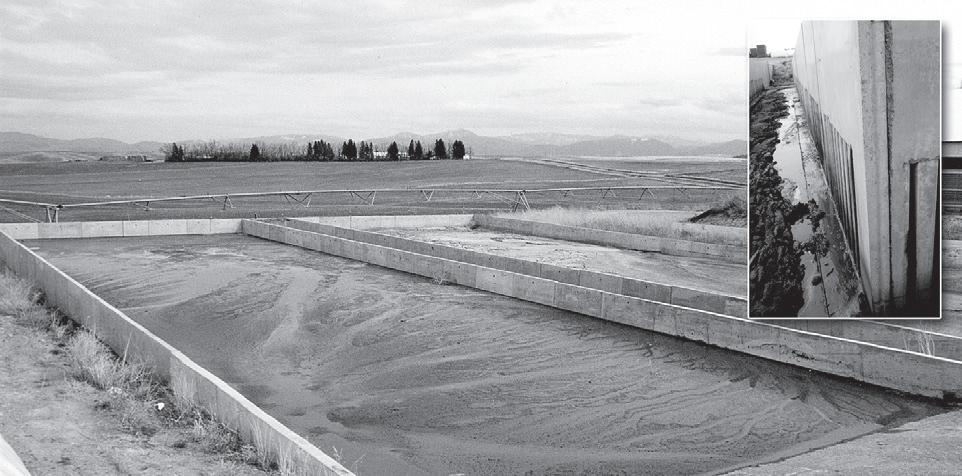
Photo 1: Sand lane, vertical concrete wall, access ramp, and solid stacking slab at Burdock Hill Dairy
previously existing automated scrapers. The scrapers deposit sand-laden manure into the flush flume through drop chutes located at the ends of the barns. To collect manure at the end of each barn, the flush flume is laid out with six 90-degree turns. The sandladen manure flows from the flush flume into the sand lane. The sand lane has a vertical concrete wall along one side and a concrete access ramp along the other side. A sloped stacking area is located along the same side as the access ramp. The sand that settles out in the sand lane is recovered and “stacked” on the solid stacking slab. The water content in the sand seeps out and the sand is eventually reused as bedding. The sand lane is connected to a series of three settling basins. The basins are designed to allow for the finer sand particles and fibrous organic solids to settle out. The manure in the settling basins has the highest fertilizer nutrient value. The accumulated solids slurry is removed from the first settling basin around every three months. The solids slurry is spread on cropland via a tanker. The liquid slurry in the second and third settling basins is applied via a drag hose. The third settling basin empties into an earthen storage structure where the liquid is stored until
it can be irrigated onto growing crops. Approximately half of the liquid in the storage structure is permanent and is used for recirculation in the flush-flume system.
Recognized Benefits of a Flush-Flume/Sand-Lane System
The Javors identified several benefits with the new system, including achieving their original goal of having an efficient MMS using only one pump. They also reported system benefits with respect to reduced labor, maintenance, and fuel. Prior to installing the flush-flume/sand lane system, Burdock Hill was rebuilding tanker pumps every few months and paying approximately $3,000 in equipment fees each time. Since Burdock Hill installed the system in early 2008, the farm has not needed to rebuild a pump. In summary, Burdock reports reductions in:
• fuel use;
• tire wear/purchase;
• pump repair/maintenance (no pump rebuild since early 2008);
• labor (nearly 80 percent less); and
• sand purchase (up to 80 percent is reused).
The benefits of the flush-flume/ sand-lane system have exceeded the Javor’s expectations. They recognize this system may not be a perfect option
for each farm but are satisfied with the results of combining transfer and treatment. This MMS did not come with an owner’s manual. Therefore, some trial and error was necessary. Some of the disadvantages of the system:
• the sand cannot be reclaimed when the temperature falls below approximately 25 degrees Fahrenheit;
• the reclaimed sand is not as clean as purchased sand (use of the reclaimed sand has not created problems when properly managed);
• and the system requires ample clean water to properly transfer and remove the sand.
Burdock Hill Dairy has a long history of managing the manure in an environmentally sustainable manner. Even before installing the flush-flume/sandlane system, community relations were not a problem for Burdock Hill. As such, when Burdock Hill selected this MMS, environmental benefits like odor and pathogen reduction were not as critical as they may be with some larger farms.
EarthMentor®
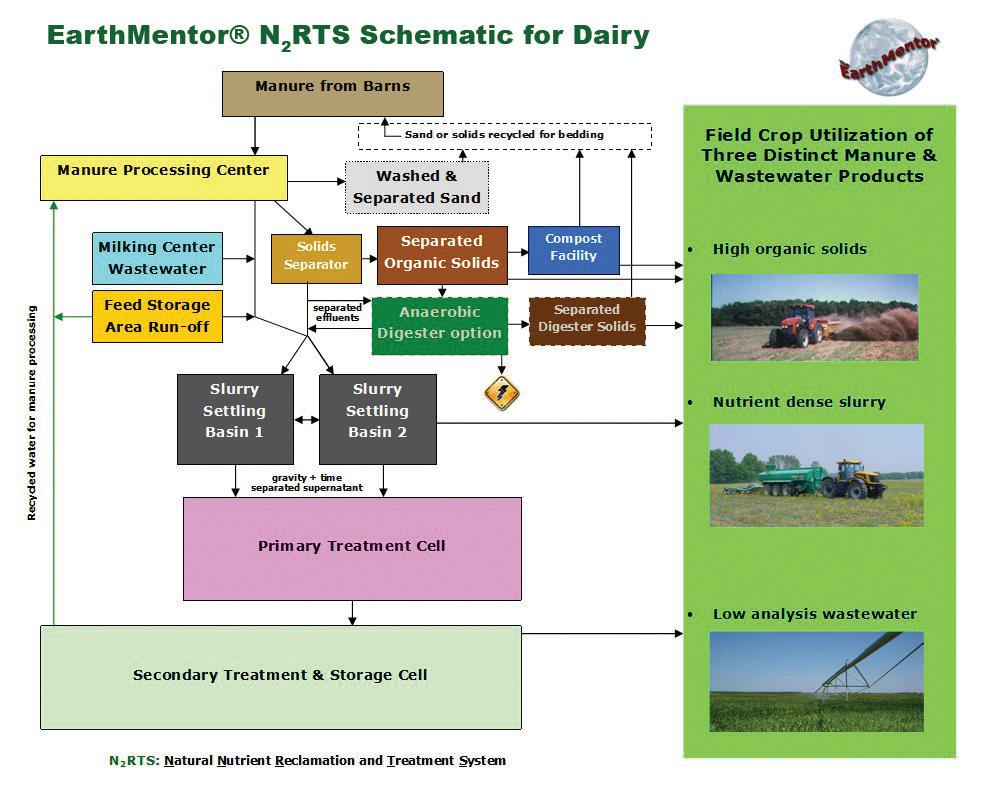
Two Vreba-Hoff dairies located in Hudson, Michigan, were challenged with proper manure treatment as the dairies grew from several hundred head to more than 7,000 cows over a four-year period. The dairy expansions and a desire to use sand bedding prompted management to convert to a new system and replace the mechanically intensive Press Treatment System (PTS) that was in place before the expansion. The proprietary EarthMentor® manure management system (EMS) by Envirolytic Technologies, LLC was selected to help address an environmental mandate from the Michigan Department of Environmental Quality (MDEQ). The mandated standards required treating the manure for specific pathogenic-indicator bacteria (fecal coliform) prior to land application.
The EMS takes advantage of various components of treatment and recycling. If sand bedding is used, the sand can be hydraulically separated to be reused as bedding. Fibrous solids are then removed by a screen separator or screw press. Fibrous solids may be: composted for re-use as bedding; or sold as an additive for compost or as a soil amendment. Composting provides pathogen control where required. After removal of inorganic and coarse solids (sand and fiber), additional fine solids (and the majority of the phosphorus) are removed through one settling basin or, preferably, two alternating settling basins. The settled fine solids are removed, as needed, from
Figure 1 – Flush-Flume/Sand-Lane System flow diagram
the settling basins and land applied as nutrient-rich slurry. The slurry contains a high concentration of phosphorus from the manure stream and is utilized as concentrated fertilizer source. Retention time of up to six months provides a measured reduction of fecal coliform bacteria in the slurry.
The wastewater is directed from the settling basins to a specifically engineered and sized anaerobic treatment cell, recognized by the U.S. Department of Agriculture’s Natural Resources Conservation Service (NRCS) and the U.S. Environmental Protection Agency (EPA) as an effective treatment component for pathogens, nutrients, and odors. By removing the majority of the solids prior to the treatment cell, the overall size of the anaerobic cell is reduced to efficiently treat the remaining organic portion of the wastewater. Similar results can also be achieved with EarthMentor® using aerobic treatments. Aerobic treatment generally requires less space but more energy, equipment, operation, and maintenance.
The top water from the anaerobic treatment cell is decanted into a storage structure. Within the storage structure the waste stream undergoes one final “polishing” treatment step. The water within the storage structure is irrigated onto growing crops at relatively high application rates and recycled as wash water for solids separation or other on-farm uses.
Envirolytic Technologies, LLC reports the EarthMentor® system, when properly operated, will treat water better than simple treatment lagoons by: removing pathogens that, if present, are concerns for human and accidental runoff impacts; reducing odors; and reducing nutrients to allow a greater degree of irrigation. The company also reports the system has several advantages over “single-stage lagoon” anaerobic treatment systems without solids pre-separation including: up to 80 percent less area is required for the treatment cells and cropland irrigation; fewer mechanical parts must be maintained (a well engineered system can be primarily gravity flow); and an estimated savings of manure handling of approximately $75 per cow per year over conventional manure-handling systems. The separated solids are reportedly easier to store and transport than un-treated liquid manure; distinct by-products (i.e., coarse solids, slurry, and treated water) are each used to the advantage of crop farmers; a smaller odor footprint; and a lower potential to cause adverse water-quality impact. The Earthmentor® system can be adapted to allow for aerobic treatment, which can be sized according to the pretreatment of manure prior to aeration.
The system is very forgiving and resilient with lots of backups
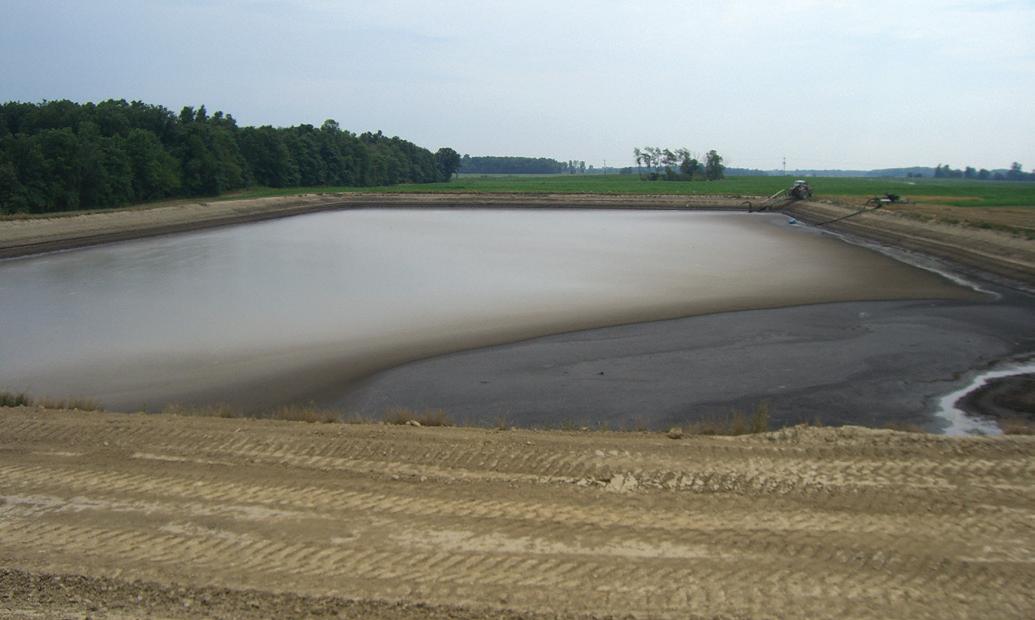
Photo 3 – Constructed slurry pond at Vreba-Hoff Dairy
Photo 2 – Separated fibrous solids using a screw press.
Figure 2 – EarthMentor® Manure-Wastewater Treatment System
(Michigan Farm News, June 15, 2007). Although the EarthMentor® system is designed for simple operation and low maintenance, the EMS requires increased management skills over traditional systems. Specifically, management must understand the system’s design and how to monitor benchmarks. If building the EarthMentor® system from scratch, the capital costs are greater than simplistic long-term holding pits. With prudent management of operation (e.g., not overloading the system), the payback for the upfront costs can be achieved by: sand (and/or coarse organic solids) recycling, more efficient treatment, replacing manufactured fertilizer purchase by full utilization of the partitioned nutrient by-products, and the potential to defend your operation against neighbors and regulators that may be unhappy with the odors and potential pathogen and water-quality impacts of conventional operations. Envirolytic Technologies, LLC reports that financial payback of the system can be achieved in less than two years, with ongoing return on investment opportunities after the initial payback period.
Recognized Benefits of EarthMentor®
Bob Gildea, environmental manager and operator of the EarthMentor® system at the Vreba-Hoff dairies, generally agrees with the EarthMentor® functions as claimed by Envirolytic Technologies, LLC. Bob could not validate the “$75 per cow per year” savings or payback period on the system, although he did agree with Envirolytic Technologies' claim of lower operational costs than conventional treatment systems that have greater reliance on mechanical features. Bob indicated the Vreba-Hoff dairies face ongoing challenges in achieving the water-quality standards mandated by the Michigan Department of Environmental Quality (MDEQ). He suggested that after the system has more time to catch-up in treating old stored waste, the water-quality criteria
will be routinely achievable. The nutrient-containing treated water is now used for center-pivot irrigation onto adjoining crop fields. Because the treated water is more dilute than it was prior to VrebaHoff’s use of the EarthMentor® system, the water can be applied at greater quantities without causing water-quality impacts. In fact, Bob indicates that the system has continually met the biosolids “pathogen reduction standard.” The coarse solids captured at the front end of the system are applied to cropland as an organic soil conditioner. Bob reports routine contact from area crop farmers requesting these coarse solids. Piping the water to the adjoining fields reduces impact to pavement on area roads and greatly reduces fuel consumption associated with truck transport. One impressive statistic Bob shared is the irrigated treated water helped realize a 50-percent increase in crop yields.
Summary
The presented treatment systems take advantage of the farm’s land base and time, which are generally available to most livestock operations. By minimizing the costs, whether up-front or operational, and maximizing the benefits of the components of the waste stream, the featured wastewater treatment systems can be economically feasible. Though the systems are designed to be relatively simple in operation and maintenance, they are not self-operating. The desired returns on the investments will require the farm operators to increase the level of management and maintenance over conventional pump-and-haul systems. Patrick Nortz, C.P.G., P.E., is a principal engineer with NTH Consultants in Michigan; Timothy Krause, P.E. is also with NTH Consultants; and Thomas Menke is with Menke Consulting of Greenville, Ohio, and a managing member of Envirolytic Technologies.
In the NEWS
pork industry innovator honored at 2009 Banff pork Seminar
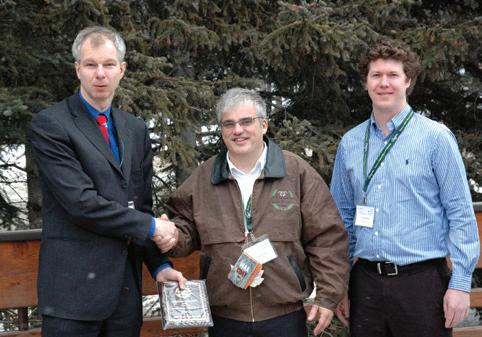
A Canadian pork industry innovator was recognized for his efforts to improve water conservation and reduce emissions from hog farms at the 2009 Banff Pork Seminar.
The F.X. Aherne Prize for Innovative Pork Production honors Canadian pork industry members who have developed either original solutions to pork production challenges or creative uses of known technology. The winner of this year’s prize is Ross Thurston of Livestock Water
Recycling (LWR) Inc. in Calgary, Alberta for his Swinewater livestock manure treatment system.
The continuous loop Swinewater System conserves water for farming operations, filtering manure-rich wastewater to the point where it is available for reuse as wash water or livestock drinking water. It also removes solids from the water that are later converted into fertilizer. In the process, it helps reduce greenhouse gas emissions by decreasing the discharge of ammonia and phosphorus into the soil.
international symposium on management of animal carcasses
Plans are currently underway for the 3rd annual International Symposium on the Management of Animal Carcasses, Tissue and Related Byproducts.
The event is scheduled for July 21 to 23, 2009 at the University of California at Davis.
Ruurd Zijlstra (left), Ross Thurston (centre), Livestock Water Recycling Inc., and Gareth Jenkins (right) Livestock Water Recycling Inc.
Three days of plenary, breakout and poster sessions are planned to discuss, learn and share information with researchers, policy makers and regulators on carcass disposal technology, planning and policy. Included in these days will be hands-on workshops and demonstrations of available carcass disposal technology.
Watch for registration materials and call for papers coming soon to http://extension.umaine.edu/ ByproductsSymposium09/default.htm.
planning underway for 2009 upper Midwest Manure handling Expo
The 2009 Upper Midwest Manure Handling Expo, themed SET for Fall: Safety, Efficiency, and Technology, will be held at the Central Iowa Expo Center in Boone, Iowa on July 22, 2009.
Expo vendors and visitors will have a chance to interact and discuss manure handling equipment, products, and services. The expo will also offer educational opportunities to manure applicators and consultants.
The expo’s location provides ample exhibition space and the gravel streets between the facilities will be the setting for more than eight hours of vendor/customer contact and field demonstrations showcasing vendor products. Educational courses and demonstrations will also be held throughout the day. General admission to the expo is free.
Vendor registration for the manure handling expo is now open. Vendor registration is $600 for either a covered 10'x10' space with electricity or a 40'x70' lot. Other amenities are available for purchase from the Central Iowa Expo Center. Expo, lodging and vendor registration information is available
at www.ag.iastate.edu/wastemgmt/expo_home.htm. For additional information, email agwaste@iastate.edu.
The 2009 Upper Midwest Manure Handling Expo is presented by Iowa State University and the Iowa Commercial Nutrient Applicators Association.
NPPC suing the EPA
The National Pork Producers Council has filed a lawsuit in the U.S. Court of Appeals for the District of Columbia Circuit challenging the U.S. Environmental Protection Agency’s decision to require livestock farms to file reports under the Environmental Protection and Community Right To Know Act (EPCRA).
NPPC also is alleging that the EPA violated the due process rights of farmers by failing to develop an adequate system to accept the reports, making compliance with the law impossible.
Under a rulemaking issued Dec. 18, the EPA decided that large livestock farms would be required to file mandatory reports on air emissions by first making phone calls to their state and local emergency response authorities, then by filing a written notification of emissions estimates. Farms that fail to comply will face penalties of $25,000 per day. The rule went into effect Jan. 20, 2009.
“In sticking the agricultural community with this unworkable rule, the EPA not only failed to provide any guidance to farmers on compliance with the new regulation or develop an adequate system to handle the volume of reports that would be filed, but it actively engaged in efforts that undermined the ability of farmers to comply with this new, stringent rule,” said NPPC president Bryan Black, a pork producer from Canal Winchester, Ohio.
Jamesway introduces new Tanker Transfer Kits
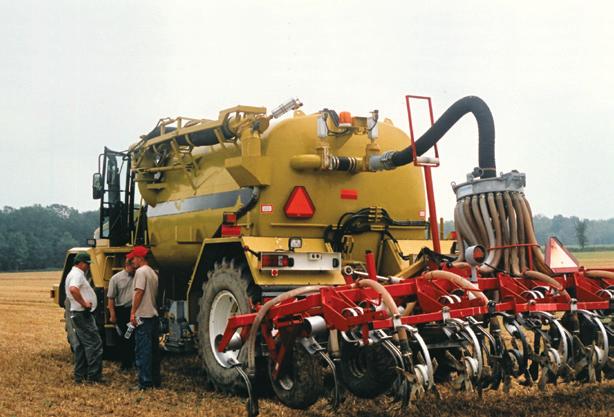
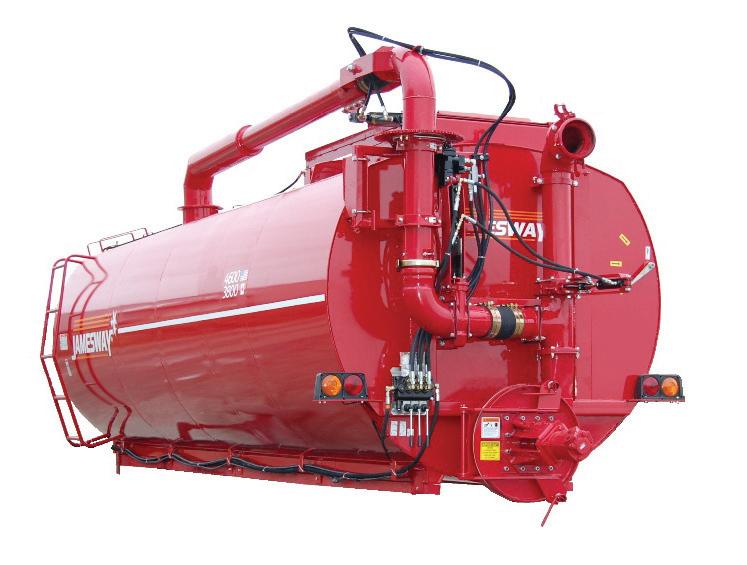
Jamesway Farm Equipment introduces a new family of Tanker Transfer Kits. These kits may be added to highway tankers or truck mounted field tankers to allow quick and easy unloading into another tanker.
Many large operations use highway
tankers to supply manure to a trailer tanker. This “tanker nursing” allows the field tanker to apply a far greater number of loads per day, plus the tanker and tractor tires are not subject to the wear associated with road travel. Additionally, the road stays clean since the field equipment stays in the field and the road equipment stays on the road.
Jamesway Transfer Kits use all bolted connections so the transfer arm may be mounted on the left or right. Bolt-on accessories include high-mount spread nozzle, low-mount spread nozzle or hose connection kit for long distance transfer. The kit may be configured with the input from the top, bottom or side to accommodate a wide range of retrofit applications, and the controls may be rear mounted or cab mounted. The impeller kit is all T1 steel and features a swing-open
front for easy service or cleaning. The hydraulic drive motor is mounted to the proven oilbath bearing chamber found on all Jamesway pump kits. www.jameswayfarmeq.com
New vertical beater for xhD and hSxhD manure spreaders
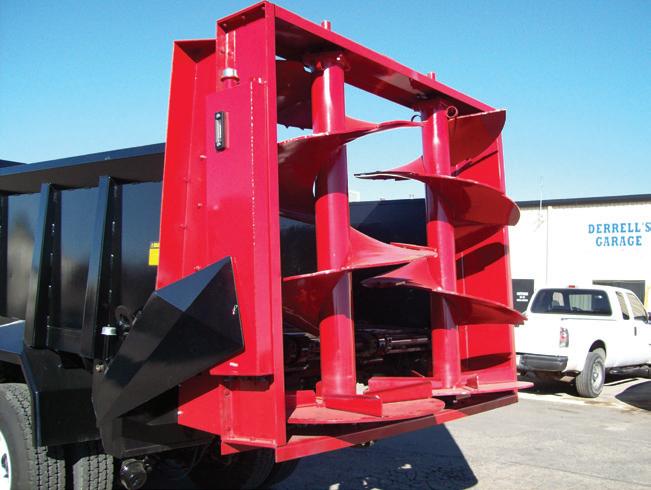
MMI International (MMI) had developed a vertical beater attachment for its line of High Speed Extra Heavy Duty (HSXHD) commercial manure spreaders. The attachment can be installed on both MMI and Mohrlang XHD and HSXHD spreaders and will deliver a spread pattern of up to 32 feet.
According to MMI, the new vertical beater capability increases the width of discharge, thus reducing the number
of trips through the field. Fewer passes equate to lower fuel consumption, less field intrusion, and overall increased efficiency, the company states, adding the design of the beaters ensures an even, consistent spread pattern reducing variations in crop vigor.
“Our customers have asked for a wider spread pattern but stressed the need for a consistent spread that results in a uniformly productive field,” said Jade Lammers, president of MMI. “Our goal is to maximize yield and minimize costs for our customers with new, innovative products. We believe this new design delivers.”
The vertical beater attachment was featured at the National Farm Equipment
Show in Louisville, Kentucky, held February 11 to 14. www.mixerfeeders.com.
New Holland S.A. Series Wheel loader
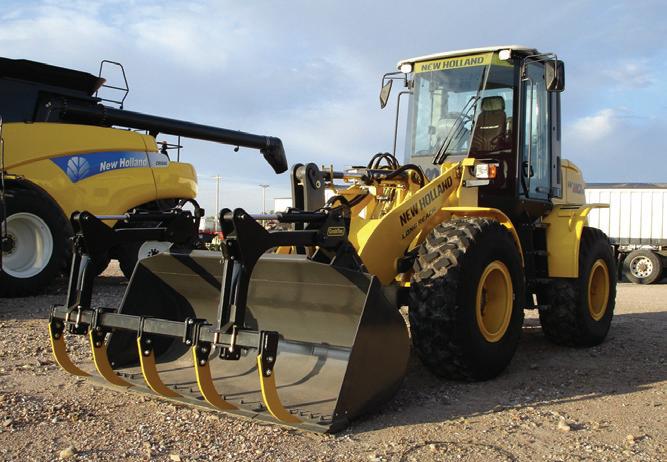
To meet the growing customer need for more specialized and efficient equipment, New Holland Construction has introduced the S.A. Series Hired Hand, a wheel loader for special applications in the agricultural business.
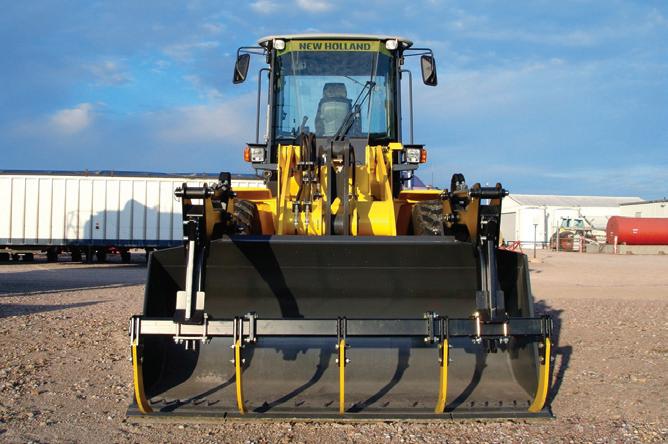
The Hired Hand features a multipurpose grapple attachment that makes this a useful machine-attachment combination for feedlots and dairy operations.
The grapple attachment is available on all New Holland wheel loader models W110B through W190B and can be combined with any of the three product configurations –Z-Bar, Tool Carrier and Long Reach.
Long Reach configurations with the grapple attachment allows the operator to reach high for applications such as loading manure spreaders, feed trucks and mixer wagons. The wide space between the grapple and bucket makes handling
of loose material easy. The wide opening of the grapple allows for more effective handling of materials as it pulls, rather than squeezes material into the bucket.
The S.A. Series Hired Hand features a Tier III engine with four work modes and a comfortable cab.
www.construction.newholland.com
puMpS
INNO ATIONS
PUMPS
Bauer
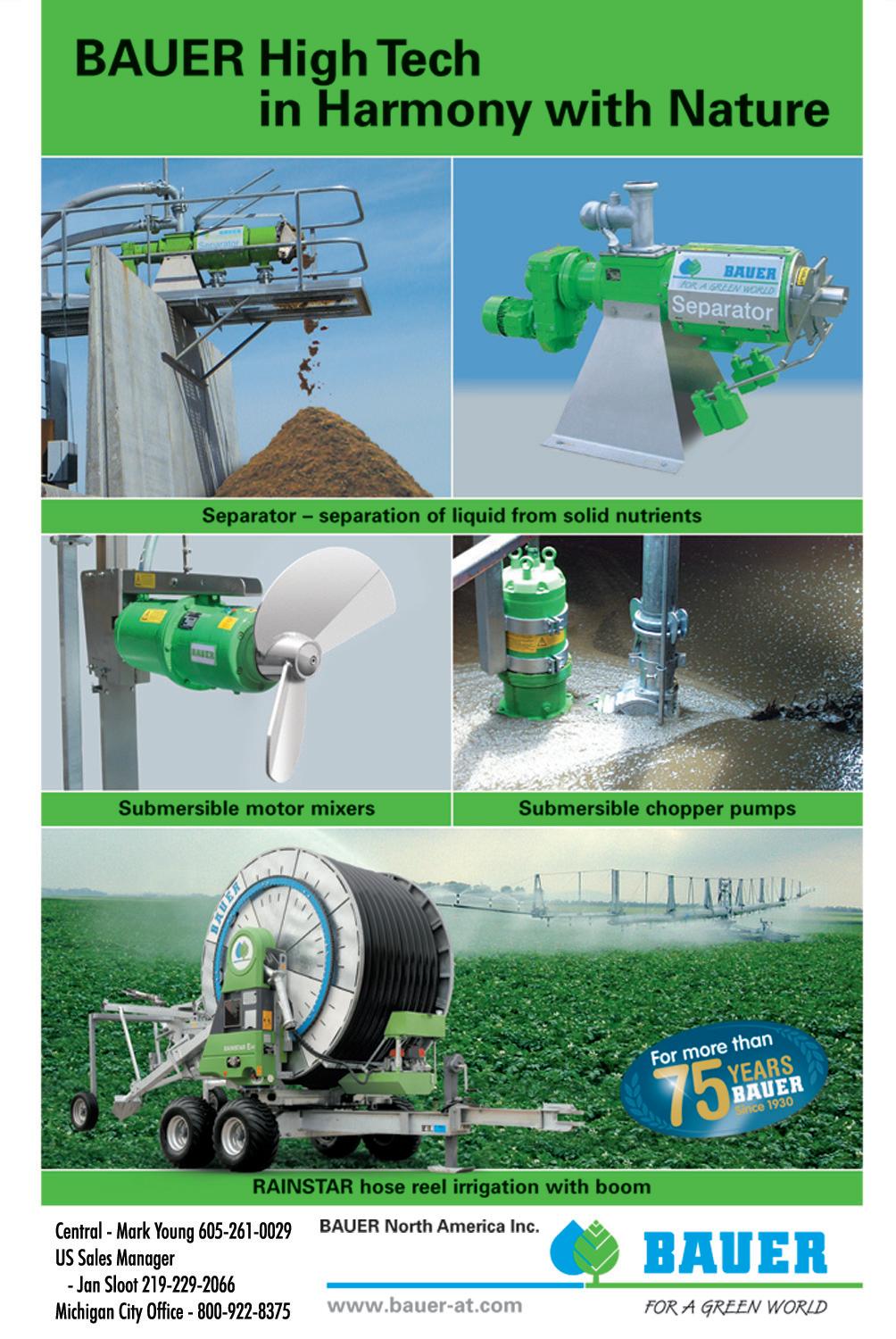
The Magnum SX Pump is available in three models – the SX 1000, the SX 2000, and SX 2600. The 1.75-inch gearbox drive shaft features 20 splines, providing lots of power. The gearbox casing is also easy to mount with four cast iron legs. No bolt heads are within the pump housing, resulting in less turbulence. The impeller speed has been reduced by 30 percent for less wear on the pump’s moving parts. These pumps are specially designed for slurry pumping using either tractor, engine or electric drive and can handle volumes up to 1300 gallons per minute. www.bauer-at.com
cornell pump company
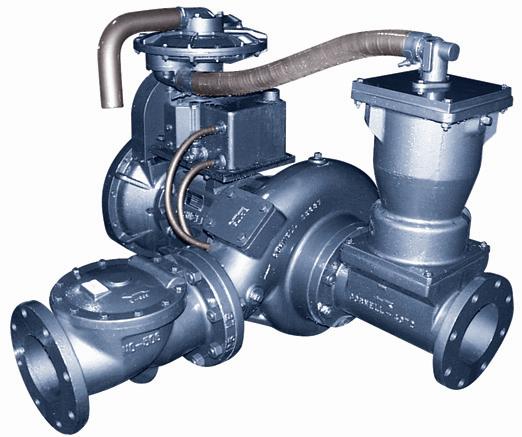
Cornell Pump Company, continues to introduce new pumping equipment for the animal waste industry. Cornell offers more than 25 models of waste handling pump models with multiple design features for low-head transfer to high-pressure application in the field. Cornell also offers four separate impeller designs to fit specific pumping applications.
LSC_3.375x4.875 3/24/08 3:34 PM Page 1
In addition to the existing high-pressure solids-handling and
WEEPING WALL SEPARATES ALL!
➤ Manure Pits,Channels & Covers
➤ Suspended Slabs - up to 40’ clearspan
➤ Hog & Cattle Slats - up to 25’ clearspan
➤ Weeping Walls - manure separation
➤ Milking Parlors
➤ Strainer Boxes
➤ Commodity Storage
➤ Bridges
➤ Bunker Silos (8 types)
➤ Syloguard Concrete repair
➤ Retaining Walls
➤ L & T Walls up to 16’ high
About
• Built to engineers’ specifications
• All sections are high strength, pre-stressed,reinforcedconcrete for longer life
• Quick & easy to build
• Air-tight seals and protectant using Syloguard products
Phone: 604•823•4245
Fax: 604•823•4249 or Call Toll-Free 1•888•796•2323
www.lscprecast.com
grey water handling pump models, recent product additions include high-pressure pump models for big gun and injection applications with semi-open impellers that handle stringy materials and slurries. This impeller design also incorporates a cutting action as the product flows through the pump.
The latest model added to the product line, 4514T (5x4x14inches), was developed to fit design conditions between the 4414T and 4NHTB models. This pump has an enclosed, two-vane impeller and produces up to 2000 GPM and up to nearly 160 PSI (1650 GPM @ 108 PSI @ best efficiency). Cornell’s newest offering is a heavyduty, high efficiency, low maintenance product, with a heavy-duty bearing frame.
These models are available close-coupled to electric motors, frame-mounted for flex-coupling to a driver, or SAE mounted direct to an engine bell housing. Also available is the Redi-Prime vacuum assisted option for automatic priming. Shafts are sealed with a packed stuffing box, the patented Cycloseal mechanical seal design, or the Cycloseal with a Run-Dry option.
www.cornellpump.com
Doda
Doda produces both vertical and horizontal chopper pumps which can be powered by tractor, engine or electrically. The chopping system consists of two static and one rotating chopper blade made from a vanadium and manganese alloy. The waste passes into the pump and through the high-speed impeller system that utilizes an adjustable pressure plate to chip the waste again.
The Super Vertical Chopper PTO Pump is available in the six inch (150) and eight inch (200) models and are made from hot dipped galvanized or 304 stainless steel for durability. The pumps come in a variety of lengths ranging from four to 13 feet. Special sizes are available.
The Super ME (electrical) Vertical Chopper Pump comes with a variety of wall and floor mount brackets to fit every need. They come in a variety of models with power ranging from three to 100 HP. All ME pumps come with C-face motor design, eliminating the need for pulleys. Manual change over from agitate to transfer is standard on all ME models.
The AFI Horizontal Chopper Pump is designed for the treatment of livestock slurry and is suitable for very thick manure. The thick part of the manure is shredded through a double chopping mechanism. The pump body, impeller, suction cell and pump support are housed in anti-shock and anti-freeze cast iron. The pump shaft is chromium plated and case hardened. www.doda.com
Fisher pumps
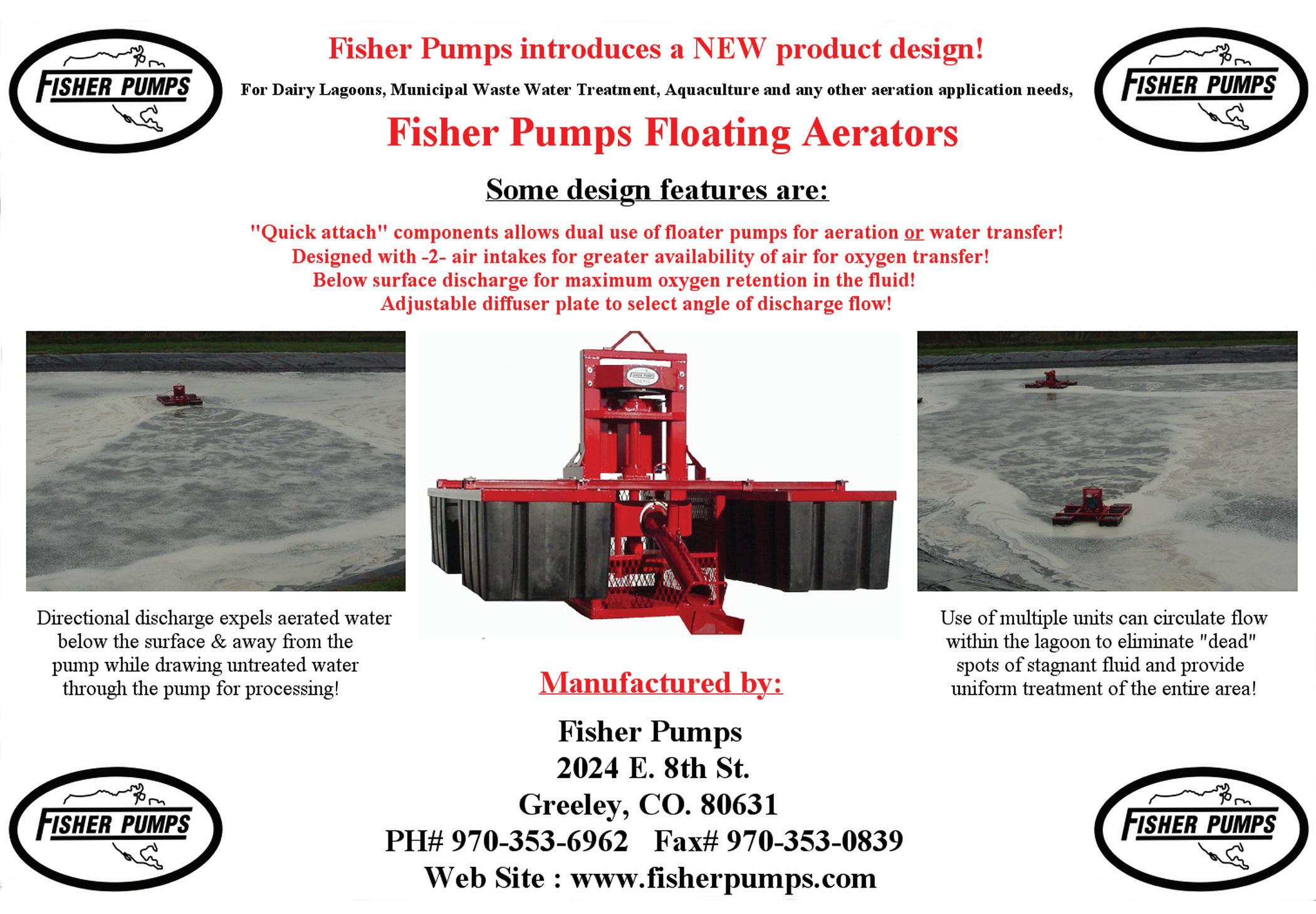
Fisher provides low maintenance, submersible centrifugal manure pumps for high capacity slurry transfer. The four to six-inch diameter discharge pumps are available in three to 14-foot vertical settings. The impellers can handle solids up to three inches in diameter, including rocks, pop can and hooves. The selfcleaning impeller blade design prevents the build up of animal hair, straw and hay normally found in manure pits. Pumps can also be sized for sufficient flow to allow for pit agitation during pump out.
Standard pump features include:
• double discharge design to equalize case pressure and maximize horsepower;
• welded construction with no connections to seal or bolts that work loose;
• constructed of heavy walled tubing;
• bearings located above the water
level meaning no oilers to fill daily;
• self draining with no seals and no priming required.
Options include:
• an agitation port with a slide gate located above case level;
• a 90 degree gear box with PTO driveline for tracto powered operation;
• a chopper blade attachment;
• liquid level controls for automatic operation.
www.fisherpumps.com
INNO ATIONS
Gorman-rupp company
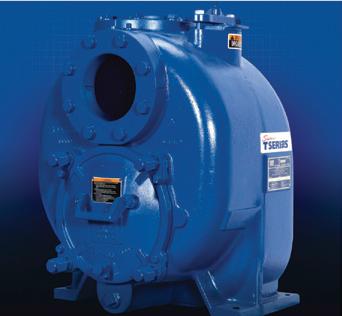
Gorman-Rupp has been manufacturing pumps and pumping systems for more than 75 years. The company's line of products includes self-priming centrifugal pumps, standard centrifugal pumps, submersible pumps, trash pumps, priming assisted pumps, rotary gear pumps and air-driven diaphragm pumps, including the T Series® and Super T Series® and 10 Series® pumps.
Continued on page 30
LIQUIDATION SALE
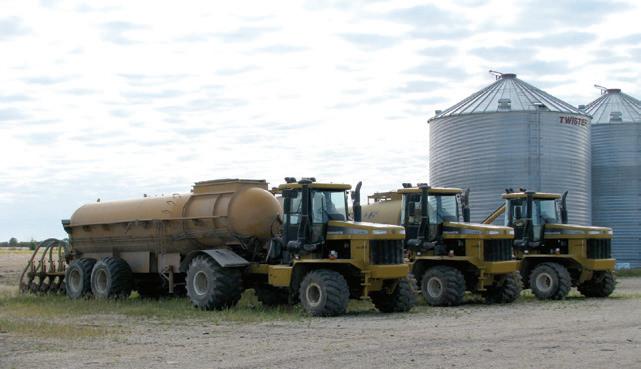
3 - 8144 Terra - Gators (2004) 4 wheel drive pulling 6000 gallon tanks on fifth wheel plates with Bourgault injectors
$170,000 Cdn each
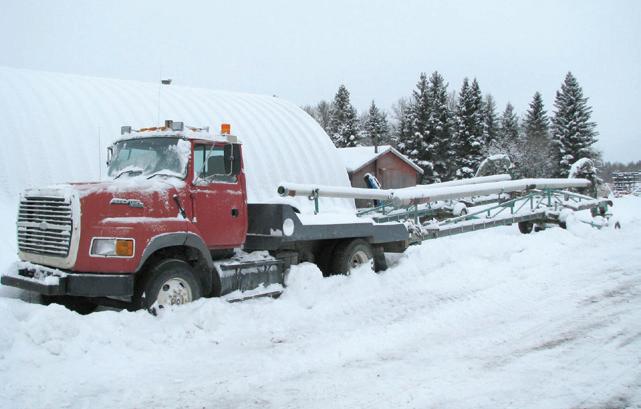
1996 Ford Aeromax highway tractor 435 Cummins it also has a transfer case that can handle up to 500 hp with a pto at the back of the truck
$40,000 Cdn
2 - 8 inch houle pumps (wall climbers) one is
$23,000 Cdn each Phone:
INNO ATIONS
Continued from page 27
The T Series is a self-priming centrifugal pump with heavy-duty construction and an easy-to-service design. These pumps feature a large volute design, allowing them to re-prime automatically in an open system without the need for suction or discharge check valves.
The Super T Series offers the same features as the T Series plus additional design features, including external shimless adjustment, dual protection for bearings and an easy-grip cover plate handle.
Both of these pumps can be matched to the exact requirements of individual systems through different pump sizes, impeller trims and speed variations.
The 10 Series is specifically designed for handling solids, corrosives liquids and slurries. The pump design has few moving parts and maintenance is minimal. If a clog occurs, it can be removed through the cover plate opening without the use of special tools or the disturbance of pipes. The pump comes with a choice of seal configurations to handle different liquids.
Gorman-Rupp also provides a wide variety of educational, reference and safety information for pump owners and users on its website.
www.grpumps.com
iTT Flygt
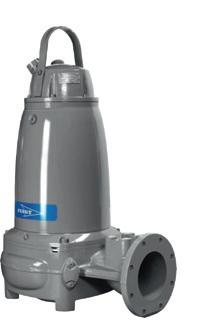
ITT’s water and wastewater division is launching a new generation of N-pumps offering new technology and more flexibility. The new generation can be ordered in hard iron for applications that require greater wear and durability. The pump was tested in lab and real conditions, including pumping water with high concentrations of coarse sand for about 200 hours, moving an estimated 2,400 tons of sand. The N-pump has also been equipped with insert rings containing relief grooves that, combined with the impeller, create a clog-free hydraulic unit plus protect the pump housing. Insert rings can also be ordered with cutting edges, converting the pump to a fertilizer or chopper pump. An inspection chamber has also been added to check for possible leaks and a thermal contact is provided that shuts the pump off if it overheats. The N-pump is available in various motor powers.
www.flygtus.com
Jamesway Farm Equipment
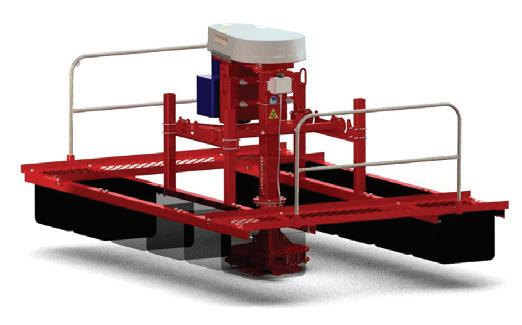
Jamesway Farm Equipment introduces a 40HP electric Floating Pump, based on the Jamesway family of vertical electric pumps. This high output pump features the same 20-inch diameter impeller used on the Jamesway Flush Pump, and may be used to directly flush the floors in large dairies, or can recharge a flush system holding tower. Designed to operate with minimal maintenance, the lower bearing is located above the manure level and an oil reservoir maintains constant lubrication in the bearing chamber.
An on-board hoist tilts the pump for easy service and the high quality floatation deck provides a stable platform for the pump. www.jameswayfarmeq.com
Nuhn
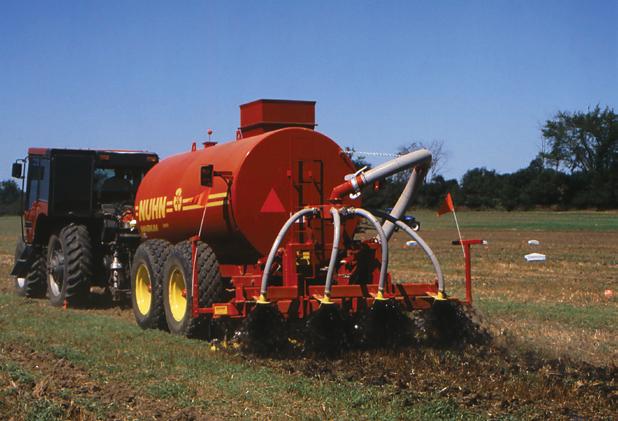
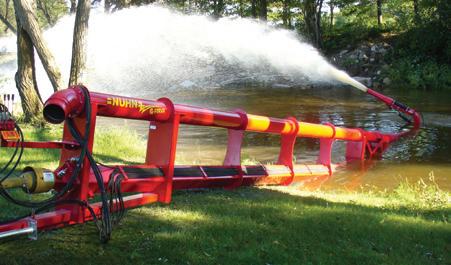
The Nuhn G-Force Lagoon Pump is a new high-volume, highperformance pump designed for commercial, and large farm, use. The clean and rugged design ensures low maintenance, and long life. With the Nuhn design, all of the energy from the tractor is directed into pumping, as opposed to wasting half of the energy on turning a prop. This results in massive agitation capacities and faster loading speeds.
To allow for longer life, the bearings are completely enclosed. Pressurized grease from a spring-loaded cup purges the unit of grit, like a wheel hub, which results in the most comprehensive lubrication system and seal in the industry.
To find out more information and to see a video clip of the Nuhn G-Force Lagoon Pump in action, please visit www.nuhn.ca.
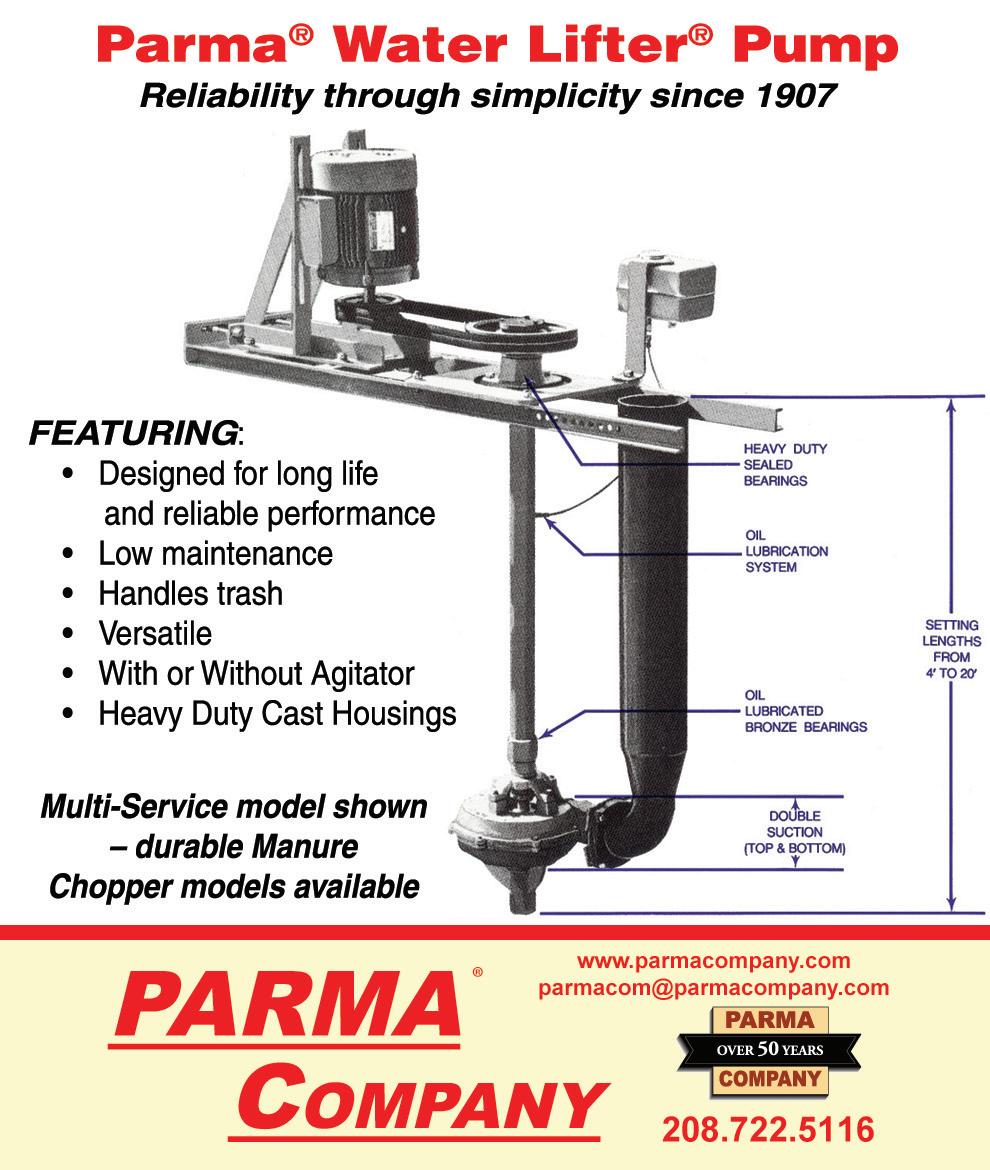
parma company
This Idaho-based company provides two different kinds of pumps for slurry waste – the Parma Multi-Service Pump and the Parma Chopper Pump.
The Multi-Service Pump is recommended for low, lifthigh volume pumping of water or slurry waste that does not require chopping. The Chopper Pump is recommended for slurry waste where smaller waste particles need to be chopped before pumping, such as dairy manure containing bedding, hay, etc.
Parma pumps have enclosed line shafts, oil lubricated with column bearings every four feet. The bowl assemblies, impellers and bearing housings are cast steel-type material for ease of repair and greater life. Low impeller speed also helps Parma pumps achieve long life.
www.parmacompany.com
Vaughan company
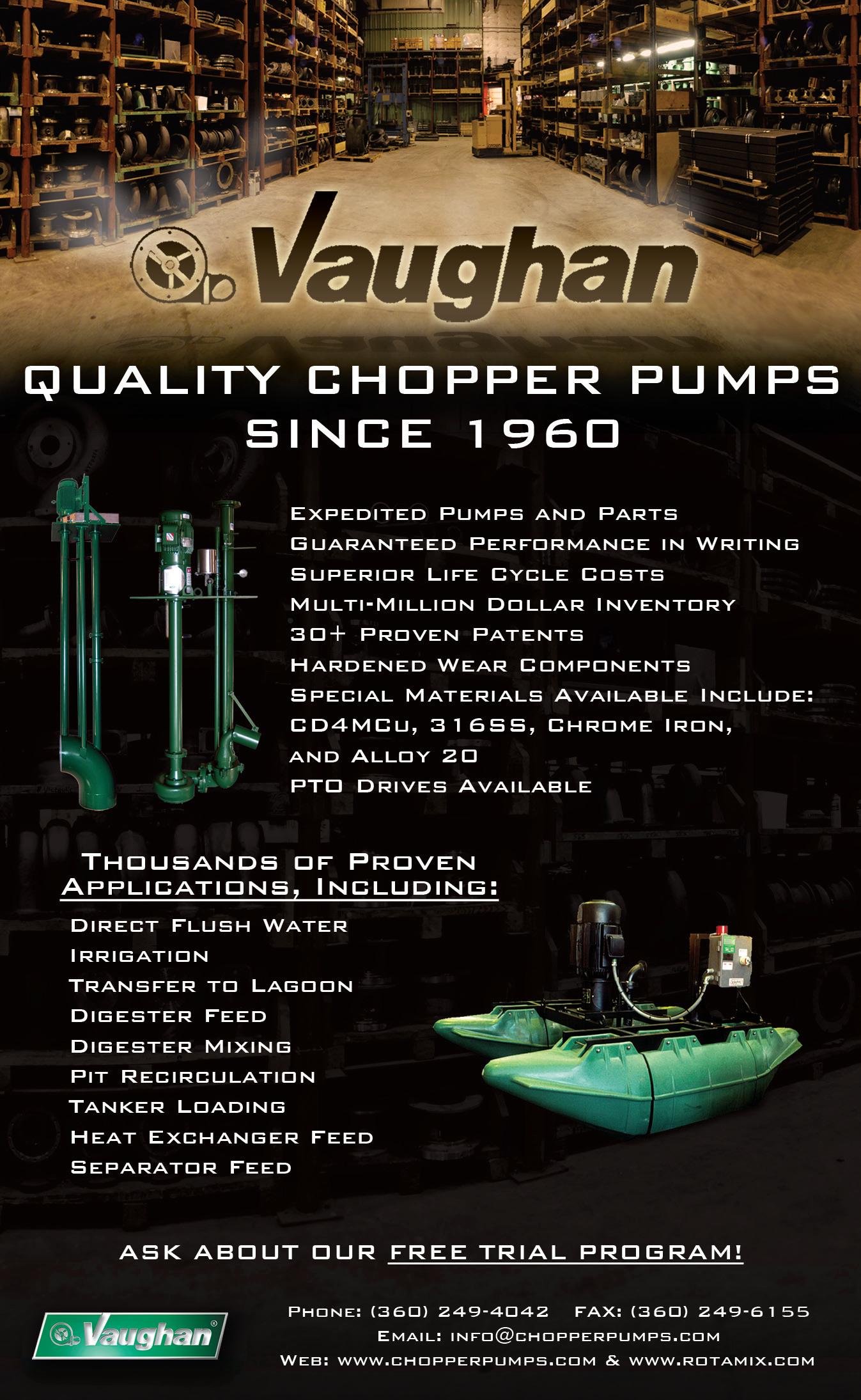
For more than 40 years, Vaughan has been supplying livestock producers with manure pumps, including the Vaughan Chopper Pump, which is available in vertical wet well, submersible or dry well configurations. The chopper pump works by chopping up solids using the sharpened edges of the impeller. An optional disintegrator tool also helps to break up the larger solids before they enter the pump. The chopped solids are easily pumped through the system without clogging and an upper cutter helps to keep the mechanical seal area of the pump clean. The chopper pump features heat-treated cast steel parts for a long life in an abrasive atmosphere. A heavy-duty seal and bearing system also provides for longevity of service. Oil bathed bearings provide self-cooling and lubrication without the need for a water flush.
Other manure pump designs available from Vaughan include the FP26Unmanned Floating Platform, designed for lagoon maintenance, dewatering, field irrigation or sludge removal and the Turbo Agitator a directional mixer designed to rotate the contents of sludge pits and pull the settled solids from the bottom.