Which method does the best job killing antibiotic-resistant bacteria? | 14
UK invasion
Manitoba dairy first operation in North America to use equipment | 18
Protein in, ammonia out
Adjusting protein reduces emissions | 22
July/August 2016
Bison
compost
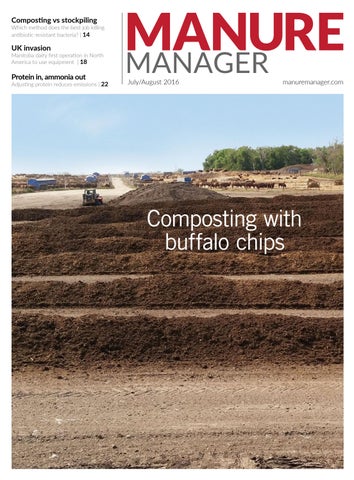
Business taking advantage of iconic animal’s return to market teabag & bulk compost products
By Tony Kryzanowski 14 18 24 Composting versus
UK invasion
Marketing teabag and bulk compost products with the iconic buffalo. See page 14.
Which method does the best job killing antibioticresistant bacteria in manure
BY TREENA HEIN
Manitoba dairy first in North America to use equipment from manufacturer based in Northern Ireland
BY TONY KRYZANOWSKI
Cementing a solution
Marty Winchell needed a solution for composting mortalities and a used cement mixer was the answer BY
DIANE METTLER
FROM THE EDITOR
Maryland’s manure storage woes
Government officials in Maryland are looking at easing winter manure spreading regulations after a group of farmers and municipal wastewater treatment facilities complained they couldn’t meet the July 1 deadline.
Back in 2012, Maryland passed a rule banning the spread of manure and biosolids during the winter months. Considering poultry farmers in the state have faced a winter litter spreading ban for years and are not required to build lagoons or special storage facilities to stockpile litter, the new regulation really only affected dairy and hog producers. As a result, farmers and sewage facilities were forced to look at expanding their storages to accommodate manure or sludge until the spring – an expensive undertaking. Large operations were given four years to meet the deadline (July 1, 2016) while smaller ones have until 2020 to comply. It seems now that the deadline has come and gone, not everyone can meet the new requirements. According to some media reports, about 80 dairy farms out of the state’s 431 operations have not yet complied with the new regulation, while 58 have built storages since 2012 and 14 projects are currently underway.
During a recent meeting of Maryland’s nutrient management advisory committee, state agricultural officials announced they were considering easing the rules, including shortening the start of the winter spreading ban so it begins Dec. 15, dropping the requirement that manure and/or biosolids must be worked into the soil when applied, and eliminating a ban on emergency spreading. The only addition to the regulation would be a required 100-foot setback from
streams and drainage ditches.
While some of these changes just seem to make sense – heck, why start a winter spreading ban on Nov. 1 in Maryland when restrictions in Wisconsin and Minnesota don’t start until mid-December? – it’s no surprise not everyone is in love with them. According to a report in the Bay Journal, a member of the audience, who was also a representative with the Midshore Riverkeeper Conservancy, said the regulation had been messed with enough. “It’s not all about making it easier for farmers,” he’s quoted as stating. “It’s also about protecting our environment.”
With farmers already facing tight profit margins and dairy producers wrestling with reduced milk prices, it can be tough to find an extra $100,000 to $500,000 to finance additional manure storage, even over a four year time period. And, based on comments in the local media, cost-sharing programs are hard to come by or qualify for.
I’ve always been a big fan of the carrot approach instead of being beaten about the head with more and more regulations and red tape. Every day, I’m inundated with new information regarding legislation and rules livestock producers are facing across North America. It’s impossible to keep up, especially when it seems like they’re all overlapping and doubling up on requirements. It’s refreshing when government listens to feedback from the industry and is willing to bend the rules to accommodate those struggling to meet them. It will be interesting to see whether these changes actually make it through to the final regulation. Hopefully Maryland farmers will know before winter comes again.
MANURE MANAGER
July/August 2016 Volume 14, No. 4
Published by:
Annex Business Media, P.O. Box 530 Simcoe, ON N3Y 4N5
Editor MARGARET LAND (519) 429-5190, (888) 599-2228, ext 269 mland@annexweb.com
Occasionally, Manure Manager will mail information on behalf of industry-related groups whose products and services we believe may be of interest to you. If you prefer not to receive
Printing Inc.. All rights reserved. Opinions expressed in this magazine are not necessarily those of the editor or the publisher. No liability is assumed for errors or omissions.
advertising is subject to the publisher’s approval. Such approval does not imply any endorsement of the products or services advertisted. Publisher reserves the right to refuse advertising that does not meet the standards of the publication.
manuremanager.com
THE PERFECT COMBINATION
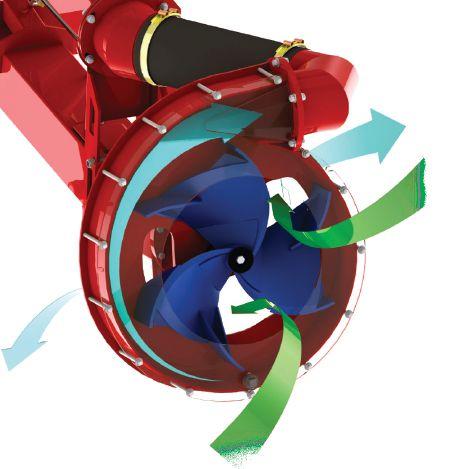
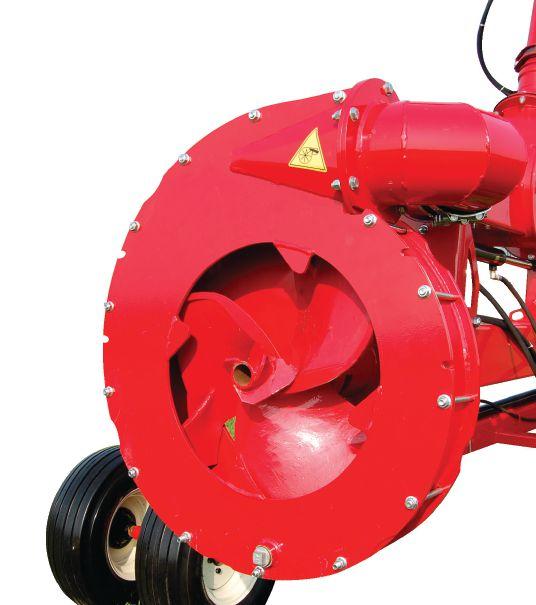
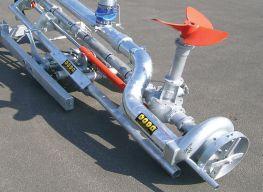
The PUMPELLER® Hybrid Turbine revolutionizes manure pump performance. Incredible intake suction pulls solids into the cutter knives, reducing the toughest crust to nothing in just seconds. The turbine combines the high-volume mixing of a propeller agitator with the power and reach of a lagoon pump, the resulting hybrid design radically outperforms both.
for professional
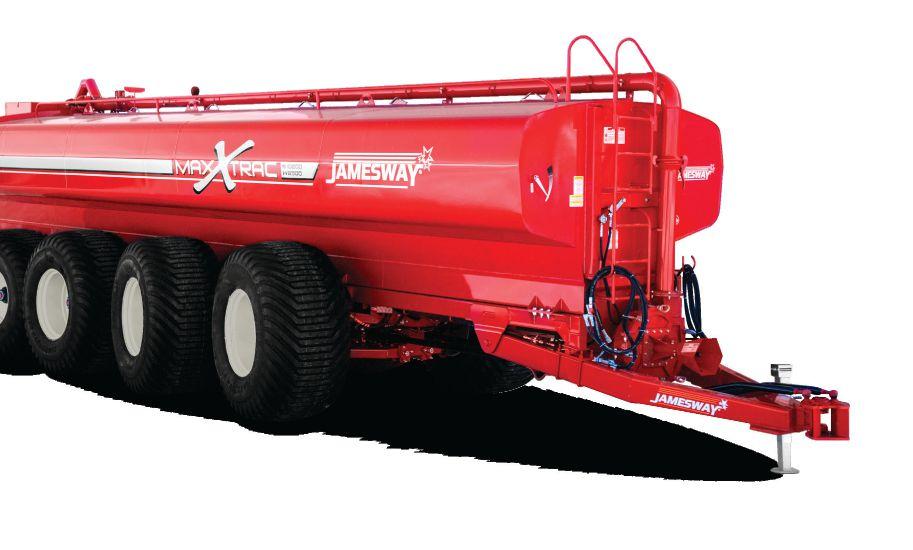
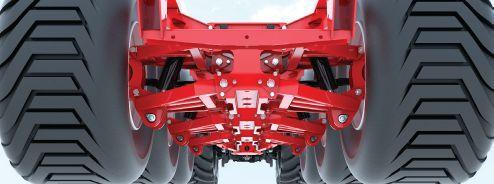
Jamesway’s new MAXX-TRAC tankers deliver maximum performance.
Patented Turbine Impeller
Farms a major air-pollution source: study
Emissions from farms outweigh all other human sources of fine-particulate air pollution in much of the United States, Europe, Russia and China, according to new research.
The good news is if combustion emissions decline in coming decades – as most projections say – fine-particle pollution will go down, even if fertilizer use doubles as expected, according to the new study published in Geophysical Research Letters, a journal of the American Geophysical Union.
Agricultural air pollution comes mainly in the form of ammonia, which enters the air as a gas from fertilized fields and livestock waste. It then combines with pollutants from combustion – mainly nitrogen oxides and sulfates from vehicles, power plants and industrial processes – to create tiny solid particles, or aerosols. Aerosols can penetrate deep into lungs, causing heart or pulmonary disease.
Many regional studies, especially in the United States, have shown agricultural pollution to be a prime source of fine-particulate precursors, but the
new study is one of the first to look at the phenomenon worldwide and to project future trends. The study’s results show more than half the aerosols in much of the eastern and central United States come from farming.
“This is not against fertilizer – there are many places, including Africa, that need more of it,” said Susanne Bauer, an atmospheric scientist at Columbia University’s Center for Climate Systems Research and NASA’s Goddard Institute for Space Studies in New York and lead author of the study. “We expect population to go up, and to produce more food, we will need more fertilizer.”
The fact that agricultural emissions must combine with other pollutants to make aerosols is good news, according to Bauer. Most projections say tighter regulations, cleaner sources of electricity and higher-mileage vehicles will cut industrial emissions enough by the end of this century that farm emissions will be starved of the other ingredients necessary to create aerosols, she said.
Biogas industry applauds Agriculture Environmental Stewardship Act
Representatives Tom Reed (R-NY) and Ron Kind (D-WI) recently introduced new bipartisan legislation – the Agriculture Environmental Stewardship Act – with the support of 12 additional Republican and Democratic leaders in the U.S. House of Representatives.
The American Biogas Council (ABC), the trade association for the U.S. biogas industry, applauded the bill, which will increase the sustainability of farms by helping to deploy new nutrient recovery and biogas systems to recycle organic material into base load renewable energy and healthy soil products.
The act will provide
a 30 percent investment tax credit (ITC) for qualifying biogas and nutrient recovery systems.
“For a healthy economy, we need healthy soils and clean waterways. Biogas and nutrient recovery systems contribute to cleaner, healthier soil and water and the Agriculture Environmental Stewardship Act will make these systems possible,” said Patrick Serfass, executive director of the American Biogas Council. “We thank Congressmen Reed, Kind and the other co-sponsors of this bill for recognizing the far reaching benefits of sustainable farming where organic material and nutrients are recy-
cled to create beneficial soil products, base load renewable energy and jobs.”
According to ABC, the introduction of the act reflects the need to support economically and environmentally sustainable agricultural practices that protect waterways and enrich soils. Currently, no tax incentive exists for nutrient recovery systems, which farms increasingly need to properly manage the nutrients found in raw manure.
Currently, only biogas projects that generate electricity are eligible for a production tax credit under Section 45 of the federal tax code, omitting other energy uses like production of pipeline quality natural gas and compressed renewable natural gas vehicle fuel.
“This measure recognizes the value that biogas systems can have as dairy producers continue improving the sustainability of their farms, large and small, across the country,” said Jim Mulhern, president and CEO of the National Milk Producers Federation. “Importantly, the creation of this new investment tax credit also addresses the value of nutrient recovery technologies, which can transform manure into fertilizer for crops and bedding for cows. This bill will help dairy farmers to utilize these new, often expensive technologies on their dairies.”
New rule on lighting, marking agricultural equipment Guidelines for stockpiling manure
The U.S. Department of Transportation (DOT) has published a final rule standardizing lighting and marking of agricultural equipment on highways. The rule incorporates two ASABE standards by reference.
The rule – Lighting and Marking on Agricultural Equipment – directly points to the requirements and content of ASAE S279.14, Lighting and Marking of Agricultural Equipment on Highways, and ASAE S390.4, Definitions and Classifications of Agricultural Field Equipment, or any successors to those standards.
Formation of the rule was mandated in the 2012 highway bill signed by President Obama, the Moving Ahead for Progress in the 21st Century Act (MAP–21). That legislation required the DOT’s National Highway Traffic Safety Administration to establish a federal rule regarding lighting and marking for agricultural equipment. The MAP-21 mandate made the rule non-discretionary and therefore not subject to the typical public comment period. The requirements are effective immediately; however, manufacturers have one year – until June 22, 2017 – to be in compliance.
ASABE members with standards access and those with site-license privileges can access the full text of S279 and S390 by electronic download from the ASABE online technical library. Others can purchase a copy by contacting ASABE headquarters at OrderStandard@asabe.org.
BY
THE NUMBERS
NATIONAL BISON ASSOCIATION HAS MORE THAN 1,000 MEMBERS, REPRESENTING 50 STATES AND 10 COUNTRIES
If you are considering stockpiling manure this summer, choosing the right location and following best management practices can decrease the chance of polluting waters.
Please note, stockpiling is not a substitute for adequate manure storage, but can be used when conditions are not suitable for land application.
Manure stockpiles must be solid manure with bedding (minimum of 20 percent solids) or dry poultry manure and should be located in or near the field that the manure is to be applied. Stockpiles cannot be stored for more than eight months. It is recommended that a 100-foot temporary vegetative buffer be placed around the pile if the manure will be stockpiled for more than four months. Also, consider covering the manure, to minimize leachate from rainfall or snow.
The stockpile should be located on soils that are deep to bedrock (greater than 40 inches) and not on soils with rapid or very rapid permeability. They should not be located in areas that occasionally or frequently flood, on hydric soils or on slopes greater than six percent.
Recommended minimum setback distances for manure stockpiles include:
• 75 feet from overhead or buried utilities
• 500 feet from residences
• 300 feet from private wells
• 300 feet from ponds and lakes
• 300 feet from streams, grassed waterways, and field surface drains
• 300 feet from tile inlet or broken tile
• 1500 feet from any public surface drinking water intakes.
Stockpiles should be inspected after rain events of 0.5-inches or more to check for leachate ponding or runoff. They should also be monitored for flies, beetles and other pests if stored longer than one week.
After the manure stockpile has been removed from the field, consider planting a vegetative cover on the site to recycle the nutrients left if site conditions allow. Also, for cropland areas, it is recommended that the same site not be used again to stockpile manure for at least one full growing season.
Number bison in North America
average annual sale of bison meat $340 MILLION
2,500 NUMBER BISON RANCHES IN U.S.
COMPOSTING BISON MANURE
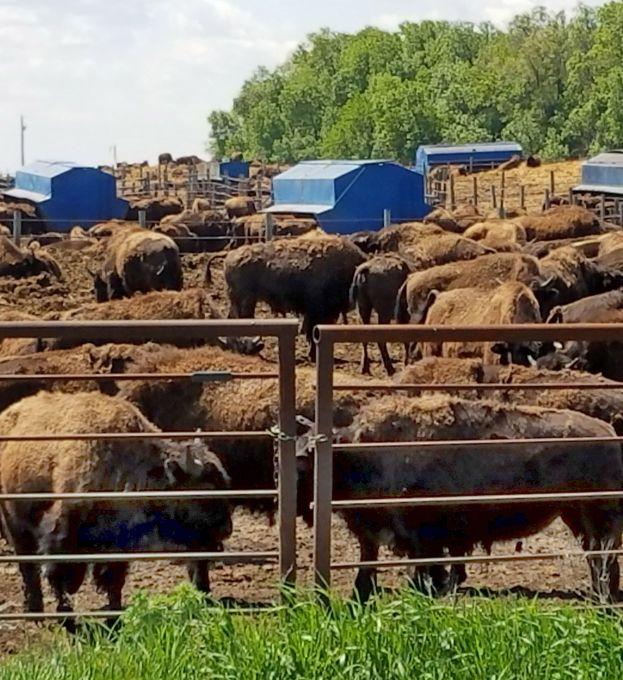
North Dakota business taking advantage of iconic animal’s return to the Great Plains to market teabag and bulk compost products. It’s also hoped the venture leads to reduced manure disposal costs.
BY TONY KRYZANOWSKI
The American bison is making a comeback and a North Dakota-based, start-up company called Bison Compost LLC is hoping this translates into growing sales for their teabag and bulk compost products. Their manure supplier and business partner, North Prairie Bison Ranch (NPBR), hopes it leads to reduced manure disposal costs.
After almost being hunted to extinction, the American bison, or buffalo, has become big business for some Great Plains ranches, and was recently named the National Mammal of the United States.
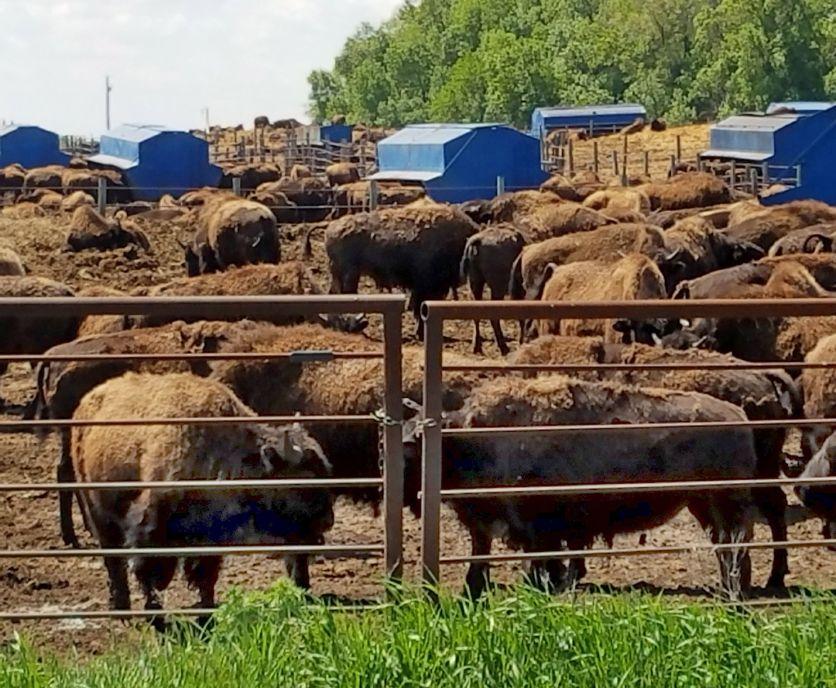
NPBR manages a 3000-head custom feedlot near Leeds, ND, where they raise the animals exclusively for a single customer. The feedlot is owned by Dennis Sexhus, his son,
Sanford, and Keith Kakela. Bison Compost LLC was formed in 2013 and has three partners: NPBR, Tom and Judy Duenow, and Shelley Mathison-Holmes. Although the Duenows live in Elk River, Minn., and Mathison-Holmes in Winston-Salem, NC, all have roots and past associations with the Leeds area, which is how they found each other to formalize the partnership. The company markets its products under the names ‘Buffalo Earth’ and ‘No. 2 Brew Compost Tea’ for plants.
While he has yet to sit down and crunch the numbers to calculate if composting is delivering a net financial benefit to the bison ranch, Sexhus says they have reduced their number of Frontier hydraulic-push manure spreaders from three to one
because the composting process reduces their manure volume by about two-thirds.
Sexhus says NPBR’s main motivations for taking the composting route were to reduce volume, derive a potential extra income from compost sales, and to help out the environment by switching to compost from land applying raw manure. At present, he says all their raw manure is being composted, but only a portion is being sold. The rest is land applied as organic fertilizer for their cash crops until such time as the compost business builds up its distributor network to take all the compost.
“Manure management is a cost for us and is a fairly expensive part of the feedlot business to properly dispose of the manure,” says Sexhus. “We were motivated by trying to turn what was really a liability for us into an asset.”
However, he has a realistic view of the costs associated with converting raw manure into compost.
compost also has a lot less odor, and is largely free of weed seeds, pathogens, and fly eggs. These are some of the main selling points of compost, not to mention its benefits as an organic plant food where it increases fertility, water-holding capacity, bulk density and biological properties.
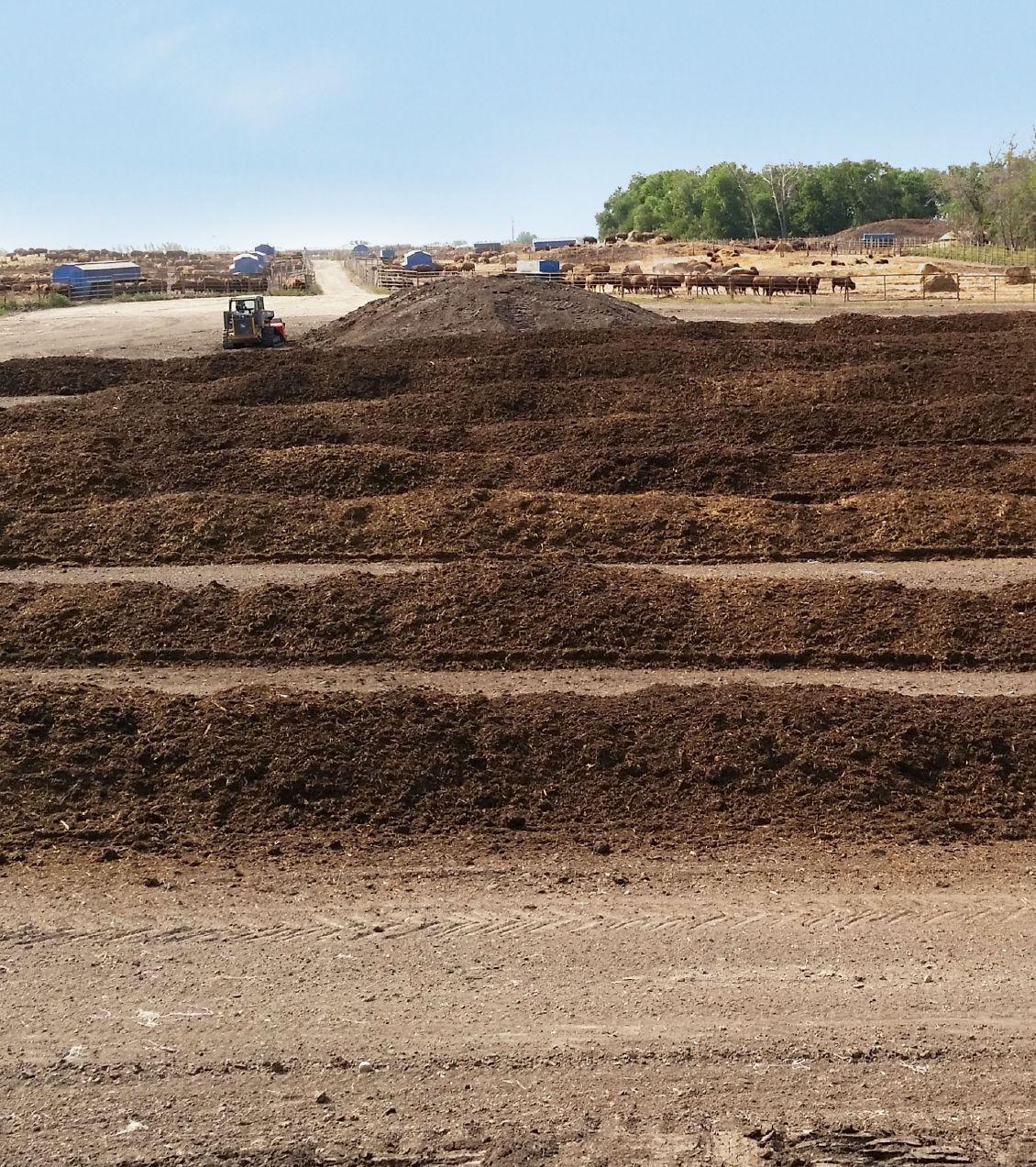
Describing the manufacture of the bison compost as a “warm weather” endeavor, Sexhus says the accumulated manure from the pens is stockpiled and then put into windrows on a designated, 10-acre, drainage-controlled, composting site provided by the bison ranch next to the feedlot.
“Manure management is a cost for us and is a fairly expensive part of the feedlot business to properly dispose of the manure.”
– Dennis Sexhus
“I believe that we are benefiting, but making compost isn’t free,” Sexhus says. “This business is fairly new and our goal is to grow it into a viable business. I do know that there are savings, but there are also costs associated with it.”
Prior to the composting venture, the ranch typically stockpiled and land applied its raw manure. It is a combination of animal waste with grass, hay, straw or corn stover.
In addition to substantially reducing raw manure volume,
Tom Duenow says his career as a food business manager brought him considerable experience in recycling, so the idea of recycling manure into compost had some appeal to him. Also, his wife, Judy, had a strong connection to the North Prairie area of North Dakota, having grown up within a couple of miles of the NPBR feedlot. Her family had close family connections with the bison ranch’s owners. Judy also had experience as a business partner with Dennis Sexhus, raising bison in the 1990s before selling out when prices went south.
“I started a conversation with Dennis about the possibility of composting and we just rolled it back and forth for a year or two,” says Duenow. “In 2013, we decided to create a partnership and start composting the bison manure.”
Mathison-Holmes spends a lot of time in North Dakota and
OPPOSITE Bison Compost LLC produced 1.5 million pounds of compost last year from feedlot manure collected from the North Prairie Bison Ranch in North Dakota.
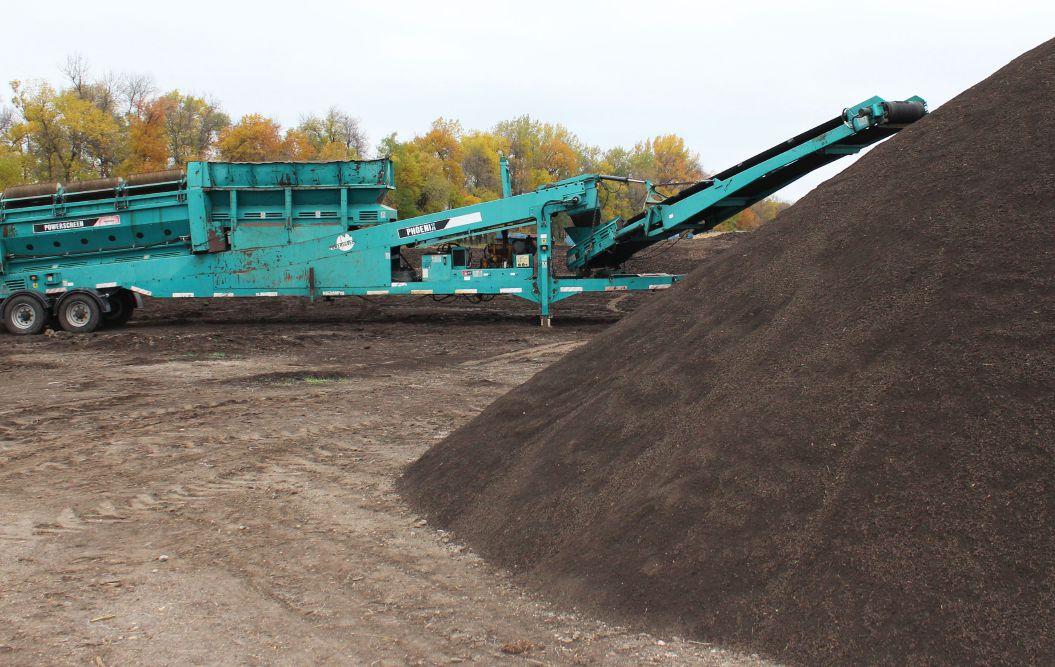
ABOVE Bison Compost LLC screens its compost down to 3/8-inches for both its bulk and teabag products.
is a strong advocate for women becoming more involved in business. Her family comes from Fargo. She was interested in becoming involved in a recycling business that created value-added end products like compost. In fact, she started a venture in manufacturing and marketing bison compost but lost her source of manure. So she reached out to the Duenows and became part of the Bison Compost partnership.
The owners did not have a lot of experience manufacturing premium quality compost, so they turned to the U.S. Composting Council and the North Dakota State University (NDSU) Extension service for technical assistance. They credit individuals like NDSU livestock environmental specialist Mary Berg with providing great and ongoing assistance in helping to launch their business venture.
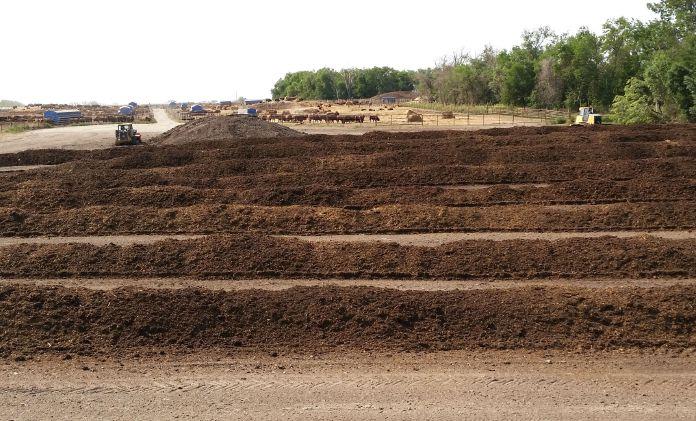
Using an excavator, dozer, and frontend loader from the ranch, the feedlot manure is piled into 200-foot-long windrows on the composting site that are 12-feet wide and 8-feet tall. The site has enough room for 15 windrows as well as room for expansion. Temperature is the critical benchmark measured when manufacturing compost and it is measured frequently. The piles are allowed to heat up to 160 Fahrenheit three times. Each time it reaches that temperature, a Vermeer CT612 compost turner – owned by Bison Compost – turns the piles. After turning, the piles cool down then heat up again. The heat is generated by the microbes within the windrows doing their job of converting the manure into compost.
“I like to say that it is kind of a natural pasteurization process,” says Duenow, adding this is how and when the toxins, fly eggs and weed seeds are destroyed.
After turning three times and the heat stabilizes at a lower temperature, the compost piles cure for four weeks. The entire process takes between two and three months.
The black compost is screened to 3/8-inch consistency through a screener supplied by PowerScreen – located in Rogers, Minn. – before being sold in bulk or loaded in small quantities into teabags. Because of the seasonality of compost production, the company rents the screener once it has a large amount of compost accumulated. Timing the production of compost to stockpile for the entire year is an important part of the planning and marketing process as no compost is produced during the winter yet there may be demand for compost from plant enthusiasts.
What Mathison-Holmes brought to the business was the concept of a unique ‘teabag’ compost gardening product. This is a small amount of compost packaged in a teabag. It is dipped in water for about 24 hours and during this steeping process, the compost nutrients are released and ready to use as organic plant fertilizer.
While Bison Compost LLC is still in its infancy, Duenow says the owners have already learned some important marketing lessons. Perhaps the most important is the decision to sell their bagger and focus on selling large quantities of the bulk product to other companies who then bag it under the Buffalo Earth name. Part of the challenge they face is being situated in North Dakota, which is quite some distance to market with a limited labor pool. That’s why for now, the company has focused on marketing its compost in bulk both locally and over longer distances as well as marketing it in smaller,
LEFT
North Prairie Bison Ranch in North Dakota has set aside 10 acres for up to 15 windrows of feedlot manure that is convert to compost.
more manageable quantities as the No. 2 Compost Tea product.
In addition to giving the environment a hand-up by converting the raw manure to compost, Bison Compost is also providing much needed employment for a local organization that works with handicapped individuals. They have the contract to package the No. 2 Compost Tea product.
The Duenows and Mathison-Holmes continue to work hard on the marketing front to attract interest outside their local area, and so far, their marketing strategy has worked out quite well. They have sold a large volume of compost to a landscape products company in Minot, ND, which is blending it to create potting mix and garden mix for its customers. Bison Compost also has nursery and garden distributors established in Minnesota, North Dakota, South Dakota and Northern Iowa, as well as a distributorship established for six states around New York.
Last year, the company produced about 1.5 million pounds of compost. Duenow says they generated about $30,000 in sales and they hope to double that amount this year as well as make good progress on establishing a national market particularly for the teabag product. Their target audience is nursery owners, gardeners, individuals involved in soil remediation and reclamation, as well as gardening enthusiasts.
While there is no difference in the process of manufacturing compost from bison manure or cattle manure, Duenow says they are hoping to leverage their sales to some extent on the growing profile of the American bison itself. They are also hitching their wagon to the green movement, promoting their product as a natural alternative to commercial fertilizer, from a source where the animals are raised without hormones or antibiotics.
To support the start-up, Bison Compost received a $135,000 grant from the North Dakota Agricultural Products Utilization Commission, and Duenow says a considerable amount is being used in their ongoing marketing efforts.
“Our name and our product are really gaining more and more interest,” he adds. “It is so much fun to go to shows like Pride of North Dakota and have people come back again and buy our product.”
COMPOSTING Versus Stockpiling
Which method does the best job killing antibiotic-resistant bacteria in manure and other factors to consider
BY Treena Hein
BELOW
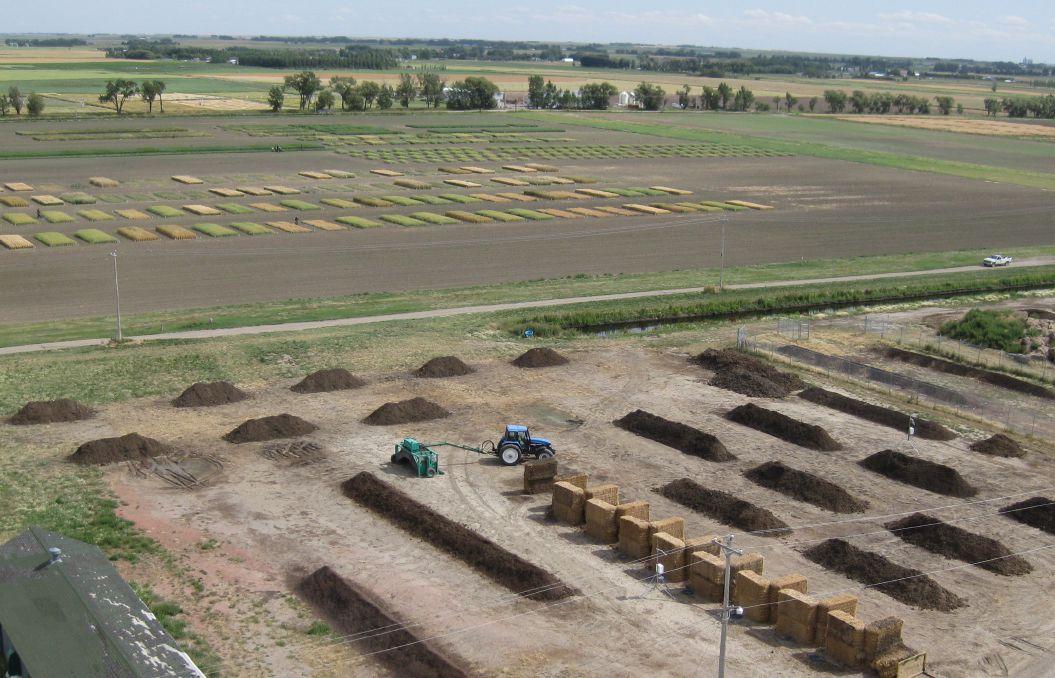
An overhead view of the Agriculture and AgriFood Canada facility where researchers are studying composting and stockpiling manure.
In North America, antibiotics are routinely administered to livestock for treating cases of disease and in some jurisdictions, they are given at sub-therapeutic levels to prevent disease, improve feed efficiency and promote growth. Manure can contain antibiotic-resistant bacteria, and it’s well known that some manure management practices destroy these bacteria, but does one stand out? Does stockpiling do a better job than composting, and are there other factors that should be considered in your decision to use one method over the other?
Tim McAllister can provide insight. McAllister is a principal research scientist in ruminant microbiology and nutrition at the Lethbridge Research Centre of Agriculture and Agri-Food Canada (AAFC). Recent studies he’s led on these issues were supported by AAFC’s Sustainable Agriculture Environmental Systems initiative and the Beef Cattle Research Council’s ‘Beef Cluster Funding.’ McAllister’s team included Shanwei Xu, Alanna Smith, Shaun Cook, Andrew F. Olson, Francis J. Larney and Rahat Zaheer (all at AAFC Lethbridge), Srinivas Sura and Allan J. Cessna (AAFC Saskatoon) and George Wang (University of Lethbridge). Cessna and Larney were lead scientists. Among other contributions, Xu drafted the manuscript and oversaw the lab analysis, Sura participated in study design, Zaheer helped track antibiotic resistance genes; Wang, Smith and Cook all provided laboratory analysis and Olson led the field studies.
But before we get to their results on stockpiling versus composting, let’s go over some facts you should know about antibiotic-resistant bacteria.
“It’s found in all soil,” McAllister explains. “Antibiotic resistance has always existed. Antibiotics are produced by many bacteria to protect themselves from other bacteria, and those bacteria need to be resistant to their own antibiotics or they will harm themselves. The populations they are defending themselves against also become resistant over time. These bacteria are found in the soil, inside animals such as cattle and in many other environments.”
So, whether or not antibiotics are added to an animal’s diet, antibiotic-resistant bacteria will be found in that animal’s digestive tract and in its manure. Resistance is a fact, and it’s only a matter of when it develops, in which bacteria
Stockpiling cannot achieve the high temperatures associated with composting and results in a shorter period of internal pile heating.
and under what circumstances. McAllister understands that while “it’s still a common perception that the prevalence and magnitude of antimicrobial resistance in our environment is related to feeding antimicrobials to beef cattle, we’ve actually found that in several cases, manure from cattle that were not administered antimicrobials contained higher numbers of resistance genes than manure from animals fed antimicrobials.”
The good news is that it’s not likely that antibiotic-resistant bacteria in the soil, either naturally occurring or placed there through the spread of manure, pose a significant risk to human health. For that, McAllister says they would have to exchange DNA with other bacteria that could cause human infections, and that would be difficult since most human pathogens don’t survive outside the human environment, or survive for long.
“So there would have to be pathogens
present, DNA exchange and then humans would have to be directly exposed to the altered pathogens,” he says. “That’s not terribly likely.”
Composting manure involves turning long piles (windrows) at least three times over the composting period with the objective of the temperature uniformly staying at, or higher than, 131 Fahrenheit (55 Celsius) for as long a period as possible (at least 15 days desirable). Turning of compost also breaks up aggregates, increases porosity, redistributes moisture
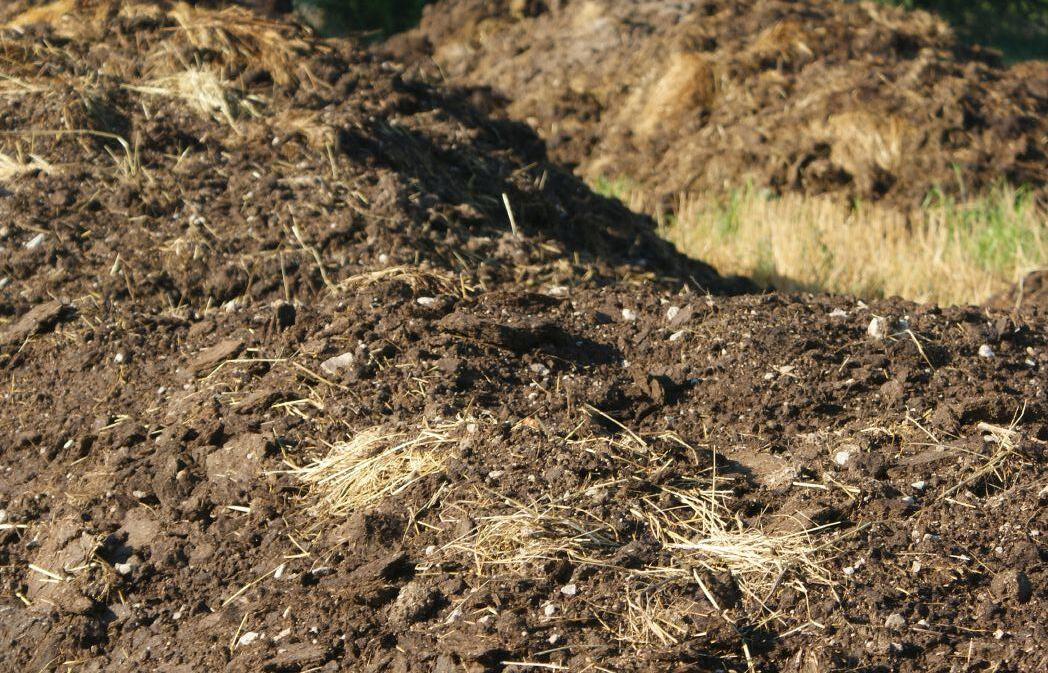
and promotes the microbial decomposition of organic matter. Stockpiling has been described as ‘passive composting,’ with manure being placed in large pyramidal piles on the ground or on a concrete pad. Stockpiled manure is not mechanically turned or mixed, leading to regions of anaerobic decomposition. Stockpiling cannot achieve the high temperatures associated with composting and results in a shorter period of internal pile heating.
McAllister’s team found that in terms
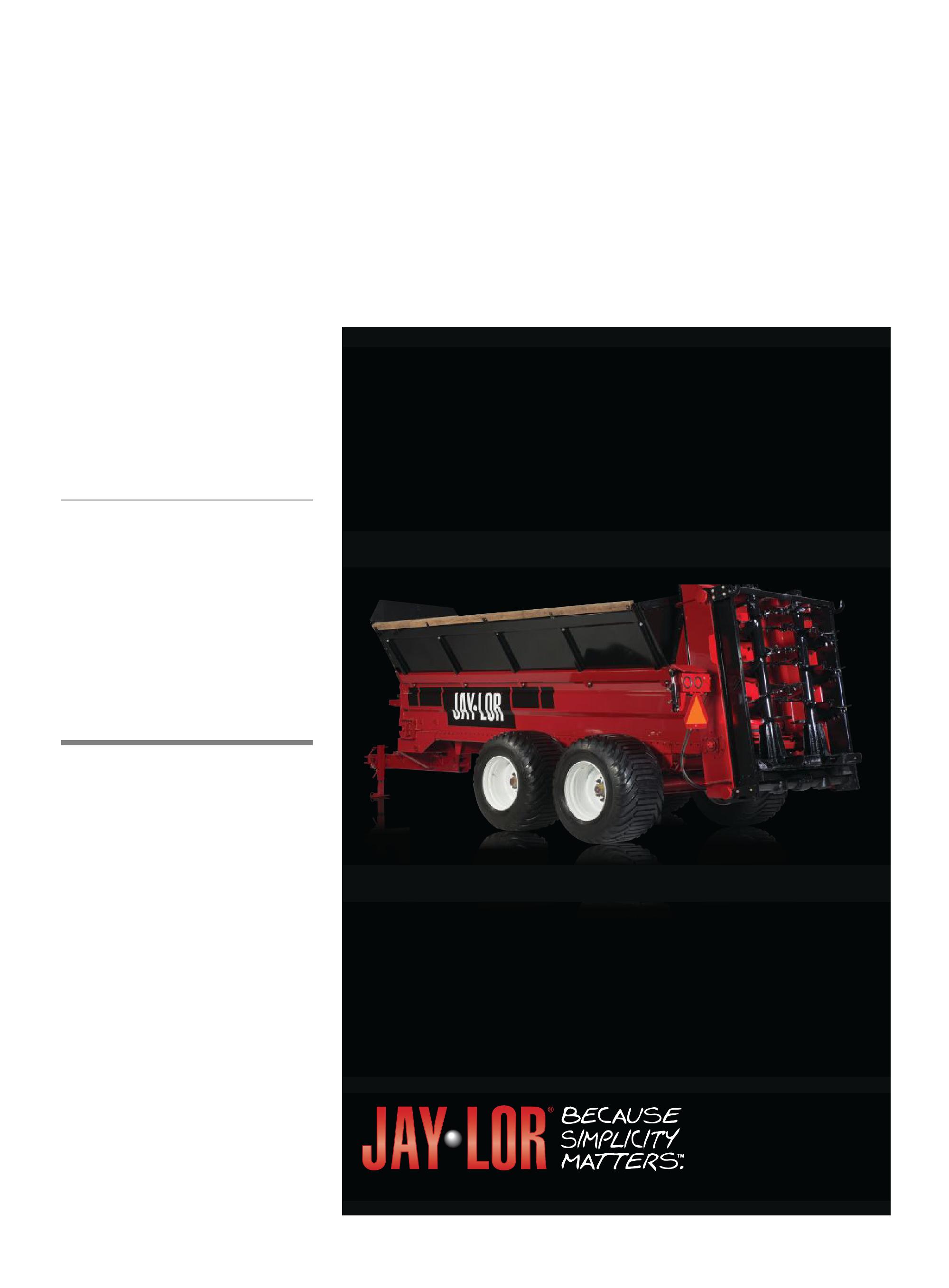
Jaylor’s new manure spreader is engineered to be simple and robust, providing years of trouble free performance. Cambered commercial-grade highway axles and brakes are standard equipment along with oil bath hubs, making the chassis virtually maintenance-free. The optional hydraulic slide axle on the HD models allows for operation in the muddiest conditions, as dynamic load balancing provides on-the-fly tongue weight ratio adjustments from 0.5%-10%.
Jaylor’s new manure spreader is engineered to be simple and robust, providing years of trouble free performance. Cambered commercial-grade highway axles and brakes are standard equipment along with oil bath hubs, making the chassis virtually maintenance-free. The optional hydraulic slide axle on the HD models allows for operation in the muddiest conditions, as dynamic load balancing provides on-the-fly tongue weight ratio adjustments from 0.5%-10%.
the muddiest conditions, as dynamic load balancing provides on-the-fly tongue weight ratio adjustments from 0.5%-10%. The quick-attach vertical beaters and hydraulic guillotine door, provide a full 40’ of consistent spread both from front to back of the load and across the width of the spread. Paired with our
applied over 50’ and from 4-15 Tons/Acre. The beaters are held by
from
2-1/4” bearings which withstand the
and
chucks. Six paddles on the beater base, allow for a fine spread of fibrous and liquid material.
Jaylor’s new manure spreader is engineered to be simple and robust, providing years of trouble free performance. Cambered commercial-grade highway axles and brakes are standard equipment along with oil bath hubs, making the chassis virtually maintenance-free. The optional hydraulic slide axle on the HD models allows for operation in the muddiest conditions, as dynamic load balancing provides on-the-fly tongue weight ratio adjustments from 0.5%-10%.
Our warehouses on both sides of the US/CDN. border stock a full complement of spare parts inventory, and most items can be shipped next day, to support our network of dealers.
The quick-attach vertical beaters and hydraulic guillotine door, provide a full 40’ of consistent spread both from front to back of the load and across the width of the spread. Paired with our optional rear canopy, material can be precisely applied over 50’ and from 4-15 Tons/Acre. The beaters are held by reinforced 2-1/4” bearings which withstand the abuse from large stones and frozen chucks. Six paddles on the beater base, allow for a fine spread of fibrous and liquid material.
Our warehouses on both sides of the US/CDN. border stock a full complement of spare parts inventory, and most items can be shipped next day, to support our network of dealers.
Once you see Jaylor’s new simple manure spreader, you’ll understand why we say: “Because Simplicity Matters”.
Once you see Jaylor’s new simple manure spreader, you’ll understand why we say: “Because Simplicity Matters”.
Our warehouses on both sides of the US/CDN. border stock a full complement of spare parts inventory, and most items can be shipped next day, to support our network of dealers.
The quick-attach vertical beaters and hydraulic guillotine door, provide a full 40’ of consistent spread both from front to back of the load and across the width of the spread. Paired with our optional rear canopy, material can be precisely applied over 50’ and from 4-15 Tons/Acre. The beaters are held by reinforced 2-1/4” bearings which withstand the abuse from large stones and frozen chucks. Six paddles on the beater base, allow for a fine spread of fibrous and liquid material.
The quick-attach vertical beaters and hydraulic guillotine door, provide a full 40’ of consistent spread both from front to back of the load and across the width of the spread. Paired with our optional rear canopy, material can be precisely applied over 50’ and from 4-15 Tons/Acre. The beaters are held by reinforced 2-1/4” bearings which withstand the abuse from large stones and frozen chucks. Six paddles on the beater base, allow for a fine spread of fibrous and liquid material.
Our warehouses on both sides of the US/CDN. border stock a full complement of spare parts inventory, and most items can be shipped next day, to support our network of dealers. Once you see Jaylor’s new simple manure spreader, you’ll understand why we say: “Because Simplicity Matters”.
Once you see Jaylor’s new simple manure spreader, you’ll understand why we say: “Because Simplicity Matters”.
LEFT
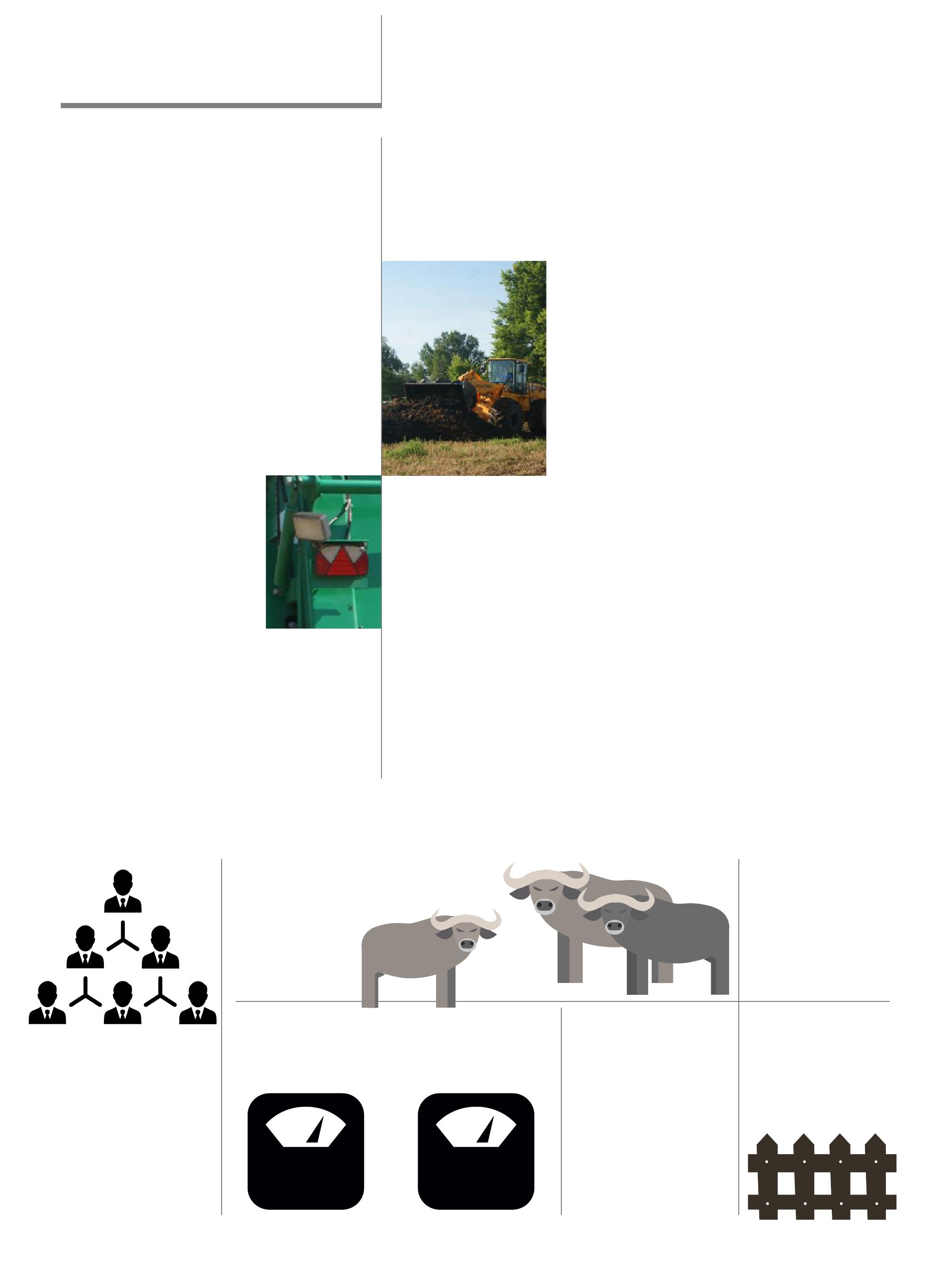
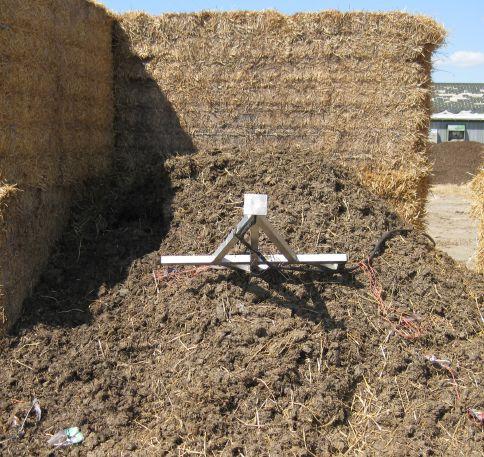
Composting manure involves turning long windrows at least three times over the composting period.
RIGHT
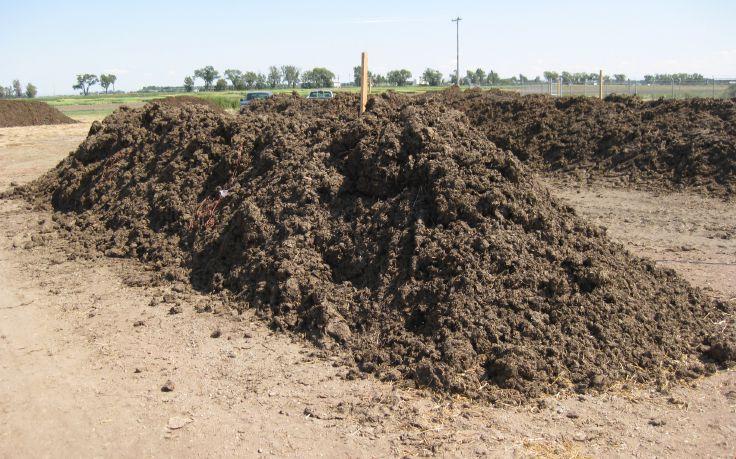
Stockpiling has been described as ‘passive composting,’ with manure being placed in large pyramidal piles on the ground or on a concrete pad.
of their ability to kill off pathogens and degrade antibiotic resistant genes, composting provides better results. McAllister believes farmers should definitely do one or the other.
“Stockpiling…doesn’t require any equipment other than a loader, which every farmer already has,” he notes. “So stockpiling is a no-brainer for manure management. Letting manure sit at least a month should be standard practice. It also has the economic advantage of lowering the volume of manure that needs to be delivered to the field.”
Composting has more costs, he says, but can be worthwhile.
“There are investments needed in capital equipment costs, and in ongoing time and labour, but if you have a market nearby, a big city where you can sell composted manure for a good price, you can potentially make an ongoing profit.” [See sidebar for more]
Composting or stockpiling aside, another matter of individual choice is deciding whether to spread your manure on your fields. Spreading it certainly won’t add to the prevalence of antibiotic resistance that is already found in the soil, but McAllister says it doesn’t always make sense financially.
“You are adding organic matter when you
Markets for composted manure
Composting on a large scale can be profitable for farmers but is a full-time job, says Van Doan, agri-resource engineer at Manitoba Agriculture, Food and Rural Development.
“Most beef farmers are farmers first…[they compost] for the volume reduction and odor reduction. Plus, if they land-apply the composted manure, they find it’s improving their soil tilth.”
Overton Environmental Enterprises compost site manager Gerry Dubé agrees. The Winnipeg-based firm composts by-products from several large companies (such as a potato processor and the Winnipeg horse racing track) and sells it to the public, and also helps several farmers compost their
spread your manure, but manure is high in phosphorus, so likely you will have to add N anyway in a separate spreading to balance out the N-P ratio,” he explains. “So, sometimes it’s easier for farmers to just use chemical fertilizer instead of manure. It’s each producer’s decision.”
And if you are wondering about what’s occurring with antibiotics added to animal feed that could impact human health, McAllister can also provide an update on that.
“Some antibiotics are already considered not safe to include in feed and regulations are in place and followed to prevent this practice, but we need more studies on the antibiotics that are presently approved,” he says. “It’s not in the best interest of animals to take away those antibiotics that help them get better from an infection or protect their health. The important thing to remember – and we haven’t published too much about this – is that we’re finding that the populations of bacteria that live in the environment are different than those that live in an animal. And there are certainly many manure management and food safety practices that we can use to reduce risk to human health, and many [of these practices] are already part of best management practices.”
own manure, from those who want to sell manure to those who want to use it on their fields to reduce or eliminate fertilizer and chemical use.
“We are trying to convince farmers that composting and spreading composted manure creates a vibrant soil biology and also sequesters carbon,” says Dubé. “They need a better understanding of the whole process and they also need an incentive from the federal government to help them transition from using large amounts of fertilizer and herbicides to this more-environmentally friendly type of farming. The incentive would fit well with the desires of the federal government to reduce carbon going into the atmosphere.”
CONTRIBUTED PHOTOS
UK INVASION IN MANITOBA
Manitoba dairy Happy Rock
Holsteins is the first operation in North America to use equipment from application system manufacturer SlurryQuip, which is based in Northern Ireland.
BY TONY KRYZANOWSKI
It is the quintessential dilemma faced by farms that generate significant amounts of liquid manure – should the farmland apply the manure themselves or should they hire a custom manure applicator?
Both have their pros and cons, and it often comes down to how much the farm owner trusts his custom manure applicator with the service they provide. Some issues are really not in the custom manure applicator’s hands, like the weather and exactly when the application is done, because during prime time in spring and fall, the phone never stops ringing. Farmers often must wait their
ABOVE
turn for the best custom applicators, which may not always work well with the farm’s cropping timetable. Advantage – farm-based system.
On the other hand, there is the time issue. Some farmers believe it simply makes more sense to hire a custom manure applicator because they and their employees need to stay focused on their dairy or hog operation. And then there is the cost of investing in tankers or a drag hose system, plus the learning curve required to use them properly. Advantage – custom manure applicator.
Dairy farm hand and engineer Mark Tucker believes there is a
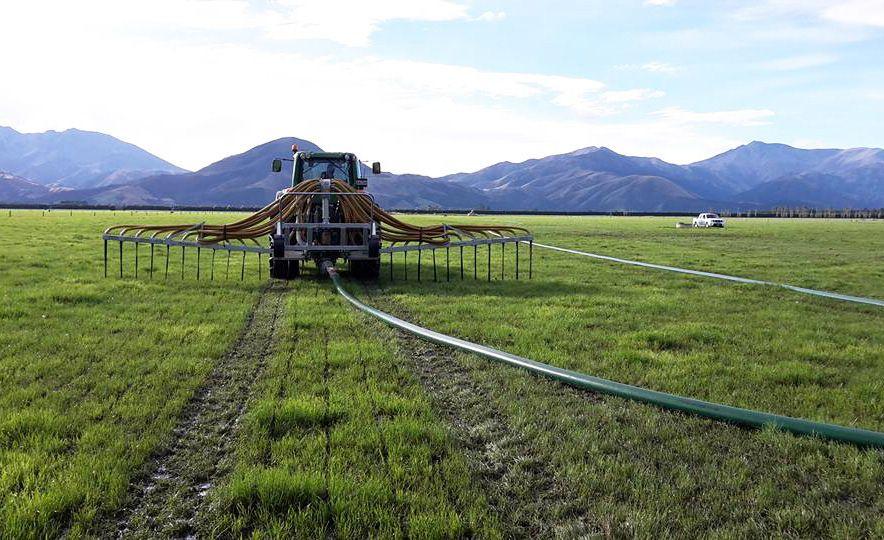
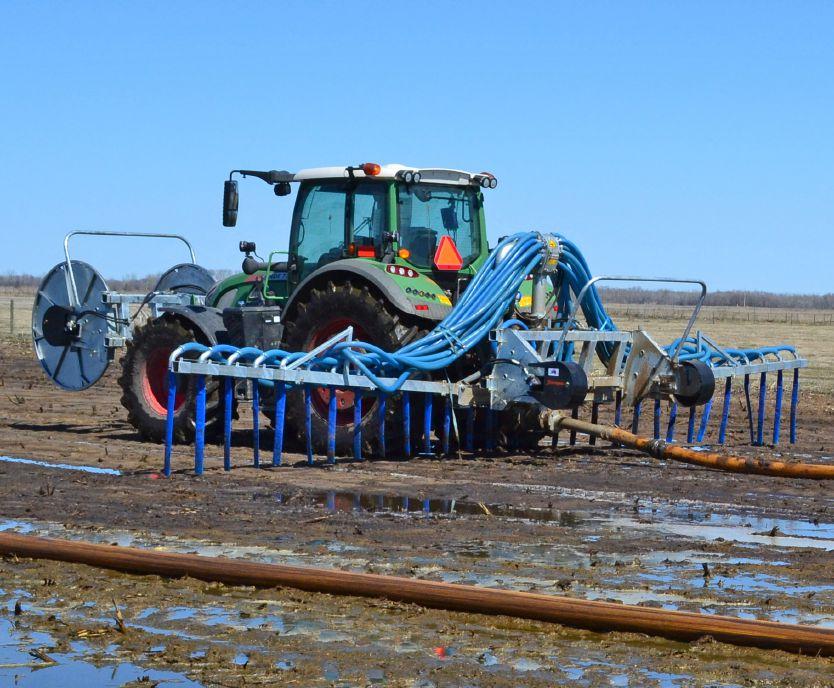
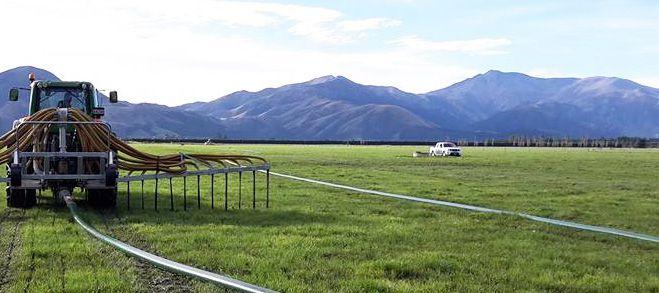
The SlurryQuip dribble bar and drag hose liquid manure application system is a product of Northern Ireland, and is already in widespread use in the UK, Australia, and New Zealand.
market niche and a demand for a simpleto-use and affordable drag hose system suited for farmers, and he believes the SlurryQuip system fits the bill.
“In my mind, it fills a gap in the market,” says Tucker. “Most of the North American systems are built overly big for your average farmer. This system is built for the farmer to use.”
The Northern Ireland-based manure application equipment manufacturer is setting up shop in North America. Its systems are currently widely used in the United Kingdom, Australia and New Zealand. The first North American system was sold last fall to Happy Rock Holsteins in Gladstone, Man., where Tucker is employed as an engineer and farm hand.
The dairy is owned by Steven Smith and has about 750 head, with 350 to 400 milking cows housed in a new free stall barn built two years ago. It has a slatted floor with liquid manure storage beneath it. The manure is pumped out twice a year and land applied. The dry cows and replacement stock are housed in an older barn with straw bedding that is cleaned out every couple of months, stockpiled, and then land applied using two, Kuhn manure spreaders. The dairy also manages about 3000 acres of cash and feed crops, in the vicinity of the dairy. This is where both the liquid and solid manure is land applied in spring and fall. Manure can only be spread in Manitoba between April 10 and November 10.
For two years after the new barn was built, Happy Rock Holsteins hired a custom manure applicator to pump out and land apply their liquid manure but it didn’t turn out as well as they had hoped. In fact, Tucker says land application of the liquid manure by the custom manure applicator destroyed an alfalfa crop twice, which encouraged the dairy owner to want to investigate a drag hose system that the farm could operate themselves. Farm hand Tucker was given the task to investigate drag hose systems and to make recommendations. That’s when he encountered the SlurryQuip system. Given his engineering background, he was quite capable of dissecting the pros and cons of each system and, although SlurryQuip had no systems working in North America, Tucker came to the conclusion that it was the right system for Happy Rock Holsteins to purchase and operate on their own.
While it requires dedicated farm employees to operate the SlurryQuip system, Tucker says that it has its advantages.
First, farmers can apply the manure on their own timetable and second, they have the opportunity to more carefully manage nutrients being applied on each parcel. He says, for example, that there
ABOVE
Happy Rock Holsteins essentially purchased the SlurryQuip system based on research over the Internet.
are plans at Happy Rock Holsteins to make several applications each year on some parcels after each alfalfa cut. Organizing this type of timely and frequent
service hiring a custom manure applicator would be a costly endeavor.
What he also likes about the SlurryQuip system is that the farmer can practice more precise farming, based upon the global position system (GPS) in the tractor, and the ability with the SlurryQuip system to carefully control the flow. With these two features, the farmer can place the liquid nutrients exactly where and in the volume that it is needed based on soil sampling. This is generally contrary to what Tucker sees as the major trend in North American custom manure application, which seems very focused on applying a fixed volume per minute across an entire field versus making application adjustments on-the-fly depending on where it is needed.
“What attracted me to this system is its accuracy,” says Tucker. “Applying volume per minute is fine for the applicator who is being paid by the gallon. For a farmer, who wants to put on the manure accurately, in my view, this system is ahead quite a bit in that respect.”
Another feature that Tucker likes about the system is the ability to reduce flow from the dribble bar by up to 75
Best Storage for Maximum Nutrient Value!
Consistent Nutrient ValueAgitation Makes the Difference
• Center agitation system evenly blends nutrients.
• Better utilization of “waste” translates into less purchased fertilizer.
Environmentally Sound
• Designed and constructed using bolted glass-fused-to-steel panels for secure storage and high corrosion resistance.
• Above ground - minimizes the danger of run-off, leaching and ground water contamination.
• Environment-friendly odor control - releases odors above ground level into higher air currents.
Visit www.cstindustries.com to find your local dealer, or call 815-756-1551.
ABOVE
The SlurryQuip system allows the dairy to reach about 70 percent of its farmland, using only one pump.
percent, meaning that the tractor operator can significantly reduce flow particularly when making turns and also in the event of the need to reduce flow in a hurry because of a flow issue. He says that is likely what caused the problem in the damaged alfalfa field owned by Happy Rock Holsteins – a problem with over application by this particular custom manure applicator, as the operator made slower turns without reducing the flow rate.
Happy Rock Holsteins essentially purchased the SlurryQuip system based on Tucker’s research over the Internet. The complete system arrived on the farm in a container, almost completely assembled. It was his job to complete the assembly, attach it to the tractor, and put it to work. Given his background in agricultural engineering, he says it was less scary for the dairy to make the equipment purchase in this way. There were no issues attaching the system to the farm tractor’s PTO and three-point hitch.
“When we looked at the system, certainly in my eyes, it was fairly simple to see how it worked, the fact that it could work, and that there were no design flaws,” says Tucker. “Both Steven and I saw many design advantages. We saw that it was much simpler to use from the farmer’s point of view than what we saw in North American systems.”
He and the dairy owner also liked that all the components are galvanized.
“In 10 years time, assuming we don’t bend or break anything, the machine will still look like new,” says Tucker.
He says the design of both the SlurryQuip hose reels and lift systems, and how they are designed to work with just one tractor in the field, powered off the tractor’s PTO and with the reeler mounted on the dribble bar, this makes it possible for one person to manage the whole field operation, which they accomplished at Happy Rock Holsteins. They only had one other person involved, looking after the pump at the farm site.
The SlurryQuip system was put to work throughout last fall’s application season with no issues. Shortly after the manure was land applied, it was disked into the soil.
“We made some errors ourselves, given the learning curve,” says Tucker. “But as far as the machine, we didn’t have one
problem. The system worked straight out of the crate.”
Their SlurryQuip system consisted of two Bauer pumps, a Vogelsang macerator, a Krohne flow meter for inside the tractor cab, 2.4 kilometers of a combination of 5-inch and 6-inch Oroflex umbilical hoses, four SlurryQuip reels, two SlurryQuip reel lifters and a 31-foot wide SlurryQuip drib-
ble application bar. The dribble bar was mounted on a 724 Fendt tractor, which Tucker says provided far more power than they needed. He suspects that a 100 horsepower tractor would have been adequate for their system because it is a dribble bar versus an injection system. They used the PTO from another farm tractor to power the pump to suck the liquid manure from
the tank through the umbilical hoses to the applicator in the field. The system allowed the dairy to reach about 70 percent of its farmland, using only one pump.
Many of the system’s components, like the pumps and hoses, are common, off-the-shelf brand items available worldwide, although Tucker says there are few wear parts on the equipment.
Patented Chopper Pumps
Dual chopping system to prevent clogging
Open design high speed impeller with adjustable pressure plate for unsurpassed performance with mechanical seals
Electric/PTO models, 4ft to 20ft
Manure Separators
NEW Stainless casted augers with super hard coating for 40% dry bedding
NEW DODA self-adjusting weights
Heavy duty planetary gearbox with 15HP USA electric motor
Sales - Service - Install
PROTEIN IN, Ammonia out
Reducing the amount of crude protein in a dairy cow’s diet can help to reduce the amount of nitrogen in manure and urea in urine.
BY ADITYARUP CHAKRAVORTY
Ammonia gas packs a smelly punch. In small doses, it’s what makes smelling salts so effective. But high levels of ammonia can be a health hazard and a pollutant.
Dairy farms are one of the major sources of ammonia emissions. The U.S. Environmental Protection Agency estimated that dairy farms contributed more than 20 percent of the ammonia emitted from animal husbandry operations in 2015.
Now, a recent study has compiled and analyzed data from 25 previous studies. Researchers honed in on factors that influence how much ammonia dairy barns emit.
The goal was to figure out which factors influence ammonia emissions in dairy barns and to, ultimately, lower the amount of ammonia being released from dairy facilities, says Adeline Bougouin, lead author of the study. That’s important because
ammonia poses several dangers.
In the confined spaces of many farm buildings, high levels of ammonia can be a threat to animals. Ammonia is also linked to the respiratory problems in humans. In the environment, ammonia can damage terrestrial and aquatic ecosystems.
“Our work is important because it provides key information to farmers and farm advisers about potential ways to lower ammonia emissions,” says Bougouin, a researcher at Wageningen University in The Netherlands who is now working at the French National Institute for Agricultural Research.
But reducing the amount of ammonia being emitted from dairy farms is a complex endeavor. Farms, after all, are economic enterprises. A solution needs to fit with the bottom line.
“Farmers need concrete strategies that reduce the environmental impact of their farms but not their economic output,” says Bougouin.
So, Bougouin and her colleagues looked at existing research. These studies had cataloged several factors that influence how much ammonia dairy barns release. They looked at both environmental factors, such as seasons and temperature, as well as the diet and nutrition of the dairy cattle.
“We confirmed that both environmental factors and nutritional aspects significantly influence ammonia emissions from dairy barns,” says Bougouin.
Some of the factors influencing ammonia emission – such as seasons – are beyond a farmer’s control. Others are not. Take, for instance, the amount of crude protein in the animals’ diet.
“Crude protein is a measurement of the total amount of nitrogen in feed,” says Bougouin.
Nitrogen in the diet is not broken down efficiently by cattle. It is excreted as urea, mostly through urine. When urine and feces mix, the urea is converted into ammonia and released to the atmosphere.
Bougouin found that reducing the amount of crude protein in a dairy cow’s diet reduced the amount of nitrogen in manure and urea in urine. And it did not affect milk yield. Reducing excess nitrogen in the diet could be an effective strategy to reduce ammonia emissions without affecting a farm’s bottom line.
Other factors that influence the amount of ammonia being released include the type of flooring system used in it, the amount of dry matter in dairy cattle feed, and milk yield per cow.
The findings come with some caveats.
“The emission rates we describe in the study may not represent whole-farm ammonia losses,” says Bougouin.
Emissions can also occur during manure storage or during composting and field application.
Bougouin’s research was published in the Journal of Environmental Quality.
CEMENTING A Composting Solution
Marty Winchell was in need of a composting solution to keep his operation’s mortalities out of the jaws of wild animals. Some creativity and a used cement mixer turned out to be the simple answer.
BY DIANE METTLER
The Winchell family farm in Alberta is relatively small – around 300 laying hens, 70 sheep, as well as a number of pigs and cattle. But not long ago, the 120-acre farm raised around 12,500 layer breeders as well as 4,200 egg laying ducks for the Filipino and Vietnamese market. When Marty Winchell went back to full time work in 2011 as the agriculture program supervisor for Clearwater County, the poultry population had to be substantially cut back.
Faced with depopulation, the Winchells first looked at selling the layers. Unfortunately, there was no
ABOVE
market for the chickens.
“I ended up paying people 20 cents a bird to pick them up, and then another 25 cents to 30 cents a bird to get rid of them. It was quite expensive,” says Winchell.
The same thing happened with the depopulation of the ducks.
“There was no market for spent fowl in the duck world here in Alberta,” he says. “Certainly nothing that wasn’t without risk.”
Winchell decided to compost the ducks himself. He built a trough using two rows of square straws bales. He filled the trough with the mortality and then covered it
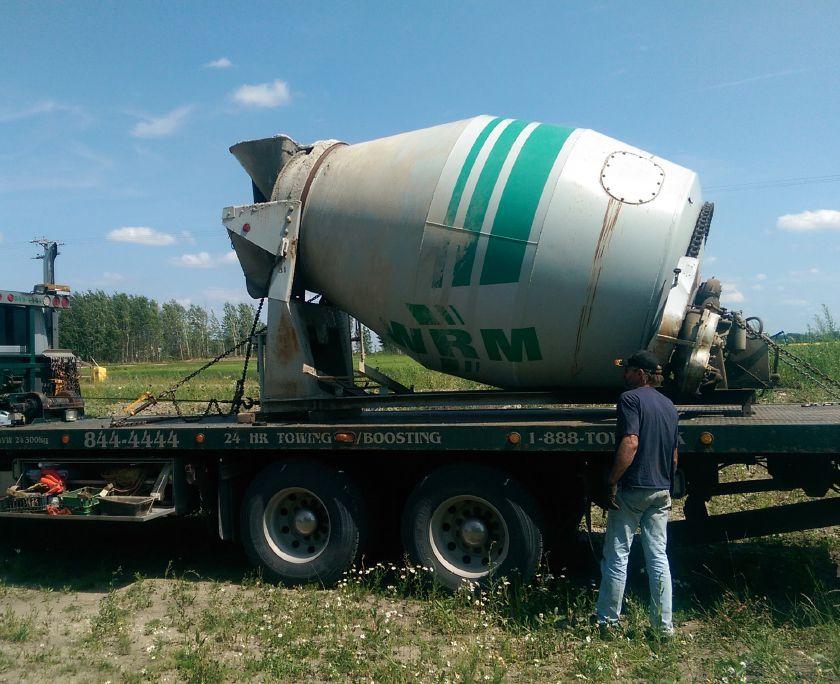
Using a grant from the Alberta government, Marty Winchell purchased a used cement mixer, outfitting it to be used as a compost system for animal mortalities on his farm.
TOP If there is any odor from the mixer, Winchell adds more carbon. And if it’s not heating, he adds water.
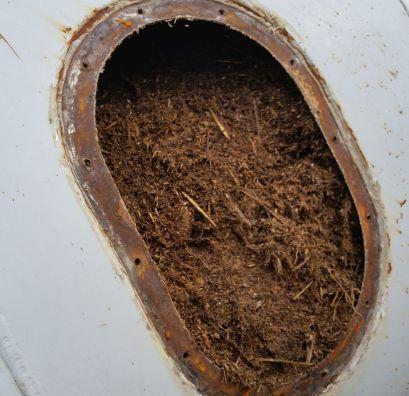
MIDDLE The Winchells have put into the mixer anything that they don’t feel comfortable putting in a windrow or exposed to the water. They have composted a llama, mortality from lambing, wiener pigs, as well as broken eggs.
BOTTOM Marty and Cindy Winchell operate a small family farm in Alberta.
with three to four feet of manure. Although it worked, it wasn’t the optimum solution.
“Every time you turn compost with any animals in it, you often expose bones and there was also odor,” Winchell says. “And although the odor dissipates quickly, we’re in close proximity of town.”
The odor can also bring in predators, which Winchell doesn’t want to expose his sheep to.
Another environmental consideration is that the farm is on the bank of the North Saskatchewan River, a river that provides water for the city of Edmonton. For that reason, they are extra cautious about any composting practices.
“We’re just trying to do the right thing,” he says.
Winchell can’t tell you when he came up with the idea of using a cement mixer to compost mortality, because he says he feels like he has always been on the lookout for one. It was definitely before the mortalities, when he was dealing with composting cracked eggs and similar materials.
“Cracked eggs are probably one of the biggest attractives I have on my farm. And, I also wanted to compost with less work,” says Winchell. “I knew that composters they sell at the hardware store weren’t large enough. I guess I was just looking for a practical way to size it up, and when I did that, it looked like a cement mixer.”
He wasn’t the only one who thought it was a good idea. Bear Smart, an Alberta provincial program, gave him a $1,000 grant to try out his innovative idea.
It took some time to get it all in place. Not only did Winchell have to find an inexpensive, used mixer, but also find a way to get it to the farm.
“With the grant, I bought a cement mixer with a bad hydraulic drive and no truck,” he says. “It cost me $1,000 to transport it here and around $800 for a new hydraulic drive, plus I had to buy some hoses. I figure I’ve got about $2,000 of my own money in it.
“If the average person were to go and buy one, they’d probably just need hoses to attach it to a tractor
or a skid steer,” he adds. “I didn’t know what I was doing, so when I picked it up, it didn’t actually have the hydraulic pump, or the drive on it, so I had to find one of those and that was difficult to locate because of the age of the cement mixer.”
In the end though, the idea was sound, and the composter worked just as he had anticipated.
One of the big benefits of using a mixer as a composter is that when it turns one way it stirs the material, and when it turns the other direction the material exits.
It’s also easy and quick to use.
“It takes about 30 seconds to hook the hoses up to my skid steer,” Winchell says. “I turn it, and I’m done.”
The first thing he composted with the mixer was 300 birds. Within a month – and only spinning it three or four times – the birds were completely composted.
“I felt like it worked really well,” he says. “I would turn it in the evening and could see the steam coming out and that it was heating.”
Winchell says he could be more scientific about the process, but for now if there is any odor he adds more carbon, like a bale of straw or a bucket of shavings. And if it’s not heating, he adds water.
Over the last year, the Winchells have put into the mixer anything that they don’t feel comfortable putting in a windrow or exposed to the water. They have composted a llama, mortality from lambing, wiener pigs, as well as other waste like broken eggs – all the while adding shavings, straw and water.
“Truthfully, after over a year, I still haven’t emptied the mixer,” Winchell says.
The cement mixer holds around five yards of compost. But it’s definitely the smaller variety. Many of the newer cement mixers hold around eight cubic yards.
Winchell doesn’t have any intention of spreading the compost from the mixer on his land.
“I was at one seminar where Environment Canada indicated that if you had compost with a dead cow with BSE, spreading it on your land and then allowing cows to eat off that could be dangerous. They
High efficiency — Lower HP required
Heavy duty construction — Low maintenance
weren’t sure how prions moved, and were very reluctant for animal compost to be put back on pastureland. Because there are sheep in our compost, and sheep can have scrapie (not that I’ve ever had that on my farm) I will not be using this compost on anything that is used for food production for animals or humans.”
When Winchell does empty the mixer, he will be using the compost for other projects, like bank stabilization.
The Winchells do, however, still have a lot of manure left from the farm when
it was larger, and continue to compost with windrows and sell that compost to neighbors.
“I usually turn it once in the spring, once in the fall. Because we live close to the river, we don’t do a lot of spreading of manure on the land. We’re trying to be responsible landowners and not put nitrates in the river. I suspect I will be spreading some compost on the property in the next couple years though.”
Winchell believes the mixer would be an ideal tool for smaller farms, not just
because it’s effective, but also because it’s inexpensive and simple to use.
“If you were looking for one, I would check out industrial auctions. They aren’t expensive, because nobody wants a cement truck. You can probably buy the truck and the cement mixer for a couple grand, then drive it home, take the cement mixer off, and then sell the truck for more than what you paid for the combination.”
And he adds, “There’s not a lot that can go wrong with them. They will probably last for a very long time.”
He can see the mixer as a great composter for small farm animals.
“You can compost something completely in six to eight weeks, so there’s no reason why a broiler operation couldn’t use something like this,” he says. “Because you don’t have a lot of mortality until the last couple weeks, and if you’re placing every six-and-a-half to eight weeks, you should be able to get a batch through.”
The Winchell family (wife, Cindy, sons Oliver and Henry and daughters Grethe and Josie) isn’t shy about showing off the new composter. During the Clearwater County West County Ag Tour, 120 people came to look at the composter in action. Also, a number of articles have been written on the innovative mixer and Winchell has received some emails.
This May, the Winchells had 275 students out to the farm.
“The Grade 4 curriculum in Alberta is animal waste and plant waste and composting. So, we incorporated the cement mixer into the Grade 4 curriculum in Clearwater County and had 275 students come through my place and look at it – in addition to seeing sheep being shorn and talk on bees and whatever else.
“We’ve been a part of that program for five years. I’ve talked to them about compost before because I’ve always been composting, but this is the first year I’ve shown them the compost.”
He says his family gets involved because it’s important to educate.
“Often agriculture is vilified in social media and in the media. Education is something that I think we need to do a lot more of in order to make sure people realize that farmers are the first stewards of the land. We make our living off the land, so why would we do things that are not constructive?
We need to educate people that manure is a byproduct, but it’s also a resource.”
ATG Galaxy EarthPRO 45
Alliance Tire Group ATG has introduced the Galaxy EarthPRO 45 R-1 farm tire. ATG is launching the new Galaxy-branded biasply tire in 22 sizes to make it simpler for customers to choose the best tire for their needs. The 45-degree angle of the tread lugs maximize traction and self-cleaning in the field and, because they are longer than 23-degree lugs, put more rubber on the ground for a more comfortable ride. A wide nose bar also helps ensure smoother performance and longer service life on gravel and pavement. Sizes for rims range from 20 to 38 inches. atgtire.com
JD StarFire 6000
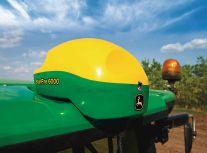
John Deere is taking satellite-based guidance to even higher levels of accuracy, repeatability and signal pull-in speed with the introduction of the StarFire 6000 receiver and SF3 signal. The new receiver has been designed to give customers greater precision capabilities, accuracy and uptime. By using the latest navigation algorithms, the StarFire 6000 can track up to three StarFire satellite signals at once, intelligently choose the one that will deliver the best performance, and automatically switch to an alternate signal to help maintain accuracy and performance if the primary signal is blocked. An improved rapid recovery feature allows for a quicker return to high-accuracy performance if the GNSS signals are lost due to shading from trees, buildings or terrain. The StarFire 6000 Receiver also has a built-in USB port to install software updates and a built-in 8 GB data-logger to capture and store data for improved trouble-shooting and diagnostics. JohnDeere.com/ag
Enterprise N-Insight
Agronomic Technology Corp is offering a free trial of its new N-Insight nitrogen diagnostic program. N-Insight is a web-based, interactive tool that provides immediate, field-specific insight into the financial and environmental impact of nitrogen management, including adaptive approaches, 4R’s nitrogen practices, and variable rate application. Using weather, soil, and field management information, N-Insight provides a five-year view of nitrogen loss, potential yield loss and excess input cost on a per-season and per-soil texture basis.
N-Insight.com
Fliegl opens subsidiary in the U.S.
Fliegl has expanded its global dealer network with the opening of Fliegl U.S. in Elkhart, Ind. According to the company, it was important to be located within the U.S. to guarantee the best possible service and to be able to provide spare parts quickly and easily. The new assembly plant, located 100 miles from Chicago, mounts Germanquality trailers. All products are original “Made in Germany” and manufactured and processed according to German quality standards. “The United States [was] the last major hurdle for us,” said Mikkel Gasberj, sales manager. “With our own branch, it is now finally possible to access the American market.” Fliegl will be working over the coming months to establish a sales team plus a strong network of distributors.
Bazooka Farmstar Hose Reels
Bazooka Farmstar is expanding the company’s line of hose reels for the manure handling industry. The Eclipse (2416) Hose Reel, 2012 Hose Reel, and the 1810 Pivoting Tongue Hose Reel will provide further functionality and convenience for manure handlers. In addition, Bazooka Farmstar has launched the innovative Quantum Drive System. The new Eclipse (2416) Hose Reel is one of the industry’s largest hose reel with a volume capacity of 580 ft3. It easily holds three miles of 6-inch hose, two miles of 8-inch hose, or one mile of 10-inch hose. The 2012 Hose Reel holds 2.5 miles of 6-inch hose or 1.5 miles of 8-inch hose. The 1810 Pivoting Tongue Hose Reel provides pivoting level wind and holds 2.25 miles of 6-inch hose and 1.25 miles of 8-inch hose. Available on all reels, the Quantum Drive System combines high-speed technology with precise control features to allow the manure handlers to move hose faster. bazookafarmstar.com
Green Mountain Technologies Intermodal Earth Flow
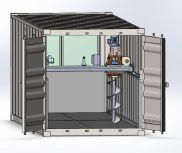
Green Mountain Technologies (GMT) recently designed and engineered its newest product, the Intermodal Earth Flow. The vessel is a standard 20-foot high cube shipping container that can be transported by truck, train and ship. Similar to GMT’s other Earth Flow systems, the Intermodal Earth Flow has automated auger technology and a positive aeration system. The re-purposed shipping container vessel comes in 20-foot or 40-foot sizes and lowers the cost of the in-vessel Earth Flow system by up to 40 percent. compostingtechnology.com
JCB 427 & 437 wheel loader
JCB is upgrading its mid-range wheel loader range, introducing the proven DNA from its 457 wheel loader to the 427 and 437 models, along with the smaller 411 and 417 loaders. Key features include JCB’s CommandPlus Cab for comfort and visibility, Innovative CommandPlus Control system, Tier 4 Final/Stage IV compliant engines with no costly diesel particulate filter, singlepiece hood for improved service access, and a range of loader arms to suit various industry applications. JCB’s new 411 and 417 wheel loaders are powered by the company’s own EcoMAX Tier 4 Final/Stage IV compliant diesel engines, delivering 108 hp (81kW) in the 411 and a powerful 125 hp (108kW) in the 417. The larger 427 and 437 loaders operate with a Tier 4 Final/Stage IV Cummins diesel engine, offering 179 hp (133kW) and 183 hp (136kW) respectively. jcb.com
Michelin low-pressure ag tires
Michelin introduced three new tires –the Michelin SprayBib VF 480/80R46 177D, the Michelin SprayBib VF 380/90R54 176D, and the Michelin CereXBib IF 1000/55R32 CFO 188A8 – for North American farmers designed with Michelin Ultraflex Technology –an innovative tire and casing design that promotes soil protection, fuel savings, longer service life and greater endurance. Michelin Ultraflex VF tires can operate at up to 40 percent less air pressure than standard radial tires (up to 20 percent less pressure for Ultraflex IF tires). The result is a larger footprint, which reduces soil compaction and can improve yield. In addition, a larger tire footprint provides excellent traction in the field, which can improve fuel economy by reducing slippage. MichelinAg.com
Mustang 608 & 708 articulated loaders
Mustang developed the 608 and 708 Articulated Loaders to answer the demand for large wheel loaders. The 608 and 708 are within the 60-80 HP class. The models have a Yanmar 64.4 hp (48 kW) engine on the 608 and a Deutz 74.3 hp (55 kW) engine powering the 708. The loaders include features such as a digital instrumentation display, Power-A-Tach Attachment Mounting System and a multi-function joystick. Digging and scraping performance is maximized through high breakout forces and front and rear locking differentials. Narrow machine widths allow access to tight, confined spaces. mustangmfg.com
Rethinking stink about antibiotics
BY ADITYARUP CHAKRAVORTY
Antibiotics and manure – two items not commonly thought of at the same time. But across North America, manure and antibiotics often share the same pile.
Antibiotics ward off diseases. Low levels of antibiotics are also often fed to livestock to improve their growth. However, much of the antibiotics fed to livestock go to waste – literally.
“Often, 90 percent or more of the antibiotic is excreted, according to previous studies,” said Francis Zvomuya, a researcher at the University of Manitoba in Winnipeg. “Manure containing these is then used as fertilizer on crops.”
And that’s not the end. Once applied with manure to crops, those antibiotics are in the natural environment, mixing with air, soil, and water. This can lead to antibiotic-resistant bacteria, a public health concern across the world.
One way to prevent such a chain reaction is to make sure antibiotics are broken down before they reach the field, for example, via composting or stockpiling. The question is: How quickly are these antibiotics breaking down during such handling?
To find the real scoop, researchers fed combinations of antibiotics to steers. Then they collected their droppings. A second group of steers was not fed antibiotics. Researchers added the same anti-
biotic combinations to these steers’ antibiotic-free manure. Then it was a matter of time: Which antibiotics would degrade faster during composting?
Results were mixed. For some antibiotics, the excreted antibiotics degraded more quickly. Other antibiotics degraded faster when added directly to manure.
That result is to be expected, said Inoka D. Amarakoon, first author of the study and a PhD student at the University of Manitoba. When antibiotics pass through the digestive system of animals, they undergo different chemical and biological changes.
“That can affect how quickly they degrade once they are excreted,” said Amarakoon.
Also, compared to the antibiotics added to manure, excreted antibiotics can be arranged differently within the manure.
“That can change whether the antibiotics are even available for chemical or biological degradation,” said Amarakoon.
Zvomuya, Amarakoon, and their colleagues at Agriculture and Agri-Food Canada found that composting manure for 30 days reduced the concentrations of the antibiotics by at least 85 percent. Some results were as high as 99 percent.
The study was published in the Journal of Environmental Quality.
Work with the TOUGHEST
Put to the test by Jerry for 13 years
Two liquid manure spreaders, a screw agitator, two Super Pumps and two trailer pumps pumping 30 to 40 million gallons of manure a year.
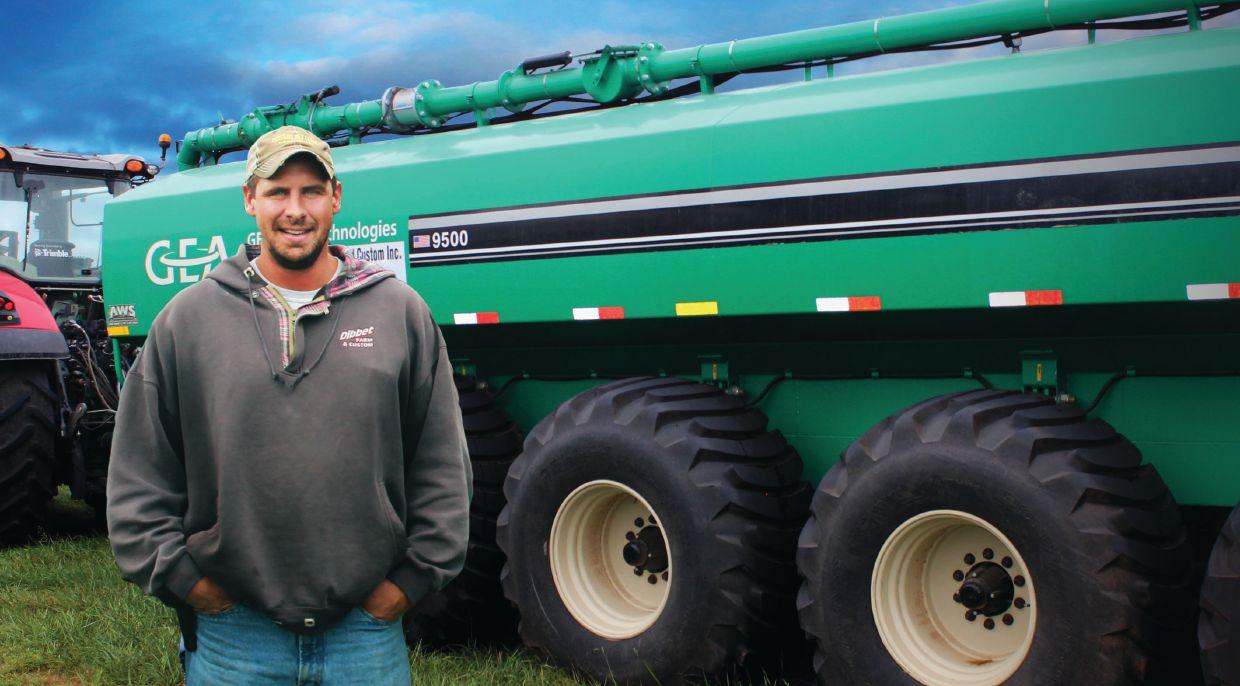
“What I like best about my GEA spreader are the options that it has like the hydraulic powered wheel steering and the weight transfer system to lift the front axle of the spreader when returning empty. It helps reduce hitch “slapping” due to the negative tongue weight with the larger tool bars. I also like the easy maintenance and how easy it pulls which leads to better fuel economy and quicker cycle times.”