Five tips for manure management Iowa farmers gather to learn | 30
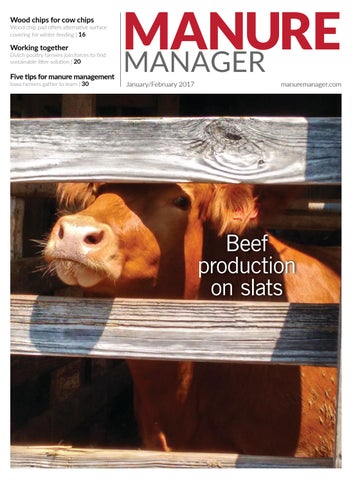
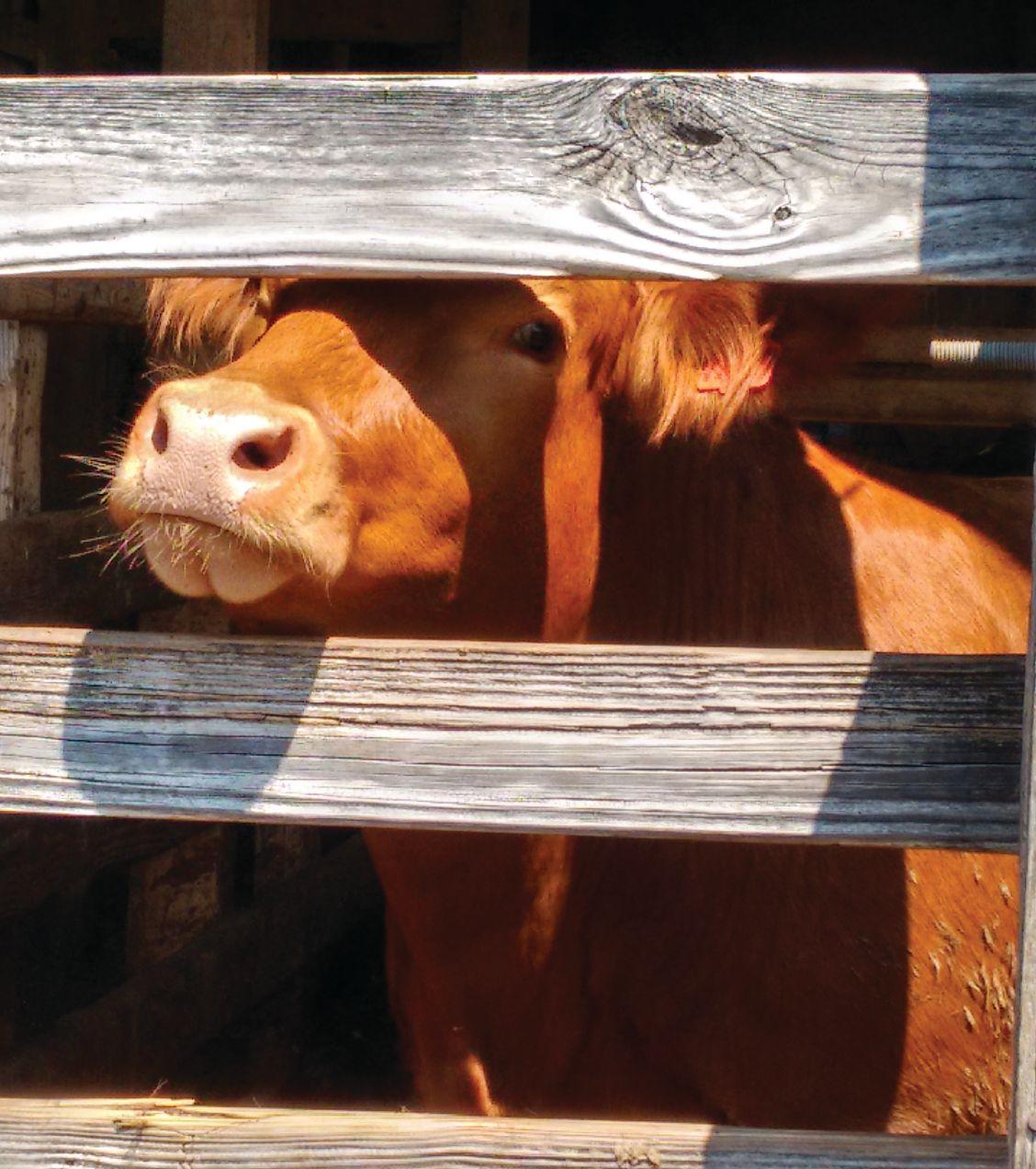
Beef production on slats
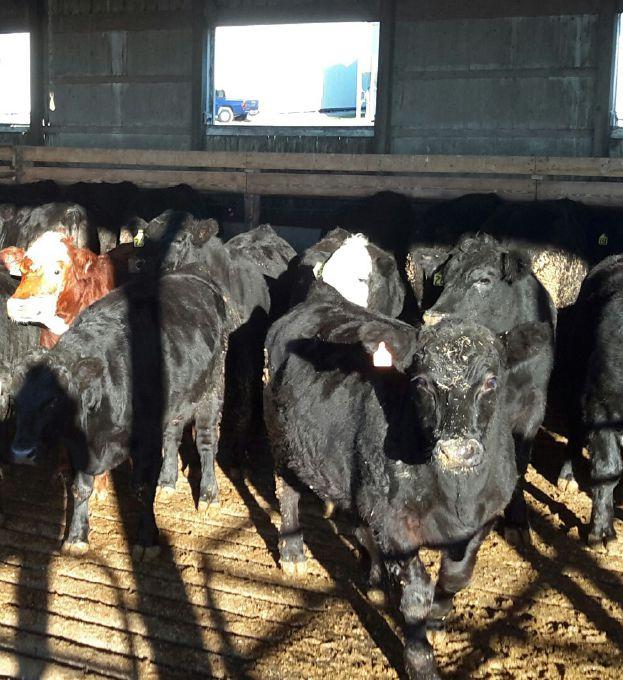
An Ohio beef producer fattens his herd in an enclosure with concrete slatted flooring and 10foot deep manure pits. PG 10
Wood chips for cow chips
Wood chip pads offer an alternative surface covering for winter feeding areas compared to concrete BY
DIANE METTLER
Working together, European style
Dutch poultry farmers joined forces to find a sustainable solution to spreading litter on farmland and also save money on disposal BY
MELANIE EPP
Five tips for understanding manure management
Iowa farmers gather to learn how to best manage their fertilizer source BY HALEY
BANWART
Beef production on slats. See page 10. Photo by Margaret Land
Have a happy, safe 2017
A 16-year-old farm boy from Wisconsin; a middle-aged Michigan dairy farmer; a 56-year-old pig farmer and his 18-year-old hired hand, both from Quebec, Canada; two brothers from a dairying family in South Dakota; a 29-year-old cattle farmer, also from Wisconsin – 2016 was a dangerous year for those managing and handling manure.
According to reports, all of the people from this sampling of 2016 manure gas fatalities were going about their normal day-to-day work – spreading manure, making repairs, agitating a lagoon, servicing equipment. These were activities they’d probably done dozens of times before without incident.
“Complacency kills,” stated Robb Meinen, a senior Extension associate with Penn State University, in a recent news release on manure gas safety. “It is not unusual in fatality situations to hear things like: ‘He’s gone in there to unclog that pump a hundred times.’”
It’s easy to take safety for granted. After all, we live in an increasingly
farm. A perfect storm of weather conditions – clear skies, no wind, heavy fog – caused the gases released during manure agitation to pool low to the ground, leading to the 29-year-old’s death.
In light of the tragedy, University of Wisconsin Extension held a manure gas safety webinar in early September to raise awareness of manure gases and update farmers about resources available to them. A recording of the presentation is available at Extension’s Agricultural Safety and Health website. During the 70-minute event, experts outlined the basics of manure gases, safety and monitoring recommendations, plus solutions to keep workers and livestock safe.
University of Wisconsin Extension is continuing its educational outreach by offering a workshop aimed at developing safety plans for manure storage and handling systems. It’s scheduled for Feb. 21 in Green Bay, Wisc., just prior to the 2017 Midwest Manure Summit.
MANURE MANAGER
January/February 2017 Volume 15, No. 1
Published by:
Annex Business Media, P.O. Box 530 Simcoe, ON N3Y 4N5
Editor MARGARET LAND (519) 429-5190, (888) 599-2228, ext 269 mland@annexweb.com
Contributing Editors Tony Kryzanowski, Diane Mettler, Lukie Pieterse
Director of Soul/COO SUE FREDERICKS Printed in Canada Publication Mail Agreement #40065710 SUBSCRIPTION RATES Canada – 1 Year $35.95 (plus applicable taxes) USA – 1 Year $62.95 USD Foreign – 1 Year $72.00 USD
GST – #867172652RT0001
CIRCULATION
e-mail: blao@annexbizmedia.com
Tel: (416) 442-5600 ext 3552 Fax: (416) 510-5170
Mail: 80 Valleybrook Drive, Toronto, ON M3B 2S9
Occasionally, Manure Manager will mail information on behalf of industry-related groups whose products and services we believe may be of interest to you. If you prefer not to receive this information, please contact our circulation department in any of the four ways listed above.
bubble-wrapped world where even silica packets in shoeboxes warn us not to eat them. And while most farmers understand the dangers of entering enclosed spaces, such as pump pits and under-barn manure storages, some wouldn’t expect to find the same gas hazards working in an open-air area. But atmospheric conditions can play an important role in manure gas distribution.
While farming accidents are devastating to all involved, it’s important to learn from them.
Please keep safety in mind as we head into 2017. Be careful out there. Please keep safety in mind
That’s what investigators believe occurred to Mike Biadasz, an Amherst, Wisc., area farmer who died of acute exposure to hydrogen sulfide gas while agitating an outdoor manure lagoon on his family’s
The Biadasz family recognizes this. As a result of their son and brother’s death, they have opened a memorial fund in Mike’s name. The Mike Biadasz Farm Safety and Education Memorial Fund hopes to raise awareness and educate people about farm safety, including the dangers of manure gas. The fund, administered through the Community Foundation of Central Wisconsin, has received more than $40,000 in donations.
All advertising is subject to the publisher’s approval. Such approval does not imply any endorsement of the products or services advertisted. Publisher reserves the right to refuse advertising that does not meet the standards of the publication.
THE PERFECT COMBINATION
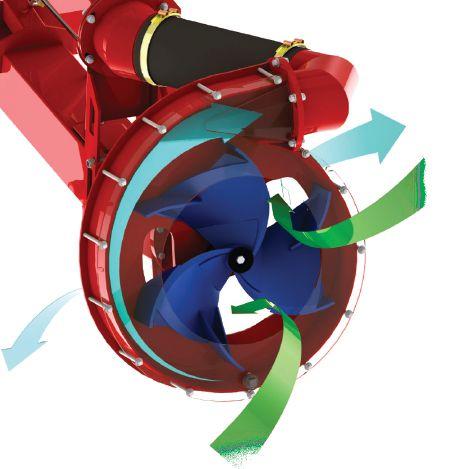
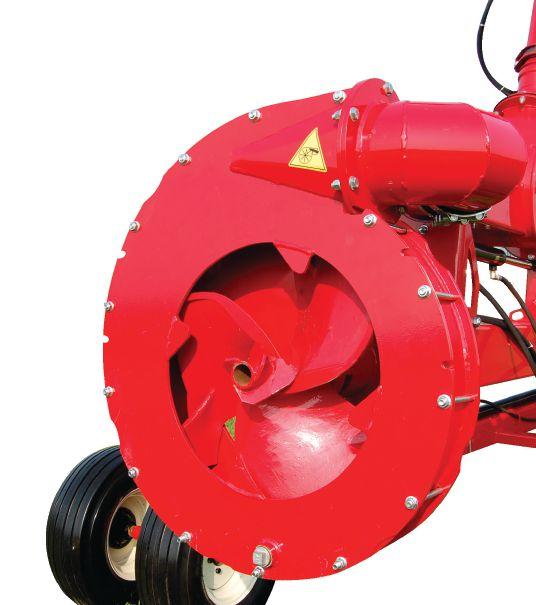
The PUMPELLER® Hybrid Turbine revolutionizes manure pump performance. Incredible intake suction pulls solids into the cutter knives, reducing the toughest crust to nothing in just seconds. The turbine combines the high-volume mixing of a propeller agitator with the power and reach of a lagoon pump, the resulting hybrid design radically outperforms both.
for professional
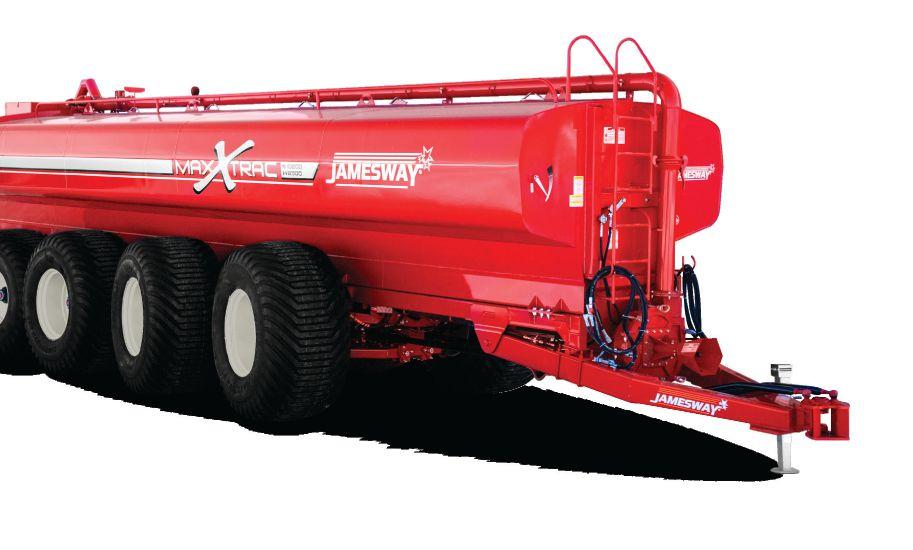
Jamesway’s new MAXX-TRAC tankers deliver maximum performance.
Patented Turbine Impeller
MDA requests proposals for manure technologies
The Maryland Department of Agriculture has issued a grant solicitation for demonstration projects offering technologies that can improve the management and utilization of manure and other waste products.
Maryland is investing in technologies that support new uses for manure, such as alternative product development and manure-to-energy projects. The state’s Animal Waste Technology
Fund provides seed funding to companies that demonstrate innovative technologies to manage or repurpose manure resources.
The fund has $3 million available to invest during 2017. There is no maximum or minimum request. Vendors, businesses, and individuals are invited to respond to this grant solicitation which may be downloaded from the department’s website.
Proposals are due by March 15, 2017.
XYLEM’S FLYGT TECHNOLOGY TO BE SOLD THROUGH DEALER NETWORK
Xylem, a global water technology company, recently announced that its Flygt pumps and mixers will be made available across the U.S. through E&R Agri-Sales LLC.
Working closely with Xylem, E&R Agri-Sales will develop a network of dealers across the country to bring Xylem’s Flygt pumps and mixers –used in crop irrigation,
manure handling, livestock waste liquid management and biogas recovery – to agriculturalists and farmers across the U.S.
“Our Flygt brand of submersible pumps, mixers and agitators have been used in the agricultural sector for the past 30 years and is renowned among farmers as a premium, reliable and efficient brand,” said Andy
Fraher, director of marketing and business development with Xylem. “Through this new agreement with E&R Agri-Sales and the dealer network we are developing, we will bring this technology even closer to customers so that they can buy from a local distributor with whom they have an existing relationship.”
“The distributors
we will bring on board will deal exclusively with the agriculture market,” added Ron Skinner, marketing director with E&R Agri-Sales LLC. “We are interested in hearing from agricultural dealers and distributors who are keen to play a key role in this exciting new development.”
BY
THE NUMBERS
For more information, visit eandrsales.com million tonnesamount of poultry litter produced annually in the Netherlands
650,000 TONNES
1.3 amount of poultry manure exported to Germany, Belgium, and France
600 number of Dutch farmers who supply BMC Moerdijk with poultry manure
60 MANURE DELIVERIES are made to BMC Moerdijk every day
285,000 the MWh of electricity produced by BMC Moerdijk annually 2,000 approximate number of poultry farms in the Netherlands
Tulane announces five
finalists for $1 million Dead Zone Challenge
The National Advisory Committee for the Tulane Nitrogen Reduction Challenge has selected five finalists for its $1 million cash prize, which will be awarded to the team that presents the best solution to combat hypoxia – the deadly deficiency of oxygen that creates annual “dead zones” in the world’s lakes and oceans.
The purpose of the challenge is to find in-field solutions to hypoxia that reduce nitrogen runoff from crop fertilizers into rivers. Such runoff from the nation’s farmlands is considered the primary cause of annual dead zones.
The five team finalists for the $1 million prize are ADAPT-N (Ithaca, N.Y.), AgDNA (Brisbane, Queensland, Australia), Cropsmith (Farmer City, Ill.), PIVOT (Berkeley, Calif.) and Stable’N (Carmi, Ill.). The solutions presented by the finalists to combat the dead zones range from using electricity to inhibit nitrogen loss, utilizing microbes to enhance availability of nitrogen for crops,
an integrated nutrient management system, and using real-time data and simulation scenarios through precision agriculture/ model derivatives to determine nitrogen application rates.
The Tulane challenge received 77 registrants, including 10 international teams from Australia, Canada, Chile, Brazil, India, Ireland, Israel and Singapore.
The 15-member Advisory Committee unanimously selected the five finalist teams in November based upon the teams’ technical submissions.
“Narrowing down to just five finalists was a very competitive process because of the quantity and the quality of submissions received,” said Leah Berger Jensen, challenge director. “We are fortunate that these top five teams represent diverse innovations from across the world.”
Moving ahead into Phase 2, the five finalist teams will be provided a plot of farmland in Tensas Parish in northeast Louisiana to field test their innovation. The winning team will be judged based on the impact their solution has on crop yield, how well their solution manages nutrient runoff and how much it costs. The $1 million grand prize will be awarded in December 2017.
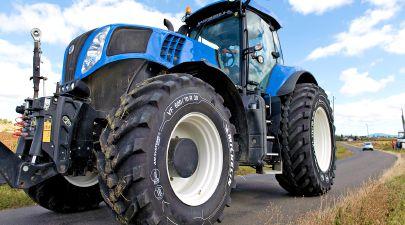
Michelin technology allows tire to change from road to field
Michelin has developed a patented two-in-one tire solution that adjusts pressure and usage, allowing farmers to operate more efficiently in the field or on the road.
This new technology recently earned the prestigious 2017 Innovation Gold Medal at SIMA, the Paris International AgriBusiness Show for high-performance and sustainable agriculture.
Working at ultra-low pressures while in the field, the tire’s contact patch increases in size up to 20 percent to reduce soil compaction. While working at higher pressures on the road, the tire transforms so that only the central continuous tread band grips the pavement, resulting in a smoother, vibration-free ride, fuel
savings and improved safety. This is great news for farmers who want the extra operational comfort but are challenged to deliver sustainable crop yields at affordable prices.
“It is a privilege to receive the SIMA Innovation Gold Medal on behalf of the dedicated, hardworking teams at Michelin,” said Emmanuel Ladent, director of Michelin’s agriculture business unit. “The twoin-one tire is a real gamechanger. This is the latest in the line of innovative new tire technologies brought to the market by Michelin, such as Ultraflex technology and the connected tire, and we eagerly anticipate the first presentation of this two-in-one tire at SIMA in March 2017.”
Judged by a jury of international agriculture professionals, the SIMA 2017 Innovation Awards recognize new developments from the show’s exhibitors that demonstrate design and innovative features having the potential to offer significant user benefits.
Smithfield Foods adopts GHG reduction goal
Smithfield Foods, Inc. recently announced plans to reduce its greenhouse gas (GHG) emissions by 25 percent by 2025 throughout its entire supply chain. When achieved, this goal will reduce emissions by more than four million metric tons, equivalent to removing 900,000 cars from the road. Smithfield
collaborated with Environmental Defense Fund (EDF) in setting its goal.
This commitment impacts operations across Smithfield’s supply chain, on company-owned farms, at processing facilities and throughout its transportation network. On its hog farms, Smithfield will
incorporate renewable energy and reuse projects that utilize technology such as anaerobic digesters and lagoon covers. Smithfield aims to install these technologies on at least 30 percent of companyowned farms.
The absolute GHG emissions reduction will be measured from a 2010 baseline.
BEEF PRODUCTION on slats
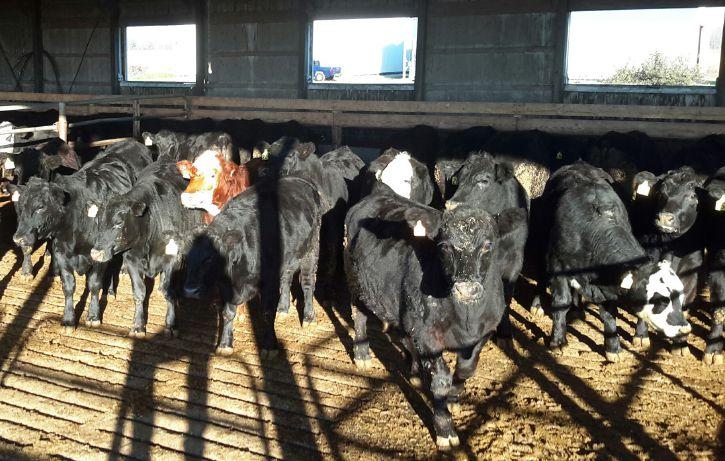
An Ohio beef producer fattens his herd in an enclosure with concrete slatted flooring and 10-foot deep manure pits, a set-up that helps simplify manure management.
BY TONY KRYZANOWSKI
BELOW
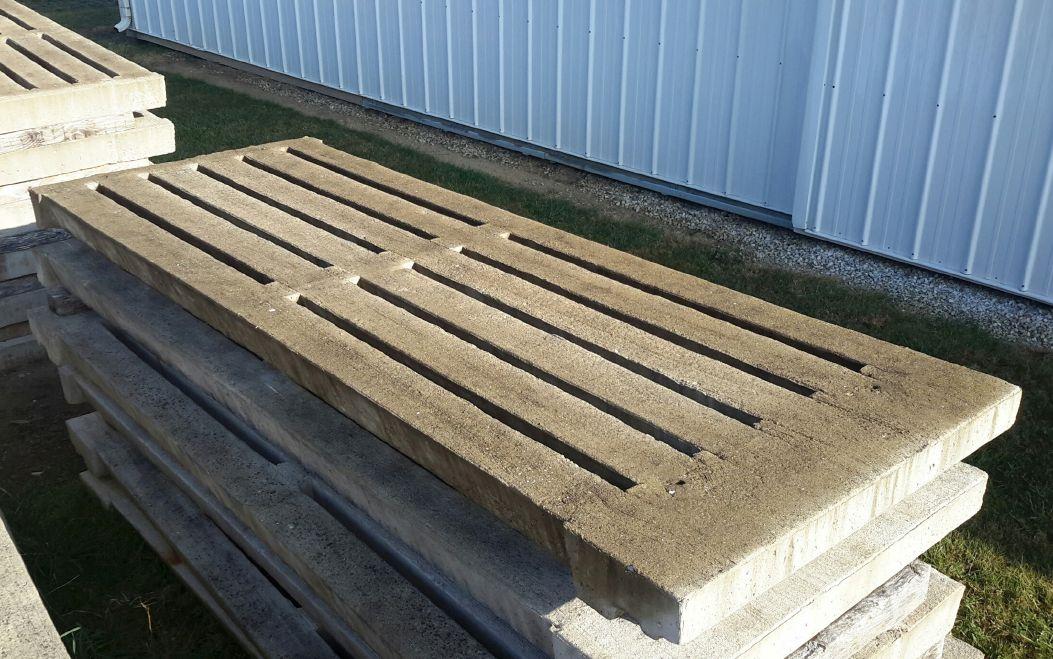
The concrete floor slats used in the cattle barn on the Rom Hastings farm in Ohio measure about 4-feet by 10-feet and lasted 28 years without needing any replacement.
Forget about cleaning cattle pens. An Ohio feedlot owner has taken the approach of housing his herd in a well-ventilated barn on slatted concrete floors. Manure collects in pits below the cattle pens, with the partially enclosed barn offering the cattle shelter from the elements.
Rom Hastings – co-owner of Hastings Farms General Partnership, along with his wife, Jodi, and son, Cody – says he doesn’t need to clean the barn except to pump out the collection pits below the concrete slatted floor once a year. The movement of the cattle within the pens propels the manure through the slats.
“As far as a slatted floor and manure collection pit operation, that is kind of unique for this area,” says Hastings. “At the time that the barn was built, it was probably state-of-the-art in the county … the cattle sleep and stand on those concrete slabs and the slabs have never been scraped since the barn was built, no power washing, nothing.”
Nor is there is any bedding used in the barn pens, which Hastings says is what he appreciates most about the barn enclosure. There is no need to handle and haul bedding out of the facility with this management system. And because the barn is well-ventilated, there is no requirement for fans or fly control. Also, in terms of potential accumulation of frozen manure on the floor in cold weather, Hastings says it has to be zero degrees for several days before he notices any accumulation.
TOP LEFT
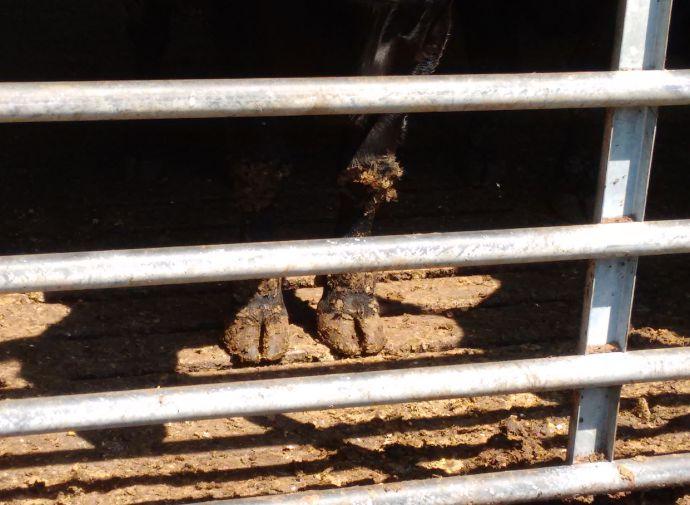
Despite being cloven hooved, Rom Hastings says the cattle he raises from 800 lbs to 1350 lbs in a barn enclosure with concrete slatted floors don’t feel nervous about the floor covering.
BOTTOM LEFT
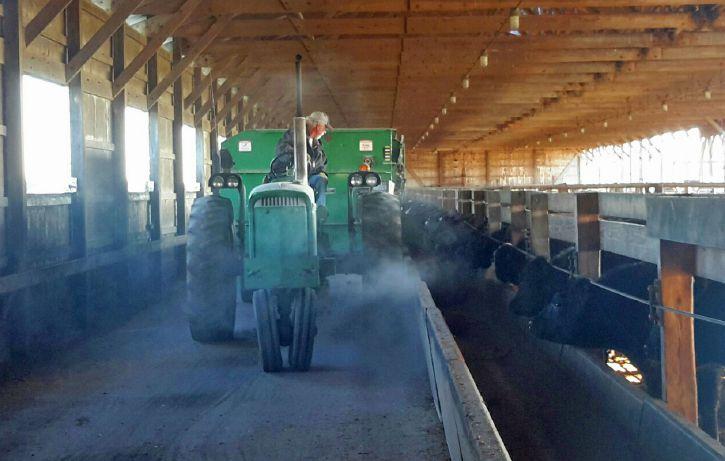
Rom Hastings drives his tractor and pulls his mixer wagon out of the elements to fill concrete feeding bunks in his beef cattle enclosure.
Hastings, his father, and the landlord were partners in the cattle business, with Rom purchasing the farm in the early 1990s, eventually setting up a partnership with his wife and son.
The building design came about from investigating other barn enclosures as well as working with experts at Ohio State University (OSU).
The structure cost about $1 million to build in the early 1980s. Hastings says to build the same structure today, depending on the approach and who builds it, he estimates that it could be built for about $1.5 million.
“The cattle sleep and stand on those concrete slabs and the slabs have never been scraped since the barn was built, no power washing, nothing.”
- Rom Hastings
A technical review of slatted concrete flooring suppliers shows that today, there are a number of suppliers aiming their products primarily at the hog and dairy industries, however, there is little or no mention of the beef cattle industry. For its time, it appears that this manure management method adopted by the Hastings for raising beef cattle was definitely breaking new ground.
The barn enclosure was designed by Hastings’ father and the landlord who owned the farm back in the early 1980s, with the expressed purpose of having a facility big enough to house a fairly large herd but with the need for minimal effort to manage the manure. At the time,
When people think of raising cattle, they often picture places like Alberta or Texas. But Hastings says the part of Ohio where he is located has a long history of cattle farming, although like so many other branches of agriculture, cattle businesses have had to get bigger to survive. Hastings Farms is probably the largest beef cattle endeavor left in their county, with many smaller operations having shut down.
The approach of raising cattle in an enclosure with a manure collection system below the floor is markedly different from places like Texas, where large cattle herds sometimes numbering in the thousands are typically raised in open pens in feedlots. The accumulated and packed manure is scraped out and usually land applied as needed. Hastings says his approach of providing an enclosure offers his cattle herd with protection both winter and summer in an area that really needs it. The Ashville, Ohio, area where the farm is located
ABOVE
It cost about $1 million to build a beef cattle barn enclosure with concrete slatted floors and manure collection pits below with the structure was built in the early 1980s. A structure today would like cost about $1.5 million.
RIGHT
There is spacing on each concrete segment of about 1.5-inches for the manure to fall through.
typically accumulates about 25 inches of snow per year. Ashville is about 15 miles south of the state capital of Columbus.
“In the summer time, the barn offers protection from the heat and in the winter time its protection from the elements,” he says.
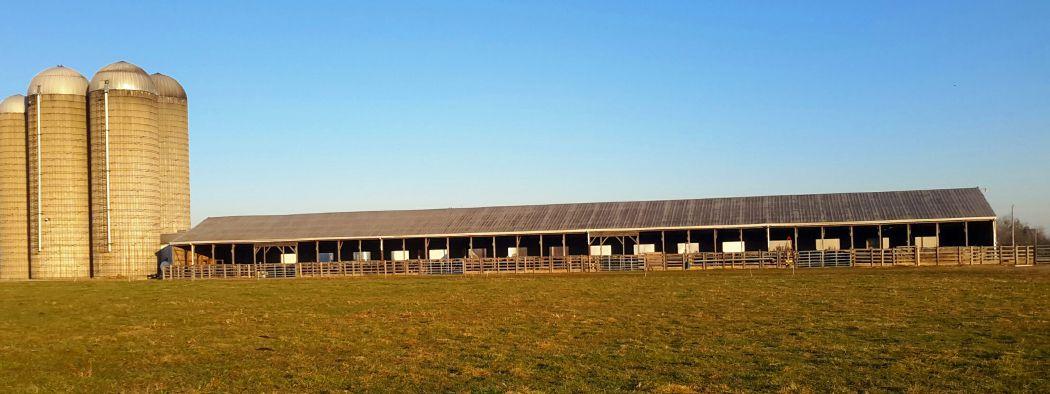
Feeding the cattle is also easier. Storage silos were constructed right next to the enclosure and in addition to the cattle, the barn roof protects an alleyway that is wide enough to accommodate a tractor and mixer wagon used to fill the concrete feeding bunks daily.
Currently, Hastings Farms manages a cow-calf operation essentially for breeding stock consisting of two herds with 30 head of cattle per herd raised on pasture – one being on rotational grazing and one not. The maturing calves from this operation are raised in the barn enclosure. The farm also purchases 300 yearlings annually that it raises within the barn. They consist of about 90 percent Black Baldy cattle, the rest being some Herefords and cross Charolais. Each yearling comes in at about 800 lbs and they feed them to 1,350 lbs. The cow-calf
herd on pasture are a Black Angus cross breed.
Hastings says he purchases the yearlings from beef cattle farmers who don’t have the land base to grow the food necessary to raise their cattle to full maturity. He does have that capability.
Hastings Farms also manages a large, no-till, cash crop business on 4,300 acres of corn and soybeans, and about 200 acres of winter wheat. Of that cropland, the farm owns 1,600 acres, with the rest rented. All the feed used in the cattle operation is grown on the farm, and the manure pumped from the barn collection pits is applied and rotated typically on a four-year rotation as organic fertilizer on Hastings cropland.
The all-wood barn structure which houses the yearlings and maturing calves from the breeding herd measures 60-feet
wide by 300-feet long. It is enclosed on three sides with the south side of the barn left open. The north side is walled in and windows installed about five feet above ground. Where the north sidewall meets the roof, there is about an 18inch space for good ventilation from the rising manure fumes. The roof is metal and insulated to control how much the enclosure heats up in summertime. Inside the barn, there are eight pens. Each pen, measuring 30-feet by 36-feet is capable of housing 40 head of cattle, meaning that there typically are about 320 head of cattle in the barn at a time. An alleyway runs along the front of the pens so that feeding equipment can drive into the barn to deposit feed into concrete bunks placed in front of each pen.
The cattle in the pens stand on concrete slats, with the manure they generate
dropping into 10-foot deep pits below each pen. There are a total of four pits below the entire cattle pen space, with each pit collecting manure from two pens.
The concrete slats – manufactured by United Precast Industries located in Mount Vernon, Ohio – are replaceable, and fit together in segments. Each segment measures 4-feet by 10-feet and there are 216 concrete slabs in the entire structure. Hastings says they went about 28 years before having to replace some of the concrete slabs, and that was only because the edges on some of the slabs were starting to chip off, making it harder for the cattle to walk on. Since the barn was built, they have replaced about 25 slabs.
There is spacing on each concrete segment of about 1.5-inches for the manure to fall through. Although beef cattle are hooved and can sometimes become nervous about certain types of materials beneath their feet, which is why Texas gates are so effective, Rom says that the cattle in his barn don’t react
nervously walking on the slatted concrete floor. However, he is careful about how mature the animals are before he houses them in the barn to avoid the potential of younger cattle catching their hooves in the openings.
“The slatted floor is flat,” says Hastings. “The only thing is that the cattle need to be 500 lbs or bigger to be housed in there. You don’t want any small, weak calves in this facility because the smaller animals tend to have more hoof damage.”
Once a year, Hastings uses a Houle agitating pump to mix and remove the manure from each pit and load it into a 5,300-gallon Houle tank for land application. There is no water added to the manure collected in the pits, which have a capacity to collect manure for an entire year before needing to be cleaned.
The pits are pumped out either in July or September, with the manure surface applied either on harvested hay or wheat crops. Hastings says luckily the farm is still allowed to surface apply the manure
in his county without incorporation because his farmland is generally flat, with not a lot of concern about potential surface runoff. The entire process of pumping out the pits and land applying the manure only takes about 40 hours, or four 10-hour days.
The manure is land applied at 4,000 to 5,000 gallons per acre on a four-year rotation. The manure feeds about 100 acres per year.
“On farms where the manure is surface applied, I’d say that it cuts down my fertilizer costs by 30 percent or more,” says Hastings.
The organic fertilizer is supplemented with commercial fertilizer as needed, based on soil sampling conducted every 2.5 acres.
Over the 35-year history of the barn enclosure, it has proven its worth for manure management as well as providing a comfortable environment for the herd. Because the enclosure is properly ventilated, the cattle raised inside have experienced no health issues.
Top quality Main line, Draghose, and Suction hose
Dsi Dietrich Injector
Wood chips for cow chips
Wood chip pads offer an alternative surface covering for winter feeding areas compared to concrete, offering better production, improved environment management and reduced cost.
BY DIANE METTLER
Wood chip pads were already part of the Irish, British and New Zealand waste management scene, but it wasn’t until Tom Basden – an extension specialist with West Virginia University – noticed many beef producers were having winter time pasture issues, that the system was introduced to the U.S.
In the mid-Atlantic, there are many small to medium farms (50 to 200 head) that are pasturebased, cow-calf operations. The cows go out to pasture spring through fall, but when they are brought back into the barnyard to be confined for the winter, environmental issues arise, leading to potential regulatory issues. But, if the farmers were
ABOVE
to put the animals back in their pastures it would create damage to the fields.
“There were a number of issues, both from a production standpoint and from an environmental and regulation standpoint,” says Joshua Faulkner, farming and climate change co-ordinator at the University of Vermont. “Tom noticed that in Ireland, Scotland and the U.K., they were using what they call ‘wood chip out-wintering areas’ – which we’ve shortened to wood chip pads – for managing cattle in the winter time. Then after a little more research, we found these are actually used in New Zealand too. Instead of a concrete barnyard, they have a wood chip barnyard on small to medium size dairies.”
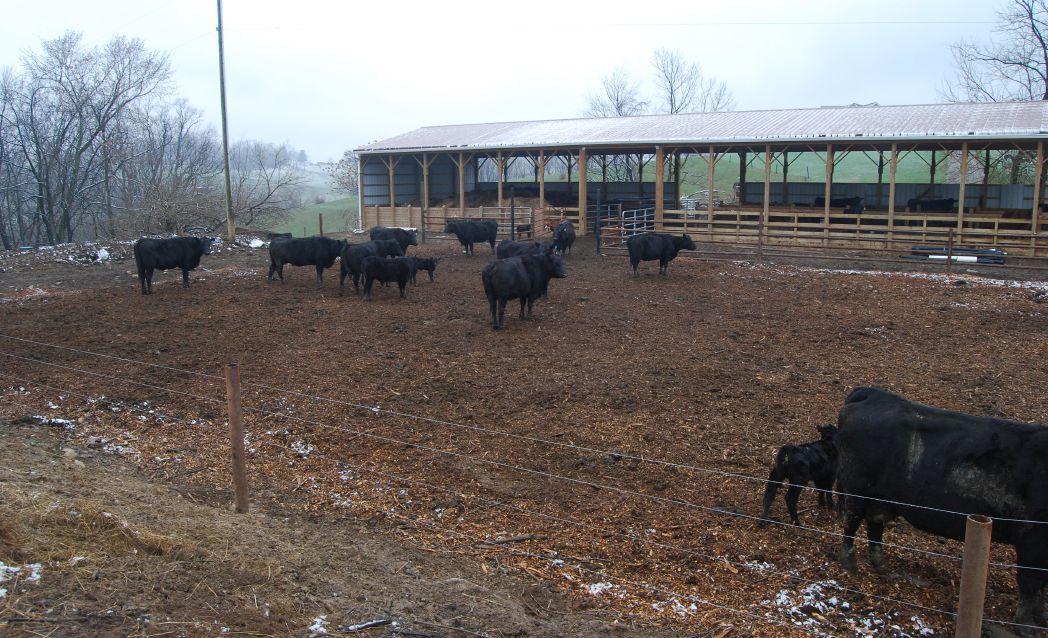
U.S. Extension agents have designed wood chip pads for small to medium-sized beef farms to manage cattle feeding areas in the winter time.
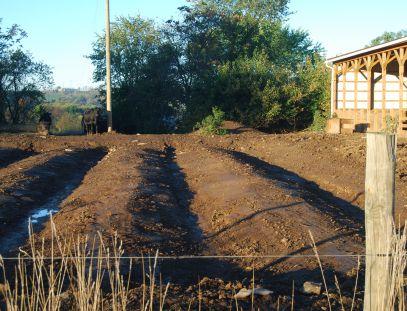
INSET: Broad parallel ridges crossing the width of the pad are formed into the subgrade at 10-foot intervals to encourage drainage.
ABOVE
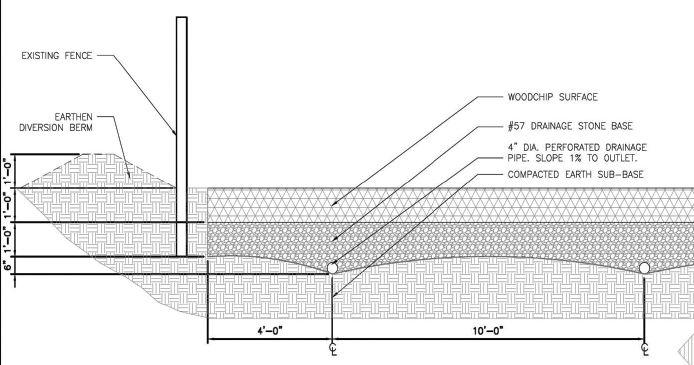
A cross-sectional diagram shows the different layers of piping, drainage gravel and wood chips used to construct the winter feeding pad.
RIGHT
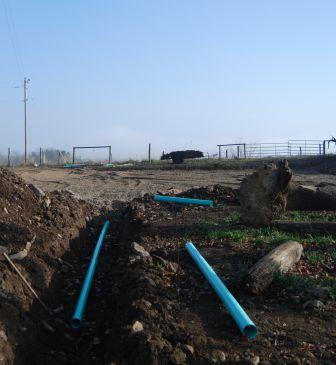
Perforated drainage pipe is also placed at 10-foot intervals between the ridges.
The West Virginia University Extension Service decided to build two wood chip pads, based on information gathered from Ireland. One was constructed on a private farm and the second at the West Virginia University animal science research farm. Later, when Faulkner left West Virginia University to take a position at the University of Vermont, he continued the work on the project, having three more wood chip pads installed, including one at a buffalo farm in New Hampshire.
The construction of all the sites was similar to the one constructed in Ohio County, West Virginia, which was approximately 80-feet by 80-feet and next to a feeding barn. It was excavated to a depth of roughly 20-inches with the subgrade having a 0.5 percent slope to the west. Broad parallel ridges crossing the width of the area were formed into the subgrade of roughly 10-foot intervals to encourage drainage into perforated drainage pipe, also placed at 10-foot intervals between the ridges.
The subgrade and drainage pipes were covered by a layer of drainage stone (maximum one foot in depth). The drainage system directed effluent away from the heavy-use area via gravity to a holding tank, which was buried to prevent freezing. (In some of the other sites, the effluent to drained to grass filter strips.)
A mixture of regional hardwood species were chipped and placed on the drainage stone (about 10-inches thick) to provide a trafficable, durable, and well-drained
surface.
“The first one we built was directly adjacent to a roofed winter feeding barn,” says Faulkner. “Then the second one is the biggest by far and it’s on the university research farm, which is a dairy farm, but it’s all dry cows and heifers.”
These first two pads have been in operation for about five years. The newer pads were built further north, and Faulkner and his team are still waiting to see the results after they have gone through a hard winter, with sub-freezing temperatures for weeks.
But there are plenty of findings being collected from the mid-Atlantic wood chip pads.
“The biggest advantages we’ve seen are those compared to concrete,” says Faulkner. “With these, we see about half of the runoff with wood chips compared to concrete because the wood chips tend to soak up the water. As the water evaporates, the chips become dry and sponge like and will soak up the next rainstorm and evaporate it. With concrete, everything runs off.”
Also, the effluent that drains off wood chip pads is weaker than the effluent that drains off concrete slabs.
“Most of the phosphorous and nitrogen seem to stay in the manure solids and stay in the wood chips, so you kind of capture it that way, and you get this really diluted wastewater.”
In some cases, the runoff is collected and then used on the fields later or
directed to a grass filter strip.
“The phosphorous [in the waste water] doesn’t seem to be high enough that we have to worry about it building up in the soil like you would with stronger wastewater,” says Faulkner.
He also sees the wood chip pads as a good possible fit for small dairies that already have storage structures for runoff in place.
The chips that have absorbed the nutrients are also a key piece of the system’s value.
“Our recommendation is that at the end of the winter, just after you’ve released cattle back on the pastures, when pastures are ready for grazing, you scrape off the top two or three inches of the wood chips. Those chips should have most of the manure,” says Faulkner. “The chips can then be composted through the summer and then spread and used as a fertilizer on your fields. Then top dress with another couple two or three inches of wood chips before you stock it again – in the fall before you go into your next winter season.”
There hasn’t been much testing on the quality of wood chip compost, but Faulkner says from what data he has seen it’s a fine source of fertilizer.
“It’s not like a straight manure because it does have the wood chips in it. So, it takes longer to compost. And, you also want to make sure it composts long enough that you’ve broken down the wood chips before application on your hay field.”
Faulkner and his team are already
seeing keen interest by farmers in the wood chip pads, in part because of their resistance to concrete.
“Concrete is fairly permanent, and farmers are concerned about general cow comfort. The wood chip pads have been documented to lead to higher weight gain in beef cattle, and it just seems to be better for animal health and comfort.”
Faulkner has seen the cattle’s reaction firsthand.
“At the farm in Ohio County, WV, where we first installed, and the gates were open, so the cattle could leave the wood chip pad whenever they wanted. They would just be hanging out on there, lying down. It wasn’t muddy like the rest of the field. It wasn’t slick and wet. It was just really nice, welldrained, comfortable, and firm.”
There are other reasons the wood chip pad might be a good alternative to concrete. Besides animal comfort, muck doesn’t build on top and require continual scraping, like it does with concrete. Instead the manure works its way into the chips.
The wood chip pad is also much less expensive to install.
“Based upon the two West Virginia systems, we saw that a wood chip pad would cost about $163 a cow, and a concrete about $463 per cow,” says Faulkner. “You do have the cost of replacing wood chips every year to top dress it, but I think there’s reduced management cost because you’re not scraping the concrete every few days with a wood chip.”
Faulkner and his team also think there is a value in raising livestock outside. He says studies from the U.K. have shown that unless it’s bitter cold or extremely wet, cattle are perfectly adjusted to being out in the weather and the farmer can avoid air quality issues and potential respiratory problems.
Some farmers, however, are concerned that if they move from an all-pasture system to a wood chip pad system, they could be exposing themselves to environmental regulations that they are currently exempt from.
“That’s true,” says Faulkner. “Some farmers would rather damage their pastures than risk some sort of environmental consequence. And I understand that. But we feel like the wood chip pad is healthy for the animals and if it’s constructed, designed, and managed well there’s no risk.”
In fact, during spring 2016 in Vermont, the state actually helped cost share and pay for the wood chip pad.
“Its was paid with environmental conservation funds and the only stipulation was that we needed to capture the wastewater – all the drainage water needed to into a small holding pond instead of sending it to a vegetated grass buffer strip,” says Faulkner. “It did raise the cost of the project, but they paid for most of it, so it worked out pretty well.”
Faulkner and his team are pleased with the ongoing support of the West Virginia and Vermont Extension Services, and will continue to look for funding to continue
the studies.
“Top of the list will be an in-depth economic analysis and to also look at animal comfort, and try to quantify those,” says Faulkner. “But even without additional research dollars, we’re doing outreach, and workshops at our extension system, both in Vermont and West Virginia and just generate interest. And we will assist with design for any farmer who is interested.”
Faulkner would love to see many more wood chip pads being built around the country.
Working together, European style
Dutch poultry farmers joined forces to find a sustainable solution to spreading litter on farmland and also save money on disposal
BY MELANIE EPP
In Europe, where intensive livestock production is common in countries like the Netherlands, Spain and Germany, concern has been raised about its environmental consequences, including runoff of excessively applied nitrate and phosphate contamination of surface water and soil.
Manure produced by intensive livestock production can lead to atmospheric emissions of ammonia, nitrous oxide, and mono-nitrogen oxides, like NO and NO2, especially when directly spread on cropland. In the 1990s, EU council, parliament and commission met to discuss possible solutions. Those discussions led to the implementation of new, more stringent regulations, including the nitrates directive – better known as 91/676/EEC – which limits application rates of livestock manure to arable land. These restrictions led farmers to look for alternatives, such as composting and biogas production.
In the Netherlands, where agricultural
production is especially intensive, the issue prompted poultry farmers into action. Together, they came up with a unique solution – convert poultry manure into electricity.
“We were producing too much manure in comparison to the arable land we had,” explained Wil van der Heijden MBA, director at Duurzame Energieproductie Pluimveehouderij (DEP), a cooperative of more than 600 Dutch poultry farmers who supply the Moerdijk-based power plant with poultry manure for fuel. “We also had a problem with too much phosphate in the soil and nitrogen in the water.”
Van der Heijden is right; Dutch farmers do produce more manure than the arable land around them can use. The issue doesn’t just affect poultry farmers either. In fact, Dutch dairy farmers were recently told they have to reduce herd size in order to comply with EU phosphate regulations.
Overproduction of manure has also been a
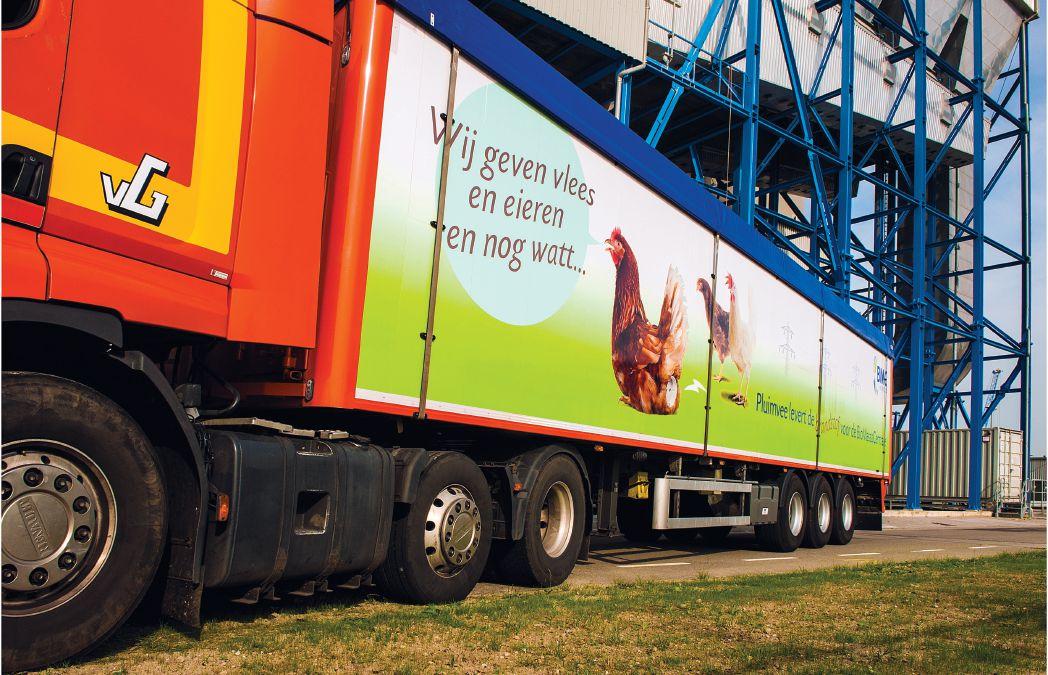
ABOVE Everyday, 60 trucks supply approximately 2,000 tonnes of poultry manure to the BMC Moerdijk power plant.
TOP RIGHT
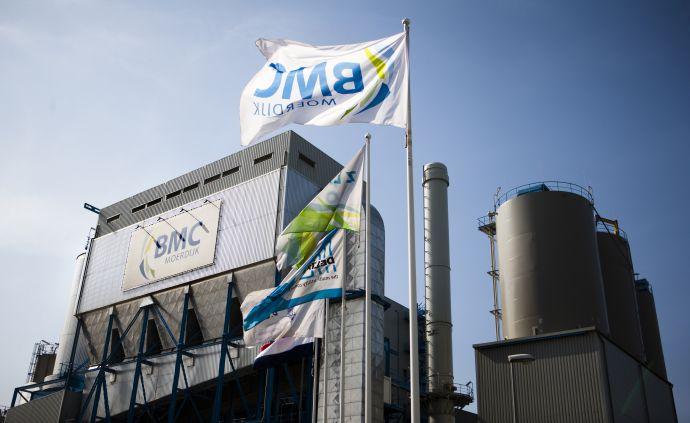
From conceptualization to the plant’s opening, it took 10 years for the BMC Moerdijk power plan to become a reality.
BOTTOM RIGHT
BMC generates 285,000 MWh of power each year, using a small amount of the electricity it produces and supplying the rest to the electrical grid. The electricity the company produces is enough to meet the needs of 80 percent of all Dutch poultry farmers for one year.
problem for Dutch poultry farmers. Each year, poultry in the Netherlands produce approximately 1.3 million tonnes of litter. Of that, 650,000 tonnes is exported to Germany, Belgium and France for use as fertilizer – a job that is facilitated by traders who make money by taking manure out of the hands of farmers and putting it into the hands of other farmers. For decades, Dutch poultry farmers were at the mercy of these traders, who charged €30-35 ($33.34 to $38.90 US) per tonne for removal. For a 100,000-bird broiler farm, this amounted to €30,000 to €35,000 ($33,350 to $38,900 US) each year, a hefty fee that left many struggling.
In 1998, Dutch poultry farmers met to discuss how they could separate themselves from the traders, as well as regulations and borders. Their solution was to join forces with a power plant and turn poultry manure into electricity. In 1999, the farmers formed DEP. The farmer members supply litter to BMC Moerdijk, a company that produces electricity using a fluidized bed combustor.
“They wanted to be independent from traders, from the weather, from the borders, and the regulations in Germany and France,” said Van der Heijden. “They learned that poultry manure could be used as fuel for electricity production and they found that there was some experience in the U.K., although very small scale.”
From conceptualization to the plant’s opening, it took 10 years for their plan to become a reality. First, explained DEP co-operative director Wil van der Heijden, they had to find the right location, which turned out to be Moerdijk, a town in the south of the Netherlands in the province of North Brabant. Then they had to apply for permissions and subsidies, look for partners and financing, and finally draw up fair contracts, which Van der Heijden
BMC processes some 430,000 tonnes of poultry manure – one-third of the total amount of poultry manure produced in the Netherlands – each year.
said were crucial for reducing risk. Construction on BMC Moerdijk began in 2006 and concluded in 2008.
Financing for the plant came from the bank, which fronted 80 percent of the overall cost. The rest came from BMC Moerdijk’s shareholders. Delta, the company that buys the electricity BMC produces, owns 50 percent of the shares. The farmers association ZLTO and DEP own the remaining shares at 33 and 17 percent respectively.
While Dutch poultry farmers were once paying €30 to €35 ($33.34 to $38.90 US) per tonne to traders for removal, in 2008, when BMC started production,
farmers who joined the co-operative were contracted at €20 ($22 US) per tonne.
Immediately, the traders dropped their rate to match that of BMC’s, said Van der Heijden.
“We told farmers that we could process their manure for 10 years for between €15 and €20 ($16.65 US to $22 US) [per tonne],” he said. “That’s why they signed the contract. But immediately after that, the traders dropped the price to €20 ($22 US) – and then even dropped to €10 ($11 US) two years later. You can imagine that all the members in 2012 were very angry.”
Today, the farmers are happy. They now pay just €11.50 to €12 ($12.75 US to
ABOVE
BMC Moerdijk processes about 430,000 tonnes of poultry manure – one-third of the total amount of poultry manure produced in the Netherlands – each year.
RIGHT
BMC Moerdijk produces electricity from poultry manure using a fluidized bed combustor.
$13.30 US) per tonne.
“We dropped the price in 2013,”explained Van der Heijden. “We had to drop the price from €20 to €11 ($22 US to $12.20 US) or €12 ($12.75 US) because they were so pissed off… because they all wanted to move. And if there is no fuel, there is no possibility to produce electricity. So, we had to join them.”
Today, BMC processes some 430,000 tonnes of poultry manure – one-third of the total amount of poultry manure produced in the Netherlands – each year. Everyday, 60 trucks supply approximately 2,000 tonnes to the power plant. Using that manure, BMC generates 285,000 MWh of power each year. The plant uses a small amount of the electricity it produces and supplies approximately 245,000 MWh to the electrical grid. The electricity the company produces is enough to meet the needs of 80 percent of all Dutch poultry farmers for one year.
BMC Moerdijk doesn’t just produce electricity, though. It also produces ash, which is a by-product of the incineration process. The ash contains highly valuable minerals, like potassium and phosphorus. It is sold to customers in the agricultural and horticultural sectors outside of the Netherlands. Those customers use the ash, sold under the name PeaKsoil, as a fertilizer to improve soil.
In its first years of operation, BMC Moerdijk learned several important
lessons. First, not all types of manure are suitable for processing.
“We thought poultry manure is poultry manure, but it isn’t,” said Van der Heijden. “There are a lot of differences between manure from layer hens and broilers, and turkeys and breeders.”
Storage was also an issue. Without storage the company sometimes had to work 15 days off and 15 days on. Today, BMC can store 10,000 to 12,000 tonnes.
“It is very important to have stable supply and demand,” explained Van der Heijden. “We also learned that the cooperative structure was useful for this type of corporation. We also learned that fixed contracts are very crucial because otherwise halfway all of the members would have left the co-operative. The fixed contracts were very useful for us and the bank to reduce the risks.”
Electricity from poultry manure is a cleaner alternative to direct land application, explained Gerd-Jan de Leeuw, MSc, at a recent visit to the plant. De Leeuw is responsible for the fuel and PeaKsoil at BMC Moerdijk. Electricity production from poultry manure saves on emissions from fossil fuel combustion. Spreading poultry manure on the land also causes larger emissions of NH3, N2O and NOx than combustion does. Finally, the ash that’s recovered has a lower mass and volume than the manure, making it more suitable for export to regions that require
phosphate.
“All of the minerals, except nitrogen and organic matter, are in the PeaKsoil, so in the ash,” said De Leeuw. “We can sell it as a fertilizer. We sell it to countries where they have a phosphate demand.”
Those countries include Belgium, France and the United Kingdom where it has been especially useful in corn and wheat crops.
All in all, BMC has proven itself as a sustainable and reliable electricity producer. Dutch poultry farmers, as a result of their cooperation with BMC, have not only complied with their obligation to process poultry manure, but also helped reduce the Dutch phosphorus surplus by approximately 8,000,000 kg P2O5 each year. The company also contributes to the Netherlands’ goal of lowering CO2 emissions and using 14 percent renewable energy by 2020. Finally, BMC has helped reduce poultry farmers’ NH3 emissions by 25 percent since 2008.
This summer, BMC was in heavy discussion with DEP, as the 10-year contracts with its members are up at the end of 2017. The discussions were a great success with 87 percent of poultry farmer members renewing their contracts, which will start January 1, 2018. Those contracts expire at the end of 2029. On average, members will pay €6.50 ($7.20 US) per tonne, an amazing reduction since 2007.
Discovery 120 Collector
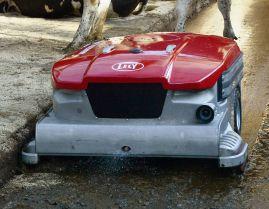
Lely has developed the Discovery 120 Collector, a robot designed for solid floors that takes the manure away rather than scraping it. Rather than pushing the manure forward, the Discovery 120 collects and releases its manure load above a dumping location. It also sprays water from the front and back of the machine. Spraying from the front results in better manure intake and from the back to leave behind a wet floor for additional grip. This water is tanked independently and is stored in two water bags in the manure tank. As the manure tank gets filled, the volume of the water bags decreases, freeing up more space for manure. This makes it a compact machine. Cows can easily move past it and the Discovery Collector can drive below the sorting gates. The Discovery Collector navigates independently using built-in sensors. Cables, corner pulleys and heightened side corridors are not necessary, as opposed to when working with a manure scraper.
lely.com/collector
ASV RT-75
ASV LLC recently introduced the large-frame, radial-lift RT75 compact track loader. The dual-level suspension of the RT-75 features both suspended wheels and axles, allowing it to manage every type of terrain and at faster speeds. The suspended wheels and fully flexible track conform to the ground, assuring maximum traction in rough conditions. In addition, the multiple wheel contact points and triple-guide lugs achieve maximum performance on steep slopes. The RT-75 comes standard with 18-inch-wide tracks, resulting in a ground pressure of only 3.6 psi. The RT-75 features a Cummins 2.8-liter turbocharged diesel engine. The 75-horsepower engine produces 221 foot-pounds of torque, which is transferred to the ground through direct-drive hydraulic motors. With internal rollers preventing friction loss in the undercarriage, all power is transferred to the track regardless of drive speed. The RT-75’s auxiliary hydraulic system to be highly efficient, including 35.7 gpm high flow and 3,300 psi. Because the machine includes larger line sizes, hydraulic coolers and direct-drive pumps, more flow and pressure is transferred directly to the attachment. This allows operators to run attachments more efficiently than higher-horsepower machines from other manufacturers. These features make the compact track loader an ideal machine for applications in agriculture and more. asvllc.com
Stihl RB 600, RB 800
The new Stihl RB 600 and RB 800 gasoline-powered pressure washers are designed for extensive professional use. The RB 600 has a 208 cc (7 hp) commercial-grade engine delivering 3,200-psi at a rate of up to 3 gpm. It also features premium commercial-grade triplex pump components, including brass manifold design, stainless steel valves and ceramic-coated pistons. Its 40-foot steel-braided hose limits frequency of relocating machine while working. The RB 800 is the most powerful industrial strength high-pressure washer in the Stihl line, with a 429 cc (14 hp) engine delivering 4,200-psi water pressure with up to 4 gpm. It also features premium commercial-grade triplex pump components, including brass manifold design, stainless steel valves and ceramic-coated pistons. Its 50-foot steel-braided hose limits frequency of relocating machine while working. Both pressure washers have premium engine features, including a cast-iron liner and low oil shutdown feature to help prevent engine failure, an adjustable pressure regulator on the pump to allow for user adjustment to match the cleaning job. stihl.com
Mitas CHO
Mitas has extended its range of Cyclic Harvesting Operation (CHO) tires and presented two new sizes. Mitas CHO tires feature unique construction that uses hexacore technology, steel breakers and flexible sidewalls to allow for larger loads at a lower tire pressure to protect the soil. Cyclic loads can vary significantly by more than twice their weight in some cases. At high inflation pressures, this can lead to soil compaction. The solution is a Mitas CHO tire capable of carrying more load at a lower tire pressure.
mitasag.com
New Holland L234 skid steer
New Holland recently announced a new skid steer loader model – the L234 – to replace the L230. One size up in weight class, the L234 features increased rated operating capacity of 3,400 lbs. at 50 percent tipping load. The 6,918 lbs. loader lift cylinder breakout force and 38 GPM hi-flow with 3,450 PSI is best-inclass. The L234 uses the FPT F5B engine with selective catalytic reduction technology for Tier 4 Final certification. With the radiator facing rearward, it is easy to clean. Filters, and reservoirs and battery jump posts are easily accessible for easy service. The improved cab offers ergonomically placed controls and electronics. An available upgrade – New Holland’s demo door – features a half-inch-thick shatterproof polycarbonate front door. Additional improvements include a newly designed heavy-duty, composite “hockey puck” boom stop to prevent steel-on-steel contact and wear during digging, carrying, and other operations. The boom stop can be changed for different carrying heights. When lowering the bucket and pushing into a pile, the boom will carry the load back into the boom stops, which allow the main frame to absorb the force.
newholland.com
Talk to your dealer about the superior solids handling and high head capabilities.
Hard Metal or White Iron materials available for abrasion resistance (MP Series)
Low head transfer to high head booster pumps
Stainless Wear Rings and Sleeves
4NHTB, 6NHTB & more
FIVE TIPS FOR understanding manure management
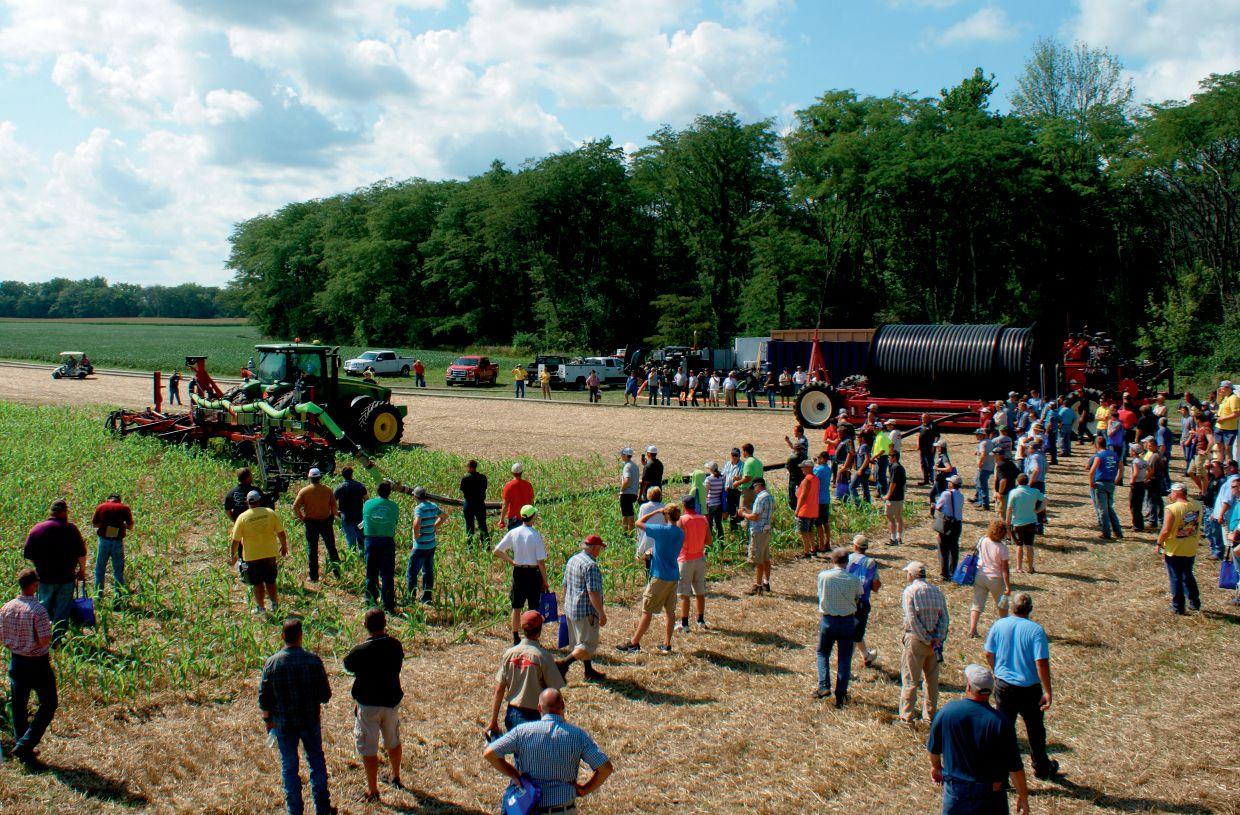
The Coalition to Support Iowa’s Farmers recently hosted more than 60 state farmers who gathered to learn how to better manage their fertilizer source both on and off the farm.
BY HALEY BANWART
Farmers facing tight markets can impact their profitability by understanding the top five criteria in manure management decisions, according to experts at the Coalition to Support Iowa’s Farmers (CSIF) recent manure management workshop.
More than 60 farmers attended the event to learn how to better manage their fertilizer source on and off the farm.
“The first thing you’ve got to do is determine how much manure you need and where it should be applied,” noted Abe Sandquist, founder of Natural Fertilizer Services. Addressing manure needs is a game of building organic matter and maintaining soil fertility. This balance can be achieved by comparing yield history, manure sampling and soil testing.
“Soil testing is kind of like figuring the odds of your fertility,” said Sandquist. “When you’re fertilizing in a low soil test field, you’ve got a higher chance of getting a yield response that’s profitable.”
Secondly, Sandquist said farmers must determine what equipment they will use based on holding capacity, density of their manure source and the range it can be hauled economically.
Dan Andersen, an agricultural and biosystems engineering assistant professor of Iowa State University, noted that manure management decisions should make manure “logistically cheaper to move and more nutrient rich.”
analyses. The trick to benefiting from these advanced tools also involves optimum timing of application.
“Immediate injection or incorporation will reduce ammonia volatilization and retain 95 to 100 percent of the nitrogen content in the soil,” said Dr. Jim Friedericks, outreach and education advisor at AgSource Laboratories. “Broadcasting or surface application will reduce retention from 70 to 90 percent.”
Lastly, alternative options such as selling manure or composting give livestock farmers flexibility in managing their fertilizer source. However, depending on the size of the farm, certain rules and regulations must be followed to ensure land and water resources are safeguarded. Farmers who have questions about these guidelines can contact the Coalition to Support Iowa’s Farmers for a free and confidential consultation.
CSIF is a non-profit organization that assists livestock farmers who want help interpreting rules and regulations, guidance on good site locations for barns, counsel on enhancing neighbor relations and tips on how to protect the environment at no cost. It was created as a joint partnership involving the Iowa Cattlemen’s Association, Iowa Corn Growers Association, Iowa Egg Council, Iowa Farm Bureau Federation, Iowa Pork Producers Association, Iowa Soybean Association, Iowa Turkey Federation and Midwest Dairy Association.
Although solid manure is easier to transport, liquid manure generally retains more nitrogen, especially if it is stored in a deep pit rather than a lagoon. According to Andersen, manure storage systems of the future will likely be designed to retain even higher nutrient levels.
Another component of manure management includes precision application. Thanks to advancements in GPS technology, manure application tools have allowed farmers to better target their acres using variable rate control and yield
Haley Banwart is an assistant field specialist with the Coalition to Support Iowa’s Farmers.
ABOVE
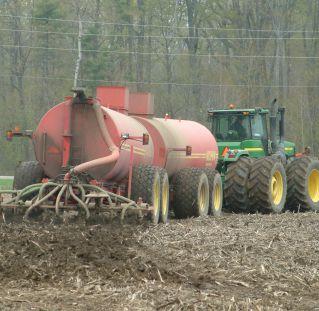
Injecting or incorporating manure directly into the soil will reduce ammonia volatilization and retain 95 to 100 percent of the nitrogen content in the soil.
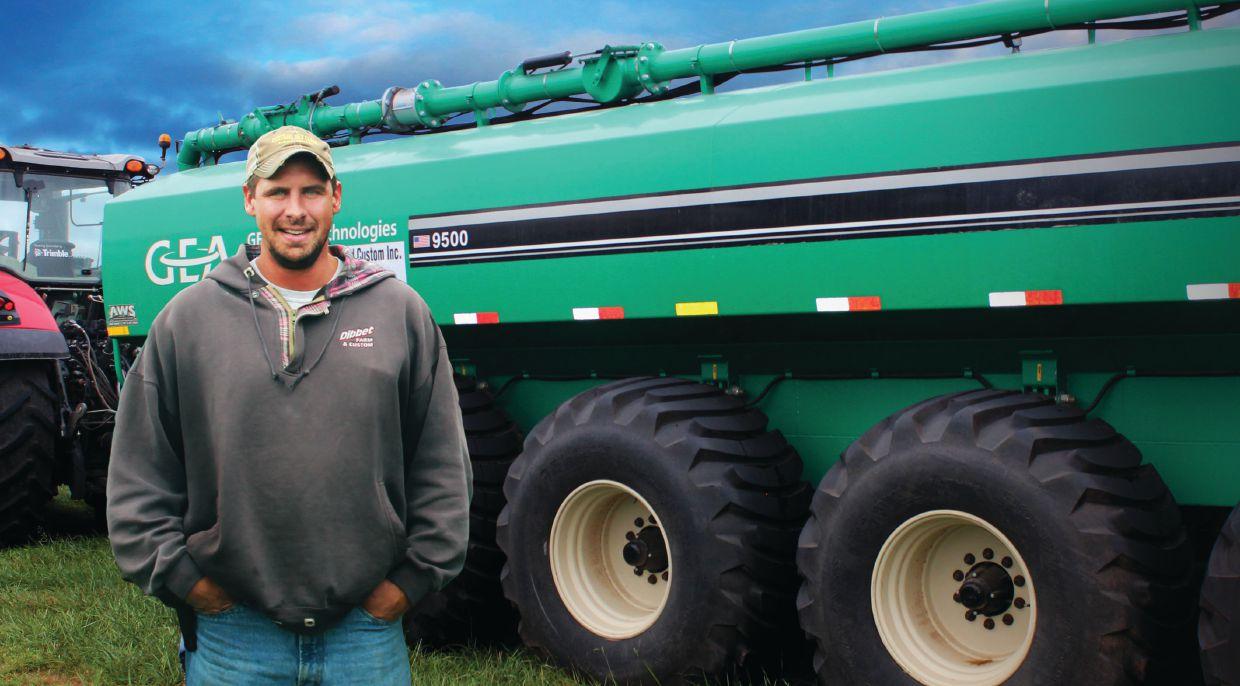
Work with the TOUGHEST
Put to the test by Jerry for 13 years
Two liquid manure spreaders, a screw agitator, two Super Pumps and two trailer pumps pumping 30 to 40 million gallons of manure a year.
“What I like best about my GEA spreader are the options that it has like the hydraulic powered wheel steering and the weight transfer system to lift the front axle of the spreader when returning empty. It helps reduce hitch “slapping” due to the negative tongue weight with the larger tool bars. I also like the easy maintenance and how easy it pulls which leads to better fuel economy and quicker cycle times.”