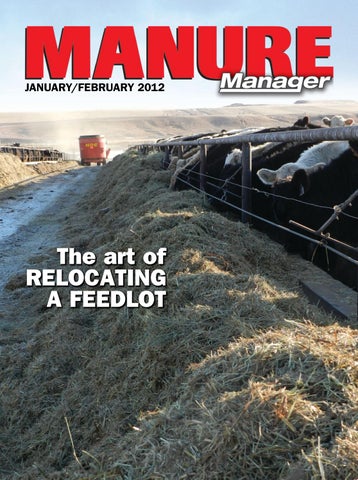
JANUARY/FEBRUARY 2012
JANUARY/FEBRUARY 2012


Volume 10 • No. 1
Published by:
Annex Publishing & Printing Inc. P.O. Box 530 Simcoe, Ontario N3Y 4N5
Editor
Margaret Land • (519) 429-5190, (888) 599-2228, ext 269 mland@annexweb.com
Contributing Editors
Tim Harrigan, Tony Kryzanowski, Kay Ledbetter, Diane Mettler
Advertising Manager
Sharon Kauk • (519) 429-5189, (888) 599-2228, ext 242 skauk@annexweb.com
Sales Assistant
Mary Burnie • (519) 429-5175, (888) 599-2228, ext 234 mburnie@annexweb.com
Production Artist Kate Patchell
VP Production/Group Publisher Diane Kleer dkleer@annexweb.com
President Mike Fredericks mfredericks@annexweb.com
Publication Mail Agreement #40065710
RETURN UNDELIVERABLE CANADIAN ADDRESSES TO CIRCULATION DEPARTMENT, P.O. BOX 530, SIMCOE, ON N3Y 4N5
e-mail: subscribe@manuremanager.com Printed in Canada
Circulation
e-mail: subscribe@manuremanager.com
Tel: 866-790-6070 ext. 202
Fax: 877-624-1940
Mail: P.O. Box 530 Simcoe, ON N3Y 4N5
Subscription Rates
Canadian Subscriptions
$35.24 Cdn, one year (with GST $37.00, with HST/QST $39.82)
U.S. Subscriptions:
$47.00 USD, one year
Occasionally, Manure Manager will mail information on behalf of industry-related groups whose products and services we believe may be of interest to you. If you prefer not to receive this information, please contact our circulation department in any of the four ways listed above.
No part of the editorial content of this publication may be reprinted without the publisher's written permission. ©2012 Annex Publishing & Printing Inc. All rights reserved. Opinions expressed in this magazine are not necessarily those of the editor or the publisher. No liability is assumed for errors or omissions.
All advertising is subject to the publisher's approval. Such approval does not imply any endorsement of the products or services advertisted. Publisher reserves the right to refuse advertising that does not meet the standards of the publication.
Website: www.manuremanager.com

By Margaret Land
I’m sure i’ve never told the magazine’s readers this, but i love manure. i’m not afraid to admit it; i’m not ashamed. i’ve shoveled a lot of it, smelled quite a bit of it, cleaned a bit off myself, talked a lot about it and even written educational articles about it. But my deep love of the topic and the magazine dedicated to it doesn’t seem to be shared by the public at large, including the many non-agricultural people i interact with as part of my job. many don’t understand the intricacies and technological know-how that goes into managing large volumes of manure.
i have spent sweat-dripping minutes patiently describing manure management to straight-faced border guards with large guns as they stare at me with their mouths agape. i’ve shown them business cards, event itineraries, magazine samples, hotel bookings, meeting agendas. all they can choke out is: “You manage manure? and they have an expo about it? let me get my supervisor.” and i start over again. i have learned to scrub my shoes and boots in hotel bathtubs using minishampoo samples, dreading the possible shoe dip at the airport. this can be a humiliating experience involving other passengers pointing and gasping in horror, believing it to be some sort of counter-terrorism measure.
i’ve had the trunk of my car searched at a border crossing, the guard convinced i had secreted away some sample of manure. i explained over and over again that it was a rental and i had only just picked it up. i hadn’t even made it to the farm i was visiting. But he was convinced there was manure to be found. he left empty-handed.
On a flight to los angeles to visit the World ag expo, i happened to meet a group of Ohio dairymen on their way to sightsee and attend the same event. after chatting with one of them while stretching my legs (i hate long flights), i discovered they were sitting just a row behind me. he asked why i was going to the World ag expo and i explained i was the editor of Manure Manager. his eyes lit up: “i get that magazine,” he said. he shouted to his friends halfway down the airplane: “She’s the editor of Manure Manager!” as he pointed at me. although the group of dairymen was excited and pleased to meet me, the rest of the passengers seemed a bit concerned. a flight steward stopped by the row to see what the fuss was. “She’s the editor of Manure Manager,” explained one of the dairy farmers, handing him my business card. the steward put his right hand on his hip as he balanced a tray filled with empty mini-liquor bottles with his left and stared at me. “manure?” he questioned, glancing at the card on his tray. “Would that be organic?”
the Ohio dairy guys, my advertising manager and i laughed until we cried. no one else found the question funny.
i’m also used to being the butt of many people’s jokes, especially at work. my co-workers love to rib me about my “center spreads” and “crappy” covers. But i don’t care. they can laugh all they want.
i’m of the opinion any publicity is good publicity – especially if it’s funny. i’ve shipped samples of the magazine to the u.K. to be used on a specialty magazine game show and Manure Manager was recently highlighted in a CBS Sunday news clip on weird magazines.
i don’t think it’s weird. and i know our subscribers don’t think so either. many describe how their copies go missing after they’ve set them down somewhere in the barn office or washroom. it’s a competition at their operations to see who can obtain and read the magazine first.
don’t worry; we’ll send you more. We enjoy “spreading” the word about manure. Where else can you learn about spraying, spreading, injecting, digesting, separating, composting, turning, pumping, agitating, filtering, shoveling and dumping that brown gold.
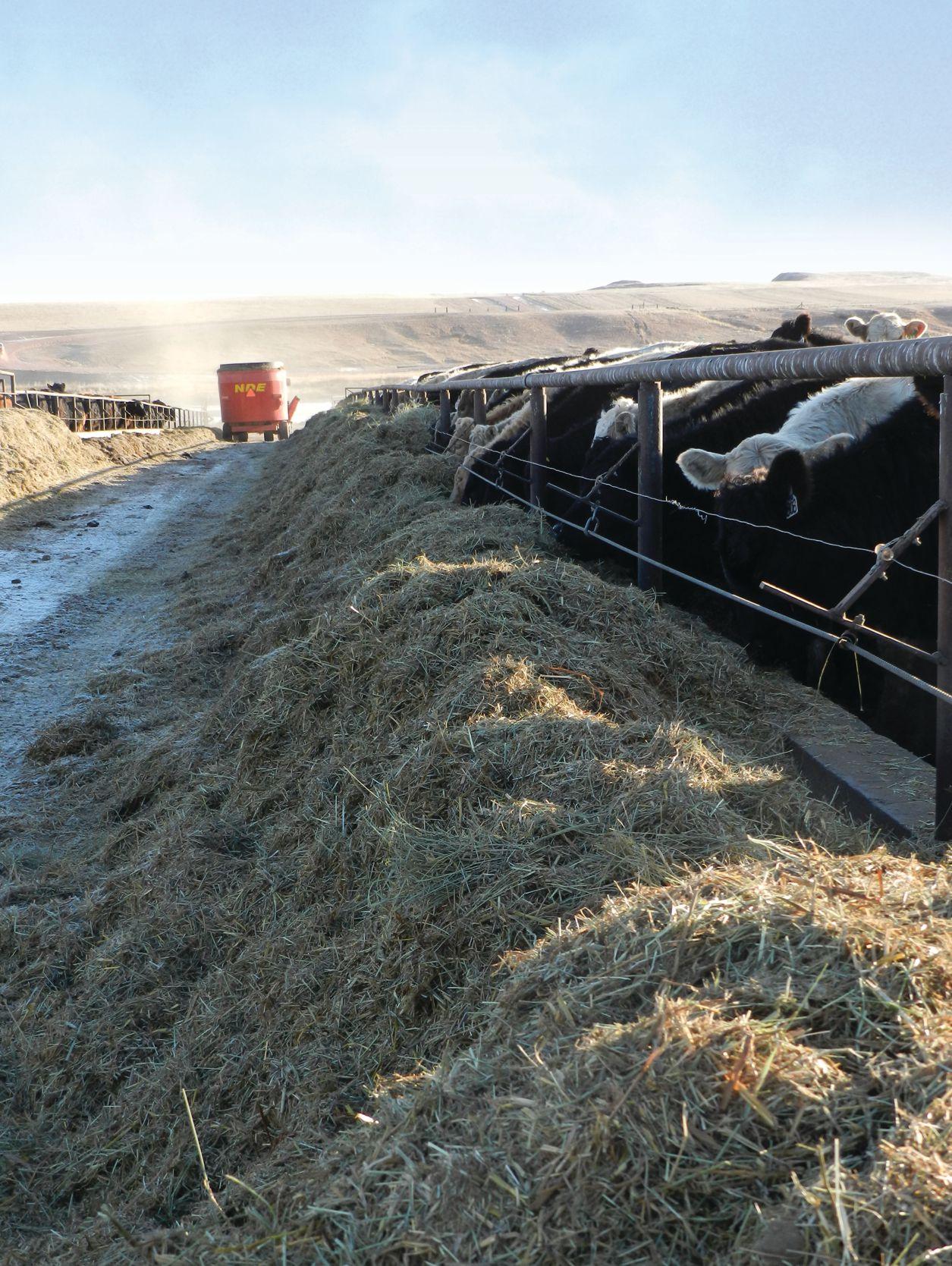
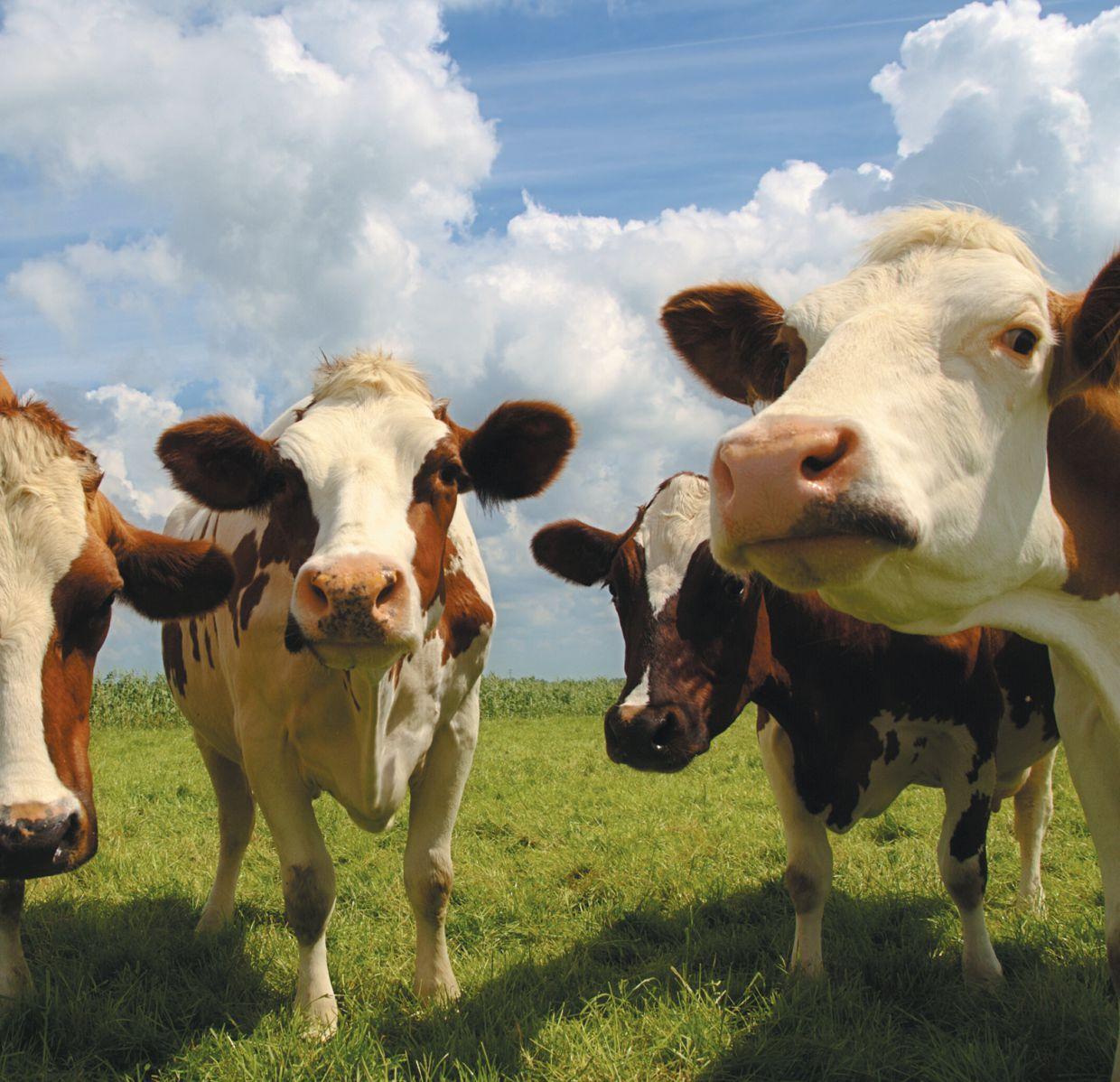
When Wes Dvorak and his wife Teresa moved back to the family farm and joined the North Dakota family business six years ago, the young couple took on a big project – relocating an entire feedlot operation. Contributed photo

By Diane Mettler
north dakota feedlot relocation is more efficient, better for the environment and healthier for the cows
When Wes dvorak and his wife teresa moved back to the family farm and joined the north dakota family business six years ago, the young couple took on a big project –relocating an entire feedlot operation.
“historically, we were strictly a cowcalf operation, selling calves straight off the cow and only occasionally backgrounding our calves,” says Wes. “as the frequency of backgrounding increased, we realized that our current feedlot wasn’t adequate. Our cows were wintered along the creek in an area that frequently flooded each spring. and, the small feedlot was situated at the bottom of a hill where winter snowpack melted, flowed through the feedlot and into the creek.”
Wes and teresa decided to expand their operation and in 2005 they
began working with the north dakota department of health, the natural resources Conservation Service (nr CS) and its (environmental quality incentives Program (eqi P).
the solution turned out to be to relocate the feedlot, along with the feed storage areas, to a hillside field with a six percent slope.
“the slope allowed the engineer to begin with a clean slate instead of having to design the feedlot around existing buildings and water and electricity lines,” says Wes. “it also has excellent drainage for those times when we get rain and when the snow melts.”
The layout
the 14.5-acre hillside feedlot was designed for 995 head. the pens range in size from 50 head of calves to 300 head of calves, and slope away from the feed bunks and mounds to create proper drainage and provide a dry place for cattle to lie.
“the cow could calve in a clean, dry area instead of along the creek as previously done,” says Wes.
One of the pens is specifically designed to allow cows access to water and windbreak during the winter, but also allow them access to cropland for fall
grazing and winter-feeding purposes. a new 48-foot by120-foot pole style barn was also erected. it is designed to be multipurpose – used for calving during spring as well as for machinery storage. the dvoraks also took advantage of the surrounding oil industry and used drill stem pipe and sucker rod to build a portion of the fencing.
“r itchie waterers were placed in the fence line between pens,” says Wes. “each pen has a 12-foot heavy-use pad at the bunk line and an 18-inch concrete curb to separate manure from the feed.”
When it came to construction, there was little that could be salvaged from the first feedlot – just some windbreak material and some concrete feed bunks.
“Otherwise, everything else down in that old facility was made out of wood,” says Wes.
Because the dvoraks did all the construction themselves, it took place in two parts. they built most of the new feedlot in the first year, but put in the final four pens and second feed alley about a year and a half later.
“it’s definitely challenging to do it yourself,” says dvorak. “it all depends on your other commitments and your


Trimble’s EZ-Guide 250 and EZ-Guide 500 lightbars can now provide record-keeping, tracking and feature mapping of your liquid and dry manure applications. Combine this new technology with Trimble’s proven guidance capability in order to more easily fulfill EPA and DNR manure handling record-keeping requirements. Increase efficiency by using colorful on-screen maps to eliminate gaps or overlaps, and avoid restricted application zones or tile lines. To find a Trimble dealer, visit www.trimble.com/agriculture or call 800-865-7438. Trimble Agriculture. The line everyone follows.
resources. For example, because of the oil industry we had oil field pipes and the oil field sucker rod, so it was just a matter of cutting it up and putting it in the ground and welding,” he says, 500-plus pounds of welding rods later.
in the end, without including labor, the cost of the entire feedlot came in at between $200 and $300 per head. and the dvoraks were able to tap into some costsharing programs to make the relocation affordable.
“at that time, the nr CS eqi P program paid 60 percent,” says Wes. “it definitely helped out, especially with these environmental rules being impressed upon us. it’s good that they stepped up and helped out in the cost sharing of relocating our feeding area.”
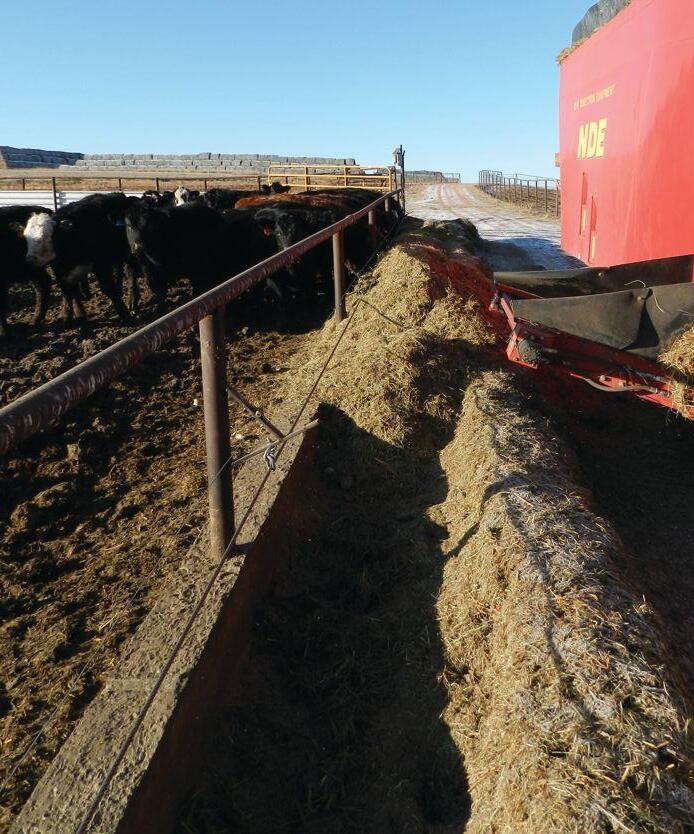
the manure handling is efficient and straightforward. Behind every pen is a drover alley that also acts as a dirty water channel. any liquid from the feedlot runs off into the channel and down to the holding pond.
On its way to the holding pond is a 24-foot by 24-foot concrete pad/solid waste separator.
“the pad has four-foot-high concrete side walls on two sides,” explains Wes. “On the side that is parallel to the holding pond, there’s a culvert that goes from the solid waste separator into the holding pond. and in front of that culvert, we just have a simple man-made screen to slow up and filter off a lot of the solids. Only the liquid portion goes into the holding pond.”
the liquid eventually travels about 1,000 feet from the feedlot to the holding pond that’s 200 feet long by 150 feet wide and about 12 to 13 feet at its deepest. it was designed for 365 days of storage with the liquids evaporating each year, eliminating the need to pump.
the entire system is gravity fed, which saves the dvoraks money.
“afterward we just clean off the pad after big rain events and in the springtime we just keep our dirty water channels free and clear,” says Wes.
in case the holding pond ever needs to be pumped, the plan is to use a traveling irrigation gun to pump the liquid onto adjacent cropland or pasture.
Moving solids
the solids are scraped into piles in the pen in the winter. When the feedlot dries out in the spring, manure is hauled to make room for the cattle and is stacked in windrows. Wes says the goal isn’t so much composting as reducing the
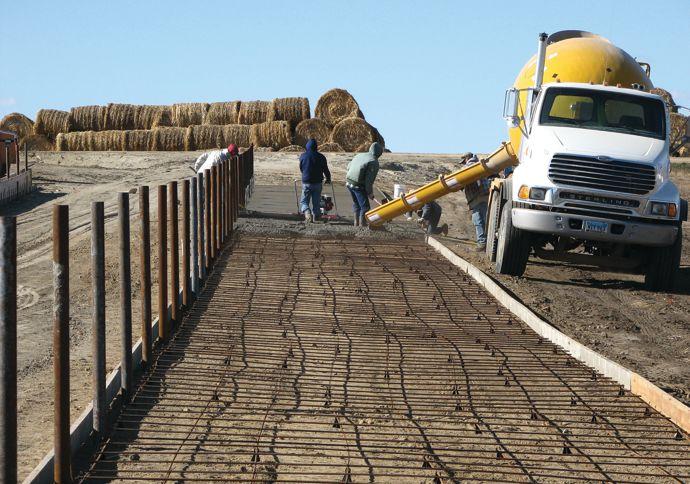
The Dvoraks did all the construction themselves and it took place in two parts. They built most of the new feedlot in the first year, but put in the final four pens and second feed alley about a year and a half later. Contributed photos
ThermoEnergy’s Thermo ARP™ high-efficiency ammonia recovery system is an unbeatable option for operators of anaerobic digesters who want to both comply with nitrogen regulations and recover ammonia as a valuable product. Thermo ARP recycles the ammonia in digester wastewater into ammonium sulfate or ammonium nitrate for the production of valuable fertilizers and industrial products. Thermo ARP is energy efficient, extremely robust, and compact – suitable for even rugged field conditions.
For more information email info@thermoenergy.com or visit our website at www.thermoenergy.com .


manure volume.
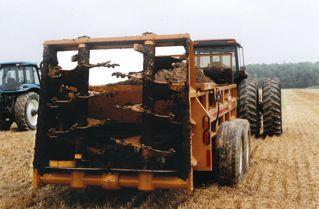
“By turning the piles a minimum of three times within two months with a front-end loader, the manure volume is decreased at least 50 percent with this process,” he says. “the manure is then hauled to cropland in the fall with a truck-mounted harsh model 19.5 manure spreader with horizontal beaters.”
each year, the manure is analyzed for nutrients and application rates are calculated based on nitrogen needs. application rates are generally between 22 and 30 tons/acre. Spreader calibration is also done each year because manure weight, texture and field landscape tend to have a big influence on application.
adjacent to the feedlot, the cows winter on a 135-acre field.
“the only time the cows come into the feedlot is just to get water and minerals but otherwise they’re out on the cropland. We have a portable windbreak for them and feed them in turned tractor tires.”
the dvoraks move the feeding area by moving the tires throughout the 135 acres on a three-year rotation.
“We just let the crows spread the manure for us,” says dvorak. “and every year we seed a crop into that, like wheat
or barley for hay, or corn.”
he adds, “at calving time or when the ground softens up, we’ll pull the cows off the cropland. We don’t want a lot of compaction in the field. typically, they’ll be off that cropland sometime in march. From there they’ll get put into a calving pasture.
dvoraks have not only cut down on their fertilizer purchase, but also eliminated it for the cropland that the manure was applied to.
“We were able to spread roughly 130 acres. that was the sole nutrients that we put down on the corn crop and got excellent production on it. and the last couple of years we’ve had tremendous hay yields on the rest of our crop and hay land so this year we’re selling quite a bit of hay to the guys down south that are in a drought.”
“We do raise some wheat, which we sell as grain,” Wes adds, “but i would say 85 percent of what we grow goes back into the feed lot.”
the dvoraks are happy with how the new feedlot is working for them, but there is always room for improvement. down the road, they would like to switch to vertical
beaters on their manure spread.
“this would also allow us to spread loads faster with a wider spread pattern and in some cases at lighter application rates,” says Wes. “i would build all the feedlot fences from super steel, which is four-feet-wide by 24-feet-long heavygauge windbreak steel – rather than sucker rods welded to the oil field pipe. the upfront costs are more, but it’s a huge labor and maintenance saving in the end.”
For now, the expansion is complete –as far as the farm’s concerned. as for the dvoraks, they have three-year-old twins, a 20-month-old toddler and another baby on the way.
the couple says that anyone considering expanding or building a feedlot should plan ahead.
“not only on your facility design, but if you were planning on putting in a feedlot, and it’s going to be larger than what you currently have, you have to have an overall business plan for filling that feed lot,” says Wes.
the couple is pleased with the final product.
“as a young couple joining the family business, the building of the feedlot allowed us to add an enterprise to the current operation without having to add acres.”
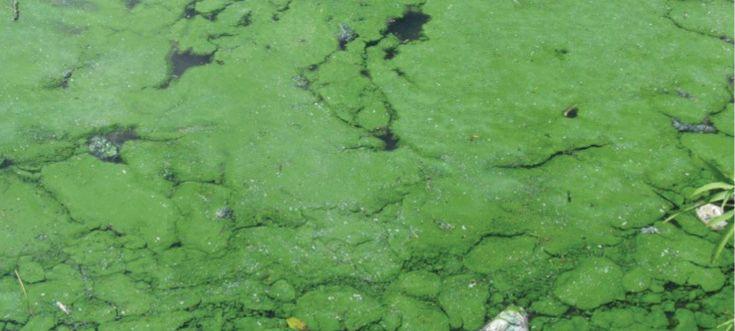
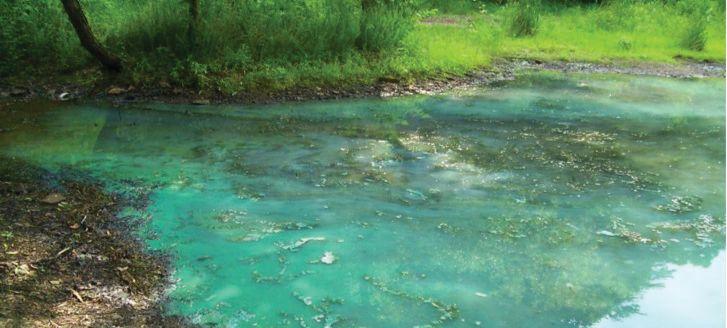
Recent studies on Grand Lake St. Marys have shown that excess phosphorus loading of the Ohio lake has been the primary reason for algae blooms during the past two summers.
It was recently announced that $1 million in federal resources has been allocated for a methane digester project in Ohio to reduce nutrient loading associated with toxic algae blooms, like the cyanobacteria in grand lake St. marys. the funding was awarded by the u.S. department of agriculture (u S da) natural resource Conservation Service’s Conservation innovation grant (Cig) program through a competitive process.
through the C ig program, quasar energy group will help bring methane digester technology to grand lake St. marys, a watershed that has been inundated by blue-green algae. the algae has left the lake unsafe for swimming, and contributed to a decline in tourism, which has led to increased economic hardship for local business.
earlier this spring, quasar, a northeast Ohio energy company, filed a grant application.
“With the Cig grant, we will be working to make the situation better by creating a portable technology to separate nutrients and remove them from the watershed,” said mel Kurtz, president of quasar energy group. “this project will not only be about impacting the region – but about demonstrating a technology that
FSRC Tanks, Inc. awarded Tank Connection dealer agreement
tank Connection is pleased to announce the addition of FS rC tanks, inc. to its group of representatives around the world.
FS r C tanks, inc. is the official national agriculture dealer for tank Connection.
FS r C tanks has more than 15 employees supplying storage tanks to the agricultural market. Previously a glasslined tank dealer for a.O. Smith, FS r C tank president ron Feucht founded the company more than 30 years ago. now teamed with tank Connection, FS r C tanks will provide a product line that has for many years supplied the agriculture industry with storage solutions.
“these are the tanks of tomorrow,” says nate Blackwood of FS r C tanks. “the tank is fully nrCS approved and much more economical for today’s agricultural market, along with an outstanding warranty.”
www.fsrctanks.com www.tankconnection.com
will benefit every farmer and every waste water treatment plant that is struggling with a nutrient management issue.”
recent studies on grand lake St. marys have shown that excess phosphorus loading of the lake has been the primary reason for algae blooms during the past two summers.
methane digestion is a biological process that converts organic matter in manure into methane, a renewable energy that can be used for facility heating and converted to electricity or compressed natural gas (Cng). availability of Cng as a motor vehicle fuel could provide lower costs and cleaner air for the community.
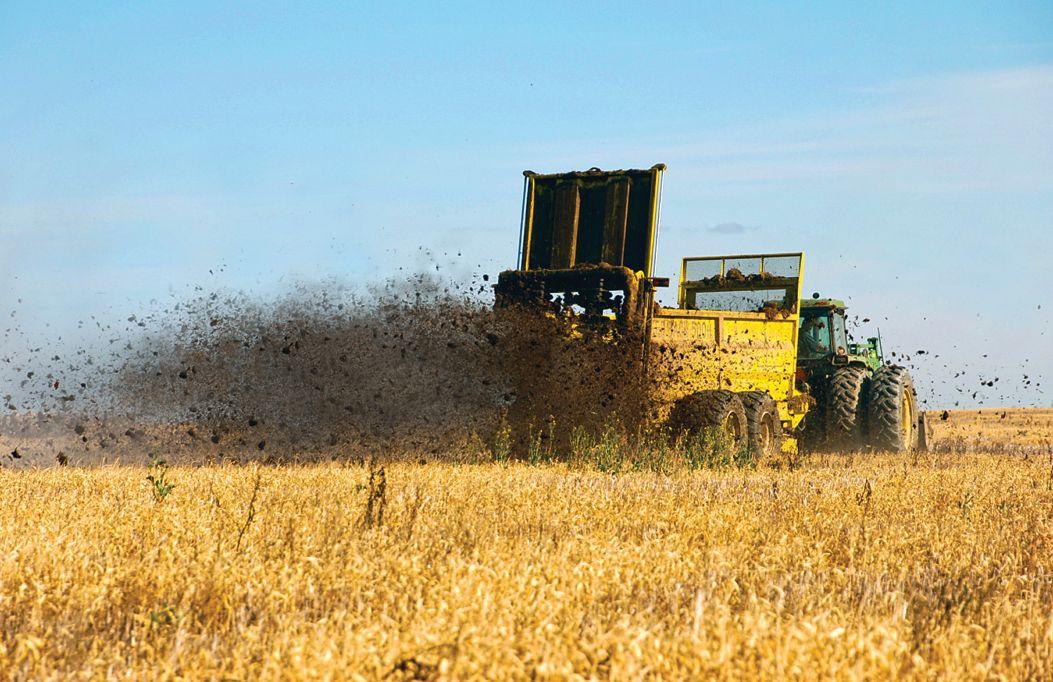
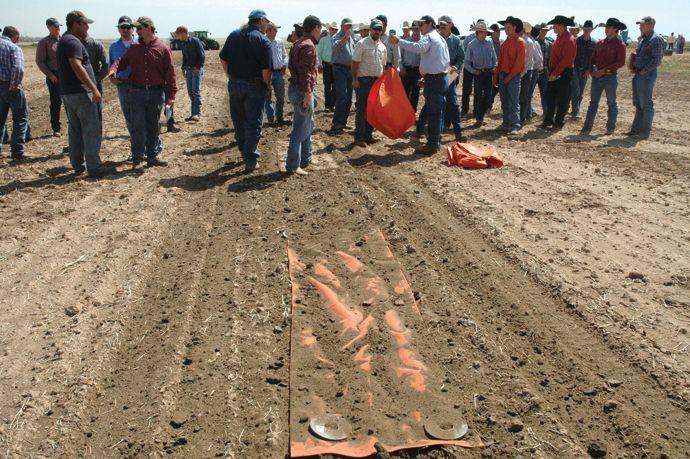
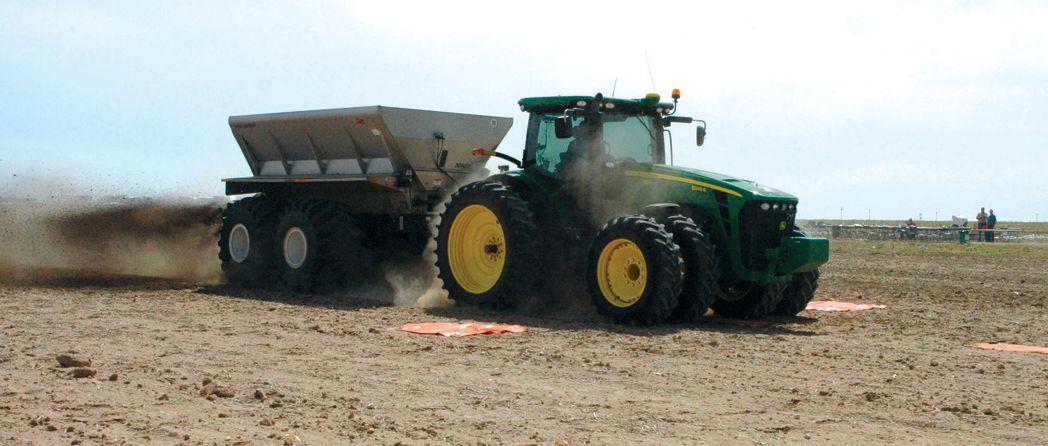
Manure distribution can vary depending on factors such as equipment, wind and moisture. Researchers are working with the cattle-feeding industry to help develop calibration tools for the field. Contributed photo
By Kay Ledbetter
Manure, managed correctly, is a valuable natural fertilizer. researchers and the cattle industry are joining forces to make sure those spreading the manure know how to do so in the “greenest” manner.
texas Cattle Feeders association, texas agrilife extension Service, texas agrilife research and West texas a&m university co-operatively are conducting the project, titled Development and Implementation of an Environmental Training Program for Manure and Compost Haulers/ Applicators in the Texas High Plains.
dr. Brent auvermann, agrilife extension environmental systems specialist, said the main purpose of the project is to demonstrate how best management practices can be used to protect water quality.
the project is operating under the authority and funding of the texas State Soil and Water Conservation Board
through the u.S. environmental Protection agency’s 319 non-point source water quality program.
“this is about non-point source pollution, which is any pollution you cannot trace to the end of a discharge pipe of some kind,” auvermann said. “diffuse runoff from agricultural fields falls into that category. So we are trying to prevent or mitigate non-point source water pollution through the use of beneficial management practices for manure and compost application.”
“Feeding cattle has been an integral part of the texas high Plains economy for the past 40-plus years,” said Ben Weinheimer, texas Cattle Feeders association vice-president. “Custom manure and compost haulers are important to the long-term success of cattle feeders.”
a number of companies in the region provide manure and/or compost removal, hauling and spreading services, Weinheimer said. these independent contractors market manure and compost,
primarily to farmers in the region. in recent years, feedyards have been able to sell manure due to its increased competitiveness with commercial fertilizer.
“tCFa’s interest in this project is to assist a key supporting industry by demonstrating field-proven techniques for proper application of manure and compost,” he said. “these include proper calibration of spreading equipment, best management practices for environmental protection and training resources for owners and employees of manure/ compost companies.”
auvermann said they are developing and refining management techniques of manure application, including developing a system by which manure haulers can easily calibrate their trucks and the applications they make if they don’t have electronic management capability.
the project has sites on watersheds in Wheeler, donley and deaf Smith counties along the Sweetwater Creek, Buck Creek and Palo duro Creek, respectively.
“the number 1 environmental

challenge is making sure feedyards have enough land to put manure on,” auvermann said. “One way to do that is off-site, or third-party, manure transfer. these transfers to third parties are really a critical component of a feedyard’s nutrient management planning exercise.
“in order to preserve that conduit for manure off the feedyard, we have to make sure that everyone involved in spreading manure knows how to spread manure uniformly, how to hit the target application rates and what areas of the field to avoid. that’s what this demonstration project is all about,” he said.
dr. Paul delaune, agrilife research soil scientist in vernon, said the project is looking at different rates of manure and compost applications, and documenting the effect of different rates of soil nitrogen and soil phosphorus and how they correlate to crop yields.
“and then also we want to monitor not only the soil nutrients, but how much nutrient we are losing in runoff water,” delaune said. “We have an automatic water sampler to collect water runoff samples during a storm event or even an irrigation event.”
he explained that if irrigation or storms produce runoff, the water runs through a flume on the backside of the sampler and they are able to calculate runoff volume based on that. in addition, they are able to take water quality samples.
“We have four rates: 20 tons raw manure per acre that is applied once every three years; five tons per acre of compost annually; commercial fertilizer applications annually, which is about 125 pounds of nitrogen; and then we have 10 tons per acre of raw manure application,
which occurs annually,” delaune said. the initial reports in year 1 with no storm-driven events, but with irrigationdriven events, indicate there is potential to move small amounts of nutrients off the plots even through irrigation, he said.
“We’ve seen as much as 11 pounds of nitrogen lost and about seven pounds of phosphorus lost from a site – less than two percent of applied and soil nitrogen and phosphorus – just due to irrigation that is moving off site,” delaune said.
“the most important thing is to soil and manure sample,” he said. “Know how much nitrogen and phosphorus you have in your soil profile and how much is in the manure before you go and apply more.”
“manure is a great source of macronutrients, micronutrients and
organic matter,” Weinheimer said.
“By providing these companies with the resources needed to be informed and making training resources readily available to them and their employees, we can ensure that manure is not at a competitive disadvantage to commercial fertilizer.
“Farmers should have the freedom to obtain crop nutrients from manure, compost or commercial fertilizer,” he said, adding they should also feel comfortable that the product has been applied in accordance with best management practices.
a video of the project can be viewed here: http://www.youtube.com/ watch?v=jlumedbW li8&feature=play er_embedded#!
GUTTER-CAT CROSS SCRAPER
SHUTTLE-STROKE CROSS CLEANER FLUSH-FLUME SYSTEM
B-15/16 CROSS CLEANER

B-15/16 CHAIN SCRAPER
DURA-CHAIN SCRAPER
XD-SERIES CABLE SCRAPERS
VERTICAL PUMPS
LIQUI-TRANS PISTON PUMP
SEMI-TRANS PISTON PUMP
SOLID-TRANS PISTON PUMP
ELECTRIC PROP AGITATOR
MECHANICAL PISTON PUMP
TRANSFER PUMP SYSTEMS
SD-SERIES NON-STEERABLE HD-SERIES NON-STEERABLE AUTO-TRAC STEERABLE ULTRA-TRAC 4, 6 or 8 WHEEL STEERABLE
JAMESWAY FARM EQUIPMENT, INC.
FACTORY: St. Francois-Xavier (Quebec) USA WAREHOUSE: Tomah, WI PHONE: 819-845-7824
ULTRA-PUMP 3PH PUMPS & PROPS
ULTRA-PUMP TRAILER LAGOON PUMPS & PROPS
VERTICAL PTO PUMPS
NUTRI-JECTOR HIGH-SPEED INJECTION SYSTEM
MULTI-JET APPLICATOR DOUBLE DISC APPLICATOR
SEMI-TRAILER MOUNTED
CENTRIFUGAL LOADING PUMP
TRANSFER ARM KITS
MOUNTED
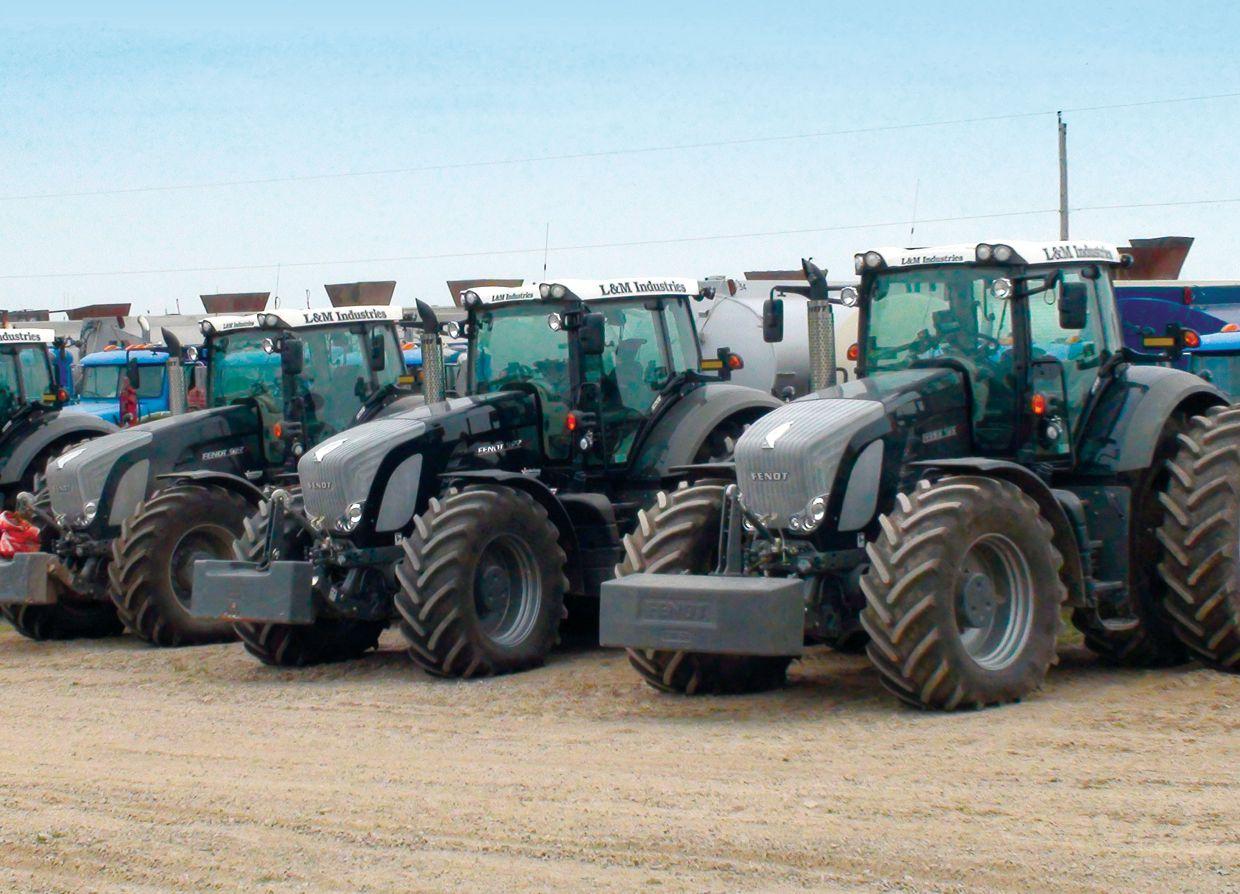
The speed and hydrostatic drive of the AGCO Fendt tractor is the reason L & M Industries has 13 of them in the company’s fleet.
Contributed photos
By Tony Kryzanowski
Industry is rife with stories about individuals jury-rigging equipment and tools to come up with a better solution to manage a particular problem. maybe it’s just human nature. the history of Wisconsin-based custom liquid manure application pioneer l & m industries inc. is exactly that type of story.
today, after 27 years in business, the company faces some tough competition with the number of custom application businesses doubling in the state over the past two years, but l & m industries inc. still has a few aces up its sleeve to keep it steps ahead of the competition.
One is the company’s custombuilt “dream machine,” which allows it to deliver more liquid manure in a day and transfer liquid manure cleaner at application sites than most of its competitors. i t is essentially an on-site manure transfer and high-pressure pumping unit in one. a nother is the speed of the hydrostatic drives installed in its 13 ag CO Fendt tractors that
the company uses exclusively in its tankering operations. the tractor’s hydrostatic drive allows the company to have much more control over the speeds that they travel across fields, thus giving them more control and accuracy over the amount of manure that is applied per acre. a lso, l & m i ndustries i nc.’s tractors are able to travel much faster down the road, if required, at about 32 mph, but that advantage is dwindling as other tractor manufacturers improve the speed of their tractors.
l & m industries inc. is owned by george lorenz and noel marcks. established in 1984, the company is located in Black Creek, Wis., about 20 miles west of green Bay. at present, they apply about 360 million gallons of liquid manure annually, with 95 percent of their clients involved in the dairy industry. the dairy sizes range from 25 cows to as many as 3,000. the company offers three primary services in its 125-mile trading area – custom liquid manure application on farmland close to the dairy using a drag hose system
directly from customer lagoons, delivery of liquid manure by tanker truck to one of the company’s two “dream machine” setups and then land applying the liquid manure using a drag hose system, and finally, liquid manure injection using houle 9500 tankers with injectors. the company’s fleet consists of six houle 9500 tankers with injector bars, two drag hose systems using eightinch hose for application jobs up to three miles away and six-inch hose for application jobs closer to the lagoon, two custom-built “dream machine” units using six-inch hose connected to the ag CO Fendt tractors injecting the manure in the field, 10 semi-trailer tanker trucks, two meyer 8865 box spreaders, a 7,000-gallon nuhn vacuum tanker, six ag CO Fendt 927 tractors, six ag CO Fendt 933 tractors, one ag CO Fendt 926 tractor and a variety of agitators, booster pumps, and extra hose. its custom-built injectors range in width from 15 to 27 feet. l & m industries inc. has seven full-time employees and as many as 30 workers during peak season.
“When we started out, there was
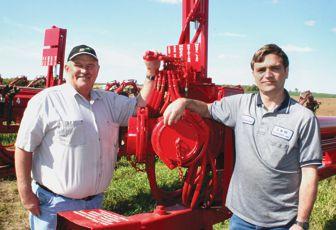
L & M Industries owners George Lorenz (right) and Noel Marcks have been ahead of the technology curve for several decades when it comes to custom manure application.
nobody pumping manure through a hose out to the field,” says lorenz. “the guys that were doing it were pumping it out through irrigation pipes. So we were the first ones to go buy a mile of hose and lay a mile of hose out and show everybody that you can pump manure through a hose. nobody else i know of at the time was doing it.”
Consequently, a lot of l & m industries inc.’s equipment has been built from scratch, as they’ve been offering drag hose application service even before current suppliers opened their doors. the company built its own agitators and injectors, and sourced its own hose suppliers to offer this service to customers. But that was then and this is now.
“now, if you have a checkbook and a bank behind you, you can start up next week and have just as good equipment as anyone else in the industry,” says lorenz. Well, almost.
“One of the things that i have that nobody else has is the ‘dream machine’ setup, which is a little quicker to set up and move between fields,” he adds. “ i t is a little more productive than some and a little cleaner than most. So it is a combination of being able to be a little bit more productive and being able to be a little bit cleaner that allows me to still make a fair profit and be competitive.”
the “dream machine” came about partially as a direct consequence of changes in the industry with dairy farms getting larger. l & m industries had to find a way to serve these larger customers who required that liquid manure be transported farther and farther because of the amount of manure they were generating, without traveling in fields with tanker trucks, muddying up roads and compacting the soil.
they needed to design a manure transfer and pumping system where
the liquid manure could be transferred from the truck to a frac storage tank at roadside quickly and safely, while keeping trucks out of the field, and to minimize the amount of labor required by their drivers so they weren’t so tired by the end of the day having to hook and unhook hoses.
however, even before l & m industries inc. could apply its “dream machine” concept, it had to solve problems caused by an increasing number of dairies using sand for bedding. the sand builds up in lagoons and becomes suspended in the slurry
when the lagoon is agitated. the problem is that it clogs up valves during the transfer process. the solution was an ingenious system that loads the liquid manure from the lagoon to the bottom of the truck tank. r ather than filling from the top, the company has installed a straw from the top of the tank down to the bottom. the straw is bent at a 90-degree angle at the bottom with a check valve to prevent backflow, such as when a truck comes to a stop at an intersection. the 90-degree elbow pushes the sand to the back of the tank at loading, keeping the sand moving
toward the outlet. the trap door prevents an overflow surge when stopping. a rubber O-ring seal at the top keeps the tank looking clean and allows l & m industries inc. to bottom fill through the straw, cutting down on foaming issues while washing the sand to the back of the trailer.
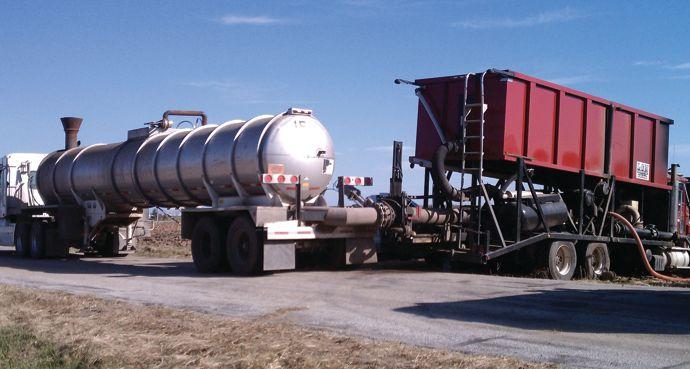
the next innovation is how the company handles transfer of the liquid manure to the “dream machine” at roadside. While an automatic unloading system would have been an ideal solution, l & m industries has gone with a happy medium of having a worker stationed full time at the “dream machine” with the sole job of hydraulically connecting to the back of the semi-tanker, making an airtight seal to suck the load off the trailer and pump the manure into the frac tank overhead of the high-pressure pump. this system still delivers the results that l & m industries inc. was looking for: elimination of the problem of drivers having to leave the truck to hook and unhook a hose to the “dream machine” several times a day while still executing a fast and clean transfer.
“We are able to suck the 6,000-gallon load off in two minutes from the time you drive up until the time the semitrailer truck drives away versus a gravity flow system that takes as much as four minutes,” says lorenz. Speed and clean transfers are money in the bank for l & m industries inc., as they can deliver and apply several more loads per day using this system.
the “dream machine” is a single unit that can be transported from location to location and that features a pump in the neighborhood of 150 psi and power unit, an air compressor, a frac tank, and a manure transfer system. this system consists of a hydraulic-pressured 12-inch power couple to the semi-trailer tank through an O-ring, which creates a spill-proof seal. Because the company often hauls sand-laden manure, it includes a system that blasts the transfer valve open using compressed air for about five seconds to open up any plugged valves.
the meyer 8865 box spreaders are used to dispose of solid material that is unable to be removed from the pumping process of emptying the lagoon. the nuhn vacuum tanker works best for applying liquid manure on smaller fields where it isn’t cost effective to set up the “dream machine,” and gives l & m industries inc. the ability to provide a more complete service.
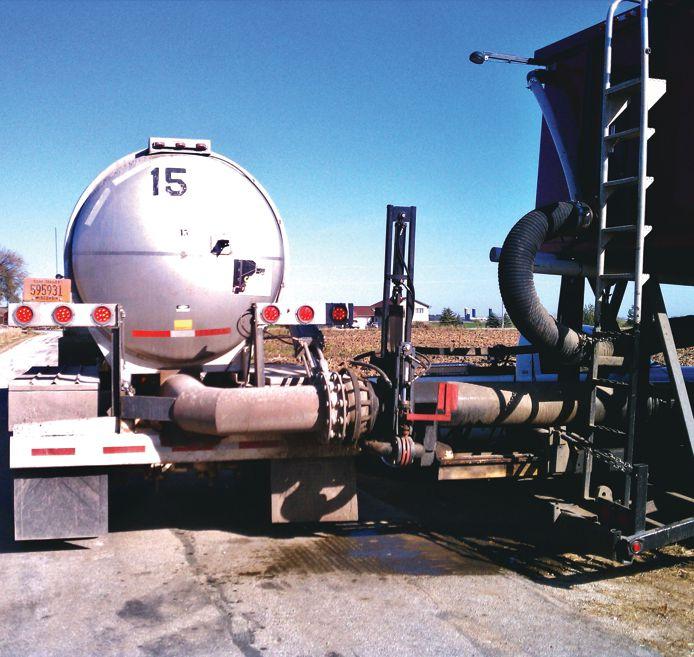
The “dream machine” is able to transfer a 6,000-gallon load of liquid manure from the
The inlet on the tanker truck bends at 90 degrees near the bottom of the tank so that sand-laden liquid manure is propelled to the back of the tank when loading, near the outlet. Contributed photos
in addition to a full three-year warranty, free oil changes in the field, and a guaranteed replacement tractor if tractors are still under warranty or if repair will take more than 24 hours, l & m industries says its Fendt tractors are simply more competitive.
“You don’t have to shift gears, you don’t have to throttle up, you don’t have to throttle down, and you don’t have to find a gear,” says lorenz. “You just slap the
joystick over to the speed you want, and the tractor takes care of itself.”
l & m industries inc. concludes that industry experience means a lot when providing customer service. although farmers have a large assortment of applicators to pick from, l & m industries inc. can offer dependability, innovative technology, fair pricing and a team of employees who are concerned about the best job they can deliver.




• Must register online via the website under “Exhibit Viewing Only” and enter “MM04” to be eligible.
By Tony Kryzanowski
Three hog barn explosions have occurred in the past few months in iowa alone – the latest example resulting in the death of 1,100 hogs and the injury of a farm worker – because of the buildup of methane and other dangerous gases from liquid manure stored in belowground pits.
a company called Pit Solutions llC believes it has a solution to prevent this dangerous situation from occurring.
Chemical marketer r andy marah introduced Pit Solutions co-owners ron tannahill and C.J. nannenga to a company that operates a chemical/ microbial lab that develops foam control products. they have since formed a partnership to produce and market those products.
according to Pit Solutions, the emergence of foam in swine confinement pits is a complex and costly problem resulting in issues such as producers having to transfer pigs out of buildings prematurely due to the foam coming through the slats, interruption of building loading schedules, pit ignitions, barn explosions, personnel injuries, gassed pigs, and the need for premature transfer of manure. the manure is typically pumped out of the pits in the fall after crops are harvested and farmland is available for application.
nannenga says an increase in the price of corn and soybean components of the swine rations has prompted producers to seek less costly feed alternatives. i ncreasing the use of dried distillers grain in the feed rations, sometimes by as much as 40 to 50 percent, can cause an imbalance of bacteria in the pits, the result being the production of dangerous foam laced with methane and hydrogen sulfide gas, he says. n annenga notes the foam acts as a blanket, which can trap the gasses between the bottom of the foam and the surface of the manure.
“When this occurs, only two factors are required for a potential disaster – a significant disruption of the foam blanket that releases the trapped gas reservoir and a source of ignition such as an open flame brooder, an lB White-type space
heater, a light switch being turned on, or a spark from a welder or grinder,” says nannenga.
Pit Solutions has developed an all-natural system that consists of two products working together to control and inhibit the production of pit foam. the products -– called defoamer 4000 and Custom Bacteria Systems (CBS) – each contain patented formula components. Pit Solutions has a priority agreement with a chemical/microbial lab that specifically designed the two products. the company says these products are new to the industry, with preliminary tests showing they effectively control foam and inhibit the organisms that are responsible for the foam.
“the product has been tested in approximately 100 barns – both in a large, iowa-based integrated grower’s barns and a private individual grower’s barns – and we achieved a 92 percent success rate,” says nannenga.
in one test, the defoaming product was able to lower foam levels from 51 inches to 10 inches in 24 hours, which is particularly helpful in emergency situations.
While the defoamer can help to solve an aggressive emergency foam problem as a quick fix, Pit Solutions llC officials note the most cost-effective approach to foam control is in a continuous preventive maintenance program, best started as soon as the pits have been pumped in the fall. according to the company, the producer is treating a lower volume of manure and the organisms responsible for the foam are at their most vulnerable stage, making them the most susceptible to the CBS application protocol.
Because the product is 100 percent natural, marah adds that it will not harm the manure, which continues to work well as a fertilizer when it is land applied. Company representatives say the product formulations actually enhance the value of the manure for field applications, are completely harmless to animals, people and the environment, and contain no silicone or antibiotics.
“in our test barns that were treated in mid-June, barns with pits that were about half full of manure and carried a foam
Pit Solutions believes it has found a solution for controlling manure pit foaming.
blanket of up to 15 inches, after only one initial treatment, the foam was completely eliminated, there was no odor or flies, and the treatment held past the time of pit pump-out this fall with no foam noted in the manure hauler’s tank wagons,” says nannenga. “that in itself is a huge plus as it cuts down on manure hauling costs considerably, especially if you have far to haul the manure.”
d avid Schmidt, an assistant extension engineer at the u niversity of m innesota, has been studying the foaming issue for the past three years and cautions that to the best of his knowledge, no products have been developed to manage the pit foaming issue that are effective all the time. h owever, he sees no reason farmers shouldn’t give products like those developed by Pit Solutions llC a try.
“my advice to people is to try it to see if it works,” he says, “but don’t spend a lot of money on it initially.”
he adds that the main challenge to controlling and preventing pit foam is “we aren’t really understanding why it’s going on.”
the reasons for pit foaming are highly complex and the microbes responsible for it have a way of evolving so that, although a product may be effective for a time, it may not be effective in every situation or forever, he says.
Pit Solutions is targeting north america-wide distribution of the products because it believes there is a significant demand. although the company’s main focus is on the hog industry, the product has already been tested on a dairy farm lagoon with positive results.
February 22-24, 2012
Western united dairymen 2012 annual Convention, temecula, California. visit: www.westernuniteddairymen.com
March 5-7, 2012
Canadian Farm & Food Biogas Conference & exhibition plus growing the margins Conference & exhibition, london Convention Centre, london, Ontario. visit: www.gtmconference.ca/site/index. php/canadian-farm-and-food-biogas
March 7-8, 2012
2012 environmental management Seminar, doubletree hotel, nashville, tennessee. visit: www.poultryegginstitute.org
March 13-14, 2012
Professional dairy Producers of Wisconsin Business Conference, alliant energy Center, madison, Wisconsin. visit: www.pdpw.org
March 13-15, 2012
2012 midwest Poultry Federation Convention, Saint Paul riverCenter, Saint Paul, minnesota. visit: www.midwestpoultry.com
March 21, 2012
Ohio Compost Operator education Course, Shisler Center, Ohio State university, Wooster, Ohio. visit: go.osu.edu/GcZ
March 27-29, 2012
7th agStar national Conference, holiday inn Syracuse-liverpool, Syracuse, new York. visit: www.epa.gov/agstar
April 16-19, 2012
26th annual Biocycle West Coast Conference, red lion hotel, Portland, Oregon. visit: www.jgpress.com/westcoast/2012
April 16-19, 2012
international Biomass Conference & expo, Colorado Convention Center, denver, Colorado.
visit: www.biomassconference.com
May 21-24, 2012
4th international animal By-Products Symposium, doubletree hotel, dearborn, michigan.
visit: http://cwmi.css.cornell.edu/ symposium2012.pdf

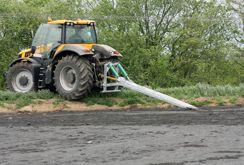
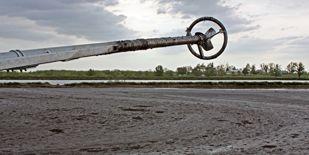
The profitability of livestock operations depends upon the ability to efficiently recycle manure nutrients and reduce commercial fertilizer use. recordhigh fertilizer prices have created an incentive for crop producers to use manure as a crop nutrient source, thereby expanding the land base available for manure application. a larger land base provides flexibility in timing manure applications and reduces the tendency to over-apply on a limited amount of land. recent technological improvements have increased manurehandling efficiency. large spreader tanks and transport vehicles have been developed, and in-field relay tanks and nurse trucks with boom extensions have improved the effectiveness of over-theroad hauling.
Farm managers need information about equipment capacity and cost to select machinery to complete field operations within the time available. We recently completed a study of the productivity of 13 manure-hauling systems used by custom applicators on 10 farms in michigan, Ohio and Ontario. Custom applicators used tractors designed for rapid (25 mph and greater) over-theroad transport, or nurse trucks ranging in size from 6,000 to 9,000 gallons for overthe-road transport to tank spreaders in the field.
Compared with tank spreader/ nurse truck systems, tractor-drawn tank spreaders alone are more productive when fields are close to storage because there is no in-field nurse tank-tospreader transfer, but the hauling rate of tank spreaders declines rapidly as the hauling distance increases. tank spreader productivity drops by 50 percent with a three-mile haul (Figure 1). nurse trucks have an advantage with longer hauls because of faster travel speed. nurse trucks over-the-road typically average about 10 mph faster than high-speed tractors.
When hauling from nearby storage, two 7,000-gallon tank spreaders were twice as productive as one 7,000-gallon tank spreader working with two 7,000-gallon nurse trucks. When the hauling distance was three miles or more, the productivity of each system was nearly equal (Figure 1). When the nurse trucks and spreader tank were the same size, the spreader worked at full capacity and had no idle time within 1.7 miles of the pit. the hauling capacity was about 27,600 gallons/hour. Beyond 1.7 miles the productivity dropped because the tractor-spreader applied manure faster than the nurse trucks delivered it. additional nurse trucks, about one per mile of distance hauled in this case, were needed to keep the tank spreader working near full capacity as the hauling distance increased.
By Tim Harrigan
tank spreaders with one-half the volume of the nurse trucks were used to reduce the potential for soil compaction and improve in-field maneuvrability. When one 3,500-gallon spreader was used with two 7,000-gallon nurse trucks the tank spreader had no idle time within 2.6 miles of the pit and the hauling capacity was about 20,200 gallons/hour. Compared with a 7,000-gallon spreader, the 3,500-gallon spreader reduced the hauling capacity by 17 percent with a three-mile haul.
We evaluated the costs for manure pumping and agitation, transport and application for a 1,400-cow dairy using either surface broadcast with tillage incorporation or subsurface injection with a six-point injector. the dairy applied 12.2 million gallons/year on fields from one to four miles from the pit. the average hauling distance was 2.5 miles. two hauling systems were evaluated. One system used four 9,000-gallon tank spreaders with six-point injectors and 240-horsepower tractors. two large lagoon pumps were used for pit pumping and agitation. the farm’s average hauling rate was 58,600 gallons/hour but fieldaverage rate ranged from 71,000 gallons/ hour within one mile of the pit to 42,800 gallons/hour with a four-mile haul. twenty-six 10-hour days were needed for transport and injection using the four tank spreaders.
2: Manure pumping, agitation and injection costs for a 1,400-cow dairy with four 9,000-gallon tank spreaders or two tank spreaders with four nurse trucks with an average hauling distance of 2.5 or four miles (Trac = tractors).
an alternative hauling system used two 9,000-gallon tank spreaders with four 9,000-gallon nurse trucks. the tank spreaders were used for hauling to fields less than three miles from the pit and the nurse trucks were used with the tank spreaders when hauling to fields three or more miles from storage. When hauling to fields near the pit this system cut productivity by one-half, but it improved productivity when hauling to fields three to four miles away. Compared with four tank spreaders, the farm-average hauling rate with the nurse trucks decreased 26 percent to 43,100 gallons/hour. thirty-one 10-hour days were needed for transport and injection compared with 26, 10-hour days for four tank spreaders. the cost for pumping and agitation was 0.17 cents/gallon for each system. transport and injection was 1.31 cents/ gallon using four tank spreaders and 1.55 cents/gallon using two tank spreaders and four nurse trucks. the total cost for injection using the four tank spreaders was 1.48 cents/gallon, which work out to $129/cow/year. the total cost using four nurse trucks was 1.72 cents/gallon, which works out to $152/cow/year. transport and land
application accounted for about 90 percent of the total cost. the cost of injection was about 10 percent greater than surface broadcast with tillage incorporation.
We evaluated the effect of distance on labor and hauling cost by increasing the farm-average hauling distance by 50 percent to four miles with fields ranging from 1.5 to six miles from storage. the longer hauling distance reduced the productivity of four tank spreaders by 13 percent and reduced the productivity of two tank spreaders with four nurse trucks by 11 percent. the labor requirement increased from 26 to 31 days with four tractor-drawn spreaders, and from 31 to 37 days for the spreaders with nurse trucks. the total cost for pumping, agitation, transport and injection for four tank spreaders with the extended hauling distance was 1.64 cents/gallon ($143/ cow/year) and 1.91 cents/gallon ($169/ cow/year) for the spreader/nurse truck system.
Summary manure generally is applied to cropland either in the spring before planting or in the fall after harvest. manure-hauling operations must align with other fieldwork
to make efficient use of equipment and labor and prevent delays in field operations.
Semi-tractor-drawn nurse tanks for over-the-road transport can provide flexibility in scheduling field operations and increase the productivity of tractordrawn tank spreaders when applying manure to fields more than three miles from storage. nurse tanks are less costly than tank spreaders. a large nurse tank with hydraulics and a boom extension costs about $25,000 compared to $90,000 for a large tank spreader with an injection unit. Custom applicators have access to the large and specialized equipment needed for timely and costeffective manure application. a typical hourly charge for custom hire of a large nurse truck is about $100/hour. Custom hire of manure-hauling services may be a good business decision for livestock producers.
Tim Harrigan is with the department of Biosystems and Agricultural Engineering at Michigan State University. For more information about the on-farm study and economic evaluation involving custom manure applicators, contact Tim at harriga1@msu.edu or at 517-353-0767.

recently patented system reduces phosphorus in wastewater, engineering team finds
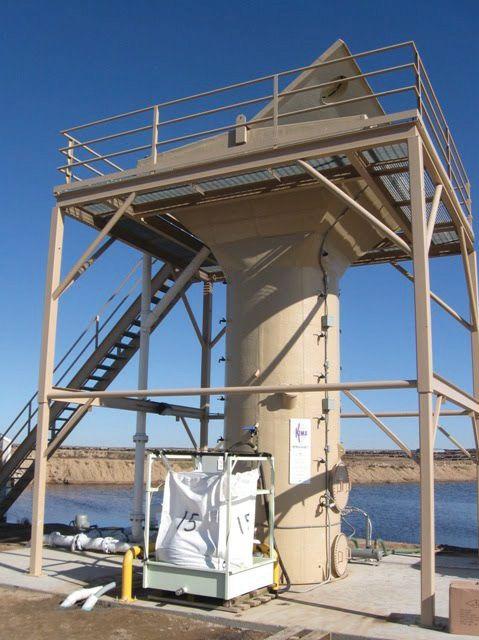
Ateam of bioprocessing engineers with Kansas State university’s advanced manufacturing institute (ami) has been issued a patent for a system that removes phosphorus from wastewater and addresses environmental regulations. excess phosphate from both animal and human wastewater is an serious environmental problem. it can pollute water resources and cause algae blooms, a problem that was present in many Kansas lakes and reservoirs this summer. the phosphorus reduction system – called Phred for short – is an easyto-use, fully automated system that removes up to 60 percent of phosphorus from wastewater in cattle feedlots. the system was issued as a patent titled Fluidized bed precipitator with optimized solids settling and solids handling features for use in recovering phosphorus from wastewater to the Kansas State university research Foundation, a nonprofit corporation responsible for managing the technology transfer activities of the university.
“ i n essence, the system changes the chemistry of wastewater from the feedlot,” says Sigifredo Castro d iaz, a bioprocessing engineer with ami who helped create the patented system. “ i t runs the water through the reactor and the phosphorus is retained in pellet form. a chemical reaction occurs, so the water comes out with lower phosphate levels.
“through this system, we can recycle the excess phosphate, while before it could be wasted and end up feeding algae water in lakes.” the project started as a partnership with Kansas environmental management associates (K ema). the researchers created a pilot system in the laboratory then used a scale version on the university’s lagoon or the feeding operation pond. Finally,
the team developed a large-scale system to use at Supreme Cattle Feeders near liberal, Kan.
the final patented system works by removing phosphorus from lagoons and trapping it in pellet form, making it easier to distribute and package. By doing so, it addresses two important farming concerns involving irrigation.
“Without the system, if farmers reuse the wastewater and there is too much phosphorus in it, they can face fines by the e Pa,” says diaz. “But during a drought, it is not helpful to have all this water that they cannot use because of the phosphorus content. So with this phosphorus reduction system, farmers can remove the phosphorus and safely use the water.”
as a result, the system helps farmers cut costs while following u.S. environmental Protection agency (e Pa) regulations. Farmers can purchase the system with assistance from the environmental quality incentive Program, a federal program that provides assistance to farmers. although competitive systems exist, they are often more expensive, less efficient and less applicable to agricultural wastewater, the researchers said.
“ the development of the Phred system provides livestock farms and others with a valuable tool to protect our nation's lakes, streams and estuaries, and K ema is proud to be the driving force behind its development,” says Kylo h eller, director of development for K ema d iaz is now leading related research projects through partnerships with Kansas State u niversity and other organizations. the team is improving the efficiency of the current bioprocessing system by partnering with additional ami and university researchers, as among them larry

g lasgow, professor of chemical engineering. the researchers are discovering uses for the phosphorus pellets that come from the system. Kimberly Williams, a professor of horticulture at Kansas State, worked on a nutrient release study and found several important advantages of phosphorus pellets as fertilizer for lawns and plants. For instance, the pellets are a natural slow-release fertilizer, meaning they slowly release nutrients to plants. Similarly, the team is looking at ways to decrease phosphorus in cattle feed. d oing so will prevent excess phosphorus from entering the ecosystem.
While the current system is optimally designed for wastewater from cattle feedlots, d iaz has been leading efforts to apply the same method at dairy and hog farms. the wastewater from these farms is different because it often comes from indoor barns that produce more phosphate-concentrated wastewater. the researchers have proved that the same system can work with both types of farms and are now working to fine-tune it.













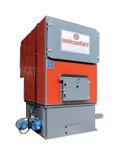
EOS series biomass gasification boiler as the u.S. biomass thermal and power industry continues to expand, new technologies reporting higher efficiency solutions are being introduced.
according to alternative energy Solutions international (ae S i), the new eOS series biomass gasification boiler, designed and built by uniconfort, is among the most energy efficient of the industry’s high-performance, lowmaintenance biomass energy plants. the eOS series provides thermal outputs ranging from 600,000 Btu /hr to 20 million Btu /hr, and can be staged to provide increased capacity.
the eOS series includes high efficiency, wide fuel acceptability, low maintenance, and automatic ignition. Specific features include:
• high heat exchanger surface and low smoke temperatures
• two-part hybrid combustion system
• automatic cleaning system
• automatic ignition system the new eOS biomass gasification boilers are available throughout the u.S., Canada, and South america exclusively through ae S i and uniconfort. www.aesintl.net www.uniconfort.com
Pichon launches
Muck Master
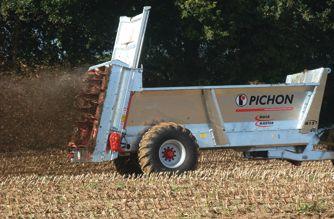
French slurry tank manufacturer Pichon recently released a line of manure spreaders called muck master. the spreader is available in eight different models that can hold anywhere from 12 to
24 cubic meters of manure.
the new spreader utilizes simple construction: a heavy-duty, narrow box, fully galvanized with large-diameter vertical beaters. according to the company, the beaters provide a uniform and regular spreading pattern, even at high rates and at the end of spreading. the spreaders are available with various options, including a hydraulic slurry door, in-cab electronic control, one or two side deflectors, a hydraulic chain tensor, and side extensions.
Pichon has more than 40 years’ experience in agriculture machinery construction.
www.pichonindustries.co.uk
ideal for slurry management of small and medium businesses, the Solidry is a new, small separator being manufactured by Fan, a company of the Bauer group.
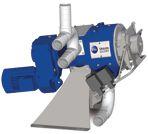
the separator has a simple construction, is available for a reasonable price and has a very compact size. the system measures only 1.3 meters by 0.7 meters and has a height of one meter. the 420-kilogram machine separates up to 15 meters cubed of substrate in an hour. Farm fertilizer with dry matter content between one and 10 percent can be separated into its liquid and solid fractions.
the core element of the system is the angular positioned auger, which is enclosed by a 360-degree screen. the substrate is filled into the cast iron housing from the side and then pressed to the front by the auger. the liquid fraction is pressed through the screen and can be discharged easily due to the shape of the machine. the solid fraction is moved to the press flange and pressed until it reaches a dry matter content of 20 to 28 percent.
the engine (a three kilowatt electric motor including the gear box) is positioned at the end of the machine and lets the auger rotate with 19 rpm.
this concept ensures an energy-efficient separation of farm fertilizer.
the Solidry is suitable for conserving high nutrition content in the solid fraction of the slurry. Furthermore, the volume can be reduced considerably (up to 30 percent of the volume is being separated as solid fraction).
Operators can choose screen slot sizes from 0.25 to one millimeter. the dry matter content of the solid fraction can be regulated by the output regulator valve located at the press flange. www.fan-separator.de

designed to deliver more power, burn less fuel and meet tier 4 emissions standards, Case ih has now released a complete family of high-horsepower equipment utilizing efficient Power technologies. the introduction of the new Case ih axial-Flow® 30 Series combines, Patriot® 4430 sprayer and maxxum® tractors complements the Steiger®, magnum™ and Puma® tractors that went into service last winter.
“Case ih FPt Selective Catalytic reduction technology helps meet tier 4 emissions requirements, but also improves engine responsiveness and can reduce fuel consumption by 10 percent on average,” explains Kyle russell, senior director of marketing with Case ih north america. “it is, hands-down, the best approach for high-horsepower ag equipment, especially when you consider high load requirements and how important fuel efficiency and maintenance costs are to farmers.”
new additions to the Case ih efficient Power family, featuring the SC r technology, include:
• new Case ih axial-Flow 30 Series combines, designed to improve performance, simplify harvest and minimize fuel consumption.
• the Patriot 4430 sprayer, which sets the industry standard for power, fuel efficiency, productivity and comfort.
• the maxxum tractor lineup, now equipped with enhanced operator controls, fuel-saving engines and more powerful hydraulics to deliver productivity, fuel efficiency and versatility.
• the magnum 370 Cvt tractor, which is set to debut in late 2012 as the highest horsepower mechanical front-drive (m F d) tractor on the market at 419 maximum boosted engine horsepower. www.caseih.com
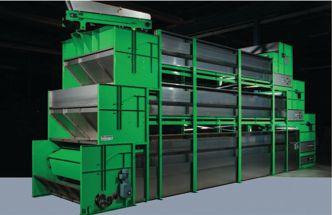
vdl agrotech recently introduced a new manure drying tunnel at the dutch exhibition landbouw vakbeurs in den Bosch, the netherlands.
this new industrial drying system dries manure up to 80 percent dry matter content within 72 hours, and contributes to a considerable fine dust reduction of about 70 percent.
Perforated steel plates driven by a railchain transport the manure in the tunnel. ventilation air from the poultry house is blown through the drying plates and the manure. the plates have a 35 percent perforated opening, allowing a fast drying process. a turning spreader divides the manure evenly on the top layer of the tunnel. a t the end of the tunnel, the plate tilts and the manure is dropped to the underlying levels. the manure then moves in the opposite direction. the automatically forced “drop to the next level” system prevents the manure from sticking to the plate.
the Pouldry can be set up at the side or at the end of the poultry house depending the layout of the equipment and building(s). vdl agrotech also offers consultancy for the best solution
concerning placement and positioning of the Pouldry. the current maximum length of the tunnel is 33 meters. www.vdlagrotech.com
gehl, a maker of compact equipment for construction and agriculture applications, recently announced an important engine upgrade on the telescopic handler.

the e Pa-certified interim tier iv Yanmar 68-horsepower (50.7-kilowatt) naturally aspirated engine provides the power needed for demanding jobs, while providing reduced fuel consumption. the upgraded interim tier iv engine meets the latest emissions standards.
the gehl r S5-19 is designed with a compact frame and tight turning radius of 11 feet (3.35 meters), allowing it to maneuver in low buildings and confined job sites. the boom reaches to a height of 19 feet, one inch (5.8 meters) and features a welded box-section design.
internal wet disc service brakes are standard equipment, for better stopping capability and longer life, along with a Sahr (spring-applied, hydraulic-release) parking brake, which is automatically applied when the engine is shut off, or manually engaged by pressing a rocker switch. this design eliminates the cable stretch and adjustments associated with many other telescopic handlers.
the view from the r OPS/FOPS canopy is a full 360 degrees. an enclosed cab is optional with front and top windows, a door and a heater/defroster for use in areas where operators need protection from the weather. Optional airconditioning is also available for further climate control.
two direct mechanical joystick controls for boom and fork tilt functions are standard. a deluxe suspension seat is optional. users also can add a work light package can also be added.
engine accessibility is possible with a large, hinged hood on the side of the machine. the hood lifts fully out of the way, allowing plenty of room to access maintenance points, including the battery and oil fill. underneath the unit, gehl has added a bolted belly pan to protect all engine and hydraulic components. a
hinged access door provides easy access to the engine oil drain.
hydraulic flow is up to 22 gallons per minute (83 liters per minute) and optional auxiliary lines are available to power a variety of available attachments, including truss booms, jib booms, buckets and multiple types of carriages and forks. the dynattach® quick-attach System allows quick attachment changes with ease. the hydraulic hoses are routed inside the boom to protect them from jobsite hazards. www.gehl.com
ClearSpan Fabric Structures, a division of e Sa PCO, recently announced a new partnership with agrilab technologies, a company specializing in heat capture and transfer from aerobic composting.
agrilab’s i SOBar™ technology moves heated vapor, averaging 120° to 150°F, produced by the composting process across closed-loop, gas-charged tubes to collect and capture the heat. this energy can then be used for various purposes, potentially saving users thousands of dollars a year in propane and diesel fuel costs. the dried-out compost can also be used as bedding, another expense that animal owners can now avoid.
With both energy and fertilizer costs increasing, agrilab’s technology can play a role in management of most organic materials that need to be recycled, returned to farm soils and diverted from landfills, reducing methane and CO2 emissions. this technology is easy to manage and cost effective to operate. a reliance on compost and its benefits will help lower the carbon footprint of food production globally, while also supporting local economic activity.
a gri lab’s i SOB ar technology allows for heat to be captured in a controlled environment. Compost bays must be covered, which is why the partnership with ClearSpan is key – there is no better way to protect such resources than with a premium fabric-covered building that provides a clear expanse of space and a naturally regulated climate. ClearSpan buildings provide the versatility necessary to maximize the benefits of a gri lab’s i SOB ar systems. www.agrilabtech.com www.clearspan.com

U.S. poultry association announces research results
the u.S. Poultry & egg association recently announced the completion of a research project examining bacterial re-colonization of in-house composted broiler litter, conducted by dr. John P. Brook with the u.S. department of agriculture’s agricultural research Service, based at the genetics and Precision agriculture unit in mississippi. in-house litter composting has been shown to reduce bacteria in broiler litter. however, reduction in natural flora of waste residual may lead to increased recolonization of other bacteria pathogens due to reduced competition. laboratory studies were conducted to:
1. determine re-colonization of food-borne bacterial pathogens (by inoculation with Salmonella, Campylobacter, Clostridium and listeria) in composted and noncomposted litter;
2. identify bacteria associated with reduced pathogen recolonization; and
3. Correlate ammonia levels on pathogen re-colonization
Food-borne bacteria were higher in composted litter in Weeks 1 and 2. however, bacterial levels were identical in both litter treatments by Week 7. upon ceasing the addition of inoculated fecal matter, food-borne bacterial pathogens were overtaken by normal litter bacteria in both treatments. no differences could be attributed to ammonia levels.
in summary, while initial (Week 1 and 2) microbial levels were reduced and food-borne pathogens were increased in composted litter, bacterial levels were similar in composted and non-composted litter treatments by Week 7.
the project is part of the u.S. Poultry & egg association’s research program encompassing all phases of poultry and egg production and processing. a complete report, along with information on other association research, may be obtained by visiting www.poultryegg.org.
alberta Beef Producers presented the 2012 environmental Stewardship award (e Sa) to Christoph and erika Weder of Spirit view ranch in rycroft, alta., during the organization’s recent annual general meeting.
“the judging team was impressed by the amount of environmental improvements that have been done in the short amount of time they have been there,” says greg Bowie, e Sa chair. in 2003, the Weders relocated north from the Camrose area up to the Peace Country. the young ranching family already thinks to the next generation and minimizing impacts to the land so they can leave it in better shape than when they began ranching.
“they focus on the big picture, not only growing more grass but encouraging biodiversity to thrive and carrying that through to the cattle they raise and the beef they produce,” says Bowie.
With the help of ducks unlimited, more than 100 wetlands have been restored throughout the ranch; these are great brood habitat for ducks and geese, and retain moisture that increases forage production. the Weders also have more than 1,200 acres of forest and grassland protected under conservation easements. a recent wildlife inventory showed they have 150 bird species, 45 mammals, seven amphibians and one reptile species inhabiting the ranch.
“the earth is not just habitat for wildlife and birds; it’s our habitat too and we have to look after what we have in front of our doorstep,” says erika. “We want to make sure we keep it, we preserve it, we look after it, and that’s what we do.”
“i really believe that livestock production and grazing management systems like we encompass with beef production is one of the most sustainable long-term agriculture production systems,” says Christoph. “it doesn’t take a lot of resources going into it and allows for biodiversity, and soil and water conservation and habitat. it’s something
to be proud of as a rancher to be able to sustain all of that for the next generation.”
“it isn’t a one-step process for Christoph and erika. their message of environmental stewardship is carried through their practice from start to finish,” says Bowie.
iowa State university extension and Outreach has recently released a publication that complements existing extension manure management resources.
How to Interpret Your Manure Analysis, PM 3014, explains the value of manure sample analyses that indicate nutrient concentrations. Such analyses help define application rates that increase the potential of manure as a crop nutrient source.
“having your manure analyzed is the best way to determine nutrient concentration,” said tom miller, i S u extension swine specialist. “this publication explains the numbers producers see in laboratory analysis results and tells how to use those numbers in the nutrient management planning process.”
the publication explains how frequently to sample, which tests to request, what the results mean and how to use those results in a nutrient plan. How to Interpret Your Manure Analysis also provides examples of lab reports and a list of common conversions.
“viewing the publication online allows readers to click on highlighted text and reach web pages with additional nutrient planning information,” said angela r ieck-hinz, i S u extension program specialist. the publication can be viewed online or downloaded from https://store.extension.iastate.edu/ itemdetail.aspx?Productid=13669. the print version of the publication can be ordered by contacting the i S u extension Online Store at 515-294-5247 or e-mailing pubdist@iastate.edu. By Angela Rieck-Hinz, Willy Klein and Tom Miller












Kyte Centrifuge supplies reconditioned or new centrifuges for manure dewatering and fine particle separation. Benefits include: uses no screens / filters, separates particles to less than 50 microns in size, and reduces phosphorus, nitrogen and potassium in wastewater.
Researchers from north Carolina State university and West virginia university have developed a new technology that can reduce air pollutant emissions from some chicken and swine barns, and also reduce their energy use by recovering and possibly generating heat.
Specifically, the research team designed, built, and evaluated a proof-ofconcept unit that incorporates a biofilter and a heat exchanger to reduce ammonia emissions from livestock barns, while also tempering – or heating up – the fresh air that is pumped into the barns.
the pollution removal component utilizes a biofiltration mechanism, in which polluted air is passed through an organic medium – such as compost or wood chips – that contains bacteria. those bacteria interact with the pollutants and break them down into harmless or less harmful constituents. Biofiltration also allows recycling of nitrogen because when the “spent” medium is applied on cropland, the nitrogen becomes available to the crops. however, biofiltration also introduces additional costs for animal agriculture operations. the researchers hope to defray those costs by reducing an operation’s energy consumption.
here’s how their prototype works: warm, polluted air from the livestock facility enters the biofilter and some of the heat is transferred to the heat exchanger. When fresh air from outside is pumped into the building, it passes over the heat exchanger, warming it up.
the prototype not only helps recover heat from the facility, it also produces its own heat. this heat is generated within the biofilter when heat-producing biochemical reactions occur – for example, when the ammonia is converted into nitrate by bacteria. the heat from the biofilter is also routed to the heat exchanger.
maintaining the appropriately high temperature is important for chicken and swine operations, because it is essential for rearing chicks and piglets to maturity.
“the technology is best suited for use when an operation wants to vent a facility that has high ammonia concentrations, and pump in cleaner air in preparation for a fresh batch of chicks or piglets – particularly in cold weather. it is also suitable for use when supplemental heat is required for raising
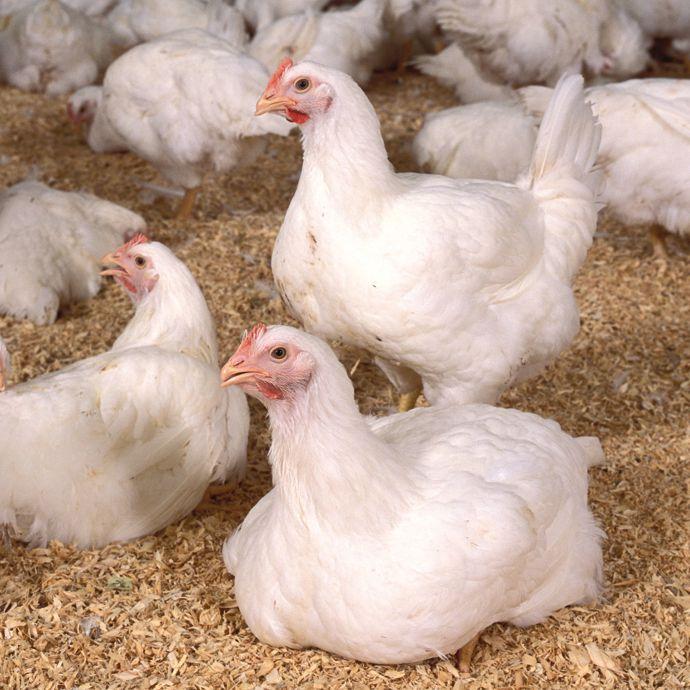
Researchers from North Carolina State University and West Virginia University have shown their new technology – which incorporates a biofilter and a heat exchanger to reduce air pollutant emissions from some livestock barns – is effective under real-world conditions, such as a 5,000-bird chicken house.
the young animals,” says dr. Sanjay Shah, an associate professor of biological and agricultural engineering at nC State and lead author of a paper describing the research. For this to be feasible, it would be necessary to replace a couple of the conventional cold weather ventilation fans with higher-pressure fans. dr. Shah explains that the technology is not compatible with summer ventilation using tunnel-fans, because of the high cost and choking effect on the fans.
dr. Shah says the researchers focused on ammonia removal because: it is released from chicken and swine houses in large quantities; it contributes to nutrient loading problems such as hypoxia; it is an indirect contributor to greenhouse gases (ghgs) because it can break down in to the potent ghg nitrous oxide in the ground; and because it is a precursor to very fine particulate matter, which contributes to haze and public
health problems, such as asthma. researchers showed that their design is effective under real-world conditions, operating their prototype in a 5,000-bird chicken house. the prototype removed up to 79 percent of ammonia and reduced the energy needed to maintain the necessary temperature in the facility – recovering as much as 8.3 kilowatts of heat.
“We plan to continue working to improve the system design in order to make it even more efficient,” dr. Shah says. the paper, “Coupled Biofilter – heat exchanger Prototype for a Broiler house,” was published in the december 2011 issue of applied engineering in agriculture. the paper was co-authored by david Workman, Jarred Yates, tom Basden, and Chestina merriner of West virginia university, and dr. June degraft-hanson of the university of maryland.