MOTION CONTROL
A look into the products, technologies and solutions shaping the market

PHOTO: © MATCHA_09 / ADOBE STOCK

A look into the products, technologies and solutions shaping the market
Encoder Products Company launches IO-Link Encoders and LP1 Accu-LaserPro™
As automation systems grow smarter and more connected, motion feedback technology is evolving to keep pace. Encoder Products Company (EPC), a leading U.S. designer and manufacturer of motion feedback devices, is advancing that evolution with two major innovations: IO-Link enabled encoders and the LP1 Accu-LaserPro™ non-contact optical encoder. Together, these solutions deliver greater insight, flexibility, and reliability to today’s high-performance industrial systems.
IO-Link, the first globally standardized IO technology (IEC 61131-9), is quickly becoming the backbone of smart factory communication. EPC’s new line of IO-Link encoders integrates seamlessly with PLCs and controllers, offering plugand-play simplicity and access to rich diagnostic data.
These encoders enable users to configure parameters in the field, adapt quickly to changing application requirements, and gain real-time visibility into performance metrics such as signal quality, temperature, and device status. The result: simplified integration, faster commissioning, and reduced unplanned downtime.
“Adding IO-Link to our encoder offering is part of EPC’s ongoing commitment to provide customers with innovative feedback solutions that meet the evolving needs of Industry 4.0,” said Bob White, CEO of Encoder Products Company. “With IO-Link, we’re giving engineers and integrators the ability to capture more data, simplify system design, and ultimately improve efficiency in their automation processes.”
Supported in EPC’s vertically integrated facility in Sagle, Idaho, these encoders combine precision, rugged construction, and the responsive lead times EPC is known for. They’re ideal for packaging, material handling, robotics, and other industrial automation applications where real-time data and continuous uptime are critical.
While IO-Link enhances communication, EPC’s new LP1 Accu-LaserPro™ reimagines motion feedback itself. Instead of relying on physical contact like wheeled or shaft-mounted encoders, the LP1 uses laser-based optical measurement to track speed and distance—completely free of friction, slip, or mechanical wear.
“This technology represents a true leap forward for OEMs and system integrators,” said White. “With no wheels to re-

place or mechanical wear points to manage, the LP1 offers reliable, long-life performance while delivering precision accuracy for high-speed operations.”
The LP1’s laser system ensures accurate, slip-free measurement even when belts or products move inconsistently. Engineers can program the encoder’s A/B output up to 120 pulses per millimeter and take advantage of two programmable trigger outputs (push/pull, NPN, PNP) with reversible signal levels. Additional features—like sequential triggers, a reverselock function for temporary backward motion, and compact non-contact mounting—make the LP1 highly adaptable to fast, complex production environments.
Applications span packaging and labeling lines, print registration, conveyor systems, and other operations where uptime and precision directly affect throughput and product quality. With no friction, no marking, and no maintenance cycles, the LP1 helps ensure consistent performance shift after shift.
EPC’s IO-Link encoders and LP1 Accu-LaserPro™ reflect the company’s core design philosophy: combine durability, flexibility, and innovation to help engineers simplify their systems and extend equipment life.
Whether the need is for smarter data integration or frictionfree measurement, EPC’s latest technologies empower automation professionals to build the connected, high-efficiency machines that define the next generation of manufacturing.
To learn more about EPC’s IO-Link encoders and LP1 Accu-LaserPro™, visit www.encoder.com.


1-800-366-5412 · 208-263-8541 encoder.com
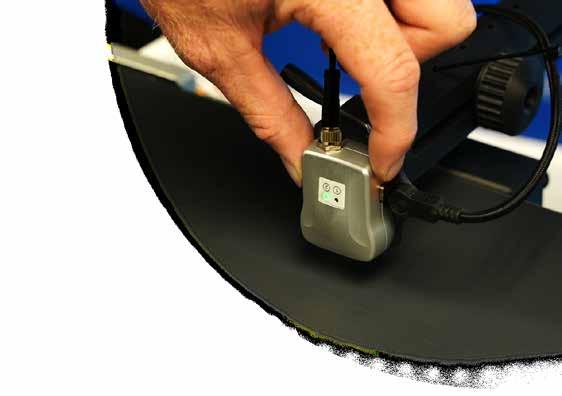
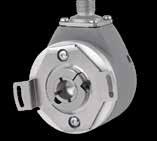
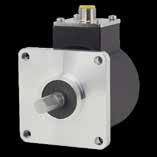
EPC’s non-contact optical laser encoder delivers accurate, reliable measurement without ever touching your product or conveyor belt— eliminating marking, damage, and wheel wear. Its optical sensing means it’s unaffected by belt or product slip, ensuring consistent output every time. With programmable pulses per mm and built-in trigger outputs, you get flexible integration without the need for extra PLC programming.
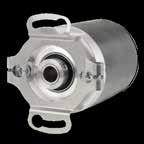
Get real-time feedback, digital changeover, and plug-and-play simplicity with EPC’s Absolute Encoders featuring IO-Link—engineered to maximize uptime and built for Industry 4.0 smart machines and fast production.
Simplified communication Easy installation Advanced diagnostics Remote configuration
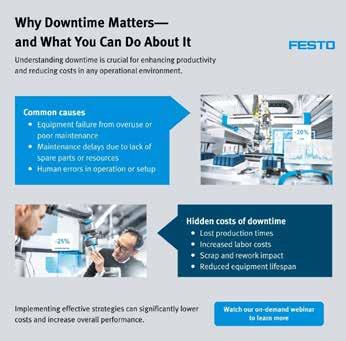
Unplanned downtime costs manufacturers millions every year. Lost production, inflated labor costs, wasted materials — the impact spreads across every corner of the business. The good news? Most of it is preventable. By moving from reactive maintenance to smarter, predictive strategies, manufacturers can dramatically cut downtime while improving efficiency and reliability.
This article explores the hidden costs of downtime, how predictive maintenance changes the game, and why electric automation delivers measurable ROI over time.
When a line goes down, the cost is rarely limited to the repair itself. A faulty connection, like tubing that isn’t fully seated in a pneumatic fitting, may look minor at first. But it can cause an air leak that forces compressors to work harder, driving up energy costs and reducing system efficiency.
The ripple effects don’t stop there. If a leaky actuator extends too slowly during its cycle, products may not be completed correctly. By the time the issue is spotted, scrap, rework, and restart costs are already piling up. Downtime isn’t just about lost minutes; it’s about cascading inefficiencies across the plant.
Instead of waiting for failures, predictive maintenance anticipates problems before they cause stoppages. Modern tools make this practical and cost-effective:
• IoT sensors for real-time insight: Embedded devices track variables like pressure, flow, and cycle speed, giving instant visibility into system health.
• Trend analysis and anomaly detection: Smart software builds performance baselines and flags deviations, offering early warnings of potential failures.
• Dashboards for decision-making: Consolidated displays provide remote monitoring, faster diagnosis, and reduced shutdown durations.
This proactive approach helps teams focus resources where they matter most — preventing costly surprises rather than firefighting them.
While pneumatics remain common, electric automation delivers precision and durability that cut downtime even further:
• Greater accuracy: Electromechanical systems enable exact control of speed, acceleration, and position, reducing the risk of errors and product defects.
• Longer equipment life: Controlled acceleration and deceleration reduce stress on components, extending service intervals.
• Built-in diagnostics: Servo drives and motors continuously monitor torque and position, signaling potential issues before they become failures.
The result is a system designed not just to run, but to run reliably and consistently.
Electric automation often requires higher upfront investment. But pneumatic systems quickly lose efficiency once leaks or wear set in, driving energy and maintenance costs higher. Over time, the reliability, flexibility, and quality of electric automation outweigh initial expenses.
For many plants, the smartest path forward is incremental. Start by upgrading pneumatic components with smart features or adding hybrid electric-pneumatic systems. This approach spreads capital costs and builds confidence, while moving steadily toward fully digitized production lines.
Downtime doesn’t have to be the norm. By investing in predictive maintenance and electric automation, you can strengthen reliability, lower costs, and unlock new levels of productivity.
Learn More: Watch our webinar for proven strategies on improving operations, increasing equipment reliability, and reducing costs.

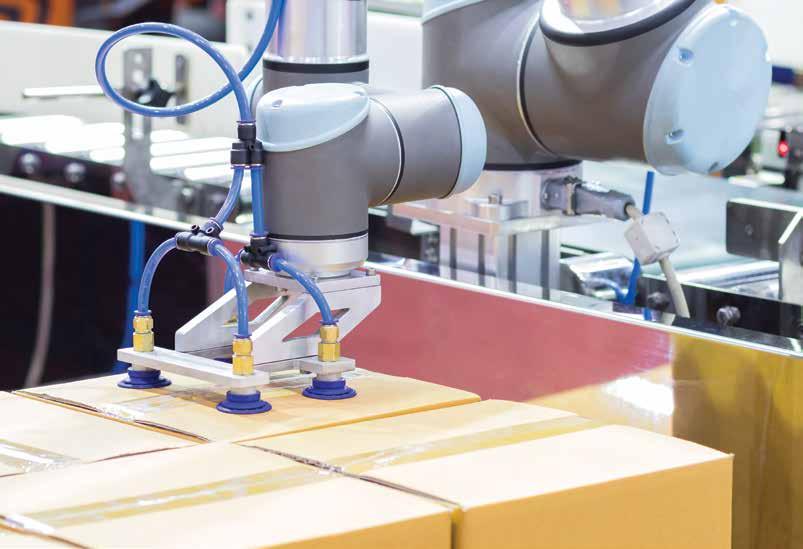
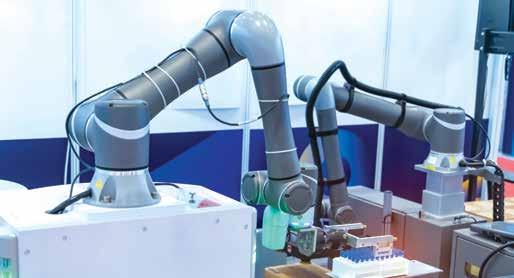
As new technology expands the boundaries of automation, the task of controlling automated processes is becoming increasingly complex. AI-powered adaptive control systems that learn from their environment are becoming essential in many scenarios.
BY JACOB STOLLER
The attempt by General Motors during the 1980s to create a fully automated
“lights out” factory is possibly the most expensive, and talked about, automation failure in history. What killed the project was not that the thousands of robots deployed couldn’t build cars – it was that the entire ecosystem of robots and control systems wasn’t flexible enough to keep pace with the rapid changes demanded by the automotive market.
Since then, the flexibility challenge has only gotten tougher as manufacturers adapt to high-mix, low volume demand. According to research by MIT’s Industrial Performance Center, productivity
gains from automation have been often cancelled out by high changeover costs and other expenses required to adjust to changing circumstances.
“Our research shows that what a company gains from automation in productivity it tends to lose in process flexibility,” wrote MIT professors Ben Armstrong and Julie Shah in the Harvard Business Review. “And when firms do adopt automation technology, studies show, they end up hiring more workers, not fewer, as they become more productive.”
As Francois Giguere, Chief Technology Officer for Montreal-based automation manufacturer Vention explained, there are many scenarios in which it is very challenging to get an
acceptable ROI from automation, even in large companies.
“If you go on factory floors of big Fortune 500 companies, you’ll see incredibly complex and sophisticated automated machines,” said Giguere, “and right beside, you’ll see applications that are completely not automated. These are processes that they just threw bodies at because they are high-mix low-volume, and the ROI from automation is not straightforward.”
For example, a beverage plant might have highly sophisticated automation for filling and capping thousands of bottles per hour, but struggle with automation at stages such as machine tending or palletizing.
“These cells get reconfigured all the time, so that’s where you have the need for flexibility,” said Giguere. “In the past, people just threw bodies at these processes. But now, companies want to get savings, so they are targeting these unautomated areas. So, what we are doing is utilizing AI and vision systems to make the machines more flexible in terms of infeeds and outfeeds.”
The combination of AI and vision systems allows a robot to act not just according to fixed programs and algorithms, but according to what is presented to the robot in real time, the same way a human would. This is far more complex than most people realize.
“Just grabbing a coffee cup is super complex,” said Giguere. “There are ways in which you can grasp and hold it, and ways you can’t. Figuring that out is a very difficult problem for a robot.”
Vention breaks down the problem of grasping and moving a part into three categories. The first is pose estimation, where the system determines the exact position and orientation of part. The system then determines the optimum way to grasp the part. Finally, a 3D motion analysis determines how the robot will move the part.
The technology leveraged to accomplish this includes a wide range of cutting-edge technology, including 3D modelling based on synthetic data, GPU-powered parallel computing, vision systems that can adapt to varied lighting conditions, and many components of AI.
Adaptive control isn’t just about imitating humans – it’s also about extending the boundaries of what we can control.
“Adaptive control can operate in situations where reality is changing faster than what a classical controller can typically handle,” said Sheldon Fernandez, AI strategist and founder and former chief executive officer of DarwinAI.
A key challenge for classical control systems is non-linearity, that is, situations where a small fluctuation can lead to an amplified effect on an overall system. “Classical control systems don’t do a great job of handling non-linearity,” said Fernandez. “As an example, a client
of ours in the aerospace sector found that the latest form of neural network-powered AI in adaptive controllers handled those nonlinear situations a lot better.”
Autonomous drones are a key area where this technology will pay off. “This small fluctuation in one of the variables could amplify the trajectory if you don’t model it properly,” said Fernandez. “So that’s an example of why adaptive controls are so powerful.”
Wind turbines and precision mining are other areas where adaptive control systems are being deployed to prevent small variations from triggering large deviations from the desired outcome.
On manufacturing lines, the same approach can also be used to prevent small deviations from escalating into major quality headaches. As Fernandez explained, manufacturing machinery is now equipped with numerous IoT devices that are collecting data that can be useful in the adaptive control process.
At DarwinAI, for example, the company aspired to take data from the end of the line and feed it back to controllers earlier in the process in order to influence the outcome from that earlier point in the process. “The aspiration is that we can do intelligent data collection,” said Fernandez, “and that can be a feed into the beginning of the system so that it changes things, perhaps to a very small degree, to increase the quality at the end of the line.”
Bringing adaptive control into a manufacturing environment will introduce technological challenges that are new to many manufacturers. One will be adapting legacy equipment and control environments. Another is upgrading skillsets so that people understand not so much how AI works,
but what it does with data, and the kinds of predictions it is able to make. There will be regulatory issues as well in some industries, as AI-powered automation can be opaque and make it difficult to verify compliance.
There’s also a danger of rushing to adaptive controls when there may be better options. “Obviously all the technologies we’re discussing will continue to advance, becoming smarter, more adaptive, easier to use, and less expensive,” said James Taylor, chief commercial officer of OnRobot. “The buzz phrase of the hour, artificial intelligence, will certainly play a part there, and that research is absolutely important. But it’s easy to get caught up in chasing automation holy grails when the reality is that the industry could make huge strides if manufacturers adopted and benefited from the smart technologies that are already available and proven.”
Perhaps most important, companies will have to develop a business culture that fosters leading edge automation technology not just as a means for replacing people, but for improving the work that the company does.
“A lot of this is imagining the world that we are not imagining,” said Fernandez. “Maybe twenty years ago, somebody might have looked at the internet and said, ‘how can I use this to make taxis more efficient?’ And there were ways you could do that. But it took somebody else with a very different mindset to connect those, and in doing that they completely reinvented how we think about shared rides today. And so, that same kind of creative thinking needs to be done in various industries.” | MA
BY JACK KAZMIERSKI
As human civilization has evolved, the concept of warehousing goods has evolved alongside us.
Thousands of years ago, the ancient Romans built large structures near rivers in order to store a variety of goods that would arrive on ships from other parts of the world docked at nearby ports.
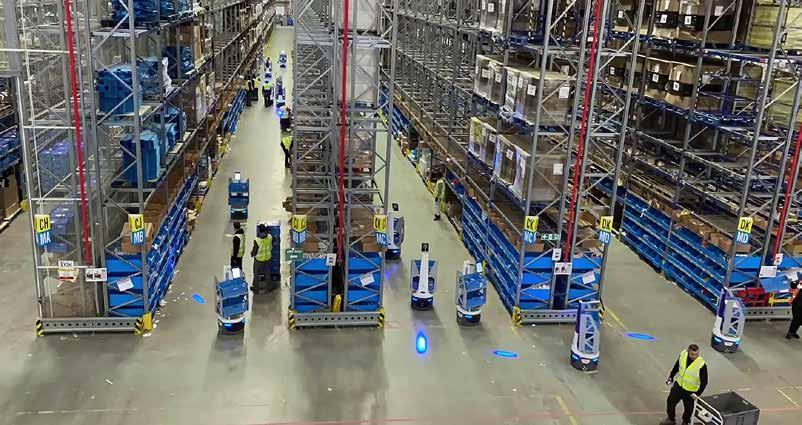
Much has changed since the fall of the Roman Empire, including the fact that today’s warehouse facilities leverage the power of technologies that the Romans could have never dreamed of, namely cutting-edge robotics and artificial intelligence (AI), designed to improve efficiency and boost productivity.
The key to efficiency and productivity is automation: enlisting machines and computers to manage tasks previously overseen by humans. “Without exception, every warehouse interested in continuous improvement would like to implement some type of automation or expand their existing automation,” said Peter Gerbitz, system sales manager at Matthews Automation Solutions. “The degree of automation varies widely. Very small, low volume facilities may have difficulty justifying the expense
(ROI). In most cases, the higher the volumes, the higher the level of automation.”
Despite the fact that automation can boost productivity, it’s not as widely embraced as one might think. “While warehouse automation is growing rapidly, the industry is still relatively early in its development,” said Gina Chung, vice president of corporate development at Locus Robotics. “According to industry estimates, less than 20 per cent of global warehouses are fully-automated today.”
That said, Chung admits the trend is accelerating, driven by acute labour shortages, rising operational costs and a growing demand for faster fulfillment. “Because of the labour shortages, many companies need to move from traditional manual operations to highly-flexible automation solutions, like mobile robotics, to meet demand, stay competitive and control operational costs,” she said.
While the benefits of automation are clear, getting started can be a challenge, admits Gerbitz. “While warehouses typically like to begin with something tangible and flashy, the first step should be to ensure that your data is in order,” he
said. “Warehouse automation requires readily available and accurate data. How much inventory is on hand? Where is it? What orders are coming in? Once the data is stable, we can begin to look at order profiles: orders per day, lines per order, items per line. Based on this information we need to answer two questions: what SKUs are needed and where do they need to go? Automation systems then execute on these answers.”
Clearly, warehouse managers have a lot of homework to do before implementing any solution. According to Chung, automation begins with identifying the problem that needs to be solved. Doing so will narrow your focus and help you identify the technologies and solutions that make the most sense for your specific warehousing needs.
Another key consideration is where to begin the automation process? Determining where a warehouse will see the most bang for their buck. “Many warehouses start with automating their order picking and fulfillment operations, often the most labour-intensive, costly and time-consuming task,” said Chung. “Deploying AMRs (autonomous mobile robots) to assist human pickers, for example, offers an immediate productivity boost and a fast return on investment without needing to fully redesign the warehouse and spend millions upfront. In addition, it helps improve worker ergonomics, safety and even retention. It’s a logical, scalable first step that allows facilities to gradually expand automation throughout the operation.”
While warehouse automation isn’t a new or novel idea, we’re seeing new technologies emerging with innovative features and advanced capabilities. Innovations like AI-driven robotics, fully automated fulfillment systems and orchestration software are rapidly reshaping warehouses, Chung explained. “We’re also seeing strong interest in solutions that integrate physical AI – the merging of physical robotics and the latest advances in artificial intelligence – to make warehouse operations smarter, more adaptive and increasingly autonomous.”
Locus Robotics recently introduced LocusINTELLIGENCE, a data science and analytics platform that uses AI to deliver real-time operational insights to optimize warehouse performance. “It provides operators with actionable dashboards, predictive analytics, and performance benchmarking, helping operators make smarter, faster decisions,” said Chung. With this new technology, Locus hopes businesses will gain full visibility into productivity trends, workflow efficiency and ROI metrics, facilitating continuous improvement across their operations.
While we often think of warehouse automation as a way to reduce the number of employees needed to get the job done, Gerbitz noted that in today’s business environment, that’s not always the goal anymore.
“In the past, reduction in headcount was desirable,” he said. “Currently, because labour is more difficult to find, distribution centres need to do more with less. Instead of reducing headcount, they need to make the operation work with a limited labour supply. All of this contributes
to maintaining and increasing throughput with the same number, or fewer employees.”
Accuracy is another critical component to consider. “In the case of a mis-pick, this can lead to costly returns or lost customers,” he explained. “In a manufacturing environment, incorrect components can lead to downtime. These have costs.”
Finally, Gerbitz explains that the data collected can also contribute to ROI. “Acquiring data throughout the fulfillment process can streamline other processes related to lot tracking, serial number capture, and item validation,” he said.
When calculating ROI, Chung noted that it’s important to look at how automation improves efficiency, throughput and accuracy while reducing labour dependency and operating costs. She added that ROI can be calculated through a combination of factors: faster order fulfillment, fewer errors, better space utilization, lower turnover costs and reduced overtime or sick leave expenses. When considering all of these factors, customers can see productivity improvements upwards of two to three times what they would achieve purely through manual operations, simply by utilizing these automated solutions.
Unless all warehousing tasks are performed by robots and computers, there’s always going to be a need for cooperation between employees and their non-human counterparts. Furthermore, whenever man and machine work together, safety becomes a key concern.
Chung agreed that collaboration and worker safety are critical for successful warehouse automation. “Robots that are designed to work alongside humans, augmenting their capabilities rather than replacing them, need to be safe and not intimidating,” she said. Locus focused heavily on making their robots user friendly with an approachable training process, not only saving time and resources but ensuring easy-adoption by workers.
As we think about the future of warehousing, we may well wonder whether we’ll see the day when humans will no longer have to work with robots or machines. In other words, will we see the day when all warehouses are fully-automated, and where humans are no longer needed?
According to Gerbitz, we are already there. “Fully-automated ‘lights out’ facilities exist today,” he said. While that may be true, Gerbitz notes that there’s a major caveat to consider. “This requires a very high level of product consistency (i.e. predictable and consistent shape and size). As automation improves, handling of exceptions and irregular items will be better handled by automation.”
That said, Gerbitz believes that there will always be a place for humans in the process, although the role humans play will continue to change over time.
Chung agreed. “The warehouse of the future will be highlyautomated, but humans will still play a vital role,” she said. “Automation will handle the repetitive, physically-demanding tasks, while humans will focus on problem solving, managing operations and optimizing workflows. The future is about finding the perfect balance between human capability and machine efficiency.” | MA