n his poignant column in this edition of Helicopters, columnist Walter Heneghan makes a passionate plea to all members of the canadian helicopter industry to not only enhance their own personal safety footprint but also step up their participation in the Helicopter association of canada and its various committees – particularly the safety committee.
It’s a timely and constructive message, as working to create the safest operating environment possible needs to be a top priority for all individuals and organizations associated with this important canadian industry. and as Heneghan aptly points out, more needs to be done to ensure this goal is met at Hac and elsewhere. It simply means a commitment from all parties – and the usual suspects can’t be counted on to carry the load.
an enhanced commitment to safety is a message that’s obviously not lost on Helicopters readers. an online poll on our website reveals some 67 per cent of respondents believe the Canadian operating environment is not as safe as it could be and much more needs to be done in order to achieve a more secure landscape. Pilots, managers, engineers, ames, as well as the major oems and suppliers that drive the industry, must work together to ensure the blades keep turning while accidents are kept at bay.
Fortunately, there are many examples of canadian companies delivering on this promise. In late september, for example, Vancouver’s cHc
The Sensible Approach
The
Safety Commitment Must Be Made on Every Level
expertise and encourage them to join the working group.
The formation of the group came just weeks after the tragic crash of a CHC Super Puma AS332 L2 off the Shetland, U.K., coast that claimed four lives. cHc is actively working to find the root cause of the accident and establish ways to prevent such tragic events. It’s a commitment the company has consistently illustrated over the years through the development of such initiatives as the annual cHc Quality & safety summit, which has evolved into a leading industry event that strives to enhance safety throughout the global operating environment.
“everyone benefits when the people who rely on us for their livelihoods are able to return home safely, and it remains our obligation to do everything humanly possible to fulfil that expectation,” said cHc president and ceo Bill amelio.
Individuals at two other canadian companies and a Quebec-based operator also have taken leadership positions in establishing safe operating environments. each has been honoured by eurocopter canada as a finalist for its annual Innovation in safety award. The award, to be presented at this year’s Hac conference in Vancouver, recognizes groups, companies, organizations, individuals or agencies for outstanding achievement in maintaining safe canadian rotary-wing flying operations, while utilizing an exceptional or groundbreaking approach.
everyone benefits when the people who rely on us for their livelihoods are able to return home safely.
Helicopter, one of the prominent players in the global oil and gas market, joined forces with the avincis group and the Bristow group to form a joint partnership to review offshore oil and gas safety practices. as part of this new corporate partnership, safety and quality experts from each of the three companies will review policies and procedures in several different areas – such as flight training, automation, emergency response planning – to share best practices. The process initially will focus on european operations, but eventually will concentrate on all regions of the globe to find better safety solutions for all working environments. The group also will reach out to other operators for their
Finalists this year include Phoenix Heli-Flight president Paul spring for his dedicated work on the implementation of Helicopter Flight data monitoring on his fleet of helicopters and his work with the global Helicopter Flight data monitoring steering group; shock Trauma air rescue society (sTars) captain Jay mccallum for producing a comprehensive internal video that describes the safety and corporate culture of the organization; and the Panorama Helicopters’ team for its implementation of innovative tools to improve awareness and efficiency. While only one will win the top prize of $5,000, a plaque and recognition amongst their peers, their collective commitment to enhancing safety will have far-reaching tentacles that will work to motivate others to strive for a safer future.
The bottom line is this: the safety quotient in the canadian helicopter industry is not merely the responsibility of a select few but the shared responsibility of everyone it touches, from the oems to the maintenance teams who turn the wrenches. Helicopters commends the efforts of those who are innovating today and striving for a better tomorrow.
“WELCOME TO OUR WORLD”
At the heart of the most extreme missions are the exceptional pilots who experience daring feats on a daily basis and are prepared to entrust their security only to the most high-performing instruments. At the heart of the most extreme missions is the Breitling Avenger. A concentrated blend of power, precision and functionality, Avenger models boast an ultra-sturdy construction and water resistance ranging from 300 to 3,000 meters. These authentic instruments for professionals are equipped with selfwinding movements chronometercertified by the COSC – the highest official benchmark in terms of reliability and precision. Welcome to the sphere of extremes. Welcome to the Breitling world.
AVENGER II SEAWOLF
New owners to lead Universal Helicopters
universal Helicopters
Newfoundland l td. is selling its helicopter operations to Universal Helicopters and l abrador l P, a limited partnership formed by Nunatsiavut g roup of c ompanies, Tasiujatsoak Trust and ca P e Fund.
The terms of the deal will not change UNH l helicopter operations, which will continue to operate under the Universal Helicopters name as part of Universal Helicopters Newfoundland and l abrador l P. The completion of the transaction is expected to be within 60 days
Universal Helicopters is one of the leading helicopter firms on the east coast, specializing in a variety of operations including mineral exploration, search and rescue, construction projects, forest fire suppression, arctic operations and more.
“The acquisition of UHN l’s helicopter operations is an important part of N gc ’ s overall business portfolio –UHN l brings with it a wealth
of experience and knowledge of not only Newfoundland and l abrador but also c anada’s arctic regions,” said N gc president and ceo
James Thorbourne. “UHN l is the ideal fit with our existing l abrador-based fixed-wing and marine transportation assets.”
Ontario’s Ornge medical transport provider, Ornge, has announced plans to install a permanent medical interior for its fleet of AW139s.
For the past couple of years, paramedics have complained that the interiors of Ornge’s fleet of 10 AW139s were insufficiently equipped to allow them to perform certain procedures and properly treat patients. Management and frontline staff have been working to fix the problems, developing a permanent interior that properly meets patients’ needs.
“By outfitting our helicopters with an enhanced medial interior, we are honouring a commitment made to our frontline paramedics to
ensure they have an optimal workspace, which will provide the best and safest environment for patients,” said Ornge president and CEO Dr. Andrew McCallum.
Since Feb. 2, Ornge has been using an interim interior, approved by Transport Canada, in the AW139, which allows for life-saving CPR to be performed during all phases of flight if necessary. The fleet’s old interiors made performing CPR prohibitive at best. Upon completion of an RFP process, the successful vendor will design and build the permanent interior.
Universal Helicopters is one of the most prominent operators on Canada’s east coast. (Photo by Jeff Goodyear courtesy of Universal Helicopters)
the importance of pilot experience
Learning from your mistakes – and from the experiences of others – is paramount if you hope to get any job done right. In the world of helicopter pilots, essential experiential information combined with proper training and skill development is key to the safe and efficient operation of an aircraft.
Veteran Canadian helicopter pilot and instructor Ray Conant is well aware of this premise and is a staunch believer in the benefits of pilots’ learning from the mistakes of others and applying skills learned from on-the-job encounters. He is so passionate about this principle that he’s put together an online training course aimed at providing pilots with “liquid” experiences to help them hone their craft.
Located at www.rayconant.com, Conant’s “Helicopter Pilot Commercial Operations” study course is not a course offered in flight schools or the Pilot Proficiency Check curriculum. In fact, it is not a required field of study anywhere. But it does offer pilots of all levels solid experiential content to help them navigate the often-complicated flying environment. It’s a free, self-paced, web-based course that comes with a 190-page manual. The course takes an estimated 15 hours to complete and cannot be completed without Conant’s book, “Helicopter Flying for Fun and Profit.” The book sells for $22 (black and white photos) or $32 (colour photos). A fee-based certificate is available upon satisfactory course completion.
Conant has more 14,000 hours of helicopter piloting experience. His rotary-wing footprint includes work as a chief pilot as well as ab initio and mountain instructing, mountain flying to 19,000 feet, long-lining, logging, helicopter skiing, mineral and oil exploration, seismic work, fire fighting, construction, geological surveying, glacier research, arctic summer and winter experience, and search and rescue work.
Saluting Top Award Winners
Canadian helicopter professionals from two different organizations walked away with important international honours this fall thanks to their innovation and bravery in the field.
The royal canadian air Force crew of search and rescue helicopter “Rescue 912” of 103 Squadron at Canadian Forces Base gander captured this year’s cormorant Trophy and the Prince Philip Helicopter rescue award from the U.k.-based guild of air Pilots and air Navigators (gaPaN) for a courageous Feb. 3 rescue of three hunters off a Newfoundland ice flow.
The highly impressive and dangerous rescue occurred in blizzard conditions and the wind was so strong that the helicopter flew the final two miles to the rescue point backwards. The winning crew of an AW101 Cormorant helicopter from Rescue 912 consists of five members:
• sergeant Bradley Hiscock (flight engineer), grand Falls, N.l
• master Warrant officer
Jeffrey Warden (sar TecH), Toronto
• master corporal mark Vokey (sar TecH), spaniards Bay, N.l.
“The storm presented challenges to our crew during the rescue that tested every aspect of our training and saw the helicopter and crew pushed to its limits,” said capt. Noble when learning of the reward.
The Rescue 912 crew received its award Oct. 23 along with the other recipients of the gaPaN awards at guildhall in london, england.
meanwhile, at the Night Vision Awards Sept. 19 in dallas, Tex., the shock Trauma air rescue foundation (sTars), captured the mark of excellence award at the Nightcon annual convention. The annual award targets an organization that signifies dedication to quality and excellence in its operation. sTars has been one of the leading proponents of NVg technology and application in Canada. In 2003, STARS was
the first civilian air carrier to use NVg technology when pilots flew a patient from southeastern alberta to calgary. Prior to that first flight, the mountains were inaccessible for emergency response by sTars’ teams due to night flight restrictions within mountainous terrain. NVgs enable sTars to access the 3,353-metre-high mountains west of calgary.
stephane demers, Transport canada Inspector of Flight standards, nominated sTars for the honour and spoke via skyPe to the audience to outline why the sTars team deser ved the award. “This was a special opportunity to have a person who nominated the award winner speak about why the recipient was worthy to receive the award,” said emcee scott emerine.
Canada – 1 Year - $25.00 (all taxes included) USA – 1 Year $35.00 Foreign – 1 Year $45.00
Occasionally, Helicopters magazine will mail information on behalf of industry-related groups whose products and services we believe may be of interest to you. If you prefer not to receive this information, please contact our circulation department in any of the four ways listed above.
Helicopters Magazine is an associate member of the
WalteR HeneGHan
this year marks the 18th year that the Helicopter association of canada (Hac) has been around with the mandate to represent the interests of the industry and its member companies. Hac serves a valuable purpose by serving as a focal point where operators can have issues important to them addressed in a coherent manner. But the Hac is only as good as its members want it to be, and I am issuing a call to arms to its member companies, and to those pilots and ames who work in the industry to participate
Now, I will stick my neck out here and offer an opinion that the level of participation in the major subcommittees of the Hac is well below what it should be, and therefore minimizes the benefits that could be reaped by the organization. Previously, I have written in this space about the Pareto principle – (the 80/20 rule) – and in this context, that would mean that a low number of participants generates the bulk of the work. This is not a good thing as it reduces the effectiveness of your organization and burns out those who care enough to be involved.
From what I have observed, there is a very small cadre of dedicated volunteers who make the subcommittees of the Hac work, and once you volunteer for a leadership role, there is a collective sigh of relief among the remaining bystanders that they weren’t obliged to step up. (c’mon, admit it.)
so, what does this have to do with safety? one of the stated
Safety and the HaC
Greater Participation Needed to Influence Change
make our industry safer, how to make our pilots better decision makers and how to improve maintenance practices. In general, it’s about how to be better. But it can’t achieve any of this unless there is better participation. In my view, this must start with a strong commitment from the senior leaders of the Hac member companies. There must be a push to encourage participation, complete with funding to travel, attend seminars and develop our “trade craft.”
This commitment from member companies needs to be backstopped with the participation of a range of talented pilots, managers and AMEs. And I’m not talking about the “usual suspects,” the 20 per cent who are involved. I am challenging you to change the ratio, to get the 80 per cent into the mix. I am challenging all of you who love to be creative about what needs to change to get involved and effect the change. I am challenging you to put up your hand when keith and rob ask for new blood to participate in the Hac safety committee or when Bob Toews is looking for help with the IFr group or any of the other committee chairs who often have the thankless task of driving the process on their own. I am challenging you to, as the saying goes, “be the change that you want to see in the world.”
The level of participation in the major subcommittees of the Hac is well below what it should be. ‘‘ ’’
primary objectives of the Hac is “to promote the continued enhancement of flight safety.” Within its structure, the Hac has several industry-oriented committees, including a safety committee. This group could be driven to improve industry safety records, provide or enhance education and become a more effective tool in “raising the bar.” This committee could be a great resource for company aviation safety officers (casos). This committee could help orient the association’s agenda so that safety has a prime place on the order paper. during the annual gathering of industry “glitterati,” the safety committee meetings could generate real discussion about how to
our industry safety record needs improvement. Helicopter services are a vital business and economic enabler but if we continue to have three to four dozen accidents each year, we are all in jeopardy. I know that there are a lot of really talented and smart people involved in our business who can contribute to making operations safer. I know that we have the ability to learn from one another about our mistakes and our successes and that we can benefit from the learned lessons collectively. I know that if we buy into that notion, greater participation will create better results, and make for a safer, and more productive industry. I know, as the american socialanthropologist margaret mead wrote, that “…[there is no] doubt that a small group of thoughtful, committed citizens can change the world; indeed, it’s the only thing that ever has.”
The bottom line at this year’s HAC? Let’s move the 80 per cent. get involved. make our world better, and safer.
Walter Heneghan is the VP of Safety and Quality at Canadian Helicopters. A passionate advocate for aviation safety and sound risk management, the veteran pilot presents his regular column for Helicopters magazine.
paul dixon
t was almost 125 years ago that Oscar Wilde wrote of the cynical man who “knows the price of everything and the value of nothing.” That was long before the Wright Brothers flew at kittyhawk and long before Igor sikorsky invested the helicopter, but these words are most accurate in describing the mentality of those who profess to govern us. our federal search and rescue (sar) scene has seen the elimination of coast guard bases such as kitsilano in Vancouver as only one of a number of decisions driven by the government’s priorities. There is no question that our military and coast guard sar experts provide an incredibly high level of service, especially when you consider the value-for money proposition, but that’s only half the story.
outside of the federal area of responsibility, search and rescue in canada is the responsibility of the local government via the local police agency. outside of urban settings, the police are ill-equipped to conduct ground searches in wilderness areas or mount technical rescue operations. In B.C., there are some 80 community-based SAR teams of volunteers. In fact, you may not be aware that many functions in community-level emergency management are performed by volunteers. In B.C., there are approximately 13,000 volunteers actively involved in sar, road rescue, emergency management, emergency communications (amateur radio) and PeP air (casara). They do everything from leading air and ground searches, rescues and helping the victims of serious car accidents to setting up networks of volunteer
analyzing the SaR Situation
Funding Changes, Logistical Support Needed to Improve Services
plex, requiring a highly skilled force of sar responders. often, circumstances require large responses involving multiple teams from across a region.
The recent august long weekend created a boom for local sar teams. chilliwack sar had four unrelated Helicopter external Transport system (HeTs) rescues over the weekend; North shore sar had two separate helicopter extractions from the Howe sound Trail; and squamish sar was tasked with recovering the body of a hiker who fell 1,000 feet to her death from the Stawamus Chief, the 2,300-foot granite monolith that towers over squamish. This is one weekend, all within 175 kilometres of Vancouver. Working with those teams were the highly skilled pilots from Blackcomb, Talon and Valley Helicopters, who are there time and time again.
Jones proposes significant changes in the way that ground sar is funded to meet the growing demand for service. He sees three core areas to be addressed at a minimum: standby pay for designated sar members; reserve helicopters specifically for sar missions at peak times; and the creation of a permanent provincewide communications system dedicated to search and rescue. British columbia does provide a level of funding for sar to cover training and designated operational expenses, including the use of helicopters. The reality is that much of the funding for volunteer sar teams comes largely through donations and the fundraising efforts of team members. While helicopter operators are paid for certain aspects of sar, they also donate many hours of flying time to the cause for operations.
There is no question that our military and coast guard sar experts provide an incredibly high level of service.
teams and co-ordinating services for victims of natural disasters.
The term “underground economy” gained popularity a few years ago to describe those who survive in a cash-only universe in an attempt to fly under the taxman’s radar. Far from being off the radar, volunteers are wholly visible and have a significantly positive impact on their communities through their selfless contribution of their talent and time. Tim Jones, a longtime fixture in the B.c sar scene, kicked a hornet’s nest when he spoke out recently about the need for a new funding model for community-based sar The workload has been increasing in recent years and the incidents have become more com-
’’
The fact is, we often overlook the true cost of volunteering. It’s not just the actual time spent on deployment or on training exercises, which can run well into the hundreds of hours annually for each sar member. It’s the impact on the day-to-day world of the volunteer who answers a pager. Pagers have no appreciation for time, and may go off in the middle of a birthday party, during christmas dinner or in the middle of the workday. There are the employers who underwrite their employees’ community service by allowing them to leave and the self-employed volunteers who shut down their business for as long as it takes. There is a huge cost to being a volunteer and it is carried across the entire community. It’s a situation where too many take the value for granted without any consideration of the price.
Paul Dixon is freelance writer and photojournalist living in Vancouver.
MiCHael BellaMY
he weather is marginal VFr with temperatures just below the freezing point. The gFa shows extensive cloud with scattered snow showers. For the helicopter pilot tasked with moving surveyors, seismic crews or any of the myriad jobs that we accomplish daily, it’s welcome back to winter flying in canada.
after a summer of mostly ideal flying conditions, fall is not only nature’s prophet of what’s to follow but also a warning to pilots to pay more attention to those weather reports and forecasts. after all, we are canadian and winter flying should be nothing new to us.
customers are usually on a tight schedule and tend to be a little impatient if they perceive excessive caution. This is a circumstance where the pilot will be called upon not only to make professional decisions but also to assure the client that he or she has their best interests in mind. rather than offhandedly announcing that the weather is lousy and walking away, a pilot should always provide an explanation as to why the conditions brought them to that conclusion in the first place. This will help placate an impetuous client. We have all heard stories of customers facing an approaching deadline and trying to intimidate a pilot by minimizing the severity of the weather – especially when they themselves are not on board.
Pushing the weather implies the wrong connotation entirely, but flying in conditions where all known criteria are just within limits is often the norm in a charter operation, especially in winter. I emphasize “known” here because decisions made to fly are predicated on those
Changing it up
Winter Flying Conditions Present Unique Challenges for Pilots
many pilots have established procedures, as have I, and beating a hasty retreat to an alternative is close to the top. For pilots who have flown safely for many winters, icing is a common foe and having an opportunity to share experiences and lessons over coffee is well worth the time.
“To go, or not to go” – it’s a complicated question. marginal winter weather conditions are further complicated by a host of variables such as the terrain. low cloud and visibility will be more of a concern when flying over a featureless arctic landscape than over forested areas. Throw in few alternates, minimal fuel on board and so on, and soon the pilot will be faced with so many borderline conditions that the decision to “not go” should be a foregone conclusion.
We have all been faced with deteriorating weather and uncertainty when deciding when to pull the crews off the line. many have made the decision to get the crews home early only to find out later that the weather in actual fact improved. It may be a bit embarrassing for the pilot and cost the client half a day, but the crew you set out that morning have a return ticket. Taking the chance of having to leave them in the bush overnight should not be an option.
How many of us, when driving to the airport, anticipate problems by observing a low indistinct ceiling? do we recognize that hoar frost adheres to the wires or the trucks radio antennae starts to dance as invisible moisture accumulates ice on the leading edge? For pilots, a morning overindulging in caffeine and weather sequences will probably be in the offing until the decision is made either to scrub the day or, if conditions have improved, to go have a look.
after all, we are canadian and winter flying should be nothing new to us.
’’
weather reports. What the pilot encounters en route may be another matter entirely and complex decisions will have to be made while flying.
I once observed a manager who was flatly instructing his pilots to land immediately at the first available clearing if they encountered icing conditions. I followed him by elaborating: “but if you continue,” I suggested, “this is how your machine’s performance will be affected.”
I recognize a scenario where home is 20 miles away, darkness is approaching and the pilot observes a white ridge of rime ice starting to form on the bottom of the windscreen. This may be indicative of widespread icing or perhaps it’s just a pocket and will dissipate, but human nature will compel the pilot to continue, just to see what’s up ahead.
a bush pilot who taught me the ropes many years ago always impressed on me the value of preparedness and having alternatives. Never totally commit to only one course, he would stress, and always leave yourself an avenue in case things go bad. a night in the bush may well be the only safe alternative, but if we don’t prepare for that unlikely event, the experience will be markedly uncomfortable.
as our daylight window shrinks and temperatures drop, flying and maintaining a helicopter demands considerably more effort. Unlike urban commuters, we shouldn’t have to relearn the lessons with the first snowfall.
A native of Spruce Grove, Alta., Michael Bellamy has been flying fixed- and rotary-wing aircraft in a variety of capacities since 1971, and is an accomplished author of several books, including Crosswinds.
Building a solid foundation
A Strong Team Approach Helps Blackcomb Aviation Soar
BY paul dixon
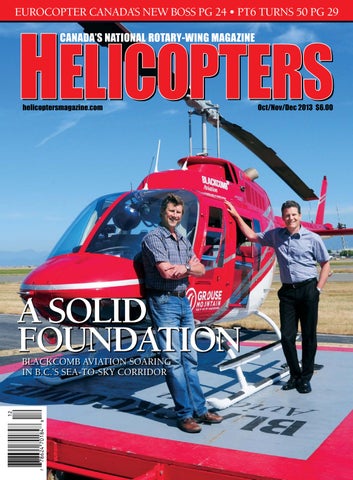
Blackcomb aviation is the little acorn that is well on its way to becoming the mighty oak. as economic confidence returns to the business sectors that aviation supports, Blackcomb is poised to grow ahead of the curve by adhering to a corporate culture based on an unswerving dedication to safety and customer service, seasoned with a liberal dash of Texas blues.
Blackcomb aviation is a partnership between John morris and the mclean group, a Vancouver-based family business with interests in commercial real estate, construction, communications and a significant position in Vancouver’s Hollywood North with Vancouver Film studios. as confidence in the economy recovers, Blackcomb is poised for growth, leveraging its strong performance history with savvy leadership.
Morris started flying with Okanagan Helicopters in the mid-1970s and then, in his own words worked “all over the place” doing a little bit of everything. In the late ’80s, Fletcher Challenge (then a major player in B.c.’s forestry sector) needed someone with a multi-engine, rotarywing background to run its in-house aviation program. It was a dream job for morris.
“I flew a Jet Ranger, the 222, the Beaver, the Falcon 20 – it was fantastic!” he says. By the mid-’90s, Morris was the both operations manager and director of flight ops and then the bottom fell out of the global market for pulp and paper. The immediate impact for morris was that as Fletcher challenge struggled to stay afloat, the company started
shedding non-core business elements, and aviation was one of the first to go. directed to sell off the corporate aircraft, he went home and thought about his situation.
“I talked to my wife about remortgaging the house again and the rest is history,” he says. “With two helicopters and five people, we launched omega aviation. later that year, we acquired a third helicopter and it just sort of grew from there. my relationship with the mcleans started when I met sacha mclean.”
mclean recalls being introduced to morris by a common friend who thought they might hit it off. “That friend was absolutely right,”
mclean says. “John is a bright guy, a serious aviation professional – I mean, how many guys do you know who have dual airline transport ratings in helicopters and planes with a lot of experience in both? It’s absolutely unheard of. so, we got along like a house on fire.”
staff at Vancouver Film studios had been lobbying mclean to buy a twin-engine helicopter specifically for the film business. The studio complied by buying a Twin star, then leasing it to omega to operate and that’s where the operation began. The relationship bloomed into a partnership several years later when the opportunity arose for morris to acquire Blackcomb Helicopters from founder steve Flynn.
looking at the proposition more closely, morris realized this would more than double the size of the existing omega. “I wasn’t sure I wanted to jump in without the requisite background, so I approached the mclean family with the idea that if they wanted to get a little further into the aviation business, this was the opportunity,” morris says. The mclean group had been very aware of Blackcomb Helicopters for a number of years. as mclean notes: “We liked what steve Flynn had done, we liked the brand, we liked the positioning and we liked the diversity of the customer base, so we jumped at the chance.” shortly thereafter, goldwing Helicopters of sechelt, B.c. was acquired, and the three entities were merged as the new Blackcomb aviation – a very deliberate decision to capitalize on the strong name recognition.
Jonathan Burke joined the company in February of this year as president/chief operating officer (coo). a self-described aviation nerd, Burke flew helicopters in B.C.’s forestry sector for 11 years before marriage and family commitments gave him cause to rethink his direction
LEFT: Maintaining hundreds of kilometres of B.C.’s hydroelectric infrastructure represents a key area of expansion for Blackcomb.
(Photo by Andrew Bradley)
BOTTOM LEFT: Blackcomb’s daily operating environment presents some of the most challenging flying conditions in the world.
(Photo by Steve Gray)
BELOW: Blackcomb AMEs in the shop at Pemberton. (Left to right) Nelson Hsiao, Tom Ralphs (production manager), Ryulho Lee, Mike Meloshinsky, Ryan Zant (chief engineer), Steven Denomme, Terry Irvine (director of maintenance), Ian Jardine. (Photo by Paul Dixon)
CoVeR stoRY
in life. In 1998, he moved into the venture capital sector and earned his mBa
In morris’ opinion, Burke brings precisely the right tools to the Blackcomb mix. “He’s a professional manager, he knows how to manage a company, he knows how to allocate resources, he knows how to set goals and how to get them done and how to measure what we’ve done,” morris says. “I’m not that guy, I’m an ops guy. He’s been an ops guy, but now he can speak to both sides. our company is made up of pretty cool pieces, because my partners (the mcleans) are serial entrepreneurs, I’m the check and balance on the ops side, and Jonathan is a professional manager.”
mclean recalls when he knew Jonathan Burke was the right man to add to the team. “When we met him, John morris and the four mcleans were on the search committee. When we interviewed him, we knew right then and there he was the right guy. He’s been in place since February and he’s done things already that I’m the first to admit that I couldn’t have done,” mclean says. “I’m an entrepreneur, not an operator. He’s an operator, he’s a through and through operator. He has the respect of our people – he’s developed a strategic plan. you can feel the excitement around the place. He brought with him a very unique background. How often do you come across a logging pilot with an mBa?”
From his perspective, Burke describes Blackcomb as a phenomenal company with a top-notch group of people who provide a sound foundation for growth. “We’ve got the managed aircraft business here in Vancouver, the fixed-base rotary operations up and down the sea-to-sky corridor and then we’re moving into the rotary-wing utility construction and maintenance where we are going out and repairing or building new power lines,” Burke says. “so, we’re preparing three areas for growth, which is more than just saying, ok, we’re going to grow. It means putting the systems and processes in place, with the right people in the right positions to handle that growth.”
From Burke’s perspective, the pitfall for many small or medium-sized companies that seek to expand is that they are not able to transition their business practices, such as accounting and human resources to handle the transactional volume of an enlarged business.
From the very beginning, morris built his company on three words – safety, respect and value – srV or the mnemonic stevie ray Vaughn. “We’ve got these three words,” morris says. “safety is a cultural thing. It’s ongoing: the buy-in process never stops. The respect proposition is very simple. respect for the people, respect for the equipment, respect for the employees, respect for the customers, respect for peers and your subordinates.
“The other one is value and when I come back to that value proposition, one of the things I always talk about with our customer is, with that value proposition comes the maturity and level of respect, the maturity of our safety systems and our training and that’s what you’re paying for. That’s the world we operate in.”
Hiring the right people is also a key for morris. “you can have the best pilot on the planet, but if he doesn’t get along with his co-workers and he doesn’t get along with the customer and it’s a constant battle, then he doesn’t fit into the respect component here very well,” he says.
an eleCtRifYinG enViRonMent
Driving the 160 kilometres from Vancouver to Blackcomb’s rotary-wing maintenance base in Pemberton, B.c., gives the casual observer an introduction to the world that Blackcomb operates in every day. Postcard beauty and some of the most challenging flying conditions in the world are Blackcomb’s daily operating environment. The ski resort at Whistler is the largest in North america and Blackcomb supports the resort’s mountain operations as well as medevac services to the ski patrol.
The mountains attract outdoor enthusiasts from around the world
year round and Blackcomb provides helicopter support to squamish, Whistler and Pemberton search and rescue teams. High voltage transmission lines dominate much of the road between squamish and Pemberton, underscoring the fact that 99 per cent of B.C.’s electricity is hydro-generated hundreds of kilometres from the market. along the route, the highest peaks are topped with cell towers and microwave relays. like so much of the infrastructure in North america, the highvoltage transmission system is aging, requiring more frequent inspections, maintenance and new construction.
Burke points to hydro infrastructure as a key area of expansion for Blackcomb. “all of these major grids that supply electricity to utilities were built about the same time and they are aging out. They’re all starting to age at the same time,” he says. “No utility is immune from not having invested enough to keep their network up to date and now they are all playing a bit of catchup. so, the amount of investment going into new construction or upgrades is just phenomenal right now, the rotarywing roving utility support and construction business. We’re investing very heavily in modern, sophisticated, twin-engine helicopters to do the work.
“What we did with Bc Hydro last year with human external transport, was getting the aircraft a hundred feet above the power lines and placing crews on the lines to do spacer-damper changes. [What this means is] you are eliminating multiple layers of risk, you are taking the helicopter further away from the lines . . . so you are getting the aircraft removed from the lines, you’re getting much more precision placement of the employees where they need to do the work. It was a much more efficient, very, very quick way to get their people on and off the lines as opposed to coming in with a platform of some type or doing touch and goes off the towers. We did prove that through methodology, a new system with twin-engine helicopters would actually increase efficiency by getting crews on and off the lines. We intend to keep our people safe and we don’t see any reason why customers shouldn’t consider paying for a second engine in areas where you are putting helicopters within the height-velocity curve and challenging environments.”
andrew Bradley, Blackcomb’s vice-president of operations, underscores the importance of hydro work, pointing out that while there is currently one AS355N dedicated to hydro work out of Squamish and sechelt, there is so much more to this market segment.
“We have a second 355N and two Twin Stars that we use to support the utility market, not just hydro, but all their subcontractors as well,” Bradley says. “There is a lot of local base work out of here (squamish, Whistler, Pemberton, sechelt). We support forestry out of here as well as communications companies and mining companies. They can be as
A nice cross-section of the Blackcomb fleet – from left, a Bell 407, a Eurocopter AS350 and a Eurocopter AS355. (Photo by Paul Dixon)
President, Phoenix Heli-Flight
CoVeR stoRY
close as gold Bridge or Bralorne, but we also did a huge job up in Nunavut last year.” at the height of the summer, there were two aircraft off on firefighting duties as well.
expandinG HoRizons
Blackcomb’s footprint in the industry is not all-traditional blue-collar work, though – not by a long shot. Whistler and its sister mountain Blackcomb form North america’s largest
ski resort. Heli-skiing is a big draw throughout the winter and continues through most summers with glacier skiing and mountain tours in the summer. mountain-top weddings can be arranged and the highlight of this summer was transporting 120 visitors to a reception on a glacier. The exercise, which took all day, involved lifting in supplies, guides and musicians, and using three helicopters to shuttle guests to and from the site.
The geography, coupled with weather that can change without notice, makes the sea-tosky corridor a challenging place to fly and it’s not a place for inexperienced pilots. “We have nine or 10 Class pilots,” Bradley says. “I like our pilots to have a varied experience in longlining, so they can do hydro work and forestry work, plus we do all the search and rescue flying in the corridor. Having versatile pilots is our key, in that it gives us a much bigger scope and range of work to go to. our aircraft may be a bit too diverse and we’re looking to communize some of our aircraft, but we have 407s, AStars, TwinStars, Jet Rangers and 205s. In that respect it allows us to meet a lot of customers’ demands.”
Blackcomb’s helicopter crews are also very skilled in another area – television work. For example, if you watched the 2010 Winter olympics on television, you can thank Blackcomb aviation for the aerial work. The company had one dedicated helicopter in Whistler for the Nordic, downhill and sliding events; a second helicopter at cypress Bowl in West Vancouver; a third helicopter exclusively for NBc; and a fourth helicopter providing HeTs medical support for the Whistler site. steve gray, assistant rotary operations manager, flew the primary camera ship for Whistler, a job that lasted a little over two weeks but was more than a year in the planning.
Through the corporate relationship with Vancouver Film studios, Blackcomb has established an international reputation of excellence. gray, as one of the primary film pilots, says the key to success is all about developing a relationship with the clients.
“I think we’ve done well to position ourselves for film work in the past four years by providing them with the aircraft they want,” gray says. “Film work is really all about reputation, networking and connections. If you can keep people happy, they’ll come back to you. It’s customer service, knowing what they want. If you’ve been hired or recommended by a producer, you need to uphold that relationship with the producer and make sure you act in the correct way on the set so you don’t ruin your reputation with him. It’s a very interconnected industry with companies and individuals and you have to keep your reputation.”
a united appRoaCH
Blackcomb’s maintenance facility moved to Pemberton a couple of years ago when operations outgrew the facilities at Whistler. Terry Irvine, director of maintenance, and chief engineer ryan Zant, chief engineer, have a
Continued on page 32
a Bounty of Riches
One of B.C.’s leading MRO companies, Vector Aerospace continues to extend its footprint in both North America and abroad. (Photos courtesy of Vector Aerospace)
B.C.’s Aerospace Industry Poised to Reach Next Level
BY Matt niCHolls
after witnessing the activity at cascade aerospace’s immaculate 230,000-square-foot facility at the abbotsford International airport in abbotsford, B.c., during a recent visit in June, it was hard not to get excited about the scope of the work at hand – and ponder the future potential of B.c.’s aerospace sector.
dozens of engineering professionals buzzed around a handful of Lockheed Martin C-130 Hercules aircraft, providing maintenance and product upgrades. The C-130 program is one of the cornerstones of cascades’ product offerings and has enabled the company to position itself as a world leader in modifications, maintenance and support on C-130 civilian and military aircraft.
engineering crews were also diligently providing maintenance and upgrades to two other iconic aircraft – a pair of CL-215 Ps. The immense amphibious firefighting flying boats used by the manitoba and saskatchewan governments in aerial firefighting capacities represent a small sampling of the service capabilities a company such as cascade can provide. modification and airworthiness certification of Bombardier CRJ100/200 aircraft, Q400 modification and product maintenance, as well as other mro services, are just some of the ways cascade is expanding its footprint in both the canadian and
the international marketplace.
“We’re building a complete portfolio that’s the next big step in the business for us,” says dwayne lucas, cascade’s vice-president and general manager of the products and engineering group. cascade is a subsidiary of the conair group, which is also based in abbotsford. “We’re going to leverage the canadian experience and move into the international marketplace, so a number of these bids we’re dealing with are with international customers – Tunisia, morocco, Jordan, Malaysia, Japan, Mexico, Peru. If you hit 10 countries, we’re hoping to get two out of it; it’s what you can handle and manage. That’s the number 1 cornerstone.
“The second piece is working on multi-mission aircraft. We can’t do it publicly yet, because we’re restricted by the agreement we have with one of the oems, but we’re taking an airplane and we’re going to build some capability on to it – I can tell you it’s a Q400. We’ve got experience with Bombardier products, principally the Q400, the CRJ and the 215. Those are the three Bombardier products that we work with. The 215, we’re doing the re-engine piece which you saw.”
With its diversified business model and myriad product offerings, cascade sees market potential in asia, russia and the former eastern bloc countries. “With the variability in the marketplace, you
definitely have to have range when it comes to product diversification,” says lucas. It’s a business model not lost on other B.c. aerospace firms that are actively tapping domestic and international markets to broaden corporate horizons. and given its geographical location and future market potential, B.c.’s leading aerospace firms could see a significant growth spurt in years to come.
pRospeCt WatCH
B.c.’s aerospace market is in many ways is a
“hidden” gem when compared to the more visible montreal cluster and developing clusters in ontario and the gTa employing more than 10,000 people, B.C. aerospace generates an estimated $2 billion in annual revenues, but these numbers pale in comparison with what could be generated in the not-too-distant future.
Over the next 20 years, approximately half of the world’s air-traffic growth will be connected to, or within, the asia-Pacific region, and B.c is perfectly positioned
geographically to tap this market. Total air traffic for the region is estimated to grow 6.7 per cent per year over that time span and air cargo will grow 6.3 per cent per year.
To modernize fleets and meet the growing demand for air transport, airlines in the Asia-Pacific region will need 11,450 new airplanes valued at $1.5 trillion over the next 20 years. global airplane sales, for both fleet growth and replacement of aging aircraft, will total 30,900 units over that period with a value of more than $3.6 trillion. It means significant opportunity for B.c.’s aerospace sector, which has some of the strongest maintenance, repair and overhaul operations in the country, if not the world. c ascade, Vector a erospace, Heli- o ne, kelowna Flightcraft and mTU maintenance canada ltd., for example, are well positioned to take advantage of increased mro demand. The same holds true for many of the province’s other leading aerospace firms such Victoria, B.c.-based oem Viking air, abbotsford, B.c.-based aerial firefighting firm conair, and software, avionics and space industry leaders.
gabe Batstone, ceo of Vancouver-based software firm NgraIN, is optimistic about the future prospects of B.c.’s aerospace footprint but irons home the point that increased industry cohesion is necessary to maximize growth. Working to develop a B.c. aerospace “cluster” for example – or at the very least a much stronger industry voice – will go a long way to maximizing growth potential, says Batstone. The cluster philosophy not only helps branding and marketing on the world stage, but it mobilizes industry players around common goals such as supply chain development, research and development opportunities and ways to spark innovation.
“B.c. is a great place to live. We’ve got a skilled workforce because we’ve got educational institutes, between the University of British columbia, simon Fraser University, University of Fraser Valley and the British columbia Institute of Technology (BcIT),” notes Batstone, whose firm provides 3D software development kits, packaged software and engineering services to commercial and military aerospace clients, including Lockheed Martin on the F-35 Joint Strike Fighter and C-130J programs. “It’s a very interesting area to be in because you have some real aerospace leaders here –mda, cascade, avcorp, Vector, ourselves... that’s the good news. The bad news is, we all have become successful in isolation. If you look at where commercial aviation is going, asia is the spot. and what’s the closest canadian location to asia? Vancouver
and Victoria – we are the gateway. location matters, and I believe clusters drive activity.”
doug rae, vice-president of business development at mda in Vancouver, concurs, adding the clusters break down internal barriers; stimulate research and development; and marry academia, government and industry objectives, something that can be argued is lacking in B.c
With more than 4,800 employees worldwide and additional canadian locations in Halifax, ottawa, montreal and Brampton, ont., mda has established a significant footprint in canadian aerospace in both the aviation and space realms of satellite development, robotics, aviation, geospatial intelligence work, communication payloads and more. The company’s primary aviation work involves the development of terminal procedural design software, flight briefing systems and aeronautical navigating systems, as well as running Heron unmanned aviation vehicles for the canadian government in afghanistan.
“I think the establishment of a cluster would be very beneficial here,” rae says. “It puts the aerospace industry on the map and I also think it’s good because it increases the visibility to both the provincial government and other agencies. It’s strong from that perspective . . . it also serves as a strong marketing tool, in a sense, for the industry. But you need to have everyone in the industry working towards that. you need industry buy-in.”
establishing stronger industry ties will also help B.c. capitalize on the future market influx brought on by demand in asia, rae notes. “We can become a hub to help produce capability that can move into that asian market space,” he says. “I see aerospace as a real nugget. We have enough of a core between Viking, avcorp, asco, mda and more, and we can wrap that around an aeronautical context.”
doWn in tHe ValleY
While a significant portion of B.c.’s aerospace footprint lies in the Vancouver area, there is a strong push to establish an aerospace cluster in the nearby city of Abbotsford. Located some 65 kilometres to the east of Vancouver, major aerospace leaders such as cascade and its parent company conair are located at the abbotsford International Airport and some 100 hectares of adjacent land is serviced and ready for development.
New aerospace tenants at the airport will be granted property tax exemptions by the city of abbotsford under a program
covering the first 10 years of tenancy. There also has been significant government buy-in for the project. The federal and B.c. governments, as well as abbotsford International Airport, have contributed some $30 million ($10 million each) to create a new 9,600foot taxi-runway to parallel the primary runway, major terminal improvement and other upgrades. so, government commitment, a key element in any aerospace endeavour, is high.
“I think the cluster mentality exists quite
strongly here’ it’s something that is being worked on, it’s being led by the abbotsford side of things,” says rick Pedersen, senior vice-president of the conair group. conair is an international leader in aerial firefighting aircraft, predominately operating in alberta, B.c., the yukon and alaska, and in europe through its operation in France. It also had two 802s in Australia when Wings visited in June. “There are opportunities for synergies between these businesses and that is driven on the mro side of the operating
TURBINE R66
scale,” says Pedersen.
The Fraser Valley would be ideal for an aerospace hub for a variety of reasons, Batstone adds, because it would enable aerospace employees to have a great lifestyle, more affordable living costs while not detracting from the existing aerospace opportunities in Vancouver. and as the old adage from the movie Field of Dreams aptly suggests, if you build it, they will come.
“People are going to fly primarily into Vancouver anyway, so if you are going to visit abbotsford to see someone, you’re also going to come back and see someone there,” Batstone notes. “But the opposite isn’t necessarily true. If someone is coming to go to abbotsford, they will most certainly make certain to stop in Vancouver. But if they’re just going to Vancouver, they may or may not choose to go to the Fraser Valley. From a regional perspective, I think it makes more sense to be out there.”
cascade’s lucas, who has done yeoman’s work organizing the annual abbotsford air show, which showcases the area’s aerospace footprint to government and industry alike, is a strong proponent of a cluster development in the valley. It just makes sense, given the proximity, the established aerospace leaders already at the airport,
Bordering on greatness
and more importantly, future opportunities. “I’m quite bullish on it, to be honest,” he says. “I know they haven’t moved as fast on it as the folks at the airport would have liked, but it is definitely something that could have a big impact in the province.”
ReaCHinG tHe pRoMised land
While greater cohesion within the aerospace ranks is needed to enhance r&d and future business opportunities within industry partners, there are other challenges ahead for B.c. aerospace companies. Finding just the right talent to fuel the aerospace engine is a very real issue.
Vanessa griffiths, executive director of the British columbia aerospace council (Bcac), notes that raising the awareness of industry and developing and/or solidifying a talent pipeline is critical to maximizing the province’s aerospace potential.
“We need to working to raise the awareness of B.c. aerospace at all levels and make sure individual companies set up solid standards of retaining employees and doing what needs to be done to keep their talent pools,” griffiths says. “The Bombardiers, the Pratt & Whitneys . . . they do that. We need to follow the same leadership
BRITISH COLUMBIA BOASTS MYRIAD AEROSPACE LEADERS TOUCHING ON A VARIETY OF KEY FIELDS. HERE ARE SOME FIRMS THAT STAND OUT:
Anodyne Electronics Manufacturing: kelowna, B.C.-based Anodyne Electronics Manufacturing Corp (AEM) is a leading designer and manufacturer of avionics, aircraft audio systems, intercoms and more. The company was founded in 2009 when Northern Airborne Technology (NAT) shut down its manufacturing operations in Canada, creating an opportunity for a 100 per cent employeeowned, vertically integrated company built around skill, experience and capability.
Avcorp: With more than 50 years in the aerospace industry, Avcorp specializes in the design and manufacture of tail, wing and other airframe structures. Located near major aerospace markets in Burlington, Ont., and Vancouver, Avcorp works with major aircraft OEMs including Bombardier Aerospace, Boeing and BAE Systems on the outboard wing of the F-35 Joint Strike Fighter. AVM Solutions (Kelowna) Inc.: Formerly known as kelowna Flightcraft Modifications Ltd., the company brings more than 40 years’ experience to the table. The firm specializes in avionics modifications to both fixed-wing and rotary-wing aircraft in corporate, civil and military markets. AVM Solutions (kelowna) Inc. also offers on-site consultancy services, maintenance programs and technical assistance.
Kelowna Flightcraft: Since 1970, kelowna Flightcraft, powered by 1,000 employees, has delivered maintenance, training and flight operations services. The company's 20 daily service aircraft (including the DC10-30F) supply dedicated overnight cargo services. And the maintenance team services 100s of aircraft from across North America for commercial, VIP and military customers. Maxcraft Avionics: As the largest avionics repair shop in Canada, Maxcraft Avionics focuses on avionics support for a variety of rotary- and fixed-wing clients in the commercial, corporate, military, HEMS and other realms. Based at Pitt Meadows Regional Airport, the firm is an authorized representative of more than 30 leading avionics brands.
Pelesys Learning Systems: Based in Richmond, B.C., Pelesys Learning Systems has spent 12 years developing a variety of detailed training systems for airlines and airline training organizations. With a customer base that includes major airlines, regional airlines, cargo airlines, helicopter operations and more, Pelesys offers clients custom courseware development, online learning management systems and flight training software.
Quaternion Aerospace: Since 2006, this Victoria, B.C.-based R&D firm has been on the cutting edge of design, modelling and optimization needs in aircraft design and the design of manned and unmanned aerial vehicles (UAVs). Quaternion has provided design and consulting services to clients such as Viking Air, Vancouver Island Helicopters, INCO, National Research Council – Hertzberg Institute of Astrophysics, and to Aeronnova S.A. (Spain) and OGMA (Portugal).
Veraform Canada Corp.: Veraform Canada is the only stand-alone, aerospace-approved stretch-forming facility in Canada. Veraform supports a variety of fixed-wing programs, including Boeing 737, 747-8F, 767, 787 and Airbus, Twin Otter, and Bombardier Global Express jets. The company manufactures aircraft extrusions, skins, leading edges, roll-formed seal retainers, brake-formed shapes and other profiles.
Viking Air: For more than 42 years, Viking Air has been one of B.C.’s aerospace leaders. Located at Victoria International Airport, Viking Air was born in 1970 as an aircraft repair facility, but by the 1980s, the company was manufacturing replacement parts for DeHavilland Canada aircraft. In 2005, Viking purchased the type certificates from Bombardier of all the DHC aircraft no longer in production: DHC-1 Chipmunk, DHC-2 Beaver, DHC-3 Otter, DHC-4 Caribou, DHC-5 Buffalo, DHC-6 Twin Otter and DHC-7 Dash 7. They now service more than 500 operators worldwide with some 1,300 aircraft in service. Viking has grown into one of the most influential aircraft manufacturers in the world.
principle here. We also have to ensure that the pipeline from our excellent institutions remains developed and strong.”
Batstone agrees and commends institutions such as BcIT for setting academic standards that mirror the needs of industry. “I give credit to BcIT as a leader in developing talent,” he says. “We are also close to seattle which of course has microsoft, so we are able to get talent in Vancouver from south of the border. But for the aerospace industry as a whole, it’s a real problem. The one challenge, and there are a few challenges, is the cost of living in B.c. Importing people is not usually the best option, so the more people you develop from B.c., the better . . . it’s just easier.”
lucas suggests that a broader understanding of what aerospace does for the province – and the value it brings to the national economy – would go a long way in getting government support, and ultimately enhancing the talent pool. It’s a role the Bcac and other aerospace associations can drive home to all levels of government.
“We have to get in at the jobs and training level . . . and do a much better job,” lucas says. “The challenge is, the province is very focused on resources: that’s where they see the billions for the future. But if you want to see something that is going to attract young people, that will move you into the asia-Pacific realm, you’re going to have to leverage your skills and knowledge on programs. you will have put some money into aerospace.”
asco aerospace’s vice-president, kevin russell, contends that while close proximity to Boeing in seattle, Wash., and access to a large asian market present plenty of opportunity to expand, industry must develop technology and automation to ensure it remains competitive. “I think it is important to develop a manufacturing research centre in B.c. which supports B.c. companies to become world-class technology leaders,” he says. “The B.c. government needs to develop a sector strategy, which needs to include r&d support, as B.c. companies will not compete on cost unless they are at the leading edge
of technology. We are not a lower-cost region of the world so we have to compensate with innovation and automation, etc.” marketing the strength – and value – of the industry and identifying just how powerful it’s become is front and centre as well and it’s something griffiths intends to work on. The Bcac is seeking to quantify the aerospace industry and develop more statistics to properly illustrate the value of this hidden gem.
“We have Canadian numbers and we have the slice – 13 per cent of the aerospace revenues in canada are generated in B.c.,” she says. “But we don’t have concrete numbers. I have seen estimates thrown around, but then I see the incomes of some B.c.-based firms and it means we are bringing in way more money to the sector than we even begin to realize.”
Fortunately, there is plenty of government buy-in when it comes to aerospace, notes Batstone. Now, it’s up to industry leaders to help the sector reach its potential. “From the government perspective, I think we are well positioned here,” he says. “It’s about making sure the leaders of the companies stay involved, including myself. at the end of the day, we are all responsible for our own company and sometimes these more holistic and industry-wide issues don’t make your topic of the day list. That may make sense in the short term, but in the long term, it will hurt us. Now is the time we need to pop our heads up to ensure we make the commitment to a cluster. you just have to make the time for it.”
For more features, visit www.helicoptersmagazine.com
B.C.'s MDA is a world leader in the development of satellite technology and aerospace initiatives. (Photo courtesy of MDA)
leading the Charge
Eurocopter Canada’s Boss
Brings a Fresh Perspective
BY Matt niCHolls
spend a few hours with eurocopter canada’s new president and ceo, romain Trapp, and one thing is immediately obvious – this isn’t a hands off, “hide-in-your-office” kind of corporate leader. The affable, 41-year-old with the welcoming smile was busy chatting up employees as he, along with director, communications and corporate affairs laura senecal and customer service director gordon kay, took me on a behind-the-scenes look at eurocopter canada’s Fort erie, ont., headquarters in early september
eurocopter canada has steadily grown into a driving force in the Canadian helicopter industry. Established in 1984 and employing some 250 highly-skilled manufacturing and maintenance workers, Eurocopter canada designs, develop and, manufactures aircraft and composite components for the eurocopter group’s production lines in France and germany. The company manufactures some 20 new aircraft and more than 1,500 engine cowlings parts as well as other components.
With company revenues topping $95 million in 2012 and projected revenues hitting $114 million this year, the newly appointed Trapp is seeking to build on the success that has enabled eurocopter canada to gain 34 per cent of the turbine helicopter fleet in Canada – and as of last year, claim 59 per cent of new turbine deliveries north of the U.s. border.
Trapp sat down with Helicopters to explain his take on the canadian helicopter industry and reveal his vision for eurocopter canada.
Helicopters: Congratulations on your recent appointment as Eurocopter Canada’s new president and CEO. What was your first order of business upon taking over the role?
Rt: First of all thank you for the opportunity. This is my first interview with a publication in canada; I am glad it could be Helicopters It is a wonderful opportunity to lead the world’s No. 1 helicopter manufacturer in canada. It is definitely a very exciting job for me, and it’s also a natural move. after five years at american eurocopter as executive vice-president and then cFo, I gained a lot of experience about the
american market, which has a certain number of similarities with the Canadian market. And since I started on July 1, I have met with customers and operators all across the country to gain a strong understanding of the canadian market and the specific aspects of it.
Helicopters: You have had tremendous success in your career at EADS with the Airbus 380A program in France and Germany, and then in the U.S market with American Eurocopter. Are there any experiences that come to mind that translate well to your new role here?
Rt: I think one of the best experiences I have had – and it’s why I am so very proud to be part of this industry – was when american Eurocopter delivered an EC145 to a children’s hospital in Fort Worth, Texas. We had a special ceremony that included the pilots, crews, nurses, paramedics – everyone involved in the process. They were all taking care of children – some one, two years old – with very serious illnesses. It makes you proud to be helping them and saving lives. our product saves lives, protects people, participates in the growth of the economy and creates jobs.
Helicopters: A great story, one of the real benefits of being able to work in this profession. I’m sure your experiences in France also allowed you to gain a broader perspective of the aerospace industry.
Rt: absolutely. I was very fortunate to be able to work on both the fixed-wing and rotary-wing sides. It’s all about aviation and it’s such a fascinating field. I am not a pilot, but I understand the role it plays and how it connects people. I remember when I first worked for airbus in Toulouse, I had an opportunity to tour the facility with my grandfather, who was 90 years old at the time. He had never flown in an aircraft. showing him the large fixed-wing aircraft, it was absolutely incredible. He was so proud of me to be part of building such a tremendous product. I was a finance guy; I wasn’t turning the wrench, but he was so proud of me. I was really proud of that, too.
Helicopters: So, you’re not a pilot, you’re not turning the wrench. What drove you towards a career in aviation?
Rt: When I started at airbus, I remember my first interview, the guy in front of me told me, romain I don’t get it. you should work for a
consulting company. you should work for a bank. Why do you want to work here? I told him that yes, I want to work in the financial world, but I need to create a link between the figures on the page and something that I can see, something that I can touch. I need to be close to a product and be proud of it. That’s exactly why I started at airbus. I could never work in a bank – I need to stay in an industry like this to see the influence of the product.
Helicopters: What are the growth opportunities for Eurocopter Canada in both the civil and military markets over the next few years?
Rt: We have been the civil market leader in canada for more than 10 years and have a strong leadership position in the utility, law enforce-
ABOVE: Earlier this year, Eurocopter’s innovative X3 broke the level flight and diving helicopter speed records in France.
LEFT: The AS350 B2 has been the aircraft of choice among Eurocopter Canada customers for some time. (Photos courtesy of Eurocopter)
ment and corporate markets. But so far, we have not had the same success on the military side, even though eurocopter remains the largest helicopter manufacturer in the world. I am looking forward to demonstrating the capabilities of the eurocopter product line to the canadian military.
In terms of the civil market share, there is growth in both the oil and gas and hydro markets. This year, mining and forestry activities are down, but at the same time these markets are cyclical. These markets are going to come back –perhaps not at the beginning of next year, but for sure at some point no later than two years from now. This is the way it is with all the commodities in canada.
Helicopters: In terms of product development, the aging Canadian fleet offers real opportunity for Eurocopter Canada. Which aircraft will best suit the needs of Canadian operators in the future?
Rt: With our astar family, on the single-engine side, we are the market leader. The AS350 B2 has been the aircraft of choice with our customers, and what we are seeing, is the B3e is becoming the standard. We have delivered 10 B3e’s this year already with more to come. The trend is definitely from the B2 to the B3e. Operators appreciate the
improved performance, affordability... and as I remind everyone at our facility daily, we want to make the best aircraft, the most reliable aircraft, the safest aircraft – that’s the goal. For the price difference between the B2 and the B3e, when you have the choice and it fits your market, it makes sense to switch. When you want to expand or be able to manage more diverse missions, the B3e is the machine of choice.
Helicopters: Are there other voids in the market that you can see Eurocopter Canada
targeting in the next few years?
Rt: yes, I have good idea of some areas I would like to concentrate on. What really surprised me when I arrived in canada is the average age of the fleet: it’s 27 years. It’s very old for a country like this, which of course, creates opportunities for replacement. We are going to focus strongly on the replacement of light single-engine aircraft, light-twin engine aircraft and light-medium engine aircraft. In addition to the B3e, the EC135 is starting to make a big push in canada. This should have
Providing Cutting Edge Aviation Fueling Systems And Solutions Across Canada
significant success in canada for years to come. In terms of performance, capability and affordability, it brings much of what operators are looking for. It is also a twin engine, which brings a safety level they demand. It is very well fitted for utility needs as well as ems and law enforcement. It is also a top seller worldwide. There are more than 1,000 EC135s flying worldwide, so it’s a proven commodity. In the U.S., the EC135 is the standard for EMS operations in the light-twin segment, as well as law enforcement and hydro activities. I believe the same trend will happen here. at a certain point in time, operators will have to upgrade their machines – when that time comes, they will have options.
Helicopters: You mentioned earlier that when you first came into your role, you met with operators to find out their perceptions of product, their needs, etc. What feedback have you received?
Rt: I have not had a single day of vacation! overall, I am pleased with the feedback coming back. We have many strengths, one of which I am consistently hearing about: the relationship we have with operators at all levels of our business. This, of course, is due to the professionalism of our team, who are all passionate about what they do. We have been able to develop options and manufacture products that suit their needs and requirements. There are challenges of course, and we need to improve our support processes. We also need to work to deliver top customer service, which sets a high standard in our industry.
Helicopters: What are some of the differences in market demand in Canada versus those in the U.S. and Europe?
Rt: one of the first things that jumped out to me was the U.s. and european markets have a much more diverse ems market than canada, as well as a larger law enforcement base. It makes sense from a city infrastructure point of view in terms of scope, but at the same time, there are many places in canada that could benefit from these services. I do believe this is something that will change, but I was very surprised. Helicopters have proven their efficiency in both areas over and over in the U.s. It’s strange to me that some of the biggest cities in canada do not have aircraft. We are working with some of these regions to show them what the helicopter can bring. you have to think about a relatively small number of aircraft in the country compared to the overall total. When you take the overall size of the Canadian fleet, 90 per cent are flying for utility. This is due to the specific nature of the economy but only 10 per cent are flying for ems, law enforcement, corporate and more. There are significant opportunities here.
In addition, what makes canada so different is helicopters are often operating in remote locations in pretty harsh conditions. on top of that, you have high seasonality: helicopters are flying from april until october, which creates plenty of challenges for operators.
Helicopters: Working to create the safest helicopter environment possible is a top priority for operators and OEMs alike. How is Eurocopter Canada working to ensure the Canadian operating environment is as safe as possible?
Rt: Safety is definitely our No. 1 priority and one of the ways we work to attain this is through proper training. eurocopter canada provides pilot and maintenance training to all customers, which gives them a chance to operate the aircraft, maintain and repair the aircraft at the highest levels of quality and excellence. We also give canadian operators a chance to train in our facility in dallas with american eurocopter, where we have our simulators. These are excellent tools for both the pilots and crews to improve their capabilities, their experiences and face situations that could be difficult to face in real life. all of our simulators are Transport canada approved. also, last year we launched the Innovation in safety award, which highlights an individual or organization which has exceptional skill or demonstrates a groundbreaking approach to promoting safety in canada. safety is not an option; it is, and always will be, eurocopter canada’s top priority.
We also launched in 2012 for our Rotor rewards club members a safety seminar for corporate customers. This year, we had 35 participants in montreal, which was a great opportunity for them to gain a better under-
standing of the aircraft. They are not flying a lot of hours, and this gives them time to interact with the pilots and learn valuable information.
Helicopters: Eurocopter is the world’s No. 1 helicopter manufacturer, but how can it remain competitive in the Canadian marketplace going forward against stiff competition?
Rt: We have invested a significant amount of resources in canada over the year and will continue to do so going forward. eurocopter Canada was created 29 years ago and I am
very proud to be involved in celebrating our 30th anniversary next year. We will be highlighting 30 years of growth, 30 years of successes, 30 years of supporting our customers, 30 years of growing the economy and creating jobs here in canada. and it’s not only eurocopter canada that has had success in this country. The entire eads group has a very strong presence here through our different affiliates. We have a very extensive footprint and actively participate in the country’s economic growth and job creation.
Eurocopter Canada’s new president and CEO, Romain Trapp, sees plenty of growth opportunities in the year’s ahead, particularly in law enforcement and EMS. (Photo by Matt Nicholls)
PILOTS NEED HEROES TOO
Train at NLC's Centre of Excellence in Aerospace!
•
Approved Basic ‘M’ training completed in 17 calendar months
•
Helicopter Type training on B206, B205, and all associated engines
•
Over 20 years of Industry recognition for quality training
•
Modern student residences available on-campus
•
Large & newly renovated facilities with many aircraft
•
Visit nlc.bc.ca for more information:
"Programs/Basic Training" for a video of facilities & aircraft and "Programs/Type Training" for Type Training schedules & tuition
• Apply online or contact Student Services or Admissions for more information.
Follow the AME Facebook page for more program information and see our video on YouTube
Helicopters: Many corporate leaders I have spoken with speak of finding the right talent to drive their operations in the future. How do you create a corporate environment that establishes trust and promotes growth, development and initiative?
Rt: When people come to eurocopter canada they very quickly develop a passion for not only their jobs, but the products they create. When I mentioned how proud I am to work for a company that creates products that save lives, that is protecting people, participating to the growth of the economy . . . our employees feel the same thing. and when you develop a passion for your work, you become engaged in the environment and want to stay. It’s all about creating the right team spirit, a working relationship where they feel recognized and valued in their roles on an everyday basis – and at the end of the day they feel proud. and the next time you come to visit, you will see many changes that will help to strengthen this connection.
Just a simple thing, for example, is celebrating a delivery ceremony for customers with all employees. We have just started doing this. For me it’s a way to thank the customer for their business but also thank the team for the great work they have done. This is something I want to do for each and every delivery.
Helicopters: Technology and innovation are critical in staying ahead of your competition and successfully serving your client base. How is Eurocopter achieving this goal?
Rt: Innovation and developing technologically advanced products has been one of the most important objectives at eurocopter. For example, the X3 in June broke the level flight and diving helicopter speed records in France – and this is just a technology demonstrator. and you are going to see the outcome of this technology for sure in canada in the next decade. many of our other products that we have recently brought to the market clearly illustrate how important innovation is for us. The EC175, EC145 T2, and coming soon, the X4, which was introduced last year, are some examples. It’s all about staying ahead of the game and providing a higher level of safety.
Helicopters: The Eurocopter motto is “thinking without limits.” Can you give me a few examples to illustrate this from a Canadian market perspective?
Rt: Our products like the X3 and the X4 illustrate this concept. We have a significant team of engineers developing and thinking of concepts to keep us ahead of the game in terms of design. In may, we also demonstrated the capability of our helicopters to be flown in an unmanned capacity – optionally pilot enabled. We have conducted tests in France with an unmanned EC145 to demonstrate this concept. We are definitely going to see in the next decade more unmanned helicopters in various roles.
Helicopters: What excites you most about the helicopter business? What’s the best thing about leading a helicopter manufacturer?
Rt: It’s just very exciting and satisfying to work in an industry and work on products that save lives and protect people. and we play an active role in growing the economy. each year when I attend the HaI award dinner and I see the special videos of the various recipients, it makes me so proud to be part of the helicopter community.
This year was very special for me because I had the great honour of giving the eurocopter golden Hour award during HaI to the shock Trauma air rescue society (sTars). This is definitely what makes me happy and drives me to go to work each day – seeing the great things our products do every day. It’s a great challenge, because there are many more people we can save, many more people we can protect and help with our products.
LEFT: P&WC employee A. Valdez works on a PT6T Twin-Pac. (Photo courtesy of P&WC)
BELOW: Bell’s new 412EPI, introduced this March, uses an upgraded P&WC PT6T-9 Twin-Pac. (Photo courtesy of Bell Helicopter)
50 Years in the air
Pratt & Whitney Canada’s PT6 Engine Celebrates a Half-Century
BY CaRRoll MCCoRMiCk
in 1963, the Beech Aircraft Company installed the very first production model of Pratt & Whitney canada’s (P&WC) new PT6 gas turbine engine in its proof-ofconcept Beech 87. Five years later, Bell Helicopter ordered the first P&WC turboshaft, the PT6T Twin-Pac, for a twin-engine version of its UH-1H.
In the 50 years since that Beech purchase, P&WC has developed and certificated 90 variations of its PT6 turboprop and turboshaft engines. They are used in more than 130 different applications in commercial, military, general aviation, business, helicopter, agricultural and utility aircraft.
With some 390 million hours of flight time logged, it’s no wonder that P&WC likes to say that the PT6 engine opened up the world.
To date, P&WC has manufactured 42,000 PT6A engines, the “A” designating turboprop engines for fixed-wing aircraft, and another 10,000 PT6B, PT6C and PT6T engines, the “B,” “C” and “T” designating turboshaft engines for helicopters.
The PT6T, the Twin-Pac, is the company’s biggest-selling PT6 turboshaft engine, with more than 6,900 delivered since the family entered service in the 1990s. The three variations of the Twin-Pac have accumulated more than 39 million flying hours in such applications as oil exploration, emergency medical service, maritime patrol and utility operations.
Fully half of P&Wc’s annual engine assembly production is devoted to the PT6 engine: about 100,000 square feet of production
area in the lethbridge, alta., longueuil, Que. and Bridgeport, W.V. facilities is devoted to assembling mote than 1,000 PT6 engines a year, with a surge capacity capable of boosting that by several hundred more units a year.
When P&WC decided in 1957 to build a turboprop engine for a target market then powered by piston engines, company engineers made a seminal decision: in a departure from other gas turbine engines of the time, P&Wc would design the new gas turbine with an opposed shaft. In this design, the compression and power sections are placed end to end and are uncoupled; that is, the compression and power sections can turn at different speeds. In the conventional, non-opposed shaft design, the shaft for the power end is inside the compression shaft, requiring more complexity to, for instance, meet varying power requirements during flight.
This design feature is common to both the turboprop and turboshaft PT6 engines. The main difference between the two is the addition of a reduction gearbox for the turboprop. Helicopters usually already have their own main rotor and tail rotor gearboxes.
From this free turbine concept flow several key advantages of the PT6 engine: lighter components, since the engine does not have to turn the propeller or helicopter blades during startup; higher power-toweight ratio; and a simpler, modular design, which, among other things, enables a wide choice of propeller speeds, easier maintenance and greater reliability.
As the decades flew by and flight hours climbed, the PT6 engine
established an in-flight shutdown rate that was consistently only one third of today’s turbine industry standard of 10 events per millions hours.
ease of maintenance translates into aircraft technicians in all corners of the world being able to complete all essential line maintenance tasks. “you can do most of the maintenance in the field, which was completely different from the other engines of that time,” explains Nick kanellias, general manager of sales and marketing at P&Wc. “The opposed
shaft allows you to remove the power section on-wing. This allows easy access for turbine inspections and maintenance. This is a big advantage.”
The first PT6 engine had 500 shaft horsepower (SHP), but now P&WC offers PT6 engines ranging from 500 SHP to 2,000 SHP. P&Wc has also increased the engine’s powerto-weight ratio by 40 per cent. Among the turboshaft engines the PT6B variations have 1,000 SHP, the PT6C variations deliver 1,200 to 2,000 SHP and the PT6T variations deliver
1,800 and 2,000 SHP.
Bell has been a long-time customer of P&WC. “The P&WC PT6 series is well known for its reliability and performance. In addition, P&Wc’s customer support is worldclass, mirroring Bell Helicopter’s commitment to providing industry-leading support throughout the entire life cycle of an aircraft,” notes Bell communications analyst Bridget garcia.
In that 1968 turboshaft project, the canadian armed Forces asked Bell to develop a twin-engine version of the UH-1H, which it called the UH-1N, or Twin-Huey. P&WC and Bell jointly developed a combining gearbox that connected to the PT6 Twin-Pac on one side and the UH-1H transmission on the other. The commercial version of this aircraft became the Bell 212.
Bell has used several variations of the PT6T in its 412 airframe, beginning with the PT6T-3. Over time, different variants of the Bell 412 have utilized the PT6T-3B, the PT6T3BE, and now, the PT6T-3D in the Bell 412EP and the PT6T-9 in the Bell 412EPI, which Bell introduced this year.
The Bell 412EPI uses upgraded PT6T-9 engines, which have 15 per cent more power. The SHP ranges from 2 x 1,021 for maximum continuous power to 1 x 1,280 for One Engine Inoperative (30 seconds).
P&Wc won the competition to supply its PT6C-67E for the new Eurocopter EC175,
Manufacturers that have used P&WC turboshaft engines in their helicopters include AgustaWestland, Bell, Boeing, Dyncorp, Eurocopter, k azan Ansat, McDonnell Douglas and Sikorsky. Pratt & Whitney Canada has tabulated the following figures:
• 40+ years turboshaft experience
• 33 engine models, 25+ applications
• 1,000+ turboshaft operators
• 13,000+ engines delivered (including the PW200)
• 7,650+ engines in service
• 3,700+ P&WC-powered helicopters flying
• 47+ million hours on the P&WC turboshaft fleet
• 3x+ growth in turboshaft deliveries in the last decade
• Turboshaft engines represent 20 per cent of P&WC’s total fleet
which should receive certification in the oil and gas mission configuration in early 2014. As of August, Eurocopter had taken 46 orders for the EC175.
Sikorsky has purchased approximately 200 PT6 engines for its S-58T and S-76B helicopters. The company cites several reasons for selecting P&Wc, including engine size, power available, control system characteristics, mounting systems, structural integrity, reliability and maintainability.
sikorsky’s public relations specialist, Frans Jurgens, explains why the firm chose the PT6 Twin-Pac for the S-58. “It proved to be an
The new Eurocopter EC175 uses a P&WC PT6C-67E engine that develops 1,775 SHP take-off power and 2,067 SHP maximum emergency power. (Photo courtesy of Eurocopter)
excellent engine for qualifying operation in falling and blowing snow It also allowed us to qualify for engine icing certification by analysis rather than having to demonstrate in an icing tunnel.” sikorsky used the PT6B-36A and PT6B-36B for the S-76B.
P&WC continues to refine its PT6 turboshaft engine. For example, the latest generation PT6 turboshaft, the PT6C-67E, has a dual channel full authority digital engine control system to reduce pilot workload. By improving the materials and design technologies for its PT6 engines over the past half-century, P&Wc reports that it has been able to maintain an optimal balance of reliability, durability, mission performance, fuel consumption and greenhouse gas levels, and purchase, operating and maintenance costs.
The company’s commitment to continue delivering this quality in the next half-century is underscored by an observation by richard dussault, P&Wc’s vice-president of marketing: “There is an interesting thing about the helicopter market,” he said. “The civilian market alone has 20,000 helicopters. A lot of them are 25 years old and more. Close to half of the thousand helicopters produced each year are replacement machines. It is an older fleet with good potential for replacement with modern, more capable machines.”
CoVeR stoRY
Continued from page 18
staff of 22 engineers, apprentices and support personnel. While Pemberton may seem remote to some, its location 35 kilometres north of Whistler offers some of the most beautiful scenery in the world. For outdoor enthusiasts, there are year-round activities and should the need for a visit to the big city arise, Vancouver is only two hours away. a common theme with employees is that while most have worked in many places around the world, when it comes time to start raising a family, this is the place that seems like the best spot.
Zant also notes that Blackcomb employees have a very strong commitment to their workplace and exhibit a personal pride in their work that reveals itself in many ways.
“I see guys do the little things, like touching up paint on a machine or touching up scuff marks,” he says. “It’s that sort of personal pride that the engineers have. They are very keen, very smart, and always seem to have a lot of good ideas, so whenever we seem to have a problem, we try to use the mass knowledge of everyone on the floor and try to tap that and come up with a good solution. as far as the maintenance is concerned, we try and do things ahead of schedule, and be proactive instead of reactive. From the day I started here, it’s always been very proactive maintenance. [It’s about] taking care of things earlier rather than being grounded somewhere out in the field.”
For Irvine, it’s all about maintaining the current tempo while planning how to grow to meet future obligations. “It’s always a challenge, trying to find the people who already have the endorsements and experience,” he says. “as the ‘N’ models are getting to be more popular because of the hydro work, we can fall back a little bit on some of the engineers
who have experience on the ‘F’ model experience Twin stars and bring them up, but you still need a differences course. so, it’s a bit of a challenge that way, making sure we have enough people endorsed on the aircraft for when we want to send them out. The work is all over the province, even over into alberta. Because of the amount of time they are spending away from the base, we have to make sure we send them away fresh off the large inspections, so nothing big for components is going to come due out in the field.
echoing Zant, Irvine says it’s the people who make the difference at Blackcomb, separating it from competitors. “our pilots are definitely a big plus in experience and we have a lot of experienced engineers working on the machines,” he says. “The twins are definitely a maintenance draw, so the people working on those are all high-time engineers. I’m not saying other companies wouldn’t do that, but that’s how we do it. With all the people we have here, it’s definitely a good team effort – the pilots, engineers, apprentices and everybody work very well together. I think that we’re still small enough so where we can work really well together.” looking to the future, mclean says the key to growing the organization is crafting just the right team and never forgetting to take calculated risks. “It’s an overused statement, but we’ve really worked hard to build a great foundation, so I think we truly are poised for growth. We have a fabulous core group of staff who can take on more challenges,” he says. “I don’t think we have any crazy ideas about making this thing enormous; we just want to grow it organically over time. I think it will always have that nice small feel to it.”
• Rigorous quality control procedures
• Highly skilled teams
• On-site service teams
• Instrument Sales
• Instrument Repairs
• Transport Canada Approved Maintenance Organization
• Approved for Aircraft, Structures and Components
• Specializing in Bell 412 and AS350 series aircraft
• Composite shop specializing in Advanced composite fabrication and repair
• Engineer owned and operated
Aviation Group is a total solution to your operational requirements.
Written by test pilot Shawn Coyle, the author of Cyclic and Collective, The Little Book of Autorotations covers the practical aspects of autorotation – “no theory, and no vector diagrams, but what you’ll see in the cockpit.”
Geared toward students and flight instructors, with lots of hints for instructors, the book builds from pre-flight briefings to specific flight exercises that ensure students understand each element before proceeding to the next stage. It emphasizes looking out the window and learning to judge variables, as opposed to making the “right” numbers happen.
Key Personnel: Randy Gee, President; Dan Wuthrich, General Manager; Shawn Stone, Operations Manager; John Morrison, Director of Maintenance; Tom Halbert, Chief Pilot; Brandi Conway, Manager, SMS
P.O. Box 2008, Abbotsford Stn. A Abbotsford, BC V2T 3T8
Airport Name: Abbotsford
Tel: 604-852-1122
Fax: 604-852-4982
Key Personnel: Bruce Campbell Fleet: B212 (7)
Canadian aiR-CRane ltd.
7293 Wilson Ave.
Delta, BC V4G 1E5
Tel: 604-940-1715
Fax: 604-940-1735
Website: www.air-crane.com
Fleet: SK-64 Air Crane (1)
Canadian HeliCopteRs sCHool of adVanCed fliGHt tRaininG
3130 Airport Rd., Penticton, BC V2A 8X1
Airport Name: Penticton Regional Airport
Tel: 250-492-0637
Fax: 250-492-6544
CC HeliCopteRs ltd.
#100-2985 Airport Rd. Kamloops, BC V2B 7W8
Tel: 250-376-7790
Fax: 250-376-7791
Website: www.cc-heli.ca
Key Personnel: President, Ralph Emsland; Chief Pilot, Keith Palmer; Director of Maintenance, Rob Estey Fleet: B206 (2), B206L (2), B407 (1), B412 (1), R44 (1)
CHC HeliCopteRs inteRnational inC.
4740 Agar Dr. Richmond, BC V7B 1A3
Airport Name: Vancouver International Airport
Tel: 604-276-7500
Fax: 604-279-2460
Website: www.chc.ca
Key Personnel: William Amelio, President and CEO; Peter Bartolotta, President and COO of CHC Helicopter Services; Dan McDonald, Senior Vice President, Fleet and Commercial for CHC Helicopter Services; Ray Bennett, Vice of Maintenance and Technical Services for CHC Helicopter Services.
Key Personnel: Wade Waters, Director of Flight Operations; Cam Wallace, Director of Maintenance Fleet: HU500D (5), Boeing/Vertol 107 II (4), Chinook 234 (1)
HeliJet inteRnational inC.
5911 Airport Rd. S. Richmond, BC V7B 1B5
Tel: 604-273-4688
Fax: 604-273-5301
Website: www.helijet.com
Key Personnel: Daniel Sitnam, President and CEO; Rick Hill, Vice President Operations and Commercial Programs; Ken Glaze, Vice President, Business Development; Fran Inouye, CFO Fleet: S-76A (6), S-76C+ (3), B206L/L3 (3), Lear 31A (2)
HiGH teRRain HeliCopteRs ltd
407 - 622 Front St. Nelson, BC V1L 4B7
Airport Name: Nelson, British Columbia –CZNL and Cranbrook International Airport, British Columbia – CYXC
Key Personnel: Bruce Alexander, Chief Operating Officer; Terry Jones, Director of Operations; Dan Kolshuk, Director of Maintenance; Ken Birss, Chief Pilot Fleet: B206B (23), B206L3 (2), AS350B2 (15), AS350BA (2)
HYdRa HeliCopteRs inC.
37084 Whelan Rd. Abbotsford, BC V3G 2L2
Airport Name: Sumas Mtn. Heliport
Tel: 604-309-8393
Fax: 604-854-5014
Website: www.hydrahelicopters.com
Key Personnel: Dale Carter, Operations Manager.; Bob Clifford, PRM Fleet: B212 Single (1), B205A1++ (1)
inteRioR HeliCopteRs ltd
6322 Airport Rd., P.O. Box 1478
Fort St. James, BC V0J 1P0
Tel: 250-996-8644
Fax: 250-996-8655
Website: www.interiorhelicopters.com
Key Personnel: Tom Schaff, AME, Director; Steve Goodife, Operations Manager Fleet: B206B-111 (6), B206L-3 (2), MD600N (1)
Key Personnel: Ian Munson, President; James Carr, Operations Manager; Jeff Patmore, Chief Pilot Fleet: B206-A (1), B206-L (1), B204B (1), AS350B2/D2 (7), AS355N (1)
london aiR seRViCes liMited 4580 Cowley Cres.
Richmond, BC V7B 1B8
Airport Name: Vancouver International Tel: 604-272-8123
Fax: 604-233-0202
Website: www.londonair.ca
Key Personnel: Chris Simpson, Operations Manaager; Gary Farn, Chief Pilot-Fixed Wing; Dylan Thomas, Chief Pilot-Rotary; Chris Lacroix, Director of Maintenance Fleet: Lear 45XR (5), Challenger 605 (1), Challenger 604 (1), AW139 (2)
noRtHeRn aiR suppoRt ltd. 6285 Airport Way
Kelowna, BC V1V 1S1
Airport Name: Kelowna International Airport
Tel: 250-765-0100 Fax: 250-765-0077
Website: www.northernairsupport.com
Key Personnel: Mark McGowan, CEO; Rob Askin, Operations Manager/Chief Pilot Fleet: B407 (3), AS350B2 (5), B206B-111 (1)
noRtHeRn liGHts ColleGe – aViation pRoGRaMs
11401 - 8th St.
Dawson Creek, BC V1G 4G2
Airport Name: YDQ
Tel: 250-784-7503 Fax: 250-784-7549
Toll free: 1-866-463-6652
Website: www.nlc.bc.ca
Key Personnel: Jeff Lekstrom, Dean; Jean Valgardson, President; John Morrison, Aviation Program Chair Fleet: EC350D (1), MD500D (1), B206 (1), B205 (1), R44 91), King Air B90 (1), Twin Commander 690 (1), Piper Aztec (1), Cessna 150 (1), Cessna 180 (1), Cessna 310 (1)
oCeanVieW HeliCopteRs ltd.
7490 Duncan St.
Powell River, BC V8A 1W7
Tel: 604-485-7135
Fax: 604-485-7460
Website: www.oceanviewhelicopters.ca
Key Personnel: James Mode, President/ Operations Manager; Matt Larocque, Chief Pilot; Bill Chernoff, Director of Maintenance Fleet: MD500D (4), MD520N (1)
okanaGan Mountain HeliCopteRs
P.O. Box 30012, RPO Glenmore Kelowna, BC V1V 2M4
Airport Name: Kelowna International Airport (CYLW)
Tel: 250-491-9359
Website: www.okhelicopters.com
Key Personnel: Johannes Vates, CP, CFI; George Cann, Operations Manager; Ryan Nicholls, Flight Instructor; Sherri Doratti, Marketing Manager
Fleet: R22 Beta II (3), R44 Raven II (2), BH06 (1)
paCifiC WesteRn HeliCopteRs ltd.
4214 Cowart Rd.
Prince George, BC V2N 6H9
Tel: 250-562-7911
Fax: 250-561-2697
Website: www.pwh.ca
Key Personnel: Ray Curry, President; Erwin Karrer, Chief Pilot; Ray Marsolais, Director of Maintenance
Airport Name: Langley Municipal Airport Tel: 604-539-5494
Fax: 604-539-5496
Website: www.resourcehelicopters.com
Key Personnel: Teri Northcott, President and Operations; Rod Brownless, General Manager; Rob Munro, Chief Pilot; Bob Clifford, Director of Maintenance. Fleet: B212 (1), B204C (2)
Key Personnel: Peter F. Murray, President; Kelsey Wheeler, Chief Pilot; Rikkert Vos, Director of Maintenance Fleet: AS350B (1), AS350 B2 (2), AS355 (1), B206L (1)
tasMan HeliCopteRs
Unit 5, 4340 King St.
Delta, BC V4K 0A5
Airport Name: Boundary Bay Airport
Tel: 604-940-0202
Fax: 604-940-0272
Website: tasmanhelicopters.ca
Key Personnel: Mark Kroeker, President; Vic Greenfield, Operations Manager; Tim Davison, Chief Pilot
Fleet: B205A-1 (1), B212 (4), B407 (2)
teCH HeliCopteRs ltd.
25595 Willow Cale Rd.
Prince George, BC V2N 6A5
Airport Name: CYXS
Tel: 250-963-8211
Website: www.techhelicopters.com
Key Personnel: Greg Sanders, President/ CFI
Fleet: RH44 II (2), RH22 (1)
tRansWest HeliCopteRs ltd.
5855 Airport St., P.O. Box 1678
Oliver, BC V0H 1T0
Airport Name: Oliver Airport, South Okanagan, BC
Tel: 250-498-6691
Fax: 250-498-6791
Website:
www.transwesthelicopters.com
Key Personnel: Ernst-Ulrich Maas, President/CEO; Jeff Brown, CP/ Operations Manager; Stacy Ascah, Director of Maintenance; Al Girden, Manufacturing Manager
Fleet: B214 B1 (1), B412 (1), AS350 B2 (1)
tRk HeliCopteRs
Unit 102, Hangar 12, 5225 216 St. Langley, BC V3A 2N4
Key Personnel: Ken Norie, President; Jen Norie, General Manager; Brian Mycroft, Director of Operations; Mike Schedel, Director of Marketing; Russ McGowan, Director of Maintenance
P.O. Box 1030 1011 Airport Rd., Port McNeill Municipal Airport
Port McNeill, BC V0N 2R0
Airport Name: CNH9
Tel: 250-956-2244
Website: www.westcoasthelicopters.com
Key Personnel: Peter Barratt, Operations Manager; Terry Eissfeldt, Director of Maintenance Fleet: AS350B (3), AS350BA (2), AS350B2 (4), B206 (1), MD36 (1)
WesteRn aeRial appliCations ltd
8450 Broadway St. Chilliwack, BC V2P 5V5 Airport Name: Chilliwack Tel: 604-792-3354 Fax: 604-792-3358
Key Personnel: Craig Murray, President; Josh Jonker, Operations Manager; Bruce Murray, Director of Maintenance Fleet: (5) UH-12ET, (3) UH-12E, (2) B206B-11, (3) SA- 315B
WHite RiVeR HeliCopteRs inC.
P.O. Box 700
Terrace, BC V8G 4B8
Tel: 250-638-1414
Fax: 250-638-0888
Website: www.whiteriverhelicopters.ca
Key Personnel: Sid Peltier; Andy Ramsay Fleet: B206B (1), B206L-III (1), AS 350 BA (1)
WHite saddle aiR seRViCes ltd.
P.O. Box 44
Tatla Lake, BC V0L 1V0
Airport Name: CBD9 White Saddle Ranch, Bluff Lake B.C. Tel: 250-476-1182
Website: www.whitesaddleair.com
Key Personnel: Mike King, Operations Manager and Chief Pilot; Audrey King, General Manager; Dave King, Chief Pilot – Fixed Wing; Les Rolston, Base Manager, Williams Lake, B.C. Fleet: B206L-4 (2), B407 (1) on order, Cessna 185 (1)
WildCat HeliCopteRs inC. 2431 Dominion Rd. Kelowna, BC V1Z 2Y4
Tel: 250-769-9093 Fax: 250-769-9053
Website: www.wildcatheli.com
Key Personnel: Ian Wilson, Vice President Operations; Patrick Renaud, Vice President Maintenance; Dave Hauber, Chief Pilot Fleet: B412 (4), B212 (6)
YelloWHead HeliCopteRs ltd.
P.O. Box 190, 3010 Selwyn Rd. Valemount, BC V0E 2Z0
Tel: 250-566-4401 Fax: 250-566-4333
Website: www.yhl.ca
Key Personnel: Jacob Forman, General Manager; Charlie Mooney, Director of Corporate Development; Mark Schoenrank, Director of Quality and Safety
Key Personnel: Frank Peters, President Fleet: B206B-III (1), AS350BA (1), AS350B2 (1)
Heli souRCe ltd.
Hangar A, 3822-21A St. Springbrook, AB T4S 2E8
Airport Name: Red Deer Regional Airport
Tel: 403-886-8601
Fax: 403-886-2547
Website: www.helisourceltd.com
Key Personnel: Doug Paris, Operations Manager; Alin Cote, Director of Maintenance; Jim Freake, General Manager; K. Bryan Bennett, Safety and Quality Manager
Key Personnel: Joseph MacDonald, Sr., Vice President; Ralph Slinger, Founder/ President Fleet: B206L-3 (1), B206B-11 (5), B206LR (1) AS350SD2 (1), AS350BA (2)
Hnz (Canadian HeliCopteRs liMited) 4500, 1000 Airport Rd. Edmonton International Airport, Edmonton, AB T9E 0V3 Airport Name: Edmonton International Airport
Tel: 780-429-6900
Fax: 780-429-6925
Website: www.canadianhelicopters.com
Key Personnel: Don Wall, President and CEO; Mark Olson, Vice President Operations; Walter Heneghan, Vice President Safety and Quality; Charlie Morgan, Marketing/Sales Manager; Bob MacKay, Vice President, Special Projects Fleet: AS350BA/B2/B3, AS355F2/N, B206B/B3, B206L/L1/LR, B212/HP, B407, B412/SP, EC120B, R22, R44, S61N, S76A++ (aircraft types vary by location)
kananaskis Mountain HeliCopteRs ltd
P.O. Box 8115
Canmore, AB T1W 2T8
Airport Name: Nakoda CNK7, Cline River CCR5, Rocky Mountain House CYRM Tel: 403-881-3728
Fax: 403-881-3748
Website: www.kmheli.com
Key Personnel: Ralph Sliger, President and CEO; Rejean Lavoie, Vice President/ Operations Manager; Jeff Lambert, Director of Maintenance/PRM; Greg Petland, Chief Engineer; John Ralph, Chief Pilot
Fleet: B206B (4), Bell 206L (2), AS350FX2 (2), AS350D (1)
l R HeliCopteRs inC.
135 MacLaurin Dr., Springbank Airport Calgary, AB T3Z 3S4
Airport Name: Springbank Airport; Boundary Bay; Edmonton City Centre; Calgary International; Winnipeg St. Andrews; Toronto Buttonville Tel: 403-286-4601
Hangar 7, 11-49 Viscount Ave. S.W. Medicine Hat, AB T1A-5G4
Airport Name: Medicine Hat Tel: 403-528-3406
Website: www.rangeland-helicopter.com
Key Personnel: Rod Craven, Chief Pilot; Sue McLeod, Owner/Partner Fleet: B206B (1), B206L-1 (1)
ReMote HeliCopteRs ltd.
P.O. Box 1340, Hangar 15, Airport Rd. Slave Lake, AB T0G 2A0
Airport Name: Slave Lake
Tel: 780-849-2222 Fax: 780-849-5235
Website: www.remotehelicopters.com
Key Personnel: Jeff Lukan, President; Brian Rosche Operations Manager; Kevin Hickling Chief Pilot; Keith Mercer Director of Maintenance Fleet: B212 (2), B205 ++ (2), B206 (2), AS350FX2 (1), AS 350B2 (1), AS350SD2 (3)
RidGe RotoRs inC.
P.O. Box 86
Blue Ridge, AB T0E 0B0
Tel: 780-648-2063
Fax: 780-648-2065
Website: www.ridgerotors.com
Key Personnel: Hans Nogel, President/ Operations Manager; Jens Laschinsky, Chief Pilot
Fleet: R4411 (2), B206B-II (2), AS350SD2 (1)
RotoWoRks inC.
P.O. Box 86
Whitecourt, AB T7S 1N3
Airport Name: Whitecourt
Tel: 780-778-6600
Fax: 780-648-2029
Website: www.rotorworks.com
Key Personnel: Jim Hofland,CFI/ President; Ryan Cluff, Flight Instructor Fleet: R22 (2), R44-I (3)
Key Personnel: Fred Prufer, President; Paul Law, Director of Maintenance Fleet: B206-III (2), AS350D (2)
tHeBaCHa HeliCopteRs ltd. P.O. Box 7866
Edson, AB T7E 1V9
Airport Name: Edson
Tel: 780-723-4180 Fax: 780-723-4187
Website: www.thebachahelicopters.ca
Key Personnel: Kim Hornsby, President/ Director of Maintenance Fleet: AS350B2 (1), B206 (1)
tRansCanada pipelines ltd
aViation dept.
P.O. Box 1000
Calgary, AB T2P 4K5
Tel: 403-216-7990
Fax: 403-250-7877
Website: transcanada.com
Key Personnel: Steve Munroe, Manager/ Chief Pilot Fleet: B206B (4)
VoRtex HeliCopteRs inC.
P.O. Box 15, Site 2, RR 1 Fort McMurray, AB T9H 5B5
Tel: 780-713-2477
Fax: 780-715-2470
Website: vortexheli.com
Key Personnel: Ryan McAssey, Owner/ Chief Pilot Fleet: (1) AS350BA (1), AS350B2 (2)
Wood Buffalo HeliCopteRs
P.O. Box 3, Comp. 11, RR 1 Fort McMurray, AB T9H 5B4
Airport Name: Fort McMurray, Lac La Biche
Tel: 780-743-5588
Fax: 780-743-5585
Website: www.woodBuffaloHelicopters.ca
Key Personnel: Michael Morin, President; Jeff Nagy, Director of Maintenance; Mark Rayner, Chief Pilot; Peter Morris, Safety Manager Fleet: AS350-B3e (1), AS350-SD2 (3), AS350-B2 (2), EC120 (2), B206B (3) saskatCHeWan
The Pas, MB R9A 1R6 Airport Name: The Pas Airport Tel: 204-624-5776
Fax: 204-624-5761
Website: www.jbairhelicopters.com
Key Personnel: Joe Barr, Owner/Director of Maintenance; Kim Barr, Owner/ Operations Manager Fleet: A119 Koala (1), EC130B4 (1), Bell 206L-3 (1), Bell 206L-1 (1)
Key Personnel: Nick Booth, CFI; JoAnne Leyburne, College Administrator Fleet: R22 (4), R44 (3), B206 (1)
GYRo ontaRio
Hangar 35, Guelph Airpark, Skyway Dr. Guelph, ON N1H 6H8
Airport Name: Guelph Airpark Tel: 519-573-0066
Website: www.gyroontario.ca
Key Personnel: Neil Laubach, CFI Fleet: Magni M16 gyro
(tHe) HeliCopteR CoMpanY inC. Toronto City Centre Airport, West Executive Lounge, Ste. 216 Toronto, ON M5V 1A1 Airport Name: CYTZ-Toronto City Centre Airport
Tel: 416-203-3280 Fax: 416-203-3282
Website: www.helitours.ca
Key Personnel: Julia Smith, President Fleet: B206B III (1)
Key Personnel: Mark Wiskemann, President 807-475-4510; Jamie Gould, Assistant Operations Manager; Kevin Robins, Director of Maintenance Fleet: B407 (4), B206LR (2), B206L3 (1)
YoRk ReGional poliCe 17250 Yonge St.
Newmarket, ON L3Y 4W5
Tel: 905-773-1221
Fax: 905-841-0445
Fleet: EC120B (1)
ziMMeR aiR seRViCes inC.
510 Orville Wieben Cres. Thunder Bay, ON P7E 6M9
Airport Name: Thunder Bay Airport
Tel: 807-475-3095
Fax: 807-475-3137
Website: www.zimmerair.com
Key Personnel: Paul Zimmer, President; Jordan Manion, Pilot Fleet: B206B (2), R44-11 (2), AS350D (1), AS355F1 (1), AS355 (1)
QueBeC
aMeRiCan iRon & Metal HeliCopteRs 9100 boul Henri-Bourassa Est Montreal, QC H1E 2S4
Tel: 514-494-2000
Fax: 514-494-3008
Website: www.scrapmetal.net
Key Personnel: Herb Black, President Fleet: AS350BA (1)
Capitale HÉliCopÈRe 230-D, 2e avenue de l’Aeroport, Quebec City, QC Airport Name: Quebec Jean Lesage International Airport Tel: 418-871-4466
Key Personnel: Guy Tremblay Fleet: AS300 (1), Hughes 500D (1), Bell 206B (1), Bell 206L (1), AS350B (1)
2013 opeRatoRs diReCtoRY
HÉli Bellule
12655, rue Services A-4
Mirabel, QC J7N 1G7
Airport Name: Montreal-Mirabel International Airport
Tel: 450-476-1000
Fax: 450-476-1002
Website: www.helibellule.ca
Key Personnel: Valerie Delorme, Operations Manager; Steve Saksi, Chief Pilot
Fleet: B222 (1), SA341G (1), R22 (2), R44 (2)
HÉli-BoRÉal
279 boul. Vigneault, CP3
Sept-iles, QC G4R 4K3
Tel: 418-962-7256
Fax: 418-962-7250
Website: www.heli-boreal.ca
Key Personnel: Jean Yves Lacasse Vice President; Michel Saguin, Chief Pilot Fleet: AS350B3 (1), AS350B2 (4), AS350BA (2), EC120B (1)
Heli-exCel inC.
1970 Decoste, P.O. Box 188 Sept Iles, QC G4R 4K5
Tel: 418-962-7126
Fax: 1-866-962-9809
Website: www.heliexcel.com
Key Personnel: Jean-Francois Boily, Chief Pilot; Bernard Gohier, Director of Maintenance; John Blanchette, Quality Assurance Manager; Perry Lethbridge, Goose Bay Manager
Airport Name: Alma Tel: 418-668-3046 Fax: 418-668-0654
Website: www.helicopterespanorama.com
Key Personnel: Jimmy Emond, General Manager/COO; Regis Villeneuve, President; Louis Bellemare, Chief Pilot; Donald Manuel, Director of Maintenance Fleet: B205 A1 (1), B407 (1), B206L3 (1), AS350SD2 (2), AS350 B2 (3), AS350 BA+ (1), AS350 BA (2), AS350 D (1)
passpoRt HeliCo/QueBeC HeliCopteRs inC.
3320, avenue de la Gare, Ste. 10 Mascouche, QC J7K 3C1
Key Personnel: Jim Brown, President; Dave Bursey, Chief Pilot; Dave Humphries, Director of Maintenance; Colleen Smart, Operations Manager Fleet: B206B-III (1), B206LR (3)
uniVeRsal HeliCopteRs neWfoundland ltd. 82 Winnipeg St., Happy Valley – Goose Bay, Labrador, NL A0P 1C0 Airport Name: Goose Bay
Key Personnel: Luc Pilon, President; Denis Pilon, C.O.O.; Michael D. Lavoy, Vice President Marketing and Communications; Gary Connolly, Vice President Finance Fleet: (40+) B206/L/L3/L4 & B204/205/212/214ST/230/407, AS350B2 & S58T/61/53/54/64
Campbell River Base e-mail: info@ebhelicopters.com www.ebhelicopters.com
Gold River Base
Tel: 250-283-7616
Fax: 250-283-7555
Port Alberni Base
Tel: 250-720-8915
Fax: 250-720-3641
Commercial Charter Services
• Astar 350, Bell 407 and Bell 206
• Robinson R22, R44, R66
Approved Robinson Dealer
• New & Used helicopter sales
• Complete overhaul facility R22, R44 and R66
Avionics
• Helicopter and Fixed-wing complete avionic services
and
Flight
Photo by Bill Campbell MAINTENANCE CENTER
COMPONENT OVERHAUL SPECIALISTS
markeTplace
Helicopter Flying Handbook
fred Jones
the Helicopter association of canada (Hac) is welcoming members to its first full-format fall convention this year in Vancouver – and it’s only just the beginning.
Two years ago, most of the association’s operators and associates asked for Hac to move its convention to the fall. operators and associates wanted to move the event from spring to fall to distance the Hac convention from the Helicopter association International’s Heli-expo (held annually in February) and the cHc safety & Quality summit (held in late april). operators also wanted to avoid the potential conflict between the Hac convention and an early spring operating season.
The 2013 convention also marks a number of milestones at HAC –and represents a turning point in the evolution of the association. There are a number of programs that have been in development for more than a year that will be rolled out in Vancouver. This year, Hac is offering the most extensive professional development program in its history. educational sessions include: Bell Ultrasound grip Inspection, audit Preparation, Human Factors in aviation maintenance, Pdm for Helicopter Flight crews, and Flying in the Wire & obstruction environment to name just a few.
Hac will also be rolling out a series of programs at the convention aimed at assisting smaller and medium-sized operators – programs that have been developed by capitalizing on the experiences of existing operator-members. The following template documents have been devel-
Putting it all together
The Critical Path to Preventing Accidents
These templates have been developed to bring more consistency and transparency to the employer-employee relationship and to help ensure that operators don’t run afoul of canada labour standards regulations and hours-of-work requirements.
• a simplified averaging agreement – This template presents easy-tofollow, step-by-step instructions for completion.
• a template policy manual – This template is designed to serve as a guide for operators if they would like to establish clear policy guidance for employees on issues such as probationary periods, use of safety equipment, harassment policy, disciplinary policy and the use of false information in the pre-employment process, to name just a few.
• a group benefits program – This template was designed through the power of pooled premiums and will be able to offer smaller and medium-sized operators and associates more reasonably priced health insurance for company employees and contractors.
The advocacy efforts at Hac have never been more fruitful. Hac is partnering with a number of other aviation associations to achieve common goals in a number of vital areas. We have been working collaboratively with other associations to advance our interests in flight and duty times and in the issue of canadian ownership, but also in a number of other key regulatory areas.
This year, Hac is offering the most extensive professional development program in its history. ‘‘ ’’
oped to help in this process. all are completely customizable to the needs of your operation.
• training agreement – a forgivable loan agreement between the operator and an individual flight crewmember or engineer to ensure that operators can continue to offer the best training to loyal employees and contractors at the lowest possible cost, and receive a reasonable return on that investment.
• templates for offers of employment for fixed-term, full-time employees, contractors, and indeterminate full-time employees –
as Hac settles in to the new model, we will be looking to you, our valued operator members, associates and individuals, to help us develop new advocacy and service programs going forward. some have suggested that Hac should be developing a Hac heli-pad construction best practice, or it should be exploring the development of an economic blueprint document for the canadian helicopter industry to identify emerging business opportunities internationally and as an aid in our advocacy efforts with government. all are worthwhile ideas and are strongly being considered going forward.
If you have any ideas or suggestions for new programs, services or products, please send them directly to me at fred.jones@h-a-c.ca. It is only with your input that we will continue to evolve as an association to better suit your needs. let’s work together to help shape the future of this invaluable canadian industry.
Fred Jones is the president/CEO of the Helicopter Association of Canada and a regular contributor to Helicopters magazine.
( THINK VERSATILITY )
Eurocopter is committed to protecting Canada’s coast… At present, and in the future. The longest coastline in the world deserves the world’s most capable helicopters. Eurocopter offers safe, reliable and innovative solutions to customers around the world.