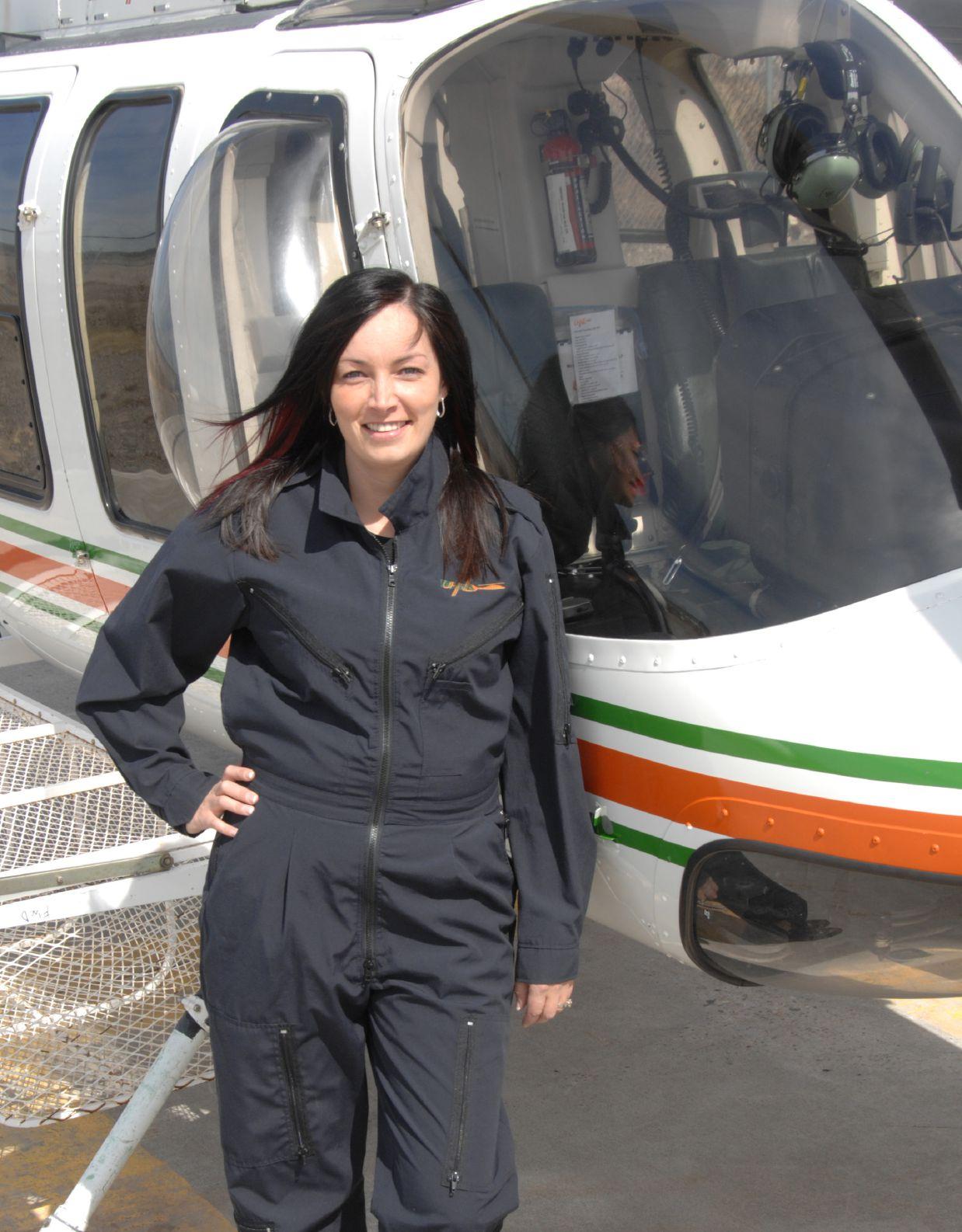
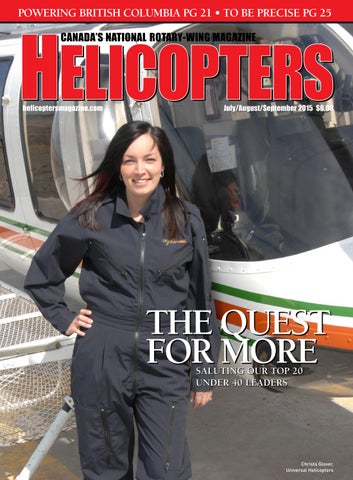
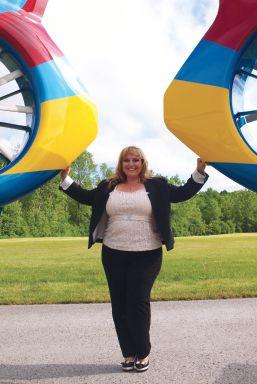
Christa Glover, Universal Helicopters
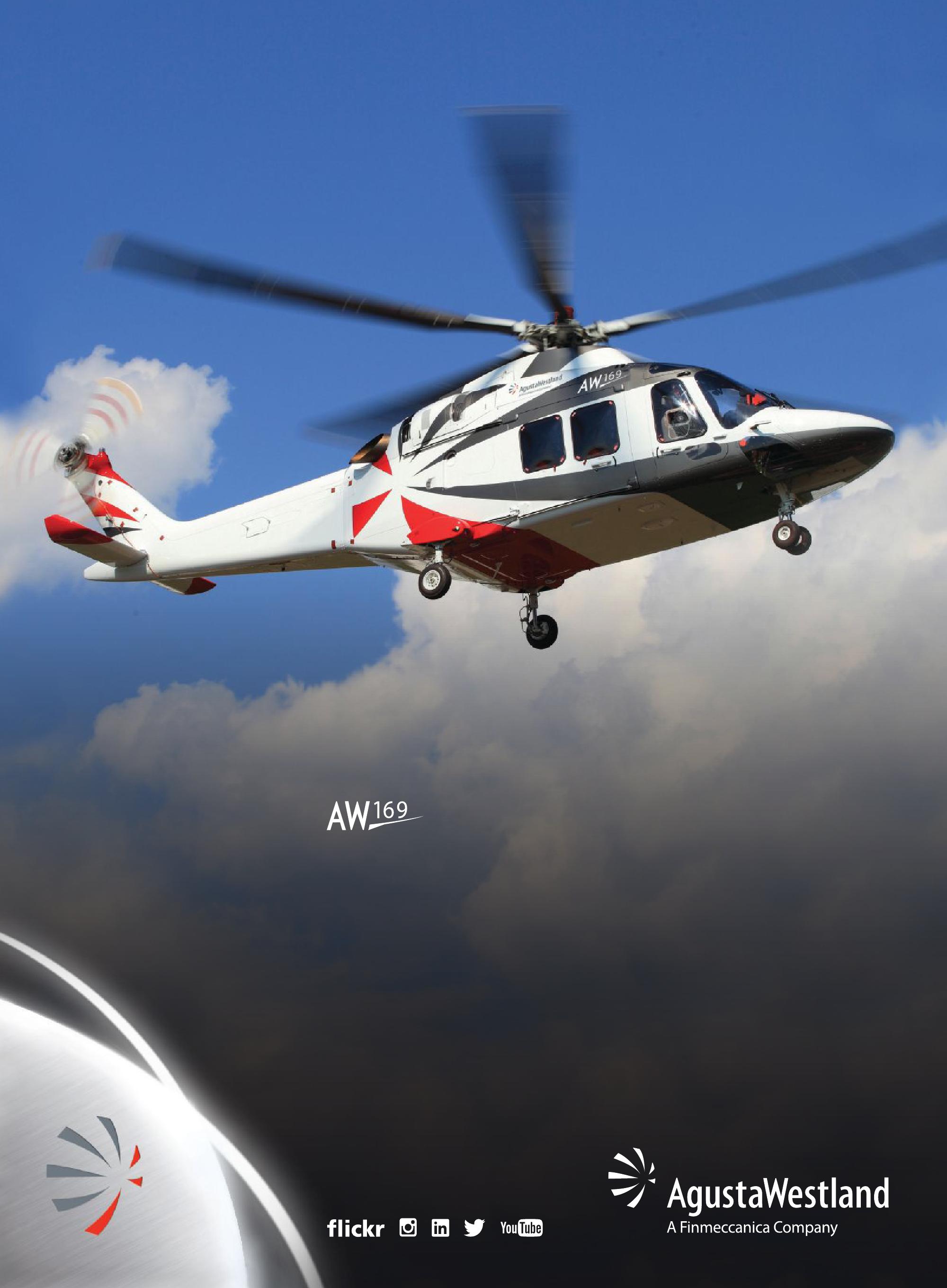
The AW169 is the brand new 4.5 tonne class twin-engine helicopter.
Featuring an advanced glass cockpit, state-of-the-art avionics, 4-axis digital autopilot, full digital electronic engine control (FADEC) and dual channel Flight Management System (FMS) for reduced pilot workload and increased passenger comfort.
Based on the operationally proven, market-leading AW139 platform and belonging to the AgustaWestland ‘Family’ of products (with AW189 and AW139), mixed-fleet operators can leverage the advantage of a common design philosophy across platforms.
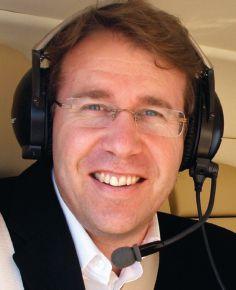
MATT NICHOLLS is editor of Helicopters
ver the past couple of years, Helicopters western correspondent Paul Dixon and I have had spirited conversations with RCMP Sgt. C.V (Cam) Kowalski about the shocking rise in the number of laser attacks against Canadian rotary and fixed-wing pilots.
The discussions were disturbing, and frankly, I’m appalled at the stupidity and lack of awareness, understanding and respect individuals that partake in such incomprehensible activities have for the pilots, crew and members of the public at large.
Laser strikes on aircraft are on the rise and it’s a disturbing trend. In 2014, there were 502 reported incidents, which represents a 43 per cent increase from two years prior. So far this year, there have been 282 strikes across the country.
Laser strikes against aircraft are not unique to Canadian skies. Last year, the FBI launched a national information campaign, offering a $10,000 reward in helping identify perpetrators. Since the FBI began tracking laser strikes in 2005, statistics reflect a more than 1,100 per cent increase in in the deliberate targeting of aircraft by people with hand-held lasers.
The severity of these criminal acts is wide-ranging: high-powered lasers can permanently scar a pilot’s vision for life, stealing their career and livelihood. On a grander scale, a laser strike on an aircraft places the lives of those in the cockpit – and innocent citizens on the ground –in grave danger for a potentially horrendous accident. And while pointing
government. Alice Wong, Minister of State (Seniors) and Lisa Raitt, Minister of Transport, launched a national awareness campaign to shine light on this critical issue and explain – and it’s incomprehensible to me that the word “explain” needs to be attached to something like this –why shining a laser at an aircraft is not a good idea.
“It should be a no-brainer that pointing lasers at any part of an aircraft is dangerous,” Wong noted. “This awareness campaign will help Canadians better understand the serious risks and consequences of pointing a laser at an aircraft. By working closely with our partners, we can help to reduce the number of incidents at Canada’s airports.”
Craig Richmond, president and CEO of the Vancouver Airport Authority, reiterated the need for safety in and around major airports. “At YVR, our number one priority is safety,” he said. “We are working with our partners to increase education and awareness about the impact of laser strikes.”
The federal government’s campaign is based on a multi-phase approach. The first phase provides the public with information that clarifies specific dangers and consequences of pointing lasers into airspace and how incidences can be reported. The second phase, to be implemented this summer, includes digital advertising, awareness videos and a direct mail campaign near three major airports.
Transport Canada (TC) has also launched tc.gc.ca/NotABrightIdea, which provides Canadians with information to better understand the dangers of pointing a laser at an aircraft. TC is also working with police, other government departments, and the aviation industry to protect pilots, passengers, and people on the ground. They are encouraging all citizens that if they see a laser pointed at an aircraft, to report it to their local police.
In 2014, there were 502 reported incidents, which represents a 43 per cent increase since 2012.
a laser at an aircraft is a criminal offence – if convicted, under Canada’s Aeronautics Act an offender could face up to $100,000 in fines, five years in jail or both – there are those that continue to put pilots, and the general public, in the line of fire.
Kowalski has taken a leadership role in putting an end to these reprehensible acts. His work, as well as those of his team members at the RCMP, NAV CANADA and the Vancouver International Airport, has been invaluable and, in early June, more support came from the federal
“Suspects who choose to target aircraft with lasers show a careless and wanton disregard for the safety of the pilots, passengers and the communities surrounding airports,” Kowalski said. “Those caught will be prosecuted according to both federal and provincial acts and will be subject to substantial fines and jail time.”
The federal government’s campaign to eliminate laser strikes is an important step in working to eliminate these despicable acts. Let’s hope it lights a fire under citizens from coast-to-coast and shuts the blind on those whose only purpose is to destroy, corrupt and harm.

While much of the industry experienced a sluggish start to the 2015 season, that wasn’t necessarily the case for Airbus Helicopters Canada.
The Fort Erie, Ont.-based OEM made plenty of news in the first few months of the year with some major signings and expansions in key sectors.
In early June, Airbus and Niagara Helicopters hooked up on a significant piece of business, as the world-renowned Niagara Falls, Ont.-based operator added four new aircraft to its fleet. The new H130s will be used by Niagara to fly customers in a variety of operations including sightseeing excursions, charter flights, aerial surveillance, film photography, external loads and more in and around the Niagara region.
Annie Pierce, vice-president and general manager of Niagara Helicopters was understandably thrilled with
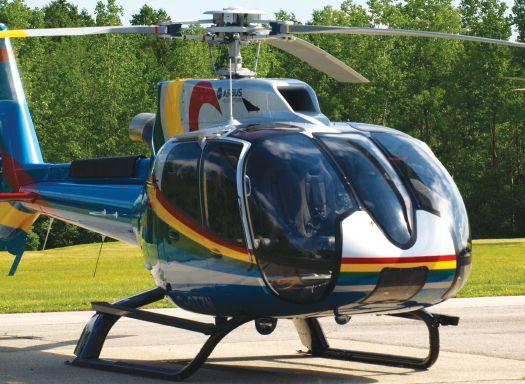
the enhancement of the Niagara fleet when Helicopters caught up with her during the fleet renewal ceremony at Airbus Canada’s Fort Erie plant. “It’s a deal that will certainly enhance our position in the marketplace, no question,” she said. “It will provide customers with a safer, enhanced riding experience, reduce noise to the community and more.” The H130 was an excellent choice for her helitourism operation, Pierce noted, given its visibility footprint, quietness, comfort and performance.
Romain Trapp, Airbus
Helicopters Canada’s president and CEO, called the deal a further extension of the strong relationship the two companies have developed over the years.
The Niagara deal was not the only significant newsmaker for Airbus Helicopters Canada in the spring, as the firm also added Mirabel HeliSupport as its eastern Canadian maintenance centre for private and corporate clients in the Quebec/Eastern Canada region. And the news didn’t stop there: the company also opened a new office at the Mirabel Helico complex in
The Abottsford, B.C.-based team of Corey Steinberg and Kelly Loewen are giving new life to salvaged helicopter parts for Bell and Sikorsky helicopters.
The dynamic duo have formed a new business venture that provides quality parts to customers at a lower cost than purchasing new – and it’s helping the environment to boot.
Steinberg and Loewen currently own several ventures including Power Hydraulics, Magnatech Inspections and Heli-Hydraulics. They jumped into this market when they realized there was a need for used helicopter parts and a glut of helicopters on the
Quebec is home to more than 200 Airbus helicopters representing almost one third of the Airbus Helicopter fleet in Canada. The 43,000 ft. Mirabel Helico facility will offer customers aircraft sales, training, technical support and parts ordering options.
“We see this location as offering tremendous benefit for our customers,” Trapp said. “In addition to the services offered by Airbus Helicopters, is the proximity to Mirabel Heli-Support, a newly authorized Airbus Helicopter Service Centre.”
market with valuable parts hidden within. Currently the company has disassembled a Sikorsky S76-A aircraft and thus far has seen great interest from the industry.
“It seemed to make sense for us to move into this area,” Steinberg said, “especially when we have the in house capability for hydraulic maintenance, NDT work and a machine shop at our convenience.”
To find out more info and check out the parts for sale, go to www.powersystemsltd.ca
Bell Helicopter’s impressive new super-medium 525 Relentless took to the skies for the first time July 1 at the company’s facility in Amarillo, Texas, much to the delight of staff, members of the design team and flight crew.
Introduced to much fanfare at Heli Expo in 2012, it marked a significant milestone for the company, and is a crowning achievement for the growing Bell helicopter portfolio.

HELICOPTERS MAGAZINE P.O. Box 530 105 Donly Drive South Simcoe ON N3Y 4N5 Tel.: 519-428-3471 Fax: 519-429-3094
The new Bell 525 Relentless will be a good option for a variety of missions. (Photo courtesy of Bell Helicopter)
“We are proud to have achieved this milestone,” noted Matt Hasik, executive vice-president of commercial programs at Bell Helicopter. “We have diligently executed our schedule to design, develop, build and test the aircraft, and look forward to the next phase of flight testing as we work towards certification. The marketplace has been awaiting the transformational capabilities of the Bell 525 and we continue to see growing customer demand from around the globe for this aircraft.”
In many ways, the 525 is an aircraft designed by operators for operators. Input from a customer advisory panel was crucial to the aircraft’s overall design, as requirements for operational safety, payload and range, cabin comfort and configuration and reliability were all built into the design.
One of the unique characteristics of the Bell 525 is the ability to perform CAT-A takeoffs and landings, to and from a helipad at maximum gross weight. Even in the event that one of the two engines fails, the Bell 525 provides sufficient power to maintain occupant safety while lifting off with a single operational engine.
“The first flight test started with taxi testing and maneuvers and then went into an initial hover, performing various hover maneuvers and then tested low speed handling qualities with winds gusting to 20 knots,” said Jeff Greenwood, senior flight test pilot at Bell Helicopter.
Bell Helicopter currently has more than 60 helicopters reserved under letters of intent for the 525. The aircraft can be configured to suit a number of missions, including corporate work, oil and gas, parapublic, aerial firefighting and HEMs.
Airbus Helicopters has introduced a new aircraft it hopes will help make its mark as an environmentally conscious option for operators.
The new Bluecopter demonstator made its debut in July at Airbus’ Donauwörth facility in Germany after some 28 flight hours of testing. The new light medium twin incorporates transversal technologies that can be applied across the Airbus product line.
“By bringing together the best of our company’s innovation, we are opening the way for a new generation of rotorcraft that will have lower noise levels, burn less fuel and are more efficient to operate,” explained Marius Bebesel, program manager of research and innovation – the point person behind the Bluecopter demonstrator. “With Bluecopter, we have met our goals of decreasing fuel consumption by as much as 40 per cent, significantly
The innovative Bluecopter demonstrator offers a bold new look of the helicopter of tomorrow. (Photo courtesy of Airbus Helicopters)
reducing C02 emissions, and lowering noise to approximately 10 decibel effective perceived noise (EPNdB) below ICAO noise certification limits, while maximizing payload and the passenger comfort.”
The new aircraft sports many technological innovations including Airbus’ signature Fenestron, with additional performance improvements from the shrouded tail rotor achieved through optimized blade and stator designs. The acoustic liner integrated in the
Fenestron’s shroud and the active rudder on the tail fin contributes as well to the reduced noise footprint of the Bluecopter.
The Bluecopter development was accomplished in a timeframe of a short-term skunk works project, largely covered by company self-funding. Certain technologies integrated into the demonstrator were developed in the framework of Europe’s Clean Sky joint technology initiative and Germany’s LuFo-IV research program.
Toll Free: 1-888-599-2228 Website: www.helicoptersmagazine.com
EDITOR MATT NICHOLLS email: mnicholls@annexweb.com 416-725-5637
MEDIA DESIGNER BROOKE SHAW
CONTRIBUTING WRITERS
RICK ADAMS, DAVID CARR, BRIAN DUNN, PAUL DIXON, WALTER HENEGHAN, FRED JONES, JAMES MARASA, CARROLL MCCORMICK, COREY TAYLOR
NATIONAL ADVERTISING MANAGER MENA MIU email: mmiu@annexweb.com 905-713-4351
ACCOUNT MANAGER KORY PEARN email: kpearn@annexweb.com 519-902-8574
ACCOUNT COORDINATOR
STEPHANIE DEFIELDS email: sdefields@annexweb.com 1-888-599-2228 ext. 257
GROUP PUBLISHER MARTIN MCANULTY email: mmcanulty@annexweb.com
DIRECTOR OF SOUL/COO SUE FREDERICKS RETURN UNDELIVERABLE CANADIAN ADDRESSES TO ANNEX PUBLISHING & PRINTING INC., P.O. BOX 530, SIMCOE, ON N3Y 4N5 CANADA. email: subscribe@helicoptersmagazine.com
Published five times a year by Annex Publishing & Printing Inc.
Printed in Canada ISSN 0227-3161
CIRCULATION email: subscribe@helicoptersmagazine.com Tel: 1-450-458-0461 ext 208 Fax: 877-624-1940 Mail: P.O. Box 530 Simcoe, ON N3Y 4N5
SUBSCRIPTION RATES
Occasionally, Helicopters magazine will mail information on behalf of industry-related groups whose products and services we believe may be of interest to you. If you prefer not to receive this information, please contact our circulation department in any of the four ways listed above. No part of the editorial content of this publication may be reprinted without the publisher’s written permission ©2015 Annex Publishing & Printing Inc. All rights reserved. Opinions expressed in this magazine are not necessarily those of the editor or the publisher. No liability is assumed for errors or omissions. All advertising is subject to the publisher’s approval. Such approval does not imply any endorsement of the products or services advertised. Publisher reserves the right to refuse advertising that does not meet the standards of the publication.
Helicopters Magazine is a corporate member of the
Helicopters Magazine is an associate member of the following Canadian aviation associations:
Having recently returned from the U.K., I was struck by a number of interesting observations – the Guinness tastes better, there are video cameras EVERYWHERE and there is a pervasive presence of “safety” equipment. Safety vests are worn by virtually every worker on a job site, by bicyclists and motorcyclists alike and many workplaces have visible elements of safety promotion. Now, I can’t say for certain that the U.K. is a safer place to work than Canada, but it is striking for sure.
One other thing I learned from my visit is that the Royal Air Force (RAF) has adopted International Civil Aviation Organization (ICAO) compliant Safety Management Systems (SMS) into its operations. The decision to follow this path stems largely from the fallout from a fatal accident of a Nimrod jet in Afghanistan in September 2006, which killed all 14 servicemen on board. The accident was followed by a number of investigations, coroners’ inquests and ultimately by a formal inquiry by Sir Charles Haddon-Cave, called “The Nimrod Review.” (I might note that both the board of inquiry and the review are worthwhile reads).
The review provided a bleak picture of organizational dysfunction within the RAF and among several of its suppliers and expressed grave concerns with the means by which risk was being assessed and managed, especially within the Nimrod fleet. The review eventually led to the U.K. government unreservedly accepting responsibility for failing to exercise an appropriate duty of care towards the dead servicemen and
If the RAF Can Do It, Why Can’t the Rest of Us?
(SCs) and Certification. The MAA provides the structure that identifies risk, establishes a mechanism for safety assurance and clearly delegates responsibility for every operation to a defined duty holder. From my observations, all the elements of an SMS – safety policy, risk management, safety assurance and safety promotion – are well-established in the decision-making processes within the RAF.
It was interesting to listen to the language of these career air force officers and NCOs – the discussions around risk, risk management and risk assessments. In addition, they have adopted many of the processes of the oil and gas producing community (OGP) including more advanced tools such as BowTie and Just Culture language. There appears to be a significant level of “buy in,” into this new safety paradigm, understandable given the intense scrutiny the air force underwent after the Nimrod review.
The key element, as well, that is front and centre, is the concept of “duty of care” of the senior leadership towards the servicemen involved in the activity in question. There is a real consciousness around which leader is identified as the “duty holder” regarding the assessed risk and whether all has been done to reduce risk to a level as low as reasonably practical (ALARP). This being completed under the ever-present possibility that the operation which is being risk managed may not necessarily eliminate all risk of injury or death, but that the risk to life is clearly identified and owned. Some of the risk is explicitly owned and signed off by the chief of the air staff.
Having clearly defined processes lets every player in the system know their duties and responsibilities. ‘‘ ’’
led to a wholesale shift in philosophy regarding risk management, duty of care and safety assurance.
The Military Aviation Authority (MAA), a parallel body to the Civil Aviation Authority (CAA) was also created. As part of the Defense Safety Authority (DSA), the MAA, as an independent organization, is responsible for the regulation, surveillance, inspection and assurance of the defense air operating and technical domains. It ensures the safe design and use of military air systems. The MAA aims to bring a new approach to Air Safety Governance through the use of clearly defined Duty Holders (DHs), a focus on Risk to Life and a new regime for Safety Cases
So this begs the question: Why such resistance elsewhere? If a major government agency like the RAF and the U.K. Ministry of Defense can successfully implement an ICAO-style SMS, why cannot other countries? While I acknowledge there is a certain over-burden associated with establishing and fostering safety management systems, there are also significant paybacks. Having clearly defined processes lets every player in the system know their duties and responsibilities. The same goes with goal setting, assurance practices and promoting safe activities. The RAF was motivated as a result of a terrible accident and from an intense round of scrutiny in its aftermath. But there are many levels now that are motivated to understand the “new system” and to move forward, to embrace the new paradigm and to employ SMS as a best practice within one of the world’s most storied organizations.
Walter Heneghan is the vice-president for Health, Safety and Environmental Protection with the Summit Air Group of Companies, Ledcor Resources and Transportation, based in Edmonton and throughout Western Canada.
PAUL DIXON
took a day off from the continuing hunt for Amazon’s secret Canadian drone testing facility for a reality check. That would be the opportunity to attend a recent Vancouver Entrepreneur Forum on the subject of UAVs
The aprés-work event attracted a wide range of Vancouver’s younger business community to hear about things that fly from a diverse panel already well-versed in the business. The meet and greet was a great read on the crowd and introduced me to a whole new segment that may or may not play a large role in taking UAVs forward.
These were the young entrepreneurs and recent MBA grads and erstwhile venture capitalists – people of the generation that is still on the rise, looking for the next big thing. They’re not the technical minds, they’re the business minds and the intriguing thing is that these young minds are going to see uses for UAVs that the experienced or “mature” isn’t willing or able to consider. It was a meeting of the minds – entrepreneurs, operators and potential investors.
The evening’s panel discussion was moderated by Paul Bennett of Aerobotika, a company that offers a wide range of services for those looking to get further into the business applications of UAVs. Members of the panel included the director of marketing for a major commercial real estate firm who uses UAVs in developing new marketing programs for both urban and rural properties; a lawyer with a major national law firm who handles the unique legal challenges and
perspective of those who are doing it now and not simply as pie-inthe-sky optimists.
Bennett set the table for the panel with the statement that Canada is a “drone powerhouse” and there are hundreds of potential startups on the verge, which seemed to surprise many in the audience. Adding to the audience’s surprise was having Transport Canada (TC) in attendance for the Q&A session and hearing that “yes,” Canada really is out in front, at least for now. Leveraging the last few years of UAV development to keep Canada out front is going to take continued active participation from TC, but it also requires a reality check on the part of the end user and a big push on the technology front before UAVs are truly ready for prime time. These are the major roadblocks as seen by the panel members that need to be overcome:
• People don’t grasp the level of technology. These are not toys that can be flown right out of the box. Sensors need to be calibrated and systems need to be maintained to a high standard;
• People who don’t know the rules governing the operation of UAVs and make no effort to educate themselves;
• Operations limited by battery capacity. Battery technology has to increase by a huge factor before UAVs move out of the backyard;
• Before UAVs can move out of the backyard and beyond line-ofsight operations, sense and avoid technology has to be developed that works at this level. Like your average teenager, you need a high level of confidence that your UAV will come home when it is supposed to and not get into trouble when it’s out there on its own.
It was a meeting of the minds – entrepreneurs, operators and potential investors. ‘‘ ’’
issues associated with the emerging world of UAVs and robotics; a university geography professor who uses UAVs as part of his study of the uses of remote sensing as a tool for mapping and monitoring a wide range of ecosystems around the world; and a local post-secondary institution that has added a UAV program into its media production department with the aim of exposing the potential of UAVs to students in as many disciplines as possible – marketing, 3D modeling, inspections, geo-mapping, forestry, wildlife observation and as many uses as students can come up with. In a nutshell, it was a group of people who can talk about the future uses of UAVs from the
If you decide that UAVs have a place in your future or your business’ future, then you are going to have to grapple with trying to figure out just what it is you want to do, or more importantly, what it is that using the UAV will do for you that can’t be done any other way. Then you’re going to have to figure out if this is something you can do yourself – owning and operating your UAV or is it going to be more expedient to contract with a dedicated UAV operator to provide the services as you need them?
I left the forum after the panel discussion concluded as the noshing and sloshing portion of the evening ramped up. The room was buzzing and the excitement was palpable. It might not be the Wild West era of UAV development, but there’s still a lot of dust in the air. Giddy up!
Paul Dixon is a freelance writer and photojournalist living in Vancouver.
COREY TAYLOR
The more we do things, the easier they become and, more importantly, the more normal they seem. Pushing the limits has been something pilots have struggled with since 1903, and none are immune.
A few years ago, I departed Victoria airport and was proceeding northwards through Sansum Narrows in what were obviously degrading weather conditions. Visibility was dropping, the ceiling lowered and rain was swirling around the edges of the front bubble while leaving those streams of what looks like viscous water on the side windows, which can have an almost hypnotic effect. I could feel my grip on the cyclic getting tighter and started to slump down in my seat in an attempt to see under the clouds that I was skimming.
This is the point where the internal conversation usually begins, which can be a source of some embarrassment (and elevated stress levels amongst aircraft occupants) when an overly sensitive intercom shares that mental struggle with the passengers. This is probably when I should have turned around, as I still had enough visibility to make a turn with reference to a shoreline. But I thought if I could just make it a mile or two further, the weather would improve and I would be past (under) the massive powerlines that feed electricity to the Island from the mainland.
The more we put ourselves into situations approaching overload,
my brain had been so completely fooled when the driveshaft sheared that I thought my drink was going to fall over and spill. As I reflected on that flight and the physical reactions my subconscious brain was causing in my body, it was apparent that the realism of this experience was as close to real life as you can get without actually being in an aircraft, in a situation one should never be in. And all for under $200,000 delivered, with an operating cost under $100 per hour.
FTD-based low visibility and scenario-based decision-making training should be mandatory in Canada with what is available in terms of training aids and their associated cost. I’m sure somebody can nitpick (and will) the details about motion and fidelity to a given type of aircraft, but the counter point to that is “what do we do now”?
FTD-based low visibility and scenario-based decisionmaking training should be mandatory in Canada.
the more likely it is we will be faced with additional pressures we’re no longer able to deal with. Such was the case on this day as suddenly, at an altitude of around 200 feet, airspeed of 40 kts and with visibility under half a mile, the tail rotor driveshaft sheared. The sense of being almost ejected from the pilot’s seat was incredible, but I have to give myself credit for my quick reaction in letting go of the collective and diving across the centre console to grab the drink I had placed on the co-pilot side floor before it spilled its contents.
Yes, I was in a simulator, or more specifically a “Flight Training Device” or FTD. There was no motion component to this device yet
Currently low visibility training, coupled with pilot decision making is mandatory for commercial pilots in Canada, especially when a company wishes to exercise the rights of the Ops Spec for flight down to one half mile. We go out in a helicopter on what is often a blue sky day, ask the pilot to estimate half a mile and then practise doing turns to get out of bad weather – all while pretending the overwhelming peripheral cues don’t exist. This is not realistic and, I daresay, almost useless. In comparison to what low-cost FTDs can bring to the table, the required inflight training is like learning to swim from the deck of the pool. Since low-cost technology is available that is almost sure to help prevent accidents by helping pilots know when to call it a day, it seems obvious this type of training should be required in Canada. At the very least, this type of training would be a far better substitute than training in a classroom and an aircraft in good weather, for those with access to such devices. Unfortunately, this is not the case in our current operating environment. An operator still has to conduct training in classroom and an aircraft in order to comply with Canadian laws, regardless of how much superior training they conduct. This means an operator pays twice for the same training, with the more expensive portion being the one of little comparable benefit. Operators struggling to make ends meet can’t afford to pay twice. So, once again safety suffers in favour of compliance.
Corey Taylor is vice-president of Global Business and Product Development for Great Slave Helicopters.
RICK ADAMS
Helicopters are not the main event at the Paris Airshow; the annual Airbus-Boeing commercial aircraft derby garners the most attention.
Nonetheless, the rotary sector generated plenty of interesting news and speculation this year from major manufacturers and niche players alike.
The dominant discussion was United Technologies Corporation’s intent to sell or spin off Sikorsky Aircraft by the end of this year. The deal went final as Helicopers was going to press, as Lockheed Martin stepped up to the plate to the tune of $9 billion.
UTC and its predecessors have owned the iconic Igor Sikorsky’s legacy for 85 years, but CEO Greg Hayes, who took over the US$65billion conglomerate last November after the abrupt resignation of Louis Chenevert, said the $7.5 billion helicopter operation no longer “fits” with their portfolio of Pratt & Whitney engines, Otis elevators, Carrier air conditioners and Kidde fire extinguishers.
Sikorsky, of course, is strong in the large-cabin sector, (S-76, S-92) favoured by the offshore oil and gas industry, which president-since-April Bob Leduc says accounts for 80 per cent of its commercial sales. With the recent 40 per cent drop in oil prices and reduced exploration, many customers are deferring deliveries, awaiting more efficient future models. Leduc said a new mediumlift model is planned “around 2020,” but that of course will be determined by the new owners.
After Sikorsky lost in April to Airbus Helicopters on a contract from
A pair of Bell 505 Jet Ranger X prototypes are test flying, and the first certification is expected to be via Transport Canada.
The first flight of the clean-sheet Bell Relentless 525 took place July 1, delayed by supply chain issues and the regulatory hurdles for fly-by-wire controls. The entry into service target is now 2017. In Paris, Bell announced a letter of intent from Milestone Aviation Group for 20 of the super-medium 525 models.
Bell also has an agreement with the Urals Civil Aviation Plant in Yekaterinburg, Russia to assemble 407GXP light single-engine helicopters. This is the first time the Fort Worth, Texas-based company has handed over assembly to a foreign partner. The first three aircraft are expected to be ready before the end of the year.
Airbus is looking to eventually replace the Super Puma, nagged by accidents and rotor shaft problems, with its new “X6” twin-engine heavy-lift concept.
The five-blade main rotor design reflects the recently launched H160 medium helicopter (maiden flight June 13), but the X6 will incorporate fly-by-wire control and a full de-icing system. Fuel burn and overall operating costs are expected to be 20-25 per cent less than current-generation aircraft. CEO Guillaume Faury told reporters that first flight could be in the “early 2020s” and service entry within seven to eight years.
Toronto-headquartered Vector Aerospace, Airbus, and Rockwell Collins also announced an agreement in Paris to jointly develop Pro Line Fusion integrated avionics upgrades for Airbus platforms. Missionspecific operational profiles will feature offshore platform approaches, hover in place, and extended searchand-rescue patterns.
Airbus is looking to eventually replace the Super Puma, nagged by accidents and rotor shaft problems.
Poland for 70 multi-purpose military choppers, the Stratford, Conn. OEM announced job cuts of 1,400. They also operate Schweizer and Keystone Helicopter completions.
The Sikorsky speculation spilled over to Bell Helicopter, which in April had announced a workforce reduction of 1,100 worldwide, including 300 more positions at Mirabel in Quebec (which is down to about 1,200 staff, roughly 40 per cent less than a year earlier).
But Textron chief executive Scott Donnelly said, “We love our helicopter business. It’s a profitable business. It’s a great technology business. We’re investing a lot.”
Thales is eyeing civil helicopter markets (law enforcement, emergency medical), as well as business jets and military aircraft, for a simplified helmet-mounted display system called TopMax.
The HMD shows basic flight info, navigation data, and engine parameters, and is claimed to be compatible with night vision goggles.
Finally, former Sony chief financial officer Robert Wiesenthal is leading start-up company Blade, which hopes to be the “Uber of helicopters,” providing on-demand shuttle services ordered through an online app. Last I knew, that was called a charter service.
Rick Adams is chief perspectives officer of AeroPerspectives, an aviation communications consultancy based in the south of France, and is editor of ICAO Journal. He has been writing about technology and training for 30 years.
BY MATT NICHOLLS
So what exactly makes a great corporate leader? Where does the drive to transform an organization and help it reach new levels of productivity, efficiency and profitability come from?
Truly great leaders have a unique ability to handle multiple projects with skill, determination and an inherent grace under pressure that most people do not possess. Innovative and creative, they have a rare ability to make those around them more efficient, productive and motivated.
It’s a rare combination indeed, and once an organization unearths such talent, it usually works hard to ensure superstars have room to develop, grow and flourish. In Wings and Helicopters third annual Top 20 Under 40 report, we highlight some of these top achievers – men and women who have transformed their organizations in maintenance, business operations, flight operations and more.
The 20 individuals featured here were carefully selected by our editorial team following an online contest that ran earlier this spring. Candidates were nominated by colleagues based on their influence to drive change, leadership skills, commitment to clients/colleagues, and their forward thinking towards the industry as a whole.
Featured alphabetically, our Top 20 Under 40 achievers represent the resourcefulness, commitment and dedication organizations are craving in today’s marketplace. On behalf of the nominees, candidates and winners, we thank you for your support and salute the achievements of all who participated.
Since graduating from Georgian College’s aviation management diploma program in 2003, Josh has been a friend, colleague, and mentor to many aviation professionals for more than a decade. From humble beginnings, Josh assisted the Canadian Aviation Expo at the Oshawa Municipal Airport from 2001-2006, and later joined the operations staff at CYLS for his co-op and extended full-time employment. He furthered his aviation experience in 2005 by joining the executive FBO ramp at Skyservice CYYZ, always carrying with him a positive attitude and the aspiration for continuous personal growth.
TITLE: MANAGER, FLIGHT
COORDINATION, CHARTER AIR TRANSPORTATION SERVICES (CATS)
LOCATION: MISSISSAUGA, ONT.
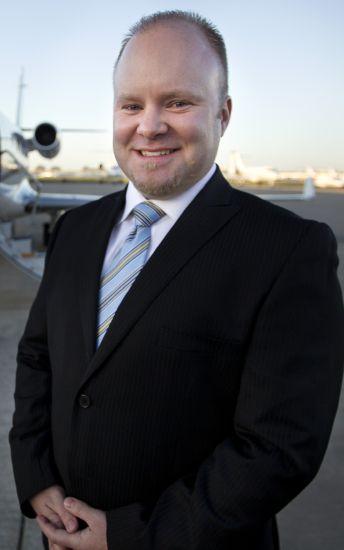
Josh Calder, 34, has certainly made the most of his opportunities in his developing aviation career.
The work/life balance of maintaining a professional career and being an exemplary father – while completing his bachelor of science in technical management with Embry-Riddle Aeronautical University – is a testament to his commitment in providing a fully supported knowledge base to every aspect of his work.
This enduring pursuit led him to become the successful flight coordination manager within two different organizations over the past
decade. It is here that Josh provided leadership and managerial oversight to his team members and flight personnel alike.
Josh’s experience was instrumental when he joined the start-up team at Charter Air Transportation Services Inc. (CATS) in Toronto as the manager of flight coordination. He structured and set up the complete flight coordination department – and continues to provide leadership and oversight to the rapidly growing operation.
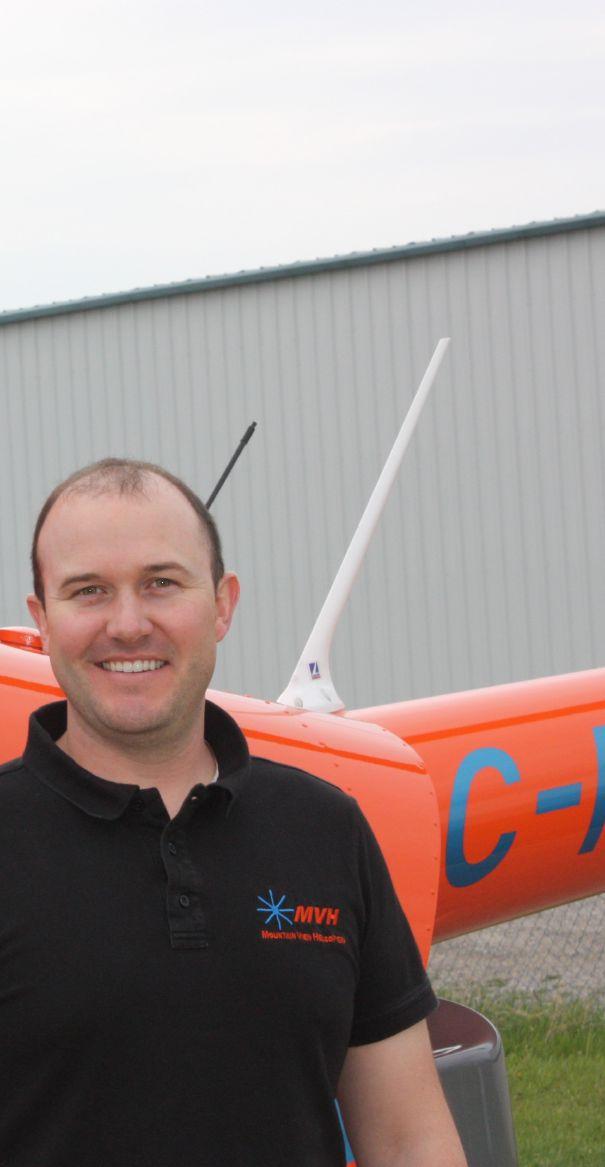
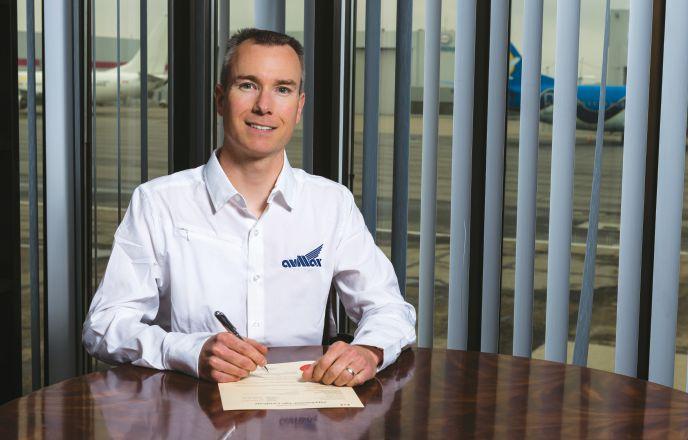
Paul Campbell, P.L. (Eng.), 37, was recruited to transform the engineering department at the fast-growing Avmax Group of Companies in 2011 and that’s exactly what he did.
First on the agenda: a Transport Canada Design Approval Organization (DAO) to reduce project cycle times by eliminating the need for external delegates. He then focused the department for growth in modifications, repairs and part design approvals to support the large fleet of regional aircraft owned or managed by Avmax, and at the same time, reached out to support other local operators with their engineering projects.
Paul’s transformative efforts extend beyond Avmax, touching grassroot initiatives. He is active in the community, having recently completed a long-term involvement with the Air Cadets. As a teen, he earned his private pilot’s licence as an air cadet and is passionate about giving back to a program that helped him gain precious leadership skills.
Paul’s philosophy of working to develop young leaders also extends to his fast-growing engineering team at Avmax where he has hired new and recent graduates to engineering roles. A proud graduate of the Southern Alberta Institute of Technology Aeronautical Engineering Technology Program, Paul has 15 years of modification and repair design experience in a variety of key areas. His combination of experience, skill and grass roots involvement perfectly illustrates what this award is all about.
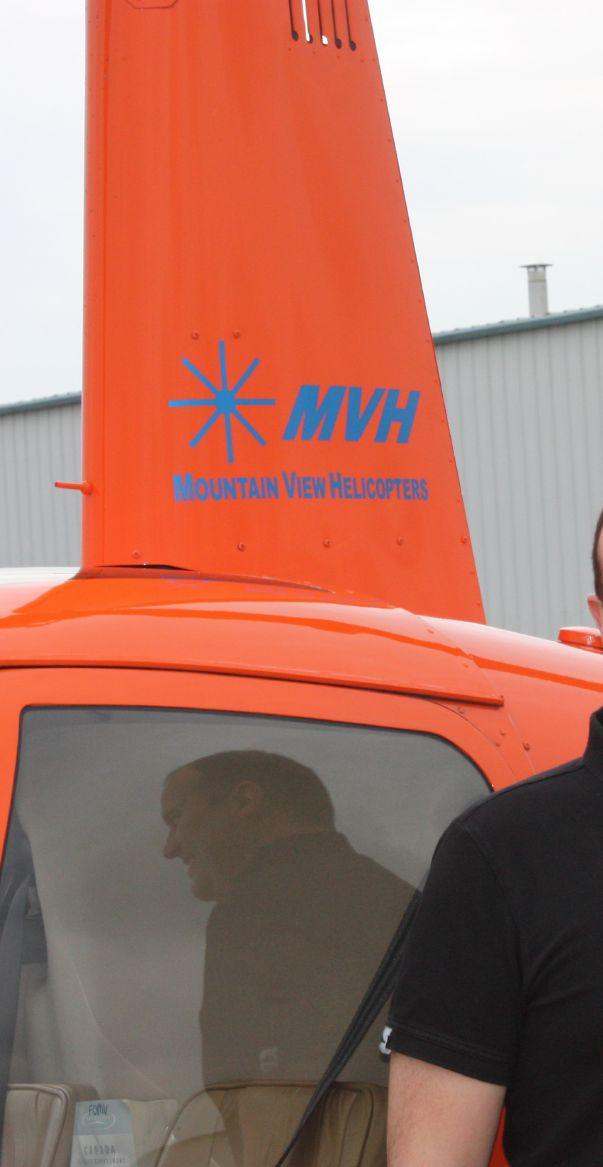
Curtis Nadon (left), Josh Calder (below left) and Paul Campbell (below right) are some of our Top 20 under 40 winners.
LOCATION: CALEDON, ONT.
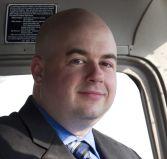
Rob Carney, 37, has demonstrated dedication in providing outstanding flight training for emerging pilots for the past 15 years.
Rob is the chief flight instructor at the Brampton Flight Centre. Through his tenure at BFC, Rob has actively worked towards the development of professional pilot training. He has played an integral part in the implementation of the BFC IATPL program and the BFC-Sheridan College collaborative degree program.
Rob strives to achieve a level of training that goes above and beyond the expected standard. He has been involved in the training of four Webster Memorial Trophy finalists, three of whom achieved first place and one who achieved runner up. As a Class 1 instructor and flight examiner, Rob has transferred knowledge to a wide variety of pilots now in various sectors throughout the aviation industry.
Rob is a graduate of the Humber College Flight and Aviation Management program and he recently completed his graduate in Aviation Management from of University of Newcastle. He is currently completing his master’s degree in aviation where he is specializing in human factors and organizational safety. In August, Rob will join Seneca College as an aviation professor.
NAME: MALLORY DELUCE
TITLE: PILOT, PORTER AIRLINES
LOCATION: TORONTO, ONT.
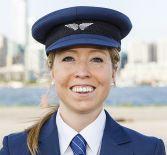
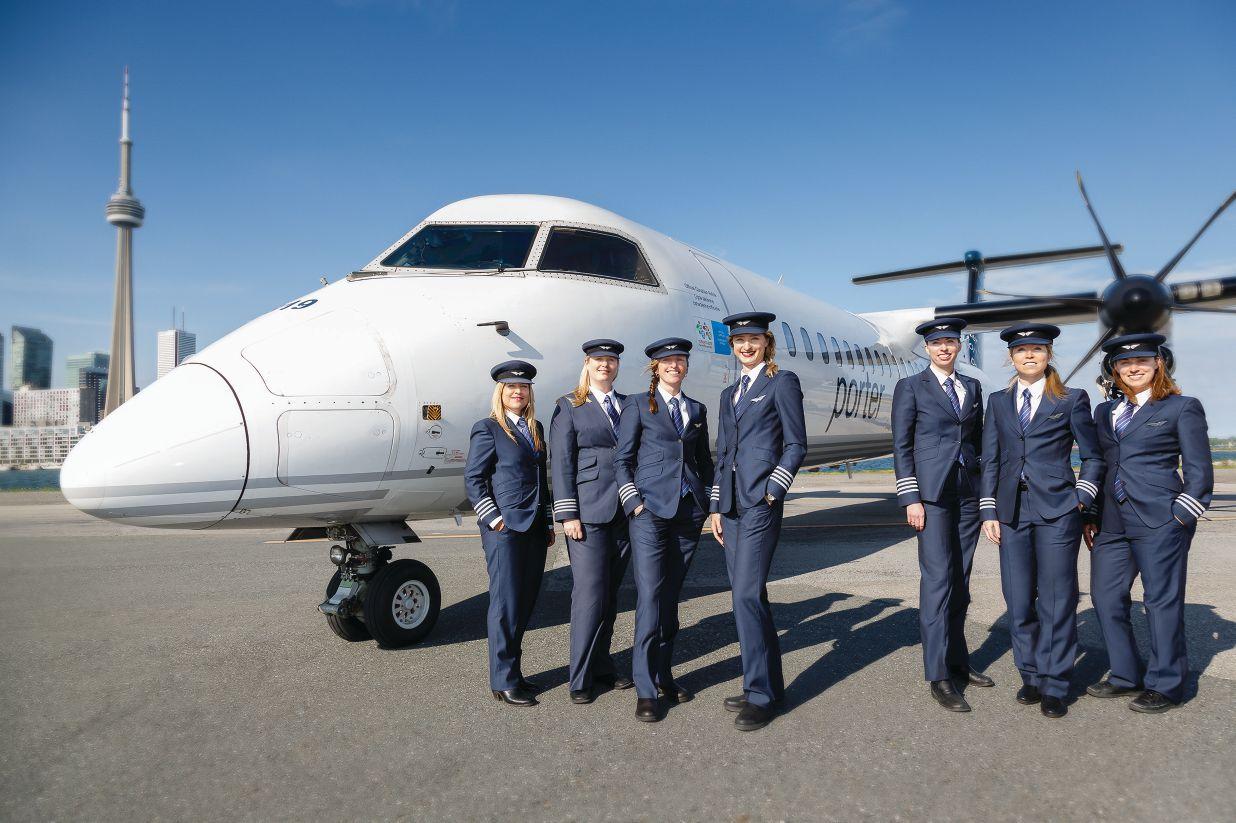
From a very young age, Mallory Deluce, 27, has had a keen interest in aviation.
Mallory's passion for aviation has deep roots that run within the family, including her uncle, Robert Deluce. Robert is thePresident and CEO of Porter Airlines. Her father and brother are also commercial pilots.
At 22, Mallory started working on obtaining her pilot’s license after graduating from university. She obtained her private license at St. Thomas Flight Centre in St. Thomas, Ont. For her multi-engine and instrument ratings, she went to the
Professional Flight Centre at Boundary Bay Airport, just south of Vancouver, then came back to St. Thomas Flight Centre to acquire her commercial license and build flying time.
In June 2013, Mallory was hired by Air Georgian as a first officer. Mallory’s Air Georgian training began with ground school where she learned about the company operation and about the Beechcraft 1900. After ground school, she trained on a Beech 1900 simulator.
When not soaring in the clouds, Mallory can often be found on the ice – playing hockey. She is an accomplished hockey player and has excelled on a number of top levels. She is also a strong advocate for grass roots development, having done numerous media interviews talking about her experiences both as a pilot and a hockey player.
Mallory has recently accepted a pilot position with Porter Airlines and will continue her career journey while continuing to be a positive advocate for the industry at all levels.
NAME: MATHIEU DEMERS
VICE-PRESIDENT/GENERAL MANAGER, AVIANOR
INC.
LOCATION: MIRABEL, QUE.
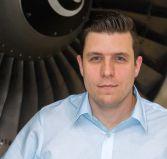
Graduating from Ecole Polytechnique of Montreal as a mechanical engineer in May 2005, Mathieu Demers, 31, joined Pratt & Whitney Canada as a quality engineer on the PW300 engine certification program where he developed expertise in statistical and manufacturing processes.
Mathieu continued his career as an engineer in 3D design and modelling at the automotive group of Dassault Systems in Montreal. Moving back to aerospace, he was then selected to lead a new design program for the cabin interiors of the Falcon 7X and 900 business aircraft from Dassault Aviation.
Mathieu joined Avianor in July 2010 as a project engineer and quickly rose to lead the growing engineering department as well as working more closely with company ownership. He has taken on the positions of engineering director, project management director and special projects director of manufacturing operations and maintenance.
In June 2014, he was promoted to vicepresident and general manager, a position created by the owners to allow them more time to focus on business development.
Since that time, he has surrounded himself with a young team of dynamic managers to support the growth of the company and its ambitious goals.
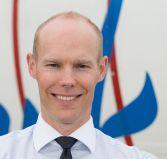
As a truly authentic and inspiring leader, Jay Dilley, 36, continually pushes the boundaries of success.
In 2013, Jay was named president of Hawkair. He is a member of the Young President’s Organization, holds the Chartered Financial Analyst Designation, a master of science in management, honours bachelor of commerce and a diploma in aviation studies.
An ardent believer of continuing professional development, Jay has earned certificates in Safety Management, Integrated Management Systems, Auditing, ISO 9001 Lead Auditor and Financial Modelling. He has also taught courses for Aurora College and Athabasca University.
A board member of the Northern Air Transport Association since 2010, Jay is a committed member of the aviation community. Prior to Hawkair, Jay was vice-president of business services for Summit Air, and had spent eight years in Yellowknife where, among other career highlights, he integrated two charter companies ahead of schedule.
Most recently, he launched the airline industry’s first Women in Leadership Executive Development Program to create a culture of awareness, inclusiveness and opportunity for women in aviation.
Through his commitment to transparency and communications, Jay is consciously raising the leadership of those around him – he never tires of making those around him better.
TITLE:
LOCATION: MISSISSAUGA, ONT.

Dedicated, meticulous, accomplished, invaluable. All of these words can be used to describe Sundeep Dhunna, P. Eng., 34, a talented senior engineer at Aversan. These words also describe the ideal
aerospace engineer, and in Sundeep’s case, he certainly lives up to the “ideal” part of the description.
Co-workers often get excited when working with Sundeep on a project and for good reason. They describe him as a type “A” personality who is passionate, innovative, and motivated to do whatever it takes to see a project through to its end, always doing it right.
Sundeep is also known for adhering to, and advocating for, the needs of his team, having an open ear, and setting a good example for his junior staff. Junior engineers often refer to Sundeep as “special forces” – the person you bring in to solve a unique issue in the most efficient and effective way possible.
Sundeep started at Aversan 10 years ago as a fledgling junior engineer, eager to show off his talent and potential. His drive and motivation to produce quality work allowed him to advance his career at an exceptional rate, rising quickly to a senior software engineer. In his time with Aversan, Sundeep has achieved a number of significant accomplishments such as designing the COMAC C919 operational software for the cockpit control system – a first for Aversan at the time.
Dependable and adaptable, Sundeep is the kind of employee you can always count on to get the job done right.
NAME: CHRISTA GLOVER
TITLE: CHIEF PILOT, UNIVERSAL HELICOPTERS
LOCATION: GOOSE BAY, N.L.
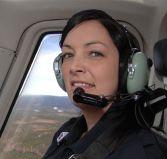
Christa Glover, 31, is the chief pilot of Universal Helicopters Newfoundland and Labrador LP, owned and operated by the Nunatsiavut Group of Companies. UHNL is one of Canada’s oldest helicopter companies operating a fleet of 19 light and intermediate helicopters in some of Canada’s most challenging environments.
Christa grew up in a small Coastal Labrador town (Pinsents Arm) of 75 people and had a passion for aviation since a very young age. She started her career 10 years ago with Universal Helicopters and continues to pursue her love for aviation with the company, earning respect and a strong working relationship with both her colleagues at UHNL and its clients.
Her flying career has taken her to all parts of Newfoundland and Labrador and north of 60, into Canada’s High Arctic. She has also honed her skills doing her time in the bush,
conducting long line drill moves, wildlife capture and forest fire suppression.
Now, as chief pilot and a senior aviation manager – and being an aboriginal as well –she has become a role model for others in the industry and those contemplating an aviation career. At a young age and being the only female pilot in the company, this environment may be intimidating to some, but Christa is first to acknowledge that she has an experienced support team of aviation professionals, maintenance and flight crew who support her 100 per cent.
NAME: CAREL ISSID
TITLE: LEGAL COUNSEL, ELEMENT AVIATION FINANCE
LOCATION: MONTREAL, QUE.

A determined, motivated professional with a deep thirst for knowledge and seeking the truth. That’s a great way to describe Carel Issid, 35, legal counsel for the
Canada’s leading national aerospace event
November 17-18, 2015
Shaw Centre Ottawa, Canada

aviation finance division of Element Financial Corporation (EFC).
Carel possesses outstanding interpersonal skills and has a great team ethic, which helps her handle multiple tasks under pressure, in a context of tight deadlines and constantly shifting priorities. As she will attest to, a lawyer or legal counsel must, in addition to being an advisor who provides legal expertise, take on a strategic role and excel in developing pragmatic solutions. Carel thrives in her current work environment where entrepreneurial spirit, originality and audacity are encouraged and supported by the company’s senior leadership team.
Carel has a multitude of roles at EFC including:
• Acting as main counsel with respect to aircraft finance (commercial loans and equipment leasing agreements, as well as the purchase and sale of large-ticket equipment, syndications and portfolio acquisitions).
• Leading and managing a variety of fixed wing and rotary wing commercial and business aviation transactions originated by the Element Aviation Finance vertical.
• Identifying potential risk areas arising from the complex and diverse financing arrangements (which often involve cross-border components) extended by the company and issue recommendations in order to minimize the same.
It’s a large portfolio to be sure, but Carel still finds room to donate her time to speak at various events including the Equipment Leasing and Finance Association’s Legal Forum, and to appear as a panellist in the “Winter is Coming: Advanced Roundtable on Cross-Border and Canadian Finance Issues.”
Carel was a finalist in the category “Lawyer of the Year” (in house practice), Young Bar Association of Montreal “Leaders of Tomorrow” Gala in 2012 and continues to generate accolades from clients and staff for her dedication, hard work and innovation.
NAME: BHARTVEER JASWAL
TITLE: AIRCRAFT MAINTENANCE
TECHNICIAN, AVMAX GROUP OF COMPANIES
LOCATION: RICHMOND, B.C.

For 33-year-old Bhartveer Jaswal, having a career in aviation is the fulfillment of a lifelong dream.
Bhartveer started his career with the Langley Museum of Flight and worked his way up into a variety of key supervisory and management roles in aircraft maintenance. At
a very early age, he given the responsibility to set up AMO for an airline. Over the past few years, he has improved and streamlined maintenance processes for several companies.
A self-learner who motivates and inspires others in being the best they can be in the industry, Bhartveer takes initiative in carrying out maintenance tasks efficiently and with the highest standards of quality.
Bhartveer has honed his craft by gaining experience in aircraft maintenance on a number of aircraft including the Cessna 172, King Air, Beech 1900s, Dash 8 and Q400. With Avmax Aviation Services in Vancouver, he caters to the maintenance needs of various customers with their aircraft maintenance requirements.
Bhartveer’s dedicated work habits and commitment to excellence make him a key part of the Avmax team – and a worthy recipient for this honour.
LOCATION: WINNIPEG, MAN.

At age 36, Diana Kelly has risen to a position of major responsibility within NAV CANADA.
As manager of ACC Operations at the Winnipeg Flight Information Region, Diana works closely with customers and bargaining agents, and leads nearly 200 professionals that include shift managers, air traffic controllers, and other operational specialists who provide services in Manitoba, Saskatchewan and northwestern Ontario.
Diana was appointed to her current role in April 2014. She is one of the first women (and among the youngest) ever to hold this leadership position at NAV CANADA, leading the way for other women in a traditionally maledominated field.
Diana’s outstanding leadership abilities, work ethic and initiative come shining through in a number of ways:
• As manager of ATC Operational Requirements from 2012-14, she led the transition from flight-data strips to a paperless environment within high-level specialties and at Flight Service Stations across the region.
• Her team developed highly successful “safety bear pit” sessions that bring together frontline operational staff and pilots to discuss safety issues and to break down barriers – a collaborative approach
that has been identified as a national best practice.
• She is an active member of NAV CANADA’s national Performance Based Navigation (PBN) Working Group, overseeing implementation of more efficient air routes and ascent profiles for the company’s airline customers across the country.
Diana studied education at the University of Alberta (with a minor in German), before becoming a terminal controller and later enroute controller at NAV CANADA’s Winnipeg Area Control Centre. In 2008, she became a unit procedures specialist, and soon after was named shift manager – the youngest at the time and the first female shift manager at the ACC. She has continued her training to complement her various ATC roles and hone her management skills at NAV CANADA.
Diana is known and respected for her hard work, personal initiative, drive and strong communication skills. She is a next-generation leader at NAV CANADA who will shape the company’s future in the years to come.
TITLE: VICE PRESIDENT, SALES & BUSINESS DEVELOPMENT, LEVAERO AVIATION LOCATION: TORONTO, ONT.
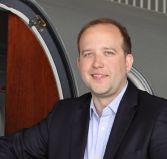
Stan Kuliavas, 35, has always been passionate about aviation . . . so much so, in fact, that he was legally able to fly airplanes before he was legally able to drive a car.
Stan is the vice president of sales and business development for Levaero Aviation in Toronto, overseeing the planning and execution of the growth strategy of the company.
A licensed pilot and graduate of EmbryRiddle Aeronautical University, Stan has nearly a decade of aviation experience, and OEM product involvement. He most recently spent six years as a board member of the St. Michael’s Young Leaders group, raising funds and awareness for St. Michael’s Hospital in Toronto, and currently volunteers with various other charitable organizations.
Stan has also sponsored and supported various grassroots efforts such as Careers in Aviation Expos throughout Canada to help inspire both students and adults alike looking to enter the field of aviation. He has also helped with the annual Girls Fly Too event recognizing women in aviation and inspiring girls and women of all ages to explore the various fields of the aviation industry.
In addition, Stan has taken part in a
relief mission with colleague John Tory, president and CEO of Private Air, to Attawapiskat, First Nation when the reserve was declared a state of emergency in December 2011 for poor living conditions. They co-led a relief trip to Attawapiskat with the help of Global Medic and flew a PC-12 up to the reserve to deliver 100 children’s winter coats and emergency relief.
Stan was one of the driving forces behind the recent rebranding of Pilatus Centre Canada into Levaero Aviation, a company with almost 20 years experience in the aviation industry. Stan has always been passionate about the aviation industry and continues to find ways to discover ways to innovate, lead and find new strategic ways to grow both Levaero Aviation and help develop and grow grass routes aviation initiatives.
LOCATION: FORT MCMURRAY, ALTA.
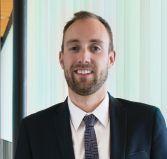
Since joining the Fort McMurray Airport Authority in 2012, Jesse Meyer, 30, led the rebranding of the airport, significantly expanded the food and retail options in the new terminal, and lobbied airlines for additional direct air service to Fort McMurray, amongst other accomplishments.
Jesse is the associate vice-president, commercial for YMM, working in a dynamic, creative and fast-paced environment at Canada’s fastest growing airport. He has a broad senior portfolio including promoting the retention and growth of air service, business development, and corporate communications. This calls for the ability to build strong relationships with airline and commercial partners, local and provincial tourism organizations and business stakeholders. It’s an accomplishment that Jesse has achieved with tremendous success.
Jesse has also become involved in tourism in the Fort McMurray region. He sits on the Board of the Directors for Fort McMurray Tourism, and is involved with media, communications, and promotions for the Western Canada Summer Games 2015 Wood Buffalo. He also sits on the Marketing & Communications Committee of Airports Council International – North America (ACINA).
Jesse holds a master’s of business administration in airport Mmanagement from EmbryRiddle Aeronautical University, as well as a bachelor of commerce in marketing from the
University of Alberta. Before joining the Fort McMurray Airport Authority, he held positions at the Vancouver Airport Authority, Embry-Riddle Aeronautical University, and Vancouver General Hospital.
TITLE: DIRECTOR OF FLIGHT OPERATIONS, FIXED/ROTARY WING, TRANSWEST AIR
LOCATION: SASKATOON, SASK.
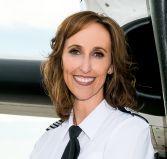
At 38, Heather McGonigal is Transwest Air’s director of flight operations, a training captain, and SAAB 340 line captain. Heather has always had a strong interest in aviation. In her high school years, her attainment of her PPL was financially assisted by a scholarship that she was awarded by the Ninety-Nines Inc. and also by working as a swimming pool
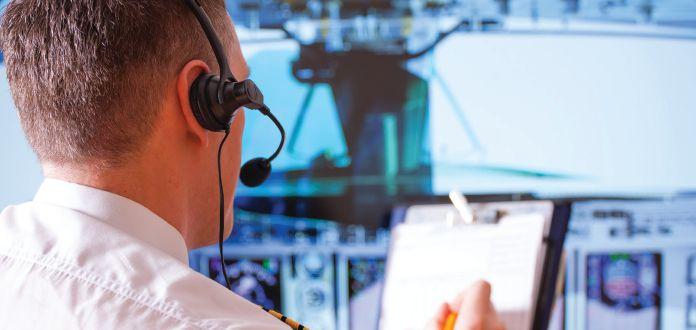
Upgrade your Commercial Pilot License and Group 1 Instrument Rating credential to become a Commercial Airline Flight Operations First Officer
It’s time to elevate your career to new heights with Seneca’s Airline Pilot Flight Operations Graduate Program.
• Gain the expertise to transition to a national airline First Officer
• Extensive multi-crew flight training in turboprop and jet flight simulation devices using LOFT models
• An opportunity to interview with Jazz Aviation LP (select qualified graduates) for direct entry positions
For more information or to apply: senecacollege.ca/fulltime/APF.html
Seneca: A national leader in aviation education for 45+ years.
lifeguard. She continued this work while completing a bachelor of arts degree and worked towards her CPL and Instructor Rating.
Heather accepted a job at Morgan Air in Calgary and was soon flying charters and teaching multi-IFR. She became chief flying instructor, and in May of 2000, accepted a Jetstream first officer position at Air Sask in Saskatoon.
Shortly after she joined the team, Air Sask and Athabaska Airways merged to form Transwest Air in September 2000. Heather was upgraded to a Jetstream captain and a training pilot and was promoted to the SAAB 340 four years later. She was further appointed to senior management positions, which she has now held for several years.
Heather’s ability to inspire loyalty and to lead others as part of a team approach to the organization’s operations is perhaps best illustrated in the development of Transwest Air’s SMS program. Under Heather’s leadership, Transwest was one of the first operators in its category grouping to develop and implement a viable SMS.
Heather takes a particular interest in mentoring young women who are interested in an aviation career. She also teaches Canadian Aviation Regulation classes at the
Saskatchewan Polytechnic Commercial Pilot Program in Saskatoon.
Heather is first vice-chair on the ATAC board of directors and is expected to become chair in November of this year. She would be the youngest chair and only the third woman to do so in the 80-year history of the association.
Heather is an excellent ambassador of Canada’s air transport industry and a strong role model for aviator’s everywhere.
NADON
TITLE: CHIEF FLIGHT INSTRUCTOR, MOUNTAIN VIEW HELICOPTERS LOCATION: CALGARY, ALTA.
At 35, Curtis Nadon is certainly well accomplished.
He currently holds the position of chief flight instructor (CFI) at Mountain View Helicopters
(MVH) at Springbank Airport in Calgary. Curtis holds a forest technician diploma, Commercial Helicopter Licence with a Class 1 Instructor Rating and is a pilot examiner and
approved check pilot.
Curtis’ Forest Technician education steered him towards a seasonal job as a fire ranger for the Ministry of Natural Resources in Ontario. As a fire ranger, he spent countless hours flying to and from fires in Bell 205’s – which sparked his initial interest in aviation. At 23, he decided to purse a career as a helicopter pilot.
Considerable industry research led Curtis to relocate from his home in Newmarket, Ont. to Calgary to attend MVH Flight School. After completing his initial training, Curtis was hired by MVH to fly tours at the Horseshoe Canyon in Drumheller, Alta.
After getting his start flying tours, Curtis’ flying career took off – literally. He landed a job in northern Alberta flying the R44 Helicopter for Gemini Helicopters, mainly in the oil patch. After a couple years, an instructor position became available at MVH. Curtis applied for and accepted the position, and was trained as a Class 4 Instructor. He achieved his Class 1 Instructor Rating in 2008 and in 2013, took over as chief flight instructor.
Curtis did not stop flying operationally when he began his flight training. MVH encourages instructors to work with other
companies in the summer to build their experience. Curtis accepted the challenge and now holds type ratings on a wide variety of helicopters.
At MVH, Curtis works with a team of five flight instructors to train the industry’s future helicopter pilots. His good natured, patient personality combined with a strong work ethic have made him an invaluable asset to MVH . . . and the industry.
NAME: FRANK NEUBAUER
TITLE: SENIOR POLICY ADVISOR, AIR POLICY DIRECTORATE, TRANSPORT CANADA LOCATION: OTTAWA, ONT.
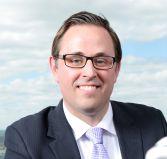
Frank Neubauer, 37, works in an environment characterized by high geopolitical stakes and significant implications for the Canadian aviation sector and the economy in general.
As a senior policy advisor – a role he has had since 2009 – Frank has consistently demonstrated a superb client service attitude, excellent judgment in his advice to
senior officials and ministers as well as great leadership and initiative.
Frank is an outstanding aviation professional who manages complex international files directly affecting the viability of the Canadian air industry. He was instrumental in conducting the multi-sector consultations that led to the development of Canada’s international air policy (called the Blue Sky policy).
Frank has worked closely with Canadian aviation industry associations in a number of capacities:
• Managing Canada’s participation in the Canada-European Union (EU) Joint Committee, a bilateral consultative body created under the comprehensive CanadaEU Air Transport Agreement.
• He is a lead technical advisor to Canada’s chief air negotiator for the negotiation of air transport treaties with countries around the world.
• He has been a key advisor to federal government negotiators regarding some aviation matters in the context of international trade negotiations such as the Trans-Pacific Partnership and the Canada-EU Comprehensive Economic and Trade Agreement
• He also leads the implementation of the


DTI has partnered with SafetyCulture to bring authorized workshops to North America on the ins and outs of iAuditor. This fully mobile app, can not only change the way you perform audits today, but can be a cornerstone to your QA in the future.
Canada-United States Open Skies Agreement and discussions on civil aviation matters with the Government of China Frank has consistently demonstrated exceptional dedication to his team, his department and the Canadian aviation sector. He proactively engages with stakeholders from Canadian airports and international carriers and is highly regarded for his expertise.
NAME: MIKE SPINA
TITLE: PROGRAM MANAGER, FIELD AVIATION LOCATION: MISSISSAUGA, ONT.
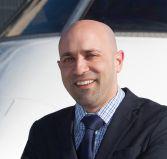
From an early age, Mike Spina, 34, decided to pursue a career in aviation. His passion for flying and aircraft would guide his education and eventually lead him into a career in the aviation industry.
Mike graduated from Georgian College in Barrie, Ont. in 2002, having successfully completed Georgian’s aviation management program. Upon graduation, he entered the

A consortium of highly trained and experienced professionals offering consultation and workshops in:
• SMS Gap Analysis
• QA Program Gap Analysis
• SMS, QA & Audit Training
• MCM & MPM audit & formatting
• SMS & QA Manual auditing
• Corrective Action Plan Assistance
January 3, 4 & 5, 2016 Coronado Springs Convention Resort, Disney World, Florida.
Three days of professional workshops and consultation featuring guest speakers Luke Anear, CEO of Australia’s famed Safety Culture Software Company and Joshua Yeamans, U.S. representative of the famous Iauditor software. Register today, space is limited. DTI contains the group to less than 100 invitees.
For more information about iAuditor and other workshops already scheduled please visit our website. www.dtitraining.com | 1-866-870-5490
commercial airline sector and over the course of the next five years, held various operational management roles with Air Transat, Royal Airlines and Jetsgo.
Mike acquired valuable operational, technical and commercial experience throughout this phase of his career and, after taking on ever-increasing management responsibilities, Mike decided it was time for a change in direction and sought interesting opportunities that would allow him to further develop his professional skills.
In 2005, at the age of 24, Mike joined Field Aviation, a company well known for its capabilities in the modification of aircraft for special mission applications. Mike joined the program management department at Field Aviation, where he continued to further develop his expertise and studied program management.
In his role as program manager at Field Aviation, Mike heads a team of skilled professionals involved in the design, fabrication, integration, testing and certification of modifications to aircraft that will configure them as highly sophisticated platforms operating in roles such as border patrol, maritime surveillance and search and rescue (SAR).
Mike has successfully managed a number of high profile and complex aircraft programs for Field Aviation in recent years, including U.S. Customs and Border Protection, Icelandic Coast Guard, Swedish Coast Guard, Australian Coast Watch and most recently, Boeing’s new Maritime Surveillance Aircraft. Integral to the overall success of Field Aviation is the contribution of talented aviation professionals, including Mike.
NAME: AMANDA SARGINSON
TITLE: ASSOCIATE, EMOND HARNDEN, LLP
LOCATION: OTTAWA, ONT.

Amanda Sarginson, 37, began her career in aviation 10 years ago as the sole human resources manager at First Air in June 2005. Amanda now practices law with Emond Harnden LLP and represents more than 30 aviation clients across the country.
As a member of the First Air team, Amanda never shied away from a challenge, was the chief spokesperson for negotiations with the dispatch group and supported the negotiation teams for the pilots, maintenance employees, flight attendants and ticket and cargo agents. She played an active role in the grievance and arbitration process for all of the unionized groups.
Ever seeking a challenge, Amanda made the difficult decision to leave First Air to conquer her next mission, law school. Excelling in this endeavour as well, she graduated on the Dean’s Honour List from the University of Ottawa in 2011. During law school, Amanda continued to work for First Air and joined Emond Harnden LLP as a student after her first year to deepen her understanding of the legal environment.
Amanda is now an associate with Emond Harnden LLP and provides employee and labour relations advice. Her practice includes assisting employers in hiring and terminating employees, drafting policy manuals, defending human rights applications, conducting investigations and representing the employer at mediation, arbitration and collective bargaining. She has also appeared before a Coroner’s Inquest, Human Rights Tribunal/Commission both federally and provincially, Small Claims Court, and the Superior Court.
Amanda is passionate about educating those in the industry. Over the past four years, she has provided numerous practical workshops to operators attending the annual conferences for HAC, NATA and ATAC.
LOCATION: TORONTO, ONT.
Since entering the aviation industry more than 10 years ago, John Tory, 35, has had a mindset of continuous improvement.
From the early stages of John’s career, the Pilatus PC-12 has played a key role in his development, and it remains a mainstay of his career as Toronto’s Private Air grows under his leadership. Private Air is a division of Levaero Canada, formerly, Pilatus Centre Canada.
A natural leader, John’s stewardship at the helm of Private Air involved guiding the company through the recent recession, and positioning the business for growth in its wake. A customer-oriented executive with a keen awareness of for strategic operations, John’s ability to apply big-picture strategic and political elements growth strategy and day-to-day operations helps give Private Air operational flexibility through customized client solutions.
John’s constant drive for improvement, growth and expanded capability have put Private Air on a growth trajectory across several areas of focus. John maintains his
commercial pilot rating and is active and proficient on the Pilatus PC-12.
John is a monocular pilot, having lost the sight in his left eye at the age of 14. And although his main role is president and CEO, he still flies in the line once or twice a month. He is also an active demonstration and training pilot. He has thousands of hours of flying time on the Pilatus PC-12 and has trained PC-12 pilots in a variety of roles including private, commercial, medevac and law enforcement.
In 2011, John was part of a relief mission with colleague Stan Kuliavas, vice-president of sales and business development for Levaero Aviation. The relief mission was organized when Attawapiskat, First Nation reserve was declared a state of emergency for poor living conditions. John flew a Pilatus PC-12 used for the mission onto a 3,500-foot gravel runway covered in ice and snow. John is an active volunteer in both the industry and his community.
LOCATION: FORT ST. JOHN, B.C.
Phil Wood, 38, is a licenced aircraft maintenance engineer at Bailey Helicopters Ltd. in Fort St. John, B.C. who grew up as a local farm kid 13 miles north of town.
Wood graduated from Northern Lights College AME program in 1998, and began his apprenticeship with Northern Mountain Helicopters (NMH), then onto Airborne Energy Solutions and Vancouver Island Helicopters (VIH) for the long term of 10 years.
Phil began his next career endeavour with Bailey Helicopters in 2012 starting as an engineer, moving into the position of the quality assurance manager and was then promoted to the position of director of maintenance. Building a team of hardworking, experienced and outgoing co-workers, Phil is a respected leader who has a positive attitude, exceptional work ethic and a good sense of humor to help conquer adversity.
All of Phil’s hard work, dedication and commitment have opened many more doors of opportunity along the way. Driving results forward, Phil is a confident, trustworthy leader committed to excellence and efficiency.
Bailey Helicopters has a very bright future with Phil and his maintenance team leading the way.
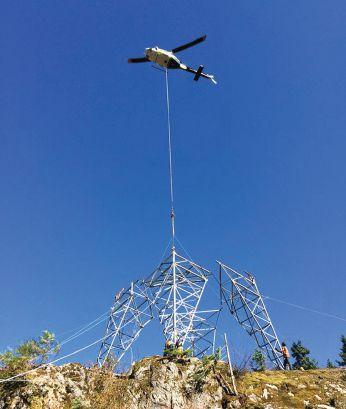
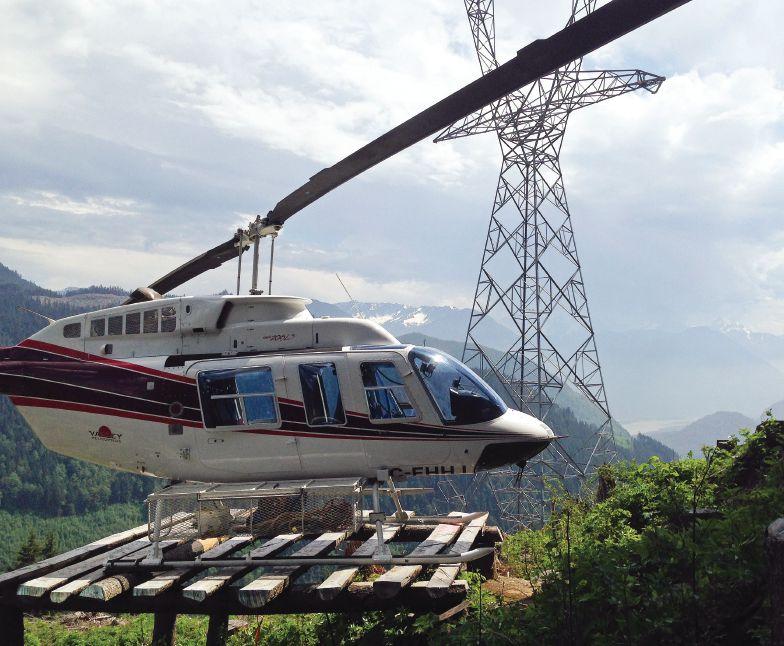
Below: A Mustang Helicopters’ Bell 212 delivers tower leg. (Photo courtesy of
BY PAUL DIXON
he history of electrical generation and distribution in British Columbia is a series of construction projects ranging from “big” to “really big.” One of the largest projects in decades is the new ILM (Interior to Lower Mainland) 500KV high-voltage line. The new line parallels an existing 40-year-old 500KV line on a 247 kilometre journey from the Nicola sub-station outside Merritt in B.C.’s Interior to the Meridian substation in the Vancouver suburb of Coquitlam.
TLike an advancing army of skeletal robots, 641 giant steel towers seem to march over towering mountain peaks and down across valley floors on their journey from the semi-arid scrubland of B.C.’s Interior down to the coastal rain forest. BC Hydro’s current power transmission system was built during the 1960s and ’70s. The ILM project is the first 500KV transmission line built in Western Canada in more than 25 years.
Most of the dams and generating stations in B.C. are located far from the population centres of the Lower Mainland and Vancouver Island. Expanding the capacity of the transmission system will
meet future demands for power on a wide scale, as B.C. is part of the Western Interconnect, an interconnected power grid serving B.C., Alberta, western U.S. states and parts of northern Mexico. Construction of the ILM is part of a forward-planning process looking ahead as far as 30 years into the future.
When the ILM is energized next year, it will be more than a decade since work first started on the project. Much has changed since the original 500KV line on this route was erected more than 40 years ago. While planners had the foresight to make the rightof-way wide enough to accommodate a second line in the future, there has been a significant shift in process since then. Environmental assessment took more than three years and the public consultation process which included 60 First Nations saw numerous court challenges before approval was finally granted.
Given the challenging geography of the province, helicopters are an essential tool in BC Hydro’s operations across the province. The utility has been proactive in implementing safety protocols to minimize the risk and maximize safety in helicopter operations for its employees, contractors and the public. Hydro’s Aviation
There was potential to drop the sockline into the river or the energized line and that would have been catastrophic.
Operations Department was recognized for its leadership role in aviation safety, with the awarding of the 2014 Back and Bevington Air Safety Award by the B.C. Aviation Council. The award is presented annually to an organization that “demonstrates the most significant contribution to air safety in areas like aircraft operation/ design, accident investigation/prevention, flight training, engineering and airport operation/design in the province of B.C.”
Devin Dukeshire, BC Hydro’s transmission field operations manager for the ILM Project, spoke with Helicopters about the thought and preparation that goes into every project. In the end, success is predicated on relationsips. “A lot of the (rotary) vendors are organizations we have used throughout the years and we’ve built those relationships,” Dukeshire said. “On this project, we’ve had multiple vendors and helicopters – lights, mediums, heavies and extremes, right through the whole project.”
At Hydro, all employees or contractors who use helicopters have to have basic helicopter training. “Basic training,” as Dukeshire explains, “is just to give people awareness, something more than a simple pilot refresher before you jump into the helicopter.” There’s a test that concludes the training as part of the rigid documentation process. The basic course is just that, intended primarily for anyone getting in or out of a helicopter. Beyond that, there’s multi-day training for everyone working in the wires, power
A Valley Helicopters’ Bell 206 LR with a newly erected tower. (Photo courtesy of Valley Helicopters)
line patrols, vegetation or aerial surveys in and around the power line system.
While this training is good for three years and applies to both contractors and pilots, it simply allows you to get into a helicopter and fly a patrol. Beyond that, Dukeshire notes, there’s specific training and sign-off for more complicated procedures. “We have more than 20 procedures in place, from installing sock lines, hover exit, touch and go, Class D – all that stuff. You have to be trained in that as well if you want to work under the helicopter or from the helicopter. The procedures were developed with the Field and Aircraft Operations people in our Work Methods Department.”
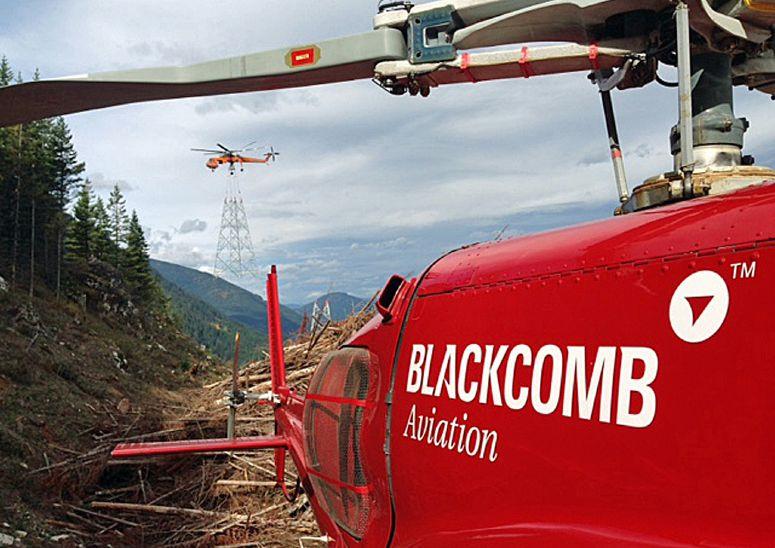
Andrew Bradley, vice-president of operations for Blackcomb Aviation, has considerable experience working with BC Hydro. When it comes to safety, they always take a leadership role. “They make sure what we are doing and what we’re supposed to be doing, is right. And not just us, but their own managers from BC Hydro as well. It’s always a work in progress.”
Brad Fandrich, general manager of Valley Helicopters, has been involved with the ILM project from its inception. Several types of helicopters and operators have been used, and it’s fascinating to see the various aircraft working in unison.
“There’s been a lot of different helicopter types, a lot of different operators and it’s certainly an interesting time,” Fandrich says. “Helifor did a lot of clearing of the right of way, so they were using their Vertol and flying fallers in with a 500. Mustang had a 214B doing legs and concrete work. Heliquest came in with a 205 and the K-Max for logging, hanging some glass and doing some legs. VIH had a Kamov doing legs and some other heavy lift such as excavators. Ascent has had a 212, Twin Ranger and 902 doing a lot of the wire in the towers.”
As for Valley, the company started moving crews of surveyors and archaeologists using its 407 and then focused on construction crews, slinging in diesel fuel for their excavators, wood for the forms, then the concrete. Once the foundations were done, Fandrich says, the steel went up and Valley started flying sock line. “We’ve pulled 90 per cent of the sock line for the wire that’s up so far and now we support the crews working on the dead end towers, flying in nuts and bolts. We fly the spacers up to the guys in the carts.”
Every job in the Hydro universe, every lift, every little detail, goes through a booking process. On the IML project, every request or booking for a helicopter goes through Dukeshire or his designate. “We select the helicopter based on the task,” he says. “Then we pick a pilot that has the hours associated to the task we’re doing. We fill out an approval form, a booking list and then we send it through to our aircraft operations department and they will vet it. They make sure the operators are approved for the task and that they have the hours associated to the task, whether it’s
long-lining, changing insulators or whatever it might be. Then they double-check the helicopter to make sure it meets the requirements for the lift.”
That’s the process for every movement on the project. In terms of matching pilots to the work crews on a job, this process is equalling precise. “They are very, very particular,” Fandrich says. “When they get a pilot they’re comfortable with, they want to take the same days off. We try and give them a couple of pilots they can work with, we don’t just randomly select pilots.
“On a bigger scale, when we have the Erickson Skycrane, we actually build a flight plan. We vet every single pick that goes through aircraft operations for approval as well. Elevation, weight of the load, all the stuff we’ll be faced with out in the field.”
The most challenging section of the project is around Spuzzum in the Fraser Canyon about 30 kilometres northeast of Hope. Some 80 per cent of the work in this section is done by helicopter only, as towers in this section are much bigger than anything used previously by BC Hydro, Dukeshire says.
“They are known as 10J structures, which weigh more than 200,000 pounds,” he says. “They are perched up on top of bluffs where there is no way to get cranes or trucks up there. We had to figure out how to break that tower down so we could fly it with the Skycrane in 20,000 pound loads.”
Hydro engineers worked with Erickson’s engineers and devised a way to break the tower down into 12 pieces. Six different helicopters were used to move these parts at once just for this portion of
the project: a 212, 214, 902, Skycrane, 407 and an AStar. The coordination was a challenge, trying to coordinate it all with the pilots.”
What made this phase of the job even more challenging was there were men up working in the steel, catching and bolting every piece that came in, leaving no room for error. Dukeshire is unreserved in talking about the skill level required of the pilots to allow him to put his workers up on the steel.
“There are 15 to 20 men up a tower who were catching 20,000 pound pieces of steel with very little room for error,” he says. “There was a great deal of confidence in those pilots. Every tower and every site is different, there’s no common ground and it was really good.”
Adding to the safety factor all Hydro’s people up on the towers are Class D, which has become the norm within BC Hydro for people working anywhere on the transmission system. As Dukeshire points out, most of the work takes place in remote locations, making Class D rescue the only viable way of attending to injured workers who otherwise couldn’t be removed from a job and moved to first aid or flown direct to hospital.
For the ILM project, Blackcomb Aviation has had its A355N involved in the process on a daily basis on standby rescue service. Blackcomb does more work with BC Hydro on an annual basis than any other operator. Bradley says his team is doing a little bit of everything.
“We do tough and goes, putting guys on top of towers by touch and go, slinging them spacers on the buggies. We’ve been there every day, almost 10 months. The A355N is certified to do the tough and go and has the oomph to sling a lot of gear around.”

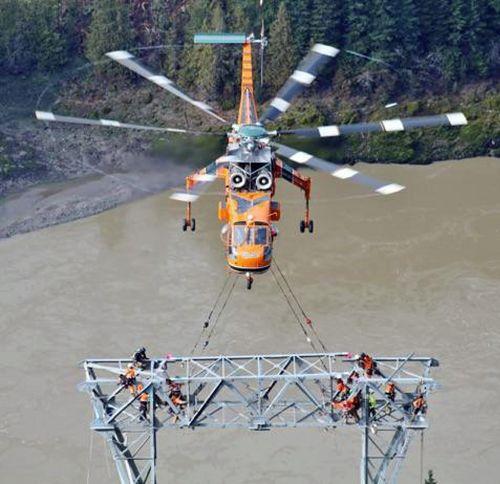
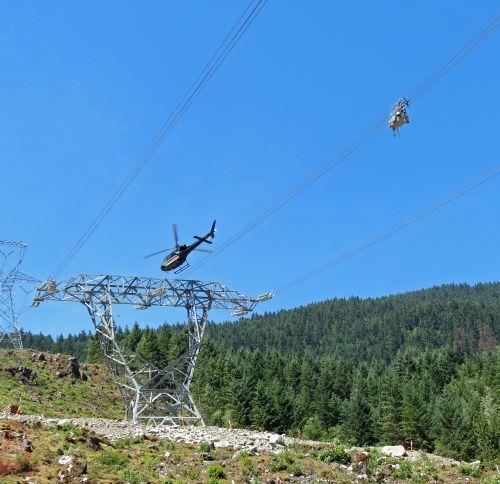
Trent Lemke, president of Ascent Helicopters says his operation has also been busy on the project since its inception, with up to five aircraft working at any one time on various jobs. Lemke has been flying his 902 as a spotter for the Aircrane, with a foreman from Hydro and someone from Aircrane with him to confirm that the load has been set properly before they release it. Lemke describes another Ascent specialty.
“We have a 212 that’s hoisting linemen onto the structures on a full-time basis, 12 hours a day, seven days a week,” he says. “These towers are very tall towers, the two outer phases are 60 to 70 feet below the centre phase. By hoisting, they can move people around without them having to climb up and down. It’s really saved the productivity of the program, using the hoist. This is the first time that hoisting has been used on such a large-scale project. I think we’ve done close to 10,000 hoists on this project. The numbers are staggering and it has proven itself.”
to be strung above.
“It was a pretty nerve-wracking scenario,” Dukeshire recalls. “We weren’t allowed to shut down the railroads when we were flying sock line and their lines are active all the time. The 500KV line was deenergized, but we couldn’t de-energize the 60KW line. There was potential to drop the sockline into the river or the energized line and that would have been catastrophic.
“When we flew the line, the pilot in the 212 had to take it up really, really high because the bag of the line is well below the helicopter. He had to take it up and then basically hit the brakes on the baby line puller, and then the pilot had to guide it down through into the tower. The pilot had to be aware of how high he was and how far he had to go back down to the tower without letting too much line out to back into the energized circuits or the river.”
There are five major river crossings along the ILM. In one section, Dukeshire says that due to access issues, there was a 10-kilometre sock line pull by helicopter. “There were very unique scenarios that we had never seen before in British Columbia.”
Given the challenging geography of the province, helicopters are an essential tool in BC Hydro’s operations.
If the Spuzzum section as a whole is the most challenging, there is one section where the line sweeps down from a mountain top, plunging deep into the canyon below before rising on the other side. Dukeshire says it’s more than 1.1 kilometres between pylons here, as the lines cross the Fraser River, the Trans-Canada Highway, CN Rail on one side of the river and CP on the other. Then there’s a second 500KV line, as well as a 60KV line, that the new line has
Dukeshire is effusive in his praise of everyone involved in helicopter operations on the ILM project. He stresses that there were multiple levels of support every step of the way by the pilots and their aircraft. “They work long hours and they are there every day,” he says.
For Fandrich, it’s been impressive to watch the process as it has all come together. “The air crews have been remarkably professional with each other, a very good team job between the air crews for most of it. The guys that are doing every task are at their A-game, they’re at the top of their careers right now.”
Fandrich’s sentiments have been echoed by everyone involved in this project – a professional group of operators, pilots and personnel dedicated to a common, powerful goal.
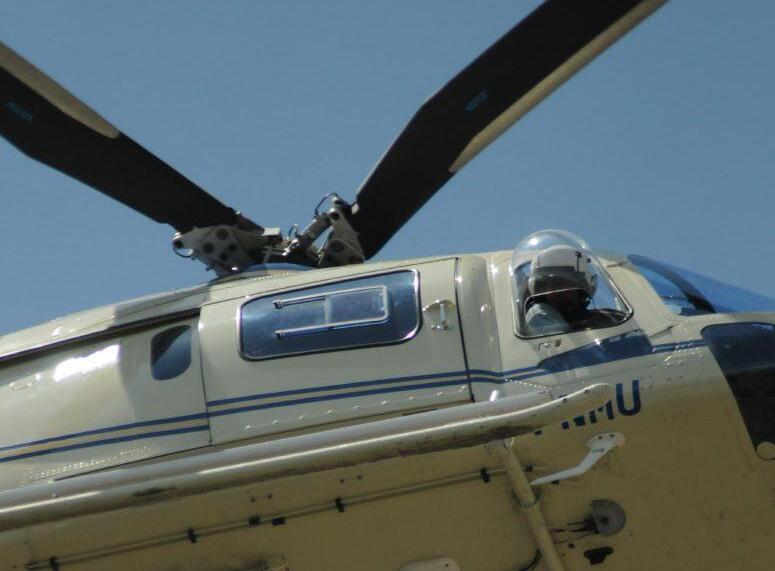
Left: The AW119’s bubble cutout window was a real benefit on this mission. (Photo courtesy of Chartright Air Group)
Below: Veteran pilot Bill Hofstede at the controls. (Photo courtesy of Chartright Air Group)
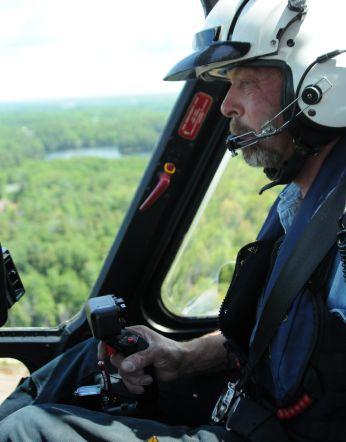
BY MATT NICHOLLS
Ontario’s Muskoka District truly is one of the province’s most unique geographical locations and quite worthy of its occasional billing by National Geographic magazine as one of the world’s most desirable spots to visit.
Covering an area of some 6,475 square kilometres, the region is home to more than 1,600 lakes, countless islands and vast places to explore and unwind, an area dotted with picturesque towns, villages and farming communities. It’s also a popular location for cottagers, as many southern Ontario residents flock out of their concrete southern Ontario lifestyles each summer for a weekly pilgrimage to the tranquility and peace of the near north.
The landscape is thick with water, rock and acres of forests, making it an ecological paradise – one residents and visitors alike not only cherish, but are quick to protect. Generations of families have enjoyed and inhabited this area for years in their lakeside homes and cottages, and they are very protective of their individual pieces of tranquility, especially when new construction projects begin to take shape.
So, when the team at Toronto-based Chartright Air Group was approached by one of its clients this spring to use an AW119 Koala to partake in an aerial construction project on a Muskoka island, it presented a unique opportunity for the company. Chartright is a leading Canadian charter and aircraft management firm for both fixed and rotary wing aircraft. This marked the first time a client had asked Chartright if it could handle an aerial construction project – with a
high level of environmental sensitivity to boot.
The project spelled great opportunity. Successful completion could possibly create new opportunities for aerial construction work down the road, and open a new revenue stream for both clients and the firm.
“Aerial work isn’t something Chartright does as part of our core business model, but the thing that is part of our business model is making our clients happy,” says Chartright’s rotary wing chief pilot Sean Carscadden. “If we have a client that is interested in getting into aerial work, we will find a way to do it.”
The project involved long-lining construction materials to a remote island in one of the popular Muskoka locales. However, the job was anything but routine. Several of the established buildings on the island needed to be dismantled and pre-fabricated panels for new dwellings needed to be brought in, including building materials, floor panels and more. Mature trees dotted the island, meaning precision and care were paramount – it was a very skilled operation that would take sensitivity and a delicate touch, not to mention an aircraft that could deliver maneuverability, power and flexibility.
“When I first looked at the project, I conducted an aerial reconnaissance in the AW109 that I fly. I was quite concerned about the confined areas we were going to be working in, especially for bringing in big panels,” Carscadden said. “Due to the delicate nature of the job and the required level of precision, we decided we would hire some outside help.”
The outside help turned out to be Bill Hofstede, a veteran longlining specialist, who works as a contract helicopter pilot. The former chief pilot at Questral Helicopters has more than 7,500 hours of longlining experience and more than two decades of flying experience. He was eager to take on the challenge of negotiating the construction materials through the trees and other obstructions on the island.
But before he could jump in and start, Hofstede needed some critical background training and education on the AW119 Koala. He was not familiar with the machine having worked mostly on AStars the majority of his career. After roughly a month of study and flying with Milos Kapetanovic, Chartright’s AW119 training captain, he was ready to go.
“I had to get an endorsement on the Koala to fly it, so flying a new machine in such a precise environment was definitely a challenge for me,” he says. “But as far as long-lining goes, it was somewhat similar to other machines. I was familiar with the fully-articulated rotor head which made it easier, but all the controls were different.”
Hofstede admits he also had real reservations about the job at first, but quickly found he was embracing the precise nature of slinging loads through very tight confines. It certainly put his flying skills to the test and made coming to work a very positive experience.
“I think the most challenging aspect of this job was the precision and the winds, just making sure you negotiated properly in between the trees,” he says. “They were also building a new house beside this spot so they had the framework up. If you are coming in with a 2,000-pound beam, you don’t want to have any swing and knock things out.”
Carscadden says he was very impressed with the way Hofstede picked up the nuances of the AW119 and excelled in all aspects of the task at hand. “Bill did a great job negotiating the trees and dealing with all of the elements,” Carscadden says. “He was able to put those loads

carefully through the canopy and work them between the branches over top of each site and get them to the crew on the site efficiently and safely.”
Like many major construction projects, there were adaptations along the way that helped make elements of the job go smoother and safer. For example, when the team initially surveyed the project, the thought process was that a 120-foot line would be enough to get the construction materials to the site. The team soon realized, however, this wouldn’t be sufficient. Extensions to the sling were added, Carscadden explains, so they could make it as long as it needed it to be for each individual load and delivery site.
In addition, some of the sites where buildings needed to be refurbished were inconsistent – there were topographical changes on the island. The scope of the project was basically that all of the buildings on the island were to be demolished and rebuilt, he says. “All told, we had five different delivery sites, but there might have been eight buildings reconstructed. In the end, we moved 128 tonnes of material and with some 255 loads to the island, a considerable amount of flying time. It was all done within 21 working days.”
The workhorse for the job was an AgustaWestland 119 Koala and according to Carscadden, it profiled well for the task at hand. The machine had just the right amount of power, maneuverability and lift to ensure all elements of the project were done to specifications.
“The Koala did a great job,” he notes. “Once Bill was able to get the loads of rocks up above TL, the loads flew great but when he was dealing with the big floor panels, he had to stay at or below TL to ensure the loads didn’t catch too much wind. In that regime of flight, there was quite a bit of vibration in the Koala; however, visibility, the ability to see the load, the aircraft’s ability to manage power – it was all impressive.”
Hofstede agrees, adding that once he got the nuances of the AgustaWestland’s layout and internal structure down, it was more than efficient. “It is quite a bit different than what I am used to,” he says. “It has a lot of speed, and has some vibration at slow speed, but it is a nice machine for hovering. Once you slow it down it is nice and smooth.”
Other features that helped included the bubble window with the cut out – “which provided plenty of visibility,” Hofstede says – and also the cargo hook from Onboard Systems, which provided reliability with the various loads. “I was very happy we had the hook on there. These hooks are reliable and they do not open up for unknown reasons.”
The Chartright team is always putting safety first and this project certainly fit that perspective, Carscadden notes. Whether it was ground operations or the actually long-lining aspects themselves, there was special attention all around.
“Since we were working a single-engine aircraft and heading out to an island, we wanted to ensure that Bill was always within auto-rotative distance from shore. Our biggest spacing was about a quarter of a mile between the islands,” he says. “Certainly from where we flew, he could always auto-rotate to a shoreline, but you are over densely-treed country the whole time – there were few big open areas. So, we had a few places that were identified as emergency landing zones. About half of the route was over land and there was a golf course nearby as Bill was departing with the loads from the Port Carling airport. There was also an open field on some private property next to the island that could be used in an emergency situation.”
When the team started the project, there was ice on the water and an ice road had been built to bring some of the material to the site. There were additional emergency landing spots along the route. But a big concern, Carscadden noted, was once the ice became too soft to land on,
how were they going to get to the helicopter if it partially or completely breaks through the ice? Fortunately, the owner and contractor both had airboats and a hovercraft, so one was on standby all the time so the ground team could respond quickly if such an accident was to occur. Once the ice was cleared off, a safety boat was ready if something happened on site.
Other safety concerns on site included the size, shape and rigging of the loads – some as heavy as 2,000 pounds. Kapetanovic was delegated supervisory responsibility of the helicopter operation, and he remained at the pickup site to ensure airworthiness and the rigging of each load – no simple task on some occasions. There was also a trained team of load handlers. “If Bill was placing an 1,800pound floor panel and someone’s hand got pinched between the load and the foundation – we just had to make sure to be careful. This was the biggest concern, just making sure both the pick up and drop off were well executed and everyone was safe. Nobody was injured, no loads were lost or dropped, and there was no damage to the delivery site. So it is positive to see everything was properly taken into consideration.”
The ultimate success of a project can be realized when both the client and the employees are not only satisfied with the outcome but with the process in which it was achieved. Such is the case here. Win-win-win is the best way to describe the end result.
“Every time I called him (the client) when I was doing my due diligence, to ensure the story I was getting from Chartright personnel was consistent with that of the customer, they were just raving about it,” Carscadden says. “They were amazed at Bill’s skill in maneuvering the helicopter to bring the load down and stabilizing any rotation in it, easing it up to allow the guys to come in and work with loads, and place it precisely where it was required. Watching Bill fly the helicopter from below, you could definitely see the high level of skill he had.”
For Hofstede, the chance to hone his skills in a new environment on a new machine was an experience he won’t soon forget. “This is one of the most interesting jobs I have ever had,” he said. “It was tense and fun, but very gratifying. I am very glad to have done it.” DAYS OF OPERATION: 24
WE GET IT: Downtime is not an option. You deserve an MRO service partner who’s committed to getting you back in the air. We are StandardAero, ranked #1 in customer satisfaction and the M250® repair and overhaul expert. Find out how we can keep your M250-powered fleet in the air working for you. Visit us at www.standardaero.com/heli
BY CARROLL MCCORMICK
The superb facilities at Transport Canada’s Motor Vehicle Test and Research Centre (MVTC) have much to offer the aviation industry, argues PMG Technologies, which manages the MVCT. To that end, PMG has joined the Consortium de recherche et d’innovation en aérospatiale au Quebec (CRIAQ) which facilitates collaboration between aerospace companies.
To introduce its capabilities to Quebec’s large aerospace industry, MVTC hosted a CRIAQ research committee meeting, at which members presented projects they are working on. Members also got the cook’s tour. They watched a car impact test on the 200-metre long indoor track. Technicians demonstrated the Hi-Ge sled, which can accelerate a 3,000-kilogram (6,600 pounds) payload to a G-force of 92 in less than one metre (3.3 feet). Members also saw the crash test dummy workshop, environmental chambers and other test equipment.
MVTC joined CRIAQ in March 2013. “We became a member to be closer to the industry and to be able to offer our solutions to CRIAQ members and to support their innovations,” explains Claude Sauvageau, vice-president of testing and capital projects at PMG Technologies.
CRIAQ lists 53 industry members, 21 universities and research centres and 11 associate members. A not-for-profit organization, it is funded primarily by industry, the National Sciences and Engineering Research Council of Canada and universities. The Quebec government funds committee meetings. “Our role is to bring together and help [members] build collaborative building projects. CRIAQ [also] helps fund the projects themselves,” says Clément Fortin, past president and director general, CRIAQ, and senior advisor to the president at Skolikovo Institute of Science and Technology (Skoltech).
Every two years CRIAQ holds a research forum, attended by as many as 1,000 people. This forum included 200 delegates from 15 countries. In essence, CRIAQ is a speed dating R&D service to aerospace companies looking for project partners and collaborators.
“It brings together context, objectives, and partners you are looking for. Each company presents three slides,” Clément says. “At the end of the day, it signs a non-disclosure agreement with interested
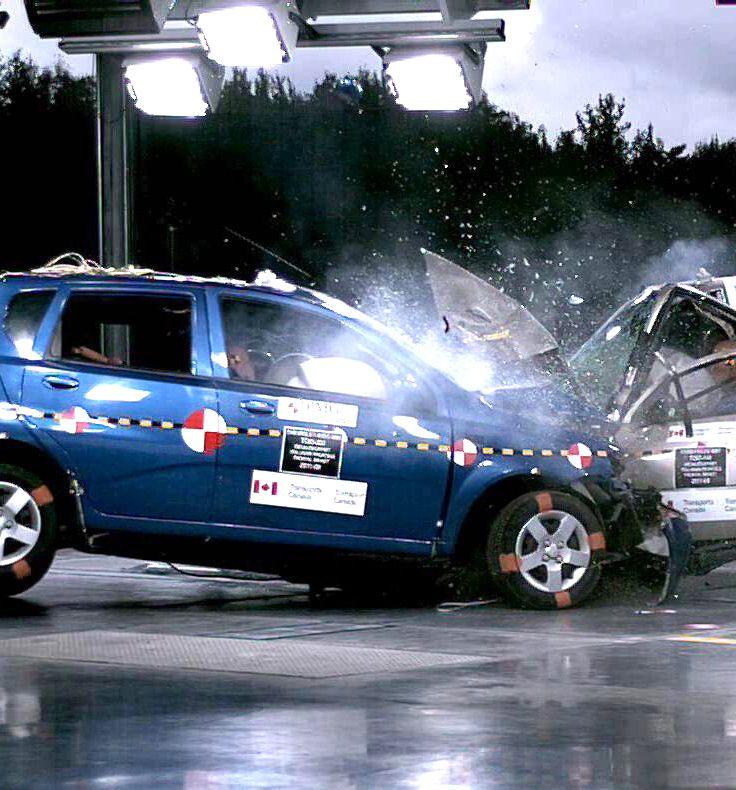
partners. Now PMG can come to the research forum and say, ‘We’d like to collaborate.’ ”
Since PMG began managing the MVTC in 1996, Transport Canada (TC) has invested $50 million in infrastructure improvements. It asserts that it has the most accurate and reliable test facility in the world. Automotive Testing Technology International agrees. In 2012 it selected MVCT from competitors from around the world for its Crash Test Facility of the Year Award.
“We are capable of doing things that are far better than some other facilities,” Sauvageau says. PMG already has a history of doing research for aerospace companies: Rolls Royce, Pratt & Whitney Canada, Bombardier, Bell Helicopter and Sikorsky. In OctoberNovember 1996, for example, Sikorsky did cold start tests at -40º Celsius.
The smaller of two environmental test chambers measures 3.4 m wide x 7.2 m long x 3.0 m high (11 ft. x 23.5 ft. x 9 ft. 8 in). Rated at 30,000 BTU an hour, it can be cooled to -40 degrees Celsius (-40 Fahrenheit) within three hours. It has a temperature range of -55º C to +85º C (-67º F to +185º F). Temperatures can be set and maintained to an accuracy of plus or minus 0.5º C (± 1º F).
The larger environmental chamber measures (6.4 m wide x 16.5 m long x 4.2 m high (21 ft. x 54 ft. x 13 ft. 9 in.) The doors are 3.2 m wide x 4.1 m high (10 ft. 6 in. x 13 ft. 5 in.). It is rated at 444,000 BTU an hour and has the same temperature range and accuracy as the small chamber.
An impressive fact about the refrigeration units for the environmental chambers is that they can maintain a constant temperature with a jet engine running inside; e.g., -40º C, in a P&WC study.
Between 1996 and 2011, Bell did a number of tests in the environmental chambers: M 407 and M 427 certification cold soak testing for -40º C; Canadian Forces Utility Tactical Transport Helicopter testing on DC/DC converter after cold soaking to -25º C; and M 407 GX Certification cold soak testing for -40º C.
There was also the snowfall study, Sauvageau recalls. “We did a test for Bell Helicopters. Normally, air conditioning is done by taking air from one of the engine’s compression stages. If the ambient humidity is very high, when the humid air is uncompressed to cool it down, the water in the air will freeze, and it will snow into the
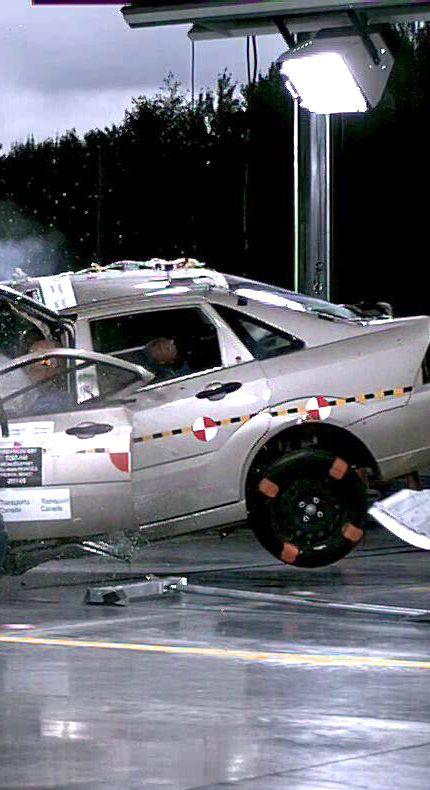
Cameras at the MVTC can take 1,000 four-megabite images per second. (Photo courtesy of PMG)
aircraft. We simulated the humid air, compressed and heated it, and uncompressed the air into Bell’s ducting.”
Bell Helicopter speaks highly of the equipment at the MVTC. “Clearly the facilities at PMG are world class,” Textron’s manager of corporate communications Brian Bianco said. “Bell Helicopter has been a client of PMG’s excellent cold chamber environmental test facilities, so their capabilities are well known to Bell Helicopter and are valued. Further, we did consider using the PMG facility to perform wheeled landing gear “drop tests”; i.e., tests with the aircraft raising up off the ground while we deploy the wheeled landing gear as part of the validation testing of this new landing gear system."
PMG’s market research suggests that aerospace clients might also
To be awarded at the Annual General Meeting & Convention of the Air Transport Association of Canada in Montreal, Qc from November 2nd to 4th.
e Award recognizes and honours a ight instructor, either xed or rotary wing, who has made a signi cant contribution to safety in Canada, also having demonstrated superior teaching skills.
Jane & Rikki Abramson established this Award in 2003 through Air Transport Association of Canada, and will personally present this year’s award. e recipient's name will be engraved on the prestigious perpetual trophy and entered in the associated logbook, both on permanent display in the Canada Aviation & Space Museum in Ottawa.
Generously supported by:



Nominations can be made at any time throughout the year, prior to the deadline of September 14th, 2015
For entry requirements contact Jane Abramson, Founder & National Administrator
Phone:
450-458-3164
Fax: 450-458-5245
Email: janeabramson@videotron.ca
be interested in using the Hi-Ge sled for testing aircraft structures. It can accelerate payloads on its 3.5-m x 1.5 m platform (4.9 ft. x 11.5 ft.) to a maximum g-force of 104, with a peak energy of 678,000 N-m (500,000 ft. lb.).
MVTC’s family of sensor-packed crash test dummies, ready and willing to sign on to any ride, can collect occupant data. “I have seen photos of cockpits with dummies installed in the seats. Our competitors are getting business from the aviation industry, so we should be getting that Hi-Ge sled business. Maybe plane manufacturers would want to do it at PMG,” Sauvageau says.
“Crash testing of full-scale helicopters helps engineers design helicopters to increase survivability for impacts on a variety of impact surfaces, including hard-paved surfaces, soft soil and water," Bianco says. "Most notably, the helicopter industry conducts crash testing on all energy attenuating seating systems installed in modern helicopters. The objective is to design the seating system to help protect the occupant’s lumbar spine from injury during a vertical crash as well as protecting the occupant from head injury during a forward crash."
“One of our roles is to bridge that automotive testing with aviation testing,” Clément says. “It’s about learning to work together and find collaboration.” The trick, he adds, is for PMG to find its place among aircraft testing facilities. “It is a matter of PMG finding the sweet spot. I’m sure that with crash and environmental chambers testing, they can do things. It’s obvious.”
Noting that manufacturers could do their testing at home rather than in the United States or Europe, Sauvageau says, “We want to be able to offer a state-of-the-art solution to the aviation industry, while reducing the cost of their business.”







The rate of change in the field of avionics is so fast that even the legislators are struggling to keep up with it. With new digital cockpits, it is getting to the stage that, if your VCR still flashes 12:00, you will have no business flying a modern helicopter!
The majority of twin-engined (and many singleengined) aircraft now have complex autopilots, glass cockpits and navigation equipment, possibly including Flight Management Systems (FMS).
This book originated with a request from the RCAF for training materials for engineers, but curious pilots whose training syllabus did not include avionics, and who would like to know a little more will find it useful as well.

FRED JONES
Afew years ago, I was working off at a camp in northern Quebec for a major multinational mining company.
The camp was one of the best I have ever been in. Two five-star chefs, warm waterproof accommodation, pleasant customers and hot showers. I didn’t want to go home.
Every week or so, a Dash 8 would arrive at the airport about 50 miles from camp to re-provision the camp and change out some crews. All four machines in the camp (Two AStars and two Long Rangers) would meet the Dash 8 at the airport and long-line the groceries, supplies and equipment back to camp. On this day, the two AStar pilots were headed home and two fresh pilots were shipping in.
It was a beautiful summer day in July, and three of us had landed at the airport in advance of the Dash’s arrival. I had shut down the Long Ranger that I was operating, and one of the AStars landed about 60 feet away, and had started his short cool-down. The pilot had closed the throttle and was about 30 seconds into his spin-down when the second AStar announced its arrival and quickly did a nohover landing from behind the first AStar – close beside him. When the dust cleared, both machines were tied-down and we waited for the arrival of the Dash-8 and the new AStar drivers.
When the airplane arrived, we spent about an hour helping to build the loads for the trips back to camp, and two of the AStar pilots
Getting More Involved May Well Help Prevent an Accident
significant. The incident was sobering, particularly in the context of an otherwise perfectly pleasant last-day-of-the-tour for two of our pilots.
I must confess that I have a habit of asking myself repeatedly what could have been done to prevent this event from occurring:
• Could I have waved-off the second AStar as it was on the approach to land?
• What prompted the arriving AStar pilot to land so close to the first aircraft while its blades were still turning?
• What prompted the arriving pilot to land so close when the entire ramp was otherwise empty?
• What prompted the arriving AStar pilot to land so close without knowing if the throttle had been closed or if the pilot of the aircraft on the ground was ready for another arrival in close proximity?
• Why didn’t the out-going pilot identify the deficiency in his post-flight turnaround inspection of the aircraft?
• Should the company have had a policy on the landing of aircraft in close proximity to one another if there are better less-proximate alternatives?
• Finally, the most chilling question is, what could have happened if damage to the tail rotor drive shaft had gone undetected?
So often in our business, we feel driven by operational pressure and we feel rushed.
prepared to board the aircraft home. One of the arriving AStar pilots started his pre-flight, and he identified a flat spot on the top aft section of the tail rotor drive shaft cover.
As it turns out, we finally concluded that the downwash from the arriving second AStar had caused one of the slow moving main rotor blades of the first AStar to flap down and strike the tail rotor drive shaft cover. In all of the dust and noise of the arrival, the blade-strike had gone undetected. An engineer was immediately called to inspect the blades, the drive shaft cover, and the drive shaft for damage –fortunately there was none however, the potential for disaster was
So often in our business, we feel driven by operational pressure and we feel rushed. I would argue that ideal circumstances and the absence of operational pressure can be just as dangerous because we least expect problems to occur. I would also argue that it can be just as dangerous – maybe more dangerous – when we don’t expect problems to occur and we let our proverbial guard down. We need to stay aware of circumstances that occur around us even when we are not directly involved and even when circumstances are ideal. What’s more we need to resolve to ourselves to become involved in the events that are occurring around us, even if there is a chance that we could be wrong – and they do not require our intervention. There is a very real chance that your involvement could prevent an accident or incident from occurring.
Fred Jones is the president/CEO of the Helicopter Association of Canada and a regular contributor to Helicopters magazine.
20th Annual HAC Convention & Trade Show
November 13-15, 2015 Vancouver BC
Canada’s Largest Helicopter Industry Event Reaching the Operators of the World’s 2nd Largest Commercial Helicopter Fleet
30,000 Square Feet of Exhibit Space
The World’s Leading Manufacturers & Suppliers
Professional Development Courses & Technical Briefings









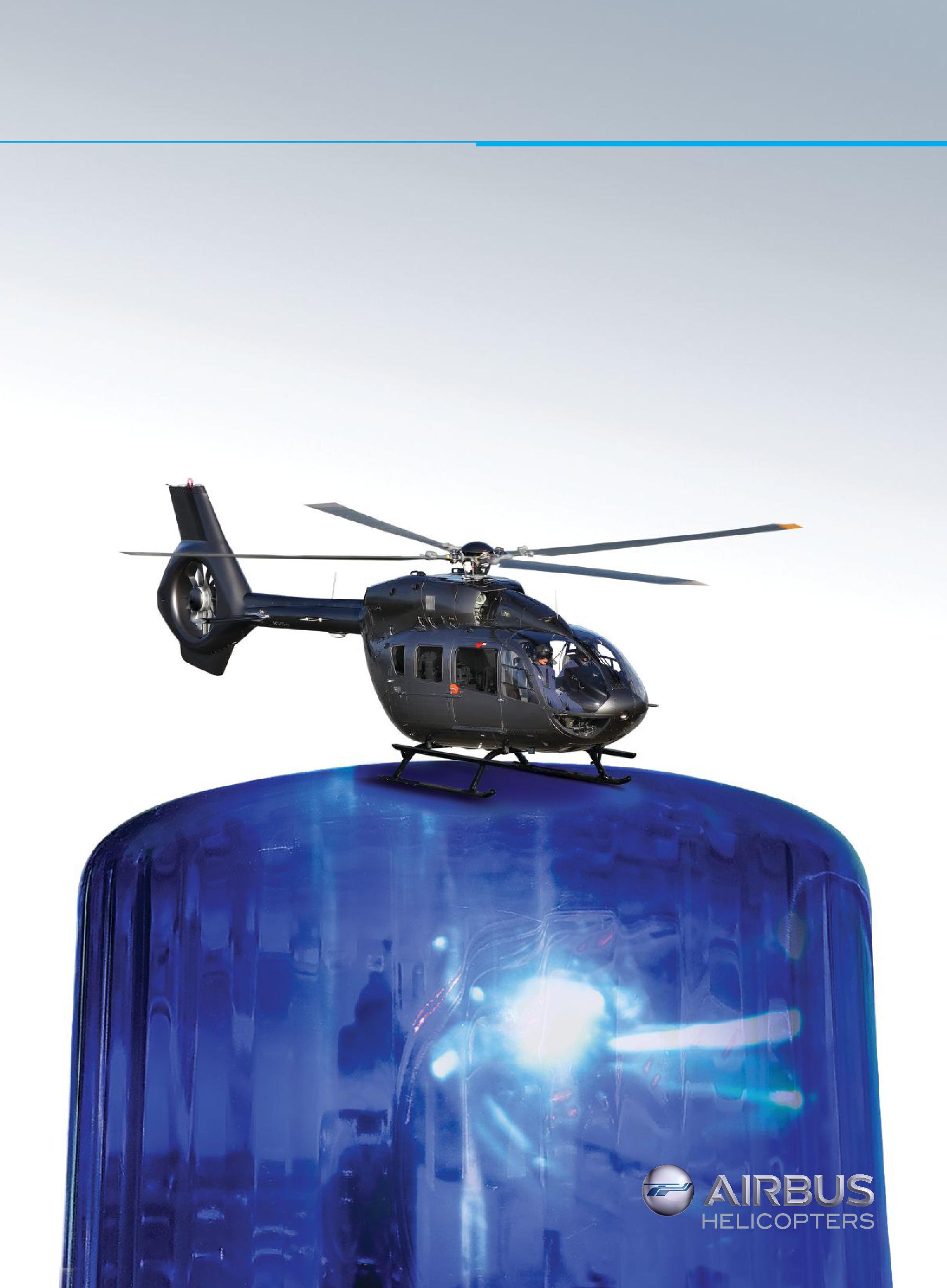
Airbus Helicopters is Canada’s preferred supplier for law enforcement aircraft. Law Enforcement agencies around the world count on the reliability, performance and efficiency of Airbus Helicopters rotorcraft for their critical missions every day. The H145 is always “ready for duty,” capable of being equipped with a modern mission management system for a variety of police operations. It offers unmatched versatility and flexibility for enhancing public safety. Issue an H145.