SWITCHES: Solid State Relays • Contactors and Overloads • Soft Starters • Definite Purpose Contactors • Mini Circuit Breakers • Electromechanical Relays • Pushbuttons and Pilot Devices
CARLO GAVAZZI has the solution for your application needs, whether it’s our industry leading solid
energy meters, contactors, motor controls, monitoring relays or sensors, now available with IO-Link communications.
CONTROLS: Energy Meters • Current Transformers • Transducers • Power Supplies • Panel Meters • Time Delay Relays • Current-, Voltage- and Phase Monitoring Controls
BACK AND FOURTH
Canadian conveying systems stalwart set to reap the market share rewards of joining a fast-growing packaging OEM powerhouse
By George Guidoni, Editor | Photos
By Naomi Hiltz
While it may be true that corporate mergers and acquisitions are often a leap of faith in any growing global and dynamic industry, including packaging equipment manufacturing, it’s also true that the ultimate success of such transactions is rooted in the quality of due diligence, strategic acumen and mutual goodwill at the earliest preliminary stages of the process. In this light, the recent acquisition of prominent Canadian conveyor manufacturer Descon Integrated Conveyor Solutions by the U.S.based Pacteon Corporation (www.pacteon. com) already seems like a win-win proposition for all parties concerned, on both sides of the Canada-U.S. border.
Formalized in late June, the smooth and amicable transaction makes the renamed
Descon Conveyor Systems the fourth core pillar of a fast-growing end-of-line packaging machinery powerhouse that also includes wellknown industry players such as:
• Schneider Packaging Equipment Company, Inc., Brewerton, N.Y.-based manufacturer of case-packing, robotic palletizing, case sealing, automatic guided vehicles, material handling solutions, and completely integrated lines for customers in the food, beverage, plastics, dairy, manufacturing and paper industries.
• ESS Technologies, Inc., Blacksburg, Va.based specialists in complete packaging line design, equipment manufacturing, and integration for the pharmaceuticals, nutraceuticals, cosmetics and consumer packaged goods industries, renowned for its integration expertise with cartoners, case-packers,
Pacteon Corporation’s chief executive officer
Mike Odom brings more than 20 years of experience in senior management positions at leading packaging and manufacturing enterprises to help the company continue rapid growth in the end-of-line packaging machinery markets.
robotic palletizers, integrated track-andtrace, robotic pick-and-place, and other end-of-line robotic equipment.
• Phoenix Wrappers , Laval, Que.-based manufacturer of automatic and semi-automatic stretchwrap packaging, pallet wrapping machinery and pallet conveyors.
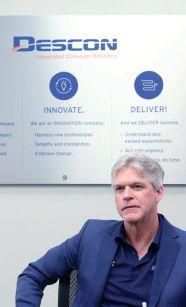
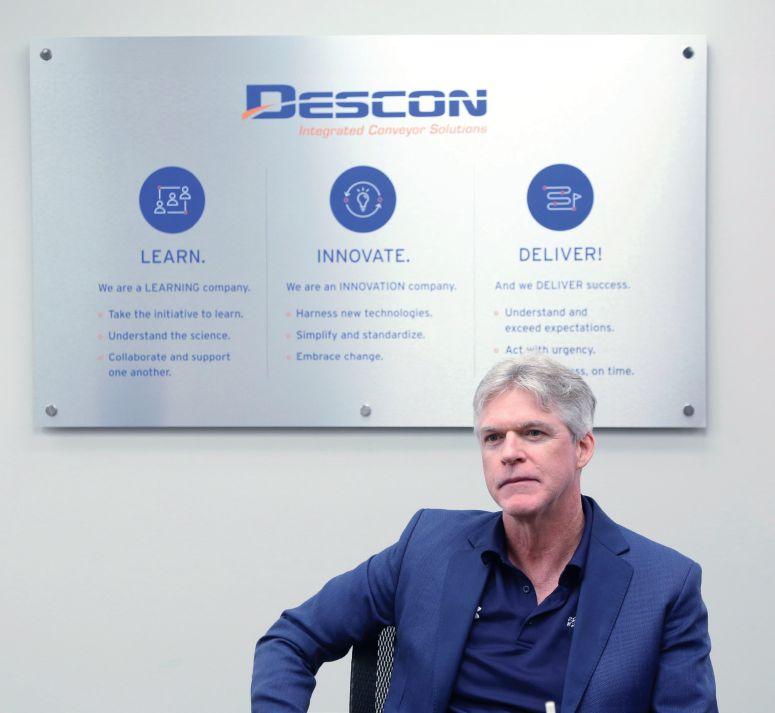
Becoming part of this elite corporate quartet has been keenly welcomed and embraced by Descon’s vice-president and general manager Steve Nixon and vice-president of operations
Jeff Philpott, both 25-year Descon veterans who have played key roles in the company’s rise from a fledgling conveyor start-up to a well-respected conveying solutions builder and integrator with a strong presence and profile in the North American beverage industry.
“We both started when there were only 13 people on staff,” recalls Nixon, “and now we’re up to 115 full-time employees, so there has been a lot of growth over the years.”
Started up in 1993 by co-founders David Farquhar and Geoffrey Oliff, Descon decided to focus on the beverage industry almost from the outset, Nixon recalls, specifically on the high-speed end of the market segment.
“Our conveyor systems are well suited for a multitude of different products, including softdrinks, bottled water, beer and cider, wine, dairy and packaged foods, as well as packaged ‘full goods’ such as corrugated cases, shells, cartons and film-wrapped packages of multiple sizes,” Nixon told Canadian Packaging during a recent visit to one of Descon’s two Newmarket
locations totalling 45,000 square feet of production and assembly space.
“Our customers include Coca-Cola, Pepsi-Cola, Blue Triton, Refresco, Unilever, Nestlé and Grupo Bimbo, to name a few,” says Nixon, adding that many Descon-built conveyor systems in service today run at lightning speeds of over 2,000 containers per minute.
“Our wide array of conveyance systems includes neck-ring air conveyors for empty PET (polyethylene terephthalate) plastic containers, bulk style conveyor for preforms and caps, air and vacuum-style conveyor for empty cans, modular belt conveyor for full container, and pack- and case-handling conveyors,” Nixon reveals.
“We also manufacture dry trash removal systems and washers for empty shells, bulk-style
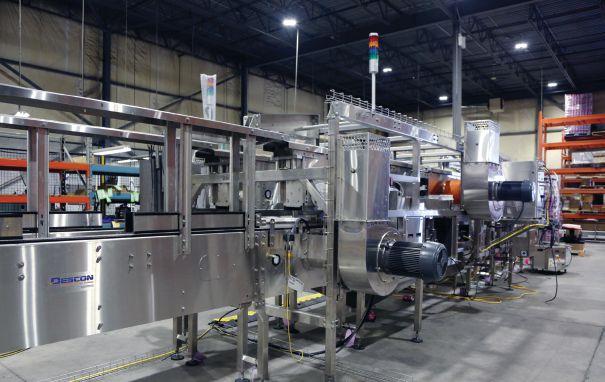
A nearly finished new coneyor being subjected to some extensive testing and troubleshooting at Descon’s central manufacturing facility in Newmarket, Ont.
depalletizers, side-grip container rinsers, container warming tunnels and drying systems,” says Nixon, estimating the company’s average yearly output at about 50 different installation projects of varying size, scope and complexity. With over 1,100 successful conveyor system installations to date—about 30 per cent at Canadian-based production facilities—Descon’s stellar track record and reputation for quality craftsmanship is well complemented with highly skilled workforce relentless focus on manufacturing and integration excellence through all phases of a given project from start to finish.
As Nixon points out, “Descon is a UL (Underwriters Laboratories)-certified panel shop that manufactures all the integrated control systems required for the control of all conveyance systems in-house.”
This in-house manufacturing prowess also extends to all the essential conveyor accessories and sub-systems required for superior highspeed conveyor performance and operational flexibility.
According to Nixon and Philpott, this extensive knowledge and expertise is a natural byproduct of a multitalented workforce in which trained engineers account for just over half of the total staffing levels.
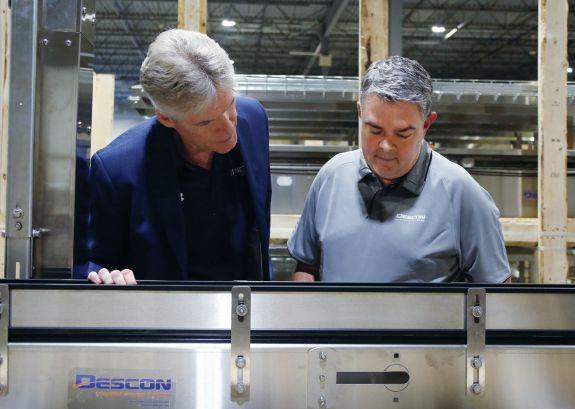
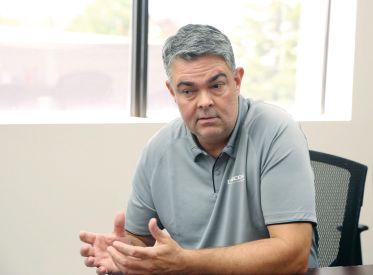
Pacteon’s chief executive officer Mike Odom (left) and Descon’s vicepresident of operations Jeff Philpott compare notes on the design and construction of a brand new conveyor line being assembled at Descon’s Newmarket facility.
Says Nixon: “Our team is made up of multiple disciplines, including mechanical and electrical engineers and designers, project management, site supervisors, start-up technicians, and multiple trades required for the assembly of our systems.”
As Philpott explains, each Descon conveyor system assembled in Newmarket is meticulously custom-tailored to meet the clients’ specific application needs to ensure smooth start-up and commissioning on-site, meaning extensive testing and process simulation prior to customer delivery.
As he relates, “Our systems greatly vary in size and complexity depending on the needs of our customers.
“Once their needs are understood, Descon’s team of layout engineers will design the solution in CAD, and our estimating team will prepare the bid.
“Our projects vary from near-turnkey type solutions to packaging line upgrades made necessary by packaging change requirements or needing to replace antiquated systems,” says Philpott, citing Descon staff’s familiarity and comfort with all the latest automation technologies deployed in fast-paced packaging line environments.
“Our packaging solutions are very automated—using the latest in PLC (programmable logic controller), operator interface and motor control technology,” he states.
“It is our responsibility to ensure that each machine center is connected and talking to the overall system to ensure it has the information that it requires to react to line condition changes— thereby maximizing overall throughput.”
With eager willingness to take ownership of each phase of the new project, taking care of all the systems integration at the customers’ site is second nature to Descon’s engineers and technical experts, according to Philpott.
“Descon uses in-house technical personnel for all site supervision, start-up and commissioning, and project management services, Philpott relates.
“If required, Descon can take responsibility for the entire installation using third-party contracted local installers,” he adds. “Our goal
is to make the buying process easy for our customers, so we’ve developed the in-house expertise to excel in these areas.”
Investing in this in-house expertise and all the related R&D (research-and-development) activities over the years has paid off spectacularly for Descon, with most of the company’s
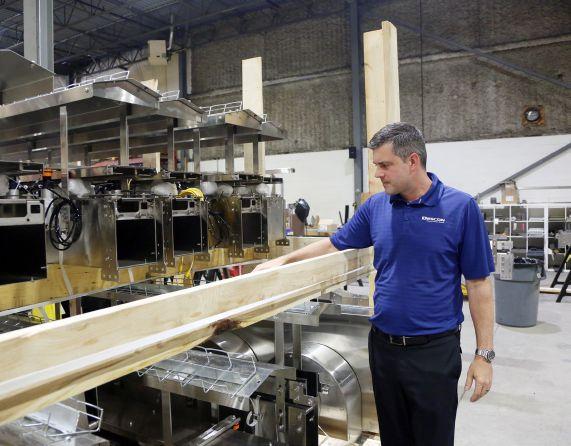
Descon’s vicepresident and general manager Steve Nixon conducts a thorough visual examination of key accessories and auxiliary equipment incorporated into the design of a new high-performance conveyor being assembled for a major customer in the beverage industry.
projects these days comprised of multimilliondollar installations with world-class manufacturing capabilities.
“We have many active installations in Canada and our systems can be found in many of the major bottlers throughout the country,” Nixon notes.
“We are currently involved in a major project at a new plant that Coca-Cola is building in California,” adds Philpott, “which will have four massive production lines running at some of the highest processing speeds ever seen in the beverage industry.”
Not surprisingly, the company attaches a great importance to continuous product innovation as a key competitive advantage in a very competitive market, according to Nixon and Philpott.
“We are constantly driving to improve and continually invest in R&D because we feel it’s important to drive change,” Nixon states.
“We recently developed a new lowerator vacuum-style ionized air rinser that can run 2,000 cpm (containers per minute) in a single lane,” he points out, “which is faster than anything currently in the marketplace.
“Up until this development it was necessary to split the flow of cans into two streams—requiring double the capital investment,” Nixon explains.
“We think this will be a game-changer in empty can handling, and we are anxious to demonstrate its capabilities to the market,” says Nixon, stressing the importance of premium
craftsmanship and strict quality control in all aspects of Descon’s manufacturing process.
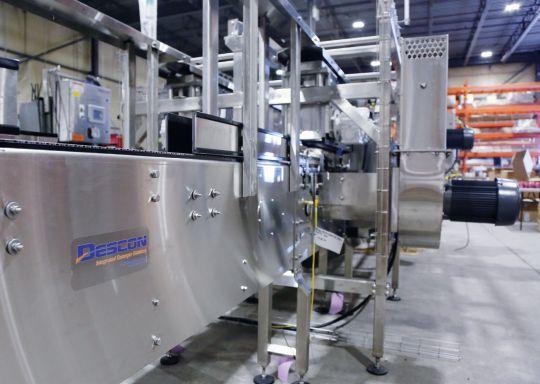
“The majority of our conveyors are manufactured of stainless steel and are suitable for any food or beverage type environment,” Nixon explains.
“We have certain specifications that change depending on the exact environment that our system will operate in so we can tailor our systems to suit most any application,” says Nixon, adding Descon has the required expertise and experience to work with beverage containers of all types, shapes and sizes, as well as all the commonly used secondary packaging formats.
“The wide variety of proven conveyance systems that we have developed and tested here at Descon is of paramount importance to us,” he states.
“These include high-speed pressureless single-filers, vacuum transfers with integrated empty can coding and inspection systems, FIFO (first in first out) and FILO (first in, last out) type accumulation systems, automatic switches and laners for multi-lane feeding of packaging machines, smart changeover systems for various product sizes, and so on.”
Having set the benchmark standards for excellence in the beverage markets, Nixon says the company is looking forward to extending its footprint into the food processing space, with its newly-forged ties with Schneider, Phoenix and ESS playing a key role in facilitating access to new business opportunities in that sector, as well
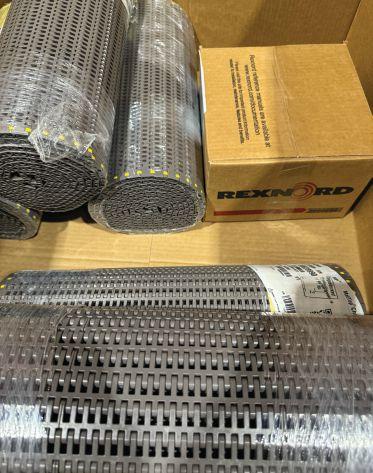
Close-up of the rolls of food-grade plastic conveyor belting supplied to the Descon facility by leading belting manufacturer Regal Rexnord await their turn to be mounted onto a Desconbuilt conveyor.
as in extending Descon’s geographic reach into the U.S., Mexico and Latin American markets.
Says Nixon: “Though Descon is well-known in the beverage market, we see opportunities for growth in more traditional food spaces and pharmaceuticals, where our sister companies are better known.
“While Descon got its start in beverage pro-
duction, our systems are completely adaptable to serving multiple industries,” Nixon continues, “including food.
“Descon is known for its unique changeover technologies using DC linear motors—making it an ideal platform for any customer running multiple packaging formats and sizes.
“And even though our systems are tailored specifically to each customer’s needs, our integrated electrical wiring raceways and wiring harnesses provide for a nearly plug-and-play type installation—shortening installation time and accelerating the start-up curve,” Nixon states.
Adds Philpott: “We are also a company that believes in standardization of conveyor designs and processes. “We have developed our products and methods over many years and have documented them until they became law.
“This persistence in documenting what works minimizes mistakes and costs on-site.
“We also pride ourselves on driving the startup curve once the line begins the commissioning phase,” Philpott proclaims, “which means we have an ‘all-hands-on-deck’ mentality to drive production. “Because we know that a slow startup costs our customers money,” he adds, “we want to be known for having the fastest start-up curves.
“This starts with a great layout design, which is supported by great standards and is driven by a great attitude.”
For all the impressive market growth and
industry accolades that Descon has earned over the last 30 years, both Nixon and Philpott agree that the best is yet to come for Descon in coming year as an integral part of the Pacteon group of companies.
“We are excited about the role we get to provide to the rest of the Pacteon team,” Nixon asserts. “With Schneider, Phoenix and ESS all being market leaders in their respective categories, Descon aims to pull the team together and help provide truly integrated production lines.
“Our role has always been to integrate the various vendors together by providing the pathways for product between machine centers and ensuring a truly integrated connected packaging line.”
As Philpott concurs, “In the short time we have been together with Pacteon, we can already see how they are building a culture that really believes in sharing best practices.
“Our engineering departments are in constant communication with each other,” he says, “and the coordinated efforts between sales and service centers puts people on the ground closer to our customers, which is a win-win for everyone.”
This buoyant positivity and enthusiasm is naturally warmly endorsed by Pacteon’s chief executive officer Mike Odom, a well-known packaging industry veteran with a brilliant career record across various senior management roles at leading industrial and life sciences instrumentation group Thermo Fisher Scientific, HG Weber and Syntegon, and as a board member for Garvey Corporation and PMMI (The Association for Packaging and Processing Technologies).
Having been appointed to Pacteon’s top job over two
years ago, Odom says he was quickly impressed by Descon’s core competencies and stellar industry reputation based, in part, on several collaborative projects between Schneider and Descon undertaken over the last few years.
“Descon is well-known for its integration capabilities,” Odom states, “and as Pacteon grew, we knew we had to provide those capabilities because that is what the customers are demanding from companies like Pacteon.
“Many packaging OEMs (original equipment manufacturers) shy away from line integration because of the huge responsibility that comes with it,” Odom relates, “but with Descon being so good at the integration part of conveying business made it a very attractive growth opportunity, with the added benefit of a lot of synergies with the rest of Pacteon.
“The other big reason that made Descon so attractive is their experience and relationships in the high-speed beverage market, which we see as a great high-growth market that Pacteon should definitely be involved in,” Odom adds.
“And the fact that they are a Canadian company was icing on the cake,” he quips, citing the overwhelmingly positive earlier experience of integrating the Montreal-based Phoenix Wrappers into the Pacteon family.
While it’s still early days for this Pacteon acquisition in terms for realizing its full potential, both Nixon and Philpott are excited about being a part of a larger, growth-focused organization that will enable Descon to deliver an even better value proposition to its existing and future customers.
“With todays advanced technologies and lighter packaging materials, it has become increasingly challen-
ging for new packaging line investments to get off to a great start after implementation,” Nixon states.
“That’s why in every little detail we can to ensure that nothing gets missed. “We don’t like surprises, and we know our customers don’t either.
“Building momentum from the first day of production is key to earn the trust of the production facility members,” Nixon concludes, “and it all starts with the understanding that our customers’ success is our success.
“As a complete team aligned with the needs of our customers, we are laser-focused on ensuring each project is a success and sustainable for the future.”
www.pacteon.com
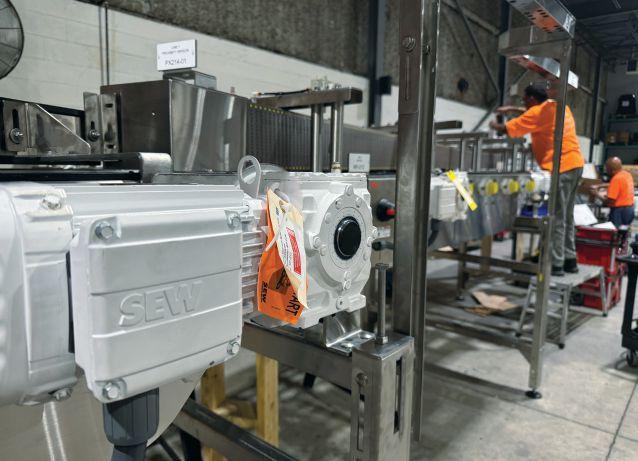
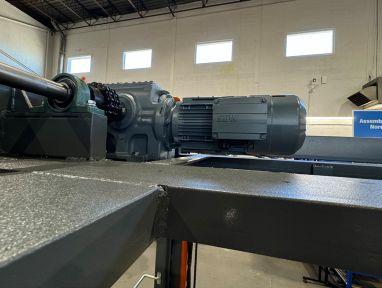
Descon conveyors make extensive use of the heavy-duty SEW-Eurodrive motors to ensure efficient power distribution for the company’s extensive range of high-speed, highperformance conveyors capable of running more than 2,000 containers per minute.
HAPPY TOGETHER
Landmark acquisition sets stage for an exciting future for stalwart Canadian packaging OEM as a core part of a fastgrowing global automation powerhouse
By George Guidoni, Editor
Photos by Pierre Longtin
If making a whole bigger and better than the sum of its parts is a hallmark of a successful M&A strategy, then the recent acquisition of Canadian packaging machinery stalwart Paxiom Group (www.paxiom.com) by Cambridge, Ont.-headquartered automation powerhouse ATS Corporation (www.atsautomation.com) could well be the start of an exciting new chapter in the history of both like-minded, globally-operating businesses with stellar reputations for manufacturing excellence and world-class technological competence.
Formally completed this spring, the multimillion-dollar transaction seems to have no limits to the high expectations and a wealth of new
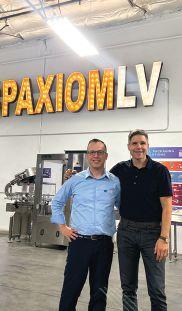
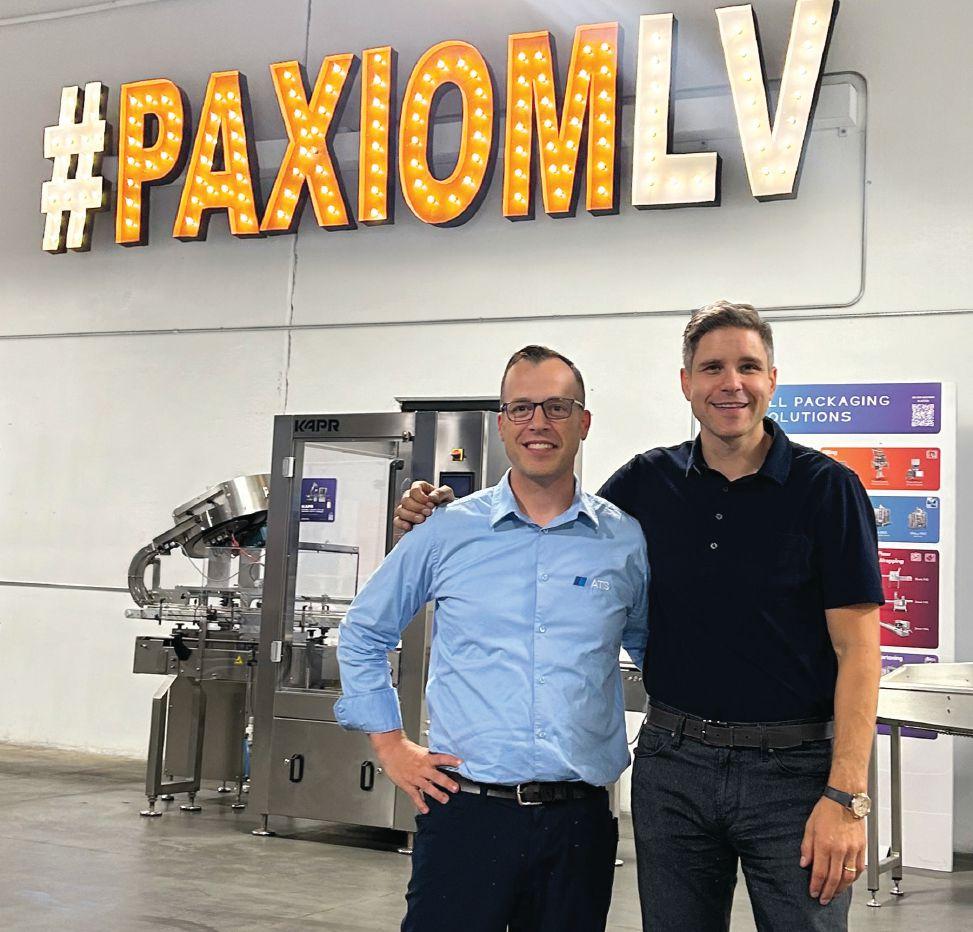
Jeremy Patten (left), president of the ATS Food & Technology Group, joins Paxiom Group’s vice president of commercial operations Nick Taraborelli on the floor of Paxiom’s flagship Xperience Center and integration facility in Las Vegas, Nev.
growth opportunities unleashed by this uniquely amicable, made-inCanada coming together of two undisputed industry leaders in their field.
According to Jeremy Patten, president of ATS Corporation’s Products & Food Technology Group, ATS has always had a strong acquisitive streak in it ever since the company was founded by German immigrant to Canada Klause Woerner in 1978.
This has only accelerated with the introduction of Andrew Hider as the CEO in 2017, having achieved significant growth for the TSE (Toronto Stock Exchange)and NYSE (New York Stock Exchange)-listed ATS— both organically and through timely strategic acquisitions—along with a strong international profile and reputation as one of the world’s largest factory automations systems integrators.
That robust market growth and an appetite for deal-making have significantly intensified in recent years, says Patten, who joined the company seven years ago after senior postings at major manufacturing conglomer-
ates IDEX Corporation and Danaher Corporation.
vicepresident of innovation
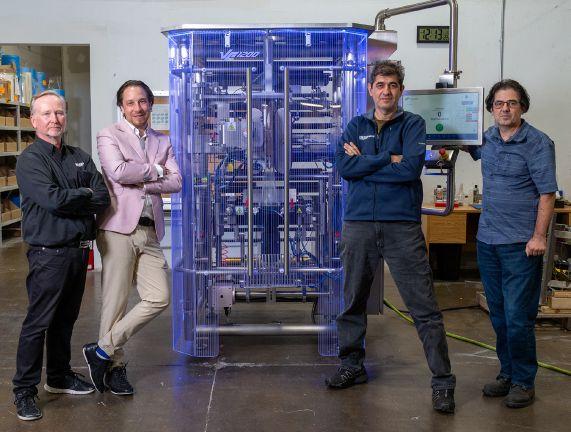
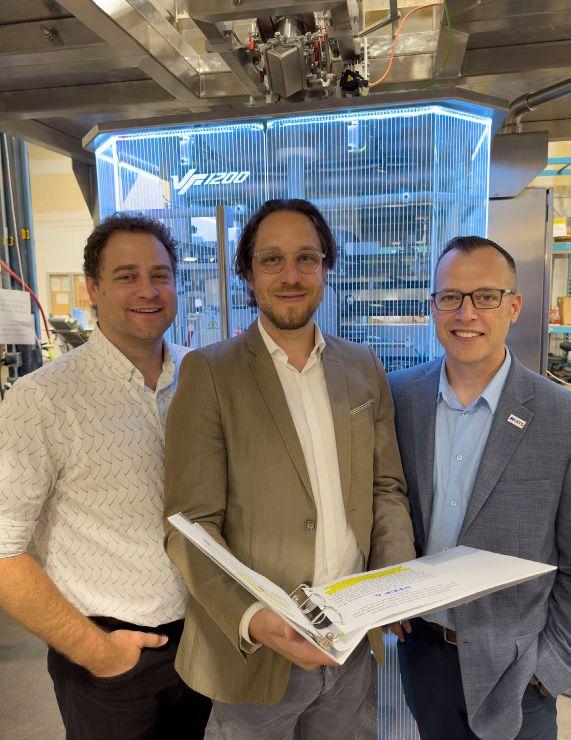
James Taraborelli (second from left) joins his team by the WeighPack VF 1200 vertical bagging machine.
“Seven years ago we were a $900-million company with a 10-percent operating profit,” says Patten, “whereas our latest fiscal year has just ended with $3-billion in sales and just over 13-percent adjusted operating profit.
“So it’s been a tremendous growth story, with acquisitions also playing a major part in it.
“We have done 24 acquisitions in the last five years,” says Patten, noting that the ATS Packaging & Food Technology now comprises 13 different but complementary global business that include well-known names like CFT, IWK, Raytec Vision, Co.Mac, NCC Automated Systems, Marco, Siapi and Rolec.
As Patten relates, one of the things that made
Paxiom Group a tempting acquisition target was the fact that the family-owned company— founded in Montreal by Louis Taraborelli in 1991—was already a full-fledged total system solutions provider with a global network of manufacturing plants producing high-quality packaging line equipment for food applications.
Manufacturing well over 400 machines per year, Paxiom’s impressive product portfolio includes WeighPack, EndFlex, ValTara, Kang Di, and Paxiom’s flagship Xperience Center and integration facility in Las Vegas, Nev.
Critically for ATS, Paxiom Group’s strength and high profile in the North American markets perfectly complements its own leading presence in the European markets with hardly any product overlap or duplication worth mentioning, as
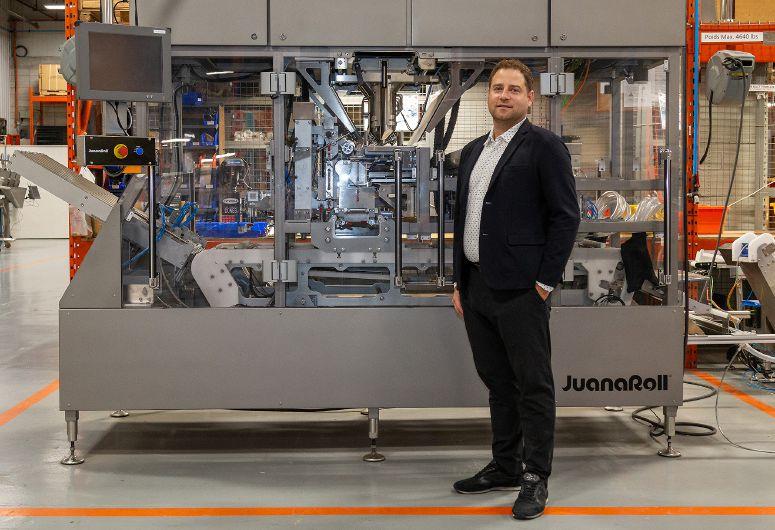
Paxiom’s vicepresident of operations
Justin Taraborelli in front of Paxiom’s fully-automatic JuanaRoll cannabis machine
Paxiom’s
Patten points out.
“Prior to Paxiom, none of our Packaging and Food Technology group of companies actually manufactured in Canada,” Patten points out, “so there are some really exciting new synergies for us to explore.”
Says Patten: “With much of Paxiom’s sales being based here in North America, and our food businesses having such a strong market penetration and great customer relationship throughout Europe, there is a natural geographic synergy for us to share customers and to grow the business across two opposite geographies.”
Paxiom’s familiarity and good standing with the North American food business was also a highly appealing reason for the acquisition for a company making a concerted effort to grow its global food and packaging business, according to Patten.
“From an ATS perspective, our four criteria for looking at acquisitions starts out by evaluating how attractive the market is,” Patten explains, “and we like the food and packaging market precisely because it is not highly cyclical and is also recession-proof, to an extent.
“Our second criteria is whether the acquisition is strategic—whether one plus one equals more than two, and that we can do thing better together than independently,” he explains.
“We also look at the company’s operational fit in terms of being adaptable to our ‘ATS business model’ of lean manufacturing and continuous improvement,” says Patten, citing
“With much of Paxiom’s sales being based here in North America, there is a natural geographic synergy for us to share customers and to grow the business across two opposite geographies.”
the company’s ‘decentralized’ approach to dayto-day management.
“So we had to look at the strength of the leadership team,” Patten says, “and we found that the three Taraborelli brothers who helped family patriarch Louis build up a world-class business—Justin, James and Nick—would fit in perfectly with the ATS work culture that values autonomy and innovative thinking.
“And lastly, being a public company that must provide a return on investment for our shareholders, we had to make sure that the deal would make business sense for them.
“After a lot of due diligence and a lot of travel, it became very clear that Paxiom ticked off all four of the boxes,” Patten says, adding that he expects things to run “business as usual” for the Paxiom operations going forward.
Naturally, this respectful and thoughtful on-boarding process helped to ease any anxiety among Paxiom’s 300-strong workforce.
As Paxiom’s vice-president of operations Justin Taraborelli explains, “ATS is a globally respected technology company that values exceptional products.
“As a product-driven company ourselves we see immense potential in collaborating with ATS to deliver seamless turnkey solutions and leverage the ATS ecosystem for enhanced collaboration across all entities,” he states.
“The decentralized business model fosters entrepreneurship and deep commitment within each entity, while ATS’s support empowers us
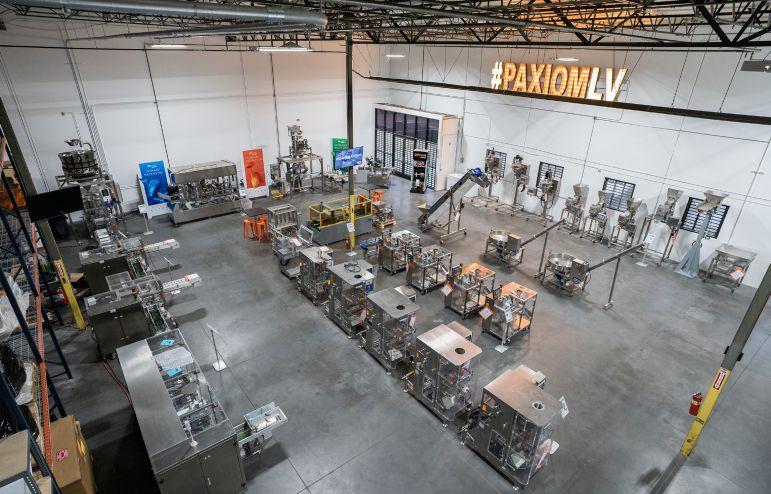
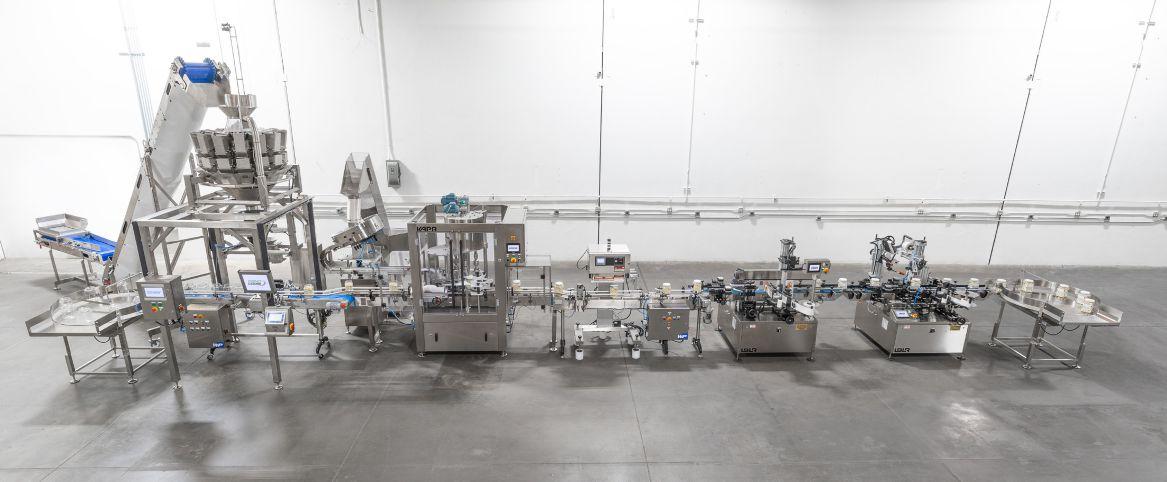
A bird’s-eye view of the extensive range of high-performance packaging machinery displayed on the plantfloor of Paxiom’s Xperience Center facility in Las Vegas for customer demonstrations and trial runs.
to drive significant growth and innovation.
Adds Justin: “ATS is led by a dynamic, leadership team that deeply values decentralized ownership, even at the employee level.
“We’ve fostered an ‘owner-driven’ mindset among our employees, enabling us to seize complex opportunities while maximizing profitability,” he relates.
“We believe that ATS will not only invest in our operations but also support our autonomy—allowing us to continue growing while maintaining our entrepreneurial spirit.”
As Paxiom’s director of operations and service Mark Conforti concurs, “The acquisition of Paxiom Group by ATS Automation is a hugely exciting development for both organizations and customers.
“Combining the operational strengths of both companies has already led to synergies that are driving innovation which ultimately will benefit our customer base with a wider range of high-quality automation solutions,” he says, “expanding Paxiom’s global presence with enhanced support, tools and service network to ensure a quicker response time and better customer service experience at a global level.
“With ATS being one of the largest integrators in the automation industry and their ‘customer first’ culture, they can leverage Paxiom Service’s established support systems including knowledge base, instructional videos and FAQs (frequently asked questions) as a platform to gain deeper insights into customer needs and preferences—enabling a more personalized and effective experience across all ATS North American companies,” he elaborates.
“Such partnerships are essential for driving growth, improving customer satisfaction, and achieving a better future for our industry,” Conforti asserts.
For Paxiom’s vice-president of innovation James Taraborelli, the landmark acquisition is in many ways a validation and endorsement of the company’s flair for design and manufacturing innovation that played a large role in Paxiom becoming a major player in the cannabis industry through stunning market success of the company’s fully-automatic
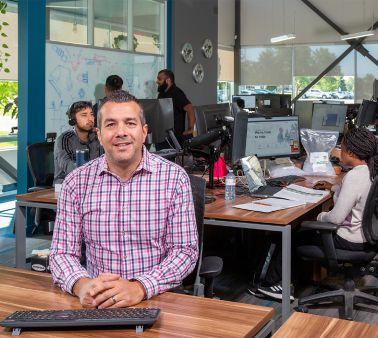
Paxiom’s director of operations and service Mark Conforti (foreground) with the customer service and technical support team.
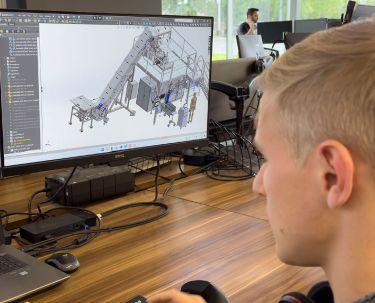
An engineer looking over the CAD image of a turnkey Paxiom packaging line design on his desktop computer screen.
From left – Justin and James Taraborelli join ATS Food & Technology group’s president Jeremy Patten for a group shot at WeighPack’s manufacturing facility in Montreal.
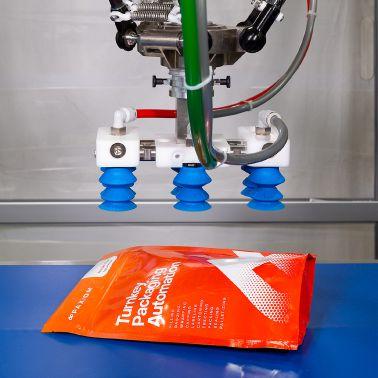
Close-up of the PKR Delta pick-and-place robot incorporated inside the ValTara case-packing machinery for gentle high-speed loading of pouches and other packaging formats inside shipping trays and/or cases.
JuanaRoll cannabis flower pre-roll machines, along with continuous improvement of all its other major product offerings.
“Over the past several years, we have been dedicated to reshaping our product line to ensure we’re well-positioned for continued growth in targeted global markets,” he states.
“The key products in this evolution include our high-speed vertical baggerffamily (VF Series), bag insertion and un-cuffer systems (BI, BU, BUSV), our Delta Robot (PKR), and the
continuous expansion of our offerings dedicated to the cannabis industry.”
Says James: “Our team is focused on developing new and enhanced features, such as high-pressure washdown capabilities and preventative and predictive maintenance systems.
“These innovations empower our customers to address potential issues before they arise,” he states.
“In today’s fast-paced environment, it is crucial to create machinery that enables oper-
ators and maintenance teams to ensure seamless operation and prevent production downtime.”
For Patten, such sentiments offer compelling proof of a “great alignment between both companies’ respective work cultures and values.
“Our core values are simple: people, process and performance, in that order,” Patten states.
“So we’re going to want to recruit, retain, develop the best people,” he asserts, “because it is those people that are going to drive the process, discipline, the continuous improve-
ment mindset, that ATS business model, and the overall continuous improvement that’s going to yield long term performance for the organization.”
Says Patten: “We’re really excited to have them (Paxiom) as a part of the organization because in addition to the great alignment, they offer a great growth story.
“It is our goal is to help support and drive profitable growth for their business so that we can the next chapter of the Paxiom Group by
The full side view of a fully-integrated turnkey packaging line, consisting almost entirely of Paxiom-built machinery, at a customer’s facility.
continuing to see its trajectory and its growth potential fully realized,” he states.
As Patten explains, “You can’t be an expert in everything, and by joining a group that has such a diverse amount of technology and geographic focus areas you don’t have to be.
“You can just be an expert in your space, but you can also leverage existing built-in partnerships to find ways to drive synergy to improve your expertise even further.
“The way that technology moves these days, it is hard to do everything by yourself,” says Patten, adding the company has no plans for any major rebranding overhaul for any of Paxiom’s core brands or product lines.
“The Taraborelli family has done a tremendous amount of work to build brand equity and the organization’s credibility, “ he says, “so the last thing we would want to do is anything that potentially disrupts that credibility and brand recognition.
“We should only be adding to it, not taking away from it,” says Patten. “Our job is to help them grow into other markets and other spaces.
“They already have the technology and the know-how,” he concludes, “and it is now our job is to figure out how to unlock all that potential to help them grow into other new markets and geographic locations.”
For vice-president of commercial operation Nicholas Taraborelli, the ATS acquisition is a truly milestone game-changing event in Paxiom’s already successful history.
“We accomplished so much in this industry in a short amount of time, having built a tremendous business with manufacturing facilities in four countries and an incredibly diverse, deep and innovative portfolio of products,” he states.
Says Taraborelli: “We were trailblazers in so many respects including joining PMMI as a Canadian company in the ’90s, the first pack-
aging machinery company in Las Vegas over 22 years ago and the first to widely promote showrooms with our Xperience Center, establishing in China over 20 years ago, and the first packaging OEM to enter the cannabis market.
“These are experiences that I can look back upon fondly and tell my kids about,” Taraborelli extols. “I am appreciative of our incredible
employees—past and present—my family, my friends, and our loyal customers who had supported that scrappy hard-working company on William Street in 1991 to the equally hard-working multinational that we had become,” Taraborelli concludes.
www.paxiom.com www.atsautomation.com
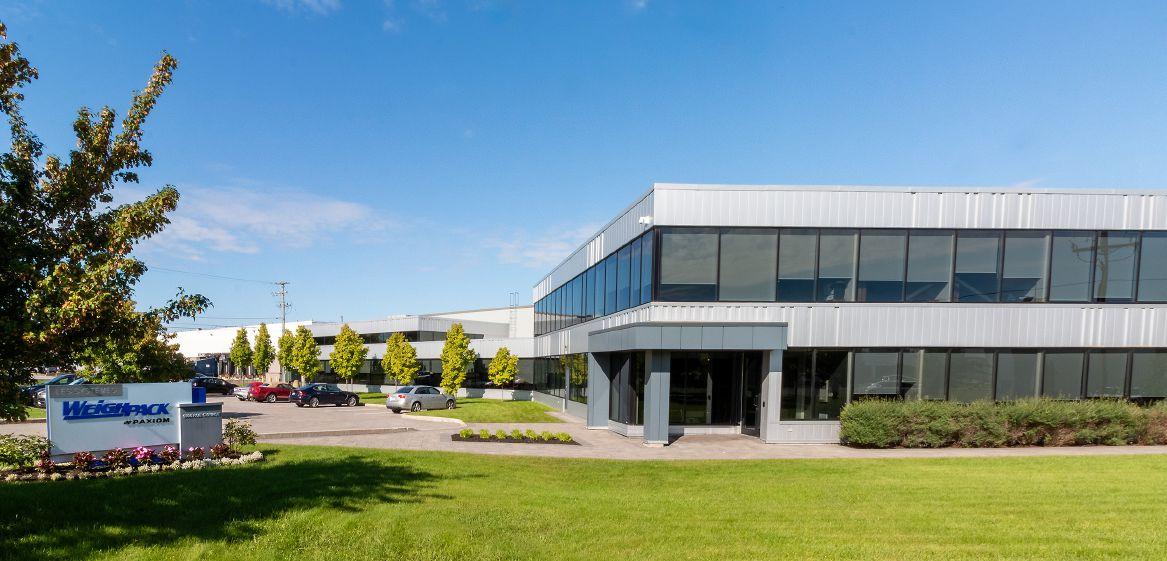
Paxiom Group’s WeighPack manufacturing facility in Montreal is one of the company’s biggest production sites worldwide.
THE HOME STRETCH
Canadian stretchwrapping machinery OEM proves to be a perfect fit for fast-growing end-of-line packaging powerhouse
By Andrew Snook
In the world of packaging, there are many steps before a manufactured good arrives safely at its destination. One of the most vital steps is ensuring it survives the transportation process, which can include trips on planes, trains, cargo ships, trucks and, sometimes, all of the above. Phoenix Wrappers (www.phoenixwrappers.com) of Laval, Que., understands this reality better than most.
A leader in stretchwrap machine manufacturing, Phoenix Wrappers, a Pacteon Company specializes in a full range of stretchwrap equipment from semi-automatic machines to highspeed, fully automatic custom-built material handling systems.
With its 80 employees, the company handles
everything from manufacturing and assembly to sales support, design and engineering from its 50,000-square-feet facility in Laval.
Currently celebrating 30 years in the packaging industry, the company serves a wide variety of industries: from brick and block to agricultural, food and beverage, pharmaceutical, bagging, distribution centers, and more.
Originally named Phoenix Innotech, the company was started up in 1994 by Manfred Fourestier, who had previously been the general manager of other respected wrapping equipment manufacturers.
The company attempted to aggressively expand in the early 2000s, but after finding itself under a great deal of financial pressure in 2001,
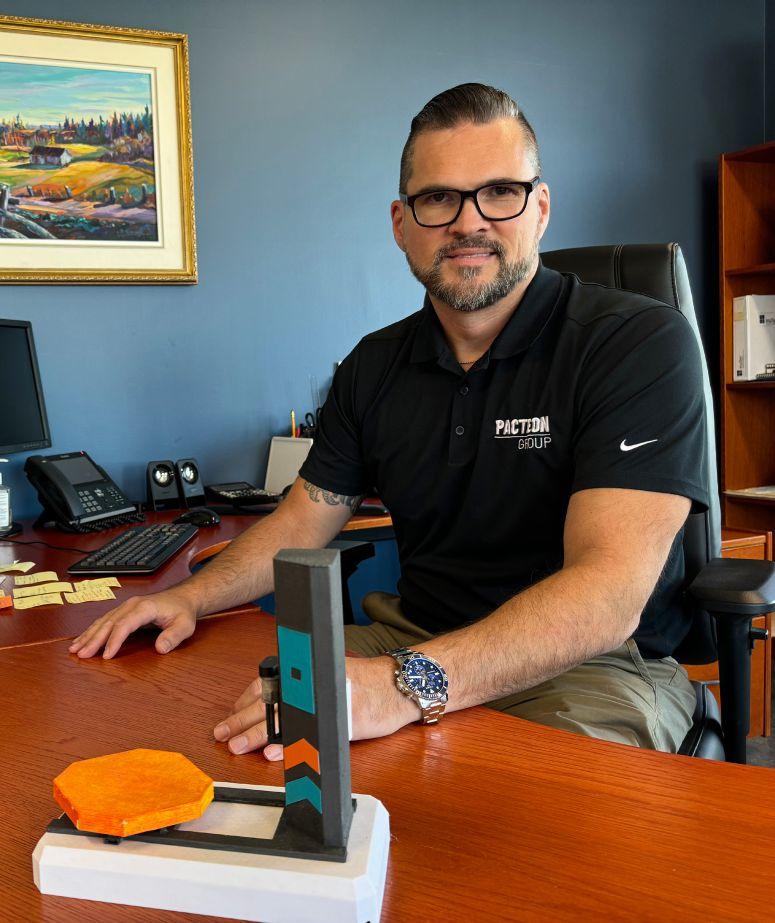
Phoenix Wrappers general manager Luc Bergeron at his desk inside the company’s headquarters facility in Laval, Que.
Fourestier reached out for a partner in the business and found Jacek Mucha, founder and owner of Orion Packaging.
After selling Orion Packaging to a multinational company, Mucha and Fourestier teamed up with another the senior engineer at Phoenix to create a strong manufacturing base for the company.
In 2006, Can-Am Packaging Systems (CAPS) partnered with Phoenix Innotech as the master distributor worldwide for all sales. In 2016, CAPS and private equity investment firm Vopne acquired the manufacturing side of the brand from Mucha and combined CAPS with Phoenix Wrappers.
The company then embarked on a journey to significantly grow its market share and hired Luc Bergeron as its general manager to lead the expansion.
“When I joined, it was more of an entrepreneurial company,” Bergeron recalls. “We rebuilt from the ground-up all the business processes, good practices, and rebuilt the team in all functions from engineering, production, finance, human resources, logistics, aftermarket and supply chain.
“A lot of things happened between 2016 and 2021 to bring the company to that point,”he says, “where it’s exponentially growing and improving.”
In 2021, the company was purchased by the Pacteon Group ( www.pacteon.com ), an integrated end-of-the-line packaging provider
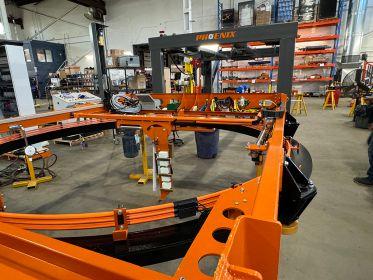
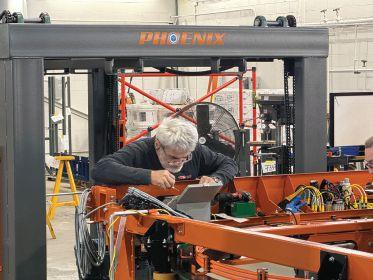
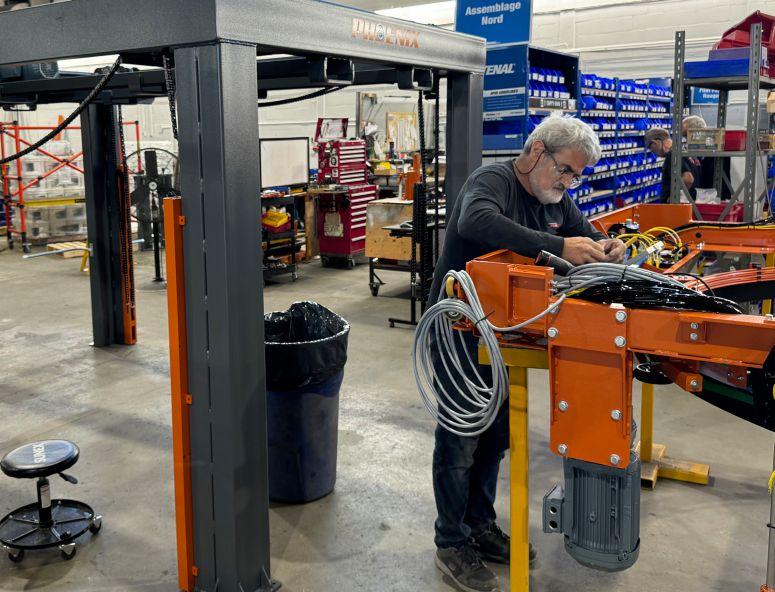
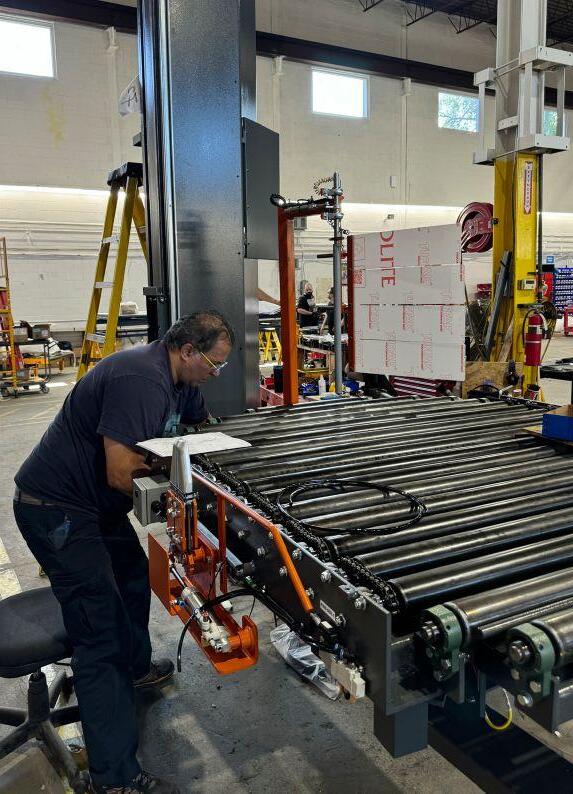
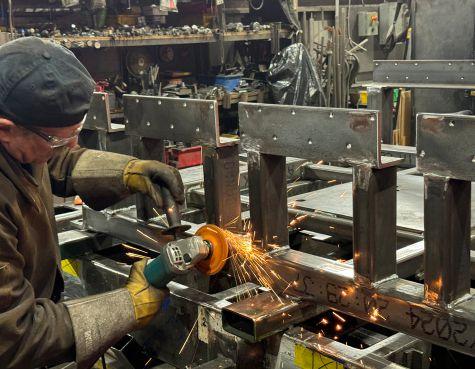
The pictures above demonstrate the high level of hands-on expert craftsmanship and attention to detail involved in the assembly of the company’s industry-leading automatic rotary ring stretchwrapping machinery for demanding high-volume, high-speed pallet wrapping applications.
comprised of four companies: Phoenix Wrappers; Descon Conveyor Systems of Newmarket, Ont.; Schneider Packaging Equipment Company of Brewerton, N.Y.; and ESS Technologies of Blacksburg, Va.
While the four companies work together to
offer complete packaging solutions, the Pacteon Group has each company’s operations managed independently, letting the product experts at each location leverage their unique knowledge of their customers’ needs.
“It’s a balance between synergies and making
sure that each business keeps to their own specific expertise,” Bergeron says.
Bergeron says the acquisition created many opportunities for growth in the packaging sector for Phoenix Wrappers.
“There are a lot of synergies we are creating
from engineering, production and supply chain, so there are a lot of savings and a lot of sharing of good practices,” Bergeron says.
“We’re working together to offer a completely integrated solutions to our customers now: not just being a stand-alone supplier, but also being part of end-of-the-line packaging solutions.”
Bergeron adds that being part of Pacteon has also allowed Phoenix Wrappers to leverage some very useful modern technology tools, such as ERP (Enterprise Resource Planning) and CRM (Customer Relationship Management) systems.
“These are all tools to better manage customer service.,” Bergeron points out.
As Bergeron acknowledges, one of the biggest advantages of joining a larger company is the ready access to additional service technicians, who are always in high demand.
“We have close to 50 technicians now, so we have people available to better respond to customer needs and customer support,” Bergeron says.
“We are cross-training them so they can support each other [across different product lines],” he adds. “It’s a great advantage.”
With a deeper pool of product designers and engineers to draw from, Phoenix Wrappers is improving its capabilities to work with integrators to provide more flexible solutions than ever before.
“We are also growing the overall stretchwrapping knowledge and expertise within the group,” Bergeron adds.
As he relates, Phoenix Wrappers recently invested in new steel cutting tools for in-house fabrication and racking to grow its capacity and to effectively support increasing demand for its products.
While the company is manufacturing automated equip-
making finishing welds on the machine frame.
ment, many of the facility’s processes are still performed the old-fashioned way.
“We’re not deeply automated in terms of equipment to build the machines,” Bergeron says. “There are a lot of manual and semi-manual processes to make those assemblies.
“The fundamentals of wrappers are standardized,” he says, “but it’s much more customized for fully-automatic applications.”
One of the strengths of Phoenix is we provide reliable custom solutions that are responsive to customer needs.”
Keeping the operation as flexible as possible is key for Phoenix Wrappers, which prides itself on offering customized solutions in response to any customer environment.
“We’re dealing with all sorts of difficult environments: cold, washdown, hot, harsh environments … everything you can imagine that can affect how to properly wrap products
Aligning rollers on a heavy-duty pallet conveyor
on a pallet,” he explains. “Fortunately, we are very strong at responding to those different customer needs.”
As Bergeron relates, today’s customers are looking for reliable and cost-effective solutions when it comes to the stretchwrapping equipment days, with price sensitivity being a very commonplace purchasing factor.
The company’s full range of stretchwrap equipment offer users a variety of unique and special features, including:
• Film carriage cut and wipe, a low-maintenance mechanism with a Safe impulse cut wire and an overwrapping film clamp.
• Breathe-easy film slitters, which use s standard stretch film rolls to and slices the film into bands for stronger holding power and aeration on the finished load.
• Dual film carriage systems to ensure optimal holding power, puncture resistance, and quick wrapping for higher production environments.
Some of Phoenix Wrappers automated features and HMI (human-machine interface) functions being incorporated into their machines include handy options, such as no load contact film tail treatment on their rotary-ring automatic pallet wrappers (RINGs) with PackML (Packaging Machine Language) program standardization.
The company’s PRRA rotary ring stretchwrappers feature a unique pallet wrapping ring concept, which incorporates three preset cycles
Clockwise from top
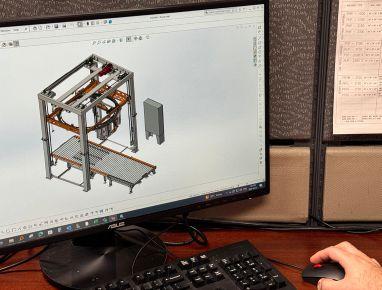
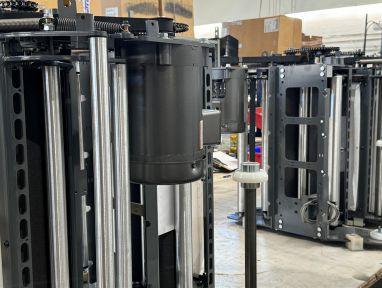
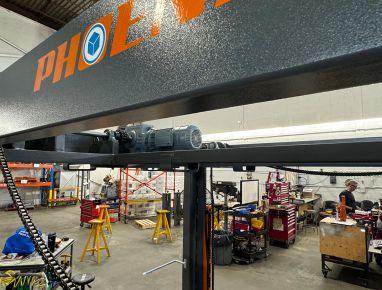
A CAD drawing of a rotary-ring stretchwrapper on a computer screen; bird’s-eye view of the busy on-site machine shop; an SEW-Eurodrive motor commonly used on Phoenix machinery.
to save on film by placing itis is needed. The ability to heat seal film tails is integrated on the standard machine, while its ability to start and finish wrapping anywhere on the load opens the possibility to double- or triple-stack loads and
wrap them individually. It also has a dual head film carriage option for longer intervals between film roll changes.
When operating the stretchwrapping equipment, it’s not unusual for a lot of stretchwrap
film to go to waste. To address the issue, Phoenix Wrappers’ engineers are currently investigating the use of paper wrap on existing stretchwrapping machines as a more sustainable solution.
In addition, the demand for thinner stretchwrap made from increasing levels of post-recycled consumer resin (PCR) is also growing in popularity.
“High-performance films are popular, but they are very thin,” says Bergeron.
“Our machines are suited for these films with effective pre-stretch capacity and upgrades for higher levels of stretch.
“We can achieve longer intervals between roll changes with these thinner, higher-performing films,” he explains, “as they are more resilient and better-performing than the traditional cast films.”
Looking to the future, Bergeron says Phoenix Wrappers plans to continue taking advantage of synergies within the Pacteon Group to grow its market share
“I think our ambitions are to grow and continue adding a bigger footprint in the North American market, but also on the southern border as well, in places like Mexico,” he concludes.
“I think that we have the product lines, we have the team, and we have the organization to have a much better footprint in the industry.” www.phoenixwrappers.com www.pacteon.com
CUT AND DRY
Unilever plant expansion sustained by Sidel’s futureproofed central robotic palletizing system
Formed in 1929, Unilever PLC is one of the world’s leading multinational FMCG (fast-moving consumer goods companies), with sales in 190 countries and products used by 3.4 billion people every day.
In addition to being the largest producer of soap in the world, the company’s diverse prod-
uct portfolio also includes baby food, beauty products, bottled water, breakfast cereals, cleaning agents, condiments, dairy products, energy drinks, healthcare and hygiene products, ice cream, instant coffee, pet food, pharmaceuticals, soft drinks, tea and toothpaste.
With so many products and factories to make them, automation is naturally one of the com-
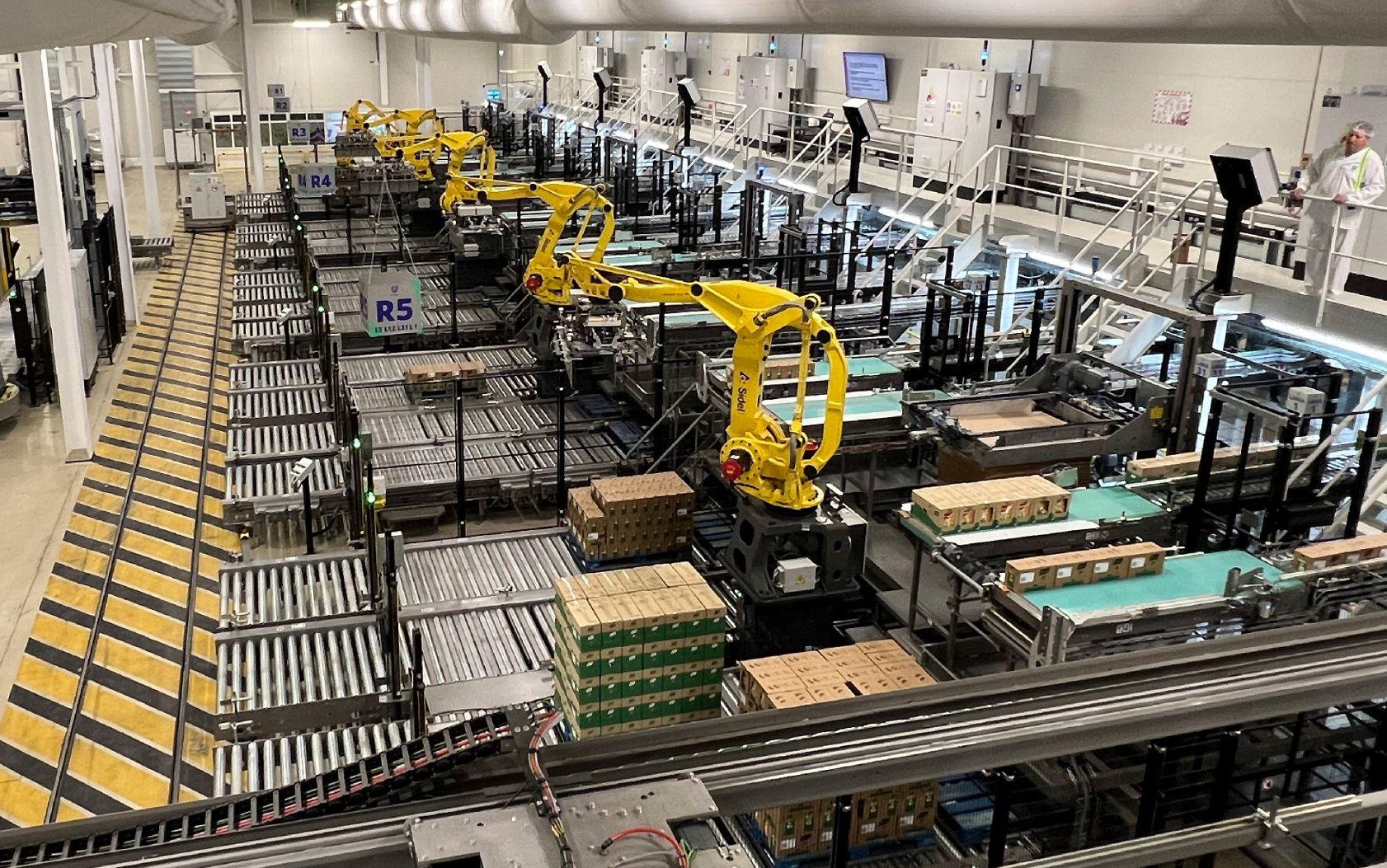
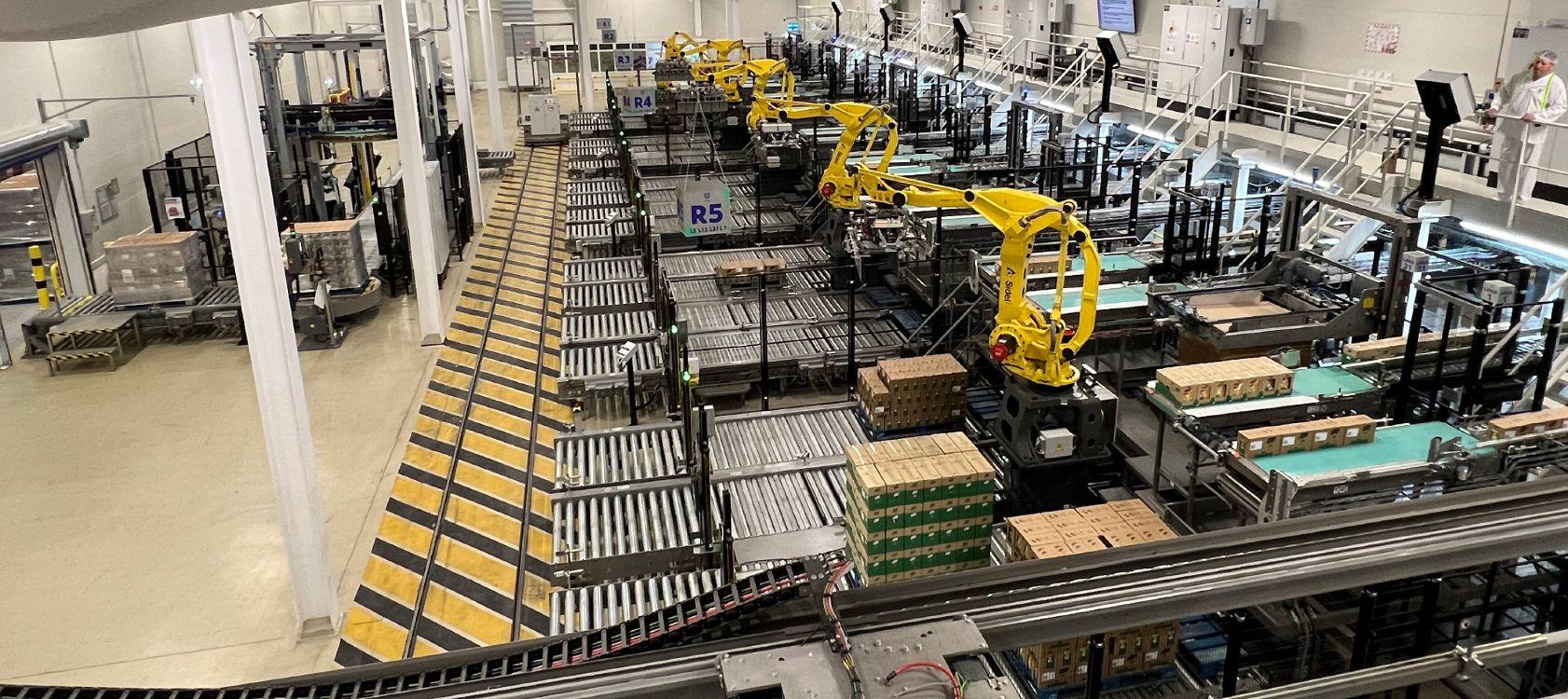
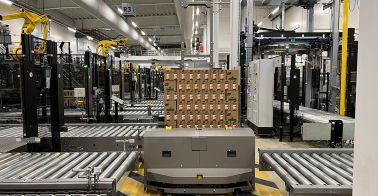
A bird’s-eye view of the massive new central palletizing system, comprising eight robotic cells, installed by Sidel
pany’s key core competencies that it must enhance and refine on ongoing basis to retain and grow the global market share for its most popular brands, including the Knorr brand of dehydrated soup and meal mixes, bouillon cubes and condiments.
Sold in over 190 countries worldwide, the entire Knorr dry nutrition portfolio includes
at a Unilever food plant.
home and personal care products.
After a careful evaluation of the plant’s current and future needs, Sidel proceeded to install a centralized palletizing system comprising eight robotic cells; several hundred meters of case and pallet conveyors; four pallet handling shuttles; and two stretchwrappers.
Capable of achieving a production rate of up to 98 pallets per hour, the consolidated system is connected to all of the plant’s 28 packaging lines.
The robotic cells are divided into two separate clusters—one with five robots, and the other with three. Each cluster has one central pallet magazine for all pallet types and sizes, including one induction shuttle for full pallet discharge and one compact shuttle for empty pallet delivery integrated underneath the robotic islands.
meal makers, dish and sauce bases, and seasonings, with a large portion of those products manufactured at the company’s nutrition factory in Ploiesti, Romania.
The products made at the Ploiesti plant come in a variety of packaging formats—including pouches, bags, cartons, and multipacks—and the facility’s production line handle a large variety of secondary packaging options such as
corrugated boxes, tray and hood, tray and shrinking foil, and shelf-ready packaging.
Unilever Ploiesti’s production capability has gradually evolved over the recent years, as volumes have tripled from 12,000 tons per year to 35,000 tons per year; SKUs have risen from 200 to 1,000; packaging lines increased from 14 to 28; and personnel has jumped from 200 to 700 people.
Naturally, it quickly became obvious that it was no longer feasible to utilize the factory’s existing end-of-line system to manage the breadth of brands packed on site.
To address the issue, Unilever Ploiesti has invested in a new central palletizing solution, fundamentally designed for the continuous production site transformations.
To accomplish this, the plant turned to leading packaging automation solutions provider Sidel (www.sidel.com), global manufacturer of automated equipment and services provider for high-speed packaging of liquids, foods,
Depending on the capacity of each packing line and the requested palletizing pattern requested, the cells have three or four product infeeds—ensuring a robot utilization rate of 92 per cent.
Unilever’s masterplan for the Ploiesti site was to keep the palletization space in a separate area from the packing hall to easily accommodate the recurring packing line modifications.
To connect the two areas, Sidel proposed a high-level conveying solution with spiral elevators to save space, facilitate circulation, and increase the overall flexibility linked to site transformations.
As the plant’s operations manager Iuliana Popescu Colt relates, “We’ve been impressed by
Above
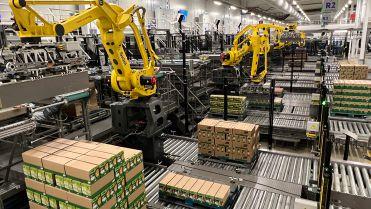
Sidel robotic palletizers in full swing.
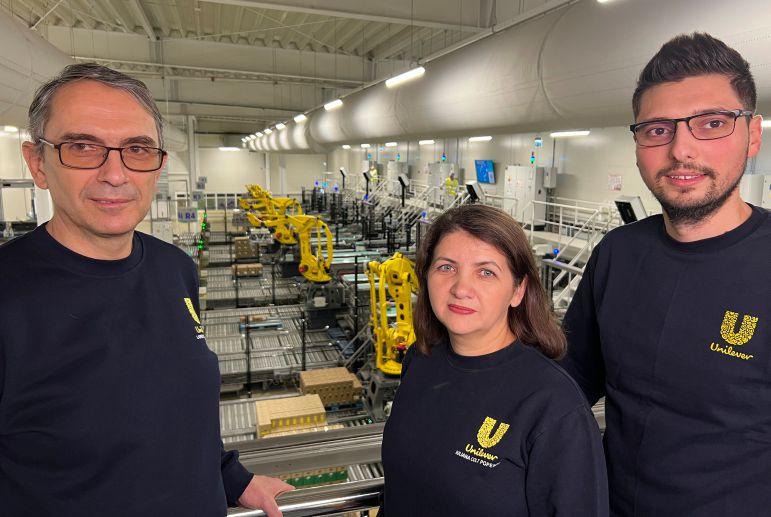
From left: Unilever Ploesti plant’s technical manager Laurentiu Badulescu, operations manager Iuliana Popescu Colt, and process engineer Lucian Tarida.
Sidel’s design capability to fit the detailed palletizing specifications we required in a compact area, and simultaneously oversee the complexity and high throughput coming from the packing lines.”
Adds Unilever technical manager Laurentiu Badulescu: “This was a complex project; however the solution developed by Sidel is based on standard proven modules, which have been developed and implemented in many other projects.
“Sidel has combined them in a smart way to deliver a custom solution, avoiding any complex start-up issues brought by made-to-order, oneshot solutions,” Badulescu states.
Sidel was able to demonstrate its proposed arrangement using virtual reality glasses, which allowed Unilever to visualize the full installation, check the space constraints, and solve potential issues related to platforms, the operators’ access and the raw material flows in advance.
Speed simulations also helped to confirm the speed levels and the robot utilization rate. After the design phase, Sidel’s project management spanned from factory acceptance testing to site installation, with all eight robot cells completed in less than eight months.
The modular concept accelerated installation as each cell was commissioned individually and at once integrated into the factory’s live packaging operations.
“Spending a little bit more time in design and simulations helped during the installation phase,” Laurentiu remarks.
“The virtual model fitted exactly in the physical space, so that we achieved the desired throughput in a very short time.”
The new central palletizing system is fully integrated in the Unilever digital process.
As soon as the operator selects the production order from the packing line, all the information related to the palletization, including pallet size, type of pattern, number of rows/ layers, and the label to apply is all automatically
set and transmitted to the corresponding palletizing cell and the entire end-of-line setup.
“At Unilever, we prioritize energy reduction in every project, as we’re aiming to achieve a zero-carbon footprint by 2030,” says Unilever’s process engineer Lucian Tarida.
“By using an energy-saving module for each robotic cell of this palletizing installation from Sidel, we’re able to generate energy from the robotic arm deceleration and re-inject it into the network to be used by other robots or equipment within the line,” Tarida concludes.
“Similarly, when a packing line is stopped for cleaning or changeover, conveyors enter standby mode as the photocells detect when no products are being transported.”
www.sidel.com
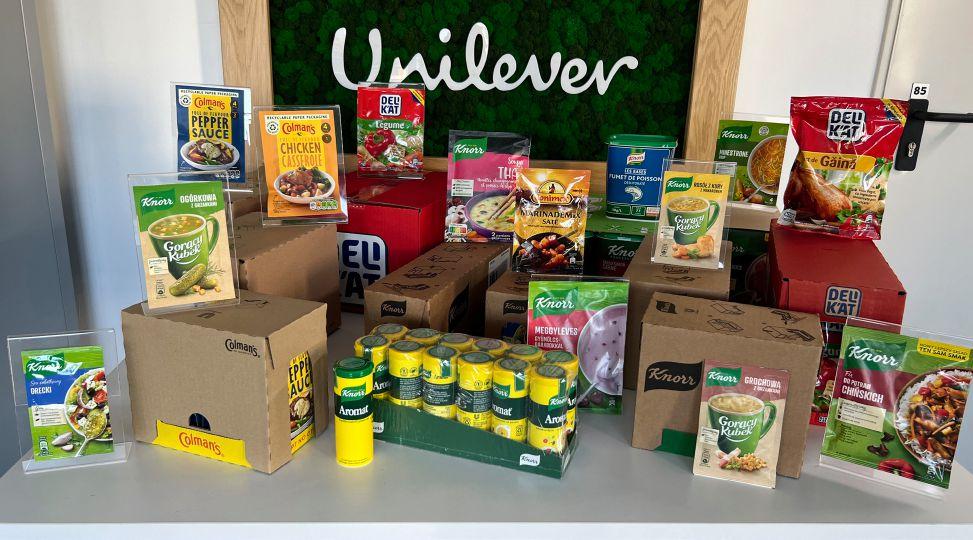
A sampling of some of the well-known Unilever brands of dry foods, soups, seasonings and other food products produced at the company’s Poliesti production facility in Romania.
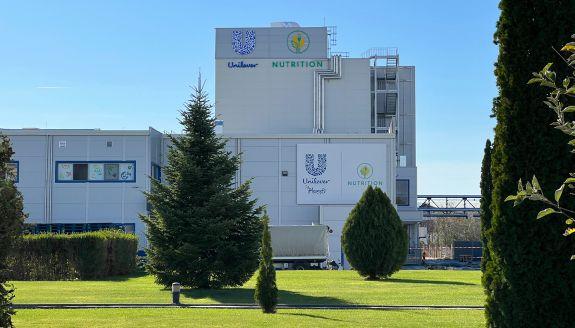
Exterior view of Unilever’s landmark Poliesti production facility in Romania.
FLEXIBLE CHAIN CONVEYORS
VersaFlex systems are powerful enough to be used in both piece- and pallet-handling applications. VersaFlex systems are capable of conveying product across three-dimensional spaces while maintaining a low profile design.