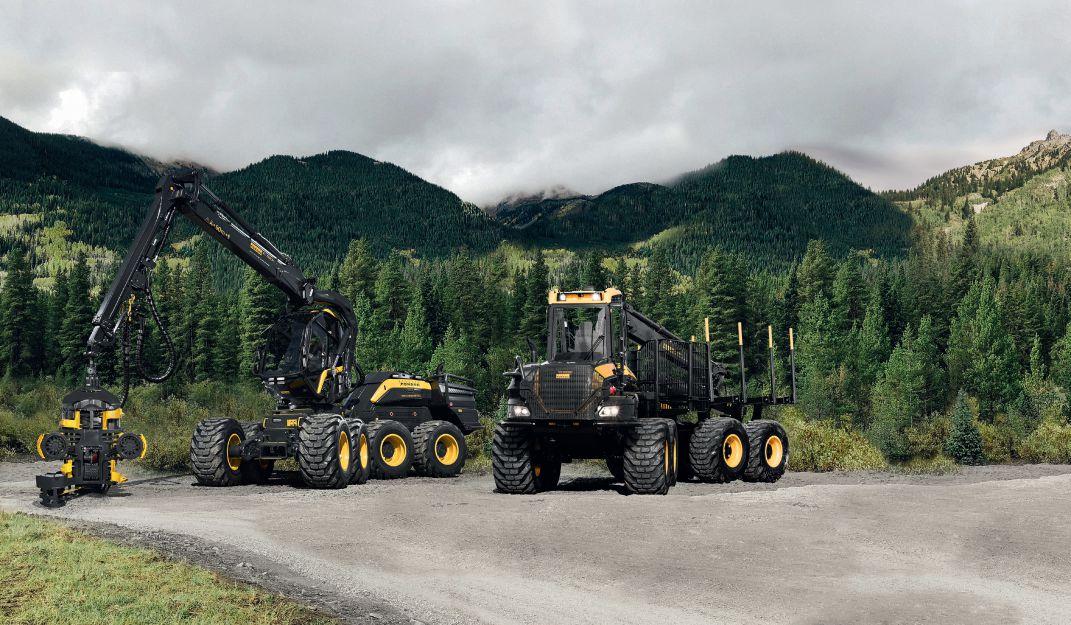
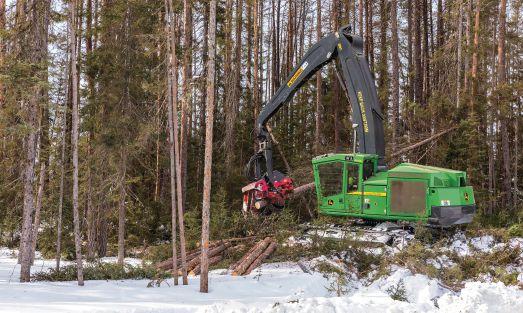
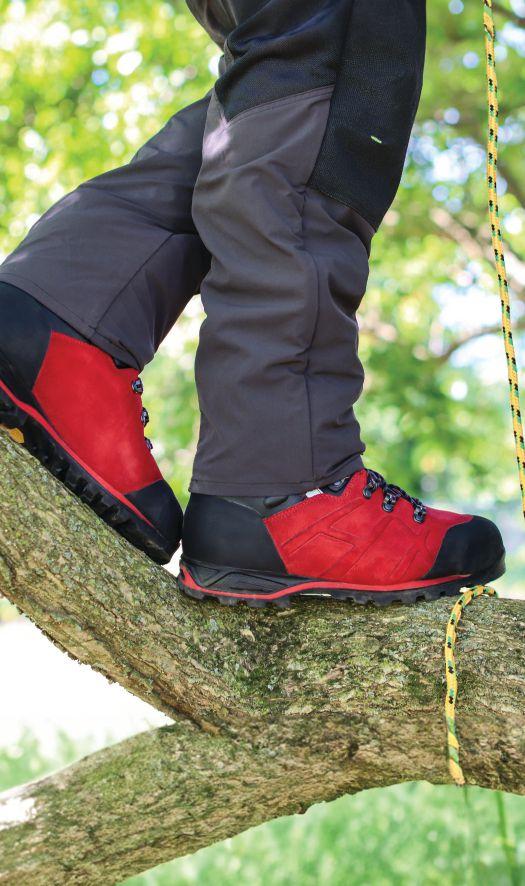
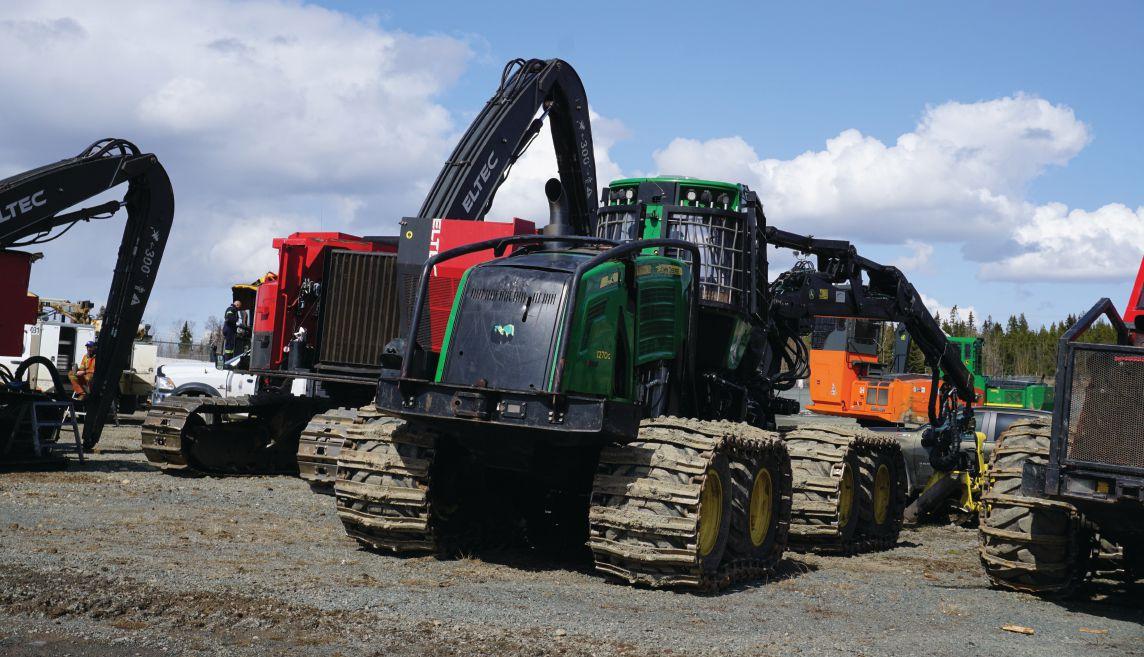
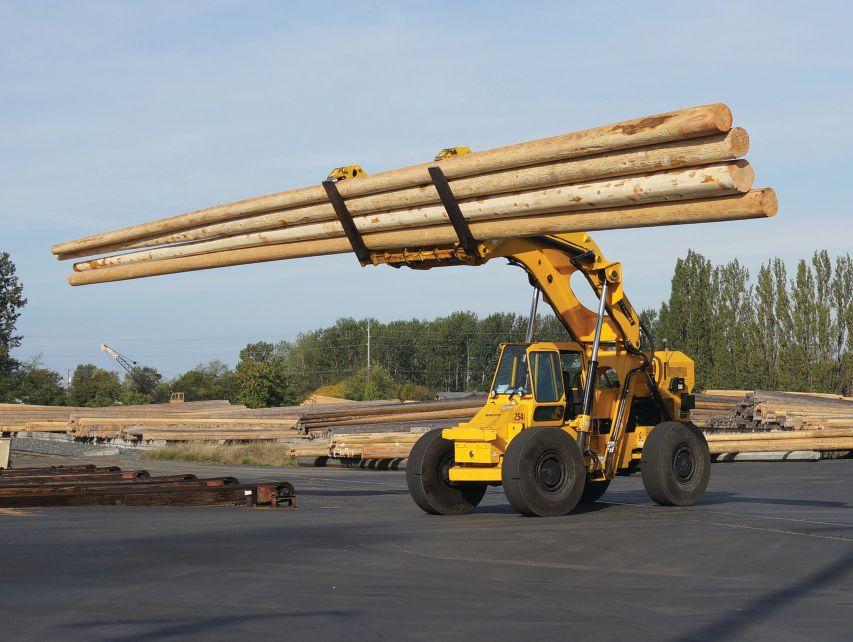
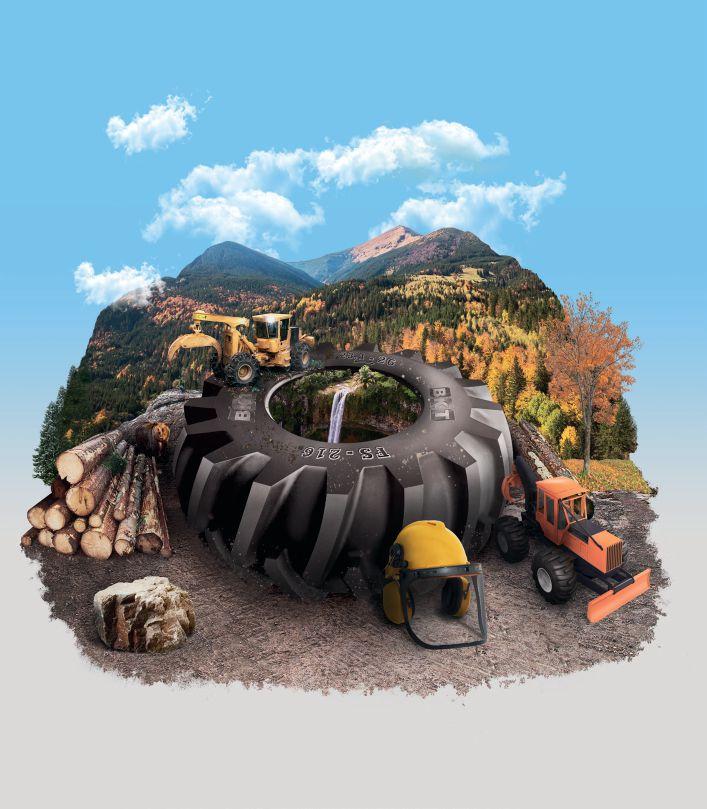
Olofsfors is the market leader in bogie tracks for CTL machinery and wheel tracks for skidders and wheeled feller bunchers. Under the brand names, ECO-Tracks and ECO-Wheel Tracks, Olofsfors offers the widest range of track models and linkage systems for various machine configurations and ground conditions. Superior quality, performance and a proven track record for increased productivity and durability.
NO MATTER THE CONDITIONS - OLOFSFORS HAS YOU COVERED!
754-2190 info@olofsfors.com
EDITORIAL first cut
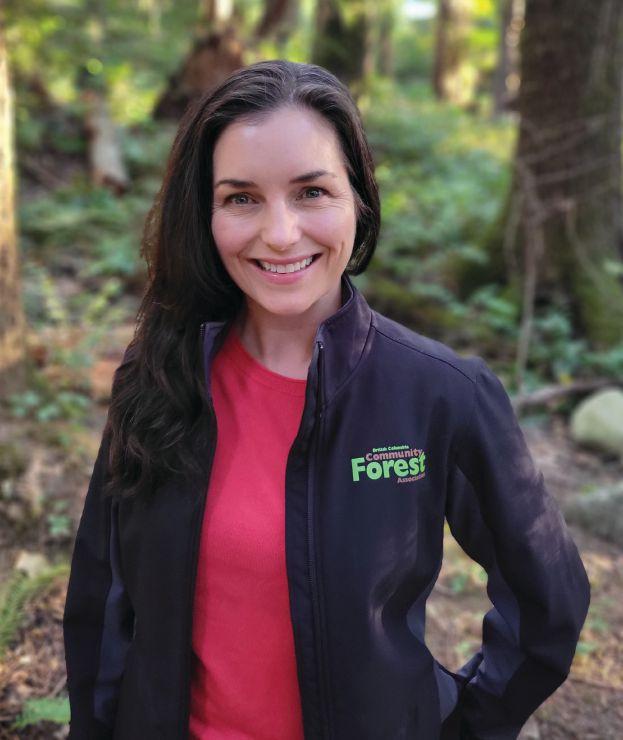
JENNIFERellson
jellson@annexbusinessmedia.com
Under 40 and overachieving
Meet the innovators, disruptors, and defiers shaping our industry
Life begins at 40, or so they say. But who has the time to wait around for that magic number when there’s a whole world of young talent out there just itching to make their mark? In this issue, we’re celebrating the go-getters, the early bloomers, the ones who started sowing the seeds of their success long before the big 4-0 came knocking.
Let’s face it, the past few years haven’t exactly been a walk in the park. A global pandemic that just won’t quit, economic rollercoasters, and more curveballs than a baseball game on steroids. And if that’s not bad enough, Kimberly-Clark announced it is pulling out its Kleenex facial tissue brand from the Canadian market –what a blow! Yet, despite all these challenges, the forest sector has seen a new generation of leaders rising through the ranks. They’ve weathered the storm, navigated the choppy waters, and come out on top. Bravo!
These young professionals are the trailblazers of our industry. They’re not just waiting for opportunities; they’re creating them. They’re not following the crowd; they’re shaping the crowd. It’s like watching a forest grow, one sapling at a time. And let me tell you, it’s awe-inspiring.
Now, you might think that picking the cream of the crop from this talented bunch was a piece of cake. Well, think again. This year, we were inundated with submissions from every corner of the country – a record amount of nominations almost double that of last year’s. It was a good kind of headache to have, but a headache nonetheless. So, what did we do? We decided to double the fun and go from our usual Top 10 to make it Top 20 Under 40 this year. And you know what? I have a dream. A dream of one day calling it the Top 40 Under 40. Can you help me make that dream come true? Nominate your young achievers, and if they don’t make the cut this year, nominate them again next year. Persistence pays off, folks!
But here’s the secret sauce: when you nominate
someone, don’t just toss in a few buzzwords and call it a day. No, no, no. Tell us their story in all its vibrant, technicolour glory. We want to feel like we’re right there with them, cheering them on as they conquer the world. So spill the beans, share the anecdotes, and paint us a picture that’s so vivid we can practically smell the pine trees.
Now, I won’t keep you in suspense any longer. It’s time to meet the stars of this year’s Top 20 Under 40. These folks are the innovators, the disruptors, the defiers of convention. They’re the ones who’ve turned challenges into opportunities, who’ve taken risks and come out on top. In short, they’re the ones who make you want to stand up and applaud.
So, what are you waiting for? Dive into these pages and get ready to be inspired. It’s a rollercoaster ride of stories that will make you smile, make you think, and maybe even make you dream. You will read about how researchers are addressing harvest residue management in B.C.; about an Alberta company that is expanding to be a leader in mass timber production; an innovative sawmill technology – snapshot scanning; how telematics can optimize performance and reduce downtime; highlights of the Forest Products Machinery and Equipment Expo; plus, winter is coming, so we have some safety tips for sawmill workers, as well as cold-weather considerations for winterizing logging equipment.
But most of all, this issue will make you realize that the future of our industry is in very capable hands.
As we celebrate the 11th edition of the Top 20 Under 40 awards, I can’t help but feel a sense of optimism. The forest sector has faced its fair share of challenges, but as long as we have these young leaders blazing a trail, the future looks bright. So, here’s to the next generation of movers and shakers in our industry. May they continue to grow, thrive, and inspire us all.
Cheers to the Top 20 Under 40!
NEWS upfront
Canfor invests $200M to build new B.C. mill
Canfor Corporation is investing approximately $200 million to build a new state-of-the-art manufacturing facility in Houston, B.C. This low cost, high efficiency facility will have an annual production capacity of approximately 350 million board feet.
Don Kayne, Canfor president and CEO, said the decision comes following a comprehensive evaluation of customer requirements and careful evaluation of economic fibre availability in the region. Work will begin immediately on detailed project engineering and permitting requirements.
Vendor and equipment selection will be finalized in early 2024, with demolition and site preparation scheduled for the spring. Planning, construction, and commissioning is expected to take between 28-32 months.
FEDS TO INVEST $3M IN TRUCKING IN COLLAB WITH FPINNOVATIONS
The federal government is investing nearly $3 million under the Zero-Emission Trucking Program in support of three projects in Quebec, B.C., and Nova Scotia, of which $1.5 million will be used to establish a Zero-Emission Trucking Testbed in collaboration with FPInnovations. The Testbed will collect real-world performance data in Canadian conditions to speed up the reduction of pollution from mediumand heavy-duty on-road transportation. Two additional investments, totalling just over $1.3 million in Government of Canada support, will enable projects in B.C. and Nova Scotia to gain
information on: zero emission truck performance, the development of training materials, and required provincial planning to support the safe deployment of zero emission trucking technologies.
The B.C. project will support commercial vehicle pilots, training, and knowledge-sharing activities to communicate their findings to a wide audience of stakeholders.
The Nova Scotia project will study the province’s technical needs, including the types and number of vehicles and refuelling/recharging stations required, and will develop guidelines to inform the adoption of medium- and heavy-duty zero-emissions vehicles.
Canada to contest U.S. softwood lumber duties
Canada will contest what the Trade Minister Mary Ng described as “unfair, unjust and illegal” U.S. duties on Canadian softwood lumber products.
“Canada is a world leader in softwood lumber and has an important industry that creates good, well-paying jobs for thousands of Canadians and supports communities across our country.
“For years, the U.S. has imposed unfair, unjust and illegal duties on Canadian softwood lumber, hurting Canadian industry and increasing housing costs in both countries,” Ng said.
Canada filed notices of intent to commence judicial review regarding the latest U.S. decision maintaining these unwarranted duties on
our softwood lumber products on Aug. 21. Current U.S. softwood lumber duties have subjected most Canadian softwood lumber exports to the new combined duty rate of 7.99 per cent.
West Fraser Timber has entered into an agreement to acquire Spray Lake Sawmills in Cochrane, Alta., subject to certain post-closing adjustments. The transaction is anticipated to close later this year following completion of Canadian regulatory reviews and satisfaction of customary conditions.
Spray Lake Sawmills produces treated wood products, dimensional lumber and a variety of innovative wood residuals and biproducts. It has an annual lumber capacity of 155 million board feet and holds two forest management agreements granted by the Government of Alberta with a total annual allowable cut of approximately 500,000 m3.
The $140 million acquisition enables West Fraser to grow its footprint in Southern Alberta and expand its Canadian treated wood business, while providing access to a high-quality timber supply.
Paper Excellence permanently closes Catalyst Paper Tiskwat
Paper Excellence has announced the permanent curtailment of Catalyst Paper Tiskwat, its paper mill in Powell River, B.C., following a comprehensive review that determined that a restart of a pulp or paper business is not feasible.
Since the indefinite curtailment in December 2021, the majority of employees took voluntary severance, and a small number chose to transfer to another Paper Excellence mill. When fully operating, Catalyst Paper Tiskwat employed approximately 200 people. The company is in talks with potential buyers for the site.
Paper Excellence will continue to supply pulp and paper customers with production from its other operating mills in British Columbia and Saskatchewan.
N.B. releases new forest management strategy
The New Brunswick government has released a new forestry management strategy entitled Our Forests are For Everyone: A Long-Term Strategy for Healthy and Sustainable Forests, that aims to “restore balance and fulfill a commitment to achieve mutually beneficial outcomes for the environment, soci-
ety and the economy through a focus on conservation, sustainable forest management principles, and economic development.”
“New Brunswick is in the unique position to dedicate more areas for conservation while also increasing the economic benefits of the forest sector – and at the same time expanding
non-timber uses like maple syrup and other agri-food production,” said Natural Resources and Energy Development Minister Mike Holland. “And we are doing it while improving our management of species at risk, augmenting water protection, and safeguarding culturally significant lands identified by First Nations.”
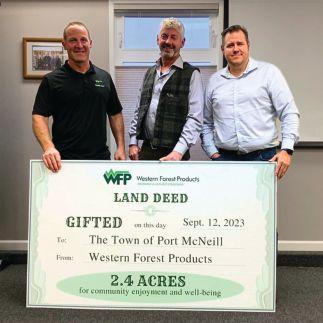
WFP donates land to Port McNeill
Western Forest Products (WFP) has donated 2.4 acres of property to the Town of Port McNeill, located on B.C.’s Vancouver Island. The centrally located three parcels of land are intended for public use and to meet the evolving needs and aspirations of the town’s population. Through WFP’s Community Enhancement Fund, the company provides support to local community events, organizations and initiatives where its employees live and work.
Email: apotal@annexbusinessmedia.com Mail: 111 Gordon Baker Rd., Suite 400, Toronto, ON M2H 3R1
EDITOR - Jennifer Ellson (438) 483-7451 jellson@annexbusinessmedia.com
MANAGING EDITOR - Maria Church (226) 931-1396 mchurch@annexbusinessmedia.com
GROUP PUBLISHER - Anne Beswick (416)410-5248 • Mobile: (416) 277-8428 abeswick@annexbusinessmedia.com
Tim Shaddick 1660 West 75th Ave Vancouver, B.C. V6P 6G2 Ph: (604) 264-1158
Kevin Cook lordkevincook@gmail.com Ph: (604) 619-1777
PRESIDENT/COO - Scott Jamieson sjamieson@annexbusinessmedia.com
Photo: Western Forest Products.
Photo: Annex Business Media
THE BURNING QUESTION
Researchers address harvest residue management in B.C.
BY ERIC NANCE, DOMINIK
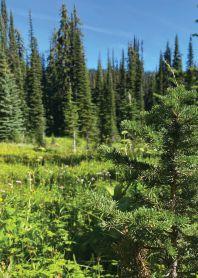
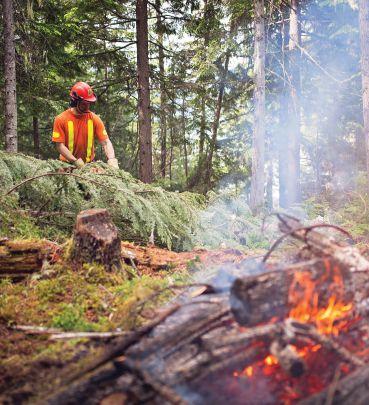
The management of harvest residues has long been a challenge for B.C. operators tasked with balancing wildfire fuel loading, planting space; financial, operational, and regulatory constraints. Now, society’s concerns on carbon emissions are on that list and practices will have to change.
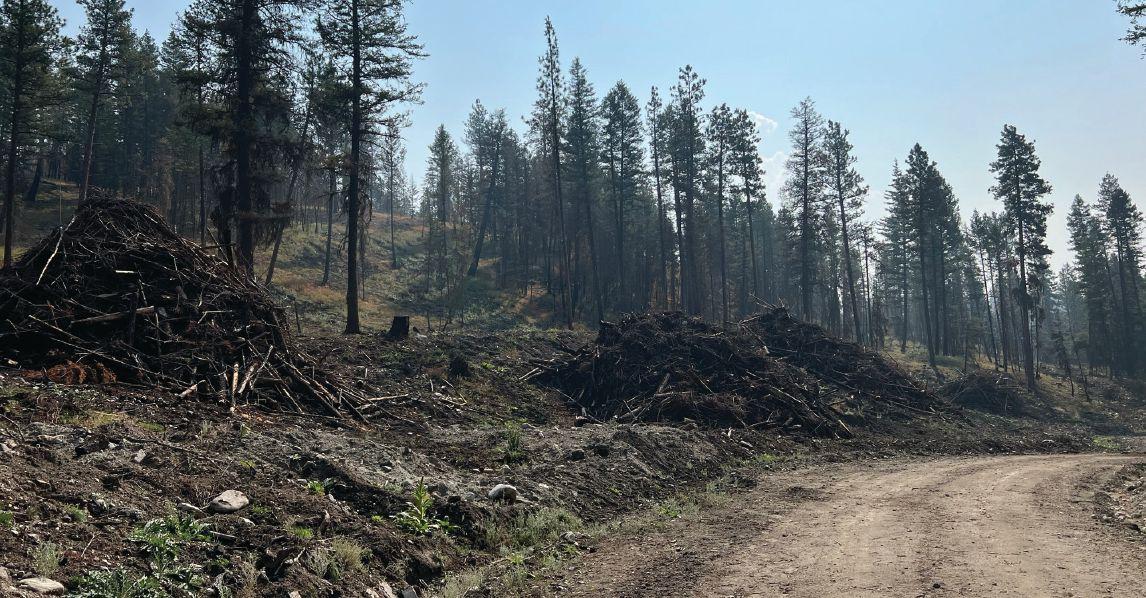
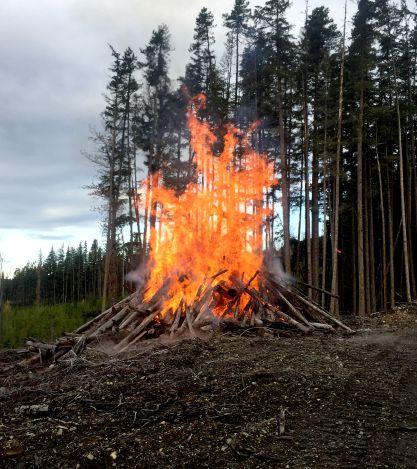
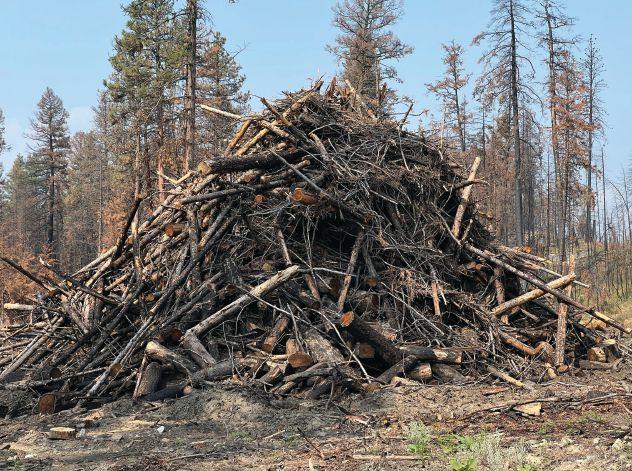
Common practice in the industry today includes either leaving residues piled in the cutting area to decompose or open-burning residues with the practice of slash-pile burning (SPB). While these low-cost treatments may meet the minimum management requirements, more needs to be done to improve their use and management moving forward. SPB is a considerable emissions source, produc-
ing harmful greenhouse gases (GHG) and particulate matter, and accelerating the release of carbon to the atmosphere. These enhance climate change and have negative human health impacts. Open burning of residues can also have negative impacts on ecological functions, such as future stand productivity and small mammal habitat. Harvest residual fibre could be flowing to the bioeconomy, where it can be used for value-added products or bioenergy that can displace more carbon intensive alternatives.
There are potential management alternatives to SPB that may serve to better use residual fibre across a range of operational conditions. Considering current B.C. and Canadian climate targets,
ROESER, CARLY A. PHILLIPS,
CAREN C. DYMOND AND WERNER A. KURZ
transitioning away from SPB and towards more sustainable alternatives will help mitigate GHG emissions and improve forest stewardship.
ALTERNATIVES
Redistribution after whole-tree harvesting: Leaving residues dispersed across the cutting area can increase soil carbon stocks, improve soil nutrients, provide shaded planting spots and wildlife habitat, and reduce soil erosion. Residues can be left whole or can first be masticated with a chipper, grinder, or
chopper-roller before being redistributed from the roadside or landings. While retaining residual fibre can improve site level tree growth and stand productivity, this alternative should only be employed where planting efforts will not be hindered, and wildfire fuel loading will not exceed acceptable levels.
Brush-mats and road amendments: Brush-mats made from residual branches, tops, and small round wood can reduce soil rutting and compaction from forest machines, mitigating the associated increases in water runoff and sediment transport. Furthermore, residues piled on trails are compressed, promoting decomposition and retaining nutrients (in particular nitrogen) in the cutting area, which might otherwise be lost during SPB. While brush-mats are mostly associated with stem-only and cut-to-length harvesting operations, this technique can also be employed during conventional whole-tree harvesting, whereby primary transportation machines (skidders, etc.) bring residues from roadside piles back into the cutblock, applying them to main trails during return trips.
Use of mulched right-of-way harvesting residues for surfacing on temporary roads can reduce road failure from rutting, compared with standard soil-surfaced roads. Using residues this way can
have less environmental impact and be less cost prohibitive than upgraded gravel surfacing.
Left decked in oriented piles: If residues need to be left, pre-sorting residues during processing to separate and deck round-wood into oriented piles can be a better alternative to leaving them piled in “hay-stacks” or SPB. FPInnovations studies have demonstrated that oriented decking can reduce the wildfire risk of the pile, provides the opportunity for secondary users to easily access the decked wood if future markets emerge, and does not re-
Mobile burning containers: If wildfire fuel loading must be reduced but markets don’t exist to use the residues, employment of mobile burning units (air curtain burner, etc.) are an effective alternative to SPB. Controlled burning in these units can reduce emissions (in particular methane) with higher efficiency combustion, while creating biochar and ash byproducts which store carbon and can be redistributed as soil amendments. These units nearly eliminates risk of fire escape during treatment.
Liquid and solid biofuels: Certain types of logging residue can be a valuable feedstock for liquid and solid biofuels, including: pellets, briquettes, hog fuel, liquid transport fuels, and others. Using residues for liquid or solid fuel provides emissions benefits when they are used to displace fossil alternatives like coal and gasoline. Initial capital investment and procurement costs of feedstock are likely to be prohibitive in many B.C. harvest conditions. Though small-scale, mobile conversion systems address some of these costs and are a promising alternative to centralized processing facilities.
Other products: Residues can be used to create novel or non-commodity wood products in B.C. Research has expanded use of wood fibre to
“POSSIBLY THE MOST IMPORTANT STEP WE CAN TAKE TOWARDS MORE RESPONSIBLE MANAGEMENT OF HARVEST RESIDUES IS A SHIFT OF OUR MINDSETS FROM THE VIEW THAT RESIDUES ARE A WASTE BYPRODUCT OF HARVESTING.“
quire significant incremental cost to operators.
Main and above photos by Dominik Roeser.
Left photo by Eric Nance.
include products like bio-based polymeric materials, textiles, building insulation, etc. While residues can be used as feedstock for these products, current demand is relatively low. What is more practical in the short term is use of low quality or small-dimension roundwood for small-scale manufacturing of products like rail ties, fenceposts, firewood, or finger-joined boards.
A PATH FORWARD
Residue management is complex and has interactions with many environmental (e.g., fire risk) and operational (e.g., transportation distances) factors, creating a system that is highly dependent on site- level conditions – there is no one-size-fits-all solution. Where possible, residues should be used in the bioeconomy, whether that be for energy production, or small-scale products manufacturing. These opportunities can provide GHG emissions benefits relative to the business-as-usual practices, increase timber supply, and provide job opportunities for British Columbians. When diverting residues to the bioeconomy is not practical, other treatments can reduce emissions and better support forest ecosystems compared with SPB. Partial solutions can be implemented.
More responsible management of residues will, however, come at a higher cost than the current leave-it or burn-it practices. Transportation and processing costs, coupled with relatively low market values for residual fibre, can limit opportunities for operators and investors. We don’t expect that forest managers and operators will take on higher cost treatments voluntarily, and therefore solutions are needed that reduce and share these
costs of fire risk mitigation and emissions reductions.
Possibly the most important step towards more responsible management of harvest residues is a shift of our mindsets from viewing residues as waste byproduct of harvesting. Residues are a component of the fibre profile alongside others, which should be managed with as much care and stewardship as the high-value logs B.C. is known for. The more we start planning for residues as we lay out our cutblocks, and not as an afterthought once logs are gone, the more operational efficiencies we’ll be able to command, the lower our costs will be for treatment and processing, and the smaller our emissions will be in the forest.
The pool of residual fibre is massive in B.C. and any incremental shift to better future management could have a truly meaningful impact on our forests and the growing bioeconomy.
We acknowledge the financial support of the Government of Canada’s Low Carbon Economy Leadership Fund; the B.C. Ministry of Forests, Lands, Natural Resource Operations and Rural Development; contributions and support of the Pacific Institute for Climate Solutions’ Wildfire and Carbon project.
Eric Nance, master of science, forest operations and management at University of British Columbia (UBC). Dominik Roeser is an associate professor forest operations, UBC. Carly A Phillips is a researcher-in-residence at the Pacific Institute for Climate Solutions. Caren C. Dymond is a forest carbon and climate change research scientist with the Ministry of Forests, Government of British Columbia. Werner A. Kurz is a senior research scientist with Natural Resources Canada, Canadian Forest Service.
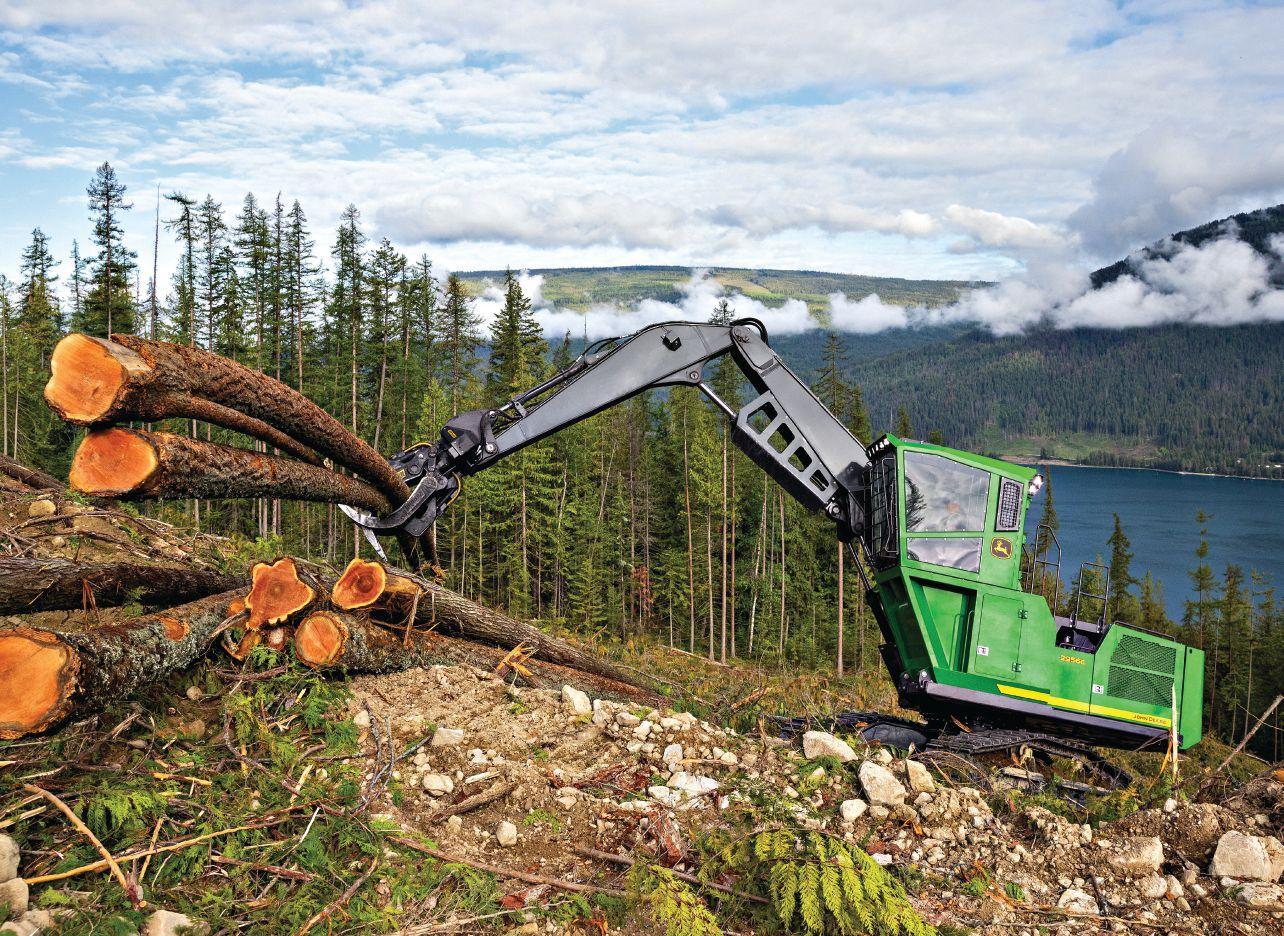
The all-new 2956G Swing Machine can handle whatever you face in the forest and is available in log loader and harvester configurations.
More Productive
Increased horsepower and hydraulic flow allow greater efficiency and speed when loading trucks.
More Versatile
Operating weight without attachments under 90,000 lbs eases transport and speeds machine mobility.
More Support
Backed by Brandt – the besttrained support team around, available 24/7/365 so you can keep working.
Winter maintenance essentials
Cold-weather considerations for winterizing logging equipment
BY LASSE AALTO AND KEVIN DRAKE
As loggers brace for cold weather conditions, keeping machines up and running is a top priority. As temperatures begin to drop. There are a variety of key areas loggers should focus on, including adopting maintenance best practices, adjusting machine settings and checking in on parts and fluid levels to ensure they are ready to tackle the job at hand, even during the most severe winter weather. The following maintenance recommendations may not apply to all machine platforms and models. It is recommended that for specific intervals and guidelines you follow your manufacturer recommendations typically outlined in the operator manual.
GENERAL MACHINE MAINTENANCE
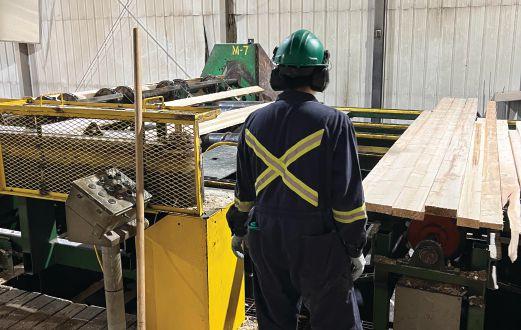
As soon as temperatures trend toward freezing conditions, it is pivotal that loggers maintain their machines to prevent unnecessary downtime and focus on sustaining ideal grease and fluid levels, which are essential to general machine health. As part of the machine’s recommended maintenance plan, all bearings should be carefully greased to purge them of condensed water. Water should also be drained from the boom base, slew unit and water fuel separator.
Next, the saw unit and chain tensioner should be carefully cleaned out and greased regularly. Also receiving a careful routine greasing are the diame-
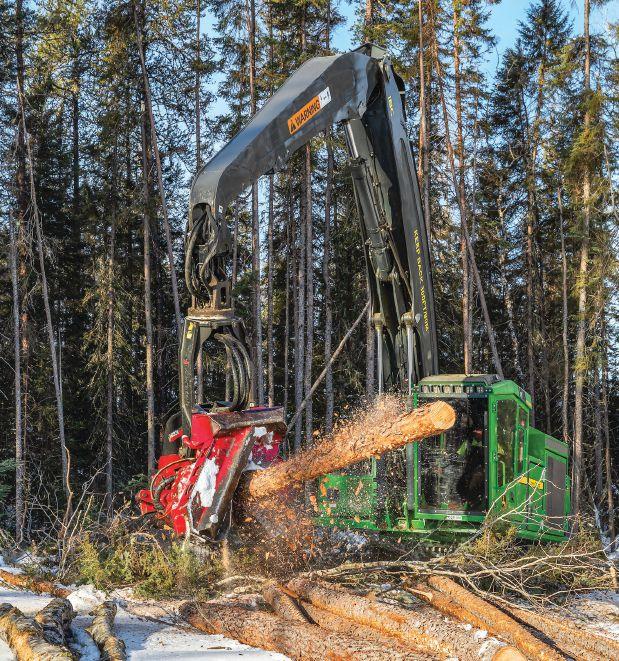
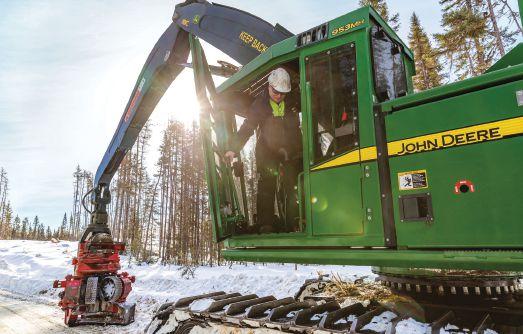
Loggers operating in cold weather are encouraged to keep a close eye on their parts and fluid levels. Photos courtesy John Deere.
ter sensors and the bogie articulation bearings, helping to keep your machine up and running in any weather condition. Regularly performing these steps during winter months can be incredibly worthwhile, as built-up dirt, debris and snow can freeze, making maintenance procedures more difficult to perform.
CHECK YOUR PARTS AND FLUIDS
Loggers operating in cold weather are encouraged to keep a close eye on their parts and fluid levels. Before tackling logging applications in the winter, all batteries should be checked to confirm they are in optimal condition and replaced if needed. Fuel should also be replaced with winter-grade fuel. If replaced early enough in the season, this step can help to avoid machine malfunctions and filter clogging.
Operators should also make sure they have an additional set of fuel filters in stock in case the temperature drops below the recommended fuel cloud point. John Deere recommends using winter grade fuel when temperatures fall below 0 C.
When looking at hydraulic oils, higher viscosity index (VI) oils can manage a wider range of temperatures than standard oils. Standard grade 46 oil typically can manage temperatures as cold as -15 C, while higher VI oils can manage temperatures as cool as -25 C. To best ensure the correct oil is being utilized, loggers should consult with their local dealer or oil supplier.
Before firing up the machine, check the temperatures to confirm your machine can sustain a cold start-up. Also, completely changing over to suitable grade oil can help sustain performance in extreme temperatures. Operators should measure the coolant freezing temperatures, as certain coolants will completely freeze in extreme temperatures. Also being swapped out in cold-weather conditions is the grease in the central lubrication system to ensure the grease classification is suitable for the temperatures at hand.
Moving away from fluids, loggers are encouraged to check their machine’s chains, tracks and tires to check that the traction studs have sufficient lifetime remaining. If the high floatation tracks have been used year-round, loggers should check that their tracks are suitable for winter use and that no damage was done during the summer months. Lastly, tire air pressures should be checked for winter use, as the pressure in the tires can decrease in cold temperatures.
WARM UP YOUR MACHINE
When getting ready to tackle the cold weather conditions from inside the cab, always conduct a performance check of the pre-heater functions and perform a test run to ensure that the machine is ready for use. Also, the oils and coolants in the winter grade help ensure the viscosity is suitable for winter use.
All loggers working in the winter should familiarize themselves with the warmup procedure, as well as how to conduct a cold start-up on their machines. This includes checking in on the machine’s hydraulics and saw motors before tackling routine applications. Also focusing on hydraulics, operators should always warm up the machine’s work hydraulics before operating, especially if the temperature of the hydraulic fluid is below 0 C.
After the machine is running, start the warmup cycle of feed rollers and wait at least five minutes as a best practice. Once the time has passed, let the feed rollers rotate and start to move
Before tackling logging applications in winter, all batteries should be checked to confirm they are in optimal condition and replaced if needed.
articulations of the boom, using small movements and keeping the boom unloaded.
Another best practice is to let the engine idle and run the saw motor to warm it up and ensure that the temperature difference between the motor and the hydraulic fluid is always below 30 C. Use all the functions of the harvester head until the hydraulic fluid is warmed up to the ideal operating temperature.
When utilizing a harvester head, adjust the settings to ensure optimal performance. Adjust the pressure curves for frozen wood and calibrate the length and diameter measurements as needed. Lastly, check your saw to ensure all adjustments have been completed before tackling forestry applications.
PROFESSIONAL FORESTRY EQUIPMENT
COLD-WEATHER CONSIDERATIONS
Also helping to keep operators up and running during extreme weather conditions, cabins should be properly lubricated at the locks, and doors should be sealed with silicone to prevent them from freezing completely, helping to avoid the cabin door from becoming frozen shut. It is also important to check that the water valve and hot air supply are working properly, ensuring that cabin stays warm for the operator.
As the winter months may impact daytime visibility in the woods, loggers are encouraged to utilize proper lighting to protect themselves, as well as the other machines and operators around them. Before heading out to the job, double check that the light package is fully functional before the darkness hits, helping to prevent necessary damage. Also, considering that the days are shorter during winter, machines will often operate during night and after the sun has gone down. Therefore, the working light of the machine should be fully operational.
During a standard winter day, your equipment’s components will warm-up naturally with the heat of the machine, helping to remove snow and ice. However, at the end of the day, operators should always clean out any remaining snow from critical places where it may freeze overnight.
In addition, the saw box on harvester heads and feed roller arms areas are vital areas to double-check before heading home at the end of the day. Operators should also park the machine on an area where the snow is packed down and should place the boom straight down for simplified start-up on the next shift. This also enables an operator to lift the harvester head without unnecessarily folding of the boom when the hydraulic system is cold.
Harsh winter weather conditions can transform a jobsite entirely, and focusing on warming up all machines, checking fluid levels and parts, and performing routing machine maintenance are essential to year-round success. In extreme weather conditions, operators are also encouraged to look after themselves as well, not just their machines, and wear the appropriate gear and bring the necessary tools to stay warm on the job.
Lasse Aalto is the manager, technical support and DTAC, while Kevin Drake is the manager, forestry customer and product support for John Deere.
Cabin doors should be sealed with silicone to prevent from becoming frozen shut.
NEW SAW TEETH FROM JOHN DEERE
Make your feller head feel like new with the best saw teeth from Deere. Stronger metal and sharper edges to maximize efficiency and productivity. The broader selection lets you fine tune your equipment to each project.
TOP 20 UNDER 40 WINNERS
Canadian Forest Industries is once again thrilled to introduce this year’s recipients of our annual Top 20 Under 40 awards.
We tried to whittle down the unprecedented number of nominations into 10, but we just can’t ignore the caliber of candidates. Thus, due to the record number of entries, we’ve decided to expand it to Top 20 this year.
Now in its 11th edition, we are very proud to present this year’s top of the crop – our industry’s young leaders, innovators, change-makers, mentors who achieved so much at a young age, inspiring
CFI
others, and giving back to their communities.
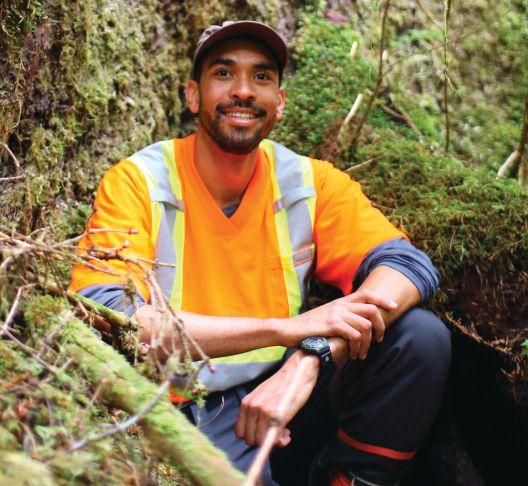
JEFF DOERKSEN Mobile equipment supervisor, Edgewood Forest Products, Carrot River, Sask.
Jeff joined the Edgewood Forest Products team in 2015 as a young Red Seal heavy duty mechanic who loved to rebuild and repair engines and transmissions. At the age of 33, Jeff has demonstrated tremendous initiative and leadership in transforming Edgewood’s mobile equipment strategy from a reactive to a proactive maintenance
is once again thrilled to introduce the 2023 top young achievers in forestry. Due to the unprecedented number of nominations, we have 20 award recipents this year. All photos submitted.
JEFF DOERKSEN
approach, while driving operational efficiency gains by utilizing technologies.
“As a result of Jeff’s efforts, several of these strategies are now being implemented across our other operations within our company. The end result has Jeff and his team achieving more than 95 per cent uptime on a triple shift, five-dayper-week basis on our core fleet of mobile equipment,” says his manager Trevor Reid, a 2019 CFI Top 10 Under 40 awardee.
Jeff continuously seeks out professional development opportunities to in order to further improve his craft. In his spare time, Jeff is an avid outdoorsman who enjoys coaching minor hockey, fishing, hunting, and spending time with his family, as well as being a part-time musician playing in several local bands as an accomplished bass guitar player.
ANNE-MARIE FAUCHER
President and CEO, PG Flooring, SaintÉdouard-de-Lotbinière, Que.
After spending a few years working in the hospitality industry, Anne-Marie decided to be a part of the family business in 2008. She has held numerous positions at PG Flooring since, spearheading innovative projects and processes, until she was promoted to president and CEO in August
2020. Since becoming the head of the company, the 36-year-old has created committees and carried out several projects and partnerships that elevated PG Flooring to be a leader in the hardwood flooring industry in Quebec and in Canada.
“It’s really exciting to work for a company founded by my grandfather and his cousin in 1979,” she says. “It’s a source of pride to continue working as a family,” adds Anne-Marie.
Knowing how to mobilize the troops and motivate colleagues to take them further are part of Anne-Marie’s leadership DNA. Over the coming years, she plans to continue expanding when markets and interest rates stabilize. “We invested more than $6 million in our production line,” she says. “We now want to maximize production capacity and efficiency.”
PETER FLETT
Operations manager, Nk’Mip Forestry/ West Boundary Community Forest, Midway, B.C.
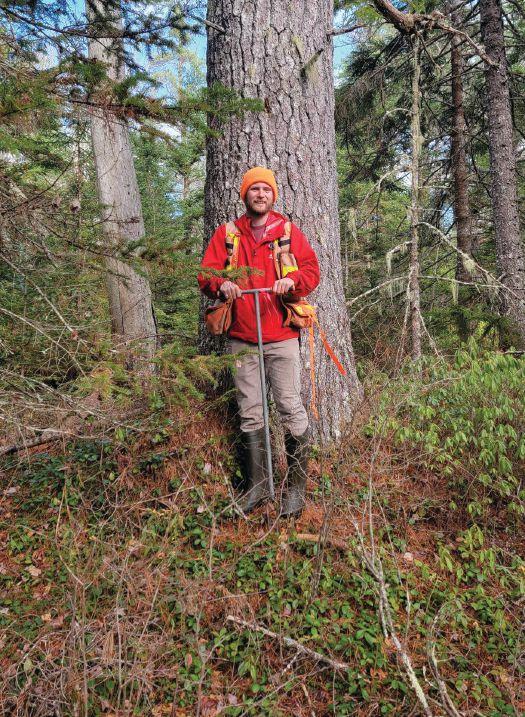
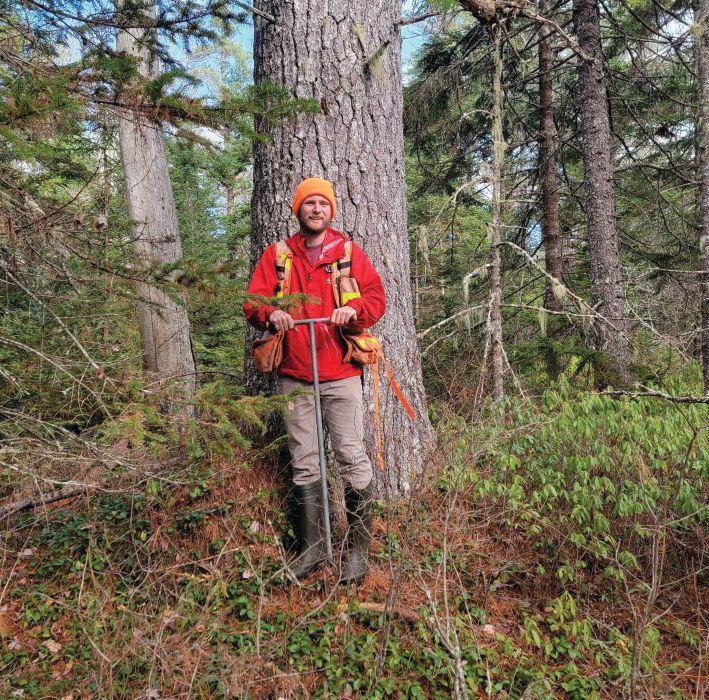
Peter’s journey toward forestry had some detours. With a bachelor’s degree in human kinetics from the University of British Columbia (UBC), Peter realized he was meant to work outdoors and be surrounded by nature. He enrolled in
the natural resource science program at Thompson Rivers University, before joining UBC’s master’s program in sustainable forest management. After graduation, Peter worked at Vaagen Fibre Canada, where he was able to dive into a wide array of forestry roles, from project management, planning, operational supervision and silviculture to building relationships and partnerships with the local community.
Today, Peter is operations manager for the Osoyoos Indian Band (OIB) forestry department, Nk’Mip Forestry and West Boundary Community Forest (WBCF). He works with First Nation Band members and local citizens before and during project planning to incorporate the values of the area and address potential concerns up front. He makes sure forest practices adhere to a foundation of sustainable forest management by balancing ecological, social, cultural and economic values.
The 30-year-old RPF is also a director for the Phoenix Interpretive Forest Society and a member of the B.C. Community Forest Association Old Growth Working Group.
BRITANNY GUIMOND
Multifunctional harvester operator, Les Forestiers Multi-Sim, DolbeauMistassini, Que.
Britanny says she has always been a bit of a tomboy. “I didn’t know what I wanted to work in, but I was looking for
ANNE-MARIE FAUCHER
PETER FLETT
an unconventional job for a girl,” says the 20-year-old who played football in high school.
Britanny was working in healthcare when she saw a YouTube video of a multifunctional harvester in action. “I found it impressive and I decided to take a forestry course in 2021. In the woods, there is never a shortage of challenges.”
Being the only woman in camp was in itself a challenge, which Brittany embraced as she paved the way for women’s increased participation in the program. There are now four other women enrolled in camp, and her company has welcomed another woman into the team.
Brittany works eight days on, followed by six days off at Quebec’s Brooch forestry camp, which she says is ideal because she loves spending time in the forest, even if she has to work 12 hours a day. She plans to work in the forest for at least the next 10 years.
KATHERINE GUNION
Team lead – Biometrics, Forsite Consultants, Salmon Arm, B.C. Kat prepared well for the technology advancements and big data
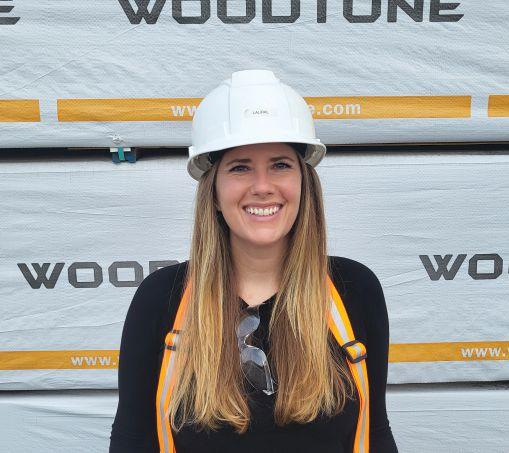
Woodtone is proud to congratulate Laural Pedersen as one of this years Top 10 Under 40 and would also like to recognize the other individuals selected and nominated.
management requirements we see now in the forest industry when she ambitiously blended experience with tree planting/ fire suppression with a master of sustainable forest management (UBC) and a MSc in computer science (University of Victoria).
The RPF has inspired colleagues to incorporate cutting edge analytical techniques and models to support complex resource management problems, earning a reputation as a key resource on any project and a seat at the company’s leadership table at only 38 years old. Kat is involved in recruiting top talent across the country to realize her vision of computer science, big data, analytics. She also volunteers with the Salmon Arm Search and Rescue Unit and is continually improving her technical and leadership skills to provide support where needed.
“Kat is the go-to person at Forsite to brainstorm and tackle technical challenges that our forest sector clients from across the country bring to us. Somehow, she manages to stay current with the fast-paced advancements in the forestry field and help other,” explains her manager Cam Brown.
SANJNA HOTHI
Sales manager, S&W Forest Products, Maple Ridge, B.C. Sanj started in the cedar shake and shingle sector in 2013 when she was hired for her accounting background. Quickly S&W realized that her skill set far exceeds just crunching numbers. Sanj expressed an interest in marketing, health and safety, general mill operations and logistics. Her general aptitude, eagerness to learn and her pleasant demeanor were evident from the start which translated into overall improvement, growth and sales for the company.
Sanj has worked in almost every department at S&W and now manages all sales for S&W. She is well known for her sharp business acumen and great foresight. Despite the challenges continuously faced in the industry, Sanj continues to always look for solutions and improvements with her never folding cornerstone attitude.
The 34-year-old has been the youngest member of the Cedar
BRITANNY GUIMOND
KATHERINE GUNION
Shake and Shingle Bureau’s board of directors since 2018, and is now the vice chair, helping shape guidelines for product quality and environmental sustainability and also helps promote the value of B.C.’s cedar shakes and shingles worldwide.
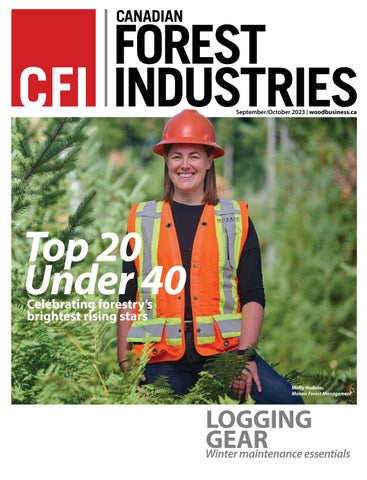
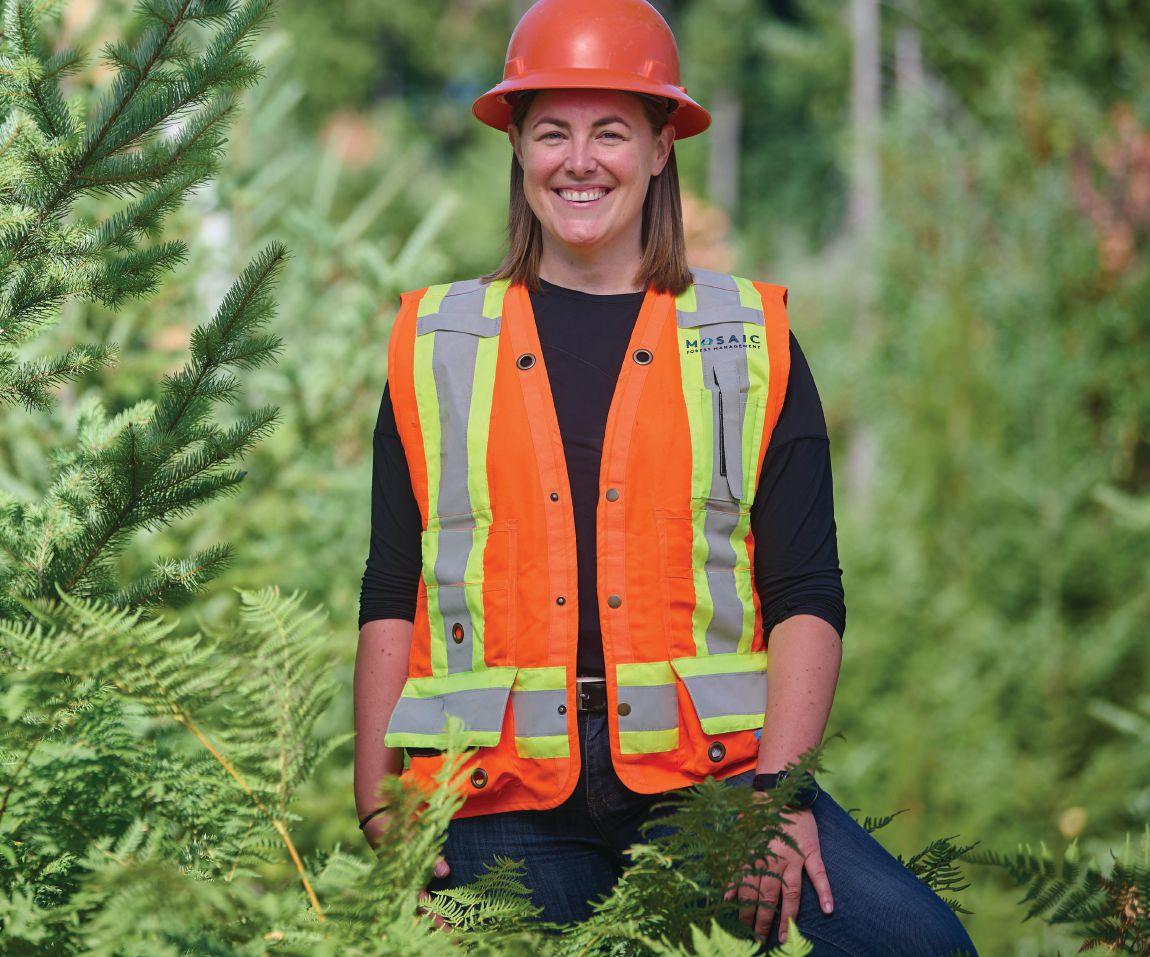
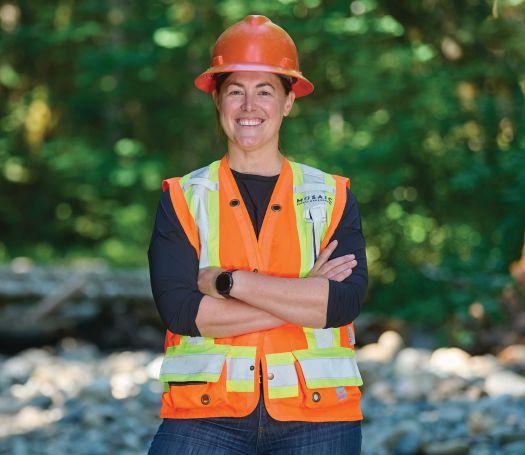
Molly’s passion for forestry was sparked in 2002 when she planted
her first tree in northern B.C. After five years of tree planting, the RPF and registered professional biologist realized she could combine her love of science and the outdoors in a forestry career. After working a stint in research at the Ministry of Forests, she reinvented herself as a timber cruiser.
After joining Mosaic’s predecessor TimberWest in 2013, she soon stepped up to apply her experience in science and forestry to stewardship and community work. Her dedication and skills saw her rise in the company, and most recently, she was appointed VP of sustainability and Mosaic’s first female chief forester.
The 39-year-old’s leadership guides Mosaic’s work in forest management certifications, operations, community relations, sustainability initiatives, environmental performance, fish and wildlife management, and the species at risk program. Her work helped Mosaic win the Sustainable Forestry Initiative’s 2023 Leadership in Conservation Award for its early adoption of climate-smart
Molly is committed to helping change the face of the forest sector so it is a safe, welcoming place for all, where different voices are at the table
Burrows Lumber, Winnipeg
When Igor immigrated to Canada eight years ago from Brazil, he had no knowledge of the wood industry and could only speak basic English.
“But he came with ambition and a great work ethic, as well as some business skills and an entrepreneurial bent,” says business partner Chris
Dirks describes Igor’s journey as a good example of the immigrant success story. Indeed, the 37-year-
SANJNA HOTHI
MOLLY HUDSON
IGOR
old’s climb to success is very inspiring, first joining Burrows Lumber as a sales assistant and in no time becoming a proficient lumber trader. In 2022, he became an equal partner in the business.
From a new immigrant who barely spoke English, the coowner of Burrows Lumber now combines lumber trading with running the company’s day-to-day operations.
In 2023 Igor and his wife became Canadian citizens.
ROBERT MOEN
General manager, Moen Lumber Sales, Edmonton Robert started his journey into the forest industry at a very young age. He started going with his grandfather to the family-owned lumber and remanufacturing yard every weekend to help with routine maintenance .
At the age of 14, he attended the Alberta Forest Products Association’s lumber grading program. Upon turning 16 and as soon as he got his driver’s license, Robert worked at the family’s mill after school and on weekends, doing everything from feeding the saws, piling lumber, machine maintenance and general repairs to equipment. After high school, Robert got his millwright certification and started working full time at Moen Lumber doing machine maintenance and repairs. As his grandfather transitioned out of the business, Robert took over managing the company.
The 39-year-old says although there has been some changes and challenges in the industry throughout the years – from remanufacturing, building pallets to reloading – he plans on keeping the business going for many many years.
BENJAMIN PATTON
Founder and president, TreeCycle Canada, North Vancouver, B.C.
The 32-year-old has been working most of his adult life in the forest industry as a tree planter, forest firefighter, arborist, dangerous tree assessor, flood rescuer, general forestry worker,
and now developing and implementing solutions for forestry wood waste and helping to grow the wood waste circular economy across Canada.
“His experience on the frontlines has shaped his commitment to finding innovative solutions for forestry waste management. Through his visionary approach, Ben has created an umbrella of
CONGRATULATIONS Devon Wilkins!
The Forestry Sector Council and Rumcache Forestry Solutions thank you for being part of a diverse, sustainable, and growing workforce in Nova Scotia!
ROBERT MOEN
BENJAMIN PATTON
circular economy and bioeconomy endeavors for forestry waste solutions, showcasing his entrepreneurial spirit and ability to translate ideas into impactful ventures. He also has a committed motivation to bringing others along with his success; ergo, our business partnerships,” explains co-founder Connor McCron.
Ben is a volunteer and director for the North Shore Streamkeepers. He also oversees the deconstruction wood waste program for the District of North Vancouver. He is actively
pursuing regulatory reform for the forestry act and municipal bylaws related to urban and community forest wood waste utilization. Recently, he has been selected as a Sustainable Forestry Initiative youth delegate for fostering a culture of environmental stewardship in the industry.
LAURAL PEDERSEN
Business administration manager, Woodtone Specialites, Armstrong, B.C.
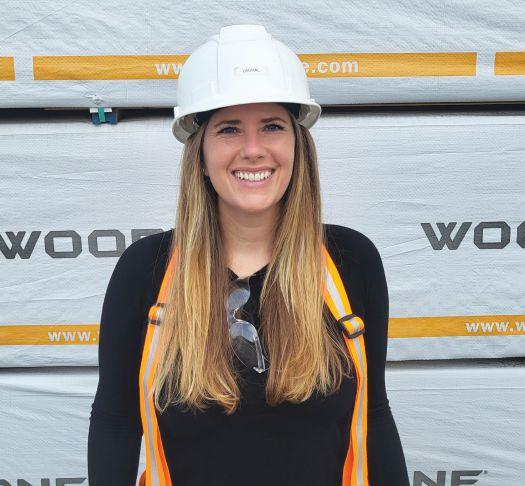
Laural joined Woodtone Specialties three years ago from outside the forest industry and has completely overhauled the accounting, administration, and human resources functions of the engineered wood products business.
With a focus on servant leadership, the 39-year-old has driven a progressive culture with a particular emphasis on women in the workplace, participating in Women in Forestry summits, among others. As a result, the company is now benefiting from an almost double the industry average percentage of women in its workforce in all capacities – from senior leadership, supervisors, admin roles, lead hands, technical operators, general labour, and cleanup.
Additionally, Laural has played a large role in Woodtone Specialties having entered a partnership with the Adams Lake Indian Band. “This partnership will not only benefit the business but more importantly represents meaningful reconciliation and is a model for what the forest industry in British Columbia could and should look like,” Woodtone Specialties president Hal Hanlon says.
“In three short years, Laural has made a significant impact on the business at the most meaningful level – the people – and she has become core to a culture that will ensure continued growth
Owner, Valley View Industries, Kamloops, B.C.
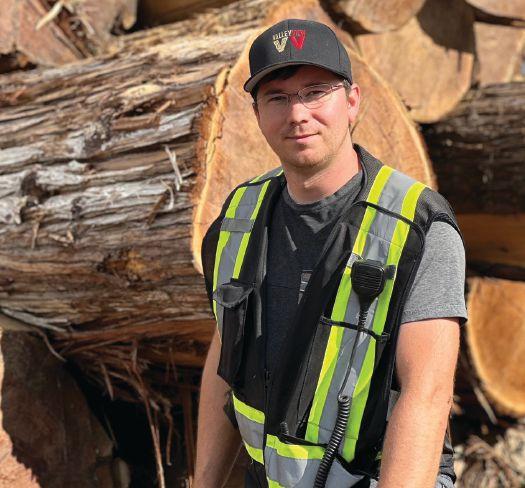
Nick’s journey in the forest industry began in 2009 when he started working in the family business, making cedar fencing and gazebos. In 2017, he purchased the company and transformed it
LAURAL PEDERSEN
NICK PRICE
into a year-round business that employs 20 staff that operates a sawmill, finishing line, and carpentry division in one facility.
Nick’s goal to build a lean culture at Valley View Industries within one year is testament to his leadership and initiative. Each morning there is a meeting with all staff where Nick teaches and trains his people, reviewing and learning lean concepts, sharing mistakes, and discussing new processes that may need to be considered. The results are a strong culture, safe work environment, highly organized and efficient workplace. Nick believes in growing people and building quality cedar products that are made to last.
The 32-year-old’s commitment extends beyond his work at Valley View Industries. He donates to schools, community gardens, and workshops – anywhere he can help others learn and grow the passion for manufacturing and woodworking.
NICK REINHARDT
Head of product and process development, Chartwell Resource Group, North Vancouver, B.C.
The 37-year-old is a professional forester, project manager, and now Chartwell’s head of product and process development.
Nick’s ability to connect with others and give back through mentorship sets him apart, says co-worker Kari Zuehlke. As mentor within the company and with young workers at UBC and at the Forest Professionals BC, Nick never hesitates to share his knowledge and expertise, helping others to develop valuable skills and achieve their career goals.
Nick’s forward-thinking approach has allowed him to embrace new technology and help drive progress with tasks like data collection, to streamline fieldwork and mapping. He works closely with GIS and development teams to explore innovative solutions to challenges and help keep Chartwell Resource Group at the forefront of advancements in the industry, adds Zuehlke.
Beyond professional achievements, Nick’s genuine kindness and welcoming demeanor help to create a great work environment. He goes above and beyond to help colleagues and believes in collaboration which benefits the whole team.
GARY SIHOTA
Director of operations, Mid-South Engineering, Richmond, B.C.
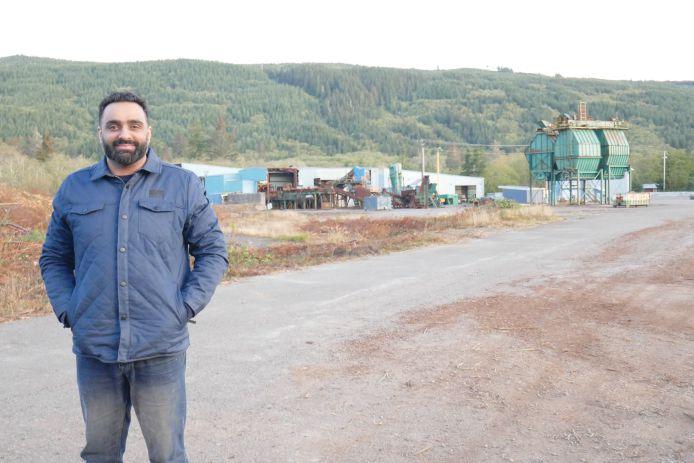
Gary is a highly accomplished professional engineer. Throughout his career, Gary’s work ethic has been truly outstanding, describes his colleague Michael Sampson.
Starting as a design engineer, the 39-year-old’s proficiency in mechanical engineering and plant design has driven him to
NICK REINHARDT
GARY SIHOTA
pursue excellence in all aspects of his work.
Specializing in facilities and plant design for sawmills, pellet plants, and wood processing facilities, Gary’s extensive knowledge has been instrumental in driving rapid growth and ensuring highquality operations at Mid-South.
“A strength of Gary’s is his ability to inspire and lead others. Having successfully guided small teams, he now oversees the
Congratulations Kate Schilling!
entire Richmond office. His leadership style fosters collaboration, innovation, and continuous improvement within the organization, resulting in heightened efficiency and outstanding outcomes,” says Sampson.
Gary’s pursuit of personal and professional development is evident through his constant engagement in training and education. He proactively seeks opportunities to expand his knowledge and skills, obtaining his P.Eng designation and earning a PMP certification. His commitment to staying abreast of industry trends reflects his dedication to growth and advancement. Active involvement in industry associations showcases Gary’s engagement and dedication to professional networks and knowledge exchange, furthering the growth of the engineering field.
KATE SCHILLING
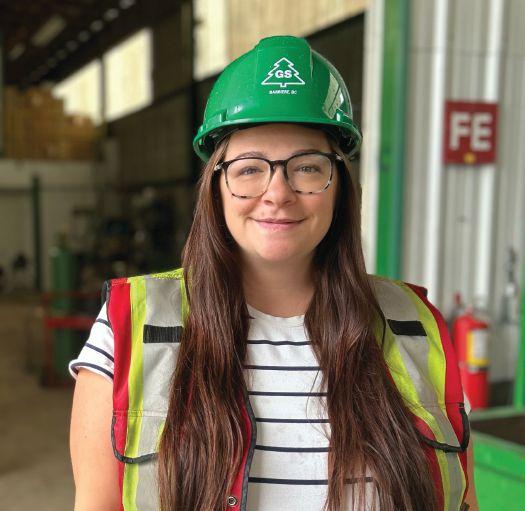
Maintainence coordinator, Gilbert Smith Forest Products, Barrier, B.C.
Kate has played a pivotal role in the success of Gilbert Smith Forest Products (GSFP). She started as an electrical apprentice in the maintenance department, tending to the everyday upkeep of the operation.
Kate’s organized and diligent approach saw her taking on more and more responsibility. In 2018, she took on her current role, overseeing a 25-person department. Parallel to being part of the lead management team at GSFP, she has continued to pursue her education. She is a ticketed level three electrician working towards her Red Seal.
On top of her already impressive workload, Kate is a member of the staff safety committee and has worked on multiple projects, including the installation of a brand new all hydroelectric dry kiln, implementing multiple worker engagement initiatives, being a champion for continuous improvement, and even co-plans the staff Christmas party.
“Kate is a shining example to all young women and men in the forest sector and at just 28 years old she will undoubtedly continue to break molds and be successful in all aspects of her
Gilbert Smith Forest Products Ltd.
KATE SCHILLING
MARK SYMES
career,” says collegue Aidan Coyles.
Kate and her husband Chad are expecting the birth of their first child.
MARK SYMES
Co-founder, Symplicity Designs, Moncton, N.B.
Mark graduated from University of New Brunswick, Fredericton, with a bachelor of science degree from the faculty of forestry and environmental management. But his career in forestry started earlier, as Mark spent his high school years doing forestry jobs, and continued to work as an operational forester and business analyst for various forest products companies in Atlantic Canada.
Since becoming the co-founder of Symplicity Designs, a company that helps other organizations and industries drive operational efficiency, the 39-year-old has continued to support the forest sector by helping individual organizations reach their maximum potential. Well-respected as a leader in the sector, he regularly gives keynote speeches at industry events.
In 2013, hewas named by 21inc as one of the Top 50 New and Emerging Leaders in Atlantic Canada.
Maark is an avid outdoorsman and a member of multiple conservation groups. He helps manage his sixth-generation family farm.
The 36-year-old CFO and corporate secretary stands out within the company where the average age of employees is between 50 to 60 years old. Bhavjit is also the youngest on the executive team.
“Bhavjit has played a crucial role in progressing Richmond Plywood’s mill through financial management, streamlining operations and rationalizing production. He is a very motivated, goal-oriented individual that is not afraid to think out of the box to create solutions to issues. He is a key player on the executive management team that always keeps everyone engaged on new
ideas and projects,” says chairman Pardeep Brar. Bhavjit constantly sets the bar high for his finance team and is always looking for ways to improve efficiencies and reduce costs. He also actively seeks new opportunities for funding, training and education for the 350+ workers in the plywood mill. He is usually one of the last to leave the office and one of the first in. Brar says the company has seen a reduction in staff turnover, attributing it to Bhavjit’s leadership style, adding that the office atmosphere has changed as Bhavjit has introduced various was to engage the office staff such as staff recognition days.
BHAVJIT THANDI
DEVON WILKINS
President, Rumcache Forest Solutions, Elmsdale and Bible Hill, N.S. Devon, 27, is one of the founders of Rumcache Forest Solutions (RFS) and plays a vital role in the strategic direction of the company. He is a proud Maritime College of Forest Technology graduate and has worked in as an independent contractor since leaving school. Thanks to mentorship from several forestry professionals during his early years in business, he gained the knowledge and confidence needed to grow RFS to where it is now.
Devon believes in and practice ongoing learning and professional development. He is positively proactive and strongly engaged with the community. His hard work and dedication make great strides in helping to build public trust in the province, says Heather Boyd from the Forestry Sector Council.
RFS was the driving force getting the forest industry highlighted at the 2023 Atlantic Outdoor Sports and RV Show, with the first ever #ForestryFriday. Devon’s company follows a similar business plan to other independent forestry consultants in western Canada, providing field work and data collection for mill groups, landowners, and crown, while specializing in the unique logistical knowledge required to work in Nova Scotia. We’ve been a leading force in air flow design for almost 3 decades, with 4-, 6-, 8-, and 12-bladed propellers, designed and manufactured exclusively for the lumber industry. Now, they are even more capable with higher- temperature capacity for certain applications. We combine this technology with unsurpassed customer service, design consultation and technical expertise, so whatever your air flow need, you can trust SmithCo to deliver.
DEVON WILKINS
WILLIAM WRIGHT
WILLIAM WRIGHT
Woodlands manager, Interfor, Nairns Centre, Ont.
Bill has progressed quickly in the industry, demonstrating inclusivity of his entire team and fleet of contractors to ensure the job gets done in a collaborative way, says colleague and mill manager Gerry Bernard. A registered professional forester, Bill’s experience spans the forest industry from coast to coast.
Bill is a great leader. When interacting with the larger Interfor team, the 31-year-old takes the time explain the woodlands proposed path forward and the implications it may have for the mill.
“My observation of the local woodlands group is that they are a team with a leader that clearly cares for them. No matter how serious a situation can get we can always count on Bill to participate, with a bit of humour to lighten the mood,” adds Bernard.
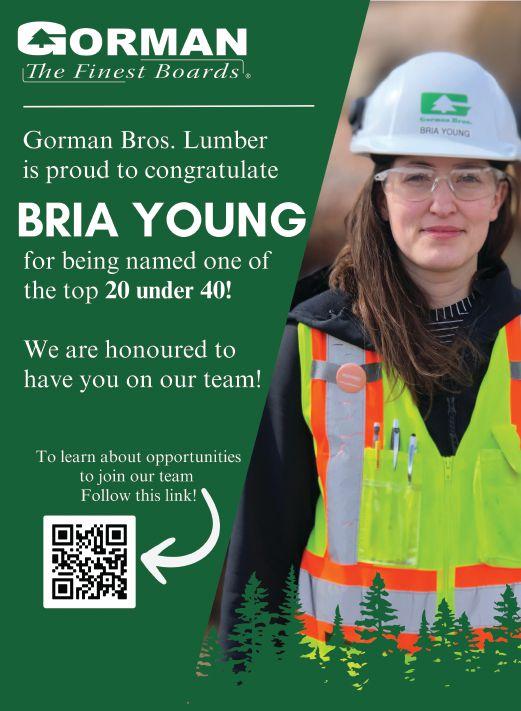
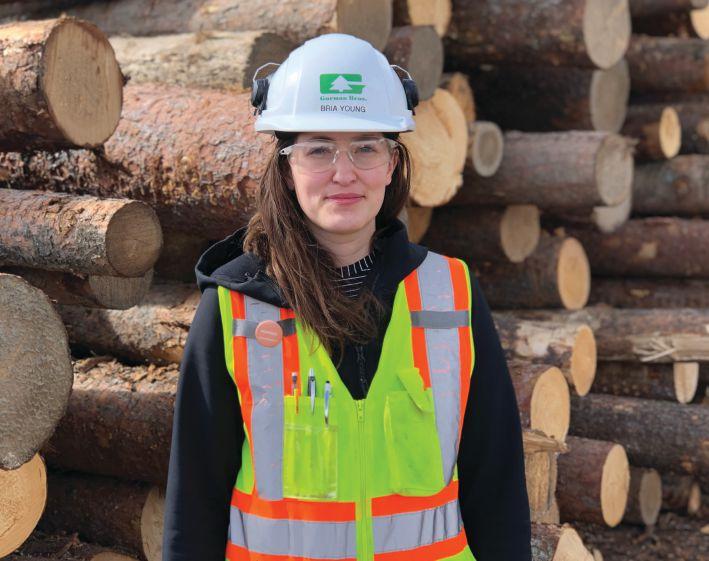
BRIA YOUNG
HR coordinator, Gorman Group, West Kelowna, B.C.
At 32, one of Bria’s notable achievements is her leadership in developing a comprehensive COVID safety program. Her efforts in ensuring the well-being of employees and business continuity during the challenging time exemplify her dedication to the welfare of her colleagues
and the company.
With a degree in human resources and a chartered professionals in human resources designation, her strong HR competencies are evident in her contributions to the
company’s mental health enhancement initiative and the HR information system project, where she has showcased her strategic thinking and attention to detail
Bria’s commitment to excellence and ability to lead by example is remarkable. She not only fulfills her responsibilities with utmost professionalism but also inspires her colleagues to strive for greatness. Bria’s positive influence fosters a culture of growth and development within the company, making her an invaluable asset to her team and the organization as a whole,” explains her manager David Murray.
Bria’s involvement in industry associations showcases her passion for the betterment of the field. She actively participates in a national forestry products industry diversity, equity, and inclusion association, which Murray describes as having an impact in Gorman Group’s success.
Combustible Dust Specialists
BRIA YOUNG
WOODPRODUCTS CANADIAN
TIMBER TITANS
BY SARAH STOTLER
In a strategic move that echoed their shared values, Northland Group acquired Western Archrib in June 2021, creating a partnership with a focus on innovation and sustainability. The deal was years in the making and exemplifies the idea that from seed to structure, every step matters.
BUILDING A LEGACY
In the early 1960s near Whitecourt, Alta., Roy and Bev Ewashko started their business with a portable sawmill. Their roots took hold in 1964 when the family relocated to Fort McMurray, Alta., along with the portable mill. Their path was not without challenges, but the Ewashkos persevered and officially founded Northland Forest Products in 1970.
In 1975, they built their first stationery mill just outside Fort McMurray. A fire in 1981 brought both challenges and opportunities, leading the Ewashkos to decide it was time for a permanent mill site. They leased 20 acres from the province of Alberta and established Northland Forest Products’ current location, 16 km north of Fort McMurray on the right-hand side of Highway 63.
In 1997, shortly after the installation of one of North America’s first HewSaw primary breakdown machines and integrated optimization at the trimmer and board edger, the mill was struck again
by a devastating fire. Roy and Bev’s sons, Howie and Craig Ewashko, who had assumed management of the mill by this time, viewed these challenges through the lens of opportunity. They embarked on a mission to rebuild the mill into a state-ofthe-art facility. Through the incorporation of new technology, they not only significantly boosted production, but also effectively minimized costs and wood waste. Howie explains, “We always believed that we need to continually upgrade our equipment and keep the mill moving forward.”
In 2001, Northland Forest Products built a new office, utilizing local wood as well as beautiful, laminated wood beams and posts supplied by Western Archrib. This would mark the beginning of a significant relationship between the two companies.
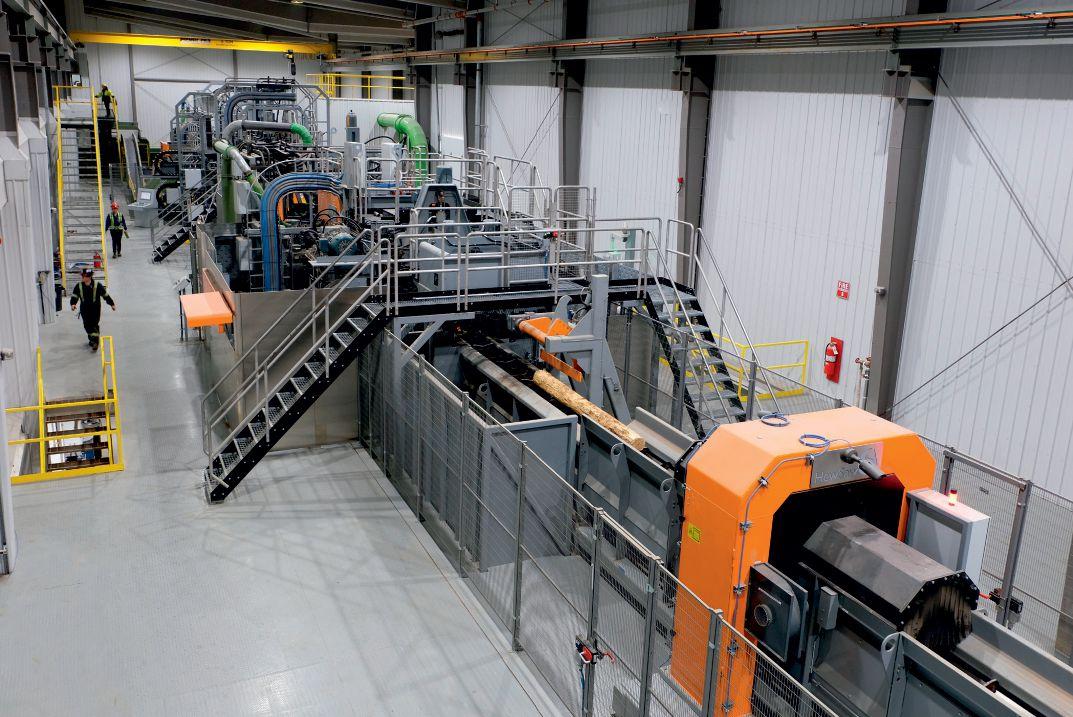
Northland Forest Products has since maintained its vision of a state-of-the-art facility and continues to move the mill forward. In 2008, the construction of a heat plant eliminated the need for natural gas in lumber drying and the building heating processes. Then in 2016, Northland acquired Millar Western’s nearby Boyle assets, which not only brought additional forest quota, but also secured Northland’s future. A year later, a new-generation HewSaw R200 A.1 was installed with full optimization and dual log turning.
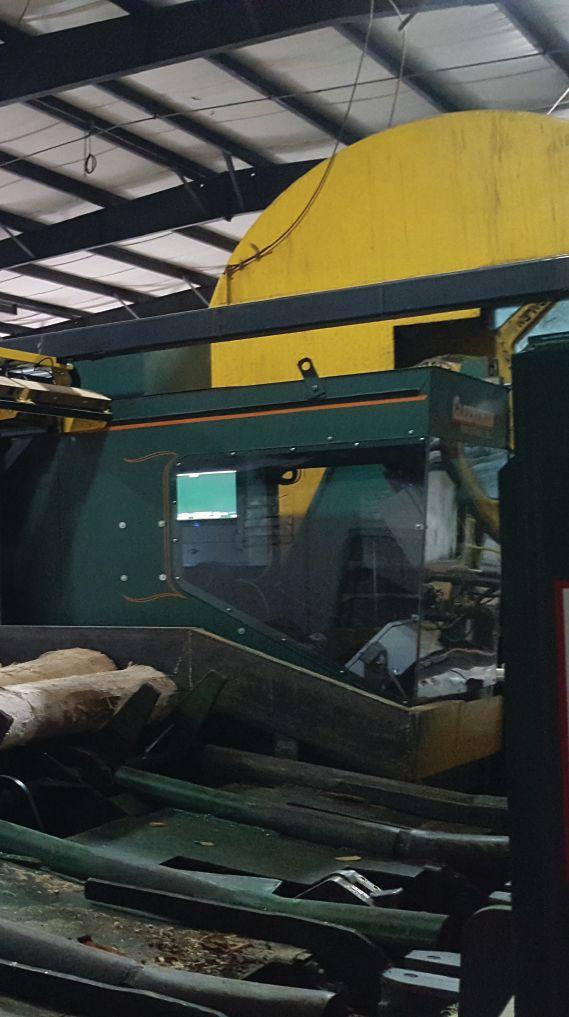
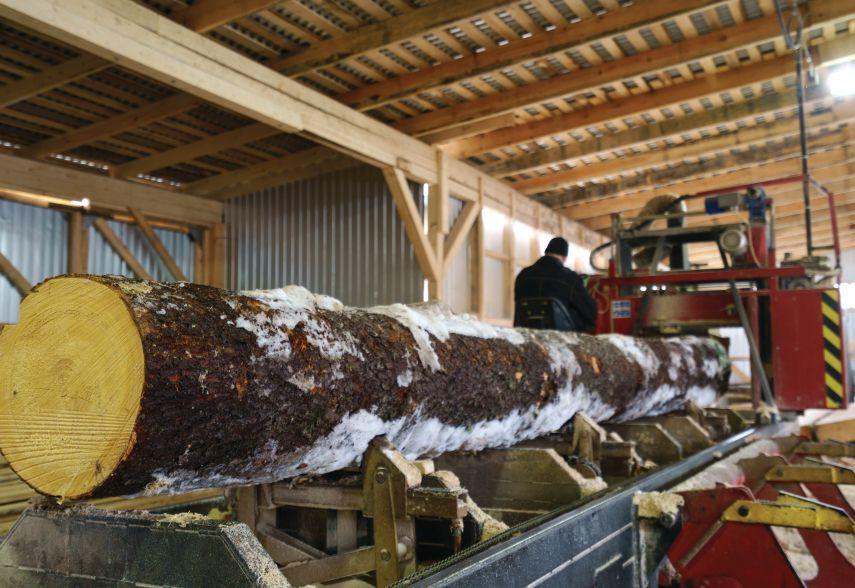
Northland Forest Products has maintained its vision of a state-of-the-art facility. Photos courtesy Northland Group.
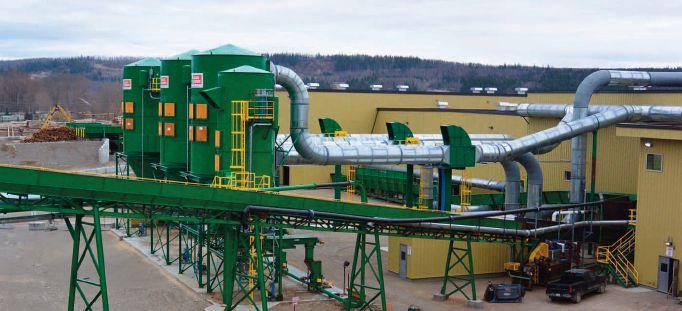
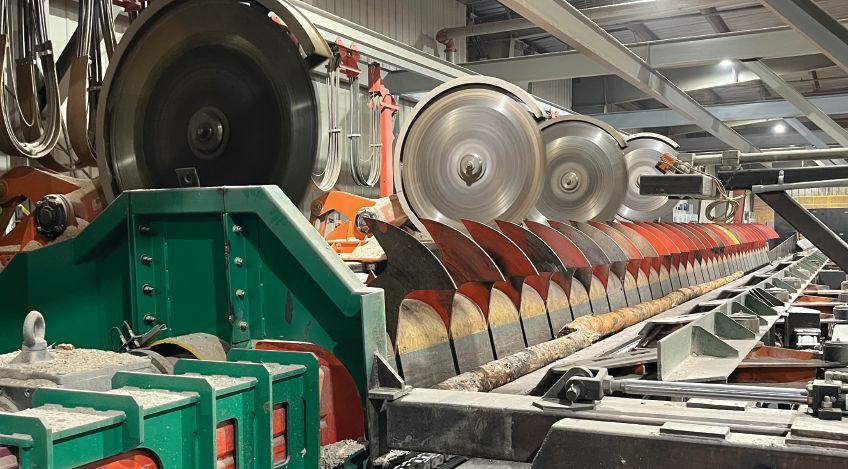
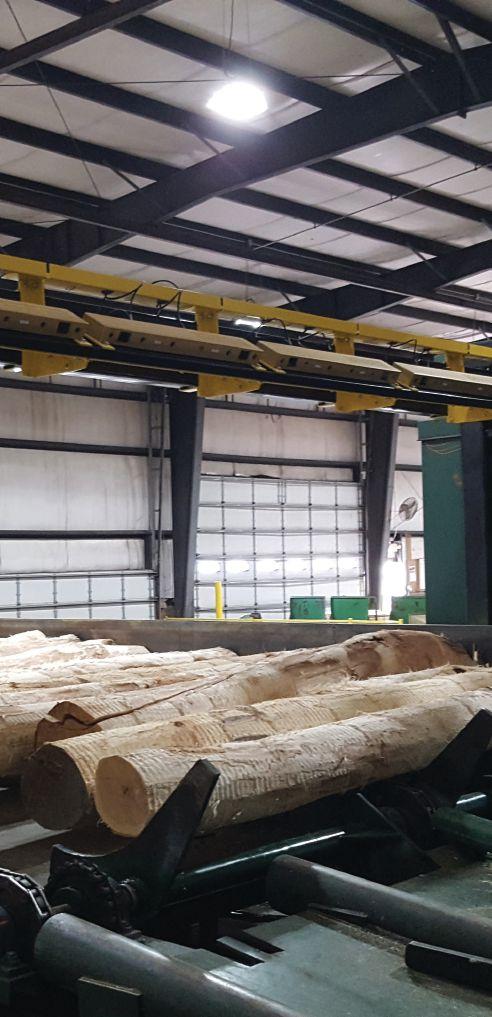
Northland Forest Products’ mill process begins as logs enter the mill and are scanned to optimize utilization and value. Larger logs go to an Optimil foursided canter, then to the board edger and gang saws. Smaller logs go to the HewSaw R200 A.1 single pass machine with a 2R Log Positioner complete with scanning and optimization from Quebec-based Prologic+. Any oversized logs are handled by the mill’s Kodiak wideband horizontal sawmill. Boards are scanned and sorted before being dried in one of two on-site kilns, which
are run with oil heated by hogfuel at the facility’s heat plant. After drying, the boards make their way to be finished by a 1930s Stetson Ross Planer, extensively upgraded over the years for high-speed production. Then finally, they are sorted for bundling as dimensional lumber.
In addition to dimensional lumber, Northland Forest Products produces chips, shavings, hogfuel, sawdust, and trim blocks, ensuring that every part of the log is utilized. They produce around 400,000 board feet per day and employ
around 75 full-time employees and up to 225 seasonal contractors.
Today, Howie is president of Northland Forest Products and Craig is the chief operating officer, overseeing the management and continuous improvement of the mill site. Northland Forest Products continues to thrive as a family-owned and operated sawmill under their stewardship. Additionally, a third generation has begun to take interest and become involved in the family business. This marks an opportunity to continue Northland Forest Products’ vision and legacy for many years to come.
PRECISION AND INNOVATION
Continuous wood drying greatness
“The TC kiln saves up to 50% energy, compared to traditional batch kilns”
JD Irving, Canada
Edmonton-based Western Archrib’s history goes back to 1951 when it was founded by Cecil Fargey. In 1952, Cecil’s son Jim joined the company. Recognized for their craftsmanship and commitment to quality, Western Archrib is dedicated to leading the mass timber industry. Following their original focus on applications such as farm buildings, hockey rinks, and storage facilities, they have evolved into a prominent player in construction projects across North America.
Jim Fargey was instrumental in moulding the company into what it is today. His strong commitment to recruiting top talent and pushing technological boundaries, along with his pivotal role in establishing manufacturing standards, highlighted his unwavering pursuit of excellence. Substantial investments in the company and its business yielded impressive results, enabling the creation of some of the widest and longest glulam beams in North America. Under Jim’s guidance, Western Archrib forged strong connections with organizations such as the Canadian Wood Council and the Canadian Standards Association, establishing its leadership role in the industry.
In 1987, Western Archrib expanded its operations with the purchase of a second facility in Boissevain, Man. During this period, Jim’s son, Kent also joined the company. In 2003, over 50 years after Cecil started the company, ownership was passed to the third generation, and Kent along with Jim’s daughter, Joan, took over Western Archrib.
Western Archrib’s glulam production process begins with pre-cut kiln-dried lumber. Each piece is inspected and
Mill process begins as logs enter the mill and are scanned to optimize utilization and value.
assessed for quality, suitability, and moisture content. Adhesive is applied to the timber components, which are then carefully stacked, aligning the grain direction. Clamps secure everything in place and introduce curvature if required. The assembled timber components are heated with forced air to cure the adhesive. The glulam beams may undergo further cutting, shaping, and sanding processes using a Baljer & Zembrod CNC machine, catering to both aesthetic and structural demands. Connection hardware like brackets and plates may be added, along with protective coatings such as stains or sealants.
Western Archrib’s projects range from small residential buildings to large multistory complexes or facilities. For some larger projects, Western Archrib is often one of the only manufacturers within North America that can fulfill the requirements due to the required beam length and specialized expertise.
On May 31, 2021, 70 years after Cecil founded Western Archrib and 20 years after the construction of Northland’s new office building, Howie and Craig added Western Archrib to the Northland Group. The acquisition of Western Archrib was a decision rooted in shared values and visions for innovation and
standing relationship, with Northland’s Fort McMurray mill supplying lumber for Western Archrib’s products.
Howie explains, “It took us two years to make sure we had the right deal. Joan and Kent Fargey are very good people to deal with and Western Archrib is a very interesting business that we were excited to
learn about and be involved in. While we knew that there was some opportunity to sell our lumber to Western Archrib, it wasn’t the driving force behind our decision. It was simply a great opportunity to become more involved with mass timber and work with a product we loved. We also thought there was a real opportunity to expand on the foundation the Fargeys had already built and to be involved in producing more beautiful projects like our office space.”
Benjamin Gill, director of corporate
development for Northland Group and Western Archrib, states, “There was an interest in Northland continuing to grow and gain new opportunities. We weren’t exactly sure what that opportunity was going to be, but then this one presented itself and we immediately gravitated towards it. It was a departure from Northland’s core business, but familiar enough that we felt comfortable taking that step. There was, and is, a tremendous amount to figure out and learn, but at
Northland Forest Products continues to thrive as a family-owned and operated sawmill.
least we have a foundation both in terms of values and knowledge of the wood manufacturing industry to build upon.”
Since the acquisition, Western Archrib has grown from 125 employees to 197 employees across the two locations. The majority are based at the Edmonton facility while the remainder are based in Boissevain. This growth is expected to continue with the Northland Group eyeing a further $82-million investment in a cuttingedge manufacturing facility in Sturgeon County, Alta., north of Edmonton. While a site has been secured, and planning and development have progressed significantly, startup is not expected until early 2026.
Howie highlights their focus on change management during the first year of ownership, and says this strategy has paid off. He explains, “We are very proud of the fact that we had very little turnover while we got our bearings during our first year. The
CONTINUED ON PAGE 53
HIGH PERFORMANCE
LIGHT CURTAINS MADE FOR SAWMILLS
Telco Sensors has been supplying high-performance photoelectric sensors for the harshest, most demanding applications in the wood products industry for over 30 years. Simply put, Telco works where others fail.
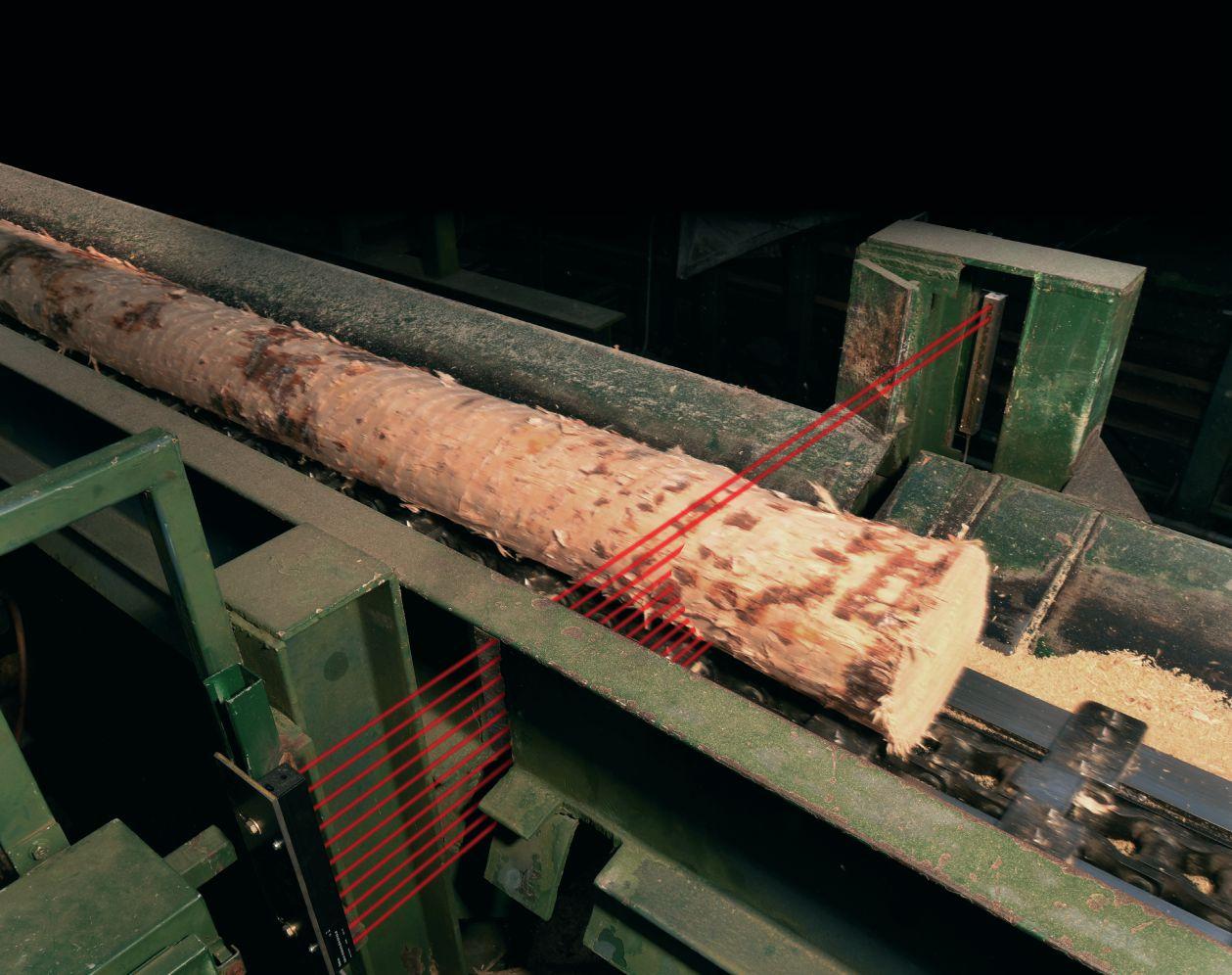
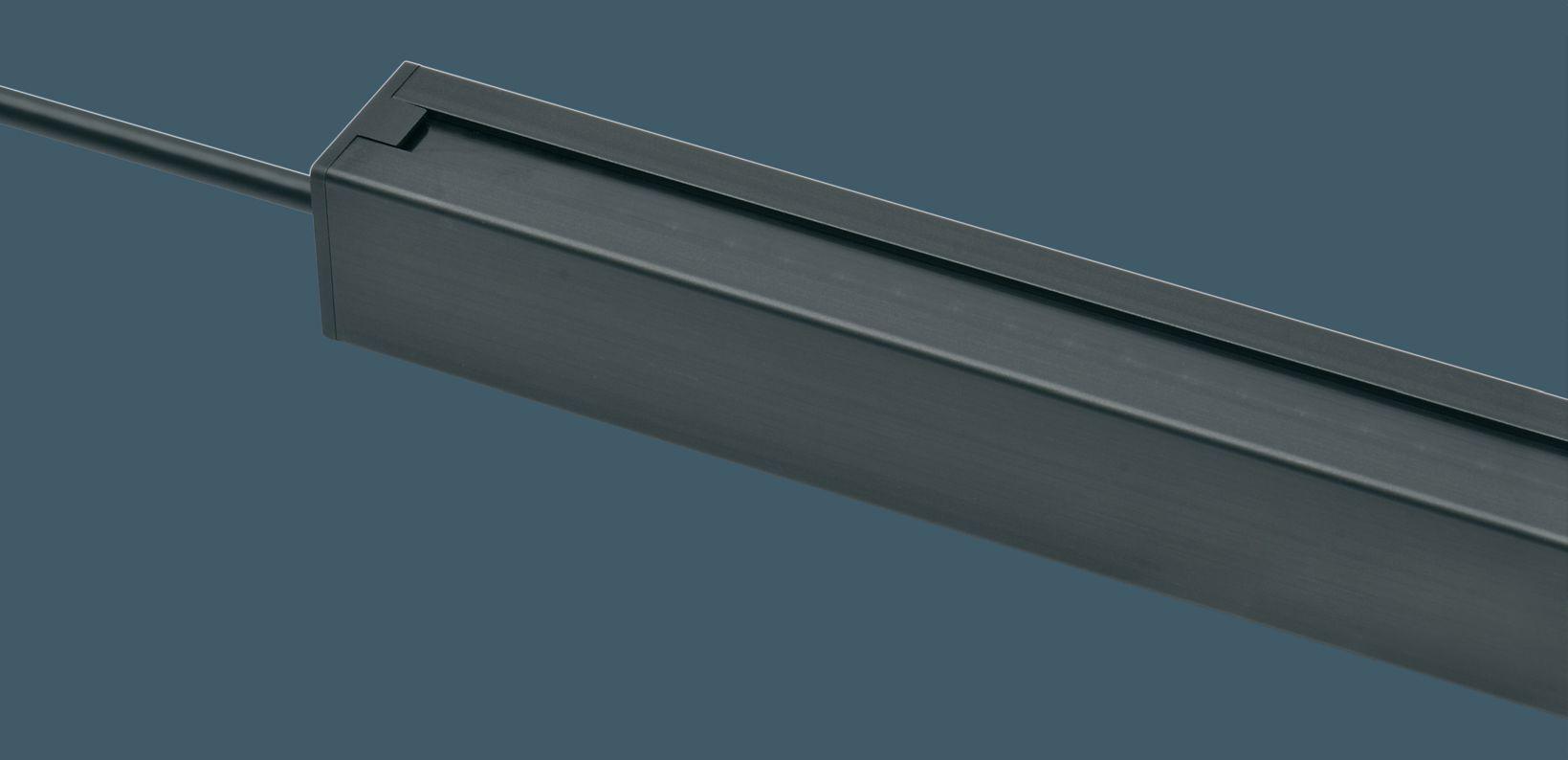
Like all Telco products, our new SpaceScan series light curtain is designed and built around 5 core values: water resistance, extreme penetration power, resistance to shock & vibration, easy alignment and immunity to sunlight. All Telco products carry a full 3-year warranty.
Telco offers light curtains in discrete, analogue, RS485, IO-Link and diffuse proximity models.
Telco Sensors Inc.
Toll Free: 800 253 0111
Email: info@telcosensorsusa.com
Web: www.telcosensors.com
WOODPRODUCTS
2 TOOLS OF OUR TRADE
From early on, sawfilers made and designed most of their own tools. Even today, sawfilers continue to come up with new and innovative tools to make their jobs easier and better. I always enjoy visiting filing rooms and hearing about and seeing the new tools and gadgets sawfilers have come up with to improve on their profession. Back in the day, when filing room doors were closed, sawfilers kept the tools of their trade to themselves and only shared this knowledge with upcoming filers they trained. We had the travelling salesman that would visit the filers, creating a trust between them. Filers who did not have access to a machine shop might trust their travelling salesmen with a drawing or make-shift tool to take back to their manufacturing plant and bring back a “precision filing room tool”. During those days, most of the tools that sawfilers used were either made on site or were inexpensive to purchase. Today’s sawfilers should have the mill and management’s ear when it comes to purchasing and maintaining their professional tools.
I will discuss just a couple of essential tools needed today in the filing room. These tools work together to ensure quality and accuracy.
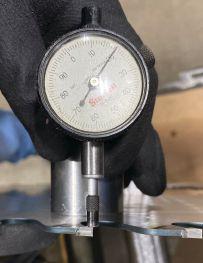
THE SIDE DIAL INDICATOR
Like most precision tools, it has varying designs, different levels of quality and cost, and is produced by multiple manufacturers. Most will perform the task at hand. However, accuracy may be more a factor of the way it is used. This tool measures side clearance and can be used to check both radial (top to bottom) and tangential (front to back) angles. This tool’s accuracy should be checked often by
placing it on granite block. The dial indicator’s foot and base must be flat and should always be held properly to obtain accurate measurements.
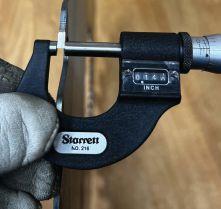
THE MICROMETER
A must in the saw filing room. It is used to check kerf and plate thickness. It’s always a good practice to double check with another device anytime it is possible. By using both – the micrometer and side dial indicator – you can be sure you’re getting correct information. The sum of the plate thickness plus side clearance on both sides of the tooth should give you the same number as the micrometer reads when checking kerf. Example: plate thickness .100 + .019 side clearance on one side + .021 on opposite side gives you .140 kerf, which should be the same number when checked with the micrometer. The micrometer can also be used to check radial and tangential angles by measuring to the far side of each and subtracting for total front to back or top to bottom measurements.
Double checking like this can save you time and problems. I have seen filers adjust their side grinding machine over and over when it’s only a bent tooth. And it’s just good practice to get this major step in grinding saw teeth correct. For long-term accuracy, the micrometer should have hardened anvils and come with a checking gauge. All measuring tools should be kept in a safe place to not be banged or dropped. They should be checked for accuracy before each use. I suggest using good, name brand, tools with protective storing cases. Tools that are well cared for should last a long time. Smith Sawmill Service – BID and most major saw manufactures can supply your filing rooms with these precision tools.
PAULsmith
Paul Smith is a saw filing consultant and founder of Smith Sawmill Service, now part of BID Group. You can reach him at paul.smith@bidgroup.ca.
Photos courtesy BID Group.
WOODPRODUCTS CANADIAN
SNAPSHOT SCANNING FOR SAWMILLS
BY JOEY NELSON
How to prevent the waney board blues?
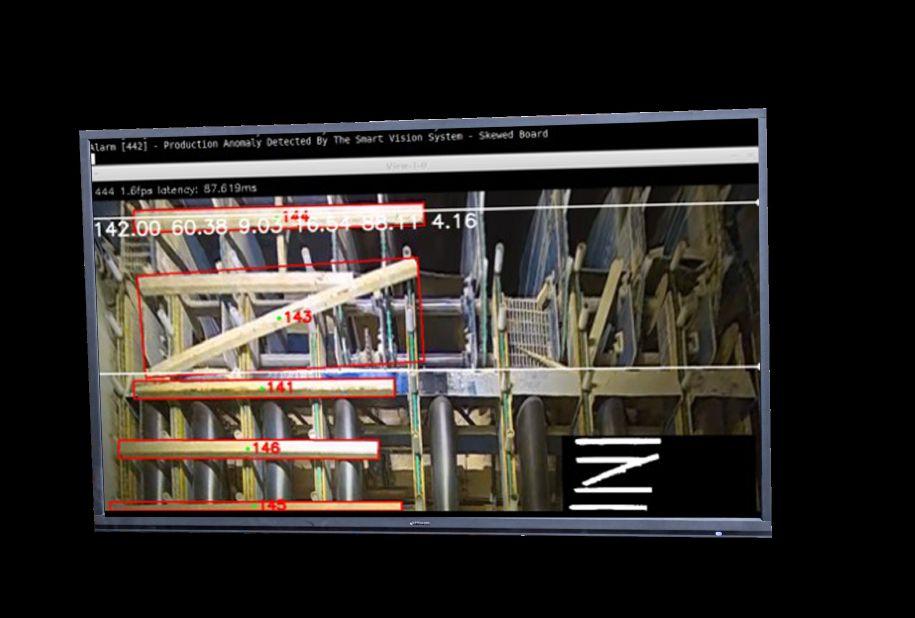
We all know that sawmilling is a special type of manufacturing. Instead of assembling products from a variety of known components, we produce goods by breaking down logs into finished lumber. The logs we start with are not standardized components with known sizes and shapes (wouldn’t that be nice?), but complex organic structures that can vary wildly from one piece to the next. Even within the same species, no two logs are exactly alike. It’s this variability that makes scanning a mission critical part of the lumber manufacturing process. It’s also this difference that makes sawmill scanning equipment so unique when compared to other industries. For example, consider the sawmill snapshot scanner – a device so specialized for breaking down wood that you won’t find it used in any other industries.
SNAPSHOT SCANNING 101
A 3D laser scanner uses lasers and cameras to define the size and shape of an object. In a sawmill, this object can be a stem, log, flitch, cant, or board. Optimization software uses this measurement to determine the best cutting solution for each piece. “Best” usually boils down to “maximizes profit”, but there are many complex decisions made at each step of the breakdown process.
In most machine centres, the log or board moves through the lasers, allowing the scanner to capture its size and shape hundreds of times per second. These measurements are combined to generate a
very accurate and dense 3D model of the wood. However, in certain sawmill systems, it’s impractical to move the piece in order to scan it. This commonly occurs with end doggers, C-frames or other very shortcoupled machine centres. Here, a snapshot scanner combines many lasers together in one package to take many measurements simultaneously, at each laser cross-section on wood. Multiple snapshot scan heads are arranged end-to-end to cover the entire length of the pieces being scanned.
LASER SPACING
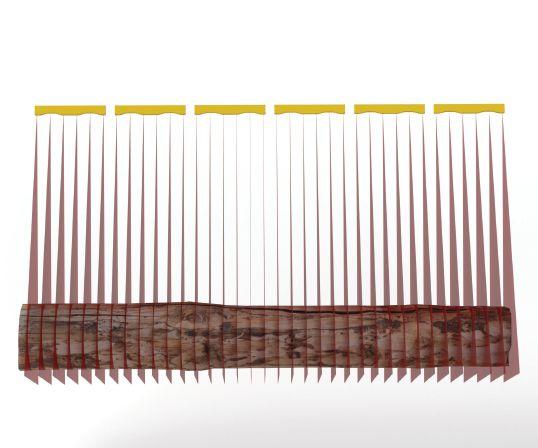
A true snapshot scan – one that does not move the piece at all – leaves gaps in the measurement, basically anywhere there isn’t a laser. The closer the lasers are to each other, the smaller those gaps are. This distance between lasers is referred to as the laser spacing of a snapshot scanner.
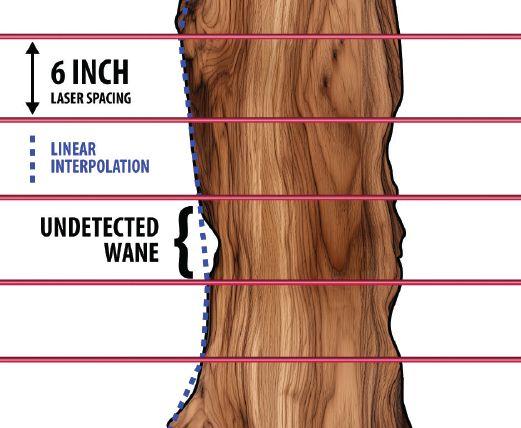
The industry standard for laser spacing has been around six inches for many years. However, as you’ll see in Figure 1, a lot can happen in those six-inch sections between measurements.
SIMPLY BETTER
Typical layout for a snapshot scanning system, with six lasers per scan head spaced six inches apart. Images courtesy JoeScan.
THE BOTTOM LINE
So, why should a sawmill care about missing data in their snapshot scans? Because it costs them money!
When faced with gaps in the data, optimization software typically uses a method like “linear interpolation” to fill them in. This is essentially connecting the dots between known data
points using straight lines. The problem occurs when the linear interpolation inaccurately represents the scanned wood. For example, the optimizer may think it’s providing the solution for a square-edged board, but the machine puts out a waney board instead.
So, how does this happen? Wherever a log or flitch narrows
Figure 1: A lot can happen in those six-inch sections between measurements.
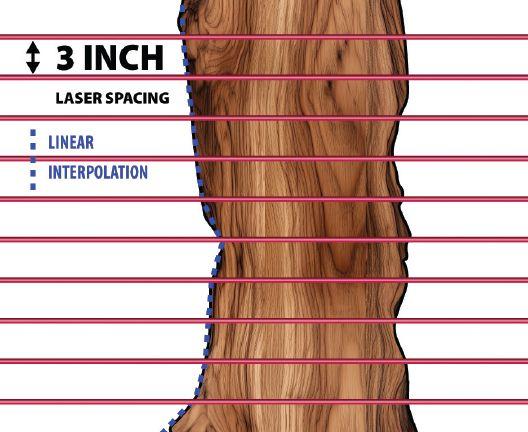
Figure 2: By reducing the laser spacing to three inches, JoeScan’s newest Z8 scan head can see twice as much as before.
A second-generation snapshot scanner on a TS Manufacturing short-infeed edger.
within a six-inch section between lasers, as in Figure 1, the scanner will not see it. Remember, it can only see where the laser touches the wood. Consequently, the optimizer assumes there is good wood where there is none, resulting in a solution that doesn’t reflect reality. Errors like these end up costing you in the form of lower-quality boards and unusable waste. Fortunately, there’s a simple fix!
THE NEXT GENERATION OF SNAPSHOT SCANNING
By reducing the laser spacing to three inches, the latest scan head can see twice as much as before. This leads to fewer and smaller undetected areas, reducing unexpected wane in your cuts. Your optimizer, like you, wants as much relevant information as possible to make an informed decision.
BEYOND THE SNAPSHOT
Snapshot-style scanners are also found in machine centres that don’t require a true snapshot. Places like the carriage headrig and short-coupled edgers also benefit from the tight laser spacing. A six-inch laser spacing allows for scanning an entire log or board’s length in just six inches of travel. This allows for faster
scan speeds, affording more time for optimization, while also significantly reducing the length of infeeds when space is limited. Further reducing laser spacing will let you operate even faster without sacrificing quality.
The modern automated sawmill is a unique kind of factory requiring specialized equipment. Scanning hardware is no exception.
Joey Nelson is the president of JoeScan.
Telematics: A game-changer for loggers
Knowledge is savings, say experts
BY JENNIFER ELLSON
In recent years, loggers have faced mounting challenges, from rising operating costs to difficult terrain, unpredictable weather and labour shortages. In an industry where profit margins are continuously under pressure, every downtime minute counts, and every drop in productivity hurts the bottom line.
Enter telematics, the game-changer that is rev-
olutionizing forestry and logging operations. CFI checked in with experts to help us explore how telematics technology is helping loggers reduce downtime, optimize performance, and ultimately save costs.
THE CHALLENGE OF MODERN LOGGING
Improving productivity and reducing expenses
Improving productivity and reducing expenses are top priorities for loggers as operating costs have gone up considerably. Photo: Annex Business Media.
are top priorities for loggers as operating costs have gone up considerably. It’s a daunting reality faced by forestry operations across the board. The challenges are as diverse as they are relentless –difficult terrain, remote locations, unpredictable weather, labour shortages, low timber prices, tariffs, mill closures, and government uncertainty.
improvement.”
According to Irfan Zardadkhan, product manager, telematics at Tigercat, telematics goes beyond simple GPS tracking; it’s a comprehensive system that provides a wealth of information. For example, Tigercat’s RemoteLog-equipped machines send back all machine codes, production
Fortunately, technology advancements in forestry equipment, such as telematics, are coming to the rescue. Telematics can capture real-time data, providing greater insight, collaboration, and efficiency in completing projects.
“And as technology continues to improve, connectivity for remote forestry locations has become easier than ever before. Software updates can be sent directly to machines on the jobsite, eliminating the need to wait for a technician to arrive,” says Mike Friederici, industry manager, forestry and earthmoving at Finning Canada.
HARNESSING THE POWER OF TELEMATICS
“When leveraged properly, data has enormous potential – it can unlock meaningful insight to help reduce costs, minimize downtime, and identify problem areas or operator-induced fault codes on your equipment,” adds Friederici.
“The right dealer can support loggers on this journey by setting up instant alerts, monthly reports, and identifying areas of opportunity or
information, and geographical positions. This data is harnessed by end users to make informed decisions about machine productivity and profitability, optimizing operations.
Forestry machines often operate in remote areas, making avoiding multiple repair trips essential to minimizing costs and machine downtime.
Telematics data can be used by engineers to make better-informed design optimization decisions for new machine models under development. Dealers can also monitor machine health, allowing technicians to be better prepared to service machines when armed with knowledge of all fault codes and operating parameters.
“Overall, telematics helps logging contractors by providing better visibility of their operations, which in turn improves planning, maximizes uptime, reduces maintenance costs, and promotes a safer operating environment,” describes Zardadkhan.
“WHEN
LEVERAGED PROPERLY, DATA HAS ENOURMOUS POTENTIAL.”
Photo courtesy Pettibone.
For Stojan Arezina, telematics manager at Doosan Infracore North America, telematics can be a game-changer in multiple ways. It collects, retains, and acts on data, allowing operators to remotely control and optimize their machines. Telematics can even predict maintenance needs, telling operators exactly when to perform tasks like oil and filter changes. Operators can track working hours for each machine, optimizing usage and cutting costs by identifying inefficiencies.
Telematics also safeguards machines from theft through geofencing and timefencing, Arezina explains, providing alerts if a machine operates outside designated co-ordinates or times. Arezina believes the future of telematics is boundless, with potential applications even in monitoring the operator’s health, though challenges like privacy concerns must be addressed.
REAL SAVINGS AND BENEFIT FOR LOGGERS
Telematics reports on fuel use and operating hours, allowing operators to compare data from different periods. It can even provide insights on potential revenue generation based on data analysis. For companies with limited manpower, telematics raises a flag when something is wrong, enabling immediate troubleshooting.
However, as Arezina points out, “Any data is only as useful as your ability to look at it.” Operators need to be trained to be productive with data and shift from a reactive approach to a proactive one, catching problems early.
According to James Leibold, product manager for global
connectivity at John Deere, telematics can connect an entire jobsite, making operations smarter overall. By monitoring various machine parameters, equipment managers can make more informed decisions and receive alerts if critical codes appear. This proactive approach can prevent excessive damage and reduce downtime, keeping machines up and running.
Mitch Fedie, product manager for Pettibone, highlights the benefits of telematics for heavy equipment management. Telematics provide essential machine data points, including engine hours, fuel consumption, diesel exhaust fluid levels, and battery voltage. It also proactively alerts operators to issues, ensuring that small problems don’t escalate.
Telematics allows many problems to be diagnosed remotely, minimizing the need for on-site service visits. It can even analyze fuel efficiency down to the level of idle time, helping cut fuel costs. It’s possible to specifically identify what parts are needed for certain maintenance items. Technicians can know exactly what filters or wear parts are needed before they go to perform the service work, so it’s much more convenient and time-efficient for personnel.
“Overall, telematics-enabled machines increase productivity, efficiency, and safety, making it a valuable asset for the forestry industry,” says Peter Bigwood, general manager for Mecalac North America.
NAVIGATING CHALLENGES CHALLENGES
Peter Gibbons, technology solutions architect at Finning Canada, sheds light on a unique challenge faced by the forest industry in Western Canada when it comes to telematics.
He emphasizes, “The remote nature of our work can be a hurdle for effective data gathering using telematics.” This issue has limited widespread adoption of the technology. Gibbons points out that addressing these network limitations will be pivotal for the future of telematics in forestry.
“While we’ve explored solutions like repeaters and Wi-Fi networks, similar to the mining industry, our constantly changing and non-stationary forestry sites require us to rely on satellite devices for connectivity. This can be both logistically challenging and cost-intensive for transmitting large volumes of data,” he further explains.
In contrast, in regions with more extensive network coverage, such as other parts of the world, the forest industry is leveraging telematics to their advantage. Gibbons underscores the importance of overcoming these challenges to unlock the full potential of telematics in Western Canada’s forestry operations.
POTENTIAL IS LIMITLESS
Telematics technology is indeed reshaping the forestry and logging industry. By harnessing the power of data, loggers can optimize their operations, reduce downtime, and cut costs, ultimately securing a more profitable future. As the industry continues to evolve, the potential of telematics remains limitless, offering solutions to both current challenges and those on the horizon. The key is for loggers to embrace this technology, train their operators, and shift to proactive data-driven decision-making to thrive in an ever-changing landscape.
FOREST safety
COMBATING COLD STRESS
Cutting the risk of workers injury
BY PATRICK MCDONALD
As summer fades into fall, and fall gives way to winter in Canada, freezing winds, low temperatures, and moisture come storming in. Since our industry never takes a day off, it’s crucial for workers, supervisors, and managers to join forces and keep our workforce warm and safe. In this article, we will explore how to measure and manage cold stress and what each group can do to mitigate the risk.
COLD STRESS: EFFECTS ON THE BODY
Hypothermia: According to the National Institute for Occupational Safety and Health (NIOSH), when exposed to cold temperatures, your body starts losing heat faster than it can produce it. Prolonged exposure to cold will eventually deplete your body’s stored energy, resulting in hypothermia, or an abnormally low body temperature. A body tempera-
ture that is too low affects the brain, making the victim unable to think clearly or move well.
Frostbite: An injury caused by freezing can cause loss of feeling and colour in affected areas. It most often affects the nose, ears, cheeks, chin, fingers, or toes. Frostbite can permanently damage body tissues, and severe cases can lead to amputation. In extremely cold temperatures, the risk of frostbite is increased for workers with reduced blood circulation and those not dressed appropriately.
Chilblains: Repeated skin exposure to cold temperatures permanently damages the capillary beds in the skin, and redness and itching will return with additional exposure. Typically, redness and itching occur on cheeks, ears, fingers, and toes.
To measure the risk of cold-related health issues, consider the following environmental factors:
• Temperature: The ambient air temperature is a crucial factor. Extremely cold temperatures increase the risk of cold stress.
• Wind chill: Wind speed and direction are critical as wind can significantly accelerate heat loss from the body. The Wind Chill Index helps estimate the cooling effect of the wind on exposed skin.
es into your daily routine. It’s like a pre-workout for your muscles.
• Take breaks: Take your scheduled breaks in warm areas.
• Fuel up: Warm beverages (non-caffeinated drinks) and high-energy food are your best friends in battling the cold.
• Stay informed: Track weather conditions and educate yourself about the early signs of cold stress.
• Moisture: Wet or damp conditions, including rain, snow, or sweat-soaked clothing, can compound cold stress by increasing body heat loss.
• Duration of exposure: The length of time workers are exposed to cold conditions is crucial. Prolonged exposure increases the risk.
• Work intensity: Physical activity and the level of exertion can generate body heat but can also lead to sweating, which, when combined with cold conditions, increases the risk of cold stress.
WHAT CAN WORKERS DO?
• Dress warm: Clothing is your first line of defense against the cold. Think layers, from moisture-wicking (moves sweat off your skin) base layers to insulated outerwear.
• Boots: Choose insulated and waterproof boots to keep your feet warm and dry.
• Gloves: Various types of winter gloves will keep your hands safe from cuts and the cold with protection down to -35 C.
• Warm-up routine: Incorporate warm-up exercis-
WHAT CAN SUPERVISORS DO?
• Lead by example: Demonstrate to your team how to dress appropriately for the weather.
• Job rotations: Consider rotating workers in and out of the cold to prevent overexposure. Allow workers time to acclimatize when temperatures suddenly drop.
• Monitor conditions: Keep a close eye on weather conditions; adjust work schedules accordingly.
• Encourage breaks: Ensure your team takes scheduled warm-up breaks for morale and safety.
• Windbreaks and shelter: Provide windbreaks or sheltered areas where workers can take breaks and warm up.
WHAT CAN MANAGEMENT DO?
• Plan ahead: Assign the maintenance department to ensure doors are insulated and in working order, and that heaters throughout the site are safe, serviced and working correctly.
“CREATE A COLD EXPOSURE CONTROL PLAN OUTLINING THE PROGRAM FRAMEWORK.”
• First aid and emergency response plan: Include procedures for treating cold-related injuries in your first aid procedures and emergency response plan, as suggested by the Nova Scotia Department of Labour and Advanced Education.
• Workforce training: Support ongoing training for workers. An informed workforce is better equipped to stay safe.
• Risk assessment: Conduct a risk assessment considering all relevant factors, work activities, and clothing worn by employees to determine the overall risk of cold stress.
• Cold exposure control plan: Create a cold exposure control plan that outlines the program framework and includes practical and effective control strategies to mitigate the risk of cold stress. Document responsibilities for management, supervisors, employees, and contractors. Working in the forest industry, where winters can be harsh, teamwork is key to managing cold stress. Workers, supervisors, and management each have critical roles to play in keeping the workforce warm and safe. So, let’s continue working together, staying informed, and ensuring that safety and warmth go hand in hand, making every workday a cozy one, even in the coldest of conditions.
Patrick McDonald is a safety specialist at Canfor, with over 15 years of experience working as a safety professional in Canada. He specializes in developing safety solutions in the industrial manufacturing industry.
Physical activity and the level of exertion increases the risk of cold stress.
THE NASHVILLE SHOW HOSTED 217 EXHIBITORS AND OVER 1,200 ATTENDEES.
It has been one year since I have had real faceto-face activity with my peers and colleagues and I must admit, I have missed it! Getting out in Nashville, Tenn., at the 37th Forest Products Machinery and Equipment Exposition, was encouraging both on a personal level but even more so on a professional one.
Held from Aug. 23 to 26, this year’s expo seemed to focus on the succession plan of our industry and especially my trade, saw filing. It was invigorating to talk to other professionals and take in the discussions regarding machine knowledge, automation, artificial intelligence, and my personal favourite, apprenticeship programs. Almost every conversation touched on one or a combination of these topics. From the largest players to the smallest, innovation and technology were on display! Visually, the show was a success. The location
(L-R) Jeremy Symonds, Xavier Garibay, Paolo Morales, and the author Paul Smith. Photos: Smith Sawmill Service – BID.
Filing Solutions’ Franklin Goforth (left) and Paul Smith discussing how valuable the SLMA Saw Filer Apprenticeship Program is for the industry.
and venue were new to our group and a welcome change to most exhibitors and attendees. Being in a smaller venue made for a close, personal experience with the foot traffic through the 217 exhibiting booths and over 1,200 attendees, as reported by Southern Forest Products Association.
It appeared that most vendors were actually able to spend quality time with their visitors and customers. Of course, it has potential for growth and hopefully the positive feedback shared back at home will create even more interest and an increase in attendees moving forward.
I think Nashville’s southern charm, good food and nightlife will bring us back again!
Paul Smith is a saw filing consultant and founder of Smith Sawmill Service, now part of BID Group. You can reach him at paul.smith@bidgroup.ca.
From left: Jack Hebert, Stephen Kinney, Dustin Norris, Paul Smith, and Josh Thomas from Smith Sawmill Service – BID, who enjoyed meeting customers, both at the show and in the streets of Nashville.
From left: Ken Lloyd (Peerless), Paul Smith (SSS-BID), Fred Oleson (York Saw & Knife), John Gammelgaard (Weyerhaeuser).
FORESTRY leaders
Model forestry
Q&A with BCCFA executive director Jennifer Gunter
BY MARIA CHURCH
Jennifer Gunter has been with the BC Community Forest Association (BCCFA) since its inception nearly 22 years ago, translating her post-secondary research on the emerging concept of a community forest into a leadership role with community forests across the province.
As co-founder and executive director, she supports communities building a model of landscape management that advances their economic, social, and ecological sustainability goals.
CFI spoke with Gunter about the evolving role of community forests and how they factor into B.C.’s larger forest sector.
CFI: WHAT DREW YOU TO A CAREER IN COMMUNITY-BASED RESOURCE MANAGEMENT?
Jennifer: I finished a master’s in resource and environmental management at SFU and I did my thesis on community forestry. I studied the Kaslo Community Forest and I moved there to work with them after I finished my degree. Through that work, I was part of the group of people who came together back in 2002 to form the association. They needed a co-ordinator so I volunteered, and that job became a full-time job.
The community forest tenure is the licence that’s granted to community organizations to manage provincial forests. The licence can be held by
supports communities building a model of landscape management.
Gunter
Photo courtesy Jennifer Gunter.
a variety of legal entities: a First Nation, a municipality, a partnership between them, a co-op, a non-profit society. It’s always long-term and community based. It sets them up for a mindset around stewardship and investment in the land base.
I think that we see a lot of solutions globally to very complex environmental, social and economic problems when we look at that model of local decision making.
CFI: HOW HAVE YOU SEEN COMMUNITY FORESTS EVOLVE OVER THE YEARS?
Thinking back to the beginnings of our community forest program and the foundation that we laid back then – our principles and objectives – it put us in a really strong position to implement the concept in the province. When I see where we are today, I think those still hold.
The province set out eight goals for the community forest program – things like creating multiple benefits, including social, environmental goals, promoting community involvement, innovation, and strengthening relationships between Indigenous and non-Indigenous people. Those were foundational. The program was initiated in B.C. at the end of the 1990s. It was one of the responses to what was called then the “War of the Woods”. There were a lot of communities, Indigenous and non-Indigenous, that wanted more control over how forests were managed around them. It was started as a pilot program, and then, in 2003, became a permanent fixture of the forest management regime in B.C.
When the association was formed, there were 10 community forests. Now we have 61. It represents just under three per cent of the province’s annual harvest. It’s always been challenging because most legislation and regulation is written more broadly for the larger players in the forest sector. We continue to find community forests are square pegs in a round hole. We’re trying to do something different, working in a framework designed for the majority of actors in the sector.
Right now, there is so much change in B.C.’s forest sector. Some of the positive change includes an increased focus on relationships with Indigenous nations and moving towards co-management and Indigenous-led decision making.
Community forestry in B.C. has always included First Nations. About half of the existing community forests in the province are held by First Nations or a partnership. There are some good examples of partnerships that others are now looking to learn from.
Community forests can be tangible tools to advance reconciliation. Those of us working in community forestry are learning all the time, and I believe our understanding is increasing and improving.
The other big shift right now would be with respect to our understanding of climate change and ecosystem resilience. Our current forest conditions are so impacted by the history of fire suppression in B.C. Forest management practices really need to be looking at things differently and managing for ecosystem resilience. That’s a concept that a lot of community forest folks have really embraced.
CFI: HOW DO YOU BALANCE THE GOALS OF LOCAL ECONOMIES WITH FOREST ECOSYSTEM RESILIENCE, AND WHAT ROLE DO COMMUNITY FORESTS PLAY IN THAT?
In B.C. right now we’re talking a lot about shifting our focus to prioritizing ecosystem health, rather than timber production, and having timber production be an outcome of our focus on ecosystems. That’s an idea that a lot of people within community forestry have understood for a long time.
What I say to the question of balance, is that it’s imperative that we figure this out. And the solutions are at the community level – the local level. When communities are empowered to make decisions over lands and resources around them, they think about the future. They’re able to make decisions for today, but also for future generations.
We see this around the world. Research has found that when local people are more involved in decision-making, they do so with the long-term in mind, then they tend to promote sustainability. That balance is perhaps not easier, but it’s imperative.
CFI: WHAT DO YOU SEE AS THE BIGGEST CHALLENGE B.C.’S FOREST INDUSTRY AT LARGE?
We are all facing a lot of challenges. But what’s front of mind for me, certainly this summer, but always, is climate change and wildfire. Many community forests have been working for decades to reduce the risk of wildfire to their communities. I think now we’re seeing more and more how critical it is to take a landscape-level approach to wildfire. I think we’ll be talking about this even more in the weeks and months ahead: the idea that we need to work to restore landscape-level resiliency and find ways to co-exist with fire.
A lot of community forests are doing that work. They’ve created wildfire management plans for their forests. There is growing capacity and expertise in that area. As an association, we’re working hard to connect community forests with researchers and scientists and policy makers to help figure this out and find solutions to make it easier to do that kind of work.
One of the questions is: how do we pay for it? If we’re not necessarily focussing on timber production, there might be other kinds of residual fibre that’s coming off the land base through these treatments and how do we deal with that? Those are some challenges that everyone is grappling with right now. What funding models could work best to support this kind of activity on the land base? What are the markets and products that can be derived from these activities? And what are the best policies to truly support and promote this work?
It’s tricky to develop policies that will work for everybody. One size doesn’t fit
Fuel mitigation on the Powell River Community Forest. Photo by Anji Smith.
all, and we’re constantly challenged as an association to advance provincial forest policy solutions that are going to work for community forests and give them the latitude to innovate and try new things and come up with local solutions.
CFI: WHAT’S YOUR TAKE ON THE FOREST INDUSTRY’S SOCIAL LICENSE IN B.C.?
It’s an interesting one for me because the concept of social license is integral to community forestry. It’s the idea that local
people are making local decisions about local forests. They are set up to encourage participatory decision making. But it can be challenging in this model as well. Every community is different, and decisions are never going to please everybody.
Societal values and priorities are changing. It needs to be a sustained and ongoing effort to engage people, earn trust, and maintain that trust. We often say it happens one conversation at a time. It’s definitely an area that requires sincere investment of time and resources to
A LONG WAY TOGETHER
FS 216
No matter how challenging your needs, FS 216 is your best ally for all operations with loggers and skidders. This aramid-belted forestry tire has a robust log design with optimum angle and larger width for enhanced traction performance. FS 216 provides excellent cut and chip resistance as well as maximum protection against possible damages at any time.
FS 216 is BKT’s response to your needs even under the most critical operating conditions in forestry.
cultivate. Having more inclusive decision making goes a long way, and through that, you get people with a better understanding of forest ecology, landscape ecology, forest management and the sector in general. Through that literacy, I think we can achieve a higher level of social license with more people on board.
Even how I view forest management today has changed in some ways from how I saw it in the past. I see it now as such a critically important tool for our work to adapt to and mitigate climate change. With active forest management, we’re talking about figuring out how to manage the landscape for wildfire, but also for biodiversity, and old growth, and healthier, more resilient forests and ecosystems. Logging is part of that. That’s the piece that I think more and more people are coming to understand. Active forest management is actually a really important tool for us to use to advance our common goals.
CFI: WHAT INSPIRES YOU AS A LEADER IN THE FOREST SECTOR?
It’s really the people. It’s the people who are committed and using ingenuity to help solve problems and to find practical solutions. And we’re seeing that you can create models or strategies that are able to create ecological, social and economic benefits. That’s what I find exciting, those places where people are figuring out how to make all of that work.
A few years back, the membership of the BCCFA decided to change one of the purposes of our association. We have a list of purposes and one of them was to promote community forestry as a tool for community economic development. They said, ‘We need to change that to be: as a tool for community economic development and ecosystem resilience.’ They said, as a group, this is what we want to advance, the concept that you can have both.
For info:
Western Canada 604-701-9098
Eastern Canada 514-792-9220
We survey our members every year on 18 different indicators of social, economic, cultural and environmental benefits. We collect that data to show that, yes, community forests as a model is working and here’s how it’s providing benefits to communities. Our annual Community Forest Indicator Reports have become an incredible storytelling vehicle. By telling the stories, we continue to support the evolution of the community forests program and its success.
second year, we felt comfortable enough to put forward an ambitious plan in terms of how we were going to further grow and develop the business, and employees have not only stuck with us but seem to be excited about the direction we’re going.”
Western Archrib has already experienced substantial growth since the acquisition. Their order book, once ranging from six to eight weeks in advance, now spans 12 to 18 months of lead time. Northland Group has a unique perspective when it comes to the future of the mass timber industry, Howie explains.
“We don’t see our peers as competition, we see them as integral parts of the ecosystem. We want them to be successful because we want mass timber to be successful and able to compete with the more traditional steel and concrete builds for more of the market share. We want to see more of the beauty and environmental benefits of mass timber within our communities,” he says.
FROM SEED TO STRUCTURE
Like Northland Forest Products, environmental consciousness forms Western Archrib’s core as they narrate the journey from seed to structure, echoing the farm-to-table movement. They believe that mass timber is the answer to some of the questions that have recently been asked about sequestering carbon dioxide and building green. Their FSC (Forest Stewardship Council) certification signifies that their products come from responsibly managed forests that provide environmental, social, and economic benefits and align with their vision of tracing a tree’s path from planting to the final application, whether that is part of building someone’s home or in community projects.
Western Archrib produces custom and standardized products. While traditionally their focus has been on delivering premium custom project solutions, they aspire to further lead the industry in providing more standardized solutions, ensuring a broader reach for mass timber beyond traditional markets.
According to Howie, the best thing about their decision to acquire Western Archrib is witnessing what can be done with lumber. “It starts out as a seed and ends up a part of these unbelievable buildings. It’s exciting to be making these beautiful structures with wood,” he says.
NAVIGATING CHALLENGES, EMBRACING OPPORTUNITIES
Recent years posed challenges for the wood industry and Northland Forest Products has felt the impact. Howie explains that 2022 was marked by trucking difficulties as availability hindered log transportation. In 2023, market-related challenges have persisted, making product sales challenging. However, Howie remains optimistic about future market trends. He disclosed ongoing efforts to enhance Northland’s forest tenure, capitalizing on their strong partnership with Alberta-Pacific Forest Industries. Collaborative efforts and reciprocal agreements in terms of harvesting and woodlands have benefited both companies and helped streamline their processes.
Western Archrib continues to thrive amid growing market attention and demand for mass timber. Wood is a key trend and many large businesses including mega companies such as Google and Facebook have incorporated it into their headquarters.
Benjamin emphasizes that the key for both companies is their culture and people. “Both entities boast a considerable number of dedicated employees with over 25 years of service. People are
excited to be a part of these teams and these projects, it’s something special. There is a distinct sense of pride and appreciation for what we are producing here every day,” he says.
The acquisition of Western Archrib by Northland Group stands as a testament to the power of shared values and forward-thinking. As the mass timber industry gains traction in North America, it offers ample room for opportunities and there is considerable excitement surrounding its future potential. With Northland Group and Western Archrib collaborating to navigate any rising challenges, their philosophy of seed to structure resonates strongly, promising a vibrant and dynamic future for both companies.
Northland’s Fort McMurray mill supplies lumber for Western Archrib’s products.
COLUMN final cut
All aboard the ‘Digital Transformation Rocket’
It’s crazy to think most technological innovations were created in the last 150 years. I used to listen to my grandfather-in-law talk about how he’d seen the world evolve in his lifetime (1930-2021). How he went from cutting ice blocks on the river with his dad, storing it in an icebox to keep food cold in the summer, to calling his grandchildren on an iPad. That is quite a leap forward in terms of technology!
It’s unbelievably exciting how the pace at which technology supersedes one another keeps on accelerating. Digital transformation, AI, quantum computing, etc. are changing our day-to-day life and I will probably experience exponentially more technological innovations in my lifetime than my grandfather-in-law did. Despite this, the wood industry has not been a leader of tech integration. There’s huge opportunity to leverage data available to our industry and the time to board the Digital Transformation Rocket is now! Why now? Because we need to innovate or else we’ll fall behind other sectors and countries.
With the current challenges in the forest sector, austerity tends to be at the agenda. The pandemic period with sky-high lumber prices is long gone. Allowable cuts are decreasing in Canada. The unprecedented severity of wildfires across the country is troubling, and labour shortage continues to affect productivity. But history has proven many times that it’s during the hardest times that urgency challenges the status quo and from that, innovation is created. If you’re not already on this path, now is the right moment to fully embrace the digital transition.
Digital transformation can mean many things. But its biggest value is to use digital tech to harness the constantly increasing amount of data and create actionable insights to optimize and automate in real time the many processes that go into making wood products. The sector has started reporting operational data on business intelligence platforms in the past years, and this is providing a flavour of the value created by leveraging available data. It allows us to see on a weekly basis if we perform well and helps focus our energy on processes that need to be improved.
Data acquisition and visualization were the first step. Now we need to move to the next phase where data is transformed and portrayed in a way where we can extract promptly actionable information. We also need to increase granularity in the data to near real-time. We all know that time is money and the faster you can be notified of an issue, the faster a remedy can be applied. Digital transformation can definitely mitigate the constraints of labour shortage. It can help reduce the barrier of entry to learning new processes and attract tech-savvy talent. The complexity of a process can be reduced by embedding knowledge (expertise) into monitoring algorithm so instead of having an expert analyze and monitor your diagnostics, the system can monitor and optimize data 24/7, reducing dependence on process experts, allowing newer staff to perform at a good level right from the beginning. It will also allow experienced process experts to optimize their time by having all basic data analytics done automatically and work only on more productive/innovative tasks, and even be available to work on other sites/locations remotely.
Digital transformation offers a unique opportunity to retain knowledge more easily. We all know that it takes many years to become a process expert, sometimes restricted to a certain type of equipment or brand. We also know that this knowledge is not easily transferable when someone leaves for another job or retires. When expertise is digitalized, the company’s performance is less sensitive to worker turnover. And the cherry on top: process knowledge is cumulative after digitalization, so you’ll continue to build and accrue knowledge.
Integrating new technologies can be complex, but there are resources and tools that can help (tech companies, research organizations like FPInnovations, universities, etc.). The more the industry utilizes these resources, the stronger the forestry technology ecosystem will be. In difficult times, it’s time to be bold and to hop onto the Digital Transformation Rocket.
FRANCIScharette
Francis Charette is the president and CEO of Algorex.
• Identification of production anomalies to prevent major production stoppages and equipment breakdown
• Automated process monitoring allowing to optimize productivity and resource allocation
• Accident reduction due to limited human interventions