Addressing consumer demands for reduced antibiotic use in poultry by Greg Page PhD, Trouw Nutrition
22
PRODUCTION: Under the Magnifying Glass
How a project manager can help plan and manage a new building project by Shawn Conley
28
SUSTAINABILITY: Sustainability in Poultry Production
Poultry has many advantages but conflicts arise by Dr. Peter Hunton 34
HEALTH: Understanding Avian Influenza
A global perspective by Melanie Epp 37
14 Feed program reduces antibiotics
Tracking on-farm movement
Planning a new barn?
BIOSECURITY: Biosecurity and Crisis Management
Success is dependent on addressing communications and relationships by Melanie Epp
FROM THE EDITOR
BY KRISTY NUDDS
High-Tech Disease Tracking
Should a producer find him or herself facing avian influenza or another catastrophic disease event, Ontario turkey producer Bob McCauley has the following advice to share: “keep track of everything.”
McCauley manages the turkey farm that was the first to be infected with avian influenza (AI) in southwestern Ontario last spring. Speaking at a Poultry Industry Council (PIC) Producer Update in February, McCauley was candid about how stressful the experience of dealing with AI was, and the importance of keeping record of everyone he talked to, what they talked about and next steps. When under such stress, it’s not easy to keep track of who said what – and when your livelihood is at stake, you want to make sure everyone is held accountable and stay in control of your own operation.
Despite having robust biosecurity plans for poultry facilities in place, unfortunately avian influenza can still find its way into a barn (see comments from Jim Dean, CEO of Center Fresh Group, on page 37). While good biosecurity practices focus on keeping a pathogen such as AI out of a barn, since the AI outbreak in British Columbia in 2004, much work has been done in Canada to understand how to minimize its spread to other facilities once a pathogen does get into a barn. Just as McCauley wanted to keep track of what was going on at his farm during AI recovery, it’s crucial that industry track everything and everyone that had been on his farm in the days before his birds showed symptoms.
Service providers, suppliers and other vehicles moving from farm to farm pose a significant risk of disease spread. This has been looked at extensively and much work has been done to understand and mitigate this risk. At the same PIC Producer Update meeting in February,
Tom Baker, incident commander of the Feather Board Command Centre (FBCC), said that connectedness through people, equipment and service providers caused avian influenza to spread rapidly in the U.S. last year, and was “much more significant than airborne transmission.”
But performing a traceback to determine which farms may be at risk from contact through a shared provider is not instantaneous. The Canadian poultry industry as a whole has gotten much better at reducing the time required to perform such a traceback. This can be seen in the reduced number of farms infected in B.C. in 2014 versus 2004, and the fact that AI was limited to three premises in Ontario in 2015.
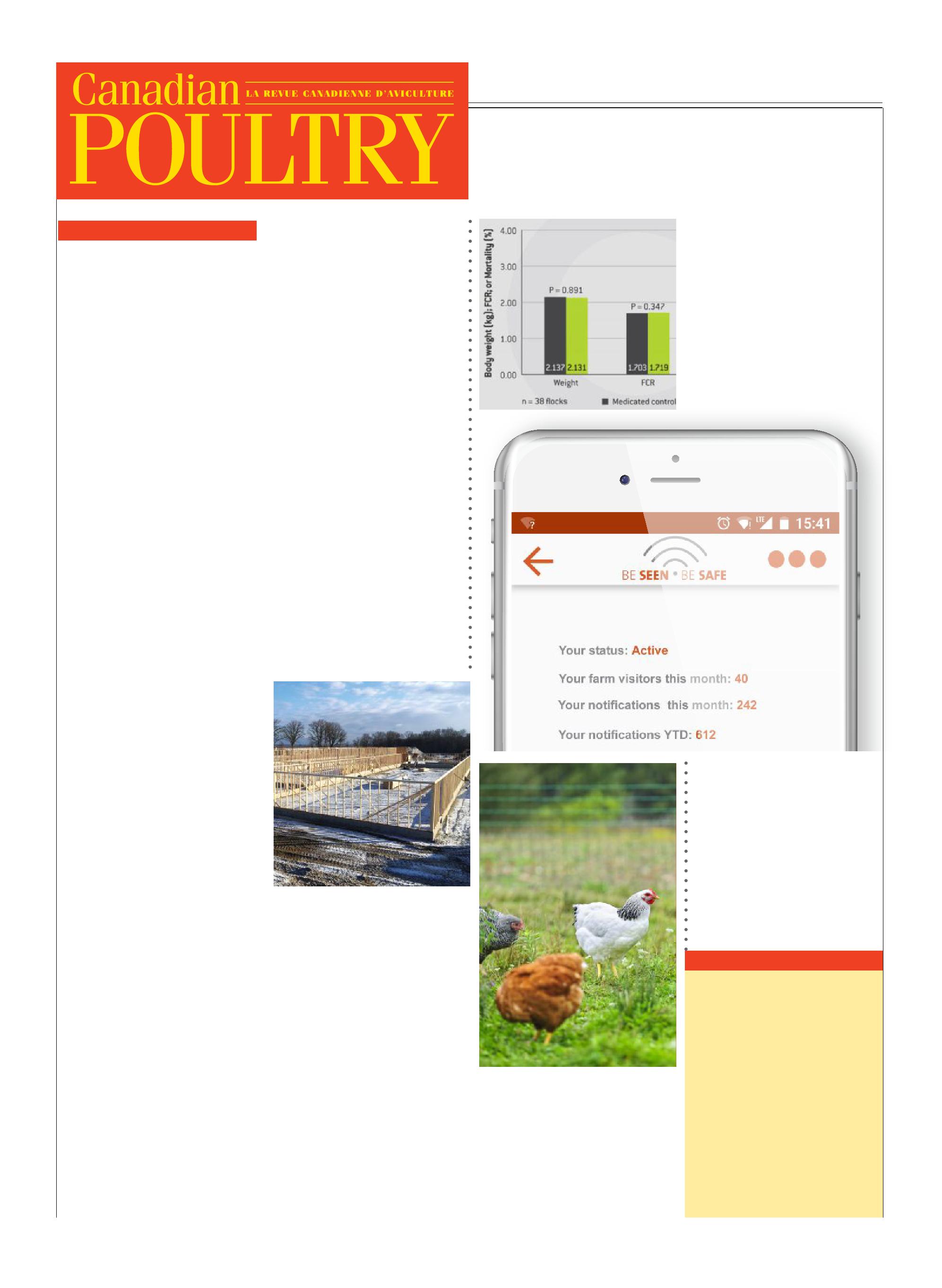
While executive director of the PIC, Tim Nelson wanted to find a more immediate solution. After several years of working with a technology partner, Nelson, now CEO of the Livestock Research Innovation Corporation (LRIC), is seeing his vision become reality. The “Be Seen Be Safe” app (see full story on page 10) acts as a virtual logbook, recording the movement of who comes on and off a farm and logging the information in a central database. During an emergency, Be Seen Be Safe can quickly analyze visitor information obtained from an infected property and plot the movement of visitors to that property throughout its infectious period, where they came from and where they went in order to identify potentially infected secondary properties.
While the app is not meant to replace good biosecurity practices on-farm, it offers industry the potential to keep AI incidents rapidly contained so that, hopefully, disease incidents can be kept to one or two farms and the industry can get back to business sooner. n
With nearly 70 years of experience developing innovative products for poultry producers worldwide, Lubing has established a reputation of leadership by introducing new, cutting-edge technologies to the poultry industry.
OptiGROW Nipple
The ultimate Broiler nipple Optimized for Growth!
SprayCabinet
Spraying/Disinfecting your chain... Simplified!
DripCanopy
Keep your floors mess-free with a DripCanopy!
Cantilever Drive Unit
Keep the clutter out of processing!
ChainKeeper
It’s like life insurance for your conveyor system!
BaitStation
Keep your rodent problems under control!
Got Lubing? Contact your local Lubing Distributor for more detailed information about our new, innovative products.
Tel: (450) 263.6222
Fax: (450) 263.9021
(780)
Power of Meat Study WHAT’S HATCHING HATCHING
The Food Marketing Institute (FMI) and the North American Meat Institute (NAMI) recently unveiled the eleventh Power of Meat survey. The survey confirmed that shoppers recognize the variety of nutrition benefits meat and poultry offer, and place a high value on convenience, variety and transparency when making purchasing decisions in the meat aisle. The report examines meat purchasing, preparation and consumption trends through the eyes of the shopper.
The majority of shoppers — more than eight in 10 — affirmed the important role meat and poultry play as sources of protein and other key nutrients in a healthy, balanced diet. The annual report series found consumers
were most likely to say red meats were important to energy levels and provided nutrients such as iron and protein. Meanwhile, maintaining a healthy weight and receiving vital nutrients were factors associated with poultry. The findings were consistent across generations, with millennials only slightly less likely to cite meat and poultry’s health benefits.
Supermarkets strengthened their position as shoppers’ primary destination for meat and poultry, though consumers increasingly chose alternative channels, like farmers’ markets, dollar stores, farmdirect and online stores, for certain meat and poultry purchases. This trend was particularly evident among millennial consumers, who exhibited a higher propensity to shop at alternative outlets for meat products.
Regarding purchasing decision drivers, price per
pound, along with total package price, emerged as the dominant factor influencing meat and poultry product purchases, with product appearance falling to third place. Total package price proved more important to small households and millennials, suggesting the future importance of package size variety and price ceilings. Along with price, consumer desire for transparency in the product and production process drove sales gains, with segments such as “antibiotic-free,” “grass-fed,” “hormone-free,” “natural” and “organic” meat and poultry recording high growth percentages, despite remaining niche market segments.
The content of the report is based on data collected through an online survey of a nationally representative sample of 1,360 U.S. consumers.
COMING EVENTS
Cap and Trade
In its 2016 Budget, the Ontario Government included a regulation to implement a cap-and-trade system on greenhouse gas emissions. The system will operate under the Western Climate Initiative with California and Quebec.
The budget also contained $155 million in initiatives to reduce emissions through support for the clean technology sector, with program details to be provided over the coming months.
The new cap and trade
Video Results in Charges
Twenty counts of animal cruelty have been laid against a dairy farm and seven of its employees in British Columbia’s Fraser Valley, about 18 months after a video surfaced showing farm animals being viciously beaten.
Sixteen of the counts are
system will establish a cap on the level of greenhouse gas emissions allowed by certain sectors of the economy. The system will reduce the amount of greenhouse gases in the atmosphere by allowing industries to reduce their emissions through applying new technologies. If doing so is not feasible for a company, theoretically, carbon credits bought from a competitor can meet their regulatory compliance or the company could access offset credits from outside sources.
The Chicken Farmers of Ontario (CFO) and the Canadian Food Inspection Agency (CFIA) have signed a ground-breaking Information Sharing Agreement to support improved disease control measures. The Agreement will allow for the mutual sharing
The Ontario Federation of Agriculture (OFA) sees potential for a new modest revenue
related to cruelty against cows and four concern treatment of a pigeon. Chilliwack Cattle Sales Ltd. and five of its corporate directors have also been charged with causing or permitting animals to be in distress — the first time a B.C. company has been held accountable for acts of cruelty on a farm, the SPCA said in a news release.
Spokeswoman Marcie Moriarty said the agency received an undercover video
of information to help control or eradicate a suspected or confirmed federally reportable animal disease incident or outbreak. It is believed that the CFO is the first livestock industry sector in Canada to establish an information sharing agreement with an agency of the federal government.
The Agreement will allow for the exchange of data between the organizations and will greatly advance the capacity of the Ontario
stream for Ontario farmers in the carbon credit trading market. Under a carbon tax system, like that in British Columbia, added costs are the result to farm operations. With a cap and trade system recognizing offsets, farmers would have the opportunity to voluntarily be part of a climate change solution while still providing food, fibre, fuel, energy, improved soil quality, improved water quality, and biodiversity for all of society.
in June 2014 showing dairy cows being beaten with chains, canes and rakes, and being kicked and punched after they were trapped and could not escape the abuse.
In June 2014, the SPCA recommended the province lay charges of animal cruelty against the company and a handful of its employees after receiving the graphic video collected covertly by the animal-rights activist group Mercy For Animals Canada.
chicken industry to respond to and recover from serious infectious disease incidents. It also ensures that industry information shared with CFIA is protected and only used for disease control purposes. CFO worked with the Feather Board Command Centre (FBCC) to develop the information sharing agreement. This agreement will act as the template for future agreements with other members of the FBCC.
APRIL 2016
April 6-7, 2016
London Poultry Show, Western Fair District Agriplex, London, Ont. For more information, visit: www.londonpoultryshow. com
April 25-27, 2016
65th Western Poultry Disease Conference, Vancouver Marriott Downtown Hotel, Vancouver. For more information, visit: http:// www.cevs.ucdavis.edu/ confreg/?confid=778
MAY 2016
May 4, 2016
PIC Research Day, OMAFRA building, Guelph, Ont. For more information, visit: www. poultryindustrycouncil.ca
May 25, 2016
Western Meeting of Poultry Clinicians and Pathologists (WestVet), Ramada Plaza & Conference Centre, Abbotsford, B.C. For more information, visit: www.westvet.com
May 26, 2016
B.C. Poultry Symposium, Ramada Plaza & Conference Centre, Abbotsford, B.C.
Registration deadline is April 30. For more information, visit: www.canadianpoultry.ca
JUNE 2016
June 15-17, 2016
Canada’s Farm Progress Show, Evraz Place, Regina. For more information, visit: www.myfarmshow.com
HATCHING HATCHING Supporting Youth
Egg Farmers of Canada (EFC) and Chicken Farmers of Canada (CFC) were the Visionary Sponsors of Forum for Young Canadians.
Every year, the Forum welcomes hundreds of students from across Canada who are seeking a unique experience to learn first-hand about governance and the Parliamentary process. CFC and EFC had the chance to conduct workshop sessions with the students to educate them on the link that
exists between their food and politics. The Forum works with many organizations that recognize and support Canadian youth and the Forum program. The partnership with the Canadian egg and chicken industries helps bring insightful information to the students about the importance of agriculture in Canada.
The Forum for Young Canadians sessions took place in Ottawa in February and March.
Cobb Celebrating 100 Years
The centennial theme unveiled by Cobb-Vantress at the IPPE in Atlanta will be carried forward around the world throughout the year.
At the show a new trade booth was unveiled along with a restored 1929 Ford Model A chick truck (seen above), a replica of the vehicle that delivered Cobb chicks to customers in Alabama during the late 1940s and 1950s.
Jerry Moye, president of Cobb, said, “I’m very grateful to all of our great customers and partners that helped us achieve this amazing milestone of 100 years. It is the
relationships we’ve built over a century that keep us moving forward, and the genetic progress year-on-year and the advances in technology that help us prepare to feed the world of tomorrow.”
The celebrations will continue up to the Eurotier Show in Hannover, Germany a few days ahead of the anniversary date of Nov. 20 when Robert C. Cobb Sr. purchased Old Pickard Farm in Littleton, Mass., which was to become the home of the Cobb breed for more than 70 years before the move south to the current headquarters in Arkansas.
COMING EVENTS
JULY 2016
July 11-14, 2016 Poultry Science Association Annual Meeting, Hilton New Orleans Riverside, New Orleans, Louisiana. For more information, visit: www.poultryscience.org
SEPTEMBER
2016
September 5-9, 2016 XXV World’s Poultry Congress, China National Convention Center, Beijing, China. For more information, visit: www.wpc2016.cn
September 13-15, 2016 Canada’s Outdoor Farm Show, Canada’s Outdoor Park, Woodstock, Ont. For more information, visit: www.outdoorfarmshow.com
OCTOBER 2016
October 4-6, 2016 Poultry Service Industry Workshop, Banff Centre, Banff, Alta. For more information, www.poultryworkshop.com
We welcome additions to our Coming Events section. To ensure publication at least one month prior to the event, please send your event information at least eight to 12 weeks in advance to: Canadian Poultry, Annex Business Media, P.O. Box 530, 105 Donly Dr. S., Simcoe, ON N3Y 4N5; email knudds@annexweb.com; or fax 519-429-3094. Please write ‘Event Submission’ in the subject line.
RODENT CONTROL trapped like rats » They’ll be «
These are some of the products eligible for the Vetoquinol Club points program. Sign up today at vetoquinolclub.ca and reap the benefits. club benefits.
GREAT PALATABILITY BAITS
• Low or no wax formulations
• Grains and food grade oils ingredients
• Greater acceptance for better results
• Different actives for rotation
GIVE THEM BAITS THAT THEY WILL LIKE!
Technology Mapping the Poultry Scene New biosecurity app
By Treena Hein
February 6th, 2004, British Columbia - the first Canadian avian influenza outbreak. By April 5, 2004, the Canadian Food Inspection Agency had ordered 19 million birds euthanized on many farms across the Fraser Valley. In the years to come – 2007, 2008, 2014 and 2015 – other Canadian outbreaks of this extremely contagious zoonotic disease (H5 and H7 types) followed. And it is sure to be back.
Tracking the spread of such a disease is, to put it mildly, not easy. Anecdotally, during the late 2014 outbreak in B.C., it took 40 people three months to nail down who had visited which farms, the farms they had visited after that, who had been on those farms, where they had gone afterwards and so on. There was also the need to find out which vehicles had been used, because sometimes vehicles have multiple drivers.
THERE HAD TO BE A BETTER WAY
Tim Nelson was keen to create a reliable and “lightning fast” method to track people and vehicles during an emergency. After several years of work, the result is a revolutionary app known as Be Seen Be Safe
There had to be a better way. Enter Tim Nelson, who at the time was working at the Poultry Industry Council. Nelson was keen to create a reliable and lightning fast method to track people and vehicles during an emergency, thereby efficiently preventing the spread of disease. But how? “We have visitor record books on each farm, but as we saw in B.C., it’s impossible to collate the information in them in any meaningful way, even if you had a lot of time,” Nelson notes. “You have to use technology. We looked into having the people and vehicles that visit farms getting RFID (Radio Frequency Identification) tags, but that would require every farm to have a $5000 RFID reader, and
would rely on everyone using it all the time. Then we looked at tracking visitors through GPS on smartphones, but people don’t want their every movement tracked and I don’t blame them.”
The answer, Nelson thought, would be a system that still uses the GPS on smartphones and tablets, but one that’s only alerted when you visit a farm. That way, the privacy of a person’s other movements would be completely protected. Even better would be a system wherein an individual visitor’s or farm’s identity would only be accessed in an emergency.
At that point in time (2010), “geofencing” (mapping of the geographical boundary of a property using GPS) was already available, but only two companies in North America were doing it. Nelson approached one and began working with its staff to build a system that would not only store information on when users entered a geo-fenced farm tproperty, but a system that, in an emergency, could instantly cross-reference and analyze many movements, producing information that could immediately be acted on. This task took Nelson and several software engineers the better part of two years. “It seems simple, but it’s a complex database that has to analyze a large amount of data,” Nelson says. “Also, part of what took so long to build the app was that it had to be available on three platforms – BlackBerry, Androids and IOS.”
But finally, there it was. Something that could do, in moments, what took 40 people three months to do in B.C. last winter – and much, much more.
HOW IT WORKS
Anyone with the free “Be Seen Be Safe” app on their smartphone or tablet automatically triggers a signal the moment they enter a geo-fenced property. The farmer receives an immediate notification of who has come on-farm. In addition, anytime they like, farmers can check farm visitor records (basically, it’s their online visitor record book) from a secure personal login. The database stores farm visit information that includes visitor ID, contact number, previous farms visited (risk assessment level), time in and time out. The person who is visiting the farm property is “greeted” through the app with a welcome message. The identity of individual visitors and farms are not accessible except by system administrators, and only come into play in an emergency. Every data packet is encrypted.
In a disease outbreak (starting with a specific flagged farm), visitor information is analyzed according to given parameters and mapped to predict disease spread in real time. Things like wind direction, wind speed, temperature, humidity and so on are overlaid onto the map. To contain the outbreak, farmers and visitors receive immediate notifications by text message so they can implement enhanced biosecurity measures.
“The system is no more intrusive on user privacy than a farm visitor log book,” Nelson says. “Data on visits is permanently deleted after a year. There is no battery drain with the app, as it only runs for a split second when one’s device crosses a geofenced property, and the data exchanges are extremely small, so users won’t notice any usage increase.”
UP AND RUNNING
In 2014, Nelson tried the app out with about 100 people (company reps and other industry personnel) and by May 2015, he and his team had worked out the bugs. In October 2015, a twoyear “Be Seen Be Safe”poultry project was launched, involving every producer belonging to Egg Farmers of Ontario, the Ontario Broiler Hatching Egg & Chick Commission and the Turkey Farmers of Ontario (almost 900 farms). These associations have paid the first two years’ cost for each farm for initial geo-fencing and monitoring, and 75 per cent of that cost is being reimbursed by a federal government grant through Growing Forward 2.
At this point, the geo-fencing is done, and each farmer in the project is receiving an email with the farm and its geo-fence marked on a map. Once the farmer validates the farm/geo-fence location and provides a few more details, such as other livestock present on the farm, things go “live.” Each farmer will receive two “Be Seen Be Safe” farm gate signs (or more, if required) to introduce the program, as well as informational packages to give to those who regularly or occasionally visit the farm. “Farmers can start accessing farm visit records online from day one,” says Nelson. “We are asking that all those who come on a farm and also visit other farms – such as egg collectors, vets, feed and
pullet deliverers, catchers, vaccination crews and so on – to sign on, to download the app and if applicable, to talk to us about having their vehicle GPS information on the system.”
Nelson says the more service providers on the system, the more complete the network and the better the chance of preventing disease spread. “Be Seen Be Safe” is currently looking at modelling on-farm visitor movement in order to predict the movement of service providers who do not want to be part of the system. However, Nelson says, “I can’t understand anyone not wanting to be part of this. It’s free to service providers and suppliers and let’s face it, preventing disease spreading in agriculture is of huge benefit to everyone. We all earn a living from it.”
In the event of an outbreak, text message emergency alerts
THE BE SEEN BE SAFE APP ALLOWS A PRODUCER TO SEE WHO HAS BEEN ON THE FARM PROPERTY
can be programmed to make a noise when they arrive on a device, thus alerting the user to look at his or her phone or tablet. Beyond that point, however, the system does not currently ask that emergency outbreak texts be responded to. This means the system – and the industry association system administrator in question – has no way of “knowing” that emergency alerts have been received and that people are acting accordingly. Nelson has thought about this, and is looking into how the system could facilitate follow-up.
FARM HEALTH MONITOR
Along with “Be Seen Be Safe,” Nelson and business partner Joel Sotomayor have developed “Farm Health Monitor” (FHM), which is available on a limited basis right now. Nelson calls it a social networking platform for diseases.
Technology
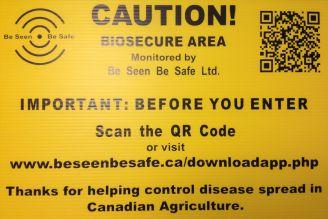
A sign has been created for the farm gate notifying visitors to download the Be Seen Be Safe app
If symptoms or bird deaths are noted on a particular farm, the farmer can input this information into the system, which has mapping and analysis capability. If two or more farms within a given radius report similar information, a warning will be sent out to every related farm (poultry, for example) in that region, but as with “Be Seen Be Safe,” the identities of individual farms always stay protected.
“The warning will prompt farmers to check their flocks carefully, keep a close eye over the next few days, and report if necessary,” Nelson says. “It’s a true early warning system. Poultry vets will also be alerted, and can also alert one another through the system.”
Nelson says he developed FHM because, catastrophic outbreaks aside, it’s very important in his opinion that producers have an efficient system for containing and managing productionlimiting diseases. “We have no idea how much these types of diseases cost, how they spread,” he says. “They are not tracked at present. So, if we can get a handle on this and reduce the impact and perhaps prevent them from reaching more farms, that could save a lot of time, money and stress on birds and people.” n
For more information, visit: https:// beseenbesafe.ca and www.farmhealthmonitor. com
Nutrition Alternative Feeding Programs
Addressing consumer demands for reduced antibiotic use in poultry
BY GREG PAGE PHD, DIRECTOR, POULTRY TECHNOLOGY APPLICATION, TROUW NUTRITION
Recently, there has been a significant increase in calls for the reduction or exclusion of in-feed antibiotics in North American poultry production. Notable restaurant chains and retailers, including McDonald’s and Costco, have publicly announced their intentions to eliminate the use of “medically important” antibiotics in their supply chains, prompting further announcements by major U.S. integrators, including Tyson, Pilgrim’s and Foster Farms to eliminate use of these antibiotics in their production systems in the coming years.
To be clear, while removing medically important disease prevention antibiotics such as bacitracin and virginiamycin, many of these companies are promoting the continued use of in-feed coccidiostats, parasiticides that control the intestinal parasites of Eimeria species.
The reason for these announcements, as noted in earlier articles in Canadian Poultry Magazine (October and December 2015 issues), is to address concerns over the development and transmission of antibiotic resistance to pathogenic bacteria in humans; so-called “superbugs”. While some continue to debate the contribution of animal agriculture’s use of antibiotics to the development of resistant bacteria in humans, as an industry, we have a
Greg Page explains how the Nobelo feeding program has resulted in a 33 per cent reduction in in-feed antibiotic use in broilers, with no difference in production performance when compared to flocks placed before or after Nobelo
responsibility to mitigate this risk where possible. This will support maintaining the effectiveness of the limited toolbox of antibiotics for treating human, as well as food production animal infections.
In order to maintain current levels of performance and health in our flocks we must find alternative feed additives or production strategies to replace these
valuable tools. This story is not new. In fact, a ban on antibiotic growthpromotants (AGPs) was initiated in the EU in 2006. What is new is a rapidly growing North American demand for effective additives to replace antibiotics.
One of the concerns in antibiotic-free programs is the increased risk of necrotic enteritis (NE). Key antibiotics have claims
REDUCING ANTIBIOTIC USE
Nutrition
numerous modes of action (how they work). A dominant category of these additives are essential oil or plant-derived extracts, registered largely as flavours, with anecdotal reports of improved growth in chickens. Essential oils are also widely considered antibacterial and have been shown to directly inhibit growth of Cp in the lab. Other technologies include yeast byproducts, prebiotics, probiotics, short and medium chain fatty acids, various acidifiers and antioxidants, most of which are single bioactive products. The reality is there is no single additive that is as effective as a drug, nor as inexpensive – no “silver bullet”. Despite the plethora of antibiotic-alternative feed additives that are promoted, little, if any, data are available to support the performance of these products under production conditions similar to a medicated feed program.
for control of Clostridium perfringens (Cp), the causative agent in NE. New additives or feeding programs should offer some protection against Cp to help prevent NE outbreaks. Feed companies are bombarded with products positioned as alternatives to traditional medicated feed programs, with
Nutreco Canada (Shur-Gain and Landmark Feeds) believes that a combination product, which improves the immune system and integrity of the digestive tract while inhibiting pathogen growth and colonization in the digestive system, will provide the strongest protection. No single bioactive compound can address all of these modes of action.
This formed the basis of a succession of studies over many years in screening various individual bioactive compounds
The winds of change are blowing through today’s livestock building ventilation. Canarm and Intelia bring you the first EC motors for agricultural fans, a smart and energy-efficient alternative to conventional AC motors. Plus, our new ECsmart™ motors run cooler and last longer than common fan motors. They’re a breath of fresh air for your energy budget.
Nutrition
and commercial products both in the lab, and under disease challenge conditions at our research facilities in Canada to identify products that would best meet the combined mode of action approach at a reasonable cost. We also used the experiences of our European Nutreco colleagues subsequent to the antibiotic ban in Europe, to develop alternative feeding programs to test.
The culmination of this effort was a three-site multilocation controlled study (a total of 180 experimental pens) comparing the performance of five dietary feeding programs, all with the same coccidiostat program:
1. Negative control (no antibiotic);
2. Positive control (includes 55 ppm bacitracin methylene disalicylate, or BMD);
3. Alternative program 1 (combination of products with ingredients that have indirect pathogen inhibition and improvements to intestinal integrity/health/microflora);
4. Alternative program 2, which later became the Nobelo
program (combination of products with ingredients that have indirect pathogen inhibition and improvements to intestinal integrity, health and microflora and immune systems competency); and
5. Alternative program 3 (combination of products to support digestive and immune systems competency).
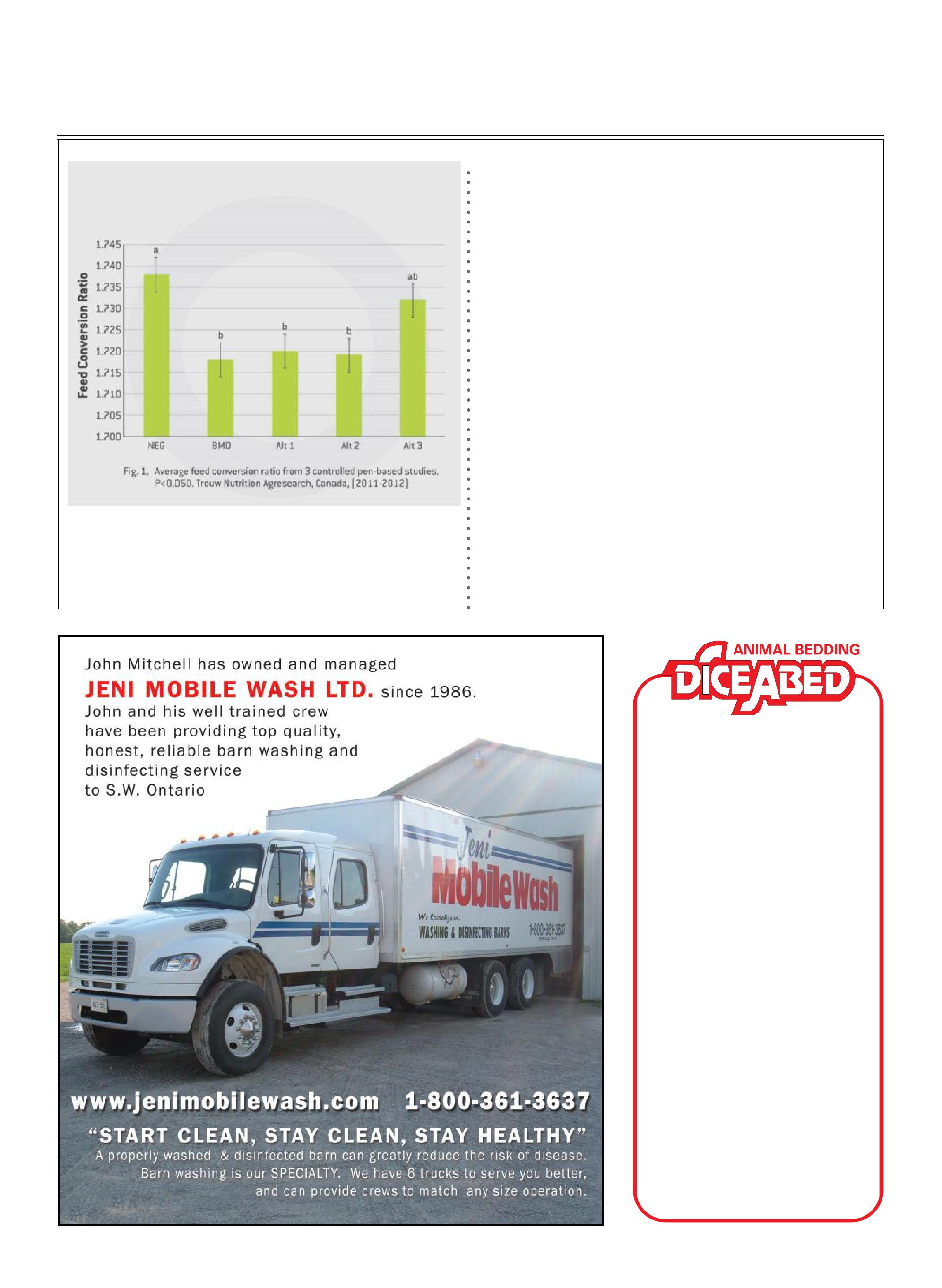
Under non-challenge research conditions we saw no differences in mortality, but we did see, as expected, a significant improvement in overall feed conversion when feeding BMD (two points lower). We also noted that Alternative programs 1 and 2 (Nobelo) had similar improvement in FCR as the medicated treatment (Fig. 1), while alternative program 3 had little benefit.
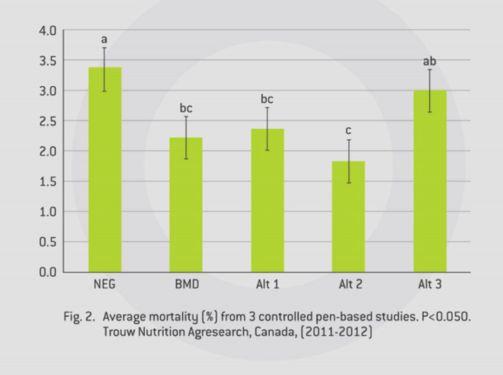
Overall average mortality was lower when using BMD (as expected), but we were excited to see that both alternative programs 1 and 2 also had significantly lower mortality compared to the non-medicated control (Fig. 2).
Pen-based studies alone are not sufficient to help producers
HEALTHY BOTTOM LINE
The Standard in High Yield
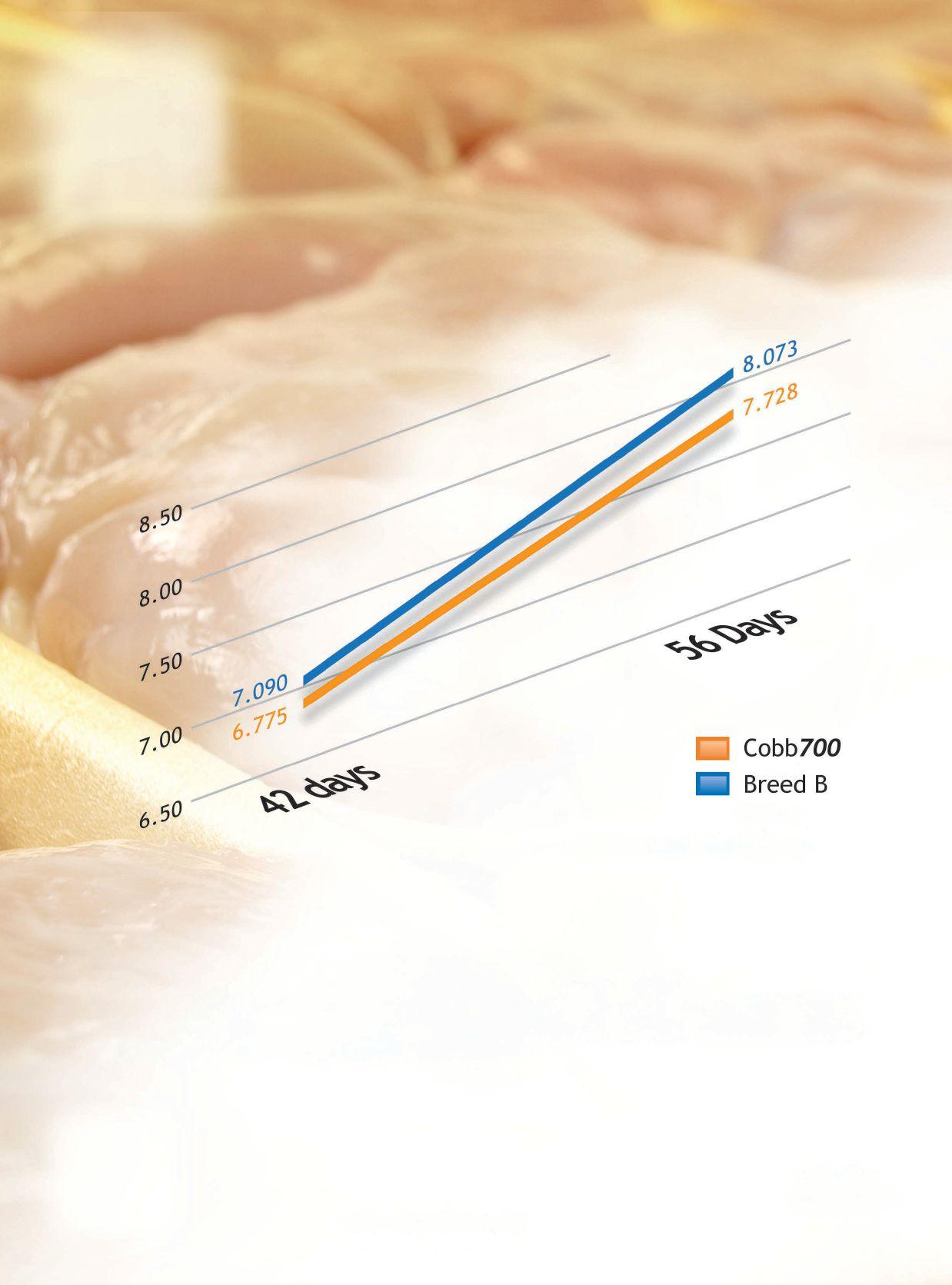
The Cobb700 has been selected to achieve meat yield efficiently. The Cobb700 consistently provides lower breast meat feed conversion offering more saleable meat per bird at a lower cost of production.
Nutrition
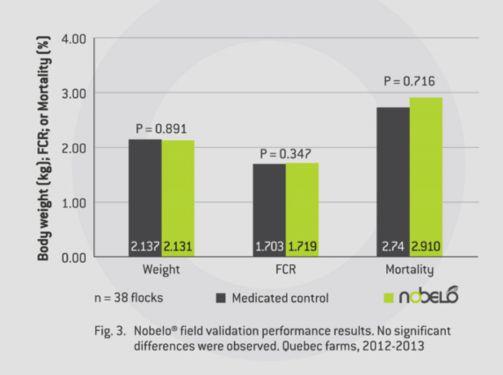
make informed choices as to whether products will work under commercial conditions. Our next step was to validate the performance of the alternative program 2 (branded as Nobelo and selected over alternative program 1 due to its lower cost) under field conditions. We repeated the field validation in two separate regions using different in-feed antibiotics with 38 commercial flocks in Quebec (19 flocks randomly assigned to antibiotic and 19 to Nobelo) and 20 commercial flocks in Ontario (10 flocks randomly assigned to antibiotic and 10 to Nobelo) in the fall of 2011. Under real-life commercial production conditions we saw no significant differences in average market weights, feed conversion or mortality in either region (Fig. 3), nor did we see any differences in production costs for antibiotic versus Nobelo.
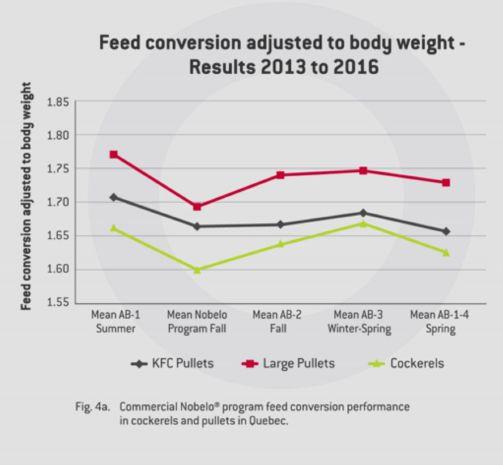
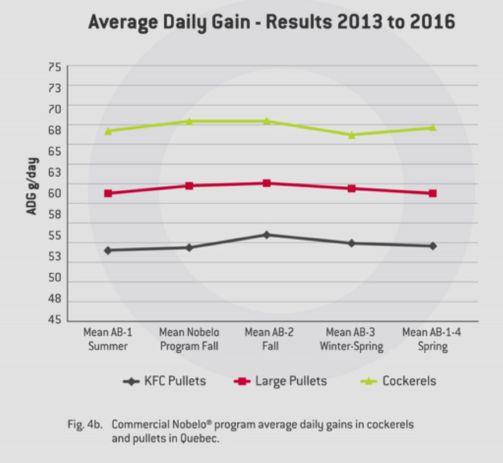
Shur-Gain and Landmark feeds introduced the Nobelo feeding program in 2014, resulting in a 33 per cent reduction in our in-feed antibiotic use in broilers, with no difference in production performance when compared to flocks placed before or after Nobelo (Fig. 4a and Fig. 4b.).
What does all of this mean? It shows that producing poultry without feeding the birds medically important antibiotics is possible in a safe and economically sustainable way while maintaining performance. Perhaps most importantly, using
Producing poultry without feeding the birds medically important antibiotics is possible in a safe and economically sustainable way while maintaining performance
this Nobelo strategy will help safeguard the use of our limited supply of antibiotics for when they are truly needed for disease treatment. n
Production Under the Magnifying Glass
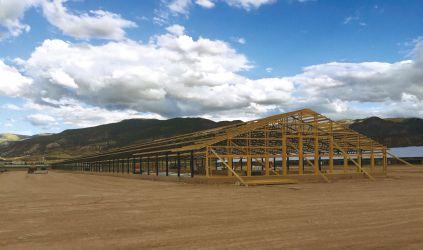
How a project manager can help plan and manage a new building project
BY SHAWN CONLEY
Project management is the process of initiating, planning, executing, controlling, and closing out work that is not part of the everyday practice of a business. Large organizations often employ or hire project managers (PMs), and have a team formed around this manager that can include department managers, directors, or labourers and consumers who may use the product of the project. This could apply to everything from creating a set of tweezers to building a nuclear power plant. This is a process that we should be applying when building our farms.
The way we tend to build today is by talking to a friend to get some references on who we should work with. The next step is to go to the recommended builder, put together a floor plan that is the least cost to build, and maybe get a second price on that design. Then, once we’ve found a site or a location on our farm, we sign a contract with the builder and take our floor plan to the recommended equipment supplier so they can fit the ventilation and equipment into the barn we designed. Many times the building is started before the equipment companies are even contacted. If the equipment supplier is lucky, the producer may have consulted with a ventilation engineer beforehand to optimize the layout. And let’s hope that engineer has experience with poultry and has continued to pursue further ventilation
A project manager can be of great assistance to a building project, from choosing the site to equipment FACTORS TO CONSIDER
education over the years. Now, this equipment supplier may or may not have any actual training themselves, and if they do, it’s just as likely to be sales training, as opposed to poultry husbandry training.
Salespeople are in a tough position — they have to balance achieving their sales targets with the long-term production needs of the farmer. As a former sales
representative myself, I faced the same challenges. What are the chances that any one equipment company has all of the best equipment? And if you choose to piecemeal the job, how do you know for sure what is the best equipment for your operation?
The quote by Alexander Graham Bell, “The sun’s rays do not burn until brought
Production
Saving money on the structure doesn’t necessarily mean saving money on equipment or maximizing the performance of the
to a focus,” is a perfect analogy for the PM. A PM can be the magnifying glass that aims all the beams of information into creating the optimal production environment for the birds. An ideal PM would have experience or training in all aspects of live production, and an expansive knowledge base of the range of equipment and builders available. Let’s look at what goes into constructing a new barn or farm, and what the advantages of working with a PM can be.
SITE PLANNING
Finding the right site and the right location on the site is extremely important. This aspect of construction alone can justify the cost of hiring a PM. Site engineers can sometimes be ambitious about the excavation that needs to be done to accommodate a structure. A hundred extra loads of fill or moving materials two or three times can add up quickly. Having someone with experience to oversee this can save a lot of cost
and headaches. It’s very unlikely that a site engineer will take things like poultry biosecurity into consideration. Do they know the best distance between poultry barns, and the best orientation with regard to prevailing winds or sun? The same applies to the next step.
BUILDING DESIGN
Builders will construct the barn that fits the parameters you provide, whether that is the top of the line, or the lowest cost structure. Many times this compromises the biosecurity and the functionality of the finished barn. Many people don’t realize all the options available because they haven’t seen buildings in Europe, the United States, or the rest of the world. Saving money on the structure doesn’t necessarily mean saving money on equipment or maximizing the performance of the birds. The primary aspects affected are ventilation and heating.
Certain building dimensions don’t lend themselves to certain types of ventilation and heating. Going wide, for example, is not ideal for tunnel ventilation; it can result in requiring two rows of heaters, and can produce significantly different conditions from one side to the other if cross ventilating. When we put a control room inside the barn footprint, we create dead spots in the ventilation, especially when located on the inlet side. Are we able to attain a suitable air speed with the fewest fans? Are we avoiding all possible obstructions to the ventilation, such as gas and water pipes? These are small details that can greatly affect the air and litter conditions.
EQUIPMENT
Tightly tied into the building dimensions is the equipment layout. It affects ventilation, and the building affects how the equipment can be installed. Sometimes it is possible to get more equipment per bird into a barn, while maintaining or reducing cost. With some new heater technologies, it’s possible to run a single row of heaters down the middle of the barn and achieve more than adequate temperatures at the wall with more even coverage.
Outside of equipment layout, one of the benefits of having an objective PM is that they can help you choose the best of each type of equipment, and help to find and apply the latest technology without having to consider sales targets. The only contemplation for an independent PM is finding what will give you the best results on cost and performance. They can consider the cost-benefit to upgrading certain options. They’ll also consider how the equipment works together. This could involve ensuring compatibility of all the elements of a single barn, or in the example of a multi-stage operation, ensuring the transitions from one barn and equipment to the next are smooth. Everyone knows control systems, data collection, and communication can be difficult to decipher, so it can help greatly to have an expert in your corner. They can also provide follow up service and management tips after the buildings are in operation.
birds. The primary aspects affected are ventilation and heating.
Production
COORDINATION, RESOURCES AND PRICE NEGOTIATIONS
From research organizations like universities to a variety of equipment suppliers and contractors, as well as other poultry companies and producers, PMs have many sources to draw on. They may be able to bring in builders from another area when the local builders are too busy. They are always learning as they are teaching, which is extremely valuable. Many athletes who become coaches suddenly have a bunch of epiphanies about how the game works, and the same applies in poultry production.
Part of the reason many companies have PMs is because they have come to the conclusion that it is difficult to do your everyday job and add the task of managing a large project on top of it without sacrificing on the quality of one or the other. It’s quite clear that having a dedicated manager to work on your project temporarily will alleviate this problem.
Price negotiation is something else a PM can assist with. They have ongoing access to pricing and know what the standards are in the industry. A grower who buys a feed system every 20 years has no measuring stick for what the cost of equipment and installation should be.
Most producers only get one or two opportunities to build, which means there is limited or no experience when the opportunity presents itself. If you look at building a barn or a farm as navigating though the wilderness, it’s a lot safer to have a guide! I’ve been lucky enough to work with excellent guides and coaches myself, and have seen firsthand how a PM can plan and manage a project. Good PMs will pay for themselves several times over by providing the required expertise to save on building and production costs, while helping you optimize bird performance. They can help you attain all the goals you’ve set out for your farm. n
Shawn Conley is a project manager with Hendrix Genetics and operations manager of Weeden Environments. He can be reached by email: Shawn.d.conley@gmail.com
AVATEC® 20 THE ONLY PRODUCT THAT ALLOWS YOU TO GET A FULL ROTATION!
You know that a well-designed rotation program is critical for resistance control in your flock. But did you know that this means rotating through different classes of ionophores and not just rotating through products? 1
Make sure your rotation program is on track! Talk to your Zoetis territory manager to discuss the most recent anticoccidial data and find out the latest on Avatec® 20—the only divalent ionophore available in Canada and an excellent solution to help control resistance and prevent disease in your flock.
Reference: 1. Chapman HD. Rotation programmes for coccidiosis control. International Poultry Production. 2007;15(1):7-9.
Sustainability Sustainability in Poultry Production
Poultry has many advantages but conflicts arise
BY DR. PETER HUNTON
There is no doubt that over the past two decades, the term “sustainability” has become widely used in a variety of contexts. It also has a large range of meanings to different people, but for the purposes of this article, we shall assume the definition developed in 1987, at the time “Our Common Future” was published by the World Commission on Environment and Development. This stated “that a sustainable development was attained when current generations could meet their needs without undermining or destroying the future generations’ chances of having their needs met.”
First, a distinction needs to be made between “industrial poultry” systems and the much less intensive small-scale “village poultry,” still encompassing large numbers of poultry in some countries. The latter might also include backyard flocks in developed countries such as Canada. While many of the issues around sustainability are relevant to all systems, some are specific to industrial production and these will be given added emphasis.
ENVIRONMENT
In terms of environmental impact, poultry have comparatively less impact than other farm animals. The carbon and water footprints for both poultry meat and egg production per unit of output are much less than for beef and dairy cattle or pigs. This has been shown to be primarily due to genetic improvements in productivity
CONFLICTING PERCEPTION
Organic production meets much of sustainability criteria, and also produces far less nutrient output per unit of input. Growth rate, egg production and feed conversion efficiency are all much lower than when intensive methods are used.
and feed efficiency. Nevertheless, the use of concentrated feeds has its own environmental impact, particularly with respect to the water footprint involved in producing the high density feed ingredients required. And with many of these ingredients, poultry use material that might otherwise be consumed directly by people. Another interesting consideration here is the feeding of organic poultry. The European Union has proposed to transition all poultry feed to organic sources at some future date (currently January 2018). There is an implication here of converting to more local feed ingredients that do not compete with human food. But it is also recognized that such ingredients may not meet the needs of highly productive
birds for methionine, thus leading to overfeeding protein with consequent increases in nitrogen excretion. Nothing is simple when it comes to sustainability!
Pollution is another aspect of environmental integrity. Ideally, egg and poultry production should be a component of an integrated farming system. In the past, this may have been largely the case, but in many (perhaps even most) industrial poultry operations today, manure is considered a waste, and special arrangements have to be made for its disposal. These inevitably involve transportation, with consequent use of fossil fuel causing some degree of pollution. Novel means of manure utilization such as composting, anaerobic digestion, and
POULTRY LIGHTING
THE THEORY AND PRACTICE
This book is fully referenced and covers the science that underpins the lighting of poultry, with chapters describing the physics of light, the physiology and mechanisms by which poultry react to light, and the responses of all classes of poultry to conventional and unconventional photoperiods, light intensity, light colour, light source and the pathological consequences of extremes of illumination.
STAALKAT FARMPACKER GRADERS
Sustainability
perhaps others as yet undiscovered or unexploited, will help to minimize impact on the environment.
SOCIAL ASPECTS
Especially in highly specialized poultry production systems, employees have been shown to be at high risk of a variety of health problems: exposure to dust, antibiotic-resistant bacteria, allergies to antibiotics and possibly feathers and feather dander. Catching chickens for market has also been shown to place employees at high risk of injuries and illness. In some industries, contract production places farmers at both economic and physical risk, and employees at risk of exploitation in the absence of workers’ unions or negotiating capability.
Gender balance is an interesting social aspect, as in many circumstances such as village poultry production, more women than men are in positions of power and decision-making.
BREED DIVERSITY AND ANIMAL WELFARE
Both meat and egg chickens used in intensive production come from a very limited genetic base and are bred to be extremely uniform. Conversely, village poultry and small flocks embrace a huge variety of genetics, although often poorly controlled. However, these small flocks represent a valuable reservoir of genetic material. They most likely contain adaptations to local environments, diseases and novel feed ingredients, all of which might become part of a more sustainable industrial system. To formally maintain these resources for future use has been, to date, an insurmountable task.
The point is made that in the poultry industry, a few breeding companies control a large proportion of the market. But as long as their products meet the various demands of the market, it is difficult for this writer to understand how this compromises sustainability; competitors will surely emerge if/when new demands are not met by the large breeding companies.
In terms of sustainability, animal
Sustainability
welfare is approached from the desires of advanced society to adopt methods that are ethical and provide animals with a secure and non-suffering existence. Most developed countries now have more or less strict regulations or accepted practices that provide such conditions, but in some areas, notably Europe, ever stricter rules are developed that make industrial poultry production increasingly difficult. It is accepted that poultry meat has evolved over the past century, from a luxury food to “the cheapest source of protein” in developed countries. The question seems to be whether the methods used in the 21st century are sustainable. There are abundant economic conflicts between the desire to produce competitively priced food and the simultaneous goals of animal welfare, corporate competition, resource conservation, and climate change.
Concentration of production is regarded as a disadvantage to consumers as it limits their choice in the marketplace. The concept of a “Concentration Ratio”(CR) has been developed to measure the market dominance of a specified number of companies. For example CR4 measures the market share of the four largest companies; in the U.S., CR4 in the broiler industry was 58.5 per cent in 2010. Some critics have suggested that a CR of more than 40 per cent is undesirable.
CONFLICTING ASPECTS
There are many areas in which different parts of the production system conflict with each other. For example, feed production may be extremely efficient, yet possibly harmful to some aspects of the environment.
A clear case of conflict arises in the area of organic production systems. While meeting many of the criteria of sustainability, they also produce far less nutrient output per unit of input. Growth rate, egg production and feed conversion efficiency are all much lower than when intensive methods are used.
Resolution of many of these, and other conflicts, seems to be possible only when large-scale production methods are abandoned. In a perfect world, poultry
would be integrated into small farming enterprises along with crops and orchards, in both urban and rural settings. How the current systems of commercial poultry production might evolve into such a situation requires a gigantic imagination. However, it is very much the norm in the many “village poultry” enterprises found
around the world. In some countries, birds kept in such conditions outnumber those in industrial operations. n
This article is largely based on the publication “Sustainable development perspectives of poultry production” by M. Vaarst, S. Steenfeldt and K. Horsted, Worlds Poultry Science Journal, December 2015, pp 609-620.
By Sommers
CPRC Update Funding Changes and Website Redesign
FUNDING THE PROGRAM CHANGES
CPRC adjusted its funding program for the 2016 call for Letters of Intent (LOI) to fit better into the annual funding timeframe. Government funding organizations generally look for industry financial support to show that the proposed research is an industry priority. Some funders, such as the Natural Sciences and Engineering Research Council of Canada (NSERC), require industry funding approval prior to application. Others will accept an application prior to industry funding commitments but will not provide final approval until industry support is confirmed. CPRC moved its call for 2016 LOIs to mid-December with a submission date in early February so that it can complete its review process and issue funding decisions by the end of June.
CPRC uses a two-step review and approval process. The first step is an internal review by the CPRC Board of Directors and its support staff to determine the level of support for a research proposal by the member organizations. The review assesses the proposal’s importance to industry and how well it aligns with priorities identified in the 2012 National Research Strategy for Canada’s Poultry Sector as well as new priorities identified by CPRC and its member organizations (e.g.: climate change, precision agriculture). A short list of projects is developed to move on to the next part of the process.
The second step is to complete peer reviews conducted by research scientists of the short-listed projects, which looks more at technical aspects of the project and the validity of the research (e.g.: duplication of prior research, methodology). The peer reviews provide valuable input to CPRC’s final decisions on the projects that will be funded. The final funding decision will be made at CPRC’s June Board of Directors meeting. CPRC received 28 LOIs in the 2016 call.
2015 CPRC SCHOLARSHIP RECIPIENT
The 2015 CPRC Scholarship was awarded to Sasha van der Klein, a PhD student under the supervision of Dr. Martin Zuidhof, University of Alberta. Sasha completed her M. Sc. at the University of Wageningen in 2015 in the areas of immunology, genetics and nutrition. She published one and co-authored another paper following from her thesis in genetics, about the relationship between production traits and immunology in laying hens.
Sasha’s research at the University of Alberta will look at broiler breeder management strategies. Her objective will be to better understand the long term effects of broiler breeder
rearing strategies on production and the effects on offspring performance. The focus will be on lighting and body weight management. She will also conduct research on understanding the mechanisms of transgenerational effects of nutrition. In her studies she will use the Precision Broiler Breeder Feeding System, developed by Dr. Zuidhof, which can control individual bird feed intake using real-time body weight measurements to make feed allocation decisions.
REDESIGNED CPRC WEBSITE
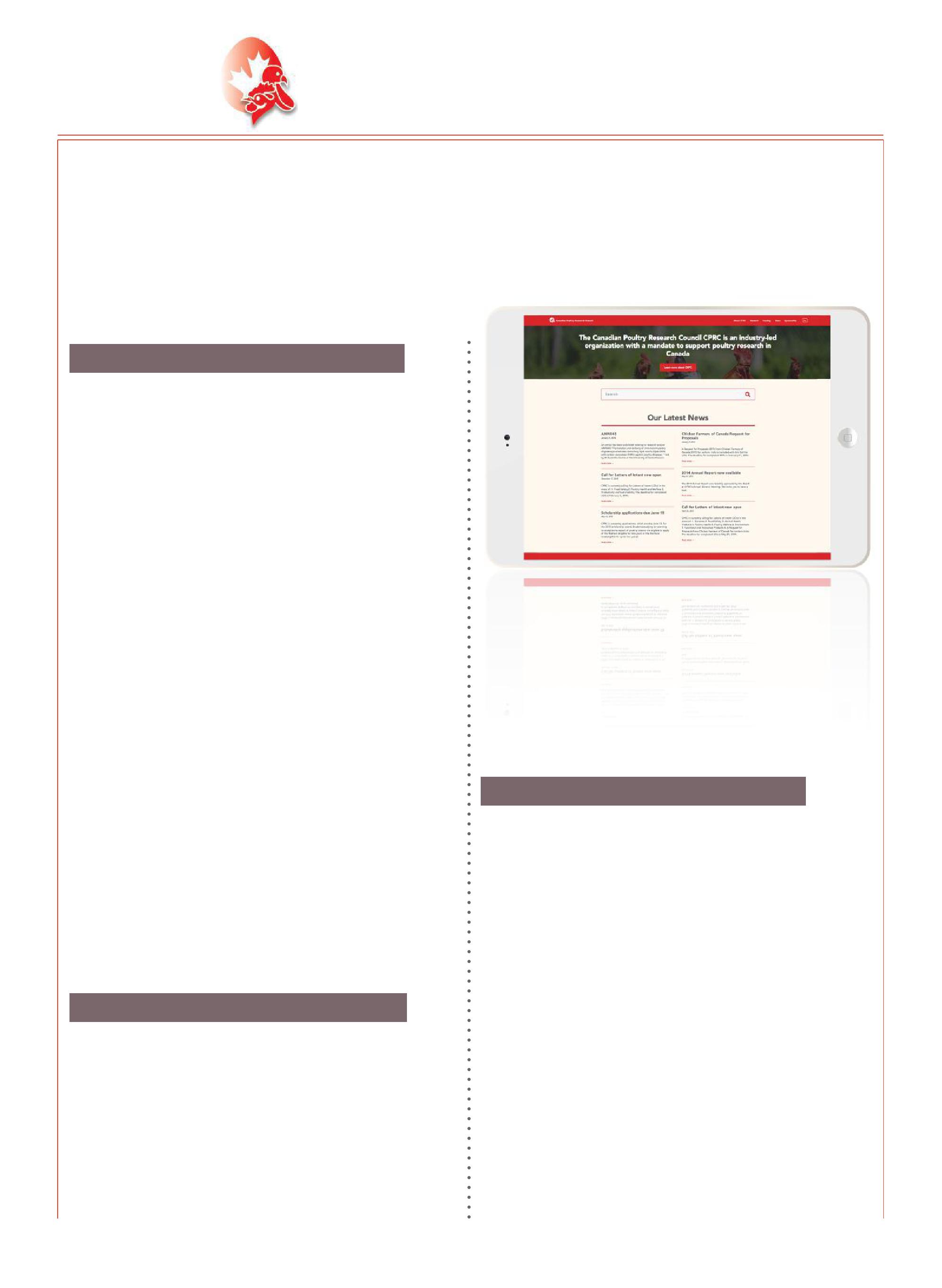
CPRC has redesigned its website (www.cp-rc.ca) to take advantage of developments in website design and management. The redesigned website was activated in March and includes the same content as the previous website but packaged in a more concise format. It is also designed for use on a cell phone. Please check out the new website and let us know what you think (info@cp-rc.ca).
CPRC, its Board of Directors and member organizations are committed to supporting and enhancing Canada’s poultry sector through research and related activities. For more details on these or any other CPRC activities, please contact The Canadian Poultry Research Council, 350 Sparks Street, Suite 1007, Ottawa, Ontario, K1R 7S8, phone: (613) 566-5916, fax: (613) 241-5999, email: info@cp-rc.ca, or visit us at www.cp-rc.ca.
The membership of the CPRC consists of Chicken Farmers of Canada, Canadian Hatching Egg Producers, Turkey Farmers of Canada, Egg Farmers of Canada and the Canadian Poultry and Egg Processors’ Council. CPRC’s mission is to address its members’ needs through dynamic leadership in the creation and implementation of programs for poultry research in Canada, which may also include societal concerns. n
There’s been
decisions.
We all agree. While antibiotics are an important part of modern human and animal medicine, it is critical that they be used RESPONSIBLY.
That’s why we implemented an antimicrobial use (AMU) strategy to demonstrate responsible use and to reduce use where possible.
The industry continues to examine methods to reduce antibiotic use.
Tellin� our Stor�
ONE PICTURE AT A TIME
Farmers of Canada developed the AMU strategy with:
The goal of the AMU strategy is to ensure the continued effectiveness of antibiotics for both humans AND animals.
CREATIVE INFOGRAPHICS ARE BEING CREATED TO BETTER TELL THE STORY OF OUR INDUSTRY, AND TO BUST SOME OF THE MYTHS ABOUT SUPPLY MANAGEMENT, ANTIMICROBIAL USE (THE AMU STRATEGY), CONSUMER PRICES, AND THE JOURNEY FROM GATE TO PLATE, AMONG OTHERS. ALL THESE WERE POSTED AND PROMOTED THROUGH VARIOUS SOCIAL AND DIGITAL PLATFORMS, MAKING THEM AVAILABLE TO CONSUMERS, MEDIA, AND FARMERS ALIKE.
Avian influenza (AI) is without a doubt one of the biggest concerns for the global poultry industry. New outbreaks occur in most regions of the world every year, and according to Arjan Stegeman of Utrecht University in The Netherlands, it’s a problem that is only going to get worse. Stegeman was a keynote speaker at the International Egg Commission’s Global Leadership Conference in Berlin last September. His talk, Understanding AI, opened what would be an interesting week.
THE UNPREDICTABILITY OF AI
Commonly called the bird flu, AI is an infectious viral disease that occurs in birds, particularly in wild waterfowl, such as geese and ducks. AI viruses can be sub-divided into two groups, high pathogenic and low pathogenic AI. This division is based on their ability to cause disease in poultry. Low pathogenic viruses can cause mild symptoms, like gut trouble, whereas high pathogenic viruses result in high mortality rates, sometimes up to 100 per cent in just 48 hours.
Avian influenza ranges from H1–H17 types; only H5 and H7 are highly pathogenic, though. While highly pathogenic viruses are always categorized as either H5 or H7, not all H5 or H7 viruses are highly pathogenic. H5 and H7 viruses are actually quite similar, Stegeman said. In fact, it’s only a very small part of the gene encoding that is different.
It’s known that wild birds are vectors for AI, but the pattern of spread does not match migratory routes
High pathogenic viruses, however, can arise from low pathogenic types.
“Sometimes we know that this happens quite quickly, so on the same farm where the virus was introduced,” said Stegeman. “And other times it can take more than half a year, like we’ve seen in Italy. That is something that we would like to understand better.”
Another peculiar feature of this virus is that it can easily exchange genetic material. “If a duck gets infected by the H5N1 virus, and at the same time an N8 virus, a new virus can arise from that,” Stegeman explained. That virus would be referred to as H5N8.
“This happened, for example, with the H5N2 virus that has arisen in the
United States,” Stegeman continued. “So this virus has all kinds of tricky features that can make it survive in the population and change its nature in a way that is very difficult to catch.”
While high pathogenic viruses wreak the most havoc, they’re the quickest to be diagnosed by the farmer. Transmission, said Stegeman, is pretty much the same as it is with the low pathogenic viruses. The concentration of the virus is much higher in high pathogenic types though.
In the past 10 to 15 years, there have been a number of interesting occurrences in highly pathogenic AI. For one, the scientific literature before 2003 showed that epidemics of new sub-types (H5N1 or H7N7) always arose from the introduction of a new low-path virus, which then mutated to a high path virus. This still happens today, only now, wild birds have entered the equation. The hypothesis, Stegeman explained, is that the H5N1
Health
epidemic was not effectively controlled in some countries, and spillover of the virus to wild birds occurred. In fact, experts agree that H5N1 was the first high pathogenic AI to be widely spread through the movement of wild birds. Today, it is possible for several wild bird species to be high pathogenic H5 infected without showing any signs at all.
The global spread of the H5N8 virus began in China and South Korea. Later, it spread to Europe. As of November 2014, the virus had spread further to Canada and the United States. Interestingly, though, the pattern of spread does not match the migratory routes of wild birds, Stegeman said.
The virus, he explained, spread first from China and South Korea to Siberia.
There, birds from Western Europe and Asia mixed and the resulting viruses were brought to Europe in the spring. A similar thing happened in North America. There are tools available to evaluate the genetic differences between viruses, and results have shown that many only differ by one genetic position. “For the rest, this is not what we see,” said Stegeman. “What we see is something that is really very scattered with really huge differences between these viruses. What this means is that we’re dealing with separate introductions, and not between-farm transmission. The most likely cause of that is the wild bird population.”
DIFFERENCES BETWEEN THE US AND EUROPE
In April of 2015, what has since been described as the worst animal disease
GLOBAL SPREAD OF H5N8 EXPLAINED
Health
outbreak in the history of the U.S. began. On April 12, the first birds tested positive for high pathogenic AI on a 200,000-bird cage-free operation in Wisconsin. On April 20, a five million bird operation in Iowa was hit.
“From April 20 until the middle of June, it was absolutely crazy,” Chad Gregory of United Egg Producers in the U.S., told the crowd in Berlin. “Every single day, seven days a week, 24 hours a day it was quite the experience – Wisconsin, Iowa, South Dakota, Nebraska and Minnesota.”
Ultimately, the outbreak ended up wiping out some 35 million egg-laying hens, and another five to six million pullets.
“Those 35 million egg-laying hens represented about 12 per cent of the entire U.S. flock,” Gregory said. “And unfortunately 30 million of the 35 million we lost were dedicated to the egg product market.”
The U.S. turkey industry lost almost eight million turkeys, primarily in the Iowa and Minnesota areas. In total, 223 premises tested positive.
“We didn’t know what to do in the beginning,” Gregory said. “We felt like there was just so much chaos going on in those first couple of days.”
But what made the U.S. situation so much different than the European cases? Dr. Klaus-Peter Behr of AniCon in Germany explained.
The H5N8 virus that hit both Europe and North America originated in Southeast Asia. This virus found its way with migrating birds via Russia to Europe and via Alaska and Canada to several U.S. states. “On its way to the U.S. it mingled up with an H9N2 virus and became the H5N2 virus hitting the U.S. poultry industry,” Behr said.
The U.S. virus experienced a severe delay or incubation period, whereas the original H5N8 needed only two days from infection before severe mortality began. In the U.S., mortality didn’t begin for eight to 10 days.
“This difference gave the U.S. virus a whole additional week to intensively multiply and spread without being obviously present, as shown by increased mortality,” Behr said.
In Europe, poultry producers had a tremendous advantage, since the virus became obvious very quickly after introduction on the farm. “This was the crucial difference that made it possible to stop spreading of the virus one week earlier than in the U.S. cases,” Behr concluded.
AI ISN’T GOING ANYWHERE
Most experts agree; AI isn’t going anywhere. That’s not to say, though, that producers are helpless. “I think, as many of you realize, we may have to live with bird flu for quite a while,” Stegeman said at the end of his presentation. “That does not mean that we cannot do anything because introductions for known pathogenic virus will remain. But it does leave us wondering what will happen with future outbreaks with the highly pathogenic virus, especially given that all the migratory birds are now coming back.” n
Biosecurity Biosecurity and Crisis Management
Success is dependent on addressing communications and relationships
BY MELANIE EPP
If there was one moment that stood out at the International Egg Commission’s (IEC) Global Leader Conference in Berlin last September, it was the moment Jim Dean described the devastation on his farms during the 2015 avian influenza (AI) outbreaks in the U.S. (see Canadian Poultry, Feb/March edition pages 34-36). Dean, CEO of Centre Fresh Group, had the room’s attention from the moment he opened his mouth. He didn’t use slides or stats; he spoke straight from the heart – and experience. It wasn’t difficult. After all, he had lost some 9.9 million birds to AI in that outbreak. No one was more surprised at that time than Dean. “We thought we had the most robust biosecurity program that we could even think of,” he said. “We thought that we were fine.”
The thing is, they did have a robust biosecurity program. In fact, just one month earlier Centre Fresh Farm had gone through a full government audited bio-security inspection. “We received a score of 100 per cent without any deficiencies,” Dean said. “We were infected April 27, 2015.”
The story stood out not so much because of the sheer devastation on the farms, but for the simple fact that it meant no one was safe. That revelation was painfully clear on the faces of the conference’s attendees, who shuffled uncomfortably in their seats. To this day, Dean is uncertain how his farms were infected.
MANAGING THE CRISIS
While the biological event itself sees the biggest investment when AI strikes, in a recent interview Brian Evans of the World Organization for Animal Health (OIE) said that crisis management success is dependent on addressing communications and relationships.
“I’m not sure anyone will know for sure,” he said. “Two complexes broke on opposite ends of the complexes. One was not near a doorway, so we believe wind. The other one broke possibly by a door, so a worker could have tracked it in.”
ENVISIONING THE IDEAL FARM
What would a model farm look like today if you had the best biosecurity possible? That’s the question Andrew Joret of Noble Foods in the U.K. asked the conference attendees. “None of us probably has a model farm,” he said. “It’s about how far
away from that we are and if we can do anything about changing the farm to get something like what we think is safe.”
According to Joret, the most ideal location for a poultry farm is somewhere far from open water sources, migratory pathways and neighbouring production units and populations.
Ideally, the perimeter of that farm would be fenced with a single point of entry. “At that entry point you have to have a barrier to disinfect, and when you decide you’re going to actually let a vehicle on your farm, then you can disinfect it,” he said. “There are many, many farms with no fence at all, and
Biosecurity
that’s an enormous risk.”
THE NEXT GENERATION OF CONTROLS
TRIPLE LAYER PROTECTION
Triple layers of protection, with fail-safe redundancy to control mission-critical functions
MULTI-HOUSE CONTROL
With EDGE, you have the power to control multiple houses from a single controller using one interface.
WIRELESS SETUP
Installing the EDGE system couldn’t be easier. Optional wireless communication with the expansion boxes greatly reduces wiring
The employee car park should be located outside of that fence. “This will force them to walk through the fence on foot and then through whatever biosecurity measures you use on your farm,” Joret said.
The buildings, he said, should be vermin and bird proofed. They should be designed with a cleanable concrete apron, and provisions for rainwater removal. Even where outdoor access is provided, buildings should still meet those standards for periods of shut in.
“Some people would certainly say that there shouldn’t be outdoor access at all,” Joret said. “It presents an increased risk.”
According to Joret, farm size needs to be addressed, too. Consider the impact of stocking density on immune status and animal welfare. While he didn’t suggest an optimum size for farms, he did say that it was something that should be looked into.
“The movement of people also presents a risk,” Joret said. “But contrary to what one might think, regular staff present a lower risk than visitors to the farm. The biggest risk of all is the people who move from one farm to another, for example, the service providers or engineers.”
DEPOPULATION BIOSECURITY: MANAGING THE CRISIS
Biosecurity isn’t just about preventing pathogens from entering the farm. In situations where biosecurity measures fail, it’s equally important to have a biosecure depopulation plan in place. Culling crews, their tools and carcass transports can still spread disease, KlausPeter Behr of AniCon Labor GmbH reminded the conference attendees.
The solution to this problem, he said, is to have as few staff working the site as possible. Treat staff well, he said. Pay them well, provide them with food and clothing, and facilities for hygiene.
He also recommended disinfecting the dead birds before loading them onto the carcass transport. Also, the
carcass transport containers should be well sealed, he pointed out.
Perhaps most importantly, though, Behr recommends setting up a mobile disinfection unit for staff, as well as for trucks and equipment. Lastly, staff should be paid to stay away from poultry farms and facilities for the 72 hours following cleanup.
CRISIS MANAGEMENT BEYOND THE FARM GATE
While the biological event itself sees the biggest investment when AI strikes, in a recent interview Brian Evans of the World Organization for Animal Health (OIE) said that crisis management success is dependent on addressing two other elements simultaneously: communications and relationships.
More specifically, Evans said that it’s important that public health officials
Biosecurity
and animal health officials speak in a coherent manner. It’s important for the reputation of both sectors and shows the public that there’s alignment between human and industry, the public and private spheres.
“Full disclosure is in everybody’s best interest to rapidly contain and deal with the circumstance, and it’s the most effective weapon that can be used to maintain or rebuild public confidence in the aftermath,” Evans said.
Evans used the example of BSE in Canada to highlight what full disclosure can do for the industry. “Unlike in other countries in the world, the Canadian experience of BSE was one where we actually saw beef consumption rise in the country instead of fall,” he said.
This was possible, he added, because there was consistent messaging from government, industry, third parties, academics and public health. “They all
reiterated the fact that what was being done was based on 20 years experience gained in the U.K. and other countries,” he concluded.
When you’re going through an emergency there will be stresses. Difficult decisions have to be made that can have economic impacts on the livelihoods of producers, the food supply chain, and on food costs to consumers.
“These are not decisions that can be taken lightly,” Evans said. “It is important that when you’re going through these circumstances that the communication level is good because you are also establishing the basis of trust that you will have going forward in the recovery phase, hopefully, and building a better situation to prevent these things in the future.”
“Diseases will happen; no country can prevent that,” he continued. “But countries that handle emergencies well tend to be those that trade well.” n
Regional Sales Manager Prime Equipment Group
Prime Equipment Group, a global leader and manufacturer of poultry processing equipment, is looking for an energetic, highly self-motivated individual with sales/communication skills and a solid working knowledge of the poultry processing industry to manage its Canada sales territories, promote strong customer relations and generate significant sales as a Regional Sales Manager.
This is a full-time position ideally based out of Canada.
Skills and Qualifications:
A solid working knowledge of the poultry processing industry
• A high level of sales motivation
• Able to work remotely while remaining connected to day-to-day operations to best serve customers
• A desire for travel and getting in front of customers
• Build new markets
• Relentless sales persistence and closing ability
• Foreign language skills a plus
• Experience working inside poultry plants a plus
• Experience with Microsoft Dynamics Navision software a plus
• General skills in: Presenting to clients, internal communications, informing others, verbal communication, closing skills, motivation for sales, self-confidence, sales planning, territory management, prospecting skills, persistence, meeting sales goals
How to apply:
Please send a resume and cover letter that outlines your qualifications to: sales@primeequipmentgroup.com or via mail to: Job Application –Prime Regional Sales Manager Attn: Human Resources Department 2000 E. Fulton St. Columbus, OH 43205
PERSPECTIVES
BY JOHN MAASKANT, FARM & FOOD CARE ONTARIO
Barn fires are devastating to all involved
There have been a lot of news stories lately about barn fires in Ontario. Without exception, the stories have been tragic and the incidents devastating to these farm families in so many ways – with the loss of animals being at the very top of that list. Often, a barn fire affects an entire community with neighbours joining together to support each other and help clean up the terrible aftermath. Economic concerns, while very real, are always secondary to the loss of farm animals that these farmers have raised and nurtured.
And it doesn’t matter what type of farm animals are involved. The dairy farmer who milks his or her barn full of cows every morning and night – and knows each of their individual traits – is as emotionally affected as a pig farmer, horse owner or chicken farmer like me.
Many of the news stories of late have focused on one central theme: more needs to be done to prevent similar incidents. Ontario’s farming community couldn’t agree more. Work is always being done on prevention methods and on improved barn designs that are better able to withstand such threats. But even with the best contingency planning, no amount of precaution will ever entirely rule out the chance that a fire may start.
Unfortunately, installing sprinkler systems also isn’t a workable solution in many cases although that idea has been suggested often lately. Farms generally source their water from wells with pumps that require electricity. If power is turned off to the barn to fight the fire, the wells and water supply would no longer operate.
fact that barns contain feed and bedding materials that are flammable (and pose potential risks not found in residential homes) and the result is almost never good – a barn can be completely engulfed in less than six minutes. In a rural setting this means the barn is usually fully engulfed when the fire department arrives.
Over the last 10 years, Ontario farmers have helped to pay for and deliver training to over 1,000 first responders (including police and firefighters) on emergency responses to barn fires and accidents involving livestock. Many rural fire departments, staffed with volunteer firefighters, are also organizing barn fire education programs for their responders so that they better understand how barns in their coverage area are built and the types of livestock found within. These programs also offer the opportunity for farmers in their region to highlight potential risks.
Every barn built in Canada must meet the standards outlined in the National Farm Building Code of Canada. These regulations continue to be updated and reviewed nationally. Ultimately education, risk prevention and diligence are the keys to preventing barn fires from starting in the first place.
Barn fires can be one of the most challenging things that first responders can face
Barn fires can be one of the most challenging things that first responders can face. Arriving at a structural barn fire with animals poses unique challenges. These can be large structures in rural areas with no access to fire hydrants or a continuous supply of water for firefighting. Many first responders are not familiar with barn design or animal handling, making the scene even more dangerous and challenging than a typical structure fire. Add to this the
While the number of barn fires in Ontario has actually decreased in recent years, according to the Office of the Fire Marshal, the recent incidents have highlighted to everyone how devastating these situations can be. The headlines also serve as a constant reminder to farmers to review their fire prevention plans.
Through coordinated efforts and awareness we can continue to reduce the risk of barn fires impacting Ontario farms and farmers.
A library of resources on how to prevent barn fires and other livestock emergencies is housed online on the Farm & Food Care Ontario website: www.farmfoodcare.org n
John Maaskant is a chicken farmer in Ontario and current chair of Farm & Food Care Ontario
REMARKABLY CLEAN
If you could protect your farm this way, you wouldn’t need any cleaners or disinfectants.
These are some of the products eligible for the Vetoquinol Club points program. Sign up today at vetoquinolclub.ca and reap the benefits. club
Vetoquinol would like to remind you of the importance of a good biosecurity protocol and its implementation on a daily basis.
NEED MORE INFORMATION? CONSULT YOUR BIOSECURITY SPECIALIST.
Clark Ag Systems is your local expert, offering a full range of Farmer Automatic conventional & alternative housing options; as well as a complete line of quality products for broiler, turkey and egg production.
VISIT US AT THE LONDON POULTRY SHOW APRIL 6 & 7 BOOTH #721S
Learn about the innovative Famer Automatic housing systems on display as well as many Broiler and Turkey products. Interact with industry experts at our two day Clark Ag Systems Technology Symposium highlighting the latest changes and technologies in the poultry industry.