ALTERNATIVE HOUSING SUPPLEMENT
AN EGG PRODUCER’S
BY FRANK LUTTELS
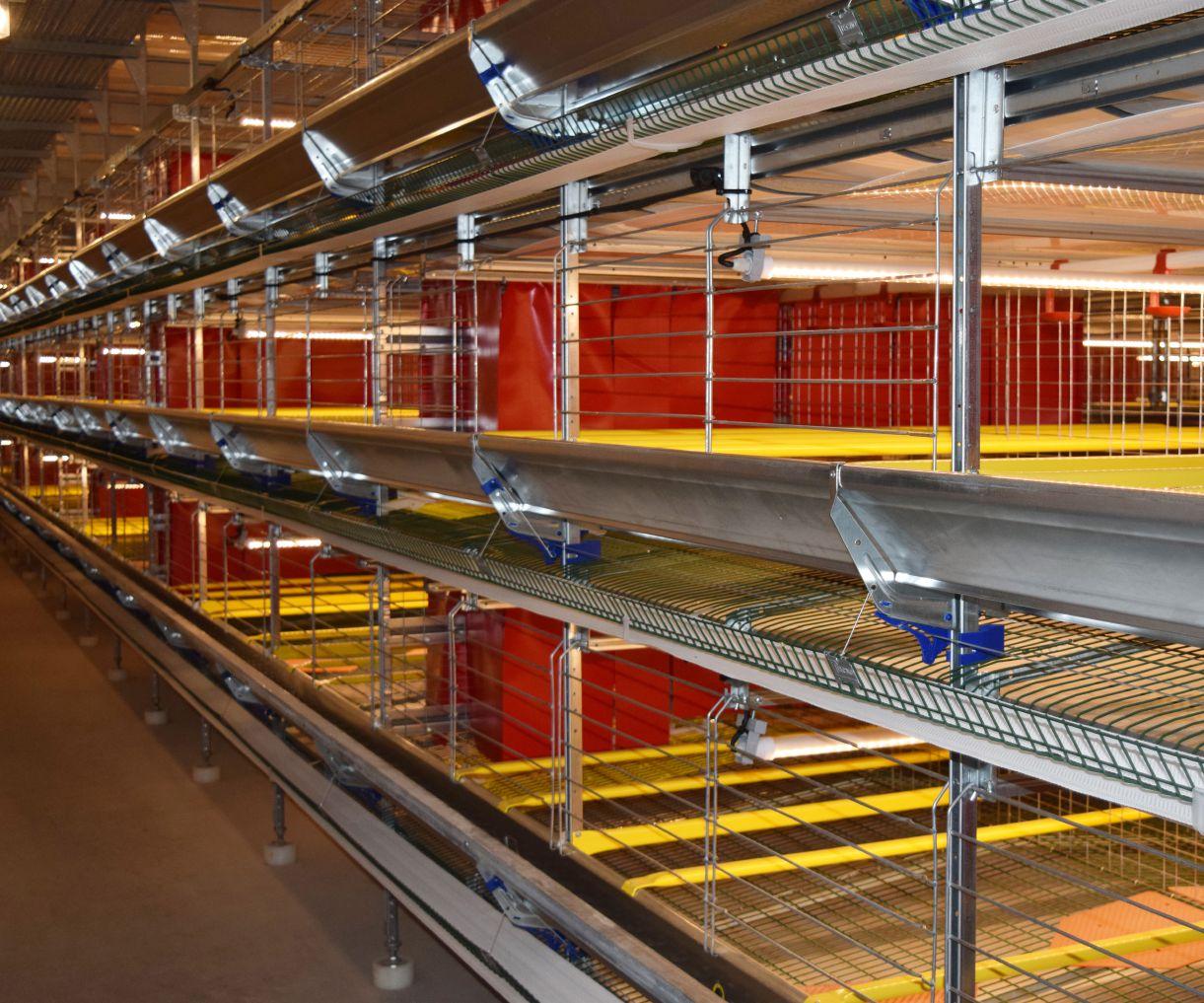
Cage-free facilities remain a dominant trend in North American egg production, driven by the growing demands of consumers, supermarkets, restaurants and others in the food supply chain. When transitioning from conventional egg production to cage-free, producers have choices, including multi-tier aviaries, combination (sometimes called “combi”) aviaries and floor systems.
While each solution offers a unique set of benefits and challenges, many leading industry experts see multi-tier aviaries, also known as European-style or open aviaries, as the superior approach. They feel that way for several reasons, including: high bird performance; reduced labor requirements; excellent bird welfare;
MULTI-TIER AVIARIES
positive public perception; and strong return on investment.
WHAT ARE MULTI-TIER AVIARIES?
Some of the earliest attempts at modern aviary design date back to the 1980s in Switzerland, as European markets began developing the demand for cage-free eggs. These early systems typically included different open levels the birds could jump inside, as well as separate nests often located against a wall.
The primary disadvantage of these early systems was that bird density per square foot was very low, with each house containing only 600 to 6,000 birds. This greatly limited potential production and profits from the house. In addition to the inefficient use of space, this setup resulted in a high rate of floor eggs, though the low
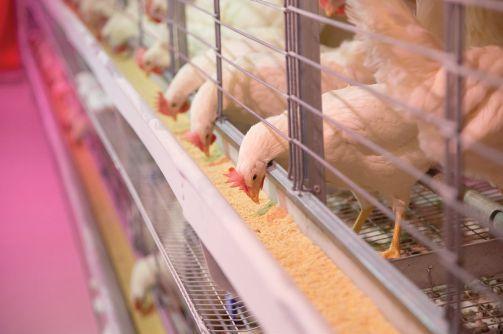
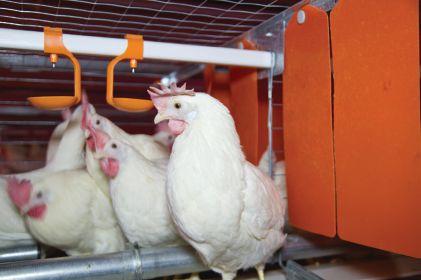
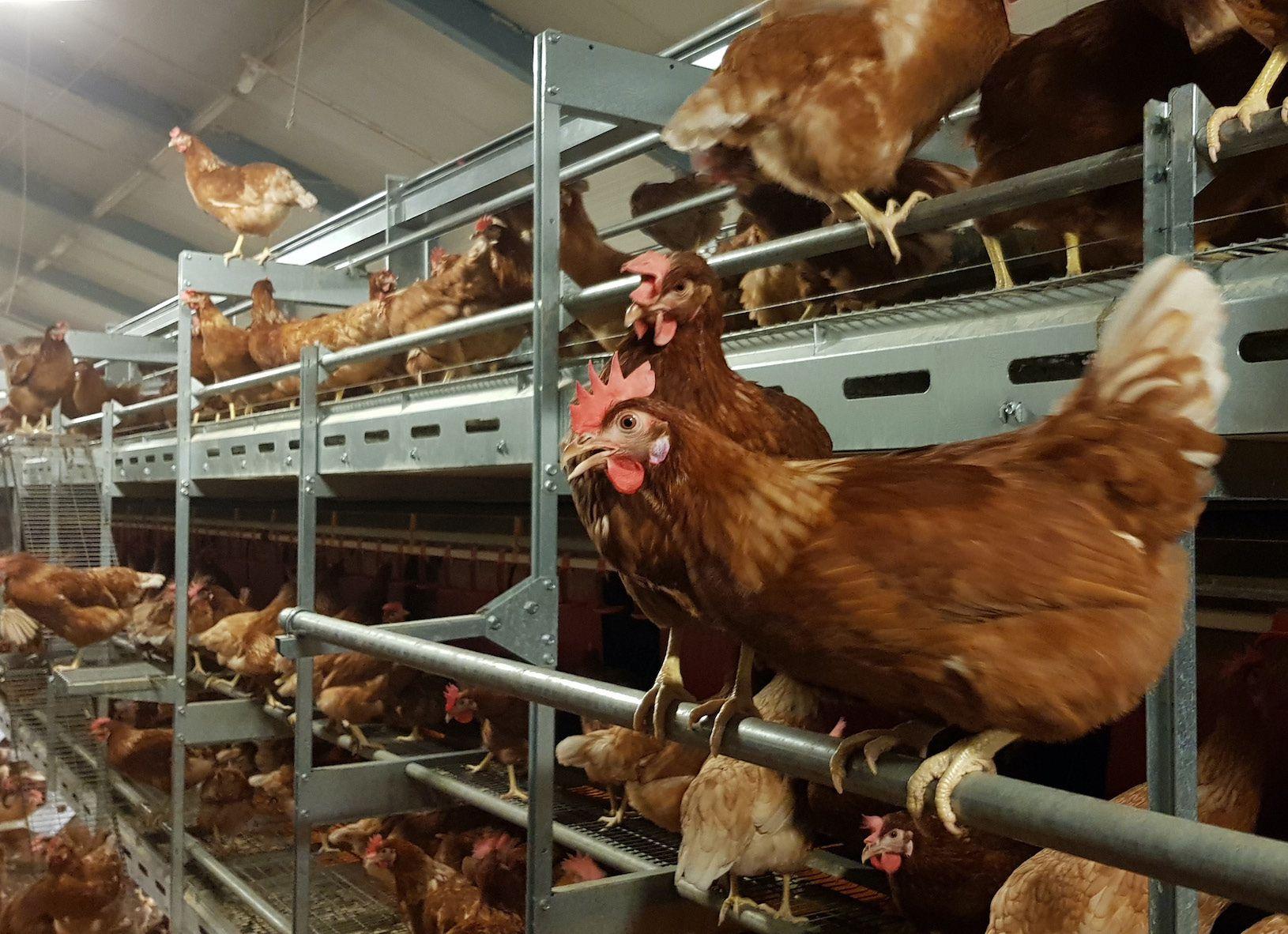
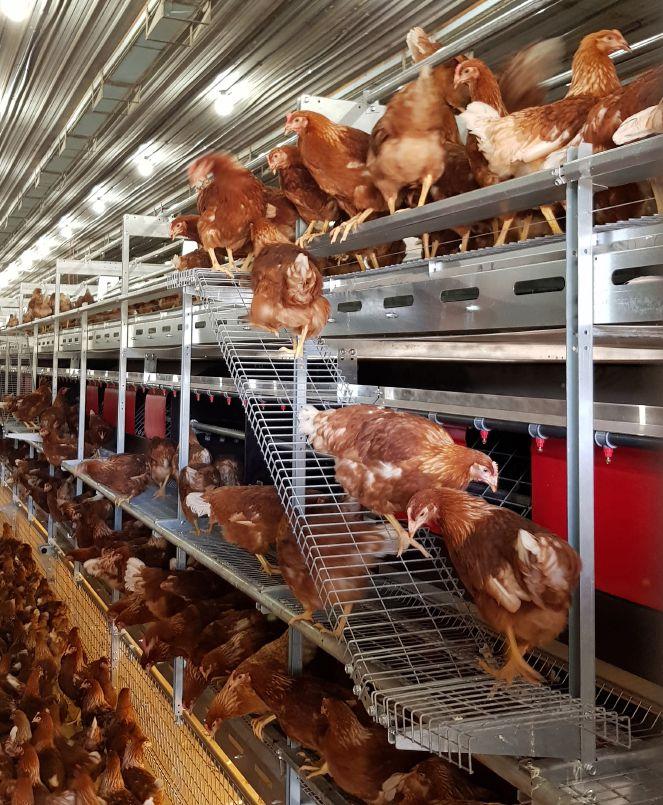
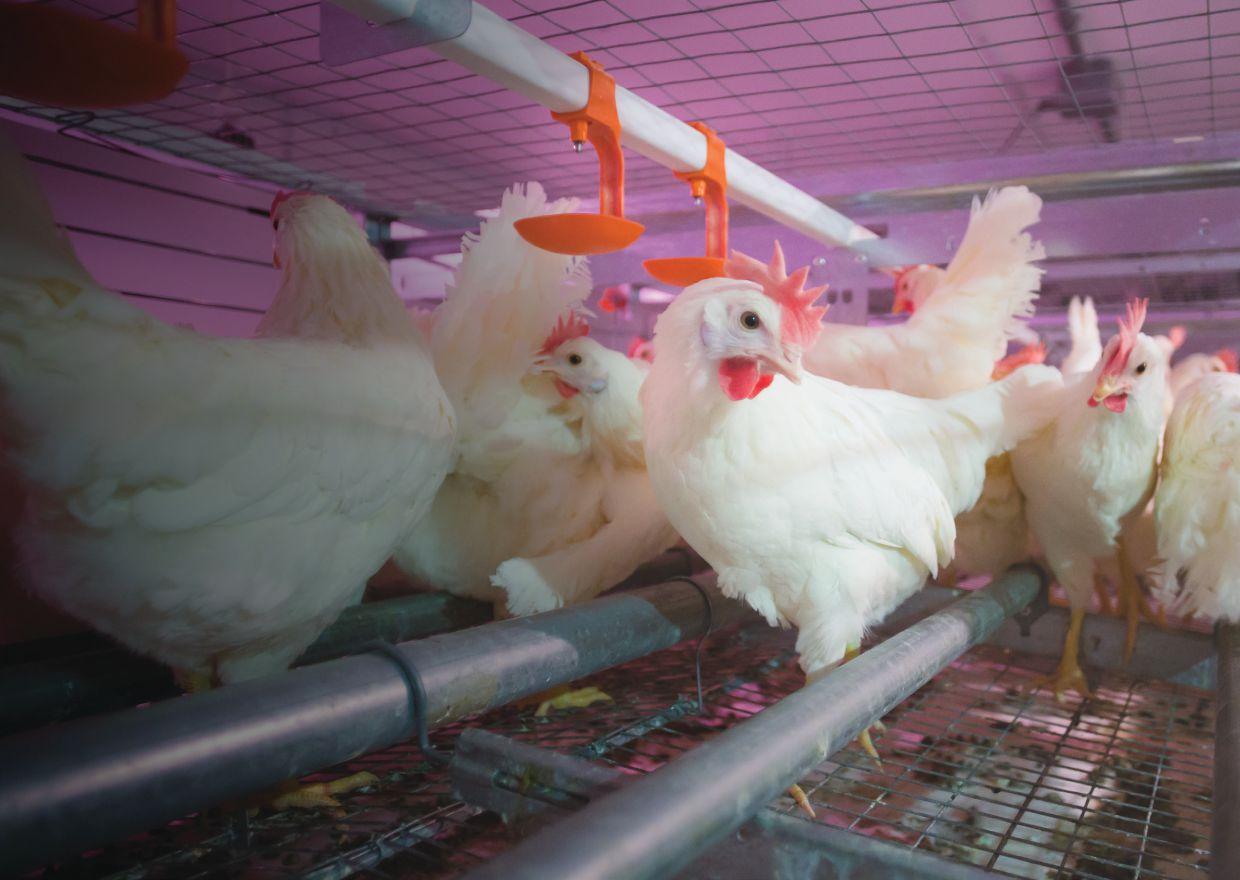
Multi-tier aviaries typically include perches on the top level, where hens prefer to sleep.
population of birds allowed farm workers to pick up the eggs relatively easily.
In the 1990s, producers in the Netherlands experimented with similar systems but added more birds per house – with populations often totalling from 20,000 to 25,000. This trial resulted in an even higher rate of floor eggs (six to 10 per cent). The high percentage of floor eggs, combined with the larger bird population, required more labour than is practical for commercial egg production.
Eventually, some egg industry pioneers began building aviary houses with integrated nests, rather than keeping the nests against a wall. They also placed the water lines in front of the nests so that birds would find the nests in their search for water. Birds performed well in this innovative system, and it became the foundation for
modern multi-tier aviaries in cage-free egg production.
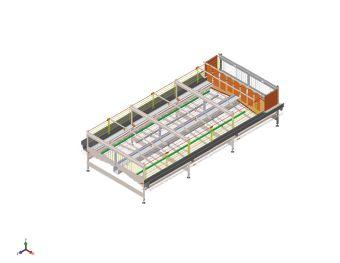
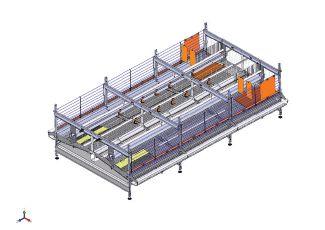
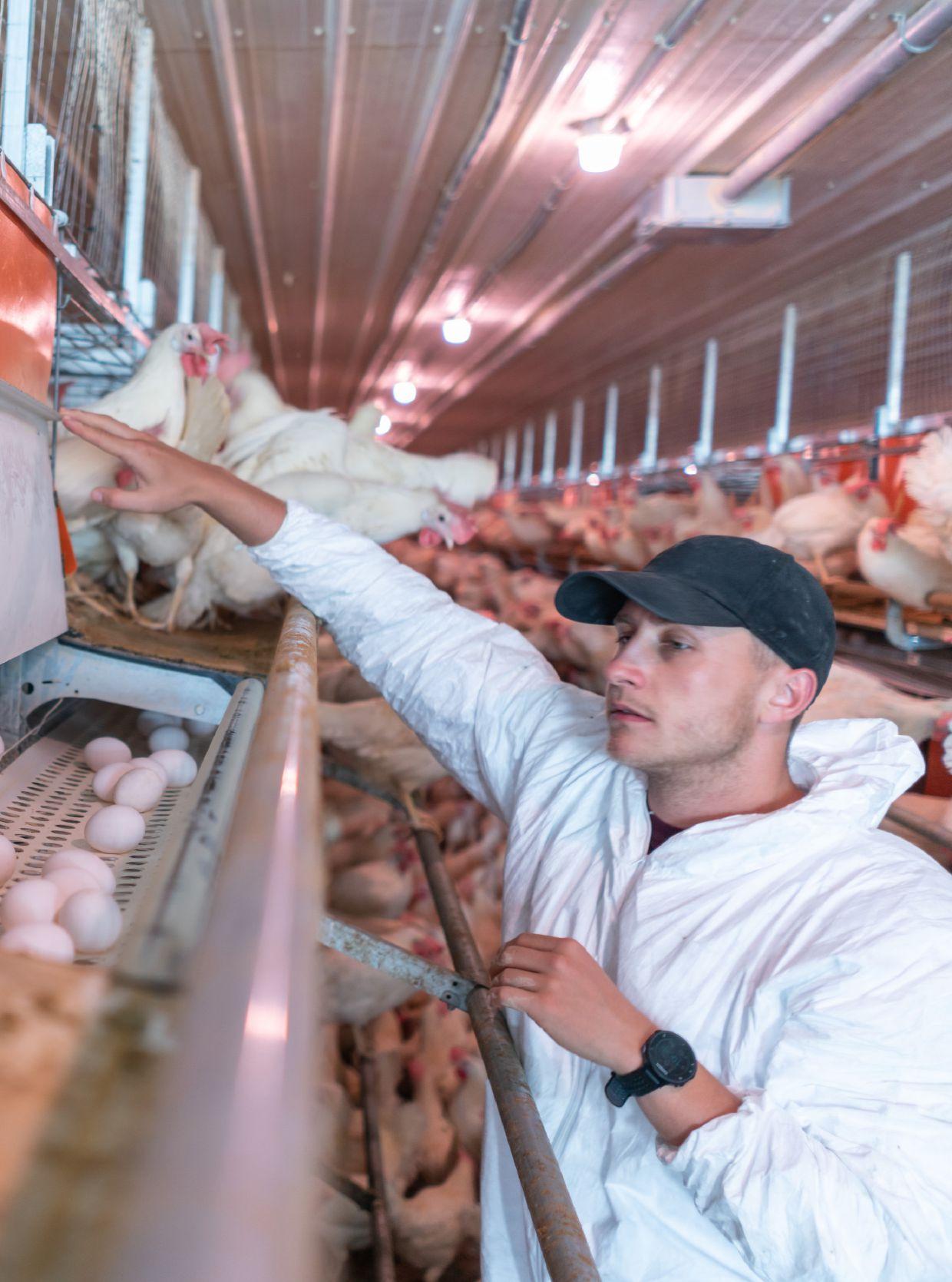
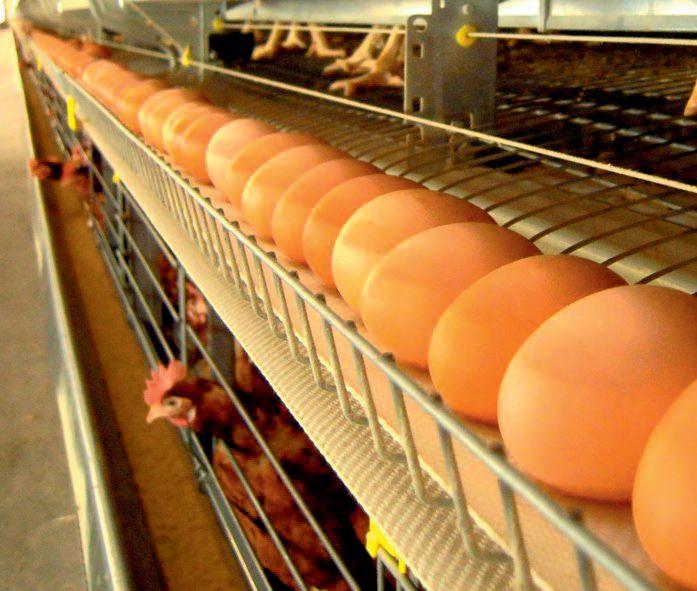
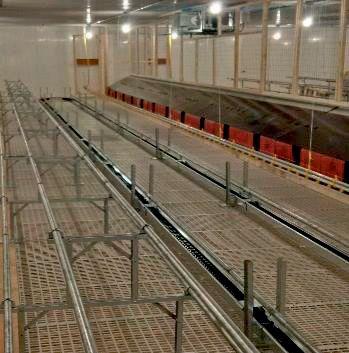
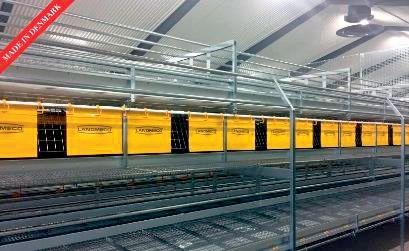
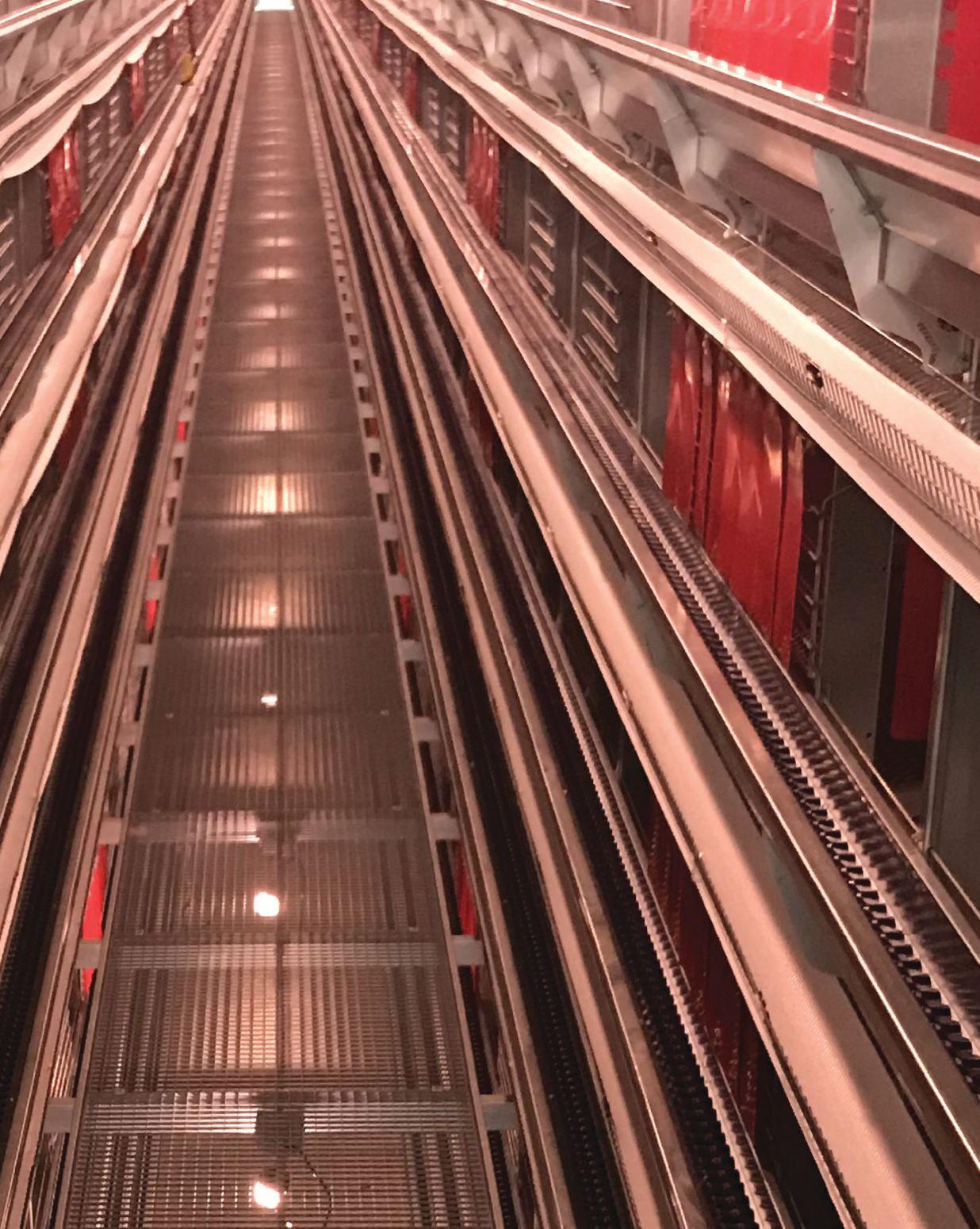
Today, producers may find a few types of multi-tier aviaries, but they are all based on the same principles. These include a bottom level, a separate nest level with water and a top level with perches. Wire mesh floors and manure belts are located on all levels to maintain a clean environment, while reducing the labour requirements of cleaning the aviaries.
In some aviary configurations, the top level is the same width as the bottom, while other configurations use a stepped design with a narrower top level. A combination of these configurations within a house is often ideal, since some birds naturally jump up within the system, while others prefer to jump across the aisle to move up to the top level.
The upper-level perches provide an area where most birds prefer to sleep. The birds naturally tend to spread out on the perches, rather than bunching up in a corner, which helps prevent the formation of hot spots and improves ventilation for a healthy climate in the house.
Today’s multi-tier aviaries also incorporate unique technologies to help ensure a higher quality end product. Some manufacturers are incorporating technologies to encourage birds to only use the nests when necessary.
For instance, one system gently nudges birds out of the nests after laying eggs, preventing them from staying in nests all the time. It helps protect eggs while the collector is running by moving slightly away from the back of the nest so birds cannot reach eggs as they go past. This helps maximize the percentage of clean, grade-A eggs.
ADVANTAGES AND CHALLENGES
The success of multi-tier aviaries in cage-free egg production is largely attributed to the way they support natural bird behaviour. For instance, the layout encourages birds to jump and move around the house. Additionally, multi-tier aviaries have 50 per cent of the floor area available for scratching, which meets or exceeds current cage-free standards in both the U.S. and EU. Providing ample floor space encourages birds to scratch in the afternoon after laying eggs, rather than engaging in undesired behaviours, such as feather pecking.
Because the design of multi-tier aviaries encourages birds to naturally distribute themselves throughout the house, management is kept to a minimum. Features such as wire mesh flooring and well-designed manure belts keep the aviaries and birds very clean, further reducing the amount of labour needed to maintain a hygienic environment.
Producers benefit by being able to stock more birds per square foot in multi-tier aviaries than other cagefree system styles allow. Two-storey houses can also be configured to increase the number of birds per house, which can further enhance return on investment, so long as producers take care not to overcrowd the houses. Bird performance declines in any house when stocked over the maximum recommended density.
Well-trained birds placed in a multi-tier aviary system
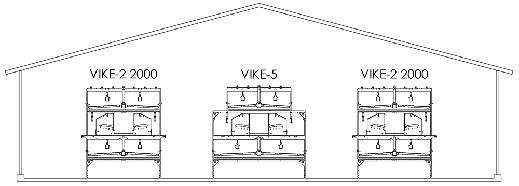
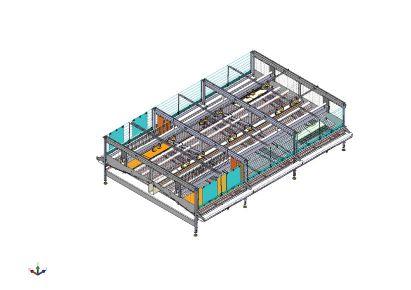
An example of a modern three-row, multi-tier aviary house layout. The middle row is wider on the bottom two levels to encourage birds to hop across to the other rows.
at an appropriate density have shown good performance, even without molting – just a single cycle through 94 to 96 weeks of age. This results in more eggs per bird, a lower cost per egg, and a higher return on investment than other system types. Over a period of 10 years, for instance, producers may be able to purchase one or two flocks less than they would with under-achieving birds that are taken out after only 74 to 76 weeks of age.
Egg quality is also optimized in multi-tier aviaries. Nests and eggs are kept cleaner in these systems, and a gentle collection system minimizes cracking, helping producers achieve the most grade-A eggs per hen.
One of the biggest barriers keeping producers from adopting multi-tier aviaries is that the cost of installation is higher than some alternative systems. However, multi-tier aviaries have demonstrated a much higher return on investment over the long term than some other systems with lower initial installation costs. This is due to the lower maintenance, better bird performance and higher egg quality with multi-tier aviaries.
COMPARISONS TO OTHER SYSTEMS
The two main alternatives to multi-tier aviaries are floor and combi systems. Floor systems are often chosen for existing poultry houses with low ceilings or other space constraints, and some consider these systems to provide the most bird freedom. Also, one great appeal of converting to a floor configuration is the typically lower short-term expense.
However, multi-tier aviaries offer much higher bird density without sacrificing bird welfare, providing producers with a better return over floor systems. Additionally, the multiple low-profile configurations available in multi-tier aviaries can often solve the issues of small houses and low clearances just as well as floor systems.
What may be a short-term gain in cost savings with a floor system is quickly outweighed by the higher long-term performance and density benefits of a multi-tier system.
Combi systems were first developed in Germany in the 2000s with the goal of creating a superior alternative to multi-tier aviaries. They feature nests, feed and water on each level, based on the idea of placing less importance on training birds to move within the system.
While this design offers some advantages, such as lower installation costs and decreased feed consumption due to less bird movement, it also has considerable drawbacks that may cause management issues and reduced bird
performance, even though it was originally conceptualized as a low-management solution.
A greater concern with combi systems, however, is the loss of egg quality. Because combi systems have nests on every level, they require more egg belts in places that tend to collect dirt, dust and other contaminants. Additionally, the combi design often leads to an unbalanced distribution of eggs.
Because of these problems, producers frequently experience dirtier eggs, more cracked eggs, and lower egg quality in general. Some trials have shown that combi systems result in 10 to 30 less grade-A eggs per bird over the total production cycle
than multi-tier aviaries, which greatly diminishes profitability. Perhaps the biggest issue with combi systems has nothing to do with production, egg quality or labour, but rather public perception. Though these are “cage-free” systems, they still resemble traditional caged housing. When it looks like the birds are in a cage, it does not matter how much one tries to explain it, some still see cages. Many retailers, food producers and chain restaurants see perception as reality and are putting in their contracts that they want cage-free eggs from multi-tier style aviaries, not combi systems. In fact, for this reason alone, combi systems
are already rejected by many European producers today.
The advantages of multi-tier aviaries in cage-free egg production are that they offer long-term viability and the greatest potential for long-term profitability.
Not only do these systems benefit bird welfare by encouraging natural bird behaviours and movement throughout the house, but producers also benefit from reduced labour requirements, lower cost per egg and increased number of grade-A eggs per bird.

Producers benefit by being able to stock more birds per square foot in multi-tier aviaries than other cage-free system styles allow.
These benefits beg the question, if multi-tier aviaries are comparably more advantageous than floor or combi houses, then why are they not being used by every producer? Some of this is due to the mindset of traditional cage production. In such systems, it came down to building costs per bird.
Density in such houses is maximized, so the cheaper, the better. Thus, a producer converting from a traditional caged to a cage-free system may still be focused on the highest density at the lowest possible cost and, without considering other factors, that points to a combi system.
As with most industries, change takes time. Additionally, change tends to happen after others pioneer new technologies and the advantages become clear to everyone. The positive experiences in Europe will continue to drive acceptance in North America.
And as more and more producers convert to multi-tier aviaries, and it is repeatedly seen how these facilities produce more, high-quality eggs, with less labour, and without the public perception problems, it is only a matter of time before this “new” multi-tier approach becomes the standard.
Frank Luttels is layer product manager for Chore-Time.
Multi-tier aviaries typically include a bottom level, a separate nest level with water and a top level with perches.
A LOOK BACK AND FORGING AHEAD
Cindy Egg Farmerette provides an update on her farm’s enriched colony housed barn build.
BY CINDY HUITEMA
Some of you might remember me from a few years ago. That’s when I, Cindy Egg Farmerette, wrote about our egg farming journey as our family built a new enriched colony barn.
First, a short recap. We began the physical building in September 2017, with birds being housed in May 2018. We put in three rows of housing, four levels high and 15 houses long. The capacity for these rows is 12,960.
At the time of ordering our initial housing, we opted to go four levels high, with three rows, but leaving the space in the barn for a fourth row.
We originally thought we would do four rows and go three high, with the plan to add the top tier in the future. But we realized that this would be a lot of work. (This farmerette compared it
ABOVE:
After Construction: For the sake of consistency, we installed another row of Farmer Automatic Eco II enriched colony housing (pictured above on the right) before it was discontinued.

Cindy Huitema is an egg farmer from Haldimand County, Ont., who occasionally writes about her farm’s journey transitioning from conventional hen housing to an enriched system.
to constructing a bungalow and adding a second floor later – a lot of extra time and labour and possible production downtime.)
PLANNING A FOURTH ROW
In October 2019, we met with knowledgeable salesman Harold Meadows of Clark Ag Systems at our kitchen table. The Farmer Automatic Eco II enriched colony housing that we had in our barn was being discontinued and upgraded and we wanted to order our fourth row of equipment to match the system we already had in place in the henhouse while we still could.
My husband Nick was general contractor and manager for the original build and proved to me that he can be quite particular about how things are done and appear. For example, the electrical conduit pipes were not to have any of the lettering showing when mounted to the walls and ceiling. This attention to detail still surprises me, as he makes more work for me in the house (fellow farmerettes know what I’m talking

















Vencomatic Group o ers a full range of innovative equipment for poultry farms accross North America. We are proud to be a global leader in cage-free solutions that are exible, practical and high-performing.
Our poultry experts provide expert advice on barn layout, bird management, climate management and egg handling.
More information: www.vencomaticgroup.com or please contact your local dealer.
BLR Solutions
QC - T: +1 450 772 2929 jfbourbeau@blrsolutions.ca
Jonkman Equipment Ltd.
BC - T: +1 604 857 2000 info@jonkmanequipment.com
Penner Farm Services
AB - T: +1 403 782 0675
MB - T: +1 204 326 3781 info@pennerfarmservices.com
Pols Enterprises Ltd.
ON - T: +1 905 708 5568 sales@polsltd.ca
Western Ag Systems
SK - T: +1 306 222 4881 wayne@westernagsystems.com


Bolegg
JONKMAN
Nick wanted our housing rows to match. Harold was our salesman when we made the initial purchase and aided us immensely along the way – especially with the Genius technology after the first flock was housed.
In February 2020, the housing parts came by truck on skids and we stored them in our old hay barn until we were ready to begin construction. At least we had the equipment on site and split the equipment cost over two calendar years for accounting purposes.
Our flock changeover month is May. We arranged to have Chris Best Construction come and pour a two-inch depth pad for the new row in May 2019. Chris did our original concrete work in the barn and was, thus, familiar with the facility already. The pad is two inches in the middle with slight, gradual slopes to the aisle edges. We find that this makes it easier to clean under the housing throughout the year and at the yearly barn cleanout time.
PREPARING “THE WAREHOUSE”
Our plan was to try to begin this project in 2020. However, our first step was deconstructing the equipment in our old layer barn so that we could use this space for storage and as a workshop for the new install.
We also saved any equipment that we could sell as used parts – sorting the various components into recyclable matter, reusable parts, if any, metal for taking to our local scrap dealer and garbage.
In March 2020, we had brothers Nick and Ben help my husband Nick and son John take apart the housing before the brothers returned to school. The initial stages of the pandemic were just taking place and even at this time we exercised caution, with the brothers working in one area of the barn and Nick and John in another.
The plan for the old barn was to use it as a warehouse and workshop for spreading out all of the housing parts and having work stations. Our son John was quite insistent that we no longer call this the old chicken barn and refer to it, instead, as “the warehouse”!
Our old barn (sorry, warehouse!) is directly beside and parallel to the new barn, with a rear exit door right across from a side door in the new barn for taking housing pieces over when ready for installation.
I was quite skeptical that we could complete the dismantling and cleanout in one week. However, we completed the job in less than five days with a truck trailer collecting scrap metal to be cashed in when the scrap metal price improved.
Nick and John moved the many skids into the
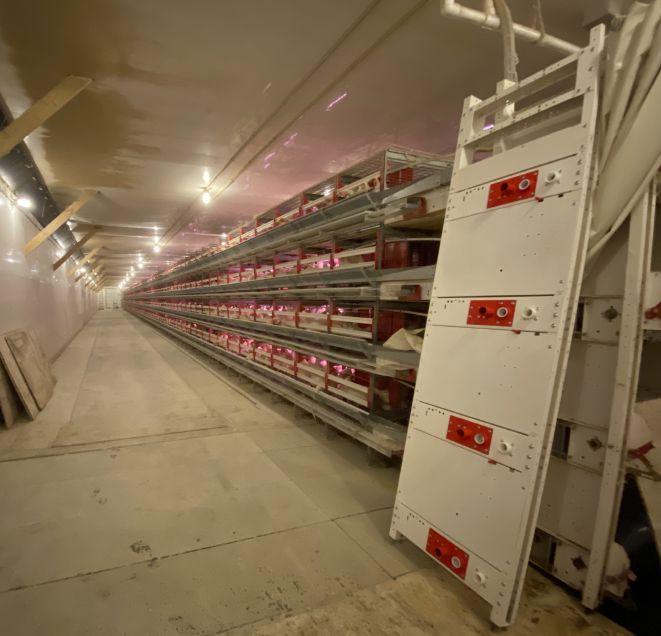
empty warehouse in the summer of 2020 when the weather was more pleasant. It was surprising how much space this building had after the old housing was removed.
CONSTRUCTION STARTS
In early January 2021, we again had brothers Nick and Ben help. The main frames were the first items we constructed. We set up socially distanced work stations and established an assembly line for the frames. Our colony enriched layer barn is 15 houses long, and they needed to make 76 frames consisting of more than 20 pieces.
We marked out the floor in the new barn. Our daughter Charlotte and I were helpful carrying parts to the barn when needed and we assisted with taking the frames from the warehouse to the new barn as well.
We were concerned about how our activity in the barn would affect the behaviour and production of the hens with the construction noises, people walking in and out of the barn more often, ceiling lights on and working across from the existing rows. However, the hens got used to louder noises within a day and egg productivity never changed.
Nick liked that he had an exact replica right beside him and John proved again to be very
Before Construction: When we built our enriched barn a few years ago, we left room for a fourth row to accommodate expansion.
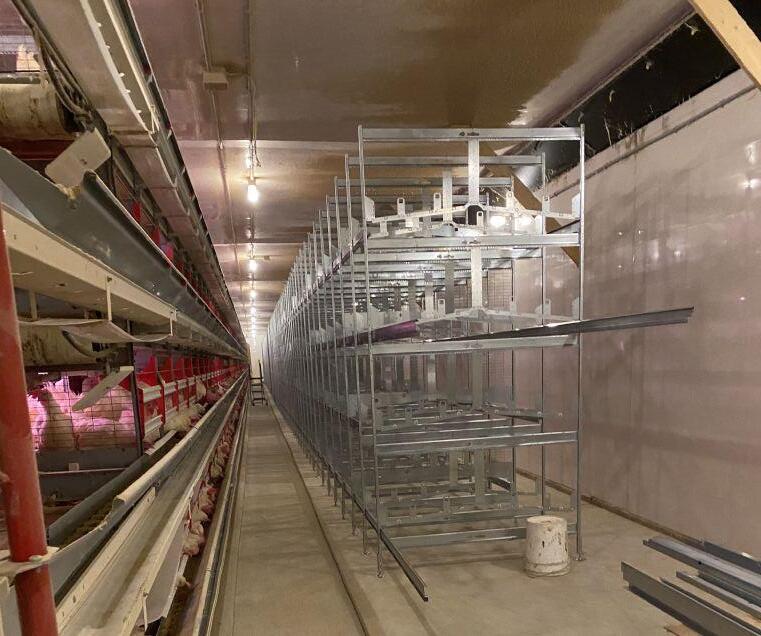
detail-oriented in the various construction components, with a good memory of the previous build.
We erected the rear manure end assembly first, with the frames being the next big component. The various parts fell into place like building a Lego playset. Clark Ag Systems was also of great assistance when we had a construction question or were in need of any missing parts.
We then added floors, nest curtains, waterlines, perches, in-house lighting, feed troughs and egg belts to the frames.
Charlotte and I also constructed the doors – 600 in total that included four pieces each! We did this on days when the weather was not as cold and we could fit it in around our other work. Charlotte has been barn manager and packs the eggs since the new barn has been in use.
Another job that took a lot of time and figuring was adding more length on the egg conveyor at the front of the barn and the conveyor paddles and elevators at the front of the new
Make sure to leave room for expansion in your egg production facility.
row. I helped John by putting the paddles together and placing them on the elevator chain for him to hand rivet in place.
Even though we felt we had a lot of time, the arrival of the new birds still was a challenging deadline to meet, with some more work being done on the system in the week prior to the birds’ arrival.
The timing and conveyor system had to be tweaked and greased to work properly for egg gathering once the birds were in.
Each house now has 27 or 28 birds each, with a capacity of 36. They have lots of space and we have lots of room
for future expansion.
We completed this project in its entirety during the wretched COVID-19 pandemic. Although some parts were delayed in getting to us, they eventually arrived. The pandemic restrictions caused minimal interruptions and there were no visitors to the farm to take time away from our work time.
SOME HELPFUL TIPS
Some advice from our experience with this and the earlier build is, firstly, to make sure to leave room for expansion in your egg production facility.
Secondly, we find the in-house lighting very valuable and a great aid in conducting our animal care barn checks every day. The hens do appear to be happy in this environment and are easy for us to see as well.
Lastly, seek out assistance from the company that sold you the product. You are spending a lot of money for a long-term investment and need to do things right to prevent extra cost, time and possibly production losses in the future.
LOOKING FORWARD
As a side note, we were approached by Burnbrae Farms, the company we sell our eggs to, to produced omega-3 white eggs from our hens housed in colony enriched housing.
We began this process in August and will produce omega-3 until November. Although this has basically been a change in feed diet, it has added some excitement to our usual routine.
Our egg farm life continues on and we are happy with what we accomplished. Additionally, we had the anticipation of our first grandchild to look forward to during the row four build, which provided us with a nice distraction at times. Our daughter Stephanie works for Clark Ag Systems and she and Jake became first time parents to Moira Elisabeth on May 19.
Now, Cindy Egg Farmerette has updated you on the happenings at our farm and I look forward to informing you on what our next endeavour brings in the future!
During Construction: Our colony enriched layer barn is 15 houses long, and we needed to make 76 frames consisting of more than 20 pieces.
MORTALITY IN CAGE-FREE SYSTEMS
BY MELANIE EPP
Societal concerns about the welfare of conventionally housed laying hens has led to the global adoption of cage-free systems. As adoption increases, so too do producers’ concerns around potentially higher mortality.
A comprehensive study published in a Nature journal, however, has found that those concerns are generally untrue. In fact, the research shows that mortality gradually drops with time, as producers gain management experience. The study’s findings could reframe the debate on the welfare of laying hens in cage-free systems.
HOW THE STUDY WAS CONDUCTED
Led by Dr. Cynthia Schuck-Paim, scientific director of the Welfare Footprint Project, the study encompassed data from 16 countries, 6,040 commercial flocks, and 176 million laying hens. Across the study, hens were housed in four different housing systems: conventional cages; furnished or enriched cages; and two types of indoor aviary systems, single-tier and multi-tiered. The researchers did not analyze systems where hens had outdoor access.
Schuck-Paim and her team of researchers conducted a systematic review and then a meta-analysis on mortality under commercial conditions in flocks of no less than 1,000 birds. On average, data was collected from very largescale flocks.
In order to be included in the study, the year of mortality had to be recorded in the dataset. The data also had to be disaggregated by housing system, meaning it had to be clear which dataset belonged to which type of housing system. Data the researchers included spanned from 2000 to 2020 and was reported in English, French, Portuguese and Spanish.

Dr. Cynthia Schuck-Paim is scientific director of the Welfare Footprint Project.
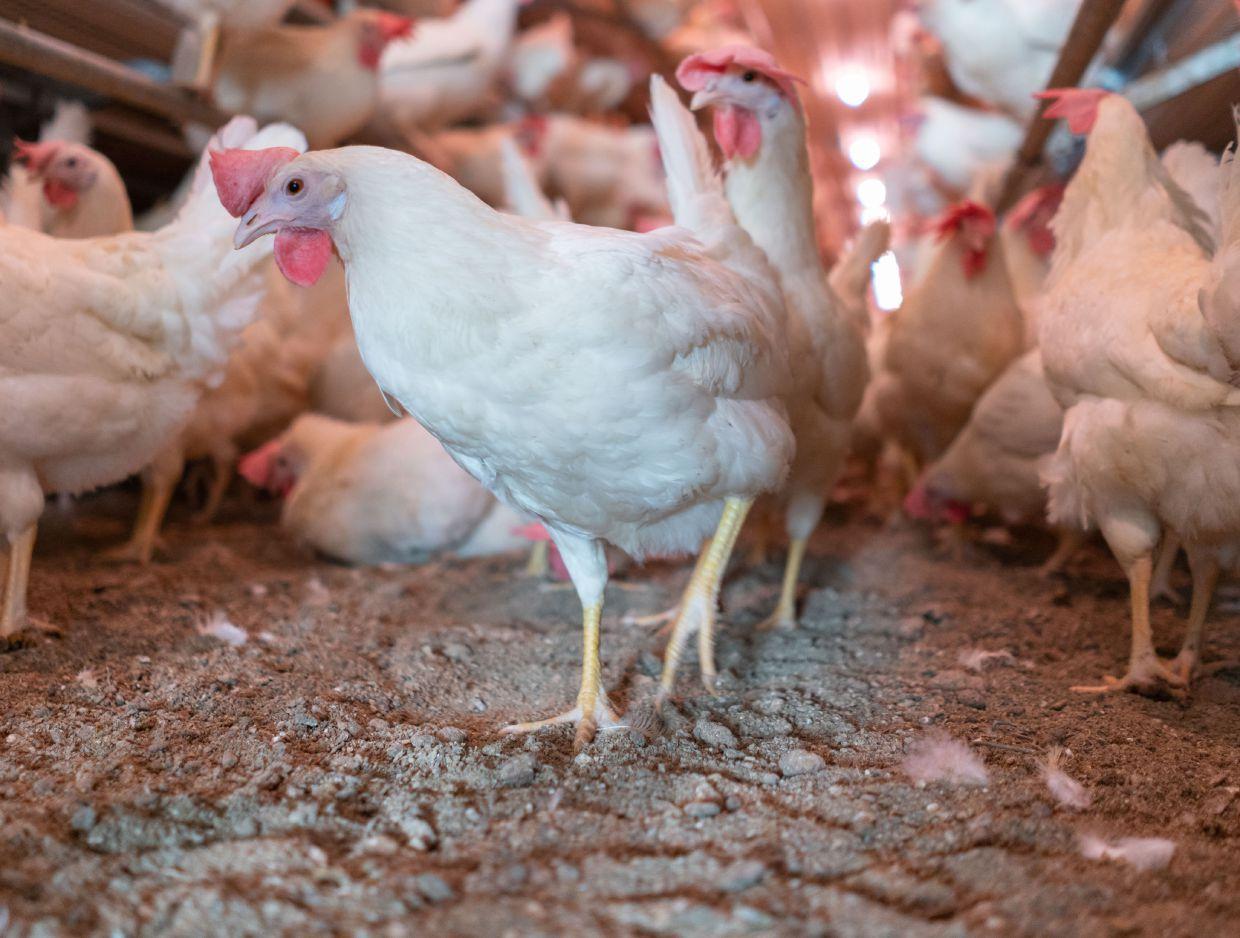
ABOVE: A comprehensive study out of Europe shows that laying hen mortality in cage-free systems gradually drops, as producers gain management experience.
Rate declines as management improves.
Several countries provided multi-year datasets of their own, including the Netherlands, France and Norway. Having access to multi-year datasets from a single country was especially advantageous, Schuck-Paim says.
“We could analyze within a single country, how mortality changed over the years for that country,” she says.
The study was comprehensive in that the researchers screened nearly 4,000 data sources. Of the 6,040 flocks they evaluated, 4,407 were caged (3,066 in conventional and 1,341 in furnished cages) and 1,633 were in indoor, cage-free systems (412 in multi-tier aviaries, 290 in single-tier aviaries and 931 flocks where the type of aviary was not defined).
THE RESULTS
What the data showed was that in the newly adopted systems – enriched cages and aviary systems included – cumulative mortality dropped over time.
“Actually, the best cage-free systems have lower mortality than the best conventionally-caged systems,” Schuck-Paim says. “Producers moving in that direction, can be hopeful that that this will be the case for them, unless they have very poor management, stockmanship and so on.”
In conventionally housed systems, however, mortality has not decreased over time since the year 2000. Instead, it has already reached a plateau, Schuck-Paim says.
In analyzing the most recent datasets, Schuck-Paim says they found no significant difference in mortality between the caged and cage-free housing systems. In fact, commercial Hy-Line data shows that the best cage-free
systems have lower mortality than the best caged systems. With that said, there is higher variability in mortality in cage-free systems. To avoid this, producers need to pay more attention to management.
“And that’s why you’ll see that as you get experience over the years, mortality goes down,” she says. “Because you do need to adopt best practices and to know how to manage these other systems.”
Overall, though, mortality gradually drops as experience builds with each system. Since 2000, each year of experience with cage-free aviaries was associated with a 0.35 to 0.65 per cent average drop in cumulative mortality. Faster rates of decline may be experienced as knowledge is gained and passed on, and as genetics are optimized for better health and welfare, Schuck-Paim says.
Beyond the basic analysis of mortality, the researchers also analyzed the data controlling for variables, including flock size, whether they were white hens or brown hens, and beak trimming status to see the effect of these variables on mortality. Overall, 84 per cent of flocks included in the study were of beak-trimmed hens. Approximately half of the intact beak flocks were located in Norway, where beak trimming was banned in 1974. Under this analysis, the results were the same. That is, mortality lessens over time as management improves.
“If you have that experience and know what works and what doesn’t, then mortality can be very low,” she adds.
Schuck-Paim was unable to expand on which management practices helped to lower mortality in this specific study, as her team did not investigate this further. But she did point to a couple of European projects that have done so: FeatherWel and Hennovation.
Funded by the EU, the Hennovation project explored two areas of concern – injurious feather pecking and end-of-lay during transport and at the abattoir. Recommendations related to injurious pecking include: the management and control of poultry red mites; the development of practical lists to advise farmers as to how to prevent further development of feather pecking after first signs of the problem occur; and the effects of lighting, including colour, intensity, daylight and scheduling.
Recommendations related to the welfare of end-of-lay hens include: knowledge transfer on best practices and guidelines; and optimal ways of catching birds in non-cage systems.
The aim of the FeatherWel project is to provide advice on practical strategies to reduce the risk of injurious pecking that occurs in
non-cage laying hens during both the rearing and the laying periods. The project compiles scientific evidence, industry experience and the results of the Bristol Pecking Project.
It led to the development of key management strategies, which can be found on the FeatherWel website at featherwel.org.
Schuck-Paim notes that producers can minimize mortality and welfare issues by adopting best practices. For example, when young flocks are introduced to tiered, cage-free systems earlier, they learn how to safely navigate the system at an early age. She notes that delaying the point of lay to over 20 weeks helps to reduce injurious pecking, as well.
In another review of the literature SchuckPaim conducted, she noted that egg peritonitis syndrome, the leaking of egg material in the peritoneal cavity, is one of the biggest drivers of hen mortality. Reducing in the incidence of egg peritonitis will reduce the overall risk of mortality, Schuck-Paim says.
A cleaner environment will also reduce the risk of infection. Proper diet, homogenous lighting, and access to litter from day-one are all crucial to proper development and minimzing health and welfare issues, she says.
Although Schuck-Paim’s study did not include cage-free systems with outdoor access, the HyLine data did.
Their data did not show higher mortality in cage-free systems, even in those with outdoor access. This was surprising, as many in the industry have expressed great concern about increased mortality due to predation and pathogens.
“Our results speak against the notion that mortality is inherently higher in cage-free production and illustrate the importance of considering the degree of maturity of production systems in any investigations of farm animal health, behaviour and welfare,” she concludes.
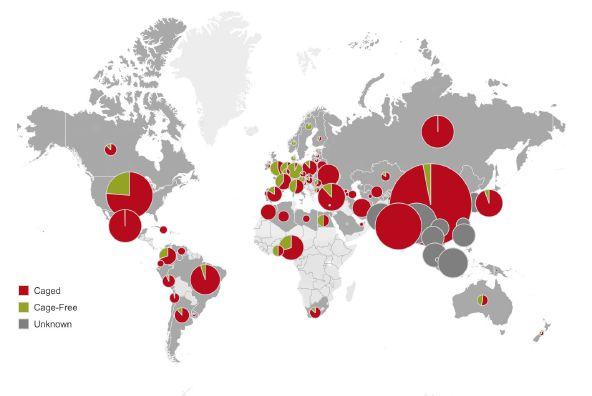
Global laying hen statistics by housing system.
STEP BY STEP
Optimizing the installation and operation of enriched housing.
BY TREENA HEIN
As more Canadian egg farmers decide to convert to enriched housing, the industry gains added collective knowledge – and is ready to share that knowledge. In May at the (virtual) National Poultry Show, Harold Meadows and Shawn MacDonald gave their pointers for those choosing to go enriched in one or more barns. They are both technical sales reps with Clark Ag Systems. Canadian Poultry also contacted two farmers with recent installations to gather tips.
EARLY PLANNING STAGES
First up are a couple of points that producers need to consider in the early barn-planning stages. Meadows notes that farmers should consult their electricity supplier, since enriched cage systems need a larger power requirement in many cases.
and three-phase service at the road,” he recalls. “Depending on whether three-phase power is available, this can be a costly and large upgrade that needs to be considered in the very early barn-planning and budgeting stages.”
Also, during the planning stages, if a larger footprint barn is required (which is very often the case for enriched), farmers needs to ensure that the new facility will meet all the minimum setbacks that provincial and county regulations require. This can have an impact on how large your new barn will be, which will directly affect your bird population numbers.
Indeed, regulations in your area, Meadows says, may make it important for farmers to look at a multi-tier housing system in a smaller footprint building in order to keep bird populations equal to what they were in your conventional housing system.
ABOVE: With their new enriched barn, the McIntoshs went with multiple shorter perches running back to front to spread out the birds more.
“For example, at Clark, our number one conversion required a larger pole transformer and our second build, we required a larger transformer
MANURE MANAGEMENT
In terms of manure management, Meadows notes that enriched system manure belts are much wider and
longer than traditional systems and need to be cleaned and scraped much more frequently.
“Since manure can build up fast and heavy on the wider belts, the risk of a belt snapping or stretching becomes magnified with excessive manure build-up in enriched systems, which can result in a costly repair, system downtime and air quality issues,” he says.
“We recommend that belts be scraped a minimum of twice a week to ensure good belt health. On the other hand, over-scraping manure can lead to inefficient scraper performance and excessive energy usage. So, find that happy medium.”
VENTILATION
MacDonald adds that farmers should also keep in mind that ventilation will very likely be much different in enriched barns. “Since manure is dryer in the enriched barn, air quality is better, especially in the winter
months,” he says. “Drier manure requires less energy and resources to manage, and your ventilation program and the overall environment in the barn is better for the birds. It also makes manure easier to clean off the belts.”
Make sure your ventilation programs are set properly to minimize over-ventilation, keep humidity levels correct and minimize your energy costs. MacDonald adds that, depending on renovation to existing housing and age of ventilation system, a ventilation enhancement may be due.
Dave Hiebert, co-manager at Davalen Farms in Abbotsford, B.C. (owned by Henry and Deb Penner), has found ventilation to be excellent in their one enriched barn, finished in January 2021 (Big Dutchman Avech 2240, five tiers, four rows).
Hiebert describes air quality, due to the barn design and tunnel ventilation, as “incredible.” He adds that “we had 44°C weather [earlier
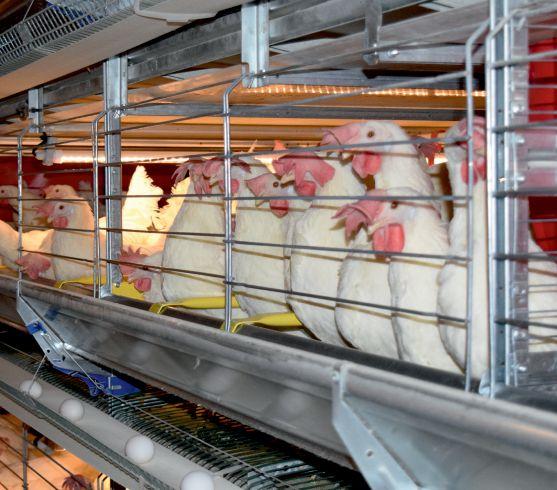

this summer] with no changes at all. No change to feed and water consumption and production. And no mortality during that heat wave in that barn.”
Ross and Barbara McIntosh have also found ventilation working well in their enriched barn in both colder and warmer parts of the year since they built an enriched barn at their farm in Seaforth, Ont., a little more than a year ago (Tecno Enriched Plus 94, four tiers, five rows). “The manure is dryer,” Ross adds. “And the belts are working well.”
OTHER FACTORS
Over their many enriched installations, Clark Ag staff have not seen any benefits to using both aisle and in-system lighting in enriched barns during production. Aisle lighting is only usually used between flocks.
However, Meadows and MacDonald note that it’s critical to position in-system lights correctly, keeping the
nests as dim as possible and scratch areas bright. In short, proper lighting encourages natural behaviours and top production.
Proper partitioning for catching as well as the promotion of even nest use is also critical in larger format enriched systems. Hiebert has found that in their 12 by eight-foot cages, partitions in the middle are a must.
But size of cage aside, every enriched housing system requires close monitoring of shunt timing of the egg belt. Hiebert has done some adjustment of this as the days got longer this spring and then got shorter after summer solstice. “We have a camera on a section so we can see what’s happening at 6 AM, 6:15, 6:30 and so on and make small adjustments,” he explains.
Overall, the McIntoshs have also found getting the shunt timing right in the morning to be the challenge with enriched, but all is going very well. They like the nests at both ends of each unit and the multiple shorter perches running back to front, as it better spreads out the birds for perching and gives them more room to otherwise move around. “We’ve finished our first flock and are now in middle of our second one,” Ross says. “It’s something to see them all roosting on their
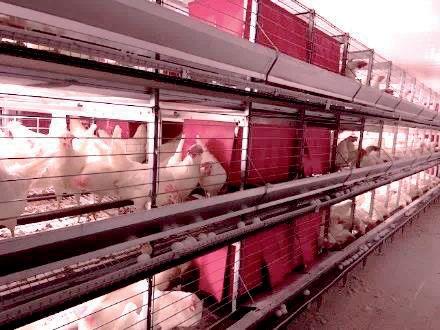
Since manure is dryer in the enriched barn, air quality is better, especially in the winter months.
perches if you check the barn at night.”
MacDonald notes that feed consumption is slightly higher in enriched system, as the birds are more active. So, it is critical to manage your feed program, bird nutrition, and potential areas for feed wastage both inside and outside the system.
If everything is working well, MacDonald notes that enriched systems will provide improved bird health and mortality rates, as well as more feathering at end of lay. With diligent daily inspection of bird health and equipment function, health issues will be minimized and production will be maximized.
While an enriched system has many more moving parts, MacDonald says, if farmers stay on top of things, “An enriched barn will service your hens and your bottom line very well for years to come.”
Enriched Layer Unit Small Group “Condo Living” for Laying Hens Now with CBM In-Cage Lights
Meeting or Exceeding 2017 NFACC Code of Practice
Floor Feeding with “Quad” Perch System Completes a Cage Free System with Community Nests
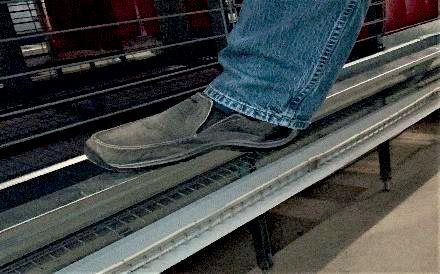
New feed trough with built in step/bumper rail standard on all tiers. The ergonomic wide flat top is gentle on the feet and helps prevent damage to the egg trays.












When