Wednesday, October 30- November 5, 2019 - // no. 027
Puerto Rico and the Caribbean
www.theweeklyjournal.com
LMM INTERNATIONAL AIRPORT SEES UPSURGE IN PASSENGER TRAFFIC P12 BAYAMÓN REINVENTS ITSELF TO LURE INVESTORS P8 DEBATE OVER PROMESA BACK AT THE HILL P16
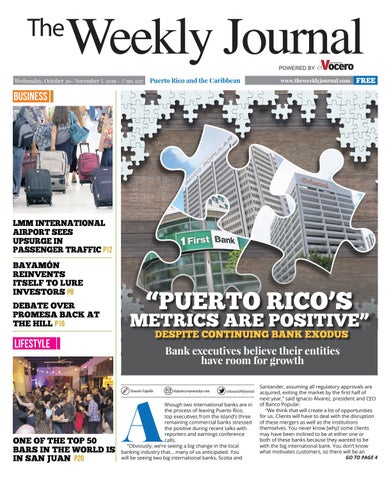
“PUERTO RICO’S
METRICS ARE POSITIVE” DESPITE CONTINUING BANK EXODUS
Bank executives believe their entities have room for growth
A Rosario Fajardo
ONE OF THE TOP 50 BARS IN THE WORLD IS IN SAN JUAN P20
rfajardo@wjournalpr.com
@RosarioWJournal
lthough two international banks are in the process of leaving Puerto Rico, top executives from the island’s three remaining commercial banks stressed the positive during recent talks with reporters and earnings conference calls. “Obviously, we’re seeing a big change in the local banking industry that… many of us anticipated. You will be seeing two big international banks, Scotia and
Santander, assuming all regulatory approvals are acquired, exiting the market by the first half of next year,” said Ignacio Álvarez, president and CEO of Banco Popular. “We think that will create a lot of opportunities for us. Clients will have to deal with the disruption of these mergers as well as the institutions themselves. You never know [why] some clients may have been inclined to be at either one or both of these banks because they wanted to be with the big international bank. You don’t know what motivates customers, so there will be an GO TO PAGE 4
The Weekly Journal > Wednesday, Octuber 30, 2019 > 2
3
/ Wednesday, October 30, 2019
A WEEK IN REVIEW COLLINS AEROSPACE INAUGURATES NEW SMART LINE CAPABILITIES IN PUERTO RICO
>Courtesy Spirit
>Courtesy DoorDash
>Courtesy DDEC
Collins Aerospace Systems, a unit of United Technologies Corp., has unveiled a new 27,000-square foot facility at the Puerto Rico campus in Santa Isabel. The facility features smart line, the company’s first major investment in automated manufacturing since becoming Collins Aerospace. The smart line production line will automate the Printed Circuit Board Assemblies build process for commercial aircraft engines and power control applications. The company expects to add up to 150 new jobs at the site, ultimately increasing its Puerto Rico workforce to more than 1,500 employees.
DOORDASH LAUNCHES IN PUERTO RICO The largest on-demand destination for door-to-door delivery in the United States, Canada and Australia, announced its official launch on the island. DoorDash’s entry into Puerto Rico brings expanded opportunities for local businesses, flexible working opportunities and customer benefits with special promotions for residents. “As we continue to grow globally, it’s a priority for us to invest in and empower the communities we serve. Partnering with Foundation for Puerto Rico reinforces our commitment to grow local economies and build small business resiliency, and we hope customers help us fulfill this mission by participating in the Descuento de Dash promotion,” said Brent Seals, DoorDash’s head of launch.
Powered BY El Vocero de Puerto Rico, 1064 Ave Ponce de León 2nd floor San Juan, PR Postal Address: PO Box 15074, San Juan, PR 00902
SPIRIT AIRLINES ADDS SERVICE FROM NEWARK AND BOSTON TO SAN JUAN The Florida-based carrier announced it will begin nonstop daily service from both, Logan International Airport in Boston and Newark Liberty International Airport in Newark, N.J. to Luis Muñoz Marín International Airport in San Juan, Puerto Rico on Dec. 19. “We are constantly looking for growth opportunities in our network and we are so proud of the growth we have had in Puerto Rico over the years,” said John Kirby, vice president of network planning for Spirit, in a press release. The airline will also add an additional daily flight between Philadelphia International Airport and San Juan, beginning March 1, 2020.
President Salvador Hasbún shasbun@elvocero.com
Human Resources Director Arlene Rolón, PHR arolon@elvocero.com
Managing Editor Yennifer Álvarez yalvarez@wjournalpr.com
Comptroller Félix A. Rosa frosa@elvocero.com
Traffic Director Ilia M. Pérez Centeno iperez@elvocero.com
Multi-Platform Digital Director Stephanie Gómez Álvarez sgomez@elvocero.com
Production Director Eligio Dekony edekony@elvocero.com
Editorial Director Juan Miguel Muñiz Guzmán jmuniz@elvocero.com
Multi-Platform Graphic Director Héctor L. Vázquez hvazquez@elvocero.com
Phone: 787-622-2300, 787-721-2300 Customer Service: 787-622-7480
4
CONTINUED FROM PAGE 1 opportunity for us to go after clients that may have been in those banks for a specific reason that no longer applies,” Álvarez said. “There may be opportunity to pick up good talent also, and there are going to be synergies in this merger. We think there’s a lot of opportunities, and obviously, in most large transactions, we are a player already. We may become a larger player, have a better chance than those that who are not,” he added. Regardless, challenges remain and there will be fierce competition among the remaining three, Álvarez indicated. “We are also going to have to up our game. Eventually, after this conversion is done, we are going to have [three] local competitors that are going to be very focused on this market. We’re going to have to up our game… to execute even better than we’ve done in the past. So, we see lots of opportunities, but we’re also going to be on our toes,” he said. In 2005, there were 11 commercial banks in Puerto Rico and now, with the announced sale of Scotia Bank Puerto Rico to Oriental Bank and that of Santander Puerto Rico to FirstBank, the island will soon be down to three commercial banks: Banco Popular, FirstBank and Oriental. As a sign of Banco Popular’s continuing strong performance, Álvarez highlighted the bank’s results for the third quarter (3Q) 2019. “The third quarter was another solid one… While results reflect higher operating expenses due to investments in key areas such as technology, compliance and our people, we maintained our net interest income stable despite the interest rate environment, increased our non-interest income and benefited from a lower provision expense. “We added 12,000 new clients, increased consumer loan balances in Puerto Rico and grew our commercial and mortgage portfolios in the United States,” he noted. Álvarez emphasized the number of new clients at Popular—37,000 since Dec. 2018—as a sign
/ Wednesday, October 30, 2019
that there is continuing room for growth. He also The disbursements of the funds has been slower noted that while the outmigration from Puerto than many had hoped or anticipated. Rico continues, there are many who remain “This delay is related to concerns “unbanked” and thus, off the grid. These regarding appropriate local people are likely in the underground oversight of the disbursement economy and/or afraid of having of federal funds and the a bank account for fear of losing political uncertainty that their welfare benefits, he we experienced during indicated. the summer. It is difficult In terms of Popular’s internal to predict whether this metrics, he said their customers’ increased scrutiny will debit and credit card purchases ultimately impact the in 3Q grew by 4 percent amount of federal refunds compared to 3Q of 2018 and 2 received. However, we percent compared to continue to believe the first nine months of that these trends will 2018. be significant and Consumer loan they will have a very origination trends in positive impact on the Puerto Rico have also local economy,” he been solid, especially added. in the auto sector. Puerto Rico Mortgage originations Economic Highlights were 3 percent lower Álvarez also pointed than the previous out the mixed trends quarter, but 2 percent in the Puerto Rico higher year-to-date economy. “In general, compared to 2018 and economic activity in were driven primarily 2019 has leveled off by higher home after a post-hurricane purchase activity. On rebound year in 2018. the commercial loan However, this activity side, balances declined continues and trends sequentially on higher well above... With payoffs, Álvarez respect to migration - Ignacio Álvarez, president and CEO indicated. trends, the most of Banco Popular “We continue to recently released expect that incremental passenger data from lending activities will be tied to the performance of the San Juan [international] airport reflects that the the local economy. The sustainability and pace of net number of people who left the island through further progress in the Puerto Rico economy will July was approximately 20,000,” he said. be heavily dependent on the magnitude and timing Excluding 2018, which was substantially of federal recovery funds flowing into the island. impacted by the inflow of people coming back to Puerto Rico following the hurricane, the data for 2019 reflects a favorable variance compared to the same period in 2015, 2016 and 2017, which averaged outflows of 63,000 people. Employment trends continue to be positive, he indicated. In September, total employment, which includes selfemployed individuals, was up 1 percent compared to Sept. 2018. The unemployment rate decreased to 7.6 percent in September, after remaining steady in the mid-8 percent range during the prior year. This is the lowest unemployment rate in Puerto Rico, going back at least 55 years, Álvarez said. Salary employment grew by 0.8 percent year-over-year. The improvement was driven by an increase of 1.3 percent in the private sector, offset by 1.1 percent decline in public sector employment. The auto industry continues to perform well, he indicated, although there has been a slowdown in recent months. About 75,000 new units have been sold year-to-date through September, down 2 percent compared to 2018, but up 30 percent and 25 percent versus comparable periods in 2017 and 2016, respectively. “Cement sales were down Aurelio Alemán, president and CEO of First BanCorp, said the Santander acquisition is “transformational” for 8 percent when compared to the first nine months the company.>Archive
Eventually, after this conversion is done, we are going to have [three] local competitors that are going to be very focused on this market. We’re going to have to up our game… to execute even better than we’ve done in the past. So, we see lots of opportunities, but we’re also going to be on our toes.
/ Wednesday, October 30, 2019
of 2018, although there was a considerable surge in activity in early 2018 following the hurricane. However, sales were 23 percent and 14 percent higher in comparable periods in 2017 and 2016, respectively,” he added. FirstBank and Oriental Moving Positively Meanwhile, Aurelio Alemán, president and CEO of First BanCorp, said the Santander acquisition is “transformational” for the company. “It will give us scale, which is important to continue competing and expanding in this market. We want to get bigger. We see an opportunity to grow in the market with this acquisition. We would like to see one plus one become three, not one plus one become 1.5,” he said. “We would like to have more presence, retain more clients, grow more clients and expand our branch network to serve the communities and clients better.” In terms of 3Q 2019 results, he reported another strong quarter of core earnings with net income of $46.3 million or $0.21 per diluted share. Pre-tax, pre-provision income remained healthy at $70 million this quarter, while franchise metrics continue to move in a “positive direction.” FirstBank has strong stable earnings, an expanded talent team, continued investments in technology and larger participation in commercial activity on the island, which are all positives, he indicated. “When you add all this together, we believe we’re going to be a stronger competitor to further support the growth in Puerto Rico and the economic recovery and redevelopment of Puerto Rico… The transaction, when you look at the deposit mix, will definitely enhance our funding profile, our cost of funds and our customer base,” Alemán said. José Rafael Fernández, president and CEO of OFG Bancorp, operating locally as Oriental Bank, said that while the local economy is “relatively flat,”
there is movement on the horizon. “[Federal reconstruction funds] are certainly trickling in, primarily for roads, and there is a lot of rebuilding on the roads and the bridges. There is still work in progress in terms of the Electric Power Authority and its restructuring. There are still a lot of expectations riding on the housing funds coming in for rebuilding and actually building new homes. “But we are seeing some of our larger construction services clients being awarded projects to build and rebuild homes and those sorts of funds have already been allocated. They’ve been awarded but they have yet to be disbursed because there is still some hoops to go through,” he said. “Our customers, commercial and consumer, are certainly in a much better financial position than they were a couple of years ago and their balance sheets show it.” Fernández said during 3Q 2019, Oriental
5
generated a 14 percent increase in adjusted earnings per share. Adjusted return on average assets and return on average tangible common equity also improved. Reported net interest margin continued at a level similar to top-performing peer banks in the mainland. “Our levels of small business, auto and consumer loan production, core deposit growth, credit quality and capital and the number of net new customers all confirmed the effectiveness of our differentiation strategies. Since we made our Scotiabank announcement, we have been engaged in extensive integration planning. We’re extremely excited about how the acquisition will significantly enhance our position as a premier retail bank on the island and establish a strong foothold in another Caribbean market [i.e. the U.S. Virgin Islands],” he added.
José Rafael Fernández, president and CEO of OFG Bancorp, operating locally as Oriental Bank, said that while the local economy is “relatively flat,” there is movement on the horizon. >Archive
6
/ Wednesday, October 30, 2019
Birling Capital Advisors: Most PRSI Firms Top U.S. Bank Stocks Under Trump Remains bullish on the economy Rosario Fajardo
F
rfajardo@wjournalpr.com
@RosarioWJournal
our out of the five publicly traded companies in the so-called Puerto Rico Stock Index (PRSI) have outperformed most of the top U.S. bank stocks since the Trump administration began in midJanuary 2017, according to the latest report by Birling Capitol Advisors. The PRSI comprises five companies: Evertec, OFG Bancorp, First Bancorp, Popular and Triple S. From Jan. 20, 2017 to Oct. 16, 2019, these were the results for the PRSI: Evertec achieved a total return of 80.69 percent; OFG was second with 75.88 percent; coming in at third was First Bancorp with 53.47 percent in total a recession won’t happen in 2019 or 2020. The returns; Popular was fourth with 23.23 percent; global economy will continue to grow but at a and finally, Triple S with -23.52 percent slower pace,” he said. By comparison, seven top banking institutions Once the United Kingdom’s Brexit limbo achieved these returns during the same time and the U.S.-China trade war are resolved, the period: JP Morgan Chase & Co. with 43.04 percent; Bank global economic output will be more positive, he indicated. of America Corp. with 33.26 percent; Citigroup Rodríguez explained that Birling Capital chose at 26.86 percent; U.S. Bancorp at 6.60 percent; to compare PRSI Morgan Stanley with companies with their 1.31 percent; Wells U.S. bank counterparts Fargo & Co. with -9.68 because he considered percent; and finally, it a good benchmark Goldman Sachs Group and the Trump at -10.76 percent. administration was a On average, the PRSI logical choice in terms outperformed these of timeframe. seven U.S. banks by “Some in corporate 40 percent, indicated America have claimed Francisco Rodríguez that Trump has been Castro, president and the best thing that CEO of Birling Capital happened to them; Advisors. “The main other elite business -Francisco Rodríguez difference is that people believe that his Puerto Rico went down Castro, president and CEO of presidency is hurting so much that people Birling Capital Advisors the country, with stopped investing. budgets out of control They ruled us out. and borrowing at Now, with hurricane increased levels,” said Birling Capitol in its report. reconstruction funds coming in, they realize we “This evidences that although the banking sector aren’t so bad after all,” he said to THE WEEKLY continues to grow under Trump’s tenure is not JOURNAL. the superb growth that some in Washington, D.C. “In my view, even though the IMF [International claim.” Monetary Fund] has cut its global growth forecast,
The main difference is that Puerto Rico went down so much that people stopped investing. They ruled us out. Now, with hurricane reconstruction funds coming in, they realize we aren’t so bad after all.
Meanwhile, Jelena McWilliams, chairman of the Federal Deposit Insurance Corp. (FDIC) has remained upbeat about the banking industry, although some “warning signs” are on the horizon. “In July, this economic expansion became the longest on record in the United States. With the recent lowering of short-term rates and inversion of the yield curve in the second quarter, new challenges for banks in lending and funding may emerge,” she said recently. “The competition to attract and maintain loan customers and deposits is strong, and therefore, banks need to maintain rigorous underwriting standards and prudent risk management. Awareness of interest rate, liquidity, and credit risks at this stage of the economic cycle will position banks to be more resilient in maintaining lending through the economic cycle,” McWilliams added. In brief, her message was that while the banking industry reported another positive quarter (i.e. second quarter 2019) and the banking system remains strong, the FDIC continues to encourage prudent risk management in order to remain resilient through economic cycles. While bank mergers gain great attention in a small market like Puerto Rico, bank mergers are common in the United States, according to the FDIC. During 2Q 2019, five new banks opened nationwide, 60 institutions were absorbed through merger transactions, and one institution failed. The FDIC will issue its next statement on 3Q 2019 around Nov. 24.
7
< The Weekly Journal > Wednesday, October 30, 2019
8
/ Wednesday, October 30, 2019
Bayamón Seeks to Foster a
Thriving Business Environment Northern city bets on its geographic advantages as it shifts focus to manufacturing and tech investments Giovanna Garofalo
T
ggarofalo@wjournalpr.com
@giopgarofalo
he municipal office of Bayamón affirmed that the city is in the process of revitalizing its image as a force in manufacturing and technology to attract investors and foster the creation of new businesses in its downtown area. THE WEEKLY JOURNAL joined a roundtable at the Metro Medical Center with key players and several members of the mayor’s office to discuss the municipality’s assets and the plans to reinvent its economy through new projects and booming industries. Jonathan Figueroa Ríos, the mayor’s assistant,
stated that Bayamón offers an attractive setting for new investments given that the metropolitan town is home to roughly 194,000 people, and receives more than 300,000 visitors every day, be it for work, services or leisure. Moreover, he noted that the municipality’s fast recovery from 2017’s Hurricane Maria, in comparison to other towns, lured new investors in the field of manufacturing and distribution, which now have an occupancy rate of 90 percent to 95 percent. “In terms of manufacturing and distribution, we bet on our location. Bayamón has a location and direct access to the main streets of Puerto Rico,” he said. The official informed that since 2017, Bayamón has welcomed “nine to 12” new companies in manufacturing and distribution, including an extension of Señor Paleta, a popular dessert establishment originally from San Juan. Two new shopping centers and one housing complex are under development on Highway 167, which borders the city of Guaynabo. “In addition to all the services that our city offers, we are focused on helping to establish new businesses and new investments… We are always collaborating with those investors who
look at Bayamón as a source of generation or development and we are highly focused on helping them in whatever they deem necessary,” Figueroa Ríos said.
Technology and Innovation a Top Priority
When asked if the municipal office had already pinpointed the key sectors it intends to prioritize under the Opportunity Zones program that allows mayors to provide further tax exemptions and benefits in the development areas of their choosing, Figueroa Ríos stated that the city is looking to attract businesses in the technology and innovation field. In 2018, the municipal administration announced the creation of Engine-4, a startup community with more than 24,000 square feet of mixed-used facilities in the downtown area, backed up by tech giants like IBM, Microsoft, Intel and AT&T. The focus of this space is to train working and non-working youth to develop smartphone apps or software programs while fostering an entrepreneurial spirit. In March 2019, the central government informed that Engine-4 would also be tasked with overseeing a lab center dedicated to researching and developing artificial intelligence (AI). “Bayamón is betting on technology; I think that [technology] in the at the forefront worldwide. We want to develop youth who in the future will lead everything concerning the city’s service in a techsavvy market,” Figueroa Ríos asserted.
Eyes Set on Downtown Area
The municipal administration of Bayamón is offering its services to upcoming businesses. Market Tech Consulting’s CEO informed that the administration has helped his company throughout its interview and hiring process. >Photos Courtesy
Figueroa Ríos observed that unlike other municipalities, Bayamón’s once overlooked downtown area is experiencing a comeback thanks to the town’s strategies to attract entrepreneurs. This area has seen a rise in new businesses, particularly in the plaza that neighbors the “Bayamón” train station. Young entrepreneurs have opened several cafés, bars and restaurants that have reinvigorated the once dull setting. One of these, El Nido, also hosts concerts and other cultural events, often attracting many visitors both locally and from other parts of the island. According to the official, Bayamón has rehabilitated structures and inaugurated more than 13 apartment complexes that have been rented by young professionals. Moreover, the municipality is in the process of developing a pop-up market with roughly 14 spaces to highlight
9
/ Wednesday, October 30, 2019
Carlos A. Izquierdo Fortuño, manager of Metro Medical Center, joined by Frank Bisesi, CEO of Market Tech Consulting, affirms that Metro Medical Center is open for business.
the visual and culinary arts, as well as small businesses. “We hope to be inaugurating this project in the downtown area by February of next year. It is meant to foster new tourism so that we continue lifting Bayamón’s downtown area,” he said.
Metro Medical Center Welcomes Investment
Although Bayamón’s Metro Medical Center was originally meant to be a building for health services providers, the space is also the headquarters of Market Tech Consulting’s call center in Puerto Rico. Carlos A. Izquierdo Fortuño, of Las Brisas Property Management (LBPM), affirmed that the company’s focus is to seek alternatives to attract more commercial establishments. Comprised of two adjacent buildings, 40 percent of Metro
Medical Center’s space is available for purchase. up here,” Bisese said. Izquierdo Fortuño informed that LBPM is investing This year, the company reopened its $300,000 on improvements such as a paint job to establishment in Puerto Rico under the Workforce the exterior, in addition to previous investments Innovation and Opportunity Act (WIOA). meant to ensure that the structure would be “At Market Tech we were looking for more than able to recover from the impact of another just a partner. We were looking for a hurricane. marriage. We needed to find the “Each building has its own perfect partner when it came power generator to energize to building; where we were the entire building, as well as going to build, where we 60,000-gallon tanks. The building were going to bring our generates revenue from a business. We needed to telecommunications antennae; find the perfect parking; it has its own internal source we needed to find the of income, it has tenants, a perfect municipality,” cafeteria—it is a fully equipped Bisese explained. structure,” he stated. The CEO informed that Market Tech the company expects Consulting CEO Frank to hire 250 people Bisese said that both within the next nine to the municipality of 12 months. Regarding Bayamón and the Metro the expansion process, Medical Center have Bisese affirmed that provided “the perfect the municipality has marriage” to do business helped the company in in Puerto Rico. coordinating interviews In 2016, Market Tech and in the process Consulting established a of “really engaging branch in Puerto Rico with the community.” under the tax benefits “When we looked provided by Act 20 at Bayamón, they but it closed due to had the space and we Hurricane Maria. can grow from that -Jonathan Figueroa Ríos, assistant After the hurricane, space—they have to the mayor of Bayamón Market Tech believed more space in this “it was an even better building—so, when time because more we are ready to grow, people needed jobs. We established ourselves we have easy access for growth. The municipality in Guaynabo for a short period of time while we themselves is willing to help us with the WIOA, so looked around the island trying to find the perfect they were able to get involved and help with that spot and municipality to work with, and we ended process,” Bisese stated.
We are always collaborating with those investors who look at Bayamón as a source of generation or development and we are highly focused on helping them in whatever they deem necessary.
10
/ Wednesday, October 30, 2019
Cruise Fever Here to Stay Forecast of 50 percent growth in the next decade Rosario Fajardo
T
rfajardo@wjournalpr.com
@RosarioWJournal
he Caribbean will “always” be the top cruise destination in the world, according to various cruise industry leaders. During the recent FloridaCaribbean Cruise Association convention in San Juan, their forecast for the future looks bright, with expectations that there could be as many as 45 million people cruising by 2030, which would represent a 50 percent increase from the current 30 million. “It’s thriving and the outlook for the region is robust,” said Royal Caribbean Cruises Vice Chairman Adam Goldstein, noting that it was imperative for the Caribbean cruise industry to remain competitive with new ships and provide enhanced offerings, such as new “experiences.” As previously reported by THE WEEKLY JOURNAL, visitors today want more “experiences,” and Bayley highlighted the success of the “Perfect
Day at CocoCay,” which is Royal Caribbean’s $250 fiscal year [2018-2019], a record figure of more million private island in the Bahamas. The popular than 1.8 million passengers and 558 boat visits cruise stop features a waterpark with a water slide were established, for an economic impact of more that is reportedly the tallest in than $217 million. This 2019 the region, a massive wave pool calendar year, we are headed to and on-the-water beach cabañas. break the record of passenger Echoing these words arrivals with over 1.7 million was Michael Bayley, Royal cruise passengers enjoying our Caribbean’s president and CEO, beautiful island. Being hosts of who sees continuing growth this important event, we reaffirm The Caribbean is by in the Caribbean—saying that our leadership in the region and far the most popular eight out of the top-10 cruise seek business opportunities to region for cruising, destinations worldwide are continue growing this sector with 34.4 percent in the Caribbean—and that strategically for Puerto Rico, “said (roughly 9.7 million) more cruise passengers will be Puerto Rico Tourism Company of the 28.2 million coming to the Caribbean in the Executive Director Carla Campos. cruise passengers future. “The Caribbean was, According to Economic worldwide visiting is, will always be, the number Development and Commerce this destination in one cruise destination in the Secretary Manuel Laboy, during 2018. world… We need to find a way to the convention, government accommodate the growth that officials coordinated 26 business is inevitably coming to cruise meetings between 10 Puerto tourism in the Caribbean,” he Rican companies, “to initiate indicated. those first conversations and for entrepreneurs In the Caribbean, Old San Juan is a perennial to showcase their products in order to make cruise stop favorite, as are Charlotte Amalie in St. business. Thomas, Philipsburg in St. Maarten and Nassau in “Last year, two local companies established talks the Bahamas. with Royal Caribbean. As a result, that cruise line “Puerto Rico continues to strengthen its began to buy Tres Monjitas products, thanks to position as a leader in the cruise industry. Last the effort of the agency’s team. We trust that the
In fact...
11
/ Wednesday, October 30, 2019
percent increase compared to 2017’s previous high of 26.7 million, according to the FCCA’s “2019 Cruise Industry Overview and Statistics” report. The association’s projections are that the 30 million mark will be hit this year. The Caribbean is by far the most popular region, with 34.4 percent (roughly 9.7 million) of the 28.2 million cruise passengers worldwide visiting this destination in 2018. The second leading destination was the Mediterranean, with 17.3 percent, or nearly 4.9 million passengers. Europe without the Mediterranean, such as cruising the Baltic Sea, was the third most popular, with 11.1 percent, or just over 3.1 million. Based on 2017 figures, most cruise passengers come from the United States (11.9 percent), followed by China (2.4 percent) and Germany (2.2 percent).
The Caribbean ‘s Strong Numbers
Old San Juan’s Castillo San Felipe del Morro, a popular tourist destination >Carlos Rivera Giusti
exhibition of local products and services at the international level will be positively reflected in the development of manufacturing and an increase in exports. During fiscal year 2017-2018, the consumption of the cruise ships that used Puerto Rico as their base, was $28 million. We continue to maximize our efforts to increase this figure in favor of the economic development of the island,” Laboy added. The U.S. Virgin Islands (USVI) and the Dominican Republic were also among neighboring destinations that lauded their offerings during the conclave. USVI Gov. Albert Bryan Jr. said he was focused on “balancing” the cruise business
between St. Thomas, which has been a long time favorite, and St. Croix, an emerging travel destination. On average, the USVI receives about 2 million cruise visitors every year. The Dominican Republic, which receives millions of tourists through its inexpensive “all inclusive” offerings, welcomed more than 1.3 million cruise passengers last year.
Record of Cruise Visitors Broken Worldwide Worldwide, another record was broken in 2018, with 28.2 million guests cruising globally – a 5.6
The highlights of the FCCA report for the Caribbean included: • $3.36 billion in direct expenditures were generated by cruise tourism, up 6.3 percent compared to the last study in 2015 and the previous record. • 78,954 jobs were attributable to the industry, up 5.2 percent compared to the last study, paying a total employee wage income of $902.7 million. • Destinations welcomed 25.2 million onshore visits from cruise passengers, with an average expenditure of $101.52, generating a total of $2.56 billion. • $534 million was generated by cruise line expenditures, including port fees and taxes, payments to local tour operators and payments to local businesses for supplies and services. • The highest expenditure per passenger was $165.42 in U.S. Virgin Islands, and the highest expenditure per crew member was $130.63 in Puerto Rico. • On average, a single transit cruise call with 4,000 passengers and 1,640 crew generates $378,500 in passenger and crew spending alone: $339,500 and $39,000, respectively.
>Archive
12
/ Wednesday, October 30, 2019
Puerto Rico’s International Airport Reports Growth in Passenger Traffic
CEO affirms the numbers surpass pre-Maria levels
T Giovanna Garofalo
ggarofalo@wjournalpr.com
@giopgarofalo
wo years after Hurricane Maria’s impact on Puerto Rico, the Luis Muñoz Marín International Airport (LMM) in Carolina reported an increase in passenger traffic. Jorge Hernández, CEO of Aerostar—the company that manages the operations of the island’s most frequented airport—told THE WEEKLY JOURNAL that by the end of the third quarter of this year, on September 30, the airport had received roughly 7.1 million passengers, both in incoming and outbound flights. This, he said, reflects an 11 percent upsurge from the same time last year. Moreover, passenger traffic for the third quarter was 5.6 percent higher than the same three-month period in 2018 and 3.8 percent higher than in the same quarter in 2017. Aerostar’s CEO added that the LMM airport has already surpassed its recovery stage and is reporting growth compared to pre-Maria levels.
He observed that before the hurricane, the airport was reporting a “spectacular” tendency in terms of growth and passenger traffic, despite negative international media coverage due to the Zika epidemic that morphed into a public health concern. Meanwhile, 2016 was “the best year we had had before Maria.” Despite the hardships that ensued, the most recent data for passenger traffic reflects a 3 percent increase in comparison to 2017 pre-Maria and 2 percent above the data collected for the same time in 2016. Aerostar expects 2019 to be the year with the highest volume of passenger traffic since the company took hold of the airport’s operations. “After the first part of the year it has been clear that it is not an issue of recovering volume; we are observing volumes that are higher than what had been reported previously,” he said. Hernández attributed this rise to several factors, such as decreasing concern about Hurricane Maria, which had hindered tourism in its aftermath. Puerto Rico’s recovery process extends to the Tourism & Hospitality sector, noticeable with the reopening of multiple hotels and lodging centers that had been forced to cease operations after the onslaught of the category 4 storm. Hernández also observed how the rise in Airbnb rooms has contributed to the booming interest in vacationing
The Luis Muñoz Marín International Airport reported the passage of roughly 7.1 million passengers by the end of this year’s third trimester. >File
in Puerto Rico. “[Increased passenger traffic] is also seen when the airlines broaden or increase their seat availability to the destination. In this case we could say that it is the highest number of seasonal seats we’ve ever had,” he stated. For instance, Frontier Airlines has expanded its route availability numbers and the number of seats in existing routes. Next November, the airline will offer three weekly flights to Boston, Miami and Bradley, Aerostar’s CEO informed. Likewise, Delta Airlines is bringing back some flights it used to provide “at season level,” such as the trip to Detroit, which will be available in December. Delta is also incorporating a larger aircraft, a tendency mirrored by other airlines. “[Larger airplanes] have been seen with Delta, United [Airlines], and are being seen in the case of American [Airlines] as well. We are seeing how all airlines in one way or another have started to increase their seat availabilities,” Hernández said. Meanwhile, Aerostar is in the process of outlining a five-year plan of capital improvements that include an investment of nearly $200 million. “Much of the investment approach is directed to… tarmacs, ramp areas, etc., whose conditions are at the point where they require our focus and relevant investments in order to continue ensuring the operation’s safety and its best form so that the airlines can continue to operate,” Hernández explained. The executive director of the Puerto Rico Tourism Co. (PRTC), Carla Campos, affirmed that the island’s commercial relations with the airlines are “stronger than ever and have generated a significant increase in seating capacity that serves the destination.” “This has allowed a stimulation of the markets toward the destination of Puerto Rico. Likewise, this is a strong indicator that the efforts made by the destination marketing organization, Discover Puerto Rico, are paying off,” Campos said in a written statement. For his part, Discover Puerto Rico CEO Brad Dean reiterated the DMO’s mission to attract more visitors to the island. “This news is a great achievement for Puerto Rico, as it brings us closer to breaking the record for the number of visitors to the island, an important milestone while we seek to double the visitor economy,” he stated.
13
#LACULPAESDETUALCALDE
Cuando nos amenaza el paso de un huracán, las góndolas se vacían en cuestión de horas. Si ocurriera un terremoto o cualquier otro desastre que no avisa, no hay abastos suficientes en la Isla para pasar la emengencia. A dos años de María, y a pesar de que todos los expertos coinciden en que el impuesto al inventario es una amenaza para todos, algunos alcaldes mantienen un tranque contra la derogación de este impuesto que nos perjudica a todos. Reclámale a tu alcalde.
Movimiento
“NO IMPUESTOS AL INVENTARIO”
< The Weekly Journal > Wednesday, October 30, 2019
SI CUANDO VIENE UN HURACÁN, ENCUENTRAS LAS GÓNDOLAS VACÍAS...
14
/ Wednesday, October 30, 2019
Shimmy McHugh Discusses Struggles of Puerto Rico’s Food and Beverage Sector The nightclub and restaurant proprietor shares how he is overcoming islandwide economic challenges
A Giovanna Garofalo
ggarofalo@wjournalpr.com
@giopgarofalo
s Puerto Rico recovers from the impact of 2017’s Hurricane Maria and a recession that has blundered the local economy since 2006, the island has seen its fair share of both new businesses and closures. With new federal and state incentives attracting potential investors, understanding the local business environment is pivotal to ensuring success. Shimmy McHugh, an American who has lived on the island for more than 20 years, discussed with THE WEEKLY JOURNAL the challenge of maintaining three food and beverage establishments in a struggling economy, as well as the importance of adaptability to attract new clients and to overcome the tides of change. McHugh is the proprietor of Brava, a nightlife club at the El San Juan Hotel in Isla Verde, Carolina; the Hard Rock Café venue in Condado, San Juan; and Shimmy’s Bayside, a sports bar and restaurant in Paseo Caribe, San Juan. The New York native originally became interested in Puerto Rico while pursuing his bachelor’s degree in banking at Northeastern University in Boston, where he frequently socialized with Puerto Ricans at bars and similar venues. In the early 1990s, his Puerto Rican friends encouraged him to host a party at a nightclub on the island called Amadeus— which would later become Brava’s first physical establishment—and he noticed that Puerto Rico had the fitting atmosphere for nightclubs and other entertainment joints.
Around 1996, he decided to embark on an entrepreneurial journey and opened Ibiza, a nightclub, at La Concha Resort in Condado. Subsequently, he would open another nightclub at the Convention Center in San Juan until ultimately settling for El San Juan Hotel, and renaming it until landing at Club Brava. Throughout this process, McHugh concluded that he would liven up the dance floors with an “open format,” in which the club plays multiple types of music rather than adhering to one genre, which used to be the norm for most. “For me, it felt natural and amazing because I think I was very lucky to have the people I knew here. The culture is amazing—people just love to have fun here and it’s pretty easy to get used to,” he said. Ever since he opened his first venture, McHugh has founded a total of five businesses, excluding the location and name changes of the nightclub. While some of these were short-lived, McHugh has high hopes for his remaining establishments, but he acknowledged that the present islandwide conditions are a drawback, particularly in his industry, due to mass migration after the hurricane. “I think the hardest thing that happened after Maria was… we lost so many good people that I keep in touch with and they don’t want to come back [to the island] because the United States pays better, it’s more convenient, safer, offers a better quality of life—all the things that we should be here in Puerto Rico,” he lamented. Other barriers that he has noted include new requirements by insurance companies for businesses and what he deemed to be a lack of collaboration among politicians. “I think that the idea of collaboration needs to happen with our politicians. They need to put their differences aside and focus on what’s best for everybody and the island,” he said. Although he recognized that his businesses haven’t fully recovered from these obstacles and that Puerto Rico’s business environment has a “rough road” ahead, he stressed that social
media—despite the challenges it brings—offers new creative opportunities to attract new types of costumers, particularly among the youth. He observed that Puerto Rico’s younger generation in the 1990s was far more conservative than today’s generations Y and Z. Understanding the interests of these groups and more relaxed attitudes, he said, is key to engaging in strategic marketing and business operations in the nightlife sector. “You have to keep up with the times… You’re always going to lose customers because they get older, so you have to ever-evolve to get new ones,” he stated. Moreover, Puerto Rico’s growing worldwide recognition as a music and entertainment conglomerate is allowing businesses to capitalize on this area. “On a bright side, the music business in Puerto Rico is bigger than The Beatles ever were. There used to be a British invasion and now there is a Puerto Rican invasion; it’s the biggest music genre around the world. You have some of the smartest people in Puerto Rico capitalizing on that,” he affirmed. McHugh stated that while the nightlife business hasn’t fully recovered from the recession, he has noted considerable improvement since the hurricane. “I feel a far better atmosphere. I feel there is more positivity in the air and it’s much better than in 2018. I just want to get through this hurricane season with no storms,” he joked.
Shimmy McHugh, the owner of three businesses, affirmed that the key to maintaining successful venues is to adapt to change. >Gabriel López Albarrán
15
/ Wednesday, October 30, 2019
Mixed Reactions on Proposed Amendments to the Medical Cannabis Law As industry grows, local company Tropizen launches new products Rosario Fajardo
rfajardo@wjournalpr.com
W
@RosarioWJournal
hile the fledgling medicinal cannabis industry is flourishing in Puerto Rico, lawmakers are considering amendments to the medical cannabis law. Senate Bill 1317 has received mixed reactions from various health professionals on the island. The bill, filed by Senate President Tomás Rivera Schatz, has been approved by the Senate and is under the consideration of the House. The proposed amendments would set clear parameters on what constitutes a bona fide doctor-patient relationship; require a physical examination by doctors; modify requirements on continuing education and training; and temporarily halt new licenses for dispensaries, crops and/or manufacturing from being issued until a market study is carried out by the Health Department. In addition, the amendments would eliminate the requirement that authorized doctors have licenses and insist that the members of the Medicinal Cannabis Regulatory Board do not have any economic or personal interests in the medical cannabis industry that results in a conflict of interest in the entity’s decision-making process. As previously reported by THE WEEKLY JOURNAL, statistics from the Medicinal Cannabis Office show that 101 dispensaries across Puerto Rico serve a population of 112,363 registered cannabis patients, concentrated mostly in the northeast section of the island. To date, the industry generates a monthly average of $4 million in sales, according to government figures. Denise Maldonado Rosa, executive director of the Medicinal Cannabis Program at the Health Department, told lawmakers that she supports the measure, with the caveat that the proposed amendments conform to the regulations of Law for the Use of Telemedicine in Puerto Rico. “In this way, [the medical cannabis law] has the
>Carlos Rivera Giusti
advantage that it provides access to those who cannot physically go to the doctor’s office, so they can obtain the necessary medical recommendation necessary for certification as a new patient or renewal,” she said. Maldonado added that the amendments also meet the Health Department’s regulation that medical practitioners take six continuing education courses every year. However, she did express concerns about identifying funds for the market study to be carried out, as the regulatory board’s $1.8 million budget has already been earmarked. “We know the importance of the [market] study that this Legislature wants to carry out, so we are mentioning that the budget of the board is fully committed to its administrative needs,” she noted. Meanwhile, Puerto Rico College of Surgeons President Víctor Ramos Otero Tropizen’s new cannabis objected to “Mamasi” Pain Stick >Courtesy
the amendments, saying that the University of Puerto Rico’s School of Pharmacy should not have the power to evaluate and accredit continuing education courses for doctors in medical cannabis. “There is no reason or justification to delegate the accreditation of continuing education of medical cannabis doctors to the School of Pharmacy. That delegation to the School of Pharmacy is unnecessary when there are already two entities with the resources, the legal authority and the experience to evaluate and regulate continuing education for doctors,” Ramos said, noting that the Licensing and Discipline Board and the Accreditation Council for Continuing Medical Education have the legal authority to regulate the practice of medicine. Also expressing concerns about the continuing education requirements was the president of the CannaWork Institute, Milton Burgos Bula. In related news, Tropizen, a licensed local cultivator and manufacturer of medical cannabis products, announced the launch of the first locally manufactured line of cannabis tinctures incorporating herbal ingredients and pharmaceutical technology, designed to alleviate the symptoms of a variety of health conditions. “We carefully researched scientifically proven herbal remedies, many of which are featured in Puerto Rico’s own cultural traditions. To create the final product, we combined the best of oldworld herbal blends with the latest drug delivery technology, using specific ratios of THC to CBD and including strain-specific effects from indicas and sativas [cannabis strains],” said Tropizen co-founder Marni Meistrell.
16
/ Wednesday, October 30, 2019
Debate Over Promesa Continues in Congress Today, the Committee on Natural Resources celebrates the second and final hearing to discuss the draft bill introduced by Raúl Grijalva that aims to reformulate the federal law which created the fiscal oversight board
W Cynthia López Cabán
clopez@wjournalpr.com
@cynthia_lope
hen the House Committee on Natural Resources resumes its work this afternoon in the federal capital, the discussion of a proposal to amend the federal law that created the Financial Oversight and Management Board for Puerto Rico (FOMB) will take center stage again, but this time with lower expectations. Last week, Republican Representative Rob Bishop, from Utah, distanced himself from any efforts to amend the Puerto Rico Oversight, Management, and Economic Stability Act (Promesa). In a press release, he called the hearing a charade, immediately casting doubts on the reach of the legislative exercise. “The people of Puerto Rico are being belittled by Democrats and their farcical hearing intended for headlines instead of solving problems,” declared Bishop, the minority leader in the committee and the politician who promoted the legislation that gave birth to the polemic federal law. “The Democrats’ draft legislation is a distraction that uses a complex crisis for trivial pandering.” Against this backdrop, local politicians and public officials engaged in a debate over the strengths and weaknesses of the draft bill by Rep. Raúl Grijalva, a Democrat who chairs the House Natural Resources Committee. Today, other voices will join the conversation on this second and final hearing. Sitting at the table will be Heriberto Martínez, president of the Economists Association; Alvin Velázquez, associate general counsel of the Service Employees International Union; Liliana Cubano, president of the Puerto Rico Products Association; and Lyvan A. Buntin Rivera,
House Natural Resources Committee Chairman ,Rep. Raul Grijalva, D-Ariz, right and the committee’s ranking member Rep. Rob Bishop, R-Utah., left, listen to testimony on Capitol Hill in Washington. >AP
a student representative from the University of Puerto Rico, among the nine people invited to delve into the dicey proposition to make Promesa and the imposition of an oversight board not elected by the people of Puerto Rico “more democratic”. In general terms, Grijalva’s proposal seeks to move the board’s funding from the bankrupt U.S. commonwealth to the federal government, as well as to protect essential services, order an audit of the island’s debt and reduce the powers of the FOMB. While the veteran politician from Arizona recognized the difficulty of advancing the proposed legislation in the current political landscape, Grijalva defended the work arguing he has a responsibility to identify provisions and lay the foundation for the moment the political situation changes. Even if the House of Representatives approves this bill, the Senate, dominated by Republicans, would have to agree to any amendments to Promesa. Then, if the bill cleared that hurdle, it would move on to the desk of President Donald Trump, who on many instances has described Puerto Rico as one of “the most corrupt places on earth” and whose government officials have recognized publicly that they are withholding the disaster aid allocated by Congress for the recuperation process of the island. THE WEEKLY JOURNAL reached out to Grijalva to inquire about future moves and the possibility of establishing a working partnership with other republican counterparts, but the representative turned down the request for an interview.
In fact... List of Witness Heriberto Martínez president, Economists Association Alvin Velázquez associate general counsel, Service Employees International Union Liliana Cubano president, Puerto Rico Products Association Lyvan A. Buntin Rivera student representative, University of Puerto Rico James Spiotto managing director, Chapman Strategic Advisors Rodrigo Masses-Artze president, Private Alliance for Economic Growth of Puerto Rico Adi Martínez senior policy advisor, Oxfam America Annie Mayol president, Foundation for Puerto Rico Cecilio Ortiz senior fellow, National Council for Science and the Enviorment
17
/ Wednesday, October 30, 2019
Demographics Key to Promesa’s Success
Demographers discuss the effects of migration and decreasing birth rates on Promesa
A Ileanexis Vera Rosado
ivera@elvocero.com
@iverarosado
ccording to demographers interviewed by THE WEEKLY JOURNAL, the Federal Oversight and Management Board’s (FOMB) projections may be affected by the government’s failure to enact public policies to
curb migration. Alexis R. Santos Lozada, assistant professor at Pennsylvania State University, claims that in order for the Puerto Rico Oversight, Management and Economic Stability Act (Promesa) to achieve its goal, the demographics of Puerto Rico have to be addressed. “In these matters, it is always imperative to question the potential for repayment. In Puerto Rico’s case, paying off the debt rests on the current and future population. However, the island’s economic system has distanced itself from that issue. With every day that passes, the labor force shrinks and more productive employees move away, leaving behind the elderly, whose life expectancy is 80 years old, and a large group of
pensioners. When faced with this reality, how can accurate plans be drafted if there aren’t enough people to repay the debt, consume and purchase goods and pay taxes?” said Santos Lozada. Santos Lozada went on to say that although the government tries to meet economic goals, and that they do have certain expectations when it comes to the money available for repayment, they do so with actions that make people debate leaving the island. Some of these repayment strategies are the reduction in pensions, increasing the price of utilities like power and water, offering poor medical and education services and enacting new labor reform laws. “There are no benefits to staying in Puerto Rico. Instead, the government, through its actions, makes people leave in search of safety, tranquility, jobs and riches. The measures taken by the government are not in sync with the adjustment plans or Promesa,” he said. The demographer went on to say that the current reforms do not provide people with enough motivation to stay on the island. As possible alternatives, he proposed better access to affordable and quality medical and education services, more safety and a reconsideration of the austerity measures. “They have sold us on the idea that the debt can be paid off but, under what conditions? What if we cannot comply with the Plan of Adjustment? Greece has had to amend its adjustment plan 14 times,” he added. Judith Rodríguez, a demographer at the University of Puerto Rico’s Medical Sciences
Campus, concurs with Santos Lozada in his belief that taking migration into account is essential to Promesa’s success. “Puerto Rico has an escape valve that makes migration easy. If things on the island do not improve –taxes, crime rates, available jobs, among others – there will only be elders left, and these will eventually become a heavy burden on Puerto Rico due to a lack of family willing to care for them,” she said. Both demographers agree that the problem is transcendental because the current number of productive adults of reproductive age on the island is lower than the amount of older people. They noted that the population aged 15 to 64 is the productive segment that tends to carry the burden of supporting children and the elderly. Education and health services, as well as the pension plans and an array of other social investments, rely on this age group and if they leave everything is affected. “With a population migrating and the economy contracting, the future looks bleak,” said Santos Lozada. The Bureau of Economic Analysis recently published preliminary data on personal consumption, private investments and exports which pointed to a reduction on consumer spending that mirrored the reduction in population. It is also worth noting that salaries are decreasing, prices have increased and the import and export of goods to and from Puerto Rico has decreased.
18
/ Wednesday, October 30, 2019
Energy Efficiency Charge Discarded Other rate increases with damaging effects to the economy loom ahead
E
Cynthia López Cabán
clopez@wjournalpr.com
@cynthia_lope
ight days before an energy efficiency charge was scheduled to take effect, the Energy Bureau issued a resolution paralyzing the Energy Efficiency Rider, which would’ve generated $13 million for the implementation of energysaving initiatives meant to slash the utility bill that the new hike -in fact- would’ve increased. Facing backlash for its decision from all sectors of society and even Gov. Wanda Vázquez, the president of the Energy Bureau Edison Avilés Deliz indicated in a press release that after listening to those concerns the Bureau “deemed appropriate at this time to leave without effect” the resolution that ordered the Puerto Rico Electric Power Authority (Prepa) to implement the charge beginning Nov. 1. “The purpose was exclusively for the implementation of energy efficiency programs aimed at giving incentives, such as rebates and economic benefits to those who traded their high energy consumption appliances for energyefficient ones, the replacement of old street lights for LED lights, among other saving energy initiatives. In the long term, each dollar invested would have represented a $3 savings in energy consumption,” Avilés said. But while the public won this round, for now, another surge in the cost of electricity looms ahead with far more damaging consequences for the island’s economy, stalled by a decade-long recession and a $70 billion-plus debt load. Worried about the proposed rate increases in Prepa’s Fiscal Plan and the new charges contemplated in the public utility’s debt restructuring process, last week a private sector coalition urged Gov. Vázquez “to withdraw” the Restructuring Support Agreement (RSA) and renegotiate a new deal, citing the devastating conclusions of a study published recently by economist Ramón Cao García. Cao concluded that the RSA and Prepa’s fiscal plan will increase electricity rates by up to 50 percent over the next five years, resulting in the loss of up to 170,000 jobs and causing the gross domestic product to drop 22 percent. In an open letter to the governor, Carlos Rodríguez, president of the Manufacturers Association, Liliana Cubano, president of the Puerto Rico Products Association, José Ledesma Fuentes, president of the Chamber of Commerce and Emilio Colón Zavala, president of the Builders Association detailed the findings of the analysis
Another surge in the cost of electricity looms ahead with far more damaging consequences for the island’s economy, stalled by a decade-long recession and a $70 billion-plus debt load. >Archive
conducted by Cao and echoed the concerns price of electricity in the states is 11 cents without of judge Laura Taylor Swain, in charge of the taking into account Hawaii and Alaska. island’s bankruptcy process, who has expressed Engineer Tomás Torres Placa, executive director unease about the lack of information and a legal of the Institute for a Competitive and Sustainable framework to support and the Consumer the agreement. Interest Representative “Governor, the to Prepa’s governing RSA and measures board, has also voiced included in Prepa’s his objection to the Fiscal Plan go against RSA and the Fiscal Plan, Puerto Rico’s economic among a long list of development,” insisted detractors. the private sector “We would have a coalition as it pleaded country industrially for those charges to disqualified for -Open letter from a coalition of the be redistributed and investment and private sector to Gov. Wanda Vázquez not included in the uncomfortable to electricity bill. live in because we These private sector would literally suffer leaders, that usually shy away from controversies, energy poverty as we wouldn’t be able to afford or also warned the governor that the proposed consume the energy being produced,” Torres said electricity rates would aggravate the current during an intervention in the podcast “Economía fiscal crisis and hinder the already weakened con Calle”. manufacturing industry. Last June, the Financial Oversight and According to Cao, the proposed rate increases Management Board (FOMB) certified Prepa’s Fiscal in both of Prepa’s proposals could turn Puerto Rico Plan, while Gov. Vázquez has already endorsed the into the country with the most expensive electricity RSA that’s before the consideration of Swain. With costs in the world. a debt load of over $8.3 billion, the agreement with In public appearances to discuss his findings, the bondholders contemplates a reduction of $3.2 Cao has noted that Puerto Rico has the most billion over 10 years. expensive electricity when compared to the United To address the questions left unanswered by the States. For instance, while a household on the RSA, judge Swain will celebrate hearings on Oct. 30 island pays 21 cents per kilowatt-hour, the average and 31 to receive comments and information.
The RSA and measures included in Prepa’s Fiscal Plan go against Puerto Rico’s economic development.
19
/ Wednesday, October 30, 2019
By Edgardo Vicenty
By Waleska Rivera
Entrepreneur and Financial Analyst
T
Back to Business as Usual
wo years after Maria, life in Puerto Rico is mostly back to the way it was before the disaster; one could say everything is business as usual. At first glance, this statement could be seen as positive; after all, recovering from a major natural disaster is no small feat. The way I see things, business as usual is extremely dangerous for Puerto Rico and, in the next four to five years, will lead us straight into a human-made economic and social disaster that will leave a larger scar in our history than any hurricane. Three years into former Gov. Rosselló’s, now Gov. Wanda Vázquez’s term, political candidates are entering campaign mode using the same populist rhetoric and maneuvering the way they always have. Everyone in the government is focused on positioning themselves to extract the most value from their position in this final year or to maximize their chances of reelection. Meanwhile, nobody is attempting to solve the ticking time bombs that could completely derail our economy and society. The largest of these is undoubtedly the elimination of the 4 percent tax on pharmaceutical companies. The U.S. Secretary of Treasury warned our governor almost two months ago that this tax had to be eliminated. But our government can’t simply remove this tax because it generates $1.8 billion in
revenue per year, which is over 20 percent of our central government’s budget. The real problem though, is that instead of facing this issue head-on and transparently, our governor has decided to ignore it and push the can down the road, which is precisely what former governors Fortuño and García Padilla did with this tax during their administrations. Instead of creating a special task force to work directly with the Department of the Treasury and the pharmaceutical companies to find a solution that works for all parties, Gov. Vázquez tried to hide the whole issue from the public but failed because of leaks to the press. The lack of a strategy to replace such a significant source of revenue becomes even more worrisome when you realize our government has reached restructuring agreements with most of its bondholders. Therefore, during the next couple of years, our government will see one of its primary revenue sources taken away at the same time its expenses increase dramatically. Sadly, this is only the tip of the iceberg. We also have unfunded pension plans to deal with, extremely high utility prices that are set to increase by up to 50 percent in the next five years, rampaging criminality and a healthcare system that’s falling apart. But Puerto Rico is back to business as usual, government officials at all levels are kicking the can down the road and making moves for their reelection while voters focus on their Halloween costumes and get ready for Christmas.
Entrepeneur & CEO Danosa Carribean Inc.
A
Energy, a Basic Need or a Luxury?
fter the island went without power in some areas for over a year, we learned to treasure getting home after a hard day’s work to take a warm bath, have a cold drink with a hot meal and sleep pleasantly under the comfort of cool room. The catastrophic hurricane taught us; we survived the unimaginable, yet, our concerns over a basic need, have not ended. Maybe they are just beginning. High-energy costs are a dark cloud over homes and businesses. Opening the electric bill has become a monthly dread and many debate between paying their electric bill and buying medications! We are living on an island were uncertainty shadows all plans for the future. The negotiations behind the Puerto Rico Energy Policy to pay the Puerto Rico Electric Power Authority (Prepa) astronomical debt walk along with new proposals of investing millions to add natural gas plants and other improvements. Who will pay the price of a fiscal and social entanglement that will bring an avalanche of increases in the next five years? If we analyze the magnitude of what awaits us, it is unprecedented. Almost six months have passed since the approval of Act 17-2019, the Puerto Rico Energy Policy. During this time, the government, represented by the Fiscal Agency and Financial Advisory Authority (AAFAF), Prepa and the Financial Oversight and Management Board (FOMB), has presented in federal court, as part of Promesa Title III proceedings, an agreement with Prepa bondholders. This agreement states that, in conjunction with additional charges included on the Prepa Fiscal Plan, will increase energy costs in the next five years to 10 cents per kilowatt-hour. Furthermore, an independent study by renowned Puerto Rican economist
Ramón Cao Ph.D assessed the effect of those rate increases, including the loss of over 100,000 jobs and a decrease of the Gross National Product (GNP) in 22 percent. Furthermore, Prepa alleges that the cost to use natural gas will compensate the increase due to the payment of the debt. Nonetheless, the investment in infrastructure required to make possible the necessary improvements, is over $20 billion. Lack of federal funding to pay this amount will result in passing the check to everyone connected to the grid, to absorb these excess costs. Responsibly we must ask ourselves, if we are looking into the future of the possibility of affordable and cleaner energy, why are we betting on natural gas, another fossil fuel? We should be thinking of a diversified plan with short, medium and longterm goals. These efforts and goals are not achievable without the participation of the private sector to open up to a more competitive environment. Based on the projected increases in electricity rates included on the Prepa Fiscal Plan, in five years, Puerto Rico will be one of the jurisdictions with the highest average electricity rates of the world, with one of the highest industrial rates (29.8 cents per kilowatt-hour). Our system is patched and unreliable and fringes these depicted policies to assure sustainability and resiliency. The future is bleak and many questions remain unanswered. What awaits us in the future? What will happen to our employees and our manufacturing plants and businesses? High energy cost will not make economic development sustainable, how will we pay bondholders and make investments to assure affordable clean energy? How will the poor be able to survive this new storm? Puerto Rico let‘s wake up, our future is at stake. Energy is a basic need not a luxury.
20
/ Wednesday, October 30, 2019
LaFactoria
Among the World’s Best 50 Bars The bar has climbed its way to number 32 since its opening in 2013, being one of six Latin American bars on the list
F
Claudia Guerrero Negrón
cguerrero@wjournalpr.com
@cguerreronegron
ound on one of the corners of the highly visited San Sebastian street in Old San Juan, lies not a hidden gem, but a gem nonetheless. For the fifth consecutive year La Factoria has been included in the World’s 50 Best Bars list, jumping to number 32 in this year’s edition, and being the only bar in Puerto Rico to ever do so.
The bar is located where an older, popular bar named “Hijos del Borinquen” used to be, what convinced Leslie Cofresi, one of the owners, that this was the perfect locale he and his business partners had been waiting for to invest in. Emblematic for the bohemian San Juan nightlife in the 80s and 90s, “Hijos del Borinquen” established the foundation for La Factoria to have its own kind of magic. “For the people that come from the outside, La Factoria does have something very magical and it is the look and feel of Old San Juan. The idea of what going out should be in Puerto Rico. For someone who comes from outside, the hospitality, the heat, seeing the place packed, hanging out with locals; the experience, I would like to think represents the night life in San Juan,” said Cofresí. Rustic, antique walls, vintage records and bicycles as decorations, dangly lights for ambiance, good music, good atmosphere, and amazing drinks
are what keeps locals and visitors coming back to this staple in the San Juan nightlife scene. You can see the history, you can taste the magic and you can feel the excellent service. Cofresí was about to give up and had plans to move to the United States after failing to find a place for the cocktail bar he and Roberto Berdecía wanted to open when they saw the place for the first time. “As soon as I saw what this place was, that was it. We didn’t need to keep looking, we found the place,” said Cofresí. Even a drink was named as an ode to “Hijos del Borinquen”: aged rum, lemon, apricot liqueur, cinnamon and Jamaican rum. Roberto Berdecia and Leslie Cofresí are internationally renowned bartenders; with Berdecía winning Puerto Rico’s World Class Bartender contest in 2011 and Cofresí winning in 2012. When the pair joined Pablo Rodriguez, a well-known business mogul in Old San Juan,
/ Wednesday, October 30, 2019
21
Leslie Cofresí, Co-Founder of La Factoria. >Photos by Gabriel López Albarrán
Peligroso, another one of their popular drinks, has in opening La Factoría, they never imagined the a dry spices infusion, citrus, Campari and Barrilito bar would grow into what it is now: a labyrinth of rum. You first taste the smoothness, then comes seven different smaller bars, with different music, the kick. different drinks and entirely different worlds of their own. Immediately after making your way past what The Success used to be the closet door of the locale, you step When La Factoria had its first opening, Berdecía into the rabbit hole of bars and find Vino @ La and Cofresí invited their closest colleagues and Factoria, a wine bar that features tapas and winefriends thinking they would enjoy a calm evening based cocktails. with their guests to taste and share cocktail ideas, Amid the classic bar food offerings like nachos, never thinking that tacos and sliders, the night would be the tapas menu features start of a life-long heavier plates like project. La Factoria has pizzettas and chicken been full ever since sandwiches which were 2013. developed by chef and “We sometimes joke partner, Franco Busó. that we have seasons, Each of the seven like on a show, and bars offers classics like the characters are their Lavender Mule, the employees. This the house special, and has become so much their nod to the iconic more than us, this will Moscow Mule. Their continue on for many mule is a refreshing generations after us, blend of ketel one so now we have to vodka, ginger tea, think about what our lavender and citrus. legacy will be” said The drink is the Cofresí. perfect way to start off In 2014, La Factoria your cocktail-tasting was named Bar to journey and a great way Watch, meaning they to get a feel of what you would soon join the will find in La Factoria: World’s 50 Best Bars delicious, well-blended, list, and they did, that reinterpreted cocktails same year, being -Leslie Cofresí, Co-Founder elaborated by wellone of only two bars renowned mixologists. representing Latin Their Spiced Old America. Now, the bar Fashioned is another take on a classic: aged rum, is one of six Latin American bars, the others being dry spices infusion and La Factoria bitters. El from Argentina, Mexico, Peru and Brazil.
For the people that come from the outside, La Factoria does have something very magical and it is the look and feel of Old San Juan. The idea of what going out should be in Puerto Rico. For someone who comes from outside, the hospitality, the heat, seeing the place packed, hanging out with locals; the experience, I would like to think represents the night life in San Juan.
One of La Factoria’s signature drinks is their take on the Moscow Mule: The Lavender Mule.
“We’re all in communication, the Latin American bars. The cocktail market is dominated by the Americans and Europeans, but we are now starting to define what we as Latin Americans want to bring to the table as our interpretation,” said Cofresí. A conglomerate of around 500 cocktail and mixology related individuals get to vote on which bars should go on the list. There is no check list, just voters and their opinions. For Berdecía, part of what has brought La Factoria its success is their motto of excellent customer service and treating the locals and tourists with the utmost care possible. “Our north, the most important thing for me, is customer service. It has to be the best we can give, always. Maybe it is not perfect, but it is certainly the best we can possibly give. We don’t give anything less. For us, our staff is key,” said Berdecía. La Factoria now opens at 2 p.m. every day during high season and has Salsa music every Sunday and Monday for guests to dance to in their Chingalin Bar, the ‘tropical’ one as Cofresí refers to it.
22
/ Wednesday, October 30, 2019
metropol Opens its Doors in Mall of San Juan
T Claudia Guerrero Negrón
Metropol Restaurant and Bar group opens their tenth establishment on the island, with over a $1 million investment, generating a total of 650 employments altogether
cguerrero@wjournalpr.com
@cguerreronegron
he widely known Metropol Restaurant & Bar opened its tenth establishment at the Mall of San Juan on Thursday, Oct. 23. The inauguration and ribbon-cutting ceremony was held with the presence of the chain’s owners, Alex Ravelo, Christian Ravelo and Rey Vega, as well as the governor’s chief of staff, Zoe Laboy. “This is how we build Puerto Rico, when the private sector joins the public sector in building a better future,” said Laboy. The restaurant, found on the first floor
by the main entrance to the mall, will feature the regular menu that can be found in all ten establishments. Recently, the restaurant group expanded for the first time to the United States, opening its doors at the Dolphin Mall in Miami, owned by Taubman Properties, who also own The Mall of San Juan. Also present at the inauguration was José A. Ayala Bonilla, general manager of The Mall of San Juan. “It is with utmost pleasure that we announce the opening of Puerto Ricans’ favorite restaurant, Metropol Restaurant and Bar. They will be joining the varied gastronomic and entertainment offerings at The Mall of San Juan,” said Ayala. “This is a beloved restaurant where people have formed special memories and we love the idea of having them here, not only for the locals that already know them, but also for the tourists that will get to experience authentic Cuban and Puerto Rican food,” Ayala added. Among the restaurant’s most popular food items are the stuffed cornfish hen, the Can Can pork chop, their sautéed steak in onions and a variety of fresh seafood like grilled mahi mahi, seafood paella and broiled lobster tail. They also have a varied selection of desserts such as chocolate cake, guava or papaya in heavy syrup with cream cheese, cheesecake, vanilla custard and Spanish cream. Classic tropical and refreshing drinks like piña coladas, margaritas, daiquiris and mojitos, which can be ordered with flavors like coconut and passionfruit, are also on the menu. Their Metropol Punch has Don Q, pineapple, orange and lime juice with a splash of grenadine. Their Cointreupolitan drink is a blend of Cointreu with cranberry juice and a splash of lemon juice.
23
/ Wednesday, October 30, 2019
Our compromise with the public is to continue offering a quality product in generous portions, accompanied by excellent service at a reasonable price. -Alex Ravelo, Christian Ravelo
and Rey Vega, Metropol Restaurant & Bar Proprietors
Economic Investment
The 6,500-square-feet establishment’s opening has generated around 65 new jobs. Alex Ravelo, Christian Ravelo and Rey Vega invested around $400,000 into the space, while Taubman invested $600,000. “We are very enthusiastic about this opening and the development of our brand, which now employs over 650 people. Our compromise with the public is to continue offering a quality product in generous portions, accompanied by excellent service at a reasonable price,” they said. For now, the proprietors are focused on running their 11 establishments and have no plans for further expansion. At present, Metropol Restaurant and Bar is the largest chain of Puerto Rican food on the island. The space has a main salon, a private room for
Christian Ravelo, Rey Vega and Alex Ravelo, Metropol Restaurant and Bar proprietors.
meetings and events, a bar area and a terrace. The restaurant will feature the same Monday to Friday $8.99 daily specials, happy hours and competitive prices available at all the other Metropol establishments. Metropol will open Sunday to Thursday, from 11 a.m. – 10 p.m., and Friday and Saturday from 11 a.m. – 11 p.m. There is free valet parking service for those who visit the restaurants at The Mall of San Juan.
The “Can Can” pork chop with “Congri” rice. >Photos Courtesy Metropol
The 6,500-square-feet space has a main salon, private room for meetings and events and an outside terrace, fitting 170 guests.
24
/ Wednesday, October 30, 2019
Here’s a surfboard
that can ‘FLY’ The eFoil can reach speeds up to 25 miles per hour and lets the rider cruise smoothly above the water
B Cynthia López
clopez@wjournalpr.com
@cynthia_lope
ack in 1989, the movie “Back to the Future II” envisioned a world were people would float above the ground and travel over the water in a wheelless skateboard. At the time, that place seemed to only exist in the imagination or the celluloid. Fast-forward three decades. In the secluded sector of Bajuras in Isabela, on the northwestern region of the island, stands a small factory that pioneered the technology of the electric surfboard, a state of the art device with a futuristic vibe that seems to effortlessly levitate over the water. “It’s a magic carpet. It’s the hoverboard,” said Nick Leason, CEO and cofounder of Lift, to highlight the gliding and - Nick Leason, CEO and unorthodox cofounder of Lift characteristics of his wave riding machine. The company, a joint venture with his father Michael, began manufacturing custom made surfboards, paddleboards and hydrofoils for kitesurfing a decade ago in this town of 40,268 inhabitants. It is a family business -that employs 20 workers- inspired by a father and son’s shared passion for the ocean and the sport of riding waves in their backyard at Villa Montaña, a secluded seaside resort near Jobos beach. Six years into the venture, an electrical
fire burned down the factory in the midst of the eFoil’s prototype testing process, but Leason’s dreams didn’t turn into ashes. Far from discouraging the young entrepreneur, the setback helped him refocus the business. From that point on, the factory shifted its attention and devoted its resources toward the development of the new gadget, which would revolutionize the future of water sports. Up to that moment, Leason recalled, foiling or foil surfing was relatively unknown. Surfers like Laird Hamilton were beginning to embrace hydrofoils -a long fin or mast with wings- and discovering its potential to cruise in all types of water, thus redefining the concept of a rideable wave. But things were about to change. In 2017, Lift introduced to the world the first commercially available electricpowered hydrofoil surfboard after testing the device in the turquoise waters of Crashboat beach in Aguadilla and the Guajataca Lake in Quebradillas. “The invention of the eFoil, to make it electrically propelled and pull it out of the waves, that is an invention that took place here in our backyard,” the 34-year-old engineer told THE WEEKLY JOURNAL. “It has technology from the Tesla vehicle inside,” he added with pride. How does it work? Leason combined a high-performance board with a silent electric motor that’s mounted on an all-carbon-fiber hydrofoil and works with an advanced lithium-ion battery. It doesn’t stop there. A wireless remote throttle that feels like a joystick controls the sleek electric surfboard that comes in three colors: white, blue
It has technology from the Tesla vehicle inside.
Nick Leason is the CEO and cofounder of Lift, a joint venture with his father Michael Leason. >Carlos Rivera Giusti
25
/ Wednesday, October 30, 2019
and black. A rider can travel for over an hour at a speed that ranges from 5 to 25 mph. Besides offering wayfarer the thrill of flying over the water, the eFoil is an emission and pollutant-free watercraft. “Riding the eFoil evokes a completely unique feeling,” indicated Leason of the sense of freedom and adventure that comes from cutting waves. The majority of the eFoil’s components are manufactured in China, including all composite components and the hand controller, but the battery is built in San Francisco. Just one detail: to stroll around Puerto Rican waters in an eFoil you need a permit and a license issued by the Department of Natural and Environmental Resources. “Everything is being assembled here in Puerto Rico where we can monitor the quality, but that could change after we build the brand, make it stronger. We could also go back to manufacturing those components here from raw materials as we did in the beginning,” said Leason. As part of the expansion plan, Lift submitted a proposal to acquire a space in a government-owned industrial park in nearby Aguadilla. “We started shipping the product in April of 2018 and since then we have shipped 1,600 units, which is pretty good because they are $12,000,” Leason indicated with a grin on his face. “It is one of the world’s most expensive surfboards. At first, everybody would say ‘you are crazy that’s never gonna work’”.
He proved them wrong. The business is growing and next year’s goal is to double the number of units sold, which ship mainly to the United States. Lift also sells surfing foils that range from $2,500 to $2,700. So, how does an American man end up designing and developing fancy surfboards in a quiet corner in Puerto Rico? “I was born in Hato Rey. My parents are Americans. They came here in the early ‘70s when they were 21- years-old,” indicated Leason. “My grandfather, Hayden Leason, had come down in the ‘60s and started two factories in Maunabo for automobile and medical manufacturing, those were offered tax incentives back in the days.” For some time, Leason and his family lived at Palmas del Mar in Humacao. They eventually moved to the United States for a few years, before finally settling back in Puerto Rico. He attended high school at Saint John’s School in Condado, where he fell in love with physics and studied engineering at the University of Utah in Salt Lake City. His brother and sister also live on the island. A self-proclaimed man obsessed with water sports and foils, Leason was a champ in the windsurfing racing scene. “My family stayed here because of the lifestyle. My mom considers herself to be Puerto Rican. She does not associate herself with American culture anymore,” Leason said. “There is no place like home [Puerto Rico].”
“We invented it here, in the backyard,” said Nick Leason of the process of designing the eFoil in Isabela. >Carlos Rivera Giusti
Since April of 2018, Lift has sold 1,600 eFoils. >Carlos Rivera Giusti
Launched in 2018, the eFoil is an electric surfboard that floats over the water. >Carlos Rivera Giusti
26
/ Wednesday, October 30, 2019
‘Doña Fela’ Fashion Icon F
“‘Doña Fela’, as she is known in Puerto Rico, was categorized as a politician but, in reality, she is a big part of Puerto Rico as we know it. There is no way to describe her without make her sound elisa Rincón de Gautier was more ambiguous, that is why this exhibit is important,” than just a politician; she was an said Joseph Da’Ponte, president of the Puerto Rican entrepreneurial woman ahead of her times, a symbol of elegance and Fashion History Council. Aside from painting a picture of what fashion in good taste. These qualities were what inspired Joseph Da’Ponte - and society was like during her lifetime, the exhibit also pays homage to the historical elements that made the Puerto Rican Fashion History her a fashion icon. Council – to research ‘Doña Fela’s’ influence in the The exhibit is meant to highlight ‘Doña Fela’s’ fashion industry. place in Puerto Rico’s history and encompasses The result of this research was “Doña Felisa moments before her life as a politician and Rincón de Gautier: Ícono de la moda”, an 85-piece philanthropist. At the exhibit, which offers free exhibit which opened to the public on Sept. 30 admission, visitors will get a glimpse of her and will run until Dec. 30 at the Campeche Room wardrobe and the elements that made her the of the San Juan Museum. The pieces on display were collected as part of a field study that included art and fashion icon that she remains to this day. Attendees will also be able to enjoy a tribute to reaching out to family members and restoring the ‘Doña Fela’ elaborated by modern designers. pieces acquired. ysolis@elvocero.com
@yairasolis
>Courtesy
Yaira Solís Escudero
27 < The Weekly Journal > Wednesday, October 30, 2019
PRESENTAN
El Reencuentro de Jossie Esteban, Ringo MartÃnez y La Patrulla 15
SABADO, 2 DE NOVIEMBRE DE 2019 PLAZOLETA POPULAR CENTER, HATO REY
BOLETOS Y AUSPICIOS
Barreto El Show
(787) 751-4088 / gilberto.quinones@mdausa.org
COLEGIO DE CONTADORES PUBLICOS PIETRANTONI, MENDEZ & ALVAREZ, LLP AIG WALGREENS UPR CAROLINA CAREERS, INC. MEDTRONIC PEPSI HAVAS CITIBANK HOSPITAL AUXILIO MUTUO
28
Step by Step: How to Buy and Ship a Car to Puerto Rico
W Hallee Patterson
newsroom@wjournalpr.com
hen my husband and I were deciding where to retire, we searched for a city where I could be a woman of independent means. Meaning I could walk to wherever I wanted to go. Reality set in after four years. Renting a car or depending on public transportation could be difficult and time consuming so we broke down and purchased a car. There are a few differences in purchasing a car in Puerto Rico.
Step by Step
You have several options: cash, financing or leasing. In Puerto Rico, there is not much compromising on the car’s sticker price. Look for special sales on the make and model. You can negotiate for extras.
1.
CASH. You will need to bring the following documents in order to complete the sale and receive title:
A. Your Social Security card. (It can’t be laminated) B. Your Driver’s License. C. Current water or electric bill showing your current residence address
2.
FINANCING. This may be done at the car dealers. There is usually a specialist and possibly bank representatives on site.You will need to bring with you: A. The three items listed above B. Last three bank statements C. Last two pay stubs
3. LEASING is available and is usually done for
luxury cars costing over $35,000 a. The terms are for 60-66 months and your last payment is 35 percent of purchase price b. Or you can exchange for a new car at the end of the lease c. Or pay off the financing charge and own the car outright
4. CLOSING COSTS. The dealer will charge you
$430 for the license plate, which will be put on right away as well as the Puerto Rican sticker called marbete. License plates in Puerto Rico remain with the car not the owner. Be aware that it takes two to three months to receive the car title.
Shipping: In order to ship an auto from the U.S.
to Puerto Rico, you must have (1) Copy of title (2) And if there is a lien, a letter from the bank authorizing the auto to be exported Once it arrives in San Juan, it will be appraised by the Department of the Treasury and they will assess the duties that have to be paid. The duties can be quite high. In addition to the duties, there is also an ACAA tax of $37.92 and a tire tax. The tire tax is based on the size of the tires. Documents needed for the clearance of the car once it arrives in San Juan: •Copy of title or permission to ship letter •Gov’t issued photo ID (either a driver’s license or passport picture page) •Copy of bill of lading •If using a moving company to clear the car, then also a power of attorney NOTE: 1.Once you are called that your car is at the dock you must pick it up right away. The shipping company will charge you for storage. 2. You have 120 days to get Puerto Rican license plates and marbete.
>Archive
/ Wednesday, October 30, 2019
29
/ Wednesday, October 30, 2019
Are We Really That Social?
Behavior Misrepresentations and Consequences Birkman Method outlines how to present effective social behavior
Alberto J. Nuñez González, Certified Birkman Professional anunez@albertonunez.com
T
GIF! Really? A dinner party with people from work. Your friends from high school are getting togetheragain! There is a big cultural “fiesta” this weekend. The list goes on. Do you really want to go to all those activities? Do you really know your emotional needs in relation to social interactions? We live in a society where amusement and entertainment are an essential part of our personal and professional activities. The demands for our presence in group events are endless. Many
professionals are living in the “gig” economy where networking is considered essential to survive. Influenced by media and other organizations, we are always “invited” to the latest promotional event or festival. There seems to be no way out of the “socialite lifestyle” even in our place of work. The demand is continuous and overflowing. The Birkman Method measures behavior utilizing nine components. One of these components is social energy. As defined by Birkman, social energy relates to sociability, approachability and preference for group and team participation. The method also elaborates on how we present behavior that is effective for us, the underlying needs of the specific behavior components and the stress behavior we exhibit when these needs are not met. Statistics from millions of users show that there is a permanent gap between our usual behavior and our needs regarding social interaction. In other words, as a society, we give great importance to social interactions and invest a lot of our energy into the social element when what our inner self really wants is some time alone or just with a few people. In many cases, it may be really beneficial
to our well being to limit the amount of these activities and/or people we include in them. In other words, we are forgetting we need time to recharge and we can do so by having more time for ourselves. What’s the flip side? What could happen if we keep responding to all social interaction demands? Stress behavior appears and it is twofold. On one hand, we may become “extremely social” trying to comply or fit in. It may work for a while but soon we realize that we feel extenuated and do not know why. On the other hand, we may appear detached and avoid social interactions. Without knowing why we might evade events indiscriminately and miss those that may serve us well. Self-awareness will bring us the capacity to enjoy life at a whole new level. Once we know our underlying emotional needs we will be able to offer our best self at work and in our personal life. Each of us is perfect in our own way. Find your perfect self! Usually only available to big corporations globally, the Birkman Method is now available in Puerto Rico to corporations and individuals.
30
/ Wednesday, October 30, 2019
Puerto Rico Cocktail Week Puerto Rico Cocktail Week 2019 is a seven-day celebration of local cocktail heritage. The best spirit brands, people and bars will be coming together to showcase the best flavors in town. When: Sunday, Nov. 3 to Saturday, Nov. 9 Where: La Concha Renaissance Resort, 1077 Ashford Ave., San Juan
Noche de Catrinas Join the Museo de las Américas for their annual Noche de Catrinas. Attendees are encouraged to dress up in their best catrina or catrín costume and take part of a costume competition. The first-place winner will take home a $300 prize and the second place will win a free dinner for two. Celebrate the day of the dead with authentic Mexican food, local artisans, artists, and much more. When: Thursday, Oct. 31, 6 p.m. Where: Museo de las Américas, Cuartel de Ballajá, 2nd floor, Old San Juan
The Cure 40th Anniversary Tribute A tribute to the legendary British post-punk band The Cure. When: Friday, Nov. 1, 9 p.m. Where: 551 Juan Ponce de Leon Ave., Hato Rey
Monster Jam 2019 The ultimate monster truck racing event is coming to Puerto Rico from Nov. 1-3! Get ready for a riveting and action-packed evening featuring drivers and trucks from the world’s largest and most famous monster truck tour. Some of the drivers that will be flaunting their skills will be Grave Digger, Brandon Vinson; Mad-D, Blake Granger; Soldier Fortune, Kayla Blood; and Pirate’s Curse, Justin Hicks. When: Friday, Nov. 1 to Sunday, Nov. 3 Where: Coliseo de Puerto Rico, 500 Arterial B St., San Juan
Rocktober Fest The festival will feature the participation of four Puerto Rican rock bands: Millo Torres y El Tercer Planeta, Vivanativa, La Secta Allstar and Fiel a la Vega. When: Saturday, Nov. 2, 8 p.m. Where: Vivo Beach Club, Carr. 187 RR2, Carolina
31
/ Wednesday, October 30, 2019
Farmers Market @ Placita Roosevelt If you’re looking to buy fresh, locally grown or made items, this farmers’ market is for you. You will find some really unusual and wonderful stuff. Buying fresh and local is a win-win for everyone — you get fresh food or local products and you help support the local economy. The money you spend stays here, helping the locals. When: Sunday, Nov. 3, 8 a.m. to 2 p.m. Where: Cooperativa Orgánica Madre Tierra, Placita Roosevelt, Urb. Roosevelt, San Juan
Witch Halloween Night Local television star Nicole Chacón will host an event where influencer Maretzy Fuentes, from Beauty Blogger; Astrid Peréz, founder of Makeup Squad Lola; and Nicole Zayas, professional make-up artist, will choose the night’s ten best costumes. When: Thursday, Oct. 31, 8 p.m. Where: The San Juan Marriott Resort & Stellaris Casino, 1309 Ashford Ave., San Juan
Vasallo Atelier Collection Presentation MADMi will present the new couture collection by Javier Vassallo Font and Atelier Vassallo. Javier Vassallo has spent nearly two decades in New York and Los Angeles designing for haute couture houses such as Vera Wang, Monique L’huillier, Halston and BCBG, creating pieces with a unique point of view that is classic and Feminine, modern and innovative. When: Saturday, Nov. 2, 2 p.m. Where: Museum of Art and Design Miramar (MADMi), 607 Cuevillas St., San Juan
Puerto Rico de mi Corazón: A Piano with Adlan Cruz Adlan Cruz will kick-start this year’s holiday season with the presentation of Puerto Rico de mi Corazón featuring renowned voices like Alberto Carrión, Yaire, and Chalí Hernández, the son of beloved Puerto Rican composer, Rafael Hernández. During the presentation, Adlan Cruz will take the audience on an exquisite musical journey through Puerto Rico’s holiday music and traditions. A portion of the concert’s proceeds will benefit the CHICAS by Alejandra Foundation, which is dedicated to creating awareness, fighting bullying and social injustices. When: Sunday, Nov. 3, 5 p.m. Where: Teatro Alejandro Tapia y Rivera, Fortaleza St., Old San Juan
The Reality of Climate Change Here and Now Botanist and ecologist Sir Ghillean Prance brings his knowledge from expeditions across the planet to this all-day symposium meant to advance our understanding of the current global crisis. Sir Prance is one of the leading world experts on botany and the economic uses of neotropical rainforests. When: Wednesday, Oct. 30, 8 a.m. Where: Parque Dona Inés, Road 877 Km 0.4., Río Piedras