Puerto Rico and the Caribbean
Wednesday, August 21-27, 2019 - // no.017
www.theweeklyjournal.com
KNOW WHICH GOV’T SERVICES ARE AVAILABLE DIGITALLY P6 U.S. RECESSION: RECOVERY FUNDS WOULD OFFSET LOCAL IMPACT P10 INVENTORY TAX “HINDERS” ECONOMIC DEVELOPMENT P14
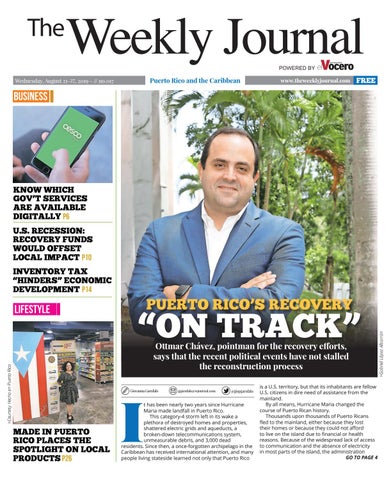
“ON TRACK” >Courtesy Hecho en Puerto Rico
Ottmar Chávez, pointman for the recovery efforts, says that the recent political events have not stalled the reconstruction process
I
Giovanna Garofalo
MADE IN PUERTO RICO PLACES THE SPOTLIGHT ON LOCAL PRODUCTS P26
ggarofalo@wjournal.com
@giopgarofalo
t has been nearly two years since Hurricane Maria made landfall in Puerto Rico. This category-4 storm left in its wake a plethora of destroyed homes and properties, shattered electric grids and aqueducts, a broken-down telecommunications system, unmeasurable debris, and 3,000 dead residents. Since then, a once-forgotten archipelago in the Caribbean has received international attention, and many people living stateside learned not only that Puerto Rico
is a U.S. territory, but that its inhabitants are fellow U.S. citizens in dire need of assistance from the mainland. By all means, Hurricane Maria changed the course of Puerto Rican history. Thousands upon thousands of Puerto Ricans fled to the mainland, either because they lost their homes or because they could not afford to live on the island due to financial or health reasons. Because of the widespread lack of access to communication and the absence of electricity in most parts of the island, the administration GO TO PAGE 4
>Gabriel López Albarrán
PUERTO RICO’S RECOVERY
The Weekly Journal > Wednesday, August 21, 2019 >
2
It's your moment to shine.
www.elvocero.com/revistas/mirame
3
/ Wednesday, August 21, 2019
A WEEK IN REVIEW GOV. VÁZQUEZ ANNOUNCES NOMINATIONS FOR GOVERNMENT DEVELOPMENT BANK, PUBLIC BUILDINGS AUTHORITY
>Archive
>>Courtesy White House
>AP
Gov. Wanda Vázquez recommended Luis Carlos Fernández Trinchet for the presidency of the Government Development Bank, a governmentowned entity that provides loans and funds to private organizations; and Melitza López Pimentel to the post of executive director of the P.R. Public Buildings Authority, which manages buildings and facilities leased to the government.
GOVERNMENT SEEKS ASSET MANAGER FOR INDUSTRIAL PROPERTIES The Puerto Rico Fiscal Agency and Financial Advisory Authority (Aafaf) published a Request for Qualifications (RFQ) seeking qualified parties to manage properties owned by the Puerto Rico Industrial Development Company (Pridco). This RFQ process is part of a Restructuring Support Agreement (RSA) between Pridco, Aafaf and a substantial amount of Pridco bondholders. The RSA seeks a financial restructuring of the Pridco Bonds, which is anticipated to be effected through a Qualifying Modification to Title VI of the Puerto Rico Oversight, Management and Economic Stability Act (Promesa). The Qualifying Modification will allow Pridco to maintain ownership of its properties and roughly $35 million that are reserved in cash, which will be used, among other things, to pay down accrued employer contributions to the Employee Retirement System and implement necessary reforms to right size and optimize the economic development arm of the Government of Puerto Rico.
Powered BY El Vocero de Puerto Rico, 1064 Ave Ponce de León 2nd floor San Juan, PR Postal Address: PO Box 15074, San Juan, PR 00902
PUERTO RICO GOV’T CONVERSES WITH THE WHITE HOUSE Gov. Wanda Vázquez held a conference call on Thursday with Doug Hoelscher, Director of Intergovernmental Affairs and Deputy Assistant to President Donald J. Trump. During the call, the newly appointed governor emphasized that establishing credibility, transparency and accountability are crucial parts of her plan to continue developing the relationship between the federal government and the government of Puerto Rico. “On the call, I reaffirmed my commitment to Puerto Rico and reemphasized the importance of maintaining open channels of communication with the federal government so that we may continue our working relationship. I thank Mr. Hoelscher and his team for the interest they have shown in our island,” said Gov. Vázquez.
President Salvador Hasbún shasbun@elvocero.com
Human Resources Director Arlene Rolón, PHR arolon@elvocero.com
Managing Editor Yennifer Álvarez yalvarez@wjournalpr.com
Comptroller Félix A. Rosa frosa@elvocero.com
Traffic Director Ilia M. Pérez Centeno iperez@elvocero.com
Multi-Platform Digital Director Stephanie Gómez Álvarez sgomez@elvocero.com
Production Director Eligio Dekony edekony@elvocero.com
Editorial Director Juan Miguel Muñiz Guzmán jmuniz@elvocero.com
Multi-Platform Graphic Director Héctor L. Vázquez hvazquez@elvocero.com
Phone: 787-622-2300, 787-721-2300 Customer Service: 787-622-7480
4
GO TO PAGE 4 established a curfew, which got eliminated about a month after the historic event. As more aspects of day-to-day life returned to normal, the impact that the storm had on the psyche of Puerto Rico’s residents became more evident. The mere flicker of a lamp brings back traumatic stress; watching the weather report is akin to waiting for hospital test results; many people are still concerned over whether they could withstand another large-scale atmospheric catastrophe. However, from the devastation flourished a spirit of resilience. Neighbors came together and proved that Puerto Rico is an island of gargantuan vitality. Despite the collective efforts from citizens, nonprofits and the public and private sectors, the island is still undergoing an extensive recovery process, made largely possible by federal funding from the Department of Homeland Security, the Department of Defense, the Community Development Block Grant Disaster Recovery program (CDBG-DR), the Small Business Administration (SBA) and the Federal Emergency Management Agency (FEMA). The latter has been pivotal in assisting Puerto Ricans who lost their homes, as well as identifying core areas that require attention in this process. While FEMA works in visiting these zones and assessing how much funding is required, it works alongside the Central Office of Recovery, Reconstruction and Resilience (COR3), which is in
/ Wednesday, August 21, 2019
charge of distributing FEMA funds to municipalities and government agencies and corporations. THE WEEKLY JOURNAL interviewed the executive director of COR3, Ottmar Chávez, who revealed the details of these funds and the measures that this entity is developing to ensure efficiency and transparency. Although Puerto Rico got its third governor in one week amid protests of fund mismanagement and ethical faults, Chávez assured that both FEMA and COR3 have continue to operate as normal. “Reconstruction has not stopped. Ever since the day that the transition process started, we, my team and I, have been working incessantly, focused on working for the people of Puerto Rico,” Chávez said. He added, “it is a specific process based on efficiency, transparency in order for the money to continue to arrive. We continue working. We are working and there has been stability for eight days and we know what we have to do. We are focused on the priorities that we will be outlining.”
The Numbers of Recovery
U.S. President Donald J. Trump has repeatedly declared on his personal Twitter account that the federal government has already provided Puerto Rico with $91 billion for its reconstruction, but this statement is factually incorrect. The figure of $91 billion actually refers to an internal estimate of the expected federal liabilities over the life of the disaster according to the U.S. Office of Management and Budget (OMB).
Meanwhile, FEMA estimates the cost of recovery at $55 billion, according to the Stafford Act. All in all, the U.S. Congress has appropriated $42.5 billion, but only a fraction of that has actually been disbursed. The COR3 has an online transparency portal in which it outlines all federal funds that have been obligated and distributed. According to this tool, the U.S. government has obligated $20.3 billion to the aforementioned agencies. Of these, roughly $13.7 billion had been disbursed at the time of this writing, or an estimated 67 percent. FEMA has been obligated nearly $16.2 billion, and roughly $12.5 billion (77 percent) have been disbursed.
Understanding the Disbursement Process
In order to disburse funds, FEMA and COR3 must confirm that the damage site complies with a series of requirements. First, employees inspect the site, then they fill a form called the Damage Description and Dimensions (DDD), followed by the Scope of Work, and lastly, the fix cost estimate. After the estimate, the money is obligated, but it is not disbursed at once. “The money is obligated, but there is a procedural part to the project in which, as you execute the project, the money for the project is provided. That is, you have the obligated money, but you won’t take 100 percent of that money at once to pay. So, as you continue executing the project, then you take the money that is already obligated,” he said.
5
/ Wednesday, August 21, 2019
SOURCE: COR3
Chávez explained that the process to identify core recovery areas and disburse FEMA funds has been highly complex because there are more than 50,000 damaged sites island-wide, and these sites result in more than 9,000 additional projects. “There are more than 9,000 projects up and running that are not part of those numbers. We expect that as those projects continue to go through the process, more money is disbursed,” he said. “We have a plan with the state hazard mitigation officer where we already have all those projects outlined. We will start a more aggressive campaign in the coming weeks. That is why we have internal deadlines that we want agencies, municipalities and nonprofits to follow. It is important that by October 31 they have the letters of intent signed,” he added. The official added that, to date, COR3 has more than 210 projects, costing upwards of $2.2 billion, that will be submitted by that date. The COR3 director affirmed that his office has a list of priorities that is geared toward ensuring fund disbursement. “For one, efficiency. We have to be more efficient in these processes. Two, for the money to come; and that relies on a collaborative effort that both parties have been doing. And
three, radical transparency. The more transparent and efficient we are, the fewer the obstacles and issues we will have to face,” Chávez said.
Transparency a Top Priority
Chávez repeatedly stated that the COR3 upholds transparency as a key component in its mission, especially to address some funding challenges. According to the Transparency Portal, permanent work is critical, but only a small amount has been disbursed for the entity’s goal to “build back better.” Specifically, $12.9 billion have been disbursed to Emergency Work & Individual Assistance, but only $37.9 million have been disbursed to Permanent Work as of August 7 of the present year. “Since Hurricane Harvey in 2017, FEMA has obligated a total of 12,947 PWs (Project Worksheets) for Permanent Work. Of these, only 145 PWs (one percent) have been obligated to Puerto Rico,” the portal reads. Amid these challenges, and the uncertainty in the political spectrum, as well as distrust from the general public in government processes, Chávez reiterated that the agency must continue to take measures to restore trust and bolster transparency so that their efforts can proceed. The official informed that as of Sept. 1 the Transparency Portal will
include all contracts from contractors and subcontractors who work in the rebuilding process. “My expectation is that we can begin to share with the people of Puerto Rico all the documentation regarding the recovery in a transparent and simple way. I would say that within the next two weeks there will be changes, not only in solutions that we will be presenting together with the governor and the resident commissioner (Jenniffer González), but there will also be changes in both the transparency portal and operational changes that we have already begun,” he said. “We will be more efficient and more transparent.” In addition, all nonprofits, individuals, companies, and subcontractors that benefit from the assistance program will be required to sign a legal document that declares that they do not have any ties with the government or public officials. “If an entity doesn’t sign it, they will not work with us,” Chávez stated. “We have nothing to hide. In my administration there is no murky management of transparency, which has already been demonstrated in the year and a half that I worked at ASG (Associated General Contractors), leading in a transparent way, with a healthy administration and teamwork,” Chávez said.
6
/ Wednesday, August 21, 2019
More Government Services to be Made Available Online
Chief Information and Innovation Officer discusses the agency’s technological goals
E
Giovanna Garofalo
ggarofalo@wjournal.com
@giopgarofalo
very resident of Puerto Rico who has had to make transactions in government instrumentalities can attest to waiting many hours before being helped, just to be told that they require additional documents or certifications from other offices or agencies, which in turn require an unmeasurable amount of additional time spent either on a call or at another packed or uncomfortable office. Although some transactions can be made online, these options are limited and have not made a significant impact on the day-to-day flow of these offices. With hopes of improving the consumer’s experience, the Puerto Rico Innovation and Technology Service (PRITS) informed that it is in the process of revolutionizing online government services in order to boost efficiency and reduce expenses. THE WEEKLY JOURNAL conducted an
interview with the chief information and innovation officer (CIIO) and PRITS executive director, Glorimar Ripoll, to discuss the institution’s agenda of modernizing governmental agencies. Ripoll, who was designated as CIIO in June 2017 by then-Governor Ricardo Rosselló, affirmed that PRITS aims to standardize the online platforms of all instrumentalities, though her team is currently focused on the Driver Service Center (CESCO by its Spanish acronym). “CESCO’s digital page has been one of the priorities. Why? Because we all know it is an essential issue. We have all gone through the experience of being in a CESCO line, the service is extremely inefficient, - CIIO Glorimar Ripoll despite the many improvements that we have been working on,” Ripoll stated. As an example of improvements already made,
The PRITS is currently focused on digitalizing all CESCO services. >Archive
the official pointed to two transactions that can already be taken care off on the center’s website, paying traffic tickets and obtaining vehicle registration documents. On the former, Ripoll asserted that it is highly beneficial and time-saving to consumers, explaining that this transaction required three different lines that could consume an entire day. She said that the individual had to visit a CESCO office to receive a certification >Courtesy La Fortaleza stating if there were any tickets pending payment, then, they had to go to the collector’s office to pay it, and finally return to the CESCO to notify them of that payment so they could register it. “It was a highly complex, highly manual, and very antiquated process that evidenced that government agencies did not speak among themselves; that each one had their own side or their independent workings,” the CIIO observed. This, she said, was a “highly interesting” project because those agency barriers had to be dissolved in favor of a collaborative effort. “It is a beautiful project from that point of view... the reality is that now, in a matter of minutes, they [consumers] can log onto the digital CESCO app and take care of something that used to take a whole day,” the official said. Moreover, residents who require their car’s annual registration documents in order to renew their vehicle’s tag can also obtain it online. On this issue, Ripoll noted that consumers faced the possibility of not having it delivered by mail or having to “waste the day” in line. Now, they only need to access the portal and enter their vehicle’s license plate number, driver’s license or identification number; the last four digits of their social security number; and their birthday, and they can instantly obtain a copy of their car’s registration documents in .PDF format for easy access. In addition to these services, Ripoll stated that the “game changer” will be the day that
The truth is that it is a very ambitious transformation, but there have been concrete results that give us a lot of confidence that we can do it and, of course, that the citizens will receive it with open arms.
7
/ Wednesday, August 21, 2019
it’s possible to renew driver licenses online, a The CESCO function which digital portal is to the PRITS is in include: the process of developing. •Different types of Regarding identifications this idea she explained •Car title transfers that, “all the •Driving record documents needed to complete the process would be accessed through the application and if there were a transaction that had to be done in person, such as picking up the identification at a CESCO, you would have the alternative—which is not available yet—to pick it up at the CESCO at a specific hour or have it delivered to you by mail.” “These are options that we will be working on and the mailing option is ideal because you wouldn’t even need to step inside the CESCO... The entire process would be online,” she added. While this is a priority, Ripoll clarified that the PRITS has a more extensive agenda for CESCO, including the ability to obtain different types of identifications, driving records and car title transfers. The CIIO revealed that the goal is to allow
In fact,
residents to complete all these transactions from their electronic devices in order to empty CESCO offices. “The truth is that it is a very ambitious transformation, but there have been concrete results that give us a lot of confidence that we can do it and, of course, that the citizens will receive it with open arms,” Ripoll affirmed. Parallel to these changes, the PRITS is adding all government CESCO offices are notorious for extensive lines and long waiting hours. services to the www. pr.gov website. experience, to have only one way to access these “We are focusing on the CESCO because it services.” is for everybody, both for the administration Presently, each government agency has its and for citizens. Everyone knows that CESCO own web design with varying levels of ease of transactions are a top priority... but the idea is that navigation. Ripoll said that this issue promotes in these new phases that are being developed, an image of a the government as being we can incorporate services to the web version, “disconnected” and “fragmented.” which would then be online at pr.gov,” the official “It’s something that we have tried to address, said, adding that the website would transform into we are only one government and not disconnected “what it should have been.” agencies... We can reflect that with a good, The goal is to have a “completely uniform integrated digital strategy,” she stated.
1st MAPR GOLF TOURNAMENT 1er TORNEO DE GOLF DEL MAPR
AUGUST
30
AGOSTO
BAHIA BEACH RESORT & GOLF Registration/Registro:
Two person scramble Sponsorship and individual players/ Auspicios y jugadores individuales
Shotgun:
For information, please call/Para información, comunicarse al
7:30 am 8:30 am
787 977-4449 / mperez@mapr.org
Vocero
el
de Puerto Rico
www.elvocero.com
Best Golf Car, LLC.
Authorized Dealer
8
/ Wednesday, August 21, 2019
Local Apps are Reshaping the Banking Industry
Pioneers ATH Móvil and Mi Banco initiated a technological revolution that is turning the smartphone into a wallet
W Cynthia López Cabán
clopez@wjournal.com
@cynthia_lope
hen Steve Jobs introduced the first iPhone on January 9, 2007, the inventor and entrepreneur announced that “Apple is going to reinvent the phone.” In front of an audience of technology enthusiasts, the co-founder of Apple heralded “we designed something wonderful for your hand” and
promised an easy to use device loaded with apps. Boy was he right. Twelve years later, the smartphone and its apps are reshaping our lives, down to the way we manage money and bank. Not just apps created by the gurus of Silicon Valley, but software designed and developed on the island. Two years after the much-awaited device debuted in San Francisco, California, a team of engineers and designers at Banco Popular, the island´s largest banking institution, created a digital banking platform that adapted to the iPhone’s screen. “We were the pioneers,” Moisés Peña, vice president of Banco Popular´s Digital Banking Division, told THE WEEKLY JOURNAL. In 2012, the bank’s app, Mi Banco (My Bank), first appeared at the App Store for iOS users and at the Play or Google Play Store for Android operating systems. The bank has a team of over 50 experts and engineers working to improve service and rethinking banking transactions. According to Peña, the app has been downloaded over 1.5 million times, almost the same number of customers of the brick and mortar bank. Banco Popular has 1.7 million clients more than half of the island’s population, which stands at 3.2 million people. The app is active on 850,000 mobile devices, and it is estimated that each person uses the app an average of 28 times a month. Consumers old and young are increasingly adopting the technology, using their devices to keep tabs on their bank accounts, transfer money, make deposits and payments without the hassle of standing in line or setting foot in a branch. Nearly two-thirds of smartphone users in the U.S. have at least one financial app on their device, according to a survey conducted by Bankrate last year. Seventy percent of these people checked their bank’s mobile app at least once a week and 16 percent checked them every day. The shift has popularized two types of Gustavo Díaz, Digital Payment Solutions Manager of Evertec, said the company’s goal is to make life easier for its customers. >Courtesy EVERTEC
Banco Popular has a team of over 50 experts and engineers working to improve service, according to Moisés Peña, Digital Banking Division Vice President. >Courtesy Banco Popular
digital applications: the typical banking app from Popular and the money transferring app like ATH Móvil(Mobile ATM). Together, these apps, designed and developed by local talent, are changing our relationship with money, even substituting the wallet with the phone. Launched in 2014, ATH Móvil has 1.3 million registered users from Banco Popular, Banco Santander and 90 cooperatives. The software was designed initially to transfer money instantly from person to person. Now instead of reaching for money or a credit card, it has become a norm to ask for a telephone number to transfer money or pay for goods. “When we first introduced the money transfer feature, there were no easy ways to do it. The only methods were checks or ATM withdrawals,” Gustavo Díaz, Digital Payment Solutions Manager of Evertec, said of the change that transformed the banking habits of old and young. Three years later, Evertec released the business counterpart of ATH Móvil and added an unexpected feature: an option that lets users donate up to
/ Wednesday, August 21, 2019
$1,500 to their favorite charity. “Our goal is to satisfy customers needs and make their lives easier with a safe and reliable product... that is why we added the fingerprint recognition feature and the passcode,” Díaz indicated. While ATH Móvil does not gather demographic information, as part of the registering process it requires users to fill in the date of birth. “We have customers up to 80 years old, but the largest concentration ranges from ages 18 to 35,” the representative for Evertec noted. “Mobile banking usage will continue to rise as more institutions partner with us,” he added. The potential is there. According to a study by Google, Puerto Rico is a “true digital oasis.” A report released last year by the technological giant revealed that in 2017 the island had 3 million internet users, making it the second country in the Caribbean with the most internet users. Of these, 2.5 million people surfed the internet using their mobile phone. Puerto Rico was also the country with the largest mobile internet market, at 69 percent. And, just when it seemed that it
couldn’t get any faster or easier, both Mi Banco and ATH Móvil adapted to the limitations imposed by the Apple Watch, which means a person can transfer money or check bank account balances with a tap on the wrist. “We were among the first five banks in the U.S. to adjust the app to Apple Watch specifications,” Peña indicated. Mi Banco also offers a feature that allows the client to transfer up to $500 to another person that doesn’t have a bank account. All the person has to do is download the application and fill in some personal information to receive a code that he or she will use at the ATM machine to withdraw the cash. That simple. The infatuation with these apps seems to be getting stronger. From January to June, Mi Banco processed 32 million money transfers and payments. For now, the brick and mortar bank won’t die. Peña was quick to point that Banco Popular “has a lot of traffic” because its branches offer other services, such as paying utilities or purchasing vehicle registrations.
9
10
/ Wednesday, August 21, 2019
Puerto Rican Economists L Agree That U.S. Economic Downturn ‘Probable’
Federal reconstruction funds would offset negative impact on the island Rosario Fajardo
rfajardo@wjournal.com
@RosarioWJournal
eading economists in Puerto Rico agree with their professional counterparts in the U.S. mainland that warning signs are on the horizon for a slowdown in the stateside economy. The good news is that the island would be shielded by the release of some $8.2 billion in federal reconstruction funds. “The old tried and true indicator of trouble brewing is the inversion of the yield curve that is in fact what is happening now. The problem is that in the last few years, the economy has responded to factors that have transformed the traditional way of looking at trends,” said José Joaquín Villamil, who spoke on behalf of the Puerto Rico Manufacturers Association as its inhouse economist. “Whereas one could state with a certain degree of confidence that financial markets drove the
José Joaquín Villamil spoke on behalf of the Puerto Rico Manufacturers Association as its in-house economist. >Carlos Rivera Giusti
11
/ Wednesday, August 21, 2019
economy, it is beginning to look as if it is now the economy that drives markets and the economy responds to events such as the trade war, Brexit, etc.,” he added. “However, the contraction would have to be substantial to offset the impact of federal reconstruction funds coming to Puerto Rico. Even if these take longer to be disbursed and come with strings attached, they will have a positive impact and offset any slowdown in the U.S. economy,” he said. Villamil was referring to the second tranche of federal reconstruction funds—$8.2 billion—that has been held up in Washington, D.C. due to concerns of corruption in Puerto Rico. Among the warning signs on the horizon include the Trump administration’s trade war with China, a messy Brexit for the United Kingdom and the uncertainty of President Trump himself. On the positive side, retail sales in the U.S. remain strong, as are unemployment figures. But the markets are reacting more to the negative signs and hence, the inverted yield curve has reared its ugly head. In a regular yield curve, short-term rates are lower than long-term rates. During an inverted yield curve, the reverse For José E. Ledesma, president of the Puerto Rico Chamber of Commerce, the key factor is the federal occurs, short-term rates are higher than longgovernment releasing the $8.2 billion for the island. >Courtesy Chamber of Commerce term rates. In economic terms, if investors think “There is a risk of global recession and we that the economy will take a downturn and are seeing financial variables very similar the Federal Reserve will lower interest rates, to what happened in [the global crisis of] investors will demand long-term bonds in order 2008,” said Heriberto Martínez, the incoming to lock-in the interest rate now. In other words, president of the Puerto Rico Economists they want to lock-in interest rates on long-term Association. bonds because they believe the rates will go Before the crisis, Spain had an down. unemployment rate of less than 8 percent and “A downturn is probable. Whether it becomes experiencing growth a recession measured of 4 or 5 percent, as two consecutive he indicated. But it quarters with was mainly due to contraction is too early a construction and to state. The main housing bubble, difference is that a and the red flags slowdown may not of warning were be a contraction but ignored until the a slowing growth,” market exploded, he Villamil said. noted. Fellow economist -Heriberto Martínez, incoming president Since 80 percent Juan Lara agreed. of the Puerto Rico Economists Association of the island’s “Yes, there is a good exports go to the chance of a recession U.S. mainland, this in 2020. The yield sector could be hurt in a stateside economic curve is inverted, which almost always means a downturn, Martínez said. recession within the following year. In addition, For José E. Ledesma, president of the Puerto [this economic] expansion is already record Rico Chamber of Commerce, the key factor long and unemployment is so low that it may is the federal government releasing the $8.2 cause inflation to start rising again. This why the billion for the island. “We need that stimulus as markets are so jittery,” he said. a buffer,” he said. Lara said the recessionary impact could be Ledesma also does not foresee a downturn felt in the island’s tourism and manufacturing in the tourism sector should there be a sectors, while the post-Hurricane Maria recovery slowdown in the U.S. economy. “Our tourism could be slowed down. “A recession there [the sector is stable and solid, even during the low U.S. mainland] would guarantee a recession season,” he said, noting that many visitors here… but the silver lining could be a Trump come from Florida, and with so many family Juan Lara said the recessionary impact could be felt in reaction with expansionary fiscal spending, connections on the island, he does not see a the island’s tourism and manufacturing sectors, while which could loosen the knot on federal the post-Hurricane Maria recovery could be slowed slowdown in that area. reconstruction funds for us.”
Since 80 percent of the island’s exports go to the U.S. mainland, this sector could be hurt in a stateside economic downturn.
down. >Gabriel López Albarrán
12
/ Wednesday, August 21, 2019
FOMB Spent 82 Percent of its FY 2019 Budget on Professional Services
This was followed by “purchased services,” with key areas related to fiscal plan implementation, a yearly spending of $4.067 million, representing monitoring and reporting. 6.3 percent. “The overwhelming majority of the new hires Of the FOMB’s total budget, nearly the entire are Puerto Ricans, several of whom have returned amount, or $64.75 million, comes from the Puerto from the U.S. mainland to help our island recover. Rico government, with The expenses incurred a mere $12,000 accrued by FOMB in carrying from interest income. out its mission are Rosario Fajardo rfajardo@wjournal.com @RosarioWJournal Acknowledging the substantial and huge multi-millionnecessary,” Jaresko dollar expenses added. “We have a he Financial Oversight and incurred in its work big and complex task. Management Board (FOMB) spent to restructure Puerto FOMB is responsible the vast majority of its $64.76 Rico’s massive debt for administering the million budget during fiscal year load and enact largest public entity 2019 on professional services for “fiscal responsibility” restructuring in U.S. various law and consulting firms. measures in the history and is party to According to the FOMB’s government, FOMB hundreds of lawsuits.” Annual Report for Fiscal Year 2019, which ended Executive Director The FOMB’s on July 30, more than $53.345 million were spent Natalie Jaresko said responsibilities include on professional services, representing 82.4 percent they have been working monitoring more than of the entity’s total annual budget. to reduce spending in 120 reform plans - FOMB Executive Among the firms that have been working with the area of professional across the Puerto Director Natalie Jaresko the FOMB are the law firms of Duff & Phelps, services. Rico government, Kobre & Kim, Luskin, Stern & Eisler and O’Neill & One of the FOMB’s requiring a significant Borges, as well as consulting firm McKinsey & Co. organizational goals in amount of resources The FOMB’s 81-page report does not give financial FY 2019 was to increase local recruiting, helping and expertise, as a lot of the information has to details on the contracts of each of these firms. to reduce costs and third-party consultants, she monitored and tracked, she indicated. By contrast the second-largest item on the indicated. Still, Jaresko noted that the FOMB reduced its FOMB’s budget for FY 2019 was payroll and According to the report, in the last few months, budget for the current FY 2020 by 11 percent from related costs, with expenditures of $4.151 million, FOMB staff has increased from 17 to over 40, the previous year, to $57.6 million. representing 6.4 percent of the total budget. and the entity will continue to hire personnel in Among the FY 2019 achievements highlighted by the FOMB in the report were completing the restructuring of over $22 billion of debt and other obligations, issued by the Sales Tax Financing Corp. (Cofina by its Spanish acronym) and the Government Development Bank. Preliminary restructuring agreements were also reached on a portion of an additional $45 billion of debt and other liabilities, such as generalobligation bonds and the Puerto Rico Electric Power Authority. When the Oversight Board was enacted in 2016 as part of the Puerto Rico Oversight, Management and Economic Stability Act (Promesa), Puerto Rico had a huge debt burden of more than $70 billion, coupled with $55 billion in unfunded pension liabilities. “Recent political events have left all of us in Puerto Rico shaken. Although FOMB’s role is not political, we will work with the elected leaders of Puerto Rico to provide its people with the stability needed by all stakeholders. We will continue our work, so this critical period does not also shake Puerto Rico’s recovery from the fiscal crisis and from the devastation of Hurricane Maria,” said FOMB Chairman José Carrión and FOMB Executive Director Natalie Jaresko at La Fortaleza after meeting with FOMB Chairman José Carrión.
Jaresko recognizes ‘substantial and necessary’ expense
T
new Gov. Wanda Vázquez >Brandon Cruz González
The expenses incurred by FOMB in carrying out its mission are substantial and necessary. We have a big and complex task. FOMB is responsible for administering the largest public entity restructuring in U.S. history and is party to hundreds of lawsuits.
13 < The Weekly Journal > Wednesday, August 21, 2019
Be on trend... be on trend...
B
www.elvocero.com/revistas/zona
14
/ Wednesday, August 21, 2019
Puerto Rico’s Tax on Inventory “Nefarious for Businesses”
zones—access that is not extended to PYMES. As such, these establishments have “managed to minimize their tax on inventory.” “When you add ggarofalo@wjournal.com Giovanna Garofalo @giopgarofalo up how many small business owners there n August 14, Gov. Wanda are, you see the reality Vázquez held a private meeting that small business with mayors from the New owners are a very Progressive Party (NPP) in which important source she reaffirmed that Puerto of strength in the Rico’s tax on inventory needs to country’s economic be eliminated. development,” Colón This removal has been proposed for years affirmed. in light of the contribution’s negative impact on Last year, the businesses and the island’s overall economic Legislature proposed development. the elimination The president of the Puerto Rico Society of CPAs of this contribution (CCPA), Cecilia C. Colón, affirmed to THE WEEKLY and suggested that JOURNAL that the inventory tax, as currently a way to make up designed, is “nefarious for businesses.” for the revenue loss Colón explained that each of Puerto Rico’s would be by increasing 78 municipalities has autonomy over their the cost of municipal inventory tax, which ranges between 6.33 patents. However, The president of the Puerto Rico Society of CPAs (CCPA), Cecilia C. Colón, explained percent to 10.33 percent islandwide. The law Colón observed that that each of Puerto Rico’s 78 municipalities has autonomy over their inventory tax, states that businesses must pay their respective this measure would which ranges between 6.33 percent to 10.33 percent islandwide. >Courtesy municipal tax on merchandise that they didn’t sell further hinder economic also commented that the tax should be lowered to within a calendar year. prosperity because it less than one percent. According to Colón, this contribution hinders would impact businesses that provide services in “The tax on inventory has to be less than one small- and midsize addition to those that percent because when you multiply per amount businesses (PYMES, are currently affected sold, what you sell is much more than what you by its Spanish by the inventory tax. have left available for sale,” Colón said. acronym) the most, “The CCPA opposed Moreover, she argued that this reform given that if they that measure should in itself be a temporary transition to the want to increase their because what it does contribution’s elimination and that municipalities offering they face the is make the cost need to find other sources of revenue. risk of incurring in of doing business Colón said that the municipalities need to more expenses if, by more expensive for save on taxes and expenses, as well as learn any chance, their sales all businesses... The how to consolidate services among themselves do not go as expected. consensus is that this geographically. She also pointed to federal funding. “The ones doing the tax on inventory is bad -CCPA President “They need staff with the expertise needed to worst end up paying and attempts against Cecilia C. Colón more... You analyze Puerto Rico’s economic request the federal funds that all municipalities in the entire [mainland] United States are entitled to that and you have development,” she request. We must also help them gradually reduce to conclude that the asserted. the amount of revenue they derive from the tax contribution is nefarious because it forces the Her stance on the inventory tax and the on inventory as they generate more revenue from heaviest burden on those whose business did legislative proposal notwithstanding, Colón worse. That is why the CCPA has spent more than clarified that the contribution cannot be eliminated other sources,” Colón explained. “But,” she added, “we cannot continue to charge 10 years warning on the need to transform the tax without a proper transition because it would taxes to whoever performs the worst, much less on inventory and eliminate the way that the tax is negatively impact municipal economies. so when we are trying to get more people to open imposed,” she said. In light of this issue, the CCPA has proposed to and invest in businesses. We need to make life The CPA said that larger companies have access amend the tax on inventory so that it applies to easier for the small-business owner.” to federal funding under designated foreign trade products that are sold, as opposed to unsold. She
Society of CPAs offers an alternative to this contribution
O
You have to conclude that the contribution is nefarious because it imposes the heaviest burden on those whose business did worse.
15
/ Wednesday, August 21, 2019
A marijuana cultivation facility. >Archive/Carlos Rivera Giusti
Medical Marijuana Companies Continue Expanding in Puerto Rico Three firms announced investments in recent days
M Rosario Fajardo
rfajardo@wjournal.com
@RosarioWJournal
edical marijuana firms are continuing to flock to the island, with the latest investments announced by Cansortium, Columbia Care and Bhang. Cansortium recently announced that it was opening its second Fluent medical marijuana dispensary in Puerto Rico. Columbia Care is set to launch “vertically integrated operations” on the island, including a dispensary in San Juan and a cultivation and manufacturing facility in Cidra. Bhang, meanwhile, has signed a deal to distribute its more than 25 cannabidiol (CBD) brands to the island. Cansortium’s new 2,200 square-foot dispensary is in San Patricio, Guaynabo, while the company’s first facility in San Juan began operations in Jan. 2018. Cansortium, based in Florida, raised more than $56 million in funds ahead of its initial public offering (IPO). The net proceeds are being used to expand their presence not only in Puerto Rico, but also Florida, Texas, Canada and Colombia. “The opening of our second Fluent dispensary in Puerto Rico is further evidence that we are executing our growth plan by steadily expanding
our dispensary network,” said José Hidalgo, experiencing strong growth in the past year with Cansortium’s CEO. the number of registered patients increasing by To date, Puerto Rico has more than 92,000 over 180 percent since last summer, the company certified medical marijuana patients and offers said. reciprocity to all medical cannabis The local medical marijuana card holders from any U.S. state, industry is expected to generate he noted. $100 million in new tax revenues “In addition to our two by 2020 and create 20,000 dispensaries in Puerto Rico, we jobs, according to Puerto Rico The local operate 15 Fluent dispensaries in government data. medical marijuana Florida with plans to have 30 in Columbia Care, based in New industry is operation or secured by the end York City, has raised more than expected to of 2019,” according to Hidalgo. $100 million in capital since it was generate $100 “We are excited to bring our highlaunched in 2012, according to its million in new tax quality consistently-formulated CEO Nicholas Vita. revenues by 2020 Fluent products to more “We are thrilled to join the and create 20,000 customers in Puerto Rico.” Puerto Rican community and be jobs, according For its part, Columbia Care a part of its economic revival. to Puerto Rico is opening a 2,800 square-foot Columbia Care continues to government data. facility—its first dispensary execute its national rollout on the island—in San Juan’s strategy with Puerto Rico Santurce neighborhood, near representing our 11th market Auxilio Mutuo Hospital. Two launch in the U.S.,” he said. other dispensaries are expected to open by the Finally, Florida-based Bhang announced it has end of the year, but their locations have yet to be signed a CBD distribution deal to bring its products announced. to Puerto Rico, which include chocolates, chewing Columbia Care said their dispensaries will be gum, lip balms and gummies. supported by 25,000 square feet of cultivation and Bhang CEO Scott Van Rixel also lauded the manufacturing space, located in Cidra. opportunities in the Puerto Rico market. “Our Puerto Rico’s medical cannabis program has one entry into the fast-growing Puerto Rico market of the highest penetration rates in the U.S. with is yet another step toward our mission to build the 92,000-plus registered patients representing a true, global house of brands while leveraging 2.9 percent of the local population. The medical partnerships with leading regional operators,” he cannabis market in Puerto Rico has been said.
In fact,
16
/ Wednesday, August 21, 2019
El Josco Bravo: The Journey Back to Sustainable Agriculture Ian Pagán’s organic crops and artisanal juices can be found every Sunday at La Placita Roosevelt in Hato Rey
a little old fashioned, have been instrumental in cultivating quality products, mainly vegetables and fruits. Pagán Roig still uses oxen to plow the land and transport materials around the farm. For Pagán Roig, who dedicates himself to cultivating mostly vegetables, the summer is an off season and he has had to get creative with what he farms. In recent months, he has Claudia Guerrero Negrón @cguerreronegron started experimenting with different crops, like newsroom@wjournal.com amaranth, okra and pumpkin, which grow well in warmer climates, like those in Africa and Asia. an Pagán Roig grabbed the chunks of dried mud that were stuck to the bottom The months between December and June, what Pagán Roig calls the “agricultural spring”, are the of his boots and tossed them to the most productive and diverse, as he is able to side with ease. He squinted his eyes in cultivate carrots, onions, beets, tomatoes, radishes, concentration and caressed his long eggplants and peppers. beard while thinking about what to say This week, Pagan Roig gave samples of his agroecological farm, El Josco of spinach from New Zealand, Bravo, located in the lush mountains of Lagos and Okinawa to the 15 to Toa Alta. 20 restaurants he delivers to “When people use the word every week in an effort to get agroecological they use it to it incorporated into their describe the word ‘organic’, menus. but it is much more than According to Pagán that…agroecology is about Roig, it is imperative for being more ecologically the development of the conscious, farming in harmony agroecological industry with nature... It also has a very to have chefs and farmers strong social component,” said work together. To that effect, Pagán Roig, who El Josco Bravo once doesn’t use pesticides hosted a fundraiser at and fertilizers as to which attendees were ensure a healthier able to sample dishes product, both for made with goods the land and the grown on the farm and consumer. crafted by chefs like When you talk to René Marichal, Xavier up and coming, farmPacheco and Enrique to-table restaurant Piñeiro. The event owners in Puerto Rico, proved to be successful Pagán Roig’s name is in more ways than sure to be mentioned one, as it also provided as one of the farmers Pagán Roig with the leading the journey perfect opportunity toward using more to educate visitors local products within on the concept of the industry. His -Ian Pagán, owner of El Josco Bravo the “agricultural methods, although
Pagán Roig uses oxen on the farm as a cost-effective option to a small tractor. >Photos Courtesy El Josco Bravo
I
Nowadays we are more conscious, more social, more political…We need to ask ourselves, why should we do this? Do we carry on merely to sell a specialty product? Or, should we do this because it is the best thing to do?
El Josco Bravo is currently cultivating two to three acres of land.
spring” in Puerto Rico, a concept he insists is recondite for many. Since then, he has made it a point to foster close relationships with a new generation of chefs in Puerto Rico who have made clear their intention to support local farmers.
On Promoting Agroecology
Pagán Roig was just 13 years old when he developed an interest in agriculture. Coming from Toa Alta, an area lush with vegetation, it seemed only natural that his curiosity would be piqued. After studying soil science and methods of sustainable agriculture, he has decided to dedicate his life to farming with the utmost respect for the earth. He has made it his mission to teach and promote agroecology to up and comers so that the movement lives on.
17
/ Wednesday, August 21, 2019
USVI Government Moving Ahead With Infrastructure Improvements Airports in St. Thomas and St. Croix to receive major facelifts
W Rosario Fajardo
rfajardo@wjournal.com
@RosarioWJournal
hile U.S. Virgin Islands (USVI) Gov. Albert Bryan Jr. said he was disappointed that some federal recovery funds were being delayed by the Trump administration, his team is moving ahead with several infrastructure works to renovate their Water and Power Authority (WAPA) facilities and two airports in St. Thomas and St. Croix. “The one purpose and mission for all of us is to create a better living experience for every Virgin Islander and our guests,” Bryan said, highlighting the importance of tourism in the territory’s economy. In 2016, prior to hurricanes Irma and Maria, the USVI received more than 2.65 million visitors, which dropped to 1.57 million in 2018 after the devastating storms, according to the USVI Tourism Department. Like Puerto Rico, the USVI’s tourism industry is bouncing back. During a recent meeting on the USVI’s economic development strategy, Bryan announced that the Federal Emergency Management Agency (FEMA) has signed off on $625 million in mitigation projects for WAPA. The works will be 90 percent funded by FEMA with a 10 percent local match paid through Housing
and Urban Development (HUD) monies. streamline entry and departure of guests going to The scope of the mitigation projects includes the British Virgin Islands and other destinations. underground wiring to serve 50 percent of WAPA’s Henry E. Rohlsen Airport on St. Croix will customers, composite undergo a four-phase poles, substation $140 million expansion upgrades, undersea also initially funded cables, and two by a $7 million grant 4-megawatt emergency from Commerce. generators for the The work includes island of St. John. improvements to the WAPA also plans pre-clearance facility; to install new, smaller enclosing 5,500 square power generators feet of walkway space throughout the to increase seating territory, institute capacity in the lounge; a Waste-to-Energy enclosing the 1,100 program, explore square-foot open-air interconnection with garden to provide the British Virgin additional concessions Islands power grid space; upgrading the and provide power mechanical systems; to cruise ships during adding a second level port calls to the USVI. to accommodate jet Meanwhile, the bridges; and improve -USVI Gov. Albert Bryan Jr. initial funding for the the flow of baggage airports’ renovations handling. is coming from other Recently, U.S. federal allocations. Cyril E. King Airport on St. Housing Secretary Ben Carson said that a second Thomas is set to begin phase one of a six-phase, tranche of federal reconstruction funds were $250 million expansion in February 2020. The being delayed for the two territories, citing alleged initial $27 million grant was received from the corruption in Puerto Rico and “capacity issues” in U.S. Commerce Department. The project includes the USVI. the construction of a 700-space parking and Puerto Rico has been waiting for a second transportation center; redesign and modernization tranche of $8.2 billion, while for the USVI, the figure of a two-story terminal; additional lounge and is $779 million. concession spaces to provide more eateries, “While I understand the concern for heightened retail stores and traveler amenities; and a dock to scrutiny given the recent developments in Puerto Rico, there have been no improprieties in the Virgin Islands’ disaster recovery process and no discernible reason to couple the U.S. Virgin Islands with Puerto Rico in this matter. We are not Puerto Rico,” Bryan said. “Our administration has implemented measures to build capacity and ensure coordination and compliance with federal disaster grant funding through our Office of Disaster Recovery, which is monitored and funded through the U.S. Department of Interior,” he pointed out. “We have been successful in drawing down the $242 million in tranche one and received approval of our action plan for the drawdown of the $779 million in tranche two.” Bryan said he will continue to lobby the White House and Secretary Carson to release more funds. “Almost two years have passed since the storms, and we can’t afford to delay any further,” he said.
Charlotte Amalie, St. Thomas, USVI >Courtesy USVI Tourism Dept.
While I understand the concern for heightened scrutiny given the recent developments in Puerto Rico, there have been no improprieties in the Virgin Islands’ disaster recovery process and no discernible reason to couple the U.S. Virgin Islands with Puerto Rico in this matter. We are not Puerto Rico.
18
/ Wednesday, August 21, 2019
Construction Industry Searching for Alternatives As reconstruction efforts continue, the construction industry seeks more skilled workers
D Ileanexis Vera Rosado
ivera@elvocero.com
@iverarosado
ue to the current boom in the construction industry, and the lack of skilled personnel to carry out diverse tasks, this sector has started to organize and develop strategies which they hope bring in more Experts within the industry estimate that once the federal funds for construction come in, and the demand for workers. Because most of the construction workers increases, 125,000 to 185,000 workers will be needed. >Archive currently underway is being paid for with federal funds, the sector hopes that by bringing in more local employees those funds can be kept in the to wake up and start working together to train as Experts within the industry estimate that once island thus helping boost the economy. many people as possible so that we do not have to the federal funds for construction come in, and the John Vigueras, president of the local chapter bring in construction workers from other places,” demand for workers increases, 125,000 to 185,000 of the Laborers’ International Union of North he said. workers will be needed. As of right now, there America (LiUNA), which was founded 113 years Vigueras is putting a call out to private are 50,000 workers available. Thankfully, federal ago in Puerto Rico and entities and other funds don’t come in all at once and the projects currently has 10,000 organizations within planned are on different schedules, which means registered members, the construction that workers can go from one project to another talked to THE WEEKLY industry to hire and over the next ten years, the amount of time that JOURNAL about the send their employees reconstruction efforts are expected to last. importance of hiring to LiUNA’s training Vigueras went on to mention that he plans to and training workers workshops, which have present Gov. Vázquez with a proposal to offer before the demand already graduated 400 a construction curriculum within Puerto Rico’s for them escalates people. LiUNA offers vocational schools. As part of his plan, he is any further. He is a construction course proposing that graduates of this curriculum earn proposing that both that takes 2,000 hours $15 an hour. the public and private to complete as well “This is a surefire way to guarantee employment, sectors work together as a workshop that decrease migration and generate money that will to accomplish this only entails 40 hours stay in the island. Nowadays, the construction mission and decrease of classwork. Aside industry offers opportunities for men and women,” - José Viguera, president of the chances that from teaching the skills he said. the Puerto Rico chapter of LiUNA potential workers leave necessary to succeed the island. within the area of Construction Cooperative Model Although Vigueras expertise the worker Cooperatives have sprung up as a way to is aware that there may be eventually be a need to chooses, both options provide lessons on how to increase growth within the industry. THE WEEKLY bring in workers, he hopes that it’s a small amount ensure health, safety and security on construction JOURNAL had the chance to talk to a professional because these workers will take their pay back with sites. who has been working under the cooperative them to their country of origin. Although most of Although the callout for more construction model in hopes of further aiding the local the workers that come into Puerto Rico are from workers was initiated by developers and unions, economy. the Dominican Republic and the U.S., he says that LiUNA has recently decided to take a more workers do occasionally come in from Mexico, active role in the task. Among their initiatives Chile and Colombia, among other countries. is the creation of cooperatives and the already “We need the associations and the government mentioned trainings.
We need the associations and the government to wake up and start working together to train as many people as possible so that we do not have to bring in construction workers from other places.
19
/ Wednesday, August 21, 2019
By Waleska Rivera
By Manuel Cidre
Entrepreneur & CEO Danosa Caribbean Inc.
Entrepreneur & Founder of Los Cidrines
Dear Governor Vázquez, take your job as if you were the CEO of Puerto Rico
The Calm After the Storm
T
he rain has ceased. The winds of indignation have lowered their intensity and there is a vigilant expectation combined with relief and a great deal of hope. The air feels as it did after the devastation left by hurricane María, because the island has just survived a historical and tempestuous political cyclone. Nonetheless, considering lessons learned while the pertinent agencies take care of the possible felonies, the private sector remains focused and strong. We are standing at the calm after the storm and we are open for business, committed and ready to regain trust in the island and out of the island’s geographical boundaries. It is time to choose leaders with proven track records, regardless of political affiliations for these eighteen crucial months. Puerto Rico must be above all for the greater good and a brighter future. Let’s set aside political issues, beliefs and candidacies for when the time comes to vote. We must be committed to stability, changing paradigms and working toward common goals; economic and social development. The undeniable force is the private sector. We must concentrate on demanding a growth tool from the federal and local government to increase and retain the manufacturing sector which represents 65 percent of our exports, covers 35 percent of the government’s income, 48 percent of PR GDP. A logical proposal for a globally competitive energy, tax and labor reforms is needed. The energy reform and infrastructure investments should reduce the energy cost, be pro-growth and environmentally friendly. We must
lower personal and corporate tax rates, eliminate outdated labor laws, ease the process of obtaining permits, negotiate government debt in order to responsibly honor our payments and let the private sector work. We must assure that the approved federal funds are used to make infrastructure resilient and sustainable for years to come. Puerto Rico’s economy should benefit, in accordance with the Stafford Act, contracting local services and products manufactured locally. We must create awareness in consumers, government and business owners of the importance of buying local products, because this means everyone can contribute to Puerto Rico’s economy. A strong public policy and personal commitment is required to strengthen manufacturing and local businesses, retaining and attracting new local and abroad investment, recovering and growing our economy from within. We should not forget that a country, nation, a state... can not be considered developed without strong local capital. We welcome investment and partnerships. Instead of seeing what happened as a sink or swim moment, embrace it as an opportunity to recognize our potential, talents and strengths, focusing on working together instead of competing among ourselves. This event confirms that the great majority of the people in Puerto Rico have strong values and are not willing to accept corruption or degrading behavior because we are better than that. As we pause in the calm after the storm, let us reflect on our greatness, not our flaws honoring Puerto Rico’s name, which means Rich Port in English. Together we can return the “Rico” to Puerto Rico, a port rich in values, security, health, education, social and economic growth for all.
T
he entrance to the Governor’s office of the former Secretary of Justice, a person who does not appear to be a politician, seems to me a great short-term opportunity to tend to the economic development projects that are being held and to regain confidence with the federal government achieving the entry of hundreds of millions of dollars in CDBG funds, among others, for the reconstruction of homes and for the hundreds of businesses that are closed or that operate with difficulty due to lack of capital. The temptation must be avoided and pretend by December 2020 to fill by filling the pipeline and continue playing the game with a lot of announcement and few results. We must focus on the results and not on the efforts and make sure that the pending projects move forward. It is essential to integrate all sectors in a common effort mainly, banking, insurance companies, business organizations and community sectors with the government to promote Puerto Rico, fight corruption and ensure that, “Puerto Rico is ready to resume the path of progress.” The Act 20/22 initiative is a great opportunity, but not limited to buying a house, living 182 days on the island and operating from Puerto Rico. This initiative, focused on specific projects, can be of great help in public transportation projects such as the expansion of the urban train, the Roosevelt Roads base and the Arecibo Highway to Mayagüez, where they are needed and due to the lack of capital and the political changes over the years nothing happens.
The government has to send a clear message of its position to the foreign investment. This reality that we often ignore reminds me of my visit to China in 2015. This mogul that manufactures everything instead of having a protectionist philosophy is quite the opposite, they live and sleep thinking about how to attract foreign investment. Given this reality, I met a government official to whom I asked the strategy behind promoting foreign investment, and his response did not need further explanation “through foreign investment we create more jobs to buy what we manufacture and more importantly, they teach us to be better and stimulate the emergence of hundreds and hundreds of local companies that manufacture their products with quality and better prices.” For years, Puerto Rico has measured foreign investment by job creation. It seems to me to be an extraordinary time to rethink the strategy and by the hand of the effort to repair the damage of the last months, develop for the first time a clear country vision that tends to the next generations and not the short term electoral game. My advice to the new Governor is that look at this job as the CEO of Puerto Rico, who must evaluate the team she inherits and remove those who are not high performance individuals. The CEO cannot be satisfied with keeping the company running, its function has to be more invasive, gain the trust of the employees, its customers, its suppliers. It is not enough to repair, it is essential to change the perception of a business in trouble to one that emerged from its crisis and is on track for the future.
20
/ Wednesday, August 21, 2019
Innovative Exhibition of Audiovisual Art by Filmmaker
Sonia Fritz Prevailing themes of migration and gender in the Puerto Rican experience Rosario Fajardo
O
>Courtesy Sacred Heart University
rfajardo@wjournal.com
@RosarioWJournal
n Thursday, Aug. 22, starting at 7:30 p. m., the Art Gallery of Sacred Heart University will inaugurate an innovative exhibition on the retrospective work of filmmaker Sonia Fritz, under the title “Sonia Fritz Cartography: Migration and Gender.” The exhibition, to be curated by local historian Margarita Fernández-Zavala, features an audiovisual installation composed of three projections with various scenes from 22 documentaries and films made by Fritz. In the films, the themes of migration and gender prevail, as these have been of great interest to the artist throughout her career as a filmmaker, which has spanned more than 30 years. A graduate of the Universidad Autónoma de México and Vermont College, Fritz has been recognized at the national and international level for her documentaries. Her oeuvre includes “Mona: Treasure of the Caribbean,” “15 Lighthouses of Puerto Rico” and “After Maria: The Two Shores.” She is also a professor of Communications at Sacred Heart and has been selected on various occasions by the Faculty Resource Network of New York University for its Summer Residency program. “The art exhibit is an opportunity to tell the story of my feature films, documentaries and shorts produced from 30 years ago,” Fritz said to THE WEEKLY JOURNAL. “By following these two lines, namely migration and gender, the audience will discover that there
/ Wednesday, August 21, 2019
are connections between documentaries, for example the one of ‘Women of the Alliance in Vieques’ who were fighting to oust the Navy, with the latter ‘America,’ whose protagonist is a young mother from Vieques who has to free herself from domestic abuse to show her daughter a way out of a lack of opportunities and then migrating to New York,” she added. As recent events have shown, Puerto Ricans are also still migrants today, in the same way that many migrated to New York in the 1950s, fleeing poverty. Today, though, it was the after-effects of the devastation wrought by Hurricane Maria nearly two years ago that caused a surge in migration to the mainland U.S. -Filmmaker Sonia Fritz With her latest piece, “After Maria: The Two Shores,” the audience can learn what is happening to the growing Puerto Rican community in Kissimmee, Florida, as well as the depopulation of such municipalities as Camuy, Lares and Naguabo, among others. “As for gender, young women were front and center at the protests to oust former Gov. Ricardo Roselló and women are fighting every day for equal opportunities, equal pay, no discrimination and no sexual harassment,
21
here and around the world. Gender is the core of the Me Too movement, it is the center of communities led by women fighting for non-fossil fuel energy, fighting to feed the elderly in their communities or gain access to healthcare. Women to me are the unrecognized leaders in everyday life in Puerto Rico,” Fritz said. “By portraying stories that reflect our reality, we shed light on what is happening to us as human beings. Hopefully the audience will engage with my work and reflect because that is why art is so important, especially on an island where colonialism has tried to erase Puerto Rico’s history; films play an important role in bringing these unique characters, circumstances and protagonists to the fore,” she explained. The exhibit will run through Oct. 12. Sacred Heart University’s Art Gallery, located at the campus in Santurce, is open Tuesdays to Fridays, 9:30 a. m. to 5:30 p. m. and Saturdays from 9:30 a. m. to 4:30 p.m. Entrance to the exhibition is free of charge. For more information, call 787-728-1515 ext. 2561.
Women to me are the unrecognized leaders in everyday life in Puerto Rico. By portraying stories that reflect our reality, we shed light on what is happening to us as human beings.
A graduate of the Universidad Autónoma de México and Vermont College, Sonia Fritz has been recognized at the national and international level for her documentaries. >Archive
The exhibition will be held in the Ivonne María Marcial Art Gallery located inside the Sacred Heart University Campus >Courtesy Sacred Heart University
22
/ Wednesday, August 21, 2019
BACOA: Finca + Fogón,
Chefs René Marichal, Raúl Correa and Xavier Pacheco own Bacoa. >Photos by Gabriel López Albarrán
Puerto Rican Culinary Excellence Rooted in Tradition
Fresh, locally grown ingredients star in a menu that is a celebration of Puerto Rican cuisine from start to finish.
C
Claudia Guerrero Negrón
newsroom@wjournal.com
@cguerreronegron
hefs René Marichal, Raúl Correa and Xavier Pacheco operate as one entity. The trio has recently opened BACOA, a restaurant that grows and cultivates its own produce on the mountains of Juncos. BACOA is yet another drop in the farm-to-table wave that has arrived on the shores of Puerto Rico. The movement continues to grow, and Marichal, Correa and Pacheco have been a part of it since its beginnings by collaborating and supporting small farmers since 2014. BACOA, a play on the Taino-rooted word “barbacoa”, was chosen as the restaurant’s name as an ode to the act of cooking “al fogón”, a method that lends an exquisite yet particular taste to food. When you taste the grub, you taste the “fogón”, you taste culture, heritage and, most
importantly, you taste the overwhelmingly Puerto that can be found on the eclectic menu. Rican energy that BACOA embodies. The three high-caliber chefs use their modern The new restaurant, and its locale, is and innovative cooking techniques to reinvent a celebration of Puerto Rico and it is evident on traditional dishes. Reinvented classics, like everything from the options on the menu, to the the Arroz Jaquita, chef Pacheco’s take on the actual physical menu, traditional Puerto designed by a local Rican “mamposteao”, artist, to how the is made with rice, dishes are prepared. beans, blood sausage The only thing that sofrito, bacon, pork is not local is the rind and topped with a -Chefs René Marichal, Raul Correa American oak wood fried egg. The dish is a and Xavier Pacheco used in the firewood winner. oven and the “burén” Marichal, Pacheco they use to create their and Correa had one delicious offerings. BACOA also wishes to be ecothing in mind when developing BACOA’s menu: friendly and chooses to use compostable take-out think local. containers and straws. “You will see that it is not creole food, “Every single dollar that is invested here not traditional in its essence. It does have supports the hard-working families that supply those elements because I live very proud of us,” said Arnaldo Hernández, BACOA’s general that cuisine, but it is more of a Puerto Rican manager, mixologist and long-time friend to the cuisine because its focused only on Puerto chefs. In keeping with the farm-to-table concept, Rican products,” said Pacheco, who used to Hernández created a bar that uses natural juices own La Jaquita Baya in Santurce, and was one from fruits like soursop and passion fruit grown on of the founders of the Asociación Gastronómica BACOA’s 3.4-acre farm. Puertorriqueña, an organization that was Goat cheese and rabbit from Juncos, guinea partly responsible for bringing locally farmed from Las Piedras, pork from a hog farm called La products to the island’s hotel restaurants. Ceba in Corozal, lamb from Los Frutos de Guacabo So far, they have been able to grow aromatics, in Manatí, freshly caught fish from Naguabo, pumpkins, bananas, eggplant, different fruits and Fajardo and Patillas, are some of the local products plantains, among other crops. They are also in the
“This is the project of our lives,”
/ Wednesday, August 21, 2019
23
Rabbit confit in romesco sauce.
process of growing chickens to supply eggs for the restaurant. “Right now, we’re at 5 percent, by next year we plan to be at 15 -20 percent,” said chef Marichal when asked about how many of their ingredients are grown on their farm. Marichal, who also owns five other restaurants, including Avocado, Argento and Wok It, said this ensemble of cooks is the first of its kind. “Chefs are usually very introverted people who don’t like to share their knowledge, they’re very jealous. The generation of chefs preceding us was very jealous with their craft. If they shared anything, it was in books. This is the first time in Puerto Rico that not just two, but three chefs join together and open a space,” said Marichal. The trio created an extensive menu, with each of the chefs contributing and sprinkling it with his knowledge. The menu, which is separated into five different sections, pays tribute to the hearty style with which Puerto Rican grandmothers cook their family meals. The sections are “Fritanga”, where you will find fritters like “bacalaitos con mojo criollo” or fried codfish with a local sauce; “Cuchifritos”, where dishes like smoked meat can be found; Breads, which includes bread with butter or bread with “porketilla”, pig butter; “de la Finca”, where the salads and smoked vegetables are; and lastly, “del Fogón”, where the bigger, fuller dishes like the rabbit confit in romesco sauce and guinea fricassee with pumpkin can be found. The rabbit used for the confit is prepared the day before it is cooked, which allows for a fresh and juicy taste in every bite. The soft, mouthwatering meat melts in your mouth as the chunky romesco sauce on top cinches the deal and turns this exquisite dish into another winner. The egg salad, found in the farm section of the menu, is a delicious twist on the classic potato salad. Instead of using potatoes, yautía, or cocoyam is used and mixed with egg and tossed with a rich and creamy mayonnaise dressing. The smoked cucumber salad is a beautiful assortment of thickly sliced cucumber circles topped with Juncos-grown goat cheese from Lucia Goat Cheese and garnished with ginger vinaigrette. For dessert, classics like the “flan”, meringue, chocolate cake and smoked pumpkin casserole
with vanilla ice cream are there to hit the right sweet note after your hearty meal. The meringue, a childhood memory-evoking sweet, is a sugary confection served with a heavenly passion fruit cream and topped with thick slices of “dulce de lechosa”, which are papaya slices which have been cut and dried in bicarbonate. Chunks of salt are sprinkled on top for balance and crunch. The specialty is a true delight. The creativity of the three chefs jumps out of each and every single item found in the menu. This is the case of the heavenly meringue dessert, a creation of chef Correa, which evidences his ample expertise and ingenuity. Correa has been executive chef at hotels like the Normandie and the San Juan Water Beach Club and is also the owner of Dorotea, a small pizzeria in “Lote 23” that uses locally-grown products. BACOA entailed a quarter-million-dollar investment in land. The farm currently has a lake, a chicken shack, a hydroponic garden and
will eventually have a helicopter landing field and lodging that may be booked on Airbnb. The chefs expect the farm to eventually become selfsufficient and hope that their project continues to support small, local farmers, provide apprenticeships for aspiring chefs and create jobs. When asking the chefs about this venture, they all said the same thing: “This is the project of our lives.” The restaurant opens for private events from Monday to Thursday, and to the general public Friday and Saturday from 11:30 a.m. – 10 p.m. and Sundays from 11:30am – 8:30pm.
24
/ Wednesday, August 21, 2019
F.O.K. Brewing Company
Experiences Growth This Caguas-based microbrewery is making a name for itself with innovative ideas... and fresh, quality beer
S
Génesis Ibarra
gibarravz@wjournalpr.com
@gibarravz
ince its humble beginnings in 2012 as a small brewery in a warehouse- and before that, a house-, F.O.K. Brewing Company has experienced accelerated growth that has allowed them to distribute their brand all over the
island. Now, six years after entering the commercial market, and with the creation of more than a dozen jobs, the local brewery bets on the high quality of Puerto Rican labor to maintain and expand their dominance in the artisanal beer market. “It is very important for us that the tourists who come to Puerto Rico see that, aside from everything before and after hurricane Maria, Puerto Rico is a group of people trying to help the country move forward,” said F.O.K. founder, Gregory Santiago, at the time he
explained the acronym for the brewing company Fresh of Kettle. In 2015, the Caguas-based company opened Puerto Rico’s first artisanal beer tap room, a concept that had only been explored by Old Harbor Brewery in Old San Juan up until that moment. “In 2017 we found this spacious building where we could have our own parking and host events so we moved. We expanded the tap room because we figured our customers deserved a more relaxed and comfortable area in which to enjoy beer,” shared Santiago. Upon entering the tasting room in Caguas, a world map with the question “Where are you from?” welcomes you. From Russia to Spain, the United States to Latin America, visitors have made it a point to leave their mark on the wall. “When people come in, whether they’ve been here before or not, we ask them about their experience with F.O.K.; if they had ever seen it out at a certain place. This helps us create our marketing strategy because we can better pinpoint the areas that still don’t know F.O.K. Brewing,” said Santiago.
Local Freshness
Even though the majority of the ingredients that F.O.K. uses are imported, the brewery has made it a priority to support other local business owners. Fruits, coffee and art that is created by
>Photos Courtesy F.O.K.
“boricuas” are some of the elements that F.O.K. Brewing incorporates into its endeavor. “Fruits, coffee, cacao, passion fruit, mango... they are all local. We buy local because we want to offer a fresh product. Our name says it all, Fresh of Keg... It is a beer that will be made with fresh local products and get to the distributor in a timely manner so our customer can enjoy it still fresh,” the founder commented. F.O.K. creates over 15 different beers, the majority of which are available in their tap room from Thursday through Saturday. However, out of those, only five beers - Pachanga, Blonde Ale, IPA, Red Ale, and B.O.M.B.S – are available at supermarkets, gas stations, convenience stores, hotels, and places dedicated to artisanal beer throughout all of Puerto Rico.
Caguas Tastes Like F.O.K.
The company, one of 11 breweries on the island, welcomes tourists and locals three days a week, (Thursdays, 4 p.m. — 9 p.m.; Fridays 2 p.m. — 11 p.m. and Saturdays, 2 p.m. — 9 p.m.). On Saturdays, visitors are welcomed to enjoy a tour of the facility and learn more about F.O.K. beers and their brewing process. Every Friday night, they host Food Truck Nights, a family-oriented event in which they host a food truck and visitors can enjoy an outdoor bar. “We receive a lot of tourists from the San Juan area and from outside Puerto Rico. Those who visit us leave our brewery super satisfied and understanding that outside investment is not necessary to create a quality business,” he expressed.
25
787.751.4088
puertorico@mdausa.org
POLO
25
$
Damas XS-XXL • Caballeros S-XXL
10
T-SHIRT $ UNISEX
Niños 2-4/6-8/10-12/14-16 Adultos S-XL XXL XXXL
GORRA
12 $ 13 $ 12
$
con cintillo ajustable en “velcro”
1,000 unidades disponibles
EDICIÓN LIMITADA
#25RAZONESCOOL Cantidades limitadas mientras duren, IVU incluido.
PUNTOS DE VENTA:
MDAPuertoRico • PRMDA.org
< The Weekly Journal > Wednesday, August 21, 2019
VIERNES/27/SEPT/2019
26
/ Wednesday, August 21, 2019
A Corner Where Puerto Rico is the Star From coconut bread to green sangria, the Made in Puerto Rico store offers consumers a place to indulge and gives local entrepreneurs a unique platform to promote their products
and the relaxed vibe. Macy’s, West Elm, Zara and other big-name stores. The surprises continue as you walk inside. Green The Puerto Rico Products Association opened the Sangria, Bajari Dark Chocolate, Supra Wash, a permanent store after Hurricane Maria’s onslaught non toxic biodegradable cleaner, Brava Motor Oil, almost two years ago. The goal was to showcase Indulac Butter, Baby and promote local Blue Coconut Bread, services and products, Doña Lola Tortilla a centerpiece Chips, Soaps Andrea, of Puerto Rico’s Tai Scrub and a wide economy. variety of coffees, According to a beverages, beers and survey conducted personal products by the firm Estudios all manufactured on Técnicos, local Puerto Rican soil and, in businesses generate Cynthia López Cabán @cynthia_lope clopez@wjournal.com a lot of cases, products 83 percent of the jobs you still can’t find in and account for 68 your supermarket. percent of the gross t first, the Made in Puerto Rico With wide glass domestic product. The -Liliana Cubano President Puerto Rico (Hecho en Puerto Rico) store windows that invite analysis published Products Association seems like any other grocery or the eye to peek in, the last year also revealed department store. But, as you store sits on a corner that a local company get closer, you notice the open of the third floor of creates 5.9 jobs for space, the foyer with sofas, the Plaza Las Américas in Hato Rey, the Caribbean’s every million dollars it makes in sales, while a friendly greeting at the door largest shopping mall, within walking distance of multinational company generates 1.7 jobs. The Made in Puerto Rico store carries an inventory of 500 products manufactured by 60 local vendors or businesses. But in total, the Association has 325 members that create 50,000 jobs. Made in Puerto Rico is the brand name of the Puerto Rico Products Association, a non-profit organization incorporated in 1967. Yet its origins go back to 1910 when it was founded by Antonio R. Barceló, a prominent lawyer and businessman, to protect the island’s main industries, which at the time were sugar cane, coffee and tobacco. “Not everything bears our seal,” Liliana Cubano, president of the Puerto Rico Products Association, proclaimed, her eyes gleaming with satisfaction. Sitting in the reception area of the organization’s headquarters -that has the cozy feeling of a living room- Cubano explained that the Made in Puerto Rico gold stamp is an assurance of the product’s quality, freshness and origin. “In order for a product to carry the stamp, it must go through a certification process. More than 35 percent of its manufacturing processes or added value must be generated locally,” Cubano told THE WEEKLY JOURNAL. “Why is this? Because the island does not produce all the raw materials required for the manufacturing process.” The certification and the store to showcase products are only the beginning of a much wider As president of the Puerto Rico Products Association, Liliana Cubano is leading efforts to export local products to agenda. The association offers its members a coworking space of sorts where they can hold the Dominican Republic and other Caribbean islands.>Photos Courtesy Puerto Rico Products Association
A
You have to be brave to be an entrepreneur in Puerto Rico. We have the most expensive utilities, the jurisdiction with the most taxes and we do not compete under the same conditions.
/ Wednesday, August 21, 2019
meetings and celebrate events in an inspiring environment. It also fosters a community of doers and innovators that come together for the individual and common good. And it seems to be working. For example, Cubano mentioned the partnership between sangrias Los Hermanos (The Brothers) and Cayo Buí (Buí Key). Although they compete in the same market, they joined efforts to produce a special box, decorated with the Puerto Rican flag and the phrase “This package is dedicated to our people as a symbol of brotherhood, union and strength,” in which to package their sangria bottles The association also debuted a webpage that it is using to test the acceptance of local products abroad. “It has become a great tool especially for those members interested in exporting their products. It is giving them good insight,” she said. Close to 25 percent of the products that carry the Made in Puerto Rico stamp are exported, mainly to the United States. Cubano has been working to increase that figure with more exports to the mainland as well as other regions. “We are making efforts to export to the Dominican Republic and the Caribbean islands since we have members in those countries,” she indicated. A second-term president, Cubano is also reinforcing brand recognition and highlighting the importance of buying local, a movement that has gained track in recent years. “That perception that goods manufactured in other places were better has vanished. Now people look for our stamp and feel pride when they buy our products,” Cubano indicated. “We put a face to the products and that resonates with people.” And it is indeed so.
Former boxing champion Miguel Cotto has the Made in Puerto Rico seal tattoed on his left arm. “The left fist is the one that hits hardest,” Cubano blurted with excitement. He is not the only one feeling proud of his roots. In his mega-hit Calma, singer, and songwriter Pedro Capó dedicated verses to Medalla, a local beer that has become a symbol of Puerto Rican identity. And it goes beyond ink and lyrics, as Cubano has noticed a growing crop of young and vanguard entrepreneurs willing to work the land and reimagine old products. “They are going back to the basics but at the same time thinking outside the box. I am in love with the so-called Millennials,” she said. “This new influx of energy,” she added, “finds fertile ground in a different state of collective consciousness.” “People have become aware that while they may pay a little more for local products, that purchase has a multiplier effect. It creates jobs and the money stays here,” Cubano insisted. Despite the progress, local businesses face big challenges like inequality in government treatment,
27
which tends to favor big foreign companies. “You have to be brave to be an entrepreneur in Puerto Rico. We have the most expensive utilities, the jurisdiction with the most taxes and we do not compete under the same conditions,” Cubano argued. “That is why every time a new product is launched and it sells we rejoice, because we know everything that the company had to endure. It should be simple to start a business in Puerto Rico, after all, we are a small island.” Joining the voices of other entrepreneurs and businesspeople, Cubano asked the government to use the same yardstick when treating local and multinational companies. “Give me the same incentives you give to them.”
28
/ Wednesday, August 21, 2019
The Outstanding Nature and
Culture of Humacao
Located on the east coast of the island, “The Pearl of the Orient” stands out because of its history, culture, food and beautiful landscape.
S
Melissa M. Cruz
mcruz@elvocero.com
@mmcruzrios
ummer isn’t over over yet! There’s still time to plan a vacation or weekend getaway so, how about Humacao? Located on the east coast of the island, the municipality stands out because of its history, culture, food and beautiful landscape. Once in Humacao, make sure to visit the “Casona de Humacao”, a neocolonial home built in 1920 by the mayor of Humacao at the time, Vicente Ortiz López, and his wife, Paula Ortiz. The family lived in the house until 1935, and after they left it served as a college, a school and a retirement home. Nowadays, “la Casona” serves as the Humacao Center for Tourism, Art and Culture and features a mural by native artist Ángel Vega Santana. The majestic mural celebrates Humacao’s diverse
culture and includes a depiction of indian chief Jumacao and images of Our Lady of the Immaculate Conception, the town’s patron saint, “granos”, local fritters, and the “Plenazo” Festival. Humacao is also home to the works of various urban artists. Wander down Dr. Vidal street and other downtown streets and >Courtesy Discover Puerto Rico take in art murals and verses by local artists like Angela María Malavé. If nature and eco-tourism are more your taste, enjoy a day at the Efraín Archilla Diez Natural Reserve (787-852-6058). Lagoons for paddling and kayaking; walking paths for jogging, cycling and running; an old military bunker called “Los Morillos” and a spectacular opportunity for bird watching await you. Upon arrival at the reserve you will be welcomed by friendly staff willing to give you a tour and offer information, as well as artisans, some of whom use materials found in the forest for their art, and various snack stands. To ensure a great and thorough experience
in Humacao, stay at the recently renovated, 107room Wyndham Candelero Beach Resort, located within the Palmas Del Mar complex. The ample hotel has two pools, restaurants, bars, cafés and a cocktail and music area. On August 30 and September 1, Humacao will celebrate the 33rd edition of the Breadfruit Festival at the Mariana Barrio. At this family-friendly event visitors will be able to enjoy music, delicious food made primarily with breadfruit and activities for children. Do you really need more reasons to visit Humacao?
Where to Go...
Luis Muñoz Rivera Plaza
Luis Muñoz Rivera Plaza. >Courtesy Discover Puerto Rico
Built in 1868 and recently renovated, it houses the “Galería de Humacaeños Ilustres” and domino tables. The plaza is also home to events like Plaz’Arte and the Humacao Culinary Fest, which are events hosted by the “Proyecto de Rehabilitación del Centro Urbano”, which seeks to bring more traffic to the city’s center, improve the infrastructure and safety of the area, promote the Humacao’s culture and improve the local economy.
29
/ Wednesday, August 21, 2019
Humacao Town Hall Dating back to 1925, it is the best example of neoclassical architecture outside of San Juan.
Roig House. >Courtesy of National Register of Historic Places
Roig House Designed in 1919 by Czech architect Antonin Nechodoma for businessman Antonio Roig Torruellas, this two-story house with a basement was made with wood and cement in the Prairie house style made popular by Louis Sullivan and Frank Lloyd Wright. The house was donated to the Humacao campus of the University of Puerto Rico in 1977 and opened its doors to the general public in 1989. Although it is currently closed to the public, it was the first home of 20th century Puerto Rico to have been included in the National Register of Historic Places.
Punta Santiago Beach. >Courtesy Discover Puerto Rico
Punta Santiago One of the most important tourist complexes of the area. Although it has already been renovated after being damaged by hurricane Maria, it will remain closed to the public until the P.R. Department of Natural and Environmental Resources gives it the go ahead. In the meantime, be sure to check out the stores, businesses and restaurants that line PR-3, which make for a fun “chinchorreo” experience. If you will be driving around the area, be sure to keep in mind that the Tropical Beach Bridge remains closed.
UPR Humacao Astronomical Observatory
“Granos” fritters. >Courtesy
“Granos” Factory The “grano” is a fritter from Humacao made with rice flour, water, lard and salt and stuffed with cheese usually consumed for breakfast. Although the fritter dates as far back as 1950, it wasn’t until 1961 that Fausto Cruz and Bartola Rodríguez decided to open this family-owned and operated enterprise in the Patagonia barrio. Thousands of fritters are made every day and sold at three street carts strategically located in Humacao’s city center.
The observatory was founded in 1985 by Dr Rafael J. Muller and housed an 11-inch diameter and 15-foot dome Celestron telescope which used to belong to the Gurabo Experiment Station. The center, which has been visited by thousands of people since it opened, had to be closed after 25 years. On May 7, 2019 it reopened with a new 14-inch diameter and 15-foot dome Celestron EdgeHD telescope and a new conference hall. The observatory is open for school trips and the general public. For more information, call 787-850-9381.
Source: Puerto Rico Tourism Company
30
/ Wednesday, August 21, 2019
Pizza & Beer Fest An offering of over 15 pizzerias and 100 different beers will be available at the Puerto Rico Pizza & Beer Fest. This family-friendly event will also have music and a pizza and beer competition. When: Saturday, August 24 at 4 p.m. Where: Pier 8, Bahía Urbana, San Juan
National Dog Day Live music, activities, gifts, dog yoga, exhibitions, conferences and an opportunity to vaccinate your dog for $17. Free admission. When: Sunday, August 25 from 10 a.m. – 4 p.m. Where: Vivo Beach Club, 7000 Carr. 187 RR2, Carolina
Five Secrets of Sewing Bathing Suits Register for a free online workshop where you will learn to work with swimwear fabrics. Perfect opportunity for skilled seamstresses to hone their skills and perhaps embark in a swimsuit design business! When: Wednesday, August 21 at 7 p.m. Where: www.sirenapatterns.com
31
/ Wednesday, August 21, 2019
Happy Art, Kaleidoscope Edition The Museo de Arte de Ponce invites you to enjoy a night of music, art and delicious food. Enjoy waltzing through the halls of the museum and the exhibition “Zilia Sánchez: Soy Isla” (I Am an Island). Admission to the event is $5, but students with a university identification and museum members can enter for free. When: Thursday, August 22 from 6 p.m. – 10 p.m. Where: Museo de Arte de Ponce, 2325 Las Américas Ave., Ponce
Yoga at Icacos Take a boat to Icacos and enjoy a beachside yoga lesson. More info: 787.632.4824 When: Saturday, August 24 from 7:30 a.m. - 6 p.m. Where: Las Croabas Beach, Fajardo
Old San Juan Night Tour
Creative Dreams (Sleepover) at Museo de Arte de Puerto Rico Have you ever spent the night in a museum? During this family-friendly event enjoy an amazing night of movies, workshops, scavenger hunts and more! The sleepover is for children aged 5 to 10 years old and every child must be accompanied by an adult. For information and reservations call 787531-0805, 787-977-6277, acruz@mapr.org and theartwalkpr@gmail.com. When: Friday, August 23, 6 p.m. to Saturday, August 24, 8 a.m. Where: Museo de Arte de Puerto Rico, 299 De Diego Ave., San Juan
EnCaminArte The streets of Old San Juan come alive with music, art and live performances by Puerto Rican artists. EnCaminArte is held the last Sunday of every month along San Sebastián street, San José street, callejón del Mercado and San José Plaza When: Sunday, August 25 at 11 a.m. Where: San Sebastián Street, Old San Juan
Enjoy spectacular Old San Juan at night! Hosted by the Puerto Rico Historic Building Drawings Society, this walking tour will meet at Colón Plaza in front of Tapia Theater. Limites spaces are available so reservations are recommended. You may also show up an hour before the tour begins to register. For more information, 787-671-8492 or info@prhbds.org. When: Sunday, August 25 at 6 p.m. Where: Plaza Colón, Old San Juan
Gustavo Cerati Tribute Enjoy an evening of “rocanrol” at this tribute to Gustavo Cerati, the Argentine singersongwriter, by Sintonia Retro. When: Saturday, August 24 from 8 p.m. – 1 a.m. Where: El Charro Restaurant, Puerta de Tierra, San Juan
Por el Amor al Arte National Music, Art and Culture Festival Puerto Rican music, art and culture collide in an event benefitting the Puerto Rico School of Plastic Arts and Design and the Puerto Rico Music Conservatory. There will be music and exhibitions. Tickets available online at https://pr.ticketerapr. com. When: Saturday, August 24 and Sunday, 25 at 10 a.m. Where: Puerto Rico Convention Center, 100 Convention Blvd. San Juan