Wednesday, April 22-28, 2020 / no. 052
Puerto Rico and the Caribbean
www.theweeklyjournal.com
Roadmap to going back to normal under consideration P7 DMO looks at the private sector for a lifeline P8 Municipal governments at the brink of insolvency P9
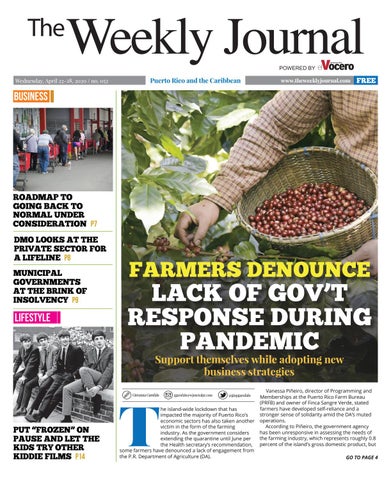
Farmers Denounce
Lack of Gov’t Response During Pandemic Support themselves while adopting new business strategies
T Giovanna Garofalo
Put “Frozen” on pause and let the kids try other kiddie films P14
ggarofalo@wjournalpr.com
@giopgarofalo
he island-wide lockdown that has impacted the majority of Puerto Rico’s economic sectors has also taken another victim in the form of the farming industry. As the government considers extending the quarantine until June per the Health secretary’s recommendation, some farmers have denounced a lack of engagement from the P.R. Department of Agriculture (DA).
Vanessa Piñeiro, director of Programming and Memberships at the Puerto Rico Farm Bureau (PRFB) and owner of Finca Sangre Verde, stated farmers have developed self-reliance and a stronger sense of solidarity amid the DA’s muted operations. According to Piñeiro, the government agency has been unresponsive in assessing the needs of the farming industry, which represents roughly 0.8 percent of the island’s gross domestic product, but GO TO PAGE 4
The Weekly Journal > Wednesday, April 22, 2020 >
2
Plan de alivio económico a clientes de FirstBank
Preguntas Frecuentes ¿A qué clientes le aplica el Plan de Alivio Económico? El Plan de Alivio aplica automáticamente a clientes de préstamos y arrendamiento de auto, préstamo personal, tarjeta de crédito y préstamo personal pequeño de nuestra subsidiaria Money Express que no tengan más de 2 pagos en atrasos al 16 de marzo de 2020 (sin exceder 89 días en atraso a esa fecha). Para tarjetas de crédito y líneas de crédito de individuo, la cuenta tiene que estar al día al 16 de marzo. Clientes de hipotecas deben comunicarse con nosotros para conocer las diferentes alternativas.
¿Qué alternativas tengo para ponerme al día con mi hipoteca luego de que transcurra el término del Plan de Alivio Económico? Pagar el saldo correspondiente a los meses en moratoria en un solo pago Solicitar un plan de pago de los meses en que se acogió a moratoria y/o Solicitar una modificación, la cual podría extender el término de su hipoteca - Los planes de pago o modificaciones pudieran estar sujetos a costos adicionales.
¿Tengo que comunicarme con el banco o la moratoria se aplicará automáticamente?
Si no deseo acogerme al Plan de Alivio Económico, ¿puedo continuar haciendo mis pagos?
La moratoria será aplicada automáticamente a los clientes que no tengan más de dos pagos en atraso (89 días en atraso al 16 de marzo) y no cuenten con débito directo. Clientes de hipotecas deben comunicarse con nosotros.
Sí, puedes continuar haciendo tus pagos como de costumbre a través de nuestros servicios electrónicos. Visita 1firstbank.com para conocer todo lo que puedes hacer a través de nuestros canales digitales.
¿Por cuánto tiempo estará vigente el Plan de Alivio Económico?
Si tengo débito directo, ¿qué tengo que hacer?
El Plan de Alivio aplica para para pagos de abril, mayo y junio 2020.
Al terminar el periodo de moratoria, ¿tengo que hacer todos los pagos a la vez en julio? No, si te acogiste a la moratoria para préstamos y arrendamientos de auto, préstamos personales, tarjeta de crédito, líneas de crédito para individuos o préstamos personales pequeños de nuestra subsidiaria Money Express, no tendrás que hacer todos los pagos acogidos a moratoria en julio. Clientes de hipotecas deben comunicarse con nosotros para más detalles.
Si tienes débito directo en cualquiera de los productos, el Banco continuará debitando el pago correspondiente de tus cuentas. Si deseas acogerte a la moratoria, debes solicitar una suspensión temporera al débito directo con FirstBank llamando al 787.725.2511 o comunicarte con tu institución financiera.
¿Habrá cargos por retraso en el pago? ¿Estarán enviando reportes negativos al crédito? Durante el periodo de este Alivio en los pagos: No tendrás un cargo por atraso No se reportarán atrasos a las agencias de crédito
Más de 200 ATMs a tu alcance
FirstBank es miembro FDIC, Equal Housing Lender. Los programas de ayuda financiera están sujetos a ciertos términos, condiciones y restricciones. Estos programas de ayuda financiera del Banco están disponibles para residentes de Puerto Rico y sólo para productos de FirstBank Puerto Rico y su subsidiaria Money Express. Para más información visita nuestra página 1firstbank.com
3
/ Wednesday, April 22, 2020
a week in review Drivers to get amnesty on traffic tickets Secretary of Transportation and Public Works Carlos M. Contreras announced the extension of the Traffic Fines Accelerated Payment Act, identified by the general public as the amnesty, until June 19. The original dispositions of the law provided for an amnesty on fines that expired on March 17. That gave citizens a 90-day period to take advantage of a 15% discount on their traffic tickets and fines and up to 100% discount on applicable penalties and surcharges. Taking into account that the end of the amnesty would coincide with a historical moment, product of the COVID-19 pandemic, Representative José “Memo” González filed a bill to extend its validity.
Relief bills signed into law Governor Wanda Vázquez signed into law this week two bills that would ease up the economic effects caused by the lockdown and curfew imposed by her executive orders, which seek to curb the spread of the coronavirus. The first law orders all financial institutions doing business in Puerto Rico to offer their clients a moratorium on payments to personal and auto loans, mortgages and credit cards due on March, April, May and June 2020. This law also prohibits the collection of surcharges, penalties and/or increased interest rates to clients opting for the moratorium. A second law provides for a paid five-day leave of absence to private sector employees who suffer, or suspect they suffer, from a disease that provokes a state of emergency. This law amends the Puerto Rico Minimum Wage, Vacation and Sick Leave Act after the state of emergency decreed by the government due to the coronavirus pandemic.
90 hotels and lodges close temporarily The Puerto Rico Tourism Company (PRTC) reported that 90 of the 160 hotels and lodges endorsed by the company have temporarily closed operations due to the emergency caused by the COVID-19. According to the PRTC, before the effects of the COVID-19 began to be felt, everything indicated that the 2020 winter season was going to be equally fruitful as the 2019 season. “Today, 90 of the 160 endorsed lodges have temporarily closed operations. Of the 15,000 total endorsed rooms, 5,880 are out of service. The average occupancy is estimated to be close to be 8%,” the PRTC reported.
4
/ Wednesday, April 22, 2020
CONTINUED FROM PAGE 1 whose contribution could be hindered further by the emergency measures implemented to flatten the coronavirus (COVID-19) contagion curve. “I am not saying that [the DA] is not operating… but what I have seen is that the DA, with a budget of $9.7 million and 320 employees, we haven’t seen them in action to address the farmers’ needs during the pandemic,” Piñeiro told THE WEEKLY JOURNAL. Ricardo Marti, owner of Piñas de Puerto Rico, noted that the DA uploaded relevant information in its website, but opined that the agency should have sent emails or other communication to the farms in its registry, adding that most information concerning the farming industry has been shared amongst farmers rather than relying on the public entity. Meanwhile, Jorge L. Rivera, owner of Adjuntas-based Café Emy, stated that the DA’s limited operations have rendered his business inoperative. Like other companies that process coffee but do not have a farm of their own, Café Emy buys the pre-processed product from the DA’s Administration for Agricultural Business Development (ADEA, by its Spanish acronym). Earlier this month, DA Secretary Carlos Flores said, “the public policy and the governor’s intention is to facilitate the rehabilitation of the coffee sector, for which the [DA] through the [ADEA],
What we have seen is that the Agriculture Department is not necessary for farmers to continue working. -Vanessa Piñeiro
established the Program for the Recovery of the Coffee Industry for the fiscal year 2019-2020.” However, this office has reportedly remained closed since the beginning of the quarantine, which began in the week of March 15. “We are on hold because the place where we buy coffee is closed. We cannot operate our business until the government authorizes that office to open and sell the coffee… Because of COVID-19 and through an executive order from the governor, that agency has been closed for over a month,” Rivera said. He added that, about a month ago, the ADEA opened for half a day and they were able to buy some coffee, but they have not received an update since. This affects both small, family-owned businesses
like Café Emy, as well as larger companies that are able to buy quintals (hundredweight) by the thousands, with one quintal equivalent to 100 kilograms or 220.5 pounds. Therefore, the repercussions of this gap in the DA reverberate across the industry. But unlike larger companies, which have storage capacity, small- and midsize coffee processors do not have the facilities to store the product for later use. According to the Secretary Flores himself, the coffee industry impacts one-fourth of the island’s municipalities, for a total of 22 municipalities. Apart from coffee processors, other farming sectors that have faced financial strain during the pandemic include the hydroponics segment, which caters predominantly to school cafeterias and designated family markets under the Supplemental Nutritional Assistance Program (SNAP). Piñeiro explained that both, schools and family markets are closed until further notice. “We face a huge challenge with family markets because we have 120 agribusinessmen who work in the family markets system. Although the [PRFB] has made several petitions to the governor, and legislation has been discussed in the House and the Senate to reopen the family markets, at least with a drive-thru, nothing has been achieved and we have all those farmers waiting for an opportunity,” Piñeiro said. She noted that, while Flores bought produce from these farmers on one of the days when the family markets were closed, he claimed that since then the agency has offered statements “but has not been directly supporting our farmers so they may have a better quality [of life].” Moreover, farming companies are facing labor limitations because some workers have opted to remain home for fear of getting infected with COVID-19.
Necessity Calls For Reinvention
Many farmers rely on street vendors to generate revenue. >Brandon Cruz González
THE WEEKLY JOURNAL asked Piñeiro how has the PRFB been able to channel its members’ concerns to the DA. “What we have seen is that the DA is not necessarily facilitating farmers to continue working. The PRFB has given them that service… We have survived without them,” she responded. Piñeiro said that the PRFB has drastically increased its day-to-day operations because they are constantly receiving calls from farmers with questions about the executive orders’ limitations. While some businesses are unable to maintain workflow, others have sought to reinvent their business models. Marti and other like-minded farmers have been preparing boxes with produce and delivering them to customers at their homes. Piñas de PR is offering this service in Cabo Rojo, Cayey, Lajas, San Germán, and Sabana Grande and even recruited people who have lost their jobs over the pandemic to assist in the farming process. The family-owned company also buys produce from other farmers to include in these customized packages. “We started doing that since the beginning of the lockdown, when people began closing their businesses. Our main buyers are people who sell
5
/ Wednesday, April 22, 2020
The Puerto Rico Farming Bureau developed an interactive inventory where farmers can update information about their produce. >Screenshot PRFB
produce on the streets… that is when we decided to adapt our business to an online model. We saw other farmers doing the same thing and we got some ideas,” Marti said. On a regular week prior to the quarantine, Piñas de PR would sell between 1,000 to 4,000 pounds of produce to small shops and sellers. Now, they are selling between 40 to 50 pineapples. With the average pineapple weighing five pounds, they are selling between 200 and 250 pounds, and up to roughly 300 pounds of produce. Piñeiro said that, although this model represents lower revenues, the packaging initiative has exceeded expectations. “We never thought they would have such a large reach. Some of our associates are delivering up to 700 boxes daily, which is a lot. People have shifted to buy products from Puerto Rico,” she said. The PRFB also released an inventory on local agricultural products that is visible to the public at www.prefab.org. The inventory allows farmers to detail how much capacity they have and when will they have products available while offering a space to market themselves. Despite the aforementioned challenges and lower sales, farmers are being encouraged to continue cultivating their products as per usual so as to avoid supply shortage after the lockdown is lifted. Meanwhile, Piñeiro considers that there needs to be a reform in the government’s agriculture model, which provides incentives to companies that generate more produce, thus bludgeoning small and midsize locally-owned
businesses, which she claimed, have been the gears that have sustained the industry during this pandemic.
Dairy Industry Boosts Sales, Lowers Production
Jorge Campos, administrator for the DA’s Office for the Regulation of the Dairy Industry (ORIL, by
Some coffee processing companies are unable to continue operations because they haven’t been able to buy products from the government. >File photo
its Spanish acronym), explained that this sector has been experiencing sales challenges since before the pandemic, and even before Hurricane Maria in 2017. Before the category-4 storm devastated the island, the dairy industry had seen an annual decline in consumption of 3 to 4 percent. In spite of former complications, Campos noted that dairy companies have actually increased their sales in supermarkets, gas stations, and other convenience stores since the enactment of the lockdown. But because school cafeterias, coffee shops, and other food businesses are either closed or generally abstaining from selling coffee, dairy companies have nonetheless opted to reduce their production. According to Campos, now there is an average daily production of 700,000 milk quarts, or roughly 175,000 gallons. This represents a year-to-year drop of 800,000 to 900,000 milk quarts compared to the same date last year. While members of other sectors of the agricultural industry have expressed dissatisfaction with the DA’s office general response, ORIL’s administrator assured his office is maintaining constant communication with dairy companies while ensuring social distancing by ordering most of their employees to work from home. The entity established a landline for customers to share concerns or complaints at (787) 765-7545. THE WEEKLY JOURNAL attempted on several occasions to reach the Department of Agriculture for comment to no avail.
6
/ Wednesday, April 22, 2020
Only 7 Percent of Small Businesses in Puerto Rico Received Approvals for PPP Funds
Reopen the economy, says the government’s Economic Task Force
M Rosario Fajardo
rfajardo@wjournalpr.com
@RosarioWJournal
any small business owners around the nation are eagerly waiting for Congress to reach another deal on extending the Paycheck Protection Program (PPP) under the CARES Act, or the so-called coronavirus relief package, as the $349 billion limit was reached just two weeks after the program went into effect. That includes many small business owners in Puerto Rico, as only a small fraction of PPP forgivable loans were approved on the island before the money ran out. A lucky 2,856 small businesses in Puerto Rico received PPP approvals, totaling more than $658.57 The private sector says it is time to reopen the Puerto Rico economy, in two-week phases. >Josian E. Bruno Gómez million in forgivable loans, as of April 16, when the assigned PPP money ran out, according to (DDEC by its Spanish acronym) are raising their week sequences, that allows our people to return to the U.S. Small Business voices that the time has come to work,” he said. Administration’s (SBA) reopen the economy, little by little. As previously reported by THE WEEKLY Paycheck Protection Program At the same time, the local Health JOURNAL, DDEC Secretary Manuel Laboy has report. The SBA is in charge Department has admitted that it has already said that it is time to reopen the economy of approving the forgivable overcounted the confirmed cases of in Puerto Rico, as the costs to the island’s struggling loans, which are handled coronavirus on the island, sometimes economy are mounting. through financial institutions. double or triple counting the same Among the sectors that should start to open are The local Health According to the U.S. cases. This has raised the ire of many tourism, construction, real estate and professionalDepartment has Census Bureau’s County people in Puerto Rico. services firms, he indicated. admitted that it has Business Pattern data, The Puerto Rico government’s “Our goal has been to develop indexes that overcounted the conthere are at least 40,000 Economic Task Force has forwarded indicate the capacity of the health system so as not firmed cases of corosmall businesses in Puerto various recommendations to Gov. to saturate it, risk indexes by economic sector and navirus on the island, Rico—and as defined by the Wanda Vázquez for reopening the of economic impact to guide us with validated data, sometimes double federal government, these economy in two-week phases. and which sectors to recommend opening first or triple counting businesses have 500 or fewer Emilio Colón Zavala, who heads before others. This is supported by standardized the same cases. This employees. The estimate the Economic Task Force, said guidelines by the [Center for Disease Control] and has raised the ire of includes the self-employed, considerations would include the risk [Occupational Safety and Health Administration] on many people in Puersuch as freelancers and of contagion—in which case “data how to operate, even under the threat of COVID-19,” to Rico. other contract personnel. driven” decisions are imperative—, the said economist Roberto Toledo. Based on these figures, number of employees and percentage He added that if the economic roll out has to be only 7 percent of small in gross national product (GNP) of stopped due to an outbreak, it will be done, and that businesses on the island received approvals for the each sector. “After five weeks of [the government] the private sector is committed to purchasing more Paycheck Protection Program under the CARES Act. having implemented closure measures and mobility coronavirus tests and establishing “contract tracing” Puerto Rico is in the sixth week of an islandwide restrictions, it is important to evaluate moving to a systems. “As I have always stipulated, in our system, an lockdown and curfew, and the private sector and the transition phase to reactivate our economy. We have economic decision affects a health one and a health Economic Development and Commerce Department to start an orderly process now, in phases, in two[decision] affects an economic one,” he said.
In facts,
/ Wednesday, April 22, 2020
7
A plan to restart the economy AFTER the lockdown being considered
Recommendations will be evaluated jointly by the Governor and members of the Economic and Medical task forces
S
By the WJ Editorial Staff
ecretary of the Department of Economic Development and Commerce (DEDC) Manuel A. Laboy announced that, after weeks of work by the government’s Economic Task Force, he received the recommendations of the plan for the economic reopening of the private sector, after the almost total stoppage of commercial operations to avoid the spread of the coronavirus. According to Laboy, once the plan is evaluated, the entire team will announce the measures that would gradually be implemented for the reactivation of the island’s economy. “As a team, the members of the private and government sectors will evaluate several alternatives so that various economic sectors can resume their operations, as long as it is done gradually and according to the situation of the
pandemic. We all have the responsibility for the economic development of Puerto Rico, but it is essential that these actions are taken while safeguarding the health and integrity of the workforce,” Laboy said. The recommendations presented by the Economic Task Force will be evaluated jointly by the Governor, the Secretary of Health, the Secretary of Economic Development and members of the Medical and Economic task forces. “When Puerto Rico is ready to open, we trust that the recommendations will be the guide to gradually and safely restart operations in the private sector,” explained Laboy. The Economic Task Force is made up of approximately 50 representatives from the private sector and it is led by Emilio Colón Zavala, president of the Business Emergency Operations Center. Colón Zavala, who is also the president of the Puerto Rico Builders Association, stated that “after five weeks of having implemented closing measures and mobility restrictions, it is important to evaluate a transition phase to reactivate our economy. Now we have to start an orderly process, by phases, in two-week sequences, that will allow our people to return to work.” The Task Force president also emphasized that “when relaxing the measures, the risk level of contagion, the number of jobs and the percentage
of the Gross National Product (GNP) for each sector, must be taken into account. Everything must be tied to the monitoring of our hospital infrastructure, test results and the tracing of contacts of those who test positive.” Several economists are part of the Economic Task Force. This second working group has the participation of the economist Roberto Toledo, who pointed out “the main objective of the economic roll-out is to protect the health system and the health of citizens” in order to develop different tools for an orderly and sustainable reopening. Toledo emphasized three issues: first, if the roll out has to be stopped due to an outbreak, it will be done; second, that the private sector is committed to supporting the government with all the necessary tools to address the plan (i.e., the purchasing of tests and “contact tracing” systems); and third, that “in our system, an economic decision affects a health one, and a health decision affects an economic one.” On her part, Governor Wanda Vázquez, expressed “measures must be correct and implemented at the right moment. Therefore, the evaluation of the population’s levels of contagion, the protective measures employers will take for their employees and how the pandemic is developing in our island, they will all be indispensable criteria.”
8
/ Wednesday, April 22, 2020
DMO Looks at Private Sector to Help Revive Tourism
Efforts stateside to include DMOs in enhanced CARES Act
D Rosario Fajardo
rfajardo@wjournalpr.com
@RosarioWJournal
iscover Puerto Rico received a setback when Gov. Wanda Vázquez recently vetoed a bill that would have given the island’s destination marketing organization (DMO) a $5 million assignment for marketing
purposes. Undaunted, Brad Dean, the CEO of Discover Puerto Rico, told THE WEEKLY JOURNAL that the entity is looking at private sector funding, among other possibilities, to help the DMO promote the island after the coronavirus crisis has passed. “Much has changed since this resolution was passed [in February], so we respect the decision by [the governor], given the economic situation that Puerto Rico is facing as a result of the global pandemic, COVID-19. Because tourism creates 80,000 jobs and delivers $640 million in tax revenues annually, we must continue to do all we can to protect our local economy, regardless of our budget,” he said. “We will continue to work with the governor, the [Puerto Rico] Senate and the House, as well as our partners in the private sector to identify possible funding sources to revive tourism. We are also working with several partner organizations in the United States to collaborate, as everyone in our industry is experiencing the same circumstances. Puerto Rico is strong and resilient, and soon travel will resume,” he added. Dean noted that once the coronavirus emergency abates, Puerto Rico will be competing with other tourist destinations, not just in the Caribbean, but around the world, to attract visitors who will be “eager” to travel again. “For tourism to help lead the economic recovery of the island post COVID-19, funding to promote tourism will be necessary. We look forward to working with stakeholders and partners in the public and private sector to promote Puerto Rico and restore tourism revenue and jobs to the island.,” he said. Regardless, “appropriate resources” are necessary for the island to rebound as quickly as possible. He also pointed out that Discover Puerto Rico only uses 6 percent of its estimated $25 million budget for “administrative and overhead costs and we’ve taken several steps to conserve the limited funding we have. This includes pausing all paid media,
Longing for a return to normality before COVID-19 >Archive
Brad Dean, CEO of Discover Puerto Rico >Carlos Rivera Giusti
Because tourism creates 80,000 jobs and delivers $640 million in tax revenues annually, we must continue to do all we can to protect our local economy, regardless of our budget. -Brad Dean, CEO of Discover Puerto Rico
canceling promotional events and authorizing only essential expenditures.” In the meantime, though, the DMO has launched an online campaign to keep Puerto Rico on the mind of travelers. These include virtual activities on social
media and the “All in Good Time” video series. Meanwhile, with tourism in the mainland U.S. also brought to a standstill by coronavirus, efforts are underway to help the travel industry, including DMOs, to benefit from an enhanced CARES Act, also known as the coronavirus relief bill. As previously reported by THE WEEKLY JOURNAL, the U.S. travel industry is calling on Congress to protect the 15.8 million Americans whose livelihoods depend on travel. At the top of the list: adding $600 billion to the Paycheck Protection Program (PPP) and expanding eligibility to small businesses that were previously left out; and ensuring loan forgiveness can cover both payroll and other operating expenses during the shutdown. A key example of small businesses that were unintentionally excluded from the PPP under the CARES Act: local and regional DMOs, whose work is crucial to driving travel and tourism business around the country. “The CARES Act was an ambitious step, but now the urgent problem is that assistance is simply not getting where it needs to go,” said U.S. Travel Association President and CEO Roger Dow. “Major adjustments and more aid are needed immediately to support small businesses, including local nonprofit [DMOs] that are essential engines of the travel economy that employs one in 10 Americans.” Dean said he fully supports these efforts, as DMOs were not included in the CARES Act. “Unfortunately, this program will only help to pay for a portion of salaries. It does not provide funding for advertising and promotion, which will also be needed to restore 80,000 jobs in our local tourism industry,” he explained.
9
/ Wednesday, April 22, 2020
Photo of La Parguera in Lajas. The southern municipality was among the towns affected by the January earthquakes. >Archive
Between Scylla and Charybdis Municipalities disappointed by Law 29 reversal, while FOMB welcomes decision
M Rosario Fajardo
rfajardo@wjournalpr.com
@RosarioWJournal
unicipalities in Puerto Rico, many of which have been financially struggling for years, received a blow when Law 29, which exempted the island’s 78 municipalities from paying health insurance and pensions for their own workers, was repealed last week. It was the latest round in a battle with the Financial Oversight and Management Board (FOMB), which declared the law in violation of the Puerto Rico Oversight, Management and Economic Stability Act (Promesa). “The decision announced by the federal court is a bucket of cold water [for municipalities] in the midst of all this [coronavirus epidemic] emergency that we are going through,” said Javier Carrasquillo, the mayor of Cidra, in a radio interview. “More than 40 municipalities will suffer significant reductions in their incomes, [affecting] the operations of municipalities; providing essential services to citizens will be jeopardized,” he added. “We have to find another way to meet those obligations,” he said, referring to their health insurance and pension payments. U.S. District Court Judge Laura Taylor Swain granted the Oversight Board’s requests for summary judgment on several grounds, declared Law 29 unenforceable and permanently ordered the Puerto Rico government from implementing and enforcing it. In addition, the court concluded that joint resolutions
by the Puerto Rico Legislature, which reprogrammed prior year appropriations and were not certified by the Oversight Board, violated Promesa. “This is an important decision that will support fiscal responsibility in Puerto Rico,” said the FOMB’s Executive Director Natalie Jaresko. “Pension payments to Puerto Rico government retirees must be safe and cannot be secured by shifting costs in unsustainable ways. “Municipalities and the central government have to each budget their own payments for their retirees responsibly and realistically. Fiscal responsibility, mandated under Promesa, is based on sound and transparent budgeting practices that ensure the government can always pay its obligations,” she said. - Ponce Mayor Maria Jaresko noted that “Mayita” Meléndez in the past six months alone, the Oversight Board authorized the incremental commonwealth government support of $100 million to support municipality related COVID19-related expenses and the release of almost $15 million following the earthquakes that hit the southern part of the island earlier this year.” Law 29 would have substantially eliminated the obligation of Puerto Rico’s municipalities to reimburse the central government for hundreds of millions of dollars in pension and healthcare costs for their own retirees and transferred those costs permanently to the Puerto Rico government. But mayors, the Legislature and La Fortaleza said
municipalities needed help to alleviate their financial burdens. Ponce Mayor Maria “Mayita” Meléndez said that “without a doubt, [the repeal of Law 29] badly affects the operations of a large number of our municipalities and forces us to decide between complying with the Pay Go payment [for pensions] or providing basic services amid four unprecedented crises.” These would include Puerto Rico’s economic depression, which has lasted more than 12 years; Hurricane Maria in Sept. 2017; the January earthquakes; and now the coronavirus epidemic. According to the Oversight Board, despite the decline in municipal revenues and population since 2017, many municipalities neglected to adequately decrease spending. “In fact, Law 29 gave the false impression of greater ability to spend and almost all municipality budgets continued to increase in fiscal year 2020. Even when pension and healthcare costs were temporarily reduced, municipalities maintained a similar level of expenditures,” said the FOMB. “As a result, net spending has increased in many jurisdictions, which may cause a shortfall of approximately $66 million in municipal budgets this fiscal year, a shortfall that should be mitigated by disaster-related transfers related to the pandemic and earthquakes,” the Oversight Board said in a statement.
Without a doubt, [the repeal of Law 29] badly affects the operations of a large number of our municipalities and forces us to decide between complying with the Pay Go payment [for pensions] or providing basic services amid four unprecedented crises.
10
/ Wednesday, April 22, 2020
By Teresita Fuentes, CPA
T
Economic Distress or Political Chess?
ax incentives meant to bolster the economy of a distressed zone should be tailored to those zones. Serious legislation that intends to provide corporations with incentives to move to Puerto Rico should take into consideration their needs, rather than be drafted as a political façade that is content-empty. Make no mistake, H.R. 6443 is a re-hashed, re-scrambled, tweaked and twisted cousin of H.R. 1525. Both bills look to provide tax credits to U.S.based operations in distressed zones. H.R. 1525 died immediately, with the support of two co-sponsors and a referral to the House Ways and Means Committee that took no action on it. Any further tweaking of H.R. 6443 focusing on U.S. based companies will likely run the same luck. If H.R. 6443 is what we have to show as a substitute to the current manufacturing benefits scheduled
to end when Puerto Rico operations that pay over $2 billion in taxes and represent over 46% of our GDP decide to look elsewhere, don’t hold your breath. To claim a credit, the operation must be in a zone with specific poverty rates, unemployment, low labor force participation and general distress, or a combination of these, for prolonged periods. The credit is allowed against the US tax and is determined by applying 40% of the EDZ wages and 40% of the depreciation allowance for property used in the EDZ. The stale re-twist is that the 40% could increase to 50% when the manufacturing facility produces property required to be maintained in the strategic national stockpile, and the production facility is moved from a foreign country to the United States or its possessions. Why would an operation that left Puerto Rico and went foreign come back to Puerto Rico to risk having to pay additional taxes on
By Ricardo Álvarez-Díaz and Cristina Villalon,
Designers and Entrepreneurs www.advfirm.com
T
Stop, Reflect and Reset, Earth Day Turns 50
his year marks the 50th anniversary of Earth Day, an important milestone in the modern environmental movement. This year is significant because we are most likely celebrating Earth day from home. The COVID-19 pandemic has done the unimaginable. It has brought the entire world to a standstill. This forced pause has uncovered the undeniable link between our way of life and the health of our planet. It has given us a
unique opportunity to stop, reflect, and RESET. In honor of Earth Day, here are five questions to think about: What if each person only consumed what they really needed? The pandemic has forced us to reflect about how much we own and what we need. We are more mindful of food waste and making the most with what’s available. We are reusing and repurposing as much as possible. We realized we can live with what we have and be happy with simple things. Does it really make sense to buy goods that travel millions of miles instead of supporting the local farmer
operations that currently don’t pay these? Furthermore, why would such operations risk this instability, and impact their cash flow when the political landscape on the island shows them that it’s just not a safe move? Whoever thinks this is a step in the right direction, is surely blinded by the belief that Puerto Rico, a U.S. territory should be treated like any other state and has neither studied business, or tax implications, or their remote is stuck on Theory Channel. For years I have advised global companies and have sat at the table as they make multi-million dollar decisions to establish and move global operations based on cash flow, tax rates and business incentives. These decisions are made based on the bottom line, period. I have also witnessed why some of these laws and policies are proposed, and many are based on electability, image and political favor. Sadly, these policy propositions are made based on loyalty to party and not to nuestro pueblo. If this proposed bill passes, and miraculously becomes law, or if it were rolled into a larger authorization bill, many tax professionals would still challenge the belief that it would immediately or even eventually motivate manufacturing operations to move to Puerto Rico. In order for a manufacturing operation in Puerto Rico to take advantage of this credit it must be
subject to U.S. taxes and pay a 21% tax rate in the U.S. to even claim a tax credit. The likely outcome is an increased effective tax rate and the loss of foreign tax credit benefits. Further, any tax exemption granted by Puerto Rico would cancel out when net taxability at the federal level is taken into consideration. Who in good faith would recommend such a course of action to a company? I’ll answer that myself— certainly a legal theorist or politician, but not a qualified tax professional working in good faith. To sum it up, the Congressional Research Service, the research branch of the U.S. Congress, published a report in 2011 (CRS-Report R41639, available online) that addressed Empowerment, HUD and Enterprise Zone studies by GAO, HUD and think tanks and clearly pointed out that studies have failed to link these zones with improvement in community outcomes, and have questioned the measurable positive impact and cost-effectiveness of these types of programs. COVID-19 has made it clear that the United States needs to ensure solid stockpiles of essential medical equipment and drugs. Puerto Rico has made it clear in the past that it is capable of producing these. Let’s make it clear that we all intend on arriving at that goal, and let’s leave the political discussion regarding the section of the U.S. Code where these incentives need to be for another day.
and local businesses? This pandemic has opened our eyes to the importance of buying local. Supporting local farmers and local businesses aids in building a healthy economic environment. Next time you hear about your local farmer’s market, make it a point to visit and support them. Do we all need to go to the office to get the job done? Working from home can be beneficial to both the company and the employee. It provides us with better opportunities for work/life balance. For companies, it also affords them the option to find talent anywhere in the world. The more we work from home, the more we can enjoy time with our families… and the less we commute to work, the less harmful carbon dioxide we will emit into the Earth’s atmosphere.
face to face interactions without having to leave our loved ones, unintentionally spreading diseases and viruses and contributing large amounts of CO2 into the atmosphere from the burning of greenhouse gases. Can we all finally understand the collective power we all possess? When most of world decided to stay home, we immediately saw the results of our collective actions at work. The air was cleaner. The sounds were purer. A carless Los Angeles with blue skies and no visible air pollution. Birds chirping in busy New York Avenues, their sounds previously drowned out in noise pollution. And closer to home, manatee’s swimming happily in our lagoon. Small, deliberate actions add up quickly to tangible results. As we celebrate this year’s Earth Day at home and the COVID-19 pandemic eventually comes to an end, let’s not lose the lessons and takeaways. We need to rethink and reassess how we live, what is necessary, and whether we want to go back to things as they were. Our planet’s survival depends on it.
Do you have to fly to that meeting or can you do it virtually? The travel restrictions due to COVID-19 have forced us to do things differently. Turns out we can still have
BIÉN
< The Weekly Journal > Wednesday, April 22, 2020
Tú TAM
11
TÚ TAMBIÉN estás entre los muchos que luchamos contra el virus: pacientes, profesionales de salud, servidores públicos, empleados esenciales, personal de apoyo... y también los que por sólo quedarse en la casa y distanciarse están evitando el contagio. TÚ TAMBIÉN estás haciendo algo heróico para controlar esta pandemia. No importa qué tan pequeño lo veas, el efecto de tus acciones es enorme y afectará favorablemente las vidas de todos.
TÚ TAMBIÉN eres parte de esta lucha, y tú también ayudarás a ganarla!
>La verdad no tiene precio
12
/ Wednesday, April 22, 2020
Fashion trends: rescuing, repurposing and
upcycling threads
Never tell people how to do things. Tell them what to do and they will surprise you with their ingenuity. General George Smith Patton
A
By Hallee Patterson
s we all know, this pandemic has changed our lives forever. Our past habits must change. Another issue is a growing need to address the large amounts of waste being generated by our society. During the quarantine, my friends were cleaning out their closets, which left me wondering what they were going to do with the items they no longer wanted. Couldn’t they keep their garments and turn them into something new? We are a throwaway society and now is a good time to change our old behaviors and look to sustainability. For twentyfive
years, Jill Pillot, a European designer, has been breathing new life into rescued materials. Jill uses the philosophy of slow fashion in her designs. She advocates for principles of good quality, clean environment and fairness for both consumers and producers. “The problem with fast fashion, is that we have garbage dumps full of unworn clothing. I want to take these unused materials and transform them into wearable art. Slow fashion means no more mass production,” Jill explained to me. Jill specializes in redesigning and transforming clothing with the environment in mind. Her look can be described as “classic with a primitive edge.” I learned that the clothes we wear tell stories and waste isn’t waste until we waste it. Jill saves every scrap of cloth, down to the thread, and puts them to good use. Jill came to Puerto Rico via San Mateo, California, after being born in Belgium and growing up in different parts of the world. Her shop and brand are called Ricochet. “Meaning when you throw something, - Jill Pillot, designer it ricochets back. I grew up ricocheting from one country to another,” Jill told me as I looked at her exciting transformed clothing selections. “I want to show that fashion can be affordable, sustainable and beautiful, along with a significant focus on creative expression.” Living in San Mateo as a single parent, she started her shop from scratch. Having opened a successful business, she now wants to open doors for students
and young professionals in Puerto Rico. She hopes to help them develop skills for success in today’s demanding, and oftentimes disheartening, fashion industry, while building their confidence. Her store is located in Miramar and her website is: http://ricochetwearableart.net. Jill is also able to come to your home and help you go through your wardrobe. She can take your much-loved garments and repurpose them. Let’s make a POSITIVE change, now that we have plenty time at home. This is a great time to find creative ways of making a difference.
Become your own designer!
Let’s start by plating dress up with what’s in your closet. 1. Go ahead and try ALL of your clothes on. 2. Have fun mixing and matching them. 3. Start separating what you still love on you, -kind of like or don’t like at all-, or perhaps things that you feel like you could change into something new. 4. Make sure you DON’T throw out any of the things you don’t like. 5. IF YOU KNOW HOW TO SEW, START REDESIGNING YOUR CLOTHES. 6. Or, take some sewing classes, so that you can make a difference. Once we come out of this lockdown, we should make a fresh start, change the way we think about our environment, and about the businesses we support, and stop the mass production businesses that contribute to the deterioration of our planet. This is the right time to think about what you are going to do once you are back to exploring outside your home, as Pillot will be offering ecological design and sewing classes. You will be able to bring all of the pieces that you no longer wanted to wear and redesign them at Ricochet Wearable Art Academy. “I hope you will join me in making a difference in the way we dress and design fashion,” said Pillot.
“I want to show that fashion can be affordable, sustainable and beautiful, along with a significant focus on creative expression.”
13
/ Wednesday, April 22, 2020
Nature Benefits
From Coronavirus Lockdown Sea turtles nesting in peace rfajardo@wjournalpr.com
@RosarioWJournal
silver lining during these challenging times is that nature is benefiting from the worldwide lockdown due to the coronavirus epidemic. We have all read about nature reclaiming “her” space and seen the amazing pictures: Air and water pollution is down. The modern world is so much quieter that city dwellers are now hearing the chirping of birds. In the canals of Venice, seabirds and fish have returned. Wild boar have been seen roaming the deserted streets of Barcelona. Mountain goats have taken over Llandudno, a seaside town in Wales. Wild monkeys have invaded the city of Lopburi, Thailand. In Puerto Rico, beaches are empty, which means that sea turtles are nesting in peace. The Department of Natural and Environmental Resources (DNER) said this bodes well for a successful nesting season for the endangered species. At least 170 nests have been reported so far in
>Archive
A Rosario Fajardo
Puerto Rico, including Vieques and Culebra, said DNER Secretary Rafael Machargo Maldonado. “[Around the island], the total number of nests reported thus far are similar to previous years. However, because of the [coronavirus] emergency that the country is in, there has been less frequent monitoring this season, so there could be more
unreported nests,” he said in a statement. “Despite the pandemic and the problems this has caused to human beings, turtles continue to nest in our beaches and we hope that this will be a successful season,” he added. Carlos Diez, who is the coordinator of DNER’s Sea Turtle Program, reminded the public to respect the lockdown and not visit beaches. “This will benefit this endangered species,” he said. The agency has a Surveillance Corps, which will continue to monitor local beaches and ensure that the turtles and their nests are respected. Sea turtle nests in nearby locales are also having a favorable season. In Juno Beach, Florida, located between Palm Beach and Jupiter, there are more leatherback sea turtle nests than normal, according to CBS Miami. “Researchers at the Loggerhead Marinelife Center in Juno beach have counted 69 nests so far, which is significantly more than normal on the 10-mile stretch of beach they patrol.” In addition, researchers said the turtles are really fat and that’s good news because it means they are healthy and eating well. CBS Miami said researchers do not know why the turtles are so fat but surmise it could be because of “abnormal weather, an increase in their food consumption or perhaps a shifting to earlier in the season for nesting.”
More About the Leatherback Turtles
Sea turtle nest. >Inter News Service
The leatherback, which takes its name from its tough and rubbery skin, is the largest sea turtle in the world. Every year from April to July, they migrate from distant waters near Canada, Europe and Africa to nest along our Caribbean coasts. “Leatherbacks are the largest turtles on Earth, growing up to seven feet long and exceeding 2,000 pounds. These reptilian relics are the only remaining representatives of a family of turtles that traces its evolutionary roots back more than 100 million years. Once prevalent in every ocean except the Arctic and Antarctic, the leatherback population is rapidly declining in many parts of the world,” states National Geographic’s website. “Leatherbacks undertake the longest migrations between breeding and feeding areas of any sea turtle, averaging 3,700 miles each way. After mating at sea, females come ashore during the breeding season to nest. The nighttime ritual involves excavating a hole in the sand, depositing around 80 eggs, filling the nest, leaving a large, disturbed area of sand that makes detection by predators difficult, and finally returning to the sea,” according to National Geographic.
14
/ Wednesday, April 22, 2020
Tired of ‘Frozen’? Stream these less obvious kids’ movies A few slightly further afield movie options that your kids might not have seen. AP
W
eeks of quarantine with kids have a way of burning through a movie collection. Even with the libraries of streaming services like Netflix, Amazon, Disney Plus and others, there are plenty of households that have already had their fill of “Frozen” and overdosed
— Fly Away Home
The outlines of this 1996 film, with Anna Paquin and Jeff Daniels, suggest a familiar and schmaltzy kind of family movie, but it’s handled with such grace that it rises above the ordinary. Also, the geese are really great. A 13-year-old (Paquin) moves in with her estranged father (Daniels) in rural Canada after the death of her mother. She adopts an abandoned nest of goose eggs, raises them and teaches them to fly South for the winter. Available to stream on the Criterion Channel. The director, Carol Ballard, and the cinematographer, Caleb Deschanel, also crafted a movie of pastoral beauty and sweet child-animal camaraderie in 1979’s “Black Stallion,” which is streaming on Amazon Prime.
— The Three Caballeros
There are forgotten Disney treasures, too, including this trippy 1944 gem streaming on Disney Plus. On his birthday, Donald Duck receives a package from his friends in Central and South America. Inside are film reels that bring a handful of individual tales and travelogues that Donald leaps into, too. It’s a loving if overly exotic celebration of South America with some fabulous and surreal moments that blend animation and live action. The movie was produced as part of the wartime “Good Neighbor” policy to bring the Americas together and ward off any appeals from Axis powers. All of which is to say: “The Three Caballeros” isn’t your average Disney movie.
on “Onward.” In the best of times, the canon for kids’ movies can feel limiting. Disney overwhelms. But there’s a wider world of movies out there for young ones. We’ll assume they’ve already accrued a solid foundation of some of the essentials: “Fantastic Mr. Fox,” “The Iron Giant,” Pixar, the Muppets, etcetera. So, here’s a few slightly further afield options — all available to stream, rent or are free — that your kids might not have seen.
— Lupin the Third
For streaming Studio Ghibli films, we’ll have to wait until they collectively hit HBO Max when it launches in May. (They are available outside the U.S. on Netflix.) They are so good — among the most wondrous in cinema — you might just go ahead and buy copies of “My Neighbor Totoro,” “Spirited Away” and “Princess Mononoke.” But for now, you can stream the feature-film directing debut of Hayao Miyazaki, the animation master and co-founder of Ghibli. “The Castle of Cagliostro,” on Netflix, isn’t as well-known as Miyazaki’s best. But the director’s verve and imagination is already on display in this, a caper that continues the exploits of the debonair thief Arsène Lupin. Here Lupin discovers the loot from a casino heist is counterfeit.
15
/ Wednesday, April 22, 2020
— Stop Making Sense
— Pirates! Band of Misfits
Concert films are an underutilized source of entertainment for kids. Jonathan Demme’s glorious Talking Heads documentary, available for digital rental and to stream for free via Vudu, is a good place to start. And since David Byrne slowly assembles his band — beginning with just himself, an acoustic guitar and a tape deck, on “Psycho Killer” — “Stop Making Sense” offers a good step-by-step education on how to build a post-modern funk extravaganza. Plus tips on wearing big suits and dancing with floor lamps. (See also: “A Hard Day’s Night,” on Criterion Channel and “The Last Waltz” on Amazon Prime.)
Aardman Animations has been reliably churning out delights, from “Wallace and Gromit” to “Shaun the Sheep,” for decades. “Pirates! Band of Misfits” (2012) came and went somewhat quietly and didn’t spawn a franchise. But the Aardman charm is there on the high seas, too. Streaming on Hulu.
— Buster Keaton
No child raised on Buster Keaton can turn out bad. It’s just a fact. Most even young children recognize, and laugh their heads off at his genius. Keaton’s features are widely available, but many of his equally brilliant shorts can be streamed for free. Among them, “One Week,” in which he tries to assemble a house; “The Goat,” wherein Keaton is mistaken for a murderer; and “Cops,” in which he angers the entire Los Angeles police force.
— Apollo 11
This hit 2019 documentary, on Hulu, simply follows the moon mission from launch to rescue, without talking heads and with large amounts of previously unseen IMAX footage. It’s a propulsive time-capsule, one that the intervening 50 years has made only more stupendous. “Apollo 11,” like the archival “For All Mankind,” captures the all-ages thrill and glory of the moon landing.
— Boy
Taika Watiti does kids better than any working filmmaker today. Well before his Oscar-nominated “Jo Jo Rabbit,” Waititi was making comic and big-hearted films about childhood, including his Oscar-nominated short, “Two Cars, One Night,” and this semi-autobiographical sophomore feature, inspired by that short. James Rolleston stars as an 11-year-old Maori boy and Michael Jackson fan whose dimwitted ex-convict father (a mulleted Waititi) returns home. Available on the free, public library streaming service Kanopy.