Puerto Rico and the Caribbean
Wednesday, March 18-24, 2020 / no. 047
www.theweeklyjournal.com
Puerto Rico’s population, economy quarantined for two weeks P6 Guidelines for tourism industry in times of the coronavirus P9
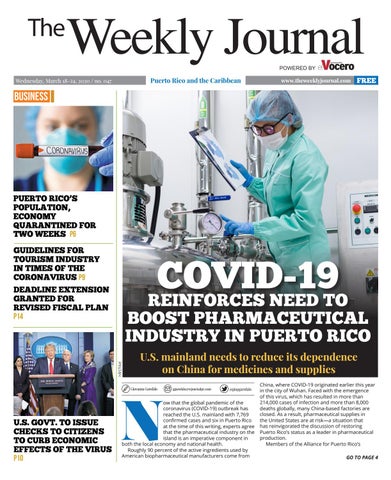
COVID-19 Reinforces Need to
Deadline extension granted for revised Fiscal Plan P14
>Archive
Boost Pharmaceutical Industry in Puerto Rico U.S. mainland needs to reduce its dependence on China for medicines and supplies
N Giovanna Garofalo
U.S. Govt. to issue checks to citizens to curb economic effects of the virus P10
ggarofalo@wjournalpr.com
@giopgarofalo
ow that the global pandemic of the coronavirus (COVID-19) outbreak has reached the U.S. mainland with 7,769 confirmed cases and six in Puerto Rico at the time of this writing, experts agree that the pharmaceutical industry on the island is an imperative component in both the local economy and national health. Roughly 90 percent of the active ingredients used by American biopharmaceutical manufacturers come from
China, where COVID-19 originated earlier this year in the city of Wuhan. Faced with the emergence of this virus, which has resulted in more than 214,000 cases of infection and more than 8,000 deaths globally, many China-based factories are closed. As a result, pharmaceutical supplies in the United States are at risk—a situation that has reinvigorated the discussion of restoring Puerto Rico’s status as a leader in pharmaceutical production. Members of the Alliance for Puerto Rico’s GO TO PAGE 4
The Weekly Journal > Wednesday, March 18, 2020 > 2
3
/ Wednesday, March 18, 2020
a week in review Presidential Primary to be postponed In response to the national emergency declared by the federal government, as well as the prevention measures taken by Governor Wanda Vázquez concerning the coronavirus (COVID-19), the Democratic Party of Puerto Rico (DPPR) requested the postponement of the presidential primaries set to take place on March 29. DPPR president Charlie Rodríguez assured the party is “seriously concerned about the welfare of voters.” As such, Rodríguez asked that the island’s Presidential Primary Act be amended for the vote to take place on Sunday, April 26.
Uber and Uber Eats Limit Operation Uber announced that its ride-hailing app and Uber Eats, its food delivery service, will offer their services in Puerto Rico exclusively from 5 a.m. to 9 p.m. until March 30. The company’s decision comes in response to Executive Order 202023, implemented by Gov. Wanda Vázquez on March 15, which establishes a curfew from 9 p.m. to 5 a.m. in a bid to stop the spread of coronavirus (COVID-19).
Powered BY El Vocero de Puerto Rico, 1064 Ave Ponce de León 2nd floor San Juan, PR Postal Address: PO Box 15074, San Juan, PR 00902
Car Sales Go Up in February The United Group of Automobile Importers (GUIA by its Spanish acronym), an organization that represents the automotive industry in Puerto Rico, has released numbers on new car sales for February, showing a healthy increase compared with year-over-year. The month ended with a total 8,382 new units sold, compared with the same month in 2018, when 7,723 were sold in the island, representing an increase of 8.5 percent.
President Salvador Hasbún shasbun@elvocero.com
Human Resources Director Arlene Rolón, PHR arolon@elvocero.com
Multi-Platform Digital Director Stephanie Gómez Álvarez sgomez@elvocero.com
Comptroller Félix A. Rosa frosa@elvocero.com
Traffic Director Ilia M. Pérez Centeno iperez@elvocero.com
Multi-Platform Graphic Director Héctor L. Vázquez hvazquez@elvocero.com
Production Director Eligio Dekony edekony@elvocero.com
Editorial Director Juan Miguel Muñiz Guzmán jmuniz@elvocero.com
Assistant Editor/ Reporter Rosario Fajardo rfajardo@wjournal.com
Phone: 787-622-2300, 787-721-2300 Customer Service: 787-622-7480
4
/ Wednesday, March 18, 2020
CONTINUED FROM PAGE 1 Economic Progress have already discussed with the U.S. Congress the Commonwealth’s potential to recover its former position in drug manufacturing “We brought this situation to Congress. This opens the doors to analyze the pharmaceutical sector and the entire industrial part. In an emergency case like this, the nation is in danger, now the rules of the game must change,” said Rodrigo Masses, one of the founders of the Alliance, who was in Washington, D.C. lobbying this issue along with attorney Luis Bacó. According to the Puerto Rico Industrial Development Co. (Pridco), 12 of the world’s top 20 pharmaceutical companies have a presence on the island, whether for manufacturing and product development or distribution. The 14 multinational and international research-based biopharmaceutical companies that comprise the Puerto Rico Pharmaceutical Industry Association (PIA) operate more than 20 facilities on the island and supply products to millions of patients in more than 100 countries around the world. Some of these products include blood thinners, IV bags, and drugs for cancer, arthritis, diabetes, and heart disease. “The recommendation to attract pharmaceuticals has been made before arguing national security issues before the possibility of a pandemic or biological attack. There are several plants here with
There are several plants here with great capacity that can be put into operation to create the assets and manufacture critical products or medications. -Iván Lugo Montes
great capacity that can be put into operation to create the assets and manufacture critical products or medications. This would benefit Puerto Rico and the American nation,” said Iván Lugo Montes, executive director of Industry University Research Center, Inc. (Induniv), a nonprofit entity that develops support strategies for the pharmaceutical industry and the academic sector. According to the data provided by Lugo Montes, a third of the local tax revenue comes from this industry, which generates about 150,000 jobs on the island. Moreover, this industry represents more than 30 percent of Puerto Rico’s gross domestic product (GDP) and 60 percent of all exports. However, this industry could be bolstered to generate even greater contributions while reducing foreign dependence. It would be a
A third of Puerto Rico’s tax revenue comes from the pharmaceutical industry. >Courtesy
unique opportunity for Puerto Rico if the United States were to promote pharmaceutical industry development in the Commonwealth once again, with adequate incentives provided by the local government. “We are ready to absorb this market, create warehouses and distribute products for an emergency like this. We already exporting to about 85 countries. We are the largest American pharmaceutical exporter, located outside the United States. We have an enormous knowledge of regulations from all over the world. Now, with the exemption on air cargo we are in the ideal position to become a distribution center,” he added.
Dependence on China a Concern
Getting better incentives to attract the pharmaceutical industry in times of economic distress would be beneficial to the island, which in the 1970s enjoyed federal tax exemptions, in turn making it one of the main centers of pharmaceutical production. These exemptions were contained in Section 936 of the U.S. Internal Revenue Code. A 1993 report by the U.S. Government Accountability Office estimated that pharmaceutical companies received the greatest benefits under Puerto Rico’s corporate tax system, earning $86 million in 1985. However, then-President Bill Clinton signed a law to gradually eliminate those tax exemptions in the 1990s. The exemptions completely expired in 2006, and the industry began to
5
/ Wednesday, March 18, 2020
90 percent of active ingredients used by American pharmaceuticals come from China. >AP Photo
decline. Consequently, roughly 75,000 jobs in manufacturing were lost after the elimination of Section 936. Economist Antonio Rosado affirmed that pharmaceutical companies that were operating in Puerto Rico relocated to China because the cost of labor was less expensive, “and they definitely paid the same there as if they were in another place, so they maintained their operation sin China, keeping funds outside the United States.” “Thus, the impact of eliminating Section 936, which was fundamentally a benefit for American pharmaceuticals, became a loss for the United States in terms of international competition in the area of pharmacy,” he stated. Regarding his meeting with members of Congress, Masses said, “we are promoting the industry in general because many products and components come from China and other parts of the world. So, imports and supplies will suffer due to coronavirus.” Lugo Montes agreed with Masses that the issue should be extended to the general manufacturing industry, as there are many products that are manufactured in China whose distribution in the United States could be paralyzed due to the health crisis. “The flow of many products has stopped because China ceased its production, like cell phone screens. Critical products must be manufactured in American territory. We must
reactivate these pharmaceutical plants and bring more volume. It is a great opportunity. The industry and the Government have to work together to move this initiative,” Lugo Montes said.
Possible Measures to Consider
The Foreign Corporations & Partnerships Tax (Act 154-10) was implemented by the Luis Fortuño administration to provide the liquidity needed to address the fiscal crisis that led to a large deficit at the time. Act 154-10 imposed a sales tax on the products of foreign companies manufactured in Puerto Rico, in turn granting them a 100 percent federal tax credit. The tax reform managed to reduce the tax rate to individuals and corporations and fed the private sector with $1 billion. U.S. Treasury Secretary Steven Mnuchin already informed the local government that the federal tax credit will no longer be an option, advising to eliminate the tax on foreign companies and seeking another solution. Without the federal tax credit, a considerable number of pharmaceuticals could relocate elsewhere. “I believe that Act 154 was a terrible idea since its conception… You cannot harm companies more than they were already penalized by increasing taxes,” Rosado said. He noted that the local government needs to eliminate the inventory tax, as well as reducing taxes on corporations, in order to boost the pharmaceutical industry locally by attracting more
competitors. “In the United States, [the corporation tax] is 21 percent, while in Puerto Rico it is 39 percent. How is it possible that the tax rate in the Commonwealth is higher than in the metropolis? That is an administrative folly,” the economist affirmed. “What the government needs to do is reduce corporation taxes from 39 percent to 21 percent. That is an important incentive for corporations… Eliminate the inventory tax, which is a disaster. Ten years ago the positive change in inventory in Puerto Rico was almost $1 billion. In 2018 it was $5 million,” he opined.
Puerto Rico Manufacturers Association Reacts
Meanwhile, Yandia Pérez, vice president of the Puerto Rico Manufacturers Association (PRMA) said that “this confirms what the Association has been talking about for a long time. We are an important sector because of the quality of service, resources, and capabilities that are relevant to medical products and whose supply chain has been affected.” “We are regulated by federal laws that provide greater safety guarantees for the health sector. They must look at Puerto Rico as an important place for manufacturing and provide us with the incentives and tools we need to strengthen this platform that already exists on the island,” she added.
6
/ Wednesday, March 18, 2020
Puerto Rico, Like Other Jurisdictions Worldwide, Hits the Pause Button Community-wide quarantine, curfew declared for the island for two weeks
S
Rosario Fajardo
rfajardo@wjournalpr.com
@RosarioWJournal
treets have seen a distinct drop in vehicular and pedestrian traffic in the San Juan metropolitan area after Gov. Wanda Vázquez declared a curfew and lockdown on all but essential services around the island due to the worldwide coronavirus pandemic. To help stop the spread of the novel coronavirus, the governor signed an executive order on Sunday, effective March 30. The lockdown in Puerto Rico echoes those of other countries, such as China, France, Italy and Spain. The law firm McConnell Váldes has sent an email to its clients, noting that all their attorneys “will be working remotely, and accessible through email and by cellular phone until this crisis subsides.” Many other companies that offer professional services, whether it be legal, economic consulting or accounting services, are also working remotely during this time. The Weekly Journal recently traveled around the Condado area in San Juan. The normally busy neighborhood is often full of tourists and local residents, but on a Tuesday afternoon, traffic was lighter than normal. However, about a dozen people could be seen walking around Ashford Avenue, many of them tourists. A visitor from New York was walking around Calle Loíza and said she was not concerned about police stopping her and giving her a fine. She noted that she saw a couple of people in various cafes around the area. “I see plenty of other people walking around. The line of people waiting for food at [Bebo’s restaurant] is really long,” said the woman, adding that she had been ordering food from nearby restaurants via Uber
Gov. Wanda Vázquez >Brandon Cruz González
Eats. In the morning, a few people could be spotted on the beach, but this dropped to zero by the early afternoon. Your correspondent also saw a
Police vehicle patrolling the beach while a police officer could be heard blowing a whistle and telling people that a lockdown was in effect. Local residents in Condado also received a
7
/ Wednesday, March 18, 2020
Like China, France, Italy and Spain, Puerto Rico is under a community-wide lockdown and curfew. The photo above shows the Miramar and Condado areas of San Juan. >Josian E. Bruno Gómez
notice via their condominiums that they were allowed to walk their dogs outside, but they had to keep their dogs on leashes, pick up after them and stay in front of their respective buildings.
McConnell Váldes Also Provided a Summary of the Executive Order:
• Based on Article VI, Sections 5 and 6 of the Constitution of Puerto Rico, Article I of Act 81 of March 14, 1912, as amended, Act 20-2017, the state of emergency is declared pursuant to EO-2020-020. As such, the Government has understood that it is absolutely necessary to implement further island-wide isolation and quarantine measures. • To that end, there will be a curfew in place applicable to everybody in Puerto Rico, starting tonight March 15th at 9 p.m. The curfew will run from 9 p.m. to 5 a.m. daily. • The Executive Order also provides for a shutdown of Government Operations, exempting only those related to essential services, as well as a shutdown of all business activity in Puerto Rico until March 30th, unless otherwise provided.
The Following Businesses are Exempt:
o retail sale of food, by drive-thru, carry-out or delivery o sale of medicines or medical equipment o pharmacies o supermarkets o gas stations o banking and financial institutions o assisted-living homes o those businesses related to the distribution chain for food items, medicines, health-related articles and fuel. • Moreover, the Executive Order applies to all shopping malls, movie theaters, discos, concert halls, theaters, gaming parlors, casinos, theme parks, gyms, bars or any similar venue and
the elderly, minors, dependents, people with disabilities, or those in need of some kind of medical or professional assistance o to go to a financial institution o During curfew (between 9 p.m. and 5 a.m.), transit or walking in public roads is only permitted for emergency purposes • The following personnel must be duly identified in order to be exempted from the curfew time limitation: o duly identified personnel from public and private safety agencies at state or federal level o health industry professionals o personnel who work in hospitals, pharmacies, pharmaceuticals, bio-science installations or >Archive health centers o personnel in the wholesale business or event that would distribution chain of entail a gathering of people within manufactured goods and its premises. foodstuff (from its origin to final • The authorized transit of disposition to consumer) The law firm vehicles and people walking in o personnel working in critical McConnell Váldes has sent public roads is allowed for the infrastructure and call-centers an email to its clients, notfollowing purposes and only o personnel working at the ports ing that all their attorneys within the time-frame between 5 or airports “will be working remotely, a.m. and 9 p.m.: o members of the press and accessible through o purchase of food items, o any citizen who is attending to email and by cellular medicine and other basic an emergency or health situation. phone until this crisis subnecessities All of these will be authorized sides.” Many other compao medical appointments or nies that offer professionto travel to and from work and al services, whether it be traveling to a hospital, whichever hour is necessary. legal, economic consulting laboratory or any other medical The Police and the Department or accounting services, service facility of Public Security are entrusted are also working remotely o transit to the working place with the responsibility to ensure during this time. for essential services and all full compliance of the Executive those governmental offices or Order. Any person or business businesses not ordered to be found to be in violation of the closed by this Executive Order terms of this Executive Order will o return transit or movement back to the home be subject to up to six months of jail time, or up to from any allowed activity $5,000 in fines, or both, subject to the discretion of o to provide assistance, care, and transport to the court.
In fact,
8
/ Wednesday, March 18, 2020
Apart from an island-wide lockdown, the governor’s executive order enacts a curfew from 9 p.m. to 5 a.m. until March 30. >Courtesy
Tourism Co. Urges Visitors to Comply With Lockdown
Incentivizes their return with complimentary experience during their next visit
O
THE WEEKLY JOURNAL
n the second day of the implementation of Executive Order 2020-023 by Governor Wanda Vázquez Garced, the most aggressive coronavirus (COVID-19) preventive lockdown implemented by any U.S. jurisdiction so far, the government of Puerto Rico launched an initiative to ensure that tourists currently visiting the Caribbean island receive accurate and updated information about the implications of the executive order to their on-island experience, while at the same time incentivizing them to return by offering a complimentary experience during their next visit. Carla Campos, executive director of the Puerto Rico Tourism Co. (PRTC), the government’s Tourism agency, is tasked with spearheading the effort. “We want guests visiting Puerto Rico during this time to know that we realize that this global health emergency has put a dent in their travel plans and that our priority is to keep our residents and visitors healthy and safe. The World Tourism
Organization (UNWTO) calls for responsible travel guidance can be found by visiting https:// www.discoverpuertorico.com. travel at this time, and, in Puerto Rico, we are Leveraging the opportunity to encourage encouraging responsible travel by inviting visitors current visitors to return to the island when the to comply with the terms of the lockdown and destination is ready to host again, the PRTC is helping be part of the solution. By staying home or in your hotel room today, we will all be able to offering a complimentary excursion to be used travel tomorrow,” Campos said. upon their return, to all those who are currently on On Monday, it the island and whose became evident that travels have been many tourists were interrupted by the local not yet aware that measures put in place. the Executive Order This proactive outreach requires residents and will simultaneously visitors to stay indoors provide economic relief and avoid social to small and midsize gatherings for the tourism businesses, which will undoubtedly extent of the lockdown, be impacted by the currently set to end lockdown. on March 30. Police “The Puerto Rican provided orientation -Carla Campos, executive director of people are warm, to many visitors found the Puerto Rico Tourism Co. hospitable and always visiting beaches. eager to host. We Moreover, the regret that during this PRTC responded by global health emergency the destination is unable implementing a local communication strategy to showcase all the richness and diversity it has to aimed at informing visitors from abroad who are offer and that many visitors have had to cut their currently staying on the island. trip short. We want visitors to know that Puerto Rico The government agency is also actively working is at the forefront of global recovery efforts and alongside Discover Puerto Rico, the Island’s that these aggressive measures will ensure that the destination marketing organization (DMO), on an destination will once again be open for Tourism in outreach strategy to provide accurate information to media outlets and partners abroad. Updated record-breaking time,” added Campos.
“We want guests visiting Puerto Rico during this time to know that we realize that this global health emergency has put a dent in their travel plans...,”
/ Wednesday, March 18, 2020
9
Tourism Co. Releases Industry Guidance During Lockdown
Hotels can remain open, but public spaces, amenities and recreational areas must remain closed
I
THE WEEKLY JOURNAL
n light of the executive order that establishes an island-wide curfew from 9 p.m. to 5 a.m. and restricts business operations to limit the spread of coronavirus (COVID-19), the Puerto Rico Tourism Co. (PRTC) published a set of guidelines applicable to the multiple sectors that comprise the tourism industry. Executive Order 2020-23 provides that all businesses should close with the exception of pharmacies, supermarkets, banks, or those related to the food or pharmaceutical industries. This is applicable even outside the curfew time frame. As such, shopping centers, movie theaters, concert halls, bars, casinos, tours, and attractions shall remain closed for the duration of the quarantine— until March 30. Hotels can remain open, but public spaces and amenities such as spas, pools, and other recreational areas must remain closed. Restaurants inside hotels may offer their services, but only by means of delivery or carry out. “Room service can and should remain available for guests. Back office support to maintain essential hotel operations running are permissible. All hotels must take extraordinary measures and precautions to safeguard the health and safety of all -PRTC guidelines guests, ensuring that adequate prevention and containment protocols are in place,” the guidance reads. As with hotel restaurants, food establishments may only offer their services by drive-thru, carryout or delivery. Bars inside restaurants must remain closed until further notice. This also applies to restaurants operating in airports.
Airports remain open for both inbound and outbound travel and usual operations are not affected by the curfew. Adjustments in travel itineraries are at the discretion of each airline in accordance with the travel restrictions established by the federal government. People who have booked travels are encouraged to contact their respective airlines for further information. “Retail operations inside the airport will be subject to the same regulations as those in the rest of the island, allowing for only essential businesses to remain open. Restaurants and food service establishments will remain open but, limited to those that can offer their services by way of carry out or delivery,” the PRTC said. By contrast, the San Juan Bay is currently closed for cruise ship vessels. Likewise, storefront operations of travel
“All hotels must take extraordinary measures and precautions to safeguard the health and safety of all guests, ensuring that adequate prevention and containment protocols are in place.”
agencies must remain closed. However, the PRTC authorizes travel agents to be able to work remotely. Because transportation is an essential service, Uber and taxi drivers will be allowed to operate, subject to the limitations in Section 3 of the Executive Order. “It is further ordered that social distancing be enforced by any person who has been infected or who has a reasonable suspicion that he or she may have been infected with the COVID-19 virus for 14 days from the date of this order (March 15), as well as confining or restricting their activities to their home, according to medical instructions, in order to ensure their health and to prevent them from posing a risk to public health and preventing transmission to non-infected persons,” Section 3 reads. As for the industry workforce, EO 201923 provides for employees that must transit from their places of residence to their place of employment after curfew to do so. In this case, employers should provide a certification to staff whose shifts extend past curfew which may be presented to law enforcement personnel, should the need arise. These employees must abide by the aforementioned Section 3 as well. Any person or business that fails to comply with the provisions is exposed to up to six months in prison and / or a fine of up to $5,000.
10
/ Wednesday, March 18, 2020
Trump Wants Checks Sent to Public in Virus Response Aimed to help businesses and taxpayers, with the exception of millionaires
P
The Associated Press
resident Donald Trump wants the government to send checks to Americans in the next two weeks in an effort to curb the economic cost of the coronavirus pandemic, Treasury Secretary Steven Mnuchin said Tuesday.
“The president has instructed me we have to do this now,” he said at the White House briefing. He didn’t give details except to say the amount should be significant and millionaires would not get it. The proposal requires approval from Congress. “We want to make sure Americans get money in their pockets quickly,” Mnuchin said. The stock market rose during the briefing after a savage drop Monday. The White House on Tuesday was asking Congress to approve a massive emergency rescue package to help businesses as well as taxpayers cope with the economic crisis that is paired with the pandemic. Mnuchin planned to outline that roughly $850 billion package to Senate Republicans at a private
lunch, with officials aiming to have Congress approve it this week. Senate Majority Leader Mitch McConnell, opening the Senate on Tuesday morning, promised swift action. “The Senate will not adjourn until we have passed significant and bold new steps above and beyond what the House has passed to help our strong nation and our strong underlying economy weather this storm,” McConnell said. Bigger than the 2008 bank bailout or the 2009 recovery act, the White House proposal aims to provide a massive tax cut for wage-earners, $50 billion for the airline industry and relief for small businesses. Two people familiar with the request described it to The Associated Press on the condition of
/ Wednesday, March 18, 2020
anonymity because they weren’t authorized to speak publicly. Congress was being asked to approve the most far-reaching economic rescue package since the Great Recession of 2008. “There’s great spirit” among lawmakers, President Donald Trump said at the White House briefing as he outlined several elements of the rescue plan. “I can say that for Republicans and Democrats.” But it’s an enormous political and economic undertaking as a slow-moving Congress tries to rise to the occasion of these fast times. The debate is sure to revive the sharp divisions over the costly bank bailout and economic recovery of the Obama and Bush era. Particularly striking is McConnell’s urgency after having adjourned the Senate over the weekend while House Speaker Nancy Pelosi muscled through an aid package. Angry senators from both parties boarded planes returning to a changed Washington, as Trump declared a state of emergency, the virus spread and the economic free-fall worsened. Despite federal guidelines against so many people gathering, senators had no choice but to convene. Legislating cannot be done from home. The House is on a recess. The White House hopes the measure will pass quickly, possibly this week, an enormous political undertaking as the administration scrambled to contain the economic fallout of the severe disruptions to American life from the outbreak. The rush to inject cash and resources into the economy is an effort unlike any since the 2008 economic crisis, with political and economic interventions and eye-popping sums to try to protect Americans from the health and financial fallout. The new proposal is beyond the House’s estimated $100 billion aid package of sick pay, emergency food aid and free virus testing that was approved by the Senate on Tuesday. Now Congress will be rushing to pass two — a massive, sweeping response to the virus outbreak that is rewriting America’s way of life. Muscling the aid will test Congress and the White House at a pivotal moment in the crisis and in an election year when the two parties have vastly different outlooks on the best way to prop up the economy and help Americans. Senate Democrats have proposed their own $750 billion package — boosting hospital capacity and unemployment checks for the suddenly jobless — with deep negotiations to come. All sides — the House, Senate and White House — agree more federal resources are needed to handle what’s coming. At the start of the month, Congress approved $8.3 billion in initial aid. Trump quickly signed into law the measure, which provided federal agencies money for vaccines, tests and potential treatments, and funding to help state and local governments respond to the threat. During the recession, the American Recovery and Reinvestment Act of 2009, passed in February of that year, had an initial price tag of $787 billion which was revised later to $831 billion. That was under Barack Obama.
We want to make sure Americans get money in their pockets quickly. Steven Mnuchin, Treasury Secretary
The Tarp passed in the fall of 2008 to help troubled banks had a price tag of $700 billion. It was put together by the George W. Bush administration, and provided money for the auto bailouts for General Motors and Chrysler. All of that money for the banks and the auto companies was paid back. Now, Republicans often reluctant to spend federal dollars, did not flinch at the head-spinning number, as a roster of America’s big and small industries — airlines, hotels, retailers — lined up for aid. Sen. Mitt Romney, R-Utah, called for sending $1,000 to every adult American — an idea the White House now is proposing, though not necessarily that sum. Industries representing a broad swath of the economy are seeking help in withstanding the fallout as schools close and Americans are being told they should stay inside, skip nonessential travel and avoid gatherings with 10 people or more.
11
That means no dining out, no boarding planes, no shopping the malls as a great national shutdown sparks business closures, layoffs and lost paychecks for rents, mortgages and everyday needs. The nation’s largest business organization, the U.S. Chamber of Commerce, asked the Trump administration and Congress on Monday to act rapidly to help companies have access to cash and avert a “potentially devastating” hit to the economy. The request from the U.S. airlines alone could easily top $50 billion, according to Airlines for America, the trade group representing the carriers. Pulling together the new package will challenge the basic logistics of governing as Congress itself struggled to adapt to the new normal. House Democrats were told on a conference call they won’t be recalled to Washington until the next package is ready for action, according to people familiar with the call but unauthorized to discuss it and granted anonymity. For most people, the new coronavirus causes only mild or moderate symptoms, such as fever and cough. For some, especially older adults and people with existing health problems, it can cause more severe illness, including pneumonia. The vast majority of people recover from the new virus. According to the World Health Organization, people with mild illness recover in about two weeks, while those with more severe illness may take three to six weeks to recover.
12
/ Wednesday, March 18, 2020
Orville Disdier, PRSI executive director >Josian E. Bruno Gómez
Statistics Institute Director Focuses on External Funding, 2020 Census Like many entities, doing more with less
O Rosario Fajardo
rfajardo@wjournalpr.com
@RosarioWJournal
rville Disdier, who was named to be the permanent executive director of the Puerto Rico Statistics Institute (PRSI) last month, has been at the independent government entity long enough to know that he faces many challenges during his 10-year appointment, but he remains undaunted. The PRSI’s budget continues to be cut. In fiscal year (FY) 2017, its budget was $2.1 million; then
dropped to $1.9 million; $1.6 million last fiscal year and now, for FY 2020, it has decreased again to $1.5 million. The institute’s number of employees has remained stable at 12 staff members and eight contractors. “We provide important information and data on Puerto Rico. This is an important service that the island needs,” said Disdier to THE WEEKLY JOURNAL, pointing out that in this age of transparency, it is vital to have trustworthy and accurate information on various socioeconomic factors. “We are working hard to ensure our database is
up to date, that our website is easy to access and that citizens have the statistics they need,” he said. Plans in the works include an app for iPhones and Androids. He is also cognizant of the new reality in terms of Puerto Rico’s economic and fiscal crisis. With that in mind, the PRSI’s strategy is that of obtaining more external funding, from the federal government and other entities, such as the private sector and nonprofits. “The reality is that we have to work with what we have. The key is innovation and seeking external funding so that we can generate our own funds,” said Disdier, who has been at the institute since
13
/ Wednesday, March 18, 2020
The reality is that we have to work with what we have. The key is innovation and seeking external funding so that we can generate our own funds. Orville Disdier, executive director of the Puerto Rico Statistics Institute
Aside from filling out the Census questionnaire by hand, residents can also answer online. >Courtesy of the U.S. Census
2008. what has happened in Puerto Rico in recent years, For example, the PRSI has been awarded a five it’s really important that Puerto Ricans participate,” year, $270,000 grant from the federal grant to Disdier said. collaborate on the National Violent Deaths Report The 2020 Census is underway with the first System. “We can expand on this and get more “invitations” to respond being sent to 140 million grants. Our aim is to get two more,” he said. households nationwide scheduled to arrive As part of this effort, a grants manager has been between March 12-20. For the first time, nearly hired and will start working this month on writing everyone will be invited to respond online, by grants for various institutions nationwide. phone or by mail. Previous PRSI Executive Director Mario Marazzi The invitation mailings are addressed to also tried to address the funding “Resident” at the household issue during his tenure. For address and do not include example, the institute began an individual’s name. In charging for some training areas more likely to respond workshops, but with many online, mailings contain government agencies and information on how to Sample municipalities also struggling respond online. Households Questions on the financially, the endeavor has not in areas of the country that 2020 Census borne the expected fruit. Hence, are less likely to respond via the focus on winning more the internet will also receive How many people were grants. a paper questionnaire in living or staying in this their first mailing, along house, apartment or with information on how mobile home on Responding to the Census to respond online. All April 1, 2020? As the official Puerto nonresponding households Rico liaison with the federal will receive a paper Is Person 1 of Hispanic, government on the 2020 Census, questionnaire after two more Latino or Spanish Disdier also highlighted the reminder mailings. origin? importance of local residents Along with the invitations, responding to the questionnaire. people can expect to find What is Person 1’s race? In Puerto Rico, 18,000 people an overview of the census, (Respondent can mark who are bilingual in Spanish and a description of language one or more boxes) English have been hired to knock assistance in English plus 12 Respondents are not on doors to help ensure that the non-English languages and a asked their citizenship island’s response rate is high, he census ID number linked to status, Social Security said, as many people have been their addresses. number, bank details or displaced either by Hurricane About 13 million credit card information. Maria in Sept. 2017 or the recent households across the nation, earthquakes. including those in Puerto Rico, The data collected on the will receive bilingual English/ island’s demographics, economic Spanish invitations and indicators and other information questionnaires. is vital “to give the government a detailed picture For a small portion of the country, in areas of our society. This will be used for a wide variety of government programs and funding, so in light of where mail is generally not delivered to the physical
In fact,
location of residences (e.g., small towns with P.O. box-only delivery), census enumerators will visit households to either hand-deliver invitations and paper questionnaires or to conduct interviews with households to collect their census data. Puerto Rico is included on this list due to the impact on households of Maria and the January tremors. “Invitations are arriving in mailboxes across the country and everyone will receive an invitation to respond through the mail or from a census worker soon,” Census Bureau Director Steven Dillingham said in a statement. “We are encouraging everyone to respond once they receive their 2020 Census invitation.” “Responding to the 2020 Census is easy, safe and important, and it’s key to shaping the future of your community,” he said, echoing the words of Disdier. “The 2020 Census will determine the number of seats each state has in the U.S. House of Representatives, and influences how hundreds of billions of dollars in public funds are allocated for critical public services like emergency response, schools, hospitals, roads and bridges over the next 10 years,” Dillingham added.
The PRSI provides important information on Puerto Rico’s socioeconomic indicators. >Archive
14
/ Wednesday, March 18, 2020
FOMB Executive Director Natalie Jaresko >Carlos Rivera Giusti
Oversight Board Grants Extension on Revised Fiscal Plan Deadline
Concerns that the economic impact of coronavirus will last for months
I
Rosario Fajardo
rfajardo@wjournalpr.com
@RosarioWJournal
n light of the global coronavirus pandemic, the Financial Oversight and Management Board (FOMB) has given the Puerto Rico government to submit its revised and updated Fiscal Plan on April 15, 2020. In a letter to Gov. Wanda Vázquez dated March 17, the Oversight Board said:
“Pursuant to the Government’s request for an extension of time to submit a revised proposed updated Fiscal Plan for the Commonwealth of Puerto Rico and considering the Island’s current state of emergency, the Oversight Board agrees with the Government’s request. “Accordingly, and pursuant to Section 201(d) (1) of [the federal law] Promesa, the Governor shall submit a revised proposed updated Fiscal Plan to the Oversight Board on April 15, 2020. The Oversight Board was scheduled to certify an updated Fiscal Plan on April 30, 2020, but will determine, in its sole discretion, when to certify the updated Fiscal Plan given the uncertainty of the current situation. “The Oversight Board looks forward to
working together to certify the Commonwealth Fiscal Plan. We hope that the situation stabilizes as quickly as possible and that the residents of Puerto Rico stay safe. We remain at your disposition during these difficult times.” On March 13, the FOMB authorized the utilization of additional Emergency Reserve funds from fiscal years 2019 and 2020 as needed by the Puerto Rico government through April 15, 2020, without prior Oversight Board approval. The remaining balance of approximately $160 million can only be used for the central government’s emergency expenses related to the COVID-19 virus, including preparedness and detection, public awareness, and improving the public healthcare sector’s capacity; as well as
15
/ Wednesday, March 18, 2020
coronavirus pandemic will have a negative economic impact on the island, which has been hit in recent years by various natural disasters and political upheavals. These include Hurricane Maria in Sept. 2017; the “Ricky Renuncia” massive demonstrations against former Gov. Ricardo Rosselló last summer; and the recent earthquakes in January that were focused in the southern region. Expected negative economic impact over the next six months On March 16, Fiscal Agency and Financial Advisory Authority (Aafaf by its Spanish acronym) Executive Director and Governor’s Representative to the FOMB Omar J. Marrero requested the Oversight Board to revise the approval schedule for the Fiscal Plan of the Government of Puerto Rico in light of the emergency caused by the coronavirus (COVID-19) pandemic. In a letter sent March 16 to the entity created under Promesa, Marrero stated that the macroeconomic assumptions underpinning the Fiscal Plan are expected to change as a result of the adverse effect of the COVID-19 on the global economy and the preventive shutdown of most businesses in Puerto Rico.
Aafaf Executive Director Omar Marrero >Archive
remaining earthquake-related responses on a case by case basis. “The threat that COVID-19 represents for the people of Puerto Rico is real,” said the Oversight Board’s Executive Director Natalie Jaresko. “The safety of all residents of Puerto Rico is our top priority in this health emergency unprecedented in recent history.” “The Oversight Board will ensure that the government and the task force created by Gov. Wanda Vázquez Garced have the funds necessary to protect the people of Puerto Rico, including funds for public health education and preparedness, and specialized equipment and personnel training to ensure the Puerto Rico medical system is ready to help residents in need of testing and treatment,” Jaresko said. “We
all hope that the situation stabilizes quickly, and the Oversight Board will continue to support government efforts during this difficult time.” As this newspaper was going to press, there were five confirmed cases of coronavirus in Puerto Rico, three of whom were tourists. The local Health Department is waiting for the results on an additional 21 suspected cases. Puerto Rico has been in a lockdown and curfew since Monday, March 15, as part of efforts to fight the spread of the novel coronavirus. Exceptions to the lockdown include essential services and businesses, which include the food, manufacturing, transportation and security-related industries. A curfew is also in place every night from 9 p.m. to 5 a.m. Economists have already warned that the
Old San Juan during the curfew. Empty streets mean very little economic activity. >Josian E. Bruno Gómez
We have a responsibility to seek creative alternatives in order to combat the negative effect on the different sectors of the economy, such as small and medium tourist businesses. -Aafaf Executive Director Omar Marrero
The negative impact on the economy is expected to persist over the next two quarters and could be considerable. “At this time, prudence dictates that the FOMB pause the process of revising the fiscal plan and give the Government an extension until April 15, 2020 to submit a revised document, provided government operations return to normal,” the Executive Director of Aafaf emphasized. “All the efforts led by our administration are focused on preventing a mass COVID-19 contagion and providing medical care to those residents who are diagnosed with the virus. In addition, the entire fiscal and economic team of Gov. Wanda Vázquez is working on evaluating measures to supplement federal aid programs—which are being considered by the U.S. Congress—that would allow our economy to rebound and protect our merchants, as well as workers affected by the closing of businesses,” Marrero expressed. “We have a responsibility to seek creative alternatives in order to combat the negative effect on the different sectors of the economy, such as small and medium tourist businesses,” the head of Aafaf stated.
The Weekly Journal > Wednesday, March 18, 2020 > 16