April, 2024
April, 2024
Dear Lowell Community,
I am incredibly excited to share Lowell Forward, the City of Lowell’s new comprehensive plan.
Lowell Forward has been profoundly shaped by the voices of hundreds of Lowellians. The year-long community engagement process was anchored by the invaluable contributions of our dedicated Steering Committee, which included over fifty long-time and newer residents from all Lowell neighborhoods, local business owners, elected and appointed City officials, and non-profit and institutional partners.
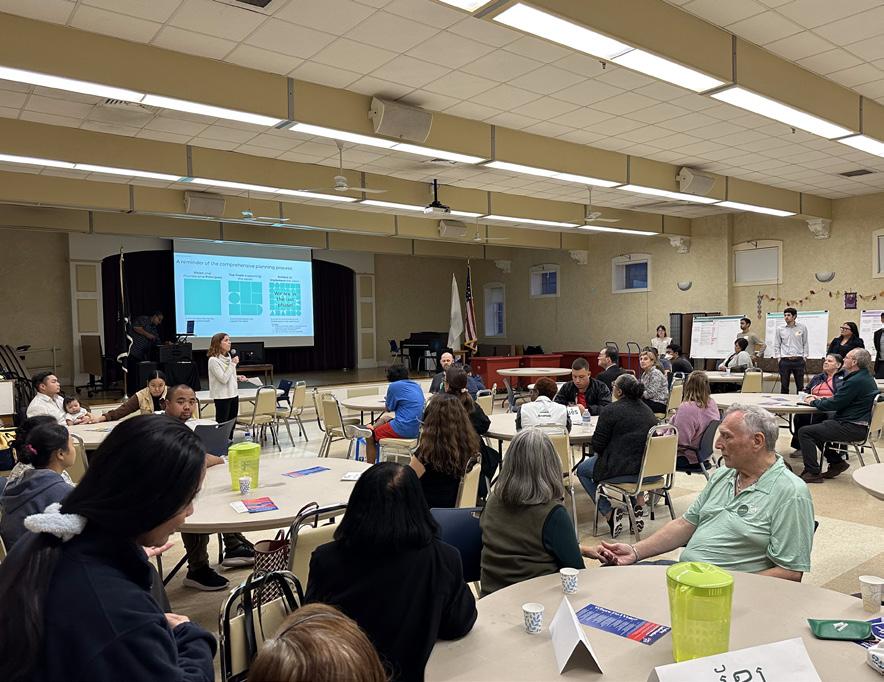
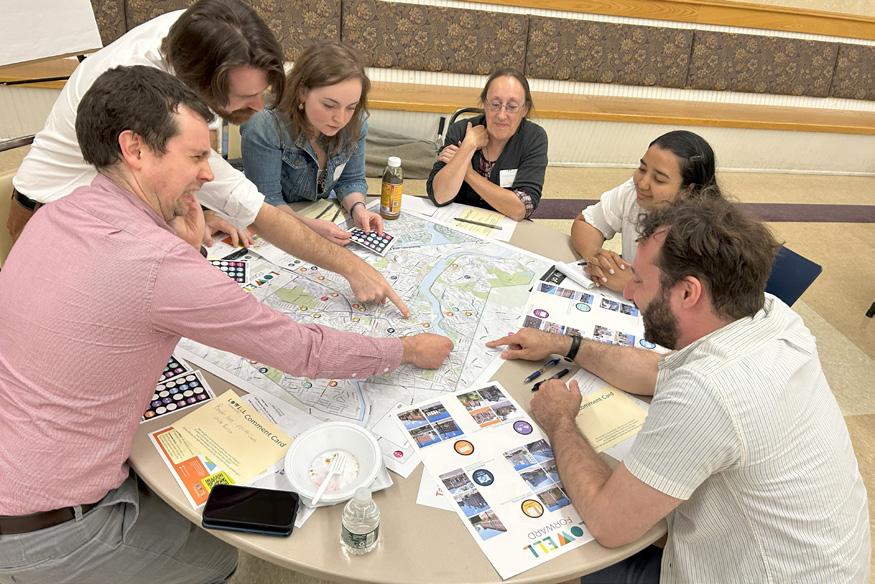
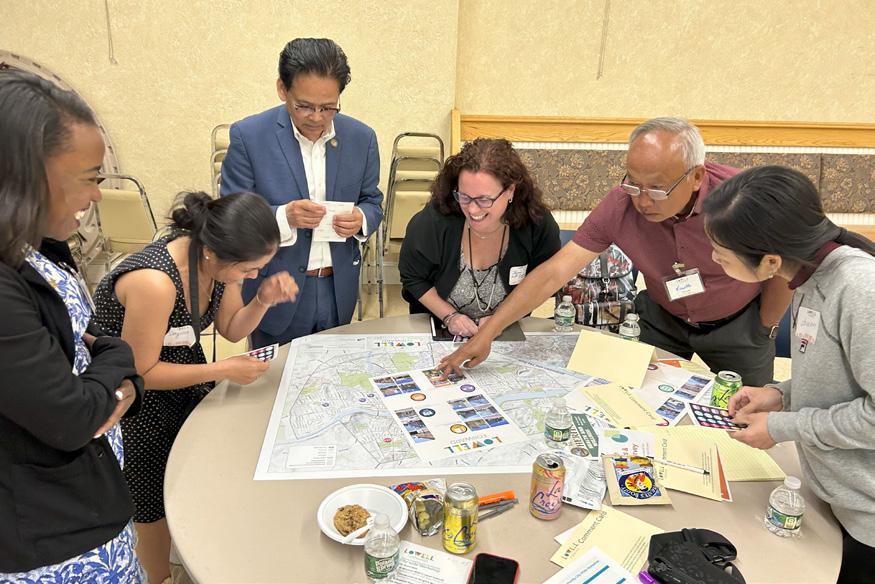
Over the past year, six steering committee meetings helped to guide the overall direction of the plan, shape our public outreach strategy, and refine content. The engagement process also included four public workshops attended by hundreds of community members, three surveys, and many focus group conversations as part of a citywide listening tour led by our community organizer and the staff of the Department of Planning and Development.
During these community conversations, we heard all the things you love about Lowell—its cultural diversity, incredible world-class cuisine, and tightly-knit neighborhoods. We also heard your calls for safe, reliable transportation, housing affordability and access, climate resiliency, public infrastructure maintenance and beautification, and downtown improvements. These priorities, your priorities, shaped Lowell Forward’s vision and resulted in the plan’s six main topic areas: housing, mobility, energy climate and environment, open and public space, economic development, and arts and culture.
Lowell Forward will serve as the City’s blueprint helping my administration inform our budgeting and capital planning, guide the work of City departments across all levels, and result in City plans and policies to assist us in achieving the goals set forward in this plan. The robust implementation plan will serve as an actionable, practical guide outlining the actions the City and its community partners can take to realize the vision crafted by the community through Lowell Forward.
Lowell Forward truly would not have been possible without the contributions of so many Lowellians. I am deeply grateful for your time, commitment, and love for the City of Lowell. My administration looks forward to working closely with the City Council to implement this plan and continue to make Lowell a place we are all proud to call home.
Sincerely,
Thomas A. Golden Jr. City Manager
• Mayor Daniel Rourke, District 1
• Vice Mayor Paul Ratha Yem, District 7
• Sokhary Chau, District 6
• John Descoteaux, District 8
• Thomas Linnehan, Chairman
• Gerard Frechette, Vice Chair
City Manager’s Office
• Thomas A. Golden, Jr., City Manager
• Shawn Machado, Assistant City Manager
• Conor Baldwin
• Austin T. Ball
• Doreen Burgess
• Melissa Desroches
Assessing Department
• Ellen Brideau, Chief Assessor
Cultural Affairs and Special Events
• Peter Crewe, Director
• Diandra Silk, Communications & Marketing
Health and Human Services
• Lisa Golden, Director
• Kim Gagnon, Senior Center
Utile: Urban Design and Planning, Community Engagement
• Matthew Littell
• Andrea Baena
• Taskina Tareen
• Rahi Patel
• Avery Robertson
• Kevin Chong
• Alessandro Ricciardi
• Kyle Jonasen
• Erik Gitschier, At Large
• Wayne Jenness, District 4
• John J. Leahy, District 3
• Rita Mercier, At Large
• Vesna Nuon, At Large
• Corey Robinson, District 2
• Kimberly Scott, District 5
• Sinead Gallivan, Second Vice Chair
• Richard Lockhart, Member
• Caleb Cheng, Member
• Allison Dolan-Wilson, Member
Department of Planning and Development
• Yovani Baez-Rose, DPD Director/ Assistant City Manager
• Camilo Espitia, Deputy Director
• Francesca Cigliano, Project Manager
• Sarah Brown
• Allison Carter
• Everlidis Desmond
• Maria Dickinson
• Philip Ferreira
• Kimberly Hayes-Hackett
• Catherine Kennedy
• Jorge Martinez
• Susan Murphy
• Elizabeth Oltman
• Dylan Ricker
• Sandra Swaile
• Stephen Stowell
• Jessica Wilson
Department of Public Works
• Paul St. Cyr, DPW Commissioner/ Assistant City Manager
• Ting Chang, Engineering
• Joseph Cady, Engineering
• Shannon Cohan, Parks
• Aaron Fox, Wastewater
• Katherine Moses, Sustainability
• Michael Stuer, Wastewater
Management Information Systems
• Miran Fernandez, Chief Information Officer
• Joseph Donovan
Police Department
• Greg Hudon, Superintendent of Police
• Mark LeBlanc, Deputy Superintendent
• William Florence
• Christopher Panagiotakos
• John Sheehan
Community Organizer
• Mercy Anampiu
HR&A: Economic Development
• Claire Summers, Harman Dhodi
Nelson\Nygaard: Transportation and Mobility
• Alyson Fletcher
Brown, Richardson + Rowe: Open Space and Parks
• David Andrews, John Latham
Tetra Tech: Infrastructure and Civil
• Jason Hellendrung
The Lowell Forward Steering Committee comprises individuals deeply connected to the Lowell community, with extensive experience working with and advocating for Lowell neighborhoods. Each member represents a diverse set of voices across the city. The Steering Committee collaborated closely with the planning team to oversee and offer direction regarding the plan’s content, while also broadening community outreach throughout the Lowell Forward process.
• Adam Baacke, Assistant Vice Chancellor of Campus Development at UMass Lowell
• Bopha S. Boutselis, Resident & Educator at Lowell Public Schools
• Joseph Boyle, Resident & Project Manager at Coalition for a Better Acre
• Leslie Briones, Resident
• Allison Chambers, VP of Finance and CFO at Middlesex Community College
• Yun-Ju Choi, Resident & Executive Director of Coalition for a Better Acre
• George DeLuca, Resident
• Melissa Desroches, Resident & Educator at Lowell Public Schools
• Jackie Doherty, Resident & School Committee Member
• Perry Downs, Resident & Conservation Commission Member
• Maxine Farkas, Resident
• Neyder Fernandez, Student Body President at UMass Lowell
• Gerard Frechette, Resident & Planning Board Member
• Suzanne Frechette, Resident & Development Director of Habitat for Humanity of Greater Lowell
• Levenia Furusa, Resident
• Valerie Galvao, Resident
• Ron Gentle, Resident
• Ryan Gilday, Resident
• Amada Gregory, Resident
• John Hamblet, Resident
• Christopher Hayes, Resident & Housing and Economic Development Planner and Northern Middlesex Council of Governments
• Austin Hill, Resident
• Cormac Hondros-McCarthy, Resident & Lowell Sustainability Council Member
• Vaughn Horn, Resident
• Carl Howell, Chief Operating Officer at Community Teamwork, Inc.
• Dean Jenkins, Local Developer
• Kerry Jenness, Resident, Lowell Historic Board Member, & First Assistant City Solicitor at City of Lowell
• Wayne Jenness, Resident & City Council Member
• Belinda Juran, Resident
• Felice Kincannon, Resident
• Lauran Lamarre Anderson, Resident & Business Owner of Lala Books
• Allison Lamey, Resident & Executive Director of the Lowell Plan/Lowell Development and Financial Corporation
• Matt Lucas, Resident
• Dennis McCarthy, Resident & Zoning Board of Appeals Member
• Rita Mercier, Resident & City Council Member
• Dennis Mercier, Resident & Chair of the Pawtucketville Citizen Council
• Vivan Merrill, Small Business Owner of E&V Merrill Insurance Group
• Steven Thurston Oliver, Resident & Professor at Salem State University
• Tania Ormonde, Resident
• Luciano Paskevicius, Resident
• Sanary Phen, Resident & Program Coordinator at Coalition for a Better Acre
• Michelle Rivera, Resident
• Juan Carlos Rivera, Director of Operations at Boys and Girls Club of Greater Lowell
• Narin Sinuon, Resident
• Craig Thomas, Director of Sustainability, UMass Lowell
• Beth Tripathi, Resident
• Bobby Tugbiyele, Resident & CEO of The Leap Network, LLC
• David Turcotte, Resident & Research Professor at UMass Lowell
• Mona Tyree Harris, Resident
• Enrique Vargas, Resident & Associate Director at Mill City Grows
• Louisa Varnum, Resident & Conservation Commission Member
• Mary Wambui-Ekop, Resident
• Barbara Warren, Division Director of Housing and Homeless Services at Community Teamwork, Inc.
• Ethan Yang, Resident
Lowell Forward is our city’s comprehensive plan for the future. It captures a 20-year vision and roadmap for supporting growth and investment in our Downtown, neighborhoods, communities, open and natural spaces, and infrastructural networks. This plan is a collective endeavor driven by the vision and dedication of our community leaders and citizens, and reflects a great deal of effort from countless individuals, all determined to propel their city into the future.
The Lowell Forward team engaged the community in inclusive dialogue to identify shared community priorities and establish a vision for Lowell’s future. Community engagement was built into every step of the process, with substantial investments of time and resources, including a fulltime community organizer, a series of city-led focus groups, three citywide public workshops, two citywide surveys, and social media outreach.
Intended audience for this chapter: all community members
Looking forward, we envision Lowell as a city that: page 41 page 42
Equitably connects our communities to the housing and resources needed to live a fulfilling life
Conveniently transports us to where we need to go whether by car, transit, walking, biking, or rolling
Embraces, celebrates, and elevates our diversity and unique heritage
Takes care of our public spaces, natural resources, and each other
Cultivates educational and economic opportunity for everyone to thrive
Prepares for and responds to the impacts of climate change
Intended audience for this chapter: action takers
1. Comprehensive zoning review
2. Downtown growth
3. Growth in neighborhood activity centers and partnerships with institutional anchors
4. Redevelop underutilized industrial or heavy commercial areas
1. Safe, equitable and connected mobility network that accommodates all users including walkers, riders, drivers, bikers and rollers
2. Provide convenient access to, and navigation toward, transportation options
3. High-quality, reliable transit, and incentives for utilizing transit options
1. Achieve carbon neutrality by 2050
2. Building Resilience
3. Promote clean energy economy
4. Energy Equity: ensure that decarbonization goals do not result in a disproportionate increase in energy burdens for our most vulnerable residents
page 81 page 165
1. Leverage the arts and support creative placemaking in Lowell
2. Support Lowell’s economic vitality through arts, culture and creativity
1. Plan for equitable and accessible growth
2. Develop homes for all
3. Increase housing quality
4. Eliminate homelessness and reduce housing insecurity
5. Provide housing options for households that make low- and very low- incomes
6. Expand and create new opportunities for affordable homeownership
7. Ensure fair housing policies and practices
1. Downtown revitalization
2. Promote, support, and grow Lowell’s local businesses
3. Expand commercial and industrial opportunities and increase job opportunities for Lowell residents
1. Strengthen social resilience, equity, access, and maintenance to and of parks, open spaces and trails
2. Strengthen climate resilience and sustainability in parks, open spaces and trails
The Lowell Forward implementation framework identifies timeframes for goals and actions to aid action takers—like city departments, local organizations, anchor institutions, and the community—in the prioritization of tasks and next steps.
See next page for Strategies for Growth and Change
As Lowell evolves, it will encounter new opportunities and challenges that shape its growth and transformation. This plan provides a significant opportunity for the City and community to prioritize the specific enhancements we value for our neighborhoods and to determine the extent of change we are comfortable with. Chapter 3 outlines strategies aimed at guiding and shaping sustainable and equitable growth and development in Lowell. These strategies were created in collaboration with the community and informed by many conversations and feedback received throughout the Lowell Forward engagement process.
Intended audience for this chapter: action takers
1. Grow and Activate our Downtown
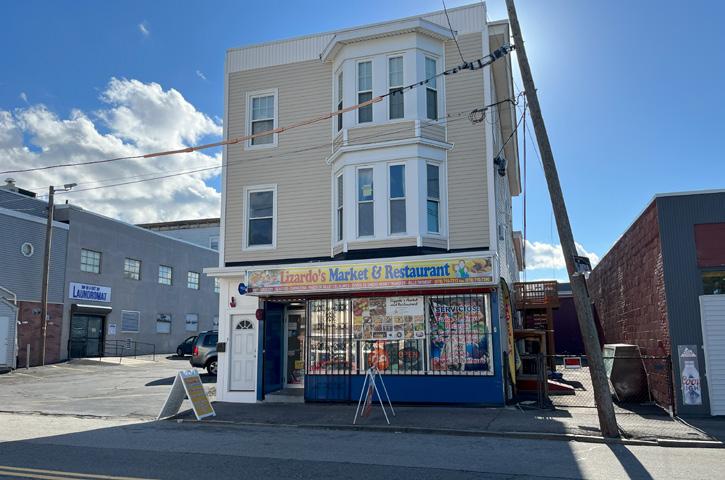
2. Build on our Unique Strengths: Neighborhood Centers and Institutional Anchors
3. Create Opportunity in Strategic Industrial Areas
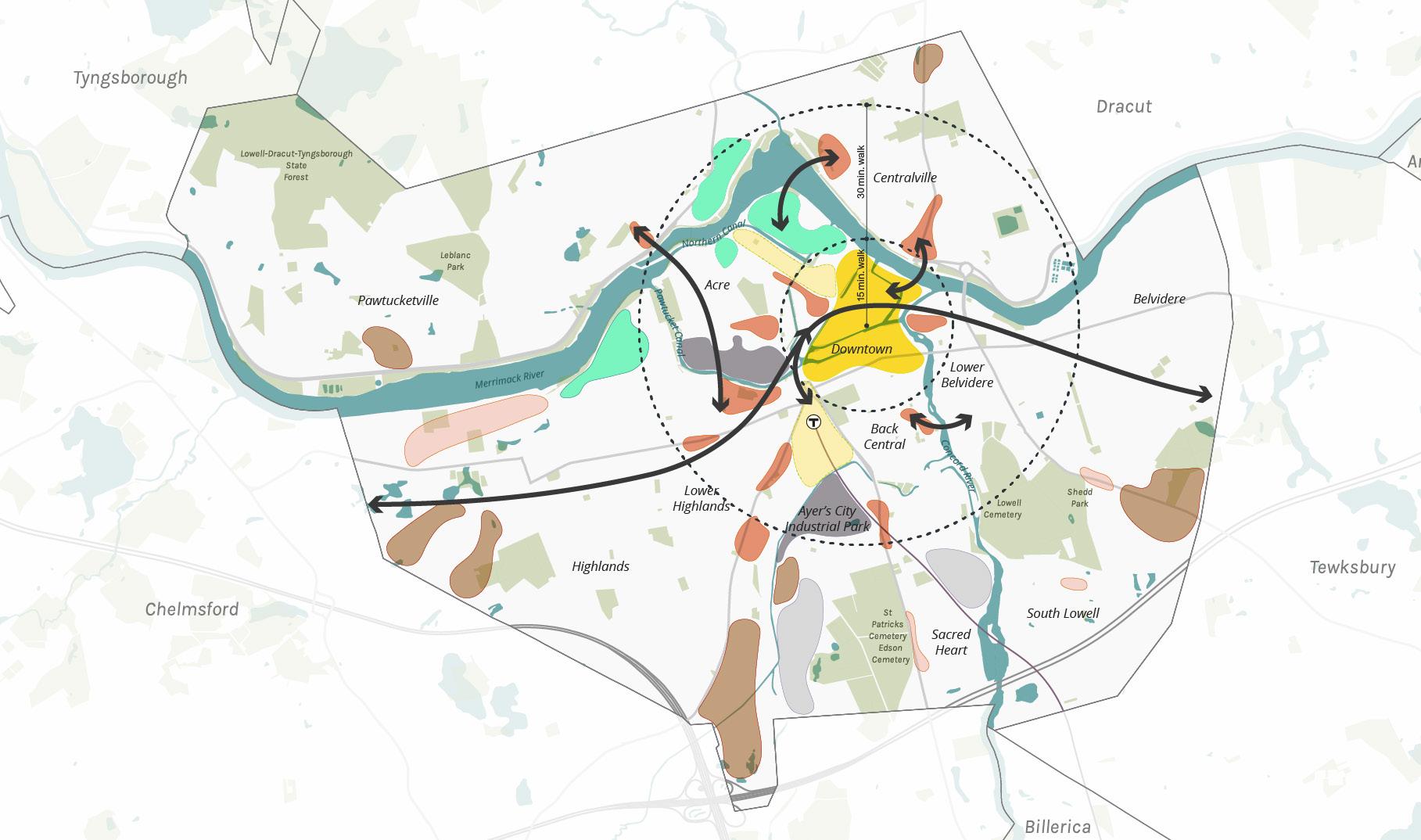
in Central Core (CC)
Neighborhood Centers inside CC
Neighborhood Centers outside CC
Educational Anchors
Industrial Areas inside CC
Industrial Areas outside CC
Improve Connections
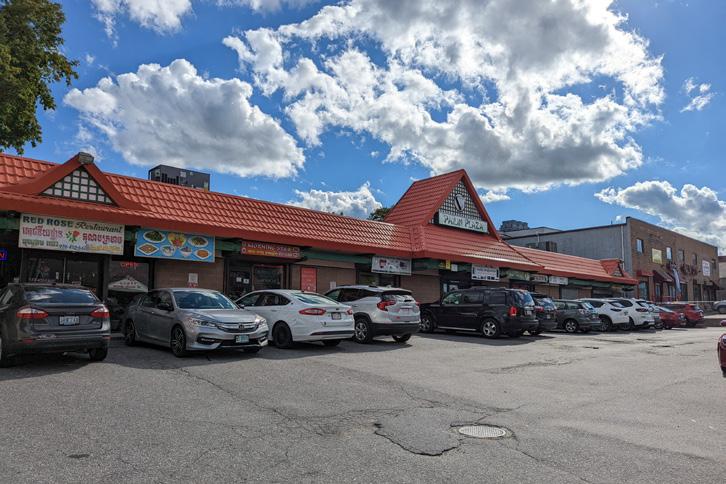
Suburban Shopping Centers
1.1: Densify, Activate, and Connect Downtown
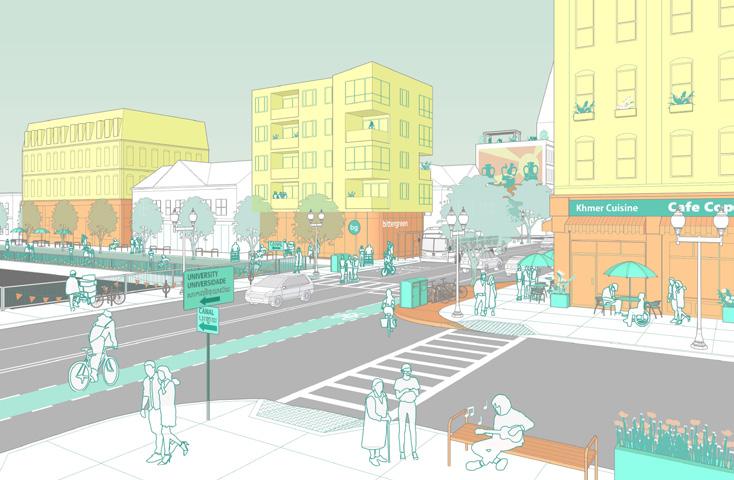
Support a vibrant, 24/7, mixed-use Downtown district that appeals to a broad range of users and bring several benefits to our larger community.
1.2: Activate the Riverfront and Canals 1.3: Fill Gaps in the Central Core
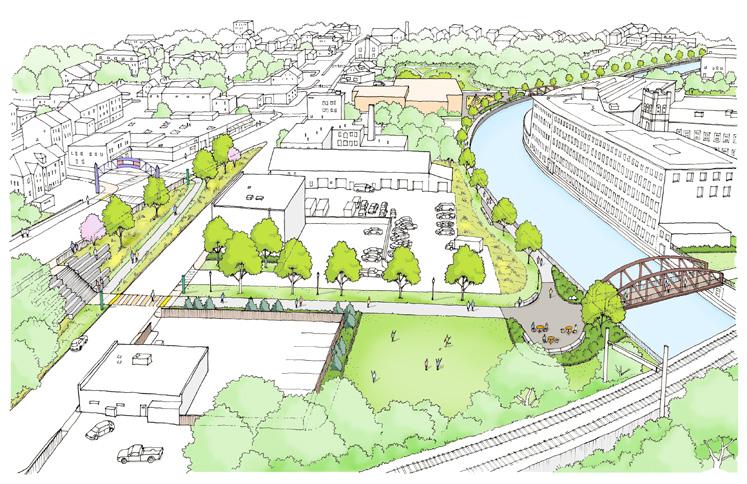
Maximize the potential of our canals and waterways to become a connector, an experience, and an identifier of Lowell.
2.1: Enhance Neighborhood Centers 2.2: Leverage Institutional Anchors
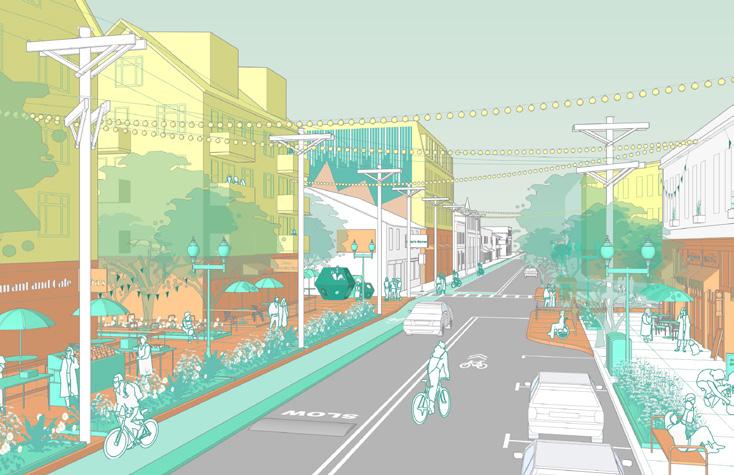
Promote contextually sensitive development that enhances neighborhood vitality, improves connectivity, and celebrates each neighborhood’s distinct identity.
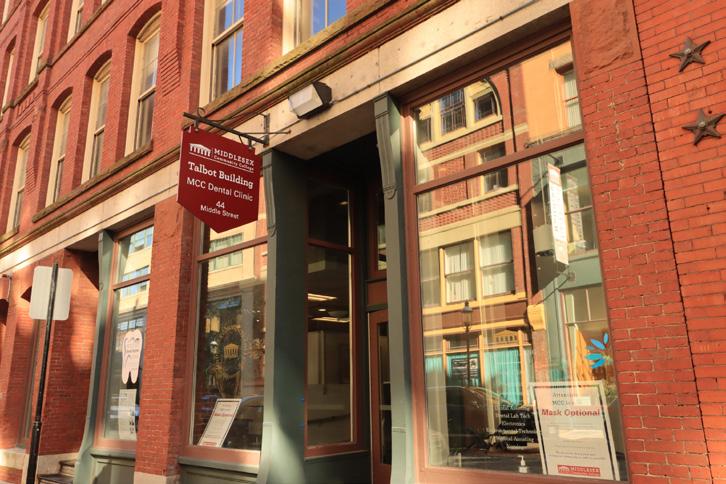
Create strategic partnerships with anchor institutions to support small businesses, provide jobs, and boost the city’s economy and built environment.
Photo Credit: City of Lowell.
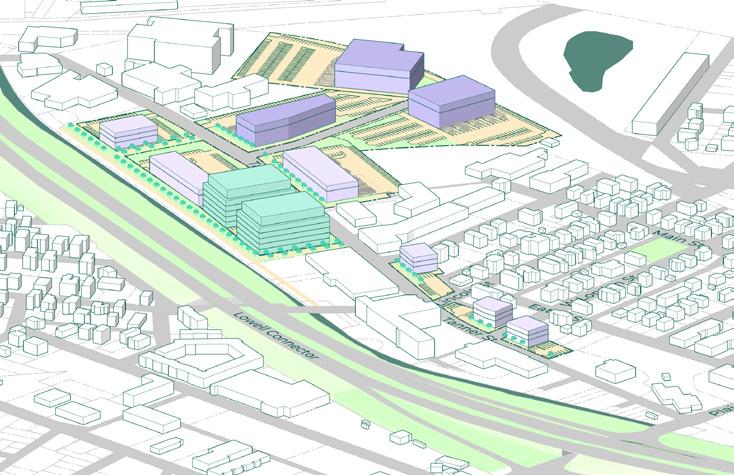
There are a number of opportunities to redevelop older industrial sites across Lowell for new economic development and job creation efforts. These include the Ayer’s City Industrial Park or Tanner Street Corridor and the area along Western Ave and Pawtucket Canal in Acre neighborhood.
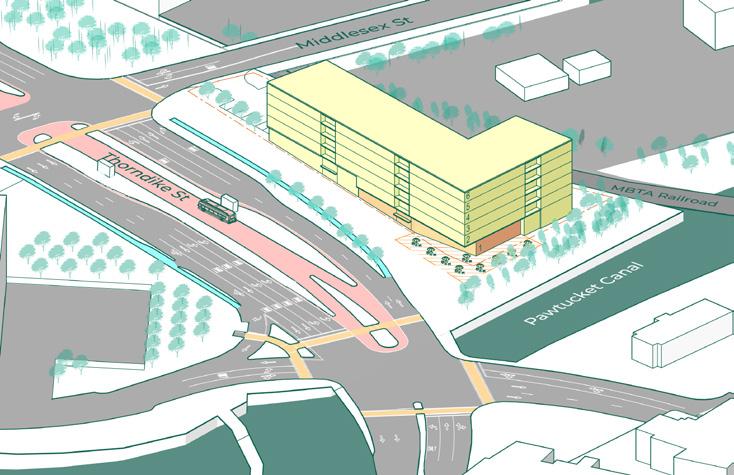
Increase residential density in and around Downtown and potential infill areas for compact, mixed-use, and walkable neighborhoods.
engagement consisted of three phases illustrated below:
Testing Future Visions Developing the Plan
SC = Steering Committee
S# = Survey Launch
Public Workshop 2:
Community Organizer: with more than 40 attendees and more than 178 written comments or sticky notes
Citywide Vision and Goals Survey 2:
more than 8 conversations or focus groups more than 366 responses
Steering Committee Meetings:
Public Workshop 3:
City-led focus groups:
7 topic-specific focus groups and 8 neighborhood specific focus groups
2 meetings
partnership with CHOP Dinner, 140+ participants, and more than 700 sticker reactions on boards.
Community Organizer:
10 conversations focused on topic-specific goals and actions including:
• The Merrimack Valley Housing Partnership
• Small Business Owners
• Project Learn
• Coalition for a Better Acre
Steering Committee Meetings:
• Lowell Litter Krewe
• Greater Lowell Community Foundation
• Lowell Public Schools
• Mill City Grows
• Greater Lowell Health Alliance
• Mary Wambui
• Mosaic Lowell
2 meetings
Equitably connects our communities to the housing and resources needed to live a fulfilling life
Conveniently transports us to where we need to go whether by car, transit, walking, biking, or rolling
Cultivates educational and economic opportunity for everyone to thrive
Embraces, celebrates, and elevates our diversity and unique heritage
Takes care of our public spaces, natural resources, and each other
Prepares for and responds to the impacts of climate change
Lowell Forward is our city’s comprehensive plan for the future. It captures a 20-year vision and roadmap for supporting growth and investment in our Downtown, neighborhoods, communities, open and natural spaces, and infrastructure. This plan is a collective endeavor driven by the vision and dedication of our community leaders and citizens, and reflects a great deal of effort from countless individuals, all determined to propel their city into the future.
Intended audience for this chapter: all community members
Many thanks to all the residents, community leaders, businesses, students, stakeholders, and passionate supporters of Lowell who contributed their input and feedback to shape this plan. Learn more about Lowell Forward community engagement on pages 41 – 53.
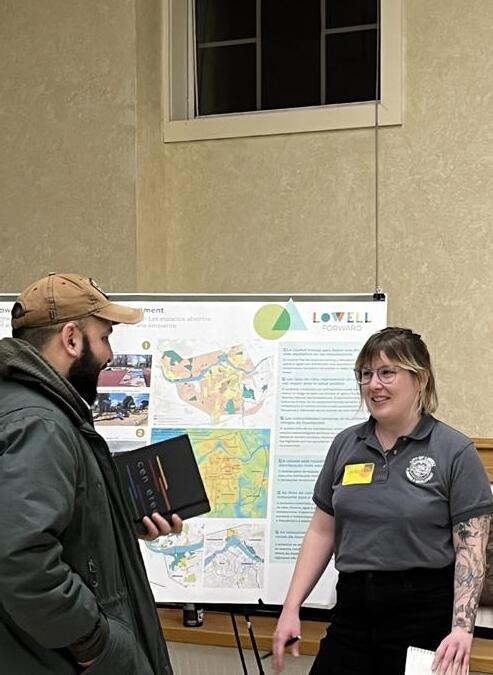
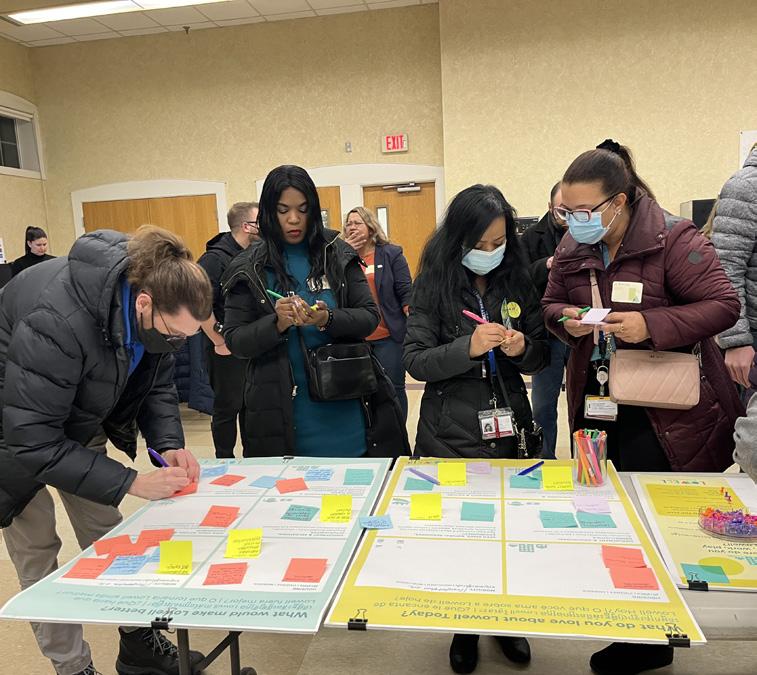
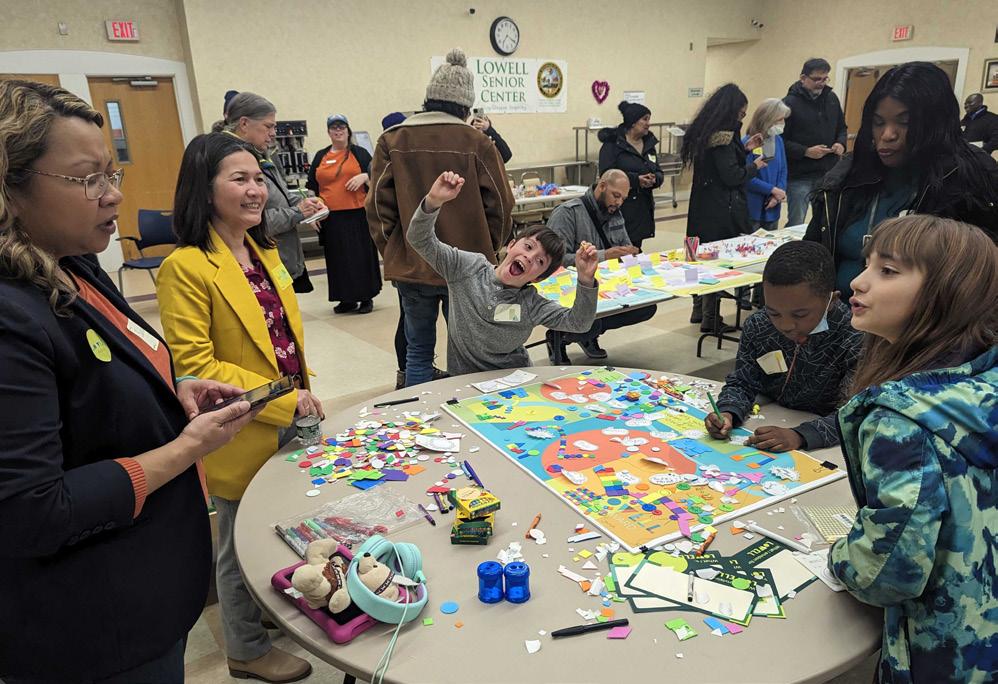
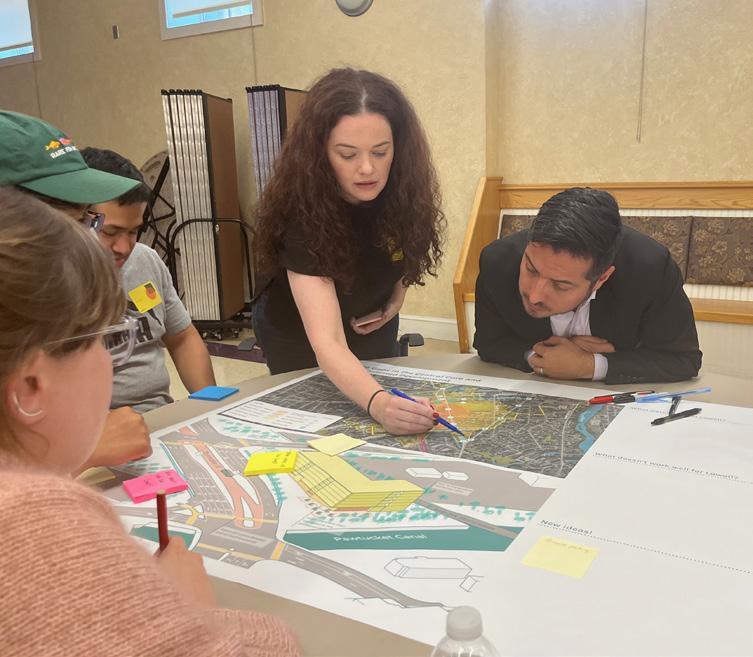
A shared vision for the city and our neighborhoods
Coordinated goals that support the vision
A guide for implementation and investments in the near future
Lowell forward understands the need to adapt and evolve as a city, embracing change as an opportunity rather than a challenge. It means adopting forward-thinking policies that will help create places for our communities that are not just functional, but also beautiful and inspiring.
Learn more about strategies for growth on page 55
Moving forward is not only about physical development but also about social and cultural enrichment of our city. It means continuing to celebrate Lowell’s unique diversity in fresh ways, and fostering creativity and innovation through education, entrepreneurship and job creation while preserving the traditions and aspects of Lowell that we love.
Learn more about what we heard from the community on page 41
Most importantly, planning for Lowell Forward does not mean starting from scratch. It means building off of a long legacy of proactive planning in our city. It involves taking stock of our past and current goals as a community, and affirming priorities for the future. It does not necessarily entail big change, but is about smart, and strategic growth that looks to improve, expand, and enhance our social, physical, and economic infrastructure.
Learn more about past and current planning efforts on page 24
Lowell, like many urban areas, faces the imperative task of tackling and addressing multifaceted challenges. We must ensure that housing remains affordable and accessible for all residents while fostering fair economic growth and job opportunities. We must address growing mobility concerns in the city, including the need for more convenient and efficient public transportation, managing traffic congestion, and maintaining and taking care of our existing public infrastructure. We must address long-standing social inequities throughout the city, breaking down various barriers that have inhibited equal opportunities for all residents to thrive and succeed. We must collectively do our part as a community to prepare for and respond to the effects of climate change.
Addressing these challenges won’t be swift or simple. It requires a concerted effort from local government, community organizations, businesses, and residents. A comprehensive plan like Lowell Forward serves as a unified blueprint, facilitating multiple stakeholders in actively pursuing community-centric goals. Beyond shaping a long-term vision, Lowell Forward incorporates specific goals and actions that will guide future policies and programs, land use and development decisions, and community investments over the next 10 to 20 years.

By considering Lowell’s urban ecosystem holistically—including housing, mobility, economic growth, energy, climate, environment, open spaces, and arts and culture—Lowell Forward provides tools and frameworks for future decision-making around growth and development. While there are numerous goals to achieve, Lowell Forward strives to prioritize implementation steps that generate simultaneous impacts across various aspects of city planning while fostering coordination among different departments and stakeholders.
Learn more about:
Important challenges facing Lowell today on page 26

Lowell Forward is a planning tool known as a comprehensive plan. Comprehensive plans are long-range, strategic plans that serve as roadmaps for guiding a community’s growth and development across various planning topics. They are essential tools for local governments and planners to make informed decisions that align with the long-term vision of the community. They also serve as a gateway for other communities to learn about who we are and what we envision for our city in the next 20 years.
Comprehensive plans are dynamic in nature! The process engages in community-wide discussion to achieve a more well rounded perspective on key policy decisions facing the city. The plan establishes clear roles and responsibilities for achieving community goals, and requires periodic review to facilitate feedback and continual learning, ensuring relevance and effectiveness overtime. Regularly monitoring, tracking, and sharing the progress towards the plan’s implementation is important to ensure accountability that local government is taking action.
As a comprehensive citywide plan, Lowell Forward builds on other citywide, topicspecific and area-specific plans by integrating their insights and goals into a unified framework. It aims to ensure continuity and alignment in addressing various topics, fostering better coordination between stakeholders and various city departments.
A suite of other citywide and area-specific planning initiatives advance and inform the vision, principles, and strategies outlined in this plan through detailed goals, actions and recommendations.
A wave of changes in the decade since the publication of Lowell’s previous comprehensive plan, Sustainable Lowell 2025, prompted our community to prioritize the creation of this updated plan, Lowell Forward. The name change reflects a shift in discourse away from static ideals of sustainability (sustaining or maintaining things as they are) toward more dynamic ambitions of moving forward to:
• Reassess and implement the relevant goals we set before
• Identify new goals and priorities that address the current challenges and opportunities within the community
Many of the goals and priorities identified in Sustainable Lowell 2025 have already been implemented, others have been rendered obsolete or are no longer priorities, and there are many others that are still relevant, that have been carried forward, expanded upon, and advanced in the Lowell Forward plan.
Certain goals in Lowell Forward are directly informed by recent plans such as the 2018 Open Space and Recreation Plan (OSRP) which is about to be updated, and the soon-to-be completed 2024 Housing Production Plan (HPP). The Lowell Forward team has been actively communicating and coordinating with various ongoing efforts, to ensure alignment with a shared long-term vision and framework for the city.
Throughout this document, we highlight and reference important connected citywide and area-specific planning efforts in sidebars called “Where to learn more.”
Below is a list of past and ongoing major citywide and area-planning efforts with year indicated. Note that this list is not exhaustive.
• Sustainable Lowell 2025 (2013)
• Housing Production Plan (ongoing)
• GoLowell Multimodal Complete Streets Plan (2021)
• Lowell Parking Study (2021)
• Lowell Regional Transit Authority Comprehensive Transit Plan Update (2021)
• Gallagher Terminal Transit-Oriented Development Study (2020)
• Urban Forestry Master Plan (ongoing)
• Open Space and Recreation Plan (2018, soon to be updated)
• Lowell’s Municipal Vulnerability Preparedness/Hazard Mitigation Plan (2020)
• Small-Scale Manufacturing & Place-Based Economic Development (2017)
• Ayer’s City Industrial Park Urban Revitalization & Development Plan (2013)
• Hamilton Canal District Master Plan (2008)
• Mosaic Lowell (2022)
• Downtown Lowell Rapid Recovery Plan (2021)
Within major topics concerning city planning and development in Lowell, key pieces of information stand out as important. These takeaways were shared with the community and aligned with the primary needs highlighted during engagement. These insights informed the goals and actions outlined in Lowell Forward, further refined through direct community discussions. The following pages provide summary highlights of these takeaways. For more in-depth information on Lowell’s existing conditions and trends in specific topics, refer to Chapter 4, pages 81 – 163, and the Lowell Today Interim Report.
Challenges and needs related to housing affordability, transportation safety and efficiency, and public infrastructure improvements were the main topics consistently brought up by the community throughout the Lowell Forward engagement process. The graph below summarizes community input during “Listening Tour 1”—a combination of responses from surveys, public workshops, individual and group meetings with our community organizer, and online comments received in the early stages of the planning process.
Listening Tour 1 Theme Summary
Transportation efficiency and safety
Affordable and diverse housing options
Public infrastructure maintenance
Downtown improvements
Address homelessness
Public realm/beautification
Frequent and reliable transit
Accountable and representative governance
Diverse and inclusive programming
Job creation and business attraction
and
and
Feedback from the community during Lowell Forward and the Housing Production Plan (HPP) emphasized the need for increasing affordability and housing diversity. This includes offering additional options for low and moderate-income households, creating housing for those without homes, and broadening the overall range of housing with diverse price points. The HPP’s research and analysis uncovered significant data and insights that the City must take into account when addressing housing challenges in Lowell.
At Least Moderately Cost Burdened
Severely Cost Burdened
Source: U.S. Census Bureau, ACS Five-year data 2006 – 2021,
40% of Lowell households are considered Housing Cost Burdened
• 20% of Lowell’s households pay more than half of their income on housing, and 40% are considered Housing Cost Burdened
• 37% of cost-burdened households are small families (4 people or less) and 30% are non-elder non-family households
• Housing Cost Burden and other housing issues disproportionately impacts households identifying as Black or African American, as a race other than White or Asian, and as Hispanic or Latino/a
Densify, make housing affordable by building more, keep Lowell a diverse home by making sure there’s enough homes for everybody.
Public Meeting 1 participant
Cost-Burdened Households by Type, Lowell, 2015 – 2019
Source: U.S. Department of Housing and Urban Development.
Housing cost burden is a common measure of whether a community has enough affordability. The United States Department of Housing and Urban Development (HUD) considers housing “affordable” if housing costs do not exceed 30% of a household’s gross annual income. When a household pays between 30% and 50% of its income on housing-related costs, HUD considers it “moderately housing cost burdened.” Households spending 50% or more of their income on housing are considered “severely housing cost burdened.”
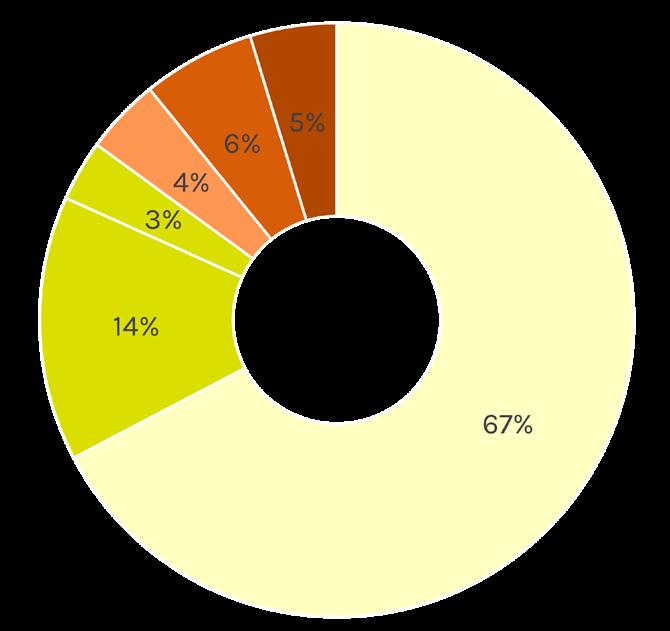
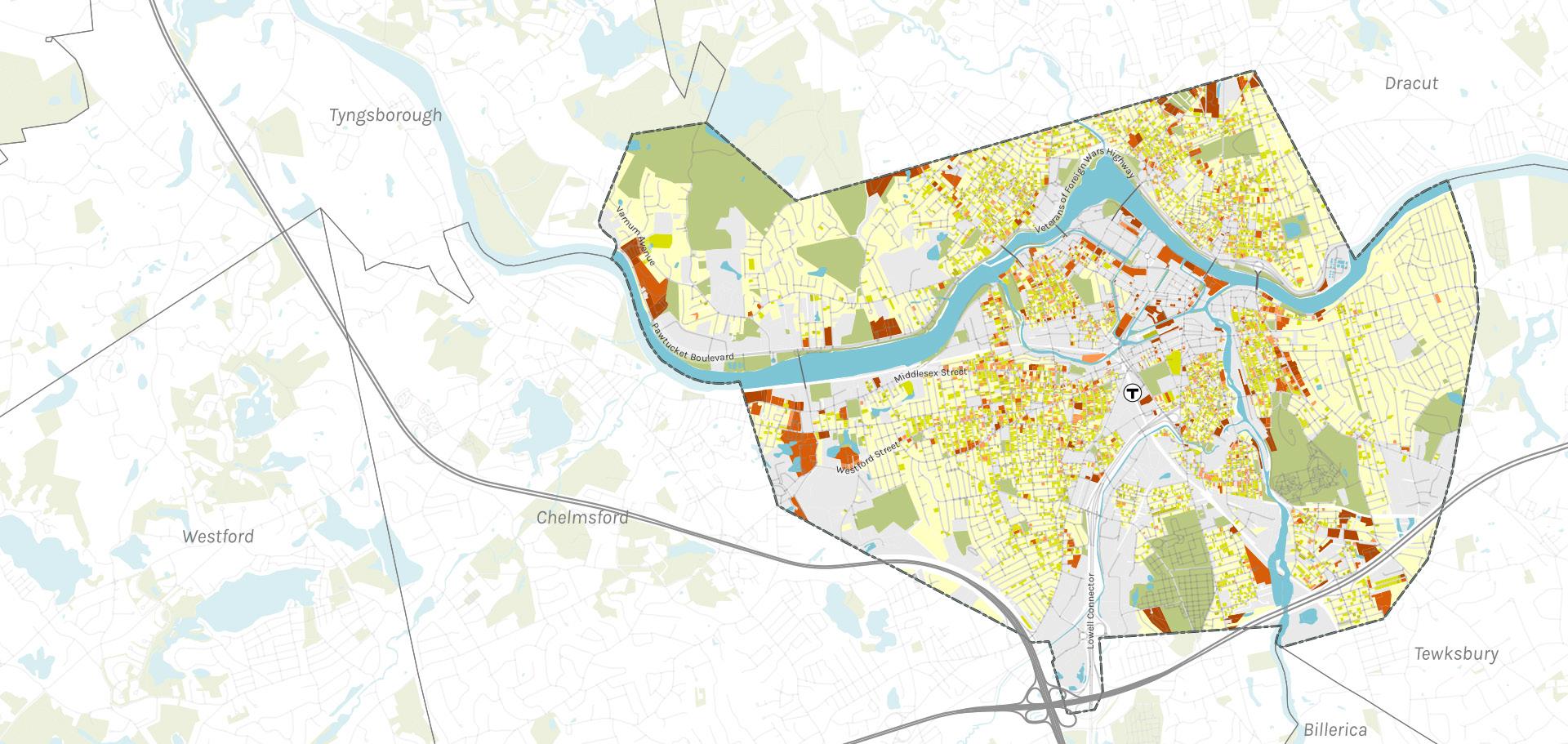
A majority of Lowell’s residential land—67%— contains single family housing, mainly in the city’s outer neighborhoods
Source: Metropolitan Area Planning Council data (MAPC), 2020.
There are not many options for alternatives to single family housing near neighborhood centers. Based on initial analysis of residential zoning conducted through the 2024 Housing Production Plan, the easiest type of residential development to build in Lowell by far is the single family house. Current zoning in Lowell favors single family housing development, as a third of the city is zoned Suburban Neighborhood Single Family, which only allows that type of development, and just over two thirds of land area allows single family homes by right.
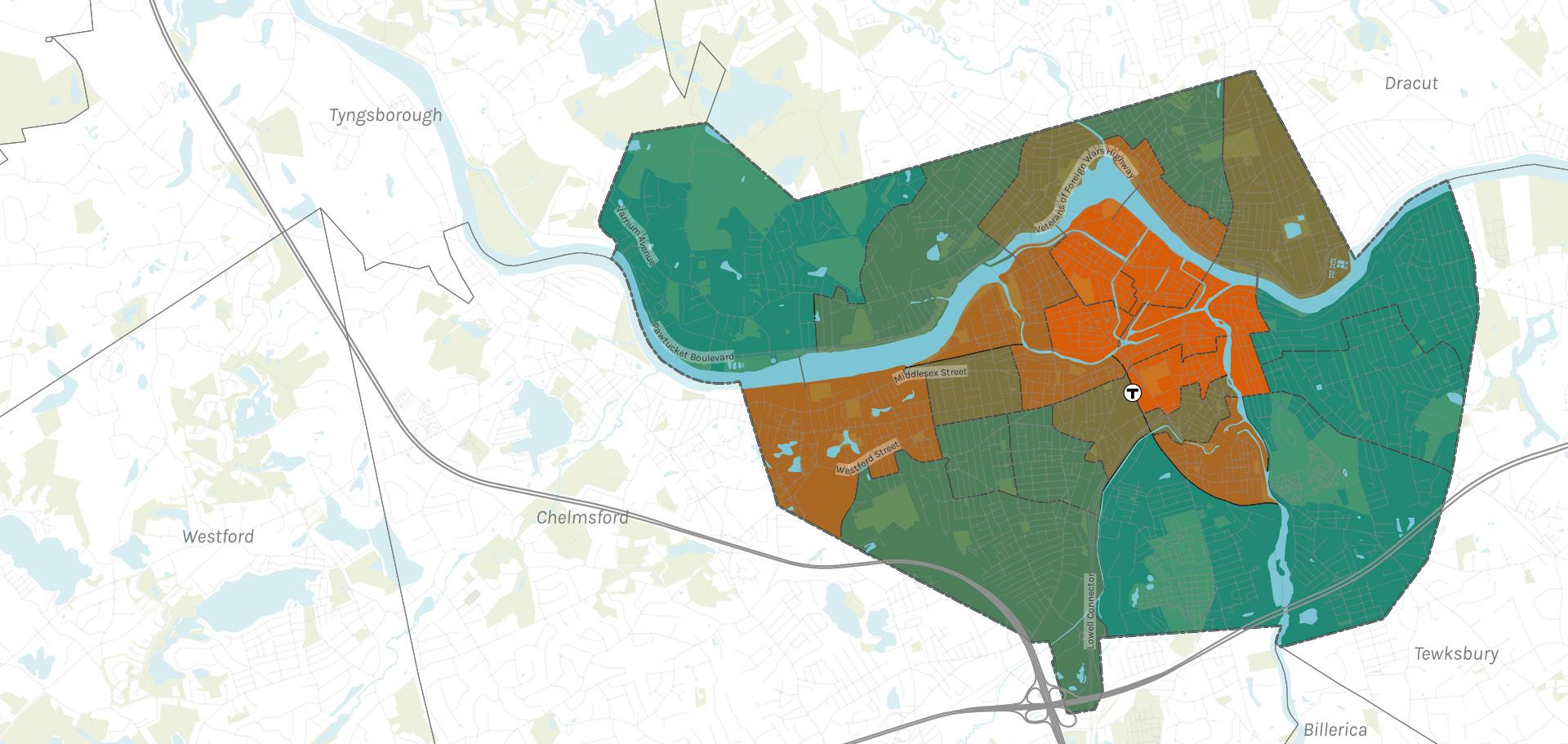
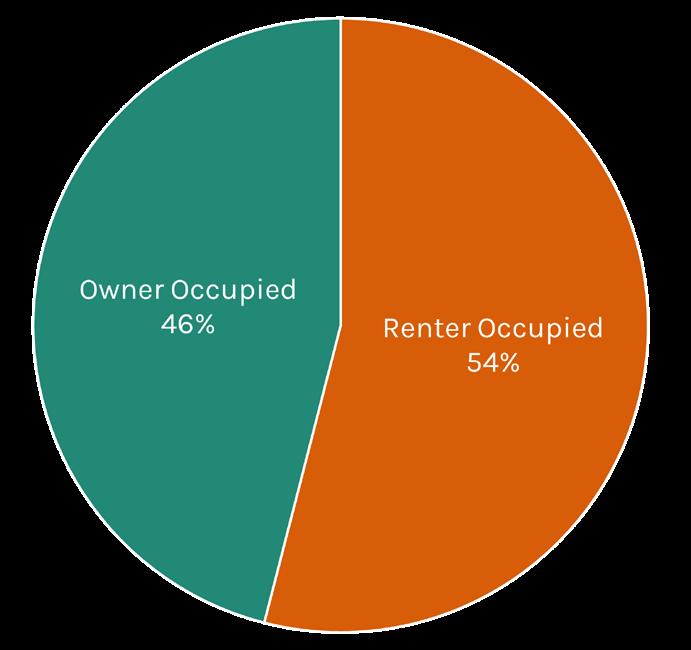
Source: American Community Survey (ACS) 2020, 5-Year Data.
Renters have less access to the southeastern and northwestern areas of Lowell, including Belvidere, South Lowell, Sacred Heart, and western Pawtucketville. Rental housing is most concentrated in Downtown, Back Central, and the Acre. These are areas where some of the oldest housing stock is located, where communities of color reside, and where some of the lowest household incomes are present.
Areas with fewer multifamily and rental opportunities have a higher proportion of White, non-Hispanic or Latino households. Historically, income disparities have blocked people of color from ownership opportunities and have reinforced segregated patterns.
Providing a distribution of tenure opportunities throughout a community is important. Rentals provide access to neighborhoods to lower-income households, while ownership units provide wealth-building opportunities and stability. Apartments, townhomes, or single family can all include ownership and rental opportunities.
Lowell is very diverse, but inequities create fair housing concerns. Lowell is segregated by race, and areas with lack of multifamily or affordable housing may perpetuate this segregation. Complying with fair housing law means more than avoiding intentional discrimination, such as determining whether zoning creates unintentional disparate impacts. Many zoning policies have been found to cause disparate impact, such as policies that only allow single family houses and require large lot sizes. These policies make the process of housing development extremely inflexible, and assume a one size fits all approach to addressing housing needs.
Post-pandemic, the count of unsheltered individuals has surged, alongside a continued rise in families seeking emergency shelter. The sparsity of basic data post2019—including consensus estimates on sheltered and unsheltered demographics, and insufficient insight into shelter capacity and available units for extremely low incomes—hinder the creation of effective short- and longterm plans to tackle homelessness and pose challenges in evaluating equity in approaches.
• The number of households at the highest income distribution is growing, but households at the lowest end is holding relatively steady despite median income growth
• Lowell has 7,350 households (17.4%) in poverty, concentrated among working-age households
• The number of households with heads 65+ years old has consistently grown for the last ten years, but more recently the number of young households has also grown
• The households with 2 or more adults and no children rose by nearly 3,000 from 20102020 and is projected to continue to grow
• Lowell needs deeply subsidized units to meet the needs of its population
• 2,502 units are needed by 2030 based on growth projections, particularly units affordable to lower incomes or filling an untapped mid-income market
• Population per housing unit figures indicates possible overcrowding and suggests that creation of housing units has not met pace with population growth
• Nearly a third of Lowell’s homes were built before 1900, and another third were built 1900-1940, with only 4% built after 2000
• In Lowell, 1,028 units may be considered overcrowded, up to 958 units lack kitchen or plumbing, and almost a third were built before 1900
Diverse transportation modes are vital for linking residents to employment, community amenities and recreational opportunities within and beyond their neighborhoods. Community feedback and existing conditions analysis revealed several needs for transportation improvements:
Lowell’s current transportation system prioritizes driving convenience. Low transit frequencies and longer transit travel times, as well as lagging investment in pedestrian and bicycle infrastructure, pose a disproportionate burden for the one in six Lowell households who do not own vehicles. Lowell’s current transit operates mainly on a hub-and-spoke model, requiring transfers between neighborhoods, with some routes having hourly bus schedules, further discouraging and limiting non-car use.
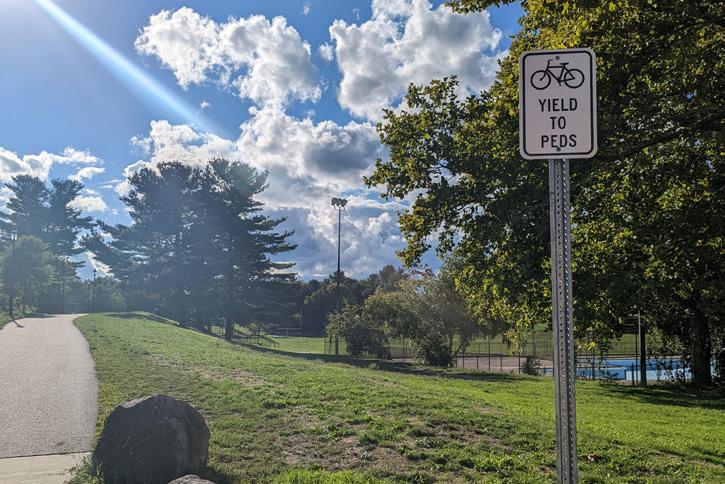
Lowell has many recreational trails and greenways, but does not have a complete network of connective biking facilities designed for the comfort of people of all ages and abilities. Lowell’s streets, like those of many other American cities, have been built to prioritize the movement of vehicles over the safety of road users. Those who walk and roll—pedestrians, cyclists, and mobility aid users—are more vulnerable to serious injury and death than motorists in the event of a crash. Learn more about transportation and mobility existing conditions in Lowell on pages 113 – 117.
Not enough routes throughout the day and the transit system is hard for residents to understand
Hub-and-spoke models center transportation operations around a main hub, such as the Gallagher Terminal bus station, with multiple routes branching out like spokes. This setup, while efficient due to centralized operations and economies of scale, leads to longer travel times, often involving layovers and transfers and limited direct connectivity between destinations.
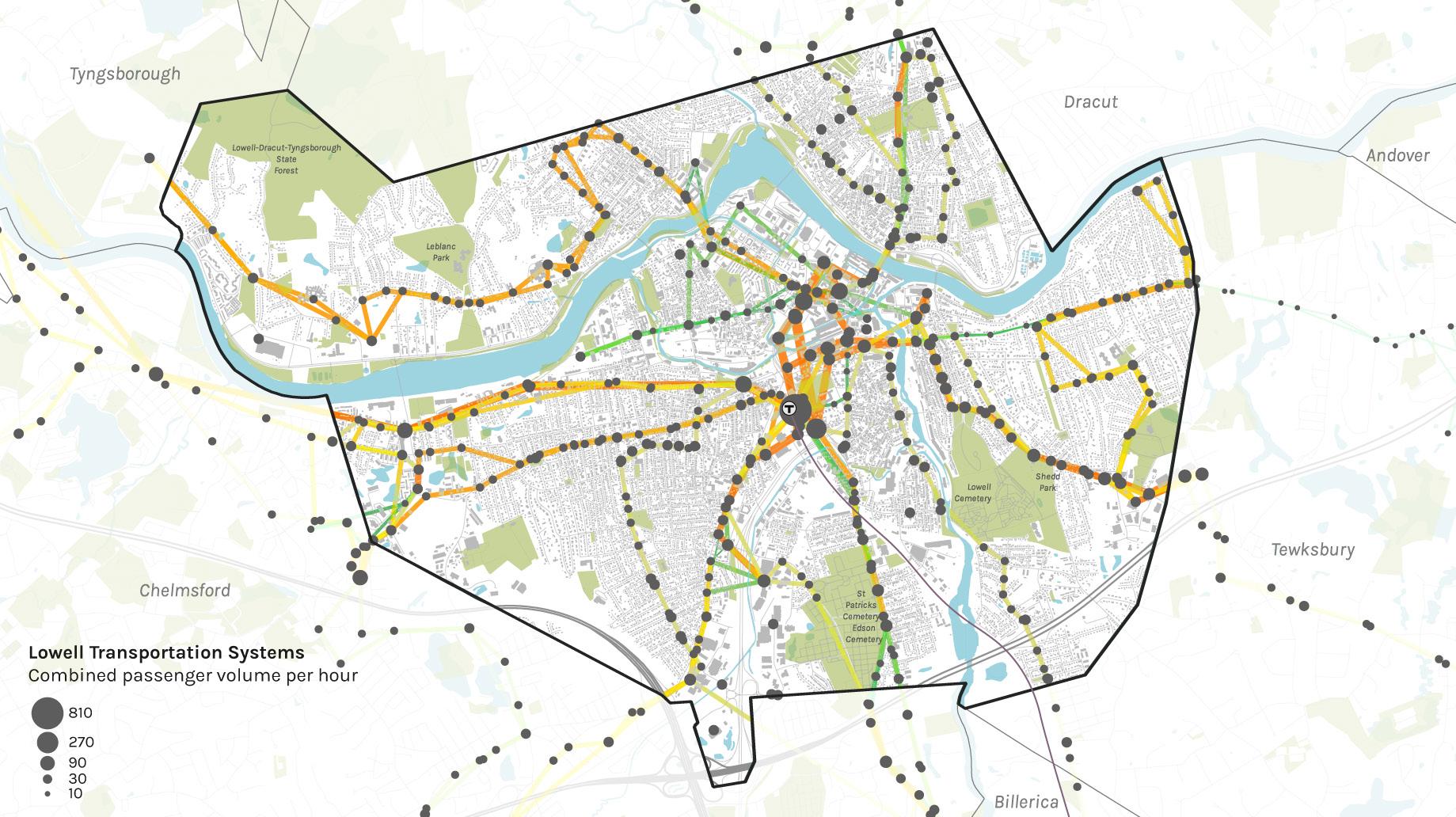
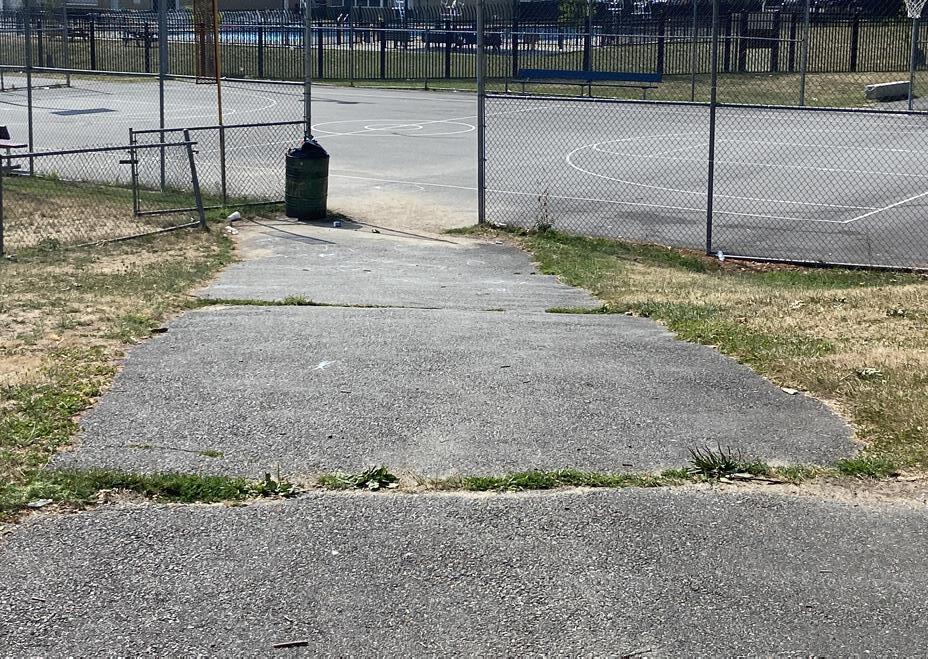
The need for better public infrastructure including sidewalks, park amenities, and general public realm improvements in Downtown and neighborhood centers, was frequently brought up by the community. Rather than simply building new infrastructure, many residents and business owners emphasized the need to enhance and maintain existing infrastructure in Lowell.
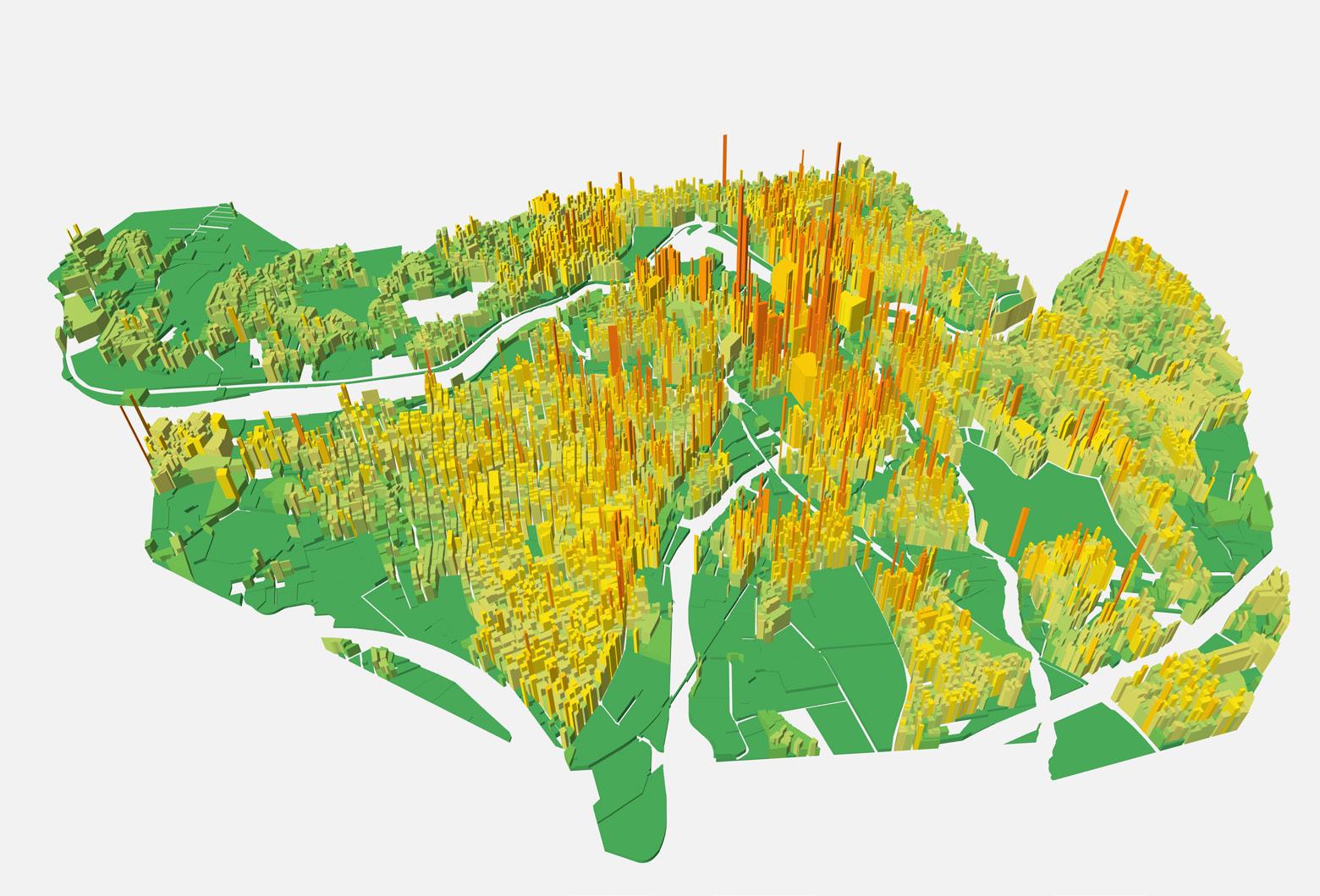
One of the key tools Lowell has to grow its revenues to pay for new infrastructure and maintenance services is to add new growth to the tax base. The majority of Lowell’s tax revenue comes from its property tax base. Investments in development, infrastructure, and amenities can support property values, and in turn, generate greater resources for public services. See map below.
May Lowellians expressed a desire to see more public realm beautifcation including vibrant sidewalks, active and walkable streets, and trees and landscaping. Alongside growing the City’s budget to fund these services, Lowell can explore ways to catalyze private development and public investment to maximize multiple opportunities and benefits through developer incentives and setting appropriate development design standards.
Slow down traffic on through streets, make sidewalks connect with minimal obstruction by cars, and improve snow banks and utilities.
Public Meeting 1 participant
Various property types exert different influences on the tax base. The map displays each parcel’s value in Lowell divided by its acreage. Darker orange and taller parcels signify higher assessed value per acre. Bright green zones contribute less value and may have minimal development. Development in Lowell’s Downtown and central neighborhoods yields greater value per acre. However, certain green areas within the central core present potential for improved utilization in future development. Enhancing these pockets could aid in neighborhood connectivity, density concentration, and increased activity.
Lowell has many inherent strengths and assets that can serve as foundations for guiding and fostering growth
The community identified various strengths and assets in Lowell that they love and would like to see enhanced and maintained. These present important opportunities to guide and support the city’s growth while addressing challenges related to housing affordability, transportation, and infrastructure.
diverse city
Lowell is growing, outpacing growth seen in most other gateway cities in Massachusetts. From 2000 to 2020, its population grew by almost 6%, from 105,000 to 115,000 residents. This growth in Lowell is accompanied by increasing diversity in both race and language. Non-Hispanic white residents have decreased from 77% in 1990 to 41% presently. Embracing and honoring Lowell’s diverse heritage and backgrounds is a central objective that threads through every aspect of this plan. Furthermore, the recent shift to a neighborhoodbased City Council representation system formalizes the roles of each neighborhood within city governance. This shift emphasizes a heightened focus on equitably distributing open spaces and other resources among neighborhoods.
Lowell’s anchor institutions including universities and hospitals, and minority-owned businesses provide a strong basis to empower jobs, education, innovation, and overall economic growth. However, Lowell’s small businesses face many ongoing challenges including low foot traffic with limited and irregular business hours, lack of experience, knowledge and support to run a business, language barriers, and safety and security concerns Partnering with anchor institutions to support small businesses can boost the city’s economy while creating new jobs and adding a rich character to Lowell businesses.
250+
1,200+ Small Businesses of all businesses in Lowell
~10%
Total Employees comprising with
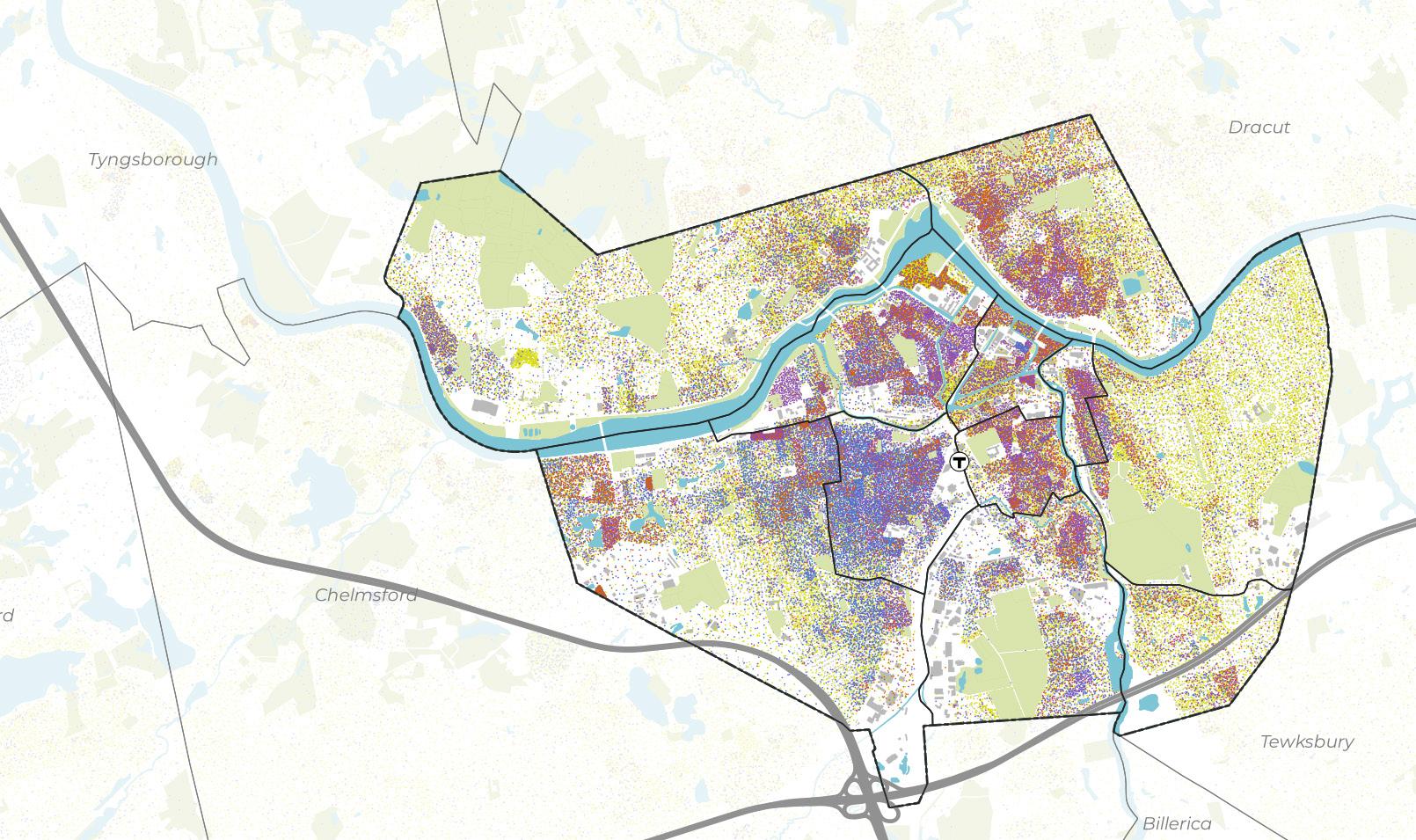
Lowell has a rich diversity and multitude of cultural backgrounds. However there exists significant inequalities in housing, economic opportunities, and access to mobility that disproportionately impact people of color residing in central neighborhoods or near downtown areas. Planning for equitable growth is a central goal of the Lowell Forward Plan.
Racial/Ethnic distribution
Black/African-American
Hispanic or Latino (of any race)
Asian
Other
White (Non-Hispanic or Latino)
Lowell’s unique natural and manmade assets such as the Merrimack River, the Concord River, and the canals and trail networks anchor the city’s open space to its culture and history. However critical gaps still exist in community access and connections, availability of recreational amenities, and quality of maintenance across open space assets. Because city-owned public parks and open spaces are already located throughout the city, the focus on improvements in open spaces in Lowell should relate to the programming offered in each space and the implementation of an appropriate maintenance program.
Lowell is a city that takes great pride in celebrating its history, historic landscapes, diverse communities and neighborhoods, cultural resources, and arts. Promoting Lowell as a regional hub for history, culture, and arts is an important goal outlined in the previous master plan, Sustainable Lowell 2025, and continues to be a priority for Lowellians across the city. The City’s Office of Cultural Affairs & Special Events (CASE), non-profit organizations, such as the Lowell Plan and Greater Lowell Community Foundation, have placed a growing value on promoting and supporting arts and culture throughout the city through initiatives such as the Like Lowell campaign and Mosaic Lowell.
Lowell Forward is all about getting things done! Chapters 4 and 5 present specific goals and actions related to each planning topic area and outline a clear implementation framework. The chapters are designed with the “action-takers” in mind—such as City departments, policymakers, elected representatives, community leaders and organizations, and state and federal partners—these chapters serve as guiding documents, fostering collaboration toward shared long-term objectives. They also function as an assessment tool, tracking advancements and evaluating progress toward community-centered goals.
Creating an implementation framework that sets clear goals and proposes ways of measuring success is important because it allows Lowell to:
• Know Where We’re Going: Set achievable goals that align with the shared vision that was developed with the community
• Focus on What Matters: Prioritizing goals will help figure out what to work on first, and stay on the long-term path
• Use Resources Wisely: City budgets are limited, and goal prioritization will help decide where to spend money and time on projects that matter most
• See How We’re Doing and Adapt: A flexible framework that includes attainable metrics or benchmarks to track progress, but also adapt and make changes if needed
• Gain Support and Keep People Informed: People and organizations are more likely to help if they can see clear goals and results; being clear about goals and progress helps the public understand what’s happening and builds trust
To assess whether we are moving towards achieving our goals, we need to create an evolving system that allows us to track our progress and make data-driven decisions. Page 39 outlines a set of indicators or key metrics the planning team have established to help us track progress towards our goals.
The City should ensure that community participation remains accessible for actions and implementation steps that follow this plan. The City should have a method of regularly checking in with the community through a Comprehensive Plan Implementation Committee and issue an annual update of implementation tracking.
Lowell Forward has worked very closely with our local community organizer to identify local organizations and nonprofits, and other local and regional entities who can play a role in the plan implementation. This is a starting base for a network of partnerships that will continue to evolve and grow during the implementation process, through a focused outreach strategy.
The City will carry this plan forward through zoning and development regulations, directing investments, creating new programs and systems, and conducting new plans or studies where necessary. Land use policy in particular is one of the most important and impactful mechanisms for shaping sustainable and equitable growth by directing where, when, and how land gets used in the city. Many of the actions across all topic areas in this plan informs future land use policy directly and ties different functions of the city together. For example, advocating for more multifamily housing near transit means that more people have convenient access to services and other transportation modes in the city. While an important tool in comprehensive planning, land use code and zoning practices should be thoughtfully coordinated with other citywide initiatives, policies, and capital investments, and they should be adaptive to change.
Envision Cambridge Dashboard, Cambridge, MA
The Envision Cambridge Dashboard serves as an ongoing and interactive progress report, detailing the status of actions and indicators outlined in the City of Cambridge Comprehensive Plan, Envision Cambridge. Offering insights into the progress made since the plan’s release in 2019, this dashboard provides a transparent overview of accomplishments within a few short years. It not only showcases the City’s achievements but also highlights areas requiring improvement, enabling City departments and staff to identify specific areas for enhancement and make necessary course corrections. City staff continually update the reporting for these indicators (organized by topic area) and residents and the communityat-large are encouraged to explore the interactive tool, accessible at cambridgema.gov/Envision.
The Arlington Redevelopment Board established the Master Plan Implementation Committee (MPIC) to implement the recommendations outlined in the 2015 Arlington Master Plan, “Your Town Your Future.” Collaborating with various ongoing planning initiatives, the MPIC comprises leaders or subcommittees focused on specific topics such as housing, historic resources, and zoning. This key implementing committee convenes quarterly to assess the implementation table, which categorizes actions into in-progress, ongoing, annual reporting, to be assigned or reassessed, on hold indefinitely, and completed. The table details the lead entity, approximate timeline, Town Meeting action necessity, and resource status.
Lowell Forward covers many topic areas with various goals. Monitoring the status of each and every goal on a regular basis would be a very time consuming task for city staff, and likley not the best use of available resources. Instead, the Lowell Forward team worked with city departments to identify key indicators, targets, or benchmarks for each topic area that we can use to track and assess progress towards meeting our goals over time.
While these indicators cannot fully capture what it means to achieve any specific goal, they serve as a marker for how well or not we’re progressing towards our overall vision laid out in this plan. More importantly over the long run, they will represent a transparent dashboard for the community that shows when things are getting done!
It is important to note that not all goals for the future can be measured by quantifiable metrics or need an assigned target to indicate success. The key here is to identify a set of high-level, specific benchmarks which relevant City departments can use to devise systems that track data and report out progress on a regular basis. The City will collect baseline data and track these indicators over time. Some City departments already have, or are in process of developing, tools to measure these indicators, while others will have to create new tools.
The City should also make sure that actions are leading towards more equitable outcomes. Additional indicators around housing affordability, risk of displacement for vulnerable populations, and equitable development should be tracked.
An initial set of indicators of progress to track are illustrated on the next page:
• Create 2,500 new housing units within the MBTA Community multifamily zoning overlay districts by 2040
• Increase production of new housing units in the upper stories of downtown buildings (goal of 800 new units by 2040)
• Increase downtown’s street tree inventory by 25% by 2040
• Increase the use of groundfloor commercial spaces with businesses that increase foot traffic.
• Increase number of locally-owned businesses
• Increase number of minority- and women-owned businesses
• Increase proportion of minorityand women-owned businesses participating in grants and consultation programs
• Obtain pedestrian traffic software; track pedestrian activity downtown and in all neighborhood nodes with goal of increasing by 50% by 2040
• Decrease the share of Lowellians who drive alone to work from 74% single occupancy to 60% of total trips by 2040
• Increase utilization of public parking garages to 85% by 2040
• Reduce serious/fatal crashes of all types (vehicular, motorcycle, bicycle, pedestrian) to zero crashes by 2040
• Build 36 linear miles of on-street bicycle infrastructure by 2040
• Repair, replace, or construct 65 miles of sidewalks throughout the city by 2040
• Increase total number of housing units to 46,950 (or +3,150) by 2030, and to 47,950 (or +4,150) by 2040
• Produce 800 new affordable housing units by 2030, and 1,050 by 2040
• Reduce total number of households lacking kitchens and lacking plumbing from 958 to near zero by 2040
• Reduce percentage of costburdened households to 32% by 2040
• Reduce percentage of severely cost-burdened households to 16% by 2040
• Achieve a healthy housing unit vacancy rate of 6%
• Increase number special events permits for usage of parks and parking garage revenue related to these
• Number of new or added publicly accessible art pieces in each neighborhood
• Increase revenue generated from state 6.5% meal tax
• Number of playgrounds upgraded to be universally accessible
• Linear feet of multi-use paths built
• Dollars invested in open space per neighborhood
• 15% or more tree canopy in each of Lowell’s eleven neighborhoods
• Reduce carbon emissions from buildings citywide by 50% vs. 1990 baseline levels by 2030
• Reduce carbon emissions from buildings citywide by 75% vs. 1990 baseline levels by 2040
• Increase publicly available EV charging infrastructure by 50% vs. FY 23 baseline
• Increase the total installed solar infrastructure by 50% vs. FY 23 baseline
• Increase the number of households utilizing decarbonized energy sources
Note: This is not an exhaustive list. The Lowell Forward team fully expects that the nature and content of indicators will evolve over time to respond to changing needs and priorities. As the plan evolves, the City might need to adjust these indicators or come up with additional benchmarks to measure progress, and this will require departmental coordination. The City should also develop a process to report regularly on changes in these indicators to help the public and elected officials judge the effectiveness of the Plan and the City’s actions to implement it.
2.
The Lowell Forward team engaged the community in inclusive dialogue to identify shared community priorities and establish a vision for Lowell’s future. Community engagement is built into every step of the process, with substantial investments of time and resources, including a full-time community organizer, a series of city-led focus groups, three citywide public workshops, two citywide surveys, and social media outreach.
Intended audience for this chapter: all community members
The vision that guides the goals and actions in this plan was shaped by the community. It reflects not one singular viewpoint, but the collective aspirations of our communities in Lowell, fostering a sense of ownership and pride in the shared future we are building together. The vision has six elements, each tied to a set of broader, long-term topic-area goals for the city that you can find in chapter 4.
Equitably connects our communities to the housing and resources needed to live a fulfilling life
Conveniently transports us to where we need to go whether by car, transit, walking, biking, or rolling
Embraces, celebrates, and elevates our diversity and unique heritage;
Takes care of our public spaces, natural resources, and each other
Cultivates educational and economic opportunity for everyone to thrive
Prepares for and responds to the impacts of climate change
In addition to the shared vision, certain community values came to the forefront as important overarching principles to guide and reinforce the planning process, its content, and the resulting outcomes, paving the way for the implementation stage ahead.
We prioritize sustainability and resilience, acknowledging the importance of preparing our communities, both current and future, to effectively adapt to different types of changes—whether they’re social, economic, or environmental.
• We are committed to responsible practices that balance the needs of the present without compromising the ability of future generations to meet their own needs
• We understand that change is inevitable, and our planning efforts should include strategies to prepare our community against unforeseen challenges
• This resilience extends beyond physical infrastructure to encompass economic adaptability, and community well-being
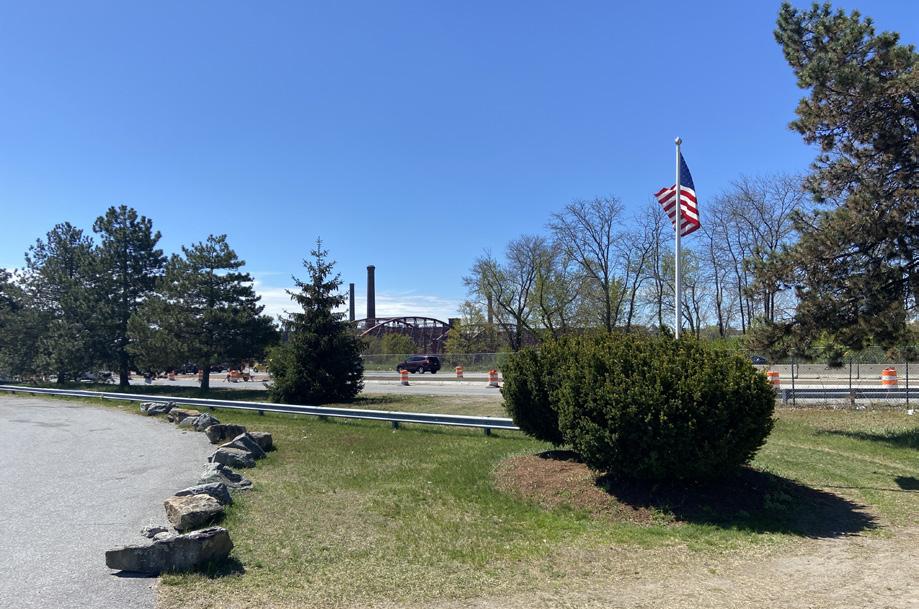
We place high value on proactive maintenance, ensuring we have a welldefined plan for who, what, where, and how we provide ongoing care of our beloved city and its resources.
• This commitment involves careful consideration of “who” will be responsible for various aspects of maintenance, ensuring that roles and responsibilities are clearly defined among city authorities, community members, and relevant stakeholders
• The “what” aspect involves identifying the specific elements and infrastructure that require regular upkeep, such as public spaces, parks, sidewalks, public art, and other infrastructure
• The “where” pinpoints the locations and communities within the city that demand particular attention and resources
• The “how” component outlines the methodologies and approaches to maintenance, taking into account sustainable practices and community engagement strategies
We believe in accountable governance and community stewardship, fostering an environment where empowerment and connectivity between residents and the local government are central to decision-making processes.
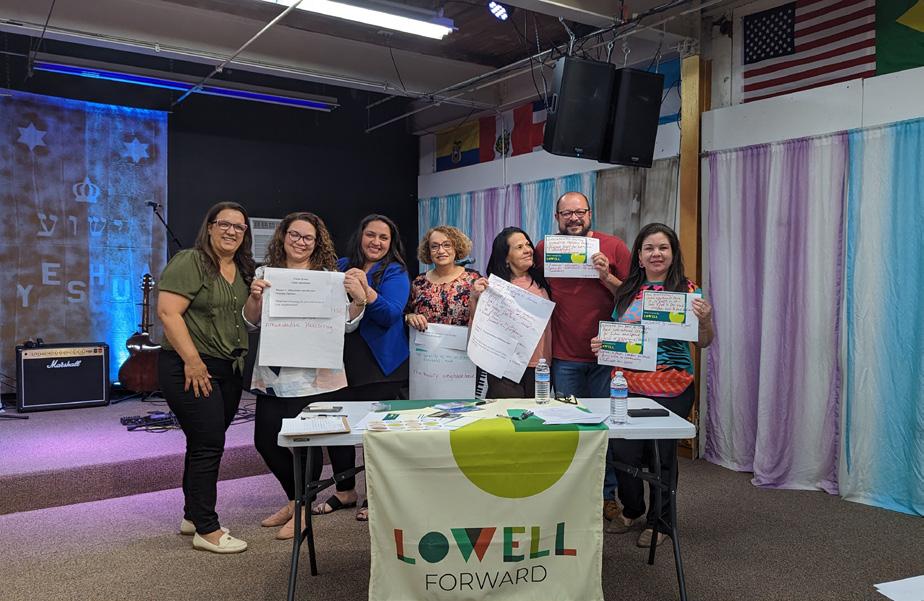
• We hold a shared ethic of responsible and equitable decision-making, ensuring that the community’s voice is not only heard but actively influences the direction and policies that shape our collective future
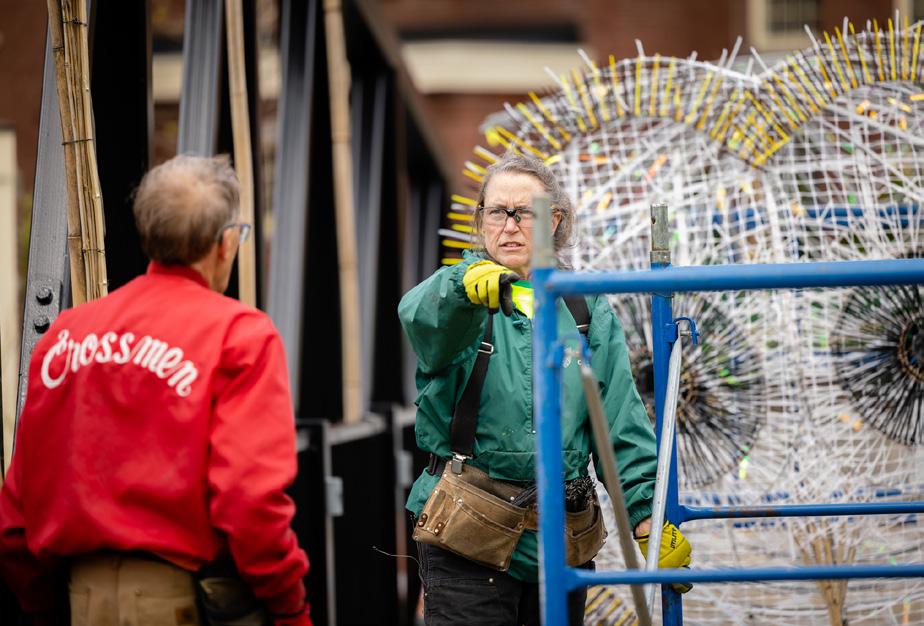
We value our workforce, businesses, and students and recognize that innovation and creativity are catalysts for progress, driving economic development, enhancing quality of life, and building resilience in the face of evolving circumstances.
• We are committed to providing resources that nurture innovation at both the individual, business, and collective levels
• This includes creating spaces for collaboration, investment in education and training programs, entrepreneurial support, and establishing partnerships with local institutions and industries to facilitate knowledge exchange
Together the vision and core values provide the foundation for the goals and actions outlined in the Lowell Forward Plan. At the beginning of each topic area section in Chapter 4, we outline the key ways in which the vision and values above are reflected in the respective goals and actions.
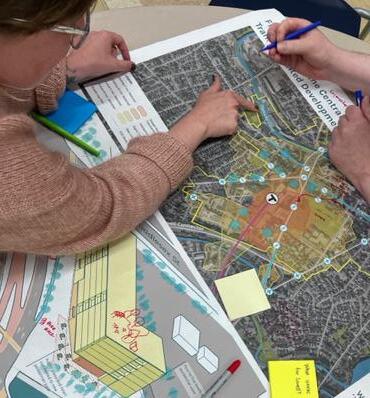
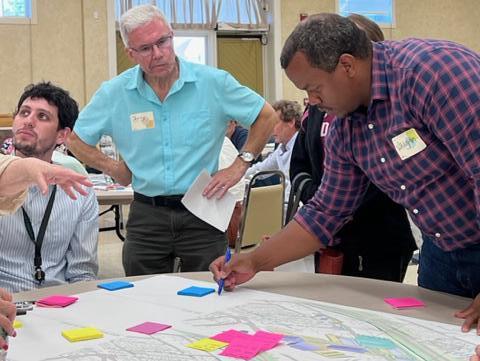
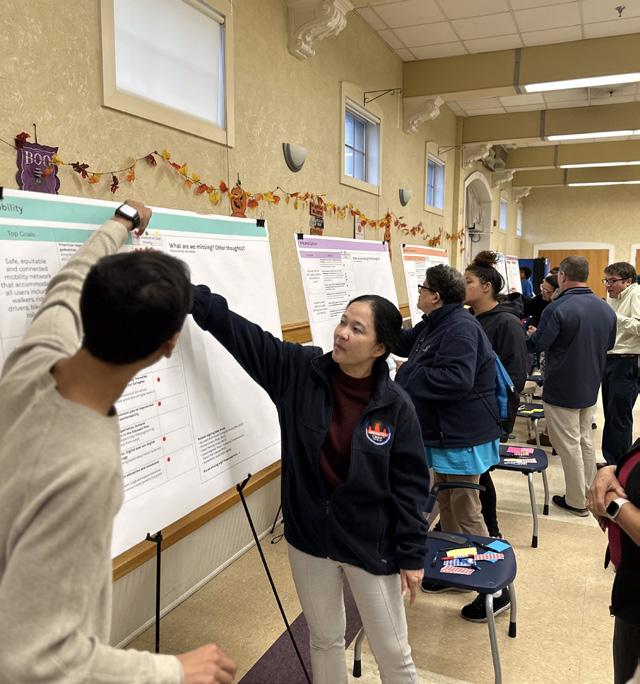
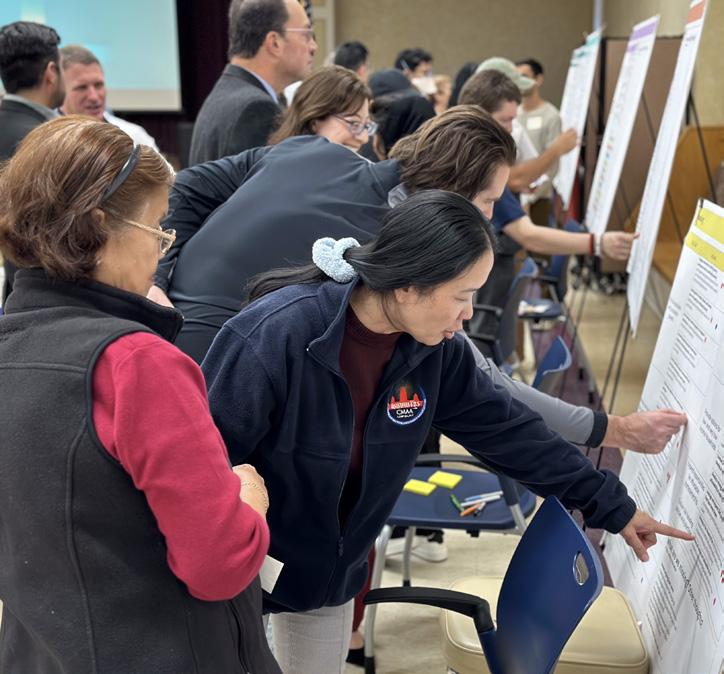
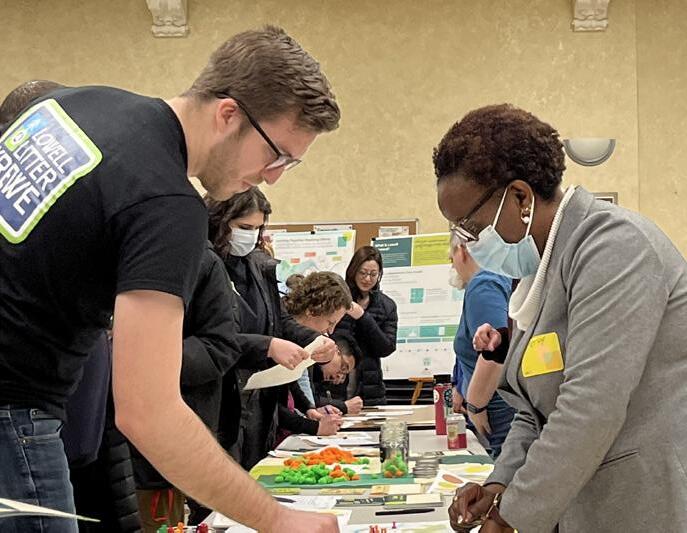
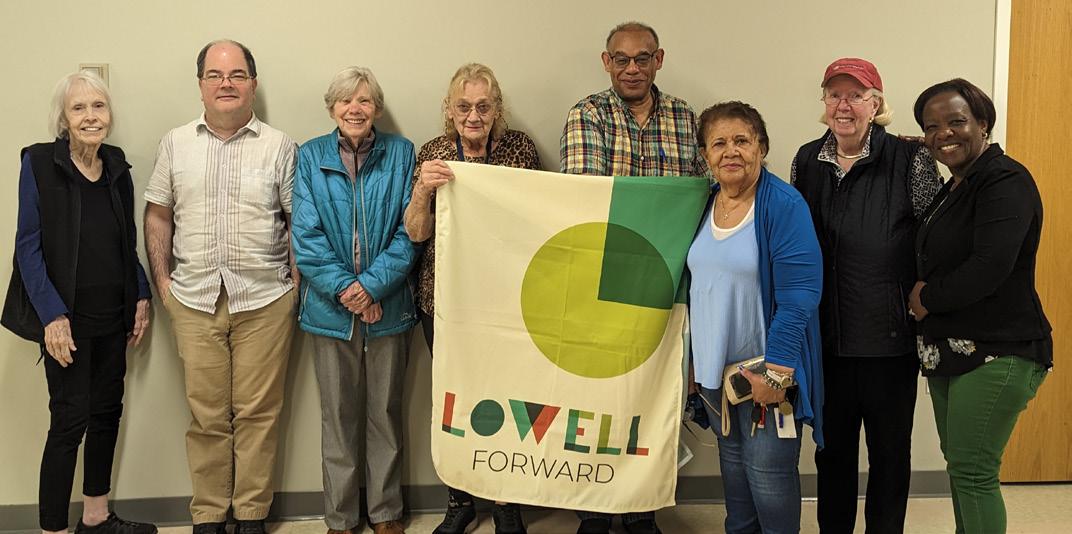
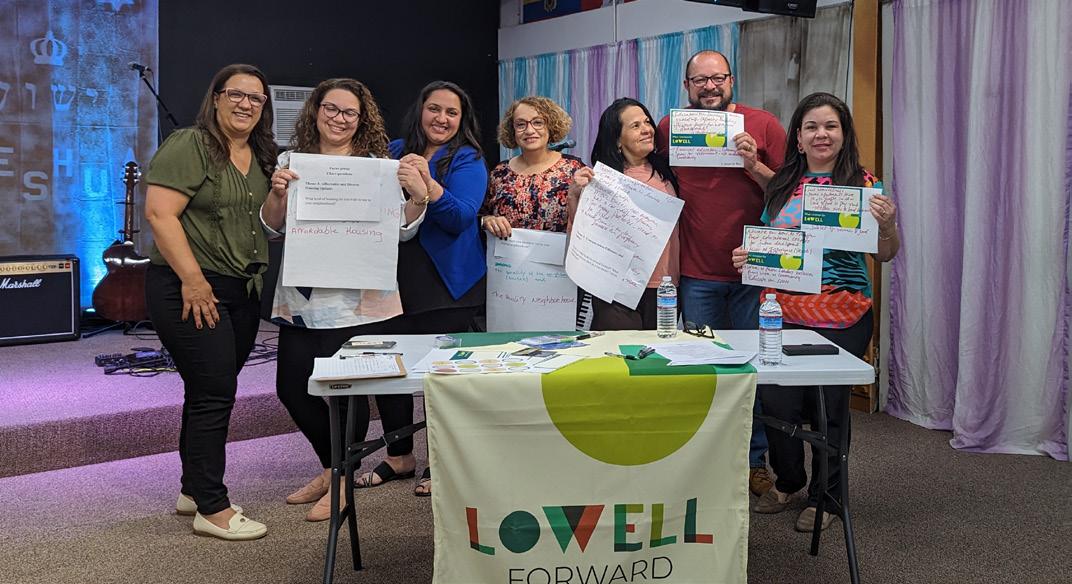
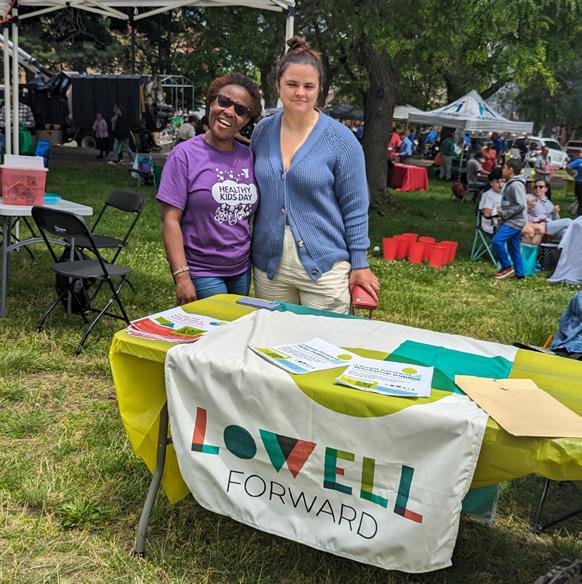
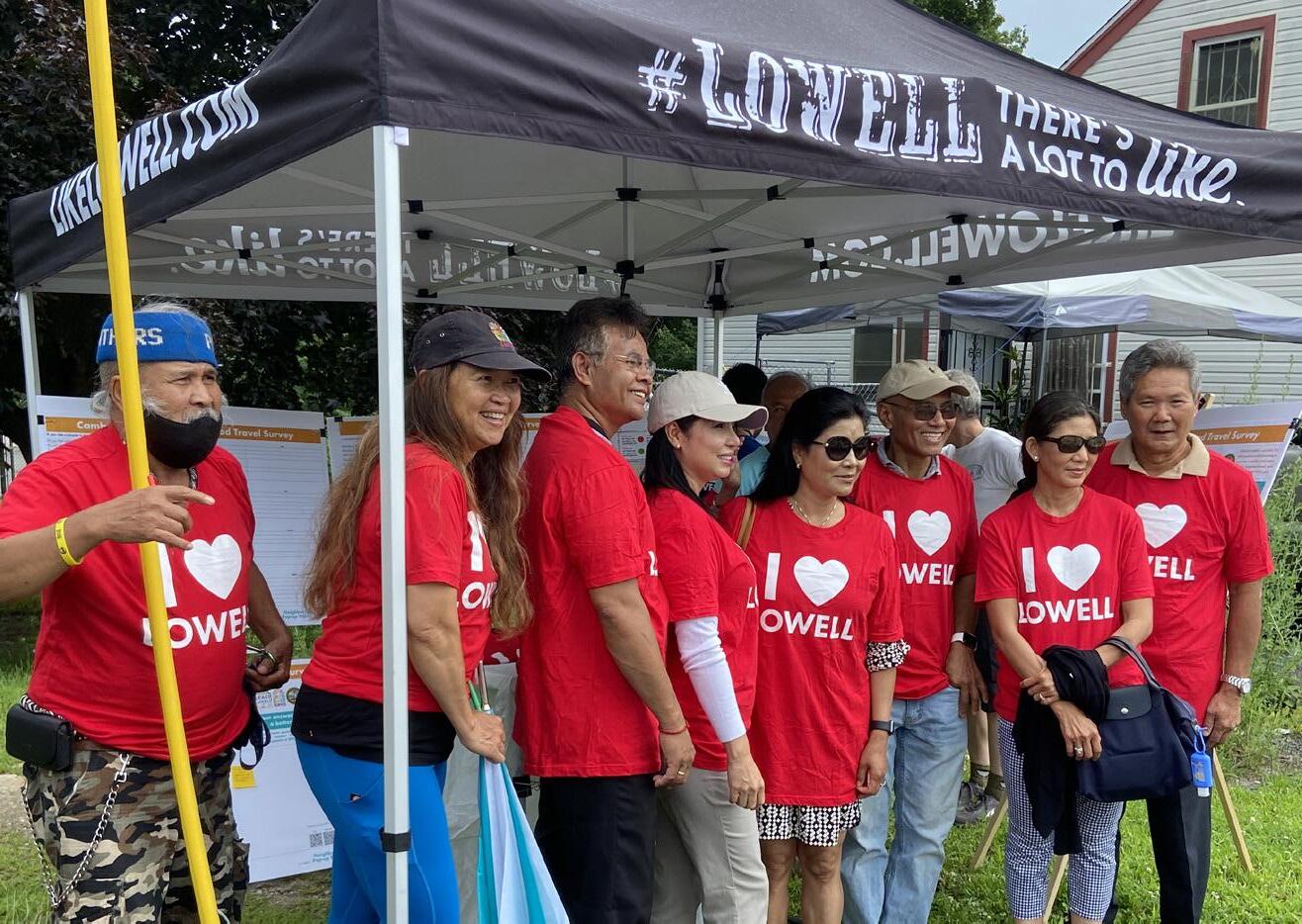
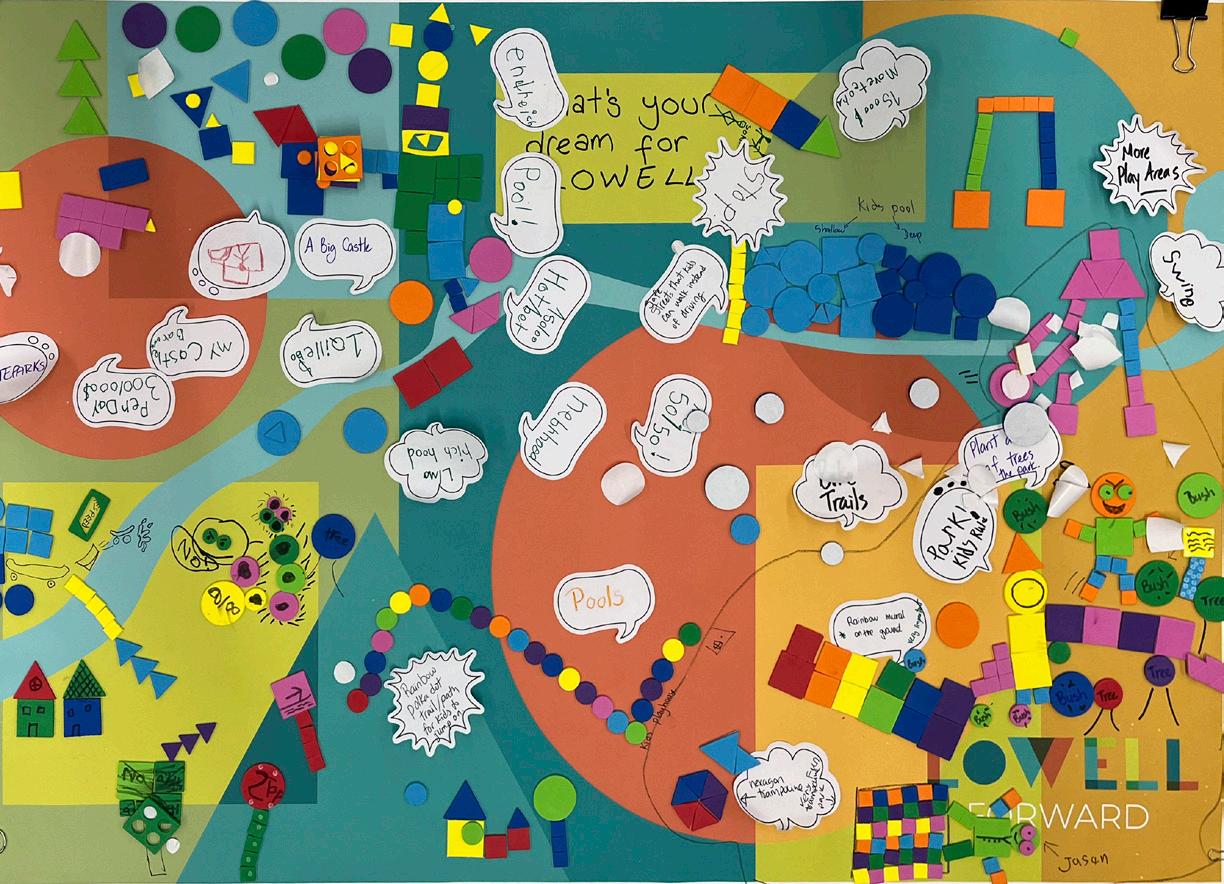
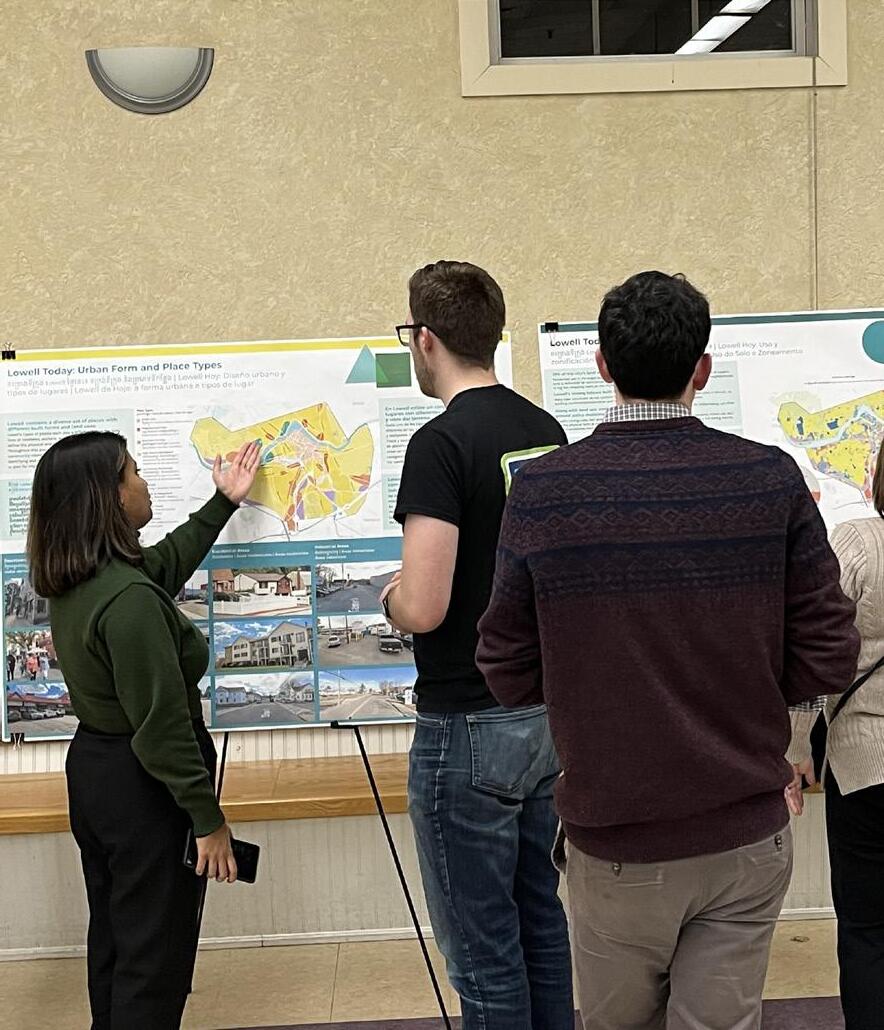
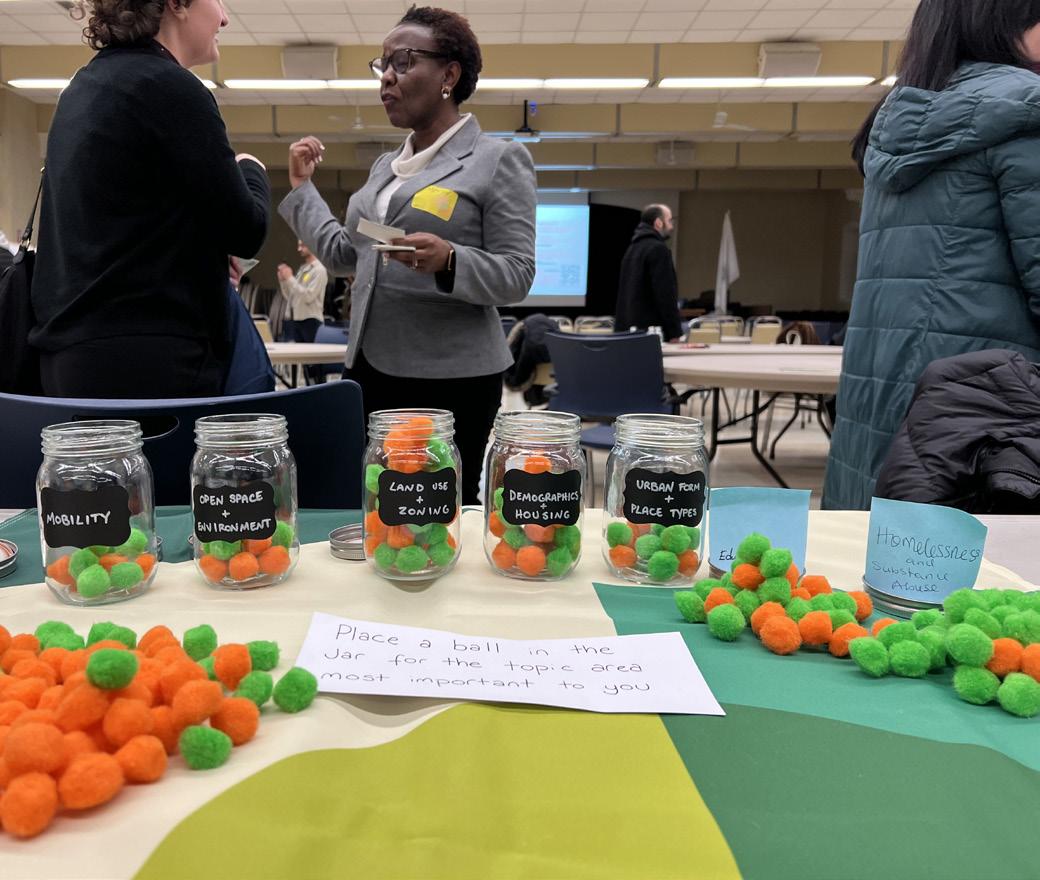
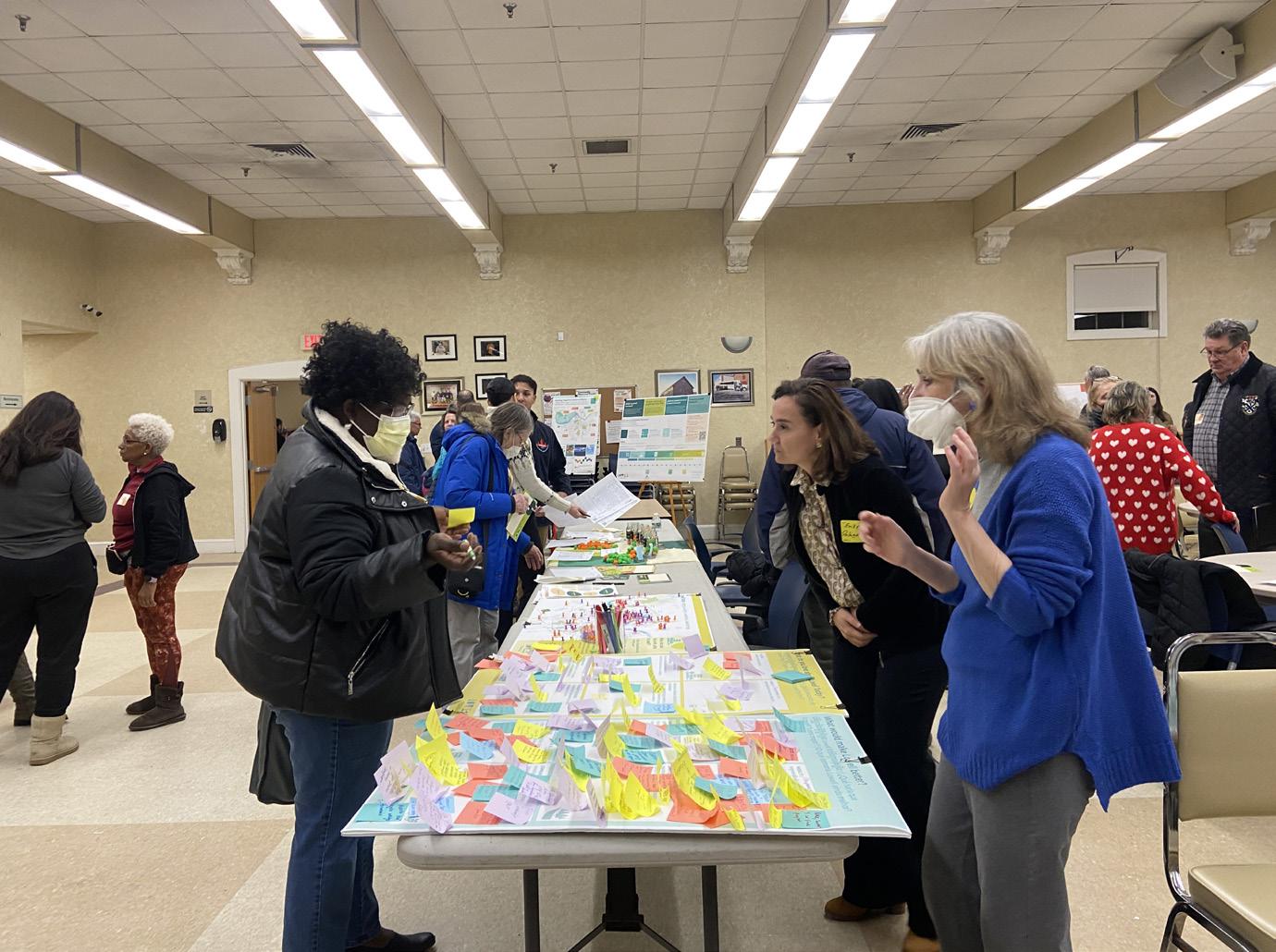
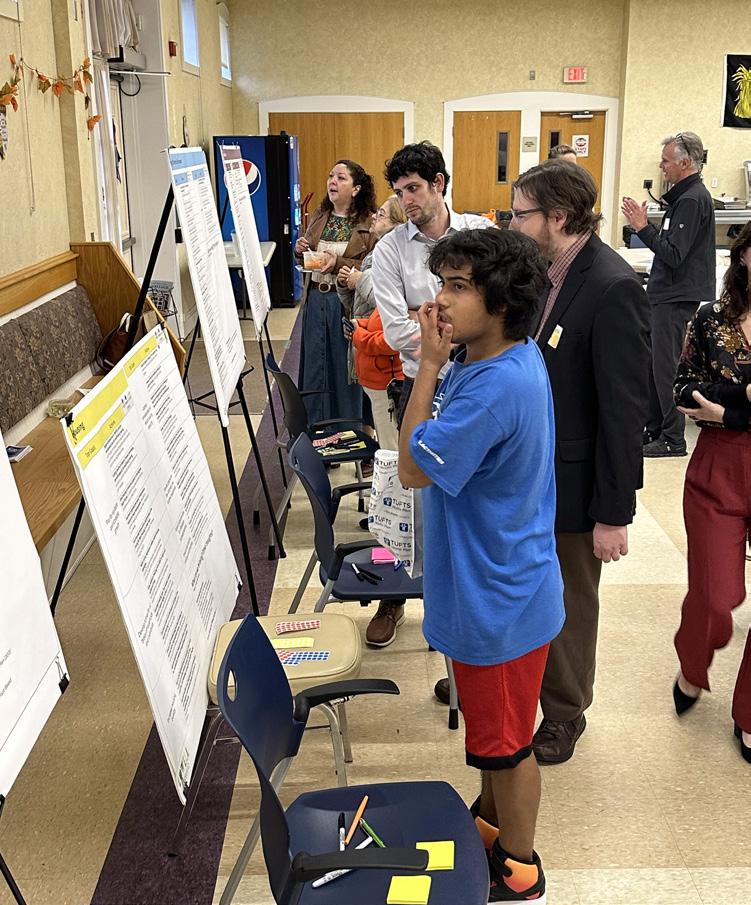
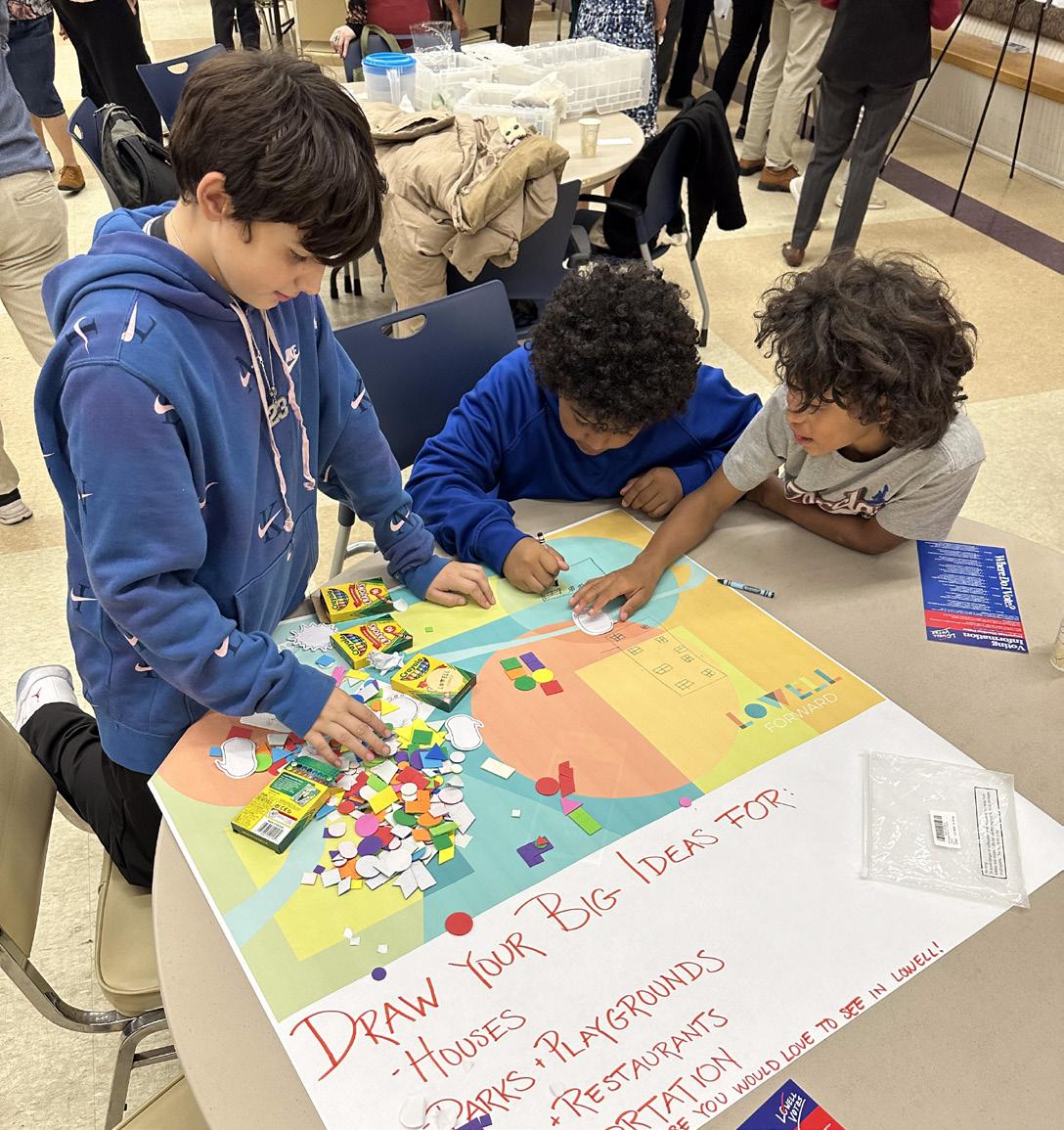
Lowell Forward embraced a people-centric planning and engagement approach which involved meeting residents where they are, actively connecting with established community groups and organizations, and overcoming barriers to engagement faced by underrepresented groups across Lowell. Where feasible, the planning team prioritized engagement in languages that residents speak at home. Additionally, the planning team ensured community involvement in every phase of the process—from initial visioning and identifying opportunities and challenges to fostering ownership for the implementation phase.
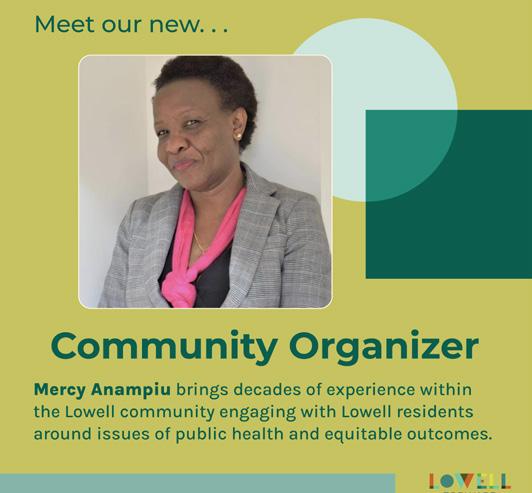
A long-time community resident was hired to lead our grassroots engagement and organizing efforts for Lowell Forward. The Community Organizer’s main objective was to ensure that the engagement addresses unique and diverse neighborhoods that feature residents who do not typically participate in local government in Lowell, with a particular focus on its immigrant communities, low-to-moderate income residents, BIPOC residents, and communities of color. The plan aimed to create intentional pathways to equitable community participation that accounts for the lived experiences of residents through varied and diverse engagement opportunities.
As the Lowell Forward Community Organizer, Mercy Anampiu brings decades of experience within the Lowell community as an immigrant, woman of color, and expert in the field of engaging with Lowell residents around issues of public health and equitable outcomes. Throughout the Lowell Forward process, she has ensured that ongoing insight and feedback from residents is incorporated into real-time analysis and design of the master planning process.
Throughout this document, look out for key community insights and takeaways under “Conversations with Mercy”
Email Mercy at: lowellforward@utiledesign.com
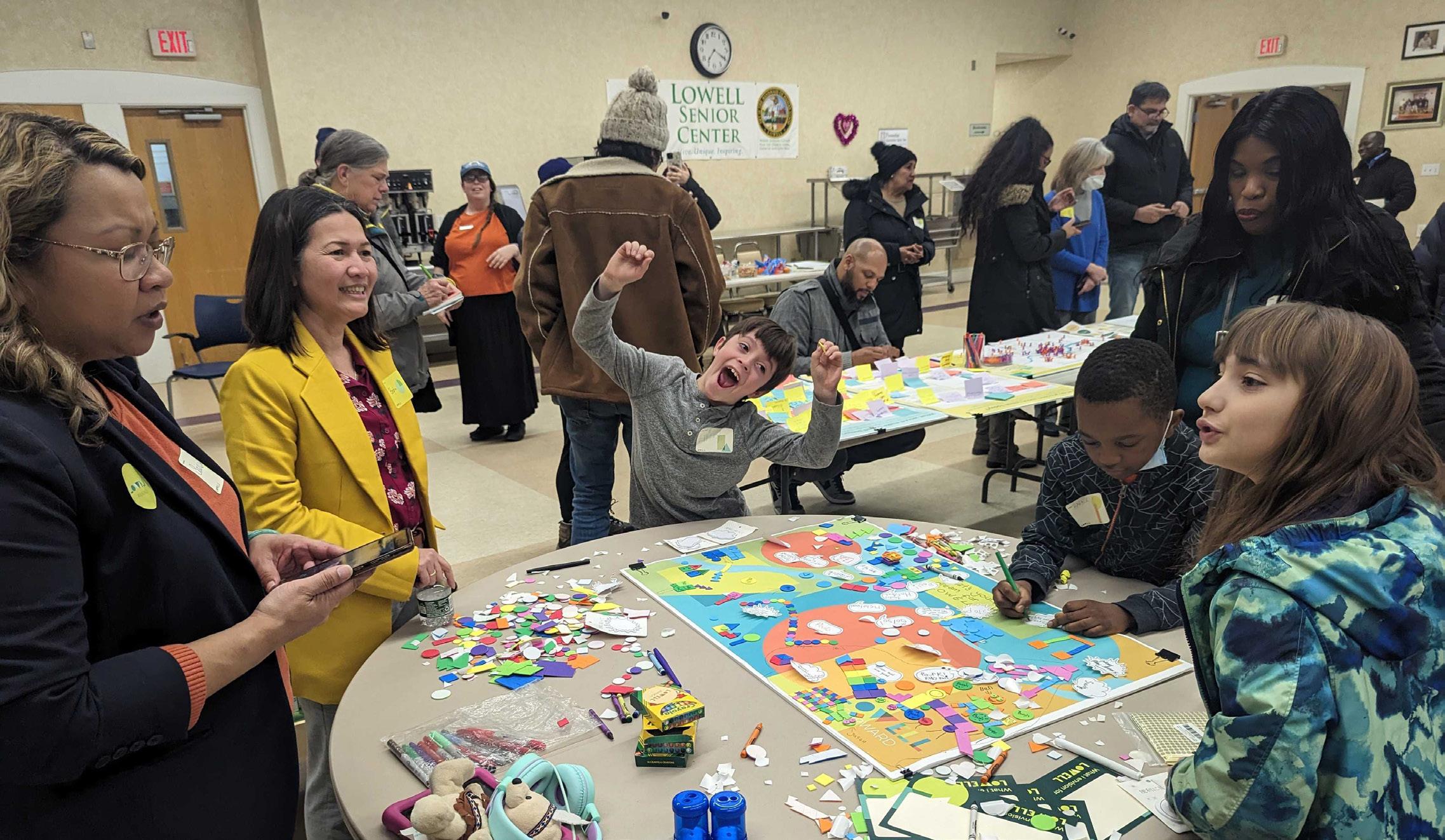
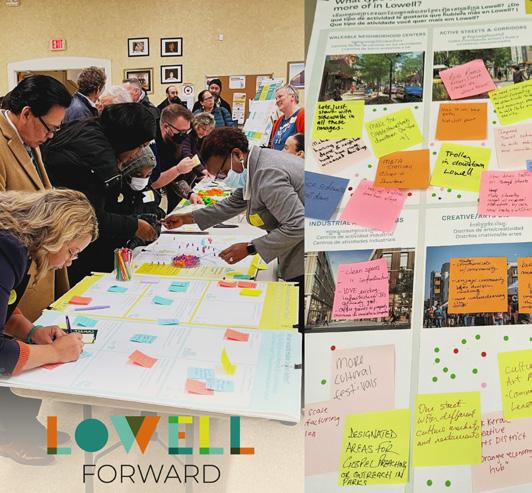
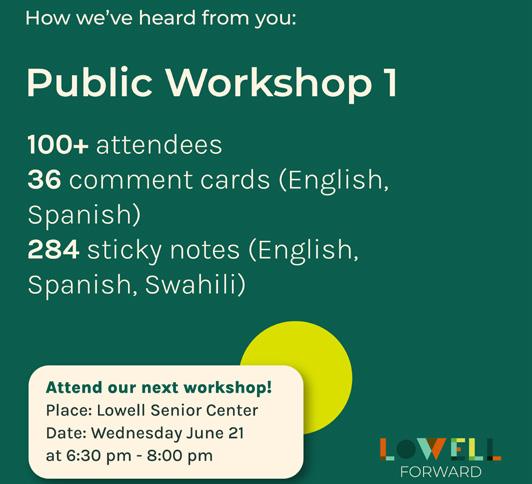
Public Workshop 1:
Community Organizer:
21 conversations, 40 comment cards
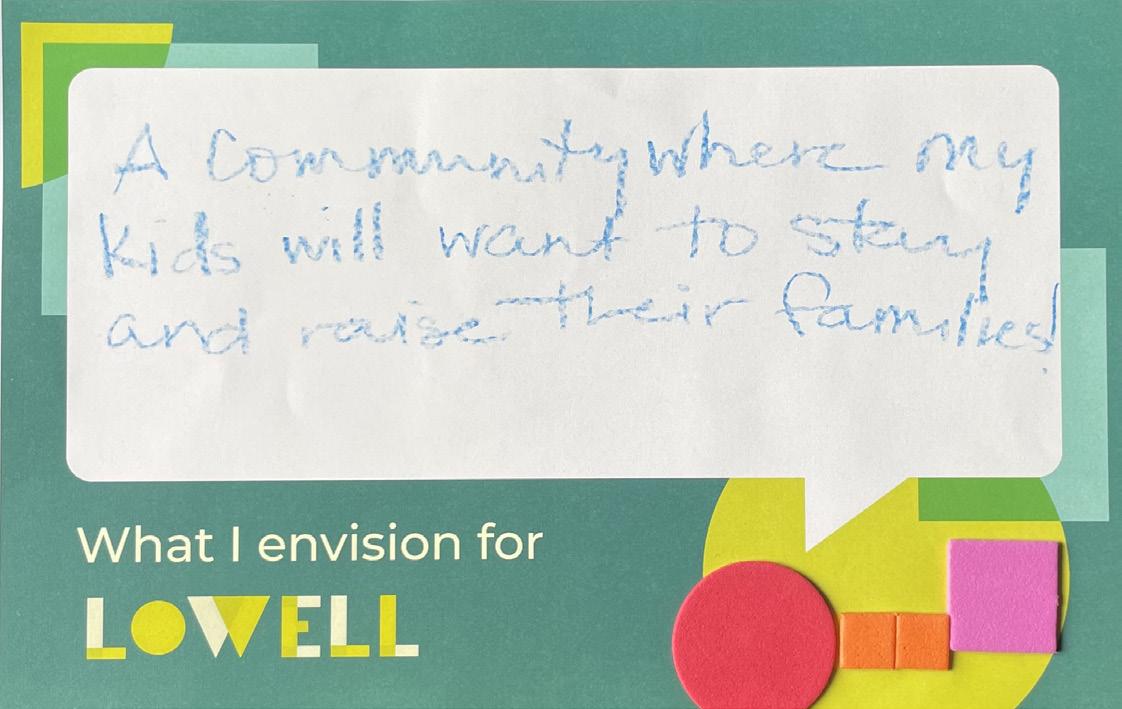
Phase 1 focused on building a shared citywide vision by collaborating closely with many community members. During this phase, learning and visioning was achieved through different types of interactions with the community including the Citywide Public Workshop, gathering feedback through the Citywide Vision and Goals Survey, conversations facilitated by the Community Organizer, and focus groups led by the City staff. Below are the main themes that emerged during this first phase of engagement. with more than 100 attendees and more than 300 written comments or sticky notes
Listening Tour 1 Theme Summary
2 meetings more than 700 responses 10 topic-specific focus groups
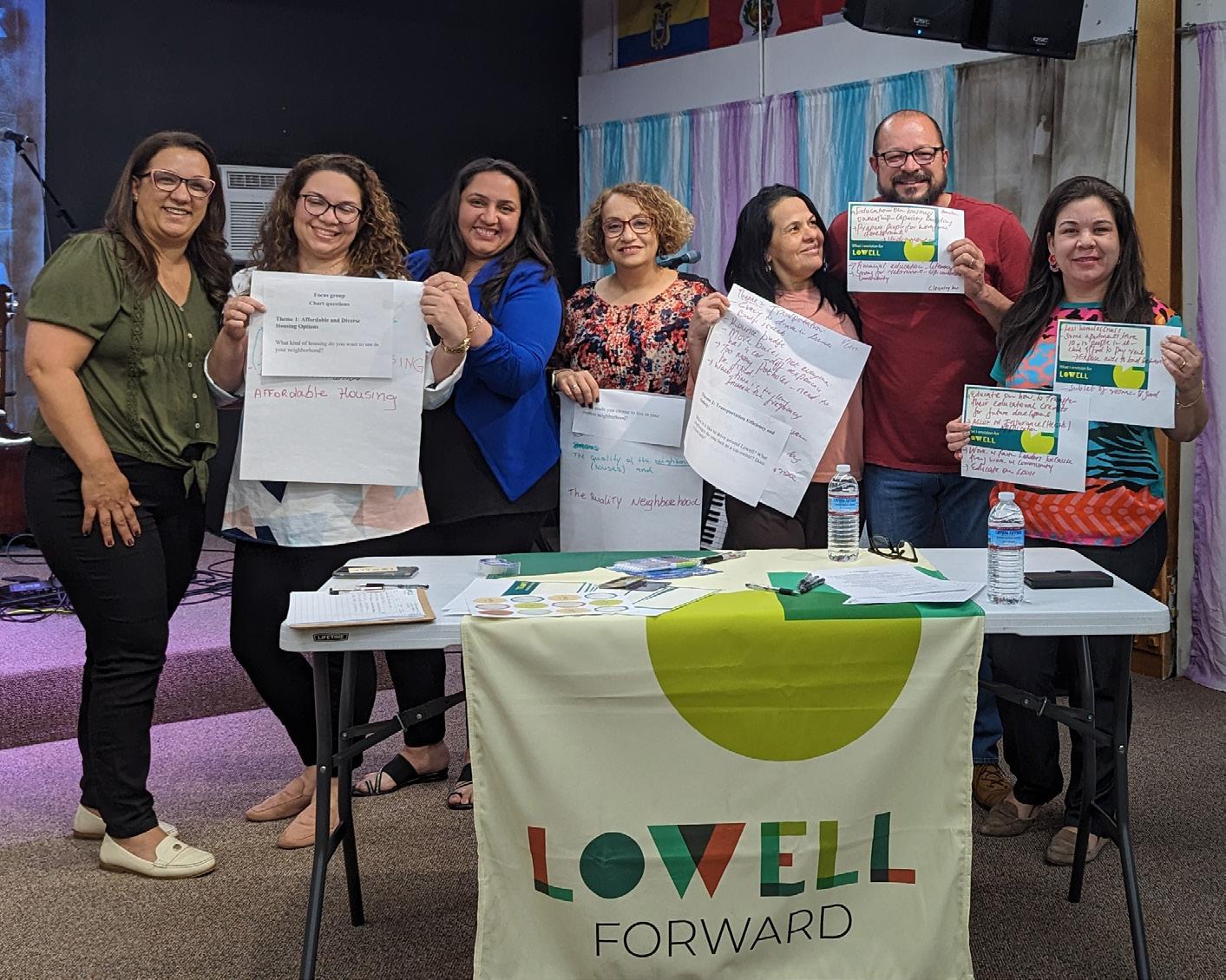
We need safer sidewalks in all neighborhoods
Public Workshop 1 Participant
We would like to see a variety of different types of affordable housing, low-income tax credit and ADUs.
Public Workshop 1 Participant
2 meetings Steering Committee Meetings:
Phase 2 focused on testing out the vision established during phase 1, and building strategies for growth and change in Lowell that align with that vision. Feedback was gathered from the community at the second public workshop, the citywide Vision and Goals Survey, conversations with the Community Organizer and City-led focus groups.
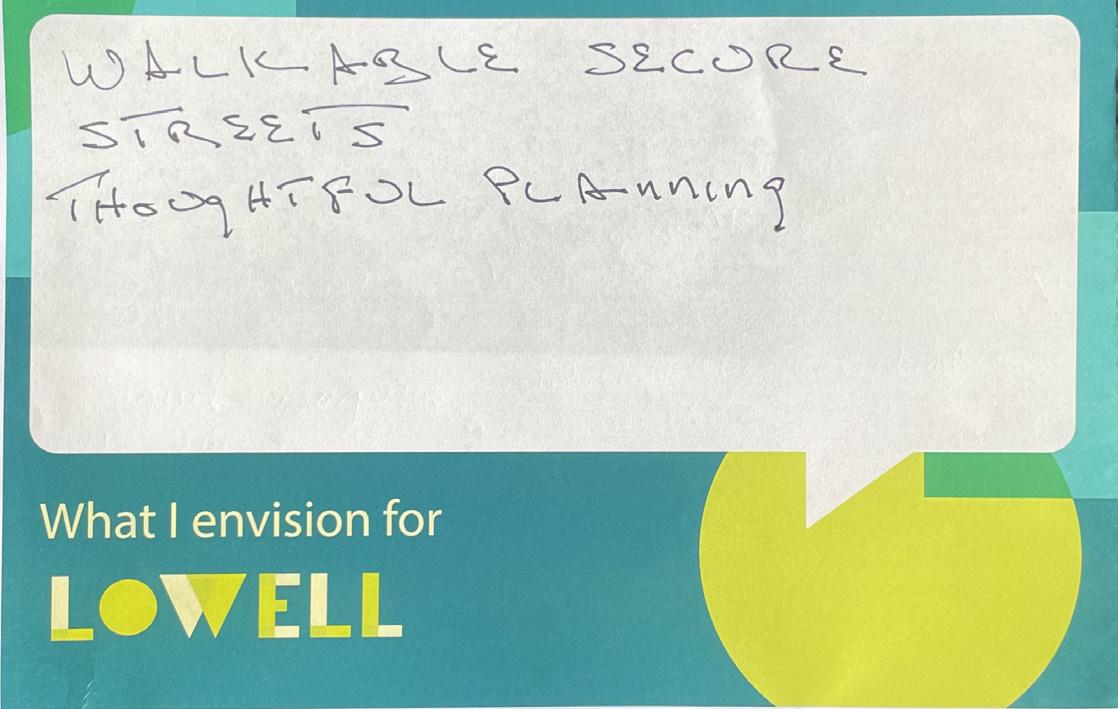
We need walkable and secure streets with thoughtful planning.
Citywide Workshop participant
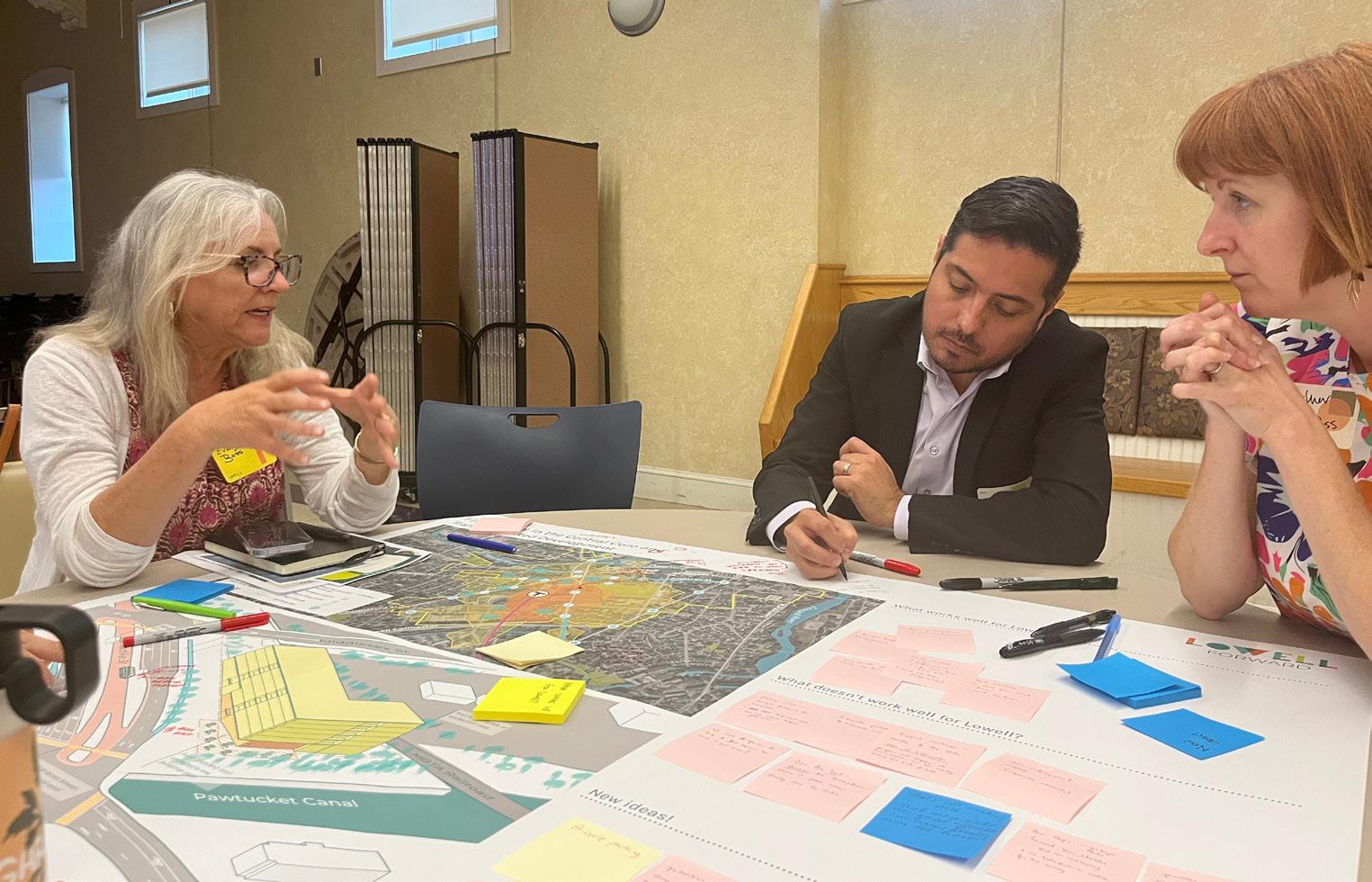
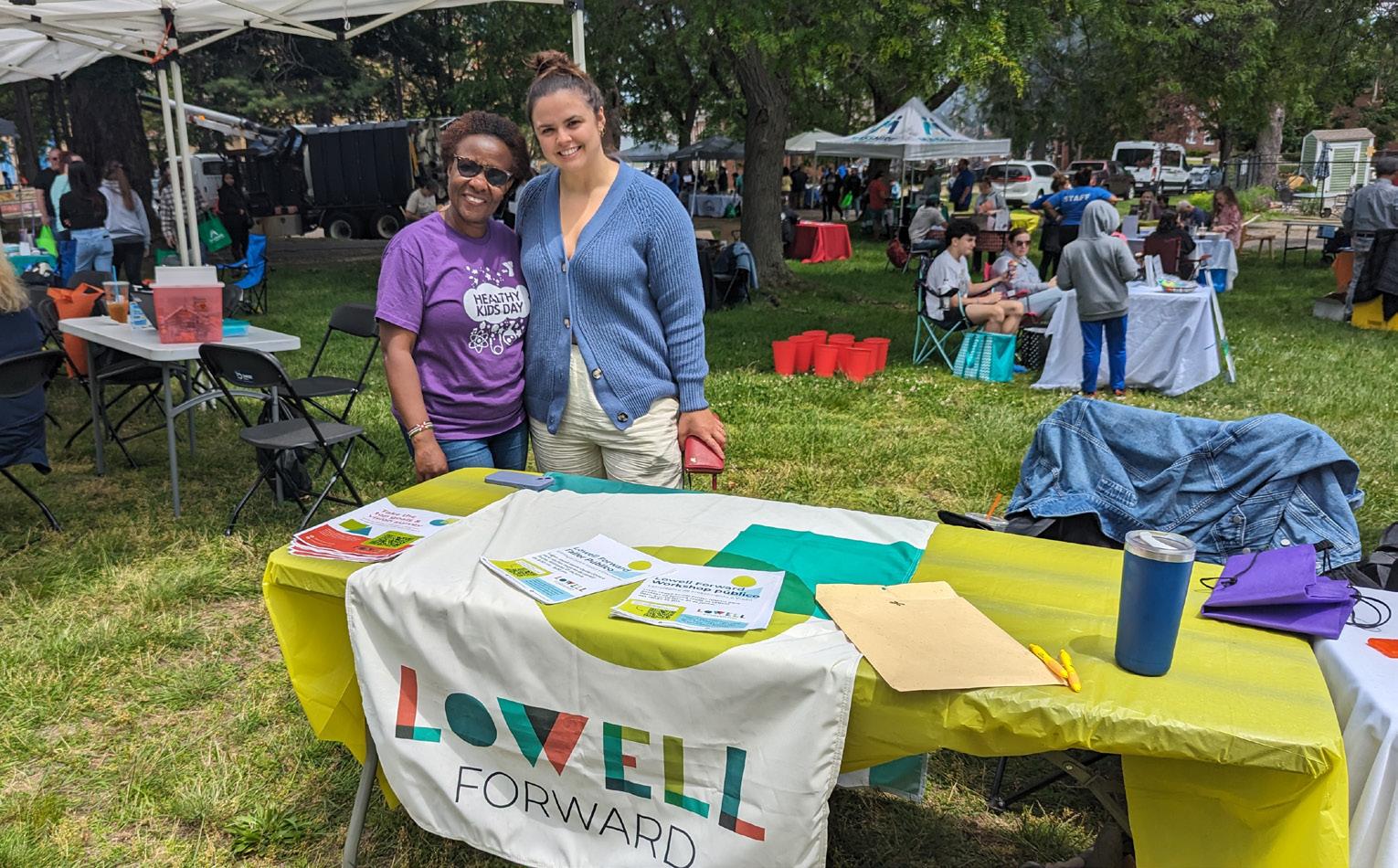
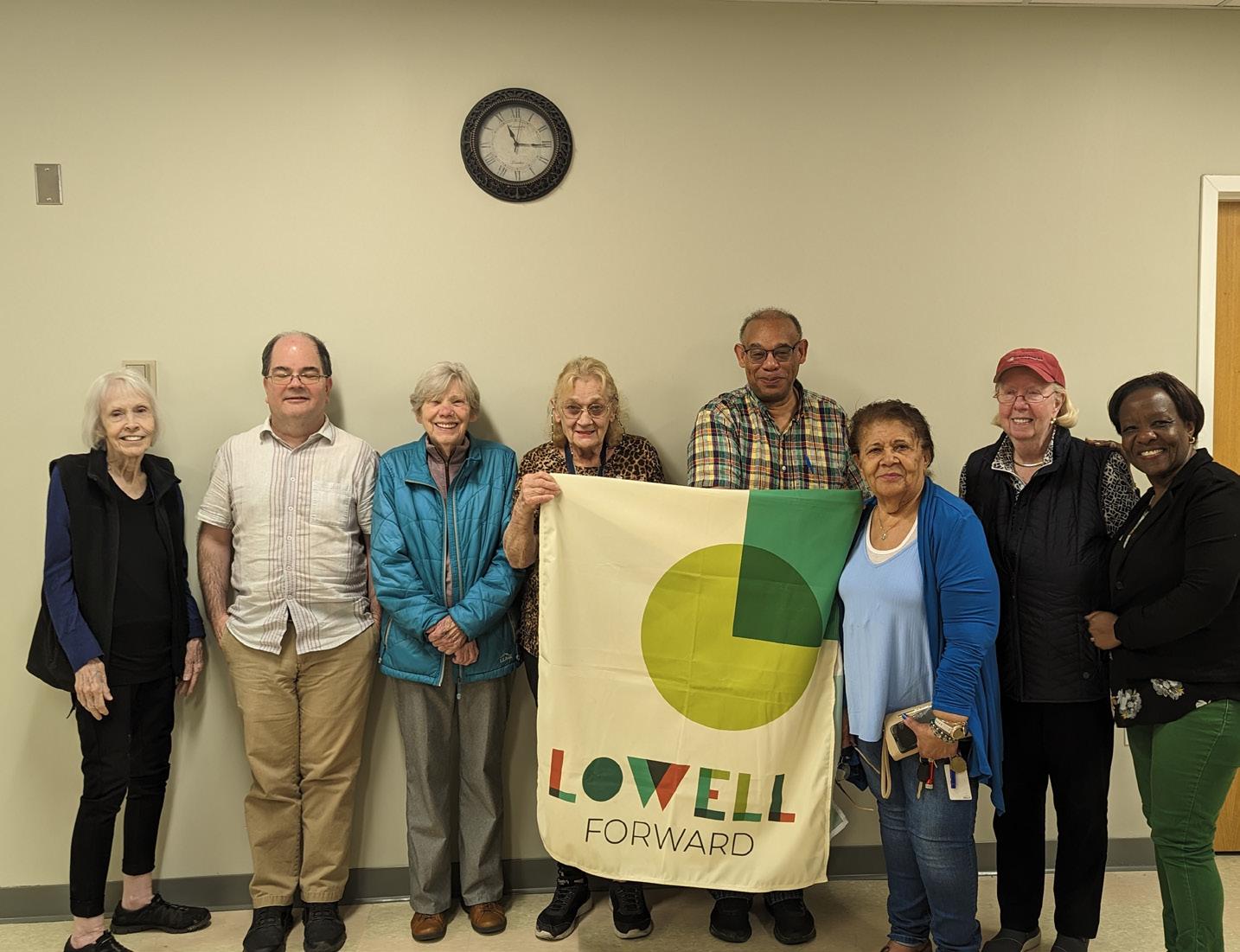
Rent prices are very high in Lowell which affects the ability of residents to find housing for their families. After kids go to college, they are unable to find housing that they can afford in Lowell so they move away to different cities/ states where housing is more affordable.
Focus Group participant
Public Workshop 3:
partnership with CHOP Dinner, 140+ participants, and more than 700 sticker reactions on boards
Community Organizer:
10 conversations focused on topic-specific goals and actions including:
• The Merrimack Valley Housing Partnership
• Small Business Owners
• Project Learn
• Coalition for a Better Acre
• Lowell Litter Krewe
• Greater Lowell Community Foundation
• Lowell Public Schools
• Mill City Grows
• Greater Lowell Health Alliance
• Mary Wambui
2 meetings Steering Committee Meetings:
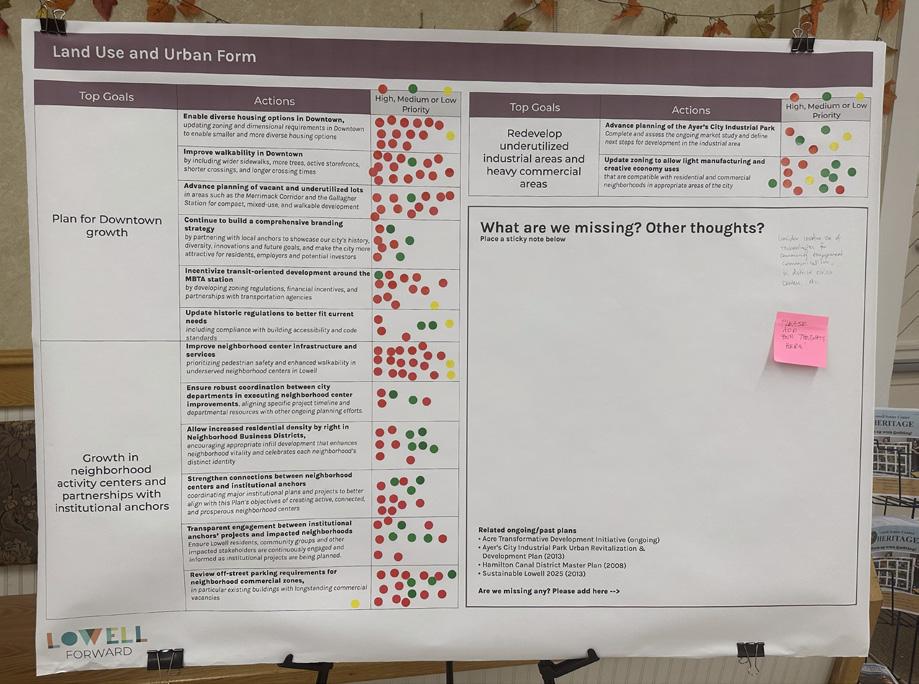
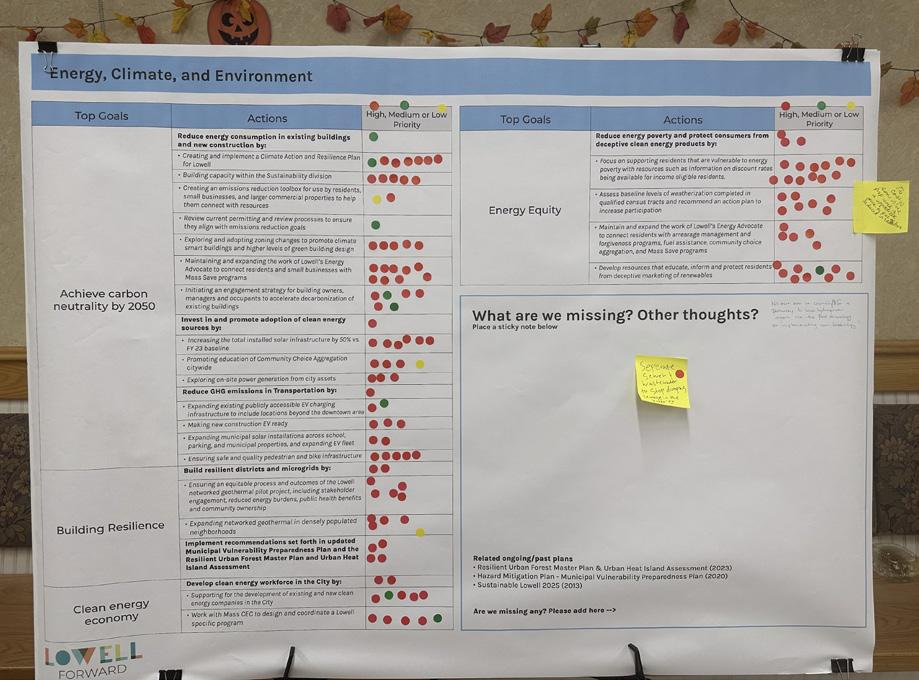
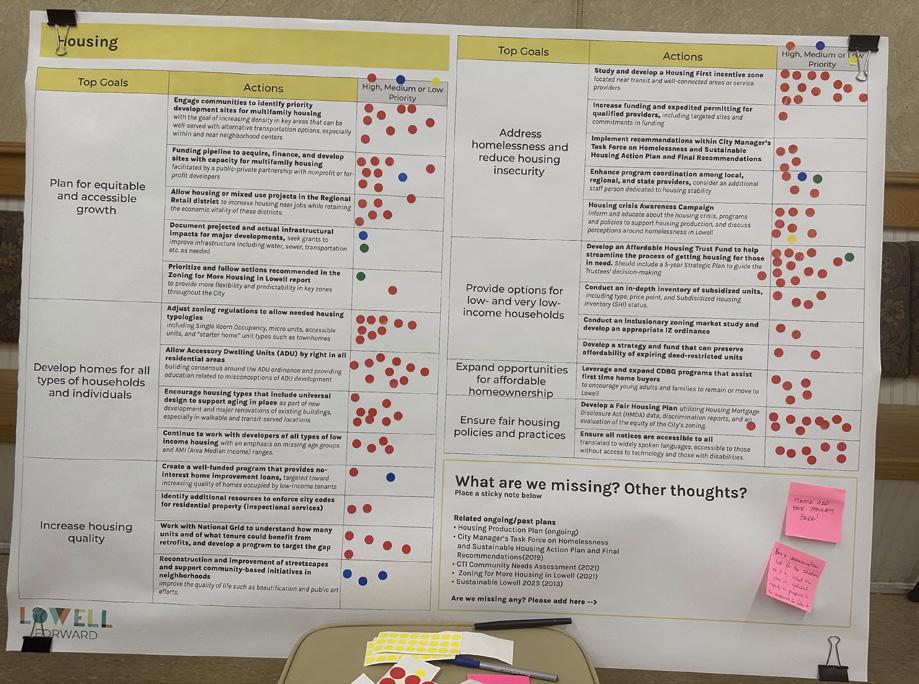
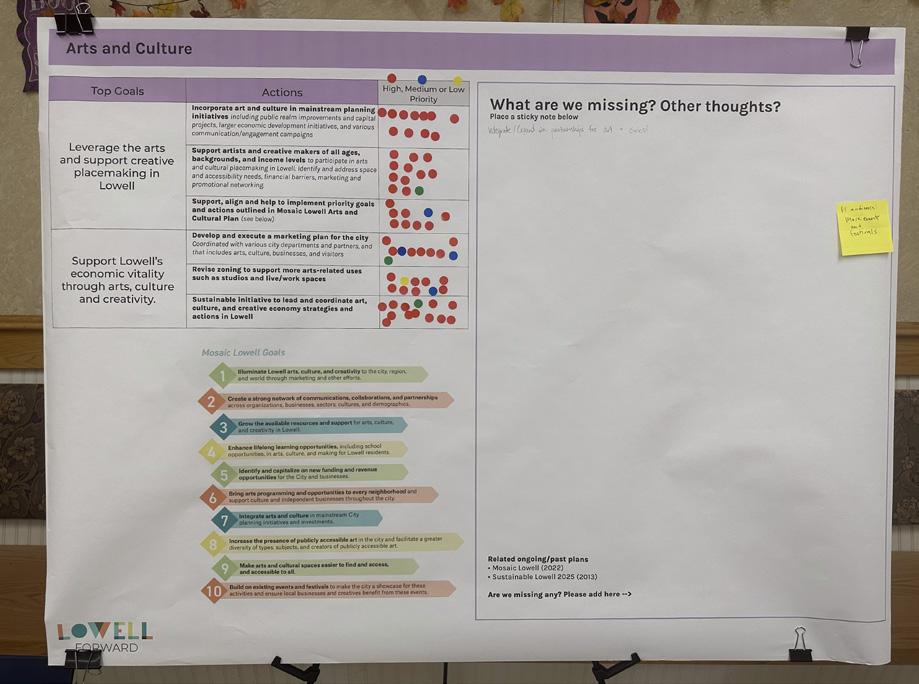
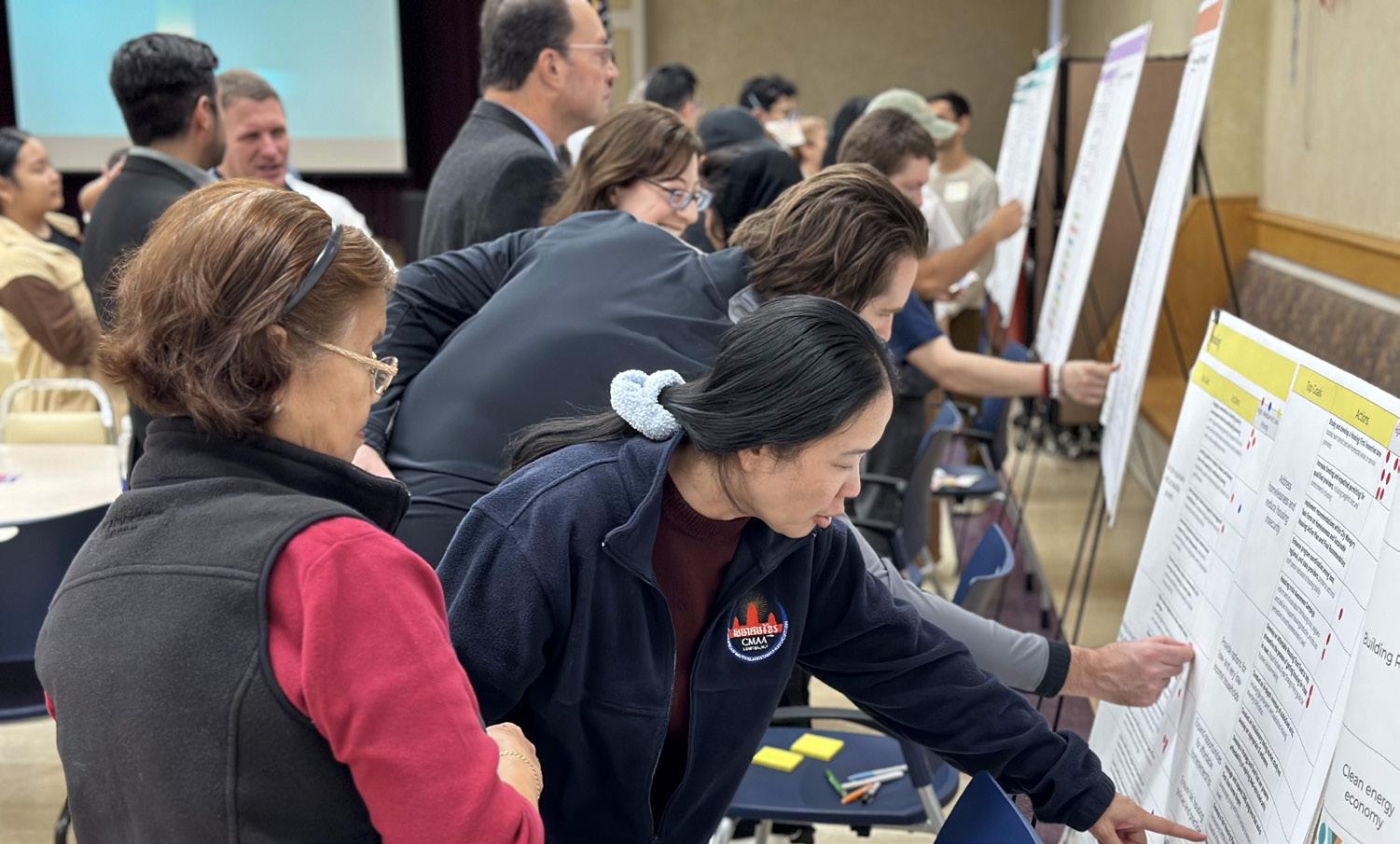
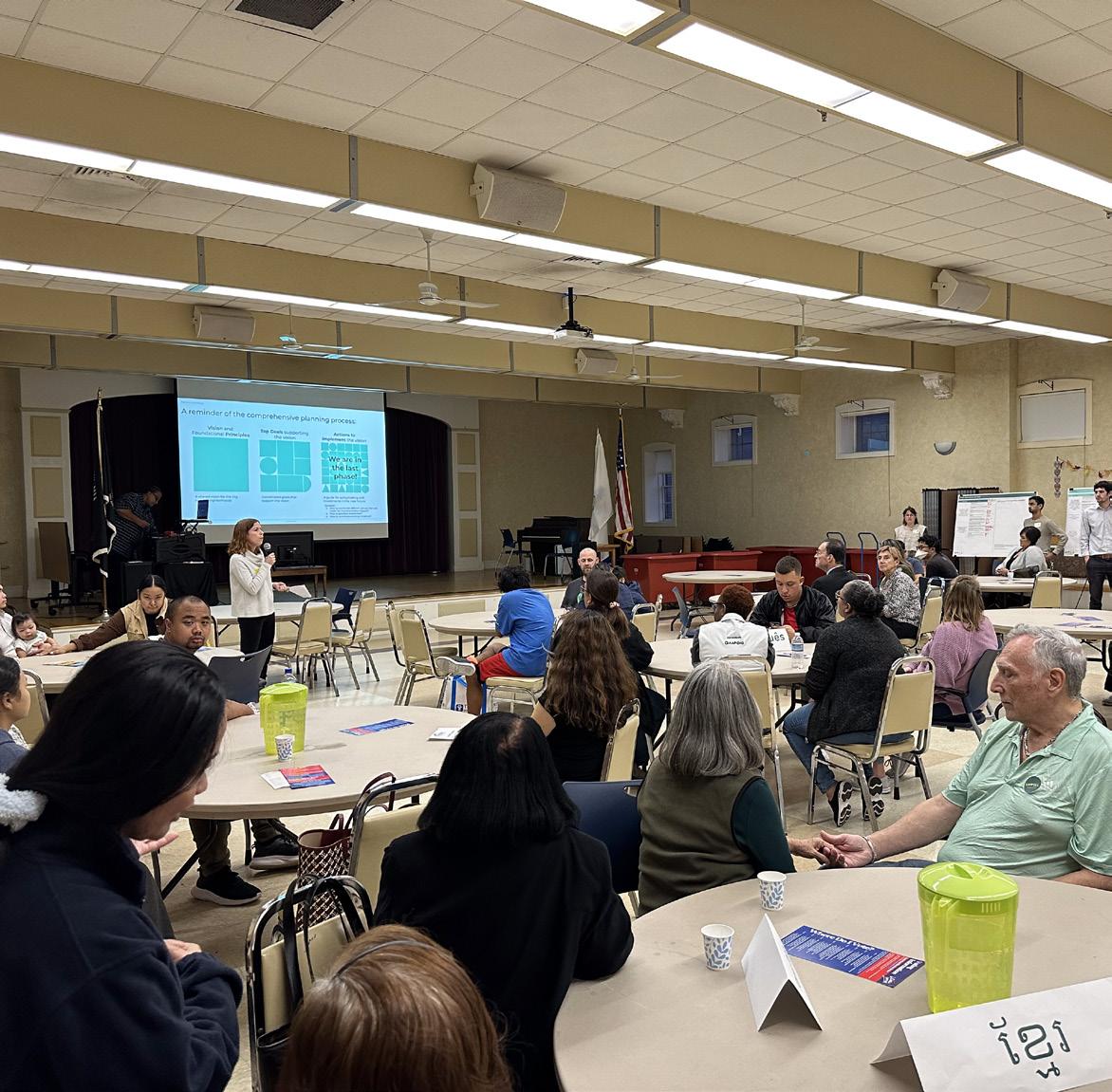
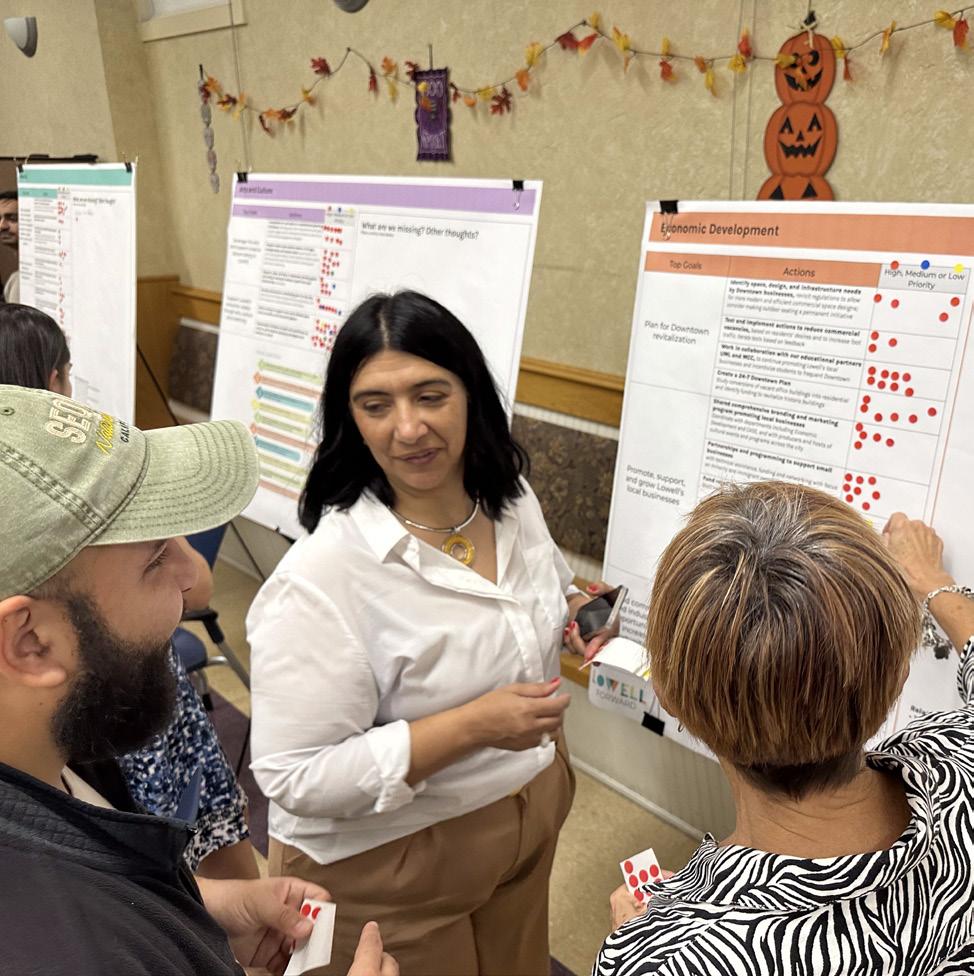
Phase 3 focused on building stewardship and support for the implementation of the comprehensive plan. The public had the opportunity to weigh-in on the goals and actions framework during the Public Workshop. The Community Organizer met with key local organizations and individuals, who provided valuable feedback on the implementation framework.
I would want to feel comfortable promoting public transportation, I wouldn’t want to promote it unless I feel safe.
Conversation with Mercy
We need to work on education around mobility and communicate associated health benefits.
Conversation with Mercy
As Lowell evolves, it will encounter new opportunities and challenges that shape its growth and transformation. This plan provides a significant opportunity for us as a city and community to prioritize the specific enhancements we value for our neighborhoods and to determine the extent of change we are comfortable with. Within this chapter, you will find strategies aimed at guiding and shaping sustainable and equitable growth and development in Lowell. These strategies were created in collaboration with the community and informed by many conversations and feedback received throughout the engagement process.
Intended audience for this chapter: action takers
Well-managed and strategic growth is essential to make our city more affordable, equitable, and resilient.
The concept of growth and change often sparks complex and multifaceted discussions among residents, businesses, and various stakeholders. Determining where growth is appropriate, the types of growth needed, and who reaps its benefits can lead to divergent opinions and concerns. Lowellians may have differing perspectives on preserving the character of existing neighborhoods versus embracing development in certain areas to revitalize the city. The nature of growth—whether it’s focused on infrastructure, housing, commercial and recreational amenities, or larger economic development initiatives, can also bring about contrasting perspectives. Addressing these perspectives necessitates thoughtful and comprehensive planning approaches that weigh tradeoffs, incorporate compromises, and aim to maximize community benefits.
What’s your future vision for Lowell?
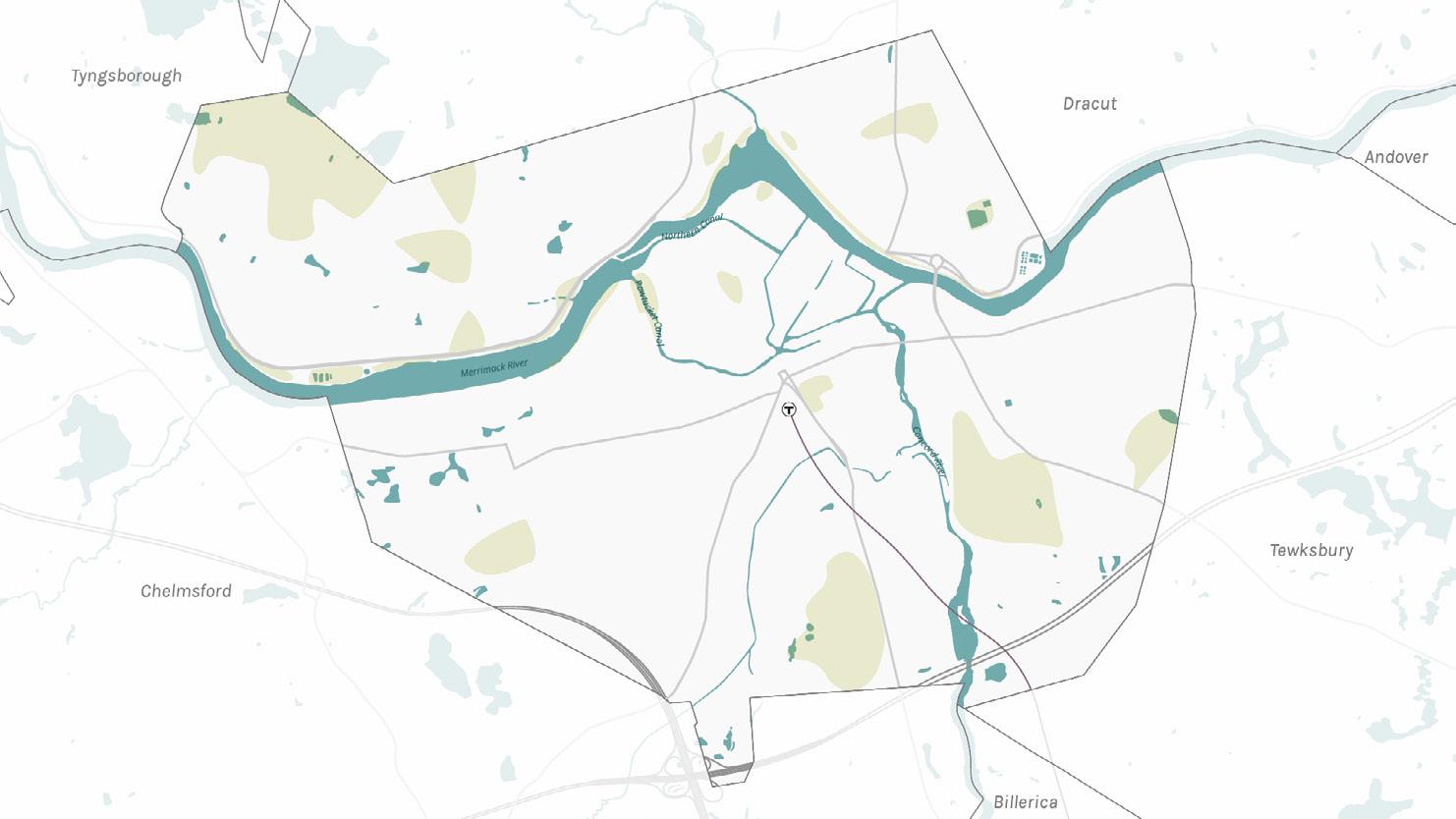
Differing perspectives and opinions aside, the reality remains that evolving dynamics, influenced by economic, environmental, and social factors, will continue to shape the trajectory of our city’s growth. For instance, in areas close to Downtown and other parts of Lowell, we see ongoing interest from developers to build more. The growing attention from private developers aligns with the community’s desires for enhanced infrastructure, affordable housing, education, and cultural amenities. Yet, if not overseen or regulated effectively, private development might yield undesirable and unintended consequences including gentrification, displacement, and the loss of community identity. Recognizing that change and development interest is an ongoing factor in the growth of Lowell, proactively planning and managing this growth is essential to ensure it aligns with and advances our community’s long-term vision and values.
Lowell Forward aims to establish a clear framework and path to navigate, oversee, and direct land use and development to serve the best interests of our community!
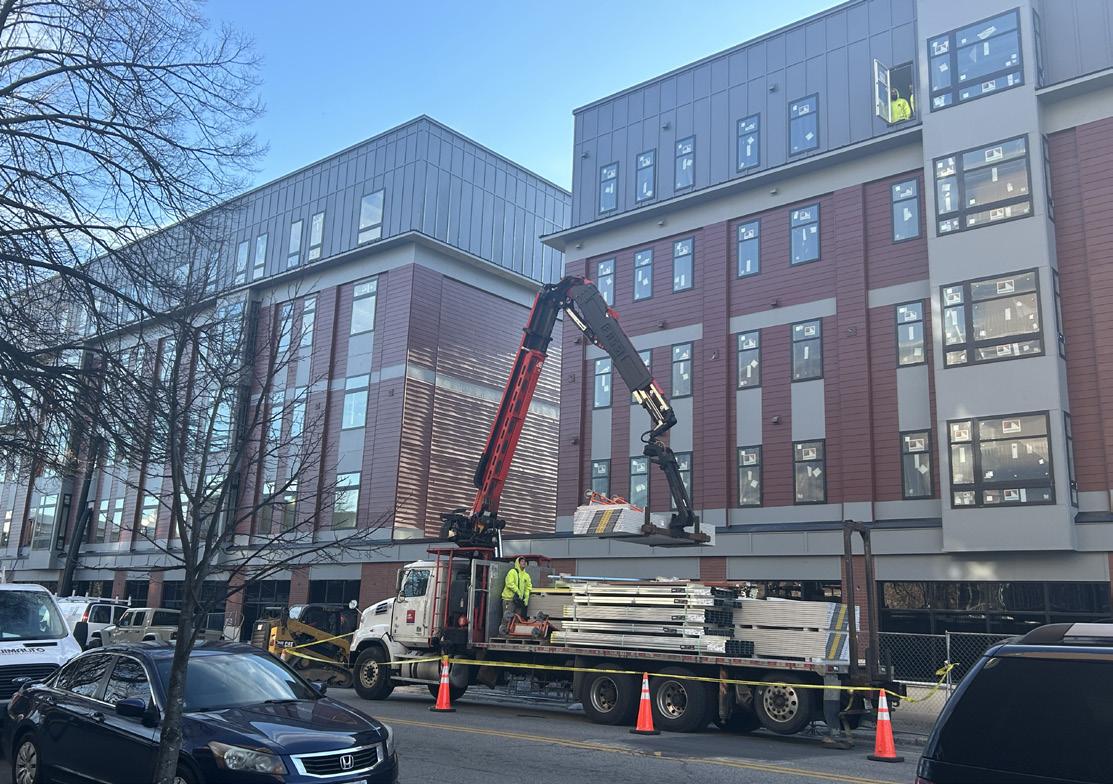
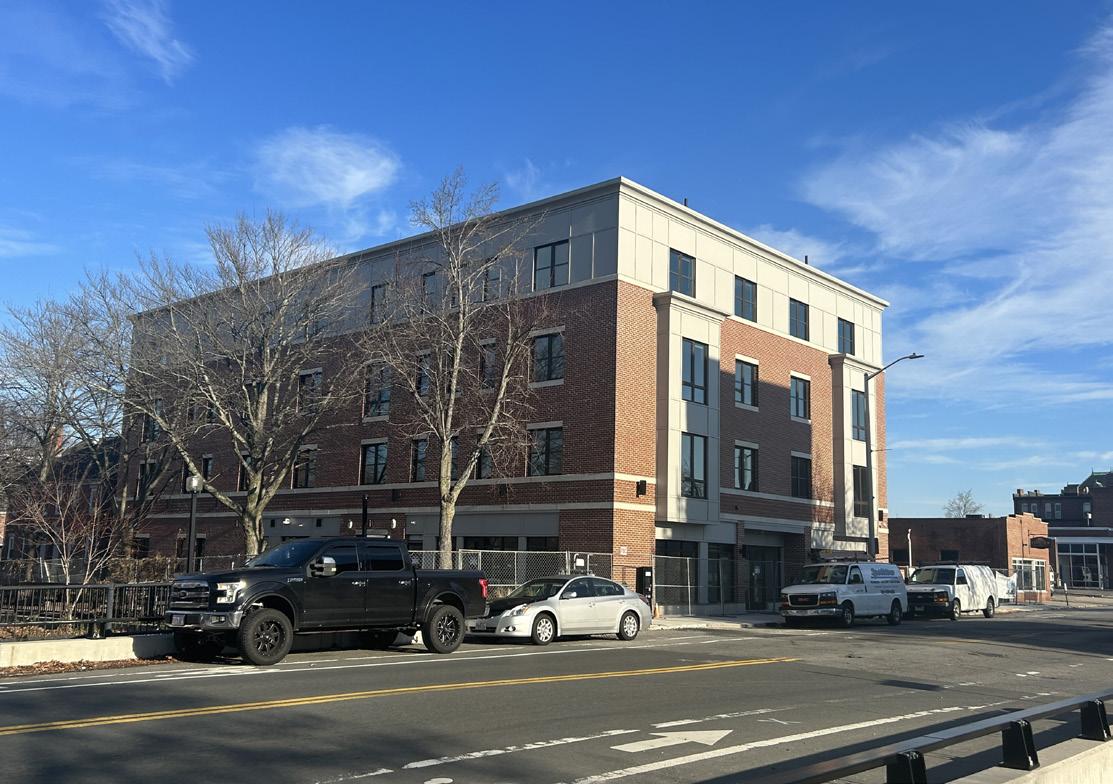
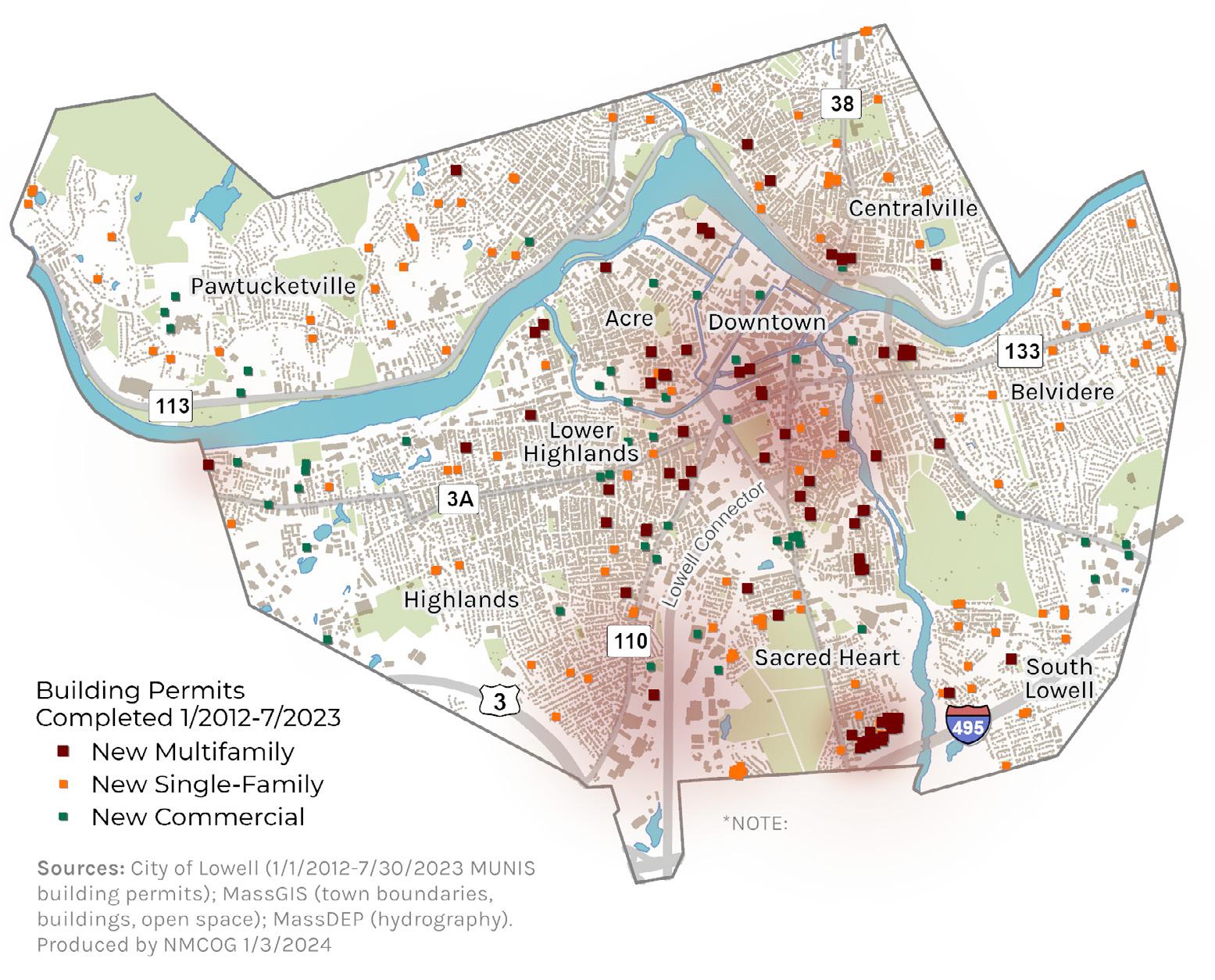
Top: New residential developments that are environmentally sustainable and include income-restricted housing.
Top Left: Acre Crossing Residents will have 30+ income-restricted homeownership units. Merrimack Valley Housing Partnership is the lottery agent for this new development at 650 Merrimack Street, Lowell, MA.
Top Right: 555 Merrimack will have 27 units have a preference for households with income at or below 60% AMI that also qualify for voluntary services, including supportive services focused on recovery from substance.
Left: Building Permits completed for new multifamily, single family and commercial projects between January 2012 and July 2023 use disorder.
Growth encompasses a much broader spectrum than simply increasing our population. It’s about enhancing the overall well-being of our existing communities while considering sustainable, equitable and inclusive development. Quality of life improvements, such as access to better employment, education, healthcare, and cultural opportunities, are all fundamental aspects of growth. Sustainable growth involves optimizing our existing resources rather than just expanding them. Efficient use of our existing infrastructure, promoting environmentalfriendly practices, and preserving our natural spaces are all important elements of growth.
What does the data tell us?
Lowell’s population is stagnating, and it is projected that this trend will continue over the next two decades as people slowly move out of the city. Unlike population, Lowell jobs are expected to grow over the next decade by 17%, although this projected job growth is still below projections for other peer cities and the statewide average. Lowell’s ratio of jobs to population—an indicator of a city’s ability to attract and retain resident workers—is increasing, although it is lower than peer cities and the statewide average. If this trend continues, Lowell will continue to lose its population and economic opportunities to other cities in the state.
Historic and Projected Ratio of Jobs to Population for peer Massachusetts Cities, 2010 – 2030
Source: UMass Donahue and Lightcast
These macro trends are particularly apparent in our Downtown, where there is relatively low presence of residential uses compared to the rest of the city, a lack of street-level activity, and a perception of vacancy.
Without growth, the City’s financial responsibility will add pressure to existing residents to keep funding basic services and City operations. Access to more affordable and diverse housing options, efficient transportation and transit networks, and quality public infrastructure, were the top needs identified by the community throughout Lowell Forward’s engagement efforts. Proactively and responsibly planning for growth and development can not only help us meet some of these needs, but also help us shape the change intentionally as much as possible so that it aligns with and advances our goals and values as a city.
of renter households and more than a third of owner households are housingcost burdened in Lowell.
Lowell’s Downtown and the surrounding areas are home to underutilized land with the potential to accommodate residential development.
of Downtown businesses reported fewer on-site customers in 2021 than 2020.
of Downtown businesses were operating at reduced hours or capacity in April 2021.
Public realm spaces— parks, plazas, and streetscapes —are underutilized, disconnected from activity centers, or require significant improvements.
Additional residential development could address citywide affordability challenges, while greater residential density could drive foot traffic Downtown.
Well-managed and strategic growth and development can positively impact the City’s fiscal sustainability through increased tax revenue and generate more resources for providing, improving, and maintaining quality public services and infrastructure. It can foster more job and educational opportunities for Lowellians, as well as offer new recreational and community amenities. While the housing crisis requires many different policies and programs to address all our community’s housing needs, creating new affordable housing programs and adding more affordable units is a major goal for growth in Lowell in this plan. In essence, well-managed and strategic growth can help us provide more options for all family sizes and needs, keep housing affordable for Lowellians, and support fiscal sustainability for high-quality public infrastructure and services, in addition to cultivating job, business, and educational opportunities through economic vibrancy and diversification.
Most of Lowell’s tax revenue comes from its property tax base. Investmets in diverse development (including commercial and industrial), can support property values and, in turn, generate greater resources for public services.
Throughout the Lowell Forward planning process, the planning team engaged the community in workshops and meetings to identify needs and opportunities in the city and neighborhoods, creating an open dialogue about what future growth and development in Lowell could look like. These conversations helped to navigate various complexities and build a more shared understanding of diverse perspectives and needs within the community, ultimately leading to more inclusive and well-thought-out growth strategies. The strategies outlined in the following pages present concepts and ideas for guiding growth, change, and development in a direction that maximizes public benefits while minimizing potential negative externalities that can result from unsustainable development. Two overarching principles for growth, highlighted on the subsequent page, guide these strategies and concepts:
• Growth should be sustainable, balanced, and integrated
• Growth should serve the interests of our community
This means that various development components including land uses, transportation and infrastructural networks, environmental systems, and commercial and community assets, must be coordinated, connected, and maintained to maximize efficiency and yield positive outcomes for the community.
Working with City staff and the community, Lowell Forward identifies the physical locations in the city where integrated growth can help us achieve multiple outcomes for our community. These are areas that already have sufficient residential and commercial density and existing infrastructure that can be expanded, in order to avoid sprawl and costly, unsustainable outcomes. By focusing on these areas, Lowell can optimize resources and infrastructure while minimizing strain on additional areas. This approach allows for more efficient utilization of existing services and facilities, making it easier to enhance mobility, create new housing options, and foster economic activity.
Concentrating growth in already dense areas promotes a more sustainable urban environment. It supports walkability, reduces commuting distances, and facilitates more mixed-use development—cultivating vibrant communities where Lowellians can live, work, and access amenities more conveniently.
Growth should help to improve quality of life for Lowellians, and not exacerbate past and existing inequities. Addressing the need for better infrastructure, affordable housing, and enhanced amenities for our communities will require collaborative efforts between the public sector, private developers, community organizations, and residents. Are there ways in which we can catalyze private development and public investment to maximize multiple opportunities and benefits for Lowell residents? Where does this occur, how do we make it happen, and what does it look like?
It is important to understand that growth will not look the same everywhere across Lowell, nor does it need to. For some communities and areas in Lowell, more substantial investment and redevelopment will bring about more transformative change in economic activity, quality infrastructure and community well-being. In other areas with stable patterns of development, less change is needed.
Growth and development in Lowell should be approached with context sensitivity. It should consider the nuanced understanding of local dynamics and challenges, and enable development solutions that are better suited and tailored to address specific needs of Lowell’s different areas and communities.
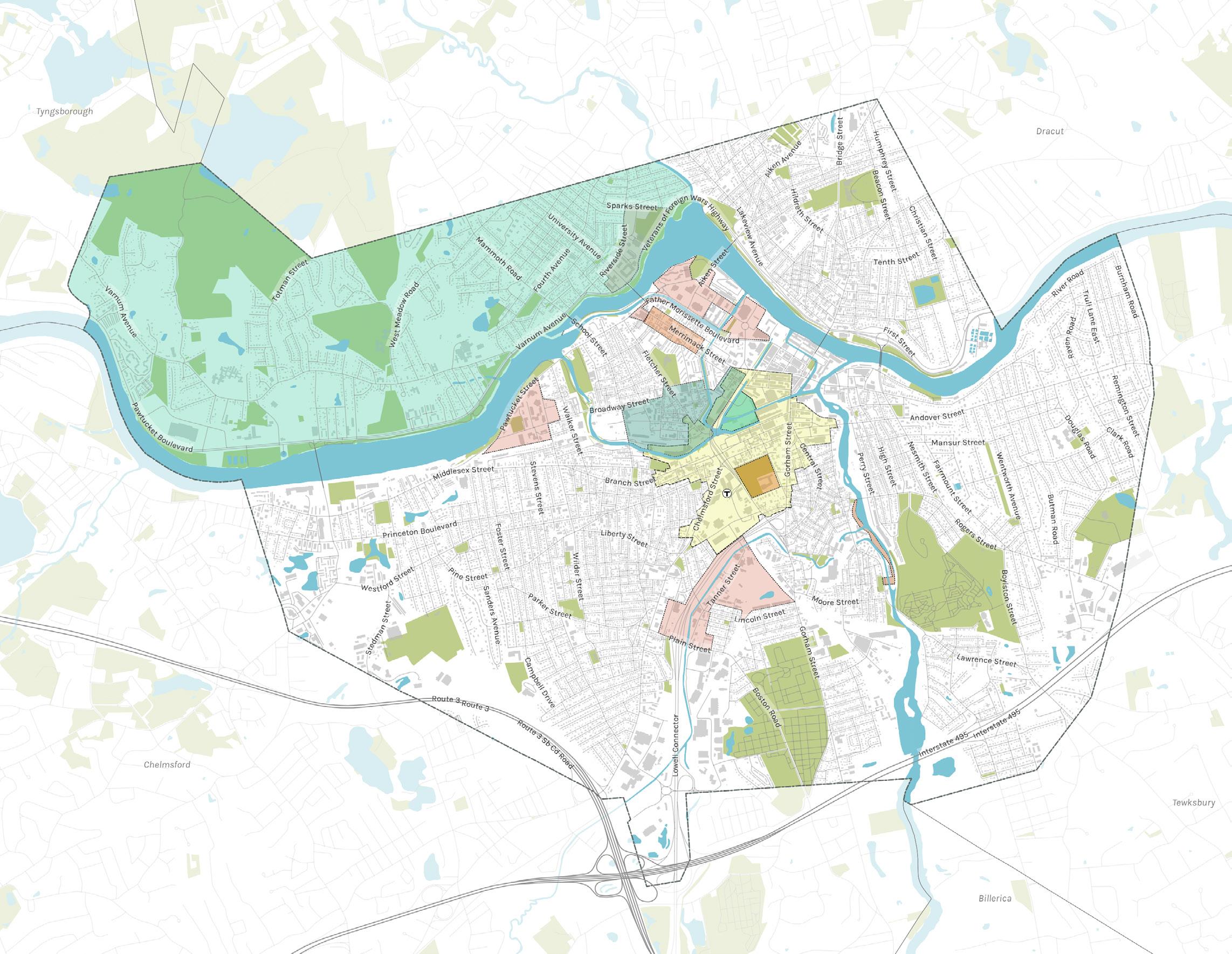
Lowell is composed of a diverse set of places with different built forms and land uses. Each place plays a different role in the daily lives of residents, workers, and visitors. Together, these places define the physical and social infrastructure of the city. Throughout this process, the planning team worked with the community to identify the most important places that define Lowell’s structure and create a shared mental map that helped to visualize how the city functions today. Identifying and categorizing the various types of places in Lowell sets the groundwork for prioritizing what kind of improvement or change we want to see in places across Lowell.
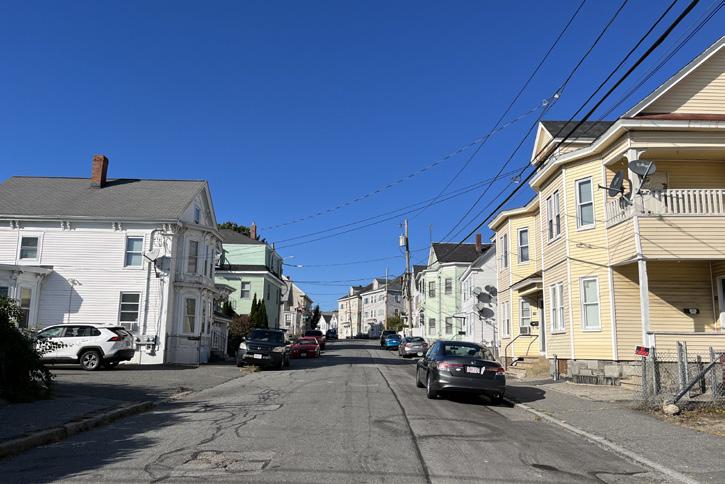
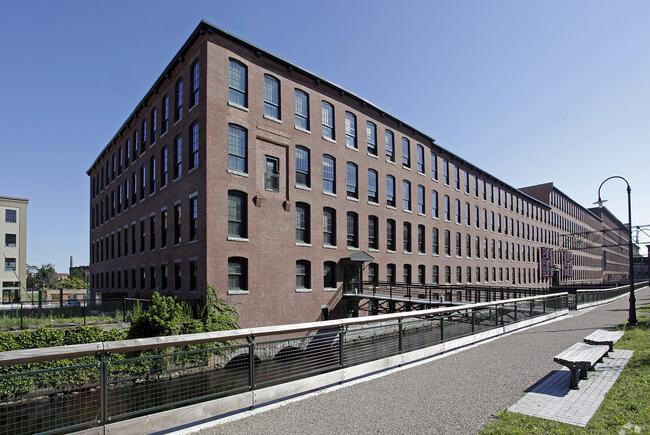
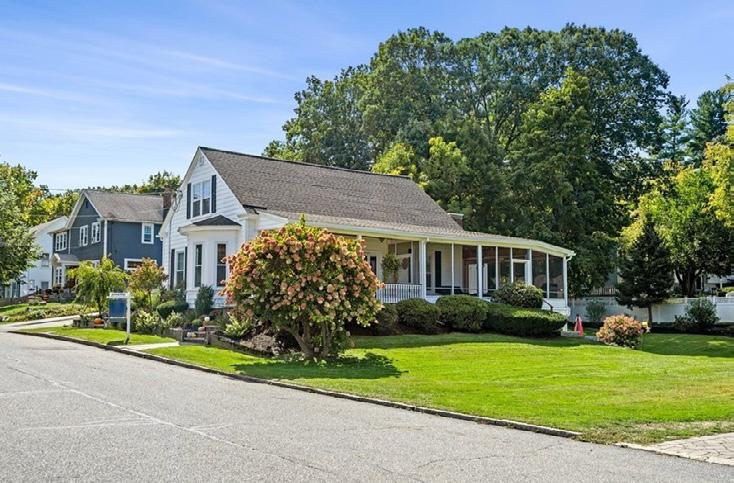
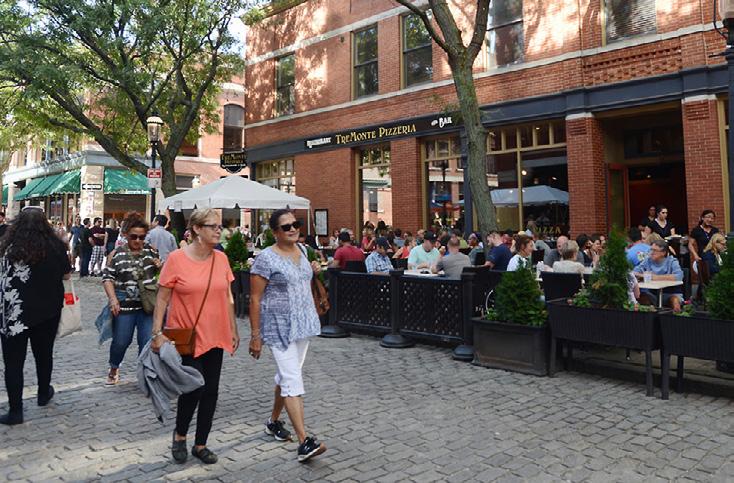
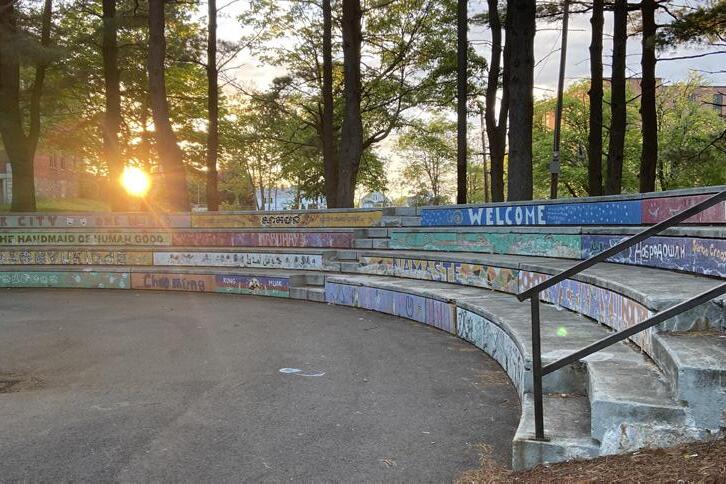
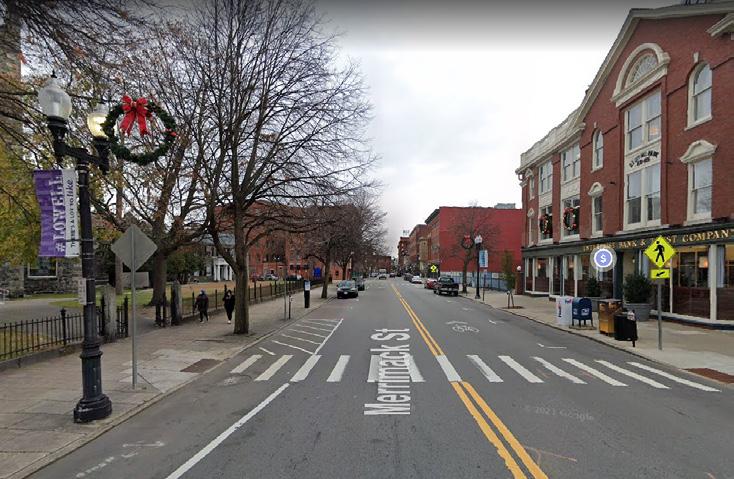
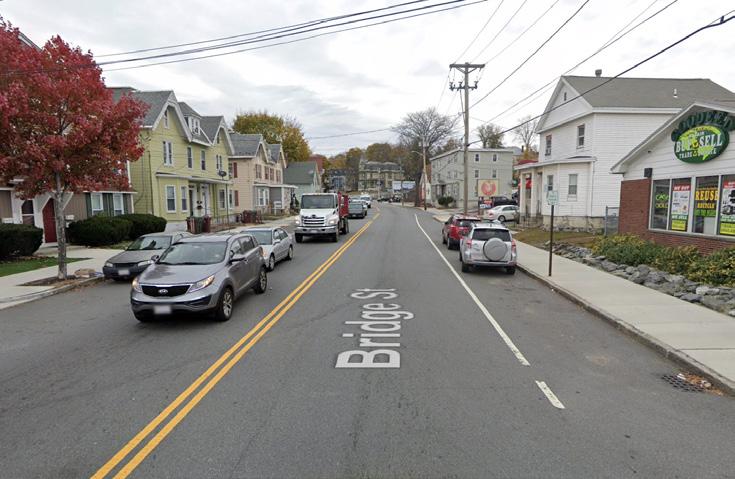
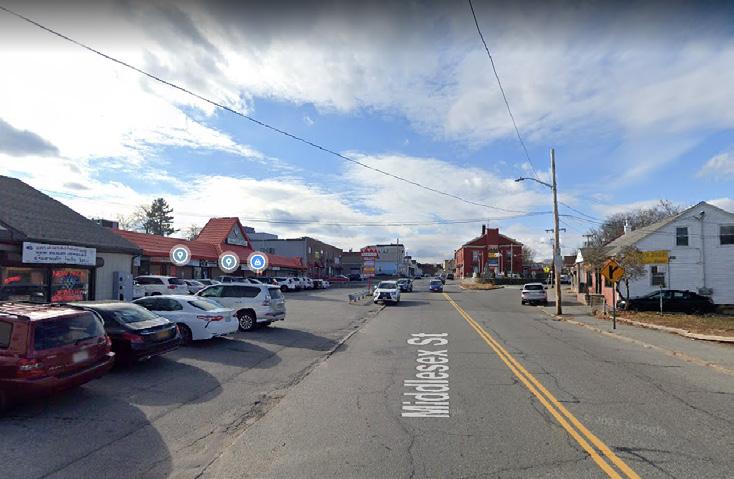
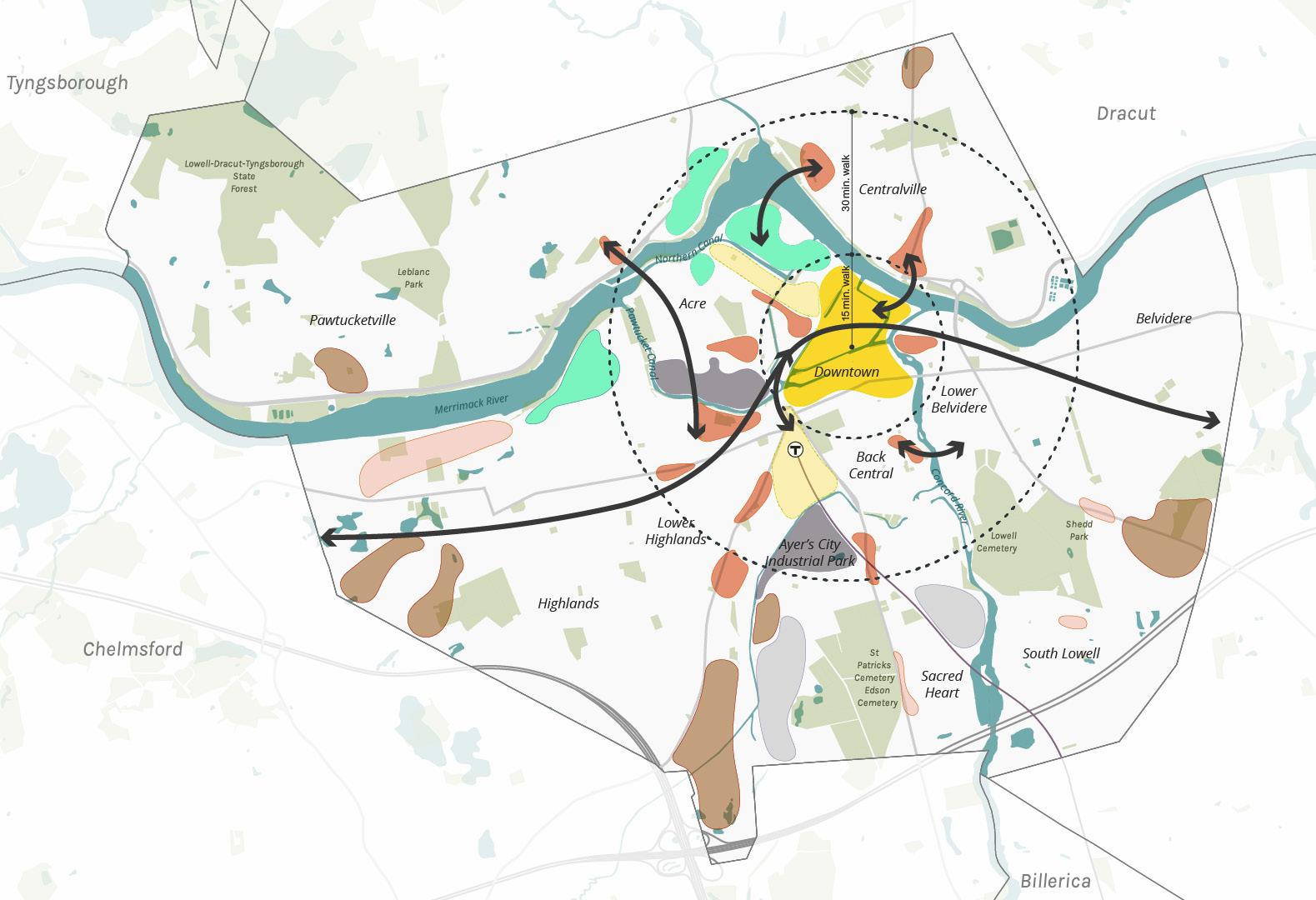
Legend Downtown Gaps in Central Core (CC)
Neighborhood Centers inside CC
Neighborhood Centers outside CC
Educational Anchors
Industrial Areas inside CC
Industrial Areas outside CC
Improve Connections
Suburban Shopping Centers
Strategy 1
Grow and Activate our Downtown Strategy 2 Build on Lowell’s Unique Strengths Strategy 3 Create Opportunity in Strategic Areas
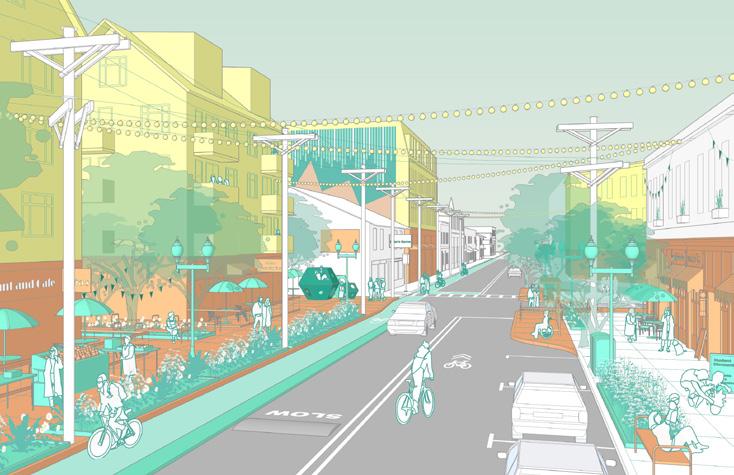
Increase residential density and increase occupancy of commercial uses in Downtown Lowell in order to:
• Drive foot traffic Downtown to support a vibrant, 24/7, mixed-use district that appeals to a broad range of users and bring several benefits to our larger community
• Support Downtown retail that serves residents, workers, students, and others
• Elevate Lowell’s “brand” and make it more attractive to employers, residents, and visitors.
• Make living in Lowell more accessible to more people by increasing housing supply and impacting housing affordability
The concepts below illustrate potential incremental development improvements for our Downtown that embody desired economic and community development outcomes. Note: Illustrations shown are conceptual ideas and reflect general conditions in Downtown and not a specific place or area. Downtown Existing Conditions Grow Downtown
Single-use building with
of public
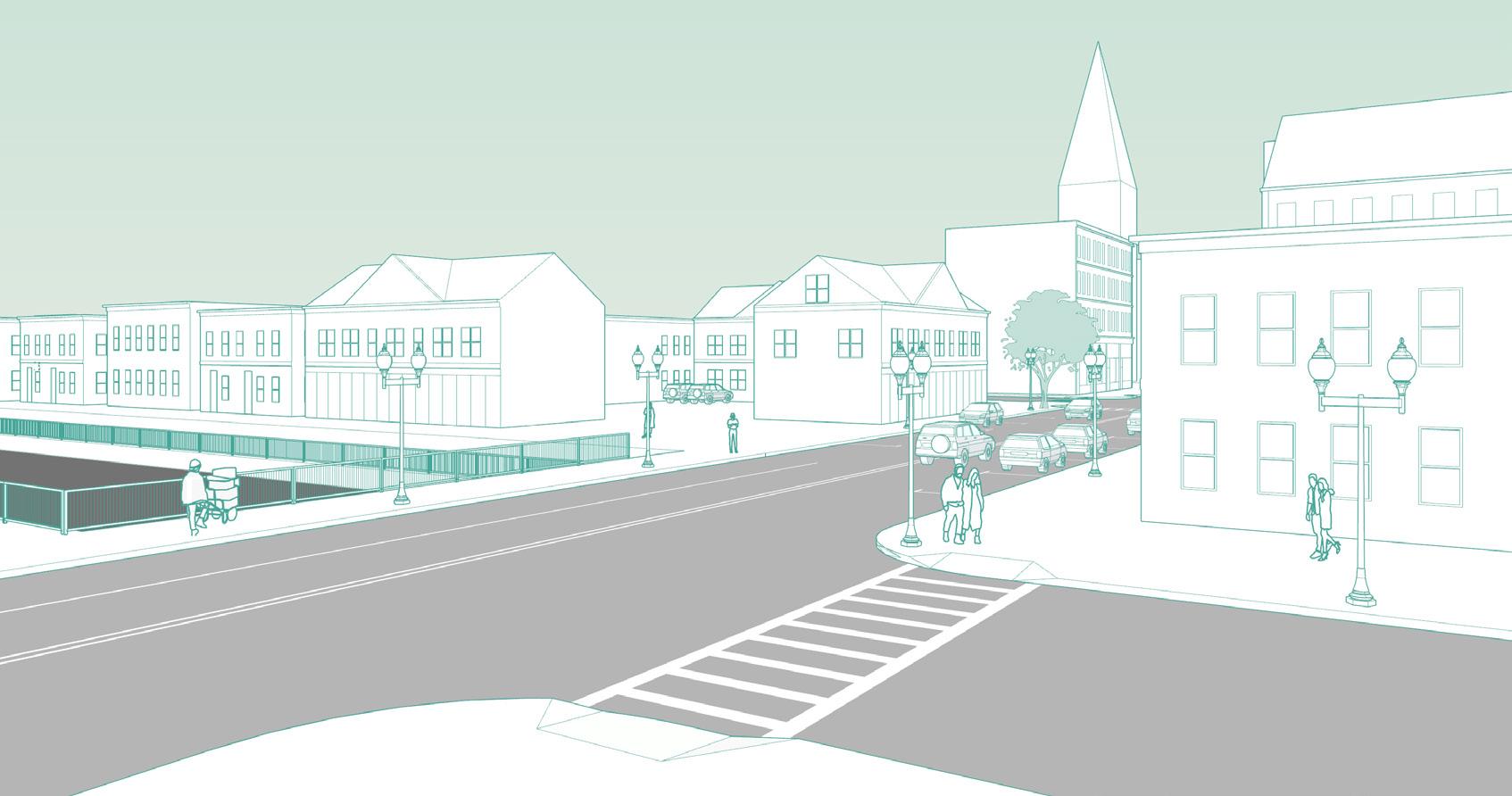
placemaking or designed environmental along canals
Vacant or underutilized property
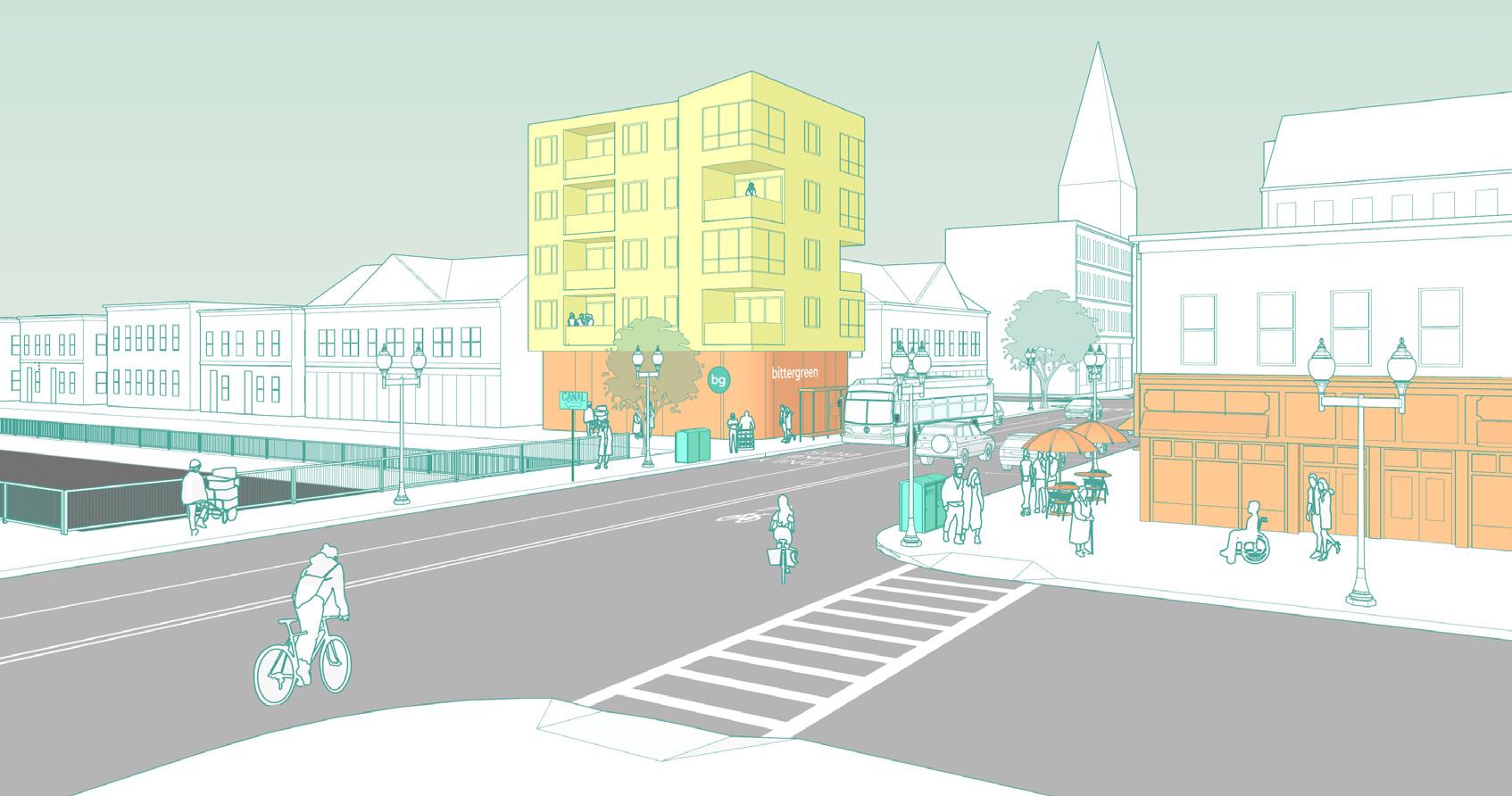
Downtown longer-term enhancements
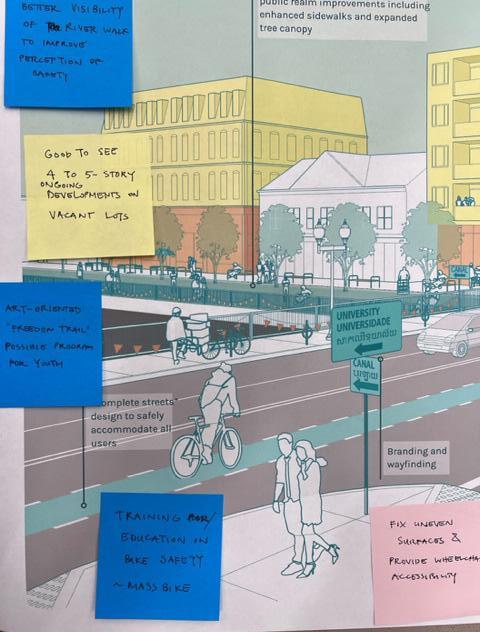
Activating canals and riverfront with public realm improvements including enhanced sidewalks and expanded tree canopy
Branding and wayfinding public and cultural activities
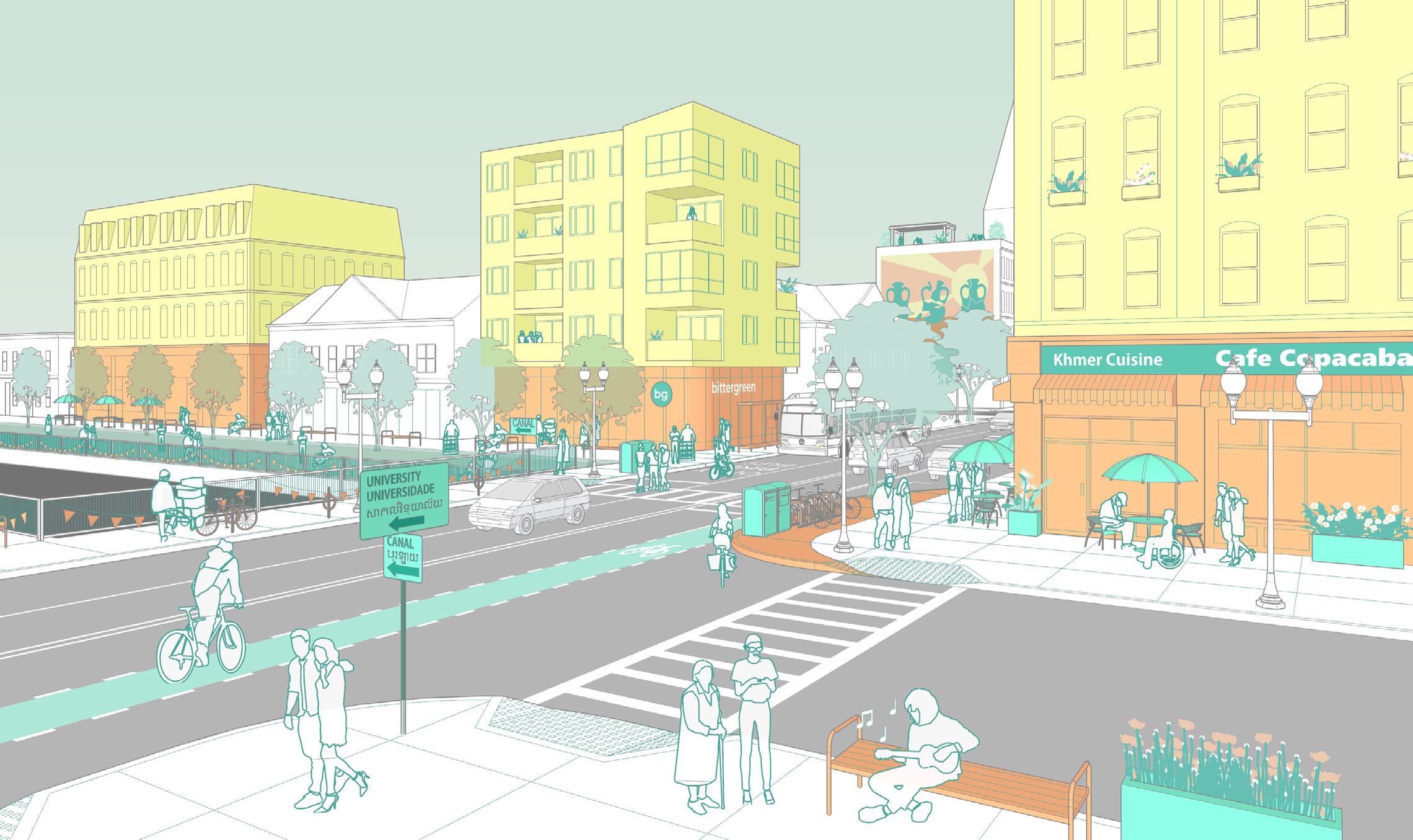
‘Complete Streets’ design to safely accommodate all users
Accessible surfaces and high-visibility crosswalks
Strategies for context-sensitive infill development with diverse and affordable housing options
Retrofitting/adaptive reuse of buildings
Ground floor activation including encouraging certain uses, storefront improvements, public space
Infill development involves locating new development projects on previously unused or underused land within existing urban areas. This practice increases density by placing new development near existing resources and infrastructure and promotes environmentally sustainable urban growth by leveraging existing utility and transportation networks. Well-designed projects can minimize travel distances, reduce car dependency, and make public transit more accessible. Infill development supports diverse and affordable housing options, bringing residences closer to job opportunities compared to suburban developments that may exclude low-income households and place people farther from essential resources.
Future infill projects in Downtown should be context–sensitive and complement the existing development character, especially our historic buildings. One way to achieve this is to set clear design guidelines for desired scale, character, and uses. In addition, we need to establish policy tools to ensure that community interests are protected, including maintaining levels of affordability. Future development in Downtown will be an incremental process, where the success of one well-planned project can establish precedents and standards for subsequent developments.
Maximize the potential of our canals and waterways to become a connector, an experience, and an identifier of Lowell by:
• Identifying gaps in the current network of pedestrian and bike access along canals
• Improving pedestrian experience at key intersections/crossings identified
• Enhancing connections between activity centers across the Merrimack River
• Collaborating with community organizations and local anchors to initiate short- and mediumterm projects to activate the canals in strategic areas as pilot studies
• Develop a comprehensive canal wayfinding strategy and activation campaign
• Leverage the national park in the heart of downtown
Some short-term and cost-effective activation strategies could include recurring events such as neighborhood parties, fairs/markets, and concert series in key areas identified. Engage local artists and community groups to tell the story of the canals, the industry that occurred and still occurs along them, as well as installations to interact with. In the future, events and cultural projects could be scaled up to draw new visitors within and outside of Lowell.
Note: There is already a long history of cultural planning and extensive investment around the river and canals. The strategy outlined in Lowell Forward does not entail creating only new initiatives, but building on, supporting, and tying together the great work already being done by our community groups, artists, city departments, and leaders. This includes improving infrastructure along our waterways, creating better wayfinding strategies, and launching promotional campaigns to highlight our city’s beautiful features
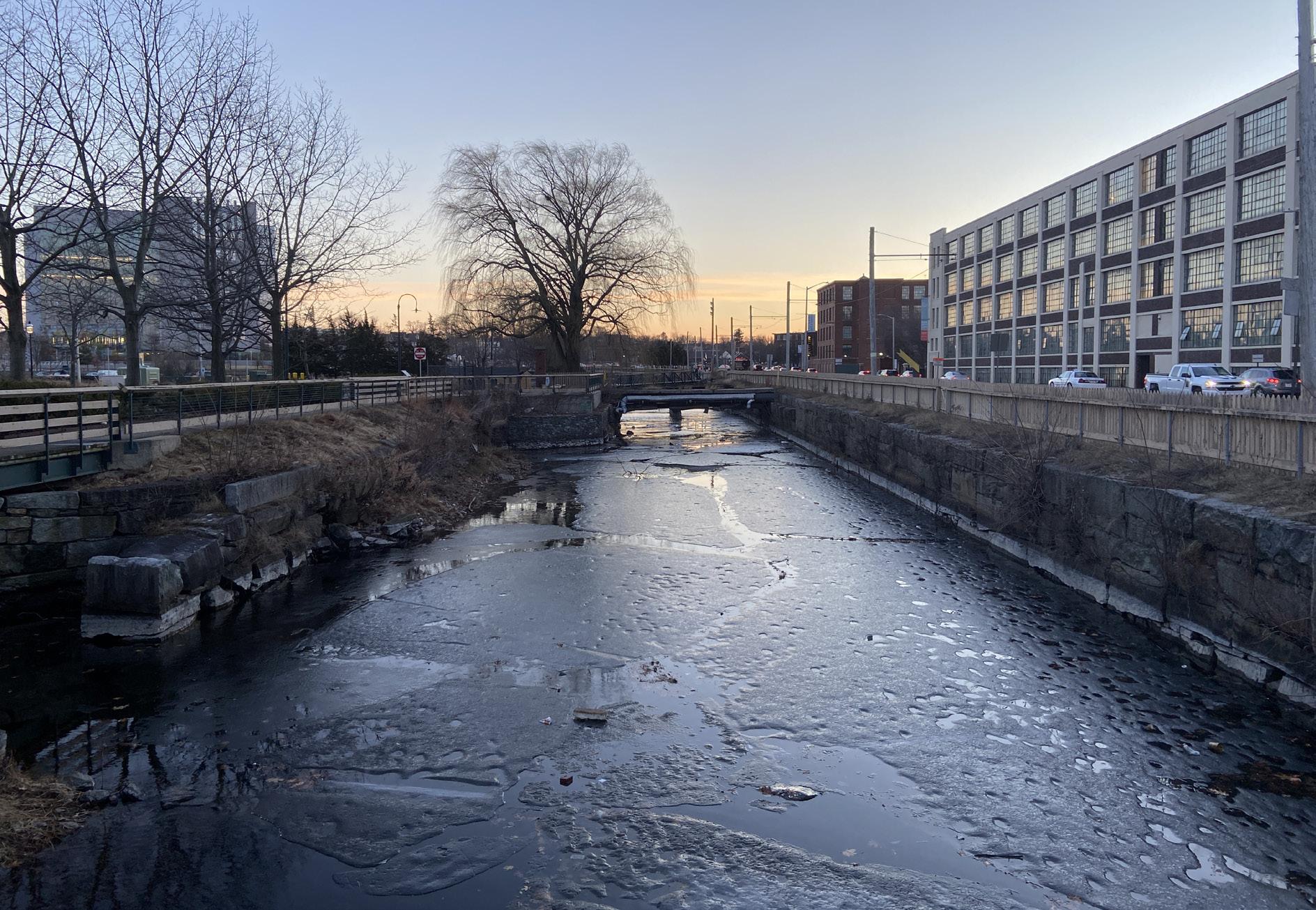
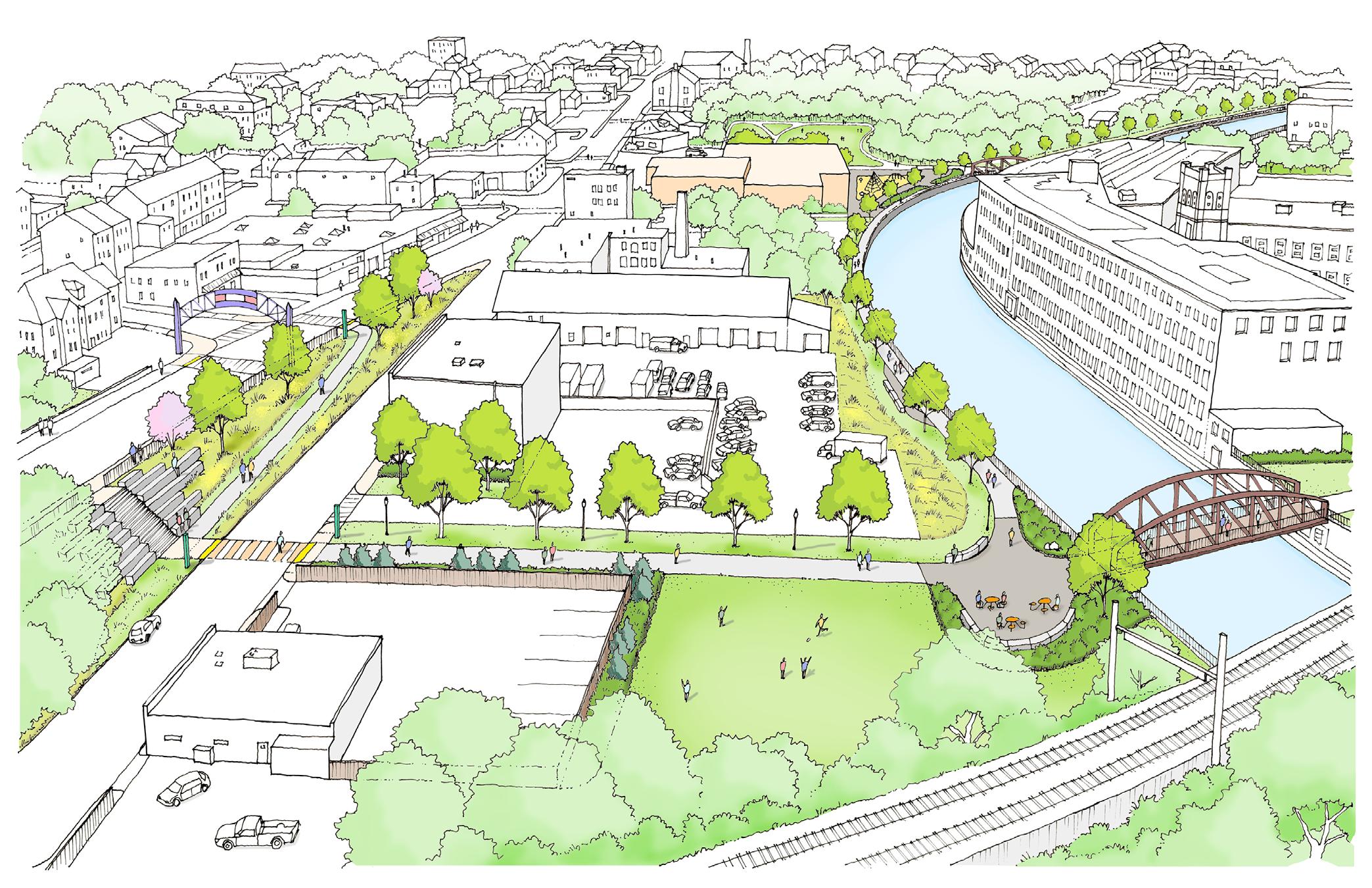
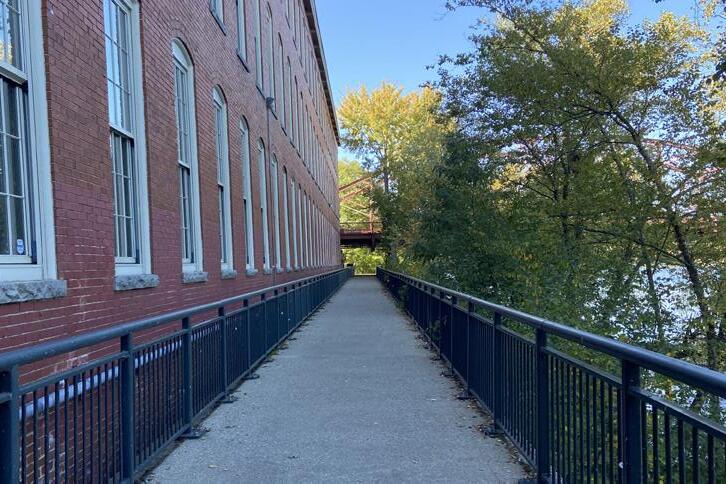
The city’s unique network of canals and its source, the Merrimack River, are a defining feature of Lowell, with four main walkways connecting Downtown. However, key gaps exist along the Pawtucket Canal and near the Concord River Greenway’s end by the Boott Cotton Mill. The Pawtucket Canal link has long been identified as a potential future link, and its completion would provide an important connection to, and amenity for, the Lower Highlands neighborhood in addition to having a significant impact on residents’ and visitors’ experience of Downtown.
In Lowell, creating new open spaces and public amenities is challenging due to limited undeveloped land in the dense urban area. However, the evolving urban landscape offers a unique opportunity to reimagine the industrial areas and canal banks along the Pawtucket Canal. The Lowell Forward Plan proposes new canal walkways along the canal banks, potentially including pedestrian bridges at strategic points. The plan also foresees utilizing existing parcels along the canal to establish improved connections, possibly extending to the canal’s banks, aiming to craft a significant new green space at the city’s core.
Since 2006, Lowell, the National Park Service (NPS), and consultants have worked on the feasibility of Pawtucket Canal walkways, uncovering challenges like railway bridge crossings and managing historically industrial soil contamination. Despite these obstacles, the City, with NPS, is committed to pursuing the vision for the Pawtucket Canal walkways. Within the Lowell Forward Plan, prior proposals have been reviewed, outlining an initial vision for this canal network segment. Recent developments along the Pawtucket Canal, including renovations to Clemente Park, approved improvements to the Boys and Girls Club, and plans for various enhancements, suggest growing interest and demand for the new canal walkways.
The Plan: The Pawtucket Canal walkways are proposed as 8' to 10' wide paved pathways along the south side of the existing canal, utilizing the Department of Conservation and Recreation’s existing easements along the canal edges. These walkways would feature new greenery, seating, and site amenities. Installing pedestrian bridges over the canal would enhance access and link parcels on the northern side to planned amenities in the Highland neighborhood to the south. Connections from adjacent areas like Clemente Park, the Boys and Girls Club, and Middlesex Street would further integrate with the Highland Neighborhood.
Catalytic project: Pawtucket Canal
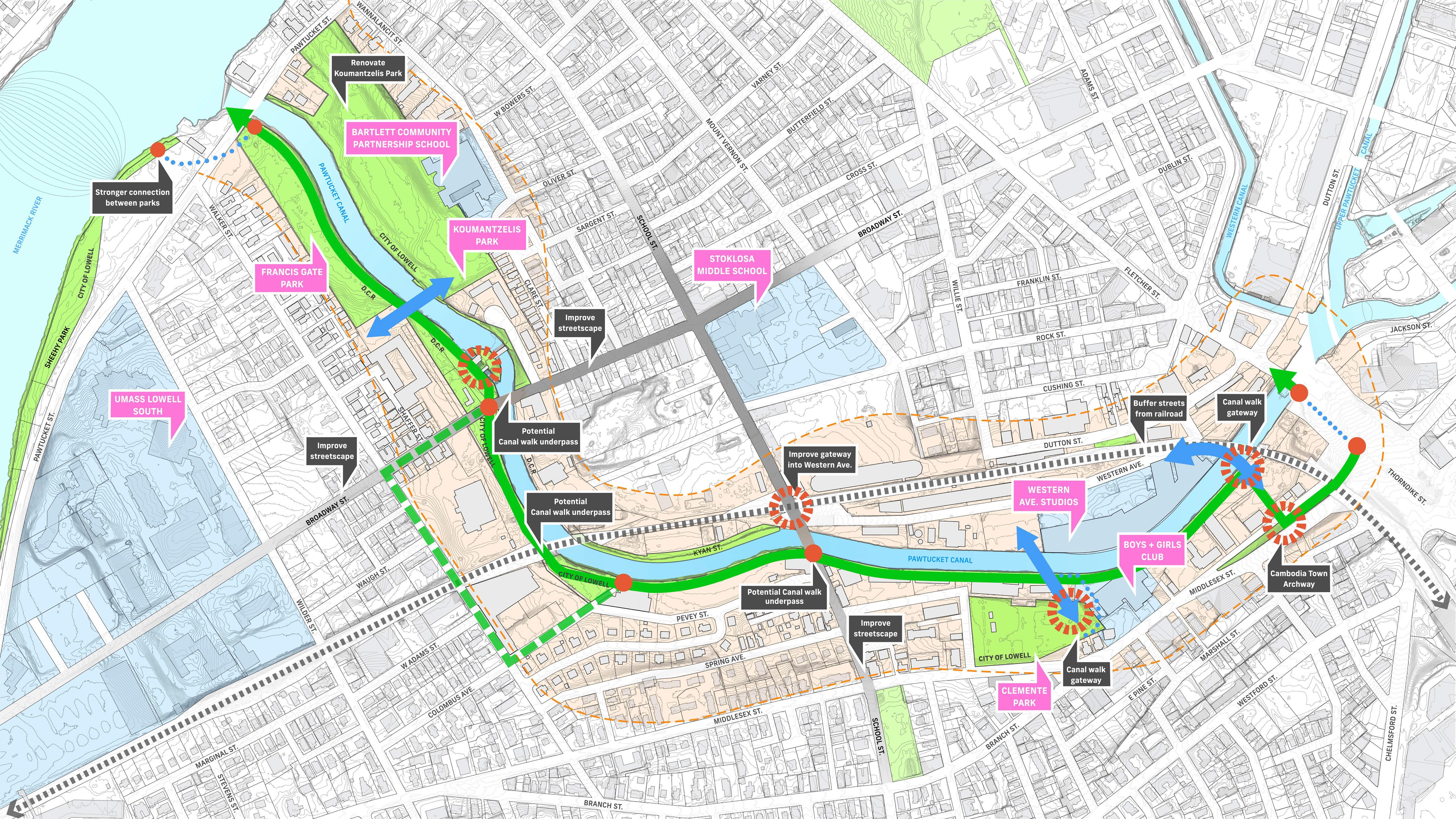

CANAL WALK

ALTERNATIVE CANAL WALK ROUTE
CANALWALK CONNECTION
PEDESTRIAN BRIDGE
GATEWAY CONNECTION POINT
ZONES

COMMUNITY FACILITY
CANAL DISTRICT
GATEWAY OPPORTUNITY
Based on site utilization, residential density, and proximity to commercial and transit hubs, the planning team has identified key areas in and around Downtown that could accommodate greater density of commercial and residential density. These areas include the Merrimack corridor area and the area around the Gallagher Station. The City and various community organizations are stewarding several development improvement efforts and partnerships in these areas, including the Transformative Development Initiative in the Acre neighborhood, in partnership with MassDevelopment. Attracting diverse and vibrant commercial and residential activity in and around Downtown can attract private investment, talent, and businesses, and in turn shift commercial property tax burden from landlords to tenants, with generation of additional tax revenue from potential new developments.
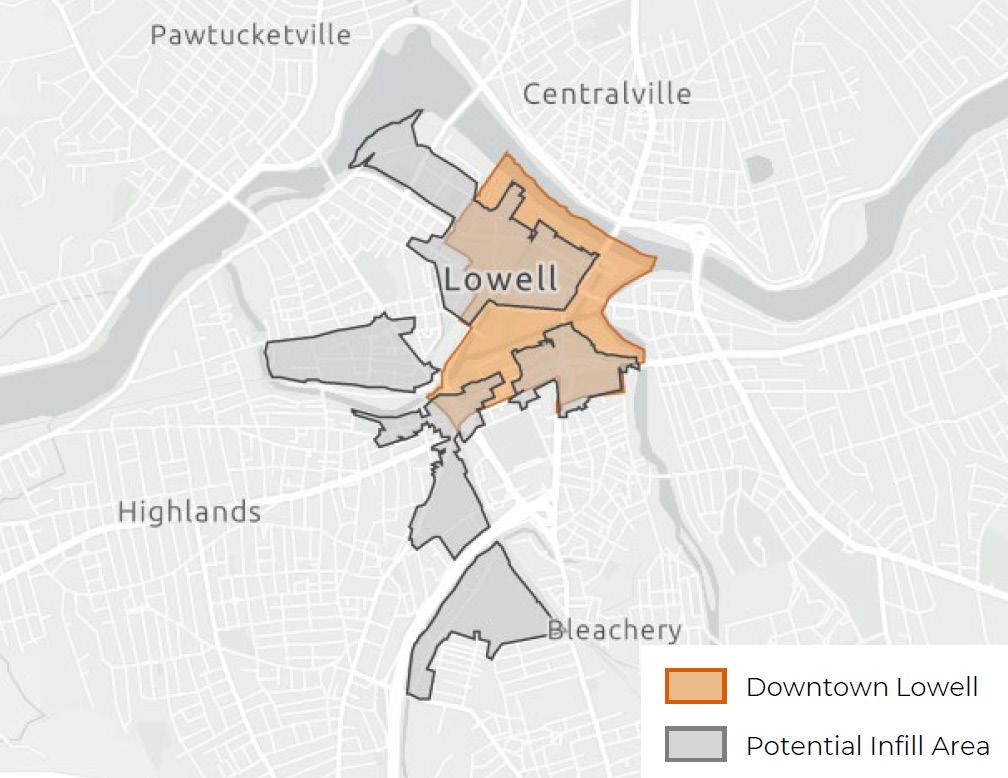
Transit Oriented Development Zoning Framework
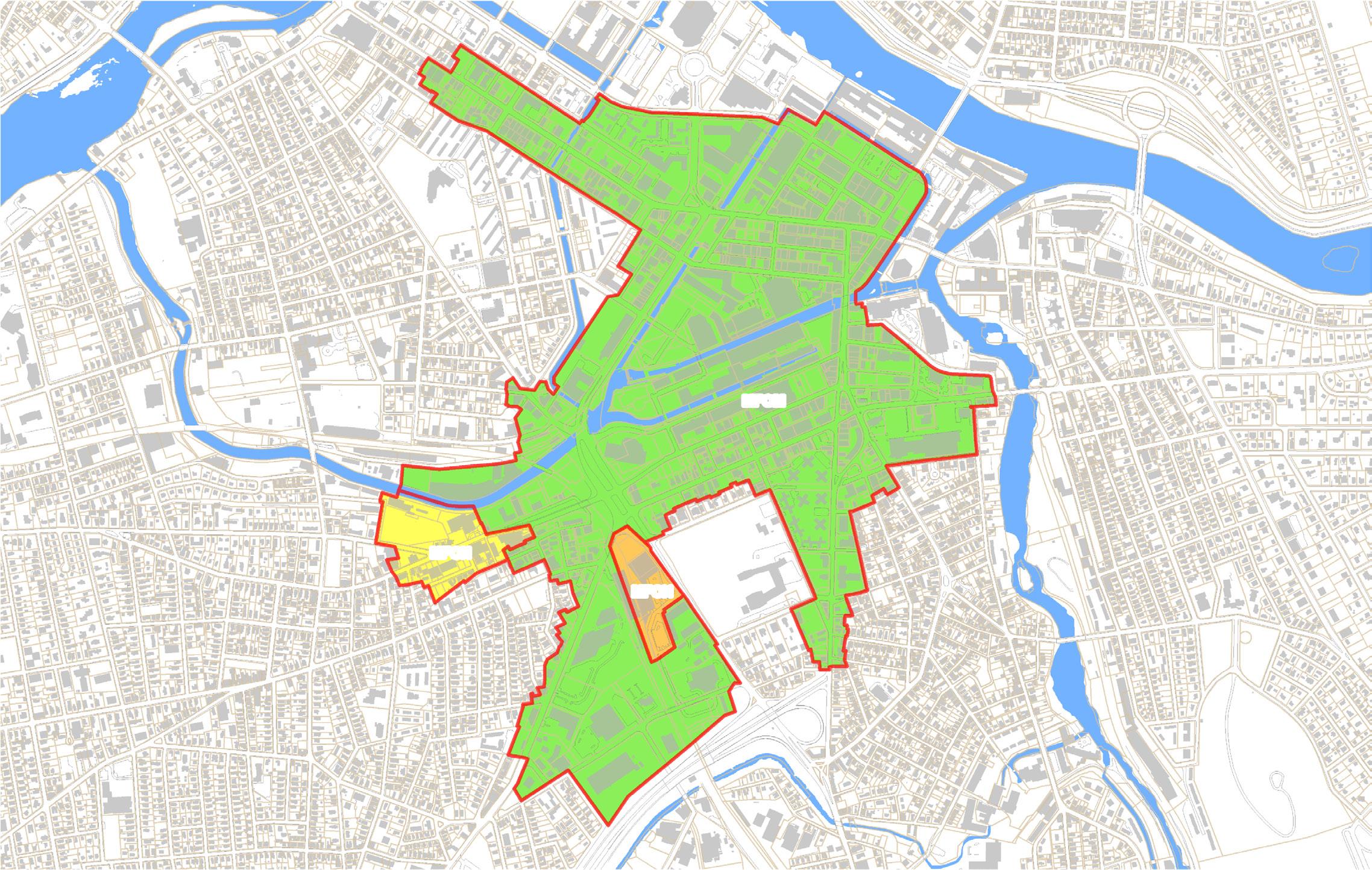
The three zones in the map above intend to step down from high-density high-rise construction at the MBTA station to mid rise on the primary corridors approaching the station, and finally to neighborhood infill around the station at historically-appropriate scale and density. MBTA Communities Overlay Data source: Stantec.
Catalytic Project: City-owned site by the Gallagher Station
The area around the Gallagher MBTA station has potential for densification and improved connectivity. Utilizing a city-owned vacant site strategically positioned between Thorndike St, Middlesex St, and the Pawtucket Canal, serves as a catalyst for incentivizing potential private investment and future development. It offers a prime opportunity to foster residential and economic growth and maximize accessibility through mixed-use development. Leveraging public land to catalyze private investment can offer the opportunity to establish longer-term and highervalue goals for our community, and support us in proactively addressing the housing shortage, and better connecting our downtown and central neighborhoods. Moreover, it opens up the opportunity to engage in strategic public-private partnerships and setting a model for what communitycentered TOD development could look like in the area.
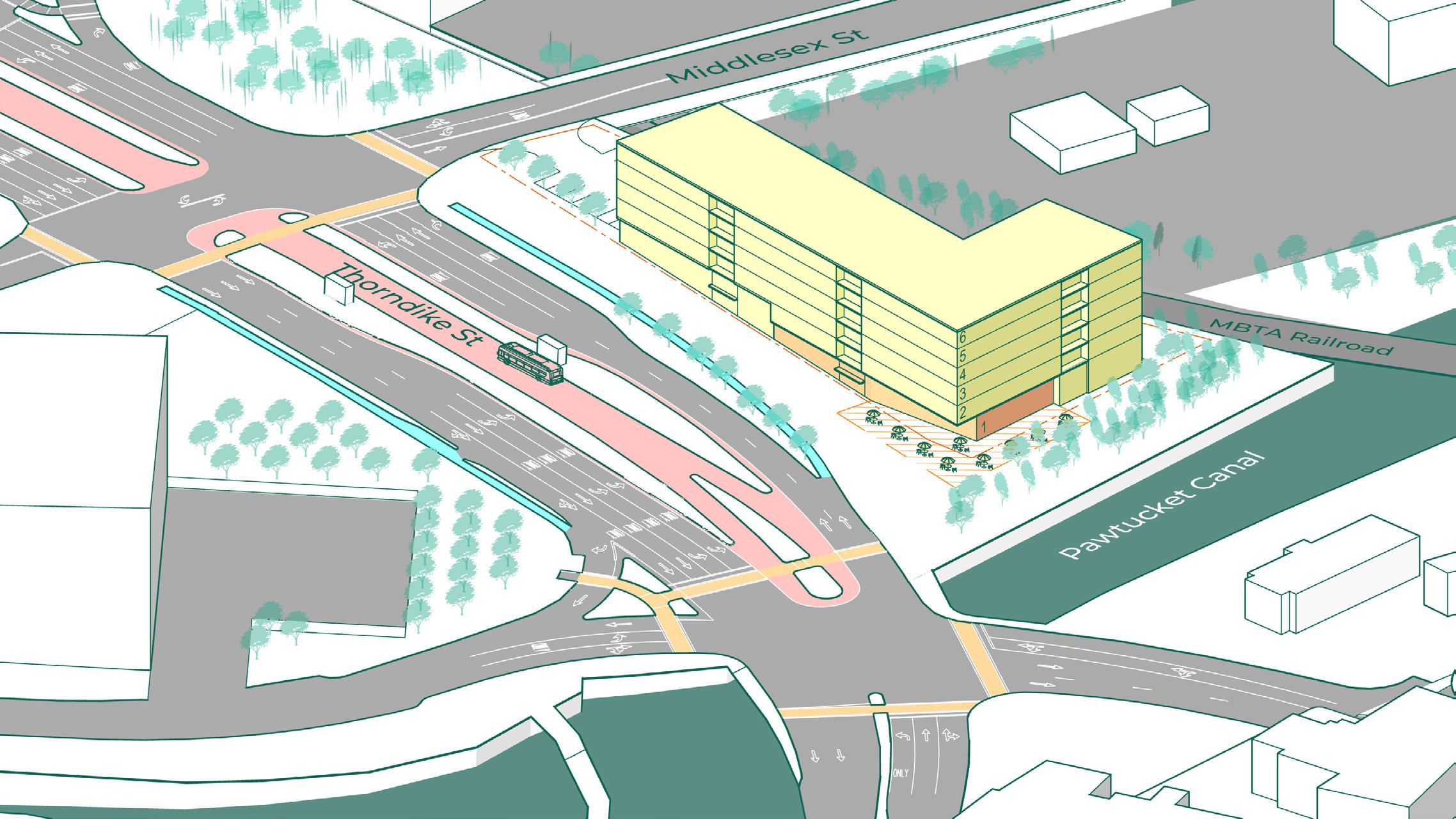
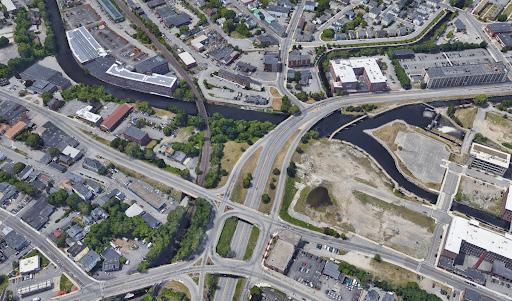
MassDevelopment’s Transformative Development Initiative (TDI) is a program for Gateway Cities designed to accelerate economic growth at the neighborhood level. The program works with local partnerships to foster actionable projects and create more vibrant streets. Lowell’s TDI District includes the upper Merrimack and upper Market Street corridors of the Acre neighborhood and is supported and led by MassDevelopment, the Lowell Plan, the Coalition for a Better Acre, UMass Lowell, the City of Lowell, Jeanne D’Arc Credit Union, Community Teamwork, Lowell Housing Authority, and Panela. Recently, the Lowell TDI partnership established a new equipment grant for small businesses in the Acre neighborhood. The grant will help small businesses purchase new equipment and expand their operations and continue to contribute to the unique character and identity of the area.
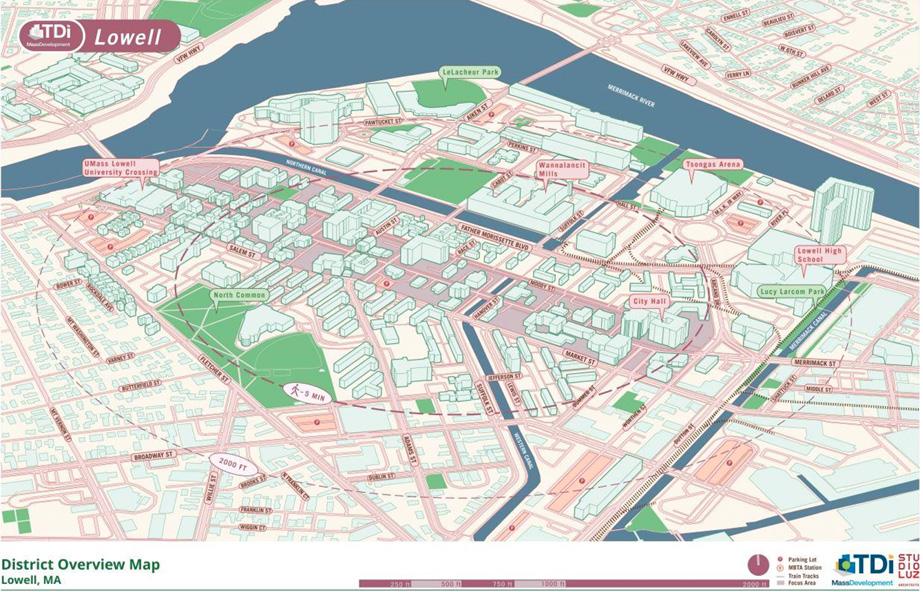
The City of Lowell applied for an “Alignment with Pathways to Removing Obstacles to Housing Grant” (PRO Housing Grant) to create development-ready parcels for future affordable housing projects in the Jackson, Appleton, Middlesex (JAM) area. In anticipation of grant funding, the City is studying housing development opportunities on vacant and underutilized public and private properties along Appleton Street. The study will identify barriers to housing development and prioritize sites for further study if the City receives funding through a PRO Housing grant.
Our neighborhood centers provide the greatest opportunity for growth and strategic community improvement. Lowell’s small businesses are pillars of the city’s economy, however, they face ongoing challenges. According to Lowell small businesses owners and business organizations, major challenges faced are:
• Lack of experience and knowledge to run a business
• Low foot traffic with limited and irregular business hours
• Lack of required space improvements in the places leased for business
• Language barriers as many small business owners don’t have English as first language
• Safety and security concerns that affects both owners and customer base
Strategies to enhance neighborhood centers and drive economic growth include:
• Promote, support, and grow Lowell’s local businesses (see page 81, on Topic specific Goals for detailed action items)
• Strengthen connectivity to and within neighborhoods through multimodal options and safe street design.
• Improving the public realm infrastructure and neighborhood services.
• Promoting contextually sensitive development that enhances neighborhood vitality and celebrates each neighborhood’s distinct identity
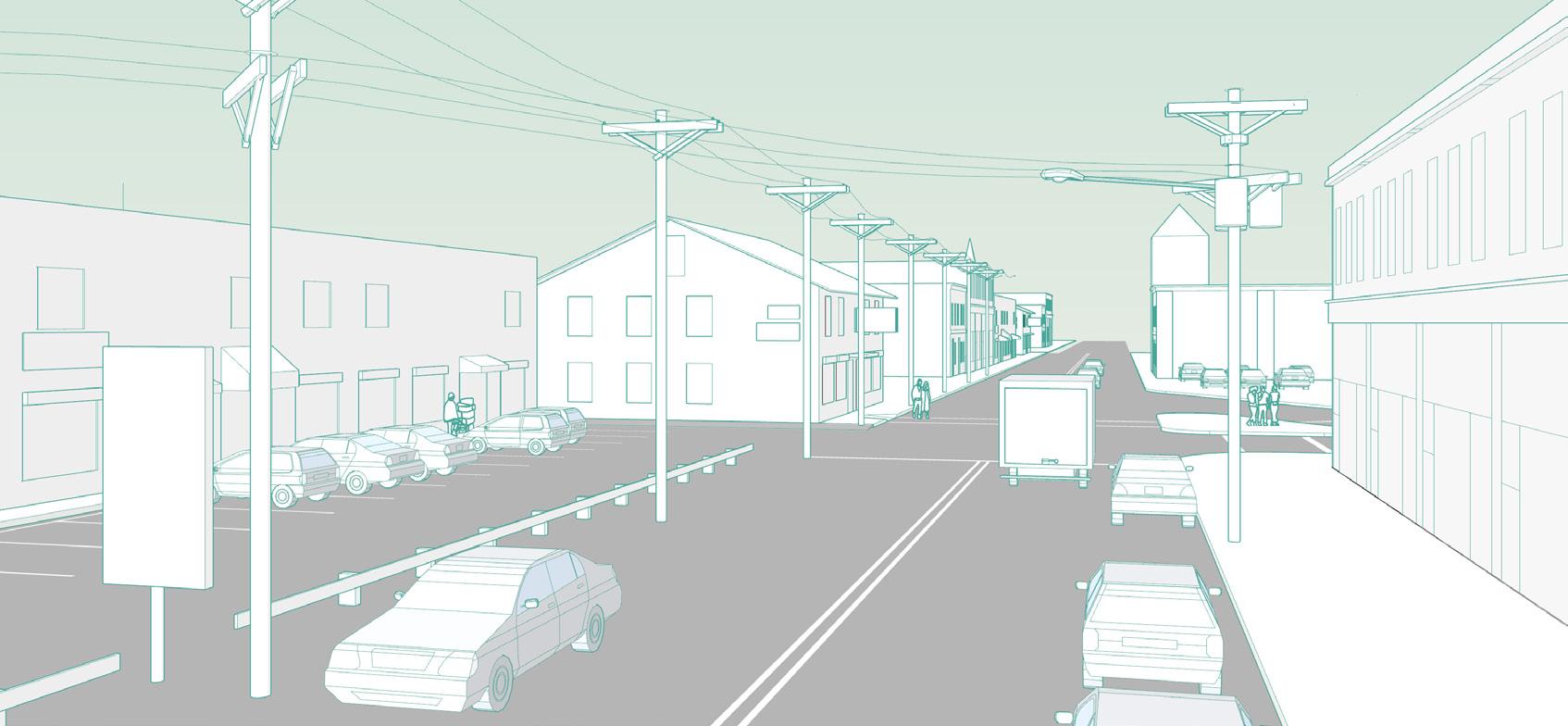
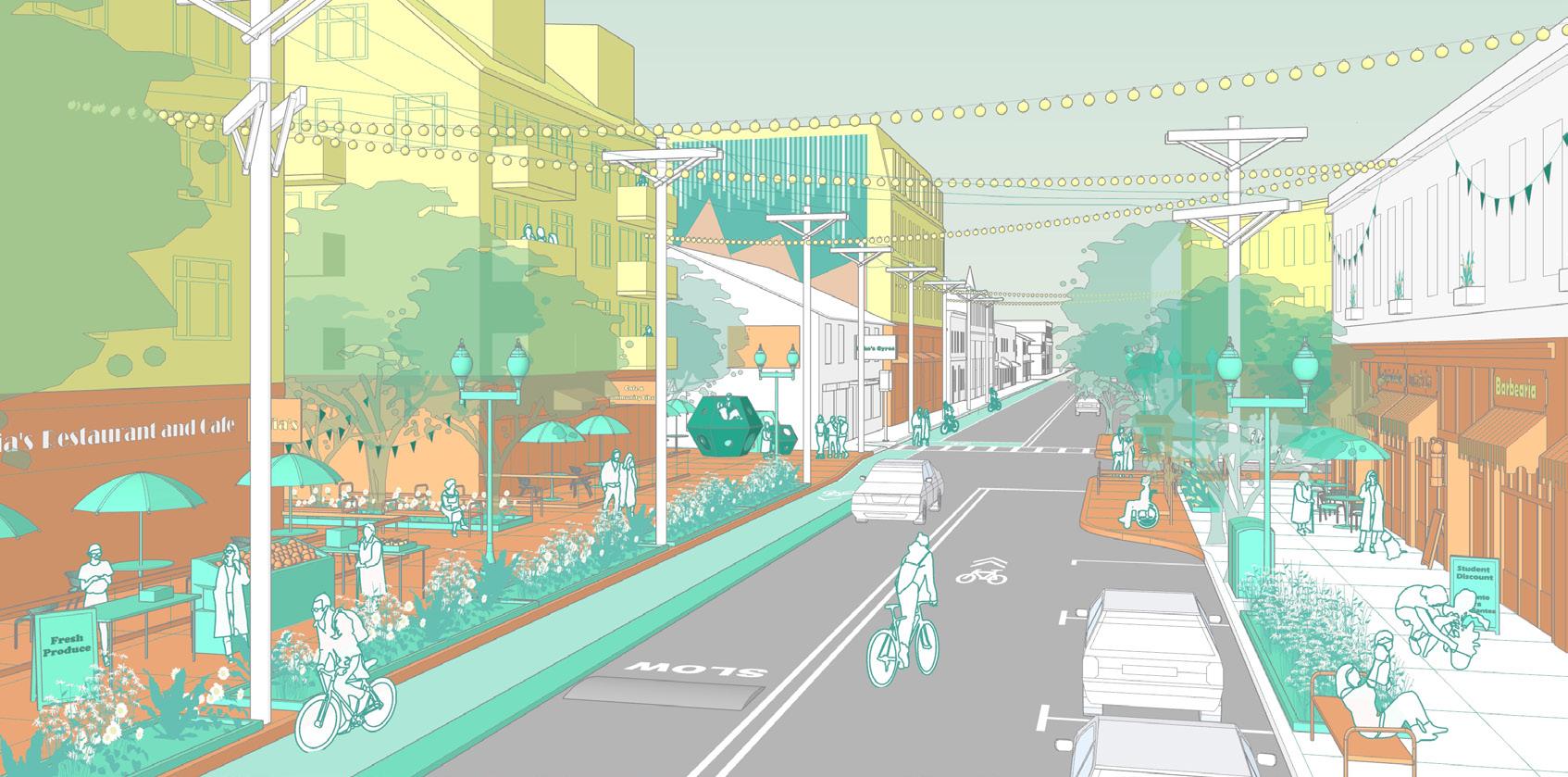
The Cambodia Town Neighborhood Plan is an ongoing partnership between the Lowell Department of Planning (DPD), Lowell Community Health Center (Lowell CHC), Lowell Community Health Center’s REACH LoWELL Program (Lowell CHC REACH LoWELL), and the Cambodian Mutual Assistance Association (CMAA). The Planning Team first approached this initiative through a lens of increasing physical activity by addressing mobility challenges in Cambodia Town, but through the community engagement process it became clear that mobility was not the only built environment factor contributing to negative health outcomes. The project evolved into a Neighborhood Plan addressing four intertwined focus areas:
• Mobility + Connectivity
• Cultural Identity
• Environment + Sustainability
• Economic Development
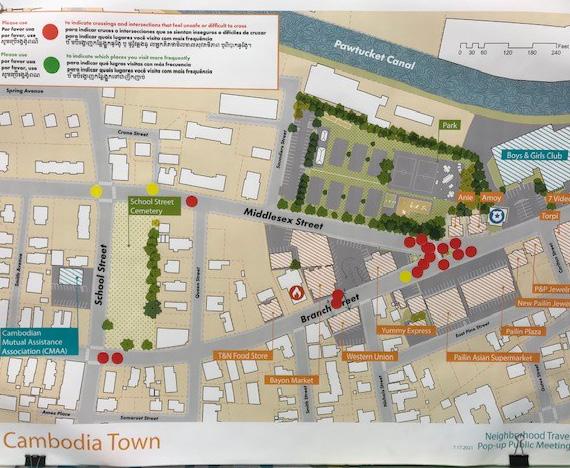
Lowell’s anchor Institutions including UMass Lowell and Middlesex Community College, provide a strong basis to empower jobs and overall economic growth, and they play a pivotal role in supporting small business growth in the city. Creating strategic partnerships with anchor institutions to support small businesses can boost the city’s economy while creating new jobs and adding a rich character to Lowell businesses through:
• Targeted purchasing initiatives that support small business growth, and drive associated hiring
• Skill development and workforce training to align skills of labor force with in-demand occupations
• Partnerships and programming to support the provision of technical assistance, access to funding, and networking for small businesses
• Targeted focus on supporting business owners in minority and immigrant communities
• Workforce development initiatives increase the attractiveness of talent in Lowell, thereby attracting new businesses
In addition to strategic local partnerships, it is important for the City and institutions to better coordinate development projects including campus plan extensions, transportation projects, and infrastructure projects, to ensure adequate connectivity and accessibility in adjacent neighborhoods. Good communication, transparency and engagement with the surrounding communities regarding institution development plans is vital to this process.

The UMass Building Authority (UMBA) is working with a team led by GMH Communities (a private real estate development company) toward the development of approximately 10 acres of land with improvements, consisting of five parcels on UMass Lowell’s East Campus. The property is located along the Merrimack River between two major local attractions, the 7,800-seat Tsongas Center and 5,000seat LeLacheur Park baseball stadium. While this master planning process is still in its initial phases, it is a prime opportunity for the City and the University to proactively plan and coordinate efforts for improved neighborhood connectivity and robust community engagement.
Lowell can employ strategies to address Downtown vacancy and improve neighborhood connectivity by learning from successful efforts in other cities.
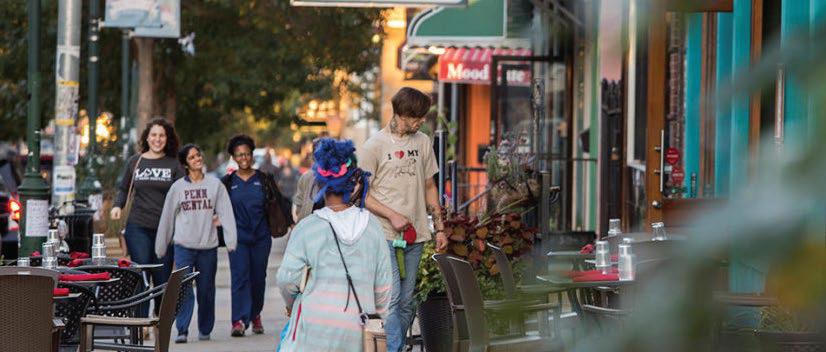
City: Entity: Program:
Philadelphia University of Pennsylvania
Buy West Philadelphia
• University requires its large national vendors to partner with local firms and partners with local community orgs. to identify qualified vendors and contractors
• Conducted surveys to understand retail needs of residents and students
Outcomes:
Annual local spending increased from just over $1 million in 1986 to $57 million in 2000.
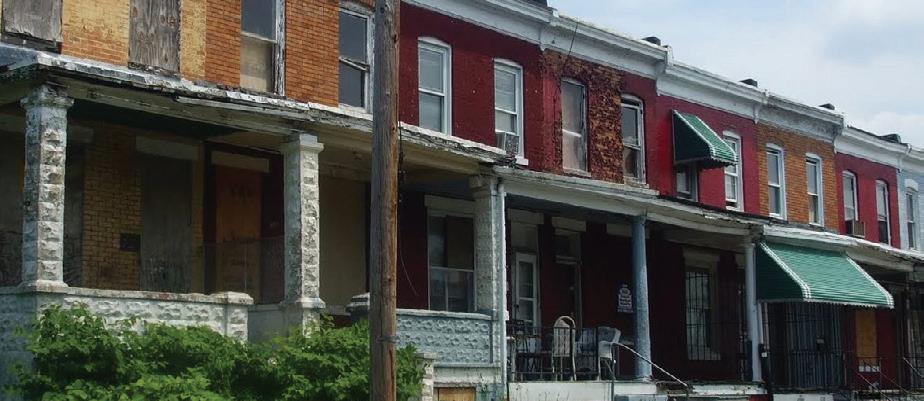
City: Entity: Program:
Baltimore
East Baltimore Redevelopment, Inc. (EBRI) East Baltimore Development Initiative
• John Hopkins deeded 100+ properties it owned to EBRI
• EBRI launched a $1.8 billion plan in 2003 to redevelop 88 acres, construction of 2,200 mixed-income housing units, 1.1 million SF of life sciences and biotech labs and offices, and retail space
Outcomes:
The development serves as a magnet to attract new biotech companies to the area, such as Annagen BioTech LLC, Chesapeake Limulabs LLC, and WindMIL Therapeutics.
Lowell’s anchor institutions have a powerful impact on the city’s economic growth. They can play a pivotal role in supporting small business growth.
City: Entity:
Durham (+ statewide presence)
North Carolina Community College (NCCC) System
Program:
Training for Local Businesses
• NCCC conducts business-focused training programs that service 600-700 local businesses every year
• Services, such as training courses and use of university infrastructure, are free of charge and tailored to the needs of companies
City: Entity: Program:
Philadelphia University of Pennsylvania

• The program engages local, minority, and women-owned businesses and residents in the University’s economic activity through targeted purchasing and hiring initiatives
Outcomes:
Till date, NCCC has started 669 businesses with creation/retention of 6,827 jobs.
Outcomes:
In 2015, Penn spent $122 million with West Philadelphia–based businesses (~13% of the university’s total purchasing), and 48% of new hires across Penn and its health system were local residents (1,572 new hires).
There are a number of opportunities to redevelop older industrial sites across Lowell for new economic development and job creation efforts.
One important and prime area is the Ayer’s City Industrial Park or Tanner Street Corridor area, which has direct access to the Lowell Connector Highway and located within close walking distance to Gallagher Terminal. Planning for the Ayer’s City Industrial Park commenced concurrent with the City’s 2013 comprehensive plan update (Sustainable Lowell) and continues to be an important development goal to advance in Lowell Forward. In terms of growth strategies, this area falls within Lowell’s central core, identified in this plan as an opportunity area for new infill development to better connect surrounding neighborhoods, accommodate new uses, and foster economic development.
Below is a test concept for the Ayer’s City Industrial Park/Tanner Street Corridor area that was generated during the Lowell Forward process to foster discussion with community groups around future industrial growth and development opportunities. The concept explored strategic redevelopment of vacant or underutilized parcels to accommodate modern industrial, research and development, and heavy commercial uses. It also explored street and site layout options to visualize alternatives for enhanced safety and efficiency around truck, vehicular, and pedestrian circulations. Additionally, the concept looks at ways we can activate the underutilized River Meadow Brook, running along the western edge of the district to provide public recreational use as a district-wide multi-use path, which can connect to Lowell’s larger system of multi-use paths.
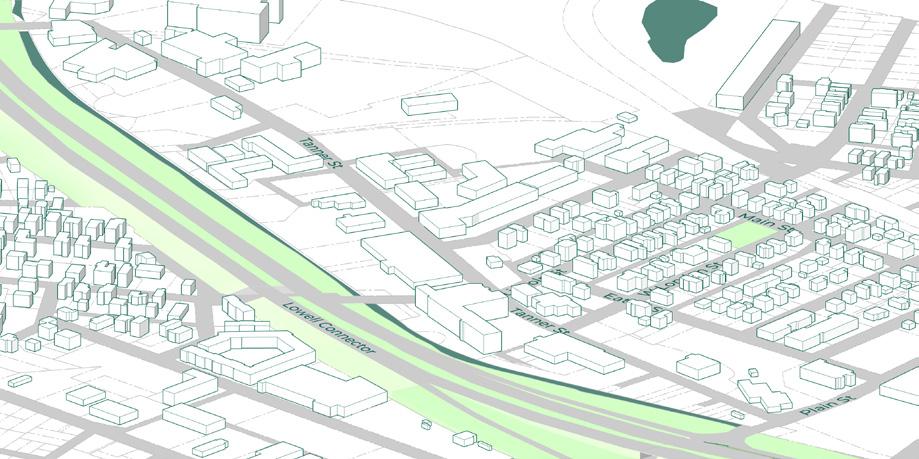
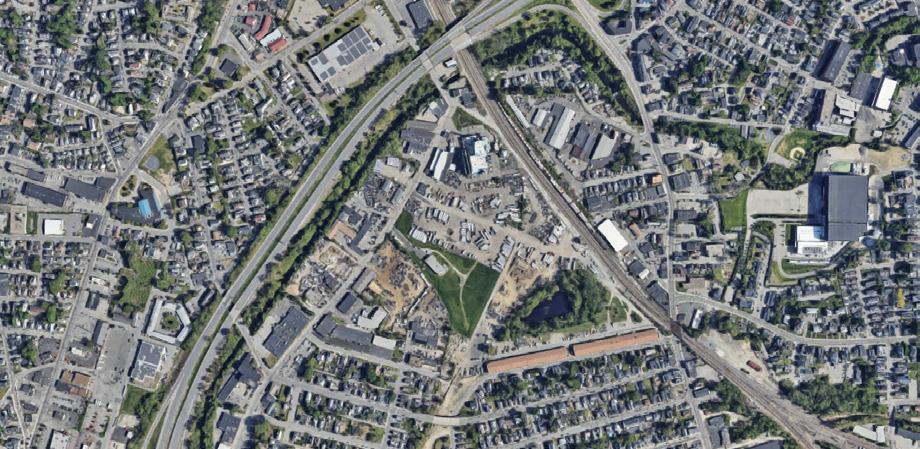
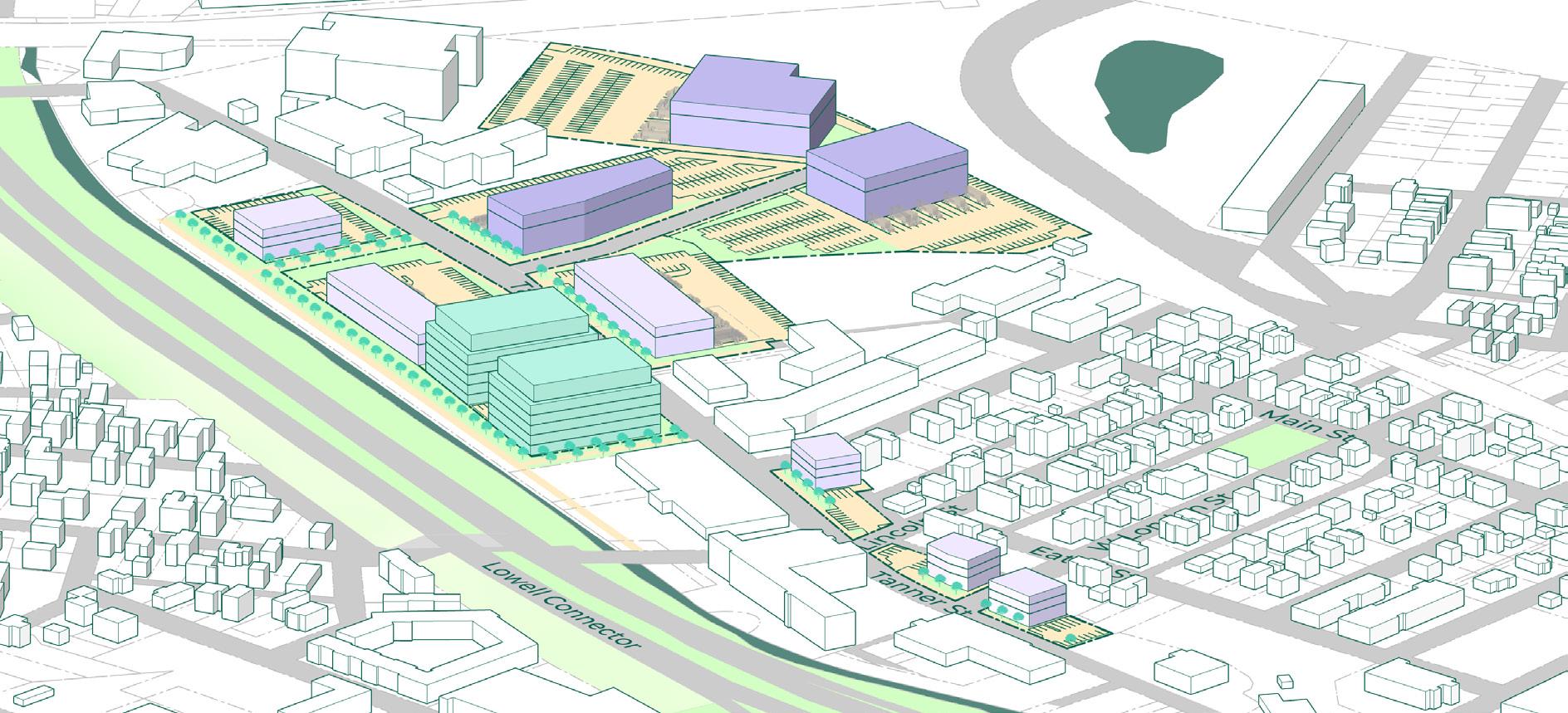
The Ayer’s City Industrial Park is a 20-year redevelopment plan for the section of Lowell around Tanner Street roughly bounded by the railroad tracks, Lowell Connector right-of-way, and Plain Street. Ayer’s City Industrial Park is the culmination of several recent planning efforts for the Tanner Street corridor. A key component of the Tanner Street District planning effort is the completion of a market research study (currently underway), which will provide a realistic picture of the types of industries and development that can be supported and targeted for the Tanner Street district given existing and future market conditions.
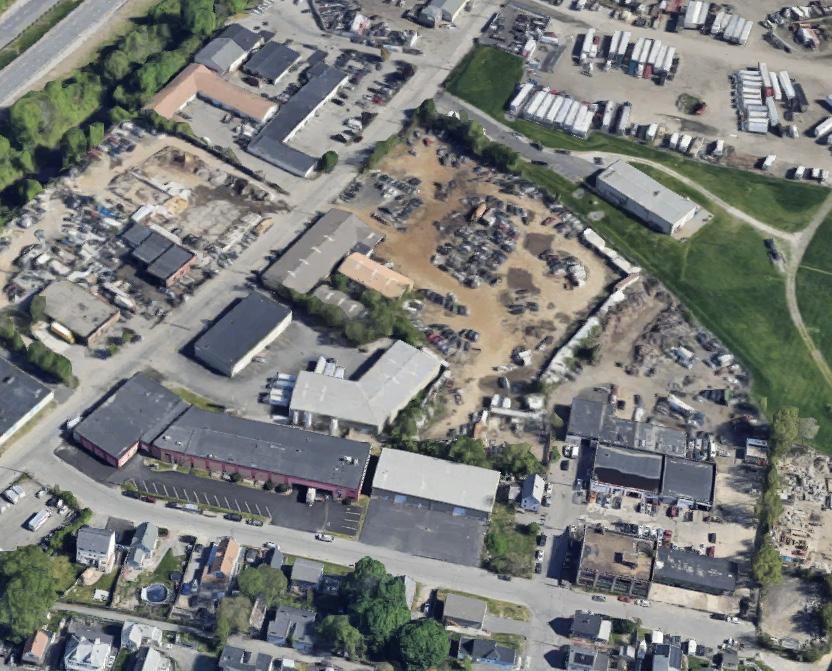
Another previous industrial area with potential for new mixed-use development including small manufacturing, artist and maker spaces, and residential uses is the area along Western Ave and Pawtucket Canal in Acre neighborhood. As part of its revitalization efforts, the City revisited its zoning codes to accommodate downtown production spaces; an artist district zoning overlay led to the creation of Western Ave Lofts and Studios, a live/work space for over 300 small-scale manufacturers and artists in a historic fabric mill building. Located alongside the Pawtucket Canal, Western Avenue Studios would be a short walk from the Hamilton Canal District and the rest of Downtown Lowell, but many physical conditions including the rail tracks disrupt connectivity. Proactively planning for, and investing in, this area could unlock potential for vibrant mixed-use and creative job development aligned with the City’s larger goals for supporting a creative economy.
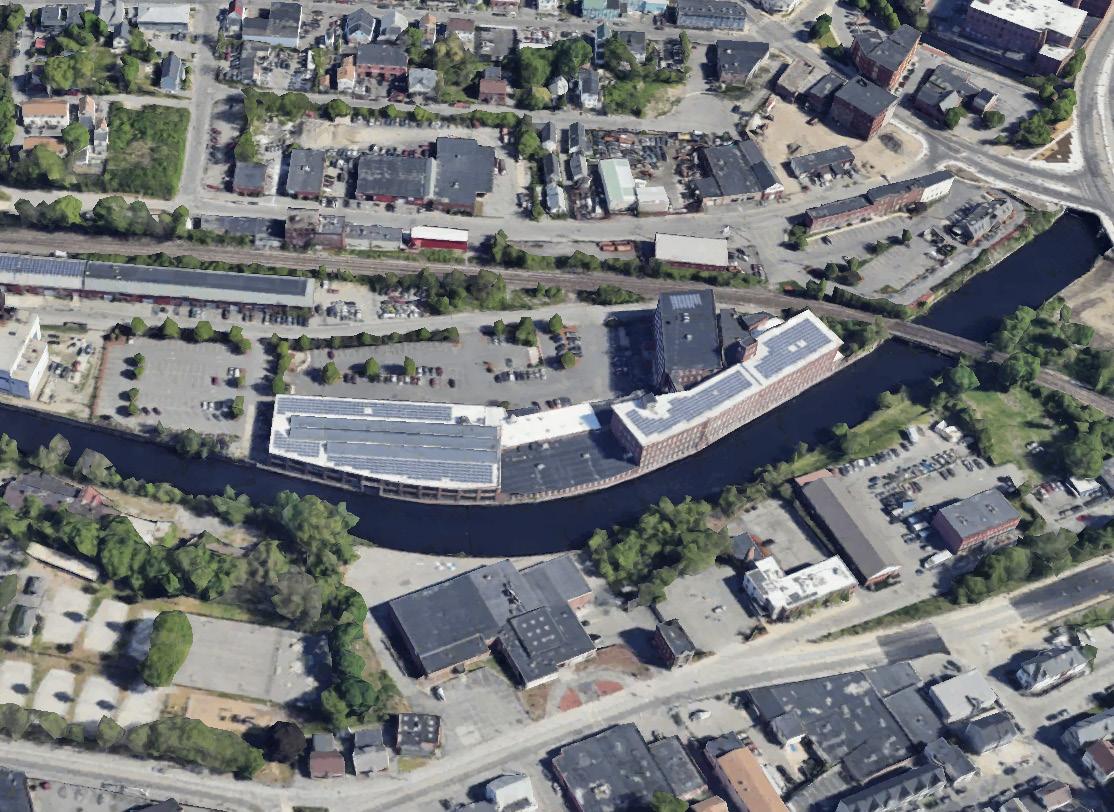
The Acre Plan was the product of a 10-month planning process, guided by a 29-member Citizens Advisory Committee made up of representatives from a cross-section of residents, businesses, agencies, and Department of Planning and Development (DPD) Staff, a group that continues to meet today. The City Council approved the Plan in June of 1999 and State approval from the Department of Housing and Community Development was received in January of 2000. Numerous creative partnerships were the key to the success of implementation. Private investment and cooperation, City commitment, Federal and State grants, and non-profit efforts all continue to be vital to making the Acre a liveable community.
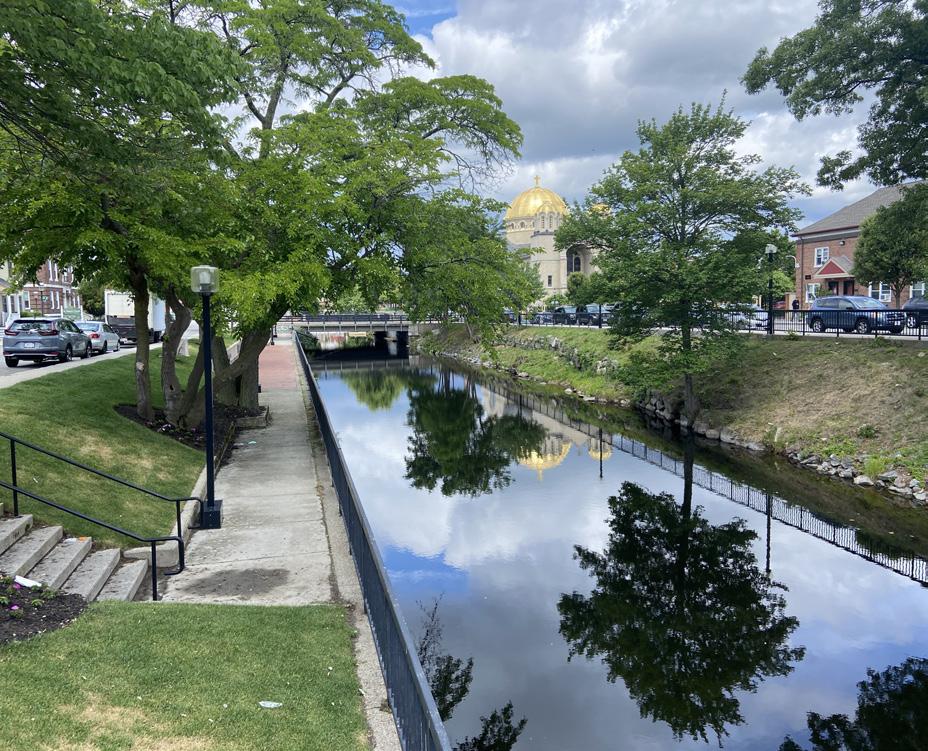
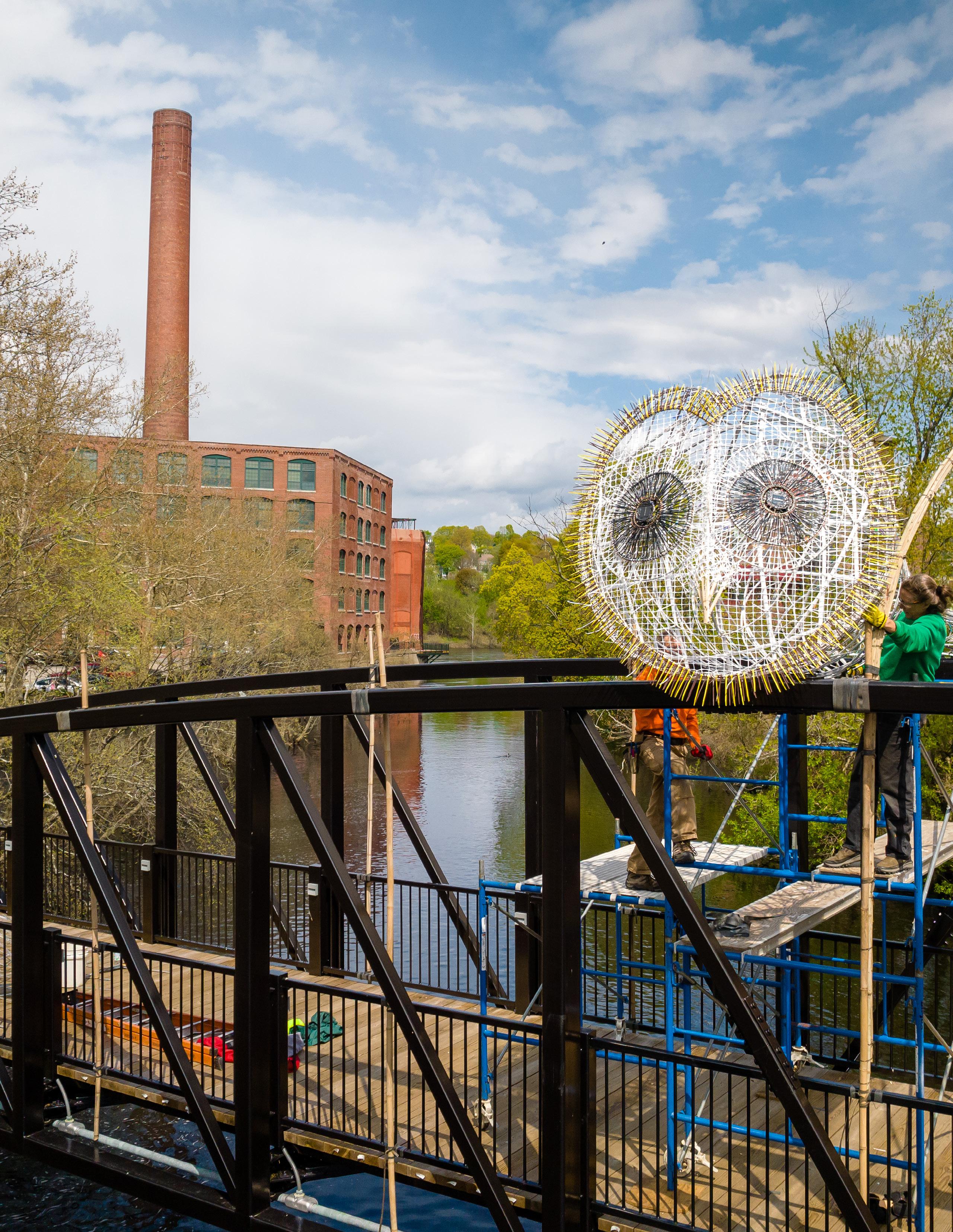
This chapter presents our city’s priority goals and actions, organized by topic area. It outlines key actions, and policy recommendations to advance our community vision and guide future growth and change in the city. The goals and actions are informed and shaped by extensive community engagement and insights uncovered from the comprehensive Lowell Today existing conditions and trends analysis. The chapter also identifies timeframes and “action takers’ (including city departments, local organizations, anchor institutions, and the community), aiding in the prioritization of tasks and implementation of next steps.
Intended audience for this chapter: action takers
Top Goals organized by Topic Area
Housing Land Use and Urban Form
Mobility
Economic Development
Energy, Climate, and Environment
Parks, Open Spaces, and Trails
Arts and Culture
The City will track progress towards each goal using indicators, targets, or quantitative measures.
Each topic section in this chapter begins with:
• A list of all topic-specific goals
• Connection to Guiding Values: Sustainability and resilience, Proactive maintenance, Accountable governance and community stewardship, Innovation and Creativity
• Indicators of Progress: Key metrics identified by the planning team and City departments
• Aligned Initiatives: Related past, ongoing, and upcoming planning efforts
• Lowell Today: A summary of key existing conditions and trends informing the goals and actions
• People: Who is responsible for the success of the actions? How can we improve communication between teams?
• Resources: What level of investement will be needed?
• Coordination: Are these new initiatives or expansions of existing initiatives? Should they be coordinated with other initiatives?
• Timeframe: Are these near-, medium-, or long-term actions?
How are these actions connected to physical growth strategies?
The power of a comprehensive plan, like this one, is that it considers various issues at the same time. This helps us understand how one thing we do can impact other things. It lets us make decisions while keeping the bigger picture in mind.
Comprehensive plans tend to result in a long list of actions, creating uncertainty about where to begin. Lowell Forward recognizes this challenge and proposes a framework for action takers like City departments, local organizations, anchor institutions, and the community—to prioritize next steps.
Don’t know where to start? This framework is designed to identify high-leverage actions, where strategic and less time-consuming efforts can yield significant changes over the long term. This approach will enable us to advance towards our bigger goals as a community.
Here are four strategies to consider when deciding what action to take:
People often think one way about an issue, but approaching the same issue differently can bring benefits to them and the community. Impacting mindsets is about trying to help people see and make that shift.
Example:
Compact and walkable places with higher density housing provide many opportunities to create vibrant, connected, and healthy communities. When we collectively understand and appreciate these benefits, it simplifies future zoning and development processes, and builds support for transit improvements. Understanding these benefits helps shift mindsets about higher density housing.
Rules play a big role in defining how a city can change over time. We need to pay close attention to how these rules are being restructured and by who, to make sure that these rules are benefiting all of the community members.
Example:
Think of zoning laws as the rules that decide how different parts of a city can develop. These rules were made a while ago, and it’s crucial to make sure they get updated and that all community members are taken into account in the process. This way, rules can keep up with the community’s changing needs and tackle new challenges in the environment.
The proposed prioritization framework is built off of Donella Meadows’ systems thinking methodology.
In many cases it is less about building new things, and more about better communicating existing resources and ongoing plans to all members of the community through different channels and methods. Improving communication will help people take full advantage of available resources and opportunities.
Example:
Increasing accessibility to parks doesn’t only mean building another park or building new amenities in existing parks. For example, improving how information on existing parks is communicated will empower the community to fully enjoy the parks, participate in community events, and take care of the spaces. Unlike building a new park, this strategy doesn’t imply high costs, and can be implemented more easily and rapidly.
Our first instinct to resolve a problem is to focus on making symptoms go away. But usually, that is only a temporary solution. To really make a big and lasting difference, we need to deal with the main causes and patterns causing the problem in the first place.
Example:
Providing solutions for those currently unhoused is important, and it is also essential to prevent people from reaching homelessness in the first place. This can be done by identifying and changing trends, like noticing when there’s less and less affordable housing available, and taking steps to make more affordable homes.
1. Downtown growth
2. Growth in neighborhood activity centers and partnerships with institutional anchors
3. Redevelop underutilized industrial areas or heavy commercial areas
Sustainability and resilience: Lowell will plan for resilience and minimize environmental impacts. The City prioritizes development patterns that efficiently utilize urban infrastructure (see page 85 for call-out on sustainable development). By fostering collaboration among city departments and stakeholders, Lowell can ensure success with coordinated individual and citywide actions.
Proactive maintenance: Lowell will take care and maintain its existing and future infrastructure, in a smart and responsible manner.
Lowell will develop a well-defined plan for who, what, where, and how we provide ongoing care, allocate budgets, and create partnerships that guarantee the continual upkeep and improvement of public spaces, sidewalks, trails, bus stops, parks, and other amenities.
Accountable governance and community stewardship: Lowell will ensure active involvement of all community members in decisions related to the places they inhabit. The community should have ongoing opportunities to actively participate in and contribute to the continuous development of a dynamic downtown and improved neighborhood activity centers.
Innovation and creativity: Lowell will channel innovation and creativity into developing a more equitable, sustainable, and resilient city.
Lowell will actively seek collaboration with local institutions, experts, community organizations, and regional partners. These collaborations will help Lowell tackle urban challenges in smarter ways.
• Create 2,500 new housing units within the MBTA Community multifamily zoning overlay districts by 2040
• Increase production of new housing units in the upper stories of downtown buildings (goal of 800 new units by 2040)
• Increase downtown’s street tree inventory by 25% by 2040
• Increase the use of ground-floor commercial spaces with businesses that increase foot traffic
• Housing Production Plan (ongoing)
• MassDevelopment’s Transformative Development Initiative (TDI) including the upper Merrimack and upper Market Street corridors (ongoing)
• Housing Authority Development Plan for Market Street Parcels
• Mosaic Lowell
• UML East Campus Development
• Neighborhood Plans (ongoing)
• Ayer’s City Market Study
Lowell’s zoning code regulates land use (residential, commercial, industrial, mixed use, etc.) and the physical form of new development in different parts of the city. A key goal of a comprehensive plan is to assess the current zoning code and set the stage for a future zoning update. Lowell Forward incorporates community input, City staff feedback, and previous planning effort data to develop an understanding of how Lowell’s zoning code serves the city today and where the code may be updated to align with long-term community development priorities. Many key actions across topic areas are related to identifying appropriate zoning modifications.
Lowell needs a land use and zoning framework that allows for development of affordable and diverse housing types located close to existing and planned mobility networks, services, and other amenities. Currently, residential use is the single largest land use in Lowell, making up 39% of the city’s total land area, and 67% of Lowell’s residential land area. Only 6% of Lowell’s land is dedicated for commercial uses, which range from compact urban main streets nestled within neighborhoods to big box shopping malls on the city’s edges. More flexibility in local zoning will help develop more affordable, multifamily housing options that suit a larger variety of housing needs.
Lowell Forward recommends prioritizing investment in well-connected areas with development potential, including existing neighborhood nodes and locations suitable for commercial or industrial uses. These nodes are prime for growth due to their infrastructure and transit accessibility, making them ideal for expanding housing, jobs, and services. This approach promotes concentrated and sustainable development with a right balance between active uses such as retail and other neighborhood services, and surrounding residential uses.
As a result of historic development patterns and new infrastructure development, there are many physical and spatial gaps (like vacant lots, industrial areas, non-walkable areas, highways, canals, and other infrastructure) present in Lowell’s fabric today that heighten disparities and connections between areas in Lowell. While many locations should ideally be within walking distance, the presence of these infrastructural barriers, coupled with inadequate sidewalk and bicycle infrastructure, poses challenges for people to get around the city without relying on cars.
Land Use and Urban Form Themes
Public Workshop 1
Buildings that are vacant can be transformed to mixed-use, providing low to middle income homes and shopping hubs.
Focus group with business owners led by Community Organizer
More mixed use buildings in every neighborhood. Citywide workshop 1 participant
Densify, make housing affordable by building more, keep Lowell a diverse home by making sure there’s enough homes for everybody
Citywide workshop 1 participant
Downtown needs to be more of a destination with more activities/things to do. focus group with Community Development Corporations (CBA, CTI) led by City Staff
There is a desire for more modern forms of development in the city. focus group with Community Development Corporations (CBA, CTI) led by City Staff
Conversations with Mercy
Mercy spoke with several community organizations in Lowell about land use. Some groups spoke about re-purposing vacant space in Downtown for mixed uses such as housing and community programs. They also recommend adding more amenities, such as a day recreation center that could draw locals and provide shelter for homeless people. Another idea that was brought up was creating places, such as a hotel, that would make the area a destination outside of lunchtime. Besides adding new spaces, community groups recommend focusing on better maintaining existing amenities by encouraging small businesses to transform on-street parking spots into patio space and by enforcing ADA compliance for old buildings that are not currently accessible. In her conversations, Mercy also heard great interest in keeping Downtown cleaner, with more trash cans, trash pick-ups, and litter cleanup crews.
Sustainable development Sustainable development focuses on protecting the needs of present and future generations, accounting for a changing climate, guaranteeing that all residents have access to city benefits, and ensuring a shared prosperity. Dense, infill development aligns with the principles of sustainable development by reducing the need for urban sprawl, using less resources, saving costs on infrastructure, decreasing reliance on private vehicles, increasing housing affordability, and by creating adaptable homes with potential for high social connectivity.
• Land use efficiency: reduces the need for urban sprawl, conserving natural spaces and promoting a more compact urban form
• Resource efficiency: multi-unit housing typically requires less land, water, and energy per capita compared to single family homes
• Infrastructure Cost Savings: providing services such as water, sewage, and utilities to a more concentrated area is often more cost-effective than spreading them out over a larger area
• Sustainable mobility: reduce the reliance on private vehicles as people may have easier access to amenities and public
<20 Households per block
Drive to commercial areas
~30 Min average transit time for daily errands
transportation—this can lead to a decrease in greenhouse gas emissions
• Housing Affordability: provide more affordable housing options by increasing housing diversity
• Adaptability to changing demographics: provide a variety of housing options suitable for individuals, families, and seniors
• Social Connectivity: create mixed-use developments with diverse housing types that encourage interaction among residents and foster a sense of community.
>40 Households per block
Spaces for social connectivity
Mixed use buildings
<10 Min average transit time for daily errands
Note: the example above is meant to illustrate the differences between two types of development patterns: predominantly single family and a mix of single family and small multifamily. Numbers above are approximate.
Numerous community organizations, spotlighted in this document, are already addressing urban challenges within Downtown, neighborhood centers, and industrial areas. Collaborating closely with these organizations not only enhances the efficiency of the implementation process but also ensures that the evolving urban landscape truly reflects the needs and aspirations of the community.
The Hamilton Canal District Master Plan envisions a vibrant, mixed-use district that is wellconnected to transit. Development in the area will support additional tax revenue and create opportunities for economic development and affordable housing production. Since the plan was set out in 2008, various projects such as the HCID Parking Garage, the Lowell Justice Center, and the UMass Lowell Innovation Hub, have already been completed. Currently, the City is working to build two new streets and associated utility infrastructure in the northern part of the district. As part of this current project, the City will also improve the Dutton and Broadway bridge for pedestrian and vehicular use, plus finish constructing the new Signature Bridge over the Pawtucket Canal.
The Ayer’s City Industrial Park Plan charts a course to revitalize a traditional industrial area in the heart of Lowell. Recent efforts, such as the ongoing cleanup of the Silresim superfund site, aim to bring this vision to reality. The plan calls for brownfield cleanup, new zoning to support redevelopment, new parks and a greenway, improved access, and enhanced street design.
While zoning recommendations play a role in various goals and actions within this plan, it is important for the City to initially undertake a thorough review of existing zoning. This review aims to identify necessary revisions to align most effectively with the vision, growth strategies, and goals outlined in the Lowell Forward Plan. Planning staff should consider how to allow multifamily units at scales and typologies that meet the needs of the Lowell community and encourage more mixed-use, transit-oriented development. The recommendations outlined in both Lowell Forward and the upcoming Lowell Housing Production Plan, should serve as the guiding framework for new zoning measures.
Action 1:
Conduct a comprehensive zoning review assessing the city’s desired growth and development patterns against existing zoning
Action Type(s): Zoning Change
Status: New Initiative
Timeframe: Near Term
City Steward: City of Lowell—DPD
Action 2:
Develop educational tools around housing policy and zoning to improve public understanding of how zoning influences the built environment.
Action Type(s): Community Outreach
Status: New Initiative
Timeframe: Medium Term
City Steward: City of Lowell - DPD; NMCOG
Is zoning a barrier to affordable housing development?
Though implementation of zoning overlays has increased the allowable density of housing development, much of the higher density development is restricted to Downtown and the middle of Lowell. Current zoning prefers single family housing development, as a third of the city is zoned Suburban Neighborhood Single Family, which only allows that type of development, and just over two thirds of land area allows single family homes by right. Not even a third of the City’s land area allows small scale mixed-use development (1-2 units with a ground floor non-residential use) by right.
Zoning should be more flexible to allow for multi-unit developments. Allowing duplexes, triplexes, quadplexes, and other types of missing middle housing development, particularly in suburban and traditional neighborhood districts, will add a lot to the local supply of housing stock. Allowing accessory dwelling units, even by special permit, in more zoning districts besides the Urban Neighborhood Single Family District, can also expand flexibility in housing development.
Action 1:
Enable diverse housing options in Downtown. Update zoning in the Downtown Mixed-use District by creating appropriate dimensional requirements to enable smaller/compact and more diverse housing options.
Action Type(s): Zoning Change, New Study and Plan
Status: New Initiative
Timeframe: Near Term
City Steward: City of Lowell—DPD (planning/zoning)
Action 2:
Advance and coordinate departmental efforts to improve walkability and vibrancy in Lowell’s Downtown street network including wider sidewalks, increased tree coverage, ground floor activation, shorter crossings, and longer crossing times.
Action Type(s): City Program, Capital Investment
Status: Modified or Expanded Initiative
Timeframe: Medium Term
City Steward: City of Lowell—DPD (economic development)
Action 3:
Advance planning of vacant and underutilized lots for infill, especially Merrimack Corridor and the Gallagher Station area, for compact, mixed-use, and walkable developments that appeal to a broad range of users.
Action Type(s): Zoning Change, New Study and Plan
Status: New Initiative
Timeframe: Medium Term
City Steward: City of Lowell—DPD (planning/zoning, economic development)
Action 4:
Continue to build a comprehensive Downtown branding strategy. Elevate Lowell’s city “brand” through a more comprehensive branding strategy that includes local partnerships, highlights Lowell’s history and current diversity, and improves wayfinding strategies to make the city more attractive to residents, workers, employers, and potential investors and developers.
Action Type(s): Local Partnership, Capital Investment
Status: Modified or Expanded Initiative
Timeframe: Near Term
City Steward: City of Lowell—CASE, Local Anchor Institutions (ex. UML, MCC, Lowell Hospital, etc)
Action 5:
Incentivize transit-oriented development around the MBTA station through financial incentives and partnerships with transportation agencies.
Action Type(s): Regional Partnership
Status: Existing/Ongoing Initiative
Timeframe: Near Term
City Steward: City of Lowell—DPD, LRTA
Action 6:
Update regulations related to historic preservation to better fit our needs and goals today. Review and update the Downtown Historic District guidelines, where necessary, to support current building and development needs including compliance with accessibility and code standards. Review Historic Board signage regulations to assure that they are compliant with Reed v. Gilbert standards and Lowell’s upcoming newly revised sign code.
Action Type(s): Other Regulatory/Policy, New Study and Plan
Status: Modified or Expanded Initiative
Timeframe: Near Term
City Steward: City of Lowell—LHB, DPD, NPS
Where to learn more:
Gallagher Terminal Transit-Oriented Development Study (2020)
This study assessed the feasibility of Transit-Oriented Development (TOD) in the vicinity of the Lowell Gallagher Transportation Terminal and explored what government actions might be necessary to achieve feasible TOD. The Lowell Planning and Development Department identified eleven example TOD sites within a five-minute walk/quarter-mile radius of the Terminal. These sites represent a variety of challenges and opportunities developers might face when considering projects with density appropriate for TOD.
Downtown Lowell Rapid Recovery Plan (2021)
Downtown Lowell is ripe for reinvestment, revitalization, and new life. The COVID-19 Pandemic has exacerbated existing challenges and uncovered new problems. The City of Lowell applied to the Local Rapid Recovery Planning Program (LRRP) with six specific goals:
1. Address vacant and underutilized storefronts
2. Support streatery program and other economic development programs
3. Support businesses to develop online presence
1. Business assessment and inventory
2. Permanent streatery program and instractrcture plan/physical design standards
3. Encourage upper-level office to residential conversion
Action 1:
Improve neighborhood center infrastructure and services. Improve and build sustainable public realm infrastructure and neighborhood services, prioritizing pedestrian safety and enhanced walkability in underserved neighborhood centers in Lowell.
Action Type(s): New Study and Plan, City programs and operations
Status: New Initiative
Timeframe: Near Term
City Steward: City of Lowell—City Manager’s Office
Action 2:
Ensure robust coordination between city departments in executing neighborhood center improvements and aligning specific project timelines and departmental resources with relevant ongoing area planning efforts and projects.
Action Type(s): Local Partnership
Status: Existing/Ongoing Initiative
Timeframe: Near Term
Improve Communication
Action 3:
City Steward: City of Lowell, Local Anchor Institutions (ex. UML, MCC, Lowell Hospital, etc)
Allow increased residential density by right in neighborhood business districts. Incentivize appropriate infill development that enhances neighborhood vitality and celebrates each neighborhood’s distinct identity.
Action Type(s): Capital Investment, New Study and Plan
Status: Existing/Ongoing Initiative
Timeframe: Medium Term
City Steward: City of Lowell—DPD, DPW
Action 4:
Strengthen connections between neighborhood centers and institutional anchors. Coordinate major institutional plans and projects to better align with Lowell Forward’s objectives of creating active, connected, and prosperous neighborhood centers.
Action Type(s): Local Partnership, New Study and Plan
Status: New Initiative
Timeframe: Medium Term
City Steward: City of Lowell—DPD
Action 5:
Require transparent engagement between institutional anchors’ projects and impacted neighborhoods. Ensure Lowell residents, community groups, and other impacted stakeholders are continuously engaged and informed as institutional projects are being planned.
Action Type(s): Community Outreach, Local Partnership
Status: New Initiative
Timeframe: Near Term
City Steward: City of Lowell—DPD
Action 6:
Review off-street parking requirements for neighborhood commercial zones, particularly for existing buildings with longstanding commercial vacancies.
Action Type(s): Zoning Change
Status: New Initiative
Timeframe: Near Term
City Steward: City of Lowell—DPD, City Manager’s Office
Action 7:
Create design guidelines in mixed-use corridors and neighborhood nodes to ensure new development promotes best practices in urban design.
Action Type(s): Zoning Change
Status: New Initiative
Timeframe: Medium Term
City Steward: City of Lowell—DPD
Where to learn more:
UMass Lowell Strategic Development Plan (2022)
This document highlights UMass Lowell’s long-term goals and strategies for the future of the campus. Key areas of interest include the promotion of alternative transportation options for commuting students and faculty, energy efficiency in new construction, and increasing supply of on-campus housing. UMass Lowell is also dedicated to environmental sustainability, expanding academic courses in sustainability-related issues and practices, implementing a green cleaning policy for campus facilities, and creating new policies for paper purchasing, printing, and new electronics purchasing.
Moving forward, UMass Lowell plans to increase their supplies of both on-campus student housing and recreation facilities. To address the increasingly residential nature of the campus and to reduce the need for driving, UMass Lowell is offering a housing subsidy to staff and faculty to purchase or rent housing within the City of Lowell known as the “Live in Lowell” Program. Such policies serve to further the University’s long-term “One Campus/One Community” goal. Ensuring that housing is affordable for university staff and faculty is a key part of addressing housing affordability city-wide.
Action 1:
Advance planning of the Ayer’s City Industrial Park. Complete and assess the ongoing market study and define next steps for development in the industrial area.
Action Type(s): New Study and Plan
Status: Existing/Ongoing Initiative
Timeframe: Near Term
City Steward: City of Lowell—DPD
Action 2:
Update zoning to allow light manufacturing and creative economy uses compatible with residential and commercial neighborhoods in appropriate areas of the city.
Action Type(s): Zoning Change
Status: New Initiative
Timeframe: Medium Term
City Steward: City of Lowell—DPD
Small-scale manufacturing, creative maker spaces and neighborhood revitalization
Technological and economic shifts have opened new opportunities in small-scale manufacturing and the “maker” economy, offering communities a chance to address various economic development issues. While local economic development strategies commonly focus on supporting retail shops and professional services, small-scale manufacturing is often overlooked despite holding significant potential for entrepreneurship, small business growth, and downtown revitalization. Small-scale manufacturers add a distinctive attraction that can draw people to a new location. Beyond traditional amenities like retail, restaurants, and cultural venues, the presence of small-scale manufacturers, creative makers, and artists provides residents and visitors with additional reasons to spend time in a neighborhood. In Lowell, the Western Ave Lofts and Studios by Pawtucket Canal exemplify the successful integration of small-scale manufacturers and artists within a historic fabric mill building, showcasing the importance of providing built-out space to retain these businesses and jobs within the community.
Source: “Made in Place,” Smart Growth America, 2017
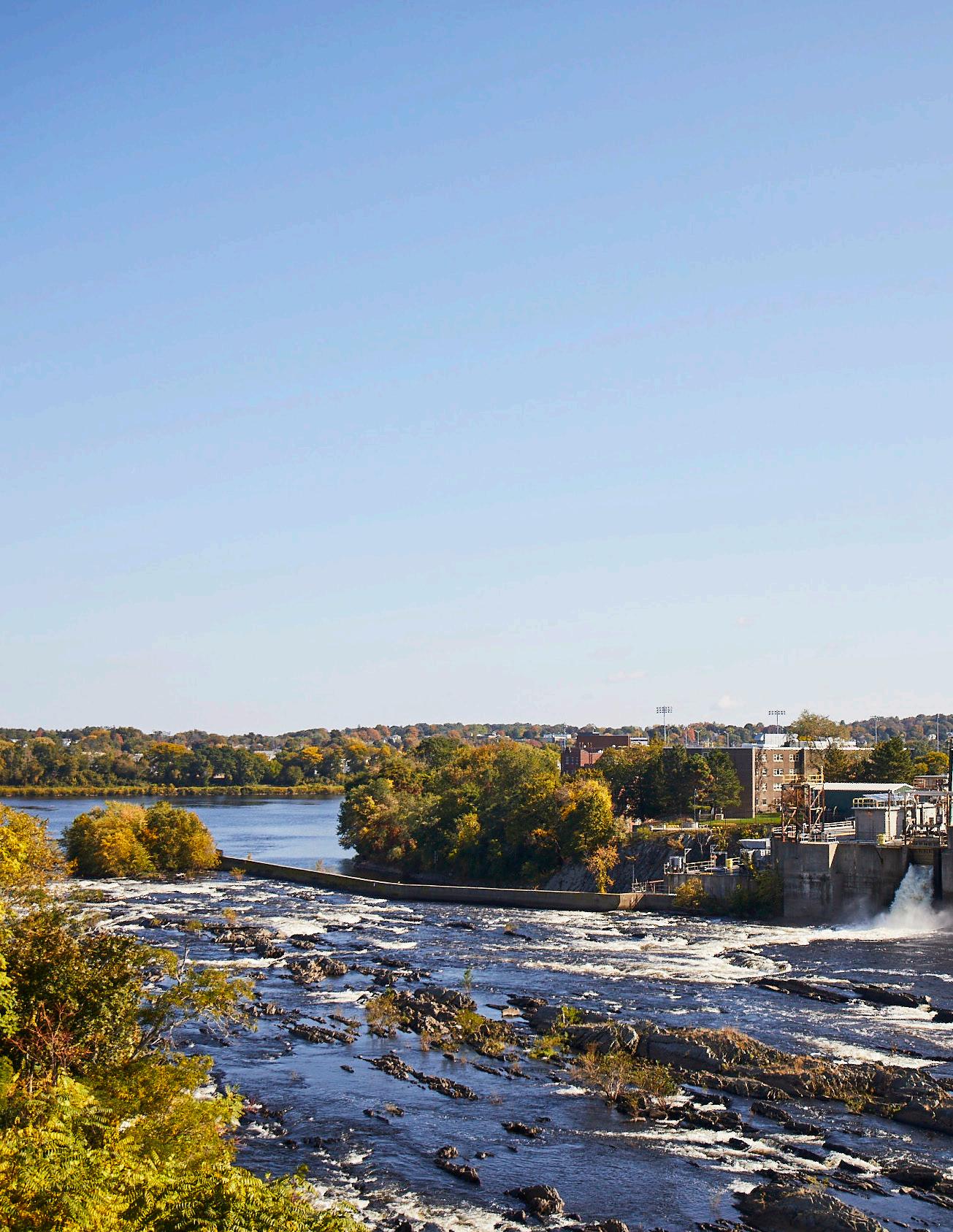
1. Plan for equitable and accessible growth
2. Develop homes for all types of households and individuals
3. Improve housing quality
4. Eliminate homelessness and reduce housing insecurity
5. Provide housing options for households that make low- and very low- incomes
6. Expand and create new opportunities for affordable homeownership
7. Ensure fair housing policies and practices
• Sustainability and resilience: Lowell will build a resilient community and evolve as a city in equitable and sustainable ways.
Lowell will promote housing affordability and stability for all types of households including young families, seniors, people living with roommates, and more, while fostering social resilience. The City will also prioritize housing connected to sustainable transportation options.
• Proactive maintenance: Lowell will proactively maintain existing housing.
Since the majority of Lowell’s housing stock is old, a key focus will be on supporting the community with home improvement and energy-efficiency upgrades. In parallel, the City will proactively maintain public infrastructure supporting housing, including sewers and streets.
• Accountable governance and community stewardship: Lowell celebrates diversity and will aim to ensure access to affordable housing choices for all.
The City will aim to ensure accessibility and transparency for all community members. Efforts will focus on simplifying navigation of the housing system especially for non-native English speakers and newcomers to Lowell or the United States. The City will also collaborate with local organizations actively supporting the community with housing programs, finance tools, and resources.
• Innovation and creativity: Lowell will embrace continuous innovation and creativity to support housing stability, increase housing quality and provide options to low to very low-income households. Lowell will partner with local and regional organizations to come up with innovative and creative solutions to housing challenges.
• Increase total number of housing units to 46,950 (or +3,150) by 2030, and to 47,950 (or +4,150) by 2040
• Produce 800 new affordable housing units by 2030, and 1,050 by 2040
• Reduce total number of households lacking kitchens and lacking plumbing from 958 to near zero by 2040
• Reduce percentage of cost-burdened households from 40% to 32% by 2040
• Reduce percentage of severely cost-burdened households from 19% to 16% by 2040
• Achieve a healthy housing unit vacancy rate of 6%
• Housing Production Plan (ongoing)
• City Manager’s Task Force on Homelessness and Sustainable Housing Action Plan and Final Recommendations
• UMass Lowell Strategic Development Plan
• City Staff’s Zoning Analysis
Lowell needs a flexible housing stock that can change along with the City’s demographics
Lowell’s population is continuously changing, and it’s anticipated to both grow and age while average household size is anticipated to decline. Lowell is projected to grow by 2,205 households (5.3%) between 2020 and 2030, which is a slower growth rate than three of four of its peer gateway cities. The number of households with heads of household 65 years or older has consistently grown for the last ten years, and is projected to grow from 25% to more than 30% of total households by 2030. Households that consist of a single person living alone are projected to rise from 12,000 to nearly 14,000, or roughly 17%, between 2030 and 2040.
Lowell’s housing prices are growing increasingly out of reach for those who call the city home
A constrained market is driving these high housing costs, which is partially an effect of Lowell’s housing policies, including restrictive zoning. In addition, high construction and land costs create a gap between the cost of building a unit and the expected return, which demands consideration of new or expanded market-rate subsidy programs and the cost impacts of current policy. Finally, recent interest rate trends have drastically reduced turnover, further distorting the housing market. Affordability was among the greatest concerns cited in community research and was the largest barrier to those who wanted to move within or to Lowell. In addition, more than half of renters cited rent being too costly as a challenge.
Affordable housing development is difficult due to lack of real estate opportunities within the city, and additional red tape related to state and federal funding sources and acquisition of city-owned properties. The need for affordable housing exceeds the supply. 5,127 units are listed on Subsidized Housing inventory (SHI), but 99% of the 7,345 households in Lowell that are severely cost burdened earn 80% AMI or less and would usually qualify for the most typical affordable housing. In addition, waitlists are reported to be more than five years. More than 80% of these severely housing cost burdened households are extremely low income.
Developers of both market-rate and subsidized housing noted difficulties in creating dense developments near amenities or transit due to the unpredictable nature of necessary variances or special permits. In some cases, existing single family zoning does not allow the construction of new homes that are similarly sized and situated on similarly-sized lots to existing homes. These homes may be opposed by neighbors when developers seek variances. The new Multi-Family Overlay District (MFOD) is a possible opportunity area for new growth near Gallagher Terminal and in the Downtown and Acre neighborhoods, but other neighborhood centers could be similarly examined for increased density and less restrictive permitting processes.
There just aren’t enough affordable housing units. focus group with seniors led by Community Organizer
After kids go to college, they are unable to find housing that they can afford in Lowell so they move away to different cities/states where housing is more affordable.
focus group at the African Community Center led by City Staff
Homelessness issues have been a main concern of the police department in recent years. focus group with Lowell Police Department led by City Staff
The homelessness problem is very serious in Lowell (as it is throughout the country) and permanent supportive housing is the solution. There needs to be political will to construct this housing. NIMBYism is a barrier. People are not able to collect themselves and exit poverty without a home and place they can regroup/rest.
focus group with Unhoused/Homeless Service Providers led by City Staff
Lowell needs to change its zoning code to allow more housing types in more places. 2/3 of the city’s residential land is zoned for single family, and this constricts our ability to build the housing we need. Homeowners dominate housing conversations and speak in their self-interest, but so many Lowellians are renters. Renters and housing insecure people lack representation, which prevents the city from creating policies and programs that benefit these groups.
focus group with Community Development Corporations (CBA, CTI) led by City Staff
Shelter is a basic human need. Yet it has become almost unaffordable to even middle class families due to higher than average homeownership rates, overpriced rental rates, as well as limited rental housing.
Conversations with Mercy
Community Highlights
Numerous community organizations, spotlighted in this document, are already addressing housing challenges in Lowell. Collaborating closely with these organizations not only enhances the efficiency of the implementation process but also ensures that housing policies and programs reflect the needs and aspirations of the community.
Merrimack Valley Housing Partnership
• Home buyer/landlord trainings
• Downpayment assistance programs
• Lead paint abatement / rehab loans
Coalition for a Better Acre (CBA)
• Development and management of affordable housing within Lowell
• Assistance with self-sufficiency including job support
• Civic Engagement
Homeless Reform Project
• Guidance and Counseling
Cambodian Mutual Assistance Association.
• Civic Engagement
• Family Support
• Youth Programs
• First Time Home Buyers Training
Day Center Programs (Eliot Church, Life Connection Center, Living Waters)
• Meals programs
• Case support and guidance
• Harm reduction services
• Hygiene programs
Housing affordability is top of mind for many in Lowell. Most community members discussed the restrictively high cost for both renting and buying homes. People proposed ideas such as rent regulation policies, increasing affordable housing production, and supporting nonprofits that build and manage permanently low-income units. Community groups have shared that eligibility requirements for government funded housing, such as credit and employment base requirements, exclude too many low-income residents. For the City of Lowell, Mercy heard people say that it came down to zoning. In addition to recent efforts towards densifying downtown, the city needs more density further out. Community groups also brought up the need to address homelessness both through policy solutions that will get people off the street and through awareness campaigns that humanize the crisis.
House of Hope
• Emergency Shelter
• Development and management of affordable housing
• Job training programs
Lowell Transitional Living Center
• Emergency Shelter
• Case management
• Meals programs
Community Teamwork Inc. and Common Ground
• Fair Housing program
• Financial education
• Housing Consumer Education Center and Emergency Rental Assistance (HCEC)
• Rental Assistance/Subsidized Housing
• Programs
• Emergency Shelters
• Development and management of affordable housing
Thrive Communities
• Empower communities to welcome and support our neighbors transitioning from incarceration
NMCOG
• Community technical assistance program
• Education and trainings
Action 1:
Engage communities to identify priority development sites for multifamily housing with the goal of increasing density in key areas that can be well-served with alternative transportation options, especially within and near neighborhood centers.
Action Type(s): New Study and Plan
Status: New Initiative
Timeframe: Medium Term
City Steward: City of Lowell—DPD, NMCOG
Action 2:
Develop a funding pipeline to acquire, finance, and develop sites with a high capacity for multifamily from parking lots to adaptive reuse. This could be facilitated by a public-private partnership with nonprofit or for-profit developers.
Action Type(s): City Program, New Study and Plan
Status: New Initiative
Timeframe: Near Term
City Steward: City of Lowell—DPD, Local Property Owners/Developers
Action 3:
Allow housing or mixed use projects in the Regional Retail District to increase housing near jobs while retaining the economic vitality of these districts.
Action Type(s): Zoning Change
Status: New Initiative
Timeframe: Near Term
City Steward: City of Lowell—DPD
Action 4:
Document projected and actual infrastructural impacts for major developments. Seek state and federal grants to improve infrastructure like water, sewer, and transportation as needed.
Action Type(s): City Programs and Operations
Status: New Initiative
Timeframe: Medium Term
City Steward: City of Lowell—DPD, DPW
Action 5:
Prioritize the sale of city properties to support the creation of housing at all income levels.
Action Type(s): City programs and operations
Status: New Initiative
Timeframe: Near Term
City Steward: City of Lowell—DPD; Law Department
Action 6:
Participate in regional initiatives such as At Home in Greater Lowell that include plan development, implementation, and community engagement activities and education
Action Type(s): Regional Partnership
Status: Ongoing Initiative
Timeframe: Near Term
City Steward: City of Lowell—DPD; NMCOG
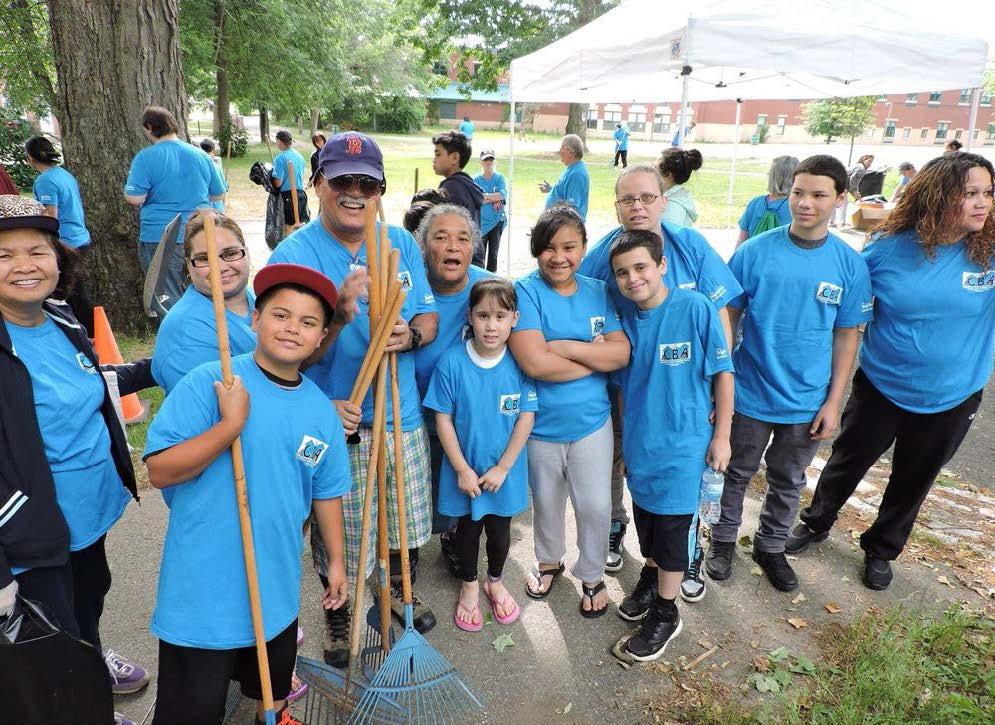
Merrimack Valley Housing Partnership (MVHP) mvhp.org
MVHP is a private, non-profit organization that promotes responsible and sustainable home ownership opportunities for low and moderate income earners. They provide comprehensive home buyer training and counseling, and they promote the use of special mortgage products and down payment assistance programs. The organization also focuses on landlord training, real estate, lead paint abatement and rehabilitation loans, and credit reports.
Community Teamwork (CTI) commteam.org
CTI is a nonprofit community action agency, regional nonprofit housing agency, and a community development corporation that serves 63 cities and towns in the greater Lowell area. CTI mobilizes resources for low-income people, providing opportunities for them to have an active voice in the decisions that affect their lives, and helping them achieve stability and self sufficiency.
CTI owns and rents 71 transitional units in Lowell. Common Ground, CTI’s development subsidary, partners with municipalities to create affordable housing, having now created 129 units, 36 in Lowell.
Action 1:
Adjust zoning regulations to allow needed housing typologies including Single Room Occupancy (SRO), micro units, accessible units, and adding bonus density for missing “starter home” unit types such as townhomes.
Action Type(s): Zoning Change, New Study and Plan
Status: Ongoing Initiative
Timeframe: Near Term
City Steward: City of Lowell—DPD, NMCOG
Restructure Rules
Action 2:
Expand housing choice in all residential areas by building consensus around an Accessory Dwelling Unit ordinance and identifying areas where contextuallyappropriate mixed-use nodes could provide more diverse housing options and improve connectivity between residences and neighborhood businesses.
Action Type(s): Zoning Change, New Study and Plan
Status: Ongoing Initiative
Timeframe: Near Term
City Steward: City of Lowell—DPD
Restructure Rules
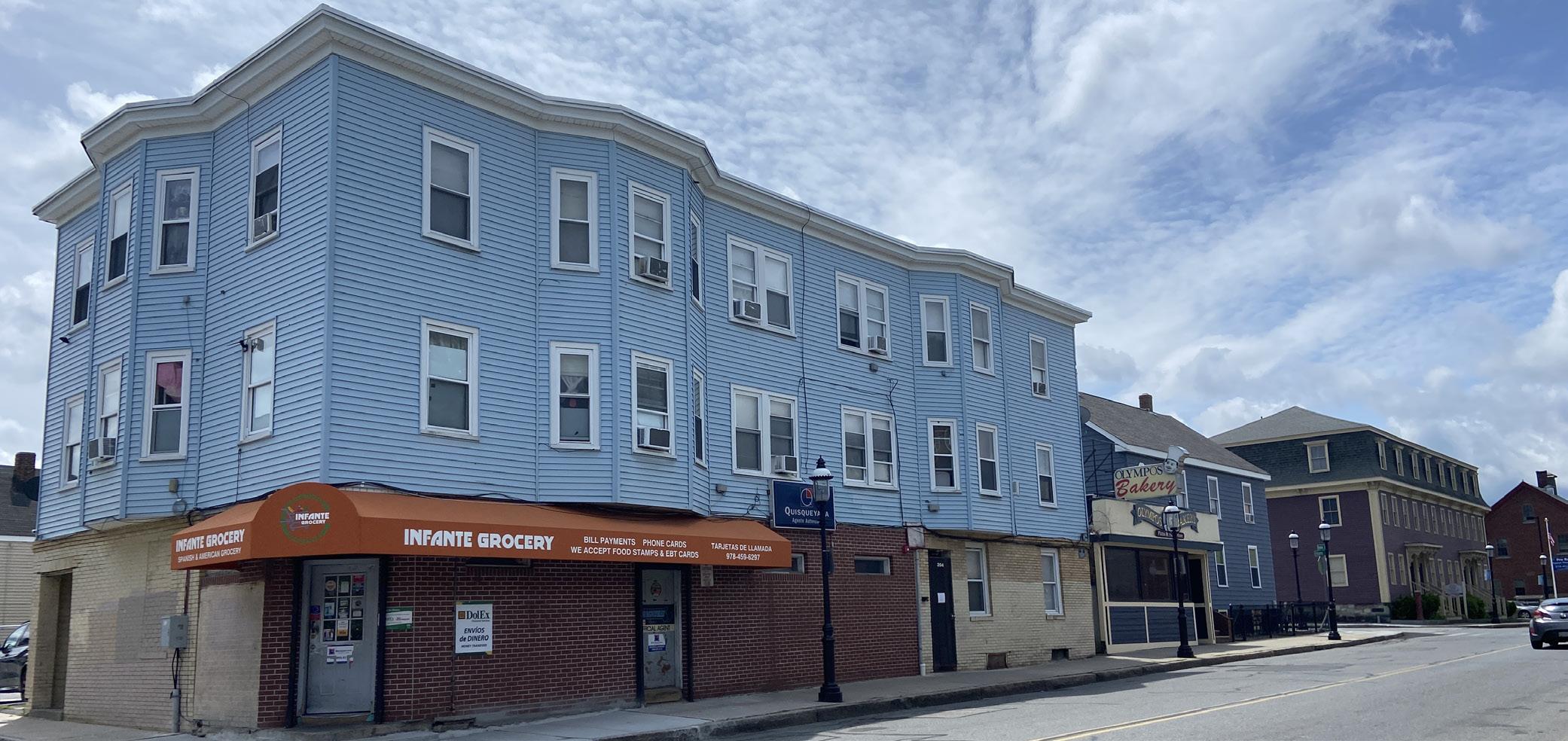
Action 3:
Encourage housing typologies that include universal design to support aging in place as part of new developments and major renovations of existing buildings, especially in walkable and transit-served locations. Develop policies that specifically support senior populations, such as growing programs that add universal accessibility, aging in community, and accessibility to existing and new housing.
Action Type(s): Local Partnership
Status: New Initiative
Timeframe: Medium Term
City Steward: City of Lowell—DPD, Council on Aging, Disability Commission, Senior Center
Action 4:
Continue to work with developers of all types of lowincome housing with an emphasis on missing age groups and AMI ranges.
Action Type(s): Local Partnership, Other Regulatory/Policy Status: Ongoing Initiative
Timeframe: Near Term
City Steward: City of Lowell—DPD
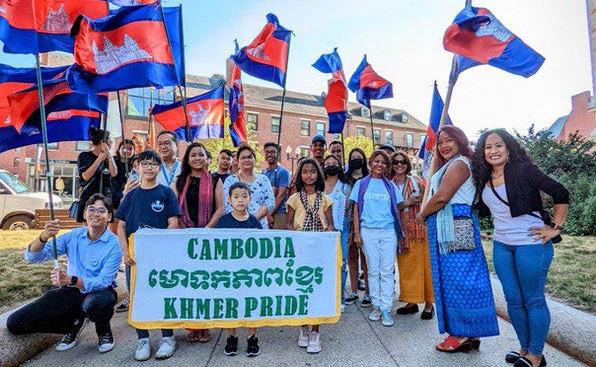
Cambodian Mutual Assistance Association (CMAA)
cmaalowell.org

CMAA is designed to support and improve quality of life for Cambodian Americans and other minorities throughout the Greater Lowell area. They promote community empowerment by providing citizenship assistance, english classes, youth programs, civic engagement opportunities, home ownership resources, and avenues for cultural preservation.
Coalition for a Better Acre (CBA)
coalitionforabetteracre.org/mission-values
As a membership based community development corporation, CBA is dedicated to resident empowerment and strives for Lowell’s neighborhoods to be affordable, vibrant, and diverse places of choice where residents are engaged leaders, and where local stakeholders work in partnership to build family and community assets. They focus on workforce development, youth programs, civic engagement and leadership, real estate, community building and events, and health access.
CBA has built and renovated more than 556 residential units, and currently owns 486 affordable rental units in Lowell.
Action 1:
Create a well-funded program that could provide no-interest home improvement loans targeted toward improving quality of homes occupied by low-income tenants while preserving the affordability of those rentals. Identify key neighborhoods that are in danger of decline.
Action Type(s): City Program
Status: New Initiative
Timeframe: Medium Term
City Steward: City of Lowell—DPD
Action 2:
Identify additional resources to enforce city codes for residential property (inspectional services). Enforce and enhance minimum housing requirements and building codes, including HOME-funded low-income housing and other types of housing.
Action Type(s): City Program
Status: Ongoing Initiative
Timeframe: Near Term
City Steward: City of Lowell—DPD
Action 3:
Work with National Grid to understand how many units and of what tenure could benefit from retrofits, and develop a program to target the gap, especially among rental units.
Action Type(s): Other Regulatory/Policy
Status: New Initiative
Timeframe: Medium Term
City Steward: City of Lowell—DPD, DPW (Sustainability)
Action 4:
Stabilize neighborhoods through reconstruction and improvement of streetscapes. Support community-based initiatives in each neighborhood that will contribute to and improve the quality of life such as beautification and public art efforts.
Action Type(s): Local Partnership
Status: Ongoing Initiative
Timeframe: Medium Term
City Steward: City of Lowell—DPD, DPW; Local Partnerships (CBA, Neighborhood Groups)
HUD’s Pro Housing Program
Communities nationwide are suffering from a lack of affordable housing, and housing production is not meeting the increasing demand for accessible and available units in many urban and rural areas, particularly areas of high opportunity.
Pathways to Removing Obstacles to Housing (PRO Housing) supports communities who are actively taking steps to remove barriers to affordable housing, such as:
• Barriers caused by outdated zoning, land use policies, or regulations
• Inefficient procedures
• Gaps in available resources for development
• Deteriorating or inadequate infrastructure
• Lack of neighborhood amenities
• Challenges to preserving existing housing stock such as increasing threats from natural hazards, redevelopment pressures, or expiration of affordability requirements
Learn more here: hud.gov/program_offices/comm_planning/pro_ housing
Federal Program: Commercial-to-residential Conversion
A new federal guidebook shows how federal tools have already been used to make conversions possible for the development of affordable housing. Several existing federal programs already support commercial-toresidential conversions. The Community Development Block Grant, which provides $3 billion annually to support community housing and revitalization projects for lowand moderate-income families, and new actions make it easier to use these funds for acquisition, pre-development and construction associated with conversions. This compliments other actions, like HUD’s recently announced $860,000 in grant funds to study office-toresidential conversions undertaken since the pandemic. Similarly, new DOT policies unlock $35 billion in available lending capacity for development projects at below market interest rates, which will make conversions easier to finance.
Learn more here: whitehouse.gov/cea/writtenmaterials/2023/10/27/commercial-to-residentialconversion-addressing-office-vacancies
Annual Action Plan for CDBG, ESG, HOME Programs (2022)
In applying its Community Development Block Grant (CDBG), HOME Investment Partnerships Program, and Emergency Solutions Grant (ESG), the City of Lowell is prioritizing a total of 21 priority needs, including decent affordable housing, suitable living environments, infrastructure improvements, providing childcare options, addressing code compliancerelated issues, providing education and access to food and nutrition services, public services, and economic opportunities. In addition, the City of Lowell has adopted HUD’s policy requiring energy star certifications for new construction and substantial rehabilitation projects to further its goal of providing more high-quality affordable housing stock. This plan recommends relaxing strict zoning and land use regulations that have been enacted in response to Proposition 2½, which has limited the rate of growth of local tax levies and discouraged communities from accepting additional housing development. In addition, the City should continue encouraging existing buildings previously used for public services and industrial work into multifamily residential uses. Ultimately, the city sees zoning for multifamily housing as a primary tool for addressing homelessness and the challenges of housing affordability.
Zoning for More Housing in Lowell (March 16, 2021)
This was an internal report presented at the City Council. It was recommended to be referred to the Zoning Subcommittee. It is unknown whether the Zoning Subcommittee discussed the report and whether any public comment was registered.
This report provides a menu of options for zoning changes that can help the City of Lowell increase its housing availability. The rate of new housing production is not meeting the needs of Lowell’s growing population. There are also several strategies the City can pursue to allow for new missing middle housing without residents and developers needing to apply for a variance. Given that Lowell is the 4th most expensive city in the Commonwealth of Massachusetts, and 55% of Lowell renter households are rent burdened, it is vital that Lowell take action on making zoning policy more flexible for housing development.
Action 1:
Study and develop a Housing First incentive zone located near transit and well-connected areas or service providers.
Action Type(s): Zoning Change
Status: New Initiative
Timeframe: Medium Term
City Steward: City of Lowell—DPD
Action 2:
Increase funding and expedited permitting for qualified providers, particularly those associated with targeted sites. Dedicate funding commitments, with a focus on leveraging HOME ARP funding if awarded, and identify additional funding sources.
Action Type(s): Other Regulatory/Policy, Capital Investment
Status: Ongoing Initiative
Timeframe: Near Term
City Steward: City of Lowell—DPD
Action 3:
Implement recommendations within City Manager’s Task Force on Homelessness and Sustainable Housing Action Plan and Final Recommendations.
Action Type(s): Regional Partnership, Local Partnership
Status: Ongoing Initiative
Timeframe: Near Term
City Steward: City of Lowell—City Manager’s Office, DPD, Local Partnerships
Homeless Reform Project homelessrp.org/about-us
HRP focuses on helping homeless community members by providing weekly meals, resources and other support. They believe that a complete solution to homelessness will involve issues of mental health, addiction, housing, and education. HRP focuses on those most at risk by providing direct aid in the form of food and clothes, in addition to providing advice and counseling through their many programs.
Action 4:
Enhance program coordination among local, regional, and state providers by creating a new staff position dedicated to housing stability.
Action Type(s): City Program
Status: New Initiative
Timeframe: Near Term
City Steward: City of Lowell—City Manager’s Office, DPD
Action 5:
Initiate a Housing Needs Awareness Campaign to inform and educate about the affordable housing shortage, share programs and policies to support housing production, and discuss perceptions around homelessness in Lowell.
Action Type(s): City Program, Community Outreach
Status: New Initiative
Timeframe: Near Term
City Steward: City of Lowell—City Manager’s Office, DPD
Where to learn more:
Partnership for Change: Action Plan to End Homelessness (2008 – 2018)
This report outlines a plan to coordinate efforts to address homelessness in the Greater Lowell Area, covering eight key components: preventing homelessness, ending individual and street homelessness, rapid rehousing for homeless families, ending youth homelessness, aging in the community in peace and safety, moving beyond shelter to housing, developing employment and education assets, and administration and oversight of the action plan. Representatives from local agencies throughout Lowell contributed to the strategy and procedure development of this plan.
City Manager’s Task Force on Homelessness and Sustainable Housing Action Plan and Final Recommendations (August 2019)
The Task Force was comprised of a crosssection of community leaders who work with, or are in some way impacted by, the escalating problems related to homelessness. The City Manager’s office hosted five full Task Force meetings, ten committee meetings, and many more Leadership Group meetings to create recommendations.
These “Housing First” strategies seek to develop and sustain permanent supportive housing and improve the overall response system to the homelessness crisis. Stronger collaboration among housing and homelessness-related organizations and improved daily housing and shelter operations are also discussed.
A Continuum of Care (CoC) is a regional or local planning body that coordinates housing and services funding for homeless families and individuals. Across the Commonwealth there are 12 CoCs eligible to apply for money from HUD to help homeless people. The Balance of State CoC works to address homelessness in a number of ways including Permanent Supportive Housing, Rapid Rehousing and Transitional Housing, Supportive Services for those who are homeless, and by collaborating with the many organizations serving this population throughout our CoC geography.
Action 1:
Develop an Affordable Housing Trust Fund (AHTF) to help streamline the process of getting housing for those in need while also reducing red tape. This AHTF should include a 5-year Strategic Plan to guide the Trustees’ decision-making.
Action Type(s): City Programs and Operations
Status: New Initiative
Timeframe: Medium Term
City Steward: City of Lowell—City Manager’s Office, DPD
Action 2:
Conduct an in-depth inventory of subsidized units including type, price point, and Subdisidized Housing Inventory (SHI) status.
Action Type(s): New Study and Plan, other regulatory/Policy Status: Ongoing Initiative Timeframe: Near Term
City Steward: City of Lowell—DPD
Action 3:
Develop a strategy and a fund that can preserve affordability of expiring deed-restricted units, including continued use of the Housing Rehabilitation program, and that can create additional affordability with the First Time HomeBuyers Program (FTHB).
Action Type(s): City Program Status: New Initiative Timeframe: Medium Term
City Steward: City of Lowell—DPD
Action 4:
Conduct an Inclusionary Zoning (IZ) market study and develop an appropriate IZ ordinance including consideration of standards and/or an overlay.
Action Type(s): Zoning Change, New Plan or Study
Status: Ongoing Initiative Timeframe: Near Term
City Steward: City of Lowell—DPD
Action 1:
Leverage and expand federal community planning and development entitlement funds such as CDBG and HOME that assist first time home buyers to encourage young adults and families to remain in, or move to, Lowell. Work with banks for lower-interest loan programs for first-time low-income homebuyers.
Action Type(s): City Program
Status: Ongoing Initiative
Timeframe: Medium Term
City Steward: City of Lowell—DPD
Action 1:
Develop a Fair Housing Plan that utilizes and monitors Home Mortgage Disclosure Act (HMDA) data and discrimination reports, and then evaluates the equity of the City’s zoning.
Action Type(s): New Study and Plan
Status: Ongoing Initiative
Timeframe: Near Term
City Steward: City of Lowell—DPD
Action 2:
Ensure all notices are translated into all languages spoken broadly by the Lowell community, and ensure that they are accessible to those without access to technology and those with disabilities. Develop targeted marketing campaigns for specific groups, recognizing cultural and media consumption differences rather than a single campaign for all groups.
Action Type(s): City programs and operations, Community Outreach
Status: Ongoing Initiative
Timeframe: Near Term
City Steward: City of Lowell—City Manager’s Office, DPD
1. Safe, equitable and connected mobility network that accommodates all users including walkers, riders, drivers, bikers, and rollers
2. Provide convenient access to, and navigation toward, transportation options
3. High-quality, reliable transit, and incentives for utilizing transit options
• Sustainability and resilience: Lowell will reduce it’s environmental impact and grow as a resilient and strong community.
Lowell will prioritize sustainable modes of transportation such as walking, biking, transit use, and shared mobility, and it will align new developments with this sustainable mobility network.
• Proactive maintenance: Lowell will be proactive about taking care of mobility infrastructure.
Prioritizing proactive maintenance of existing and new infrastructure is essential. Not only is it important to build new bus stops, the City also needs to maintan and equip stops with updated transit information.
• Accountable governance and community stewardship: Lowell will make sure that everyone has access to a safe, accessible, efficient, and reliable mobility network.
A better mobility infrastructure promotes healthy lifestyles, enhances public health, and supports access to economic opportunity and participation in civic life. Every community member should have a platform to advocate for a mobility network that meets their needs.
• Innovation and creativity: Lowell will work in close collaboration with partners to support creative and innovative mobility solutions.
The city will work on creative strategies that improve public information, and educational resources. The City will work closely with organizations that are advancing creative solutions around shared mobility.
• Decrease the share of Lowellians who drive alone to work from 74% single occupancy to 60% of total trips by 2040
• Increase utilization of public parking garages to 85% by 2040
• Reduce serious/fatal crashes of all types (vehicular, motorcycle, bicycle, pedestrian) to zero crashes by 2040
• Build 36 lineal miles of on-street bicycle infrastructure by 2040
• Repair, replace, or construct 65 miles of sidewalks throughout the city by 2040
• GoLowell Multimodal Complete Streets Plan
• Concord River Greenway
• Lower Locks
• Parking Study
Lowell has a transportation system prioritizing driving convenience
Low transit frequencies and longer transit travel times, as well as lagging investment in pedestrian and bicycle infrastructure poses a disproportionate burden for the one in six Lowell households who do not own vehicles. These Lowellians rely disproportionately on carpooling, walking, and public transit to get to work.
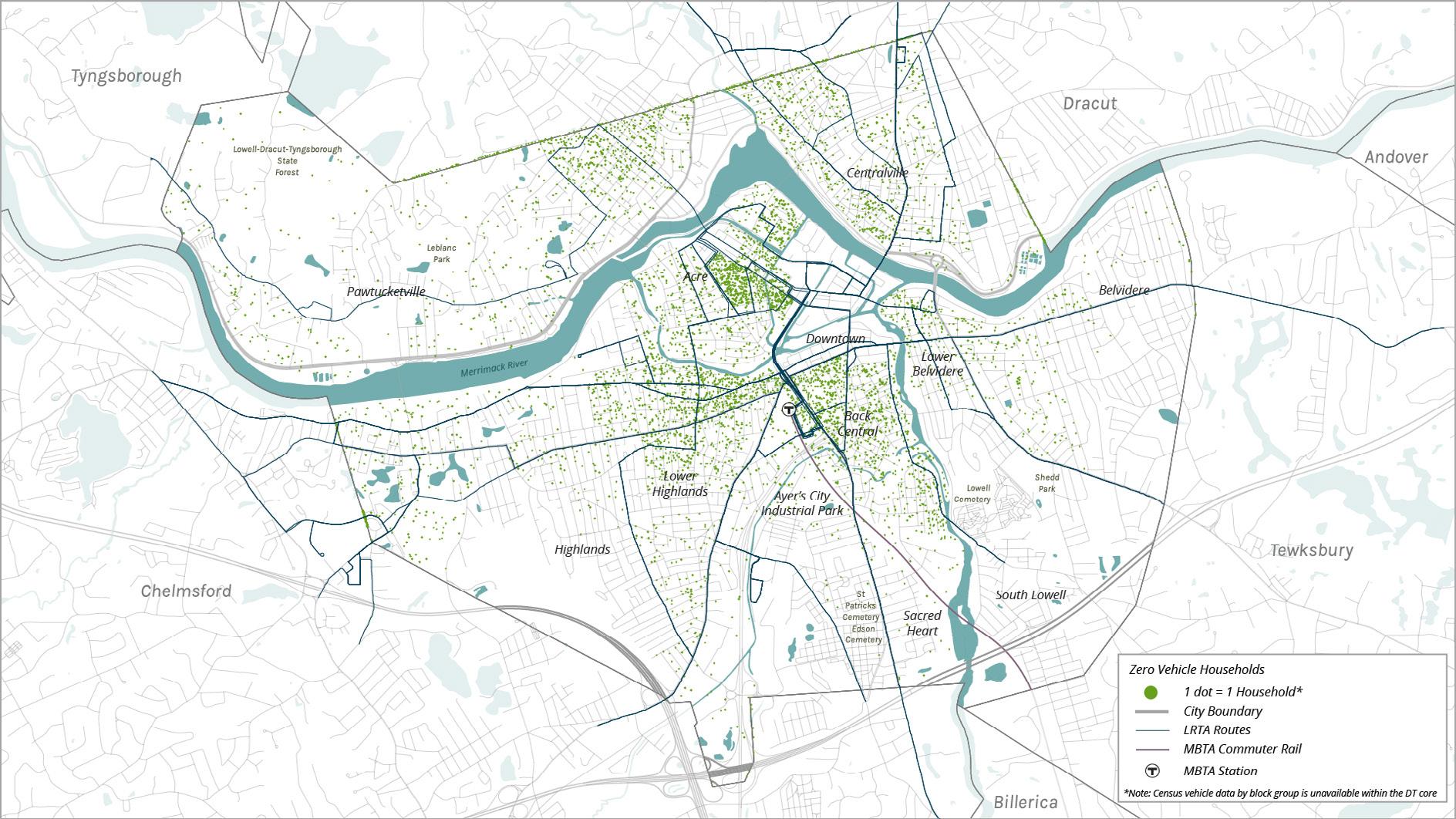
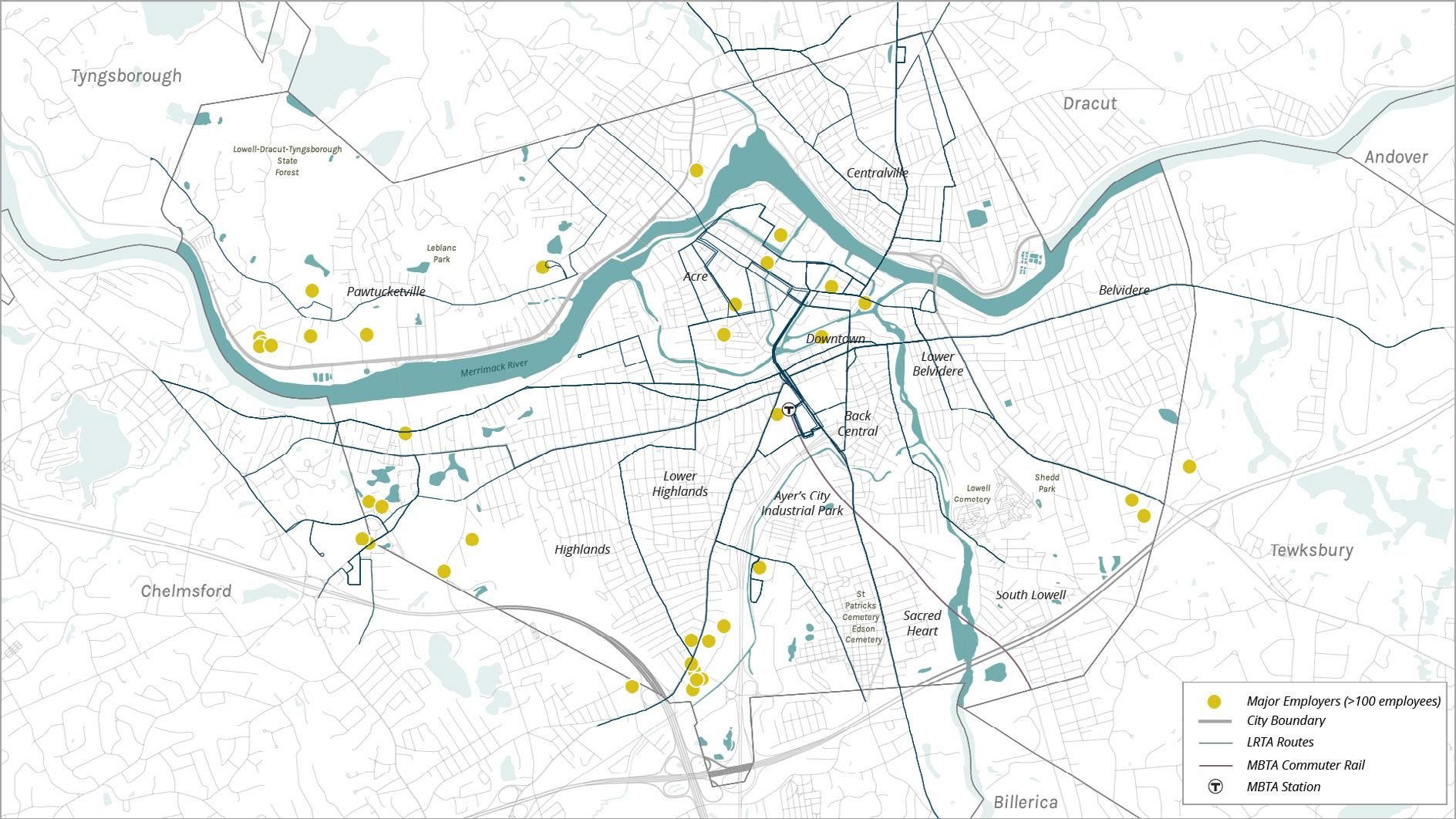
There is a strong need for safe, reliable and frequent transit
Residents who take transit to work spend twice as much time commuting as drivers. Lowell Regional Transit Authority’s (LRTA) buses typically only arrive at stops every 30 minutes to one hour and the latest route ends operation before 10pm. Lowell residents who take transit to work spend 50 or more minutes commuting on average, twice as much time as drivers.
Overall, most major employers are located along LRTA’s fixed-route network. However, some aren’t and development plans and/or TDM programs should consider this mismatch, as proposed in GoLowell. For example, further west, in Pawtucketville and in the Highlands, some major employers are not directly located and many of the employees that use transit for travel to and from work may experience first/last mile conflicts.
The greatest number of households without vehicles is found around Gallagher Terminal, the Acre neighborhood, and in Downtown along Merrimack Street and Salem Street. These areas with high concentrations of zero-vehicle households are fortunately served by routes operating every 2030 minutes, unlike most LRTA routes that run hourly. While this is positive news, it’s essential to evaluate other proposed strategies to ensure we are effectively connecting users who rely on nonmotorized options. For instance, we should examine how these strategies align with the proximity of trails and bike infrastructure.
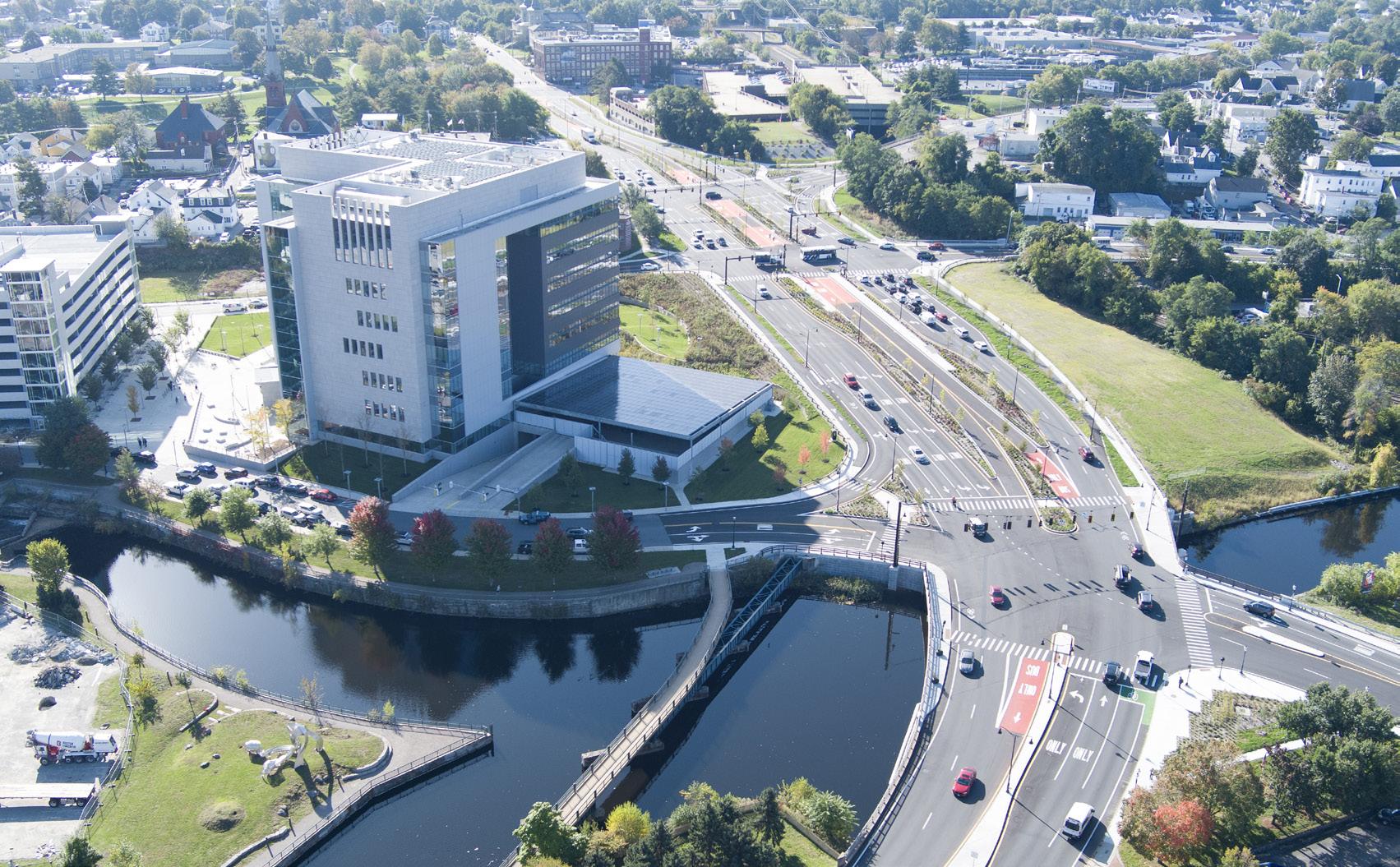
Lowell Forward aims to advance sustainable transportation options to enhance environmental protection, economic efficiency, and social equity. Recognizing the significant link between transportation and greenhouse gas emissions, the mobility actions in this plan focus on expanding access to sustainable travel choices for Lowell residents. Encouraging and promoting ride-sharing options are key strategies to mitigate emissions and enhance air quality.
Lowell has many recreational trails and greenways, but does not have a complete network of connective biking facilities designed for the comfort of people of all ages and abilities. And while many streets have compact grids and sidewalks, many streets could benefit from enhanced sidewalks and improved crossings.
Lowell’s streets, like those of other cities, have been built to prioritize the movement of vehicles over the safety of road users. Those who walk and roll—pedestrians, cyclists, and mobility aid users—are more vulnerable to serious injury and death than motorists in the event of a crash. A majority of crashes involving people walking and biking have occurred along arterials that carry higher volumes of vehicle traffic, such as Andover Street, Westford Street, and Route 38. The City’s recent multimodal Complete Streets plan, GoLowell, assessed street safety throughout Lowell and analyzed safety trends at many key intersections and streets throughout the city. The plan included concept diagrams for street safety improvements and prioritized implementation for new pedestrian and bicycle infrastructure.
GoLowell is Lowell’s multimodal Complete Streets plan. The planning effort assessed transit use, walkability, and bicycle safety throughout the city. The final plan can be read in its entirety on the City of Lowell’s website. GoLowell identified 10 highpriority corridors which will be assessed in detail for the safety and comfort of pedestrians and cyclists. GoLowell also proposed new bus routes and improved bus stop amenities:
• Crosstown Express route—connects Belvidere to Downtown & Gallagher Terminal to Highlands
• Downtown busway—Circulator from downtown to Gallagher Terminal
• New complete streets prioritization plan forthcoming Finally, the GoLowell plan proposed a connected network of bicycle infrastructure, from onstreet protected lanes to off-street greenways and trails. The plan recommended projects at key locations, such as crosswalk safety improvements and separated bike lanes on Bridge Street. Read the full GoLowell plan here: lowellma.gov/1340/GoLowell
The City of Lowell’s 2021 Citywide Parking Study recommended a selection of strategies designed to improve the parking experience throughout the city with a focus on fairness and equity. The study suggests updating parking prices so that they reflect the full environmental and social costs of parking, alongside new enforcement practices that use technology to ensure payment. The plan also recommends taking advantage of underutilized parking capacity by promoting parking garages, expanding residential parking programs, and broadening shared parking agreements between downtown private landholders.
A community college student in my household is a transportation rider. Based on her experience, I can say that transit in Lowell is highly unreliable. She needs to be at the bus stop 20 – 30 mins before just in case the bus arrives early, and sometimes stay 20 – 30 mins after the estimated time to wait in case the bus is late.
We need the potholes and sidewalks to be fixed. focus group with the Acre
There are so many parking garages downtown, there is a surplus of parking.
Getting to downtown from here is not friendly or safe. focus group with South East Asian Community led by
I do not shop in downtown because of the issues with parking and traffic.
No Sunday bus service and limited connections to other cities/ suburbs that are major employers such as Burlington Mall, Merrimack Premium Outlet, and Pheasant Lane Mall.
Public transportation just doesn’t run frequently enough for people to actually use it.
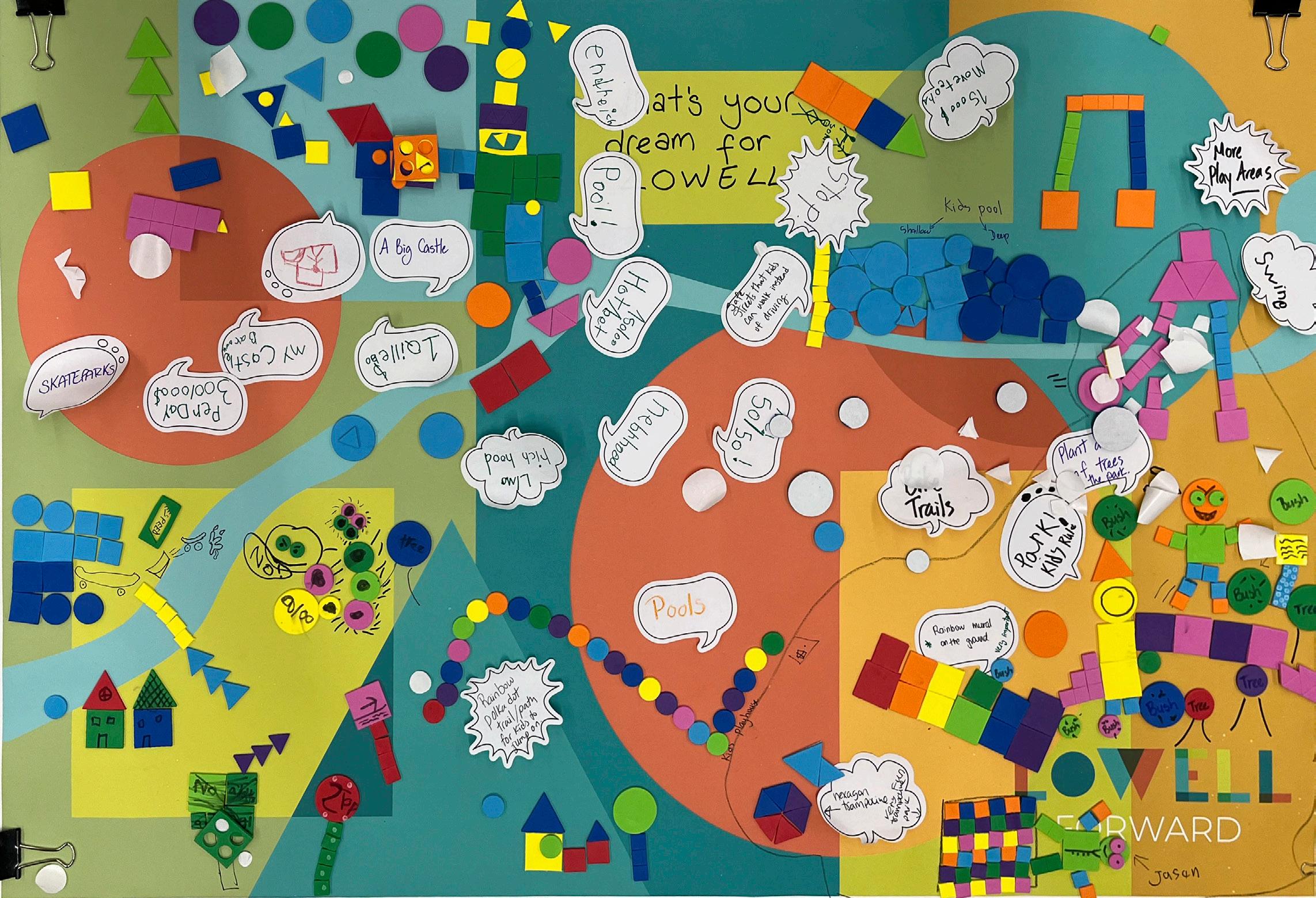
Conversations with Mercy highlighted concerns about mobility and transportation, emphasizing issues stemming from poor infrastructure and inadequate public transportation. Participants called for better sidewalks and bike lanes, more road maintenance, improved markings for walking and biking paths, and increased safety measures. Suggestions included rest areas, better path connections, and slower driving speed enforcement.
The city also needs enhanced public transportation infrastructure, with community groups advocating for improved bus stop signage, covered waiting areas, and seating. Concerns about Gallagher Station’s inconvenient location were raised. In Mercy’s conversations, people wanted to support public transportation more, but because service is so infrequent and unreliable, they felt like they could not. This brought out some creative recommendations such as collaborating with UMass Lowell to make their shuttle service public or looking into car sharing programs such as Q-Ryde.
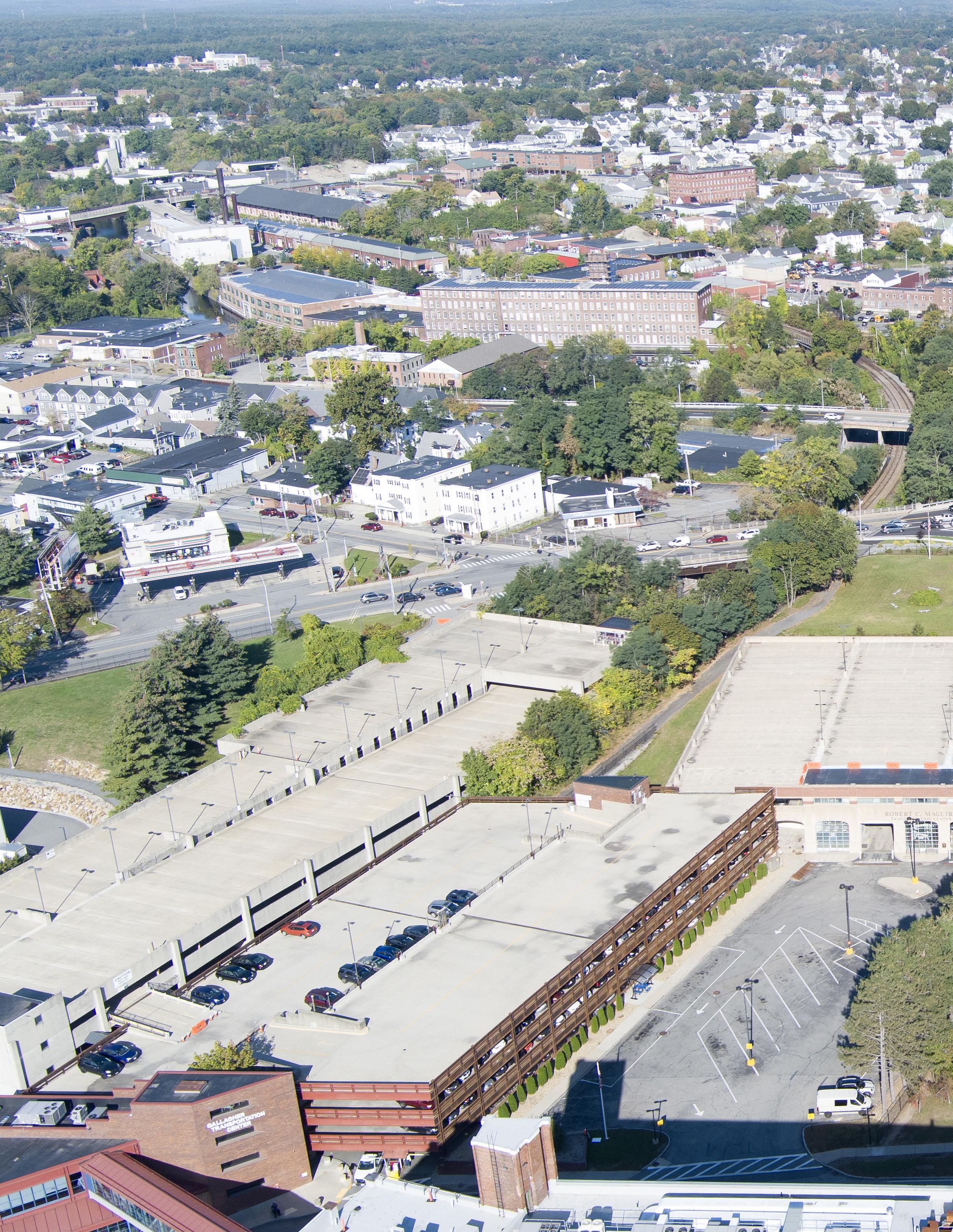
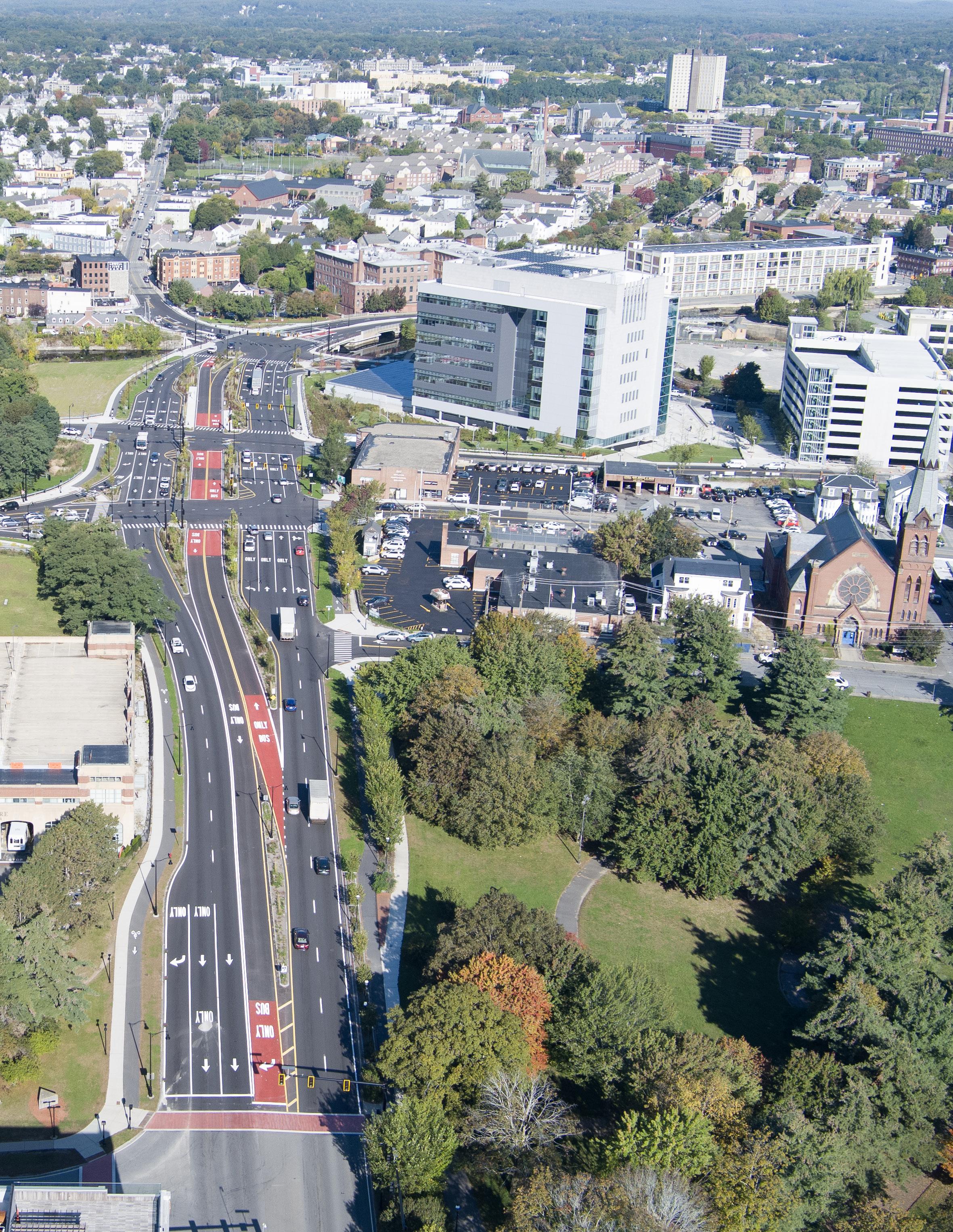
What is a Vision Zero Plan?
Vision Zero is a strategy aimed at eliminating all traffic fatalities and severe injuries while promoting safe, healthy, and equitable mobility. Originating in Sweden in the 1990s, it has seen success in Europe and is gaining traction in major American cities. The approach acknowledges that human errors are inevitable, emphasizing the need for road systems and policies designed to prevent severe outcomes. Vision Zero involves collaboration among various stakeholders, including traffic planners, engineers, policymakers, and public health professionals, recognizing the multifaceted nature of safe mobility and setting clear goals to achieve zero fatalities and severe injuries.
Traffic Calming Program (2022)
This program was developed to provide effective and consistent guidelines for the implementation of traffic calming measures throughout the city to decrease vehicle speeds and increase the safety and livability of the residents of Lowell. The Traffic Calming Program provides a clear process by which citizens of Lowell are able to request that their street or neighborhoods be evaluated for traffic calming.
Action 1:
Prioritize improving sidewalk quality and pedestrian crossing safety projects along key pedestrian routes of higher demand, higher levels of ADA need, and to/from higher ridership transit stops.
Action Type(s): Capital Investment
Status: Existing/Ongoing Initiative
Timeframe: Medium Term
City Steward: City of Lowell, LRTA
Action 2:
Adopt Vision Zero and create a Vision Zero Safety Action Plan for Lowell.
Action Type(s): City programs and operations
Status: New Initiative
Timeframe: Medium Term
City Steward: City of Lowell—DPD
Action 3:
Prioritize implementing 2021 GoLowell proposed bike network. Evaluate which projects require parking and sidewalk tradeoffs/considerations. Identify which projects require curb removal and additional funding.
Action Type(s): Capital Investment, New Study and Plan
Status: Modified or Expanded Initiative
Timeframe: Medium Term
City Steward: City of Lowell—DPD
Action 4:
Extend Bruce Freeman Rail Trail into Lowell. Begin process with abutters to engage and study feasibility.
Action Type(s): New Study and Plan
Status: New Initiative
Timeframe: Near Term
City Steward: MassDOT, City of Lowell—DPD, MassTrails
Action 1:
Implement policies and strategies from 2021 City-wide parking study to assure parking availability and incentives for modeshift.
Action Type(s): Capital Investment, New Study and Plan
Status: New Initiative
Timeframe: Near Term
City Steward: City of Lowell, DCR
Action 2:
Improve trails wayfinding signage to and from activity centers. Examine needs and make plans and designs to install signage in appropriate locations.
Action Type(s): City programs and operations
Status: Modified or Expanded Initiative
Timeframe: Near Term
City Steward: City of Lowell—DPD, Parking Department
Action 3:
Develop a multilingual, digital and non-digital, communication strateg y for both wayfinding and informing people about transportation options and circulation routes.
Action Type(s): New Study and Plan
Status: Modified or Expanded Initiative
Timeframe: Near Term
City Steward: LRTA, City of Lowell, and employer partners
In 2021, the City received a $165,755 Shared Streets Grant from MassDOT to enhance safety for pedestrians, cyclists, rollers, and drivers. Utilizing this grant, the City implemented two temporary projects in 2020 and two in 2021, aligning with the goals of GoLowell. These projects served as pilots to test changes, gather feedback, and assess the potential for making them permanent. The 2021 Shared Streets Pilots included the Pawtucket Boulevard project, which narrowed the road with concrete barriers to enhance pedestrian safety, and the Merrimack Street project at Cardinal O’Connell Parkway, which featured crosswalk safety improvements and transit stop enhancements. Feedback and data collected from these pilots will inform decisions on making some or all of these changes permanent in the future.
Action 1:
Collaborate with LRTA to implement GoLowell recommended Cross-town and Downtown Connecter routes.
Action Type(s): Regional Partnership
Status: Existing/Ongoing Initiative
Timeframe: Near Term
City Steward: LRTA
Action 2:
Collaborate with LRTA to finalize bus reliability projects along Thorndike Street for getting service in and out of Gallagher Transit Terminal. Prioritize areas with high concentrations of zero vehicle households and neighborhoods where there are higher levels of transit dependency.
Action Type(s): Regional Partnership, Capital Investment
Status: New Initiative
Timeframe: Medium Term
City Steward: City of Lowell, MassDOT, LRTA
Action 3:
Coordinate with LRTA to make the Sunday bus service pilot permanent to help service worker commutes and non-commuters users of transit for errands, shopping, and entertainment.
Action Type(s): City Program, Local Partnership
Status: Modified or Expanded Initiative
Timeframe: Near Term
City Steward: City of Lowell, LRTA
Action 4:
Collaborate with LRTA to create a capital improvement plan to improve bus stop accessibility and comfortability. Study quality of bus stop amenities and their distribution across the city.
Action Type(s): Regional Partnership
Status: Modified or Expanded Initiative
Timeframe: Near Term
City Steward: LRTA
Action 5:
Implement TDM (Transportation Demand Management) program in the GoLowell Plan starting with City staff and then expanding programs to large employers. Assure that new large employers have TDM programming, especially those further away from transit.
Action Type(s): New Study and Plan
Status: New Initiative
Timeframe: Medium Term
City Steward: City of Lowell—DPD, LRTA
Action 6:
Initiate a public transportation education and awareness campaign to promote public transport usage and expand awareness of social, economic and environmental benefits that public transportation brings.
Action Type(s): City Program, Local Partnership
Status: New Initiative
Timeframe: Near Term
City Steward: DPD, City Manager’s office
Transportation Demand Management (TDM) centers on understanding individuals’ transportation choices and endeavors to influence behavior towards more efficient use of existing infrastructure. This involves reducing single-occupancy vehicle trips and promoting the utilization of transit, ridesharing, walking, biking, and telecommuting. TDM proves to be cost-effective by guiding the design of transportation and physical infrastructure, naturally encouraging alternatives to driving, and fostering a better-balanced transportation system.
The GET A $2 RYDE pilot program will allow employees in the greater Lowell area to get $2 car rides to and from their workplaces. MassHire, a workforce development nonprofit serving the greater Lowell area, has partnered with the Q-Ryde transportation software company to provide affordable rides to local employees. The pilot, which began in October of 2023 and will run for a full year, uses federal funds to subsidize Q-Ryde drivers to pick up and drop off employees. These rides function similarly to commercial ride-share apps like Uber or Lyft, the user can schedule shared rides between their home and their workplace through the Q-Ryde website or over the phone, with the biggest difference being the low price of $2.
1. Downtown revitalization
2. Promote, support, and grow Lowell’s local businesses
3. Expand commercial and industrial opportunities and increase job opportunities for Lowell residents
• Sustainability and resilience: Lowell will reduce the city’s impact on the environment and become a resilient community.
To become a resilient and sustainable city, it is crucial to ensure economic stability for all members of the community. This involves implementing strategies to diversify employment opportunities, aligning them with effective training and education, and actively supporting small businesses and inclusive entrepreneurship.
• Proactive maintenance: Lowell will care for existing organizations, infrastructure and programs that support economic activity.
The City will work closely with organizations who are actively offering training and education programs, supporting small businesses, and employers who are providing diverse and lowbarrier jobs. The City will also proactively maintain built infrastructure and public programs that connect people to jobs, enhance existing job centers and attract new employers.
• Accountable governance and community stewardship: Lowell will include different voices in key decisions to achieve shared economic prosperity.
Lowell’s diversity is integral to its vibrancy. The City supports equity and inclusion initiatives and strives to eliminate all types of disparities in economic opportunity. Essential to this effort is the creation of opportunities for the community to participate in decision-making processes.
• Innovation and creativity: Lowell embraces innovation and creativity that support economic opportunities for all.
Collaborating with anchor institutions, the City will enhance accessibility to training and education programs, advance economic opportunities, and foster job growth for everyone.
• Increase number of locally-owned businesses
• Increase number of minority- and women-owned businesses
• Increase proportion of minority- and women-owned businesses participating in grants and consultation programs
• Obtain pedestrian traffic software; track pedestrian activity downtown and in all neighborhood nodes with goal of increasing by 50% by 2040
• Hamilton Canal District
• Ayer City Market Study
• Mosaic Lowell
• TDI (Transformative Development Initiative) at the Acre
• Rapid Recovery Plan
As Lowell continues to recover from the economic, health, and social consequences of the COVID-19 pandemic, residents and business owners have called attention to the state of Downtown businesses. The Rapid Recovery Plan identified vacant storefronts and surveyed Downtown business owners, who reported revenue decline, reduced operating hours, additional expenses, and temporary or permanent closures as major impacts of the pandemic. 79% of Downtown businesses surveyed had fewer on-site customers in 2021 than in 2020. 60% of downtown businesses were operating at reduced hours or capacity in April 2021.
Despite these trends, office and retail rents in Lowell have grown more in the past six years than countywide rents. However, vacancy rates that are slightly more volatile than countywide rates are better indicators of the difficulty that Lowell commercial uses have experienced. Lowell office vacancy jumped from 5% to 9% from 2020 to 2021.
These results emphasize a need to further understand the obstacles faced by downtown businesses in the coming years. These results also indicate a need to understand Lowell’s larger entrepreneurial ecosystem and the steps the City and its partners can take to support local, smallscale businesses.
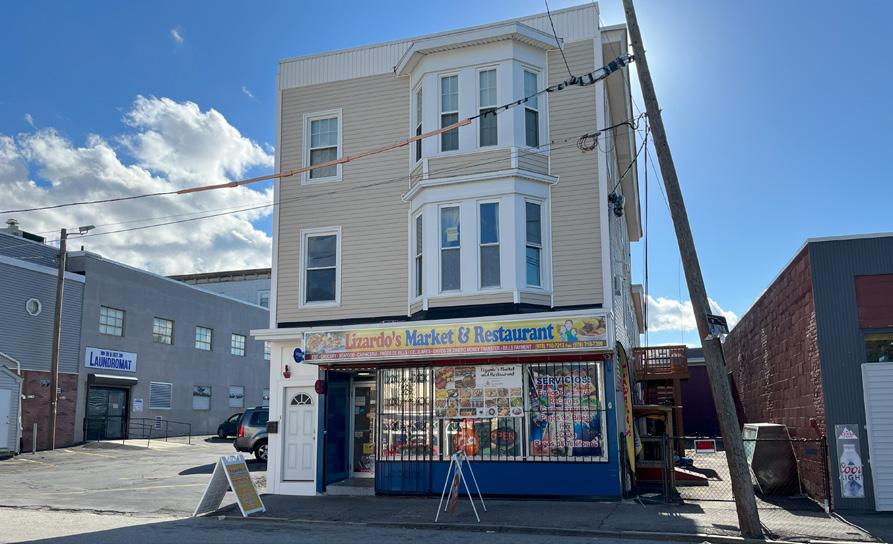
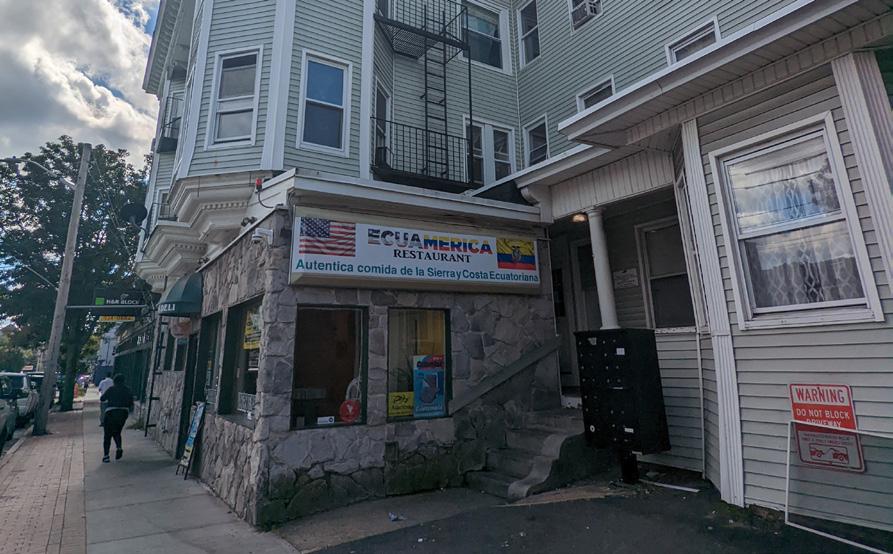
The largest institution of higher education in the city, UMass Lowell, successfully provides training that aligns with key in-demand jobs, such as those in healthcare-related occupations. Among the programs with the most number of degrees or certificates conferred at UMass Lowell are business and management, finances, computer science, sales, physical and social sciences, administration, and architecture and engineering. However, UMass Lowell does not offer programs for other in-demand occupations, such as healthcare support and healthcare practitioners. Lowell has an opportunity to capitalize on its strong position as a regional education hub by continuing to provide job training and degree programs that align with high-demand industries. Middlesex Community College and the Greater Lowell Technical High School may offer other programs that do support some of those industries.
Job Growth by Occupation 2012 – 2022
Architecture & Engineering
Maintenance & Repairs Sales
Food Prep & Serving Construction
Administrative Support
Transportation
Cleaning and Maintenance
Production
Computer
Personal Care
Physical & Social Science
Protective Services
Education & Library
Legal
Arts & Entertainment
Social Services
Financial Management
Healthcare Practitioners
Healthcare Supporta
Completions refers to the number of degrees or certificates conferred for a specific course of study in a given year. Includes Associate, Bachelor, Master, and Doctorate degree completions from the University of Massachusetts Lowell. Source: Lightcast
Number of Degree Completions in 2022
As is the case in the Boston region and Massachusetts overall, healthcare is one of the fastest growing sectors in Lowell. Jobs in healthcare support occupations—such as home health aides, occupational and physical therapy aides, and medical and nursing assistants—grew by 58% between 2012 and 2022, or by 1,115 jobs. Other growing occupations include healthcare practitioners, management, finance, and social services. The average earnings within each of these industries ranged from approximately $43,000 to $151,000 in 2022. Lowell’s median household income of $73,008 lies in between this range, indicating that the city is attracting and retaining both low-paying and high-paying occupations, and in turn, generating greater resources for public services and major capital projects.
Fastest growing occupations in Lowell in 2020
1. Healthcare Support 3,027 $43,019
2. Healthcare Practitioners 4,624 $110,247
3. Management 4,293 $151,530 4.
Sound fiscal management is crucial to enable the City of Lowell to continue serving its residents and expanding the scope and quality of public services. Nearly half of the City’s revenue comes from state funding. Just 38% of the City’s revenue is generated from taxes and other fees. Nearly all tax revenue comes from property taxes on residences and businesses. Lowell’s strong development momentum provides an opportunity to capitalize on new streams of tax and fee revenue. Targeted public investment in development, infrastructure, and local amenities can support property values, and in turn, generate greater resources for public services and major capital projects.
City of Lowell Revenues, FY 2021.
Economic Development Themes
Public Workshop 1
Build a better economic bridge between [UMass Lowell] and the city.
Attract people from whole regions with unique amenities and businesses (like canals).
Public Meeting 1 participant
Provide opportunities for skill building, training and innovation.
Community Organizer interviewee
Public Meeting 1 participant
Promote small businesses and expand business opportunities for minority groups.
Community Organizer interviewee
Bring back Downtown, there are too many empty storefronts!
Community Organizer interviewee
In talking with small business owners, Mercy heard that the City has more work to do in supporting economic growth and development. One of the problems she heard discussed was the loss of young people moving away from Lowell to find success elsewhere. The city needs more early job opportunities in the form of internships, job shadowing, and apprenticeships that will keep young people local. Small businesses also need more support, especially when they first open. Such support could take the form of helping them own their own space. The city also needs to attract investors, which could be accomplished by having business incubators and leveraging currently vacant space.
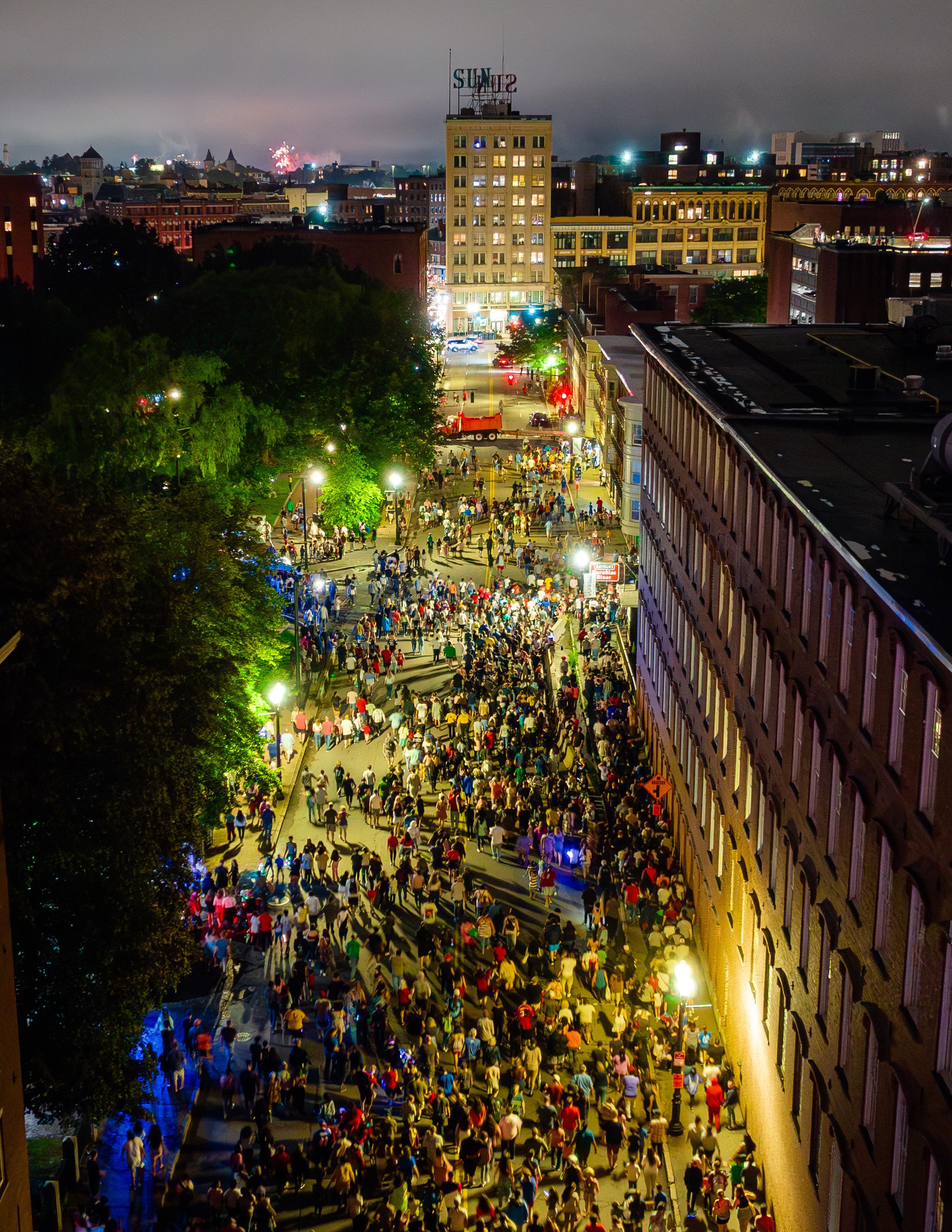
Action 1:
Identify space, design, and infrastructure needs by Downtown Lowell businesses; revisit regulations to allow for more modern and efficient commercial space designs; consider making outdoor seating a permanent initiative.
Action Type(s): City programs and operations
Status: Modified or Expanded Initiative
Timeframe: Near Term
City Steward: City of Lowell—DPD (economic development)
Action 2:
Test and implement actions to reduce commercial vacancies in a way that both aligns with residents’ desires and can increase foot traffic. Iterate tests based on feedback received.
Action Type(s): City programs and operations
Status: New Initiative
Timeframe: Near Term
City Steward: City of Lowell—DPD (economic development)
Action 3:
Work in collaboration with our educational partners UML and MCC, to continue promoting Lowell’s local businesses and incentivize students to frequent Downtown.
Action Type(s): Local Partnership
Status: New Initiative
Timeframe: Near Term
City Steward: City of Lowell—DPD (economic development), MCC, UML
Action 4:
Create a 24-7 Downtown Plan that studies conversions of vacant office buildings into residential use, and continue to collaborate with other local, state, and federal economic development entities to identify funding opportunities to revitalize historic buildings.
Action Type(s): New Study and Plan, Local Partnership
Status: Modified or Expanded Initiative
Timeframe: Near Term
City Steward: City of Lowell—DPD (economic development)
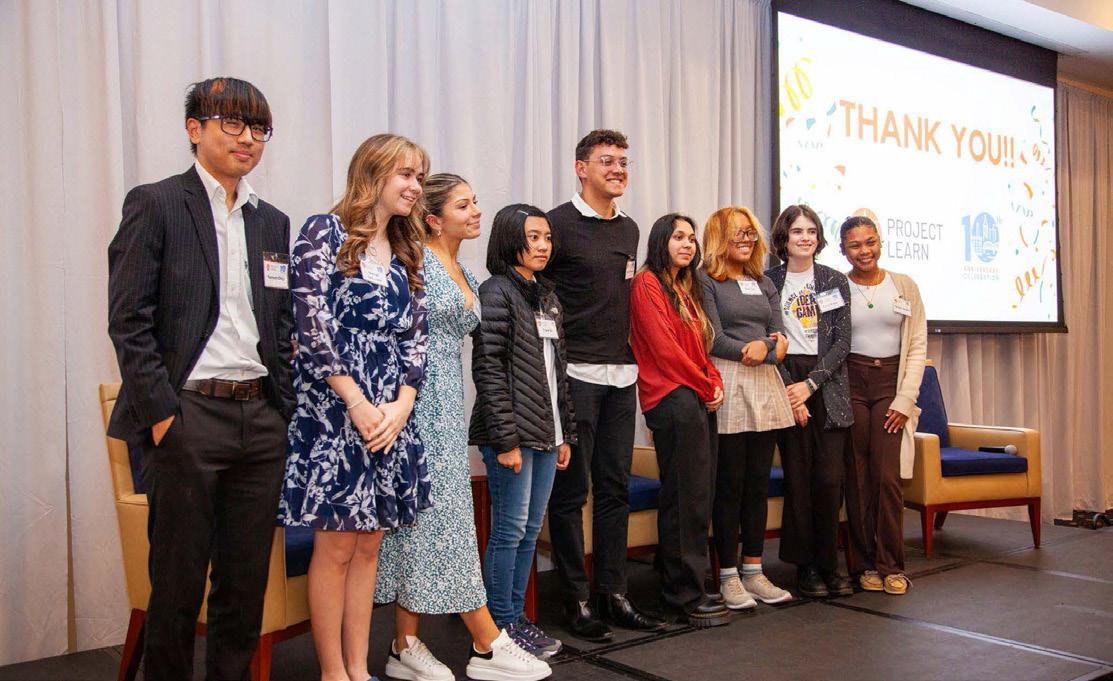
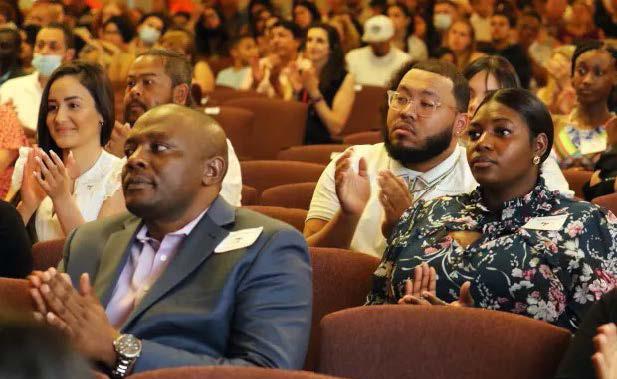

Project Learn is a 501(c)(3) organization that believes every young person in Lowell deserves the opportunity to learn, succeed, and thrive. They ensure all Lowell students have equitable access to high-quality educational experiences, expand access to highquality experiential learning and preprofessional work experiences, and support both youth-led programs and youth adult partnerships. Project Learn also manages a sustainability charitable fund that supports innovative educational projects led by Lowell students and educators.
Abisi Adult Education Center lowell.k12.ma.us/domain/1167
The Abisi Adult education center provides classes for every adult in the Greater Lowell area, so that everyone has the opportunity to earn high school credentials and/or to learn and improve their English. The center provides a setting where students can develop the literacy and math skills needed to qualify for further education, job training, or better employment.
Action 1:
Create a comprehensive branding and marketing program promoting local businesses. Coordinate with departments including Economic Development and CASE, and with producers and hosts of cultural events and programs. Emphasize support of local business community.
Action Type(s): Local Partnership, City Program
Status: Modified or Expanded Initiative
Timeframe: Near Term
City Steward: City of Lowell—DPD (economic development), CASE, UML’s Marketing and Social Policy professors and students
Action 2:
Establish partnerships and programming to support small businesses with provision of technical assistance, access to funding, and networking for small businesses, with targeted focus on supporting business owners in minority and immigrant communities and start-ups created by local educational institutions.
Action Type(s): Local Partnership, Regional Partnership
Status: Modified or Expanded Initiative
Timeframe: Near Term
City Steward: City of Lowell—DPD (economic development), UML, MCC
Action 3:
Fund retail incubators/pop-ups, not just in Downtown, but throughout the city.
Action Type(s): City programs and operations
Status: Existing/Ongoing Initiative
Timeframe: Near Term
City Steward: City of Lowell—DPD (economic development)
Action 4:
Expand the City’s Storefront Improvement Program to assist Lowell’s local businesses in improving commercial spaces.
Action Type(s): Local Partnership, City Program
Status: New Initiative
Timeframe: Medium Term
City Steward: City of Lowell—DPD (economic development), Office/Anchor Institutions
Action 5:
Increase funding and/or tax incentives for businesses looking to relocate to/within Lowell as they grow.
Action Type(s): Regional Partnership, City Program
Status: Modified or Expanded Initiative
Timeframe: Near Term
City Steward: City of Lowell—DPD (economic development), Mass Supplier Diversity Office, Lowell-based businesses
Action 6:
Expand opportunities to become certified vendors for government procurement opportunities. Work with Mass Supplier Diversity Office and Lowell-based businesses.
Action Type(s): Local Partnership
Status: New Initiative
Timeframe: Medium Term
City Steward: City of Lowell—DPD (economic development), Office/ Anchor Institutions
Action 7:
Incentivize anchor institutions to purchase from local businesses to support small business growth and drive associated hiring.
Action Type(s): Local Partnership
Status: New Initiative
Timeframe: Medium Term
City Steward: City of Lowell—DPD, Office/Anchor Institutions
Latinx Community Center for Empowerment (LCCE), Inc. merrimackvalley.org/listing/latinxcommunity-center-for-empowerment-lcce-inc
The LCCE’s mission is to empower members of the Latinx community by providing opportunities for education, employment, civic engagement, and meaningful decision-making. Their selection of social programs are designed to strengthen community assets and promote socio-economic development for the whole Latinx community.
African Community Center of Lowell (ACCL) acclowell.org

ACCL equips African immigrants and refugees in the Greater Lowell area with the resources that allow them to be actively engaged community members, through educational, social, and cultural initiatives. They host events to promote learning, with documentaries and talks, and to promote cultural connections, where African music, costumes, and food are celebrated. ACCL also connects with the public school system to encourage locals of all ages to visit the center and learn about African heritage.
Action 1:
Identify and create areas for redevelopment through the implementation of the Ayer City Urban Renewal Plan and Brownfields Program.
Action Type(s): Other Regulatory/Policy
Status: Existing/Ongoing Initiative
Timeframe: Medium Term
City Steward: City of Lowell—DPD (project management)
Action 2:
Enhance workforce development initiatives. Build a pipeline of talent for jobs in industrial mixed-use districts and establish programs with anchor institutions to create an education-workforce pipeline.
Action Type(s): City programs and operations, Local Partnership
Status: Modified or Expanded Initiative
Timeframe: Near Term
City Steward: City of Lowell—DPD (economic development), Anchor institutions
Action 3:
Development initiatives increasing the attractiveness of talent in Lowell in collaboration with anchor institutions.
Action Type(s): Local Partnership
Status: New Initiative
Timeframe: Near Term
City Steward: City of Lowell—DPD (economic development), UML, MCC
Impact Mindsets
Action 4:
Study space and infrastructure needs of new businesses and plan for how the City can accommodate these needs.
Action Type(s): City programs and operations, Local Partnership
Status: New Initiative
Timeframe: Medium Term
City Steward: City of Lowell—DPD (economic development), UML, MCC
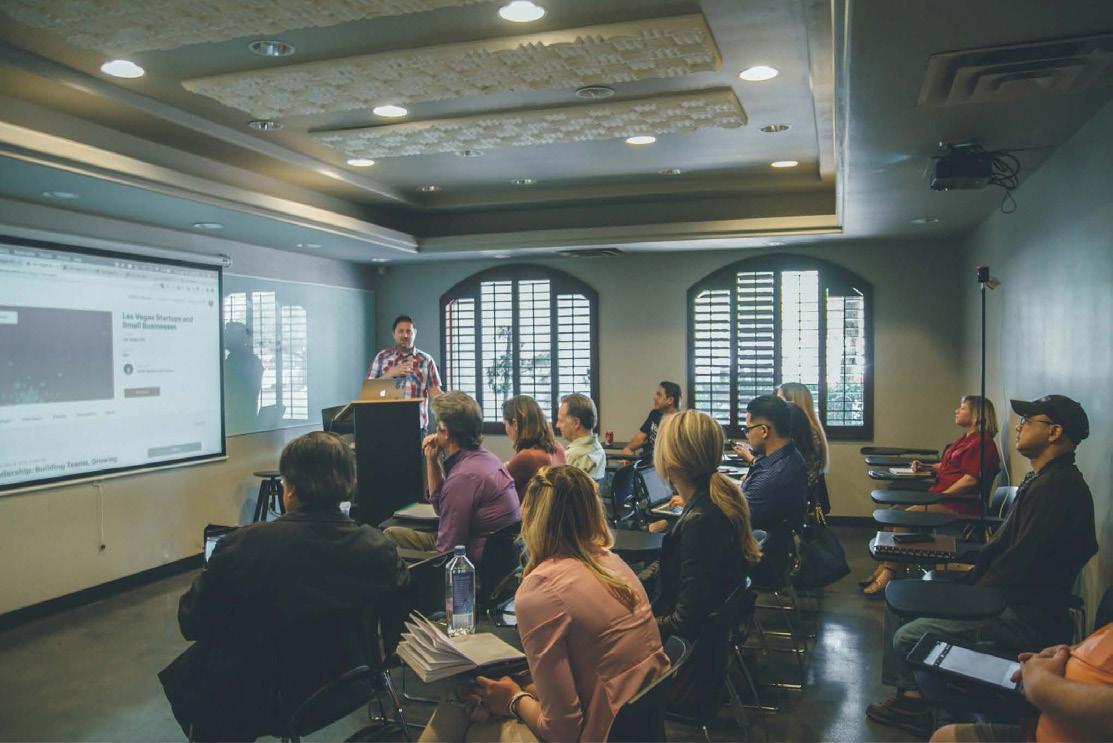
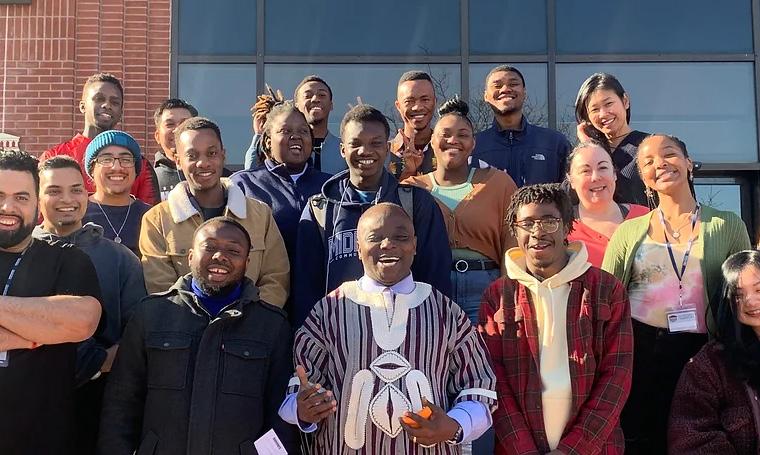
Masshire (Career Center)
masshirelowellcc.com/about
MassHire is part of the Massachusetts One-Stop Career Center System serving the communities of Billerica, Chelmsford, Dracut, Dunstable, Lowell, Tewksbury, Tyngsborough, and Westford. The Lowell Career Center operates under the direction of the City of Lowell and is chartered by the MassHire Greater Lowell Workforce Board. The career center provides job seekers with a range of work readiness services including youth job placement, technical training, and resume building. Out of school youth academic programs include HiSET preparation for ages 17+.
1. Achieve carbon neutrality by 2050
2. Building resilience
3. Promote clean energy economy
4. Ensure energy equity
• Sustainability and resilience: Lowell will address energy, climate, and environmental challenges at different scales through collective action.
Lowell will build upon existing initiatives and plans, and initiate new efforts to diminish our environmental footprint. Lowell is committed to minimizing its impact on the environment and proactively preparing for, and mitigating the effects of, climate change. These initiatives span across various scales, from local, regional, and global.
• Proactive maintenance: Lowell will proactively take support existing organizations, infrastructure and programs that are working towards energy, climate, and environmental initiatives.
The City will work closely with organizations that are working on energy efficiency projects, mitigating impacts on climate change, and promoting environmental sustainability. In parallel, the City will focus on maintaining built infrastructure that uses clean energy sources and will promote sustainable mobility options.
• Accountable governance and community stewardship: Lowell will take into account all community members’ needs when addressing energy, climate, and environmental challenges. The City will focus on environmental justice and social equity to ensure that all members of the community are protected from environmental impacts and benefit equally from environmental resources.
• Innovation and creativity: Lowell will embrace innovation and creativity to support resilience for all.
The implementation of innovative and creative strategies is crucial for climate change actions and solutions. The City will collaborate with other stakeholders to address a spectrum of scales from hyperlocal to regional, and from individual to collective.
• Reduce carbon emissions from buildings citywide by 50% vs. 1990 baseline levels by 2030
• Reduce carbon emissions from buildings citywide by 75% vs. 1990 baseline levels by 2040
• Increase publicly available EV charging infrastructure by 50% vs. FY 23 baseline
• Increase the total installed solar infrastructure by 50% vs. FY 23 baseline
• Increase the number of households utilizing decarbonized energy sources
• Municipal Vulnerability Preparedness/Hazard Mitigation Plan (2020)
• Claypit Brook Climate Resilience Stormwater Management Capital Improvement Plan (2021)
• Resilient Urban Forest Master Plan
• Ongoing OSRP update
in Lowell
Parts of the Highlands, Centralville, and Pawtucketville are at elevated risks for flooding. Much of Lowell’s flood risk is due to low lying land adjacent to an active river. Damage potential from floods will continue to rise as extreme weather events become more common due to climate change. We have an opportunity to adapt to the impacts of existing flood zones and set regulations for new development, infrastructure, and green infrastructure that could mitigate future flooding.
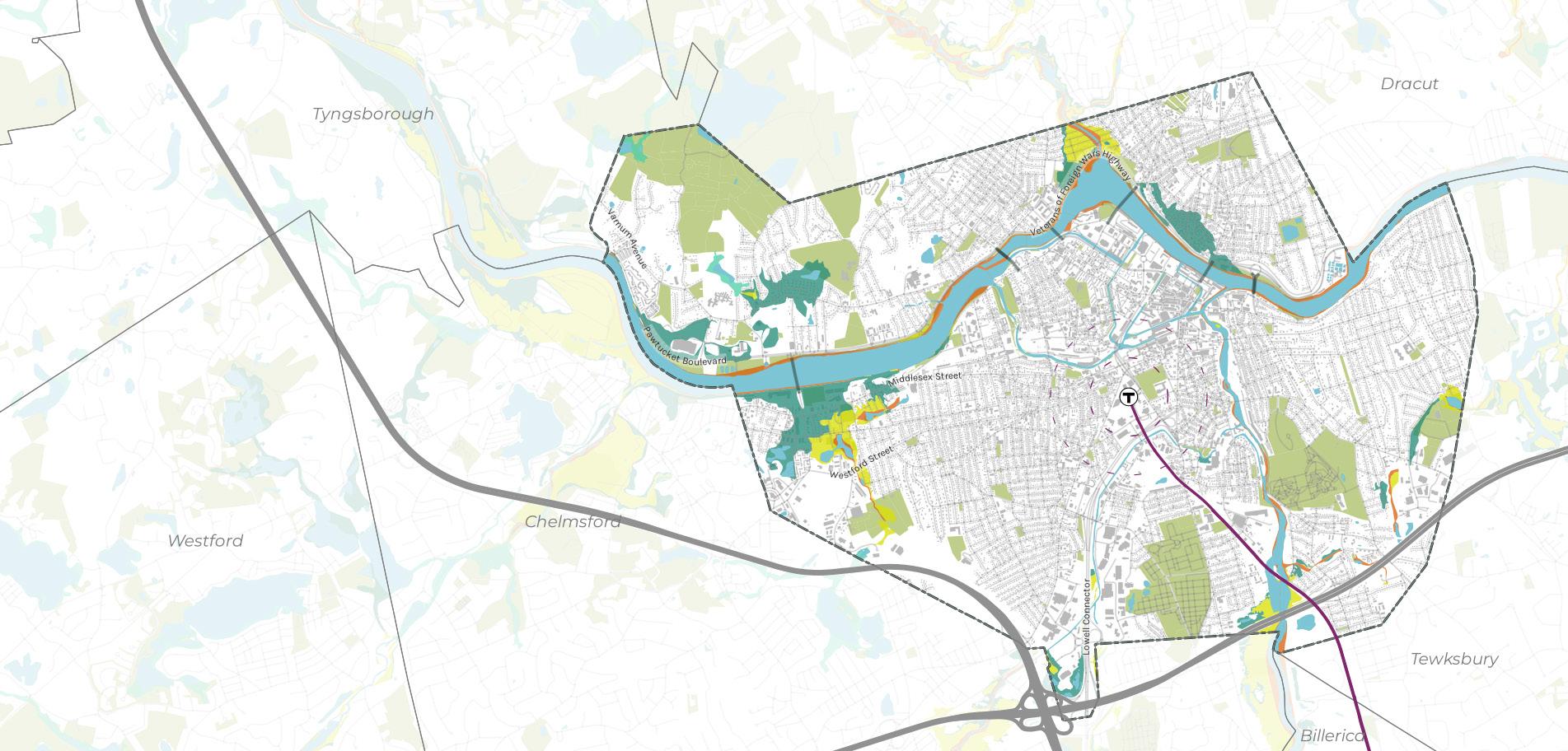
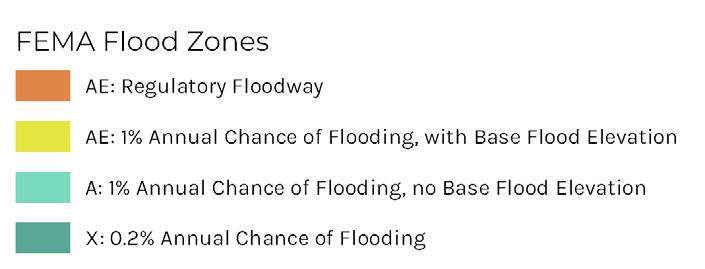
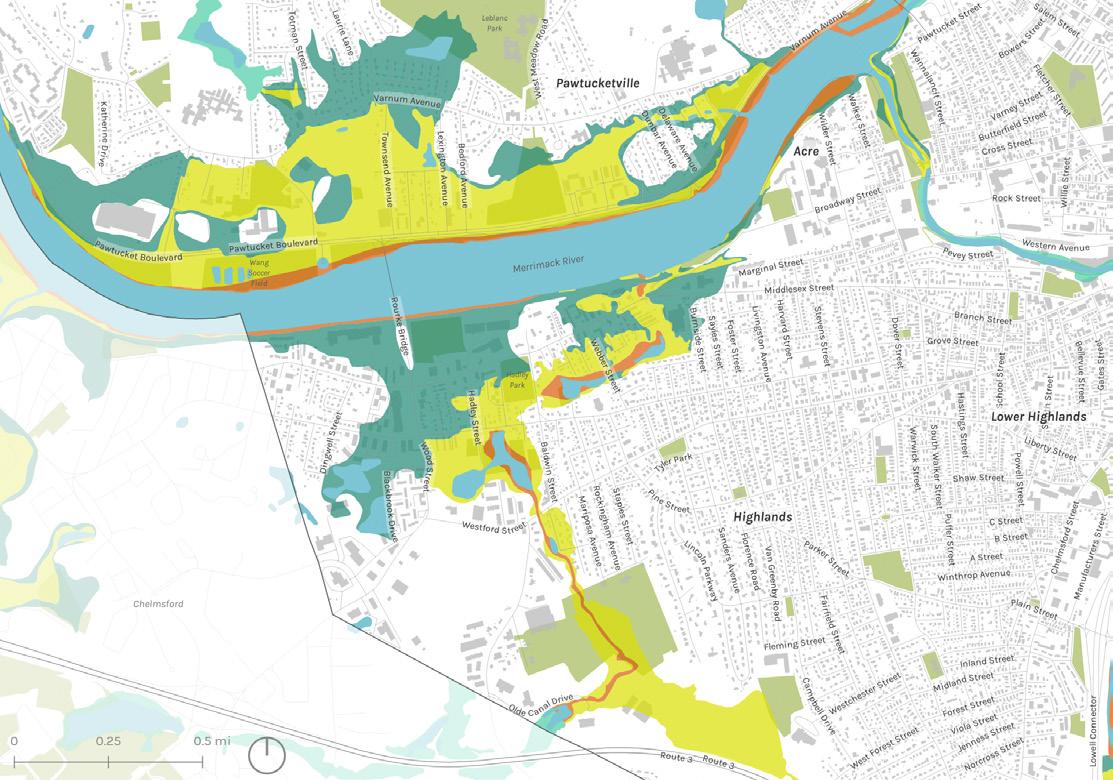
Floodmap: Pawtucketville.
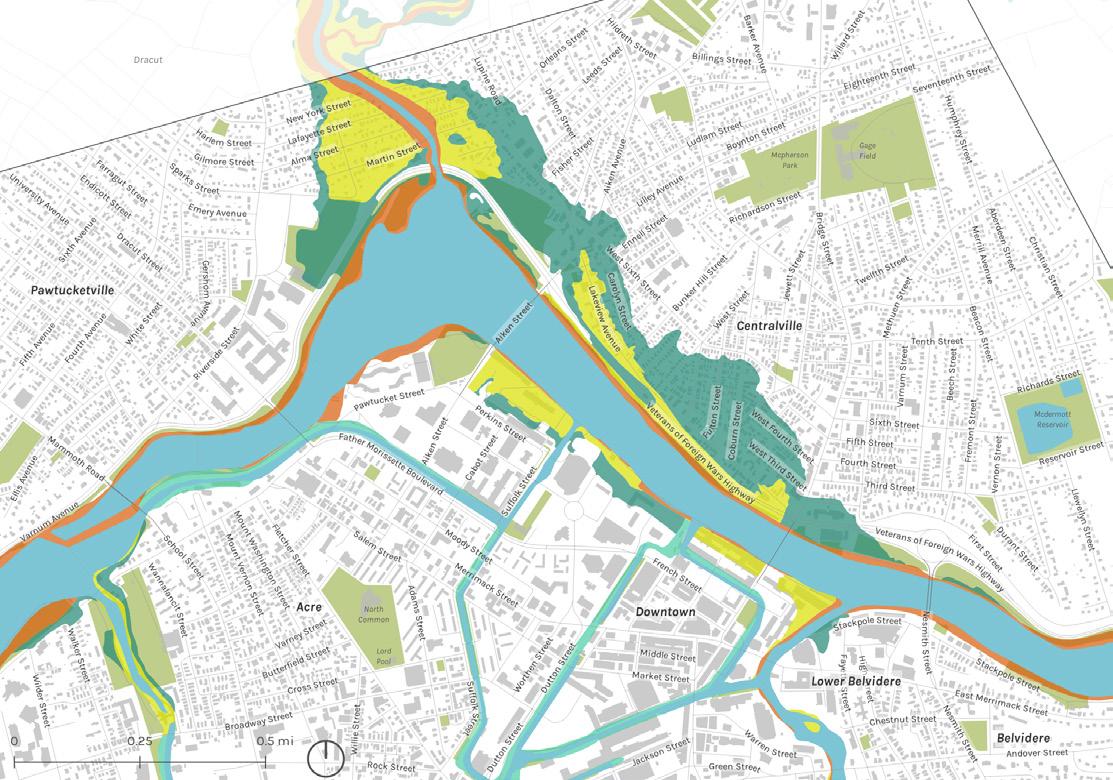
Floodmap: Centralville.
In addition to increased flooding, climate change will cause temperatures to rise in Lowell over the next few decades. Both the frequency and intensity of extreme heat events will increase. High temperatures can trigger health complications such as heat stroke and exacerbate existing cardiovascular or respiratory conditions. Extreme heat events are especially dangerous for small children, the elderly, outdoor workers, and people with chronic health conditions.
The built environment plays an important role in mitigating or exacerbating the effects of extreme heat. Places with lots of exposed pavement, such as parking lots, tend to retain heat the most. Places near water or tree cover can be dramatically cooler than most areas of the city on a hot day. For instance, on July 22, 2022, the surface temperature of the Centralville Market Basket parking lot reached 133 degrees Fahrenheit. Meanwhile, Rogers Fort Hill Park—a green space with substantial tree cover—reached just 92 degrees, a 41 degree difference!
As we prepare for more extreme heat events, developing a system of cooling infrastructure to mitigate heat stress, such as street trees, green infrastructure, drinking fountains, green roofs, open space, splash pads, pools, and public air-conditioned facilities will be crucial. Tree planting and retention of existing trees is a critical tool to mitigating heat island effect, thus developing a street tree program could be something to prioritize.
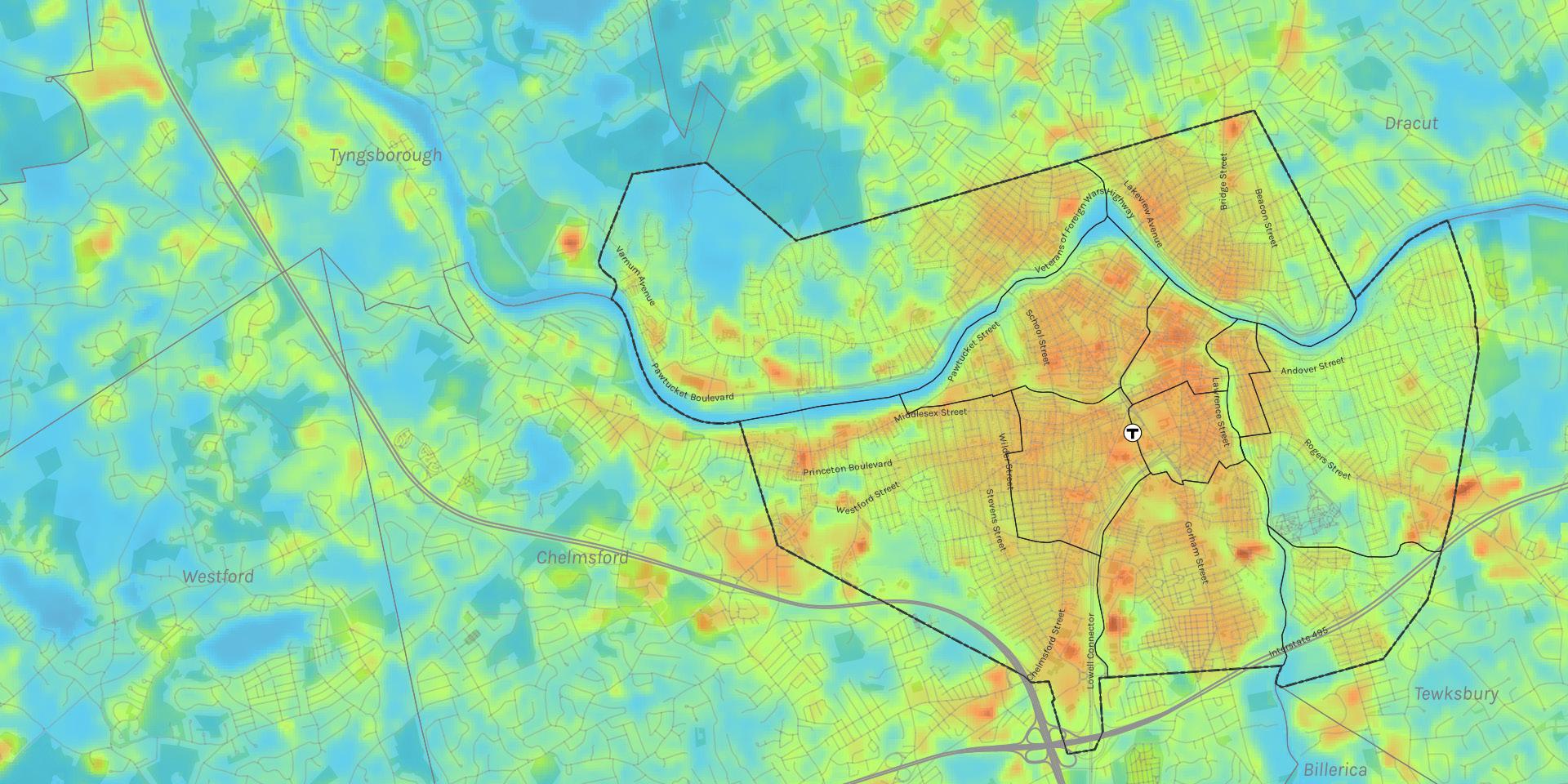
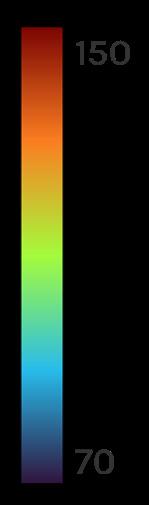
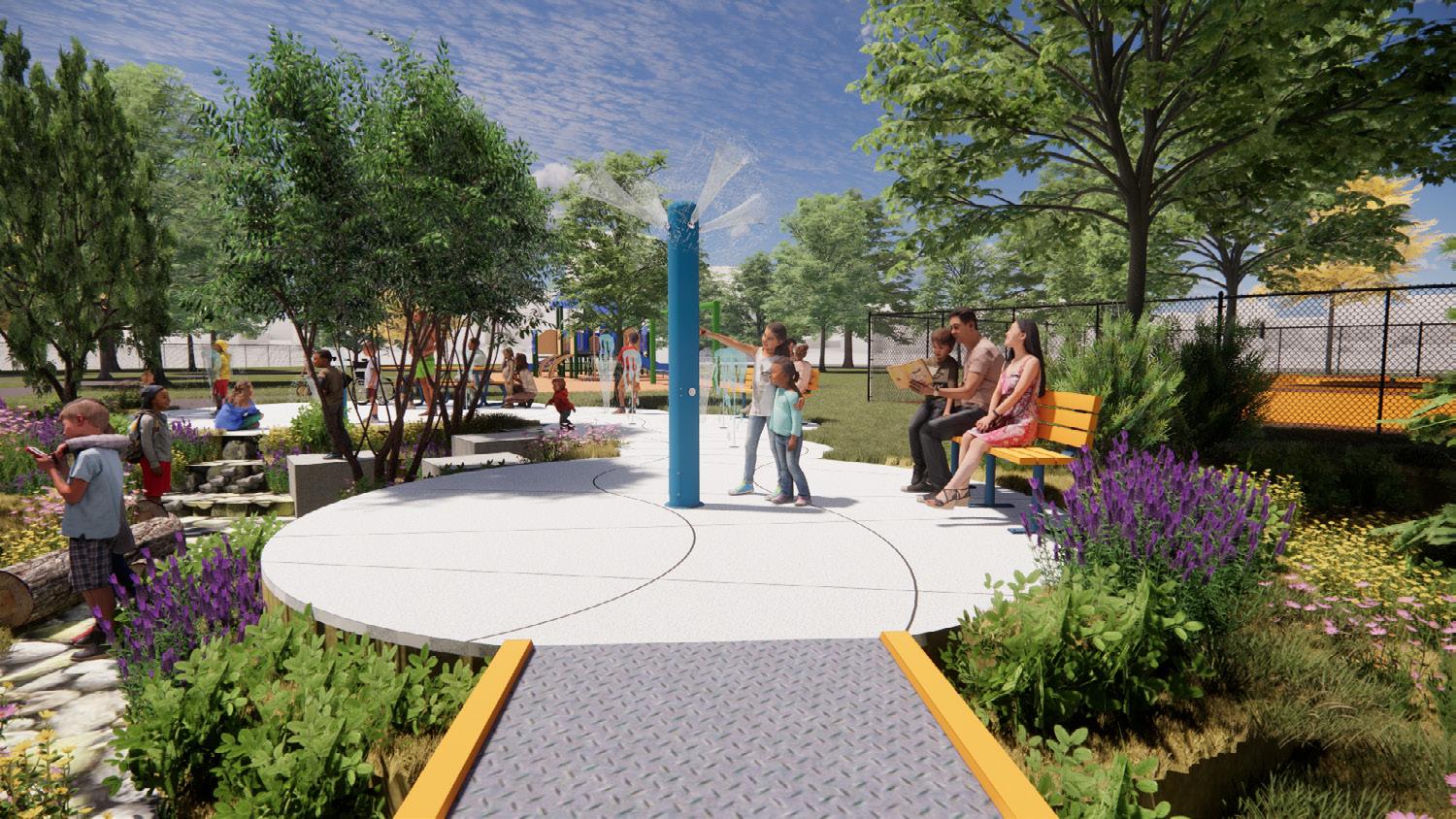
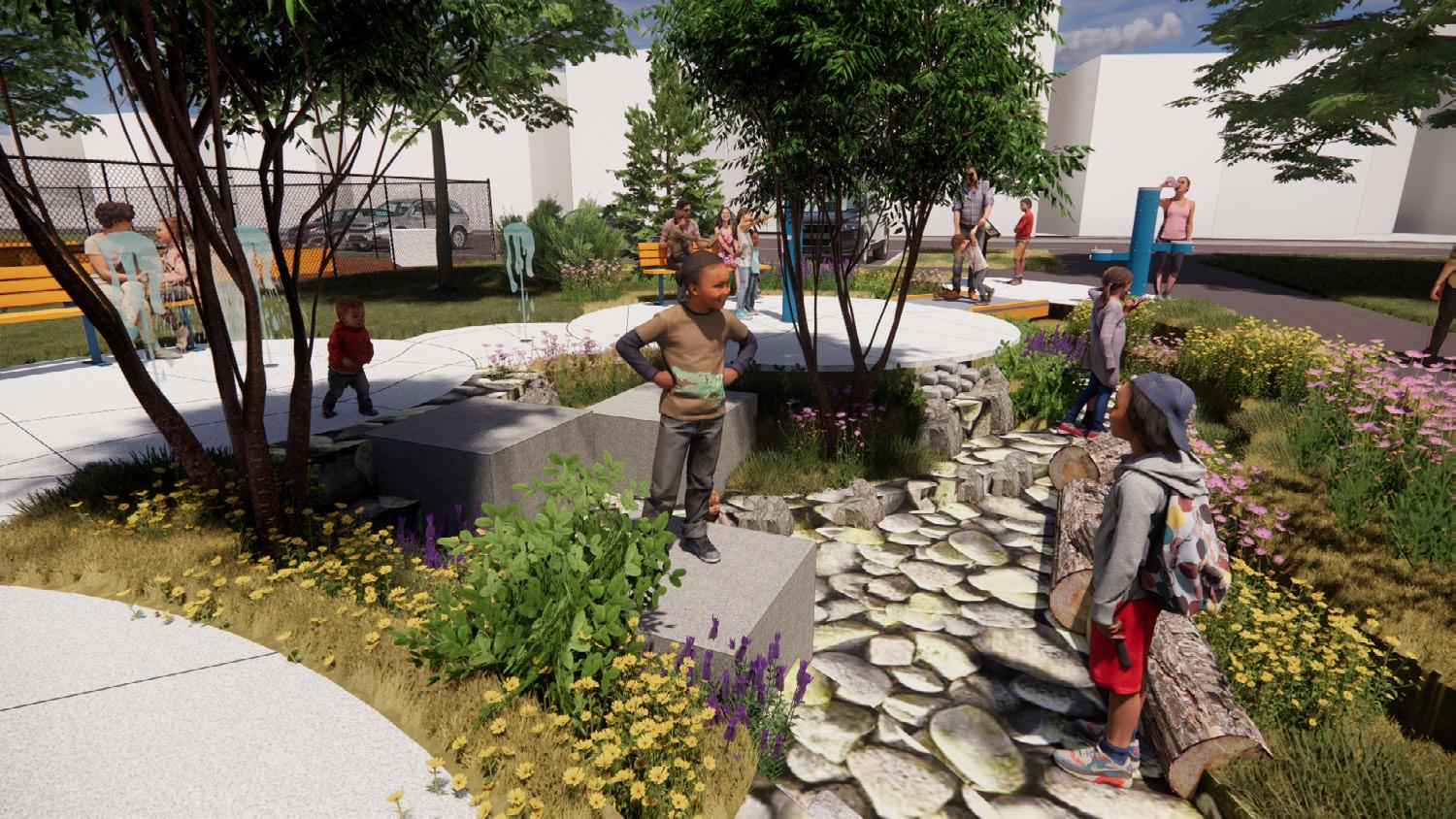
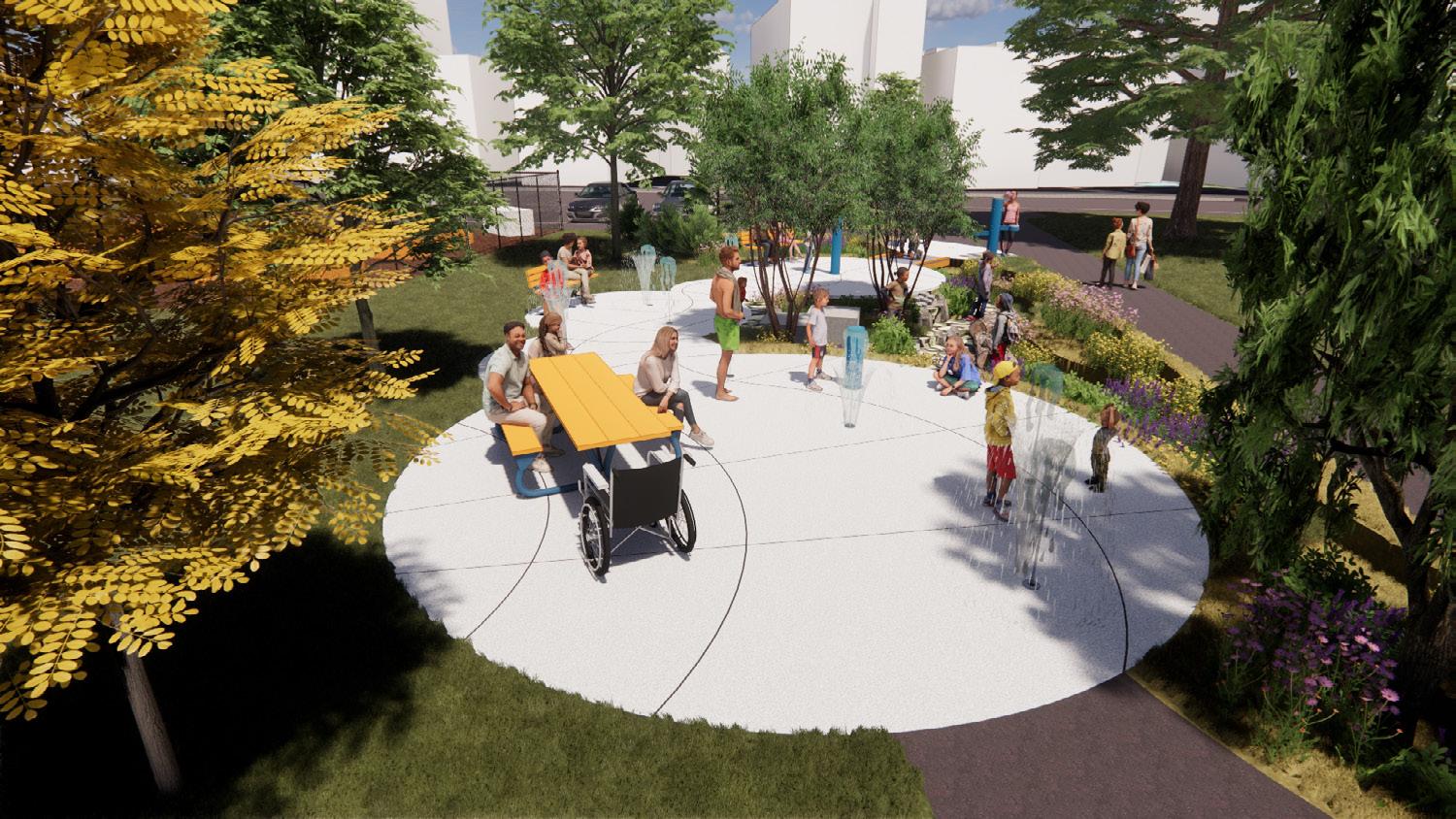
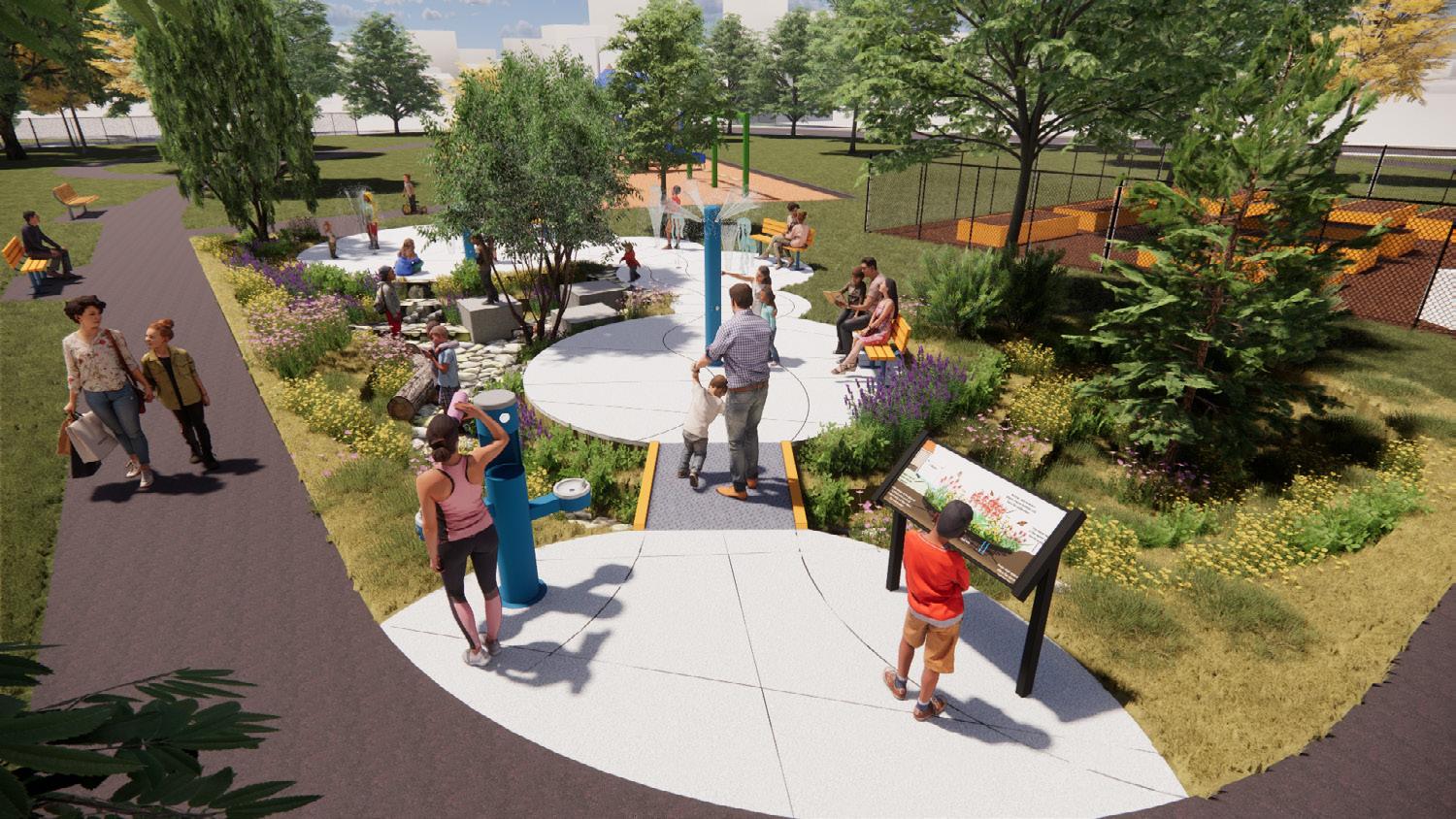
Caption: Armory Park, which features a playground and community garden, will be getting a new splash pad as an additional cooling resource for neighborhood families to combat the effects of urban heat islands. Source: Kyle Zick Landscape Architects.
Master Plan and Urban Heat Island Assessment (2023)
This plan aims to improve Lowell’s urban forest and mitigate the effects of urban heat island effect throughout the city. The first step of the plan is to undergo a tree inventory to determine what tree cover the city already has, then to perform urban heat island assessments and gain community feedback to determine where trees are most needed. These actions will inform an equitable tree planting and maintenance plan that will reduce extreme heat, improve air quality, and mitigate flood risk.
Green Infrastructure (GI) is a set of tools and practices that mimic natural methods of storing, infiltration and/or filtering stormwater. As more development occurs across Lowell, integration of these practices into new and redeveloped areas will help mitigate flooding, contribute to adaptation to increased rainfall, and where plants are present, will increase the filtration of urban stormwater before returning it back to groundwater reservoirs.
Plant more trees in areas that have few to enhance livability and appeal of neighborhoods , care for trees we plant.
Recycling is an ongoing challenge due to cost and contamination levels. Lowell residents don’t sort their trash for recycling.
Conversation with City staff
Support solar installation for families who can’t afford.
Community groups want to see Lowell generate fewer emissions, grow more resilient, and advance energy equity. Mercy heard people say that there is room for more energy reduction tactics in buildings, that can be built to green standards, but also in ongoing education about weatherization and other energy saving strategies. Lowell can also do more to encourage the use of renewable energy, like solar and wind, through rebates for low energy consumption. Community groups have also called for auditing and improving the citywide recycling program, support for rain water catching infrastructure, and connecting lowincome residents with resources on discounts and green cost-saving measures.
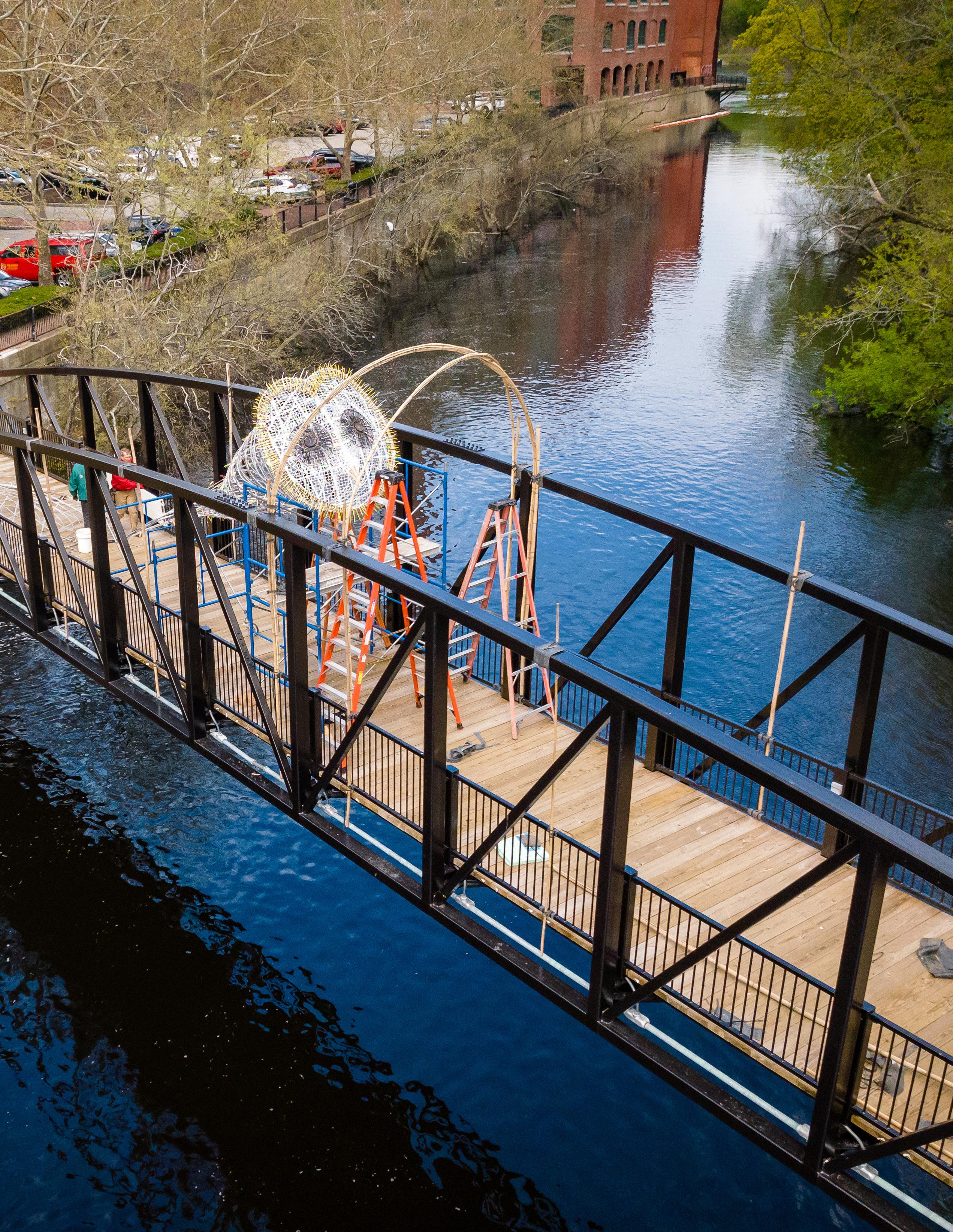
Action 1:
Reduce energy consumption in existing buildings and new construction by:
1. Creating and implement a Climate Action and Resilience Plan for Lowell
2. Building capacity within Sustainability division
3. Creating an emissions reduction toolbox for use by residents, small businesses, and larger commercial properties to help them connect with resources
4. Review current permitting and review processes to ensure they align with emissions reduction goals
5. Exploring and adopting zoning changes to promote climate smart buildings and higher levels of green building design
6. Maintaining and expanding the work of Lowell’s Energy Advocate to connect residents and small businesses with Mass Save programs
7. Initiating an engagement strategy for building owners, managers and occupants to accelerate decarbonization of existing buildings
Action Type(s): City Program
Status: New Initiative
Timeframe: Near Term
City Steward: City of Lowell—DPW (sustainability)
Action 2:
Invest in and promote adoption of clean energy sources by:
1. Increasing the total installed solar infrastructure by 50% vs. FY 23 baseline
2. Promoting education of Community Choice Aggregation citywide
3. Exploring on-site power generation from city assets
Action Type(s): City programs and operations
Status: Modified or Expanded Initiative
Timeframe: Medium Term
City Steward: City of Lowell—DPW (sustainability)
Action 3:
Reduce GHG emissions in Transportation by:
1. Expanding existing publicly accessible EV charging infrastructure to include locations beyond the downtown area
2. Making new construction EV ready
3. Expanding municipal solar installations across school, parking, and municipal properties, and expanding EV fleet citywide
4. Ensuring safe and quality pedestrian and bike infrastructure
Action Type(s): City programs and operations
Status: New Initiative
Timeframe: Near Term
City Steward: City of Lowell—DPW (sustainability)
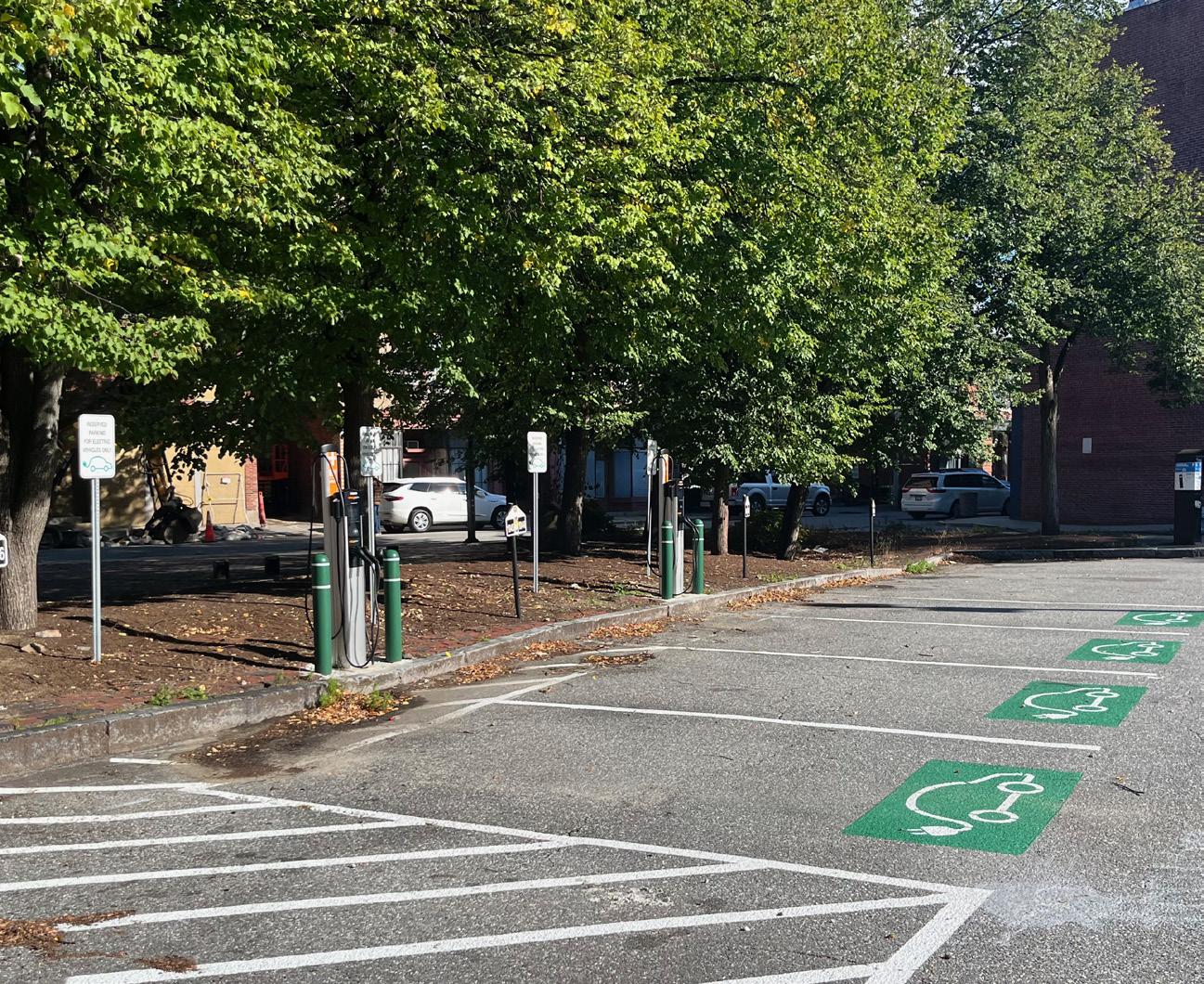
Through this ongoing work, the City of Lowell will advance projects that mitigate the impacts of weather events, flooding, extreme heat, and other climate change threats. This process involves assessing and promoting resilient infrastructure, societal and economic well being, and preservation of environmental resources. The Massachusetts Municipal Vulnerability Preparedness program funds the Lowell plan, which will create future opportunities for work as the updated Hazard Mitigation Plan makes the City eligible to apply for federal FEMA grants.
Flooding, due to poor stormwater management and more storm activity, is an increasing problem in Lowell’s neighborhoods. This plan focuses on Pawtucketville, near Claypit Brook, where the project team is working with local stakeholders to redesign culverts and identify nature-based supply drainage solutions that will protect local residents.
Action 1:
Build resilient districts and microgrids by:
1. Ensuring an equitable process and outcomes of the Lowell networked geothermal pilot project, including stakeholder engagement, reduced energy burdens, public health benefits and community ownership
2. Expanding networked geothermal in densely populated neighborhoods
Action Type(s): City programs and operations
Status: Modified or Expanded Initiative
Timeframe: Medium Term
City Steward: City of Lowell—DPW (sustainability)
Action 2:
Implement recommendations set forth in updated Municipal Vulnerability Preparedness Plan and the Resilient Urban Forest Master Plan and Urban Heat Island Assessment.
Action Type(s): City programs and operations
Status: Modified or Expanded Initiative
Timeframe: Medium Term
City Steward: City of Lowell—DPW (sustainability)
Action 1:
Develop clean energy workforce in the city by
1. Supporting for the development of existing and new clean energy companies in the city
2. Work with Mass CEC to design and coordinate a Lowell specific program
Action Type(s): New Study and Plan
Status: New Initiative
Timeframe: Medium Term
City Steward: City of Lowell—DPW (sustainability)
Goal
Energy Equity: ensure that decarbonization goals do not result in a disproportionate increase in energy burdens for our most vulnerable residents
Action 1:
Reduce energy burden and protect consumers from deceptive clean energy products by:
1. Focus on supporting residents that are vulnerable to energy burden with resources such as information on discount rates being available for income eligible residents.
2. Assess baseline levels of weatherization completed in qualified census tracts and recommend an action plan to increase participation
3. Maintain and expand the work of Lowell’s Energy Advocate to connect residents with arrearage management and forgiveness programs, fuel assistance, community choice aggregation, and Mass Save programs
4. Develop resources that educate, inform and protect residents from deceptive marketing of renewables, including misleading or unsubstantiated “green” claims made by companies to their customers.
Action Type(s): New Study and Plan
Status: New Initiative
Timeframe: Medium Term
City Steward: City of Lowell—DPW (sustainability)
Deceptive green marketing describes business practices that mislead customers by making promises that companies intend to break, claiming certain products or companies are more sustainable than they really are, and other harmful tactics. Unfortunately, renewable industries, like solar panel companies, sometimes engage in these deceptive practices, overpromising on cost savings, underdelivering with poorly done installations, and trapping customers with confusing and restrictive contracts.
1. Strengthen Social Resilience, Equity, Access, and Maintenance to, and of, Parks, Open Spaces, and Trails
2. Strengthen Climate Resilience and Sustainability in Parks, Open Spaces, and Trails
• Sustainability and resilience: Lowell will stregthen social and climate resilience and sustainability in parks, open spaces, and trails.
Lowell is dedicated to building upon existing initiatives and plans while initiating new efforts to ensure that shared parks, open spaces, and trails provide benefits for all members of the community.
• Proactive maintenance: Lowell will proactively take care of parks, open spaces, and trails. Lowell is committed to investing equitably in maintaining open space facilities and infrastructure in alignment with OSRP priorities, and ensuring inclusivity and accessibility for all members of the community.
• Accountable governance and community stewardship: Lowell is committed to taking into account all community members’ needs when addressing parks, open spaces, and trails.
Essential to achieving social and climate resilience in shared parks, open spaces, and trails, is the establishment of accountability in governance and the creation of opportunities for the community to actively participate in decision-making processes.
• Innovation and creativity: Lowell embraces innovation and creativity to strengthen social resilience, climate resilience, and sustainability in parks, open spaces, and trails.
The City will partner with other local organizations to promote innovative and creative wayfinding initiatives, awareness campaigns, urban agriculture projects, tree-planting efforts, placemaking projects, and more to increase social and climate resilience throughout Lowell’s open space network.
• Number of playgrounds upgraded to be universally accessible
• Linear feet of multi-use paths built
• Dollars invested in open space per neighborhood
• 15% or more tree canopy in each of Lowell’s eleven neighborhoods
• Open Space and Recreation Plan (OSRP) Update
• Lowell Resilient Urban Forest Master Plan
• ARPA Neighborhood Improvement Plan
• Saint Louis Sponge Park Phase 1
• Clemente Park Master Plan Phase 1
• Jackson Street Playground/Park
• Reilly Playground Upgrade
• O’Donnell Park Improvements
• North Common Improvements
• Father Maguire Park Improvements
• Hadley Park Improvements
• 2023 Construction Projects
• South Common Phase 2
• Crowley Park Playground Upgrade
• Callery Park Playground Upgrade
• Kittredge Park Playground Upgrade
• 2024 Construction Projects:
• Armory Park Splash Pad
• South Common Phase 3
• Shedd Park Concession Building
• Veterans Memorial Park
• 2025 Construction Projects:
• McPherson Park Traffic Playground
• Durkin Park Improvement project
While most residents have a park or open space nearby, some neighborhood parks and open spaces have less amenities or are not consistently maintained.
As identified in the 2019 – 2026 Open Space and Recreation Plan, city-owned parks and open spaces are located throughout the city and close to most homes. However, the level of amenities and quality of maintenance can vary in each park or open space. The 2019-2026 OSRP outlined a Seven-Year Action Plan that highlights specific improvements at a variety of open spaces and parks across the city. The City should focus on implementing the remaining goals from this plan and when doing so prioritize improvements in parks and open spaces that are in need of the most repair or are in the densest or most underserved neighborhoods. As the City prepares to update the Open Space and Recreation Plan, future park and open space goals could be identified through the lens of strengthening social resilience, equity, access and maintenance, climate resilience, and sustainability.
Because city-owned public parks and open spaces are already located throughout the city, the focus on improvements should relate to the programming offered in each space and the implementation of an appropriate maintenance program. By gaining input from local residents, the City can identify desired activities suitable for each park and seek to provide a range of uses that will attract all age groups. Specifically, it has been mentioned that activities for teenagers and our older populations are needed in many parks. As part of any park improvements, the City should seek to ensure that all City parks and open spaces are universally accessible, ADA compliant, and provide ADA-compliant play equipment at each playground.
lowelllitterkrewe.org
The Lowell Litter Krewe is a volunteer based group committed to beautifying Lowell through litter clean-up and renovation projects. They are committed to creating volunteer clean-up opportunities in Lowell, being flexible enough to meet community needs, and providing tools necessary to get the job done. The group shares that “tomorrow there’ll be more of us, and anything you can dream, together we can build with the talent of our hands, the creativity of our minds, and the depth of our hearts.”
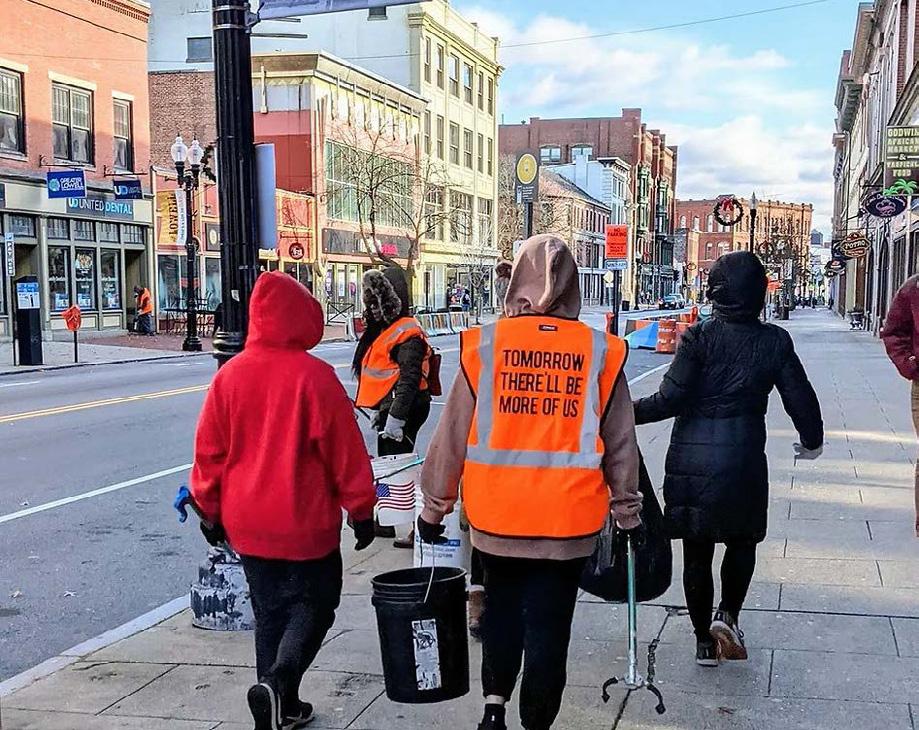
Safe street crossings, bicycle lanes, sidewalks, and off-street pathways provide important physical connections to parks and open spaces. Ensuring that this important mobility infrastructure is safe and welcoming is essential to improving the access to, and use of, neighborhood parks and open spaces. As part of any park or open space improvements project, upgrading the surrounding connections should also be considered.
Improving residents’ awareness of and sense of connectedness to their local outdoor community spaces is a critical part of improving access and connections to the City’s park and open space network. An improved city-wide wayfinding strategy can help guide residents to safe routes of travel to neighborhood outdoor spaces. Multi-language signage in each park and open space can help make residents feel welcome. Furthermore, incorporating culturally relevant amenities or programming within parks and open spaces can increase residents’ feeling of connectedness to their local spaces.
The city is already home to some excellent greenways and off-street multi-use paths that take advantage of, and provide access to, the unique natural environment surrounding the city. Near the city center, these trails typically follow the rivers and canal networks. While these trails are extensive, critical gaps still exist, such as some segments of trails along the Merrimack River and the Pawtucket Canal area which is a missing link along the City’s canalwalk network. The Concord River Greenway has three constructed segments, while the final missing segments are designed and funded.
As part of future public realm improvements, the City should consider completing the missing links in the downtown trail network, of which the Pawtucket Canal could be prioritized. The construction of canalwalks along the Pawtucket Canal could be a transformative project that would provide a major new greenspace in the Highlands neighborhood, provide a safe alternative travel route for residents, and link key parts of the city together.
Note: Go to the Energy, Climate and Environment section on page 136 to learn more about urban canopy, street tree planting, green infrastructure, and reduced impervious surfaces.
In order to access certain open space grant opportunities, the City is required to update its Open Space and Recreation Plan (OSRP) every 7 years. The current Plan spans from 2019 - 2026. The City will be conducting extensive community engagement in 2025 to inform the next OSRP update. While the Lowell Forward master plan provides overarching open space goals and some big-ticket actions, the OSRP will dive deep into assessing the current state of the City’s open spaces and providing prioritized recommendations to guide the next 7 years of open space investments and initiatives. The City has already implemented many of the actions from the 2019-2026 OSRP, such as installing a shade structure over the bocce court at Clemente Park, constructing South Common Phase 2, and installing an accessible playground at Hovey Park. Ongoing actions include renovating the playground and basketball court at Durkin Park, installing play equipment in Downtown, and building an improved dog park.
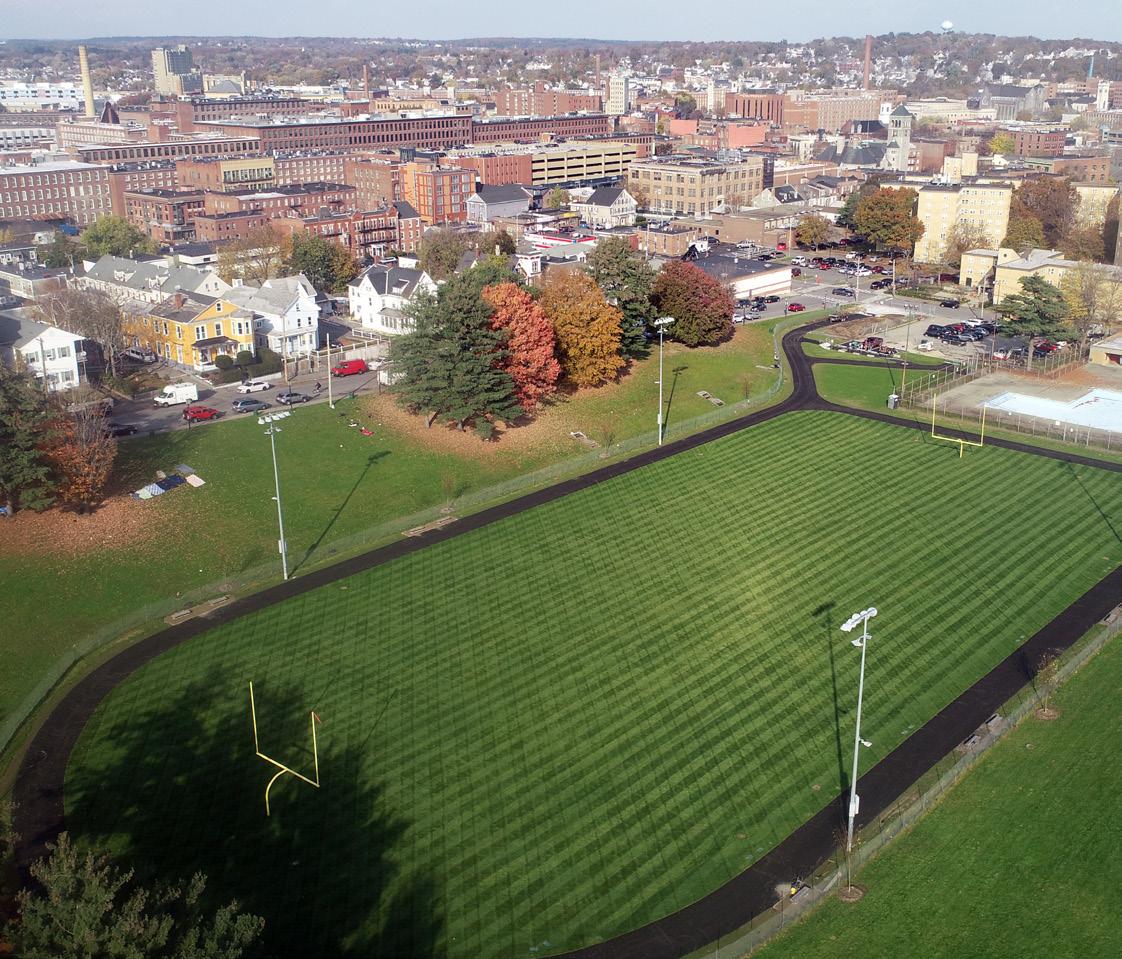
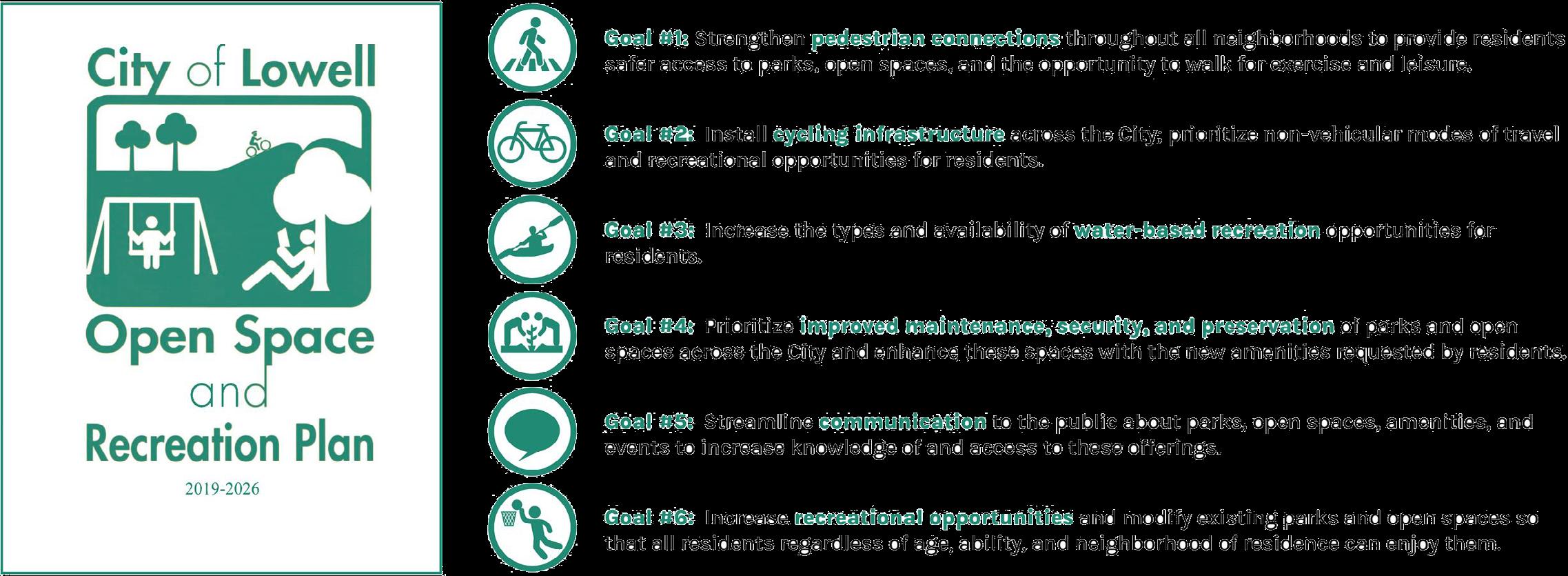
We do have plenty of parks, but they need maintaining. Parks need to be clean and walkable.
Conversation with Mercy (Community Organizer)
One of my great wishes for public space in Lowell is that it belongs to everyone, but that each person feels like it’s something that’s theirs, like an extension of their backyard.
Conversation with Mercy (Community Organizer)
Parks could be more accommodating for all residents/ community needs.
We need to solve unkept parks, poor sidewalks, poor maintenance, insufficient lighting (reduce criminal activities).
Conversation with Mercy (Community Organizer)
One thing that always comes back it me is when immigrant gardeners talk about the community gardens being small slices of home.
Conversations with Mercy
Mercy heard many great recommendations when discussing Lowell’s parks and open spaces. For one thing, many people said they wanted to see more parks with community amenities in more neighborhoods, specifically in the densest neighborhoods. They also want to see existing parks in better condition, with better lighting, painted basketball courts, sufficient parking near public open space, and less litter. To combat litter, community groups suggested fines for contractors that leave behind debris and using trail cameras to catch other litterers. In addition, community groups also talked about the importance of community gardens in parks and open spaces. Gardens can improve food sovereignty, improve users’ health, and strengthen the community.
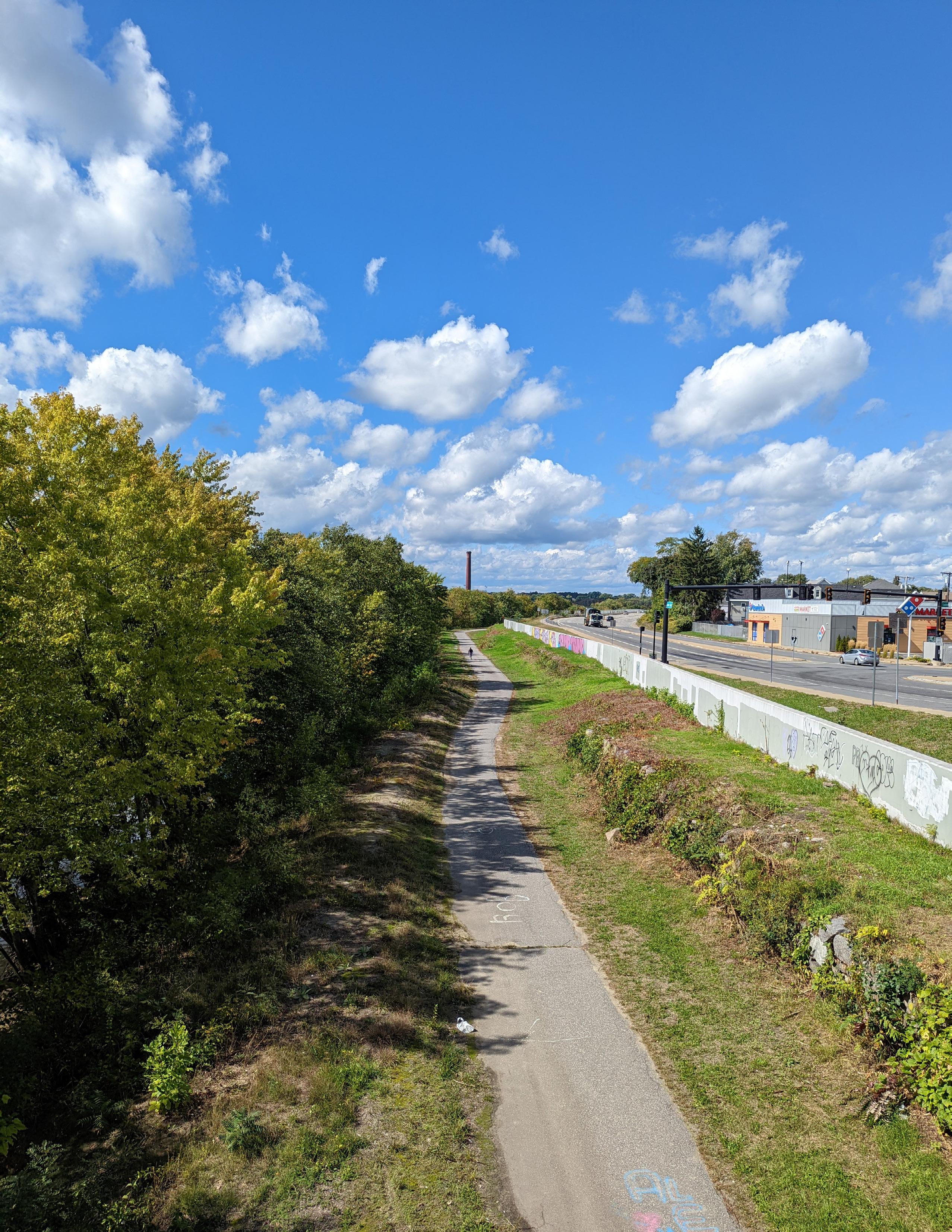
Action 1:
Equitably invest in and maintain open space facilities including recreational facilities, open spaces, and trails in alignment with OSRP priorities, and to ensure inclusivity and accessibility for all ages and abilities.
Action Type(s): Capital Investment
Status: Modified or Expanded Initiative
Timeframe: Medium Term
City Steward: City of Lowell—DPD, Parks Department
Action 2:
Improve physical access to parks and outdoor programs by improving pedestrian and bicyclist infrastructure along key routes.
Action Type(s): Capital Investment, New Study and Plan
Status: New Initiative
Timeframe: Medium Term
City Steward: City of Lowell—DPD, DPW
Three organizations—Lowell Parks & Conservation Trust (LP&CT), Mass Audubon (MAS), and Mill City Grows—are working in partnership to protect Lowell’s last farm, known locally as Rollie’s Farm. The farm is located at 1413 and 1415 Varnum Avenue. The partnership will create an urban wildlife sanctuary and educational center dedicated to local agricultural and community-based environmental education. Mass Audubon and the Lowell Parks & Conservation Trust (LP&CT) will acquire these parcels which will have conservation restrictions placed on them. Both Mass Audubon and LP&CT are nationally accredited as land trusts committed to permanent land conservation and program excellence. Mill City Grows will establish a variety of programs on the space, including urban agriculture, community gardens, greenhouses, a food forest, farmer’s markets, and educational programming.
Action 3:
Improve equitable communication about parks and outdoor programs by reducing barriers to participation. Examples include: developing a multilingual wayfinding strategy and a language access center.
Action Type(s): City programs and operations, Capital Investment
Status: New Initiative
Timeframe: Near Term
City Steward: City of Lowell—DPD, Partners like UML, MCC, NPS, others
Action 4:
Prepare an open space master plan for the Pawtucket Canal and surrounding industrial/ non-residential lands (from Pawtucket Street at the Merrimack River to the Thorndike Street Bridge), considering both sides of the Pawtucket Canal.
Action Type(s): New Study and Plan
Status: Modified or Expanded Initiative
Timeframe: Medium Term
City Steward: City of Lowell—DPD, Parks Department, NPS
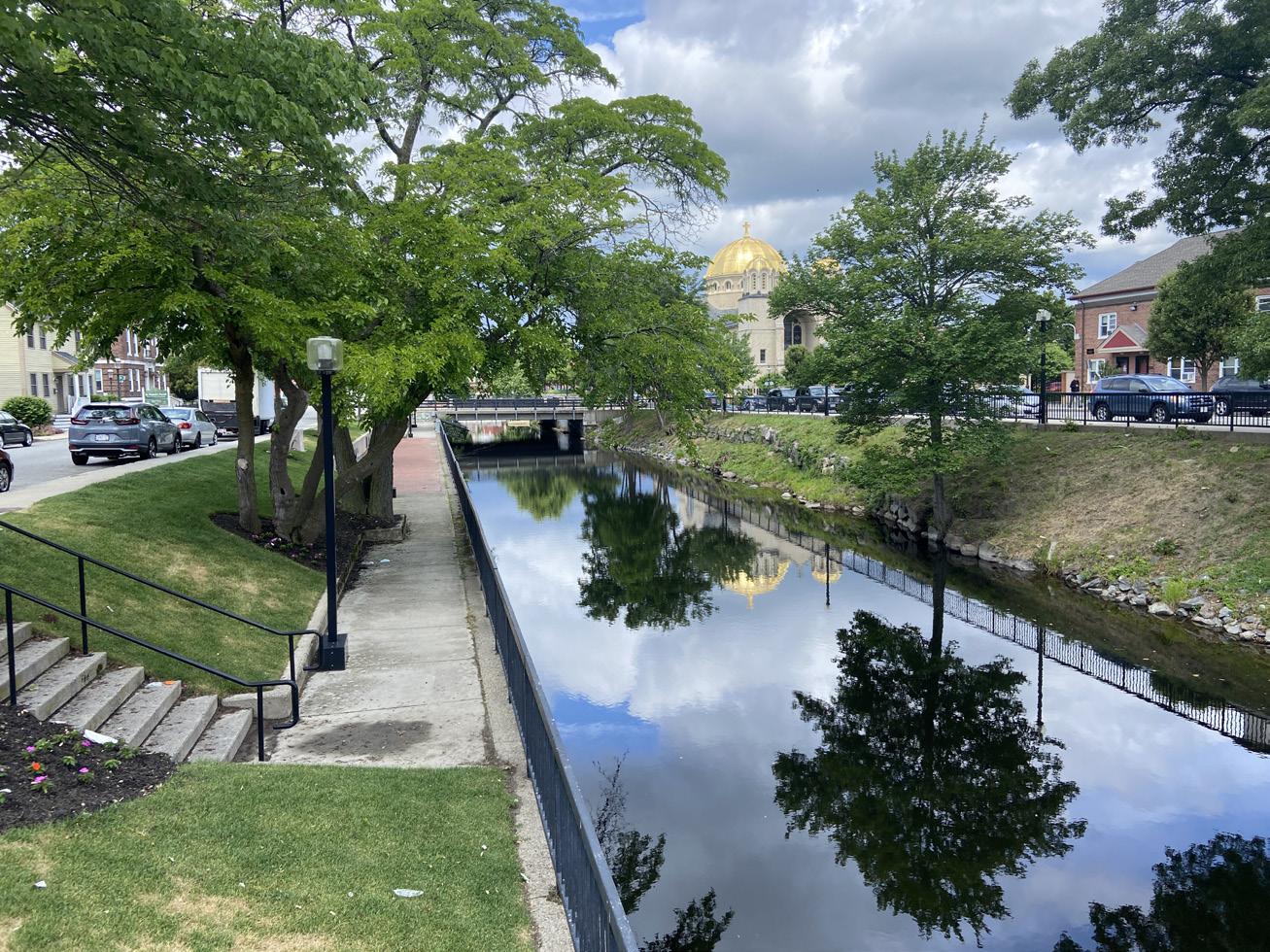
Community Spotlight: Mill City Grows millcitygrows.org
Mill City Grows fosters food justice by improving physical health, economic independence, and environmental sustainability in Lowell through increased access to land, locally-grown food, and education. They focus on food justice advocacy, food access, community engagement, and healthy work environments.
Strategic Plan Priorities: Food Justice Advocacy, Food Access, Community Engagement, and Healthy Work Environment.
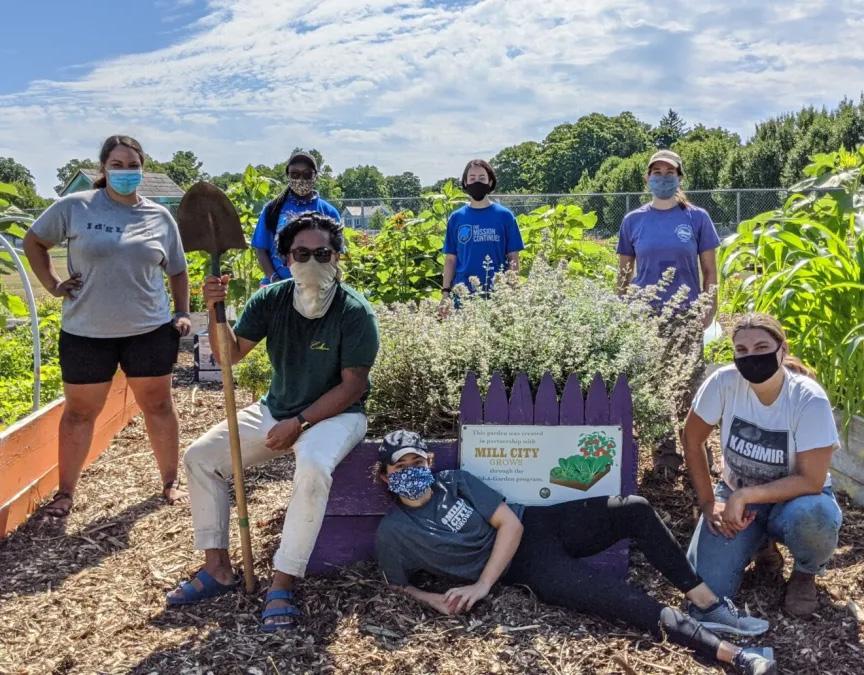
Action 1:
Plant trees along priority corridors and within urban heat islands in alignment with the City’s Urban Forestry Plan.
Action Type(s): City programs and operations
Status: Existing/Ongoing Initiative
Timeframe: Medium Term
City Steward: City of Lowell—DPD, DPW, Parks Department
Action 2:
Reduce impervious surfaces and install green infrastructure, where applicable, to manage stormwater runoff and mitigate flooding, and create a maintenance plan.
Action Type(s): Capital Investment, Other Regulatory/Policy
Status: New Initiative
Timeframe: Long Term
City Steward: City of Lowell—DPD, DPW, Parks Department
Action 3:
Initiate a public stormwater management awareness and education campaign, in partnership with universities and nonprofits, to inform businesses and residents about effects of stormwater pollution on Lowell’s waterways and ways in which they can help reduce stormwater runoff.
Action Type(s): Local Partnership
Status: New Initiative
Timeframe: Near Term
City Steward: City of Lowell—DPD, DPW, Partners like UML, MCC, others
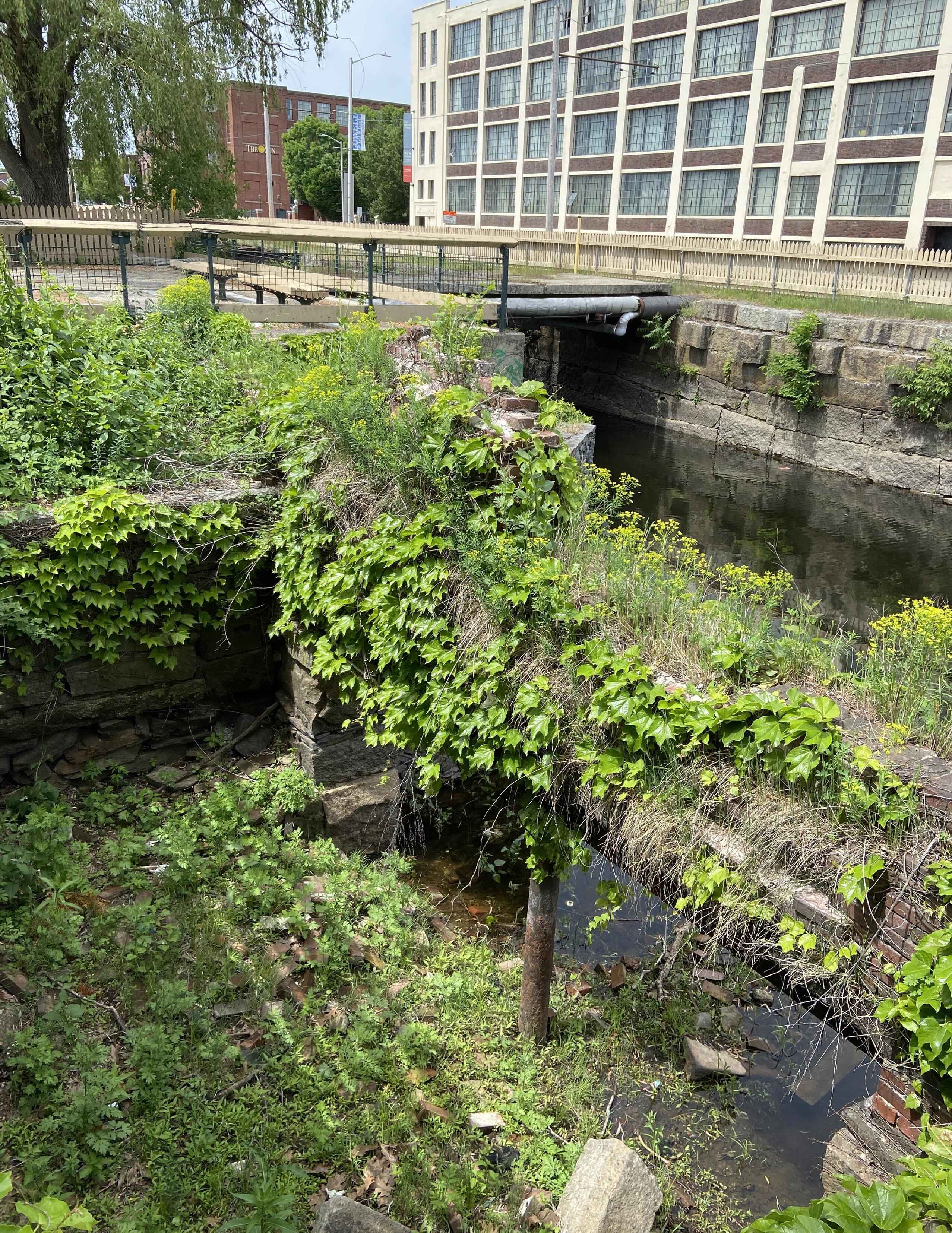
1. Leverage the arts and support creative placemaking in Lowell
2. Support Lowell’s economic vitality through arts, culture, and creativity
• Sustainability and resilience: Lowell is committed to strengthening resilience and sustainability in coordination with arts and culture.
Lowell will build a strong and resilient community that supports diverse arts, cultures, and creative placemaking.
• Proactive maintenance: Lowell will be proactive about taking care of existing arts and culture assets.
The City will work with existing organizations to proactively maintain and promote existing arts and culture assets.
• Accountable governance and community stewardship: Lowell is committed to taking into account all community members’ needs related to arts and culture.
A diverse and inclusive community must be welcoming to all, and ensure that everyone has the opportunity to participate in decision making processes, join in civic life, and foster a sense of belonging. The City will enhance public participation, remove disparities based on race and other factors, and work towards equity and inclusion for all members of the community.
• Innovation and creativity: Lowell embraces innovation and creativity to leverage the arts, support creative placemaking, and support Lowell’s economic vitality.
Lowell celebrates diversity and will support arts and culture, which are essential to help us learn from each other and share our diverse traditions and histories. The City will collaborate with existing organizations that are celebrating our diverse arts and cultures.
• Increase number special events permits for usage of parks and parking garage revenue related to these
• Number of new or added publicly accessible art pieces in each neighborhood
• Increase revenue generated from state 6.5% meal tax
• Mosaic Lowell
• TDI Acre (Transformative Development Initiative)
Lowell has many cultural, art, and creative assets throughout its unique neighborhoods
• More than 80 nonprofit organizations working in arts, culture, youth development, health, and education
• Over 150 food and restaurant options
• Over 30 festivals and events for food, music, art, and cultural celebrations
The recently completed Mosaic Lowell Cultural Economy Plan for Lowell outlines how a growing creative economy builds wealth in Lowell and the region by creating jobs, generating tax revenue, increasing tourism and consumer purchases, and attracting people to live and invest in the city.
In 2019, the U.S. Bureau of Economic Analysis reported that the arts and culture sector contributed $25.5 billion to the Massachusetts economy, representing 4.3% of the state’s GDP and more than 140,000 jobs. This was more than other large industries, including construction, education services, and agriculture. In Lowell alone, the nonprofit arts and cultural industry contributed more than $12 million to the economy in Fiscal Year 2015 (FY15). This supported the equivalent of 500 full-time jobs, paid out $8 million in household income to residents, and generated nearly $500,000 in revenue for both the local and state governments.
Promoting
an
Entities such as the City’s Office of Cultural Affairs & Special Events (CASE), non-profit organizations like the Lowell Plan, the Greater Lowell Community Foundation, and Mosaic Lowell have increasingly emphasized the promotion and support of arts and culture. Initiatives like the Like Lowell campaign underscore Lowell’s longstanding commitment to the cultural sector as a valuable contributor to the economic development and overall appeal of Lowell for residents and visitors. The Lowell Forward plan is poised to further enhance and propel these ongoing endeavors, viewing them not only as an economic development strategy but also as a central element that contributes to the overall appeal of Lowell as a vibrant place to reside or explore.
Mosaic Lowell
Mosaic Lowell is a collaboration of stakeholders working to develop and implement an arts, cultural, and creative economy plan for Lowell to enhance the quality of life for all and elevate Lowell into an even more exciting place to live, work, and visit. To learn more, visit mosaiclowell.org
Illuminate Lowell arts, culture, and creativity to the city, region, and world through marketing and other efforts.
Create a strong network of communications, collaborations, and partnerships across organizations, businesses, sectors, cultures, and demographics.
Grow the available resources and support for arts, culture, and creativity in Lowell.
Enhance lifelong learning opportunities, including school opportunities, in arts, culture, and making for Lowell residents.
Identify and capitalize on new funding and revenue opportunities for the City and businesses.
Bring arts programming and opportunities to every neighborhood and support culture and independent businesses throughout the city.
Integrate arts and culture in mainstream City planning initiatives and investments.
Increase the presence of publicly accessible art in the city and facilitate a greater diversity of types, subjects, and creators of publicly accessible art.
Make arts and cultural spaces easier to find and access, and accessible to all.
Build on existing events and festivals to make the city a showcase for these activities and ensure local businesses and creatives benefit from these events.
More youth programs for kids in each neighborhood.
Public Meeting 1 participant
Lowell spends a lot of time celebrating the past, but Lowell also needs to celebrate the present and the future.
Make Lowell a destination and promote local artists.
Great ideas related to arts and culture came up in conversations with small business owners. Some of these include: expanding on Summer Pop-Up Markets, utilizing the Lowell Auditorium for more acts of different types throughout the year, and adopting a MITS (Mariposa in the Schools) model to bring tradition-based performing art forms to students, educators and community groups.
Mercy also spoke with organizations like Project Learn who are leading ArtUp Lowell, a creative-placemaking initiative that brings together Lowell’s diverse community of young people, artists, educators, and social entrepreneurs to create visual and performing arts that enhance public spaces throughout the city. Mercy and the City also co-hosted an artist focus group with Mosaic Lowell.
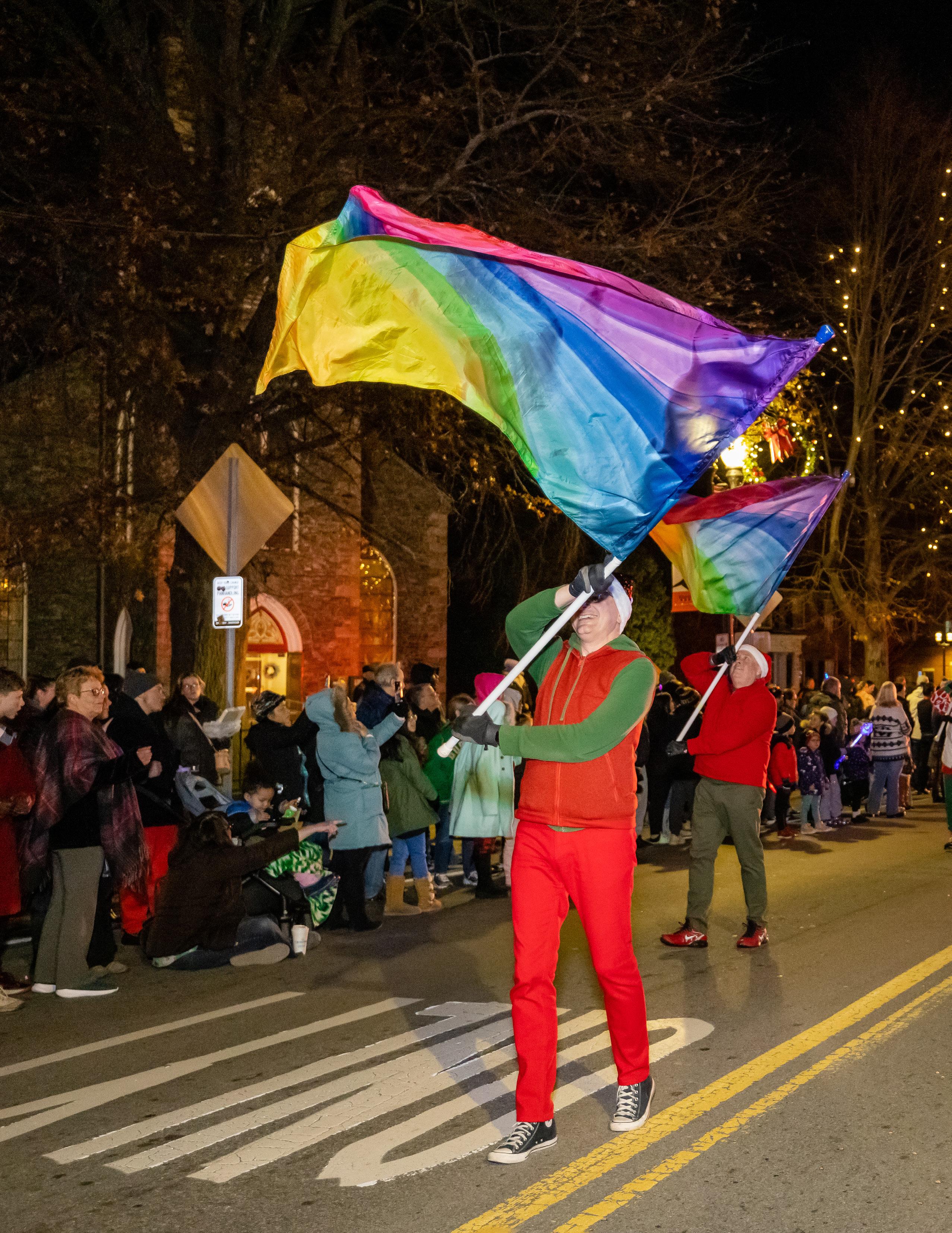
Action 1:
Incorporate art and culture in mainstream planning initiatives including public realm improvements and capital projects, larger economic development initiatives, and various communication/engagement campaigns.
Action Type(s): Local Partnership, New Study and Plan
Status: New Initiative
Timeframe: Near Term
City Steward: City of Lowell—CASE, City Manager’s Office, Mosaic Lowell
Action 2:
Support artists and creative makers of all ages, backgrounds, and income levels to participate in arts and cultural placemaking in Lowell. Identify and address space and accessibility needs, financial barriers, marketing, and promotional networking.
Action Type(s): Local Partnership, New Study and Plan
Status: New Initiative
Timeframe: Near Term
City Steward: City of Lowell—CASE, DPD
Action 3:
Support, align, and help implement priority goals and actions outlined in Mosaic Lowell Arts and Cultural Plan.
Action Type(s): City Program
Status: New Initiative
Timeframe: Medium Term
City Steward: City of Lowell—Mosaic Lowell
Action 1:
Develop and execute a marketing plan for the city coordinated with various City departments and partners, and that includes arts, culture, businesses, and visitors.
Action Type(s): New Study and Plan
Status: Ongoing
Timeframe: Near Term
City Steward: City of Lowell—DPD (planning/zoning), CASE
Action 2:
Revise zoning to support more arts-related uses such as studios and live/work spaces.
Action Type(s): Local Partnership, Zoning
Update
Status: New Initiative
Timeframe: Near Term
City Steward: City of Lowell—DPD, CASE
Action 3:
Create a sustainable initiative to lead and coordinate art, culture, and creative economy strategies and actions in Lowell.
Action Type(s): Local Partnership
Status: New Initiative
Timeframe: Near Term
City Steward: City of Lowell—CASE, Mosaic Lowell
National Park and Historic Board highlight
The Lowell Historic Board is the City of Lowell’s historic preservation agency, created in 1983 by special act of the Massachusetts Legislature and in response to Congressional requirements placed upon the city to preserve, protect, and enhance Lowell’s historic resources when the National Park was created. Working collaboratively with project proponents and partners including the National Park for forty years, nearly $1 billion in development activity has taken place within the downtown while over 98% of 5.2 million square feet of mill space has been rehabilitated.
Established in 1978, Lowell National Historical Park preserves and interprets the historic structures and stories of the Industrial Revolution and its legacies in Lowell, serving as a catalyst for revitalization of the city’s physical and economic environments and promoting cultural heritage and community programming. This unique urban national park works collaboratively with a variety of partners and the local community to help tell, preserve, and commemorate the stories of Lowell, its diverse people, and its many cultures.
For over three decades, the Lowell Folk Festival has been one of the country’s most popular celebrations of cultural arts and music. For three days each summer, the Festival features musicians from around the world on five stages, showcases folk craft areas and demonstrations, and shares regional and global food traditions. The Lowell Folk Festival attracts over 150,000 people each year and generates over $7 million in economic impact, providing a major boost to the economy of Greater Lowell.
The vision, growth strategies, and specific goals outlined in Lowell Forward result from extensive community engagement, a thorough assessment of current city conditions, and well-informed foresight regarding future possibilities. The vision and goals serve not only as aspirations but function as a roadmap, providing tangible ideas that guide program and policy interventions, and influence future decision-making in the city. While the formal Lowell Forward planning process comes to a close, there is much to undertake proactively in the implementation phase.
Achieving our vision and goals, as highlighted throughout this plan, requires concerted efforts from various stakeholders and necessitates collaboration across the city, including the private development sector and non-profit agencies. The Lowell Planning Department (DPD) will spearhead efforts to ensure external stakeholders align with the established vision, values, and goals for envisioning the city’s future. More importantly, the City commits to being accountable to the community’s interests, recognizing that the city’s and community’s needs may evolve, requiring us to refine and realign priority actions accordingly.
While the complete and effective implementation of the plan will take several years, success should not be solely measured by an ideal end state but by how well we work towards achieving our goals. Continuous community involvement is essential to this process. The growth strategies and progress indicators will help incrementally track successful implementation. Our key to success lies in maintaining open communication with Lowellians, sustaining action in adopting the strategies and recommendations in this plan, and fostering the right partnerships and targeted investments needed to enhance the vibrancy, safety, prosperity, and equity of our neighborhoods.
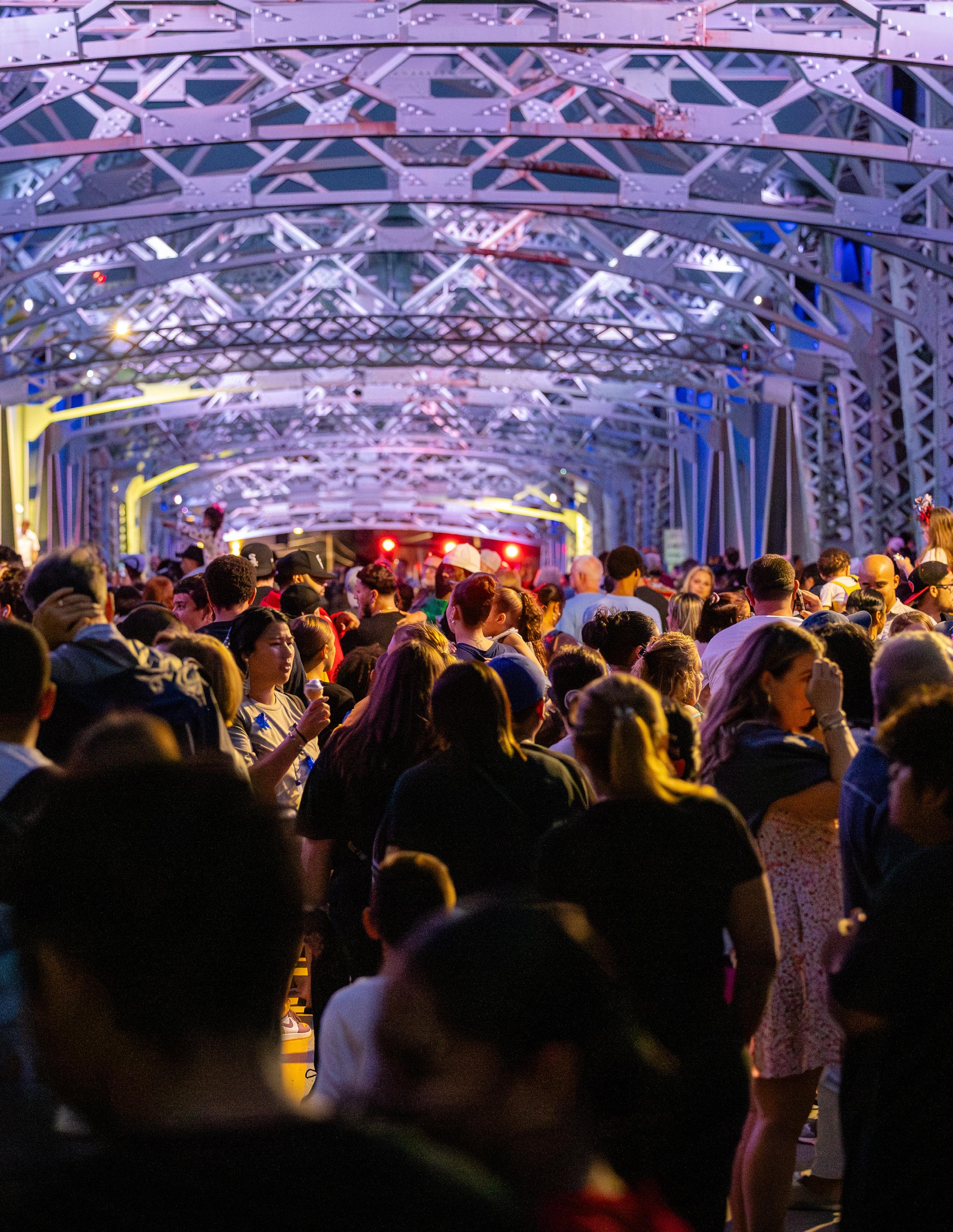
The Lowell Forward implementation framework identifies timeframes for goals and actions to aid action takers— like city departments, local organizations, anchor institutions, and the community—in the prioritization of tasks and next steps.
Intended audience for this chapter: action takers
1. Create 2,500 new housing units within the MBTA Community multifamily zoning overlay districts by 2040
2. Increase production of new housing units in the upper stories of downtown buildings (goal of 800 new units by 2040)
3. Increase downtown’s street tree inventory by 25% by 2040
4. Increase the use of ground-floor commercial spaces with businesses that increase foot traffic.
While zoning recommendations play a role in various goals and actions within this plan, it is important for the City to initially undertake a thorough review of existing zoning. This review aims to identify necessary revisions to align most effectively with the vision, growth strategies, and goals outlined in the Lowell Forward Plan. Planning staff should consider how to allow multifamily units at scales and typologies that meet the needs of the Lowell community and encourage more mixed-use, transit-oriented development. The recommendations outlined in both Lowell Forward and the upcoming Lowell Housing Production Plan, should serve as the guiding framework for new zoning measures.
1 Conduct a comprehensive zoning review assessing the city’s desired growth and development patterns against existing zoning
2 Develop educational tools around housing policy and zoning to improve public understanding of how zoning influences the built environment.
1. Create 2,500 new housing units within the MBTA Community multifamily zoning overlay districts by 2040
2. Increase production of new housing units in the upper stories of downtown buildings (goal of 800 new units by 2040)
3. Increase downtown’s street tree inventory by 25% by 2040
4. Increase the use of ground-floor commercial spaces with businesses that increase foot traffic.
1 Enable diverse housing options in Downtown. Update zoning in the Downtown Mixed-use District by creating appropriate dimensional requirements to enable smaller/ compact and more diverse housing options.
2 Advance and coordinate departmental efforts to improve walkability and vibrancy in Lowell’s Downtown street network including wider sidewalks, increased tree coverage, ground floor activation, shorter crossings, and longer crossing times.
3 Advance planning of vacant and underutilized lots for infill, especially Merrimack Corridor and the Gallagher Station area, for compact, mixed-use, and walkable developments that appeal to a broad range of users.
4 Continue to build a comprehensive Downtown branding strategy. Elevate Lowell’s city “brand” through a more comprehensive branding strategy that includes local partnerships, highlights Lowell’s history and current diversity, and improves wayfinding strategies to make the city more attractive to residents, workers, employers, and potential investors and developers.
5 Incentivize transit-oriented development around the MBTA station through financial incentives and partnerships with transportation agencies.
6 Update regulations related to historic preservation to better fit our needs and goals today. Review and update the Downtown Historic District guidelines, where necessary, to support current building and development needs including compliance with accessibility and code standards. Review Historic Board signage regulations to assure that they are compliant with Reed v. Gilbert standards and Lowell’s upcoming newly revised sign code.
Anchor Institutions (ex. UML, MCC, Lowell Hospital, etc)
1. Create 2,500 new housing units within the MBTA Community multifamily zoning overlay districts by 2040
2. Increase production of new housing units in the upper stories of downtown buildings (goal of 800 new units by 2040)
3. Increase downtown’s street tree inventory by 25% by 2040
4. Increase the use of ground-floor commercial spaces with businesses that increase foot traffic.
1 Improve neighborhood center infrastructure and services. Improve and build sustainable public realm infrastructure and neighborhood services, prioritizing pedestrian safety and enhanced walkability in underserved neighborhood centers in Lowell.
2 Ensure robust coordination between city departments in executing neighborhood center improvements and aligning specific project timelines and departmental resources with relevant ongoing area planning efforts and projects.
3 Allow increased residential density by right in neighborhood business districts. Incentivize appropriate infill development that enhances neighborhood vitality and celebrates each neighborhood’s distinct identity.
4 Strengthen connections between neighborhood centers and institutional anchors. Coordinate major institutional plans and projects to better align with Lowell Forward’s objectives of creating active, connected, and prosperous neighborhood centers.
5 Require transparent engagement between institutional anchors’ projects and impacted neighborhoods. Ensure Lowell residents, community groups, and other impacted stakeholders are continuously engaged and informed as institutional projects are being planned.
6 Review off-street parking requirements for neighborhood commercial zones, particularly for existing buildings with longstanding commercial vacancies.
7 Create design guidelines in mixed-use corridors and neighborhood nodes to ensure new development promotes best practices in urban design.
Change
Anchor Institutions (ex. UML, MCC, Lowell Hospital, etc)
neighborhood centers
Indicators of progress:
1. Create 2,500 new housing units within the MBTA Community multifamily zoning overlay districts by 2040
2. Increase production of new housing units in the upper stories of downtown buildings (goal of 800 new units by 2040)
3. Increase downtown’s street tree inventory by 25% by 2040
4. Increase the use of ground-floor commercial spaces with businesses that increase foot traffic.
1 Advance planning of the Ayer’s City Industrial Park. Complete and assess the ongoing market study and define next steps for development in the industrial area.
2 Update zoning to allow light manufacturing and creative economy uses compatible with residential and commercial neighborhoods in appropriate areas of the city.
Study and Plan
Change
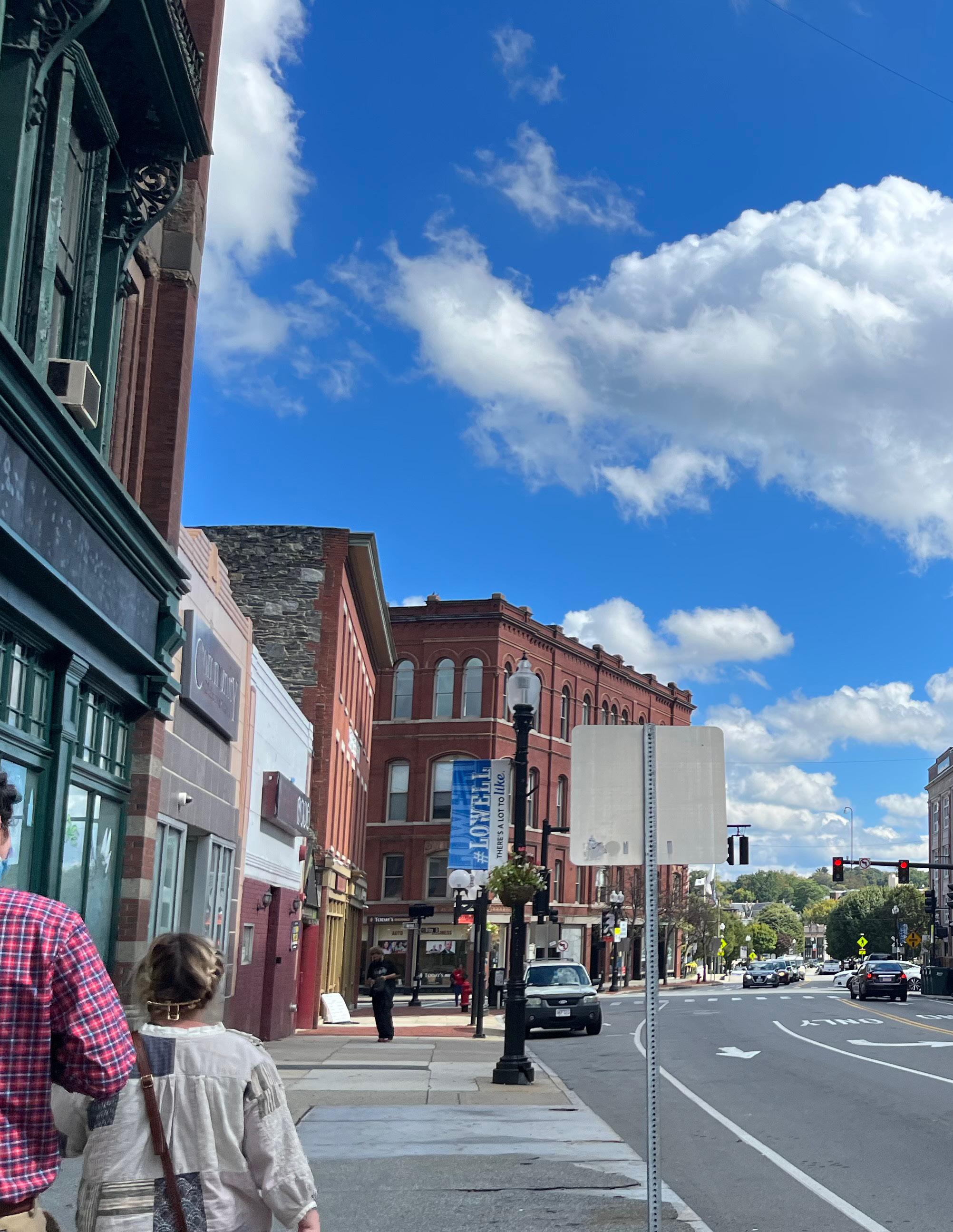
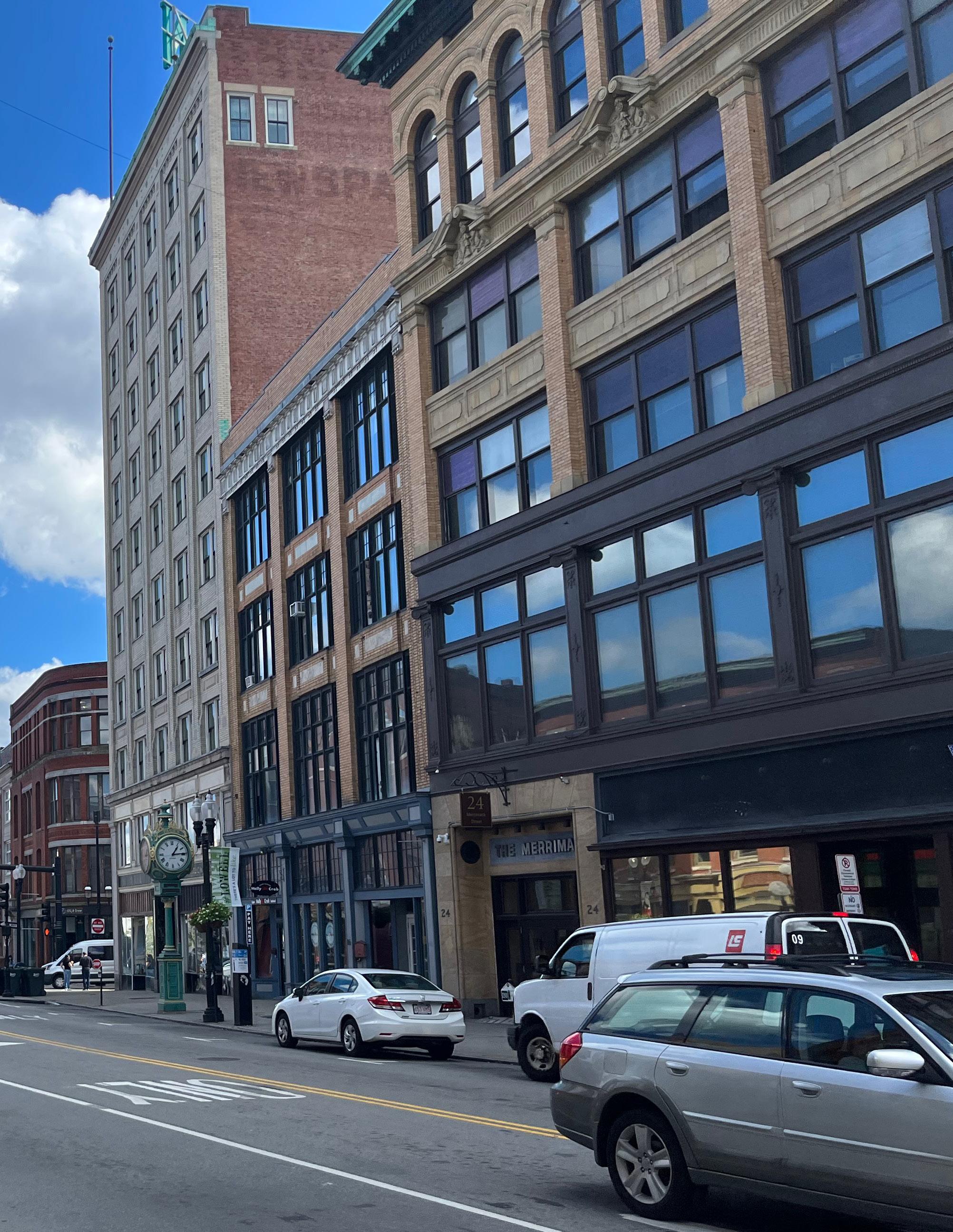
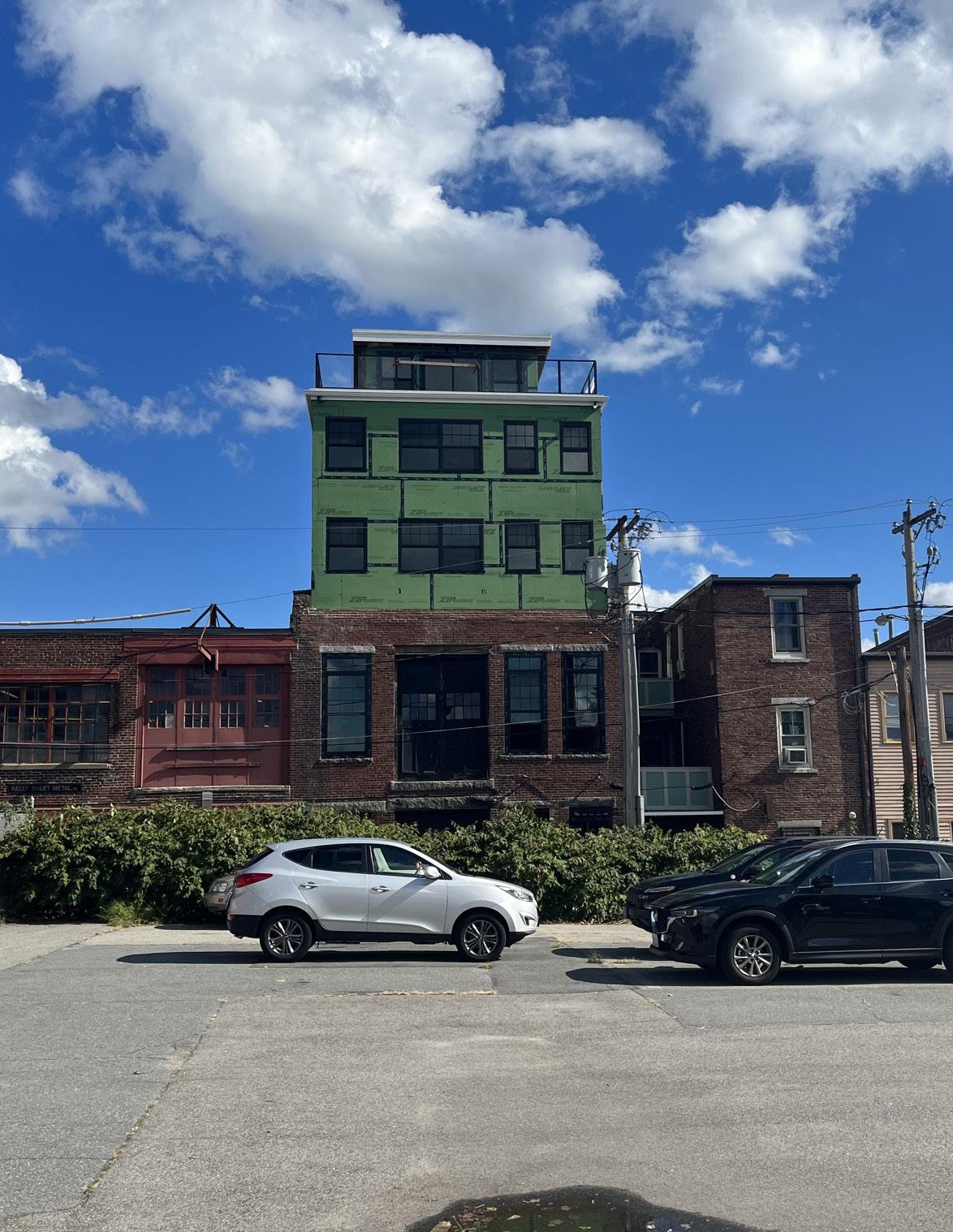
Goal 1 :
1. Increase total number of housing units to 46,950 (or +3,150) by 2030, and to 47,950 (or +4,150) by 2040
2. Produce 800 new affordable housing units by 2030, and 1,050 by 2040
3. Reduce total number of households lacking kitchens and lacking plumbing from 958 to near zero by 2040
4. Reduce percentage of cost-burdened households from 40% to 32% by 2040
5. Reduce percentage of severely cost-burdened households from 19% to 16% by 2040
6. Achieve a healthy housing unit vacancy rate of 6% Order of
1 Engage communities to identify priority development sites for multifamily housing with the goal of increasing density in key areas that can be well-served with alternative transportation options, especially within and near neighborhood centers.
2 Develop a funding pipeline to acquire, finance, and develop sites with a high capacity for multifamily from parking lots to adaptive reuse. This could be facilitated by a public-private partnership with nonprofit or for-profit developers.
3 Allow housing or mixed use projects in the Regional Retail District to increase housing near jobs while retaining the economic vitality of these districts.
4 Document projected and actual infrastructural impacts for major developments. Seek state and federal grants to improve infrastructure including water, sewer, transportation as needed.
5 Prioritize the sale of city properties to support the creation of housing at all income levels.
6 Participate in regional initiatives such as At Home in Greater Lowell that include plan development, implementation, and community engagement activities and education.
Study and Plan
Program, New Study and Plan
and operations
programs and operations
Partnership
1. Increase total number of housing units to 46,950 (or +3,150) by 2030, and to 47,950 (or +4,150) by 2040
2. Produce 800 new affordable housing units by 2030, and 1,050 by 2040
3. Reduce total number of households lacking kitchens and lacking plumbing from 958 to near zero by 2040
4. Reduce percentage of cost-burdened households from 40% to 32% by 2040
5. Reduce percentage of severely cost-burdened households from 19% to 16% by 2040
6. Achieve a healthy housing unit vacancy rate of 6%
1 Adjust zoning regulations to allow needed housing typologies including Single Room Occupancy (SRO), micro units, accessible units, and adding bonus density for missing “starter home” unit types such as townhomes.
2 Expand housing choice in all residential areas by building consensus around an Accessory Dwelling Unit ordinance and identifying areas where contextuallyappropriate mixed-use nodes could provide more diverse housing options and improve connectivity between residences and neighborhood businesses.
3 Encourage housing typologies that include universal design to support aging in place as part of new developments and major renovations of existing buildings, especially in walkable and transit-served locations. Develop policies that specifically support senior populations, such as growing programs that add universal accessibility, aging in community, and accessibility to existing and new housing.
4 Continue to work with developers of all types of low-income housing with an emphasis on missing age groups and AMI ranges.
Other Regulatory/ Policy
Goal 3:
Indicators of progress:
1. Increase total number of housing units to 46,950 (or +3,150) by 2030, and to 47,950 (or +4,150) by 2040
2. Produce 800 new affordable housing units by 2030, and 1,050 by 2040
3. Reduce total number of households lacking kitchens and lacking plumbing from 958 to near zero by 2040
4. Reduce percentage of cost-burdened households from 40% to 32% by 2040
5. Reduce percentage of severely cost-burdened households from 19% to 16% by 2040
6. Achieve a healthy housing unit vacancy rate of 6%
1 Create a well-funded program that could provide no-interest home improvement loans targeted toward improving quality of homes occupied by low-income tenants while preserving the affordability of those rentals. Identify key neighborhoods that are in danger of decline.
2 Identify additional resources to enforce city codes for residential property (inspectional services). Enforce and enhance minimum housing requirements and building codes, including HOME-funded lowincome housing and other types of housing.
3 Work with National Grid to understand how many units and of what tenure could benefit from retrofits, and develop a program to target the gap, especially among rental units.
4 Stabilize neighborhoods through reconstruction and improvement of streetscapes. Support communitybased initiatives in each neighborhood that will contribute to and improve the quality of life such as beautification and public art efforts.
Local Partnerships (CBA, Neighborhood Groups)
1. Increase total number of housing units to 46,950 (or +3,150) by 2030, and to 47,950 (or +4,150) by 2040
2. Produce 800 new affordable housing units by 2030, and 1,050 by 2040
3. Reduce total number of households lacking kitchens and lacking plumbing from 958 to near zero by 2040
4. Reduce percentage of cost-burdened households from 40% to 32% by 2040
5. Reduce percentage of severely cost-burdened households from 19% to 16% by 2040
6. Achieve a healthy housing unit vacancy rate of 6% Goal 4:
1 Study and develop a Housing First incentive zone located near transit and well-connected areas or service providers.
2 Increase funding and expedited permitting for qualified providers, particularly those associated with targeted sites. Dedicate funding commitments, with a focus on leveraging HOME ARP funding if awarded, and identify additional funding sources.
3 Implement recommendations within City Manager’s Task Force on Homelessness and Sustainable Housing Action Plan and Final Recommendations.
4 Enhance program coordination among local, regional, and state providers by creating a new staff position dedicated to housing stability.
5 Initiate a Housing Needs Awareness Campaign to inform and educate about the affordable housing shortage, share programs and policies to support housing production, and discuss perceptions around homelessness in Lowell.
Program
Program, Community Outreach
(0 - 5 yrs)
City Manager’s Office, DPD, Local Partnerships
Manager’s Office, DPD
Goal 5:
Indicators of progress:
1. Increase total number of housing units to 46,950 (or +3,150) by 2030, and to 47,950 (or +4,150) by 2040
2. Produce 800 new affordable housing units by 2030, and 1,050 by 2040
3. Reduce total number of households lacking kitchens and lacking plumbing from 958 to near zero by 2040
4. Reduce percentage of cost-burdened households from 40% to 32% by 2040
5. Reduce percentage of severely cost-burdened households from 19% to 16% by 2040
6. Achieve a healthy housing unit vacancy rate of 6%
1 Develop an Affordable Housing Trust Fund (AHTF) to help streamline the process of getting housing for those in need while also reducing red tape. This AHTF should include a 5-year Strategic Plan to guide the Trustees’ decision-making. City programs and operations
2 Conduct an in-depth inventory of subsidized units including type, price point, and Subdisidized Housing Inventory (SHI) status.
3 Develop a strategy and a fund that can preserve affordability of expiring deed-restricted units, including continued use of the Housing Rehabilitation program, and that can create additional affordability with the First Time Home-Buyers Program (FTHB).
4 Conduct an Inclusionary Zoning (IZ) market study and develop an appropriate IZ ordinance including consideration of variety standards and/or an overlay.
Policy
Program
Indicators of progress:
1. Increase total number of housing units to 46,950 (or +3,150) by 2030, and to 47,950 (or +4,150) by 2040
2. Produce 800 new affordable housing units by 2030, and 1,050 by 2040
3. Reduce total number of households lacking kitchens and lacking plumbing from 958 to near zero by 2040
4. Reduce percentage of cost-burdened households from 40% to 32% by 2040
5. Reduce percentage of severely cost-burdened households from 19% to 16% by 2040
6. Achieve a healthy housing unit vacancy rate of 6%
1 Leverage and expand federal community planning and development entitlement funds such as CDBG and HOME that assist first time home buyers to encourage young adults and families to remain in, or move to, Lowell. Work with banks for lower-interest loan programs for firsttime low-income homebuyers.
(5 - 10 yrs)
7:
Indicators of progress:
1. Increase total number of housing units to 46,950 (or +3,150) by 2030, and to 47,950 (or +4,150) by 2040
2. Produce 800 new affordable housing units by 2030, and 1,050 by 2040
3. Reduce total number of households lacking kitchens and lacking plumbing from 958 to near zero by 2040
4. Reduce percentage of cost-burdened households from 40% to 32% by 2040
5. Reduce percentage of severely cost-burdened households from 19% to 16% by 2040
6. Achieve a healthy housing unit vacancy rate of 6%
1 Develop a Fair Housing Plan that utilizes and monitors Home Mortgage Disclosure Act (HMDA) data and discrimination reports, and then evaluates the equity of the City’s zoning.
2 Ensure all notices are translated into all languages spoken broadly by the Lowell community, and ensure that they are accessible to those without access to technology and those with disabilities. Develop targeted marketing campaigns for specific groups, recognizing cultural and media consumption differences rather than a single campaign for all groups.
Study and Plan
programs and operations
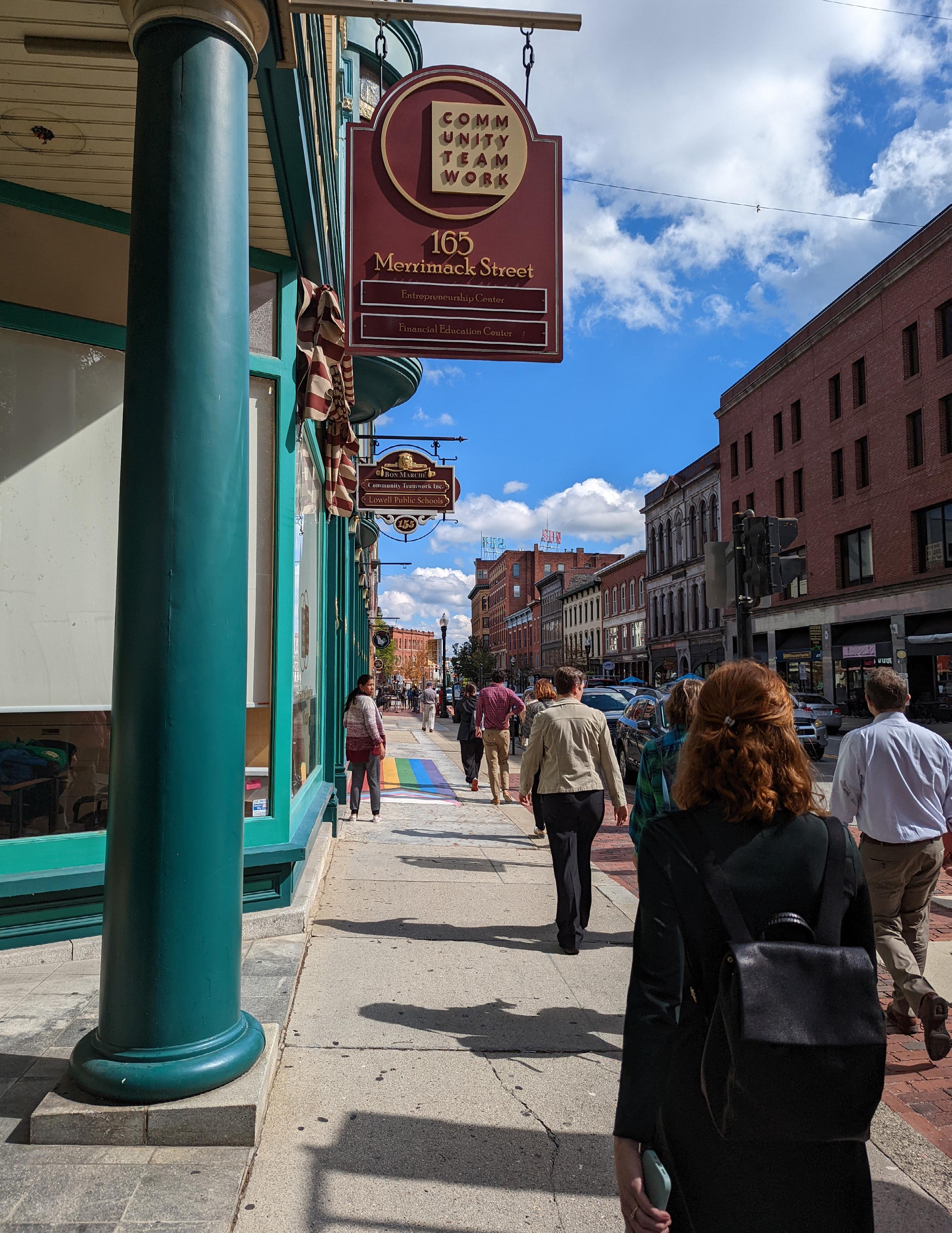
Topic: Mobility
Goal 1:
1. Decrease the share of Lowellians who drive alone to work from 74% single occupancy to 60% of total trips by 2040
2. Increase utilization of public parking garages to 85% by 2040
3. Reduce serious/fatal crashes of all types (vehicular, motorcycle, bicycle, pedestrian) to zero crashes by 2040
4. Build 36 lineal miles of on-street bicycle infrastructure by 2040
5. Repair, replace, or construct 65 miles of sidewalks throughout the city by 2040
1 Prioritize improving sidewalk quality and pedestrian crossing safety projects along key pedestrian routes of higher demand, higher levels of ADA need, and to/from higher ridership transit stops.
2 Adopt Vision Zero and create a Vision Zero Safety Action Plan for Lowell.
3 Prioritize implementing 2021 GoLowell proposed bike network. Evaluate which projects require parking and sidewalk tradeoffs/ considerations. Identify which projects require curb removal and additional funding.
4 Extend Bruce Freeman Rail Trail into Lowell. Begin process with abutters to engage and study feasibility.
Topic: Mobility
Goal 2:
1. Decrease the share of Lowellians who drive alone to work from 74% single occupancy to 60% of total trips by 2040
2. Increase utilization of public parking garages to 85% by 2040
3. Reduce serious/fatal crashes of all types (vehicular, motorcycle, bicycle, pedestrian) to zero crashes by 2040
4. Build 36 lineal miles of on-street bicycle infrastructure by 2040
5. Repair, replace, or construct 65 miles of sidewalks throughout the city by 2040 Order of Priority Actions
1 Implement policies and strategies from 2021 City-wide parking study to assure parking availability and incentives for modeshift.
2 Improve trails wayfinding signage to and from activity centers. Examine needs and make plans and designs to install signage in appropriate locations.
3 Develop a multilingual, digital and non-digital communication strategy for both wayfinding and informing people about transportation options and circulation routes.
and Plan
Goal 3:
1. Decrease the share of Lowellians who drive alone to work from 74% single occupancy to 60% of total trips by 2040
2. Increase utilization of public parking garages to 85% by 2040
3. Reduce serious/fatal crashes of all types (vehicular, motorcycle, bicycle, pedestrian) to zero crashes by 2040
4. Build 36 lineal miles of on-street bicycle infrastructure by 2040
5. Repair, replace, or construct 65 miles of sidewalks throughout the city by 2040
1 Collaborate with LRTA to implement GoLowell recommended Cross-town and Downtown Connecter routes.
2 Collaborate with LRTA to finalize bus reliability projects along Thorndike Street for getting service in and out of Gallagher Transit Terminal. Prioritize areas with high concentrations of zero vehicle households and neighborhoods where there are higher levels of transit dependency.
3 Coordinate with LRTA to make the Sunday bus service pilot permanent to help service worker commutes and non-commuters users of transit for errands, shopping, and entertainment.
4 Collaborate with LRTA to create a capital improvement plan to improve bus stop accessibility and comfortability. Study quality of bus stop amenities and their distribution across the city.
5 Implement TDM (Transportation Demand Management) program in the GoLowell Plan starting with City staff and then expanding programs to large employers. Assure that new large employers have TDM programming, especially those further away from transit.
6 Initiate a public transportation education and awareness campaign to promote public transport usage and expand awareness of social, economic and environmental benefits that public transportation brings.
Partnership
and Plan
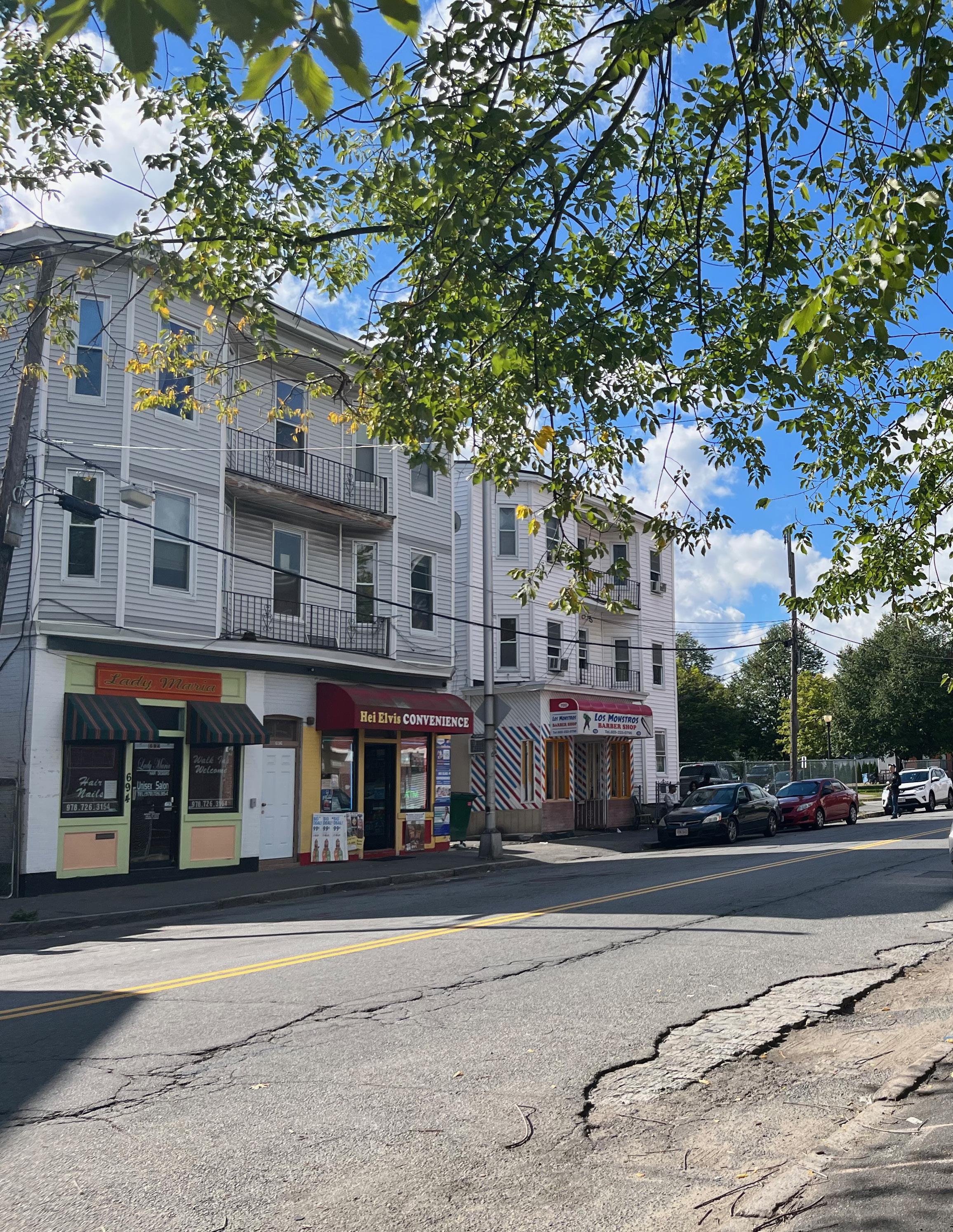
1. Increase number of locally-owned businesses
2. Number of programs/grants and dollar amount in terms of grants or technical assistance to businesses that self-identify as minority-owned
3. Number of self-identified minority owned-businesses on a monthly basis by tracking folks who we help in-person or by email
4. Obtain pedestrian traffic software; track pedestrian activity downtown and in all neighborhood nodes with goal of increasing by 50% by 2040
1 Identify space, design, and infrastructure needs by Downtown Lowell businesses; revisit regulations to allow for more modern and efficient commercial space designs; consider making outdoor seating a permanent initiative.
2 Test and implement actions to reduce commercial vacancies in a way that both aligns with residents’ desires and can increase foot traffic. Iterate tests based on feedback received.
3 Work in collaboration with our educational partners UML and MCC, to continue promoting Lowell’s local businesses and incentivize students to frequent Downtown.
programs and operations
4 Create a 24-7 Downtown Plan that studies conversions of vacant office buildings into residential use, and continue to collaborate with other local, state, and federal economic development entities to identify funding opportunities to revitalize historic buildings.
operations
1. Increase number of locally-owned businesses
2. Number of programs/grants and dollar amount in terms of grants or technical assistance to businesses that self-identify as minority-owned
3. Number of self-identified minority owned-businesses on a monthly basis by tracking folks who we help in-person or by email
4. Obtain pedestrian traffic software; track pedestrian activity downtown and in all neighborhood nodes with goal of increasing by 50% by 2040
1 Create a comprehensive branding and marketing program promoting local businesses. Coordinate with departments including Economic Development and CASE, and with producers and hosts of cultural events and programs. Emphasize support of local business community.
2 Establish partnerships and programming to support small businesses with provision of technical assistance, access to funding, and networking for small businesses, with targeted focus on supporting business owners in minority and immigrant communities and start-ups created by local educational institutions.
3 Fund retail incubators/pop-ups, not just in Downtown, but throughout the city.
4 Expand the City’s Storefront Improvement Program to assist Lowell’s local businesses in improving commercial spaces.
5 Increase funding and/or tax incentives for businesses looking to relocate to/within Lowell as they grow.
6 Expand opportunities to become certified vendors for government procurement opportunities. Work with Mass Supplier Diversity Office and Lowell-based businesses.
7 Incentivize anchor institutions to purchase from local businesses to support small business growth and drive associated hiring.
and operations
Partnership
Partnership
(economic development), CASE, UML’s Marketing and Social Policy professors and students
DPD (economic development), UML, MCC
DPD (economic development)
(economic
Office/ Anchor Institutions
neighborhood centers
Downtown + neighborhood centers
DPD (economic development), Mass. Supplier Diversity Office, Lowell-based businesses
(economic development), Office/ Anchor Institutions
DPD (economic development), Office/ Anchor Institutions
anchor institutions
Topic: Economic Development
Goal 3:
Indicators of progress:
1. Increase number of locally-owned businesses
2. Number of programs/grants and dollar amount in terms of grants or technical assistance to businesses that self-identify as minority-owned
3. Number of self-identified minority owned-businesses on a monthly basis by tracking folks who we help in-person or by email
4. Obtain pedestrian traffic software; track pedestrian activity downtown and in all neighborhood nodes with goal of increasing by 50% by 2040
1 Identify and create areas for redevelopment through the implementation of the Ayer City Urban Renewal Plan and Brownfields Program.
2 Enhance workforce development initiatives. Build a pipeline of talent for jobs in industrial mixed-use districts and establish programs with anchor institutions to create an education-workforce pipeline.
3 Development initiatives increasing the attractiveness of talent in Lowell in collaboration with anchor institutions.
Regulatory/ Policy
Connection to Growth Strategy
Redevelop underutilized intrustrial areas
educational anchors
institutions
and strengthen institutional anchors
4 Study space and infrastructure needs of new businesses and plan for how city can accommodate these needs.
1:
1. Reduce carbon emissions from buildings citywide by 50% vs. 1990 baseline levels by 2030
2. Reduce carbon emissions from buildings citywide by 75% vs. 1990 baseline levels by 2040
3. Increase publicly available EV charging infrastructure by 50% vs. FY 23 baseline
4. Increase the total installed solar infrastructure by 50% vs. FY 23 baseline
5. Increase the number of households utilizing decarbonized energy sources Order
1 Reduce energy consumption in existing buildings and new construction by:
1. Creating and implement a Climate Action and Resilience Plan for Lowell
2. Building capacity within Sustainability division
3. Creating an emissions reduction toolbox for use by residents, small businesses, and larger commercial properties to help them connect with resources
4. Review current permitting and review processes to ensure they align with emissions reduction goals
5. Exploring and adopting zoning changes to promote climate smart buildings and higher levels of green building design
6. Maintaining and expanding the work of Lowell’s Energy Advocate to connect residents and small businesses with Mass Save programs
7. Initiating an engagement strategy for building owners, managers and occupants to accelerate decarbonization of existing buildings
2 Invest in and promote adoption of clean energy sources by:
1. Increasing the total installed solar infrastructure by 50% vs. FY 23 baseline
2. Promoting education of Community Choice Aggregation citywide
3. Exploring on-site power generation from city assets
3 Reduce GHG emissions in Transportation by:
1. Expanding existing publicly accessible EV charging infrastructure to include locations beyond the downtown area
2. Making new construction EV ready
3. Expanding municipal solar installations across school, parking, and municipal properties, and expanding EV fleet citywide
4. Ensuring safe and quality pedestrian and bike infrastructure
programs and operations
Goal 2:
1. Reduce carbon emissions from buildings citywide by 50% vs. 1990 baseline levels by 2030
2. Reduce carbon emissions from buildings citywide by 75% vs. 1990 baseline levels by 2040
3. Increase publicly available EV charging infrastructure by 50% vs. FY 23 baseline
4. Increase the total installed solar infrastructure by 50% vs. FY 23 baseline
5. Increase the number of households utilizing decarbonized energy sources
1 Build resilient districts and microgrids by:
1. Ensuring an equitable process and outcomes of the Lowell networked geothermal pilot project, including stakeholder engagement, reduced energy burdens, public health benefits and community ownership
2. Expanding networked geothermal in densely populated neighborhoods
2 Implement recommendations set forth in updated Municipal Vulnerability Preparedness Plan and the Resilient Urban Forest Master Plan and Urban Heat Island Assessment.
programs and operations
programs and operations
1. Reduce carbon emissions from buildings citywide by 50% vs. 1990 baseline levels by 2030
2. Reduce carbon emissions from buildings citywide by 75% vs. 1990 baseline levels by 2040
3. Increase publicly available EV charging infrastructure by 50% vs. FY 23 baseline
4. Increase the total installed solar infrastructure by 50% vs. FY 23 baseline
5. Increase the number of households utilizing decarbonized energy sources
1 Develop clean energy workforce in the city by:
1. Supporting for the development of existing and new clean energy companies in the city
2. Working with Mass CEC to design and coordinate a Lowell specific program
Topic: Energy, Climate, and Environment
Goal 4:
that decarbonization goals do not result in a disproportionate increase in energy burdens for our most vulnerable residents
Indicators of progress:
1. Reduce carbon emissions from buildings citywide by 50% vs. 1990 baseline levels by 2030
2. Reduce carbon emissions from buildings citywide by 75% vs. 1990 baseline levels by 2040
3. Increase publicly available EV charging infrastructure by 50% vs. FY 23 baseline
4. Increase the total installed solar infrastructure by 50% vs. FY 23 baseline
5. Increase the number of households utilizing decarbonized energy sources
Order of Priority Actions
1 Reduce energy poverty and protect consumers from deceptive clean energy products by:
1. Focusing on supporting residents that are vulnerable to energy poverty with resources such as information on discount rates being available for income eligible residents.
2. Assessing baseline levels of weatherization completed in qualified census tracts and recommend an action plan to increase participation
3. Maintaining and expanding the work of Lowell’s Energy Advocate to connect residents with arrearage management and forgiveness programs, fuel assistance, community choice aggregation, and Mass Save programs
4. Develop resources that educate, inform and protect residents from deceptive marketing of renewables, including misleading or unsubstantiated “green” claims made by companies to their customers
Connection to Growth Strategy
Topic: Parks, Open Spaces, and Trails
Goal 1:
Indicators of progress:
1. Number of playgrounds upgraded to be universally accessible
2. Linear feet of multi-use paths built
3. Dollars invested in open space per neighborhood
4. 15% or more tree canopy in each of Lowell’s eleven neighborhoods
1 Equitably invest in and maintain open space facilities including recreational facilities, open spaces, and trails in alignment with OSRP priorities, and to ensure inclusivity and accessibility for all ages and abilities.
2 Improve physical access to parks and outdoor programs by improving pedestrian and bicyclist infrastructure along key routes.
3 Improve equitable communication about parks and outdoor programs by reducing barriers to participation. Examples include: developing a multilingual wayfinding strategy and a language access center.
4 Prepare an open space master plan for the Pawtucket Canal and surrounding industrial/nonresidential lands (from Pawtucket Street at the Merrimack River to the Thorndike Street Bridge), considering both sides of the Pawtucket Canal.
programs and operations
Goal 2:
Indicators of progress:
1. Number of playgrounds upgraded to be universally accessible
2. Linear feet of multi-use paths built
3. Dollars invested in open space per neighborhood
4. 15% or more tree canopy in each of Lowell’s eleven neighborhoods Order
1 Plant trees along priority corridors and within urban heat islands in alignment with the City’s Urban Forestry Plan.
2 Reduce impervious surfaces and install green infrastructure, where applicable, to manage stormwater runoff and mitigate flooding, and create a maintenance plan.
3 Initiate a public stormwater management awareness and education campaign, in partnership with universities and nonprofits, to inform businesses and residents about effects of stormwater pollution on Lowell’s waterways and ways in which they can help reduce stormwater runoff.
programs and operations
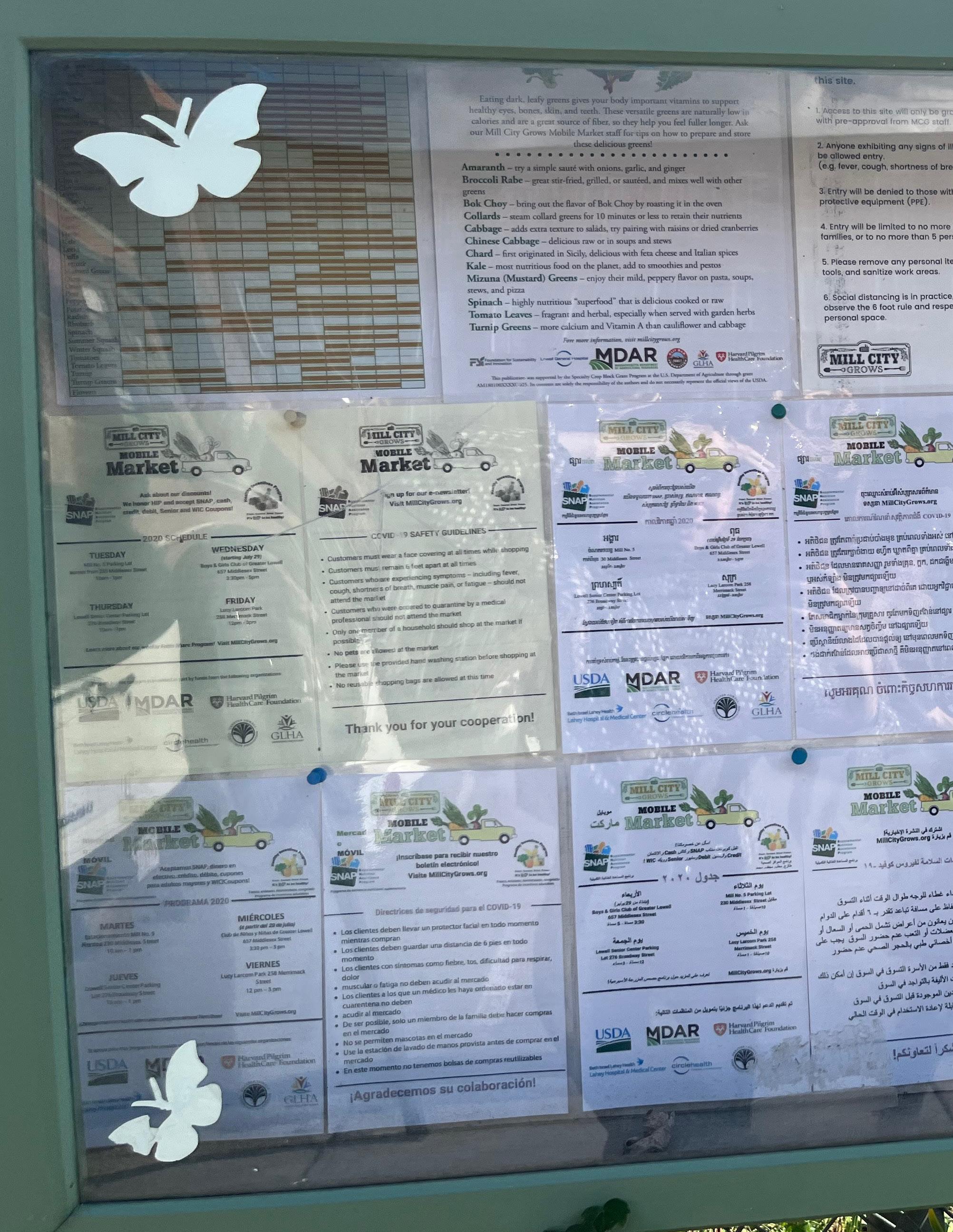
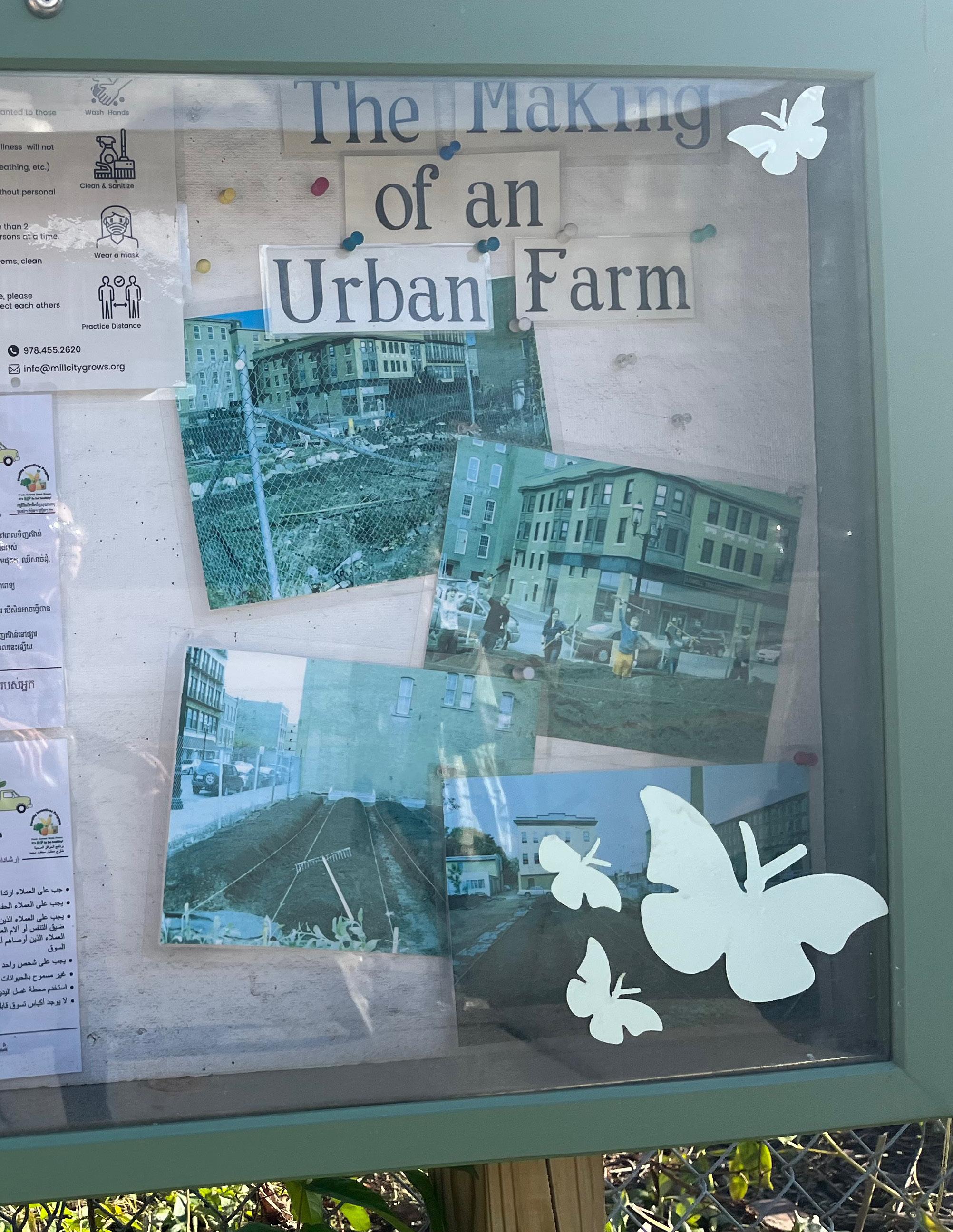
1. Increase number special events permits for usage of parks and parking garage revenue related to these
2. Number of new or added publicly accessible art pieces in each neighborhood
3. Increase revenue generated from state 6.5% meal tax
1 Incorporate art and culture in mainstream planning initiatives including public realm improvements and capital projects, larger economic development initiatives, and various communication/engagement campaigns.
2 Support artists and creative makers of all ages, backgrounds, and income levels to participate in arts and cultural placemaking in Lowell. Identify and address space and accessibility needs, financial barriers, marketing, and promotional networking.
3 Support, align, and help implement priority goals and actions outlined in Mosaic Lowell Arts and Cultural Plan.
Indicators of progress:
1. Increase number special events permits for usage of parks and parking garage revenue related to these
2. Number of new or added publicly accessible art pieces in each neighborhood 3. Increase revenue generated from state 6.5% meal tax Order of Priority Actions
1 Develop and execute a marketing plan for the city, coordinated with various City departments and partners, that includes arts, culture, businesses, and visitors.
Study and Plan
2 Revise zoning to support more artsrelated uses such as studios and live/work spaces.
3 Create a sustainable initiative to lead and coordinate art, culture, and creative economy strategies and actions in Lowell.
Partnership Zoning Update
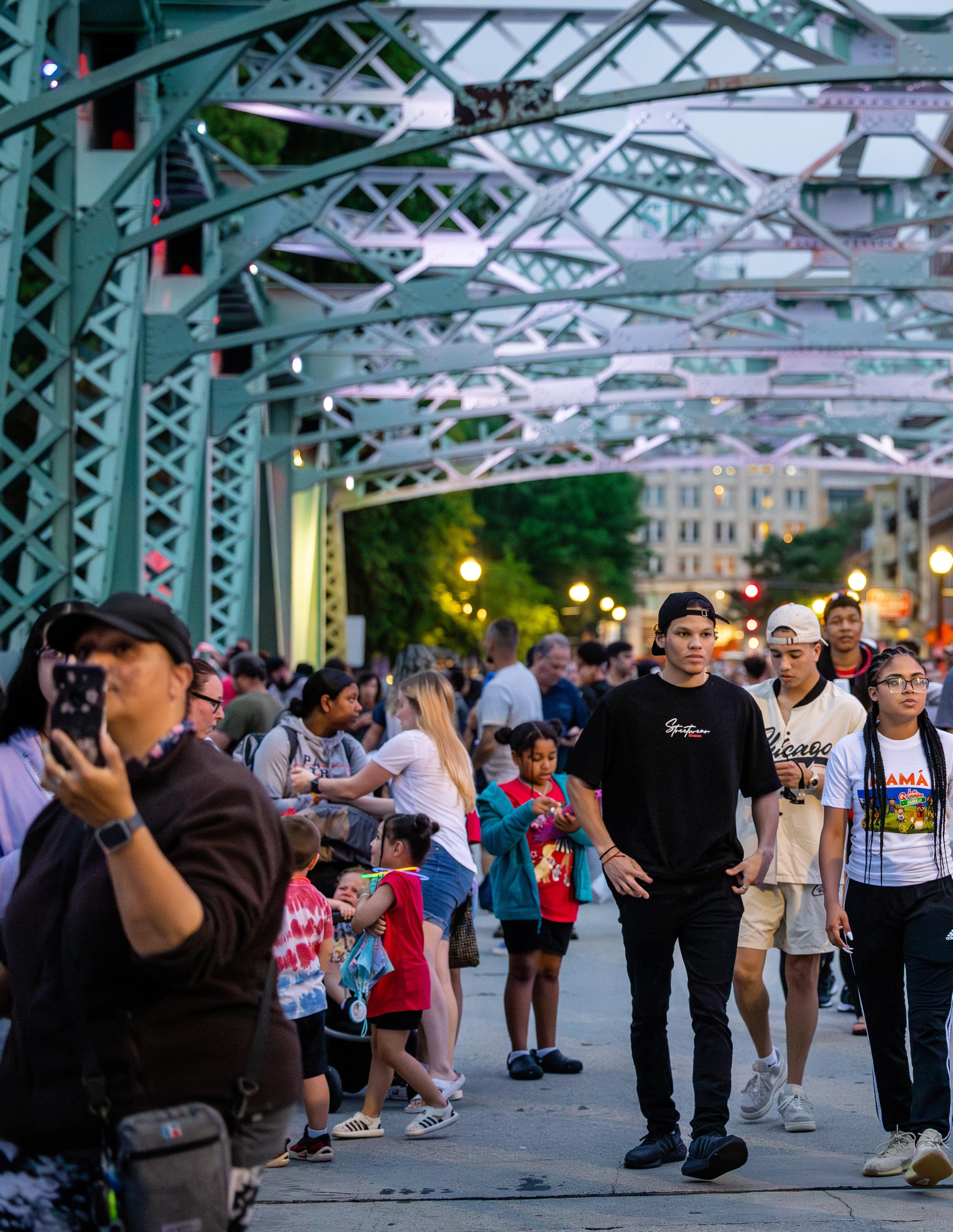
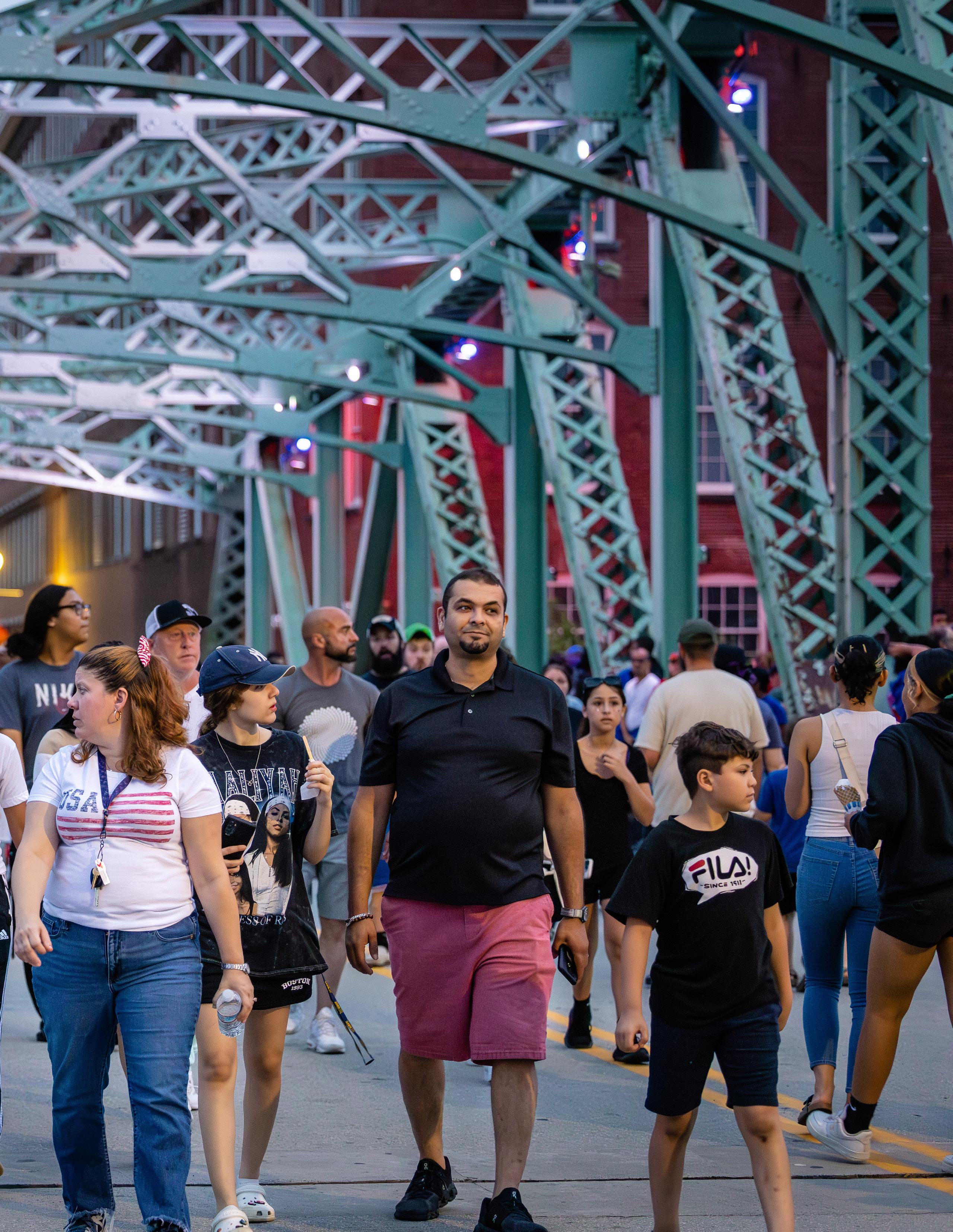
Accessory Dwelling Unit (ADU): A self-contained housing unit in an owner occupied single-family home or lot that is either attached to the main dwelling or in a separate structure on the same property.
ADA-Compliance: Refers to the federal American Disability Act, and determines all handicap requirements and stipulations. The ADA compliance of a structure will include handicap access in the form of elevators, ramps, wheelchair lifts, as well as the proper positioning of light switches, countertops, grab bars, etc.
Affordable Housing: Dwelling units priced low enough so that households earning less than certain thresholds can comfortably pay for them. These thresholds typically target households earning below 80% of the area’s median income (or AMI) or some other percent of AMI. Affordable housing exclusively refers to the cost of the housing to the consumer and does not refer to the design, type, or method of construction of a housing unit or development. Generally, if a given household pays less than 30% of its monthly income on housing, that housing price is considered affordable.
Anchor Institution: An organization that has strong ties to the surrounding area, and improves the area’s economy through its operation. Anchor institutions often refer to local universities, hospitals, and businesses.
Area Median Income (AMI): Every year the Federal Department of Housing and Urban Development (HUD) estimates the median family income for every American metropolitan area and region at various levels (30% AMI, 50% AMI, 80% AMI and 100% AMI). HUD adjusts this data based on household sizes so that incomes may be expressed as a percentage of the area median income. They then publish these figures, called Income Limits, as part of an annual report, and these limits are used for eligibility in most housing programs.
Brownfield: A former industrial or commercial site where future use is affected by real or perceived pollution. These sites often negatively impact local communities. Typically, they also cannot be redeveloped without environmental cleanup.
By-right: A zoning framework that allows development projects to proceed without the need for a special permit, variance, amendment, waiver, or other discretionary approval if the project meets all the existing zoning requirements.
CASE: The Lowell Office of Cultural Affairs & Special Events, which serves as the official arts and events agency for the City, where they plan logistical support for public events.
Clean Energy: Energy derived from renewable, zero-emissions sources (renewables), as well as energy saved through energy efficiency measures.
Renewable energy sources include: biomass, geothermal, hydropower, solar, and wind.
Commercial: Concerned with or engaged in business. Here, business refers to the trade of goods, services, or both for the primary purpose of profit. This report will often refer to commercial spaces and uses, these terms refer to places or uses that are dedicated to business. For example, a business district would refer to a portion of the city dedicated to business, such as a downtown area, and business use would refer to portions of buildings reserved for retail, restaurant, or other business related use.
Community Garden: A piece of land where a group of people individually or collectively grow plants of their choosing. Typically, community gardens are not for profit, and their purpose is to serve the local community. The location of these gardens can vary, but they are often located on publicly accessible land, and sometimes are integrated with park space.
Complete Streets: A transportation policy and design approach that prioritizes safety for all road users. This approach has become a popular framework that requires streets to be planned, designed, operated and maintained with safe, convenient and comfortable travel and access in mind for all users regardless of age, ability, or their mode of transportation. Streets that meet these guidelines are referred to as Complete Streets, and many policies and plans that aim to improve street safety include the term “Complete Streets” in their title.
Context Sensitive Development: An approach that makes development and design choices based on existing features at a given site, instead of automatically engineering those features into compliance with design choices that have already been made. This approach considers stormwater flow patterns, wetlands, street layout, and other existing site features before making any design decisions.
Cost Burden: The Federal Department of Housing and Urban Development uses this phrase to describe households that spend 30% or more of their combined income on housing related costs. These costs typically refer to rent and mortgage payments.
Decarbonization: Reducing the amount of emissions from greenhouse gases, like carbon dioxide (CO2), released into the atmosphere.
Deed Restriction: A mechanism that limits how land owners can use and sell their property. Deed restrictions can be an affordability tool when they are used to prevent property sales from exceeding certain price thresholds. For example, an affordable housing unit originally sold at 80% AMI might include a deed restriction that prevents owners from ever selling that property above 80% AMI.
Densify: Increasing the number of people living in a given area. A high density area, or one that has been densified, typically has apartment buildings and other multifamily units, and a low density area typically has single-family homes and vacant lots.
DPD: The Lowell Department of Planning and Development, which includes programs for Community Development, Developmental Services, Economic Development, Housing and Energy, Traffic and Transportation, among others.
DPW: The Lowell Department of Public Works, which has responsibility to manage solid waste and recycling, sewage and storm water management, provision of drinking water, maintenance and repair of City owned properties and roads, among others.
Energy Equity: Ensure that decarbonization goals do not result in a disproportionate increase in energy burdens for the city’s most vulnerable residents.
Environmental Justice: A framework that strives to equitably distribute environmental harms and benefits and involve everyone with the decisionmaking process for environmental policies.
First/Last Mile Connections: These terms are used in reference to public transportation systems to describe the beginning or ending of an individual trip that makes use of public transportation options. Specifically, this describes how a user gets from their starting point to a bus stop or train station for the first mile, and how they get from a bus stop or train station to their destination for the last mile.
Green Building: Refers to both a structure and the application of processes that are environmentally responsible and resource-efficient throughout a building’s life-cycle: from planning to design, construction, operation, maintenance, renovation, and demolition.
Green Stormwater Infrastructure: Infrastructure designed to mimic nature and capture rainwater where it falls. Green infrastructure reduces and treats stormwater at its source while also providing multiple community benefits such as reducing localized flooding and Improving community aesthetics.
HCID: Hamilton Canal Innovation District, located in the westernmost area in between the Merrimack and Hamilton Canals. This district has been selected as redevelopment opportunity by multiple City plans.
Heat Island Effect: An effect that causes urban areas to become significantly warmer than their surrounding less densely built out areas. The effect is primarily caused by the replacement of natural landscapes with hard surfaces (roads, widewalks, etc.), concentration of heat-trapping gasses like carbon dioxide and other air pollution (vehicle and building exhaust), and the high volume of heatgenerating machines and processes (air conditioners, refrigerators, etc.).
HPP: Housing Production Plan, specifically referring to Lowell’s soon-to-be completed 2024 Housing Production Plan. This plan will outline the City’s housing goals, and provide a framework to meet them.
Hub-and-Spoke Model: This urban planning framework places transportation operations around a central area, or hub, with multiple routes branching out like spokes. This setup, while efficient due to centralized operations and economies of scale, leads to longer travel times, often involving layovers and transfers and limited direct connectivity between destinations.
Inclusionary Zoning: A policy that requires a share of new housing development to be affordable to low- or moderate-income households through zoning code.
Infill Development: Development projects located on underused or vacant land in existing urban areas. This practice increases density and places new developments near existing resources and infrastructure. Infill areas are places with potential for infill development.
Infrastructure: The system of public works of a country, state, or region, as well as the resources (such as personnel, buildings, or equipment) required for an activity.
Land Use: The economic and cultural activities that are practiced at a given place. Land uses are often described in terms like agricultural, residential,
industrial, retail, recreational, and others. Different land uses are influenced by whether the land is public or private, location of the building, zoning policy, and other factors.
Life Sciences: The sciences concerned with the study of living organisms, including biology, botany, zoology, microbiology, physiology, biochemistry, and related subjects. In terms of land use, this term is tied to uses for healthcare, scientific research and development, and laboratories.
LRTA: Lowell Regional Transit Authority, the organization responsible for managing public transportation for the Lowell region. Micro Unit - A living space one step smaller than a studio apartment. These units are typically less than 400 square feet, and make efficient use of space to provide an open concept space for a kitchen, bathroom, and bed.
Mixed-Use: A zoning classification that blends multiple uses, such as residential, commercial, cultural, institutional, or entertainment, into one space. These spaces physically and functionally integrate those multiple uses and provide pedestrian connections between surrounding areas. Mixed-use development may be applied to a single building, a block, a neighborhood, or in zoning policy across an entire area.
Multifamily Housing: Any residential property containing more than one housing unit and where more than one family lives.
These homes can take many forms, from free-standing single family homes restructured into multiple units to large multi-story apartment complexes.
Multimodal: Having or using more than one method, or mode, of transportation. These methods, or modes, of transportation include walking, biking, taking a bus or train, etc. The term Multimodal often refers to development projects or planning policies that support multiple methods of transportation in a given area.
NMCOG: The Northern Middlesex Council of Governments, one of 13 regional planning agencies within Massachusetts covering the Greater Lowell region and headquartered in Lowell.
NPS: The National Park Service, a federal U.S. agency responsible for taking care of all national parks.
OSRP: The Lowell Open Space and Recreation Plan, which describes the City’s vision for its parks, open spaces, and recreational programs. The plan was last updated in 2018, but is about to be updated.
Public Realm: Any publicly owned streets, pathways, sidewalks, parks, open spaces, buildings, and facilities where the public has access.
Resilience: The capacity to resist damage and recover quickly from disturbance. This term is often used to describe the ability of communities and ecosystems to survive climatebased disturbances without losing functions or services.
Single-Family Housing: Any residential property containing no more than one housing unit and where no more than one family lives. These homes are typically free-standing residential buildings.
Single Room Occupancy (SRO): A form of low-income housing, where each SRO unit is designed for one individual, with a lockable door. Typically, many SRO units will be located in one building to allow for additional density at lower price points. Individual SRO units can include amenities like kitchens and bathrooms, but these amenities are often shared across multiple nearby units.
Stormwater Management: The practice of diverting and directing rainfall with the purpose of preventing floods during storm events. Stormwater management involves drainage infrastructure in addition to ground types and ground cover that absorb water like soil and trees.
Sustainability: Meeting the needs of the present without compromising the ability of future generations to
meet their needs. This term is often used to describe environmentally friendly practices that will ensure future generations have access to an environment that is at least as safe, clean, and bountiful as today’s environment. However, the term can also be used to describe other practices that are designed to last, such as economic and social practices.
Trasnformative Development Initiative (TDI): A MassDevelopment program designed to accelerate economic growth at the neighborhood level. The program works with local partnerships to foster actionable projects and create more vibrant streets. Lowell’s TDI District includes the upper Merrimack and upper Market Street corridors of the Acre neighborhood.
Transit-Oriented Development (TOD):
A type of urban development that maximizes the amount of residential, business, and leisure space within walking distance of public transport. It promotes a symbiotic relationship between dense, compact urban form and public transport use.
Transportation Demand Management (TDM): A planning framework that aims to increase travel efficiency for individual users so that they arrive at their destinations more quickly. Often, the biggest barrier to fast travel times is vehicular traffic, so TDM improves efficiency by
encouraging people to walk, bike, and use public transportation, thereby decreasing the amount of cars on the road.
Universal Design: The design and composition of an environment so that it can be accessed, understood, and used to the greatest extent possible by all people regardless of their age, size, ability or disability.
Vision Zero: A strategy to eliminate all traffic related fatalities and severe injuries. These strategies are typically formulated in Vision Zero plans.
Wayfinding: All of the methods people use to orient themselves in physical space and navigate from place to place. Strategies to improve wayfinding throughout an area can include increasing the number and visibility of street signs, adding additional signage with elements like maps, and improving the visibility of landmarks.
Zoning: Or zoning code, describes land use policy that controls what can and cannot be built on a property based on its geographic location within a municipality. City and town governments use zoning to divide their municipality into areas, or zones, and then apply different restrictions and allowances to different zones. For example, factories may only be permitted in an industrial zone. safety, prosperity, and equity of our neighborhoods.