Areas for Targeted Redevelopment
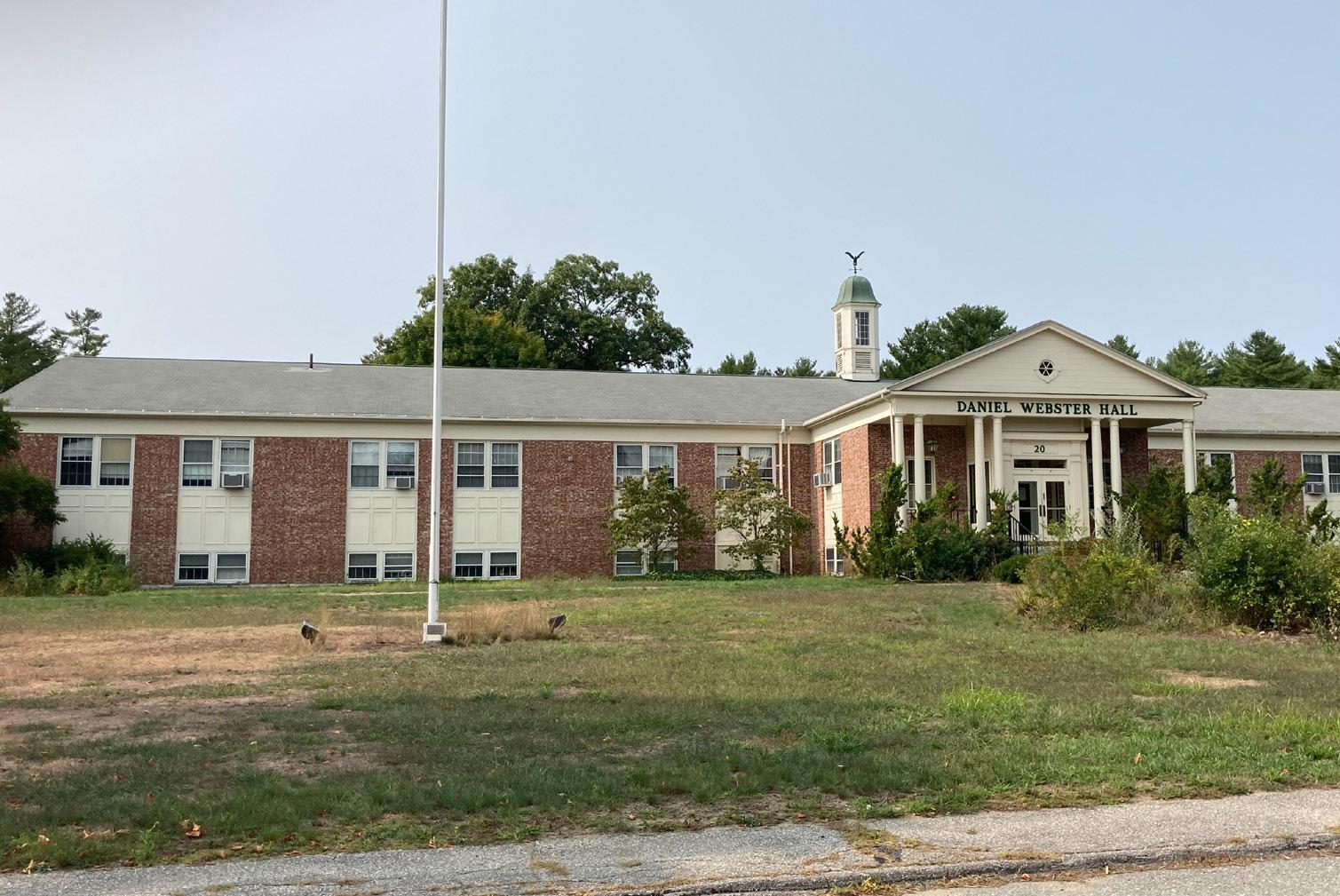
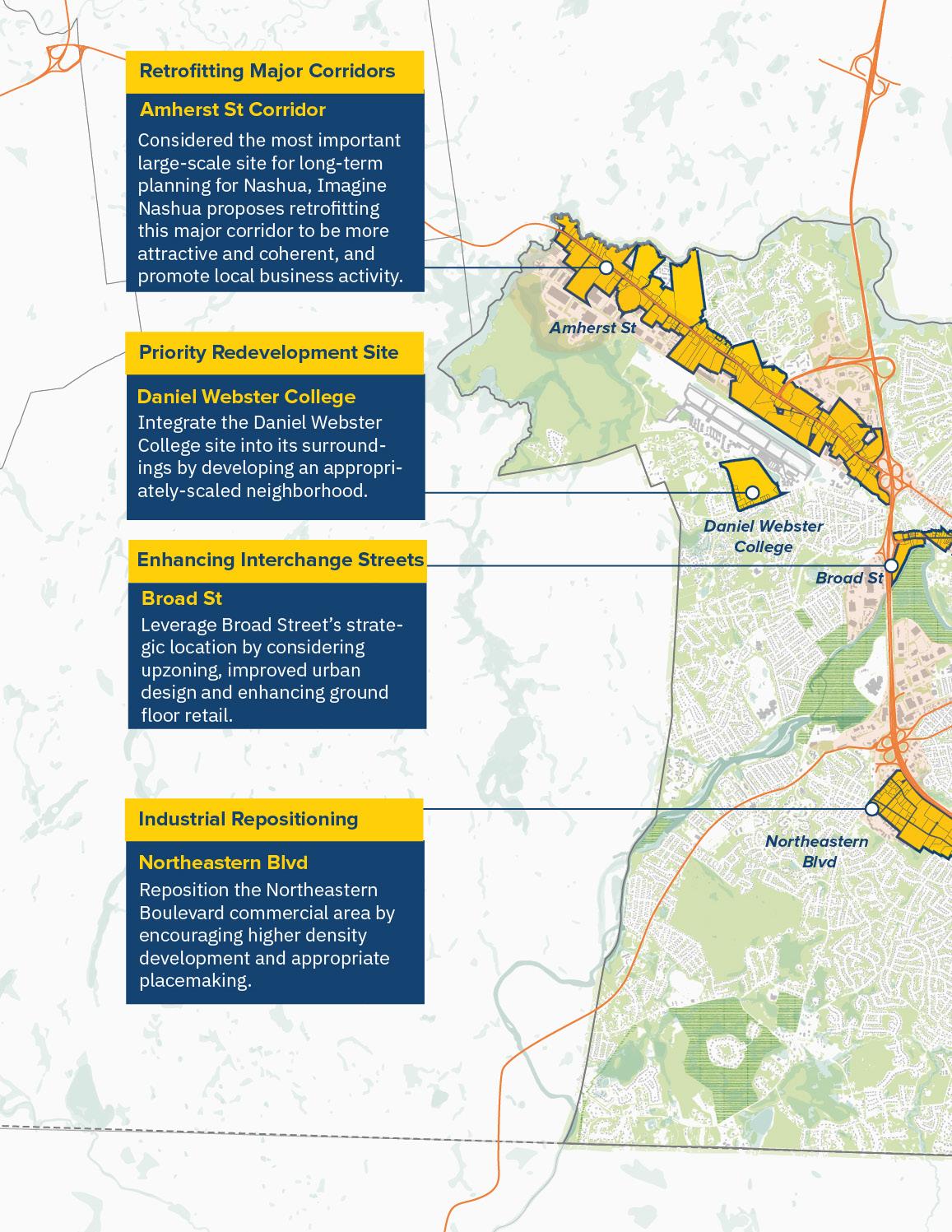
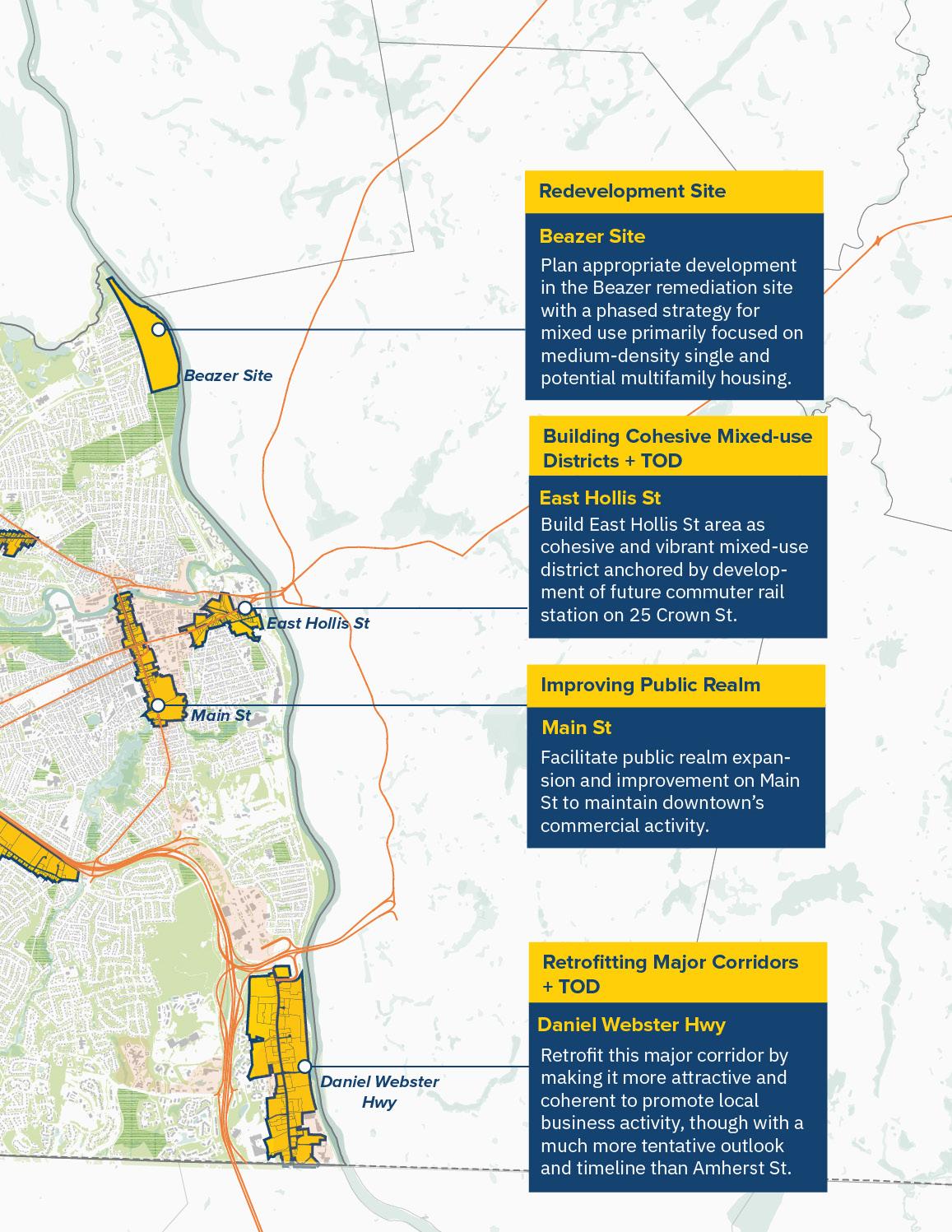
The planning team worked collaboratively with the Master Plan Steering Committee to identify key areas for targeting redevelopment in the city, and generated scenario studies exploring the best and viable landuse and urban design outcomes. Some of the study areas including the Amherst Street Corridor, the Daniel Webster Hwy, the Daniel Webster College site, the Beazer remediation site and the East Hollis Street area have been on the City’s horizon for priority planning before the advent of the master planning process, while the additional three sites including Main St, Northeastern Boulevard,
and Broad Street are additional prime areas identified for redevelopment planning through discussions with the City and the Master Plan Steering Committee.
The scenario studies and recommendations for the priority redevelopment areas seek to accommodate future growth and redevelopment in a sustainable and equitable manner, and aim to create a more livable and vibrant city for Nashuans by providing and planning for:
• more walkable communities, with access to a range of mobility options and amenities
• a variety of housing options that meet the needs of different individuals and families of all backgrounds
During public meetings, the Nashua community expressed desire to see future development on the DW College site integrate with surrounding neighborhoods.
• mixed-use corridors and neighborhoods that promote economic growth and access to job opportunities
• services and infrastructure needed to support growth and redevelopment
• access to parks and recreational spaces, with respect for natural and environmental resources
• enhanced cultural resources and programs and opportunities that enable all residents to to fully participate in and enjoy civic life
Scenario Planning
The process of scenarios is an important part of coming to a community-wide consensus about preferred outcomes. It is very easy, in the abstract, for stakeholders to declare that one value or set of values should be prioritized over all others. It is much harder, when looking at potential scenarios— physical manifestations of sets of prioritizations—to continue to promote pure singleissue priorities. Moreover, conversations related to scenarios quickly become
The planning team, through previous work, has found that asking stakeholders to evaluate potential scenarios is the best way to persuade all stakeholders to weigh the totality of future outcomes and consider the needs of fellow stakeholders. This means that the end result of this plan, zoning recommendations that can enable the potential redevelopment, should be balanced to meet the range of community needs as best as possible.
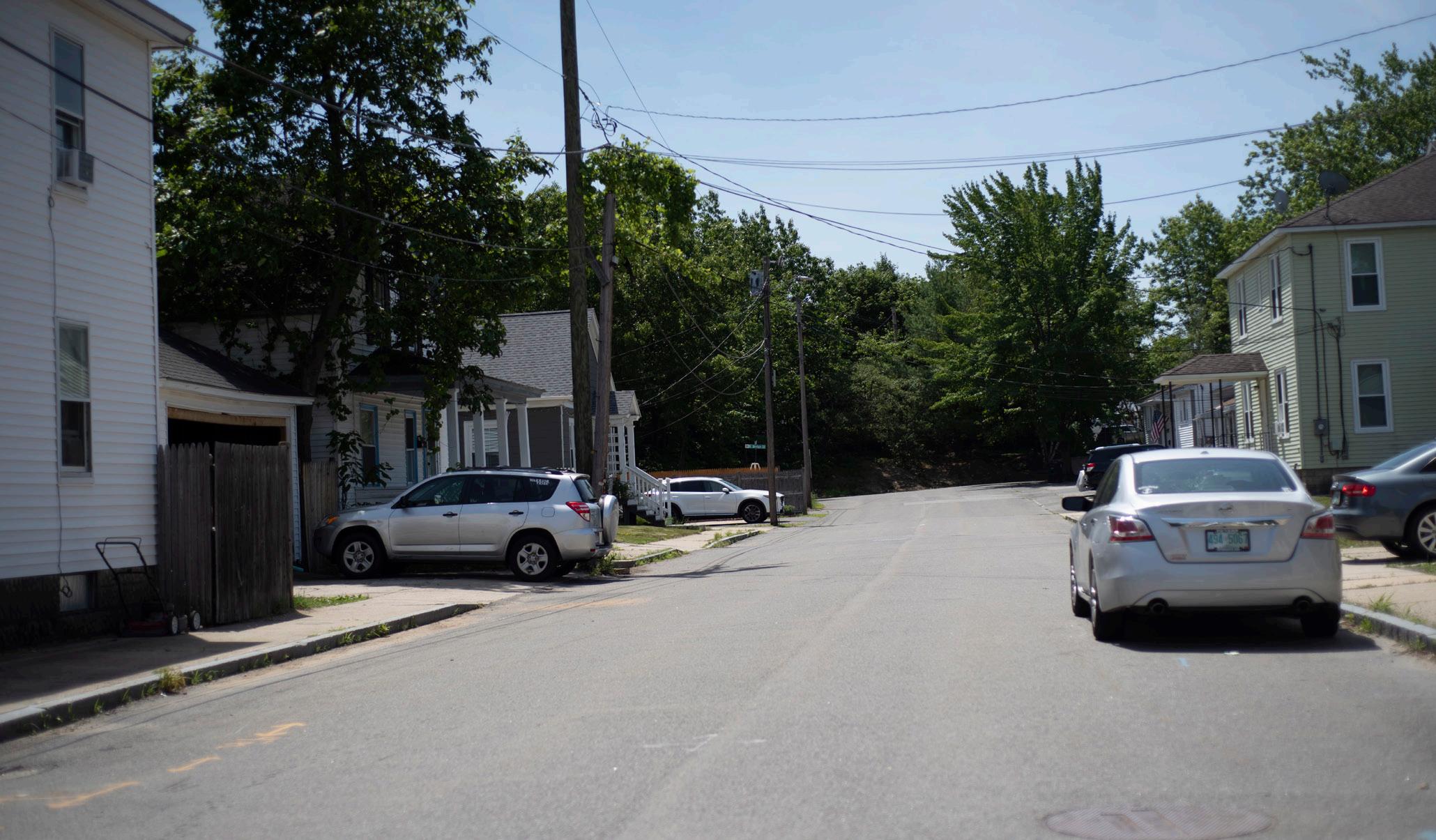
Scenario planning helps to build upon and envision future public realm improvements across all of Nashua’s neighborhoods.
Amherst Sts
Issues and Opportunties:
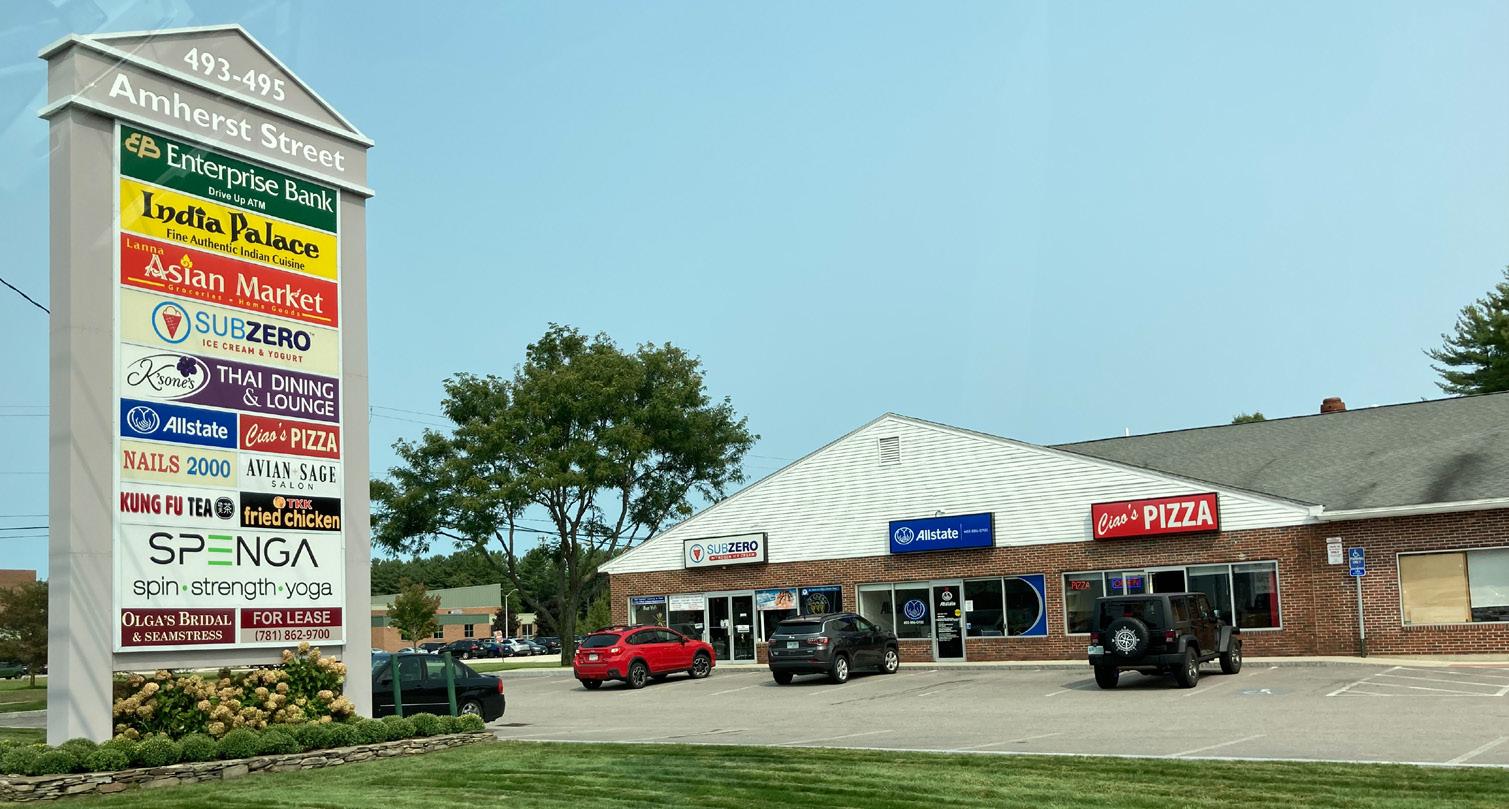
• Heavy traffic road, auto-dominated design characterized by large surface parking lots between buildings and the street
• Lack of pedestrian and bicycle infrastructure and poor connectivity
• Access management and traffic-related issues
• No clear corridor identity due haphazard development patterns
• Located on an important state highway (Rt. 101A) that connects communities to the west to Route 3
• Opportunities to provide needed housing in this area with walkable mixed-use development, including residential and commercial office/retail uses
• Advance city’s goal to create mobility-oriented roads and streets that balance multiple uses
Top Goal 1: Redevelopment Opportunity
Promote redevelopment that is mixed-use, multimodal, and sustainable in targeted areas with access to transit, infrastructure and amenities.
Action: Retrofitting Major Corridors
Make commercial corridors more viable by encouraging a wider range of commercial uses, mixeduse development, and active ground floor uses; improving multimodal infrastructure; incorporating landscaping and green infrastructure; enhancing public realm through on the sidewalk; and developing a formbased code and facade and signage regulations.
Amherst Street Corridor
In collaboration with the City and stakeholders, the Master Plan team has identified the Amherst Street corridor as the most important large-scale site for long-term planning for Nashua. Many issues come into play here—the effects of regional and macroeconomic shifts in employment as we enter deeper into the 21st century, the challenges associated with shifting transport and mobility away from being dominated solely by combustion-engine single passenger vehicles, balancing the opportunities of denser and more walkable development with the necessary infrastructural and land use changes—and we believe that pushing forward a progressive and transformative reenvisioning of this corridor will serve the entire city well as it grapples with how to address these issues in other locations as well.
Existing commercial uses on Amherst Street.
In collaboration with the City and stakeholders, the Master Plan team has identified the Amherst Street corridor as the most important largescale site for long-term planning for Nashua.
Recommendation 1
Timeframe: Near-term
Allow increased height/greater density to encourage land values that will justify redevelopment of existing income-generating uses.
• Set allowable height to a minimum number of stories for mixed commercial and residential development, the minimum viable density for many market-rate developers
• Reorient commercial buildings to the street and allow for mixed-use typologies
Active commercial fronts and mixed-use development
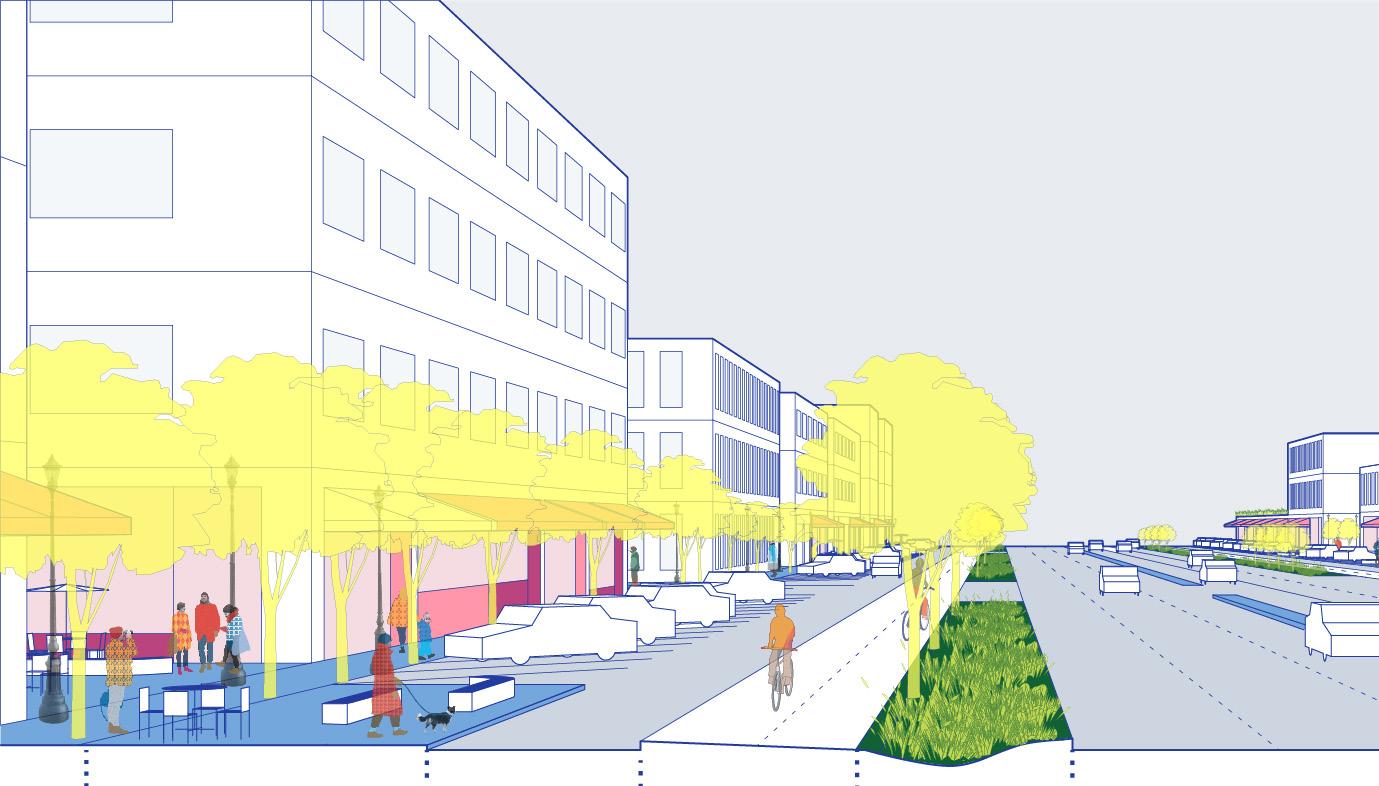
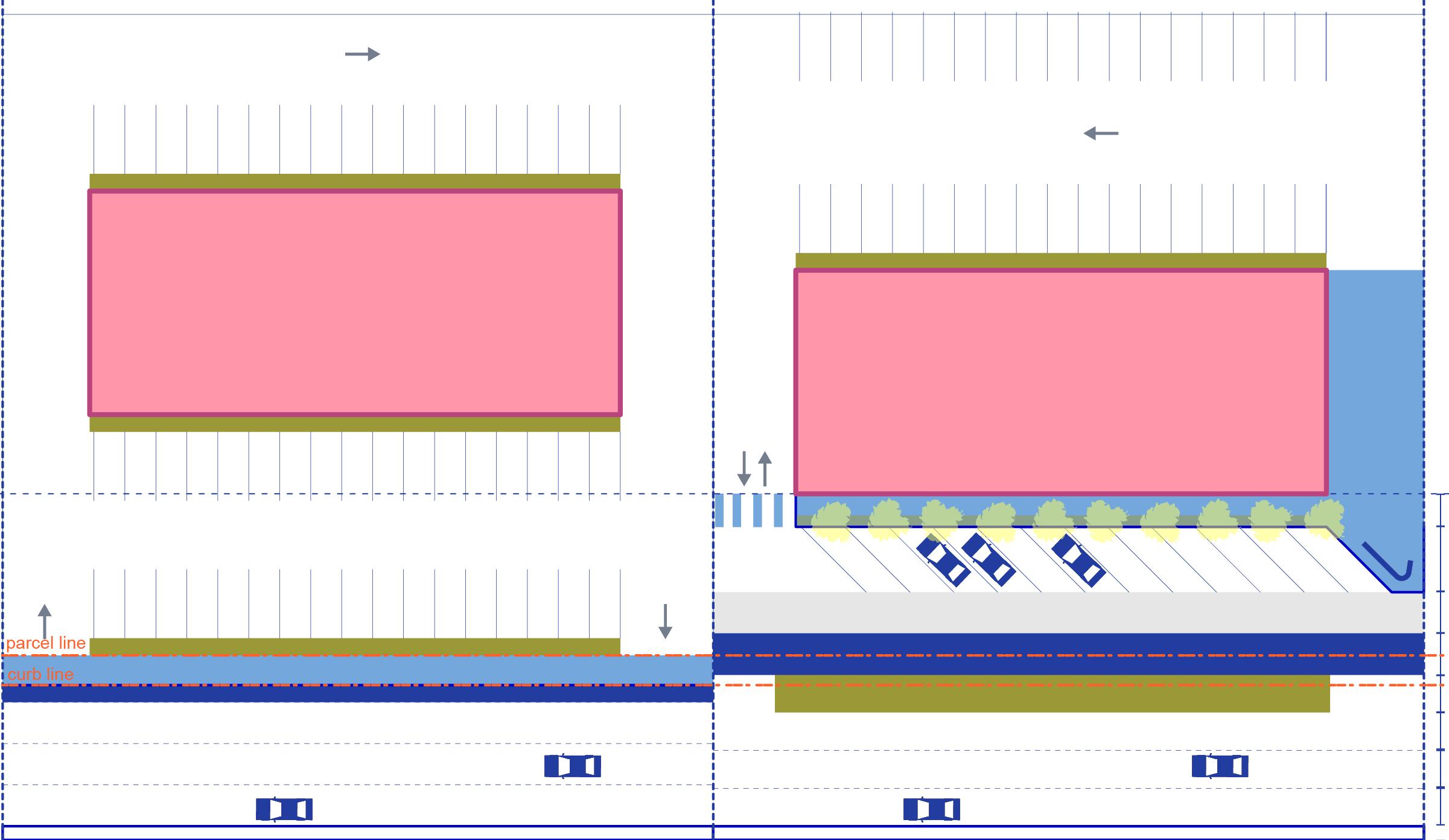
For local traffic and connected to additional parking behind buildings 11’ Bike Path Bidirectional protected bike path
Planted Filter
Bioswale with rain garden plantings and a few trees with an 8’ buffer from road 11’x 3 Road
Transit with less interruptions
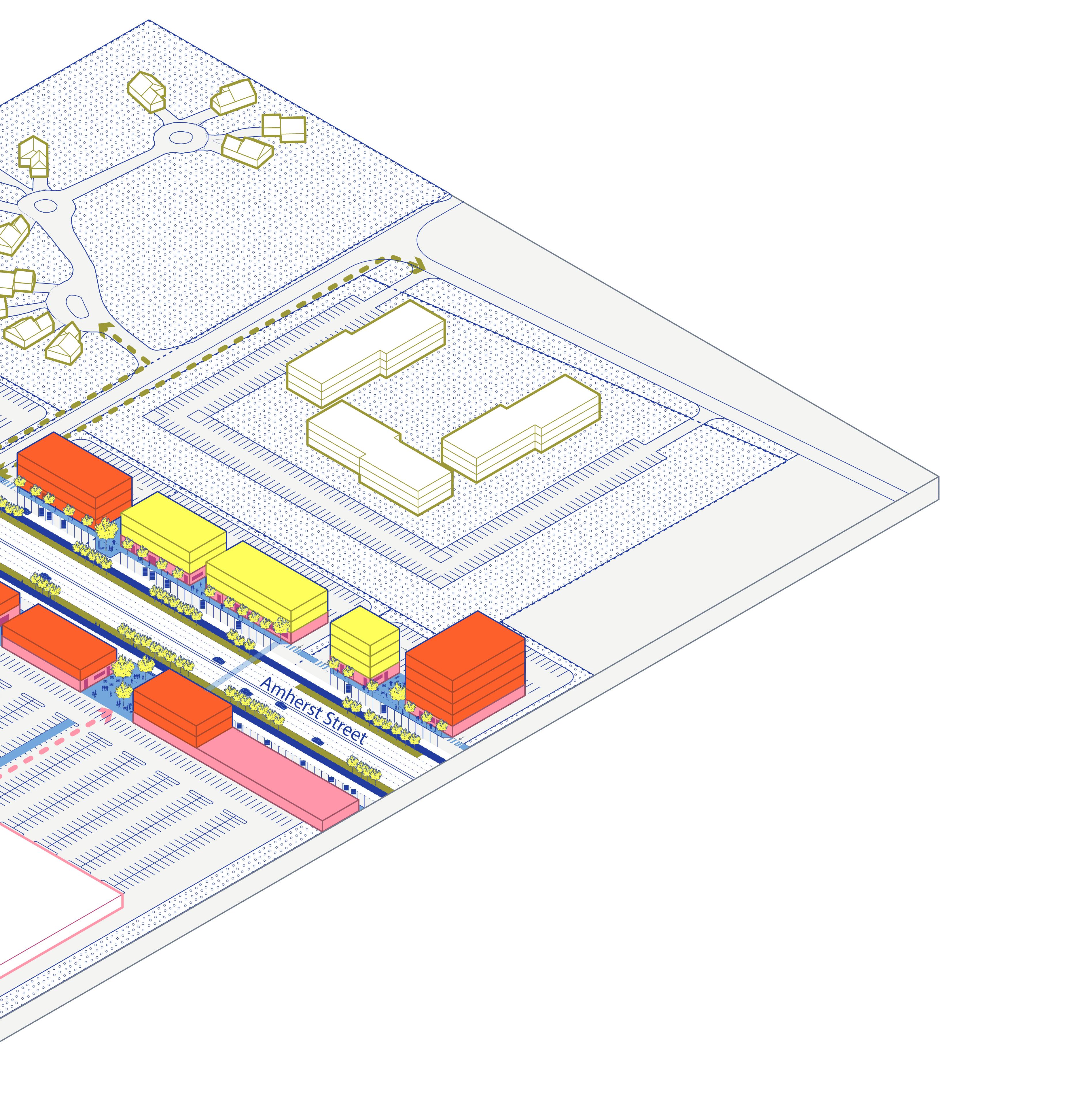
Amherst Street Visioning Concept: Recommendations propose retrofitting the corridor to be more attractive, coherent, and promote local businesses.
9.6’ Sidewalk Multi-tree pits under permeable pavement
12’ Carriageway
19’ Convenient Diagonal Parking or Extended Plaza
Amherst Street as Destination
Imagine Nashua seeks to enhance Amherst St’s role as an important connecting arterial in the city and allow the corridor to grow into a successful commercial destination for Nashuans and visitors. Allowing a wider mix of uses on Amherst Street can create more diversified traffic patterns and help preserve and enhance the City’s commercial tax base, while creating a welcoming and vibrant environment for every day use.
Recommendation 2
Timeframe: Near-term
Adjust dimensional constraints to enable new development to have a less suburban, auto-oriented character and a more walkable, active corridor character
• Relax minimum lot size, frontage requirements, and setbacks.
• Right-size parking requirements and require it to be located in the rear
Recommendation 4
Timeframe: Mid-term
Reposition the street as a mobility-oriented corridor
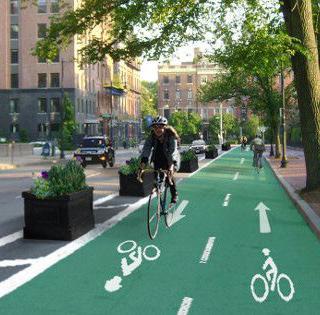
• Evaluate opportunities for developing protected bicycle lanes and opportunities for creating shared bicycle/ pedestrian pathways to increase safety and accessibility for all ages and abilities
• Evaluate sections of the corridor where introducing a carriageway is appropriate in terms of commercial activity and means of traffic calming
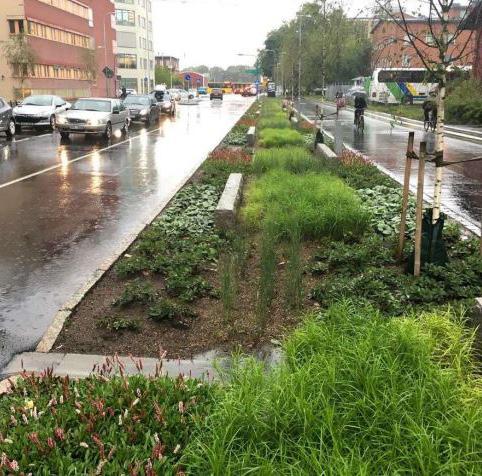
What is Green Stormwater Infrastructure (GSI)?
GSI is a set of tools and practices that mimic natural methods of storing, infiltration and/or filtering stormwater.
Learn more about GSI tools and strategies on page 143.
Recommendation 3
Timeframe: Near-term
Create active commercial front and improve access management
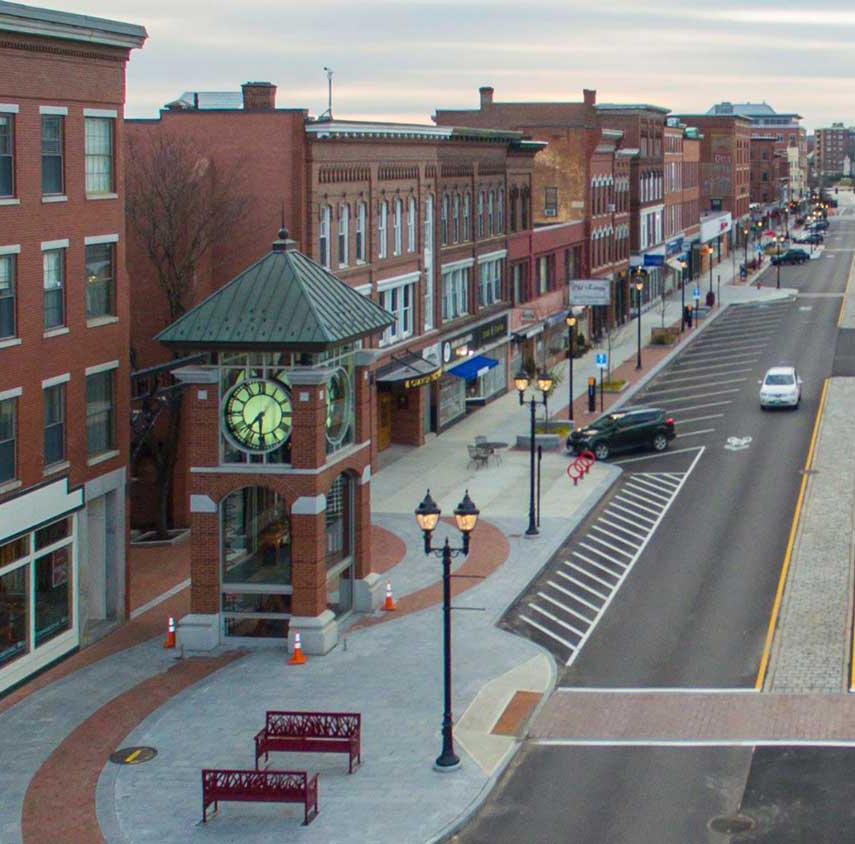
• Explore carriageway layout with diagonal parking on commercial front as incentive to businesses for increased customer attraction, and as a traffic calming technique, through further feasibility or traffic studies, coordination with private property owners, and a temporary pilot layout.
• Create signage and storefront guidelines on commercial corridors such as Amherst St. and Daniel Webster Highway to enhance the corridor’s identity.
• Provide highly visible crosswalks at key intersections with safety enhancements such as crosswalk lighting systems or rapid flashing beacons, where warranted
• Provide sheltered bus stops with clear transit information and consider as community placemaking opportunity.
• Add additional stops through the development process, at retail locations like supermarkets. Determine what regulatory changes need to happen to encourage this process through the publicprivate process.
Allowing a wider mix of uses on Amherst Street can create more diversified traffic patterns and help preserve and enhance the City’s commercial tax base, while creating a welcoming and vibrant environment for every day use.
Recommendation 5
• Develop a comprehensive wayfinding strategy with a focus on multi-modal connectivity.
• Develop entrance corridor signage that both welcomes and guides visitors to key destinations in Nashua
• Perform a traffic analysis study to better accommodate safety concerns.
Timeframe: Near-term
Incorporate landscaping and green stormwater infrastructure development and improvement
• Provide planted filter for stormwater management and as a traffic buffer
• Integrate stormwater infiltration and vegetal filtering
• Provide narrow long continuous multi-tree pits under permeable pavement.
• In areas of high concentration of runoff, consider the incorporation of underground storage cells, preferably under paved surfaces, to encourage stormwater infiltration
9.6’ Sidewalk 12’ Carriageway
Bike Path
Planted Filter
x 3 Road
Convenient Parking
Planted filter as buffer from highway and stormwater management.
Enhance connections to nearby existing office buildings, retail buildings and residential areas.
Green Infrastructure
Raingarden in Uppsala, Sweeden
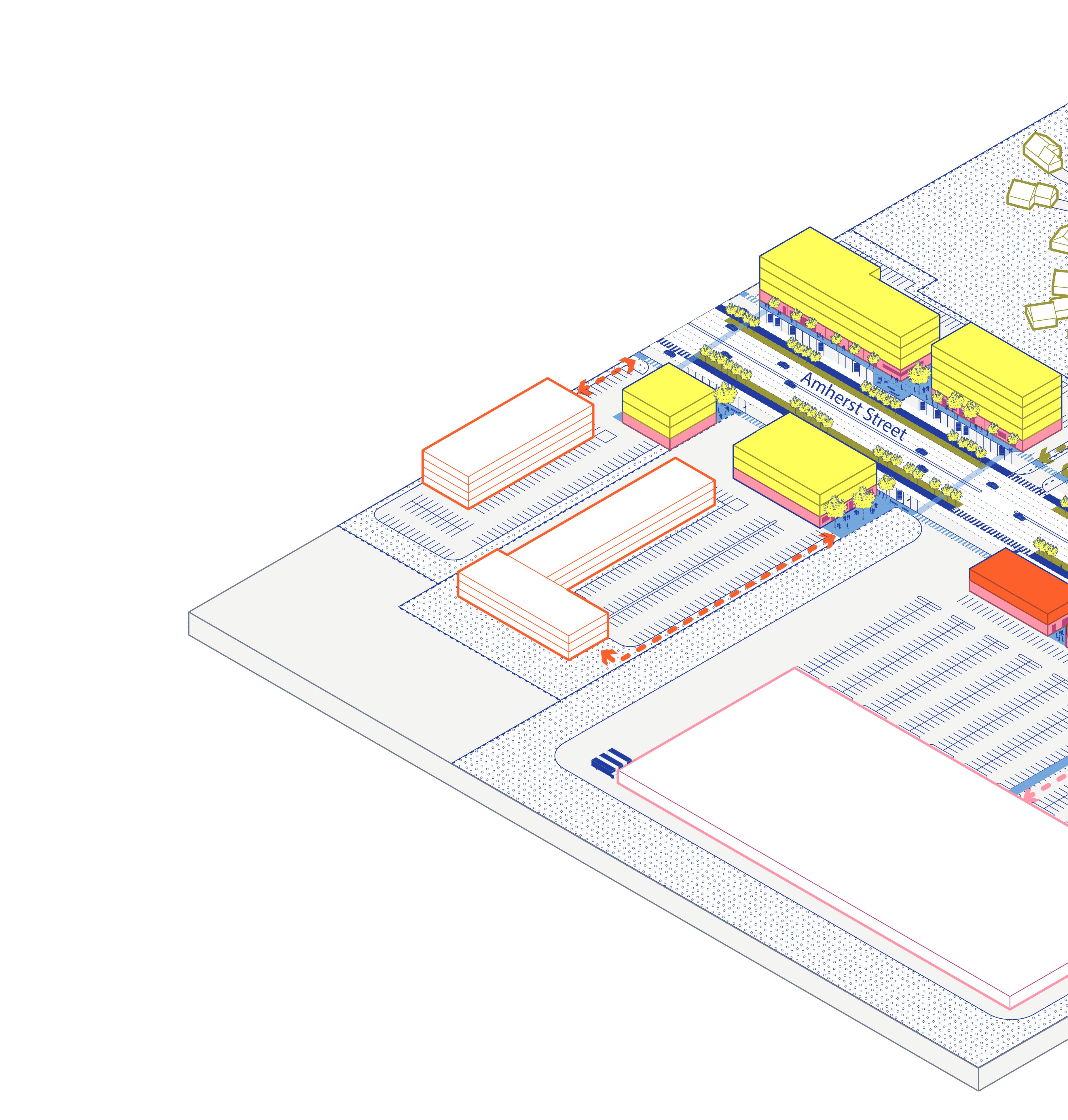
Amherst St Visioning Concept
Upzoning/ greater density
Greater density to encourage land values that will justify redevelopment of existing income-generating uses. Up to 4-story mixed use development with active retail on ground floor and residential and/or office spaces on upper stories.
Mobility-oriented corridor
Accommodate multiple mobility options for pedestrians, bikes, cars and public transit, including protected bike lane, continuous sidewalks, crosswalks, bus stops and convenient parking.
Boston Bike Lane
Concord, NH.