BEVERLY DESIGN STANDARDS
Updated 2022.08.17
Purpose
A. To set design standards for the development of mixed-use residential and commercial buildings in specific growth areas and neighborhood centers.
B. To foster walkable and mixed-use districts with ground story active uses and public amenities along primary corridors.
C. To ensure redevelopments and new developments have building dimensions and characteristics that respect their context.
D. To minimize the visual and pedestrian impact of vehicular access and parking.
E. To support pedestrian safety and prioritize sidewalk continuity.
F. To promote the principles of transit-oriented development.
Walkable Districts Tier Framework
Project areas are categorized according to specific Walkable District (WD) Tiers ranging from Tier 5 to Tier 2, corresponding to descending building height and scale. This framework is intended to promote walkable areas that prioritize the pedestrian experience as well as the principles of transit-oriented development that are appropriate for each tier. These principles include:
A. Bringing people, activities, buildings, and public spaces together;
B. Connecting jobs, services, and opportunities with people and homes;
C. Concentrating development efforts and infrastructure investment;
D. Supporting healthier lifestyles, walking and biking;
E. Reducing automobile use, traffic congestion, and travel time;
F. Reducing carbon footprint and negative impacts on the environment; and
G. Promoting long-term sustainability, equity, and prosperity.
Definitions
In addition to the definitions found in §300-5 Terms defined, the following definitions apply:
A. BASEMENT
B. BUILDING HEIGHT
See “Basement” in §300-5 Terms defined.
See “Height” in §300-5 Terms defined.
C. BUILD-TO ZONE Area between the minimum and maximum front setbacks.
D. CELLAR
E. FAÇADE
See “Cellar” in §300-5 Terms defined.
The exterior wall of a building oriented in whole or in part toward a front lot line.
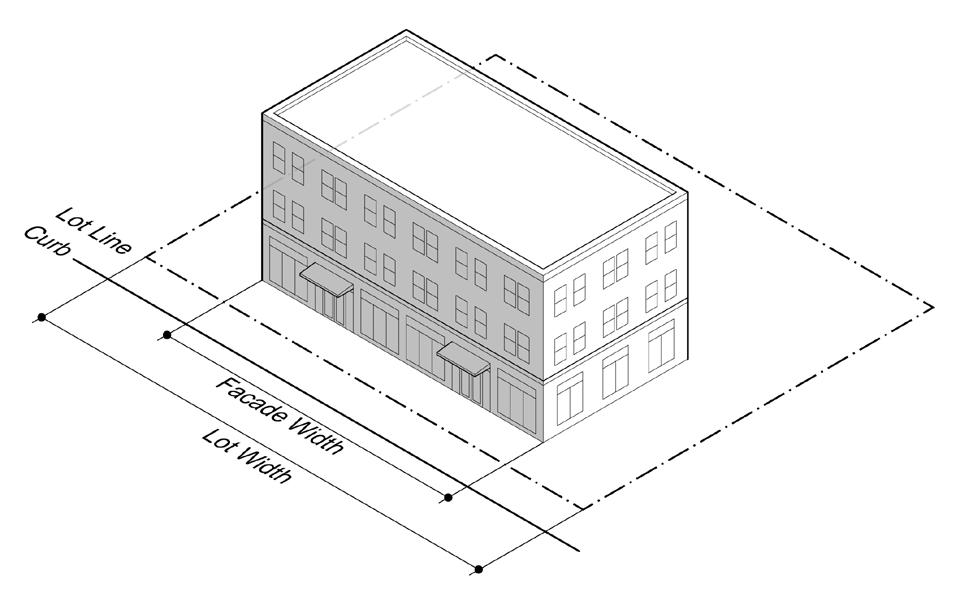
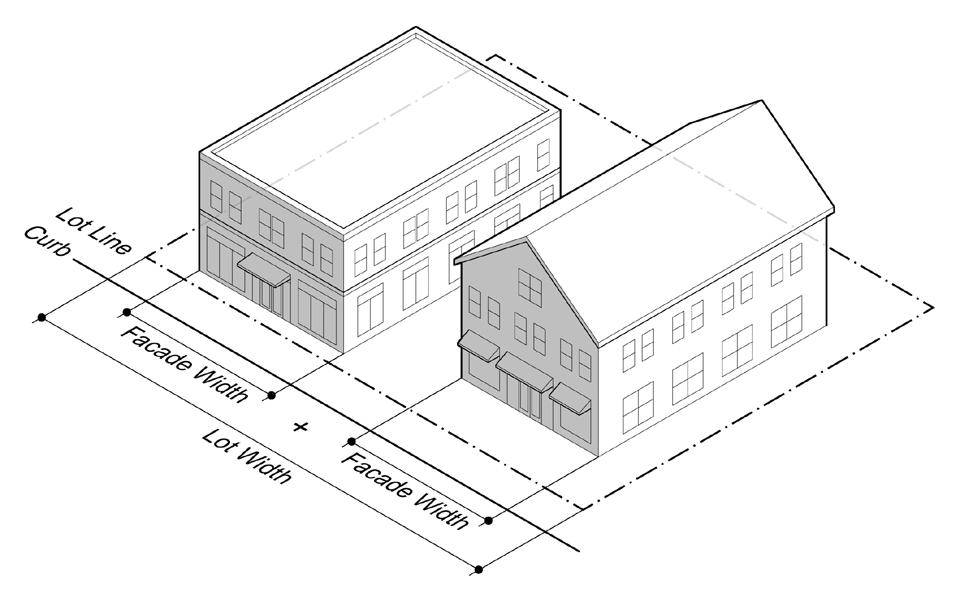
F. FAÇADE BUILD OUT
The ratio of the façade width to the lot width, calculated by dividing the cumulative façade width by the lot width.
G. FLOOR PLATE
H. FORECOURT
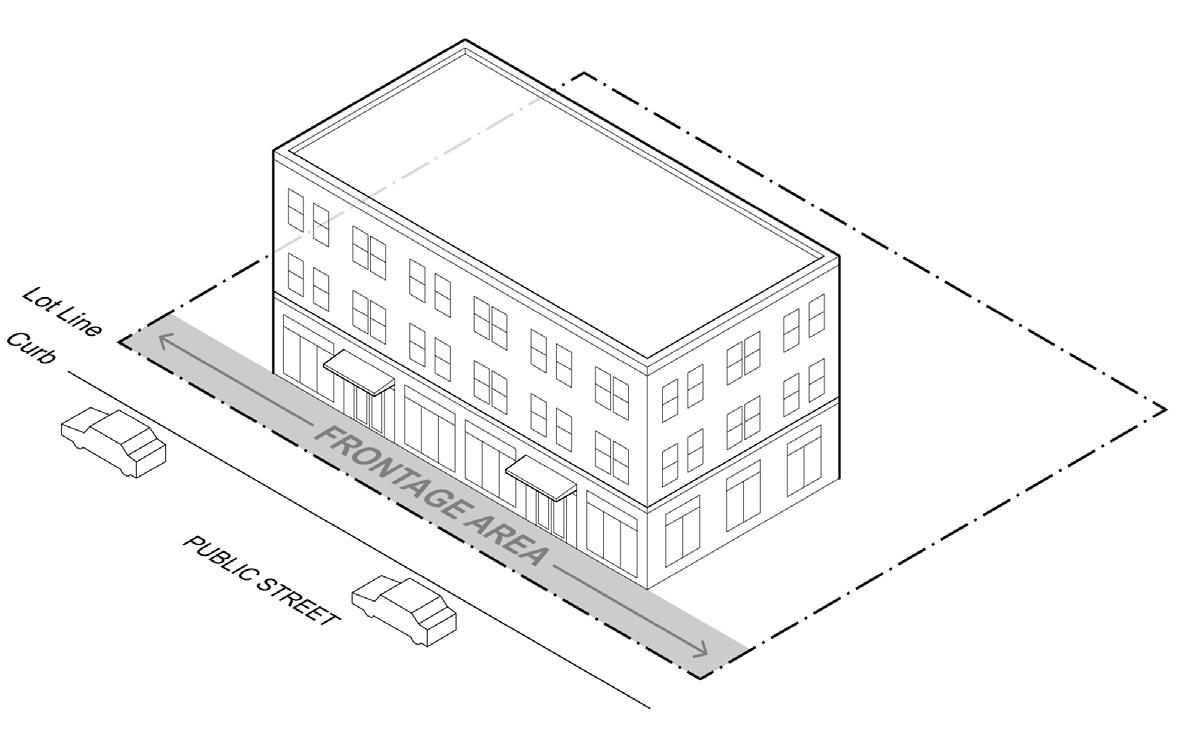
I. FRONTAGE AREA
The total gross floor area of an above-grade single story of a building, including enclosed floor space intended for the parking of motor vehicles, as measured to the exterior faces of the walls.
An open space formed by a substantial recess in the central portion of a building's facade.
The area of a lot between the building facade(s) and any front lot line(s), extending fully to each side lot line(s).
J. FRONTAGE TYPE
K. FURNISHING ZONE
A distinct combination of façade and frontage area design features.
The portion of the sidewalk between the curb and the walkway used for street trees, landscaping, transit stops,
L. LANDSCAPE AREA
M. LOT LINE
N. LOT LINE, FRONT
O. LOT LINE, SIDE
P. LOT LINE, REAR
Q. LOT WIDTH
R. OPEN SPACE
S. PARTY WALL
T. PRINCIPAL ENTRANCE
U. RAIN GARDEN
V. SCREENING
W. STEP-BACK
X. STORY
Y. STORY, GROUND
Z. STORY, HALF
AA. STORY, UPPER
street lights, and site furnishing See Figure 13 “Parking Lot Planting Strip”.
The area of a lot covered by any combination of trees, shrubs, perennials, grass or the horticultural elements, decorative stonework, pavers, screening, or other landscape architectural elements, all of which are designed to absorb and filter stormwater runoff, enhance the visual amenity of a property, and/or to provide an amenity for common use by the occupants of a building.
The boundary that legally and geometrically demarcates a lot.
Any lot line abutting a thoroughfare, excluding an alley.
Any lot line other than a front or rear lot line.
Any lot line which is parallel to or within forty-five (45) degrees of being parallel to a front lot line, unless that lot line is a side lot line of an abutting lot.
The length of the front lot line of a lot.
A ground-level open-air landscape area including, but not limited to, natural woodlands, yards, forecourts, courtyards, and civic spaces, excluding driveways, parking spaces, and other surfaces intended for motor vehicles. See also Landscape Area.
A wall separating two attached buildings.
The addressed entrance to a building or commercial space.
Landscaped areas designed to absorb and filter stormwater runoff from impervious surfaces.
See “Screening” in §300-5 Terms defined.
A recess of an upper story façade a set distance behind the façade of the story below.
See “Story” in §300-5 Terms defined.
The lowest story of a building with a finished floor at or above the finished ground level next to a building at the facade.
See “Story” in §300-5 Terms defined.
Any story above the ground story of a building.
Lot Standards Applicable to all WD Tiers
This section provides an explanation of the dimensional standards for lots within the WD Tiers, defines how to measure certain standards, and provides other requirements and reference information as necessary.
A. Street Hierarchy
a. The following streets are Primary Streets within applicable areas:
i. Bass River:
1. River St.
2. Bridge St.
ii. Downtown:
1. Rantoul St.
2. Cabot St.
3. Federal St.
4. Broadway St. (between Rantoul St. and Park St.)
5. Railroad Ave. (between Rantoul St. and Park St.)
iii. Beverly Harbor District:
1. Water St.
iv. Neighborhood Centers:
1. Colon/Cabot: Colon St., Cabot St., Rantoul St.
2. Ryal Side: Bridge St.
3. Colon/Essex: Essex St.
4. Prides Crossing: Hale St.
5. Beverly Farms: Hale St., West St., Oak St.
6. Cabot St: Cabot St.
7. Dodge St: Dodge St., County Way
8. Essex St: Essex St.
b. All other streets within applicable areas are Secondary Streets.
B. Building Placement
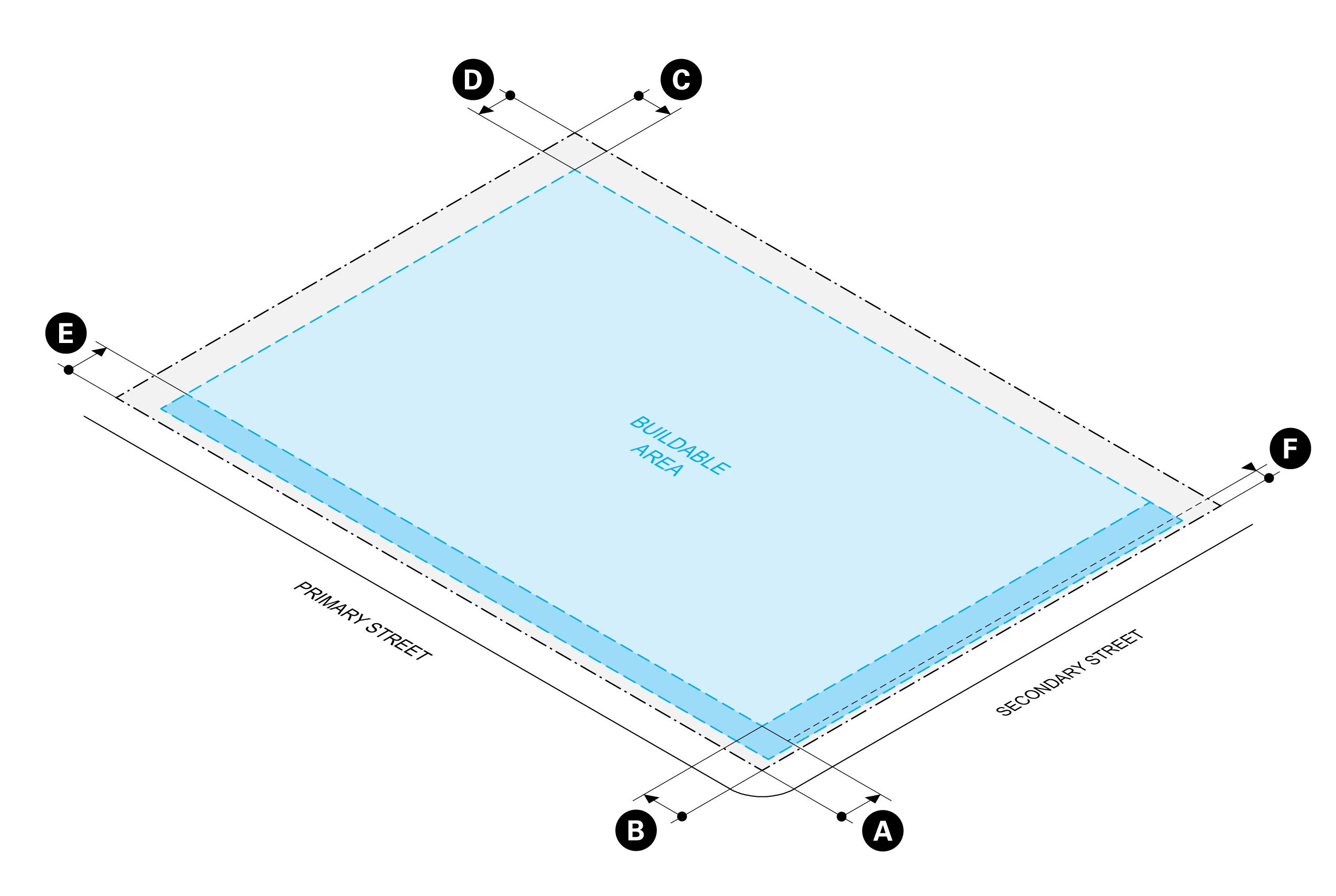
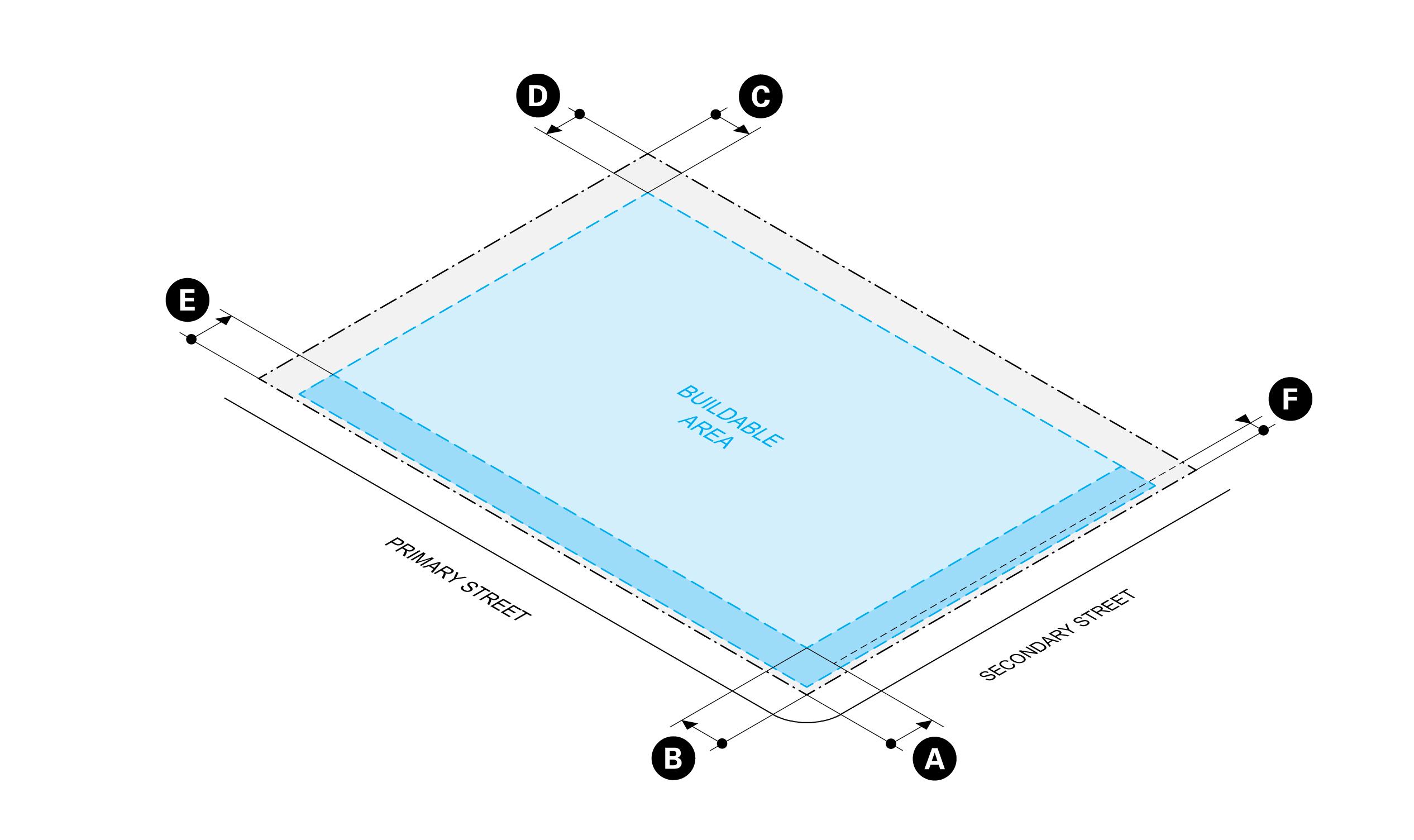
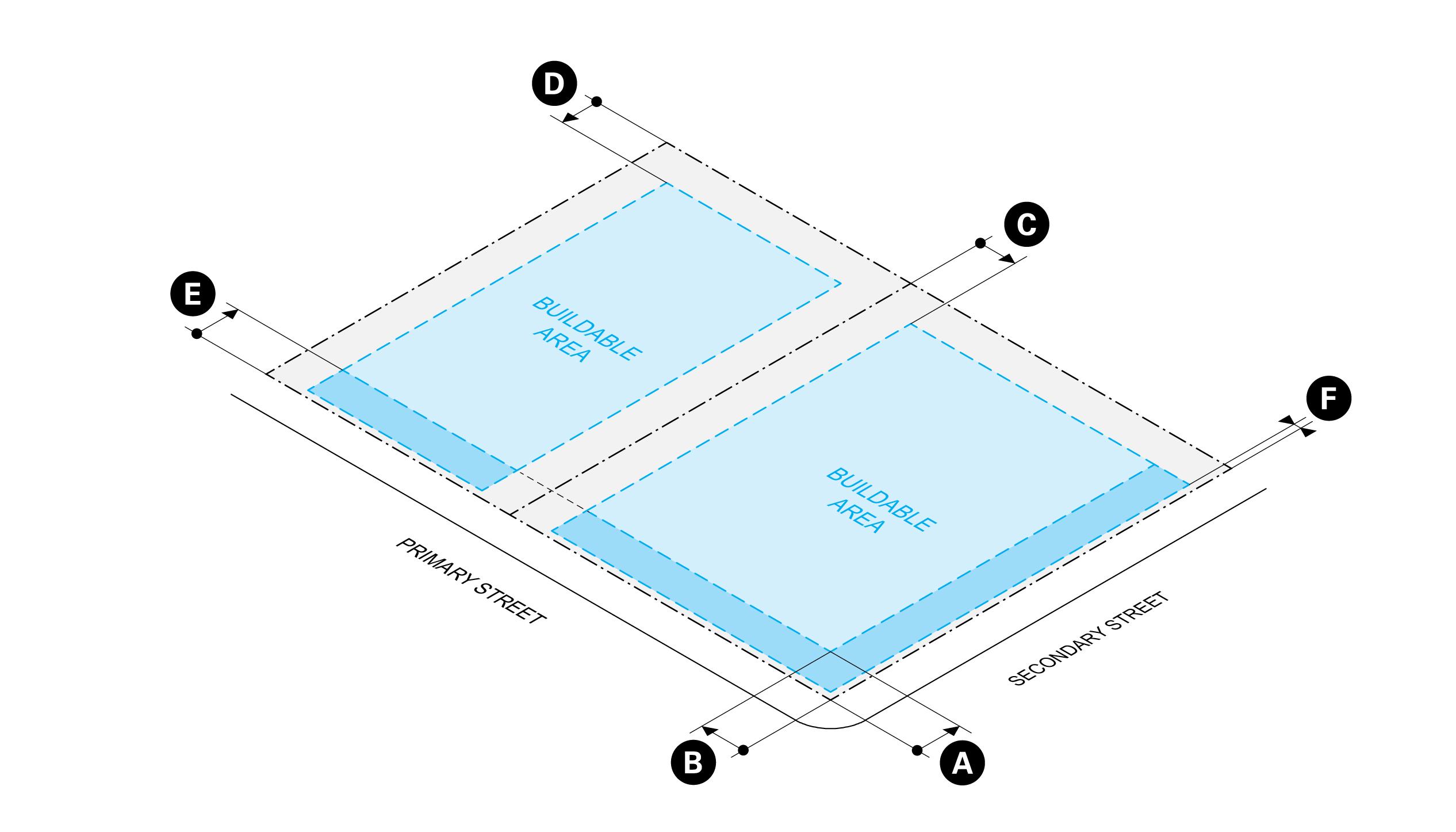
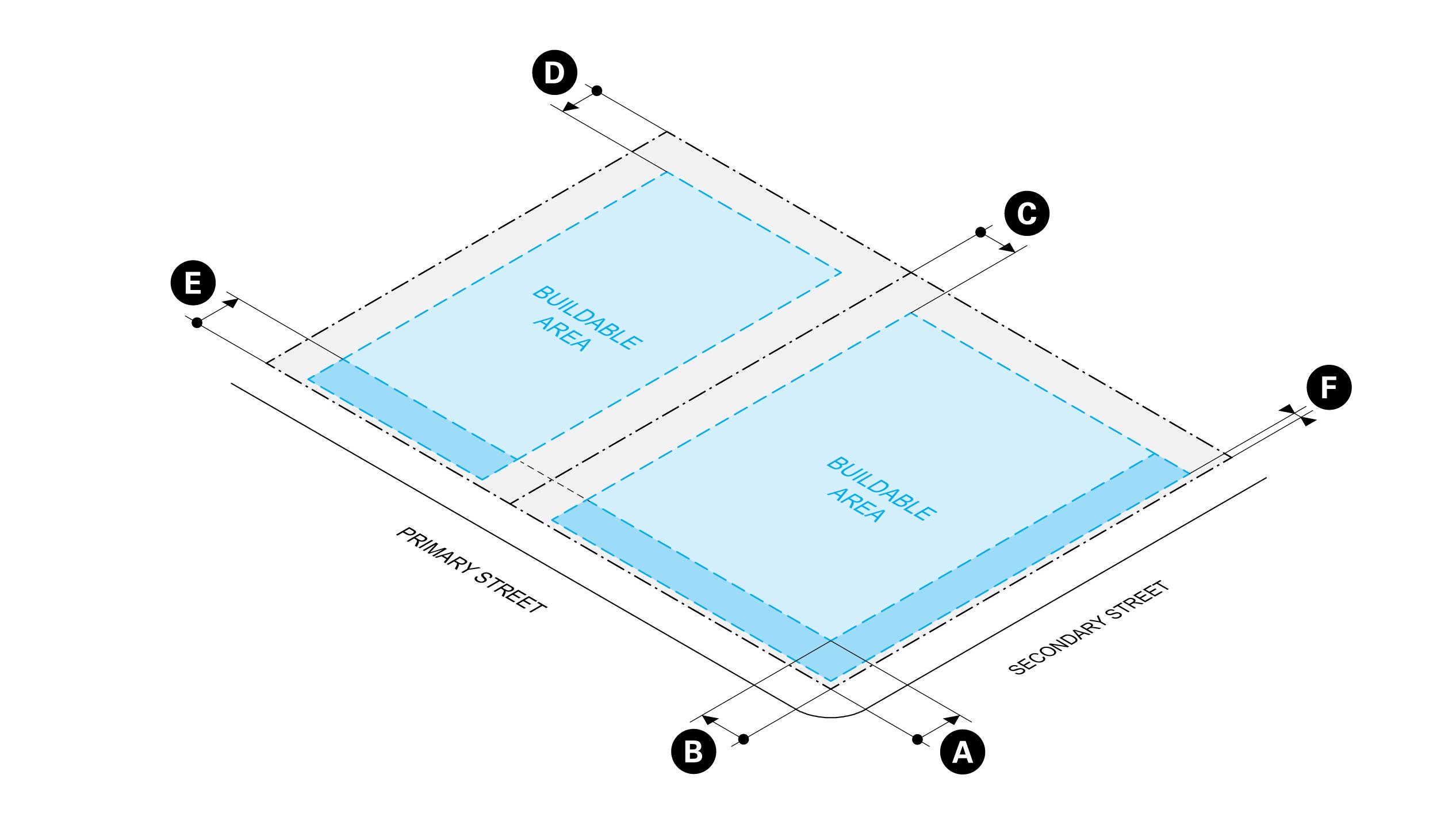
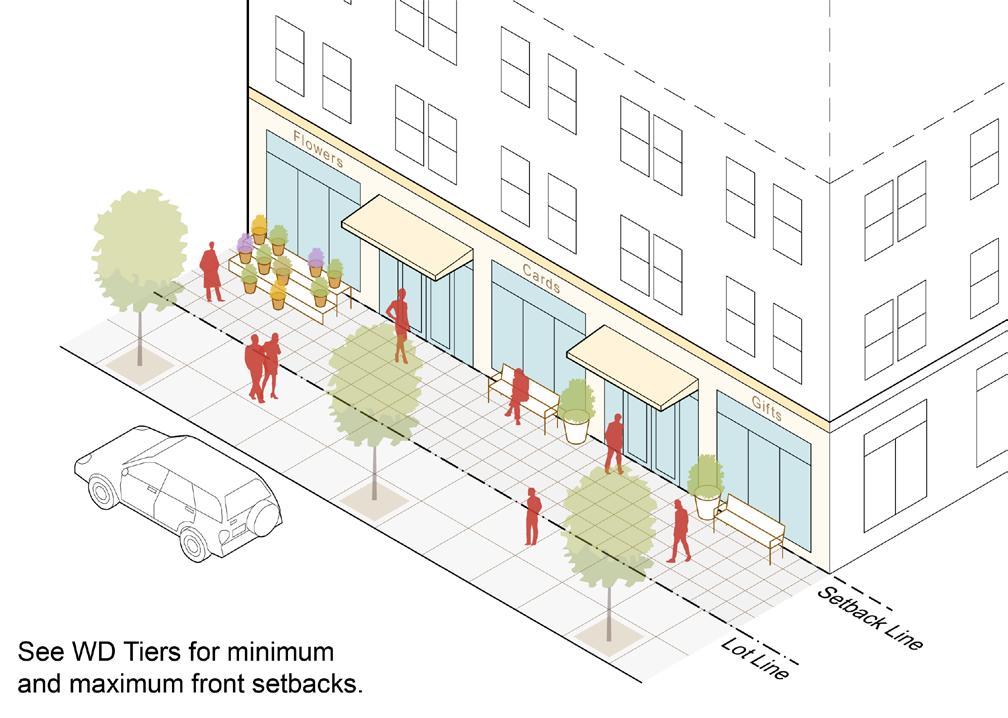
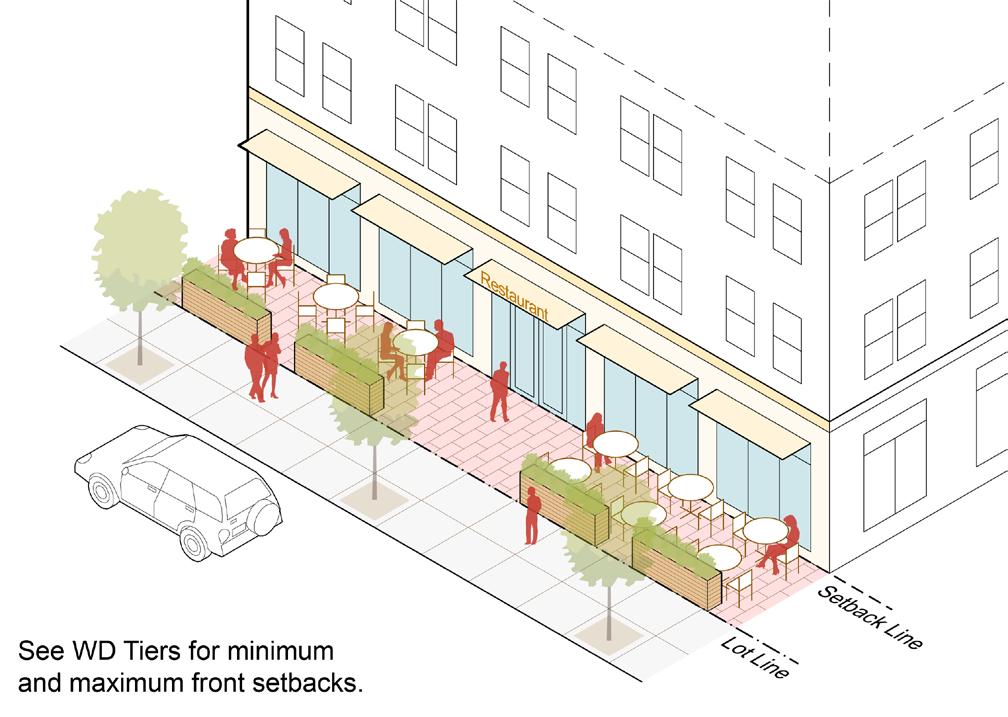
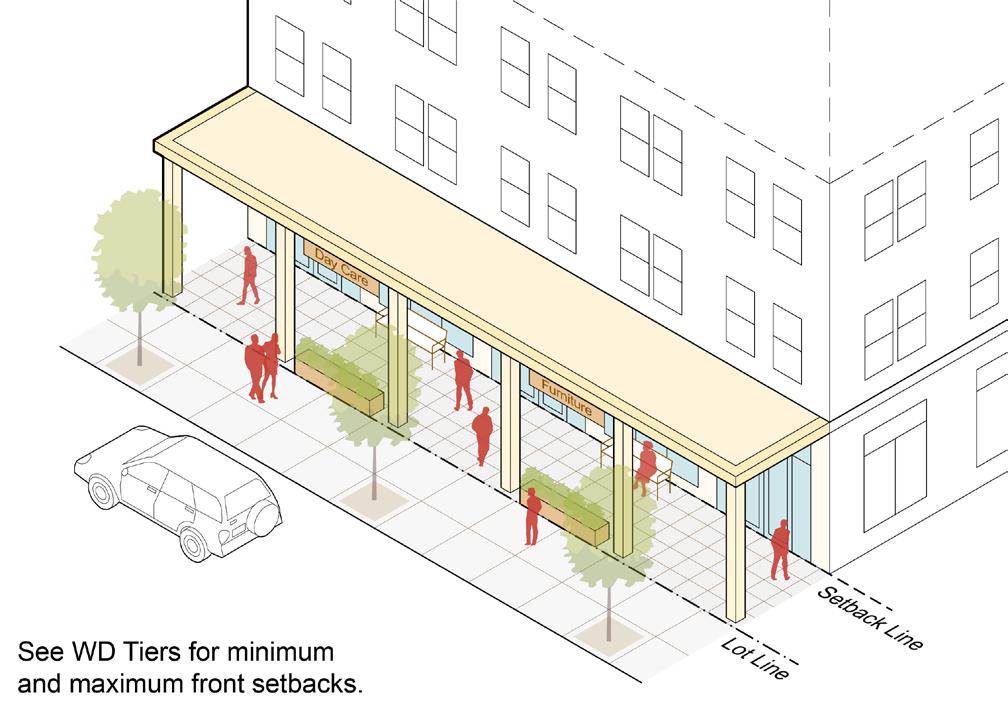
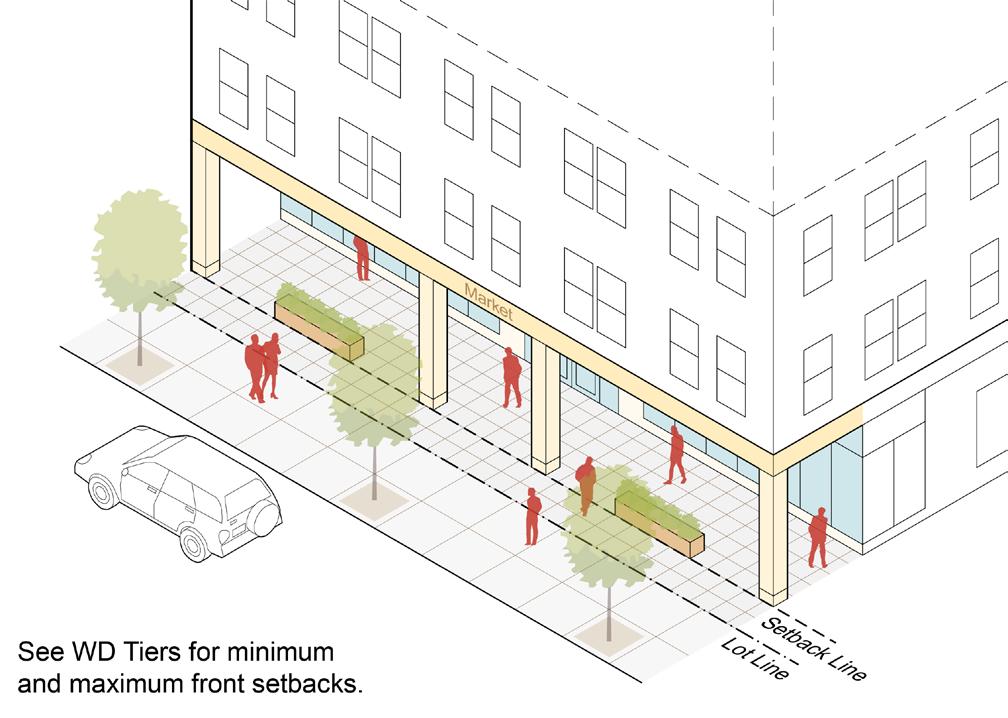
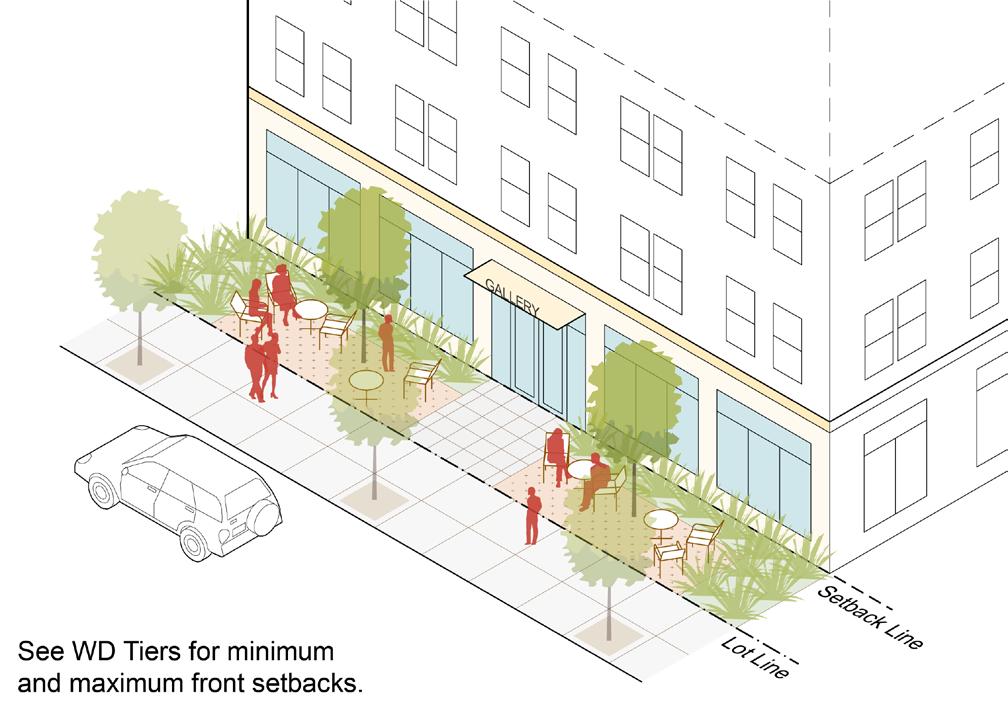
a. Building façade(s) must be built to any front lot line(s) within the build-to zone, at or between the minimum and maximum front setbacks, as specified in the Lot Standards for each WD Tier (Fig. 4).
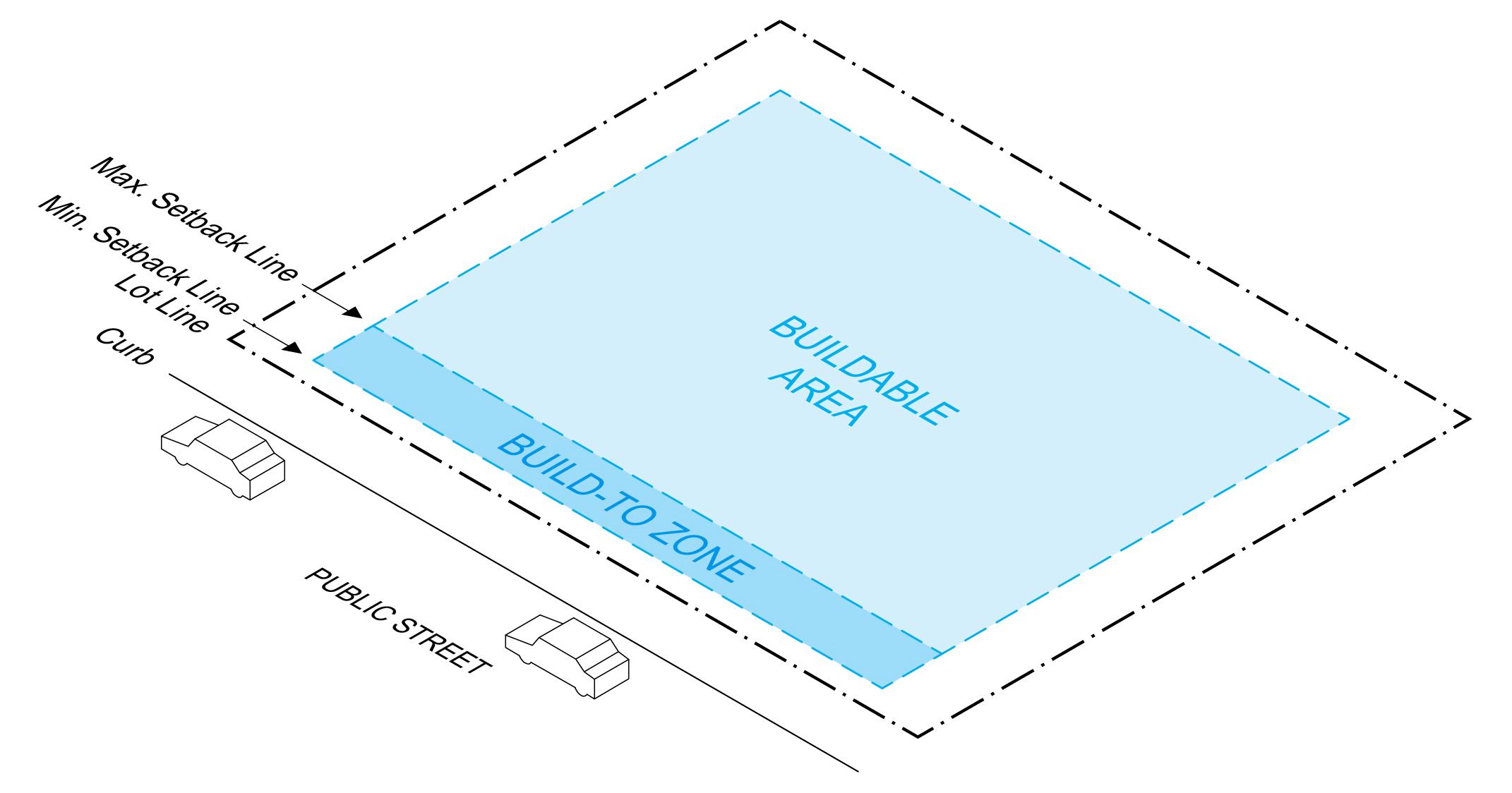
b. Building façade(s) must be built out to a percentage of the lot width as specified in the Lot Standards for each WD Tier.
i. Total Facade Build Out is calculated by dividing the total width of all façade(s) by the lot width and may be met cumulatively by multiple buildings. See Façade Build Out in Definitions.
ii. Forecourts with Ground Story Active Uses on all sides are considered part of the building for the purpose of measuring facade build out. See Forecourt in Definitions.
c. When development occurs on any lot abutting a sidewalk that is less than ten (10) feet in total width, inclusive of the furnishing zone, buildings must be setback an additional distance such that a sidewalk at least ten (10) feet in width is provided, inclusive of the furnishing zone. The minimum and maximum front setbacks are increased accordingly.
C. Number of Buildings
a. Multiple buildings are permitted on each lot, subject to the minimum Open Space percent for all lots.
D. Building Separation
a. Multiple buildings on a single lot must comply with the building separation distance at all points as specified in Building Standards for each WD Tier.
E. Parking Placement
a. Unless otherwise specified, all parking spaces must be located at or behind any required parking setback.
F. Lot Development
a. Lot occupation must comply with the minimum Open Space percent as specified for each WD Tier. Open Space is defined in Definitions.
Building Standards Applicable to all WD Tiers
This section provides an explanation of the dimensional standards for buildings within the WD Tiers, defines how to measure certain standards, and provides other requirements and reference information as necessary.
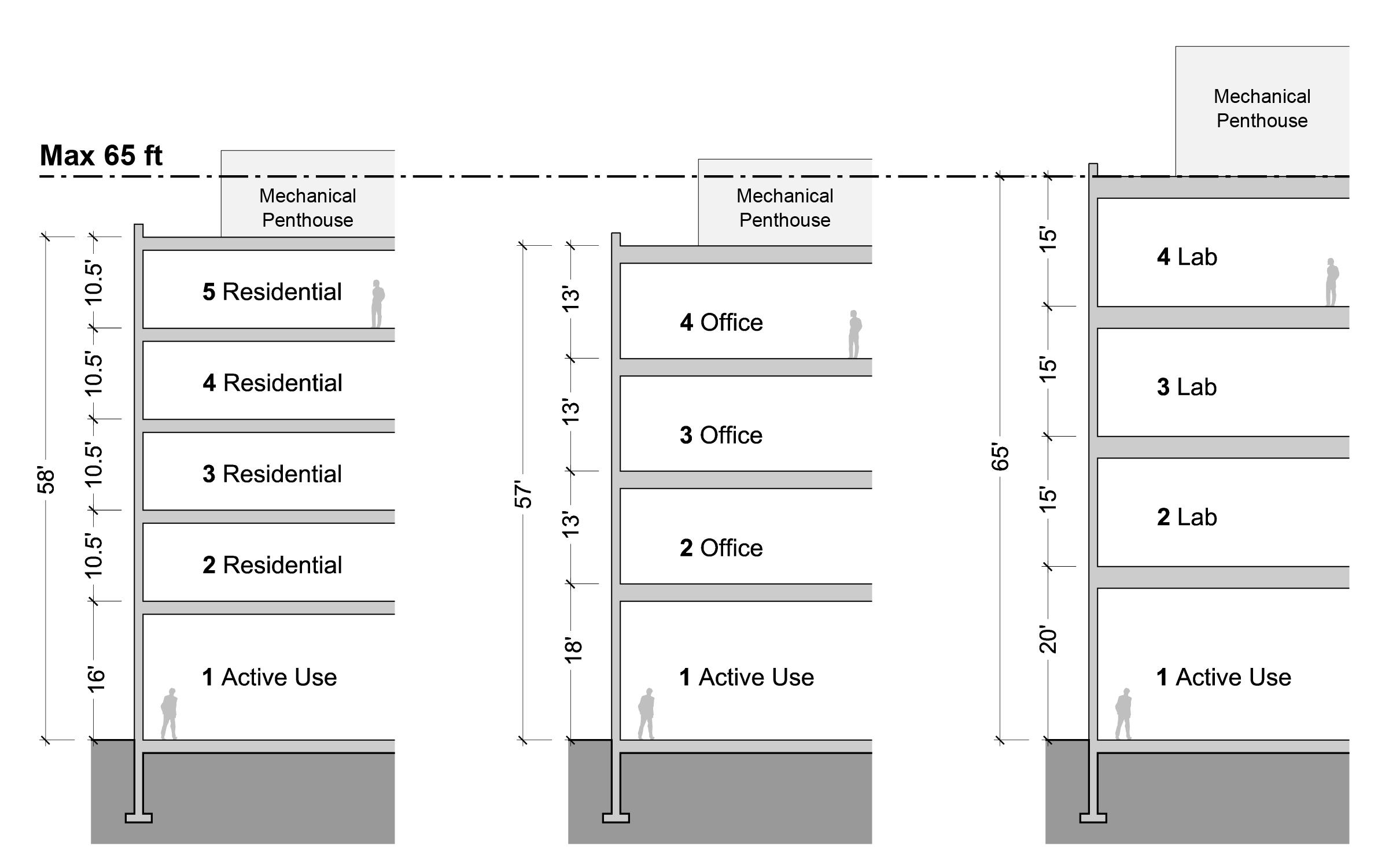
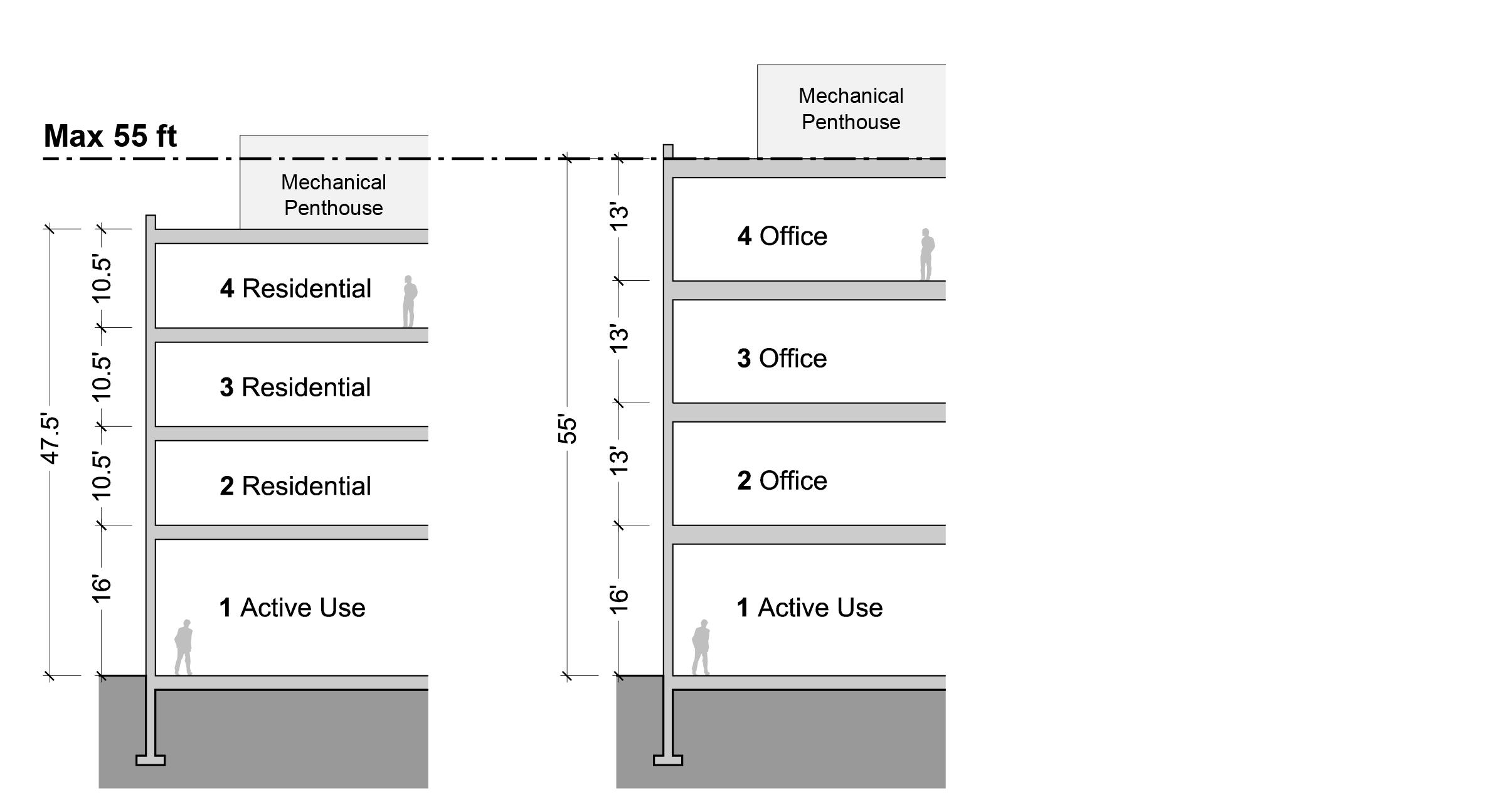
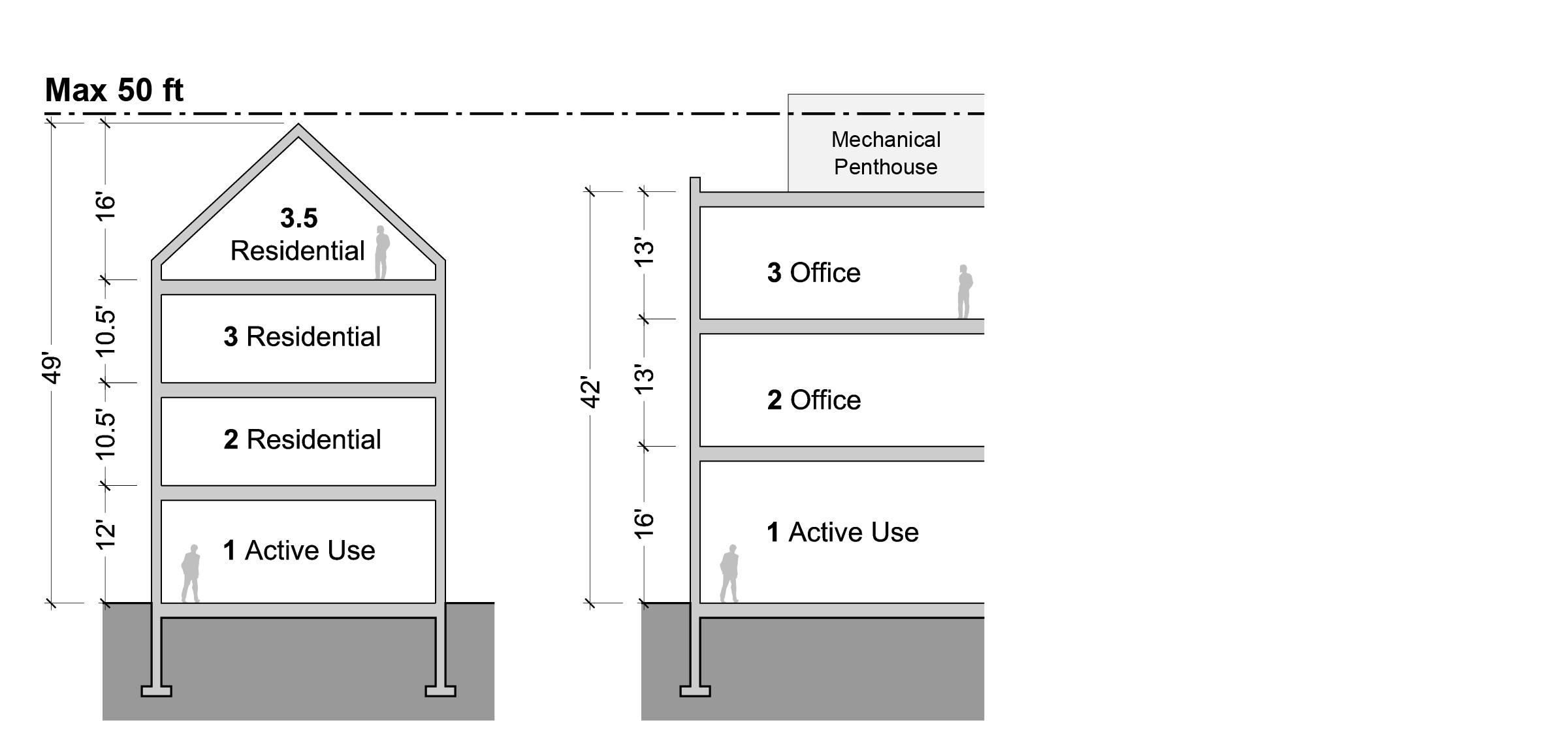
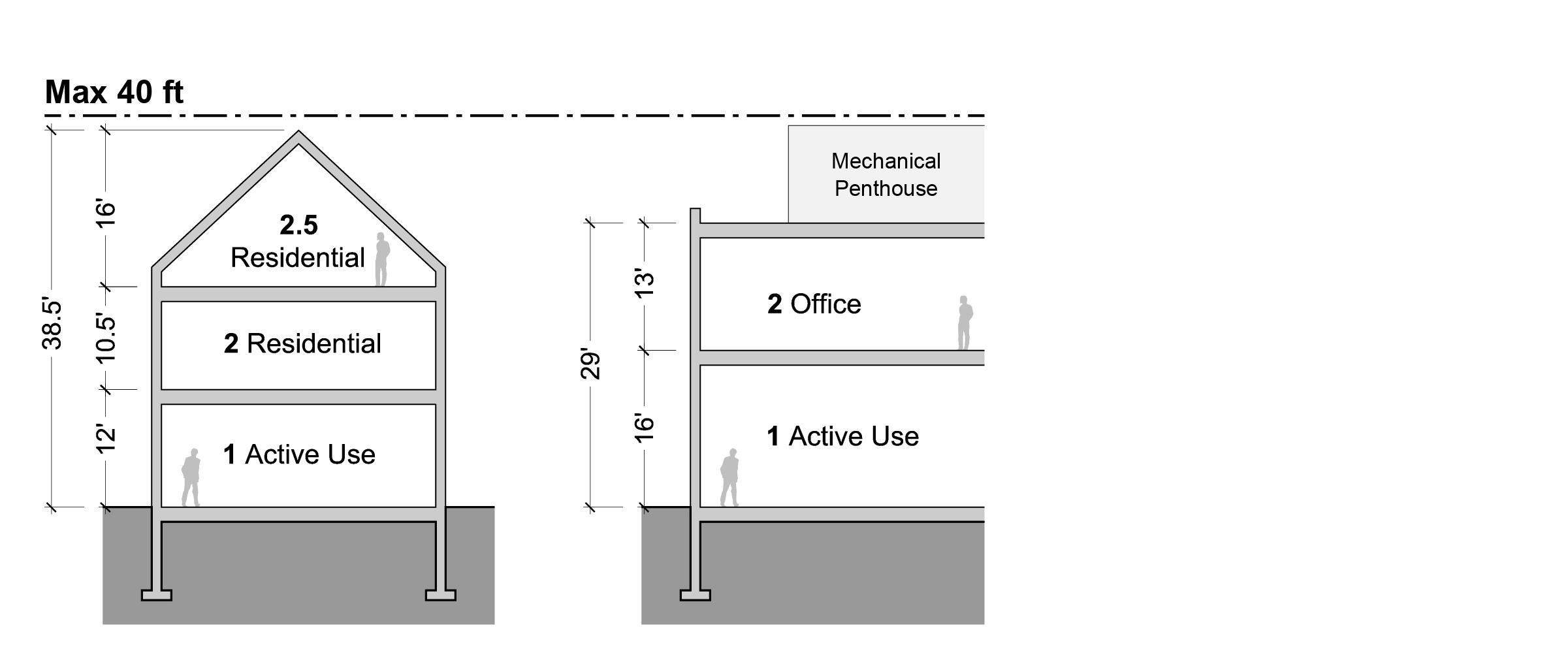
A. Building Height (Fig. 5)
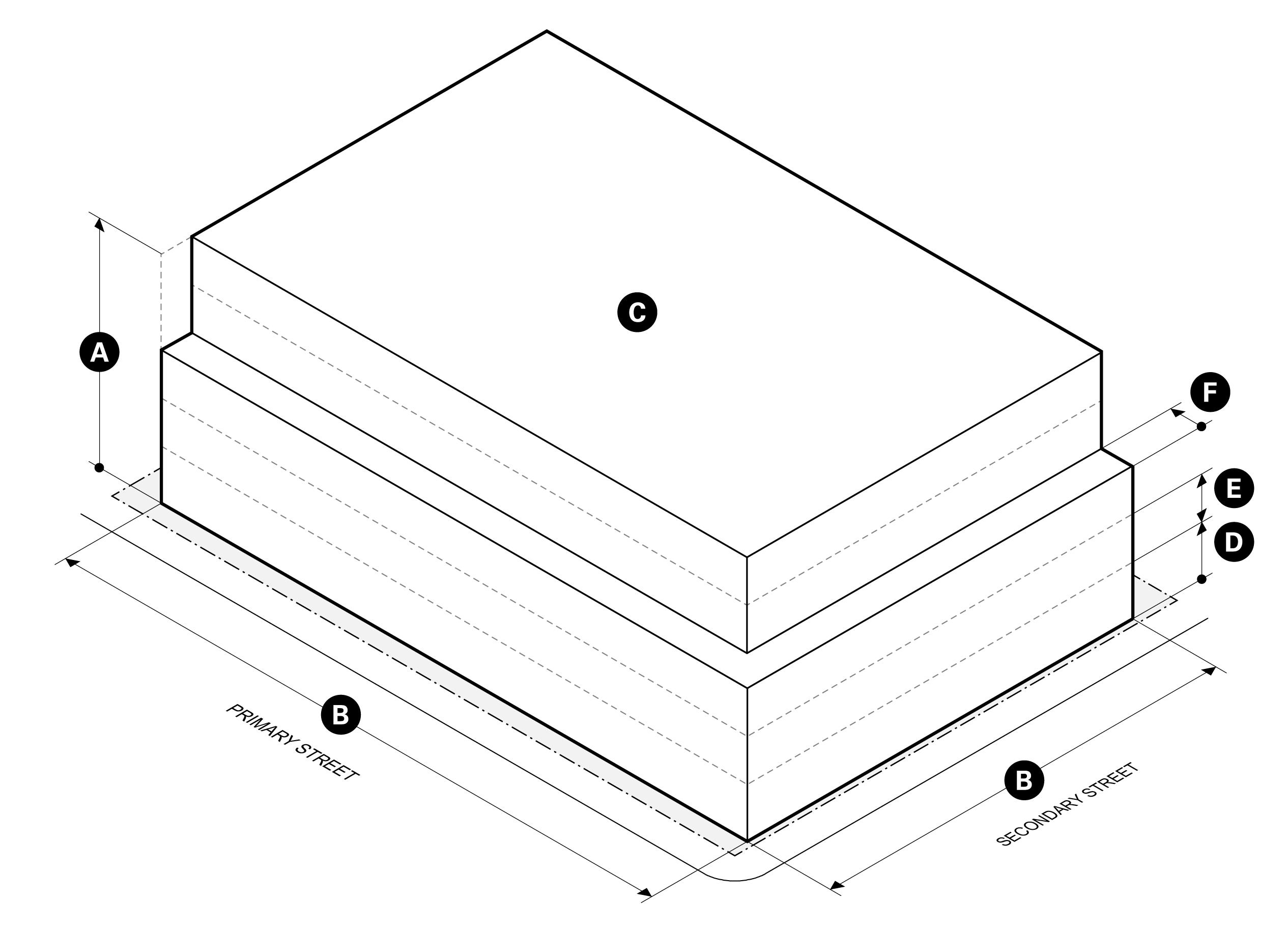
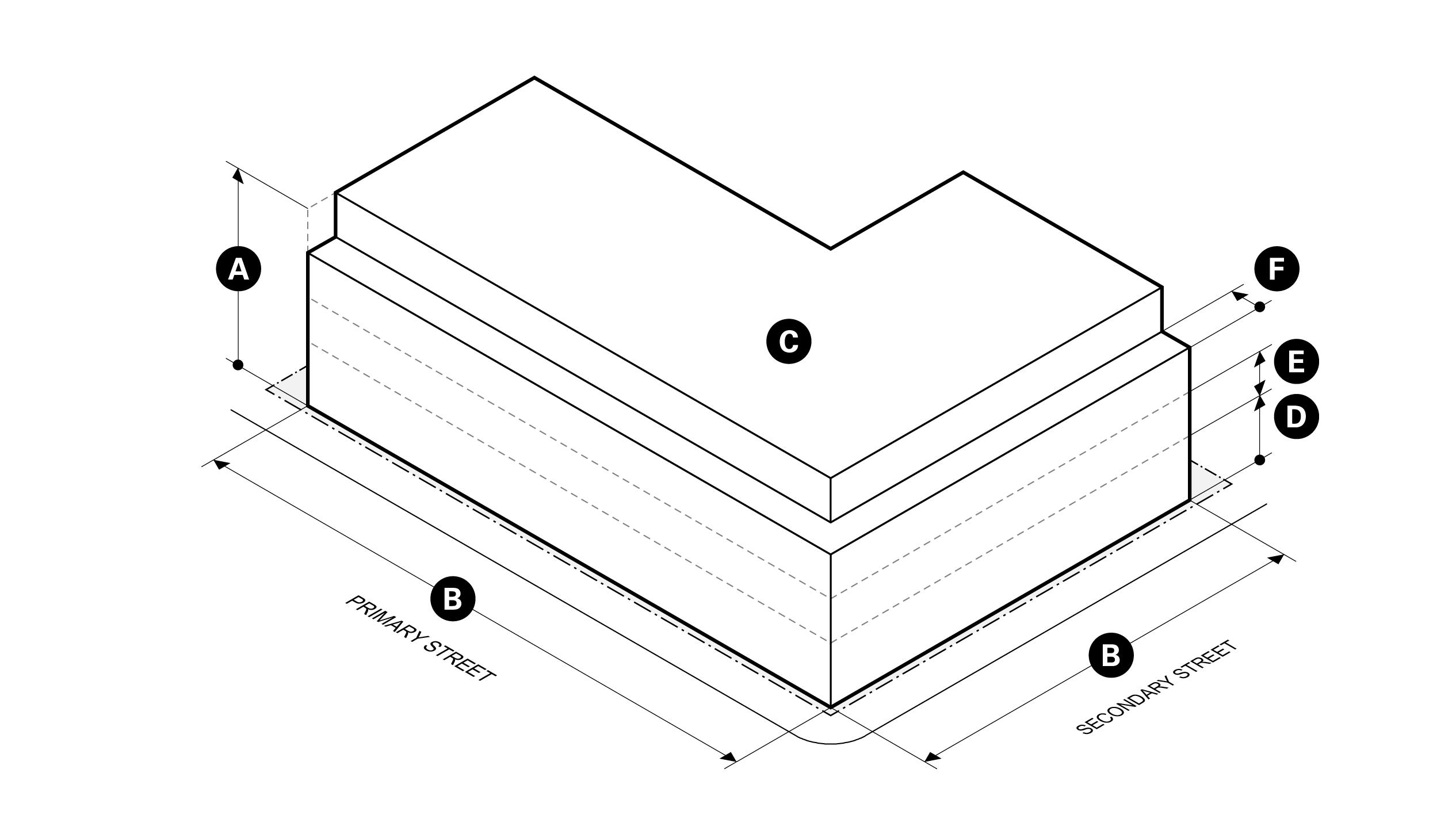
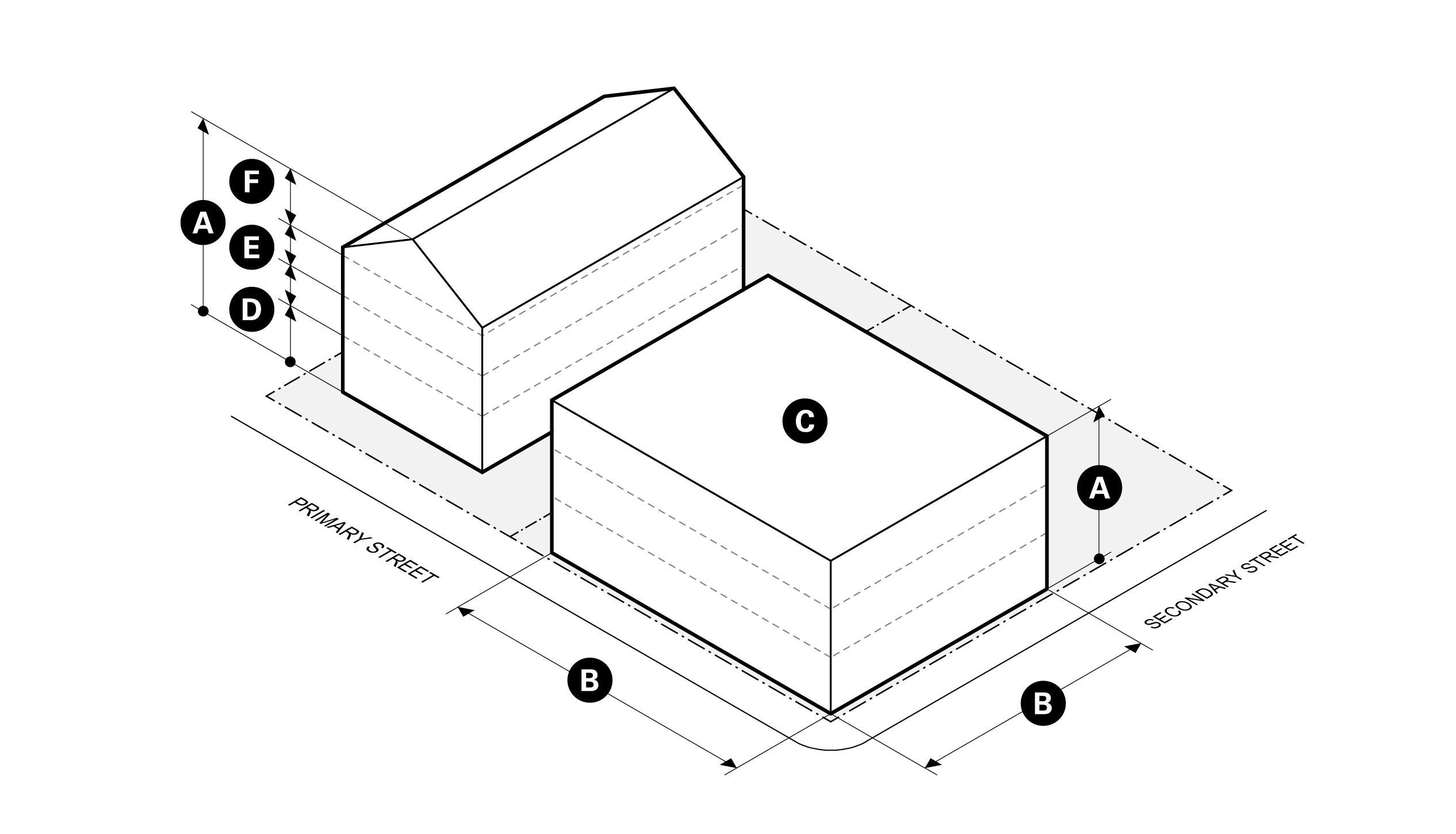
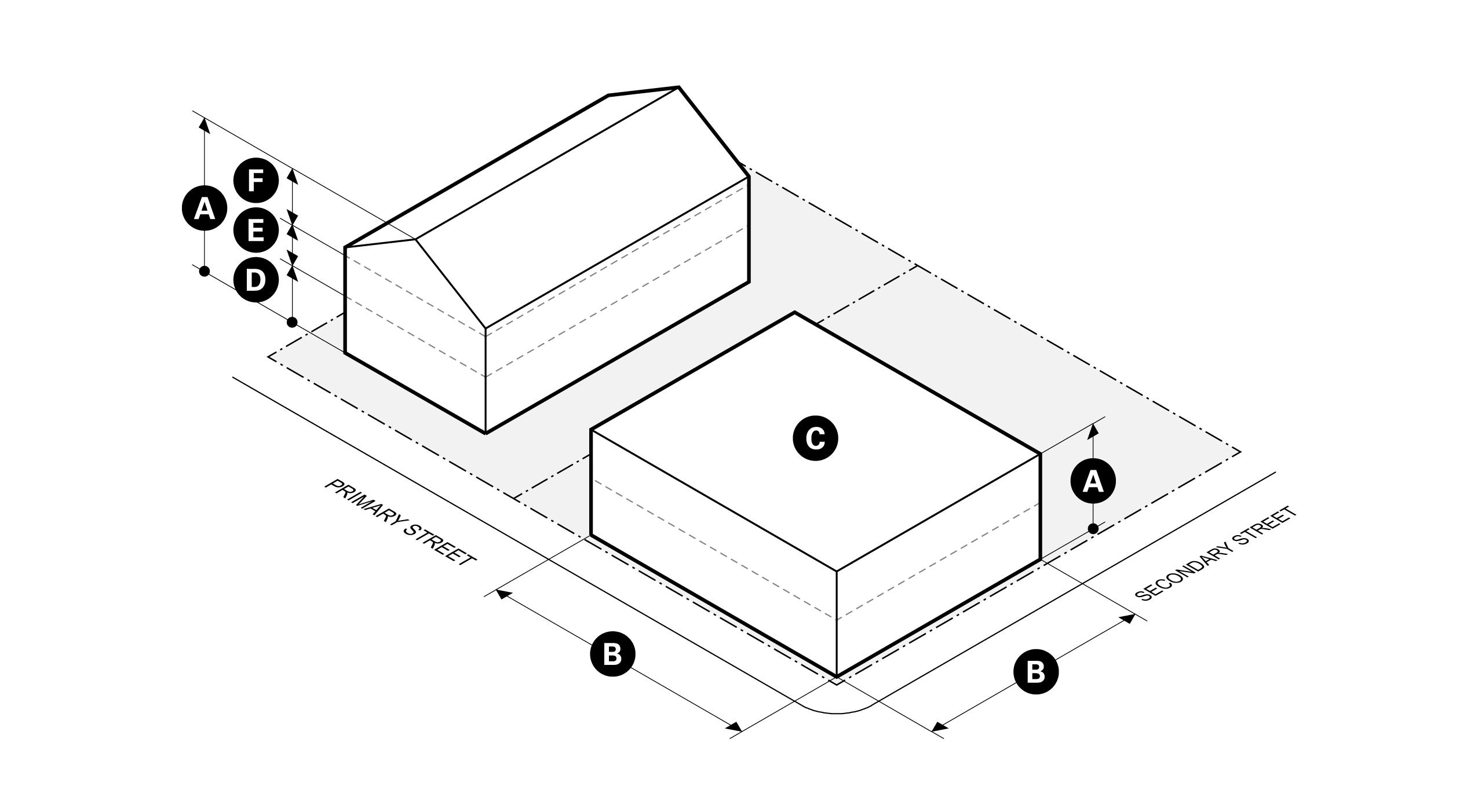
a. Buildings must comply with the maximum building height specified for each building type. Building height is measured as defined in Definitions.
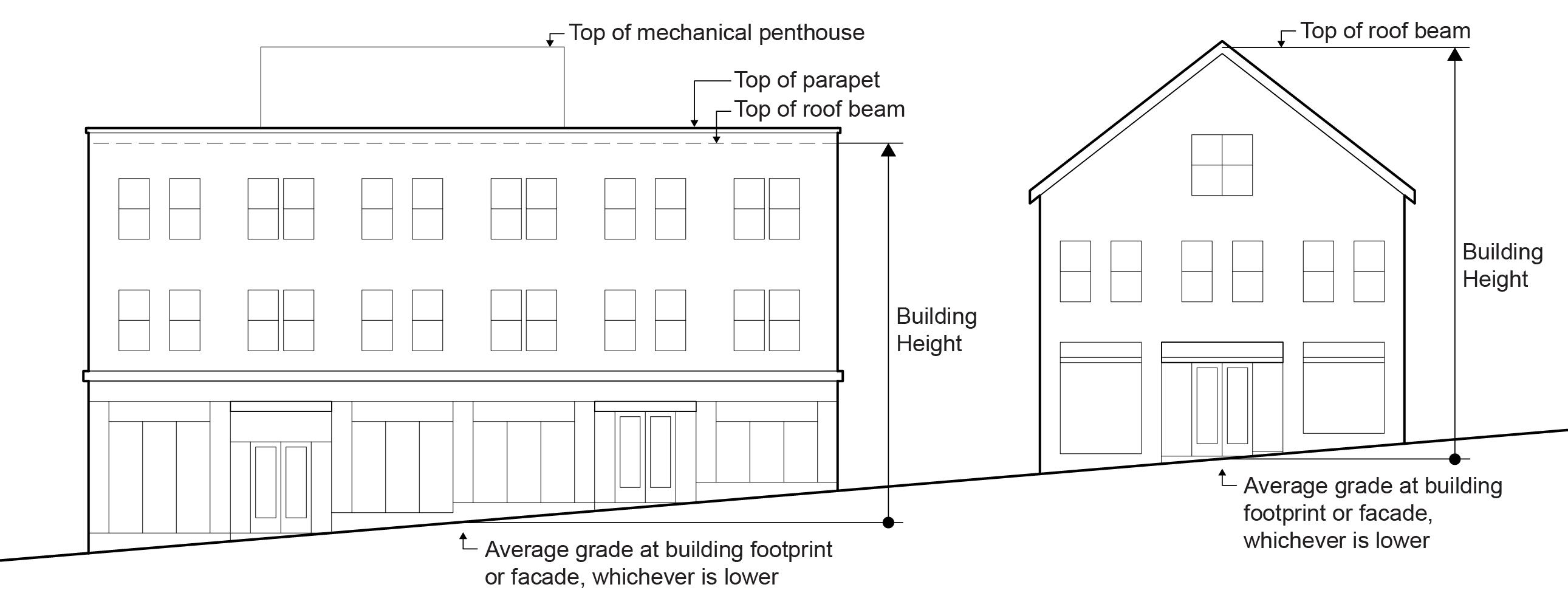
B. Story Height (Fig. 6)
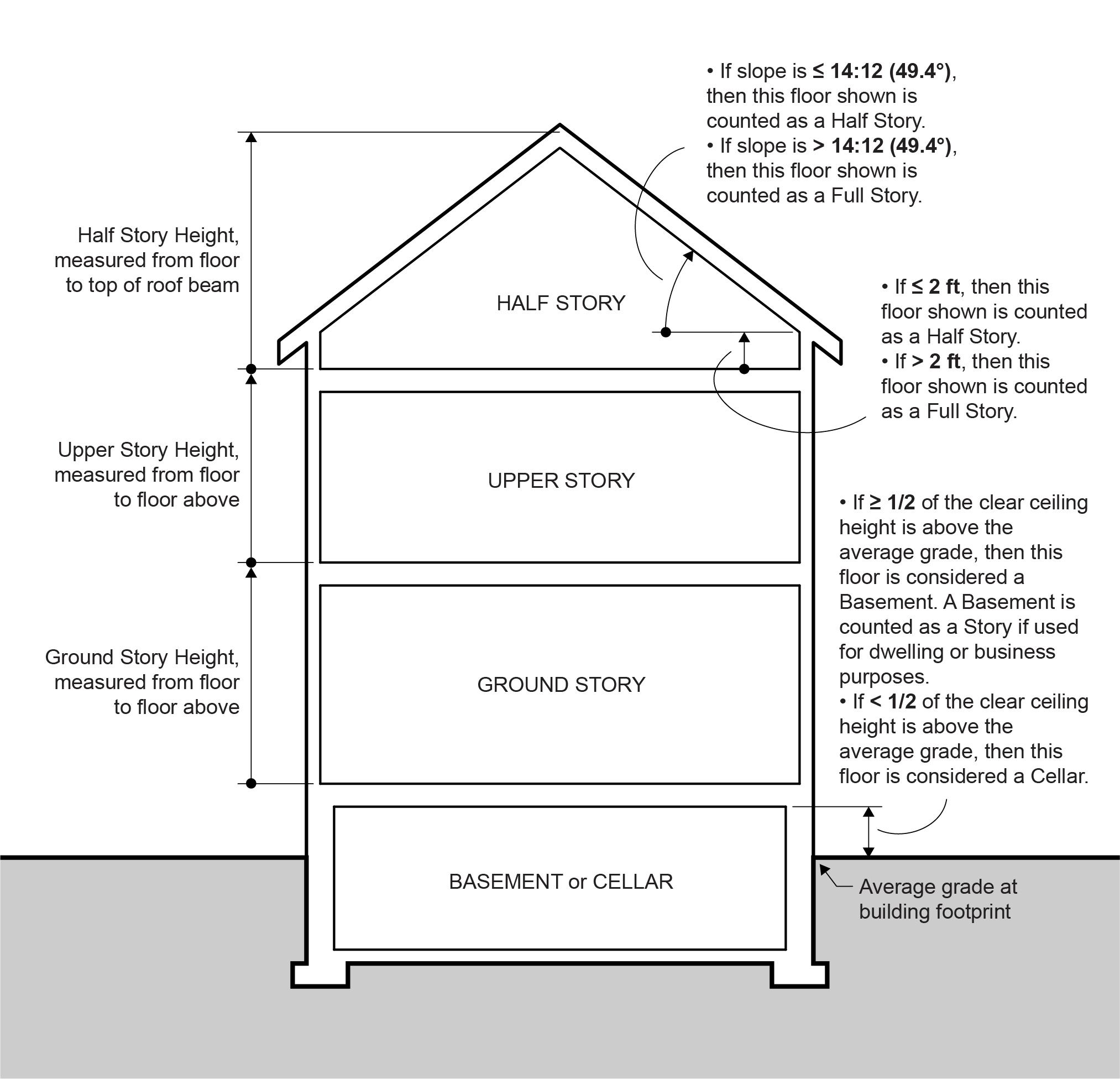
a. Each individual story of a building must comply with the minimum and maximum story height requirements specified for each WD Tier and is measured independently for each story of a building.
b. The height of the ground story and upper story(ies) of a building is measured vertically from the surface of the finished floor to the surface of the finished floor above, at all points.
c. The height of a half story is measured vertically from the surface of the finished floor to the top of the highest roof beam above.
C. Number of Stories (Fig. 6)
a. Buildings must comply with the minimum and maximum number of stories specified for each WD Tier.
b. The ground story is always counted as one (1) story, except that a single ground story over twenty (20) feet in height is counted as two (2) stories.
c. The second story is counted as one (1) additional story, except that any upper story with a mezzanine or loft is counted as two (2) stories.
d. A basement is counted as one (1) story if at least half of the clear ceiling height is above the average grade at the building footprint and it is used for dwelling or business purposes.
e. Habitable space located directly under a pitched roof is counted as a half (0.5) story, provided the following standards are all met:
i. At least two opposite roof planes are pitched toward each other.
ii. A pitched roof may be composed of roof planes with different slopes.
iii. The slope of any pitch must be no greater than 14:12 (49 degrees); otherwise, this story is counted as a full story.
iv. The roof rafters must intersect the wall plate or top of wall frame of the exterior walls at a height no more than two (2) feet above the finished floor of the half-story; otherwise, this story is counted as a full story.
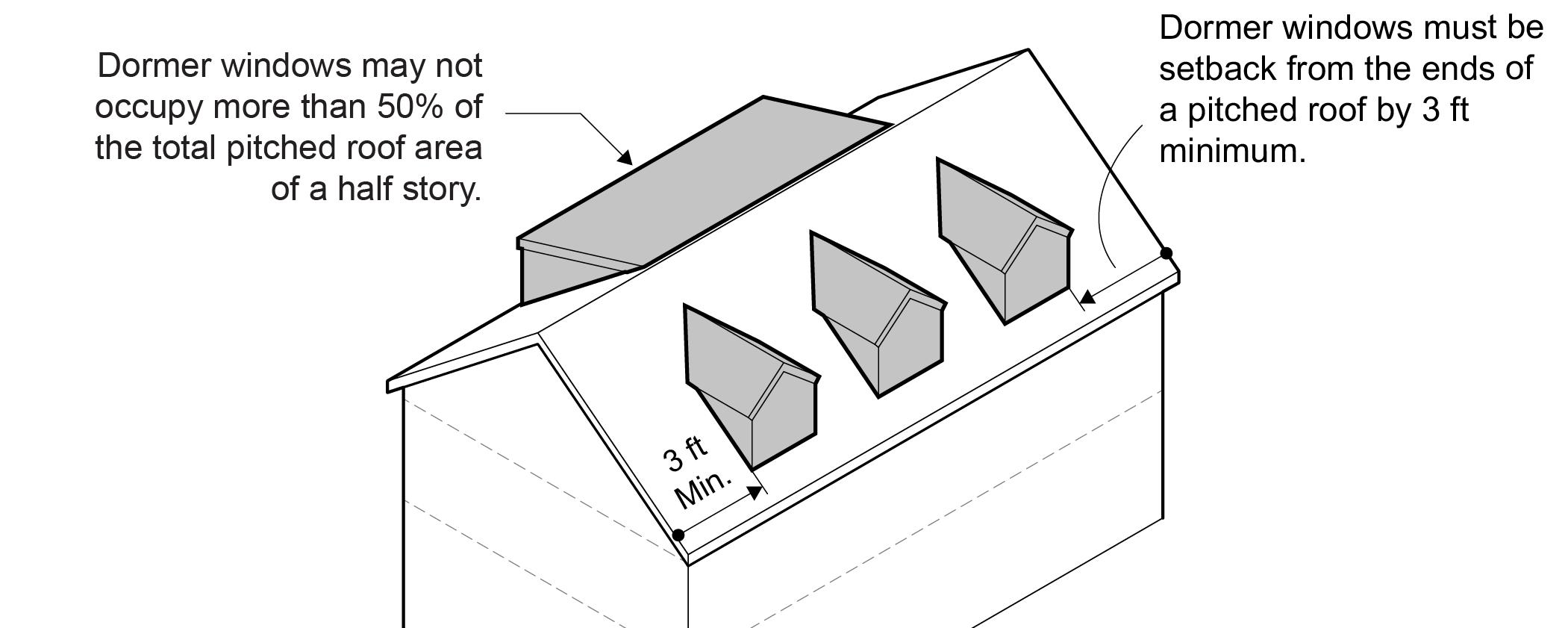
v. Dormer windows may not occupy more than 50% of the total pitched roof area and must be setback from the ends of a pitched roof, where applicable, by a minimum of three (3) feet (Fig. 7)
f. Non-habitable attic space located under a pitched roof is not counted as a half story.
D. Step-Back
a. A required distance that certain upper stories of a building must be recessed from the plane of the facade of the stories below.
i. Required step-backs must be provided for all stories as specified for each WD Tier
ii. Buildings on any lot with an average lot depth less than sixty-five (65) feet are exempt from the upper story step-back requirement.
E. Ground Story Active Uses
a. Any building with Primary Street frontage must also provide ground story Active Use space for a depth specified in each WD Tier, measured as the distance from the facade towards the interior of the building, for one hundred percent (100%) of the total width of the building.
b. Active Uses include:
i. Retail
ii. Restaurant / bar / specialty food service
iii. Brewery / distillery / winery with an accessory retail component
iv. Maker space with an accessory retail component
v. Live entertainment venue
vi. Professional services
vii. Personal services
viii. Day care
ix. Public art / gallery / arts studio
x. Live/work spaces combining residential with commercial, retail, or artisan industrial uses
xi. Community center / cultural facility
xii. Recreation
xiii. Semi-active accessory uses, such as lobbies and common areas associated with office, hotel, or residential uses
c. Only uses listed above are considered Active Uses.
F. Façade Articulation
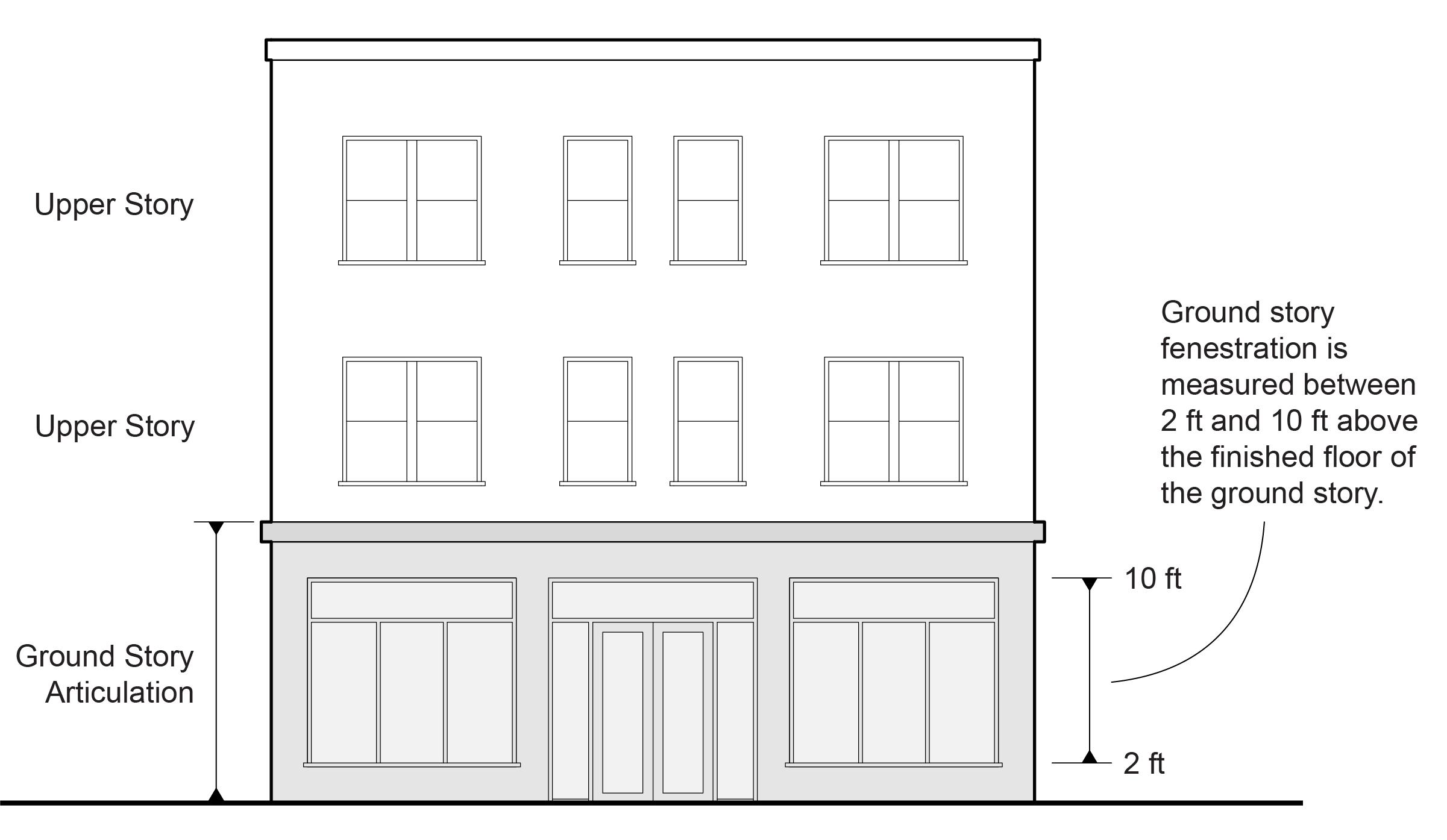
a. Facades must differentiate the ground story of the building from the upper stories through horizontal articulation, a change in material, or a change in window size or pattern to create a distinct base to the building facade. The entire height of the ground story must be included in the facade base (Fig. 8)
b. For buildings with more than one facade, the design of the base must align horizontally at the corner.
c. The facade of any building greater than one hundred (100) feet in width must be divided vertically by a recess or an offset at least seven (7) feet deep and ten (10) feet wide and designed as two (2) or more distinct facades of differing architectural treatment so that the building appears to be multiple buildings. Modifications to the facade of existing buildings are exempt.
G. Fenestration
a. Fenestration must be provided as indicated for each WD Tier and is calculated as a percentage of the area of a façade.
b. For buildings with ground story Active Use spaces, ground story fenestration is measured between two (2) feet and ten (10) feet above the finished floor of the ground story (Fig 8).
c. For ground story fenestration, glazing must have a minimum sixty percent (60%) Visible Light Transmittance (VLT) and no more than fifteen percent (15%) Visible Light Reflectance (VLR) as indicated by the manufacturer.
H. Building Entry
a. For parcels with Primary Street frontage, buildings must have their main entrance from a sidewalk on a Primary Street. For parcels without Primary Street frontage, buildings must have their main entrance from a sidewalk on a Secondary Street.
b. Multi-story buildings with ground floor Active Use spaces must have one (1) principal entrance for each Active Use space in addition to any principal entrance(s) necessary for any upper stories.
c. Principal entrances must either be recessed from the plane of the facade, or have a projecting awning or canopy, to signal building entry and provide adequate protection from the elements.
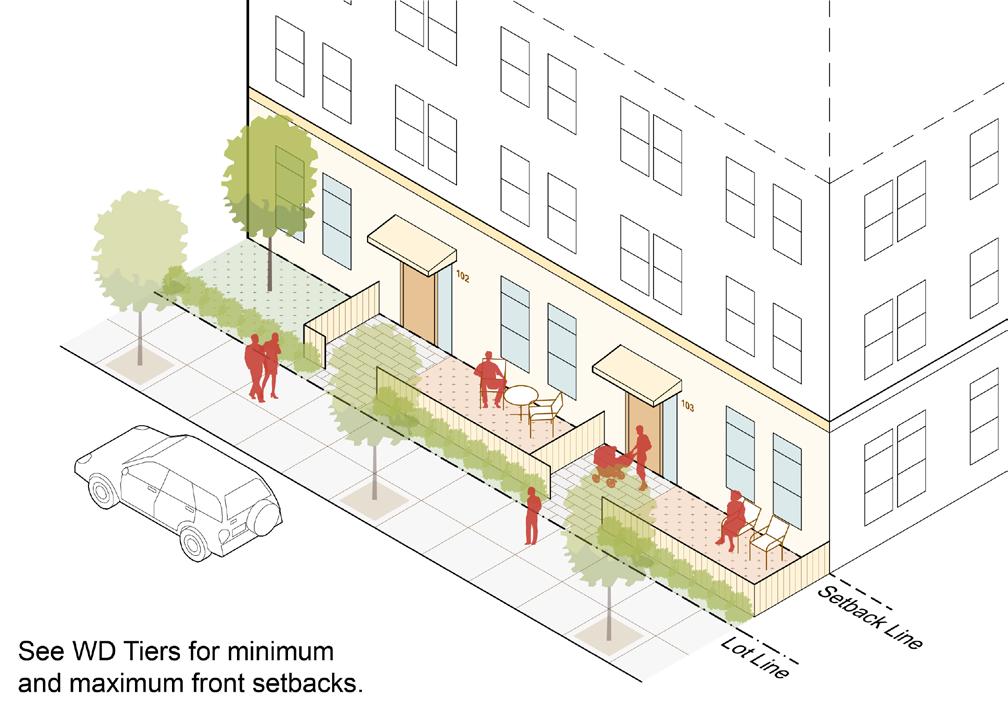
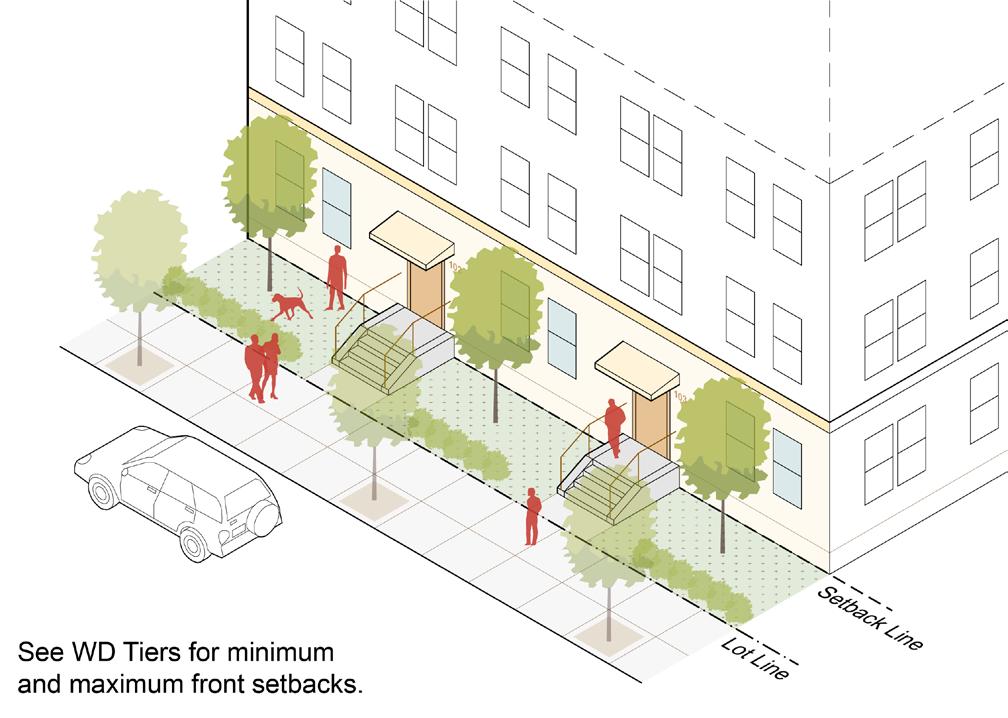
d. For buildings with residential uses on the ground floor fronting a public right-ofway, individual unit entrances are required.
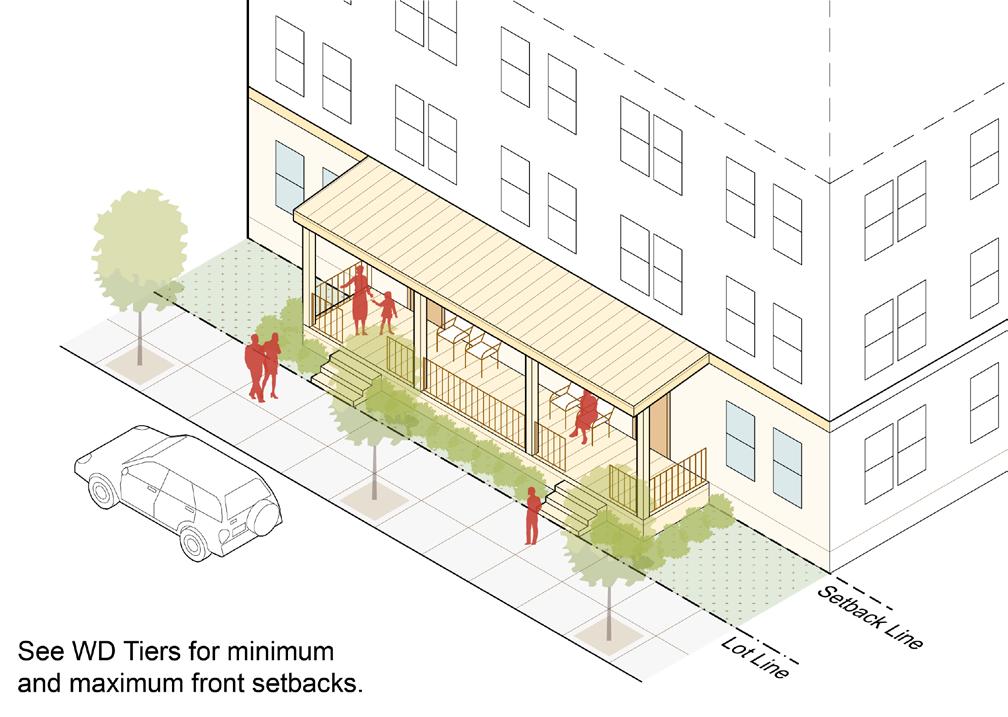
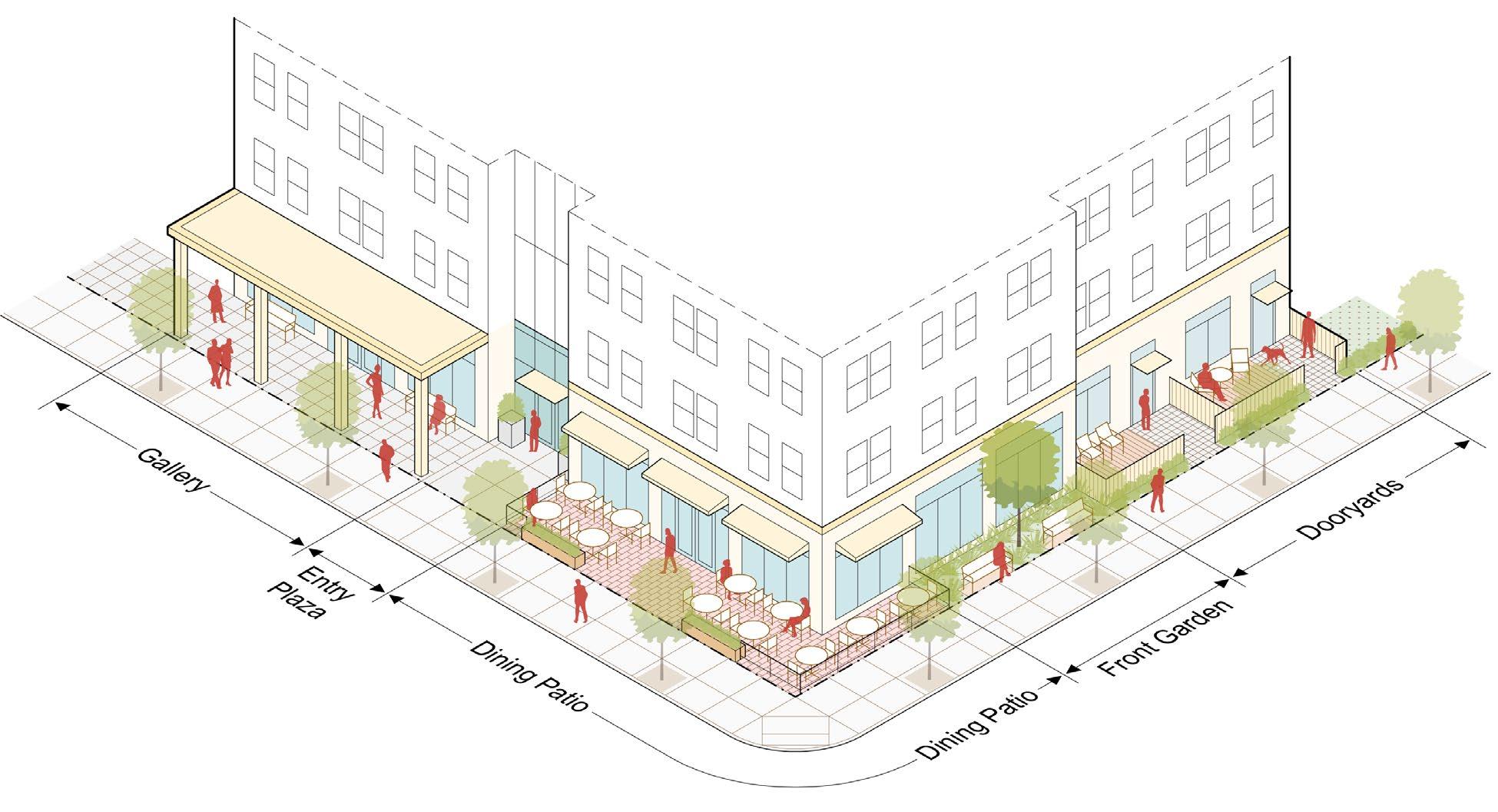
I. Frontage Types (Fig. 9)
a. Frontage types provide access to principal entrances and serve as the interface and transition between the private realm (building interiors) and the public realm (sidewalks and public spaces) and are defined by a combination of site features and façade characteristics.
b. Frontage types are permitted according to Table 9.
c. Frontage types not expressly permitted are prohibited.
d. Multiple frontage types are permitted for each building.
J. Roof Features
a. Non-habitable architectural features including, but not limited to, mechanical & stairwell penthouses; vents or exhausts; solar panels or skylights; belfries, chimneys, cupolas, parapets, spires, and steeples are permitted on roofs.
K. Mechanical Equipment (Fig. 10)
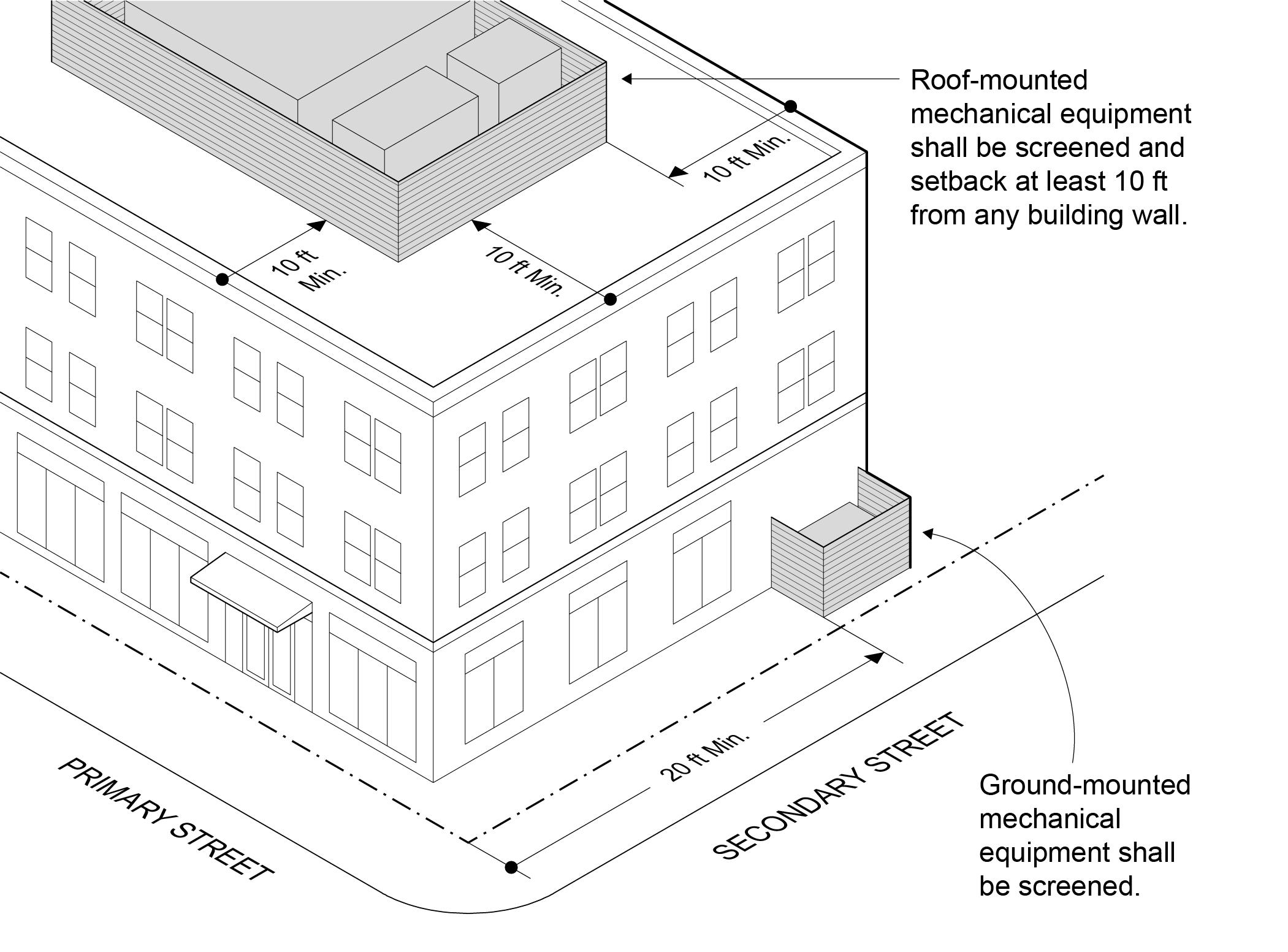
a. Roof-mounted mechanical equipment must be screened and setback at least ten (10) feet from any building wall. See “Screening” in §300-5 Terms defined.
b. Wall-mounted mechanical and/or electrical equipment such as louvers, exhaust equipment, ducts, alarm devices, cable boxes, utility meters, etc. must not be mounted on a Primary Street facade.
c. Ground-mounted mechanical equipment is prohibited along Primary Streets.
d. Ground-mounted mechanical equipment located along a Secondary Street must be located a minimum of 20 feet from the lot line along a Primary Street and screened so as not to be visible to a pedestrian from within the right-of-way of a Primary Street. See “Screening” in §300-5 Terms defined.
Site Standards Applicable to all WD Tiers
This section provides an explanation of the dimensional standards for site improvement within the WD Tiers, defines how to measure certain standards, and provides other requirements and reference information as necessary.
A. Parking and Driveway Location (Fig. 11)
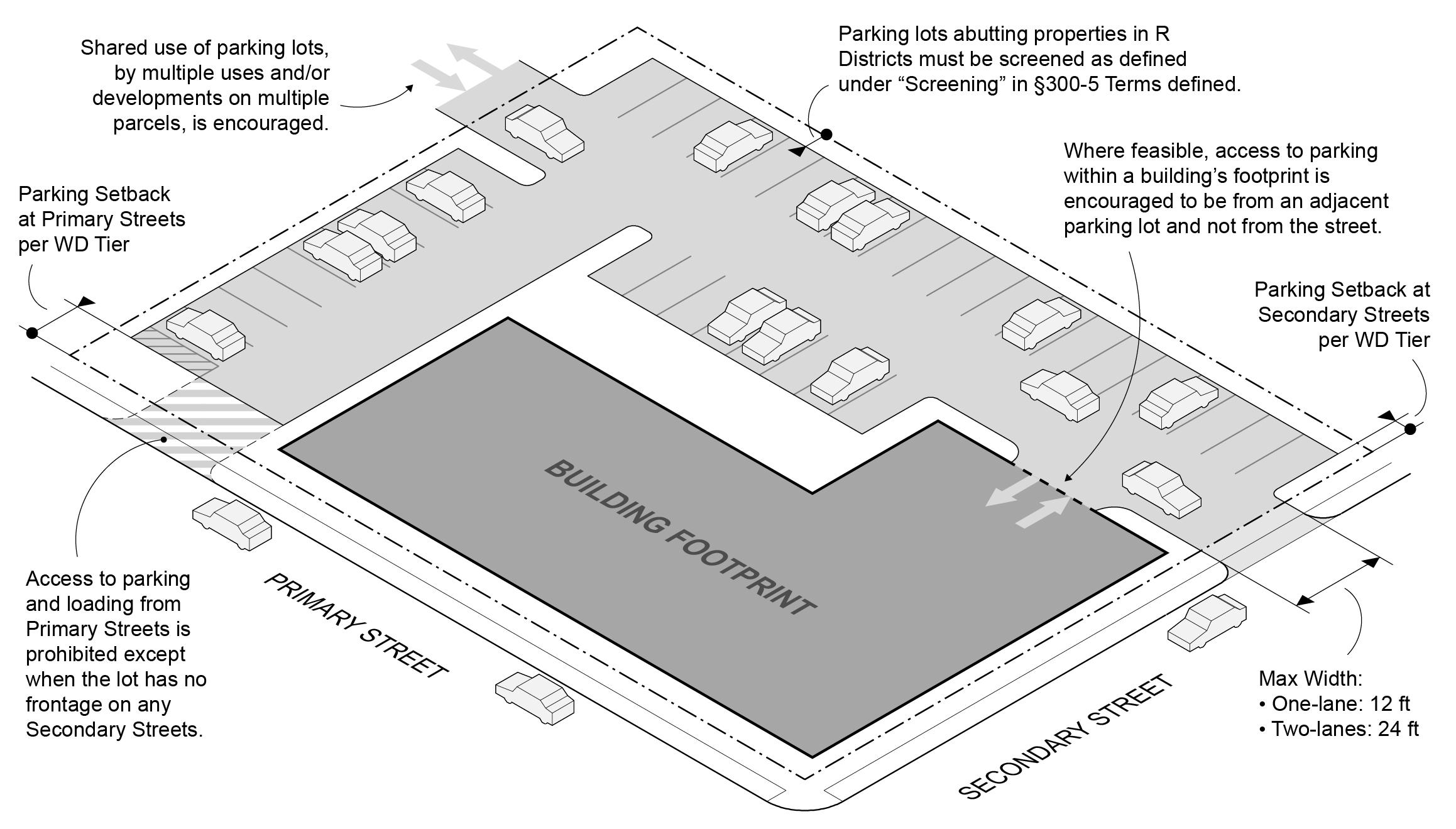
a. All parking spaces and structures must be located at or behind any required parking setback as specified for each WD Tier.
b. Driveways are discouraged between the façade of a building and the front lot line (driveways are encouraged to be to the side of a building).
B. Parking Lot Access (Fig. 11)
a. Access to parking lots and structures from Primary Streets is prohibited except when the lot has no frontage on any Secondary Streets.
b. Shared use of parking lots, by multiple uses and/or developments on multiple parcels, is encouraged.
c. Where feasible, access to parking lots within the footprint of a building is encouraged to be from an adjacent surface parking lot driveway and not via a curb cut and driveway directly from an adjacent street.
C. Curb Cuts and Driveways (Fig. 11)
a. Curb cuts are prohibited along Primary Streets except when the lot has no frontage on any Secondary Streets.
b. The maximum width of a curb cut and driveway for access to parking lots and structures is as follows:
i. One-lane: 12 ft
ii. Two-lane: 24 ft
c. Each lot is limited to one curb cut per street frontage. Lots with more than 200 feet of frontage are allowed one additional curb cut every 200 feet.
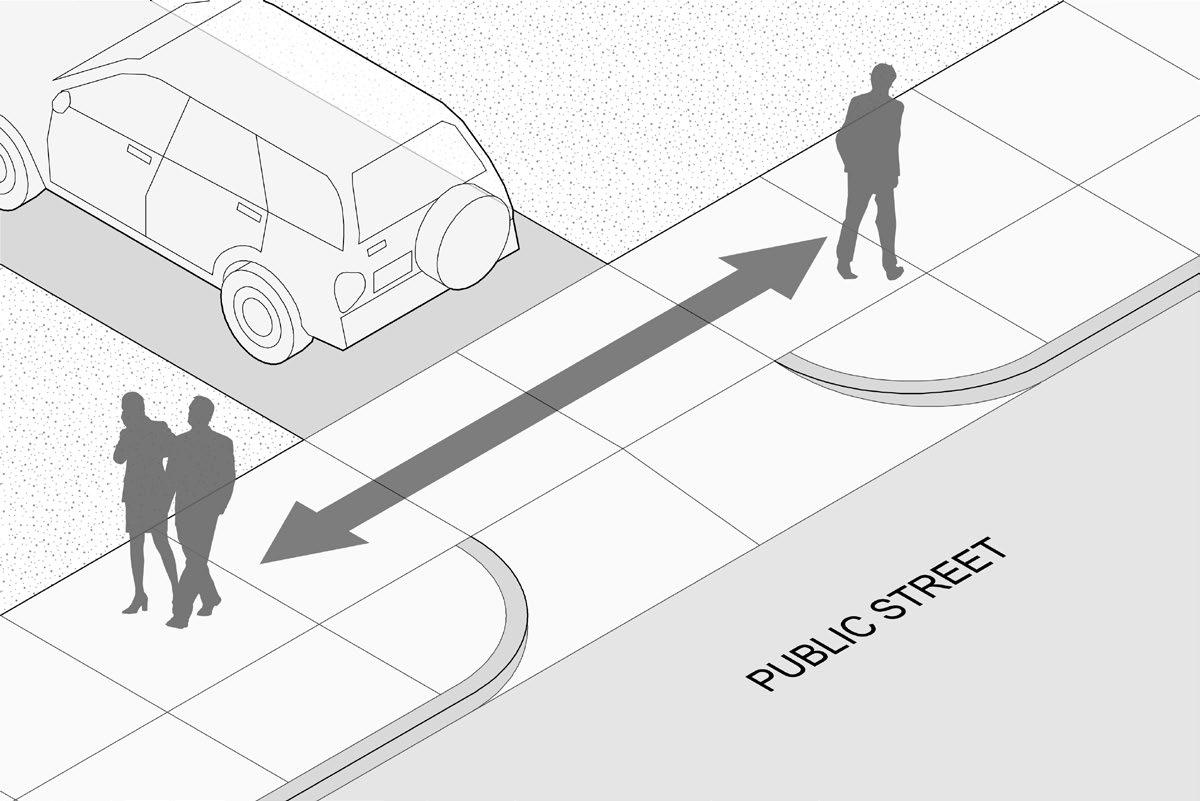
d. A driveway apron may be installed only within the furnishing zone of a sidewalk (Fig. 12)
e. The grade, cross slope, and clear width of the walkway of a sidewalk must be maintained between the driveway apron and the abutting driveway. The appearance of the walkway (i.e., scoring pattern or paving material) must indicate that, although a vehicle may cross, the area traversed by a vehicle remains part of the pedestrian sidewalk (Fig. 12).
Figure 12. Sidewalk Continuity at Curb Cuts
D. Surface Parking Lot Design
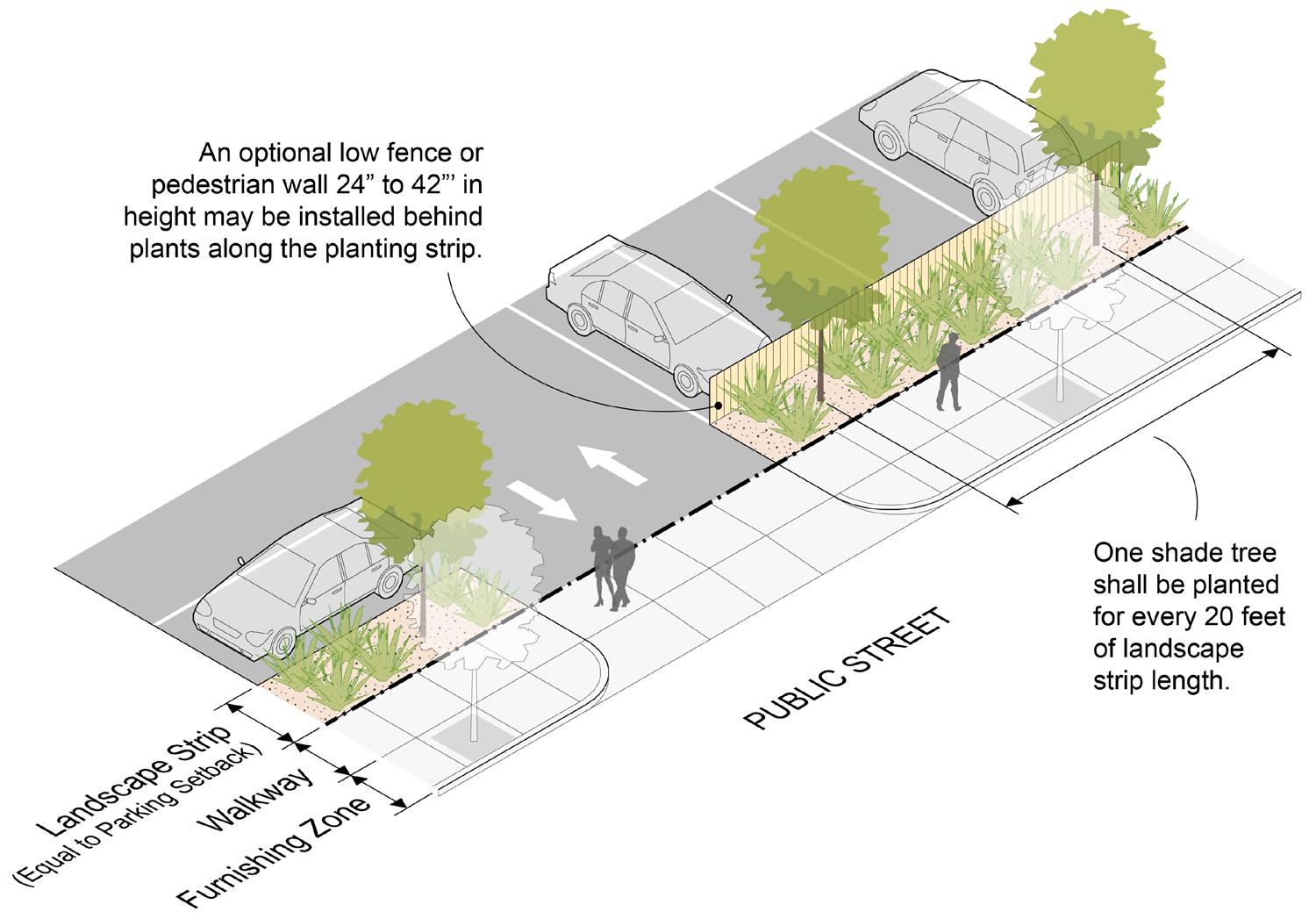
a. Parking lots must be separated from the public right-of-way by a landscaped strip with a depth equal to the parking setback as specified in the Lot Standards for each WD Tier. The landscaped strip must adhere to the following design standards (Fig. 13):
i. The landscape strip must run the full length of the parking lot perimeter along the right-of-way, excluding curb cuts and driveways.
ii. The landscape strip must be planted with shrubs, perennials, native grasses, and other planting types that provide screening from the public right-of-way.
iii. Deciduous shade trees must be planted for every 20 feet of landscape strip length, spaced linearly and parallel to the public right-of-way. Shade trees must be a minimum of two (2) inches in tree caliper when planted.
iv. An optional low fence or pedestrian wall 24” to 42” in height may be installed behind the landscape strip and setback up to 24” from the adjacent parking lot to accommodate for car overhang.
v. The use of stormwater management techniques such as rain gardens and bioswales is encouraged in landscape strips.
b. Parking lots abutting properties in any Residential Districts along any side or rear lot line must be screened as defined under “Screening” in §300-5 Terms defined.
c. Parking lot landscape strips, parking lot islands, landscape buffers, and other landscaped areas should utilize Low-Impact-Development (LID) practices consistent with state law to treat and discharge stormwater.
d. At least ten percent (10%) of paved parking lot areas, inclusive of driveways, must be landscaped. Landscape strips along public rights-of-way and landscape buffers abutting Residential Districts are excluded from the calculation of the parking lot area.
E. Parking Structure Design
a. Garage facades visible from within the right-of-way of Primary and Secondary Streets must be screened with architectural and/or landscape elements.
b. Parking structure access ramps must not be exposed on Primary Street facades.
F. Loading
a. Access to loading docks and areas from Primary Streets is prohibited except when the lot has no frontage on any Secondary Streets.
b. Outdoor loading facilities, including all docks and areas used for the storage and staging of goods or materials, that are visible from a public street, public space,
or abutting properties in any Residential Districts must be screened from view as defined under “Screening” in §300-5 Terms defined.
c. Interior loading must be screened from view by solid, non-transparent doors which must remain closed when the loading dock is not in use.
G. Service Areas
a. Trash collection, trash compaction, recycling collection and other similar service areas must be fully enclosed within a building or located to the side or rear of the buildings.
b. Outdoor service areas are not permitted along Primary Streets.
c. Outdoor service areas that are visible from a public street, public space, or abutting properties in any Residential Districts must be fully screened from view as defined under “Screening” in §300-5 Terms defined.
H. Landscape and Stormwater Management
a. Low-Impact-Development practices consistent with state law, such as Rain Gardens and bioswales, should be installed to treat and infiltrate runoff from parking lots, thoroughfares, entry plazas, dining patios, and other impervious surfaces.
b. Lot areas not covered by structures or impermeable surfaces must be Landscape Areas, as defined in Definitions.
c. Where vegetative solutions are not feasible, permeable pavers, porous concrete, or porous asphalt should be used for sidewalks, parking lots, entry plazas, and dining patios to infiltrate stormwater.
Walkable District Tier 5
The WD Tier 5 district is primarily located in Downtown Beverly along Rantoul St. and is characterized by a variety of moderate to large floor plate buildings up to five (5) stories in height. Buildings are set close to the sidewalk to create a defined street wall that supports pedestrian activity and a sense of place. WD Tier 5 is primarily mixed-use, with ground story active uses that address the needs of residents and employees in the immediate neighborhood as well as the larger Beverly community and visitors from the broader region.