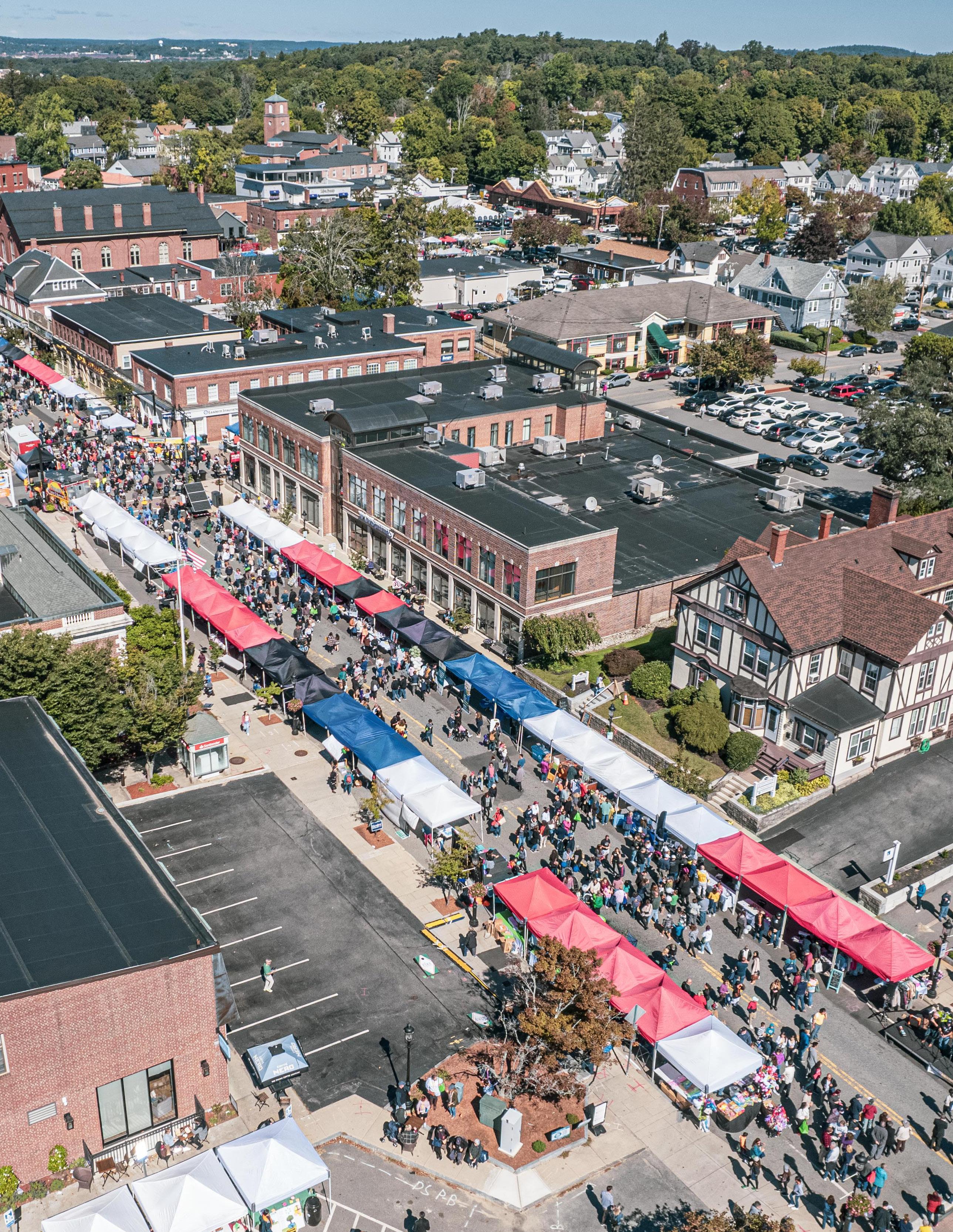

DRAFT, July 20, 2023
DRAFT, July 20, 2023
This Plan would not be possible without the contributions, assistance and support of several volunteers, Town staff and members of the community at large. A special thank you to all Andover residents who participated in this master planning process. The stories and insights you shared have shaped this Plan.
Planning Board
Zachary Bergeron, Chair
Rocky Leavitt, Vice Chair
Ann Knowles, Secretary
Vincent Chiozzi, Jr.
Neil Magenheim
Morgan von Prelle Pecelli, Associate
Select Board
Melissa Danisch, Chairperson
Laura M. Gregory, Vice Chair
Christian C. Huntress, Clerk
Annie Gilbert
Alexander J. Vispoli
Comprehensive Plan Steering Committee
Lelani Loder Foster, Chairperson
Brian Masterson, Vice Chair
Allison Lex, Clerk
Amy Brearley
Ann Knowles
James Bonfanti
Matthew Quinlan
Melissa Cryan
Michael Shyu
Morgan von Prelle Pecelli
Richard Padova
Patty Bechard
Prashant Navkal
Rajesh Tekchandani
Town Staff
Lisa Schwarz, AICP, Assistant Planning Director
Jacki Byerley, AICP, Planner
Ann Ormond, Director of Cultural and Business Development
Monica Gregoire, Associate Planner
Paul Materazzo, Director of Land Use and Economic Development
Consultant (Utile, Inc.)
Tim Love, FAIA
Will Cohen, AICP
Taskina Tareen, AICP
Cyrus Dahmubed
Rahi Patel
Avery Robertson
Xiaoran Zhang
Gabriel Ramos
Kyle Jonasen
Land Acknowledgment
We open by respectfully acknowledging that we collectively gather on the territory of many Indigenous peoples, who have stewarded this land for hundreds of generations. With gratitude to the Andover Center for History & Culture for their guidance, we acknowledge the harmful effect colonization and violent systemic and cultural inequities have had on our understanding of Indigenous identity and terminology. Andover was home to the Pennacook people as early as 6000 BCE, and we honor their past, present, and emerging leaders. We will continue to learn, respect, and reconcile the histories, legacies, and ongoing experiences of Indigenous injustice. Land Acknowledgments are a small, but essential, step towards building a culture of respect, truth, and accountability. To learn more about the land we are on, visit: https://nativeland.ca/.
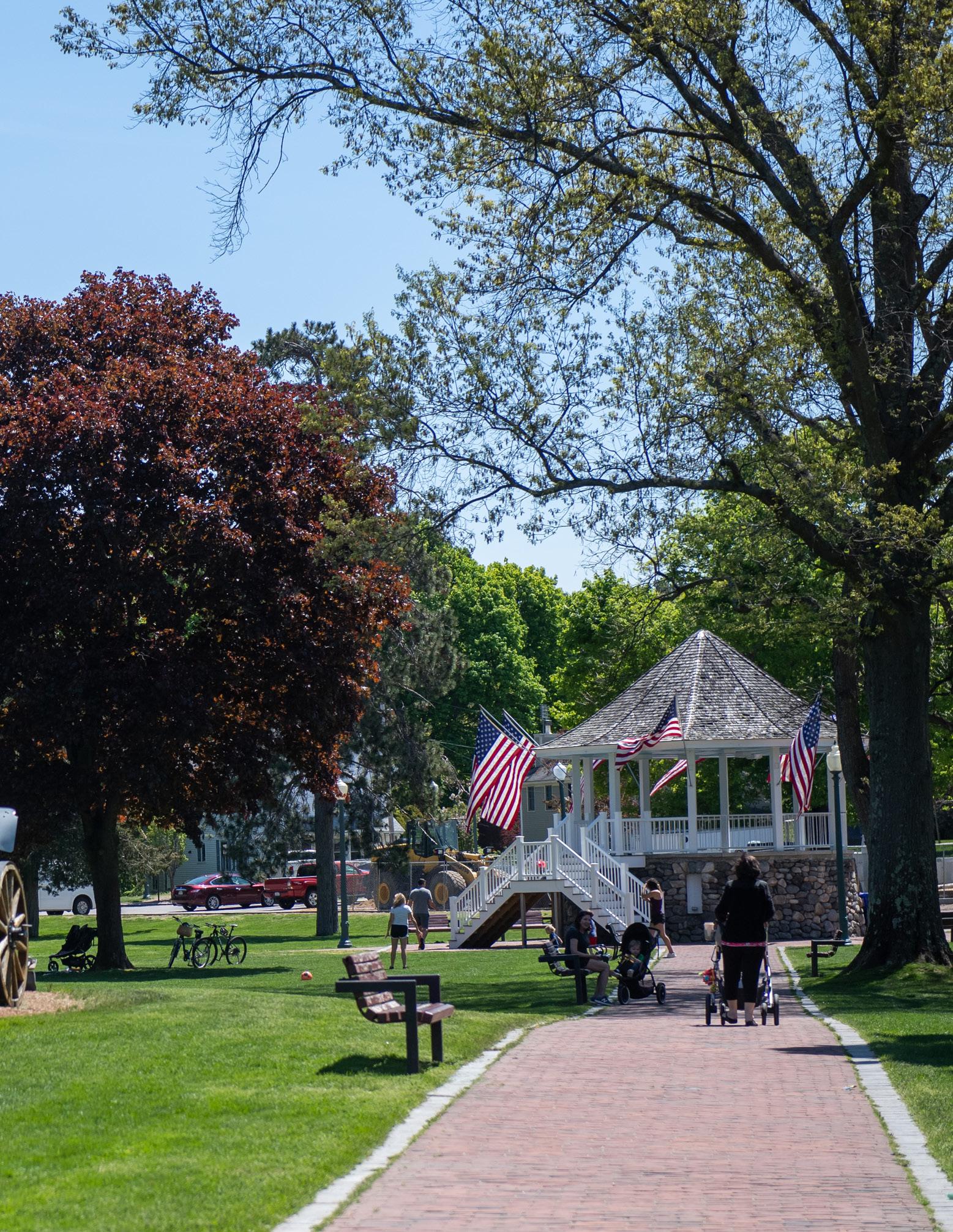
Dear Andover Community,
Andover has long been regarded as a premier place to live, work, study, and visit. The town’s historic character, thriving commercial and industrial districts, excellent educational opportunities, tight-knit neighborhoods, and striking natural landscapes provide advantages that have enabled Andover to establish a reputation as one of Greater Boston’s most desirable communities. Throughout its history, Andover has succeeded in preserving these distinct features while successfully adapting to new challenges — from population growth to shifting economic factors — through thoughtful and deliberate decisions on the part of local government.
The Town of Andover’s use of long-term, strategic planning to guide decision making has been a critical component in the enduring prosperity of our community. The 2023 Andover Comprehensive Plan marks the continuation of this proven approach. This comprehensive document establishes a cohesive vision for Andover’s future and provides a coordinated roadmap that will guide decisions regarding land use, housing, economic development, open space, recreation, and many other areas. The plan provides further insight into how decisions in these areas impact other critical priorities of the Town of Andover, including sustainability, climate resilience, and diversity, equity, and inclusion.
The 2023 Andover Comprehensive Plan is the product of an exhaustive, community-driven process that took place over more than two years. Through numerous public forums and meetings, countless residents lent their perspective, insight, and expertise to this process to help ensure that the plan accurately reflects the values, priorities, and aspirations of the community. I would like to express my sincere appreciation to all members of the community who participated in this process. Significant credit is due to the members of the Andover Planning Board for their support at every stage of the effort, and particularly to Morgan von Prelle Pecelli and Ann Knowles for their intensive involvement. I would also like to thank the thirteen members of the Comprehensive Plan Steering Committee who dedicated countless hours in leading the Plan’s public engagement process, and working closely with Assistant Planning Director Lisa Schwarz and the Town’s consultant, Utile, to help shape the final product.
The development of the 2023 Andover Comprehensive Plan provided a productive opportunity to reflect on Andover’s past accomplishments; identify changes in community demographics, the environment, expectations, and priorities; clarify shared values; articulate a vision for the future; and define new goals for achieving that vision. I am confident that the plan presented in the following pages will guide our community in a positive direction throughout the next decade and beyond. I look forward to partnering with the community in its implementation.
Yours sincerely,
Andrew Flanagan, Town Manager
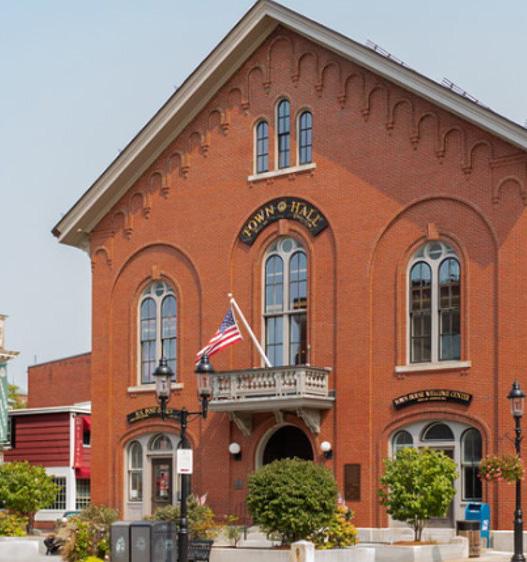
Halfway through the year 2023, it is clear that change and uncertainty around economic trends, real estate, and demographic shifts affect communities across the metropolitan region, the Commonwealth, and the nation at large. Andover’s previous master plan, completed in 2012, has served the town well for the past decade. It is this hope of this effort that this document will serve the town for the next decade or two as well.
This plan does not start from scratch. From the affinity mapping and focus group efforts of 2021, to the master plan outreach and engagement in 2022, to the public meetings in 2022 and 2023, the last three years have been an opportunity for town residents, workers, stakeholders, and advocates to make their thoughts known and voices heard.
Above all else, we heard over and over again different ways that people care about their town. Whether or not respondents rent or own, whether or not they are new to town or are lifelong residents, whether they work nearby or in downtown Boston, a common sentiment was the importance of having Andover continuing to be a good place to live that serves the needs of its residents as fully as possible. With that in mind, this plan focuses on three key strategies:
The planning team has heard through its outreach work concerns around sprawl, improving schools, ensuring that the town’s open space assets and development patterns stay familiar and desirable. The goal of this process is to proactively address these concerns through a long-term plan, so that the potential downsides of growth can be minimized as much as possible, and the collective benefits of that change can be maximally realized. By creating a plan to address these challenges head-on, Andover will retain the ability to shape its future, rather than having to respond to new development proposals or planning ideas ad-hoc and as they come. This is particularly true in the face of the substantial demographic shift facing New England as the baby boom seeks to age in place, and as the millennial generation simultaneously is increasingly seeking places to settle and create households.
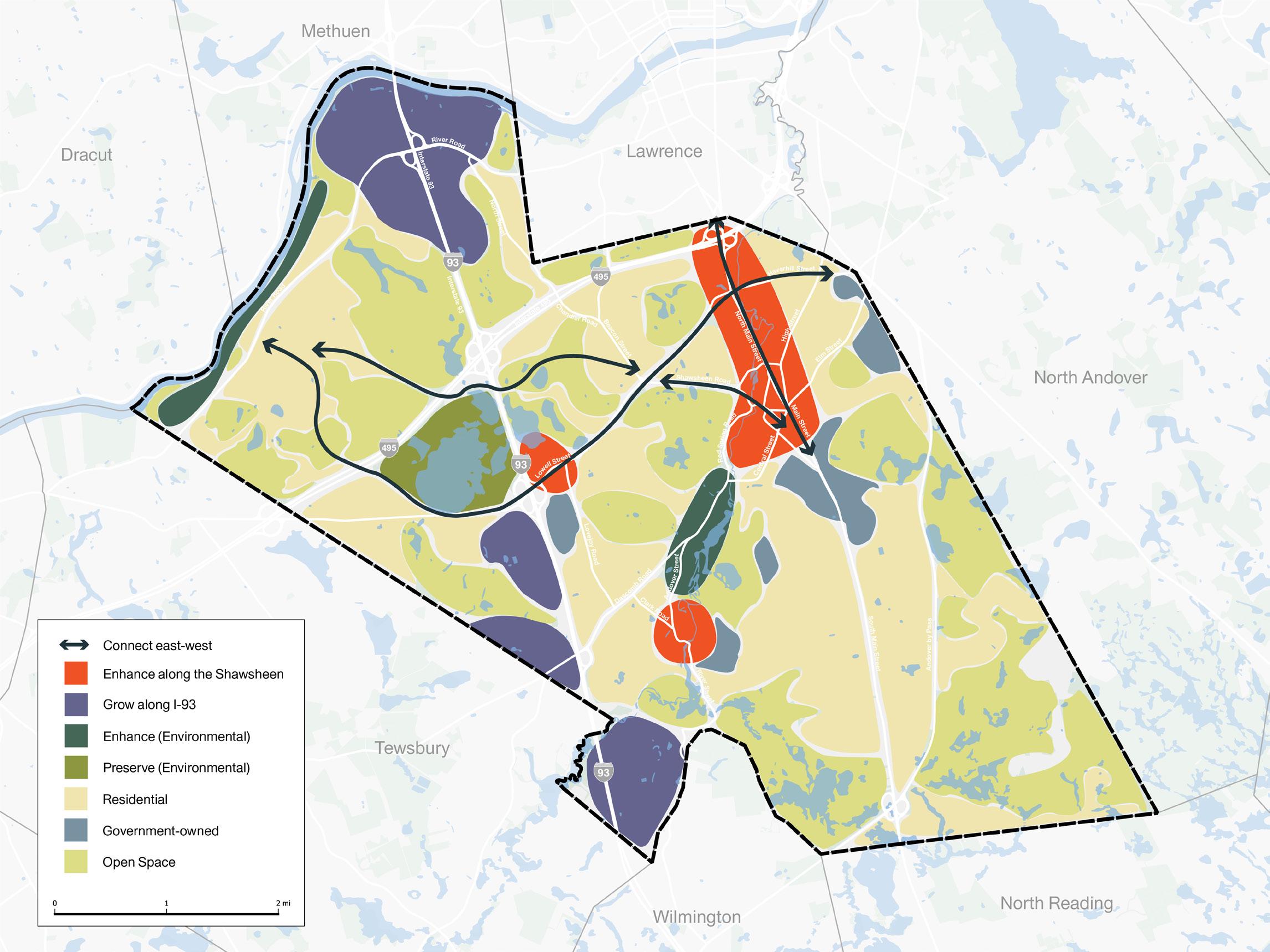
• Densifying and expanding job centers along I-93 in the business and industrial parks
• Encouraging new “middle missing” housing types in town and improving open space access along the Shawsheen
• Improving east-west connectivity with improved multimodal transportation links.
That double squeeze – of baby boom generation members seeking to age in place and of millennials to gain space for married life or life at the start of parenthood – is the primary long-term trend facing most American communities today. Increased production of “missing middle” housing, we believe, is the most direct strategy to tackle both ends of that squeeze. Some – and very much not all! –community members who want to age in place may not need to continue to occupy their single-family home indefinitely, and would like to have a more walkable, smaller homestead where they can enjoy life as an empty nester, without all of the expense and logistics that made more sense while kids were at home. Similarly, young households looking to decamp from metropolitan Boston may be looking for slightly more spacious or more affordable living situations, and do not need (nor would be able to afford) jumping right to a single-family home in Andover. Even for community members not facing either of these two major inflection points, providing an opportunity for those who are substantially reduces the overall pressure on the rest of Andover’s housing stock. The goal is not to reshape the entire Town’s housing outlook, but to instead provide an additional option that has not historically been present in Andover, so that the current housing stock can better serve the needs it is best suited to.
Through both the outreach process as well as our data analysis, our planning team has heard and seen that Andover’s relationship to employment is complicated. On the one hand, many Andover residents have long commutes that reach far across the metropolitan Boston region. On the other hand, despite the small-town feel of Andover, the town is in fact a net importer of jobs. That is, Andover is an employment center. This has two primary impacts on longterm planning.
First, from a tax perspective, Andover finds itself in a different position than many communities north of Boston. As it works toward achieving broader economic development goals, it can rely on a diversified set of
properties, which provide the town with stability across economic cycles. Second, unlike many communities, Andover has some opportunity to work at both sides of the commute. A longstanding and common concern from residents across the region heard during this planning process and in others is a desire to shorten a commute, to live closer to work. Andover cannot locate itself closer to other employment centers, but it can both locate more housing closer to transit modes of commute (reducing the need to sit in traffic), and it can encourage more job creation in Andover (allowing more chances for residents to work locally). This plan suggests that the town work on both strategies.
Andover’s population growth in recent decades mirrors many of its peer communities, and projections for its future population growth follow the same pattern. In many ways, this “middle of the pack” pattern relative to those communities (shown above both in terms of absolute and relative percentage change since 2010 and projected out until 2050), show that the regional demographic shift will likely affect Andover in a way that is similar to many other communities. Andover will continue to grow, as will its surrounding and similar towns and cities. While it is impossible to perfectly predict the future, general projections suggest that this growth will continue in the coming decades as well.
For this reason, there is no time better than now to prepare for these issues. Examples abound of municipalities closer to the regional core who have found themselves increasingly hampered by a confounding simultaneous pressure to 1) push back against an uncontrollable pressure to produce housing to meet demand, and 2) find ways to continue to let their community remain accessible to more than the select few or existing homeowners. In the spirit of the saying that “a stitch in time saves nine,” this plan suggests beginning to tackle this problem now, while the risks are lower and the benefits are more easily realizable.
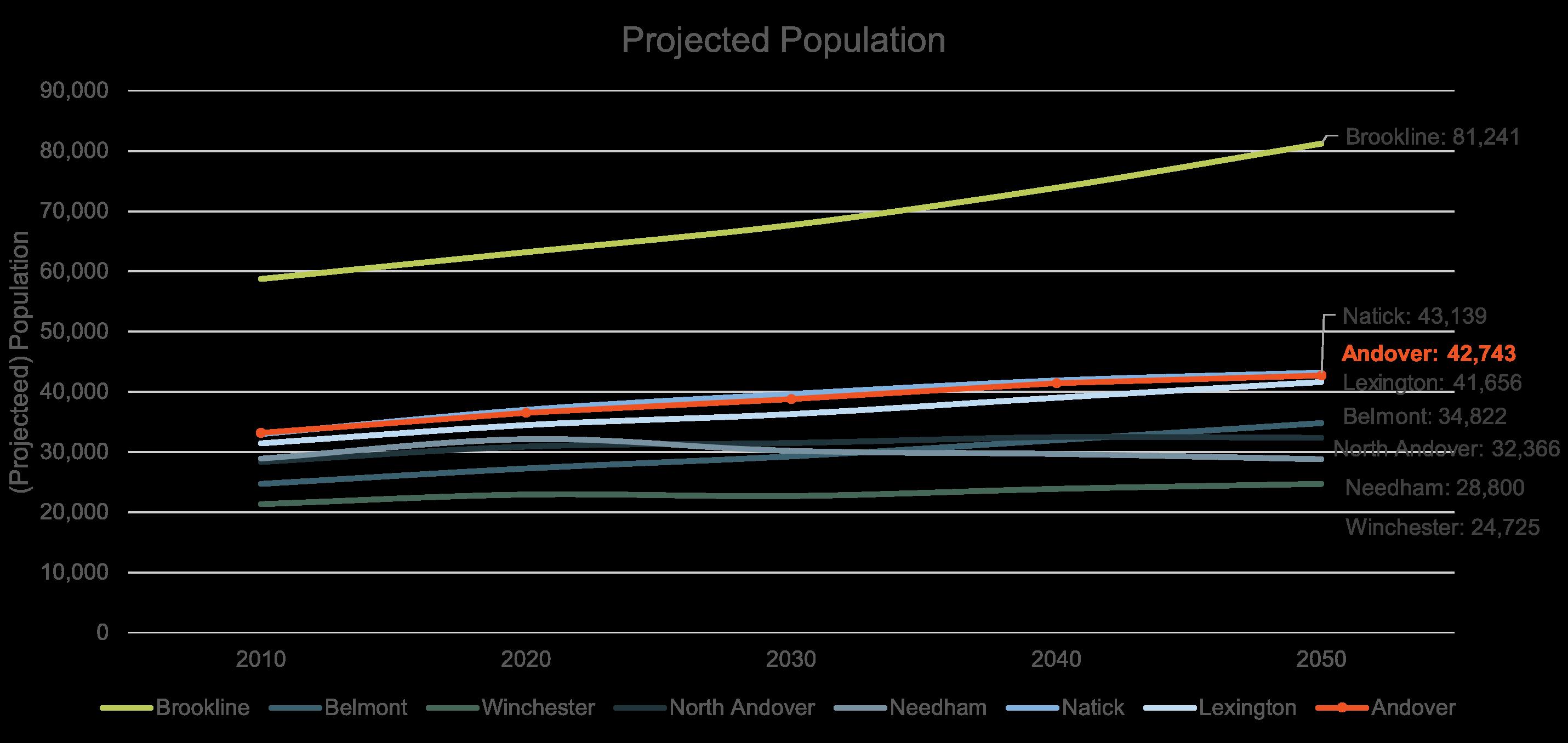
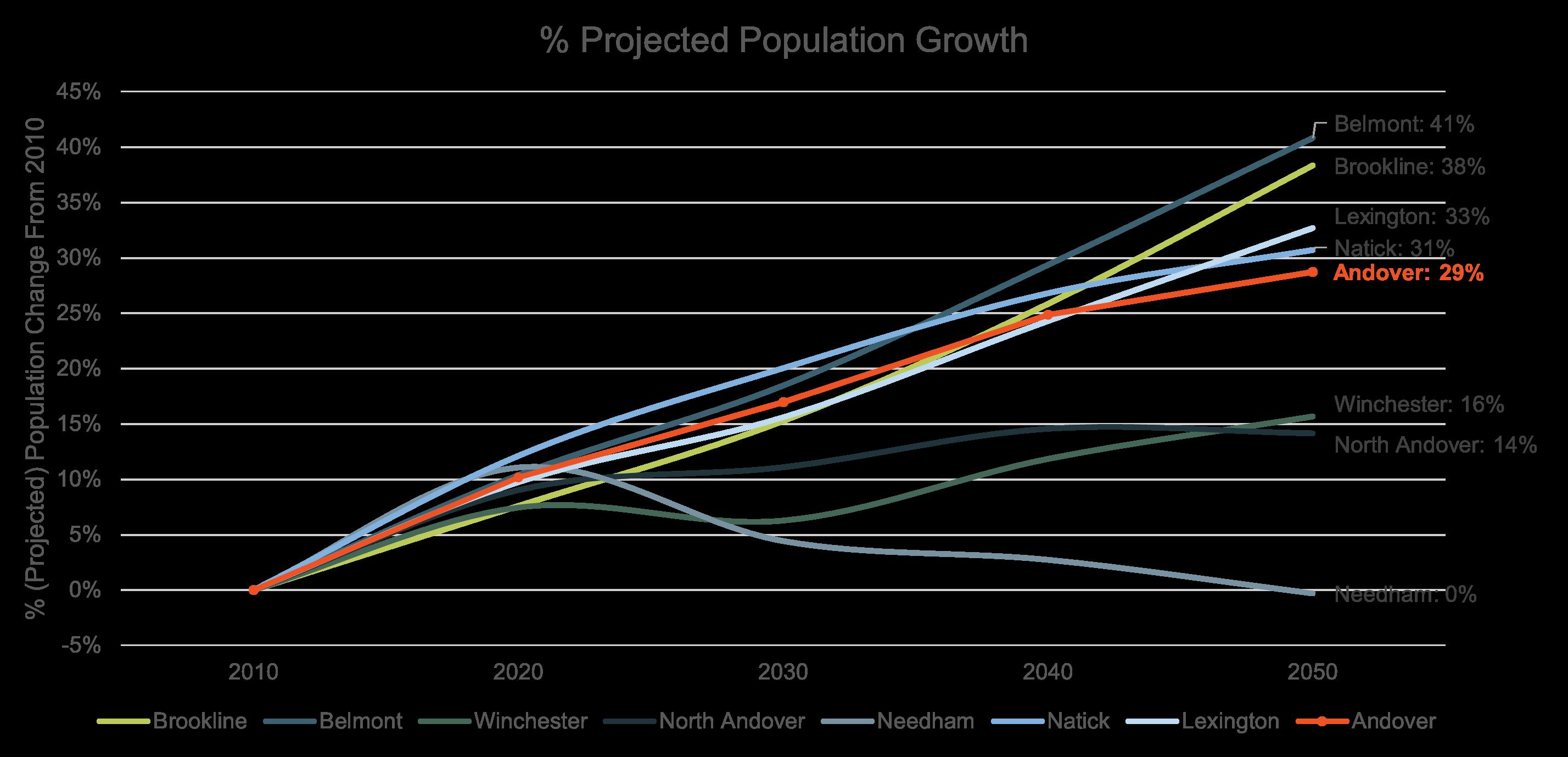
Source: UMass Donahue Institute v2022 Long-Term Population Projections
Given that comprehensive plans are meant to guide a community for a decade or more, an underlying principle of townwide planning is to identify some of the bigger and more complicated issues facing Andover, and to then propose a range of strategies—some shorter-term, some longer-term—that can help guide the community to a better resolution. In addition, these strategies are almost always a compromise between competing interests. Situations where there is one clear answer don’t need a long-term plan and can just be addressed on their own. On the contrary, a balanced path forward is the right plan in situations where the right answer requires outreach, discussion, and debate, with results that will be tackled by many people over a longer period of time.
A Comprehensive Plan, also called a Master Plan, is required by Massachusetts General Law (Chapter 41, Section 81D) and must include topics such as land use, housing, economic opportunity, natural and cultural resources, open space and recreation, services and facilities, and transportation and mobility, as well as a goals and policies statement, and an implementation program.
The Town of Andover (the “Town”) is required to create a plan within this framework. The Master Plan Steering Committee compiled a plan that addresses the needs and desires of the community based on public participation through focus groups, data collection, surveys and public meetings conducted over a two-year period.
do? What can’t it do?
A Comprehensive Plan is a planning tool which develops a strategic vision and roadmap for the Town’s future. The foundation of a Comprehensive Plan is a robust public engagement strategy which engages the community in discussions of Andover’s present and future. Public engagement guides the values and goals of the Plan, and the process ultimately culminates in a document that stitches together recent planning efforts into a comprehensive framework, provides the Town with a foundation for implementing key land use policies and capital projects, and provides a basis for future decision-making by the Town and its partners. A Comprehensive Plan does not directly change zoning laws, but it does make recommendations to the Town and the community for future zoning changes.
Andover’s last comprehensive plan was completed in 2012. Since then, Andover has added 3,720 new residents and experienced new development throughout Town. As Andover prepares for the coming decades, it is important that development policies, land use regulations, and broader Town policies reflect the values and goals of residents, business owners, and other key stakeholders.
The comprehensive planning process provides the Town and its residents the opportunity to discuss, debate, and develop a roadmap for land use and development over the next ten or more years. Planning for new development and the future of existing development is especially important for the Town’s financial sustainability, and Andover is in a good financial position to take on strategic debt to finance critical changes. Moving forward, cultivating a balance of land uses (residential, business, industrial) will be crucial to balancing tax burdens among residents and businesses. Zoning changes, new development in some areas of Town, and key investments can ensure long-term livability and support a greater diversity of people who can live, work, and learn in Town. Andover strives to become a better, more livable community for all residents.
A successful Comprehensive Plan can enhance the appeal and character of Andover, improve the Town’s ability to provide public services, improve and add predictability to property values for residents and businesses, clarify Town policies, prioritize implementation of key projects, and ensure that development in Andover occurs at an appropriate scale in appropriate locations.
Source: U.S. Decennial Census 2000–2020
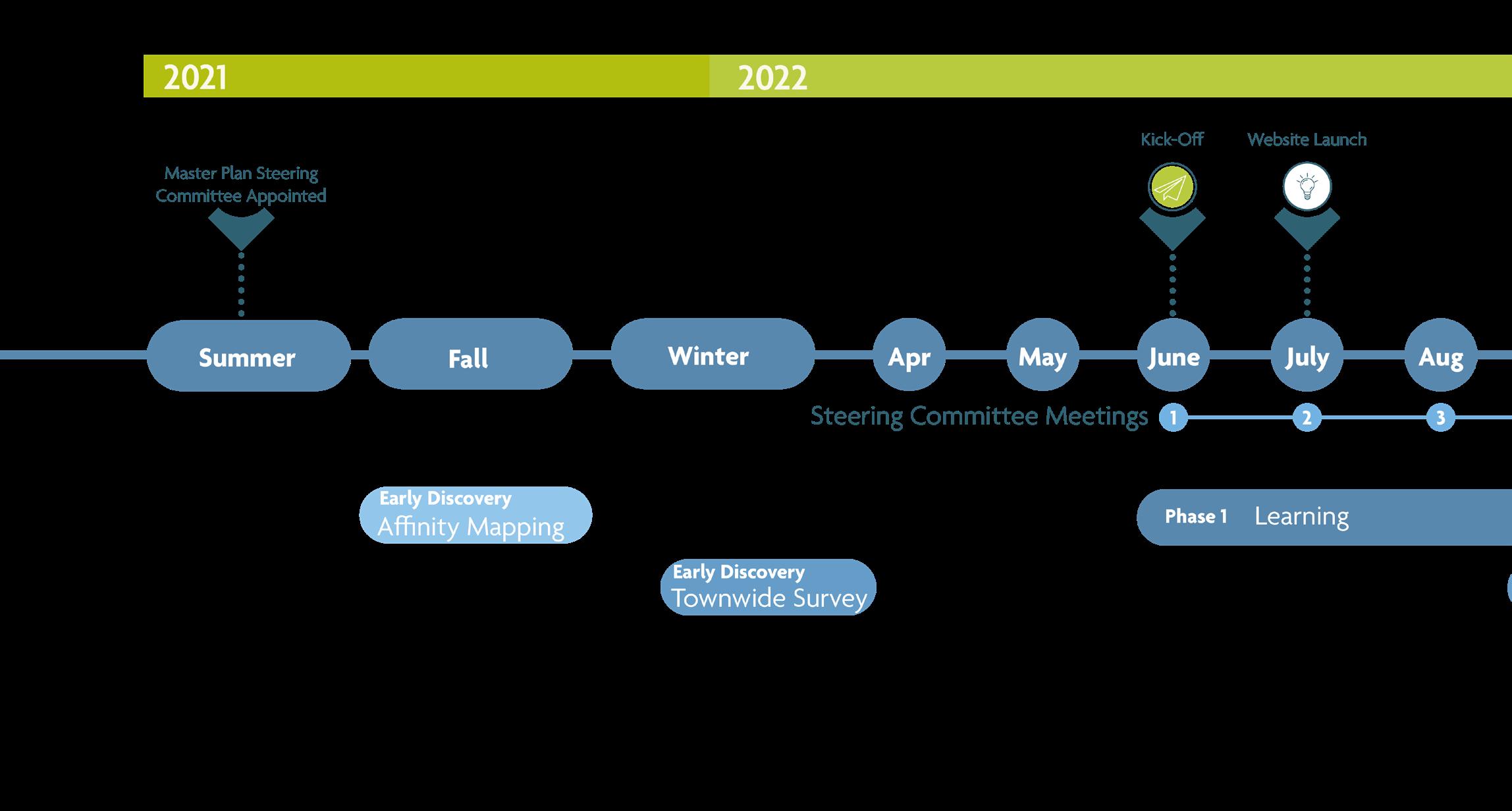
This plan is the culmination of years of community process, working and focus group discussions, and collaboration between town staff, volunteers, and planning consultants. The town kicked off a comprehensive planning process in 2021, with the creation of a Steering Committee and the initiation of a townwide survey in the spring.
Based on that, the town conducted twenty focus group meetings with a number of interested parties and groups the town wanted to ensure the participation of. This resulted in an overall “affinity mapping” process where the findings of all these focus groups and survey data were collected in advance of the start of a formal comprehensive plan writing process. Based on this feedback, this plan attempts to address many of those issues. As can be seen in the summary charts and tables of the affinity mapping process, a number of key issues have repeatedly been identified by town residents, which directly informed the key priority initiatives. Additionally, demographic data collected during the affinity mapping process have shown where some internal biases exist in the feedback collected, since many of the respondents have skewed older, more affluent, and more socioeconomically and demographically homogeneous compared to the town at large.
Most importantly, this plan’s aim is to attempt to address as many of the land use, social, economic, service-based, and climate issues raised through these processes as possible. While it cannot address all of them – the Schools committee is more focused on issues around curriculum, class size, and school performance, for example; and the DEI committee is working to address other issues around diversity and inclusion overall – these priority issues more or less reflect the priority recommendations this plan is suggesting, at least through the lens of physical planning and land use.
In 2022, a consultant was selected to assist the town with turning this initial feedback into a plan. With regular Steering Committee meetings, three public events, and various presentations to town groups, the process engaged in a learning phase, culminating in a townwide vision statement; an exploring phase, culminating in initial goals and recommendations; a plan development phase, culminating in key recommendations and priority initiatives; and a documentation phase, culminating in this final plan document.
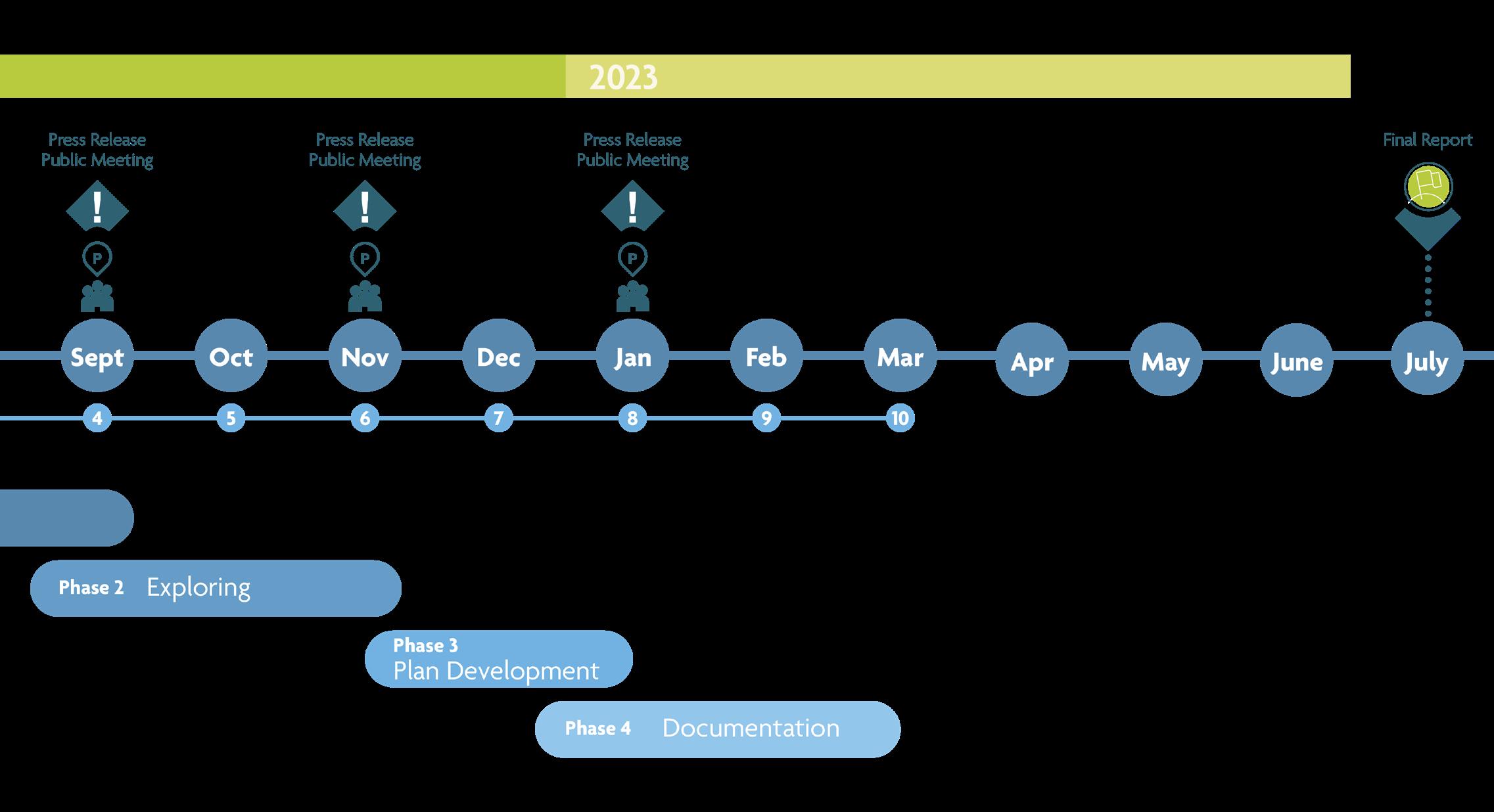
This plan is the culmination of years of community process, working and focus group discussions, and collaboration between town staff, volunteers, and planning consultants. The town kicked off a master planning process in 2021, with the creation of a master planning committee and the initiation of a townwide survey in the spring.
The Steering Committee was critical for the production of this plan and for guiding its process. In addition to performing outreach, attending all in-person and virtual public events, and meeting regularly, the committee was responsible for giving feedback on draft concepts and ideas, for guiding and revising plan content, and for being an overall sounding board for staff and planners.
Three overall surveying processes took place. In 2021-2022, a townwide survey, a series of focus groups, and a community assessment survey guided the overall visioning before the formal comprehensive plan development process started. In winter 2022, a visioning survey took place online, allowing residents to guide the creation of a vision statement with goals. Finally, a smaller online survey allowed residents to respond to the draft recommendations after the plan’s focus groups concluded in 2022.
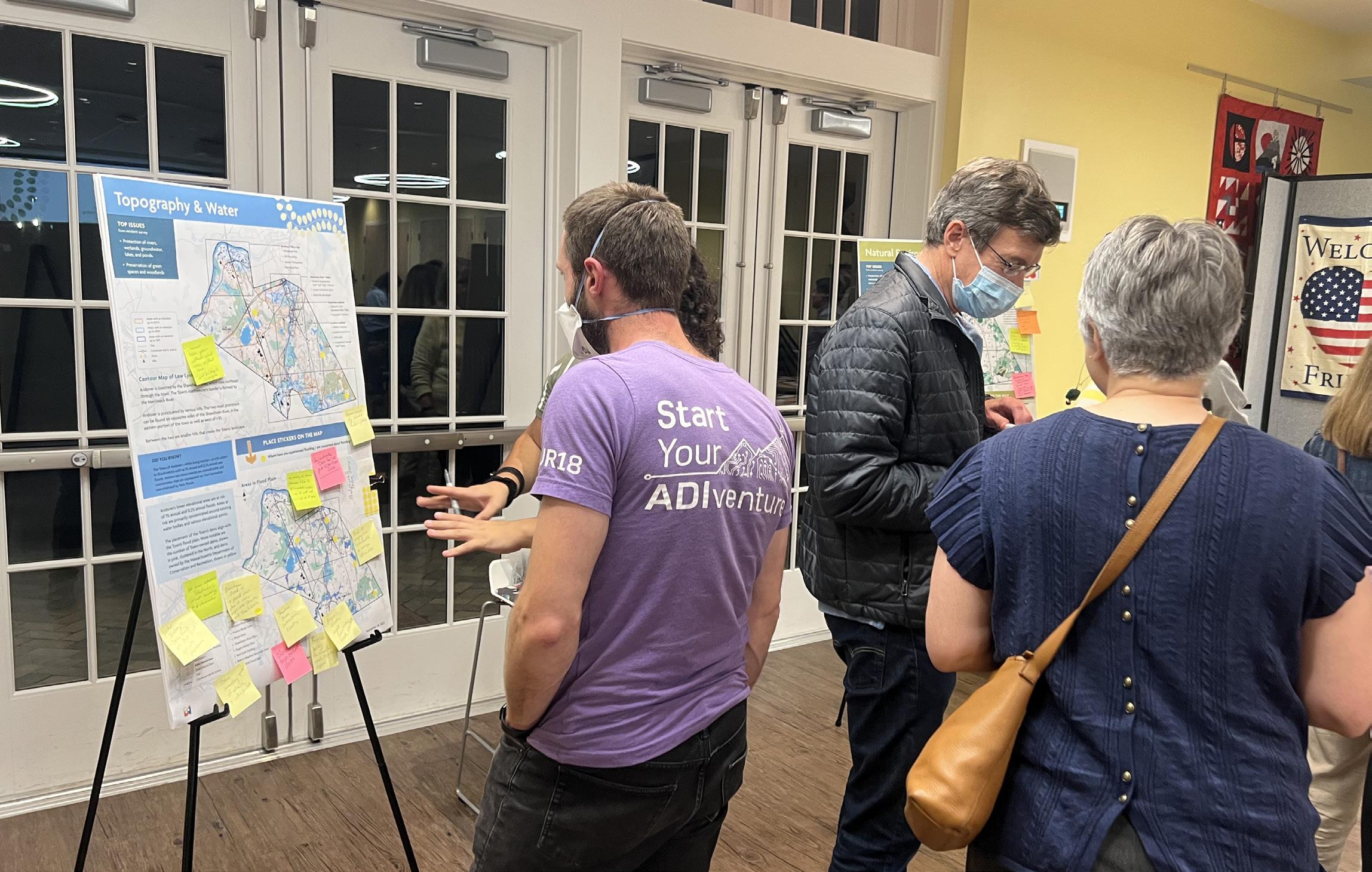
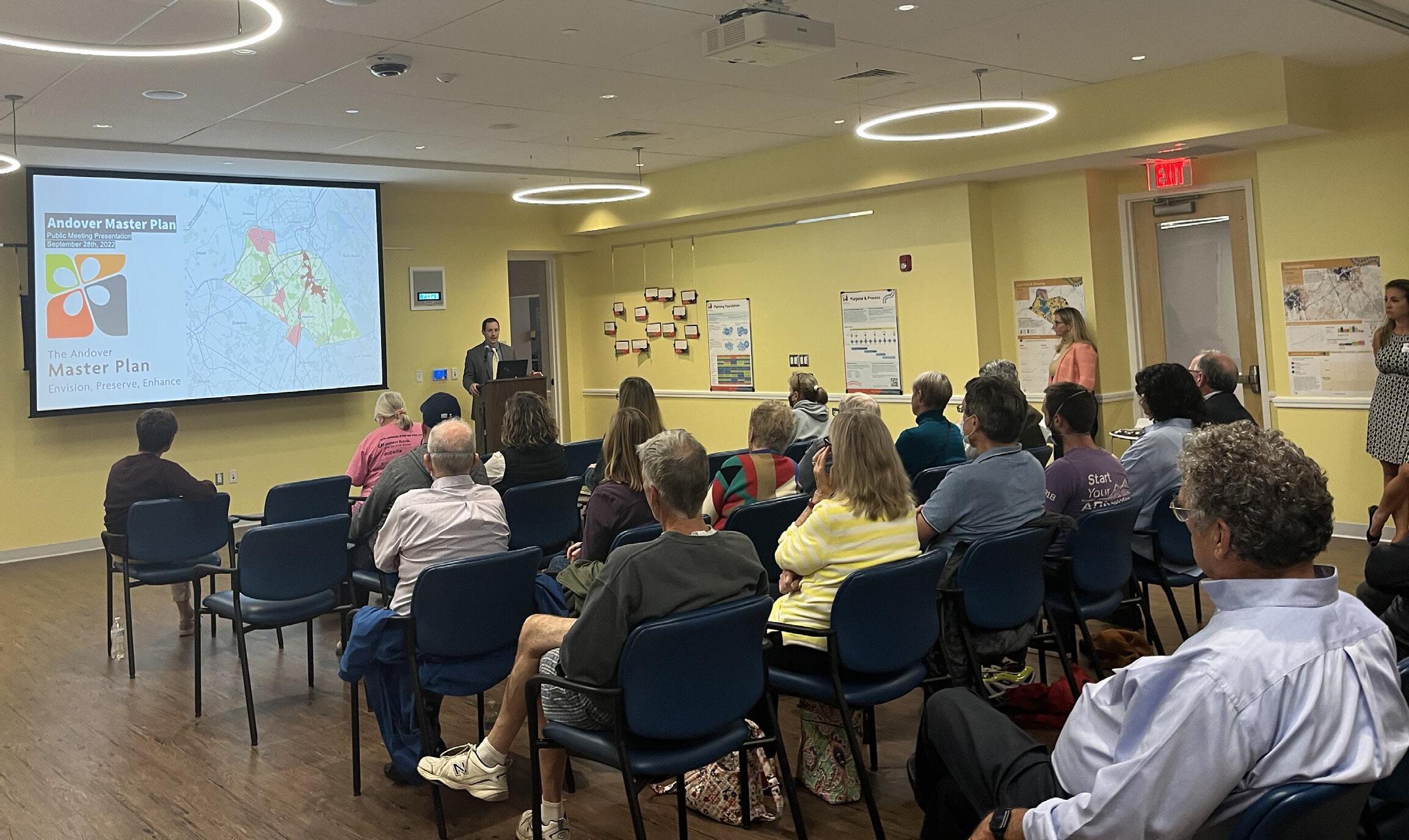
Three public meetings—in September 2022, November 2022, and February 2023—guided the comprehensive plan production process. The first meeting involved the presentation of existing conditions and initial visioning results. The second meeting allowed residents to weigh in on draft goals and recommendations. The third and final public meeting provided a critical opportunity for residents to see and help develop the primary planning moves this plan recommends.
Fall 2021
representing various demographics living in Andover. Participants were asked four identical questions:
• Why Andover?
• What is working for you in Andover right now?
• What is not working for you in Andover right now?
• What is your perfect day in Andover ten years from now?
took the Townwide Survey Winter 2021
Aug–Sep 2022
took the Polis Survey and submitted:
• 8,634 votes
• 79 statements submitted
• Typical respondent submitted 2 statements on average
took the Community Assessment Survey Fall 2022
In Fall 2021, the
conducted
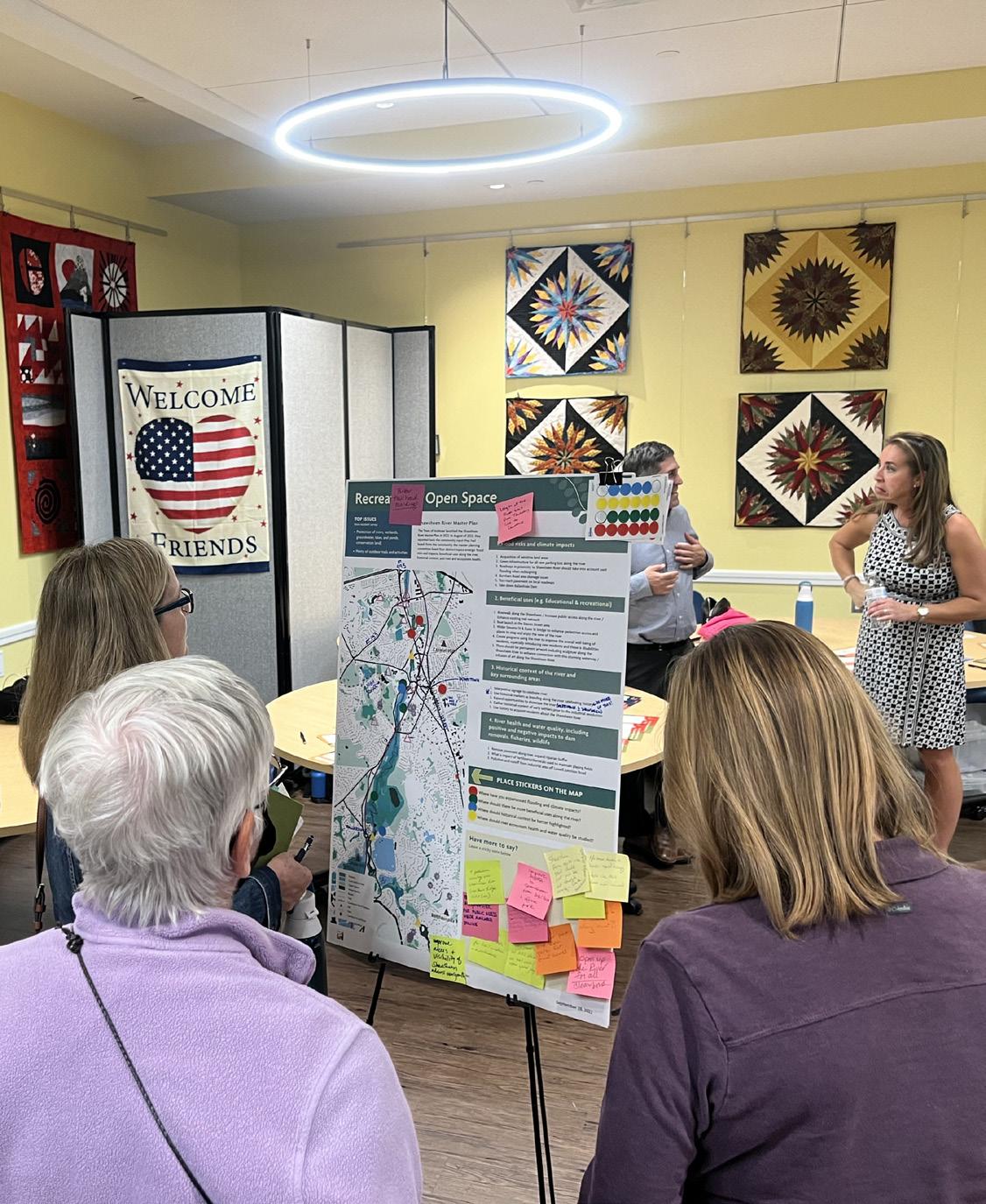
Once the vision statement was developed and refined with the help of the steering committee, the planning team worked with town staff to develop an initial set of topicspecific goals and detailed recommendations that would make up the bulk of this plan’s policy recommendations. After a few rounds of refinement, the planning team held a public event at the Andover Public Library where the public broke up into small working groups and individually workshopped the different topic areas word by word, finding areas that were unclear or topics that were missed. On the whole, this was an extremely helpful process to make sure that the master plan’s recommendations were in line with the feedback we’d heard and the opinions of residents. Most importantly, we heard strong feedback reminding the planning team that it was essential to balance bold and strong goals for the future with the importance of protecting what makes Andover a good place to live now. The town and planning team fully reworked this plan’s recommendations based on that perspective, trying to provide a range of small-scale and short-term options along with direction for potential change in the longer and medium term timeframes, so that as Andover grows as a community to face the future, residents can feel a sense of ownership over how that change is taking place.
On February 1, 2023, the planning team held a third and final large public online presentation and meeting on the key recommendations for the plan, focusing on the three main initiatives of growing along I-93, enhancing along the Shawsheen, and connecting east to west. Those three priorities had been identified during some planning workshops held with the consultant team, town staff, and steering committee members following the development and refinement of the overall goals and recommendations coming out of the focus group process. Based on the feedback gained during that meeting, which included online polls for attendees to suggest changes, these three initiatives became the key priorities described at the start of this planning document. They serve as the backbone of the plan, and the rest of the goals and recommendations developed serve as the additional detail that the town can use as it works to achieve all of its policy goals over the coming decade or two.
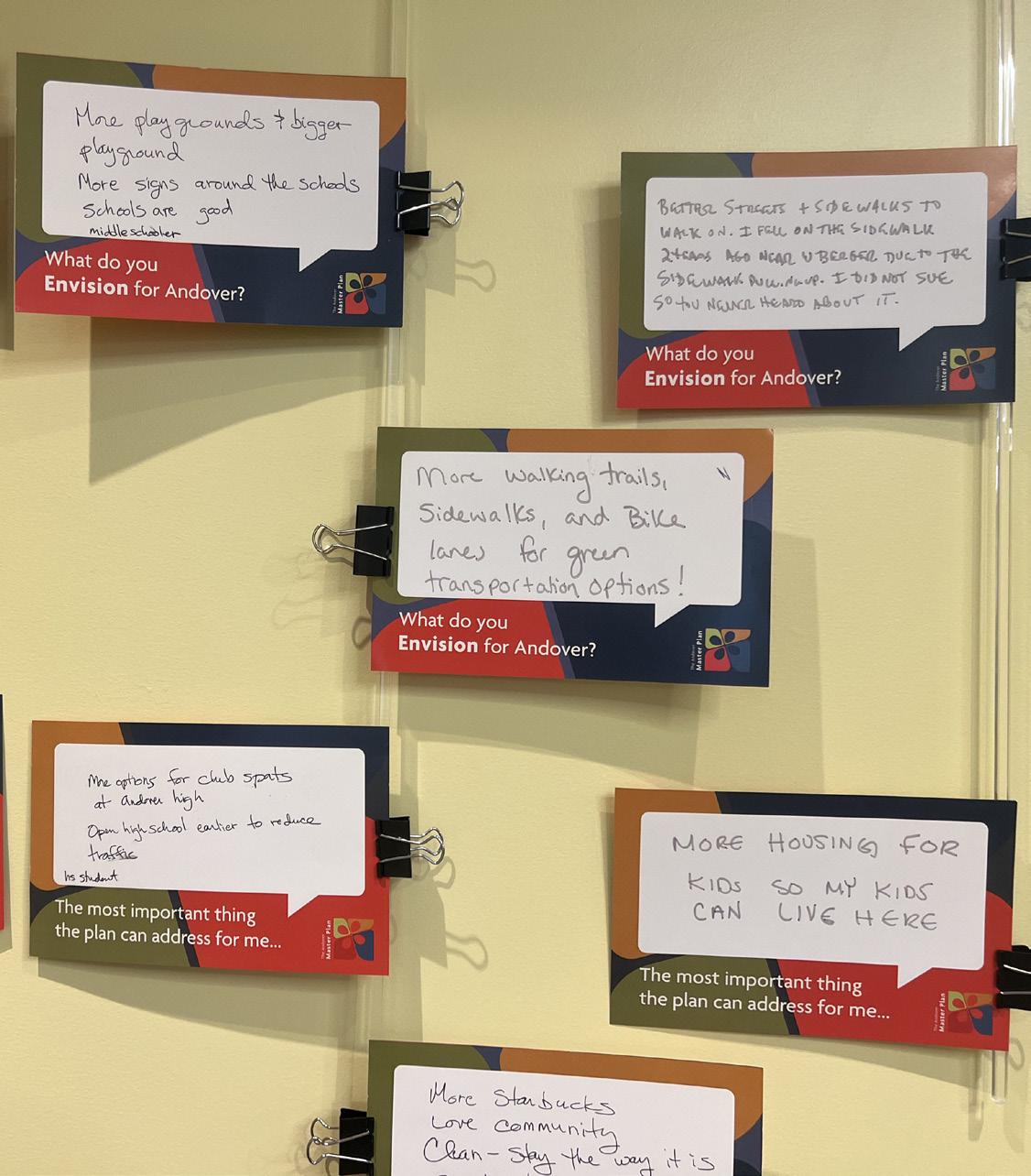
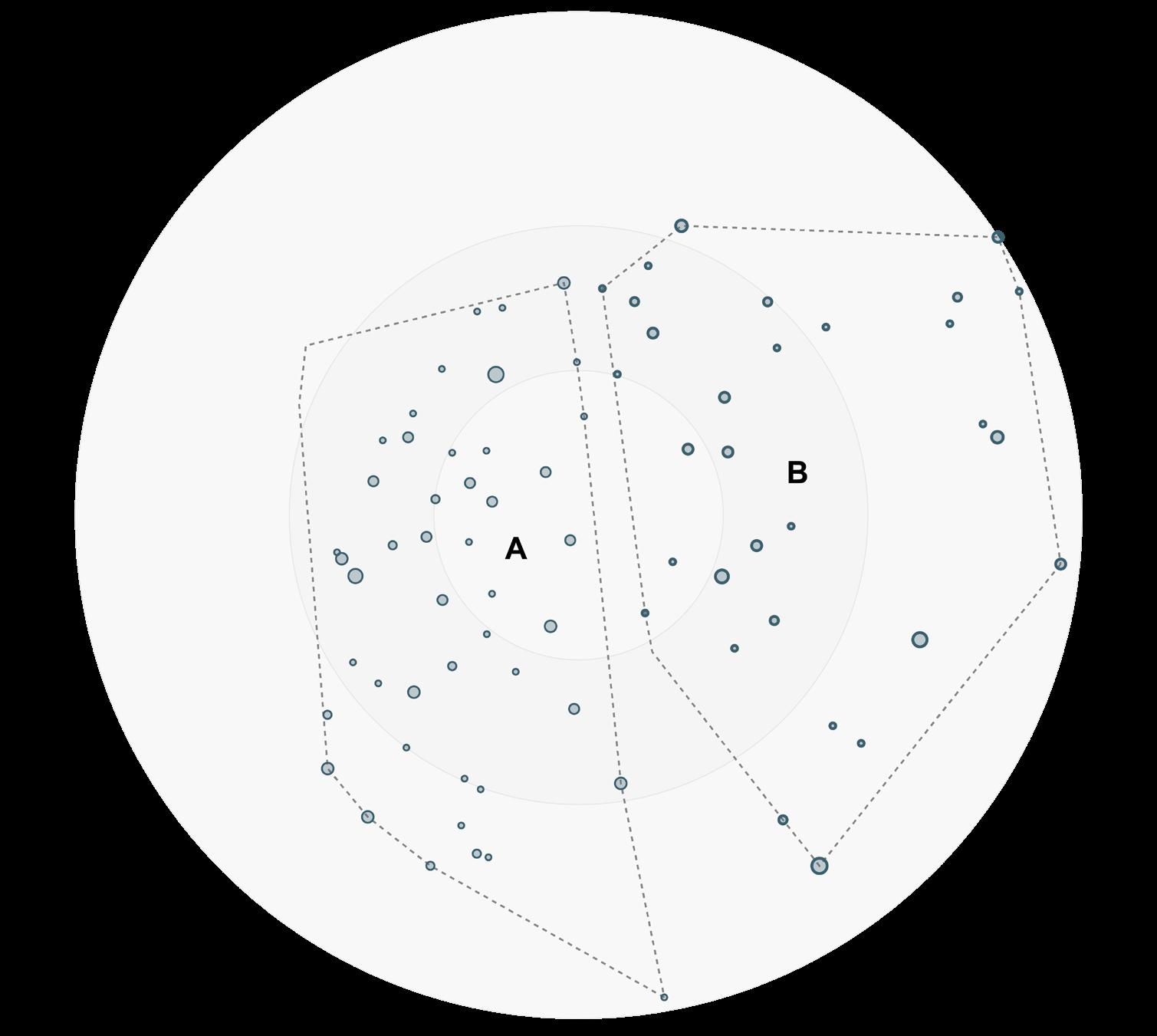

The two charts here show how the statements submitted were categorized by the Polis system.
For the diagram directly to the left, each dot represents a notable statement from the set of statements submitted. Dots toward the center of the circle represent statements which had more consensus, and statements to the edges show statements that were more divisive. Opinion Group A, which represented the majority of respondents and the majority of statements, both includes more of the middle of the circle and also includes dots and respondents grouped closer together, indicating that the majority of ideas and respondents generally shared their overall ideas. Opinion Group B, on the other hand, was much more dispersed. The minority of opinions, while still notable in size, did not coalesce around any one primary idea. From a planning perspective, this suggests that there is not firm opposition to any one idea, but instead a healthy concern about change, and a need for clarification about ensuring that planning policies take care of all residents’ concerns.
The graph below shows the statements in a different way, with dots to the left representing statements that had more consensus and statements to the right showing more division. It shows that most of the ideas suggested, with a few exceptions, were generally agreeable to the public who responded to the survey.
After the town conducted its affinity mapping and focus group effort, the planning team looked to determine a way to conduct additional outreach that could continue to inform the master plan. This resulted in the use of the Polis online surveying and analysis tool. The town created an initial set of statements for residents to respond to, and residents themselves could agree, disagree, or mark uncertainty based on their opinions of those statements. Additionally, respondents to the survey could add their own statements. In the end, almost 300 people voted on approximately 80 statements, with a total of more than 8600 votes. This allowed the Polis tool to categorize the various opinion groups of people in town, which directly informed the process of developing a vision statement with initial goals. Specifically, there was strong consensus about the need to consider the town’s future, especially around building appropriate types of new housing, planning for environmental and climate change, and addressing the lack of opportunity for getting around town, especially when not by car. There was still a strong set of additional voices in the minority who like Andover as it is, and who expressed concern that too much change too fast could be detrimental to the town’s character. The full results are available at https://pol.is/report/r3fybddipea7zbcamuafv.
Synthesizing and building upon other recent planning efforts is a key component of the Andover Comprehensive Plan process. A Comprehensive Plan ties together and prioritizes projects, goals, and recommendations contained in other plans.
Andover’s previous master plan, adopted by the Planning Board in 2012, included an extensive public engagement process which resulted in a series of detailed vision statements, goals, and implementation strategies for Town policies, regulations, and capital projects.
The Town undertook a parking study to better understand existing parking use and to manage parking downtown more effectively. The study identified several areas for improvement of pricing, signage, payment systems, and communication. It also found that large numbers of spaces were available even at peak hours. The study made a number of recommendations aimed at more effectively managing the existing parking supply to improve the downtown experience for residents, businesses, and visitors.
The Merrimack Valley Comprehensive Economic Development Strategy, adopted by the Merrimack Valley Planning Commission, outlined several objectives for municipalities and their regional partners related to transportation, manufacturing, and natural resource protection. The plan established a time horizon of 2018 to 2023 for its recommendations.
The Open Space Plan, adopted by the Conservation Commission, outlined strategies for conserving critical open space and natural habitat throughout Andover. The plan focused on protecting land along the Merrimack and Shawsheen Rivers to enhance opportunities for recreation and wildlife habitat preservation.
Andover’s Housing Production Plan, adopted by the Select Board, presented findings related to the current inventory of Andover’s housing stock and existing housing affordability. The report also outlines regulatory barriers, environmental considerations, and infrastructure capacity that affect housing capacity and production.
The Municipal Vulnerability Preparedness Plan outlines climate-related and extreme weather hazards of highest concern to the community; identifies existing and future vulnerabilities and asset strengths in areas of infrastructure and critical facilities, socioeconomic characteristics and environmental resources; develops and prioritizes actions for community resilience based on identified opportunities for risk reduction and resilience building; and proposes key actions through community partnerships.
• Implemented Transportation Demand Management best practices in downtown Andover
• Updated the Stormwater Management and Erosion Control Bylaw
• Expanded the areas of review under the Design Review Board
• Created the Andover Green Advisory Board and the Economic Development Council
• Achieved above the Massachusetts Department of Housing and Community Development (DHCD) 10% affordable housing threshold
• Acquired over 179 acres of open space
• Rezoned certain Industrial Districts to allow for additional complementary uses such as restaurants
• Relocated the Andover Department of Public Works from downtown and rezoned the area (100 acres) for high-density mixed-use development near the commuter rail station
• Adopted a Complete Streets policy
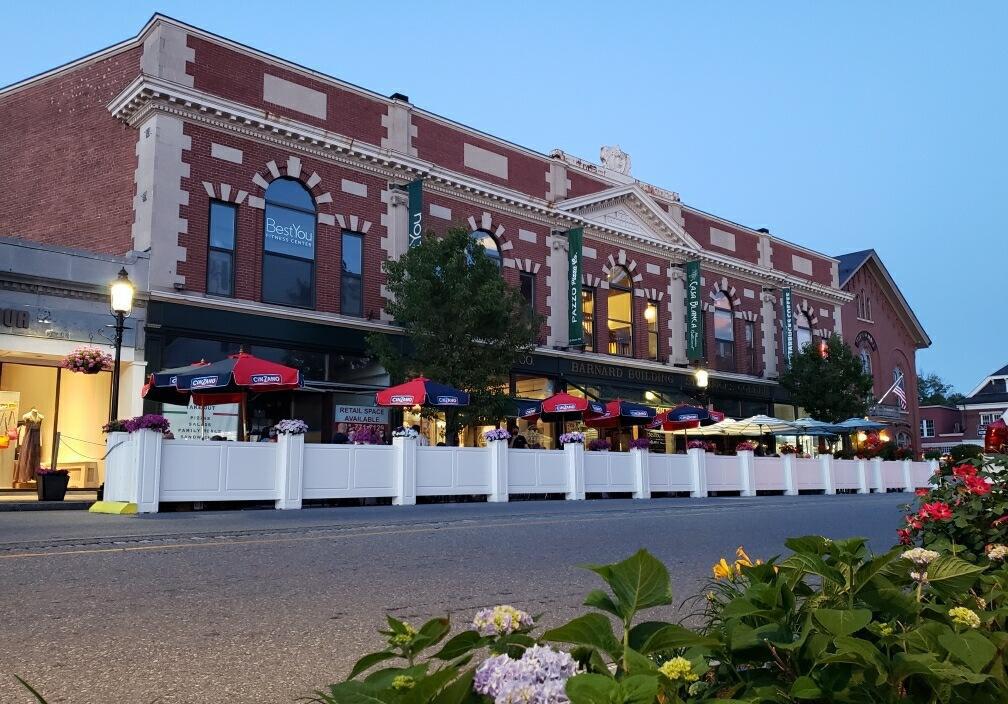
A vision statement and priority recommendations are how this plan can avoid the classic problem of trying to do “everything except the kitchen sink.” A vision statement tries to condense the overall purpose of all the planning goals and initiatives into one primary statement. Priority recommendations pull out the most important programs or changes that the plan proposes for Andover. These serve as a more detailed version of the key initiatives mentioned at the start of this document.
A vision statement is the foundation of a plan’s values. It is intended to develop a coherent, broad vision for Andover that is built upon by the plan’s goals and recommendations.
“As Andover progresses into the future, we envision a community that embraces economic, social, and environmentally sustainable growth. We welcome new neighbors and businesses and strive to preserve and support the history and people who built the strong foundation we enjoy today. By strategically designing and connecting our historic centers, commercial districts, vibrant open spaces, and neighborhoods, we will channel vitality that secures Andover’s future while preserving our greatest resources.”
Una declaración de visión es la base de los valores de un plan. Su objetivo es desarrollar una visión coherente y amplia para Andover que se base en las metas y recomendaciones del plan.
“A medida que Andover avanza hacia el futuro, visualizamos una comunidad que adopta un crecimiento económico, social y ambientalmente sostenible. Damos la bienvenida a nuevos vecinos y empresas y nos esforzamos por preservar y apoyar la historia y las personas que construyeron los cimientos sólidos que disfrutamos hoy. Al diseñar y conectar estratégicamente nuestros centros históricos, distritos comerciales, espacios abiertos vibrantes y vecindarios, canalizaremos la vitalidad que asegura el futuro de Andover mientras preservamos nuestros mejores recursos.”
远景规划是计划的价值基础。在该规划的目标和建议之下, Andover将建立一个连贯、广阔的远景.
随着 Andover 迈向未来,我们设想将有一个兼有经济、社会和环境持续 增长的社区。我们欢迎新的邻居和企业,并努力保护和支持为我们今天
所享有的坚实基础打下基础的历史和人民。通过战略性地设计和连接 我们的历史中心、商业区、充满活力的开放空间和社区,我们将充满生 机,确保安多弗的未来,同时最大地保护我们资源。
如需翻译综合计划方面的帮助,请通过 planning@andoverma.us 联系规划部门或致电 (978) 623-8650。
This section provides a high-level overview of the Comprehensive Plan’s priority recommendations. These priority recommendations cut across different topic areas. Please see the Topic Area Goals & Recommendations section for detailed goals and recommendations by topic area. The content of this section is intended to be primarily visual—mainly diagrams and maps, with some explanatory text.
Jobs and housing to be considered jointly by the planning process
Economic development and growth strategies must be considered jointly alongside conservation protection and open space improvements to provide avenues for funding
Regional demand for industry has been strong and continues to be strong in the metropolitan region. Industrial and office parks north and south of Andover along I-93 are at capacity and continue to be critical components of economic development for communities, even in the post-pandemic economic landscape. With that in mind, setting zoning and policy changes in effect to build upon these strengths is the first priority recommendation for this planning effort.
• Review Limited Service Zoning District along Lowell Street, east of I-93, to incorporate the mix of uses existing today. (See Urban Form & Land Use Goal 2. Create Robust Business and Industrial Districts)
• Evaluate success of ID2 and explore additional allowed uses in the Industrial Districts (See Urban Form & Land Use Goal 2. Create Robust Business and Industrial Districts)
• Reduce parking ratios. (See Mobility and the Transportation Network Goal 4. Pursue Multimodal Mobility Solutions)
• Increase the height limit for buildings in Industrial Districts. (See Urban Form & Land Use Goal 2. Create Robust Business and Industrial Districts)
• Explore noise and other nuisance issues from existing businesses and identify design and code enforcement strategies to mitigate nuisances for existing and future residents.
Building height: maximum of 85’
• In many cases, buildings will still max out at 3 stories, or something like 55’, due to parking requirements and existing conservation space
Reduced parking ratios in line with current market standards:
• Industrial: 1 space per 1600 square feet
• Commercial: 1 space per 500 square feet
Compare with current ratios:
• Industrial: 1 space per 300–600 square feet
• Commercial: 1 space per 500 square feet
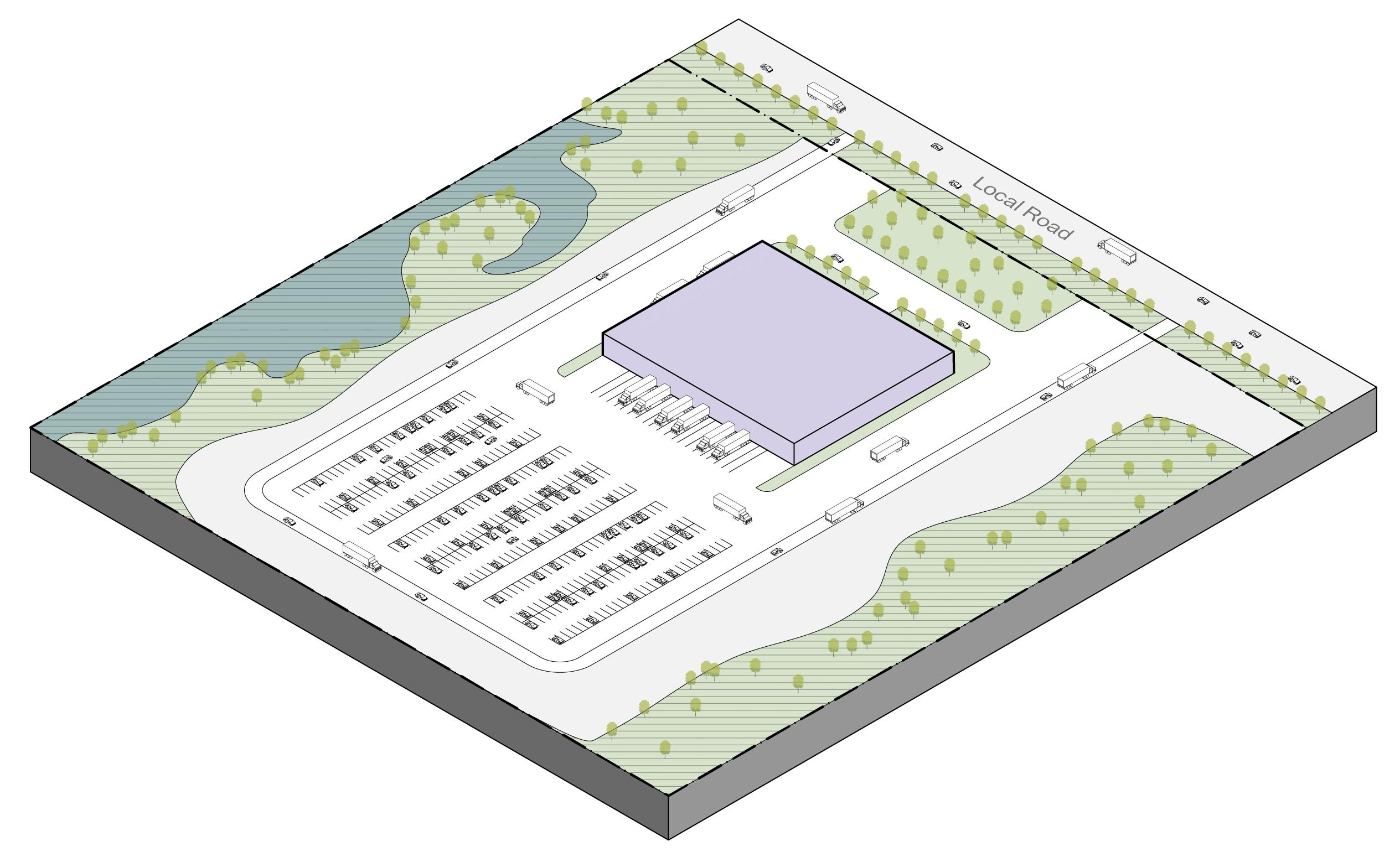
For the purposes of this plan, the planning team selected a single prototypical site, a site that is representative of some smaller existing industrial businesses or buildings in one or more of the existing employment centers. The image at the top right shows the current condition—generally a single story building, large amounts of parking, and site placement that does not leave much room for expansion. The image at bottom right, Proposed condition, shows the outcome of the zoning changes our planning team recommends. By allowing for higher density and increased overall development potential, modern industrial sites can be developed. With contemporary and appropriate lowered parking ratios, it is possible not only to place a high-bay (28’) ground floor industrial building, with two or three additional accessory or light industrial stories on top. This allows for a tripling of overall space per site, and provides an incentive for property owners to slowly replace their existing facilities as the current ones approach end-of-life.
• Single story industrial or commercial.
• Substantial parking, almost entirely underutilized throughout the day.
• Buildings set back very far from the road, creating no possibility of any circulation through the site except by car or truck.
• Constructed area is segregated from surrounding conservation areas.
• Overall commercial/industrial mix and scale is retained, while allowing for newer Research and Development (R&D) space to be added in as sites redevelop.
• New construction with “high bay” industrial ground floor—well suited for advanced manufacturing or modern R&D or industrial uses. Two/three additional stories above the ground-floor industrial— allowing for additional accessory commercial or light industrial uses.
• Building frontage closer to road, still setting back enough distance for frontage entry and green buffer from traffic.
• Green spaces along constructed areas to reduce environmental impact and interact with conservation.
Existing buildings are fully utilized
Parking lots are largely vacant, because parking ratios used during development do not reflect current employment patterns
Increase in leasable space mostly offset by adjusted parking ratio, but spaces can still be accommodated with more efficient layout
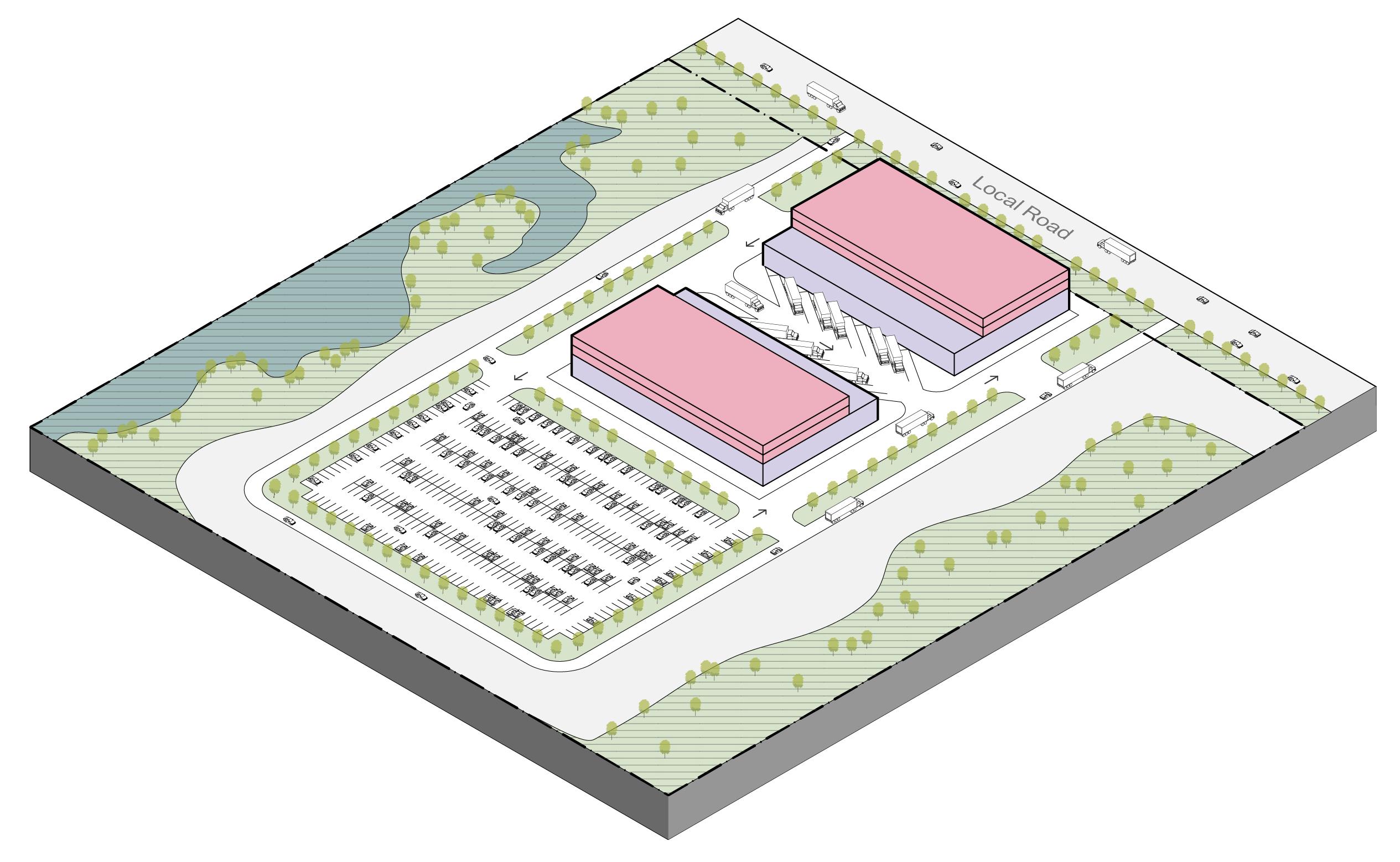
Buildings never to exceed 85’, a building code threshold and determinant of construction cost.
Since parking largely stays the same, town’s ability to handle employee exit/arrival should remain similar to current needs.
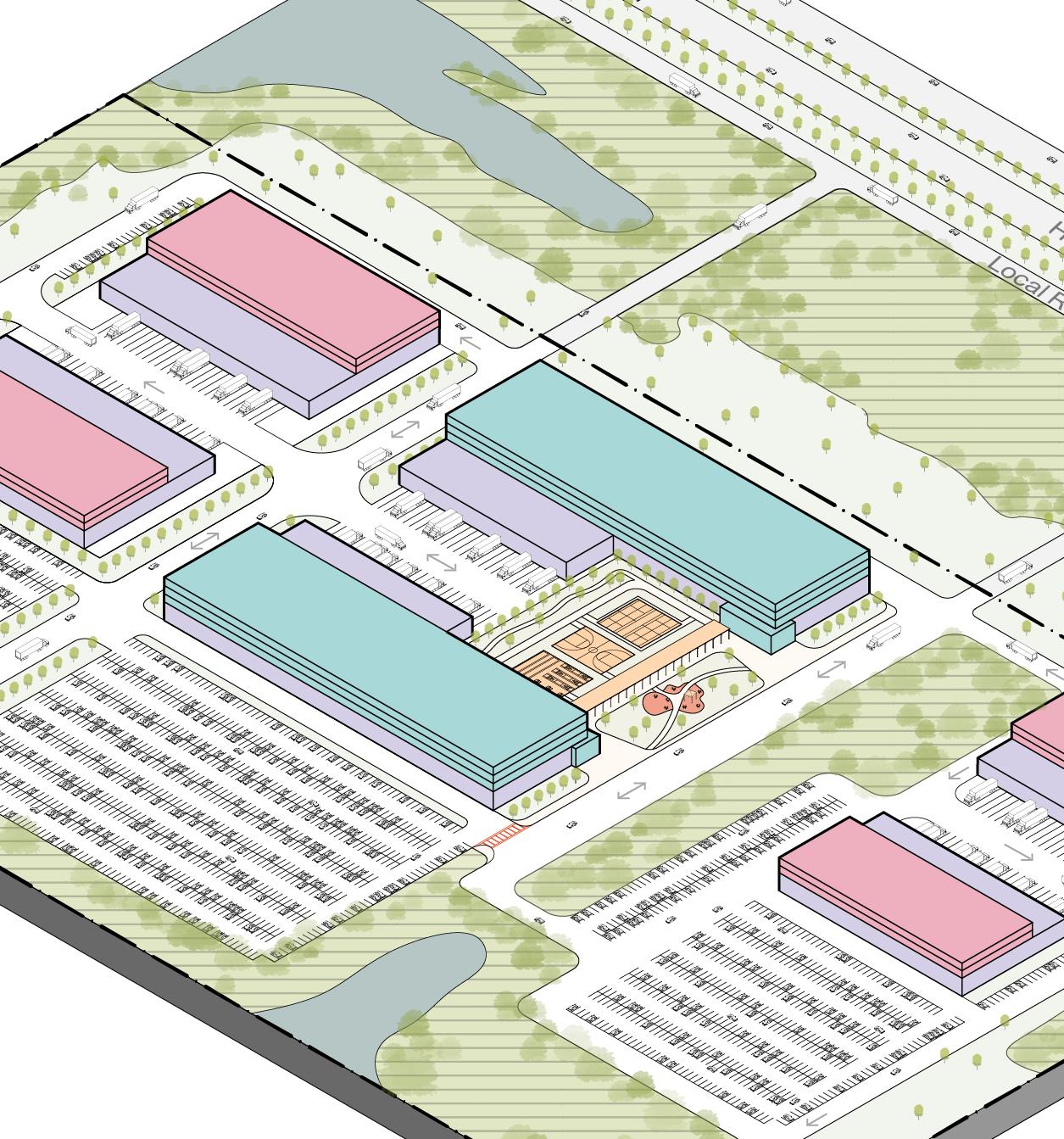
A development approach similar to the smaller-scale site applies for a larger scale redevelopment scenario, with some additional benefits and considerations. Building types can likely vary with more flexibility, and it makes sense to allow for industrial floors to take larger floor plates relative to the upper stories to accommodate more flexible and space-dependent uses there. Placing buildings close to one another, in comparison to the more separated placement across many existing sites, allows for some level of placemaking between the buildings. Placing parking in its own space further away would allow for some open space or amenity development, which could leave space for lunch spots or outdoor seating. Helping create a more pleasant overall workspace environment in and around the buildings is a key aspect of further repositioning Andover’s parks as prime new employment locations.
• Large-scale legacy industrial plants or warehousing, with one or two story footprints.
• Accessory office buildings adjacent to larger primary buildings.
• Circulation is primarily driven by the need to accommodate large parking lots.
• Similar concept as on the small site, but with varied building scales and types.
• For larger buildings, the industrial first floor takes more space than upper floors, both to accommodate expanded loading uses and limit new parking needs.
• Buildings closer to each other to create a human-scale campus, increasing walkability and connection within and among building groups.
• Centralized shared workplace open space for employees’ daily needs - food trucks, seating for gathering and adequate space for outdoor activities and events.
• Green spaces along constructed areas to reduce environmental impact and interact with conservation areas.
Revised guidelines yield 2x-3x the built square footage on same site.
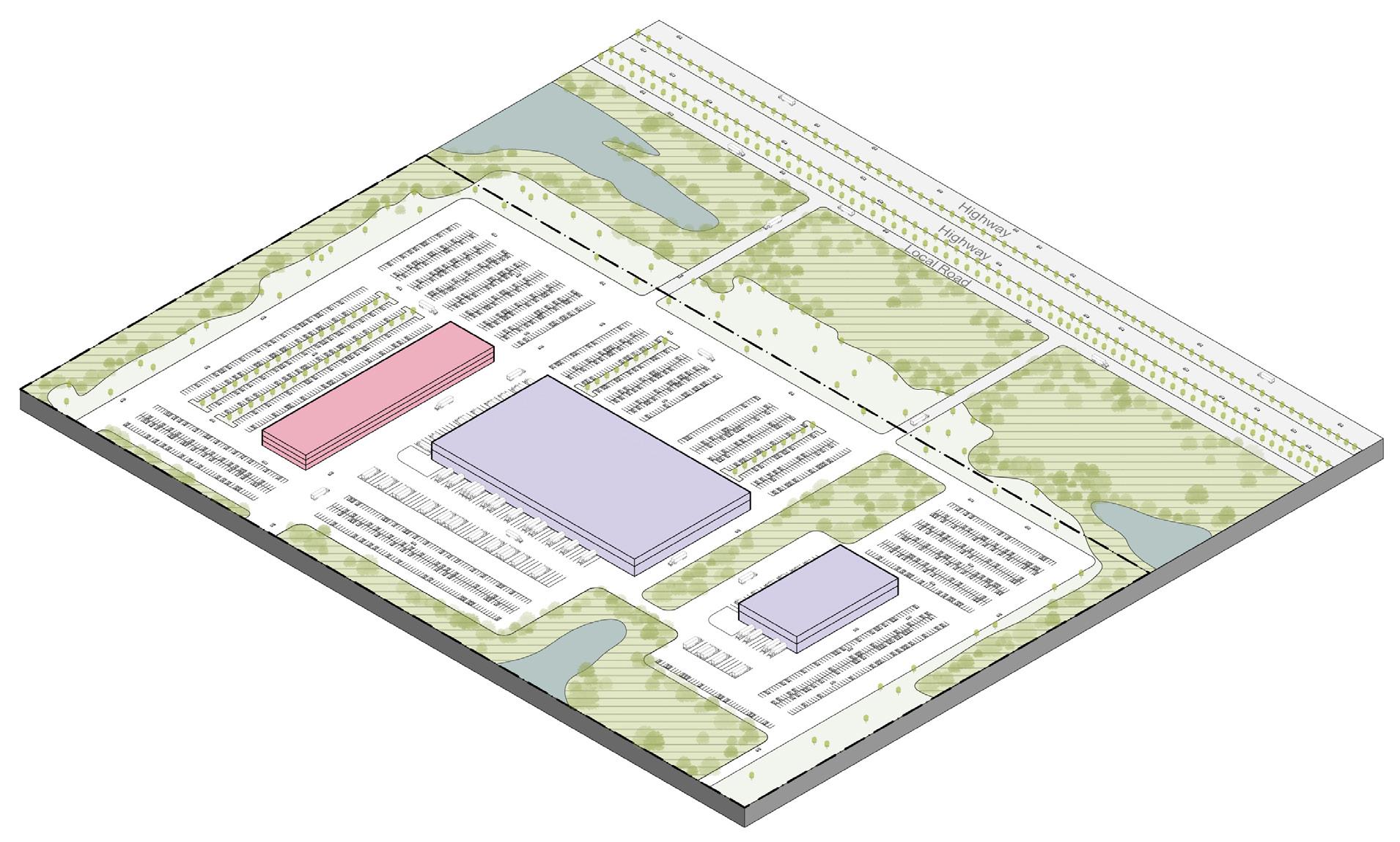
Clustering buildings together allows for sense of “district” and not just isolated individual tenants
Proximity of buildings allows developers to consider building campus open space and food amenity spaces
Parking can be placed separated from normal business logistics and loading, simplifying access in and out of site
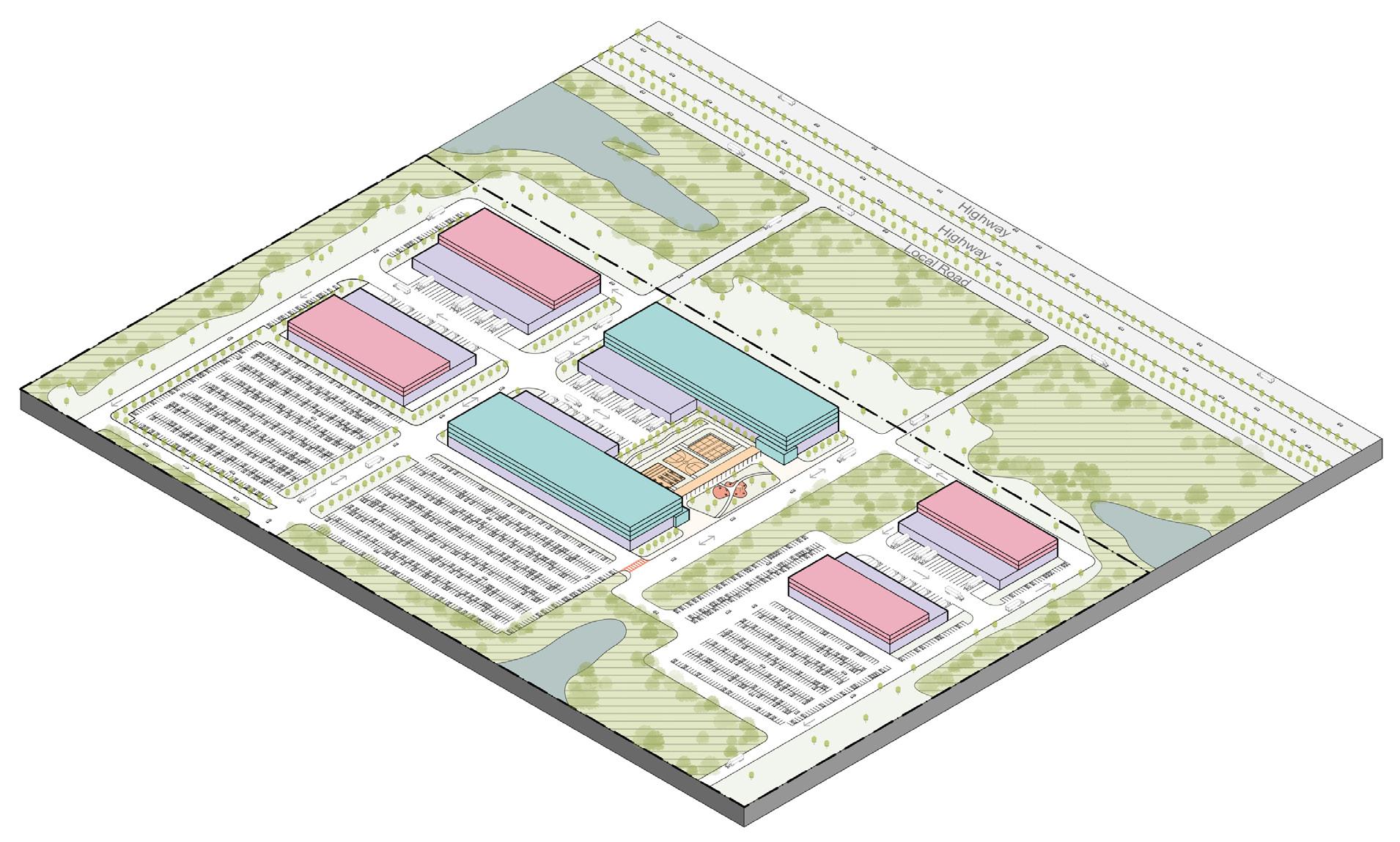
Reduced parking ratio means that additional development can happen entirely on unrestricted land
Enabling modern industrial/ commercial hybrids signals to the market that Andover is serious about its continued role as an regional job center
Pushing future building developments toward the front edges of parcels sets the stage for longerterm district mobility improvements`
the Shawsheen River and the
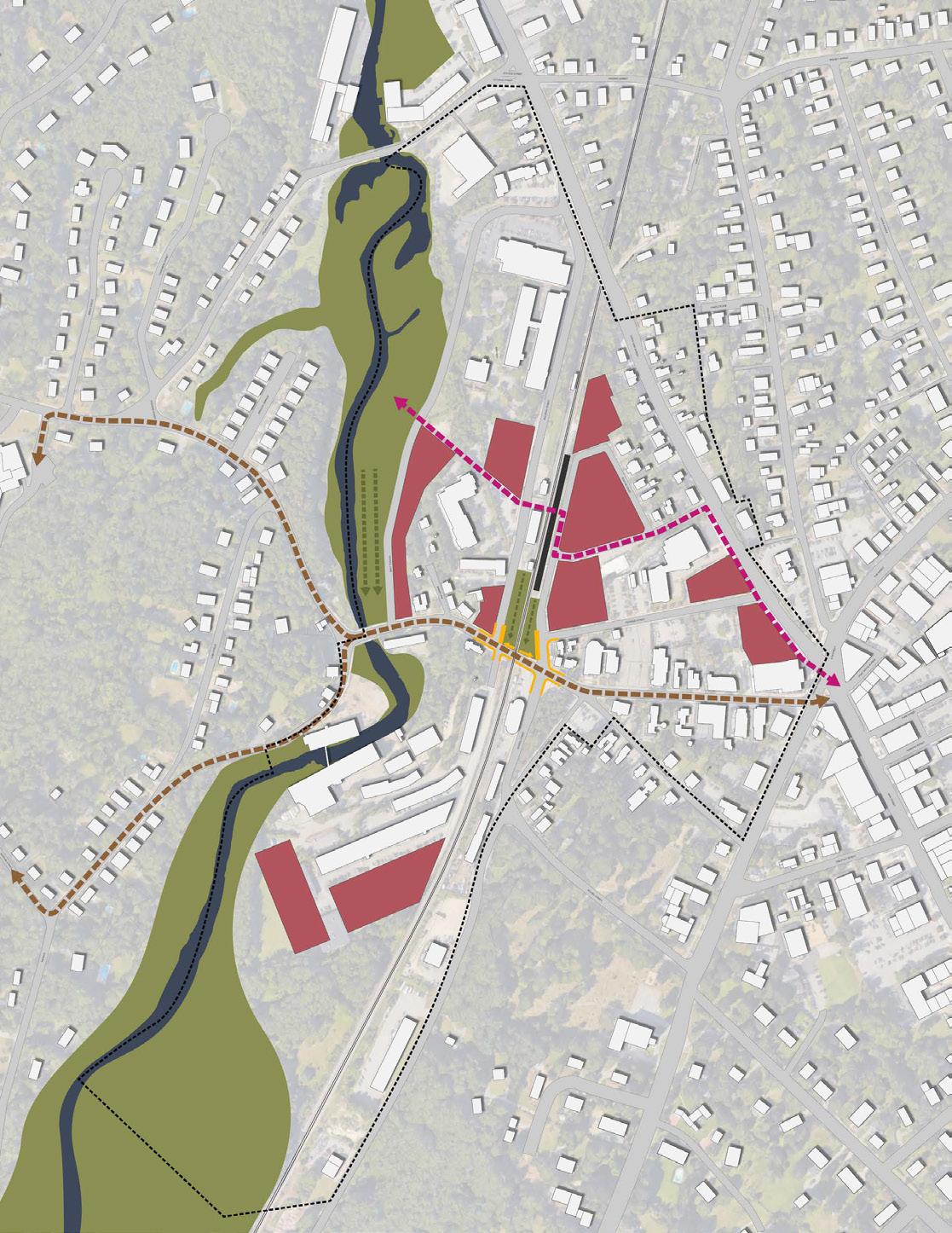
This priority recommendation builds upon a number of recent and ongoing initiatives by the Town. Andover is already hard at work on a Shawsheen River Master Plan, and that combined with the recently passed Historic Mill Overlay District (HMOD) leads this planning effort to try to link the two. To do so, this plan suggests combining a more comprehensive effort to improve the recreational and historic character of the existing town centers and natural resources alongside an effort to increase the production of what is commonly called “missing middle” housing, a scale of housing less dense than traditional multifamily but denser than single-family housing.
• Preserve existing historic districts. (See Goal 6. Enhance Historic Character for more detailed recommendations)
• Reduce minimum lot size, required setbacks, and frontage requirements. (See Housing Goal 1. Diversify Housing Opportunities & Urban Form & Land Use Goal 1. Focus on Targeted Growth and Enhancement)
• Identify and rezone locations for multifamily development with walking access to Ballardvale Station. (See Housing Goal 2. Encourage Transit Oriented Development)
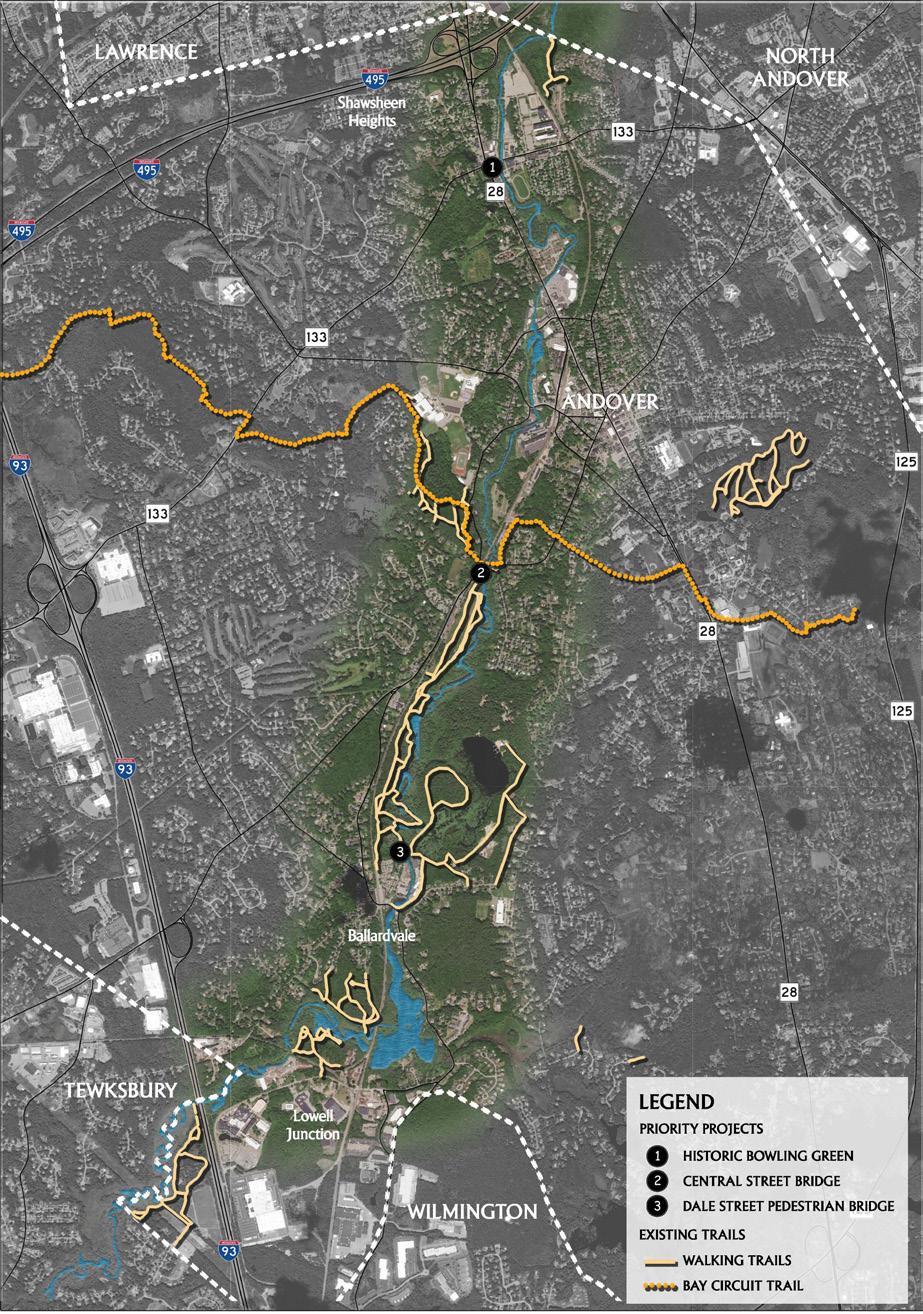
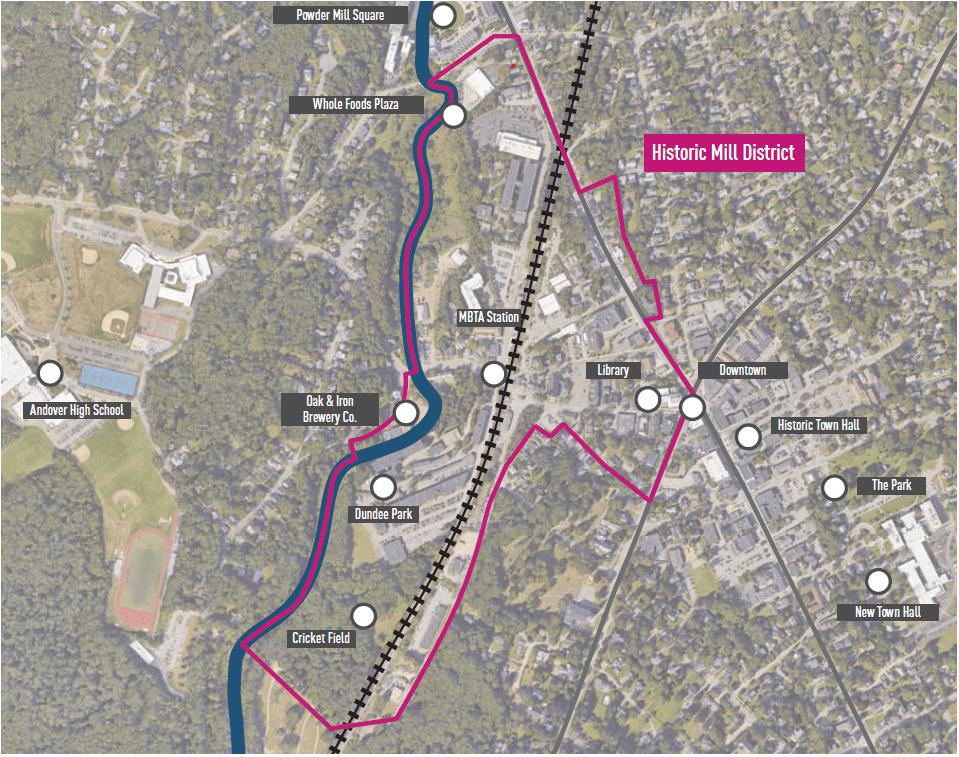
The Historic Mill District (above), already passed and implemented by the town, serves as an excellent initial framework for denser development that this plan builds upon.
Priority projects from the concurrent Shawsheen Master Plan (pictured left) will provide additional recreational and environmental support to supplement the development options discussed in this plan and also envisioned through the Historic Mill District Overlay.
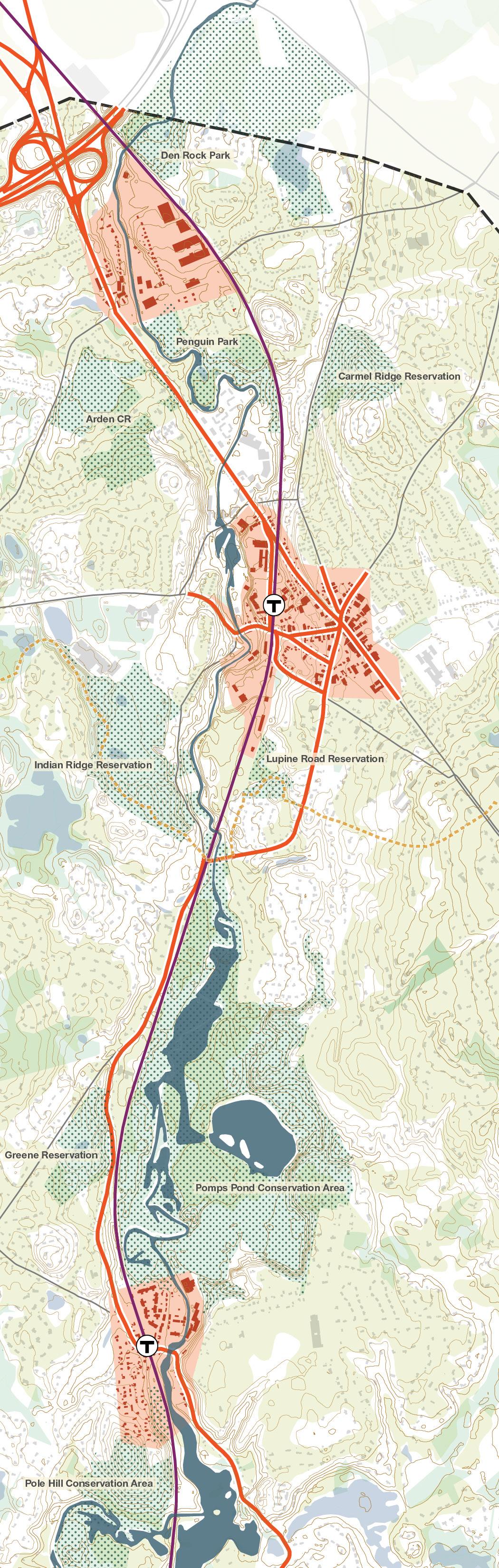
Thoughtful increased density can create an additional target market for downtown retail businesses
“Missing middle” housing can help produce transit-oriented residential infill, which helps create more of a sense of place while still retaining Andover’s primary small-town character downtown and near the station.
Opportunity for longer-range recreational amenities planning along the Shawsheen
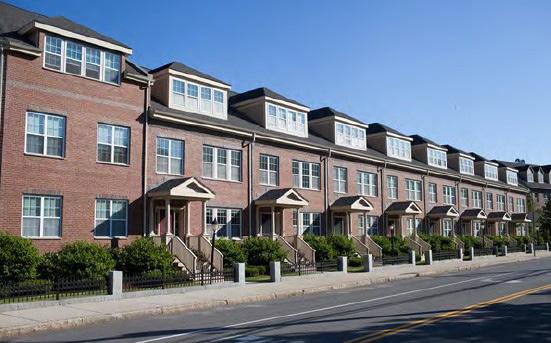
As can be seen on the example site to the right, the levels of density suggested for this “missing middle” housing sits between individual single-family houses (which exist to the southwest of the site as context) and the larger multifamily adaptive reuse or construction envisioned for the Historic Mill Overlay District. In its place, smaller buildings of six or twelve units create buildings with footprints that are similar in size to a large house. This has multiple benefits: the parking can be disaggregated across the site, minimizing the impact of the density both within the development and from the street or the perspective of neighbors, it creates a more village-like feel compared to apartment buildings, and it still ultimately yields a level of density of about 25 units an acre, which is very much in line with other statewide initiatives, like the 3A MBTA Communities Act.
• Legacy commercial or vacant use
• Some existing low-density residential adjoining
• Proximity to open space and river
• Building footprints range from 2400 to 3600 sf
• Efficient from an internal circulation standpoint, making them market-viable
• Allow disaggregating parking across site
• Fit for sites that are either too thin or too small for larger multifamily
• Smaller residential group creates a village style that interacts with existing neighborhoods, and adds up green space and walkable pathways that connect to the riverfront.
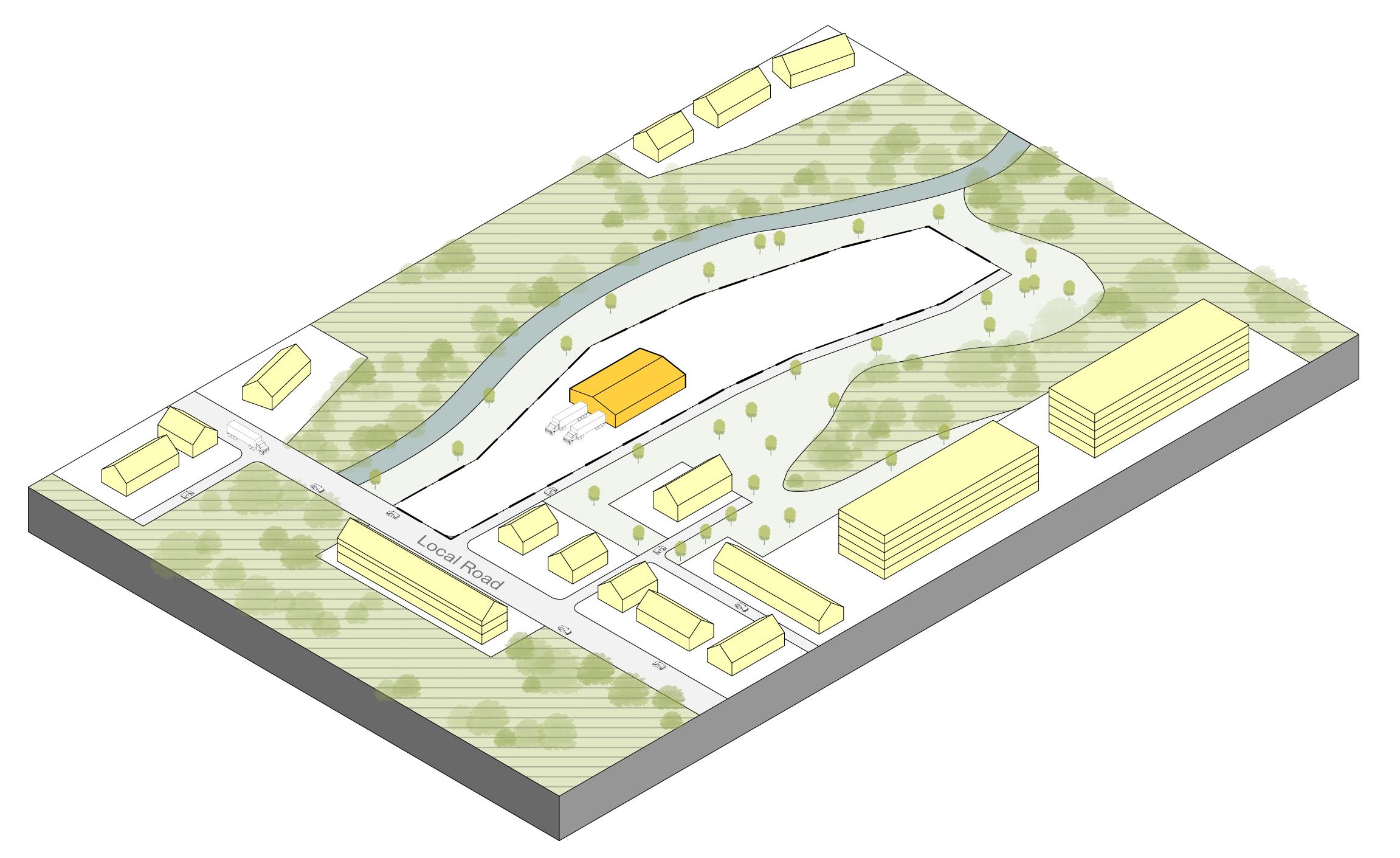
Existing nature along the riverfront is a clear asset to the Town.
Abutting lots tend to be single-family.
Six-unit buildings near the road side of parcels prevents development from appearing too bulky
Depending on site specifics, the individual buildings can be arranged to minimize impact on neighbors
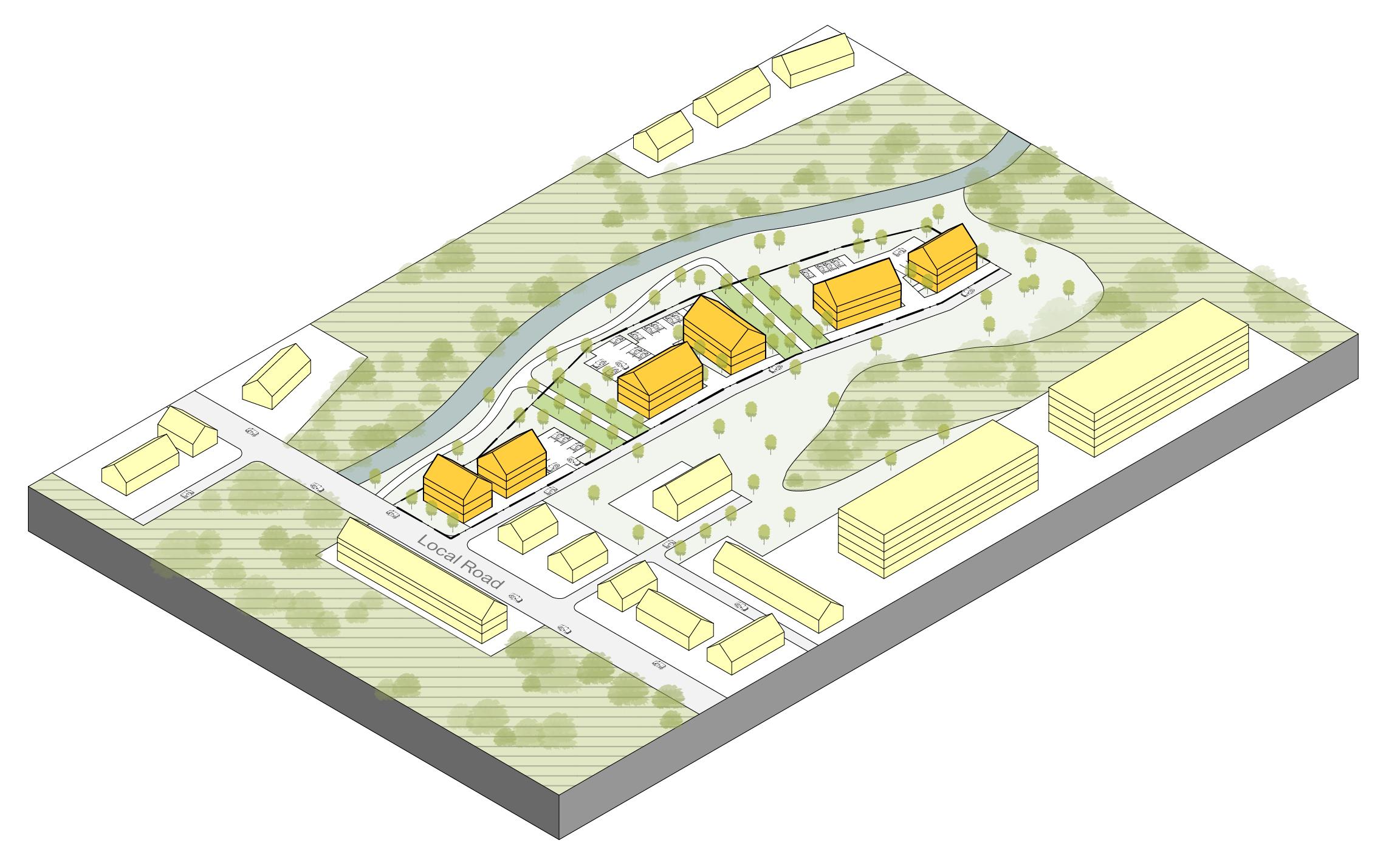
Distributing buildings along parcels allows parking to be distributed as well
Traveling East to West through Andover can be challenging. We can improve mobility for all road users by investing in multimodal improvements to East-West corridors throughout the Town. This involves a more systematic reinvestment in existing thoroughfares, and using a number of strategies to calm traffic and improve the experience for non-pedestrians. Andover will continue to be a town where many residents work throughout the region, but the Town can continue to meet the needs of commuters while also allowing for other ways to travel to become easier, safer, and more pleasant.
• Traffic calming: Introduce street design elements that discourage speeding and enhance the streetscape, such as planted curb extensions and bioswales
• Pedestrian infrastructure: Identify locations for new or expanded sidewalks, ADA-compliant crossings, and additional infrastructure such as raised crossings and continuous sidewalks
• Bicycle infrastructure: Identify locations where protected bicycle infrastructure, such as a raised bike lane or protected intersection, is feasible. Where right-of-way constraints prevent protected infrastructure, identify other design strategies to increase bicyclist safety.
• Beautification: Identify opportunities for new street trees, plant beds, pocket parks, community gardens, etc. along priority corridors
• Lowell St/Haggetts Pond Rd Corridor
• High Plain Road Corridor
• Main St Corridor
• High Street
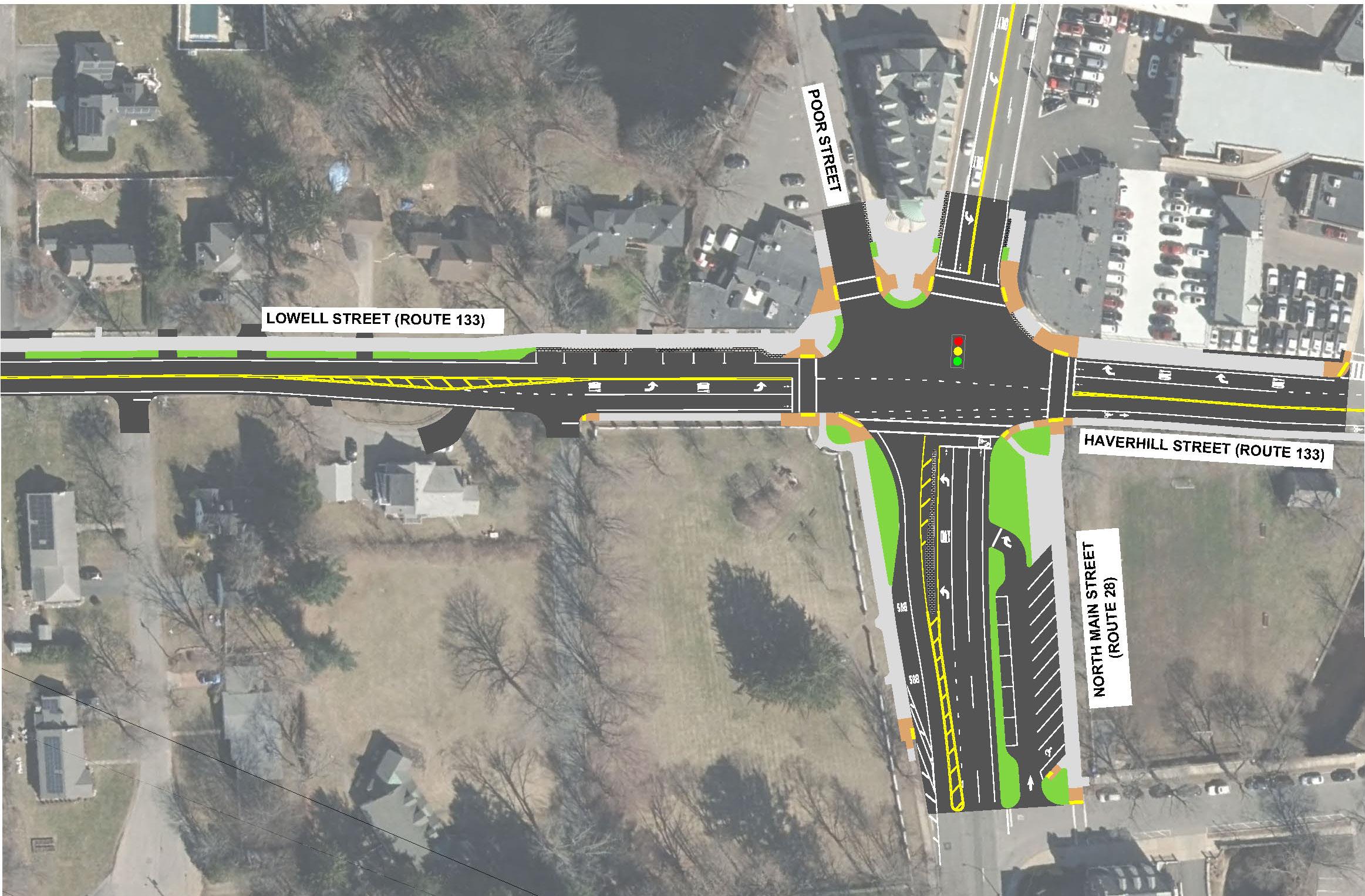
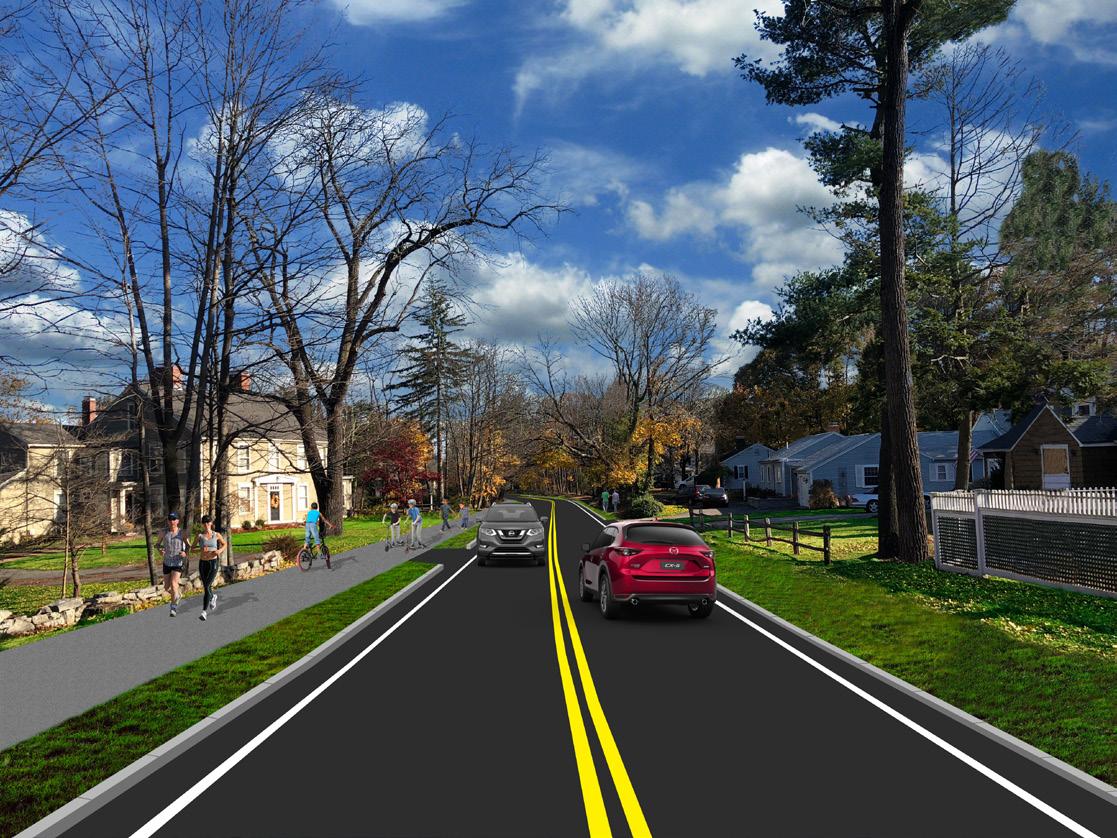
Existing Project: Lowell St (Rt 133) Redesign MassDOT is currently working with the Town to complete a 1.25-mile long improvement to Route 133 (Lowell St.), which runs through Shawsheen Village. The project will improve intersection design, improve roadway safety, increase roadway capacity, and introduce bicycle and ADAcompliant pedestrian accommodations to the corridor.
https://andoverma.gov/877/Route-133-Corridor
While the key planning moves described earlier represent the priority policy changes, a comprehensive plan involves more than that. This section goes through all of the plan’s topic areas—urban form and land use, housing, natural environment, mobility and transportation, and economy and jobs—and provides additional detail. This includes topic-specific goals and recommendations to help the town achieve multiple objectives over the coming decades.
Before diving into recommendations, here is a glossary of commonly used planning terms with brief explanations about what they refer to.
Accessory Dwelling Unit (ADU) is a self-contained housing unit in an owner occupied single-family home/lot that is either attached to the principal dwelling or in a separate structure on the same property.
Affordable Housing: Housing targeted to and affordable by households that meet specific income eligibility levels, typically households earning below 80% of the area’s median income (or AMI). “Affordable housing” does not refer to the design, type, or method of construction of a housing unit or development, but to the cost of the housing to the consumer. Housing is generally considered affordable if the household pays less than 30 percent of its monthly income to secure the housing.
Area Median Income (AMI): The Federal Department of Housing and Urban Development (HUD) annually publishes the area median income limits nationally, and these are used for eligibility in most housing programs. HUD estimates the median family income for an area in the current year at various levels (30% AMI, 50% AMI, 80% AMI and 100% AMI), adjusted household sizes so that incomes may be expressed as a percentage of the area median income.
Bioswale: a long channel or trench that has vegetation (such as grasses, flowers, and shrubs) and soil, mulch, or stones to slow down rainwater and filter out pollutants. These pollutants include things like litter, motor oil, and excess fertilizer from lawns.
Business Districts: In Andover, the business districts, also called commercial districts, are identified as Mixed Use District (MU), General Business District (GB), Limited-Service District (LS), and Office Park (OP). Each district is explained in the Zoning Bylaw and the Table of Uses outlines exactly what business, or commercial use, is allowed to operate and the process by which it is allowed to operate.
Commercial: concerned with or engaged in commerce, i.e. an organization engaged in the trade of goods, services, or both to consumers (e.g., retail, corporation, LLC, or sole proprietorship) whose primary purpose is a for-profit venture.
Community Benefit Agreements (CBA) are strategic vehicles for community improvement, while benefiting private sector developers and both state and local governments. They are not zero-sum instruments. They are legal agreements between community benefit groups and developers, stipulating the benefits a developer agrees to fund or furnish, in exchange for community support of a project.
Community Garden is a piece of land gardened or cultivated by a group of people individually or collectively. Normally in community gardens, the land is divided into individual plots. Each individual gardener is responsible for their own plot and the yielding or the production of which belongs to the individual
Complete Streets is a transportation policy and design approach that requires streets to be planned, designed, operated and maintained to enable safe, convenient and comfortable travel and access for users of all ages and abilities regardless of their mode of transportation.
Context Sensitive Design: a theoretical and practical approach to land-use, housing, transportation decisionmaking using site-design and engineering that takes into consideration the lands through which stormwater flows, wetlands exist, and streets and roads traverse.
Densifying: a term used by planners, designers, developers and theorists to describe the increasing density of people living in an area.
Eco-friendly Roads: refer to paved streets constructed from eco-friendly or recycled materials. The purpose of building such roads is to reduce the negative impact of road construction on the environment.
Environmental Justice Population: a neighborhood whose annual median household income is equal to or less than 65 percent of the statewide median or whose population is made up of 25 percent minority, foreign born, or lacking English language proficiency.
Floor Area Ratio (FAR): the ratio of a building’s total floor area to the size of the piece of land upon which it is built. It is often used as one of the regulations in city planning
along with the building-to-land ratio. FAR is expressed as a decimal number, and is derived by dividing the total area of the building by the total area of the parcel (building area ÷ lot area). FAR is an effective way to calculate the bulk or mass of building volume on a development site, and is often used in conjunction with other development standards such as building heights, lot coverage and lot area to encourage a community’s desired arrangement and form of development.
Green Building: refers to both a structure and the application of processes that are environmentally responsible and resource-efficient throughout a building’s life-cycle: from planning to design, construction, operation, maintenance, renovation, and demolition.
Green Building Best Practices: An integrated and comprehensive approach, the principles encompass each of the green building phases, including construction, operation, maintenance, and decommissioning.
• Sustainable Siting: this approach optimizes land use and development to reduce adverse impacts and minimize the building’s ecological footprint.
• Energy Efficiency: this technique focuses on the establishment of performance targets that account for intended use, occupancy and other energy operations for new construction and renovation projects.
• Water efficiency: this technique emphasizes the value of decreasing demands for freshwater and reducing the generation of wastewater through optimized landscaping, integrated rainwater catchments, gray water recycling, and wastewater treatment systems
• Building Materials: by using sustainable construction materials and resources, green building materials have aided the reduction of extraction, processing, transportation, solid waste, and consumption.
• Healthy Indoor Environmental Quality: these processes have enhanced the sustainable communities through ventilation and thermal comfort, moisture
control, daylighting, environmental tobacco smoke control, and protecting indoor air quality during construction.
Green Stormwater Management Infrastructure: infrastructure designed to mimic nature and capture rainwater where it falls. Green infrastructure reduces and treats stormwater at its source while also providing multiple community benefits such as: Reducing localized flooding. Improving community aesthetics.
Holistic Economy: refers to approaches to addressing the economy in an integrated way and with all its connections based on sustainability. Together with Holistic Economics, economic theory will both express a more sustainable economic approach and better analyze real life.
Inclusionary Zoning: a policy that requires a share of new housing development to be affordable to low- or moderateincome households.
Infill: building within unused and underutilized lands within existing development patterns, typically but not exclusively in downtown areas. Infill development is critical to accommodating growth and redesigning our cities to be environmentally- and socially-sustainable.
Industrial Districts: in Andover, the industrial districts are identified as Industrial G (IG), Industrial A (IA), Industrial D (ID), and Industrial D 2 (ID2). Each district is explained in the Zoning Bylaw and the Table of Uses outlines exactly what activity or use is allowed to operate, and the process by which it is allowed to operate. Some uses allowed in the Industrial Districts include manufacturing, biotech, warehousing and research and development.
LEED (Leadership in Energy and Environmental Design) is the most widely used green building rating system in the world. Available for virtually all building types, LEED provides a framework for healthy, efficient, and cost-saving green buildings. LEED certification is a globally recognized symbol of sustainability achievement and leadership.
Mixed-Use: a zoning classification that blends multiple uses, such as residential, commercial, cultural, institutional, or entertainment, into one space, where those functions are to some degree physically and functionally integrated, and that provides pedestrian connections. Mixed-use development may be applied to a single building, a block or neighborhood, or in zoning policy across an entire area or other administrative unit.
Multi-Family Housing: any residential property containing more than one housing unit.
Multi-Generational Housing: including two or more adult generations (with adults mainly ages 25 or older) or a “skipped generation,” which consists of grandparents and their grandchildren younger than 25.
Multimodal: having or using more than one mode, in transportation would include, bicycle, walking, bus, train, etc.
Nuisance Mitigation: to repair negative conditions or a situation that has led a property, or a situation, to be deemed a nuisance. The order requires the owner to make the repairs or take other action to remedy or offset negative conditions.
Older Adults: in the Andover Zoning Bylaw, it is defined as a person having reached the age of 62 years or older.
Parking Ratios: the number of parking spaces allocated towards the amount of square footage leased, or the amount in the building.
Passive House is a voluntary standard for energy efficiency in a building, which reduces the building’s ecological footprint. It results in ultra-low energy buildings that require little energy for space heating or cooling
Regional Ecology: a regional complex with a relatively complete ecological structure, ecological process, and ecological function.
Single-Family Housing: A stand-alone house is a freestanding residential building. It is sometimes referred to as a single-family home in contrast with a multi-family residential dwelling.
SITES is a rating system that guides, evaluates and certifies a project’s sustainability in the planning, design, construction and management of landscapes and other outdoor spaces.
Soil Regeneration: a form of ecological regeneration within the field of restoration ecology, is creating new soil and rejuvenating soil health by: minimizing the loss of topsoil, retaining more carbon than is depleted, boosting biodiversity, and maintaining proper water and nutrient cycling.
Solar Photovoltaic Readiness: it meets certain characteristics and requirements that will facilitate the installation of a solar energy system and optimize it for maximum solar electricity production.
Stretch Code: emphasizes energy performance, as opposed to prescriptive requirements, is designed to result in costeffective construction that is more energy efficient than that built to the “base” energy code.
Universal or Accessible Design is the design and composition of an environment so that it can be accessed, understood, and used to the greatest extent possible by all people regardless of their age, size, ability or disability.
Wayfinding: all of the ways in which people orient themselves in physical space and navigate from place to place, an example is signage.
In the following pages, each topic section begins with an overview of existing conditions and key opportunities and challenges for the Town of Andover for the related topic.
Pg XX Urban Form and Land Use
Pg XX Housing
Pg XX Natural Environment
Pg XX Mobility and Transportation Network
Pg XX Economy and Jobs
“While
I do really like Andover as it is today, I think our town should change to accommodate the future.”
69% Agree, 7% Disagree, 22% No Response (n=223)
Land use is the term used to describe the human use of land. It represents the economic and cultural activities (e.g., agricultural, residential, industrial, commercial, and recreational uses) that are practiced in a given place. As population increases, and land availability decreases, growth planning and decision making is critically important because it can ensure that resources are used efficiently, land-use conflicts can be avoided, and residents’ needs are met. Ultimately, environmental, social, physical, and economic conditions in Andover will benefit.
Urban form and land use has been placed first in this planning document for two reasons. First, physical planning and its implementation is the focus of master planning as guided by the state, and planning’s relationship to zoning changes is what provides the master plan with the strongest and most effective tools for shaping the future of Andover. More than any other topic area, these tools are most closely linked to urban form and land use.
Second, while urban form and land use is not in and of itself the most important topic area, the decisions made around urban form and land use in this plan do inform and guide the rest of the topics and recommendations made throughout. By looking at these issues at the very beginning, the concepts described here can serve as background and further explanation for what is discussed through the rest of the document.
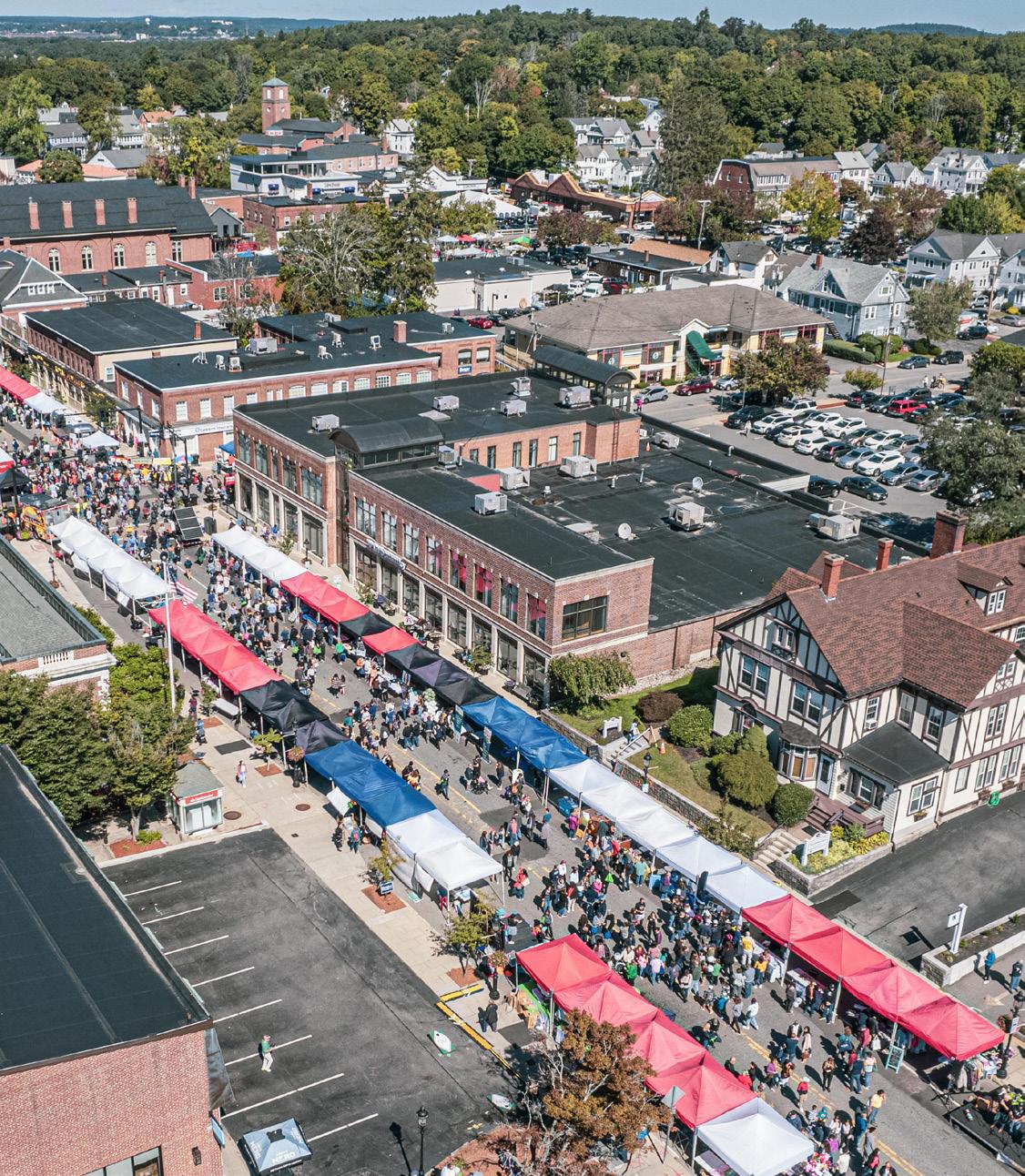
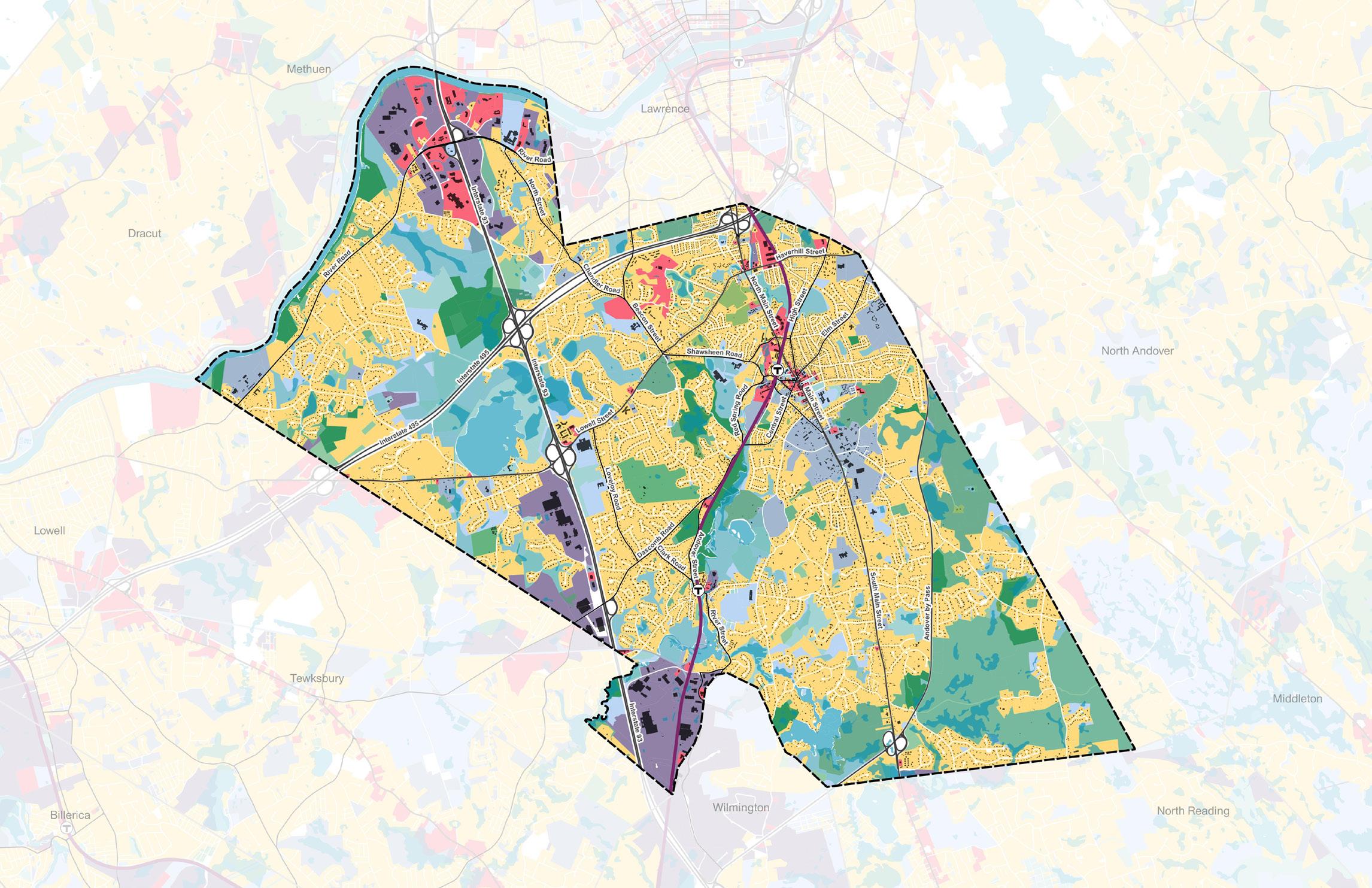
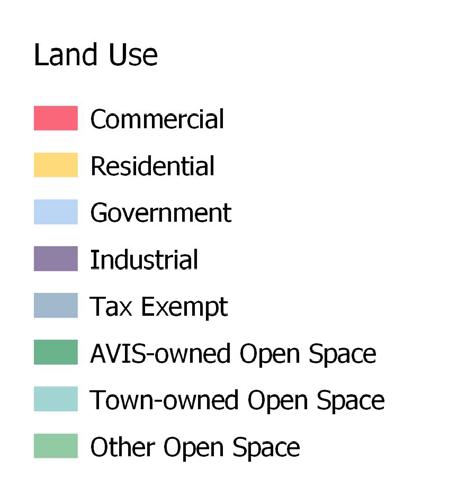
Land use in Andover. Andover’s urban form follows a classic New England town model, with a few small and historic town centers surrounded by open space and suburban singlefamily housing. Notably, the presence of multiple large highways provides a special corridor of dense employment as well.
Future development in Andover
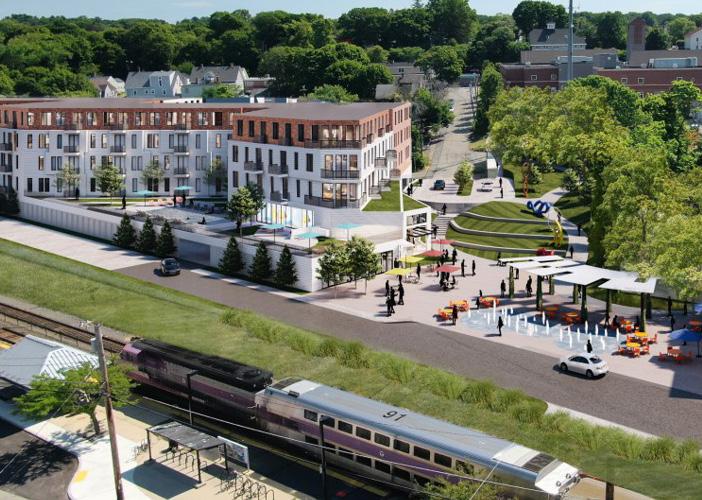
While work is already under way to consider a vision for more housing near or around the commuter rail station (such as this vision, right), the goal of missing middle is to provide an additional type of dense but less dense housing that makes sense further out from immediate proximity to transit.
$7,000,000,000.00
$6,000,000,000.00
$5,000,000,000.00
$4,000,000,000.00
$3,000,000,000.00
$2,000,000,000.00
$1,000,000,000.00
$-
Create more development opportunities to grow the Town’s economy and attract new residents who already commute to Andover, which will diversify the Town’s tax base.
a. Increase minimum allowable Floor Area Ratio (FAR) and height requirements of existing mixed use (residential with ground-floor commercial), Industrial and Business Districts to promote denser development.
b. Pursue a Town growth analysis to forecast different growth/density scenarios, to predict, manage, and plan for growth impact before it happens.
c. Develop design guidelines that accommodate the design of different densities, commercial zones, and corridors, along with reduced, shared, and eliminated parking requirements, to allow the Town to evolve with new growth while maintaining the Town’s appeal and character.
d. Strive to create neighborhoods that combat sprawl and improve public health by adapting the concept of the fifteen-minute walk and/or bike zone in different parts of Andover, supported by a walkable urban form and safe transportation infrastructure.
e. Encourage a variety of residential choices and styles designed to withstand the economic and demographic tests of time to be developed in Andover.
f. Pursue regional development opportunities by inviting neighboring municipalities, specifically those with Environmental Justice populations, to identify cross-municipal development opportunities.
To the degree that municipal finances inform planning decision-making, it is important to note that the dense job centers of Andover still remain relatively low in terms of overall property values. Creating a wider range of property types at different density levels is a good strategy in terms of diversifying how and why programs get funded across the town.
Secure a strong industrial and commercial tax base by developing a robust economic plan to transform existing Industrial and Business Districts into a mix of uses.
a. Identify areas downtown that can be redeveloped into entertainment venues, spaces for attractive nightlife, and a range of affordable to boutique retail shops in close proximity to each other.
b. Promote the creation and retention of new small businesses by ensuring sufficient consumer density and improved walkability throughout downtown, Shawsheen Village and Ballardvale.
c. Create the opportunity for small local businesses and neighborhood businesses to be added to existing family zones by allowing accessory commercial units through the special permit process.
d. Discourage new single story commercial development of retail and restaurants and encourage midrise development in existing areas across the Town with contextual height limits.
e. Identify and encourage development opportunities to reuse existing building stock creatively in the historical and industrial sections of the Town and attract developers’ participation through pursuing grants and tax incentives.
f. Review Limited Service Zoning District along Lowell Street, east of I-93, to incorporate the mix of uses existing today.”
“I would like to see Andover consider increasing residential and commercial density to create walkable neighborhoods.”
56% Agree, 22% Disagree, 20% No Response (n=225)
Enhance the public realm through placemaking, urban design, and public art and create quality gathering and multi-use spaces for residents and visitors of all ages.
a. Create a town-wide placemaking and wayfinding plan to highlight and emphasize cultural and ecological heritage destinations.
b. Support public art and employ seasonal art installations to activate and draw attention to various parts of the Town.
c. Create active spaces throughout Andover by dedicating space and offering attractions, activities, and amenities for all residents and visitors of all ages, races, religions, abilities, etc. Increase the number of social and cultural activities to highlight and enhance Andover’s diverse population.
d. Partner with Andover’s Commission on Diversity, Equity and Inclusion (DEI) to enhance the diversity of cultural offerings in Town.
Focus Group Responses - Perfect Day in 2033:
Person 2: Walk into downtown from home in Ballardvale; shopping; lunch outdoors; neighborhood block party
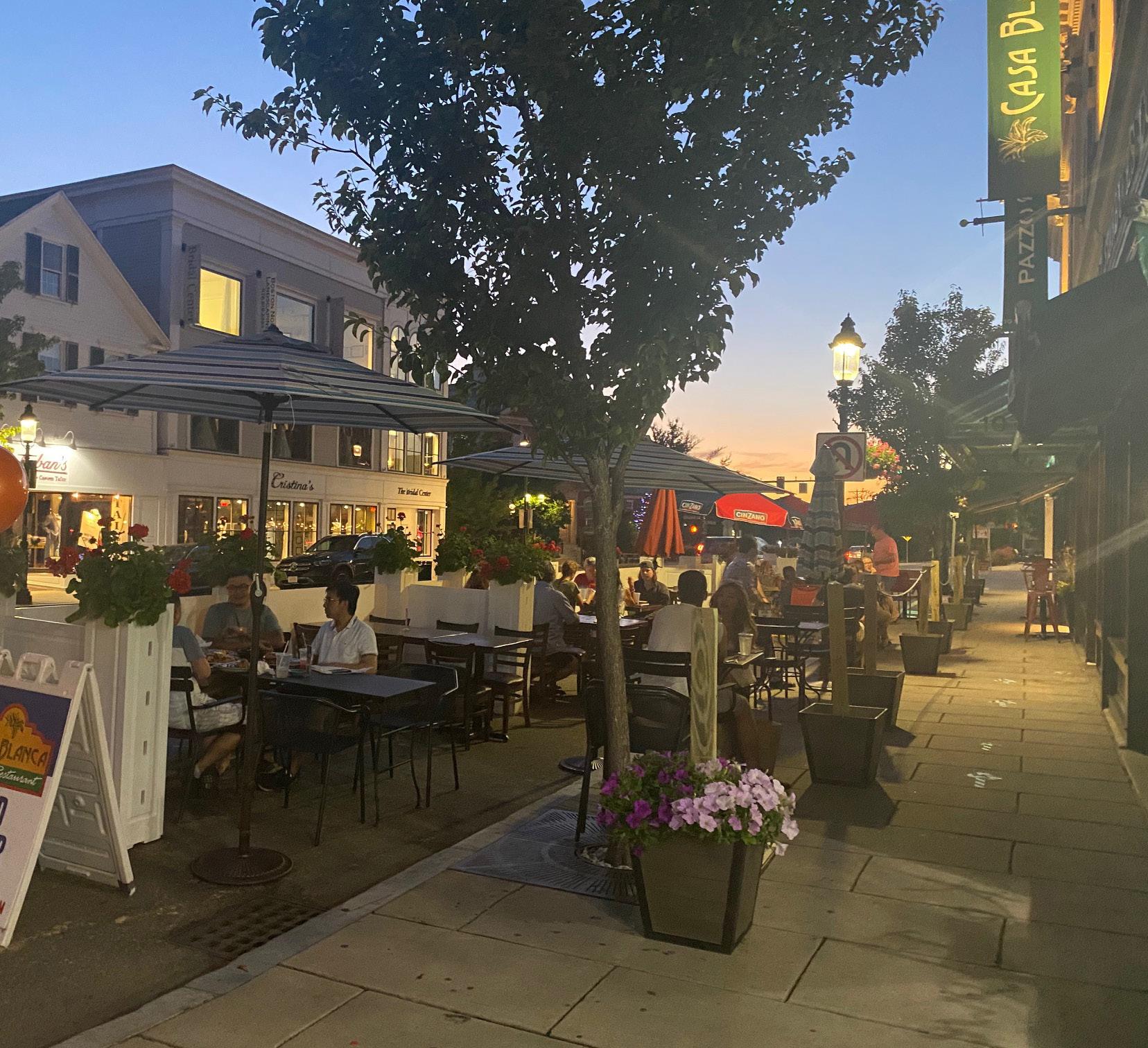
Person 4: Walk or bike into Town; outdoor dining; outdoor performance; use trails.
Person 5: Walk to have coffee outside; spend time outside/play sports; enjoy public art; go to a bar for a beer; attend an evening event in Town.
Person 7: Walk somewhere for coffee/drink to see people; have a schedule of events that’s easily accessible and plan a day around it; spend time with people.
Require green building best practices in new commercial construction and encourage best practices in residential construction to meet state-led goals of 80% greenhouse gas reduction by 2050.
a. Encourage and incentivize green energy efficiency and electrification upgrades in existing buildings in conjunction with requests to permit other improvements, by providing information to developers, owners, and renters about subsidy and loan programs that exist to mitigate some of the short-term costs of making upgrades and before long-term savings begin.
b. Require all new developments to align to the Massachusetts Building Energy Codes including the Stretch Code and encourage them to align to the Specialized Code.
c. Require new development and encourage existing development sites within the 100-year flood plain to implement plans to mitigate and handle flood waters, recover quickly from flooding events, notify tenants of potential impacts, notify tenants ahead flooding events, and upgrade any existing/nearby stormwater management systems.
d. Incentivize new developments, and those seeking special permits for improvements, to implement environmentally progressive approaches to:
• Building construction (i.e., Passive House, Solar Photovoltaic Readiness, LEED, Well, or SITES certifications, green i); and,
• Landscape/site design (i.e., green infrastructure, native tree plantings and invasive species removal, and encouraging topsoil preservation, and water conservation and reduction).
e. Support improved access to low carbon modes of transportation by enhancing and adding sidewalks, bike lanes, and bike parking to connect new development to nearby amenities including open spaces and trails.
f. Encourage increased building height and density in certain areas, including replacing single-story standalone buildings with multi-story buildings or converting single-family residences to support multi-generational housing.
g. Reduce car parking requirements for new developments.
h. Require Electric Vehicle charging stations at multifamily residential and commercial development.
i. Educate residents that are navigating the renovation and design decision-making process to assist them with understanding their options for improving their energy efficiency.
j. Assist and educate residents on implementing water conservation efforts to reduce consumption.
Preserve and regenerate remaining land currently used for agricultural or related purposes and seek additional opportunities to increase small-scale farming and gardening among all landowners throughout Town.
a. Develop strategy to purchase farmland with Agricultural Preservation Restriction(s) and with community input, outline potential options for future agricultural opportunities.
b. Establish an Agricultural Board to encourage backyard food production.
c. Create a community garden plan that identifies various areas around the Town that can be added to a Town-wide network of gardens and incorporates branding and wayfinding for pedestrians to access the Town’s gardens.
d. Support local stewardship of land by partnering with professional organizations (public-private partnerships), funders, volunteer groups, and school groups to maintain a Town-wide network of community gardens.
e. Encourage denser parts of Town to preserve spaces for community gardens, including rooftop gardens, to ensure that agricultural character finds its way into developed parts of Andover.
f. Conduct a feasibility analysis to encourage more local/backyard food production (chickens, goats, fish, bees, fruits, and vegetables) in ways that minimizes negative health impacts.
g. Develop a plan for small to large-scale communal agricultural activity and pursue a collective land ownership and operation model for future agricultural land.
h. Research tax incentives for small scale farming.
i. Support and promote local farmers’ markets.
j. Research mechanisms whereby:
• Homeowners with houses on subdivided lots that were formerly farmland could sublet a portion of their yards to small-scale growers, either individually or in coordination with their neighbors.
• Owners of privately owned open spaces, which are not formally recognized as protected open spaces, could be incentivized to “sublet” their land.
• Local organizations such as Andover Village Improvement Society (AVIS) similar entities could support small-scale farming on select pieces of property that aren’t restricted for conservation.
• Commercial development can incorporate food-producing gardens and composting into their campuses.
Preserve Andover’s unique character through strategic location and context-sensitive design guidelines for new development, emphasizing housing affordability and accessibility through the Town’s zoning bylaws.
a. Create development guidelines and zoning bylaws that require universal, accessible, and contextual design in new development.
b. Encourage creative and adaptive reuse of existing building stock.
c. Create design guidelines for different districts in Andover, similar to the design guidelines associated with the Historic Mill Overlay District and encourage the evolution of historic character through building and site renovation, when appropriate.
d. Prioritize and protect landscapes, scenic roadways and vistas that balance Andover’s more developed areas (downtown, Industrial and Business Districts, etc.).
Adopt an economic development strategy that generates revenue for the Town by enabling adaptive reuse of historic buildings and creating thriving historic districts such as the Shawsheen and Ballardvale areas.
a. Encourage the preservation and restoration of existing structures of historic interest, by partnering with the Andover Preservation Commission to review and update the Demolition Delay Bylaw, the Special Permit for Historic Preservation, and other preservation tools that may be underutilized.
b. Identify key opportunities within the districts and properties on the Massachusetts Historic Register to restore or renovate using Historic Tax Credits.
c. Utilize the Andover Center for History and Culture and the Andover Preservation Commission to create a building history research program to investigate, identify and designate buildings and homes through a voluntary plaque, historic marker and booklet program.
d. Create a branding package that includes wayfinding (i.e. public maps, signage) for the Town’s various historic districts to help make visitors aware of the Town’s history.
The benefits of additional housing, including housing with affordable options, include increased economic activity, additional job opportunities, improved infrastructure, enhanced public health outcomes, and opportunities for investing in the Town’s future (i.e. older adults remaining in the Town that they love and new residents having an opportunity to move into Andover).
Andover’s housing stock is almost entirely singlefamily residential, which has served the town well for many decades. As discussed in the introduction to this comprehensive plan, the broader socioeconomic and demographic shifts mean that both 1) empty nesters looking to live in a housing situation requiring less upkeep and without the same space needs as when they had children at home and 2) millennials who have delayed but are beginning to form households and start families are both causing a double squeeze on the housing market. Part of a way to address the increased pressure on housing in Andover is to help address those needs by supplementing the existing single-family housing stock with additional multifamily housing in particular locations. This can allow for “missing middle” housing, housing that is denser than single-family but less dense than classic downtown housing projects, as well as less intensive kinds of housing production, like allowing for accessory dwelling units as additions to existing structures or as small freestanding additional units in backyards.
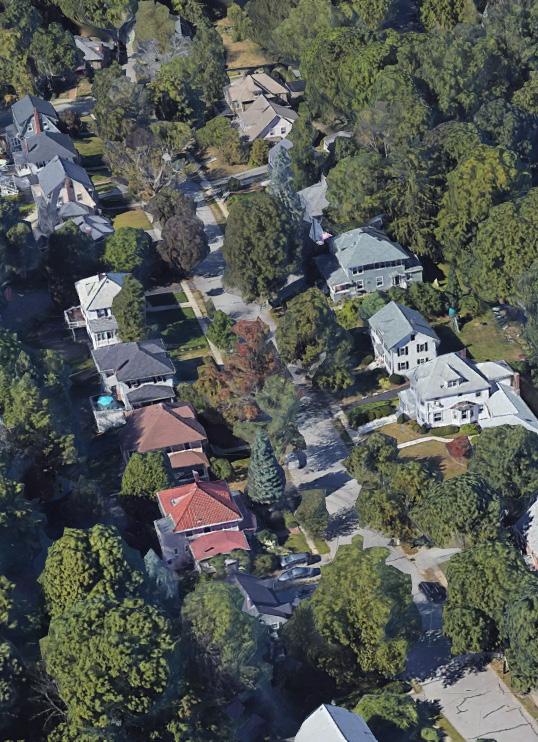
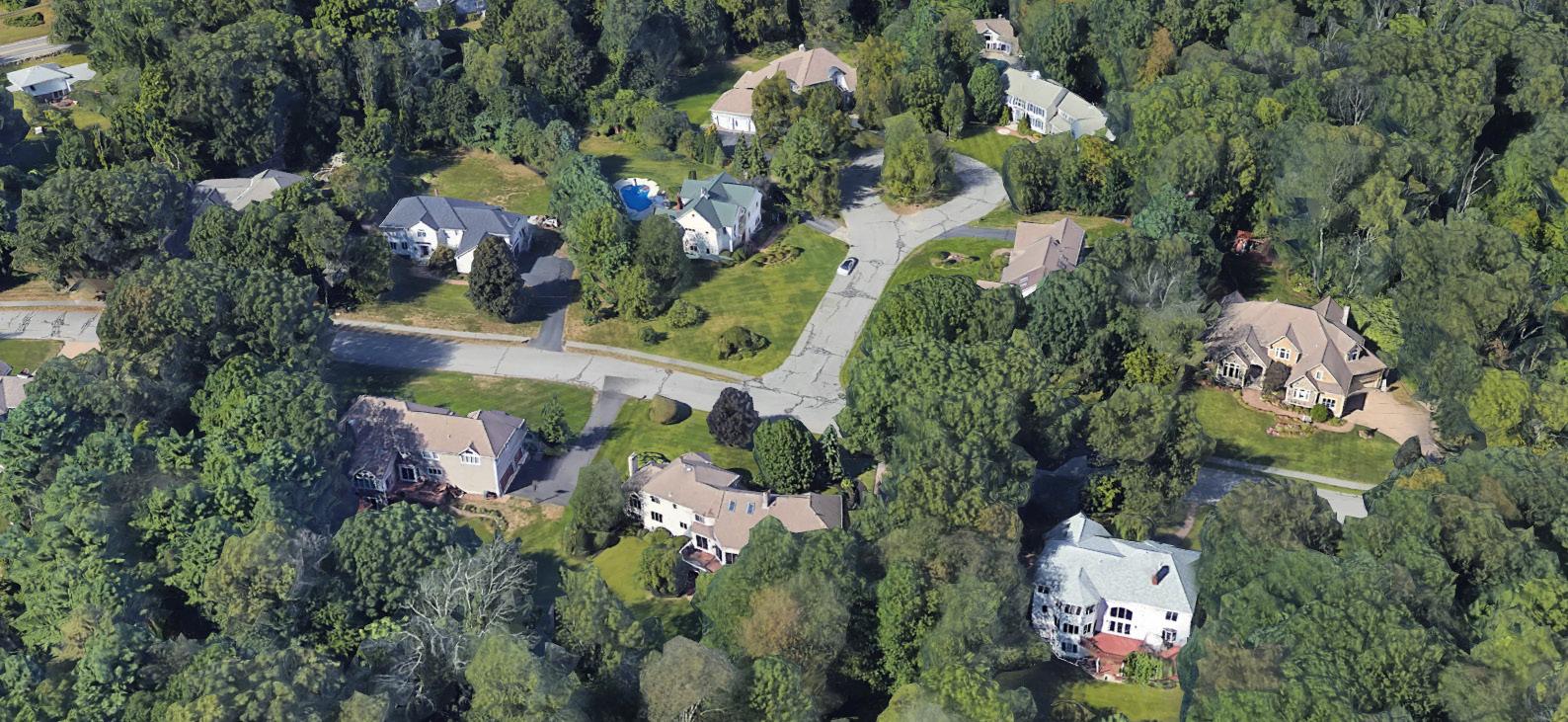
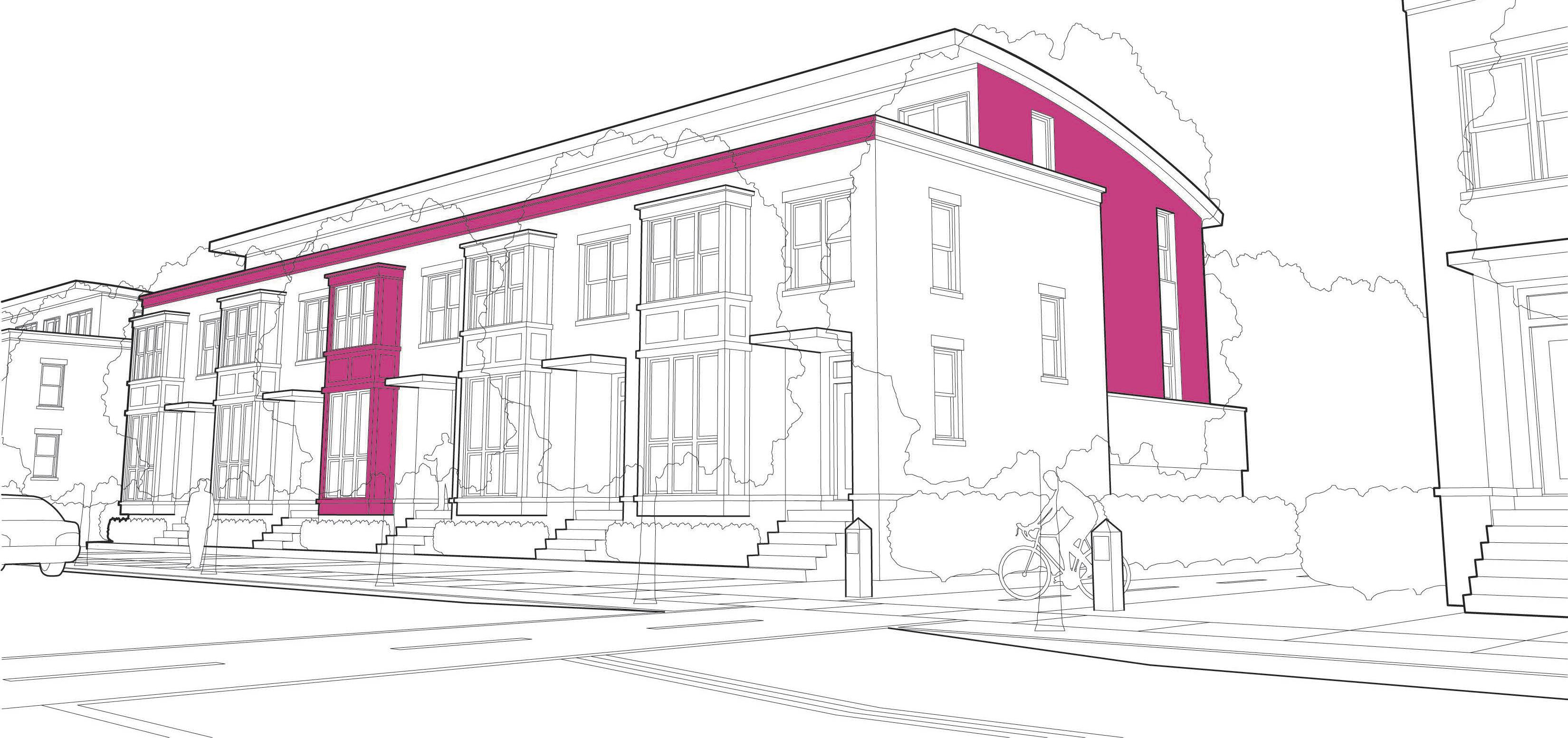
The Historic Mill District Overlay Design Guidelines (above and right), completed in 2018, already provide a great deal of guidance for some housing production. As has become clear in the last few years, the housing crisis is serious enough in the Commonwealth that a “belt and suspenders” approach is becoming necessary statewide. Whether through denser multifamily as envisioned here, through MBTA Communities compliance zoning, or through the missing middle proposals in this plan meant to complement these efforts, a key priority for the town is creating new housing while staying true to what makes Andover special for its residents.
Create new housing opportunities for older adults and empty nesters to be able to stay in Andover by either moving into smaller units or renovating homes into multigenerational properties; create options for persons with disabilities, young families and single working professionals to rent or buy homes; and create opportunities for people of different economic backgrounds to move to Andover.
a. Consider zoning changes:
• Replace Family Dwelling Unit section with a more flexible Accessory Dwelling Units (ADU) bylaw.
• Update Conversions section of the Zoning Bylaw to allow for additional opportunities to create multi-family units from existing single-family residential units.
• Expand Inclusionary Zoning and require new development proposed that is over a designated size or number of units, to set aside affordable units, potentially through density bonuses.
• Include affordability ranges up to 120% Area Median Income (Area Median Income, or AMI, is the household income for the median household in a given region, i.e., if you were to line up each household income from lowest to highest, the very middle would be considered the median).
b. Collaborate with nonprofit affordable housing organizations to expand affordable housing options.
c. Identify contiguous parcels that could be developed and utilized for under-represented housing types such as single-family homes under 2000 square feet, age restricted housing, and multi-family housing.
d. Create a program to assist older adults who want to downsize from their current home by providing information on available units or locations in Andover.
e. Advocate that the Select Board include Expanding Housing Opportunities in Andover as a Select Board goal.
f. Identify and evaluate Town-owned parcels to be sold for affordable housing.
g. Assist architects and developers in achieving full compliance with all requirements for accessible design and simultaneously enhancing developments with universal design features for residents and visitors.
Direct and encourage development to areas of Town that are already transit-accessible to promote public health, limit additional vehicle traffic, and encourage a walkable urban form.
a. Adopt the Massachusetts General Laws (MGL) Chapter 3A “MBTA Communities Zoning” to enable the creation of medium-density residential housing types with proximity to transit, to encourage housing production and facilitate access to public transportation (i.e., less daily dependence on automobiles).
b. Engage at the regional and state levels to advocate for increased alternative transit options, increased frequency and education.
c. Fund sidewalk construction and rehabilitation projects that increase access to public transportation and commercial centers.
d. Support and create infrastructure for alternative modes of transportation such as buses, bicycles, pedestrians and electric vehicles.
“Given the housing crisis and the high cost of living, I support the idea of building affordable housing in Andover.”
Coordinating housing, land use change, and transportation improvements
Coordinating land use policies, housing growth, and transportation improvements is critical to achieving our vision of sustainable growth. See the Mobility & Transportation section for more detailed pedestrian, transit, and bicycle studies and recommendations.
Work to combat the realities of racism and intolerance in Andover by supporting housing programs, policies, and initiatives which contribute to an inclusive Andover.
a. Work with the Andover Commission on Diversity, Equity, and Inclusion to identify any barriers in the existing Town bylaws or policies that prevent Andover from being a community which embraces tolerance, inclusiveness, and respect for all.
b. Engage existing cultural, religious, and advocacy groups in Andover to reach beyond the borders to promote Andover as a welcoming community and a place to live.
c. Utilize all existing housing production strategies, including inclusionary zoning, subsidized affordable housing, and medium-density multifamily development through MGL Chapter 3A, to ensure that units are built to meet an array of households.
d. Inform and educate residents about the benefits of having an array of housing types and the positive economic impact to the community.
e. Promote American with Disabilities Act (ADA) awareness and inclusion in all development, including new construction, renovations, and infrastructure projects.
Focus Group Respondent - Perfect Day in 2033:
“Andover will be a healthy and welcoming Town, with a lively, mixed-use downtown including sustainable, green, affordable apartments, condos and singlefamily homes. Also, I see local transportation to and from the downtown, ethnic restaurants, cafes, a brewery, event space for indoor and outdoor music, more educational opportunities, community theater, public art, more recreational space, and more sidewalks and bike paths throughout town. Some changes may be achieved by partnering with institutions, organizations, community agencies and neighboring communities.”
“There is an issue with housing affordability, and it keeps some people out. I looked for three years before finding a house. I think that housing diversity is an issue, we need different types of houses.”
Two demographics that face challenges in the Andover housing market are existing older adults, i.e., residents over the age of 62, and potential residents entering the housing market.
a. Craft policies that create housing that will meet the needs and preferences of older adults and retirees that are ready for a change in lifestyle, as well as create new opportunities for those entering the housing market.
b. Create a task force composed of residents and staff to implement zoning changes that will allow for increased housing options.
c. Develop older adults housing in areas where residents have access to services appropriate to their needs, transportation, and open space.
d. Increase funding (using the Affordable Housing Trust) for programs such as First Time Homebuyer/ Down Payment Programs, Home Improvement or Modification Programs, rental or utility assistance, and the creation of new housing units.
“If my friends or family need to move, I am confident they can find quality housing in the Town that fits their household’s needs and budget.”
16% Agree, 57% Disagree, 25% No Response (n=210)
Top Issues Impacting Andover - Community Needs Survey Fall 2022
Respondents 65+ 57.5% said High Cost of Living
said Aging health concerns
said Housing Affordability
Open spaces are important for both their individual and collective benefits. In terms of individual benefits, open spaces provide people with opportunities for recreation and physical activity that are proven to benefit people’s health. In the same vein, open spaces foster a civil, cooperative life among residents. If residents have opportunities to interact with one another, the larger community will benefit. Andover is proud and lucky to retain such a strong set of existing natural resource assets. From the multiple rivers, to the ponds and other scenic water features, to the extended set of AVIS, state, and other trails, to the ample park space and historic farmland, much of what makes Andover special to residents and workers alike is this small town feel in the middle of a classic New England environment. Despite the types of growth, economic development, and housing production considered by this plan, that inherent natural character and environmental beauty of Andover needs to be not only protected, but also brought front and center. Especially in a time where people can feel increasingly disconnected from nature, it is critical that Andover continue to strengthen that link. This importance was made very clear during the outreach process by many members of the public and the stakeholders the planning team talked to.
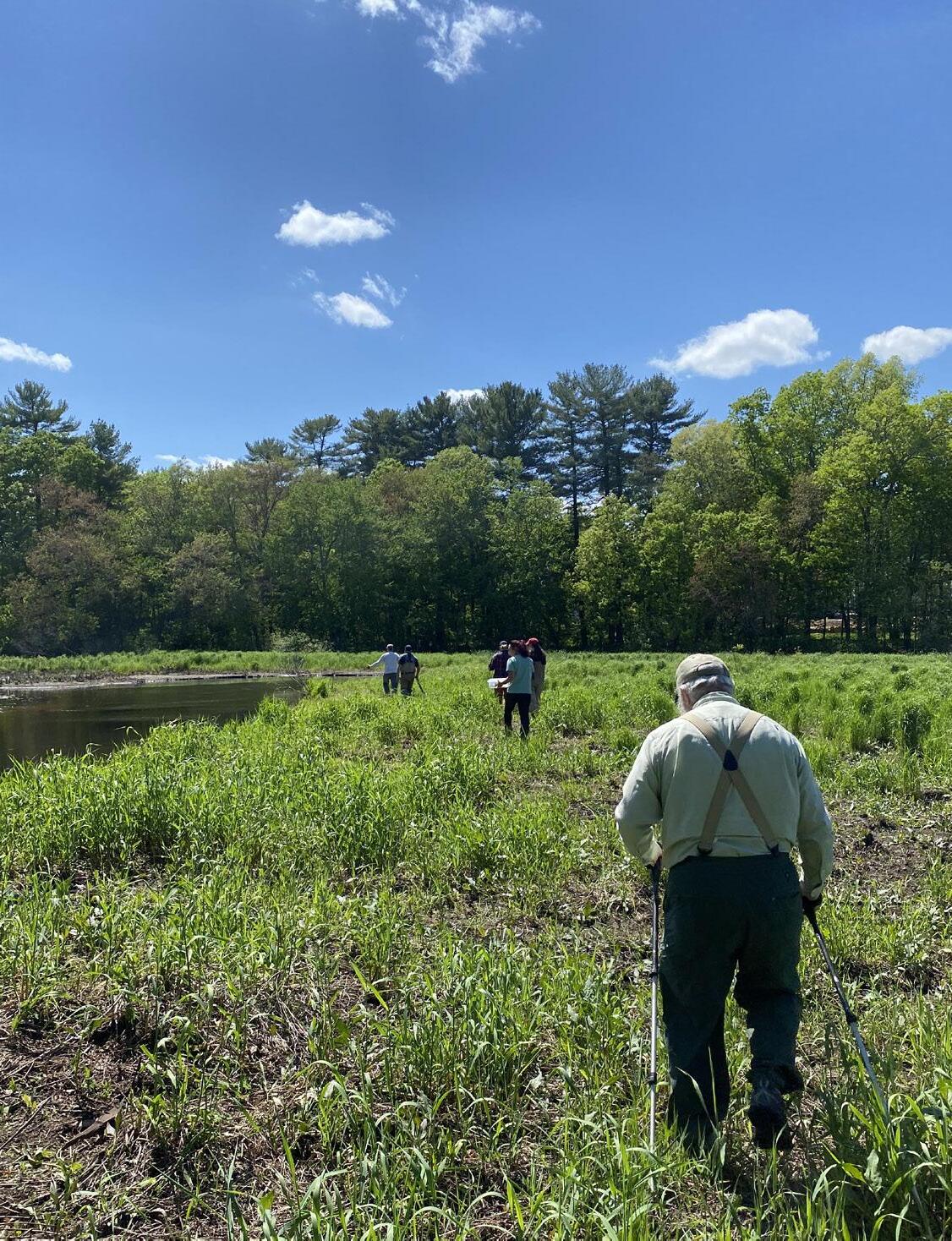
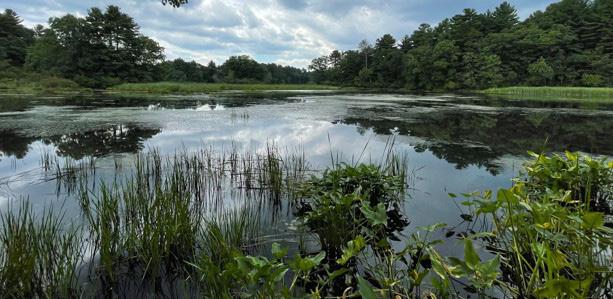
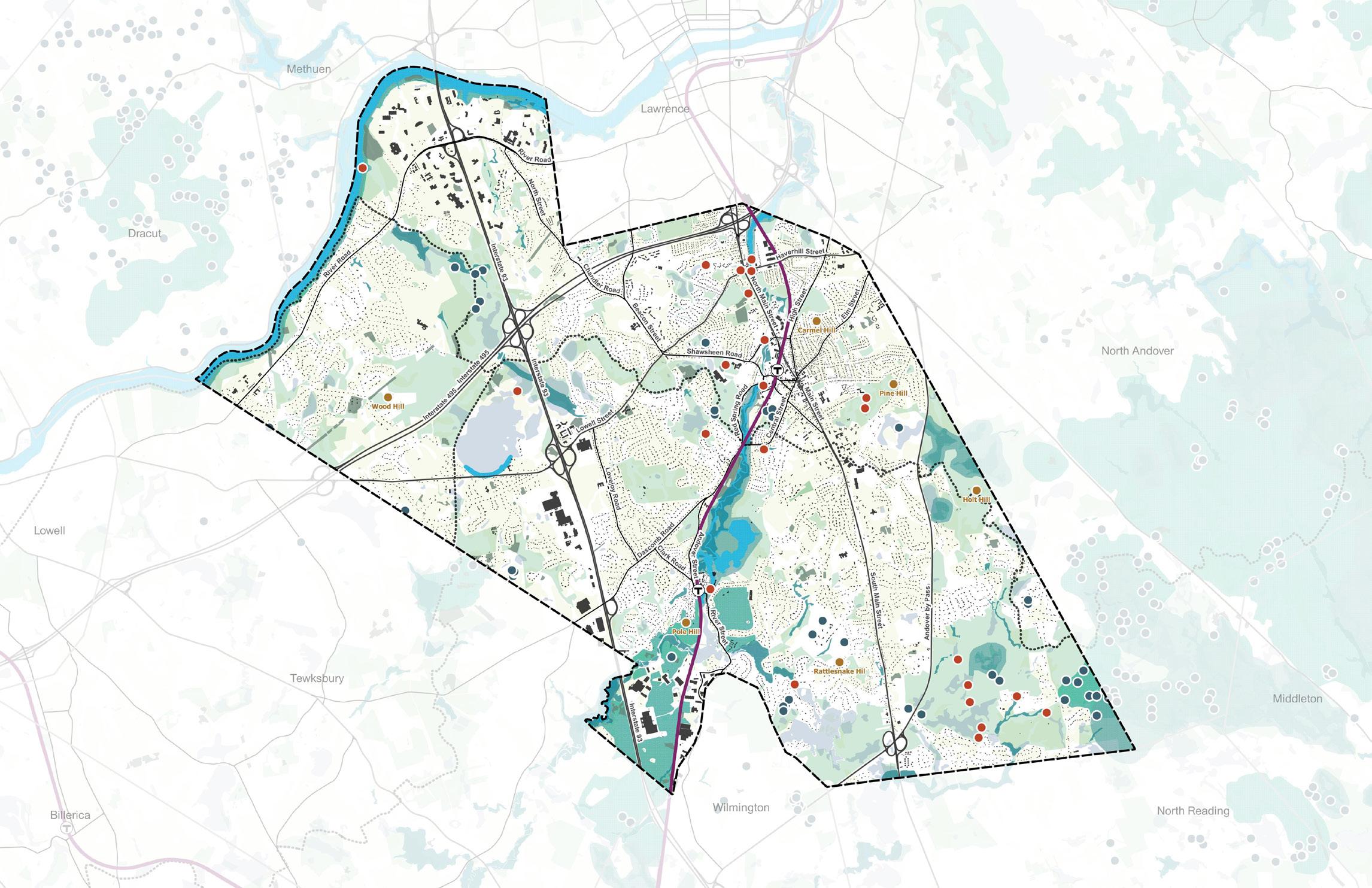
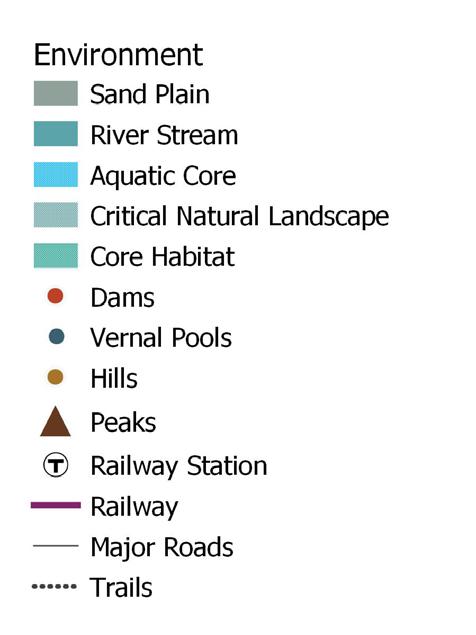
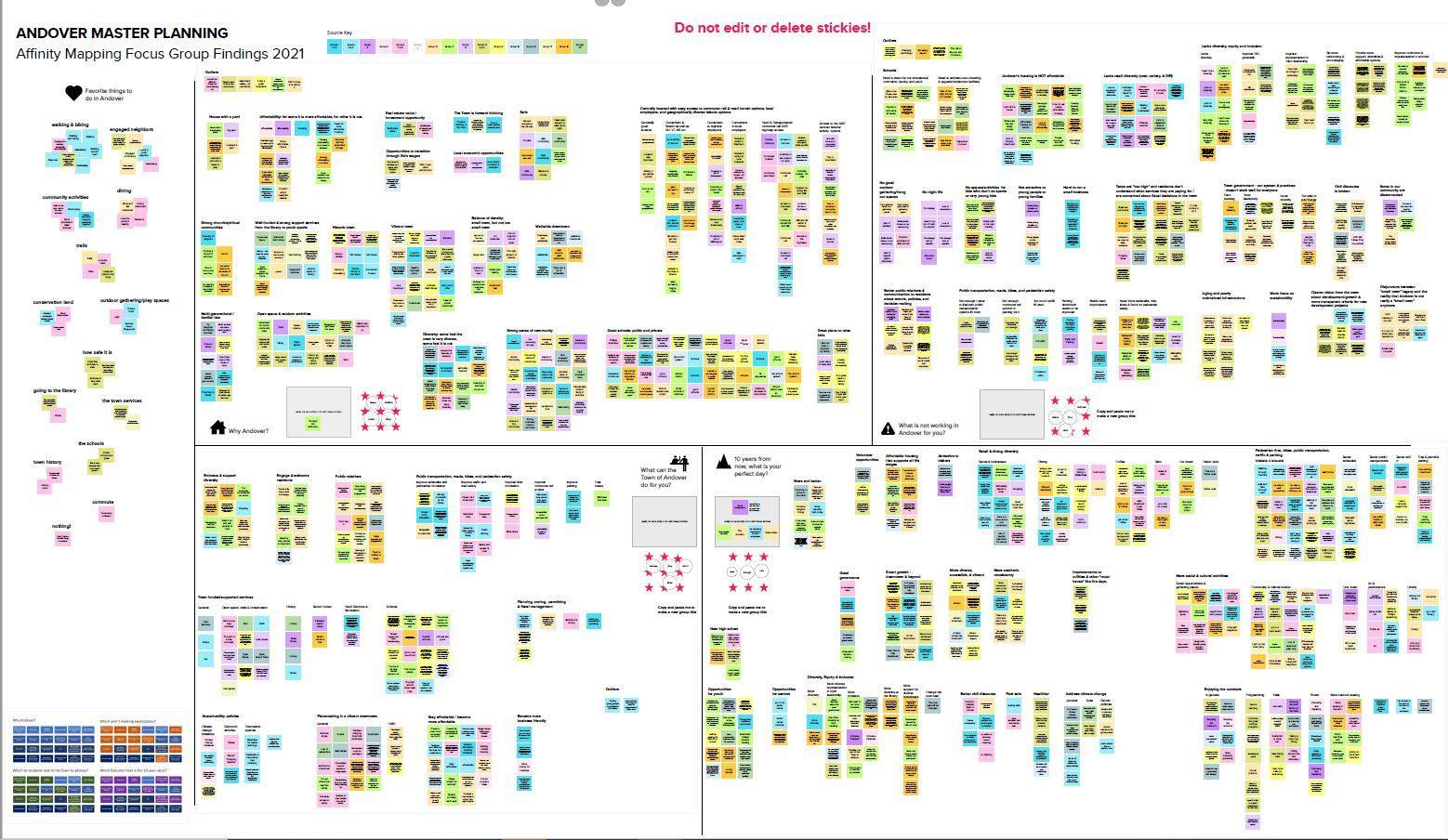
A common takeaway heard during the Affinity Mapping that kicked off this comprehensive plan was the importance of natural resources to what makes Andover important for residents. In many ways, all of the strategies proposed in this plan are intended either directly to improve sustainability and resilience measures or to ensure that future development protects and enhances natural resources and the public realm.
Pursuant to the goals established in the 2018 Open Space and Recreation Plan, the Town of Andover should work with local conservation organizations to realize plans of creating the Shawsheen Greenway, promote local land stewardship, and plan for future open space needs.
a. Complete the necessary steps to acquire additional open space to begin establishing appropriate wildlife corridors and active recreational connections along the Shawsheen River.
b. Create a workforce program, such as Groundwork Lawrence’s Green Team, to employ local-residents, workers, and students in the active management of the Town’s natural resources.
c. Partner with local organizations such as Andover Trails, Andover Village Improvement Society (AVIS) and Shawsheen River Watershed Association on initiatives that will preserve open space.
d. Pursue the creation of Town Tree Removal/Replacement Guideline for new development.
e. Require new development to maintain or enhance tree canopy across all non-developed square footage.
f. Employ a dark skies philosophy in addition to other innovative methods of reducing light pollution, while still creating a navigable walkable urban environment.
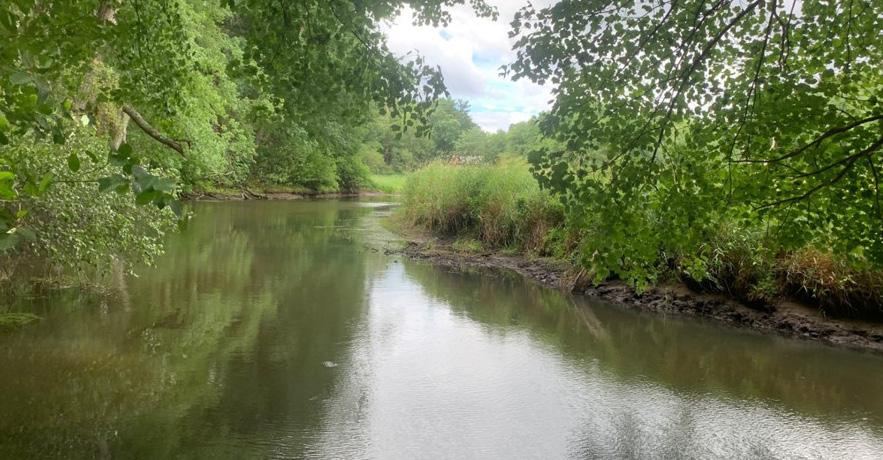
Add additional open space that is adjacent and connected to existing open space to create an interconnected greenway featuring transit, bike, and trail infrastructure.
a. Street connections: Identify streets that can connect residents to open space from residential and commercial areas, and improve them to include public transportation, pedestrian, and bike accessways.
b. Greenway connections: Determine key parcels, of either undeveloped land or partially developed land, for acquisition to be added to a Town-wide connected greenway.
“I support the idea of maintaining, improving, connecting, and expanding quality natural systems in a linked network of parks, open spaces, and waterways, including street trees and public spaces.”
88% Agree, 1% Disagree, 9% No Response (n=216)
a. Make the Shawsheen and Merrimack Rivers into more notable Town features complete with recreational activities and public programming, and ensure the preservation of their ecological and riverine health.
b. Review parcel ownership along the rivers and work on a case-by-case basis with owners and stakeholders to make the river more publicly accessible.
c. Support the goals and recommendations of the Shawsheen Master Plan, when completed, with an emphasis on enhancing active recreation along the river.
d. Pursue regional improvement opportunities by inviting neighboring municipalities, specifically those that also have Environmental Justice populations, to collaborate on cross-municipal efforts to enhance the Merrimack River.
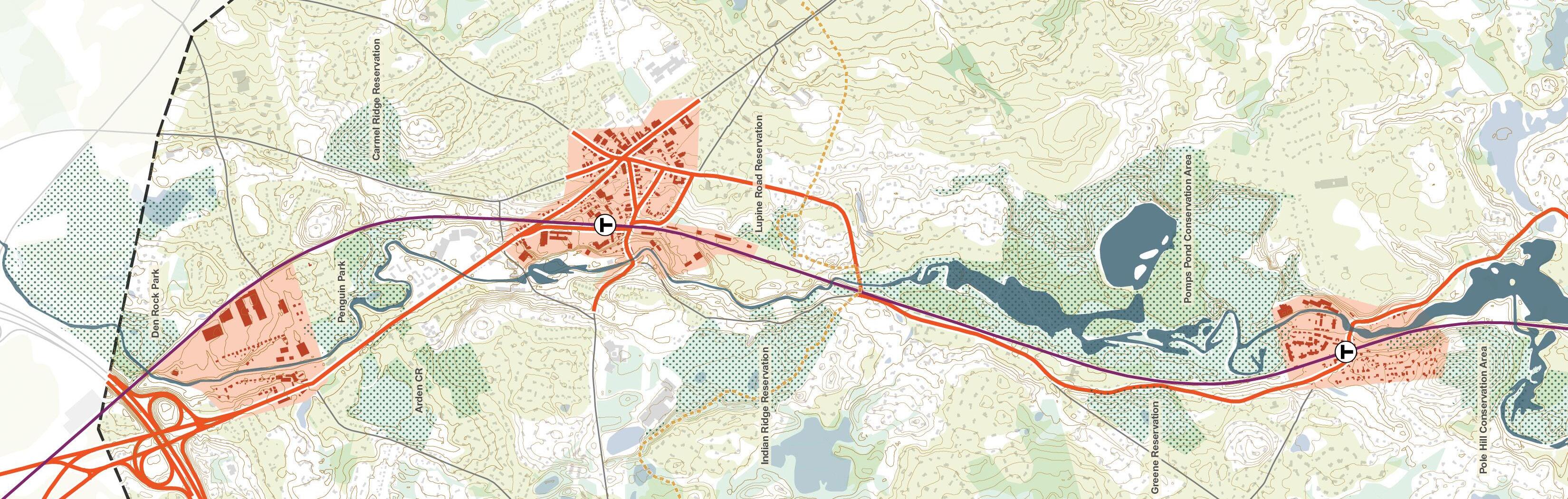
Make recreational open space, both passive open space and open space used for recreation, accessible to all residents, including those with disabilities.
a. Identify areas of Town with impediments to accessing open space and create a strategy to provide accessible options that include walking, biking, kayaking, or other means of movement.
b. Secure funding and investment either through public or private sources, that will enhance infrastructure.
c. Educate residents on the benefits of creating equitable recreation and passive open space access and opportunities for a diverse population.
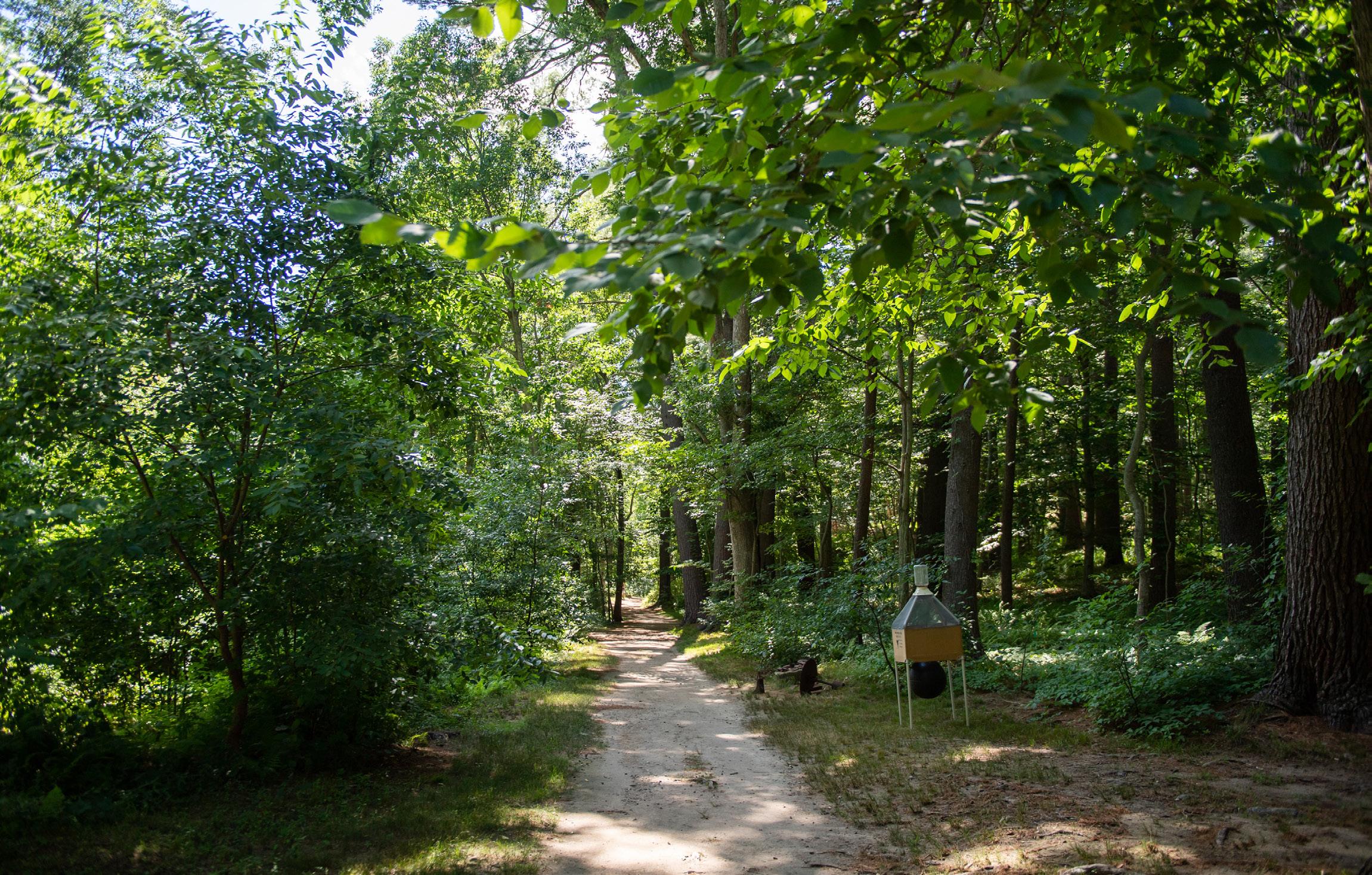
Incorporate native plantings into the downtown, Ballardvale, and Shawsheen neighborhoods, so that new development, or redevelopment, is connected to Andover’s pastoral and ecological history.
a. Develop a regional ecology plan (regional ecology considers the application of the science of ecology to the management of natural resources) to revitalize native plantings, limit invasive species encroachment, and maintain a biodiverse urban environment.
b. Promote education campaigns regarding edible plants within Andover and the benefits of native plant species.
c. Incentivize developers and residents to use native and non-invasive plants in new and existing development, including Industrial and Business District infill.
d. Maintain high-quality soil by encouraging soil regeneration and protection on public and private property.
e. Develop regulations that minimize the use of harmful pesticides, materials, chemicals, and artificial turf in all existing and new development and educate residents about pesticide and fertilizer use and their negative impacts on the environment.
f. Create neighborhoods that support the local food system by helping people integrate the growing of edible foods in their immediate environment and allowing for accessible access to shared gathering areas.
Environmental sustainability is trying to maintain an ecological balance in our natural environment and conserving our natural resources to support the wellbeing of our current and future generations of Andover and the region.
Focus Group Respondent - What is working for you in Andover?
“The amount of conservation land, outdoor trails, outdoor spaces to enjoy is my top answer.”
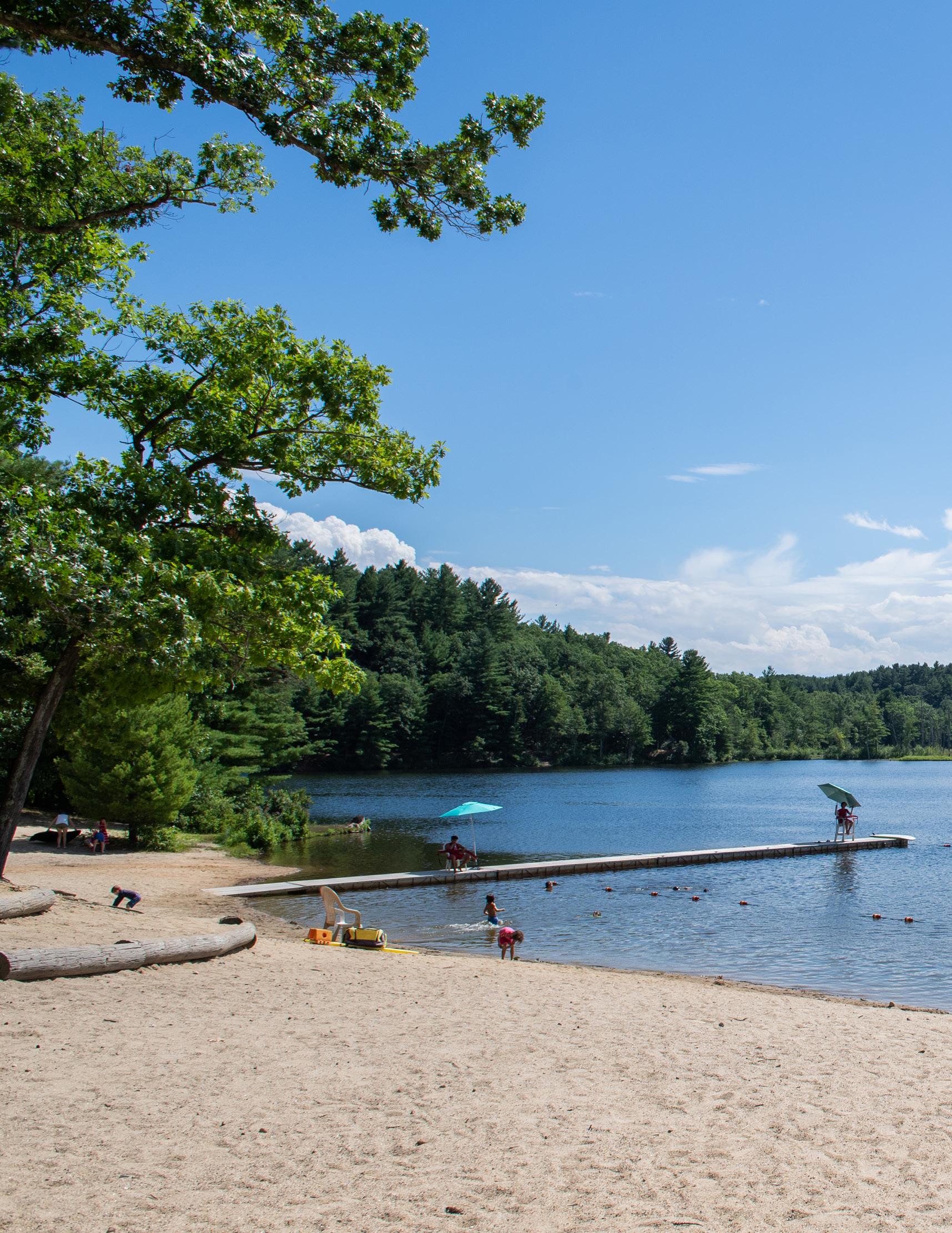
Mobility and the transportation network are a fundamental component of a community. It provides the spatial imprint defined by roads, transportation systems and spaces, locations of buildings and the connections between destinations, activities, services, and home. Addressing the mobility challenge in the future calls for a paradigm shift; encouraging smarter growth (i.e., more compact development), and planning for mixed use land development that increases accessibility and reduces the need for vehicles. The focus is to bring people and places together in additional ways.
Andover is lucky to have two commuter rail stops, especially given its size and distance from the urban core. This, in many ways, is symbolic of the mobility opportunities available to Andover. On the one hand, it has strong connections, whether through the multiple highway connections or multiple commuter rail stops, to employment centers out of town or closer to downtown Boston. On the other hand, there is still much room for improvement helping residents and workers travel within town itself. Our recommendations largely focus on improvement that internal connectivity, so it becomes easier for residents to potentially access new jobs in the highwayaccessible business parks, for residents to get from place to place without being fully dependent on their cars, and to increase walkability and bikeability on roads that are still actively being repurposed for a broader shift in mobility happening across the region.
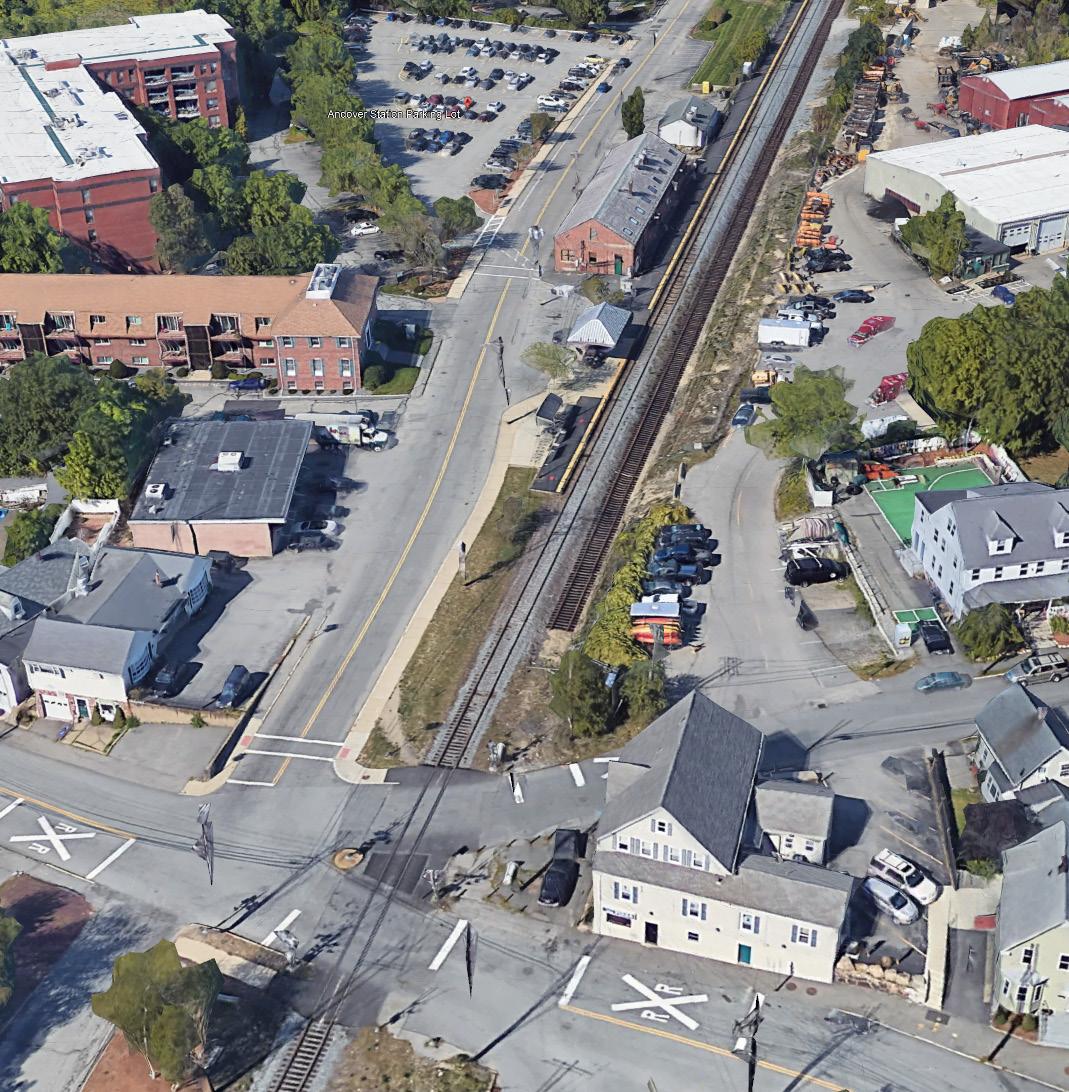
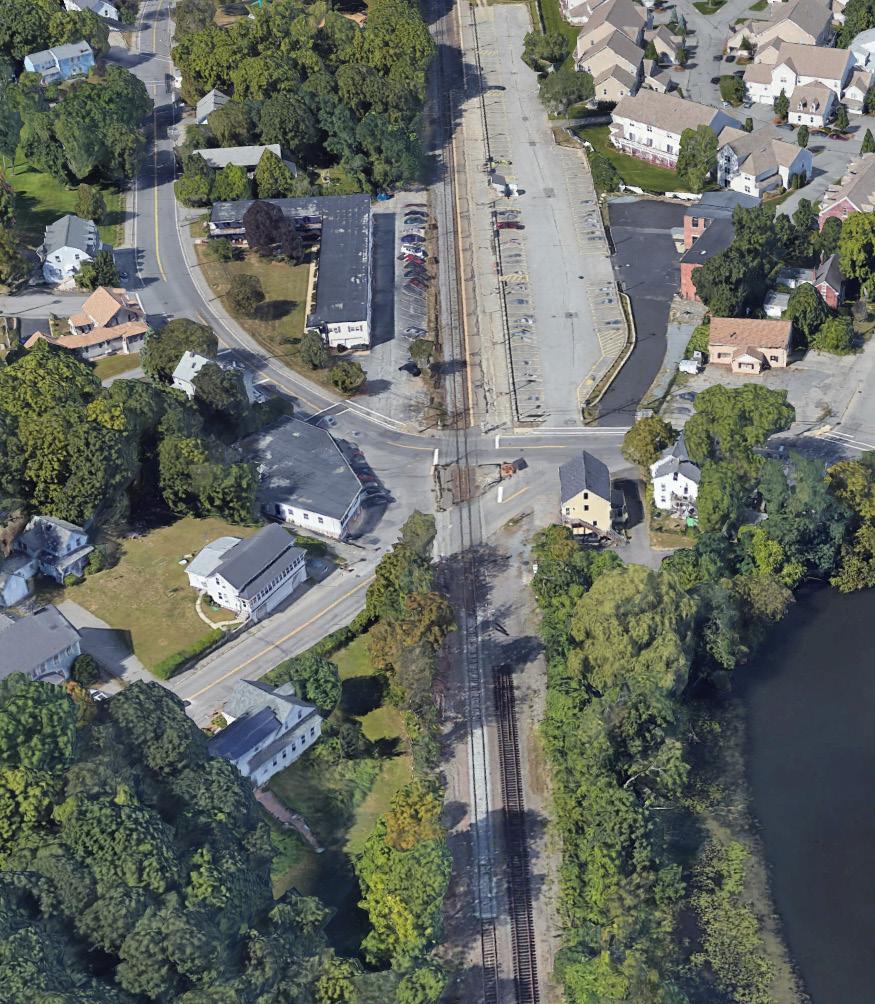
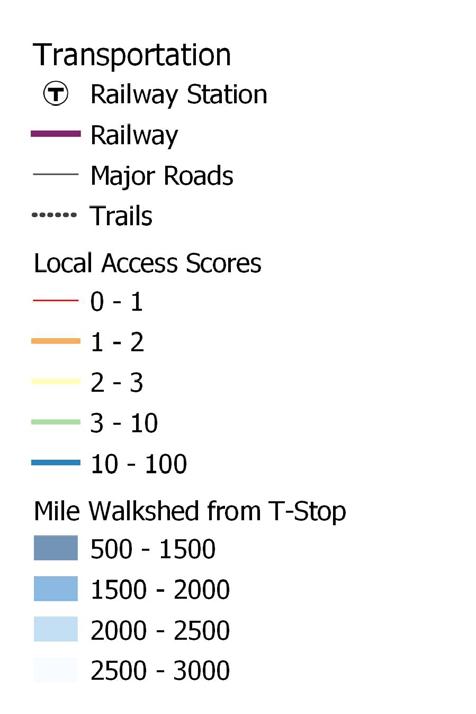
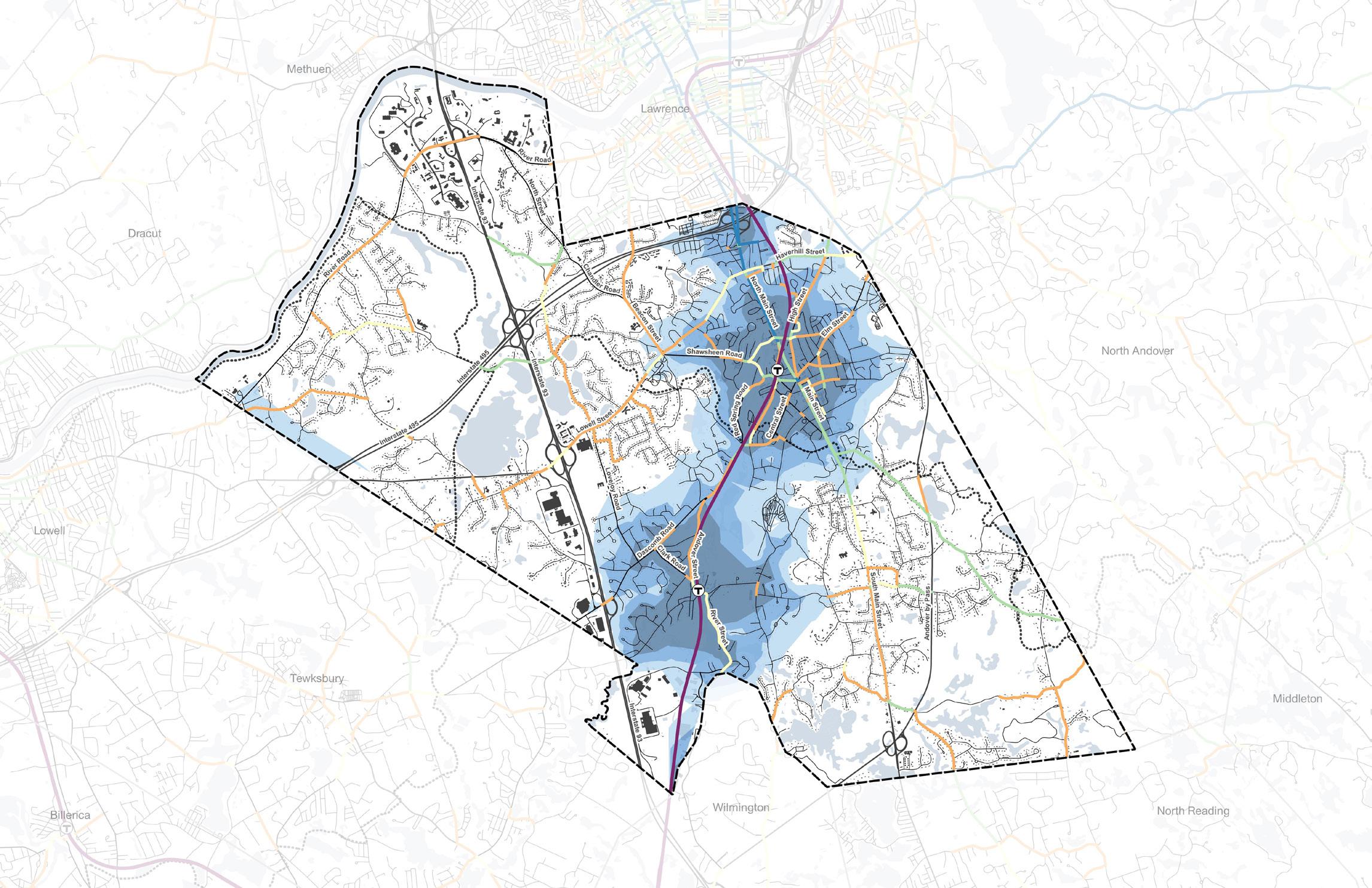
Large portions of town are still accessible within a 15-minute walk from the Commuter Rail. Broader mobility improvements to shift usage away from automobiles will mean that a multi-pronged approach to mobility, development patterns, infrastructure improvement, and long-term development will need to take place.
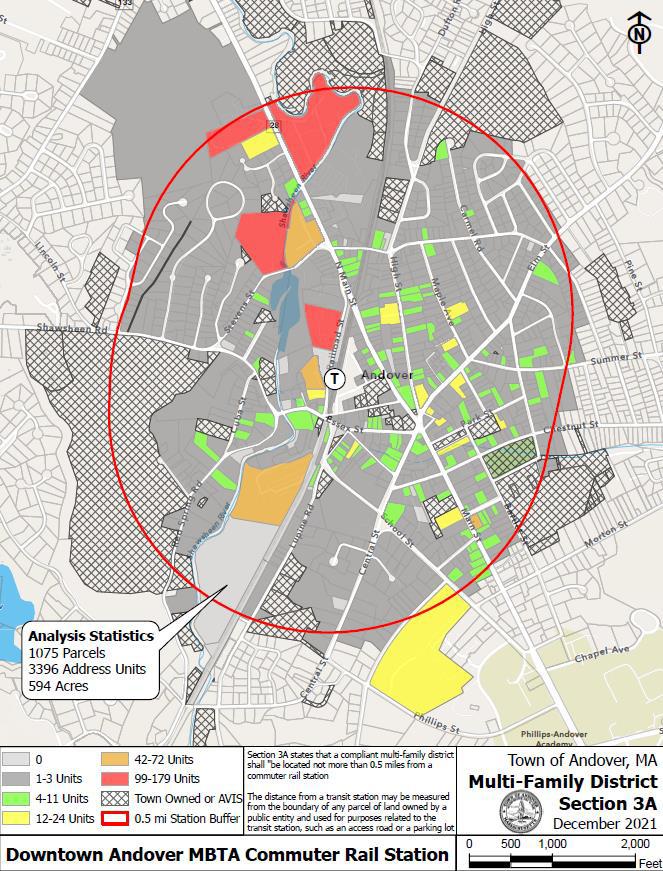
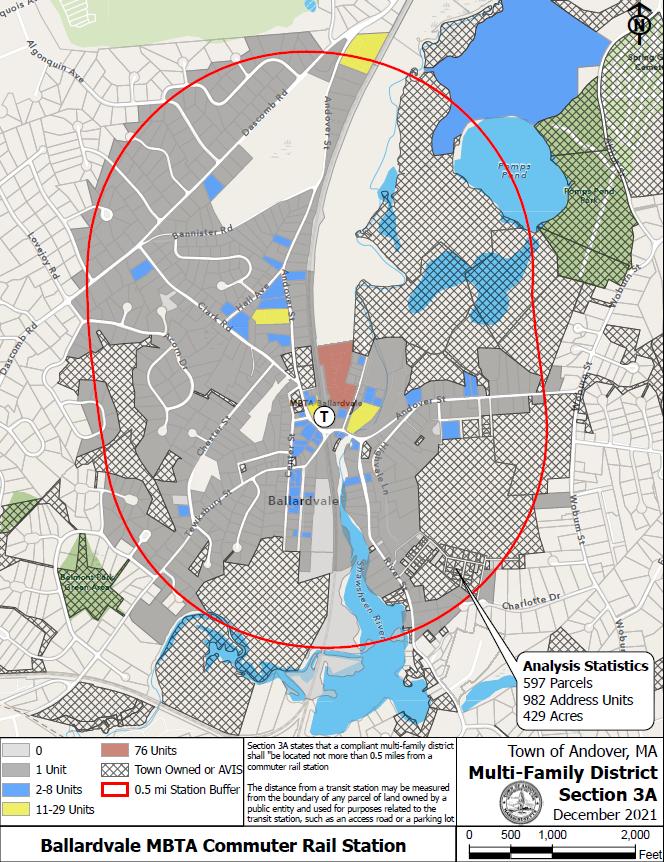
Andover is actively working toward creating a compliant multifamily district with proximity to the Commuter Rail stops as required by the recently-enacted MBTA Communities legislation. While this new zoning does not change anything about existing buildings, this plan tries to focus future mobility improvements so that they line up with these changes in development patterns.
Connect residents to active commercial spaces and to the commuter rail by providing various station access points from different areas of the Town.
a. Identify key opportunities for continuous multimodal transit connections along the commuter rail corridor to key Residential, Industrial and Business Districts.
b. Provide wayfinding (i.e., public maps, signage) to connect MBTA commuter rail passengers to their place of work, neighborhoods, the downtown, municipal services and other destinations.
c. Partner with the Merrimack Valley Regional Transit Authority (MeVA) on enhancing existing services for older adults, commuters, and pedestrians to connect them to various Town resources and promote equitable access to basic necessities such as grocery stores, pharmacies, community services, and municipal services.
d. Continue the Town’s work in developing a Complete Streets Prioritization Plan
e. Create a pathway to pursue MassDOT’s Complete Streets funding.
“Current infrastructure is not friendly to any mode of transport except cars. Congestion can be reduced if there are protected bike lanes and investment in innovative public transit opportunities.”
Make Ballardvale and Andover MBTA Commuter Rail stations into high quality community assets and promote the creation of transit-oriented development around them.
a. Conduct a feasibility study to assess options for renovating or modernizing Ballardvale and Andover MBTA commuter rail stations.
b. Identify parcels where increased mixed-use density could be developed in proximity to the commuter rail and create a housing plan for commuters.
c. Make both stations into sites where activity such as convenience commerce, performances, and community gatherings can occur.
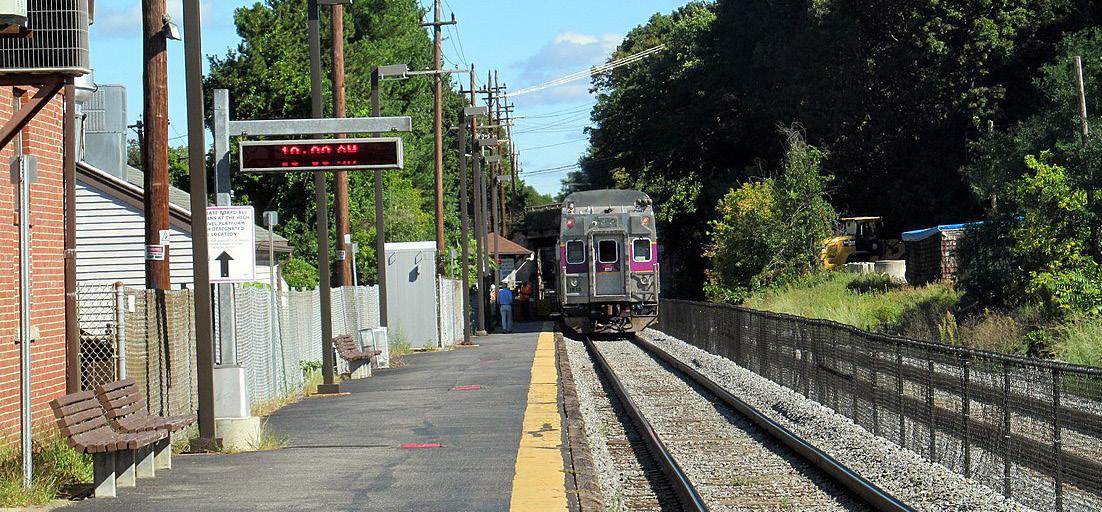
Focus Group Response - Perfect Day in 2033:
“I see a town that is completely accessible from everywhere by sidewalks. People will be able to walk downtown from everywhere. The current sidewalk network will be improved, and this will help with cohesiveness.”
a. Develop a long-term vision to enhance pedestrian and bicycling movement throughout Town. Potential initiatives might include the following:
• Investigate innovative methods and best practices of weatherproofing certain aspects of the Town’s pedestrian and bike infrastructure to promote a year-round culture of utilizing the system.
• Research year-round bicycling and walking alternatives and improvements as proven in other northern cities and countries.
• Explore additional Rail Trail opportunities such as the Haggetts Pond Rail Trail, a feasible project that could incorporate both bicycle and pedestrian paths and could be a shorter-term project.
• Determine key areas to install amenities and improve existing pedestrian and cyclist infrastructure, taking into consideration where improvements are most needed according to usage and how they fit into a connected network.
b. Provide policies and guidelines that will make walking and biking safer, more comfortable and a competitive alternative to driving short distances.
c. Require new development and adaptive reuse to include quality sidewalks and publicly accessible connections to existing abutting trail systems where the trails are not otherwise accessible from the public right-of-way.
d. Require secure, high quality indoor long-term bicycle storage accommodations for new apartment/ condo complexes, office buildings and municipal buildings.
e. Provide education to drivers on how to share the roads with bicycles and pedestrians.
Prioritize green and environmentally restorative methods of enhancing transportation infrastructure throughout the Town to minimize the negative impacts that large-scale transit systems have on local and regional ecology.
a. Invest in green infrastructure as part of a green and Complete Streets initiative when street improvements are made, including additional street trees and green stormwater management infrastructure (rain gardens and bioswales), and solar-powered illumination options.
b. Reduce the negative impact of road construction and road maintenance on the environment by researching new technology in paving solutions, road maintenance and eco-friendly roads.
c. Investigate methods of incorporating green development into large-scale transit infrastructure.
d. Bury and eliminate utility lines and utility poles.
e. Add Electric Vehicle (EV) charging infrastructure to parking facilities in municipal parking lots, Industrial and Business Districts.
f. Incentivize building owners to retrofit EV charging stations at their own buildings, to require some amount of EV charging capacity in new construction, and to retrofit parking lots with green infrastructure.
innovative infrastructure investments in parking solutions, such as a multipurpose municipal parking garage, revising parking rations, minimize or eliminate parking requirements.
a. Create an Active Transportation Plan that focuses on an accessible network of bike, bus, MBTA commuter rail and pedestrian connections that bring people to destinations within and beyond Town boundaries. Include design standards that incorporate information related to ADA considerations, aesthetic guidelines, and public participation procedures.
b. Evaluate and implement parking solutions, such as:
• Different levels of parking capacity needed to support various levels of residential and commercial density, such as the Industrial Districts, commuter rail stations, Business Districts.
• Reduce parking minimums for new development and establish bicycle parking minimums and guidelines (e.g., rack style, spacing, accommodations, for cargo or accessible mobility devices).
• Encourage parking share agreements between private property owners.
c. Support and anticipate rideshare and vehicle-share/car club services, to reduce the need for parking downtown as well as to support travel from the Industrial Districts and commuter rail stations to different parts of Town.
Focus Group Response - What is not working for you in Andover?
“There is an opportunity for more expanded routes to schools. There are a lot of kids that would walk or bike to school, but the sidewalks just end and some of the areas are dangerous because there are no crosswalks.”
Focus Group Responses - Perfect Day in 2033:
“I would be able to get around without a car. I could live in Andover and have access to the market and other services without driving.”
Andover’s economy and job market are a critical component of the quality of life of the community, i.e., increased opportunities that improve the health, comfort, and happiness of all residents. Economic development, if planned effectively, works to retain, and grow jobs and promote investment within the community, generating revenue that provides numerous services and opportunities that contribute to the overall quality of life of Andover residents.
Having such a robust employment center within town borders is a powerful asset that is quite distinct for communities of Andover’s size. To that end, the strategies being suggested in this plan are based on continuing to encourage the vitality of those business parks. In addition to the overall densification and redevelopment strategies discussed in the key priorities section, this plan suggests additional strategies to both diversify the kinds of businesses in Andover’s major employment centers as well as diversify and increase the commercial and retail strength downtown as well, particularly as Andover considers trying to add some housing in and around the town center.
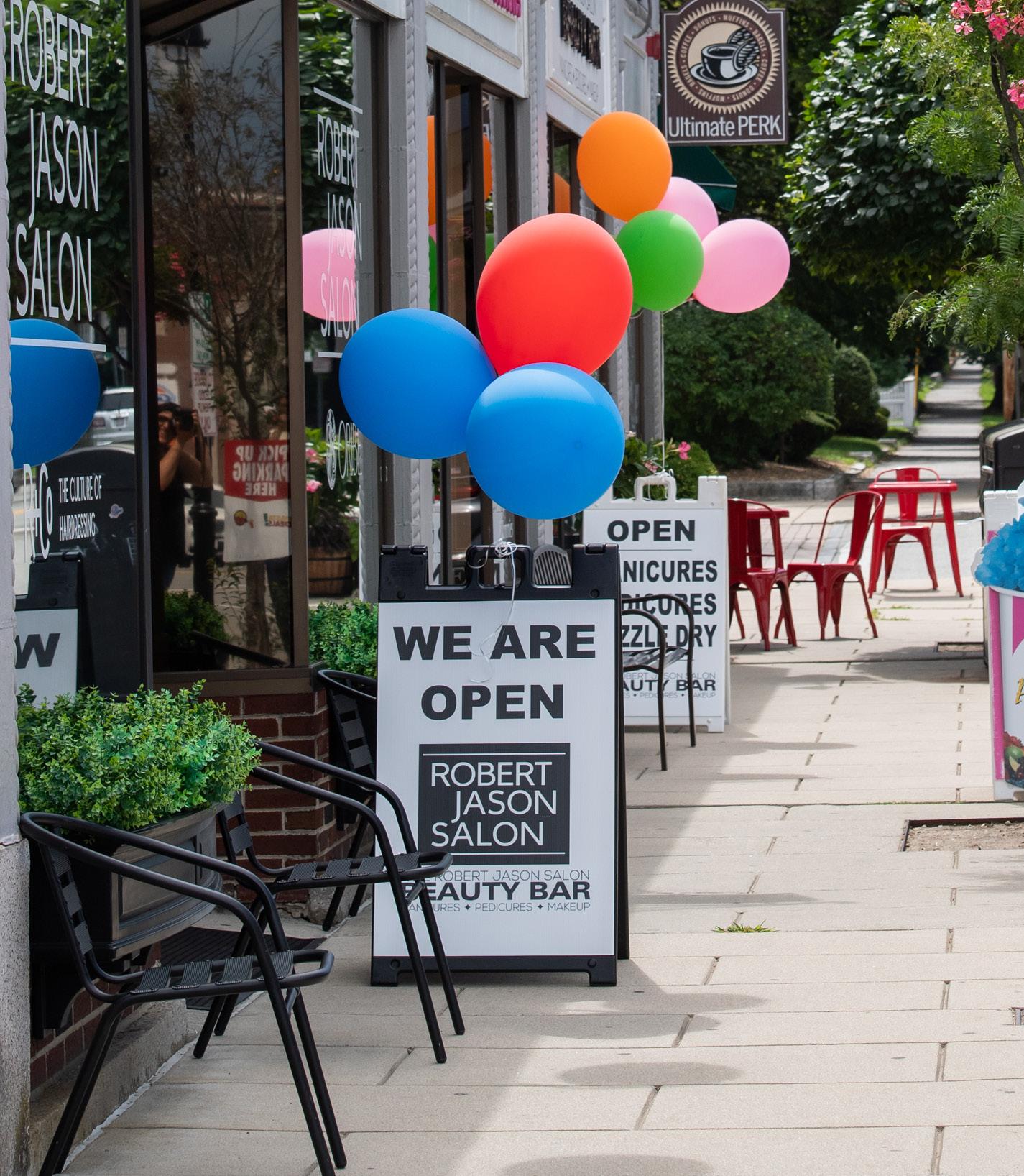
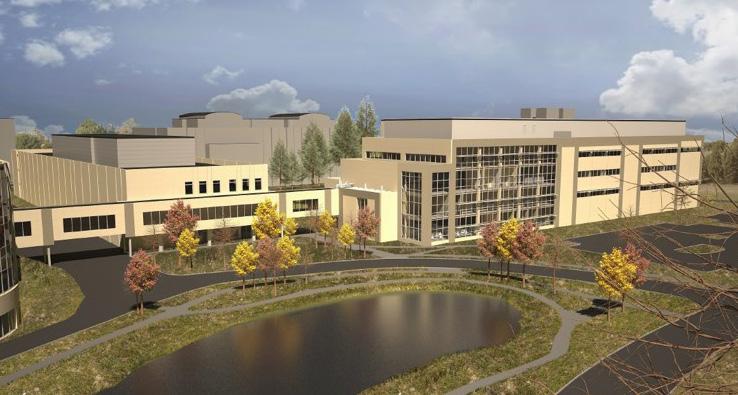
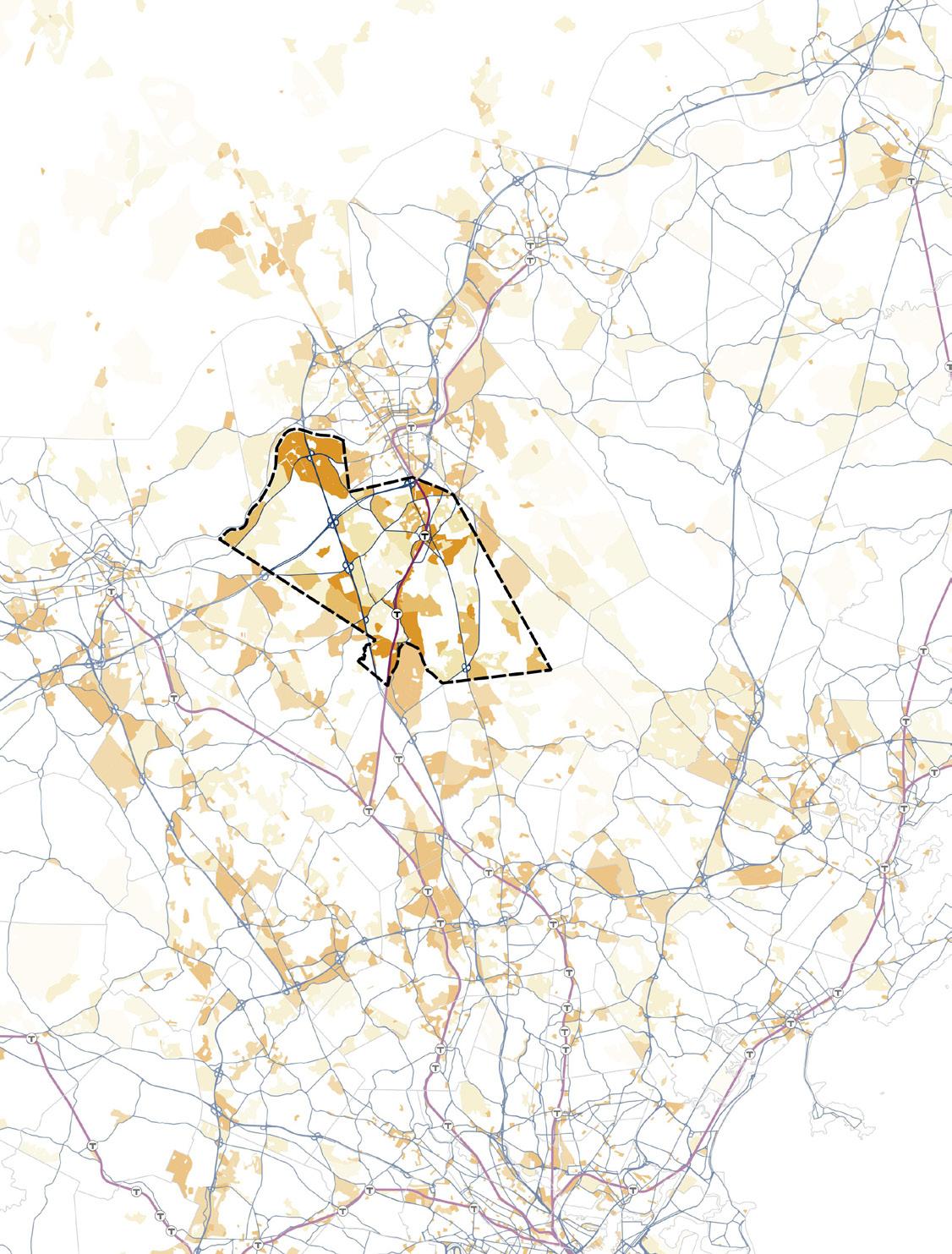
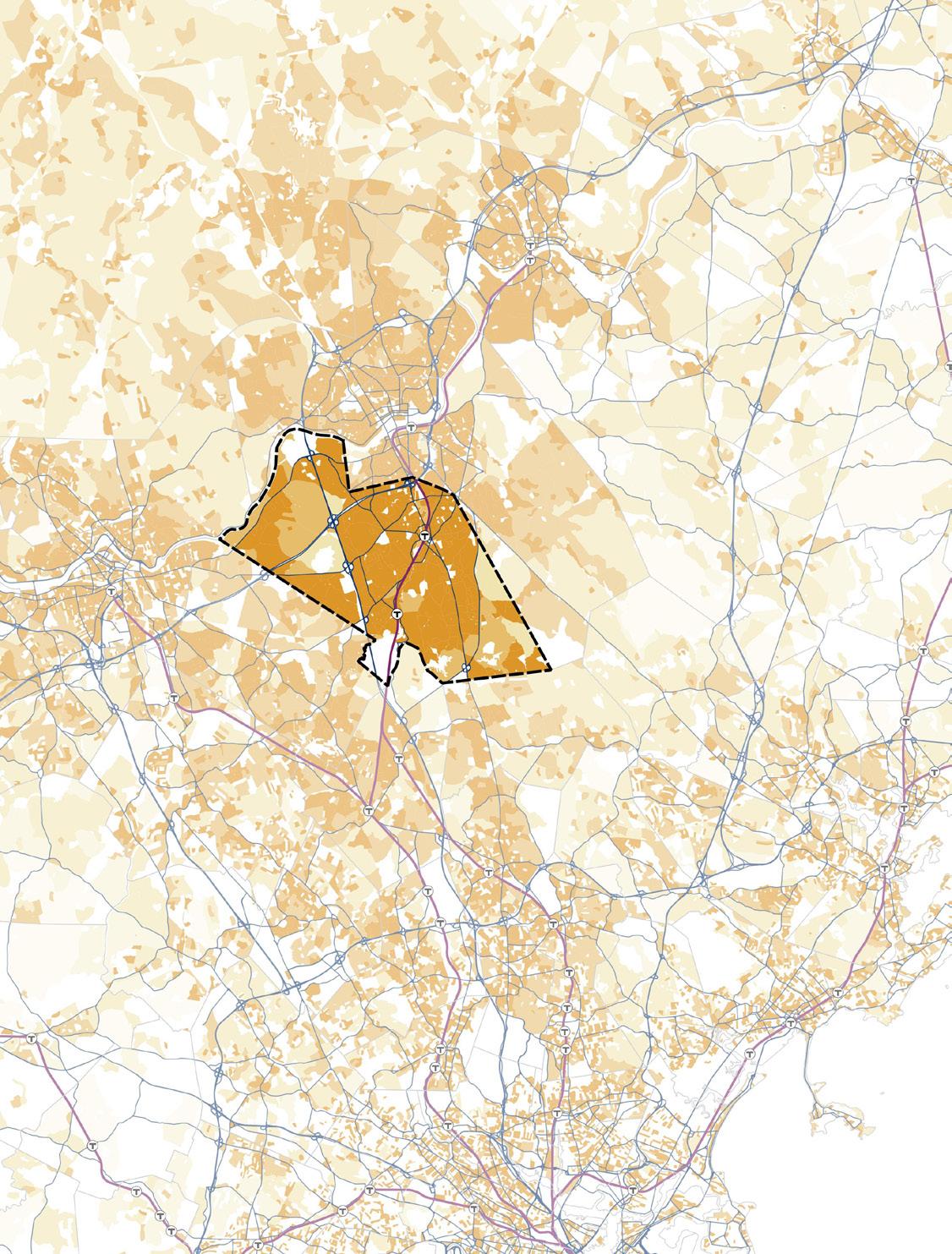
Even with its small-town feel, Andover is also a job center.
Every day, 34,000 workers from outside Andover come into town to work. Meanwhile, 12,000 residents of Andover leave town to work elsewhere. Approximately 2,500 Andover residents also work within town border. This means that the daytime population of Andover rises by more than 20,000 people every single day before falling in the evening. This is unlike most other suburban communities in the area.
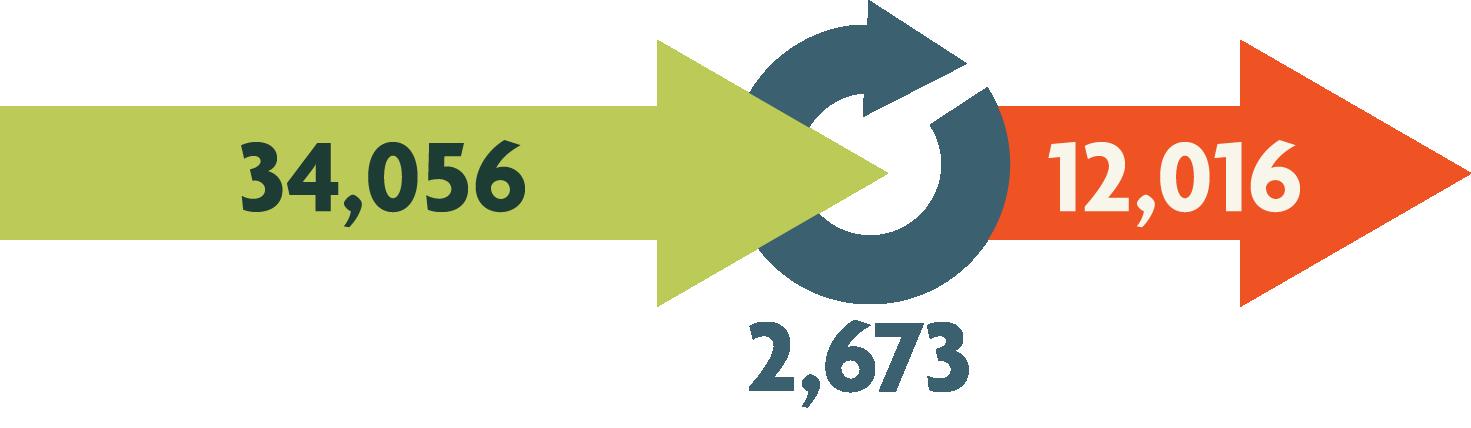
Support a holistic economy of employment in science, technology, health care, and the arts by attracting a diverse range of industries and cultures to Andover.
a. Develop a business outreach plan, which would include meeting with local employers to discuss various land improvements that would support denser and walkable districts for commuters and residents.
b. Encourage various artist support programs that attract a diverse group of young creatives and professionals to live, work, meet, and display their work in Andover.
c. Attract micro businesses through the creation of incubator space (leased/subleased) that is smallscale enough to be affordable in the early stages of business.
d. Assess the Zoning Bylaw for barriers and inconsistencies that may limit creative job clusters that are desired by the Town.
e. Review all Industrial Zoning Districts to update parking ratios, mix of uses, dimensional requirements, etc.
Focus Group Respondent - Perfect Day in 2033:
“I see a downtown with more coffee shops and fairs. I see the Addison Gallery at Phillips expanding, more designated historic sites in Town, sitting on more park benches. I see an iconic New England feel to Town with an ambiance and more people gathering at Town events.”
Attract employers who bring a greater commercial tax base and can expand employment opportunities to Andover, by creating places that encourage employees to patronize local business, and ultimately relocate to Andover.
a. Pursue tax incentives to attract employers offering high wage jobs in fields such as biotechnology, manufacturing, and technology.
b. Promote the addition of more cafes, co-working spaces, and dining options throughout Andover’s Business Districts to create opportunities for collaborators and entrepreneurs to gather and work together.
c. Research Community Benefits Agreement (legal agreements between community benefit groups and developers) stipulating the benefits a developer agrees to fund or furnish, in exchange for community support of a project) that require large new employers to enhance the public realm, accessibility, and general appearance of office or lab developments.
d. Invigorate existing Industrial Districts by pursuing additional strategies to increase the mix of uses, increase the density by redeveloping existing buildings, and research other creative solutions.
e. Evaluate existing infrastructure conditions and plan for infrastructure upgrades, either by capital planning or private investment, to ensure capacity for economic growth.
Encourage the downtown, Shawsheen Village and Ballardvale to become hubs for people employed in arts and culture, entertainment, retail, culinary arts, and boutique services.
a. Pursue tax incentives paired with community benefits and public realm enhancements, to encourage the growth of a vibrant arts and entertainment district downtown.
b. Tap into local talent to create programming that increases foot traffic downtown to help attract customers to local businesses.
c. Consider infill opportunities in the General Business Districts to create additional retail space, including smaller units that would encourage retail diversity and innovative concepts.
d. Identify barriers impeding small business growth and work to address the identified obstacles.
e. Ensure business owners have equitable access to technical assistance and resources.
f. Increase the marketing and promotion of local businesses to the region.
g. Prioritize the retention and recruitment of restaurant operators, small retail and boutique shops, and innovative new businesses.
“The Town should make the downtown a vibrant destination for everyone across the region.”
78% Agree, 8% Disagree, 12% No Response (n=219)
“A vibrant
downtown
active
through
the evening hours will be an asset to the entire Town.”
82% Agree, 4% Disagree, 12% No Response (n=221)
Reduce the reliance of Andover’s businesses on fossil fuels and encourage environmentally friendly and sustainable practices among all Andover businesses.
a. Provide incentives and advocate for green manufacturing businesses to relocate to Andover.
b. Implement a business composting program, like a residential composting program.
c. Provide incentives and build a network of local developers and contractors who specialize in green residential projects and retrofits.
d. Provide homeowners and developers, who are retrofitting or adapting existing structures, with information about contractors in the area who specialize in green and environmentally friendly building practices.
Prioritize arts, culture, and innovation to support inclusive economic development and placemaking.
a. Create a workforce development program for creative workers, artists, artisans, performers, and designers. Initiatives that the workforce development program might pursue include the following:
• Provide creative workers, artists, artisans, performers, and designers access to affordable studio and/or coworking space across Town and showcase their work in public art and seasonal art initiatives.
• Partner with local schools on creating internship opportunities for students in Andover to connect with local businesses, small-scale and craft manufacturers, and other artisanal workers.
• Increase the number of social and cultural activities to highlight and enhance Andover’s diverse population.
• Partner with Andover’s Commission on Diversity, Equity and Inclusion (DEI) to enhance the diversity of cultural offerings in Town.
b. Create a public art policy and program that determines what should be considered works of art versus signage and advertising.
c. Implement the Adaptive Reuse Study of Old Town Hall to create a vibrant gathering space in downtown to facilitate community engagement and draw residents downtown.