• Automate Interactions & Notifications to Streamline Hand-offs Between Parties
Dime Community Bank: A Strong History and A Bright Future
BY GLEN CARBALLO
DIME PRIVATE & COMMERCIAL BANKING
Our History
For more than 160 years, Dime Community Bank has been a financial pillar in the communities we serve. Built on perseverance, integrity, customer service, and a commitment to reinvest locally, Dime has helped generations of New Yorkers manage their finances, grow their businesses, and plan for their future. Through two World Wars, the Great Depression, the 2008 financial crisis, and most recently, a glob-
al pandemic, Dime has remained stable, strong and deeply rooted in our communities.
That kind of staying power does not happen by accident. Dime has always taken a careful and thoughtful approach to banking. While other financial institutions may have followed trends or taken unnecessary risks, Dime stayed focused on long-term relationships, trust, and smart decision-making. It is that consistent approach that has allowed the bank not just to endure, but to grow throughout its 160-year history.
Dime continues to expand across New York into additional communities. These expansions reflect Dime’s ongoing commitment to serving new communities with the same trusted, relationship-focused approach that has defined the bank for over 160 years.
Dime’s story is one of strength, service, and unwavering commitment. And it is a story that continues to grow.
An “Outstanding” Commitment to Community
Throughout our history, Dime has earned and maintained the trust of its clients by offering consistent service, impactful financial solutions, and a genuine commitment to community well-being. That commitment has been formally recognized with an “Outstanding” Community Reinvestment Act (CRA) rating for four consecutive years. This is one of the highest possible distinctions for community banks and reflects Dime’s dedication to meeting the needs of the communities it serves.
Whether through financing local businesses, sup-
porting affordable housing, or investing in community development, Dime continues to take a hands-on approach to reinvestment. Families, individuals, and businesses across Greater Long Island and New York City rely on Dime as a trusted partner, and that trust has grown stronger over time, built upon generations of positive experiences and proven reliability.
Personalized Service Through a Single Point of Contact
In addition to traditional branches, Dime has expanded its reach and coverage with Dime Private and Commercial Banking with teams of highly skilled professionals dedicated to providing exceptional financial services to our valued customers. One of the key differentiators of Dime’s Private and Commercial Banking group is our relationship-driven model. Each client is supported by a dedicated banking team who understands their full financial picture and serves as a single point of contact. This client-centric approach
ensures a high level of responsiveness, expertise, and personalized attention across every stage of the banking relationship.
As a trusted partner, Dime delivers tailored financial solutions that help clients navigate complex needs and plan for long-term success. Clients can count on the dedicated support of a banker who knows their business and is committed to helping them succeed.
Expertise, Efficiency, and Execution
At the core of Dime’s Private and Commercial Banking philosophy is a focus on delivering value through expertise, efficiency, and execution. These three pillars guide our approach and reflect the high standard of service we provide to every client.
Expertise means our bankers bring decades of combined experience to the table, supporting clients with specialized and often complex banking needs. Whether navigating commercial lending, treasury management services, or strategic deposit management, our team has the knowledge and insight to provide sound guidance at every step.
Efficiency is another critical benefit of working with a dedicated finance team. Financial operations require attention to detail and adherence to strict deadlines, such as tax filings, audits, and budget reviews. A dedicated team streamlines these processes by establishing workflows and leveraging familiarity with the organization’s systems. For example, a team that regularly handles payroll or accounts receivable can reduce errors and processing times compared to external resources. Moreover, dedicated teams can implement advanced tools, such as enterprise resource planning (ERP) software or data analytics platforms, to automate repetitive tasks and enhance accuracy. This efficiency translates into cost savings and allows the organization to allocate resources to strategic initiatives rather than administrative burdens. In contrast, relying on non-specialized staff or third-party providers often leads to delays, miscommunication, or costly mistakes.
Collaboration is a cornerstone of a dedicated finance team’s success, fostering synergy that drives innovation and problem-solving. Unlike fragmented
or outsourced financial functions, a dedicated team operates as a cohesive unit, with members sharing a common goal and open lines of communication. Regular meetings, brainstorming sessions, and cross-functional collaboration enable the team to align financial strategies with the organization’s broader objectives. For instance, a finance team working closely with marketing might develop a budget that optimizes advertising spend while ensuring profitability. This collaborative environment also encourages knowledge sharing, where junior members learn from seasoned professionals, enhancing the team’s overall capability. Additionally, a dedicated team builds trust and accountability, as members are invested in the organization’s long-term success. This unity contrasts with external consultants, who may prioritize short-term deliverables over sustained growth.
A dedicated team’s vigilance safeguards the organization’s financial health and enhances its resilience. Beyond these operational benefits, a dedicated finance team contributes to strategic growth by aligning financial planning with long-term objectives. Unlike temporary or outsourced solutions, a dedicated team invests time in understanding the organization’s vision, whether it’s expanding into new markets, launching innovative products, or improving sustainability. This alignment enables the team to develop financial models that support ambitious goals while maintaining fiscal discipline. For instance, a dedicated team might secure favorable financing terms for a capital-intensive project or identify cost-saving opportunities to fund research and development. This strategic foresight is particularly valuable in competitive industries, where agility and informed decision-making provide a competitive edge.
Execution reflects our ability to deeply understand each client’s goals, challenges, and industry landscape. With this insight, we help develop and carry out comprehensive banking strategies designed for long-term success.
Looking Ahead
Today, Dime is proud to be recognized as the leading commercial community bank with the number one deposit market share among community banks on Greater Long Island . With 62 locations across New
York from Montauk to Manhattan, Staten Island, and Westchester County, and a team of experienced bankers who live and work in the same communities they serve, Dime continues to help people and businesses thrive through reliable solutions and real relationships. In conclusion, working with a dedicated finance team offers transformative advantages that enhance an organization’s financial performance and strategic positioning. The team’s specialized expertise ensures high-quality decision-making, while its efficiency streamlines operations and reduces costs. Collabora-
tion fosters innovation and alignment with organizational goals, and proactive risk management safeguards against uncertainties. Together, these benefits enable a dedicated finance team to serve as a catalyst for growth, driving both short-term stability and longterm success. In an era where financial complexity is ever-increasing, organizations that invest in dedicated teams are better equipped to navigate challenges and seize opportunities.
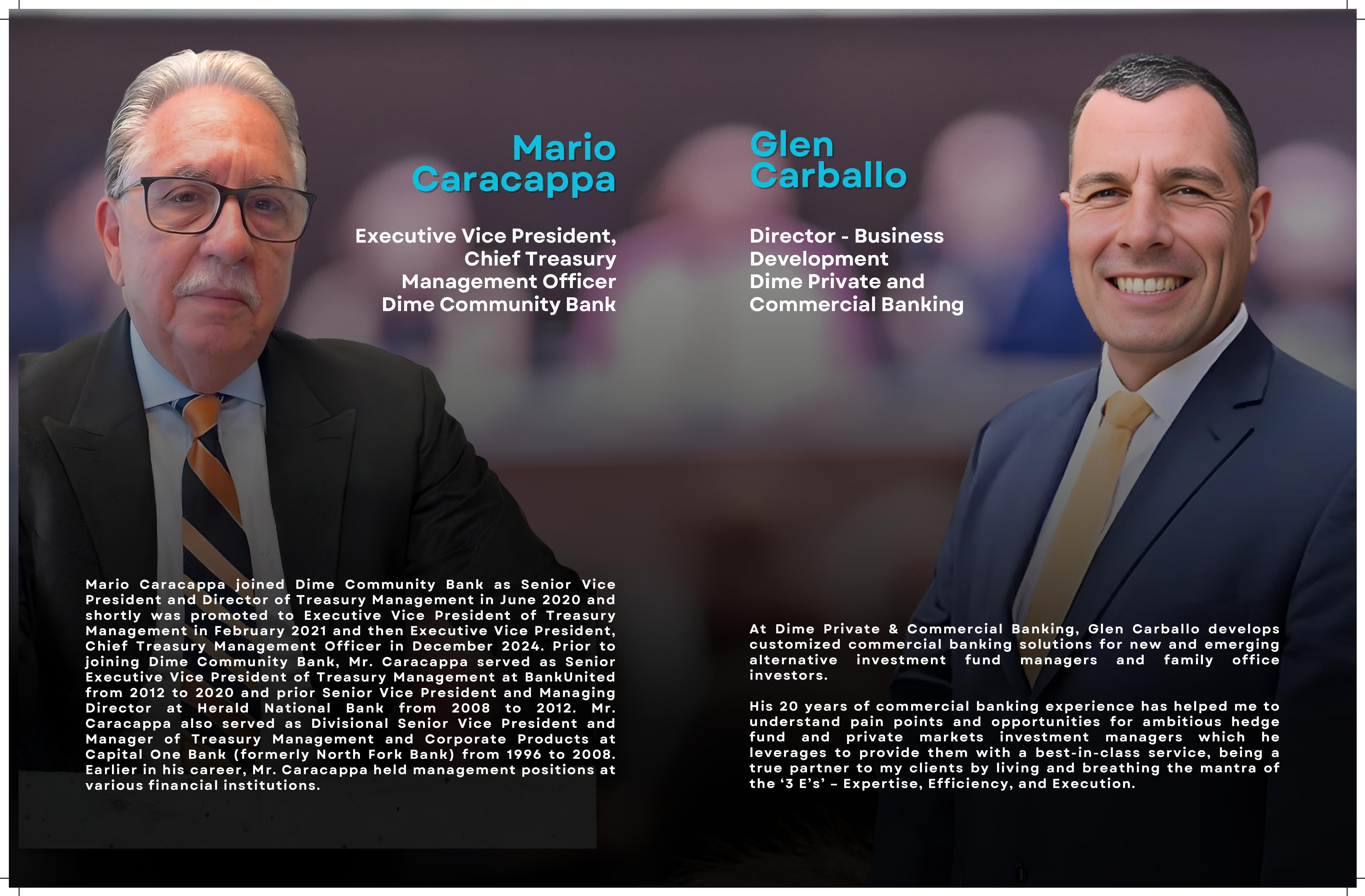
As a seasoned commercial banking professional within Dime Private & Commercial Banking, Glen Carballo specializes in crafting tailored financial solutions for emerging alternative investment fund managers and family office investors. With 20 years of experience, Glen deeply understands the challenges and opportunities faced by ambitious hedge fund and private markets managers. Guided by his “3 E’s” philosophy— Expertise, Efficiency, and Execution—he delivers best-in-class service, acting as a true partner to his clients.
SPECIAL ADVERTISING FEATURE
CELEBRATES 160 YEARS
Dime Community Bank has a long history of financial and community strength. Since opening its doors in 1864, Dime has endured the Great Depression, two world wars, the financial crisis of 2008 and a global pandemic. At each point, Dime has leaned into the communities they serve to support their needs and provide a safe harbor during times of change. Today, on the occasion of its 160th year in business, Dime is committed to becoming the premier community commercial bank from Montauk to Manhattan by partnering and building trusted relationships and providing solutions for financial success.
1864
Dime Savings Bank of Williamsburgh founded in Brooklyn, New York
1865
1952
Dime offers FHA, VA mortgages as per the GI Bill to returning service men
1940
Dime adds women as bank officers
William W. Armfield President
Dime issues first home mortgage
1869
Dime moves from basement of Williamsburgh City Bank to Broadway
1873
Dime moves to 52 Broadway and Wythe Avenue
1874
Dime deposits doubled in its first decade. Accounts grew 8X.
Savings passbook 1890, depicting Dime’s second main office on Broadway and Wythe Avenue Raymond Bertrand Vice President William Grandy Secretary Dime Founding Officers
1883
Brooklyn Bridge opens in May
1889
Dime celebrates 25 years
1929
Wall Street crash spurs Great Depression. Dime joins FDIC.
1923
Dime expands bank building at Havemeyer and South Fifth streets
1914
Dime celebrates 50 years
1908
Dime moves to new headquarters at Havemeyer and South Fifth streets
1903
Williamsburg Bridge opens in December
YEARS OF COMMUNIT Y BANKING
1961
Dime’s first Long Island branch opens in Merrick
1964
Dime celebrates 100 years
1975
New York City fiscal crisis. Dime remains independent
1985
Amid bank failures, Dime reports profits
1996
Dime goes public and acquires Conestoga Bancorp, Inc. and its subsidiary, Pioneer Bank
2018
Dime’s Havemeyer Street headquarters declared a New York City landmark 1998
26, 1996
2021
2017
Dime moves headquarters to Cadman Plaza, Brooklyn
Dime shifts focus to commercial and business banking. Approved as Small Business Administration (SBA) lender
Dime merges with BNB Bank, now having 60 locations in the New York region
2021
Dime provides $2 billion of Paycheck Protection Program loans to customers and businesses during COVID-19 pandemic
2022
Dime moves headquarters to Hauppauge
Dime acquires Financial Bancorp, Inc.
2023
Dime ranks #1 by deposit market share on greater Long Island amongst community banks*
Dime launches online account opening platform to expand its digital offerings
2024
2011
Dime opens branches in Brooklyn and Queens 2014
Dime celebrates 150 years
Dime opens a branch on Fourth Avenue
2010
Dime opens branches in Garden City and Cedarhurst
2008
Dime opens branch in Valley Stream
Financial crisis. Dime opens branches in Brooklyn Heights and Boro Park
Dime expands into Westchester County with a new location
Dime opens its 63rd location in Williamsburg, blocks from the original building
Dime receives “Outstanding” Community Reinvestment Act rating
IMPROVING RISK MANAGEMENT PROTOCOLS FOR VALUE EQUITY INVESTING
DAVID KAISER
Methodical Investments LLC
Many investors can agree that when investing in equities there should be a focus on risk management, from securities selection to monitoring and managing the portfolio as a whole. Unfortunately, there is no universal standard for what constitutes risk management.
While this is a challenge for the portfolio manager it is of equal concern to sophisticated institutional investors, both for when they are conducting due diligence vetting on the investment processes of multiple portfolio managers under consideration, and then for monitoring a portfolio’s exposures once they have invested with the manager they chose.
When it comes to value equity investing, and the traditional approach taken for it, things can get tricky regarding risk management protocol selection and execution; again, both for the portfolio manager and prospective sophisticated investors. The reason is that traditional value investing tends to follow a subjective, fundamentals-based approach to conducting company research, securities selection and managing the resulting portfolio. That can be challenging for defining risk management protocols that can be followed with consistency.
How subjective and how structured?
These are among the questions institutional investors ask themselves when evaluating value equity managers and looking into the risk management protocols embedded in their investment processes. Also critical is whether risk management related protocols are being set and followed with consistency.
How is the portfolio manager attempting to determine if a company is discounted and whether it should be bought, sold or held? The more subjective the investment process, the less structure it may have, and the resulting gray areas of strategy implementation may result in variability as to the guidelines a portfolio manager may be following. How much might a value equity manager’s investment methodology shift and drift, and what might that portend for the value of its risk management decision making?
Sophisticated investors can rightly feel that the more amorphous a portfolio manager’s ‘must have’ and ‘nice to have’ characteristics are for company selection the weaker risk management may be for that stage of the investment process. Further, could the manager’s reasoning for buying and selling companies in the portfolio change over time, or as market conditions shift? (The reasons why a portfolio manager buys and later sells a company could be completely different.)
This is where a prospective investor evaluating a value equity manager will be looking to uncover whether subjective bias and rationalization are potential risks not addressed well enough in the investment methodology. Having strategy implementation consistency regarding why a portfolio manager buys, holds and sells, can help better identify and mitigate risk. Lacking that consistency, the value equity manager may end up making risk management related decisions on a caseby-case basis. That can reasonably make a prospective institutional investor wary of variability in that manager’s strategy implementation.
Could risk management be improved for value investing?
We believe the answer is Yes.
We believe that the key to improving risk management protocols for value equity investing is to apply a data-driven, multi-factor analytics, rules-based methodology. By applying a fixed, quantifiable structure, there is the potential for more consistent investment decision making for the portfolio manager as well as improved portfolio evaluation and monitoring ability for the prospective investor.
Contrary to what many people often assume, the idea of data-driven and rules-based value equity investing is not a foreign concept. Value investing legend Benjamin Graham was a fan of formulas and parameters. Back in his time, when financial data was hard to come by and had to be compiled and analyzed manually, he spoke of what he referred to as Net-Net investing analysis: analysis focused on a firm’s net current assets. Graham had criteria in place for what he believed was an acceptable investment. Today we have ready access to far more company specific information as well as tools to aggregate and analyze it more effectively and with greater consistency.
When conducting value investing with a methodical, evidence-based analysis focus, the entire universe of companies can be the starting point for filtering down to a portfolio manager’s investable universe. Further — and we have found this to be a fascinating point — portfolio managers implementing a data-driven style of value investing are not limited by what particular companies or industries they believe they know in depth or have extensive exposure to.
If one can structure and apply a data-driven approach for value investing then an often asked question from prospective investors — Is it a repeatable process? — can be answered Yes. The reasons for these can be as consistent and as simple as, We buy and own it if it meets our criteria. If it no longer does, we do not own it. It can be black and white risk management protocol.
Additionally, we understand that no single metric equates to stock appreciation or to downside protection. Therefore, we believe it is prudent to take a more holistic, multi-factor analytics approach that views the whole picture. Some metrics may be more heavily weighted than others but taking a group of metrics into account can be helpful for both analyzing companies and a port-
folio of holdings.
Monitoring the forest while keeping an eye on the trees
We believe multi-factor, data-based analytics can improve value equity portfolio risk management at the portfolio level as well as at the individual stock level. As sophisticated investors (and portfolio managers) appreciate, the investment objective should be that the portfolio as a whole does well, not that every holding in the book becomes a win. For this, a quantifiably measurable combination of company holdings characteristics that comprise the average for the portfolio’s whole basket of holdings could be compared and contrasted to, say, some appropriate index benchmark. This can be a transparent way to see whether a portfolio is delivering more and stronger company strength and discounted valuation characteristics, or not.
Importantly, we believe that owning a value equity portfolio that in aggregate is discounted could result in upside potential and more downside protection to the book. A data-based analytics driven investment process can have the potential to measure and monitor that.
Examine the risk management rules
For the prospective investor evaluating the value equity portfolio manager’s process, inquire about their active management of the book. For instance, are there set parameters relating to actively monitoring at the portfolio-level, whether in terms of portfolio price movement or other factors? Also, evaluate risk management protocols at the stock picking and asset allocation stages. What thought has the portfolio manager given to what type of companies are allowed in the portfolio? Additionally, what do they do if company specific factors change (e.g. if a profitable company becomes unprofitable), what valuation-related risks do they tolerate, and how often are these factors being evaluated?
The more structure and consistency to rules-based risk management that you find in the stock-level buy, hold and sell decisions and with the portfolio-level monitoring and active management at the basket of
holdings level, the better. Those can be signs of a repeatable value equity investing process. Add to that the removal of subjectivity and potential bias in portfolio management decision making, which a data-driven multi-factor analytics approach further adds to the mix, and you may uncover opportunity to allocate where you think there is the potential for a strategy to deliver an improved risk/reward profile due to improved risk management protocols.
David Kaiser Managing Partner &CIO Methodical Investments LLC
Our intended role within an investor’s total portfolio is to provide capital appreciation potential from exposure to potentially undervalued companies that have, in our opinion, strong operating characteristics.
Our goal in our flagship fund, Method Investments, LP, is to outperform the Russell 2500 Value Index benchmark over a 5-year rolling period, in an attempt to add alpha without adding commensurate risk.
from website: personal bio (different than bio at end of article):
David has over 19 years of industry experience and worked with quantitative strategies before entering the financial industry. He always looks for efficient and effective ways to grow assets using equities. His passion is value investing, but his focus is on quantitative, automated, and unbiased approaches.
Body Copy - no indent 1st paragragh. Drop 1st letter x4. Indent paragraphs after first
For over 30 years, Worth Magazine has been an authority on the intersection of business, finance, and innovation.
Uncorrelated attendees will receive a free one-year subscription to Worth Magazine. Scan the QR Code to claim your subscription. For more information about worth and to sign up for our newsletters, visit Worth.com
Proprietary questionnaire highlighting overall event history, goals and target demographics
Kick off strategy call to review questionnaire, event marketing materials and project timeline
Add-on Services
(pre-event, onsite/virtual and post-event business development support)
Targeted sponsor sales initiative
Digital Outreach
Eblast
• 1 customized eblast for distribution to Connext’s proprietary network consisting of financial services and nonprofit contacts
Online/Social Media
• Customized posts (pre-event, event day and post-event) with click-toactions on the following sites: LinkedIn X Facebook The NEXT Event website
• Company provides the following media assets: Logo Electronic invite Online links, videos & preferred content
• Follow-up on requests for additional information and general inquiries resulting from the digital outreach
Summary of activity and ConNEXTions™ based on customized URLs
Each engagement is customized based on client’s goals, timeline and mandate
Additional ConNEXTions™
Additional rounds of social media
About Us
A strategic business development boutique that delivers tangible results. We transformbusinesses into worldclass organizations by connecting our clients to their next opportunity, making synergistic introductions, creating unique marketing platforms and enhancing brand visibility.
Our comprehensive suite of services include: business development, marketing, events and communications. Together we build solutions that ensure long-termgrowth and success.