Fision fiber-powered communities. Board tested. Resident approved.

Hotwire Communications partners with HOAs to deliver futureproof technology, transparent contracts, and concierge-level customer service that keeps residents connected and boards confident.
Choosing a telecom provider is one of the most important decisions a board can make. With a 99% renewal rate nationwide, communities trust Hotwire to deliver unmatched performance and white-glove support year after year.


Our 100% fiber-to-the-home network ensures symmetrical speeds, guaranteed reliability, and no data caps—while our dedicated account managers provide the concierge-level customer service boards and residents deserve. Independent rankings by PCMag and Consumer Reports confirm what our partners already know: Hotwire is the fastest and most trusted ISP in the market.
Let’s Build Something Better, Together.


’S BOARDSMART TM
MASTERCLASS SERIES
Build the core knowledge every board and manager needs for effective, compliant, and efficient community leadership.
This comprehensive program is designed for current and aspiring community association board members, property managers, and homeowners who want to understand how to effectively govern and sustain their communities.
Completion of the masterclass series will satisfy DPBR educational requirements for board members of condominiums and homeowners associations.
Credits earned by managers who successfully complete the series will be submitted to the DBPR and count towards licensing requirements.
CONDO/CO-OP CLASS BUNDLE
4-Hour Board Certification
Knowledge is Power: Legal Update
Record Keeping for Associations
Disaster Preparedness & Recovery
How to Properly Run an Election
Proper and Effective Board Meetings
Collection & Foreclosure Strategies

HOA CLASS BUNDLE
4-Hour Board Certification
Record Keeping for Associations
Disaster Preparedness & Recovery
How to Properly Run an Election
Proper and Effective Board Meetings
Collection & Foreclosure Strategies
Rewriting Your Documents from Start to Finish
BONUS CLASS
Condo Construction Projects Gone Wild
Proper and Effective Membership Meetings
BONUS CLASS
Discovering, Managing and Recovering from Construction Defects


The Making of a Modern Board: How Learning, Perspective, and the Right Tools Shape Stronger Leadership
Building a Better Board: Essential Education and Tools for Florida Community Leaders
The Hidden Price of Underfunded Reserves
Leading with Civility: Why Professional Board Conduct Strengthens Communities
the
Financial, Legal, and Management Services Directories
Products and Services Directory
Display Advertisers’ Index
Class Is in Session: The ABCs of Florida’s Board Member Education Requirements
Rembaum’s Association Roundup House Bill 657: Legislation Proposed to Potentially Destroy Florida’s Homeowners’ Associations
Mitigating Exposure to Potential Legal Liabilities for Community Associations
Florida Law Alterations: Heavy Metal Not Welcome Music to Ear nor a Pleasure to Eye


Journal Notes
Well, 2026 is already flying by as we enter into February. While none of us can know what ups and downs the year will bring, we can still work to be prepared for what comes our way and to handle it with aplomb.
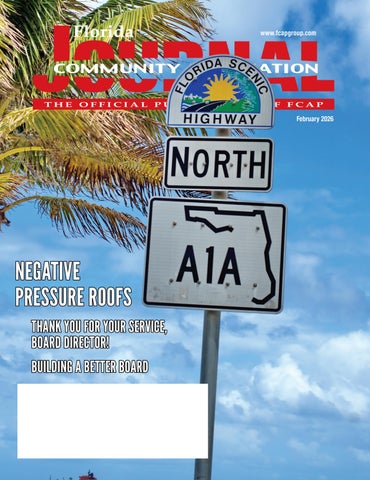
Turn to page 8 to read “Negative Pressure Roofs: Science, Design, and Practicality” by Patricia Staebler and Doug Sutter. They provide advantages and disadvantages of negative pressure roofs as well as a cost comparison to regular roofs.
On page 18, “Thank You for Your Service, Board Director!” is a compilation of best practices for new and returning board members. It is a weighty responsibility to serve on the board of directors and to keep track of all the requirements, and these service providers are offering tips to help lighten the load on these board members’ shoulders.
Flip to page 34 to read “Class Is in Session” by Allison L. Hertz with Becker. She shares the level of education required for board members in Florida, depending on whether the community is a condominium, cooperative, or homeowner association.
On page 40 Jeffrey A. Rembaum, Esq., with Kaye Bender Rembaum writes about House Bill 657 and why this proposed legislation has the potential to destroy Florida’s HOAs. Rembaum shares how this bill “proposes a mechanism to terminate HOAs with alarming ease.”
Turn to page 56 to read “The Making of a Modern Board” by Raj Baterina with Vesta Property Services. She shares how board leadership is about stewardship. She also remarks, “Great boards are not built overnight. They grow through experience, reflection, and a willingness to improve.”
FLCAJ wishes you a wonderful February.

Editor
Publishers Richard Johns Dana Johns
Editor Michael Hamline
Art Director Nick Walker
Advertising Sales Phone: (800) 425-1314 Email: info@fcapgroup.com
Circulation/Accounting Tammy Hanner
Phone: (800) 443-3433 Fax: (501) 280-9233
Editorial Phone: (800) 443-3433 Fax: (501) 280-9233
Florida Community Association Journal is published monthly by True Source Publishing LLC 1000 Nix Road Little Rock, AR 72211-3235
Email: info@fcapgroup.com Website: FCAPgroup.com
Copyrighted by Florida Community Association Journal. Reproductions of any part of this publication without written permission of the publisher are prohibited.
Subscription Rates
$24 for one year, $48 for three years. Back issues are $5 each plus postage. Group rates for 3 or more people are available at $12 per person.
The publisher and editor(s) of this magazine do not accept responsibility for the content of any advertisement, including statements made by advertisers herein, or for the opinions expressed by authors of by-lined articles. The publisher and editor(s) also reserve the right to reject any ad or article for objectionable content in verbiage or images. The intent of this publication is to provide general information only and is not intended to provide specific advice or recommendations. Appropriate legal, financial, or engineering advice or other expert assistance should always be sought from professionals.
Postage paid at Little Rock, AR and additional offices (permit #1085).
Postmaster
Send address changes to: Florida Community Association Journal 1000 Nix Road Little Rock, AR 72211-3235 or email info@fcapgroup.com


CORAL GABLES!


Ansbacher Law, with board certified partners, 12 attorneys and over 0 professionals, is available to serve your community throughout
•Full service law firm for your Condominium or Homeowners Association.
•Florida’s leading construction defect team - Full contingency available, no fees or costs unless you win.
•Collections handled on deferred and contingency fee arrangement.


Hannah Rullo
Zach Roth
Barry Ansbacher
Emily Dominguez
Alejandra Gonzales

Negative Pressure Roofs: Science, Design, and Practicality
BY PATRICIA STAEBLER, RS, SRA AND DOUG SUTTER
R
eserve specialists have the responsibility to continuously educate themselves to be the best steward for their clients. Reserve providers constantly learn about new construction materials and techniques. One of these techniques is the negative pressure roof system, which has been in existence for over 40 years, but is often overlooked. The assembly is often viewed with skepticism by the general public who do not understand the science behind it. However, with the increasing strength and number of storm systems, the roofing industry is paying more attention to negative pressure roofs, and the installation of this type of roof is gaining
Images courtesy of Integrated Roofing Solutions (IRSI).
momentum. With this article we want to spotlight negative pressure roofs, explain the technique and science behind it, and list advantages, disadvantages, and cost comparison. We encourage every association to consider negative pressure roofs to protect their buildings if they have a suitable application.
Negative pressure roofs are designed to utilize pressure differentials to improve structural integrity, energy efficiency, and durability. These systems are particularly relevant in regions prone to high wind speeds, as they counteract uplift forces that can damage or remove conventional roofing systems.
Understanding the design, materials, and performance of negative pressure roofs is essential for architects, builders, and property owners aiming for long-lasting, resilient construction.


PATRICIA STAEBLER, RS, SRA AND DOUG SUTTER
Patricia Staebler, RS, SRA, is the principal of Staebler Consulting, a provider of reserve studies, milestone and turnover reports, insurance appraisals, and structural engineering services. She is a CAI designated reserve specialist (RS) and a designated member of the Appraisal Institute (SRA). Patricia developed and taught multiple seminars on a variety of topics and authored several articles in professional magazines. Her firm serves Lee, Charlotte, Sarasota, Manatee, Pinellas, Pasco, and Hillsborough counties.
Doug Sutter is a fourth generation roofing contractor and has nearly 40 years of experience in the commercial roofing industry. His family business “Sutter Roofing Company”, has roots back to 1902. Sutter Roofing has operated in Florida since 1979 and specializes in commercial reroofing and service work. Throughout his career Doug has spoken at many state and national roofing industry events.
THE SCIENCE BEHIND NEGATIVE PRESSURE ROOFS
The concept of negative pressure roofs is rooted in fluid dynamics and aerodynamics. As wind flows over a building, it creates areas of high and low pressure. According to Bernoulli’s principle, faster-moving air over the roof creates a zone of lower pressure compared to the stiller air inside the building. This pressure difference can result in an uplift force—essentially pulling the roof upward (American Society of Civil Engineers [ASCE], 2016, see the opening graphic on page 8).

A NEGATIVE PRESSURE ROOF IS DESIGNED TO EQUALIZE OR MITIGATE THIS UPLIFT BY TWO MEANS
1. Allowing controlled internal airflow, which reduces the pressure differential; or 2. Mechanically anchoring the roof to resist these forces.
In some systems, specialized pressure relief valves or mechanical channels allow air to balance interior and exterior pressures (Holmes, 2015). Other designs use vacuum-sealed compartments or materials with inherent structural resistance to negative pressure.
TYPES OF MATERIALS USED
Materials in negative pressure roof systems are chosen for strength, flexibility, and weather resistance. Common materials include the following:
• Thermoplastic membranes (e.g., PVC or TPO) for waterproofing
• Modified bitumen roof systems for increased durability.
• Steel cables or anchors to distribute loads
• Insulated panels (such as SIPs or sandwich panels) for thermal efficiency
These materials are designed to withstand wind uplift, UV exposure, and temperature changes without compromising the structure.
METHOD OF ATTACHMENT
Unlike traditional mechanically fastened or adhered roofing materials, negative pressure roofs utilize vacuum anchoring, where air is partially evacuated to create


suction between layers. The insulation and membrane are often loosely laid and held in place by the negative pressure of the assembly. The harder the wind blows, the more the roof system sucks down to the deck.
Fasteners and air seals are placed strategically to align with stress points identified through wind tunnel testing or computational modeling. All air points through the roof deck such as around penetrations and roof to wall junctures must be totally sealed airtight by the roofing contractor. The roof membrane is anchored around the perimeter and at all roof penetrations and roof drains.
ADVANTAGES OF NEGATIVE PRESSURE ROOFS
• Superior wind resistance—These roofs resist uplift better than traditional systems, making them ideal for hurricane-prone areas.
• Enhanced durability—Materials used are long-lasting and less likely to fail under dynamic loading.
• Energy efficiency—When integrated with insulation, these roofs reduce heating/cooling demands.
• Lower long-term maintenance—Due to their structural integrity and material choice, they often require fewer repairs.
• Environmental resilience—Many systems are fire-, UV-, and weather-resistant (FEMA, 2023).
Pressure Relief Valves:
Valves are strategically placed in the perimeter of the roof. The valves transfer suction and create controlled cross ventilation 2
Typical installation of TPO with pressure relief valves.
2 Image courtesy of Integrated Roofing Solutions (IRSI).
Switching to fiber internet is easier than you think!
Partner with Blue Stream Fiber to ensure a smooth transition for your community.
Our guarantee:
5-star service — Guaranteed speeds and uptime, plus 24/7/365 technical support from a U.S.-based team that answers the phone in under a minute.


White glove support — Stress-free installation, community-friendly construction, resident training, and a dedicated account manager to oversee every phase of your transition.
Personalized approach — We provide tailored solutions best suited for your community’s needs—and we’re fully committed to building a state-of-the-art network the right way.
Proven partnership — We’ve earned the trust of 385,000+ community residents and the decision-makers of 500+ communities through our industry-leading service and support.
“Our relationship with Blue Stream Fiber is an asset to our community because our residents get reliability, service and support that is above and beyond anything that would usually be expected of a service provider.”
– Rich Bobker, President, Kings Point in Tamarac (4,869 units)
Don’t wait to give your community the internet they deserve!
C ontact us today for a FREE network evaluation.


DISADVANTAGES OF NEGATIVE PRESSURE ROOFS
• Potentially higher initial cost—Due to advanced materials and design, upfront investment can be a premium over other systems.
• Complex installation— Requires specialized contractors and often extensive design calculations.
• Limited availability—Not all regions have access to materials or skilled labor.
• Not every roof deck type is suitable for a negative pressure system. Concrete decks are ideal while metal and wood decks present challenges that may make them unsuitable.
WARRANTIES
Choosing a negative pressure roof can result in very beneficial warranties and riders, such as 150 mph wind rider, 15-20 year material and labor warranty with no dollar limit (NDL), etc.
NEGATIVE PRESSURE ROOFS IN THE INSURANCE INDUSTRY

Insurance companies assess risk when determining premiums. Since negative pressure roofs are engineered to resist wind uplift, they are less likely to be damaged in windstorms or hurricanes.
As a result, some insurers may offer the following:
• Discounted premiums
• Wind mitigation credits
• Lower deductibles for windstorm coverage

These incentives are especially common in coastal areas or hurricane zones (e.g., Florida, Gulf Coast, Caribbean).
Because negative pressure roofs resist failure better than traditional roofs, property owners are less likely to file claims for roof damage, water intrusion, or structural failures. This long-term reduction in claims can result in the following:
• Improved claims history
• Eligibility for better coverage terms
• Loyalty or longevity discounts from insurers
Many new building codes in hurricane-prone regions require roofs to meet uplift resistance standards. A negative pressure roof that complies with these standards demonstrates proactive risk management, ensures insurability and code compliance, and avoids surcharges or coverage limitations tied to non-compliance.
Sutter Roofing, based in Sarasota Florida, has installed over 30 negative pressure roof systems since the early 2000s. Their installations have mainly been for reroofing on beachfront high-rise condominiums along the west coast of Florida. They have seen incredible performance results on these systems after sustaining a multitude of hurricanes and high wind events. Doug Sutter, with 36 years of Florida roofing experience remarks, “Wind-vented roof systems, when installed properly, have shown remarkable resilience in even the highest wind events. After major storm events we have observed negative pressure systems uncompromised while at the same time seen conventional roof systems on adjacent buildings with significant wind damage. As long as wind-borne debris does not breach the membrane and ruin the air seal, the system

COST COMPARISON TO REGULAR ROOFS
Initial Cost Medium to High (due to tech and materials)
Material Cost Moderate to High (ETFE, PTFE)
Installation Specialized labor needed

Low to Medium
Variable (asphalt, shingles, metal, etc.)
Readily available contractors
Maintenance High if pressure systems fail Low to Moderate
Energy Savings (long-term)
High (better insulation) Moderate
Over time, the total cost of ownership may be lower than traditional roofing, especially in high-wind regions (FEMA, 2023).
works as intended. It works especially well on concrete roof decks.”
Many more buildings in our region have been improved with negative pressure roofs, such as mid- and high-rise condominium buildings, hotels, office towers, and large box retailers. Furthermore, public buildings like schools and county administration headquarters were improved with
This is one of the tallest buildings in Sarasota County. Hurricane Milton’s eye passed directly over this facility and the flat roof sustained no roof damage.

The future is a seamlessly connected community.

At Fibernow, we deliver 100% fiber connectivity right to your community. And with our full range of fiber services, we have what it takes to bring you customized bulk packages tailored to the unique needs of your residents.
Part of the largest fiber company in the world.
We’re backed by DigitalBridge, a world-class digital infrastructure network that allows us to ensure the highest levels of network performance.
Doubling up on fiber to double down on reliability. By running two fiber lines to your property for added redundancy, we’re able to provide guaranteed network uptime for your residents.
Personalized support is less than a minute away. Our 100% U.S.-based customer service team answers calls in less than 60 seconds on average.

Talk
us


negative pressure roofs. If federal, state, and county institutions opt for this roof type, it is the most compelling argument.
CONCLUSION
Negative pressure roofs represent a compelling evolution in architectural design and engineering. By leveraging principles of fluid dynamics and employing advanced materials, they offer significant benefits in terms of wind resistance, longevity, and energy performance. While their initial cost and installation complexity may deter some buyers, the long-term advantages in durability and performance—especially in challenging environments—often justify the investment. As climate-related weather events increase in frequency and intensity, negative pressure roofing systems may become not just innovative but essential.
REFERENCES
• American Society of Civil Engineers. (2016). Minimum Design Loads for Buildings and Other Structures (ASCE/SEI 7-16). Reston, VA: ASCE.
• Federal Emergency Management Agency (FEMA). (2010). Wind Retrofit Guide for Residential Buildings. FEMA P-804.
• Holmes, J. D. (2015). Wind Loading of Structures (3rd ed.). CRC Press.
• National Roofing Contractors Association (NRCA). (2020). The NRCA Roofing Manual: Membrane Roof Systems— 2020. n
Manatee County Emergency Operations Center
The Best Lifestyle
When it comes to managing large-scale, master-planned communities, no one’s done it longer, and no one does it better.
For more than 50 years, CCMC has been delivering world class property management service tailored to each community’s unique needs, providing expert guidance, engaging lifestyle programs, and a dedicated team that builds strong relationships with homeowners and boards alike.
98% community retention rate, many communities with us for 20+ years
94% HOA Board satisfaction rating
Average tenure of community managers is 2x industry standard
5x+ Community Management Company of the Year Awards – and growing!

This spring, we will be holding exclusive events in your area. We hope you’ll join us for some HOA Board education mixed with great hospitality. Sign up today to be the first to be notified of upcoming events, plus get instant access to a range of on-demand educational materials.

Thank You for Your Service, Board Director!
Editor’s Note: The role of board member is essential to community association living. The role can be satisfying when the community is thriving and residents are mostly content. But serving on the board is a serious responsibility that takes time, and there are many areas with which to be concerned. With that in mind, a variety of professionals have provided sound counsel in their areas of expertise to assist board members in carrying out their responsibilities well. Thank you for your service to your community in 2026, board members!
BEST PRACTICE TIP: PROACTIVE ROOF MANAGEMENT FOR STRONGER RESERVES
By Jennifer Richards
For new and returning board members, one of the most impactful steps you can take is implementing a proactive roof management plan. Roofing systems are among a community’s largest capital assets, and unexpected failures can create financial strain, insurance challenges, and safety concerns.
Start by scheduling annual professional inspections to document the roof’s condition, identify early signs of wear, and estimate remaining service life. This information is critical for accurate budgeting and supports the structural integrity reserve study (SIRS) by providing real data rather than assumptions.
Establish a preventive maintenance program to address minor issues before they become costly repairs. Cleaning debris, monitoring flashing, maintaining sealants, and ensuring proper ventilation all extend system life and protect property values.
Photo by iStockphoto.com/Anna P
Consistent documentation, photos, and annual reports help boards plan responsibly, communicate transparently with residents, and avoid emergency assessments—ensuring long-term financial and structural stability.
Jennifer Richards is CEO of All Area Roofing & Construction Inc. For more information, call 772-464-6800 or visit AllAreaRoofingInc.com.

GUIDELINES FOR WRITING EFFECTIVE BOARD MEETING MINUTES
By Vladimir G. Diaz, LCAM, MBA
Here are some best practices regarding the preparation of board meeting minutes to ensure clarity and accuracy in your records.
Board meeting minutes should focus exclusively on the actions taken by the board concerning specific agenda items. It is important to keep the minutes brief and concise, documenting the issues addressed, the specific motions made and seconded, and the corresponding votes on each agenda item.
Please note that comments made during the open forum are not part of the official agenda and should therefore be excluded from the minutes. A common error in minute-taking is treating the minutes as a transcript of the entire meeting, which one must avoid. By adhering to these guidelines, we can maintain clear and effective documentation of the board’s decisions.
Vladimir G. Diaz, LCAM, MBA, is president/CEO of America’s Community Management. For more information, visit www.americascommunitymgmt.com
EDUCATIONAL REQUIREMENTS FOR HOA AND CONDOMINIUM BOARD MEMBERS IN FLORIDA
By Ashley Dietz
Educational Requirements for HOA Board Members
HOA board members newly elected or appointed after July 1, 2024, must complete a certification course within 90 days of election or appointment. HOA board members appointed or elected prior to July 1, 2024, must complete a certification course within four years if the board member serves on the board without interruption during the four-year period. The certification is valid for four years if serving on the HOA board continuously.
HOA board members from associations with less than 2,500 parcels must complete four


hours of continuing education each year, while those from associations with more than 2,500 parcels must complete eight hours of continuing education annually.
All HOA board members, regardless of election or appointment date, may count their board member certification course toward the completion of their continuing education requirement once every four years.
Educational Requirements for Condominium Board Members
Condominium board members newly elected or appointed after July 1, 2024, must complete a fourhour board certification course within 90 days of election or appointment. Condominium board members appointed or elected prior to July 1, 2024, had to complete a four-hour certification course by June 30, 2025. The certification is valid for seven years if serving continuously.
Condominium board members must also sign a certification stating that they have read the association’s governing documents. Condominium board members must also complete one hour of legal continuing education annually.
If you are in need of a board certification course, continuing education course, or additional free education, please visit campbellevents.org to find a variety of free webinars and courses.
Ashley Dietz is vice president of marketing at Campbell Property Management. For more information, call 954-427-8770, email sales@ CampbellPropertyManagement.com, or visit www.campbellpropertymanagement.com.
WHY BOARD MEMBER EDUCATION MATTERS MORE THAN EVER
By Marines Rodriguez

Group reinforces this commitment with its ongoing Association Leadership Webinar Series, which provides board members with practical guidance from legal, engineering, and financial experts.
This year’s programming continues to expand on topics that help associations navigate financial soundness, compliance, and community best practices.
We invite residents to visit www.castlegroup.com to explore our robust library of board member resources and register directly for upcoming educational events. Access webinars, blogs, and downloadable content curated to help your community thrive.
Marines Rodriguez is director of marketing at Castle Group. For more information, visit castlegroup.com.
BOARD BEST PRACTICES FOR COMMUNITY SUCCESS

By Anna Rogers
Your role as a board member is an indispensable commitment to preserving and enhancing your community. To support you, we’ve compiled best practices to help both new and returning board members succeed.
Know the rules—Review current governing documents to stay informed of changes and avoid surprises. Understanding key policies and procedures helps prevent future issues. Board members must act in the community’s best interest, avoid conflicts of interest, and make decisions guided by care, loyalty, and compliance with applicable laws.
Communication—Effective communication is essential. Promote transparency through timely updates, and ensure enforcement of rules is consistent and fair. Clear and defined roles among board members support effective decision-making.
Financial Oversight—Work with experienced banking professionals to establish internal controls, transparent budgeting, and strong reserve planning to reduce financial risk.
Board members, staying informed is one of the most valuable ways you can support your association. Continuous board education ensures your community remains compliant, financially sound, and well - prepared for the year ahead. Castle
Maintenance and Safety—Prioritize preventive maintenance and periodic structural evaluations to protect assets and meet inspection standards. Approach these areas proactively to support stability, trust, and long-term community value.
Anna Roger is SVP and community association relationship manager for Cogent Bank. Explore Cogent Bank’s association banking offerings at cogentbank.com and contact me at arogers@cogentbank.net.
TRANSITIONING BOARDS: ENSURING CONTINUITY AND REDUCING RISK
By Kyle A. Alonso, Esq.

Nothing says winter in Florida like annual budget meetings and board elections. New board members are often energized to improve their communities, yet many encounter avoidable challenges caused by a disorganized transition from the prior board.
This reality of board turnover makes deliberate and well-planned transitions critical. Best practices begin with documentation. Outgoing boards should ensure that governing documents, contracts, insurance policies, reserve studies, budgets, and summaries of pending projects or litigation are current, organized, and easily accessible. New or returning directors should receive a brief orientation covering fiduciary duties, statutory obligations under Chapters 718 or 720 of Florida Statutes, and the association’s immediate priorities.
Continuity with professional advisors is equally
important. Maintaining consistent relationships with management, legal counsel, accountants, and engineers reduces the learning curve and minimizes risk. Finally, professionalism matters. Cooperative transitions promote stability, protect the association, and set the foundation for effective governance going forward.
Kyle A. Alonso, Esq., is partner at Haber Law. For more information, visit haber.law
LET’S TALK TECH: KEEPING YOUR COMMUNITY CONNECTED AND PROTECTED
By Marcy L. Kravit, CMCA, AMS, PCAM, CFCAM, CSM

Technology can transform how your HOA or condo community operates–and it’s easier to implement than you might think.
Today’s residents expect convenience. They want to pay dues online, submit maintenance requests from their phones, and access important documents instantly.
With the right tools, you’re not just keeping up–you’re creating a community people enjoy living in. Even better, modern technology makes your job simpler. Automated reminders, digital voting, and streamlined communication reduce hassles and free up

time for what truly matters.
Of course, connectivity comes with responsibility. Cyber threats exist, but they’re manageable with basic precautions–simple habits, much like locking your front door.
You don’t need to be a tech expert. You just need practical systems, a strong, reliable internet connection, and a little training. And Hotwire Communications is here to support you every step of the way.
This is your chance to elevate your community. Let’s make it happen.
Marcy L. Kravit, CMCA, AMS, PCAM, CFCAM, CSM, is senior director of community association relations for Hotwire Communications and author of Common Sense Community Management. For more information, email marcy.kravit@hotwiremail.com
EVALUATE BUILDING MAINTENANCE NEEDS

By Alex Freeman
As the New Year arrives, boards of directors often begin evaluating building maintenance needs. One important consideration is the condition of silicone-based architectural wall coatings. Over time these coatings can accumulate atmospheric dust and dirt, resulting in an uneven or unattractive appearance. Cleaning may provide only temporary improvement, and recoating options are limited because most organic or acrylic architectural coatings will not adhere properly to existing silicone surfaces.
An effective path forward is available with Pecora SilcoPrime, an STPU (silyl-terminated polyurethane) interlaminary primer designed to promote adhesion between existing silicone-based coatings and new, non-silicone architectural coatings. Applied as a transitional layer, SilcoPrime forms a durable bond that allows communities to select from a broad range of acrylic coating systems for future recoating projects. This approach supports long-term maintenance planning and offers greater flexibility when updating building exteriors.
Alex Freeman is the social media and content specialist for Pecora Corportation. For more information about SilcoPrime, please call (800) 523-6688, email techservices@ pecora.com, or visit https://www.pecora.com/coatings/
HOW MODERN HOA TECHNOLOGY HELPS BOARDS REDUCE EVERYDAY RISK
By Camille Moore

Did you know that many of the risks HOA boards face don’t come from major failures but from gaps in information, communication, and follow-through? When records live in email threads, spreadsheets, or personal folders, consistency and accountability quickly break down.
Using a single, connected platform, such as RealManage’s best-in-class technology, gives every board member access to the same real-time information. A centralized system helps with the following:
• Provide one accurate source for financials, violations, architectural requests, and maintenance workflows
• Reduce confusion by eliminating scattered documents and outdated files
• Create clear, time-stamped records that support compliance and consistent governance Technology also keeps operations steady during board transitions. When roles change, historical data, communication logs, and project details remain intact. With the right technology foundation, boards can operate with clarity, reduce avoidable risk, and lead their communities with greater stability and confidence.
Camille Moore is a creative content writer for RealManage. For more information, visit www.RealManage.com.
CURRENT RESERVE STUDY—THE ROADMAP THAT KEEPS YOUR PROPERTY SAFE
By Matt Kuisle, PE, RS

A current reserve study isn’t just a best practice for Florida condominium boards— it’s the roadmap that keeps your property safe, your finances predictable, and your owners informed. Whether you are new to the board or have been serving for a while, when was the last time you looked at your reserve


study? When was it completed, and who prepared it? If a structural integrity reserve study (SIRS) is required, was it done by a qualified, independent professional, and does it reflect your building’s current condition?
Next, compare the study’s funding plan to your current budget and reserve balances. Are you funding as projected, or have inflation and deferred maintenance pushed you off track? Gaps can lead to surprise special assessments and rushed projects.
A 2025 statutory change adds urgency for communities required to have a SIRS: before adopting any budget where reserve funding—via assessments, special assessments, lines of credit, or loans—doesn’t align with the most recent SIRS funding plan, the association must obtain an updated SIRS. Review now to avoid delays and surprises at budget time.
Matt Kuisle, PE, RS, is regional executive director for Reserve Advisors. For more information, email Matt@ ReserveAdvisors.com, call 800-980-9881, visit www. reserveadvisors.com, or connect at https://www.linkedin. com/in/mattkuisle/
THE TRAITS OF HIGHLY EFFECTIVE BOARD MEMBERS
By Joey Schellbach

For both new and returning board members,
serving on an association board is a privilege and a duty—and it is crucial to the association’s success. Since it is their fiduciary duty to act in the best interests of the association and its residents, board members must not only be effective in their roles but also develop the qualities that ensure strong leadership and a healthy community.
The following are eight key traits of highly effective board members:
Knowledgeable—They understand legal governance and community needs.
Transparent—They communicate openly to build trust.
Strategic—They plan for both long-term and immediate goals.


Empathetic—They consider residents’ perspectives.
Collaborative—They foster teamwork among members and committees.
Accountable—They take responsibility for decisions.
Engaged—They are committed to their role.
Proactive—They demonstrate foresight and initiative. By embracing these qualities, board members like you can lead confidently, fostering thriving, wellmanaged communities where residents feel heard, valued, and engaged.
Joey Schellbach is the senior vice president of business development at Sentry Management. Joey has over 10 years of experience in the community management industry and helps to introduce prospective boards to Sentry’s full-service management options. For more information, visit sentrymgt.com.
MITIGATING EXPOSURE TO POTENTIAL LEGAL LIABILITIES
By Niurys Robaina

Lawsuits against community associations for alleged negligence can expose communities to significant legal liability when injuries occur. Such cases underscore the need for proactive measures to reduce risk and avoid costly consequences.
Failure to properly maintain common areas can lead to serious accidents and even tragic outcomes. Boards of directors should implement a consistent schedule for property inspections. Areas such as walkways, driveways, parking lots, pool decks, sports courts, and other shared spaces can develop cracks or uneven surfaces that pose trip-and-fall hazards. Likewise, balcony and deck railings may loosen over time, compromising their strength and safety.
When inspections uncover damage or signs of wear, prompt action is essential. Repairs and replacements should be prioritized and completed efficiently to prevent further risk.
By implementing and adhering to a regular inspection schedule, addressing maintenance issues quickly, maintaining adequate insurance coverage, and taking a proactive approach to safety, associations and their boards can minimize liability while ensuring a secure environment for residents and guests.
Niurys Robaina is an attorney with the South Florida law firm of Siegfried Rivera who focuses on community association and construction law. For more information, visit www.SiegfriedRivera.com, email NRobaina@ SiegfriedRivera.com, or call 305-442-3334.
BEST PRACTICES FOR BOARDS OF DIRECTORS
By Patricia Staebler, RS, SRA

Boards of directors in the Sunshine State should take this New Year’s opportunity to review key responsibilities that safeguard community assets. Rising insurance costs and aging buildings make proactive planning essential. First, confirm your insurance appraisal is current. Proper replacement values are critical to ensure adequate coverage and avoid unexpected assessments after a loss. Outdated valuations can leave communities financially exposed when disaster strikes.
Next, review your reserve study to ensure upcoming capital projects—such as roofing, siding, or mechanical systems—are properly funded. Strong reserves promote structural safety and protect longterm property values.
Finally, if your association is approaching its required milestone inspection, consider engaging a licensed professional engineer now. Scheduling early helps secure qualified experts and keeps your community compliant with Florida’s stringent safety regulations.
Welcome winter residents with confidence—by staying prepared, informed, and invested in your community’s future.
Patricia Staebler, RS, SRA, is the principal of Staebler Consulting. For more information, visit www.staeblerconsulting.com.
ANSWERING THE QUESTION EVERY BOARD HEARS
By Rodrigo Contreras, LCAM

One of the most common questions board members hear is, “Why do maintenance fees increase every year?” While it may be tempting to offer a simple explanation, the most effective answer is a transparent one.
Annual maintenance fee increases are rarely driven by a single factor. They reflect a series of deliberate budget decisions tied to rising operating costs, longterm planning, and the association’s responsibility to maintain the community’s assets. Walking owners through the budget—line by line when necessary— provides context and builds understanding. It allows boards to explain how expenses evolve, why certain
allocations changed, and how financial decisions support the community’s future.
Proactive communication grounded in the budget transforms a recurring complaint into an educational moment. When owners understand the “why” behind the numbers, then trust increases, and boards are better positioned to lead with confidence and accountability.
Rodrigo Contreras is a co-founder and chief operations officer for The ERRO Group. For more information, call 786-767-2111, email ro@theerrogroup. com or info@theerrogroup.com, or visit www.theerrogroup.com
KEEPING YOUR COMMUNITY IN TOP SHAPE
By Rajika Baterina

For any board of directors, especially those new to the role, staying on top of maintenance is one of the smartest ways to protect property values and keep residents happy. Start with a thorough look at the community’s common areas and building exteriors. Small issues like a leaking roof, cracked sidewalks, or worn paint can quickly turn into big problems if ignored. Inside, make sure systems like HVAC, plumbing, and electrical are regularly checked and serviced. Create a maintenance plan
that addresses both urgent repairs and long-term needs, and consider setting aside funds for major projects. Clear communication is also key. Let homeowners know about inspections, upcoming work, and improvements. Working with trusted contractors, keeping good records, and reviewing warranties can prevent headaches down the road. Boards that stay organized and proactive build safer, more attractive communities that residents are proud to call home.
Rajika Baterina is marketing assistant at Vesta Property Services. For more information, email rbaterina@vestapropertyservices.com or visit www.vestapropertyservices.com n


Community Community
Florida Community Association Professionals (FCAP) primarily publishes the Florida Community Association Journal, the leading resource for Florida community association managers, service providers, and board members. Through our publication, we provide education, industry insights, and resources to support the professionals who serve Florida's community associations.
Contact us at 800-443-3422, info@fcapgroup.com , or www.fcapgroup.com for more information.
BECAUSE YOU ASKED
By Betsy Barbieux, CAM, CFCAM, CMCA

Betsy,
I took your board certification class in March and have signed up for the December board class. Will this December class meet the four-hour HOA continuing education requirement, or would I need to take the CE class in 2026?
— Vickie
Vickie,
The legislators don’t understand how training works, so the statute requiring “continuing education” is unclear and poses many questions.
I am approved by the Division to offer the HOA CE class as well as the Condo CE class, but right now the information in the material is no different than the regular board class since we are in between legislative sessions. Neither is there any reporting requirement,
so all these course requirements are on the honor system.
I can foresee that with condominiums and cooperatives having to create a DBPR account and report the names of their directors and other information, eventually the board certificates will have to be uploaded too, which will be forced compliance for training. So far there is no such requirement for HOAs to create the same type of DBPR accounts other than what was reported in 2013 by CAMs.
My board certification classes are now five classes in one because they are all basically the same—Initial condominium, cooperative, and HOA certification, 1-hour condo CE, and 4 -hour HOA CE.
Section 720.3033, Florida Statutes, says in part—
a. A director of an association that has fewer than 2,500 parcels must complete at least four hours of continuing education annually.
b. A director of an association that has 2,500 parcels or more must complete at least eight hours of continuing education annually.
I would guess that with the word “annually” you would take your “CE” class a year after you take the initial certification. That way you’ll have a Certificate of Completion with a 2026 date.
— Betsy
Betsy, I don’t want to comply with the leasing restriction to provide a copy of my lease to the association. What are the ramifications of being out of compliance?
I think it is a privacy issue and that my rental arrangement should not be any business of the association. What policies do you maintain to properly store confidential information, and send me a copy of that policy.
Also, your board members have loose lips. I heard from a neighbor that I am a frustrating owner who has threatened to recall the board. This is unacceptable, and I expect you to address what is being said by your board members.
As a property management professional, what are your thoughts on this type of communication happening by your board members?
— Sherry
Sherry,
The ramifications for not providing the lease agreement as required by the Declaration of Condominium are that it is a violation. When a unit is scheduled for closing, I must note violations on the estoppel. The
Betsy Barbieux
closing agent will not close until he/she receives notification that violations have been cured.
Based on statute, tenant information is not available to owners on a records request, so they are already private. The statute does not permit me to release tenant information.
The collection of tenant information is not a random act by the board of directors. The owners, including you and your husband, voted to collect this information and voted affirmatively to add it to the covenants and restrictions. The intent of the restriction is for safety purposes.
I cannot comment on hearsay or rumors among owners. Management does not get involved in squabbles among owners unless there is an underlying covenant, restriction, or rules violation.
— Betsy Betsy,
Thank you for another enlightening board certification course. There were three others who were supposed to be there, but they were told they didn’t have to go and they would get nothing out of it anyway. If board members don’t complete their initial certification and/ or complete their annual CE course, what happens to them?
— Joyce
Joyce,
As you know the board certification is required. If you are not certified within 90 days of election or appointment, you are suspended from the board until you comply. Noncompliant board members should be sent a letter stating the conditions on which they may return to the board. Otherwise, if they show up at a meeting, they cannot vote or count toward a quorum.
The annual CE requirement for four hours (or eight hours, depending on the number of parcels in the community) seems to be a year from when you took the original certification, which will make keeping track of it very hard to do. These certifications must be on your website. I assume the same applies if they are noncompliant with the CE four-hour class—suspension and their presence at a board meeting does not count toward the quorum nor can they vote.
— Betsy
TOGETHER WE ARE STRONGER: HOW CONDOMINIUM OWNERS ARE MAKING A DIFFERENCE IN FLORIDA
By Marcy Kravit, VP HOA Regional Account Executive, smartstreet (powered by Banc of California)

As someone with many years of experience in community association management, currently serving as vice president of CAI Gold Coast, and a member of my HOA board, I’ve seen firsthand how powerful it can be when residents come together to advocate for their communities.
Recently I had the pleasure of meeting with Robin Hicks Nunley and Travis Moore at the CAI Legislative Wrap-Up in Stuart, Florida. Their dedication, passion, and persistence for advocating on behalf of condominium owners truly inspired me. Their story highlights what residents can accomplish when they unite and work collaboratively.
THE GENESIS OF THE FLORIDA CONDO ALLIANCE
It all began at the Harborage Yacht Club, where Robin and her neighbors struggled to get clear, accurate information about compliance with the structural integrity reserve studies (SIRS) legislation. They encountered conflicting advice from engineers, insurers, and legal experts; and the law itself seemed confusing and sometimes contradictory.
Robin reached out to her state senator, Gayle Harrell, who helped organize a meeting with the bill sponsors, Senators Pizzo and Bradley. That small community gathering quickly grew into a statewide conversation, attracting condominium owners from Palm Beach to Vero Beach along with management companies, law firms, and media. Senators Pizzo and Bradley have continued to be key figures in the legislative discussions surrounding condominium reform. This event highlighted a significant gap: with over 1.5 million condominium owners in Florida, their voices remained largely unheard and unrepresented. The unique needs of this demographic, particularly the large population of retirees who have worked their entire lives for a worry-free retirement, were not being adequately addressed by those with intimate knowledge of their experiences.
Recognizing this need for a unified voice, Robin and her team launched the Treasure Coast Condo Alliance, which has
Marcy L. Kravit
since expanded into the Florida Condominium Alliance. Their mission is straightforward: give condominium owners a seat at the legislative table and advocate for laws that protect their interests.
Travis Moore, a seasoned lobbyist, joined the effort. His expertise helped the Alliance push for meaningful changes to legislation, particularly concerning structural integrity and reserve requirements for condominiums. Through direct outreach and sharing real stories from owners, they helped legislators understand the realworld impact of these laws, leading to important revisions.
TAKING ACTION AND MAKING A DIFFERENCE: THE IMPACT OF HB 913
The Florida Condo Alliance, working closely with lobbyist Travis Moore and various legislators, has successfully mitigated some of the more egregious issues present in the original SIRS bill. These efforts culminated in significant changes reflected in House Bill 913 (HB 913), which took effect on July 1, 2025.
The Alliance’s advocacy, reflected in HB 913, has brought about the following crucial adjustments:
Extended Deadline for SIRS
Studies—The initial requirement for all condominium associations to complete a SIRS study by the end of 2024 was extended to December 31, 2025. This provided muchneeded breathing room for associations to comply.
Addressing Conflicts of Interest—
The original bill notably omitted provisions for conflicts of interest involving engineering firms. HB 913 directly addresses this crucial ethical concern by imposing strict disclosure requirements on professionals who conduct reserve studies or milestone inspections and intend to bid on related repair work. Undisclosed financial relationships render contracts voidable, ensuring transparency and fair practices.
Flexible Funding Mechanisms—
Perhaps one of the most impactful changes is the shift from an immediate, cashfunded requirement for SIRS repairs to a more flexible approach. HB 913 allows for alternative funding methods such as special assessments, loans, or lines of credit, provided these are approved by a majority vote of the total voting interests of the association. This crucial adjustment aims to prevent condominium owners from having to withdraw substantial amounts from their retirement accounts to meet unrealistic demands. Additionally, for associations that have recently completed a milestone inspection, the bill permits a two-year delay in commissioning a new reserve study to prioritize necessary structural repairs, and reserve contributions may be paused or reduced for up to two consecutive budget years with a majority vote of the membership, applicable for budgets adopted on or before December 31, 2028.
HOW THE ALLIANCE INFLUENCES LEGISLATION
The formation of the Florida Condo Alliance itself was spurred by anecdotal input, with the public meeting at the Harborage in Stuart serving as a prime example. At this gathering approximately 200 condominium owners, board members, real estate agents, and other stakeholders shared their alarm and lack of information. State Senator Gayle Harrell arranged for Senators Pizzo and Bradley to be there in person, and they answered questions for over two hours.
This direct engagement, driven by real experiences and concerns, underscores the Alliance’s approach. They translate the lived realities of condominium owners—the financial burdens, the confusion, the fear—into compelling narratives that resonate with legislators, demonstrating the tangible impact of proposed laws. As Travis Moore stated, the changes in HB 913 came about directly because of the Alliance legislative town hall with Senators Harrell, Bradley, and Pizzo last May.
NAVIGATING CHALLENGES IN ADVOCACY
One significant challenge has been the sheer volume of condominium owners (over 1.5 million in Florida) who, despite their numbers, have historically remained largely unheard and unrepresented. Overcoming this involves persistent education and mobilization, ensuring that condominium owners understand their unique needs and the importance of advising legislators directly.
Another challenge involves navigating the complexities of the legislative process itself, requiring continuous engagement with various legislators and their staff as well as working to balance competing interests among different stakeholders in the community association industry. The Alliance addresses this by building strong relationships, providing clear and concise information, and presenting unified positions that represent the broader interests of condominium owners.
Travis Moore also highlighted the influence of developers who often seek to terminate older properties on valuable land to build more expensive structures. He proudly stated, “This [past] year we won. We just have to keep the voices communicating with a clear voice to policymakers and then hold them accountable.”
THE CRUCIAL ROLE OF MANAGEMENT COMPANIES AND VENDORS
Robin emphasizes that management companies and vendors have a vital role in supporting advocacy efforts because condominium owners hire their
services. Condominium associations support several stakeholders, including local and state governments. Condominium living cannot become so expensive in Florida that it is a doomed way of life.
When all stakeholders—residents, management, vendors, and advocacy groups—work together, laws and policies better reflect the needs of everyone involved. This collaborative approach ensures the long-term viability and affordability of condominium living in Florida, which benefits the entire industry. Travis Moore added that they provide “subject matter expertise and guidance that is very important and useful in advocating for what truly matters in a community.”
OTHER LEGISLATIVE PRIORITIES FOR CONDOMINIUM OWNERS
Beyond SIRS, significant ongoing concerns include insurance issues, particularly the rising costs and availability of coverage, and various vendor issues that impact service quality and pricing. There will also be a continued need for clarification and addressing unforeseen issues with the newest SIRS legislation as it is implemented. The Florida Condominium Alliance views this as a work in progress and emphasizes that condominium associations need to be on board if they want their voices heard on these critical matters.
CAI’S ESSENTIAL CONTRIBUTIONS TO COMMUNITY ADVOCACY
While the Florida Condominium Alliance focuses specifically on condominium owner advocacy, CAI (Community Associations Institute) plays a crucial and complementary role. CAI provides valuable resources and education for these groups on a broader scale, supporting the entire industry to promote best practices and policies that benefit communities.
CAI-FLA successfully collaborated with legislators on HB 913 to bring about significant improvements to SIRS and milestone inspection timelines and to streamline necessary forms—specifically for buildings with three or more habitable stories. This collaborative effort demonstrates CAI’s dedication to ensuring the voices of community members are heard and acted upon in the legislative process.
Here’s a summary of the positive outcomes achieved through these combined advocacy efforts:
MILESTONE INSPECTIONS
Limited to buildings with three or more habitable stories. Habitable spaces include areas intended for living, sleeping, eating, or cooking. Garages, storage areas, hallways, closets, etc. are not considered habitable.
Local Agency Reporting—Agencies were required to report inspection data to the state by October 1, 2025.
Funding Repairs—Special assessments, lines of credit, or loans are allowed subject to unit owner approval.
STRUCTURAL INTEGRITY RESERVE STUDIES (SIRS)
Limited to buildings with three or more habitable stories. Habitable spaces include areas intended for living, sleeping, eating, or cooking. Garages, storage areas, hallways, closets, etc., are not considered habitable.
Deadline—Completion deadline was extended to December 31, 2025.
Travis Moore highlighted the most helpful items that came from these advocacy efforts. The “pause provisions”—Allowing associations to deal with immediate
repairs following a milestone inspection to prioritize that and pause funding SIRS-related reserves for up to two years. This allows them to get a SIRS after those repairs are completed, and because the remaining useful life of those components will be so much longer, their annual contribution to replacing/repairing them will be considerably lower.
Having DBPR create a uniform SIRS form—This will ensure consistency, which is severely lacking now.
Having the “baseline method” figure provided—Associations will know the minimum required to be fully compliant.
JOIN US AND MAKE A DIFFERENCE!
The Florida Condominium Alliance, with the valuable support of organizations like CAI, demonstrates that residents truly can influence laws that affect their homes. When we unite and speak with one voice, we help shape a fairer, more transparent future for our communities. Management companies and vendors play an essential role in supporting these efforts because strong communities start with strong advocacy. Interested parties can directly contact Darlene VanRiper, President of Florida’s Condo Alliance at 772-285-7447. Supporting the Alliance could involve becoming members, participating in grassroots efforts to share their stories, attending meetings, and advocating to their local and state representatives. The Alliance believes that condo owners need to be advising legislators, and legislators need to be listening. Contact CAI at www.caionline.org. Together, we can make a real difference for all condominium communities. n


Class Is in Session
The ABCs of Florida’s Board Member Education Requirements
BY ALLISON L. HERTZ
B
enjamin Franklin famously said in 1789, “In this world, nothing can be said to be certain, except death and taxes.” Had he lived in a community association in Florida, his quote likely would have read “… except death and taxes and changes in Florida community association law.” There were a voluminous number of bills filed during the 2025 legislative session that dealt with community associations. While the vast majority of these bills will never become law, those that do often have major impacts on the daily operations of a community association, ranging from meeting requirements to official records, reserve funding, investment of association funds, community association managers, hurricane protection, and so on. The
Photo by iStockphoto.com/Jacob Wackerhausen
legislature expects every board member in this state to understand and follow all these laws that change almost every year, in addition to the governing documents of the specific association.
Fortunately for board members, Florida is leading the way in ensuring board members have access to educational materials to meet their obligations. Florida is the only state that has adopted laws mandating the education of board members according to Community Associations Institute (CAI)1 . So, what level of education is required of board members in Florida? That answer depends on whether the community is a condominium, cooperative, or homeowner association. Different education requirements apply to each type of community.
CONDOMINIUM ASSOCIATIONS
Condominiums are the most highly regulated by Florida. Board members in a residential condominium are required to sign an acknowledgement that

ALLISON L. HERTZ, SHAREHOLDER, BECKER
Allison L. Hertz is a shareholder in the West Palm Beach office of Becker. Ms. Hertz is board certified by the Florida Bar in condominium and planned development law. She is a graduate of the Nova Southeastern University Shepard Broad Law Center, and Ms. Hertz has exclusively represented community associations and individual property owners since being admitted to the Florida Bar in 2007. Hertz devotes her practice to working with her clients on the broad range of legal issues that community associations face on a regular basis. She has extensive experience in all aspects of community association law. Hertz is a native of Palm Beach County. For more information, visit www.beckerlawyers. com.
they have read the governing documents and will uphold the policies of their association. In addition, these board members are required to complete both a certification course and continuing education courses throughout their tenure. The requirements for board member education are found in §718.112(2)(d)(5)b, Florida Statutes.
The board member certification course is a four-hour course. Condominium directors who were elected before July 1, 2024, had until June 30, 2025, to complete this requirement. Condominium directors elected on or after July 1, 2024, must take the four-hour course within 90 days after being elected or appointed or one year prior to being elected or appointed. The written certification and educational certificate are valid for seven years after the date of issuance and do not have to be resubmitted as long as the director serves on the board without interruption during the seven-year period. Upon completing the initial condominium director certification course, the obligation for directors to remain educated continues. They must also annually complete a one-hour legal update course relating to changes to Florida’s Condominium Act and any

amendments to rules adopted by the Department of Business and Professional Regulation.
The association must certify to the DBPR each year that each director has met their educational requirements, and the DBPR has the power to investigate compliance by directors with all educational requirements. Should a director choose not to complete their required education courses or submit their certificate of completion, then that director is temporarily suspended from the board until they meet their legal obligations.
HOMEOWNERS’ ASSOCIATIONS
Florida Statute §720.3033(1) sets out homeowner association educational requirements for directors, and these requirements have been further clarified by the DBPR. One of the major differences between the requirements for homeowner associations and condominiums is there is no requirement for the homeowner association board member certification course to be four hours long. However, it must address specific topics, including financial literacy and transparency, recordkeeping, levying of fines, and notice and meeting requirements. Another important difference is there is no longer a requirement for a director to submit a written certification that they have read the governing documents of the association and will uphold the association’s policies. Instead, all board members in a homeowners’ association must complete a board member certification course. This course must be completed every four years, and the certificates from the course must be submitted to the association. There is no submission to the DBPR.

The DBPR indicates that for board members who were elected or appointed prior to July 1, 2024, then the board member certification program must be completed within four years of their election or appointment to the board as long as the director serves without interruption during the four-year period. Board members who are elected on or after July 1, 2024, must complete their board member certification program within 90 days of election or appointment.
Notable for homeowner association directors is a requirement to complete either four or eight hours of continuing education annually, depending on the number of parcels in their association. A director of an association that has fewer than 2,500 parcels must complete at least four hours of continuing


education annually. A director of an association that has 2,500 parcels or more must complete at least eight hours of continuing education annually. The DBPR indicates that these hours must be completed every year between July 1st and June 30th by all directors, regardless of when they were elected or appointed, and that board members may count their completion of their continuing education requirement once every four years.
Like condominium associations, if the director fails to comply with the educational requirements, the director is temporarily suspended from the board until compliance occurs.
COOPERATIVE ASSOCIATIONS
Finally, Florida has basic educational requirements for
cooperative directors in §719.106(1)(d), Florida Statutes. Directors can either sign a written acknowledgement that they have read the governing documents and will uphold the association’s policies, or they can take a board member certification course within 90 days of being elected or appointed or within one year before. There is no requirement for cooperative board member education to be a fourhour course, and there is no continuing education requirement. The course certificate is valid and does not have to be resubmitted as long as the board member serves without interruption. Once again, if the director fails to comply with the educational requirements, the director is temporarily suspended from the board until compliance occurs.
CONCLUSION
Florida is leading the way nationally when it comes to board member education for community association directors. The industry has pushed education even further forward by having a host of cutting-edge courses for board members available on all the various issues they will face as directors. Becker has more than 30 classes approved by the DBPR that we offer on-demand online. The availability and ease of access of these courses ensures compliance may be achieved for all directors. Finally, associations must also remember that all directors’ educational certificates and written acknowledgements are official records of the association that are open to the members, and they must be posted on the website for associations that must comply with website requirements. n


Innovative and comprehensive security solutions for condominiums and HOA properties
As a leading security provider for residential properties across South Florida, Orlando and Tampa, GardaWorld Security goes beyond everyday security services by delivering innovative and integrated solutions.
Concierge services
Security guards
Mobile patrols
AI video surveillance
Remote monitoring
Security risk and threat assessments

TALK TO AN EXPERT
David Fambrini Business Development Manager
David.Fambrini@garda.com | (561) 698-1014

REMBAUM'S ASSOCIATION ROUNDUP
House Bill 657: Legislation Proposed to Potentially Destroy Florida’s Homeowners’ Associations
BY JEFFREY A. REMBAUM, ESQ.
Homeowners’ associations (HOAs) are a defining feature of a great many Florida neighborhoods. Designed to maintain property values, create cohesive communities, and manage shared amenities, HOAs promise an organized and well-maintained living environment. Additionally, the local governmental water management districts require the community’s developers to create an entity to manage the surface water drainage system over the large tracts of lands upon which the homes will be built. Those entities are created and become what we know as the homeowners’ association.
Purchasers looking to buy in an HOA often drive through the community and are attracted to the overall appearance of the well-maintained homes, manicured lawns, maintained roads, common amenities, and so much more. Yet, a curious phenomenon persists: some people willingly buy homes within HOAs only to become vocal critics or active challengers of the very organizations they once
Photo courtesy of Kaye Bender Rembaum
accepted. For instance, they receive a letter to clean the driveway or roof and react angrily. Or, they are furious when the HOA tells them they cannot park their boat in the neighborhood. Why does this negative reaction happen? Why educated and smart, prospective purchasers fail to read the covenants and rules as part of their purchase process can boggle the mind.
For many, buying a home is the largest purchase of their lifetime; yet some do so without even reading the covenants and rules. Despite initial enthusiasm, some residents later find themselves at odds with their HOA. A few even want to find a way to disband and fully terminate their HOA. To those people it must be asked, why did you even move into an HOA in the first place?
But, when a disgruntled homeowner is also a legislator, the consequences can be significant. For instance, House Bill 657 proposes a mechanism to terminate HOAs with alarming ease. It may be the most draconian piece of legislation ever presented affecting Florida’s


Attorney Jeffrey Rembaum has considerable experience representing countless community associations that include condominium, homeowner, commercial, and cooperative associations throughout Florida. He is a board-certified specialist in condominium and planned development law and is a Florida Supreme Court circuit civil mediator. Every year since 2012 Mr. Rembaum has been inducted into the Florida Super Lawyers. He was twice awarded as a member of Florida Trend’s Legal Elite. Kaye Bender Rembaum P.L. is devoted to the representation of community and commercial associations throughout Florida with offices in Palm Beach, Broward, Hillsborough, and Orange Counties (and Miami-Dade by appointment). For more information, visit kbrlegal.com
HOAs. According to this legislation, only 20 percent of the voting interests need to sign a petition and present it to the board upon which the board must notice a meeting of the membership to take place within 60 days for a vote to terminate the HOA. If two-thirds of the total voting interests vote in favor of the plan of termination, then the termination can proceed.
In this author’s view (and many other experienced community association practitioners), House Bill 657 is a wrecking ball. Not only does it provide for the mechanism for the disgruntled owners to try to terminate an HOA, but it also provides for a new type of court within the existing judicial structure referred to as a “community association court program.” Importantly, this bill does not provide for any type of funding mechanism to create such a court system. Worse still, this bill eliminates one of the most effective civil dispute resolution processes ever created: the statutory required pre-suit mediation process. Simply put, for many HOA disputes the aggrieved party must first initiate the mediation process, which dispenses with 80 to 90 percent of all HOA disputes. So, rather than having to spend tens of thousands of dollars in litigation


along with the emotional turmoil that comes along with contested litigation, the parties can resolve their differences at the mediation table for pennies on the dollar as compared against the expenses of litigation.
If the foregoing issues with the bill are not enough to generate concern, the bill also requires, “beginning July 1, 2026, each newly formed incorporated association [referring to a homeowners’ association] must include the following statement in the governing documents, ‘this association and the association’s governing documents are governed by the Florida Condominium Act as amended from time to time.’” Yes, you read that correctly. It certainly makes one wonder whether the bill’s sponsors actually took the time to read their own bill before filing it or fully grasp the consequences of this requirement.
If you understand the importance of your HOA, and you want to continue to protect your investment and desire to continue to enjoy the manicured
lawns and well-maintained homes in your community, then it is important that all board members, managers, and residents reach out to your Florida legislators and tell them to vote “NO” to House Bill 657.
Should you have additional questions regarding how this legislation could affect your HOA, please reach out to your association’s attorney. n


C elebr ating 2 5
Ye a rs!


W i n d o w C l e a n i n g
S Q U E E G E E S Q U A D . C O M
H O A ' s A r e O u r S p e c i a l t y !
C o m m e r c i a l H i g h r i s e

B u i l d i n g R e s t o r a t i o n / C a u l k i n g
C O M M E R C I A L
,
W i n d o w C l e a n i n g - P r e s
B u i l d i n g R e s t o r a t i
C O N T A C T
S Q U E E G E E S Q U A D T O D A Y !
P r o u d l y S e r v i n g A l l o f
G r e a t e r F l o r i d a

P r e s s u r e W a s h / S o f t W a s h
M o r e t h a n 1 1 5 , 0 0 0
c u s t o m e r s s e r v e d !

S Q U E E G E E S Q U A D
8 0 0 - 7 8 3 - 5 8 1 2
F l o r i d a @ S q u e e g e e S q u a d . c o m

Mitigating Exposure to Potential Legal Liabilities for Community Associations
BY NIURYS ROBAINA
L
awsuits claiming negligence against community associations can expose them to serious legal and financial consequences, especially when the suits involve alleged personal injuries that occur on common property. Such cases underscore the need for associations to implement proactive measures to minimize risks and protect residents and guests.
Most governing documents make associations responsible for maintaining common areas and ensuring they are safe and free of dangerous conditions. When maintenance lapses lead to hazardous conditions, the results can be costly (and sometimes tragic). Associations and their directors should take a proactive approach to identifying and addressing potential risks before they escalate into legal and financial matters.
Photo by iStockphoto.com/hatman12
Association directors can only fix issues they are made aware of. Accordingly, routine inspections of a property’s common elements are essential for spotting hazards early. It is recommended for boards and management to establish a schedule for property walkthroughs that include high-traffic areas like sidewalks, parking lots, pool decks, and sports courts. Look for cracks, uneven surfaces, or loose railings—anything that could cause accidents or injuries to persons or property. Consistent and thorough inspections enable directors and managers to stay informed as to the state of the common elements and to act quickly to avoid any potential hazards.
When inspections reveal damage or uncover problems that may lead to injury or loss, prompt action is critical. Delaying repairs not only increases the risk of

NIURYS ROBAINA, ATTORNEY, SIEGFRIED RIVERA
Niurys Robaina is an attorney with the South Florida law firm of Siegfried Rivera who focuses on community association and construction law. She is based at the firm’s Coral Gables office and is a regular contributor to its Newsroom blog at www.SiegfriedRivera.com/blog. The firm also maintains offices in Broward and Palm Beach Counties, and its 49 attorneys focus on real estate, community association, construction, and insurance law. For more information, visit www. SiegfriedRivera.com, email NRobaina@SiegfriedRivera.com, or call 305-442-3334.
injury but can also heighten legal exposure if an association was aware of the hazard but failed to make prompt repairs or corrective measures. Associations should prioritize making repairs and replacements as quickly and effectively as possible in order to protect residents, guests, and invitees while also helping to shield against potential legal liabilities.
Inadequate lighting and visibility can turn minor hazards into major accidents. Installing and maintaining proper overhead and ground-level lighting in such common areas as walkways, parking lots, and recreational spaces are relatively small investments that improve the overall safety of a community, diminish potential risks and liability, and further enhance its aesthetic appeal.
Even with the best precautions, accidents and injuries can happen. Associations should carry comprehensive premises liability insurance and


work only with contractors who have proper coverage. These added layers of protection help safeguard a community from exposure to significant potential legal and financial ramifications should any incidents occur.
Residents and guests are often the first to notice hazards in communities. As part of the vigilance against any potential accidents or sources of liabilities, boards should make it easy for residents, guests, and invitees to report hazards in the common elements. This collaborative approach ensures problems don’t go unnoticed between scheduled inspections, and it allows associations to respond promptly to any such matters.
When in doubt as to whether associations are subject to any potential legal exposure or liability, they should seek the advice and guidance of qualified and experienced legal counsel. Qualified attorneys can help boards navigate complex liability issues, ensure compliance with regulations, develop strategies to reduce risk, and implement effective solutions to legal issues that may arise.
Negligence claims against associations have led to severe legal and financial consequences for many communities. By scheduling and conducting regular inspections, addressing hazards promptly and effectively, maintaining insurance, and fostering open communication, associations and their directors can significantly reduce liability risks while creating a safer environment for everyone. n

Spray Foam Roofing since 2007
Commercial and Condominiums
Wind Resistant- Energy Efficient- Adds Structural Strength
With over 70 years of experience, All Florida Urethane has the expertise to save thousands on an energy efficient and wind resistant roofing installation with minimal disruption to residents.


Alterations: Heavy Metal Not Welcome Music to Ear nor a Pleasure to Eye
BY MICHAEL J. GELFAND, ESQ.
M
any Florida community associations restrict the type of roofs that can be installed. Most of these associations supplement the type of roof restrictions with rules requiring owners to apply for and receive association approval before replacing a roof with a different type of material or different appearance. What happens when an owner just changes a roof type without complying with and obtaining association prior approval?
Whether a wrecking crew will rip out a new, different type of roof was exactly the subject of a recent Florida appellate court decision. The facts in Lock Properties LLC v. Kelly Plantation Owners Association, Inc., 50 Fla. L. Weekly D 2485 (Fla. 1st DCA, November 19, 2025), reflect that without obtaining the association’s approval, an owner replaced a roof
Photo by iStockphoto.com/Andrii Yalanskyi
with a steel underlayment, which was covered in barrel roofing tiles made of stone.
Why was this an issue? The association’s documents required owners to obtain the association’s approval before installing a new roof. In addition, the documents also prohibited metal roofs.
The association sued, seeking to force the owner to remove and replace the new roof. The owner conceded to not obtaining approval before installing the new roof. The owner also claimed that the new roof was not a metal roof. At trial, the association obtained a summary judgment with the trial court finding that the roof was a metal roof. The trial court entered a mandatory injunction requiring the owner to remove and replace the new roof.

MICHAEL J. GELFAND, ESQ., SENIOR PARTNER, GELFAND & ARPE, P.A.
Michael J. Gelfand, Esq., the senior partner of Gelfand & Arpe, P.A., emphasizes a community association law practice, counseling associations and owners how to set legitimate goals and effectively achieve those goals. Gelfand is a dual Florida Bar board-certified lawyer in condominium and planned development law and in real estate law, a certified circuit and county civil court mediator, a homeowners’ association mediator, an arbitrator, and parliamentarian. He is a past chair of the Real Property Division of the Florida Bar’s Real Property, Probate & Trust Law Section, and a Fellow of the American College of Real Estate Lawyers. Contact him at ga@gelfandarpe.com or 561-655-6224.
The Florida appellate court disagreed with the decision of the trial court. The appellate court discussed that there was no dispute that the roof contained metal. The appellate court also discussed that there was no dispute that the roof was covered with stone tiles. Nevertheless, the appellate court determined that the case had to be returned to the trial court to determine as a matter of fact whether the metal underlayment was sufficient to make the roof a “metal roof.”
The owner also challenged the injunction requiring removal and
Florida’s Roofing Partner for Communities and HOAs
•


replacement of the roof. Perhaps strategically, the association agreed that if the roof was not a prohibited roof type, then it would be unreasonable to require the owner to remove and replace the new roof. The association conceded that removal and replacement of the roof was unreasonable if the roof was not a metal roof and said, “[i]f an owner installed an ‘indisputably compliant’ roof without approval and then sought approval, an association could approve the compliant roof so removal would be unnecessary.” Based on this concession, the appellate court determined that injunctive relief requiring removal and replacement was in error.
This decision is instructive for not only Florida homeowners but also condominium associations. It seems that owners are undertaking more and more renovation and reconstruction efforts, frequently altering the structure and appearance of exteriors. As an initial matter, associations are increasingly learning, sometimes the “hard way” after a dispute arises, that the association is missing a critical starting point: a clear restriction to meet a legitimate goal.
A second lesson is the need to educate owners regarding approval requirements so that disputes can be avoided before owners expend significant money and time with their work. Enforcement after the fact frequently faces entrenched opposition that might have been avoided by early action.
A third lesson is the need to consider changing circumstances and whether restrictions should be updated.
LIEN NOTICE DOOMS ASSOCIATION’S FORECLOSURE ACTION
Will a Florida community association really be barred from foreclosing an assessment lien because of a seemingly minor detail? Consider the context. Florida law has increasingly mandated specific content and procedures for Florida community association notices to owners before the association may fully enforce a claim of lien for delinquent assessments.
So what happens if a Florida community association fails to comply with these notice requirements before filing a complaint to foreclose a claim of lien? That was the issue in Winston Towers 100 Association, Inc. v. Antonioli, 50 Fla. L. Weekly D 2535 (Fla. 3rd DCA, November 26, 2025). There a condominium association sued an owner to foreclose the association’s claim of lien and to collect amounts claimed due.


The dispute proceeded to trial at which the notice’s compliance with statutory notice requirements was an issue. At the trial, the association’s secretary of its board of directors testified as to what were assessment payment records, but he admitted he was not familiar with the association’s mailing system.
The defendant owner then testified he never received notice from the association. The owner denied being associated with post office boxes to whom the association claimed to send notice. The owner also denied living at addresses where the notices were sent or claimed that he had not lived at the address for a while. The trial court granted final judgment for the owner on both counts.


Photo by iStockphoto.com/MonthiraYodtiwong


Julie Jaram, MBA
360 Central Avenue, Suite 800
St. Petersburg, FL 33701
727.290.2578
jjaram@devinandco.com • www.devinandco.com

The Florida appellate court affirmed the final judgment denying the association’s request to foreclose. The court explained that before filing a claim of lien, by statute the association was required to send a notice of its intent to lien to the unit owner “at his or her last address as reflected in the records of the association … and delivered to the owner at the address of the unit if the owner’s address as reflected in the records of the association is not the unit address.”
The trial testimony recited by the appellate court revealed that the association’s notice of intent to file a lien was sent to two addresses, but neither address was the address of the unit. The court found that the association failed to establish that the owner lived at the addresses on the notice. Therefore, the association failed to show compliance with the notice requirement before filing the claim of lien. While the association did proceed with a money judgment, most associations prefer a lien foreclosure because of the problems of collecting a “regular” money judgment, especially if the property is the owner’s homestead.
This decision reinforces the need for associations to keep current and correct records of owners’ addresses and owner requests for associations to change address information, and for the rest of the statutory requirements to be followed. Excuses that compliance is difficult, or the computer system is different, likely will not impress a judge!


The Making of a Modern Board How Learning, Perspective, and the Right Tools Shape Stronger Leadership
BY RAJ BATERINA
Board service has changed. What once looked like a small group of neighbors meeting occasionally has grown into a serious leadership role. Today’s boards manage budgets, handle legal responsibilities, respond to resident concerns in real time, and make decisions that directly affect how people experience their homes and communities.
Most board members step into this role without formal training. They volunteer because they care, want their community to thrive, and are willing to learn as they go. That commitment is essential, but in today’s environment good intentions alone are not enough. The boards that succeed treat learning, adaptability, and collaboration as part of the role, not optional extras.
Photo by iStockphoto.com/Tero Vesalainen
FROM VOLUNTEERS TO LEADERS
Many boards start informally. A few motivated people divide tasks and keep things moving. This works for small or new communities, but as responsibilities grow, cracks appear. Meetings run long. Decisions feel reactive. A few members end up doing most of the work while others are unsure where they fit.
The shift happens when a board starts thinking of itself as a leadership team. Roles become clear. Expectations balance out. Conversations move from putting out fires to planning ahead. Strong boards are intentional about how they operate. They think about how meetings are run, how decisions are made, and how responsibilities are shared. Learning how to operate effectively is part of leadership, not a weakness.
LEARNING MATTERS
The most effective board members are lifelong learners. Rules, financial practices, and technology evolve constantly. Boards that rely only on past knowledge can fall behind without realizing it.

RAJIKA BATERINA, MARKETING ASSISTANT, VESTA PROPERTY SERVICES
Rajika “Raj” Baterina serves as a Marketing Assistant at Vesta Property Services, supporting both the Marketing and Business Development teams. Her responsibilities include managing social media content, performing data entry, and providing general administrative assistance to ensure smooth and efficient operations. For more information, visit www.VestaPropertyServices. com or call 877-988-3782.
Ongoing education keeps boards proactive, builds confidence, and improves decision making. It also reduces tension. When everyone shares a basic understanding of key issues, discussions become more productive and less personal. Learning does not have to be overwhelming. Short webinars, workshops, or brief educational segments during meetings add up over time and make the board more capable.
EXPERIENCE AND FRESH PERSPECTIVE
Long-serving board members bring invaluable knowledge about community history and past decisions. Even they, however, benefit from fresh perspective. Newer members ask questions long-timers may overlook and spot areas for improvement.
The healthiest boards balance experience with curiosity. Mentorship pairs newer members with seasoned ones, helping knowledge flow naturally and building stronger relationships. A culture that values both tenure and fresh thinking encourages growth and innovation.
SYSTEMS KEEP BOARDS RUNNING
Strong boards rely on systems. Clear processes for meetings, decisions, and follow-ups reduce confusion. Shared tools for documents and communication keep everyone on the same page, and consistent recordkeeping prevents knowledge loss when members rotate off the board.

With systems in place, board members spend less time tracking details and more time leading. Meetings stay focused. Action items are clear. Accountability feels fair rather than personal. Many boards only realize the value of systems once they do not have them.
COMMUNICATION BUILDS TRUST
Boards do not operate in a vacuum. Every decision affects residents and stakeholders. How decisions are communicated matters just as much as the decisions themselves. Clear, timely communication builds trust. Even difficult news is better received when it is transparent. Improving communication does not mean responding instantly to every concern or sharing every detail. It means being thoughtful. Boards need to know what should be shared, how to explain it clearly, and who delivers the message. Boards that focus on communication often notice fewer misunderstandings and a more constructive community tone.
THINKING LONG TERM
One of the hardest parts of board service is balancing immediate pressures with long-term responsibility. It can be tempting to make decisions that keep things quiet now even if they cause problems later.
Stronger boards pause to consider how decisions affect the future. They think about financial impact, community culture, and leadership succession. This type of strategic thinking develops over time through experience, discussion, and ongoing learning. Boards that adopt this mindset feel more confident and less reactive. They may not be perfect, but they are prepared.
SUPPORT IS A STRENGTH
No board can be an expert in everything. Recognizing when to seek professional help is a sign of strong leadership. Management professionals, legal advisors, and financial experts exist to guide boards through complex situations. The best boards treat these relationships as partnerships. They ask questions, seek clarity, and use expert guidance to make informed decisions.
When boards and professionals collaborate, processes run smoother, risks are managed better, and members feel supported rather than overwhelmed.
GROWING OVER TIME
Great boards are not built overnight. They grow through experience, reflection, and a willingness to improve. They learn from mistakes and refine their approach each year. What truly sets strong boards apart is intention—a commitment to learning, listening, and leaving the community stronger than they found it.
Board service always requires time and effort. But with the right mindset, tools, and focus on growth, it can also be deeply rewarding. At its heart, board leadership is about stewardship. Caring for something bigger than yourself and helping it thrive for years to come is what modern board service looks like, and it is worth doing well. n


A Better Connection for a Better Community


100%

BY ASHLEY DIETZ
C Building a Better Board: Essential Education and Tools for Florida Community Leaders
ongratulations on serving on your board of directors! Stepping into this role is an honorable commitment to the place you call home. While you bring invaluable professional experience to the table, community association boards are very different in form and function than other corporate entities. They are essentially political organizations, run by unpaid volunteers, where every “shareholder” (resident) has a significant personal investment. Perhaps the most challenging aspect is that residents will rarely agree on a common set of goals, and no matter how successful you may have been in other fields, succeeding in community governance requires specialized knowledge and a commitment to continuous learning.
We would like to provide you with a friendly breakdown of the association’s core structure and highlight the essential educational tools available to help you master your new role.
Photo by iStockphoto.com/fizkes
UNDERSTANDING THE COMMUNITY ASSOCIATION CONCEPT
The community association is the cornerstone of a planned residential community. Its core purpose is to bring continuity and order, preserve architectural integrity, and maintain common elements. A well-run association promotes “community” and protects property values by providing facilities often unavailable to individual residents. Membership is mandatory and requires homeowners to accept financial obligations and abide by governing rules for the betterment of the community.
BUILDING THE BOARD: ROLES, AUTHORITY, AND STRUCTURE
The board of directors is entrusted with managing the association’s business and common elements according to Florida statutes and governing documents. As

ASHLEY DIETZ, VP MARKETING, CAMPBELL PROPERTY MANAGEMENT
Ashley Dietz has been handling the marketing at Campbell Property Management since 2013. She is a native Floridian who shines at building relationships and getting things done with a positive attitude. Ashley graduated summa cum laude from Florida Atlantic University with her bachelor’s in communications. She has always believed “knowledge is power” and has made it Campbell’s mission to offer free education through in-person events, webinars, and their blog, Florida Association News (FAN), to board members and property managers of condominiums and HOAs throughout Florida. Ashley has worked hard to spread the word about FAN, which currently has over 35,000 subscribers. To check out FAN and access all of Campbell’s past and upcoming webinars, visit ReadFAN.org. For more information, call 954-427-8770, email contact@CampbellPropertyManagement.com, or visit www.campbellpropertymanagement.com
a nonprofit corporation, the board executes essential duties without compensation. Effective communities are led by a board with a clear mission.
DEFINING OFFICER RESPONSIBILITIES
President—The chief executive officer (CEO) of the association. They execute contracts, serve as the official spokesperson, and preside over all official meetings.
Vice President—Steps in when the president is absent and is often tasked with chairing substantive committees, such as architectural review or finance.


Secretary—The official custodian of all association records. Their role includes ensuring accurate minutes are kept for all meetings and guaranteeing that members have appropriate access to official documents.
Treasurer—The financial overseer. They are the custodian of the association’s funds and records, responsible for overseeing accounting practices, coordinating the annual budget development, and preparing necessary financial reports.
ESSENTIAL BOARD DUTIES
Collectively the board is responsible for the following:
• Enforcing governing documents and establishing sound fiscal policies
• Developing and approving

the budget, establishing reserve funds, and setting assessment rates
• Creating, publicizing, and enforcing rules and associated penalties
• Selecting essential professionals (attorney, management company, auditor, insurance agent) and ensuring adequate insurance coverage
• Appointing committees and delegating authority to them
• Informing members of important decisions
YOUR FIDUCIARY DUTY
Board service is governed by a fiduciary relationship with the members. This relationship of trust mandates that every director act in good faith and always in the best interests of the association. Fiduciary duty requires directors to exercise due care and diligence within the scope of their legal authority.
CONTINUING EDUCATION: NEW FLORIDA REQUIREMENTS
To promote greater community stability and safety, the Florida legislature has significantly changed education requirements for condominium and HOA board members:
Condominium Directors—Condominium directors appointed or elected on or after July 1, 2024, must complete a four-hour certification within 90 days after being elected or appointed that covers the following topics: milestone inspections, structural integrity reserve studies, elections, recordkeeping, financial literacy and transparency, levying of fines, and notice and meeting requirements. Condominium directors appointed or elected prior to July 1, 2024, have until June 30, 2025, to complete the
We help associations maintain physical and financial health through education, ongoing support, and reserve studies tailored to your community’s unique priorities. Contact us at reserveadvisors.com or (800) 980-9881. Planning for the future is complicated. Your reserve study shouldn’t be.
YOUR PROPERTY WELLNESS EXPERTS

four-hour certification requirement. The certification is valid for seven years and does not have to be retaken during the seven-year period if the director serves without interruption. If the director serves for more than seven years, the certification must be retaken upon expiration of the seventh year. In addition to the certification, and within one year thereof and annually thereafter, directors must take a onehour continuing education course relating to any changes during the past year to chapter 718, F.S., and the related administrative rules.
HOA Directors—HOA directors appointed or elected on or after July 1, 2024, must complete education for new board members within 90 days after being elected or appointed. HOA directors appointed or elected prior to July 1, 2024, must complete education for new board members within four years if the director serves on the board without interruption during the four-year period. The new board member education is valid for four years and does not have to be retaken during the four-year period if the director serves without interruption. If the director serves for more than four years, the certification must be retaken upon expiration of the fourth year. In addition to the new board member education, a director of an HOA association with fewer than 2,500 parcels must complete at least four hours of continuing education annually. A director of an HOA association with 2,500 or more parcels must complete at least eight hours of continuing education annually. Pursuant to section 720.3033(1)(a)3., F.S., all HOA directors, regardless of election or appointment date, may count a board member certification toward the completion of their continuing education requirement once every four years.
YOUR TOOLBOX FOR SUCCESS: ESSENTIAL RESOURCES
As you navigate this dynamic role, remember you don’t have to be an expert in everything. Campbell Property Management is committed to providing the resources to help you excel. We encourage you to utilize the powerful educational materials available through our website, making it easy to find everything you need in just a few clicks! Here are two essential resources you should explore:
Events—Check out our upcoming condominium and HOA board certification courses and CEU courses that meet the new Florida requirements. Visit CampbellEvents. org to sign up.
Florida Association News Blog: Get quickread articles and the latest thoughts on community association topics and legislation in Florida. Access our blog at readfan.org By committing to the ongoing education found in these resources, you ensure the continued success and stability of your Florida condo or HOA. n


The Hidden Price of Underfunded Reserves
BY SUNDEEP
JAY, RS, PRA
HOW TODAY’S SHORTCUTS BECOME TOMORROW’S CRISIS
If you live in a condominium, you already know that the monthly assessment is a sensitive topic. Nobody enjoys paying more. But when assessments are kept low by underfunding reserves, the association is not saving money—it is postponing costs.
Underfunded reserves are a widespread problem for
Photo by iStockphoto.com/insta_photos
community associations. The impact shows up in two ways: short-term cash problems and long-term deterioration and loss of value.
SHORT-TERM PAIN: WHAT UNDERFUNDING LOOKS LIKE TODAY
In the short term, underfunded reserves create constant financial tension. Every major repair becomes a budget crisis. A roof leak, a chiller failure, or a failing elevator is no longer just a maintenance issue—it is a question of “Where will we find the money?”
Without adequate reserves, boards usually have three unappealing choices. They can levy a special assessment, sometimes for thousands of dollars per unit. They can take out a loan that must be repaid with interest

SUNDEEP JAY, SENIOR RESERVE SPECIALIST AND PROFESSIONAL RESERVE ANALYST, J.R. FRAZER INC.
Sundeep Jay is certified as a senior reserve specialist and professional reserve analyst. He has been completing reserve studies and condominium/HOA property & flood valuation reports for a little more than nine years with J.R. Frazer Inc. He graduated with a degree in accounting and computer science from the University of Central Florida. During his career he has assisted in building more than 70 to 80 residential homes as a real estate broker while also operating his own mortgage company as well as managing three franchise hotels. For more information, call 561-488-3012, email JRFrazerENT@ aol.com, or visit www.JRfrazer.com.
through higher assessments. Or they can delay the work and try to get by with “band-aid” repairs.
None of these options is ideal. Large, unexpected special assessments can be devastating and can lead to delinquencies or forced sales. Loans may spread the cost over time but add interest expense. And repeated patch-and-repair work often costs more over a few years than a planned replacement would have while still leaving the underlying problem unsolved.
Operating budgets also feel the strain. Money that should be used


for daily services—landscaping, housekeeping, security, on-site staff—is diverted to emergencies. Owners see tired common areas and projects that never seem to get done. Over time, trust in the board and manage -
CONSEQUENCES:
PROBLEMS ARE BIGGER AND MORE EXPENSIVE
The long-term consequences of chronic underfunding are even more serious. Concrete, roofs, plumbing, and mechanical systems all have finite useful lives. When major projects are delayed because the money is not there, minor issues are allowed to grow into
A small crack becomes a structural repair. Minor water intrusion becomes damaged interiors and mold. Aging equipment eventually fails outright. By the time the association is forced to act, the scope of the project is larger, and the cost is significantly higher than it would have been if the work had been done earlier.
Insurers and lenders increasingly pay attention to the financial and physical health of associations. Obvious deferred maintenance and weak reserves can lead to higher premiums, tougher underwriting, or difficulty obtaining coverage and loans. When buyers cannot get financing, units take longer to sell and
Over many years, the pattern is predictable: larger and more frequent special assessments, higher total project costs due to emergency premiums and rushed bids, and more reliance

G E N E R A L G E N E R A L
Milestone inspections and SIRS aren’t optional they ’ re Florida law. HOAs and CAMs face strict deadlines, DBPR penalties, and insurance pressure. Statewide licensed contractor support mobilized fast for compliance and restoration
Pre-assessment site reviews to prepare for engineering inspections

Milestone & SIRS coordination with our licensed engineers
Concrete and structural restoration that meets Florida’s strictest codes
Trenchless pipe & Infrastructure repairs (NASSCO/ASTM standards)
CCTV pipe inspections and GPR/X-ray concrete scanning for hidden issues
MEP upgrades for aging systems
Transparent board-level reporting to document compliance
Pli-Dek Certified decking, balcony & walkway resurfacing
Site Assessments + engineering + post repair compliance reporting
Licensed upgrades to aging systems, codecompliant retrofits.
Concrete, structural, facade, waterproofing, spalling remediation, Pli-dek systems.
Drain & water systems, trenchless lining, foundation, MEP retrofits.

on bank loans. Owners end up paying more—not less—because the association failed to plan and save in advance.
There is also an issue of fairness. Underfunded reserves mean today’s owners enjoy lower assessments while future owners inherit the bills for wear and tear that have already occurred. Boards have a fiduciary duty to act in the best interests of the association as a whole, not just to keep assessments low for one more year.
TURNING THE SHIP: PRACTICAL STEPS FOR BOARDS AND OWNERS
The good news is that underfunded reserves can be corrected. It does, however, require clear information and a willingness to make changes.
The first step is to obtain a current, professional reserve study. A quality study identifies your major components, estimates their remaining life, and provides realistic replacement costs and funding plans. Without that road map, any budget decision is really just guesswork.
Next, the board should communicate openly with owners. People are more likely to accept assessment increases when they see the numbers and understand the risks of doing nothing. Simple charts showing upcoming projects and a comparison of “fund now” versus “wait and pay later” can be very effective.
Finally, adopt a funding plan and stick to it. That might mean a multi-year schedule of gradual increases to bring reserves up to an appropriate level. The key is consistency. Cutting reserves to keep assessments flat almost always leads to bigger problems later.
THE BOTTOM LINE
Underfunded reserves are like a slow leak in your association’s financial foundation. The damage may not be obvious day to day, but over time it erodes the building’s condition, financial stability, and property values.
Properly funding reserves is not about building a pile of cash for its own sake. It is about protecting homes and investments, providing predictable costs, and maintaining a safe, attractive community. n


Invisible Problems lead to Visible Disasters
Protect your community's investment with our non-disruptive trenchless solutions that cost less than traditional repairs, extend inf rastructure lifespan, and prevent the catastrophic failures that lead to emergency assessments and resident complaints.


Leading with Civility: Why Professional Board Conduct Strengthens Communities
BY ANA SANCHEZ RIVERO
Serving on the board of a condominium or homeowner association is an honor and a responsibility. Board members are entrusted with guiding a community’s financial health, maintaining property values, and fostering a positive environment for residents. Yet one of the most overlooked elements of successful governance isn’t a statute, a contract, or a budget line item. It’s the way board members treat each other.
Board members won’t always agree. In fact, diverse perspectives are healthy. But disagreements don’t have to become disputes. When boards maintain professionalism, courtesy, and clear decisionmaking processes, they build trust, improve outcomes, and elevate the entire community.
ASSOCIATIONS AS MINI-GOVERNMENTS
Although associations are not municipalities, they do function as miniature governments in many ways. They collect assessments, adopt policies, enforce rules, manage assets, and make decisions that affect hundreds—or sometimes thousands—of residents. The board’s
Photo by iStockphoto.com/Ridofranz
role parallels the responsibilities of corporate directors and elected officials: to act in the best interest of the entity they serve, not in the interest of any individual personality or preference.
This mindset shifts the focus from “winning an argument” to “serving the community.” Once a motion is made and a vote is taken, the board speaks with one voice even if individual members voted differently. Unity after a vote helps maintain homeowner confidence and reduces confusion, conflict, and rumor-driven division.
PROFESSIONAL CONDUCT: THE CORNERSTONE OF EFFECTIVE GOVERNANCE
Board members don’t need to think alike, but they do need to act professionally. That means the following:
• Respecting one another’s viewpoints

ANA SANCHEZ RIVERO, CO-CEO AND CO-FOUNDER, ALLIED PROPERTY GROUP
Ana Sanchez Rivero is the Co-CEO and Co-Founder of Allied Property Group, a South Florida firm specializing in condominium and HOA management. With over 20 years of experience in association leadership, operations, and board education, Ana is passionate about helping boards make informed, collaborative decisions that strengthen their communities. She regularly leads training programs for property managers and board members and advocates for professionalism, transparency, and long-term planning in association governance. Ana’s commitment to empowering communities has made her a trusted voice in Florida’s property management industry. For more information visit www.alliedpropertygroup.net.
• Allowing every board member a voice
• Keeping conversations focused on issues, not individuals
• Setting emotions aside during deliberations
• Following meeting procedures and decorum Healthy debate is not only acceptable—it’s valuable. By calmly explaining the reasoning behind a vote, board members can influence understanding, clarify priorities, and occasionally persuade others. But when discussions turn personal or hostile, boards lose credibility, meetings become unproductive, and important decisions get delayed. Professionalism isn’t about suppressing disagreement—it’s about expressing disagreement constructively.


Build the core knowledge every board and manager
BoardSmart is Becker’s on-demand education bundle that gives board members the knowledge (and required certification) to lead smarter, avoid common mistakes, and protect their community while meeting DBPR requirements. Free for Becker clients, with special reduced pricing for nonclient managers and board members.
PLANNING LIKE A CORPORATION
While associations are communities, they are also corporations. That means board members must think strategically and fiscally. Long-term planning, reserve funding, maintenance schedules, and capital projects require thoughtful, sometimes difficult decisions. Not every vote will be popular, but the board’s duty is to vote in the best interest of the association—not individual preferences or pressures.
Viewing the association as a business entity encourages the following:
• Forward-looking financial planning
• Transparent decision-making
• Consistency in policy enforcement
• Focus on long-term value over short-term convenience This mindset helps boards remain objective even when emotions or community politics run high.
THE MANAGER’S ROLE— AND ITS LIMITS
Property managers are invaluable partners, but they are not experts in every field. A strong board understands that the manager’s role is to guide, facilitate, and implement—not to replace legal, financial, engineering, or construction professionals.
Boards should not put managers in the middle of board disagreements or ask them to “side” with one faction. Instead, managers should be empowered to do the following:
• Provide information and context
• Offer administrative and operational support
• Coordinate communication
• Connect the board with qualified professionals
When specialized issues arise, boards must seek proper expertise—from attorneys, CPAs, reserve specialists, engineers, insurance professionals, and licensed contractors. Doing so not only leads to better outcomes—it also reduces liability.
WHAT HAPPENS WHEN CIVILITY BREAKS DOWN
A board divided by conflict can unintentionally harm the community. Prolonged disagreements may delay repairs, stall budgets, impact vendor relationships, and damage the association’s reputation. Homeowners lose confidence, meetings become contentious, and critical decisions may be postponed.
In extreme cases, dysfunction can lead to the following:
• Higher legal costs
• Turnover of managers or vendors
• Loss of volunteer participation
• Increased owner complaints
• Lower property values
The cost of incivility is real— financially, operationally, and emotionally.
A REAL-WORLD EXAMPLE
A mid-sized condominium in South Florida faced escalating tension between board members over a major roof replacement project. Meetings became heated, decisions stalled, and residents grew frustrated as leaks worsened. Rather than continuing the cycle, the board agreed to adopt structured meeting procedures, allow equal speaking time, and consult an engineer and association attorney to guide the process.
Once discussions shifted from personal opinions to expert-supported facts, the


YOUR HOA LENDER
BASED, FLORIDA FOCUSED
You will enjoy how simple and easy we make banking for Homeowner Associations and Prroperty Managers with a suite of products developed uniquely to meet your needs and a level of service that consistently reminds you of how important you are to us at U.S. Century Bank.


board voted on a clear plan, communicated it respectfully to residents, and completed the project successfully. The change wasn’t about unanimous agreement—it was about professional conduct and focusing on the community’s best interest. The result? A completed project, higher owner confidence, and a board that functioned more cohesively moving forward.
BUILDING A CULTURE OF RESPECT
Professionalism doesn’t happen by accident—it’s cultivated. Boards can strengthen their effectiveness by the following:
• Establishing a code of conduct
• Following agendas and parliamentary procedure
• Limiting sidebar conversations and interruptions
• Encouraging fact-based discussion
• Remembering that disagreement is not disrespect Ultimately, board service is about stewardship. When board members listen, communicate openly, and treat one another with dignity, they set the tone for the entire community.
A POSITIVE PATH FORWARD
Serving on a board is challenging, but it’s also deeply rewarding. Board members have the opportunity to protect property values, improve quality of life, and leave a lasting, positive impact on their community. The key is simple: lead with respect, decide with integrity, and remember that every board member shares the same goal—a better community for everyone. n


We’ve Got You – And Your Car –COVERED.
Protect your vehicles from Florida’s harsh environment with Mullet’s Aluminum’s award-winning carports. Ideal for condominium, apartment and commercial properties, our structurally superior, site-specific systems are engineered for long-term performance, reducing vehicle heat and enhancing interior comfort.
With over 45 years of experience in manufacturing and installation, Mullet’s Aluminum is one of the largest architectural aluminum manufacturers in Florida - so don’t worry, we’ve got you covered. .
Call for a free quote or visit our website.


What Is the One Question Every Board Member Must Know the Answer To?
BY JEFFRY GAY, CMCA, AMS
WHY DID I RUN FOR THE BOARD?
There are many right answers to this question, but there are also less correct answers. The question is, “Why did I run for the board?” The correct answers can range from assisting with board decorum, addressing better communication with the community, or delving into future community needs to addressing the community infrastructure. In fact, there are many reasons to join your community board of directors. Here are some great answers to that question. Influence Decision-Making to Improve the Community—Board members play a key role in shaping policies and decisions that directly impact their community, including budget allocations, community events, ensuring safety, and maintaining common areas.
Build Relationships—You can connect with neighbors and build strong relationships to foster a sense of community
Photo by iStockphoto.com/sommart
and collaboration. You can ensure that the concerns and needs of residents are heard and addressed. This can lead to a more responsive and inclusive community environment.
Develop Leadership Skills— Board membership can help you develop and hone leadership and management skills, which can be beneficial in both personal and professional contexts.
Personal Fulfillment— Many find personal satisfaction in contributing to the betterment of their community and seeing the positive impact of their efforts.
The less correct answers relate to having a single item to accomplish. Joining the board to push something specific or personally desired over the finish line could indicate that you are not coming to the board table with impartiality. If you are looking to be a community hero by addressing a popularitybased issue, you will soon realize board popularity is a fickle thing. Your fellow homeowners will quickly recognize you were a one-issue candidate. Boards have a fiduciary responsibility to do multiple things for the betterment of the entire community. If you are joining the board to push a single item forward, you may be overwhelmed with the enormity of your total board responsibilities. A single item cannot be the only reason you run for the board; your board membership comes with a full range of community issues to be addressed. Focusing on one single issue is short sighted. Every issue has multiple facets. Board members need to listen to other board members and consider all sides of an issue and the long-term ramifications of decisions.

JEFFRY GAY, DIRECTOR AT LELAND MANAGEMENT
Jeffry Gay has been a director at Leland Management for 16 years and has been in the industry for 26 years. He has spoken at the National CAI Conference four times since 2014 and also teaches board certification and board politics classes for Leland Management. He has spent his years in this industry as an on-site manager, portfolio manager, and division director as well as an education instructor. He has his Florida real estate license and has held a Florida insurance license as well. After managing in Orlando, St. Augustine, and Lake County, he currently manages in the Sarasota-Naples area for Leland Management. For more information, call 888-465-0346 or visit www.lelandmanagement.com.
When joining the board, it is best you consider the entire array of concerns board members are compelled to deal with such as the following:
Time Commitment—Board members often need to dedicate a significant amount of time to meetings, planning, and addressing community issues. This can be challenging for those with busy schedules.
Conflict Management—Voting for something often means you are voting against something else. Dealing with disagreements and conflicts among residents can be stressful. If you prefer to avoid confrontation, this might not be the best role for you.
Responsibility and Accountability—Board members are responsible for making important decisions that affect the entire community. This level of responsibility can be overwhelming for some.
Criticism and Complaints—Board members are often the first to hear complaints and criticism from residents. This can be discouraging, especially if you are sensitive to negative feedback.
Legal and Financial Knowledge—Understanding the legal and financial aspects of leading a community association is crucial. If you lack interest or expertise in these areas, you might find the role too challenging.
Limited Personal Time—The demands of the role can encroach on your personal time, affecting your balance of work and time with family and friends.
It is best that anyone running for the board understand the total picture of board member responsibilities. Be ready to hit the ground running and expect that the road to community success will encounter obstacles. Be prepared for detours and do your best to assist the community to get to their destination.
The question is, “Why did I run for the board?” I have asked this question many times of my board members. Your answer should be one that serves your community and the office you were elected to. Here below is one of the best responses I received:
“I ran for the board to contribute to the well-being of my community and maintain property values and the quality of life for everyone in my neighborhood. By actively participating in my community association with my time and knowledge, I can help to protect the investments of all the homeowners in my community and sustain a sturdy foundation for future board members.” n

Smart Home Protection Guide
BY DARION SAMUELS
Welcome back to your home! After some time away enjoying the New Year, it’s time to settle back in and make sure your home is safe and secure. Whether you’ve been gone for a while or just a few weeks, your security system and smart devices deserve a quick checkup. Here’s a simple guide to ensure everything is working properly so you can relax and enjoy your return.
Start at the Keypad—Your keypad is the heart of your security system. Begin by checking for any trouble alerts or warnings. Look for messages about low batteries or connectivity issues. If everything looks clear, you’re off to a good start.
Photo by iStockphoto.com/DSCimage
TAKE A FEW MINUTES TO WALK THROUGH YOUR HOME AND INSPECT ALL ENTRY POINTS, SUCH AS DOORS AND WINDOWS. MAKE SURE SENSORS ARE PROPERLY ALIGNED AND SECURELY ATTACHED.
Conduct a Walk-through— Take a few minutes to walk through your home and inspect all entry points, such as doors and windows. Make sure sensors are properly aligned and securely attached. They should not be hanging off frames or loose. Check your sensor’s integrity. Each sensor should be intact for accurate monitoring. A misaligned sensor can cause false alarms or leave your home vulnerable.
Check Life Safety Devices— Your smoke and carbon monoxide detectors are critical for your family’s safety. Verify that they are functioning correctly with a visual check. Smoke detectors give off an LED flash about every 12 seconds that you can look for. Carbon monoxide detectors should have a constant flashing light. If you don’t see these indicators, contact your alarm service provider immediately.
Arm and Disarm Your System—Enter your code at the keypad to arm and then disarm the system. This simple step ensures all sensors are reporting as closed and functioning prop-

DARION
SAMUELS, SENIOR ACCOUNT MANAGER, ADT
Darion Samuels is Sr. Account Manager at ADT Security Systems—Community Association Program. Call 954-299-1000 or email samuelsd@adt.com for additional information regarding smart home protection.
erly. If any zones show as open, double-check those areas for alignment or damage. If you have interactive remote access, make sure your alarm is responding to all commands from your smart device.
Test Smart Home Devices—Smart devices add convenience and security, but they need attention too. Confirm your smart thermostats are connected and responding to temperature changes. Test scheduled or remote lighting features to ensure they activate as expected. Lock and unlock smart door locks using both the keypad and app to verify proper operation. If any device uses batteries, replace them now to avoid unexpected failures.
Here are your final thoughts. Your home is your sanctuary, and a few minutes of preventive care can make all the difference. By following these tips, you’ll ensure your security system and smart devices are ready to protect what matters most, giving you peace of mind all season long. n


From Budgets to Reserves: The Role of Ongoing Education in Financial Governance
BY CAMILLE MOORE
Financial oversight is one of the most important responsibilities an HOA board undertakes. It is also one of the most complex. Volunteer board members are routinely asked to approve budgets, review financial statements, plan for longterm reserves, and make decisions that affect the financial health of an entire community. Yet many board members step into these roles with limited formal training and little ongoing education once their term begins.
In today’s environment, that gap matters more than ever. Rising costs, increased regulatory scrutiny, aging infrastructure, and heightened homeowner expectations have raised the stakes for financial governance. For boards to lead effectively, continuing education is no longer optional; it’s foundational.
Photo by iStockphoto.com/Andrii Yalanskyi
FINANCIAL GOVERNANCE DOES NOT STOP AT THE ANNUAL BUDGET
Most boards receive some level of guidance during budget season. They review line items, debate assessments, and ultimately vote to approve a financial plan for the coming year. But strong financial governance extends well beyond a once-a-year exercise.
Boards must understand how current spending decisions impact long-term reserves, how deferred maintenance compounds risk, and how cash flow aligns with contractual obligations and capital projects. Without a working knowledge of these concepts, even well-intentioned boards can make decisions that create future shortfalls or force reactive measures such as special assessments.
Ongoing education helps board members see the full financial picture. It connects short-term budgeting decisions to long-term financial sustainability and reinforces why reserves are not just a savings account but a strategic planning tool.
RESERVE PLANNING REQUIRES CONFIDENCE, NOT GUESSWORK
Reserve studies are critical, but they are only effective if board
REALMANAGE—A STRATEGIC PARTNERSHIP FOR YOUR COMMUNITY

At RealManage we specialize in helping boards navigate their responsibilities with confidence. As a trusted and innovative leader in bespoke community association management, RealManage delivers full transparency and personalized solutions that empower boards to drive peak performance and long-term success in their communities. Ready to experience a new standard of HOA management? Contact RealManage today at www.realmanage.com/lp/proposal-request and discover what’s possible for your community.
members understand how to use them. Too often reserve reports are treated as static documents rather than living financial roadmaps. Board members may struggle to interpret funding models, replacement timelines, or the financial consequences of underfunding.
Education empowers boards to ask better questions. It helps them evaluate whether reserve contributions align with actual asset lifecycles and whether their funding strategy is realistic given the community’s financial position. This confidence leads to more informed discussions, clearer communication with homeowners, and fewer surprises over time.
TRANSPARENCY STRENGTHENS TRUST AND DECISION-MAKING
Financial transparency is not just about sharing reports. It is about ensuring board members understand what they are reviewing and can explain it clearly to homeowners. When boards lack financial fluency, transparency breaks down. Reports become harder to interpret, communication grows inconsistent, and trust erodes.
Education plays a critical role in preventing this. When board members understand financial statements, reserve balances, and variance reports, they can communicate with clarity and credibility. Homeowners are more likely to trust decisions that are explained confidently and supported by clear data.

Technology can further reinforce this transparency. Modern platforms that centralize financial information give boards real-time access to budgets, reserves, invoices, and historical data. When paired with educated board members, these tools turn financial reporting into a shared, accessible resource rather than a monthly mystery.
THE ROLE OF TECHNOLOGY IN SUPPORTING EDUCATED BOARDS
Education and tools must work together. Even the most financially savvy board can struggle if information is scattered across spreadsheets, emails, or outdated systems. Access to accurate, up-to-date data is essential for applying what board members learn.
HOA management technology provides boards with clear visibility into financial performance. Dashboards, reporting tools, and centralized document access allow board members to review information on their own time and come prepared to make informed decisions. This accessibility reinforces learning and reduces reliance on manual tracking or fragmented records.
EDUCATION SUPPORTS CONTINUITY DURING BOARD TRANSITIONS
Board turnover is inevitable. Without proper education and accessible financial records, transitions can disrupt momentum and introduce risk. New board members may struggle to understand past decisions, current financial obligations, or long-term plans.


Ongoing education helps standardize financial understanding across the board, while centralized technology preserves institutional knowledge. Together they ensure continuity even as leadership changes. This stability supports consistent financial oversight year after year.
INVESTING IN EDUCATION IS INVESTING IN THE COMMUNITY
Financial governance is ultimately about stewardship. Board members are entrusted with protecting community assets, maintaining property values, and planning for the future. Continuing education equips them to fulfill that responsibility with confidence and clarity.
Communities that prioritize education and financial transparency are better positioned to make informed decisions, communicate effectively with homeowners, and navigate financial challenges without disruption. Pairing ongoing board education with modern technology creates a stronger foundation for longterm success.


RealManage supports this approach by combining experienced community management with best-inclass technology that delivers clear, real-time financial visibility for boards. To learn how RealManage helps associations strengthen financial governance through education, transparency, and service excellence, visit RealManage.com. n


Photo by iStockphoto.com/dusanpetkovic
Governing Better: How HOA Boards Can Lead with Confidence and Clarity
BY JACKY HAM
S
erving on an HOA board is both an honor and a challenge. Board members are volunteers elected by their neighbors to protect the community’s assets, uphold governing documents, and guide the association toward long-term success. Yet many boards quickly discover that good intentions alone are not enough. Without clear governance practices in place, even dedicated board members can find themselves overwhelmed, reactive, and unsure whether they are making the right decisions for their community.
Across Florida, this challenge is increasingly common. As community associations grow larger and more complex, boards are asked to manage significant budgets, comply with evolving regulations, and
respond to heightened homeowner expectations while balancing full-time jobs and personal commitments. When governance structures are informal or inconsistent, board meetings can become inefficient, communication may suffer, and homeowner trust can erode.
At the heart of many governance challenges is a lack of clarity. Board members may be uncertain about where their responsibilities end and management’s responsibilities begin. Officer roles may exist in name only, with duties shifting from year to year depending on who is serving. Policies may be outdated or applied inconsistently, creating confusion for residents and frustration for board members alike. Over time these issues can compound, leading to delayed decisions, increased conflict, and heightened risk for the association.
When governance issues go unaddressed, the consequences can be significant. Boards may struggle to maintain consistent enforcement, manage reserves effectively, or plan strategically for the future. Homeowners may lose confidence in board leadership, resulting in lower engagement and increased complaints. In more serious cases, poor governance can expose associations to compliance failures or legal disputes that divert time, resources, and attention away from the community’s long-term health.
Historically many HOA boards have relied on informal practices, learning “on the job” and following habits established by previous boards. While this approach may work in smaller or less complex communities, it often breaks down as associations grow. Without documented

JACKY
HAM, SENIOR VICE PRESIDENT OF BUSINESS
DEVELOPMENT, CCMC
Jacky Ham is the senior vice president of business development at CCMC, where she focuses on cultivating relationships throughout Florida, North Carolina, South Carolina, and Tennessee. With more than 20 years of experience in association-led communities, she partners with developers, boards, and community leaders to advance the success of large-scale and master-planned communities supported by robust lifestyle programs and professional, on-site teams. Jacky is passionate about fostering connection, building strategic partnerships, and creating thriving community cultures that elevate resident satisfaction and long-term value. Learn more about CCMC’s award winning community management and read other valuable educational resources at ccmcnet.com/florida or call 239-492-8140.
processes and shared expectations, governance becomes reactive rather than strategic.
More effective boards are increasingly adopting structured governance frameworks that emphasize clarity, transparency, and education. One of the simplest and most impactful changes boards can make is bringing consistency and order to their meetings. Many associations find that using elements of Robert’s Rules of Order, even informally, helps meetings stay focused and productive. Clearly stated motions, orderly discussion, and documented votes create structure without unnecessary formality, ensuring that decisions are made fairly and efficiently.
Beyond meetings, clearly defining roles and responsibilities is foundational to strong governance. When board members understand their fiduciary duties and how those duties differ from management’s operational responsibilities, decisions are made more confidently and with less friction. Clear role definition also helps prevent micromanagement, allowing professional managers to handle day-to-day operations while boards focus on policy, oversight, and long-term direction.
Education is another critical pillar of effective governance. Laws and regulations affecting Florida community associations continue to evolve, making ongoing board education essential. Boards that invest in regular training, or leverage their community management company for training, are better equipped to interpret financial reports, understand compliance obligations, and make informed decisions. Education empowers board members to lead proactively rather than reactively, reducing uncertainty and stress.
The benefits of structured governance are well illustrated by a large master-planned community that had been struggling with inefficiency and growing homeowner dissatisfaction. Board meetings routinely ran long without producing clear outcomes, financial decisions were delayed, and homeowners expressed concern about transparency and accountability.
A comprehensive review of the community’s governance practices revealed unclear officer roles, inconsistent meeting procedures, and outdated policies. Working collaboratively, the board implemented governance improvements that included clearer role definitions, standardized meeting agendas, and the use of basic parliamentary


COMMUNITY ASSOCIATION LAW SERVICES:
Covenant enforcement
Covenant amendments
Contract review/negotiation
Collection of assessments
Meeting package preparation
Attendance at meetings
Legal counsel on all day-to-day operational decisions
Review and negotiation of loan/line of credit documents
General litigation And more!
TURNOVER & CONSTRUCTION DEFECT SERVICES:
Turnover meetings
Review of turnover documents
Assisting in the selection and hiring of turnover auditors, engineers and other consultants
Chapter 558 inspections and procedures
Negotiating repair protocols
All aspects of state/federal litigation for construction warranty claims, from settlement negotiations
practices to guide discussion and voting. Board members also participated in ongoing education focused on fiduciary responsibility and long-term planning.
Within a year the impact was clear. Meetings became shorter and more productive, decisions were documented and communicated more consistently, and homeowner trust improved. Board members reported feeling more confident in their roles and less overwhelmed by the demands of governance.
One board officer reflected that adopting a more structured approach—particularly in meetings—helped the board move from managing personalities to managing decisions. With clearer processes in place, discussions became more respectful, outcomes more predictable, and leadership more effective.
Strong governance is not about rigid rules or bureaucracy. Rather, it is about creating a framework that allows volunteer leaders to serve effectively while protecting the association and fostering a positive community environment. Simple tools—such as clearly defined roles, structured meetings, and ongoing education—can make a meaningful difference.
When boards lead with clarity and consistency, communities benefit. Homeowners feel informed and confident in their leadership, decision-making improves, and associations are better positioned to plan for the future. By embracing proven governance practices and thoughtful structure, HOA boards can move beyond day-today challenges and lead with confidence, stability, and purpose. n
Photo by iStockphoto.com/EyeEm Mobile GmbH


We Are Where We Are
BY BETSY BARBIEUX, CAM, CFCAM, CMCA
Many of you will be familiar with the previously used provisions for condominium membership to petition to substitute their budget if the assessments in the proposed board budget exceed 115 percent of the previous year’s assessments (excluding reserves and insurance).
In 2025 the legislators changed this procedure found in Section 718.112(2)(e), which has created a timing and scheduling conundrum.
Instead of a membership-proposed substitute budget, the legislators now require the board to prepare its own budget alternative to the primary budget they want to pass. To most, this makes no sense.
Board members have likely met several times to work on the primary budget figures, and now they are ready to schedule the vote.
Photo by iStockphoto.com/AlessandroPhoto
They must first deliver to the membership a 14-day notice and agenda of the budget meeting along with a proposed budget including non-SIRS and SIRS reserve schedules.
But if the board’s primary budget causes assessments to increase 115 percent or more (less the exclusions), the board must also schedule a special membership meeting, send out a 14-day written notice and agenda to the membership, and include the proposed substitute budget created by the board along with the non-SIRS and SIRS reserve schedules. They will also include a limited proxy/written vote of owner form. The substitute budget cannot include any discre tionary expenses. What associa tion has discretionary expenditures?
If a substitute budget is to be considered, the special member ship meeting must be scheduled sometime, somehow in this process. Before, after, or during? How far ahead? A day? An hour? This is where we encounter the fact that legisla tors do not know meeting mechanics and the differences between board and membership meetings.
Or does the membership meeting happen in the middle of the board budget meeting? Does the board convene its meeting, recess it so the membership can vote on the substitute budget, then reconvene to vote on either its primary budget or the substi tute budget?
Meeting notices may be delivered by U.S. mail, hand delivered, or electronically trans mitted with a roster kept as to how each owner received each of their notices.
And don’t forget the

BETSY BARBIEUX, CAM, CFCAM, CMCA, FLORIDA CAM SCHOOLS
Betsy Barbieux, CAM, CFCAM, CMCA, guides managers, board members, and service providers in handling daily operations of their communities while dealing with different communication styles, difficult personalities, and conflict. Effective communication and efficient management are her goals. Since 1999 Betsy has educated thousands of managers, directors, and service providers. She is your trainer for life! Betsy is the author of Boardmanship, a columnist in the Florida Community Association Journal, and a former member of the Regulatory Council for Community Association Managers. Subscribe to CAM MattersTM at www.youtube.com/c/cammatters. For more information, contact Betsy@ FloridaCAMSchools.com, call 352-326-8365, or visit www.FloridaCAMSchools.com.

RELIABLE COMMUNICATION THAT’S SENTRY
Sentry’s community managers respond promptly and accurately to association queries. We understand that you need an acknowledgment that we heard you and that a solution is in progress.
affidavit of mailing for both the board meeting and the special membership meeting. These are two of the required affidavits now to be kept as official records.
Adding to the conundrum, if either or both meetings are conducted in part or in whole by videoconferencing, those details must be transmitted to owners on both meeting notices.
Drafting one budget is hard enough, but if the board must work on a second one, it seems almost impossible.
For the membership to approve the board-proposed substitute budget, the vote requires an affirmative vote of a majority of the entire membership unless a greater percentage is required by the bylaws; that is assuming a quorum is attained. To many CAMs, you know this as the “big vote.”
If the membership vote fails, the board can move forward and adopt the primary budget.
To be on the safe side, for the board budget meeting notice and the special membership meeting notice, be sure to include some language such as this: “The board proposed primary budget requires assessments that exceed 115 percent of the assessments for the preceding year. The board will give the membership an opportunity to consider and vote on a board-proposed substitute budget without any discretionary expenses.”
As a reminder, both the primary and substitute budgets should be provided to the membership with the 14-day notices.
The following seems to be the timeline:
• Board drafts primary budget—it exceeds the 115 percent assessment threshold
• Board drafts substitute budget without discretionary expenses
• Association sends 14-day notice/agenda of board budget meeting to vote on primary budget, including a copy of the primary budget with reserve schedules
• Association prepares affidavit of mailing for board meeting
• Association sends 14-day notice/agenda of special membership meeting to vote on substitute budget, including a copy of the substitute budget with reserve scheduled
• Association prepares affidavit of mailing for the membership meeting
• Association prepares limited proxy/written vote of owner form
• Board convenes board budget meeting to vote on primary budget
• Board recesses its meeting
• Association convenes special membership meeting to vote on substitute budget—vote fails or passes
• Association adjourns special membership meeting; minutes prepared
• Board reconvenes its meeting and votes on either the primary budget or substitute budget depending on whether the substitute budget passed
• Board adjourns board meeting; minutes prepared
• If either meeting is conducted in whole or in part by videoconferencing, retain the recording for at least one year
• Membership is provided with a copy of the approved budget and new assessment amount
Then there is the new law that requires a quorum of the board to be present in person at the membership meeting if the membership meeting is in whole or in part conducted by videoconferencing.
Section 718.112(2)(d)(2), Florida Statutes, states in part: “… If the annual meeting of the unit owners is conducted via video conference, a quorum of the members of the board of administration must be physically present at the physical location where unit owners can attend the meeting….”
Legislators have again created a conundrum. They do not understand there is no board of directors acting in any official capacity (at all) at a membership meeting, whether annual or special. At the membership meeting, board members are just owners like everyone else. They should sit in the audience with the other owners.
However, the officers are officers of the corporation, not just officers of the board. So, the officers will have duties at a membership meeting. The president will be at the lectern and will chair the meeting unless turned over to the CAM, the secretary will come to the lectern and read the previous membership minutes and sit down, the treasurer may give a financial report at the lectern and sit down. There only needs to be one person up front.
The board members have no collective duty at a membership meeting and should not be sitting together at the front of the room (as if they have some official role or are acting in some official capacity).
We are where we are, and navigating these two new procedures will likely create more new problems. The legislation should be repealed. n


Association Accounting Solutions Association Accounting with Benefits 877-418-2004 assoc-accounting.com

Devin & Associates
360 Central Avenue, Suite 800 Saint Petersburg, Florida 33701 727-290-2578
jjaram@devinandco.com devinandco.com


Staebler Consulting Patricia Staebler, RS, SRA 941-705-0123 or 941-778-0123
staeblerconsulting.com
Bank OZK 100 5th Street South St. Petersburg, Florida 33701 844-905-6975 www.OZK.com/association services

Popular Association Banking 7920 Miami Lakes Drive W. Miami Lakes, Florida 33016 800-233-7164 www.popularassociation banking.com
Serving the community association industry exclusively. Truist Association Services 12485 28th Street N St. Petersburg, FL 33716 727-549-1202 or 888-722-6669 www.Truist.com/ AssociationServices


N. Ponce de Leon Boulevard St. Augustine, Florida 32084 800-997-1961 www.herbiewiles.com
over 100 FL condo associations and HOAs.


LEGAL SERVICES


Gelfand & Arpe, P.A. 1555 Palm Beach Lakes Boulevard, Suite 1220 West Palm Beach, Florida 33401 561-655-6224 www.gelfandarpe.com


Siegfried Rivera 201 Alhambra Circle, 11th Floor Coral Gables, Florida 33134 800-737-1390 www.siegfriedrivera.com Experience Personalized Professionalism.
Tripp Scott Law Firm 110 SE 6 Street Fort Lauderdale, Florida 33301 954-525-7500
www.trippscott.com
For over 50 years, Tripp Scott has served our community.


Our Group Subscription reduces the $24 annual subscription to $12 each per year!
The Group Subscription is for groups of 3 OR MORE. Copies may be sent to different addresses, but there is to be ONE PAYMENT for the Group Subscription, by credit card or check (all addresses must be within the
U.S., and payment must be included).
The low group subscription rate makes it affordable for all the members and board members of an association to receive a copy of Florida Community Association Journal magazine.
SUBSCRIPTION FORM
Subscription Contact: ________________________________ Title: _________________________ Tel: ________________ Association Name: ___________________________________ Email: Street: ______________________________________________ City/State/Zip: _______________________________________
MAIL WITH CHECK TO: Florida Community Association Journal
True Source Publishing 1000 Nix Road Little Rock, AR 72211-3235
PAYMENT BY CREDIT CARD OR CHECK
Name: Unit: Address: City/State/Zip: Name: Unit: Address: City/State/Zip:
Name: Unit: Address: City/State/Zip:
Total Number of subscribers: _______ x $12.00 = Amount Enclosed: $_________ Check #_______ Date ___/___/
Credit card #
Printed name on credit card: __________________________________
Billing address for cardholder:
Credit card expiration date: ____/____
Signature Required
*For more than 4 subscriptions, please attach a separate page with the additional names and addresses.
MANAGEMENT CO. DIRECTORY

Allied Property Group Inc. 12350 SW 132 Court, Suite 114 Miami, Florida 33186
305-232-1579; 239-241-6499
www.alliedpropertygroup.net
Providing service to South Florida since 2003.


America's Community Management
4733 W. Atlantic Avenue, Suite C-22
Delray Beach, Florida 33445
833-628-8288 americascommunitymgmt.com HOA


877-869-9700
www.QualifiedProperty.com


fcapgroup.com/nl-sd 5523 W. Cypress Street, Suite 102 Tampa, Florida 33607 866-403-1588
Inc. 5455 A1A South St. Augustine, Florida 32080
904-461-9708


www.towerspropertymgmt.com

fcapgroup.com/


Products and Services Directory
ACCESS CONTROL, SECURITY AND CUSTOM
GATE AUTOMATION
Smart Entry Systems: 626-2137557; SmartEntrySystems.com; sales@SmartEntrySystems.com

The Finest Quality Automated Gate and Access Control Systems
SUNBELTSYS COM
904-354-7060
AIR DUCT CLEANING
Air Duct Aseptics
Certified Air Duct Cleaning, Dryer Exhaust Cleaning repair & replacement. Mold testing 888-707-7763 www.adaflorida.com
ALARM MONITORING

ALUMINUM PRODUCTS
CBR Fabricators
cbr@cbrfabricators.com 954-782-4111; cbrfabricators.com
ALUMINUM RAILING
Mullets Aluminum: 941-371-3502; nate@mulletsaluminum.com; www.mulletsaluminum.com
ASPHALT REPAIR/ REJUVENATION
Asphalt Restoration Technology: 800-254-4PDC (4732); www.asphaltnews.com.
BALCONY INSPECTIONS
Howard J. Miller
Consulting Engineers: 561-392-2326; www.HowardJMiller.net


Promar Building Services LLC: Alfredo Amador; 561-598-4549; info@promarbuilding.com
CONCRETE RESTORATION PROJECT MANAGEMENT
Daniello Companies: 888-370-4333; www.concreterepairing.net.
CONSTRUCTION
General Construction & Development: 239-790-8729; build@generalconstructioncorp. com; generalconstructioncorp.com
EDUCATION

ELECTRIC
Hypower Electrical & Utility Contractor 888-978-9300; www.hypowerinc.com
ELEVATOR SERVICE/REPAIRS
Connections Elevator: Elevator maintenance agreements, repairs and modernizations; 954-792-1234; www.ConnectionsElevator.com.
ENGINEERS
Consult Engineering, Inc: 941-206-3000; www.consultengineering.com.
Howard J. Miller Consulting Engineers: 561-392-2326; www.HowardJMiller.net
NV5: 954-495-2112; nv5.com
PEGroup Consulting Engineers, Inc.: 800-698-2818; 305-655-1115; www.pegroup.com.

Swaysland Professional Engineering Consultants (SPEC): 954-473-0043; 888-264-7732.
FENCING AND GATES

FIRE ALARM SYSTEMS
Bass United Fire & Security Systems, Inc.: 954-785-7800; www.bassunited.com.


GENERAL CONTRACTORS
Hartman & Sons Construction, Inc.: 407-699-4549; fax: 407-6990919; Serving Central FL INTERNET/TELEVISION/ VOICE SERVICES

Blue Stream Fiber 888-960-2855 www.bluestreamfiber.com

Summit Broadband: 407-2212777; bulk@summitbb.com; www. summitbb.com/community
JANITORIAL SUPPLIES


Promar Building Services LLC: Alfredo Amador; 561-598-4549; info@promarbuilding.com
PATIO FURNITURE REPAIR
Sarasota Patio Furniture Repair: 941-586-6917; saraso tapatiofurniturerepair.com
PEST/ANIMAL CONTROL

PIPELINING SOLUTIONS
Trenchless Sewer Line Repairs: 786-322-4600; trench less-repairs.com


info@AllFloridaUrethane.com 321-684-8139 www.allfloridaurethane.com
Polo International: 954-7825851; www.polo14.com
ROOF MANAGEMENT & CONSULTING

ROOFING
All Area Roofing and Construction: 772-464-6800; allarearoofinginc.com
Dan Tennis Roofing: 954-4857778; info@dantennisroofing. com; dantennisroofing.com
SPF Systems, Inc.: (866) 5613626; HurricaneProofRoof.com.
Sutter Roofing: 800-741-0090 or 941-377-1000; sutterroofing.com


SEALANT
Pecora Corporation: 800-5236688; freemana@pecora.com
SECURITY
Security solutions for condominiums and HOA properties
David.Fambrini@garda.com (561) 698-1014 | garda.com

PCI Security: 877-25-SAFETY or 407-996-1313; pcisecurity.us
Ramco Protective: 888-3989700; www.ramcoprotective.com.
SWIMMING POOLS


fcapgroup.com/nl-sd

TRADE SHOWS
CAI Central Florida: exdir@caicf. org; 386-507-4086; www.caicf.org
TRASH CHUTE CLEANING AND REPAIR

WATER, SEWER AND DRAINAGE—INSPECTION AND REPAIRS

Hinterland Group: 561-6403503; hinterlandgroup.com
WEBSITES
Florida Condominium Association Websites: 954-662-0356; CondoAssociationWebsites.com
WINDOW CLEANING
Squeegee Squad: 305-897-1310; marcellomagno@squeegeesquad. com; squeegeesquad.com

fcapgroup.com/nl-sd