


















Local mayors support Amtrak’s proposal for a passenger rail connecting Tucson and Phoenix
Fresh back from the 2021 National High School Rodeo championships, Maryn Buchanan is both blazing a personal trail while adding to the wellearned fame of her extended family.
Maryn is the latest standout in the legendary Parsons clan that includes patriarch Charlie; rodeo legends Clay, Joe and Cutter; rodeo star and multi-sport

athlete Erin; and stud basketball players Mallory and Carly. (Maryn’s mom, Tracy, is a Parsons.) e Parsons family is synonymous with both Marana and rodeo, so Maryn has both a solid base and a whole lot to try to live up to. She’s o to a good start.
e National High School Rodeo is actually misnamed. It doesn’t just feature the top highschool age rodeo competitors
from the United States, but also draws people from Mexico, Canada, Australia, and New Zealand. is year’s event was held in Nebraska; for the next two years, it will be in Wyoming. She reached Nationals by competing on an almost yearround basis, piling up points along the way as she headed into the State Finals in Prescott. e
See RODEO STAR, P5
On July 13, 11 mayors, including mayors from Sahuarta, Oro Valley and Marana, led by Tucson City Mayor Regina Romero and Phoenix Mayor Kate Gallego, sent a letter to Arizona congressional leaders, supporting Amtrak’s proposal for a passenger rail that would not only connect Tucson and Phoenix, but other towns like Marana, Coolidge and Goodyear.
“It’s about a regional approach to economic development because what’s good for Tucson is good for the region,” said Romero in a media roundtable with Amtrak and city leaders on Tuesday. “It really is about o ering an opportunity to all of our residents, including those that live south of Tucson in Nogales and Rio
See AMTRAK PROPOSAL, P6


The Desert Times is published the first week of every month and distributed free of charge to homes and in single-copy locations throughout south Tucson. To find out where you can pick up a free copy of the Desert Times, please visit www.TucsonLocalMedia.com
STAFF
ADMINISTRATION
Steve T. Strickbine, Publisher
Michael Hiatt, Vice President
Jaime Hood, General Manager jaime@tucsonlocalmedia.com
Claudine Sowards, Accounting claudine@tucsonlocalmedia.com
Sheryl Kocher, Receptionist sheryl@tucsonlocalmedia.com
EDITORIAL
Jim Nintzel, Executive Editor jimn@tucsonlocalmedia.com
Jeff Gardner, Associate Editor jeff@tucsonlocalmedia.com
Mike Truelsen, Web Editor mike@tucsonlocalmedia.com
Christina Duran, Staff Reporter christinad@tucsonlocalmedia.com
Ireland Stevenson, Staff Reporter istevenson@tucsonlocalmedia.com
PRODUCTION
Courtney Oldham, Production Manager, tucsonproduction@timespublications.com
Ryan Dyson Graphic Designer ryand@tucsonlocalmedia.com
Emily Filener, Graphic Designer emilyf@tucsonlocalmedia.com
CIRCULATION
Alex Carrasco, Circulation alexc@tucsonlocalmedia.com
ADVERTISING
TLMSales@TucsonLocalMedia.com
Kristin Chester, Account Executive kristin@tucsonlocalmedia.com
Lisa Hopper, Account Executive lisa@tucsonlocalmedia.com
Candace Murray, Account Executive candace@tucsonlocalmedia.com
Tyler Vondrak, Account Executive tyler@tucsonlocalmedia.com
EDITORIAL & AD CONTENT
The Desert Times expresses its opinion in the editorial. Opinions expressed in guest commentaries, perspectives, cartoons or letters to the editor are those of the author. The content and claims of any advertisement are the sole responsibility of the advertiser. Tucson Local Media assumes no responsibility for the claims or content of any advertisement. Publisher has the right to edit for size or refuse any advertisement at his or her discretion.
7225 N. Mona Lisa Road, Ste. 125 Tucson, Arizona 85741 Phone: (520) 797-4384
Next to Normal. It’s not easy to cope with a household facing crisis and mental illness (something a lot of us probably know better than ever after the last year). This musical, with book and lyrics by Brian Yorkey and music by Tom Kitt tells the story of what appears to be the “typical American family.” But every typical American family has its problems, and in this one, one of them is the mother’s 16year battle with manic depression. The winner of three Tony Awards and the 2010 Pulitzer Prize, Next to Normal takes you into the mind and heart of each character for an unforgettable story. 7 p.m. on Fridays, 2 p.m. and 7 p.m. on Saturdays and 2 p.m. on Sundays. Aug. 20 to 22 and Aug. 27 to 29. Scoundrel and Scamp Theatre at the Historic Y, 738 N. Fifth Ave. $22.50 to $29.50.
Congress House Show. Okay, not to make too big a deal of it, but this is the OFFICIAL REOPENING OF CLUB CONGRESS!!! Can you wait? We can’t wait. Can you tell we’re excited? The night features performances by Dirt Friends, Middle Lanes, Tongues, Augusta and Ashley Tappan. Plus, the total rockstar staff at Club Congress. Get ready to party and to celebrate that one of downtown’s most beloved venues is back. 7 p.m. Thursday, Aug. 12. Club Congress, 311 E. Congress St. $5.
protecting wildlife and wild places. There will be plenty of games, activities and refreshments, as well as live classic rock performed by Clutch Dragons & the Lugnuts. 5:30 to 8:30 p.m. Saturday, Aug. 7. Reid Park Zoo, 3400 Zoo Court. $10.50 adults, $8.50 seniors, $6.50 kids ages 2 to 14.
HUB A La Road: The Brewery Tour. Have you had a chance to visit the HUB’s ice cream truck on one of its stops at a local brewery yet? Don’t worry—you’ve still got time! On Wednesday, Aug. 4 they’ll be at Ten55 Brewing Company serving up “beer floats” with Ten55’s XOXO Coffee Stout. And on Wednesday, Aug. 11, they’ll be at Dragoon Brewing Company doing flights. Yup—a set of four 5-oz pours, all paired with their own li’l ice creams. These sweet treats will have you hoppy-happy. 6 to 8 p.m. on Wednesday, Aug. 4 at Ten55 Brewing Company, 110 E. Congress St. Same time on Wednesday, Aug. 11 at Dragoon Brewing Company, 1859 W. Grant Road, #111.

Summer Safari Nights. There are only a couple of Saturday night Safaris at the Reid Park Zoo left for the summer, so you’d better get over there. This week’s them is an important on: endangered animals. Learn about some of the threatened species at the zoo, and about what you can do to help them. In the “fit for the future” spirit, guests are encouraged to wear clothes that are thrifted or from sustainable brands, to celebrate
Roman Barten-Sherman: Farewell Blues Extravaganza. Roman Barten-Sherman has been singin’ the blues here in the Old Pueblo since he was four years old. Guy Davis has said “Roman is one of the people who will make sure that blues music stays alive, in the eyes and ears of his generation, and beyond.” So he’s doing some seriously good stuff. This fall he’s off to Massachusetts to study music, so it’s time for us desert-dwellers to bid him a fond farewell at this performance. Opening set is by Trans Van Santos and special guests include Tom Walbank, Al Perry and Ralph White. 7 to 10 p.m. Saturday, Aug. 14. MSA Annex, 267 Avenida de Convento. $12 presale or $15 at the door.

Jim Nintzel Tucson Local Media
Downtown’s Rialto and Fox theaters have landed major grants from the federal government’s relief programs and will soon be reopening with a slew of shows on the horizon.
The Fox received $1,448,389 Shuttered Venue Operator’s Grant from the Small Business Administration’s program.
“Having just revealed our 2021-2022 Return to the Fox season of 50+ shows, this comes at a time when long-awaited relief is much needed,” said Bonnie Schock, Fox Tucson Theatre executive director. “With our first live performance
since March of 2020 just a few months away, these funds allow us to move forward boldly toward full recovery and a triumphant return to the Fox.”
Congressman Raul Grijalva cheered the news.
“Live venues are an integral part of Tucson’s vibrant culture and economy, and I’m pleased SBA has finally awarded the Fox Theatre an SVOG grant,” Grijalva said in a prepared statement.
“The need for this funding has been clear for some time, and that’s why I pushed so hard for this program from the beginning. I am happy to see the results coming to fruition and our local businesses getting the aid they need and deserve. With the funding Congress provided,
they can now move forward to hire, book talent, begin marketing, and ultimately come back into operation stronger than before. Our small venues have waited long enough for relief, and I will continue fighting for any resources they need to ensure a full economic recovery from the pandemic.”
The Rialto has also been approved for a grant, although Rialto Theater Executive Director Cathy Rivers declined to reveal the precise amount. Rivers said the Rialto had received “enough to pay back our creditors, hire staff, fix stuff and open the Theatre.”
The grants come after an initial disastrous rollout of the program in April, when a rush to submit applica-
tions from venue operators crashed the online system.
The SBA reported that as of July 12, the agency had awarded 6,610 grants worth a total of $5 billion, with an average grant of $758,000. A total of $3.3 billion had been disbursed. In Arizona, the SBA had awarded just under $118 million in grants.
Venues were eligible for grants based on 45% of the organization’s 2019 earned revenues and the monies can be used for business expenses dating back to March 2020 and to cover expenses through the end of this year.
Both the Fox and the Rialto have already begun booking shows for the year ahead. The Fox schedule includes The Mavericks on Aug. 19, Big Bad Voodoo
Daddy on Sept. 11, Chris Issak on Sept. 25, Rickie Lee Jones on Sept. 26, Pat Metheny with James Francies & Joe Dyson on Oct. 5, Asleep at the Wheel on Oct. 8, Amy Grant on Oct. 24, Paula Poundstone on Oct. 28, Atlanta Rhythm Section and Firefall on Nov. 5, Tommy Emmanuel on Nov. 6 and Boney James on Nov. 7.
The Rialto will also reopen its sister venue, 191 Toole, with performances scheduled by the likes of Ramirez (Aug. 3), Your Money’s Worth (Aug. 7), Miss Olivia and the Interlopers (Aug. 14), Black Joe
See TheaTers, P15
The Rialto will host an 18+ DJ-based Electric Feels dance party on Friday, Aug. 6, and a Gasolina Reggaeton Dance Party on Saturday, Aug. 7. Live music returns with Andrew Schulz on Wednesday, Aug. 18, followed by Amigo the Devil on Friday, Aug. 20. On Saturday, Aug. 21, the Rialto will host Dia de las Luchas, a wrestling extravaganza that will also feature Los Nawdy Dogs. Neko Case will perform on Monday, Aug. 23; the Flaming Lips are scheduled for Tuesday, Aug. 24; Old Blind Dogs play on Friday, Sept. 4; Gogol Bordello returns on Saturday Sept. 4; Modest Mouse comes to town on Monday, Sept. 20; Jack Russell’s Great White is scheduled for Friday, Sept. 24; and hometown favorite Calexico will perform on Saturday, Sept. 25.

Continued from P1
top four nishers in each event are invited to Nationals. She was one of a select few to reach the Nationals in multiple events. (She didn’t qualify in Barrel Racing, but hopes to do so next year.)
Her best mark was in Breakaway Roping, in which a rider on a horse must lasso a running calf and then signal for her horse to stop. Once the calf pulls the rope taut, the rope breaks loose from the saddle horn so as not to injure the calf and, more importantly, to signal the end of the event to the timer. It is not unreasonable to see times in this event in the double digits of seconds.
e least-fast time at the Nationals was 14.14 seconds.
Maryn did it in 2.5 seconds. at was fast enough to win her pool of 13 ropers. She would end up nishing 11th overall out of more than 200 competitors in the event. A roper from Texas won the event with a mind-boggling time of 1.92 seconds.
Seriously, can you imagine a sporting event involving two animals, a human, a rope and a perfectly executed tug on the reins accompanied by a voice command, all accomplished under three seconds? It’s crazy.
Maryn actually has two di erent horses for her competitions. Chiquita is
her Roping horse, but for Pole Bending, she rides Joe. (Pole Bending is the rodeo equivalent of the Giant Slalom in skiing. Competitors on horseback weave in and out of closely spaced poles that are stuck in the ground.) ere was again a wide range of times at the Nationals, ranging from a winning time of 19.811 seconds down to a time of 43.962. Maryn’s time of 26.777 seconds put her in the middle of the pack of 200-plus competitors.
“I know I can do better than that,” she says. “It just wasn’t a good day for me and Joe.”
Well, considering that Joe is 22 years old(!), every day is a good day for him. Isn’t that kinda old for a
horse to be competing?, she was asked.
“Well, maybe. Very few horses compete over the age of 20, but Joe still has a lot of spirit and competitiveness in him. Besides, he doesn’t know that he’s 22.”
You’re keeping it from him?! Doesn’t he deserve to know?
“We’ll (both) know when it’s time,” she explains.
Maryn is already training horses that could potentially take his place when Joe applies for the equine version of Social Security.
She is entering her junior year of high school, so she has two more years to compete at Nationals. She has thought about trying to squeeze in high-school sports (she used to play volleyball and so ball and,
at nearly 5’ 9”, ought to be able to carry on the Parsons tradition of playing basketball), but there just isn’t enough time in the day.
“I’m up with the sun, checking on the horses, then there’s school and then practicing. My days are full.”
She hopes to compete in rodeo in college and perhaps even earn an athletic scholarship to do so. (I wouldn’t bet against it.)
One quick side note: While doing the research for this, I looked online at the results of the Nationals, poring over the lists for odd stats and/or unique names. Unique? More like priceless. In one of the events for boys, two of the top nishers were Cash Robb and Chance Story. It’s like it was written by Elmore Leonard.
Speaking of names,
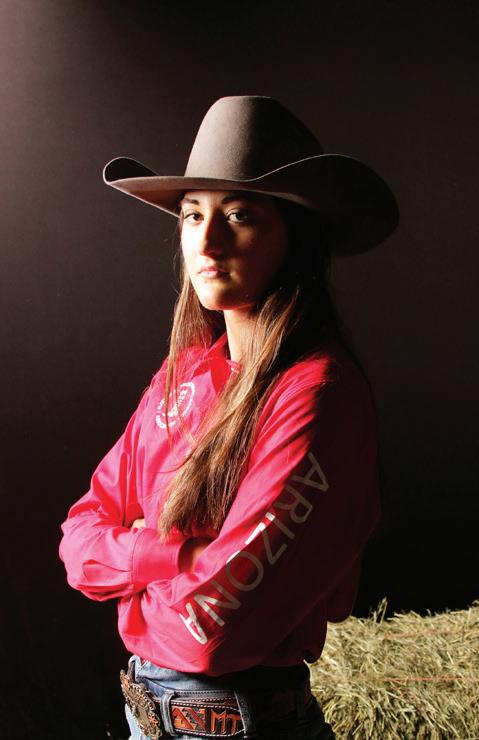
what’s with Maryn?
“I’m named a er Marin County in California, but my mom put a ‘y’ in there just so people would mess it up for my entire life.”
Yeah, well, at this point, just about everything else seems to be going right.





































































































































Continued
from P1
Rico, to connect even tourists that are coming in from Sonora, Mexico, which is our number one trading partner in Arizona, to Tucson.”
e passenger rail would be an alternative to driving, with a ve-minute shorter travel time than the peak two-hours-and-30-minute commute from Tucson to Phoenix, said Amtrak President Stephen Gardner.
e rail would o er three daily round trips from Tucson, Phoenix and Buckeye, and one daily trip from Tucson to Los Angeles. e proposed line is part of Amtrak’s Corridor Vision Plan to expand low carbon intercity passenger rail service to 160 communities
across the nation over the next 15 years.
“We have a global climate crisis. In part congestions on the road and really in the air feed some of that. We have a history of some structural inequality in society but particularly in transportation as well,” said Amtrak CEO Bill Flynn. “We believe that one way to rise and address these challenges that our country confronts is through expanding intercity passenger rail service, putting in place a system that o ers frequent reliable, sustainable and equitable alternatives to driving and ying.”
Flynn said the rail could address long-term congestion issues in the corridor, as Tucson commuters are estimated to spend about 90%
more time in tra c than elsewhere and large city commuters may be experiencing as much as 62 hours of congestion delay, estimated to cost about $1,000 a year.
e passenger rail would require an investment of about $925 million and take about three years of construction to put the service in place, said Gardner.
Amtrak estimates the service would generate roughly 200,000 riders annually, producing $77.7 million a year and generate about $2.3 billion in economic activity created from one-time capital investments.
Mayor Ed Honea of Marana, who signed the letter of support, said his constituents would be able to visit

their families or travel for work, like his own family has using Amtrak’s existing line to travel from San Diego to Los Angeles. He also noted the area around the Marana stop has multiple hotel and motel complexes for people to stay in for business.
Beyond the leisure traveller, Visit Phoenix CEO Ron Price added that by connecting these cities it would increase interest in the region.
“How much more attractive are we going to become to be landing the next corporate headquarters, the regional o ces?” asked Price.
Amtrak would use and build on existing lines, and use their new diesel multipl-unit train, which Gardner said is a “very e ective train set.” While the train is not electric, he said Amtrak is looking at di erent alter-
natives to provide the “lowest carbon service that we can.”
When asked why Amtrak considered a passenger rail versus a high speed rail, Flynn noted the time and investment a high speed rail would take, but would be considered in the future once there’s an existing line.
“High speed rail from start to nish, usually is a 15-plus-year project, and it is something that I think that we look at once there’s an existing corridor, and there’s existing volumes,” said Flynn. “ e approach here is to build out the service, build out the ridership and then explore what other future opportunities are for services.”
At the moment Amtrak hopes to secure the federal funding necessary to begin the investments to start operations, including
the agreements with host railroads, like Union Pacific to develop the rights to operate. Gardner said they proposed a “bold plan for federal investment” to Congress to help cover up to all of the initial capital costs and a portion of the early operational costs. ey also advocated that Congress provide additional funds to increase operation of the trains, including the two they currently have, in their long distance network from tri-weekly to daily.
Part of the proposal also includes transitioning the operating funding requirement to the state a er a period of time, according to Flynn.
“ e state of Arizona has an incredible opportunity to lead on this particular type of investment that other states, by the way, already do,” said Romero.



Splendido follows the culinary standards and philosophy of Mather, one of its two parent companies— and Mather has been highlighted by the New York Times as a prime example of senior living residences offering residents top chefs and “foodie delights.”
Headed by Executive Chef Masood Shirmohammadi, Splendido’s classically trained chefs and pastry chefs create from-scratch recipes, sourcing highquality local, seasonal, and organic ingredients to use in delectable dishes.
“Cooking from scratch results in healthier dishes, because we control the ingredients,” Chef Masood explains. “For example, we can reduce or avoid salt and fat, come up with more nutritious options for them, and certainly improve on the quality and taste of food. We give residents the healthiest options possible. . . which also happen to be delicious!”


To residents, it may seem that the only thing that stays the same on the menu is quality and mouthwatering taste. In each of Splendido’s restaurants, the menus change regularly, offering inviting new selections that reflect the latest flavors and techniques from around the world, all while promoting a healthy, balanced diet.
“We love making great food here, as well as making meals an experience,” says Chef Masood.
Every evening, Pastry Chef Mary Teresi has five different dessert options, including a sugar-free option and a gluten-free option. Mary, whose team recently earned Splendido first place in the 2021 Oro Valley Chamber’s Peanut Butter Cookie Contest, shares one of her recipes here, as does Chef Masood.
Makes one 9 by 13” pan.


INGREDIENTS
3 eggs
6 cups pureed black beans
½ cup cocoa powder
2 ¼ cup oats (After measuring, grind in a food processor to make a flour.)
1 ½ Tbsp. salt
1 ½ cups honey
¾ cup brown sugar
1 cup plus 2 Tbsp. vegetable oil
2 Tbsp. vanilla
2 ½ tsp. baking powder
3 cups mini chocolate chips
DIRECTIONS:
1. Preheat oven to 350° degrees F.
2. In a bowl, combine eggs, beans, and brown sugar
and mix.
3. Add vanilla and honey and mix.
4. Add oil and mix.
5. Combine cocoa powder, salt, oat flour, baking powder, and choc chips and add to wet mixture.
6. Combine and mix together thoroughly.
7. Line the bottom of a pan with a piece of parchment paper and spray the sides with baking spray that has oil only.
8. Bake for approximately 40 minutes.
9. The brownie will rise slightly and have small cracks on the edges when done.
Chef Masood’s Quinoa
Salad with Roasted Salmon
INGREDIENTS:
1 cup quinoa, rinsed
2 cups water
1 cup red pepper, roasted and diced small
2 cups kale, chopped fine
½ cup carrot, julienned
½ cup pistachios, chopped
½ cup scallions, sliced thin
½ cup fresh cilantro, chopped
1 lb. salmon filet, roasted and cooled
3 cups watercress, with large stems removed
4 Tbsp. dried cranberries
DRESSING
4 Tbsp. fresh lime juice
2 Tbsp. fresh orange juice
½ tsp. ground cumin
½ tsp. turmeric powder
¾ tsp. kosher salt
¼ tsp. cayenne pepper
½ cup olive oil
DIRECTIONS:
1. For the quinoa: In a bowl, wash the quinoa in at least 2-3 changes of cold water until the water runs clear; drain in a fine sieve.
2. Bring 2 cups of water to a boil in a mediumsized pot and add the quinoa. Lower heat and cover; cook for about 15 minutes. Remove from heat and let sit for 20 minutes, covered. Fluff with a fork to break up any clumps. Transfer the quinoa to a large bowl and cool. Add the remaining ingredients and toss gently to combine.
3. For the dressing: In a small bowl, whisk together all ingredients except the olive oil. Add the oil in slowly, whisking constantly.
4. Drizzle the dressing over the salad and toss well, taste for seasoning and adjust. Salad can be made few hours ahead and chilled, covered.
5. Pan roast salmon the salmon and allow to cool slightly.
6. To serve: Mound a stack of watercress on a plate and top with 1 cup of the salad. Top with roasted salmon.




Matt
According to her great, great nephew, Monica Flinn likely spent the rst summer at her new El Charro Café making pots of stew and tortillas to feed local construction workers. at was 99 years ago, and summer survival continues to be the hallmark of the season at each of El Charro’s Tucson locations.
“Tia Monica was a erce and feisty frontier woman, someone who could probably chew tobacco, spit in a spittoon and come back and make your meal,” said Ray Flores, Flinn’s great, great nephew and president of Flores Concepts which owns and operates El Charro Café. “But at the end of the day she was all about service, to her family, extended family and community.”
It’s in that spirit that El Charro reveals its summer menu that Flores says is a symbol of survival.
“Our summer menu is kind of like a summer survival guide, providing extra value at the time of year when we’re all

hurting the most and giving our guests a reason to come out to dinner on the hottest of days and nights,” said Flores.
Taking center stage on this year’s summer menu is shrimp, sourced from sustainable farms and served in three dishes that showcase the restaurant’s creativity with camarones.
e Shrimp Poblano Enchilada Elegante features grilled shrimp, peppers, and bacon in twice-rolled corn tortillas, baked in a poblano crema with queso Oaxaca, avocado salsa, and marinated pink onion. Flores notes that this is “meatier and thicker” than the restaurant’s standard enchilada.
ose grilled shrimp and peppers also anchor the Fajita Lettuce Cups, with queso cotija, chipotle crema, avocado salsa and a margarita lime vinaigrette. is dish has reportedly been popular with guests who’ve adopted low-carb and keto nutritional lifestyles.
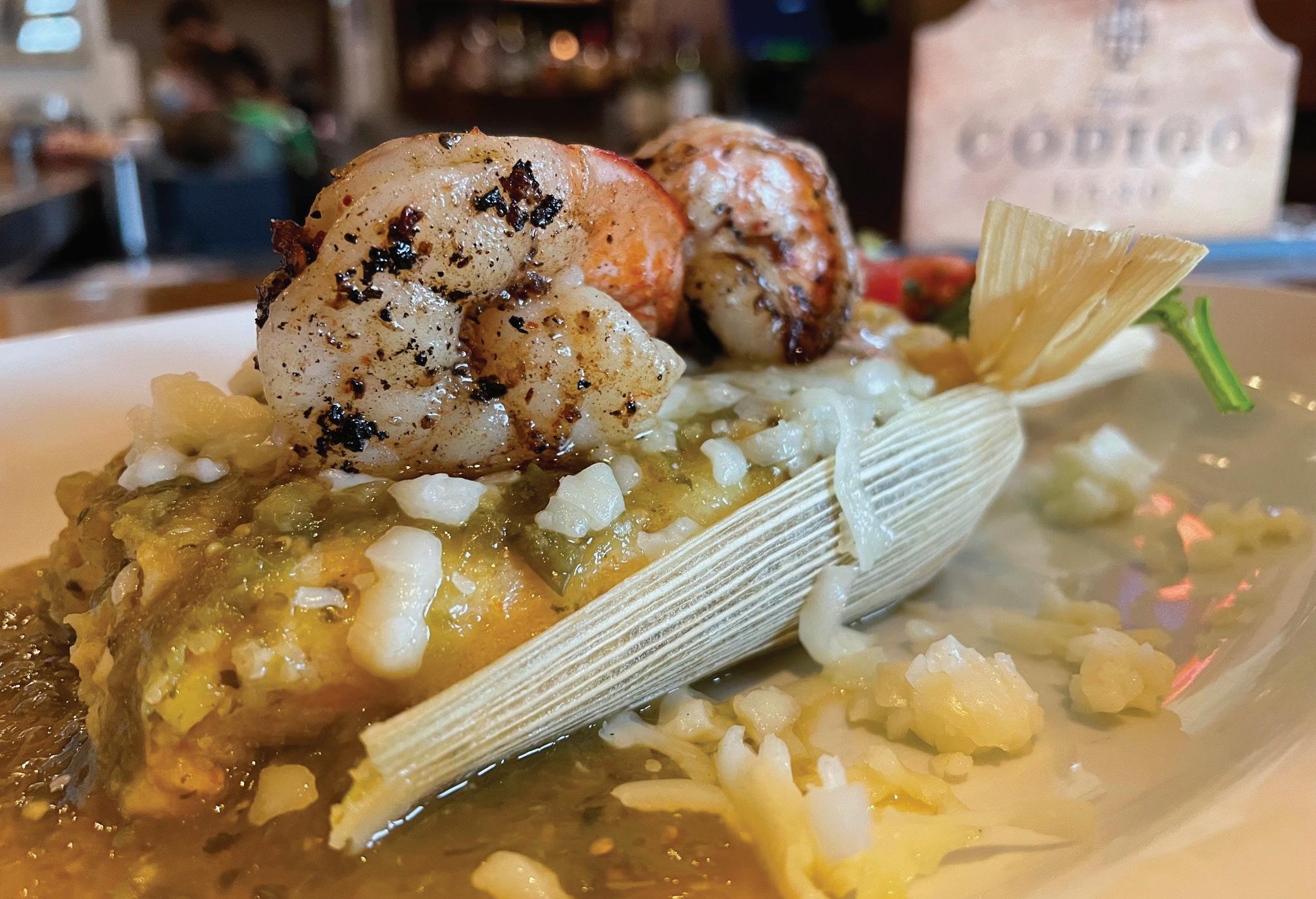
ird in the summer menu lineup is the Mojo de Ajo Shrimp Tamal, a handmade corn tamal topped with grilled garlic chimichurri shrimp, to-

matillo sauce and queso Oaxaca. Flores prefers his tamales with toppers, and he suggests the shrimp and sauce on this dish is an epicurean expression of awesome.
With each of these dishes priced under $10, this menu, which runs through Aug. 15, makes surviving the summer a little easier.
Flores has also introduced four signature summer margaritas, for less than $6 each, which include mango and jalapeno, coconut and pineapple, watermelon and mint, and tamarind and citrus varieties.
When asked which of these cocktails would appeal most to Tia Monica, Flores replied honestly. “Probably none of them,” he said. “She was a woman who preferred to drink martinis out of teacups.”
Summer is also being celebrated at Flores’ other local restaurants, Charro Steak & Del Rey and Charro Vida, with upgraded happy hours. “Coming out of the pandemic and moving into the summer, we really wanted to have a strong happy hour,
so all of our stores have focused on greater and bigger o erings.”
I’ll drink to that.
“ e fact that we’ve made it through 99 summers, or even one summer at all, is a testament to a restaurant’s grit,” said Flores. “Tucson has its own challenges every summer that we as businesses endure, and we know that being all in it together is what
helps us get through.”
Togetherness. Family. Service. Guiding principles forged nearly a century ago by a woman who stood out among her contemporaries. Flores’ team appears to feed their community with the same a ection that Flinn fed hers – minus the spittoon, of course –and in the brutal months of summer, that’s some-
thing from which we can all bene t.
Contact Matt Russell, whose day job is CEO of Russell Public Communications, at mrussell@russellpublic. com. Russell is also the publisher of On eMenuLive. com as well as the host of the Friday Weekend Watch segment on the “Buckmaster Show on KVOI 1030 AM.








Jeff Gardner Tucson Local Media
Driving into the Southwest from any direction, the rst sight of a saguaro cactus waving on the horizon serves as a “welcome” for Arizona residents and tourists alike. But even more than a welcome sign, the saguaro is an icon of the American South, even for those who don’t know what the Sonoran Desert is or pronounce saguaro with a hard G.
A new book, “In the Arms of Saguaros,” tracks the iconography of the accordion-pleated colossi alongside the development of the Arizona territory. At rst a food source for Native Americans, the saguaros came to be used in art, architecture, clothing and tourism — but it wasn’t always that way. What was at rst ignored by American developers gradually became critical.
Author William Bird followed the appropriation and in uence of the saguaro through decades of American history. “In the Arms of Saguaros” serves as both a picture book rife with saguaro imagery, and a timeline of Arizona’s growth.
Bird originally came to Tucson to earn his master’s de-
gree in history at the University of Arizona. ough he rst lived here for fewer than two years in the mid-’70s, he says he was quickly enthralled by the desert landscape and ora, and research for this book served as a kind of “exercise in nostalgia.”
“ ese photos of people posing in the arms of saguaros really suggest to me a kind of e ort to become one with the plant, at one with botany, even at your own peril,” Bird said.
“It’s become a kind of meme or regional identi er that has gone national, and even international.”
“In the Arms of Saguaros” is published by the University of Arizona Desert Laboratory on Tumamoc Hill.
Saguaros are easily recognizable, and can be enormous, but do you think there’s something about their vaguely humanoid shape that people connect with?
Well, I always feel like they’re waving at me. at’s kind of a joke, but in every joke there’s an element of the truth. at is always commented upon when people use it to promote the desert Southwest. It re ects the anthropomorphic moods of humankind. You’ll have balleri-
nas mimicking saguaros, and everyone who writes about the Southwest poses with a saguaro. at pose is very telling. And you can’t get close enough to them, clearly, with all the old photos of people climbing in them, hence the title of the book.
In all your research for the book, what is the most unique saguaro memorabilia or art you came across?
I’d have to say the Mary Eaton botanical illustration on the back of the book. at to me is one of the most compelling things featured in the book. But I also like the more modest things available to anyone. Like back in the day, the items made by saguaro rib cra ers, those are charming and highly collectible… As a museum person, I’m into the materiality of it. e icon is always there, and people always ri on it and make it their own. But my job as a curator and author is to nd things that are interesting to look at, and build the story around that.
I see that you’re the curator emeritus of the political history collection at the National Museum of American History. During your re-
search, did you see any fascinating ways the saguaro had political impacts?
Iconography is sort of an accumulative process, like getting on a slow-moving train. So I assumed quite naturally that this process was an arc that went from the lower le , and up in a steady climb. But it’s more like a sawtooth. ere was a great e ort made around 1893 at the Chicago World’s Fair to represent the Arizona territory with saguaros transplanted to the fairgrounds in Chicago… Oddly enough, there were people who complained that was not the appropriate symbol for the territory, because it suggested that was the only thing that could grow in Arizona’s soil. So if you look through the territory and the state’s iconography, there’s actually a paucity of saguaro imagery. In fact, the state seal today has a dam, a lake, a miner, a cow, but no saguaro… It isn’t until the ’20s or ’30s that you begin to see saguaros on the edge of the brochures, and gradually it moves to the center. So politically, it sort of begins as this fraught, problematic symbol for a lot of people… ere’s almost a reluctance or “desert denial,” but they really come around to it by the ’50s and

are actually creating a botanical landscape for advertising purposes that has no basis in reality. ey take a golf course brochure and add in saguaros to the background. I think they recognize people are curious about it. It’s an attraction that is unique to the Sonoran Desert.
In your research, did you see any appropriation of the saguaro imagery by artists outside of the desert or around the world? If so, how was the saguaro iconography changed?
Well sometimes you’ll even see it reproduced in this coun-
try and it’s wrong. Or you’ll see the Peruvian apple cactus in decorating magazines and they’ll have arms that suggest it’s a saguaro. But the ones I have seen are an English T-shirt with a saguaro outline, that was surprisingly accurate if you’re just trying to show someone what a saguaro looks like. ere are others that are completely abstract but still spot-on, like an artist who had a knit stocking over their head with two eye-holes that looks quite dramatic, if impractical.
For more information, visit tumamoc.arizona.edu/InTheArmsOf Saguaros














































































Name a Pima County department that saves lives. You probably immediately thought of the Health Department, given the pernicious pandemic we’re struggling through. Or maybe the Sheriff’s Department and its hundreds of deputies keeping us safe every day.
How about the Regional Flood Control District? No?
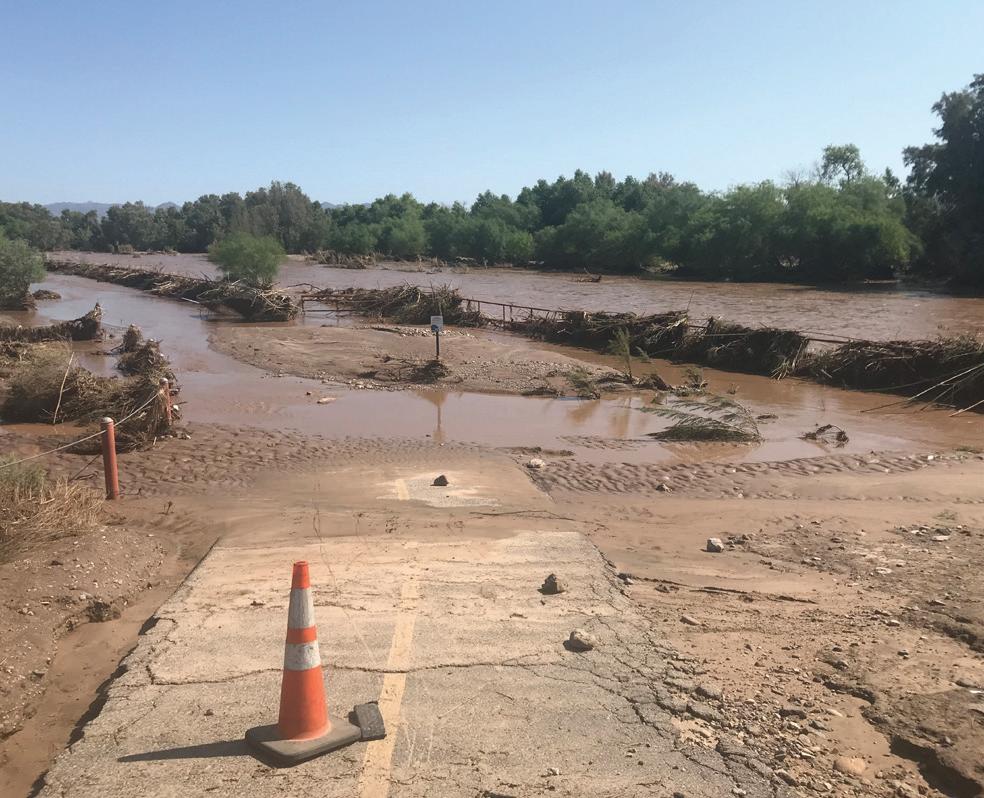
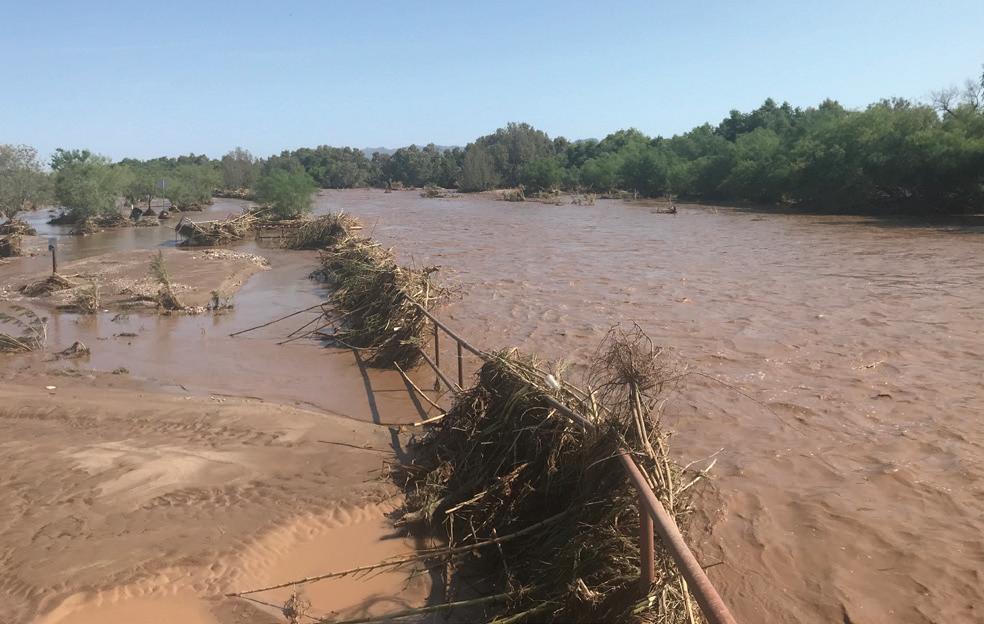
You should because Flood Control protects lives and property every year. That was clearly on display last month when record rain fell over four days, filling the metro rivers bank-to-bank with billions of gallons of water. That flood event was similar in size to the floods in 2006 and 1993.
Yet despite all that water, there was very little property damage and no loss of life. Instead, hundreds of millions of dollars of flood control infrastructure directed the water away from

property, into the rivers and out of town.
After a series of El Nino-fueled floods in the 1970s, the Arizona Legislature allowed for the creation of Flood Control Districts to raise funds necessary to pay for infrastructure needed to protect lives and property in our fast-growing state. Just five years after the Pima County Regional Flood Control District was formed, we were hit with a 500-year flood event in 1983, devastating the metro area, destroying 150 homes and claiming nine lives. The flood caused more than $550 million in property damage (in 2018 dollars) and taught flood control engineers
many painful lessons.
Since that great flood, county taxpayers have invested nearly $400 million in diversion channels, soil-cement riverbanks, retention basins and other methods to make the water go where we want without wreaking havoc or devastation.
Not all the infrastructure is made from concrete, either. The District has installed dozens of rain gauges around the Pima County that digitally report up-tothe-minute rainfall totals. Dozens of flow meters in the washes and rivers also report the feet per second of runoff flows minute-by-minute. If there is a large thunderstorm dumping big water on the side of a mountain, RFCD can see it happening in real time and alert emergency agencies downstream with accurate information about the amount of water heading their way, allowing them to make quick assessments of the relative danger. The public can view the rain and streamflow data online, but if you live next to or near a wash or river, I highly rec-
ommend signing up for MyAlerts. You can get alerts for the specific watershed you live near.
The staff, scientists and engineers at County Flood Control are some of the finest in the country, developing brilliant and innovative methods to not only control flooding, but to use runoff to restore riparian habitats, water turf, and create or preserve recreation amenities.
The Kino Environmental Restoration Project near Ajo Way and Kino Parkway collects runoff from a 17-square mile drainage area on the southside, collecting and storing the water in large ponds that support an amazing array of wildlife, trees, shrubs and aquatic plants. The water collected there also is used to water the turf at Kino Sports Complex, saving taxpayers thousands of dollars in water fees every year.
I am immensely proud to have played a role in supporting, funding and advocating for the Flood Control District’s efforts to protect people and property
for more than half of its 42year existence. The next time it rains, or rains a lot, give a thought to these hard-working professionals who build and maintain the systems to keep the water out of your homes and businesses and put it in the river where it belongs.

1 Handwriting style
7 Woodland or wetland
14 E! talk show
16 Similar chemical compounds
17 *Like many old video game soundtracks
19 *Common purchase for a tailgate
20 Getting close, in a guessing game
21 Parts of psyches
23 Tuner that’s turned
24 Moves furtively
26 *Sinbad’s milieu
30 Singer Stefani
31 “Survivor” setting, often
32 Singer’s time to shine
33 Mortgage claim
35 Suggestion made with a wink and a nudge
38 “___ said yes!”
41 *Burger chain named for a father and his sons
43 Minuscule particle



44 Kicked down the road, as an issue
46 Some first responders, in brief
48 Freshly
49 Culmination of a wedding ceremony
51 Resistance units
54 *One of two for the 1990s Chicago Bulls
57 Full of cheer
59 Video hosting service since 2009
60 Like many baby animals
62 Singer’s time to shine
63 *Anthem whose French lyrics predate its English lyrics
66 *Former fashion retailer so-named for its 57th Street address in Manhattan
68 “That’s two hours I’ll never get back!”
69 All together
70 Binge at a buffet, say
71 Fluctuated wildly
1 Worries anxiously



2 Science fiction writer Ted with four Hugo awards
3 Came back, as hair
4 (Spoiler alert!) Sole survivor of the Pequod
5 Poker prize
6 “A series of ___,” infamous analogy for the internet
7 Philip Pullman’s “___ Dark Materials”
8 Stage digression
9 Completely confine
10 Stalemate
11 Star of CBS’s “Madam Secretary”
12 Circle segment
13 “For shame!”
15 One skewered at a roast?
18 Throw out
22 Bud in the Baseball Hall of Fame
25 Part of a place setting
27 Performance sites
28 Big name in shoes and handbags
29 In a moment
31 Bring up
34 ___ al-Adha (Muslim holiday)
36 Citi Field team, on scoreboards
37 “We wanna join!”
38 Altercation
39 “Say what?”
40 Deprive of strength — not, as is commonly believed, to give strength
42 Pioneering computer
45 11- or 12-year-old
47 Draw back (from)
50 Bowl over
52 On a larger scale
53 Credit ___ (banking giant)
Woman in a 1982 hit who can be reached using the starts of the answers to the starred clues
58 Filled to the brim
61 What might get under your collar? 63 “Well, lookee here!” 64 Cleveland athlete, for short 65 The “A” of D.A.: Abbr. 67 ___ pop (genre for Billie Eilish)
ARIES (March 21-April 19). The week is lled with urgent potential. There are things to build, hobbies to take up, skills to learn... not to mention trips to take and services to contribute. Organizing it all is a challenge, though one that falls dead center of your strengths. You prioritize like a titan. Everything important will be savored.
TAURUS (April 20-May 20). While irrational cheerfulness is unattractive to you, using optimism as a pragmatic strategy will be the most e ective route to a ful lling week. Your energy level is higher because you raise the ceiling on it with your winning attitude. So much more is possible because you choose to believe it is.
GEMINI (May 21-June 21). You have something important to impart this week. To be heard, keep it brief. Short messages travel far, ring true, land easy and carry well. They also can take a while to craft. Do your prep work so you can say more with less. As Mark Twain said, “If I had more time, I would have written a shorter letter.”
CANCER (June 22-July 22). This week, maybe it’s too much to ask yourself to be fearless, as in -- one who has no fear. But you’ll certainly nd it’s within your realm to literally fear less, as in -- face one small fear and, in doing so, possibly overcome it, enlarging your circle of possibility and capability.
LEO (July 23-Aug. 22). You set out with every intention of doing what you love and loving what you do, but unless you take precautions to barricade and sanctify your focused time, you will be kept from this purpose. Don’t leave yourself open! Distraction comes in forms irresistible, especially the form of people involving you in their problems.
VIRGO (Aug. 23-Sept. 22). Over-ambition and unrealistic expectation is a set-up for failure disguised as optimism -- what a sneaky form of self-sabotage! But it’s a trap you can avoid (and often do) with pragmatism. Mix that with your penchant for planning and this week will be a success you can enjoy, duplicate and build upon.
LIBRA (Sept. 23-Oct. 23). Ultimately you want to o er patient compassion to the world, but you can’t give what you don’t have. Do something nice for yourself. If you deserve it, great. If not, even better. It will give you the chance to practice acceptance, compassion and big-heartedness where it you most need it now -- turned inward.
SCORPIO (Oct. 24-Nov. 21). Expectations will often go unstated or be indirectly alluded to, and yet, you’ll pick up on it all. While it may not be appropriate or timely to hash out exact agreements, privately make note of what’s being exchanged. Awareness lends an advantage. It’s powerful to be conscious of the unconscious behaviors of others.
SAGITTARIUS (Nov. 22-Dec. 21). When people weigh in with their opinion, it is only human to feel bolstered or de ated by the score. However, your own view is the one to consider. Be tough-minded about this. Allow no one -- not your biggest fan, not your worst detractor -- to interfere with what you’re creating.
CAPRICORN (Dec. 22-Jan. 19). You’re creative and you want to make something di erent of your life than you’ve seen others do. This drive sets you apart from the crowd. Can you get comfortable with it? It doesn’t mean you can’t be close to people -- it just means you have to gure out the connections. Does it help to know you’re an inspiration?
AQUARIUS (Jan. 20-Feb. 18). The ego would have us believe that we deserve the good that comes to us, but often, forces like synchronicity, felicity and angelic favor are as impersonal as gravity. That’s the way it is this week. You’ll gure out what to do, how to do it, and then you’ll get to work. Luck is of no help. This is just cause and e ect.
PISCES (Feb. 19-March 20). Your creative life is accomplished with proactive moves. Don’t allow yourself to act re exively because reaction isn’t nearly as inspired as action. You get ahead of this when you make a plan and become involved with it, thus occupying yourself in such a way as to be impervious to unimportant distractions.






















































Lewis and the Honeybears (Aug. 20), Sian (Aug. 21), Nanpa Básico (Aug. 27) and the Residents (Sept. 14).
Tucson’s Lo Cinema also received a $1,006,000 grant from the Shuttered Venues Operator’s program.
but of the whole industry of theatrical exhibition,” said Lo Cinema Executive Director Peggy Johnson. “We will be forever grateful for our wonderful members and patrons who generously supported us through the tough times and we are excited for the future!”

e midtown movie palace’s three indoor theaters were closed for 14 months, although the nonpro t was able to bring in some revenue with streaming lms, outdoor shows and theater rentals for small groups, but revenue was down nearly 90%.
Johnson thanked Arizona’s congressional delegation for its support through the pandemic.
“We’re fully invested in making e Lo Cinema a sustainable nonpro t lm center, and we hope to see everyone soon at the movies!”








“Being closed for so long was incredibly di cult, as was the uncertainty of the future, not only of e Lo
For more information on these shows and more, visit rialtotheatre.com and foxtucson.com.
















































































































Cases on the rise as students return to classroom



e Explorer and Marana News is published every Wednesday and distributed free of charge to homes and in single-copy locations throughout the Northwest Tucson. To nd out where you can pick up a free copy of the Explorer and Marana News, go to www.TucsonLocalMedia.com
STAFF
ADMINISTRATION
Steve T. Strickbine, Publisher
Michael Hiatt, Vice President
Jaime Hood, General Manager jaime@tucsonlocalmedia.com
Claudine Sowards, Accounting claudine@tucsonlocalmedia.com
Sheryl Kocher, Receptionist sheryl@tucsonlocalmedia.com
EDITORIAL
Jim Nintzel, Executive Editor jimn@tucsonlocalmedia.com
Jeff Gardner, Managing Editor je @tucsonlocalmedia.com
Mike Truelsen, Web Editor mike@tucsonlocalmedia.com
Christina Duran, Sta Reporter christinad@tucsonlocalmedia.com
Ireland Stevenson, Sta Reporter istevenson@tucsonlocalmedia.com
PRODUCTION
Courtney Oldham, Production Manager, tucsonproduction@timespublications.com
Ryan Dyson Graphic Designer ryand@tucsonlocalmedia.com


Emily Filener, Graphic Designer emilyf@tucsonlocalmedia.com
CIRCULATION
Alex Carrasco, Circulation alexc@tucsonlocalmedia.com
ADVERTISING
TLMSales@TucsonLocalMedia.com
Kristin Chester, Account Executive kristin@tucsonlocalmedia.com
Lisa Hopper, Account Executive lisa@tucsonlocalmedia.com
Candace Murray, Account Executive candace@tucsonlocalmedia.com
Tyler Vondrak, Account Executive tyler@tucsonlocalmedia.com
EDITORIAL & AD CONTENT
The Explorer and Marana News expresses its opinion in the editorial. Opinions expressed in guest commentaries, perspectives, cartoons or letters to the editor are those of the author. The content and claims of any advertisement are the sole responsibility of the advertiser. Tucson Local Media assumes no responsibility for the claims or content of any advertisement. Publisher has the right to edit for size or refuse any advertisement at his or her discretion.
7225 N. Mona Lisa Road, Ste. 125 Tucson, Arizona 85741
PHONE: (520) 797-4384
Jeff Gardner Tucson Local Media
With the amount of people who gather together a er summer vacation and head into the cooler school months, it’s no surprise that December, January and February rank as the worst time of the year for u and cold cases. It also provides evidence for the argument that schoolteachers have some of the strongest immune systems to be found outside of a hospital.
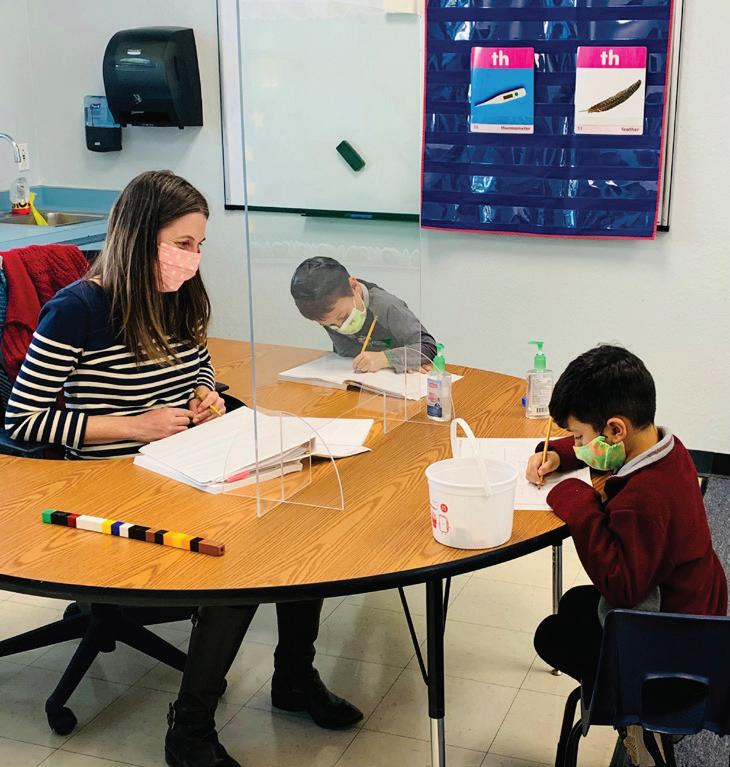
Unfortunately, as we head into the new school
year, local health o cials are warning that COVID cases are on the rise, despite the e orts to vaccinate adults and children 12 and older. Because the vaccine has not been approved for anyone younger, there’s a lot of worry that schools will become a big transmission vector in the months to come, especially since Gov. Doug Ducey has signed a state law that prohibits school districts from requiring masks in the classroom or vaccination against COVID.
Pima County Health Director Dr. eresa Cullen told the press last week
that doctors are reporting more cases among children, including ICU admissions, thanks to the Delta variant that spreads more easily than previous version of the virus. She is encouraging students, teachers and sta to mask up as the school year begins.
Sta reporter Christina Duran looks at the e orts TUSD and the Marana School District are taking to mitigate the risk of spreading COVID in schools with the limited options they have in Tucson Local Media’s annual Back to School edition. In
addition,. sports columnist Tom Danehy looks at how athletes are getting back to training. Unfortunately, Cullen has warned that some of the COVID spread has been traced back to athletic programs, so we’ll see how this season goes.
Be careful out there. e pandemic isn’t over yet.




Know Us
Know Your Community




Tucson Uni ed School District will not di erentiate between vaccinated or unvaccinated individuals when quarantining, announced Superintendent Dr. Gabriel Trujillo at a recent governing board meeting.
In July, Kaitlin Harrier, education policy advisor for Governor Doug Ducey sent a letter to two school districts, Catalina Foothills and Peoria, stating their isolation and quarantine policies violated Arizona statute, since they indicated fully vaccinated individuals would not have to quarantine, following guidance from the Center for Disease Control and Prevention and Arizona Department of Health Services.
In a press brie ng, Trujillo said their decision to implement a uniform quarantine requirement was not informed by the actions of the Governor’s o ce nor from any political implications, but more out of their inability to ask for a student’s vaccination status.
“In order to even trigger a quarantine approach that would treat or assign di erent amounts of quarantine time to a vaccinated student or an unvaccinated student at some point you would have to actually ask that family or that student if they’ve been vaccinated,” said Trujillo. “ at’s not a route that we’re willing to go right now for legal implications.

Obviously other districts have chosen di erently.”
While Trujillo acknowledged that Catalina Foothills and Peoria’s legal representatives found both districts had acted in good faith and not violated the statute, TUSD still opted for a more conservative approach.
Other school districts, including Marana Uni ed School District, reference CDC and ADHS guidance on isolation and quarantine.
According to Alli Benjamin, Director of Public Relations for the district, Marana Uni ed School District Health Services would complete full case investigations and contact tracing for all positive cases and the Pima County Health Department would provide guidance on quarantine and isolation to individuals exposed to COVID-19. e district would not be asking for vaccination status. She said the district would continue to docu-


ment COVID-19 cases on their COVID-19 Dashboard, and sta and families at impacted sites will receive noti cations.
Tucson Uni ed School District will also continue to monitor COVID-19 cases across their schools, but contact tracing and isolation and quarantine recommendations would come from the Pima County Health Department. e TUSD governing board also supported the creation of signage across their schools that would encourage masking for students and sta .

purchase a book, find signed copies in Barnes and Noble at Foothills Mall and Eastside and in Bookman’s at 3330 E Speedway Blvd. Or online at Amazon.com or BarnesandNoble.com. (Book Signing Aug 27th Foothills Mall Location 11:30am)
book is about wildlife from a to z on where
“We are not authorized as a school district, nor is any other school district in the state of Arizona, authorized to mandate masks for students, or our employees,” said Trujillo at the press brie ng. “It is however the o cial position of this superintendent, and this administration and our governing board as voiced in public

Continued from P3
last night that we strongly encourage our students and staff to wear masks, in the spirit of public health and in the spirit of the recommendations that we have seen from the World Health Organization and the Centers for Disease Control.”
At the briefing, Trujillo highlighted the unexpected increase in enrollment for the Tucson Unified Virtual Academy, their new all remote learning school. Heading into their July 13 governing board meeting, about 700 students had enrolled in TUVA and last Wednesday Trujillo said that number had grown to 1,200 students.
Trujillo initially projected around 1,000 students en-
rolled at TUVA, but believes they could probably have between 1,500 and 1,700 students enrolled by the time district opens on August 6.
He believes Gov. Doug Ducey’s decision to sign a budget bill passed by Arizona GOP lawmakers that prohibited schools from mandating masks is a “big reason” for the rise in enrollment to TUVA.
“I have to believe that it’s created a significant level of uneasiness, of anxiety, of fear, for a lot of our parents that do not feel comfortable sending their unvaccinated students into maskless environments, and with a school district powerless to enforce what I think was our most powerful strategy for mitigation,” said Trujillo. “We’re no longer able to do that so I don’t blame parents for hesitating in sending their students back to school. For those parents TUVA is a viable option.”
Trujillo said some parents also have concerns about the
overall safety of returning to schools with a potential fourth wave as cases of the Delta variant continue to rise when there is no COVID-19 vaccine for those younger than 12.
“Two of my three children are too young to be vaccinated against COVID-19, and that’s why they returned to public school today wearing masks,” wrote Arizona Health Department Director Cara Christ in a blog before she announced her retirement. “ADHS recommends the same for all unvaccinated individuals when they are around people they don’t live with. It wasn’t the most popular decision to my two kiddos, but it’s one that will protect their health and the health of those around them.”
At a July vaccine clinic hosted by Marana Unified School District in partnership with the Pima County Health Department on Tuesday, Jennifer Hess waited with
her two children to get their vaccinations before the coming school year. Students at Mountain View High School, Dustin, 15 and Audrey, 13, both got their COVID-19 vaccine. At the event, students could not only receive all the required vaccines for the coming school year for Chicken Pox, Polio and the like, but also had the option to receive the Pfizer vaccine for those 12 and older.
Hess said she waited mostly out of convenience, since her primary care provider is usually packed and school is starting soon. She also felt more comfortable and had no concerns about masking being optional, since her children are vaccinated.
“It’s a small risk any time you have a vaccine,” said Hess. “For us the benefit outweighs the risks.”
The event had a larger turn out than expected, according to MUSD Director of Health Services Nicole Pargas. Pima
County Health Department reported the clinic had 107 total visits, with around half the children getting vaccinated with their required vaccines, 17 children receiving only the COVID-19 vaccine, and 13 children receiving both. They also vaccinated five adults with the COVID-19 shot, as the event did not limit participation, even those outside of the district could receive their vaccines.
Mehdi Ali, 68 travelled from New Mexico to visit grandkids Sama, 11 and Noor 14 while their parents are overseas. He brought Noor, a student at Sonoran Science Academy, to Tuesday’s vaccine clinic to get the COVID-19 vaccine. As a faculty member at University of New Mexico, Ali got his vaccine in January, despite having diabetes and a recent open heart surgery.
“I hope people wise up and take the vaccine for themselves, for other people,
for the community,” said Ali. “Better to be vaccinated at this age with the rise of the Delta variant.”
Once Sama becomes eligible to receive the COVID-19 vaccine, Ali believes she will be vaccinated, since their whole family is vaccinated.
However, some students eligible for the COVID-19 vaccine are unable to get vaccinated due to the need for parental consent.
Marana High School student James Wesley, 16, said he wants to get vaccinated, but his mother Theresa said they “don’t believe in it.” They attended the vaccine clinic to get his regular immunizations. Wesley said once he turns 18 he would get a COVID-19 vaccine, but until then said he would be wearing his mask at school.
COVID-19 cases have risen substantially over the past month in Arizona, with a high
See School Year, P7

Christina Duran Tucson Local Media
Pima County is seeing an increase in school outbreaks as students return to the classroom, with health o cials warning the spread of COVID in schools could have a signicant impact on the community at large.
Pima County Health Department Director Dr. eresa Cullen told the press last week that between in the seven days beginning July 19, there were reports of eight outbreaks in schools and 56 school cases, but there were no outbreaks in the summer. She said they have closed one school classroom as a result and expected more cases on the horizon.
e cases were primarily from Vail School District, which started classes at the end
of July, and some of the outbreaks are in schools and others are from school related activities, like football, cheerleading or freshman orientations, Cullen said.
“We are now seeing this increase as students go back to school,” said Cullen. “We anticipate that approximately 5% to 10% of the cases we are seeing right now will be due to school as opposed to a maximum of 4% last year.”
Although several studies conducted early during the COVID-19 pandemic suggested children have lower incidence rates than adults, this may be partly due to children having fewer opportunities for exposure and a lower probability of being tested, CDC o cials warned in an updated July 9 brief. ey noted that studies that systematically tested children and adolescents,
irrespective of symptoms, for COVID-19 infection or prior infection found “their rates of infection can be comparable, and in some settings higher, than in adults.”
Cullen said pediatricians, primarily working in hospitals, “are seeing increased admissions and increased severity of illness, including ICU admission.”
Currently, younger children are not eligible to receive the COVID-19 vaccine (only those 12 to 17 can receive the P zer vaccine), which are highly effective against hospitalization and death for all COVID-19 variants. In a brie ng last week before she announced she was leaving her job, ADHS Director Dr. Cara Christ reported that nearly 32% of 12 to 17 year olds have been vaccinated with at least one dose of vaccine.
e expected rise in

09/30/2021

school-related cases comes as the U.S. faces another wave of COVID-19 and the increased prevalence of the Delta variant.
As of last week, the CDC reports Arizona has a high rate of transmission with 132.6 cases in the last seven days per 100,000 individuals. In Arizona, the Delta variant accounts for about 75% of all cases, said Dr. Joe Gerald, epidemiologist at the University of Arizona, in a July 23 COVID-19 report.
Emerging data suggests lower e ectiveness of the vaccine against con rmed infection and symptomatic disease caused by the Delta variant, according to the CDC’s brief on vaccinations updated on Tuesday.
e CDC reports the Delta variant is “more than two times as transmissible as the original strains circulating at the start of the pandemic and is causing
large, rapid increases in infections.”
Pima County remains at a substantial rate of transmission at about 65 cases in the last seven days per 100,000 individuals, about half the state’s transmission rate. Cullen notes that until July 19, when the county received increased reports of school COVID-19 cases and outbreaks, the county was in moderate transmission.
“If we continue to see the increases that we have seen in the last week in our caseload. It is very possible that we will get to high transmission,” said Cullen.
“ e reason why we don’t separate out kids cases from adult cases, from elderly cases, and it’s all one, is because the belief is that that re ects what’s going on in the community at large.
So, there is potential for a very signi cant impact on the community at large because of the
school base cases.”
Cullen said the health department is increasing their school team, because they believe “there will be an increasing number of outbreaks unless we have further mitigation.”
However, new state law prohibits schools from mandating masks and requiring students and teachers get vaccinated. Schools in Arizona also faced backlash from Governor Doug Ducey’s o ce for using language from the CDC, which states vaccinated individuals do not have to quarantine.
e Pima County Health Department is responsible for assessing vaccination status and determining the recommendation for isolation and quarantine, while school districts report positive cases, said Cullen.
“From the school district
See COVID, P7















Aer the school sports seasons were shut down in the spring of 2020, crushing the dreams of athletes across the country, there were those who hoped that by that summer, there would be a tiny movement back toward normalcy. But such was not the case. ere would be no open gyms, no organized o -season
conditioning, and no summer leagues. It was the worst of time and…well, just the worst of times. is summer has seen a glorious burst of enthusiasm. While the pandemic should be gone but isn’t totally (blame fringe politics), it’s mostly gone and high-school athletes have returned to the drudgery (and sheer joy) of o -season work with glee on their faces.
It’s a brutally hot Tues-
day out in the middle of nowhere, where sits Marana High School and nothing else for as far as the eye can see. Out on the football eld, at least 60 guys are doing conditioning drills in the late-a ernoon heat. ere are no complaints seeing as how a week earlier it had hit a record 115 degrees. During that entire week, the Amphitheater School District (and others) had banned all outdoor athletic ac-








tivity on all of their campuses basically during the 14 hours that the sun was up. For nearly a week, the mercury hit 100 degrees just a er 8 in the morning and didn’t drop down to double digits until almost midnight. e average overnight “low” was a miserable 83 degrees.
But that was last week. Today it’s only 105 and it’s go time. e seven-on-seven squad from Ironwood Ridge walks in groups down to the football eld. Soon it will be game time.
touch below the neck. Even run-happy teams play summer seven-on-seven, if for no other reason than to give their defensive players some work.
missed out on) the summer of 2020), they’re just happy to be in the gym with their teammates and coaches.
e next night, both gyms on the Flowing Wells High School campus are going full tilt, two games on the hour in the big gym and another game in the East Gym. Twice a week, games featuring girls’ teams go from late a ernoon until nearly 10.













It’s played on a short eld with a limited number of rst downs, so a team can’t nickel-anddime its way down the eld. If a DB picks o a pass, it’s a change of possession. Turnovers can be killers. If a defensive player intercepts a pass and runs it back to the end zone, it may look cool, but it doesn’t count as a touchdown.








Seven-on-seven football has gone from being the gridiron version of a pickup game of three-onthree basketball to being de rigueur for just about every prep football program in the country. It’s basically a way for quarterbacks and receivers (including backs) to work on pass patterns and timing. Linebackers and defensive backs work on various zone or man-to-man schemes.
e rules are simple. Everyone on o ense (except the center who snaps the ball) is eligible to go out for passes. ere are no running plays and there is no rushing the quarterback. e QB has a strict four seconds to throw the ball. If he doesn’t get rid of the ball in that time, it’s a loss of down. ere is no tackling; strictly two-hand
In Marana’s Norm Patton Gym, there are enough boys to have three fullcourt games going on side by side in the (with about a dozen others waiting on the sidelines to get in the games). e rst day of open gym this year, the day a er Memorial Day, more than 50 boys showed up for workouts.
e numbers have uctuated somewhat with families nally being able to go on vacation and several of the hoop players spending time out on the football eld.
e girls program, with somewhat smaller numbers, is in the Alumni Gym, working on plays that will be tried out in summer league competitions. Like everybody else who lived through (and
Besides giving the athletes much-needed competition and the chance for team building, the Flowing Wells Summer League also serves as a much-needed training ground for future referees. e ref school, run by legendary local refs Chris Rastatter and Bob Scho eld (both of whom have re ed NCAA Final Four games), has established refs teaching newcomers on the y, throwing them in the deep end to see how they react to game-time conditions.
Flowing Wells Coach Michael Perkins’ squad reached the Class 5A State championship game this past spring despite not having the summer league last year. But even with the madness of multiple games going on in one gym with tag-team novice refs, he and all the other coaches (as well as the players and parents) are just thrilled to be back at it.
Continued from P5
perspective, our goal is to say this is a Pima County Health Department prerogative, responsibility to keep the county safe and it falls within the purview of our authority to follow up on this,” said Cullen. “We are cognizant of what the Governor has stated. We believe that our approach to this takes the onus off the school, and basically says the follow up is due to us.”
Cullen emphasized that the county is “doing everything [they] can to keep kids in school.”
The Pima County Health Department last week updated a Public Health Advisory to match the new CDC guidelines released on Tuesday, July 27. The CDC updated their guidance, recommending fully vaccinated individuals in areas with high or substantial rates of transmission should also wear a mask in public indoor settings because of the new evidence on the Delta variant.
Matching CDC language, they will be “strongly recommending all teachers, staff and students, visitors to K-12 schools wear masks indoors,
regardless of vaccination status.” Cullen hopes school superintendents will elect to push out the same recommendation and language.
Catalina Foothills School District and Tucson Unified School have opted to post signage around schools to encourage masking and the Catalina Foothills School District has updated their mitigation plan to match the new CDC guidelines.
According to a statement from TUSD, “The Tucson Unified School District Administration strongly recommends universal mask wearing for all students and staff. Per House Bill 2898 we are unable to mandate mask wearing. TUSD supports Superintendent of Public Instruction Kathy Hoffman’s recommendation to have all students and staff wear masks when on school campuses.”
The Arizona Department of Health Services will also be updating their public health recommendations to the CDC recommendations, according to Communications Director Steve Elliot. While it will take a few days to update, Elliot said the headlines would include:
“Everyone, those who are vaccinated in addition to those who aren’t vaccinated, should
Continued from P4
rate of transmission of 102 cases per 100,000 individuals for the week of July 11, and 46% of Arizonans fully vaccinated, according to the Arizona Department of Health Services.
“Unlike my previous assumption—roughly counterbalanced forces—it appears that total immunity is still insufficient to avert another surge in the presence of the more transmissible Delta variant,” said Dr. Joe Gerald, an epidemiologist and
wear masks and distance in indoor settings where they are around people they don’t live with. In schools, everyone should wear masks regardless of whether they are vaccinated. This includes students, teachers, staff and visitors. Previous CDC guidance recommended masks only for those who weren’t vaccinated.” It also notes that state law prohibits mask mandates.
In the updated July 9 brief on transmission in schools, the CDC notes that when a combination of effective mitigation strategies, like masking and social distancing, are implemented and “strictly adhered to in the K-12 in-person learning environment, the risk of transmission in the school setting appears to be lower than or equivalent to the transmission risk in other community settings.”
“Schools have done an amazing job, they have all worked with us for the past months, over the last year to ensure that they have layered mitigation,” said Cullen. “However, they have limited ability to do certain things and that’s why we believe it is our responsibility to do the recommendation, the strong recommendation about masking.”
professor at UA Zuckerman School of Public Health in his July 16 COVID-19 report.
With the acceleration in transmission, Gerald emphasized vaccination as the most important public health priority to reduce viral transmission and severe illness and that mandating masks in indoor spaces and limiting large gatherings is “warranted to reduce transmission in public settings.”
“Unfortunately, it seems unlikely that state policymakers will take action to protect public safety, either by allowing vaccination mandates (e.g., school attendance), in-
door mask mandates or targeted business restrictions,” said Gerald. “Furthermore, individual action will not be able to stem the tide unless those most resistant to vaccination and mask-wearing change their behaviors.”
Despite the concerns of the rise in the Delta variant and masking being optional at school, both parents and children at the clinic expressed excitement to go back to in-person schooling.
For Noor remote schooling was “pretty hard” and she “work(s) better on paper and pencil instead of Googling things.”






































































































er,astheholidayweekendgrew closelastweek,Bidenconceded thatthecountrywouldnotreach
estateofArizonaandPima Countyhadn’thitthegoalatthe startoftheholidayweekendlast AsofJuly4,theU.S.fallsjust





































ofMarana’sClass big2021tookon challenges


whenIsaythatthishasbeenadreadinfulyear,”Patelsaid.“Graduationspeeches formalsthepasthaveincludedstoriesofproms, and football games. However, waythisyearwehadtoadjusttoabrandnew COVIDoflifefullofZoomcalls,masksand tests,whichconsistedofmassive ofQ-tipsbeingshovedupournoses.Instead reminiscing
experience,we
beingcollectivelytakingadeepbreathandjust Patel,gratefulthatwe’refinallyhere.”