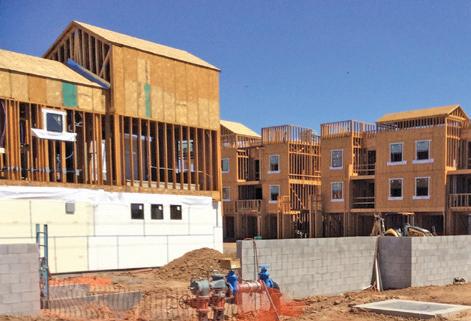
Tempe Union High School District is expecting a $23-million windfall and Ahwatukee residents could see a “new old-home neighborhood” after the district governing board approved the sale of a 63acre site in the community.
The board last week unanimously approved the sale of the parcel on the southwest corner of Desert Foothills Parkway near Frye Road to Desert Vista 100, a subsidiary of Blandford Homes, a respected homebuilder in Arizona that touts higher-end luxury master-planned communities.
The sales price – roughly $367,000 per acre – exceeded the district’s expectations. Earlier this year, officials said it would like yield between $13 million and $19 million.
Opponents of the South Mountain Freeway have asked an appellate court panel to prevent blasting and further bridge construction in the Ahwatukee segment of the controversial thoroughfare.
Stating that blasting “will permanently destroy valuable aspects of the environment,” lead plaintiffs Ahwatukeebased Protect Arizona’s Resources and
Children and the Gila River Community filed the request last week with the U.S. Court of Appeals for the Ninth District.
The court also set Oct. 19 for oral arguments on freeway opponents’ appeal from U.S. District Judge Diane Humetewa’s July 2016 ruling that allowed the Arizona Department of Transportation and developer Connect2020Partners to begin work.
The court already has rejected one request by opponents to halt construction while the appeal is being heard. There is no
time requirement for the court to act on the request to halt blasting. Jurists gave no indication when they might rule, especially since the government must first file a written answer to request.
“I’m not overly optimistic about this one, but we had to try,” PARC President Pat Lawlis said in announcing the injunction request. “Blasting the foothills will definitely produce irreparable harm.
Despite the fact that both sides concluded
(Kimberly Carrillo/AFN Photographer)
Abigail Lopez leads a bunch of her new classmates on the first day of school at Lomas Elementary, where she and the other kids are starting kindergarten. For a look at
scenes on the first day of school at Lomas, See page 22.
BY PAUL MARYNIAK AFN Executive Editor
AHWATUKEE FOOTHILLS NEWS
AHWATUKEE FOOTHILLS
TheAhwatukeeFoothillsNewsis published every Wednesday and distributed free of charge to homes and in single-copy locations throughout Ahwatukee Foothills.
Times Media Group:
1620 W. Fountainhead Parkway, Suite 219 Tempe, Arizona, 85282
Main number: 480-898-6500
Advertising: 480-898-5624
Circulation service: 480-898-5641
PUBLISHER
Steve T. Strickbine
ADVERTISING STAFF
National Advertising Director Zac Reynolds 480-898-5603 zac@ahwatukee.com
National Account Coordinator: Patty Dixie 480-898-5940, pdixie@ahwatukee.com
Major Account Representative: Terry Davenport 480-898-6323, tdavenport@timespublications.com
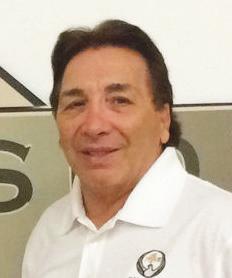
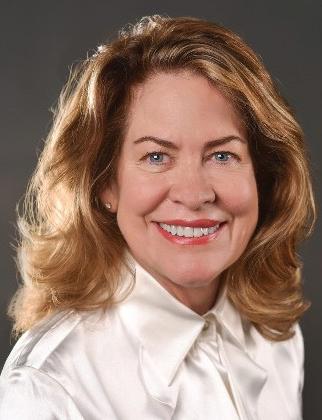
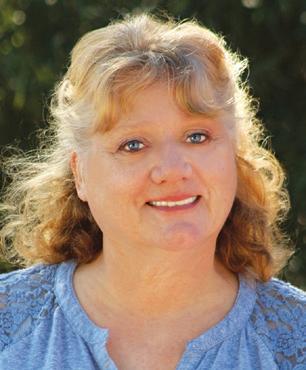
Ahwatukee resident Michelle Coro, who teaches new media at Desert Vista High School, has joined the board of a national student journalist association.
Journalist and educator Michelle Coro joins national student press group’s board
BY PAUL MARYNIAK AFN Executive Editor
Ahwatukee resident and Desert Vista High School teacher Michelle Coro likes to say,
“I’m busy and blessed.”
Now, she’s a whole lot busier, and will be blessing high schools across the country with the knowledge she’s gained as a journalist and new media teacher after being named to the National Scholastic Press Association’s board of directors.
For 15 years, Coro has advised multimedia programs at Desert Vista High School, working with students on the staffs of the Thunder Vision, View Newspaper, Storm Yearbook and the DVthundermedia.com website.
EDITORIAL
She also sits on Tempe Union High School District’s Career and Technology Education media advisory council and the Arizona State Interscholastic Press Association board.
Before getting into education, the Arizona State Cronkite School of Journalism graduate worked for the Tribune company, doing broadcast before and behind the camera in Yuma, Kansas City and Phoenix.
“I was lucky early in my career to gain experience at Tribune Newspapers covering death, destruction and all sorts of dastardly deeds as a police reporter,” she said.
She eventually began teaching, and has earned her master’s in education “with an emphasis in technology because I love to explore tech, photography, writSee NEIGHBORS
Cub Scout pack seeks new members
NEIGHBORS
ing and learn anything that I can introduce to students.
“That includes everything from bringing in real-world guest speakers to getting an insider’s view of newsrooms and studios that are using the same communication tools to cover stories,” Coro said.
The wife of local sportswriter Paul Coro, she said she drew high praise from the NSPA when it appointed her to the board.
“She incorporates a wealth of knowledge, experience and contacts into her classroom and does so through an affinity to technology tools and toys,” the association said, noting:
“She encourages students to explore areas of media production including writing, videography, digital photography and technology in all her classes.”
Coro herself said her primary focus at Desert Vista is teaching a format “that combines what students have traditionally learned and produced in newspaper and yearbook classes.”
“It’s definitely a challenge to converge these concepts, but the goal is to provide
a platform for students who want to be writers, photographers, videographers, designers, copy editors or any other job that can be gleaned from journalism experience,” she explained.
A founding member of the Scholastic Journalism Institute, Coro is on the Jostens National Summer Workshop team at the University of San Diego and is a consultant for numerous workshops and seminars, including teaching broadcast at the Virginia High School League.
She also has added a new challenge by joining the NPSA board, helping the association run national contests as well as education events and conventions for thousands of students.
“As a board member, I’m an ambassador to schools across the country,” she said. “Those of us who are in the classroom engage with other teachers, programs and students to listen to their needs and support scholastic journalism. I was asked to join the board specifically because of my connection to broadcast journalism.”
She has her work cut out for her as she and other teachers and media professionals try to fight for student journalism’s survival.
“Student publications are struggling to survive across the country, but that doesn’t change the need for accurate, reliable content,” she said.
“High schools and colleges are training a body of journalists who can keep it moving forward. It’s not just creating a newsletter or making a scrapbook. It’s so much more. Journalism is the only profession protected by the Constitution,” Coro added.
She will be participating in an association initiative to provide a critique service for students’ newspapers, magazines, yearbooks and broadcasts.
“We can help them take a look at their publications and broadcasts to offer ways to increase content, drive design directions or provide any other support they may need to keep journalism vital on their campuses,” she said.
Coro said that when she first left the newsroom for the classroom, it didn’t take long for her to see “it was a natural fit.”
“It was hard to walk away, but I always tried to bring my experiences and knowledge to students who had an interest in the career and will continue to do so, she exaplined.
“I’ve made every effort to stay informed in both areas. With a spouse who’s a journalist, the profession always has been a part of our lives and our enthusiasm for it trickles down.”
(Special to AFN)
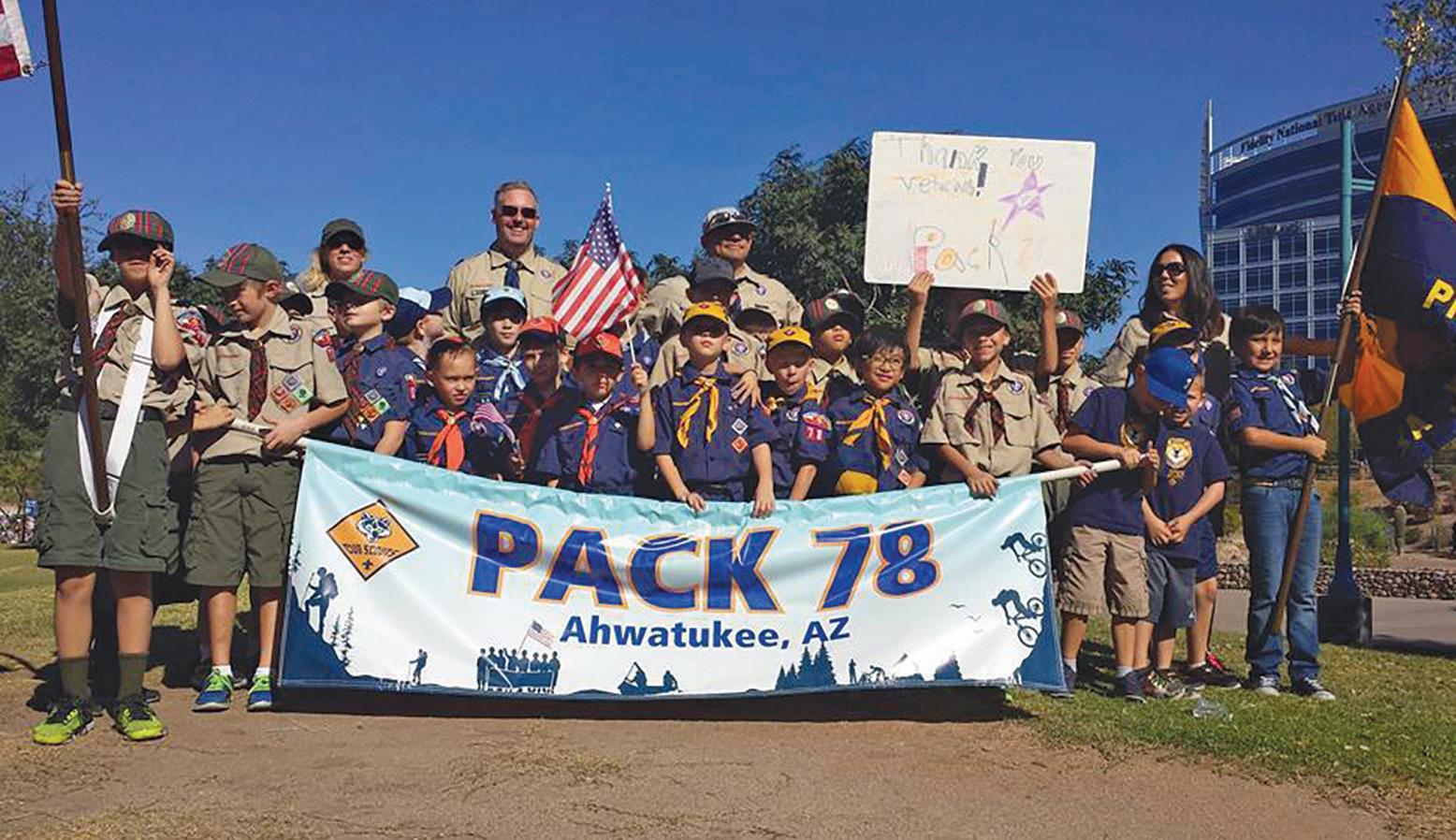
Cub Scout Pack 78, which meets at Monte Vista Elementary School in Ahwatukee, is recruiting boys in kindergarten through fifth grade and is holding a meeting for interested boys and their parents at 6:30 p.m. Aug. 14 in the school’s multipurpose room. Information: BSAPack78.org or facebook.com/ AhwatukeePack78. Registration is not required at the meeting.
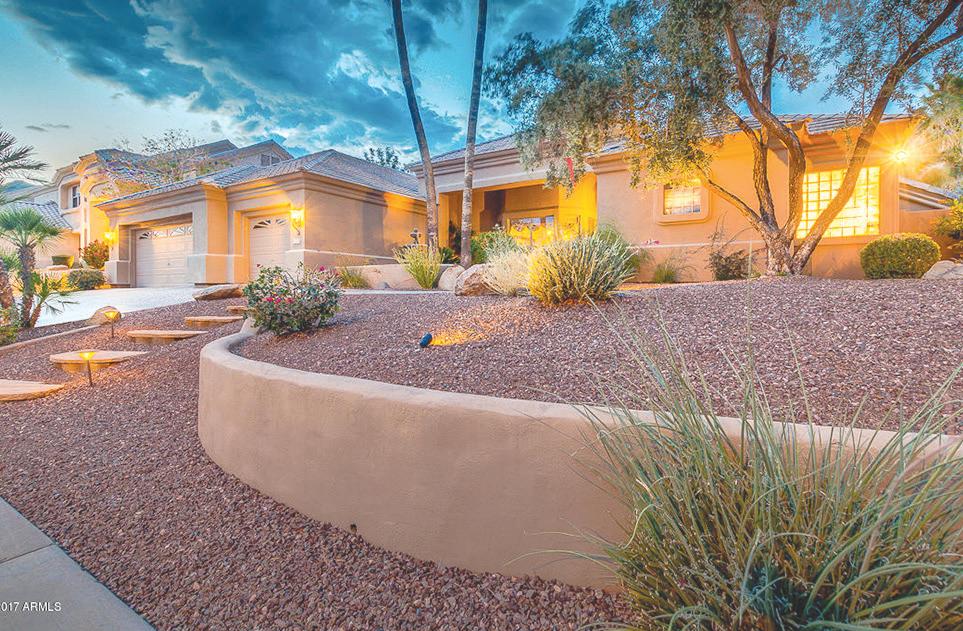
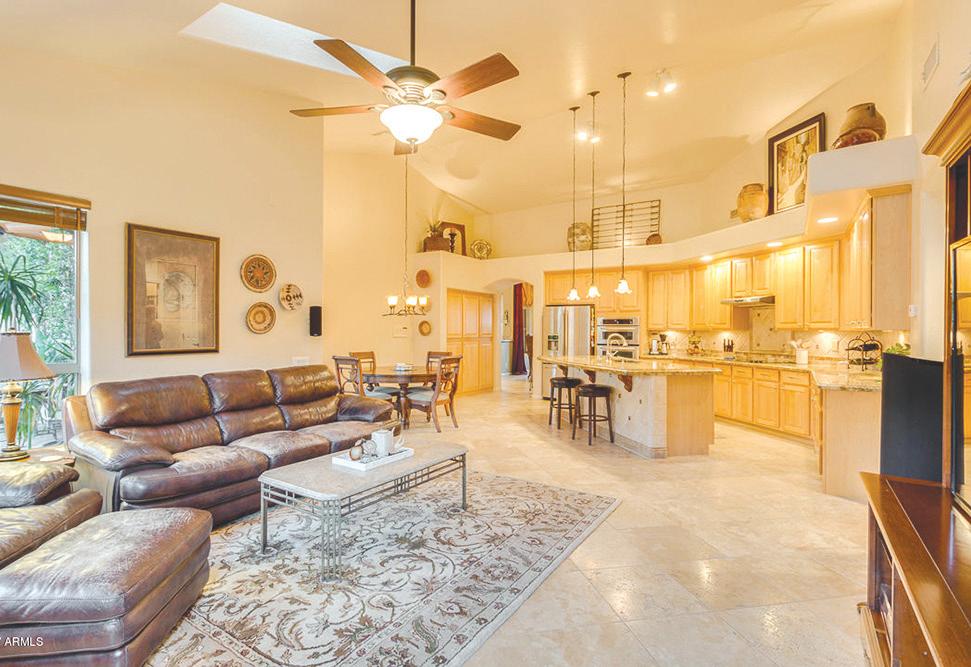
$439,900 Central Corridor Beauty! This home offers the best commodity you can have....PRIVACY! Located on a quiet cul-de-sac, it offers: Granite counters in kitchen & baths**S/S appliances**Upgraded maple cabinets** Recessed lighting**Wood
$720,000
***FINE FINISHES***Spectacular kitchen with slab granite counters and tumbled travertine back splashes. 42-inch cherry cabinets, pot drawers, double pantry and crown moldings. Appliances are stainless steel. Cherry and granite is continued through the sumptuous baths. Romantic claw foot tub in master with separate shower. Closet organizers. Gorgeous travertine in all the right places. Gleaming hard wood in living room area. New carpet 2017. Beautiful open plan with white shutters and french exits. Escape to the pristine pebble tech pool and lush landscaped yard with block fence. Great privacy with established pecan, lemon, grapefruit, tangelo, lime, date palm and pomegranate trees. Over sized garage with cabinets. Excellent North Central location and sought after Madison schools.
Tempe Union board opts to look within for new superintendent
The Tempe Union High School Governing Board has opted to find a new superintendent from within the district’s ranks.
The board last week unanimously voted to look in-house rather than spend upward of $50,000 to find a replacement for Superintendent Kenneth Baca, who is leaving after the 2017-18 school year.
Baca, who has been leading the district since 2011, submitted his resignation last month but gave no reason for his decision to leave June 30, except to say it was time to move on.
During last week’s meeting, board members discussed four options for picking a superintendent, including two using search firms, looking within the district’s ranks and holding a community forum to get public input.
“I think we can find one here at our district on our own,” said board member Brandon Schmoll, the only Ahwatukee resident on the panel. “I don’t know it would be that hard of a search to find a good qualified candidate who meets our requirements.”
Added Michelle Helm: “No cost, smooth transition, time here to work with Dr. Baca through the school year to adjust and take over. I just don’t see any negatives.”
Schmoll indicated that some board members may already be eyeing a candidate, although all five will have a chance to name administrators they like and bring them in for closed-door interviews.
Several board members said it would be a waste of tax dollars and appIicants’ time to hire an executive search firm when there were likely superintendent candidates already working for Tempe Union.
But Baca cautioned the board that it needs to vet any candidate to make sure he or she holds a state certificate qualifying them to be a district superintendent.
“The advantage of looking inside is you know the strengths, you know the weaknesses, you know they know Tempe Union and to me that’s a big plus,” said board member Sandy Lowe.
Board member Bernadette Hodge said she thought “we should open it up to anybody in the community” and that “I
want to hear the community’s point of view on it.”
But Lowe said it was important that the board not inadvertently mislead the public by indiscriminately seeking input that it had no intention of taking into consideration.
“I’m not sure when to involve the community,” Lowe said. “I want to be very honest and transparent when we do that.”
Noting she has been approached informally by people at the supermarket and other places in the district about their ideas for Baca’s successor, Helm added, “I think we’re getting community input right now.”
Baca made it clear that he had no dog in the hunt.
“This is one where, folks, you’re on your own,” he told the board.
Board members indicated that despite their preference to both post the position within the ranks and approach specific Tempe Union administrators, reaching out to someone outside the district ultimately could occur.
But more than one member also pointed out that Tempe Union had a number of potentially strong candidates to succeed Baca.
AFN file photo)
Tempe Union Superintndent Kenneth Baca is leaving the district at the end of next June.
Foothills
New state laws today affect cell phones, education and guns
BY HOWARD FISCHER Capitol Media Services
Got one of those plastic covers on your license plate to thwart photo radar?
Get out your screwdriver. As of today, Aug. 9, they’re going to be illegal.
Foothills Club West
It’s one of several hundred new laws that kicked in today, the fruits of this year’s 122-day legislative session. Others range from expanding who can teach in Arizona classrooms and when police need warrants to track cell phones to exactly how much of someone’s foot a podiatrist can amputate.
For the record, it’s a toe – but not the whole foot.
There also are some odd new statutes, including one that specifically allows counties to put up signs that say, “Enter or proceed with caution. Use at your own risk. This surface is not maintained by the county.”
Ahwatukee Custom Estates
Many of the changes, however, will not take effect yet.
Legislation to bar the state’s newest drivers from using cell phones does not take effect until next July 1.
And a bill to set up procedures for people to argue about what they are charged by out-of-network hospitals does not become law until Jan. 1, 2019.
The measure on license plates culminates years of efforts by Sen. Steve Farley, D-Tucson.
But Farley did not present SB 1073 as a method of helping police catch more speeding motorists with photo radar, a technology that has proven unpopular with many lawmakers.
Instead, he sold it as a law-and-order measure, saying that bad guys will get away because police officers and witnesses to crimes won’t be able to read the license plate of a vehicle.
The new laws, in general, fall into several areas.
Law and order
Legislators voted to curb the ability of police and prosecutors to seize property, requiring they prove by “clear and convincing evidence’’ that the items they want to confiscate were involved in criminal activity.
The change is important because police and prosecutors can seize property without ever charging the owner with a crime, much less getting a conviction.
Other new laws include:
• Requiring police to get warrants when tracking the location of cell phones.
• Expanding the definition of “terrorism’’ to include acts intended to coerce civilians and “further the goals, desires, aims, public pronouncements, manifestos or political objectives of any terrorist organization.’’
• Allowing for an enhanced sentence for a convicted criminal who acted because his victim was a peace officer, whether or not that officer was on duty.
• Allowing community notification of registered sex offenders to be done electronically
• Barring state and local governments from mandating that anyone who sells property from requiring a background check on the buyer.
Education
Lawmakers adopted several measures that could have sweeping impact.
One of the biggest would expand eligibility for who can get a voucher of public funds to attend private or parochial schools.
Started in 2011, what are formally known as “education scholarship accounts’’ were designed for students with special needs. But proponents have incrementally expanded it to where it now also includes foster children, reservation residents and children attending schools rated D and F. Whether it becomes law, however, is another question.
Foes had until close of business Tuesday, Aug. 8, to submit at least 75,321 valid signatures on referendum petitions. If successful, the law remains on “hold’’ until November 2018 when voters get the last word on whether to ratify or veto the change.
Other education bills include:
• Easing requirements for people from other states to be able to teach in Arizona and allowing local school districts to decide who to certify as teachers through a “classroom-based preparation program.’’
• Imposing new requirements on school districts to make new high school textbooks available for public review for at least 60 days.
• Allowing children at public schools
and children’s camp to use sunscreen with a note or prescription from a doctor.
• Requiring schools to report on suspensions and expulsions involving illegal substances.
Health and welfare
Lawmakers agreed to restore the two-year lifetime limit on Temporary Assistance for Needy Families that the state had previously cut in half. But they added some new restrictions that will prevent everyone from being eligible for that second year.
Lawmakers also approved:
• Repealing a requirement for fingerprints for welfare and food stamp recipients after it was determined the cost to administer it exceeded any fraud that was prevented.
• Requiring the Department of Economic Security to post information online about those who have not made child-support payments in at least 12 months.
• Permitting judges to create exemptions from laws which suspend the driver’s license of those who are in arrears on child support, a move
designed to ensure they keep their jobs and can start making payments.
Odds and ends
• Imposing new requirement for meetings and voting by homeowners’ associations
• Exempting those who break into a locked vehicle to rescue a child or pet in imminent danger from civil liability.
• Putting new limits on who can file lawsuits over issues of disability access.
• Repealing limits on how much landlords can pay in “finder fees’’ to those who locate prospective tenants.
• Enacting new regulations on intrastate movers, including prohibition against refusing to deliver goods if the customers pays the price agreed upon before the move.
• Imposing new limits on the ability of counties to regulate home-based businesses regarding things like traffic, parking and delivery.
• Increasing the number of licenses to sell beer and wine.
(Special to AFN)
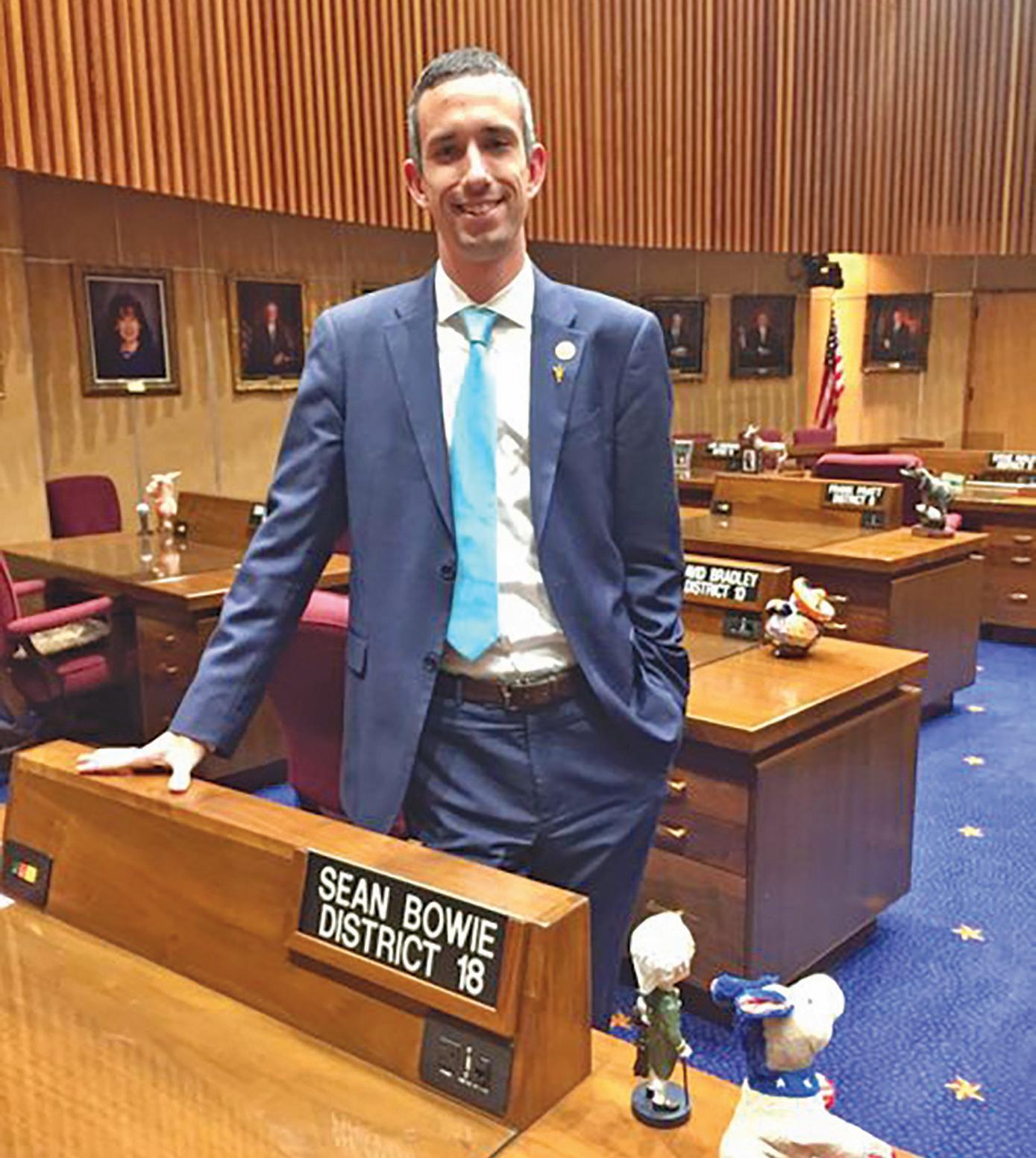
State Sen. Sean Bowie, a Democrat from Ahwatukee, helped craft some of the new state laws that took effect today as he spent his first session in the Legislature.
Fixed problem immediately. great personality. What else could you want? Also arrived on time- amazing!
~ Marvin K.
Courteous and
Great
~ Lisa T.
~ Mike F.
School voucher foes claim victory in first stage of their battle
BY HOWARD FISCHER Capitol Media Services
Foes of expanded school vouchers submitted on July 8 the signatures necessary to force a public vote on the plan, but lawmakers could move to undermine the referendum.
Members of Save Our Schools said they have more than 100,000 signatures on petitions to block the new law from taking effect as scheduled today, Aug. 9.
If the Secretary of State’s Office finds 75,321 of these are valid, the changes remain on “hold’’ until the 2018 general election, when voters would decide whether to ratify or veto what the Republicancontrolled Legislature approved.
It might not get that far.
Voucher supporters already are weighting litigation to keep the measure off the ballot.
But the more serious threat could come from the Legislature itself.
The petitions seek to refer SB 1431 to the ballot.
That law scraps the requirement that students seeking a voucher of taxpayer money to attend private or parochial schools must meet certain requirements,
like having a disability, being a foster child, living on a reservation or attending a school rated D or F. Instead, it would allow any student to qualify, though the measure has a cap of 30,000.
But the Legislature is free to repeal SB 1431 and immediately re-enact it, perhaps with only some minor changes, making the petition drive legally moot. And foes of vouchers, formally known as Empowerment Scholarship Accounts, would have to start over again from scratch to demand a public vote.
Lawmakers have done that before.
In 2013, opponents of HB 2305 gathered more than 144,000 signatures to force a referendum on a series of changes in election laws that opponents said were designed to depress voter turnout and place roadblocks in the path of those who want to propose their own laws, things like limiting who can take someone’s early ballot to a polling place and imposing stricter requirements on citizen groups who are sponsoring initiatives.
More than 110,000 were declared valid, far more than legally required, to force the issue to the ballot.
The next year, legislators repealed the law, quashing the initiative.
But that was not the end of it. Since that time, lawmakers have re-enacted virtually all of the same provisions, breaking them into separate bills in a way to make it difficult to refer all of them to the ballot.
A repeat performance is clearly on the minds of voucher supporters, starting with Sen. Debbie Lesko, R-Peoria, who has been the prime proponent.
“All options are on the table,’’ she told Capitol Media Services during the signature gathering process when asked about a repeal-and-replace scenario.
And Kim Martinez, spokeswoman for the American Federation for Children, which has pushed for vouchers here and elsewhere, also will not take off the table the option of getting lawmakers to undermine the referendum campaign.
“We’re not at a point where we want to talk strategy,’’ she said Monday.
House Majority Leader John Allen acknowledged that tweaking the law to kill the referendum is an option. But the Scottsdale Republican doesn’t think it’s a good idea politically.
“We would be spending political capital on a circumstance on which we can win straight out,’’ he said.
Allen, who voted for the voucher
expansion, said the risk is that voters may get fed up with lawmakers doing end runs around voter proposals and could take away that right.
In fact, he noted, that’s exactly what happened after lawmakers repealed the state’s first medical marijuana act approved at the ballot in 1996. The result was the 1998 approval of the Voter Protection Act, which constitutionally bars the Legislature from repealing or sharply altering anything that voters have enacted.
The first question is whether the secretary of state determines there are enough valid signatures.
Martinez noted that Save Our Schools relied largely on volunteers who, unlike paid circulators, may have gathered names of people who are not registered to vote or filled out the forms improperly. It is not unusual for these kinds of petition drives to have an invalidity rate of 25 percent or more.
Martinez said that even with voucher foes claiming to have more than 100,000 signatures, the petition drive could still come up short after the review process. And what signatures election officials do not invalidate, her organization is preparing to go to court to eliminate.
BLASTING
filing thousands of pages of briefs, exhibits and legal arguments months ago, the Ninth Circuit only last week set the date for oral arguments.
PARC attorney and Club West resident Howard Shanker said both sides will each have 20 minutes to speak. That time could go longer if the judges have questions.
The $1.7 billion freeway – the state’s most expensive highway project in history – will run 22 miles between the I-10/59th Avenue interchange in West Phoenix and the Chandler/I-10 interchange.
It will provide a bypass for an estimated 140,000 vehicles a day – half of them trucks – around the heavily congested Broadway Curve and downtown Phoenix.
It will eliminate Pecos Road and require next year blasting a 200-footwide path across three South Mountain peaks.
But the blasting that is targeted by last week’s injunction request is more immediate – and closer to home for scores of Ahwatukee residents near the freeway’s path.
The Arizona Department of Transportation announced recently that blasting will be needed after all to break down rock in areas west of 24th Street and beyond Desert Foothills Parkway.
Although ADOT’s announcement did not give a timeline for the blasting, spokesman Dustin Krugel said, “Best guess right now is mid-August.”
In their injunction request, PARC and the Gila River Community alleged construction already has left a trail of devastation in the Ahwatukee sector of the freeway.
“Prior to the clearing, grading and construction undertaken by defendants, Pecos Road was bordered by desert
flora and largely pristine vistas,” the injunction request states. “Much of this flora has already been destroyed and fauna has been displaced.”
“The initiation of blasting, continued clearing, grading and construction creates further irreparable harm to plaintiffs and the environment,” it also contends.
Besides preventing the blasting, opponents also are trying to stall further bridge construction pending a ruling on their appeal.
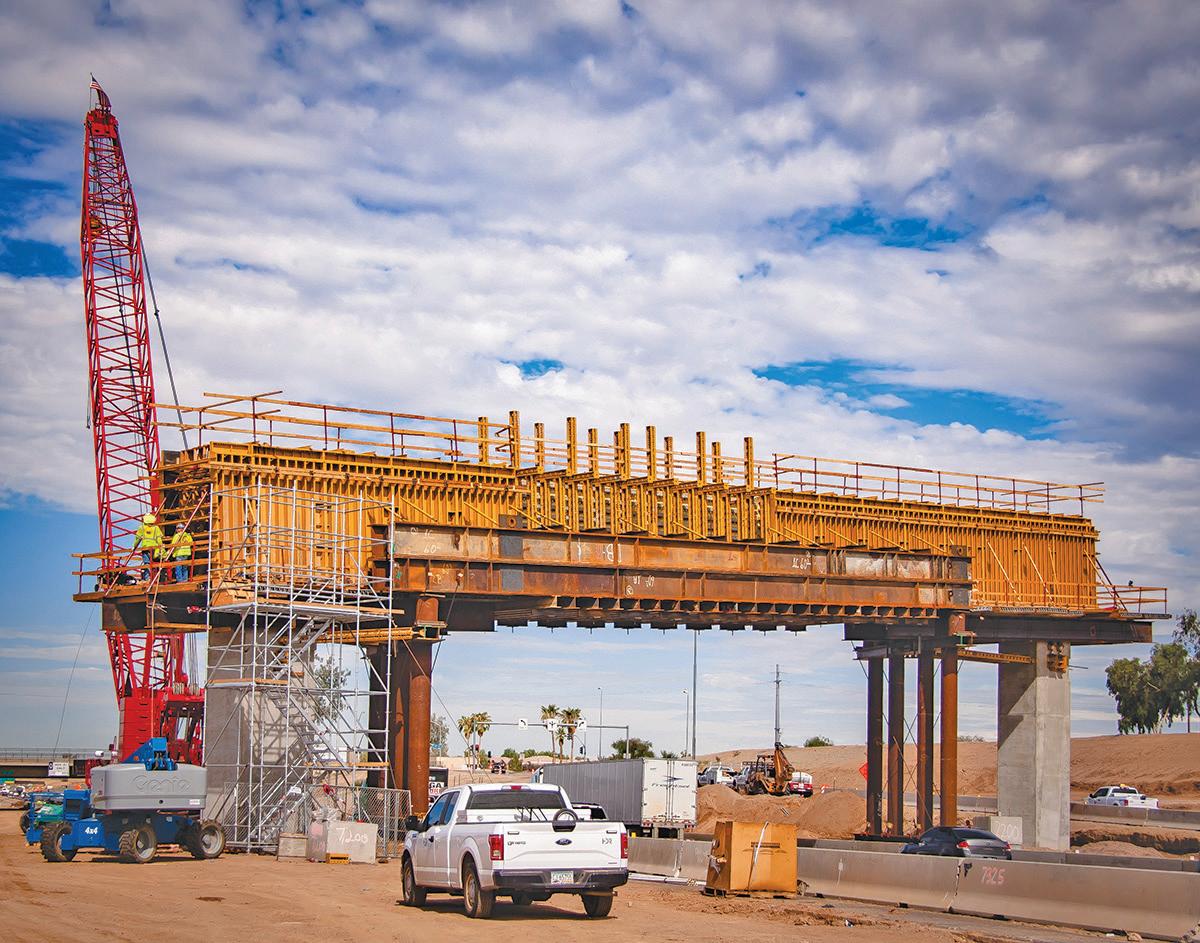
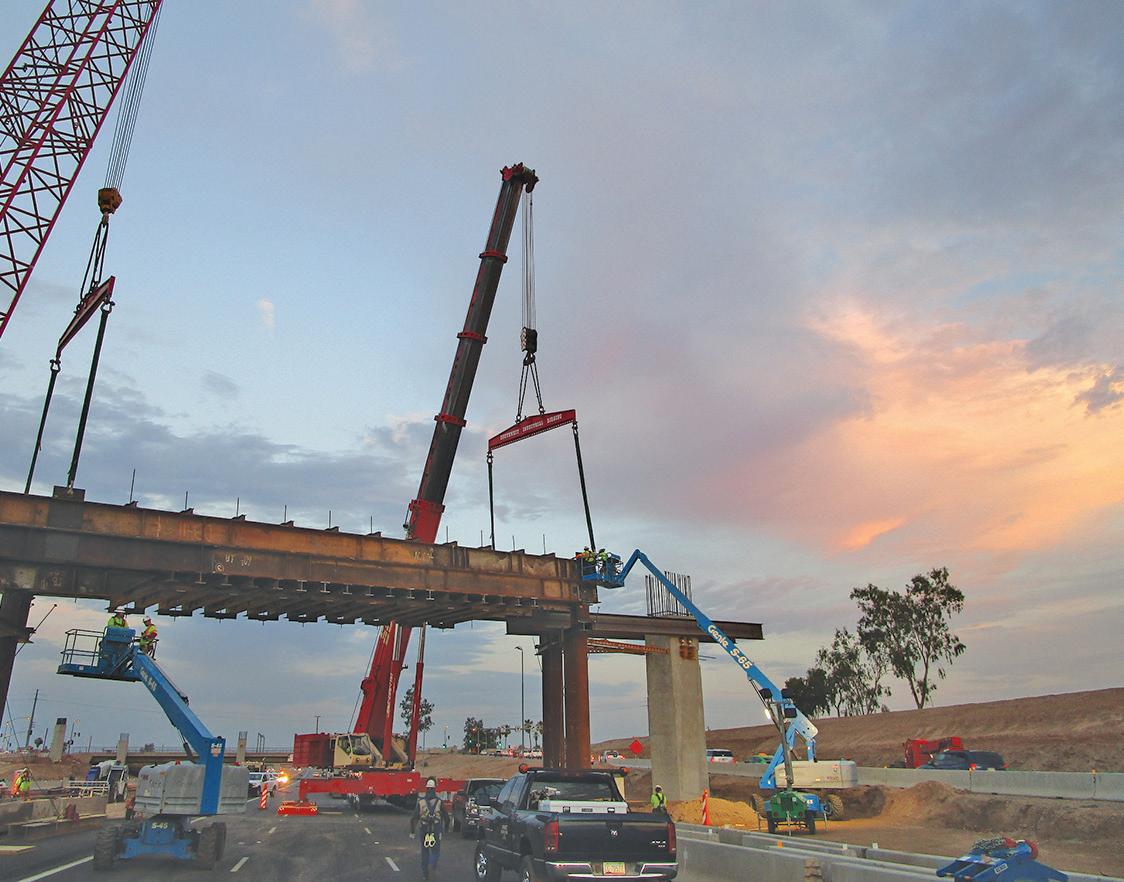
ADOT is preparing to pour concrete sometime later this month on the framework for the bridge span at 17th Avenue sometime this month and are working on a second bridge span at 40th Street. That work will likely be done at night to avoid the excessive daytime heat.
The highway agency several weeks ago suggested work is proceeding even faster than anticipated, although the target date for opening the freeway remains late 2019.
The injunction request takes note of that and implores the appeals court to slow down the work, if not stop it altogether, because of the widespread impact on the community.
“The construction-related activities are also irreparably harming plaintiffs members’ recreational and aesthetic interests, including but not limited to their interests in the naturally functioning ecosystems of the area, hiking, cycling and viewing wildlife and nature,” it states, adding:
“Defendants have spent, and continue to spend, millions of dollars on the construction of this Freeway and to
commit vast amounts of public and private resources to race to completion – notwithstanding that the agency decision is on appeal. This ‘bureaucratic steamroller’ is considered irreparable harm.”
The lengthy request reviews the opponents’ long-standing bases for their contention that freeway planners performed inadequate environmental studies and ran roughshod over Native Americans’ concerns for South Mountain, which they consider a sacred site.
“Many studies have now shown that people who live, work, or attend school near major roads have an increased incidence and severity of health problems that may be related to air pollution from roadway traffic,” it states, adding:
“Reviews of the literature have concluded that near-roadway traffic emissions may not only trigger and exacerbate asthma symptoms, but also contribute to the development of asthma in children.”
Noting 17 schools are within a halfmile of the freeway, in addition to hundreds of residents on both the Ahwatukee side of the thoroughfare and in the Gila River Community, the request states:
“The public has an interest in ensuring that proper scrutiny and analysis is provided by the government before an irreparable commitment of public lands/resources is made.”
ADOT last month said that crews have been using heavy equipment since April to break down rock and that “this method has been effective thus far.”
However, it said freeway developer Connect 202 Partners “anticipates that controlled rock blasting will be necessary in some locations.”
“Controlled rock blasting uses small
(Arizona Department of Transportation)
BLASTING
from page 16
amounts of timed charges to break rock into smaller, more manageable pieces,” ADOT stated.
It called such blasting “a standard construction technique used in many areas of the nation for many years without damage to property.”
ADOT said Connect 202 Partners “will ensure that ground vibrations” from the blasts will use “modern techniques” and “comply with local and federal safety and ground vibration standards.”
Those standards exist to avoid impacting nearby homes and other structures.
“Any blasting activities will be in accordance with industry best practices using only proven and safe methods,” ADOT added.
“Controlled rock blasting has been used to shape essential roadways throughout the world, including the initial construction of Pecos Road previously,” said Rob Samour, ADOT’s senior deputy state engineer for major projects.
“Connect 202 Partners has hired an experienced team, including a blasting engineer, blasting consultant and vibration monitoring expert with close to 100 years of combined blasting
experience in Arizona and across the United States,” he also said.
ADOT said the blasting “will not result in any damage to nearby structures,” although the freeway developer had offered to residents within a half-mile of the area a free inspection to document the condition of their homes in case of structural damage claims.
The blasting in Ahwatukee could go on for as long as a year, several times a week and at different locations.
In the injunction request, Lawlis states, “If the pouring of concrete and other elements of bridge construction are allowed to continue, it will result in irreparable harm to the environment.”
“There is also ongoing harm/ destruction not related to blasting or bridge construction, to flora and fauna in the right of way that is resulting in irreparable environmental harm – much of which could have been averted if the injunction we sought at the onset of the appeal would have been granted.”
Some Pecos Road trees have died since freeway-related removal
AFN News Staff
Some of the trees that crews uprooted for the South Mountain Freeway didn’t make it after all.
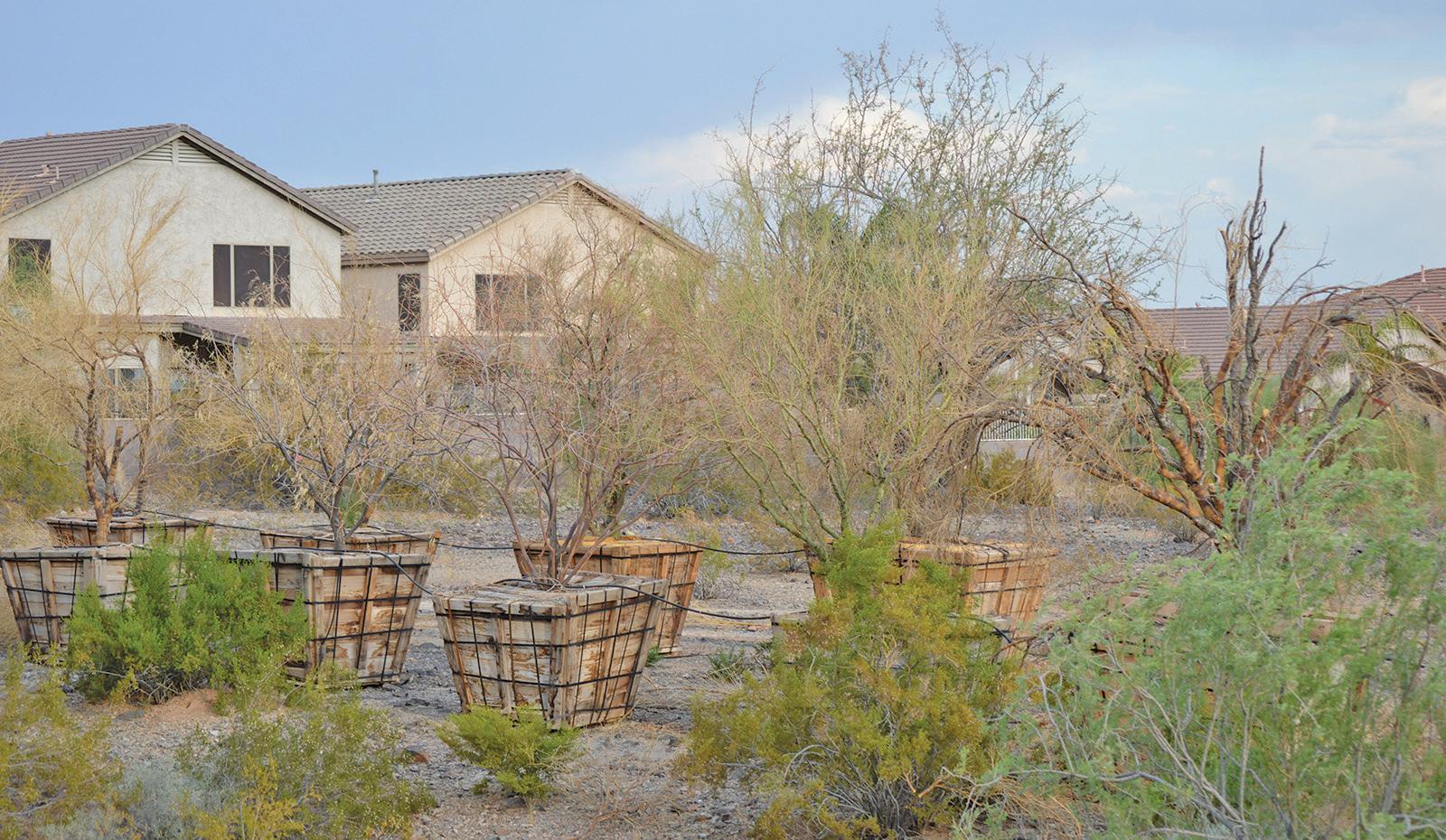
Foothills Reserve resident Dietmar Hanke said he recently saw as many as 20 wither, die and eventually be removed from the eastern end of the new Chandler Boulevard Extension following a monsoon downpour July 23.
“A pile of boards from the boxes lies at the western end of where the row was,” Hanke said. “No one seems to notice the drip system isn’t working for the uprooted trees.”
“Either the crew that gouged them out of the ground had absolutely no idea what they were doing or there was no water in the system,” he added. “The water lines were visible.
“Trees need a lot of water after they’re uprooted to help them heal and recover. Even after transplanting, they need a revegetation supply of water for about a half a year.”
The Arizona Department of Transportation last fall removed about
trees were removed.
800 trees, cacti and plants along Pecos Road because they were in the freeway’s path.
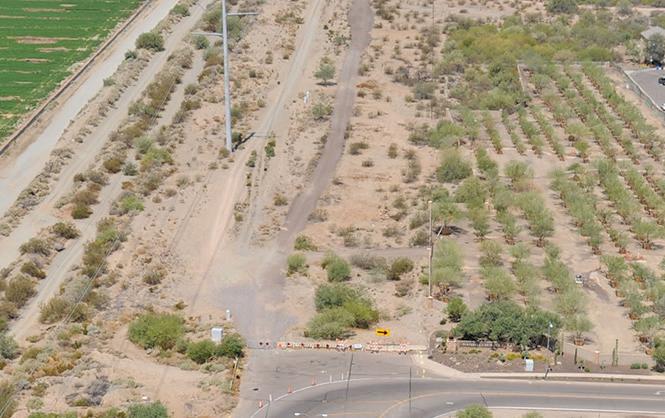
They have been stored in a makeshift nursery nearby for replanting once the freeway is built.
Told of Hanke’s observations, ADOT spokesman Dustin Krugel said, “Special
care has been taken to keep the plants alive in the temporary nursery, including installing an irrigation watering system, along with bi-weekly inspections.”
He also said crews have been providing “additional watering and maintenance” during the hot summer months.
Krugel conceded that while “most of
the salvaged trees, including palo verde, mesquite and ironwoods, are performing quite well… a limited number of trees have been removed due to either stress, such as excessive heat or disease, since the nursery site was created.
“It is typical to lose some trees as part of the plant salvage process,” he added.
(Arizona Department of Transportation)
Crews install a so-called straddlebent near the West Valley end of the South Mountain Parkway to enable ramps to cross over I-10 from the new highway.
(Dietmar Hanke/Special to AFN)
Foothills Reserve resident Dietmar Hanke photographed these dying trees that were transplanted temporarily from the path of the freeway. Following a downpour July 23, he said, the
(Arizona Department of Transportation)
This aerial photograph shows the makeshift nursery that crews made for trees transplanted from Pecos Road in the path of the South Mountain Freeway until they’re moved back near the freeway after it opens.
I BUY HOMES FOR CASH!
LAND
from page 1
“We wouldn’t be doing this if we weren’t getting top dollar for the community,” said board President DeeAnne McClenahan.
Although several dozen initial bids were submitted, Desert Vista 100 had taken the lead within a matter of weeks. Tempe Union officials had asked the developer to raise its offer to match one from an unidentified buyer.
Voters last fall overwhelmingly approved a ballot measure that authorized the district to sell the land.
Virtually all the wrangling with Desert Vista 100 and other bidders occurred behind closed doors. Districts are allowed to convene executive sessions when land transactions are involved.
Despite the board vote, it will be a while before the district sees the money and residents near the site meet new neighbors.
Although the full terms of the sale agreement have not been disclosed, the resolution approved by the board makes the deal final once the developer gets final approval from the city for whatever residential plan it comes up with.
A site plan has yet to be submitted to the city for review, which will include at least one hearing before the Ahwatukee Foothills Village Planning Committee.
State law also restricts how the money can be used – a fact that Superintendent
Kenneth Baca reminded the board after its vote.
“While we would like this money to go into the classroom – especially for teacher compensation and employee compensation – by state statute it has to go to capital purposes or paying off debt as the result of bonds,” Baca said, adding:
“Those are decisions you will make down the road.”
The land was purchased long before the current board and administration took office and had initially been eyed as the site of a third high school in Ahwatukee.
Subsequent population projections indicated another school would be unnecessary.
When officials were mulling a possible sale, their consultant, Ryan Duncan of Nathan and Associates called it “a highly coveted site by the development community.”
But he also cautioned that the site’s topography had challenges and that might affect how high the bidding would go.
Although Duncan indicated the site could see as many as 178 homes, the zoning theoretically could allow for more than 400.
But that does not account for the land that would be used for streets, walks, oversized lots and amenities.
And Desert Vista 100, a company
(Special to AFN)
Even before houses were built, signs like this generated huge interest in the Mulberry neighborhood in Mesa that was developed by the same homebuilder that locked up a 63-acre site in Ahwatukee owner by the Tempe Union High School District.
LAND
from page 18
Blandford formed in late 2013, is already winning plaudits for a 350-home planned residential development it has developed near the intersection of Guadalupe and Signal Butte roads in east Mesa.
Called Mulberry, the development boasts “millions of extra dollars spent to create real resort-quality entries, date palm boulevards like none other, carriage houses, specialty street lighting, lush landscaping, unique theme walls and meaningful amenities.”
Among the landscaping amenities are 150 16-foot date palm trees that line the main streets and two gateways to the development.
“It is the neighborhood EVERYONE falls in love with,” Mulberry’s website states. “It feels like an enchanted land –magically reminiscent of the early 1900s, when homes sprung up to create quaint neighborhoods.”
It offers six sets each of single-level and two-story floor plans ranging between 1,700 and 4,000 square feet and priced from $200,000 to mid-$300,000. Corner-lot homes feature wraparound porches.
Besides a Georgian Colonial-style clubhouse complete with white-and-
Arizona’s state universities aiming to increase grad rates
BY ALEXIS KUHBANDER Cronkite News
Arizona universities are working to drive up Arizona college graduation rates, smoothing the way for students transferring from community college, offering financial aid and adding online classes to draw non-traditional students.
year universities across the U.S. The programs map specific courses students need to complete at community colleges to successfully transfer to fouryear colleges as juniors.
green shutters, the development offers homeowners exclusive use of seven parks, sport courts, playgrounds, a pool, fitness and multipurpose rooms, party terrace and huge great lawn area.
A “lifestyle director” organizes community events and activities, including “All-American picnics,” a pancake breakfast with Santa, crafty workshops, food drives, “Mulberry Monster Mash” and a “Kris Kringle Party.”
While the development is located within about a mile of a bustling and relatively new complex of shops and even an IMAX Theater, developers also built “Mulberry Marketplace” within the community.
Anchoring that strip mall is a Fry’s Supermarket that has expanded organic products, added the chain’s first fullservice sushi station and even sells namebrand clothing and shoes. Additionally, customers can phone in their orders and pick them up curbside.
Its neighbors include a seven-day-aweek medical clinic, a wine bar that also serves craft beers, and an international cheese shop.
To top it off, every home gets a pair of “Mulberry Cruisers,” custom-made bicycles branded with the development’s name and blue-and-green colors.
Less than one out of three students in Arizona in 2013 earned a four-year degree in six years or less, according to a 2015 report by the U.S. Department of Education. The Arizona Board of Regents, which oversees the state’s three public universities, said in a 2015 statement their combined graduation rates were 59.8 percent in 2015-16, nearly five percent higher than the national average.
The regents hope to increase grad rates to 65.6 percent by 2020.
The community college district develops “pathway” programs to make it easier for students to transfer to 50 four-
The Arizona Board of Regents is asking the state’s public universities to increase the number of bachelor’s degrees presented to community college transfer students, according to public documents provided by the regents.
Transfer students were awarded more than 7,500 bachelor’s degrees in 201516 academic year, just short of the 7,770 goal the regents set, documents show.
The board estimates community college transfer students will earn nearly 7,850 bachelor’s degrees for the 201617 academic year and about 9,550 undergraduate transfer students will get their degrees in 2025.
The state’s three public universities awarded more than 27,400 bachelor’s degrees in 2015-16, surpassing the board’s goal of 27,281, according to data the Board of Regents has collected.
(Special to AFN)
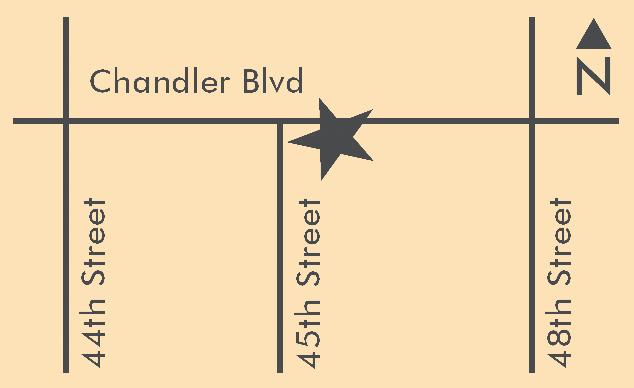
This map shows the location of the 63-acre parcel being sold by Tempe Union officials.
BY GARY NELSON
AFN Contributor
Back in 2001, life was discovered in Arizona outside the city limits of Phoenix.
Fannie Mae, a federally backed mortgage corporation, made headlines that year when it coined the term “boomburb” to describe large and growing communities where much of this life existed.
“Incredibly,” one report said at the time, “some of the boomburbs described by Fannie Mae are so large they exceed the population of actual cities.”
Mesa was listed as the prime example, already boasting a population larger than that of Minneapolis, Miami, St. Louis, Pittsburgh or Cincinnati.
Even then, one suspects, Mesa would have chafed at being described as something other than a real city. Likewise Tempe, Gilbert and Chandler, which also made the “boomburb” list.
But if the semi-derogatory term was at all true as the century dawned, the East Valley’s four major municipalities have been working overtime to make sure it no longer applies.
Part of that – the part about no longer being known simply for breakneck population growth – is taking care of itself naturally as cities use up their available
land and approach buildout.
The other part – the part about becoming a self-sustaining community with an identity and a sense of place –results from a willingness to stick with long-term visions and plans.
That is not to say growth is over. It isn’t, not by a long shot.
But it will be slower than in the past, and some recent population projections have been toned down in the wake of the Great Recession.
The Maricopa Association of Governments, which oversees planning for the metro area, said in its latest projections that the recession put a 10year dent in the Valley’s expected growth. Previously, MAG expected the Valley’s population to hit 6.1 million by 2030; that number now is not expected until 2040.
For the East Valley specifically, MAG sees a little less clout in the future. In 2015, the area held 34 percent of the region’s population. As growth accelerates elsewhere and slows on the east side, that share is expected to slip to less than 27 percent by 2050.
The East Valley’s share of metro-area jobs also is expected to slip, from 41 percent in 2015 to 35.5 percent in 2050.
MAG projections do show every East Valley city steadily gaining population over the next three decades. But gone are the days when a city could double or even triple its population in the span of a decade.
Surprisingly, the East Valley’s two oldest cities – Tempe and Mesa – are expected to show the biggest growth in terms of both raw numbers and percentages.
Tempe, which is landlocked and already the Valley’s most urbanized city, may add another 89,500 people by 2050, a 52 percent jump over its 2015 population. How? By growing up, not out.
Mayor Mark Mitchell said it’s no accident that the gleaming waterfront skyline along Tempe Town Lake symbolizes his city’s maturation.
The idea for Tempe Town Lake was born 40 years ago in an Arizona State University architectural classroom, Mitchell said. It matured to the point that a greenbelt along the entire Salt River bed from Mesa into Phoenix was proposed to Maricopa County voters in 1987.
Countywide, the proposal lost. But Tempe voters backed it, which encouraged city leaders to pursue a more local project. Town Lake opened in 1999.
Since then, its once-barren banks have spawned a dazzling array of midrise office and mixed-use complexes.
“As a kid, when I went down there, it was a dumping ground, a landfill,” Mitchell said. “To see it turn around – there’s over 40,000 residents that work in and around the lake. There’s over $1.4 billion in investment in and around the lake.”
Tempe’s vertical transformation extends south from the waterfront to the light-rail line, with construction cranes sprouting like weeds after a spring rain.
Mitchell said Tempe’s urbanization is no accident.
“Because we are landlocked, as we grow our city is becoming more and more densely populated,” he said. That is happening even in more suburban parts of town, one example being an apartment complex now rising on the site of a former shopping center on the north side of Baseline Road between McClintock and Rural roads.
Mesa’s planning director, John Wesley, agrees with MAG’s prediction that Mesa’s 2050 population will be about 600,000 –a 33 percent jump from 2015.
That growth could take several forms, Wesley said. One is vertical, most especially along transit corridors. Another will be infill, as developers use up the city’s vacant land.
And another, he said, could be annexation, possibly into Pinal County.
Mesa is not actively looking at
(Gary Nelson/AFN Contributor)
A large residential complex at University Drive and Myrtle typifies construction now under way in much of downtown Tempe.
such annexation, Wesley said. But it’s possible that future developers of the Superstition Vistas state trust land could request annexation to facilitate building infrastructure.
Mesa’s buildout population could go up, Wesley said, if resources permit.
“I guess with enough money and assuming there is enough water, there really isn’t an upper limit,” he said. But he said one possible limit to vertical growth is Mesa’s water system, designed with pressures to serve horizontal development rather than towering skyscrapers.
Wesley’s current focus is reflected in the latest iteration of Mesa’s general plan, approved by voters in 2014. As he and his staff worked on the plan, Wesley told the City Council a major aim would be “sprawl repair,” mitigating the worst effects of past decades’ pell-mell, automobilecentric development patterns.
That does not mean every part of town will look the same, nor will redevelopment sweep away all of the city’s suburban neighborhoods and mobile-home parks.
“I would hope that we can continue to find things that tie us together as a community and give some overall identity and sense of place,” Wesley said. “But we will also have our unique areas that we want to be maintained.”
Chandler and Gilbert both expect buildout populations of about 300,000, but Chandler should get there a lot quicker.
David de la Torre, Chandler’s principal planner, said that city could reach buildout as soon as 2030. Beyond that, MAG expects slow growth to a 2050 population of about 320,000.
Urbanization also is in Chandler’s future, de la Torre said – especially along transit corridors such as Arizona Avenue.
“Overall,” he said, “the city envisions itself becoming a major urban center within the next few decades.”
But again, that does not mean homogeneity.
Southeast Chandler will likely retain its semi-rural character. West Chandler will develop as an employment corridor. North Chandler will become more dense. And, de la Torre said, future redevelopment must remain compatible with surrounding neighborhoods.
“We don’t expect redevelopment to occur everywhere in the city,” he said, “but certainly in certain areas like downtown and along high-capacity (transit) corridors.”
Planners in Chandler and Gilbert said those cities have no prospects for
annexation other than the numerous county islands within their existing planning areas.
Of all the East Valley cities, Gilbert in 2001 may best have fit Fannie Mae’s “boomburb” label – a town of 110,000 people with not a single hospital or hotel.
The ensuing years have rendered that description obsolete, and modern midrise office buildings along Loop 202 speak to Gilbert’s burgeoning employment opportunities.
Still, most of the town’s 70-plus square miles retain an overwhelmingly, and likely permanent, suburban feel.
Kyle Mieras, Gilbert’s development services director, said construction there is now comparable to pre-recession levels.
MAG expects Gilbert to add 52,500 people to its estimated 2015 population, reaching about 295,000 by 2050.
Mieras said future changes in density and development patterns could push that number upward. But growth will slow, he said, as big parcels fill in and developers are left with more challenging, smaller tracts.
Infill already is occurring, he said, with most of that occurring in the older northwestern part of town.
In the end, what matters to planners in the East Valley is not the labels chosen by Fannie Mae and other outsiders. Nor is it, primarily, a numbers game for their maturing communities.
The overarching goal, said Chandler planner de la Torre, is to “provide a high quality of life.”
Build that, the planners believe, and they will come – just as they have for decades past, for decades into the future.
EV growth by the numbers
A snapshot of projected growth populations in the East Valley: CHANDLER
Estimated 2015 population: 255,100
Projected for 2050: 320,700
Growth percentage: 25.7
GILBERT
Estimated 2015 population: 242,900
Projected for 2050: 295,400
Growth percentage: 21.6
MESA
Estimated 2015 population: 461,000
Projected for 2050: 613,400
Growth percentage: 33
TEMPE
Estimated 2015 population: 172,000
Projected for 2050: 261,500
Growth percentage: 52
Source: Maricopa Association of Governments
Future growth won’t come easy
BY GARY NELSON AFN Contributor
East Valley cities face several challenges as they prepare for continued growth in coming decades.
WATER
Planners in Mesa, Tempe, Chandler and Gilbert all say they have developed robust and diverse water portfolios.
Eric Braun, Gilbert’s water resources manager, said Gilbert has complied with state law proving the town can meet estimated demand for the next 100 years. But he said, “As Gilbert continues to grow, water supply will always be a consideration for balancing growth and cost of service.”
He said Gilbert is promoting conservation as an alternative to developing additional sources, which are becoming more expensive.
REDEVELOPMENT
New uses may be proposed for older parts of the cities, creating conflict with existing neighbors.
David de la Torre, chief planner for Chandler, said, “There are existing lowdensity neighborhoods surrounding those (redevelopment) areas, and we just want to be sure that those are protecting the property values and are compatible with those areas.”
Many likely redevelopment sites in Mesa, Tempe and Gilbert also abut established residential areas.
AFFORDABLE HOUSING
Not everyone can afford the highend apartments and condos that are multiplying in such areas as downtown Tempe.
Melanie Dykstra, community resources program supervisor for Gilbert, said federal programs help.
And, she said, “Gilbert partners with a nonprofit organization to purchase, rehabilitate and rent affordable housing units to income-eligible residents.” In addition, another nonprofit refurbishes homes for low-income residents.
Mesa and Tempe have seen the development of several low-income housing projects along the light rail line, and Chandler planner de la Torre said Chandler will work to retain the more affordable housing that already exists in some older neighborhoods.
CLIMATE CHANGE
A study published this summer in the journal Science said counties in Arizona could lose 10 to 20 percent of their economic activity by the 2080s if present climate trends continue.
Those losses could occur in the form of heat-related deaths, vastly higher energy costs and diminished productivity of outdoor workers, the study said.
On the other hand, some analysts said the study can’t account for possible future changes in technology and society that could mitigate or reverse rising temperatures.
(Gary Nelson/AFN Contributor)
A massive residential complex is under construction on McQueen Road south of Loop 202 in Chandler.
Lomas Elementary students generally were smiling last Thursday, Aug. 3, as they and thousands of other Kyrene School District returned to class after summer break. Starting clockwise from upper right, Lucky Pola-Mao wanted to tell the world he's starting kindergarten while kindergarten teacher D. Wozniak had to give a pep talk to little Annabelle Parady. Willow Tweten was all set to start second grade while third grader Cruz Alvarez was accompanied to school by Lorraine Arredondo and Luis Alvarez. Brielle and Marcus Pina started fifth grade and kindergarten, respectively. Above, Tony Schmidt is flanked by daughter Kya, a fifth grader, and son Drake, who is in fourth grade. And Vincent Woodmansee fearlessly marched off to kindergarten.
PHOTOS
BY
KIMBERLY CARRILLO AFN Photographer
Local artist selected to contribute art for national fundraiser
BY COTY DOLORES MIRANDA
AFN Contributor
When the Kids in Need Foundation approached Treasures 4 Teachers –recently selected to be one of their 40 U.S. National Resource Centers – for an artist to create two fine-art pieces as part of its annual fundraiser, T4T founder Barbara Blalock didn’t hesitate.
She selected Kathie Kelly, an Ahwatukee resident and former high school and Kyrene Elementary Schools art teacher whom she’d known for nearly 10 years.
“I chose Kathie because she’s been a member of Treasures 4 Teachers for years, and her reputation in the artist community is impeccable,” said Blalock, who started the nonprofit a decade ago in her Ahwatukee home. Now it is housed in a 20,000-square-foot facility in Tempe.
“I’ve seen her work, and it is amazing,” Blalock added. “She has a huge heart, and I just knew that she would appreciate being able to give back through her art.”
That giving back melds well with Kelly’s agenda these days, busy as they are.
Formerly an art teacher at the shuttered St. Paul’s Academy in Phoenix, Kelly was Kyrene’s traveling art teacher, serving Cerritos, Ninos and Mirada elementary schools.
She now teaches art at approximately 10 senior living centers throughout the East Valley and Scottsdale, and holds weekly art classes for adults and children in her Ahwatukee home. Kelly also provides professional and fun guidance with her popular group-painting parties.
The two artworks she’s painting for the KINF were to be completed this week.
One of the paintings will be auctioned off Sept. 12 at KINF’s 22nd anniversary gala in Minneapolis, and the other will be auctioned to benefit T4T at a later date.
The Kids in Need Foundation, established in 1995 and headquartered in Dayton, Ohio, distributes needed school supplies to kids who would otherwise go without. This is done through 40 U.S.
(Donna Perry/Special to AFN)
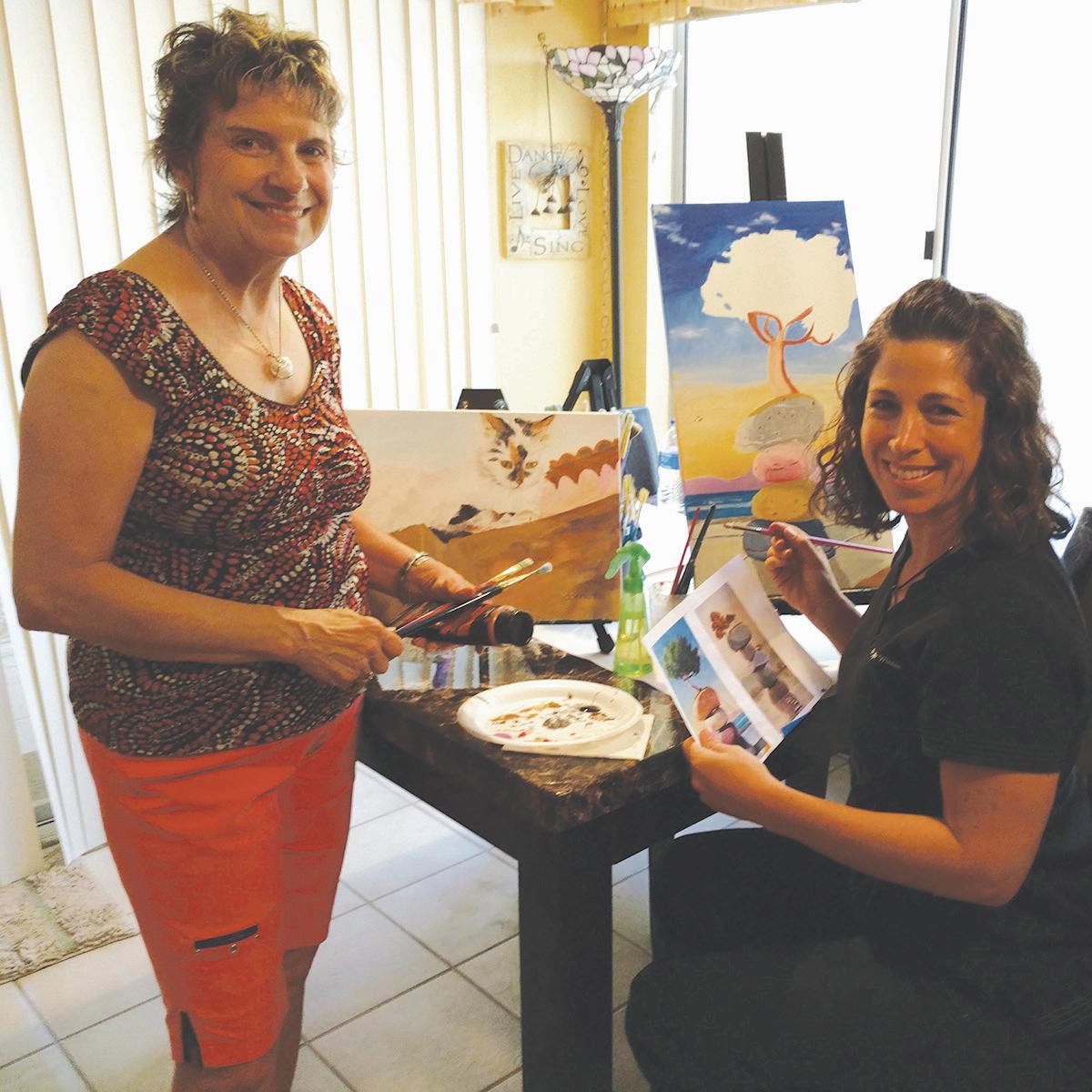
Ahwatukee artist Kathie Kelly, left, works with student Jen Winton in her studio.
Ahwatukee’s oldest Cub Scout pack recruiting local boys
As the new school year gears up, so does recruitment time for local scouting troops.
Ahwatukee Cub Scout Pack 178 is the latest local troop to schedule a recruitment drive for boys in kindergarten through fifth grade. It’s had a lot of experience with the annual recruitment drive: Pack 178 was Ahwtaukee’s first Cub pack, established in 1980.
The pack is holding an open house and ice cream social at 6 p.m. Monday, Aug. 14, for new and returning scouts at Mountain View Lutheran Church, 11022 S. 48th St., Ahwatukee.
While boys can join anytime, pack
leaders say now is the best time to register and avoid missing a full year of activities.
“Cub Scout Pack 178 of Ahwatukee recently completed a multi-day camping trip to the Grand Canyon,” said assistant Cubmaster Joey Boyer, who works with Cubmaster Baron Smith.
“The Pack has also gone to Mukutu’s Island and had a pool party over the summer,” Boyer added. “This year, the Pack will be camping several times in the Payson area and is working on plans for another large summer camp.”
Cub packs are part of the Boy Scouts of America, whose mission “is to help young people build character, learn citizenship, develop personal fitness,
a Lion Pack for boys who are 5 years old by Sept. 30 but under age 7. That group is aimed at helping boys explore scouting’s value with a parent or guardian.
“Lion is a family-oriented program,” Boyer explained. “A boy and his parent or caring adult partner join scouting together. A group of six to eight boys and their adult partners meet together in a group called a den. Dens will meet approximately twice per month.
“They have fun participating in den meetings and outings while making memories together.”
become effective leaders and have fun in the outdoors,” Boyer said.
Norgaard helps Ahwatukee Boy Scout fulfill badge requirement
Ahwatukee Boy Scout Thomas Allen turned a chance meeting at a supermarket into an opportunity to interview a state legislator for his Eagle Scout badge.
Thomas Allen, an eighth-grader at Altadena Middle School and a member of Troop 14 at Esperanza Church, met with state Rep. Jill Norgaard, the Republican representative from Legislative District 18 and an Ahwatukee resident.
The son of Denise and Randy Allen, Thomas and his sister Tatum, a fifthgrader at Sienna Elementary, toured the State Capitol.
He filed this report at the request of AFN:
“I am a Star Scout in Boy Scouts Troop 14 and have my eyes set on Eagle Scout, in order to do that though, I need to get certain merit badges.
“One of those badges is ‘Citizenship in The Community’ and one of its requirements is to interview a member of our community about issues facing us.
Since we met in the grocery store and became acquainted, I sent our families House Representative, Jill Norgaard, an email asking if I could interview her.
“She emailed back saying that she’d love to. My mom, sister and I met her at the State Capital and she gave us a private tour of the House Floor and the “secret” passageway. It was really cool.
“The two questions I asked her were:
“What are you doing to help military veterans? She answered that the Arizona House and the Arizona Senate are running a drive to collect water for the homeless veterans of Arizona.
“What was she was doing for school kids. She said that she was running a project to help families to cope with Children dealing with Dyslexia.
“It was a great experience to meet and talk with Rep. Norgaard. I encourage other boys to join Boy Scouts. It has provided amazing experience for me.”
(Special to AFN)
Thomas Allen of Ahwatukee raises a gavel during his tour of the State Capital in which state Rep. Jill Norgaard was both his guide and a big help in Thomas' quest for his Eagle Scout badge.
(Special to AFN)
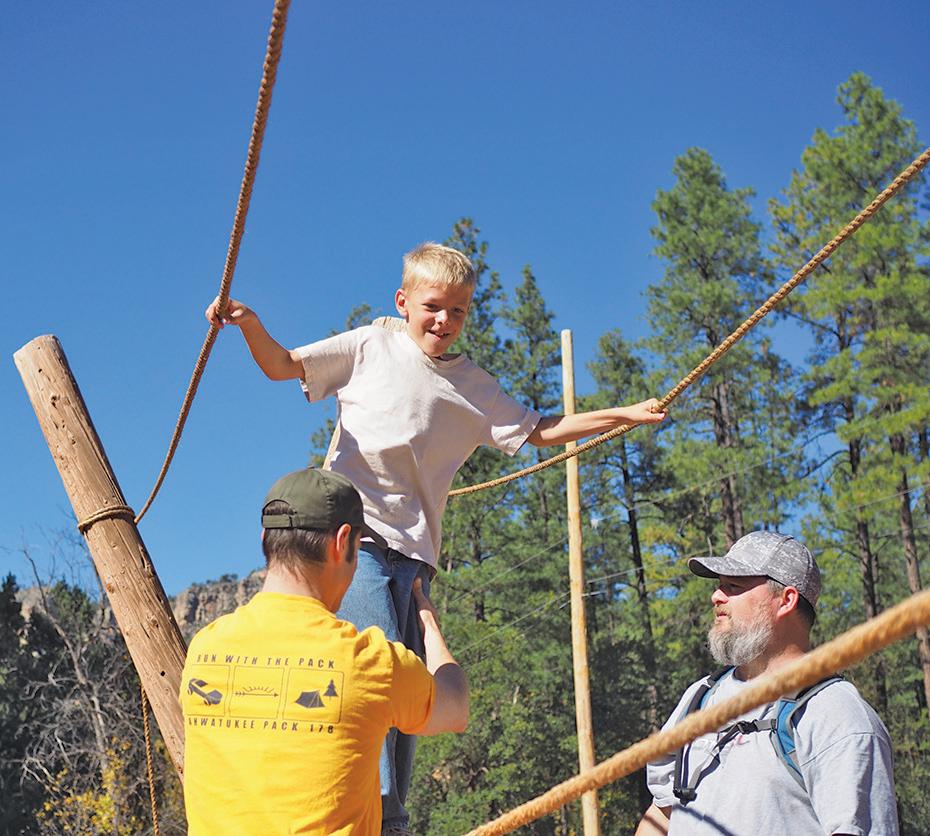
Helping 9-year-old Justin Madden on a rope course during Pack 178's trip to Payson are Marc Conkle, left, and Jim Neuman.
AFN News Staff
FUNDRAISER
from page 23
Resource Center locations.
Helping provide supplies for needy children is nothing new to Kelly, and one of the reasons she has been a staunch supporter and member of Treasures 4 Teachers.
“As an art teacher teaching kids since 1996, I’ve been using Treasures 4 Teachers for years. I know it’s really important for teachers to be able to go in and get needed supplies. I was significantly able to stretch art budgets by going there and getting many useful things to make artwork with,” she explained, adding:
“Presented with unique supplies and an artistic direction, kids are so creative. They come up with better ideas than I do.”
But that praise discounts Kelly’s own creativity. She is adroit in oils, acrylics, watercolors and sculptures and mosaics.
“But right now, I’m focused on painting,” she laughed.
Mesa High School graduate Kelly became interested in art while working at a local hobby store where one of her coworkers was a portrait painter. Kelly sought out an oil painting teacher to learn how to paint and met Betty Huff, a Mesa artist who gave painting lessons in her home.
Her painting career had begun.
“I did that for two years and then went to Mesa Community College, where I majored in art,” she recalled. “I took a wide variety of art classes, not just painting. I learned, studied and worked with ceramics, 3-D design, drawing, and more.”
When her husband, Steve, accepted a job in Texas, the couple decided it was an appropriate time for her to pursue a degree. She earned a B.A. in fine arts from the University of Texas with painting as her major and art history her minor.
In 1995, the couple purchased their home in Ahwatukee. It is there she holds adult classes every Friday at 1 p.m., and children’s art classes Saturdays at 3 p.m., both 90 minutes in duration.
“I have a studio upstairs, but I do art
classes in my family room and dining room. My husband has been so nice to let me spill over into these rooms,” she said.
Painting pretty much dominates her busy schedule.
“If I have sufficient time, I prefer oils but when I’m rushed, like with this project, I like acrylic,” she said. “Because I know how to handle the materials, I can push the envelope. After all, I’ve been painting since I was in my early 20s.”
She said the KINF guidelines require the work be on 24-by-30-inch canvases.
“They said I could paint anything I wanted as long as I used their materials and products,” she said.
Kelly was provided with six canvases and eight tubes of paint from DalerRowney and also received “nice, quality brushes.”
A spring trip to Payson and a more recent visit to Flagstaff had already supplied her with photographs of flowers and trees she’d snapped.
She’s using these as inspiration for the new paintings.
“I’ve got two paintings already underway, and with the other canvases, I can see what I want to donate to the foundation and Treasures 4 Teachers,” she said.
For T4T head Barbara Blalock, the foundation’s selection of Kelly was fitting.
“I love how it comes full circle with Treasures 4 Teachers starting in Ahwatukee, and an artist that’s been selected in Ahwatukee,” she said.
Along with KINF, Dixon Ticonderoga Company, established in 1795, is working with 10 resource centers to help make the 20 fine art pieces a reality. Other products used by the artists include Canson and Maimeri, which, along with Daler-Rowney, are among Dixon Ticonderoga art and office supply companies.
Dixon Ticonderoga company donates up to $1.5 million in products annually to KINF resource centers.
To view a sampling of Kathie Kelly paintings, or to learn more about the artist and/or her art classes, see ArtLessonsforYou.com
Grandparents, foster parents aid children’s reading success
BY KRISTIN ANDERSON CETONE AFN Guest Writer
As a reading specialist and former teacher, I have had more and more grandparents, and foster parents, come to me asking about their grandchild’s or foster child’s reading ability.
They usually ask the same thing: Are they reading at grade level? Are they falling behind?
In today’s society, many grandparents are taking over the role of guardian, provider, nurturer and advocate. As the number of children in foster care rises, more foster parents are also facing the challenge of what to do when a child appears to not being doing well in the foundation of educational success: Reading.
Many of these grandparents raising grandchildren, and foster parents, are also dealing with health coverage, legal issues, financial concerns and complex family situations. It’s important for them
to know that grandparents and foster parents are also the first responders to a child’s reading success. This becomes one of the most important activities they will undertake.
How do they know if their grandchild or child is having reading difficulties? How can they help with their child’s reading success?
Reading with the child is one of the most important activities you can do. Who teaches them? You do!
Choosing good books to read:
• Ask the child to tell you about the things that interest them.
• Take them to the library to choose the books they want to read. Borrowing library books is free! If they choose a book that is not at their grade level reading ability, don’t worry. This becomes a read aloud book for you to read with them. Reading success begins with read aloud books. This starts at birth, so for the very young who can’t talk about books yet, choose picture books to read to them.
• Ask your other adult friends,
librarian, or bookstore clerk for book suggestions. Check online with the American Library Association or the International Reading Association for lists of books.
• Let babies play with books that are sturdy (and drool-proof).
• Read the book they choose to yourself before you read it with your child. This will allow you preparation time to know the book well enough to give it an enthusiastic reading.
• Read slowly.
• Read the same book repeatedly. Children don’t grow tired of it because they hear something new with each reading.
• Don’t read through an entire book without taking a break.
• Don’t ignore the pictures. Have the child point to the pictures while you read the words.
How to nurture a reader:
• Turn off the television and limit computer time.
• Set aside a consistent time each day for reading.
• Have plenty of reading material around the house.
• Have a book to read with them whenever you leave the house for outside activities such as doctor visits, grocery, or at a restaurant.
• Take books on tape along in the car to keep them entertained. Make your own tapes of you reading a story, to use in the car.
• Be a role model. Let your child see you reading, talk to them about interesting things you have read!
If the above steps are taken and a child still shows a lack of interest in reading or understanding, it is time to take action. Talk immediately to your child’s teacher or other professionals. Research has shown that if a child cannot read by the end of the third grade they may never catch up to their peers!
Not being able to read can affect a child’s self-esteem for a lifetime and will negatively impact their education, their ability to hold a job and so much more.
-Kristin Anderson Cetone is a reading specialist and author in Ahwatukee. Reach her at buckaoobuckeye.com or Kristin@BuckarooBuckeye.com.
Deadline approaching for helping Kiwanis baby shower
The Kiwanis Club of Ahwatukee is seeking donations and volunteers for its annual baby shower “sorting day” on Aug. 19, and donors and volunteers don’t have much more time to help. Donations are being accepted only through Tuesday, Aug. 15. At the shower, teen moms in foster care are feted to the “baby shower experience with refreshments and baby gifts.
“These young women are alone in their pregnancy and parenting experience without family and friends to support them. They can use our help to make it easier for them to ‘beat the odds’ in this hard life,” said organizer Andi Pettyjohn of Ahwatukee.
Girls enrolled in Compadre High School’s Teen Parenting Program will be invited to “shop” for free clothing and necessities for their babies. Other donations will be given to moms in crisis at the Phoenix Dream Center, Maggie’s Place, UMOM and Tumbleweed. Foster parents who are fostering babies will also benefit from your donations.
The Kiwanis Club needs new and gently used clothing for babies from newborn to size 5T, as well as socks, booties, sippy cups, strollers, diapers, baby blankets, gift cards, toys and shoes.
Donations will be accepted at the following Ahwatukee locations: Ahwatukee Swim Center, 4700 E. Warner Road; Ahwatukee Carpet, 15215 S. 48th St.; Vision Community Management, 16625 S. Desert Foothills Pkwy.; Triple R Child Care, 4510 E. Ray Road; Ahwatukee Chamber of Commerce, 4435 E. Chandler
AROUND AHWATUKEE
Blvd.; PostNet, 4605 E. Chandler Blvd.; West USA Realty, 4505 E. Chandler Blvd.; Triple R Child Care, 1442 E. Chandler Blvd.; and the Ahwatukee Foothills Family YMCA, 1030 E. Liberty Lane. Also accepting donations is United Brokers Group, 106 S. Kyrene Road, Chandler.
Items also can be purchased at Target, where the event is registered under Kiwanis (first name) Ahwatukee (second name).
Information: 602-402-6267, info@AhwatukeeKiwanis.org and AhwatukeeKiwanis.org.
Ahwatukee author Tom Morrissey starts radio program
Ahwatukee author and Republican activist Tom Morrissey now has a radio show.
He broadcasts from Payson 3-5 p.m. every Thursday and can be heard online at krimfm.com.
Morrissey debuted on air last week with a show on Bubblegum Music, partly discussing his own role in the genre with the band Ohio Express, as well as the evolution of folk music.
100+ Women Who Care slate quarterly gathering Aug. 22
The nonprofit 100+ Women Who Care Valley of the Sun Chapter will meet 5:30-7:30 p.m. Tuesday, Aug. 22, at Foothills Golf Club, 2201 E. Clubhouse Drive, Ahwatukee.
100+ Women Who Care is a local philanthropic group of mainly Ahwatukee women who meet quarterly, contribute locally and connect personally to
benefit well deserving charities. Guests are welcome. Information:100WWCValleyOfTheSun.org.
Planning meeting called for lights festival Kick-Off party
The Festival of Lights committee will reconvene to begin planning for the Nov. 25 holiday Kickoff Party. All interested people are invited to attend the meeting at 6:30 p.m. Tuesday, Aug. 15, at the Desert Foothills United Methodist Church, 2156 E. Liberty Lane, Ahwatukee.
The committees to be formed will include sponsorships, restaurants, vendors for Marketplace, entertainment, logistics, beer/wine tavern, rides/games, Santa’s Village, volunteers and motorcycle parade. There will be positions for either advance planning and/or the day of the event.
Cub Scout Pack 278 seeks new members for fun, adventure
Ahwatukee boys in first through fifth grade are invioted to check out Cub Scout Pack 278 at its first meeting at 6:30 p.m. Aug. 21 at Corpus Christi Church, rooms 5 and 6, 3350 E. Knox Road.
com or azpack278.com.
Local prof’s homeless outreach in downtown is Aug. 12
Project Humanities’ year-round outreach led by an Ahwatukee professor to help the homeless in downtown Phoenix will be held 6:45-8:15 a.m. Saturday, Aug. 12. Volunteers are welcome to meet on South 12th Avenue between West Jefferson and West Madison streets to help homeless people pick out clothing, shoes and toiletries.
Neal Lester, Foundation Professor of English at Arizona State University and the founder/director of ASU’s Project Humanities, also reminds residents they can donate bottled water at AZ Spine & Disc, 4530 E. Ray Road, Ahwatukee during normal business hours. Other items can be donated at Project Humanities’ Tempe headquarters.
Information on donating and volunteering: 480727-7030 or projecthumanities@asu.edu.
Scouts learn to be helpful, friendly, kind, brave, reverent, have fun camping, making rockets and racing pinewood derby cars,” a release stated. Cub Scout Pack 278 has boys from many schools in the area, including Colina, Lomas, Monte Vista, Horizon, and Summit.
All families welcome to the meeting and no commitment required. Information: azpack278@gmail.
Porsche Chandler, a lu xury experience encompassing Sales, Service, Parts & Accessories in the heart of the East Valley. Offering complimentary Porsche service loaners and door-to-door Sales & Service vehicle delivery. Showcasing the finest selection of New, Certified and Pre-Owned Porsche models. Conveniently located North of the Santan 202 Freeway on Gilbert Road.
Real Estate Guide
Multigenerational homes making a steady comeback
It was the cycle that defined American life for decades.
People got married, bought a house and started a family. The kids grew up, left the nest and didn’t come back. The empty nesters then downsized to a smaller place to enjoy their golden years.
Their kids eventually started families of their own and bought their own homes. And so it went. Instead of the circle of life within a household, it was more like a straight line.
But in recent years, the line has begun
curving again, according to a leading real estate website. This entrenched societal pattern is becoming upended in favor of a mode of living that harks back to an earlier era, according to realtor.com.
Fueled by economic and cultural factors, a growing number of people are moving back in with their folks or opening their homes to their aged parents.
It’s a large-scale change making its impact felt in all corners of the real estate market – and American life itself.
Nearly one in five Americans is now
Mendoza
living in a multigenerational household – a household with two or more adult generations, or grandparents living with grandchildren – a level that hasn’t been seen in the U.S. since 1950.
About 60.6 million adults, or 19 percent of the population, were residing with their family in 2014, according to the Pew Research Center’s analysis of census data, up from 57 million in 2012.
Rising home prices, staggering child care expenses, college debt, longer life expectancies and the growth of ethnic communities in which extended families traditionally live together are all fueling this shift.
And as people become accustomed to this style of living, it’s altering the way they buy and build their homes, and how they plan for the future.
With buyers seeking homes and renovations to suit multigenerational lifestyles, builders and developers are responding to meet the demand – and a lucrative new market.
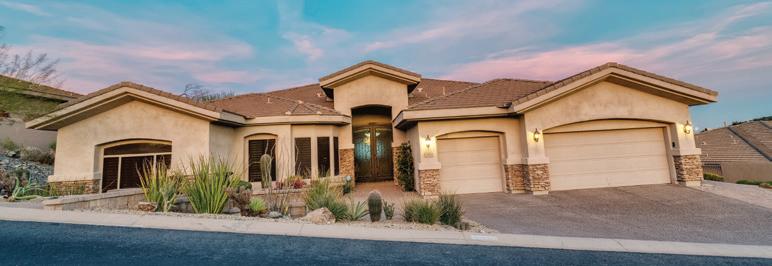
While cottages, casitas, and apartments over garages are still part of the picture, so are fully decked-out homes with ample square footage and a separate wing for the extended family.
Many of these homes have modern amenities such as dual thermostat controls so the whole family doesn’t have to swelter when Grandma catches a chill.
Tracy Elkins, 39, lives with her husband, their three kids, her mother, and three dogs in one of the Next Gen line of homes from Lennar, the nation’s second-largest homebuilder.
In their open and airy 6,100-square-foot home, the in-law suite is no afterthought: It has a separate living room, kitchenette, bedroom, bathroom, laundry, and private garage with a separate entrance.
Lennar describes it as “a home within a home.”
Tracy’s 63-year-old mom was retired,
and the purchase seemed like a logical move.
“Even I have to admit I was a little scared,” Elkins said. “You come to a point where living with your parents is not an easy option. It wasn’t something we had to do, but it worked out really well.”
“As home prices increase, more families tend to opt for living together,” said Valerie Sheets, a Lennar spokeswoman.
“Everyone is looking for the perfect home for any number of family situations, such as families who opt to take care of aging parents or grandparents at home, or millennials looking to live with their parents while they attend school or save for a down payment.”
Lennar, which builds homes in 19 states, is offering Next Gen homes in 36 key markets.
The blueprints vary by market, but they generally offer the main home and an adjacent unit with private living room, bedroom, bath, laundry, and garage.
“It has great benefits. There are some people who can’t live with aging parents
in a traditional setup,” Elkins says. “If it wasn’t for this home, I probably wouldn’t want to live with my mother either.”
Economics might have forced the issue, but people now are rediscovering the advantages of this way of life, according to Donna Butts, executive director of Generations United, a family research nonprofit and advocacy group.
The Great Recession drove a lot of young-adult “boomerang children” back to their parents’ homes when they couldn’t find a job.
“People came together by necessity, and they stayed together by choice,” said Butts. “In many other countries, it’s just a way of life. It helps strengthen the family.”
The percentage of people residing in multigenerational homes peaked around 1950, when 21 percent of households had such an arrangement. But in raw numbers it amounted to only 32.2 million people –a far cry from today’s 60 million-plus.
multigenerational in the sprawling cities of Houston, Austin, San Antonio, and Nashville. President and CEO Jim Lemming said he’s seen siblings and other family members buy a house together. It’s increasingly expected that they will help each other out.
“We live in a very diverse area,” Lemming said. “With that comes different aspects of multigenerational living.”
Multiple kitchens, separate entrances, and more than one master suite are the norm in these dwellings that are priced for close to a million dollars. Lemming also sees demand for amenities that cater to the needs of older people, including elevators and bathrooms with grab bars, taller commodes, and wider doors for wheelchairs or walkers.
Living with extended family members might require some adjustment in how you plan your home – and your future. As builder Mark Patterson pointed out, a big home meant to accommodate elderly parents might feel too big once they’re gone.
“Your parents are with you for five or 10 years. Then what?” asked Patterson, co-owner of PATCO Construction, which builds custom homes in Maine and New Hampshire.
Years ago, the norm was to put an apartment over a garage, but that might not be a long-term solution for a graying housemate.
“That works well until about 80, but after that, they are having challenges with their stairs,” Patterson said.
One solution is to create a house whose spaces can be adapted over time, he said, noting, however, that zoning regulations can be a challenge.
It’s also helpful to plan out how all these relatives across different generations can cohabit successfully.
Data suggest that multigenerational living is more prevalent among Asian, Hispanic and African-American families, while U.S. whites have fewer multigenerational homes (15 percent).
Continued demographic shifts in the U.S. mean this trend isn’t going anywhere but up. In Asia and Latin America, multigenerational living is widely accepted.
In the U.S., immigrants from those areas are more likely to live in multigenerational households.
Even immigrants who don’t have relatives living with them full time might need to accommodate long visits from them.
Houston-based custom homebuilder Partners in Building sees an expanded definition of what it means to be
Jessica Bruno, 44, has been blogging about her nine years living with four generations under one roof at FourGenerationsOneRoof.com. They all live in her childhood home in a small town about 45 minutes outside of Boston. The home was originally 1,600 square feet, but they expanded it to 6,200 square feet to accommodate more family members.
She said her key to success is a firm set of boundaries before anybody moves in. Agree on how bills are split, groceries are paid for, and who is allowed to eat your food. Lots of fridges and separate TV rooms are big.
“Having your own TV room is pretty important, so you don’t have to go watch ‘Bonanza’ with your grandparents,” Bruno said. “It’s kind of a time warp around here.”
-Provided by Realtor.com
(Special to AFN)
Homebuilders are seeing a resurgence in multigenerational housing where grandparents, parents and children all share living space.
Home buyers should avoid 8 dumb moves that kill their dream
Buying a home – especially if it’s your first – can be a lot like losing weight in the sense that “people end up doing, well, some pretty dumb stuff in the process,” according to a leading real estate website
“But while desperate dieters might waste money on ‘magical’ weight-loss pills or silly exercise equipment, misguided home buyers could be doing far more serious damage – like undermining their ability to purchase a house at all,” realtor. com says.
The website asked real estate agents to shed light on some of the dumbest reasons people can’t buy a home. The good news, it added, is that the mistakes are easily avoidable.
Dumb reason No. 1: Waiting to line up financing.
The first step in the home-buying process should be to meet with a mortgage lender to discuss your financing options, advised Benny Kang, a real estate agent in Irvine, California.
“You don’t truly know what you can
Off the market
afford until you meet with a lender,” said Kang, noting that just because you think you can buy a $1 million house doesn’t mean you can actually get a loan to purchase a home that nice.
Dumb reason No. 2: Using a fly-bynight mortgage lender.
The mortgage industry is rife with scams – including fake or unreliable lenders. Trusting a bad lender can cause a deal to fall through.
To make sure your financing is rocksolid, ask your real estate agent for lender recommendations instead of just Googling it. And read up to know your mortgage basics.
Dumb reason No. 3: Getting prequalified rather than pre-approved.
Pre-qualification and pre-approval might sound similar, but they’re not. Essentially, anyone can get pre-qualified for a loan, because it only involves having a conversation with a lender about the state of your finances (no documents are exchanged).
Getting pre-approved involves gathering all necessary documentation –
tax returns, bank statements, pay stubs, and more – and having the lender package the loan and submit the file to an underwriter for review. If everything checks out, the lender will issue a written commitment for financing up to a certain loan amount that’s good for up to 90 or 120 days.
When you submit an offer on a home, you’ll need to include a pre-approval letter from your lender.
“Educated sellers won’t even entertain an offer unless the buyer has a letter of pre-approval” from a reliable lender, one agent noted.
Dumb reason No. 4: Shopping outside your price range.
“It sounds obvious, but some home buyers just have trouble sticking to a budget,” said Kang. Therefore, resist the temptation to shop online for homes that are simply outside your price range, especially whatever amount you’ve been pre-approved for.
Dumb reason No. 5: Making lowball offers in a seller’s market.
You need to rely on your real estate agent to determine whether a house that you’re interested in has a fair listing price.
Your agent will do this by performing a comparative market analysis, which entails looking at recently sold properties that are comparable to the house that’s up for sale.
If a home is priced well, it might make sense to offer full price. One Realtor noted, “If you’re in a seller’s market, making a crazy lowball offer can” can kill your offer.
(Special to AFN)
This single-level, 2,945-square-foot home in the 800 block of E. Desert Flower Lane in Ahwatukee recently sold for $676,500. The Pulte home was built in 1995 and boasts of numerous upgrades.
Dumb reason No. 6: Writing a bad personal letter to the seller.
If you’re competing against other buyers, writing the seller a personal letter can help strengthen your offer.
But Julie McDonough, a real estate agent in Southern California, said some home buyers are inclined to overshare, in which case a letter can actually hurt your
offer.
“Stick to the fact that you love the house and the neighborhood,” she said. “Don’t get into personal details” such as the fact that you’ve lost out on other homes or want to remodel the dated kitchen.
Dumb reason No. 7: Making a big purchase while in escrow.
Some homebuyers make the mistake of opening new credit accounts while they’re in the process of buying a house. But purchasing a big-ticket item like a car or a boat while you’re buying a house can jeopardize your financing.
A mortgage lender’s underwriter is going to re-evaluate your finances and recheck your credit report shortly before closing in order to determine that you’re still able to qualify for the loan.
Even buying a fridge can throw off your credit or debt-to-income ratio.
Dumb reason No. 8: Not budgeting for closing costs.
If you don’t have enough cash to cover closing costs, you won’t make it to settlement; and if that’s the case, you could lose your earnest money deposit. Thus, make sure to get an estimate from your mortgage lender of what your closing costs will be before making an offer on a property (currently, this is legally required – just make sure to read it.
Closing costs vary widely by location, but they typically total 2 percent to 7 percent of the home’s purchase price. So, on a $250,000 home, your closing costs could come to $5,000 to $17,500. Both buyers and sellers usually pitch in on closing costs, but buyers shoulder the lion’s share of the load, so you need to make sure you have enough cash on hand to pay your portion.
$255,000
$312,000
$379,500
$399,000 16032 S. 1st AVE.
$468,500
$113,000 3830 E. LAKEWOOD PKWY.
$123,500 16013 S. DESERT FOOTHILLS PKWY.
$126,525 16013 S. DESERT FOOTHILLS PKWY.
$147,500 3236 E. CHANDLER BLVD.
$149,000 3830 E. LAKEWOOD PKWY.
$158,500 16013 S. DESERT FOOTHILLS PKWY.
$175,500 3236 E. CHANDLER BLVD.
$181,000 16013 S. DESERT FOOTHILS PKWY.
$253,000 4085 E. WOODLAND DRIVE
$255,000 3232 E. NIGHTHAWK WAY
$285,000 3310 E. NIGHTHAWK WAY
$300,000 3007 E. REDWOOD LANE
$309,000 16835 S. 12th WAY
$310,000 4238 E. SALTSAGE DRIVE
$312,000 3630 E. LONG LAKE ROAD
$315,000 4216 E. CEDARWOOD LANE
$324,900 4214 E. WINDSONG DRIVE
$334,900 3339 E. WINDSONG DRIVE
$335,000 14811 S. 25th ST.
$337,000 3140 E. REDWOOD COURT
$351,000 16671 S. 24th PLACE
$352,000 3525 E. NIGHTHAWK WAY
$352,240 3014 E. VERBENA DRIVE
$370,000 4138 E. ASHURST DRIVE
$375,000 16237 S. 13th ST.
$375,000 3825 E. WINDSONG DRIVE
$387,500 16231 S. 31st WAY
$390,000 16666 S. 37th PLACE
$394,000 15644 S. 26th WAY
$394,000 15013 S.
$397,000
$400,500
$416,000
$428,000 16639 S. 37th WAY
$445,000 1615 E. SALTSAGE DRIVE
$450,000 1733 E. BRIARWOOD TERRRACE
$460,000 14652 S. 7th PLACE
$460,000 2637 E. SILVERWOOD DRIVE
$676,500 838 E. DESERT FLOWER LANE
$350,000 2974 E. GLENHAVEN DRIVE
$365,000 16047 S. 31st WAY
$390,000 16202 S. 33rd PLACE
$420,000 3115 E. VERBENA DRIVE
$435,000 2723 E. BIGHORN AVE.
$455,000 2148 E. GOLDENROD ST.
$510,000 2536 E. MOUNTAIN SKY AVE.
$735,000 16221 S. MOUNTAIN STONE TRAIL
Get a financial checkup before starting a house hunt
Real estate experts agree that long before prospective homebuyers peruse listings or check out open houses, they should talk to a lender about getting a mortgage.
“Talk to your bank or a reputable mortgage company to see what you qualify to purchase,” saicd Rosanne Nitti, a Realtor with RMN Investments & Realty Services.
While figuring out financing might not sound like the most exciting way to embark on a house hunt, it’s essential.
Barring the rarity of having enough cash on hand, realtor.com notes that lenders don’t just hand out loans to everyone who walks in their door.
“Rather, they’ll need to review your financial history to determine how much money they’re willing to fork over,” the real estate website states
“Without that step, you have no idea what your purchasing power is,” explains Nitti.
People who are still in more of the window-shopping phase with no immediate plans to buy might want to opt for mortgage pre-qualification, which gives a ballpark sense of an individual’s purchasing power
without promises of a loan.
But those who are actively house hunting probably want to seek loan pre-approval, where the lender performs an in-depth exploration of a prospective buyer’s finances followed by a solid promise for a home loan of a certain size.
To get pre-approved for a loan, expect to be asked to reveal income, the amount of
money in savings and credit history. This helps lenders determine how much money they’re willing to loan.
Consider this step akin to getting a full medical checkup before training for a marathon. In this sense, a lender can determine whether someone is ready to embark on the home-buying journey or whether it’s advisable to take a step back and
do some prep work first.
“If you do not have any savings available for a down payment, then your first step is to save every dime you can,” said Realtor Debra Kroon.
If there are blemishes on your credit history, such as late or missing credit card payments, you might need to take steps to clean up your credit report before you would even qualify for a loan.
If your financial profile reveals flaws that throw a wrench in your ability to buy a home, your loan officer can direct you on how to make improvements.
If you’re deemed to be ready and raring to start house hunting now, a loan officer can give you a heads-up on what to expect on the finance front.
“The loan officer will be able to let you know which loan programs you qualify to use, what your purchase price limit is, what your projected monthly payments will be, and how much cash you will need to have on hand for a down payment, closing costs, and reserves,” said Kroon.
To get started, explore realtor.com/ mortgage to find lenders in your area, check mortgage interest rates, figure out how much home you can afford, and more.
SPOTLIGHT home
Exquisite Tuscan living with stunning mountain views. Abundant custom features including 24” Travertine flooring with inlays, inviting open floor plan, elegant library, soaring coffered ceilings, art niches, three fireplaces and custom builtins throughout. Gourmet kitchen boasts granite countertops with backsplash, custom mahogany raised-panel cabinetry, Dacor six-burner cooktop, two ovens, warming drawer, Sub Zero refrigerator and walk-in pantry. Spacious master suite with walk-in shower and Jacuzzi tub, plus den and two secondary bedrooms upstairs. Huge theatre room, three bedrooms, steam room and game room with wet bar in basement. Resort-style backyard complete with Marbella Stone patio entertaining areas, pool and spa with dual water features, built-in Dacor BBQ, fireplace and lush landscaping.
Listed for $1,395,000
1627 E Briarwood Terrace in Shadow Rock
College debt, high rent keep millennials out of home buying
Since the market crash, many prospective first-time home buyers have been fighting an uphill battle on their path to homeownership.
It isn’t for lack of trying. While millennials might be the largest group of first-time buyers, according to the National Association of Realtors, they face a whole slew of daunting challenges before they can sign on the dotted line. Some of these hiccups are mostly out of their control.
Here are some of those factors that could be barring millennials from homeownership.
College costs more than expected Student loans are this generation’s beast of burden. The national average for 2016 graduates remains around $37,172, up 6 percent from last year.
“Student loan debt raises the debt-toincome ratio of borrowers, making it hard to qualify for the amount of a loan they’d need,” explains Robert Farrington, founder of TheCollegeInvestor.com.
In 2015, Federal Housing Administration loans, which once ignored deferred student debt, started factoring it into applicants’ financial standing.
Farrington said millennials saddled with college loan debt should focus on getting those monthly payments into a manageable position.
One tactic is refinancing their federal loans into a private loan, “which could offer lower interest rates and more flexible payment options,” he said. Another option: Paying more each month to reduce their debt at a faster rate.
Refinancing can be a double-edged sword when it comes to federal student loans. Income-driven repayment plans offered by the government will vanish once the federal loan is refinanced with a private loan company.
So, millennials should go into it with their eyes wide open. It makes sense to refinance if they can afford their standard repayment plan and don’t qualify for debt forgiveness they might be privy to if they work in a service or teaching job.
Someone else screwed their credit
Generally, you can control your credit
with patience and a good understanding of how to get a decent credit score. But if someone hijacks your identity, the thief can wreak havoc on your dreams of homeownership. Even a family member.
“I had a client whose parents took out the accounts in his name when he was a child, and didn’t ever pay them,” recalled one Realtor. “It knocked this prospective buyer’s score below 500. It was impossible for anyone to lend to him and took him years to fix.”
In this case, the client should have been checking his score periodically. Experts recommend putting a fraud alert on the reports from all three credit bureaus. This flags your account for extra protection, so if something odd happens, the bureau will call to confirm it with you before trashing your score.
The rent is too high
It’s no secret that rent in metro areas is skyrocketing. And higher rent means less money for everything else.
“In California, what we’re seeing is that renters are devoting increasingly more of their paychecks to cover their rising rents, which means they have less money to save for a down payment,” said Kevin Stein, associate director at the California Reinvestment Coalition, an organization that advocates for lowincome communities.
If millennials are set on owning, the best thing they can do is create a budget and start saving what they can. It might mean sacrificing some comfort – like their own apartment or a short commute – to get cheaper rent and secure a property in the future.
The competition has bags of cash
In some areas, the people millennials are up against don’t have 20 percent down; they have 100 percent down.
All-cash offers from investors can be tough to beat.
The “pecking order” of preferred home buyers, according to a real estate agent: All-cash offers, 50 percent down, 20 percent down, less than 20 percent down, FHA loans.
Cash offers don’t always rule the roost. There are plenty of sellers who are willing to entertain offers from all buyers, not just the ones with a big wad of cash.
$699,500
Ironwood Library writers group publishes anthology
BY COTY DOLORES MIRANDA AFN Contributor
Parchment & Prose – a writers group based at the Ironwood Branch of the Phoenix Public Library – has marked the 25th anniversary of the Ahwatukee branch with the publication of an anthology of 14 members’ work.
Titled “Ironwood Alchemy,” the book is for sale on Amazon and was the focus of a launch party last week.
Anissa Stringer, a co-founder of the group, credits Parchment & Prose with helping her get over her “fears of publishing my work.”
“Since the group began just a few years ago, I’ve published five novels, two books of nonfiction, and I expect to release two more books by the end of the year,” said Stringer, adding:
“Parchment & Prose is a great place for new and experienced writers to learn about various writing topics, and we encourage writers to deliver presentations on their favorite topics, which is a great way to polish public speaking skills. There’s even a critique component of the group that meets on another day. And everyone is so encouraging and supportive.”
A 17-year Ahwatukee resident, Stringer’s anthology contribution, titled “The Transformation,” is “a character-driven apocalyptic short story” set in Ahwatukee, as is one of her full-length novels, “The Glare.”
“The apocalypse that strikes is caused by a mutated plant that takes over the world, and the main character struggles with existential questions about the meaning of life – just like many of us do in our own lives,” said Stringer, who is also a magazine writer.
Tim Valenta of Tempe began attending the writing group two years ago.
“I was new at the time to sharing my work in an open setting,” he said. “The single greatest thing the group does for me is push me to make my work the best I know how, before I even put it in front of them to read.”
“It’s my reality check before sending something out, to make sure it really is as good as I think it should be,” said Valenta, who wrote “Keeper of Life.”
“Even then, I can trust them to bring questions or observations to my attention that I wouldn’t necessarily have considered, born from their individual world views and what they identify with in my characters.”
the month, and usually hosts a local author or person in a writing-related profession who gives an educational presentation.
On the third Tuesday of the month, “we bring our own writing and exchange feedback in smallgroup critique sessions,” Moore said.
how she became a part of the Ironwood writer’s group.
“Now I come whenever I’m in town,” said Ross, who is currently writing a novel of political satire dealing with income inequality.
Anthology contributor Eva Marie Willis, a 22-year Ahwatukee resident, has three poems in the book.
Valenta said the group is diverse –“which is a glimpse into how actual readers will react to my work.”
He said the group’s “welcoming atmosphere” helped clear his apprehensions and that “the feedback was better for it.”
“The Keeper” is a story of a fantasy-type shopkeeper and craftswoman of swords and armor who fights off demons, is put in a situation where her own craftsmanship may save her life, and “rediscovers the intensity of personal investment in her craft.”
“One lesson might be to find happiness in what you can do instead of what you can’t do, but for this story I wanted to explore a situation where complacency wasn’t such a great outcome,” Valenta said.
Chandler resident Mary Moore, a professional copy editor who worked with Cosmopolitan in New York City, helped edit the anthology, crediting the group with helping her gain confidence in her written work.
“This combination of learning and doing helped me build confidence about my own writing,” she said.
“Also, I enjoyed sharing my knowledge of editing with others.”
Keith Shaw, a 36-year Chandler resident who helped format the book, also submitted a story, titled “Storyteller.”
It is a remembrance of protagonist Will Miller writing about his family, particularly his grandfather.
“It’s about the power of storytelling,” said Shaw, a former designer for the Arizona State University Lyric Opera Theater who has been a part of the writing group for two years.
“Editing and writing are very different skills,” she said. “I started going to the Ironwood Branch for the writers group because they had an amazing library assistant, Haley Dziuk, who set up the group in a way that combines learning and doing,” she said.
The group meets the first Tuesday of
“I particularly like the guest presenters, who often bring insightful information about the process of writing,” said Shaw, who has two young adult novels, “From the Shadows” and “Neworld Papers” both published by iPulp Fiction.
He’s also written more than 600 interactive modules and nearly 900 educational videos.
Among the other contributors to “Ironwood Alchemy” are Randi Ross, an adjunct associate professor of writing with the New School for Social Research at the University of Maryland and at the City University of New York (CUNY).
During school breaks and summer vacations, Ross comes to Ahwatukee to visit her mother, Phyllis Beck, and that’s
“I’ve been a poet for about eight years,” said Willis, a member of the Arizona State Poetry Society and East Valley Poets. “One of the poems I entered was written to describe one of my oil paintings. Last year, I started to marry these two forms of my artistic expression.” Willis was introduced to Parchment & Prose through her cousin, Sharyl Bales, who has a story in the anthology. Her book, “With All My Heart,” was published in 2013.
Facilitating the group is Ironwood assistant librarian Haley Dziuk, one of the two editors who also penned a story in the anthology. Hers, written under the non de plume H. Duke, is titled “The Fiction Room.” Not surprisingly, it is about a young woman who gets a job as a librarian in a library that “turns out to be more than it appears.”
Dziuk, a graduate of the University of Iowa with a degree in linguistics, said her alma mater influenced her love of the written word.
“I’d say my time at Iowa inspired me to start the group, as well as participating in NaNoWriMo (National Novel Writing Month) the year before,” said Dziuk, who has worked at Ironwood four years.
Soon after she began working at Ironwood, Stringer walked in with another writer who has since moved away.
“And we started the group together. It was very serendipitous,” Dziuk said.
“Many members comment on how supportive, constructive, and ego-free the group is,” she said. “I’ve seen several members publish and get published, and I’ve seen every member grow.”
Parchment & Prose writers group meets at the Ironwood Branch Library the first and third Tuesday from 6 to 7:45 p.m. The first Tuesday includes presentations and workshops on all aspects of writing and publishing, and on the third Tuesday is the critique group gathering. Both are free and open to all writers.
“Ironwood Alchemy” is available at the Friends of the Library corner at the entrance of Ironwood Library. Cost: $5 each, cash only.
(Kimberly Carrillo/AFN Photographer)
Members of the Ironwood Library writers group who published an anthology of fiction and poetry include, from left: Ben Halloran, Anissa Stringer, H. Duke, JoAnn Richi, Avery Stiles, Eva Marie Willis, David Anderson, Mary Moore, Sharyl Bales and KB Shaw.
(Special to AFN)
"Ironwood Alchemy" is an anthology of poetry and fiction by members of the writers group at ironwood Library.
FRIDAY, AUG. 11
Arriba Grill has hatch chiles
Arriba Mexican Grill will begin six to eight weekends of roasting hatch chiles in front of its Ahwautukee store every Friday, Saturday and Sunday. The chiles will cost $1.99 per pound, and a few different food specials featuring hatch chiles will be on the menu.
DETAILS>> 4649 E. Chandler Blvd., Ahwatukee. 480‑753 4453
THURSDAY, AUG. 17
Gardeners discuss edible plants
“Desert Edibles,” presented by Maricopa Master Gardeners looks at how for centuries, Native Americans have used the Sonoran Desert plants for food and medical needs. Learn how to identify, when to harvest, and prepare natural foods.
DETAILS>> 6 8 p.m., County Extension Office 4341 E. Broadway Road, Phoenix. Cost: $20. Registration: extension.arizona.edu/maricopamg.
Blood drive scheduled
Give the gift of blood at the American Red Cross Blood Drive at Ironwood Library. Appointments are recommended by going to redcrossblood.org and selecting the “Donating Blood” option to submit your appointment time. Walk in donations okay.
Kids 5 to 12 years old and their families can prepare
for the solar eclipse on Aug. 21 by making a pinhole eclipse viewer and other astronomy related crafts.
DETAILS>> 2 3 p.m., Ironwood Library, 4333 E. Chandler Blvd., Ahwatukee. Ages 6 11. No registration required. Free.
Y has paddleboard yoga
The Ahwatukee Foothills Family YMCA is teaming up with Riverbound Sports and offering a stand up paddleboard yoga by a certified paddleboard yoga instructor. Paddleboards will be provided by Riverbound Sports.
DETAILS>> The partnership kicks off with its first class 4 5 p.m. 1030 E. Liberty Lane, Ahwatukee. Cost: $35 for members, $45 nonmembers. Call or stop by the YMCA to reserve a board. 480 759 6762.
MONDAY, AUG. 21
Medicare explained
Ahwatukee financial advisor Gregory Geryak has scheduled sessions today and Aug. 29 on “Understanding Medicare,” focusing on options and entitlements, enrollment, coverage and other topics. This is not a sales presentation, he said.
DETAILS>> 3 p.m. Aug. 21, 4 p.m. Aug. 29. Ironwood Library, 4333 E. Chandler Blvd., Ahwatukee. Refreshments served. Reservations requested: 480 797 5615. Free.
THURSDAY, AUG. 24
Desert Lawn Care
Get practical advice for maintaining a healthy, beautiful and water efficient lawn. This free workshop presented in partnership with City of Phoenix Water Department.
DETAILS>> 6:30 7:30 p.m., Ironwood Library, 4333 E. Chandler Blvd., Ahwatukee. Register online in the calendar section at phxlib.org.
SATURDAY, AUGUST 26
Back-to-school party is on Back to school party! Join us for craft, snacks and Smash Bros.
DETAILS>> 2 4 p.m., Ironwood Library, 4333 E. Chandler Blvd., Ahwatukee. Open to teens ages 12 17. Free, no registration required.
SUNDAYS
‘TinkerTime’ open for kids
A makerspace for children to design, experiment, and invent as they explore hands on STEAM activities through self guided tinkering.
DETAILS>> 1 4 p.m. every Sunday, Ironwood Library 4333 E. Chandler Blvd., Ahwatukee. Ages 6 11. Free; No registration required.
Learn gardening from pros
Learn desert gardening by getting your hands dirty with the Ahwatukee Community Gardening Project. Share in the knowledge, the produce and the smiles. All ages welcome. Bring sun protection and water; tools optional.
DETAILS>> 7 9 a.m. in the northwest corner of the park at 4700 E. Warner Road, Ahwatukee. Information : acgarden.org or 480 759 5338
MONDAYS
Chamber offers networking
The Ahwatukee Foothills Chamber of Commerce networking and leads group is open to members.
DETAILS>> Noon, Native Grill and Wings, 5030 E. Ray Road, Ahwatukee. Devida Lewis, 480 753 7676.
LD 18 Dems meet monthly
Legislative District 18 Democrats gather monthly, usually the second Monday, to share news, opportunities, food and laughter. Meetings include guest speakers, legislative updates, how to sessions and Q&A. Volunteer or just enjoy an evening with like minded folks.
DETAILS>> For times and places: ld18democrats. org/calendar.
TUESDAYS
Power Partners available
The Ahwatukee Foothills Chamber of Commerce networking and leads group is open to chamber members.
DETAILS>> 8 9 a.m., Four Points by Sheraton, 10831 S. 51st St., Ahwatukee. Dorothy Abril, 480 753 7676.
WEDNESDAYS
Watercolor classes available
Watercolor classes that teach both bold and beautiful as well as soft and subtle approaches to the art are available twice a week for beginners and intermediate students who are at least 15 years old. Step by step instruction and personal help are provided.
DETAILS>> 2:30 5 Wednesdays and 10 a.m. 12:30 p.m. Saturdays at Hobby Lobby, 46th Street and Ray Road, Ahwatukee. Cost: $25 per class, $80 for four classes. Registration required: jlokits@yahoo.com or 480 471 8505.
Montessori holds open house
Ahwatukee Foothills Montessori holds an open house weekly. It includes a short talk about Montessori education, followed by a tour of its campus.
Hospice of the Valley offers a free ongoing grief support group for adults and is open to any adult who has experienced a loss through death. No registration required.
DETAILS>> 6 7 p.m. first and third Wednesdays, Pecos Community Center, 17010 S. 48th St. 602 636 5390 or HOV.org.
Foothills Women meet
An informal, relaxed social organization of about 90 women living in the Ahwatukee Foothills/Club West area. A way to escape once a month to have fun and meet with other ladies in the area. Guest speaker or entertainment featured.
DETAILS>> 7 p.m. second Wednesday of the month, Foothills Golf Club, 2201 E. Clubhouse Drive. Contact Shelley Miller, president, at 602 527 6789 or essentiallyshelley@gmail.com
Parents can ‘drop in’
STEM for kids available
Join us at the library for this fun, hands on STEM based program. Kids will create a different project each week including: Circuit Bugs with LEDs, straw rocket ships, binary code keychains, wobblebots, turtle weavings and robotic hand building.
Parents are invited to join a drop in group to ask questions, share ideas or just listen to what’s going on with today’s teenagers.
DETAILS>> 5:30 7 p.m. second Wednesday of each month. Maricopa Cooperative Extension, 4341 E. Broadway Road, Phoenix. Free. RSVP at 602 827 8200, ext. 348, or rcarter@cals.arizona.edu.
‘Dems and Donuts’ set
DETAILS>> Free. 4 5 p.m., Ironwood Library, 4333 E. Chandler Blvd. Ages 6 11. No registration required. Does not meet Tuesday, July 4.
District 18 Democrats gather for an informal chat.
Chair yoga featured
Inner Vision Yoga Studio offers chair yoga to help seniors and people recovering from injuries to stay fit.
DETAILS>> 1:30 2:30 p.m., 4025 E. Chandler Blvd., Ahwatukee. $5 per class. Information: donna@ innervisionyoga.com or 480 330 2015.
Toastmasters sharpen skills
Improve your speaking skills and meet interesting people at Ahwatukee Toastmasters meetings DETAILS>> 6:45 8 a.m at the Dignity Health Community Room, 4545 E. Chandler Blvd., Ahwatukee.
DETAILS>> Free and open to the public 7:30 9 a.m. the third Wednesday of the month at Denny’s, 7400 W. Chandler Blvd., Chandler. RSVP: marie9@q.com or 480 592 0052.
LD 18 Dems meet in Tempe
The Legislative District 18 Democrats meet the second Monday of the month.
DETAILS>> 6:30 p.m. social time, 7 8:30 p.m. meeting time. Because the location may be different from month to month, see ld18democrats.org. Information: ld18demsinfo@gmail.com. Free and open to the public.
Planning committee chairman, Kevin Patterson appeal to Ahwatukee voters
Both candidates for Phoenix City Council District 6 have been invited to write four columns prior to the Aug. 29 election.
The question they were asked to address this week was “Why should Ahwatukee
Blostone: DiCiccio gets the job done
BY CHAD BLOSTONE
AFN Guest Writer
Sal DiCiccio has lived in Ahwatukee for 34 years. He grew up here, riding dirt bikes in the desert and cruising the streets in his first car, a used Ford Pinto with no air-conditioning that he bought with money earned from his paper route. It’s easy to forget the impact that one person can have. But if you want to know what someone is going to do, look at what they’ve already done. For those of us who know and love Ahwatukee, there is only one choice in the upcoming council election: Sal DiCiccio.
Sal has a proven history of delivering results for our community, just like those newspapers he landed on doorsteps decades ago. There are few difficult community problems he has not helped solve.
The opening of the new Chandler Boulevard extension just a couple weeks ago is a great example of Sal’s leadership: He worked tirelessly alongside the planning committee, neighborhood associations and neighborhood groups to significantly improve the project.
Our area’s regional planning agency sought to provide us the least-expensive road possible, a design so lacking and unsafe they had not built one similar anywhere else in our 516-square-mile city. Sal fought them. The end result was the road builders providing us with a safe design.
North of the Chandler Boulevard extension are 234 acres of open space, protected into perpetuity from development, that Sal helped the city buy from the State Land Department. Some sought to transfer housing units slated for that newly preserved land to the south side of Chandler Boulevard.
Not this time. Those units were retired, which means less density. We value open space in Ahwatukee, and Sal has fought for it and will always fight for it when the
community demands it.
When Ahwatukee got our first police substation, Sal was there, leading the charge. The same was true of our first senior center on 48th and Elliott, which Sal helped get donated to the community.
Now we have our own fully developed senior center and police substation at Pecos Park, which happens to be one of the parks for which Sal helped to gather initial funding.
Mountain Vista Park was just dirt until he and other community leaders found the money.
These things are just the beginning, there’s much more that Sal has done for our community ...
If you like to hike in our mountain parks, Sal is – four or five days a week –right there with you. That’s why many years ago, he worked with community leaders to create Telegraph Pass, get the land donated to the city of Phoenix, and is now helping oversee the installation of new ramadas, bathrooms and improved parking.
Sal also put the team together that founded Pecos Park and spearheaded Phoenix’s investment – $25 million – in South Mountain Park.
And if you’re a cyclist, well, Sal doesn’t do that. But he’s still right there with you. As recently as a couple years ago, the freeway design eliminated a valuable element to the road-biking experience in Ahwatukee – Pecos Road.
Alongside the Coalition of Arizona Bicyclists and the Pecos Action Group, Sal fought that fight, too. The result will be a path south of the freeway that will not fully replace the Pecos experience, but at least retains some element of it – namely a long stretch of straight path where moderate speed can be achieved.
Sal was also instrumental in working with local leaders to solve the water crisis at The Foothills. And right now, Sal
voters vote for you?”
Incumbent Sal DiCiccio has designated Village Planning Committee Chairman Chad Blostone to write in his place.
Patterson: Say yes to your neighborhood
BY KEVIN PATTERSON AFN Guest Writer
Ilove District 6 and the city of Phoenix.
I know how fortunate I was to grow up in Ahwatukee in a wonderful neighborhood around the Lakes Golf Course, and I see the potential and character of North Central Phoenix as a great asset to our community.
Yet, throughout this campaign, as I have talked to more and more residents of our vibrant community, I have become more and more concerned for the future integrity, character, and true nature of our neighborhoods.
I recently attended a meeting of the Camelback East Village Planning Committee, where discussions are underway to tear apart the Phoenician Resort in the district.
While this may seem like an issue far removed from Ahwatukee, we have seen developer aggression time and time again, whether with our golf courses or the 202 expansion, and it threatens the core of what our neighborhoods are.
As we look to build a strategic plan and vision for our district and city, finding how we can balance growth with responsibility and neighborhood will be core to our mission.
As one citizen said at the Planning Committee meeting, “great cities are made by great leaders,” but they are “maintained by great neighborhoods.”
District 6 has lacked great leadership for this decade, with a councilman who is more concerned in allowing developers free rein to tear apart our community than fighting for working families like ours who are seeing their communities change before their eyes.
Leaders are supposed to bring more voices into the fold, to listen and learn and advocate for the true interests of our families. For too many families in this district, that just hasn’t been the case.
Our district is strong, and we are even stronger when we are united around our common values and purpose. District 6 is full of great neighborhoods made up of inspiring people, but it has lacked a great leader.
I do not know everything, and I don’t have every answer, but I am ready to learn from you and your families, to advocate and fight for the community we call home. That is why I believe I am the best fit to represent District 6 and why I am so eager to take on the unique challenges this community faces. It’s time for someone who will say yes to you, your voice and your neighborhood.
Fall portends major impacts on Ahwatukee – maybe
BY PAUL MARYNIAK AFN Executive Editor
The calendar indicates we still have plenty of summer left, but for Ahwatukee, fall is shaping up to be a season that could impact thousands of residents and homeowners.
Four major events could produce decisions that will affect the community for years to come.
But because two of those events involve the courts, Ahwatukee residents concerned about the community’s future may end up waiting a lot longer for a final resolution.
The court cases involve the South Mountain Freeway and the defunct Ahwatukee Lakes Golf Course.
At the same time, fall will bring elections involving budget overrides sought by both Tempe Union and Kyrene school districts.
Tempe Union High School District is seeking a 15 percent operations and maintenance budget override that would, among other things, boost teacher and staff pay beyond the measly 1 percent the state Legislature decided was more than enough to live on.
Kyrene has three questions on the ballot – two allowing continuation of 15 percent operating and 10 percent capital budget overrides and a third authorizing the district to borrow up to $116,750,000 in bonds over 10 years.
The bond money would largely underwrite repairs to the district’s aging infrastructure, since many of its 25 elementary and middle schools are at least 30
Schools fail to teach American fundamentals
While watching our nation gradually evolve into a socialistic society and economy for the past many years, I began to do some research to determine the reason for this evolution.
It’s long been my hunch the education system was the culprit, but I didn’t pursue the idea until I became involved with my grandchildren and what they were being taught in school about American history, world history, civics and economics. Suffice it to say, that which the student is being taught in school today doesn’t mesh well with the history, civics and economics
years old.
The stakes are high for both districts, given their effort to compete for students with other school districts and charters while living in a state where funding for education remains a political football.
But at least we’ll see some finality to the overrides. By the end of the day on Nov. 7, the voters will have spoken.
No such timeliness can be expected in the court cases.
Although it has not formally entered a specific date, Howard Shanker, one of the lawyers for the freeway opponents, believes the U.S. Court of Appeals for the Ninth Circuit will hold a hearing on his appeal in October.
That’s just listening to maybe 40 minutes of oral argument before a threejudge panel wades into thousands of pages of legal documents.
In the Lakes case, a state Superior Court judge has set Oct. 23-25 for a non-jury trial on some residents’ efforts to have golf course owner True Life Companies restore the site, which was closed in 2013.
True Life, on the other hand, is asking the judge to set aside the land-use rules requiring a golf course so it can proceed with its plan to create Ahwatukee Farms, a community that would include about 270 homes, a farm, private school and some other amenities.
Unless you moved to Ahwatukee in the last month or have just ignored these two important cases, much is riding on their outcome.
Many of the 5,200 Ahwatukee Lakes homeowners, especially those who paid premium prices for lots fronting a golf course, believe their property values al-
ready are circling the drain because of the barren wasteland now bordering their yards.
True Life contends its development will elevate those property values. Besides, it asserts, a golf course is no longer a financially viable use of the 103-acre site.
In the freeway case, the government argues the highway will save millions of motorists’ gas money and months of time wasted in traffic jams on the Broadway Curve.
Opponents maintain that the freeway constitutes a health hazard to thousands of children attending 17 schools within a half-mile radius of the thoroughfare as well as to thousands of residents in both Ahwatukee and the Gila Community.
If someone had not observed nearly a century ago that the wheels of justice grind slowly, someone in Ahwatukee would have coined the phrase while watching the molasses-like progress of the freeway and Lakes court fights.
To be fair, both cases involve huge complexities as well as wildly divergent assertions that literally have required years of work to get to where they are now.
In the meantime, passions continue to run high on both sides in the two cases.
The biggest difference between the two court battles is that the Ninth Circuit refused Shanker’s request to halt work until the appeal is decided.
Both the Arizona Department of Transportation and the Federal Highway Administration virtually have argued that millions of tax dollars already have been sunk into the 22-mile freeway. What do you think they would say if they lost the appeal?
In the Lakes case, the acrimony on
LETTERS
that were taught in the mid- to late 1940s and the early 1950s.
The facts of history and economics haven’t changed. Nevertheless, because of the intentional misinformation and disinformation presented by our public education system, socialism has been thrust upon us in all of its false glory. Somehow, the worlds of academia, the media, and the government bureaucracy don’t grasp the value of a capitalist economy and the virtue of a moral republican government.
As I reviewed the American History books which are being used in elementary school, middle school and high school, I was convinced my suspicion was correct.
Sad to say, it isn’t only the history books
both sides hasn’t ebbed, though both sides have decided independently of each other to lay low until the trial.
When I contacted both sides last week with some questions related to the oneyear anniversary of True Life’s rollout of its farm plan, they declined to comment.
One question left unanswered by the “no comments” is whether the judge’s decision will prompt an appeal by the losing party.
It’s hard to believe either side will just take his decision as the final word in this seemingly unending battle.
With the freeway case, it’s a bit more difficult to speculate on what will happen after the Ninth Circuit finally gets around to a making decision.
It’s difficult to bring an appellate court decision before the U.S. Supreme Court.
The high court is extremely selective, accepting fewer than 150 cases for review out of an estimated 7,000 that are brought to it.
In other words, a ruling that upholds a federal judge’s blessing on the freeway could doom opponents’ efforts to stop it.
On the other hand, a ruling in their favor would throw a huge monkey wrench into the state’s most expensive highway project in history. It’s hard to imagine that state and federal highway agencies would take an adverse decision lying down.
The bottom line to all this?
It’s going to be an interesting fall for people who are concerned about the community character of Ahwatukee. But given the snail’s pace of the legal system, what happens this fall may end up being yet another major chapter in two sagas that seem to have no end.
which fail to teach that our nation is a republic, but it’s in the reading programs as well. This makes the indoctrination complete.
In reading the current textbooks, you will find only that the United States is a democracy. Rarely will you find the word “republic” mentioned as it relates to our form of government.
To make matters worse, not one of the textbooks relates in a cogent way the founding fundamentals of our nation. The most basic of which are Nature’s God and the Laws of Nature’s God mentioned in the first paragraph of the Declaration of Independence.
In the second paragraph of the Declaration,
you find “Life, Liberty and the pursuit of Happiness,” which are given to us by our Creator, i.e. Nature’s God.
Then, when you go to the Preamble to the Constitution, you find reference to a perfect union, justice, domestic tranquility, the national defense, the general welfare and “the blessings of liberty for ourselves and our posterity.” All very basic fundamentals. Next, please consider the Bill of Rights. The First Amendment speaks to freedom of speech, freedom of the press, the right to peaceful assembly, freedom of religion, the right to petition the government for a redress of grievances.
is leading once again, this time working to solve the water problem at Club West and to restore the golf course (and, some believe, the surrounding homeowners’ property values) which the course operator has allowed to fall into disrepair.
Most do not realize that, at one time, our community was slated to have thousands of additional high-density apartment units. But we don’t, because Sal has consistently fought to protect our quality of life – doing everything from fighting inappropriate development to laying out a plan that will see a significant number of streets in Ahwatukee repaved over the next three years.
None of these accomplishments happened overnight. They all required a dedication to our community and a dedication to getting things done.
And that Ford Pinto? Well, it eventually went into the junkyard at 48th and Ray, at least until Sal got around to helping us replace the junkyard with a new AMC movie theater we all enjoy today.
Sal DiCiccio is one of us. That’s why I’m urging everyone to support Sal because judging by the things he’s done for us already, the best is yet to come -Chad Blostone chairs the Ahwatukee-Foothills Village Planning Committee.
Amendment II addresses the right to keep and bear arms and a well-regulated militia. Without reviewing the entire Bill of Rights, let’s understand the Declaration of Independence and the Constitution are the framework of our basic fundamentals of freedom and liberty.
While becoming more familiar with the Declaration of Independence and the Constitution, and talking to many people about them, it didn’t take long to learn that most people know little or nothing about these subjects.
Either they were asleep in history class, or the schools weren’t doing their job in the teaching of these crucial documents and the fundamentals which they represent. It’s my conviction the public education system is failing in the teaching and understanding of our basic fundamentals, both political and moral.
Keep in mind school boards are made up of elected members. Therefore, one must wonder about the mindset of the general population since board members come from that source.
Consequently, one can only assume the public education problem has existed for many years, probably since Franklin Delano Roosevelt was president when he espoused
You're invited to join us at the next meeting of our monthly coffee club
When: Friday, August 11th, 2017, 8:30-9:30a.m.
Where: Sheraton Four Points 10831 S 51st St, Phoenix, AZ 85044 RSVP: 480-753-7664 by August 9th, seating is limited.
B. Ortiz, AAMS ® , CRPS
4902 E Warner Rd Suite 1 Phoenix, Arizona 85044 480.753.7664
the education philosophy of John Dewey. Shouldn’t our school boards be responsible for a proper history curriculum among other things?
As the old saying goes, If you don’t believe in something, you’ll fall for anything. We have fallen for socialism. The socialist enemies of our constitutional republic don’t waiver in their efforts to destroy our way of life.
We cannot yield in the defense of our constitutional republic and the great philosophy of government it represents.
So, as I studied the Declaration of Independence, the Constitution and the Federalist Papers, the reason for our probable failure became apparent. We don’t know history because our public school system doesn’t teach the founding fundamentals and all that goes with them.
As Edmund Burke, the 18th-century Irish philosopher said: “If you don’t know history, you’re destined to repeat it.”
It’s the fundamentals that count.
-Don Kennedy
Thank you, Sen. McCain
Thank you to Sen. McCain for keeping your word (“Despite cancer diagnosis, McCain is a warrior up to the task,” July 23).
McCain called for bipartisanship from his colleagues and pressed senators to act as
public servants regardless of party affiliation over discussion of the health care bill proposed last week.
After a dramatic return to D.C. to cast his vote for the motion to proceed last month, McCain declared along with his vote of “yes” that it was a “shell of a bill” and was only voting to further the discussion.
Sen. McCain urged his fellow senators to set aside party affiliation in this debate; and we thank him for staying true to his word and voting against the final presented bill, which came as a shock to his Republican colleagues.
The discussions in Washington are too often distant from the actual people affected in our country. In Arizona alone, 441,000 children, seniors, veterans, folks with disabilities and other vulnerable individuals and families would lose access to health care if the bill had been passed.
I and a few other constituents were in Washington recently to meet with his office regarding this bill, and we thank him for listening.
– Brooklynne Sundseth
Russia’s machinations
It has to be the most successful intelligence coup since Hitler tricked Stalin into decimating his officer corps before WWII.
The Russians, as verified by our own intelligence organizations, along with the “establishment,” believed that Hillary would win the election. Setting out to damage her expected presidency, they began hacking and leaking information from the DNC. A Trump campaign being run by rank amateurs was an easy mark. The unsavory, shady past of the Clintons was an added bonus because it made just about anything believable.
Then a befuddled, self-serving FBI director fell victim to Russian maneuvers and changed the dynamic of the race at the last minute. Voila – a political amateur at the helm of the world’s greatest power! With the outrage of the left, the stunned disbelief of the established bureaucracy, and a Democrat party eager to explain their defeat, it is easy, and in their best interests, for the Russians to make Mr. Trump look like their patsy.
But none of this would have been possible had the Democrats nominated a candidate with impeccable credentials. The Clinton legacy was, to Mr. Putin, the gift that keeps on giving.
– Jim Barber
www.ahwatukee.com
Banner Health moving quick clinics into Safeway stores Business
BY WAYNE SCHOTSKY AFN Staff Writer
Banner Health is continuing its expansion into the convenient care space in Arizona through a partnership with Safeway that will put clinics at select grocery stores throughout the state. Banner unveiled the first two locations on Aug. 1 in Safeways at 926 E. Broadway Road in Tempe and 4970 E. Alma School Road in Chandler. A third is in Tucson.
The new clinics are part of a larger push by Banner to meet patients where they live. The health-care network previously acquired 32 Urgent Care Extra facilities in Arizona in late 2016 as a part of this strategy.
“Patients want us to be closer to them, more convenient for them, relatively inexpensive and still provide quality care,” said Dr. Rob Rohatsch, Banner Urgent Care CEO.
Banner chose Safeway as a partner due to market research that highlighted grocery stores as a prime location for retail-based health care and the brand’s reputation nationwide.
“Safeway has an outstanding reputation
nationally as a high-quality chain of grocery stores,” Rohatsch said.
The combination of convenience and cost concerns are driving the push into retail as these locations will allow consumers
to pay less than they would at a primary care provider without making an appointment. “(The question is) how do you get the right person with an illness or injury in the right center with the right care for
the right price?” Rohatsch said.
Banner’s retail clinics offer an array of services for consumers experiencing minor injuries or illnesses, including allergic reactions, common colds, cough, earaches, pinkeye, stomachaches, strep throat and urinary tract infections.
Nurse practitioners with direct doctor oversight provide care at the clinics. That means the nurse practitioners will be able to communicate with a doctor at any time to receive recommendations and advice, Rohatsch said.
The clinics will also offer physical exams and vaccinations.
For more complex issues, patients will be referred to a Banner urgent care facility. Notably, referred patients will have fees waived at the urgent care so they are not charged twice, Rohatsch said.
Banner uses an integrated medical records system, so urgent care facilities, hospitals, retail clinics, primary care providers and others operating within the network will know patient care history, including prescribed medications.
That integration is a key component
Engineer-turned-Pilates instructor opens Ahwatukee studio
So, how did Jean Atkinson’s career trajectory swing from software engineering to physical fitness?
Blame it on the people she helped as a certified Pilates instructor.
“The software engineering career track was professionally challenging,” said the former Intel engineer. “However, I found helping my Pilates clients improve their physical well-being to be personally more satisfying.”
Now, Atkinson has taken that sense of satisfaction to a new level by opening her own studio in Ahwatukee.
Located at 3961 E. Chandler Blvd. in Ahwatukee, Pilates by Jean offers equipment-based Pilates for women and men in both group classes and private sessions. The new business is built around a va-
riety of equipment that “maximizes the benefits of 50-minute classes and keeps the workouts fresh and varied,” Atkinson said.
First developed in World War I as a rehabilitation protocol, Pilates has become a primary form of fitness for many adults, she said.
“Pilates is also a great way to kick start a renewed fitness commitment,” said Atkinson, who became a convert herself after trying other forms of exercise.
“Pilates offers a universe of physical-training options for participants of all fitness levels and abilities,” she explained.
“The combination of core strength, resistance training, flexibility, and the resulting long-term benefits I saw in myself and other participants was very compelling.”
She said she also helps clients who want to use Pilates as a supplement to other kinds of workouts, such as hiking or
weight training, noting it also helps others “who have been injured in other activities or have existing musculoskeletal challenges and need an alternative workout.”
A Club West resident since 2004, Atkinson and her family recently moved to Chandler so her kids could attend Seton Catholic Prep.
After deciding she wanted to move her home-based Pilates business of six years to a studio, however, she opted for Ahwatukee. “Our family still maintains close relationships with our Ahwatukee friends and continues to be active in Mountain Park Community Church,” said the mother of two. “After high school graduation, who knows? We’ve already moved back to Ahwatukee twice. We love the area.”
A Boston native who holds a degree from
(Special to AFN)
Banner’s retail clinics offer an array of services for consumers experiencing minor injuries or illnesses, and they will also perform physical exams and vaccinations.
AFN News Staff
(Special to AFN)
Jean Atkinson says her equipment-based Pilates regimen at her new Ahwatukee studio offers a quality workout for people of all ages.
Ahwatukee contractor adds online reality show to his resume
JESSICA SURIANO
AFN Staff Writer
Alongtime Ahwatukee resident and business owner is adding another venture to his resume: an online reality show.
Eddie Foster Jr., owner of HomeScape, a contracting company, is launching a web-based show documenting the various projects and personalities that follow his business and crew.
The show, “FosterFamily.com,” is scheduled to release on Aug. 11, with five episodes in the first season. The show will be available to watch on FosterFamily.com or on the Foster Family YouTube channel.
“I have this network that I couldn’t do it without them,” Foster said. “This should be about everyone who is showing up and helping us.”
Foster said he doesn’t think other shows
that follow remodeling companies show the full “family” of people that make the success of the business possible, so he wants to showcase how much he relies on his dependable partners in HomeScape. He said his team always has a sense of camaraderie.
“We are knuckleheads. You’re definitely going to take that away,” Foster said. “But the biggest thing is I don’t think people understand that even if you’re just remodeling your backyard, there’s a lot of logistics that go into that.”
Educating the public on the actual, sometimes obstacle-ridden, process of remodeling homes is one of Foster’s main goals.
HomeScape provides several services for pools, landscapes, kitchens, children’s play courts, custom projects and more. To see some of the company’s recent transformational projects, visit hmscp.com/.
Make a lifelong friend from abroad.
Enrich your family with another culture. Now you can host a high school exchange student (girl or boy) from France, Germany, Scandinavia, Spain, Australia, Japan, Brazil, Italy or other countries. Single parents, as well as couples with or without children, may host. Contact us ASAP for more information or to select your student.
Fellow resident Chad Turner owns a video and technical work company called CT Productions, which will be aiding Foster in the development of the show.
“Eddie has coached my son in hockey for a few years, so I knew he had unique blend of toughness with passion while making it fun for the kids,” Turner said, adding:
“When we started recording and Eddie did different impressions and general goofball stuff, I just felt he was a natural in front of the camera.”
Foster said creating the show was a lot more work than he ever thought it would be, and almost like having another company.
He also said the project has taken a lot longer than he thought it would, but he is excited for the community to finally see the finished product.
“Work is not work if you are doing what you enjoy, and it is even better if you are doing it with people who have great souls,” Foster said.
“We have worked very hard to find the right people and vendors that enjoy what they do, take great pride in what they do and understand that a smile and a joke always makes for a better day.”
Arizona State in computer and information systems, Atkinson has been working on her new studio for nearly two months.
“With the help of Ahwatukee general contractor Mark Swanson at MJS Construction, we were able to turn an ugly duckling of a space into a gorgeous new Pilates studio in just six weeks of construction,” she said. It took her another six weeks, she said, to unpack crates of equipment that were brought in custom-made from Canada.
With two certified Pilates instructors already on staff, Atkinson plans on adding more. She opted to go from a homebased business to a studio because she saw it as an “opportunity to bring the benefits of equipment-based Pilates to a larger audience and increase the workout options for my original smaller circle of loyal clients.”
Open mornings and evenings Monday-Friday and Saturday mornings, Atkinson is currently offering a pre-grand opening special of $149 per month for unlimited classes. The first class is always free.
A range of classes and fees, as well as other information is at pilatesbyjeanaz. com. Information: 480-935-3316.
(Special to AFN)
Eddie Foster Jr., an Ahwatukee resident and owner of a contracting company called HomeScape, is starting an online reality show.
of Banner’s strategy as the clinics are less about replacing traditional care like primary care providers and more about giving patients additional health and wellness options.
“We are filling in gaps around the consumer experience,” Rohatsch said.
The prevalence of retail-based medicine is a trend that is growing nationwide.
The first retail health-care facility in the country opened in 2001. By 2014, roughly 1,900 retail-based clinics existed across the country, and that number is expected to reach 2,800 by the end of 2017, according to a report from Accenture, a management consulting company.
This is largely a consumer-driven trend, he added.
Consumers are attracted by the convenience as one-third of Americans live within a 10-minute drive of a retail clinic and most visits take place when their doctor’s offices are closed, according to an article in the American Journal of Medicine.
The article also cites price as a contributing factor as charges at these locations are easy to understand and cheaper than other providers.
Whether or not these clinics save consumers money in the long run is still up in the air, though.
A report from the RAND Corporation found that 40 percent of visits to retail clinics for minor issues took place instead of going to the doctor’s office and resulted in lower costs for consumers and health plans.
However, roughly 60 percent of visits were for routine care that the patients would not have sought if not for the presence of the clinic. The added cost of those visits outweighed cost savings, according to the report.
– Reach Wayne Schutsky at 480-898-6533 or wschutsky@timespublications.com.
Arizona becoming a leader in move to 5G wireless communication
BY NATHAN J. FISH Cronkite News
WASHINGTON – Arizona lawmakers have been at the forefront when it comes to laying the groundwork for 5G, the next generation of wireless telecommunications technology, a group of experts says.
A panel of industry and government officials said Arizona could become one of the first states with 5G technology, and they credited measures like the state’s HB 2365, which streamlines the permitting process for the faster networks.
Fifth-generation, or 5G, technology runs faster and allows people to be smarter about the “applications and services that they’re running,” said one speaker at a recent symposium hosted by the Free State Foundation, a free-market think tank.
Michael O’Rielly, a federal communications commissioner, said 5G has the potential to be the “first truly terrestrial, high-speed, high-capacity, fully seamless wireless internet experience.”
“It’s going to massively affect our economy and everything people do in the future,” said Arizona State Rep. Jeff Weninger, R-Chandler. “If we don’t allow, in a rapid way, companies able to expand these services we’re going to be way behind the eight-ball.”
HB 2365, passed in April, creates a “streamlined process for telecommunications companies to deploy small cell-technology across the state,” according to a press release from the Arizona House Republicans.
“I think Arizona is ahead of the curve,” said Robert Fisher, senior vice president for the federal government affairs of Verizon.
“Arizona is putting itself in the forefront of being able to have an environment that
encourages 5G investment, and by passing that legislation not only will the citizens benefit and the cities benefit, but the community and economy from all the investment that will go into building a 5G network,” Fisher said.
Jonathan Adelstein, president and CEO of the Wireless Infrastructure Association, echoed the praise for Arizona.
“The government doing what they did in Arizona to make it easier to get to Phoenix, will make it easier to get to Yuma.” he said.
Weninger explained that the key to success for passing this legislation was setting a “series of standards that the cities and counties agreed to.”
“I think the outcome is going to be better wireless service and possibly be one of the first handful of states to have 5G fully deployed,” he said.
Fisher said Arizona has proven to be a model for other states.
“That model is to bring together all stakeholders, both local and all the carriers together to try to figure out what the best policy is so that we can get streamline access to rights-of-way and deploy infrastructure in a quick manner,” Fisher said.
With the increasing need for faster, more reliable data, the “use of wireless devices has proliferated faster than most experts have imagined,” O’Rielly said, adding:
“While there is no firm definition, everyone agrees the next generation network will provide greater capacity, faster speeds and lower latency.”
High School
Consumers are increasing their cellphone data consumption “massively,” Adelstein said.
“As a matter of fact, at the same time that’s happening, carriers are offering unlimited data plans,” he added. “So, this is great news for consumers and they’ve been getting more for less for a long time out of the wireless industry.”
With the increase in demand for a faster, more reliable network, Arizona’s partnerships will prove valuable, speakers said.
“Clearly, we have a state like Arizona … where there are partnerships to get that legislation to move forward to make sure we’re on the leading edge, but not every state is probably going to be as proactive,” Fisher said.
“We have clear national imperative here, just as we do with … physical infrastructure,” Fisher said. “There is also a digital layer of infrastructure which I think is equally, if not more important.”
(Photo by Natihan J. Fish/Cronkite News) Federal Communications Commissioner Michael O’Rielly speaks about what 5G technology could bring the U.S. The higher-speed network is needed to keep up with increasing demand for wireless services.
This dog’s story shows the wonder and love of God
BY REV. SUSAN WILMOT AFN Guest Writer
We’re probably all so used to this happening now that it slides over us with barely a twinge of conscious acknowledgement. That’s the driver who’s clearly in so much of a hurry that they weave in and out of cars to get ahead, usually accelerating hard even when the lights are red.
Or the driver who doesn’t seem to even notice that there’s a large flashing arrow board indicating a lane closure, cutting in dangerously at literally the last moment, despite all the other warning signs that prompt the need for a
lane change ahead of time.
Is it really driver inattention or driver competitiveness, or is there something more going on? Are we really becoming so distracted in our lives that even when we’re in charge of a potentially lethal weapon moving at high speed we’re genuinely careless of those around us and reckless of our own and others’ safety?
Let’s slow it down.
That kind of inattention and self-absorption seems to be growing rather than diminishing, and it’s impacting every aspect of our lives, including our spiritual lives. When we do slow it down enough to pay attention, a whole world of miracles starts to become clearer to us. We also start to experience God’s
goodness, love and grace in more ways than we ever thought possible, which in turn, gives us even more opportunities to practice gratitude and praise for all that God has done for us.
The gift of life is so precious, and even when we don’t notice, God is pouring out blessings on us constantly. Here’s a true story, a personal experience of God’s amazing grace and love.
The story has two main characters: a 9-year-old girl I’ll call Cate and my big old German shepherd, Abby. When I worked in a rural area in climes cooler than than the hot Valley, it was great to have Abby come to the office with me. She loved to crash on an old blanket, lying down to soak up the warmth of the sunshine outside the office door and enjoying the attention she inevitably attracted.
One of the families near the church encouraged Cate and her younger brother to join us for fun activities like Vacation Bible School, and the occasional Sunday service. After school, Cate often just rode her bike over to visit with Abby. I’d pop out of the office to say hi, and let her know that it was OK to stroke Abby or hang out as long as she wanted.
It was always a one-sided conversation, though, because Cate has special needs and never said a word.
Weeks and weeks went by. I didn’t give up encouraging Cate to visit as often as she liked, and to enjoy spending time with Abby. Then quite unexpectedly one afternoon I heard a voice outside. I stepped out to see if everything was OK or to see if someone was looking for help and found Cate crouched low over Abby talking into her ears.
Cate had decided that Abby was really called Angel. My heart burst with joy. I was overwhelmed by the miracle of hearing Cate speak at last. I was thrilled and awed that it was Abby’s calm and beautiful presence that had teased the words of love from her lips.
I still feel blessed beyond measure to have had the privilege of being present
in that moment. There’s no doubt in my mind that God was and is working mightily in this little girl’s life. I’m convinced to this day that she could see and understand more of God’s love and goodness all around her, and so vibrantly present to her, than I ever will.
She saw my sweet dog, Abby, as an angel, and when many adults would hesitate to come near, Cate was totally at ease with receiving this angelic gift from God that helped open her lips, giving her voice over to words of love and praise.
So often we miss the constant opportunities to give thanks and praise to God, because we’re distracted or worried, or we’re busy dwelling in past events, or rushing towards the future. The whole wonderful miraculous moment taught me some important lessons about learning to be present to God in others, and to celebrate the face of Christ in all God’s beloved children. As well as paying more attention to the beauty and grace present in all God’s creatures, and every part of God’s good creation.
Everything and everyone has gifts to share. How can we neglect to respect others, and give thanks to God for all the everyday miracles we give and receive? We don’t always succeed but by God’s grace we can all change.
We can all be more intentional about being attentive to others, to enjoying the beauty of creation, and the gift of all God’s creatures, because life is a gift, and each moment is infused with God’s love, care and blessings.
How about taking time to listen to those who have no voice, or helping the most vulnerable find their voices? How about keeping a look out for everyday miracles of God’s loving compassion, grace, mercy and providential care? How about praising God for all our blessings?
-The Rev. Susan E. Wilmot is vicar at St. James the Apostle Episcopal Church & Preschool, Tempe. rector@stjamestempe.org, 480-345-2686 or stjamestempe.org.
SUNDAYS
BIBLE EXPLORED
This biblical scripture study embraces a spirit-filled, intellectually honest, and understandable exploration of God’s Word. Lessons will combine Christian and Jewish theology along with Bible history, archaeology and linguistics for a rich learning experience.
High school and middle school students meet to worship and do life together.
DETAILS>> 5 p.m. at Horizon Presbyterian Church, 1401 E. Liberty Lane. 480-460-1480 or email joel@horizonchurch.com.
KIDS CAN LEARN JEWISH LIFE
Children can learn and experience Jewish life. Chabad Hebrew School focuses on Jewish heritage, culture and holidays.
DETAILS>> 9:30 a.m. to noon, for children ages 5-13 at Pollack Chabad Center for Jewish Life, 875 N. McClintock Drive, Chandler. 480-855-4333, info@chabadcenter.com, or chabadcenter.com.
SUNDAY CELEBRATION SERVICE
Inspirational messages and music to lift your spirit. A welcoming community committed to living from the heart. Many classes and events offered. We welcome you!
DETAILS>> 10 a.m. Sundays at Unity of Tempe, 1222 E. Baseline Road, Suite 103, Tempe. Information: 480-7921800, unityoftempe.com.
FOUNDATIONS OF FAITH
The Foundations of Faith Bible study embraces a spir-
it-filled, intellectually honest, and refreshingly understandable exploration of God’s Word. Lessons will combine Christian and Jewish the ology along with bible history, ar chaeology and linguistics for a rich learning experience.
This Flow 1-2 class (intermediate) is free and open to the community.
DETAILS>> 6-7 p.m., Mountain Park Community Church, 2408 E. Pecos Road. Greg Battle at 480-759-6200 or gbattle@moutainpark.org.
TUESDAYS
GRIEFSHARE
DETAILS>> 6:30-8 p.m. Mountain Park Community Church, 2408 E. Pecos Road. mountain-
SENIORS ENJOY TUESDAYS
The Terrific Tuesdays program is free and includes bagels and coffee and a different speaker or theme each week. Registration not needed.
DETAILS>> 10-11 a.m., Barness Family East Valley Jewish Community Center, 908 N. Alma School Road, Chandler. evjcc.org or 480-897-0588.
WEDNESDAYS
RECOVERY
Celebrate Recovery is a biblical 12-step program that helps you find hope and healing from all of life’s hurts, habits and hangups. Whether it’s addiction, loss, anger or stress, you can find the freedom you’re looking for today.
WOMEN’S BIBLE STUDY OFFERED
Living Word Ahwatukee women’s Bible study and fellowship that offers “a short, low-key time of praise and worship in music and message.” It’s also an opportunity to meet other Christian women in Ahwatukee.
DETAILS>> 10-11:30 a.m., Living Word Ahwatukee, 14647 W. 50th St., Suite 165, Ahwatukee. Free child care.
THURSDAYS
KIDS CAN FIND SUPPORT
Support group for children ages 6 to 12 coping with a separation or divorce in the family. One-time $10 fee includes snacks and workbook.
DETAILS>> 6:30-8:30 p.m., 1825 S. Alma School Road, Room C202, Chandler. Pastor Larry Daily, 480-963-3997, ext. 141, larrydaily@chandlercc.org or chandlercc.org.
FRIDAYS
NEFESHSOUL HOLDS SERVICES
Congregation NefeshSoul holds Shabbat services the second Friday of every month.
DETAILS>> 6:15 p.m., 6400 W. Del Rio St., Chandler. Information: nefeshsoul.org.
TOTS TAUGHT TORAH
Mountain Park Community Church is offering an ongoing GriefShare programs to help people deal with the pain of losing a loved one.
DETAILS>> 6:30-8 p.m., 2408 E. Pecos Road, Ahwatukee. To register: mountainpark.org and click on Launch. Information: Alex at 480-759-6200.
FINDING HEALING FOR PAIN
HOPE, an acronym for “Help Overcome Painful Experiences,” offers support for men and women who seek God’s grace and healing.
Don’t go through one of life’s most difficult times alone. Divorce Care is a friendly group that will walk alongside you and provide support through divorce or separation.
Hosted by Chabad of the East Valley for children ages 2 to 5. Features hands-on activities about the Shabbat, songs, stories and crafts. Children will make and braid their own challah.
DETAILS>> 10:15-11 a.m., members’ homes. 480-785-5831.
SATURDAYS
JEWISH STUDY OFFERED
Congregation NefeshSoul Jewish study for adults. DETAILS>>> 8:45-9:45 a.m., 6400 W. Del Rio St., Chandler, in the sanctuary.Information: nefeshsoul.org or rabbi@nefeshsoul.org
Blaze fires up boutique pizza scene with a giveaway
BY ALISON BAILIN BATZ GET OUT Contributor
Ahwatukee residents have two days left to get a free pizza, but they’ll have to go to Tempe to get it.
Blaze Pizza, 105 W. University Drive, is marking the beginning of the new school year by offering free pizza.
Blaze has created a following with its interactive open-kitchen format, which allows guests to customize one of the menu’s signature pizzas or create their own for about $8.
Since opening its first location in California in 2012, Blaze has succeeded in finding ways to serve tasty food without artificial colors, flavors or preservatives.
“Look, real ingredients just taste better –period,” said Blaze executive chef Bradford “Brad” Kent. “We take great pride in that fact that we’ve ‘nixed the nitrates’ in our cured meats, removed preservatives in our garlic and salad dressings, switched to ‘true hue’ black olives and banana peppers without artificial colors and moved to barbecue sauce with no high-fructose corn syrup.”
Even Blaze’s pizza dough is “clean,” meaning it’s made from scratch daily and uses only a few simple ingredients –unbleached flour, extra-virgin olive oil, filtered water, salt and a dash of sugar – that require 24-hour fermentation to produce his signature crisp crust.
Unlike many other brands, Blaze has an actual executive chef, Kent, on board. That’s a testament to its commitment to
the team’s real food-first attitude.
“I started to cook at age 7, and quickly learned that food was more than just ingredients put together,” said Kent, who quickly evolved his craft from dorm room creations as a marketing major at the University of Southern California to his first business as a tapas and small-plate catering company.
Thirsting for more knowledge surrounding his passion for food, Kent went to study at the Culinary Institute of America in New York and then Cal StateLong Beach, earning a food science degree.
After using an opportunity as a chef on a high-end yacht to hone his pizzamaking skills, he opened Olio Pizzeria in Los Angeles and then Blaze. Basketball star LeBron James owns 17 locations.
Under Kent’s direction, Blaze Pizza has developed several crowd-pleasers in addition to offering hundreds of custom pizza options. They include:
Meat Eater (top seller): Pepperoni, crumbled meatballs, red onion, mozzarella, red sauce
Green Stripe: Pesto drizzle over grilled chicken, red peppers, chopped garlic, mozzarella, arugula
Art Lover: Artichokes, mozzarella, ricotta, chopped garlic, red sauce dollops
Red Vine: Sauceless with sliced tomatoes, mozzarella, Parmesan, basil, chopped garlic, olive oil drizzle
Link In: Italian sausage, red peppers, red onions, mozzarella, red sauce
Over the past 18 months, Blaze has made a significant commitment to Arizona,
opening locations in Tempe, North Phoenix, Central Phoenix, Avondale, Glendale and Tucson, with a Scottsdale restaurant coming by the end of the year, as well as a second location in Tucson.
“We want to be more than an easy stop for lunch or dinner. We want to be a part of the local community,” local franchisee Joe Sawyer said.
The local team is actively looking to host fundraisers for the local schools, community centers, sports teams and nonprofits in their neighborhoods. Those
interested can visit blazepizza.com/ fundraising to learn more information and schedule an event.
“Each of our Phoenix-area Blaze locations are also committed to shining a light on local partners, offering several local brews on our draft beer menu monthly,” said Kent, who is a fan of the Huss Strawberry Blonde and several Four Peaks varietals after sampling them in the Phoenix restaurants.
Information: 480-829-3775, blazepizza. com.
Smoothie Run continues its expansion out of Laveen
BY SIRANTHI PERERA GETOUT Staff
Afew months after opening, Smoothie Run’s signature products are proving to be a hit with its customers in Gilbert.
Laveen-based Marcus Moody opened the second outlet of his concept on the southeast corner of Higley and Ray roads, a stone’s throw from the Agritopia housing complex. His first Smoothie Run is in Laveen.
“People want healthful options,” Moody said. “That’s how all this came about.”
The suite housing his Gilbert location used to contain a pizzeria, Moody said.
“Prior to coming here, I asked community what would you like here, and the top three things were smoothies, pizza and sandwiches,” he said. “This is exactly what we did. We made it happen.”
Smoothie Run offers 20 fruit and vegetable smoothies in various combinations, including cucumber, carrot and grape and celery, orange and lemon (all smoothies are
priced $5.50 regular and $6.50 large). Besides the refreshing beverages, it also has pizza, salads and a selection of cold and hot sandwiches including the popular spicy jerk chicken ($7.95 for 6 inches and $9.95 for 12 inches).
The latest addition to the menu is boba tea. Also called pearl or bubble tea, the drink became popular in Asian countries after it was created in the 1980s in Taiwan. Ingredients in the traditional drink are tea, milk and tapioca balls, or pearls, that float in the bottom of the drink and then are
chewed when slurped up through a straw.
“We have had several cus tomers asking about boba tea, and we want to give our customers what they want,” Moody said.
Smoothie Run also is adding several other drinks to its summer menu, including fruit-
(Special
Blaze Pizza is celebrating the beginning of the new school year by giving away pizzas this week through Friday. The pizzeria boasts of tasty food without preservatives or articial coloring.
based iced teas such as raspberry, mango and peach, sweetened and unsweetened iced tea, as well as blended and frozen, iced coffee drinks.
While he hasn’t done much marketing of his restaurant so far, he has a plan in place. “I felt that people really needed to come in and see who we are and buy into our system,” he said. “I wanted to organically see what people wanted and let them do the marketing for us for the first six months.”
About 40 percent of the restaurant’s customers order through Uber Eats, which is proving to be a good stream of revenue for him.
Moody, who has operated restaurants for 20 years, is also a marketing manager for Dunkin Donuts in the Western region. Previously, he held a similar role for Subway and at another sandwich place in Nebraska.
Moody and his wife, who works in behavioral health, moved to Laveen from Nebraska because of its farmland.
“Now it’s grown; it’s not rural anymore,” he said.
While he discounts moving to Gilbert anytime soon, Moody is taken up by the town’s character and economic development.
“This is an up-and-coming area,” he said.
“I’ve always loved Gilbert. I go downtown all the time.
“It’s a great community. We knew it was up and coming. We wanted to be there because we’re up and coming as well. It just all fit very well.”
Smoothie Run is at 1633 S. Higley Road, Gilbert. Details: 480-279-1011 or smoothierun.com
(Srianthi Perera)
With Smoothie Run, Marcus Moody is happy to introduce his healthful food option to Gilbert.
(Srianthi Perera)
Smoothie Run is located on the southeast corner of Higley and Ray roads, in the vicinity of Agritopia.
From hip-hop to Steve Martin, weekend offerings vary
Highland Yard Vintage Market
Sky Watch and Star Party
BY JUSTIN FERRIS GET OUT Editor
Hip Hop Championship
Watch the best hip hop crews from around the globe – including megacrews of up to 40 dancers – compete to be the best in the world.
DETAILS>> Times vary TuesdayThursday, Aug. 9-10. The Arizona Grand Resort & Spa, 8000 S. Arizona Grand Parkway, Phoenix. Tickets: $25-$150. hiphopinternational.com.
‘The Little Mermaid’
Head under the sea for the musical version of Disney’s timeless classic “The Little Mermaid.”
DETAILS>> Wednesdays-Saturdays, Aug. 9-19. Hale Centre Theatre, 50 W. Page Ave., Gilbert. Tickets: $22-$32. 480-497-1181. haletheatrearizona.com.
Browse creations from local designers and artisans at this indoor, air-conditioned market.
DETAILS>> Times vary Thursday-Sunday, Aug. 10-13. Behind Merchant Square, 1509 N. Arizona Ave., Chandler. Cost: Free. facebook. com/Highlandyardvintage.
The Music of Styx
Dennis DeYoung, a founding member of classic rock group Styx, and his new band recreate the group’s classic hits, including “Come Sail Away,” “Mr. Roboto” and plenty more.
DETAILS>> 8 p.m. Friday, Aug. 11. Mesa Arts Center, 1 E. Main St., Mesa. Cost: $35$55. 480-644-6500. mesaartscenter.com.
2nd Friday Night Out
For this month’s Hotter Than Hades theme, dress up in your best toga and test your brain in Greek and Roman mythology trivia. There will also be live music, arts booths and more family-friendly fun.
DETAILS>> 6-10 p.m., Friday, Aug. 11. Downtown Mesa between Center and Robson. Cost: Free. 2ndfridaynightout.com.
Join the East Valley Astronomy Club for a lecture at the Southeast Regional Library followed by a Star Party at the Observatory. Telescopes provided, or bring your own.
DETAILS>> 7:30 p.m. Friday, Aug. 11. Gilbert Riparian Preserve, 2757 E. Guadalupe Road, Gilbert. Cost: Free. evaconline.org.
Clydesdale Bath Day
Get up close with giant horses as you help give them a bath and learn how to care for them. Anyone over 6 years old can participate. RSVP to 602-803-4051.
DETAILS>> 8:30-10:30 a.m. Saturday, Aug. 12. USA Clydesdale Preservation Foundation, 17208 E. Saragosa St., Gilbert. Cost: $25 donation per family requested. 602-803-4051. usacpf.org.
A New World
The Final Fantasy series of video games is known for its excellent music. Experience classic tracks from 30 years of games live with the New World Players chamber ensemble and piano soloist Benyamin Nuss in “A New World: Intimate Music from Final
Festival.”
DETAILS>> 8-10 p.m. Saturday, Aug. 12. Mesa Arts Center, 1 E. Main St., Mesa. Tickets: $42-$65. 480-644-6500. mesaartscenter. com.
Robby Roberson Band
Singer, songwriter and storyteller Robby Roberson presents an eclectic range of music.
DETAILS>> 3 p.m. Sunday, Aug. 13. Chandler Center for the Arts, 250 N. Arizona Ave., Chandler. Cost: Free. 480-782-2680. chandlercenter.org.
Steve Martin and Martin Short
Two of the Three Amigos present a night of comedy, film clips, stories and conversation titled “An Evening You Will Forget for the Rest of Your Life.” Grammywinning bluegrass band Steep Canyon Rangers will join them.
DETAILS>> 8 p.m. Sunday, Aug. 13. Comerica Theatre, 400 W. Washington St., Phoenix. Tickets: $55-$125. 602-379-2800. comericatheatre.com.
One-Skillet Chicken is full of flavor
BY JAN D’ATRI
AFN Contributor
May I suggest a pan of perfection for Sunday Supper?
This One-Skillet Chicken is over the moon with flavor, a dish you can make in no time and if you make a little extra, it freezes beautifully. We all love one-pot wonders, and this one will not disappoint. By the way, if you think chicken breast is boring –proceed to the kitchen!
Check out my how-to video: jandatri.com/recipes/ one-minute-kitchen.
Ingredients:
1 (8 oz.) package of sliced fresh mushrooms
6 tablespoons of unsalted butter, divided
4 skinned and boned chicken breasts
1/2 cup of all-purpose flour
1/2 cup of chicken broth
1/4 teaspoon salt
1/2 teaspoon pepper
1/2 cup of shredded mozzarella cheese
1/2 cup of parmesan cheese
2 chopped green onions, sliced thin
Directions:
Slice the four chicken breasts in half lengthwise. Cover with plastic wrap or place in plastic zippered bag. Pound each slice to about 1/8-inch thick to tenderize.
In a large oven safe or cast-iron skillet, melt 2 tablespoons of butter over medium high heat. Sauté the mushrooms until golden brown, about 5 minutes, stirring often. Set aside. Add two more tablespoons of butter to the skillet. Place flour on a dinner plate. Dredge the chicken pieces in the flour to coat.
Cook chicken with the butter over medium high heat for 3 to 4 minutes per side until golden brown. Remove the chicken from the skillet, leaving the drippings. Add last two tablespoons of butter and chicken broth. Bring to a boil, scraping up all the chicken bits. When liquid begins to thicken, place chicken back in the skillet and turn each piece to coat with the liquid. Pour the mushrooms over the top of chicken. Turn off heat.
In a bowl, mix together, both cheeses, green onions, salt and pepper. Sprinkle cheese mixture over chicken and mushrooms and bake at 425 degrees for about 12 minutes or until cheese has melted and slightly browned. Serve with rice or pasta. Serves 4.
Thunder’s James Stagg a hot prospect for college coaches
BY GREG MACAFEE AFN Sports Editor
Even before he begins the final season of his high school football career, Desert Vista senior James Stagg is a hot prospect among Division I schools.
Stagg is among the entire secondary and majority of the defensive line that will be returning this year under head football coach Daniel Hinds following a year in which they went 7-5 and lost in the playoffs to eventual 6A state champion Chandler High.
Stagg was one of the Thunder’s top performers on both sides of the ball for the last year.
The two-way player – a tight end on offense and defensive end on defense – racked up 36 tackles, four for a loss, and finished his junior campaign with 51/2 sacks. On offense, Stagg caught 22 passes for 338 yards and three touchdowns in 11 games.
His successful junior year – combined with his 6-foot-4, 240-pound frame –led to a busy summer highlighted by offers from Louisville, Navy, the Air Force and Northern Arizona, among other Division I schools.
“He really is a unique type of athlete,” Hinds said. “The fact that he can get those offers from universities is great and shows how special he is.”
With his ability to impact games on both sides of the ball, Stagg said college offers split about 50-50 between offensive and defensive positions.
Because he enjoys playing both sides of the ball equally, Stagg said he will weigh his college decision on both the school and position before making his choice after the football season.
“It’s kind of which school offers me the position and which one works best,” Stagg said. “If I like the school and not the position, I might go somewhere else.”
On offense, you’ll see Stagg blocking in the run game as well as getting the opportunity to catch passes from new quarterback Derek Kline.
Since Kline’s arrival in the spring, the
two seniors have formed a bond heading into their final high school season on the gridiron.
“We hang out all the time, and as far as talent, I think it’s pretty clear how good he is,” Stagg said. “So, I think I’ll be getting more touchdowns than I did last year because of that.”
On defense, Stagg lines up all over the place, coming from the outside or lining up in the middle of the defensive line.
With a defense that is returning Caleb Humphries, who racked up 59 tackles last season, and leading tackler Larry Davis, Hinds said teams are going to have to pick their poison with what to do against Stagg.
“If teams try to run away from him, they are going to run into trouble on the other side,” Hinds said. “If they double-team him, Larry and Caleb are going to have a heyday.”
With Stagg’s ability to excel on both sides of the ball, Hinds knows there’s just one challenge he’ll have to face heading into the season.
“We’re going to use him a lot,” Hinds said. “I think our, only challenge is going to be how were going to rest him because he’s going to be out there a lot.”
With a successful two years of starting on varsity, Stagg has made a name for himself heading into his senior year.
With multiple offers to play at the next level, he said he is comfortable with where he stands and has one thing on his mind.
“The only thing I’m really trying to
prove is Desert Vista getting a state title,” Stagg said. “I’m all about the team.”
-Contact Sports Editor Greg Macafee at gmacafee@timespublications.com or by phone at 480-898-5630. Follow Greg on Twitter @ greg_macafee
Even before he starts his last season at Desert Vista High School, senior James Stagg has generated considerable interest among coaches from Division 1 colleges and universities. A tight end on offense and defensive end on defense, his versatility and talent are noted by many scouts.
(Special to AFN)
Sun Devils largely not bothered by new study of football-linked brain injuries
BY JOSE ESPARZA Cronkite News
Despite an eye-opening study about trauma found in the brains of deceased NFL players, Arizona State athletes say they’ll continue competing in the sport they love.
“It don’t bother me,” running back Demario Richard said. “It’s football. It’s a gladiator sport. It’s either you are with it or you’re not.”
Chronic traumatic encephalopathy, known as C.T.E., was found in 99 percent of deceased NFL players’ brains donated to research, according to a study published recently in the Journal of the American Medical Association. Dr. Ann McKee, a neuropathologist, examined 202 brains, 111 of them from players who had competed in the NFL. All but one of the 111 were found to have C.T.E., the degenerative disease scientists believe occurs from repeated blows to the head.
The 202 brains studied were donated from families who believed their loved ones were suffering from CTE. Critics of the study have pointed out that it was not a random selection.
The NFL last year pledged $100 million toward the development of new technology and more research on the effects of head injuries.
Redshirt sophomore quarterback Blake Barnett, who just transferred from Alabama, was not bothered by the findings, stating it won’t affect his play.
“It’s football,” he said. “Your job, even at quarterback, is imposing your will on another person. It’s a physical game. Everyone understands that and expects that.”
One of Barnett’s closest friends in high school was paralyzed from the neck down. He has witnessed the trauma that can result from the sport he loves to play.
“You have to understand that and accept that it’s a possibility,” he said. “You just have to come out here and do
everything you can but also understand that could happen.”
Dr. Robert Cantu of the Boston University School of Medicine recently told Time magazine that children should not play tackle football before age 14 because the youth brain is less
developed than the adult brain.
The national Pop Warner youth football website reveals age and weight divisions that start at 5 years and 35 pounds.
Bungee workout is harder than it looks, fitness expert says
BY REINERT TOFT Cronkite News
People who walk into Tough Lotus for the bungee-workout class often have the same reaction.
“It’s crazy,” said Amanda Paige, owner and operator of the Chandler fitness gym. “First of all, you’ll see it and you think it’s going to be so much fun and it doesn’t look like it’s going to be that hard. It is so much harder than you think it is and it’s even more fun than you think it is.”
The bungee workout is a new fitness routine that originated in Thailand about two years ago and is springing into gyms around the country. The workout combines aerial fitness, dancing, core workouts, aerobics and toning.
The harness used in the workout look like one from a rock climbing gym. The bungees, suspended from the ceiling, pull on students as they perform exercises that resemble sequences from an action movie.
“We were both studio-trained, competitive dancing from the time we were 4 and 2,” Gillian Grabowski said, referring to her and her sister, Allison. “So we
I get this out here?’ I flew to Thailand, I spent two weeks out there (and) became a master trainer,” Paige said.
The class lasts 75 minutes.
All the little steps are meant to teach the students an important lesson when doing the bungee workout.
“You have to think about it this way: The bungee cord, its job is to pull you up to the ceiling,” Paige said. “It’s pulling you up, so your job is to pull it down.”
Participants get to stretch, bounce and get fit int he bungee-workout class at the Tough Lotus fitness studio in Chandler.
grew up dancing and this isn’t like any other workout we’ve ever done. This is even harder than dancing, I think.”
“You use different muscles,” Allison said. “My legs are still shaking.”
When Paige first saw the video of the bungee workout in Thailand, she fell in love with it. A sign in her gym says, “Master Training Center, 1st in the United States.”
“I called them. I said, ‘Hey, how do
Paige has her students do a 15-minute pre-workout stretch to make sure the body is loose before she has her students put on the harness.
“I always tell them, ‘You’re going to feel a little lift.’ So, I hook it onto their lower back and they go ‘ooooh,’” Paige said.
Once the harnesses are on, the students do squats and pushups. Paige also has them walk and lean forward in the harness to have them engage their core muscles.
“To do that, you have to use core. You have to use quads and hamstrings to keep it low and the lower you go, the higher you’re going to release up into the air.”
In order to be successful in pulling off the moves in the class, a 100 percent effort is required or the bungee will take control, Paige said.
See STUDY on page 46 Special to AFN)
“People want to do the moves, they want to fly, they want to jump from their hands to their feet so it literally pushes them harder than anything else because they want to do it,” Paige said.
She has her workouts follow the flow of upbeat songs like “Sweet Dreams (Are Made of This)” by Eurythmics, “(I Can’t Get No) Satisfaction” by the Rolling Stones.
Ever since Paige brought the workout to the United States, she has received
Special to AFN)
Most ASU football players say that a new study linking brain injries to gridiron play won’t dissuade them from playing the game they love.
STUDY
from page 45
“Half of us have been playing this game since we were 6,” senior linebacker D.J. Calhoun said. “I’ve been playing since I was 5½ so I got a lot of years under my belt. It is overwhelming and it is a little scary.”
Calhoun led the team with 77 tackles and 11.5 tackles for loss last season and enjoys delivering hits. He also supports making the game safer.
“I do feel like we need to be more aware of it and we need to make the helmets better,“ he said.
C.T.E. can cause symptoms from memory loss to depression to dementia.
BUNGEE
from page 45
calls nonstop from people trying to open bungee workout studios.
“I was very grateful, because when I purchased this studio it was an aerial studio so it was rigged for aerial work,” she said. “So, it was very easy installation. (People) came in from Las Vegas to rig this. It’s all professionally done. It’s not just your traditional ceiling. There’s
The age range of those in the study was from 23 to 89.
Physical defensive lineman Koran
Crump – who delivered a clean sack last season on UCLA quarterback Josh Rosen, taking him out of the game – is aware of the risk that comes with football beyond injuries and C.T.E., but still, won’t let that slow him down.
“Concussions ain’t nothing to play with,” Crump said. “(I) hear that. I love this game and still go out there and play.”
ASU senior running back Kalen Ballage plays a physical and demanding position that requires him to run between tackles and subjects him to violent hits in open space. He does not
a lot to it.”
Paige is hoping to expand the bungee workout program. There are more advanced dances like the vertical wall, which also involves a harness, but the class is able to utilize more of a room, including running and bouncing along walls, flying higher for longer periods of time and being able to perform flips.
“When we get a bigger location, then we can add that vertical wall and do that but right now we don’t have the space
intend to shy away from the contact sport.
“I don’t even worry about that at all,” Ballage said. “I play football. It’s the game I love. I’ve been playing it since the third grade so it’s something that’s important to me. I’ll continue to play until I can’t anymore.”
In the last two seasons, Ballage has run the ball 251 times and caught it 56 times with almost every play ending with a defensive player going full speed to stop him. To go through that experience almost 300 times and potentially another 150 more times this coming season can give one moment of pause.
The research was conducted by VA Boston Healthcare System, Boston
for it here,” Paige said. “It’s fun, though. I did it when I was out there.”
Additionally, Paige is planning on opening a new bungee workout classes to cater to a wider audience.
“We have a bungee fit that I’m about to introduce,” she said. “It’s going to be no combo, more like one song of just lunges, one song of just pushups. It’s go, go, go like that.”
Paige also has in mind a class for those who are older or injured who need to go
University School of Medicine and the Concussion Legacy Foundation. The 177 brains that showed C.T.E. came from football players with an average of 15 years of football experience.
The 202 brains studied were put in a variety of groups. Three of the 14 former football athletes who played up to the high school level had C.T.E. At the college football level, 48 of 53 players were diagnosed C.T.E.
“At the end of the day, I don’t let it dwell on me,” Calhoun said. “You’re playing this game because you love the game.”
“If I had somewhere to die,” he added, “I would die on the football field because I’m doing something I love.”
at a slower pace, and a bungee workout for kids.
For those that aren’t used to being active, Paige advises building up endurance before participating.
Her requirements for the class are still simple.
“If you can go for a walk or a run or whatever, come on give it a try.”
Information: 3050 N. Dobson Road, Chandler; 480-886-8823, toughlotus. com.
melan-
Julie is survived by her husband of over 33 years, Terry McCloskey; her son Trevor McCloskey
p ne Sweeney (James) and brother William “Steve“ Stephens (Stacey) , along with nieces, nephews and cousins
Julie was born in Los Angeles, California, where she attended Marlborough High School After a year at Pepperdine University, she transferred to the University of Arizona, where she was a member of Kappa Alpha Theta She graduated with a degree in Home Economics Julie was a loving and supportive wife and devoted mother; family was her focus As a passionate follower of Christ, she dedicated her life to sharing His love through pr ayer and service While living in Texas and Arizona, she invested energy in the ministry of Moms in Prayer International, lifting petitions to God, encouraging others, and attending to administrative tasks For the past 12 years, Julie volunteered at the Phoenix Open with the local Panhellenic chapter She provided leadership to the local K
Dove Thrift Shoppe in Mesa In a final demonstration of her generous spirit, Julie supported the University of Arizona Skin Cancer Institute in their specialized research on melanoma
A Celebration of Life will be held on Sunday, August 13, 2017 at 2:00 p m at Bridgeway Community Church, 2420 E Liberty Lane, Phoenix, Arizona 85048 with a reception immediately following at the church
In lieu of flowers, donations may be made in Julie’s memory to: Moms in Prayer International, Hospice of the Valley, Desert Botanical Garden, or University of Arizona Skin Cancer Institute
rick@
Meetings/Events
Ahwatukee Foothills
Friends and Neighbors (AFFAN)
is a women s organization, dedicated to cultivating friendships, and goodwill AFFAN promotes social, charitable and educational events all year long AFFAN holds monthly luncheon meetings with varied speakers We offer over 40 monthly activities including Book Clubs, Canasta, Bunco, Euchre, and Bridge Other monthly activities are Dining Out, Stitch and Chat, Explore Arizona, and Garden Club Significant others/ spouses can attend some events For more info contact Teresa Akrish Phone: 480-518-5788, teresaakrish@gmail com
Points Hotel located at 51st St and Elliot Rd in
Noon Cost is $15 For
and de tails, please call
Check our website at affanwomensclub com
AMERICAN LEGION
AHWATUKEE Post #64
We Meet Every 3rd Wed at 3pm at the Ahwatukee Retirement Center At 5001 E Cheyenne Dr, Phoenix, Az 85044
Contact ED MANGAN Cmdr 602-501-0128
Meetings/Events
GAMBLERS ANONYMOUS & GAMANON for meeting information 602-266-97846
Crops
of Luv
"My dream is that one day we will be able to give every "wish" child a scrapbook to remind them that dreams do come true " Jody co-founder, Ahwatukee based nonprofit
Come Join us: Help make embellishments, organize or assist with events, scrapbook, donate your time, money or space
Come be apart of something Awesome!
Cropsofluv com 480 634 7763
cropsofluv@cox net
Meetings/Events
Startup book club called
September's read will be Beneath a Scarlet Sky by Mark Sullivan October
Amor Towles Staring
will continue to choos
the book club reads For
please contact Donna at batesd10@yahoo com
In-Ahwatukee Toastmasters Club meets from 6:45-8am every Tuesday at Dignity Health Urgent Care Ahwatukee - Community Room (1st floor) 4545 E Chandler Blvd , Phoenix, AZ 85048
Bosom Buddies, Ahwatukee/Chandler nonprofit, breast cancer, support group, meets 10am-12 Noon on the 2nd Saturday of the month Meetings are held every month at Desert Cove, located at 1750 W Frye Rd., Chandler 85224 This is just north (across the street) from the Chandler Regional Hospital For more info, call Benji Tucker at 602-739-8822
NONDENOMINATIONAL GREAT PRAISE AND WORSHIP, GREAT MESSAGES FOR TODAYS LIVING! OUR MISSION IS “EVANGELISM, HEALING, DISCIPLESHIP THROUGH THE WORD OF GOD! VISIT US AT ValorCC com
Beta Sigma Phi, a woman ' s cultural and social organization, is looking to reconnect with non-active members in the East Valley New members are also welcome Beta Sigma Phi is a non-college sorority, which offers "sisterhood" and "friendship" to women of all ages You can never underestimate the importance of other women in your life
Contact: Gail Sacco at gailsacco@q com
Overeaters Anonymous
Tuesday s at 10:30 AM Esperanza Lutheran Church Ray & Thunderhill
Dining For Women (DFW) diningforwomen org inspires, educates and engages people to invest in programs that make a meaningful difference for women and girls living in extreme poverty DFW helps women find dignity and strength, develop skills and opportunities value and support their children's education We have a local chapter in Ahwatukee which meets the 3rd Thursday every month from 6:30 p m -8 30p m If you'd like to know more on how you can transform lives and reduce poverty contact Mary Hake at marysullivanhake @gmail com
Christian Business Networking, Chandler BiMonthly Chapter 7:30 a m second and fourth Tuesdays of the month
Offers members the opportunity to share ideas, contacts and business referrals
Chandler Christian Church, Room B202 1825 S Alma School Rd , Chandler
Info: Maia, 480-4250624, christianbusinessnetworking com
TOPS (Take Off Pounds Sensibly) is a weight loss organization that is over 60 years old We meet at Ahwatukee Rec Center on Cheyenne between S 48th St and S 51st St on Wed eve s from 67 30 p m For more information: Terri at 480-893-6742
PARENTS OF ADDICTED LOVED ONES
Are you affected by someone who is dealing with an addiction? If so, know that you are not alone and that the PAL (Parents of Addicted Loved Ones) group can help The group is available to provide education and support to anyone 18 years or older who is dealing with a friend or family member with an addiction See our local meeting list at palgroup.org
Smart Recovery Meeting Wed’s 7:008:30 p m 6400 W Del Rio Chandler Montessori School next to Unitarian Church room 5 All issues drugs, alcohol, gambling, online addictions, & medications 480-532-2460