www.ahwatukee.com




Wednesday, June 21, 2017

www.ahwatukee.com
Wednesday, June 21, 2017

BY PAUL MARYNIAK
AFN Executive Editor
Alocal promoter’s effort to raise enough money for an Independence Day fireworks show in Ahwatukee appears to have fizzled out as some frantic last-minute fundraising failed to garner even a quarter of the money he needs to hold the show.
As of Tuesday, June 20, Tim Matykiewicz, a longtime Ahwatukee resident and president/CEO of Arizona Events Group, had raised only $3,300 of the $18,500 he figured he needed to stage fireworks show on July 2 at Desert Foothills Park and a concurrent festival in a nearby strip mall with the help of Native Grill and Wings on Chandler Boulevard. Though resigned, Matykiewcz tried to remain upbeat during an interview on Monday.
“We had a good day Friday,” he said. “We raised $1,000. Had a good day Saturday and Sunday, but we’re well short of our goal. I’m 70 percent sure I’m going to have to drop it.”
He expected to make a final decision late Tuesday, after AFN’s deadline, but indicated he was all but certain he would be pulling the plug on his plan.
Matykiewicz had hoped to continue a 41-year tradition of an Ahwatukee Independence Day celebration after the Ahwatukee Foothills Chamber of Commerce announced last month that it could not afford to hold its Red, White and Boom! festival this year.
Chamber President/CEO Lindy Lutz Cash said the chamber had been planning to co-host the event with an unidentified organization, but that potential partner pulled out at the last minute. Moreover, even had the partner not pulled out, the fest likely would have had to be held outside Ahwatukee because South Mountain Freeway construction eliminated the staging site for the fireworks show.
Matykiewicz said he had to secure city permits for his event, and was planning to use rockets that incinerated 300 feet in the air, eliminating the possibility of embers falling on nearby homes.
BY JIM WALSH AFN Staff Writer
Pediatric drownings are heartbreaking, preventable tragedies that leave lifelong emotional scars on family members, firefighters and neighborhoods, but there are many other drownings that have received little or no attention.
Safety campaigns since the 1980s have consistently focused on reducing and preventing pediatric drownings, with everyone agreeing there was a need to protect the most vulnerable victims.
But adult drownings are entirely different events with the same tragic results.
Instead of vulnerable toddlers innocently wandering into life-threatening bodies of
water, adult drowning victims often have used alcohol or drugs, have experienced some sort of unanticipated medical emergency, or have overestimated their ability to swim.
However, elderly people suffering even mild dementia also are vulnerable, as was a 70-year-old Ahwatukee woman found in her pool two years ago.
When the Coalition to Prevent Drowning in Arizona observed pediatric drowning fatalities dropping in the past two decades, the result of pool fence laws and campaigns to increase vigilant adult supervision of children around water, it noticed a surprising and troubling trend.
In the four major East Valley cities – Mesa, Chandler, Gilbert and Tempe – 12 of the 24 victims who drowned in 2016 were adults.
In Chandler and Gilbert, all seven drowning victims last year were adults.
The numbers fluctuate from year to year but it all underscores the fact that adult drownings are a chronic problem, just like pediatric drownings, but for different reasons.
If Phoenix is added into the death toll, the numbers are even more startling, 30 out of the 37 drowning victims during 2016 were adults.
“I think people are more sympathetic to children. Kids are naturally drawn to the water,” said Jackie Morgan, executive director of leadership and risk management for the Valley of the Sun YMCA. “People


AHWATUKEE
TheAhwatukeeFoothillsNewsis published every Wednesday and distributed free of charge to homes and in single-copy locations throughout Ahwatukee Foothills.
Times Media Group: 1620 W. Fountainhead Parkway, Suite 219 Tempe, Arizona, 85282
Main number: 480-898-6500
Advertising: 480-898-5624
Circulation service: 480-898-5641
Steve T. Strickbine
ADVERTISING STAFF
National Advertising Director
Zac Reynolds 480-898-5603 zac@ahwatukee.com
National Account Coordinator: Patty Dixie 480-898-5940, pdixie@ahwatukee.com
Major Account Representative: Terry Davenport 480-898-6323, tdavenport@timespublications.com
Advertising Sales Representatives: Karen Mays, 480-898-7909, kmays@ahwatukee.com
Laura Meehan, 480-898-7904, lmeehan@ahwatukee.com
Classified: Elaine Cota, 480-898-7926, ecota@ahwatukee.com
Circulation Director: Aaron Kolodny 480-898-5641, aaron@azintegratedmedia.com
Executive Editor: Paul Maryniak, 480-898-5647, pmaryniak@timespublications.com
Managing Editor: Ralph Zubiate, 480-898-6825, rzubiate@timespublications.com
Sports Editor: Greg Macafee, 480-898-5630, gmcafee@timespublications.com
GetOut Editor: Justin Ferris, 480-898-5621, jferris@timespublications.com
Designers: Christy Byerly, 480-898-5651, cbyerly@timespublications.com Ruth Carlton, 480-898-5644, rcarlton@timespublications.com Tonya Mildenberg, 480-898-5618 tmildenberg@timespublications.com Paul Braun,480-898-5601 pbraun@timespublications.com
Production Coordinator: Courtney Oldham 480-898-5617 production@timespublications.com
Reporters:
Jim Walsh, 480-898-5639 jwalshe@timespublications.com
Photographer: Kimberly Carrillo, kcarrillo@timespublications.com
WRITE A LETTER
To submit a letter, please include your full name. Our policy is not to run anonymous letters. Please keep the length to 300 words. Letters will be run on a spaceavailable basis. Please send your contributions to pmaryniak@ahwatukee.com.
EDITORIAL CONTENT
TheAhwatukeeFoothillsNewsexpresses its opinion. Opinions expressed in guest commentaries, perspectives, cartoons or letters to the editor are those of the author.
ADVERTISING CONTENT
The content and claims of any advertisement are the sole responsibility of the advertiser. TheAhwatukee FoothillsNewsassumes no responsibility for the claims or content of any advertisement.
© Strickbine Publishing, Inc.

(Special to AFN)
Ahwatukee native Ryan Schmoll, brother of Tempe Union Governing Board member Brandon Schmoll, served in the Middle East and has just been awarded a scholarship from the Pat Tillman Foundation to further his studies in medical school at the University of Arizona.
As a battle captain with the U.S. Air Force in the Middle East, Ahwatukee native Ryan Schmoll helped coordinate anti-terrorism operations. Now he’s studying medicine at the University of Arizona, convinced of its power “to de-escalate violence and improve relationships” and hoping to find new ways to control pain that will reduce people’s dependence on opioids. For his service and his aspirations, the second-year med school student recently received a scholarship

























from the Pat Tillman Foundation, an organization named after the Arizona State University football star who gave up a promising NFL pro-football career to join the Army and was later killed in action in Afghanistan.
Physicians he encountered in and around the battlefield impressed Schmoll, the son of Kim and Craig Schmoll and the brother of Tempe Union High School District governing board member Brandon Schmoll.
Tillman Foundation noted.
After his service in Iraq, the foundation said, Ryan “performed nuclear alert duties as a launch control commander and instructed junior commanders to ensure safe and secure operations with ICBMs. He then went on to work with National Security Administration and Air Force Space Command assets to support counter- terrorism operations in Afghanistan and Southwest Asia.”
The second-year medical student “is keen to apply the lessons he learned in the military to helping communities closer to home,” the foundation said, adding:


His mother said Ryan, 35, was “moved by military physicians’ ability to transform the communities they served.”
His military service was extensive, including battle captain in Iraq in 2007, where he worked with others to coordinate 716 operations to safeguard top civilian officials.




“He issued time critical attack warnings to personnel, integrated information from 24-7 network of Army spotters and technical systems, tracked and responded to threats throughout Baghdad,” according to the U.S. Air Force.
Ryan comes from a family with a long military tradition starting with his father, who flew B-52s for the Air Force, and including his maternal grandfather, Air Force L. Col. Donald J. Hedges, a pilot who earned numerous awards and medals for his service in World War II, Korea and Vietnam.
“Growing up in a military family, Ryan was taught from a young age the significance of service before self,” the
“His research efforts are focused on non-opioid pain relief, healthcare record management and security and improving access to telemedicine. By leveraging his big data experience from the NSA, Ryan is working hard to develop a more secure way to manage healthcare records in a way that will also personalize patient care. He also hopes his work with nonopioid pain treatment will someday help reduce opioid dependence throughout the United States.”
That makes him a perfect scholarship candidate in the eyes of the Tillman Foundation, whose mission is award academic scholarships to military veterans and their spouses in order to build “a diverse community of leaders committed to service to others.”
Ryan and other scholarship winners were selected for their “extraordinary academic and leadership potential, a true sense of vocation, and a deep commitment to create positive change through their work.”
Now that the spring semester is over, colleges and universities across the country are reporting who made their respective dean’s lists for superior academic performance as well as those who graduated.
Eric D. Horowitz earned a degree in business administration from Rockhurst University bin Kansas City, Missouri.
Daniel Rose-Ziegler achieved a perfect 4.0 grade point average at Hofstra University in New York, ofstra University in New YorkHofstra earning a spot on the Provost’s List.
Baylor University in Texas, reported that Sydney Olsommer Burke, a student in its College of Arts and Sciences, and School of Education student Kennedy Nicole Moore both made its dean’s list.
At Washington State University, the President’s Honor Roll includes Madison Ann Herr and Daniel K. Howson.
Matisse Monty, was named to the dean’s list at Fort Lewis College, where he is majoring in public health.
ive
The third round of scholarships presented by the National Merit Scholarship Corporation will be followed by a final list of
This year, 182 higher education institutions are underwriting Merit Scholarship awards through the National Merit Scholarship Program. Sponsor colleges and universities include 103 private and 79 public institutions in 44 states and the District of Columbia.
Like all applicants, the local winners were asked to submit a detailed application that included an essay and information about extracurricular activities, awards, and leadership positions. Semifinalists also had to

have an outstanding academic record, be endorsed and recommended by a high school official and earn satisfactory SAT scores.
Among the Ahwatukee recipients is Nathan Hsiung, a home-schooled student who will be majoring in accounting this fall at Arizona State University.
The winners from Desert Vista High School, who all graduated in May, include:
Hannah Fuchs, who is studying epidemiology at American University in Washington, D.C.;
Matthew D. Jobe, who also will be attending ASU to study computer engineering;
Dylan L. Ketcham, who is planning to study actuarial science at ASU;
Tyler Ruan, who is headed to Vanderbilt University in Tennessee to study engineering;
Kai Yin, who is eyeing a career in computer science, which he will be studying at ASU.


































BY WAYNE SCHUTSKY AFN Staff Writer
The beginning of summer is typically a time of celebration for children as school comes to an end and vacations, pool parties and camp fill the schedule. However, for youngsters who suffer from hunger, the end of the school year is much less joyous.
Arizona has one of the highest rates of food insecurity in the country, with one in four children facing food hunger everyday. For many of those children, the National School Lunch and School Breakfast Program in an invaluable resource
With 650,000 children participating in the National School Lunch Program, “it is a wonderful way to consistently feed children who need that source of nutrition to be in class, to learn, to thrive,” said Association of Arizona Food Banks CEO Angie Rodgers.
Around 78 percent of those children receive free or reduced-price lunch.
When school ends, so do those meals.
“If you take all of those meals out of the equation, kids struggle to get that source of care,” Rodgers said. “Kids rely on school to receive regular meals, and they struggle in summer.”
That is where the Summer Food Service Program comes in. It is a federally-funded program designed to give low-income children access to meals when school is out. The program is funded through the USDA and administered in Arizona by the Arizona Department of Education.
While some East Valley school districts
run programs where youngsters regardless of where they live can drop by and have lunch, Kyrene has none.
Kyrene School District spokeswoman Nancy Dudenhoefer said Lomas Elementary School in Ahwatukee has a Title 1 lunch program for kids who were in kindergarten through fifth grade last school year. Kindergarten child also can eat at Lomas and Kyrene de los Ninos in Tempe through the Summer Feeding Program, she said.
The Department of Education regulates the program, conducts site visits, administers all required training for site sponsors, and ensures that all prospective sponsors meet eligibility and budget requirements.
There are over 1,000 sites where children can receive SFSP meals in Arizona, including many schools and Boys & Girls Club locations. However, site sponsors are making an effort to diversify their locations in order to go to where the kids are.
“We encourage sponsors to have activities at their sites,” said Kenny Barnes, Arizona Department of Education summer food program specialist. “That way, they can stay from breakfast through lunch, and it keeps them occupied” in a controlled, supervised environment, he said.
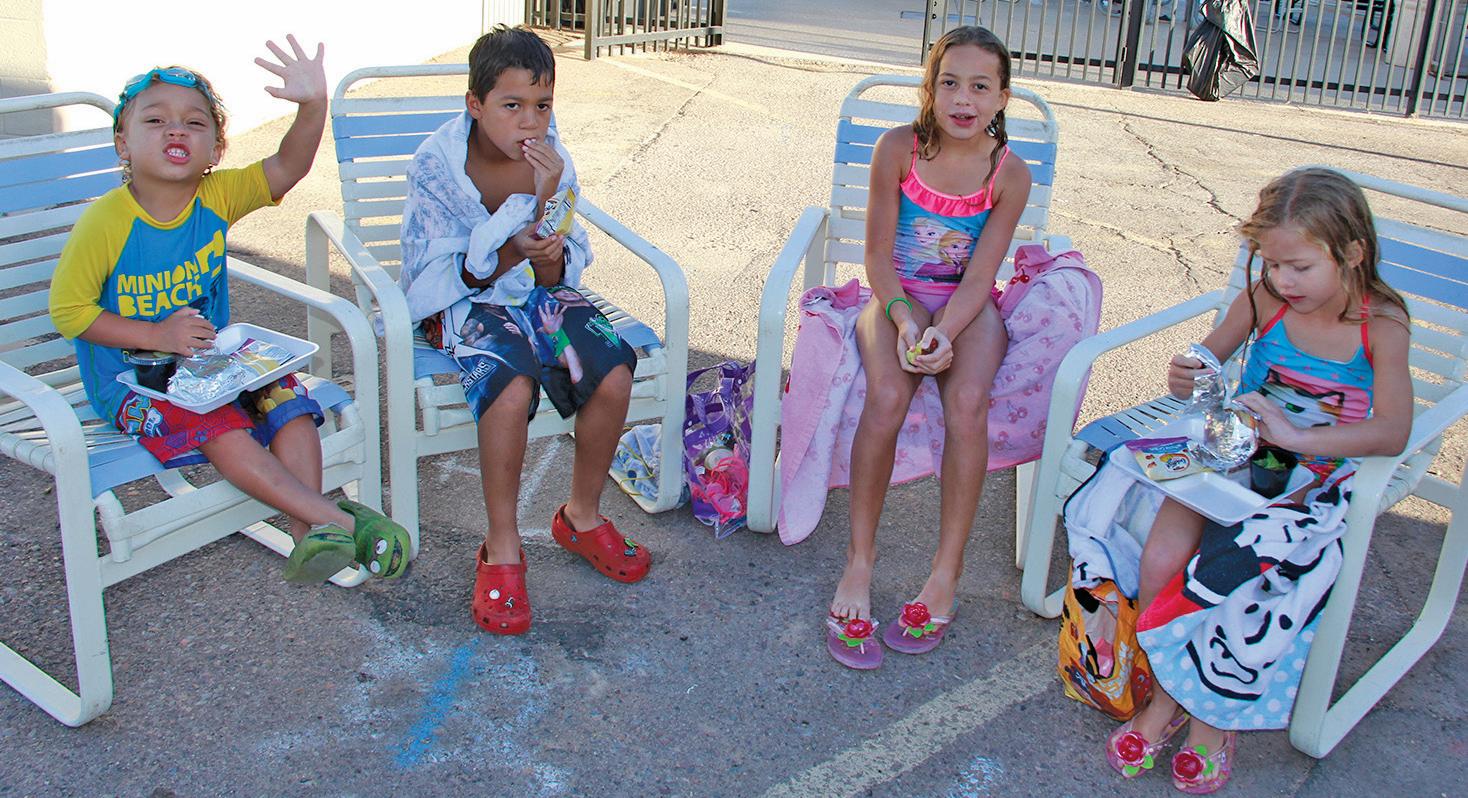
The Chandler Unified School District alone hosts 13 sites across the city, including some locations at city pools. The SFSP sites are set up outside of the pool gates so that children and parents do not have to pay a pool entrance fee















in order to take advantage of the meal program.
The meals are free for children 18 years old and younger. Select locations also offer meals for adults for a nominal price that generally ranges between $2 and $4.
The meals served vary by site. Many sites serve breakfast, lunch and /or snacks and a few sites also offer dinner options. It is possible for families to eat three meals a day at SFSP sites, though they would have to travel to multiple locations since program regulations only allow a site to serve two meals per day.
In Arizona, SFSP-affiliated programs serve between 3.5 million to 4 million meals every year, though those numbers are dropping. By comparison, the lunch program provides roughly 13 million meals every month during the school year, Rodgers said.





SFSP site for a snack.
It’s a great way to keep the children fed throughout most of the day and also makes sense logistically, Audri Knutson, supervisor for Chandler Unified School District’s Food Services Department.
In many cases, children and their parents still must brave the heat of the Arizona summer to receive meals, and they must eat those meals at the location rather than take them home due to program regulations. Transportation to and from SFSP locations, many of which are schools, is difficult for many low-income families in the summer when there is no school bus in service, Rodgers said.
“Here in the metro area (a major issue is) just the heat,” Barnes said. “When it gets 110 or 115 degrees outside it is hard to get children to come down.”
In 2014, the program provided 4,046,104 meals, and in 2016 that number fell to 3,432,722, according to statistics provided by Arizona Department of Education.
Parents can find meal sites and information at eatwellbewell.org/ summerfood, by texting FOOD to 877-877 or by calling National Hunger Hotline at 1-866-3-Hungry.
Those numbers do not necessarily equate to falling demand, though. That is because actual demand during the summer likely far outpaces meals served under SFSP, Rodgers said.
That disconnect is caused by range of factors, including cumbersome regulations, access to meal service sites, summer heat and community awareness.
While there are over 1,000 sites serving meals across the state, they tend to cluster in urban areas and many children –especially in rural communities – have trouble accessing them.
Mesa, the East Valley’s largest city, has just under 50 SFSP locations. However, smaller cities and towns like Chandler (14 locations) and Gilbert (six locations) have far less, according to the interactive online map from Arizona Nutrition Network.
There are no SFSP sites in Ahwatukee, though there are nearby sites at Boys & Girls Club of the East Valley in Guadalupe and Wood Elementary School in Tempe.
Children and parents do not have to be residents of a city or town to take advantage of a site located there, though.
For instance, under a program called Snack on the Bus, 150 students from Gilbert are bused to a Chandler swimming pool that also features an SFSP site run by Chandler Unified School District where they eat breakfast and lunch. Then, on their way home, they stop at another
One recent food trend in the Phoenix metro may hold the solution to that problem – food trucks. Chandler Unified School District is currently awaiting the arrival of its own food truck thanks to a donation from the Arizona Diamondbacks and a partnership with Aeromark. The food truck will be ready for service by next summer. In order to comply with the USDA regulations that require food be consumed on site, the food truck will bring tables for children to use.
This type of creativity and hard work is part and parcel of the dedicated public servants and volunteers who navigate the various regulations and logistical challenges involved in the program to feed hungry children, organizers say.
“Whatever twists and turns come up, we will prevail,” said Patti Narducci, food and nutrition supervisor for Chandler Unified School District.
The Summer Food Service Program also suffers a publicity problem. In many cases, children cannot take advantage of the program because their families simply do not know about it.
Association of Arizona Food Banks, Arizona Department of Education and other interested groups are working to reverse that trend by investing in social media marketing. Department of Education also partners with St. Mary’s Food Bank, Dairy Council of Arizona and Arizona Nutrition Network to create public service announcements and other promotional materials.
Chandler Unified promotes the program on school and district websites and also sends information home with students.
– Reach Wayne Schutsky at 480-898-6533 or wschutsky@timespublications.com.

































are less sympathetic to adults drowning. They feel like they should know better.”
Morgan said the unfortunate statistics demonstrate that adults need to change their attitude toward water, recognizing that it is not just a source of enjoyment but also a potential threat.
She said adults should never swim alone, because there are unanticipated issues that may occur, such as someone suffering a cramp, banging their head against a pool wall or suffering some sort of medical problem.
“They think they can swim, so they are waterproof,” Morgan said. “Just because you are a good swimmer doesn’t mean you can’t drown.”
Morgan said adults should respect water, rather than take it for granted, and use common-sense precautions. An adult who is not a good swimmer should avoid the water until taking swimming lessons, or a swimmer who is not feeling well should choose to stay away from the water on a particular day, Morgan said.
“I think learning a skill as an adult is intimidating, especially when there is fear involved,” she said. “Swimming is a life skill. It’s about survival. It’s like looking both ways before you cross a street.”
Sandra Franks, executive director of the Ahwatukee Foothills Family YMCA, said swimming classes for adults are increasingly popular.
“Lots of times, you have parents and grandparents who have children, who need to be safe around water,” Franks said. “They need to be able to jump in” and save a child from drowning if
necessary.
Franks said that East Valley YMCAs offer group classes and individualized instruction for adults.
“It gives you quality time with the instructor, at your own pace, at your own level,” she said.
Sharon Sholes, 56, of Chandler, was always around water when she lived on the East Coast, but she was never confident in her swimming ability. She always wears a life vest or uses a floatation device, but she decided recently to confront her fears about water and to take an adult swim class at the Ahwatukee YMCA.
Part of Sholes’ motivation is that she is looking for exercise that puts less friction on her joints as she gets older. She dreams about going snorkeling in Hawaii without a floatation device.
“You don’t voice your fears. You feel a little ashamed,” Sholes said. “I was never a strong swimmer. I always had a fear of the water I kept to myself.”
Sholes said that in New York and New Jersey, she was used to seeing lifeguards, which gave her a sense of security, but she felt very vulnerable at Saguaro Lake north of Mesa, realizing there was no one there to help her.
The tragic death of Ryan Thomas, 21, an Arizona State University student who was also a center for the Mountain View High School football team, shows tragedy can happen at anytime around water.
Thomas drowned eight years ago in Saguaro Lake only about 20 feet from the shoreline. Described as an above average swimmer, Thomas was not
wearing a life vest.
Thomas’ death motivated family members to the launch the Ryan Thomas Foundation, hoping to save other families from suffering such a devastating loss. The foundation has kiosks at eight lakes, including Saguaro, where visitors can borrow a life vest for the day. It has donated 1,000 vests in memory of Thomas.
“We kind of look at this as Ryan’s legacy, to save other families” from such tragic losses, said Shannon Liebrock of Chandler, Thomas’ aunt. “I think with adults, there is over-confidence in their swimming abilities.”
While people tend to blame adults for behavior that contributes to drowning, “accidents are accidents regardless of age,” she said.
Josh Hoffman, boating safety education coordinator for the Arizona Game and Fish Department, said the vests donated in Thomas’ memory are heavily used during the boating season.
Although some disappear from kiosks for months, only to return after the end of boating season, authorities are just happy to see the vests used to prevent drownings, he said.
In Arizona, children ages 12 or younger are required to wear life vests on boats, while it is voluntary for teens and adults.
“The drowning of children with boating has definitely plateaued,” Hoffman said. “It’s still a constant battle with adult drowning.”
He said one theory in Thomas’ death is that he may have succumbed to “cold water shock,” a reaction to the contrast between 100-degree air temperatures and 70-degree water temperatures.
“Your body is going to want to gasp. It’s an involuntary reaction,” Hoffman

said.
When a victim’s lungs fill with water, “at that point, you might not be able to regain the surface” without help from a floatation device, he said.
Lori Schmidt, a spokeswoman for the Scottsdale Fire Department and the drowning prevention coalition, said she has seen tragic incidents where adults could have been saved from drowning through additional vigilance.
She said there needs to be a sober “water-watcher” at pool parties, keeping track of people to make sure there are no life-threatening accidents.
“Someone needs to be paying attention, whether it’s an adult or a child,” she said.
Schmidt said that mixing alcohol with swimming can have the same disastrous effects as mixing drinking with driving.
“The adults need to change the way they think about water,” she said. “It just hasn’t been focused on. People are not aware of the risks.”
Schmidt said there has not been any well-publicized safety campaigns aimed at preventing adult drowning, but the issue is starting to get more attention from water-safety advocates.
She said one idea that has been discussed is to ask pharmacies to attach warnings to prescriptions about the risk of swimming while under the influence of certain drugs.
Sholes said its obvious more adults need to take swim classes in Arizona. She ended up with her individualized class because not enough people signed up for the group class.
“I’ve been to Hawaii a couple of times,” she said. “I thought, oh gosh, wouldn’t it be nice to come back here and have that freedom.”
jwalsh@timespublications.com.












BY PAUL MARYNIAK
AFN Executive Editor
The City of Phoenix is giving serious attention to one of Ahwatukee residents’ most common complaints – the condition of Ray Road.
Crews on Monday began work on a segment of Ray between Ranch Circle and Mountain Parkway on a schedule aimed at minimizing inconvenience to residents who drive to work.
“With all the work going on Pecos Road, we did not want to close down Ray Road or Chandler Boulevard completly,” city Councilman Sal DiCiccio said. “It would be a nightmare.”
Instead, the work will be done outside of morning and evening rush hours, and one lane in each direction will remain open at all times, he explained.
“It will create some inconvenience but it will not affect people going to work or coming home from work,” DiCiccio said, adding, “I have to give the Streets Department an amazing amount of credit because we didn’t want to shut down the road and it looks like we will accomplish that goal.”
Streets in one neighborhood near that stretch of Ray Road, as well as those in a neighborhood off 36th Street near Knox Road, also are scheduled for resurfacing this year.
DiCiccio also said he and the seven other City Council members will be reaping the benefits of some additional roadwork money. Each district is being allotted 10 miles worth of thoroughfares and he wants Ahwatukee residents to make suggestions on what streets and roads should get attention.
Ahwatukee residents can submit their nominations to DiCiccio at 602-262-7491 or council.district.6@ phoenix.gov.
Meanwhile, the Chandler Boulevard Extension is slated for completion at the end of July, creating an alternative to Pecos Road for three Ahwatukee subdivisions.
Crews will resurface Ray Road between Ranch Circle and Mountain Parkway over the next week, and DiCiccio said other neighborhoods in the community will be getting attention this year –while more work is being scheduled in 2018 and 2019.
“It would be a huge negative for



the community if we had too much work going on this year with all the construction along Pecos Road,” he said.
Other resurfacing projects slated this year include neighborhood streets on either side of 48th Street between the Elliot-Warner Loop; an area just west of 48th Street and south of Piedmont Road; and two stretches of Liberty Lane west of 24th Street and west of Desert Foothills Parkway.
Next year, the department is targeting a stretch of Chandler Boulevard on either side of 17th Avenue, neighborhoods on the north side of Chandler Boulevard between Desert Foothills Parkway and the Chandler-Ray intersection, streets off Lakewood Drive and two more Ranch Circle areas.
In 2019, resurfacing has been scheduled for the rest of Lakewood, Desert Foothills Parkway and adjacent streets west of there, streets north of Liberty Lane on either side of 17th Avenue and neighborhoods between Mountain Parkway southwest to Chandler Boulevard.
DiCiccio said Ahwatukee is not alone when it comes to poor street surface conditions.
“If you drive throughout the city of Phoenix, our streets are crumbling, and I think they’re getting the message,” he said, referring to Streets Department officials.
As the result of a sales tax increase approved by voters in 2015, the city is scheduled to reap millions in additional money for a wide range of street and mass transit improvements over the next 30 years, including additional resurfacing projects.
The Chandler Boulevard Extension’s opening midsummer will come almost a year from the time the plan first came before the Village Planning Committee and ran into a storm of criticism.
Committee Chairman Chad Blostone expressed alarm that the city planned only a two-lane mile-long stretch connecting two four-lane ends of Chandler Boulevard, noting that even a minor fender bender would shut down the road completely.
Blostone and DiCiccio pressed city officials for four lanes, but in the end, both sides compromised on having one lane in each direction with a middle service lane to allow emergency vehicles access.

The applications for those permits had to be submitted to the city 10 days before the event, making Thursday, June 22, the drop-dead deadline.
Matykiewicz said he didn’t want to wait until the last minute to submit permit applications because “that’s not the way I do things.”
“I just don’t like putting the city in that position and filing the applications at the last minute,” he said last week.
Matykiewicz is no stranger to staging public spectacles; it’s been his livelihood for 20 years.
While he’s been on two Super Bowl planning committees and is a life member of the Fiesta Bowl Committee, his full-time job these days is putting on the Arizona Balloon Festival, which will be held for the seventh consecutive year next February in Goodyear.
Matykiewicz said he also had “run into some issues with the liquor license” he and Native would need to serve alcohol in the parking lot of the strip mall at East Chandler Bouelvard and Desert Foothills Parkway before, during and after the fireworks show.
The plan was to sell food and beverages and offer vendors, bounce houses and

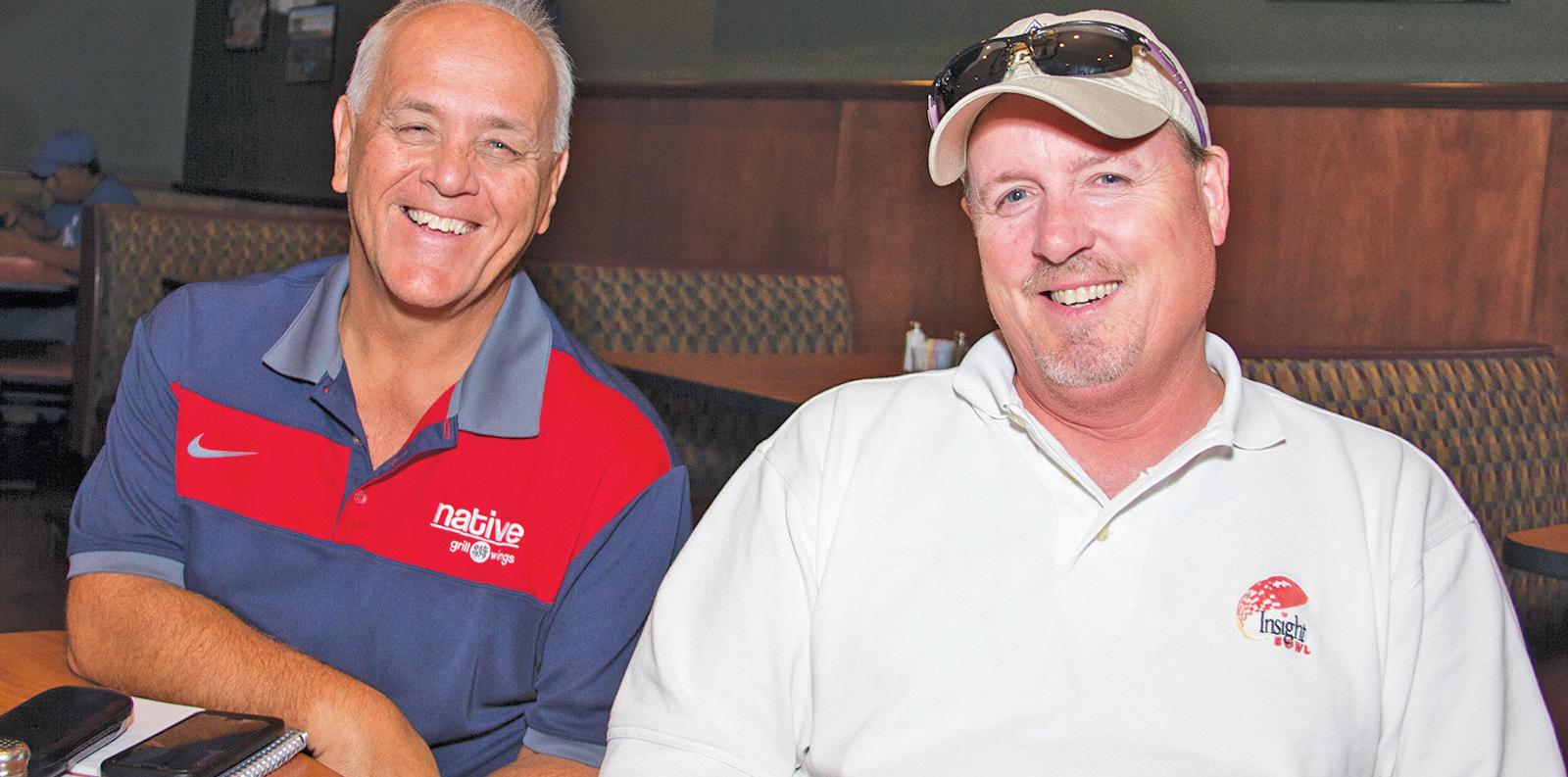
Rod Ticknor, left, owner of Native Grill and Wings on East Chandler Boulevard, and event promoter Tim Matykiewicz, had hoped on keeping fireworks bursting in air in Ahwatukee for Independence Day this year, but their fundraising campaign apprently failed to get public buy-in.
other family attractions similar to what the Ahwatukee Chamber offered at a pre-fireworks show it had held the last two years in Pecos Park.
Pleas for donations on social media appeared to spark much support on Matykiewicz’s gofundme.com site.
Most donors kicked in $5 to $20

while six contributed $250 each and several others about $100 each.
“All the money will be returned to the donors if I decide to cancel,” Matykiewicz said.
While Ahwatukee residents likely won’t find a fireworks show in their backyard, they won’t have far to travel to
several. Rawhide plans its annual show for July 1 while Chandler, Tempe and Mesa all plan to hold their fireworks shows on July 4.
A full report on upcoming shows will appear in the June 28 edition of AFN. Updates on Matykiewicz’s efforts can be found at ahwatukee.com.


















BY LEAH MERRALL AFN Staff Writer
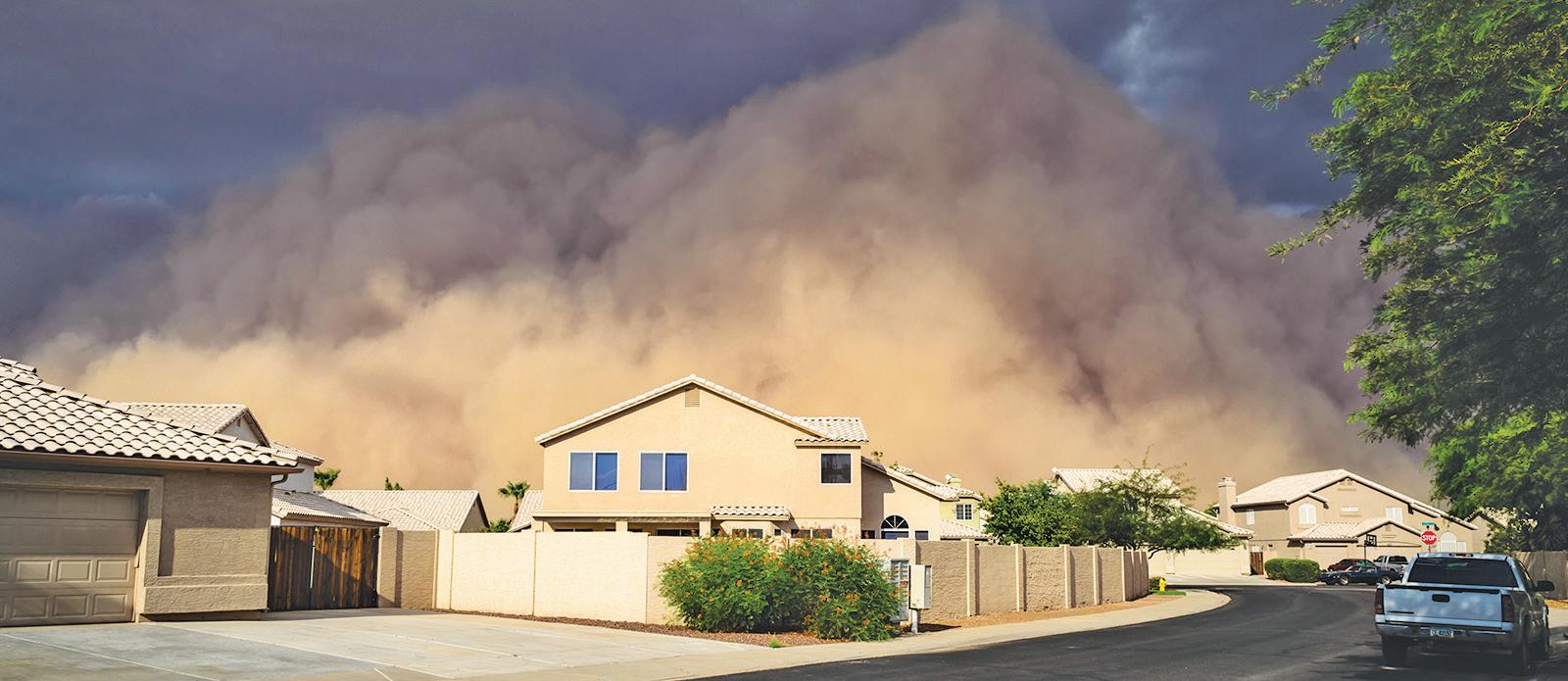
Arizona’s monsoon season has debuted, and that means haboobs are here too.
These dust storms are a staple summer weather event for locals in the Valley, but they’re actually more dangerous than their name lets on.
Haboobs (derived from the Arabic word for “strong wind”) are the leading cause of injuries by hazard in Arizona, according to a National Oceanic and Atmospheric Administration Technical Memorandum report on blowing dust and dust storms.
The report also found that haboobs are the third leading cause of death by hazard in the state, behind heat and flooding.
According to Jaret Rogers, a meteorologist at the National Weather Service in Phoenix, haboobs are typically generated from thunderstorm wind gusts. As the thunderstorm decays, it produces strong wind gusts over the open desert that kicks up dust, which causes an outflow.
It’s this outflow that can travel dozens of miles across the desert, kicking up dust along the way, and creates the wall of sand that citizens of the Valley see coming during the summer months.
Chandler, Queen Creek and Ahwatukee are especially vulnerable to dust storms, Rogers said, because thunderstorms often develop near
Tucson and the open desert between creates a large opportunity for the collection of dust. Those southernmost cities are the first to get hit.
“It’s not always obvious when they’re going to hit so it can be short notice,” Rogers said. “You may only have 10 or 15 minutes before you can see the wall of dust that’s going to hit you.”
The biggest concern is safety for motorists, as dust storms can decrease visibility down to almost zero.
“Pull Aside, Stay Alive” is the slogan of the National Weather Service, which advises drivers to try and pull over as far away from the road as possible to wait out a haboob.
The National Weather Service also issues dust storm warnings so people have the opportunity to take precautions in advance.
Although monsoon season officially takes place between June 15 and Sept. 30, Rogers said the most common time for haboobs to hit is late June and early July. They tend to occur in the late afternoon or early evening.
One of the biggest and most significant haboobs in recent history took place in Phoenix on July 5, 2011.
Ken Waters, the warning coordination meteorologist for the National Weather Service in Phoenix at the time, told EarthSky.org that the storm was so big because there had been no rain in parts of Arizona for up to four months, meaning there was a lot of available dust.
While there isn’t anything anyone can
do to stop the storm from coming, there are measures that Ahwatukee residents can take to ride it out.
“Pay attention to the dust storm warning in our forecast,” Rogers said. “And just take safety precautions.”
The City of Phoenix has prepared a list of instructions for residents to follow in the event of a nasty monsoon storm. For more information, see phoenix.gov.
Life-threatening emergencies: 911 Non-emergency police assistance: 602-262-6151
Report street issues: 602-262-6441
Report traffic signal outages: 602-262-6021
Storm debris information: 602-262-6251
Report power outage: APS: 855-688-2437
SRP: 602-236-8811
American Red Cross: 800-842-7349
The city suggests that residents “explore innovative, long-term water barrier options such as self-activating flood barriers.” The barriers are activated when hit by water and act like sandbags. They can be stored throughout the year and reused and can be found online or at local hardware stores.
Residents can leave these barriers in flood-prone areas before leaving for work.
Residents who prefer sandbags can find
them before a threatened storm at Phoenix Fire Station #43, 4119 E. Chandler Blvd., Ahwatukee. You must bring a shovel and bags.
Know where to go and how to get there should you need to get to higher ground, the highest level of a building, or to evacuate. Clean out roof drains or scuppers to prevent accumulation of rain water on the roof.
Thin out trees and trim down overgrown vegetation.
Clean out drywells on your property so water can collect safely.
Repair landscaping to ensure water will run away from your building.
Back up all data in case your computer or servers become damaged.
Look at installing generators or back up battery systems.
Build an emergency kit with a flashlight, batteries, cash, and first aid supplies.
Standing water can trigger an increase in mosquito. Call Maricopa County Vector Control at 602-506-6616 with complaints.
BY COTY DOLORES MIRANDA
AFN Contributing Writer
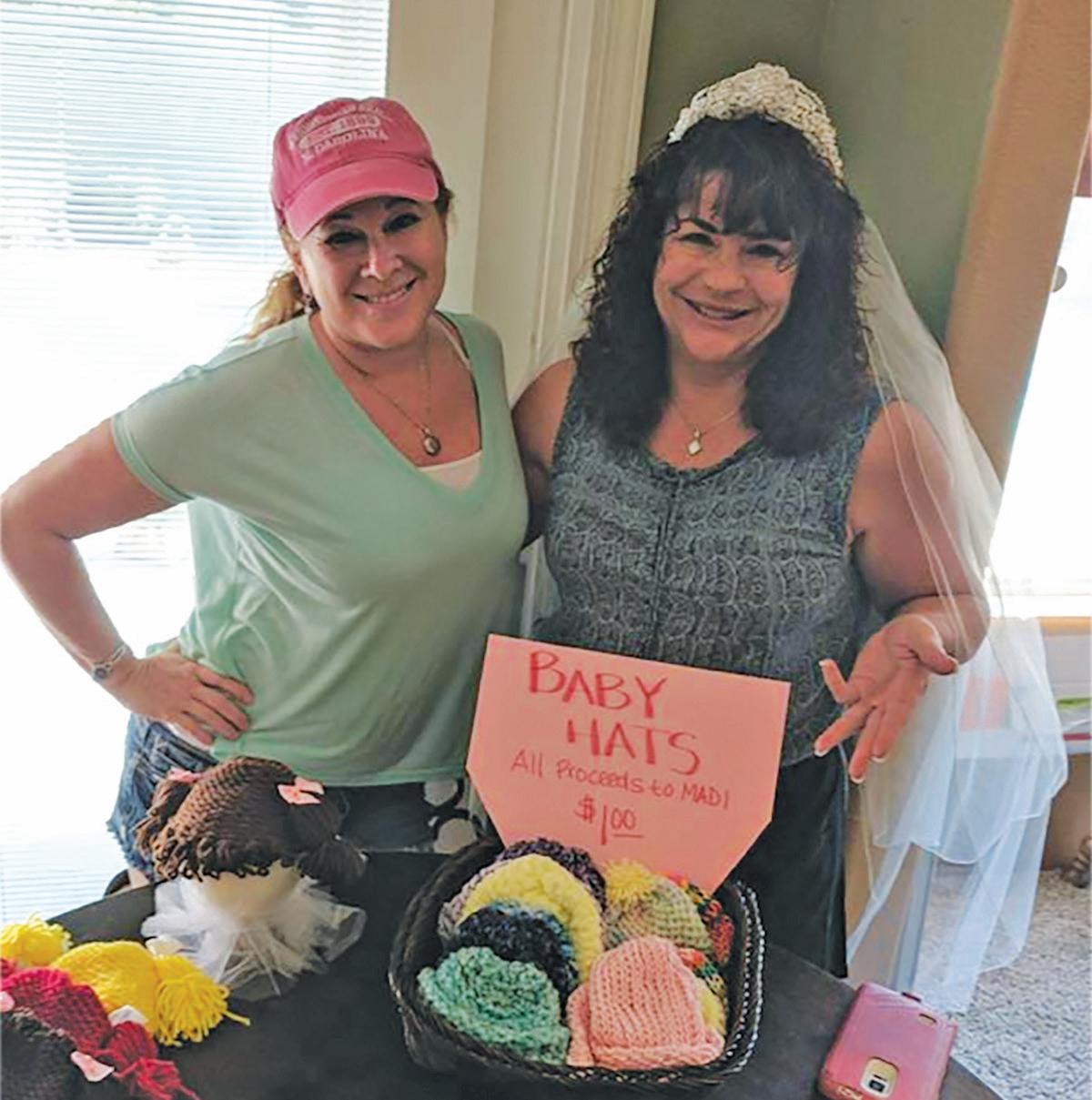
Last week, an unusual image posted on social media showed a woman wearing a wedding dress and posing with tables of household items readying for her “Divorce Sale.”
It captured attention and prompted a few questions, such as, “Who advertises a divorce sale? and “How does a woman fit in her wedding dress after 19 years?”
Actually, the white lace gown was a bit large on Ahwatukee resident, mother and new divorcee Paula Fosbinder.
As to honestly dubbing the sale what it was? That, according to Fosbinder’s close friends, is “Typical Paula – always finding a way to see humor in any situation.”
Fosbinder had soldiered through a tough couple weeks on top of a few tougher years.
She speaks no ill will toward her ex, admitting they remain amicable.
Still, it was difficult to unload family treasures representing a lifetime invested.
“I probably spent the last two weeks in tears,” she said. “But this is not about revenge. It’s about cleansing the soul,
tucking away memories and making room for an abundance of happiness that lies ahead of me. I don’t want to sound cliché, but it’s about closure.”
Her house on Desert Flower Lane was the home where, for 17 of her 19 years of marriage, she raised two children.
“I was married nearly half of my life,” said Fosbinder, 51, while organizing the $1 room where her wedding dress originally hung.
“These walls are full of laughter, joy, change and – most of all – love. I spent three weeks in between work and other activities going through rooms, closets and boxes, sorting things for my boys to have when they someday need to have a childhood memory. I cried, laughed and got angry through this process,” she said.
“I spent hours on the phone with my parents and sisters coaching me through
See GARAGE on page 22
(Special to AFN)


each piece of memory. It was my sister Trisha who said to me, ‘You need to stop having these stupid pity parties and realize that God wants you to go through this,’” Fosbinder added
“She said, ‘Paula, I was just listening to a Steve Warren sermon on my way home from work. The message was exactly what you need to hear. Hosea 10:12 “Sow to yourselves in righteousness, reap in mercy; break up your fallow ground: for it is time to seek the Lord till he come and rain righteousness upon you.”’
“So, I’m tilling the earth for my new garden to grow.”
Coming to the hurting woman’s side were her “go-to girls,” who were at the house to sort and organize items for sale.
“After spending these hours alone going through each memory, I had an epiphany that I needed help with this sale. I contacted my go-to girls for help – you know, the ones who you may not see or talk to for weeks or even months, but know they will rally with you and for you when called upon,” said Fosbinder, adding: “Two of my go-to’s were out of town for the month, but three of my five showed up with bells on ready to conquer the storm with me and get ready for this sale.
“While setting up for the sale, they had me laughing, snorting and crying. I told them they needed to take charge. They did indeed, and – bam! – we had it done!” she continued.
“I was hanging up some clothes on the rack and Shelly screamed, “That is not your wedding dress!” Which then led to the ‘dress-up’ challenge and the photos. This has been so therapeutic and healing for me going through this process and knowing the best is yet to come. Cue Frank Sinatra.”
Fosbinder’s indefatigable spirit was equally inspiring to her three friends


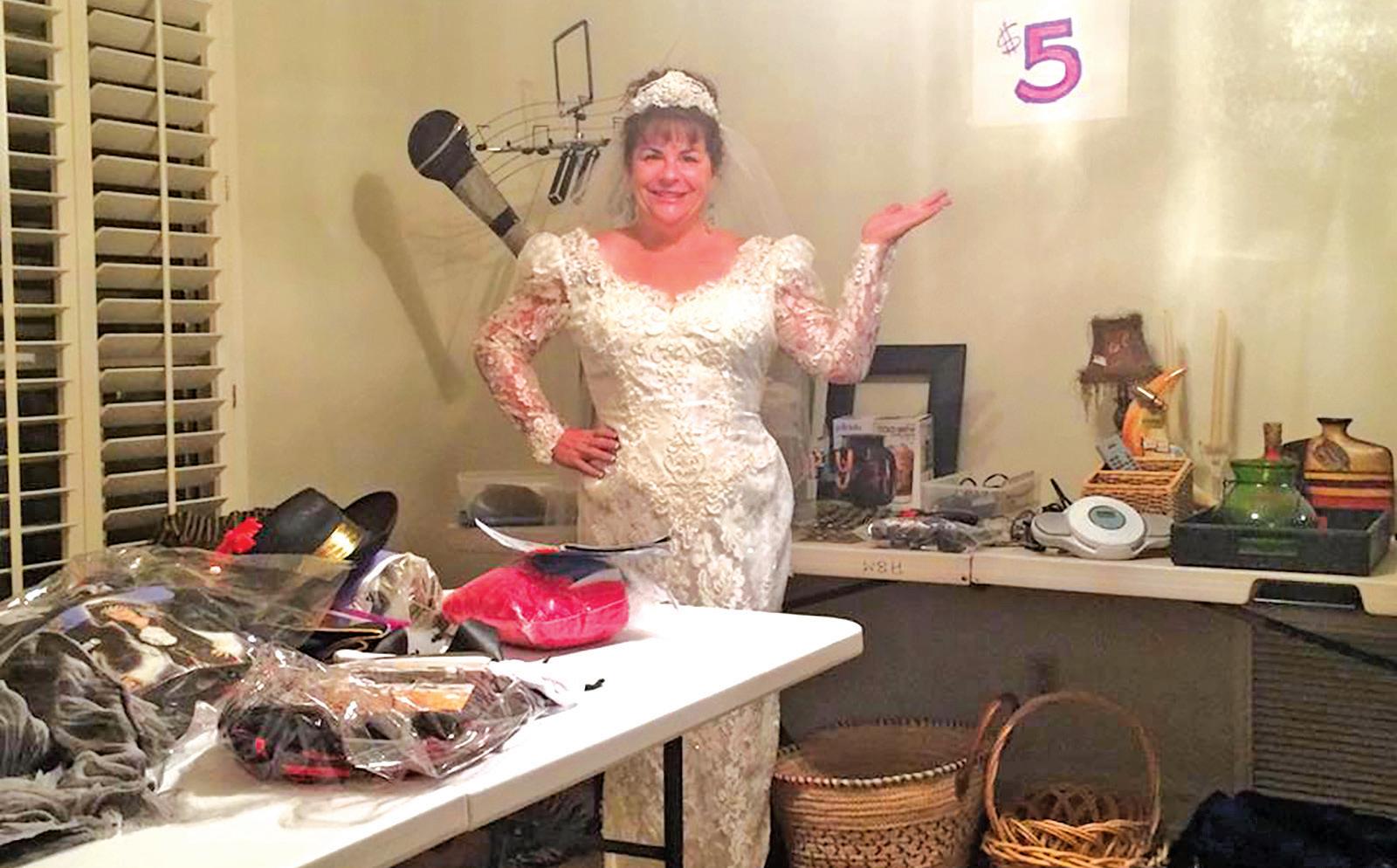
– Sheri Arendse, Shelly Kotchou and Caroline Shields – and many other women whom she had not met before her two-day sale.
“Her current situation would have most women crumbling, but not Paula. She has stepped into her big-girl panties (and her wedding gown) as an example to us all that a positive attitude and a few go-to girls can get you through just about anything,” said Arendse, a friend of 17 years, adding:
“She laughs and she cries and then she gets down to taking care of business. She’s truly an inspiration. Once this sale is completed and her gown goes away for good, Paula will tackle this next chapter with enthusiasm and love as she has done in every situation, and I’ll be right by her side to share in every minute!”
Shields learned Fosbinder was packing up the house for a divorce sale only last week.
“Paula contacted me on Wednesday; it was the first time I’d even heard about the house and her need to get it vacated by Monday,” she said.
“This is typical Paula,” she continued. “She takes on so much of the burden all on her own, but I feel fortunate that she asks for help when she really needs it. Although she was focused on the physical help she needed with the house, when I got there it was clear that she needed companionship and help to pull her through, not just the physical getting stuff prepped or cleaned out.”
Along with Kotchou, Shields pitched in with the sale, which had the fivebedroom house crowded both mornings.
“Shelly and I went over that night and after just a little bit of organizing and pointing her in the right direction, she was getting back to her old self again. We got everything divided into rooms and had plenty of time to laugh,” Shields said, adding:
“When we found an old tequila bottle in the garage fridge, we poured the last of it into three glasses and made sure to toast Paula – specifically her strength getting through such a crazy difficult situation.”
It was Kotchou who cajoled Fosbinder
into wearing the wedding dress, and it proved to be the hit of the evening and the internet.
“I get a big smile thinking of the wedding dress and Shelly convincing her to put it on, and how awesome that the dress is even too big for her,” said Shields.
“I never thought the post (on a Facebook page) would have drawn so much attention, and be so inspiring to me and to others,” said Fosbinder. “My go-to girls were instrumental in pulling this off, and I have to say that if anyone every needs help with anything like this to please contact me to be their go-to girl. It’s so good to have friends who are there for you.”
Shields concurred.
“I believe that every once in a while each of us needs to be buoyed by our girlfriends, lifted out of whatever dark hole were falling into or have we fallen into,” she said.
As women, we tend to take on so much of the burden ourselves. Isn’t it amazing a small bit of contact with a girlfriend can serve as a true lifeline. It helps us realize we’re not insane, we’re not going crazy and we can do this.”
Instead of selling her wedding dress as originally planned, Fosbinder chose to donate it to Angel Gowns, a nonprofit that re-purposes the lavish creations into burial gowns given to families who lost their newborns, or those stillborn.
In addition, Fosbinder donated $100 to the Madison (Madi) Caballero‘s gofundme.com account, and her friend Arendse added another $60 from crocheted baby hats sold at the sale.
“It was a big success and a walk down memory lane as people from my past stopped by to say hi and show support,” said Fosbinder, who wore her wedding veil both days. “I have a great sense of passion for life and want my legacy to be that of kindness. I want my children to look back at this divorce and say, ‘They did it with grace and dignity.’”

Any hope for a quick resolution of the appeal over the South Mountain Freeway was shattered late last week when the U.S. District Court of Appeals for the Ninth Circuit said it probably won’t hear oral arguments before October.
Stating the case “is being considered for the October 2017 San Francisco oral argument calendar,” the appellate court also said it would announce the date for oral arguments 10 weeks before they are to be heard.
“We will be lucky to have a ruling by the end of the year,” complained Past Lawlis, president of the Ahwatukeebased Protect Arizona’s Resources and Children, one of the two major groups appealing U.S. District Judge Diane Humetewa’s decision last year to let work proceed on the 22-mile connector between the Chandler and 59 Avenue interchanges on the I-10.
Humetewa rejected assertions by PARC and the Gila River Indian Community that the Arizona Department of Transportation and Federal Highway Administration violated environmental
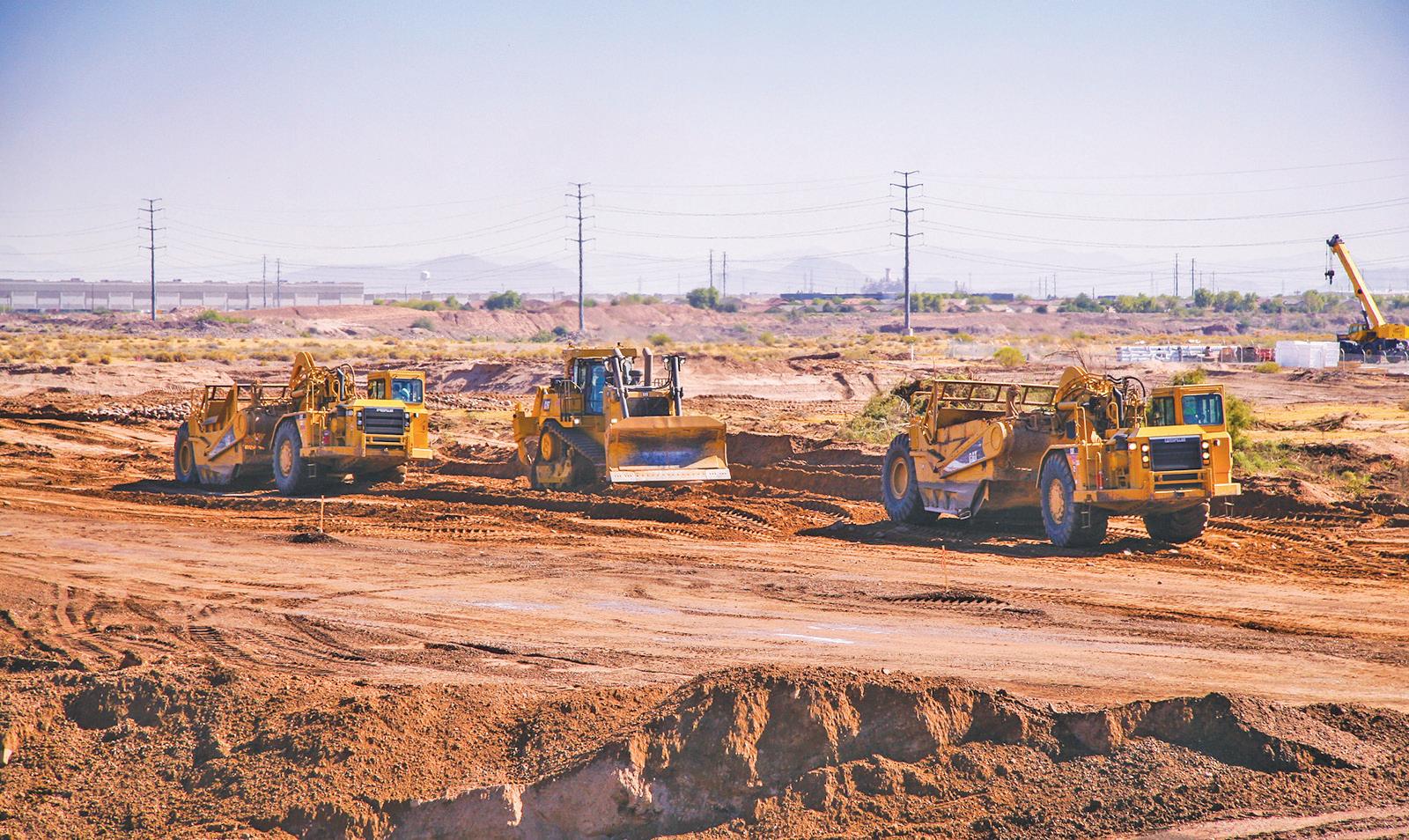
regulations and laws protecting sacred Native American sites when it planned the $1.77 billion project.
They contend that the highway agencies performed inadequate studies on the freeway’s impact on air quality and other health-related factors affecting thousands of children attending 17 schools near the Ahwatukee segment
of the freeway as well as reservation residents.
The Gila Community also has argued that the agencies’ plans to cut a 200foot gash across three peaks of South Mountain desecrates a site that Native Americans consider sacred. It also alleges that other sacred sites and burial grounds already have been destroyed by ongoing
work.
ADOT and the FHWA have denied the plaintiff’s allegations, stating they followed all laws and regulations protecting the environmental and sacred Indian sites.
They also contend that the project is not only vital to the region but will improve the air quality around the Broadway Curve on I-10 by providing a bypass around downtown Phoenix for thousands of vehicles.
Some Valley highway planners say 40 percent of all daily traffic uses the Broadway Curve.
News of the appellate court’s announcement provoked some outrage on Ahwatukee social media sites.
“At the rate it’s going, the Foothills will be blasted, a bridge will be towering over the homes at 32nd Street, and there will be so much irreparable damage, if we win, how will the community and environment ever be restored?” complained one woman who owns a home near the right-of-way.
“I can’t believe they can drag it out so long without awarding an injunction

We have been parents at Keystone Montessori for over nine years and this is the only school that both of our kids attended. We believe Keystone has provided our children with the perfect blend of social, emotional and intellectual development. The Keystone staff and teachers have done a remarkable job in fostering the intellectual curiosity coupled with emotional maturity in our kids that we believe have prepared them for their next steps of high school and then college.
- Parent Testimonial
BY PAUL MARYNIAK
AFN Executive Editor
As the temperature rises, so does Leon Nelson’s wariness.
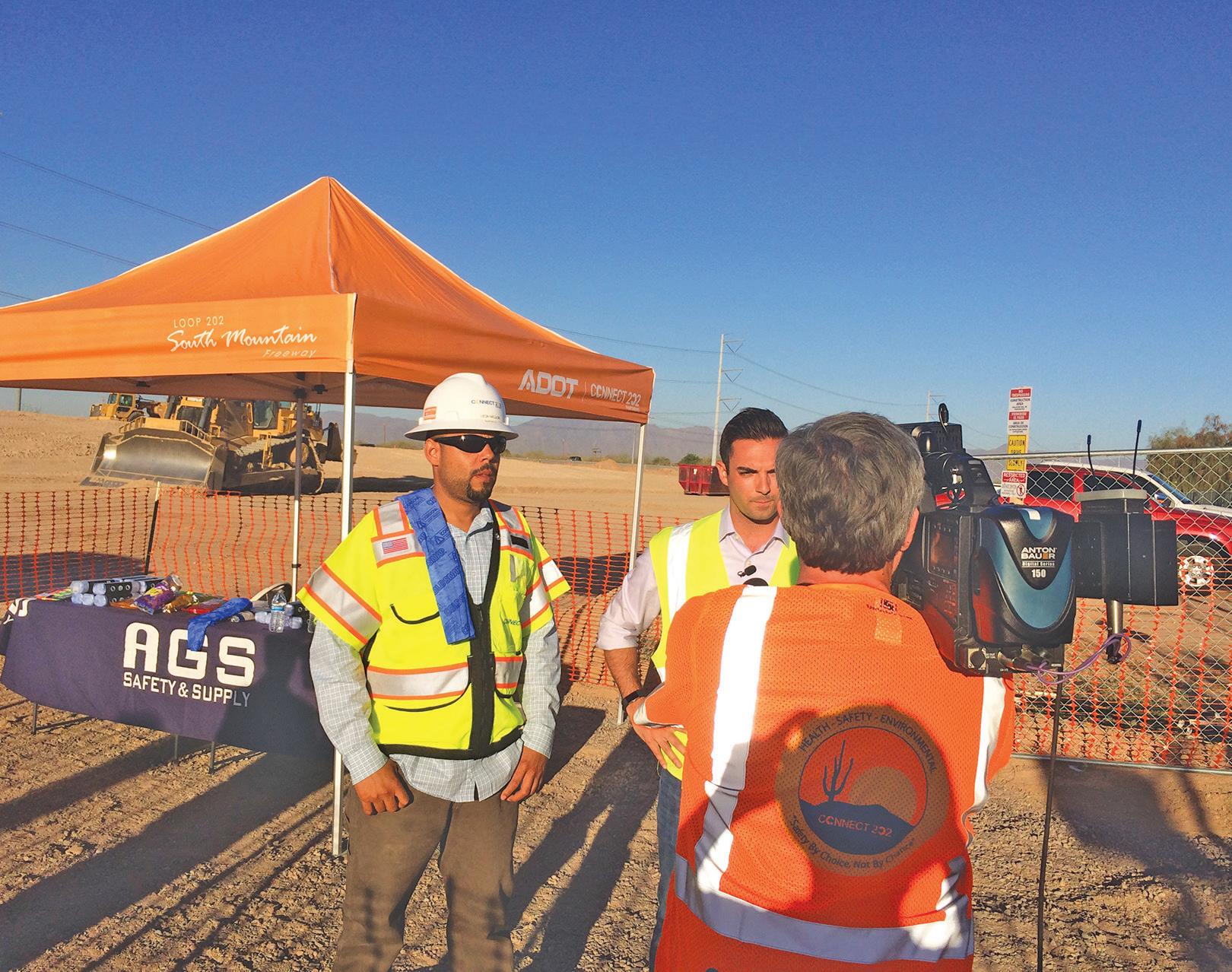
The Chandler man rolls up and down along the sidelines of Pecos Road in his air-conditioned utility truck, making sure South Mountain Freeway crews are guarding themselves against the brutal heat.
“I’m fortunate that one of my jobs is driving a truck,” said Nelson, a safety lead for the last nine years of his 20 years as a journeyman electrician/road worker.
Nelson’s job is ensuring the safety of the 40 to 60 workers now on the site of the freeway’s Ahwatukee segment.
And the biggest threat to worker safety right now is blistering daytime temperatures.
“Heat illness does happen,” Nelson said. “The guys we have are trained in the signs of heat illness.”
Despite that training, it’s easy for the men to become so involved in their work that they forget to follow basic precautions that have been passed along to about 1,400 workers who will be outside along the entire 22-mile stretch of the freeway once construction activity starts to peak in a month or two.
Even now, Nelson said, “there are little remote operations” along the freeway’s so-called Pecos Segment where only a couple men might be working. “I let the truck run and let the guys sit in it.”
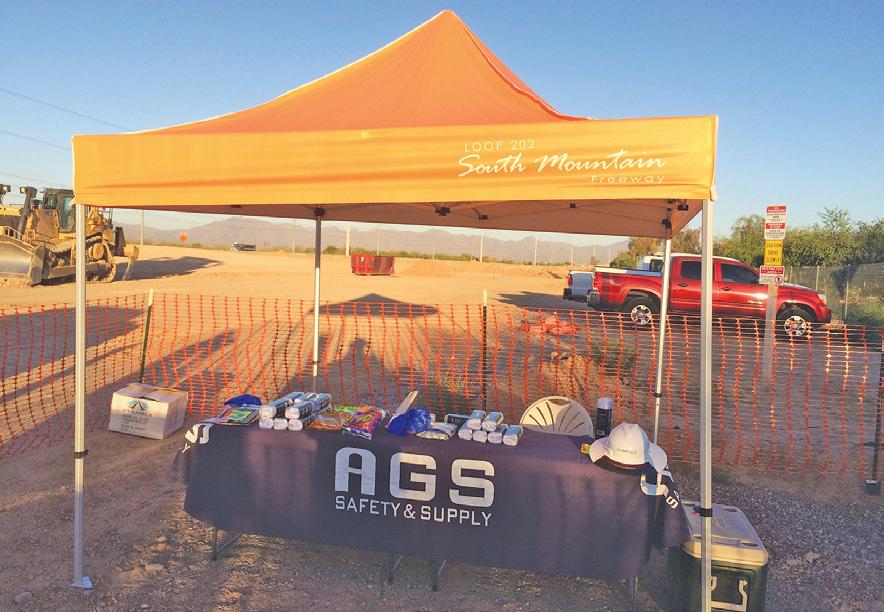
“Cases of chilled bottled water, protective lightweight clothing, sun visors and shaded tent areas, coupled with mandatory training on dealing with extreme heat, are just some of the ways crews building the Loop 202 South Mountain Freeway are prepared for temperatures forecast to surge beyond 110,” the Arizona Department of Transportation said in a release last week. Those precautions are standard for all ADOT crews on any state road project,
from page 23
until a decision is made, or at least until the court date,” she added.
Another post on PARC’s Facebook site complained that the court seemed “determined to hold this off until so much damage has been done it will be irreversible, no matter the decision.”
Though Lawless expressed frustration on PARC’s Facebook site, she also
late-afternoon temperatures.
While most of the workers are Arizona natives or have lived here a long time, occasionally a newcomer is on a crew.
That requires more careful management of their time outside until they get acclimated,” Krugel said.
“We don’t put them out for the whole day right away,” he added. “We have them go a few hours and then gradually have them stay out longer so they get used to the heat.”
said department spokesman Dustin Krugel.
“With a project as large as the South Mountain Freeway, there’s no opportunity for workers to take a summer vacation to get away from the heat,” Krugel said. “People are relying on us to get this freeway done fast and reduce the impact on the community.”
“Water, rest and shade. Those are the three big precautions,” he added, noting that crews work on a “buddy system” and are trained to look after one another for signs of heat prostration.
“If you wait till you’re thirsty, it’s too late,” he added, saying crews are reminded each morning to “get rest throughout the day, sit down, drink water and get in the shade.”
Some precautions come in the form of products that private companies
remained confident of prevailing in the appeal.
“It will certainly take a long time for ADOT to redo Pecos Rd and tear down all that bridge crap after we win,” she posted. “But we should get a new Pecos Rd. I guess that’s one good thing that will come of it.”
It remains unclear whether ADOT will proceed with blasting in the area between 32nd Street and South Mountain this summer, as it previously announced.
specifically design for men and women who work outside in hot weather.
“There’s new products all the time,” Nelson said.
For example, tightly wrapped cylinders of chilled towels can be cracked open and placed on the back of the neck. Small packets of electrolyte powder in different flavors are available to be mixed into water or a beverage.
Popsicle-like products resembling the old freezer pops treats that were once available in stores also are handed out to workers at the end of the day.
“Some guys forget how long of a drive they have home, so we give these to them so they can stay hydrated,” Nelson explained.
Crews also start working by 5:30 a.m. and quit by anytime between 12:30-2 p.m. to keep them out of the intense
Although freeway developer Connect 202 Partners and a private company are providing free inspections to nearby homeowners to determine whether the houses could be damaged by the blasting, an ADOT spokesman said two weeks ago that the agency is still studying whether blasting will be necessary. Crews will have to conduct blasting for the stretch that will cut through South Mountain, but that work is not scheduled until the middle of next year.
Nelson said more tents have been erected along the Pecos Segment than other stretches of the freeway because the work areas tend to be more expansive. If the workers can’t eat lunch inside an air-conditioned truck cab, they’re encouraged to take a break under the tent.
Freeway developer Connect 202 Partners also has emergency medical technicians on site to check blood pressure, heart rate, respiration and body temperature.
Soon, Nelson will be adding another summertime duty to his daily workload: watching the skies for approaching monsoon storms.
“One of my jobs is to monitor the storms and see how fast they are approaching,” said Nelson. “But usually we don’t have to worry much because the storms come late enough in the day that everyone’s already done for the day.”
ADOT also issued a release earlier this month boasting of how fast work is going on the freeway, which is tentatively scheduled to open in late 2019. That’s largely because the freeway is a “design-build” project in which construction is ongoing along some segments while planners are designing other portions.
ADOT said that approach cuts costs on what is the most expensive highway project in state history.
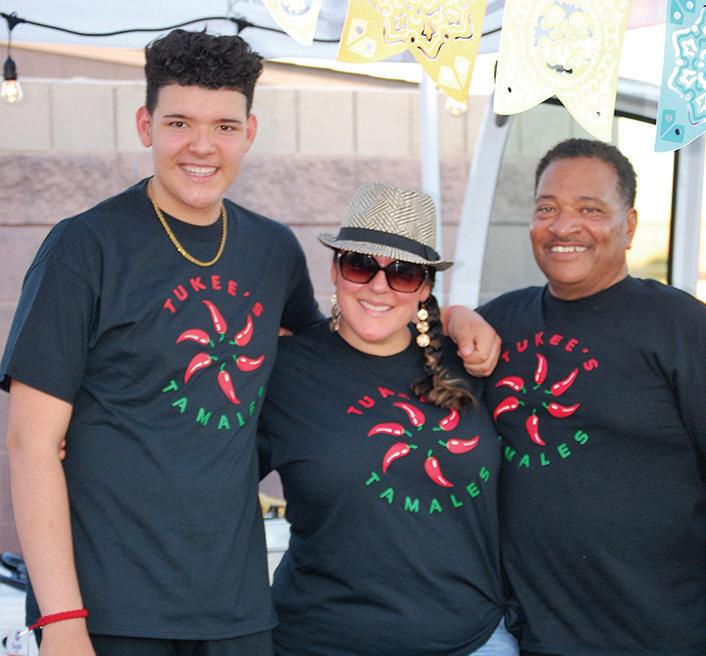
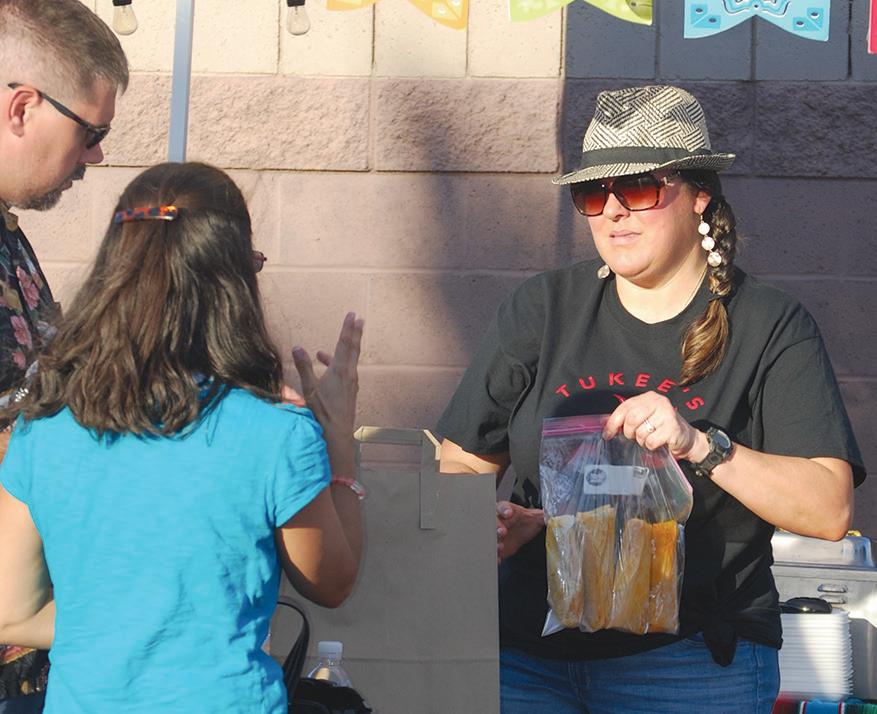
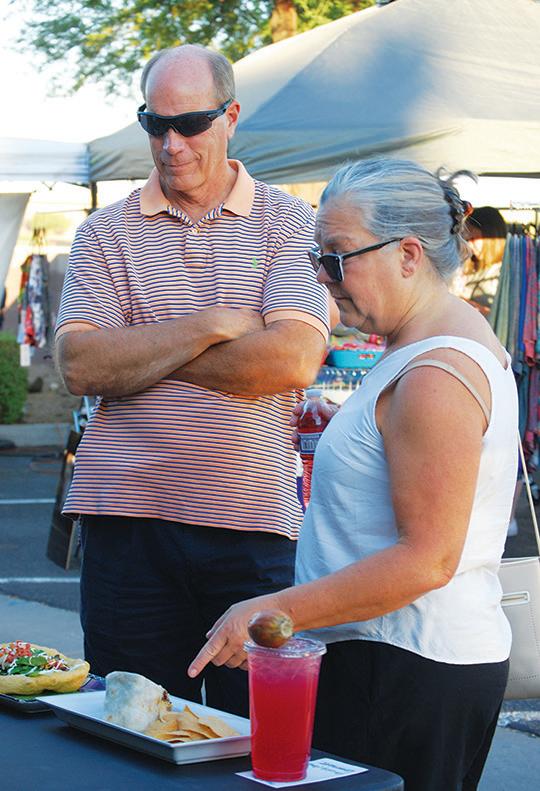
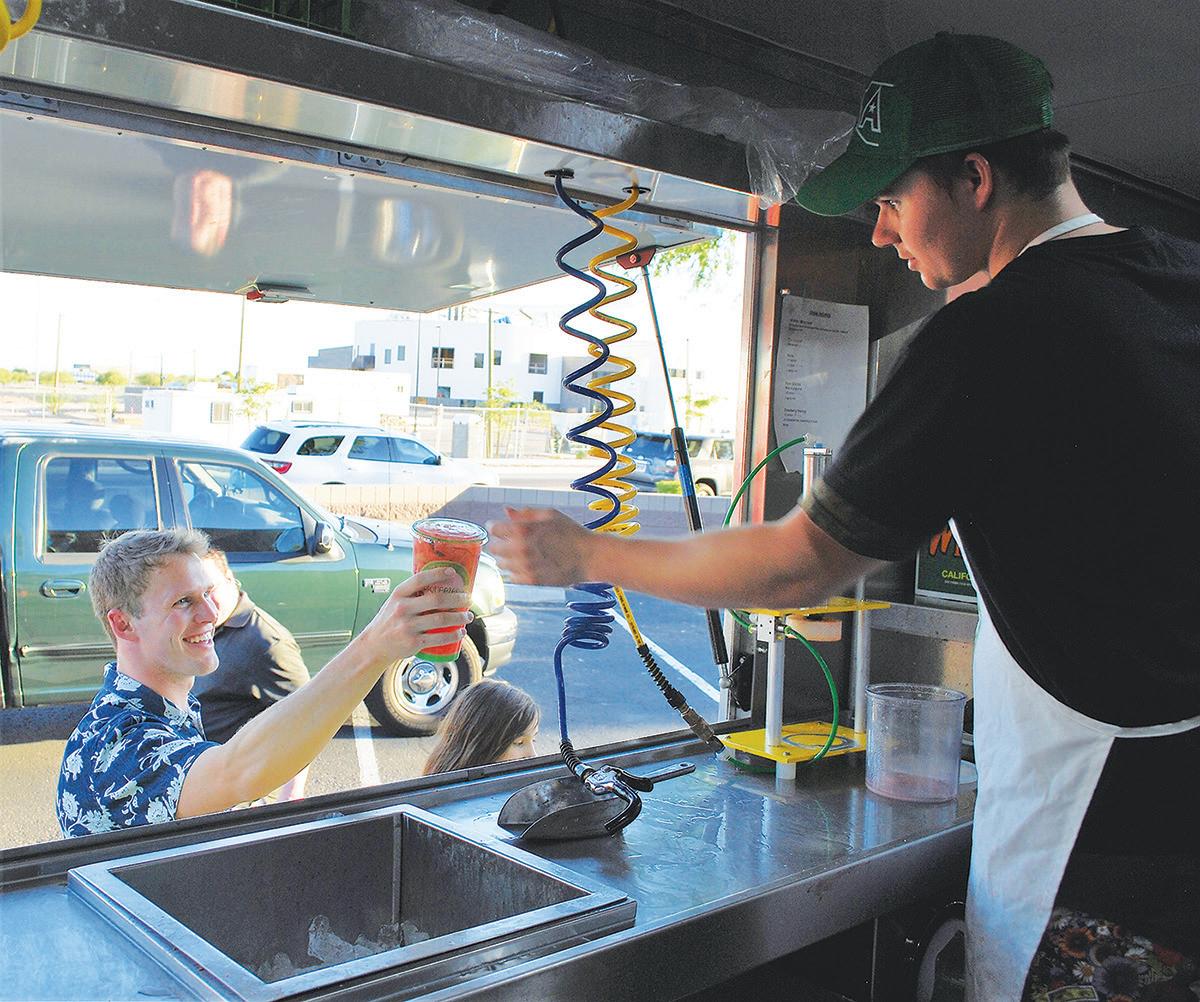
The popular Ahwatukee East food truck rodeo at Horizon Honors' complex at Frye Road and 48th Street held its last roundup of the season June 17 and even the hot weather couldn't keep all the fans away. At left, Caprice Gouveia and her son and husband Eric brought their popular Tukee Tamales fare out while at right, Rathana Chhoeung and Rosemary Meas sampled some food. In the second row from left, Gouveia completes a purchase, Wanda Henderson picks up an order from Best of the Grilled, and Vanessa and Curtis Jacobs enjoy dinner. In the bottom row from left, Megan Doud and Abby Knight picnic while in the photo below them, Daryn Ranous of Abigail's Lunch Box accepts a donation from Ashlyn Statello. In the center-bottom photo, Mike Malady and Roberta Ruyle-Malady size up offerings at a vendor truck. At lower right, Jack Nielsen, left, gets a much-welcomed thirstquencher from Trey Tompkin of Family Squeeze Lemonade. Ahwatukee Eats organizers promise to return in September when the hot weather starts to beat a retreat.






BY PAUL MARYNIAK AFN Executive Editor
Dennis Lambert has a resume that two people could easily share: retired pharmaceutical sales and marketing executive, rock band guitarist, marathon runner, poet and deacon in the Catholic church.
Now, the 17-year Ahwatukee resident has added another notch to his accomplishments – novelist.
Last week, Enroute Books and Media published his first book, “The Table,” culminating four years of writing amid a busy schedule of other activities.
“Finding time to write was really hit or miss while I was still working in the pharmaceutical industry,” said Lambert, who with his wife, Debbie, has two children and a newly born granddaughter.


felt unworthy to have him enter his house. Instead, he told Jesus he believed he could heal him without coming inside.
“It is a great testimony of faith,” said Lambert, explaining that he began wondering what happened to the centurion after that encounter. From there, his story traces a series of events where the table exerts a miraculous influence as it finds its way into the hands of a despairing rock musician.

“After I retired a couple years ago, I had more time to work on it,” he continued. “So, I knuckled and banged out the bulk of it at that time. Once completed. there was a period of time editing it and getting ready to seek publication. Once I started to submit it for publication, it took about seven months of endless queries before I got a yes. In fact, after countless ‘thanks but no thanks,’ I got three ‘yeses’ in one week.”
The wait was worth it, judging by the accolades that have been accorded to his book, which deals with a fictional table built by the grandfather of Jesus Christ that is handed down over centuries until a man encounters it during a spiritual crisis and emotional loss.

Various authors and professors have praised the novel as an inspirational and suspenseful piece of storytelling, with one critic calling it “a gripping and beautiful story that displays the peculiarity of God’s plan and how He can bring all things together for good.”
The book stems from Lambert’s reflections on the Roman centurion who wanted Jesus to heal a beloved servant but
Some of the themes and characters in the book echo aspects of Lambert’s life and faith.
He and his wife are members of the Ahwatukee-based Lil’ Debbie Band, which has played at local events such as the Festival of Lights Kick-Off Party as well as events and other venues throughout the Valley.
“Debbie and I have playing music in bands since about the mid-’80s,” he said.
“While in Chicago, we were for a long period of time in a blues band. When we moved out to the Valley in 2000, we started our current band, the Lil’ Debbie Band, right away.
“We started out playing just blues once again and then over the years we broadened to include classic rock and Motown. We are a six-piece band, four of whom have been with us from the start and the two others for a very long period of time. Our band is more of a family than
page 26
anything else: good people who share of love of music and who value one another’s friendship.”
Even before he retired after 29 years in the pharmaceutical industry, the Lake Forest College graduate also began a two-year study at the Phoenix Catholic Diocese’s Kino Catechetical Institute, because he wanted “to dedicate more time to writing and to serving the Church.”
He is now a deacon at Corpus Christi Church in Ahwatukee.
Lambert said he has long had a passion for writing “but never thought that I could write an entire novel.”
He had written unpublished poetry –including an annual family Christmas poem since 1983 – and some short stories, including three Christmas-related stories
about a “quirky but lovable elf named Pritchard” that he now hopes to publish.
Like his novel, the “Pritchard the Elf stories” contain “teaching and moral components.”
“After getting favorable feedback on those stories, an idea for a novel popped into my head as I was flying back from a business trip,” Lambert said, adding:
“I took out my computer right then and there and began to write the first chapter. As I got deeper and deeper into writing the story, I began to think, why not? Why couldn’t I write a complete novel? Why not at least try? My commitment then became to finish the story. Whether it ever got published or not, I vowed to myself to at least finish it.”
While the table is a fictional piece of furniture that won’t be found in the Bible, Lambert uses it to tie events separated by
2,000 years.
“It appealed to me in part because of Jesus and his father’s work as carpenters,” Lambert said.
Though he admitted to occasional bouts of self-doubt over his ability to complete the book, Lambert said, “That never happened.”
“Every time I sat down and dug in, ideas would flow and I found myself becoming engrossed in the process and found myself really enjoying being able to create something that I felt was a part of me. I can kind of relate the above to my past experiences as a runner,” he said. “Getting out the door to run was always the greatest challenge for me, but once I got on the road, all the doubts or trepidation I had would quickly leave and I would enjoy the run.”
Lambert already is hard at work on his second novel, about a Nazi concentration camp guard who doesn’t like his job and helps prisoners, though at times with devastating consequences.
He credits his first novel’s publication to his innate perseverance and the fact that “my years in sales have greatly thickened my skin and prepared me for the boatload of rejection that comes with submitting a book for either
representation by an agent and or for direct acceptance from a publisher.”
For aspiring novelists, he offers several tips.
“Ensure that you have work properly edited and the pitch that you give is all it can be,” he said. “Agents and publishers get inundated with thousands upon thousands queries, and if you don’t hook them right away and/or if there are grammatical errors, they will quickly pass your submission and will be on to the next.
“Secondly and perhaps most importantly, you need to be persistent and have thick skin. The more queries you put out, the more nos you will get, but the more queries you put out, the better the chance that you will get finally get a yes.”
He advises writers to avoid publishers who want money to publish their work.
“They are basically having you cover all the cost of publishing, taking no risk, and then having you take on all facets of the sales and promotion of the book without giving you anything in return and while taking the lion share of the profits you produce. Bottom line: Make sure the publisher is reputable and for real.”
“The Table” is available on amazon.com and Barnesandnoble.com. Information: dennislambert-writer.com.


BY MALINDA MALONE
AFN Guest Writer
Summer is a terrific time to be a dog owner in Arizona. We can swim and play with our dogs, but with our extreme heat, we need to take extra precautions for their safety and wellbeing.
Summer also brings unique risks to dogs’ health that you should keep in mind throughout the season. These dangers include:
• Heatstroke. This occurs when a dog’s body temperature rises dangerously high. It is most common when dogs are left in a car for too long, or when they exercise in the heat.
Never leave your dog in the car in hot weather, and always remember that a cracked window is not enough to cool a car. Your dog always needs access to shade outside.
• Sunburn. Dogs can burn in the sun just like people can. White, light-colored, and thinly coated dogs have an increased risk of sunburn. Sunburn causes pain,
itching, peeling, and other problems.
To prevent sunburn, apply a waterproof sunscreen formulated for babies or pets. Be sure to cover the tips of your dog’s ears and nose, the skin around its mouth, and its back.
• Burned paw pads.
Sidewalk, patio, street, sand and other surfaces can burn your dog’s paw pads. Walk your dog in the morning and at night when outdoor surfaces are coolest. There are booties that can be purchased to help protect their feet. If you cannot stand on the ground barefooted, neither can your dog. If it is painful for you, it will be painful for your dog.

indoors and outside. Ice cubes and frozen chicken or beef broth encourage your dog to take in more fluids and help keep it cool.
• Campfires and barbecues. Your dog may try to take burning sticks from the fire, so close supervision is a must. Food that is stuck to barbecues after cooking can tempt your dog to lick the barbecue and burn its tongue or mouth.
Lighter fluid is a poison and should not be left where your dog can reach it. Keep your dog away from barbecues and campfires.
If you cannot avoid being around fireworks, then keep your dog on a very short leash.
• Parasites. Ticks, fleas, mosquitoes, flies, and other insects are at their peak during the summer months. Talk to your veterinarian about appropriate protection for your pet.
• Chemicals in the water. It is no secret that most dogs love to swim. Swimming can be fun for you and your dog and helps prevent heatstroke. However, chlorine can irritate a dog’s skin and upset its stomach.
Rinse your dog with fresh water after swimming in a pool and do not let it drink more than a small amount of pool water. Standing water, such as puddles, can also be dangerous for dogs to drink due to the presence of harmful chemicals. Provide your dog with fresh water to drink whenever possible.
• Dehydration. Prevent dehydration by providing your dog with unrestricted access to fresh and cool water both


Matt Tobias General Manager




• Fireworks. Some fireworks look like sticks, which makes dogs think that they are toys. The loud noises and sudden flash of fireworks can disorient and startle dogs, causing them to run wildly.







-Malinda Malone owns Diamond Cut Pet Spa in Ahwatukee and is a certified master pet tech instructor in Pet CPR and first aid. Information: 480-689-1261.


AFN News Staff
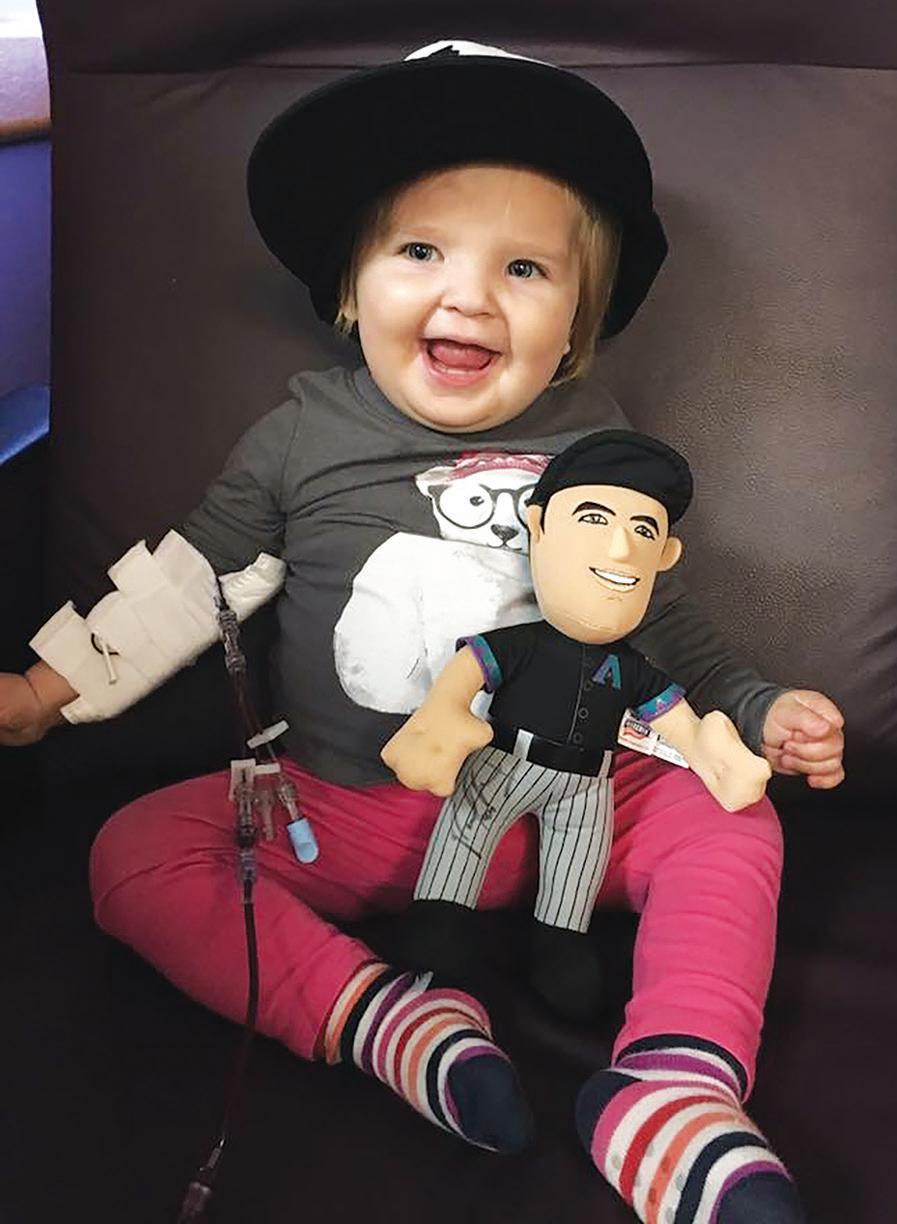
An Ahwatukee toddler with a rare disease has become a poster child of sorts for an agency’s effort to get Valley residents to donate blood.
United Blood Services recently featured Adelyn Troutman’s plight in its ongoing campaign even as the little girl, who won’t turn 2 until November, encountered a new difficulty as she awaits a life-saving bone marrow transplant.
Addy suffers from a rare genetic disorder called Diamond-Blackfan anemia, which prohibits her body from making red blood cells.
Her red blood cells have a relatively short life span, so she requires a blood transfusion every four weeks.
When United Blood Services spokeswoman Sue Thew read the AFN’s account of her problem, she arranged to have several Valley TV stations come to the hospital to document her receiving one of her monthly blood tests. It was the 22nd transfusion of her young life.
“It was good for us to promote blood donations as Addy’s life depends on
them. Hopefully it generated an increase in possible blood donations,” said her father, Matt Troutman.
Right now, he and his wife have more pressing concerns – mainly, finding a donor with the right blood match.
And if they find a match and Addy undergoes the bone marrow transplant, she faces months of recovery – including up to six weeks in the hospital.
Addy’s older brother and sister were tested for a possible match, but while their blood was not a match for a bone marrow transplant, 15 unrelated matches were found.
But a new problem has developed.
Scans showed there is no damage to the tot’s heart from the chronic transfusions, but “there is definitely iron built up” in her liver.
“We have to take measures to correct it immediately,” Troutman said, adding doctors had to increase her dosage of Jadenu, a drug used to remove iron from the blood.
Troutman said the increase “put her close to maximum daily dosage limit in hopes of keeping her iron levels down
and removing the iron built up in her liver already. Her dosage has now doubled since the beginning of the year.”
Another scan will be done later this year “and the results of that will ultimately determine how soon she will need to have her bone marrow transplant. If the iron continues to build in her body, she will suffer iron overload, and this could be fatal,” Troutman said.
“You might not realize the importance of giving blood, but you are giving life to someone like Adelyn,” Matt added. “We are thankful for the blood donors who are keeping her alive.”
United Blood Services and the Valley’s seven Volkswagen dealers have teamed up to entice people to give blood by offering a raffle for a 2017 Passat-R-line dor donations through Aug. 31.
Information and to set up an appointment: 1-877-827-4376 or BloodHero.com.
To help out Addy and her family: go-
fundme.com/adelynscure.
To learn more about the girl: adeylnscure.com.








BY JOSH SKALNIAK AFN Guest Writer
Michelle Rader’s world began to unravel soon after she and her boyfriend were evicted from their home due to their addiction to drugs. With nowhere to go, they found themselves living out of a truck on the streets of Phoenix.
The news of the eviction soon reached her 7-year-old son’s teachers, and she lost custody of her only child. Though she was devastated, her addiction was so powerful that she continued to use. Until one day she had an epiphany.
“If I didn’t do something different, I knew I was going to lose my son permanently,” said Rader. “I was either going to die or end up in jail.”
That’s when she lost her taste for the life she was living.
The Department of Child Services referred her to Phoenix Rescue Mission’s Changing Lives Center for Women and Children, the only faithbased recovery program in the region offering long-term, comprehensive services to women and children.
It was exactly what she needed.
A week and a half later, the police informed her that her boyfriend had been found beaten to death on the streets she formerly called home.
“We went everywhere together,” said Rader. “That could have been me.”
After 12 months at the Changing Lives Center, Rader not only graduated from the center’s recovery program, but she also earned back full custody of her son.
“Thanks to this place, I’m not only sober, I not only have custody of my
son, I have a way to move forward and support my family,” she said.
Her path is even more clear today because – through a unique vocational development program available at the center – she has been given the opportunity to lay down a foundation for a career in culinary management.
Designed to help curb the cycle of homelessness, the 13-week Food Services Program gives women at the center a chance to become certified ServeSafe food managers and learn in-depth knowledge about the inner workings of the restaurant business. It also teaches them skills that will serve them long after they leave the program.
gram is you not only gain the skills restaurant employers are looking for, you have the opportunity to put those skills to the test and build your resume at the same time,” said Rader.
Since joining the Food Services Program, Rader has worked her way up from line cook to a paid position as manger of the Changing Lives Center’s social enterprise program, Mission Possible Catering.
The health-minded catering service is staffed completely by the women in recovery at the center who have completed the vocational development program and have earned their ServeSafe certifications.
“The beautiful thing about this pro-

Monday through Friday, Rader and her staff are hard at work serving real customers, handling all the challenges of a real business and earning valuable on-the-job experience, including menu creation and preparation, marketing techniques, business management practices, customer service skills and much more.
While Mission Possible Catering brings in a small amount of income to help support its programming, the Food Services Program costs about
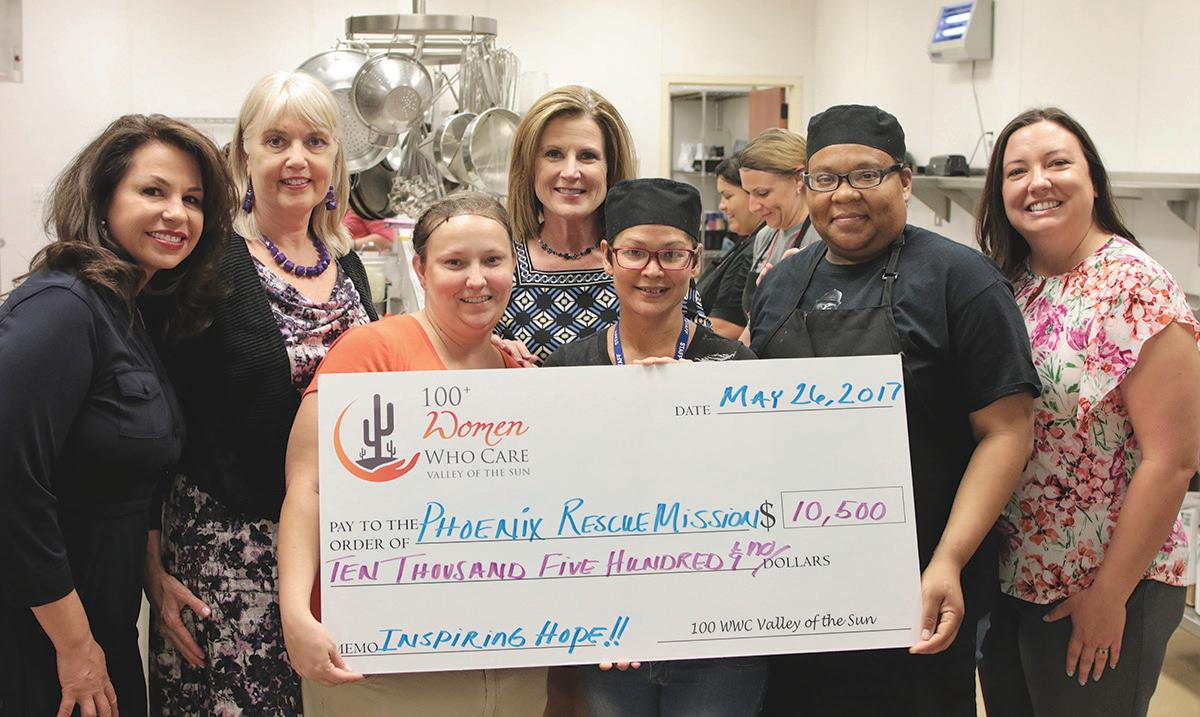
$2 million annually to support and relies heavily on donations from private organizations like 100+ Women Who Care Valley of the Sun, a philanthropic group of local women who recently donated $10,500 to the charity.
The mission got vital help from 100+ Women Who Care because members Mary Jordan and Ahwatukee resident Carina Burtell nominated it.
Numerous Ahwatukee women belong to the group.
The next meeting of 100+ Women Who Care Valley of the Sun is Aug. 22 at the Foothills Golf Club. Guests are welcome.
Information: 100wwcvalleyofthesun.org or PhoenixRescueMission.org.


BY COTY DOLORES MIRANDA AFN Contributor
“The Little Mermaid,” a pop culture phenomenon since the 1989 release of the Disney animated film, is coming to Mountain Pointe High School.
Approximately 45 actors, ages 4 through 19, will sing and dance in the production presented at 2 and 7 p.m. Saturday, June 24.
While many of the cast are Ahwatukee youngsters, other performers are from Chandler, Tempe and Tucson.
And one, Yale Langworthy in the role of Prince Eric, is from Boise, Idaho.
The role of Ariel, the teenage mermaid princess who falls in love with the human prince, is played by Corona del Sol High School senior Lizzie Stewart, starring in her first Studio 111 Theater Company musical.
It is also the first musical in Ahwatukee for Yale, 13, who came to the role through his mother – a Boise dance studio owner who is a friend of the musical’s director, Jenefer Miller. Rachal Bautista is directs the music.
Desert Vista High School alum and Studio 111 newcomer Jackson Clithero, 19, has the King Triton role.
Ursula, the sea witch who tirelessly attempts to sabotage the mermaid princess and prince’s romance, is portrayed by Mia Dickson, an incoming freshman at Desert Vista High School.
Mia is no stranger to the Studio 111 musicals, having played the role of Mrs. Potts in last year’s summer production of “Beauty and the Beast.”
Lizzie Stewart has extensive choir-singing experience, starting as a youngster in Chandler’s Children’s Choir (directed by her mother, Aimee Stewart) and with Corona’s Performance Choir.
Her role of Ariel is not only her first role in musical theater, but her first time onstage in any theatrical production.
“This has been an exciting adventure for me,” said Lizzie, 17. “It’s really expanded my horizons, musically and socially. And it certainly inspired me to
continue to go out and try something new.”
She plans to follow her director’s instruction to dye her blond hair red for the role as depicted in the Disney film.
“That’s going to be interesting,” she laughed.
“But I do admire Ariel’s passion, I think its inspiring to me because she’s such a go-getter. That’s something I can relate to. I mean when she has something she desperately wants, she sacrifices to do it.”
Sacrifice is something everyone in the cast and crew are familiar with as the show’s rehearsals have been from 1:30 p.m. to 6:30 p.m. Monday through Friday.
And, as is usual with Studio 111 productions, the costumes, lighting – by newcomer Daniel Lowe – and scenery dazzle.

Under the guidance of costume designer and head seamstress DeAnn Nevision, undersea creatures are swathed in tulle, sequins and hand-painted fabrics, including Ursula’s (the sea witch) skirt fashioned from more than 30 yards of fabric and tulle netting.
Ariel and her mersisters wear handmade seashell crowns, and other eyecatchers include Nevison’s 18 fish heads, four jellyfish, five seagulls, swans, turtles, flamingos and lily pads – all handmade.
“DeAnn has a creative vision and the audience will truly feel as if they’re under the sea,” said Dance Studio 111 owner and instructor Kimberly Lewis.
“All of the fabric for this production was purchased in the garment district in L.A. and brought to Arizona.”
“There’s a lot of time and love that goes into these productions, and I just try to outdo myself every year,” said Nevison of her third summer musical
production. “The kids are filling the stage with color and its going to be just amazing.”
The stage at Mountain Pointe High School theater is being transformed with Jon Nevison’s designs that include a 16-foot-wide papier-mache seashell as the back of King Triton’s throne.
His creative touches are readily seen on other scenery and props like the undersea grotto, Ursula’s lair, the Prince’s castle and the rowboat upon the waves.
Making the show a family affair is the Nevisons’ 10-year-old daughter, Ashley, who plays Jetsam, the crafty sea eel.
“We would love the community to come see ‘The Little Mermaid,’” said Lewis. “These kids have worked so hard and the dancing, singing and acting are all incredible. Why go to Broadway when you have outstanding theater and talent her in Ahwatukee?”
Lewis wholeheartedly denied a rumor about her 4910 E. Chandler
Blvd., Suite 111 dance studio being sold.
“Oh no! I just signed a new six-year lease, so we’re going to be here and continue serving the area dancers and performers,” Lewis said. “I’ve been in business for 23 years. This September starts my 24th year in Ahwatukee. I’ve been at this location for seven years and I love it. It’s our happy home.”
Tickets for “The Little Mermaid” are $10, $15 and $20, assigned seating, and may be purchased at the Studio 111 in Ahwatukee or at 480-7066040.



BY SANDY KRAUS AFN Guest Writer
Play is one of the most important things a child can do. In fact, play is truly a child’s work.
It is through play that children grow in all areas of their development. This doesn’t just include their physical development but also their intellectual, social, emotional and language development. Children are not aware that they are sharpening their skills while they play; they aren’t just having fun.
Unfortunately, play gets a bum rap when compared to learning in a structured environment. When we want our children to learn more, we cut the playtime in lieu of what we perceive to be real learning.
Compared to children 30 years ago, today’s children play an estimated eight hours less each week. When we remove play from our children’s world, we are eliminating a powerful teaching tool.
When children play, they create a connection between their bodies and their brains. As the brain’s circuitry is being wired, learning is taking place. Young children need to experience everything in order to learn about it. Since the mouth is more sensitive than the hands, young children tend to put everything into their mouth to take in information about it.

Preschool children who engage in pretend play are seen as more creative and more socially mature. Movement can also increase focus in a child’s thinking and learning by burning off excess energy.
Children need the freedom to explore their world in a safe environment so they can learn from their experiences.
There are actually five kinds of play children engage in.
Social play: Children are interacting with other children or adults. An example might be playing a game together. At age 2, children will participate in parallel play, meaning they will play side by side with another child but will not play directly with the other child. By age 3, children are beginning to en-
gage in play with other children.
Object play: This form of play can be observed when children are playing with toys such as rattles or blocks.
Pretend play: This is when a child uses an object as something else. Or imagining being different characters, places and times.
Physical play: This is using the body to engage in movement. It can be jumping, throwing a ball, or running to name a few.
Media play: Children interact with
electronic and digital gadgets. This includes iPads and video games.
As adults, we need to play too.
Playing with our children can be very rewarding. We have the options of being the onlooker, stage manager, co-player or play leader. As the parent, we may feel the need to manage our children’s play but letting the child lead is better in the long run.
Let them direct how the play goes and watch their brains at work.
In the future, when you see your children playing, remember this is their work and they are actively learning as they play. The more they play, the more they learn.
-Sandy Kraus is an Ahwatukee parent coach. Reacher her at 480-759-1898 or legacyparentingtoday@gmail.com
As baby boomers look to downsize out of their suburban McMansions, a generational showdown is looming: Millennials might be coming into their own as the nation’s biggest group of first-time home buyers, but they aren’t lining up to buy large, expensive homes in the sleepier suburbs. Instead, they’re looking for a different kind of home – the same ones, in fact, that the empty nesters are looking to buy. The battle of millennials versus baby boomers is playing out in the nation’s suburban housing markets.
Younger and older generations alike are gravitating toward smaller dwellings in more urban, walkable suburbs and cities, with restaurants and coffee shops around the corner.
Increasingly, boomers are getting stuck, because most can’t buy the home of their dreams until they unload their current ones. And many millennials have neither the desire nor the means to help them out.
“What you have is everyone chasing the same type of home,” said Rick Palacios, director of research at John
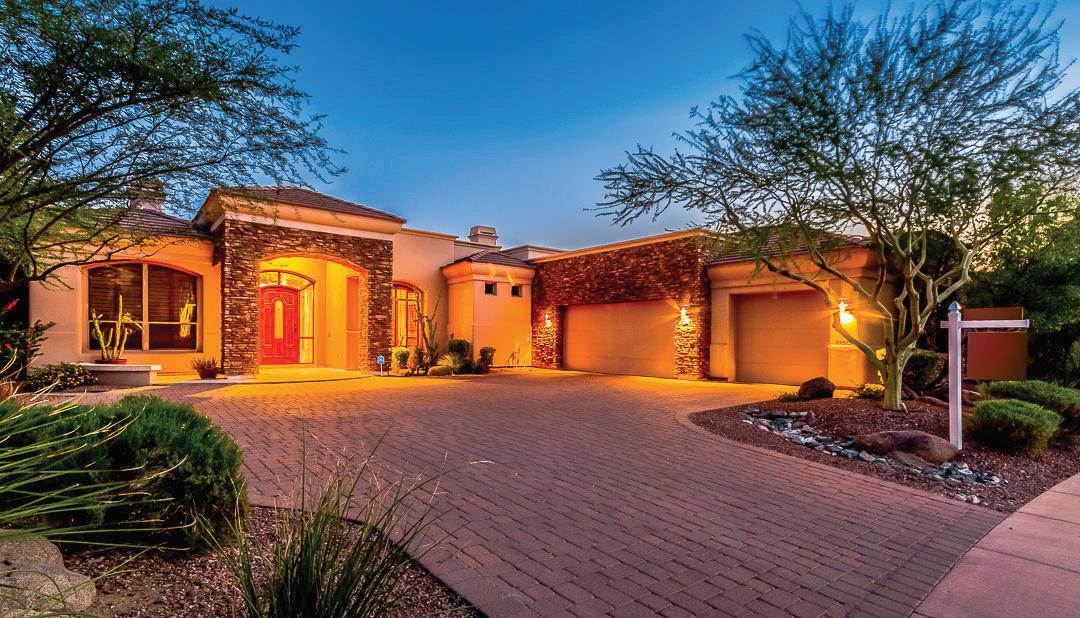
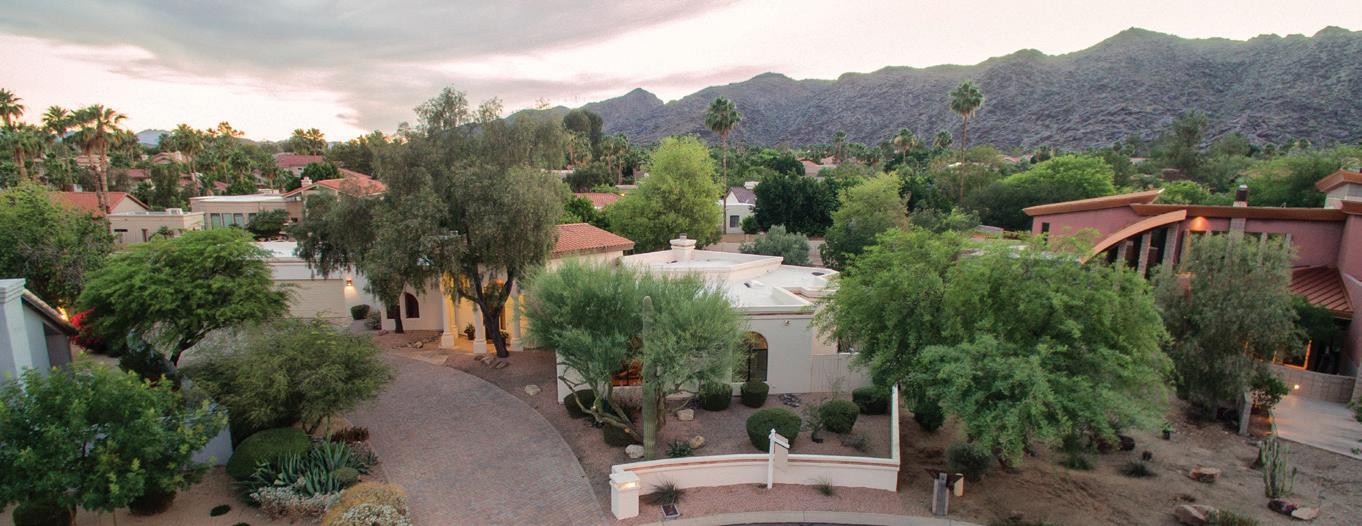





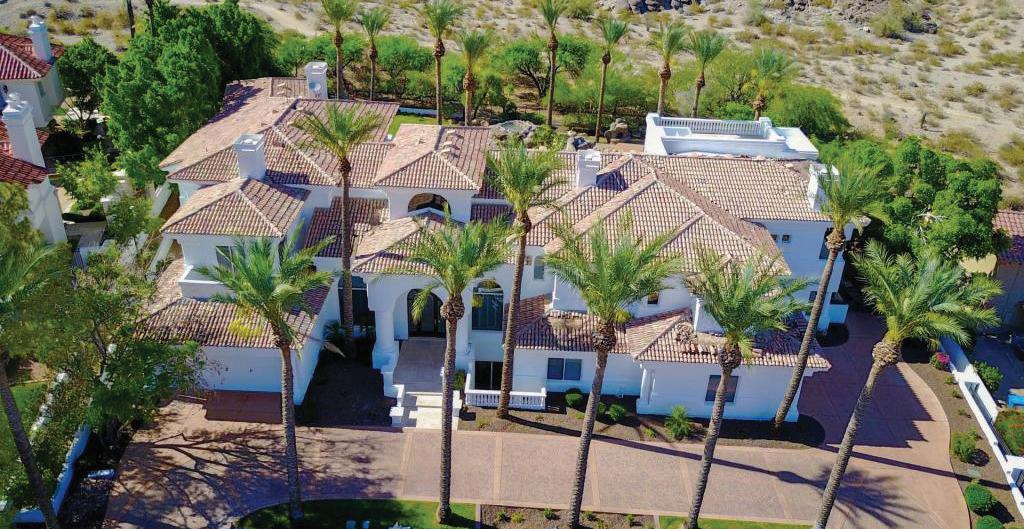




(mls.com./Special to AFN)
This two-story, five-bedroom, four-bathroom house in the 1200 block of E. Desert Flower Lane in Ahwatukee recently sold for $744,100. At just over 3,800 square feet, the home, built in 1995, is probably a little larger than either millennials or boomers prefer but perfect for families. The large master bedroom offers a huge balcony with views of South Mountain.
from the sprawling domains of the boomer generation.

Burns Real Estate Consulting. “More and more buyers of all ages want to avoid having to deal with a huge yard and all the upkeep and the costs to maintain [a larger] home.”
It’s creating an odd imbalance in a real estate market – a disruption to what has long been considered the traditional generational housing life cycle. And it’s leaving many would-be buyers out in the cold.
About 57 percent of buyers 36 and under closed on homes in the suburbs last year, compared with just 15 percent of those who became homeowners in cities, according to research from the National Association of Realtors. But their vision of suburban living differs
Many younger Americans are reluctant to give up the excitement of urban life to settle down and start having kids.
About 45 percent of millennials who plan to buy a home in the future are waiting because they aren’t ready to settle down yet, according to a survey of 24,000 millennial renters by the rental website Apartment List.
Other top reasons were not being able to afford to become homeowners and preferring to wait until marriage.
So, when they do make that move to the suburbs, millennials often seek more walkable towns that have many of the urban amenities they’re used to, like bike lanes, social events, and lots of shops and restaurants.
“What’s really attracting millennials

are the communities that are bringing the urban flavor out to nonurban towns,” Palacios said. “They don’t want the traditional massive homes and big yards. They want smaller homes and cool things to do.”
“It’s more important to have proximity to the lifestyle they want,” said Jason Dorsey, president and researcher at the Center for Generational Kinetics, focused on millennials and Generation Z. “Their living room is actually the park outside the condo.”
It’s not just the size of boomers’ homes that is a turnoff; it’s also the style. Times and tastes have changed, and today both boomers and millennials are attracted to modern, open floor plans – which aren’t common in the older homes that boomers are hoping to unload. Boomers like the flexibility of these spaces for aging in place, and millennials like the clean design.
Even if they want these larger homes, many younger buyers simply don’t have the financial means to buy them.
The average college graduate in 2016 owed a whopping $37,172 in student loans, according to Student Loan Hero, a website that provides tools for managing college debt. Plus, with less work experience and shorter credit history, they aren’t likely to qualify for a big mortgage.
As for Generation X, having weathered the Great Recession during what should have been their prime earning years, they now have to save for their kids’ college expenses, their retirement, and caring for their aging parents.
So they’re not likely to trade up from their starter homes. And if they do, many prefer an easier-to-maintain smaller home in a community with activities they enjoy—just like those millennials and boomers, Dorsey said.



And while they’re willing to compromise on size, millennials are less willing to bite the bullet on amenities. Weened on HGTV, they want highend finishes, nice countertops, upscale appliances, and luxurious bathrooms.
“They’ll buy a smaller house with fancier amenities, close to town, rather than chase square footage,” Dorsey said.


All of these factors mean that while it’s a seller’s market in many areas, plenty of boomers are having trouble selling their homes, said Chris Porter, chief demographer and researcher for John Burns Real Estate Consulting.
Meanwhile, since the boomers see their home as their nest egg, they’re not all willing to reduce their asking price and shortchange their retirement accounts, said Dorsey. So more end up staying put.
“There certainly was a lot of speculation about what would happen if the boomers tried to sell their houses en masse, and whether that would flood the market with a supply of large homes that the younger population didn’t want – or couldn’t afford – to buy,” Porter said.
“The boomers do seem to be moving less and aging in place more.”
Buying a house is a large financial commitment and often the smartest one people can make. But they need to determine whether it’s the right commitment at the right time. Shouldering mortgage payments for the greater part of one’s life will likely affect how much money can be stashed away for retirement.
So, in addition to browsing real estate listings and checking out open houses, prospective buyers should be thinking about how well they’re saving for retirement, Realtor.com says.
“The old-school mentality is that you want to own a home when you start a family, but there’s nothing wrong with pushing back buying a house to save more for retirement,” said Brandy Wright, a certified financial planner at Modera Wealth Management in Atlanta. Experts are not saying people should avoid buying a house, but rather they should weigh the financial consequences carefully.
Realtor.com said prospective biuyers should sure they have enough cash for the down payment. Most financial
planners recommend that home buyers strive to make a down payment amounting to 20 percent of the price of the home in order to avoid paying private mortgage insurance, or PMI, a premium that protects a lender in case you default on the loan.
PMI ranges from about 0.3 percent to 1.15 percent of a home loan. With the national median home price currently around $235,000, the average 20-percent down costs $47,000.
People who don’t have enough cash to make a down payment might be considering dipping into other savings accounts – like their retirement fund. However, making early withdrawals from an IRA or 401(k) might be a big mistake for two reasons.
Borrowing from either plan before age 59½ draws a 10 percent excise tax on the amount withdrawn on top of the regular income tax paid on withdrawals from traditional contribution plans. Also, withdrawing funds prematurely prevents the money from accruing interest in these accounts – a mistake that can have a “huge negative impact on your retirement plans,” said Craig Jaffe, a financial planner.
If you need to tap retirement savings to scrape together enough money for a down payment, you’re better off waiting a few years until you save more cash, Realtor.com said.
Many employers offer to match employees’ 401(k) contributions with contributions of their own as long as the worker deposits enough money in the account.
If buying a house means that you won’t be able to contribute enough money to your 401(k) to get your full company match, you need to prioritize saving for retirement, said Wright.
“You never pass up free money,” she added, stating that an employer 401(k) match might, in some cases, be more important than being able to purchase a house – at least for now.
Another advantage to maxing out a 401(k) is that all of the wage contributions and company matches are tax-deferred, so people reap an immediate tax advantage, said Jaffe.
“For most people, Social Security alone is not going to foot the entire bill for retirement,” said Wright.
One reason that’s the case is because people are living longer. The average life
expectancy in the U.S. is 79 years, up from 71 in 1970.
Deciding whether to buy a house now or save more money for retirement will hinge on what type of retirement lifestyle a person wants.
“If you’re used to a $100,000-a-year lifestyle and you want to continue that lifestyle in retirement, you’re going to need to save more money than other people,” Jaffe said.
Something else to consider: If you think buying a house and building equity will set you up for a comfortable retirement, Jaffe says you could be sorely mistaken.
“I don’t view buying a personal home as an investment,” he explained. “You’re technically building equity, but as people learned during the recession, building equity is not always the ultimate outcome.”
Moreover, “buying a home barely keeps pace with the rate of inflation,” Jaffe adds. Therefore, you don’t want all of your retirement savings locked up in your home.
The moral of the story: Make sure your nest egg is in good shape before you decide to buy a house.



Finding the right paint and color for your home can seem daunting. At Dunn-Edwards,® our Professional Color Advisors will walk you through every step – answering all your questions, and helping you find the paint, gloss, and color palette you’ll love. To talk with an advisor, just stop by our Phoenix (Ahwatukee) store, or call for an appointment.

$275,000
30th AVE.
$282,000 16005 S. 17th LANE
$289,900 3025 W. SILVER FOX WAY
$295,000 3030 W. SILVER FOX WAY
$330,000 15415 S. 13th AVE.
$720,000 16806 S. 31st LANE
$197,000 16620 S. 48th ST.
$228,000 4232 E. WINDMERE DRIVE
$229,900 4409 E. WILDWOOD DRIVE
$248,000 4122 E. MOUNTAIN VISTA DRIVE
$304,000 1319 E. WILDWOOD DRIVE
$309,000 3748 E. Wildwood DRIVE
$315,000 3217 E. ASHURST DRIVE
$320,000 3002 E. REDWOOD LANE
$335,000 3809 E. WINDSONG DRIVE
$346,000 719 E. GOLDENROD ST.
$360,000 15013 S. FOXTAIL LANE
$360,000 3143 E. MUIRWOOD DRIVE
$366,950 16406 S. 42nd PLACE
$395,000 2104 E. GRANITE VIEW DRIVE
$411,000 312 E. SOUTH FORK DRIVE
$424,900 3223 E. REDWOOD LANE
$430,000 3145 E. WILDWOOD DRIVE
$440,000 3405 E. MOUNTAIN VISTA DRIVE
$455,000 2039 E. TECOMA ROAD
$472,500 14636 S. 14th WAY
$665,000 15202 S. 19th WAY
$744,100 1234 E. DESERT FLOWER LANE

BY BONNY HOLLAND AFN Guest Writer
Summer months are typically the busiest for closing escrows. Moving buyers in and sellers out can be very challenging.
From the time an offer is submitted, closing date and possession are critical parts of the contract. To facilitate timing and personal situations, sometimes prepossession or post-possession agreements are part of the negotiation and contract.
The Arizona Association of Realtors
Residential Purchase Contract is clear on possession: “Seller shall deliver possession, occupancy, existing keys and/or means to operate all locks, mailbox, security system/ alarms, and all common area facilities to Buyer at COE.”
In other words, Realtors typically don’t recommend these types of agreements, but understand that they may be necessary to reach agreement on a purchase contract.
Brokers recommend that parties seek independent counsel from insurance, legal, tax and accounting professionals to better understand the risks before entering into a pre or post-possession agreement.
A prepossession agreement is created to allow the buyer possession to the property prior to close of escrow. The buyer and seller should address the following in a prepossession agreement:
Insurance: Who is responsible and what is covered? The seller needs to go over their homeowner’s policy with their insurance company to review and see if a tenant would change the terms of their policy. Also, the buyer should get a renter’s insurance policy until close of escrow.
Walk-through: The buyer and seller should do a final walk thru prior to the buyer possessing the premises to make sure they agree on the conditions of the property.
Repairs and maintenance: Who is liable for repairs? The buyer and seller should address who is responsible for any repairs and maintenance of the premises for the duration of the prepossession. Both parties should consider ordering a home warranty that will cover the property prior to close of escrow.
Occupancy rights: Who is moving in? Does the buyer have children? Pets? Is smoking allowed? These are all questions the buyer and seller should have answered prior to agreeing to prepossession terms.
Rental payments and deposits: How
much will the buyer pay the Seller for the prepossession? Who is responsible for the Utilities during the prepossession? Does the seller require a security deposit from the buyer in the event the sale falls through and damages have been done?
Buyer contingencies: Are there any contingencies that have not been met prior to the prepossession? Have the contingencies been waived or are they still in affect therefore allowing the buyer to cancel the purchase contract if a contingency is not met?
Alterations: What if the buyer moves in and begins to alter the property and later finds out they cannot purchase the property?
Buyer’s remorse/failed transaction: What happens is the sale falls through? When should the Buyer vacate the property? What happens if the buyer fails to leave the premises?
A post-possession agreement allows the seller to keep possession of the property after the close of escrow while making the buyer the legal owner. In most cases, a postpossession gives the seller more time to find a new home or just move out over time.
Both parties should consider the following before entering into a post-possession agreement: Insurance: The buyer should have a
new homeowner’s policy. The seller should purchase a renters policy for the duration of the post-possession agreement.
Property condition: The buyer and seller should do a “move-in” and “move-out” walk-through to document the condition of the property, which should be agreed upon by both parties prior to the post-possession.
Term: The parties should determine a time period of the seller’s post-possession as well as what happens if the seller needs less or more time than what was originally agreed to.
Rental payment and security deposit:
How much is the seller going to the pay the buyer for the post-possession? When are payments due? Will the be prorated? Does the buyer want a security deposit for any potential damages during the postpossession? Who is responsible for the utilities during the post-possession?
Occupancy rights: Who lives with the seller – i.e. children or pets? If the seller smokes, can that continue in the house during the post-possession? Both types of agreements have inherent risks and should be entered into cautiously. Before entering into either of these agreements, make sure you are well informed on the possible consequences.

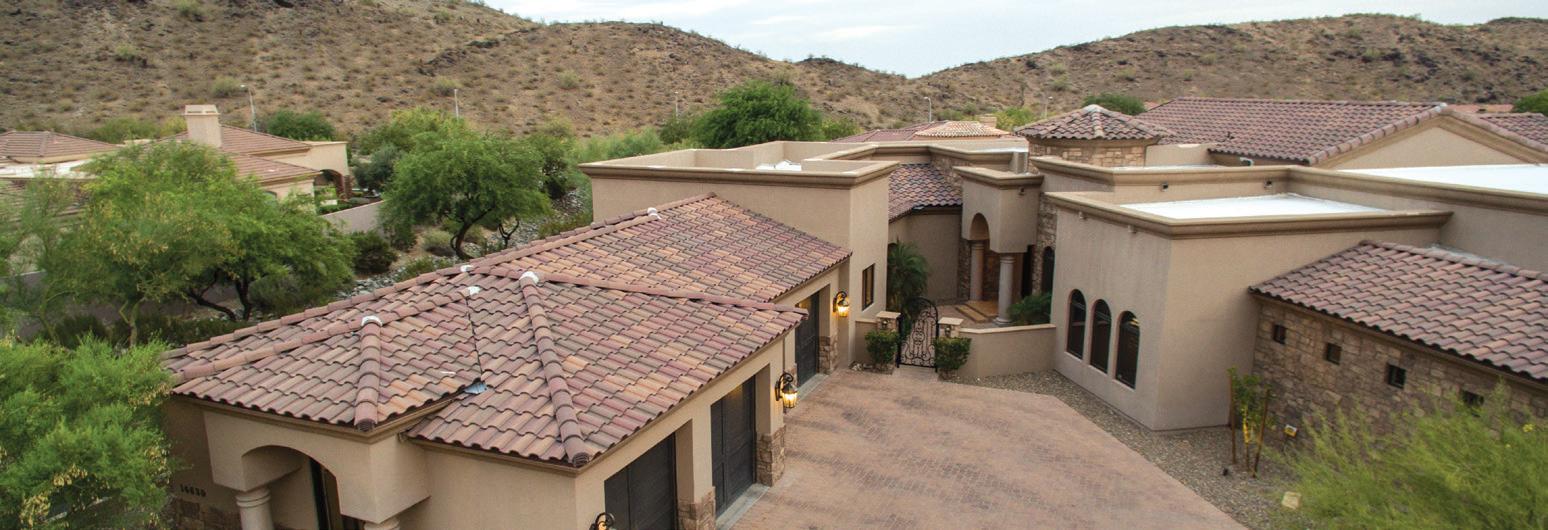



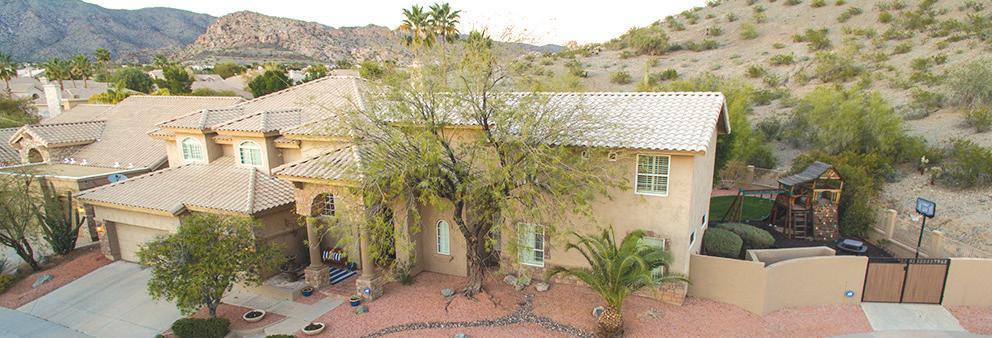










Exquisite Tuscan living with stunning mountain views. Abundant custom features including 24” Travertine flooring with inlays, inviting open floor plan, elegant library, soaring coffered ceilings, art niches, three fireplaces and custom built-ins throughout. Gourmet kitchen boasts granite countertops with backsplash, custom mahogany raised-panel cabinetry, Dacor six-burner cooktop, two ovens, warming drawer, Sub Zero refrigerator and walk-in pantry. Spacious master suite with walk-in shower and Jacuzzi tub, plus den and two secondary bedrooms upstairs. Huge theatre room, three bedrooms, steam room and game room with wet bar in basement. Resort-style backyard replete with Marbella Stone patio entertaining areas, pool and spa with dual water features, built-in Dacor BBQ, fireplace and lush landscaping.
Listed for $1,395,000
Mendoza 480.706.7234

One of the most amazing view lots in all of arizona! Stunning preserve & city light views! This custom estate has everything you could possibly want • over 10,000 sqft of the finest finishes • 3/4 acre preserve lot • 6 bedrooms, 8 bath, plus executive office, plus theater room, plus exercise room, plus loft, plus guest house • grand foyer • formal living & dining room • gourmet kitchen includes: s/s appliances, quartz countertops, double ovens, 2 dishwashers, cooktop, subzeros, etc • large family room • master suite w/sitting room • master bath w/steam shower, jacuzzi tub, and his/her closets • guest house • resort backyard w/pebbletec divingpool, waterfalls, slide, volcano, firepit, fp, spa, sport court, grassy play areas, & outdoor kitchen • 4-car a/c garage • most desired location in the ahwatukee custom estates! A true masterpiece!!! Listed for $2,299,000





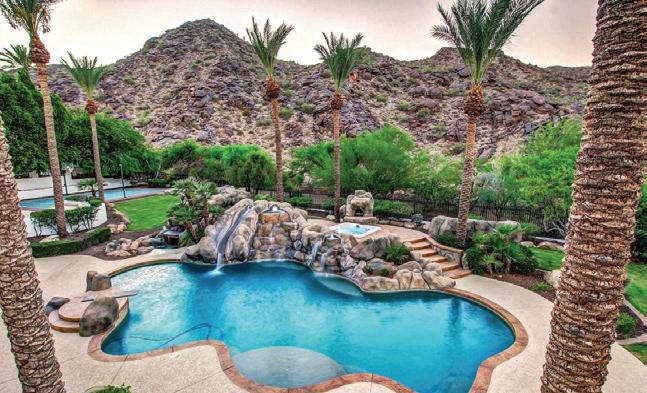





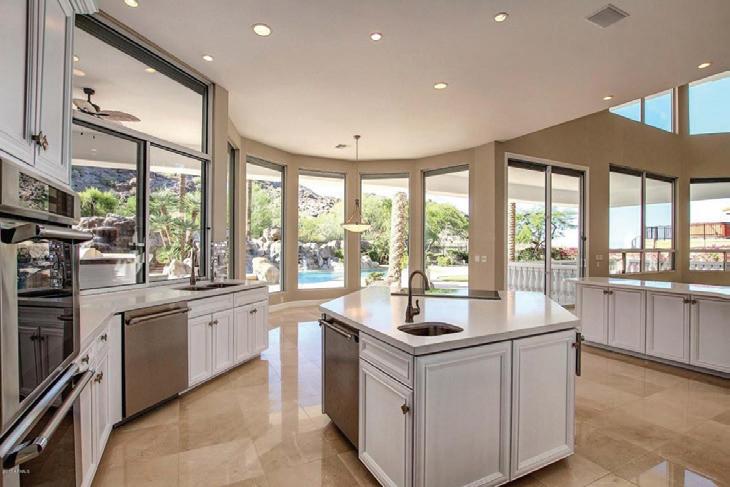


a borrower pays a bank for the chosen interest rate.
In the seemingly never-ending mortgage lexicon of home buying and selling, one term in particular stands out as a source of confusion: the origination fee.
It’s something every homeowner needs to understand. And the good news is that it’s not actually that complicated. In basic terms, an origination fee –sometimes referred to as a discount fee – is money that a lender or bank charges a client to complete a loan transaction.
An origination fee can encompass a variety of different fees added together, said Mark Ventrone, owner and broker with ABLEnding, based in California and Arizona.
It can include underwriting fees, administrative fees, processing fees, discount fees (also known as points), and any other fee charged by the lender and/or broker to the borrower.
Lenders generally speak about the money associated with origination fees as points. The term “point” is slang for 1 percent of the loan amount.
And points are part of those aforementioned closing costs charged by your lender, calculated as a percentage of the principal, said Casey Fleming, author of “The Loan Guide: How to Get the Best Possible Mortgage.”
If your loan is for $300,000, one point equals 1 percent or $3,000, and two points equals 2 percent or $6,000.
Because “points” is not an official term, you won’t see the term on disclosures, but you will see it in marketing materials and hear the term from lenders.
Lenders charge an origination fee in part because they have upfront costs in originating a loan, so they try to recoup that money with a fee, said David Reiss, a law professor and academic program director for the Center for Urban Business Entrepreneurship at Brooklyn Law School.
If a lender doesn’t do this, it risks the borrower paying off the mortgage early and before the lender fully recoups the cost of generating the mortgage. And let’s face it: lenders might also charge an origination fee because it can be a profit center like the interest rate.
Another way to think of an origination fee, according to Fleming: It’s the cost
Putting an exact dollar amount on origination fees can be a bit difficult because they are expressed as a percentage of the loan amount. But a standard origination fee for a conventional loan typically runs between $750 to $1,200, said Ventrone.
“Each fee will be itemized separately in Box A so you will know exactly what you are paying for,” said Ventrone.
If a loan is $200,000 and the lender is charging a half-point to originate the loan, the borrower will need to pay an additional $1,000 in closing costs, said Reiss. If the lender is charging one point, the fee would rise to $2,000.
The origination fee generally ranges from 0.5 or 1 percent of the loan amount, but it can change depending on the bank and the client.
The origination fee can’t be reduced. But based on the interest rate you lock in for your mortgage, your lender or broker might give you a credit that you can apply at closing toward the origination fee and potentially toward other costs such as title fees, appraisal fees, or recording fees.
You can determine whether you’ll get this lender credit by again referring to Page 2 of your loan estimate and looking at Box J, said Ventrone.
You can also look for a bank that doesn’t charge origination fees.
Another option is to negotiate the fee with the lender. Usually, those who can negotiate best have great credit and income, said Denise Supplee, cofounder of SparkRental. It takes more work for a broker to get a loan for someone with bad credit or unverifiable income, so the origination fee isn’t as negotiable.
It’s always worth shopping around for a loan, because lenders, fees, and other charges can vary significantly. A simple way to choose which lender is offering you better terms is to compare the origination fee and lender credit at a specific rate for the same time frame, because rates are constantly in flux.
Keep your options open and be patient when shopping for a mortgage; it’ll be worth it in the end when you’re paying a rate that fits comfortably in your budget.
-Provided by Realtor.com




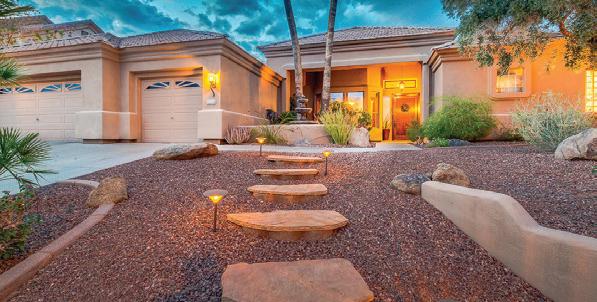

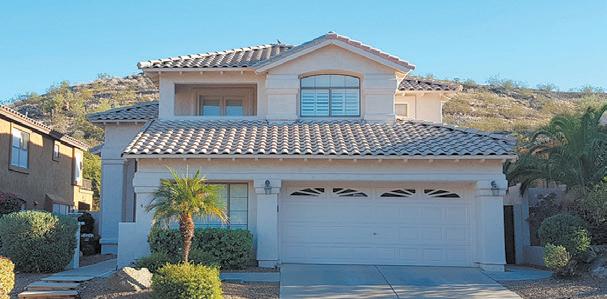




PostNet hiring in its Chandler and Ahwatukee stores
PostNet is hiring store associates at both its Ahwatukee and Chandler locations. “We are looking for you if you are friendly, enthusiastic, positive, motivated and energetic,” said manager Janine Moeller.
Applicants must have computer experience be able to work 8:30 a.m.-5:30 p.m. Monday to Friday and 9 a.m.-1 p.m. Saturday. Applications will be accepted at the Ahwatukee location, 4605 E. Chandler Blvd., 8-9:30 a.m. Friday, June 23. Interested persons should come with a completed application, which is at bit.ly/71636579904165postnetjobs. Applications also are available at either the Ahwatukee store or the Chandler location, 2820 S. Alma School Road.
Rep. Norgaard making the rounds in Ahwatukee as guest speaker
State Rep. Jill Norgaard will be the guest speaker at two different events in Ahwatukee, where she lives and is one of two members of the legislative district that includes the community. She is the featured speaker at a joint
meeting of the Legislative District 18 GOP Committee and Ahwatukee Republican Women 6:30-8:30 p.m. June 28 at Mountain View Lutheran Church, 11002 S. 48th St., Ahwatukee. Information: arwomen@aol.com.
The next day at 7:30 a.m. June 29, she is the featured speaker at the regular weekly meeting of the Kiwanis Club of Ahwatukee. The Kiwanis Club meets at Biscuits Restaurant, 4623 E. Elliot Road, Ahwatukee, every Thursday and welcomes the public. Information: mike. maloney2003@gmail.com.
Mountain View Lutheran Church collecting water for homeless
Mountain View Lutheran Church, 11002 S. 48th St., Ahwatukee, is holding a bottled-water drive throughout June to benefit the Summer Heat Respite Program at Grace Lutheran Church in downtown Phoenix, which addresses hunger, heat relief and connects the homeless to resources through Sept. 1.
The drive has become an annual event at Mountain View, which seeks to provide a “simple, tangible and visible way people are able to help a basic need right

in their backyard.” Last year, it collected 2,000 cases.
Cases of water or cash donations can be dropped off at the church 8:30 a.m.3:30 p.m. weekdays or during one of the regular worship times at 5:30 p.m. Saturday or 8, 9:15 or 10:45 Sunday morning. Any size case or amount of bottled water is accepted.
Information: pastorsarah@graceinthecity.com.
Village Planning Committee says it is canceling monthly meeting
The Ahwatukee Foothills Village Planning Committee has canceled its regular meeting scheduled for next Monday.
The panel’s next regularly scheduled meeting is 6 p.m. July 24 at Pecos Community Center.

Registration ending Thursday for We the People Summit
State Rep. Mitzi Epstein, one of the two state House of Representatives representing the legislative district that includes Ahwatukee, said the deadline is fast approaching for the We the People Summit scheduled for 8:30 a.m. Saturday, June 24, at the Phoenix Convention Center. Registration ends Thursday, June 22, and no walk-ins will be allowed.
“Arizonans' involvement in the legislative process is crucial,” Epstein said in a release. “During the past session, citizens engaged with the Arizona Legislature by contacting their legislators, testifying in committees, joining events such as Environmental Day and more. We the People Summit seeks to expand this involvement.”
“We the People is a series of three summits to bring together individuals, grassroots organizations, and non-profits to share workshops and organize people and ideas toward progressive causes,” she added.
Information: pafco.org/wethepeople or Summit Director Jennifer Jermaine at wethepeoplesummit@gmail.com.









TODAY, JUNE 21
Free CW concert planned
Cactus Jacks in Ahwatukee will present a free country-western concert featuring Arizona native Kyle Mercer after free line-dancing classes by Carrie McNeish of dancemeetsfitness.net
DETAILS>> Line dancing at 5:30 p.m., concert at 7:30 p.m., southwest corner of 48th Street and Elliot Road. Information: kylemercermusic.com/bio and cactusjacksbar.co.
Reptile Adventure in offing
Snakes in the library! Meet some of Rich Ihle’s extraordinary reptile friends, including a 15-foot boa constrictor.
DETAILS>> 2-2:45 p.m., Ironwood Library, 4333 E. Chandler Blvd., Ahwatukee. No registration required.
TUESDAY, JUNE 27
LGBTQ history explored
Phoenix's “Hip Historian” Marshall Shore discusses Arizona's LGBTQ history. From pre-statehood to present day, Shore will use film footage and photos and artifacts.
DETAILS>> 6:30-7:15 p.m., Ironwood Library, 4333 E. Chandler Blvd., Ahwatukee. No registration required. All ages.
WEDNESDAY, JUNE 28
Norgaard addressing GOP
Ahwatukee State Rep. Jill Norgaard will present “Wrap of the Capitol” at a joint meeting of the Legislative District 18 GOP Committee and Ahwatukee Republican Women. A light dinner of sandwiches and salads will
be available for a $5 donation.
DETAILS>> 6:30-8:30 p.m., Mountain View Lutheran Church, 11002 S. 48th St., Ahwatukee. Information: arwomen@aol.com.
Richard Steele creates magic
Be astounded by mind reading and other feats of magic as renowned magician Richard Steele takes the stage. Free tickets are required and available at 1:30 p.m. on the day of the event.
DETAILS>> 2-2:45 p.m., Ironwood Library, 4333 E. Chandler Blvd., Ahwatukee. No registration required – first come, first served.
THURSDAY, JUNE 29
Police visit Ahwatukee
The Phoenix Police Department’s South Mountain Precinct will hold its next “Tukee Talks” session with residents.
People can have one-on-one conversations with officers, air concerns and get crime-fighting tips.
DETAILS>> 6:30-8 p.m. Ahwatukee Event Center, 4700 E. Warner Road, Ahwatukee.
THURSDAY, JULY 5
American dance party set
Cactus Jacks Bar in Ahwatukee will hold a “Proud American Summer Line Dance Party with Ahwatukee dance and fitness instructor Carrie McNeish.
A cake and a raffle will be offered, along with food specials.
DETAILS: 4 p.m., southeast corner of Elliott Road and 48th Street. Information: cactusjacksbar.co., Carrie@ dancemeetsfitness.net.
SATURDAY, JULY8
Build your own sundae
Family, kids and friends can build their own sundae and enjoy music and events at Hawthorne Court.
DETAILS>> 12:30-2 p.m., 13822 S. 46th Place, Ahwatukee. Free. RSVP: 480-598-1224.
TUESDAY, JULY 18
Kyrene plans ‘kinder roundup’
Kyrene School District’s Kinder and Pre-K Roundup will give parents a chance to register their child for kindergarten or pre-kindergarten classes and get their questions answered by school principals and staffers. Parents need the child’s birth certificate, immunization records and proof of resident.
DETAILS >> 6 p.m. Kyrene District Offices, 8700 S. Kyrene Road, Tempe. Childcare will be provided.
WEDNESDAY, JULY 26
Candidate forum coming
The Ahwatukee Foothills Chamber of Commerce and Ahwatukee Foothills News offers residents a chance to ask questions of the two candidates for the District 6 seat on Phoenix City Council, which includes Ahwatukee. Both Councilman Sal DiCiccio and challenger Kevin Patterson will attend the moderated forum.
DETAILS>> 5:30-7 p.m., Ahwatukee Events Center, 4700 Warner Road. Free.
FRIDAY, JULY 28
Hawthorn Court offers fun
Family, friends and kids can enjoy live music and a
food truck rodeo at Hawthorn Court.
DETAILS>> 6-8 p.m., 13822 S. 46th Place, Ahwatukee. Free admission. RSVP: 480-598-1224.
Online reading is rewarding
The Maricopa County Reads Online Summer Reading Program will continue through Aug. 1. Adults, teens, children, and babies can log onto maricopacountyreads.org to record their reading and earn points toward a voucher for a free book and other prizes. Just read 20 minutes a day, every day. DETAILS>> Registration is online. Come to Ironwood Library, 4333 E. Chandler Blvd., Chandler, to pick up the schedule. Attend programs and earn points toward a free book. All ages. Free.
‘TinkerTime’
A makerspace for children to design, experiment, and invent as they explore hands-on STEAM activities through self-guided tinkering.
DETAILS>> 1-4 p.m. every Sunday, Ironwood Library 4333 E. Chandler Blvd., Ahwatukee. Ages 6-11. Free; No registration required.
Learn gardening from pros
Learn desert gardening by getting your hands dirty with the Ahwatukee Community Gardening Project. Share in the knowledge, the produce, and the smiles. All ages welcome Bring sun protection and water, tools optional.
DETAILS>> 7-9 a.m. in the northwest corner of the park at 4700 E. Warner Road, Ahwatukee. Information : acgarden.org or 480-759-5338








BY PAUL MARYNIAK AFN Executive Editor
I’m hoping I won’t be considered a male chauvinist for saying that politics needs a woman’s touch.
When I met a few weeks ago with the Ahwatukee Foothills Chamber of Commerce to discuss our jointly sponsored forum for the two candidates for Phoenix City Council District 6, I had been figuring the format would be pretty similar to dozens of similar forums I helped organize – with male coworkers – in East Valley municipalities for nearly a decade when I worked for the Arizona Republic.
Enter Lindy Lutz Cash, the chamber’s fireball of a CEO and president. In figuring out the format, she nonchalantly mentioned we needed light refreshments for an informal half-hour meet-and-greet before we got down to the nitty-gritty hour of questions and answers from the two candidates, incumbent Sal DiCiccio and health-care executive Kevin Patterson.
Brilliant.
It never dawned on me that voters
might appreciate something more than a chance to ask the candidates questions about their community and their city. That they would like to take the measure of both men in a less-structured setting, too.
So, thanks to Lindy’s acumen, the AFN and Chamber are proud to announce a District 6 candidate town hall 5:30-7 p.m. Wednesday, July 26, at the Ahwatukee Events Center, 4700 E. Warner Road. Both candidates have already confirmed their attendance.
While Lindy and Nick Knight, chair of the Chamber’s Public Policy Committee, will be soliciting questions from their member business owners and representatives, I am soliciting our readers’ questions. Simply email them to me at pmaryniak@ahwatukee.com no later than July 19.
We also will be taking questions from the audience, and attendees will be given index cards to write them out as they enter the spacious premises that have been graciously donated for this event by the Ahwatukee Board of Management.
The forum is coming eight days before the start of early voting on Aug. 2. Together with AFN’s election coverage beginning next week and the research
voters will do on their own, the forum will give Ahwatukee citizens a golden opportunity to be well prepared to perform their civic duty.
Now that a third candidate has pulled out of the race, the campaign has a distinctly Ahwatukee flavor even though the sprawling council district extends from Pecos Road all the way to Arcadia.
DiCiccio, an Ohio native who moved to the Valley as a kid, lives in Ahwatukee. Patterson, who lives in Central Phoenix, grew up in Ahwatukee and says he still keeps up with what’s going on here.
This means that Ahwatukee residents can probe the two candidates’ positions on a wide range of issues that have arisen right in their backyard – many directly affecting the community’s overall quality of life.
Quality of life has been raised in a number of forums in Ahwatukee over recent years. Many have voiced concerns about the level of police patrols, the condition of local streets, the future of the golf courses, the impact of the South Mountain Freeway – just to name some of the bigger issues.
Now, the Chamber and AFN are giving you a choice to voice your concerns and
ask your questions of the two men who are vying for a chance to be the only elected city official with a direct responsibility for tending to this community’s needs.
Obviously, the whole is bigger than the parts. So, you also will have a chance to ask the candidates for their takes on taxes, city pension reform, the adequacy of the police force’s size, illegal immigration, economic development and many other issues affecting Phoenix as a whole.
Town halls and political forums have been getting a bad rap for the past few years because extremists from both sides of the political spectrum have decided they should be venues for shouting matches and vilification.
The Chamber and AFN intend to reintroduce civility in this particular election, and I believe Ahwatukee residents will show they’re better than the loudmouths who turn an event that’s supposed to be edifying into an opportunity to see who can outshout the loudest.
For anyone concerned about Ahwatukee’s and the city’s future, this forum is the political event of the year.
Both Lindy and I, as well as the entire Chamber membership and AFN staff, hope to see you there.
BY REP. JILL NORGAARD AFN Guest writer
Trade is not a zerosum game, where one party wins and one loses. Trade is a positive sum game, where both parties are better off from the exchange.
Economists simply call this a “win-win” because both parties party voluntarily engage in a transaction knowing they both will benefit from it.
Trade allows us to live much more abundant lives, far outside our individual productive capacity. Very few of us could make everything we consume. We don’t make all of our own clothing or grow all of our own food.
We rely on our farmers, ranchers,
and manufacturers to specialize in certain activities. We may specialize in one industry and use that income to buy other goods for our consumption. We, as consumers, benefit from that specialization process and so does the seller.
To extrapolate on that point, imports and exports are beneficial for our global economy and vital to its growth. Global trade helps consumers by lowering prices and increasing the variety of goods and services. Countries specialize in certain types of products that they’ll export. With that income, they can afford to buy imports that other countries will specialize in. This raises everyone’s standard of living. The same economic concepts apply for trade with one’s local neighbor and global trade, both are a
“win-win.”
So what happens when we raise trade barriers, such as a border adjustment tax? A border adjustment tax is a valueadded tax applied to imports.
Who is going to bear the burden of this tax? You are either going to see price increases on the goods and services imported from those countries and/or a decrease in exports to the United States. Countries may also seek retaliation, which would make it more difficult for U.S. exporters to sell abroad.
Import barriers put exports at risk –and 50 percent of what we export comes back to us in the form of an import.
Retailers in Arizona support more than 229,000 jobs in our state and in 2015 contributed just under $16 billion to the gross regional product – a contribution
comparable to the manufacturing, finance and heath-care sectors in our state.
An imposition of the 20 percent border adjustment tax will result in price increases to consumers who buy those goods. This tax will disproportionately affect the middle class and the poor, as they spend a higher percentage of their disposable income on groceries, electronics, gas, and apparel. Arizona, this is an issue we can all get behind – I oppose this border adjustment tax as it impedes trade. I continue to support efforts to keep and grow business in our country and in our great state.
-Jill Norgaard is an Ahwatukee resident and a Republican member of the state House of Representatives from Legislative District 18, which includes Ahwatukee.
BY DAVID LEIBOWITZ Tribune Columnist
The advertisement on a local news website proved once again that you are never too old to learn something new.
I have lived in this state for 22 years now, somehow surviving 22 monsoon seasons, and never once had it occurred to me that said monsoon could actually be dangerous.
Unless, of course, you’re an idiot. Sure, that will sound harsh, but we’ve all seen those helicopter live shots on the nightly news and read the stories in this fine publication: Some putz sitting on the roof of his stranded Toyota Tercel, perched like Huck Finn on his raft, bobbing in a flooded wash while awaiting a rescue.
Later, after the firefighters fish the guy out, there’s the obligatory quote.
“Yeah, I, uh, well, uh, I, uh, thought I could make it through,” says our intrepid explorer. “It didn’t look that deep. But, yeah, I guess maybe whoever put up the warning signs was right. Whaddya know, huh?”
Cut to a reporter reminding us of Arizona Revised Statute 28-910, the
state’s so-called “Stupid Motorist Law.”
The gist: If you drive your vehicle on a flooded street and swerve around warning barricades, then get stuck, you can be held “liable for the expenses of any emergency response.”
I’ll say it again: The monsoon is only dangerous if you’re idiot – though you wouldn’t know it from this year’s
I borrowed that last one from a book, but you get the idea.
As for the local TV stations, they have long produced monsoon season specials that I have always ignored. But this year’s versions seemed to be longer on death and destruction than in years past. I especially liked ABC15’s video homage to downburst winds, subtitled
“ As a true believer in personal responsibility, I don’t think we should need public service announcements and TV specials to tell us that dangerous things are dangerous.”
government and media approach to the June 15 start of monsoon season.
The ad I mentioned was part of something called “Flood Awareness Week,” a Maricopa County campaign I had managed not to notice for two decades.
It included all sorts of helpful tips, like how to properly use sandbags, what to stockpile in case of a flash flood – food and cash! – and how to build an ark and get animals to board two by two arranged by species.
“Destruction in The Desert!”
Cue the meteorologist’s dramatic narration: “It happens every summer. Downed trees and power lines, roofs ripped up and cars smashed as fierce winds whip through parts of the Valley.”
My question: If “it happens every summer,” then why the hell is it news?
The answer is simple, of course: Who doesn’t like to see pictures of a strip mall littered with downed palo verdes, its roof dangling like an opened can of Del Monte peas? I believe stations all over
town call this “great television.”
If I sound callous about the monsoon, please understand that I spent my formative adult years in newsrooms, where calamities involving people who drive into flooded washes or go outside to watch lightning storms were inevitably referred to as “thinning the herd.”
As a true believer in personal responsibility, I don’t think we should need public service announcements and TV specials to tell us that dangerous things are dangerous.
You want to survive the monsoon this year? Frankly, all you need is one thing. Common sense.
Not that the endless monsoon news reports from now until September are all bad. We will get lots of live shots of massive dust storms rising up from the south to eclipse Ahwatukee and half of Chandler, and many, many references to that Arabic word everyone in the Valley has learned to chuckle at whenever it’s said aloud.
Let’s hope the 2017 monsoon features a terrific set of haboobs. Who among us doesn’t like to stare, right?
– David Leibowitz has called the Valley home since 1995. Contact david@leibowitzsolo. com.
BY DENNY BARNEY AFN Guest Writer
Here’s something I believe that most everyone else will think is crazy: Budgets are not just interesting, they’re enlightening. Let me explain.
Whether you’re talking about a single family, a small business, or a large entity like a government, people speak with their wallets. How we spend money gives others a sense of our priorities.
A budget, then, isn’t just rows of numbers; it’s a reflection of the people making it. A mirror of sorts. Budgets are enlightening because they tell a story about who we are and where we’re going.
As chairman of the Maricopa County Board of Supervisors, I had the privilege of leading the discussion about our fiscal year 2018 budget. We talked about how to be a lean, efficient government that provides exceptional customer service.
I challenged elected leaders and department heads to use existing
resources whenever possible to cover their needs. I met with them one-onone in many instances, but I also leaned heavily on the judgment and expertise of others: our county leadership and budget office, and my fellow elected officials and their advisors.
In one case, a department came to us and said it no longer needed 11 staff positions and felt that money could be better used elsewhere. Another department requested less money than its budgeted baseline – which happens about as often as a snowstorm in Phoenix.
There’s a balance to be had. It’s great to cut costs, but we also realize, as the fastest-growing county in the nation, there are areas in which we need to invest.
One example is the new intake/transfer/ release jail facility we are building. This facility will make the booking process more efficient, putting law enforcement officers back on the streets faster and shortening jail stays for those eligible for release. Facilities like this cost money up front but will save us money in the long haul.
Nearly 54 percent of our 2017-18 budget is allocated to public safetyrelated activities because this board has prioritized creating and maintaining safe communities.
We’re also putting money into other areas: improvements to our parks system, an expanded space for animal care and control, robust road management and maintenance and additional resources for the Office of the Medical Examiner, to name a few.
Of course, there is no shortage of challenges as Maricopa County continues to grow and evolve.
The jail excise tax is supposed to cover detention costs, but the formula doesn’t work and this year we’ll have to shift $30 million from our general fund to the detention fund to cover operations. We will need help from the Legislature to address that.
State cost shifts are decreasing –and we’re grateful to lawmakers and Governor Ducey – but mandated costs
still represent a large chunk of our budget. This year, the biggest change was a substantial increase in mandated county contributions to the Arizona Long Term Care System, which may be an unintended consequence of Prop 206.
But that’s life and that’s budgeting. There are costs you’d rather not have to eat, but you plan for the unexpected. That’s why the Board commits to retaining two months of expenses in case of emergency.
I mentioned earlier I think every budget tells a story. So what’s the story in FY 2018? I’d invite you to read more at maricopa.gov/2018budget. But here’s the short version:
We deliver great service at a reasonable cost.
We prioritize public safety. We invest in a growing economy. We plan for the future. It’s a story I’m happy to tell.
BY WAYNE SCHOTSKY AFN Staff Writer
While conventional wisdom says consumers are abandoning brick and mortar stores in droves in favor of online retailers like Amazon, the retail sectors covering Ahwatukee and the East Valley are showing promising signs of growth.
The Ahwatukee/Tempe submarket has a retail vacancy rate of 6.88 percent, which is below the metro Phoenix average of 8.8 percent.
That low number is driven in part by Tempe, which is arguably the hottest commercial real estate submarket across all sectors in Arizona, said CBRE Retail Services First Vice President Todd Folger. However, Ahwatukee specifically is considered a “safe” submarket due to its great residential base, high incomes and proximity to daytime workers, he added. Overall, asking lease rates in the submarket averaged $17.51 per square
foot through the first quarter of this year, which is slightly higher than the metropolitan Phoenix average of $17.16, according to CBRE’s statistics.
Tempe/Ahwatukee also posted net absorption of 37,929 square feet during that same time period with an additional 15,321 under construction.
Net absorption is a critical statistic that represents the total new occupied square footage in a given sector, minus square footage that is no longer occupied by tenants, explained Sanford Burstyn, vice president of investments and director in the National Retail Group for Marcus & Millichap.
Ahwatukee and other East Valley areas are also benefiting from adaptive reuse and infill projects that see vacant retail spaces being taken over by nontraditional uses. A recent example is Mountainside Fitness’ recent purchase of the former Sports Authority space in Foothills Park Place Shopping Center.
Some of the recent retail success
in the East Valley at large is driven by the development of grocery-anchored centers, including new locations for Sprouts and Fry’s that have opened across the region over the past year. Sprouts opened its 250th store in Mesa last September.
“These centers are being built where the houses are being built,” said Folger. “It’s the old adage that retail follows rooftops.”
The East Valley is also being bolstered by the smaller centers that are becoming increasingly popular across the area. They include some mix of urgent care or other medical services along with popular eateries like Chipotle and Starbucks.
These spots can attract rents in the $20 to $40 per square foot annually range, which is well above the current market average of roughly $14 to $15, said Burstyn.
Additionally, developers are also taking outdated large restaurant spaces located in premier hard-corner locations,
renovating them and breaking them into smaller units to be occupied by multiple users.
The Mesa/Chandler/Gilbert submarket posted net absorption numbers of 114,558 square feet through the first quarter of 2017, according to market research released by commercial real estate company CBRE. There was an additional 346,335 square feet of retail under construction as of the first quarter. Chandler alone had net absorption of just under 500,000 square feet of retail space in 2016, according to market analysis provided by the city using CoStar Group data.
In 2016, the East Valley submarket –which includes Chandler, Mesa, Gilbert and Queen Creek – saw a spike in new, delivered retail square footage to nearly 1.25 million square feet.
That is a noticeable rise from the retail square footage delivered annually in
BY MICHAEL BUTLER AFN Contributor
As a kid in the early 1960s, you might have been too young or too poor to hitch a ride on the Shelby Cobra sports car phenomenon.
A new boutique auto dealer, Hillbank Motorsports, knows baby boomers are not too young and not too poor anymore and is ready to give flight to their feverish motoring dreams.
Art Manni of Ahwatukee is general manager of Hillbank’s Tempe store at 2180 W. University Drive, said the dealership bridges the gap between unauthorized – and often low-quality – do-it-yourself kit cars and the astronomical prices of collectible Cobras. The dealer specializes in selling the Superformance MKIII, a Shelby American-licensed, factory-made replica
of the original AC Cobra.
As Cobra connoisseurs know, Carroll Shelby capped an illustrious racing career by winning the 1959 24 Hours of Le Mans in a sleek British roadster built by AC Cars.
After retiring from the circuit, Shelby hit on the brilliant idea of dropping a big Ford V-8 into that nimble, lightweight chassis and cruised into American automotive legend.
Other Ford buffs revere Shelby for his later work on the Cobra Mustangs, the Daytona Coupe and the GT40. Dodge fans covet Shelby’s 1980s-era highperformance tweaks to the Charger and the Daytona.
The Superformance MKIII is a replica, Manni explained, because the modern ladder frame chassis is quite

JESSICA SURIANO
AFN Staff Writer
Achieving healthier eating habits and weight-loss goals just got a lot easier – thanks to the premade, customized meals from AZ Taste Buds delivered right to the front door.
The food prep-and-delivery service relocated from California to Chandler last September and now provides about 15 to 25 organic meals a week to around 40 regular customers.
“We just wanted to give back to the community, and actually help people get closer to their goals just simply by changing the foods that they’re eating,”
Daniel Lindsey, master chef and co-owner said. “We don’t want people to have to make it a job to eat – we want to make it fun to eat.”
Lindsey said the business is growing by the week. Convenience, dietary restrictions, fresh foods and even preparation for special occasions such as weddings or athletic events are some of the most common reasons customers contact AZ Taste Buds.
The business now also services

Ahwatukee, the East Valley, the West Valley, Anthem and Buckeye. Lindsey and his partner-head chef, Bre O’Donnell, work with a team of employees with years of nutrition experience to fit every meal plan to a specific customer’s health goals.
Typical meals are about $5 to $7, including the cost of delivery. They are prepared, cooked and delivered every Sunday from 5 p.m. to 9 p.m. Customers can submit orders every other day

Monday through Saturday until 5 p.m. at aztastebuds. com or by visiting the kitchen at 961 W. Ray Road. On Mondays and Tuesdays, Lindsey said, the business donates free meals to churches and nonprofit organizations. These come from the “Donate a Meal” option available to customers on the website.
During the rest of the week, the company is devoted to marketing its service as well as picking up supplies and ingredients for the following week. Lindsey said the ingredients come from commercial wholesale suppliers as well as organic farmers markets around the Valley.
“We try and stay local,” Lindsey said. “We want to boost other small businesses as well.”
The protein doughnuts, zucchini
lasagna, street tacos and Stella’s Chili comprise some of the company’s most popular menu items. “We’re blowing through so many doughnuts, you’d think I own a doughnut shop,” Lindsey said. Lindsey and his team will also offer customers training and fitness tips and break down every meal’s nutritional makeup, such as its carbohydrates, sugars and fats, to fit every individual’s needs.
Although not all food delivery services have the health benefit of AZ Taste Buds, the food delivery industry could grow to be worth as much as $210 billion eventually, according to research by Morgan Stanley, a financial services company.
“We are in the early days of a potentially significant shift in access to delivery, as various mobile internet-enabled businesses begin to scale and offer unprecedented variety, speed and convenience to the consumer,” said John Glass, Morgan Stanley’s U.S. restaurant analyst in a July 2016 report.
Thanks to word of mouth about AZ Taste Buds, Lindsey doesn’t see his business slowing down anytime soon.
“They just loved us,” Lindsey said. “They literally eat it up.”

2010 to 2015, which topped out at just less than 500,000 square feet in 2015, according to statistics prepared Burstyn.
The 2016 figures are still well below the boom years of 2006 to 2008 when there was roughly 2.75 million to 4 million square feet delivered annually.
“(Last year) is when retailers made clear decisions to build buildings that were going to have immediate occupancy,” said Burstyn, noting that investors “are not really interested in financing spec space.”
That trend mostly holds true in Chandler, a city that saw 450,000 square feet of new retail space delivered in 2016 with 25,000 square feet delivered so far in 2017. Because of Chandler’s strong fundamentals, many developers are building with some tenants signed on while leaving a certain amount of spec space available for future tenants, said Chandler economic development director Micah Miranda.
Despite those positive trends, the Mesa/Chandler/Gilbert submarket has a relatively high vacancy rate of 10.25 percent, which is higher than the metropolitan Phoenix average of 8.8 percent, according to CBRE.
That high vacancy is largely due to a glut of assets that have reached the end of their lives as useful retail locations.
“It’s hard for people to stomach that [these locations] aren’t retail anymore,” Folger said. “We have to make the hard decision to repurpose real estate.”
Mesa has a range of these types of assets in the Fiesta District that are being repurposed for other uses. Santander USA Inc., which occupies an adapted former big box store on Southern Avenue, is an example of this, Jabjiniak said.
The planned redevelopment of Fiesta Mall into a higher education campus is another high-profile example of the rethinking of retail space currently happening in west Mesa.
“The demand for retail [in the Fiesta District] has changed dramatically over time,” Jabjiniak said.
Mesa also has a concentration of outdated retail assets near downtown and on the west side of the city.
Notably, Chandler and Gilbert have significantly lower vacancy rate than the submarket at large. Chandler’s retail vacancy rate sits under eight percent and has steadily fallen since a high over 13 percent in 2012, according to market analysis provided by City of Chandler Economic Development using CoStar
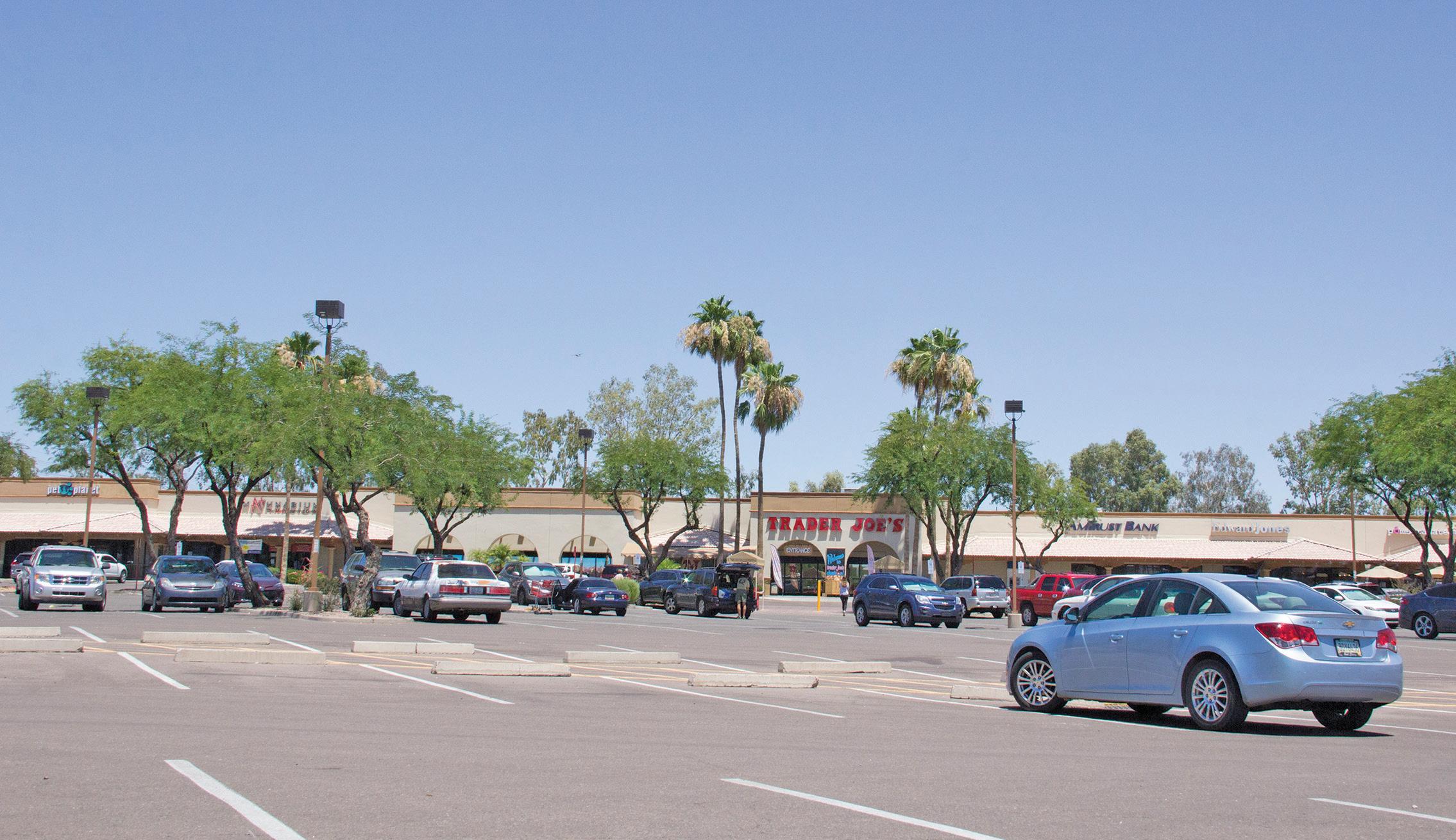
Group data.
“Retail in chandler is really healthy and a major part of that is healthy job growth,” Miranda said. “It is really across all sectors – our unemployment rate is (in the low 4 percent range). The city’s low vacancies and positive net absorption numbers are being driven by retail users across the board and an increase in restaurant users, especially local and regional chains.”
The retail vacancy rate in Gilbert sat at 6.3 percent at the end of the first quarter of this year. That is the lowest vacancy rate the town has seen since before the recession, said Gilbert economic development director Dan Henderson.
Gilbert is seeing a range of entertainment occupants coming to the town like Whiskey Row and Top Golf. Another boon for Gilbert is craftoriented retail concepts such as those pioneered by Joe Johnston at Agritopia.
“There is a very genuine desire from folks in the Gilbert and (the Valley) market to go toward those craft oriented uses,” Henderson said.
Those rents are a function of location as well. In the current market, consumers have largely replaced developers as the driving force behind the location of retailers, Burstyn said. That has led retailers and developers to focus on properties near freeways that have strong demographics and high incomes such as the area around Chandler Fashion Center or Gilbert’s SanTan Village.
Mesa is also seeing interest in development near freeways, specifically at Mesa Riverview, where developers are interested in creating mixed-use projects that blend retail with office and other uses, Jabjiniak said.
– Reach Wayne Schutsky at 480-898-6533 or wschutsky@timespublications.com.









Preparations are now underway for the Mountain Park Ranch Homeowners Association (MPRHOA) Annual Meeting scheduled for Tuesday, October 17, 2017. Three (3) of the five Board of Director positions will be voted on this year. Nominations are now being accepted in the MPR Office for the open positions up until July 7, 2017. Any Member interested in serving on the Board should contact Jim Welch, Executive Director, at the Mountain Park Ranch office at 480-704-5000 or e-mail: jim@mtparkranch.org for further information. MPRHOA By-laws allow Board Members to serve two consecutive two year terms.
Mountain Park Ranch Homeowners Association 15425 S. 40th Place, Suite #4, Phoenix, AZ 85044 (FAX) 480.704.5005 • Website: www.mtparkranch.org


make all the right noises.”
different than the original. In terms of looks, the fiberglass two-seater with its open cockpit, structural roll bar, instrumentation and other details, is spot on.
The Mark III is sold as a “roller” from Hillbank, meaning that you’re buying a mid-$50,000 car that still needs an engine and transmission, which pushes the basic price into the mid-$80,000 range.
If South Africa-based Superformance exported cars with engines, Manni explained, they’d have to conform to modern emission standards. Superformance buyers are not interested in catalytic converters and other performance-robbing innovations.
It’s not a loophole, according to Manni. The Feds know that this market only amounts to a few hundred cars per year, and that most owners drive only on weekends and special occasions.
Manni said most buyers opt to drop a push-rod, 427-cubic-inch Ford V8 into their MKIIIs, which can be ordered from Roush Performance and other outlets.
“They shake the ground,” said Manni, a longtime resident of Ahwatukee. “They
Some customers order a modern overhead cam Mustang engine for a smoother ride, Manni said.
In either case, you’re good to go with premium unleaded pump gas.
Enthusiasts should also note that Hillbank sells new GT40s and Corvette Grand Sports, designed by Zora Arkus Duntov in 1962.
These are considered “continuation” cars because there aren’t any differences in the way they are made from the originals. They’re licensed by Shelby and GM and have very exacting manufacturing standards.
Because those cars are also enclosed, buyers can order air conditioning.
Like a lot of other Arizona Cobras members, Bob Broberg of Glendale rolled into Hillbank’s recent open house to show off his Superformance Cobra, which he bought for $66,000 years ago.
He put a 460-cubic-inch, 550 horsepower engine into it from a 1972 Thunderbird. If he feels like he needs a speed boost on the road up to Flagstaff, he can give it a shot of nitrous.
“I’ve had $66,000 worth of fun,” he said, “and I can sell it for more than I bought it.”
BY LEAH GILCHREST
AFN Staff Writer
Anew service claims it can provide health care at a lower cost to Phoenix residents.
SingleCare is a new app and online company that offers patients health care up to 80 percent less than typical providers, and covers a range of services not typically covered by insurance companies.
“SingleCare is creating a marketplace for consumers to get health care services.” Simon Brown, a SingleCare representative, said.
Membership is free, and requires a first and last name, date of birth and email address. The member will receive a membership card that they use when they receive service through SingleCare.
The price for the prescription or service already has SingleCare’s fee added in. “It’s a really unique model.” Brown said, “It’s free to members and it’s free to providers.”

cover.
When a member uses SingleCare, the transaction is completed through the app or online website. The member enter their credit card information into the app prior to making an appointment through SingleCare to pay for the service.
SingleCare then pays the provider at a previously agreed-upon rate. The app eliminates any price negotiations or discrepancies.
When the transaction through SingleCare is complete, the member gets an emailed receipt.
SingleCare has partnered with 35,000 pharmacies, including Walmart, Target, Rite Aid, Walgreens, CVS and Fry’s.
The service began in 2014, and includes Philadelphia, San Antonio, Charlotte and Richmond.
An average of 20,000 new members sign up for the service every week, Brown said.
The service primarily helps reduce the cost of prescriptions as well as out-ofpocket visits for dental and vision. It also offers its members the opportunity to video-call doctors.
Members can still use benefits from any health insurance they may already have.
“We don’t believe fundamentally people should have to pay to have access to health-care services.” Brown said.
For members who already have health insurance, the service can significantly reduce costs their insurance does not





At this time, SingleCare is primarily focusing its service on the Phoenix and Philadelphia areas. As it develops the app and the website, it will likely expand across the country, Brown said. Information: singlecare.com








BY RABBI DEAN SHAPIRO AFN Guest Writer
City folk that we are, how can we understand the injunction “when you reap the harvest of your land, you shall not reap all the way to the edges of your field, or gather the gleanings of your harvest; you shall leave them for the poor and the stranger: I God am your God” (Leviticus 23:22)?
Even had we been farmers who tilled the field, planted the seeds and harvested the grain, we still would not have caused the sun to shine, the rain to fall, or the seed to germinate.
So, too, although we may work the hours, close the deals or design the product, we still do not create the natural resources, guide the economy or cause the inspiration.
We are limited beings, not solely responsible for our success. Since we are not the Source, we are obliged to share the bounty with those in need. We would do well to be humble.
BIBLE EXPLORED
This biblical scripture study embraces a spirit-filled, intellectually honest, and understandable exploration of God’s Word. Lessons will combine Christian and Jewish theology along with Bible history, archaeology and linguistics for a rich learning experience.
DETAILS>> 9:15 a.m. Mountain View Lutheran Church. 11002 S. 48th St., Ahwatukee. 480-893-2579, mvlutheran. org.
HORIZON SEEKS YOUNG PEOPLE
High school and middle school students meet to worship and do life together.
DETAILS>> 5 p.m. at Horizon Presbyterian Church, 1401 E. Liberty Lane. 480-460-1480 or email joel@ horizonchurch.com.
KIDS CAN LEARN JEWISH LIFE
Children can learn and experience Jewish life. Chabad Hebrew School focuses on Jewish heritage, culture and holidays.
DETAILS>> 9:30 a.m. to noon, for children ages 5-13 at Pollack Chabad Center for Jewish Life, 875 N. McClintock Drive, Chandler. 480-855-4333, info@chabadcenter.com, or chabadcenter.com.
A widow once told me that her husband’s motto had been “never take everything.” In grocery stores, he always left a box or two of an item behind because the next customer might need it more than he. It’s a virtue that’s basic and profound but seemingly forgotten: Leave something for someone else.
when they don’t.
“Tzimtzum” is the Hebrew term for the voluntary contraction of self that allows others to have what they need. The term is derived from a Kabbalistic story of creation. God wanted to create a world, but since God filled all there was, there was no room for anything else!
“ We who are used to having our say and getting our way need to practice self-contraction.”
American restaurants serve portions that would feed a family elsewhere. We have closets full of clothes we rarely wear. We tear up the earth to extract oil and metal, and tear down the rainforest to graze cattle. We speak so loudly on our cell phones that others can’t hear themselves think. We don’t let other drivers merge into our lane. We expect others’ schedules to conform to our own, and curse them
God determined to contract, to make space for Existence.
The practice of tzimtzum is important and powerful for human beings, too. Tzimtzum means knowing when to yield space to someone else. It means knowing when to stop talking, when to ask a question rather than give an answer. Tzimtzum allows other people to make decisions for themselves.
It’s a check on privilege determined
by race, class and gender, among other attributes. When can you take up a little less – food, space, time – so that others might have a fuller experience?
It’s true that some people hold themselves in check too often, thinking that they don’t count, that their opinions don’t matter. These folks do not need to engage in tzimtzum. Rather, we who are used to having our say and getting our way need to practice self-contraction so that others can enjoy their share of the sun. They get to blossom, and we get to learn from them.
Whether it’s the corners of your field, a product at a store, Earth’s resources, or the power to speak, please be considerate enough not to drain all the stock. Instead, leave enough for others to have a share, and for the supply to be replenished. In the words of Bernard Etzine, a quiet hero: “Never take everything.”
SUNDAY CELEBRATION SERVICE
Inspirational messages and music to lift your spirit. A welcoming community committed to living from the heart. Many classes and events offered. We welcome you!
DETAILS>> 10 a.m. Sundays at Unity of Tempe, 1222 E. Baseline Road, Suite 103, Tempe. Information: 480-7921800, unityoftempe. com.
FOUNDATIONS OF FAITH
The Foundations of Faith Bible study embraces a spirit-filled, intellectually honest, and refreshingly understandable exploration of God’s Word. Lessons will combine Christian and Jewish theology along with bible history, archaeology and linguistics for a rich learning experience.
MONDAYS

DETAILS>> 9:15 a.m. Mountain View Lutheran Church. 11002 S. 48th St., Ahwatukee. 480-893-2579. mvlutheran.org.
JOIN CHRIST-CENTERED YOGA
This Flow 1-2 class (intermediate) is free and open to the community.
DETAILS>> 6-7 p.m., Mountain Park Community Church, 2408 E. Pecos Road. Greg Battle at 480759-6200 or gbattle@ moutainpark.org.
CLASS TARGETS THE GRIEVING
Classes for those grieving over death or divorce.
DETAILS>> 6:30 p.m., Holy Trinity Lutheran Church, 739 W. Erie St., Chandler. 480-963-4127.
TUESDAYS
GRIEFSHARE
Mountain Park Community Church is offering an ongoing
GriefShare programs to help people deal with the pain of losing a loved one.
DETAILS>> 6:30-8 p.m., 2408 E. Pecos Road, Ahwatukee. To register: mountainpark.org and click on Launch. Information: Alex at 480-759-6200
FINDING HEALING FOR PAIN
HOPE, an acronym for “Help Overcome Painful Experiences,” offers support for men and women who seek God’s grace and healing.
DETAILS>> 6:30-8 p.m. Mountain Park Community Church, 2408 E. Pecos Road. mountainpark.org.
SENIORS ENJOY TUESDAYS
The Terrific Tuesdays program is free and includes bagels and coffee and a different speaker or theme each week. Registration not needed.
DETAILS>> 10-11 a.m., Barness Family East Valley Jewish Community Center, 908 N. Alma School Road, Chandler. evjcc.org or 480-897-0588.
WEDNESDAYS
CELEBRATE RECOVERY
Celebrate Recovery is a Biblical 12-step program that
from page 42
helps you find hope and healing from all of life’s hurts, habits and hang-ups. Whether it’s addiction, loss, anger or stress, you can find the freedom you’re looking for today.
DETAILS>> 6:20 p.m. Mountain View Lutheran Church. 11002 S. 48th St., Ahwatukee.. 480-893-2579. mvlutheran. org.
DIVORCE CARE
Don’t go through one of life’s most difficult times alone. DivorceCare is a friendly, caring group that will walk alongside you and provide support through divorce or separation.
DETAILS>> 6:30 p.m. Mountain View Lutheran Church. 11002 S. 48th St., Ahwatukee. 480-893-2579. mvlutheran.org.
WOMEN’S BIBLE STUDY OFFERED
Living Word Ahwatukee women’s Bible study and fellowship that offers “a short, low-key time of praise and worship in music and message.” It’s also an opportunity to meet other Christian women in Ahwatukee.
DETAILS>> 10-11:30 a.m., Living Word Ahwatukee, 14647 W. 50th St., Suite 165, Ahwatukee. Free child care.
SLEEPING BAGS FOR THE HOMELESS
Ugly Quilts has made more than 15,500 sleeping bags for the area homeless, and continues to do so at First United Methodist Church every Thursday. Quilters stitch donated fabric, comforters, sheets and blankets into sleeping bags. Those are then distributed to the Salvation Army, churches and veterans’ organizations. DETAILS>> 8 a.m.-2 p.m., 15 E. 1st Ave., Mesa. Information: 480-969-5577.
KIDS CAN FIND SUPPORT
Support group for children ages 6 to 12 coping with a separation or divorce in the family. One-time $10 fee includes snacks and workbook.
DETAILS>> 6:30-8:30 p.m., 1825 S. Alma School Road, Room C202, Chandler. Pastor Larry Daily, 480-963-3997, ext. 141, larrydaily@chandlercc.org or chandlercc.org.
FRIDAYS
NEFESHSOUL HOLDS SERVICES
Congregation NefeshSoul holds Shabbat services the second Friday of every month on the campus of the Valley Unitarian Universalist Congregation.
DETAILS>> 6:15 p.m., 6400 W. Del Rio St., Chandler. Information: nefeshsoul.org.
TOTS TAUGHT TORAH
Hosted by Chabad of the East Valley for children ages 2 to 5. Features hands-on activities about the Shabbat, songs, stories and crafts. Children will make and braid their own challah.
DETAILS>> 10:15-11 a.m., members’ homes. 480-785-5831.
JEWISH STUDY OFFERED
Congregation NefeshSoul Jewish study for adults is held weekly.
DETAILS>> 8:45-9:45am, 6400 W. Del Rio St., Chandler, in the sanctuary. Information: nefeshsoul.org or rabbi@nefeshsoul.org
WEEKLY SERVICES SCHEDULED
International, nondenominational church offers weekly Sabbath services. Congregational meeting in the morning and Bible study in the afternoon.
DETAILS>> 10:30 a.m.-noon; 1:30-2:45 p.m. at True Jesus Church, 2640 N. Dobson Road, Chandler. 480-899-1488 or tjcphoenix@tjc.org.
ANSWERS TO PUZZLES AND SUDOKU from Page 51

JEWISH KIDS PROGRAM AVAILABLE
Shabbat Yeladim is a free Shabbat program for Jewish children ages 3-7 sponsored by Ahwatukee’s NefeshSoul Jewish Community. Shabbat Yeladim is on the second Saturday of the month. Songs, stories and art project each month.
DETAILS>> 10-11 a.m. on the Valley Unitarian Universalist Campus, 6400 W. Del Rio, Chandler. Contact Rabbi Susan Schanerman at rabbi@nefeshsoul.org or nefeshsoul.org.

Submit your releases to pmaryniak@ahwatukee.com



BY KENNETH LAFAVE GETOUT Contributor
How to be Tony Bennett: Have an innate gift for singing, nurture it with intensive training, select only the songs that suit your voice and temperament, and then work like a maniac to get your stuff into the culture.
And, oh yeah, start out with your first hit record at age 25 and keep going strong at age 90.
Bennett, whose career has spanned the sweep of American popular music for over six decades, will perform in concert July 11 at Phoenix’s Celebrity Theatre.
Born Anthony Dominick Benedetto in Queens, New York, in 1926, the singer got his stage name from Bob Hope, who suggested it after hearing him in a New York nightclub in 1949.
“When I started out, my premise was to create a hit catalog and avoid going for a (single) hit song that would get attention and then fade away,” Bennett recalled.
The plan worked, producing dozens of Top 40 records since Bennett’s first bona fide No. 1 seller, “Because of You,” in 1951. In addition to his iconic mega-hit, “I Left My Heart in San Francisco,” those have included “The Good Life,” “Rags to Riches” and “Who Can I Turn To?”
While he started out in the autumn years of the older popular style, Bennett has stretched his musical profile over the last 25 years to include collaborations with major contemporary artists such as k.d. lang, Amy Winehouse, Bono, Lady Gaga, Michael Buble and Aretha Franklin.
As expansive as his taste has become, Bennett’s love of music remains rooted in the tradition of the Great American Songbook.
“I got hooked on jazz in the ’40s, and it has remained my favorite musical genre ever since,” he said. “I consider it America’s classical music, as it was created here but loved all over the world.”
It was the era of the classic songwriters, “a host of master craftsman,” as Bennett

put it, “like the Gershwins, Irving Berlin, Duke Ellington, Cole Porter.
“I think in any musical genre there are compositions that are timeless and will last, and then some that are novelty pieces that may hit it big for a few weeks and then be easily forgotten.”
How does Bennett go about selecting the songs that fit his musical personality?
“I have to give a lot of credit to Ralph Sharon, my musical director and pianist who was with me for many years, as he always had a great ear for picking songs. He was the one who found my signature song,
‘I Left My Heart in San Francisco.’”
About that biggest hit of all his hits: Bennett has never resented having to sing it on demand for the last 50 years. Asked if he is tired of it, his perfect stock answer is:
“Do you get tired of making love?”
For a song to make it into his repertoire, it has to be more than just novel; it has to have something to say.
“I like to sing songs where the melody and the lyrics speak to me and I know that I
(Special to AFN)
can convey the song to an audience, and they will feel what I feel,” Bennett said.
Song choice is a vital part of a singer’s life, but it’s the style that makes the singer, and Bennett’s style wraps a large, warm sound around a phrase like a grandfatherly hug around a child.
His way of bringing nuance to the most obvious melody or lyric means that even as hackneyed a song as “Fly Me to the Moon” feels fresh when Bennett brings it to life.
Bennett has never rested on any laurels, and he has always sought out the best musicians of every genre. His first love, jazz, was greatly enriched by two albums he recorded with one of jazz’s greatest masters of the piano, Bill Evans.
“Bill was a genius and I am so grateful we got to work together. Funny enough, we made two albums when I had left a major label, and those albums are the ones that most music critics and jazz lovers say are their favorites.
“Bill had a terrible addiction to drugs that took him away from us too early. A few
weeks before he passed away, we spoke on the phone and he told me, ‘Tony, just stay with truth and beauty,’ and I have used that as my artistic inspiration ever since.”
If the Evans albums were Bennett’s highest jazz profile, his pop profile was raised to its pinnacle when he recorded a series of astonishing jazz duets with Lady Gaga.
“I just love her,” Bennett said. “We get along so well and we understand each other. We are both Italian-American and our families also get along.
“I met her at a benefit gala in NYC that we were both performing to raise money for the homeless. I remember hearing her perform ‘Orange Colored Sky’ and I was so impressed with her voice and the way she played the piano that I met her backstage and asked her to sing on my “Duets II” album, which we were recording at the time.
“She immediately said yes, and it just kept going from there. She is an authentic artist and everything she does has been thought out and perfected to the smallest detail. I know she will have a long career.”
In the middle of a career devoted to musical excellence, Bennett has somehow also managed to paint. It’s more than just a hobby.
“I paint or draw every day. When I am on the road, I bring a portable easel and watercolor paints, and when I am home, I have an art studio where I can use oils.
“Nature never disappoints so I love landscapes, but I like all subjects. One of the greatest thrills of my life is to have three of my original paintings in the permanent collection of the Smithsonian Institution.”
When: 7:30 p.m. July 11
Where: Celebrity Theatre, 440 N. 32nd St., Phoenix
Tickets: $78-$138
Info: 602-276-1600, celebritytheatre.com
BY ISRAE GONZALEZ GETOUT Contributor
The sounds of joysticks clashing, coins clanging and beer bottles rattling can be heard throughout the bar.
Video game characters are painted on the walls and bathroom doors, and art by Arizona artists hangs on the wall near the bar counters.
This isn’t your father’s bar.
Gaming-themed spots like Cobra Arcade Bar are sweeping the nation and, according to the TV show and magazine “The List,” the downtown Phoenix bar is one of the country’s best.
“The idea was just to give somebody a new experience of going out,” said Ariel Bracamonte, Cobra Arcade Bar cofounder.
Bracamonte has been obsessed with arcades and its machines since he was a kid. He frequented Circle K and 7-Eleven locations to watch people play.
“I’ve always had an interest in arcades,” Bracamonte said. “When I was a kid, I was fascinated by the art on the sides and watching the games be played because we didn’t have money to play.”
The obsession follows him even now. Bracamonte supplies the arcade cabinets for Cobra Arcade Bar from his collection of over 300. At least, that’s how many he had the last time he counted.
“I stopped counting a long time ago,” Bracamonte said. “I have a 2,500-square-feet warehouse filled with them. I have close to five storage units and my living room filled with them.”
Bracamonte acquired most of his collection from Craigslist, OfferUp and dedicated internet forums. He has driven as far as Dallas and Sacramento to pick up the units, which he restores himself.

(Special to AFN)
Cobra Arcade Bar’s Ariel Bracamonte supplies the arcade cabinets in his Phoenix establishment from his collection of more than 300 games, ranging from old standbys like Donkey Kong and Ms. Pac-Man to newer, more intricate games.
“I’m obsessed with arcades,” Bracamonte said. “I’m obsessed with fixing them. I’m obsessed with making them. That’s all I do. I really care about what they look like and how they function.”
After visiting other “barcades” like Insert Coin and Ground Kontrol, Bracamonte wanted to deliver one to downtown Phoenix.
“I wanted to bring the idea to Phoenix,”
Bracamonte said. “But I also wanted to do it my own way.”
His idea was to partner with local and national artists like Lalo Cota, El Mac, Pablo Luna and Noelle Martinez to add artwork to the sides of his cabinets.
“I really wanted to incorporate art as much as I can with the arcades,” Bracamonte said. “I didn’t just go buy them in an auction and throw them inside the bar.”
The bar, which is open to patrons 21 and older, features about 40 vintage arcade cabinets, four pinball machines and even custom-made machines for newer games.
The cabinets are rotated with different games from Bracamonte’s collection.
“We utilize new technology,” Bracamonte said. “I have a Street Fighter 5 arcade, which is for a Playstation 4. Nobody has an arcade machine like that, but we made it in-house.”
Other selections include Donkey Kong, Ms. Pac-Man and Mortal Kombat II. Custom-made arcade cabinets like “Street Fighter 5” can be found on the floor and the bar’s televisions host newer games like Super Smash Bros. Cobra Arcade Bar hosts tournaments, too.
There are 14 beers on tap, including Dos
Equis, Stella Artois and Kilt Lifter, and video game-themed signature cocktails like Princess Peach (pear vodka mixed with stone fruit, lemon and orange bitters) Crazy Kong (Jameson Caskmates whiskey, banana liqueur, lemon and ginger beer).
A selection of nonalcoholic drinks is also available. The bar doesn’t serve food, but food trucks like Ladera, Dos Manos Hotdogs and Ragin’ Cajun are nearby.
“If you don’t like to drink you can come play some games,” Bracamonte said. “And it’s a great social environment for strangers, too. You can get competitive in a game together.”
What: Cobra Arcade Bar
Where: 801 N. Second St., Suite 100, Phoenix
Hours: 4 p.m.-2 a.m. Monday to Sunday Info: 602-595-5873, cobraarcadebar.com
and select Special Tours).
“The Curious Incident of the Dog in the Night-Time” is about 15-year-old Christopher, who boasts above-average intelligence but below-average social skills. When his neighbor’s dog is killed and he’s a suspect, he sets out on a journey to find the real killer. Don’t miss the Tony Awardwinning Broadway play.
DETAILS>> Through June 25. ASU Gammage, 1200 S. Forest Ave., Tempe. Tickets: $20$125. 480-965-3434. asugammage.com.
Escape rooms are all the rage, but this scenario aims squarely at kids 7-12. Six players get 45 minutes to find a stuffed monkey and get to bed before their parents get home.
DETAILS>> 10 a.m.-3 p.m., Thursday, June 22. Escape Games AZ, 12 N. Center St., Suite 200, Mesa. Tickets: $10 per player. 480-6493144. escapegamesaz.com (click Book Now
The East Valley Children’s Theatre presents a musical adaptation of the classic “The Wizard of Oz.” Follow Dorothy, Toto, Scarecrow, Cowardly Lion, Tin Woodsman and more favorite characters on their adventures.
DETAILS>> Thursday-Sunday, June 22-25. Mesa Arts Center, 1 E. Main St., Mesa. Tickets: $15 adults, $11 17 and under. 480-644-6500. mesaartscenter.com.
Coming off a tour in London, this rock group, which includes two members of the breakout local band Simply Three, brings a unique sound you won’t want to miss.
DETAILS>> 8 p.m., Friday, June 23. Mesa Arts Center, 1 E. Main St., Mesa. Tickets: $20. 480-644-6500. mesaartscenter.com.
Craving gourmet street food from a food truck? Every Friday night, 15 to

25 food trucks show up along with live entertainment and a boutique market for an evening of fun. Feel free to bring chairs, tables and leashed pets.
DETAILS>> 5:30-9 p.m., Friday, June 23. Queen Creek Library, Ellsworth Loop and Ocotillo, Queen Creek. Cost: Free Entry. azfeastivals.com/qcfeastival.
Iliza Shlesinger, the only female winner of “Last Comic Standing,” Shlesinger brings her latest special to the Valley.
DETAILS>> Times vary, Friday, June 23 and Saturday, June 24. Tempe Improv, 930 E. University Drive, Tempe. Tickets: $27.50 and two-drink minimum. 480-921-9877. tempeimprov.com.
The full Downtown Mesa Festival of the Arts closes for the summer, but it still hosts a monthly market. Show up to enjoy the work of local artisans and crafters.
DETAILS>> 10 a.m.-3 p.m., Saturday, June 24. SW Herb Shop & Gathering Place, 148
N. Center St., Mesa. Cost: Free. dtmesafest. com.
Gun collectors, hunters and those interested in self-defense will enjoy the Crossroads of the West Gun Show’s hundreds of tables with all kinds of guns, ammunition and gun accessories.
DETAILS>> 9 a.m.-5 p.m., Saturday, June 24 and Sunday, June 25. Mesa Convention Center, 263 N. Center St., Mesa. Tickets: $12 for both days. crossroadsgunshows.com.
On Thursdays, kids get the opportunity to meet their favorite superheroes and Disney characters, plus enjoy music, themed games and activities, and a splash pad. This week: Belle and Rapunzel.
DETAILS>> 6-7:30 p.m., Thursdays until July 27. Tempe Marketplace, 2000 E. Rio Salado Parkway, Tempe. Cost: Free. tempemarketplace.com/summer.




Comedians Nikki Carr and Aida Rodriguez from NBC’s “Last Comic Standing” are [performing Saturday, June 24, at UltraStar Multi-tainment Center.
Carr got her start at the New York Comedy Club at 34 and had her television debut on BET’s “Comic View” in 2000. She made it to the summer finals on “Last Comic Standing” in 2014.
The Bronx native has appeared in independent films such as “Golddigger Killer,” “Change the Game” and “Ass Backwards.” She the daughter of jazz drummer Bruno Carr.
Rodriguez is best known for being a top 10 finalist on season 8 of “Last Comic Standing.”
She has appeared on Nickelodeon and hosted “The Wedding Zinger” with Felipe Esparza, a comedy roast special for the NuVo Network.
Doors open at UltraStar at Ak-Chin Circle at 8 p.m. and showtime is 9 p.m. Tickets are $20 and the show is open to anyone voer 21.
A party upstairs in the Luxe Lounge
gives guests a chance to meet with the comedians after the show. Luxe Lounge features 21 HD flat-screen TVs, big screen, pool tables, Golden Tee Golf, soft tip darts, foosball and great food and drinks.
Tickets/information: ultrastaraz.com
Ak-Chin Circle is at 16000 Maricopa Road, Maricopa.





Dracula, the Frankenstein monster, the boogeyman – these are just a few of the monsters that can keep kids, and some adults, awake at night. This summer, however, the terrifying monsters of our nightmares get an adorable makeover at the i.d.e.a. Museum’s latest exhibit, My Favorite Monster.
According to the museum’s website, the exhibit aims to take “a light-hearted look at our fascination with these fantastical creatures – including dragons, ghosts, zombies and vampires.” Think Pixar’s “Monsters Inc.” in exhibit form.
As i.d.e.a. Museum Executive Director Sunnee O’Rork explains, “Monsters today are quite relevant because they’re everywhere – from comics, kid-friendly cartoons and video games to popular fiction, classic TV shows, films and more.”
The museum hopes the exhibit provides a “look at the popularity of these imaginative creatures in media and their role in

storytelling, as well as cultural and historical aspects of monsters in our society.”
Of course, that sounds kind of high-brow for kids, who are mainly there for the fun. Fortunately, there will be plenty of that.
Like most i.d.e.a Museum exhibits, My Favorite Monster includes both art in a wide range of mediums and handson activities sure to keep little ones engaged. The activities include creating monster art, dressing up as monsters, monster-themed games, a monster dance party in front of the green screen, and other monster fun.
Don’t count out the art, though. Kids – and adults –will find a lot to like from a number of Phoenix and national artists. That includes Redeye the Vampire Bat Boy, a photograph of shopping Yetis, and a cute-as-a-button Cthulhu.


For kids ages 5-10 who truly love monsters, the museum’s Monster Mayhem summer camp runs from July 10 to July 14. It goes even further in depth on
the history and behavior of monsters, plus science experiments and a field trip to see dinosaurs.






Where: i.d.e.a. Museum, 150 W. Pepper Place, Mesa
When: Through Sept. 10
Tuesdays-Saturdays: 9 a.m.4 p.m.
Sunday: Noon-4 p.m.
Cost: $8 per person, free for under 1
Info: 480-644-4332, ideamuseum.org

BY CHRISTINA FUOCO-KARASINSKI GETOUT Contributor
Frank Iero knows he’s a nerd. Best known as the rhythm guitarist/ backup singer for My Chemical Romance, Iero now fronts Frank Iero and the Patience, a task that didn’t come easily.
“I never wanted to do that,” Iero said. “That wasn’t on my bucket list. I considered writing the songs and getting someone else to sing them. However, it felt weird to do that, like I was faking or hiding. With the songs I had been writing, I was trying to be as honest and forthright as possible.
“To hide at the end of the cycle of creation felt wrong.”
To keep being honest, Iero fought his demons and stepped behind the mic after discussions with his wife, friends and family.
“I had to give it a try or regret it,” he said. “I found out I was able to do it on my own terms.”
That dictated that Iero be himself.
“I had this image of a frontman as almost like a caricature,” he said. “They get up on stage (and swear). That’s not me. With some people, it works. But to get up on stage in a room full of people, it was scary.”


Iero has since found comfort in it as he celebrates the release of his second album, “Parachutes.” The band performs with Deftones, Rise Against and Thrice at AkChin Pavilion at 6:30 p.m. Sunday, July 9.
“When that tour came down the pipeline, I think everybody just started to salivate,” said Iero, who had to initially cancel plans to promote “Parachute” after a bus crashed into him and his bandmates while unloading for a gig in Sydney, Australia.
“It’s amazing and super-fflattering that they wanted us to be on the tour. It’s really rad to be on a tour that I would have bought tickets for.”
Fans can expect to hear “Parachute’s” songs, most of which have “grown a lot since we recorded them.”
“That’s one of my favorite things about music and creating things: You get to have this initial release when you write the songs,” Iero said. “Then they change and evolve by the time you record them.”
“Parachute” was recorded with the help of legendary producers Ross Robinson and Steve Evetts in California. Iero said he loved getting Robinson’s advice, the particulars of which he wouldn’t share.
“He was an incredible partner,” he adds.


“He finds a way to ask the right questions – so much so that you find out things about yourself as a person and as an artist.
“It’s too personal to share. It really is. I’ve never been pushed like that or questioned like that. I thought I knew what certain songs were about and where they came from.
“But by working with Ross, I learned that a lot of these songs and feeling stemmed from even further back. They were from something else that happened earlier on.

The songs are about something totally different. That kind of insight opened the doors for me lyrically.”
Like singing in front of thousands of people, the transformation in the studio was scary.
“You’d think that being yourself is a little bit scary, but I find comfort in being awkward,” he added. “It’s more uncomfortable when I pretend not to be



What: Deftones, Rise Against, Thrice and Frank Iero and the Patience. Where: Ak-Chin Pavilion, 2121 N. 83rd Ave., Phoenix
When: 6:30 p.m. Sunday, July 9.
Cost: Start at $22 Info: 4602-254-7200, 800-745-3000, ticketmaster.com
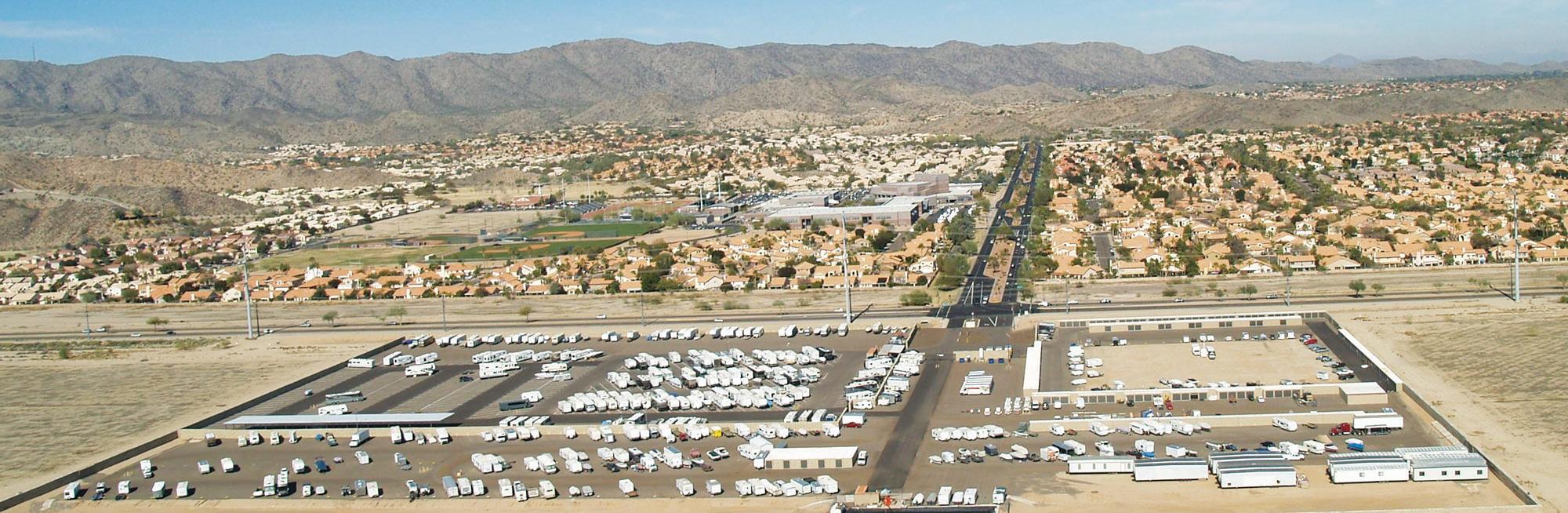

BY MADISON RUTHERFORD GETOUT Staff Writer
Brandon Kellum is the self-proclaimed Clark Kent of hardcore.
By day, he works with a team of analytic consultants and project managers for a large financial company. His alter ego is the vocalist of Phoenix metalcore band American Standards.
“I take off the tie and turn into Superman,” he jokes.
Kellum, 31, is no stranger to balancing work and play. He has been a musician in Arizona bands for nearly half his life.
American Standards formed in 2011 and quickly became a staple in the local hardcore scene, accruing steadfast fans in Phoenix and rapidly garnering national and international attention.
They signed to a subset of Victory Records shortly after their first self-titled EP. Since then, they have released four albums, including their newest full-length, “Anti-Melody.”
The band has kept things fresh with lyrics that oscillate between politics and personal struggle.
The band will join Zao w/Colombian

“I think we’ve always paralleled the popular style of music and we’re never exactly the model for what fits into hardcore or punk rock or metal, we’re just somewhere on the side of it and because of that, I think promoters and venues don’t know what to do with us.”
said.
The album’s heaviness in sound is underscored by the heavy topics explored throughout each track. Kellum said it is, by far, the band’s most personal album, written in the wake of the loss of his father to cancer and the unexpected suicide of the band’s lead guitarist, Cody Conrad, in 2015.
Necktie, Seizures and Flying Scorpion at 7 p.m. Saturday, June 24, at The Nile, 105 W. Main S., Mesa, Tickets are $15.
“I’ve seen the cycles over time where music starts off… it progressively gets heavier and heavier into hardcore and metal and people get burnt out from all the noise and it just recycles right back to the beginning,” Kellum said, adding:







Kellum said they have been put on bills with bands that range from death metal to indie rock to pop punk, which has helped expose them to a variety of different crowds.
“It also kind of hurts us because we go in as the underdog where we don’t fit in with the four other bands that sound very similar to each other, so it’s a lot of people scratching their heads at first and they either really love it because we’re completely different or they hate it because it just doesn’t fit the mold,” he
“I almost hesitated to write such a personal album but I felt like I needed to. When those two big things happened, they made me rethink how I wanted the lyrics,” Kellum explained.
“I definitely wanted to include some of the stuff that we had talked about in the past, especially in our political climate now,” he said. “But at the same time I needed to talk about the experience with my dad and the experience with Cody… and that’s something I just never really did.”
Prior to “Anti-Melody,” Kellum avoided including extreme emotions like love and hate in his music.
“I felt like they were cliché and I didn’t really have a lot to add to those conversations,” he said. “I’m not belting out love ballads and I’m not writing these really angry, hateful songs.
The community of Mountain Park Ranch is again sponsoring a Children’s Fourth of July Parade. The Parade date is set for Tuesday, July 4, 2017. All families are invited to join in. Come celebrate with Mountain Park Ranch family and friends. We will be celebrating this historic day with a Parade and some fun and games for the entire community.
The Parade begins at 8am at the Foothills Baptist Church on Thunderhill Road and will follow Thunderhill east to the Park near Ray Road. The Phoenix Fire Department will be on hand to lead the kids down Thunderhill. Time will be approaching to start decorating your bikes, trikes, wagons, scooters and electric kiddy cars with red, white and blue streamers and ribbons. Making a small float could be a great neighborhood project to keep the kids busy.
A family celebration will follow the Parade, at Thunderhill Park, and end around 10:30 a.m. The celebration will include a DJ, a superslide and other family activities. There will be sno-cones, hot dogs and drinks for the entire family. Best of all, there will be awards and prizes for best decorations and spirit. Bring your cameras! This is a great opportunity to show our community spirit, to meet neighbors, visit with friends and have a great time with the entire family. See you at the Parade and celebration.


BY JAN D’ATRI
AFN Contributor
OK dads, even though your official day has passed, we’re making you the most “highly craveable” snacks in existence – according to me, anyway. It’s hard to believe that only four ingredients could create such a taste sensation, but when you combine bacon, brown sugar, maple syrup and crescent rolls, you pretty much know what the reaction is going to be.
Best part is, this bacon candy-like snack is easy. But wait! There’s more! I’ve included an irresistible recipe for Beer Candied Bacon, too.
Check out my how-to video for candied bacon and bacon crack and then … get crackin’ on snackin’: jandatri. com/recipes/one-minute-kitchen.
Maple-bacon crack
Ingredients:
1 lb. bacon, chopped
1 tube crescent rolls
1/4 cup real maple syrup, divided 1 cup brown sugar, divided
Directions:
Preheat oven to 325 degrees. Line a 9 x 12 inch baking sheet with parchment paper and spray lightly with cooking spray.
In a medium skillet, cook bacon until almost done, about 5 minutes.
Transfer to plate with paper towels to drain.
Roll out crescent rolls or puff pastry onto parchment. Pinch seams to make one single sheet. Prick all over with

a fork.
Drizzle with half the maple syrup. Sprinkle a half cup brown sugar over dough. Top with cooked bacon, distributing evenly. Sprinkle remainder of brown sugar and drizzle with remaining maple syrup. Bake for about an hour or until golden brown and brown sugar has caramelized. (Note: It could take less time than one hour, depending on your oven.)
Let cool completely to harden before slicing into pieces.
1 lb. bacon, thick-cut
1/2 cup brown sugar
1/3 cup dark beer (I used Stockyard Oatmeal Stout)
1/8 teaspoon cayenne pepper or chipotle powder
Directions:
Preheat oven to 375 degrees.
Line a rimmed baking sheet with aluminum foil. Place a wire cooling rack or oven rack on top. Arrange bacon on the rack. Cook for 10 minutes.
In a bowl, combine brown sugar, beer and cayenne, whisking to form syrup. Arrange bacon on the rack. Cook for 10 minutes. Remove from oven and brush one side of the bacon with the beer syrup. Turn bacon over and brush the other side with syrup. Return to oven and cook for 7-10 minutes. Repeat process until bacon is browned and syrup is used up. (Do not burn the bacon.)
Cool to allow bacon to harden, about 10 minutes.

Responsibility
Lip
“Guinness Book” suffix
Shrek, for one
Stratagem

BY GREG MACAFEE AFN Sports Editor
Many athletes dream of representing their country at the top of their sport.
Recently, 2014 Desert Vista High School graduate Joe Underwood did just that at the International Wheelchair Basketball Federation Men’s U23 World Wheelchair Basketball Championship in Toronto, Canada.
“It’s the best opportunity any athlete could ask for,” Underwood said. “Being able to wear USA on your uniform is a dream for so many athletes.”
It’s a dream he has been pursuing since he started playing when he was 8 years old. A family friend recommended Arizona Disabled Sports, a non-profit organization dedicated to providing sports and recreation opportunities for individuals with all types of disabilities.
Underwood played wheelchair basketball throughout high school on a travel team for AZDS.
He represented the U. S. at a World Championship swimming meet in Pasadena, California, the summer before
his freshman year at the University of Missouri.
It was at Mizzou that he met his current coach, Ron Lykins.
“He has been the coach for multiple USA teams and had a lot of influence getting me and my two of my other teammates good enough to try out and make the U23 national team,” Underwood said.
The team qualified for the world championships by going undefeated at the qualifying tournament in Buenos Aires, Argentina.
Unfortunately, the team’s time in Toronto did not go as well for the United States representatives.
The team lost to Great Britain, then fell to Germany, Japan, and France.
The U.S. team left Toronto on a high note with double-digit victories in its final two games. It defeated Italy by a score of 65-48, and blew out South Africa 76-17.
Underwood learned a valuable lesson.
“It was definitely a learning experience I would say,” Underwood said. “Going against those guys made me realize how much I still have to work on.”

Underwood is a psychology major and is also pursuing a minor in Spanish. But, his dreams don’t stop there.
“I plan to get a master’s and PhD in
counseling psychology with an emphasis in sports psychology,” he explained. “I want to be a sports psychologist after school.”
BY GREG MACAFEE
AFN Sports Editor
The Phoenix Flyers Track Club, an Ahwatukee-based running club, qualified 14 of its members for the Regional Junior Olympics meet on July 6-9 during a stellar performance recently.
During the Junior Olympics State Championships at Mesa Community College, the top four placers in each event qualified for the regional meet.

The top five athletes in each event at the regional meet will move on to the Junior Olympics national meet held in Kansas at the end of July.
Phoenix Flyers athletes qualified in eight different age groups.
Isabella Allison qualified in the 8-andunder girls’ division, finishing first in the mini-javelin and third in the long jump. Max Columbus qualified in the same age group’s boys division by taking first place in the mini-javelin.
In the 9-10 group, Micah Newkirk
took third place in the 1,500-meter race.
The 11-12 boys group fielded three qualifiers: Braden Lolli took second place in the 1,500-meter race; Jake Blair took first in aero-javelin; and Maddox Moses placed fourth in the 3,000-meter race.
Charlie Allison placed first in the javelin throw and second in the triple jump for the 13-14 boys group while Peyton Burnside placed fourth in the 3,000-meter race in the girls’ division.
In the 15-16 girls’ division, Maddy
Shoemaker took second in the 1,500-meter race and Kenya Coburn took first place in the triple jump, third in the long jump and second in the 100-meter race.
Four Flyers in the 17-18 girls’ division qualified. The 4 x 100-meter relay team of Chynna Simmons, Nura Muhammad, Catera Lee and Brittany Patterson took first place. Patterson, Muhammad and Simons swept in the triple jump and then Patterson and Simmons took second and third in the long jump.
BY SHELBY HYDE Cronkite News
It was a shotgun accident in a small Indiana town. The guns weren’t locked up. A neighborhood boy found a 12-gauge and wanted to play with 4-year-old Nick Pryor. The pair went outside.
Pryor’s life was forever changed.
“I spent three weeks afterwards, numerous surgeries, when they decided that they were going to amputate my leg,” he said. “Then from there on, it’s just I got my first leg and never really stopped going.”
Now 27, Pryor is an accomplished athlete benefiting from the advancements in prosthetics. He plays on an allamputee basketball team and is training for the javelin competition in the World Para Athletics Championships this summer.
The world of prosthetics has made great advances in recent years. A field that once relied heavily on wood has since evolved to use stronger, lightweight materials like carbon fiber. For athletes, prosthetics are available for specific sports, including basketball, cycling and running.
Pryor used a wheelchair before turning to a walker. He started wearing his prosthetic leg about eight months after the shotgun accident.
“I was already in tee-ball when my accident happened,” he said. “I like to say the only sport I actually played with two legs was tee-ball for a half a year, so everything else has been with a prosthetic.”
He started to play baseball again when he was 6, although basketball and football were his focus.
Doctors told him that he would need to relearn how to walk and would be limited to certain movements. He persevered.
“They told me I wouldn’t be able to do a lot of things, but when they gave me my first prosthesis, I just took off walking and never really had a problem,” he said.
Growing up, Pryor benefited from the care given by the Shriners Hospitals for Children.
“They kind of helped pay for those prosthetics and those needs if you don’t have them,” he said. “I was a Shriner kid from the time I was 6 years old until the time I quit growing when I was 23.
“It’s helped me a lot. It gave me all
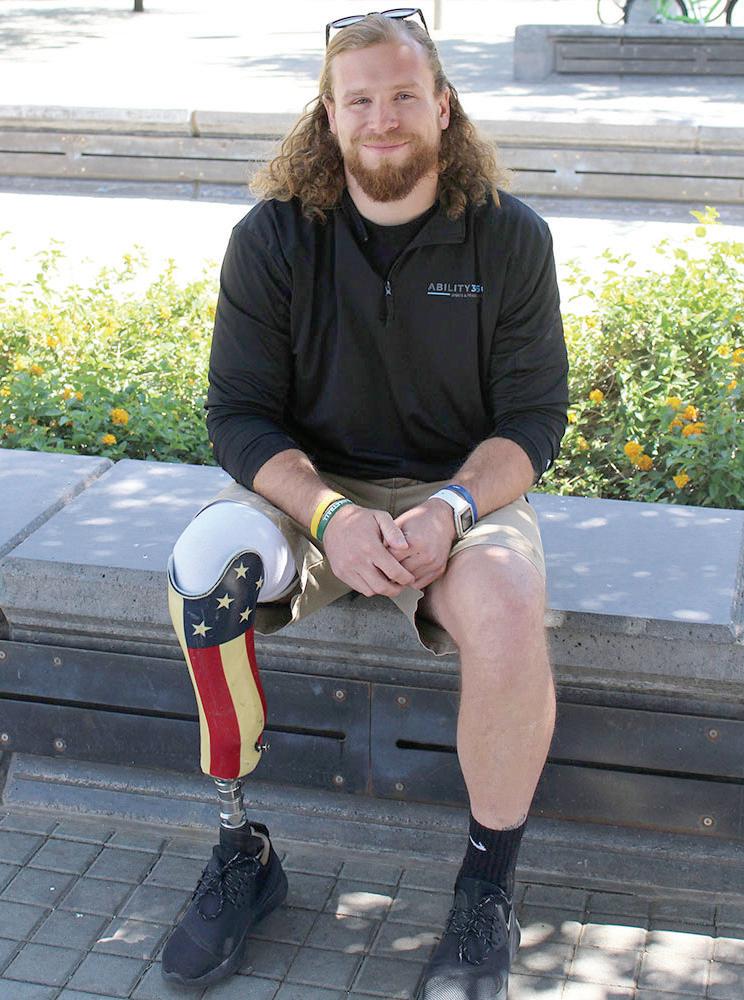
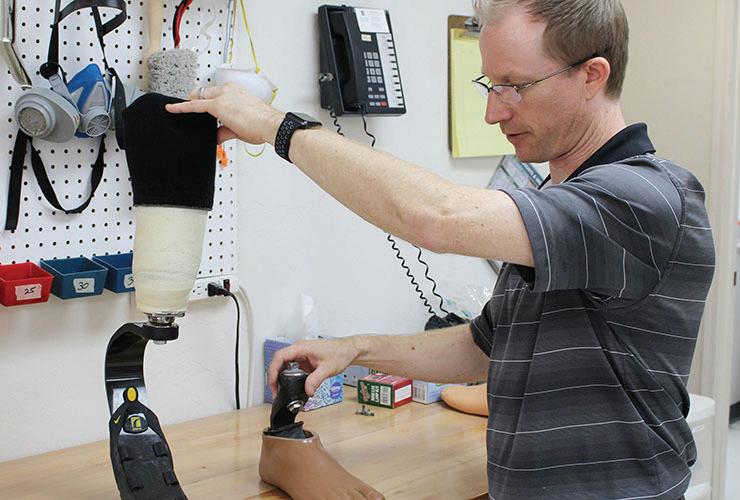
gone high-tech.
“That’s probably one of the most amazing things that have come about is the microprocessors, because when I started years ago, we only had a few feet to choose from,” he said. “Now, there’s probably over a thousand feet to choose from. The materials when I first started, it was wood. Now everything is carbon fiber, all different types of plastic, which make it much lighter, much stronger.”
Pryor said as a child it was “literally a rubber foot and a plastic leg” and they would break all the time. During the football season of his senior year, he broke 12 prosthetic feet.
When today’s prosthetics break, Larson said, the warnings are rare.
“You have a certain stress level, especially with the carbon fibers,” he said. “When they break, it’s more of a catastrophic break.
indestructible.”
O’Brien, 34, said many insurance policies don’t cover prosthetics for sports, so payment typically comes out of pocket or from a sponsor’s account.
“I still don’t understand why you wouldn’t cover it as medically necessary when you’re trying to get people to be more fit and (healthy) anyway, but (when they’re) not covered by insurance, they can get pretty pricey,” O’Brien said. “It’s always a cool thing when you break it because it means you’re really putting it to the test, but then it’s, ‘Oh, no, now I got to replace it.’ ”
Pryor has benefited from changes in the field.
“The durability of them has changed, just the technology and how they fit and how they find the center of gravity to your body is a lot different,” Pryor said. “Before you could always kind of tell there was a hitch when I ran and stuff like that. Now it’s like you can’t even tell.”
Pryor said the rare hindrance from participating in sports was that he would always get sores, but now he doesn’t have that problem.
“I don’t get a lot of that, but I’ll just carry my wrenches with me when I go to track practice and change out my foot and put it back on when I’m done. It’s pretty nice to have that.”
Sports prosthetics are different than everyday-use prosthetics because they are designed for a specific sport.
of the equipment I needed to be able to compete and even just live an active life.”
Over the years, prosthetics have continued to evolve. More options are available for daily and athletic activities, and improvements have centered on technology and durability.
Owen Larson, a certified prosthetist at the Artificial Limb Specialists in Mesa, has seen the changes firsthand during his 46 years in the field. The business has
You don’t get any warnings, whereas years ago you would start to hear some clicking or some type of noise and that would give you kind of a heads-up, but nowadays it just fractures right away.”
Certified prosthetist Seth O’Brien said prosthetic components will break down as time goes on, but not all consider it a negative.
“If you can break it, it’s like a badge that you wear (like), ‘Look what I broke,’ ” O’Brien said. “I get a lot of my athletes and just really active guys that are coming in all the time proud that they broke something that should be
Nearly 10 years ago, O’Brien lost his leg to cancer and had a difficult time. It inspired him to become a certified prosthetist. He works at Artificial Limb Specialists and has been in the field for six years.
He said prosthetics for everyday-use are designed “to make you as normal, functional as if it had never happened, as possible.”
Athletic prosthetics are created with the sport in mind.
“They’re really designed for one specific goal, whether that’s sprinting or something that’s much more agile for somebody who might play football or somebody who might do long-jumping or somebody who might do discus,” O’Brien said. “Those all have very different movements.
“Each sport prosthesis is made specifically for that sport and usually it has to do with the stability or how much
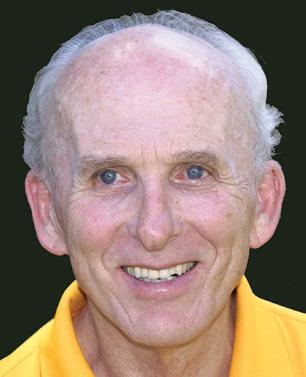
CHUCK CORBIN AFN Guest Writer
Guidelines for Americans indicate that adults should get a minimum of 150 minutes of moderate physical activity each week. Moderate activity is activity equal in intensity to brisk walking.
Those who prefer more vigorous activity can meet the weekly national standard by performing 75 minutes of activities, such as jogging. Either form of exercise significantly reduces the risk of chronic diseases and early death. The national guidelines were based on the amount of physical activity that can provide the most benefit while at the same time offering realistic goals for the average person. Performing more than the minimum amount provides additional benefits.
In meeting minimum standards or performing extra activity for extra benefits, you may want to combine a variety of activities to meet your goals.



But how do you determine the value of different types of activities when combining them. Using METs minutes can help.
What is a MET? One MET (metabolic equivalent) refers to the amount of energy (calories) expended at rest. The intensity of a physical activity can be measured in multiples of METs.
For example, an activity that is three times the intensity of resting would have a MET value of 3. In general, activities are divided into three categories: light, equal to 1 to 2.9 METs; moderate, equal to 3-5.9 METs; and vigorous, equal to 6 METs or higher.
What is a MET minute? A MET minute is an expression of the energy expended over a period of time (METs multiplied by minutes). For example, the national guideline calls for 150 minutes of moderate activity per week.
Brisk walking, the general descriptor for moderate activity, is assigned a MET value of 3.3, so 3.3 METs x 150 minutes = 495 MET minutes. You can also meet the national guidelines by doing 75 minutes of vigorous activity.
For example, jogging at a 14-minute-






mile pace has a MET value of 6.6, so 6.6 METs x 75 = 495 MET minutes.
Standard for physical activity? You must perform about 500 MET minutes of activity per week to meet the minimum national activity guidelines for adults.
How can I use MET minutes? If you want to combine different types of activities to meet national guidelines you can use MET minutes. For example, you may want to do some moderate activity and some vigorous activity.
So, you can multiply the MET value of each activity that you perform times the number of minutes you perform the activity to determine MET minutes for each. You then add the






values to determine your MET minute values for the week.
MET values for a variety of activities can be found in the Compendium of Physical Activities at google.com/ site/compendiumofphysicalactivities/ Activity-Categories).
Can I get additional benefits? People who are sedentary reap the biggest benefits by meeting the minimum standard of 500 MET minutes per week. Those who already meet the minimum can increase MET minutes to get enhanced benefits.
For example, doubling MET minutes per week provides extra disease risk reduction, enhanced wellness, enhanced performance and fitness, and improved cognitive function.
However, an already active person does not get as much benefit by doubling MET minutes as the sedentary person gets from meeting the minimum activity standard.
In other words, you get added benefits for added activity but there are diminishing benefits for the time invested as you add more activity. However, those who do only moderate
activity can get added benefits from adding some vigorous activity and some muscle fitness exercise. Muscle fitness exercises performed at least two days a week have important benefits to bone health.
What about kids? The guidelines for children and teens are different from those for adults. Sixty minutes of daily activity is recommended for those 5-18. Activities for youth are typically more intermittent than for adults.
Youth guidelines call for vigorous activity at least three days a week and muscle fitness exercises two to three days a week.
Using 3.3 METs as the minimum activity intensity, youth would need to perform about 1400 MET minutes of activity per week to meet national activity guidelines (3.3 METs x 60 minutes = 198 MET minutes per day x 7 days a week = 1386).
People who want to combine activities to meet minimum standards, or to do more than the minimum amount, can use MET minutes to determine energy expenditure and to help them reach their activity goals.
-Chuck Corbin is professor emeritus at Arizona State University and a resident of Ahwatukee since 1987.
impact force it can take. The dynamics of walking, you get about one to one and a half times your bodyweight going through your leg, but when you go to a run, it can be up to two or three times your bodyweight, so a very different demand on the carbon fiber.”
For the last three or four years, O’Brien has competed in triathlons and has had a specific prosthetic for each portion of the competition.
“It’s a complicated sport because going from swimming, where you don’t wear anything on your limb, to then having to get out (and use) crutches or hop or something into the transition area, and I put on a totally separate leg for my bike,” O’Brien said.
“I have a cycling leg that I switch into. (I) go do the bike race and then come back and then I switch again to a specific running leg. So I go through three different legs throughout the process and the transition is always the trickiest part.”
Pryor continues to participate in various sports, including basketball and javelin.
He said he uses a blade – a curved device that attaches below the knee – for





track and field but not for basketball.
“For me, it’s more of the turning stuff on the blade where you don’t have that stability as much, but I can’t play basketball in that blade,” Pryor said. “You can’t cut. You can’t turn. For running, it does make a big difference.
“It gives you a springback. It’s easier on your hips and on your body, so that’s the biggest difference that I see.”
Pryor didn’t start using the blade until last year.
“It does take a little bit of getting used to, but for me it was kind of put it on and play with it for a little bit, run on it and now it’s just normal for me to use it,” he said.
As Pryor trains for the World Para Athletics Championships in London in July, he will continue working to let others know that more is available to them.
In addition to competing in sports, he is a graduate student at Arizona State.
“With my research and studying, (the priority is to) just keep the doors open and let people ask questions (and to) really work on this inclusive environment that we want to live in because we don’t want to let anybody sit on the sidelines or leave anybody out. And for me, I didn’t have that, but I’ve seen that.




record Full or Part time
OTR Driving for a Drive
Passports are a plus 636-358-4677
brooke@randctrans com
EIM Delivery Lead w/ PetSmart Inc. (Phoenix, AZ)- Manage delivery of complex system dvlpment projects from design to release Establish & govern delivery stndrds on MDM, data integration & BI sol ns covering full range of data supply chain Req's Bach in Info Tech, Mgmt Info Systms, Bsns, or rel d field & 5 yrs prog post-Bach exp., must incl some exp w/: Data Warehousing, Bsns Intel , Enterprise App Integration (EAI); Sftware Dvlpmnt Life Cycle (SDLC) skills; ability to lead project teams of internal staff, partners, & contractors; using tools in PetSmart Enterprise Info Platform (MicroStrategy, Informatica, Tibco, Mulesoft, Netezza) Req's bkgrnd check & drug screen Resumes to: Riz Hyder, 19601 N 27th Avenue, Phoenix, AZ 85027

Sr Manager, EIM Development w/ PetSmart Inc (Phoenix AZ)- complete dvlpment function of EIM, incl MDM, data integration (ETL, EAI EDIA & SOA), data warehousing & BI Reporting Supervise 12 EIM devlprs. Req s Master s or Bach in Comp Sci, Engg, Info Sys or rel'd & prog post-Bach exp (2 yrs w/ Mstrs or 5 yrs w/ Bach), incl some exp w/: mnging staff & projects; data modeling, design & info archtctre princpls & tchnques across master, trnsctn & derived/anlytc data; data intgrtn standrds, frmwrks & best prctcs; ETL, EAI & SOA; MDM sftware; Data Intgrtn Tech; SDLC skills; & Bsns Intel tech (Netezza, SQL Server, MuleSoft, Informatica TIBCO, MicroStrategy) Req's bkgrnd check & drug screen Resumes Riz Hyder, 19601 N 27thAve, Phoenix AZ 85027


Moving Sale Sunday 6/25 7am-12
Misc Items, furniture, sports equipment 1037 E Silverwood Dr Phoenix, AZ 85048


good hand to eye coordination, the ability to lift a n d
tools, possess counting skills, and be able to follow basic instructions Must be able to lift 50 pounds $12 57 (prevailing wage) Guarantee of 3/4 of the workdays All work tools, supplies, a
Transportation and subsistence expenses to the worksite will be provided or paid by the employer, with payment to be made no later than completion of 50% of the work contract Send Resume to Arizona@Work Foreign Labor Cert











































































































































BOOK GROUP! We are a group of women, of all ages, who meet the first Tuesday of the month, in local venues, for the purpose of discussing member chosen books We do not charge fees we call ourselves the Happy Hour Book Club and we go by the initials HHBC For more information interested women can contact Donna and the email address is happyhourbook clubahwatukee@ gmail com