‘Idol’ vet confident in his ability to be recording artist
BY CHRISTINA FUOCO-KARASINSKI
Mesquite High School senior Thomas Muglia wants to be seen as an artist—not the 17-year-old musician who was born with hearing loss.
“I am hearing impaired and I’ve had to learn to sing and play while I’m hearing impaired,” said Thomas, who recently wrapped up a stint on FOX-TV’s “American Idol.”
“It’s normal to me because I do not have anything to compare it to. At the same time, I did go there [to ‘Idol’] to sing—not to be the hearing-impaired kid.”
Whether it was his story on which “American Idol” focused or his talent, Thomas made it to the Top 75 after auditioning in Denver. It’s not a bad showing when thousands upon thousands of musicians try out.
“I was pretty confident that I would be able to go at least through most of ‘Hollywood Week,’” Thomas said.
“But you never really knew what was going to happen. I perform very often. Maybe at least one night out of the week I’m singing at a bar or coffee shop. I do have the endurance for the surprises that they threw at us.”
Among those surprises were the “Idol” producers dictating which song the contestants are going to sing—with little notice.
“They’ll keep you up all night, stuff like that,” he said. “That’s something I’m definitely used to.”
One of the hardest parts of being on the show was keeping his outcome quiet. Thomas said his classmates initially hounded him for his results, but soon backed down.
With influences like John Mayer and Ed Sheeran, Thomas called being on the last season of “American Idol” a learning experience.
“The most important thing I’ve learned was definitely to perform in that setting,”
he said. “I’ve never been in that setting before, with the cameras and all that.
“I’m used to playing on stage and singing and playing on stage. I learned how to move and interact with the audience and such. It was difficult at first. There were cameras everywhere but we got used to it.”
Thomas, whose favorite judge on the show is Harry Connick Jr., enjoyed playing “Don’t” by Ed Sheeran. However, he hopes music listeners see him as more than a cover artist.
“I want to be an artist and write my own music and perform it,” he said. “Now that I’m back here, I can work on perfecting my music and writing my own music and making it exactly the way I want it.”
Thomas Muglia will perform from 7 p.m. to 10 p.m. Saturday, March 19, at SoZo Coffee, 1982 N. Alma School Rd., Chandler. Call (480) 726-7696 for admission charge. For more information, visit www.sozocoffee.org. He also performs at 6:30 p.m. Thursday, April 28, at St. Xavier University, 92 W. Vaughn, Gilbert. Visit thomasmuglia.com for more information.
Top spellers win prizes from Assistance League
After 22 rounds, only three students remained on the stage for the Gilbert School District Spelling Bee on Jan. 19 at Mesquite Junior High School Auditorium. After a few more tense rounds, Neo Pyon, a fifth grader at Playa Del Rey Elementary School, emerged as the top speller.
During the final rounds, Lauren Christensen, fifth grader at Quartz Hill Elementary, misspelled “embarcadero.”
This left Eugenia Trakal, seventh grader at Gilbert Classical Academy, to misspell “russet.” Neo spelled “russet” correctly, followed by the word “turbot.”
Thirty-four Gilbert elementary and junior high schools were represented at the contest. All eight finalists received trophies and bookstore gift cards from Assistance League of East Valley, which sponsored the event along with the Arizona Education Foundation.
The other winners were Fiona Sauve, eighth grader at Greenfield Junior High, fourth place; Emmitt Eastmond, fifth
grader at Superstition Springs Elementary, fifth place; Arianna Labertew, sixth grader at Houston Elementary, sixth place; Amber Kassisieh, eighth grader at South Valley Junior High, seventh place; and Caitlin Kelleher, sixth grader at Val Vista Lakes Elementary, eighth place.
The eight winners were slated to compete in the Regional Bee Feb. 19 at Mesquite Junior High School Auditorium. The results were not available at deadline. The two trophies for this upcoming event will be provided by the Assistance League of East Valley.
Assistance League of East Valley is an all-volunteer group which provided school clothing and uniforms to more than 7,000 children in East Valley school districts last year. The group raises funds through their thrift shop at 1950 N. Arizona Ave., Chandler, and through community donations, grants and fundraising events.
Thomas Muglia. Submitted photo
COLLEGE MONEY GUIDE
Dear Reader,
The Arizona Commission for Postsecondary Education (ACPE) is dedicated to expanding access and increasing success in postsecondary education for Arizonans. The ACPE not only serves as a forum for all sectors of higher education to come together to address opportunities and challenges, but also works to increase student financial assistance and identifies and implements strategies to help students and families plan, enter and succeed in postsecondary education.
The value of college has been confirmed by a new set of income statistics, reported by the Economic Policy Institute. This study reports that a four-year degree has never been more valuable. The premium in 2013 was 98 percent more an hour in wages on average over wages for a worker without a degree. Moreover, postsecondary education remains a key building block to a successful future and produces citizens who contribute to our community. The consistent reporting of such positive outcomes keeps the public convinced that a college education is a goal worth pursuing, both for our children and ourselves.
The following article written by Deena Lager is designed to help families take positive steps toward college enrollment and also offers an overview of ways to pay for college. This is important information to consider to avoid the situation portrayed by Jason Houle, a University of Wisconsin demographer, in his November 2012 study. His research revealed a growing burden of student debt is being experienced by middle-class families. He reported that middle-income families rack up, on average, more student loan debt than both high-income and low-income families. To counter this trend, the commission offers an opportunity to regain some of this lost financial ground through the Arizona College Savings (529) Program where savings benefit from both state and federal tax advantages. Information on this program is available at www.az529.gov.
We hope you enjoy this article and gain insight about maximizing the value of higher education and a greater understanding about options for financing a higher education. To learn more about the ACPE visit us on the Web at www.highered.az.gov.
Sincerely,
Dr. April L. Osborn, Executive Director Arizona Commission for Postsecondary Education
COLLEGE MONEY GUIDE
Senior countdown
HOW ARE YOU GOING TO PAY FOR COLLEGE?
In 2010, researchers at Georgetown University’s Center on Education and the Workforce forecasted that by 2018, 63 percent of all jobs will require at least some college and that there will be a shortfall of 300,000 college graduates each year through 2018. In order for America to reach the national goal of having the highest proportion of college graduates in the world by 2020, every American needs to complete at
of education beyond high school. In today’s economy, having just a high school diploma will not secure your future. Whether you plan to complete a certificate, an associate’s degree or a bachelor’s degree, the following information includes a checklist that will help you get ready for college and information to help you find ways to fund your education beyond high school.
WINTER SENIOR YEAR
• Contact the admissions and financial aid offices of the vocational, community colleges or universities you plan to attend to ensure you are aware of all deadlines and requirements.
• Apply for scholarships. Your goal is minimizing the amount of loan funds you may need to borrow.
• Go to www.fsaid.ed.gov to apply for an FSA ID—one for you and one for your parent. You will each need your own email address and FSA ID to e-sign the Free Application for Federal student aid (FAFSA).
• As soon as possible after Jan. 1, complete and submit your FAFSA
along with any other financial aid applications required by your school of choice. You can complete the FAFSA online by going to www. fafsa.ed.gov.
• If you still need assistance, attend one of Arizona’s statewide College Goal FAF$A events for free help. Visit www.collegegoal.az.gov/ college-goal-fafsa to find a location near you.
• Use FAFSA4caster at www. fafsa4caster.ed.gov to estimate how much federal student aid you might receive. This information will help you and your parents plan ahead. Compare the results in the FAFSA4caster to the actual costs at the colleges to which you have applied.
SPRING SENIOR YEAR
• Continue to stay focused in school. Second semester grades can affect scholarship eligibility.
• Complete any last scholarship applications.
• Review your college acceptance letters and the financial aid awards you have received. For each school you are considering, what will be your family’s remaining expenses after financial aid is credited? Compare this remaining “expense” as an evaluation factor between colleges.
• When you decide which vocational, community college or university you want to attend, notify that school of your commitment and submit any required financial deposit. Many schools require this notification and deposit by May 1.
HOW TO PAY FOR COLLEGE
• Stay involved in school- or community-based activities that interest you or let you explore career interests. Consider working or volunteering. Remember it’s quality, (not quantity) that counts.
When planning how to pay for college, families should view the following resources as pieces of a pie that fit together to make a whole plan.
1. Federal student aid
2. Scholarships
3. Savings
Higher Education Special Section
FEDERAL STUDENT AID
The first step to paying for college each year is to apply for federal student aid. Most colleges, universities, and scholarship foundations require students to complete the Free Application for Federal student aid (FAFSA) in order to be considered for any state, institutional or private grants or scholarships. This free application will also determine if you qualify for any federal financial aid programs. You should never pay to complete a Federal Aid application!
The U.S. Department of Education awards about $150 billion each year in grants, work-study funds and loans with favorable repayment terms to more than 15 million students. Federal student aid can be used to pay for education related expenses, such as tuition and fees; room and board; books and supplies; a computer; and transportation.
TYPES OF FEDERAL STUDENT AID
There are three main types of federal student aid:
Grants: A grant is free money that does not have to be repaid. Eligibility for federal grants is based on
financial need and a minimum grade point average (GPA).
Work Study: This is a work program through which students with financial need can earn federal aid money to help pay for school. The program encourages community service work or work related to the student’s course of study. Jobs can be located on or off-campus, however students are not allowed to work more than 20 hours per week during school. While workstudy income is reported as taxable income when completing the FAFSA each year, it is also reported as financial aid income and is excluded from the financial needs calculation for the following year.
Student Loans: A student loan is money borrowed from the federal government to help pay for education that must be repaid with interest. Students may borrow money for vocational, community college, university or career school. Student loans offered by the federal government usually offer borrowers lower interest rates and have more flexible repayment options than loans from private banks. The current interest rate for undergraduate federal student loans is 4.29 percent.
Other benefits of federal student loans are:
• no collateral is required and they do not require a credit check,
• loan amount eligibility each year is based on grade level
• all borrowers get a sixth-month grace period before beginning repayment,
• repayment follows a standard 10year plan, but you could sign up for an income-driven repayment plan,
• interest paid on federal student loans can be tax deductible,
• certain types of teaching or public service may qualify for loan forgiveness,
• loans may be discharged if you become totally and permanently disabled.
The best resource for more information about federal student aid programs is www.studentaid. ed.gov. You can visit the website to see what questions are trending and learn about any new changes to the application process each year.
Apply for federal student aid any time after Jan. 1 during your high school senior year. You should apply no later than Feb. 14 to ensure you meet most college and university
priority filing deadlines of March 1. If you are unsure of the priority financial aid and scholarship filing deadlines at the schools you are interested in attending, contact the admissions or financial aid office right away to find out.
Go to www.fafsa.ed.gov to complete the FAFSA online. It takes about 26 minutes on average to complete the application online. If you have any questions while filling out the application, call 1-800-4-FED-AID (1-800-433-3243).
If you would like free in-person assistance to complete the FAFSA, the Arizona Commission for Postsecondary Education is coordinating Arizona’s statewide College Goal FAFSA events. Visit www.collegegoal.az.gov/college-goalfafsa to find a location near you.
COLLEGE MONEY GUIDE
SCHOLARSHIPS
Everyone wants free money to help them attend college. There are many types of scholarships (they don’t all require that you have outstanding grades!), and they are provided by many different organizations. Each scholarship provider has its own application process and rules to determine who will receive its scholarship. Your job is to find as many scholarships for which you think you might qualify, and apply by the deadlines.
Grants and scholarships are often called “gift aid” because the money is free, a form of state or private financial aid that does not have to be repaid. Grants are often needbased, while scholarships can be merit, talent or skill-based. Some scholarships have both a need and a merit component. Be sure to read the qualification requirements for all scholarships and grants you intend to apply for.
Grants and scholarships can come
Higher Education Special Section
from federal government agencies, state government agencies, directly from your college or career school or a private or nonprofit organization. No scholarship is too small since every dollar counts! You might be able to get a scholarship for being a good student or a great basketball player, for being Polish, for being a member of a certain church, or because your parent works for a particular company. There are many scholarship options out there. Find out more through research, apply for any grants or scholarships you might be eligible for and be sure to meet the application deadlines.
Note: There is no “secret” scholarship money out there. You don’t need to pay a consultant or join a society just because they say they can help you find scholarships. You should never pay to receive free money for school. Avoid scholarship scams.
Free sources of information include:
• The U.S. Department of Education’s free online scholarship search at www.studentaid.ed.gov/scholarship
• FinAid! The Smart Guide to Financial Aid at www.finaid.org/ scholarships
• Peterson’s Scholarship Guide at www.petersons.com/scholarships
• FastWeb Scholarship Search at www.fastweb.com
• Scholarship Search by Sallie Mae www.salliemae.com/plan-for-college/ scholarships
• Arizona Community Foundation at www.azfoundation.org
• The Endowment Scholarship offices at the colleges or universities you are interested in attending
• Your public library’s reference section
• Foundations, religious or community organizations, local businesses or civic groups
• Organizations and professional associations related to your field of interest
• Ethnicity-based organizations
• Your employer or your parent’s employer(s)
SAVINGS
Many people forget about savings as an important component of their plan to pay for college. Some families feel like it may be too late to start saving, but that’s not true. According to a longitudinal study released in 2012 by Washington University in St. Louis, “children with any college savings are six times more likely to attend a fouryear college than children with no dedicated college savings account.” While the dollar amounts saved in the study were not significant, involving the child in the act of saving clearly expressed the family’s intent for the child to go to college.
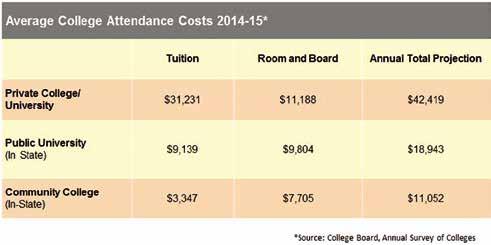
In addition, the study found that a child with college savings of $500 or more was five times more likely to graduate from college than a child with no savings account. It is never too late to continue saving for your child’s college education. Involve the student and other members of your family in saving toward their college goal. If you have not opened a tax-deferred college savings account, you can find information about the tax advantages at www. az529.gov. Any contributions made to a 529 College Savings account by an Arizona resident can be claimed as an Arizona income tax deduction, up to $2,000 each year for individual tax filers or $4,000 for married couples filing jointly. While college costs continue to rise, it’s important to remember that it is cheaper to save than to borrow. The chart above represents average college attendance costs for schools in Arizona during the 2014-15 academic year.
*Source: College Board, Annual Survey of Colleges
INVESTMENT OPTIONS
The State of Arizona offers one of the most diversified 529 College Savings plans in the country. Arizona’s 529 Savings Plan benefits include:
• Contributions and earnings grow free from federal and Arizona State income taxes when used to pay qualified higher education expenses.
• College savings offered through three financial institutions that include choices of FDIC-insured CDs, mutual fund options, and agebased portfolios.
•Assets are not considered when determining Arizona financial aid awards.
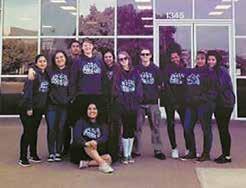
of Student Council at the Feed My Starving Children event
Higher Education Special Section
COLLEGE MONEY GUIDE
• Savings can be used at all U.S. Department of Education accredited universities, colleges, private colleges and vocational schools in the United States, as well as eligible foreign institutions.
• Allows for anyone to make contributions (grandparents, family members, friends).
• Ability to begin saving with as little as $15 a month.
• Ability to change account beneficiaries within the same family.
• If there are still funds left in the account after your oldest child completes their college degree, the account beneficiary can be changed from the oldest child to another member of the family. According to the chart below, the beneficiary could be changed to another sibling, to the beneficiary’s
spouse, back to the parent to complete a PhD, or to a grandchild.
MEMBER OF THE FAMILY
The Arizona Family College Savings Program offers a wide variety of choices through three financial institutions. Choices include CD’s, adviser-sold mutual fund options, direct-sold mutual fund options, passively and actively managed accounts, indexed, age-based portfolios and self-designed custom strategy options. Choices are offered so that your investment goals can be targeted for the timeline that best fits your needs.*
MORE TAX SAVING TIPS
Go to www.irs.gov and read IRS Publication 970, Tax Benefits for Education to see how you or student might benefit from federal income tax credits for education expenses. The Hope Scholarship, Lifetime Learning Tax Credit, and the Tuition and Fees Deduction are some of the tax benefits available for educational expenses. Up to $2,500 a year in student loan interest can be deducted on an income tax return without itemizing.
Toll Free: 1.800.888.2723
Fidelity Investments Fidelity offers both actively managed and index portfolios. Within those portfolio categories you can choose from age-based allocation, static allocation, and/or individual portfolios. www.fidelitys.com/arizona Toll
Four Campo Verde seniors sign letters of intent
BY EDWIN RODRIGUEZ
Four Campo Verde Coyote football standouts signed their national letters of intent on National Signing Day Feb. 3.
Campo Verde seniors Dezmond Odoms, Eli Jones, Joe Golden and Kaden Risley have officially committed to attend the colleges that sought their talents to play football at the collegiate level.
Dezmond Odoms, who played cornerback and receiver for the Coyotes, will study at North State University in Aberdeen, South Dakota.
“They had a great atmosphere and the whole town supported the college,” Odoms said. “I felt at home.”
Jones, who also played cornerback and wide receiver for the Coyotes, will take his talents to Western New Mexico University where he hopes to further his education off the field and help the Mustangs improve their record from a season ago.
“The business program that they have and the team chemistry,” Jones said. “The (WNMU) coaches just want me to succeed.”
Golden, who played free safety and wide receiver for the Coyotes, has officially committed and will play for the Adams State University Grizzly Bears in Alamosa, Colorado.
“Players and coaches were all very welcoming,” Golden said. “They offered me the Colorado experience and one of my mentors on the football team before he went up [to Alamosa, Colorado]. It should be a good experience to get up there to play football.”
Risley, who played defensive end for the Coyotes, will attend Hamline University to play for the Pipers in St. Paul, Minnesota.
smart, very studious and academically motivated students,” said Campo Verde football coach Max Ragsdale.
“They could not have played for us on Friday nights had they not been at the academic level that we want them to have.”
Ragsdale was notably pleased to see his players desire to further their education while continuing their football careers.
Summer Fun for Everyone!
Use us for a week, a month, an afternoon or the entire summer! Our nanny and sitter services are flexible to fit YOUR summer schedule! Simple for Parents. Fun for Kids. College Nannies and sitters are educated, active role models. When the kids are well cared for and having fun, parents are relaxed and happy. Fun, for everyone!
“I went on a visit there and I loved the atmosphere, the coaches and the players were just great,” Risley said. “It’s a great program, they offered a great opportunity in football and academics.”
The players all cited familiarity and fit as huge factors when choosing a college to further their education in the recruitment process.
Student-athletes and coaches know that to play and stay on the field is determined by academic eligibility.
“When recruiters come in, the first thing they ask us is about academics and we are blessed in Campo to have
“It’s rewarding, considering we didn’t have a great season,” Ragsdale said. “This kind of puts the 4-6 season in perspective that we are not doing it for wins and losses. We are doing it for kids and helping them along in their life choices.”
Assistant coach Nick Cornell said he and Ragsdale mentor their players on and off the field.
“In our position we have to coach them at a high level, teach them fundamentals and techniques,” Cornell said. “We want them to compete— compete in the classroom, compete in speed, in agility and on the football field. So the mindset has to be ‘I want to be the very best I can be and I want to compete in everything I do.’”
STUDENT CHRONICLES
Claudia Adriana Vazquez
Susan Ferguson was among 932 students from Miami University in Oxford, Ohio, who received degrees during fall commencement exercises Friday, Dec. 11, 2015, in Millett Hall. Ferguson earned a Master of Arts degree.
Timothy Fajembola, the son of Oladipo and Jennifer Fajembola, has been named
Youth
to Randolph-Macon Academy’s dean’s list for the second quarter of the 2015-16 school year. To be named to the dean’s list, a student must earn a grade point average (GPA) between 3.3 and 3.99 and be enrolled in ninth, 10th, 11th or 12th grade at Randolph-Macon. Timothy is a junior at Randolph-Macon Academy. Randolph-Macon Academy (R-MA), founded in 1892, is a college-preparatory, coeducational boarding school for students in grades 6 through 12. Students in grades 9 through 12 participate in R-MA’s 91st Air Force Junior Reserve Officer Training Corps (JROTC), and have the opportunity to learn to fly through a unique flight program. The Academy also offers several summer programs. R-MA is affiliated with the United Methodist Church and is located in Front Royal, Virginia.
Wilkes University Provost Dr. Anne Skleder announced the dean’s list for the Fall 2015 semester. To be named to the dean’s list, students must obtain a minimum 3.4 grade point average and carry at least 12 credits. Among those named were Joshua Bodnovits and Edgar Maldonado. Wilkes University is an independent institution of higher education dedicated to academic and intellectual excellence through mentoring in the liberal arts, sciences,
and professional programs. Founded in 1933, the university is on a mission to create one of the great small universities, offering all of the programs, activities, and opportunities of a large research university in the intimate, caring, and mentoring environment of a small liberal arts college, at a cost that is increasingly competitive with public universities. In addition to 41 undergraduate majors, Wilkes offers the doctor of nursing practice, doctor of education and doctor of pharmacy degrees and more than a dozen master’s degree programs. Learn more at www.wilkes.edu
Clifford Anderson graduated from Fort Lewis College on Dec. 19. Anderson received a bachelor’s degree with a major in accounting. More than 200 students participated in the winter commencement ceremony. Fort Lewis College is the Southwest’s crossroads of education and adventure. Its blend of small classes, dynamic academic programs, and a liberal arts perspective leads to transformative learning experiences that foster entrepreneurship, leadership, creative problem solving and life-long learning.
Nicole Rubin received her white coat. The new physician assistant program at Oklahoma City University opened with a white coat ceremony, during which 36 students took an oath of service and received their uniform lab coats. The ceremony was led by program director Daniel McNeill with a keynote presentation from Dr. George Selby, a professor and program director at the University of Oklahoma College of Medicine.
Nearly 400 South Dakota School of Mines & Technology students were named to the dean’s list for the 2014 fall semester. In order to merit a spot on the dean’s list, students must earn a grade point average of 3.5 or higher for the semester. Full-time students must have earned a minimum of 12 credit hours that term, while part-time students must have earned between three and 11 credit hours that term. Among those named to the list is Jackson Ade , metallurgical engineering.