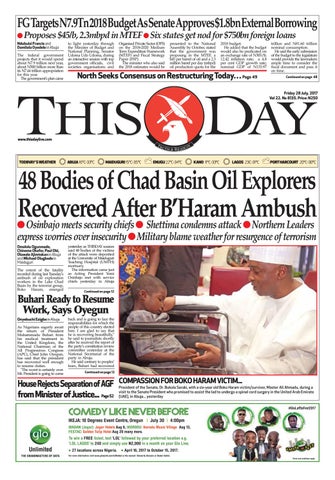
FGTargetsN7.9Tn2018BudgetAsSenateApproves$1.8bnExternalBorrowing Proposes $45/b, 2.3mbpd in MTEF Six states get nod for $750bn foreign loans Ndubuisi Francis and Damilola Oyedele in Abuja The federal government projects that it would spend about N7.9 trillion next year, about N500 billion more than its N7.44 trillion appropriation for this year. The government’s plan came
to light yesterday through the Minister of Budget and National Planning, Senator Udoma Udo Udoma, during an interactive session with top government officials, civil societies organisations and
Organised Private Sector (OPS) on the 2018-2020 Medium Term Expenditure Framework (MTEF) and Fiscal Strategy Paper (FSP). The minister who also said the 2018 estimates would be
presented to the National Assembly by October, stated that the government was proposing in the MTEF, a $45 per barrel of oil and a 2.3 million barrel per day (mbpd) oil production quota for the
2018 budget. He added that the budget would also be predicated on an exchange rate of N305/$; 12.42 inflation rate; a 4.8 per cent GDP growth rate; nominal GDP of N133.97
North Seeks Consensus on Restructuring Today… Page 49
trillion and N81.60 trillion nominal consumption. He said the early submission of the budget to the legislature would provide the lawmakers ample time to consider the fiscal document and pass it on time. Continued on page 48
Friday 28 July, 2017 Vol 22. No 8135. Price: N250
www.thisdaylive.com TR
TODBVAY'S WEATHER
ABUJA 16°C-33°C
MAIDUGURI 15°C-35°C
UT H
& RE A S O
ENUGU 22°C-34°C
N
KANO 11°C-33°C
LAGOS 23C-31°C
PORT HARCOURT 20°C-30°C
48 Bodies of Chad Basin Oil Explorers Recovered After B’Haram Ambush Osinbajo meets security chiefs Shettima condemns attack Northern Leaders express worries over insecurity Military blame weather for resurgence of terrorism Omololu Ogunmade, Chineme Okafor, Paul Obi, Olawale Ajimtokan in Abuja and Michael Olugbode in Maiduguri The extent of the fatality recorded during last Tuesday's ambush of oil exploration workers in the Lake Chad Basin by the terrorist group, Boko Haram, emerged
yesterday as THISDAY sources said 48 bodies of the victims of the attack were deposited at the University of Maiduguri Teaching Hospital (UMTH) mortuary. The information came just as Acting President Yemi Osinbajo met with service chiefs yesterday in Abuja Continued on page 12
Buhari Ready to Resume Work, Says Oyegun Onyebuchi Ezigbo in Abuja As Nigerians eagerly await the return of President Muhammadu Buhari from his medical treatment in the United Kingdom, the National Chairman of the All Progressives Congress (APC), Chief John Oyegun, has said that the president has recovered well enough to resume duties. "The worst is certainly over. Mr. President is going to come
back and is going to face the responsibilities for which the people of this country elected him. I am glad to say that he is recovering beautifully," he said to journalists shortly after he received the report of the party's constitution review committee yesterday at the National Secretariat of the party in Abuja. He said contrary to peoples’ fears, Buhari had recovered Continued on page 12
FOR BOKO HARAM VICTIM... House Rejects Separation of AGF COMPASSION President of the Senate, Dr. Bukola Saraki, with a six-year old Boko Haram victim/survivor, Master Ali Ahmadu, during a to the Senate President who promised to assist the lad to undergo a spinal cord surgery in the United Arab Emirate from Minister of Justice... Page 52 visit (UAE), in Abuja... yesterday
2
T H I S D AY FRIDAY JULY 28, 2017
T H I S D AY FRIDAY JULY 28, 2017
3
4
T H I S D AY FRIDAY JULY 28, 2017
T H I S D AY FRIDAY JULY 28, 2017
5
6
T H I S D AY FRIDAY JULY 28, 2017
T H I S D AY FRIDAY JULY 28, 2017
7
8
T H I S D AY FRIDAY JULY 28, 2017
T H I S D AY FRIDAY JULY 28, 2017
9
10
T H I S D AY FRIDAY JULY 28, 2017
T H I S D AY FRIDAY JULY 28, 2017
11
FRIDAY, ͺ˜ ͺͿ ˾ T H I S D AY
12
PAGE TWELVE 48 BODIES OF CHAD BASIN OIL EXPLORERS RECOVERED AFTER B’HARAM AMBUSH over the resurgence of terrorist attacks in the country and ordered them to relocate to Maiduguri, the epicentre of the Boko Haram terror. Moved by the recent carnage, the Governor of Borno State, Alhaji Kashim Shettima, commiserated with the families of the victims and expressed his regrets that the attack had set back the progress being made in the war against terror. According to THISDAY sources, the details of the corpses deposited at the UMTH showed that 18 soldiers were lost, 15 Civilian JTF killed alongside five university staff and four NNPC drivers. It was also gathered that the bodies of six persons who were wounded in the attack but escaped to somewhere in Yobe State where they were later found dead had been brought to Maiduguri. Apart from the wounded soldiers admitted to the military hospital in the town, two members of the Civilian JTF were also on admission at the UMTH yesterday. The Nigerian Army in a statement on Wednesday by its spokesman, Brig. Gen. Sani Usman, had claimed that all the NNPC staff abducted in the Tuesday ambush had been rescued. Usman had said: "On receipt of the information, the Brigade mobilized and sent reinforcement, search and rescue party that include the Armed Forces Special Forces and guides that worked and pursued the terrorists throughout the night. "So far, they have rescued all the NNPC staff and recovered the corpses of the officer, 8 soldiers and a civilian, who have been evacuated to 7 Division Medical Services and Hospital. "The team recovered 4 vehicles one of which included a gun truck mounted with an AntiAircraft Gun, 2 white Hilux taken away from NNPC staff and 1 blue Hilux belonging to CJTF. The team also recovered large quantities of arms and ammunition; several spare tyres; many jerry cans, containing Petrol; Oil and Lubricant; assorted drugs; Improvised Explosive Device (IED) making materials; reflective jackets and a Motorola handheld radio, among others. The team also neutralized many of the terrorists." But investigations by THISDAY revealed that five lecturers from the University of Maiduguri (UNIMAID) in the exploration team were killed. They included Dr. Joseph Millitus, Dr. Manaja Uba and Idris Njodi. The
names of the other two were yet to be revealed. A member of Millitus’ family, Daniel Millitus, told our correspondent that the family was still in grief over the loss of one of their rising stars. Daniel, who is a pastor in one of the parishes of the Redeemed Christian Church of God in Maiduguri, said the family was making arrangements for the burial of their son. A female relative of the Ubas, said the family was still in shock and found it difficult to believe that "Manaja was no more." She lamented that another relative (Yusuf Ibrahim) also in the exploration team was still missing. When contacted on phone by journalists, the spokesman of University of Maiduguri, Professor Danjuma Gambo, said he was not in the university at the moment and had limited access to information on the situation in the institution. He, however, promised to get more information on the claims as soon as he gets back to the campus from Abuja. The Deputy Director Army Public Relations, Col. Kingsley Samuel, when contacted on the matter said it was not within the purview of the 7 Division where he was the spokesman.
Osinbajo Relocates Service Chiefs to Maiduguri Following renewed deadly Boko Haram attacks in the North-east, Osinbajo yesterday summoned service chiefs to an emergency meeting in the State House, Abuja. The acting president, who had been on a trip to Port Harcourt to inaugurate a fertilizer plant, returned to the Presidential Villa in the evening to preside over the meeting. It was subsequently resolved that service chiefs should return to the command centre to witness the turn of events for themselves. Upon taking the oath of office on May 29, 2015, President Muhammadu Buhari had ordered the relocation of the Command and Control Center to the war-torn North-east to enable them oversee the battle against terror effectively. But there had been protracted attacks from insurgents particularly on the University of Maiduguri in recent times, resulting in the destruction of several lives and property. The latest of the attacks was the killing of 18 soldiers
and abduction of 10 staff of the Nigerian National Petroleum Corporation (NNPC) who were on oil exploration mission. Although there were reported claims by the military that the oil workers had been rescued, the Minister of State for Petroleum, Dr. Ibe Kachikwu said no contact had been established with them. Answering questions from journalists after the meeting yesterday, the Minister of Defence, Col. Mansur Dan-Ali (rtd.), said the meeting resolved that the service chiefs should return to the command centre and examine the situation. He also said they resolved to install more surveillance devices and cameras to enable them monitor the insurgents from a distance. According to him, this raining season has complicated military operations in the region, making it difficult for troops to be on top of the situation. However, he said they were putting the machinery in motion to regain mastery of the terrain and dismantle the deadly ambushes built by the insurgents. Dan-Ali said: "We just finished a meeting with the acting president and the three service chiefs. We agreed that they should move back to the Command Centre again and see what are the things happening there. "We have also agreed that we should get more surveillance devices, cameras that will be able to see distant attackers coming to the position of our troops. "So also, the period of the raining season is a difficult moment for us. We cannot dominate the environment like what we did during the dry season but effort is geared towards regaining back our areas and we assure you that all these ambushes that are happening regularly would be stopped," Ali said. Present at the meeting were the Chief of Defence Staff, Gen. Gabriel Olonisakin, Chief of Army Staff, Lt-Gen Tukur Buratai, Chief of Naval Staff, Vice Admiral Abak Ibas, Chief of Air Staff, Air Vice Marshall Abubakar Saddique and Dan-Ali. Meanwhile, the Minister of State for Petroleum Resources, Dr. Ibe Kachikwu, on Thursday disclosed that the Nigerian National Petroleum Corporation (NNPC) was sufficiently cleared by the country’s military to resume oil search in the Chad Basin which passes through Bornu State, a hotbed of terrorist group, Boko Haram. Kachikwu, also stated that while NNPC recognised the
risks of going to search for oil in the region as directed by Buhari, to grow Nigeria’s reserves, it sought and waited for the military to clear it in 2016 to undertake the tasks. He, however, said unless sufficient clearance was again obtained from the military, NNPC would not resume its oil search in the region soon. Buoyed by the commercial oil finds in neighboring Chad Republic, NNPC on the orders of Buhari intensified and focused its exploratory work in the Inland Basins on the Chad Basin and Benue Trough areas. In November 2016, it resumed exploration activities in Gubio; Magumeri; Monguno; Kukawa; Abadam; Guzamala; and Mobar, after getting security advice from the military. However, on July 25, 2017, the NNPC Frontier Exploration Services (FES) and Surface Geochemistry Sampling crew comprising of three consultants attached to FES and the Integrated Data Services Limited (IDSL); nine external consultants from the University of Maiduguri; military personnel and members of the Civilian Joint Task Force (JTF) were ambushed by Boko Haram, while returning to Maiduguri town after conducting survey mapping and geological study. Nine soldiers and some members of the civilian JTF were reportedly killed. But speaking to journalists in Abuja, on the development, Kachikwu, noted that NNPC was yet to officially confirm reports that the military had rescued its workers that were abducted by Boko Haram, though army spokesman, Sani Usman, said all of NNPC’s workers have been rescued and corpses of the nine dead soldiers and civilian JTF retrieved. Kachikwu, also said NNPC would wait on the military to determine its next move, adding that government would take care of the families of the dead security personnel. “I would ordinarily have opted against answering that for the simple reason that it is not respectful to the souls of those who died to be discussing going back or not, but for specifics, the reality is that anytime NNPC decides to go into a terrain, they first get the privilege of security advise and that security advise I can say was sufficiently cleared,” said Kachikwu. Asked why the corporation went into Boko Haram’s hotbed to explore for oil notwithstanding the security clearance, Kachikwu said: “I have explained we got
security clearance, and by the way, across the other side of Lake Chad, our neighbours are busy drilling, we are really not alone in this.”
Northern Leaders Military Explains Raise the Alarm over Resurgence of Terror Growing Insecurity, In a new report released by Conflicts the Air Component of the Operation Lafiya Dole, the military said bad weather and the use of foliage and dense vegetation were giving Boko Haram the leverage to maximise their attacks in recent times. Recently the terrorists had stepped up their game, targeting the UNIMAID. But in a report by the Nigerian Air Force (NAF) spearheading the air component of the war against Boko Haram insurgency, bad weather and new strategies adopted by the terrorists seemed to have derailed the operations of the military in averting some of the recent attacks. The report presented by Air Commodore Tajudeen Yusuf said the most daunting challenge confronting troops "indicated a gradual return of Boko Haram Terrorist activities into the Sambisa Forest. "In view of the prevailing weather and the associated environmental impediments, operations by the ground troops have not continued at a desirable pace," he said. In his reaction, the Borno State Governor, Shettima, described the attack on oil exploration workers at the Lake Chad Basin by Boko Haram as a tragic setback in the fight against terrorism in the North East and efforts to boost the nation's economy. The governor, in a statement by his spokesman, Mallam Isa Gusau, e-mailed to THISDAY, said he was still in shock and had not fully recovered after hearing of the tragic attack. The governor, who said the news was broken to him while on his journey to the United Kingdom alongside some governors to visit ailing President Muhammadu Buhari, said: "I haven't been my normal self since I received information on that attack. What happened in the first instance was a tragic setback in the fight against Boko Haram and in Nigeria's effort to expand its economic fortunes. "I am deeply pained by this incident especially coming at a time when we were beginning to pick up the pieces of our lives. Even though the attack should never have happened given the successes recorded by the Military and multi-national joint forces since 2015, I nonetheless still deem it
BUHARI READY TO RESUME WORK, SAYS OYEGUN and was convalescing very strongly. "There has been sufficient information given to the public. We want to confirm that Mr. President is convalescing very strongly. Right now, all he is doing is having enough rest as much he can to build up his energy and build up his stamina," he said Oyegun who was among the team of APC leaders that visited Buhari in London last weekend said the president was staying back to gain
stamina before returning to resume work. The party chairman agreed that Nigerians had a genuine need to express concern over the health of their president, but maintained that only the president could speak on when he would come back. Oyegun also slammed the Governor of Ekiti State, Mr. Ayo Fayose, for his statement on the state of the ailing president's health. He said: "I hate to comment on anything the governor of
Ekiti State says because when people have taken leave of common sense and all decency, when people have thrown overboard, basic cultural upbringing, when people cease to have respect for elders and cease to have respect for the fact that an elder statesman who is also president of this nation is going through a serious health crisis and seek to make fun of it and seek to say things that are totally unbecoming, it is not really worth commenting on.
"But I am glad that even yesterday, PDP governors went there. Thank God, nice, sober people were very excited and were happy with the pace of Mr. President' recovery. We are glad that finally, even the most hardened political adversary would allow common sense and common decency to finally prevail. "Only Mr. President can speak on when he is coming back. But I am glad that he is having a lot of rest and I wish it is not going to take longer
necessary to commend the military for re-mobilizing and countering the initial gains of the insurgents."
to be truly ready. But he is beautifully making progress with his recovery. We discussed issues with him, but basically it was a courtesy call. "People were genuinely concerned and wanted to see him. We had a good chat with him and had a good meal as you could see. He is still his own jovial self. He asked so many questions about events back home, just wanting to get our own perspective. I personally enjoyed the visit and I came back very happy."
Highly placed religious and political figures from the North, led by Sultan of Sokoto, His Eminence Sa'ad Abubakar II, have expressed concern over the growing instability, surge in kidnapping, Biafran separatist agitation and economic inequality among others that are sweeping across the country. The elders under the aegis of the Senior Working Group warned that the developments are disturbing signs of fragility within the security apparatus of the country. They also warned that it could have dire consequences for the unity of the country if not addressed. They expressed their concern in a statement issued last night titled: For the Wellbeing of Nigerians. Other individuals in the group of 11 include, Cardinal John Onaiyekan, General Martin Luther Agwai (rt.), Amb. Fatima Balla, Dr. Usman Bugaje, Amb. Ibrahim Gambari, Dr. Nguyan Feese, Dr. Jibrin Ibrahim, Mrs. Aisha Murtala Muhammed Oyebode.and Dr. Chris Kwaja. They said the current state of the nation is tantamount to a hotbed of internal conflicts that threaten its sovereignty and legitimacy as a nationstate. They listed the Biafran agitations in the South-east, rising communal violence across the country, the Boko Haram crisis raging in the North-east, and the surge in armed robbery and kidnappings as tell tale signs of insecurity. "The drivers of these varying conflicts differ in nature, but find their remedy in the constitutional responsibility of the state i.e. the protection of lives and property, provision of education; in short, creating an enabling environment that safeguards the flourishing of citizens and those within its borders," the statement said. Continued on page 48
TOP GAINERS CONOIL CHAMPBREW INTERBREW N.E.M OKOMUOIL TOP LOSERS CADBURY UPDC MORISON
NGN NGN % 3.36 36.40 10.1 0.18 2.85 6.7 0.1.50 31.50 5.0 0.06 1.26 5.0 3.54 74.41 5.0 NGN NGN % 1.20 11.20 9.6 0.16 2.77 5.4 0.07 1.36 4.9 OANDO 0.40 8.00 4.7 LIVESTOCK 0.04 0.82 4.6 HPE Nestle Nig Plc ₦955.50 Volume: 542.803 million shares Value: N8.009 billion Deals: 5,939 As at yesterday 27/7/17 See details on Page 44
T H I S D AY FRIDAY JULY 28, 2017
13
14
T H I S D AY ˾ ˜ ͰͶ˜ Ͱͮͯ͵
COMMENT
Editor, Editorial Page PETER ISHAKA Email peter.ishaka@thisdaylive.com
END OF AN ERA
Nats Onoja Agbo pays tribute to David Attah, journalist and administrator
W
hen Chief David Attah was appointed as General Manager of Benue Printing and Publishing Corporation, publishers of Nigeria Voice, in 1984, there was palpable joy in the establishment. The joy among workers of the corporation was anchored on his antecedents as the General Manager, the Nigeria Standard in Jos; his tenure was adjudged as one of the best moments of that newspaper house. Optimists were not disappointed because the moment he reached Makurdi, he hit the ground running with breathtaking innovations. He was pained that people held the erroneous notion that journalists, no matter their status in the industry, were not serious people. He therefore set out to use his position as General Manager of the fledgling Nigeria Standard and later the Nigeria Voice, to prove that journalists were some of the most dedicated, loyal, hardworking and productive people in the society. One of his best attributes was his knack for identifying some of the best brains in the industry for maximum performance. At the Nigeria Standard, for instance, he attracted such great hands as Dan Agbese, George Ohemu, Bagudu Hirse, James Ikuve, Innocent Oparadike and a host of other professionals for the task of turning the newspaper into a huge success. His guiding philosophy was commitment to service, instead of personal comfort. In Nigeria Voice, he inherited a crop of young writers like Nats Onoja Agbo, Hingah Biem, Tor Uja, Simon Amase, Joe Nwachukwu, Bala Dan Abu and a host of others whom he turned into editorial managers. He embarked on staff development and sent many indigenous workers for training. His staff development programme was anchored on the belief that only a trained and motivated work force could turn an organisation into a success. Indeed, he wanted efficient hands in all the departments, to ensure that the newspaper took centre stage in national reckoning. Such trained and motivated hands came handy when he embarked on massive expansion of the two corporations. And he pursued his expansion policies with vigour. One of the earliest posts of his expansionist policy in Jos was the establishment of Sunday Standard; it was the first Sunday newspaper in Northern Nigeria. Thereafter, he established Pappy Joe, a comic newspaper and perhaps the first of its kind in Nigeria. He also established Pen Powers Football Club, which translated into JIB Rocks Football Club and later Plateau Untied Football Club of Jos. He capped his achievements in the Standard with a 10-story edifice, which he built for the organisation. Humble almost to a fault, he told this writer shortly before his death that the achievements were the gains of team work.
ONE OF HIS BEST ATTRIBUTES WAS HIS KNACK FOR IDENTIFYING SOME OF THE BEST BRAINS IN THE INDUSTRY FOR MAXIMUM PERFORMANCE. AT THE NIGERIA STANDARD, FOR INSTANCE, HE ATTRACTED SUCH GREAT HANDS AS DAN AGBESE, GEORGE OHEMU, BAGUDU HIRSE, JAMES IKUVE, INNOCENT OPARADIKE AND A HOST OF OTHER PROFESSIONALS
He approached his job at Nigeria Voice with the same zeal. With a highly motivated staff, he embarked on improving the editorial contents of the newspaper. He introduced Sunday Voice and appointed Hingah Biem as its first Editor. Within a short period, he turned the newspaper into a national icon. The newspaper’s editorials were aired on national radio. His attainments within a short period caught the attention of the military governor who promptly elevated him to the position of Commissioner for Information. He continued to reform the corporation, especially the editorial department, which saw the appointment of editors from within, instead of importing them from other establishments. He recruited other experienced staff like Ochapa Ogenyi, Sebastian Agbinda and Chris Abah to beef-up the editorial department. After leaving office as commissioner, he teamed up with others to establish Focus, the first monthly newsmagazine in Central Nigeria. He was in that venture with Nats Onoja Agbo who was the first editor; Justice A.P. Anyebe, Professor Erim Ode Erim, Okpe Ojanga and Dr. Gabriel Ankeli. The magazine also had quality contributors, including Ogoh Alubo, Sonni Gwanle Tyoden, Erim Ode Erim, Dan Mou and Thomas Amper. It was a formidable team. Chief Attah cut his teeth in journalism with Daily Times. He held various appointments in the company before his appointment as general manager of the Standard newspapers. He won election to the House of Representatives in 1979 and was one of the most visible members of the House. It was after the National Assembly that he was appointed as General Manager of Nigeria Voice and later as Commissioner of Information, and later Commerce, in Benue State. He had retired and was resting in his house at Igumale one day when armed soldiers stormed the sleepy town looking for him. His relations took to their heels upon seeing the soldiers, fearing that they had come to arrest their icon. General Sani Abacha who had just assumed office as Head of State needed a man with charm, charisma and love for service as his Chief Press Secretary. Chief Attah became an instant choice. He was airlifted to Lagos that same day and he assumed duty as the Chief Press Secretary to General Abacha. He also served as Chief Press Secretary to General Abdulsalaam Abubakar before he finally retired from public service. He was a foundation member of the Peoples Democratic Party (PDP) and remained faithful to the party until his death. As one of the first notable journalists from Northern Nigeria, his death certainly marks the end of an era.
THE HIJACKED NIGERIAN PRESIDENCY (2) Concealing information about the President Buhari’s health raises doubt in the minds of the citizenry, writes Nnanna Ijomah
N
igeria today is experiencing not only a crisis but also an absence of leadership with the president’s illness and the situation has been compounded by the show of shifting standards, manufactured lies and hypocrisy. Isn’t it ironic, that the same guys who cried Wolf and demanded for the resignation of the late President Umaru Yar Adua due to illness are now singing a different tune by normalising presidential absenteeism which may come back to haunt us in the future? Rather than continue with the impetuous and improvisational answers that are meant to deceive and hide, the cabal in Aso Rock should have practiced the first lesson in Crisis Management 101, which is to come clean and reveal everything about the president’s illness. They should have informed the Nigerian people what ails the president, adding also that due to the severity of his illness, he may have to undergo treatment for a couple of months abroad. I am sure most Nigerians would have been very understanding and would have prayed for his quick recovery. But no, they decided to keep everything secret thereby giving rise to the constant public request for more information. They failed to realise that a
cover up is always worse than the crime, hence their sloppiness and arrogance frittered that opportunity away. So far there has been a level of obliviousness for the public’s demand for information and clarity on this issue that is frightening and so ridiculous that it is not funny. With each day that goes by, every lie that is told seems straight from the twilight zone. These guys have defined disinformation not only down but deep into the cesspool by exhibiting a vanity that runs contrary to the public good. What bothers me as an individual is not only their lidless grandiosity but also their evasions and intentional omissions. There is also the deeply insulting irony to their manifestation and policy of concealment which exposes their bald expression of contempt for the level of intellect of the Nigerian public. Their prevailing assumption being that there will be no consequence for their lack of forthrightness. To which, I say, they may be right, for it is only in the crazy bubble of Nigerian politics that these people will not pay any price for their dishonesty and blatant lies. The truth is that Nigerians deserve better. We need to see pictures of the president in real time. To be convinced that the president is fully recovering, we need
video recordings of the President receiving his many nocturnal visitors from Nigeria or receiving his weekly phone calls from Pastor Bakare whose Orwellian doublespeak on the president’s health is not only disappointing for a man of the cloth but also disheartening. We need to hear him speak to the Nigerian people with words of assurance, hope, and confidence and to some degree put some fear in the hearts of the hyenas and jackals in Abuja (Aisha Buhari’s words, not mine). We need his front men and spokespeople in both Aso Rock and the APC to desist from lying to us and taking us for a dazzling collection of jesters and fools. I must repeat again that in the present environment of distrust and cynicism there is absolute need for a combination of imagery and facts because both constitutes the truth in a situation like this where one is not possible without the other. The reality is that people tend to accept some information as the truth if presented with imagery and facts. Just like Thomas Jefferson once said, “whenever, the people are well informed they tend to be more trustful of their Government”. If the president is actually doing well and recovering as claimed, that’s good news as I hate to ponder what will happen if he passes away before the end of his
term. Honestly I am not one of those who wish the president dead. I want him hale and healthy so he can finish his term but I detest the lies and the efforts to conceal the true nature of his illness from the Nigerian people. My concern is that when an administration goes to so such a length and expend so much effort to conceal something from the governed, it raises a lot of doubt in the minds of the citizenry as well as create the suspicion that the truth may be really bad to be revealed hence concealment is considered a better option. As much as the sensuality of deceit can be said not to have ever looked so enticing or so mournfully regrettable, it is time for this administration to stop the lies and disinformation and come clean because if they don’t and their lies prove otherwise this administration and the party would lose whatever little trust earned over the last two years. I will conclude by quoting Ramsay Bolton in the popular American movie series, “Game of Thrones”, “if you think this has a happy ending, you haven’t been paying attention”. Ijomah, a New York City-based Political Science Lecturer, turned this piece in before President Buhari started receiving political chieftains from Nigeria in London
15
T H I S D AY Ëž Ëœ Í°ÍśËœ Í°ÍŽÍŻÍľ
EDITORIAL NHIS SAGA AND THE HEALTH SECTOR The authorities should get to the root of the problem and mete out appropriate sanctions
F
or almost two weeks, the Nigerian public was subjected to the stench coming from the health sector in the form of allegations and counter-allegations between the suspended Executive Secretary of National Health Insurance Scheme (NHIS), Prof. Usman Yusuf and the Minister of Health, Prof. Isaac Adewole. For an administration that claims to be ďŹ ghting corruption, the revelations were very troubling. But what was even more disturbing was that nobody could bring the parties under control as they engaged in media war. While Yusuf, who initially resisted the attempt to suspend him, eventually had to vacate ofďŹ ce to pave way for a proper investigation on the allegations of fraud, nepotism and outright abuse of ofďŹ ce levelled against him, the dust is yet to settle. If anything, the process and intrigues leading to his suspension and the involvement of the National Assembly has only helped to deepen the crisis. But the whole saga and the way it played out in the public has exposed the indiscipline in our public service and the lack of effective THE WHOLE SAGA AND coordination within THE WAY IT PLAYED OUT IN the administration of THE PUBLIC HAS EXPOSED President MuhamTHE INDISCIPLINE IN OUR madu Buhari where institutions work PUBLIC SERVICE AND at cross-purposes. THE LACK OF EFFECTIVE While the presidency COORDINATION WITHIN backed Adewole, the THE ADMINISTRATION embattled Yusuf got the support of the House of Representatives. Unfortunately, in a bid to outwit one another, the parties introduced into the dispute polarising ethno-religious slants which tended to trivialise the seriousness of the issues. Nevertheless, this has also helped to bring to the fore the chronic corruption, impunity and ineptitude that have characterised Nigeria’s health sector over the years. And now that a measure of sanity has been restored, we hope that the panel already set up to probe the allegations
Letters to the Editor
against Yusuf will give him a fair hearing while the presidency must also look into the veracity of his own counter-allegations which are equally serious. Incidentally, what triggered the chain of events was a petition dated April 21 by a group named United Youth Alliance Against Corruption (UYAAC) which made damaging allegations against Yusuf. Aside accusing him of budgeting N860 million for a questionable training programme in the 2016 appropriation bill, the group went into details on how Yusuf allegedly violated laid-down procedure by splitting contracts and raising multiple payment vouchers. With supporting documents, the group also alleged that the NHIS boss was fond of spending money without any approval from the supervising ministry.
I T H I S DAY
EDITOR DEPUTY EDITORS ˜ MANAGING DIRECTOR DEPUTY MANAGING DIRECTOR CHAIRMAN EDITORIAL BOARD
EDITOR NATION’S CAPITAL
T H I S DAY N E W S PA P E R S L I M I T E D
EDITOR-IN-CHIEF/CHAIRMAN GROUP EXECUTIVE DIRECTORS ˜ ˜
˜ GROUP FINANCE DIRECTOR DIVISIONAL DIRECTORS ˜ ˜ DEPUTY DIVISIONAL DIRECTOR
SNR. ASSOCIATE DIRECTOR ASSOCIATE DIRECTORS ˜ CONTROLLERS ˜ ˜
GENERAL MANAGER
GROUP HEAD DIRECTOR, PRINTING PRODUCTION TO SEND EMAIL: ďŹ rst name.surname@thisdaylive.com
n a defence that did not address the issues but bordered more on insubordination, Yusuf stated that by virtue of Section 47 of the NHIS Act, the minister is empowered only to give directives of a general nature to the Governing Council of the Scheme while, in the absence of the council, have the Presidential mandate to exercise its powers and functions. He added that “since the powers and functions of the Council do not include the discipline, suspension or removal of the Executive Secretary of the Scheme from ofďŹ ce,â€? the action of the minister was ill-motivated and that he would not obey it. While we want to encourage a conclusive investigation to the allegations and counter-allegations, we are nonetheless worried that such a huge distraction is coming from a critical but much-challenged sector. This is worsened by the fact that the sector is grossly underfunded. In the 2017 budget, for instance, the meagre 4.17 per cent allocation is far below the 13 per cent recommended by the World Health Organisation (WHO) and the 2001 African Union (AU) 15 per cent Abuja declaration. Since the issues involved are that of transparency and accountability, the authorities must get to its root and mete out appropriate sanctions to whoever is found to have contravened the law. But beyond that, it is also important for the Health Minister to face the serious challenges that plague the sector.
TO OUR READERS Letters in response to speciďŹ c publications in THISDAY should be brief (150-200 words) and straight to the point. Interested readers may send such letters along with their contact details to opinion@thisdaylive.com. We also welcome comments and opinions on topical local, national and international issues provided they are well-written and should also not be longer than (9501000 words). They should be sent to opinion@thisdaylive.com along with the email address and phone numbers of the writer.
MARSHALL PLAN TO END BIAFRA AGITATION
P
rimarily, this is for the swirling speculation in the popular media that some overzealous and unpatriotic Presidency officials had in the last few days convinced the Acting President, Professor Yemi Osinbajo, to order the re-arrest of the Director of Radio Biafra and the leader of the Indigenous People of Biafra, Mr.Nnamdi Kanu. This question becomes more imperative and urgent given that this same presidency stood by, did practically nothing by way of law enforcement whilst a bunch of unruly youth under the aegis of Arewa Youth Forum were busy dishing out illegal quit notices to Igbo to exit the 19 Northern states or face the consequences of forced removal by October 1, 2017. Why are the aides of the acting president urging him to go for another illegal arrest and detention of Nnamdi Kanu only because he exercised his constitutional freedom of expression by asking his supporters to boycott the Anambra governorship poll? In the light of the above emerging information that filtered into the media recently, it became even much more difficult for patriotic writers to formulate workable panacea to the ongoing heightened state of agitations with specific reference to the peaceful agitations championed by over 35 million registered members of the Nnamdi Kanu-led Indigenous People of Biafra Worldwide for self-determination. That notwithstanding, whilst advising the president to go for constructive dialogue and avoid the temptation of unduly stoking another serial street protests that could elicit the brutal crackdown by the military- the type that led to the extra-legal executions of over 500 peaceful IPOB demonstrators last year as documented by the London-
based Amnesty International and several other local human rights groups. The rumoured order or plots to clip the wings of Nnamdi Kanu is a toxic idea that is dead on arrival unless the government is programmed to instigate extra-legal killings because the fanatical and die-hard supporters of Kanu will surely embark on sustained mass actions which are bound to create instability in the system. If the government heeded the so-called security reports given to it by the pro-north security hierarchies not to pick up the bellicose northern youth who ordered for the eviction of Igbo from the 19 Northern states why then is it tinkering with the time bomb of arresting Kanu who is simply exercising his constitutional right to free speech and peaceful assembly? However, this writer thinks that one among the panaceas towards reducing the severity of the agitations is for the Nigerian state to introduce a Marshall Plan for the former Eastern region so as to fix the broken and devastated public and private assets which characterised the 30-month bombardments by the then federal forces. This is aside the urgent need to balance the systemic imbalances in the governance style of the current government which are adversarial to the South East of Nigeria. It is a well-known post-war reality that rebuilding and reconstruction process are integral aspects of ending any civil war. But in the case of the Nigeria/ Biafra War, the region which suffered almost 98% of the destruction was left without reconstruction. Was it no longer a civil war or was it a war of conquest? The deliberate failure of the then General Yakubu Gowon-led dictatorship to rebuild the Eastern region after so much damage amounts to a war
crime. A critical look at the history of warfare globally shows that warravaged entities have always received special reconstruction projects from both within the polity and the international community. The examples of Palestine, Iraq, and Afghanistan suffice to demonstrate the validity of the aforementioned claim. Cory Doctorow wrote that the government of the United States of America has spent more in rebuilding Afghanistan than it spent rebuilding Europe under the Marshall plan. Coming closer home, the North East of Nigeria has in the last five years faced unrelenting bombing campaign by the home-bred Islamic terror group known as Boko Haram. In the devastation that has followed this needless war, both the indigenous communities and persons from the South resident in those places have lost their entire assets. The federal government has however championed the advocacy for the comprehensive reconstruction of the devastated North East. There is however no mention of any compensation packages for Southerners displaced from their settlements in the North East of Nigeria by armed Boko Haram terrorists. However, the central government is going ahead with the rebuilding agenda for North East. So with the reduction of attacks and the seeming victory or so we are told, of government over the terrorists, the Nigerian government has only just rolled out a Marshall plan to rebuild that region. The question to ask is why was the old Eastern region which suffered a worst fate with over a million fatalities criminally neglected? Emmanuel Onwubiko, www.emmanuelonwubiko.com
16
T H I S D AY FRIDAY JULY 28, 2017
''At this Workshop, participants will discuss perspectives on infrastructure as an asset class, understand the role of credit enhancement in attracting long term debt finance to infrastructure, identify existing products and potential deal flow, and chart a sustainable path to increasing pension and insurance funds' capacity to directly invest in the asset class in the long term''
Oriental Hotel, Lagos |
Friday, July 28th 2017 |
Strictly by invitation
Sponsors
9:30 am – 4:30 pm
T H I S D AY ˾ FRIDAY, JULY 28, 2017
17
Group Politics Editor Tobi Soniyi Email tobi.soniyi@thisdaylive.com 08033146139 SMS ONLY
POLITICS
PERSONALITY FOCUS
Meet the Contenders for PDP Chairmanship Post With the leadership dispute judicially resolved, the jostling for the Peoples Democratic Party’s chairmanship position has begun in earnest, writes Segun James
George
A
fter the judgment of the Supreme Court, the Peoples Democratic Party faces the challenge of reconciling all factions. Obviously, being one of the leading protagonists, Ahmed Makarfi, who leads the victorious caretaker committee of the party, is not the best man to lead the reconciliatory process. Realising this, the party has already announced plans to hold a convention to appoint new leaders. The caretaker committee is expected to organize an elective convention, to usher in a new set of leaders ahead of the 2019 elections. A fresh battle for the chairmanship position has therefore begun. PDP’s National Executive Committee (NEC) has already approved the zoning of the presidential ticket to the north and the chairmanship of the party to the south. However, the south-east leadership appeared ready to concede the chairmanship to the south-west and the south-south region. Following the outcry from the south-west that it is the only region that has yet to produce the party’s chairman, the national caucus decided that the zone be allowed to produce the national leader; that was the position until the botched national convention. But who has the capacity and the sagacity to wield the fractious party together at this time when effective leadership ability is required? So far, three prominent members of the party from the southwest have stepped forward to offer themselves for the job. They are: Chief Olabode George, Mr. Jimi Agbaje and Mr. Femi Fani-Kayode. All are eminent and capable. But who has that extra niche needed to do the job? Already, they have started selling themselves to members ahead of the party’s national convention. With each of them accusing the other of not having the leadership credentials to lead the party, full politicking has resumed. Having lost the juicy position of president to the All Progressives Congress, whoever emerges chairman of PDP must influential and must enjoy the respect of supporters across board. As the party moves and limps towards the 2019 elections, it requires a lot of money; money that is no longer available! The party has lost its dominance in the polity and has
Agbaje
shrunk from controlling over 26 states of the federation to less than half of that in one election year. Even though the states that are being controlled by the party are about the richest in the country, none of the governors is ready to fund the party at the centre right now; or confident enough to gamble the state’s financial resources on an election that the party might not win. The case is even made worse by the fact that most of the governors on the party’s platform are also facing elections themselves and needed all the resources they can muster not only to fund re-election but also to combat the raging and crushing political machine of the APC which brooks no opposition. Furthermore, unlike in the past when governors wield lot of powers and influence as to who takes what in the run towards any election, such influence have waned; and from all indications, they seem not to be really “interested” as to who ever becomes the party’s chairman right now, let alone its presidential candidate in the forthcoming election, a source close to one of the governors from the south-south region told THISDAY. According to him, the reason why the governors are wary is that, the chairman will have to face a very daunting task of not only trying to bring a fractured party together in a few months, but also dislodge an incumbent government that is ruthless. Besides this, he said more important to the governors is that they are rather more interested in their own survival than anybody
This gloomy situation notwithstanding, since the governors are the de facto leaders of the party in their respective states, they will still end up determining who eventually becomes the national chairman
else. In all directions, the PDP seems to be in dire straits. This gloomy situation notwithstanding, since the governors are the de facto leaders of the party in their respective states, they will still end up determining who eventually becomes the national chairman. An it is in their own interest too. The Contenders Some of the contenders for the post of chairman include a former Minister of Education, Prof. Tunde Adeniran, who is also a member of the party’s Board of Trustees (BoT), Prof. Taoheed Adedoja and Prince Uche Secondus, a former acting national chairman of the party. Don’t rule out media mogul, Chief Raymond Dokpesi yet. The Main Contenders Bode George Olabode Ibiyinka George was a former military administrator of Ondo State, and later Chairman of the Nigerian Ports Authority. In between, he was the national vice-chairman, southwest zone of the PDP and later, the deputy national chairman of the party. George was born on November 21, 1945 in Lagos. He earned a B.Sc and MBA from the University of Lagos. George became a Commodore in the Nigerian Navy, and was appointed Military Governor of Ondo State (1988–1990). He became Principal Staff Officer, to General Oladipo Diya when the latter was Chief of General Staff, between 1993 and 1997. George was also a Director at the Nigerian National War College (NWC). George used to be close to Olusegun Obasanjo. Today, the party’s apparatchik are persons between the age of 45 and 60 years. George needs to convince these young men that he has all it takes to take the party to the next level given his age. Strong-willed, inflexible and considered by some as arrogant, George is one man who the hawks in the party will find it hard to push around. He is one man who is not afraid to say his mind on issues he feels passionate about. JImi Agbaje Olujimi Kolawole Agbaje was born on March 2, 1957. He is a Pharmacist and was the 2015
party’s Lagos State governorship candidate. In 1982, Agbaje founded his own company, JAYKAY Pharmaceutical and Chemical Company Limited and was Managing Director until 2005 when he decided to venture into politics. A consummate professional, he was a member of the Pharmacists Council of Nigeria (1999 – 2006); National Secretary of the Nigerian Association of General Practice Pharmacists (NAGPP) from 1987 – 1990; National Chairman NAGPP (1990 – 1993) and Chairman Pharmaceutical society of Nigeria Lagos State (1994 – 1997). He also sits on the Board of other organizations including Oakwood Park Ltd, Atlantic Hall Secondary School Epe, Jimi Agbaje Outreach (a project dedicated to helping the less fortunate) and has served as business mentor at Fate Foundation. Based on his affiliation with Afenifere, he joined the Action Congress (AC) - his first political party. In 2007, Agbaje who had initially aspired to contest for the governorship of Lagos State on the platform of the Action Congress (AC) left the party to join the Democratic People’s Alliance (DPA). He was among the 11 aspirants that turned their back on the Action Congress (AC) when it was alleged that Bola Tinubu, then governor had already anointed someone else to succeed him even before the party primaries. Widely believed to have conducted the best campaign in 2007, Agbaje contested in gubernatorial election on the Democratic People’s Alliance (DPA) platform, but eventually, alongside other major contenders -Musiliu Obanikoro of PDP, Femi Pedro of Labour Party (Nigeria) - lost to Babatunde Raji Fashola of the Action Congress (AC). He left DPA in 2011 and went on to join the PDP following the de-registration of DPA by the Independent National Electoral Commission (INEC). On October 29, 2014, he officially indicated his interest in giving the Lagos State gubernatorial elections another shot by picking up the PDP nomination form. On 8 December 2014, he emerged as the candidate of the PDP for the 2015 Lagos State gubernatorial election, having defeated Musiliu Obanikoro in the primary. If there is one man who fits into the bill of those shopping for a true consensus chairman CONT’D ON NEXT PAGE
T H I S D AY ˾ FRIDAY, JULY 28, 2017
18
POLITICS
Why APC Swept Lagos Council Polls The timely intervention by the Lagos State governor, Akinwunmi Ambode, disagreement within the Peoples Democratic Party in the state, among other issues, ensured a resounding victory for the All Progressives Congress in last Saturday’s local government elections in Lagos, writes Shola Oyeyipo
M
any expected the All Progressives Congress to have a tough time during last Saturday’s local government election in Lagos given the feud and violence which characterised the party’s primaries. But this was so as the party had an easy ride to success going by the election results. Going by the official results eventually announced on Monday by the Chairman of the Lagos State Independent Electoral Commission (LASIEC) Justice Ayotunde Phillips (rtd) in a statement signed by the Director of Public Affairs, Oladapo Olatunde, APC swept all the 20 local government and 37 development areas seats. Of the 369 councillorship seats, the PDP was only able to win four seats in Agege LGA (Ward C), Itire Ikate LCDA (Ward A), Ikorodu LGA (Ward D) and Oriade LCDA (Ward A). The Accord Party (AP) also won in Agege LGA (Ward E), Ikosi Isheri LGA (Ward D) and Somolu LGA (Ward E). So, APC would have won a total victory but for the seven councillorship seats lost to PDP and Accord Party. It was indeed a big victory for the ruling party and to many of them, including the likes of Governor Akinwunmi Ambode; former Lagos State governor and APC national leader, Senator Bola Tinubu; the state APC chairman, Chief Henry Ajomole; former APC Publicity Secretary, Mr. Joe Igbokwe and a host of others, the victory is well deserved. In fact, four days to the election, while presenting the party candidates with flags, Ajomole boasted that nothing was going to stop the party from winning all the elective offices as a gift for the duo of Tinubu and Ambode. “Nothing is going to stop us. By the grace of God we are going to win the elections. Come Saturday, get ready and use your available opportunities and your leadership roles to win for our candidates and we know, for His Excellency the governor and Asiwaju Bola Tinubu our leader, we must win the elections as a gift to both of them. I said it before, we are going to give the governor the whole package, the total package, all the councillors, all the chairmen are going to be handed over to the governor,” Ajomole said with assurance. Going by Igbokwe’s calculation, what fetched the ruling party the landslide victory was simply because the party prepared ahead by campaigning well. Secondly, the seemingly intractable fracas within the leadership of the opposition PDP at the state level also prevented the party from working as a team. Igbokwe said: “We are not surprised by the result we got because we campaigned as if there was a formidable opponent in place. I am not surprised we won all the seats
Philips…declared election successful
because the PDP was still fighting within themselves when we were preparing for the election and putting our house in order. In fact, 24 hours to the election there was still confusion in the opposition camp.” But away from the expression of confidence by APC members, the ruling party headed for the election divided. Some members were disenchanted and protested over alleged imposition of candidates. The fear was that those aggrieved might choose to work against the party at the election. But it took the timely intervention of Ambode to calm frail nerves. “The governor was able to resolve practically all the issues before the election. He held several meetings with aggrieved members and was able to pacify every side and that is why the APC was able to go into the election as a united house,” Igbokwe said. When addressing the party’s candidates few days before the election, Ambode appealed to aggrieved party members to put aside their dis-contentment and ensure that the
While APC succeeded in putting its house in order, the PDP could not and had to go into the election divided.
party succeed at the election, stressing that the ruling party was capable of making amends by giving appointments to the aggrieved. “All the things that we have done wrong, I want to say sorry. I want to appeal to all members of the party. If we break the house, there would be no further canopy. So it’s better to call the plumber, the bricklayer, the electrician to come and do repair works, so that there would be somewhere for us to lay our head and sleep. “I know a lot of misgivings had taken place, but what is important is for us to build the house together, thereafter we can do aesthetics to the windows and the doors so that those who are standing would be able to sit. Wherever it is that we have had cracks, there are still more than a 1001 positions to compensate,” Ambode pleaded. While APC succeeded in putting its house in order, the PDP could not and had to go into the election divided. The implication of going into an election divided was very clear to the party but yet, it failed to rally its members for the election. During the election, the PDP was where the APC wanted it: in disarray. This affected the party’s chance in the election. This much was acknowledged by Mr Moshood Salvador, the party factional chairman in Lagos who sided with Ahmed Makarfi’s caretaker committee while the battle for the soul of the party was on. Before the Supreme Court’s judgment which gave victory to Makarfi, Salvador had said his group would form an alliance with Labour Party for the purpose of the Lagos
council polls . He said: “We are all not unaware of the leadership problem rocking our party, for which we are awaiting the decision of the Supreme Court to end the crisis. This is why the party needs experienced, knowledgeable and an articulate leadership at all levels. By extension, the Ali Modu Sheriff group of Lagos PDP also took advantage of the crisis, connived with APC to reduce the chances of PDP’s success in the coming Lagos State council election.” Consequently, Salvador directed chairmanship and councillorship candidates on his side to contest the poll on the LP platform as a way to avoid dealing with the Segun Adewale-led PDP faction which enjoyed the backing of stalwarts of the party, including Chief Olabode George. However, Adewale described Salvador’s action as a failed attempt to undermine the PDP at the polls, LP itself ran into crisis over the alliance talk with the PDP. Soon after the alliance was announced, a member of the Labour Party, Mr. Femi Enofe, who claimed to be the newly elected caretaker chairman of the party; after a purported suspension of the state chairman, Pastor Biodun Popoola, denied having any alliance or pact with the PDP in Lagos State that would allow PDP’s candidates to contest the election on Labour Party’s platform. So, going into the election divided and disorganised against a more formidable APC which has been in control of the state since 1993 was definitely a major problem for the party. But apart from all these, PDP members also alleged that the election was not free and fair contrary to the views of top APC members who claimed the election was a true reflection of the wish of the people of the state. While the election was ongoing, Bode George had noted that there were reports of electoral malpractices and violence “Our boys are reporting some incidences. It is everywhere from what I have heard.” Likewise, the PDP state Public Relations Officer, Mr. Taofik Gani, who reported incidences of ballot stuffing in Sogunle area, was emphatic in his call to the LASIEC chairman to cancel the entire process and conduct fresh elections. Though there were reported cases of violence in Orile Agege, Odi-Olowo, Amuwo Idofin and Oshodi, and also there was low turn out of voters due to the heavy rain downpour on the election date, there is no indication that LASIEC is considering cancelling any of the elections. In fact, Ambode had already sworn-in the newly elected chairmen on Tuesday. And by that action, anyone with strong argument against the conduct of the election has only one option left: to go to court for the determination of his right.
MEET THE CONTENDERS FOR PDP CHAIRMANSHIP POST of the party, Agbaje is the one. He is the one that neither threatens the hawk nor drives away the doves. Also very strong willed, Agbaje is known to be inflexible except convinced by superior argument. But his greatest attribute is that, he is trusted and respected by the new leadership within the party. Femi Fani-Kayode Femi Fani-Kayode was with the opposition APC until June 2014 when he returned to the ruling Peoples Democratic Party. Although his family lineage originates from Osun, he was born in Lagos, on 16 October 1960 to
Chief Victor Babaremilekun Adetokunboh Fani-Kayode and to Chief (Mrs) Adia Adunni Fani-Kayode. He is an Ile-Ife chieftain of Yoruba descent. Fani-Kayode was the Special Assistant (Public Affairs) to President Olusegun Obasanjo from July 2003 until June 2006. He was Minister of Culture and Tourism from 22 June to 7 November 2006 and as the Minister of Aviation from 7 November 2006 to 29 May 2007. In 1980 Femi Fani-Kayode went to the University of London, School of Oriental and African Studies where he graduated with an LL.B degree in 1983 and later attended
Cambridge University (Pembroke College) where his grandfather (Selwyn College), his father (Downing College) and his older brother, Akinola (Downing College) had all previously read law. After finishing from Cambridge, Femi Fani-Kayode went to the Nigerian Law School and in 1985 was called to the Nigerian Bar. He is one man who is not afraid to speak his mind on issue. He disagreed with President Obasanjo his boss; he simply walked away. When he joined the ACP, he could not agree with the system, he just walked out. Fani-Kayode is ready and will take on controversial issues any time any day and
it does not matter to him if his position is likely to inflame the polity. As national chairman, Fani-Kayode is expected to carry everybody along irrespective of tribe and tongue, but his contentious position on religion and ethnicity is likely to affect his chance. Given this, and knowing that a lot of people from the north and even some people from the southwest are very wary of him, the possibility of him clinching the position is dicey. It is said that the margin of victory in life can sometimes be measured in inches; a good leader may make the difference in the situation that the PDP now finds itself.
19
T H I S D AY Ëž Ëœ Í°ÍśËœ 2017
BUSINESSWORLD
Group Business Editor Chika Amanze-Nwachuku Email chika.amanzenwachukwu@thisdaylive.com 08033294157
ÍŻ Íś Í° ÍŽ ÍŻ Íľ NIBOR OVERNIGHT 1-MONTH
NIBOR 21.3750% 21.0038 %
3-MONTH 6-MONTH
22.5331% 24.6856%
NITTY 1-MONTH 3-MONTH 3-MONTH
20.1827% 19.3855% 16.2693%
6-MONTH 9-MONTH 12-MONTH
21.3861% 21.5058% 22.4006%
EXCHANGE RATE N305.35//1US DOLLAR* ĚŠ
Quick Takes Civil Servant Wins MMA2 Promo
A civil servant, Mr. Polycarp Anyanwu, has won the star prize in the just—concluded MMA2 @ 10 Fly and Win promo. The prize, a Kia Rio saloon car, is a product of a partnership between Dana Motors/Dana Air and Bi-Courtney Aviation Services Limited (BASL), a member of the Resort Group and operators of the Murtala Muhammed AirportTerminalTwo (MMA2), which turned 10 recently. A statement from the company said Anyanwu, 51, who hails from Imo State, works with the National Pensions Commission (PenCom) headquarters, Abuja. He emerged the winner out of the 19,250 passengers who participated in the promo, organised by BASL as part of activities, marking 10 years of operation of MMA2. His winning ticket number 0037630 was picked at the ďŹ nal draw of the promo by a Director and Group Consultant of The Resort Group, Prof. Olugbemiga Ogunmoyela. While presenting the car to Anyanwu in Lagos yesterday, the Chief Executive OďŹƒcer of BASL, Captain JariWilliams, said it was one of the ways in which the company appreciates passengers who y through MMA2 terminal to various destinations in the country.
Ethiopian Begins Flight to Bahrain
GUINNESS NIGERIA’S RIGHTS ISSUE
L-R: Chief Executive, Stanbic IBTC Capital, Funso Akere; Executive Director, Capital Markets, Nigeria Stock Exchange, Haruna Jalo-Waziri; Chairman, Guinness Nigeria Plc, Babatunde Savage and Managing Director, Guinness Nigeria Plc, Peter Ndegwa, during the Facts Behind the Issue to announce Guinness Nigeria’s N40billion Rights Issue at the NSE, Lagos ‌ recently abiodunajala
NIMASA Begins 24 Hours Turnaround Time for Issuance of Debit Notes Eromosele Abiodun In compliance with the presidential directive on the resumption of 24 hours port operations at Lagos ports, the Nigerian Maritime Administration and Safety Agency (NIMASA) has commenced a 24-hour turnaround time for analysing cargo manifests and issuance of Debit Notes to shipping agents. The acting President, Prof. Yemi Osinbajo had in May this year signed three Executive Orders as part of the federal government initiative under the Presidential Enabling Business Environment Council (PEBEC) to ensure ease of doing business in Nigeria, one of which was the resumption of 24 hours port operations in Lagos Port.
MARITIME In line with the directive, NIMASA has extended work hours for some staff of the agency in the Shipping Development Department. NIMASA also said that its offices are also open on weekends in order to accommodate shipping agents willing to do business. Shipping agents, it added, can therefore access the agency at these times with their manifests for further necessary action after which a debit note would be issued to them not later than 24 hours after submission. According to the agency, these changes have impacted the overall performance of ports operations by reducing the dwell
time of vessels calling the Lagos ports while increasing efficiency of the entire system. Emphasising the significance of the presidential directive, the Director General of the Agency, Dr. Dakuku Peterside noted that the long dwell time of vessels calling Lagos Ports was stifling trade instead of facilitating it. “The Executive Order signed by the Acting President for resumption of 24 hours port operations is aimed at improving efficiency and facilitating trade in Lagos Ports. As a responsible agency, we are committed to implementing this directive and if it means extending work hours or even instituting a shift system, we will.� The NIMASA boss stated that the new approach to analysing
manifests and issuing debit notes will be constantly monitored and evaluated to ensure its effectiveness while automation of the entire process is receiving priority attention. Already, dwell time of vessels at the ports which had been attributed to delays in issuing debit notes and sailing clearance has reduced considerably. The agency, he stated, is also expediting action on the automating its processes to allow for electronic submission of manifests, issuing of debit notes and sailing clearances which will further reduce human interaction, improve efficiency and block revenue leakages. Continued on page 20
FG to Build Hub at MMIA after Certification The federal government, through the Nigerian Civil Aviation Authority (NCAA) plans to certify the Murtala Muhammed International Airport, Lagos after the validation of its safety standard by the International Civil Aviation Organisation (ICAO). Already, the Federal Airports Authority of Nigerian (FAAN) has met all the conditions for the certification. As Nigeria has the highest passenger traffic in West and Central Africa it ought to operate the hub of the sub-regions but today the Katoka International Airport, Accra is drawing the aircraft and passenger traffic because of the state of Nigeria’s airports. But THISDAY learnt on Wednesday that after the
AVIATION certification more international carriers would start operating to Nigeria, as they have already indicated interest to come to the country after the certification. Also with that recognition, international aviation agencies would upgrade the airport and allow more aircraft to fly into the country. The Director General of NCAA, Captain Muhtar Usman said that the airport certification would give the international aviation community that confidence to operate to the airport. “The certification of the airport is based on safety and it is required by ICAO to give the required confidence to
international airline operators coming in that given standards have been met. That is not to say that what we have now is unsafe, because we have been operating. The airports as they are now are safe and they will be even safer, if we bring it in line with standards and recommended practices- because ICAO wants to bring in uniformity as fueled by Standard and recommended practices. We have been operating safely, we want everybody to be on the same page, that is why this certification has to be done in line with ICAO standards,� the Director General said. THISDAY learnt that the federal government is facilitating the plan by private investors to build Maintenance, Repair
and Overhaul (MRO) facility and fuel depot very close to the airport to avoid the languid and rigorous movement of oil tankers from the Apapa depots to the airport. A top official of FAAN told THISDAY that the certification entails meeting stringent conditions and such conditions would attract more credibility to the airport and improve its profile. “We must operate according to standards and our facilities must function efficiently and the infrastructure must be safe for flight landing and take-off at any time and that is why it must adhere to given high international standards,� the official said. Continued on page 20
Africa’s largest airline group, Ethiopian Airlines has announced that it would start services to Bahrain eective August 17, 2017 with the latest B737 -800 New Generation with Sky Interior. Bahrain, a nation comprising more than 30 islands in the Persian Gulf has been at the center of major trade routes since olden days with growing economy over the past decade. In line with the commencement of Ethiopian services to Bahrain, Group CEO Ethiopian Airlines, Mr. Tewolde GebreMariam, said, “With the ourishing trade relations between Ethiopia and the Gulf countries, availability of eďŹƒcient air transport services would surely play great roles in ensuring easy movement of people and import/exportitems.OurpresenceinBahraindatesbacktothe1970’s and we are glad that we are now back with scheduled thrice weekly ights. Currently, Ethiopian ies to major cities in the Middle east including: Beirut, Dammam, Doha, Jeddah, Kuwait, Dubai, Madinah, Muscat, Riyadh, and Sharjah.â€? The airline said that in 2017 alone, new destinations like Victoria Falls, Antananarivo, Oslo, Chengdu, Singapore, Guinea, Windhoek, Moroni, as well as freighter destinations like Ahmedabad, a ďŹ fth cargo gateway to India, Milan and Zaragoza have joined Ethiopian vast global network. Ethiopian currently operates the youngest and the most technologically advanced eet in the industry with an average eet age of less than ďŹ ve years.
EAN Wins IS-BAH CertiďŹ cation
EAN Aviation, a Lagos-based business aviation services company, has become the ďŹ rst West African IS-BAH Stage 1 registered Fixed Based Operator, and only the second organisation to earn the status in all of Africa. The IS-BAH Stage 1 certiďŹ cate was awarded by IBAC on March 31, 2017. The certiďŹ cation is the culmination of a nearly three-year process which began in 2014 when EAN embarked on a mission to harmonise its operating and safety practices with the International Civil Aviation Organization (ICAO) SMS framework, the International Standards for Business Aircraft Handling Standards, industry standards and recommended best practices. Since then EAN Aviation has made a signiďŹ cant commitment in terms of time and ďŹ nancial investment to achieve the prestigious status. EAN’s Quality and Safety Manager who led the certiďŹ cation, Labaeka Ibrahim, attended the Fundamentals of IS-BAH and IS-BAH Auditing Workshops in Dubai, UAE. A series of eight organizational manualsweredevelopedcoveringtopicsincludinggroundoperations, ight dispatch, safety management, customer relations, emergency response and more, in accordance with the ICAO Safety Management System framework and IS-BAH Standard Manual. EAN’s operations and management personnel participated in over eleven in-house and international aviation training sessions covering Safety Management Systems, Air Transport of Dangerous Goods, Aviation Security, Ramp Safety, Organization Indoctrination and Procedures, Aircraft Systems and Types, Emergency Response and IS-BAH Fundamental Awareness.
“The role of a civil aviation authority in certification is to ensure that the standards and the recommended practices set by the International Civil Aviation Authority (ICAO) are met“
Director-General, the Nigerian Civil Aviation Authority (NCAA))
Capt Muhtar Usman
20
T H I S D AY Ëž Ëœ Í°ÍśËœ Í°ÍŽÍŻÍľ
BUSINESSWORLD NIMASA BEGINS 24 HOURS TURNAROUND TIME FOR ISSUANCE OF DEBIT NOTES
Peterside had recently listed what he termed game changers that will make ports on the African continent to be globally competitive to include investment in world class infrastructure, strengthened regulatory frameworks, enhance institutional cooperation, implementation of one-stop portals like the national single window and adequate Investment in human capital. He stated this while delivering a paper on the Significance of Maritime Regulations and Competitiveness of African Ports at the conference on Port Development, which took place in Accra Ghana. In his words: “African ports have fallen far behind our global peers on key performance indicators. Cargo spends nearly three weeks on average in Sub-Saharan African ports, compared to less than a week in large ports in Europe, Latin America and Asia. FG TO BUILD HUB AT MMIA AFTER CERTIFICATION He added that when these standards are attained “the airport will attract more flights and more airlines will come through our airports and this means more revenue for the country. This will boost the economy and create more jobs.� THISDAY also reliably gathered that some airlines which would have started operation to Nigeria like some Chinese airlines are waiting for the certification of the airport and the recognition that ought to be given to the airport by ICAO has not been given because the airport has not been certified. Although ICAO and the International Air Transport Association (IATA) have acknowledged that the Lagos airport drives the highest traffic in West Africa, but it has not been recognised as a hub because it has not been certified. However, no airport in the West and Central Africa has been certified by the international aviation body; so it is hoped that when MMIA is certified in the next few days it would open the door for the certification of other airports in the sub-region that has met the given standards.
NEWS
DPR Restates Commitment to Safety in Nigeria’s Oil and Gas Industry ČŠ ÂŽÂŒÂ›Â’ÂŽÂœČą Â’Â—ÂŒČą ’•ȹÂ?Ž™˜Â?ȹꛎ Ejiofor Alike The Department of Petroleum Resources (DPR) has restated its commitment to Health, Safety and Environment (HSE) in Nigeria’s oil and gas industry, saying that the industry recorded only one fatal rig accident in the last 10 years as a result of its effort in ensuring the operators’ strict adherence to high safety protocols and standards. The regulatory agency has also decried the recent fire outbreak at the Linc Oil and Gas Depot in Calabar, stressing that in further show of its commitment to its regulatory oversight functions, its Director, Mr. Mordecai Danteni Baba Ladan had visited Linc Oil facility for an on-hand physical assessment of the incident and to lend weight to ongoing efforts to remediate the situation. In a reaction to the recent fire incident, the regulatory agency said in an emailed statement to THISDAY that it was aware of the challenges facing the regulation of over 30, 000 petroleum retail outlets in 36 states of the federation, including the FCT. It, however, pointed out that despite this formidable challenge, its strategic HSE interventions have been effectively and consistently deployed in a way that has ensured a steady annual reduction in petroleum products outlets fire-related fatalities, adding that it targets to achieve zero incidents.
The statement further clarified that the Linc Oil depot has been shut down indefinitely, pending the outcome of its investigations into the incident. “It is very unfortunate because lives were lost. We commiserate with the families of those that lost their loved ones during the unfortunate explosion�, the statement said. The agency noted that in the course of discharging its regulatory functions, several
companies have been barred from operating within the Nigerian oil and gas industry while others have been issued hefty fines for HSE violations. “And we can aver that this shall continue to be the stance of the DPR going forward, as we strive to hold every operator/ marketer to adhere to the highest safety standards while paying due diligence to their immediate operational environment in line with world class standards,�
the statement said. DPR also added that even though the issuance of road worthiness certification does not fall under its regulatory mandate, it still goes a step further in ensuring that all vehicles evacuating products from all petroleum depots, amongst other checks, possess valid road worthiness documents issued by the relevant government agencies. According to the statement,
the measures are aimed at preventing calamitous consequences on the roads. “We would like to highlight the fact that road traffic incidents that involve Petrol tankers account for the overwhelming majority of fatalities recorded in the entire Petroleum industry. The regulation of vehicular traffic, road use and incidences arising therefrom, fall outside the jurisdiction of the Department of Petroleum Resources.
LCCI ICT EXPO
L-R: Vice President, Lagos Chamber of Commerce and Industry, Adenike Shobajo; President, LCCI, Dr. Nike Akande; Minister of Communication, Barr Adebayo Shittu and DG, Federal Institute of Industrial Research, Oshodi, Dr. Gloria Elemo, at the LCCI Information Communication Technology and Telecommunications EXPO 2017 in Lagos ... recently abiodunajala
‘Jaiz Takaful Insurance Has No Religious Motive’ Olawale Ajimotokan in Abuja The Managing Director of Jaiz Takaful Insurance, Momodou Musa Joof has said that there is no religious agenda behind the insurance product which the company introduced into the Nigerian market in January. He explained that though Takaful might be new in Nigeria, it is practiced in Zambia, which is 95 per cent Christian and studied as a course by Chartered Institute of London, the highest professional body for insurance in the world. He also said that Islam is
not imposed on the Christian minority group in the Gambian, where Takaful insurance began though Muslims constitute about 95 percent of the population of the land-locked West African country. “It is not about religion, but a fair way to do insurance. It is a product open to all. I took Takaful insurance to Zambia, a Christian dominated country and it is practiced in the Gambian, majorly a Muslim state where people of other faith are living in peace. It is in Malaysia and also found in China, composed mainly
of people that neither belief in Islam nor Christianity. The essence of Takaful Insurance is in its transparency in profit sharing. It is an avenue where your risk is covered and you get a return when you don’t suffer a loss,’’ Joof said. He said Takaful is an Arabic word that means “solidarity� and the coming together of people for mutual benefits. Joof said that the product is an alternative concept to assuage the public reservation about conventional insurance as a practice that takes people’s money in form of premium, but
at the end of the year, few claims are paid, while the company declares huge profits. “In Islam, what you pay for must be equivalent to what you get when you are into buying and selling. Conventional insurance takes money from millions and indemnifies only a few thousands for loss suffered. Every religion promotes fairness, but Islam says it is good to be insured when you suffer a loss you go and get settled. It also says it is unacceptable when you do not suffer a loss and you end up losing money’’. Joof stressed in Takaful
Insurance the company collects money from all to create a pool that belongs to the participants forever. He said the company will collect only 30 per cent as management expenses from the client while the 70 per cent will be left in the participant’s account and used to indemnify all claims in the course of the year as reinsurance fees. Furthermore, he said that at the end of the year, after the account is audited, whatever is left as profits or surpluses will be distributed to the participants who have not incurred losses.
Peterside: Africa Seas, Oceans Possess Huge Economic Opportunities Eromosele Abiodun Group Business Editor
Ă’Ă“Ă•Ă‹ Ă—Ă‹Ă˜Ă¤Ă?Ě‹ ĂĄĂ‹Ă?Ă’Ă&#x;Ă•Ă&#x; AgriBusiness/Industry Editor
Ă™Ă˜Ă‹ĂžĂ’Ă‹Ă˜ äĂ? Comms/e-Business Editor
Ă—Ă—Ă‹ Ă•Ă™Ă˜Ă”Ă“ Capital Market Editor
ÙÎÎã Ă‘Ă?Ă˜Ă? Senior Correspondent
Ă‹Ă’Ă?Ă?Ă— Ă•Ă“Ă˜Ă‘ĂŒĂ™Ă–Ă&#x; (Advertising) Correspondents
Ă’Ă“Ă˜Ă?ĂŽĂ&#x; äĂ? (Aviation) Ă“Ă˜ĂŽĂ‹ ĂœĂ™Ă•Ă? (Labour) ĂœĂ™Ă—Ă™Ă?Ă?Ă–Ă? ĂŒĂ“Ă™ĂŽĂ&#x;Ă˜ (Cap Mkt) ÔÓÙĂ?Ă™Ăœ Ă–Ă“Ă•Ă? (Energy) Ă‹Ă—Ă?Ă? Ă—Ă?ÔÙ (Nation’s Capital) ĂŒĂ“Ă˜Ă˜Ă‹ Ă’Ă“Ă—Ă‹ (Money Mkt) Chineme Okafor (Energy ) Reporters
Ă&#x;Ă—Ă? Ă•Ă?Ă‘Ă’Ă? (Money Market) Ă™Ă?Ă‹ Ă–Ă?Ă•Ă’Ă&#x;ÙÑÓĂ? (Maritime)
The Director General of the Nigerian Maritime Administration and Safety Agency (NIMASA) Dr. Dakuku Peterside has stated that Africa seas and oceans possess huge economic opportunities that can take the continent to the next level. He made the remark at an event by stakeholders and experts in the maritime sector to commemorate this year’s ‘Africa Day of Seas and Oceans,’ in Lagos. Peterside said that decade of Africa’s Seas and Oceans declared by the African Union (AU) from 2015-2025 should be perceived as a shift in perspective that
recognises the fact that our oceans and seas are economic infrastructure, necessitating the need for stakeholders in the sector to work together to realise the opportunities embedded in the sector. “It is a well-known fact that Africa seas and oceans are usually overlooked when it comes to issues of sustainable development in Africa, to the extent that Africa is considered to be sea blind; sea blind because there is low level awareness of the potentials for wealth creation which abounds in the seas and oceans. This event therefore tends to show that our eyes are gradually being opened to the reality that our seas and
oceans possess huge source of economic resources that can take the continent to the next level�, he said. While describing this year’s theme titled: ‘Harnessing African maritime potential for sustainable development’, as very apt, the NIMASA boss noted that it is in line with the overall goals of Africa’s Agenda 2063, which is aimed at ushering in the Africa that we all desire with the capacity to generate wealth from sustainable governance of Africa’s seas and oceans. He also assured stakeholders that NIMASA as the maritime regulatory agency, has considered it necessary to continue championing the awareness on Africa
Integrated Maritime-Strategy and the Blue Economy through the day of the seas and oceans and other sensitisation programmes the agency will still embark upon. Peterside also used the opportunity to inform participants that NIMASA was championing the passage of a dedicated anti-piracy law aimed at tackling piracy and all forms of illicit crimes on the nation’s waterways. “The desire of the government is to ensure cleaner oceans and to eliminate sea piracy, armed robbery and all forms of illegalities within Nigeria’s maritime space which is in line with the 2050 African Integrated Maritime Strategy (AIMS),� he explained. He
further observed that “our seas and oceans are our heritage and we must do all we can to protect it; pointing out that NIMASA will continue to work together with all relevant government agencies to ensure that our maritime sector is safe, clean and secured in order to continue to attract both local and foreign investors.� Also speaking at the event was Professor Charles Ukeje who delivered a paper titled: ‘Securing the African Marine Environment for Sustainable Development’, noted that harnessing and sustainable use of our oceans and seas are the key to unlocking prosperity for the economy.
T H I S D AY Ëž Ëœ Í°ÍśËœ Í°ÍŽÍŻÍľ
21
BUSINESSWORLD
NEWS
Customs Rakes in N2.5bn in Six Months Eromosele Abiodun The Nigeria Customs Service (NCS), Federal Operations Unit (FOU), Zone ‘A’ Ikeja, has stated that it intercepted various contraband with duty paid value (DPV) of N1.29 billion and N1.28 billion. The items, according to the agency were from duty payments and demand notices respectively on general goods that tried to beat the system from seaports, airport and border stations through wrong classification, transfer of value, and short-change in duty payment that are meant for the federal government. According to the NCS, the cumulative amount raked between January and June 2017 stood at N2.58 billion.
In the months under review, the agency revealed that 95 suspects were arrested in connection to the seizures and 475 different seizures were recorded comprising foreign parboiled rice, frozen poultry products, vegetable oil, smuggled vehicles, Indian hemp, arms, fake pharmaceutical/ medicaments and various general merchandise. The Controller, Federal Operations Unit Zone ‘A’, Comptroller Mohammed Uba Garba said the successes were recorded following intensified anti-smuggling operations in the zone. He thanked the Comptroller General of Customs, Col. Hameed Ibrahim Ali (rtd) and the entire management team of the Nigeria Customs Service for their efforts in recognising hard work and putting square begs in square holes.
“Without the management motivation and necessary logistic support, we won’t have achieved this feat within this period, “he said. Similarly, Uba commended the commitment and diligence of the officers and men of the FOU ‘A’ for thwarting the antics of some dare devil smugglers who used different methods for concealment. He charged all his officers to be professional and diligent in performing their statutory responsibilities; most especially in the area of anti-smuggling operations by making sure all revenue linkages are blocked. Uba added that smuggling is a global phenomenon, which cannot be curbed entirely but can only be brought to its barest minimum.
‌ Pledges to Combat Smuggling at Seme Border Eromosele Abiodun The Seme Area Command of the Nigeria Customs Service (NCS) has pledged to sustain its anti-smuggling activities along Seme border with a view to enhancing government revenue. The Customs Area Comptroller, Compt. Mohammed, Aliyu who stated this in a chat with journalists said the command has in recent times engaged in a renewed effort of aggressive anti-smuggling operation by tightening the land border against smuggling activities. According to him, the command is deploying all necessary tools to ensure that the core mandate of the Service is achieved. “This is because actualising the functions of revenue generation and legitimate trade facilitation depends solely
on how smuggling activities are aggressively suppressed to the barest minimum. “It is against this backdrop that the anti-smuggling unit of the command has intensified its operations in order to curb the menace of trans-border crimes (smuggling) and other vices. “The ongoing aggressive patrol by the anti-smuggling operation unit of illegal routes and flanks of the border is yielding tremendous results, and has translated into the seizure of numerous items,� he said. Combating smuggling, he noted, is a major responsibility that the Nigeria Customs Service is saddled with, and as such, compliance with Government fiscal policies is not an option to an institution that is bestowed with such enormous responsibilities.
Furthermore, he said that officers are adequately motivated and re-oriented to execute their functions creditably and discretionally without compromise. Aliyu reiterated that in order to key into the presidential mandate (reform, restructure and revenue generation), smuggling activities have to be confronted headlong in order to prevent revenue leakages. “This reality has necessitated the proactive approach of the enforcement unit to ensure smuggling activities is maximally suppressed in order to enhance and boost revenue generation,� he stated. The Command’s helmsman, while showcasing the seizures made, charged all officers and men to maintain the tempo in combating smuggling activities across the frontier.
WAICA Re Achieves 90% Subscription Success on Capitalisation Offer Ebere Nwoji The West African Reinsurance Corporation Plc, (WAICA Re), said it has concluded the first phase of its three-phase capitalisation project with a subscription success level of 90 per cent. WAICA Re, also said in the year 2016, it successfully achieved its strategic objective of growing its business beyond the Anglophone West Africa region, pointing out that it attained a notable growth level of 250 percent in Francophone Africa region in 2016 while maintaining 80 percent growth in other overseas countries within the period The company’s chairman, Kofi Duffor, who disclosed this at the annual general meeting of the company held in Accra,
Ghana, said the capitalisation process was started by the company in 2016, through a Rights Issue, which involved the issue of 14,472,816 ordinary shares at $1.52 per share at a ratio of 0.5669 new share for every one existing share held. He said that the offer was to raise additional share capital of $21,998,680 to support the Corporation’s strategic drive and business expansion. “At the end of the offer, 13,031,190 shares were subscribed valued at $19,807,408.80, representing a success rate of 90 per cent�, said Duffor. According to him, the company, established by the West African Insurance Companies Association (WAICA), commenced operations with modest capital pooled from member companies, and the
public in July 2011, adding that its capital base was later raised to $25 million in December 2013. Duffor, said despite the exchange rate volatility, which affected the dollar denominated figures of premiums generated, WAICA Re, recorded 47 per cent growth in gross premium income from $33.5 million in 2015 to $49.2 million in 2016. Presenting country by country growth recorded by the company during the period, Duffor said: “In the WAICA Re member countries, Sierra Leone recorded the highest level of growth of 153 per cent, followed by Liberia 60 per cent, then Gambia 26 per cent, Ghana 23 per cent and Nigeria eight per cent. This is reflective of our continuous effort to grow the business in our home markets.�
RISK MANAGEMENT WATCH Robert Mbonu
Enterprise Risk Management: The Public Sector (III) Risk management is not a new concept within the public sector. What is needed is to integrate risk management into the strategic and decision making processes that cut across ministries, departments and agencies (MDA’s), and abandon the outdated practice of managing risks within functional silos. The adoption of Enterprise Risk Management (ERM) makes this possible. Recent failures in the private sector have put a spotlight on enterprise risk management as a critical component of an organisation’s overall health and long-term sustainability. Studies and other writings have shown that ERM can and does help companies perform better. It was found that organisations that have embraced ERM have realised a concrete advantage in their risk management competency. The purpose of this concluding three part article is to provide public sector managers with the “HOW� and “WHAT� to consider when implementing ERM. In response to the public’s demand for change, government managers as well as those within the public sector must find ways to weave risk management strategies and tactics into their everyday operations and strategic decisions at the highest level. ERM is fast becoming an important activity for many agencies to undertake as a solution for bringing various agency risk activities all together. While traditional risk management has its merits, it is often still carried out in silos, leaving the “white spaces� between organisational functions “open to interpretation.� ERM challenges the status quo and requires managers and leaders to step out of their organisational comfort zones and into a collaborative environment to discuss not only common risks, but uncover latent risks as well. While there is great expectation and hope for this management practice, there are very few success stories and best practices available in the public sector in Nigeria to benchmark. This may be due in part to the multiplicity of missions and objectives of government agencies, which makes it difficult to achieve a uniformed approach to ERM. The lack of a standard methodology across the public sector should not discourage agencies from implementing ERM, as variations in ERM are expected. Each agency brings a unique perspective to ERM, driven by different goals and objectives. Despite these differences, each agency can use the approach of one of the established risk management standards and frameworks as working models. The overall approach of each of the standards is similar, and should be selected based on relevance to particular circumstances. Some of the best established standards include ISO 31000 (2009), the Committee of Sponsoring Organisations of the Tread-way Commission (COSO) Enterprise Risk Management Integrated Framework and the Canadian Integrated Risk Management Framework. The decision to implement an ERM program which must be guided by a certified specialist, must include the investment to train workers to change their mindset and attitudes to risk. ERM is an initiative that is championed by the highest level of management, driven down into the organisation. To get started, a summary of the following steps can be taken:- a program implantation must start with developing a risk management lexicon to ensure consistency of terminology across the MDA
r &TUBCMJTI B DPNNVOJDBUJPOT QMBO r $VTUPNJTF &3. TUSBUFHZ BQQSPBDI BOE methodology based on the specific requirements. The next stage is organizing for ERM by establishing a Risk Office r )BWF B EFEJDBUFE iSJTL DIBNQJPOu XJUI good communication skills r )FBE PG UIF SJTL PSHBOJ[BUJPO uSJTL champion� should be a member of executive management –preferably at director level in the civil service r &TUBCMJTI BOE NBJOUBJO FYFDVUJWF MFWFM support, ideally from the highest levels in the MDA. Then comes the development of the ERM framework. This will entail: - Designing a policy that outlines the organization’s expectations regarding the management of risks, the strategy, appetite, attitudes and philosophy r %PDVNFOU UIF QSPDFTT BOE BOBMZTJT TP UIBU it can be replicated r %FTJHO UIF SJTL BSDIJUFDUVSF XIJDI EFà OFT roles and responsibilities. This will involve engaging those who manage risks, as well as areas with inherent risks, to develop analytical tools and techniques r 4FFL EJWFSTF QFSTQFDUJWFT PO JTTVFT BT UIFZ are critical to risk and opportunity management. Like everything else, implementation of an ERM program is not without its challenges and limitations. It must be driven with commitment and will take time and dedication to achieve. Limitations result from the realities that human judgment in decision making can be faulty. Other challenges include, insufficient sponsorship of ERM at the executive level and competing priorities. Federal government regulations and requirements, a lack of understanding about risk management and lack of qualified risk management professionals and expertise all add to the challenges. For many agencies, it will take a holistic approach across the entire organisation to realise the full impact of risk management. For others, having some variation of ERM, no matter the scale or scope, will be enough to point the agency in the right direction towards better performance, management, and results. The effort to integrate risk management and tying risk processes together through ERM will separate adaptable and responsive MDA’s from stagnate ones. ERM in the public sector is essential if government is to take a proactive stance in crises management, and projects and service delivery. This way government can play their proper role in the long-term development of our economy and society, and in the protection of our natural environment. t.CPOV '&31 $*3. 6, )$*# .T3. 4UFSO TUVEJFE &OHJOFFSJOH JT BO FYQFSJFODFE #BOLFS BOE &OUFSQSJTF 3JTL .BOBHFNFOU QSPGFTTJPOBM &BSOFE B QPTU HSBEVBUF EFHSFF JO 3JTL .BOBHFNFOU GSPN /FX :PSL 6OJWFSTJUZ 4UFSO 4DIPPM PG #VTJOFTT BOE JT B NFNCFS PG UIF *OTUJUVUF PG 3JTL .BOBHFNFOU 6, $BO CF SFBDIFE PO 4.4 0OMZ FNBJM SN SJTLNHU!HNBJM DPN
22
T H I S D AY Ëž Ëœ Í°ÍśËœ Í°ÍŽÍŻÍľ
BUSINESSWORLD
AVIATION
Unilorin, AIB Seal Deal on Laboratory Services Stories by Chinedu Eze The University of Ilorin has signed a Memorandum of Understanding (MoU) with the Accident Investigation Bureau (AIB) on the use of the agency’s accident instigation laboratory in Abuja, the Federal Capital Territory. During the signing at the AIB head office in Lagos, the Commissioner, Akin Olateru said that academic institutions and other organisations in the country would save billions of naira annually on research and capital flight with the usage of the laboratory, adding that the partnership would be beneficial to the agency and the university. He decried the prevalent situation whereby private and public business organisations expend little or no resources on funding of researches and projects in the country, stressing that Harvard University in the United States alone has in excess of $30 billion set aside for research purposes. According to him, with adequate research would help the nation’s national development. Olateru explained that the vision of the management was to make the laboratory a world class facility where
giant construction companies and countries like South Africa, United Kingdom and other European nations could come to conduct their researches, stressing that the collaboration with the university would lead to the recognition of Nigeria as a serious nation in researches in the international community. He maintained that the usage of the facility would lead to human capital development in the country while the laboratory would also give students more opportunity to practice whatever they had been taught in the classrooms by their lecturers. “This is a very important occasion for us and I believe University of Ilorin too should be proud of this occasion. I have about 30 years’ experience in aviation and this is the first that I know that an aviation agency is signing an MOU with any higher institution in this country for the benefit of Nigerians. “Let’s look at it very well, the federal government owns AIB and University of Ilorin is equally owned by the federal government. Why can’t we collaborate? I challenge every other agency to see how we can all collaborate. No more a stand-alone business. We
should find a way of how we can benefit from one another. You don’t need to have all the resources, competence or the technical expertise by yourself, it is all about collaboration. “We need to develop the manpower to be able to run the laboratory effectively and that is why I think this MoU is a groundbreaking event and I would like to see more of it not just in aviation, but in the country at large. This is something we are giving our 100 per cent and Nigerians would benefit from it,� Olateru said. He also explained that AIB hoped to lure more academic institutions to make use of the facility, stressing that it would also form parts of its Internally Generated Revenues (IGRs). The leader of the Unilorin delegation, Prof. Yinusa Jimoh noted that it was the first time the institution would sign MoU with Ministries, Departments and Agencies (MDAs) in the country and expressed hope that it would be mutually beneficial to parties involved. He insisted that Nigeria at large had a lot to gain from the partnership, stressing that rather than travel abroad for researches; they would be able to do so with ease in the country.
AIR WATCH Poor Working Conditions in NDLEA
NDLEA Boss, Abdallah
AON Partners NTDC on Domestic Tourism The Airline Operators of Nigeria (AON) is to partner the Nigerian Tourism Development Corporation (NTDC) in an effort to jumpstart domestic tourism in the country. The collaboration is aimed at encouraging more Nigerians to fly to various tourism destinations around the country rather than travel abroad for their holidays. Chairman of AON, Captain Nogie Meggison made this known during a courtesy visit to the newly appointed Director General of the NTDC, Mr. Folorunso Folarin Coker in his office in Abuja recently. He noted that aviation and tourism are two sides of the same coin which go hand-inhand and both sectors could be developed by one another in
a mutually beneficial manner. Meggison therefore called for synergy between the airlines and the various facets of the tourism industry in a bid to stimulate domestic tourism. “It is a well known fact that airlines help to build tourism. A clear example was during the closure of Abuja airport; many of the leading hotels in Abuja lost a lot of patronage from about 80 percent occupancy to well below 20 percent. This also had a ripple effect on car hire and taxi operators, restaurants, a drop in taxes and had an effect on the GDP and several other businesses in the service industry. This underscores how important aviation is to tourism and hospitality,� Capt. Meggison said.
Responding, the DG of NTDC noted that Nigeria was blessed with so many tourist sites, festivals, events and places of interests which people would love to go, adding that this could be achieved if the tourism and hospitality sectors in partnership with the entertainment sector work in synch with the airlines. “Families can take advantage of various festivals, carnivals and events around the country the year round to go on holiday and relax and have fun. For instance, hotels can partner with airlines and the tourism authority to arrange package tours for couples, family or groups to visit the Calabar Carnival or Obudu Cattle Ranch, or spend a weekend for two in Abuja, or go and enjoy the scenery at the Eyo Festival in Lagos.
Germany Donates Sniffer Dogs, Bus to NDLEA The German government has donated six trained sniffer dogs and a Mercedes bus to the National Drug Law Enforcement Agency (NDLEA) to boost the country’s capacity to detect concealed drugs. German Deputy Consul General, Alexandra Herr made the presentation to the agency in Lagos. Herr in her remarks said that Germany was making the presentation because it is importance the agency has the right tools to work. “It is important to have the right tools to work and I commend the cooperation between Germany and Nigeria in combating drug trafficking through the aid of sniffer dogs. I am eager to see positive results in the canine operations of the
Agency�. In his response, the Director of Operations and General Investigation at the agency, Mr. Olugbenga Mabo, thanked the German Government for the support and pledged that the investment will soon lead to the dismantling of more drug trafficking syndicates in the country. “Twenty major arrests and seizures of narcotic drugs comprising cocaine, heroin, methamphetamine, ephedrine, and cannabis with a combined weight of 17,432kg were made with the assistance of the sniffer dogs since 2009. The contribution of Germany government has made a tremendous impact on the operations of the Agency
at the airport, seaport and land borders. This additional support will ensure that more drug trafficking syndicates are dislodged� Mabo stated. Under the German canine support project to Nigeria, three officers recently completed a 16-week basic course at the Police Dog School Neustadt, Saxony Germany. This current batch brings the total number of donated dogs since 2009 to fourteen and trained officers in dog handling proficiency to nine. Two Toyota Hiace buses currently being used to convey the dogs to operations areas as well as training materials were also donated by the German government.
W
orkers of the National Drug Law Enforcement Agency (NDLEA) have Ă‹Ă–Ă–Ă?Ă‘Ă?ĂŽ ÞÒËÞ Ͳͯ ĂšĂ?ĂœĂ?Ă™Ă˜Ă˜Ă?Ă– had died in the last one year ÙÖ˛ Ă&#x;Ă’Ă‹Ă—Ă—Ă‹ĂŽ Ă&#x;Ă?ÞËÚÒË Abdallah (retd.) took over as the Chairman/Chief Executive of the agency. Some of the workers attributed the deaths to strange circumstances Ă‹Ă? Ă‹ ĂœĂ?Ă?Ă&#x;Ă–Ăž Ă™Ă? ËŤĂŽĂ“ĘĽĂ?ĂœĂ?Ă˜Ăž ÞãÚĂ?Ă? Ă™Ă? ĂĄĂ™Ă?Ă?ËŹ ÞÒĂ? ĂĄĂ™ĂœĂ•Ă?ĂœĂ? are going through. ËŤ Ă’Ă?Ă?Ă? ÙʊĂ?Ă?ĂœĂ? ĂŽĂ“ĂŽ Ă˜Ă™Ăž ĂŽĂ“Ă? Ă‹Ă? Ă‹ ĂœĂ?Ă?Ă&#x;Ă–Ăž Ă™Ă? ÙÚĂ?ĂœĂ‹ĂžĂ“Ă™Ă˜Ă‹Ă– Ă’Ă‹Ă¤Ă‹ĂœĂŽĂ?Ëœ Ă‹Ă?Ă?Ă“ĂŽĂ?Ă˜ĂžĂ?Ëœ Ă™Ăœ ĂŒĂŁ Ă—Ă™ĂŒ ËʾËĂ?Ă•Ă?Ëœ ĂŒĂ&#x;Ăž ĂŒĂ?Ă?Ă‹Ă&#x;Ă?Ă? Ă™Ă? Ă?Ă?ĂœĂ“Ă?Ă? Ă™Ă? ĂšĂœĂ™Ă–Ă™Ă˜Ă‘Ă?ĂŽ Ă“Ă˜ĂžĂ?ĂœĂ˜Ă‹Ă– ĂšĂœĂ™ĂŒĂ–Ă?Ă—Ă? Ă‹ĂœĂ“Ă?Ă“Ă˜Ă‘ Ă?ĂœĂ™Ă— inability of the management to address welfare and health deďŹ cits of the workforce which have ĂšĂ?ĂœĂ?Ă“Ă?ĂžĂ?ĂŽ Ùà Ă?Ăœ ÞÒĂ? ĂŁĂ?Ă‹ĂœĂ?Ë› Ă’Ă“Ă? Ă?ÙÖÙĂ?Ă?Ă‹Ă– Ă–Ă™Ă?Ă? Ă“Ă˜ Ă&#x;Ă˜ĂŽĂ?Ăœ ÚÙÚĂ&#x;Ă–Ă‹ĂžĂ?ĂŽ Ă‹Ă‘Ă?Ă˜Ă?ĂŁ Ă“Ă? Ă&#x;Ă˜Ă“Ă—Ă‹Ă‘Ă“Ă˜Ă‹ĂŒĂ–Ă?ËœËŹ Ă™Ă˜Ă? Ă™Ă? ÞÒĂ? ĂĄĂ™ĂœĂ•Ă?ĂœĂ? ÞÙÖÎ Ë› Ă’Ă? ĂĄĂ™ĂœĂ•Ă?ĂœĂ? Ă˜Ă™ĂžĂ?ĂŽ ÞÒËÞ ÞÒĂ?Ă?Ă? Ă’Ă‹ĂœĂ Ă?Ă?ĂžĂ? Ă™Ă? ĂŽĂ?ËÞÒĂ? Ă?Ă‹Ă˜Ă˜Ă™Ăž ĂŒĂ? Ă?âÚĂ?ĂœĂ“Ă?Ă˜Ă?Ă?ĂŽ even in a war zone or battle ďŹ eld and attributed it to ĂšĂ™Ă™Ăœ Ă—Ă?ĂŽĂ“Ă?Ă‹Ă– Ă‹ĘľĂ?Ă˜ĂžĂ“Ă™Ă˜ Ă‹Ă˜ĂŽ Ă?Ă‹Ă?ÓÖÓÞÓĂ?Ă?Ëœ ÞÙÞËÖ Ă˜Ă?Ă‘Ă–Ă?Ă?ĂžËœ Ă?Ă‹ĂœĂ? Ă‹Ă˜ĂŽ ĂĄĂ?Ă–Ă?Ă‹ĂœĂ? ÚËĂ?Ă•Ă‹Ă‘Ă?Ă? Ă‹Ă˜ĂŽ Ă—Ă™ĂœĂ? Ă“Ă—ĂšĂ™ĂœĂžĂ‹Ă˜ĂžĂ–ĂŁ ËŤĂ‹Ă˜ĂžĂ“Ě‹ĂšĂ?ÙÚÖĂ? ÚÙÖÓĂ?Ă“Ă?Ă? Ă‹Ă˜ĂŽ ĂŽĂ“ĂœĂ?Ă?ÞÓà Ă?Ă? Ă™Ă? ÞÒĂ? Ă‹Ă‘Ă?Ă˜Ă?ĂŁ Ă‹Ă‘Ă‹Ă“Ă˜Ă?Ăž Ă“ĂžĂ? ĂĄĂ™ĂœĂ• Ă?Ă™ĂœĂ?Ă?˛ˏ The workers said the high death rates at the agency Ă&#x;Ă˜ĂŽĂ?Ăœ ĂŒĂŽĂ‹Ă–Ă–Ă‹Ă’ËŞĂ? ĂœĂ?Ă‘Ă“Ă—Ă? Ă?Ă‹Ă–Ă–Ă? Ă?Ă™Ăœ Ă‹ Ă?Ă?ĂœĂ“Ă™Ă&#x;Ă? Ă?Ă™Ă˜Ă?Ă?ĂœĂ˜Ëœ ĂšĂ™Ă“Ă˜ĂžĂ“Ă˜Ă‘ ÞÒËÞ Ă“Ă? ÞÒĂ? Ă‹Ă‘Ă?Ă˜Ă?ĂŁËŞĂ? Ă–Ă?Ă‹ĂŽĂ?ĂœĂ?Ă’Ă“Ăš ĂŽĂ™Ă?Ă? Ă˜Ă™Ăž ĂĄĂ‹Ă•Ă?Ě‹Ă&#x;Ăš Ă?ĂœĂ™Ă— Ă“ĂžĂ? ÙÚĂ?ĂœĂ‹ĂžĂ“Ă™Ă˜Ă‹Ă– Ă‹Ă˜ĂŽ Ă‹ĂŽĂ—Ă“Ă˜Ă“Ă?ĂžĂœĂ‹ĂžĂ“Ă™Ă˜ Ă?Ă–Ă&#x;Ă—ĂŒĂ?ĂœËœ Ă‹Ă˜ĂŽ Ă‹ĂŽĂŽĂœĂ?Ă?Ă? ÞÒĂ?Ă?Ă? Ă?Ă&#x;Ă˜ĂŽĂ‹Ă—Ă?Ă˜ĂžĂ‹Ă– ĘŽĂ‹ĂĄĂ?Ëœ Ă?Ă™Ă™Ă˜ Ă™Ăœ Ă–Ă‹ĂžĂ?ĂœËœ ÞÒĂ? Ă‹Ă‘Ă?Ă˜Ă?ĂŁ Ă—Ă“Ă‘Ă’Ăž Ă?Ă?Ă‹Ă?Ă? ÞÙ Ă?âÓĂ?Þ˛ Ă–Ă?Ă‹ĂœĂ˜Ăž ÞÒËÞ Ă?Ă&#x;ĂœĂœĂ?Ă˜ĂžĂ–ĂŁËœ ÞÒĂ? Ă?Ă˜ĂžĂ“ĂœĂ? ĂĄĂ™ĂœĂ•Ă?Ă™ĂœĂ?Ă? Ă™Ă? ÞÒĂ? Ă‹Ă‘Ă?Ă˜Ă?ĂŁ Ă“Ă? ÍłËœÍŽÍŽÍŻ Ă‹Ă˜ĂŽ Ă“Ă˜ Ă–Ă?Ă?Ă? ĂžĂ’Ă‹Ă˜ Ă™Ă˜Ă? ĂŁĂ?Ă‹Ăœ Ͳͯ ÙÚĂ?ĂœĂ‹ĂžĂ“Ă Ă?Ă? ĂŽĂ“Ă?ĂŽ ĂœĂ?ĂšĂœĂ?Ă?Ă?Ă˜ĂžĂ“Ă˜Ă‘ ͎˛;;Ϲ˛ ËŤ Ă’Ă“Ă? Ă‘Ă™ĂœĂŁ Ă?Ă“ĂžĂ&#x;Ă‹ĂžĂ“Ă™Ă˜ Ă?ÒÙåĂ? ÞÒËÞ ĂŒĂ?ÞåĂ?Ă?Ă˜ Í°ÍŽÍŻÍ´ Ă‹Ă˜ĂŽ Ă—Ă“ĂŽĂŽĂ–Ă? Ă™Ă? Í°ÍŽÍŻÍľËœ Ă—Ă™Ă?Ăž Ă”Ă&#x;Ă˜Ă“Ă™Ăœ ÙʊĂ?Ă?ĂœĂ? Ă’Ă‹Ă Ă? ĂŽĂ“Ă?ĂŽË› Ă“Ă˜Ă? Ă˜Ă‹ĂœĂ?ÙÞÓĂ? Ă‹Ă‘Ă?Ă˜ĂžĂ? ÞÙÚÚĂ?ĂŽ ÞÒĂ? Ă–Ă“Ă?Ăž ĂœĂ?ĂšĂœĂ?Ă?Ă?Ă˜ĂžĂ“Ă˜Ă‘ Í°ÍąË›Í´ÍśĎąËœ Ă?ÙÖÖÙåĂ?ĂŽ ĂŒĂŁ ÙʊĂ?Ă?ĂœĂ? ĂĄĂ’Ă™ Ă‹ĂœĂ? Ă?ĂšĂ&#x;Þã Ă&#x;ĂšĂ?ĂœĂ“Ă˜ĂžĂ?Ă˜ĂŽĂ?Ă˜Ăž Ă™Ă? Ă˜Ă‹ĂœĂ?ÙÞÓĂ? åÓÞÒ ͯ͜˛ͲͰϹ Ă™Ăœ Ă?Ă?Ă Ă?Ă˜Ëœ oďŹƒcers on Chief Narcotic Agents (CNA) ranks with ͯ͹˛ͯʹϹ Ă™Ăœ ʨà Ă?Ëœ Ă?Ă?Ă“Ă?ĂžĂ‹Ă˜Ăž Ă&#x;ĂšĂ?ĂœĂ“Ă˜ĂžĂ?Ă˜ĂŽĂ?Ă˜Ăž Ă™Ă? Ă‹ĂœĂ?ÙÞÓĂ?Ă? Ě™ Ěš
åÓÞÒ ͎ͯ˛ͳ͹Ϲ Ă™Ăœ Ă?Ă™Ă&#x;ĂœËœ Ă&#x;ĂšĂ?ĂœĂ“Ă˜ĂžĂ?Ă˜ĂŽĂ?Ă˜Ăž Ă™Ă? Ă‹ĂœĂ?ÙÞÓĂ?Ă? Ě™ Ěš åÓÞÒ ;˛͜͡Ϲ Ă™Ăœ Ă?Ă™Ă&#x;ĂœËœ Ă?Ă˜Ă“Ă™Ăœ Ă‹ĂœĂ?ÙÞÓĂ? Ă‘Ă?Ă˜Ăž Ě™ Ěš åÓÞÒ ͳ˛ͰʹϹ Ă™Ăœ ĂžĂĄĂ™Ëœ Ă‹ĂœĂ?ÙÞÓĂ? Ă?Ă?Ă“Ă?ĂžĂ‹Ă˜Ăž Ě™ Ěš åÓÞÒ ͳ˛ͰʹϹ Ă™Ăœ ĂžĂ’ĂœĂ?Ă?Ëœ Ă’Ă“Ă?Ă? Ă&#x;ĂšĂ?ĂœĂ“Ă˜ĂžĂ?Ă˜ĂŽĂ?Ă˜Ăž Ă™Ă? Ă‹ĂœĂ?ÙÞÓĂ? Ě™ Ěš åÓÞÒ ͯ͹˛ͯʹϹ Ă™Ăœ ʨà Ă? Ă‹Ă˜ĂŽ Ę¨Ă˜Ă‹Ă–Ă–ĂŁ Ă?Ă?Ă“Ă?ĂžĂ‹Ă˜Ăž Ă’Ă“Ă?Ă? Ă™Ă? Ă‹ĂœĂ?ÙÞÓĂ? Ě™ Ěš Ͱ˛ʹ͹Ϲ Ă™Ăœ ÞåÙ˛ TheworkerssaidthatNigeria’seortstotackledrug Ă?ĂœĂ“Ă—Ă?Ă? Ă‹ĂœĂ? Ă‘ĂœĂ?ËÞÖã Ă’Ă‹Ă—ĂšĂ?ĂœĂ?ĂŽ ĂŒĂŁ Ă’Ă&#x;Ă—Ă‹Ă˜Ëœ Ă—Ă‹ĂžĂ?ĂœĂ“Ă‹Ă–Ëœ Ă‹Ă˜ĂŽ Ă‹ĂŽĂ—Ă“Ă˜Ă“Ă?ĂžĂœĂ‹ĂžĂ“Ă Ă? Ă?Ă‹Ă?ĂžĂ™ĂœĂ?Ëœ Ă˜Ă™ĂžĂ“Ă˜Ă‘ ÞÒËÞ ÞÒĂ?ĂœĂ? Ă‹ĂœĂ? ÖÙÞ Ă™Ă? Ă’Ă“Ă˜ĂŽĂœĂ‹Ă˜Ă?Ă?Ă? Ă‹Ă˜ĂŽ ĂŒĂ™ĘľĂ–Ă?Ă˜Ă?Ă?Ă•Ă? Ă“Ă—ĂšĂ“Ă˜Ă‘Ă“Ă˜Ă‘ Ă™Ă˜ ÞÒĂ?
eectiveness of Nigeria’s ďŹ ght against narcotics and described NDLEA as a law enforcement agency that Ă“Ă? Ă?Ă’Ă‹ĂœĂ‹Ă?ĂžĂ?ĂœĂ“Ă?Ă?ĂŽ ĂŒĂŁ Ă“Ă˜Ă?Ă?Ă˜Ă?ÓÞÓà Ă? Ă‹Ă˜ĂŽ ĂšĂ™Ă™Ăœ Ă–Ă?Ă‹ĂŽĂ?ĂœĂ?Ă’Ă“ĂšËœ “whose workforce that groans under bondage cannot ĂŒĂ? Ă?Ă‹Ă“ĂŽ ÞÙ ÞËĂ?Ă•Ă–Ă? ĂŽĂœĂ&#x;Ă‘ Ă?ĂœĂ“Ă—Ă?Ă? Ă?ĘĽĂ?Ă?ÞÓà Ă?Öã˛ˏ ËŤ Ă’Ă? Ă?Ă&#x;ĂœĂœĂ?Ă˜Ăž ĂĄĂ™ĂœĂ•Ă?Ă™ĂœĂ?Ă? Ă™Ă? ÞÒĂ? Ă“Ă? Ă?Ă&#x;ĂŒĂ”Ă?Ă?ĂžĂ?ĂŽ ÞÙ ĂŽĂ?Ă’Ă&#x;Ă—Ă‹Ă˜Ă“Ă?Ă“Ă˜Ă‘ ĂĄĂ™ĂœĂ• Ă?Ă˜Ă Ă“ĂœĂ™Ă˜Ă—Ă?Ă˜ĂžËœ Ă?ĂœĂ&#x;Ă?ĂžĂœĂ‹ĂžĂ“Ă™Ă˜Ëœ Ă‹Ă˜Ă‘Ă?ĂœËœ ÒÙÚĂ?Ă–Ă?Ă?Ă?Ă˜Ă?Ă?Ă?Ëœ Ă’Ă‹ĂžĂœĂ?ĂŽËœ Ă“Ă–Ă–Ă&#x;Ă?Ă“Ă™Ă˜Ëœ Ă™Ă?Ă?Ă&#x;ĂšĂ‹ĂžĂ“Ă™Ă˜Ă‹Ă– ĂœĂ“Ă?Ă•Ă? Ă‹Ă˜ĂŽ Ă’Ă‹Ă¤Ă‹ĂœĂŽĂ?Ëœ ĂŽĂ?ĂšĂœĂ?Ă?Ă?Ă“Ă™Ă˜Ëœ ĂšĂ™Ă™Ăœ Ă—Ă?ĂŽĂ“Ă?Ă‹Ă– Ă?Ă‹Ă?ÓÖÓÞÓĂ?Ă?Ëœ ĂĄĂ?Ă–Ă?Ă‹ĂœĂ?Ëœ Ă?Ă‹ĂœĂ? Ă?ĂžĂ?Ë› Ă˜ĂŁ ĂĄĂ™ĂœĂ•Ă?Ă™ĂœĂ?Ă? Ă“Ă˜ Ă‹Ă˜ĂŁ Ă™ĂœĂ‘Ă‹Ă˜Ă“Ă?Ă‹ĂžĂ“Ă™Ă˜ ÞÒËÞ Ă?Ă&#x;ĘĽĂ?ĂœĂ? Ă?Ă?Ă™Ă˜Ă™Ă—Ă“Ă? Ă‹Ă˜ĂŽ Ă?Ă™Ă?Ă“Ă‹Ă– Ă™ĂšĂšĂœĂ?Ă?Ă?Ă“Ă™Ă˜ Ă‹Ă˜ĂŽ Ă“Ă˜Ă”Ă&#x;Ă?ÞÓĂ?Ă?Ă? ĂĄĂ“Ă–Ă– Ă˜Ă™Ăž ĂŒĂ? Ă Ă“ĂŒĂœĂ‹Ă˜Ăž Ă‹Ă˜ĂŽ Ă’Ă?ËÖÞÒã Ă‹Ă˜ĂŽ Ă‹Ă? Ă?Ă&#x;Ă?Ă’ ĂĄĂ“Ă–Ă– Ă?âÚĂ?ĂœĂ“Ă?Ă˜Ă?Ă? ĂĄĂ™Ă?Ă? Ă™Ăœ ĂŽĂ“Ă?Ă‹Ă?ĂžĂ?ĂœĂ?Ë› Ăž Ă“Ă? Ă‹ ĂžĂœĂ?Ă˜ĂŽ Ă‹Ă˜ĂŽ ÚËʾĂ?ĂœĂ˜ Ă“Ă˜ ÞÒĂ? ÞÒËÞ ÙʊĂ?Ă?ĂœĂ? Ă’Ă‹ĂœĂŽĂ–ĂŁ Ă‘Ă?Ăž ÞÒĂ?Ă“Ăœ beneďŹ ts or allowances as at when due either their ÙÚĂ?ĂœĂ‹ĂžĂ“Ă™Ă˜Ă‹Ă– Ă™Ăœ Ă—Ă?ĂŽĂ“Ă?Ă‹Ă– Ă‹Ă–Ă–Ă™ĂĄĂ‹Ă˜Ă?Ă?Ă?Ë› Ă’Ă? Ă’Ă‹ĂœĂŽĂ?Ă?Ăž Ă’Ă“Ăž Ă“Ă? ÞÒĂ? Ă”Ă&#x;Ă˜Ă“Ă™Ăœ ÙʊĂ?Ă?ĂœĂ? Ă™Ăœ Ă?Ă‹ĂŽĂœĂ?Ë› Ă’Ă? Ă?Ă˜ĂžĂ“ĂœĂ? ĂĄĂ™ĂœĂ•Ă?Ă™ĂœĂ?Ă? is working in a demoralisng and harsh environment ĂĄĂ’Ă“Ă–Ă? ÞÒĂ? ÞÙÚ Ă—Ă‹Ă˜Ă‹Ă‘Ă?Ă—Ă?Ă˜Ăž Ă?ÞËʼ Ă?ĂĄĂ“Ă—Ă? Ă“Ă˜ ÙÚĂ?Ă˜ Ă‹Ă?ĘŽĂ&#x;Ă?Ă˜Ă?Ă?Ë› Ăž Ă“Ă? ĂŽĂ“Ă?ĂžĂ&#x;ĂœĂŒĂ“Ă˜Ă‘ ÞÒËÞ ÞÒĂ? Ă‹Ă‘Ă?Ă˜Ă?ĂŁ Ă’Ă‹Ă? Ă?Ă‹Ă“Ă–Ă?ĂŽ ÞÙ address squarely the economic and social needs of Ă“ĂžĂ? ĂĄĂ™ĂœĂ•Ă?Ă™ĂœĂ?Ă?ËœËŹ ÞÒĂ? ĂĄĂ™ĂœĂ•Ă?ĂœĂ? Ă–Ă‹Ă—Ă?Ă˜ĂžĂ?ĂŽË› Ă&#x;Ăž Ă?ÚÙÕĂ?Ă?Ă—Ă‹Ă˜ Ă™Ă? Ëœ Ă“ĂžĂ?Ă’Ă?Ă–Ă– Ă?ÙãĂ?Ă”Ă&#x;Ëœ ĂœĂ?Ă‹Ă?ĂžĂ“Ă˜Ă‘ to the allegation said: “It is unthinkable and highly Ă?Ă&#x;ĂšĂ?ĂœĂ?ÞÓÞÓÙĂ&#x;Ă? Ă?Ă™Ăœ Ă‹Ă˜ĂŁĂŒĂ™ĂŽĂŁ ÞÙ Ă–Ă“Ă˜Ă• ÞÒĂ? ĂŽĂ?ËÞÒĂ? ÞÙ Ă–Ă?Ă‹ĂŽĂ?ĂœĂ?ÒÓÚ˛ Ă’Ă? ĂŽĂ?ËÞÒĂ? ĂĄĂ?ĂœĂ? Ă˜Ă‹ĂžĂ&#x;ĂœĂ‹Ă– ĂŒĂ?Ă?Ă‹Ă&#x;Ă?Ă? ÞÒĂ?ĂœĂ? Ă’Ă‹Ă? Ă˜Ă™Ăž ĂŒĂ?Ă?Ă˜ Ă‹Ă˜ĂŁ Ă?Ă‹Ă?Ă? Ă™Ă? Ă‹ Ă?Ă‹Ă—Ă“Ă–ĂŁ Ă‘Ă™Ă“Ă˜Ă‘ ÞÙ Ă’Ă™Ă?ÚÓÞËÖ ÞÙ Ă?Ă™Ă˜ĂŽĂ&#x;Ă?Ăž Ă‹Ă&#x;ÞÙÚĂ?ĂŁ ĂŒĂ?Ă?Ă‹Ă&#x;Ă?Ă? ÞÒĂ?ĂŁ Ă?Ă&#x;Ă?ĂšĂ?Ă?ĂžĂ?ĂŽ ÞÒËÞ ÞÒĂ?Ă“Ăœ ÖÙà Ă?ĂŽ one died unnaturally. It is God that gives and takes Ă–Ă“Ă?Ă?ËœËŹ Ă?ÙãĂ?Ă”Ă&#x; Ă?Ă‹Ă“ĂŽË› He described the NDLEA Chairman as seasoned Ă‹Ă˜ĂŽ Ă?âÚĂ?ĂœĂ“Ă?Ă˜Ă?Ă?ĂŽ ÙʊĂ?Ă?ĂœËœ ĂĄĂ’Ă™ Ă’Ă‹Ă? Ă?Ă™Ă—ĂŒĂ“Ă˜Ă?ĂŽ Ă—Ă“Ă–Ă“ĂžĂ‹ĂœĂŁ Ă?ĂžĂœĂ‹ĂžĂ?Ă‘ĂŁ åÓÞÒ Ă˜Ă‹ĂœĂ?ÙÞÓĂ? Ă?Ă™Ă&#x;Ă˜ĂžĂ?Ăœ ĂžĂ?Ă?Ă’Ă˜Ă“Ă›Ă&#x;Ă?Ëœ ËŤĂĄĂ’Ă“Ă?Ă’ Ă“Ă? a ďŹ ne blend for the agency. NDLEA has never had a Chairman with such background so we need to Ă–Ă?Ă Ă?ĂœĂ‹Ă‘Ă? Ă™Ă˜ Ă’Ă“Ă? Ă?âÚĂ?ĂœĂ“Ă?Ă˜Ă?Ă?˛ˏ Ă?ÙãĂ?Ă”Ă&#x; Ă‹Ă–Ă?Ă™ ĂŽĂ“Ă?Ă?Ă–Ă™Ă?Ă?ĂŽ ÞÒËÞ ÞÒĂ? Ă—Ă‹Ă”Ă™Ăœ Ă?Ă’Ă‹Ă–Ă–Ă?Ă˜Ă‘Ă? ÞÒĂ? Ă‹Ă‘Ă?Ă˜Ă?ĂŁ Ă“Ă? Ă?Ă‹Ă?Ă“Ă˜Ă‘ Ă“Ă? ÚËĂ&#x;Ă?ÓÞã Ă™Ă? Ă?Ă&#x;Ă˜ĂŽĂ? Ă‹Ă˜ĂŽ Ă˜Ă™Ăž ÞÒËÞ ÞÒĂ?ĂœĂ? were funds and the Chairman diverted it. “So government should increase the funding of the agency.What ĂĄĂ? Ă‹ĂœĂ? Ă?Ă&#x;ĘĽĂ?ĂœĂ“Ă˜Ă‘ Ă?ĂœĂ™Ă— Ă“Ă? ĂšĂ™Ă™Ăœ Ă?Ă&#x;Ă˜ĂŽĂ“Ă˜Ă‘Ëœ Ă?Ă™ ĂĄĂ? ĂŽĂ™Ă˜ËŞĂž Ă’Ă‹Ă Ă? ĂšĂœĂ™ĂŒĂ–Ă?Ă— åÓÞÒ Ă–Ă?Ă‹ĂŽĂ?ĂœĂ?ÒÓÚ˛ Ă&#x;Ăœ Ă’Ă‹Ă“ĂœĂ—Ă‹Ă˜ Ă’Ă‹Ă? Ă—Ă‹ĂŽĂ? Ă?Ă?Ă Ă?ĂœĂ‹Ă– Ă?ĘĽĂ™ĂœĂžĂ?Ëœ Ă“Ă˜Ă?Ă–Ă&#x;ĂŽĂ“Ă˜Ă‘ ĂĄĂœĂ“ĂžĂ“Ă˜Ă‘ Ă–Ă?ĘľĂ?ĂœĂ? Ă‹Ă˜ĂŽ Ă—Ă?Ă?ĂžĂ“Ă˜Ă‘ åÓÞÒ Ă•Ă?ĂŁ ĂšĂ?ÙÚÖĂ? Ă“Ă˜ ÑÙà Ă?ĂœĂ˜Ă—Ă?Ă˜Ăž ÞÙ ĂšĂœĂ?Ă?Ă? ÞÒĂ? Ă˜Ă?Ă?ĂŽ Ă?Ă™Ăœ Ă“Ă˜Ă?ĂœĂ?Ă‹Ă?Ă? Ă“Ă˜ ÞÒĂ? Ă?Ă&#x;Ă˜ĂŽĂ? Ă‘Ă“Ă Ă?Ă˜ ÞÙ ÞÒĂ? Ă‹Ă‘Ă?Ă˜Ă?ĂŁËŹËœ Ă’Ă? Ă?Ă‹Ă“ĂŽË› ÙåĂ?Ă Ă?ĂœËœ ÞÒĂ? ĂĄĂ™ĂœĂ•Ă?ĂœĂ? Ă‹Ă–Ă–Ă?Ă‘Ă?ĂŽ ÞÒËÞ Ă?ĂžĂ‹Ă‘Ă˜Ă‹ĂžĂ“Ă™Ă˜Ëœ Ă?ĂžĂ’Ă˜Ă“Ă? Ă‹Ă˜ĂŽ Ă?Ă•Ă?ĂĄĂ?ĂŽ ÚÙĂ?ĂžĂ“Ă˜Ă‘ Ă’Ă‹Ă Ă? ĂŒĂ?Ă?Ù×Ă? Ă?Ă™Ă—Ă—Ă™Ă˜ Ă?Ă?Ă‹ĂžĂ&#x;ĂœĂ? ÞÒËÞ Ă’Ă‹Ă Ă? ÚÖËÑĂ&#x;Ă?ĂŽ ÞÒĂ? ĂĄĂ™ĂœĂ•Ă?Ă™ĂœĂ?Ă? Ă“Ă˜ ÞÒĂ? Ă‹Ă‘Ă?Ă˜Ă?ĂŁ ÞÓÖÖ ĂŽĂ‹ĂžĂ?Ëœ Ă˜Ă™ĂžĂ“Ă˜Ă‘ ÞÒËÞ ÞÒÓĂ? Ă‹Ă–Ă?Ă™ Ă‹Ă‘Ă‘ĂœĂ‹Ă Ă‹ĂžĂ?Ă? Ă‹Ă˜Ă‘Ă?ĂœËœ ĂŽĂ?ĂšĂœĂ?Ă?Ă?Ă“Ă™Ă˜Ëœ ĂŽĂ?Ă?ĂšĂ™Ă˜ĂŽĂ?Ă˜Ă?ĂŁËœ Ă’Ă?ËÖÞÒ Ă‹Ă˜ĂŽ Ă?Ă—Ă™ĂžĂ“Ă™Ă˜Ă‹Ă– ĂšĂœĂ™ĂŒĂ–Ă?Ă—Ă? ĂĄĂ’Ă“Ă?Ă’ manifest on the faces of the oďŹƒcers on daily basis.
T H I S D AY ˾ ˜ ͰͶ˜ Ͱͮͯ͵
23
BUSINESSWORLD
AVIATION
Why Aviation is Unprofitable Recently investors and airline operators met in Lagos to brainstorm on factors inhibiting growth in the aviation industry and the poor yield on investment. Chinedu Eze who was in attendance, highlights the key issues and solutions proffered One of the reasons why there is poor infrastructure in the aviation sector is because the private sector is not investing in the industry. The reason why 150 airlines had gone under within a relatively short space of time was because of unfavourable government policies. Those were the views of industry stakeholders and government representatives at the Aviation Round Table forum held in Lagos last week. Poor Airport Infrastructure The stakeholders noted that government policies do not encourage private sector investment in the industry. They observed that in other parts of the world, most airport facilities are provided by the private sector and it is done in a way that there is return in investment whereas in Nigeria, government officials and government policies are a disincentive to investment in the sector. Specifically, Chairman of the Resort Group and the operator of the Murtala Muhammed Airport domestic terminal (MMA2), Wale Babalakin (SAN), said that over the years, government and its officials have always been hostile to private sector investment in Nigeria. He traced efforts made by entrepreneurs in various sectors of the economy that were discouraged, sometimes to huge losses by the investors. Babalakin noted that government in Nigeria may not yet be disposed to providing the necessary incentives to encourage private sector investment and because it cannot provide the necessary essential infrastructure to drive the nation’s economy, that explains why Nigerians suffer so much due to poor infrastructure- road, airport facilities to inadequate electricity. Babalakin said that aviation could be a catalyst for economic growth, “but I am not convinced on this happening; even if we are, I am not convinced that we have the skills to achieve that. I have seen so many airlines come and go and I have researched thoroughly the reason for their collapse.” He recalled that in the past, the Military was accused of being responsible for the poor performance of the aviation industry and other sectors of the economy but noted that the military always had their civilian collaborators, including aviators who had put so many years in the industry. “I used to hear the blanket response that it was the military that collapsed everything; that is, the military government. But the engine of the military is the civilians, including aviators who did not come to grow the industry. So the military, civilians and aviators destroyed the industry,” Babalakin said. He expressed regret that the education system in Nigeria is deficient in the sense that it does not prepare the young to acquire the skills that could be used to effectively manage the economy. He also recalled that Volkswagen established a plant in Nigeria at the same time it did in Brail but while the Nigerian plant had gone into extinction, that of Brazil had grown and expanded. According to him, Nigeria is 50 years behind Brazil in development, but the later was contemporaneous with the most populous country in Africa about 50 years ago. “In the airline industry government promised to build maintenance hangar and other infrastructure but what we have is the carcass of what was promised. There is nothing in the aircraft that is manufactured locally; even the fuel we have in abundance is imported! This is the melancholic decadence of great intellect. This is the product of mediocre that does not have the intellect to know whether you are wrong or right. We have to start again. I look forward to the great aviation industry but I have not seen the template,” Babalakin said. He remarked that since he came into the aviation industry he had witnessed 11 Ministers of Aviation with their policies swinging from left to right and expecting industry investors to swing along with them. “We have run MMA2 for 10 years without blackout. But we have less than 5 percent of
the revenues generated by the international terminal. I was told when that airport was built that it would be replicated around Nigeria. Big projects come from 75 percent thinking and 25 percent implementation. Before we built MMA2 we went round the whole world to get a suitable design. “But we have a government that does not honour its own agreement. Such government cannot be taken seriously by outsiders. We have to find a way at the negotiating stage the best mind in government to preside over such agreements,” Babalakin stressed. Stunted Airlines In his opening remark, the President of ART, Gbenga Olowo noted that development is a serious issue but without sustained growth there cannot be development. “We have about eight commercial airlines in Nigeria. We have a total number of 44 operating aircraft. This could be managed by one airline. Can the airlines come together as one airline to operate the aircraft without losing their identities? The answer is yes. This will kill local competition and the airline could operate a monopoly but then they could compete effectively with international airlines. This will make them profitable as they will review their tariff to reflect the actual operating cost, as competition drives down the fares,” Olowo said. On his part, Chairman of Air Peace, Chief Allen Onyema, raised the alarm over the negative impact of various charges being levied on airlines by aviation agencies and urged the National Assembly to quickly intervene to save the sub – sector from total collapse. Onyema said the charges were killing their operations, expressing sadness that the exorbitant charges were responsible for the killing of about 150 airlines in the past and also responsible for the short life span of airlines in the country. He said due to harsh operating condition in the country, airlines are not making profit as the little gains go to agencies in the form of taxes. “The major challenge Nigerian airlines have is double taxation. We pay VAT, Passenger Service Charge, parking charges, en-route charges and others, 37 in all. Government and aviation agencies policies are inimical to airline operations. Government was magnanimous enough to give us waivers on imported aircraft spares and even the equipment itself, but Nigerian
Customs Service always find a way to make us pay some charges. For the waivers to be effective it has to be passed into law by the National Assembly so that it would not be subjected to government tenures; that when the government that introduced it goes, Customs will go back to collecting the tariffs. And government should urgently review these charges and taxes in order to ensure the sustainability of the airlines,” Onyema said. He stressed that there is something fundamentally wrong with the system for 150 airlines to go under within a period of 30 years and attributed the collapse to harsh government policies. Onyema lamented that Nigerian airlines fly only between 6:00 am to 7:00 pm instead of 18 to 22 hours a day due to poor airport infrastructure, noting that in most airports there is no airfield lighting coupled with lack of manpower, adding that airline business is unfortunately made to fail from the beginning as government does not provide any incentive to ensure the sustainability of airlines in Nigeria. FAAN Reaffirms Commitment But the Federal Airports Authority of Nigeria (FAAN) said it was poised to providing essential amenities like airfield lighting and other facilities at the airports to prepare them for certification by the International Civil Aviation Organisation (ICAO). The agency said it would certify the first five airports by November this year and these include the Port Harcourt International, the Nnamdi Azikiwe International Airport, Abuja, the Murtala Muhammed International Airport, Lagos the Mallam Aminu Kano International Airport, Kano and the Akanu Ibiam International Airport, Enugu. The Minister of Information, Lai Mohammed said that there was the need for a legal framework in Private Public Partnership (PPP) policy and urged that government officials need to change their approach to agreements validly entered into with any private investor, irrespective of his or her ethnic background or religion, in order to attract the required private investments for the economy. While describing MMA2 as a proof of what the private investors can do, the Minister said, “If MMA2 is an error, it is a good error and I want that kind of error replicated all over Nigeria”. He lamented that the greatest challenge
Nigeria has is institutional consistency, which he noted has retarded Nigeria’s developmental growth over the years. “If you don’t obey your own agreements you will be sending wrong signal not only to your local community but also to the international community. People come here to invest with the hope of recouping their investment. So the first thing is to obey agreements,” Mohammed said. Need for favourable Policies The Chairman of Airline Operators of Nigeria (AON), Captain Nogie Meggison called for clear policy to grow the nation’s aviation industry with the aim of making it a hub in West and Central Africa. He lamented how Nigeria is sitting by and Ghana with less than 50 percent of Nigerian population is striving to be the hub of the sub region. Meggison said that government could help the industry grow by reviewing downwards the charges leveled on airlines and observed that in Ghana, government assisted the industry by removing VAT and reducing the price of aviation fuel by 20 percent. He also noted that whereas Nigeria is still contemplating, South Africa Airways is setting Maintenance, Overhaul and Repair (MRO) facility in Ghana; even as 60percent of the international passengers that pass through Ghana come from Nigeria. “Aviation can create 200,000 direct and indirect jobs and government can do this if it is committed to it because I remember when we were having series of accidents in Nigeria and government came up with deliberate policy to stop future accidents and shortly after, Nigeria secured the Category 1 safety status from the US Federal Aviation Administration (FAA) and now almost all the Nigeria airlines have IATA Operational Safety Audit (IOSA). When Nigeria also secured the Cape Town Convention, South Africa in which city the convention was signed was yet to obtain it. So government has the will to make things happen,” he said. He also noted that “safety is not a standalone; other things have to be in place for high safety standard to be achieved, but in a situation where the airlines do not have operational funds, over time the safety standard might be compromised, so it is the responsibility of government to ensure that airlines have access to funding and government could make this possible trough favourable policies.”
T H I S D AY Ëž Ëœ Í°ÍśËœ Í°ÍŽÍŻÍľ
24
For the Protection of Aquatic Species Eromosele Abiodun tasks the federal government to implement the outcome of a regional conference that sought to promote a mechanical response to oil spills and protect aquatic species in the marine environment On 28 October 2016 in Hobart, Australia, the Convention for the Conservation of Antarctic Marine Living Resources agreed to establish the first Antarctic and largest marin park in the world encompassing 1.55 million km2 (600,000 sq mi) in the Ross Sea. Other large Marine Protection Areas (MPAs) are in the Indian, Pacific, and Atlantic Oceans in certain exclusive economic zones of Australia and overseas territories of France, the United Kingdom and the United States, with major (990,000 square kilometres (380,000 sq mi or larger) new or expanded MPAs by these nations since 2012—such as Natural Park of the Coral Sea, Pacific Remote Islands Marine National Monument, Coral Sea Commonwealth Marine Reserve and South Georgia and the South Sandwich Islands Marine Protected Area. When counted with MPAs of all sizes from many other countries, as of August 2016 there are more than 13,650 MPAs, encompassing 2.07 per cent of the world’s oceans, with half of that area – encompassing 1.03 per cent of the world’s oceans –receiving complete “no-take� designation. Marine protected areas are protected areas of seas, oceans, estuaries or large lakes. MPAs restrict human activity for a conservation purpose, typically to protect natural or cultural resources. Such marine resources are protected by local, state, territorial, native, regional, national, or international authorities and differ substantially among and between nations. This variation includes different limitations on development, fishing practices, fishing seasons and catch limits, moorings and bans on removing or disrupting marine life. In some situations (such as with the Phoenix Islands Protected Area), MPAs also provide revenue for countries, potentially equal to the income that they would have if they were to grant companies permissions to fish. In Nigeria, the absence of MPA and regular oil spill has almost destroyed the means of livelihood of many in the Niger Delta. To reverse the trend, stakeholders gathered at a regional conference on marine safety and fisheries protection to put the matter on the front burner and provide solutions. The conference was put together with the support of the Norwegian government and the United Nations Institute for Training and Research (UNITAR). Protecting the Environment Speaking at the conference, the Norwegian government and the UNITAR called on the federal government to enhance national contingency plans and invest in relevant equipment to ensure effective oil spill prevention and protect the environment to future generations. The Norwegian Ambassador to Nigeria, Mr Jens-Petter Kjemprud pointed out that the past oil spills in Nigeria were preventable. He stated that while Norway has been involved in oil exploration for decades, the worst oil spill in its history was the Ekofisk Bravo spill in 1077, which he stated was the first serious uncontrolled oil blowout offshore. “It exposed serious deficiencies in the country’s defence against such pollution and the expertise of an American specialist had to be called upon to control the well. In this part of the world along the coast from South Africa to Nigeria, a handful of incidents have happened at sea over the years, most of them because of accidents with oil tankers outside South Africa, one of the busiest ship routs in the world. Accidents like the Bonga accident of 2011 have also happened at offshore installations in Nigeria, �he stated. Kjemprud added that Nigeria is blessed with rich marine resources and the country must continue to find ways through which activities regarding oil exploration would not hamper its biodiversity. He charged participants to use the opportunity provided by the conference to deliberate on how to strengthen regional cooperation when major accidents occur. On his part, Country Head and Resident Representative/UNITAR Nigeria Office, Lawrence
Peterside
Boms said there are great benefits for the entire region if the abundant economic opportunities existing in the area spreading across the Gulf of Guinea to the Cape in South Africa are tapped sustainably. Boms, who is also the Area Security Coordinator, United Nations System in Nigeria, said the region’s riches in oil and other marine resource and the viability of the marine for shipping present so much economic possibilities. “According to statistics, the region accounts for 3000 ships passing annually with an estimated 140 million tons of oil. The combination of oil, marine resources and shipping can help propel economic prosperity in ways that it would be of benefits to businesses, government and the people, “he added. Oil Sill Danger Speaking on the danger of oil spill, the Director General of the Nigerian Maritime Administration and Safety Agency (NIMASA), Dr. Dakuku Peterside stated that every economic activity has environmental consequence. “Environmental destruction has a very long term effect. Crude oil is Nigeria’s economic mainstay; its exploration has a major effect on the environment whether onshore or offshore. As we push to grow our economy by exploring for oil we destroy the environment and the very factors that sustain life,� he said. Peterside stressed the need for concerted and collaborative efforts of all stakeholders towards the conservation and sustainable use of ocean resources for the protection of the environment and indeed the entire ecosystem. The DG said that the activities of oil exploration and resultant oil spills whether onshore or offshore can continuously hamper the ecosystem. Peterside also noted that Nigeria is blessed with abundant aquatic resources including rare species of fishes but lamented that while the sea is being exploited for various economic purposes, not much attention is paid to the sustainability of the environment. In his words: “While tapping into the resources of our marine environment for economic
advancement, care must be taken to ensure the perseveration of the environment or else wealth becomes useless if our environment is damaged.� Dakuku equally frowned at the indiscriminate use of dispersants to clean up oils spill adding that NIMASA as the government regulatory agency in conjunction with the International Maritime Organisation (IMO) has a list of approved dispersants. Specifically, he said: “Before the usage of dispersants, we must consider the chemical composition and the attendant effect of its breakdown to the marine environment and of course the ecosystem.� Other speakers at the event were the Lagos State Commissioner for Agriculture, Hon. Oluwatoyin Suarau represented by Mr. Emmanuel Audu, Executive Director of the Nigerian Institute of Oceanography and Marine Research Dr. Gbola Akande amongst other notable maritime stakeholders. The conference is borne out of the need to promote mechanical response to oil spill and protect fisheries and other aquatic species in the marine environment for the benefit of the west and central Africa sub-region. Environmental Consequences In his paper titled: ‘Environmental Consequences of Oil Spills on Marine Habitats and the Mitigating Measures – the Niger Delta Perspective’, Mr. Etiese Etuk Akpan of Clean Nigeria Associates Limited, said oil spills in the marine environment can have wide spread impact and long-term consequences on wildlife, fisheries, coastal and marine habitats, human health and livelihood, as well as recreational resources of coastal communities and the ancestral heritage. “Oil spill effects on fish, sea birds and other marine life are mostly due to the smothering and physical contamination or due to the toxicity of the chemical components of the oil. The fisheries and mariculture sector are impacted by the physical oiling of equipment and contamination of seafood leading to tainting and the effects on commercial and subsistence
fisheries lead to substantial losses,� he said. He added that the repercussions of contaminated seafood on public perception is very serious and requires restoration of market confidence and public health assurances. According to him, “The impact of oil spills on coastal and marine environments can be both short and long term. The degree of the damage caused by an oil spill event depends primarily upon the quantity of oil spilt, the chemistry and properties (type) of the oil and the sensitivity of the biological resources impacted.� Akpan stated that oil spillage is a major environmental challenge in Nigeria especially in the Niger Delta region which harbours the operations of the most major oil companies in Nigeria. He said: “The government of Nigeria is statutorily obliged by section 20 of the constitution to protect the environment from oil spill. Section 20 of the Constitution provides that “The state shall protect and improve the environment and safeguard the water, air, and land, forest and wild life of Nigeria. “Unavoidably, between 1970 and 2016 Nigeria recorded thousands of oil spill incidents, which resulted in loss of millions of barrels of oil to the environment which led to devastating environmental degradations; precipitate extensive and damaging environmental pollution which progressively destroyed farmlands and marine habitats. Available records for the period 1976 to 1996 indicated that approximately 6 per cent, 25 per cent, and 69 per cent of total oil spilled in the Niger Delta area, were in land, swamp and offshore environments respectively.� He added: “Some major spills in the coastal zone are the GOCON’s Escravos spill in 1978 of about 300,000 barrels, SPDC’s Forcados Terminal tank failure in 1978 of about 580,000 barrels and Texaco Funiwa-5 blowout in 1980 of about 400,000 barrels. Other oil spill incidents are those of the Abudu pipe line in 1982 of about 18,818 barrels. The most publicised of all oil spills in Nigeria occurred on January 17 1980 when a total of 218,935 barrels of crude oil got spilled into the environment; this spill occurred as a result of a blow out at Funiwa 5 offshore station (which led to the establishment of Clean Nigeria Associates in 1981). Others are the Jesse fire incident which claimed about a thousand lives and the Idoho oil spill of January 1998, of about 40,000 barrels.� Recovery/Mitigation Akpan stressed that the negative effects of oil spill may eventually fade away, but in many cases the long term effects remain several years after, sometimes even decades, before an area or ecosystem will fully recovered from a spill that caused extensive damages. He added that the seriousness of oil spill impact is mostly a function of the speed of recovery of the damaged habitats and species. Recovery, he added, depends upon both the removal of oil which is toxic from the environment and restoring the ecosystem, by replanting, introduction of cultured species threatened by extinction etc. He said: “The key parameter for evaluating recovery success, is the reproductive success of the survivors, the influx of larvae, eggs, juveniles or adults present in the oil impacted area. The seriousness of impact and the speed of recovery of the affected habitats and species following an oil spill will to a large extent be determined by factors such as the oil type, oil thickness onshore, type of ecosystem, local geography, climate/ season, the vulnerability and sensitivity of the species, biological and physical characteristics of the area and the type of clean up response strategy adopted. “Generally, recovery will proceed faster in warmer climates and on rocky shores compared to cold climates for example, marshes. The long-term effects on deeper bottoms (if oil sinks and is absorbed in bottom sediments) is also a matter of concern.�
T H I S D AY ˾ ˜ ͰͶ˜ Ͱͮͯ͵
25
BUSINESSWORLD
PERSPECTIVE
Underbelly of the Executive Order Bolaji Akinola, in this article, argues that without first addressing the huge infrastructure problems bedevilling the nation’s seaports, the Executive Order recently signed by the acting president will not produce the desired results
The zeal and energy with which Nigeria’s acting President, Professor Yemi Osinbajo, is working and tackling national issues should not come as a surprise to anyone. I’ve always been awed by how any one person could rise to the peak of his profession, his career and his religious calling. In academics, he rose to become a professor, which is the summit of scholarship; as a lawyer, he rose to the enviable rank of Senior Advocate of Nigeria and as a Christian, he pastors a big branch of the Redeemed Christian Church of God. Osinbajo is a genius of our time. Just listening to him talk will leave even the most devious of his critics in admiration. He knows what to say at the right time. His words are always soothing and his steps ever so sure. The Executive Order signed by the acting President in May to ensure prompt cargo clearance at the Lagos Port Complex Apapa and reduce the cost of doing business in the country, shows Professor Osinbajo, unlike many other Nigerian leaders, possesses a working knowledge and good understanding of the importance of the nation’s seaports to the economic well being of the people. I’m looking forward to seeing the kind of genuine and sustainable reform he carried out in the Lagos judiciary when
he served as the state’s Commissioner of Justice from 1999 to 2007, replicated in all economic and governmental sectors at the national level. Well intentioned as it is, I believe the Executive Order will not produce the desired until certain infrastructural gaps are addressed. For one, how will anyone be able to clear cargo at the nation’s seaports when the operations of Nigeria Customs Service, which is the principal government agency at the port and which is responsible for clearing cargo, are largely manual? Customs does not have functional scanners at the ports, which means it carries out physical inspection of every container arriving or leaving the port. This is not only archaic; it is backward, expensive and shameful. First is to flood the ports with modern scanners so that less than 10 per cent of imported cargoes are manually inspected as it happens in the developed ports we glowingly allude to. At present, manual inspection is 100 per cent. One is not aware of any port in the world where this is done. Second, stakeholders have severally drawn government’s attention to the need for automation of Customs processes.
Government must put an end to the hand carrying of documents by its officials from one desk to the other. It is not efficient and it is the rich soil in which corruption flourishes. Government agencies fall head over heels to be at the port and partake in cargo clearance because of the illegitimate financial benefits they derive from the process. Past studies estimate an average of 70 signatures on one clearing document. Each of the signatures costs money. Once automation is in place, government agencies will fizzle out of the port once they realise it is no longer lucrative. The daily order and counter-order sacking and reinstating government agencies at the port is unnecessary dissipation of energy; simply take away the sugar, the ants will disappear. Third is the parlous state of the roads in Apapa. No matter how strong an Executive Order is; it will not ease the time and cost of doing business at the port if the roads that lead into and out of Apapa are not repaired. Perhaps His Excellency the Acting President should visit Apapa unannounced some day. If he announces the visit, cosmetic measures will be put in place to clear the mess before his arrival
and he won’t see the true picture. The Acting President will sure be shocked at the horrendous experiences commuters and truckers contend with daily on the severely damaged Ijora-Wharf and Appa-Oshodi roads. The way out? Government should implement the Apapa regeneration plan, which is expected to gulp a mere N110 billion. ‘Mere’ because it is on record that government realises something in the region of two billion naira daily through payment of Customs duties, Nigerian Ports Authority charges and dues, Nigerian Maritime Administration and Safety Agency (NIMASA) levy and various other taxes and levies paid by operators. Government should therefore not have any issue spending a mere fraction of its earnings from the nation’s gateways to keep its cash cow alive. While the Executive Order is good, its workability lies in the ability of government to urgently address the three major issues highlighted above. Everything else will fall in place afterwards. - Akinola, a maritime analyst, writes from Lagos
26
T H I S D AY Ëž Ëœ Í°ÍśËœ Í°ÍŽÍŻÍľ
CBN: Boosting Markets with Creative Policies Arize Nwobu Acs highlights the positive impact of the various interventions by the Central Bank of Nigeria on the economy The Central Bank of Nigeria (CBN) seems to have hit the bull’s eye with its creative and strategically combined policies on foreign exchange, namely the reinforced intervention and supply of dollar into the system and introduction of the Investors’ and Exporters (I&E) foreign exchange window. The two policies have improved liquidity in the spot market, engendered relative stability with rates almost converging, enhanced investors’ confidence and boosted stock market transactions and real sector production. The I&E window allows market-determined exchange rate, whereby sellers and buyers of dollars transact between themselves at a mutually agreed rate. The introduction created a powerful impact on the stock market which rallied 30 per cent in the wake, signifying the interconnectedness between the money and capital markets and how good policies drive economic growth and development. The importance of vibrant stock markets in wealth creation and driving economic growth and development cannot be overemphasised. Experts believe that without a stock market (the hub of the capital market), in which people could quickly and easily trade assets, the global economy would quickly grind to a halt. ‘’If there were no stock exchanges, there would be no market place where people could sell their securities for cash and capital would soon be sluggish and the financing of new ventures, no matter how promising, would be heavily curtailed.’’ The stock market had opened the year on a negative note due to the decline in oil price and the hitherto CBN’s restrictive foreign exchange policy, but surprisingly made a rebound in the second quarter of April powered by the I&E Window which engendered positive sentiments and energised greater participation by foreign portfolio investors and Pension Funds. Foreign investors are pleased with the new CBN Window, as a result, their participation in the market rose from N22billion in April to N73billion in May, a contrast to the outflow of N109billion versus N24billion inflow, recorded in March. In June, the stock market galloped and gained N417billion in one trading day, noted as the highest daily gain in two years. On trading day, Monday June 5, 2017, the market capitalisation spiked from N10.845trillion to close at N11.262trillion and the All Share Index gained the highest in 23 months of 3.9 per cent to close at 32,578.38. With the development, market operators and investors creamed off handsome returns from capital gains. Reportedly, Africa’s richest man, Aliko Dangote, effectively made N518billion (US$1.6billion) in three trading days. Dangote Cement Plc was on the forefront of the gainers, with a gain of N560billion in the first three trading days of June, representing 69 per cent of the total market gains, and the company’s capitalisation closed at N3.578trillionwhich accounted for 30 per cent of the entire market capitalisation. Besides boosting the stock market, CBN’s reinforced dollar supply is also energising the real sector. The apex bank has made up to 28 interventions since February 2017, and notwithstanding scepticisms in some quarters, it seems resolute to sustain the trend. Between February and March, 2017, it made six critical interventions as follows: (Tuesday, February 21- US$417million, Thursday, February 23US$231million, Friday March 3- US$380million, Monday, March 6- US$367million and Tuesday, March 7-US$100million. Up to June, it has sold about US$6.14billion. Attesting to the positive impact of the interventions, the Managing Director, Binatone, Nigeria, Mr. Prasun Barnerjee, noted in a press report, that ‘’initially most manufacturers had that challenge but in the last two months there have been changes. Foreign exchange has been readily available and relatively stable. There is big hope for manufacturing in this country.’’ The Purchasing Managers’ Index (PMI) report for June published by CBN, also show there was an increase in the Manufacturing Purchasing Managers’ index to 52.9 index points in June 2017, which indicated an expansion in the manufacturing sector for the third consecutive
EmeďŹ ele
month. The PMI attests to the economic wellness of the manufacturing sector based on five parameters, namely, new orders, inventory levels, production, supplies deliveries and employment environment. Experts interpret that a composite index of above 50 points indicate a general expansion in the manufacturing/ non-manufacturing
Though there has been pockets of criticisms on CBN’s direct interventions, EmeďŹ ele’s stance and action seemed to be driven by his passion to tackle the problem of unemployment through other means besides using the core variables that are traditionally in the purview of central banks
economy, 50 points indicate no change and below 50 points indicate a decline. The production level index for manufacturing sector also expanded for the fourth consecutive month in June 2017, standing at 58.2 points, which indicated an increase in production. In June 2017, CBN Governor, Godwin Emefiele, clocked three years in office. He has been widely noted as a man with the courage of his own convictions even in the face of contradictory constructs, and one of the most challenged Governors of the apex bank who has demonstrated pragmatism in the evolution and management of policies aimed at reinventing and defining a new direction for the economy. As noted by Dangote,‘’the policies of the Central Bank contributed in saving the economy’’, Some of the major highlights of Emefiele’s three years in office include, keeping a lid on inflation through a tight monetary policy. He has continued to retain the Monetary Policy Rate (MPR) at 14 per cent to avoid credit overextension which CBN believes could escalate inflation which presently is at 16.25 per cent, down from a 17.78 per cent in April, and could also create a knock on effect in the banking system. Even in the present dear money situation, it has been reported of a gradual rise in banks’ Non-Performing Loans (NPL), though apex bank has reassured that it is still within control and was working with the banks to rein it in. Another major highlight is in the area of development banking which has witnessed the
apex bank’s intervention in the agricultural sector and other critical sectors of the economy with good results. CBN’s Anchors Borrowers Programme sparked off a ‘’Rice Revolution’’, such that Nigeria may start exporting rice before the end of 2017. Though there has been pockets of criticisms on CBN’s direct interventions, Emefiele’s stance and action seemed to be driven by his passion to tackle the problem of unemployment through other means besides using the core variables that are traditionally in the purview of central banks. In his maiden press briefing as CBN Governor, he had noted that, central banks go beyond their traditional scope to directly intervene in certain critical sectors for the greater benefit of their economies. ‘’Early and recent evidence of central banking in places such as the United States, England, Japan and France indicate that supporting selected economic sectors using ‘’direct methods’’ of intervention have been essential tasks of their central banks.’’ Also, in the thick of dollar scarcity, a development which required creative solutions to keep the economy running, Emefiele evolved a quasi import substitution policy which forbade access to the official foreign exchange window for the importation of some 41 items, a policy which aligns with the infant industry argument, and is needed to stimulate local industrial growth. - Nwobu, is a Business Journalist, Chartered Stockbroker and Policy Analyst. He wrote via arizenwobu@yahoo.com Tel; 08033021230.
WEEKLY PULLOUT
WEEKEND Acting Features Editor: Charles Ajunwa Email: charles.ajunwa@thisdaylive.com
LIVING | P31
COLLAGE | P36
THISLIFE | P37
FILE
A QUEEN'S BOLD STEP ACTING EDITOR CHARLES AJUNWA / charles.ajunwa@thisdaylive.com
28/COVER
28.07.2017
A Queen's Bold Step Recently, Olori Wuraola Zaynab Otiti Ogunwusi, the Queen of Ife and wife of the Ooni, led a large throng of women on a march in Lagos to protest and raise awareness on domestic violence and sexual abuse against women. Mary Ekah, in this interview with the Olori, sought to know what motivated the march Olori Ogunwusi
What exactly is the #1in3Africa campaign all about? The #1in3Africa is a campaign against gender based violence; the victimisation of women in Africa. It is focused on changing the way the society treats this social malaise. According to the United Nations, globally, one woman out of every three women has experienced one form of domestic violence and sexual abuse at one time or the other in their lives. And 30 per cent of the women victimised end up losing their lives. In Africa, and especially in Nigeria, the situation is even worse. The family structure is such that women are regarded as subordinates to men. In some cases, wives are treated as mere slaves by the master husbands. Women are denied the right to respect and self-esteem. They are battered, raped and subjected to all forms of abuse for offences such as talking back in an argument, food not being ready on time and even visiting relatives without the husband’s permission. These things persist because the perpetrators know that they will get away with it. Society refuses to interfere, choosing to look away and treat it as “Family Matter”. But these women are dying in silence. They suffer emotional wounds that are soul deep, making them to lose self-confidence and unable to take their place among other people. So we are trying to awaken the society to the real harms that this is doing to our social fabric. We are trying to change the social reactions to this sickness. We are trying to make the women being abused to speak out and seek help, to make our society to treat it as a crime and to increase arrests and prosecutions of offenders. Is the campaign a one off thing? The campaign is a social movement towards a paradigm shift. And like every other movement, it is a big gradual process involving so many activities. We are going to have marches in Port Harcourt and Abuja soon, we are going to press for a bill to be passed, increasing protection for women against this malady, we are setting up help lines, to assist and support women in distress as a result of this issue, we are amplifying communications across all media, condemning the crime and increasing chances of arrests of perpetrators. There will also be several lectures, seminars and counseling systems. The overall target is a society that is rid of this malaise. So it is a gradual process, we are just starting. Was there any particular experience you
witnessed or had that spurred you to come up with this campaign? The House of Oduduwa Foundation, founded by my husband, the Ooni of Ife, His Majesty, Adeyeye Ogunwusi, to improve the well-being of individuals and communities of Ile-Ife and to foster the unity of the Yoruba race as whole, focuses on support for rural people and women and children are in the forefront of our agenda. We have initiatives under the foundation for women empowerment. Part of our efforts at this initiative is the mediation of family conflicts and the creation of good family environment for women and children to exist and attain their fullest potentials. The greatest difficulty I discovered in helping women is to break the barriers of their self-limitations and make them come out and seek to advance themselves. These women are very intelligent but domestic battery and intimidations have so traumatised them that in their own eyes, they have been reduced to sub humans, undeserving of success. It is heart rending! So, I realised that the best empowerment that I can give these women is to remove this evil that is suppressing their spirit. That was why I decided to enlist the help and support of as many people as I know that are sympathetic to this cause and we are fighting to spread the awareness against this crime. When a woman is abused, even her children are emotionally battered. This thing is killing our society, making Africa to remain forever chained against the walls of backwardness. There are several individuals; NGOS and other organisations which have been fighting for this same cause. Do you think they have not done enough? Let us look at it this way, if we are living in a community and there is a flood, for instance. Just because some people are creating drainage ways to remove the water, it does not mean that you have to fold your hands and wait on them to do it all alone. All hands have to be on deck to save the community and until the flood water abates, there will be no relenting on the efforts. That is how I see this fight. I am so glad that a lot is being done. I am doing my bit; I pray that every other person in all their various capacities can join this effort, in their various ways and domains. All that can be done must be done to save our country from this evil. Until there is an end to domestic violence against women, enough has not been done!
How will #1in3Africa campaign be different from previous and existing efforts made by other individuals and organisations before now? We have our own strategy. We are employing the massive power of social media synchronised across the followership of highly respected celebrities. We are unrelenting in our efforts, we are using the support of local chiefs and traditional rulers and we are using rural communication extensions, through seminars, workshops in communities and through radio broadcasts which is very effective in reaching rural communities. And also very important, we have very strong support from the Nigerian police. We are setting up help lines especially through social media, for women victims and witnesses to women abuse, to reach us and assist us with information. On the overall, the difference between us and other efforts is that we are here and we will remain here until we have results. Do you foresee any challenge trying to achieve your goals through this campaign? Beyond the reluctance of women coming out to seek help for fear of the stigma of losing their marriages, I don’t foresee any challenge. The human society resists change. So it will not be easy to establish a paradigm shift. It will be slow, it will be gradual, but with clarity of focus and zero tolerance to discouragement, I know I will achieve what I have set out to achieve. Most times, women are the ones who encourage abuse, so first, how would they know when an abuse is emanating and what should they do in such instances to avoid it or discourage such? I do not agree with you that in most cases women are the ones who encourage abuse against themselves. The reason why women are abused is because the perpetrators know that they will get away with it. I have been told that women are provocative with their tongues. If a man’s female boss rebukes him at the work place, he does not resort to beating her up. It is just a warp in our social system. Men assume the role of patriarchs and beating a wife is seen as a way of disciplining her, even when she is being battered to death. I will encourage women to control their tongues and do everything possible to maintain a stable home in which to raise children. But real abusers of women are the sick men who have psychopathic tendencies to be cruel and sexually coercive on women. These are the
ones who hide behind the cloak of society’s indifference and perpetuate their crime. Also there are those who are involved in women trafficking and prostitution. None of these are encouraged by women. But in this part of the world, people view things from the point of view that it’s a man’s world, so women don’t really see it as abuse when they are being ill-treated. So what strategies is your campaign putting in place to educate and sensitise women on this? What you just highlighted is a situation that we arrived at as a result of centuries of living with this attitude of the men being the fathers and thus having the right to discipline women anyhow they deem fit. If our grand mothers and their fore's have stood up against being treated like this, we would not be where we are today. So to treat this situation, we have a lot of lectures and seminars and trainings in place. We have a lot of radio communications and we are planning more, extending into television broadcasts. We are trying to institute a change in the thinking pattern of society. Domestic violence is a sensitive area that most people don’t like dabbling into or like talking about. Some think it’s “unAfrican” while others shy away from talking about sex abuse, husband battering a wife and all that, so that even those who are bold enough to come out and report or share the nasty experiences they pass through are most often not given the needed support by family and even the authority concerned; consequently most people are discouraged from even sharing their experiences and as such the culprits always go unpunished. So what exactly is your campaign project doing to demystify this believe and misconception? All that is fast changing; the authorities you mentioned are fast awakening to the new realities on ground. In Lagos State for instance, the government is not taking it easy with offenders in women battery and abuse. We protect the safety of women who come out to speak out about sexual abuse so that they are not stigmatised by society. We have family counseling systems where we encourage families to support their daughters who have gone through these ordeals. We let them know that nothing is more important than the lives of their daughters who are daily going through near death situations. We are achieving impact. You will be surprised at the number of bold testifiers that we are recording.
29/COVER
28.07.2017
Participants on a Lagos street during the “#1in3Africa campaign”
love was not lacking, but then you also know that a lot is expected of you.
What is your advice to young ladies in particular and women generally undergoing abuse? Try to see ways you can be respected and cared for by the man you choose to be with but if situation persists, and it's a physical abuse, for your safety, leave that relationship immediately! Nothing good can come of it! You will be fine in due time. Do not let anyone tell you otherwise. There are good men. Even if your father was abusive of your mother, there are still other good men out there. Do not let your daughters be caught in the vicious cycle! Give them a good future, take the courage and leave. And this is where economic empowerment also comes into play. If a woman is gainfully employed, it becomes easier for her to fend for herself. So learn a skill today. The first place to start fending for your-self and your children is in the area of financial independence. You are a royal queen in Ife, Osun State, so why bring the campaign first to Lagos State? We are driving a national campaign; we are looking for nation-wide impact. Lagos is the seat of almost all the media organisations in Nigeria. So our coming to Lagos is to maximise reach and impact. We intend to go to Port Harcourt and Abuja as well. These are the places from which it is possible to establish a renaissance because the media handles to drive awareness and social response are in those places. How would you describe your experience during this campaign? What were people’s reactions, first as a royal queen marching on the street for a course like this and secondly, have you gotten the needed support for this? The reaction is mixed. First of all, I have been highly encouraged by the good responses I got. I have had people in all kinds of places from the most revered positions to the most grassroots, congratulating me on such a bold step. I am blessed to have such encouragement. Then there are those who think it is out of place for a queen of my status to march on the street. That is the whole idea. I am trying to let people realise that the enormity of this
How did you meet your husband and has being a queen been a bed of roses for you? Fate brought us together, some things are divine. It shows the deeper aspect to all our existence. There is a role we are all on earth to play. Being the wife of a king was never my plan and it happened because in the bigger picture of things your plans don't really count, the will of God must prevail above everything else. Nothing in life is a bed of roses; that’s a fairy-tale imagination, but the bone of contention is that you are happy with your life and you are living a life that reflects values and you are contributing your quota to the shaping of history. How is it like being a wife to a royal father and then running a course like this? Is he in support of your campaign? My husband is 100 per cent in support of my campaign. He is a great supporter of women related social constructive efforts. Beyond my husband, I have other royalties such as the Emir of Kano and more fully behind us.
Ooni of Ife and his Olori
evil eating into our society has gotten to the point where I have to come and march on the street to make people aware. I have seen what it is doing to rural women and I am shocked that people can just go about their lives as if nothing is wrong. Tell us a bit more about yourself and what you do? My name is Olori Wuraola Zaynab Otiti Ogunwusi. I am married to the Ooni of Ife, Oba Adeyeye Enitan Ogunwusi. I am a real and normal person married to a husband that is one in a million. Not just because he is royalty but because he is a character that is cast in gold. Before getting married I was a
realtor with international practice and I also trained as an architect. Now, I am involved in the shaping of the future of a people and I am very much passionate about the state of the downtrodden. I am not a rebel, but I am also a non-conformist. I like to try where others have failed I believe that civilisations are built by those who fulfill purpose by standing in the gaps to achieve social balance. How was growing up? I had a great upbringing partly in Benin where I come from, and different parts of the country and other countries I have lived in, I am a child of the world hence my love for different cultures. I came from a home where
How do you find time to manage your schedule as the Olori, a wife, mother and then manage the campaign and other things in the palace and business world? Planning helps a lot. I am not ruled by a calendar but it helps a lot. Scheduling wisely and with prudence, you can surpass your limits. It only takes a lot of discipline to maintain your timelines. But when you do, God takes care of the rest. What’s your vision for #1in3Africa campaign in few years to come? In a few years to come, I hope to see #1in3 Africa assist at least a thousand women, rehabilitate them and give them succour from domestic abuse. I hope to see us assist in the prosecution of as many cases as possible; I also hope to see us catalyse a nationwide paradigm shift towards an end to this scourge. I hope to see many others join us in this effort. We are not trying to do it alone. We need all the support we can get.
30/ NEWS
28.07.2017
KCOSA Goes Global as New Executives Take Over
Queen Moremi Pageant Holds October
Stories by Mary Ekah The new Executive Committee Members of the Kuramo College Old Students Association (KCOSA), led by the National President, Donald Olufemi Odusami, are leaving no stone unturned in ensuring that the association’s impact is felt not just in Nigeria, but globally. To this end, there would soon be inauguration of all local and foreign chapters and the immediate installation of chairman and two other executive members, for each. Odusami explained further that KCOSA will be stratified into sets, regions and continents, starting with the 1985 set to be headed by an elected chairman and two other executive committee members. The same, he revealed, goes for Kuramites regions or continents such as Europe, America, Asia and others. “Kuramo College Old Student Association, under my watch, will be driven by resilient and foresightedness, the aim of which is to foster a sense of belongings to all members, even as we give back to our Alma mater,” he said. This was revealed during a recent election by KCOSA where all positions were keenly contested for and won by the most suitable ones except the position of the provost which was declared inconclusive by the electoral committee. The following persons were therefore elected: Hon. Femi Odusami - President; Victor Ekim- 1st Vice President; Priscilla Lawrence - 2nd Vice President; Elizabeth Jimmy- General Secretary; Monday Nnah - Assistant General Secretary; Godwin Ekaidem- Financial Secretary; Felix Uweribeno - PRO and Christopher Godwin- Assistant PRO. Others were: Affiong Okon- Social Secretary; Bonaventure Okereke- Assistant Social Secretary; Babatunde Otulaja - Welfare Officer; Ekiye Eyinimiere - Assistant Welfare Officer; Evans Ayanwu- Legal Adviser;
KCOSA Exco with other members in a group picture after a succesful election of the new leaders
George Onyirioha- Auditor and Anthony Edet- Treasurer. In order to encourage the present crop of students at his Alma Mater, Odusami, while revealing plans to change the face of the school for better, said that KCOSA would put in place a number of projects to enhance quality education for the school. He said also that there would be renewal and revitalisation of all clubs in the school – Cultural Society and Literary/Debating Society – for which Kuramo College was known in the 80s while it will also go further to sponsor the annual prize giving day of his alma mater. “We have talented Kuramites scattered around the globe, with untapped potentials. This is the time to reach out to them so that they can give back to society. We shall use the professionals amongst us to deliver dividends of good education to both Kuramites and present students of Kuramo College and we would not forget our parents too.” Other plans in the pipeline for the school by the association under the scheme, ‘My School and I Programmes’, include purchase
of school bus, provision of customised notebooks for students, refurbishment of the school dilapidated infrastructures, provision of free health services and stocking of the library amongst others. He said however that the programmes highlighted may never be accomplished without the support of every member, stressing that, “No Association flourishes without adequate funding.” He therefore appealed to members to endeavour to pay all their dues while promising that the administration under his watch will ensure every kobo paid into the KCOSA account is judiciously used and accounted for. For this very determined leader, housing for all is a must during his tenure. Consequently, he promised that the welfare of members will be in the front burner of the newly elected executives such that it will spur other Kuramites to join the moving train, adding, “KCOSA will be establishing estates around the country, starting from Epe, Lagos State. This will spread to other parts of Lagos State and thereafter other states,” Odusami said.
Adeyinka Igbinoba: Doing the Digital Marketing Training with a Difference Trainings are commonly dreaded to be boring and tiring but the opposite was the case with Adeyinka Igbinoba who recently took her training to the next level by leading participants on a walk-through practical training with lots of refreshments, crowned with a red carpet session where each applicant was given the opportunity to say one or two things about the training. In attendance were reputable real estate consultants and representatives of notable real estate companies. This is what a few have to say. The CEO SiteTech Partnership Limited, Mr, Ernest Igbinoba has this to say about the training organised by AIG Media PRO: “Online marketing has be a huge challenge before now, coming here today is a blessing and with what I've learnt here today, it will definitely boost and enhance my online presence.” Another participant, Abiodun Abdul, CEO of Keshab Properties said, “It has always been our dream at Keshab Properties to take our real estate business to the online sphere, with what I've learnt here today, I don't need to pay a web designer.” Also, Salami Yetunde said, "Coming to this training today, I have come to realise that it's not about how many people you can
Resource Result Tasks Businesses, Govt on Human Capital Development
Some of the participants at the 100% Digital marketing training organised by AIG Media Pro and Keshab Properties in Lagos
talk to personally but how many people you can reach digitally.” Trinita Akpan, CEO of Triakot Properties expressed appreciation for this 100 per cent digital marketing training, noting that with what has been impacted today, “We will love to meet our clients on our online platforms.” For Bisi Ogunwale, MD of Abule Sowo Concepts, it was a full day of learning the world of digital marketing
and how best to explore it in her real estate business,” she said. Being an award-winning consultant in the real estate world of Lagos State did not deter the CEO of Brilliant Concepts, Funke Kehinde from registering for the digital marketing training. “It's the only way to broaden ones tentacles. And it's been awesome here. You can never go wrong with with the knowledge we have gained here today,” she said.
Yomi Causal Unveils New Collection, Renaissance Celebrity fashion designer and Chief Executive Officer, Yomi Casual, Olorunyomi Omoniyi Makun, has added a new collection to the conventional traditional attires signature that he has always been known for. He recently unleashed his latest design into the fashion market with the unveiling of a new collection called, ‘Renascence’. This, Makun said, is a rebirth of his designs but in a more casual form. “The ‘Renascence’ Collection is different because these ones are more like street wears and I try to add a bit of class on it. It is far different from our norms, because at Yomi Causal, we are known for causal wears but this time around I am making things that even youths on the street can
Queen Moremi Ajasoro of Ile-Ife is a heroine to be reckoned with, as she single-handedly delivered her race from external forces by sacrificing her only son to the Spirit of the river Esimirin so that she could discover the strength of her nation's enemies. She was eventually taken as a slave by the Igbo and, due to her beauty, married their ruler as his anointed queen. After familiarising herself with the secrets of her new husband's army, she escaped to Ile-Ife and revealed this to the Yorubas who were able to subsequently defeat them in battle. Though the Edi Festival, according to history, started as a means of celebrating the sacrifice the princess made for the people of Yorubaland, as well as some prominent places being named after her such as the female residence halls at the University of Lagos and Obafemi Awolowo University. The Ooni of Ife Adeyeye Enitan Ogunwusi however feels the need to immortalise her in more ways than already exists, hence, the Ojaja the 2nd has announced plans to organise a second edition of the Moremi Pageant, which will take place in October. At a press in Lagos last week, the Ooni, whose staff of office was present, through the heritage ambassador, the legacy of Moremi, princess Ronke Ademuliyi said, The pageant known as the “Queen Moremi Ajasoro (QMA) and named after the revered Queen Moremi of the ancient city Ile-Ife is being organised as part of efforts to promote the heritage of Moremi Ajasoro, who held sway as queen of Ife in the 12th century. Apart from upholding the legacy of the respected queen of O’odua House, the pageant will also help stimulate the awareness of the tourism potentials of Ile-Ife, as well as re-awaken the legacy and create conscious awareness of the impact of this traditional icon which was almost going into extinct if not salvaged. The competition is opened to ladies between the ages 18 to 25 year old, they must be of Yoruba heritage or of half parentage and must be able to communicate in Yoruba and English fluently as she would subsequently be following the Ooni to all his travels. She will also get a brand new car with N1.5 as well as a wardrobe allowance each month. Other contestants will not be left out, as everyone would take home something. Already, the Ooni has paid for the forms for the first 100 people who would want to enter the competition.
wear them. Before now we had more like traditional wears and I was paying more attention to the very matured audience and not to the young people, thinking that was where the money was but right now I think it was good I cut across,” he said while interacting with journalists on his latest design at his Lekki office last week, The Fashion Design and Clothing Technology graduate from Auchi Polytechnic, who said his label specialises in African design, especially cut-to-fit African design, added, “Our designs are intricately textured and designed to stand our clients out in style.”Renaissance collection’s unconventional designs are inspired primarily by impeccable art that blends well with nature, marking
Zack Orji in Yomi Casual's Renaissance design
the rebirth of trend to the modern world.
Recruiting quality staff and constant training of existing human capital and resources is the best way to have the greatest HR asset any organisation can be proud of, Africa Managing Partner, Resource Result Limited, Mr. Adewale Abdulfattah Ademokunla, has said. Speaking ahead of a three-day workshop by the company on tackling HR risk challenges, he premised his submission on the very nature of human natural intelligence ability to be innovative and creative. “In a recession, organisation with talented and properly trained staff will beat its competitor by being creative and innovative with new products and services that customer wants. This will bring about optimal growth and stakeholder expected returns in the company,” he said. While urging businesses and government to give priority to human capital development for organisational growth, he lamented that typically in Nigeria, training is perceived in many organisations as secondary vacation for staff, as employers often cut training budget as soon as cash flow becomes an issue. This challenge, according to him, is being addressed by Resource Result with the introduction of a one-day ‘Pro-Bono’ training to both private and public sectors, as part of the company’s corporate social responsibility program. “Training ought to be an investment in human capital by employers. However, such is the opposite in government or private sector. It is often seen as welfare and rather than a critical success factor that should fill an identified need or gap in an organization,” he said. According to him, the workshop from August 23rd – 25th, 2017 at Excellent Hotel and Conference Centre Ogba, Lagos, will address such HR challenges including prevention of potential fraud, HR budget preparation that is cost effective as well as management of emerging HR risk, regulatory and compliance challenges.
31/LIVING
28.07.2017
A Beautiful Homecoming Some Old Boys of Christ's School, the first secondary school in Ekitiland founded by the Anglican Church in 1933, recently went back to Ekiti to relieve old memories. The tale is one of surprise and thanksgiving, writes Peter Uzoho For four days between June and July, Ado-Ekiti, the capital of Ekiti State, dinner beautiful, brand new attires. Its streets came alive and jumped for joy, as old boys of Christ’s School, Ado-Ekiti, Class of ’87, returned in their numbers to the institution to celebrate their 30th graduation anniversary. Indeed, for old students of Christ’s School, it has become an undying tradition to return to their alma mater every year, to reunite with fellow alumni and give something back to the institution that made them. However, the events of Thursday, June 29 and Sunday, July 2 would linger long in the minds of members of the set, even as scores of members of the general alumni, staff and current students of Christ’s School and residents of the Ekiti State capital would also not forget those days in a hurry. Besides affording the men, many of whom had not seen one another in 30 years, the rare chance to meet, mingle and network, it was an opportunity to socialise in a convivial environment and learn useful lessons from their old principal as well as some of the teachers that taught them while they studied at the school between 1982 and 1987. The Class of ’87 members were also able to give a token back to the institution. They reconstructed the long forsaken Principal’s Residence, a dilapidated old house that had become totally derelict after its abandonment by successive school administrations for over two decades. The programme commenced on Thursday, June 29 with the registration of members of the Class of ’87. Shortly after, a delegation of the association, led by its president, Morakinyo Bayode, an architect plying his trade in the United Kingdom, paid a courtesy call on the principal of the school, Mr. Christopher Abe. Other members of the team were Vice President and Coordinator, Home Branch, Otunba Adedapo Akinwunmi, General Secretary, Olukorede Oni and Ex- officio member, Northern Nigeria, Prince Yomi Subulade. Shortly after, members of the set boarded the air-conditioned school bus and were driven to the homes of three of their old teachers in the Ekiti State capital. Those visited include Mrs. Melodi, whose son, Professor Goke Melodi, a Professor of Electrical Engineering at the Federal University of Technology, Akure (FUTA), is also a member of the set; Mr. Aina, a former vice principal of the school, and Mr. Egunlae. Gifts were presented to the teachers who could not hide their joy at seeing how their former teenage students in the 1980s had now turned out. In the evening, members of the set from far and near were hosted to an evening of goat meat (asun), fish and chicken barbecue, drinks and songs by the Home Branch. Music was provided by a prominent juju artiste, Akinlabi Olabode, popularly known as Zico, who is also a member of the set. The event was organised, it was gathered, by Otunba Dapo Akinwunmi, Toyin Omotosho and Prince Yomi Subulade on behalf of the home branch.
Some members of the set after a thanksgiving service rounding off the 30th reunion at the Christ's School Chapel in Ado -Ekiti
The Principal's residence reconstructed by the Class of 87
The following day was kicked off with a novelty football match between members of the Class of ’87 and selected teachers and students of the school. The match ended 5-3 in favour of the old boys. That was followed by a public lecture delivered by Professor Adamolekun, entitled ‘In defence of elite educational institutions.’ The lecturer, an old student of Christ’s School, is an emeritus Professor of Public Administration of Obafemi Awolowo University, Ile-Ife. Described as one of the leading scholars on political and administrative management in Africa, Professor Adamolekun, in his lecture, gave succinct reasons why the establishment of elite educational institutions, especially at the secondary and tertiary levels, would boost education in Nigeria. He praised the decision of the Anglican Church, Ekiti Diocese, and the Christ’s School Alumni Association for their decision to retrieve the school from the state government and run it as an elite private boarding school, in order to return the school to its old glory. In attendance at the event were a number of dignitaries, including 90-year-old Chief Daramola, an old boy and chairman of the programme, Chief Olusola Bayode, an old boy, a former principal
of the school and special guest of honour, Mr. Oladele Ayodele, National Secretary, Christ’s School Alumni, principal of the school, Mr. Christopher Abe, principal of the sister school, Christ Girl’s School, Ado-Ekiti, Mrs. Christianah Onipede (who taught the Class of ’87 members economics in the 1980s) and others. Former governor of Ekiti State and Minister of Mines and Steel Development (Solid Minerals), Dr. Kayode Fayemi, an old boy of Christ’s School, also breezed in to the venue. He congratulated members of the set for spending millions of naira to reconstruct the Christ’s School Principal’s Residence. The compere of the event was the General Secretary, Olukorede Oni, a Kaduna-based pharmacist. Publicity secretary of the set, Mr. Tope Adeboboye, an editor with The Sun Publishing Limited, presented copies of his latest collection of poetry, entitledSongs of my Rebirth, to the school through the principal. Four students - two from Christ’s School and two from the sister Christ Girls’ School - were presented prizes for academic excellence during the lecture. In the evening of that day, the old students converged on the residence of their former principal,
Chief Olusola Bayode where they were hosted by the Ikere-Ekiti-born septuagenarian administrator and scholar. It was a nostalgic evening, as the old students and their principal recalled old events while enjoying assorted drinks and pounded yam. Odunayo Adebiyi, a businessman and master comedian, was master of ceremonies. Gifts were later presented to Chief Bayode and his wife by the set, while an exclusive photo-frame of the former principal was presented by the Vice-President 4 and Coordinator, North America, Mr. Akin Tayo Babayemi on behalf of the North American branch. The following morning, Saturday, July 1, members of the set had their annual general meeting at the school premises. A few hours later, the ultra-modern Principal’s Residence reconstructed by the set was commissioned and handed over to the school. Chairman of the project committee of Class of ’87, vice-president 2 and coordinator of the home branch, Otunba Adedapo Akinwunmi, led dignitaries inside the building, accompanied by other members of the set. In his speech, president of the association, Morakinyo Bayode, explained that the set members decided to reconstruct the principal’s residence after learning that the house had become dilapidated, and that past principals had stopped living on the school premises. Such practice, he noted, was capable of setting the school back, as discipline and character among the students would be diminished since there would be no principal monitoring their activities in the evenings and at night. He described the residence as, apart from being home to the principal, a court room, a pastoral centre and a tutorial centre, among others. In the evening, members of the set converged on the Banquet Hall of the luxuriant De-Xambra Hotels, Ado-Ekiti for their anniversary dinner. There was much to eat and drink, even as Ziko, the juju star, dished out sonorous tunes. Chief Olusola Bayode, the set’s former principal at Christ’s School, and Folarin Oguntoyinbo, a Professor of Microbiology and Biotechnology at the University of Lagos, were given awards by High Chief Olatunji Obayemi, a member of the set and one of the most senior traditional chiefs in Ado-Ekiti. Oguntoyinbo was honoured for being the first professor produced by the set. In his speech, Chief Bayode, who said he had become a honorary member of the Class of ’87, tasked the old students to continue to showcase the Christ’s School tradition of integrity, courage, humility and an undying passion for the school. He specifically lauded Messrs Tayo Babayemi and Dayo Obasa for bringing their immediate family members to Ado-Ekiti for the reunion. The event was concluded on Sunday with a thanksgiving service at the Chapel of Living Hope, Christ’s School, Ado-Ekiti. A number of the old students flew in from Europe and North America for the reunion. They include Morakinyo Bayode (UK), Joseph Adeleye (UK), Abiodun Ajayi, (UK), Ayo Owolabi (UK), Tayo Babayemi (USA), Olumide Olaborede (USA), Abimbola Benson (USA) and Rotimi Ilori (Canada.)
GOtv Ambassador, Daddy Showkey Rewards Outstanding School Children Godbless Eduviere The GOtv Ambassador and veteran singer, Daddy Showkey, has rewarded four students of Rybeka Model College, Ajegunle, Lagos for their outstanding academic performances during the 2016/2017 academic session at school's graduation ceremony that held at the school's premises, recently. The beneficiaries, who were the best graduating student in senior secondary, junior secondary, primary and nursery sections of the school were given a GOtv decoder for emerging the best graduating student in their respective sections. Daddy Showkey, who was born and brought up in Ajegunle, said he embarked on the initiative in line with his tradition of giving back to the neighborhood that made him what he is today. He advised the students to shun social vices and focus their minds on their education as well as relevant skills acquisition.
“I always advise people that there is nothing greater than making a child develop a skill. I could remember that in my time, I used to represent my school in debate competitions and those things have impacted me today,” he said. Calling for the provision of vocational training in schools as a means of reducing the spate of unemployment in the country, Showkey said, "Vocational skills promote entrepreneurship. I am strongly advocating that government should improve the teaching and learning of vocational studies in schools. The reason most people today are waiting for government to provide jobs is because of lack of vocational training. Vocational schools will make our teeming youth population self-reliance.” Speaking further, Showkey said that the presentation of the GOtv is to serve as a digital learning platform for students. According to him, GOtv can be used as an educative tool as it is
L-R: The Executive Director, Rybeka Model College, Ajegunle, Hillary Oyeka, Marketing Manager, Gotv, Johnson Ivase, Best Graduating pupil, primary six, Samuel Akintoye, GOtv Ambassador, Daddy Showkey, and Director of Studies, Rybeka Model College, Charles Oyeka during the school graduation/prize giving ceremony in Lagos…recently
loaded with various educational programmes
and that it gives students real life experience of what they read in their textbooks. “GOtv has many educative content like Nat Geo Wild, which complements teaching on natural sciences; documentaries, which help develop students’ critical thinking about society and the world; and cartoons, which help pupils in kindergarten learn quickly. “Television can motivate kids to read more and explore the world around them. The key is to provide them with a guided viewing experience and GOtv is known for its top-quality content. It will benefit the students immensely,” he said. In his remarks, the school’s Director of Studies, Charles Oyeka, said the management invited Daddy Showkey to inspire the students to explore their talent. “It is our goal to develop the child mentally, physically, emotionally and socially. Rybeka Model College places emphasis on arts and culture. It is not everyone that will be a lawyer, doctor or engineer.
32 / XTRA
28.07.2017
Bolanle Ambode’s Gift to Humanity Doris Ikechukwu writes that HOFOWEM, the pet project of the First Lady of Lagos State, Mrs. Bolanle Ambode, has positively impacted on the society
Mrs. Ambode (2nd right) presenting cheque to one of the beneficiaries of her pet project
The pet project of the wife of the Governor of Lagos State, Mrs. Bolanle Esther Ambode, is appropriately named HOFOWEM, which stands for Hope for Women in Nigeria Initiative. It is mainly borne out of the need and desire to positively impact on the society. As the name suggests, it is a platform for women of all ages and tribe, without bias or preference. HOFOWEM caters for the needs of women by protecting, empowering and giving them hope and assurance of a better future. It also extends its services to children and the general society. Women and children are a special part of the society that should be protected and empowered. Women, especially, are the hands that carry the cradle and the chest that nurse generations. HOFOWEM, in pioneering the course of women carry out intervention programmes at intervals targeting different issues affecting women. A few days ago, HOFOWEM empowered 103 widows with cash and various gift items geared toward alleviating their suffering and assisting them to sustain their means of livelihood. At the event, Mrs. Ambode said that the cultural and social problems that women face upon the death of their husbands had become a matter of extreme worry and as such must be appropriately tackled. Mrs. Ambode further said the life of widows, especially young ones, was never enviable, stressing that a major aim of the programme was to guarantee that the widows were able to live happily and depend more on themselves after the death of their husbands. Beneficiaries of the programme were grouped into three categories. The first were those that needed skills acquisition who fall into the category of relatively young widows. The second were those to be empowered with appropriate work related tools while the third group was those that needed monetary support to enlarge the scope of their businesses. This broad categorisation was arrived at as a result of systematic analysis and eventual realisation that various widows require diverse intervention. Aside from offering assistance to widows, HOFOWEM also has a programme for mothers tagged: ‘Hope for Expectant Mothers’ which is an initiative aimed at reducing maternal and infant mortality in the society. At its inaugural edition, the programme made provision for 230 expectant mothers drawn from 20 local government areas and 37 development areas of the state. Support materials ranging from baby mattresses, sanitary pads, towels, beverages, shawl, diapers, breastfeeding net, traveling bed and sanitisers to Nursing Mum’s packs which contained all the necessary baby essentials from thermometers to complete delivery packs amongst others were given to the 230
Mrs. Ambode...mother with a heart of gold
School children that benefitted from Mrs. Ambode's pet project
expectant mothers. In view of the relevance of basic hygiene and good sanitary habits for pregnant women and its role in reducing maternal and infant mortality, the women were also educated on proper physical hygiene. Since the health of the mother is linked to the health of the child it is pertinent that issues affecting mother and child be tackled headlong. The First Lady is leaving no stone unturned in her pursuit of mother child welfare. Beneficiaries of HOFOWEM numerous interventions include two-year-old John Akinbo who had a hole in the heart and was sent for surgery in India. Also, Mrs. Folake Muritala who had a hip replacement surgery. Equally, HOFOWEM has provided financial grants for organisations such as Sebeccly Cancer Foundation (in aid of cancer course), Irede Foundation (limb for children with mobility challenges), Children Development Centre (in support of children with autism) Lydia Foundation (to rehabilitate prostitutes) and many others. Though HOFOWEM has covered a huge ground within such a short period, it is not yet resting on its oars. The philosophy of the Foundation is that excellence has no finishing line and that innovation is a continuous journey. Hence, in 2016, it launched a major landmark initiative tagged: ‘Project Bright Steps, equipping future leaders’. At the launch of the project, Mrs. Ambode said: “We are here basically to motivate these children, boost their self-esteem, and help them appreciate their self-worth, encourage them to be proud of themselves and most importantly equip
them for the future. “As a mother, I am deeply passionate about children. Some lucky ones have the necessary support, while others have very little or nothing.” A major highlight of the event is the distribution of shoes and socks to 175,000 public primary school pupils in Lagos State. The central and underlining philosophy behind the laudable gesture is primarily to ensure that no pupil is denied the joy and fulfillment of schooling on the basis of lack of shoes and other such basic necessities. Considering that a former President of the country once made the subject of “I had no shoe” a crucial electoral campaign issue, this particular intervention of HOFOWEM should be vastly appreciated. Early this year, an additional 175,000 pupils benefited from HOFOWEM’s ‘Project Bright Steps’ initiative. Another dimension was, however, added to this year’s edition with the distribution of shoes and socks for pupils across the six Education Districts in the State. They are: Agege LGA Secretariat; St Agnes Nursery and Primary school complex, Maryland; Education District 4, Yaba; LGEA Secretariat, Ojo; and LGEA Secretariat, City Hall (Holy Cross). At this year’s event, the First Lady admonished the pupils to listen attentively in class; dress neatly and smart to school; study well; obey and respect constituted authorities, discover and fulfill their potentials. She further stressed that she conceived the project because of her love for children and desire to
see them decently kitted for school to boost their self-confidence and overall performance. She said: “Properly equipping our children for school plays a great role in boosting their confidence level, morale, concentration and overall performance.” While restating that it is the responsibility of the society to guarantee that children are supported to fulfill their purpose, she accentuated that putting on shoes is not a luxury, but a necessity. Mrs. Ambode further pledged that HOFOWEM would keep on sustaining the project because “our children deserve the very best.” Another crucial milestone project of HOFOWEM is a scholarship scheme which was recently launched for eligible candidates for 2016/2017 session. The scheme is meant to fund the undergraduate programme of some of the brightest students in public school secondary schools to pursue first degree courses in Nigeria. The recipients of this scholarship will choose courses that will address critical issues on engineering, environment, food security, education, public health and other key areas that will address societal needs. A philanthropist at heart, Mrs. Ambode is not resting on her oars, as she is set to come out with determined and dedicated to the course of the under privileged, the weak and vulnerable. Working assiduously, her Foundation has been able to touch the lives of many; pupils, indigent students, widows, multiple birth mothers, orphans and many others have received varied degrees of help from HOFOWEM at one time or the other.
33/ TRAVEL, LEISURE & TOURISM
28.07.2017
The Time Traveller Edo State governor Godwin Obaseki is attempting to send Edo back to its golden age, and if his excellent track-record is anything to go by, betting against him to do that will be epic folly, writes Solomon Elusoji
Obaseki
In 1550, Oba Orhogbua ascended the Bini throne. When his father died, Orhogbua had been in Europe, learning the ways of the white man. But he returned to take the throne, perhaps because he saw an opportunity to utilise all he had learnt for the progress of his people. At the time of Orhogbua’s ascension of the throne, beginning about the thirteenth century, Edo-speaking peoples had forged a powerful kingdom at Benin City to the east. By the mid-fifteenth century, the Oba’s dynasty had introduced a series of political reforms which concentrated military power in the institution’s hands, and accelerated a process of imperial expansion, west into Yorubaland. Inspired by the imperial ambitions of the Europeans, especially the Portuguese, Orhogbua began an economic and military campaign that would see the Benin empire grow to its zenith. By the middle of the 16th century, Portuguese traders had shifted the focus of their activity from Ijebu to the thriving Benin kingdom, which was so dominant in the area that contemporary European cartographers gave its name to the broad bight to the south. At Benin the Portuguese bought small quantities of pepper and slaves for export to Europe and the Americas. The Portuguese offered in exchange manillas and cowries, which served as local currencies, and cloth, beads, and other luxuries for the personal adornment of the Oba and chiefs; Military expansion and economic growth occurred simultaneously in Benin. Both stimulated Edo canoe-borne warfare and trade along the creeks, lagoons, and rivers to the west. Throughout the 16th century, Benin became the largest and most powerful state between the Volta and the River Niger. A striking instance of Benin’s dominance is its conquest of Lagos. In the second half of the sixteenth century, Oba Orhogbua sent fleets of war canoes to attack Iddo, an eight-to-ten-day journey from Benin City. According to Kristin Mann, in her book ‘Slavery and the Birth of an African City’, these expeditions may have represented an effort to retain control of European trade, which was beginning to shift west with the rise of a powerful Aja state at Allada. Although repulsed on more than one occasion by a courageous and popular Olofin, Benin eventually established a
military camp on Lagos Island, presided d over by a number of generals, and used it as a base for pursuing the Oba’s political al and commercial ambitions in the area. a. Andreas Josua Ulsheimer, a German in Dutch h employ who left an eyewitness account of the settlement in 1603, referred to it as a frontier town, surrounded by a strong fence,, belonging to the Kingdom of Benin and d inhabited by none but soldiers and four military commanders. Subsequently, the island, lagoon, and channel connecting them to the sea were sometimes known as “Curamo,” “Korame,” “Ikurame,” or other variants of a term that was probably Edo in origin. The modern city that originated on the island is still known to its indigenous inhabitants as Èkó,which most likely derives from the Edo word for war camp. Although Oba Orhogbua’s reign ended in 1578, the kingdom missed his visionary ambitions. By the 19th century, the British completed the demolition of the vast Benin empire, sending it into the pages of history. But, on November 16, 2016 the Edo people swore-in an Executive Governor who appears set to restore its glory: Godwin Obaseki. The case that argues that Obaseki can be Edo’s next Orhogbua has merit. Like the legendary Oba, Obaseki, despite observing his early years within the country, is widely travelled and has crossed vast seas to acquire the wisdom of the white man. After obtaining a Bachelor of Arts degree in Classics at the University of Ibadan, Obaseki proceeded to prestigious Ivy League schools, Columbia University and Pace University to obtain MBA degrees in Finance and International Business respectively. After securing a solid educational foundational, Obaseki then went on to build a glittering career as an Investment Banker, Asset Manager and Securities Trader. He led the core team that set up two of the new generation banks that shaped the face of Nigeria’s banking industry, before setting up one of Africa’s finest investment banking firms, Afrinvest. As governor, Obaseki has, also, specifically set out to restore the glory days of the Edo people. His focus on raising the quality of the state’s education system, the foundation of every great civilisation, confirms this as-
Oba Orhogbua
sertion. In April, when he received executive members of Idia College Old Girls Association at the Edo State Government House, he reiterated his administration’s commitment to improve the standard of education in the state, noting that only teachers who will instill morals and discipline in students will be recruited for its schools. This July, the governor made an unannounced stop at Ologbosere Primary School, Ugbekun area of Ikpoba Okha Local Government, as part of his inspection activities to ascertain the level of sanity in the state’s schools. “We are re-thinking our education sector,” Obaseki has said. “Something went wrong and it has taken us from the enviable position we used to occupy. We are assessing what went wrong and what can be done to revive the standard of our education system. Education is not all about having the infrastructure, but about
the content of the instruction and morals.” Orhogbua’s focus on economic expansion was key in building his revered legacy and Obaseki, true to his h investment banking roots, is i committed to building Edo’s economy to a height befitting the e best states in the global arena. b His H message to the people of Edo on New Year Day was E tilted towards assuring them til of a speedy economic recovery, which will set the stage for their wh increased happiness. “Our goal inc is to t attract investments to and make ma Edo State one of the easiest places to locate businesses and pla industries in Nigeria,” he said. In indu March, the government signed a Mar Memorandum of Understanding Mem (MoU) (MoU with one of the world largest energy energ companies, Siemens, to help develop the state’s power and transdevel portation sectors and oversee Edo’s porta reimagining of its industrialisation reima strategy. Meanwhile, after promisstrate ing to create 200,000 thousand jobs during his first tenure, Obaseki has commenced a massive drive towards comme investing in agriculture, a primary investi source of wealth for Edo peoples. Recently, this reporter was in Rece on a short trip, and signs Benin City C of a renaissance cannot be missed. The city’s central spot, Ring Road, has been cleared of its disorderliness and has embraced a new shape, a carefully regulated structure; taxi drivers spoke glowingly of the governor’s new vision for the state and commentators on radio waxed lyrically of his early exploits. A Doctor of Communication at the University of Benin told this reporter that the governor has set about doing things in a different way. It might be premature to equate Obaseki with Orhogbua in the bastions of Benin history – some might even frown at the thought, considering the latter ’s legendary status – but in the next few years, it might not look so odd. Obaseki is attempting to send Edo back to its golden age, and if his excellent track-record is anything to go by, betting against him to do that will be epic folly.
34/XTRA
28.07.2017
Youths Share Vision, Expectations in NigeriaStartsWithMe Book Launch Peter Uzoho Young Nigerians were at their creative best as they painted apt pictures of the Nigeria of their dreams through various contributions to the NigeriaStartsWithMe book which was recently launched by Sahara Group in Lagos. The 98-page book features short articles on several initiatives that can be deployed to place Nigeria firmly on the pedestal of sustainable growth. The book also captures certain landmarks in Nigeria under sections tagged, ‘Explore Nigeria’, which were included to promote the nation’s heritage. Unveiled in March 2017, the #NigeriaStartsWithMe project is an initiative of Sahara Group, which tasked young people to volunteer practical ideas on moving Nigeria forward. The project required contributions to be based on the 17 Sustainable Development Goals (SDGs). Speaking at the book launch, Sahara Group’s Executive Director and Co-Founder, Tonye Cole said the ideas expressed by youths “are indicative of the fact that we truly have talented young people whose creative energies should be harnessed towards effective nation building.” He added: “the level of participation and quality of contribution we received reinforced our belief in the ability of young Nigerians to lead the charge towards the #NewNigeria vision. Twitter was abuzz with ideas from youths with over 1000 comments whilst the portal dedicated to the project via our website (www.sahara-group. com), received over 158 contributions.” Chinasa Nwachukwu, a contributor who wrote on “education through sensitisation” noted that: “a radical transformation of the Nigerian society should begin from a change of the individual
Chiemelie Ezeobi
A cross section of participants at the NigeriaStartsWithMe book launch
mindset; education of the youths through sensitisation programmes about their rights, their limitations and the power they have over the government.” Making a case for patronising ‘Made-in-Nigeria’ fashion designers, Tobenna Menakaya wrote: “In addition to a more tailored satisfaction of personal style, #WearNigeria will drive the necessary growth and perfection in Nigerian fashion as it gives a voice to home-grown talent and fosters creativity and advancement which would trigger diversification and job creation within the industry.” Focusing on the need to reduce climate change, Oladeji Oladayo wrote: “increased support for investment in renewable energy such as biogas and solar energy would greatly expand the scope for development of low-carbon energy.” Cole urged the nation’s youths to sustain their contributions to transforming Nigeria by positively, constructively and consistently lending
their voices to national discourses through social media platforms. He said the book would be formally presented to Acting President, Prof. Yemi Osinbajo as well as the leaders of other organs of government to ensure the contributions and propositions captured in the book receive the backing of key decision makers across the nation. “We will also distribute the book to members of the organised private sector, academia, multilateral institutions and civil organisations to expand the scope of achieving some of the suggestions that are critical to realising the SDGs in Nigeria,” he said. According to Cole, Sahara Group would keep the #NigeriaStartsWithMe project open to allow other young Nigerians send in their contributions “to ensure we keep the conversation going until we see the results we all desire, that is the emergence of a greater Nigeria.”
ANA Launches Campaign against Violent Extremism Solomon Elusoji The Association of Nigerian Authors (ANA) has announced the creation of the Association of Nigerian Authors Preventing and Countering Violent Extremism (ANA PCVE) programme. This follows the signing of a Memorandum of Understanding with STRADA Development Initiative, an Abuja-based NGO. Under the MoU, former ANA PRO (North), Richard Ali, is named Programme Manager. The Association has also created a six-man Committee on Preventing and Countering Violent Extremism. Other committee members of the programme include: Obari Gomba, Jack Vincent Fidelis, Halima M. Usman, Chief Macpherson Okpara, Isah Dan Musa. ANA, being an organisation committed to social advocacy, has been concerned with the rise of hate speech and extremism in Nigeria, particularly violent extremism. ANA PCVE will be a specialist programme to combat the challenge of extremism using a cultures-based approach which leverages on the Association’s extensive network of writers and primacy across the genres of prose, poetry and drama and allied
Protection Plus Boosts NSCDC Efforts, Refurbishes Office
Ali
arts. Extremism can only be effectively countered when the individual citizen becomes a point of dissemination of correct narratives about all social groups. Ali, speaking from Abuja, said, ANA PCVE programme will follow a cultures-based approach. “Cultures are complex and composite and, in spreading knowledge and information about the threat of violent extremism and radicalisation of various sorts, a cultures approach is
essential. So, our method will balance rigorous socio-scientific research with a targeted use of the arts to disseminate measurable programme objectives.” He added: “We will carry out research and then develop work plans and plan projects. Partnerships with all class of stakeholders will also be sought. Our emphasis is on the Counterradicalisation and Strategic Communications streams of CVE activity and we will key into national and international platforms. Ali, whose parents hail from Idah in Kogi State, is an Abuja-based lawyer who has consulted widely with the government on public sector policy and strategy issues. He is also the COO of Lagos independent publishing house, Parresia Publishers Ltd, which has published continental voices ranging from Helon Habila (Caine Prize, Commonwealth PrizeAfrica Region) to Chika Unigwe (NLNG Nigeria Prize) to Abubakar Adam Ibrahim (BBC African Performance Prize, NLNG Nigeria Prize). ANA was founded in 1981 by late Professor Chinua Achebe and has become the biggest writers’ organisation in Nigeria with 28 state chapters and well over 10,000 members.
In a bid to boost the effort of the Nigerian Security and Civil Defence Corps (NSCDC), Protection Plus Security, a private security outfit, refitted and refurbished one of the blocks of building of the corps at their headquarters in Alausa, Ikeja. Apart from refurbishing the structure, the security firm also refitted the insides by equipping it with office essentials including gadgets. The gesture by the firm was duly appreciated by the corps because it came at a time when they were in dire need of a befitting office for the officers. The refurbished structure was handed over to the corps formally by the Managing Director, Protection Plus Security, Dr. Ubong King and the company's head of legal services, Ruth Enudi. According to Mr. Dada one of the directors, whose office was refurbished, the gesture took them unawares because they never approached him at any time for help. He said, "I did not approach him for help but he saw the situation of the place. He asked if I should be given the funds, but I declined. I told him I wanted him to do it. "Lo and behold, he exceeded our expectation because I know I won't have done half of what he did. We will always remember his kind gesture."Also speaking, the Lagos State Commandant, Tajudeen Balogun said, "Historically, contemporary and comparatively, NSCDC has always been associated with efficiency and effectiveness as reflected in our mission statement which speaks integrity in service delivery. "The private guard company really appreciates our efforts and modus operandi by which we do our job and to show appreciation, they decided to do some renovations in one of our offices. "We really appreciate their moves towards Corporate Social Responsibility (CSR). We call on Nigerians and other private companies to show their own input no matter how little, to make our work environment more conducive. "Security issues are not like textbooks that anybody can just go to the library to read. We have been having a lot of cooperation and goodwill from people around the state who are passing fantastic information to us. "We are using the information in conjunction with other security agencies because we operate in the spirit of cohesion not competition "Intelligence sharing is key in every modus operandi of military and para-military. In a nutshell, if you see something, say something." On his part, Protection Plus Managing Director, King, whose firm was incorporated in 2009 and registered as a private security company before it was verified by the NSCDC, said his gesture stemmed out of the need to give back to the corps. On the reason for the partnership he said, "My company also constitutes part of internal security in this country and if my company is under the regulation of the NSCDC, there should be a relationship.
‘Nigeria’s System Harsh on Talents’ Peter Uzoho President, Nigeria Academy of Pharmacy and former Minister of Health, Prince Julius AdelusiAdeluyi, has decried the harsh condition of things in the country, saying “if our system were not inclement to talent we would be celebrating a bountiful harvest of geniuses in all the fields of human endeavour.” Adelusi-Adeluyi, was the guest speaker at the 1st Ladipo Mobolaji Abisogun-Afodu Annual Lecture in Pharmacy held at the J.F. Ade-Ajayi Auditorium, University of Lagos, Akoka, organised by the Board of Trustees of Ladipo Mobolaji Abisogun-Afodu Annual Lecture in Pharmacy in collaboration with the Faculty of Pharmacy, UNILAG, entitled: ‘Private Public Partnership as A Vehicle for Sustainable Pharmaceutical Education’. The former minister stated that Nigeria is punching “miserably” below its weight in the hierarchy of world economies and politics, and that none of the country’s tertiary institutions come near the top 500 University League Table. According to him, “an estimated 50 per cent of our people live in extreme poverty. Youth unemployment hovers around 45 per cent (70 per cent for the far-North). The poverty is
L-R: Chairman of the occasion, Prof. Ebenezer Ogunlana; Head of da-Rocha-Afodu Family, Mrs. Angela Branco; Guest Speaker and President, Nigeria Academy of Pharmacy, Prince Julius Adelusi-Adeluyi; Special Guest of Honour, High Chief Modupe Oluwole; and Deputy Vice Chancellor, Academic and Research, University of Lagos, Professor Oluwatoyin Ogundipe; at the inaugural edition of the Ladipo Mobolaji Abisogun-Afodu Annual Lecture in Pharmacy held at the J F Ade Ajayi Auditorium, University of Lagos...recently
heartbreaking. Our per capita GDP is less than $3,000 as compared to Singapore’s $55, 252.” He noted that it is only by investing in science and in young people can Nigeria forge a better future, stressing that without science and innovation, Africans will never overcome their millennial
servitude. “And the African Renaissance of our dream will become a mere phantasmagoria,” he said. Adelusi-Adeluyi also noted that Nigeria must create an ecosystem that enables science and innovation to flourish, and encourage talents while building a merit-based society.
Stressing on the imperative of developing a proper private public partnership (PPP) strategy in the tertiary education sub-sector, Adelusi-Adeluyi noted that such PPP policy would need to address specific objectives such as improving the quality and relevance of tertiary education, adding that it would also need to be inclusive and incorporate informed views from the private sector and key regulatory/oversight agencies. He described late Mrs. Frederico Abimbola Omololu-Mulele, who donated an endowment of 36 million each for two memorial lectures in the university as a trail-blazer, saying she contributed significantly to the educational progress of children at all levels. The two lectures are the late Ladipo Mobolaji Abisogun-Afodu Memorial lecture in Pharmacy (in honour of her late father) and the Abimbola Omololu-Mulele Memorial Lecture in Obstetrics and Gynaecology (in her honour). Earlier in his welcome address, the Vice Chancellor, University of Lagos, Professor Rahmon Ade Bello, represented at the occasion by the Deputy Vice Chancellor, Academy and Research, Professor Oluwatoyin Ogundipe, said the annual lecture in Pharmacy would promote the growth and dissemination of knowledge in the field of Pharmaceutical Sciences.
35/XTRA
28.07.2017
Magu
Taking the Anti-corruption War Online Ayodeji Rotinwa writes that the anti-corruption war of the President Muhammadu Buhari-led government has gone online Nigeria’s fight against corruption may be getting new citizen recruits thanks to Report Yourself, a web platform that allows Nigerians report instances of everyday bribery and graft. Report Yourself is the brainchild of the United States Diplomatic Mission to Nigeria and local religious leaders in collaboration with non-governmental organisations who cumulatively have over 40 years’ experience in anti-corruption work as well as securing the economic and social rights of the Nigerian citizen. The religious leaders are of an inter-faith body called the Religious Leaders AntiCorruption Committee who have apparently assigned themselves a very specific task. The platform was developed by civic organisation, BudgIT, which has been leading the charge for a few years in using tech tools to raise standards of transparency and accountability in government. It is funded by the United States Department of State’s Bureau of International Narcotics and Law Enforcement. In April 2017, Ibrahim Magu, acting Chairman of the country’s anti-corruption agency, the Economic and Financial Crimes Commission reported that the agency had recovered the sums of N521,815,000.00, $53,272,747.00, £122,890.00, and €547,730.00 through its Whistleblower Policy. The Whistleblower Policy which really took off this year encourages citizens to expose the (location of) loot of usually high-ranking public officials. And so staggering figures that almost make up the 2016 state budget of the likes of Ekiti State (N67bn) have been found in cemeteries, file cabinets and nondescript, unpainted buildings. Report Yourself has no such grand ambitions. “We hear of billions of dollars missing but the question we forget to ask is: where did the officials involved in all this, start? They started from petty corruption. They were once low level civil servants, politicians who stole at those very early stages. It was only
natural that when the money was bigger, they would steal more. They didn’t just happen into high office and start stealing money,” Stanley Achonu, Operations Manager, BudgIT said in a press conference announcing the platform’s launch. Report Yourself offers Nigerians the means to report everyday corruption whether be it a demand for a bribe to acquire an express service international passport, a driver’s licence or for no reason at all, as is commonly the case at police checkpoints. Complainants also have the option of forwarding their report to the Nigerian Police Force Public Complaints Rapid Response Unit. The platform will measure and track these reports and when patterns and high frequencies of graft reports have been identified, it will deliver its findings to the leadership of the agencies who have been reported against, recommending solutions. Report Yourself has the buy in of and will be working in conjunction with relevant security agencies such as the Police Force and EFCC. “If we discover at the Ikoyi Passport Office, there is a part of the process where bribery demands are made, we might not be able to apprehend the person making the demand but once we are sure of frequency of reports from that sector we can begin to engage the leadership of the Nigerian Immigration Service and say: you need to simplify the process,” Achonu illustrated. He went on to explain that the aim of the platform is not set up to pick out corrupt eggs but to provoke institutional reform and change where structures (or lack thereof) that enables corruption are eliminated. Why isn’t there for instance an express service for passport acquisition where citizens can pay a higher than usual but official rate for quicker service? Currently Nigerians are at the mercy of immigration service officials who charge arbitrary fees, bound for their pockets. The rate is decided by the citizen’s despera-
tion. How bad do you want it? How high will you pay to get it? The costs of corruption are usually hard to measure. How does $38m found in an unoccupied apartment or a bribe for a driver’s licence really affect our lives directly? US Charge d’ Affaires, David Young also speaking at the press conference put it in perspective with a short hypothetical story: Olufemi, a taxi driver is saving to send Tosin, his son to school. His licence expires. He tries to renew it. He cannot pay more than the N7, 000 it is supposed to cost. He is asked to pay a bribe (N20, 000) which he cannot afford. He waits in line for several days to get it renewed. He soon cannot wait any longer as he’s losing money not driving, stuck at the license office. He continues driving, unlicensed. One day, he is stopped by the Police. He is unable to pay the fine (N10, 000) for driving without a license. He is jailed. He eventually has to pay N125, 000 to be released on bail. This is the lump sum he has been saving to send his son to school plus money borrowed from family. Eventually, his son has to hawk to help make ends meet. Olufemi has also lost his car and means of income trying to pay debts. “Because of Olufemi and Tosin, the fight against corruption is important. Corruption is not a victimless crime. I hope that Report Yourself starts a new movement in citizen engagement and I hope every Nigerian who is affected by corruption will feel empowered to share their experiences,” Young said. Young’s story is the reality of many everyday Nigerian. It was powerfully delivered and elicited resigned sighs at the press conference. But hope is not a strategy. Nigeria is a mobile first nation with an internet penetration rate of 53 per cent (97.2 million users) according to the 2017 Jumia White Paper on Mobile Trends. According to an Alliance for Affordable Internet Case Study (A4AI), the average mobile broadband plan cost $13, which accounts for 13 per cent of
the average monthly income of a Nigerian. The United Nations Development Programme in a 2016 Nigeria National Human Development report states that 56 million Nigerians are poor. People like Olufemi who are most vulnerable to the costs of corruption literally cannot afford to report it. The average price of internet-enabled smartphones according to the Jumia White Paper is $117 (N40, 950, exchange rate conversion as at the time of this report.) Lead Partner, BudgIT, Seun Onigbinde however revealed the platform will at a future time have an SMS option. A text costs N4. Potential challenges notwithstanding all parties are counting on the inclusion of the religious leaders to galvanise Nigerians into the fight against corruption. “Nigerians look up to them as leaders to fill the vacuum we have in our political leadership. Also, they wield a lot of influence. The leadership of security agencies will not refuse to meet with them.” The religious leaders are expected to knock on the doors of these security agencies, asking for the institutional changes aforementioned. At the press conference, represented by Bishop Emmanuel Isong and Imam Shefiu, they also stressed they would deliver sermons once a month stressing the need for citizens to join the fight against corruption and preaching the gospel of the Report Yourself platform. “The first step is to report,” Shefiu said quoting a verse from the Quran. “Whoever among you sees something bad, they must say it. If you cannot say it, you write about it. If you cannot write about it, you pray over it.” Given the prevalence of special deliverance prayer meetings, night vigils, Nigerians’ ability to pray away evil is not in doubt. Report Yourself recommends that Nigerians apply similar vigour to talking and writing about it.
36/COLLAGE
28.07.2017
L-R: Mother of the groom, Mrs. Victoria Abiodun; The couple Mr. Olaolu Abiodun and his wife, Omotayo; Father of the groom, Mr. Thomas Christopher Abiodun; and Mrs. Abegbe Faleye, during the wedding reception of the couple in Lagos.. recently
L-R: Oyo State Governor, Senator Abiola Ajimobi; his wife, Florence; and sister, Alhaja Bisi-Jare Alade during the fifth anniversary of the death of the governor's mother, Alhaja Dhkirat Ajimobi, at the Government House, Agodi, Ibadan...recently
L-R; REV JOHN OCHE, CELEBRANT, OBI OKOLI AND SEMINARIAN PAUL MAJI, DURING A BIRTHDAY MASS THANKSGIVING OF OKOLI AT HOLY TRINITY CATHOLIC CHURCH, MAITAMA ABUJA...RECENTLY
L-R: FORMER GOVERNOR OF ANAMBRA STATE, MR. PETER OBI; DEPUTY GOVERNOR OF ANAMBRA STATE, DR. NKEM OKEKE; AND DECEASED SON-IN-LAW, MR. EMEKA OKAFOR, AFTER THE FUNERAL MASS OF LATE MRS. CECELIA IFEOMA DUNKWU AT ST. MICHEAL'S CATHOLIC CHURCH OKPANAM, DELTA STATE.....RECENTLY
L-R; Divisional Head, Corporate Services, First City Monument Bank (FCMB), Felicia Obozuwa; Deputy Director/ Area Manager, Industrial Training Fund (ITF), Lagos Central Area, Mr. Chuwang Pam and Head, Training Academy of the Bank, Mr. Sola Oyegbade, during the presentation of ‘’Best Contributing Employer on Human Resource Development 2016’’ Award to FCMB by ITF. in Lagos....recently.
L-R: Head of da-Rocha-Afodu Family, Mrs Angela Branco; Guest Speaker and President, Nigeria Academy of Pharmacy, Prince Julius Adelusi-Adeluy and; Special guest of honour, High Chief (Mrs) Modupe Oluwole during the inaugural edition of the Ladipo Mobolaji Abisogun-Afodu Annual Lecture in Pharmacy at the J F Ade Ajayi Auditorium, University of Lagos...recently ABIODUN AJALA
L-R Past Assistant Governor, Rot. Dr. Susan Omotosho; , the newly installed District 9110 Governor, Rotary International, Rot. Dr. Adewale Ogunbadejo, his wife, Inner Wheel Member Olufunmilayo Ogunbadejo and a Past 9110 District Governor, Rot. Dr. Kamoru Omotosho at the investiture ceremony of . Dr. Ogunbadejo in Lagos... recently
L-R: Olomu of Omu Aran, Oba Charles Oladele Ibitoye; Olofa of Offa, Oba Mufutau Gbadamosi; Kwara State Governor, Dr. Abdulfatah Ahmed; Olupo of Ajase Ipo, Oba Sikiru Atanda Sanni and Elese of Igbaja, Oba Ahmodu Babalola during courtesy visit to the Governor by Traditional Rulers from Kwara South Senatorial District at Government House, Ilorin...recently
37/THISLIFE
28.07.2017
Aniemeka: Air Man with Unwavering Passion for Scientific Knowledge As the Nigerian military advance technologically and in strategic planning, the need for military officers to advance in knowledge has also become imperative. For Master Warrant Officer (MWO) Enem Theophilus Aniemeka, the pursuit of scientific knowledge is key to delivering on the goals of the military. His recent award of an academic Doctor of Philosophy by the Babcock University underscores the new order of change within the Nigerian military. Paul Obi writes
Aniemeka
Beyond the modern day military training given to officers, the intellectual and strategic training of today's soldier has also been key in defence matters. As the world becomes more digitalised and scientifically driven, soldiers are also expected to embrace the wave of change. For Master Warrant Officer, Enem Theophilus Aniemeka, seeking knowledge has constantly been the bedrock of his goals. And as regimented as the military is, this has not deterred him from reaching the peak of his academic desire. It is this singular act that recently came to a crescendo when Aniemeka was awarded Ph.D in Computer Science (Networking and Telecommunication) by the Babcock University, Ilishan-Remo, Ogun State. Aniemeka , who was born on 23 September 1964 in Enugu, hails from Eke in Udi Local Government of Enugu State. He had his early education at Colliery Primary School, Iva-Valley Enugu (1973 – 1979) and College of Immaculate Conception Enugu (1980 – 1984). He thereafter enlisted into the Nigerian Air Force as a member of 85A Set on 4th of February 1985 and completed his Initial Basic Training Course at Ground Training Group Kaduna on 9th of August 1985. He has served in several NAF units and held several appointments, some of which are Computer Analyst, Personal Assistant at both the Unit and Command level. At present, he is the Supervisor Computer
Centre of 051 Personnel Management Group Lagos, an appointment he has held since 2008. In addition, he acts as the System Administrator at the 051 Personnel Management Group Computer Centre whenever the incumbent is unavailable due to service exigency. From the cradle, MWO Aniemeka has an insatiable taste for knowledge and has always used any opportunity at his disposal to acquire knowledge and skills which improves his service delivery to the Nigerian Air Force. He had his B.Sc. (Hons) Computer Science at University of Benin from 1992-1995, M.Sc (Information Technology) at National Open University of Nigeria Lagos from 2008-2010 before proceeding to Babcock University IlishanRemo from 2012-2016 for Ph.D in Computer Science (Networking and Telecommunication). He is a member of Computer Society of Nigeria. It is pertinent to note that he acquired his Msc and Ph.D through self-effort. In his doctoral research with the title 'Transmission Control Protocol’s Initial Congestion Window for Web Latency Reduction and Speedy Flows', Aniemeka dissected the dynamics of transmission control and how they impact on web latency. The research outcome and result from his thesis indicated that the developed Transmission Control Protocol (TCP) model in varying the congestion window size from 2 to 48 was achieved. The developed Random Early Detection
(RED) algorithms were able to reduce the transmission timer and also increase the congestion window size. Thus, the result showed that the Round Trip Time, throughput and web latency of Microsoft Windows 8 and 8.1 gave the best result compared to other operating systems (OS). The packet loss reduced from 23 bytes to 18 bytes and the Round Trip Time was reduced from 189ms to 10ms at TCP congestion window of 32. Hence, the TCP congestion window was increased to 32 segments. According to him, "the research was also able to solve the problems of short-lived connections in the current Internet network. Also, the speedy flows and web latency reduction on Hyper Text Transfer Protocol (HTTP) for various OS improved and thereby reduced packet loss and delay. This study recommended that the Initial Congestion Window for TCP be adopted by the Internet Service Providers (ISPs) in Nigeria to give Internet users better service by reducing latency and improving page load time which are the factors influencing user satisfaction and website visit." At the Air Force service front, Aniemeka has earned the Forces Service Star, Silver Jubilee Medal and Golden Jubilee Medal. Late last year, he won the Best Graduating Student Award at the Leadership and Management Course 1/2016 held at Ground Training Centre Kaduna. On 4 June 2017, he won the Best
Graduating Doctorate Award with overall highest Cumulative Grade Point Aggregate (CGPA) at the Doctor of Philosophy Level from Babcock University, Ilishan Remo, Ogun State. Speaking to THISDAY, Aniemeka explained that his "zeal for academic pursuit lies on my quest to succeed academically and otherwise as an Oscar Romeo. And also to key into one of CAS key drivers on personnel academic enhancement." He added that the "research work which centred on web latency reduction and speedy flows has to do with reducing latency and increasing data flow speed within the Transmission Control Protocol stack. It also reduced packet loss on transit." On how the Nigerian Air Force will benefit from the knowledge he had acquired with the Ph.D, he stressed that "NAF will benefit immensely from work by adopting my recommendations or subscribing to an Internet Service Provider (ISP) that is using my work." Personally, Aniemeka believes that his "life has been something like a go for excellence. Strive for perfection, if any task is worth doing, it is worth doing well. I got this drive from from NAF core value that stipulates that integrity, service before self and excellence in all you do should be the driving forces for all airmen. I have a passion for teaching. I desire to go into lecturing work, where I will add value to humanity."
38/OPINION
28.07.2017
LEKANFATODU HEADS-UP
Email lekantodun@yahoo.com
Tel 07058069255
2019: Can Adeola Succeed Amosun? The political cloud is gathering and getting thicker by the day ahead of Nigeria’s general elections in 2019. And from every discernible indication, a heavy political downpour is in the offing. Just as we all know already, President Muhammadu Buhari’s absence from work because of an undisclosed ailment has fuelled the hunger for power by some politicians who are already crafting means to take over at the Aso Villa come 2019. And an interesting part of this fervent quest is that it is not just the familiar political names that are eyeing the presidency in 2019, there a few unusual characters that are adding up to the mix. Monica Ambrose, a Netherlands-based Nigerian lady, first expressed her interest in the presidential seat come 2019 in a five-minute video broadcast that was widely shared on the internet. According to her, she will not be contesting on the platforms of the notable political parties so her plan for a “better hope for Nigeria” will not be soiled. Good thinking you would say, but how realistic it is, is a different kettle of fish entirely. That said, as it were, the coming elections would arrive with unusual attention-gripping dramas and intrigues. Along with this, it is hoped that there will also be greater ideas and commitments to addressing the problems that are bedeviling the nation by the office seekers. Though the presidency remains the highest political office in the land, the opportunities, influence and power that are inherent in governorship positions in Nigeria has made the gubernatorial elections as fierce as that of the president. That is why many politicians would pull out all the stops in an effort to occupy the position of the chief executive office of their states.
Adeola
Across the length of the country, quite a number of known individuals in politics
have been covertly and openly showing their intention to contest for a gubernatorial seat. Of particular interest is the governorship election in Ogun State, South-West, Nigeria, and a contender, Senator Olamilekan Adeola a.k.a Yayi, whose name has been featuring in virtually all the political analyses as regards the state’s governorship race in 2019. Note that by 2019 the current governor of Ogun State, Senator Ibikunle Amosun, would have completed his constitutional two terms in office. At that conjuncture the seat is open to anyone to fight for without the direct threat or intimidation from an incumbent which has always been a major obstacle to the aspirations of many contestants. This circumstance, I suppose, is the fuel in the zeal for Yayi, a serving senator, that is propelling him to want to drop his service in the federal upper legislative house for the governor’s office in Ogun State. But Yayi has got some pertinent, albeit sentimental, posers to answer before probably achieving his goal. It is on the basis of these posers that some analysts assume that the politician is still some distance away from the governor’s seat in Ogun State. Yayi is the senator representing Lagos West senatorial district in the National Assembly. So, according to the politics that is played in most parts of Nigeria, he is a “Lagos” politician which as such would hinder his right to aspire for the top political position in Ogun State. In this instance the competence and character of the individual that is seeking this position does not matter. What is seen to be supreme in the rules of the political elites is the “primary” residence of the candidate or his business operational base. On many occasions, and mostly in the public service, the state of origin and gender of a candidate seeking a job or an appointment
have been made into terrible encumbrances that prevent capable hands from getting positions they qualify for. This development is largely responsible for the country’s growth in mediocrity instead of merit. It is therefore on the basis of the antiquity of such practice that I submit that Yayi is not yards away from attaining his ambition as wrongly thought by the old and young who are still living with primordial sentiments that continuously rob Nigeria of her best brains. Interestingly, his uncommon fortitude and considerable war chest, a vital asset in Nigerian politics that he’s said to be spreading equally unlike is competitors, is already reported to be creating serious disturbance amongst the traditional politicians in the state while helping to recruit legion of supporters and fans on a daily basis. Fascinatingly, Yayi himself is not unaware of what lies ahead hence he has commenced his canvassing and consultations early enough. And commendably, Yayi has given a good response to those who thought him a “foreigner” in Ogun State just by his accomplishment in Lagos state. “If a child makes success of his trade abroad, it will be beneficial to a whole community, if he returns home,” he said. Really, it’s just inconceivable that a nation of people who are usually quick to align with and offer best wishes and even extend unsolicited invitations for lavish congratulatory visits to their foreign-based nationals or individuals of Nigerian extraction who have excelled abroad couldn’t see the necessity to increase and tap the potentials of others at home. Frankly speaking, Nigeria can only make significant progress the moment several written and unwritten anti-development practices and beliefs are banished in our national life.
Anambra: The Fear of UPP is the Beginning of Wisdom Chike Odenigbo Chief Willie Obiano must have to traverse the distant lands to cross the proverbial seven rivers and seven wildernesses if he does not want to join his predecessors in the camp of one-term governor, a record which has only been broken by his immediate predecessor, Mr. Peter Obi. Obi indeed broke what appears to be a jinx, which had trailed the political trajectory of the state, even as far back as 1991 when the old Anambra State was split into its present enclave and what is now comprises as Enugu and Ebonyi states. Chief Jim Nwobodo, had emerged the first governor when the country returned to civilian rule in 1979 after a long stretch of military rule. But that was all there was to it as he was eventually displaced by the late Chief Christian Chukwuma Onoh before the army, once again, sacked the Third Republic that era represented. Then came the period of Military President, General Ibrahim Babangida, by the time the new Anambra had already been created. In the ill-fated transition programme that ended with the truncation of the June 12, 1993 election, Dr. Chukwuemeka Ezeife took over as the new governor of the state. Then came the military again, which sacked the government even before its second birthday. In the present dispensation, the state has seen the faces of four governors in a period of 18 years, a record in the country, due to the peculiar circumstances that have trailed its political history. First, came Dr. Chinwoke Mbadinuju, who ran a government that some people have described as not too good in the history of the state so far and was therefore booted out after the first four years. Then came Dr. Chris Ngige, whose era could be described as the most troubled, where for
Obiano
the first time in the nation’s history and even that of the world, a governor was kidnapped right inside his own office like a commoner. But that was not the end of the story, as the stormy era, ended abruptly when a court of appeal sitting in Enugu showed the ex-governor the exit door from government. It was the culmination of a potpourri of the bizarre, the outlandish and the eerie, communing with the good and the desirable. Beyond the kidnap event, Ngige’s office, was completely razed down by some hoodlums said to be hired and supervised by some indigenes of the state working for the Federal
Government. He was accused of visiting the infamous Okija shrine to swear an oath. A video made of him making out with a woman also surfaced. His convoy was run out of the road on several occasions. His traducers even went to the extent of procuring the infamous Justice Stanley Nnaji’s judgement which sacked him from office on the ground that he was not properly sworn-in. However, Ngige’s government, which had on the flip side the introduction of what is seen as real governance, apart from the positive public perception of his ability to stand up to his traducers, was eventually sacked on account of the political heist, which brought him to power in the first place. Obi, the beneficiary of the new turn of events, though, had his own side of the sad political story of the state, with the highpoint being his “impeachment” from office, was however able to weather the storm due to a combination of sheer suave political brinkmanship and practical transformation of the state into an exemplary viable entity, even with its scarce resources. Today, however, signals suggest that Obiano, who is currently in the line of fire and receiving his own baptism, may be in the line of has-beens not on account of his volition, but from the strong forces welling up against him. To say that the All Progressives Grand Alliance (APGA) is in tatters, may be a hard way of putting it. But what is not in contention is that it is in turmoil, with a leadership struggle that is already tapering towards the Mbadinuju sad story. Like Mbadinuju, who was denied the Peoples Democratic Party (PDP) ticket in the wake of the campaigns for the 2003 election, the prospect of Obiano, also being denied the APGA ticket to contest the forthcoming election is now the talk of the town. This
is as a result of the political intrigues that have thrown up Chief Martin Agbaso as the new APGA National Chairman in place of Chief Victor Oye. In recent times, the governor was said to have been in and out of the courts through his agents to try and get a reprieve from the order of mandamus, issued to INEC by the Enugu State High Court, transferring power to Agbaso, whose brief is, according to reports, to deny Obiano the APGA ticket. However, events suggest that the onslaught from his party, might even be the least of his problem, that is if he is able to surmount it. This is on account of the fire the influence of the United Progressives Party (UPP), has wrought in the Anambra polity. The birthing of the UPP, has seen the reinvigoration of the spirit of APGA of old, apparently because it takes the same parentage from the originator, who designed and promoted the APGA philosophy and roadmap from the first day. When Chief Chekwas Okorie, declared that those who took APGA leadership from him were only holding the carcass, not many seemed to understand the import until the party practically began to falter and finally relapsed into its present inertia and stunted growth, as evidenced by its inability to win any other state in the South-east, its major catchment area even with its huge potentials. Now, that spirit seems to have returned in a new body in form of the UPP. In fact, the spirit has not only returned, but actually bursting with bristling energy given the new political reality in Nigeria today in which the Biafra agitation is now the singsong in the South East… Therein lies the new reality. For the Anambra governor to get around this, therefore, is the task is the Gordian Knot that must be untied. Odenigbo lives in Awka, Anambra State
T H I S D AY ˾ ˜ ͰͶ˜ Ͱͮͯ͵
39
BUSINESSWORLD
PERSPECTIVE
Ending Judicial Incursions in Power Sector A recent directive by the Chief Justice of Nigeria, Justice Walter Onnoghen, asking the judges in Nigeria’s appellate courts to stop entertaining cases instituted by parties in commercial contracts with arbitration clauses, may eventually see the country’s judiciary lead in protecting and nurturing investments in the power sector, writes Chineme Okafor To protect investments in Nigeria’s privatised electricity market and other commercial sectors of the country, as well as nurture them to fruition, the Chief Justice of Nigeria (CJN), Justice Walter Onnoghen, has written to heads of appellate courts and judicial officers in the country, asking them to stop entertaining court cases instituted by parties in commercial contracts with arbitration clauses. Rather than entertain such cases, Onnoghen, has advised the judicial officers to invoke the powers under their respective courts’ rules to issue practice directions to the parties involved, which in most cases include attorneys who hold briefs for parties involved in such differences. As matter of fact, he stated that in doing so, the courts would be helping parties in such commercial contracts to benefit from the time saving nature of arbitration proceedings, while encouraging heightened commercial and economic activities and investments that could support Nigeria’s economic growth. Onnoghen’s letter to this effect, which was obtained by THISDAY, was addressed to the President of the Court of Appeal; Chief Judge of the Federal High Court; and Chief Judge of the Federal Capital Territory High Court of Justice. Though written in May, the letter was in sync with Onnoghen’s reported assurance to the Minister of Power, Works, and Housing, Mr. Babatunde Fashola, at a recent national workshop for judicial officers, that the judiciary would help protect investments made in the country’s power sector by emphasising on respect for arbitration clauses in power investments and contracts. Fashola had at the workshop, which was organised by the International Institute for Petroleum, Energy, Law, and Policy (IIPELP), described in his remarks, the negative impacts frivolous courts cases on the country’s power sector. He also reportedly complained to Onnoghen who brought to his notice, the letter to the judicial officers. Court cases in power sector Since its privatisation, Nigeria’s power sector has seen a couple of court actions initiated by stakeholders to mostly enforce their perceived rights, and these cases have in many ways, left the sector in disarray. Always at the risk of taking the shine off the privatisation exercise, the judicial actions have also ensured that power shortage which was the primary reason for the privatisation has not been cut short. The long drawn dispute over a 20-year lease granted to Geometric Power Aba Limited to generate, transmit and distribute electricity in the Aba and Ariaria business districts of Enugu electricity distribution network, is perhaps the sector’s most celebrated court case, wherein about 141 megawatts (MW) of expected electricity generation was bogged down by contractual and ancillary controversies. Geometric had reportedly obtained a concession for the Aba and Ariaria electricity business districts which were owned by the government before privatisation. It further rehabilitated the distribution assets; built five new substations; and made relevant investment to cover over 105 kilometres of 33kV and 40 kilometres of 11kV power lines. The company also built the Aba IPP at a reported cost of $530 million, and from which steady electricity would be generated and supplied to Aba; Arairia, and indeed the national grid. But a protracted legal tussle between Geometric and Interstate Electrics which became the preferred investor for the Enugu Disco upon its privatization, has kept the investment from fruition despite the concession deal Geometric has. Another celebrated court case in the sector was that of a Lagos-based lawyer, Toluwani Adebiyi, who in 2015, approached the Federal High Court in Lagos to stop the Nigerian Electricity Regulatory Commission (NERC) from undertaking its statutory periodic tariff review on the grounds
Justice Walter Samuel Onnoghen
that there was no adequate power supply in the country to justify the review by NERC. Adebiyi’s request to the court was granted by Justice Ibrahim Idris, who ruled against any increment, thus barring NERC from conducting a tariff review, and subsequently leading to huge revenue shortfalls in the power market. Similarly, two Federal High Courts sitting in Abuja in 2016, granted separate injunctions to eight Discos, restraining the NERC from implementing its directive for the Central Bank of Nigeria (CBN) to escrow the accounts of Discos, which cannot meet their monthly payment obligations to the Nigeria Bulk Electricity Trading Plc (NBET). Perhaps flowing from the revenue shortfalls that was stirred by the Lagos court ruling against tariff review, NERC and other connected persons were further restrained from compelling the Discos from entering into Promissory Note arrangement with NBET, as well as from calling on the Letters of Credit (LC) placed by the Discos with NBET through certain commercial banks, pending the hearing and determination of the Motion on Notice. The Discos had equally alleged that they had severe cash flow problems as a result of NERC’s bad management of the power sector, and so would not be able to meet up with certain obligations demanded of them by the market. Ending legal incursions in power sector In his letter to judges on this, Onnoghen however said that: “It goes without saying that no investor, whether domestic or international would want his investment tied down in seemingly endless litigation, especially where there is an arbitration clause in the contract,” adding that “in such cases, the use of arbitration must be employed.” He thus directed: “That no court shall entertain an action instituted to enforce a contract or claim damages arising from a breach thereof, in which the parties have, by consent, included an arbitration clause and without first ensuring that the clause is invoked and enforces.” He added that: “The courts must insist on enforcement of the arbitration clause by declining jurisdiction and award substantial costs against parties engaged in the practice.” Onnoghen equally argued that any party who instituted an action in court to enforce breach of contract containing an arbitration clause without first invoking the clause had himself breached the said contract and should not be encouraged further by the courts. He
Fashola
then asked judicial officers to take urgent action along his line of suggestion to salvage existing situations as they existed. Impacts of court cases on power investments Similarly, in his remark at the workshop, Fashola stated that with an average of 200 homes that benefit from every single megawatts (MW) of electricity that comes to the national grid, up to 770,000 Nigerian homes may have been denied electricity from three power projects that have been legally encumbered. The minister listed these projects to include the Geometric Aba power project; the 700MW Zungeru; and 3050MW Mambilla hydro power projects, all of which he said have been stopped from getting completed by years of legal actions. He lamented that judicial officers were yet to appreciate the current operational background of the country’s privatised power sector as provided for by the Electric Power Sector Reform Act 2005 (EPSRA), adding that the courts have often tried to stop the NERC from performing its statutory regulatory roles in the sector. According to him, about nine court actions were instituted against the NERC and the sector in 2015 against periodic tariff reviews and other market related issues. This, he explained was unwholesome and detrimental to the sector. “I believe that in making judicial pronouncements especially on matters relating to power; oil; and gas, you are indeed making economic decisions for Nigeria. With respect to the power sector, let me say that it is in transition and we must all understand that. It has survived and endured a totally government owned and operated sector for over 60 years, but within the last four years, it is now largely in private hands, therefore proceeding in transition from a state monopoly towards a competitive electricity sector,” said Fashola. He further explained: “It is my humble view therefore, that in deciding cases that will arise in this sector, it must be understood that the sector is no longer wholly government owned like in the days when it was known as NEPA or PHCN, and the legal principles that probably apply then, certainly are no longer applicable. There is a lot more access to court rooms with regards to tariffs; connections; injuries; compensations and others. I would like to also stress that with the privatisation, government now owns only a subsidiary interest in the Discos. The entire sector is now regulated by the NERC which is the body for monitoring and regulating the
industry.” Insisting that other regulatory agencies in the country such as the Central Bank of Nigeria (CBN) and Nigerian Communication Commission (NCC), have exercised their regulatory powers without interference from the courts, the minister then wondered why that of NERC should be different. “My Lords, I would like to add that in the interest of the Nigerian economy, that NERC is understood in this light and allowed as best as it can to perform its statutory functions, this of course should not be misunderstood that it should be above the law. There will be fitting and appropriate cases where clearly your judicial powers of reviews would be brought to bear,” Fashola said. “I am of the view that for the power sector to play its roles, we must as much as possible afford the parties the opportunities to be held to their contract. I would refer to three power projects that went before various courts in the country – the Aba power project, held up in court for three years and was not concluded but your lordships and all of us need the electricity and because they were fighting over ownership, they could not complete the plant that would have added at least 100 megawatts of power to the grid, and if we go by the rule of thumb that each one megawatt of power produced is used by 200 homes, you can imagine how many homes that are denied this power. The Zungeru power plant in Niger state is another example with potential 700 megawatts to the grid. The Mambilla power project which is the biggest hydro power plant in the country has been held in the court for seven years, and a potential of 3050 megawatts,” he explained. Fashola further noted that while most of the agreements in the sector are usually with arbitration clauses, the parties do not always obey the clauses and then resort to court actions. “I say that it is dishonourable for any party who has signed an arbitration agreement to go to court, and by granting access to such people, we are perhaps inadvertently providing a sanctuary for them to dishonour their contracts. My plea is that you should drive them from your court, don’t drive them away from justice, but drive them to arbitration. I am of the humble and considered view that the role of the judiciary in the power privatisation is to encourage them to grow. To hold parties to their contracts and to ensure that the regulator does not exceed its mandate while citizens are responsible to their obligation and technicalities do not derail the sector,” Fashola added.
T H I S D AY ˾ FRIDAY, JULY 28, 2017
40
CITYSTRINGS
Acting Features Editor Charles Ajunwa Email charles.ajunwa@thisdaylive.com
Hon. Nnaji (middle), others, and graduands at the Auxiliary Social Work Certificate Training Programme and Certificate Award Ceremony organised by Twinning for Health Support Initiative, Nigeria,held at Emene, Enugu...recently
Social Workers to the Rescue The Ministry of Women Affairs and Social Development last week in Enugu trained 55 auxiliary social workers to help orphans, mentally ill persons and emotionally traumatised families regain normalcy in their lives, writes Christopher Isiguzo
T
he need for a social development workforce to help stem the tide of the increasing spate of anti-social behaviours including domestic violence leading to wife-battery and breeding of disconsolate vulnerable children as well as the countless mentally unstable persons who flood the streets has clearly become imperative. In recent times, quite a number of anti-social behaviours mostly exhibited by young people who indulge in cult activities have started to take their toll on the society necessitating the need for quick intervention by major stakeholders. It’s in line with this that the federal government recently in Enugu formally graduated a new set of Auxiliary Social Workers to drive the all important project, with the hope of taking the initiative round the country. Meanwhile, social work as a profession is designed to ameliorate problems facing individuals in the society. It is generally understood as a helping profession that utilises qualified personnel who use their knowledge to help people tackle their social problems. Understanding the work of the social
worker as the one with capacity to mould the society along the path of honour, the government through the Federal Ministry
A strong social welfare workforce is critical to meeting the needs of children and the vulnerable. Everyone, from government policy makers, local administrators, researchers and social workers, to educators, community volunteers, workers, care providers and social service actors have a key role to play in ensuring the well-being of orphans and vulnerable children
of Women Affairs and Social Development has reaffirmed its resolve to take the project to the expected end. Speaking at the Auxiliary Social Work Certificate Training Programme and Certificate Award Ceremony organised by Twinning for Health Support Initiative, Nigeria, a non-governmental organisation partnering with the federal government on the project which took place at the Federal School of Social Works, Emene, Enugu State, Minister of Women Affairs and Social Development, Senator Aisha Alhassan said government was determined to improve the quality of service at the community level. She noted that currently her ministry was collaborating with the National Association of Social Workers (NASOW), the United Nations Children’s Fund (UNICEF) the National Assembly and other stakeholders to ensure that the bill on professionalisation of Social Work in Nigeria which had been passed into law received presidential assent. The legal backing, she said would enable practitioners to promote professional standards to improve effectiveness and efficiency and also regulate the practice in the country. The minister who was represented by the
Deputy Director, Social Welfare Department of the Ministry, Mr. Ben Okwuosa said a total of 55 persons drawn from Enugu, Abuja and Cross River State took part in the six months course, noting that the research they conducted showed that the population of social workers in Nigeria was low compared to the population in need of social services. “The need for auxiliary social workers is therefore a welcome and good response to this challenge. Within the current vulnerable children workforce, there are limitations in terms of skills, competency levels and expertise which are the gaps this programme is aimed at filling,” she said. She urged benefiting states to not only ensure that the beneficiaries of the programme were utilised at the various communities in carrying out social services to the vulnerable children and families but to also start training others in their respective states. On his part, Governor Ifeanyi Ugwuanyi of Enugu State said social work was crucial to humanity, noting that already his administration had plans on ground to ensure that the Auxiliary Social Workers delivered while efforts would be made to expand the exercise to accommodate more persons.
T H I S D AY ˾ FRIDAY, JULY 28, 2017
41
CITYSTRINGS
Provost of Federal School of Social Work, Gbana, Executive Director of Twinning for Health, Ulunta, Enugu State Commissioner for Gender, Hon. Nnaji and a recipient, Alexander, at the event
Enugu State Commisioner for Gender Affairs and Social Development, Hon. Peace Nnaji, delivering Governor Ifeanyi Ugwuanyi’s speech at the event
Participants at the event
The governor who was represented by the Commissioner for Gender Affairs and Social Development, Hon. Peace Nnaji, said already his government championed the domestication and passing into law of the Child Rights Bill, noting that the law would provide a comprehensive legal tool for the protection of children of all brackets living in the state irrespective of their gender, status, socio-economic and religious backgrounds. “We have departments that focus on the families’ welfare, child development, poverty alleviation and reduction of HIV/ AIDS transmission. Every child is expected to grow up in a family environment where his health, physical, mental, moral, socio-cultural and security are guaranteed. We’ve also taken measures to protect the abandoned and psychologically battered children,” he said. He further asked the Twinning for Health Support Initiative to extend its tentacles to federal and state social legislations in order to ensure that all facets of social work implementation agencies including the police, military, civil defence, school of social workers, welfare desk officers and medical social workers among others were involved in their training schedules. The Executive Director of Twinning for Health Support Initiative, Nigeria, Mr. Justice Ulunta said the organisation which was registered in 2014 was established by the American International Health Alliance/ Twinning Centre (AIHA) as its local Nigerian partner to among others increase the number and improve the quality of community-level social workers. With funds from the Centre for Disease Control and Prevention through sub-grant from Centre for Clinical Care and Clinical Research Nigeria (CCCRN), Ulunta said his organisation had received mandate to
collaborate with the Federal Ministry of Women Affairs and Social Development to institutionalise Auxiliary Social Work training in tertiary institutions in Nigeria as a certificate programme that will ensure a steady pool of trained auxiliary social workers to help bridge the gap in social welfare service in Nigeria. According to Ulunta, already five focal areas namely Benue, Cross River, Enugu, Kaduna, and FCT had been selected in the first phase to host the training programmes so as to effectively introduce ASWs to the basic tools, concepts, processes and helping skills that underline all interventions with children, families, and communities, “thus providing a foundation for effective intervention with this population.” The Executive Director further disclosed
The Provost of Federal School of Social Work, Mr. Jatau Kpeno Gbana and Prof. Uzoma Okoye of the University of Nigeria, Nsukka, the event’s Guest Lecturer said the efforts being put in the Social Work Department would be beneficial to the nation in the long run as it would help build a better society
that his organisation is currently working with relevant stakeholders including the Nigerian Universities Commission (NUC), NASOW, Nigerian Association of Social Work Educators and recipients of social work services to harmonise the training curriculum for Bachelor of Science Degree in Social Work in order to ensure that the products of Social Work Departments in the universities were equipped to deal with the challenging issues of our present society in accordance with international best practices. Also speaking, the representative of the Country Director, Centre for Disease Control, Nigeria, Mr. Victor Atuchukwu said the 2008 situation assessment and analysis of vulnerable children in Nigeria revealed that there are 17.5 million orphans and vulnerable children. He therefore lamented that with regards to the available workforce for vulnerable children, there were limitations in terms of skills, competency levels and expertise hence the need to not only increase the workforce but also to ensure all-round competence of social welfare workers especially at the community level where interventions matter most. “A strong social welfare workforce is critical to meeting the needs of children and the vulnerable. Everyone, from government policy makers, local administrators, researchers and social workers, to educators, community volunteers, workers, care providers and social service actors have a key role to play in ensuring the well-being of orphans and vulnerable children,” he said. He said the training programme was part of efforts towards strengthening the government social welfare workforce and improving the competencies and skills of personnel required for excellent social welfare service delivery to vulnerable populations especially orphans, vulnerable children and
those in dire need of moulding. The Provost of Federal School of Social Work, Mr. Jatau Kpeno Gbana and Prof. Uzoma Okoye of the University of Nigeria, Nsukka, the event’s Guest Lecturer said the efforts being put in the Social Work Department would be beneficial to the nation in the long run as it would help build a better society. They insisted that by the time the training was taken to the five focal states in the first phase and the entire country, such anti-social behaviours would have been effectively checkmated. Some of the beneficiaries of the training exercise including Catherine Akpan (Abuja), Alexander Ezeja (Enugu) and Margaret Utogor from Cross River expressed delight for being part of the pilot phase of the programme, pledging their readiness to serve humanity in the area of social work. “For me, this is the best training I’ve received. We’ve been involved in this for the past six months and now, we are very much ready to serve humanity. This aspect of service is clearly lacking in our system, that’s why anti-social vices are on the increase. We hope to stem the tide,” Utogor noted. On his part, Akpan while thanking the federal government for giving them the opportunity, asked state governments to also replicate the programme in the local government areas in order to ensure the participation of more people. No doubt, the programme has come at the right time with so many families experiencing emotional breakdown challenges as a result of the myriad of hardship facing humanity, the training of these Auxiliary Social Workers who are expected to take what they’ve learnt to different communities would go a long way in restoring “sanity” to lots of people who may have lost hope in life.
T H I S D AY Ëž , JULY 28, 2017
42
BUSINESS/MONEYGUIDE
Fidelity Bank CEO Foresees Brighter Economic Prospects Peter Uzoho The Managing Director/Chief Executive Officer of Fidelity Bank Plc, Mr. Nnamdi Okonkwo has said that with the improved foreign exchange supply in the country and the decelerating inflation, economic activities in Nigeria would increase. Speaking during his investiture as the new Vice President of the Nigerian British Chamber of Commerce (NBCC), at the annual general meeting of the Chamber in Lagos yesterday, Okonkwo said that the significance of his appointment was for increased cooperation between the bank, the NBCC and in furtherance of commercial activities in the country. He said for years, the bank had been cooperating with
the Chamber and that made it necessary for his appointment. “What this means is increased cooperation between the bank and the Nigerian British Chamber of Commerce as well as increased cooperation between our mutual customers as well as furtherance of commercial activities,� Okonkwo said. He stated that the chamber would remain consistent in ensuring that the economy keeps growing. “We’ll always have the economy moving. As you well know, the Nigerian economy is improving; the exchange rate is stabilising, inflation rate is dropping; business environment is improving as well. “The moment liquidity in the foreign exchange space improved, we saw the results,
even though we’re not yet there. So, it therefore means that members of this chamber would feel the positive impact,� he added. Reiterating the bank’s support to SMEs Okonkwo said: “Fidelity is already well-known for supporting SMEs and for corporates. If you talk about agriculture we’re strong players there as well -participant in the Anchor Borrowers Scheme, and then, bilateral engagement with different agricultural companies. “Fidelity is already well-known for supporting SMEs and for corporates. If you talk about agriculture we’re strong players there as well -participant in the Anchor Borrowers Scheme, and then, bilateral engagement with different agricultural companies.
Union Bank Unveils Digital Banking Platforms Union Bank of Nigeria has unveiled a plethora of digital banking solutions. The bank explained in a statement that the solutions include a new version of its mobile banking app, UnionMobile, and *826#, a unique USSD code which will allow customers perform banking transactions through short code messaging on their mobile phones. The bank also revealed its upgraded online banking platform, UnionOnline, with aesthetic improvements, new features and targeted offers for its customer segments. It explained that with *826#, Union Bank has joined a growing financial industry trend which hopes to extend banking services to less tech savvy customers, and customers who want to avoid internet banking which requires data, as
well as the financially excluded. A statement quoted the bank’s Chief Executive Officer, Emeka Emuwa to have expressed commitment to delivering on its brand proposition. “Simpler, Smarter banking is not just a tagline for us. We have worked tirelessly for nearly two years to deliver the solutions we are presenting today because we invested time and resources to understand what our customers really need and how we can deliver the right solutions to meet those needs. “This investment in understanding our customers’ needs has led to the innovations and first-to-market features we are unveiling today. Our new platforms marry simplicity, functionality and aesthetics to deliver a seamless and improved user experience for
our customers’� Emuwa added. Borrowing from the UBER innovation concept, Union Bank introduced a ‘Locate An Agent’ feature on its banking app, designed to bring its mobile banking services directly to its customers. According to Union Bank’s Head of Retail Banking, Carlos Wanderley, the new feature was designed especially to support small businesses. “The ‘Locate an Agent’ feature was developed to provide a much desired convenience for small businesses and sole entrepreneurs. This is an on-demand service which allows them conclude basic banking transactions at a time and location most convenient to them. It saves them time and provides one-on-one VIP service they would likely not get at the branches,� he said.
FCMB Rewards More Loyal Customers First City Monument Bank (FCMB) has continued to fulfil its promise to reward customers through its on-going reward scheme tagged: ‘FCMB Millionaire Promo Season 4,’ after another draws that was held recently. The exercise, the second since the ‘season 4’of the promo, began in March this year. It was held at the regional and zonal levels of the bank across Nigeria. It was witnessed by officials of Consumer Protection Council (CPC), National Lottery Regulatory Commission (NLRC), community leaders, customers of FCMB and other dignitaries from all walks of life. According to a statement, the latest lucky customers to win
N1 million each at the regional draws were Bright Odimegwu (Lagos); Usman Yusuf (Abuja & North); Chigozie Egwuonye (South-west) and Clement Nwosu (South-east & Southsouth). In addition, 640 other customers of the bank won various gift items, ranging from LED televisions, power generating sets, decoders, tablets, smart phones and other consolation prizes at the electronic selection exercise that took place. The promo, which would end in November 2017, was designed to provide extra empowerment and create value for customers of the bank, while encouraging financial inclusion and savings culture.
The promo is targeted at all segments of the society, especially existing and potential savings account customers of the bank. This however, excludes salary and domiciliary account holders. Speaking on how to participate in the promo, the Executive Director, Retail Banking of the bank, Mr. Olu Akanmu, said all an existing or a new customer of the bank needs to do is to increase his or her balance by N10,000 in any of the eligible savings account and maintain it for 30 days to qualify for the zonal and regional electronic selection of winners where the star prize of N1million and other fantastic prizes will be won.
Access Bank Upgrades Mobile Banking App Access Bank Plc yesterday said that it has refreshed its mobile banking app with a set of new and exciting features. These additional features, according to the bank, allows customers perform multiple functions including quick airtime top-up and funds transfer without signing on to the app. It said customers can also initiate self-block and unblock cards on all channels; make domiciliary account transfers; reset forgotten PIN and make
cardless withdrawals from any ATM. The upgrade, which according to the bank gives the application a whole new look and feel also ensures the convenience of bill payments since a lot more utility and lifestyle billers have been added to the existing pool. The receipt generation feature has also been upgraded to real time generation. Speaking on the development, Group Head, Channel Services, Maryann Ezechukwu
said: “At Access Bank, we focus on delivering exceptional service to our customers and this has been revalidated with the execution of our frequently held customer engagement sessions which led to finding out what they would like to see on the mobile banking application. As a Bank, we appreciate our customers and recognize the importance of convenience to them, hence, the upgrade being fully premised on our customers speaking and us listening.�
Okonkwo
MARKET INDICATORS MONEY AND CREDIT STATISTICS
Ě™ Ěš
DECEMBER 2016 Broad Money (M2)
23,840,392.42
Ě‹Ě‹ Ă‹ĂœĂœĂ™ĂĄ Ă™Ă˜Ă?ĂŁ Ě™ ÍŻĚš
11,520,166.67
---- Currency Outside Banks
1,820,415.90
---- Demand Deposits
9,699,750.76
-- Quasi Money
12,320,225.75
Net Foreign Assets (NFA)
9,353,504.03
Net Domestic Assets(NDA)
14,486,888.39
Ě‹Ě‹ Ă?Ăž Ù×Ă?Ă?ÞÓĂ? ĂœĂ?ĂŽĂ“Ăž Ě™ Ěš
26,970,297.97
Ě‹Ě‹Ě‹Ě‹ ĂœĂ?ĂŽĂ“Ăž ÞÙ Ùà Ă?ĂœĂ˜Ă—Ă?Ă˜Ăž Ě™ Ă?Þ̚
4,595,579.89
Ě‹Ě‹Ě‹Ě‹ Ă?Ă—Ă™Ë? ĂœĂ?ĂŽĂ“Ăž ÞÙ Ùà Þ˛ Ě™ Ă?Þ̚ Ă–Ă?Ă?Ă?
7,436,917.79
Ě‹Ě‹Ě‹Ě‹ Ă?Ă—Ă™Ë? Ă?ĂŽË› Ă‹Ă˜ĂŽ Ă“ĂœĂœĂ™Ăœ Ă?Ă?Ă™Ă&#x;Ă˜ĂžĂ? Ě™ Ěš
-2,841,337.90
Ě‹Ě‹Ě‹Ě‹ ĂœĂ?ĂŽĂ“Ăž ÞÙ ĂœĂ“Ă Ă‹ĂžĂ? Ă?Ă?ĂžĂ™Ăœ Ě™ Ěš
22,374,718.08
--Other Assets Net
-12,483,409.58
Reserve Money (Base Money)
5,837,322.41
Ě‹Ě‹ Ă&#x;ĂœĂœĂ?Ă˜Ă?ĂŁ Ă“Ă˜ Ă“ĂœĂ?Ă&#x;Ă–Ă‹ĂžĂ“Ă™Ă˜
2,179,174.28
Ě‹Ě‹ Ă‹Ă˜Ă•Ă? Ă?Ă?Ă?ĂœĂ Ă?Ă?
3,318,344.71 Ëž Ă™Ă&#x;ĂœĂ?Ă? Ě‹
MANAGED FUNDS Month
December 2016
Inter-Bank Call Rate
10.39
Minimum Rediscount Rate (MRR) Monetary Policy Rate (MPR)
14.00
Treasury Bill Rate
13.96
Savings Deposit Rate
4.18
1 Month Deposit Rate
8.53
3 Months Deposit Rate
8.80
6 Months Deposit Rate
10.23
12 Months Deposit Rate
10.76
Prime Lending rate
17.09
Maximum Lending Rate
28.55 Ëž Ă™Ă˜Ă?ĂžĂ‹ĂœĂŁ ÙÖÓĂ?ĂŁ Ă‹ĂžĂ? Ě‹ ͯ͹Ϲ
OPEC DAILY BASKET PRICE AS AT, WED, 26 JULY 2017 The price of OPEC basket of fourteen crudes stood at $48.51 a barrel on Wednesday, compared with $47.11 the previous day, according to OPEC Secretariat calculations. The OPEC Reference Basket of Crudes (ORB) is made up of the following: Saharan Blend (Algeria), Girassol (Angola), Oriente (Ecuador), ZaďŹ ro (Equatorial Guinea), Rabi Light (Gabon), Iran Heavy (Islamic Republic of Iran), Basra Light (Iraq), Kuwait Export (Kuwait), Es Sider (Libya), Bonny Light (Nigeria), Qatar Marine (Qatar), Arab Light (Saudi Arabia), Murban (UAE) and Merey (Venezuela). SOURCE: OPEC headquarters, Vienna
43
˾ FRIDAY, JULY 28, 2017
Nigeria’s top 50 stocks based on market fundamentals
27-July-17 26-July-17
% Change
Capitalisation
EPS
P/E
P/S
Div. Yld
Price/ Book Value
01 Dangote Cement Plc
244.99
245.00
0.00%
4,174,753,909,150.95
10.95
22.37
6.79
3.27%
5.24
02 Nigerian Breweries Plc
173.77
165.90
4.74%
1,377,839,861,307.76
3.58
46.29
4.19
2.17%
7.93
03 Guaranty Trust Bank Plc
41.00
39.58
3.59%
1,206,678,348,184.00
4.49
8.81
2.81
4.47%
2.31
04 Zenith Bank Plc
25.71
25.60
0.43%
807,203,855,238.06
4.13
6.20
1.58
7.03%
1.14
955.50
910.00
5.00%
757,383,048,786.00
10.00
91.02
3.97
3.19%
23.36
06 Stanbic IBTC Holdings Plc
37.50
36.92
1.57%
375,000,000,000.00
2.85
12.95
2.36
0.27%
2.62
07 United Bank for Africa Plc
10.10
10.08
0.20%
366,423,215,852.20
1.99
5.06
0.95
5.95%
0.82
08 Ecobank Transnational Incorporated
16.53
15.75
4.95%
303,318,081,583.95
0.68
23.28
0.49
3.94%
0.46
09 Access Bank Plc
10.30
10.55
-2.37%
297,958,107,799.30
13.18
0.80
0.80
5.21%
0.67
10 Presco Plc
71.00
68.50
3.65%
281,903,870,195.00
0.03 2,342.70
3.81
1.90%
6.50
11 Lafarge Africa Plc
60.00
61.01
-1.66%
273,294,108,600.00
3.71
16.44
1.26
4.92%
1.12
488.00
485.00
0.62%
270,015,432,744.00 -82.02
-5.91
4.23
3.28%
0.71
5.97
5.88
1.53%
214,294,897,968.24
0.21
28.34
0.40
2.55%
0.34
38.32
38.32
0.00%
144,975,912,300.00
0.81
47.19
2.08
0.13%
12.40
15 Dangote Sugar Refinery Plc
9.88
9.41
4.99%
118,560,000,000.00
1.20
7.84
0.67
5.31%
1.71
16 International Breweries Plc
31.50
30.00
5.00%
103,768,852,320.00
0.02 1,331.44
3.71
0.83%
9.01
17 Guinness Nig Plc
66.00
66.10
-0.15%
99,388,620,408.00
-3.06
-20.60
0.92
5.08%
2.41
8.00
8.40
-4.76%
96,276,951,152.00
0.29
28.93
0.22
8.93%
0.53
19 Total Nigeria Plc
270.00
268.00
0.75%
91,670,895,990.00
43.58
6.15
0.31
5.22%
3.86
20 Mobil Oil Nig Plc
253.00
253.00
0.00%
91,230,601,286.00
22.61
11.19
0.97
2.85%
4.25
21 Forte Oil Plc.
62.90
62.90
0.00%
81,926,061,378.70
2.22
28.34
0.55
5.48%
1.89
22 Flour Mills Nig. Plc
29.43
29.43
0.00%
77,231,300,413.41
-1.19
-24.67
0.18
6.80%
0.78
23 Okomu Oil Palm Plc
74.41
70.87
5.00%
70,980,443,100.00
5.15
13.77
4.71
0.14%
3.97
24 7-Up Bottling Comp. Plc
90.21
90.21
0.00%
57,787,656,646.23
-0.05
0.62
2.44%
2.60
1.48
1.55
-4.52%
57,307,076,189.00
-0.03
-53.25
1.01
0.00%
0.69
36.00
36.00
0.00%
47,520,000,000.00
-2.89
-12.45
0.34
4.17%
0.68
1.31
1.32
-0.76%
37,940,987,256.52
0.39
3.33
0.25
12.40%
0.20
16.70
17.00
-1.76%
32,078,435,262.90
3.37
5.04
0.43
5.88%
0.43
29 Diamond Bank Plc
1.33
1.27
4.72%
30,803,317,327.44
-0.29
-4.29
0.14
0.00%
0.13
30 Sterling Bank Plc
1.01
1.00
1.00%
29,078,322,307.26
0.18
5.58
0.26
9.00%
0.34
31 FCMB Group Plc
1.30
1.30
0.00%
25,743,524,015.30
0.72
1.80
0.15
7.69%
0.14
32 National Salt Co. Nig. Plc
9.50
9.30
2.15%
25,169,664,591.00
0.91
10.20
1.35
5.91%
3.06
33 Cap Plc
35.44
35.44
0.00%
24,808,000,000.00
2.29
15.47
3.64
3.24%
10.86
34 Glaxo Smithkline Consumer Nig. Plc
20.00
20.00
0.00%
23,917,529,760.00
3.51
5.69
1.66
1.50%
1.40
35 Mansard Insurance Plc
2.20
2.10
4.76%
23,100,000,000.00
0.25
8.37
1.06
2.38%
1.09
36 PZ Cussons Nigeria Plc
23.00
23.10
-0.43%
23,000,000,000.00
5.69
4.06
1.61
0.43%
0.62
0.55
0.54
1.85%
21,215,956,344.55
0.07
8.19
0.39
0.00%
0.44
11.20
12.40
-9.68%
21,035,862,848.00
-0.16
-80.79
0.80
10.20%
2.17
39 Custodian And Allied Insurance Plc
3.43
3.40
0.88%
20,174,794,188.85
0.91
3.75
0.52
4.12%
0.66
40 Honeywell Flour Mill Plc
2.01
2.00
0.50%
15,939,697,292.58
-0.40
-4.95
0.33
8.00%
0.48
41 Continental Reinsurance Plc
1.37
1.31
4.58%
14,210,659,707.44
0.42
3.12
0.61
9.16%
0.73
42 Cement Co. Of North.Nig. Plc
9.70
9.70
0.00%
12,189,774,330.20
0.22
44.31
1.10
1.03%
1.13
43 Skye Bank Plc
0.74
0.75
-1.33%
10,271,423,043.40
-2.93
-0.26
0.06
40.00%
0.10
44 Unity Bank Plc
0.61
0.59
3.39%
7,130,496,144.62
0.19
3.16
0.08
0.00%
0.08
45 Wapic Insurance Plc
0.50
0.50
0.00%
6,691,369,126.00
0.18
2.78
0.85
6.00%
0.41
46 Resort Savings & Loans Plc
0.50
0.50
0.00%
5,664,866,202.00
0.03
17.71
3.72
0.00%
1.94
47 Fidson Healthcare Plc
3.49
3.39
2.95%
5,235,000,000.00
0.21
16.05
0.66
1.47%
0.77
48 UACN Property Development Co. Limited
2.77
2.93
-5.46%
4,760,937,486.15
-0.90
-3.25
0.79
23.89%
0.15
49 Nigerian Aviation Handling Company Plc
2.90
2.80
3.57%
4,710,234,375.00
0.36
8.36
0.61
6.69%
0.75
50 AIICO Insurance Plc
0.55
0.54
1.85%
3,811,612,464.00
1.48
0.37
0.14
9.26%
0.43
05 Nestle Nigeria Plc
12 Seplat Petroleum Dev. Co. Ltd 13 FBN Holdings Plc 14 Unilever Nigeria Plc
18 Oando Plc
25 Transnational Corporation Of Nigeria Plc 26 Julius Berger Nig. Plc 27 Fidelity Bank Plc 28 U A C N Plc
37 Wema Bank Plc 38 Cadbury Nigeria Plc
TOTAL
12,273,373,572,666.00
TOTAL MARKET CAP
12,836,574,621,744.70
% OF MARKET CAP Annotation - MA* = Simple Moving Average
95.61%
Table 1 Market Statistics Mkt Indicators
Open 26-July-1
NSE All Share Index NSE Market Cap (N'Trillion)
36,740.77 12.66
37,245.17 12.84
1.37 1.37
155.38 12.10
157.63 12.27
1.45 1.45
Thisday BGL 50 Index Thisday BGL 50 Market Cap (N'Trillion)
Close Change % 27-July-17
Table 3 Top 5 Gainers Stock
Open 26-Jul-1
International Breweries Plc Nestle Nigeria Plc Okomu Oil Palm Plc Dangote Sugar Refinery Plc Ecobank Transnational Incorporated
30.00 910.00 70.87 9.41 15.75
Close Change % 27-Jul-17 31.50 955.50 74.41 9.88 16.53
5.00 5.00 5.00 4.99 4.95
Table 4 Top 5 Losers Stock
Open 26-Jul-1
Cadbury Nigeria Plc UACN Property Development Co. Limited Oando Plc Transnational Corporation Of Nigeria Plc Access Bank Plc
Close Change % 27-Jul-17
12.40 2.93
11.20 2.77
-9.68 -5.46
8.40 1.55
8.00 1.48
-4.76 -4.52
10.55
10.30
-2.37
Market records 14 days consecutive gaining streak Market pulse on the Nigerian Stock Exchange (NSE) today – Thursday, July 27th, 2017 again ended on a positive note as the stock market closed green on the back of restored investors’ confidence which leads to growth in risk appetite. This was further highlighted by positive performance from the NSE Subsectors: Banking, Insurance and Consumer Goods (Save Oil & Gas). Also, trading activities increased in volume as 542.80m shares worth of N8.01 billion in 5,939 deals exchanged hands today. This is an increase from 335.34m shares worth of N4.64 billion in 5,385 deals which exchanged hands on Wednesday. Topping in volume terms are: United Bank for Africa Plc, Zenith Bank Plc and Diamond Bank Plc; Zenith Bank Plc and Nigerian Breweries Plc ended trading as the most active stocks in value terms. Brent crude oil price today shows upward signal as it grew to US$51.49 per barrel while it rose to $50.97 per barrel at its previous closing. The All Share Index (NSEASI) closed positive with 1.37% (+504.40) increase to close at 37,245.17 from 36,740.77 the previous trading day. Market capitalization appreciated in tandem to N12.84 trillion from N12.66 trillion of prior trading day. Similarly, the Thisday BGL 50 Index closes with an increase of 1.45% to 157.63 from 155.31 recorded at the end of the previous trading day, while its market capitalization stood at N12.27 trillion from N12.10 trillion of the previous trading day. Market breath closed positive today as 38 stocks gained on the bourse while 17 stocks also declined leaving 39 stocks unchanged. Leading the pack was Conoil Plc with a gain of 10.17% to close at N36.40 per share. It was followed by Champion Breweries Plc with a gain of 6.74% to close at N2.85 per share. Others on the gainers’ list include: International Breweries Plc, NEM Insurance Co. Nig. Plc and Nestle Nigeria Plc. On the decliners’ list, Cadbury Nigeria Plc led with a loss of 9.68% to close at N11.20 share. It was followed by UACN Property Development Co. Limited with a loss of 5.46% to close at N2.77 per share. Others on the decliners list include: Morison Industries Plc, Oando Plc and Livestock Feeds Plc. Topping the Thisday BGL 50 Index gainers’ list International Breweries Plc as it emerged as the day’s toast of investors with a gain of 5.00% to close at N31.50 per share. It was followed by Nestle Nigeria Plc with a gain of 5.00% to close at N955.50 per share. Others on the gainers list include: Okomu Oil Palm Plc, Dangote Sugar Refinery Plc and Ecobank Transnational Incorporated; while on the decliners’ list, Cadbury Nigeria Plc lead with a loss of 9.68% to close at N11.20 share. It was followed by UACN Property Development Co. Limited with a loss of 5.46% to close at N2.77 per share. Others on the decliners list include: Oando Plc, Transnational Corporation Of Nigeria Plc and Access Bank Plc. REQUIRED DISCLOSURE This report has been prepared by BGL Plc. BGL Plc does and seeks to do business with companies covered in its research reports. As a result, the firm may have a conflict of interest that could affect the objectivity of this report. Investors should use this report as one of many other factors in making their investment decisions.
For more details go to www.thisdaylive.com
T H I S D AY ˾ , JULY 28, 2017
44
MARKET NEWS
FBN Holdings Profit Declines to N29.5bn, Assets Hit N4.7tn Goddy Egene and Nosa Alekhuogie FBN Holdings Plc yesterday reported its unaudited results for the half year ended June 30, 2017, showing a profit after tax of N29.5 billion, a decline of 17.8 per cent posted in the corresponding period of 2016. The financial conglomerate posted gross earnings of N288.8
billion, up 7.8 per cent from N267 billion in 2016. Net interest income rose by 30.2 per cent from N126 billion to N164 billion, while impairment charges fell by 2.6 per cent from N69.9 billion to N62.4 billion. However, profit before tax fell by 22.4 per cent to N45.9 billion from N35.6 billion, while PAT stood at N29.5 billion, as against N35.9billon in 2016.
T H E MAIN BOARD
DEALS
MARKET PRICE
A further analysis of the results showed that total assets of N4.9 trillion, grew by 3.0 per cent to hit N4.9 trillion, from N4.7 trillion as at December 31, 2016. Customer deposits was N3.0 trillion, down 3.5 per cent as against N3.1 trillion in December 31, 2016, just as customer loans and advances ended at N2.0 trillion, down
N I G E R I A N QUANTITY TRADED
STO C K
VALUE TRADED ( N )
Daily Summary as of 22/02/2016 Printed 22/02/2016 14:36:10.010
Daily Summary (Bonds) No Debt Trading Activity Daily Summary (Equities) Activity Summary on Board EQTY AGRICULTURE Crop Production OKOMU OIL PALM PLC. PRESCO PLC Crop Production Totals Livestock/Animal Specialties LIVESTOCK FEEDS PLC. Livestock/Animal Specialties Totals AGRICULTURE Totals CONGLOMERATES Diversified Industries A.G. LEVENTIS NIGERIA PLC. TRANSNATIONAL CORPORATION OF NIGERIA PLC U A C N PLC. Diversified Industries Totals CONGLOMERATES Totals CONSTRUCTION/REAL ESTATE Infrastructure/Heavy Construction JULIUS BERGER NIG. PLC. Infrastructure/Heavy Construction Totals Real Estate Development UACN PROPERTY DEVELOPMENT CO. LIMITED Real Estate Development Totals CONSTRUCTION/REAL ESTATE Totals CONSUMER GOODS Beverages--Brewers/Distillers CHAMPION BREW. PLC. GUINNESS NIG PLC INTERNATIONAL BREWERIES PLC. NIGERIAN BREW. PLC. Beverages--Brewers/Distillers Totals Beverages--Non-Alcoholic 7-UP BOTTLING COMP. PLC. Beverages--Non-Alcoholic Totals Food Products DANGOTE SUGAR REFINERY PLC FLOUR MILLS NIG. PLC. HONEYWELL FLOUR MILL PLC NASCON ALLIED INDUSTRIES PLC N NIG. FLOUR MILLS PLC. TIGER BRANDED CONSUMER GOODS PLC Food Products Totals Food Products--Diversified CADBURY NIGERIA PLC. NESTLE NIGERIA PLC. Food Products--Diversified Totals Household Durables VITAFOAM NIG PLC. Household Durables Totals Personal/Household Products P Z CUSSONS NIGERIA PLC. UNILEVER NIGERIA PLC. Personal/Household Products Totals CONSUMER GOODS Totals FINANCIAL SERVICES Banking ACCESS BANK PLC. DIAMOND BANK PLC ECOBANK TRANSNATIONAL INCORPORATED FIDELITY BANK PLC GUARANTY TRUST BANK PLC. SKYE BANK PLC STERLING BANK PLC. UNITED BANK FOR AFRICA PLC UNION BANK NIG.PLC. UNITY BANK PLC WEMA BANK PLC. Banking Totals Insurance Carriers, Brokers and Services AIICO INSURANCE PLC. CONTINENTAL REINSURANCE PLC CONSOLIDATED HALLMARK INSURANCE PLC LASACO ASSURANCE PLC. AXAMANSARD INSURANCE PLC N.E.M INSURANCE CO (NIG) PLC. UNITY KAPITAL ASSURANCE PLC WAPIC INSURANCE PLC Insurance Carriers, Brokers and Services Totals Micro-Finance Banks NPF MICROFINANCE BANK PLC Micro-Finance Banks Totals Other Financial Institutions AFRICA PRUDENTIAL REGISTRARS PLC CUSTODIAN AND ALLIED PLC FCMB GROUP PLC. STANBIC IBTC HOLDINGS PLC UNITED CAPITAL PLC Other Financial Institutions Totals FINANCIAL SERVICES Totals HEALTHCARE Pharmaceuticals FIDSON HEALTHCARE PLC
6 6 12
30.00 34.00
19 19 31
4.1 per cent from N2.1 trillion as at December. In terms key ratios, net-interest margin improved to 8.5 per cent in 2017, from 7.2 per cent in 2016. Non-performing ration stood at 22 per cent, an improvement on the 22.8 per cent in June 2016 and 24.4 per cent in December 2016. Commenting on the results, the Group Managing Director,
12,629 11,640 24,269
374,530.15 421,345.20 795,875.35
1.25
1,078,511 1,078,511 1,102,780
1,358,964.30 1,358,964.30 2,154,839.65
5 68 13 86 86
0.77 1.13 20.47
33,500 6,740,423 65,995 6,839,918 6,839,918
25,070.00 7,635,453.96 1,344,425.15 9,004,949.11 9,004,949.11
13 13
41.50
31,970 31,970
1,409,214.78 1,409,214.78
5 5 18
5.20
28,901 28,901 60,871
154,716.48 154,716.48 1,563,931.26
6 24 7 98 135
2.85 118.85 20.00 99.00
190,900 53,000 15,200 429,541 688,641
528,079.00 6,201,924.95 293,757.00 42,728,789.84 49,752,550.79
9 9
168.50
166,476 166,476
28,285,937.95 28,285,937.95
54 38 6 12 1 29 140
5.61 19.00 1.37 6.86 6.65 1.27
2,120,306 314,421 40,000 119,863 433 3,285,739,119 3,288,334,142
11,610,520.13 5,953,792.96 55,716.00 842,442.48 2,736.56 4,074,348,894.07 4,092,814,102.20
11 54 65
17.86 700.00
18,825 98,360 117,185
329,518.50 68,567,962.00 68,897,480.50
11 11
4.46
99,050 99,050
420,455.00 420,455.00
13 21 34 394
21.90 28.00
36,887 133,117 170,004 3,289,575,498
820,034.75 3,737,067.92 4,557,102.67 4,244,727,629.11
82 51 21 25 200 41 16 147 11 15 67 676
4.10 1.49 15.60 1.21 16.70 1.07 1.76 2.95 5.30 0.63 0.98
3,962,506 2,163,396 278,470 790,900 4,847,312 1,969,858 1,204,932 8,586,418 39,752 501,617 5,920,564 30,265,725
16,210,255.82 3,314,106.88 4,136,459.40 958,864.34 80,963,793.44 2,115,552.11 2,087,767.85 25,302,954.71 205,645.40 316,018.71 5,813,502.17 141,424,920.83
14 8 2 3 7 10 1 1 46
0.80 0.90 0.50 0.50 2.06 0.76 0.50 0.50
200,107 276,500 5,004,000 1,000,000 351,540 327,285 37,708,135 10 44,867,577
160,838.67 251,350.00 2,502,000.00 500,000.00 720,728.80 245,325.31 18,854,067.50 5.00 23,234,315.28
1 1
1.08
4,760 4,760
4,950.40 4,950.40
31 7 105 7 20 170 893
2.46 4.00 0.85 14.15 1.31
1,149,464 27,041 31,257,120 38,035 708,255 33,179,915 108,317,977
2,830,722.84 104,002.06 26,613,309.20 537,985.34 931,556.31 31,017,575.75 195,681,762.26
27
2.69
614,065
1,572,223.05
FBN Holdings, Mr. Urum Kalu said: “FBN Holdings has again demonstrated its strong revenue generating capacity in the current economic environment reporting gross earnings of N288.8 billion - up 7.8 per cent. In line with our strategic focus on improving asset quality; cost optimisation; and, enhancing revenue generation, we are beginning to see improvement
across a number of metrics associated with these initiatives.” He added: “Our focus on enhancing the quality of our loan book is reflected in a decline in non-performing loans, a reduction in our impairment charge following improvement in the asset quality outlook, and we will continue to prioritise this area through the rest of this year.
E XC H A N G E
MAIN BOARD GLAXO SMITHKLINE CONSUMER NIG. PLC. MAY & BAKER NIGERIA PLC. NEIMETH INTERNATIONAL PHARMACEUTICALS PLC Pharmaceuticals Totals HEALTHCARE Totals ICT IT Services TRIPPLE GEE AND COMPANY PLC. IT Services Totals ICT Totals INDUSTRIAL GOODS Building Materials ASHAKA CEM PLC BERGER PAINTS PLC CAP PLC CEMENT CO. OF NORTH.NIG. PLC PORTLAND PAINTS & PRODUCTS NIGERIA PLC LAFARGE AFRICA PLC. Building Materials Totals Electronic and Electrical Products CUTIX PLC. Electronic and Electrical Products Totals Packaging/Containers BETA GLASS CO PLC. Packaging/Containers Totals INDUSTRIAL GOODS Totals OIL AND GAS Energy Equipment and Services JAPAUL OIL & MARITIME SERVICES PLC Energy Equipment and Services Totals Integrated Oil and Gas Services OANDO PLC Integrated Oil and Gas Services Totals Petroleum and Petroleum Products Distributors CONOIL PLC ETERNA PLC. FORTE OIL PLC. MOBIL OIL NIG PLC. TOTAL NIGERIA PLC. Petroleum and Petroleum Products Distributors Totals Exploration and Production SEPLAT PETROLEUM DEVELOPMENT COMPANY LTD Exploration and Production Totals OIL AND GAS Totals SERVICES Automobile/Auto Part Retailers R T BRISCOE PLC. Automobile/Auto Part Retailers Totals Courier/Freight/Delivery RED STAR EXPRESS PLC Courier/Freight/Delivery Totals Printing/Publishing LEARN AFRICA PLC Printing/Publishing Totals Transport-Related Services AIRLINE SERVICES AND LOGISTICS PLC NIGERIAN AVIATION HANDLING COMPANY PLC Transport-Related Services Totals Support and Logistics CAVERTON OFFSHORE SUPPORT GRP PLC Support and Logistics Totals SERVICES Totals EQTY Board Totals Daily Summary (Equities) Activity Summary on Board ASeM CONSUMER GOODS Food Products MCNICHOLS PLC Food Products Totals CONSUMER GOODS Totals ASeM Board Totals Daily Summary (Equities) Activity Summary on Board PREMIUM FINANCIAL SERVICES Banking ZENITH INTERNATIONAL BANK PLC Banking Totals Other Financial Institutions FBN HOLDINGS PLC Other Financial Institutions Totals FINANCIAL SERVICES Totals INDUSTRIAL GOODS Building Materials DANGOTE CEMENT PLC Building Materials Totals INDUSTRIAL GOODS Totals PREMIUM Board Totals Equity Activity Totals
DEALS
MARKET PRICE
QUANTITY TRADED
VALUE TRADED ( N)
32 4 6 69 69
25.33 0.94 0.69
551,998 16,020 597,000 1,779,083 1,779,083
13,903,164.18 15,299.40 412,110.00 15,902,796.63 15,902,796.63
1 1 1
1.69
500 500 500
805.00 805.00 805.00
16 9 4 6 10 31 76
24.00 9.30 35.78 8.62 3.36 80.50
110,727 40,229 26,700 142,300 299,900 14,373,223 14,993,079
2,707,053.97 362,501.29 992,680.00 1,227,076.00 966,480.00 1,157,057,077.16 1,163,312,868.42
6 6
1.51
134,500 134,500
204,240.00 204,240.00
5 5 87
50.00
24,529 24,529 15,152,108
1,165,135.50 1,165,135.50 1,164,682,243.92
2 2
0.50
24,262 24,262
12,131.00 12,131.00
90 90
3.47
3,827,573 3,827,573
13,288,632.05 13,288,632.05
21 7 8 21 7 64
18.34 1.84 342.00 150.00 145.00
81,125 100,300 20,300 16,295 13,699 231,719
1,505,034.50 182,832.00 6,595,470.00 2,396,080.60 1,959,692.96 12,639,110.06
33 33 189
318.00
389,934 389,934 4,473,488
124,037,602.56 124,037,602.56 149,977,475.67
1 1
0.50
941 941
470.50 470.50
5 5
3.80
32,870 32,870
127,756.40 127,756.40
13 13
0.89
624,500 624,500
538,430.00 538,430.00
1 22 23
2.29 4.00
4,588 251,094 255,682
10,001.84 1,001,583.80 1,011,585.64
1 1 43 1,811
1.68
10,000 10,000 923,993 3,428,226,216
16,000.00 16,000.00 1,694,242.54 5,785,390,675.15
2 2 2 2
1.21
270,464 270,464 270,464 270,464
327,261.44 327,261.44 327,261.44 327,261.44
306 306
11.45
13,929,679 13,929,679
159,605,439.23 159,605,439.23
278 278 584
3.74
10,438,552 10,438,552 24,368,231
39,515,087.18 39,515,087.18 199,120,526.41
35 35 35 619 2,432
139.83
38,770 38,770 38,770 24,407,001 3,452,903,681
5,304,666.00 5,304,666.00 5,304,666.00 204,425,192.41 5,990,143,129.00
2 2 2 2 2 10 10 10
2,330.00 2.33 6.02 11.09 18.07
3,000 20 20 20 15 3,075 3,075 3,075
6,986,000.00 46.70 120.20 221.80 270.65 6,986,659.35 6,986,659.35 6,986,659.35
Daily Summary (ETP) Exchange Traded Fund Name NEWGOLD EXCHANGE TRADED FUND (ETF) VETIVA BANKING ETF VETIVA CONSUMER GOODS ETF VETIVA GRIFFIN 30 ETF VETIVA INDUSTRIAL ETF Exchange Traded Fund Totals ETF Board Totals ETP Activity Totals
45
˾ FRIDAY, JULY 28, 2017
MARKET NEWS
Seplat Posts N8 Billion Loss in Half-year, Reduces Loans to $433m Goddy Egene Seplat Petroleum Development Company (Seplat) Plc, a leading Nigerian indigenous oil and gas company listed on both the Nigerian Stock Exchange (NSE) and London Stock Exchange (LSE), yesterday released its financial results for the half year ended June 30, 2017. The results showed
that the company posted a net loss of N8billion, which however was a reduction from N13 billion loss in the corresponding period of 2016. Specifically, Seplat reported a revenue of N40 billion, up from N31 billion; gross profit rose marginally to N16 billion, compared with N15 billion in 2016. Commenting on the
A Mutual fund (Unit Trust) is an investment vehicle managed by a SEC (Securities and Exchange Commission) registered Fund Manager. Investors with similar objectives buy units of the Fund so that the Fund Manager can buy securities that willl generate their desired return. An ETF (Exchange Traded Fund) is a type of fund which owns the assets (shares of stock, bonds, oil futures, gold bars, foreign currency, etc.) and divides ownership of those assets into shares. Investors can buy these ‘shares’ on the
results, Chief Executive Officer of Seplat, Mr. Austin Avuru said: “Since the resumption of exports via the Forcados terminal our production has recovered strongly, providing us with sufficient confidence to reinstate guidance, which we expect to be in the region of 43,000 to 50,000 boepd net to Seplat in the second half of the year. After 18 difficult
floor of the Nigerian Stock Exchange. A REIT (Real Estate Investment Trust) is an investment vehicle that allows both small and large investors to part-own real estate ventures (eg. Offices, Houses, Hospitals) in proportion to their investments. The assets are divided into shares that are traded on the Nigerian Stock Exchange. GUIDE TO DATA: Date: All fund prices are quoted in Naira as at 26Jul-2017, unless otherwise stated.
months, the company is now well-placed to secure a long-term return to profitability and growth. We have continued to cut costs, strengthen the balance sheet and establish alternative export routes to insure us against future disruption at Forcados. I believe that we are now a fitter, stronger Company than at any time in our history
and look to the future with renewed optimism. If the current operating environment continues, we expect to see a significant improvement in our performance.” The company said it has completed upgrades and repairs on two jetties at the Warri refinery, saying that the upgraded jetties will enable sustained exports of 30,000 bopd
gross if required in the future. The company explained that it has strengthened its balance sheet. “One year extension of revolving credit facility, 30 per cent oversubscribed and successfully concluded in June. $42 million debt principal repayments made in H1; gross debt at $635 million and net debt $433 million,” the company said.
Offer price: The price at which units of a trust or ETF are bought by investors. Bid Price: The price at which Investors redeem (sell) units of a trust or ETF. Yield/Total Return: Denotes the total return an investor would have earned on his investment. Money Market Funds report Yield while others report Year- to-date Total Return. NAV: Is value per share of the real estate assets held by a REIT on a specific date.
DAILY PRICE LIST FOR MUTUAL FUNDS, REITS and ETFS MUTUAL FUNDS / UNIT TRUSTS AFRINVEST ASSET MANAGEMENT LTD aaml@afrinvest.com Web: www.afrinvest.com; Tel: +234 1 270 1680 Fund Name Bid Price Offer Price Yield / T-Rtn Afrinvest Equity Fund 176.41 176.64 38.72% Nigeria International Debt Fund 231.68 231.88 8.93% ALTERNATIVE CAPITAL PARTNERS LTD info@acapng.com Web: www.acapng.com, Tel: +234 1 291 2406, +234 1 291 2868 Fund Name Bid Price Offer Price Yield / T-Rtn ACAP Canary Growth Fund 0.80 0.81 14.16% AIICO CAPITAL LTD ammf@aiicocapital.com Web: www.aiicocapital.com, Tel: +234-1-2792974 Fund Name Bid Price Offer Price Yield / T-Rtn AIICO Money Market Fund 100.00 100.00 18.86% ARM INVESTMENT MANAGERS LTD enquiries@arminvestmentcenter.com Web: www.arm.com.ng; Tel: 0700 CALLARM (0700 225 5276) Fund Name Bid Price Offer Price Yield / T-Rtn ARM Aggressive Growth Fund 16.37 16.87 32.62% ARM Discovery Fund 351.41 362.01 22.37% ARM Ethical Fund 0.00 0.00 -100.00% ARM Money Market Fund 1.00 1.00 17.78% AXA MANSARD INVESTMENTS LIMITED investmentcare@axamansard.com Web: www.axamansard.com; Tel: +2341-4488482 Fund Name Bid Price Offer Price Yield / T-Rtn AXA Mansard Equity Income Fund 138.93 139.90 32.08% AXA Mansard Money Market Fund 1.00 1.00 18.63% CHAPELHILL DENHAM MANAGEMENT LTD investmentmanagement@chapelhilldenham.com Web: www.chapelhilldenham.com, Tel: +234 461 0691 Fund Name Bid Price Offer Price Yield / T-Rtn Chapelhill Denham Money Market Fund 100.00 100.00 0.00% Paramount Equity Fund 10.97 11.25 17.19% Women's Investment Fund 92.36 94.73 9.18% CORDROS ASSET MANAGEMENT LIMITED assetmgtteam@cordros.com Web: www.cordros.com, Tel: 019036947 Fund Name Bid Price Offer Price Yield / T-Rtn Cordros Money Market Fund 100.00 100.00 18.44% FBN CAPITAL ASSET MANAGEMENT LTD invest@fbnquest.com Web: www.fbnquest.com; Tel: +234-81 0082 0082 Fund Name Bid Price Offer Price Yield / T-Rtn FBN Fixed Income Fund 1,100.79 1,101.88 8.73% FBN Heritage Fund 138.67 139.88 24.40% FBN Money Market Fund 100.00 100.00 18.67% FBN Nigeria Eurobond (USD) Fund - Institutional $108.97 $109.92 5.96% FBN Nigeria Eurobond (USD) Fund - Retail $108.16 $109.16 5.93% FBN Nigeria Smart Beta Equity Fund 152.09 154.08 34.98% FIRST CITY ASSET MANAGEMENT LTD fcamhelpdesk@fcmb.com Web: www.fcamltd.com; Tel: +234 1 462 2596 Fund Name Bid Price Offer Price Yield / T-Rtn Legacy Equity Fund 1.32 1.34 41.49% Legacy Short Maturity (NGN) Fund 2.81 2.81 9.18% FSDH ASSET MANAGEMENT LTD coralfunds@fsdhgroup.com Web: www.fsdhaml.com; Tel: 01-270 4884-5; 01-280 9740-1 Fund Name Bid Price Offer Price Yield / T-Rtn Coral Growth Fund 2,688.82 2,734.79 22.04% Coral Income Fund 2,303.45 2,303.45 9.47% GREENWICH ASSET MANAGEMENT LIMITED assetmanagement@gtlgroup.com Web: www.gtlgroup.com ; Tel: +234 1 4619261-2 Fund Name Bid Price Offer Price Yield / T-Rtn Greenwich Plus Money Market Fund 100.00 100.00 14.48% INVESTMENT ONE FUNDS MANAGEMENT LTD enquiries@investment-one.com Web: www.investment-one.com; Tel: +234 812 992 1045,+234 1 448 8888 Fund Name Bid Price Offer Price Yield / T-Rtn Abacus Money Market Fund 1.00 1.00 17.56% Vantage Balanced Fund 1.99 2.01 18.30% Vantage Guaranteed Income Fund 1.00 1.00 18.40%
LOTUS CAPITAL LTD fincon@lotuscapitallimited.com Web: www.lotuscapitallimited.com; Tel: +234 1-291 4626 / +234 1-291 4624 Fund Name Bid Price Offer Price Yield / T-Rtn Lotus Halal Investment Fund 1.10 1.12 10.90% Lotus Halal Fixed Income Fund 1,023.67 1,023.67 6.56% MERISTEM WEALTH MANAGEMENT LTD info@meristemwealth.com Web: http://www.meristemwealth.com/funds/ ; Tel: +234 1-4488260 Fund Name Bid Price Offer Price Yield / T-Rtn Meristem Equity Market Fund 13.21 13.28 36.48% Meristem Money Market Fund 10.00 10.00 19.18% PAC ASSET MANAGEMENT LTD info@pacassetmanagement.com Web: www.pacassetmanagement.com/mutualfunds; Tel: +234 1 271 8632 Fund Name Bid Price Offer Price Yield / T-Rtn PACAM Balanced Fund 1.14 1.16 14.89% PACAM Fixed Income Fund 10.67 10.73 2.65% PACAM Money Market Fund 10.00 10.00 15.30% SCM CAPITAL LIMITED info@scmcapitalng.com Web: www.scmcapitalng.com; Tel: +234 1-280 2226,+234 1- 280 2227 Fund Name Bid Price Offer Price Yield / T-Rtn SCM Capital Frontier Fund 121.10 124.52 20.13% SFS CAPITAL NIGERIA LTD investments@sfsnigeria.com Web: www.sfsnigeria.com, Tel: +234 (01) 2801400 Fund Name Bid Price Offer Price Yield / T-Rtn SFS Fixed Income Fund 1.34 1.34 7.25% STANBIC IBTC ASSET MANAGEMENT LTD assetmanagement@stanbicibtc.com Web: www.stanbicibtcassetmanagement.com; Tel: +234 1 280 1266; 0700 MUTUALFUNDS Fund Name Bid Price Offer Price Yield / T-Rtn Stanbic IBTC Balanced Fund 2,144.33 2,157.24 17.12% Stanbic IBTC Bond Fund 160.89 160.89 4.50% Stanbic IBTC Ethical Fund 0.98 0.99 27.92% Stanbic IBTC Guaranteed Investment Fund 204.11 204.11 9.21% Stanbic IBTC Iman Fund 167.53 169.82 29.08% Stanbic IBTC Money Market Fund 100.00 100.00 18.61% Stanbic IBTC Nigerian Equity Fund 9,423.82 9,534.16 24.28% UNITED CAPITAL ASSET MANAGEMENT LTD unitedcapitalplcgroup.com Web: www.unitedcapitalplcgroup.com; Tel: +234 803 306 2887 Fund Name Bid Price Offer Price Yield / T-Rtn United Capital Balanced Fund 1.27 1.29 13.84% United Capital Bond Fund 1.37 1.37 11.88% United Capital Equity Fund 0.80 0.82 19.53% United Capital Money Market Fund 1.13 1.13 3.53% ZENITH ASSETS MANAGEMENT LTD info@zenith-funds.com Web: www.zenith-funds.com; Tel: +234 1-2784219 Fund Name Bid Price Offer Price Yield / T-Rtn Zenith Equity Fund 11.92 12.12 22.94% Zenith Ethical Fund 12.61 12.75 15.29% Zenith Income Fund 18.30 18.30 10.72%
REITS NAV Per Share
Yield / T-Rtn
11.41 128.61
1.01% 3.74%
Bid Price
Offer Price
Yield / T-Rtn
10.60 104.38
10.70 106.35
20.61% 37.75%
Fund Name FSDH UPDC Real Estate Investment Fund SFS Skye Shelter Fund
EXCHANGE TRADED FUNDS Fund Name Lotus Halal Equity Exchange Traded Fund Stanbic IBTC ETF 30 Fund
VETIVA FUND MANAGERS LTD Web: www.vetiva.com; Tel: +234 1 453 0697 Fund Name Vetiva Banking Exchange Traded Fund Vetiva Consumer Goods Exchange Traded Fund Vetiva Griffin 30 Exchange Traded Fund Vetiva Industrial Goods Exchange Traded Fund Vetiva S&P Nigeria Sovereign Bond Exchange Traded Fund
funds@vetiva.com Bid Price
Offer Price
Yield / T-Rtn
4.21 7.86 16.13 21.16 129.71
4.25 7.94 16.23 21.36 131.71
52.14% 11.74% 35.08% 32.46% 0.63%
The value of investments and the income from them may fall as well as rise. Past performance is a guide and not an indication of future returns. Fund prices published in this edition are also available on each fund manager’s website and FMAN’s website at www.fman.com.ng. Fund prices are supplied by the operator of the relevant fund and are published for information purposes only.
46
T H I S D AY FRIDAY JULY 28, 2017
ALL PROGRESSIVES GRAND ALLIANCE Motto: Be Your Brother and Sister’s Keeper
National Secretariat: 41B, Libreville Crescent, Opp. Tulip Press, Aminu Kano Crescent, Wuse II, Abuja. Tel: 0803-3256706, 0803-5897127, 0803-6431576, E-mail: apga.national@yahoo.com
PUBLIC NOTICE
COMMMUNIQUE ISSUED AT THE END OF THE MEETING BETWEEN THE NATIONAL CHAIRMAN OF APGA, DR. VICTOR IKE OYE AND ALL THE 36 STATES CHAPTER CHAIRMEN OF APGA INCLUDING THE FCT, HELD AT AWKA, ANAMBRA STATE THIS 28TH DAY OF JUNE 2017.
TIME TABLE/SCHEDULE OF ACTIVITIES FOR THE FollowingANAMBRA the meeting between the STATE National Chairman of APGA, Dr. The meeting condemned the activities of some expelled members GOVERNORSHIP ELECTION 2017 Victor Ike Oye with all the 36 states Chapter chairmen and the FCT, the of the Party who had clandestinely deceived the High Court in state National chairmen reaffirmed commitment towards repositioning Enugu to make spurious rulings met against leadership of the Party. The Working their Committee (NWC) of the All Progressives Grand Alliance (APGA) onthe21st July 2017 and the Party under the leadership of Dr. Victor Ike Oye as the National Consequently, all the 36 states chairmen and the FCT gave full approved the following Time Table/Schedule of Activities for the forthcoming 18th November 2017 Anambra State Chairman to meet the challenges attendant with the party’s new support to the National Chairman’s application of the Court to set Governorship Election: position as the credible alternative platform whose activities must aside its judgment obtained by deceit, misrepresentation of facts reflect true democratic principles and ideals.
1.
and fraudulent concealment.
1st - 7th August 2017: Collection of Ad-Hoc Ward Delegates Nomination Form.
The highlights of the meeting include:
2. 3. 4. 5. 6. 7. 8. 9.
The meeting resolved to set up a Monitoring Committee to Ward be headed by eachNomination zonal Vice Chairman 8th August 2017:itsLast for the return of duly completed Delegates Form. of the Party, to The meeting reiterated totalday loyalty to the leadership of Dr. monitor, supervise and ensure that credible State Party office Victor Ike Oye as the National Chairman of the Party. To this end, 8th - 10th August 2017: Sale of Governorship Expressionaccommodation of Interest and Nomination Forms. is acquired and fully furnished and equipped in the meeting resolved to continue to back and support the National each state capital of the Federation. Chairman, Dr. Victor Ike Oye in taking appropriate disciplinary 9th August 2017: Screening of aspiring Delegates across the 21 Local Government Areas of Anambra State. At the end, all the State Chairmen and Chairman of the Party in the sanctions against erring officers and members of the Party in line FCT pledged to continue to work assiduously with the provisions of the Party Constitution. 10th August 2017: Ward Congresses for the election of 3-man Ad-Hoc Delegates per Ward. towards the progress and development of the Party in tandem with the Constitution All the 36 states and the FCT Chairmen were enjoined to acquire of the Party.Governorship All the States’ Chairmen expressed gratitude 11th accommodation August 2017: daycapitals, for the returntheofFCTduly completed Expression of their Interest andto befitting in allLast the state including the leader of the Party and Chairman of the Board of Trustees, His in Nomination order to ensureForms. the Party sustains visible presence and identity Excellency, Governor Willie Obiano, for his unwavering support to in all the states of the Federation, including the FCT. the growth and rebuilding of the Party. 12th August 2017: Screening of Governorship Aspirants. The meeting pledged total support to the re-election of Governor Willie Obiano for a second term in office, come November 18, 2017, Sgd: 2017: Congress/Primary in 15th view ofAugust his credibility andSpecial laudableState performance as Governor election for the nomination of the Party’s Governorship Hon. (Sir) Ifeatu Obiokoye in Candidate. critical sectors of infrastructural and economic development of National Publicity Secretary Anambra State. APGA. 17th August 2017: Sitting of the Governorship Electoral Appeal Panel.
ATTENDANCE LIST FOR THE MEETING OFcampaign. THE NATIONAL CHAIRMAN, NATIONAL SECRETARY, 10. 18th August 2017: Commencement of public
DEPUTY NATIONAL CHAIRMEN NORTH AND SOUTH, SIX NATIONAL VICE CHAIRMEN AND THIRTY-SEVEN CHAIRMEN INCLUDING FCTofAT GEOGOLD HOTEL, STATE ON JUNE 28, 2017 11. 23rd STATES - 25th August 2017: Collection Electoral Forms fromAWKA, INEC ANAMBRA Headquarters Abuja.
12. 18th September 2017: last day for submission of Forms CF001 and CF002 at INEC Headquarters Abuja. 13. 4th October 2017: Last day for Withdrawal/Submission of withdrawn candidates. 14. 9th October 2017: Last day for the submission of Nomination Forms to INEC Headquarters. 15. 4th November 2017: Submission of names of Party Agents for the Election to the Resident Electoral Commissioner (REC). 16. 16th November 2017: Last day for campaigns. 17. 18th November 2017: Anambra State Governorship Election 2017. NB: Apart from the above dates statutorily stipulated by the Independent National Electoral Commission, the Party reserves the right to make adjustments/changes to the dates that solely affect the activities of the Party in the build up to the Anambra State Governorship Election. For: All Progressives Grand Alliance, APGA
CHIEF MIKE KWENTOH National Organising Secretary, APGA
47
FRIDAY JULY 28, 2017 ˾ T H I S D AY
WORLD OF ISLAM INTERNATIONAL Israel Removes Jerusalem Flashpoint
email:foreigndesk@thisdaylive.com
Edited by: MJO Mustapha Email deji.mustapha@thisdaylive.com
Balancing Our Inner and Outer Worlds
Mansoor Alam/IslamiCity
I
t is now known that the old theory of a static Universe is no longer tenable. Modern science has revealed that there is nothing fixed or static in the Universe, and it has been expanding ever since it came into existence. Thus, by nature of its creation, our Universe is dynamic and everything in it is perpetually changing. Our Earth has been changing as well. Scientists say that it has taken millions of years and several eons of adaptation for it to become suitable to support life. Our mountains, oceans, deserts, and forests have traded places on Earth through the shifting sands of time; so has the life that it supports. Some species have come and gone and others have adapted to change. These natural changes have occurred everywhere on Earth: in its air, on its land, and under its seas. Here also, there is nothing fixed or static. Our Earth has existed far longer than human beings. So have all other living species. Therefore, they are well adapted to natural change. The same may not be said of us humans, though. Endowed with the power of rational thinking, humans also have the ability and willingness to destroy themselves. According to Einstein: “By painful experience we have learnt that rational thinking does not suffice to solve the problems of our social life. Penetrating research and keen scientific work have often had tragic Wimplications for mankind, producing, on the one hand, inventions which liberated man from exhausting physical labor, making his life easier and richer; but on the other hand, introducing a grave restlessness into his life, making him a slave to his technological environment, and—most catastrophic of all—creating the means for his own mass destruction.” [Albert Einstein, Out of My Later Years, p. 152] The main motivation of powerful nations pursuing this course is to dominate weaker ones – by hook or by crook. Initially, the self-destructive forces produced by following such a course remain relatively imperceptible, thus producing a false sense that their power will last forever. But as time goes on, these nations meet their eventual destruction despite their power. History is full of such stories: ancient Babylon, Egypt, Greece, Iran, Rome and even some parts of the New World are now graveyards of powerful civilizations. This destruction is not a random act but is the result of their wrong actions based on the law of the rise and fall of nations. Actually, there are two aspects of this law i.e., two sides of the same coin. Both are essential, for the rise, growth, and the moral and intellectual advancement of a nation: i) knowledge of the forces of the outer world, and ii) knowledge of the forces of the inner world within human beings. One without the other is bound to lead to ultimate destruction of any civilization. With proper balance between these two forces, human societal advancement will know no bounds, both intellectually and spiritually. But first of all, let us be clear that a nation cannot hope to recover from its abyss unless it changes its inner self. Stopgap measures or doing patch up work only to treat the symptoms would only prolong suffering and would not cure the disease. A nation needs a fundamental change in its outlook, its psychology, and its attitude if it truly wants to change its destiny. One way to achieve glory is by assigning two separate arenas of human thought: one for scientific thinking – done by people of science, and the other for religious thinking – done by people of religion. One is not allowed to interfere with the other. Religious people take charge of Religion and its hierarchy, and the science people take charge of Science and its hierarchy. After Galileo was sentenced to death by the Church for his scientific thinking that was in conflict with the Church, it made perfect sense to the West to create these two mutually exclusive compartments of human thought. This separation has apparently enabled the West to gain mastery
over the forces of the outer world as never before. Since at the present time we are in the grips of this Western approach, we tend to believe that this is the way to glory. But let us see what modern Western thinkers have to say about this approach. “For science can only ascertain what is, but not what should be, and outside of its domain value judgments of all kinds remain necessary…. Representatives of science have often made an attempt to arrive at fundamental judgments with respect of values and ends on the basis of scientific methods and in this way have set themselves in opposition to religion. These conflicts have all sprung from fatal errors. . . For the scientist, there is only “being,” but not wishing, no valuing, no good, no evil, no goal.” [Albert Einstein, Out of My Later Years, p. 152] “We began our era of scientific efficiency confident that materialistic triumphs would solve life’s problems. We are finding we were wrong. Life is not as simple as that.” [J.W.T. Mason, Creative Freedom, pp 183-4.] “Man has created a new world with its own laws and destiny. Looking at his creation, he can say, truly, it is good. But looking at himself what can he say? … While we have created wonderful things we have failed to make of ourselves beings for whom this tremendous effort would seem worthwhile.” [Erich Fromm, Psychoanalysis & Religion, pages 1-2] Why does the West fail to deal with the complex problems of humankind? After all, the West came to their current methodology after a long, hard fought battle with the Church resulting in the constitutional separation of the Church and the State. The answer may actually lie in the very principle of the separation of Church and State which essentially created a dualistic self: one private, the other public; one related to the Church, the other related to the State; one subjective, the other objective; one devoted to Sunday, the other devoted to the rest of the days. Thus, God became associated with the private life of citizens while the State took control of their public life. Forces within the inner world of human beings thus became disassociated with the forces of their outer world. This created tension in people’s inner and outer worlds. All the power the West has mustered through the control and mastery over the outer world seems unable to control the destructive forces of its inner world. One has become bright and shiny while the other has remained dark and gloomy. The fullness of body and emptiness of the soul are the obvious manifestations of practicing this Western approach to life. In the words of Erich Fromm: “Ours is a life not of brotherliness, happiness, contentment but of spiritual chaos and bewilderment dangerously close to state of madness — not the hysterical kind of madness which existed in the Middle Ages but a madness akin to schizophrenia in which the contact with reality is lost and thought is split from affect.” “Those who try to find a solution by returning to traditional religion are influenced by a view which is often proposed by religionists, that we have to choose between religion and a way of life which is concerned only with the satisfaction of our instinctual needs and material comfort…Priests and ministers appear to be the only professional groups concerned with the soul, the only spokesmen for the ideals of love, truth, and justice.” [Psychoanalysis & Religion, pages 1-2.]
Contrary to the approach practiced by the West, the past glory of Muslims in Science was not the result of separation of science and religion. Those revolutionary Muslim scientists were truly devoted to religion while carrying out their scientific studies. There were no contradictions between their scientific thinking and their religious thinking.
Security Apparatus Muslim leaders have lifted a boycott of a key holy site in East Jerusalem after Israel removed the last of the security measures which had led to uproar. They urged Palestinians to reenter the compound on Thursday for the first time since the crisis erupted two weeks ago. The last remnants of Israel’s recently installed security apparatus were taken away on Thursday morning. Palestinians had fiercely objected to the measures introduced after the killing of two Israeli policemen. They had refrained from entering the Old City complex known to Muslims as Haram al-Sharif and to Jews as the Temple Mount in protest over what they saw as an Israeli attempt to exert control over the contested site. Last week Palestinian Authority President Mahmoud Abbas said he was freezing all contacts with Israel, including security co-operation, until Israel cancelled the new measures. There have been intensive diplomatic efforts to resolve the crisis, involving the US, Saudi Arabia and Jordan, which is custodian of the holy site and has a large Palestinian population. The Israeli government has not yet commented on its decision to completely dismantle the
infrastructure. Observers say it is a climbdown by Prime Minister Netanyahu which will put him at odds with more right-wing members of his cabinet. Education Minister Naftali Bennett, a political rival to Mr Netanyahu and whose party is part of the ruling coalition, criticised the decision. “Israel comes out weakened from this crisis,” he told Israel’s Army Radio. “Instead of sending a message about Israel’s sovereignty on the Temple Mount, it sent a message that Israel’s sovereignty can be questioned.” The issue of control in East Jerusalem, occupied by Israel in the 1967 Middle East war, is one of the most contentious areas of dispute with the Palestinians. Israel claims sovereignty over the whole of Jerusalem, though this is not recognised by the international community. Palestinians claim East Jerusalem as the capital of a sought-after state. In a separate development, Mr Netanyahu accused the Qatarfunded pan-Arab al-Jazeera TV channel of fuelling the crisis. “The al-Jazeera network continues to stir violence around the Temple Mount,” he posted in Hebrew on his Facebook page, vowing to “enact the required legislation to expel al-Jazeera
from Israel”. Palestinians jubilan Palestinians sang, danced and let off fireworks as railings and security camera gantries were removed from the Lions’ Gate entrance near the Temple Mount/Haram al-Sharif in the early hours of Thursday morning. “For 12 days no-one has slept, no-one has done anything except the al-Aqsa mosque,” bystander Firas Abasi told AFP news agency. He said he felt like crying over what he called a “victory”. Mass prayer gatherings had been held in the street outside the Old City walls and near-daily clashes between Israeli security forces and demonstrators have taken place since the metal detectors were introduced in the wake of the killings of the policemen near the site on 14 July. Four Palestinians were killed and three Israeli civilians stabbed to death by a Palestinian who said he was avenging Israel actions at the site. Israel said the security measures were necessary because the weapons used to kill the police had been smuggled on to the compound. Earlier this week, it vowed to bolster its police presence around the site and introduce less obtrusive security measures over the next six months, including unspecified “advanced technologies”.
Scaramucci Challenges Priebus over Leaks to the Press The newly-hired communications director for US President Donald Trump says he has a “very good idea” who the “senior leakers” are at the White House. In a quickly-deleted tweet, and in interviews on Thursday, Anthony Scaramucci appeared to point the finger at Chief of Staff Reince Priebus. “If Reince wants to explain that he’s not a leaker, let him do that,”
he told CNN in a phone interview. “He’s gonna need to speak for his own actions”, he added. President Trump has said that leaks from the White House are a national security threat and must stop. The tensions between two of his top aides appeared to be made public when Mr Scaramucci tweeted on Wednesday night that
his government financial disclosure form had been leaked. The tweet, which he subsequently deleted, ended by tagging Mr Priebus’ Twitter handle. After journalists began reporting that the tweet was a threat, Mr Scaramucci posted: “Wrong! “Tweet was public notice to leakers that all Sr Adm officials are helping to end illegal leaks.”
Massive Fires ‘under Control’ in Southern France Huge fires that forced mass evacuations of residents and holidaymakers in southern France were being brought under control Thursday, firefighters said, although they warned new blazes were still starting. As firefighters in France fought for a fourth day to put out the flames, the situation was improving in central Portugal where fires had raged across large areas of tinder-dry forest on Wednesday. Parts of southern Europe are experiencing a scorching summer, leaving forests and bushland highly vulnerable to fire. In the French village of Bormesles-Mimosas, near beaches popular with tourists on the Cote d’Azur, fires that led to the evacuation of 10,000 people overnight Tuesday were largely extinguished. “The fire is not completely under control but we are winning the fight,” said Lieutenant-Colonel Michael Bernier, the civil security officer leading the emergency effort in the village. “Things are going in the right direction but new fires are starting caused by gusts of wind,” he said. Of those forced to flee,
1,500 spent a second night in emergency accommodation centres in Bormes-lesMimosas and hundreds of people chose to sleep on the beach rather than return to their campsites. Miguel Goncalves, a 30-yearold Portuguese tourist who spent the night on the beach, told AFP: “We had not planned
I formerly known and addressed as MISS JULIET OLUCHI UZOUKWU, now wish to be known and addressed as MRS JULIET OLUCHI AJUONUMA. All former documents remain valid. The general public should take note.
for this, but it is not too serious. The most important thing is not to be in danger.”
CHANGE OF NAME
I formerly known and addressed as MISS EMEM BENSON UDOH, now wish to be known and addressed as MRS EMEM MOSES ABUBAKAR. All former documents remain valid. The general public should take note. I formerly known and addressed as MISS CHINELO NJIDEKA ONUNKWO, now wish to be known and addressed as MRS CHINELO KOSISOCHUKWU KENNETH. All former documents remain valid. The general public should take note. I formerly known and addressed as ANTHONY J. JOHN, now wish to be known and addressed as ANTHONY JAMES JOHN. All former documents remain valid. The general public should take note. I formerly known and addressed as MISS MFON UYO UDOUDO, now wish to be known and addressed as MRS MFON UDEME JOHNNY. All former documents remain valid. The general public should take note.
CONFIRMATION OF NAME
FRIDAY, ͺ˜ ͺͿ ˾ T H I S D AY
48
NEWS
Customs Hands Over Imported Snakes, Others to NAQSA Bassey Inyang in Calabar The Nigeria Customs Service said it had handed over hundreds of snakes, frogs, and lizards, allegedly imported illegally into the country by an unnamed importer, to the Nigerian Agricultural Quarantine Service Agency (NAQSA). Making the disclosure yesterday in Calabar, the Customs Public Relation Officer for the Cross River and Akwa Ibom States Customs Area Command, Mr. Mohammed Awalu, said the animals which were
imported from Cameroon, were handed over to the agency for analysis and further investigations. Awalu told journalists that the 400 snakes, 200 frogs and 100 gecko lizards handed over to NAQSA were of different species. He said the animals were packed into three cartoons, loaded into a container and shipped into the Calabar, Cross River State Waterways through a vessel, MV Flesh. He said two persons were arrested in connection with the illegal importation and had been handed over
to NAQSA for further questioning. He said the customs service was yet to ascertain the motive behind the importation of the animals into the country. Awalu said the Customs Service did not open the boxes due to expert advice that they should not be opened in open space because the animals were alive and active and could be very dangerous. He said the animals were handed over to the NAQSA because they were responsible for keeping anything that
required quarantine. However, the Customs spokesman said the two persons arrested told officials that they were clearing agents working for the importer of the animals whom they claimed resided in Lagos. Awalu said adequate arrangements had been made for the feeding of the animals in the custody of agency officials. He said the Customs would stop at nothing to unravel the motive behind the importation of the animals into the country from Cameroon.
Comptroller General of Customs, Colonel Hamid Ali (rtd)
FG TARGETS N7.9TN 2018 BUDGET AS SENATE APPROVES $1.8BN EXTERNAL BORROWING "The MTEF outlines the Federal Government fiscal policies and our macroeconomic projections for the next three years from 2018 to 2020 and it provides the broad framework for the 2018 budget,” he said, adding: "We are committed to delivering the 2018 budget to the National Assembly by the beginning of October.” The minister said the fiscal deficit was expected to rise to N2.77 trillion in 2018 from N2.35 trillion, adding that there was no need for Nigerians to panic about the country's debt burden. The nation's debt profile, he noted, was sustainable as it was still within the threshold approved by the Fiscal Responsibility Act (FRA), 2007. He also explained that there was no country in the world that did not borrow, pointing out that the federal government was capable of meeting its obligations to its creditors. "We are maintaining our deficit and debts within sustainable limits. Debt financing will be restructured gradually in favour of foreign financing as part of a strategy to lower debt service burden and free up more fiscal space for the private sector," he added. Udoma also disclosed that the government was targeting a total oil production volume of 2.3 million barrels per day with an oil price benchmark of $45 per barrel. Government's plan in 2018, he added, was to reduce inflation rate to 12.42 per cent with a Gross Domestic Product growth rate of 4.8 per cent and nominal GDP of N133.97tn. In terms of revenue projections, he said the government was targeting N5.16tn for 2018 as against N5.08tn in 2017. The amount would be generated from oil revenue N2.1tn, non-oil revenue N1.36tn, dividend from Nigeria Liquefied Natural Gas N29.58bn, and minerals and mining N1.06bn. Others are independent revenue from agencies of government N847.9bn, domestic recoveries and fines N364bn, other Federal Government recoveries N138.43bn and grants and donor funding N281.6 billion. On the expenditure, the minister said the government was planning to spend N2.63tn on nondebt recurrent expenditure, while N350bn has been set
aside for special intervention programs. Udoma said N2.4tn would be spent on capital projects implementation as against N2.17tn approved for 2017. He described the targets of the government in 2018 as "ambitious" but noted that they were achievable. He said: "In line with the goals of the Economic Recovery and Growth Plan (ERGP) 2017-2020, the medium term fiscal policies of government will be directed at achieving macroeconomic stability, accelerating growth, intensifying economic diversification and promoting inclusiveness. "The need to look onwards to boost non-oil revenues cannot be overemphasized, as we diversify. "We are on track to achieve full recovery and return firmly to the path of growth. Fiscal prudence must be observed at all levels of governance," he stated. On specific strategies to achieve the projected revenues, he said that the objective of government going forward was to enhance oil revenues and accelerate non-oil revenues. According to him, this would be achieved through transition from the traditional Joint Venture Cash Call budget to the self-funding mechanism.
Senate Approves FG's $1.8bn, States $750m External Borrowing Meanwhile, the Senate has approved the $1.806 billion Federal Government 20162018 external borrowing (rolling) plan for the Lagos - Kano railway modernization project, and the reconstruction and rehabilitation of the North East. The railway project, which includes the Lagos-Ibadan segment double track is to be funded by China Export-Import Bank for $1.231 billion, while the Northeast rehabilitation is to be funded by the World Bank for $575 million. The Senate also approved the $750 million medium term external loan requests for six states, out of the FG's request of $1.49billion for 10 states. The states whose loan requests were approved are Abia, Ebonyi, Enugu,
Kano, Ondo and Plateau. The approvals followed the adoption of the reports of its Committee on Local and Foreign Debts chaired by Senator Shehu Sani ( Kaduna Central). The terms of the China EXIM bank loan include a maturity tenure of 20 years with a moratorium of seven years at interest rate of 2.5 percent. It also includes a management fee of 0.5 percent, a commitment fee of 0.2 percent, and duration of three years. The committee in its report observed that the railway project would link the North to the South by rail and promote trade, create jobs and also reduce pressure on roads infrastructure. "That the Senate do recommend the immediate negotiation for the Eastern corridor (Port Harcourt - Maiduguri) and submit same for approval by the National Assembly," it read. The committee also recommended for approval by the Senate, the remaining segments of the Rail Modernisation Project as soon as they are approved by the Board of China EXIM Bank. The segments are Kano-Kaduna segment, the Lagos - Calabar segment (coastal railway project), and the Port-Harcourt Maiduguri segment (eastern corridor). It added that the World Bank funded projects would facilitate the much needed rehabilitation and resettlement of the people of the region back to their respective homelands and allow schools to be reopened. The breakdown of the utilisation of the $575 million World bank loan includes $125 million for polio eradication support and routine immunisation project, $75 million for community and social development project, and $125 million for Nigeria States Health Programme Investment project. Others are $100 million for State Education Programme Investment Project, $100 million for Nigeria Youth Employment and Social Support Project and $50 million for Fadama III project. In its report on the loans for the six states, the committee said the loans would facilitate the provision of critical infrastructure and social amenities for the residents and citizens. It however said there was
a need for phased approval of the loan requests for the ten states, which include Ogun, Jigawa, Kaduna and Katsina. A breakdown of the approved loans are $70 million from African Development Bank (ADB) for Ebonyi Ring Road Project (to be co-financed by Islamic Development Bank), $200 million ADB facility for Rural Access and Mobility Project (RAMP) in Abia State, and $200 million IDB loan for Kano State Integrated Agricultural and Water Resources Development. It also approved a $100 million request for Enugu and Kano from the French Development Agency for the third National Urban Water Sector Reform (NUWSRP-III). "That the remaining four states in the borrowing plan be deferred," the report read. The Senate directed the relevant committees to ensure effective oversight on the implementation of the projects for which the loans were approved. In another development, the Senate passed the bill
to establish the Nigerian Financial Intelligence Agency (NFIA) which would grant operational, legal and financial autonomy to the NFI unit. The bill, if signed into law, would decouple the NFIU from the Economic and Financial Crimes Commission (EFCC) and domicile it in the Central Bank of Nigeria. The agency would however operate independently without control from the apex bank. The bill also places the NFIA on first line charge. The swift passage of the bill is borne out of the Senate's determination to avert the expulsion of Nigeria from the Egmont Group, a network of 154 national financial intelligence units, which suspended Nigeria in early July 2017. The bill was first presented to the Senate last week, and its passage was accelerated to avoid a blacklisting of Nigeria’s financial system. In his comments following the passage, the Deputy Senate President, Senator Ike Ekweremadu lauded
his colleagues for the swift passage of the bill. “We believe that this is a major contribution in the fight against corruption in Nigeria and we believe the international community will take us more seriously for taking the step today. I hope that Egmont group will also take the decision to lift the suspension on Nigeria because of this step we have taken today,” he said. “The fact of relocating the agency under the CBN will give other agencies sufficient access to the job of this agency in such a way that there will be no control of the NFIU that will lead Nigeria to another round of suspension. We have taken the right step especially when it is considered that what we have done today is in consonance with what is done in other countries of the world where we have similar agencies,” Ekweremadu added. Meanwhile, the lawmakers have embarked on their annual six week long recess, to resume on September 19, 2017.
48 BODIES OF CHAD BASIN OIL EXPLORERS RECOVERED AFTER B’HARAM AMBUSH The Senior Working Group said instability is stumping the country’s potential for prosperity, while adding that the tremendous human and entrepreneurial strengths of Nigerians are yet to be fully realised. They also noted the demonstrated weaknesses of the state to offer genuine responce to these sources of instability that perpetuate a cycle of reoccurring violent conflicts in communities across the country, particularly in northern Nigeria. They also painted an abject outlook about the fragility and restiveness in the north, particularly the North-east. According to them, the region, in terms of the measure of its human development, hovers around issues such as, high illiteracy, high unemployment rates, and above all, the highest levels of inequality and poverty. "Although inequality persist across Nigeria; it presents a significant challenge in the north because this region contains 19 of Nigeria’s 36 states, occupies almost 70 percent of the landmass of the country, and is home to different ethnic and religious communities.
"This growing gap between the rich and poor, beyond poverty itself, generates antigovernment sentiments that are easily manipulated to fuel civil unrest, and drive wedges between communities that have coexisted in the region for decades. This, of course indicates the lapses of the government over time in living up to its responsibilities, which has opened the floodgates for those challenging the legitimacy of the state to offer their own alternatives on how to ‘save the people’. "The underlining narrative of Boko Haram is the offer of an alternative state that not only postulates to be theologically legitimate, but also seeks out the forgotten welfare of the people," the statement said. The opinion leaders stressed that cascading problems facing the North is a genetic feature across all the 19 states. However, they noted that the common problem provides an opportunity for common solutions that re-imagine inter-state cooperation and collaboration that identify failing public goods in order to provide joint solutions and offer the people greater alternatives to competing narratives.
The group proposed a collaborative efforts by the North, saying the entire block must work together to solve its common problems for the greater good of Nigeria. In addition, they appealed for corporation among Northern state governors leading to deliberation on common policies that address common setbacks. "Joint ventures should be encouraged and already existing organisations, networks and institution, such as the Arewa Research and Development Project (ARDP) and the New Nigeria Development Company (NNDC), owned by the 19 northern states with the mission to promote socio-economic transformation, should be welcomed, reinvigorated and strengthened because they seek to foster solutions for the wellbeing of all Nigerians," they pointed out. They called on the governors to institutionalise early warning mechanisms in collaboration with civic actors and community based organisations that can flag potential conflicts, saying these organisations can adequately inform government so they can prepare to respond, and in some cases, prevent conflicts.
FRIDAY JULY 28, 2017 ˾ T H I S D AY
49
NEWS
News Editor Davidson Iriekpen Email davidson.iriekpen@thisdaylive.com, 08111813081
North Seeks Consensus on Restructuring Today
Onyebuchi Ezigbo in Abuja and John Shiklam in Kaduna The North is to adopt a position today on the ongoing clamour for restructuring of the country at the end of a meeting between the Northern States Governors Forum (NSGF) and the Northern Traditional Rulers Council (NTRC) in Kaduna. Chairman of the NSGF and Governor of Borno state, Alhaji Kashim Shettima, said yesterday while declaring open the meeting between the governors and traditional rulers at the Government House, Kaduna, that today’s session would consider the region’s position on the quest for the structural adjustment of the country. Shettima, who was among the seven governors that visited ailing President Mohammadu Buhari in London recently, was represented at the meeting by Governor Aminu Masari of Katsina State. ”We, the political and traditional leaders of Northern Nigeria, are gathered here today against the backdrop of certain developments in Nigeria’s political landscape that we can only ignore to the detriment of the wellbeing of our people and the development of our region,” he said. He noted: “In the last few
months, all manner of political agitations, ranging from the sublime to the ridiculous have been going on and the North cannot be aloof,” adding that after the meeting with the traditional rulers and another one by the governors today, the North will adopt its consensus position on restructuring. According to him: “It is also my expectation that at the end of this meeting today (yesterday) and, God willing, tomorrow’s (today) meeting of the governors, the Forum and our esteemed royal fathers will adopt a consensus position on restructuring of the country that will be reflective of the general overall interest of the people of Northern Nigeria and which will attract popular acceptance. “It is of vital importance to arrive at such consensus position because it is crucial to dispel the erroneous impression created and disseminated by certain interests in this country that the North is opposed to restructuring. “Secondly, it is important to do so not only to accommodate the mainstream of Northern public opinion, our primary constituency, but to also counter the specific versions of restructuring which generally seek to place the North in a position of strategic political and economic disadvantage, but
portrayed as the only versions that can work for the nation.” Shettima noted that while there were moderate and mature voices advocating for the scrapping of the 1999 Constitution and a return to the 1963 Republican Constitution with its own emphasis on regionalism, others have called for the practice of “true” or “fiscal” federalism with some others aggressively seeking the adoption of the Report of the 2014 Constitutional Conference as the authoritative basis for discussing restructuring. Shettima lamented the worsening conflicts between herdsmen and farmers and activities of the Boko Haram insurgents in the North-east which have impacted negatively on the socio economic lives of the people. According to him, the struggle over grazing land is a recurring phenomenon in many African countries south of the Sahara, stressing that the situation in Nigeria has assumed a dangerous and worrisome dimensions, especially “the ethno-religious colouration it has been so cynically given”. “I dare to say that unless we are ready to cast aside all sentimentladen approaches to tackling this monstrous problem, it is capable of
consuming the very social fabric of the North and even condemning the entire country to unwarranted destruction,” he noted. He condemned the activities of groups like the MASSOB and IPOB for alleged hate speeches and sometimes incitement and urged leaders in the South-east to call them to order. Ohanaeze Expresses Disappointment over Rejection of Power Devolution The leadership of the Ndigbo apex organization Ohanaeze has expressed disappointment at the position of the Senate and House of Representatives on the issue of power devolution in the country. Ohanaeze said yesterday in a statement signed by its President General, Chief John Nnia Nwodo, that even though it was aware of the long process of the constitution amendment and that the National Assembly was not the final step, it said it was disappointing and disheartening that as representatives of the people, the legislature was unable to correctly gauge the mood and desires of their people and the nation. “The barrage of voices in this country lately shows clearly that majority of Nigerians are desirous of the country running a true federal
system and one expected the NASS to have appreciated this in all their actions especially in constitutional amendment,” it said. The Ndigbo umbrella body counselled the National Assembly that rather than go into constitution amendment at this time that the mood of the country was tuned towards total restructuring, they should have concerned themselves in making the necessary legislative enactment to empower the convening of a national conference for real constitution drafting. According to Ohanaeze: “Any action whether legislative or executive in this country today that is not programmed to respond to the yearnings of the populace will amount to an exercise in futility.” Ohanaeze therefore urged the National Assembly and other legislative levels involved in the constitution amendment process to put the interest of the country first and ensure that its actions were such that would help to douse the tension and stabilize of the country. Atiku Slams Senate In his reaction, former Vice President Atiku Abubakar yesterday expressed total disappointment at the rejection of power devolution in the country by the Senate.
He described as shocking and saddening, the decision of the APC-led Senate to block the passage of the bill which would devolved more power to the states. In a statement by his media office in Abuja, the Waziri of Adamawa decried the lost opportunity to honour one of the party’s election promises to bring about change by shifting power closer to the people in the remotest regions of the country. “This blockade of the Bill by an APC-led Senate majority is a betrayal of our party’s pre-election promises,” Atiku said, adding: “It was an important vote and I’m shocked by some so-called progressives’ visceral and cynical opposition to restructuring,” he exploded. He decried the reluctance of democratically elected lawmakers to remove the insidious structural impediments to development, which decades of military rule had hoisted upon the nation According to him, instead of building the foundations for a true federation, a small group of so-called progressive Senators decided to stick with the new party line, pretending they did not know
Cont’d on pg 52
Okonjo-Iweala to Earn £130,000 Annually in New Standard Chartered Appointment Obinna Chima The Board of Directors of Standard Chartered Plc yesterday announced the appointment of Nigeria’s former Minister of Finance, Dr. Ngozi Okonjo-Iweala, as an independent Non-Executive Director with effect from November 1, 2017. A statement from the bank said Okonjo-Iweala would also join the Board’s Brand, Values and Conduct Committee of the bank. With the appointment, Okonjo-Iweala will receive a fee of GBP100,000 per annum for her services as an independent Non-Executive Director, with an additional fee of GBP30,000 per annum as a member of the brand, values and conduct committee of the international bank, in accordance with the Rules Governing the Listing of Securities on the Stock Exchange of Hong Kong Limited. The independent non-executive Directors do not participate in any of the Group’s incentive arrangements. Aged 63, Okonjo-Iweala has 30 years of economic development and financial expertise. She is an internationally renowned economist and a prominent African leader, who twice served as Finance Minister in Nigeria, Africa’s largest economy and one of our largest African markets. She has played an important role in public finance transparency and has in-depth knowledge of Africa and international affairs. Ngozi spent 25 years working at the World Bank in various positions. After leaving in 2003, she served as the Finance Minister of Nigeria from 2003 to 2006. She returned to the World Bank
in 2007, serving as a Managing Director until 2011, when she was appointed to the role of Minister of Finance and Coordinating Minister for the Economy in the Nigerian government, a position she held until 2015. “During her time in government, she spearheaded Nigeria’s successful program to obtain debt relief and is credited with developing reforms that helped improve governmental transparency to stabilise and grow the Nigerian economy,” it added. Okonjo-Iweala sits on a number of prestigious international advisory boards including the Asian Infrastructure Investment Bank and as Chair of the Global Alliance for Vaccines and Immunisations (GAVI). She has a Bachelor’s degree from Harvard University and a Masters and PhD from Massachusetts Institute of Technology. Commenting on the appointment, the Group Chairman of the bank, José Viñals said: “Ngozi is a globally recognised African and international figure. She has significant geopolitical, economic, risk and development experience and expertise at a national governmental level and in international organisations, which will provide significant insight and value to the Board. She also has deep knowledge of Africa as well as emerging and developing markets. I am delighted to welcome her to Standard Chartered.” The statement stressed that Okonjo-Iweala has no relationship with any other director, member of senior management or substantial or controlling shareholder of Standard Chartered.
OFFICIAL VISIT TO RIVERS
L-R: Acting President Yemi Osinbajo; Rivers State Governor, Nyesom Ezenwo Wike; and Deputy Governor, Ipalibo Harry Banigo, during an airport reception for the acting president in Port Harcourt...yesterday
Amazon Founder Tops Bill Gates as the World’s Richest Person A surge in Amazon.com Incorporated’s shares yesterday ahead of the online retailer’s earnings report briefly propelled its founder, Jeff Bezos, past Bill Gates as the world’s richest person. According to Bloomberg, shares of the online retailer traded at $1,055.37 at 2:17p.m. in New York, after climbing as high as $1,083.31, which gave Bezos a net worth of $92.3 billion. Gates had a net worth of $90.8 billion as of the Wednesday close. In afternoon trading, Bezos was ranked second on the Bloomberg Billionaires Index, behind the Microsoft Corp.
co-founder. Gates, 61, has held the top spot since May 2013. Investors and analysts, in addition to watching Amazon’s progress in taking market share in categories such as apparel and groceries, woud be scrutinising how many new subscriptions the retailer sold for its $99-a-year Amazon Prime service, which offers delivery discounts and video and music streaming. Prime shoppers spend more than customers who don’t have a membership. “Amazon Prime is why so much physical retail is going away,” said Michael Pachter, a Wedbush
Securities Incorporated analyst who has a buy rating on the stock and a price target of $1,250. “Anyone who joins Prime shops in retail stores 10 percent less, and that number will keep accelerating as Amazon adds more inventory.” Investors also monitor Amazon’s cloud-computing division, Amazon Web Services, a fast-growing and profitable business that accounts for about 10 percent of revenue. Amazon leads the cloud-computing industry, but faces increasing competition from Microsoft and Google parent Alphabet Inc. Amazon is expected to post
quarterly revenue of $37.2 billion, a 22 percent jump from a year earlier, according to the average estimate of 34 analysts surveyed by Bloomberg, and earnings per share of $1.42. Bezos, 53, owns about 17 percent of Seattle-based Amazon, which has surged 40 percent this year through Wednesday, helping to add $24.5 billion to his net worth. He started 2017 as the world’s fourth-wealthiest person and has since surpassed Warren Buffett and Inditex SA founder Amancio Ortega, 81, who ranks third with $82.7 billion.
50
FRIDAY JULY 28, 2017 ˾ T H I S D AY
NEWSEXTRA
Port Harcourt Refinery: Senate Halts Talks between FG, Agip/ENI, Oando PIB: Host communities, fiscal framework bills pass second reading Damilola Oyedele in Abuja The Senate has ordered the discontinuance of talks between the Federal Ministry of Petroleum Resources, Agip/ENI and Oando Plc on the rehabilitation of the Port Harcourt Refinery. It condemned what it described as the non-transparent process that is seemingly being adopted by the ministry and the Nigerian National Petroleum Corporation (NNPC) to engage the companies to rehabilitate and improve the performance of the refinery. The Senate further stated that it is ‘highly unlikely’ that the proposed agreement to handover the rehabilitation of the refinery to ENI/Oando, following a separate deal of $6 billion contracts for Crude -for- Products swaps of Direct Sale-Direct Purchase (DSDP) by the ministry to 10 groups or consortia which included ENI/ Oando Plc. Adopting the report of its adhoc committee on the planned concession of the Port Harcourt Refinery to Agip/ENI and Oando, the lawmakers directed
that the process must be open and competitive, to allow participation of all relevant stakeholders. They argued that if it was not done, it would be misconstrued as backdoor transfer of the asset to the preferred investor, the Senate said, and added that the public invitation for bids under clearly spelt out terms and conditions should be re-advertised. The committee chaired by Senator Abba Kyari (Borno Central), noted that the parties involved denied that there were plans for concession of the refinery. It, however, cited several pointers indicating that the plans existed, to include reported comments by the minister, Dr. Ibe Kachikwu, and the Chief Executive Officer of Oando, Mr. Wale Tinubu. “There have been various contradictions in the Minister of State for Petroleum Resources public statements and media briefings on the true position of the subject matter culminating in his statement at the public hearing that there is no planned concession on the refinery, no concession has been embarked upon and none
is in the pipeline,” it read. The statement did not correspond with the alleged earlier press briefings including one at Vienna, Austria by Kachikwu, the committee observed. It also stated that there had been advertisements for Expression of Interest in April 2016 seeking financiers to fund, rehabilitate and jointly operate NNPC refineries, whose tender process was truncated in May 2016 following concerns raised by other relevant stakeholders. “That competent independent technical consultant should be engaged to review the diagnostic report (under preparation) on the refinery, and recommend a suitable strategy for attracting private sector investment, taking into consideration re-appraised rehabilitation cost estimates,
environmental concerns of host communities and labour issues,” the report read. “Based on international best practice, it is more likely that a credible financier will cause an independent diagnostic review to be undertaken that would be the basis for determining cost estimates for rehabilitation,” it added. In another development, the Senate passed through second reading two Petroleum Industry Bills regarding fiscal framework and host communities. The bills are a “bill for an Act to Provide for Framework relating to Petroleum Producing Host Community’s participation, cost and benefit sharing among the Government, Petroleum Exploration Companies and Petroleum Host Communities and for related matters,” sponsored by Senator Kabir
Marafa (Zamfara Central) and “a bill for an Act to Establish a Fiscal Framework that encourages further investment in the Petroleum Industry whilst increasing accruable revenues to the Federal Government of Nigeria and for connected matters” sponsored by Senator Tayo Alasoadura (Ondo Central). The upper legislative chamber also passed through second reading a bill to provide for administrative framework for the petroleum industry, sponsored by Senator Albert Bassey Akpan ( Akwa Ibom North East). The Host Community Bill is intended to assuage the fears of the communities by providing a regime of compensation directly to the communities to enable them develop local infrastructure. The sponsor, Marafa, who is Chairman of the Senate Committee on Petroleum Resources
(Downstream), in his lead debate, said the bill provides that host community development be funded through a direct contribution from petroleum companies. It also defines the ratios of distribution of benefits among different categories of the communities, Marafa added. He was however silent on recommended compensation. The contentious issue of direct compensation of host communities had led to the defeat of PIB, in past assemblies. Presiding, Senate, President Bukola Saraki, noted that the passage of the bBills was in fulfillment of the commitment of the Senate to ensure the swift passage of all PIB related bills following the passage of the Petroleum Industry Governance Bill by the Senate recently.
Dangote Shares Insights into His Business Success Obinna Chima The President of the Dangote Group, Alhaji Aliko Dangote, has given insights into the drive behind the success of his businesses. Dangote disclosed this in an interview for the 2017 KPMG CEO Outlook. For the third year in a row, KPMG has surveyed CEOs from leading corporations around the world to assess their perception of the global economy, their top concerns and their expectations for the near future. Dangote was one of the CEOs that were specially profiled in the global report. The Dangote Group, one of the leading diversified business conglomerates in Africa, generates revenues in excess of US$3 billion and employs more than 26,000 people, with business interests as diverse as cement, sugar, pasta, natural gas, and telecommunications. The company’s various businesses are growing at paces that would make most CEOs envious. But Dangote said the group was focused on aggressive growth. “I think really, the future is looking very, very bright,” he told KPMG in the 2017 CEO Outlook. When it comes to entering a new geography or a new business line, Dangote said he has a very specific point of view. Rather than entering a new market via acquisition, he said the company is always focused on building a business from scratch and then “start competing with a lot of existing players.” According to the Africa’s richest man, that is an approach that continues to generate wins for his organisations. “Areas where some of our competitors have been, for 50 years before us, we’ve gone there, we’ve struggled with them, we’ve taken more market share … with
no advertisements, nothing,” he added. Another key element behind the group’s impressive growth is its relentless focus on quality. “What we’re doing is making sure the quality is unquestionable,” he said, adding that when “you’re providing the highest quality product in the market, you’re able to attach a very good price to that product.” For instance, he explained that when the company entered the cement business, he realised the burning question was whether they’d be able to produce cement that rivalled the quality of the established and only other cement producer operating in Nigeria at that time. He said: “We concentrated on quality. We knew customers would not trust our brand because they’d been used to one brand for over 50 years. That’s how we came out to have the best quality ever.” Dangote is also a big believer in leading by example. He rises before 5:30 a.m. every day and after prayers and running 10 kilometres, he is at the office by 8:30 a.m. putting in 18-hour days on a regular basis. “I don’t really take my job as something I have to do, it is my hobby. “Twenty-four hours in a day really is not enough,” he added. On the topic of leadership, for any company to be successful, Dangote said: “The main objective for any CEO is to make sure there’s ownership. Some of our competitors are not doing well because there’s nothing like ownership in their businesses. “What we try to train our people on is that they must be committed and they must have ownership of the business. Don’t take it as something that you’re doing just to earn a salary. I think that kind of outlook can bring a major change in any business that you operate.”
AUGUST VISITOR
The Chief Executive of Google, Mr. Sundar Pichal (right), listening to technology startups at the Google Nigeria Digital Citizenship Summit held in Lagos...yesterday
Court Orders Accelerated Hearing on Suit Seeking Recall of Melaye Four others seek to be joined Alex Enumah in Abuja The Abuja division of the Federal High Court yesterday ordered an accelerated hearing of the suit seeking to stop the Independent National Electoral Commission (INEC) from proceeding with the recall of Senator Dino Melaye. The court which is one of the vacation courts sitting in Abuja also directed that Chief Olowo Cornelius, John Ajorin and Mallam Yusuf Adamu who brought application to be joined as co-defendants and Michael Olowoleyemo who is also seeking to be joined as co-plaintiff to file all their papers in respect of the substantive suit before August 7 when the matter will be heard and determined. At the resumed hearing yesterday, trial judge, Justice Nnamdi Dimgba, granted prayers of counsel representing
INEC, Sulayman Ibrahim, and counsel for Senator Melaye, Nkem Okoro, to address the court on the motion praying the vacation judge to hear the matter. INEC’s lawyer, in his submission, prayed the court to give the summons filed by Melaye accelerated hearing because the 90 days allowed for the recall process to be completed is constitutionally bound. When asked whether the 90 days would still stand if the foundation (that is the petitions) upon which the recall process was initiated was found to be questionable, Ibrahim however told the court that the 90 days was sacrosanct. Responding, Melaye’s lawyer, while stating that his counter affidavit and averments were not denied by the defendant, wondered why INEC waited for three weeks before responding to
Melaye’s suit, adding that INEC cannot suddenly turn round to demand that the matter be treated with utmost urgency. In a brief ruling, Justice Dimgba agreed with the commission that the matter should be heard speedily and consequently granted the motion as prayed. But the court could not proceed to hear the substantive matter or INEC’s application seeking to vacate the interim exparte order restraining it from continuing with the recall processes as two lawyers, Anthony Adeniyi and Ponsak Bigun, had announced appearance for the parties to be joined. While Adeniyi said his clients, the petitioners-Chief Olowo Cornelius, John Ajorin and Malam Yusuf Adamu-have filed their joint application since June 28, Bigun said he filed Olowoleyemo’s application yesterday. Melaye’s counsel, Okoro, said
he opposed both applications, and insisted that he should be given seven days to respond to Michael Olowoleyemo application. The applicant is seeking to be joined as co-plaintiff. Though INEC counsel who initially opposed the applications of the parties seeking to be joined had withdrawn his objection, Okoro insisted he needed an adjournment to enable him respond. Justice Dimgba adjourned the matter to August 7. The judge also agreed to hear the matter during the court’s vacation period. Senator Melaye had filed the suit against INEC before Justice John Tsoho of the Federal High Court Abuja who granted an interim exparte order that restrained the commission from proceeding with recall processes which began in June this year following petitions for Melaye’s recall.
FRIDAY JULY 28, 2017 ˾ T H I S D AY
51
NEWSEXTRA
Fayose: How Obasanjo Used Me against Atiku, Makarfi Alleges former president knelt down to beg Ghaddafi for third term Ekiti State Governor, Ayodele Fayose, has made some of the most far-reaching revelations yet about the years in office of former President Olusegun Obasanjo. Fayose said in the current edition of The Interview that Obasanjo used him to wreck the presidential ambition of former Vice President Atiku Abubakar and the chance of former Kaduna State Governor, Ahmed Markafi, becoming the
Peoples Democratic Party (PDP) presidential candidate in 2007. He said in his naivety, Obasanjo also used him to attack former Abia State Governor, Orji Kalu, among other political foes. In a statement, the MD/EditorIn-Chief, Azu Ishiekwene, described the edition as “a window on a dark and troubling past, and a must read for any important political figure who has crossed Fayose’s
Four Killed in Suicide Bomb Attack in Borno Four people have been killed in a suicide bomb attack at Mandirari Village in Konduga Local Government Area of Borno State, the News Agency of Nigeria (NAN) has reported. An official of the Borno State Emergency Management Agency, Bello Danbatta, who confirmed the development, said yesterday that the attack occurred late on Wednesday. He said the agency had since deployed its rescue team to the village, which according to him is near Maiduguri, the Borno State capital. Danbatta said the team had also evacuated people, who sustained injuriess to the Maiduguri Specialist Hospital for medical attention. The attack is the latest in an increasing spate of deadly attacks in the war-wrecked North-east, the epicentre of the Boko Haram insurgency, which commenced in 2009. A resident of Mandirari Village, Jubril Modu, who claimed to have witnessed the attack, said that four female suicide bombers were
involved in the attack. He said the bombers were intercepted by members of the Civilian Joint Task Force (CJTF), when the insurgents were trying to infiltrate Mandirari Village. Modu said that one of the insurgents detonated an explosive strapped to her body, making the device strapped on two other suicide bombers to detonate. “The bomb blew up the insurgents into pieces. One member of the CJTF and three others sustained injuries in the blast.’’ Modu explained that the fourth suicide bomber threw away the explosive device on her body and fled. “A team of the CJTF member is searching for the fleeing suicide bomber,” he stated. A member of the military task force, who spoke with journalists on condition of anonymity because he is not authorised to speak on the issue, also confirmed the attack. The officer said, however, that security had been beefed up in the area.
FG Denying Us Access to Freed Chibok Girls, Alleges BBOG Olawale Ajimotokan in Abuja The #BringBackOurGirls, (BBOG) advocacy group has accused the federal government of shielding them from making contact with the 106 of the freed Chibok girls currently undergoing rehabilitation at the Women Development Centre, Abuja. The group’s co-convener, Aisha Yesufu, made the allegation yesterday at the project launch of research on new forms of social and political action, organised by Partnership for African Social Governance Research (PAGSR) and Centre for Democracy and Development (CDD), using #BringbackOurGirls as the case study. Two months ago, the Department of State Services (DSS) handed the girls over to the Ministry of Women Affairs, after some of them regained their freedom in a swap deal involving some Boko Haram commanders. She said the group would continue to make demands to government to ensure that the girls receive the right psychosocial therapy and are allowed to be in touch with their parents and families. “The government has not
allowed us to see the girls, but we are okay with that even though for three years, we led the agitation for their agitation. Our role is to ensure they are allowed to be in touch with their parents and are given quality education. We will continue to monitor what government is doing and ensure they dont fall into a trap,” Yesufu said. It is now exactly 1,202 days since 273 Chibok girls were abducted from their dormitories while preparing to write the West African School Certificate examination. Of those kidnapped, 67 of them escaped from their captors. BBOG attracted global attention to the abduction of the girls when its hashtag first started 1,186 days ago. Though 106 of the schoolgirls have been freed, Yesufu tasked the government to do more by ensuring the rescue of the remaining 130 girls still held by Boko Haram. She also challenged government to produce a missing people register that would profile the remaining Chibok girls and all Nigerian citizens that are missing. Yesufu said the advocacy for the release of the girls jeopardised the security of the members of the group as were at risk of attack by terrorists. She also said government was antagonistic and constantly on their trail.
path in the last 18 years.” Fayose told The Interview that the scale fell off his eyes when on a trip with Obasanjo to Tripoli, Libya, where the then president had gone to ask Moummar Ghaddafi to support his third term bid, the former Libyan president treated Obasanjo like a serf. Recalling the encounter, he said: “It was such a pathetic scenario, so shameful. Obasanjo was speaking rapidly like a parrot. I was shocked beyond words. I never knew Obasanjo would be that humble. “He was on one knee till the end of the conversation. Gadaffi kept quiet and was just watching Obasanjo. When Obasanjo stopped rambling, Gadaffi said: ‘Have you finished? Just know that I will not attend that meeting.
I have other engagements.” He also revealed how on two major occasions when he went to visit Atiku at the height of Obasanjo’s third term bid, security details promptly reported him to the former president, even before he left the venue, leaving him feeling spooky and vulnerable. On the Obasanjo-Atiku saga, Fayose said: “Obasanjo told me that when you capture a general and you don’t kill him, he’ll come back and kill you; that since Atiku tried to stop him and failed, he must pay for it. And he (Atiku) is still paying for it.” In a statement that could reverberate beyond Nigeria’s shores, Fayose said he knew, as an insider at the time, that Obasanjo betrayed former Liberian President, Charles Taylor, to induce United
States support for this third term bid, after promising Taylor safe haven in Nigeria. He revealed how the current Chairman of PDP was sidelined in favour of a sick and reluctant Umaru Musa Yar’Adua and his role in it as Chairman of the Presidential Selection Committee. Fayose warned Kalu against “selling” the Igbo down the river “for cheap politics” and blamed President Muhammadu Buhari’s government for making the Indigenous People of Biafra (IPOB) leader, Nnamdi Kanu, popular. He also spoke on his attempts to reach Buhari directly; former Governor Kayode Fayemi’s relationship with APC leader, Bola Tinubu, and futile attempt to discourage former Governor Peter
Odili from accepting Obasanjo’s dummy that he was his heir apparent. Also in this edition, the Executive Director of Neem Foundation, a not-for-profit NGO, Dr. Fatima Akilu, said she foresaw problems even after the shooting war with Boko Haram. Akilu, a psychologist, warned that except there is a plan to deal with post-war stress and build inclusive communities, the gains of the military campaign could unravel. The edition also contains interviews with the first Nigerian in the Belgian parliament, Collins Nweke; conversations with poet, Dike Chukwumerije, and inside information in the corridors of power in Interview Confidential, among others.
STRATEGIC MEETING
R-L: Sokoto State Governor, Aminu Tambuwal, Jigawa State Governor, Abubakar Badaru; Kaduna State Governor, Nasiru El-Rufai; and Katsina State Governor, Aminu Masari, at the meeting of the Northern states governors with their traditional rulers in Kaduna....yesterday Idris Egaji
Shell CEO to Switch over to Electric Car in September Ejiofor Alike with agency reports The Chief Executive Officer of Royal Dutch Shell Plc, Mr. Ben Van Beurden, has said his next car will not run on oil or gas as he is set to switch from a diesel car to electric car in September 2017. Europe’s largest energy company yesterday released its 2017 second quarter results where Beurden stated that the company is gearing up for a world of “lower forever” oil prices, after the company’s profits tripled. The results beat expectations as the company was able to boost profits after cutting costs to adapt to a world of $50-a-barrel oil. With the assets sales and big savings it introduced since the oil price crash kicked in, Shell was also able to increase cash flow to $12.2 billion (9.31 billion pounds) and reduce debt. Shell had responded to the oil price crash with its $54 billion takeover of BG Group Ltd., betting that demand for natural gas will rise as the world
shifts to cleaner-burning fuels. But Beurden’s plan to switch over to electric car has potentially exposed the future threats to fossil fuels. The company’s Chief Financial Officer, Jessica Uhl already drives a BMW i3 electric car and Beurden will also switch from a diesel car to a plug-in Mercedes-Benz S500e in September. “The whole move to electrify the economy, electrify mobility in places like northwest Europe, in the US, even in China, is a good thing,” Van Beurden said in an interview on Bloomberg TV. “We need to be at a much higher degree of electric vehicle penetration -- or hydrogen vehicles or gas vehicles -- if we want to stay within the 2-degrees Celsius outcome,” he added The United Kingdom on Monday said it would ban sales of diesel- and gasoline-fueled cars by 2040, two weeks after France announced a similar plan to reduce air pollution and meet targets to keep global warming below 2 degrees Celsius. Carmaker Volvo AB said this
month it will manufacture only electric or hybrid vehicles from 2019. Changes in automotive technology, the fight against climate change and slowing economic growth in China are dampening the world’s once boundless appetite for crude. “If policies and innovation really work well, I can see liquids peaking in demand in the early 2030s and maybe oil will peak a little bit earlier if there’s a lot of biofuels coming into the mix as well,” Van Beurden said. It is projected that electric cars will outsell fossil-fuel powered vehicles within two decades as battery prices plunge, according to Bloomberg New Energy Finance. Beurden said Shell had adopted “what we call a lower-forever mindset,” as the company’s oil and gas production dipped versus the previous quarter as a result of reduced output from a facility in Qatar. Van Beurden said with oil prices hovering around $50 a barrel and forecasts of only a modest recovery by the end of the decade, Shell was not planning to stop its cost cutting drive.
It was now “getting fit” to be profitable in a world where oil trades at $40 a barrel, he said. “Shell’s strong results this quarter show that we are reshaping the company following the integration of BG. Cash generation has been resilient over four consecutive quarters, at an average oil price of just under $50 per barrel. This quarter, we generated robust earnings excluding identified items of $3.6 billion, while over the past 12 months cash flow from operations of $38 billion has covered our cash dividend and reduced gearing to 25 per cent,” Beurden said “The external price environment and energy sector developments mean we will remain very disciplined, with an absolute focus on the four levers within our control, namely capital efficiency, costs, new project delivery, and divestments. I am confident that we are on track to deliver a world-class investment to our shareholders,” Ven Beurden added. Shell reiterated its plans to spend around $25 billion this year, at the lower end of its long-term range, but said it could cut further if needed.
52
FRIDAY JULY 28, 2017 ˾ T H I S D AY
NEWSEXTRA
House Rejects Separation of Attorney General from Minister of Justice Passes ‘Not too young to run bill’ Approves 35% ministerial slots for women, commissioners 20% Opposes indigenisation for married women James Emejo in Abuja The House of Representatives yesterday rejected an amendment to the 1999 constitution to separate the office of the Attorney General of the Federation and of the state from the office of the minister or commissioner for justice in a bid to make them independent and insulate both from partisanship. The lower chamber, however, passed the ‘Not too Young to Run Bill ‘ to remove age limitations for young people who seek elective positions in politics. It also approved the affirmative action bill which stipulates that 35 per cent of persons appointed as ministers be women and 20 per cent of appointments by state governors be commissioners was voted for by the green chamber. The House further voted in favour of an amendment to the constitution to disqualify any candidate from being declared winner of any election by the law courts, particularly where he or she neither participated nor canvassed
for votes. These were part of the positions of the lawmakers at the consideration and voting on the proposed amendments to the 1999 Constitution. The House voted against the devolution of powers, opposing the transfer of certain items from the exclusive legislative list to the concurrent legislative list to give more powers to states. It passed the proposed amendment composition of members of the Council of State to include the President of the Senate and the Speaker of the House of Representatives to ensure the three arms of government are fairly represented. A bill on political parties and electoral matters to provide the independent national electoral commission (INEC) sufficient time to conduct bye-elections and provide grounds for deregistration of political parties and for other related matters was also approved by the lawmakers. But the House rejected a bill
Google CEOVisits Nigeria, Announces $3m Investment Plan Emma Okonji The Chief Executive Officer of Google, Mr. Sundar Pichal, who visited Nigeria for the first time yesterday, announced fresh plan of the technology company to invest as much as $3 million free equity seed funding for technology startups in Africa before the end of this quarter. Pichal who spoke at the Google Nigeria Digital Citizenship summit held in Lagos yesterday, said Nigeria would benefit immensely from the $3 million seed funding. According to him, one million people have been trained in Africa on digital skills, with a projected plan to train 10 million Africans in the next five years on digital skills. “Nigeria needs digital skills training for its youths and Google is focusing on digital skills training in the whole of Africa, to empower Africans to write software codes for their local economies. “We have commenced the Google Launchpad Accelerator
Space training in other regions of the world where we train technology startups on digital skills and we are starting the Google Launchpad Accelerator Space training in Lagos,” Pichal said. Other announcements made by the Google boss for Nigeria, included increasing content in Google Map for Nigeria; introducing Google Local Guide that will share local knowledge among Nigerians; and Introduction of Google Street View that will allow Nigerians see at a glance, the view of certain locations of interest within Nigeria. Pleased with what Google is doing to empower Africans with technology tools and solutions, the Minister of Communication, Adebayo Shittu, who was present at the Google Nigeria Digital Citizenship summit, said the federal government would collaborate with Google Nigeria to harness the benefits of technology for Nigerians.
NORTH ADOPTS CONSENSUS ON RESTRUCTURING TODAY what restructuring was all about, and that even if they knew, it could not be done. “I think this is disingenuous,” he said. “And I think it is a sad day for our Party. But I’m confident the APC will learn the right lesson from this self-inflicted defeat, and remember the mission and mandate given to us by the people.” The Waziri also expressed the hope that Nigeria’s lawmakers would find the courage to stand by what is right, and not by what serves their personal vanities and political interests. “Let me be clear: Restructuring is no panacea to all our nation’s problems. But devolving resources and responsibilities from an
overbearing, unresponsive, and ineffective federal government to the states is the first step we must make if we are serious about putting our nation back on track, and our people back to work,” he said. But the Indigenous People of Biafra (IPOB) expressed happiness over the senate’s rejection of the quest to restructure Nigeria. IPOB in a press statement by its Media and Publicity Secretary, Mr Emma Powerful, in Awka, Anambra State capital thanked the Senate for rejecting the quest for restructuring Nigeria, saying that its stand had vindicated its leader, Mr Nnamdi Kanu.
for state creation and boundary adjustment to remove the ambiguity associated with the procedures and passed a bill seeking to provide immunity for members of the legislature in respect to spoken of written words at plenary sessions or committee proceedings and institutionalise legislative bureaucracy in the constitution and other related matters. The lower chamber approved a bill to make the office of the Auditor General for the Federation and for the state financially independent by placing them on the Consolidated Revenue of the Federation and of state; the bill scaled through with 280 in favour and nine against. They voted in support of financial autonomy for the state legislature with 286 in favour and 10 against. Of the total of 30 bills considered by the House, 21 bills were passed while nine others were rejected by the House. The House voting exercise was merely to establish concurrence with the earlier position of the Senate which voted Tuesday on the proposed amendment. In some cases, whereby the upper chamber had voted against a particular bill, the House would only be making its position known to the public if it decided to vote in favour of same bill already opposed by the Senate. This is because as a
bicameral legislature, it’ll require the assent of both Houses to pass a piece of legislation. For instance, on the bill for state creation and boundary adjustment to remove the ambiguity associated with it, the Senate passed the bill while it was defeated in the House which voted 166 in favour and 125 against but it could meet the two-thirds majority votes needed to pass. Also, though the citizenship and indigeneship bill passed in the Senate, it failed in the House with 208 members in support while 78 opposed it and thus fell short of the two-thirds requirement. Furthermore, the House voted in favour of changing the name of the Nigeria police from Nigeria Police Force to Nigeria Police and approved the restriction of tenure of the president and governor to disqualify a person who was sworn-in as president or governor to complete the term of the elected president or governor from being elected to same office for more than a single term. The green chamber, however, disapproved of a bill that provide for a change in the names of some local government councils and further rejected an alteration of the constitution to provide for the appointment of a minister from the Federal Capital Territory (FCT) to ensure the capital city is represented
in the Executive Council. The lawmakers approved an amendment to the constitution to provide time for the determination of pre-election matters but voted in favour of a bill to amend the 1999 constitution to reflect the establishment and core functions of the Nigeria Security and Civil Defence Corps. But a bill on citizenship and indigeneship suffered a setback in the House as it opposed moves to entitle married women to claim indigeneship of the state of their husbands. The voting caused some rows as a result of technical hitch from the electronic display board- and House Speaker, Hon. Yakubu Dogara had to appeal to members to vote thrice to be convinced on the results. At the end, the bill, largely supported by women members suffered a defeat as it couldn’t garner the two-thirds majority needed to scale through. Furthermore, the House passed a bill seeking to provide for the procedure for passing a constitution alteration bill where the president withholds assent. Essentially, it read that:”Where the president withholds his assent and the bill is again voted upon by each House of the National Assembly by two-thirds majority, the bill shall become law. “ Also, a bill to amend the constitution to allow INEC conduct
local government elections in states was rejected with 229 in favour and 51 against the bill. The bill for the appointment of the FCT minister also failed with 191 in favour and 91 against while three abstained. The bill to remove certain Acts including the National Youth Service Corps (NYSC) and the Land Use, national security agencies and the Public Complaints Commission from the constitution failed to garner adequate support to pass despite lobby from interested members including the speaker. The bill seeking to separate the office of the AGF from that of the minister of justice was defeated because it couldn’t garner the two-thirds majority needed; 234 members voted in its favour while 58 opposed it. At some point, the ignorance of some lawmakers in some of the bills was evident as some even voted against bills which were supposed to be in their favour. The speaker, intervening at some point made clarification and further educate them. Some lawmakers merely followed the bandwagon. Spokesman of the House, Hon. Abdulrassaq Namdas described the exercise as successful but said the process of amendment was not yet over as action now moves to state houses of Assembly.
BUSINESS VISIT
L-R: Executive Director, Risk Management and Compliance, United Bank for Africa (UBA) Plc, Mr. Uche Ike; Regional CEO, UBA Africa, Anglophone, UBA Plc, Mr. Oliver Aluwaba; GMD/CEO, UBA Plc, Mr. Kennedy Uzoka; Minister of Finance, Republic of Zambia, Hon. Felix Mutati; and CEO, UBA Zambia, Emeka Dimanochie, during the business visit by UBA management to the minister at the Ministry of Finance in Lusaka, Zambia....yesterday
PDP Sacks Factional Executive Committees in Anambra Onyebuchi Ezigbo in Anambra The Peoples Democratic Party (PDP) has dissolved all the existing factional executive committees of the party in Anambra State. The party also said it would in due course appoint a caretaker committee to run the affairs of the PDP in the state pending when it would be auspicious to elect executive committees at all levels. Before now, two PDP factional executives, led by Ken Emeakayi and Chief Ejike Oguebego had engaged each other in a battle of wits over who takes charge of the
party in the state. However, the decision to sack the factional state executives came after the meeting of the state PDP stakeholders and the National Caretaker Committee (NCC) led by Senator Ahmed Makarfi yesterday. At the stakeholders’ meeting, the leaders opted for a caretaker committee as a means to unite all the contending forces in the Anambra State chapter ahead of the November 18 governorship election. A statement issued by the PDP spokesman, Dayo Adeyeye, shortly after the meeting, said: “NCC
in exercise of its powers under Section 31, (2)(E) today dissolved all the existing factional executive committees of the party in Anambra State. “The NCC will in due course, appoint a caretaker committee to run the affairs of the PDP in the state pending when it will be auspicious to elect executive committees at all levels.” Adeyeye said the party wants the leaders to bury all their differences and join hands together in unity towards the victory of the party in the forthcoming gubernatorial election in the state. THISDAY gathered from some of the leaders who attended the
meeting that they considered the state of affairs in the Anambra chapter and resolved that putting together a caretaker committee will serve to reconcile all the factions that existed in the state. The PDP stakeholders agreed to nominate one person from each senatorial district in the state to work with the NCC to ensure full reconciliation of all the party leaders. Also former governors elected on the platform of the PDP met with the Chairman of the NCC, Senator Ahmed Makarfi as part of consultations to chat a way forward for the recovering opposition party.
FRIDAY JULY 28, 2017 ˾ T H I S D AY
53
NEWSEXTRA
Only FG Can Regulate Inland Waterways, Says NIWA LASG: Claim is misleading Jonathan Eze The National Inland Waterways Authority (NIWA) has urged members of the public to disregard the recent pronouncement that the Court of Appeal, Lagos Division, had set aside the Federal High Court judgment which empowered NIWA to regulate inland waterways, including dredging activities, and has now empowered Lagos State to regulate same within the state. In a statement signed by its Managing Director, Boss Mustapha, yesterday, NIWA clarified that the Court of Appeal only granted Lagos State the power to legislate on intra-state waterways i.e. such waterways that originate and end within the state. NIWA however noted that such waterways do not exist in Lagos State because all bodies of waterways in the state are international, tidal, intra-coastal and/or inter-state waterways. The statement read in parts: “The Court of Appeal retained the power to regulate international, intra-coastal and inter-state waterways in NIWA being items provided under articles 36 and 64 of the exclusive legislative list of the 1999 Constitution (as amended).
“It should be noted that NIWA was not the plaintiff in this case at the lower court as wrongly perceived, but a co-defendant with Lagos State. “It is also imperative to notify the public that beside this Court of Appeal judgment, there is also another subsisting Court of Appeal decision in G. M Enterprises Limited vs C.R. Investment Ltd. reported in (2011) 14 N.W.L.R. part 1266, page 125, where the Court of Appeal held that NIWA has been conferred with far reaching power and right to control, develop, manage and use all the lands, navigable waterways, inland waterways, river ports etc throughout Nigeria. The position therefore remains that it is only the federal government that can regulate Inland waterways, shipping, navigation and dredging activities within the Nigerian inland waterways and its Right-of-Ways. “Therefore, NIWA wishes to use this medium to call upon all maritime and dredging operators to disregard the latest claims by the Lagos State Government, remain calm, and continue to carry on their legitimate businesses as regulated by NIWA. NIWA added that it has already filed an appeal against the judgment at the Supreme Court pending the formal transmission of the judgment
to NIWA and therefore Lagos State has nothing to be excited about since the judgment has not changed the status quo ante.” Meanwhile, the state government has described NIWA’s claim on the recent judgment of the Court of Appeal setting aside the judgment of the Federal High Court and
allowing the appeal of the state government as misleading. In a statement signed by the state Commissioner for Information and Strategy, Mr. Steve Ayorinde, the state government clarified that in the lead judgment delivered by Justice Hussein Mukhtar, the Court of Appeal indeed set aside
the judgment of the Federal High Court and held that the Lagos State House of Assembly is competent to make laws in respect of the intra-inland waterways in the state except those inter-state waterways under item 5 in the 2nd Schedule of the National Inland Waterways Act.
Ayorinde added:”Any arguments to the contrary by NIWA are misconceived and should be disregarded. It is not in doubt that this judgment favours the state government and because the status quo has changed, is the reason for the purported notice of appeal referred to by NIWA.
Only Education Reform Can Save Nigeria, Says Babalakin The Pro-Chancellor of the University of Lagos (UNILAG), Dr. Wale Babalakin (SAN), has said a reform of the education sector is the solution to Nigeria’s problems. He spoke yesterday at UNILAG during the 2017 annual lecture of the institution’s School of Postgraduate Studies with the theme: ‘Governance and Democracy in Nigeria.’ The lawyer, who chaired the occasion, said: “I challenge the university to do more, so that we can train the high number and good calibre of dons required to satisfy the gap and inadequacy we have today in the formal education sector. I look forward to UNILAG becoming a centre for generating and advancing ideas. Let me warn
that if the intelligentsia of a nation stops thinking; if the scholars stop inventing; if the students stop learning; it is only a matter of time before we enter a painful cull de sac. One of the challenges of today is how we can regenerate interest in intellectual work; how we can revive the love for scholarship; how we can get students and teachers to realise that choosing career in the academia is a worthwhile, fulfilling and rewarding career. The solution to this lies in all of us. Let us wear our thinking caps. Let us sit down together. There is a massive opportunity now for us
to create a harmonious situation in the university environment. The federal government is currently discussing with the unions, through the negotiating committees, on how to find alternatives to funding education and enhance autonomy of the universities. If we reform the education system successfully, we would have started the journey of reforming the whole country. I am happy that the guest lecturer mentioned that it is only in Nigeria that you have direct correlation between increase in religious practices and decline in moral values. It
is something that has baffled me for a very long time that as we become more religious, we become more immoral; and this questions our sincerity a lot. “Particularly on education, I appeal to all and Sundry here to take Alli’s exposee as a challenge to improve the educational system; as a challenge to be creative; as a challenge to find ways of returning education to what it was nearly 40 years ago, when the first choice job for any outstanding intellectual was to return to the university. Our fathers created this and we lost it.”
T H I S D AY ˾ FRIDAY, JULY 28, 2017
54
FRIDAYSPORTS
Group Sports Editor Duro Ikhazuagbe Email duro.ikhazuagbe@thisdaylive.com
Eagles, Black Stars Renew Rivalry in WAFU Nations Cup Nigeria’s Super Eagles have been drawn in Group A alongside host nation Ghana in the WAFU Nations Cup. Other countries in the group include Mali and Guinea in this unique format that will see teams play single games before proceeding to the quarter finals. Ghana and Nigeria have seven African titles between them, with the Super Eagles and the Black Stars featuring in the last two FIFA World Cup finals in South Africa (2010) and Brazil (2014). All the teams in Group A will play in Takoradi, the twin city of Sekondi that also hosted matches during the 2008 Africa Cup of Nations. Other teams in Group A are The Gambia, Sierra Leone, Mauritania and Guinea Bissau. The Super Eagles are
drawn to play Sierra Leone. Group B will compete in Cape Coast. 2015 African champions Cote d’Ivoire headline the pool that also has Senegal, Burkina Faso and Benin Republic, with Liberia, Niger Republic, Togo and Cape Verde also involved. NFF’s Director of Competitions, Ayobola Oyeyode, represented Nigeria at the Draw Ceremony.
GROUP A Ghana Vs The Gambia Nigeria Vs S’ Leone Mali Vs Mauritania Guinea Vs G’ Bissau GROUP B Senegal Vs Liberia B’ Faso Vs Niger Rep Cote d’Ivoire Vs Togo Benin Vs Cape Verde
Home-based Super Eagles players in training session
Star Lift Nigerian Football Z E N I T H W O M E N B ’ B A L L L E A G U E First Deepwater Stun Dolphin, Meet First Bank in Final with Arsenal Trainers Over the course of the week, Star Lager Beer brought over 30 coaches to Abuja for a Knowledge exchange workshop facilitated between the brand two partners, Arsenal and the Nigerian Professional football League. The workshop was aimed at sharing and transferring of knowledge between the two parties. The workshop which, is a product of Star’s Partnership with the NPFL, held at the National stadium in Abuja and it saw an exchange of coaching techniques and methodology between the Arsenal and NPFL personnel. The topics from the training ranged from both practical and theoretical and it also included using the Abuja FC 19-plus football team as part of the
workshop practical. The coaching clinic was a purely technical football session was organized to aid knowledge transfer between Star lager’s foreign football club partners and the Nigerian professional football league to advance the quality of Nigerian football. While giving a closing remark, The Head, Government Relations, Nigerian Breweries, Vivian Ikem said; “We are happy about the impact we have been able to make in the past few days. Football is important to us as a brand and to our consumers. We are delighted to have been a part of the coaching clinic and we are sure the coaches have been able to learn new skills.
‘El Clasico Miami’ Live on StarTimes La Liga champion FC Barcelona and defending UEFA Champions League winner Real Madrid are to meet in the pre-season International Champions Cup (ICC) tomorrow at the Hard Rock Stadium in Miami, USA. Pay TV Company, StarTimes, is set to bring live the match and all football games in the ICC fixture this weekend to its subscribers on its ST World Football and ST Sports Premium sports channels. Dubbed as the ‘El Clásico Miami’, it will mark the first-ever match between FC Barcelona and Real Madrid C.F. to take place in North
America. Real Madrid and FC Barcelona both return to the ICC with the goal of adding another title to their already world-class resumes. Real Madrid C.F. will be making a record fifth appearance in the ICC, having played in every year of the tournament’s history. Speaking on the coming International Champions Cup matches, Brands and Marketing Director, StarTimes, Mr. Qasim Elegbede, said StarTimes remains commitment to delivering quality sporting content to its subscribers.
First Deepwater recorded a surprise result in the semifinal of the Zenith Women Basketball League yesterday by beating favourites, Dolphins, to qualify for the final. The impressive Deepwater girls won 70-57 to set up a crunch final with defending champion First Bank, that defeated IGP Queens 93-64 in the first semifinal also decided on Thursday. Deepwater were also no pushovers but in the past
three seasons, it has always been Dolphins, First Bank final. The Aboderin ladies won two seasons back while the Elephant Girls won last year. Dolphins team apparently lost due to their inexperience as they filed to control the game when it mattered most especially towards in the third and final quarter of the match. First Bank coach Peter Ahmedu said the final would be an explosive encounter
on Saturday at the National Stadium in Lagos. He said the two semifinal matches on Thursday were very interesting and the fans were also well entertained. Ahmedu said: “This is a very keen contest. I am happy we are in the final but it is not yet over because our target is to win. “We still have a big game ahead. Deepwater is a strong opposition and we are going to give our best. They have quality players and the battle
is not won until we finish the match on Saturday.” The All Star match is scheduled to take place today with many officials of the sponsors, Zenith Bank, expected to be in attendance. The competition started April 10 in Abuja after which the second and third phases took place in Kaduna and Asaba respectively. Ibadan hosted the fourth edition of the competition before the Final Phase which draws to a close on Saturday.
NPFL: Enyimba, Kano Pillars Usman Bundles Portugal’s Top Return to the Trenches in Calabar Player Out of Men’s Singles Fisayo Dairo Two of the best sides in the Nigeria Professional Football League (NPFL) this past decade, Enyimba and Kano Pillars weigh in on each other on Sunday in a Match-day 32 encounter which promises not just a clash of former heavy weights but also the reunion of old team mates that have switched sides. The two sides with symbolic aliases that aptly depict what they stand for have had a stranglehold on the domestic league in Nigeria since the turn of the millennium, leaving occasional spaces for other teams to have a taste of the league diadem. Matches between both sides have also, always had a bearing on the eventual destination of the league trophy but despite Sunday’s game lacking such agenda, there would still be
more to be contested for in the game than just a mere fight for the three points. When the People’s Elephant - as Enyimba are called - file out at the chunky UJ Esuene Stadium, they will be hoping to continue their impregnable home record against Pillars who are yet to secure any away victory against Enyimba in the past twelve years, be it at the frenzied Enyimba Stadium in Aba, the quiet Yakubu Gowon Stadium in Port Harcourt or perhaps anywhere Enyimba call “home ground” per time. With seven games left to play including Sunday’s clash, both teams are certainly not where they set-out to be on the log at the start of the season. While Enyimba can view the summit of the table from a very vintage 4th position, they still sit 3 points below the last continental spot and eight behind league leaders, Plateau United.
Nigeria’s Isiaq Usman was the hero of the day at the ongoing Lagos International Badminton Classics after his hard won victory over top seed, Duarte Nuno Anjo from Portugal. The Portuguese star, seeded number five in the tournament got more than he bargained for as he was shown the exit door in the men’s singles event to the admiration of packed crowd at the Molade Okoya-Thomas hall of Teslim Balogun stadium. Usman, who is an undergraduate of Kwara State Polytechnic turned the table against his experienced counterpart to clinch a slot in the quarterfinal with a 2-1 win. Before setting up a second round battle against the European, Usman had beaten Uganda’s Jacob Musisi 2-0 while his performance against the Portuguese gave Nigeria something to cheer. From the start of the encounter
against the Portuguese, the Kwara State-born Usman played with a lot of caution taking instruction from his coach throughout the encounter. When it was clear that the Nigerian was taking charge, the Portuguese had to submit in the third match to bow out in style. In his post match interview, an excited Usman said he played according to his coach’s instruction gave him a big advantage in the match. “I think what really worked for me in the encounter was because I listened to every instruction passed by my coach. He told me to always drive my shot and block to the net. And that if I have any sure ball, I should smash it. All these really helped me a lot in the match. I am so happy and I am looking forward to my next match against the Egyptian who is the number three seed.”
T H I S D AY FRIDAY JULY 28, 2017
55
Friday, July 28, 2017
TR
UT H
& RE A S O
N
Price: N250
MISSILE Adejare to Landlords “It is now of paramount importance that owners of buildings or structures impeding the free-flow of storm water, wherever they exist in the state, are advised to voluntarily quit forthwith in the overriding public interest or risk being removed by the state government” – Lagos state Commissioner for Environment, Dr. Babatunde Adejare reading the riot act to Lagos landlords whose houses are impediments to free flow of rain water leading to flooding in some areas in the state.
AKINOSUNTOKUN DIALOGUE WITH NIGERIA
akin.osuntokun@thisdaylive.com
Despite The Senate Vote S
TOP PRESS: This column was being put to bed when the news broke that Nigeria’s dysfunctional Senate just voted against the constitutional amendment recommendation of devolution of powers. Not quite surprising but in the fullness of time, the Senators would learn that history moves with iron necessity-hence the title above Some observers have taken issues with my advocacy of restructuring and raised relevant points. Because of the potential of those observations to generate profitable debate, I have decided to take them up as fit and proper subject matter for this column. Hereunder I present samples of those rejoinders as questions to which I provided answers. QUESTION ‘I define restructuring differently - because I have a different diagnosis of the Nigerian problem. I fundamentally believe that the problem is us, not the law or the 36-state structure. Under the same laws and structures, let the Arabs or Germans come and take over Nigeria and you will see a different outcome. Take Nigerians to go and populate Germany and Germany will never be the same again. I operate from that angle’. ANSWER The standard response to this typically poor Nigerian national rating is that there is no generic Nigerian in the same manner that you have an Arab or a German. Beyond this stock response is the critical observation that Nigerians have not always been like the present crop of Nigerians and were once well poised to matching the best of universal citizenship standard. The Nigerians of today are way qualitatively different from the Nigerians of yesterday. As a child on occasional forays in rural Ekiti I bore witness to a typical rural economy market exchange that is as alien to contemporary Nigerian as the UFOs are alien to our earthly existence. As a matter of fact I may just be recounting what many readers might have heard from members of the older generation. The seller leaves a farm produce, tuber of yam, for instance, by the wayside. The passer by buyer (all alone by himself) picks up the yam tuber and leaves what he deems a fair price in place for the seller to recoup at his convenience. I am speaking of the early 70s. Fast forward to two, three and four decades later and ask if it is conceivable to imagine a routine display of comparable moral equivalence in contemporary Nigeria. The difference between the Nigeria of the decades leading up to the early 70s and Nigeria of the decades of the 1990s and beyond is the difference from one socio political dispensation to another; it is the difference between the operative federalism then and the prevailing operative pseudo federalism now. The decline in the moral quality of Nigerians within this generational span is equivalent to the commensurate impoverishment of the political environment. And a large part of this impoverishment is the degradation of
Senate President, Bukola Saraki
federalism. Following the logic of this deduction, the question the advocates of restructuring are asking is-in what ways can we recreate the Nigeria of 40, 50, 60 years ago? What were the environmental stimuli to which the Nigerians of those ages responded in such a positive manner to which we may reflectively aspire? With respect to the defining moral conduct highlighted above, the first and most crucial stimulus was the aggregate Yoruba culture and tradition in which the virtuous behaviour we illustrated was inherent. If we were desirous of transporting this pan Yoruba trait to the new Nigerian nation, how is this objective best achieved. Is it by reproducing it within a homogeneous political unit or in several decimated units? Which is the more authentic mode of transportation? To put it in the parlance of sociologists what is the autochthonous route of achieving this transportation-the continuity between society and the nation state, rooting the latter on the former. ‘Autochthony means the assertion of not just the concept of autonomy, but also the concept that the constitution derives from (their own) native traditions. The autochthony, or home grown nature of constitutions, give them authenticity and effectiveness’. We argue that the more autochthonous the incorporation of citizens into a nation state, the better adjusted and authentic the citizenship. The greater recognition and accommodation given to the autochthonous identity, (ie Yoruba, Igbo, Hausa-Fulani) and the less diffused the recognition-as in the broken superficial states, the more viable the coordinate units-all adding up to a more viable Nigerian citizenship. In the logic federalism, if the Yoruba cannot become a nation state on its own (by the default of colonialism) the next best political arrangement would be for the Yoruba nationality to be incorporated into the Nigerian nation state as one autonomous regional unit-not in broken pieces. It is the viability of this regional unit that will add up (with other similarly incorporated regional units) to the viability of Nigeria. This, of course, is in the belief that this Yoruba prototype found similar expression across Nigeria in the Northern and Eastern regions. This then was the formulation of Nigerian federalism. Had Nigeria been continuously nurtured
and groomed in this manner, contemporary Nigerian citizens would not compare so poorly to their German, French or Indian counterparts. It is logical to expect that the Nigerians who populated the western region in 1960 would exhibit a superior standard of behaviour than they now do when the region had been attenuated into six states. The degraded Yoruba corporate identity derives (amongst others) from the loss of local autonomy and self-sustainability in the management of their affairs; the lack of regional consolidation and optimal usage of resources as for instance in owning and operating just one large world class university rather than the resultant substandard and wasteful replication in six successor states. The downward spiral continues and incrementally degrades the people inhabiting the decaying environment. I hasten to caution that I do not speak or aver in absolute or unchallengeable terms. I can only speak of trends and tendencies and there would always be exceptions to the rule. Furthermore, there are intervening variables which serve to reinforce the trend we attribute whether in observance or breach of federalism. One such conspicuous and powerful intervening variable was the oil boom which posted a significant disruptive effect on fiscal federalism-made worse by the disinclination of the Military dictatorship to work conscientiously for the preservation of Nigerian federalism. In addition there was the ethically corrosive effect of the excessive materialism that attended the unearned overflowing income from oil. It helped fostered the culture of elevating conspicuous consumption over productivity and fomented the lack of positive correlation between productivity and reward. QUESTION ‘There is no iron-cast definition of federalism, contrary to a common belief in Nigeria. It is basically the sharing of power between national and subnational governments. The extent is determined in each country. Indonesia shares revenue the same way we do it in Nigeria. It is still federalism’. ANSWER Much of the argument here is platitude especially the reference that the extent (of federalism) is determined in each country-this precisely was how Nigeria determined its own federalism and arrived at the independence constitution in the first place; and the same logic argues against its subsequent distortions. If the same pseudo federalism is working for Indonesia, then maybe there are enabling factors unique to Indonesia such as 90% religious homogeneity. At any rate, kudos to Indonesia but the point here is it is not working for Nigeria and we have had an original version which worked before in our life experience. QUESTION ‘Without restructuring Lagos has raised its IGR from 500m in 1999 to nearly 20b today. That says something about making good use of the brain. Nobody asked Ondo to stop cocoa
or Kano to stop groundnuts because of state creation. No, it was lazy thinking brought by oil boom. Bayelsa can feed Nigeria with rice but that part is grossly underdeveloped and ignored because of petrodollars’. ANSWER Well, may be with restructuring, Lagos would probably have raised its IGR even more-as it would have, on the basis of equity and fairness, been able to retain better share of the Value Added Tax, it internally generates. People make better use of their brain when they are challenged to be self-reliant and self-sustaining, and when necessity becomes the mother of invention-not when states are assured and dependent on monthly maintenance and sustenance perks and allowances. Fiscal ‘unitarism’ and unearned oil income are self-reinforcing as disincentives to productivity and hard work. QUESTION ‘Finally, many commentators seem to ignore the fact that states were created for a purpose, as part of political management of diversity. It was not as if there was no thinking behind it. Dissolve the states today and you will create a new set of problems that you probably did not envisage’. ANSWER Unfortunately, beyond the civil war strategy of breaking up the defunct Eastern region (which metamorphosed into Biafra) the overwhelming majority of the 36 states were created for no more serious, worthy or productive reason than the demand of local elites for more access to the so called national cake. It is a disservice to serious statecraft to attribute their creation to high minded management of political diversity. How politically diverse is Kano from Jigawa state or Ekiti from Ondo state? And the latter phases of the states’ creation actually became synonymous with military nepotism. LAST WORD FROM PROFESSOR ALBERT STEPAN ‘Although there are many multinational polities in the world, few of them are democracies. Those multinational democracies that do exist, however (Switzerland, Canada, Belgium, Spain, and India), are all federal. Although all these democracies, except for Switzerland, have had problems managing their multinational polities (and even Switzerland had the Sonderbund War, the secession of the Catholic cantons in 1848), they remain reasonably stable. By contrast, Sri Lanka, a territorially based multilingual and multinational unitary state that feared the “slippery slope” of federalism, could not cope with its ethnic divisions and plunged headlong into a bloody civil war that has lasted more than 15 years. In fact, in my judgment, if countries such as Indonesia, Russia, Nigeria, China, and Burma are ever to become stable democracies, they will have to craft workable federal systems that allow cultural diversity, a robust capacity for socioeconomic development, and a general standard of equality among their citizens’.
Printed and Published in Lagos by THISDAY Newspapers Limited. Lagos: 35 Creek Road, Apapa, Lagos. Abuja: Plot 1, Sector Centre B, Jabi Business District, Solomon Lar Way, Jabi North East, Abuja . All Correspondence to POBox 54749, Ikoyi, Lagos. EMAIL: editor@thisdaylive.com, info@thisdaylive.com. TELEPHONE Lagos: 0802 2924721-2, 08022924485. Abuja: Tel: 08155555292, 08155555929 24/7 ADVERTISING HOT LINES: 0811 181 3086, 0811 181 3087, 0811 181 3088, 0811 181 3089, 0811 181 3090. ENQUIRIES & BOOKING: adsbooking@thisdaylive.com